EP3992172A1 - Procédé et installation de production d'oléfines - Google Patents
Procédé et installation de production d'oléfines Download PDFInfo
- Publication number
- EP3992172A1 EP3992172A1 EP20204783.3A EP20204783A EP3992172A1 EP 3992172 A1 EP3992172 A1 EP 3992172A1 EP 20204783 A EP20204783 A EP 20204783A EP 3992172 A1 EP3992172 A1 EP 3992172A1
- Authority
- EP
- European Patent Office
- Prior art keywords
- fraction
- hydrogen
- product stream
- ethane
- ethylene
- Prior art date
- Legal status (The legal status is an assumption and is not a legal conclusion. Google has not performed a legal analysis and makes no representation as to the accuracy of the status listed.)
- Withdrawn
Links
- 238000000034 method Methods 0.000 title claims abstract description 34
- 150000001336 alkenes Chemical class 0.000 title claims abstract description 9
- 238000004519 manufacturing process Methods 0.000 title claims description 7
- ATUOYWHBWRKTHZ-UHFFFAOYSA-N Propane Chemical compound CCC ATUOYWHBWRKTHZ-UHFFFAOYSA-N 0.000 claims abstract description 70
- VNWKTOKETHGBQD-UHFFFAOYSA-N methane Chemical compound C VNWKTOKETHGBQD-UHFFFAOYSA-N 0.000 claims abstract description 48
- 238000000926 separation method Methods 0.000 claims abstract description 46
- 239000007789 gas Substances 0.000 claims abstract description 36
- 239000001294 propane Substances 0.000 claims abstract description 35
- OTMSDBZUPAUEDD-UHFFFAOYSA-N Ethane Chemical compound CC OTMSDBZUPAUEDD-UHFFFAOYSA-N 0.000 claims abstract description 32
- VGGSQFUCUMXWEO-UHFFFAOYSA-N Ethene Chemical compound C=C VGGSQFUCUMXWEO-UHFFFAOYSA-N 0.000 claims abstract description 32
- 239000005977 Ethylene Substances 0.000 claims abstract description 32
- 239000001257 hydrogen Substances 0.000 claims abstract description 28
- 229910052739 hydrogen Inorganic materials 0.000 claims abstract description 28
- 238000004230 steam cracking Methods 0.000 claims abstract description 22
- UFHFLCQGNIYNRP-UHFFFAOYSA-N Hydrogen Chemical compound [H][H] UFHFLCQGNIYNRP-UHFFFAOYSA-N 0.000 claims abstract description 21
- 238000007906 compression Methods 0.000 claims abstract description 21
- 230000006835 compression Effects 0.000 claims abstract description 21
- 238000006356 dehydrogenation reaction Methods 0.000 claims abstract description 18
- QQONPFPTGQHPMA-UHFFFAOYSA-N propylene Natural products CC=C QQONPFPTGQHPMA-UHFFFAOYSA-N 0.000 claims abstract description 12
- 125000004805 propylene group Chemical group [H]C([H])([H])C([H])([*:1])C([H])([H])[*:2] 0.000 claims abstract description 10
- 150000002431 hydrogen Chemical class 0.000 claims abstract description 7
- 229930195733 hydrocarbon Natural products 0.000 claims description 14
- 239000007788 liquid Substances 0.000 claims description 11
- CURLTUGMZLYLDI-UHFFFAOYSA-N Carbon dioxide Chemical compound O=C=O CURLTUGMZLYLDI-UHFFFAOYSA-N 0.000 claims description 10
- 239000000203 mixture Substances 0.000 claims description 8
- 229910002092 carbon dioxide Inorganic materials 0.000 claims description 5
- 239000001569 carbon dioxide Substances 0.000 claims description 5
- 125000002534 ethynyl group Chemical group [H]C#C* 0.000 claims description 5
- 238000001179 sorption measurement Methods 0.000 claims description 5
- UGFAIRIUMAVXCW-UHFFFAOYSA-N Carbon monoxide Chemical compound [O+]#[C-] UGFAIRIUMAVXCW-UHFFFAOYSA-N 0.000 claims description 4
- HSFWRNGVRCDJHI-UHFFFAOYSA-N alpha-acetylene Natural products C#C HSFWRNGVRCDJHI-UHFFFAOYSA-N 0.000 claims description 4
- 229910002091 carbon monoxide Inorganic materials 0.000 claims description 4
- 229910052799 carbon Inorganic materials 0.000 claims description 3
- -1 carbon hydrocarbons Chemical class 0.000 claims description 2
- 150000002430 hydrocarbons Chemical class 0.000 description 12
- 125000004432 carbon atom Chemical group C* 0.000 description 11
- 239000000463 material Substances 0.000 description 5
- 238000005336 cracking Methods 0.000 description 4
- 239000003518 caustics Substances 0.000 description 2
- 238000005984 hydrogenation reaction Methods 0.000 description 2
- OKTJSMMVPCPJKN-UHFFFAOYSA-N Carbon Chemical compound [C] OKTJSMMVPCPJKN-UHFFFAOYSA-N 0.000 description 1
- 230000001419 dependent effect Effects 0.000 description 1
- 230000000694 effects Effects 0.000 description 1
- 238000005516 engineering process Methods 0.000 description 1
- 230000004992 fission Effects 0.000 description 1
- 238000009472 formulation Methods 0.000 description 1
- 239000012188 paraffin wax Substances 0.000 description 1
- 239000000126 substance Substances 0.000 description 1
- 238000011144 upstream manufacturing Methods 0.000 description 1
- 238000005406 washing Methods 0.000 description 1
Images
Classifications
-
- C—CHEMISTRY; METALLURGY
- C07—ORGANIC CHEMISTRY
- C07C—ACYCLIC OR CARBOCYCLIC COMPOUNDS
- C07C4/00—Preparation of hydrocarbons from hydrocarbons containing a larger number of carbon atoms
- C07C4/08—Preparation of hydrocarbons from hydrocarbons containing a larger number of carbon atoms by splitting-off an aliphatic or cycloaliphatic part from the molecule
- C07C4/10—Preparation of hydrocarbons from hydrocarbons containing a larger number of carbon atoms by splitting-off an aliphatic or cycloaliphatic part from the molecule from acyclic hydrocarbons
-
- C—CHEMISTRY; METALLURGY
- C10—PETROLEUM, GAS OR COKE INDUSTRIES; TECHNICAL GASES CONTAINING CARBON MONOXIDE; FUELS; LUBRICANTS; PEAT
- C10G—CRACKING HYDROCARBON OILS; PRODUCTION OF LIQUID HYDROCARBON MIXTURES, e.g. BY DESTRUCTIVE HYDROGENATION, OLIGOMERISATION, POLYMERISATION; RECOVERY OF HYDROCARBON OILS FROM OIL-SHALE, OIL-SAND, OR GASES; REFINING MIXTURES MAINLY CONSISTING OF HYDROCARBONS; REFORMING OF NAPHTHA; MINERAL WAXES
- C10G69/00—Treatment of hydrocarbon oils by at least one hydrotreatment process and at least one other conversion process
- C10G69/02—Treatment of hydrocarbon oils by at least one hydrotreatment process and at least one other conversion process plural serial stages only
- C10G69/06—Treatment of hydrocarbon oils by at least one hydrotreatment process and at least one other conversion process plural serial stages only including at least one step of thermal cracking in the absence of hydrogen
-
- C—CHEMISTRY; METALLURGY
- C07—ORGANIC CHEMISTRY
- C07C—ACYCLIC OR CARBOCYCLIC COMPOUNDS
- C07C4/00—Preparation of hydrocarbons from hydrocarbons containing a larger number of carbon atoms
- C07C4/02—Preparation of hydrocarbons from hydrocarbons containing a larger number of carbon atoms by cracking a single hydrocarbon or a mixture of individually defined hydrocarbons or a normally gaseous hydrocarbon fraction
- C07C4/04—Thermal processes
-
- C—CHEMISTRY; METALLURGY
- C07—ORGANIC CHEMISTRY
- C07C—ACYCLIC OR CARBOCYCLIC COMPOUNDS
- C07C5/00—Preparation of hydrocarbons from hydrocarbons containing the same number of carbon atoms
- C07C5/32—Preparation of hydrocarbons from hydrocarbons containing the same number of carbon atoms by dehydrogenation with formation of free hydrogen
- C07C5/327—Formation of non-aromatic carbon-to-carbon double bonds only
- C07C5/333—Catalytic processes
-
- C—CHEMISTRY; METALLURGY
- C10—PETROLEUM, GAS OR COKE INDUSTRIES; TECHNICAL GASES CONTAINING CARBON MONOXIDE; FUELS; LUBRICANTS; PEAT
- C10G—CRACKING HYDROCARBON OILS; PRODUCTION OF LIQUID HYDROCARBON MIXTURES, e.g. BY DESTRUCTIVE HYDROGENATION, OLIGOMERISATION, POLYMERISATION; RECOVERY OF HYDROCARBON OILS FROM OIL-SHALE, OIL-SAND, OR GASES; REFINING MIXTURES MAINLY CONSISTING OF HYDROCARBONS; REFORMING OF NAPHTHA; MINERAL WAXES
- C10G2400/00—Products obtained by processes covered by groups C10G9/00 - C10G69/14
- C10G2400/20—C2-C4 olefins
-
- Y—GENERAL TAGGING OF NEW TECHNOLOGICAL DEVELOPMENTS; GENERAL TAGGING OF CROSS-SECTIONAL TECHNOLOGIES SPANNING OVER SEVERAL SECTIONS OF THE IPC; TECHNICAL SUBJECTS COVERED BY FORMER USPC CROSS-REFERENCE ART COLLECTIONS [XRACs] AND DIGESTS
- Y02—TECHNOLOGIES OR APPLICATIONS FOR MITIGATION OR ADAPTATION AGAINST CLIMATE CHANGE
- Y02P—CLIMATE CHANGE MITIGATION TECHNOLOGIES IN THE PRODUCTION OR PROCESSING OF GOODS
- Y02P30/00—Technologies relating to oil refining and petrochemical industry
- Y02P30/40—Ethylene production
Definitions
- the invention relates to a method and a plant for the production of olefins according to the respective preambles of the independent patent claims.
- Propane dehydrogenation is typically characterized by a very high selectivity for the main product, propylene.
- Other important components in the product gas are unreacted propane and hydrogen.
- the carbon-containing secondary components are predominantly ethane and/or ethylene and methane and hydrocarbons with four or more carbon atoms.
- a first feed stream containing propane and hydrogen is used to obtain at least one of propylene, propane, ethane and/or ethylene, methane and hydrogen containing first product stream is subjected to propane dehydrogenation, and at least a portion of the first product stream is subjected to a first separation sequence.
- a second feed stream is subjected to steam cracking to obtain a second product stream and at least part of the second product stream is subjected to raw gas compression and then to a second separation sequence.
- a transfer fraction containing at least ethane and/or ethylene is formed in the first separation sequence, and at least part of the transfer fraction is transferred to the steam cracking or the crude gas compression.
- a gas mixture can be formed in the propane dehydrogenation and any subsequent steps as explained below, which contains significantly more ethane than ethylene or vice versa, which is expressed here by the general formulation that the gas mixture "contains ethane and/or ethylene". .
- the present invention is suitable for both variants.
- a transfer fraction with corresponding contents can be fed in particular to the steam cracking, in the case of a gas mixture with more ethylene than ethane in particular to the downstream crude gas compression.
- the present invention provides a method that saves fresh feedstock for steam cracking without additional outlay in terms of apparatus. allows.
- the invention can be used in particular when propane dehydrogenation and steam cracking are planned in close proximity to one another or are to be implemented using appropriate plant components.
- a gas fraction and a liquid fraction are first generated.
- the gas fraction contains the majority of the hydrogen from the product stream of the propane dehydrogenation (referred to here as the "first" product stream). It also contains a large portion of the methane from the propane dehydrogenation product stream and small amounts of two and three carbon hydrocarbons.
- the liquid fraction in turn, contains the majority of the hydrocarbons with two and three carbon atoms and only small amounts of hydrogen and methane. Further a heavy fraction can be formed with hydrocarbons with four or more carbon atoms.
- the present invention therefore provides that the first separation sequence comprises a first separation step, to which at least part of the first product stream is fed, and in which a gas fraction enriched in hydrogen and methane and a liquid fraction depleted in hydrogen and methane are formed and wherein the first separation sequence comprises a second separation step to which at least part of the liquid fraction is fed and in which the transfer fraction is formed.
- the terms "enriched” and “depleted” refer to a respective content in the first product stream, with a content of more than 1.5 times, 2 times, 5 times or 10 times being an “enrichment " and a content of less than 0.5 times, 0.25 times, or 0.1 times is spoken of as a "depletion".
- the liquid fraction is separated in the processes explained, typically at a pressure of between 20 and 35 bar (abs.) between hydrocarbons with two and three carbon atoms. Accordingly, there is then a gaseous product with hydrocarbons with two hydrocarbons and possibly lighter components, which contains only small amounts of methane, hydrogen and possibly traces of carbon monoxide, carbon dioxide and acetylene.
- the proportion of hydrocarbons with two carbon atoms consists, as mentioned, either predominantly of ethane or of ethylene.
- the second separation step is therefore carried out at a pressure level of from 20 to 35 bar (absolute).
- the transfer fraction can be formed in the second separation step such that it contains 0.01 to 1.5% hydrogen, 0 to 0.1% carbon monoxide, 0 to 0.015% carbon dioxide, 5 to 25% methane, 0 to 0.1% acetylene , 60 to 90% ethane and/or ethylene and 0.05 to 0.15% hydrocarbons containing three carbon atoms.
- a specific example contains 1% hydrogen, 0.07% carbon monoxide, 0.01% carbon dioxide, 16% methane, 0.02% acetylene, 7% ethylene, 76% ethane and 0.1% hydrocarbons with three carbon atoms.
- This specific example therefore relates to the case in which a gas mixture with more ethane than ethylene is formed in the propane dehydrogenation and therefore the transfer fraction also has a higher ethane than ethylene content.
- the process can be implemented in the context of the present invention in the form of two process alternatives, i.e. feeding the transfer stream into the steam cracking ("variant 1") and into the raw gas compression downstream of the steam cracking and upstream of the separation sequence ("variant 2").
- the choice of the respective process alternatives depends in particular on the ethane content in the transfer fraction.
- variant 2 it can be ruled out that the splitting process is negatively influenced by other components.
- Variant 2 is particularly suitable for the cases mentioned in which the transfer stream contains more ethylene than ethane.
- the stream is fed to the raw gas compression, in particular before the caustic scrubber, which by definition is intended to be part of the second separation sequence here. This ensures that any small traces of, for example, carbon dioxide are removed. Together with the cracked gas, the transfer stream compressed here in the compression after caustic washing to the final pressure of the raw gas compressor. Acetylenes from the transfer stream (if present in traces) are hydrogenated in the following hydrogenation.
- Methane and possibly lighter components are removed in a corresponding separation step in the first separation sequence, hydrocarbons with three or more carbon atoms in a subsequent separation step.
- Ethylene can be obtained in a so-called C2 splitter.
- the order in which the hydrogenation and the separation steps mentioned take place is irrelevant. Separated ethane originating from the transfer stream and from the second product stream can be returned to the cracking process, so that a corresponding amount of input is saved in this way as well.
- the first product stream is not necessarily pre-separated into a gas fraction and a liquid fraction. Instead, the entire first product stream is directly separated between two and three carbon atoms. In this case, it would not make sense to take a correspondingly obtained lighter fraction directly to steam cracking, as described above, since the top product can also be very rich in hydrogen and methane.
- this top product is first used for hydrogen production in a pressure swing adsorption
- the ethane- and/or ethylene-enriched tail gas of the pressure swing adsorption can advantageously be routed to the crude gas compression downstream of the steam cracking. Since the tail gas of the pressure swing adsorption has a low pressure of typically 1.2 to 8 bar (abs.), feeding it directly into the steam cracking is less advantageous.
- a hydrogen- and methane-rich fraction is formed in the first separation sequence, at least part of which is used in unchanged composition as the transfer fraction, or from at least part of which the transfer fraction is formed, in particular using pressure swing adsorption.
- the transfer fraction is fed to the steam cracking without further compression in all configurations, so that additional compression devices can be saved.
- the invention also extends to a plant for the production of olefins, which is set up to subject a first feed stream containing propane and hydrogen to a propane dehydrogenation to obtain a first product stream containing at least propylene, propane, ethane and/or ethylene, methane and hydrogen. and arranged to subject at least a portion of the first product stream to a first separation sequence.
- the plant has means which are set up to subject a second feed stream to steam cracking to obtain a second product stream, to subject at least part of the second product stream to raw gas compression and then to a second separation sequence, in the first separation sequence at least one ethane and/or or to form a transfer fraction containing ethylene, and to convert at least part of the transfer fraction into the steam cracking or the crude gas compression.
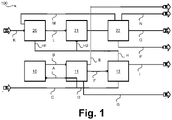
- figure 1 Illustrated is a process 100 for producing olefins according to an embodiment of the present invention.
- Process 100 illustrated is a first feed stream A containing propane and hydrogen to obtain a first product stream B containing at least propylene, propane, ethane, methane and hydrogen Propane dehydrogenation 10 subjected. At least part of the first product stream B is subjected to a first separation sequence 11, 12 comprising a first and a second separation step.
- a gas fraction enriched in hydrogen and methane and a liquid fraction depleted in hydrogen and methane are formed. Part of the hydrogen from the gas fraction is combined with a propane feed C and a propane recycle D to form the first feed stream A. Another part is in the form of a material flow E to the plant boundary (in figure 1 denoted throughout with BL).
- the liquid fraction is fed to the second separation step 12 in the form of a stream F.
- a fraction containing hydrocarbons with four or more carbon atoms is also formed and conducted in the form of a stream G to the plant boundary BL.
- the liquid fraction contains, in particular, ethane and/or ethylene, propane and propylene, as well as lighter components that have not passed into the gas fraction separated off in the first separation step 11 .
- a transfer fraction is formed, which contains ethane and/or ethylene and possibly the lighter components, and which is carried out in the form of a stream H from the second separation step 12.
- a propylene product fraction from the second separation step 12 which is conducted in the form of a stream I to the plant boundary BL, is carried out, as is a propane fraction, which is provided in the form of the recycle stream D already mentioned above.
- a second feed stream K is subjected to a steam cracking 20 to obtain a second product stream L. At least part of the second product stream L is subjected to raw gas compression 21 and then to a second separation sequence 22, the latter being illustrated here in the form of a single functional block, but which can include different separation and processing steps. As illustrated here in the form of alternative streams H1 and H2, the transfer fraction H is transferred to the steam cracking 20 or the raw gas compression 21 .
- a paraffin fraction which is returned to the steam cracking 20 in the form of a recycle stream M
- a tail gas fraction which is in the form of a Material flow N
- an ethylene product fraction which is fed in the form of a material flow O to the plant boundary BL
- a fraction containing hydrocarbons with three or more carbon atoms which is fed in the form of a material flow P to the plant boundary BL.
Landscapes
- Chemical & Material Sciences (AREA)
- Organic Chemistry (AREA)
- Chemical Kinetics & Catalysis (AREA)
- Oil, Petroleum & Natural Gas (AREA)
- Engineering & Computer Science (AREA)
- General Chemical & Material Sciences (AREA)
- Physics & Mathematics (AREA)
- Thermal Sciences (AREA)
- Organic Low-Molecular-Weight Compounds And Preparation Thereof (AREA)
Priority Applications (5)
| Application Number | Priority Date | Filing Date | Title |
|---|---|---|---|
| EP20204783.3A EP3992172A1 (fr) | 2020-10-29 | 2020-10-29 | Procédé et installation de production d'oléfines |
| CA3197303A CA3197303A1 (fr) | 2020-10-29 | 2021-10-29 | Procede et installation pour produire des olefines |
| US18/250,625 US20230399275A1 (en) | 2020-10-29 | 2021-10-29 | Method and Plant for Producing Olefins |
| CN202180072576.7A CN116368110A (zh) | 2020-10-29 | 2021-10-29 | 用于生产烯烃的方法和设备 |
| PCT/EP2021/080124 WO2022090466A1 (fr) | 2020-10-29 | 2021-10-29 | Procédé et installation pour produire des oléfines |
Applications Claiming Priority (1)
| Application Number | Priority Date | Filing Date | Title |
|---|---|---|---|
| EP20204783.3A EP3992172A1 (fr) | 2020-10-29 | 2020-10-29 | Procédé et installation de production d'oléfines |
Publications (1)
| Publication Number | Publication Date |
|---|---|
| EP3992172A1 true EP3992172A1 (fr) | 2022-05-04 |
Family
ID=73039938
Family Applications (1)
| Application Number | Title | Priority Date | Filing Date |
|---|---|---|---|
| EP20204783.3A Withdrawn EP3992172A1 (fr) | 2020-10-29 | 2020-10-29 | Procédé et installation de production d'oléfines |
Country Status (5)
| Country | Link |
|---|---|
| US (1) | US20230399275A1 (fr) |
| EP (1) | EP3992172A1 (fr) |
| CN (1) | CN116368110A (fr) |
| CA (1) | CA3197303A1 (fr) |
| WO (1) | WO2022090466A1 (fr) |
Families Citing this family (1)
| Publication number | Priority date | Publication date | Assignee | Title |
|---|---|---|---|---|
| US20240166580A1 (en) * | 2022-11-23 | 2024-05-23 | Uop Llc | Dehydrogenation and pyrolysis product recovery with a common c3 splitter |
Citations (1)
| Publication number | Priority date | Publication date | Assignee | Title |
|---|---|---|---|---|
| EP3428143A1 (fr) * | 2017-07-12 | 2019-01-16 | Linde Aktiengesellschaft | Procédé et installation de fabrication de propylène par combinaison de déshydrogénation de propane et procédé de vapocraquage avec stages de pre-séparation dans les deux procédés pour éliminer hydrogène et méthane |
Family Cites Families (2)
| Publication number | Priority date | Publication date | Assignee | Title |
|---|---|---|---|---|
| US4458096A (en) * | 1983-05-26 | 1984-07-03 | Air Products And Chemicals, Inc. | Process for the production of ethylene and propylene |
| CN106062149B (zh) * | 2014-02-25 | 2018-09-21 | 沙特基础工业公司 | 集成加氢裂化方法 |
-
2020
- 2020-10-29 EP EP20204783.3A patent/EP3992172A1/fr not_active Withdrawn
-
2021
- 2021-10-29 CN CN202180072576.7A patent/CN116368110A/zh active Pending
- 2021-10-29 WO PCT/EP2021/080124 patent/WO2022090466A1/fr not_active Ceased
- 2021-10-29 US US18/250,625 patent/US20230399275A1/en not_active Abandoned
- 2021-10-29 CA CA3197303A patent/CA3197303A1/fr active Pending
Patent Citations (1)
| Publication number | Priority date | Publication date | Assignee | Title |
|---|---|---|---|---|
| EP3428143A1 (fr) * | 2017-07-12 | 2019-01-16 | Linde Aktiengesellschaft | Procédé et installation de fabrication de propylène par combinaison de déshydrogénation de propane et procédé de vapocraquage avec stages de pre-séparation dans les deux procédés pour éliminer hydrogène et méthane |
Non-Patent Citations (2)
| Title |
|---|
| "Ullmann's Encyclopedia of Industial Chemistry", 2013, article "Propane Dehydrogenation" |
| "Ullmann's Encyclopedia of Industrial Chemistry", 2013, article "Propene" |
Also Published As
| Publication number | Publication date |
|---|---|
| CN116368110A (zh) | 2023-06-30 |
| US20230399275A1 (en) | 2023-12-14 |
| WO2022090466A1 (fr) | 2022-05-05 |
| CA3197303A1 (fr) | 2022-05-05 |
Similar Documents
| Publication | Publication Date | Title |
|---|---|---|
| EP0792928A2 (fr) | Procédé de récupération d'aromates à partir d'essence de reforming et appareillage pour réaliser ce procédé | |
| EP2917305A1 (fr) | Procédé de production de produits oléfiniques par vapocraquage thermique | |
| EP3498668A1 (fr) | Procédé et installation destinées à l'obtention des oléfines | |
| WO2020187572A1 (fr) | Procédé et installation pour la préparation d'une ou plusieurs oléfines | |
| DD202734A5 (de) | Verfahren zur rueckgewinnung von verbrauchtem oel | |
| EP3428143A1 (fr) | Procédé et installation de fabrication de propylène par combinaison de déshydrogénation de propane et procédé de vapocraquage avec stages de pre-séparation dans les deux procédés pour éliminer hydrogène et méthane | |
| EP3068849B1 (fr) | Procédé de séparation d'un mélange d'hydrocarbures | |
| EP3992172A1 (fr) | Procédé et installation de production d'oléfines | |
| EP3652137B1 (fr) | Procédé et installation de fabrication de propylène par combinaison de déshydrogénation de propane et procédé de vapocraquage avec recyclage de propane au procédé de vapocraquage | |
| DE10217866A1 (de) | Verfahren und Vorrichtung zur Olefinherstellung | |
| EP3510008B1 (fr) | Procédé et installation de production de benzène | |
| EP3041916B1 (fr) | Procédé de production d'hydrocarbures | |
| DE2702424A1 (de) | Verfahren zum trennen von aethylen und aethan | |
| DE1810300B2 (de) | Verfahren zur Herstellung von gegen UV-Strahlen stabilisiertem Schmieröl | |
| EP3702016B1 (fr) | Procédé et installation permettant d'obtenir un produit de propylène | |
| WO2020079199A1 (fr) | Procédé et installation pour l'obtention d'éthylène | |
| EP3037503A1 (fr) | Procédé de fabrication et d'utilisation d'un mélange d'hydrocarbures | |
| EP0489371B1 (fr) | Mélanges d'hydrocarbures à haute teneur en arômes monocycliques et bicycliques | |
| EP3931170B1 (fr) | Procédé et installation destinés à la production d'un produit du butylène | |
| DE2005648C3 (de) | Verfahren zur Abtrennung von Aromaten aus Kohlenwasserstoffgemischen beliebigen Aromatengehaltes | |
| EP3041917B1 (fr) | Procédé de production d'hydrocarbures | |
| EP4357441A1 (fr) | Procédé et installation de production de benzène | |
| DE3907570A1 (de) | Verfahren zur abtrennung von wasserstoff aus einem ueberwiegend olefinhaltigen einsatzstrom | |
| EP3159326A1 (fr) | Procede et installation de fabrication d'olefines | |
| AT303702B (de) | Verfahren zur Abtrennung von Aromaten aus Kohlenwasserstoffgemischen beliebigen Aromatengehaltes |
Legal Events
| Date | Code | Title | Description |
|---|---|---|---|
| PUAI | Public reference made under article 153(3) epc to a published international application that has entered the european phase |
Free format text: ORIGINAL CODE: 0009012 |
|
| STAA | Information on the status of an ep patent application or granted ep patent |
Free format text: STATUS: THE APPLICATION HAS BEEN PUBLISHED |
|
| AK | Designated contracting states |
Kind code of ref document: A1 Designated state(s): AL AT BE BG CH CY CZ DE DK EE ES FI FR GB GR HR HU IE IS IT LI LT LU LV MC MK MT NL NO PL PT RO RS SE SI SK SM TR |
|
| STAA | Information on the status of an ep patent application or granted ep patent |
Free format text: STATUS: REQUEST FOR EXAMINATION WAS MADE |
|
| 17P | Request for examination filed |
Effective date: 20221102 |
|
| RBV | Designated contracting states (corrected) |
Designated state(s): AL AT BE BG CH CY CZ DE DK EE ES FI FR GB GR HR HU IE IS IT LI LT LU LV MC MK MT NL NO PL PT RO RS SE SI SK SM TR |
|
| STAA | Information on the status of an ep patent application or granted ep patent |
Free format text: STATUS: THE APPLICATION HAS BEEN WITHDRAWN |
|
| 18W | Application withdrawn |
Effective date: 20240416 |