EP3704838B1 - Émetteur, noeud de réseau, procédé et programme informatique pour transmettre des informations binaires - Google Patents
Émetteur, noeud de réseau, procédé et programme informatique pour transmettre des informations binaires Download PDFInfo
- Publication number
- EP3704838B1 EP3704838B1 EP18778894.8A EP18778894A EP3704838B1 EP 3704838 B1 EP3704838 B1 EP 3704838B1 EP 18778894 A EP18778894 A EP 18778894A EP 3704838 B1 EP3704838 B1 EP 3704838B1
- Authority
- EP
- European Patent Office
- Prior art keywords
- power
- power state
- signal
- transmitter
- state
- Prior art date
- Legal status (The legal status is an assumption and is not a legal conclusion. Google has not performed a legal analysis and makes no representation as to the accuracy of the status listed.)
- Active
Links
Images

Classifications
-
- H—ELECTRICITY
- H04—ELECTRIC COMMUNICATION TECHNIQUE
- H04L—TRANSMISSION OF DIGITAL INFORMATION, e.g. TELEGRAPHIC COMMUNICATION
- H04L27/00—Modulated-carrier systems
- H04L27/02—Amplitude-modulated carrier systems, e.g. using on-off keying; Single sideband or vestigial sideband modulation
- H04L27/04—Modulator circuits; Transmitter circuits
-
- Y—GENERAL TAGGING OF NEW TECHNOLOGICAL DEVELOPMENTS; GENERAL TAGGING OF CROSS-SECTIONAL TECHNOLOGIES SPANNING OVER SEVERAL SECTIONS OF THE IPC; TECHNICAL SUBJECTS COVERED BY FORMER USPC CROSS-REFERENCE ART COLLECTIONS [XRACs] AND DIGESTS
- Y02—TECHNOLOGIES OR APPLICATIONS FOR MITIGATION OR ADAPTATION AGAINST CLIMATE CHANGE
- Y02D—CLIMATE CHANGE MITIGATION TECHNOLOGIES IN INFORMATION AND COMMUNICATION TECHNOLOGIES [ICT], I.E. INFORMATION AND COMMUNICATION TECHNOLOGIES AIMING AT THE REDUCTION OF THEIR OWN ENERGY USE
- Y02D30/00—Reducing energy consumption in communication networks
- Y02D30/70—Reducing energy consumption in communication networks in wireless communication networks
Definitions
- the present disclosure generally relates to a transmitter, a network node, methods therefor, and computer programs for implementing the method.
- the disclosure relates to providing a wireless signal carrying binary information where the signal has improved properties.
- Idle mode listening typically used by devices related to the field commonly referred to as Internet of Things, IoT, in such networks, impacts the overall energy consumption for the devices. This is particularly noticeable when the data traffic is very sporadic.
- EP 1209841 A2 discloses an approach where bidirectional signals are transmitted in one direction as non-return-to-zero (NRZ) coded signals at a first clocking pulse rate, and in the other direction as ON-OFF keying coded signals having pulse transitions at a second clocking pulse rate.
- the second clocking pulse rate is a multiple of the first clocking pulse rate.
- US 2001/017895 A1 discloses approaches of coding a signal for digital optical communication for use in electric home appliances and information equipment capable of infrared communication.
- a method of coding a signal for digital optical communication is disclosed where the spectrum attains a zero level at a prescribed frequency within a main lobe band.
- a communication apparatus includes a processing system configured to encode a first set of information in a plurality of symbols and to encode a second set of information according to a spacing among the symbols.
- Energy reduction may for example be performed by an approach in which it is possible to switch off a main radio frequency interface during inactive periods and to switch it on only if a communication demand occurs. For example, by using a wake-up radio, where a wake-up signal is sent by using a transmitter, received and decoded at the device, wherein the main radio is activated, significant energy consumption reduction may be achieved for many applications.
- MAC medium access control
- PHY physical layer
- the disclosure is based on the inventors' understanding that signal-to-noise gain is achieved by keeping time where actual information is transmitted short.
- a transmitter arranged to transmit binary information using a binary amplitude shift keying where information symbols are represented by a signal including a first power state and a second power state.
- the first power state has a higher signal power than the second power state.
- a duration of a bit includes a first part where the second power state is applied irrespective of which binary value being represented, and a second part where a binary value is represented by any of the first power and a third power state or a combination pattern of the first power state and the third power state.
- the first power state has a higher signal power than the third power state.
- the duration of the second part is equal or less the duration of the first part and the signal power of the first power state is such that the binary values are distinguishably decodable.
- the duration of the second part and the signal power of the first power state are jointly selected.
- the signal power of the first power state is selected to be a maximum power given by any of specified minimum hardware capacity of the transmitter or regulatory limitations, whichever put power boundaries.
- An average power of a bit is predefined, wherein the selection of the signal power of the first power state and the duration of the second part is made based thereon.
- the second part may comprise 1/2 n of the duration of the bit, where n is any of 1, 2 or 3.
- the second and third power states may have equal signal power.
- the second and third power states may include a zero or close to zero signal power.
- the third power state may have a higher signal power than the second power state, and the second power state may include a zero or close to zero signal power.
- the second power state may have a higher signal power than the third power state, and the third power state may include a zero or close to zero signal power.
- the signal may be arranged to represent a first binary value of a symbol by the first power state and a second binary state of a symbol by the third power state during the second part.
- the signal may be arranged such that a first binary value of a symbol is represented by the third power state during a first portion of the second part followed by the first power state during a rest of the second part, and a second binary value of a symbol is represented by the first power state during a first portion of the second part followed by the third power state during a rest of the second part.
- a method performed by a transmitter to transmit binary information using a binary amplitude shift keying where information symbols are represented by a signal including a first power state and a second power state.
- the first power state has a higher signal power than the second power state.
- a duration of a bit includes a first part where the second power state is applied irrespective of which binary value being represented, and a second part where a binary value is represented by any of the first power and a third power state or a combination pattern of the first power state and the third power state.
- the first power state has a higher signal power than the third power state.
- the method comprises selecting the duration of the second part to be equal or less the duration of the first part, selecting the signal power of the first power state such that the binary values are distinguishably decodable, and transmitting the signal using the selected duration of the parts and the selected signal power of the first power state.
- the selecting of the duration of the second part and the selecting of the signal power of the first power state are jointly performed.
- the selecting of the signal power of the first power state is selected to be a maximum power given by any of specified minimum hardware capacity of the transmitter or regulatory limitations, whichever put power boundaries.
- An average power of a bit is predefined, wherein the selecting of the signal power of the first power state and the selecting of the duration of the second part is made based thereon.
- the selecting of the second part may comprise selecting 1/2 n of the duration of the bit, where n is any of 1, 2 or 3.
- the second and third power states may have equal signal power.
- the second and third power states may include a zero or close to zero signal power.
- the third power state may have a higher signal power than the second power state, and the second power state may include a zero or close to zero signal power.
- the second power state may have a higher signal power than the third power state, and the third power state may include a zero or close to zero signal power.
- the signal may be arranged to represent a first binary value of a symbol by the first power state and a second binary state of a symbol by the third power state during the second part.
- the signal may be arranged such that a first binary value of a symbol is represented by the third power state during a first portion of the second part followed by the first power state during a rest of the second part, and a second binary value of a symbol is represented by the first power state during a first portion of the second part followed by the third power state during a rest of the second part.
- a computer program comprising instructions which, when executed on a processor of a transmitter, causes the transmitter to perform the method according to the second aspect.
- a communication apparatus comprising a transmitter according to the first aspect.
- the communication apparatus may be a network node arranged to transmit a wake-up signal arranged to turn on a main transceiver of a remote terminal such that the network node and the remote terminal become enabled to exchange data traffic.
- Fig. 1 schematically illustrates an On-Off Keying, OOK, signal, which is a modulation scheme where the presence of a signal represents the ON part or state and the absence of the signal represents the OFF part or state.
- OOK is considered the simplest form of amplitude-shift keying, ASK, that represents digital data at the presence or absence of a signal.
- ASK amplitude-shift keying
- the presence of a carrier for a specific duration represents a binary one, while its absence for the same duration represents a binary zero.
- Some more sophisticated schemes vary these durations to convey additional information. It is analogous to a unipolar encoding line code.
- OOK is a suitable modulation to use whenever the power consumption of the receiver is a major concern, as the demodulation can be done non-coherently and with very relaxed requirements on gain control and resolution in the receiver.
- Fig. 2 illustrates a data bit with value one is represented by, i.e. encoded to, a logical one followed by a logical zero, whereas a data bit with value zero is represented by a logical zero followed by a logical one.
- the encoding can be swapped so that a data bit with value one is represented by a logical zero followed by a logical one, etc.
- the decoding of the Manchester coded symbol is essentially done by comparing the first and the second half of the symbols and deciding in favour of a logical one if the first half of the symbol has larger power than the second half of the same symbol, or vice versa.
- the average signal level will be removed and thus have no impact on the metric used for making the decision.
- Manchester coded OOK is being standardized within the IEEE 802.11ba task group (TG).
- TG 802.11ba develops a standard for wake-up radios (WUR), targeting to significantly reduce the power consumption in devices based on the 802.11 standard.
- WUR wake-up radios
- IFFT inverse fast Fourier transform
- this block is already available in Wi-Fi transmitters supporting e.g. 802.11a/g/n/ac.
- an approach discussed for generating the OOK is to use the 13 sub-carriers in the centre, possibly excluding the DC carrier, and then populating these with some signal to represent ON and to not transmit anything at all to represent OFF.
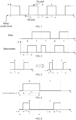
- Figs 3 to 5 illustrate such approaches, where Tz and T NZ denote the time when the ON signal, i.e. where the signal is ON in the examples given in Figs 1 and 2 , is zero and non-zero, respectively.
- Fig. 3 illustrates to the left a traditional Manchester OOK and to the right an adapted keying with zero-padded parts Tz. The potential improvement comes from that the same energy is received during a shorter time T NZ .
- Fig. 4 illustrates a signal with modified OOK by zero-padding of a portion Tz of the symbol time T b
- Fig. 5 illustrates a signal with modified Manchester OOK by zero-padding a portion Tz of the signal part that traditionally would have been ON.
- a limit on the maximum peak power that can be used for the transmissions there is a limit on the maximum peak power that can be used for the transmissions.
- One limitation may be set by a power amplifier used by the transmitter. For this limitation, it needs to be considered how much power back-off is typically needed in order to ensure that the power amplifier is operating in a sufficiently linear range.
- Fig. 6 illustrates an example of an input-output characteristic of a power amplifier. In short, if the modulation uses a large peak-to-average ratio (PAR) a higher back-off is normally required than if a smaller peak-to-average ratio is used.
- Another limitation may be from radio transmission regulations or the used transmission system or radio access technology, i.e. regulatory limitations.
- the average power limitation of 16 dBm will be fulfilled if T NZ is 2 ⁇ s, i.e. 1 ⁇ 4 of T b . i.e. on average the high-power signal is transmitted 2 16 of the time (observing a one and a zero; 2 ⁇ s of high-power signal and total time of 16 ⁇ s). Signal-to-noise gain of 6 dB can thus be achieved at the receiver end.
- a similar effect is achieved for modified Manchester coded OOK as illustrated in Fig. 5 for any bit value probability with T NZ of 1 ⁇ s for respective bit value representation, i.e. on average the high-power signal is transmitted 1 ⁇ 8 of the time (observing any of a one and a zero; 1 ⁇ s of high-power signal and total time of 8 ⁇ s).
- An assumption may be that the approach above may be used for lean or extremely lean transmissions, such as for wake-up signal to a wake-up radio in a receiver, where the wake-up radio has the purpose of receiving the wake-up signal and upon proper decoding thereof initiate operation of a main transceiver of the receiving entity, wherein the main transceiver commences traffic exchange with e.g. a network node.
- the network node may be the entity comprising the transmitter discussed above.
- bit time T b may be relatively long.
- signal energy is distributed along the bit time T b , but as demonstrated above, signal-to-noise gain can be achieved by concentrating signal energy to a part of the bit time T b .
- One approach of doing this is to provide a signal having a first power state, a second power state, and a third power state.
- the first power state is the above referred high-power state, or ON-state, which then has a higher signal power than the second and third power states.
- the second power state is assigned to a first part of the bit time T b , where the power may be zero or close to zero irrespective of which bit value is conveyed during the bit time T b .
- either the first or the third power states are applied, i.e. in case of OOK, or a pattern of the first and third power states are applied, e.g. as the above demonstrated Manchester code, for representing the respective bit values.
- the power levels of the second and third power states are equal, but may differ for achieving certain effects that will be demonstrated below.
- first and second parts may be transmitted in either order, and the first part may even be divided into two portions with one portion transmitted before the second part and the rest transmitted after the second part.
- the term transmitted is here used also for the first part although that part may be silent.
- the first part constitutes at least half of the bit time T b .
- the second and the third power states have signal powers that are zero or close to zero.
- An advantage of having for example the second power state, and also the third power state, non-zero may for example be when being applied in a radio frequency spectrum where a listen-before-talk, LBT, approach is applied. That may facilitate for other entities to spot that the channel is occupied.
- Another advantage may be for the receiver to distinguish the signal or roughly determine synchronisation of the signal.
- the non-zero approach may enable a receiver to distinguish all parts of a signal sequence from when no signal is provided. It is reasonable to assume that a receiver is able to detect a signal at the low-power state(s) which is 30 dB below the high-power state representing the equivalence to the ON state of OOK, or higher, e.g. somewhere between 20 dB and 30 dB below the high-power state.
- the ratio between the high-power state and the low-power state(s) is kept high such that the states are distinguishably decodable, preferably with a ratio corresponding to at least 20 dB.
- the zero approach has the advantage of consuming less power and generating less interference, although the difference may be small to the small power intended for the second and/or third power states of the non-zero approach, but for an average power limitation as discussed above, also the contributions by the second and third power states need to be taken into account for the non-zero approach.
- Figs 7 and 8 illustrate signal schemes for plain OOK and Manchester coding, respectively, according to the suggested approaches.
- a system operating at for example 250 kbits/s and also has a low-rate mode where it operates for example a wake-up radio on 62.5 kbits/s.
- the bitrate when operating on 250 kbits/s is illustrated by dot-dash lines along the timeline, while the bitrate when operating on 62.5 kbits/s is illustrated by dashed lines along the timeline.
- the numerical example demonstrated above applies in sense of relations between average power and peak power.
- the signal is silent (or close to zero) the first 3 ⁇ 4 of the bit time and then the high-power state is applied for the last 1 ⁇ 4 of the bit time.
- a similar approach is provided for the Manchester coding approach in Fig. 8 , but where the last 1 ⁇ 4 of the bit time is used for providing the pattern for respective binary value of the symbol. It should be noted that the last 1 ⁇ 4 of the bit time is here used for easier understanding of a tangible example, but the part having the high-power state or the indicative pattern may of course be present anywhere during the bit pattern that is determined for the system, and thus known by both the transmitter and the receiver.
- the division between the always silent (or close to zero) part and the other part may be changed to 1 ⁇ 2 to 1 ⁇ 2. Similar, if the peak power is sufficient, the division may be selected to be 7 ⁇ 8 to 1 ⁇ 8.
- the short second part will as discussed above provide a signal-to-noise gain.
- the second part preferably should comprise 1/2 n of the duration of the bit, where n is any of 1, 2 or 3.
- a further consideration is that when the above demonstrated approaches are used in a radio frequency spectrum where LBT is to be applied, the long silent (or close to zero) parts may impose problems for other entities to spot that the channel is occupied. This may be solved by for example dividing the second part into portions, e.g. two portions, which are distributed over the bit time. The time T NZ and thus the energy is thus distributed such that a remote entity is more likely to spot that the channel is occupied.
- the second part which may be static or dynamic following certain rules set up for the system such that the transmitter and receiver agrees
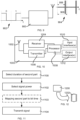
- Fig. 9 schematically illustrates a transmitter 900 which is arranged to transmit binary information using the binary amplitude shift keying demonstrated above with reference to the different embodiments.
- Information symbols 902 are represented by a transmitted signal 904 including the power states demonstrated above.
- the transmitter 900 is thus arranged to provide the signal where the first power state has a higher signal power than the second power state, and the second power state is used during all of a first part 906 of a bit time 908, where the first part 906 is at least half the bit time 908.
- Fig. 10 is a block diagram schematically illustrating a network node 1000 according to an embodiment.
- the network node 1000 comprises an antenna arrangement 1002, a receiver 1004 connected to the antenna arrangement 1002, a transmitter 1006 connected to the antenna arrangement 1002, a processing element 1008 which may comprise one or more circuits, one or more input interfaces 1010 and one or more output interfaces 1012.
- the interfaces 1010, 1012 can be operator interfaces and/or signal interfaces, e.g. electrical or optical.
- the network node 1000 may be arranged to operate in a cellular communication network.
- the processing element 1008 being arranged to perform the embodiments demonstrated with reference to Figs 1 to 9 , the network node 1000 is capable of transmitting a signal as demonstrated above.
- the transmitter 1006 is here to be regarded as either a single transmitter used for both the signal demonstrated above, e.g. wake-up signal, paging signal, control signal, etc., and for other traffic, e.g. associated with a cellular or wireless local area network, or as a transmitter arrangement comprising one transmitter arranged for traffic associated with e.g. a cellular or wireless local area network, and another transmitter arranged and dedicated to provide the signal demonstrated above.
- the processing element 1008 can also fulfil a multitude of tasks, ranging from signal processing to enable reception and transmission since it is connected to the receiver 1004 and transmitter 1006, executing applications, controlling the interfaces 1010, 1012, etc.
- Fig. 11 is a flow chart schematically illustrating methods according to embodiments.
- the method is performed by a transmitter, e.g. any of the transmitters 900, 1006 demonstrated with reference to Figs 9 and 10 , respectively, to transmit binary information using a binary amplitude shift keying where information symbols are represented by a signal including a first power state and a second power state.
- the first power state has a higher signal power than the second power state.
- a duration of a bit includes a first part where the second power state is applied irrespective of which binary value being represented, and a second part where a binary value is represented by any of the first power and a third power state or a combination pattern of the first power state and the third power state.
- the first power state has a higher signal power than the third power state.
- the signal may apply any of the options demonstrated above.
- the method comprises selecting 1100 the duration of the second part to be equal or less the duration of the first part, and selecting 1102 the signal power of the first power state such that the binary values are distinguishably decodable.
- the selections 1100, 1102 are provided jointly, and different rules and limitations are applied.
- the second part is mapped to the bit time according to certain rules, where these rules are to ascertain that the transmitter and a receiver of the signal are in agreement.
- the signal is thus formed as demonstrated above, and is transmitted 1104 using the selected duration of the parts and the selected signal power of the first power state, and where applicable with the selected mapping.
- the methods according to the present disclosure are suitable for implementation with aid of processing means, such as computers and/or processors, especially for the case where the processing element 1008 demonstrated above comprises a processor handling the selection of duration of the second part and the selection of signal power for the first power state, and possibly for the mapping of the second part. Therefore, there is provided computer programs, comprising instructions arranged to cause the processing means, processor, or computer to perform the steps of any of the methods according to any of the embodiments described with reference to Figs 1 to 9 .
- the computer programs preferably comprise program code which is stored on a computer readable medium 1200, as illustrated in Fig.
- FIG. 12 which can be loaded and executed by a processing means, processor, or computer 1202 to cause it to perform the methods, respectively, according to embodiments of the present disclosure, preferably as any of the embodiments described with reference to Figs 1 to 9 .
- the computer 1202 and computer program product 1200 can be arranged to execute the program code sequentially where actions of the any of the methods are performed stepwise, or be made to perform the actions on a real-time basis.
- the processing means, processor, or computer 1202 is preferably what normally is referred to as an embedded system.
- the depicted computer readable medium 1200 and computer 1202 in Fig. 12 should be construed to be for illustrative purposes only to provide understanding of the principle, and not to be construed as any direct illustration of the elements.
Landscapes
- Engineering & Computer Science (AREA)
- Computer Networks & Wireless Communication (AREA)
- Signal Processing (AREA)
- Mobile Radio Communication Systems (AREA)
- Transmitters (AREA)
Claims (17)
- Émetteur (900, 1006) agencé pour transmettre des informations binaires à l'aide d'une modulation par déplacement d'amplitude binaire (902) où des symboles d'informations sont représentés par un signal (904) incluant un premier état de puissance et un deuxième état de puissance, le premier état de puissance présentant une puissance de signal supérieure au deuxième état de puissance, où une durée d'un bit inclut une première partie où le deuxième état de puissance est appliqué indépendamment de la valeur binaire qui est représentée, et une seconde partie où une valeur binaire est représentée par l'un quelconque du premier état de puissance et d'un troisième état de puissance ou d'un motif de combinaison du premier état de puissance et du troisième état de puissance, où le premier état de puissance présente une puissance de signal supérieure au troisième état de puissance, dans lequel la durée de la seconde partie est inférieure ou égale à la durée de la première partie et la puissance de signal du premier état de puissance est telle que les valeurs binaires sont décodables de manière reconnaissable,
caractérisé en ce que la durée de la seconde partie et la puissance de signal du premier état de puissance sont sélectionnées de manière conjointe lorsque la puissance de signal du premier état de puissance est sélectionnée pour être à une puissance maximale donnée par l'une quelconque d'une capacité de matériel minimale spécifiée de l'émetteur ou des limitations réglementaires, peu importe qui a mis des limites de puissance, et la sélection de la puissance de signal du premier état de puissance et de la durée de la seconde partie se base sur une puissance moyenne prédéfinie d'un bit. - Émetteur (900, 1006) selon la revendication 1, dans lequel la seconde partie comprend 1/2n de la durée du bit, où n est égal à l'un quelconque de 1, 2 ou 3.
- Émetteur (900, 1006) selon l'une quelconque des revendications 1 ou 2, dans lequel les deuxième et troisième états de puissance présentent une puissance de signal égale, et dans lequel les deuxième et troisième états de puissance incluent une puissance de signal égale à zéro ou proche de zéro.
- Émetteur (900, 1006) selon l'une quelconque des revendications 1 ou 2, dans lequel le troisième état de puissance présente une puissance de signal supérieure au deuxième état de puissance et le deuxième état de puissance inclut une puissance de signal égale à zéro ou proche de zéro.
- Émetteur (900, 1006) selon l'une quelconque des revendications 1 ou 2, dans lequel le deuxième état de puissance présente une puissance de signal supérieure au troisième état de puissance, et le troisième état de puissance inclut une puissance de signal égale à zéro ou proche de zéro.
- Émetteur (900, 1006) selon l'une quelconque des revendications 1 à 5, dans lequel le signal (904) est agencé pour représenter une première valeur binaire d'un symbole par le premier état de puissance et un second état binaire d'un symbole par le troisième état de puissance pendant la seconde partie.
- Émetteur (900, 1006) selon l'une quelconque des revendications 1 à 5, dans lequel le signal (904) est agencé de telle sorte qu'une première valeur binaire d'un symbole est représentée par le troisième état de puissance pendant une première portion de la seconde partie suivie par le premier état de puissance pendant un reste de la seconde partie, et une seconde valeur binaire d'un symbole est représentée par le premier état de puissance pendant une première portion de la seconde partie suivie par le troisième état de puissance pendant un reste de la seconde partie.
- Procédé mis en oeuvre par un émetteur pour transmettre des informations binaires à l'aide d'une modulation par déplacement d'amplitude binaire où des symboles d'informations sont représentés par un signal incluant un premier état de puissance et un deuxième état de puissance, le premier état de puissance présentant une puissance de signal supérieure au deuxième état de puissance, où une durée d'un bit inclut une première partie où le deuxième état de puissance est appliqué indépendamment de la valeur binaire qui est représentée, et une seconde partie où une valeur binaire est représentée par l'un quelconque du premier état de puissance et d'un troisième état de puissance ou d'un motif de combinaison du premier état de puissance et du troisième état de puissance, où le premier état de puissance présente une puissance de signal supérieure au troisième état de puissance, le procédé comprenantla sélection (1100) de la durée de la seconde partie pour qu'elle soit inférieure ou égale à la durée de la première partie ;la sélection (1102) de la puissance de signal du premier état de puissance de telle sorte que les valeurs binaires sont décodables de manière reconnaissable ; etla transmission (1104) du signal à l'aide de la durée sélectionnée des parties et de la puissance de signal sélectionnée du premier état de puissance,caractérisé en ce que la sélection (1100) de la durée de la seconde partie et la sélection (1102) de la puissance de signal du premier état de puissance sont mises en oeuvre de manière conjointe, dans lequel la sélection (1102) de la puissance de signal du premier état de puissance est sélectionnée pour être une puissance maximale donnée par l'une quelconque d'une capacité de matériel minimale de l'émetteur ou des limitations réglementaires, peu importe qui a mis des limites de puissance et, dans lequel une puissance moyenne d'un bit est prédéfinie, dans lequel la sélection (1102) de la puissance de signal du premier état de puissance et la sélection (1100) de la durée de la seconde partie sont faites sur la base de celle-ci.
- Procédé selon la revendication 8, dans lequel la sélection (1100) de la durée de la seconde partie comprend la sélection de 1/2n de la durée du bit, où n est égal à l'un quelconque de 1, 2 ou 3.
- Procédé selon l'une quelconque des revendications 8 ou 9, dans lequel les deuxième et troisième états de puissance présentent une puissance de signal égale, et dans lequel les deuxième et troisième états de puissance incluent une puissance égale à zéro ou proche de zéro.
- Procédé selon l'une quelconque des revendications 8 ou 9, dans lequel le troisième état de puissance présente une puissance de signal supérieure au deuxième état de puissance, et le deuxième état de puissance inclut une puissance de signal égale à zéro ou proche de zéro.
- Procédé selon l'une quelconque des revendications 8 ou 9, dans lequel le deuxième état de puissance présente une puissance de signal supérieure au troisième état de puissance, et le troisième état de puissance inclut une puissance de signal égale à zéro ou proche de zéro.
- Procédé selon l'une quelconque des revendications 8 à 12, dans lequel le signal est agencé pour représenter une première valeur binaire d'un symbole par le premier état de puissance et un second état binaire d'un symbole par le troisième état de puissance pendant la seconde partie.
- Procédé selon l'une quelconque des revendications 8 à 12, dans lequel le signal est agencé de telle sorte qu'une première valeur binaire d'un symbole est représentée par le troisième état de puissance pendant une première portion de la seconde partie suivie par le premier état de puissance pendant un reste de la seconde partie, et une seconde valeur binaire d'un symbole est représentée par le premier état de puissance pendant une première portion de la seconde partie suivie par le troisième état de puissance pendant un reste de la seconde partie.
- Programme informatique comprenant des instructions qui, lorsqu'elles sont exécutées sur un processeur d'un émetteur, amènent l'émetteur à mettre en oeuvre le procédé selon l'une quelconque des revendications 8 à 14.
- Appareil de communication comprenant un émetteur selon l'une quelconque des revendications 1 à 7.
- Appareil de communication selon la revendication 16, qui est un noeud de réseau agencé pour transmettre un signal de réveil agencé pour mettre en marche un émetteurrécepteur principal d'un terminal distant de telle sorte que le noeud de réseau et le terminal distant sont activés pour échanger un trafic de données.
Applications Claiming Priority (2)
| Application Number | Priority Date | Filing Date | Title |
|---|---|---|---|
| US201762581245P | 2017-11-03 | 2017-11-03 | |
| PCT/EP2018/076067 WO2019086177A1 (fr) | 2017-11-03 | 2018-09-26 | Émetteur, nœud de réseau, procédé et programme informatique pour transmettre des informations binaires |
Publications (2)
| Publication Number | Publication Date |
|---|---|
| EP3704838A1 EP3704838A1 (fr) | 2020-09-09 |
| EP3704838B1 true EP3704838B1 (fr) | 2023-05-17 |
Family
ID=63685985
Family Applications (1)
| Application Number | Title | Priority Date | Filing Date |
|---|---|---|---|
| EP18778894.8A Active EP3704838B1 (fr) | 2017-11-03 | 2018-09-26 | Émetteur, noeud de réseau, procédé et programme informatique pour transmettre des informations binaires |
Country Status (3)
| Country | Link |
|---|---|
| US (1) | US11063797B2 (fr) |
| EP (1) | EP3704838B1 (fr) |
| WO (1) | WO2019086177A1 (fr) |
Families Citing this family (1)
| Publication number | Priority date | Publication date | Assignee | Title |
|---|---|---|---|---|
| WO2024055878A1 (fr) * | 2022-09-16 | 2024-03-21 | 华为技术有限公司 | Procédé de communication et appareil de communication |
Family Cites Families (19)
| Publication number | Priority date | Publication date | Assignee | Title |
|---|---|---|---|---|
| US5920278A (en) | 1997-05-28 | 1999-07-06 | Gregory D. Gibbons | Method and apparatus for identifying, locating, tracking, or communicating with remote objects |
| EP0884865A3 (fr) | 1997-06-12 | 2001-05-30 | Sharp Kabushiki Kaisha | Procédé pour coder un signal pour communication optique numérique |
| JP3362672B2 (ja) | 1998-07-30 | 2003-01-07 | 日本電気株式会社 | Ask変調装置及びask変調方法 |
| US6731873B1 (en) | 2000-11-28 | 2004-05-04 | Marconi Communications, Inc. | Bidirectional optical communications using on-off keying to generate a hybrid form of Manchester serial encoding for one of either upstream or downstream transmission |
| JP4265487B2 (ja) | 2004-06-17 | 2009-05-20 | 富士通株式会社 | リーダー装置、その装置の送信方法及びタグ |
| JP4626530B2 (ja) | 2005-03-31 | 2011-02-09 | パナソニック株式会社 | インパルス無線通信装置 |
| WO2009044365A2 (fr) | 2007-10-03 | 2009-04-09 | Nxp B.V. | Procédé et système d'activation par impulsions radio |
| DE102009009565B4 (de) | 2009-02-19 | 2011-04-28 | Atmel Automotive Gmbh | Empfängerschaltung, Verwendung und Verfahren zum Empfang für ein codiertes und moduliertes Funksignal |
| JP5287902B2 (ja) | 2011-02-28 | 2013-09-11 | カシオ計算機株式会社 | Rfid通信装置及びプログラム |
| JP5269931B2 (ja) * | 2011-02-28 | 2013-08-21 | 株式会社東芝 | 通信装置及びプログラム |
| EP2663110A1 (fr) | 2012-05-11 | 2013-11-13 | BlackBerry Limited | Gestion de données de balise de communication en champ proche |
| US8724662B2 (en) | 2012-06-25 | 2014-05-13 | Johnson & Johnson Vision Care, Inc. | Wireless communication protocol for low power receivers |
| US8942278B2 (en) * | 2012-09-26 | 2015-01-27 | Qualcomm Incorporated | Systems and methods for detecting data collisions for a near field communication system |
| US9787355B2 (en) | 2012-10-26 | 2017-10-10 | Qualcomm, Incorporated | System and method for communication using hybrid signals |
| US20160278013A1 (en) | 2015-03-20 | 2016-09-22 | Qualcomm Incorporated | Phy for ultra-low power wireless receiver |
| CN107770848B (zh) * | 2016-08-15 | 2020-09-11 | 华为技术有限公司 | 通信系统中传输唤醒包的方法和设备 |
| WO2018080047A1 (fr) | 2016-10-31 | 2018-05-03 | 엘지전자 주식회사 | Procédé et dispositif de transmission de paquet de réveil dans un système lan sans fil |
| WO2019008916A1 (fr) | 2017-07-07 | 2019-01-10 | パナソニック インテレクチュアル プロパティ コーポレーション オブ アメリカ | Dispositif d'émission radio et procédé d'émission |
| EP3704839A1 (fr) * | 2017-11-03 | 2020-09-09 | Telefonaktiebolaget LM Ericsson (PUBL) | Récepteur, appareil de communication, procédé et programme informatique pour recevoir des informations binaires |
-
2018
- 2018-09-26 EP EP18778894.8A patent/EP3704838B1/fr active Active
- 2018-09-26 WO PCT/EP2018/076067 patent/WO2019086177A1/fr not_active Ceased
- 2018-09-26 US US16/759,510 patent/US11063797B2/en active Active
Also Published As
| Publication number | Publication date |
|---|---|
| WO2019086177A1 (fr) | 2019-05-09 |
| US20200313941A1 (en) | 2020-10-01 |
| US11063797B2 (en) | 2021-07-13 |
| EP3704838A1 (fr) | 2020-09-09 |
Similar Documents
| Publication | Publication Date | Title |
|---|---|---|
| US10716067B2 (en) | Systems and methods for transmitting a wake-up radio signal to low power devices in a wireless communication system | |
| US11240090B2 (en) | Receiver, communication apparatus, method and computer program | |
| US20180376370A1 (en) | Wakeup packet preamble | |
| CN112425210B (zh) | 唤醒信号的复用 | |
| CN113794664B (zh) | 一种基于子载波扣除的抗干扰方法 | |
| US20210226828A1 (en) | Transmitter, network node, method and computer program | |
| US20250016677A1 (en) | Method for receiving wake-up signals, method for configuring wake-up signals, and device | |
| KR20180041155A (ko) | Ofdm 백채널을 사용한 저전력 무선 통신 | |
| CN113938996B (zh) | 一种无线通信控制信息传输方法和设备 | |
| EP3766196B1 (fr) | Transmission conjointe d'un signal modulé en amplitude avec une transmission d'ofdm | |
| EP3704838B1 (fr) | Émetteur, noeud de réseau, procédé et programme informatique pour transmettre des informations binaires | |
| CN118715827A (zh) | 无线电唤醒信号 | |
| WO2026066843A1 (fr) | Procédés de transmission d'informations, premier nœud de communication, second nœud de communication et support de stockage | |
| WO2025156935A1 (fr) | Procédés d'envoi de signal, procédés de réception de signal et dispositif, système de communication et support de stockage | |
| WO2023097443A1 (fr) | Procédé et appareil pour surveiller un canal de commande, dispositif et support de stockage | |
| WO2019170557A1 (fr) | Procédé, nœud de réseau et programme d'ordinateur permettant d'aligner des performances de portée |
Legal Events
| Date | Code | Title | Description |
|---|---|---|---|
| STAA | Information on the status of an ep patent application or granted ep patent |
Free format text: STATUS: UNKNOWN |
|
| STAA | Information on the status of an ep patent application or granted ep patent |
Free format text: STATUS: THE INTERNATIONAL PUBLICATION HAS BEEN MADE |
|
| PUAI | Public reference made under article 153(3) epc to a published international application that has entered the european phase |
Free format text: ORIGINAL CODE: 0009012 |
|
| STAA | Information on the status of an ep patent application or granted ep patent |
Free format text: STATUS: REQUEST FOR EXAMINATION WAS MADE |
|
| 17P | Request for examination filed |
Effective date: 20200515 |
|
| AK | Designated contracting states |
Kind code of ref document: A1 Designated state(s): AL AT BE BG CH CY CZ DE DK EE ES FI FR GB GR HR HU IE IS IT LI LT LU LV MC MK MT NL NO PL PT RO RS SE SI SK SM TR |
|
| AX | Request for extension of the european patent |
Extension state: BA ME |
|
| DAV | Request for validation of the european patent (deleted) | ||
| DAX | Request for extension of the european patent (deleted) | ||
| STAA | Information on the status of an ep patent application or granted ep patent |
Free format text: STATUS: EXAMINATION IS IN PROGRESS |
|
| 17Q | First examination report despatched |
Effective date: 20210528 |
|
| GRAP | Despatch of communication of intention to grant a patent |
Free format text: ORIGINAL CODE: EPIDOSNIGR1 |
|
| STAA | Information on the status of an ep patent application or granted ep patent |
Free format text: STATUS: GRANT OF PATENT IS INTENDED |
|
| INTG | Intention to grant announced |
Effective date: 20221221 |
|
| GRAS | Grant fee paid |
Free format text: ORIGINAL CODE: EPIDOSNIGR3 |
|
| GRAA | (expected) grant |
Free format text: ORIGINAL CODE: 0009210 |
|
| STAA | Information on the status of an ep patent application or granted ep patent |
Free format text: STATUS: THE PATENT HAS BEEN GRANTED |
|
| AK | Designated contracting states |
Kind code of ref document: B1 Designated state(s): AL AT BE BG CH CY CZ DE DK EE ES FI FR GB GR HR HU IE IS IT LI LT LU LV MC MK MT NL NO PL PT RO RS SE SI SK SM TR |
|
| REG | Reference to a national code |
Ref country code: GB Ref legal event code: FG4D |
|
| REG | Reference to a national code |
Ref country code: DE Ref legal event code: R096 Ref document number: 602018049993 Country of ref document: DE |
|
| REG | Reference to a national code |
Ref country code: CH Ref legal event code: EP |
|
| REG | Reference to a national code |
Ref country code: IE Ref legal event code: FG4D |
|
| REG | Reference to a national code |
Ref country code: AT Ref legal event code: REF Ref document number: 1568860 Country of ref document: AT Kind code of ref document: T Effective date: 20230615 |
|
| REG | Reference to a national code |
Ref country code: LT Ref legal event code: MG9D |
|
| REG | Reference to a national code |
Ref country code: NL Ref legal event code: MP Effective date: 20230517 |
|
| REG | Reference to a national code |
Ref country code: AT Ref legal event code: MK05 Ref document number: 1568860 Country of ref document: AT Kind code of ref document: T Effective date: 20230517 |
|
| PG25 | Lapsed in a contracting state [announced via postgrant information from national office to epo] |
Ref country code: SE Free format text: LAPSE BECAUSE OF FAILURE TO SUBMIT A TRANSLATION OF THE DESCRIPTION OR TO PAY THE FEE WITHIN THE PRESCRIBED TIME-LIMIT Effective date: 20230517 Ref country code: PT Free format text: LAPSE BECAUSE OF FAILURE TO SUBMIT A TRANSLATION OF THE DESCRIPTION OR TO PAY THE FEE WITHIN THE PRESCRIBED TIME-LIMIT Effective date: 20230918 Ref country code: NO Free format text: LAPSE BECAUSE OF FAILURE TO SUBMIT A TRANSLATION OF THE DESCRIPTION OR TO PAY THE FEE WITHIN THE PRESCRIBED TIME-LIMIT Effective date: 20230817 Ref country code: NL Free format text: LAPSE BECAUSE OF FAILURE TO SUBMIT A TRANSLATION OF THE DESCRIPTION OR TO PAY THE FEE WITHIN THE PRESCRIBED TIME-LIMIT Effective date: 20230517 Ref country code: ES Free format text: LAPSE BECAUSE OF FAILURE TO SUBMIT A TRANSLATION OF THE DESCRIPTION OR TO PAY THE FEE WITHIN THE PRESCRIBED TIME-LIMIT Effective date: 20230517 Ref country code: AT Free format text: LAPSE BECAUSE OF FAILURE TO SUBMIT A TRANSLATION OF THE DESCRIPTION OR TO PAY THE FEE WITHIN THE PRESCRIBED TIME-LIMIT Effective date: 20230517 |
|
| PG25 | Lapsed in a contracting state [announced via postgrant information from national office to epo] |
Ref country code: RS Free format text: LAPSE BECAUSE OF FAILURE TO SUBMIT A TRANSLATION OF THE DESCRIPTION OR TO PAY THE FEE WITHIN THE PRESCRIBED TIME-LIMIT Effective date: 20230517 Ref country code: PL Free format text: LAPSE BECAUSE OF FAILURE TO SUBMIT A TRANSLATION OF THE DESCRIPTION OR TO PAY THE FEE WITHIN THE PRESCRIBED TIME-LIMIT Effective date: 20230517 Ref country code: LV Free format text: LAPSE BECAUSE OF FAILURE TO SUBMIT A TRANSLATION OF THE DESCRIPTION OR TO PAY THE FEE WITHIN THE PRESCRIBED TIME-LIMIT Effective date: 20230517 Ref country code: LT Free format text: LAPSE BECAUSE OF FAILURE TO SUBMIT A TRANSLATION OF THE DESCRIPTION OR TO PAY THE FEE WITHIN THE PRESCRIBED TIME-LIMIT Effective date: 20230517 Ref country code: IS Free format text: LAPSE BECAUSE OF FAILURE TO SUBMIT A TRANSLATION OF THE DESCRIPTION OR TO PAY THE FEE WITHIN THE PRESCRIBED TIME-LIMIT Effective date: 20230917 Ref country code: HR Free format text: LAPSE BECAUSE OF FAILURE TO SUBMIT A TRANSLATION OF THE DESCRIPTION OR TO PAY THE FEE WITHIN THE PRESCRIBED TIME-LIMIT Effective date: 20230517 Ref country code: GR Free format text: LAPSE BECAUSE OF FAILURE TO SUBMIT A TRANSLATION OF THE DESCRIPTION OR TO PAY THE FEE WITHIN THE PRESCRIBED TIME-LIMIT Effective date: 20230818 |
|
| PG25 | Lapsed in a contracting state [announced via postgrant information from national office to epo] |
Ref country code: FI Free format text: LAPSE BECAUSE OF FAILURE TO SUBMIT A TRANSLATION OF THE DESCRIPTION OR TO PAY THE FEE WITHIN THE PRESCRIBED TIME-LIMIT Effective date: 20230517 |
|
| PG25 | Lapsed in a contracting state [announced via postgrant information from national office to epo] |
Ref country code: SK Free format text: LAPSE BECAUSE OF FAILURE TO SUBMIT A TRANSLATION OF THE DESCRIPTION OR TO PAY THE FEE WITHIN THE PRESCRIBED TIME-LIMIT Effective date: 20230517 |
|
| PG25 | Lapsed in a contracting state [announced via postgrant information from national office to epo] |
Ref country code: SM Free format text: LAPSE BECAUSE OF FAILURE TO SUBMIT A TRANSLATION OF THE DESCRIPTION OR TO PAY THE FEE WITHIN THE PRESCRIBED TIME-LIMIT Effective date: 20230517 Ref country code: SK Free format text: LAPSE BECAUSE OF FAILURE TO SUBMIT A TRANSLATION OF THE DESCRIPTION OR TO PAY THE FEE WITHIN THE PRESCRIBED TIME-LIMIT Effective date: 20230517 Ref country code: RO Free format text: LAPSE BECAUSE OF FAILURE TO SUBMIT A TRANSLATION OF THE DESCRIPTION OR TO PAY THE FEE WITHIN THE PRESCRIBED TIME-LIMIT Effective date: 20230517 Ref country code: EE Free format text: LAPSE BECAUSE OF FAILURE TO SUBMIT A TRANSLATION OF THE DESCRIPTION OR TO PAY THE FEE WITHIN THE PRESCRIBED TIME-LIMIT Effective date: 20230517 Ref country code: DK Free format text: LAPSE BECAUSE OF FAILURE TO SUBMIT A TRANSLATION OF THE DESCRIPTION OR TO PAY THE FEE WITHIN THE PRESCRIBED TIME-LIMIT Effective date: 20230517 Ref country code: CZ Free format text: LAPSE BECAUSE OF FAILURE TO SUBMIT A TRANSLATION OF THE DESCRIPTION OR TO PAY THE FEE WITHIN THE PRESCRIBED TIME-LIMIT Effective date: 20230517 |
|
| REG | Reference to a national code |
Ref country code: DE Ref legal event code: R097 Ref document number: 602018049993 Country of ref document: DE |
|
| PLBE | No opposition filed within time limit |
Free format text: ORIGINAL CODE: 0009261 |
|
| STAA | Information on the status of an ep patent application or granted ep patent |
Free format text: STATUS: NO OPPOSITION FILED WITHIN TIME LIMIT |
|
| 26N | No opposition filed |
Effective date: 20240220 |
|
| REG | Reference to a national code |
Ref country code: CH Ref legal event code: PL |
|
| PG25 | Lapsed in a contracting state [announced via postgrant information from national office to epo] |
Ref country code: SI Free format text: LAPSE BECAUSE OF FAILURE TO SUBMIT A TRANSLATION OF THE DESCRIPTION OR TO PAY THE FEE WITHIN THE PRESCRIBED TIME-LIMIT Effective date: 20230517 |
|
| PG25 | Lapsed in a contracting state [announced via postgrant information from national office to epo] |
Ref country code: LU Free format text: LAPSE BECAUSE OF NON-PAYMENT OF DUE FEES Effective date: 20230926 |
|
| REG | Reference to a national code |
Ref country code: BE Ref legal event code: MM Effective date: 20230930 |
|
| PG25 | Lapsed in a contracting state [announced via postgrant information from national office to epo] |
Ref country code: SI Free format text: LAPSE BECAUSE OF FAILURE TO SUBMIT A TRANSLATION OF THE DESCRIPTION OR TO PAY THE FEE WITHIN THE PRESCRIBED TIME-LIMIT Effective date: 20230517 Ref country code: LU Free format text: LAPSE BECAUSE OF NON-PAYMENT OF DUE FEES Effective date: 20230926 Ref country code: IT Free format text: LAPSE BECAUSE OF FAILURE TO SUBMIT A TRANSLATION OF THE DESCRIPTION OR TO PAY THE FEE WITHIN THE PRESCRIBED TIME-LIMIT Effective date: 20230517 Ref country code: MC Free format text: LAPSE BECAUSE OF FAILURE TO SUBMIT A TRANSLATION OF THE DESCRIPTION OR TO PAY THE FEE WITHIN THE PRESCRIBED TIME-LIMIT Effective date: 20230517 |
|
| REG | Reference to a national code |
Ref country code: IE Ref legal event code: MM4A |
|
| PG25 | Lapsed in a contracting state [announced via postgrant information from national office to epo] |
Ref country code: IE Free format text: LAPSE BECAUSE OF NON-PAYMENT OF DUE FEES Effective date: 20230926 |
|
| PG25 | Lapsed in a contracting state [announced via postgrant information from national office to epo] |
Ref country code: CH Free format text: LAPSE BECAUSE OF NON-PAYMENT OF DUE FEES Effective date: 20230930 |
|
| PG25 | Lapsed in a contracting state [announced via postgrant information from national office to epo] |
Ref country code: IE Free format text: LAPSE BECAUSE OF NON-PAYMENT OF DUE FEES Effective date: 20230926 Ref country code: FR Free format text: LAPSE BECAUSE OF NON-PAYMENT OF DUE FEES Effective date: 20230930 Ref country code: CH Free format text: LAPSE BECAUSE OF NON-PAYMENT OF DUE FEES Effective date: 20230930 |
|
| PG25 | Lapsed in a contracting state [announced via postgrant information from national office to epo] |
Ref country code: BE Free format text: LAPSE BECAUSE OF NON-PAYMENT OF DUE FEES Effective date: 20230930 |
|
| PG25 | Lapsed in a contracting state [announced via postgrant information from national office to epo] |
Ref country code: BG Free format text: LAPSE BECAUSE OF FAILURE TO SUBMIT A TRANSLATION OF THE DESCRIPTION OR TO PAY THE FEE WITHIN THE PRESCRIBED TIME-LIMIT Effective date: 20230517 |
|
| PG25 | Lapsed in a contracting state [announced via postgrant information from national office to epo] |
Ref country code: BG Free format text: LAPSE BECAUSE OF FAILURE TO SUBMIT A TRANSLATION OF THE DESCRIPTION OR TO PAY THE FEE WITHIN THE PRESCRIBED TIME-LIMIT Effective date: 20230517 |
|
| PG25 | Lapsed in a contracting state [announced via postgrant information from national office to epo] |
Ref country code: CY Free format text: LAPSE BECAUSE OF FAILURE TO SUBMIT A TRANSLATION OF THE DESCRIPTION OR TO PAY THE FEE WITHIN THE PRESCRIBED TIME-LIMIT; INVALID AB INITIO Effective date: 20180926 |
|
| PG25 | Lapsed in a contracting state [announced via postgrant information from national office to epo] |
Ref country code: HU Free format text: LAPSE BECAUSE OF FAILURE TO SUBMIT A TRANSLATION OF THE DESCRIPTION OR TO PAY THE FEE WITHIN THE PRESCRIBED TIME-LIMIT; INVALID AB INITIO Effective date: 20180926 |
|
| PGFP | Annual fee paid to national office [announced via postgrant information from national office to epo] |
Ref country code: DE Payment date: 20250929 Year of fee payment: 8 |
|
| PGFP | Annual fee paid to national office [announced via postgrant information from national office to epo] |
Ref country code: GB Payment date: 20250929 Year of fee payment: 8 |
|
| PG25 | Lapsed in a contracting state [announced via postgrant information from national office to epo] |
Ref country code: TR Free format text: LAPSE BECAUSE OF FAILURE TO SUBMIT A TRANSLATION OF THE DESCRIPTION OR TO PAY THE FEE WITHIN THE PRESCRIBED TIME-LIMIT Effective date: 20230517 |