EP3766196B1 - Transmission conjointe d'un signal modulé en amplitude avec une transmission d'ofdm - Google Patents
Transmission conjointe d'un signal modulé en amplitude avec une transmission d'ofdm Download PDFInfo
- Publication number
- EP3766196B1 EP3766196B1 EP18711529.0A EP18711529A EP3766196B1 EP 3766196 B1 EP3766196 B1 EP 3766196B1 EP 18711529 A EP18711529 A EP 18711529A EP 3766196 B1 EP3766196 B1 EP 3766196B1
- Authority
- EP
- European Patent Office
- Prior art keywords
- amplitude shift
- data signal
- transmission
- ofdm
- signal
- Prior art date
- Legal status (The legal status is an assumption and is not a legal conclusion. Google has not performed a legal analysis and makes no representation as to the accuracy of the status listed.)
- Active
Links
Images




Classifications
-
- H—ELECTRICITY
- H04—ELECTRIC COMMUNICATION TECHNIQUE
- H04L—TRANSMISSION OF DIGITAL INFORMATION, e.g. TELEGRAPHIC COMMUNICATION
- H04L27/00—Modulated-carrier systems
- H04L27/02—Amplitude-modulated carrier systems, e.g. using on-off keying; Single sideband or vestigial sideband modulation
-
- H—ELECTRICITY
- H04—ELECTRIC COMMUNICATION TECHNIQUE
- H04J—MULTIPLEX COMMUNICATION
- H04J11/00—Orthogonal multiplex systems, e.g. using WALSH codes
- H04J11/0023—Interference mitigation or co-ordination
- H04J11/0026—Interference mitigation or co-ordination of multi-user interference
- H04J11/003—Interference mitigation or co-ordination of multi-user interference at the transmitter
-
- H—ELECTRICITY
- H04—ELECTRIC COMMUNICATION TECHNIQUE
- H04L—TRANSMISSION OF DIGITAL INFORMATION, e.g. TELEGRAPHIC COMMUNICATION
- H04L27/00—Modulated-carrier systems
- H04L27/26—Systems using multi-frequency codes
- H04L27/2601—Multicarrier modulation systems
- H04L27/2602—Signal structure
- H04L27/2605—Symbol extensions, e.g. Zero Tail, Unique Word [UW]
- H04L27/2607—Cyclic extensions
-
- H—ELECTRICITY
- H04—ELECTRIC COMMUNICATION TECHNIQUE
- H04L—TRANSMISSION OF DIGITAL INFORMATION, e.g. TELEGRAPHIC COMMUNICATION
- H04L27/00—Modulated-carrier systems
- H04L27/26—Systems using multi-frequency codes
- H04L27/2601—Multicarrier modulation systems
- H04L27/2626—Arrangements specific to the transmitter only
- H04L27/2646—Arrangements specific to the transmitter only using feedback from receiver for adjusting OFDM transmission parameters, e.g. transmission timing or guard interval length
-
- H—ELECTRICITY
- H04—ELECTRIC COMMUNICATION TECHNIQUE
- H04L—TRANSMISSION OF DIGITAL INFORMATION, e.g. TELEGRAPHIC COMMUNICATION
- H04L5/00—Arrangements affording multiple use of the transmission path
- H04L5/003—Arrangements for allocating sub-channels of the transmission path
- H04L5/0044—Allocation of payload; Allocation of data channels, e.g. PDSCH or PUSCH
-
- H—ELECTRICITY
- H04—ELECTRIC COMMUNICATION TECHNIQUE
- H04L—TRANSMISSION OF DIGITAL INFORMATION, e.g. TELEGRAPHIC COMMUNICATION
- H04L5/00—Arrangements affording multiple use of the transmission path
- H04L5/003—Arrangements for allocating sub-channels of the transmission path
- H04L5/0058—Allocation criteria
- H04L5/0062—Avoidance of ingress interference, e.g. ham radio channels
-
- H—ELECTRICITY
- H04—ELECTRIC COMMUNICATION TECHNIQUE
- H04W—WIRELESS COMMUNICATION NETWORKS
- H04W52/00—Power management, e.g. Transmission Power Control [TPC] or power classes
- H04W52/02—Power saving arrangements
- H04W52/0209—Power saving arrangements in terminal devices
- H04W52/0225—Power saving arrangements in terminal devices using monitoring of external events, e.g. the presence of a signal
- H04W52/0229—Power saving arrangements in terminal devices using monitoring of external events, e.g. the presence of a signal where the received signal is a wanted signal
Definitions
- the present disclosure generally relates to a transmitter, a network node, methods therefor, and computer programs for implementing the method.
- the disclosure relates to transmitting a wireless signal carrying binary information.
- the telecommunications domain has often so forth been accompanied by a significant increase of electrical energy consumption.
- Demands on performance such as spectral efficiency or data rate, have been met at the expense of more energy consumption.
- Advances in analogue and digital electronics have enabled development of low-cost, low-energy wireless nodes.
- energy consumption remains an issue for some applications.
- the approach used for idle mode listening, especially when used by devices related to the field commonly referred to as Internet of Things, IoT, in wireless networks impacts the overall energy consumption for the devices. This is particularly noticeable when the data traffic is very sporadic.
- Energy reduction may for example be performed by an approach in which it is possible to switch off a radio frequency main interface during inactive periods and to switch it on only if a communication demand occurs. For example, by using a wake-up radio, where a wake-up signal is sent by using a transmitter, received and decoded at the device, wherein the main radio is activated, significant energy consumption reduction may be achieved for many applications.
- MAC medium access control
- Wake-up radio is a technology being discussed for achieving such reduction in energy consumption, and is for example a topic in the 802.11 Task Group 802.11ba where it is decided to use an on/off keying (OOK) modulation scheme together with Manchester coding.
- OOK on/off keying
- the reason for using OOK is that it may be demodulated using an envelope detector, which can be implemented at very low complexity.
- TDD time division duplex
- NB-IoT narrow-band Internet of Things
- 3GPP 3 rd Generation Partnership Project
- PHY physical layer
- OOK On-Off Keying
- Fig. 1 is a modulation scheme where the presence of a signal represents the ON part or state and the absence of the signal represents the OFF part or state.
- the ON and OFF parts could represent binary digits, or the transition between ON to OFF state and OFF to ON state could represent binary digits.
- OOK is considered the simplest form of amplitude-shift keying, ASK, that represents digital data at the presence or absence of a signal. In its simplest form, the presence of a carrier for a specific duration represents a binary one, while its absence for the same duration represents a binary zero. Some more sophisticated schemes vary these durations to convey additional information.
- OOK is analogous to unipolar encoding, which is a special case of a line code.
- OOK is a suitable modulation to use whenever the power consumption of the receiver is a major concern, as the demodulation can be done non-coherently, with very relaxed requirements on gain control and resolution in the receiver.
- Fig. 2 illustrates a data bit with value one is represented by, i.e. encoded to, a logical one followed by a logical zero, whereas a data bit with value zero is represented by a logical zero followed by a logical one.
- the encoding can be swapped so that a data bit with value one is represented by a logical zero followed by a logical one, etc.
- the decoding of the Manchester coded symbol is essentially done by comparing the first and the second half of the symbols and deciding in favour of a logical one if the first half of the symbol has larger energy than the second half of the same symbol, or vice versa.
- energy one can also use other means of measuring the signal level, for example absolute signal-envelope averaged over the symbol duration.
- Manchester coded OOK is being standardized within the IEEE 802.11ba task group (TG).
- TG 802.11ba develops a standard for wake-up radios (WUR), targeting to significantly reduce the power consumption in devices based on the IEEE 802.11 standard.
- WUR wake-up radios
- IFFT inverse fast Fourier transform
- this block is already available in Wi-Fi transmitters supporting e.g. IEEE 802.11a/g/n/ac.
- an approach discussed for generating the OOK is to use the 13 sub-carriers in the centre, possibly excluding the DC carrier, and then populating these with some signal to represent ON and to not transmit anything at all to represent OFF.
- Figs 3 to 5 illustrate such approaches, where Tz and T NZ denote the time when the ON signal, i.e. where the signal is ON in the examples given in Figs 1 and 2 , is zero and non-zero, respectively.
- Fig. 3 illustrates to the left a traditional Manchester OOK and to the right an adapted keying with zero-padded parts Tz. The potential improvement comes from that the same energy is received during a shorter time T NZ .
- Fig. 4 illustrates a signal with modified OOK by zero-padding of a portion Tz of the symbol time T b
- Fig. 5 illustrates a signal with modified Manchester OOK by zero-padding a portion Tz of the signal part that traditionally would have been ON.
- Figs 6 to 9 illustrate variants thereof where representation and placement of zero-padding portion are varied.
- the zero-padding portion may for example be used as guard intervals for limiting inter-symbol interference with adjacent symbols.
- the signal should have a guard interval (GI) before an "on" period when using on/off keying, as for example shown in submission IEEE 802.11-17/0696r0 with title " Blank GI for the Waveform Coding" by J. Suh et al, May 2017 .
- GI guard interval
- the benefit with this is that the power of the "on" period can be boosted since the allowed power is calculated over a certain time. Put shortly, if the same energy of the signal can be sent in shorter time, and thereby also received in shorter time, the received signal used for demodulation will contain less noise energy and consequently the signal-to-noise-ratio of the signal will be improved.
- Figs 10 and 11 illustrates application of guard intervals, GI, when applying Manchester coded OOK, and illustrate comparisons with traditional Manchester coded OOK and with traditional OFDM transmissions.
- Fig. 10 illustrates providing one Manchester coded OOK symbol, i.e. representing a bit, per time of two OFDM symbols of the considered OFDM transmission, while Fig. 11 illustrates a one-to-one relationship between the OFDM symbol time and the time for each Manchester coded OOK.
- XIAOFEI WANG (INTERDIGITAL): "On the Coexistence of 802.11ax and 802.11ba Signals",vol. 802.11ba, no. 3, 11 May 2017, pages 1-21 also discloses co-existence of OOK symbols and 802.11ax symbols.
- Fig. 12 illustrates a traditional packet format used for example in IEEE 802.11a.
- a preamble is provided comprising training fields, short training field (STF) providing initial timing synchronisation and frequency estimate and long training field (LTF), two symbols each, providing fine timing and frequency synchronisation and channel response estimation, and a signal field (SIG), one symbol, comprising control information.
- STF short training field
- LTF long training field
- SIG signal field
- the preamble is followed by data symbols (Data1 - DataN).
- the training fields are direct sequence spread spectrum modulated while the signal field and data fields are OFDM transmissions.
- the preamble format demonstrated here is often referred to as "legacy preamble" and is commonly reused as part of preamble in other flavours of IEEE 802.11.
- OOK transmissions are in nature best suited for low-rate transmissions, and are furthermore often used in applications where link budget is demanding. Coexistence with more complex transmissions, such as the above demonstrated OFDM transmissions may become an issue when OOK transmissions occupy a common spectrum. It is therefore a desire to provide an approach for efficient coexistence.
- the disclosure is based on the inventors' understanding that aligning of concurrently operating systems will make operation more efficient.
- the inventors have further realised that by aligning one of the systems to an extended part of the other system, where the extended part comprises redundant or no information, effects of interference on the other system may be limited.
- a method of transmitting an amplitude shift keying signal comprises determining timing of an Orthogonal Frequency Division Multiplex, OFDM, transmission of a concurrently operating transmission system.
- the OFDM transmission applies an extended representation for at least a part of the transmitted OFDM transmission.
- the extended representation comprises an extended part.
- the method further comprises representing a data signal to be transmitted by amplitude shift keying.
- the method also comprises transmitting the amplitude shift keyed data signal intermittently aligned with the OFDM transmission such that symbols of the amplitude shift keyed data signal occurs only during the extended part of the OFDM transmission.
- the extended part may comprise a cyclic prefix.
- Symbols of the amplitude shift keyed data signal may be transmitted only during payload symbols of the OFDM transmission.
- One amplitude shift keyed data signal symbol per extended representation may be used for the symbols where the amplitude shift keyed data signal occurs.
- one amplitude shift keyed data signal symbol per a plurality of extended representations may be used for the symbols where the amplitude shift keyed data signal occurs.
- the alignment with the OFDM transmission may be such that symbols of the amplitude shift keyed data signal are provided with a guard interval to the beginning or end of the extended representation of the OFDM transmission, wherein no amplitude shift keyed data signal transmission is performed during the guard interval.
- the representing of the data signal to be transmitted by amplitude shift keying may be performed by on-off keying.
- the representing of the data signal to be transmitted by amplitude shift keying may be performed by applying a Manchester code.
- the data signal may be representing a wake-up signal arranged to address a wake-up radio.
- a computer program comprising instructions which, when executed on a processor of a network node, causes the network node to perform the method according to the first aspect.
- a transmitter arranged to provide a data signal by performing the method according to the first aspect.
- a network node comprising the transmitter according to the third aspect.
- the network node may be arranged to operate as a combined access point for both the OFDM transmissions and the amplitude shift keying data signal transmissions, wherein the determining of timing of the OFDM transmission of the concurrently operating transmission system is provided within the network node.
- the network node may be arranged to operate as an access point for the amplitude shift keying data signal transmissions, wherein the network node comprises an interface for the determining of timing of the OFDM transmission of the concurrently operating transmission system.
- the interface may be arranged to receive transmissions comprising training fields transmitted by the concurrently operating transmission system for the determining of the timing of the OFDM transmission of the concurrently operating transmission system based on the received training fields.
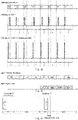
- Fig. 13 is a signal diagram illustrating some examples of transmitting an amplitude shift keyed data signal intermittently aligned with an OFDM transmission, illustrated at top, such that symbols of the amplitude shift keyed data signal occurs only during the extended part, here cyclic prefix illustrated, of the OFDM transmission.
- a pure OOK transmission occupying an essential part of the extended part with one OOK symbol per extended part, i.e. per OFDM symbol, is illustrated.
- An advantage of applying the approach of omitting usage of symbol space at some time instants, which may be referred to as puncturing, may be that average power level for the amplitude shift keying signal can be kept within bounds while the signal energy for respective amplitude shift keying symbol can be kept fairly high.
- Fig. 13 uses a per extended part as symbol as a timing unit, optionally with puncturing as given by the third example of Fig. 13 , and pure OOK, other approaches are feasible.
- Fig. 14 illustrates examples according to an embodiment where Manchester coding (or similar) is used and taking two OFDM symbol times for putting in the two parts of the Manchester coding in alignment with respective extended part of the OFDM transmission.
- the symbol rate of the amplitude shift keyed data signal will thus be half of that illustrated in Fig. 13 , or less since the puncturing approach as illustrated in Fig. 13 may be applied here as well although not illustrated, i.e. leaving some extended parts of the OFDM signal unused.
- a Manchester coded transmission occupying an essential part of the extended parts with one amplitude shift keyed symbol per two extended parts, i.e. per two OFDM symbols, is illustrated.
- Second, a similar approach as the first example is illustrated, but with the addition that a guard interval is applied to limit signal leakage of the amplitude shift keyed signal outside the time slot of the extended part.
- Fig. 15 illustrates examples according to an embodiment where Manchester coding (or similar) is used within a single extended part.
- Manchester coding or similar
- a Manchester coded transmission occupying an essential part of the extended part with one amplitude shift keyed symbol per extended part, i.e. one per OFDM symbol, is illustrated.
- Second, a similar approach as the first example is illustrated, but with the addition that a guard interval is applied to limit signal leakage of the amplitude shift keyed signal outside the time slot of the extended part.
- the symbol rate of the amplitude shift keyed data signal will thus be the same of that illustrated in Fig. 13 , or less since the puncturing approach as illustrated in Fig. 13 may be applied here as well although not illustrated, i.e. leaving some extended parts of the OFDM signal unused.
- the amplitude shift keyed data signal may be used for a wake-up signal, WUS, intended to provide a control signal for a wake-up receiver arranged to control on and off states of a main transceiver of the communication apparatus based on the signal received by the receiver.
- WUS wake-up signal
- the approach with WUS and wake-up receivers may be used for lean or extremely lean transmissions, where the wake-up receiver has the purpose of receiving the wake-up signal and upon proper decoding thereof initiate operation of a main transceiver of the receiving entity, wherein the main transceiver commences traffic exchange with e.g. a network node.
- the wake-up receiver has the purpose of receiving the wake-up signal and upon proper decoding thereof initiate operation of a main transceiver of the receiving entity, wherein the main transceiver commences traffic exchange with e.g. a network node.
- Fig. 16 is a rough signal diagram illustrating timing of OFDM transmissions by a concurrently operating transmission system, similar as the one demonstrated above with reference to Fig. 12 , and the corresponding suitable timings of a WUS, taking into account the more detailed timing demonstrated in any one of Figs 13 to 15 , since SIG and Data symbols of the OFDM transmission normally apply an extended part, e.g. cyclic prefix.
- the WUS transmitter may receive the training symbols STF, LTF of the concurrently operating transmission system and thereby acquire synchronisation to be enabled to align the WUS to the extended parts, e.g. cyclic prefix, of the OFDM symbols transmitted by the concurrently operating transmission system when the concurrently operating transmission system transmits the SIG and Data symbols.
- the extended parts e.g. cyclic prefix
- Fig. 17 is a signal diagram which illustrates an example of alignment between OFDM signal and WUS.
- a guard interval is provided to limit the risk of WUS interfering the non-extended part of the OFDM symbol, e.g. due to dispersion of signal over the channel and/or propagation time between entities.
- the size of the guard interval may be selected on one hand to provide sufficient limitation of the risk of the WUS to interfere the non-extended part of the OFDM symbol, and on the other hand to provide sufficient time for the amplitude shift keyed symbol within the time of the extended part of the OFDM symbol.
- the length of the extended part can be configured, e.g. in the case of IEEE 802.11ax where length of cyclic prefix can be selected, it can for example be beneficial to choose a long cyclic prefix length, e.g. 3.2 ⁇ s. In this way there is more freedom to place the amplitude shift keyed symbol, and thus to provide a sufficient guard interval.
- the amplitude shift keyed symbol could have a duration of 2.4 ⁇ s, i.e.
- 0.8 ⁇ s is the cyclic prefix length used in IEEE 802.11a/g and most often in IEEE 802.11n/ac, so a guard interval of 0.8 ⁇ s as demonstrated above should be sufficient for almost any case.
- the generous time budget may be used to spread the amplitude shift keyed symbol in time to provide a sufficient symbol energy with limited maximum power, possibly at expense of the length of the guard interval.
- the synchronisation to the OFDM transmission to enable the alignment of the amplitude shift keyed symbol may be provided in different ways.
- the systems may for example be co-located, wherein common control may provide for the synchronisation.
- the WUS transmitter receives training symbols of the concurrently operating transmission system and thus is enabled to synchronise.
- the WUS transmission may in such cases be like demonstrated with reference to Fig. 16 .
- the configuration may be provided by the concurrently operating transmission system in the SIG symbol, wherein the commencement of WUS transmission reasonably is after the SIG symbol, and the WUS transmitter configures the symbol time and guard interval based on control information provided in the SIG symbol.
- Fig. 18 is a flow chart schematically illustrating a method of transmitting an amplitude shift keying signal according to embodiments.
- the transmitting entity of the amplitude shift keying signal determines 1800 timing of an Orthogonal Frequency Division Multiplex, OFDM, transmission of a concurrently operating transmission system.
- OFDM Orthogonal Frequency Division Multiplex
- the OFDM transmission is expected to apply an extended representation for at least a part of the transmitted OFDM transmission.
- the extended representation comprises an extended part, e.g. a cyclic prefix or a zero-padded part.
- the extended part may be selectable, wherein the determination 1800 also may comprise determining duration of the extended part.
- the transmitting entity of the amplitude shift keying signal represents 1802 a data signal to be transmitted by amplitude shift keying. For example, OOK or Manchester coded OOK, with or without a guard interval, as demonstrated above.
- the transmitting entity then transmits 1804 the amplitude shift keyed data signal intermittently aligned with the OFDM transmission such that symbols of the amplitude shift keyed data signal occurs only during the extended part of the OFDM transmission.
- the transmission by the concurrently operating transmission system may only apply OFDM symbols with extended part for some parts of the transmission, e.g. for payload symbols. In such cases, symbols of the amplitude shift keyed data signal are transmitted only during payload symbols of the OFDM transmission.
- the transmitted amplitude shift keying signal may be used as a wake-up signal in a wake-up radio employment where a low-complexity wake-up receiver can receive the signal and activate a more complex transceiver arrangement on demand, and thereby save energy compared with keeping the complex transceiver active all the time.
- a processing element 2208 demonstrated below comprises a processor handling the alignment between the amplitude shift keying signal and the OFDM signal as demonstrated above. Therefore, there is provided computer programs, comprising instructions arranged to cause the processing means, processor, or computer to perform the steps of any of the methods according to any of the embodiments described with reference to Figs 13 to 18 .
- the computer programs preferably comprise program code which is stored on a computer readable medium 1900, as illustrated in Fig.
- FIG. 19 which can be loaded and executed by a processing means, processor, or computer 1902 to cause it to perform the methods, respectively, according to embodiments of the present disclosure, preferably as any of the embodiments described with reference to Figs 13 to 18 .
- the computer 1902 and computer program product 1900 can be arranged to execute the program code sequentially where actions of the any of the methods are performed stepwise, or be made to perform the actions on a real-time basis.
- the processing means, processor, or computer 1902 is preferably what normally is referred to as an embedded system.
- the depicted computer readable medium 1900 and computer 1902 in Fig. 19 should be construed to be for illustrative purposes only to provide understanding of the principle, and not to be construed as any direct illustration of the elements.
- Fig. 20 is a block diagram schematically illustrating a system comprising an integrated network node 2000 comprising an access point for the OFDM transmissions and an access point for providing the WUS, a station 2020 arranged for transmission and/or reception of OFDM signals, and a wake-up receiver 2010.
- the transmitting entity of the amplitude shift keying signal is the network node 2000 since it comprises the access point for providing the WUS.
- An advantage of the integrated network node 2000 is that the network node inherently provides the possibility to align the transmissions of the WUS with the OFDM transmissions as discussed above.
- the setup may be that a WiFi access point 2000 may have the WUS transmitter as an addon.
- Fig. 21 is a block diagram schematically illustrating a system comprising separate network nodes for an access point 2100 for the OFDM transmissions and an access point 2105 for providing the WUS, and a station 2120 arranged for transmission and/or reception of OFDM signals, and a wake-up receiver 2110.
- the transmitting entity of the amplitude shift keying signal is the access point 2105 for providing the WUS.
- the access point 2105 for providing the WUS is arranged to operate as an access point for the amplitude shift keying data signal transmissions.
- the access point 2105 for providing the WUS comprises an interface for the determining of timing of the OFDM transmission of the concurrently operating transmission system.
- the interface may according to one embodiment be arranged to exchange a control signal between the access point for the OFDM transmissions and the access point for providing the WUS from which the timing can be determined.
- the exchange of the control signal may be wired or wireless.
- the interface is arranged to receive transmissions comprising training fields, e.g. Short Training Field (STF) and Long Training Field (LTF) as illustrated in Fig. 16 , transmitted by the concurrently operating transmission system.
- STF Short Training Field
- LTF Long Training Field
- the access point for providing the WUS is able to determine the timing of the OFDM transmission of the concurrently operating transmission system based on the received training fields.
- the access point for providing the WUS is then able to align transmissions of the WUS to extended parts, e.g. signalling (SIG) and data symbols provided by the concurrently operating transmission system following the training fields transmissions, as illustrated in Fig. 16 .
- SIG signalling
- An advantage of the latter embodiment is that establishment of a dedicated control signal between the access points can be omitted.
- commencement of the WUS transmission may depend on when the access node 2105 for providing the WUS has gained enough information to align the transmissions of the WUS with the OFDM transmissions.
- control information in the SIG symbol see e.g. Figs 12 and 16 , may be required before commencing transmission.
- the propagation times for transmissions to reach the station arranged for transmission and/or reception of OFDM signals and the wake-up receiver, respectively do not differ to such an extent that it will jeopardize the alignment. This is particularly the case where guard intervals are applied.
- actions may be taken by for example applying timing advance to maintain alignment, or by increasing guard intervals.
- Increasing guard intervals may for example be made at expense of transmission rate, e.g. by applying the second example demonstrated with reference to Fig. 14 together with a large ratio between pulse width and the width of the extended part, e.g.
- short pulse and/or long cyclic prefix may call for using puncturing as demonstrated with the last example of Fig. 13 , i.e. not using all extended parts.
- Selecting long cyclic prefix is for example feasible for IEEE 802.11ax.
- Fig. 22 is a block diagram schematically illustrating elements of a transmitting entity 2200 of the amplitude shift keying signal as mentioned with reference to the method demonstrated above, and included in any one of the network node 2000 and the access point 2105 demonstrated with reference to Figs. 20 and 21 , respectively.
- the transmitting entity 2200 comprises an antenna arrangement 2202, a transmitter 2206 and a processor 2208.
- the processor 2208 is arranged to determine timing of the OFDM transmission of the concurrently operating transmission system, represent the data signal to be transmitted by amplitude shift keying.
- the transmitter 2206 is provided with the representation and timing, and is arranged to transmit, through the antenna arrangement 2202, the amplitude shift keyed data signal intermittently aligned with the OFDM transmission such that symbols of the amplitude shift keyed data signal occurs only during the extended part of the OFDM transmission, as demonstrated above.
- the transmitting entity 2200 may be provided with interfaces 2210, 2212 according to the properties of the control signal exchange, e.g. electrical or optical. For example, if the transmitting entity is only receiving a control signal, an input interface 2210 is required, but if a mutual exchange of control signals is desired, both the input interface 2210 and an output interface 2212 may be required.
- the transmitting entity comprises a receiver 2204 which may be connected to the antenna arrangement 2202. The receiver 2204 may thus be considered as a wireless interface.
- the receiver 2204 is then arranged to receive the training signals STF, LTF and possibly the control signalling SIG and provide the acquired information to the processor 2208 such that the processor is enabled to make the determinations from the acquired information.
- the processing element 2208 may also fulfil a multitude of tasks, ranging from signal processing to enable reception and transmission since it is connected to the receiver 2204 and transmitter 2206, receiving and providing control signals through the interfaces 2210, 12, executing applications, controlling the interfaces 2210, 2212, etc.
- the interfaces 2210, 2212 can further comprise operator interfaces and/or signal interfaces, e.g. electrical or optical.
Landscapes
- Engineering & Computer Science (AREA)
- Signal Processing (AREA)
- Computer Networks & Wireless Communication (AREA)
- Mobile Radio Communication Systems (AREA)
Claims (15)
- Procédé de transmission d'un signal de modulation par déplacement d'amplitude, le procédé comprenant
la détermination (1800) de temporisation d'une transmission en multiplexage par répartition orthogonale de la fréquence, OFDM, d'un système de transmission fonctionnant simultanément, dans lequel la transmission OFDM applique une représentation étendue pour au moins une partie de la transmission OFDM transmise, laquelle représentation étendue comprend une partie étendue ; la représentation (1802) d'un signal de données à transmettre par modulation par déplacement d'amplitude ; caractérisé par la transmission (1804) du signal de données modulé par déplacement d'amplitude aligné de façon intermittente avec la transmission OFDM de sorte que des symboles du signal de données modulé par déplacement d'amplitude se produisent uniquement pendant la partie étendue de la transmission OFDM. - Procédé selon la revendication 1, dans lequel la partie étendue comprend un préfixe cyclique.
- Procédé selon la revendication 1 ou 2, dans lequel des symboles du signal de données modulé par déplacement d'amplitude sont transmis uniquement pendant des symboles de données utiles de la transmission OFDM.
- Procédé selon l'une quelconque des revendications 1 à 3, dans lequel un symbole de signal de données modulé par déplacement d'amplitude par représentation étendue est utilisé pour les symboles où le signal de données modulé par déplacement d'amplitude se produit.
- Procédé selon les revendications 1 à 3, dans lequel un symbole de signal de données modulé par déplacement d'amplitude pour une pluralité de représentations étendues est utilisé pour les symboles où le signal de données modulé par déplacement d'amplitude se produit.
- Procédé selon l'une quelconque des revendications 1 à 5, dans lequel l'alignement avec la transmission OFDM est tel que des symboles du signal de données modulé par déplacement d'amplitude sont pourvus d'un intervalle de protection au début ou à la fin de la représentation étendue de la transmission OFDM, dans lequel aucune transmission de signal de données modulé par déplacement d'amplitude n'est mise en œuvre pendant l'intervalle de protection.
- Procédé selon l'une quelconque des revendications 1 à 6, dans lequel la représentation (1802) du signal de données à transmettre par modulation par déplacement d'amplitude est mise en œuvre par une modulation par tout ou rien.
- Procédé selon l'une quelconque des revendications 1 à 6, dans lequel la représentation (1802) du signal de données à transmettre par modulation par déplacement d'amplitude est mise en œuvre par application d'un code de Manchester.
- Procédé selon l'une quelconque des revendications 1 à 8, dans lequel le signal de données représente un signal de réveil agencé pour adresser un réveil radio.
- Programme informatique comprenant des instructions qui, lorsqu'il est exécuté sur un processeur (1902, 2208) d'un nœud de réseau (2000, 2105, 2200), amène le nœud de réseau (2000, 2105, 2200) à mettre en œuvre le procédé selon l'une quelconque des revendications 1 à 9.
- Transmetteur (2200) agencé pour fournir un signal de données en mettant en œuvre le procédé selon l'un quelconque des articles 1 à 9.
- Nœud de réseau (2000, 2105) comprenant le transmetteur (2200) selon la revendication 11.
- Nœud de réseau (2000) selon la revendication 12 étant agencé pour fonctionner en tant que point d'accès combiné à la fois pour la transmission OFDM et pour la transmission de signal de données à modulation par déplacement d'amplitude, dans lequel la détermination de temporisation de la transmission OFDM du système de transmission fonctionnant simultanément est fournie au sein du nœud de réseau.
- Nœud de réseau (2105) selon la revendication 12 étant agencé pour fonctionner en tant que point d'accès pour la transmission de signal de données à modulation par déplacement d'amplitude, dans lequel le nœud de réseau comprend une interface (2204, 2210, 2212) pour la détermination de temporisation de la transmission OFDM du système de transmission fonctionnant simultanément.
- Nœud de réseau (2105) selon la revendication 14, dans lequel l'interface (2204) est agencée pour recevoir des transmissions comprenant des champs d'apprentissage transmis par le système de transmission fonctionnant simultanément pour la détermination de la temporisation de la transmission OFDM du système de transmission fonctionnant simultanément sur la base des champs d'apprentissage reçus.
Applications Claiming Priority (1)
| Application Number | Priority Date | Filing Date | Title |
|---|---|---|---|
| PCT/EP2018/056255 WO2019174718A1 (fr) | 2018-03-13 | 2018-03-13 | Transmission de signal de modulation par déplacement d'amplitude conjointement avec une transmission ofdm |
Publications (2)
| Publication Number | Publication Date |
|---|---|
| EP3766196A1 EP3766196A1 (fr) | 2021-01-20 |
| EP3766196B1 true EP3766196B1 (fr) | 2022-06-22 |
Family
ID=61683776
Family Applications (1)
| Application Number | Title | Priority Date | Filing Date |
|---|---|---|---|
| EP18711529.0A Active EP3766196B1 (fr) | 2018-03-13 | 2018-03-13 | Transmission conjointe d'un signal modulé en amplitude avec une transmission d'ofdm |
Country Status (3)
| Country | Link |
|---|---|
| US (1) | US11218346B2 (fr) |
| EP (1) | EP3766196B1 (fr) |
| WO (1) | WO2019174718A1 (fr) |
Families Citing this family (3)
| Publication number | Priority date | Publication date | Assignee | Title |
|---|---|---|---|---|
| FR3084489B1 (fr) * | 2018-07-26 | 2020-09-11 | Etat Francais Represente Par Le Delegue General Pour Larmement | Procede de detection d’au moins un equipement informatique compromis au sein d’un systeme d’information |
| CN117319156A (zh) * | 2022-06-16 | 2023-12-29 | 华为技术有限公司 | 一种通信方法及通信装置 |
| US12563495B2 (en) * | 2022-07-25 | 2026-02-24 | Apple Inc. | Systems and methods for broadcasting a wake-up signal to user equipment |
Family Cites Families (6)
| Publication number | Priority date | Publication date | Assignee | Title |
|---|---|---|---|---|
| JP4180890B2 (ja) | 2002-11-21 | 2008-11-12 | 三星電子株式会社 | 超広帯域無線送信機及び超広帯域無線受信機並びに超広帯域無線通信方法 |
| JP6746595B2 (ja) | 2015-03-26 | 2020-08-26 | アップル インコーポレイテッドApple Inc. | 低減されたシグナリングオーバヘッドでのアップリンク送信のためのシステム、方法およびデバイス |
| US20170280392A1 (en) * | 2016-03-28 | 2017-09-28 | Intel Corporation | Fine timing measurement signaling |
| CN110169144B (zh) * | 2017-01-06 | 2021-06-08 | 华为技术有限公司 | 一种发送和接收唤醒帧的方法和设备 |
| WO2018149531A1 (fr) * | 2017-02-17 | 2018-08-23 | Telefonaktiebolaget Lm Ericsson (Publ) | Transmission de signal de réveil |
| US10547489B2 (en) * | 2018-03-13 | 2020-01-28 | University Of South Florida | OFDM reception under high adjacent channel interference while preserving frame structure |
-
2018
- 2018-03-13 EP EP18711529.0A patent/EP3766196B1/fr active Active
- 2018-03-13 WO PCT/EP2018/056255 patent/WO2019174718A1/fr not_active Ceased
- 2018-03-13 US US16/979,666 patent/US11218346B2/en active Active
Also Published As
| Publication number | Publication date |
|---|---|
| US11218346B2 (en) | 2022-01-04 |
| EP3766196A1 (fr) | 2021-01-20 |
| WO2019174718A1 (fr) | 2019-09-19 |
| US20210044465A1 (en) | 2021-02-11 |
Similar Documents
| Publication | Publication Date | Title |
|---|---|---|
| CN103548295B (zh) | 用于低于1GHz的频带的前导码设计 | |
| CN114513837B (zh) | 用于在无线通信系统中向低功率设备传输唤醒无线电信号的系统和方法 | |
| EP3254391B1 (fr) | Détection précoce robuste à travers une répétition de signal dans des communications sans fil à débit de données mixtes | |
| EP1720310B1 (fr) | Procédé et dispositif pour le multiplexage de données et d'information de contrôle dans un système de communication sans fil avec accès multiple a répartition fréquentielle | |
| US20230189139A1 (en) | Wake-up signals and adaptive numerology | |
| JP2020501405A (ja) | マルチキャリアウェイクアップ無線フレームのための波形コーディング | |
| CN106063151B (zh) | 一种上行接入方法、装置及系统 | |
| WO2018017008A1 (fr) | Transmission simultanée efficace d'un signal de réveil et données d'utilisateur | |
| JP2003249908A (ja) | 無線通信方法、無線通信システム、無線基地局、無線通信端末、プログラム及び媒体 | |
| CN112425210B (zh) | 唤醒信号的复用 | |
| WO2018017005A1 (fr) | Modulation d'enveloppe pour la transmission simultanée d'un signal de réveil et de données d'utilisateur | |
| EP3766196B1 (fr) | Transmission conjointe d'un signal modulé en amplitude avec une transmission d'ofdm | |
| EP3704838B1 (fr) | Émetteur, noeud de réseau, procédé et programme informatique pour transmettre des informations binaires | |
| US20250286672A1 (en) | Single-carrier packet for reception by ofdm receiver | |
| WO2019170557A1 (fr) | Procédé, nœud de réseau et programme d'ordinateur permettant d'aligner des performances de portée |
Legal Events
| Date | Code | Title | Description |
|---|---|---|---|
| STAA | Information on the status of an ep patent application or granted ep patent |
Free format text: STATUS: UNKNOWN |
|
| STAA | Information on the status of an ep patent application or granted ep patent |
Free format text: STATUS: THE INTERNATIONAL PUBLICATION HAS BEEN MADE |
|
| PUAI | Public reference made under article 153(3) epc to a published international application that has entered the european phase |
Free format text: ORIGINAL CODE: 0009012 |
|
| STAA | Information on the status of an ep patent application or granted ep patent |
Free format text: STATUS: REQUEST FOR EXAMINATION WAS MADE |
|
| 17P | Request for examination filed |
Effective date: 20201002 |
|
| AK | Designated contracting states |
Kind code of ref document: A1 Designated state(s): AL AT BE BG CH CY CZ DE DK EE ES FI FR GB GR HR HU IE IS IT LI LT LU LV MC MK MT NL NO PL PT RO RS SE SI SK SM TR |
|
| AX | Request for extension of the european patent |
Extension state: BA ME |
|
| DAV | Request for validation of the european patent (deleted) | ||
| DAX | Request for extension of the european patent (deleted) | ||
| GRAP | Despatch of communication of intention to grant a patent |
Free format text: ORIGINAL CODE: EPIDOSNIGR1 |
|
| STAA | Information on the status of an ep patent application or granted ep patent |
Free format text: STATUS: GRANT OF PATENT IS INTENDED |
|
| INTG | Intention to grant announced |
Effective date: 20220314 |
|
| GRAS | Grant fee paid |
Free format text: ORIGINAL CODE: EPIDOSNIGR3 |
|
| GRAA | (expected) grant |
Free format text: ORIGINAL CODE: 0009210 |
|
| STAA | Information on the status of an ep patent application or granted ep patent |
Free format text: STATUS: THE PATENT HAS BEEN GRANTED |
|
| AK | Designated contracting states |
Kind code of ref document: B1 Designated state(s): AL AT BE BG CH CY CZ DE DK EE ES FI FR GB GR HR HU IE IS IT LI LT LU LV MC MK MT NL NO PL PT RO RS SE SI SK SM TR |
|
| REG | Reference to a national code |
Ref country code: GB Ref legal event code: FG4D |
|
| REG | Reference to a national code |
Ref country code: CH Ref legal event code: EP |
|
| REG | Reference to a national code |
Ref country code: DE Ref legal event code: R096 Ref document number: 602018036990 Country of ref document: DE |
|
| REG | Reference to a national code |
Ref country code: AT Ref legal event code: REF Ref document number: 1500478 Country of ref document: AT Kind code of ref document: T Effective date: 20220715 |
|
| REG | Reference to a national code |
Ref country code: IE Ref legal event code: FG4D |
|
| REG | Reference to a national code |
Ref country code: NL Ref legal event code: FP |
|
| REG | Reference to a national code |
Ref country code: LT Ref legal event code: MG9D |
|
| PG25 | Lapsed in a contracting state [announced via postgrant information from national office to epo] |
Ref country code: SE Free format text: LAPSE BECAUSE OF FAILURE TO SUBMIT A TRANSLATION OF THE DESCRIPTION OR TO PAY THE FEE WITHIN THE PRESCRIBED TIME-LIMIT Effective date: 20220622 Ref country code: NO Free format text: LAPSE BECAUSE OF FAILURE TO SUBMIT A TRANSLATION OF THE DESCRIPTION OR TO PAY THE FEE WITHIN THE PRESCRIBED TIME-LIMIT Effective date: 20220922 Ref country code: LT Free format text: LAPSE BECAUSE OF FAILURE TO SUBMIT A TRANSLATION OF THE DESCRIPTION OR TO PAY THE FEE WITHIN THE PRESCRIBED TIME-LIMIT Effective date: 20220622 Ref country code: HR Free format text: LAPSE BECAUSE OF FAILURE TO SUBMIT A TRANSLATION OF THE DESCRIPTION OR TO PAY THE FEE WITHIN THE PRESCRIBED TIME-LIMIT Effective date: 20220622 Ref country code: GR Free format text: LAPSE BECAUSE OF FAILURE TO SUBMIT A TRANSLATION OF THE DESCRIPTION OR TO PAY THE FEE WITHIN THE PRESCRIBED TIME-LIMIT Effective date: 20220923 Ref country code: FI Free format text: LAPSE BECAUSE OF FAILURE TO SUBMIT A TRANSLATION OF THE DESCRIPTION OR TO PAY THE FEE WITHIN THE PRESCRIBED TIME-LIMIT Effective date: 20220622 Ref country code: BG Free format text: LAPSE BECAUSE OF FAILURE TO SUBMIT A TRANSLATION OF THE DESCRIPTION OR TO PAY THE FEE WITHIN THE PRESCRIBED TIME-LIMIT Effective date: 20220922 |
|
| REG | Reference to a national code |
Ref country code: AT Ref legal event code: MK05 Ref document number: 1500478 Country of ref document: AT Kind code of ref document: T Effective date: 20220622 |
|
| PG25 | Lapsed in a contracting state [announced via postgrant information from national office to epo] |
Ref country code: RS Free format text: LAPSE BECAUSE OF FAILURE TO SUBMIT A TRANSLATION OF THE DESCRIPTION OR TO PAY THE FEE WITHIN THE PRESCRIBED TIME-LIMIT Effective date: 20220622 Ref country code: LV Free format text: LAPSE BECAUSE OF FAILURE TO SUBMIT A TRANSLATION OF THE DESCRIPTION OR TO PAY THE FEE WITHIN THE PRESCRIBED TIME-LIMIT Effective date: 20220622 |
|
| PG25 | Lapsed in a contracting state [announced via postgrant information from national office to epo] |
Ref country code: SM Free format text: LAPSE BECAUSE OF FAILURE TO SUBMIT A TRANSLATION OF THE DESCRIPTION OR TO PAY THE FEE WITHIN THE PRESCRIBED TIME-LIMIT Effective date: 20220622 Ref country code: SK Free format text: LAPSE BECAUSE OF FAILURE TO SUBMIT A TRANSLATION OF THE DESCRIPTION OR TO PAY THE FEE WITHIN THE PRESCRIBED TIME-LIMIT Effective date: 20220622 Ref country code: RO Free format text: LAPSE BECAUSE OF FAILURE TO SUBMIT A TRANSLATION OF THE DESCRIPTION OR TO PAY THE FEE WITHIN THE PRESCRIBED TIME-LIMIT Effective date: 20220622 Ref country code: PT Free format text: LAPSE BECAUSE OF FAILURE TO SUBMIT A TRANSLATION OF THE DESCRIPTION OR TO PAY THE FEE WITHIN THE PRESCRIBED TIME-LIMIT Effective date: 20221024 Ref country code: ES Free format text: LAPSE BECAUSE OF FAILURE TO SUBMIT A TRANSLATION OF THE DESCRIPTION OR TO PAY THE FEE WITHIN THE PRESCRIBED TIME-LIMIT Effective date: 20220622 Ref country code: EE Free format text: LAPSE BECAUSE OF FAILURE TO SUBMIT A TRANSLATION OF THE DESCRIPTION OR TO PAY THE FEE WITHIN THE PRESCRIBED TIME-LIMIT Effective date: 20220622 Ref country code: CZ Free format text: LAPSE BECAUSE OF FAILURE TO SUBMIT A TRANSLATION OF THE DESCRIPTION OR TO PAY THE FEE WITHIN THE PRESCRIBED TIME-LIMIT Effective date: 20220622 Ref country code: AT Free format text: LAPSE BECAUSE OF FAILURE TO SUBMIT A TRANSLATION OF THE DESCRIPTION OR TO PAY THE FEE WITHIN THE PRESCRIBED TIME-LIMIT Effective date: 20220622 |
|
| PG25 | Lapsed in a contracting state [announced via postgrant information from national office to epo] |
Ref country code: PL Free format text: LAPSE BECAUSE OF FAILURE TO SUBMIT A TRANSLATION OF THE DESCRIPTION OR TO PAY THE FEE WITHIN THE PRESCRIBED TIME-LIMIT Effective date: 20220622 Ref country code: IS Free format text: LAPSE BECAUSE OF FAILURE TO SUBMIT A TRANSLATION OF THE DESCRIPTION OR TO PAY THE FEE WITHIN THE PRESCRIBED TIME-LIMIT Effective date: 20221022 |
|
| REG | Reference to a national code |
Ref country code: DE Ref legal event code: R097 Ref document number: 602018036990 Country of ref document: DE |
|
| PG25 | Lapsed in a contracting state [announced via postgrant information from national office to epo] |
Ref country code: AL Free format text: LAPSE BECAUSE OF FAILURE TO SUBMIT A TRANSLATION OF THE DESCRIPTION OR TO PAY THE FEE WITHIN THE PRESCRIBED TIME-LIMIT Effective date: 20220622 |
|
| PG25 | Lapsed in a contracting state [announced via postgrant information from national office to epo] |
Ref country code: DK Free format text: LAPSE BECAUSE OF FAILURE TO SUBMIT A TRANSLATION OF THE DESCRIPTION OR TO PAY THE FEE WITHIN THE PRESCRIBED TIME-LIMIT Effective date: 20220622 |
|
| PLBE | No opposition filed within time limit |
Free format text: ORIGINAL CODE: 0009261 |
|
| STAA | Information on the status of an ep patent application or granted ep patent |
Free format text: STATUS: NO OPPOSITION FILED WITHIN TIME LIMIT |
|
| 26N | No opposition filed |
Effective date: 20230323 |
|
| PG25 | Lapsed in a contracting state [announced via postgrant information from national office to epo] |
Ref country code: SI Free format text: LAPSE BECAUSE OF FAILURE TO SUBMIT A TRANSLATION OF THE DESCRIPTION OR TO PAY THE FEE WITHIN THE PRESCRIBED TIME-LIMIT Effective date: 20220622 |
|
| PG25 | Lapsed in a contracting state [announced via postgrant information from national office to epo] |
Ref country code: MC Free format text: LAPSE BECAUSE OF FAILURE TO SUBMIT A TRANSLATION OF THE DESCRIPTION OR TO PAY THE FEE WITHIN THE PRESCRIBED TIME-LIMIT Effective date: 20220622 |
|
| REG | Reference to a national code |
Ref country code: CH Ref legal event code: PL |
|
| REG | Reference to a national code |
Ref country code: BE Ref legal event code: MM Effective date: 20230331 |
|
| PG25 | Lapsed in a contracting state [announced via postgrant information from national office to epo] |
Ref country code: LU Free format text: LAPSE BECAUSE OF NON-PAYMENT OF DUE FEES Effective date: 20230313 |
|
| REG | Reference to a national code |
Ref country code: IE Ref legal event code: MM4A |
|
| PG25 | Lapsed in a contracting state [announced via postgrant information from national office to epo] |
Ref country code: LI Free format text: LAPSE BECAUSE OF NON-PAYMENT OF DUE FEES Effective date: 20230331 Ref country code: IT Free format text: LAPSE BECAUSE OF FAILURE TO SUBMIT A TRANSLATION OF THE DESCRIPTION OR TO PAY THE FEE WITHIN THE PRESCRIBED TIME-LIMIT Effective date: 20220622 Ref country code: IE Free format text: LAPSE BECAUSE OF NON-PAYMENT OF DUE FEES Effective date: 20230313 Ref country code: FR Free format text: LAPSE BECAUSE OF NON-PAYMENT OF DUE FEES Effective date: 20230331 Ref country code: CH Free format text: LAPSE BECAUSE OF NON-PAYMENT OF DUE FEES Effective date: 20230331 |
|
| PG25 | Lapsed in a contracting state [announced via postgrant information from national office to epo] |
Ref country code: BE Free format text: LAPSE BECAUSE OF NON-PAYMENT OF DUE FEES Effective date: 20230331 |
|
| PG25 | Lapsed in a contracting state [announced via postgrant information from national office to epo] |
Ref country code: BG Free format text: LAPSE BECAUSE OF FAILURE TO SUBMIT A TRANSLATION OF THE DESCRIPTION OR TO PAY THE FEE WITHIN THE PRESCRIBED TIME-LIMIT Effective date: 20220622 |
|
| PG25 | Lapsed in a contracting state [announced via postgrant information from national office to epo] |
Ref country code: BG Free format text: LAPSE BECAUSE OF FAILURE TO SUBMIT A TRANSLATION OF THE DESCRIPTION OR TO PAY THE FEE WITHIN THE PRESCRIBED TIME-LIMIT Effective date: 20220622 |
|
| PG25 | Lapsed in a contracting state [announced via postgrant information from national office to epo] |
Ref country code: CY Free format text: LAPSE BECAUSE OF FAILURE TO SUBMIT A TRANSLATION OF THE DESCRIPTION OR TO PAY THE FEE WITHIN THE PRESCRIBED TIME-LIMIT; INVALID AB INITIO Effective date: 20180313 |
|
| PG25 | Lapsed in a contracting state [announced via postgrant information from national office to epo] |
Ref country code: HU Free format text: LAPSE BECAUSE OF FAILURE TO SUBMIT A TRANSLATION OF THE DESCRIPTION OR TO PAY THE FEE WITHIN THE PRESCRIBED TIME-LIMIT; INVALID AB INITIO Effective date: 20180313 |
|
| PG25 | Lapsed in a contracting state [announced via postgrant information from national office to epo] |
Ref country code: TR Free format text: LAPSE BECAUSE OF FAILURE TO SUBMIT A TRANSLATION OF THE DESCRIPTION OR TO PAY THE FEE WITHIN THE PRESCRIBED TIME-LIMIT Effective date: 20220622 |
|
| PGFP | Annual fee paid to national office [announced via postgrant information from national office to epo] |
Ref country code: GB Payment date: 20260327 Year of fee payment: 9 |
|
| PGFP | Annual fee paid to national office [announced via postgrant information from national office to epo] |
Ref country code: DE Payment date: 20260327 Year of fee payment: 9 |
|
| PGFP | Annual fee paid to national office [announced via postgrant information from national office to epo] |
Ref country code: NL Payment date: 20260326 Year of fee payment: 9 |