EP3706209A1 - Composition pour former une couche de matériau actif, son procédé de préparation, feuille d'électrode pour batterie rechargeable tout solide, et procédé de fabrication de batterie rechargeable tout solide - Google Patents
Composition pour former une couche de matériau actif, son procédé de préparation, feuille d'électrode pour batterie rechargeable tout solide, et procédé de fabrication de batterie rechargeable tout solide Download PDFInfo
- Publication number
- EP3706209A1 EP3706209A1 EP18871975.1A EP18871975A EP3706209A1 EP 3706209 A1 EP3706209 A1 EP 3706209A1 EP 18871975 A EP18871975 A EP 18871975A EP 3706209 A1 EP3706209 A1 EP 3706209A1
- Authority
- EP
- European Patent Office
- Prior art keywords
- active material
- material layer
- composition
- secondary battery
- dispersion medium
- Prior art date
- Legal status (The legal status is an assumption and is not a legal conclusion. Google has not performed a legal analysis and makes no representation as to the accuracy of the status listed.)
- Pending
Links
- 239000011149 active material Substances 0.000 title claims abstract description 235
- 239000007787 solid Substances 0.000 title claims abstract description 209
- 239000000203 mixture Substances 0.000 title claims abstract description 204
- 238000000034 method Methods 0.000 title claims abstract description 84
- 238000004519 manufacturing process Methods 0.000 title claims abstract description 65
- 239000007784 solid electrolyte Substances 0.000 claims abstract description 208
- 239000002612 dispersion medium Substances 0.000 claims abstract description 179
- 239000012752 auxiliary agent Substances 0.000 claims abstract description 132
- UCKMPCXJQFINFW-UHFFFAOYSA-N Sulphide Chemical compound [S-2] UCKMPCXJQFINFW-UHFFFAOYSA-N 0.000 claims abstract description 116
- -1 ketone compound Chemical class 0.000 claims abstract description 86
- 125000001931 aliphatic group Chemical group 0.000 claims abstract description 31
- 239000003575 carbonaceous material Substances 0.000 claims abstract description 22
- 125000002915 carbonyl group Chemical group [*:2]C([*:1])=O 0.000 claims abstract description 15
- 125000004432 carbon atom Chemical group C* 0.000 claims abstract description 14
- 239000006185 dispersion Substances 0.000 claims description 36
- 238000002156 mixing Methods 0.000 claims description 34
- 150000001338 aliphatic hydrocarbons Chemical class 0.000 claims description 12
- 229920006395 saturated elastomer Polymers 0.000 claims description 6
- 239000010410 layer Substances 0.000 description 315
- 239000007774 positive electrode material Substances 0.000 description 64
- OKTJSMMVPCPJKN-UHFFFAOYSA-N Carbon Chemical group [C] OKTJSMMVPCPJKN-UHFFFAOYSA-N 0.000 description 56
- 239000007773 negative electrode material Substances 0.000 description 49
- 229910052799 carbon Inorganic materials 0.000 description 39
- 150000002500 ions Chemical class 0.000 description 37
- 239000000463 material Substances 0.000 description 36
- 239000002245 particle Substances 0.000 description 32
- 229910052744 lithium Inorganic materials 0.000 description 27
- 229920000642 polymer Polymers 0.000 description 27
- 238000007599 discharging Methods 0.000 description 21
- 230000000052 comparative effect Effects 0.000 description 20
- 229910001416 lithium ion Inorganic materials 0.000 description 20
- WHXSMMKQMYFTQS-UHFFFAOYSA-N Lithium Chemical compound [Li] WHXSMMKQMYFTQS-UHFFFAOYSA-N 0.000 description 19
- HBBGRARXTFLTSG-UHFFFAOYSA-N Lithium ion Chemical compound [Li+] HBBGRARXTFLTSG-UHFFFAOYSA-N 0.000 description 16
- 229910052782 aluminium Inorganic materials 0.000 description 15
- 239000011230 binding agent Substances 0.000 description 15
- 239000011248 coating agent Substances 0.000 description 15
- 238000005259 measurement Methods 0.000 description 15
- 229910052751 metal Inorganic materials 0.000 description 15
- 239000002184 metal Substances 0.000 description 15
- IMNFDUFMRHMDMM-UHFFFAOYSA-N N-Heptane Chemical compound CCCCCCC IMNFDUFMRHMDMM-UHFFFAOYSA-N 0.000 description 14
- 238000000576 coating method Methods 0.000 description 14
- 238000002360 preparation method Methods 0.000 description 14
- 239000002002 slurry Substances 0.000 description 14
- 230000006866 deterioration Effects 0.000 description 13
- 239000011521 glass Substances 0.000 description 13
- 229910008323 Li-P-S Inorganic materials 0.000 description 12
- 229910006736 Li—P—S Inorganic materials 0.000 description 12
- MCMNRKCIXSYSNV-UHFFFAOYSA-N Zirconium dioxide Chemical compound O=[Zr]=O MCMNRKCIXSYSNV-UHFFFAOYSA-N 0.000 description 12
- 229910000314 transition metal oxide Inorganic materials 0.000 description 12
- 229920000049 Carbon (fiber) Polymers 0.000 description 10
- 239000004917 carbon fiber Substances 0.000 description 10
- 239000006230 acetylene black Substances 0.000 description 9
- XAGFODPZIPBFFR-UHFFFAOYSA-N aluminium Chemical compound [Al] XAGFODPZIPBFFR-UHFFFAOYSA-N 0.000 description 9
- 239000007772 electrode material Substances 0.000 description 9
- 239000011888 foil Substances 0.000 description 9
- PXHVJJICTQNCMI-UHFFFAOYSA-N nickel Substances [Ni] PXHVJJICTQNCMI-UHFFFAOYSA-N 0.000 description 9
- 238000004220 aggregation Methods 0.000 description 8
- 150000001875 compounds Chemical class 0.000 description 8
- 238000000354 decomposition reaction Methods 0.000 description 8
- 229910003480 inorganic solid Inorganic materials 0.000 description 8
- GLNWILHOFOBOFD-UHFFFAOYSA-N lithium sulfide Chemical compound [Li+].[Li+].[S-2] GLNWILHOFOBOFD-UHFFFAOYSA-N 0.000 description 8
- XLYOFNOQVPJJNP-UHFFFAOYSA-N water Substances O XLYOFNOQVPJJNP-UHFFFAOYSA-N 0.000 description 8
- 230000015572 biosynthetic process Effects 0.000 description 7
- 238000001035 drying Methods 0.000 description 7
- 239000010408 film Substances 0.000 description 7
- 230000000737 periodic effect Effects 0.000 description 7
- 239000002994 raw material Substances 0.000 description 7
- VYPSYNLAJGMNEJ-UHFFFAOYSA-N silicon dioxide Inorganic materials O=[Si]=O VYPSYNLAJGMNEJ-UHFFFAOYSA-N 0.000 description 7
- 239000010935 stainless steel Substances 0.000 description 7
- 229910001220 stainless steel Inorganic materials 0.000 description 7
- 125000000101 thioether group Chemical group 0.000 description 7
- 229910052719 titanium Inorganic materials 0.000 description 7
- 229910009176 Li2S—P2 Inorganic materials 0.000 description 6
- RTAQQCXQSZGOHL-UHFFFAOYSA-N Titanium Chemical compound [Ti] RTAQQCXQSZGOHL-UHFFFAOYSA-N 0.000 description 6
- 229910002804 graphite Inorganic materials 0.000 description 6
- 239000010439 graphite Substances 0.000 description 6
- 238000000691 measurement method Methods 0.000 description 6
- 229910044991 metal oxide Inorganic materials 0.000 description 6
- 238000003825 pressing Methods 0.000 description 6
- 229910052717 sulfur Inorganic materials 0.000 description 6
- 239000010936 titanium Substances 0.000 description 6
- 229910052723 transition metal Inorganic materials 0.000 description 6
- 239000012298 atmosphere Substances 0.000 description 5
- 150000004770 chalcogenides Chemical class 0.000 description 5
- 229910052802 copper Inorganic materials 0.000 description 5
- 239000010949 copper Substances 0.000 description 5
- 238000009831 deintercalation Methods 0.000 description 5
- 239000003792 electrolyte Substances 0.000 description 5
- 239000008151 electrolyte solution Substances 0.000 description 5
- 238000011156 evaluation Methods 0.000 description 5
- 238000009830 intercalation Methods 0.000 description 5
- 150000002576 ketones Chemical class 0.000 description 5
- VGYDTVNNDKLMHX-UHFFFAOYSA-N lithium;manganese;nickel;oxocobalt Chemical compound [Li].[Mn].[Ni].[Co]=O VGYDTVNNDKLMHX-UHFFFAOYSA-N 0.000 description 5
- 229910052759 nickel Inorganic materials 0.000 description 5
- WSGCRAOTEDLMFQ-UHFFFAOYSA-N nonan-5-one Chemical compound CCCCC(=O)CCCC WSGCRAOTEDLMFQ-UHFFFAOYSA-N 0.000 description 5
- 229910052710 silicon Inorganic materials 0.000 description 5
- 239000000126 substance Substances 0.000 description 5
- 238000003786 synthesis reaction Methods 0.000 description 5
- 229910052718 tin Inorganic materials 0.000 description 5
- PTTPXKJBFFKCEK-UHFFFAOYSA-N 2-Methyl-4-heptanone Chemical compound CC(C)CC(=O)CC(C)C PTTPXKJBFFKCEK-UHFFFAOYSA-N 0.000 description 4
- RXGUIWHIADMCFC-UHFFFAOYSA-N 2-Methylpropyl 2-methylpropionate Chemical compound CC(C)COC(=O)C(C)C RXGUIWHIADMCFC-UHFFFAOYSA-N 0.000 description 4
- 229910000838 Al alloy Inorganic materials 0.000 description 4
- NINIDFKCEFEMDL-UHFFFAOYSA-N Sulfur Chemical compound [S] NINIDFKCEFEMDL-UHFFFAOYSA-N 0.000 description 4
- 239000011324 bead Substances 0.000 description 4
- 239000004020 conductor Substances 0.000 description 4
- 239000000470 constituent Substances 0.000 description 4
- 230000007423 decrease Effects 0.000 description 4
- 229920001971 elastomer Polymers 0.000 description 4
- 230000001747 exhibiting effect Effects 0.000 description 4
- 238000010304 firing Methods 0.000 description 4
- 230000006872 improvement Effects 0.000 description 4
- 229910052738 indium Inorganic materials 0.000 description 4
- AMXOYNBUYSYVKV-UHFFFAOYSA-M lithium bromide Chemical compound [Li+].[Br-] AMXOYNBUYSYVKV-UHFFFAOYSA-M 0.000 description 4
- KWGKDLIKAYFUFQ-UHFFFAOYSA-M lithium chloride Chemical compound [Li+].[Cl-] KWGKDLIKAYFUFQ-UHFFFAOYSA-M 0.000 description 4
- 150000004706 metal oxides Chemical class 0.000 description 4
- 229910001317 nickel manganese cobalt oxide (NMC) Inorganic materials 0.000 description 4
- 229910052698 phosphorus Inorganic materials 0.000 description 4
- 239000005020 polyethylene terephthalate Substances 0.000 description 4
- 229920000139 polyethylene terephthalate Polymers 0.000 description 4
- 239000000843 powder Substances 0.000 description 4
- 239000005060 rubber Substances 0.000 description 4
- 239000011593 sulfur Substances 0.000 description 4
- 238000012360 testing method Methods 0.000 description 4
- JQCWLRHNAHIIGW-UHFFFAOYSA-N 2,8-dimethylnonan-5-one Chemical compound CC(C)CCC(=O)CCC(C)C JQCWLRHNAHIIGW-UHFFFAOYSA-N 0.000 description 3
- UHOVQNZJYSORNB-UHFFFAOYSA-N Benzene Chemical compound C1=CC=CC=C1 UHOVQNZJYSORNB-UHFFFAOYSA-N 0.000 description 3
- RYGMFSIKBFXOCR-UHFFFAOYSA-N Copper Chemical compound [Cu] RYGMFSIKBFXOCR-UHFFFAOYSA-N 0.000 description 3
- 229910000881 Cu alloy Inorganic materials 0.000 description 3
- OKKJLVBELUTLKV-UHFFFAOYSA-N Methanol Chemical compound OC OKKJLVBELUTLKV-UHFFFAOYSA-N 0.000 description 3
- GWEVSGVZZGPLCZ-UHFFFAOYSA-N Titan oxide Chemical compound O=[Ti]=O GWEVSGVZZGPLCZ-UHFFFAOYSA-N 0.000 description 3
- YXFVVABEGXRONW-UHFFFAOYSA-N Toluene Chemical compound CC1=CC=CC=C1 YXFVVABEGXRONW-UHFFFAOYSA-N 0.000 description 3
- 229910052787 antimony Inorganic materials 0.000 description 3
- 230000008901 benefit Effects 0.000 description 3
- 239000006229 carbon black Substances 0.000 description 3
- 238000006243 chemical reaction Methods 0.000 description 3
- 239000003795 chemical substances by application Substances 0.000 description 3
- 150000004696 coordination complex Chemical class 0.000 description 3
- 230000003247 decreasing effect Effects 0.000 description 3
- 229910052731 fluorine Inorganic materials 0.000 description 3
- 230000006870 function Effects 0.000 description 3
- XPFVYQJUAUNWIW-UHFFFAOYSA-N furfuryl alcohol Chemical compound OCC1=CC=CO1 XPFVYQJUAUNWIW-UHFFFAOYSA-N 0.000 description 3
- 229910052733 gallium Inorganic materials 0.000 description 3
- 239000007789 gas Substances 0.000 description 3
- 239000002241 glass-ceramic Substances 0.000 description 3
- 238000010438 heat treatment Methods 0.000 description 3
- 239000011261 inert gas Substances 0.000 description 3
- 239000007788 liquid Substances 0.000 description 3
- 150000002739 metals Chemical class 0.000 description 3
- VLKZOEOYAKHREP-UHFFFAOYSA-N n-Hexane Chemical compound CCCCCC VLKZOEOYAKHREP-UHFFFAOYSA-N 0.000 description 3
- CYQAYERJWZKYML-UHFFFAOYSA-N phosphorus pentasulfide Chemical compound S1P(S2)(=S)SP3(=S)SP1(=S)SP2(=S)S3 CYQAYERJWZKYML-UHFFFAOYSA-N 0.000 description 3
- 229920000058 polyacrylate Polymers 0.000 description 3
- 229920002239 polyacrylonitrile Polymers 0.000 description 3
- 239000011241 protective layer Substances 0.000 description 3
- 230000002829 reductive effect Effects 0.000 description 3
- 229920005989 resin Polymers 0.000 description 3
- 239000011347 resin Substances 0.000 description 3
- 238000003756 stirring Methods 0.000 description 3
- XOLBLPGZBRYERU-UHFFFAOYSA-N tin dioxide Chemical compound O=[Sn]=O XOLBLPGZBRYERU-UHFFFAOYSA-N 0.000 description 3
- DURPTKYDGMDSBL-UHFFFAOYSA-N 1-butoxybutane Chemical compound CCCCOCCCC DURPTKYDGMDSBL-UHFFFAOYSA-N 0.000 description 2
- SZNYYWIUQFZLLT-UHFFFAOYSA-N 2-methyl-1-(2-methylpropoxy)propane Chemical compound CC(C)COCC(C)C SZNYYWIUQFZLLT-UHFFFAOYSA-N 0.000 description 2
- CSCPPACGZOOCGX-UHFFFAOYSA-N Acetone Chemical compound CC(C)=O CSCPPACGZOOCGX-UHFFFAOYSA-N 0.000 description 2
- XKRFYHLGVUSROY-UHFFFAOYSA-N Argon Chemical compound [Ar] XKRFYHLGVUSROY-UHFFFAOYSA-N 0.000 description 2
- 239000004215 Carbon black (E152) Substances 0.000 description 2
- DXVYLFHTJZWTRF-UHFFFAOYSA-N Ethyl isobutyl ketone Chemical compound CCC(=O)CC(C)C DXVYLFHTJZWTRF-UHFFFAOYSA-N 0.000 description 2
- JOYRKODLDBILNP-UHFFFAOYSA-N Ethyl urethane Chemical compound CCOC(N)=O JOYRKODLDBILNP-UHFFFAOYSA-N 0.000 description 2
- YCKRFDGAMUMZLT-UHFFFAOYSA-N Fluorine atom Chemical compound [F] YCKRFDGAMUMZLT-UHFFFAOYSA-N 0.000 description 2
- 229910002986 Li4Ti5O12 Inorganic materials 0.000 description 2
- 229910002097 Lithium manganese(III,IV) oxide Inorganic materials 0.000 description 2
- 229910004600 P2S5 Inorganic materials 0.000 description 2
- 229920003171 Poly (ethylene oxide) Polymers 0.000 description 2
- 239000004372 Polyvinyl alcohol Substances 0.000 description 2
- BQCADISMDOOEFD-UHFFFAOYSA-N Silver Chemical compound [Ag] BQCADISMDOOEFD-UHFFFAOYSA-N 0.000 description 2
- WYURNTSHIVDZCO-UHFFFAOYSA-N Tetrahydrofuran Chemical compound C1CCOC1 WYURNTSHIVDZCO-UHFFFAOYSA-N 0.000 description 2
- XSQUKJJJFZCRTK-UHFFFAOYSA-N Urea Chemical compound NC(N)=O XSQUKJJJFZCRTK-UHFFFAOYSA-N 0.000 description 2
- 239000000654 additive Substances 0.000 description 2
- 230000002776 aggregation Effects 0.000 description 2
- 229910045601 alloy Inorganic materials 0.000 description 2
- 239000000956 alloy Substances 0.000 description 2
- 150000001408 amides Chemical class 0.000 description 2
- 150000001450 anions Chemical class 0.000 description 2
- 239000007864 aqueous solution Substances 0.000 description 2
- 239000012300 argon atmosphere Substances 0.000 description 2
- 150000004945 aromatic hydrocarbons Chemical class 0.000 description 2
- 229910021383 artificial graphite Inorganic materials 0.000 description 2
- XUPYJHCZDLZNFP-UHFFFAOYSA-N butyl butanoate Chemical compound CCCCOC(=O)CCC XUPYJHCZDLZNFP-UHFFFAOYSA-N 0.000 description 2
- 239000004202 carbamide Substances 0.000 description 2
- 239000002134 carbon nanofiber Substances 0.000 description 2
- 150000001768 cations Chemical class 0.000 description 2
- 239000001913 cellulose Substances 0.000 description 2
- 229920002678 cellulose Polymers 0.000 description 2
- 125000004122 cyclic group Chemical group 0.000 description 2
- JHIVVAPYMSGYDF-UHFFFAOYSA-N cyclohexanone Chemical compound O=C1CCCCC1 JHIVVAPYMSGYDF-UHFFFAOYSA-N 0.000 description 2
- 239000002270 dispersing agent Substances 0.000 description 2
- 150000002148 esters Chemical class 0.000 description 2
- 239000000835 fiber Substances 0.000 description 2
- 239000011737 fluorine Substances 0.000 description 2
- 238000005227 gel permeation chromatography Methods 0.000 description 2
- 229910052732 germanium Inorganic materials 0.000 description 2
- 229930195733 hydrocarbon Natural products 0.000 description 2
- 150000002430 hydrocarbons Chemical class 0.000 description 2
- 229910000037 hydrogen sulfide Inorganic materials 0.000 description 2
- 230000002209 hydrophobic effect Effects 0.000 description 2
- 150000003949 imides Chemical class 0.000 description 2
- 229910010272 inorganic material Inorganic materials 0.000 description 2
- 239000011147 inorganic material Substances 0.000 description 2
- 229910003473 lithium bis(trifluoromethanesulfonyl)imide Inorganic materials 0.000 description 2
- QSZMZKBZAYQGRS-UHFFFAOYSA-N lithium;bis(trifluoromethylsulfonyl)azanide Chemical compound [Li+].FC(F)(F)S(=O)(=O)[N-]S(=O)(=O)C(F)(F)F QSZMZKBZAYQGRS-UHFFFAOYSA-N 0.000 description 2
- 238000003701 mechanical milling Methods 0.000 description 2
- 239000004570 mortar (masonry) Substances 0.000 description 2
- 238000000465 moulding Methods 0.000 description 2
- 229910021382 natural graphite Inorganic materials 0.000 description 2
- 229910052758 niobium Inorganic materials 0.000 description 2
- 239000010955 niobium Substances 0.000 description 2
- 239000011368 organic material Substances 0.000 description 2
- 239000003960 organic solvent Substances 0.000 description 2
- 229920002451 polyvinyl alcohol Polymers 0.000 description 2
- 229920002981 polyvinylidene fluoride Polymers 0.000 description 2
- 230000009257 reactivity Effects 0.000 description 2
- 150000003839 salts Chemical class 0.000 description 2
- 150000004760 silicates Chemical class 0.000 description 2
- 239000000377 silicon dioxide Substances 0.000 description 2
- LIVNPJMFVYWSIS-UHFFFAOYSA-N silicon monoxide Chemical compound [Si-]#[O+] LIVNPJMFVYWSIS-UHFFFAOYSA-N 0.000 description 2
- 229910052709 silver Inorganic materials 0.000 description 2
- 239000004332 silver Substances 0.000 description 2
- 239000002904 solvent Substances 0.000 description 2
- 239000002203 sulfidic glass Substances 0.000 description 2
- 238000004381 surface treatment Methods 0.000 description 2
- 229910052715 tantalum Inorganic materials 0.000 description 2
- 229910000326 transition metal silicate Inorganic materials 0.000 description 2
- 238000011282 treatment Methods 0.000 description 2
- IEPQGNKWXNDSOS-UHFFFAOYSA-N 1,1,2,3,3,3-hexafluoroprop-1-ene dihydrofluoride Chemical group FC(C(F)=C(F)F)(F)F.F.F IEPQGNKWXNDSOS-UHFFFAOYSA-N 0.000 description 1
- BQCIDUSAKPWEOX-UHFFFAOYSA-N 1,1-Difluoroethene Chemical compound FC(F)=C BQCIDUSAKPWEOX-UHFFFAOYSA-N 0.000 description 1
- UIQGEWJEWJMQSL-UHFFFAOYSA-N 2,2,4,4-tetramethylpentan-3-one Chemical compound CC(C)(C)C(=O)C(C)(C)C UIQGEWJEWJMQSL-UHFFFAOYSA-N 0.000 description 1
- ZWEHNKRNPOVVGH-UHFFFAOYSA-N 2-Butanone Chemical compound CCC(C)=O ZWEHNKRNPOVVGH-UHFFFAOYSA-N 0.000 description 1
- VZXXYILNWWRSGE-UHFFFAOYSA-N 3,5-dimethylheptan-4-one Chemical compound CCC(C)C(=O)C(C)CC VZXXYILNWWRSGE-UHFFFAOYSA-N 0.000 description 1
- NIXOWILDQLNWCW-UHFFFAOYSA-M Acrylate Chemical compound [O-]C(=O)C=C NIXOWILDQLNWCW-UHFFFAOYSA-M 0.000 description 1
- IJGRMHOSHXDMSA-UHFFFAOYSA-N Atomic nitrogen Chemical compound N#N IJGRMHOSHXDMSA-UHFFFAOYSA-N 0.000 description 1
- 229910011255 B2O3 Inorganic materials 0.000 description 1
- XMWRBQBLMFGWIX-UHFFFAOYSA-N C60 fullerene Chemical compound C12=C3C(C4=C56)=C7C8=C5C5=C9C%10=C6C6=C4C1=C1C4=C6C6=C%10C%10=C9C9=C%11C5=C8C5=C8C7=C3C3=C7C2=C1C1=C2C4=C6C4=C%10C6=C9C9=C%11C5=C5C8=C3C3=C7C1=C1C2=C4C6=C2C9=C5C3=C12 XMWRBQBLMFGWIX-UHFFFAOYSA-N 0.000 description 1
- WWHZNKWTLFCJAV-UHFFFAOYSA-N CCCCCCC.C(C(C)C)C(=O)CC(C)C Chemical compound CCCCCCC.C(C(C)C)C(=O)CC(C)C WWHZNKWTLFCJAV-UHFFFAOYSA-N 0.000 description 1
- XDTMQSROBMDMFD-UHFFFAOYSA-N Cyclohexane Chemical compound C1CCCCC1 XDTMQSROBMDMFD-UHFFFAOYSA-N 0.000 description 1
- RWSOTUBLDIXVET-UHFFFAOYSA-N Dihydrogen sulfide Chemical compound S RWSOTUBLDIXVET-UHFFFAOYSA-N 0.000 description 1
- AQZGPSLYZOOYQP-UHFFFAOYSA-N Diisoamyl ether Chemical compound CC(C)CCOCCC(C)C AQZGPSLYZOOYQP-UHFFFAOYSA-N 0.000 description 1
- ZAFNJMIOTHYJRJ-UHFFFAOYSA-N Diisopropyl ether Chemical compound CC(C)OC(C)C ZAFNJMIOTHYJRJ-UHFFFAOYSA-N 0.000 description 1
- 229910005842 GeS2 Inorganic materials 0.000 description 1
- 244000043261 Hevea brasiliensis Species 0.000 description 1
- 238000003109 Karl Fischer titration Methods 0.000 description 1
- 229910000733 Li alloy Inorganic materials 0.000 description 1
- 229910003405 Li10GeP2S12 Inorganic materials 0.000 description 1
- 229910011131 Li2B4O7 Inorganic materials 0.000 description 1
- 229910000578 Li2CoPO4F Inorganic materials 0.000 description 1
- 229910011030 Li2CoSiO4 Inorganic materials 0.000 description 1
- 229910011021 Li2CrMn3O8 Inorganic materials 0.000 description 1
- 229910011059 Li2CuMn3O8 Inorganic materials 0.000 description 1
- 229910009713 Li2FeMn3O8 Inorganic materials 0.000 description 1
- 229910009719 Li2FePO4F Inorganic materials 0.000 description 1
- 229910009731 Li2FeSiO4 Inorganic materials 0.000 description 1
- 229910010122 Li2MnPO4F Inorganic materials 0.000 description 1
- 229910010142 Li2MnSiO4 Inorganic materials 0.000 description 1
- 229910010171 Li2MoO4 Inorganic materials 0.000 description 1
- 229910008706 Li2NiMn3O8 Inorganic materials 0.000 description 1
- 229910009099 Li2S-Al2S3 Inorganic materials 0.000 description 1
- 229910009292 Li2S-GeS2 Inorganic materials 0.000 description 1
- 229910009293 Li2S-GeS2-Ga2S3 Inorganic materials 0.000 description 1
- 229910009290 Li2S-GeS2-P2S5 Inorganic materials 0.000 description 1
- 229910009297 Li2S-P2S5 Inorganic materials 0.000 description 1
- 229910009303 Li2S-P2S5-LiCl Inorganic materials 0.000 description 1
- 229910009301 Li2S-P2S5-SiS2 Inorganic materials 0.000 description 1
- 229910009311 Li2S-SiS2 Inorganic materials 0.000 description 1
- 229910009324 Li2S-SiS2-Li3PO4 Inorganic materials 0.000 description 1
- 229910009326 Li2S-SiS2-Li4SiO4 Inorganic materials 0.000 description 1
- 229910009318 Li2S-SiS2-LiI Inorganic materials 0.000 description 1
- 229910009331 Li2S-SiS2-P2S5 Inorganic materials 0.000 description 1
- 229910009328 Li2S-SiS2—Li3PO4 Inorganic materials 0.000 description 1
- 229910007307 Li2S:P2S5 Inorganic materials 0.000 description 1
- 229910007562 Li2SiO3 Inorganic materials 0.000 description 1
- 229910007623 Li2SnO2 Inorganic materials 0.000 description 1
- 229910009329 Li2S—Al2S3 Inorganic materials 0.000 description 1
- 229910009338 Li2S—Ga2S3 Inorganic materials 0.000 description 1
- 229910009351 Li2S—GeS2 Inorganic materials 0.000 description 1
- 229910009353 Li2S—GeS2—Al2S3 Inorganic materials 0.000 description 1
- 229910009108 Li2S—GeS2—Ga2S3 Inorganic materials 0.000 description 1
- 229910009110 Li2S—GeS2—P2S5 Inorganic materials 0.000 description 1
- 229910009102 Li2S—GeS2—Sb2S5 Inorganic materials 0.000 description 1
- 229910009130 Li2S—GeS2—ZnS Inorganic materials 0.000 description 1
- 229910009142 Li2S—Li3PO4—P2S5 Inorganic materials 0.000 description 1
- 229910009145 Li2S—LiI—Li2O—P2S5 Inorganic materials 0.000 description 1
- 229910009181 Li2S—LiI—P2S5 Inorganic materials 0.000 description 1
- 229910009228 Li2S—P2S5 Inorganic materials 0.000 description 1
- 229910009237 Li2S—P2S5—LiCl Inorganic materials 0.000 description 1
- 229910009284 Li2S—P2S5—SiS2 Inorganic materials 0.000 description 1
- 229910009433 Li2S—SiS2 Inorganic materials 0.000 description 1
- 229910007282 Li2S—SiS2—Al2S3 Inorganic materials 0.000 description 1
- 229910007295 Li2S—SiS2—Li3PO4 Inorganic materials 0.000 description 1
- 229910007290 Li2S—SiS2—Li4SiO4 Inorganic materials 0.000 description 1
- 229910007289 Li2S—SiS2—LiI Inorganic materials 0.000 description 1
- 229910007298 Li2S—SiS2—P2S5 Inorganic materials 0.000 description 1
- 229910007306 Li2S—SiS2—P2S5LiI Inorganic materials 0.000 description 1
- 229910007407 Li2Ti2O5 Inorganic materials 0.000 description 1
- 229910007848 Li2TiO3 Inorganic materials 0.000 description 1
- 229910007786 Li2WO4 Inorganic materials 0.000 description 1
- 229910007822 Li2ZrO3 Inorganic materials 0.000 description 1
- 229910012453 Li3Fe2(PO4)3 Inorganic materials 0.000 description 1
- 229910001367 Li3V2(PO4)3 Inorganic materials 0.000 description 1
- 229910010092 LiAlO2 Inorganic materials 0.000 description 1
- 229910013178 LiBO2 Inorganic materials 0.000 description 1
- 229910012808 LiCoMnO4 Inorganic materials 0.000 description 1
- 229910032387 LiCoO2 Inorganic materials 0.000 description 1
- 229910011279 LiCoPO4 Inorganic materials 0.000 description 1
- 229910010941 LiFSI Inorganic materials 0.000 description 1
- 229910010695 LiFeP2O7 Inorganic materials 0.000 description 1
- 229910052493 LiFePO4 Inorganic materials 0.000 description 1
- 229910003327 LiNbO3 Inorganic materials 0.000 description 1
- 229910012752 LiNi0.5Mn0.5O2 Inorganic materials 0.000 description 1
- 229910015701 LiNi0.85Co0.10Al0.05O2 Inorganic materials 0.000 description 1
- 229910014598 LiNi2O2 Inorganic materials 0.000 description 1
- 229910001290 LiPF6 Inorganic materials 0.000 description 1
- 229910012463 LiTaO3 Inorganic materials 0.000 description 1
- 229910001228 Li[Ni1/3Co1/3Mn1/3]O2 (NCM 111) Inorganic materials 0.000 description 1
- NTIZESTWPVYFNL-UHFFFAOYSA-N Methyl isobutyl ketone Chemical compound CC(C)CC(C)=O NTIZESTWPVYFNL-UHFFFAOYSA-N 0.000 description 1
- UIHCLUNTQKBZGK-UHFFFAOYSA-N Methyl isobutyl ketone Natural products CCC(C)C(C)=O UIHCLUNTQKBZGK-UHFFFAOYSA-N 0.000 description 1
- SECXISVLQFMRJM-UHFFFAOYSA-N N-Methylpyrrolidone Chemical compound CN1CCCC1=O SECXISVLQFMRJM-UHFFFAOYSA-N 0.000 description 1
- CTQNGGLPUBDAKN-UHFFFAOYSA-N O-Xylene Chemical compound CC1=CC=CC=C1C CTQNGGLPUBDAKN-UHFFFAOYSA-N 0.000 description 1
- OAICVXFJPJFONN-UHFFFAOYSA-N Phosphorus Chemical compound [P] OAICVXFJPJFONN-UHFFFAOYSA-N 0.000 description 1
- 240000007320 Pinus strobus Species 0.000 description 1
- 229920002845 Poly(methacrylic acid) Polymers 0.000 description 1
- 239000005062 Polybutadiene Substances 0.000 description 1
- 239000004698 Polyethylene Substances 0.000 description 1
- 239000004743 Polypropylene Substances 0.000 description 1
- VKCLPVFDVVKEKU-UHFFFAOYSA-N S=[P] Chemical compound S=[P] VKCLPVFDVVKEKU-UHFFFAOYSA-N 0.000 description 1
- 229910007271 Si2O3 Inorganic materials 0.000 description 1
- 229910020343 SiS2 Inorganic materials 0.000 description 1
- 229910005792 SnSiO3 Inorganic materials 0.000 description 1
- 229910005610 SnSiS3 Inorganic materials 0.000 description 1
- 238000002441 X-ray diffraction Methods 0.000 description 1
- NFOVOLLZYFKJCK-UHFFFAOYSA-J [Fe+4].[O-]P([O-])(=O)OP([O-])([O-])=O Chemical class [Fe+4].[O-]P([O-])(=O)OP([O-])([O-])=O NFOVOLLZYFKJCK-UHFFFAOYSA-J 0.000 description 1
- YWJVFBOUPMWANA-UHFFFAOYSA-H [Li+].[V+5].[O-]P([O-])([O-])=O.[O-]P([O-])([O-])=O Chemical compound [Li+].[V+5].[O-]P([O-])([O-])=O.[O-]P([O-])([O-])=O YWJVFBOUPMWANA-UHFFFAOYSA-H 0.000 description 1
- JFBZPFYRPYOZCQ-UHFFFAOYSA-N [Li].[Al] Chemical compound [Li].[Al] JFBZPFYRPYOZCQ-UHFFFAOYSA-N 0.000 description 1
- KLARSDUHONHPRF-UHFFFAOYSA-N [Li].[Mn] Chemical compound [Li].[Mn] KLARSDUHONHPRF-UHFFFAOYSA-N 0.000 description 1
- FDLZQPXZHIFURF-UHFFFAOYSA-N [O-2].[Ti+4].[Li+] Chemical compound [O-2].[Ti+4].[Li+] FDLZQPXZHIFURF-UHFFFAOYSA-N 0.000 description 1
- GLMOMDXKLRBTDY-UHFFFAOYSA-A [V+5].[V+5].[V+5].[O-]P([O-])([O-])=O.[O-]P([O-])([O-])=O.[O-]P([O-])([O-])=O.[O-]P([O-])([O-])=O.[O-]P([O-])([O-])=O Chemical compound [V+5].[V+5].[V+5].[O-]P([O-])([O-])=O.[O-]P([O-])([O-])=O.[O-]P([O-])([O-])=O.[O-]P([O-])([O-])=O.[O-]P([O-])([O-])=O GLMOMDXKLRBTDY-UHFFFAOYSA-A 0.000 description 1
- 238000010521 absorption reaction Methods 0.000 description 1
- 239000002253 acid Substances 0.000 description 1
- 230000002378 acidificating effect Effects 0.000 description 1
- NIXOWILDQLNWCW-UHFFFAOYSA-N acrylic acid group Chemical group C(C=C)(=O)O NIXOWILDQLNWCW-UHFFFAOYSA-N 0.000 description 1
- 230000009471 action Effects 0.000 description 1
- 150000001335 aliphatic alkanes Chemical class 0.000 description 1
- 150000007824 aliphatic compounds Chemical class 0.000 description 1
- 125000000217 alkyl group Chemical group 0.000 description 1
- PNEYBMLMFCGWSK-UHFFFAOYSA-N aluminium oxide Inorganic materials [O-2].[O-2].[O-2].[Al+3].[Al+3] PNEYBMLMFCGWSK-UHFFFAOYSA-N 0.000 description 1
- NDPGDHBNXZOBJS-UHFFFAOYSA-N aluminum lithium cobalt(2+) nickel(2+) oxygen(2-) Chemical compound [Li+].[O--].[O--].[O--].[O--].[Al+3].[Co++].[Ni++] NDPGDHBNXZOBJS-UHFFFAOYSA-N 0.000 description 1
- 229910003481 amorphous carbon Inorganic materials 0.000 description 1
- 239000002518 antifoaming agent Substances 0.000 description 1
- 229910000411 antimony tetroxide Inorganic materials 0.000 description 1
- GHPGOEFPKIHBNM-UHFFFAOYSA-N antimony(3+);oxygen(2-) Chemical compound [O-2].[O-2].[O-2].[Sb+3].[Sb+3] GHPGOEFPKIHBNM-UHFFFAOYSA-N 0.000 description 1
- 239000003963 antioxidant agent Substances 0.000 description 1
- 230000003078 antioxidant effect Effects 0.000 description 1
- 229910052786 argon Inorganic materials 0.000 description 1
- 150000001491 aromatic compounds Chemical class 0.000 description 1
- 229910052797 bismuth Inorganic materials 0.000 description 1
- WMWLMWRWZQELOS-UHFFFAOYSA-N bismuth(III) oxide Inorganic materials O=[Bi]O[Bi]=O WMWLMWRWZQELOS-UHFFFAOYSA-N 0.000 description 1
- 229910052796 boron Inorganic materials 0.000 description 1
- 150000001721 carbon Chemical group 0.000 description 1
- 239000011203 carbon fibre reinforced carbon Substances 0.000 description 1
- 229910021393 carbon nanotube Inorganic materials 0.000 description 1
- 239000002041 carbon nanotube Substances 0.000 description 1
- 239000000919 ceramic Substances 0.000 description 1
- 230000008859 change Effects 0.000 description 1
- 239000007795 chemical reaction product Substances 0.000 description 1
- 239000011247 coating layer Substances 0.000 description 1
- FHCPLZDXSWLYHT-UHFFFAOYSA-L cobalt(2+) fluoro-dioxido-oxo-lambda5-phosphane Chemical class [Co+2].[O-]P([O-])(F)=O FHCPLZDXSWLYHT-UHFFFAOYSA-L 0.000 description 1
- GIPIUENNGCQCIT-UHFFFAOYSA-K cobalt(3+) phosphate Chemical class [Co+3].[O-]P([O-])([O-])=O GIPIUENNGCQCIT-UHFFFAOYSA-K 0.000 description 1
- 229910052681 coesite Inorganic materials 0.000 description 1
- 229920001940 conductive polymer Polymers 0.000 description 1
- 229910052593 corundum Inorganic materials 0.000 description 1
- 238000005336 cracking Methods 0.000 description 1
- 229910052906 cristobalite Inorganic materials 0.000 description 1
- 238000004132 cross linking Methods 0.000 description 1
- 239000003431 cross linking reagent Substances 0.000 description 1
- WJTCGQSWYFHTAC-UHFFFAOYSA-N cyclooctane Chemical compound C1CCCCCCC1 WJTCGQSWYFHTAC-UHFFFAOYSA-N 0.000 description 1
- 239000004914 cyclooctane Substances 0.000 description 1
- DIOQZVSQGTUSAI-NJFSPNSNSA-N decane Chemical compound CCCCCCCCC[14CH3] DIOQZVSQGTUSAI-NJFSPNSNSA-N 0.000 description 1
- 230000018044 dehydration Effects 0.000 description 1
- 238000006297 dehydration reaction Methods 0.000 description 1
- 238000000151 deposition Methods 0.000 description 1
- 230000002542 deteriorative effect Effects 0.000 description 1
- 229910001873 dinitrogen Inorganic materials 0.000 description 1
- 238000003618 dip coating Methods 0.000 description 1
- POLCUAVZOMRGSN-UHFFFAOYSA-N dipropyl ether Chemical compound CCCOCCC POLCUAVZOMRGSN-UHFFFAOYSA-N 0.000 description 1
- 238000009826 distribution Methods 0.000 description 1
- 238000002296 dynamic light scattering Methods 0.000 description 1
- 230000000694 effects Effects 0.000 description 1
- 239000003480 eluent Substances 0.000 description 1
- RTZKZFJDLAIYFH-UHFFFAOYSA-N ether Substances CCOCC RTZKZFJDLAIYFH-UHFFFAOYSA-N 0.000 description 1
- 230000002349 favourable effect Effects 0.000 description 1
- 238000001914 filtration Methods 0.000 description 1
- HUGHRBCOAPEAIP-UHFFFAOYSA-L fluoro-dioxido-oxo-lambda5-phosphane iron(2+) Chemical class P(=O)([O-])([O-])F.[Fe+2] HUGHRBCOAPEAIP-UHFFFAOYSA-L 0.000 description 1
- WAFGIFIAAXVSSI-UHFFFAOYSA-L fluoro-dioxido-oxo-lambda5-phosphane manganese(2+) Chemical class [Mn++].[O-]P([O-])(F)=O WAFGIFIAAXVSSI-UHFFFAOYSA-L 0.000 description 1
- 238000005187 foaming Methods 0.000 description 1
- 229910003472 fullerene Inorganic materials 0.000 description 1
- 239000006232 furnace black Substances 0.000 description 1
- 229910052949 galena Inorganic materials 0.000 description 1
- QZQVBEXLDFYHSR-UHFFFAOYSA-N gallium(III) oxide Inorganic materials O=[Ga]O[Ga]=O QZQVBEXLDFYHSR-UHFFFAOYSA-N 0.000 description 1
- 239000003502 gasoline Substances 0.000 description 1
- PVADDRMAFCOOPC-UHFFFAOYSA-N germanium monoxide Inorganic materials [Ge]=O PVADDRMAFCOOPC-UHFFFAOYSA-N 0.000 description 1
- 230000009477 glass transition Effects 0.000 description 1
- 239000011809 glassy carbon fiber Substances 0.000 description 1
- 229910021389 graphene Inorganic materials 0.000 description 1
- 239000001307 helium Substances 0.000 description 1
- 229910052734 helium Inorganic materials 0.000 description 1
- SWQJXJOGLNCZEY-UHFFFAOYSA-N helium atom Chemical compound [He] SWQJXJOGLNCZEY-UHFFFAOYSA-N 0.000 description 1
- BHEPBYXIRTUNPN-UHFFFAOYSA-N hydridophosphorus(.) (triplet) Chemical compound [PH] BHEPBYXIRTUNPN-UHFFFAOYSA-N 0.000 description 1
- 125000004435 hydrogen atom Chemical group [H]* 0.000 description 1
- 230000001771 impaired effect Effects 0.000 description 1
- APFVFJFRJDLVQX-UHFFFAOYSA-N indium atom Chemical compound [In] APFVFJFRJDLVQX-UHFFFAOYSA-N 0.000 description 1
- 238000009616 inductively coupled plasma Methods 0.000 description 1
- 230000002401 inhibitory effect Effects 0.000 description 1
- 239000003999 initiator Substances 0.000 description 1
- 229910052945 inorganic sulfide Inorganic materials 0.000 description 1
- 229910052742 iron Inorganic materials 0.000 description 1
- XEEYBQQBJWHFJM-UHFFFAOYSA-N iron Substances [Fe] XEEYBQQBJWHFJM-UHFFFAOYSA-N 0.000 description 1
- WBJZTOZJJYAKHQ-UHFFFAOYSA-K iron(3+) phosphate Chemical class [Fe+3].[O-]P([O-])([O-])=O WBJZTOZJJYAKHQ-UHFFFAOYSA-K 0.000 description 1
- 125000000959 isobutyl group Chemical group [H]C([H])([H])C([H])(C([H])([H])[H])C([H])([H])* 0.000 description 1
- 239000003350 kerosene Substances 0.000 description 1
- 239000003273 ketjen black Substances 0.000 description 1
- 239000002346 layers by function Substances 0.000 description 1
- 229910052745 lead Inorganic materials 0.000 description 1
- YADSGOSSYOOKMP-UHFFFAOYSA-N lead dioxide Inorganic materials O=[Pb]=O YADSGOSSYOOKMP-UHFFFAOYSA-N 0.000 description 1
- YEXPOXQUZXUXJW-UHFFFAOYSA-N lead(II) oxide Inorganic materials [Pb]=O YEXPOXQUZXUXJW-UHFFFAOYSA-N 0.000 description 1
- XMFOQHDPRMAJNU-UHFFFAOYSA-N lead(II,IV) oxide Inorganic materials O1[Pb]O[Pb]11O[Pb]O1 XMFOQHDPRMAJNU-UHFFFAOYSA-N 0.000 description 1
- 229910000341 lead(IV) sulfide Inorganic materials 0.000 description 1
- 229920005610 lignin Polymers 0.000 description 1
- 239000004973 liquid crystal related substance Substances 0.000 description 1
- 239000001989 lithium alloy Substances 0.000 description 1
- XGZVUEUWXADBQD-UHFFFAOYSA-L lithium carbonate Chemical compound [Li+].[Li+].[O-]C([O-])=O XGZVUEUWXADBQD-UHFFFAOYSA-L 0.000 description 1
- 229910052808 lithium carbonate Inorganic materials 0.000 description 1
- 229910000625 lithium cobalt oxide Inorganic materials 0.000 description 1
- GQYHUHYESMUTHG-UHFFFAOYSA-N lithium niobate Chemical compound [Li+].[O-][Nb](=O)=O GQYHUHYESMUTHG-UHFFFAOYSA-N 0.000 description 1
- FUJCRWPEOMXPAD-UHFFFAOYSA-N lithium oxide Chemical compound [Li+].[Li+].[O-2] FUJCRWPEOMXPAD-UHFFFAOYSA-N 0.000 description 1
- 229910001947 lithium oxide Inorganic materials 0.000 description 1
- 229910001386 lithium phosphate Inorganic materials 0.000 description 1
- 229910001496 lithium tetrafluoroborate Inorganic materials 0.000 description 1
- VDVLPSWVDYJFRW-UHFFFAOYSA-N lithium;bis(fluorosulfonyl)azanide Chemical compound [Li+].FS(=O)(=O)[N-]S(F)(=O)=O VDVLPSWVDYJFRW-UHFFFAOYSA-N 0.000 description 1
- BFZPBUKRYWOWDV-UHFFFAOYSA-N lithium;oxido(oxo)cobalt Chemical compound [Li+].[O-][Co]=O BFZPBUKRYWOWDV-UHFFFAOYSA-N 0.000 description 1
- 238000012423 maintenance Methods 0.000 description 1
- 229910052748 manganese Inorganic materials 0.000 description 1
- 239000011572 manganese Substances 0.000 description 1
- 238000002844 melting Methods 0.000 description 1
- 230000008018 melting Effects 0.000 description 1
- 239000012528 membrane Substances 0.000 description 1
- VNWKTOKETHGBQD-UHFFFAOYSA-N methane Chemical compound C VNWKTOKETHGBQD-UHFFFAOYSA-N 0.000 description 1
- 229940043265 methyl isobutyl ketone Drugs 0.000 description 1
- 239000004005 microsphere Substances 0.000 description 1
- 230000005012 migration Effects 0.000 description 1
- 238000013508 migration Methods 0.000 description 1
- 239000000178 monomer Substances 0.000 description 1
- 125000004108 n-butyl group Chemical group [H]C([H])([H])C([H])([H])C([H])([H])C([H])([H])* 0.000 description 1
- DIOQZVSQGTUSAI-UHFFFAOYSA-N n-butylhexane Natural products CCCCCCCCCC DIOQZVSQGTUSAI-UHFFFAOYSA-N 0.000 description 1
- 229920003052 natural elastomer Polymers 0.000 description 1
- 229920001194 natural rubber Polymers 0.000 description 1
- 239000011331 needle coke Substances 0.000 description 1
- GUCVJGMIXFAOAE-UHFFFAOYSA-N niobium atom Chemical compound [Nb] GUCVJGMIXFAOAE-UHFFFAOYSA-N 0.000 description 1
- 239000012299 nitrogen atmosphere Substances 0.000 description 1
- 239000012454 non-polar solvent Substances 0.000 description 1
- TVMXDCGIABBOFY-UHFFFAOYSA-N octane Chemical compound CCCCCCCC TVMXDCGIABBOFY-UHFFFAOYSA-N 0.000 description 1
- 239000003921 oil Substances 0.000 description 1
- 239000005486 organic electrolyte Substances 0.000 description 1
- 230000003534 oscillatory effect Effects 0.000 description 1
- 239000012188 paraffin wax Substances 0.000 description 1
- 238000003921 particle size analysis Methods 0.000 description 1
- 239000011574 phosphorus Substances 0.000 description 1
- DLYUQMMRRRQYAE-UHFFFAOYSA-N phosphorus pentoxide Inorganic materials O1P(O2)(=O)OP3(=O)OP1(=O)OP2(=O)O3 DLYUQMMRRRQYAE-UHFFFAOYSA-N 0.000 description 1
- 230000010399 physical interaction Effects 0.000 description 1
- 229920003023 plastic Polymers 0.000 description 1
- 239000004033 plastic Substances 0.000 description 1
- 229920003229 poly(methyl methacrylate) Polymers 0.000 description 1
- 229920002857 polybutadiene Polymers 0.000 description 1
- 238000012643 polycondensation polymerization Methods 0.000 description 1
- 229920000573 polyethylene Polymers 0.000 description 1
- 229920001195 polyisoprene Polymers 0.000 description 1
- 239000005518 polymer electrolyte Substances 0.000 description 1
- 239000003505 polymerization initiator Substances 0.000 description 1
- 229920001155 polypropylene Polymers 0.000 description 1
- 229910052700 potassium Inorganic materials 0.000 description 1
- 230000002265 prevention Effects 0.000 description 1
- 239000000047 product Substances 0.000 description 1
- 238000010791 quenching Methods 0.000 description 1
- 230000000171 quenching effect Effects 0.000 description 1
- 238000010526 radical polymerization reaction Methods 0.000 description 1
- 150000003254 radicals Chemical class 0.000 description 1
- 238000012827 research and development Methods 0.000 description 1
- 230000004044 response Effects 0.000 description 1
- 230000000452 restraining effect Effects 0.000 description 1
- 230000002441 reversible effect Effects 0.000 description 1
- 238000007151 ring opening polymerisation reaction Methods 0.000 description 1
- 239000004576 sand Substances 0.000 description 1
- 125000002914 sec-butyl group Chemical group [H]C([H])([H])C([H])([H])C([H])(*)C([H])([H])[H] 0.000 description 1
- 238000010008 shearing Methods 0.000 description 1
- 229910052814 silicon oxide Inorganic materials 0.000 description 1
- 239000002356 single layer Substances 0.000 description 1
- 229910052708 sodium Inorganic materials 0.000 description 1
- 239000011734 sodium Substances 0.000 description 1
- 229910052979 sodium sulfide Inorganic materials 0.000 description 1
- GRVFOGOEDUUMBP-UHFFFAOYSA-N sodium sulfide (anhydrous) Chemical compound [Na+].[Na+].[S-2] GRVFOGOEDUUMBP-UHFFFAOYSA-N 0.000 description 1
- 239000000243 solution Substances 0.000 description 1
- 238000001179 sorption measurement Methods 0.000 description 1
- 238000004611 spectroscopical analysis Methods 0.000 description 1
- 238000004528 spin coating Methods 0.000 description 1
- 229910052596 spinel Inorganic materials 0.000 description 1
- 239000011029 spinel Substances 0.000 description 1
- 238000005507 spraying Methods 0.000 description 1
- 230000003068 static effect Effects 0.000 description 1
- 229910052959 stibnite Inorganic materials 0.000 description 1
- 229910052682 stishovite Inorganic materials 0.000 description 1
- 238000003860 storage Methods 0.000 description 1
- 239000000758 substrate Substances 0.000 description 1
- 150000004763 sulfides Chemical class 0.000 description 1
- 125000004434 sulfur atom Chemical group 0.000 description 1
- 239000000725 suspension Substances 0.000 description 1
- 230000002194 synthesizing effect Effects 0.000 description 1
- 229920003002 synthetic resin Polymers 0.000 description 1
- 239000000057 synthetic resin Substances 0.000 description 1
- GUVRBAGPIYLISA-UHFFFAOYSA-N tantalum atom Chemical compound [Ta] GUVRBAGPIYLISA-UHFFFAOYSA-N 0.000 description 1
- 125000000999 tert-butyl group Chemical group [H]C([H])([H])C(*)(C([H])([H])[H])C([H])([H])[H] 0.000 description 1
- YLQBMQCUIZJEEH-UHFFFAOYSA-N tetrahydrofuran Natural products C=1C=COC=1 YLQBMQCUIZJEEH-UHFFFAOYSA-N 0.000 description 1
- 239000002562 thickening agent Substances 0.000 description 1
- 239000010409 thin film Substances 0.000 description 1
- 229910001887 tin oxide Inorganic materials 0.000 description 1
- QHGNHLZPVBIIPX-UHFFFAOYSA-N tin(II) oxide Inorganic materials [Sn]=O QHGNHLZPVBIIPX-UHFFFAOYSA-N 0.000 description 1
- OGIDPMRJRNCKJF-UHFFFAOYSA-N titanium oxide Inorganic materials [Ti]=O OGIDPMRJRNCKJF-UHFFFAOYSA-N 0.000 description 1
- 238000012546 transfer Methods 0.000 description 1
- 229910052905 tridymite Inorganic materials 0.000 description 1
- RIUWBIIVUYSTCN-UHFFFAOYSA-N trilithium borate Chemical compound [Li+].[Li+].[Li+].[O-]B([O-])[O-] RIUWBIIVUYSTCN-UHFFFAOYSA-N 0.000 description 1
- TWQULNDIKKJZPH-UHFFFAOYSA-K trilithium;phosphate Chemical compound [Li+].[Li+].[Li+].[O-]P([O-])([O-])=O TWQULNDIKKJZPH-UHFFFAOYSA-K 0.000 description 1
- 229910052721 tungsten Inorganic materials 0.000 description 1
- 229910052720 vanadium Inorganic materials 0.000 description 1
- 238000007740 vapor deposition Methods 0.000 description 1
- 239000003981 vehicle Substances 0.000 description 1
- 238000003466 welding Methods 0.000 description 1
- 239000008096 xylene Substances 0.000 description 1
- 229910001845 yogo sapphire Inorganic materials 0.000 description 1
- 229910052725 zinc Inorganic materials 0.000 description 1
- 229910052726 zirconium Inorganic materials 0.000 description 1
Images
Classifications
-
- H—ELECTRICITY
- H01—ELECTRIC ELEMENTS
- H01M—PROCESSES OR MEANS, e.g. BATTERIES, FOR THE DIRECT CONVERSION OF CHEMICAL ENERGY INTO ELECTRICAL ENERGY
- H01M4/00—Electrodes
- H01M4/02—Electrodes composed of, or comprising, active material
- H01M4/13—Electrodes for accumulators with non-aqueous electrolyte, e.g. for lithium-accumulators; Processes of manufacture thereof
-
- H—ELECTRICITY
- H01—ELECTRIC ELEMENTS
- H01M—PROCESSES OR MEANS, e.g. BATTERIES, FOR THE DIRECT CONVERSION OF CHEMICAL ENERGY INTO ELECTRICAL ENERGY
- H01M4/00—Electrodes
- H01M4/02—Electrodes composed of, or comprising, active material
- H01M4/13—Electrodes for accumulators with non-aqueous electrolyte, e.g. for lithium-accumulators; Processes of manufacture thereof
- H01M4/131—Electrodes based on mixed oxides or hydroxides, or on mixtures of oxides or hydroxides, e.g. LiCoOx
-
- H—ELECTRICITY
- H01—ELECTRIC ELEMENTS
- H01M—PROCESSES OR MEANS, e.g. BATTERIES, FOR THE DIRECT CONVERSION OF CHEMICAL ENERGY INTO ELECTRICAL ENERGY
- H01M4/00—Electrodes
- H01M4/02—Electrodes composed of, or comprising, active material
- H01M4/13—Electrodes for accumulators with non-aqueous electrolyte, e.g. for lithium-accumulators; Processes of manufacture thereof
- H01M4/136—Electrodes based on inorganic compounds other than oxides or hydroxides, e.g. sulfides, selenides, tellurides, halogenides or LiCoFy
-
- H—ELECTRICITY
- H01—ELECTRIC ELEMENTS
- H01M—PROCESSES OR MEANS, e.g. BATTERIES, FOR THE DIRECT CONVERSION OF CHEMICAL ENERGY INTO ELECTRICAL ENERGY
- H01M10/00—Secondary cells; Manufacture thereof
- H01M10/05—Accumulators with non-aqueous electrolyte
- H01M10/052—Li-accumulators
- H01M10/0525—Rocking-chair batteries, i.e. batteries with lithium insertion or intercalation in both electrodes; Lithium-ion batteries
-
- H—ELECTRICITY
- H01—ELECTRIC ELEMENTS
- H01M—PROCESSES OR MEANS, e.g. BATTERIES, FOR THE DIRECT CONVERSION OF CHEMICAL ENERGY INTO ELECTRICAL ENERGY
- H01M10/00—Secondary cells; Manufacture thereof
- H01M10/05—Accumulators with non-aqueous electrolyte
- H01M10/056—Accumulators with non-aqueous electrolyte characterised by the materials used as electrolytes, e.g. mixed inorganic/organic electrolytes
- H01M10/0561—Accumulators with non-aqueous electrolyte characterised by the materials used as electrolytes, e.g. mixed inorganic/organic electrolytes the electrolyte being constituted of inorganic materials only
- H01M10/0562—Solid materials
-
- H—ELECTRICITY
- H01—ELECTRIC ELEMENTS
- H01M—PROCESSES OR MEANS, e.g. BATTERIES, FOR THE DIRECT CONVERSION OF CHEMICAL ENERGY INTO ELECTRICAL ENERGY
- H01M4/00—Electrodes
- H01M4/02—Electrodes composed of, or comprising, active material
- H01M4/13—Electrodes for accumulators with non-aqueous electrolyte, e.g. for lithium-accumulators; Processes of manufacture thereof
- H01M4/139—Processes of manufacture
-
- H—ELECTRICITY
- H01—ELECTRIC ELEMENTS
- H01M—PROCESSES OR MEANS, e.g. BATTERIES, FOR THE DIRECT CONVERSION OF CHEMICAL ENERGY INTO ELECTRICAL ENERGY
- H01M4/00—Electrodes
- H01M4/02—Electrodes composed of, or comprising, active material
- H01M4/13—Electrodes for accumulators with non-aqueous electrolyte, e.g. for lithium-accumulators; Processes of manufacture thereof
- H01M4/139—Processes of manufacture
- H01M4/1391—Processes of manufacture of electrodes based on mixed oxides or hydroxides, or on mixtures of oxides or hydroxides, e.g. LiCoOx
-
- H—ELECTRICITY
- H01—ELECTRIC ELEMENTS
- H01M—PROCESSES OR MEANS, e.g. BATTERIES, FOR THE DIRECT CONVERSION OF CHEMICAL ENERGY INTO ELECTRICAL ENERGY
- H01M4/00—Electrodes
- H01M4/02—Electrodes composed of, or comprising, active material
- H01M4/13—Electrodes for accumulators with non-aqueous electrolyte, e.g. for lithium-accumulators; Processes of manufacture thereof
- H01M4/139—Processes of manufacture
- H01M4/1397—Processes of manufacture of electrodes based on inorganic compounds other than oxides or hydroxides, e.g. sulfides, selenides, tellurides, halogenides or LiCoFy
-
- H—ELECTRICITY
- H01—ELECTRIC ELEMENTS
- H01M—PROCESSES OR MEANS, e.g. BATTERIES, FOR THE DIRECT CONVERSION OF CHEMICAL ENERGY INTO ELECTRICAL ENERGY
- H01M4/00—Electrodes
- H01M4/02—Electrodes composed of, or comprising, active material
- H01M4/36—Selection of substances as active materials, active masses, active liquids
- H01M4/58—Selection of substances as active materials, active masses, active liquids of inorganic compounds other than oxides or hydroxides, e.g. sulfides, selenides, tellurides, halogenides or LiCoFy; of polyanionic structures, e.g. phosphates, silicates or borates
- H01M4/581—Chalcogenides or intercalation compounds thereof
- H01M4/5815—Sulfides
-
- H—ELECTRICITY
- H01—ELECTRIC ELEMENTS
- H01M—PROCESSES OR MEANS, e.g. BATTERIES, FOR THE DIRECT CONVERSION OF CHEMICAL ENERGY INTO ELECTRICAL ENERGY
- H01M4/00—Electrodes
- H01M4/02—Electrodes composed of, or comprising, active material
- H01M4/62—Selection of inactive substances as ingredients for active masses, e.g. binders, fillers
-
- H—ELECTRICITY
- H01—ELECTRIC ELEMENTS
- H01M—PROCESSES OR MEANS, e.g. BATTERIES, FOR THE DIRECT CONVERSION OF CHEMICAL ENERGY INTO ELECTRICAL ENERGY
- H01M4/00—Electrodes
- H01M4/02—Electrodes composed of, or comprising, active material
- H01M4/62—Selection of inactive substances as ingredients for active masses, e.g. binders, fillers
- H01M4/624—Electric conductive fillers
- H01M4/625—Carbon or graphite
-
- H—ELECTRICITY
- H01—ELECTRIC ELEMENTS
- H01M—PROCESSES OR MEANS, e.g. BATTERIES, FOR THE DIRECT CONVERSION OF CHEMICAL ENERGY INTO ELECTRICAL ENERGY
- H01M10/00—Secondary cells; Manufacture thereof
- H01M10/05—Accumulators with non-aqueous electrolyte
- H01M10/052—Li-accumulators
-
- H—ELECTRICITY
- H01—ELECTRIC ELEMENTS
- H01M—PROCESSES OR MEANS, e.g. BATTERIES, FOR THE DIRECT CONVERSION OF CHEMICAL ENERGY INTO ELECTRICAL ENERGY
- H01M2300/00—Electrolytes
- H01M2300/0017—Non-aqueous electrolytes
- H01M2300/0065—Solid electrolytes
- H01M2300/0068—Solid electrolytes inorganic
-
- Y—GENERAL TAGGING OF NEW TECHNOLOGICAL DEVELOPMENTS; GENERAL TAGGING OF CROSS-SECTIONAL TECHNOLOGIES SPANNING OVER SEVERAL SECTIONS OF THE IPC; TECHNICAL SUBJECTS COVERED BY FORMER USPC CROSS-REFERENCE ART COLLECTIONS [XRACs] AND DIGESTS
- Y02—TECHNOLOGIES OR APPLICATIONS FOR MITIGATION OR ADAPTATION AGAINST CLIMATE CHANGE
- Y02E—REDUCTION OF GREENHOUSE GAS [GHG] EMISSIONS, RELATED TO ENERGY GENERATION, TRANSMISSION OR DISTRIBUTION
- Y02E60/00—Enabling technologies; Technologies with a potential or indirect contribution to GHG emissions mitigation
- Y02E60/10—Energy storage using batteries
-
- Y—GENERAL TAGGING OF NEW TECHNOLOGICAL DEVELOPMENTS; GENERAL TAGGING OF CROSS-SECTIONAL TECHNOLOGIES SPANNING OVER SEVERAL SECTIONS OF THE IPC; TECHNICAL SUBJECTS COVERED BY FORMER USPC CROSS-REFERENCE ART COLLECTIONS [XRACs] AND DIGESTS
- Y02—TECHNOLOGIES OR APPLICATIONS FOR MITIGATION OR ADAPTATION AGAINST CLIMATE CHANGE
- Y02P—CLIMATE CHANGE MITIGATION TECHNOLOGIES IN THE PRODUCTION OR PROCESSING OF GOODS
- Y02P70/00—Climate change mitigation technologies in the production process for final industrial or consumer products
- Y02P70/50—Manufacturing or production processes characterised by the final manufactured product
Definitions
- the present invention relates to a composition for forming an active material layer and a method for manufacturing the composition for forming an active material layer, and methods for manufacturing an electrode sheet for an all-solid state secondary battery and an all-solid state secondary battery.
- a lithium ion secondary battery is a storage battery which has a negative electrode, a positive electrode, and an electrolyte sandwiched between the negative electrode and the positive electrode and enables charging and discharging by the reciprocal migration of lithium ions between both electrodes.
- an organic electrolytic solution has been used as the electrolyte.
- liquid leakage is likely to occur, there is a concern that a short circuit and ignition may be caused in batteries due to overcharging or overdischarging, and there is a demand for additional improvement in safety and reliability.
- all-solid state secondary batteries in which a solid electrolyte is used instead of the organic electrolytic solution are attracting attention.
- all of the negative electrode, the electrolyte, and the positive electrode are solid, safety and reliability that are considered as a problem of batteries in which the organic electrolytic solution is used can be significantly improved.
- an all-solid state secondary battery as a next-generation lithium ion battery is being progressed, and a material forming a constituent layer of the all-solid state secondary battery is also being studied.
- a composition (slurry) forming a solid electrolyte layer of an all-solid state secondary battery or an electrode active material layer constituting an electrode (a negative electrode and a positive electrode) can be mentioned.
- the slurry for forming an electrode active material layer is usually a slurry in which a binder, a dispersant, and the like are additionally appropriately dispersed in an inorganic solid electrolyte and an active material that are essential components forming the electrode active material layer using various dispersion media ( WO2014/051032A , JP2012-212652A , JP2016-139511A , and JP2016-212990A ).
- a sulfide-based solid electrolyte has received particular attention due to high ion conductivity thereof.
- a composition using a sulfide-based solid electrolyte is obtained by dispersing a sulfide-based solid electrolyte, an active material, and preferably a conductive auxiliary agent in a dispersion medium.
- a conductive auxiliary agent is often used in a composition for forming a positive electrode active material layer.
- a dispersion medium having a low moisture content or a non-aqueous dispersion medium, or a non-polar dispersion medium or a low-polar dispersion medium is generally used among various dispersion media, in order to prevent deterioration of the sulfide-based solid electrolyte exhibiting high reactivity.
- the conductive auxiliary agent usually has a higher hydrophobicity than the sulfide-based solid electrolyte and the active material, and has a dispersion behavior in a dispersion medium different from the sulfide-based solid electrolyte and the active material. Therefore, in the composition containing the conductive auxiliary agent, the sulfide-based solid electrolyte, the active material, and the conductive auxiliary agent each cannot be dispersed with good dispersibility (without aggregation) in the dispersion medium while suppressing the deterioration and decomposition of the sulfide-based solid electrolyte.
- the conductivity of an electrode active material layer to be formed decreases, and an all-solid state secondary battery exhibiting a high battery capacity cannot be obtained.
- a carbonaceous material suitably used as a conductive auxiliary agent tends to aggregate, there is room for improvement in the dispersibility of a composition containing the carbonaceous material as the conductive auxiliary agent.
- An object of the present invention is to provide a composition for forming an active material layer and a method for manufacturing the composition for forming an active material layer, with which the manufacture of an all-solid state secondary battery exhibiting a sufficient battery capacity is possible, by using the composition as a material forming an electrode active material layer of an all-solid state secondary battery.
- another object of the present invention is to provide a method for manufacturing a solid electrolyte-containing sheet using the composition for forming an active material layer and a method for manufacturing an all-solid state secondary battery.
- a dispersion medium constituted of a ketone compound in which two specific aliphatic groups are bonded to a carbonyl group (hereinafter, also referred to as a ketone compound dispersion medium) can disperse not only a sulfide-based solid electrolyte and an active material but also a carbonaceous material as a conductive auxiliary agent with suppressing the aggregation thereof and without deteriorating the sulfide-based solid electrolyte.
- a composition for forming an active material layer containing the dispersion medium constituted of this ketone compound in combination with a conductive auxiliary agent or the like has a high conductivity when used for an electrode sheet for an all-solid state secondary battery and exhibits a high battery capacity when used for an electrode active material layer of the all-solid state secondary battery.
- the present invention has been completed by further repeating studies on the basis of the above-described findings.
- the present invention can provide a composition for forming an active material layer and a method for manufacturing the composition for forming an active material layer, with which the manufacture of an all-solid state secondary battery exhibiting a sufficient battery capacity is possible, by using the composition as a material forming an electrode active material layer of an all-solid state secondary battery. Further, the present invention can provide a method for manufacturing a solid electrolyte-containing sheet using the composition for forming an active material layer and a method for manufacturing an all-solid state secondary battery.
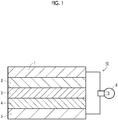
- Fig. 1 is a vertical cross-sectional view schematically illustrating an all-solid state secondary battery according to a preferred embodiment of the present invention.
- composition for forming active material layer (Composition for forming active material layer)
- a composition for forming an active material layer according to the present invention contains a sulfide-based solid electrolyte, an active material, a conductive auxiliary agent including a carbonaceous material (hereinafter, may be simply referred to as a conductive auxiliary agent), and a dispersion medium including at least one ketone compound dispersion medium to be described below.
- a sulfide-based solid electrolyte an active material
- a conductive auxiliary agent including a carbonaceous material hereinafter, may be simply referred to as a conductive auxiliary agent
- a dispersion medium including at least one ketone compound dispersion medium to be described below.
- each of the sulfide-based solid electrolyte, the active material, and the conductive auxiliary agent is in a dispersion state (suspension) dispersed in a dispersion medium in the solid state.
- the composition for forming an active material layer may be in the above-described dispersed state but is
- composition for forming an active material layer of the present invention has at least one ketone compound dispersion medium in which two aliphatic groups each having 4 or more carbon atoms are bonded to a carbonyl group as a dispersion medium for the sulfide-based solid electrolyte, the active material, and the conductive auxiliary agent, all of the sulfide-based solid electrolyte, the active material, and the conductive auxiliary agent can be dispersed while suppressing the deterioration or decomposition of the sulfide-based solid electrolyte.
- the carbonyl group in the ketone compound dispersion medium is a polar group, it can be adsorbed on the surface of the sulfide-based solid electrolyte and the surface of the active material to improve the dispersibility thereof.
- the ketone compound dispersion medium usually has high reactivity and may react with the sulfide-based solid electrolyte to deteriorate the sulfide-based solid electrolyte.
- the ketone compound dispersion medium since two aliphatic groups each having 4 or more carbon atoms are bonded to the carbonyl group in the ketone compound dispersion medium used in the present invention, it is considered that the aliphatic group (carbon chain) moves freely and thus the reaction between the carbonyl group and the sulfide-based solid electrolyte can be inhibited, and the deterioration can be suppressed while maintaining the adsorption ability to the active material.
- the ketone compound dispersion medium usually shows dispersibility for the sulfide-based solid electrolyte and the active material, but does not show good dispersibility for the conductive auxiliary agent that is more hydrophobic than the sulfide-based solid electrolyte and the active material.
- the two aliphatic group moieties described above also exhibit a chemical or physical interaction with the conductive auxiliary agent, and can enhance the dispersibility of the conductive auxiliary agent.
- This ketone compound dispersion medium can effectively suppress the re-aggregation of a carbonaceous material as the conductive auxiliary agent and can enhance the dispersibility of the carbonaceous material.
- the steric hindrance of the aliphatic group is increased, re-aggregation and the like of the conductive auxiliary agent during preparation of the composition for forming an active material layer of the present invention and during coating and drying are suppressed, and thus the dispersion effect of the conductive auxiliary agent that the ketone compound dispersion medium exerts becomes higher.
- ketone compound dispersant in which a carbonyl group and the above-described specific aliphatic group are functionally differentiated from each other, and furthermore, each function is exhibited without inhibiting each other, it is possible to disperse the sulfide-based solid electrolyte, the active material, and the conductive auxiliary agent that is more hydrophobic than the sulfide-based solid electrolyte and the active material, while suppressing deterioration or decomposition of the sulfide-based solid electrolyte.
- the composition for forming an active material layer of the present invention can achieve both ion conductivity and electron conductivity at a high level.
- the composition for forming an active material layer of the present invention is a non-aqueous composition.
- the non-aqueous composition includes, in addition to an aspect containing no water, a configuration having a moisture content (also referred to as moisture content ratio) of 50 ppm or less.
- the moisture content is preferably 20 ppm or less, more preferably 10 ppm or less, and still more preferably 5 ppm or less.
- the water content indicates the amount of water (mass proportion to the composition for forming an active material layer) contained in the composition for forming an active material layer.
- the water content can be determined by filtering the composition for forming an active material layer through a 0.02 ⁇ m membrane filer and by performing a Karl Fischer titration.
- composition for forming an active material layer of the embodiment of the present invention contains and may contain will be described.
- a sulfide-based solid electrolyte is an inorganic sulfide-based solid electrolyte, and the solid electrolyte refers to a solid-form electrolyte capable of migrating ions therein.
- the inorganic solid electrolyte is clearly differentiated from organic solid electrolytes (polymer electrolytes represented by polyethylene oxide (PEO) or the like and organic electrolyte salts represented by lithium bis(trifluoromethanesulfonyl)imide (LiTFSI)) since the inorganic solid electrolyte does not include any organic substances as a principal ion-conductive material.
- organic solid electrolytes polymer electrolytes represented by polyethylene oxide (PEO) or the like
- the sulfide-based solid electrolyte is a solid in a static state and thus, generally, is not disassociated or liberated into cations and anions. Due to this fact, the inorganic solid electrolyte is also clearly differentiated from inorganic electrolyte salts of which cations and anions are disassociated or liberated in electrolytic solutions or polymers (LiPF 6 , LiBF 4 , LiFSI, LiCl, and the like).
- the sulfide-based solid electrolyte is not particularly limited as long as the inorganic solid electrolyte has the conductivity of ions of metals belonging to Group I or II of the periodic table and is generally a substance not having electron conductivity.
- the sulfide-based solid electrolyte it is possible to appropriately select and use sulfide-based solid electrolyte materials that are applied to this kind of product.
- a sulfide-based solid electrolyte having ion conductivity for a lithium ion is used.
- Sulfide-based solid electrolytes are preferably compounds which contain sulfur atoms (S), have ion conductivity of metals belonging to Group I or II of the periodic table, and further have electron-insulating properties.
- the sulfide-based solid electrolytes are preferably inorganic solid electrolytes which, as elements, contain at least Li, S, and P and have a lithium ion conductivity, but the sulfide-based solid electrolytes may also include elements other than Li, S, and P depending on the purposes or cases.
- lithium ion-conductive sulfide-based solid electrolytes satisfying a composition represented by Formula (1) are exemplified.
- L represents an element selected from Li, Na, and K and is preferably Li.
- M represents an element selected from B, Zn, Sn, Si, Cu, Ga, Sb, Al, and Ge.
- A represents an element selected from I, Br, Cl, and F.
- a1 to e1 represent the compositional ratios among the individual elements, and a1:b1:c1:d1:e1 satisfies 1 to 12:0 to 5:1:2 to 12:0 to 10.
- al is preferably 1 to 9 and more preferably 1.5 to 7.5.
- b1 is preferably 0 to 3 and more preferably 0 to 1.
- d1 is preferably 2.5 to 10 and more preferably 3.0 to 8.5.
- e1 is preferably 0 to 5 and more preferably 0 to 3.
- compositional ratios among the individual elements can be controlled by adjusting the ratios of raw material compounds blended to manufacture the sulfide-based solid electrolyte as described below.
- the sulfide-based solid electrolytes may be non-crystalline (glass) or crystallized (made into glass ceramic) or may be only partially crystallized.
- glass glass
- crystallized made into glass ceramic
- the sulfide-based solid electrolytes can be manufactured by a reaction of at least two raw materials of, for example, lithium sulfide (Li 2 S), phosphorus sulfide (for example, diphosphorus pentasulfide (P 2 S 5 )), a phosphorus single body, a sulfur single body, sodium sulfide, hydrogen sulfide, lithium halides (for example, LiI, LiBr, and LiCI), or sulfides of an element represented by M (for example, SiS 2 , SnS, and GeS 2 ).
- the ratio between Li 2 S and P 2 S 5 in Li-P-S-based glass and Li-P-S-based glass ceramic is preferably 60:40 to 90:10 and more preferably 68:32 to 78:22 in terms of the molar ratio between Li 2 S:P 2 S 5 .
- the lithium ion conductivity can be preferably set to 1 ⁇ 10 -4 S/cm or more and more preferably set to 1 ⁇ 10 -3 S/cm or more.
- the upper limit is not particularly limited but realistically 1 ⁇ 10 -1 S/cm or less.
- Li 2 S-P 2 S 5 Li 2 S-P 2 S 5 -LiCl, Li 2 S-P 2 S 5 -H 2 S, Li 2 S-P 2 S 5 -H 2 S-LiCl, Li 2 S-LiI-P 2 S 5 , Li 2 S-LiI-Li 2 O-P 2 S 5 , Li 2 S-LiBr-P 2 S 5 , Li 2 S-L1 2 O-P 2 S 5 , Li 2 S-Li 3 PO 4 -P 2 S 5 , Li 2 S-P 2 S 5 -P 2 O 5 , Li 2 S-P 2 S 5 -SiS 2 , Li 2 S-P 2 S 5 -SiS 2 -LiCl, Li 2 S-P 2 S 5 -SnS, Li 2 S-P 2 S 5 -Al 2 S 3 , Li 2 S-P 2 S 5 , Li 2 S-P 2 S 5 -LiCl, Li 2 S-P 2 S 5
- Examples of a method for synthesizing sulfide-based solid electrolyte materials using the above-described raw material compositions include an amorphorization method.
- Examples of the amorphorization methods include a mechanical milling method, a solution method, and a melting quenching method. This is because treatments at a normal temperature become possible, and it is possible to simplify manufacturing steps.
- the sulfide-based solid electrolyte is preferably a particle.
- the median diameter D50 of the sulfide-based solid electrolyte is not particularly limited but is preferably smaller than the median diameter of the active material described later.
- the median diameter is, for example, preferably 0.01 ⁇ m or more, and more preferably 0.1 ⁇ m or more.
- the upper limit is preferably 100 ⁇ m or less and more preferably 5 ⁇ m or less. In the present invention, since a specific dispersion medium described later is used, re-aggregation of the sulfide-based solid electrolyte or the like in the composition for forming an active material layer can be suppressed.
- the particle diameter of the sulfide-based solid electrolyte can be reduced.
- the particle diameter is smaller than that of the active material, the battery capacity of the all-solid state secondary battery can be improved.
- the upper limit of the particle diameter (median diameter) of the sulfide-based solid electrolyte can be, for example, 100 ⁇ m, regardless of the upper limit described above. In a case where preliminary dispersion described later is performed, the diameter can be set to a smaller diameter of 1 ⁇ m or less.
- the average particle diameter of the sulfide-based solid electrolyte particles is measured in the following order.
- the sulfide-based solid electrolyte particles are diluted and prepared to 1% by mass of a dispersion liquid using heptane in a 20 mL sample bottle.
- the diluted dispersion specimen is irradiated with 1 kHz ultrasonic waves for 10 minutes and is then immediately used for testing.
- Data capturing is carried out 50 times using this dispersion liquid specimen, a laser diffraction/scattering-type particle size distribution measurement instrument LA-920 (trade name, manufactured by Horiba Ltd.), and a silica cell for measurement at a temperature of 25°C, thereby obtaining the volume-average particle diameter.
- the description of JIS Z8828:2013 "Particle size analysis - Dynamic light scattering method" is referred to as necessary. Five specimens are manufactured and measured per level, and the average values thereof are employed.
- the sulfide-based solid electrolytes may be used singly or two or more inorganic solid electrolytes may be used in combination.
- the content of the sulfide-based solid electrolyte in the composition for forming an active material layer is not particularly limited and preferably 5% by mass or more, more preferably 10% by mass or more, still more preferably 15% by mass or more, even still more preferably 50% by mass or more, still further preferably 70% by mass or more, and most preferably 90% by mass or more with respect to 100% by mass of the solid components in a case where a decrease in the interface resistance and the maintenance of the decreased interface resistance in the case of being used in the all-solid state secondary battery are taken into account,.
- the upper limit is preferably 50% by mass or less, more preferably 40% by mass or less, and particularly preferably 30% by mass or less.
- the content of the sulfide-based solid electrolyte in the composition for forming an active material layer is preferably 5% by mass or more, more preferably 10% by mass or more, and particularly preferably 15% by mass or more as a total content with an active material described later with respect to 100% by mass of the solid components.
- the upper limit is preferably 99.9% by mass or less, more preferably 99.5% by mass or less, and particularly preferably 99% by mass or less.
- the content of the sulfide-based solid electrolyte alone is not particularly limited as long as the total content of the sulfide-based solid electrolyte and the active material is within the above range, and is appropriately set.
- the solid content refers to a component that does not volatilize or evaporate and disappear in the case of carrying out a drying treatment on the composition for forming an active material layer at an atmospheric pressure of 1 mmHg and in a nitrogen atmosphere at 150°C for six hours.
- the solid content refers to a component other than a dispersion medium described below.
- the composition for forming an active material layer of the present invention contains an active material.
- the active material is a material capable of intercalating and deintercalating ions of a metal element belonging to Group I or Group II of the periodic table.
- Examples of such active materials include a positive electrode active material and a negative electrode active material.
- the positive electrode active material is preferably a metallic oxide (preferably a transition metal oxide)
- the negative electrode active material is preferably a carbonaceous material, a metallic oxide, or a metal capable of forming an alloy with lithium such as Sn, Si, Al, and In.
- the composition for forming an active material layer containing a positive electrode active material may be referred to as a composition for a positive electrode
- the composition for forming an active material layer containing a negative electrode active material may be referred to as a composition for a negative electrode.
- the positive electrode active material is preferably a positive electrode active material capable of reversibly intercalating and deintercalating lithium ions.
- the above-described material is not particularly limited as long as the material has the above-described characteristics and may be a transition metal oxide, an organic substance, an element capable of being complexed with Li such as sulfur, a complex of sulfur and a metal, or the like.
- transition metal oxides are preferably used, and transition metal oxides having a transition metal element M a (one or more elements selected from Co, Ni, Fe, Mn, Cu, and V) are more preferred.
- an element M b an element of Group I (Ia) of the metal periodic table other than lithium, an element of Group II (IIa), or an element such as Al, Ga, In, Ge, Sn, Pb, Sb, Bi, Si, P, or B
- the amount of the element mixed is preferably 0 to 30 mol% of the amount (100 mol%) of the transition metal element M a .
- the positive electrode active material is more preferably synthesized by mixing the element into the transition metal oxide so that the molar ratio of Li/M a reaches 0.3 to 2.2.
- transition metal oxides include transition metal oxides having a bedded salt-type structure (MA), transition metal oxides having a spinel-type structure (MB), lithium-containing transition metal phosphoric acid compounds (MC), lithium-containing transition metal halogenated phosphoric acid compounds (MD), lithium-containing transition metal silicate compounds (ME), and the like.
- MA bedded salt-type structure
- MB transition metal oxides having a spinel-type structure
- MC lithium-containing transition metal phosphoric acid compounds
- MD lithium-containing transition metal halogenated phosphoric acid compounds
- ME lithium-containing transition metal silicate compounds
- transition metal oxides having a bedded salt-type structure include LiCoO 2 (lithium cobalt oxide [LCO]), LiNi 2 O 2 (lithium nickelate), LiNi 0.85 Co 0.10 Al 0.05 O 2 (lithium nickel cobalt aluminum oxide [NCA]), LiNi 1/3 Co 1/3 Mn 1/3 O 2 (lithium nickel manganese cobalt oxide [NMC]), and LiNi 0.5 Mn 0.5 O 2 (lithium manganese nickelate).
- LiCoO 2 lithium cobalt oxide [LCO]
- LiNi 2 O 2 lithium nickelate
- LiNi 0.85 Co 0.10 Al 0.05 O 2 lithium nickel cobalt aluminum oxide [NCA]
- LiNi 1/3 Co 1/3 Mn 1/3 O 2 lithium nickel manganese cobalt oxide [NMC]
- LiNi 0.5 Mn 0.5 O 2 lithium manganese nickelate
- transition metal oxides having a spinel-type structure include LiMn 2 O 4 (LMO), LiCoMnO 4 , Li 2 FeMn 3 O 8 , Li 2 CuMn 3 O 8 , Li 2 CrMn 3 O 8 , and Li 2 NiMn 3 O 8 .
- lithium-containing transition metal phosphoric acid compounds examples include olivine-type iron phosphate salts such as LiFePO 4 and Li 3 Fe 2 (PO 4 ) 3 , iron pyrophosphates such as LiFeP 2 O 7 , and cobalt phosphates such as LiCoPO 4 , and monoclinic an NASICON-type vanadium phosphate salt such as Li 3 V 2 (PO 4 ) 3 (lithium vanadium phosphate).
- lithium-containing transition metal halogenated phosphoric acid compounds examples include iron fluorophosphates such as Li 2 FePO 4 F, manganese fluorophosphates such as Li 2 MnPO 4 F, cobalt fluorophosphates such as Li 2 CoPO 4 F.
- lithium-containing transition metal silicate compounds examples include Li 2 FeSiO 4 , Li 2 MnSiO 4 , Li 2 CoSiO 4 , and the like.
- the transition metal oxide having a bedded salt-type structure (MA) is preferred, and LCO or NMC is more preferred.
- the shape of the positive electrode active material is not particularly limited but is preferably a particle shape.
- the median diameter D50 of the positive electrode active material is not particularly limited but is preferably larger than the median diameter of the sulfide-based solid electrolyte in terms of the electric capacity of the all-solid state secondary battery.
- the median diameter of the positive electrode active material can be set 0.1 to 50 ⁇ m.
- an ordinary crusher or classifier may be used.
- a positive electrode active material obtained using a firing method may be used after being washed with water, an acidic aqueous solution, an alkaline aqueous solution, or an organic solvent.
- the median diameter of the positive electrode active material can be measured in the same manner as the median diameter of the sulfide-based solid electrolyte.
- the positive electrode active material may be used singly or two or more positive electrode active materials may be used in combination.
- the mass (mg) of the positive electrode active material per unit area (cm 2 ) in the positive electrode active material layer (weight per unit area) is not particularly limited.
- the weight per unit area can be appropriately determined depending on a set battery capacity.
- the content of the positive electrode active material in the composition for forming an active material layer is not particularly limited but is preferably 10% to 95% by mass, more preferably 30% to 90% by mass, still more preferably 50% to 85% by mass, and particularly preferably 55% to 80% by mass with respect to a solid content of 100% by mass.
- the negative electrode active material is preferably a negative electrode active material capable of reversibly intercalating and deintercalating lithium ions.
- the above-described material is not particularly limited as long as the material has the above-described characteristics, and examples thereof include a carbonaceous material, a metal oxide such as tin oxide, silicon oxide, a metal complex oxide, a lithium single body, a lithium alloy such as a lithium aluminum alloy, metals capable of forming alloys with lithium such as Sn, Si, Al, and In, and the like.
- a carbonaceous material or a lithium complex oxide is preferably used in terms of reliability.
- the metal complex oxide is preferably capable of intercalating and deintercalating lithium.
- the materials are not particularly limited but preferably contain titanium and/or lithium as constituent components from the viewpoint of high-current density charging and discharging characteristics.
- the carbonaceous material that is used as the negative electrode active material is a material substantially consisting of carbon.
- Examples thereof include graphite (natural graphite, artificial graphite such as highly oriented pyrolytic graphite), and a carbonaceous material obtained by firing a variety of synthetic resins such as polyacrylonitrile (PAN)-based resins or furfuryl alcohol resins.
- PAN polyacrylonitrile
- examples thereof also include a variety of carbon fibers such as PAN-based carbon fibers, cellulose-based carbon fibers, pitch-based carbon fibers, vapor-grown carbon fibers, dehydrated polyvinyl alcohol (PVA)-based carbon fibers, lignin carbon fibers, glassy carbon fibers, and active carbon fibers, mesophase microspheres, graphite whisker, flat graphite, and the like.
- carbon fibers such as PAN-based carbon fibers, cellulose-based carbon fibers, pitch-based carbon fibers, vapor-grown carbon fibers, dehydrated polyvinyl alcohol (PVA)-based carbon fibers, lignin carbon fibers, glassy carbon fibers, and active carbon fibers, mesophase microspheres, graphite whisker, flat graphite, and the like.
- PAN-based carbon fibers such as PAN-based carbon fibers, cellulose-based carbon fibers, pitch-based carbon fibers, vapor-grown carbon fibers, dehydrated polyvinyl alcohol (PVA
- the metal oxides and the metal complex oxides applied as the negative electrode active material are particularly preferably amorphous oxides, and furthermore, chalcogenides which are reaction products between a metal element and an element belonging to Group XVI of the periodic table are also preferably used.
- the amorphous oxides mentioned herein refer to oxides having a broad scattering band having a peak of a 2 ⁇ value in a range of 20° to 40° in an X-ray diffraction method in which CuK ⁇ rays are used and may have crystalline diffraction lines.
- amorphous oxides of semimetal elements and chalcogenides are more preferred, and elements belonging to Groups XIII (IIIB) to XV (VB) of the periodic table, oxides consisting of one element or a combination of two or more elements of Al, Ga, Si, Sn, Ge, Pb, Sb, and Bi, and chalcogenides are particularly preferred.
- amorphous oxides and chalcogenides include Ga 2 O 3 , SiO, GeO, SnO, SnO 2 , PbO, PbO 2 , Pb 2 O 3 , Pb 2 O 4 , Pb 3 O 4 , Sb 2 O 3 , Sb 2 O 4 , Sb 2 O 8 Bi 2 O 3 , Sb 2 O 8 Si 2 O 3 , Bi 2 O 4 , SnSiO 3 , GeS, SnS, SnS 2 , PbS, PbS 2 , Sb 2 S 3 , Sb 2 S 5 , and SnSiS 3 .
- these amorphous oxides may be complex oxides with lithium oxide, for example, Li 2 SnO 2 .
- the negative electrode active material preferably contains a titanium atom. More specifically, Li 4 Ti 5 O 12 (lithium titanium oxide [LTO]) is preferred since the volume fluctuation during the absorption and deintercalation of lithium ions is small, and thus the high-speed charging and discharging characteristics are excellent, and the deterioration of electrodes is suppressed, whereby it becomes possible to improve the service lives of lithium ion secondary batteries.
- Li 4 Ti 5 O 12 lithium titanium oxide [LTO]
- a Si-based negative electrode is also preferably applied.
- a Si negative electrode is capable of intercalating a larger number of Li ions than a carbon negative electrode (graphite, acetylene black, or the like). That is, the amount of Li ions intercalated per unit mass increases. Therefore, it is possible to increase the battery capacity. As a result, there is an advantage that the battery driving duration can be extended.
- the shape of the negative electrode active material is not particularly limited but is preferably a particle shape.
- the median diameter D50 of the negative electrode active material is not particularly limited but is preferably larger than the median diameter of the sulfide-based solid electrolyte described above.
- the median diameter of the negative electrode active material is preferably 0.1 to 60 ⁇ m.
- an ordinary crusher or classifier is used.
- a mortar, a ball mill, a sand mill, an oscillatory ball mill, a satellite ball mill, a planetary ball mill, a revolving airflow-type jet mill, a sieve, or the like is preferably used.
- classification is preferably carried out.
- the classification method is not particularly limited, and it is also possible to use a sieve, a wind power classifier, or the like. Both of dry-type classification and wet-type classification can be carried out.
- the median diameter of the negative electrode active material can be measured in the same manner as the median diameter of the sulfide-based solid electrolyte.
- the chemical formulae of the compounds obtained using a firing method can be calculated using an inductively coupled plasma (ICP) emission spectroscopic analysis method as a measurement method from the mass difference of powder before and after firing as a convenient method.
- ICP inductively coupled plasma
- the negative electrode active material may be used singly or two or more negative electrode active materials may be used in combination.
- the mass (mg) of the negative electrode active material per unit area (cm 2 ) in the negative electrode active material layer (weight per unit area) is not particularly limited.
- the weight per unit area can be appropriately determined depending on a set battery capacity.
- the content of the negative electrode active material in the composition for forming an active material layer is not particularly limited but is preferably 10% to 80% by mass and more preferably 20% to 80% by mass with respect to a solid content of 100% by mass.
- the surfaces of the positive electrode active material and the negative electrode active material may be coated with different metal oxides.
- the surface coating agents include a metal oxide and the like containing Ti, Nb, Ta, W, Zr, Al, Si, or Li. Specific examples thereof include titanium oxide spinel, tantalum-based oxides, niobium-based oxides, lithium niobate-based compounds, and the like, and specific examples thereof include Li 4 Ti 5 O 12 , Li 2 Ti 2 O 5 , LiTaO 3 , LiNbO 3 , LiAlO 2 , Li 2 ZrO 3 , Li 2 WO 4 , Li 2 TiO 3 , Li 2 B 4 O 7 , Li 3 PO 4 , Li 2 MoO 4 , Li 3 BO 3 , LiBO 2 , Li 2 CO 3 , Li 2 SiO 3 , SiO 2 , TiO 2 , ZrO 2 , Al 2 O 3 , B 2 O 3 , and the like.
- a surface treatment may be carried out on the surfaces of electrodes including the positive electrode active material or the negative electrode active material using sulfur, phosphorous, or the like.
- the particle surface of the positive electrode active material or the negative electrode active material may be treated with an active light ray or an active gas (plasma or the like) before or after the coating of the surfaces.
- the composition for forming an active material layer of the present invention contains a conductive auxiliary agent.
- the conductive auxiliary agent contains a carbonaceous material (which means a conductive auxiliary agent of a carbonaceous material and also referred to as a carbon-based conductive auxiliary agent).
- the conductive auxiliary agent containing a carbonaceous material and "the conductive auxiliary agent contains a carbonaceous material” mean that at least one of the conductive auxiliary agents used in the composition for forming an active material layer of the present invention is the carbon-based conductive auxiliary agent.
- the present invention includes an aspect in which a conductive auxiliary agent other than the carbon-based conductive auxiliary agent is included.
- each conductive auxiliary agent contains a carbon-based conductive auxiliary agent and a conductive auxiliary agent other than the carbon-based conductive auxiliary agent
- the configuration of each conductive auxiliary agent is not particularly limited.
- a carbon-based conductive auxiliary agent and a conductive auxiliary agent other than the carbon-based conductive auxiliary agent may be contained as an aggregate, or a carbon-based conductive auxiliary agent and a conductive auxiliary agent other than the carbon-based conductive auxiliary agent each may be independently contained without forming an aggregate of the carbon-based conductive auxiliary agent and the conductive auxiliary agent other than the carbon-based conductive auxiliary agent.
- the configuration of the above-described content of each conductive auxiliary agent is the same for an electrode sheet for an all-solid state secondary battery and an active material layer of an all-solid state secondary battery, which will be described later.
- a conductive auxiliary agent that does not intercalate and deintercalate Li and does not function as an active material at the time of charging and discharging a battery is regarded as the conductive auxiliary agent. Therefore, among the conductive auxiliary agents, a conductive auxiliary agent capable of functioning as the active material in the active material layer at the time of charging and discharging a battery is classified not into the conductive auxiliary agent but into the active material. Whether or not the conductive auxiliary agent functions as the active material at the time of charging and discharging a battery is not unambiguously determined but is determined by the combination with the active material.
- the carbon-based conductive auxiliary agent used in the present invention is not particularly limited as long as it is a conductive auxiliary agent of a carbonaceous material, and those known as a general conductive auxiliary agent can be used.
- the carbon-based conductive auxiliary agents include individual conductive auxiliary agents, for example, an electron-conductive material, natural graphite, graphite such as artificial graphite, acetylene black, Ketjen black, carbon black such as furnace black, amorphous carbon such as needle coke, carbon fibers such as vapor-grown carbon fibers and carbon nanotubes, and carbon isotopes (excluding carbon fibers) such as graphene and fullerene.
- the conductive auxiliary agent is preferably an electron-conductive material, more preferably carbon black, carbon fiber or a carbon isotope, and further preferably carbon black.
- the conductive auxiliary agent other than the carbon-based conductive auxiliary agent is not particularly limited, and conductive auxiliary agents that are known as a general conductive auxiliary agent can be used.
- conductive auxiliary agents that are known as a general conductive auxiliary agent can be used.
- metal powder, metal fiber, a conductive polymer and the like can be mentioned.
- one of the above-described conductive auxiliary agents may be used, or two or more thereof may be used.
- the total content of the conductive auxiliary agent in the composition for forming an active material layer is preferably 0.5% to 5% by mass and more preferably 1% to 3% by mass with respect to 100 parts by mass of the solid content.
- the total content of the conductive auxiliary agent means the total content of the carbon-based conductive auxiliary agent and the conductive auxiliary agent other than the carbon-based conductive auxiliary agent.
- the content ratio of the carbon-based conductive auxiliary agent in the conductive auxiliary agent is not particularly limited as long as it is within the above-described range of the total content, and for example, it may be 10% by mass or more and is preferably 50% to 100% by mass with respect to the total content of the conductive auxiliary agent.
- the shape of the conductive auxiliary agent is not particularly limited but is preferably a particle shape.
- the median diameter D50 of the conductive auxiliary agent is not particularly limited, and is, for example, preferably 0.01 to 1 ⁇ m, and more preferably 0.02 to 0.1 ⁇ m.
- the composition for forming an active material layer according to the embodiment of the present invention contains a dispersion medium that disperses each component contained in the composition for forming an active material layer according to the embodiment of the present invention, in particular, a sulfide-based solid electrolyte, an active material, and a conductive auxiliary agent.
- the dispersion medium contains at least one ketone compound dispersion medium in which two aliphatic groups each having 4 or more carbon atoms are bonded to a carbonyl group. Therefore, the configuration in which the composition for forming an active material layer contains a dispersion medium may be any one of a configuration including only one kind of the above-described ketone compound dispersion medium, a configuration including two or more kinds of the above-described ketone compound dispersion medium, and a configuration including at least one kind of the above-described ketone compound dispersion medium and another dispersion medium. A configuration including only one kind of the above-described ketone compound dispersion medium, or a configuration including one kind of the above-described ketone compound dispersion medium and another dispersion medium is preferred.
- the dispersion medium used in the present invention includes, in addition to a configuration including non-aqueous dispersion medium (containing no aqueous dispersion medium), a configuration including an aqueous dispersion medium.
- the content of the aqueous dispersion medium is suitably determined within a range not exceeding the above-described water content in the composition for forming an active material layer.
- the non-aqueous dispersion medium generally refers to a dispersion medium other than water. In a case where the dispersion medium is a non-aqueous dispersion medium, decomposition or deterioration of the sulfide-based solid electrolyte can be prevented.
- the ketone compound dispersion medium as a dispersion medium is a ketone compound in which two aliphatic groups each having 4 or more carbon atoms are bonded to a carbonyl group.
- Each of the aliphatic groups each having two bonds to the carbonyl group is preferably a saturated aliphatic hydrocarbon group (alkyl group) and has 4 or more carbon atoms, and preferably 4 or 5 carbon atoms.
- Each of the two aliphatic groups may have any of a linear chain structure, a branched chain structure, or a cyclic structure, is preferably a linear chain structure or a branched chain structure, and more preferably a branched chain structure in terms of the dispersibility of the sulfide-based solid electrolyte, the active material, and the conductive auxiliary agent.
- the two aliphatic groups may be the same or different from each other but are preferably the same in terms of dispersibility of the sulfide-based solid electrolyte, the active material, and the conductive auxiliary agent.
- the two aliphatic groups may bind each other to form a ring.
- the aliphatic group is not particularly limited, but examples thereof include, n-butyl, sec-butyl, iso-butyl, t-butyl, neopentyl (2,2-dimethylpropyl), isopentyl (3-methylbutyl), sec-pentyl (1 -methylbutyl), 3-pentyl (1-ethylpropyl), and tert-pentyl (1,1-dimethylpropyl).
- the ketone compound dispersion medium described above may be a compound in which the above aliphatic groups are suitably combined, and in particular, is preferably a compound in which two aliphatic groups are the same and have a branched chain structure.
- a ketone compound dispersion medium is not particularly limited, and examples thereof include di (sec-butyl) ketone, di (iso-butyl) ketone, di (t-butyl) ketone, and di (isopentyl) ketone.
- the ketone compound dispersion medium contained in the composition for forming an active material layer may be one kind or two or more kinds.
- the dispersion medium may include a dispersion medium other than the ketone compound dispersion medium in addition to the ketone compound dispersion medium.
- a dispersion medium is not particularly limited as long as it is other than the ketone compound dispersion medium, and examples thereof include various organic dispersion media.
- Examples of the organic dispersion media that can be used in combination with the ketone compound dispersion medium include a dispersion medium constituted of an ether compound, a dispersion medium constituted of an amide compound, a dispersion medium constituted of an amine compound, a dispersion medium constituted of an aromatic compound, and a dispersion medium constituted of an aliphatic compound, a dispersion medium constituted of a nitrile compound, and a dispersion medium constituted of an ester compound.
- a non-polar dispersion medium is preferred.
- the non-polar dispersion medium refers to a dispersion medium formed from a carbon atom and a hydrogen atom.
- a dispersion medium constituted of an aromatic hydrocarbon compound or a dispersion medium constituted of an aliphatic hydrocarbon compound are mentioned, a dispersion medium constituted of an aliphatic hydrocarbon compound are more preferred, and a compound constituted of a saturated aliphatic hydrocarbon is still more preferred.
- Examples of the dispersion media constituted of an aromatic hydrocarbon compound include benzene, toluene, and xylene.
- the dispersion medium constituted of an aliphatic hydrocarbon compound is not particularly limited as long as it is a dispersion medium of an aliphatic hydrocarbon compound, but a dispersion medium constituted of a saturated aliphatic hydrocarbon compound (alkane dispersion medium) is preferred.
- the dispersion medium constituted of an aliphatic hydrocarbon compound may have any of a linear chain structure, a branched chain structure, or a cyclic structure.
- Examples of the dispersion media constituted of an aliphatic hydrocarbon compound include an alkane compound dispersion medium having 6 to 10 carbon atoms such as hexane, heptane, octane, decane, cyclohexane, and cyclooctane, paraffin, gasoline, naphtha, kerosene, light oil, and the like.
- the organic dispersion medium that can be used in combination may be one kind or two or more kinds.
- the total content of the dispersion medium in the composition for forming an active material layer is not particularly limited, but is preferably 20% to 80% by mass, more preferably 30% to 70% by mass, and particularly preferably 40% to 60% by mass.
- the content of the ketone compound dispersion medium in the composition for forming an active material layer is not particularly limited as long as the total content of the dispersion medium is within the above range.
- the content thereof in the composition for forming an active material layer is preferably 1% to 80% by mass, more preferably 1.5% to 70% by mass, and still more preferably 2% to 50% by mass.
- the content of the ketone compound dispersion medium means the total content in a case where the composition for forming an active material layer contains two or more kinds of ketone compound dispersion media.
- the content of the organic dispersion medium that can be used in combination in the composition for forming an active material layer is not particularly limited as long as the total content of the dispersion medium is within the above range.
- the content thereof in the composition for forming an active material layer is preferably 1% to 75% by mass, more preferably 1.5% to 70% by mass, and still more preferably 2% to 50% by mass.
- the content of the organic dispersion medium that can be used in combination means the total content in a case where the composition for forming an active material layer contains two or more kinds of organic dispersion media.
- the content of the ketone compound dispersion medium in the dispersion medium is 100% by mass or less and can be set suitably depending on the kind, the content, or the like of the sulfide-based solid electrolyte, the active material layer, or the conductive auxiliary agent.
- the lower limit of the content of the ketone compound dispersion medium in the dispersion medium is preferably 1% by mass or more, and more preferably 2% by mass or more.
- the upper limit of the content of the ketone compound dispersion medium in the dispersion medium can be set to, for example, 50% by mass or less.
- composition for forming an active material layer of the present invention may contain a binder.
- the binder is not particularly limited as long as it is a binder polymer usually used in a composition for forming an active material layer for an all-solid state secondary battery.
- a binder made of a (meth)acrylic polymer, a urethane polymer, a urea polymer, an amide polymer, an imide polymer, an ester polymer, hydrocarbon rubber, fluorine rubber, or the like is preferably exemplified.
- the (meth)acrylic polymer is not particularly limited as long as the (meth)acrylic polymer is a polymer formed of a (meth)acrylic monomer, and examples thereof include polymethyl (meth)acrylate, poly(meth)acrylic acid, polyhydroxymethyl (meth)acrylate, and the like.
- a polymer described in JP2015-088486A is also suitably exemplified.
- the urethane polymer As the urethane polymer, the urea polymer, the amide polymer, the imide polymer, and the ester polymer, polymers described in JP2015-088480A are preferably exemplified respectively.
- hydrocarbon rubber natural rubber, polybutadiene, polyisoprene, polystyrene-butadiene, and hydrated polymers thereof are exemplified.
- the fluorine rubber preferably has a repeating unit derived from vinylidene fluoride, and, as such a polymer, polyvinylidene difluoride, polyvinylidene difluoride hexafluoropropylene, and the like are exemplified.
- the binder is preferably polymer particles.
- the average particle diameter of the polymer particles is preferably 0.01 to 10 ⁇ m and more preferably 0.01 to 1 ⁇ m.
- a median diameter measured in the same manner as the above-described median diameter of the sulfide-based solid electrolyte particles is employed.
- the average particle diameter can be measured from the manufactured all-solid state secondary battery by, for example, disassembling the battery, peeling the electrodes off, then measuring the average particle diameters of the electrode materials, and excluding the measurement value of the average particle diameter of particles other than the polymer particles which has been measured in advance.
- polymer particles commercially available polymer particles may be used, and polymer particles described in JP2016-139511A can be suitably used.
- the weight-average molecular weight of the binder, particularly, the above-described polymer is preferably 10,000 or more, more preferably 20,000 or more, and still more preferably 30,000 or more.
- the upper limit is preferably 1,000,000 or less, more preferably 200,000 or less, and still more preferably 100,000 or less.
- the weight-average molecular weight of the binder refers to a standard polystyrene-equivalent weight-average molecular weight by gel permeation chromatography (GPC).
- GPC gel permeation chromatography
- a measurement method thereof basically, a value measured using a method under conditions A or conditions B (preferred) described below is employed.
- an appropriate eluent may be appropriately selected and used.
- the content of the binder in the composition for forming an active material layer is preferably 0.01% by mass or more, more preferably 0.1% by mass or more, and still more preferably 1% by mass or more with respect to 100% by mass of the solid component in terms of compatibility of the binding property with the solid particle such as the sulfide-based solid electrolyte particle, the active material, and the conductive auxiliary agent, and the ion conductivity.
- the upper limit is preferably 20% by mass or less, more preferably 10% by mass or less, and still more preferably 5% by mass or less.
- the mass ratio of the total mass (total amount) of the sulfide-based solid electrolyte and the active material to the mass of the binder is preferably in a range of 1,000 to 1. This ratio is more preferably 500 to 2 and still more preferably 100 to 10.
- binder One type of binder may be used singly, or two or more kinds thereof may be used in combination.
- composition for forming an active material layer according to the embodiment of the present invention may further include, as desired, a thickener, a crosslinking agent (an agent that undergoes a crosslinking reaction by radical polymerization, condensation polymerization, or ring-opening polymerization, or the like), a polymerization initiator (an initiator that generates an acid or a radical by heat or light or the like), an antifoaming agent, a leveling agent, a dehydration agent, an antioxidant, and the like as a component other than the above components.
- a thickener an agent that undergoes a crosslinking reaction by radical polymerization, condensation polymerization, or ring-opening polymerization, or the like
- a polymerization initiator an initiator that generates an acid or a radical by heat or light or the like
- an antifoaming agent an initiator that generates an acid or a radical by heat or light or the like
- a leveling agent a dehydration agent
- an antioxidant
- composition for forming an active material layer of the embodiment of the present invention can be prepared preferably as a slurry by mixing the sulfide-based solid electrolyte, the active material, the conductive auxiliary agent, and as necessary, the above-described components using various mixers in the presence of a dispersion medium containing at least one kind of the ketone compound dispersion medium described above.
- the mixing method is not particularly limited, and mixing may be performed collectively or sequentially.
- the active material, the conductive auxiliary agent, the binder, other additives, and the like may be mixed when the sulfide-based solid electrolyte and the dispersion medium are mixed, or may be separately mixed.
- the carbon-based conductive auxiliary agent and a conductive auxiliary agent other than the carbon-based conductive auxiliary agent are used in combination as the conductive auxiliary agent
- the carbon-based conductive auxiliary agent and the conductive auxiliary agent other than the carbon-based conductive auxiliary agent may be mixed simultaneously or sequentially.
- the composition for forming an active material layer can be prepared by mixing the above components using various mixers.
- the mixer is not particularly limited, and examples thereof include a ball mill, a beads mill, a planetary mixer, a blade mixer, a roll mill, a kneader, and a disc mill.
- the mixing conditions are not particularly limited.
- the mixing temperature is set at 10°C to 60°C
- the mixing time is set at 5 to 5 hours
- the rotation speed is set at 10 to 700 rpm (rotation per minute).
- the rotation speed is set at 150 to 700 rpm and the mixing time at 5 minutes to 24 hours at the mixing temperature described above.
- the blending quantity of each component is preferably set so that it becomes the content described above.
- the mixing environment is not particularly limited, but may be in dry air or in an inert gas.
- the composition for forming an active material layer is preferably prepared by a method having a step of preliminarily dispersing (stirring) a sulfide-based solid electrolyte in a dispersion medium including at least one ketone compound dispersion medium in which two aliphatic groups each having 4 or more carbon atoms are bonded to a carbonyl group and a step of mixing the obtained preliminary dispersion, an active material, and a conductive auxiliary agent.
- this manufacturing method (referred to as the method for manufacturing the composition for forming an active material layer according to the embodiment of the present invention), deterioration of the sulfide-based solid electrolyte is prevented, and the sulfide-based solid electrolyte, the active material, and the conductive auxiliary agent can be dispersed with good dispersibility. Accordingly, in a case where an electrode sheet for an all-solid state secondary battery or an all-solid state secondary battery is manufactured by the method for manufacturing the composition for forming an active material layer according to the embodiment of the present invention or by using the composition for forming an active material layer obtained by this manufacturing method, further improvement in conductivity or battery capacity can be expected.
- the sulfide-based solid electrolyte is preliminarily dispersed (stirred) in a dispersion medium.
- the dispersion medium used is as described above, and the preferred configuration is also the same as above.
- the mixing conditions at the time of preparing the composition for forming an active material layer preferably the mixing conditions in a case where a ball mill is used, can be applied.
- a mixing method or stirring method in which a mechanical shearing force (stirring action) acts on the sulfide-based solid electrolyte is preferred.
- a mixer such as a ball mill, a bead mill, and a planetary mixer.
- the degree to which the sulfide-based solid electrolyte is reduced is not particularly limited, but for example, the median diameter is preferably set to 3.0 ⁇ m or less and more preferably 2.0 ⁇ m or less.
- components other than the active material and the conductive auxiliary agent may be mixed.
- a step of mixing the obtained preliminary dispersion of the sulfide-based solid electrolyte, the active material, and the conductive auxiliary agent is performed.
- the active material and the conductive auxiliary agent are as described above, and the preferred ones are also the same as above.
- the dispersion medium for mixing (dispersing) the above components may be the dispersion medium contained in the preliminary dispersion, or a new dispersion medium different from the dispersion medium can be used. In the present invention, it is preferable to use the dispersion medium contained in the preliminary dispersion.
- the dispersion medium newly used may be the same as or different from the dispersion medium used in the preliminary dispersion step.
- a sulfide-based solid electrolyte isolated from the obtained preliminary dispersion and a new dispersion medium may be used as the preliminary dispersion.
- the order of mixing with the preliminary dispersion is not particularly limited.
- the active material and the conductive auxiliary agent may be mixed at the same time, or either one may be mixed first.
- a mixture of the carbon-based conductive auxiliary agent and the conductive auxiliary agent other than the carbon-based conductive auxiliary agent may be mixed with the preliminary dispersion or the like, and the carbon-based conductive auxiliary agent and the conductive auxiliary agent other than the carbon-based conductive auxiliary agent may be separately mixed with the preliminary dispersion or the like.
- the mixing ratio of each component in the mixing step is the same as the content ratio of each component in the composition for forming an active material layer according to the embodiment of the present invention, and the preferred range is also the same.
- the mixing conditions may be any condition as long as each component can be mixed and dispersed, and for example, the mixing conditions at the time of preparing the composition for forming an active material layer can be applied.
- the conditions for mixing are preferably milder than the conditions for preliminary dispersion described above.
- the mixing conditions at the time of preparing the composition for forming an active material layer preferably the mixing conditions in the case where a ball mill is used can be applied.
- composition for forming an active material layer according to the embodiment of the present invention can be prepared.
- composition for forming an active material layer according to the embodiment of the present invention can be dispersed while suppressing re-aggregation even in a case where the carbonaceous material is used as a conductive auxiliary agent. Therefore, as described later, the composition for forming an active material layer is preferably used as a material forming an electrode active material layer of an all-solid state secondary battery or an electrode sheet for an all-solid state secondary battery.
- the solid electrolyte-containing sheet is a sheet-shaped molded body capable of forming a constituent layer of an all-solid state secondary battery and includes various aspects depending on the use thereof. Examples thereof include a sheet that is preferably used in a solid electrolyte layer (also referred to as a solid electrolyte-containing sheet for an all-solid state secondary battery), a sheet that is preferably used in an electrode or a laminate of an electrode and a solid electrolyte layer (an electrode sheet for an all-solid state secondary battery), and the like. In the present specification, a variety of sheets described above will be collectively referred to as a sheet for an all-solid state secondary battery in some cases.
- the electrode sheet for an all-solid state secondary battery may be a sheet having an active material layer (electrode layer), a sheet having an active material layer (electrode layer) formed on a base material (collector), or a sheet formed of an active material layer (electrode layer) without having a base material.
- the electrode sheet is a sheet that is suitably used for forming a laminate of an active material layer, or a laminate of a solid electrolyte layer and an active material layer of an all-solid state secondary battery.
- this electrode sheet is generally a sheet having a collector and an active material layer, and an aspect of having a collector, an active material layer, and a solid electrolyte layer in this order and an aspect of having a collector, an active material layer, a solid electrolyte layer, and an active material layer in this order are also considered as the electrode sheet.
- the electrode sheet may have other layers as long as the layer has an active material layer. Examples of other layers include a protective layer (stripping sheet), a collector, a coating layer, and the like.
- the layer thicknesses of each layer constituting the electrode sheet are identical to the layer thicknesses of each layer described later in the section of an all-solid state secondary battery.
- the active material layer of the electrode sheet is preferably formed of the composition for forming an active material layer according to the embodiment of the present invention.
- the active material layer exhibits a high level of ion conductivity and electron conductivity in a well-balanced manner.
- this electrode sheet as a material constituting the (negative electrode or positive electrode) active material layer of the all-solid state secondary battery, a high battery capacity can be provided to the all-solid state secondary battery.
- the content of each component in the active material layer of the electrode sheet is not particularly limited, but is preferably the same as the content of each component in the solid content of the composition for forming an active material layer according to the embodiment of the present invention.
- the base material is not particularly limited as long as the base material is capable of supporting the active material layer, and examples thereof include sheet bodies (plate-shaped bodies) such as a material described in the section of the collector described below, an organic material, an inorganic material, and the like.
- sheet bodies plate-shaped bodies
- examples of the organic materials include a variety of polymers and the like, and specific examples thereof include polyethylene terephthalate, polypropylene, polyethylene, cellulose, and the like.
- the inorganic materials include glass, ceramic, and the like.
- the solid electrolyte sheet for an all-solid state secondary battery and the solid electrolyte layer for an all-solid state secondary battery can be formed of a known solid electrolyte composition.
- the solid electrolyte sheet for an all-solid state secondary battery and the solid electrolyte layer for an all-solid state secondary battery generally, does not include any positive electrode active material and/or any negative electrode active material.
- the layer thickness of the solid electrolyte layer of the solid electrolyte-containing sheet is identical to the layer thickness of the solid electrolyte layer described in the section of an all-solid state secondary battery.
- the solid electrolyte-containing sheets include a sheet having a solid electrolyte layer and a protective layer on a base material in this order and a sheet made of a solid electrolyte layer (a sheet not having a base material).
- a method for manufacturing a solid electrolyte-containing sheet is not particularly limited.
- the electrode sheet for an all-solid state secondary battery can be manufactured through (including) the method for manufacturing a composition for forming an active material layer according to the embodiment of the present invention.
- the solid electrolyte-containing sheet can also be manufactured using the composition for forming an active material layer of the embodiment of the present invention.
- the composition for forming an active material layer according to the embodiment of the present invention is prepared as described above, and the obtained composition for forming an active material layer is made into a film (coated and dried) onto a base material (other layers may be interposed) to form an active material layer (coated and dried layer) on the base material. Accordingly, it is possible to manufacture an electrode sheet having a base material and a coated and dried layer.
- the composition for forming an active material layer according to the embodiment of the present invention even during the coating and drying, suppresses both deterioration or decomposition of the sulfide-based solid electrolyte and re-aggregation of the sulfide-based solid electrolyte, and thus the excellent dispersion state of the sulfide-based solid electrolyte, the active material, and the conductive auxiliary agent can be maintained. For this reason, the electrode sheet produced using the composition for forming an active material layer according to the embodiment of the present invention can exhibit both ion conductivity and electron conductivity at a high level.
- the coated and dried layer refers to a layer formed by coating the composition for forming an active material layer of the embodiment of the present invention and drying the dispersion medium (that is, a layer formed using the composition for forming an active material layer of the embodiment of the present invention and constituted of a composition in which the dispersion medium has been removed from the composition for forming an active material layer of the embodiment of the present invention).
- the composition for forming an active material layer according to the embodiment of the present invention is preferably used as a slurry, and, as desired, the composition for forming an active material layer according to the embodiment of the present invention can be slurried by a known method.
- Each step of coating and drying the composition for forming an active material layer of the embodiment of the present invention will be described in the following section of the method for manufacturing an all-solid state secondary battery.
- the coated and dried layer obtained as described above can be pressurized.
- the pressurizing condition and the like will be described later in the section of the method for manufacturing an all-solid state secondary battery.
- the base material, the protective layer (particularly stripping sheet), or the like can also be stripped.
- the all-solid state secondary battery has a positive electrode active material layer, a negative electrode active material layer facing the positive electrode active material layer, and a solid electrolyte layer disposed between the positive electrode active material layer and the negative electrode active material layer.
- the positive electrode active material layer and the negative electrode active material layer of the all-solid state secondary battery, particularly the positive electrode active material layer, are formed of the composition for forming an active material layer of the embodiment of the present invention, and contain a sulfide-based solid electrolyte, an active material, and a conductive auxiliary agent.
- a layer containing a sulfide-based solid electrolyte, an active material, and suitable components described above, or a lithium metal layer is employed.
- the solid electrolyte layer contains a solid electrolyte having ion conductivity for a metal belonging to Group I or II of the periodic table and suitable components described above.
- the all-solid state secondary battery provided with an active material layer formed of the composition for forming an active material layer of the present invention exhibits a high level of ion conductivity and electron conductivity in a well-balanced manner, and exhibits a high battery capacity.
- the lithium metal layer that can constitute the negative electrode active material layer means a layer of a lithium metal and specifically includes a layer formed by depositing or molding lithium powder, a lithium foil, a lithium vapor deposition film, and the like.
- the thickness of the lithium metal layer is not particularly limited, and may be, for example, 0.01 to 100 ⁇ m.
- the active material layer is formed of the composition for forming an active material layer of the embodiment of the present invention or the above-described electrode sheet.
- This active material layer is preferably the same as the solid content of the composition for forming an active material layer or the solid electrolyte-containing sheet, unless otherwise specified for each component and the content of the component.
- each of the negative electrode active material layer, the solid electrolyte layer, and the positive electrode active material layer is not particularly limited.
- the thickness of each of the layers is preferably 10 to 1,000 ⁇ m and more preferably 20 ⁇ m or more and less than 500 ⁇ m.
- the thickness of at least one layer of the positive electrode active material layer, the solid electrolyte layer, or the negative electrode active material layer is still more preferably 50 ⁇ m or more and less than 500 ⁇ m.
- Each of the positive electrode active material layer and the negative electrode active material layer may include a collector on the side opposite to the solid electrolyte layer.
- the basic structure may be directly used as an all-solid state secondary battery, but the basic structure is preferably used after being enclosed in an appropriate chassis in order to have a dry battery form.
- the chassis may be a metallic chassis or a resin (plastic) chassis.
- a metallic chassis examples thereof include an aluminum alloy chassis and a stainless-steel chassis.
- the metallic chassis is preferably classified into a positive electrode-side chassis and a negative electrode-side chassis and electrically connected to the positive electrode collector and the negative electrode collector respectively.
- the positive electrode-side chassis and the negative electrode-side chassis are preferably integrated by being joined together through a gasket for short circuit prevention.
- Fig. 1 is a cross-sectional view schematically illustrating an all-solid state secondary battery (lithium ion secondary battery) according to a preferred embodiment of the present invention.
- an all-solid state secondary battery 10 of the present embodiment has a negative electrode collector 1, a negative electrode active material layer 2, a solid electrolyte layer 3, a positive electrode active material layer 4, and a positive electrode collector 5 in this order.
- Each layer is in contact with each other forms a laminated structure.
- electrons (e - ) are supplied to the negative electrode side, and lithium ions (Li + ) are accumulated on the negative electrode side.
- the lithium ions (Li + ) accumulated on the negative electrode side return to the positive electrode, and electrons are supplied to an operation portion 6.
- an electric bulb is employed as the operation portion 6 and is lit by discharging.
- composition for forming an active material layer according to the embodiment of the present invention can be preferably used as a material used to shape the negative electrode active material layer or the positive electrode active material layer.
- the electrode sheet according to the embodiment of the present invention is suitable as the negative electrode active material layer or the positive electrode active material layer.
- the positive electrode active material layer (hereinafter, also referred to as the positive electrode layer) and the negative electrode active material layer (hereinafter, also referred to as the negative electrode layer) will be collectively referred to as the electrode layer or the active material layer in some cases.
- the all-solid state secondary battery In a case where an all-solid state secondary battery having the layer constitution shown in Fig. 1 is put into a 2032-type coin case, the all-solid state secondary battery will be referred to as the electrode sheet for an all-solid state secondary battery, and a battery produced by putting this electrode sheet for an all-solid state secondary battery into the 2032-type coin case will be referred to as the all-solid state secondary battery, thereby referring to both batteries distinctively in some cases.
- the all-solid state secondary battery 10 at least the positive electrode active material layer is formed by using the composition for forming an active material layer of the embodiment of the present invention or the above-described electrode sheet.
- the all-solid state secondary battery shows a high battery capacity. The details of the reason for the high battery capacity are as described above.
- Each component that the positive electrode active material layer 4, the solid electrolyte layer 3, and the negative electrode active material layer 2 contain may be identical to or different from each other.
- the negative electrode active material layer can be formed using the composition for forming an active material layer of the embodiment of the present invention or the above-described electrode sheet, or can be formed using a lithium metal layer.
- the positive electrode collector 5 and the negative electrode collector 1 are preferably an electron conductor.
- the collector there are cases in which any or both of the positive electrode collector and the negative electrode collector will be simply referred to as the collector.
- the positive electrode collector aluminum, an aluminum alloy, stainless steel, nickel, titanium, or the like, and furthermore, a material obtained by treating the surface of aluminum or stainless steel with carbon, nickel, titanium, or silver (a material forming a thin film) is preferred, and, among these, aluminum and an aluminum alloy are more preferred.
- the negative electrode collector aluminum, copper, a copper alloy, stainless steel, nickel, titanium, or the like, and furthermore, a material obtained by treating the surface of aluminum, copper, a copper alloy, or stainless steel with carbon, nickel, titanium, or silver is preferred, and aluminum, copper, a copper alloy, or stainless steel is more preferred.
- collectors having a film sheet-like shape are used, but it is also possible to use net-shaped collectors, punched collectors, compacts of lath bodies, porous bodies, foaming bodies, or fiber groups, and the like.
- the thickness of the collector is not particularly limited, but is preferably 1 to 500 ⁇ m.
- the surface of the collector is preferably provided with protrusions and recesses by means of a surface treatment.
- a functional layer, a functional member, or the like may be appropriately interposed or disposed between each layer of the negative electrode collector, the negative electrode active material layer, the solid electrolyte layer, the positive electrode active material layer, and the positive electrode collector or on the outside thereof.
- each layer may be constituted of a single layer or multiple layers.
- the all-solid state secondary battery according to the embodiment of the present invention is not particularly limited and can be manufactured through (including) the method for manufacturing a composition for forming an active material layer according to the embodiment of the present invention.
- the solid electrolyte-containing sheet can also be manufactured using the composition for forming an active material layer of the embodiment of the present invention.
- the all-solid state secondary battery is manufactured by preparing the composition for forming an active material layer of the embodiment of the present invention as described above and by forming a constituent layer of the all-solid state secondary battery using the obtained composition for forming an active material layer or the like. In this way, an all-solid state secondary battery having a high discharging capacity can be manufactured.
- the method for preparing the composition for forming an active material layer according to the embodiment of the present invention is as described above and thus will not be described.
- the all-solid state secondary battery of the embodiment of the present invention can be manufactured using a method including (through) a step of applying the composition for forming an active material layer of the embodiment of the present invention onto a base material (for example, a metal foil which serves as a collector) and forming a coating film (making a film).
- a base material for example, a metal foil which serves as a collector
- the composition for forming an active material layer of the embodiment of the present invention is applied as a composition for a positive electrode onto a metal foil which is a positive electrode collector so as to form a positive electrode active material layer, thereby producing a positive electrode sheet for an all-solid state secondary battery.
- a solid electrolyte composition for forming a solid electrolyte layer is applied onto the positive electrode active material layer so as to form a solid electrolyte layer.
- the composition for forming an active material layer of the embodiment of the present invention is applied as a composition for a negative electrode onto the solid electrolyte layer so as to form a negative electrode active material layer.
- a negative electrode collector (a metal foil) is overlaid on the negative electrode active material layer, whereby it is possible to obtain an all-solid state secondary battery having a structure in which the solid electrolyte layer is sandwiched between the positive electrode active material layer and the negative electrode active material layer.
- a desired all-solid state secondary battery can also be manufactured by enclosing the all-solid state secondary battery in a chassis.
- an all-solid state secondary battery by carrying out the methods for forming individual layers in a reverse order so as to form a negative electrode active material layer, a solid electrolyte layer, and a positive electrode active material layer on a negative electrode collector and overlaying a positive electrode collector thereon.
- the negative electrode active material layer can be formed using a known negative electrode active material composition or a lithium metal foil. The same is applied to the following method.
- the following method can be exemplified. That is, a positive electrode sheet for an all-solid state secondary battery is manufactured as described above.
- the composition for forming an active material layer of the embodiment of the present invention is applied as a composition for a negative electrode onto a metal foil which is a negative electrode collector so as to form a negative electrode active material layer, thereby producing a negative electrode sheet for an all-solid state secondary battery.
- a solid electrolyte layer is formed on the active material layer in any one of these sheets as described above.
- the other one of the positive electrode sheet for an all-solid state secondary battery and the negative electrode sheet for an all-solid state secondary battery is laminated on the solid electrolyte layer so that the solid electrolyte layer and the active material layer come into contact with each other.
- An all-solid state secondary battery can be manufactured as described above.
- a positive electrode sheet for an all-solid state secondary battery and a negative electrode sheet for an all-solid state secondary battery are manufactured as described above.
- a solid electrolyte composition is applied onto a base material, thereby manufacturing a solid electrolyte-containing sheet for an all-solid state secondary battery constituted of a solid electrolyte layer.
- the positive electrode sheet for an all-solid state secondary battery and the negative electrode sheet for an all-solid state secondary battery are laminated together so as to sandwich the solid electrolyte layer that has been peeled off from the base material.
- An all-solid state secondary battery can be manufactured as described above.
- An all-solid state secondary battery can be manufactured by combining the above-described forming methods. For example, a positive electrode sheet for an all-solid state secondary battery, a negative electrode sheet for an all-solid state secondary battery, and a solid electrolyte-containing sheet for an all-solid state secondary battery are manufactured individually. Next, a solid electrolyte layer peeled off from a base material is laminated on the negative electrode sheet for an all-solid state secondary battery and is then attached to the positive electrode sheet for an all-solid state secondary battery, whereby an all-solid state secondary battery can be manufactured. In this method, it is also possible to laminate the solid electrolyte layer on the positive electrode sheet for an all-solid state secondary battery and attach the solid electrolyte layer to the negative electrode sheet for an all-solid state secondary battery.
- At least one of the negative electrode active material layer or the positive electrode active material layer, in particular, a positive electrode active material layer preferably containing a conductive auxiliary agent is formed of the composition for forming an active material layer of the embodiment of the present invention.
- the active material layer is formed of a composition other than the composition for forming an active material layer of the embodiment of the present invention, a commonly used composition for forming an active material layer or the like can be mentioned.
- the solid electrolyte composition forming the solid electrolyte layer is not particularly limited as long as it is a composition containing a solid electrolyte, and a solid electrolyte composition (not containing an active material) which is commonly used in the manufacture of an all-solid state secondary battery), or the like can be mentioned.
- the method of coating the composition for forming an active material layer or each composition commonly used for manufacturing an all-solid state secondary battery is not particularly limited and can be suitably selected. Examples thereof include coating (preferably wet-type coating), spray coating, spin coating, dip coating, slit coating, stripe coating, and bar coating.
- the composition for forming an active material layer or each composition commonly used for manufacturing an all-solid state secondary battery may be dried after being applied or may be dried after being applied to multiple layers.
- the drying temperature is not particularly limited.
- the lower limit is preferably 30°C or higher, more preferably 60°C or higher, and still more preferably 80°C or higher.
- the upper limit is preferably 300°C or lower, more preferably 250°C or lower, and still more preferably 200°C or lower.
- This temperature range is preferred since the temperature is not excessively increased and each member of the all-solid state secondary battery is not impaired. Therefore, in the all-solid state secondary battery, excellent total performance is exhibited, and it is possible to obtain a favorable binding property.
- each layer thereof or the all-solid state secondary battery is preferably pressurized.
- each of the layers is also preferably pressurized together in a state of being laminated.
- Examples of the pressurization methods include a method using a hydraulic cylinder pressing machine and the like.
- the welding pressure is not particularly limited, but is, generally, preferably in a range of 50 to 1,500 MPa.
- the applied composition for forming an active material layer or the like may be heated at the same time as pressurization.
- the heating temperature is not particularly limited, but is generally in a range of 30°C to 300°C.
- Each of the layers or the all-solid state secondary battery can also be pressed at a temperature higher than the glass transition temperature of the sulfide-based solid electrolyte.
- the pressurization may be carried out in a state in which the applied solvent or dispersion medium has been dried in advance or in a state in which the coating solvent or the dispersion medium remains.
- the individual compositions may be applied at the same time, and the application, the drying, and the pressing may be carried out simultaneously and/or sequentially.
- the individual compositions may be applied to separate base materials and then laminated by means of transfer.
- the atmosphere during the pressurization is not particularly limited and may be any one of the atmosphere such as an atmosphere under the dried air (the dew point: -20°C or lower), in an inert gas (for example, in an argon gas, in a helium gas, or in a nitrogen gas), and the like. Since the sulfide solid electrolyte reacts with moisture, the atmosphere during pressurization is preferably an atmosphere under dried air or in an inert gas.
- the pressurization time may be a short time (for example, within several hours) under the application of a high pressure or a long time (one day or longer) under the application of an intermediate pressure.
- a restraining device screw fastening pressure or the like
- the pressing pressure may be a pressure that is constant or varies with respect to a portion under pressure such as a sheet surface.
- the pressing pressure can be changed depending on the area or film thickness of the portion under pressure. In addition, it is also possible to change the pressure to a pressure that varies stepwise at the same portion.
- a pressing surface may be flat or roughened.
- the all-solid state secondary battery manufactured as described above is preferably initialized after the manufacturing or before the use.
- the initialization is not particularly limited, and it is possible to initialize the all-solid state secondary battery by, for example, carrying out initial charging and discharging in a state in which the pressing pressure is increased and then releasing the pressure to a pressure at which the all-solid state secondary battery is ordinarily used.
- the all-solid state secondary battery of the embodiment of the invention can be applied to a variety of usages.
- Application aspects are not particularly limited, and, in the case of being mounted in electronic devices, examples thereof include notebook computers, pen-based input personal computers, mobile personal computers, e-book players, mobile phones, cordless phone handsets, pagers, handy terminals, portable faxes, mobile copiers, portable printers, headphone stereos, video movies, liquid crystal televisions, handy cleaners, portable CDs, mini discs, electric shavers, transceivers, electronic notebooks, calculators, portable tape recorders, radios, backup power supplies, memory cards, and the like.
- examples of consumer usages include vehicles (electric cars and the like), electric vehicles, motors, lighting equipment, toys, game devices, road conditioners, watches, strobes, cameras, medical devices (pacemakers, hearing aids, shoulder massage devices, and the like), and the like.
- the all-solid state secondary battery can be used for a variety of military usages and universe usages.
- the all-solid state secondary battery can also be combined with a solar battery.
- Li-P-S-based glass As a sulfide-based solid electrolyte, Li-P-S-based glass was synthesized with reference to a non-patent document of T. Ohtomo, A. Hayashi, M. Tatsumisago, Y. Tsuchida, S. Hama, K. Kawamoto, Journal of Power Sources, 233, (2013), pp. 231 to 235 and A. Hayashi, S. Hama, H. Morimoto, M. Tatsumisago, T. Minami, Chem. Lett., (2001), pp. 872 and 873 .
- Li 2 S lithium sulfide
- P 2 S 5 diphosphorus pentasulfide
- the mixing ratio of Li 2 S to P 2 S 5 was set to 75:25 in terms of molar ratio.
- Example 1 a composition for a positive electrode and a positive electrode sheet for an all-solid state secondary battery were manufactured, and the ion conductivity and the electron conductivity of the positive electrode sheet were measured.
- lithium nickel manganese cobalt oxide NMC, median diameter: 3 ⁇ m according to the above-described measurement method
- the sulfide-based solid electrolyte Li-P-S-based glass (median diameter: 7 ⁇ m according to the above-described measurement method) synthesized in Synthesis Example 1
- acetylene black (median diameter: 50 nm according to the above-described measurement method) as a conductive auxiliary agent were mixed so that the mass ratio thereof became 80: 18: 2, and the mixture was added to a planetary mixer (Hibis mix 2P-03 (trade name), manufactured by PRIMIX Corporation).
- a dispersion medium shown in Table 1 as the dispersion medium was added to the planetary mixer so that the concentration of solid contents became 40% by mass, and the mixture was stirred and mixed at 50 rpm for 1 hour at room temperature (25°C) to prepare a composition (slurry) for a positive electrode as a non-aqueous composition.
- compositions for a positive electrode were applied onto a carbon-coated aluminum foil having a thickness of 20 ⁇ m using an applicator (trade name: SA-201, Baker-type applicator, manufactured by Tester Sangyo Co., Ltd.), dried by heating at 100°C for 1 hour, and each of positive electrode sheets A-1 to A-4 and B-1 to B-14 for an all-solid state secondary battery was prepared.
- the thicknesses of the positive electrode active material layers were 100 ⁇ m.
- a positive electrode sheet A-5 for an all-solid state secondary battery was prepared in the same manner as in the preparation of the positive electrode sheet A-1 for an all-solid state secondary battery except that a positive electrode active material, a sulfide-based solid electrolyte, and a conductive auxiliary agent were mixed so that the mass ratio thereof became 80: 16: 4 to prepare a composition (slurry) for a positive electrode as a non-aqueous composition in the preparation of the positive electrode sheet A-1 for an all-solid state secondary battery.
- a positive electrode sheet B-15 for an all-solid state secondary battery was prepared in the same manner as in the preparation of the positive electrode sheet B-1 for an all-solid state secondary battery except that a positive electrode active material, a sulfide-based solid electrolyte, and a conductive auxiliary agent were mixed so that the mass ratio thereof became 80: 16: 4 to prepare a composition (slurry) for a positive electrode as a non-aqueous composition in the preparation of the positive electrode sheet B-1 for an all-solid state secondary battery.
- Each of the prepared positive electrode sheets A-1 to A-5 and B-1 to B-15 for an all-solid state secondary battery was punched out into two circular sheets having a diameter of 10 mm, and the two circular sheets were laminated so that the positive electrode active material layers thereof faced each other.
- the obtained laminate was restrained in the thickness direction with a stainless steel (SUS) rod to prepare a measurement cell.
- the measurement cell (between the positive electrode sheets for an all-solid state secondary battery) was pressurized by applying a pressure of 350 MPa. After the pressurization was released, a voltage of 5 mV was applied to the measurement cell in a constant-temperature tank at 30°C while applying a pressure of 50 MPa again to the measurement cell, and the electron conductivity was determined from the direct current resistance.
- the electron conductivity in each measurement cell prepared from the positive electrode sheets A-1 to A-5 and B-1 to B-15 for an all-solid state secondary battery was divided by the electron conductivity in the measurement cell prepared from the positive electrode sheet A-1 for an all-solid state secondary battery to calculate the electron conductivity (relative value) of each measurement cell.
- Each of the prepared positive electrode sheets A-1 to A-5 and B-1 to B-15 for an all-solid state secondary battery was punched out into two circular sheets having a diameter of 10 mm, and one of the circular sheets was placed in a cylinder having a diameter of 10 mmcp made of polyethylene terephthalate (PET).
- P PET polyethylene terephthalate
- 30 mg of the sulfide-based solid electrolyte Li-P-S-based glass synthesized as above was put on the surface of the positive electrode active material layer in the cylinder, and a SUS rod of 10 mmcp was inserted from both ends of the opening member of the cylinder to sandwich the punched-out circular positive electrode sheet for an all-solid state secondary battery and the Li-P-S-based glass.
- the solid electrolyte layer was formed by pressure-molding with two SUS rods at a pressure of 350 MPa. Thereafter, the SUS rod disposed on the solid electrolyte layer side was once removed, and the remaining punched-out circular positive electrode sheet for an all-solid state secondary battery was inserted onto the solid electrolyte layer in the cylinder. The removed SUS rod was inserted again into the cylinder and pressure-molded with two SUS rods at a pressure of 350 MPa. Thereafter, the two SUS rods were fixed while pressurizing again at 50 MPa. In this way, a cell for evaluating ion conductivity having a laminated structure of SUS rod / positive electrode active material layer / solid electrolyte layer / positive electrode active material layer / SUS rod was prepared.
- the alternating current impedance of the prepared cell for evaluating ion conductivity was measured in a constant-temperature tank (30°C) using a 1255B FREQUENCY RESPONSE ANALYZER (trade name, manufactured by SOLARTRON Analytical) at a voltage magnitude of 5 mV and a frequency of 1 MHz to 1 Hz. From the measurement results of the impedance and the electron conductivity of the positive electrode active material, the ion conductivity was calculated using the method described in Journal of Power Sources, 316, 2016, pp. 215-223 .
- the ion conductivity in each cell for evaluating ion conductivity prepared from the positive electrode sheets A-1 to A-5 and B-1 to B-15 for an all-solid state secondary battery was divided by the ion conductivity in the cell for evaluating ion conductivity prepared from the positive electrode sheet A-1 for an all-solid state secondary battery to calculate the ion conductivity (relative value) in each cell for evaluating ion conductivity.
- the ion conductivity and the electron conductivity cannot be compatible in any positive electrode sheets B-1 to B-15 for an all-solid state secondary battery manufactured from the composition for forming an active material layer that does not contain the ketone compound dispersion medium defined as the dispersion medium in the present invention.
- the positive electrode sheet B-1 for an all-solid state secondary battery had extremely low electron conductivity
- the positive electrode sheet B-15 for an all-solid state secondary battery had extremely low electron conductivity and extremely low ion conductivity.
- the ketone compound dispersion medium reacts with the sulfide-based solid electrolyte, and the ion conductivity of the sulfide-based solid electrolyte itself is decreased, and thus the ion conductivity of the positive electrode sheets B-2 to B-7 for an all-solid state secondary battery became low.
- the sulfide-based solid electrolyte, the active material, and the conductive auxiliary agent cannot be sufficiently mixed and dispersed, and the electron conductivity of the positive electrode sheet for an all-solid state secondary battery is not sufficient.
- the sulfide-based solid electrolyte, the active material, and the conductive auxiliary agent could not be sufficiently dispersed, and the positive electrode sheets B-8 to B-14 had insufficient electron conductivity.
- the ion conductivity and the electronic conductivity can be compatible at a high level in any positive electrode sheets A-1 to A-4 for an all-solid state secondary battery manufactured from the composition for forming an active material layer that contains the ketone compound dispersion medium defined as the dispersion medium in the present invention.
- the reason for the high electron conductivity is considered to be that since acetylene black which is a conductive auxiliary agent is dispersed with good dispersibility (uniformly) even in a small amount in the composition for forming an active material layer of the embodiment of the present invention, the conductive auxiliary agent is dispersed throughout the positive electrode active material layer formed of the above composition for forming an active material layer.
- the positive electrode sheet A-5 for an all-solid state secondary battery it has been confirmed that since the content of acetylene black is increased and the content of the sulfide-based solid electrolyte is reduced, the ion conductivity is decreased compared with the positive electrode sheets A-1 to A-4 for an all-solid state secondary battery, but the electron conductivity and the ion conductivity are improved compared with the positive electrode sheet B-15 for an all-solid state secondary battery having the same ratio of acetylene black and the sulfide-based solid electrolyte.
- the composition for forming an active material layer of the embodiment of the present invention is used for forming an active material layer of an all-solid state secondary battery, and thus an electrode sheet for an all-solid state secondary battery showing high ion conductivity and high electron conductivity can be prepared. It is also can be seen that in a case where an all-solid state secondary battery is manufactured using the electrode sheet for an all-solid state secondary battery having such excellent characteristics, a high battery capacity is exhibited.
- Example 2 a composition for a positive electrode, a positive electrode sheet for an all-solid state secondary battery, and an all-solid state secondary battery were manufactured, and the battery capacity of the all-solid state secondary battery was measured.
- a step of performing preliminary dispersion in the method for manufacturing a composition for forming an active material layer of the embodiment the present invention was performed as follows.
- a mixing step was performed. That is, in a 45 mL zirconia container (manufactured by Fritsch Japan Co., Ltd.), lithium nickel manganese cobalt oxide (NMC, median diameter: 3 ⁇ m) as the positive electrode active material, acetylene black as the conductive auxiliary agent(median diameter: 50 nm according to the above-described measurement method), and the dispersion medium the same as the dispersion medium used in the above-described step of performing preliminary dispersion were added to the slurry 1. Then the container was set in a planetary ball mill P-7 manufactured by Fritsch Japan Co., Ltd., and wet-type dispersion was performed at room temperature and a rotation speed of 150 rpm for 10 minutes. In this way, a positive electrode composition (slurry 2) was prepared as a non-aqueous composition.
- NMC lithium nickel manganese cobalt oxide
- acetylene black as the conductive auxiliary agent(median diameter: 50 nm according to the above-
- the mixing amount of each of the above components was set so that the mass ratio of lithium nickel manganese cobalt oxide, the sulfide-based solid electrolyte, and acetylene black became 80:18:2. Further, the dispersion medium was added, and the concentration of solid contents of the composition for a positive electrode was set to 50% by mass.
- compositions for a positive electrode were applied onto a carbon-coated aluminum foil having a thickness of 20 ⁇ m using an applicator (trade name: SA-201, Baker-type applicator, manufactured by Tester Sangyo Co., Ltd.), dried by heating at 100°C for 1 hour, and each of positive electrode sheets C-1 to C-9 and D-1 to D-5 for an all-solid state secondary battery was prepared.
- the thicknesses of the positive electrode active material layers were 100 ⁇ m.
- a positive electrode sheet D-5 for an all-solid state secondary battery was prepared in the same manner as in the preparation of the positive electrode sheet C-1 for an all-solid state secondary battery except that acetylene black was not added, that the mass ratio of lithium nickel manganese cobalt oxide to the sulfide-based solid electrolyte was set to be 82:18, and that the composition for the positive electrode was prepared in the preparation of the positive electrode sheet C-1 for an all-solid state secondary battery.
- Each of the prepared positive electrode sheets C-1 to C-9 and D-1 to D-5 for an all-solid state secondary battery was punched out into a circular sheets having a diameter of 10 mm, and was placed in a cylinder made of PET having an inner diameter of 10 mm.
- 30 mg of the sulfide-based solid electrolyte Li-P-S-based glass synthesized as above was put on the surface of the positive electrode active material layer in the cylinder, and a SUS rod of 10 mmcp was inserted from both ends of the opening member of the cylinder.
- a substrate (aluminum foil) side of the positive electrode sheet for an all-solid state secondary battery and the sulfide-based solid electrolyte were pressure-formed with the SUS rods at a pressure of 350 MPa to form a solid electrolyte layer. Thereafter, the SUS rod disposed on the solid electrolyte layer side was once removed, and a circular indium (In) sheet having a diameter of 9 mm (thickness: 20 ⁇ m) and a circular lithium (Li) sheet having a diameter of 9 mm (thickness: 20 ⁇ m) were inserted in this order onto the sulfide solid electrolyte in the cylinder.
- In indium
- Li lithium
- the charging and discharging characteristics of the prepared all-solid state secondary batteries were measured using a charging and discharging evaluation device (TOSCAT-3000 manufactured by Toyo systems Development Co., Ltd.). Charging was performed at a current density of 0.5 mA/cm 2 until the charging voltage reached 3.6 V, and after reaching 3.6 V, charging was performed at a constant voltage until the current density became less than 0.05 mA/cm 2 . Discharging was performed at a current density of 0.5 mA/cm 2 until the voltage reached 1.9 V. This charging and discharging was regarded as one cycle, this cycle was repeated three times, and the discharging capacity at the third cycle was measured.
- TOSCAT-3000 manufactured by Toyo systems Development Co., Ltd.
- the discharging capacity in each all-solid state secondary battery prepared from the positive electrode sheets C-1 to C-9 and D-1 to D-5 for an all-solid state secondary battery was divided by the discharging capacity in the all-solid state secondary battery C-3 to calculate the discharging capacity (relative value) of each all-solid state secondary battery.
- the battery capacity was not sufficient in any all-solid state secondary batteries D-1 to D-4 prepared from the composition for forming an active material layer that did not contain the ketone compound dispersion medium defined as the dispersion medium in the present invention.
- the all-solid state secondary battery D-5 the charging and discharging characteristics could not be obtained since the electron conductivity was too low.
- the battery capacity was high in any all-solid state secondary batteries C-1 to C-9 prepared from the composition for forming an active material layer that contained the ketone compound dispersion medium defined as the dispersion medium in the present invention. It has been found that in a case where the aliphatic group of the ketone compound dispersion medium has a branched chain structure, the all-solid state secondary battery has a higher battery capacity than in a case where the aliphatic group of the ketone compound dispersion medium has a linear chain structure.
Landscapes
- Chemical & Material Sciences (AREA)
- Chemical Kinetics & Catalysis (AREA)
- Electrochemistry (AREA)
- General Chemical & Material Sciences (AREA)
- Engineering & Computer Science (AREA)
- Materials Engineering (AREA)
- Manufacturing & Machinery (AREA)
- Inorganic Chemistry (AREA)
- General Physics & Mathematics (AREA)
- Condensed Matter Physics & Semiconductors (AREA)
- Physics & Mathematics (AREA)
- Battery Electrode And Active Subsutance (AREA)
- Secondary Cells (AREA)
Applications Claiming Priority (2)
| Application Number | Priority Date | Filing Date | Title |
|---|---|---|---|
| JP2017209603 | 2017-10-30 | ||
| PCT/JP2018/038263 WO2019087750A1 (fr) | 2017-10-30 | 2018-10-15 | Composition pour former une couche de matériau actif, son procédé de préparation, feuille d'électrode pour batterie rechargeable tout solide, et procédé de fabrication de batterie rechargeable tout solide |
Publications (2)
| Publication Number | Publication Date |
|---|---|
| EP3706209A1 true EP3706209A1 (fr) | 2020-09-09 |
| EP3706209A4 EP3706209A4 (fr) | 2020-12-16 |
Family
ID=66333095
Family Applications (1)
| Application Number | Title | Priority Date | Filing Date |
|---|---|---|---|
| EP18871975.1A Pending EP3706209A4 (fr) | 2017-10-30 | 2018-10-15 | Composition pour former une couche de matériau actif, son procédé de préparation, feuille d'électrode pour batterie rechargeable tout solide, et procédé de fabrication de batterie rechargeable tout solide |
Country Status (6)
| Country | Link |
|---|---|
| US (1) | US11658282B2 (fr) |
| EP (1) | EP3706209A4 (fr) |
| JP (1) | JP6876820B2 (fr) |
| KR (1) | KR102364247B1 (fr) |
| CN (1) | CN111247673B (fr) |
| WO (1) | WO2019087750A1 (fr) |
Families Citing this family (6)
| Publication number | Priority date | Publication date | Assignee | Title |
|---|---|---|---|---|
| JP2021039887A (ja) * | 2019-09-03 | 2021-03-11 | マクセルホールディングス株式会社 | 全固体電池用電極、その製造方法、全固体電池およびその製造方法 |
| CN111092262B (zh) * | 2019-12-28 | 2021-04-20 | 横店集团东磁股份有限公司 | 一种掺杂型磷硫碘化物固态电解质及其制备方法和用途 |
| JP7796662B2 (ja) * | 2020-10-23 | 2026-01-09 | 富士フイルム株式会社 | 電極組成物、全固体二次電池用電極シート及び全固体二次電池、並びに、全固体二次電池用電極シート及び全固体二次電池の製造方法 |
| EP4064382A1 (fr) * | 2021-03-22 | 2022-09-28 | Ricoh Company, Ltd. | Composition liquide, procédé de fabrication d'électrode, et procédé de fabrication d'un élément électrochimique |
| JP7545429B2 (ja) * | 2022-02-07 | 2024-09-04 | トヨタ自動車株式会社 | 負極層 |
| KR102885362B1 (ko) * | 2022-09-15 | 2025-11-13 | 롯데에너지머티리얼즈 주식회사 | 황화물계 고체전해질의 제조방법 |
Family Cites Families (15)
| Publication number | Priority date | Publication date | Assignee | Title |
|---|---|---|---|---|
| JPH01104678A (ja) * | 1987-10-16 | 1989-04-21 | Matsushita Electric Ind Co Ltd | 電極形成用インク |
| JP5708467B2 (ja) | 2011-03-18 | 2015-04-30 | トヨタ自動車株式会社 | スラリー、固体電解質層の製造方法、電極活物質層の製造方法、および全固体電池の製造方法 |
| KR20150063021A (ko) * | 2012-09-28 | 2015-06-08 | 제온 코포레이션 | 전고체 2 차 전지용 슬러리, 전고체 2 차 전지용 전극의 제조 방법, 전고체 2 차 전지용 전해질층의 제조 방법 및 전고체 2 차 전지 |
| US9035389B2 (en) | 2012-10-22 | 2015-05-19 | Taiwan Semiconductor Manufacturing Company, Ltd. | Layout schemes for cascade MOS transistors |
| JP6116315B2 (ja) * | 2013-03-28 | 2017-04-19 | 日立造船株式会社 | 全固体電池用材料及び全固体電池用材料の製造方法 |
| JP6110823B2 (ja) | 2013-09-25 | 2017-04-05 | 富士フイルム株式会社 | 固体電解質組成物および全固体二次電池用のバインダー、ならびにこれらを用いた電池用電極シートおよび全固体二次電池 |
| KR20180069137A (ko) | 2013-09-25 | 2018-06-22 | 후지필름 가부시키가이샤 | 고체 전해질 조성물, 이를 이용한 전지용 전극 시트 및 전고체 이차전지 |
| US20170214081A1 (en) * | 2014-07-23 | 2017-07-27 | Idemitsu Kosan Co., Ltd. | Solid electrolyte composition, method for producing same, method for producing solid electrolyte-containing layer, electrolyte layer, and battery |
| JP6318099B2 (ja) * | 2015-01-27 | 2018-04-25 | 富士フイルム株式会社 | 固体電解質組成物およびこれを用いた電池用電極シートならびに電池用電極シートおよび全固体二次電池の製造方法 |
| WO2016136090A1 (fr) * | 2015-02-27 | 2016-09-01 | 富士フイルム株式会社 | Composition d'électrolyte solide, substance active d'électrode et son procédé de production, feuille d'électrode de batterie et son procédé de fabrication, et batterie rechargeable tout solide et son procédé de fabrication |
| KR101673763B1 (ko) * | 2015-04-30 | 2016-11-07 | 현대자동차주식회사 | 전고체 리튬이온 전지 양극 및 이를 포함하는 전고체 리튬이온 전지 |
| JP6607694B2 (ja) | 2015-04-30 | 2019-11-20 | 富士フイルム株式会社 | 全固体二次電池、電極活物質層用組成物および全固体二次電池用電極シートならびに全固体二次電池用電極シートおよび全固体二次電池の製造方法 |
| EP3389129B8 (fr) | 2015-12-11 | 2023-10-11 | FUJIFILM Corporation | Composition d'électrolyte solide, particules de liant, feuille de batterie rechargeable tout solide, feuille d'électrode de batterie rechargeable tout solide, batterie rechargeable tout solide et leur procédés de production |
| JP6723824B2 (ja) | 2016-05-23 | 2020-07-15 | 日東電工株式会社 | スパイラル型膜モジュール |
| KR102359583B1 (ko) * | 2017-05-08 | 2022-02-07 | 현대자동차주식회사 | 고체전해질 및 이를 포함하는 전고체 전지의 제조방법 |
-
2018
- 2018-10-15 EP EP18871975.1A patent/EP3706209A4/fr active Pending
- 2018-10-15 KR KR1020207009757A patent/KR102364247B1/ko active Active
- 2018-10-15 JP JP2019551015A patent/JP6876820B2/ja active Active
- 2018-10-15 CN CN201880068160.6A patent/CN111247673B/zh active Active
- 2018-10-15 WO PCT/JP2018/038263 patent/WO2019087750A1/fr not_active Ceased
-
2020
- 2020-03-30 US US16/833,668 patent/US11658282B2/en active Active
Also Published As
| Publication number | Publication date |
|---|---|
| KR102364247B1 (ko) | 2022-02-16 |
| WO2019087750A1 (fr) | 2019-05-09 |
| JPWO2019087750A1 (ja) | 2020-11-12 |
| EP3706209A4 (fr) | 2020-12-16 |
| JP6876820B2 (ja) | 2021-05-26 |
| US20200227726A1 (en) | 2020-07-16 |
| CN111247673A (zh) | 2020-06-05 |
| US11658282B2 (en) | 2023-05-23 |
| KR20200051012A (ko) | 2020-05-12 |
| CN111247673B (zh) | 2023-11-10 |
Similar Documents
| Publication | Publication Date | Title |
|---|---|---|
| EP3751642B1 (fr) | Composition d'électrolyte solide et son procédé de production, feuille contenant un électrolyte solide, et procédés de fabrication de feuille d'électrode de batterie rechargeable tout solide et batterie rechargeable tout solide | |
| EP3419098B1 (fr) | Composition électrolytique solide, feuille d'électrode pour accumulateurs tout solide, accumulateur tout solide, et procédé de fabrication de feuille d'électrode pour accumulateurs tout solide et d'accumulateur tout solide | |
| US11114689B2 (en) | Solid electrolyte composition, solid electrolyte-containing sheet, all-solid state secondary battery, and methods for manufacturing solid electrolyte-containing sheet and all-solid state secondary battery | |
| US11658282B2 (en) | Composition for forming active material layer and method for manufacturing the same, and methods for manufacturing electrode sheet for all-solid state secondary battery and all-solid state secondary battery | |
| EP3696886A1 (fr) | Composition d'électrolyte solide, feuille contenant un électrolyte solide, batterie secondaire entièrement solide, et procédés de production de feuille contenant un électrolyte solide et de batterie secondaire entièrement solide | |
| EP3780239A1 (fr) | Batterie secondaire à électrolyte entièrement solide et son procédé de fabrication | |
| EP3467846B1 (fr) | Composition d'électrolyte solide, feuille comprenant un électrolyte solide ainsi que son procédé de fabrication, et batterie secondaire entièrement solide ainsi que son procédé de fabrication | |
| US11552332B2 (en) | Solid electrolyte composition, solid electrolyte-containing sheet, electrode sheet for all-solid state secondary battery, all-solid state secondary battery, method of manufacturing solid electrolyte-containing sheet, and method of manufacturing all-solid state secondary battery | |
| WO2015125800A1 (fr) | Composition d'électrolyte solide, procédé de production de cette composition, feuille d'électrode pour batterie l'utilisant, et pile secondaire tout solide | |
| EP3683883A1 (fr) | Composition d'électrolyte solide, son procédé de production, procédé de stockage et kit, feuille contenant un électrolyte solide, procédé de stockage et kit associé, et batterie secondaire entièrement solide | |
| WO2017104405A1 (fr) | Matériau pour électrodes, feuille d'électrode pour des batteries rechargeables tout solide, batterie rechargeable tout solide, procédé permettant de produire une feuille d'électrode pour des batteries rechargeables tout solide et procédé permettant de produire une batterie rechargeable tout solide | |
| EP3712903A1 (fr) | Composition d'électrolyte solide, feuille contenant un électrolyte solide, batterie rechargeable tout solide, procédé de production de feuille contenant un électrolyte solide, et procédé de production de batterie rechargeable tout solide | |
| US11508989B2 (en) | Solid electrolyte film for all-solid state secondary battery, solid electrolyte sheet for all-solid state secondary battery, positive electrode active material film for all-solid state secondary battery, negative electrode active material film for all-solid state secondary battery, electrode sheet for all-solid state secondary battery, all-solid state secondary battery, and method for manufacturing all-solid state secondary battery | |
| WO2018163976A1 (fr) | Feuille contenant un électrolyte solide et son procédé de production, composition d'électrolyte solide, et batterie rechargeable tout solide et son procédé de production | |
| JP7448657B2 (ja) | 全固体二次電池用シート及び全固体二次電池の製造方法、並びに、全固体二次電池用シート及び全固体二次電池 | |
| US12040445B2 (en) | Solid electrolyte composition, solid electrolyte-containing sheet, all-solid state secondary battery, and methods for manufacturing solid electrolyte-containing sheet and all-solid state secondary battery |
Legal Events
| Date | Code | Title | Description |
|---|---|---|---|
| STAA | Information on the status of an ep patent application or granted ep patent |
Free format text: STATUS: THE INTERNATIONAL PUBLICATION HAS BEEN MADE |
|
| PUAI | Public reference made under article 153(3) epc to a published international application that has entered the european phase |
Free format text: ORIGINAL CODE: 0009012 |
|
| STAA | Information on the status of an ep patent application or granted ep patent |
Free format text: STATUS: REQUEST FOR EXAMINATION WAS MADE |
|
| 17P | Request for examination filed |
Effective date: 20200330 |
|
| AK | Designated contracting states |
Kind code of ref document: A1 Designated state(s): AL AT BE BG CH CY CZ DE DK EE ES FI FR GB GR HR HU IE IS IT LI LT LU LV MC MK MT NL NO PL PT RO RS SE SI SK SM TR |
|
| AX | Request for extension of the european patent |
Extension state: BA ME |
|
| A4 | Supplementary search report drawn up and despatched |
Effective date: 20201113 |
|
| RIC1 | Information provided on ipc code assigned before grant |
Ipc: H01M 10/058 20100101ALI20201109BHEP Ipc: H01M 4/139 20100101AFI20201109BHEP Ipc: H01M 4/62 20060101ALI20201109BHEP Ipc: H01M 4/13 20100101ALI20201109BHEP Ipc: H01M 10/0562 20100101ALI20201109BHEP |
|
| DAV | Request for validation of the european patent (deleted) | ||
| DAX | Request for extension of the european patent (deleted) | ||
| RAP3 | Party data changed (applicant data changed or rights of an application transferred) |
Owner name: FUJIFILM CORPORATION |