WO2019087750A1 - Composition pour former une couche de matériau actif, son procédé de préparation, feuille d'électrode pour batterie rechargeable tout solide, et procédé de fabrication de batterie rechargeable tout solide - Google Patents
Composition pour former une couche de matériau actif, son procédé de préparation, feuille d'électrode pour batterie rechargeable tout solide, et procédé de fabrication de batterie rechargeable tout solide Download PDFInfo
- Publication number
- WO2019087750A1 WO2019087750A1 PCT/JP2018/038263 JP2018038263W WO2019087750A1 WO 2019087750 A1 WO2019087750 A1 WO 2019087750A1 JP 2018038263 W JP2018038263 W JP 2018038263W WO 2019087750 A1 WO2019087750 A1 WO 2019087750A1
- Authority
- WO
- WIPO (PCT)
- Prior art keywords
- active material
- material layer
- composition
- dispersion medium
- solid electrolyte
- Prior art date
- Legal status (The legal status is an assumption and is not a legal conclusion. Google has not performed a legal analysis and makes no representation as to the accuracy of the status listed.)
- Ceased
Links
Images
Classifications
-
- H—ELECTRICITY
- H01—ELECTRIC ELEMENTS
- H01M—PROCESSES OR MEANS, e.g. BATTERIES, FOR THE DIRECT CONVERSION OF CHEMICAL ENERGY INTO ELECTRICAL ENERGY
- H01M4/00—Electrodes
- H01M4/02—Electrodes composed of, or comprising, active material
- H01M4/13—Electrodes for accumulators with non-aqueous electrolyte, e.g. for lithium-accumulators; Processes of manufacture thereof
- H01M4/131—Electrodes based on mixed oxides or hydroxides, or on mixtures of oxides or hydroxides, e.g. LiCoOx
-
- H—ELECTRICITY
- H01—ELECTRIC ELEMENTS
- H01M—PROCESSES OR MEANS, e.g. BATTERIES, FOR THE DIRECT CONVERSION OF CHEMICAL ENERGY INTO ELECTRICAL ENERGY
- H01M4/00—Electrodes
- H01M4/02—Electrodes composed of, or comprising, active material
- H01M4/13—Electrodes for accumulators with non-aqueous electrolyte, e.g. for lithium-accumulators; Processes of manufacture thereof
- H01M4/136—Electrodes based on inorganic compounds other than oxides or hydroxides, e.g. sulfides, selenides, tellurides, halogenides or LiCoFy
-
- H—ELECTRICITY
- H01—ELECTRIC ELEMENTS
- H01M—PROCESSES OR MEANS, e.g. BATTERIES, FOR THE DIRECT CONVERSION OF CHEMICAL ENERGY INTO ELECTRICAL ENERGY
- H01M4/00—Electrodes
- H01M4/02—Electrodes composed of, or comprising, active material
- H01M4/13—Electrodes for accumulators with non-aqueous electrolyte, e.g. for lithium-accumulators; Processes of manufacture thereof
-
- H—ELECTRICITY
- H01—ELECTRIC ELEMENTS
- H01M—PROCESSES OR MEANS, e.g. BATTERIES, FOR THE DIRECT CONVERSION OF CHEMICAL ENERGY INTO ELECTRICAL ENERGY
- H01M10/00—Secondary cells; Manufacture thereof
- H01M10/05—Accumulators with non-aqueous electrolyte
- H01M10/052—Li-accumulators
- H01M10/0525—Rocking-chair batteries, i.e. batteries with lithium insertion or intercalation in both electrodes; Lithium-ion batteries
-
- H—ELECTRICITY
- H01—ELECTRIC ELEMENTS
- H01M—PROCESSES OR MEANS, e.g. BATTERIES, FOR THE DIRECT CONVERSION OF CHEMICAL ENERGY INTO ELECTRICAL ENERGY
- H01M10/00—Secondary cells; Manufacture thereof
- H01M10/05—Accumulators with non-aqueous electrolyte
- H01M10/056—Accumulators with non-aqueous electrolyte characterised by the materials used as electrolytes, e.g. mixed inorganic/organic electrolytes
- H01M10/0561—Accumulators with non-aqueous electrolyte characterised by the materials used as electrolytes, e.g. mixed inorganic/organic electrolytes the electrolyte being constituted of inorganic materials only
- H01M10/0562—Solid materials
-
- H—ELECTRICITY
- H01—ELECTRIC ELEMENTS
- H01M—PROCESSES OR MEANS, e.g. BATTERIES, FOR THE DIRECT CONVERSION OF CHEMICAL ENERGY INTO ELECTRICAL ENERGY
- H01M4/00—Electrodes
- H01M4/02—Electrodes composed of, or comprising, active material
- H01M4/13—Electrodes for accumulators with non-aqueous electrolyte, e.g. for lithium-accumulators; Processes of manufacture thereof
- H01M4/139—Processes of manufacture
-
- H—ELECTRICITY
- H01—ELECTRIC ELEMENTS
- H01M—PROCESSES OR MEANS, e.g. BATTERIES, FOR THE DIRECT CONVERSION OF CHEMICAL ENERGY INTO ELECTRICAL ENERGY
- H01M4/00—Electrodes
- H01M4/02—Electrodes composed of, or comprising, active material
- H01M4/13—Electrodes for accumulators with non-aqueous electrolyte, e.g. for lithium-accumulators; Processes of manufacture thereof
- H01M4/139—Processes of manufacture
- H01M4/1391—Processes of manufacture of electrodes based on mixed oxides or hydroxides, or on mixtures of oxides or hydroxides, e.g. LiCoOx
-
- H—ELECTRICITY
- H01—ELECTRIC ELEMENTS
- H01M—PROCESSES OR MEANS, e.g. BATTERIES, FOR THE DIRECT CONVERSION OF CHEMICAL ENERGY INTO ELECTRICAL ENERGY
- H01M4/00—Electrodes
- H01M4/02—Electrodes composed of, or comprising, active material
- H01M4/13—Electrodes for accumulators with non-aqueous electrolyte, e.g. for lithium-accumulators; Processes of manufacture thereof
- H01M4/139—Processes of manufacture
- H01M4/1397—Processes of manufacture of electrodes based on inorganic compounds other than oxides or hydroxides, e.g. sulfides, selenides, tellurides, halogenides or LiCoFy
-
- H—ELECTRICITY
- H01—ELECTRIC ELEMENTS
- H01M—PROCESSES OR MEANS, e.g. BATTERIES, FOR THE DIRECT CONVERSION OF CHEMICAL ENERGY INTO ELECTRICAL ENERGY
- H01M4/00—Electrodes
- H01M4/02—Electrodes composed of, or comprising, active material
- H01M4/36—Selection of substances as active materials, active masses, active liquids
- H01M4/58—Selection of substances as active materials, active masses, active liquids of inorganic compounds other than oxides or hydroxides, e.g. sulfides, selenides, tellurides, halogenides or LiCoFy; of polyanionic structures, e.g. phosphates, silicates or borates
- H01M4/581—Chalcogenides or intercalation compounds thereof
- H01M4/5815—Sulfides
-
- H—ELECTRICITY
- H01—ELECTRIC ELEMENTS
- H01M—PROCESSES OR MEANS, e.g. BATTERIES, FOR THE DIRECT CONVERSION OF CHEMICAL ENERGY INTO ELECTRICAL ENERGY
- H01M4/00—Electrodes
- H01M4/02—Electrodes composed of, or comprising, active material
- H01M4/62—Selection of inactive substances as ingredients for active masses, e.g. binders, fillers
-
- H—ELECTRICITY
- H01—ELECTRIC ELEMENTS
- H01M—PROCESSES OR MEANS, e.g. BATTERIES, FOR THE DIRECT CONVERSION OF CHEMICAL ENERGY INTO ELECTRICAL ENERGY
- H01M4/00—Electrodes
- H01M4/02—Electrodes composed of, or comprising, active material
- H01M4/62—Selection of inactive substances as ingredients for active masses, e.g. binders, fillers
- H01M4/624—Electric conductive fillers
- H01M4/625—Carbon or graphite
-
- H—ELECTRICITY
- H01—ELECTRIC ELEMENTS
- H01M—PROCESSES OR MEANS, e.g. BATTERIES, FOR THE DIRECT CONVERSION OF CHEMICAL ENERGY INTO ELECTRICAL ENERGY
- H01M10/00—Secondary cells; Manufacture thereof
- H01M10/05—Accumulators with non-aqueous electrolyte
- H01M10/052—Li-accumulators
-
- H—ELECTRICITY
- H01—ELECTRIC ELEMENTS
- H01M—PROCESSES OR MEANS, e.g. BATTERIES, FOR THE DIRECT CONVERSION OF CHEMICAL ENERGY INTO ELECTRICAL ENERGY
- H01M2300/00—Electrolytes
- H01M2300/0017—Non-aqueous electrolytes
- H01M2300/0065—Solid electrolytes
- H01M2300/0068—Solid electrolytes inorganic
-
- Y—GENERAL TAGGING OF NEW TECHNOLOGICAL DEVELOPMENTS; GENERAL TAGGING OF CROSS-SECTIONAL TECHNOLOGIES SPANNING OVER SEVERAL SECTIONS OF THE IPC; TECHNICAL SUBJECTS COVERED BY FORMER USPC CROSS-REFERENCE ART COLLECTIONS [XRACs] AND DIGESTS
- Y02—TECHNOLOGIES OR APPLICATIONS FOR MITIGATION OR ADAPTATION AGAINST CLIMATE CHANGE
- Y02E—REDUCTION OF GREENHOUSE GAS [GHG] EMISSIONS, RELATED TO ENERGY GENERATION, TRANSMISSION OR DISTRIBUTION
- Y02E60/00—Enabling technologies; Technologies with a potential or indirect contribution to GHG emissions mitigation
- Y02E60/10—Energy storage using batteries
-
- Y—GENERAL TAGGING OF NEW TECHNOLOGICAL DEVELOPMENTS; GENERAL TAGGING OF CROSS-SECTIONAL TECHNOLOGIES SPANNING OVER SEVERAL SECTIONS OF THE IPC; TECHNICAL SUBJECTS COVERED BY FORMER USPC CROSS-REFERENCE ART COLLECTIONS [XRACs] AND DIGESTS
- Y02—TECHNOLOGIES OR APPLICATIONS FOR MITIGATION OR ADAPTATION AGAINST CLIMATE CHANGE
- Y02P—CLIMATE CHANGE MITIGATION TECHNOLOGIES IN THE PRODUCTION OR PROCESSING OF GOODS
- Y02P70/00—Climate change mitigation technologies in the production process for final industrial or consumer products
- Y02P70/50—Manufacturing or production processes characterised by the final manufactured product
Definitions
- the present invention relates to a composition for forming an active material layer, a method for producing the same, an electrode sheet for an all solid secondary battery, and a method for producing an all solid secondary battery.
- a lithium ion secondary battery is a storage battery that has a negative electrode, a positive electrode, and an electrolyte sandwiched between the negative electrode and the positive electrode, and enables charge and discharge by reciprocating lithium ions between the two electrodes.
- organic electrolytes have been used as electrolytes.
- the organic electrolyte is liable to leak, and a short circuit may occur inside the battery due to overcharge or overdischarge, which may cause ignition, and further improvement of safety and reliability is required. Under such circumstances, an all solid secondary battery using a solid electrolyte in place of the organic electrolyte has attracted attention.
- all of the negative electrode, the electrolyte, and the positive electrode are solid, and the safety or reliability, which is a problem of the battery using the organic electrolyte, can be greatly improved.
- the composition (slurry) which forms the solid electrolyte layer of an all-solid-state secondary battery or the electrode active material layer which comprises an electrode (a negative electrode and a positive electrode) is mentioned.
- the slurry for forming the electrode active material layer usually, an inorganic solid electrolyte and an active material as essential components for forming this layer, and a binder, a dispersing agent, etc., as appropriate, and various dispersion media are used. They are dispersed (Patent Documents 1 to 4).
- inorganic solid electrolytes sulfide-based solid electrolytes are particularly attracting attention because of their high ion conductivity.
- the composition using the sulfide-based solid electrolyte can be obtained by dispersing the sulfide-based solid electrolyte, the active material, and preferably the conductive additive in a dispersion medium.
- a conductive aid is often used in a composition for forming a positive electrode active material layer.
- the dispersion medium in order to prevent deterioration of the sulfide-based solid electrolyte exhibiting high reactivity, the dispersion medium usually contains, among various dispersion media, a dispersion medium or a non-aqueous dispersion medium having a low water content, or A nonpolar or low polar dispersion medium or the like is used.
- the conductive aid is generally more hydrophobic than the sulfide-based solid electrolyte and the active material, and the dispersion behavior to the dispersion medium is different from the sulfide-based solid electrolyte and the active material. Therefore, in the composition containing the conductive additive, the sulfide-based solid electrolyte, the active material, and the conductive additive are dispersed in the above-described dispersion medium while suppressing deterioration and decomposition of the sulfide-based solid electrolyte. It can not be dispersed (without aggregation).
- the conductivity of the formed electrode active material layer is lowered to increase the battery capacity.
- the all solid secondary battery shown can not be manufactured. Since a carbonaceous material suitably used as a conductive aid tends to agglomerate, there is room for improvement in the dispersibility of a composition containing a carbonaceous material as a conductive aid.
- the present invention when used as a material for forming an electrode active material layer of an all-solid secondary battery, provides a composition for forming an active material layer capable of producing an all-solid secondary battery exhibiting sufficient battery capacity
- the task is to provide a method.
- Another object of the present invention is to provide a method for producing a solid electrolyte-containing sheet and an all solid secondary battery using the composition for forming an active material layer.
- the dispersion medium (hereinafter also referred to as a ketone compound dispersion medium) comprising a ketone compound in which two specific aliphatic groups are bonded to a carbonyl group is a sulfide system. It has been found that it is possible to suppress the aggregation and disperse the sulfide-based solid electrolyte and the active material as well as the carbonaceous material as a conductive aid without deteriorating the solid electrolyte.
- the inventors of the present invention have high conductivity when the composition for forming an active material layer, which contains the dispersion medium consisting of this ketone compound in combination with a conductive auxiliary agent, etc., is used as an electrode sheet for all solid secondary batteries. In addition, they were found to exhibit high battery capacity when used as the electrode active material layer of all solid secondary batteries. The present invention has been further studied based on these findings and has been completed.
- composition for active material layer formation containing ⁇ 1> sulfide type solid electrolyte, an active material, the conductive support agent containing a carbonaceous material, and a dispersion medium
- composition for active material layer formation as described in ⁇ 1> or ⁇ 2> in which a ⁇ 3> dispersion medium contains at least 1 sort (s) of nonpolar dispersion media.
- the composition for active material layer formation as described in ⁇ 3> whose ⁇ 4> nonpolar dispersion medium is a saturated aliphatic hydrocarbon compound dispersion medium.
- the manufacturing method of the composition for active material layer formation which has the process of mixing the obtained pre-dispersion, an active material, and the conductive support agent containing a carbonaceous material.
- Method for electrode sheet ⁇ 11> A method for producing an all-solid secondary battery, comprising producing an all-solid secondary battery through the method for producing a composition for forming an active material layer according to any one of the above ⁇ 6> to ⁇ 9> .
- the present invention when used as a material for forming an electrode active material layer of an all-solid secondary battery, provides a composition for forming an active material layer capable of producing an all-solid secondary battery exhibiting sufficient battery capacity We can provide a way.
- the present invention can also provide a method for producing a solid electrolyte-containing sheet and an all-solid secondary battery using the composition for forming an active material layer.
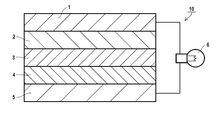
- FIG. 1 is a longitudinal sectional view schematically showing an all solid secondary battery according to a preferred embodiment of the present invention.
- a numerical range represented using “to” means a range including numerical values described before and after “to” as the lower limit value and the upper limit value.
- composition for forming an active material layer of the present invention includes a sulfide-based solid electrolyte, an active material, a conductive aid containing a carbonaceous material (hereinafter sometimes referred to simply as a conductive aid), and a ketone compound described later And a dispersion medium containing at least one dispersion medium.
- a dispersed state suspension
- the composition for forming an active material layer may be in the above dispersed state, but is preferably a slurry.
- a ketone compound dispersion in which the composition for forming an active material layer of the present invention comprises a carbonyl group and two aliphatic groups having 4 or more carbon atoms bonded to each other as a dispersion medium for a sulfide-based solid electrolyte, an active material and a conductive auxiliary agent.
- the composition for forming an active material layer of the present invention comprises a carbonyl group and two aliphatic groups having 4 or more carbon atoms bonded to each other as a dispersion medium for a sulfide-based solid electrolyte, an active material and a conductive auxiliary agent.
- the carbonyl group in the ketone compound dispersion medium is a polar group, it can be adsorbed on the surface of each of the sulfide-based solid electrolyte and the active material to improve their dispersibility.
- the ketone compound dispersion medium is usually highly reactive and may react with the sulfide-based solid electrolyte to degrade the sulfide-based solid electrolyte.
- the ketone compound dispersion medium used in the present invention is a sulfide-based solid electrolyte due to free movement of the aliphatic group (carbon chain) because two aliphatic groups having 4 or more carbon atoms are bonded to a carbonyl group.
- the reaction between the carbonyl group and the sulfide-based solid electrolyte can be inhibited to suppress the deterioration.
- the ketone compound dispersion medium usually exhibits dispersibility in a sulfide-based solid electrolyte and an active material, it does not exhibit good dispersibility in a conductive aid that is more hydrophobic than these.
- two of the above-mentioned aliphatic group sites exhibit chemical or physical interaction with the conductive aid, and the dispersibility of the conductive aid can be enhanced.
- the ketone compound dispersion medium can effectively suppress the reaggregation of the carbonaceous material as the conductive aid to enhance the dispersibility of the carbonaceous material.
- the aliphatic group has a branched chain structure, the steric hindrance becomes large, and the dispersion effect of the conductive auxiliary exerted by the ketone compound dispersion medium becomes large at the time of preparation of the composition for forming an active material layer of the present invention And the reaggregation of the conductive support agent in coating drying is suppressed and it becomes higher.
- the carbonyl group and the above-mentioned specific aliphatic group are functionally differentiated from each other, and the respective functions are exhibited without inhibiting each other.
- both of the sulfide-based solid electrolyte and the active material, and the conductive aid that is more hydrophobic than these can be dispersed.
- the composition for forming an active material layer of the present invention deterioration or decomposition of the sulfide-based solid electrolyte is suppressed, and the sulfide-based solid electrolyte, the active material, and the conductive aid are dispersed. Accordingly, the composition for forming an active material layer of the present invention can achieve both ion conductivity and electron conductivity at a high level.
- the composition for forming an active material layer of the present invention is a non-aqueous composition.
- the non-aqueous composition includes, in addition to the aspect not containing water, also a form having a water content (also referred to as water content) of 50 ppm or less.
- the water content is preferably 20 ppm or less, more preferably 10 ppm or less, and still more preferably 5 ppm or less.
- the water content indicates the amount of water contained in the composition for forming an active material layer (the mass ratio to the composition for forming an active material layer).
- the water content can be determined by filtering the composition for forming an active material layer with a membrane filter of 0.02 ⁇ m and performing Karl Fischer titration.
- the sulfide-based solid electrolyte refers to an inorganic sulfide-based solid electrolyte
- the solid electrolyte refers to a solid electrolyte capable of transferring ions therein.
- An organic solid electrolyte (a polymer electrolyte represented by polyethylene oxide (PEO) or the like, an organic electrolyte represented by lithium bis (trifluoromethanesulfonyl) imide (LiTFSI) or the like because it does not contain an organic substance as a main ion conductive material It is clearly distinguished from electrolyte salt).
- a sulfide-based solid electrolyte since a sulfide-based solid electrolyte is solid in a steady state, it is not usually dissociated or released into cations and anions. In this respect, it is also clearly distinguished from the electrolyte solution or the inorganic electrolyte salt (LiPF 6 , LiBF 4 , LiFSI, LiCl, etc.) in which the cation and the anion are dissociated or released in the polymer.
- the sulfide-based solid electrolyte is not particularly limited as long as it has the conductivity of an ion of a metal belonging to Group 1 or Group 2 of the periodic table, and one having no electron conductivity is generally used.
- a sulfide-based solid electrolyte material to be applied to products of this type can be appropriately selected and used.
- a sulfide type solid electrolyte uses what has the ion conductivity of lithium ion.
- the sulfide-based solid electrolyte contains a sulfur atom (S), and is preferably a compound having ion conductivity of a metal belonging to the first group or the second group of the periodic table and having an electron insulating property.
- S sulfur atom
- the sulfide-based solid electrolyte preferably contains at least Li, S and P as elements, and preferably has lithium ion conductivity, but other elements other than Li, S and P depending on the purpose or case. May be included.
- L a1 M b1 P c1 S d1 A e1 formula (I)
- L represents an element selected from Li, Na and K, and Li is preferred.
- M represents an element selected from B, Zn, Sn, Si, Cu, Ga, Sb, Al and Ge.
- A represents an element selected from I, Br, Cl and F.
- a1 to e1 represent composition ratios of respective elements, and a1: b1: c1: d1: e1 satisfies 1 to 12: 0 to 5: 1: 2 to 12: 0 to 10. 1 to 9 is preferable, and 1.5 to 7.5 is more preferable. 0 to 3 is preferable, and 0 to 1 is more preferable as b1. 2.5 to 10 are preferable and 3.0 to 8.5 of d1 are more preferable. 0 to 5 is preferable, and 0 to 3 is more preferable as e1.
- composition ratio of each element can be controlled by adjusting the compounding ratio of the raw material compound at the time of manufacturing the sulfide-based solid electrolyte as described below.
- the sulfide-based solid electrolyte may be non-crystalline (glass) or crystallized (glass ceramic), or only a part of it may be crystallized.
- a Li—P—S-based glass containing Li, P and S, or a Li—P—S-based glass ceramic containing Li, P and S can be used.
- the sulfide-based solid electrolyte includes, for example, lithium sulfide (Li 2 S), phosphorus sulfide (for example, diphosphorus pentasulfide (P 2 S 5 )), single phosphorus, single sulfur, sodium sulfide, hydrogen sulfide, lithium halide (for example, LiI It can be produced by the reaction of at least two or more of the sulfides of the elements represented by the above M (for example, SiS 2 , SnS, GeS 2 ).
- the ratio of Li 2 S to P 2 S 5 in the Li-P-S-based glass and Li-P-S-based glass ceramic is preferably a molar ratio of Li 2 S: P 2 S 5 of 60:40 to 90:10, more preferably 68:32 to 78:22.
- the lithium ion conductivity can be made high.
- the lithium ion conductivity can be preferably 1 ⁇ 10 ⁇ 4 S / cm or more, more preferably 1 ⁇ 10 ⁇ 3 S / cm or more. There is no particular upper limit, but it is practical to be 1 ⁇ 10 ⁇ 1 S / cm or less.
- Li 2 S-P 2 S 5 Li 2 S-P 2 S 5 -LiCl, Li 2 S-P 2 S 5 -H 2 S, Li 2 S-P 2 S 5 -H 2 S-LiCl, Li 2 S-LiI-P 2 S 5 , Li 2 S-LiI-Li 2 O-P 2 S 5 , Li 2 S-LiBr-P 2 S 5 , Li 2 S-Li 2 O-P 2 S 5 , Li 2 S-Li 3 PO 4 -P 2 S 5 , Li 2 S-P 2 S 5- P 2 O 5 , Li 2 S-P 2 S 5- SiS 2 , Li 2 S-P 2 S 5- SiS 2 -LiCl, Li 2 S-P 2 S 5 -SnS, Li 2 S-P 2 S 5 -Al 2 S 3, Li 2 S-GeS 2, Li 2 S-GeS 2, Li 2 S-G
- the mixing ratio of each raw material does not matter.
- an amorphization method can be mentioned.
- the amorphization method for example, a mechanical milling method, a solution method and a melt quenching method can be mentioned. It is because processing at normal temperature becomes possible, and simplification of the manufacturing process can be achieved.
- the sulfide-based solid electrolyte is preferably particles.
- the median diameter D50 of the sulfide-based solid electrolyte is not particularly limited, but is preferably smaller than the median diameter of the active material described later.
- the median diameter is, for example, preferably 0.01 ⁇ m or more, and more preferably 0.1 ⁇ m or more.
- the upper limit is preferably 100 ⁇ m or less, more preferably 5 ⁇ m or less. In the present invention, since a specific dispersion medium described later is used, reaggregation of a sulfide-based solid electrolyte or the like in the composition for forming an active material layer can be suppressed.
- the particle size of the sulfide-based solid electrolyte can be reduced.
- the particle size is smaller than that of the active material, the battery capacity of the all-solid secondary battery can be improved.
- the upper limit value of the particle size (median diameter) of the sulfide-based solid electrolyte can be, for example, 100 ⁇ m regardless of the above upper limit value, and in the case of preliminary dispersion described later, it is 1 ⁇ m or less It can also be set.
- the measurement of the average particle size of the sulfide-based solid electrolyte particles is carried out according to the following procedure.
- Sulfide-based solid electrolyte particles are diluted with heptane to a 1% by weight dispersion in a 20 mL sample bottle.
- the diluted dispersed sample is irradiated with 1 kHz ultrasound for 10 minutes, and used immediately thereafter for the test.
- a laser diffraction / scattering particle size distribution analyzer LA-920 (trade name, manufactured by HORIBA)
- data acquisition is performed 50 times using a quartz cell for measurement at a temperature of 25 ° C.
- JIS Z 8828 2013 "Particle diameter analysis-dynamic light scattering method" as necessary. Make five samples per level and adopt the average value.
- a sulfide type solid electrolyte may be used individually by 1 type, and may be used in combination of 2 or more type.
- the content of the sulfide-based solid electrolyte in the composition for forming an active material layer is not particularly limited, and in consideration of reduction of interface resistance and maintenance of reduced interface resistance when used in an all-solid secondary battery.
- the solid component is 100% by mass, it is preferably 5% by mass or more, more preferably 10% by mass or more, still more preferably 15% by mass or more, and 50% by mass or more It is more preferably 70% by mass or more, particularly preferably 90% by mass or more.
- the upper limit is preferably 50% by mass or less, and 40% by mass or less, because the energy content of the battery decreases when the content of the solid electrolyte increases and the active material ratio in the electrode decreases. Is more preferable, and 30 parts by mass or less is particularly preferable.
- the content of the sulfide-based solid electrolyte in the composition for forming an active material layer is preferably 5% by mass or more in 100% by mass of the solid component as the total content with the active material described later. It is more preferable that it is mass% or more, and it is especially preferable that it is 15 mass% or more.
- the upper limit is preferably 99.9% by mass or less, more preferably 99.5% by mass or less, and particularly preferably 99% by mass or less.
- the single content of the sulfide-based solid electrolyte is not particularly limited as long as the total content with the active material is in the above range, and is appropriately set.
- the solid content does not disappear by evaporation or evaporation when the composition for forming an active material layer is subjected to drying treatment at 150 ° C. for 6 hours under a pressure of 1 mmHg and a nitrogen atmosphere.
- ingredient Typically, it refers to components other than the dispersion medium described later.
- the composition for forming an active material layer of the present invention contains an active material.
- This active material is a material capable of inserting and releasing ions of metal elements belonging to Periodic Table Group 1 or Group 2.
- a positive electrode active material and a negative electrode active material can be mentioned.
- the positive electrode active material is preferably a metal oxide (preferably transition metal oxide), and the negative electrode active material may be a carbonaceous material, a metal oxide or a metal capable of forming an alloy with lithium such as Sn, Si, Al and In. Is preferred.
- composition for forming an active material layer containing a positive electrode active material may be referred to as a composition for a positive electrode
- a composition for forming an active material layer containing a negative electrode active material may be referred to as a composition for a negative electrode.
- the positive electrode active material is preferably one capable of reversibly inserting and releasing lithium ions.
- the material is not particularly limited as long as it has the above-described characteristics, and may be a transition metal oxide, an organic substance, an element capable of being complexed with Li such as sulfur, a complex of sulfur and a metal, or the like. Among them, it is preferable to use a transition metal oxide as the positive electrode active material, and a transition metal oxide having a transition metal element M a (one or more elements selected from Co, Ni, Fe, Mn, Cu and V) Are more preferred.
- an element M b (an element of Group 1 (Ia) other than lithium, an element of Group 1 (Ia) of the metal periodic table, an element of Group 2 (IIa), Al, Ga, In, Ge, Sn, Pb, Elements such as Sb, Bi, Si, P or B may be mixed.
- the mixing amount is preferably 0 to 30 mol% with respect to the amount (100 mol%) of the transition metal element M a . It is more preferable to be synthesized by mixing so that the molar ratio of Li / Ma is 0.3 to 2.2.
- transition metal oxide examples include a transition metal oxide having a (MA) layered rock salt type structure, a transition metal oxide having a (MB) spinel type structure, a (MC) lithium-containing transition metal phosphate compound, (MD And the like) lithium-containing transition metal halogenated phosphoric acid compounds and (ME) lithium-containing transition metal silicate compounds.
- MA transition metal oxide having a
- MB transition metal oxide having a (MB) spinel type structure
- MC lithium-containing transition metal phosphate compound
- MD And the like lithium-containing transition metal halogenated phosphoric acid compounds
- ME lithium-containing transition metal silicate compounds.
- transition metal oxides having a layered rock salt type structure LiCoO 2 (lithium cobaltate [LCO]), LiNi 2 O 2 (lithium nickelate), LiNi 0.85 Co 0.10 Al 0. 05 O 2 (lithium nickel cobalt aluminate [NCA]), LiNi 1/3 Co 1/3 Mn 1/3 O 2 (lithium nickel manganese cobaltate [NMC]) and LiNi 0.5 Mn 0.5 O 2 ( And lithium manganese nickelate).
- LiCoO 2 lithium cobaltate [LCO]
- LiNi 2 O 2 lithium nickelate
- LiNi 0.85 Co 0.10 Al 0. 05 O 2 lithium nickel cobalt aluminate [NCA]
- LiNi 1/3 Co 1/3 Mn 1/3 O 2 lithium nickel manganese cobaltate [NMC]
- LiNi 0.5 Mn 0.5 O 2 And lithium manganese nickelate
- transition metal oxide having a (MB) spinel structure examples include LiMn 2 O 4 (LMO), LiCoMnO 4 , Li 2 FeMn 3 O 8 , Li 2 CuMn 3 O 8 , Li 2 CrMn 3 O 8 and Li 2 NiMn 3 O 8 and the like.
- (MC) lithium-containing transition metal phosphate compounds include olivine-type iron phosphates such as LiFePO 4 and Li 3 Fe 2 (PO 4 ) 3 , iron pyrophosphates such as LiFeP 2 O 7 , LiCoPO 4 etc. Cobalt phosphates and monoclinic Nasacon type vanadium phosphate salts such as Li 3 V 2 (PO 4 ) 3 (lithium vanadium phosphate).
- (MD) as the lithium-containing transition metal halogenated phosphate compound for example, Li 2 FePO 4 F such fluorinated phosphorus iron salt, Li 2 MnPO 4 hexafluorophosphate manganese salts such as F and Li 2 CoPO 4 F And cobalt fluoride phosphates.
- Li 2 FePO 4 F such fluorinated phosphorus iron salt
- Li 2 MnPO 4 hexafluorophosphate manganese salts such as F and Li 2 CoPO 4 F And cobalt fluoride phosphates.
- the (ME) lithium-containing transition metal silicate compound include Li 2 FeSiO 4 , Li 2 MnSiO 4 and Li 2 CoSiO 4 .
- transition metal oxides having a (MA) layered rock salt type structure are preferred, and LCO or NMC is more preferred.
- the shape of the positive electrode active material is not particularly limited, but is preferably in the form of particles.
- the median diameter D50 of the positive electrode active material is not particularly limited, but is preferably larger than the median diameter of the sulfide-based solid electrolyte in terms of electric capacity of the all-solid secondary battery.
- the median diameter of the positive electrode active material can be 0.1 to 50 ⁇ m.
- a usual pulverizer or classifier may be used.
- the positive electrode active material obtained by the firing method may be used after washing with water, an acidic aqueous solution, an alkaline aqueous solution and an organic solvent.
- the median diameter of the positive electrode active material can be measured in the same manner as the median diameter of the above-mentioned sulfide-based solid electrolyte.
- the positive electrode active materials may be used alone or in combination of two or more.
- the mass (mg) (area weight) of the positive electrode active material per unit area (cm 2 ) of the positive electrode active material layer is not particularly limited. It can be determined appropriately depending on the designed battery capacity.
- the content of the positive electrode active material in the composition for forming an active material layer is not particularly limited, and is preferably 10 to 95% by mass, more preferably 30 to 90% by mass, and still more preferably 50 to 85% in 100% by mass of solid content.
- the weight is more preferred, and 55 to 80% by weight is particularly preferred.
- the negative electrode active material is preferably one capable of reversibly inserting and releasing lithium ions.
- the material is not particularly limited as long as it has the above-mentioned characteristics, and carbonaceous materials, metal oxides such as tin oxide, silicon oxides, metal complex oxides, lithium alone such as lithium alloy and lithium aluminum alloy, and And metals such as Sn, Si, Al and In which can be alloyed with lithium.
- carbonaceous materials or lithium composite oxides are preferably used from the viewpoint of reliability.
- a metal complex oxide it is preferable that lithium can be occluded and released.
- the material is not particularly limited, but it is preferable in view of high current density charge and discharge characteristics that titanium and / or lithium is contained as a component.
- the carbonaceous material used as the negative electrode active material is a material substantially consisting of carbon.
- Examples thereof include carbonaceous materials obtained by firing various synthetic resins such as graphite (natural graphite, artificial graphite such as vapor grown graphite, etc.), and PAN (polyacrylonitrile) resin or furfuryl alcohol resin.
- various carbon fibers such as PAN-based carbon fiber, cellulose-based carbon fiber, pitch-based carbon fiber, vapor-grown carbon fiber, dehydrated PVA (polyvinyl alcohol) -based carbon fiber, lignin carbon fiber, glassy carbon fiber and activated carbon fiber And mesophase microspheres, graphite whiskers, and flat graphite.
- an amorphous oxide is particularly preferable, and chalcogenide which is a reaction product of a metal element and an element of Periodic Group 16 is also preferably used.
- amorphous is an X-ray diffraction method using CuK ⁇ radiation, and means one having a broad scattering band having an apex in a region of 20 ° to 40 ° in 2 ⁇ value, and a crystalline diffraction line May be included.
- amorphous oxides of semimetal elements and chalcogenides are more preferable, and elements of periodic table group 13 (IIIB) to 15 (VB), Al Particularly preferred are oxides consisting of Ga, Si, Sn, Ge, Pb, Sb and Bi singly or in combination of two or more thereof, and chalcogenides.
- preferable amorphous oxides and chalcogenides include, for example, Ga 2 O 3 , SiO, GeO, SnO, SnO 2 , PbO, PbO 2 , Pb 2 O 3 , Pb 2 O 4 , Pb 3 O 4 , and the like.
- Sb 2 O 3 , Sb 2 O 4 , Sb 2 O 8 Bi 2 O 3 , Sb 2 O 8 Si 2 O 3 , Bi 2 O 4 , SnSiO 3 , GeSiO, GeS, SnS, SnS 2 , PbS, PbS 2 , Sb 2 S 3 , Sb 2 S 5 and SnSiS 3 are preferably mentioned. They may also be complex oxides with lithium oxide, such as Li 2 SnO 2 .
- the negative electrode active material also preferably contains a titanium atom. More specifically, Li 4 Ti 5 O 12 (lithium titanate [LTO]) is excellent in rapid charge / discharge characteristics because the volume fluctuation at the time of lithium ion absorption and release is small, and the deterioration of the electrode is suppressed, and lithium ion secondary It is preferable at the point which the lifetime improvement of a battery is attained.
- Li 4 Ti 5 O 12 lithium titanate [LTO]
- a Si-based negative electrode it is also preferable to apply a Si-based negative electrode.
- a Si negative electrode can store more Li ions than carbon negative electrodes (graphite, acetylene black, etc.). That is, the storage amount of Li ions per unit mass increases. Therefore, the battery capacity can be increased. As a result, there is an advantage that the battery operating time can be extended.
- the shape of the negative electrode active material is not particularly limited, but is preferably in the form of particles.
- the median diameter D50 of the negative electrode active material is not particularly limited, but is preferably larger than the median diameter of the sulfide-based solid electrolyte.
- the median diameter of the negative electrode active material is preferably 0.1 to 60 ⁇ m.
- a usual grinder or classifier is used. For example, mortars, ball mills, sand mills, vibratory ball mills, satellite ball mills, planetary ball mills, and swirl flow jet mills or sieves are suitably used.
- wet pulverization in the presence of water or an organic solvent such as methanol can also be performed.
- the classification method is not particularly limited, and a sieve, an air classifier, or the like can also be used. Classification can be used both dry and wet.
- the median diameter of the negative electrode active material can be measured in the same manner as the median diameter of the above-mentioned sulfide-based solid electrolyte.
- the chemical formula of the compound obtained by the above-mentioned firing method can be calculated from the mass difference of the powder before and after firing as a measurement method using inductively coupled plasma (ICP) emission spectroscopy and as a simple method.
- ICP inductively coupled plasma
- the negative electrode active materials may be used alone or in combination of two or more.
- the mass (mg) (area weight) of the negative electrode active material per unit area (cm 2 ) of the negative electrode active material layer is not particularly limited. It can be determined appropriately depending on the designed battery capacity.
- the content of the negative electrode active material in the composition for forming an active material layer is not particularly limited, and is preferably 10 to 80% by mass, and more preferably 20 to 80% by mass with respect to 100% by mass of the solid content.
- the surfaces of the positive electrode active material and the negative electrode active material may be surface coated with another metal oxide.
- the surface coating agent may, for example, be a metal oxide containing Ti, Nb, Ta, W, Zr, Al, Si or Li. Specific examples thereof include titanate spinel, tantalum-based oxides, niobium-based oxides, lithium niobate-based compounds, etc.
- the electrode surface containing a positive electrode active material or a negative electrode active material may be surface-treated with sulfur or phosphorus.
- the particle surface of the positive electrode active material or the negative electrode active material may be subjected to surface treatment with an actinic ray or active gas (such as plasma) before and after the surface coating.
- the composition for forming an active material layer of the present invention contains a conductive aid.
- the conductive aid contains a carbonaceous material (meaning a conductive aid of a carbonaceous material, also referred to as a carbon-based conductive aid).
- the phrase "conductive auxiliary containing carbonaceous material” and "the conductive auxiliary contains a carbonaceous material” mean that at least one of the conductive auxiliary used in the composition for forming an active material layer of the present invention is It means that it is a carbon-based conductive aid, and includes an embodiment including a conductive aid other than the carbon-based conductive aid.
- each conductive aid contains a carbon-based conductive aid and a conductive aid other than the carbon-based conductive aid
- the content form of each conductive aid is not particularly limited.
- it may be contained as an aggregate of a carbon-based conductive support agent and a conductive support agent other than the carbon-based conductive support agent, and an aggregate of the carbon-based conductive support agent and a conductive support agent other than the carbon-based conductive support agent
- a carbon-based conductive support agent and a conductive support agent other than the carbon-based conductive support agent may be contained alone, without forming.
- the said containing form of each conductive support agent is the same also about the active material layer of the all-solid-state secondary battery electrode sheet mentioned later and an all-solid-state secondary battery.
- the active material and the conductive aid when used in combination, among the above-mentioned conductive aids, those which do not cause insertion and release of Li when the battery is charged and discharged and do not function as the active material are the conductive aids. I assume. Therefore, among the conductive aids, those which can function as an active material in the active material layer when the battery is charged and discharged are classified into the active materials rather than the conductive aids. Whether or not the battery functions as an active material when charged and discharged is not unique, and is determined by the combination with the active material.
- the carbon-based conductive aid used in the present invention is not particularly limited as long as it is a conductive aid of a carbonaceous material, and any material known as a general conductive aid can be used without particular limitation.
- Examples of carbon-based conductive additives include electron conductive materials, graphites such as natural graphite and artificial graphite, carbon blacks such as acetylene black, ketjen black and furnace black, amorphous carbon such as needle coke, etc.
- Examples include carbon fibers such as vapor grown carbon fiber or carbon nanotube, and conductive aids of carbon isotope such as graphene or fullerene (excluding carbon fibers).
- the conductive aid is preferably an electron conductive material, more preferably carbon blacks, carbon fibers or carbon isotopes, and even more preferably carbon blacks.
- the conductive assistants other than the carbon-based conductive assistant are not particularly limited, and those known as general conductive assistants can be used. For example, metal powder, metal fiber, conductive polymer and the like can be mentioned.
- the carbon-based conductive support agent and the conductive support agent other than the carbon-based conductive support agent may be used alone or in combination of two or more.
- the total content of the conductive additive in the composition for forming an active material layer is preferably 0.5 to 5% by mass, and more preferably 1 to 3% by mass with respect to 100 parts by mass of the solid content.
- the total content of the conductive aid means the total content of the content of the carbon-based conductive aid and the content of the conductive aid other than the carbon-based conductive aid.
- the content of the carbon-based conductive additive in the conductive additive is not particularly limited as long as it is within the above-mentioned range of the total content, and for example, it may be 10% by mass or more in the total content of the conductive additive. Preferably, it is 50 to 100% by mass.
- the shape of the conductive aid is not particularly limited, but is preferably in the form of particles.
- the median diameter D50 of the conductive additive is not particularly limited, and is, for example, preferably 0.01 to 1 ⁇ m, and more preferably 0.02 to 0.1 ⁇ m.
- the composition for forming an active material layer of the present invention contains a dispersion medium in which each component contained in the composition for forming an active material layer of the present invention, in particular, a sulfide-based solid electrolyte, an active material and a conductive agent are dispersed.
- the dispersion medium contains at least one ketone compound dispersion medium in which two aliphatic groups having 4 or more carbon atoms are bonded to a carbonyl group.
- the form in which the composition for forming an active material layer contains a dispersion medium is a form containing only one kind of the above-mentioned ketone compound dispersion medium, a form containing two or more kinds of the above-mentioned ketone compound dispersion medium, It may be any of the forms containing the above-mentioned ketone compound dispersion medium and other dispersion medium. Preferably, it is a form containing only one kind of the above-mentioned ketone compound dispersion medium, or a form containing one kind of the above-mentioned ketone compound dispersion medium and another dispersion medium.
- the dispersion medium used in the present invention includes a form containing a water dispersion medium in addition to the embodiment which is a non-water dispersion medium (does not contain a water dispersion medium).
- the content of the water dispersion medium is appropriately determined within the range not exceeding the above-mentioned water content in the composition for forming an active material layer.
- the non-aqueous dispersion medium usually means a dispersion medium other than water.
- the ketone compound dispersion medium as the dispersion medium is a ketone compound in which two aliphatic groups having 4 or more carbon atoms are bonded to a carbonyl group.
- the aliphatic group having a bonding number of 2 to the carbonyl group is preferably a saturated aliphatic hydrocarbon group (alkyl group), and the carbon number is 4 or more, preferably 4 or 5.
- Each of the two aliphatic groups may have any linear, branched or cyclic structure, but in view of the dispersibility of the sulfide-based solid electrolyte, the active material and the conductive auxiliary agent, It is preferably a chain structure or a branched structure, and more preferably a branched structure.
- the two aliphatic groups may be identical to or different from each other, but are preferably identical to each other in terms of the dispersibility of the sulfide-based solid electrolyte, the active material, and the conductive additive.
- the two aliphatic groups may be bonded to each other to form a ring.
- the aliphatic group is not particularly limited.
- the ketone compound dispersion medium may be a compound in which the above-mentioned aliphatic groups are appropriately combined, and in particular, a compound in which two aliphatic groups are identical and have a branched structure is preferable.
- a ketone compound dispersion medium is not particularly limited, and examples thereof include di (sec-butyl) ketone, di (iso-butyl) ketone, di (t-butyl) ketone, di (isopentyl) ketone and the like. .
- the ketone compound dispersion medium contained in the composition for forming an active material layer may be one type, or two or more types.
- the dispersion medium can also contain a dispersion medium other than the ketone compound dispersion medium, in addition to the ketone compound dispersion medium.
- a dispersion medium is not particularly limited as long as it is other than the ketone compound dispersion medium, and examples thereof include various organic dispersion media.
- the organic dispersion medium that can be used in combination with the ketone compound dispersion medium include a dispersion medium consisting of an ether compound, a dispersion medium consisting of an amide compound, a dispersion medium consisting of an amine compound, a dispersion medium consisting of an aromatic compound, and a dispersion medium consisting of an aliphatic compound.
- nonpolar dispersion media comprising a nitrile compound, dispersion media comprising an ester compound, and the like.
- nonpolar dispersion media are preferable.
- the nonpolar dispersion medium refers to a dispersion medium consisting of carbon atoms and hydrogen atoms.
- the nonpolar solvent includes a dispersion medium comprising an aromatic hydrocarbon compound or a dispersion medium comprising an aliphatic hydrocarbon compound, and more preferably a dispersion medium comprising an aliphatic hydrocarbon compound, and a compound comprising a saturated aliphatic hydrocarbon Is more preferred.
- the dispersion medium comprising an aliphatic hydrocarbon compound is not particularly limited as long as it is a dispersion medium of an aliphatic hydrocarbon compound, but a dispersion medium (alkane dispersion medium) comprising a saturated aliphatic hydrocarbon compound is preferable.
- the dispersion medium comprising an aliphatic hydrocarbon compound may have any of linear, branched or cyclic structure.
- dispersion media consisting of aliphatic hydrocarbon compounds
- examples of dispersion media consisting of aliphatic hydrocarbon compounds include dispersion media of alkane compounds having 6 to 10 carbon atoms such as hexane, heptane, octane, decane, cyclohexane and cyclooctane, paraffin, gasoline, naphtha, kerosene, light oil and the like. It can be mentioned.
- the organic dispersion medium that can be used in combination may be one kind or two or more kinds.
- the total content of the dispersion medium in the composition for forming an active material layer is not particularly limited, and is preferably 20 to 80% by mass, more preferably 30 to 70% by mass, and particularly preferably 40 to 60% by mass.
- the content of the ketone compound dispersion medium in the composition for forming an active material layer is not particularly limited as long as the total content of the dispersion medium falls within the above range.
- 1 to 80% by mass is preferable, 1.5 to 70% by mass is more preferable, and 2 to 50% by mass is more preferable.
- the content of the ketone compound dispersion medium means the total content.
- the content of the organic dispersion medium that can be used in combination in the composition for forming an active material layer is not particularly limited as long as the total content of the dispersion medium falls within the above range.
- the composition for forming an active material layer 1 to 75% by mass is preferable, 1.5 to 70% by mass is more preferable, and 2 to 50% by mass is more preferable.
- the content of the organic dispersion medium that can be used in combination means the total content.
- the content of the ketone compound dispersion medium in the dispersion medium is 100% by mass or less, and the kind or content of the sulfide-based solid electrolyte, the active material layer or the conductive auxiliary agent, etc. It can be set appropriately according to the situation.
- the lower limit value of the content of the ketone compound dispersion medium in the dispersion medium is preferably 1% by mass or more, and more preferably 2% by mass or more.
- the upper limit of content in the dispersion medium of a ketone compound dispersion medium can be set to 50 mass% or less, for example.
- the composition for forming an active material layer of the present invention may contain a binder.
- a binder will not be specifically limited if it is a binder polymer normally used for the composition for active material layer formation for all-solid-state secondary batteries.
- (meth) acrylic polymers, urethane polymers, urea polymers, amide polymers, imide polymers, ester polymers, hydrocarbon rubbers, fluororubbers and the like are suitably mentioned.
- the (meth) acrylic polymer is not particularly limited as long as it is a polymer formed from (meth) acrylic monomers, and, for example, methyl poly (meth) acrylate, poly (meth) acrylic acid, poly (meth) acrylic acid hydroxy Methyl etc.
- polymers described in JP-A-2015-88486 are also preferably mentioned.
- polymers described in JP-A-2015-88486 are also preferably mentioned.
- urethane polymer urea polymer, amide polymer, imide polymer and ester polymer
- polymers described in JP-A-2015-88480 are preferably mentioned.
- Hydrocarbon rubbers include natural rubber, polybutadiene, polyisoprene, polystyrene butadiene, and hydrogenated polymers thereof.
- fluororubber it is preferable to have a repeating unit derived from fluorinated vinylidene, and as such a polymer, polyvinylidene difluoride, polyvinylidene difluoride hexafluoropropylene and the like can be mentioned.
- the binder is preferably a polymer particle.
- the average particle size of the polymer particles is preferably 0.01 to 10 ⁇ m, and more preferably 0.01 to 1 ⁇ m.
- the average particle size of the polymer particles is the median size measured in the same manner as the median size of the sulfide-based solid electrolyte particles described above.
- the measurement from the produced all solid secondary battery is, for example, after the battery is disassembled and the electrode is peeled off, the measurement is performed on the electrode material, and the average particle diameter of particles other than the polymer particles measured in advance This can be done by excluding the measured values.
- a commercially available thing may be used for a polymer particle, and the polymer particle of Unexamined-Japanese-Patent No. 2016-139511 can be used conveniently.
- the weight average molecular weight of a binder means the weight average molecular weight in terms of standard polystyrene by gel permeation chromatography (GPC) unless otherwise specified.
- GPC gel permeation chromatography
- the measurement method it is set as the value measured by the method of the following condition A or condition B (priority) as a basis.
- an appropriate eluent may be selected and used.
- the content of the binder in the composition for forming an active material layer is a solid in terms of compatibility with ion conductivity and the binding property with solid particles such as sulfide-based solid electrolyte particles, active material and conductive auxiliary agent.
- solid particles such as sulfide-based solid electrolyte particles, active material and conductive auxiliary agent.
- the upper limit is preferably 20% by mass or less, more preferably 10% by mass or less, and still more preferably 5% by mass or less from the viewpoint of battery characteristics.
- the mass ratio of the total mass (total amount) of the sulfide-based solid electrolyte and the active material to the mass of the binder is preferably in the range of 1,000 to 1.
- the ratio is more preferably 500 to 2, and further preferably 100 to 10.
- the binders may be used alone or in combination of two or more.
- the composition for forming an active material layer according to the present invention may optionally contain, as components other than the above components, a thickener, a crosslinking agent (such as one that undergoes a crosslinking reaction by radical polymerization, condensation polymerization or ring opening polymerization), It can contain an initiator (such as one that generates acid or radical by heat or light), an antifoamer, a leveling agent, a dehydrating agent, an antioxidant, and the like.
- a thickener such as one that undergoes a crosslinking reaction by radical polymerization, condensation polymerization or ring opening polymerization
- an initiator such as one that generates acid or radical by heat or light
- an antifoamer such as one that generates acid or radical by heat or light
- a leveling agent such as one that generates acid or radical by heat or light
- a dehydrating agent such as one that generates acid or radical by heat or light
- an antioxidant such as one that generates acid or radical by heat or light
- the composition for forming an active material layer of the present invention comprises a sulfide-based solid electrolyte, an active material, a conductive auxiliary agent, and the above-mentioned components as appropriate, in the presence of a dispersion medium containing at least one ketone compound dispersion medium. It can be prepared as a slurry, preferably by mixing using various mixers. The mixing method is not particularly limited, and may be mixed all at once or may be mixed sequentially.
- the active material, the conductive additive, the binder, and the other additives may be mixed when mixing the sulfide-based solid electrolyte and the dispersion medium, or may be separately mixed.
- the carbon-based conductive aid and a conductive aid other than a carbon-based conductive aid are simultaneously mixed. You may mix, and you may mix one by one.
- the composition for active material layer formation can be prepared by mixing each said component using various mixers. Although it does not specifically limit as a mixer, For example, a ball mill, a bead mill, a planetary mixer, a blade mixer, a roll mill, a kneader, and a disc mill are mentioned.
- the mixing conditions are not particularly limited, and, for example, the mixing temperature is set to 10 to 60 ° C., the mixing time is set to 5 minutes to 5 hours, and the rotation speed is set to 10 to 700 rpm (rotation per minute).
- the mixing temperature is set to 10 to 60 ° C.
- the mixing time is set to 5 minutes to 5 hours
- the rotation speed is set to 10 to 700 rpm (rotation per minute).
- the number of rotations to 150 to 700 rpm and the mixing time to 5 minutes to 24 hours at the above mixing temperature.
- the compounding quantity of each component is set so that it may become the said content.
- the environment to be mixed is not particularly limited, and examples thereof include dry air and inert gas.
- the composition for forming an active material layer according to the present invention is preferably a dispersion containing a sulfide-based solid electrolyte and at least one ketone compound dispersion medium formed by combining a carbonyl group with two aliphatic groups having 4 or more carbon atoms. It is prepared by a method including the steps of predispersing (stirring) in a medium, and mixing the obtained predispersion, the active material, and the conductive aid.
- This production method (referred to as the production method of the composition for forming an active material layer of the present invention) prevents deterioration of the sulfide-based solid electrolyte, and further disperses the sulfide-based solid electrolyte, the active material and the conductive auxiliary agent It can be dispersed well. Therefore, an electrode sheet for all solid secondary batteries or an all solid battery can be obtained by using the composition for forming an active material layer of the present invention or using the composition for forming an active material layer obtained by this method. When the secondary battery is manufactured, further improvement in conductivity or battery capacity can be expected.
- a sulfide-based solid electrolyte is preliminarily dispersed (stirred) in a dispersion medium.
- the dispersion medium used is as described above, and the preferred embodiment is also the same.
- the mixing conditions at the time of preparation of the composition for forming an active material layer preferably the mixing conditions in the case of using a ball mill, can be applied.
- mechanical shear force is a sulfide-based compound in that the dispersibility of the sulfide-based solid electrolyte can be improved, and in particular, the sulfide-based solid electrolyte can be refined (such as crushing of aggregates).
- Preference is given to mixing methods or stirring methods which act on the solid electrolyte.
- a mixer such as a ball mill, a bead mill, or a planetary mixer.
- the degree to which the sulfide-based solid electrolyte is refined in the preliminary dispersion step is not particularly limited, but for example, the median diameter is preferably 3.0 ⁇ m or less, and more preferably 2.0 ⁇ m or less.
- the pre-dispersing step components other than the active material and the conductive additive may be mixed.
- a preliminary dispersion of a sulfide-based solid electrolyte can be obtained.
- the step of mixing the obtained preliminary dispersion of the sulfide-based solid electrolyte, the active material, and the conductive additive is performed.
- the active material and the conductive aid are as described above, and preferred ones are also the same.
- the dispersion medium for mixing (dispersing) the above respective components may be the dispersion medium contained in the preliminary dispersion, and a new dispersion medium may be used separately from this.
- the dispersion medium to be newly used may be the same as or different from the dispersion medium used in the preliminary dispersion step.
- a sulfide-based solid electrolyte isolated from the obtained pre-dispersion and a new dispersion medium may be used as the pre-dispersion.
- the order of mixing with the predispersion is not particularly limited, and the active material and the conductive aid may be mixed simultaneously or one may be mixed first.
- a carbon-based conductive aid and a conductive aid other than a carbon-based conductive aid as a conductive aid, a mixture of a carbon-based conductive aid and a conductive aid other than the carbon-based conductive aid is prepared in advance.
- the mixing ratio of each component in the mixing step is the same as the content ratio of each component in the composition for forming an active material layer of the present invention, and the preferable range is also the same.
- the mixing conditions may be any conditions as long as the respective components can be mixed and dispersed. For example, the mixing conditions at the time of preparation of the composition for forming an active material layer can be applied. Conditions for mixing are preferably milder than the conditions for predispersion described above.
- the mixing conditions at the time of preparation of the composition for forming an active material layer preferably, the above mixing conditions when using a ball mill can be applied.
- the composition for forming an active material layer of the present invention can be prepared.
- composition for forming an active material layer of the present invention can be dispersed while suppressing reaggregation even if a carbonaceous material is used as a conductive aid. Therefore, as described later, it is preferably used as a material for forming an electrode active material layer of an all solid secondary battery or an electrode sheet for an all solid secondary battery.
- the solid electrolyte-containing sheet is a sheet-like molded body capable of forming a constituent layer of the all-solid secondary battery, and includes various embodiments according to the application.
- a sheet preferably used for a solid electrolyte layer also referred to as a solid electrolyte-containing sheet for all solid secondary batteries
- an electrode or a sheet preferably used for a laminate of an electrode and a solid electrolyte layer (for all solid secondary batteries Electrode sheet) etc. are mentioned.
- these various sheets may be collectively referred to as a sheet for all solid secondary battery.
- the electrode sheet for all solid secondary batteries may be a sheet having an active material layer (electrode layer), and the active material layer (electrode layer) is on the substrate (collector Or the sheet
- the electrode sheet is a sheet suitably used to form an active material layer or a laminate of a solid electrolyte layer and an active material layer of an all solid secondary battery.
- this electrode sheet is usually a sheet having a current collector and an active material layer, an embodiment having a current collector, an active material layer and a solid electrolyte layer in this order, a current collector, an active material layer, The embodiment having the solid electrolyte layer and the active material layer in this order is also included.
- the electrode sheet may have other layers as long as it has an active material layer.
- a protective layer release sheet
- a collector collector
- a coat layer etc. are mentioned, for example.
- the layer thickness of each layer constituting the electrode sheet is the same as the layer thickness of each layer described in the all solid secondary battery described later.
- the active material layer of the electrode sheet is preferably formed of the composition for forming an active material layer of the present invention. From this, the active material layer exhibits the ion conductivity and the electron conductivity in a well-balanced manner at a high level.
- this electrode sheet as a material constituting the (negative electrode or positive electrode) active material layer of the all solid secondary battery, a high battery capacity can be imparted to the all solid secondary battery.
- content of each component in the active material layer of an electrode sheet is not specifically limited, Preferably, it is synonymous with content of each component in solid content of the composition for active material layer formation of this invention.
- the substrate is not particularly limited as long as it can support the active material layer, and examples include materials described in the later-described current collector, sheet bodies (plate-like bodies) of organic materials, inorganic materials, and the like.
- examples of the organic material include various polymers and the like, and specific examples include polyethylene terephthalate, polypropylene, polyethylene and cellulose.
- an inorganic material glass, a ceramic, etc. are mentioned, for example.
- the solid electrolyte sheet for an all solid secondary battery and the solid electrolyte layer can be formed of a known solid electrolyte composition.
- the solid electrolyte sheet and solid electrolyte layer for all solid secondary batteries generally do not contain a positive electrode active material and / or a negative electrode active material.
- the layer thickness of the solid electrolyte layer of the solid electrolyte-containing sheet is the same as the layer thickness of the solid electrolyte layer described in the all solid secondary battery described later.
- a solid electrolyte content sheet the sheet which has a solid electrolyte layer and a protective layer in this order on a substrate, and the sheet (sheet which does not have a substrate) which consists of a solid electrolyte layer are mentioned, for example.
- the method for producing the solid electrolyte-containing sheet is not particularly limited.
- the electrode sheet for the all solid secondary battery can be manufactured (included) through the method for manufacturing a composition for forming an active material layer of the present invention. Focusing on the raw materials to be used, it can also be manufactured using the composition for forming an active material layer of the present invention.
- the composition for forming an active material layer of the present invention is prepared as described above, and the obtained composition for forming an active material layer is formed on a substrate (may be via another layer).
- a method of forming an active material layer (coating dry layer) on a substrate by (coating and drying) may be mentioned.
- the electrode sheet which has a base material and a coating dry layer can be produced.
- the composition for forming an active material layer of the present invention suppresses the deterioration or decomposition of the sulfide-based solid electrolyte and the re-aggregation of the sulfide-based solid electrolyte etc. even during the above-mentioned coating and drying, thereby preventing the sulfide-based solid electrolyte and the active material And the excellent dispersed state of the conductive aid can be maintained.
- the electrode sheet produced using the composition for active material layer formation of this invention exhibits an ionic conductivity and electronic conductivity at a high level.
- the coated and dried layer is a layer formed by applying the composition for forming an active material layer of the present invention and drying the dispersion medium (that is, using the composition for forming an active material layer of the present invention) And the layer which consists of a composition which removed the dispersion medium from the composition for active material layer formation of this invention is said.
- the composition for forming an active material layer of the present invention is preferably used as a slurry, and if desired, the composition for forming an active material layer of the present invention can be slurried by a known method.
- coating of the composition for active material layer formation of this invention, drying, etc. is demonstrated in the manufacturing method of the following all-solid-state secondary battery.
- the coated and dried layer obtained as described above can also be pressurized.
- the pressurization conditions and the like will be described in the manufacturing method of the all solid secondary battery described later.
- the base material, the protective layer (in particular, a release sheet) and the like can be peeled off.
- the all solid secondary battery includes a positive electrode active material layer, a negative electrode active material layer facing the positive electrode active material layer, and a solid electrolyte layer disposed between the positive electrode active material layer and the negative electrode active material layer.
- the positive electrode active material layer and the negative electrode active material layer of the all solid secondary battery, particularly the positive electrode active material layer, are formed of the composition for forming an active material layer of the present invention, and a sulfide-based solid electrolyte, an active material and a conductive support agent Contains
- the negative electrode active material layer is not formed of the composition for forming an active material layer of the present invention, a layer containing a sulfide-based solid electrolyte, an active material, and the appropriate components described above or a lithium metal layer is employed.
- the solid electrolyte layer contains a solid electrolyte having conductivity of ions of metals belonging to Periodic Table Group 1 or Group 2 and appropriate components described above.
- the all solid secondary battery hereinafter sometimes referred to as the all solid secondary battery of the present invention
- the active material layer formed of the composition for forming an active material layer of the present invention is an ion It exhibits conductivity and electron conductivity in a well-balanced manner at a high level, and exhibits high battery capacity.
- the lithium metal layer that can constitute the negative electrode active material layer means a layer of lithium metal, and specifically, includes a layer formed by depositing or molding lithium powder, a lithium foil, a lithium deposited film, and the like.
- the thickness of the lithium metal layer is not particularly limited, and can be, for example, 0.01 to 100 ⁇ m.
- the active material layer is formed of the composition for forming an active material layer of the present invention or the above electrode sheet.
- This active material layer is preferably the same as in the solid content of the composition for forming an active material layer or the solid electrolyte-containing sheet, unless otherwise specified.
- the thicknesses of the negative electrode active material layer, the solid electrolyte layer, and the positive electrode active material layer are not particularly limited.
- each layer is preferably 10 to 1,000 ⁇ m, more preferably 20 ⁇ m or more and less than 500 ⁇ m, in consideration of the size of a general all-solid secondary battery.
- the thickness of at least one of the positive electrode active material layer, the solid electrolyte layer and the negative electrode active material layer is more preferably 50 ⁇ m or more and less than 500 ⁇ m.
- the positive electrode active material layer and the negative electrode active material layer may each include a current collector on the side opposite to the solid electrolyte layer.
- the all solid secondary battery of the present invention may be used as the all solid secondary battery as it is in the above-mentioned structure depending on the application, but in order to form a dry battery, it may be further enclosed in a suitable housing Is preferred.
- the housing may be metallic or made of resin (plastic). When using a metallic thing, the thing made of aluminum alloy and stainless steel can be mentioned, for example.
- the metallic casing is preferably divided into a casing on the positive electrode side and a casing on the negative electrode side, and is preferably electrically connected to the positive electrode current collector and the negative electrode current collector. It is preferable that the housing on the positive electrode side and the housing on the negative electrode side be joined and integrated through a short circuit preventing gasket.
- FIG. 1 is a cross-sectional view schematically showing an all solid secondary battery (lithium ion secondary battery) according to a preferred embodiment of the present invention.
- the all solid secondary battery 10 of the present embodiment has a negative electrode current collector 1, a negative electrode active material layer 2, a solid electrolyte layer 3, a positive electrode active material layer 4, and a positive electrode current collector 5 in this order as viewed from the negative electrode side. .
- Each layer is in contact with each other and has a stacked structure. By adopting such a structure, at the time of charge, electrons (e ⁇ ) are supplied to the negative electrode side, and lithium ions (Li + ) are accumulated there.
- the composition for forming an active material layer of the present invention can be preferably used as a molding material for a negative electrode active material layer or a positive electrode active material layer.
- the electrode sheet of the present invention is suitable as a negative electrode active material layer or a positive electrode active material layer.
- a positive electrode active material layer (hereinafter also referred to as a positive electrode layer) and a negative electrode active material layer (hereinafter also referred to as a negative electrode layer) may be collectively referred to as an electrode layer or an active material layer.
- this all solid secondary battery When an all solid secondary battery having the layer configuration shown in FIG. 1 is placed in a 2032 coin case, this all solid secondary battery is referred to as an electrode sheet for all solid secondary batteries, and this electrode sheet for all solid secondary batteries is A battery manufactured by putting it in a 2032 type coin case may be called as an all solid secondary battery and called separately.
- the all solid secondary battery 10 At least a positive electrode active material layer is formed using the composition for forming an active material layer of the present invention or the above electrode sheet. Thereby, the all solid secondary battery exhibits high battery capacity. The details of the reason are as described above.
- the components contained in the positive electrode active material layer 4, the solid electrolyte layer 3 and the negative electrode active material layer 2 may be the same as or different from each other.
- the negative electrode active material layer can be formed using the composition for forming an active material layer of the present invention or the above electrode sheet, and can also be formed of a lithium metal layer.
- the positive electrode current collector 5 and the negative electrode current collector 1 are preferably electron conductors.
- one or both of the positive electrode current collector and the negative electrode current collector may be simply referred to as a current collector.
- a current collector In addition to aluminum, aluminum alloy, stainless steel, nickel and titanium as materials for forming a positive electrode current collector, aluminum or stainless steel surface treated with carbon, nickel, titanium or silver (a thin film is formed are preferred, among which aluminum and aluminum alloys are more preferred.
- materials for forming the negative electrode current collector in addition to aluminum, copper, copper alloy, stainless steel, nickel and titanium etc., carbon, nickel, titanium or silver is treated on the surface of aluminum, copper, copper alloy or stainless steel Are preferred, with aluminum, copper, copper alloys and stainless steel being more preferred.
- the shape of the current collector is usually in the form of a film sheet, but a net, a punch, a lath body, a porous body, a foam, a molded body of a fiber group and the like can also be used.
- the thickness of the current collector is not particularly limited, but is preferably 1 to 500 ⁇ m. Further, it is also preferable to make the current collector surface uneven by surface treatment.
- each layer of the negative electrode current collector is appropriately interposed or disposed between or outside each layer of the negative electrode current collector, the negative electrode active material layer, the solid electrolyte layer, the positive electrode active material layer and the positive electrode current collector.
- Each layer may be composed of a single layer or multiple layers.
- the all solid secondary battery of the present invention is not particularly limited, and can be manufactured (including) through the method of manufacturing the composition for forming an active material layer of the present invention. Focusing on the raw materials to be used, it can also be manufactured using the composition for forming an active material layer of the present invention.
- the composition for forming an active material layer of the present invention is prepared as described above, and the resulting composition for forming an active material layer is used to obtain an all solid secondary battery. It can manufacture by forming the component layer of a battery. Thereby, the all-solid-state secondary battery with high discharge capacity can be manufactured.
- the method of preparing the composition for forming an active material layer of the present invention is the same as described above, and thus the description thereof is omitted.
- the composition for forming an active material layer of the present invention is applied onto a substrate (for example, a metal foil serving as a current collector) to form a coating (film formation) It can be manufactured through a method including (via) steps.
- the composition for forming an active material layer of the present invention is applied as a composition for a positive electrode on a metal foil that is a positive electrode current collector to form a positive electrode active material layer, and a positive electrode sheet for all solid secondary battery is produced.
- a solid electrolyte composition for forming a solid electrolyte layer is applied onto the positive electrode active material layer to form a solid electrolyte layer.
- composition for active material layer formation of this invention is apply
- An all-solid secondary battery having a structure in which a solid electrolyte layer is sandwiched between a positive electrode active material layer and a negative electrode active material layer by overlapping a negative electrode current collector (metal foil) on the negative electrode active material layer Can. This may be enclosed in a case to make a desired all solid secondary battery.
- the formation method of each layer is reversed, a negative electrode active material layer, a solid electrolyte layer, and a positive electrode active material layer are formed on the negative electrode current collector, and the positive electrode current collector is stacked to produce an all solid secondary battery.
- the negative electrode active material layer can also be formed using a known negative electrode active material composition or a lithium metal foil. The same applies to the following method.
- Another method is as follows. That is, as described above, a positive electrode sheet for an all solid secondary battery is produced. Moreover, the composition for active material layer formation of this invention is apply
- the following method may be mentioned. That is, as described above, a positive electrode sheet for an all solid secondary battery and a negative electrode sheet for an all solid secondary battery are produced. Moreover, separately from this, a solid electrolyte composition is apply
- An all solid secondary battery can also be manufactured by a combination of the above forming methods. For example, as described above, a positive electrode sheet for all solid secondary batteries, a negative electrode sheet for all solid secondary batteries, and a solid electrolyte-containing sheet for all solid secondary batteries are prepared. Subsequently, after laminating the solid electrolyte layer peeled off from the substrate on the negative electrode sheet for the all solid secondary battery, the whole solid secondary battery can be manufactured by bonding to the positive electrode sheet for the all solid secondary battery. it can. In this method, the solid electrolyte layer may be laminated on the positive electrode sheet for the all solid secondary battery, and may be bonded to the negative electrode sheet for the all solid secondary battery.
- At least one of the negative electrode active material layer and the positive electrode active material layer is formed of the composition for forming an active material layer of the present invention.
- the composition etc. for active material layer formation normally used are mentioned.
- the solid electrolyte composition forming the solid electrolyte layer is not particularly limited as long as it is a composition containing a solid electrolyte, and a solid electrolyte composition (does not contain an active material) generally used in the production of all solid secondary batteries Etc.).
- each composition generally used for manufacture of the composition for active material layer formation or an all-solid-state secondary battery is not specifically limited, It can select suitably.
- application preferably wet application
- spray application spin coating application
- dip coating dip coating
- slit application stripe application
- bar coating application can be mentioned.
- the composition for forming an active material layer or each composition generally used for the production of an all solid secondary battery may be subjected to a drying treatment after being applied respectively, or even after being subjected to a multilayer application, a drying treatment Good.
- the drying temperature is not particularly limited.
- the lower limit is preferably 30 ° C. or more, more preferably 60 ° C. or more, and still more preferably 80 ° C.
- the dispersion medium can be removed, and a solid state (coated dry layer) can be obtained.
- the temperature is not excessively high and the members of the all solid secondary battery are not damaged. Thereby, in the all solid secondary battery, excellent overall performance can be exhibited, and good binding can be obtained.
- the composition for forming the active material layer is applied and dried as described above, the deterioration or decomposition of the sulfide-based solid electrolyte and the reaggregation of the sulfide-based solid electrolyte, etc. are also suppressed, as described above. It is possible to maintain an excellent dispersed state of the solid electrolyte, the active material and the conductive additive.
- the applied composition for forming an active material layer or the like, or each layer or all solid secondary battery after producing the all solid secondary battery. Moreover, it is also preferable to pressurize in the state which laminated
- a hydraulic cylinder press machine etc. are mentioned as a pressurization method.
- the pressure is not particularly limited, and in general, the pressure is preferably in the range of 50 to 1,500 MPa.
- the applied active material layer-forming composition may be heated simultaneously with the application of pressure.
- the heating temperature is not particularly limited, and generally in the range of 30 to 300 ° C. It is also possible to press at a temperature higher than the glass transition temperature of the sulfide-based solid electrolyte.
- the pressurization may be performed in a state in which the coating solvent or dispersion medium is dried in advance, or may be performed in a state in which the coating solvent or dispersion medium remains.
- each composition may be simultaneously apply
- the atmosphere during pressurization is not particularly limited, and may be under air, under dry air (dew point ⁇ 20 ° C. or less), under inert gas (eg, in argon gas, in helium gas, in nitrogen gas). Since the sulfide solid electrolyte reacts with water, the atmosphere during pressurization is preferably under dry air or in an inert gas.
- the pressing time may be high pressure for a short time (for example, within several hours), or may be medium pressure for a long time (one day or more).
- a restraint (screw tightening pressure or the like) of the all-solid secondary battery can also be used to keep applying medium pressure.
- the pressing pressure may be uniform or different with respect to a pressure receiving portion such as a sheet surface.
- the press pressure can be changed according to the area and film thickness of the pressure-receiving portion. It is also possible to change the same site in stages with different pressures.
- the press surface may be smooth or roughened.
- the all-solid secondary battery produced as described above is preferably subjected to initialization after production or before use.
- the initialization is not particularly limited, and can be performed, for example, by performing initial charge and discharge in a state where the press pressure is increased, and then releasing the pressure until the general working pressure of the all solid secondary battery is reached.
- the all solid secondary battery of the present invention can be applied to various applications.
- the application mode is not particularly limited, for example, when installed in an electronic device, a laptop computer, a pen input computer, a mobile computer, an e-book player, a mobile phone, a cordless handset, a pager, a handy terminal, a mobile fax, a mobile phone Examples include copying, portable printers, headphone stereos, video movies, LCD TVs, handy cleaners, portable CDs, mini-discs, electric shavers, transceivers, electronic organizers, calculators, portable tape recorders, radios, backup power supplies, memory cards and the like.
- Other consumer products include automobiles (electric cars, etc.), electric vehicles, motors, lighting equipment, toys, game machines, road conditioners, watches, strobes, cameras, medical devices (pace makers, hearing aids, shoulder machines, etc.), etc. . Furthermore, it can be used for various military and space applications. It can also be combined with a solar cell.
- Synthesis Example 1 Synthesis of Sulfide-based Solid Electrolyte Li-P-S Glass> As a sulfide-based solid electrolyte, T.K. Ohtomo, A. Hayashi, M. Tatsumisago, Y .; Tsuchida, S. HamGa, K .; Kawamoto, Journal of Power Sources, 233, (2013), pp 231-235 and A.A. Hayashi, S. Hama, H. Morimoto, M. Tatsumisago, T .; Minami, Chem. Lett. , (2001), pp 872-873, Li-P-S-based glass was synthesized.
- lithium sulfide Li 2 S, manufactured by Aldrich, purity> 99.98%) 2.42 g, phosphorus pentasulfide (P 2 S) in a glove box under an argon atmosphere (dew point ⁇ 70 ° C.) (5 , manufactured by Aldrich, purity> 99%) 3.90 g of each was weighed, put into a mortar made of agate, and mixed for 5 minutes using a pestle made of agate.
- Example 1 In Example 1, the composition for positive electrodes and the positive electrode sheet for all solid secondary batteries were respectively produced, and the ion conductivity and the electron conductivity of the positive electrode sheets were measured.
- ⁇ Preparation of positive electrode sheet for all solid secondary battery> -Preparation of composition for positive electrode- Lithium manganese manganese cobaltate (NMC, median diameter 3 ⁇ m according to the above measurement method) as a positive electrode active material and sulfide-based solid electrolyte Li-P synthesized in the above synthesis example 1 in a dry air environment (dew point ⁇ 60 ° C.) -S-based glass (median diameter 7 ⁇ m according to the above measurement method) and acetylene black (median diameter 50 nm according to the above measurement method) are mixed so that the mass ratio becomes 80: 18: 2, and planetary It was added to a mixer (Hibis Mix 2P-03 (trade name), manufactured by Primix).
- a dispersion medium shown in Table 1 as a dispersion medium is added to this planetary mixer so that the solid content concentration becomes 40 mass%, and stirred and mixed at 50 rpm for 1 hour at room temperature (25 ° C.)
- the composition for positive electrodes (slurry) was prepared as a composition, respectively.
- the ion conductivity of each of the cells for evaluating ion conductivity prepared from positive electrode sheets A-1 to A-5 and B-1 to B-15 for all solid secondary batteries is the positive electrode sheet A-1 for all solid secondary batteries
- the ion conductivity (relative value) in each ion conductivity evaluation cell was calculated by dividing by the ion conductivity in the ion conductivity evaluation cell manufactured from the above. In this test, the larger the ion conductivity (relative value), the higher the ion conductivity of the positive electrode sheet for the all solid secondary battery.
- the positive electrode sheets B-1 to B-15 for all solid secondary batteries prepared from the composition for forming an active material layer which does not contain the ketone compound dispersion medium specified in the present invention as the dispersion medium are In any case, the ion conductivity and the electron conductivity can not be compatible. Specifically, when heptane, which is a nonpolar dispersion medium, is used alone, the sulfide-based solid electrolyte, the active material and the conductive additive can not be sufficiently mixed. As a result, the positive electrode sheet B-1 for all solid secondary batteries was extremely low in electron conductivity, and the positive electrode sheet B-15 for all solid secondary batteries was extremely low in electron conductivity and ion conductivity.
- the ketone compound dispersion medium and the sulfide-based solid electrolyte react that at least one aliphatic group has 3 or less carbon atoms, and the ion conductivity of the sulfide-based solid electrolyte itself As a result, the ion conductivity of the positive electrode sheets B-2 to B-7 for all solid secondary batteries became small.
- the sulfide-based solid electrolyte, the active material, and the conductive additive can not be sufficiently mixed and dispersed, and the electron conductivity of the positive electrode sheet for all solid secondary batteries is not sufficient.
- the sulfide-based solid electrolyte, the active material and the conductive additive can not be sufficiently dispersed, and positive electrode sheets B-8 to B for all solid secondary batteries -14 had insufficient electron conductivity.
- all of the positive electrode sheets A-1 to A-4 for all solid secondary batteries prepared from the composition for forming an active material layer containing the ketone compound dispersion medium specified in the present invention as the dispersion medium It has both ion conductivity and electron conductivity at a high level.
- the reason why the high electron conductivity is exhibited is that acetylene black, which is a conductive additive, is dispersed well (uniformly) even in a small amount in the composition for forming an active material layer of the present invention, and the composition for forming the active material layer It is considered that the conductive auxiliary agent is dispersed in the whole of the positive electrode active material layer formed from the material to form the electron conductive path.
- the positive electrode sheet A-5 for the all solid secondary battery increases the content of acetylene black and decreases the content of the sulfide-based solid electrolyte, so positive electrode sheets A-1 to A-4 for the all solid secondary battery Although the ion conductivity was lower than that of the above, it was confirmed that the electron conductivity and the ion conductivity were improved as compared with the positive electrode sheet B-15 for all solid secondary batteries having the same ratio.
- the composition for forming an active material layer of the present invention is used to form an active material layer of an all solid secondary battery, thereby providing an electrode for all solid secondary batteries exhibiting high ion conductivity and electron conductivity. It can be seen that sheets can be made. Moreover, when an all-solid-state secondary battery is manufactured using the electrode sheet for all-solid-state secondary batteries which have such an outstanding characteristic, it also turns out that high battery capacity is shown.
- Example 2 In Example 2, a composition for a positive electrode, a positive electrode sheet for an all solid secondary battery, and an all solid secondary battery were respectively manufactured, and the battery capacity of the all solid secondary battery was measured. ⁇ Preparation of positive electrode sheet for all solid secondary battery> -Preparation of composition for positive electrode- The predispersing step in the method for producing a composition for forming an active material layer of the present invention was performed as follows.
- the mixing amounts of the above components were set such that the mass ratio of lithium manganese manganese cobaltate to the sulfide-based solid electrolyte and acetylene black was 80: 18: 2. Moreover, the dispersion medium was added and the solid content concentration of the composition for positive electrodes was set to 50 mass%.
- the sulfide prepared in Synthesis Example 1 in place of Slurry 1 without performing the above-described predispersing step was prepared using a solid electrolyte (median diameter: 7 ⁇ m).
- acetylene black is not added, and the mass ratio of lithium manganese manganese cobaltate to a sulfide-based solid electrolyte is set to 82:18.
- a positive electrode sheet D-5 for an all solid secondary battery was produced in the same manner as the production of the positive electrode sheet C-1 for an all solid secondary battery except that the composition for the positive electrode was prepared.
- the substrate (aluminum foil) side of the positive electrode sheet for all solid secondary battery and the sulfide-based solid electrolyte were pressure-formed with a SUS rod at a pressure of 350 MPa to form a solid electrolyte layer.
- the SUS rod arranged on the solid electrolyte layer side is once removed, and a disc-shaped indium (In) sheet (thickness 20 ⁇ m) with a diameter of 9 mm and a disc-shaped lithium (Li) sheet (thickness 20 ⁇ m) with a diameter 9 mm
- the removed SUS rod was reinserted into the cylinder and fixed under pressure of 50 MPa.
- all solid secondary batteries C-1 to C-9 and D-1 to D having cathode sheets C-1 to C-9 and D-1 to D-5 for all solid secondary batteries as cathode active material layers. Each D-5 was manufactured.
- the charge / discharge characteristics of the produced all solid secondary battery were measured by a charge / discharge evaluation device (TOSCAT-3000, manufactured by Toyo System Co., Ltd.). Charging was performed at a current density of 0.5 mA / cm 2 until the charging voltage reached 3.6 V, and after reaching 3.6 V, constant-voltage charging was performed until the current density was less than 0.05 mA / cm 2 . Discharge was performed at a current density of 0.5 mA / cm 2 until it reached 1.9 V. The charge and discharge were repeated as one cycle for three cycles, and the discharge capacity at the third cycle was measured.
- TOSCAT-3000 manufactured by Toyo System Co., Ltd.
- the discharge capacity of each all solid secondary battery prepared from positive electrode sheets C-1 to C-9 and D-1 to D-5 for all solid secondary battery is divided by the discharge capacity of all solid secondary battery C-3. Then, the discharge capacity (relative value) of each all solid secondary battery was calculated. In this test, the larger the discharge capacity (relative value), the better the battery performance of the all solid secondary battery.
- all solid secondary batteries D-1 to D-4 prepared from the composition for forming an active material layer which does not contain the ketone compound dispersion medium specified in the present invention as the dispersion medium are all The battery capacity was not enough.
- all the solid secondary batteries D-1 to D-9 prepared from the composition for forming an active material layer containing the ketone compound dispersion medium specified in the present invention as the dispersion medium have high battery capacity. showed that. It was found that when the aliphatic group of the ketone compound dispersion medium has a branched chain structure, the all solid secondary battery exhibits higher battery capacity as compared to the dispersion medium having a linear structure.
Landscapes
- Chemical & Material Sciences (AREA)
- Chemical Kinetics & Catalysis (AREA)
- Electrochemistry (AREA)
- General Chemical & Material Sciences (AREA)
- Engineering & Computer Science (AREA)
- Materials Engineering (AREA)
- Manufacturing & Machinery (AREA)
- Inorganic Chemistry (AREA)
- General Physics & Mathematics (AREA)
- Condensed Matter Physics & Semiconductors (AREA)
- Physics & Mathematics (AREA)
- Battery Electrode And Active Subsutance (AREA)
- Secondary Cells (AREA)
Abstract
Priority Applications (5)
| Application Number | Priority Date | Filing Date | Title |
|---|---|---|---|
| KR1020207009757A KR102364247B1 (ko) | 2017-10-30 | 2018-10-15 | 활물질층 형성용 조성물과 그 제조 방법, 및 전고체 이차 전지용 전극 시트와 전고체 이차 전지의 제조 방법 |
| EP18871975.1A EP3706209A4 (fr) | 2017-10-30 | 2018-10-15 | Composition pour former une couche de matériau actif, son procédé de préparation, feuille d'électrode pour batterie rechargeable tout solide, et procédé de fabrication de batterie rechargeable tout solide |
| CN201880068160.6A CN111247673B (zh) | 2017-10-30 | 2018-10-15 | 活性物质层形成用组合物、电池、电极片及相关制造方法 |
| JP2019551015A JP6876820B2 (ja) | 2017-10-30 | 2018-10-15 | 活物質層形成用組成物及びその製造方法、並びに、全固体二次電池用電極シート及び全固体二次電池の製造方法 |
| US16/833,668 US11658282B2 (en) | 2017-10-30 | 2020-03-30 | Composition for forming active material layer and method for manufacturing the same, and methods for manufacturing electrode sheet for all-solid state secondary battery and all-solid state secondary battery |
Applications Claiming Priority (2)
| Application Number | Priority Date | Filing Date | Title |
|---|---|---|---|
| JP2017-209603 | 2017-10-30 | ||
| JP2017209603 | 2017-10-30 |
Related Child Applications (1)
| Application Number | Title | Priority Date | Filing Date |
|---|---|---|---|
| US16/833,668 Continuation US11658282B2 (en) | 2017-10-30 | 2020-03-30 | Composition for forming active material layer and method for manufacturing the same, and methods for manufacturing electrode sheet for all-solid state secondary battery and all-solid state secondary battery |
Publications (1)
| Publication Number | Publication Date |
|---|---|
| WO2019087750A1 true WO2019087750A1 (fr) | 2019-05-09 |
Family
ID=66333095
Family Applications (1)
| Application Number | Title | Priority Date | Filing Date |
|---|---|---|---|
| PCT/JP2018/038263 Ceased WO2019087750A1 (fr) | 2017-10-30 | 2018-10-15 | Composition pour former une couche de matériau actif, son procédé de préparation, feuille d'électrode pour batterie rechargeable tout solide, et procédé de fabrication de batterie rechargeable tout solide |
Country Status (6)
| Country | Link |
|---|---|
| US (1) | US11658282B2 (fr) |
| EP (1) | EP3706209A4 (fr) |
| JP (1) | JP6876820B2 (fr) |
| KR (1) | KR102364247B1 (fr) |
| CN (1) | CN111247673B (fr) |
| WO (1) | WO2019087750A1 (fr) |
Cited By (3)
| Publication number | Priority date | Publication date | Assignee | Title |
|---|---|---|---|---|
| JP2021039887A (ja) * | 2019-09-03 | 2021-03-11 | マクセルホールディングス株式会社 | 全固体電池用電極、その製造方法、全固体電池およびその製造方法 |
| KR20210136101A (ko) * | 2019-12-28 | 2021-11-16 | 헹디안 그룹 디엠이지씨 마그네틱스 컴퍼니 리미티드 | 도핑형 인-황 요오드화물 고체 전해질 및 이의 제조방법과 용도 |
| WO2022085733A1 (fr) * | 2020-10-23 | 2022-04-28 | 富士フイルム株式会社 | Composition d'électrode, feuille d'électrode pour batteries rechargeables entièrement solides, batterie rechargeable entièrement solide, procédé de production d'une feuille d'électrode pour batteries rechargeables entièrement solides et procédé de production d'une batterie rechargeable entièrement solide |
Families Citing this family (3)
| Publication number | Priority date | Publication date | Assignee | Title |
|---|---|---|---|---|
| EP4064382A1 (fr) * | 2021-03-22 | 2022-09-28 | Ricoh Company, Ltd. | Composition liquide, procédé de fabrication d'électrode, et procédé de fabrication d'un élément électrochimique |
| JP7545429B2 (ja) * | 2022-02-07 | 2024-09-04 | トヨタ自動車株式会社 | 負極層 |
| KR102885362B1 (ko) * | 2022-09-15 | 2025-11-13 | 롯데에너지머티리얼즈 주식회사 | 황화물계 고체전해질의 제조방법 |
Citations (10)
| Publication number | Priority date | Publication date | Assignee | Title |
|---|---|---|---|---|
| JPH01104678A (ja) * | 1987-10-16 | 1989-04-21 | Matsushita Electric Ind Co Ltd | 電極形成用インク |
| JP2012212652A (ja) | 2011-03-18 | 2012-11-01 | Toyota Motor Corp | スラリー、固体電解質層の製造方法、電極活物質層の製造方法、および全固体電池の製造方法 |
| WO2014051032A1 (fr) | 2012-09-28 | 2014-04-03 | 日本ゼオン株式会社 | Suspension épaisse pour batterie secondaire entièrement solide, procédé de production d'électrode pour batterie secondaire entièrement solide, procédé de production de couche d'électrolyte pour batterie secondaire entièrement solide, et batterie secondaire entièrement solide |
| JP2014192061A (ja) * | 2013-03-28 | 2014-10-06 | Hitachi Zosen Corp | 全固体電池用材料及び全固体電池用材料の製造方法 |
| JP2015088480A (ja) | 2013-09-25 | 2015-05-07 | 富士フイルム株式会社 | 固体電解質組成物および全固体二次電池用のバインダー、ならびにこれらを用いた電池用電極シートおよび全固体二次電池 |
| JP2015088486A (ja) | 2013-09-25 | 2015-05-07 | 富士フイルム株式会社 | 固体電解質組成物、これを用いた電池用電極シートおよび全固体二次電池 |
| WO2016013224A1 (fr) * | 2014-07-23 | 2016-01-28 | 出光興産株式会社 | Composition d'électrolyte solide, son procédé de production, procédé de production de couche contenant un électrolyte solide, couche d'électrolyte et batterie |
| JP2016139511A (ja) | 2015-01-27 | 2016-08-04 | 富士フイルム株式会社 | 固体電解質組成物およびこれを用いた電池用電極シートならびに電池用電極シートおよび全固体二次電池の製造方法 |
| JP2016212990A (ja) | 2015-04-30 | 2016-12-15 | 富士フイルム株式会社 | 全固体二次電池、電極活物質層用組成物および全固体二次電池用電極シートならびに全固体二次電池用電極シートおよび全固体二次電池の製造方法 |
| JP2017209603A (ja) | 2016-05-23 | 2017-11-30 | 日東電工株式会社 | スパイラル型膜モジュール |
Family Cites Families (5)
| Publication number | Priority date | Publication date | Assignee | Title |
|---|---|---|---|---|
| US9035389B2 (en) | 2012-10-22 | 2015-05-19 | Taiwan Semiconductor Manufacturing Company, Ltd. | Layout schemes for cascade MOS transistors |
| WO2016136090A1 (fr) * | 2015-02-27 | 2016-09-01 | 富士フイルム株式会社 | Composition d'électrolyte solide, substance active d'électrode et son procédé de production, feuille d'électrode de batterie et son procédé de fabrication, et batterie rechargeable tout solide et son procédé de fabrication |
| KR101673763B1 (ko) * | 2015-04-30 | 2016-11-07 | 현대자동차주식회사 | 전고체 리튬이온 전지 양극 및 이를 포함하는 전고체 리튬이온 전지 |
| EP3389129B8 (fr) | 2015-12-11 | 2023-10-11 | FUJIFILM Corporation | Composition d'électrolyte solide, particules de liant, feuille de batterie rechargeable tout solide, feuille d'électrode de batterie rechargeable tout solide, batterie rechargeable tout solide et leur procédés de production |
| KR102359583B1 (ko) * | 2017-05-08 | 2022-02-07 | 현대자동차주식회사 | 고체전해질 및 이를 포함하는 전고체 전지의 제조방법 |
-
2018
- 2018-10-15 EP EP18871975.1A patent/EP3706209A4/fr active Pending
- 2018-10-15 KR KR1020207009757A patent/KR102364247B1/ko active Active
- 2018-10-15 JP JP2019551015A patent/JP6876820B2/ja active Active
- 2018-10-15 CN CN201880068160.6A patent/CN111247673B/zh active Active
- 2018-10-15 WO PCT/JP2018/038263 patent/WO2019087750A1/fr not_active Ceased
-
2020
- 2020-03-30 US US16/833,668 patent/US11658282B2/en active Active
Patent Citations (10)
| Publication number | Priority date | Publication date | Assignee | Title |
|---|---|---|---|---|
| JPH01104678A (ja) * | 1987-10-16 | 1989-04-21 | Matsushita Electric Ind Co Ltd | 電極形成用インク |
| JP2012212652A (ja) | 2011-03-18 | 2012-11-01 | Toyota Motor Corp | スラリー、固体電解質層の製造方法、電極活物質層の製造方法、および全固体電池の製造方法 |
| WO2014051032A1 (fr) | 2012-09-28 | 2014-04-03 | 日本ゼオン株式会社 | Suspension épaisse pour batterie secondaire entièrement solide, procédé de production d'électrode pour batterie secondaire entièrement solide, procédé de production de couche d'électrolyte pour batterie secondaire entièrement solide, et batterie secondaire entièrement solide |
| JP2014192061A (ja) * | 2013-03-28 | 2014-10-06 | Hitachi Zosen Corp | 全固体電池用材料及び全固体電池用材料の製造方法 |
| JP2015088480A (ja) | 2013-09-25 | 2015-05-07 | 富士フイルム株式会社 | 固体電解質組成物および全固体二次電池用のバインダー、ならびにこれらを用いた電池用電極シートおよび全固体二次電池 |
| JP2015088486A (ja) | 2013-09-25 | 2015-05-07 | 富士フイルム株式会社 | 固体電解質組成物、これを用いた電池用電極シートおよび全固体二次電池 |
| WO2016013224A1 (fr) * | 2014-07-23 | 2016-01-28 | 出光興産株式会社 | Composition d'électrolyte solide, son procédé de production, procédé de production de couche contenant un électrolyte solide, couche d'électrolyte et batterie |
| JP2016139511A (ja) | 2015-01-27 | 2016-08-04 | 富士フイルム株式会社 | 固体電解質組成物およびこれを用いた電池用電極シートならびに電池用電極シートおよび全固体二次電池の製造方法 |
| JP2016212990A (ja) | 2015-04-30 | 2016-12-15 | 富士フイルム株式会社 | 全固体二次電池、電極活物質層用組成物および全固体二次電池用電極シートならびに全固体二次電池用電極シートおよび全固体二次電池の製造方法 |
| JP2017209603A (ja) | 2016-05-23 | 2017-11-30 | 日東電工株式会社 | スパイラル型膜モジュール |
Non-Patent Citations (3)
| Title |
|---|
| A. HAYASHIS. HAMAH. MORIMOTOM. TATSUMISAGOT. MINAMI, CHEM. LETT., 2001, pages 872,873 |
| JOURNAL OF POWER SOURCES, vol. 316, 2016, pages 215 - 223 |
| T. OHTOMOA. HAYASHIM. TATSUMISAGOY. TSUCHIDAS. HAMAK. KAWAMOTO, JOURNAL OF POWER SOURCES, vol. 233, 2013, pages 231 - 235 |
Cited By (9)
| Publication number | Priority date | Publication date | Assignee | Title |
|---|---|---|---|---|
| JP2021039887A (ja) * | 2019-09-03 | 2021-03-11 | マクセルホールディングス株式会社 | 全固体電池用電極、その製造方法、全固体電池およびその製造方法 |
| KR20210136101A (ko) * | 2019-12-28 | 2021-11-16 | 헹디안 그룹 디엠이지씨 마그네틱스 컴퍼니 리미티드 | 도핑형 인-황 요오드화물 고체 전해질 및 이의 제조방법과 용도 |
| KR102674455B1 (ko) | 2019-12-28 | 2024-06-11 | 헹디안 그룹 디엠이지씨 마그네틱스 컴퍼니 리미티드 | 도핑형 인-황 요오드화물 고체 전해질 및 이의 제조방법과 용도 |
| WO2022085733A1 (fr) * | 2020-10-23 | 2022-04-28 | 富士フイルム株式会社 | Composition d'électrode, feuille d'électrode pour batteries rechargeables entièrement solides, batterie rechargeable entièrement solide, procédé de production d'une feuille d'électrode pour batteries rechargeables entièrement solides et procédé de production d'une batterie rechargeable entièrement solide |
| JPWO2022085733A1 (fr) * | 2020-10-23 | 2022-04-28 | ||
| KR20230070268A (ko) * | 2020-10-23 | 2023-05-22 | 후지필름 가부시키가이샤 | 전극 조성물, 전고체 이차 전지용 전극 시트 및 전고체 이차 전지, 및, 전고체 이차 전지용 전극 시트 및 전고체 이차 전지의 제조 방법 |
| CN116348506A (zh) * | 2020-10-23 | 2023-06-27 | 富士胶片株式会社 | 电极组合物、全固态二次电池用电极片及全固态二次电池、以及全固态二次电池用电极片及全固态二次电池的制造方法 |
| KR102793966B1 (ko) | 2020-10-23 | 2025-04-09 | 후지필름 가부시키가이샤 | 전극 조성물, 전고체 이차 전지용 전극 시트 및 전고체 이차 전지, 및, 전고체 이차 전지용 전극 시트 및 전고체 이차 전지의 제조 방법 |
| JP7796662B2 (ja) | 2020-10-23 | 2026-01-09 | 富士フイルム株式会社 | 電極組成物、全固体二次電池用電極シート及び全固体二次電池、並びに、全固体二次電池用電極シート及び全固体二次電池の製造方法 |
Also Published As
| Publication number | Publication date |
|---|---|
| KR102364247B1 (ko) | 2022-02-16 |
| JPWO2019087750A1 (ja) | 2020-11-12 |
| EP3706209A4 (fr) | 2020-12-16 |
| JP6876820B2 (ja) | 2021-05-26 |
| US20200227726A1 (en) | 2020-07-16 |
| CN111247673A (zh) | 2020-06-05 |
| EP3706209A1 (fr) | 2020-09-09 |
| US11658282B2 (en) | 2023-05-23 |
| KR20200051012A (ko) | 2020-05-12 |
| CN111247673B (zh) | 2023-11-10 |
Similar Documents
| Publication | Publication Date | Title |
|---|---|---|
| US11605833B2 (en) | Solid electrolyte composition and method of manufacturing the same, solid electrolyte-containing sheet, electrode sheet for all-solid state secondary battery, and method of manufacturing all-solid state secondary battery | |
| JP6721669B2 (ja) | 固体電解質組成物、全固体二次電池用電極シートおよび全固体二次電池、並びに、全固体二次電池用電極シートおよび全固体二次電池の製造方法 | |
| EP3780239A1 (fr) | Batterie secondaire à électrolyte entièrement solide et son procédé de fabrication | |
| US11552332B2 (en) | Solid electrolyte composition, solid electrolyte-containing sheet, electrode sheet for all-solid state secondary battery, all-solid state secondary battery, method of manufacturing solid electrolyte-containing sheet, and method of manufacturing all-solid state secondary battery | |
| US11658282B2 (en) | Composition for forming active material layer and method for manufacturing the same, and methods for manufacturing electrode sheet for all-solid state secondary battery and all-solid state secondary battery | |
| WO2019074074A1 (fr) | Composition d'électrolyte solide, feuille contenant un électrolyte solide, batterie secondaire entièrement solide, et procédés de production de feuille contenant un électrolyte solide et de batterie secondaire entièrement solide | |
| WO2015125800A1 (fr) | Composition d'électrolyte solide, procédé de production de cette composition, feuille d'électrode pour batterie l'utilisant, et pile secondaire tout solide | |
| WO2016017714A1 (fr) | Batterie secondaire tout solide et procédé de fabrication de particules d'électrolyte solide inorganique, de composition d'électrolyte solide, de feuille d'électrode pour batteries et de batterie secondaire tout solide | |
| JP6572063B2 (ja) | 全固体二次電池、全固体二次電池用電極シート及びこれらの製造方法 | |
| EP3712903A1 (fr) | Composition d'électrolyte solide, feuille contenant un électrolyte solide, batterie rechargeable tout solide, procédé de production de feuille contenant un électrolyte solide, et procédé de production de batterie rechargeable tout solide | |
| JPWO2020059550A1 (ja) | 全固体二次電池用積層部材の製造方法及び全固体二次電池の製造方法 | |
| WO2018163976A1 (fr) | Feuille contenant un électrolyte solide et son procédé de production, composition d'électrolyte solide, et batterie rechargeable tout solide et son procédé de production | |
| WO2018164050A1 (fr) | Matériau d'électrolyte solide inorganique, pâte l'utilisant, pellicule d'électrolyte solide pour accumulateur complètement solide, feuille d'électrolyte solide pour accumulateur complètement solide, pellicule de matériau actif d'électrode positive pour accumulateur complètement solide, pellicule de matériau actif d'électrode négative pour accumulateur complètement solide, feuille d'électrodes pour accumulateur complètement solide, accumulateur complètement solide, et procédé de production d'accumulateur complètement solide | |
| JP2018037229A (ja) | 固体電解質組成物、固体電解質含有シートおよび全固体二次電池ならびに固体電解質含有シートおよび全固体二次電池の製造方法 | |
| JP7448657B2 (ja) | 全固体二次電池用シート及び全固体二次電池の製造方法、並びに、全固体二次電池用シート及び全固体二次電池 | |
| US12040445B2 (en) | Solid electrolyte composition, solid electrolyte-containing sheet, all-solid state secondary battery, and methods for manufacturing solid electrolyte-containing sheet and all-solid state secondary battery |
Legal Events
| Date | Code | Title | Description |
|---|---|---|---|
| 121 | Ep: the epo has been informed by wipo that ep was designated in this application |
Ref document number: 18871975 Country of ref document: EP Kind code of ref document: A1 |
|
| ENP | Entry into the national phase |
Ref document number: 2019551015 Country of ref document: JP Kind code of ref document: A |
|
| ENP | Entry into the national phase |
Ref document number: 20207009757 Country of ref document: KR Kind code of ref document: A |
|
| NENP | Non-entry into the national phase |
Ref country code: DE |
|
| ENP | Entry into the national phase |
Ref document number: 2018871975 Country of ref document: EP Effective date: 20200602 |