EP3706224A1 - Sekundärbatterie mit wasserfreiem elektrolyt und verfahren zur herstellung davon - Google Patents
Sekundärbatterie mit wasserfreiem elektrolyt und verfahren zur herstellung davon Download PDFInfo
- Publication number
- EP3706224A1 EP3706224A1 EP18873064.2A EP18873064A EP3706224A1 EP 3706224 A1 EP3706224 A1 EP 3706224A1 EP 18873064 A EP18873064 A EP 18873064A EP 3706224 A1 EP3706224 A1 EP 3706224A1
- Authority
- EP
- European Patent Office
- Prior art keywords
- negative electrode
- positive electrode
- aqueous electrolyte
- lithium
- current collector
- Prior art date
- Legal status (The legal status is an assumption and is not a legal conclusion. Google has not performed a legal analysis and makes no representation as to the accuracy of the status listed.)
- Granted
Links
Images

Classifications
-
- H—ELECTRICITY
- H01—ELECTRIC ELEMENTS
- H01M—PROCESSES OR MEANS, e.g. BATTERIES, FOR THE DIRECT CONVERSION OF CHEMICAL ENERGY INTO ELECTRICAL ENERGY
- H01M10/00—Secondary cells; Manufacture thereof
- H01M10/05—Accumulators with non-aqueous electrolyte
- H01M10/052—Li-accumulators
-
- H—ELECTRICITY
- H01—ELECTRIC ELEMENTS
- H01M—PROCESSES OR MEANS, e.g. BATTERIES, FOR THE DIRECT CONVERSION OF CHEMICAL ENERGY INTO ELECTRICAL ENERGY
- H01M4/00—Electrodes
- H01M4/02—Electrodes composed of, or comprising, active material
- H01M4/64—Carriers or collectors
- H01M4/66—Selection of materials
- H01M4/661—Metal or alloys, e.g. alloy coatings
-
- H—ELECTRICITY
- H01—ELECTRIC ELEMENTS
- H01M—PROCESSES OR MEANS, e.g. BATTERIES, FOR THE DIRECT CONVERSION OF CHEMICAL ENERGY INTO ELECTRICAL ENERGY
- H01M10/00—Secondary cells; Manufacture thereof
- H01M10/05—Accumulators with non-aqueous electrolyte
- H01M10/056—Accumulators with non-aqueous electrolyte characterised by the materials used as electrolytes, e.g. mixed inorganic/organic electrolytes
- H01M10/0564—Accumulators with non-aqueous electrolyte characterised by the materials used as electrolytes, e.g. mixed inorganic/organic electrolytes the electrolyte being constituted of organic materials only
- H01M10/0566—Liquid materials
- H01M10/0569—Liquid materials characterised by the solvents
-
- H—ELECTRICITY
- H01—ELECTRIC ELEMENTS
- H01M—PROCESSES OR MEANS, e.g. BATTERIES, FOR THE DIRECT CONVERSION OF CHEMICAL ENERGY INTO ELECTRICAL ENERGY
- H01M10/00—Secondary cells; Manufacture thereof
- H01M10/05—Accumulators with non-aqueous electrolyte
- H01M10/058—Construction or manufacture
- H01M10/0587—Construction or manufacture of accumulators having only wound construction elements, i.e. wound positive electrodes, wound negative electrodes and wound separators
-
- H—ELECTRICITY
- H01—ELECTRIC ELEMENTS
- H01M—PROCESSES OR MEANS, e.g. BATTERIES, FOR THE DIRECT CONVERSION OF CHEMICAL ENERGY INTO ELECTRICAL ENERGY
- H01M4/00—Electrodes
- H01M4/02—Electrodes composed of, or comprising, active material
- H01M4/04—Processes of manufacture in general
- H01M4/0402—Methods of deposition of the material
- H01M4/0404—Methods of deposition of the material by coating on electrode collectors
-
- H—ELECTRICITY
- H01—ELECTRIC ELEMENTS
- H01M—PROCESSES OR MEANS, e.g. BATTERIES, FOR THE DIRECT CONVERSION OF CHEMICAL ENERGY INTO ELECTRICAL ENERGY
- H01M4/00—Electrodes
- H01M4/02—Electrodes composed of, or comprising, active material
- H01M4/13—Electrodes for accumulators with non-aqueous electrolyte, e.g. for lithium-accumulators; Processes of manufacture thereof
- H01M4/134—Electrodes based on metals, Si or alloys
-
- H—ELECTRICITY
- H01—ELECTRIC ELEMENTS
- H01M—PROCESSES OR MEANS, e.g. BATTERIES, FOR THE DIRECT CONVERSION OF CHEMICAL ENERGY INTO ELECTRICAL ENERGY
- H01M4/00—Electrodes
- H01M4/02—Electrodes composed of, or comprising, active material
- H01M4/36—Selection of substances as active materials, active masses, active liquids
- H01M4/38—Selection of substances as active materials, active masses, active liquids of elements or alloys
- H01M4/381—Alkaline or alkaline earth metals elements
- H01M4/382—Lithium
-
- H—ELECTRICITY
- H01—ELECTRIC ELEMENTS
- H01M—PROCESSES OR MEANS, e.g. BATTERIES, FOR THE DIRECT CONVERSION OF CHEMICAL ENERGY INTO ELECTRICAL ENERGY
- H01M4/00—Electrodes
- H01M4/02—Electrodes composed of, or comprising, active material
- H01M4/36—Selection of substances as active materials, active masses, active liquids
- H01M4/48—Selection of substances as active materials, active masses, active liquids of inorganic oxides or hydroxides
- H01M4/485—Selection of substances as active materials, active masses, active liquids of inorganic oxides or hydroxides of mixed oxides or hydroxides for inserting or intercalating light metals, e.g. LiTi2O4 or LiTi2OxFy
-
- H—ELECTRICITY
- H01—ELECTRIC ELEMENTS
- H01M—PROCESSES OR MEANS, e.g. BATTERIES, FOR THE DIRECT CONVERSION OF CHEMICAL ENERGY INTO ELECTRICAL ENERGY
- H01M4/00—Electrodes
- H01M4/02—Electrodes composed of, or comprising, active material
- H01M4/36—Selection of substances as active materials, active masses, active liquids
- H01M4/48—Selection of substances as active materials, active masses, active liquids of inorganic oxides or hydroxides
- H01M4/52—Selection of substances as active materials, active masses, active liquids of inorganic oxides or hydroxides of nickel, cobalt or iron
- H01M4/525—Selection of substances as active materials, active masses, active liquids of inorganic oxides or hydroxides of nickel, cobalt or iron of mixed oxides or hydroxides containing iron, cobalt or nickel for inserting or intercalating light metals, e.g. LiNiO2, LiCoO2 or LiCoOxFy
-
- H—ELECTRICITY
- H01—ELECTRIC ELEMENTS
- H01M—PROCESSES OR MEANS, e.g. BATTERIES, FOR THE DIRECT CONVERSION OF CHEMICAL ENERGY INTO ELECTRICAL ENERGY
- H01M4/00—Electrodes
- H01M4/02—Electrodes composed of, or comprising, active material
- H01M4/64—Carriers or collectors
- H01M4/66—Selection of materials
- H01M4/665—Composites
- H01M4/667—Composites in the form of layers, e.g. coatings
-
- H—ELECTRICITY
- H01—ELECTRIC ELEMENTS
- H01M—PROCESSES OR MEANS, e.g. BATTERIES, FOR THE DIRECT CONVERSION OF CHEMICAL ENERGY INTO ELECTRICAL ENERGY
- H01M4/00—Electrodes
- H01M4/02—Electrodes composed of, or comprising, active material
- H01M2004/021—Physical characteristics, e.g. porosity, surface area
-
- H—ELECTRICITY
- H01—ELECTRIC ELEMENTS
- H01M—PROCESSES OR MEANS, e.g. BATTERIES, FOR THE DIRECT CONVERSION OF CHEMICAL ENERGY INTO ELECTRICAL ENERGY
- H01M2300/00—Electrolytes
- H01M2300/0017—Non-aqueous electrolytes
- H01M2300/0025—Organic electrolyte
-
- Y—GENERAL TAGGING OF NEW TECHNOLOGICAL DEVELOPMENTS; GENERAL TAGGING OF CROSS-SECTIONAL TECHNOLOGIES SPANNING OVER SEVERAL SECTIONS OF THE IPC; TECHNICAL SUBJECTS COVERED BY FORMER USPC CROSS-REFERENCE ART COLLECTIONS [XRACs] AND DIGESTS
- Y02—TECHNOLOGIES OR APPLICATIONS FOR MITIGATION OR ADAPTATION AGAINST CLIMATE CHANGE
- Y02E—REDUCTION OF GREENHOUSE GAS [GHG] EMISSIONS, RELATED TO ENERGY GENERATION, TRANSMISSION OR DISTRIBUTION
- Y02E60/00—Enabling technologies; Technologies with a potential or indirect contribution to GHG emissions mitigation
- Y02E60/10—Energy storage using batteries
-
- Y—GENERAL TAGGING OF NEW TECHNOLOGICAL DEVELOPMENTS; GENERAL TAGGING OF CROSS-SECTIONAL TECHNOLOGIES SPANNING OVER SEVERAL SECTIONS OF THE IPC; TECHNICAL SUBJECTS COVERED BY FORMER USPC CROSS-REFERENCE ART COLLECTIONS [XRACs] AND DIGESTS
- Y02—TECHNOLOGIES OR APPLICATIONS FOR MITIGATION OR ADAPTATION AGAINST CLIMATE CHANGE
- Y02P—CLIMATE CHANGE MITIGATION TECHNOLOGIES IN THE PRODUCTION OR PROCESSING OF GOODS
- Y02P70/00—Climate change mitigation technologies in the production process for final industrial or consumer products
- Y02P70/50—Manufacturing or production processes characterised by the final manufactured product
Definitions
- the present disclosure relates to a non-aqueous electrolyte secondary battery and a method for manufacturing the same, and more specifically to a lithium secondary battery and a method for manufacturing the same.
- non-aqueous electrolyte secondary batteries with high capacity, lithium ion batteries have been used exclusively.
- a configuration in which, for example, a lithium-containing transition metal oxide is used for a positive electrode, and a negative electrode active material comprising graphite, a silicon compound and the like is used for an negative electrode is known as a lithium ion battery, this configuration is reaching the limit with respect to an increase in capacity.
- Patent Literature 1 discloses a lithium battery in which a part of a positive electrode comprises a lithium transition metal oxide having an inverse spinel structure, and a negative electrode is selected from the group consisting of lithium metal, a lithium alloy and a lithium intercalation compound.
- Patent Literature 2 discloses a rechargeable battery in which a part of a positive electrode comprises a specific lithium manganese oxide intercalation compound, a negative electrode comprises a lithium manganese oxide intercalation compound, and an electrolyte comprises a lithium salt dissolved in a non-aqueous solvent.
- PATENT LITERATURE 1 Japanese Unexamined Patent Application Publication No. Hei7-243957
- a non-aqueous electrolyte secondary battery which enables suppressing the rupture of an electrode which can occur when a charge and discharge cycle is repeated while achieving the increase in capacity of the battery has been required.
- a non-aqueous electrolyte secondary battery which is one aspect of the present disclosure comprises: a positive electrode including a positive electrode active material comprising a lithium-containing transition metal oxide; a negative electrode, including a negative electrode current collector, wherein lithium metal deposits on the negative electrode current collector at the time of charge; a separator disposed between the positive electrode and the negative electrode; and a non-aqueous electrolyte, and is characterized in that a molar ratio of a total amount of lithium which the positive electrode and the negative electrode have to an amount of the transition metal included in the positive electrode is 1.1 or less, the battery has a space layer between the negative electrode and the separator in a discharge state, and a positive electrode capacity per unit area of the positive electrode, ⁇ (mAh/cm 2 ), and an average value of a thickness of the space layer, X ( ⁇ m), satisfy 0.05 ⁇ ⁇ /X ⁇ 0.2.
- a method for manufacturing a non-aqueous electrolyte secondary battery wherein the method is another aspect of the present disclosure is a method for manufacturing a non-aqueous electrolyte secondary battery comprising a positive electrode including a positive electrode active material comprising a lithium-containing transition metal oxide; a negative electrode, including a negative electrode current collector, wherein lithium metal deposits on the negative electrode current collector at the time of charge; a separator disposed between the positive electrode and the negative electrode; and a non-aqueous electrolyte, and is characterized by having: a step of coating a surface of the negative electrode current collector with ethylene carbonate to manufacture the negative electrode including a coating layer of ethylene carbonate on the surface; a step of layering and winding the negative electrode including a coating layer and the positive electrode through the separator to manufacture an electrode assembly; a step of housing the electrode assembly in a battery case; and a step of injecting the non-aqueous electrolyte containing a non-aqueous solvent other than ethylene carbonate into the
- a non-aqueous electrolyte secondary battery which enables suppressing the rupture of an electrode which can occur when a charge and discharge cycle is repeated while achieving the increase in capacity of the battery can be provided.
- non-aqueous electrolyte secondary battery lithium secondary battery
- the increase in capacity of a non-aqueous electrolyte secondary battery in which lithium metal deposits on an negative electrode at the time of charge, and the lithium metal dissolves in a non-aqueous electrolyte at the time of discharge can be expected, and the battery however has a problem that the electrode ruptures due to stress which occurs with the swelling due to lithium metal which deposits on the negative electrode.
- the present inventors have examined earnestly to solve such a problem and consequently found that, in an electrode assembly comprising a positive electrode, an negative electrode and a separator, a space which receives the swelling of the negative electrode due to the deposition of lithium metal at the time of charge is secured by forming a space layer between the negative electrode and the separator, and the rupture of the electrode after a charge and discharge cycle is repeated can be suppressed.
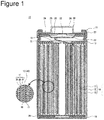
- FIG. 1 is a longitudinal sectional view of a non-aqueous electrolyte secondary battery 10 which is an example of an embodiment, and shows a section including a direction along the winding axis of an electrode assembly 14.
- FIG. 2 is a transverse sectional view in a plane perpendicular to the winding axis of the electrode assembly 14 constituting the non-aqueous electrolyte secondary battery 10 which is an example of an embodiment, and schematically shows the disposition of a positive electrode 11, a negative electrode 12 and a separator 13 constituting the electrode assembly 14.
- the non-aqueous electrolyte secondary battery 10 illustrated as an embodiment is a cylindrical battery comprising a cylindrical case made of metal
- the non-aqueous electrolyte secondary battery of the present disclosure is not limited to this.
- the non-aqueous electrolyte secondary battery of the present disclosure may be, for example, a square battery comprising a square-shaped case made of metal, a laminated battery comprising an armor body comprising an aluminum laminate sheet, or the like.
- a wound electrode assembly 14 formed by winding the positive electrode and the negative electrode through the separator is illustrated as the electrode assembly constituting the non-aqueous electrolyte secondary battery, the electrode assembly is not limited to this.
- the electrode assembly may be, for example, a layered electrode assembly formed by layering a plurality of positive electrodes and a plurality of negative electrodes through separators by turns.
- the non-aqueous electrolyte secondary battery 10 comprises the electrode assembly 14 having a winding structure and a non-aqueous electrolyte (not shown).
- the electrode assembly 14 comprises the positive electrode 11, the negative electrode 12 and the separator 13, and is formed by winding the positive electrode 11 and the negative electrode 12 through a separator 13 spirally.
- the non-aqueous electrolyte secondary battery 10 is a lithium secondary battery in which lithium metal deposits on the negative electrode 12 at the time of charge, and the lithium metal dissolves in the non-aqueous electrolyte at the time of discharge.
- All of the positive electrode 11, the negative electrode 12 and the separator 13 constituting the electrode assembly 14 are formed in the shapes of belts, wound spirally, and layered by turns in the diameter direction of the electrode assembly 14 thereby.
- the longitudinal direction of each electrode is the winding direction
- the cross direction of each electrode is the direction of the axis.
- a space layer 50 is formed between the negative electrode 12 and the separator 13 in the electrode assembly 14. The space layer 50 will be described in detail hereinafter.
- a positive electrode lead 19 electrically connecting the positive electrode 11 and a positive electrode terminal is connected, for example, with the center in the longitudinal direction of the positive electrode 11, and extends from one end of the electrode assembly 14.
- a negative electrode lead 20 electrically connecting the negative electrode 12 and a negative electrode terminal is connected, for example, with an end in the longitudinal direction of the negative electrode 12, and extends from the other end of the electrode assembly 14.
- the negative electrode lead 20 connects with an end located outside in the diameter direction of the negative electrode 12, the negative electrode 12 lengthens in the winding direction at the time of the occurrence of stress in the negative electrode 12, and the range to which stress can be released is preferably widened.
- the battery case made of metal and housing the electrode assembly 14 and the non-aqueous electrolyte is constituted by a case body 15 and a sealing assembly 16. Insulating plates 17 and 18 are provided above and below the electrode assembly 14, respectively.
- the positive electrode lead 19 extends to the sealing assembly 16 side through a through hole of the insulating plate 17, and is welded to the lower surface of a filter 22 which is a bottom plate of the sealing assembly 16.
- the cap 26 of the sealing assembly 16 electrically connected with the filter 22 functions as the positive electrode terminal.
- the negative electrode lead 20 extends to the bottom side of the case body 15, and is welded to the inside of the bottom of the case body 15.
- the case body 15 functions as the negative electrode terminal.
- the case body 15 is a bottomed cylindrical container made of metal.
- a gasket 27 is provided between the case body 15 and the sealing assembly 16, and the sealability in the battery case is secured.
- the case body 15 has a projecting portion 21 which is formed, for example, by pressing a side portion from outside and supports the sealing assembly 16.
- the projecting portion 21 is preferably formed in a ring shape along the circumferential direction of the case body 15, and supports the sealing assembly 16 on its upper surface.
- the sealing assembly 16 has a structure in which the filter 22, a lower vent member 23, an insulating member 24, an upper vent member 25 and the cap 26 are layered sequentially from the electrode assembly 14 side.
- Members constituting the sealing assembly 16 have, for example, disk shapes or ring shapes, and the members except the insulating member 24 are electrically connected with each other.
- the lower vent member 23 and the upper vent member 25 are connected with each other at the respective centers, and the insulating member 24 is between the respective peripheries.
- the lower vent member 23 is provided with an air holes, and the upper vent member 25 therefore swells to the cap 26 side, and is separated from the lower vent member 23. The electrical connection between both is cut off thereby.
- the upper vent member 25 ruptures and gas is discharged from an opening of the cap 26.
- the space layer 50 which has a specific thickness between the negative electrode 12 and the separator 13 is formed in the electrode assembly 14 according to the present disclosure.
- the negative electrode 12 not including the negative electrode mixture layer on the negative electrode current collector 40 is used in the lithium secondary battery, lithium ion dissolving in an electrolytic solution deposits on the surface of the negative electrode 12 as lithium metal at the time of charge, and the thickness of the whole negative electrode 12 increases according to the amount of lithium metal deposited (swelling).
- the rupture of the positive electrode 11 and the negative electrode 12 (when the positive electrode 11 and the negative electrode 12 are not distinguished, both are generically named “electrodes” herein) which can occur by the swelling of the negative electrode 12 at the time of charge can be suppressed by forming the space layer 50. It is considered that the principle is as follows.
- electrodes and a separator are layered as densely as possible, and a space which only a non-aqueous electrolyte occupies is excluded in the case body 15 from the viewpoint of the capacity improvement. Meanwhile, as charge proceeds further in the deposition secondary battery, the amount of lithium metal deposited increases, and a negative electrode is swollen.
- the electrodes and the separator are densely layered in the conventional deposited secondary battery as mentioned above, stress which occurs in the electrodes is not released. It is considered that thus, stress occurs in the electrodes in every charge and discharge cycle, fatigue accumulates in the electrodes by repeating it, and the electrodes rupture after all.
- the space layer 50 having a specific thickness is formed between the negative electrode 12 and the separator 13, namely adjacently to the negative electrode 12. Since the space which receives the swelling of the negative electrode 12 by the deposition of lithium metal at the time of charge is secured by this, the occurrence of stress in the polar plates can be suppressed. Even though local stress occurs by ununiform deposition of lithium metal, this can be relaxed by the space layer 50.
- the formation of the space layer 50 in the lithium secondary battery is disadvantageous with respect to the capacity improvement of the battery.
- a space in which the negative electrode mixture layer is not provided can be used for expanding the areas of the positive electrode 11 and the negative electrode 12 per battery and increasing the content of a lithium-containing transition metal oxide which is a positive electrode active material per battery as compared with a conventional lithium secondary battery in which negative electrode mixture layers are provided on both sides of the negative electrode current collector. Therefore, the total amount of the positive electrode capacity per battery increases beyond a capacity decrease by forming the space layer 50, and the increase in capacity of the battery can be achieved.
- the space layer 50 are formed so that the positive electrode capacity per unit area of the positive electrode 11 ⁇ (mAh/cm 2 ) and the thickness of the space layer 50 X ( ⁇ m) satisfy 0.05 ⁇ ⁇ /X ⁇ 0.2 when the non-aqueous electrolyte secondary battery 10 is in a discharge state.
- the positive electrode capacity per unit area of the positive electrode 11 ⁇ at the time of the discharge of the non-aqueous electrolyte secondary battery 10 is a value obtained by dividing the positive electrode capacity per battery ⁇ (mAh) by the total area of a positive electrode mixture layer 31 formed on the surface of a positive electrode current collector 30 (cm 2 ).
- the positive electrode capacity per battery ⁇ is calculated, for example, by the product of the theoretical capacity of lithium metal (3860 mAh/g) by and the total mass of lithium included in the positive electrode 11, more specifically the positive electrode mixture layer 31.
- the total mass of lithium included in the positive electrode mixture layer 31 may be calculated, for example, based on the composition and the thickness of the positive electrode mixture layer 31, and the total area of the wound positive electrode mixture layer 31.
- the thickness of the space layer 50 X is the average value of the thickness in the layering direction of the space layer 50 provided between the negative electrode 12 and the separator 13. In other words, the thickness X is an average value of the distance between the surface of the negative electrode 12 opposite to the separator 13 and the surface of the separator 13 opposite to the negative electrode 12. For example, when the positive electrode capacity per unit area of the positive electrode 11 ⁇ is 5.4 mAh/cm 2 , the thickness of the space layer 50 X is 28 ⁇ m or more and 112 ⁇ m or less.
- the ratio of the positive electrode capacity per unit area of the positive electrode 11 ⁇ to the thickness of the space layer 50 X expresses the relationship between the amount of lithium metal deposited on the negative electrode 12 at the time of charge and a volume occupying the space layer 50.
- the ratio ⁇ /X is too high, the space which receives the swelling of the negative electrode by the deposition of lithium metal cannot be secured, and the effect of preventing electrode rupture is not fully obtained.
- the ratio ⁇ /X is too low, the positive electrode capacity per battery ⁇ decreases, and the importance of using a lithium metal deposition secondary battery is deteriorated.
- the positive electrode capacity per unit area of the positive electrode 11 ⁇ and the thickness of the space layer 50 X preferably satisfy 0.05 ⁇ ⁇ /X ⁇ 0.2, and more preferably satisfy 0.07 ⁇ ⁇ /X ⁇ 0.15 from the above-mentioned viewpoint.
- the thickness of the space layer 50 X and the total area, the thickness and the like of the positive electrode mixture layer 31 in the non-aqueous electrolyte secondary battery 10 may be measured, for example, using an X-ray CT apparatus (for example, "Microfocus X-Ray Fluoroscopy System SMX-2000" manufactured by SHIMADZU CORPORATION).
- the positive electrode capacity per unit area of the positive electrode 11 ⁇ is calculated by dividing the product of the theoretical capacity (3860 mAh/g) of lithium metal by the total mass of the lithium included in the positive electrode mixture layer 31 by the total area of the positive electrode mixture layer 31 (cm 2 ) as above-mentioned.
- the total mass of lithium included in the positive electrode mixture layer 31 is calculated, for example, based on the composition, the thickness and the total area of the positive electrode mixture layer 31.
- the composition of the lithium-containing transition metal oxide included in the positive electrode mixture layer 31 is subjected to qualitative and quantitative analyses using a well-known analysis apparatus such as an ICP emission spectrophotometer (for example, "CIROS-120" manufactured by Spectro Analytical Instruments GmbH).
- the thickness of the space layer 50 X is a value measured at the time of the initial stage of cycles, and is measured, for example, using a battery in 10 cycles or less.
- a specific method for forming the space layer 50 is not limited.
- a method for manufacturing the non-aqueous electrolyte secondary battery 10 having the space layer 50 has: a step of coating the surface of the negative electrode current collector 40 with ethylene carbonate (EC) to manufacture the negative electrode 12 including an EC coating layer on the surface (a negative electrode manufacturing step); a step of layering the negative electrode 12 including the EC coating layer and the positive electrode 11 through the separator 13 and winding these to manufacture the electrode assembly 14 (an electrode assembly manufacturing step); a step of housing the electrode assembly 14 in the case body 15; and a step of injecting the non-aqueous electrolyte containing a non-aqueous solvent other than EC into the case body 15 in which the electrode assembly 14 is housed.
- EC ethylene carbonate
- Ethylene carbonate (EC) is a non-aqueous solvent used as a non-aqueous electrolyte of lithium secondary batteries, and has a melting point of 34°C to 37°C. Therefore, although EC is a solid at room temperature (25°C), EC easily dissolves in another non-aqueous solvent used similarly as the non-aqueous electrolyte, and becomes a mixed solvent which is a liquid at room temperature.
- the non-aqueous electrolyte secondary battery 10 having the space layer 50 is manufactured using this property of EC. That is, in the negative electrode manufacturing step, liquid EC obtained by heating to the melting point or more is applied to the surface of the negative electrode current collector 40 to form an EC coating layer.
- the electrode assembly 14 provided with the separator 13 on the positive electrode 11 side and with the EC coating layer on the negative electrode 12 side between the positive electrode 11 and the negative electrode 12 is subsequently manufactured by layering and winding the negative electrode 12 including the solidified EC coating layers on both surfaces and the positive electrode 11 through the separator 13.
- the obtained electrode assembly 14 is housed in the case body 15, the non-aqueous electrolyte containing a non-aqueous solvent other than EC is then injected into the case body 15.
- the EC coating layers is dissolved by the non-aqueous electrolyte injected into the case body 15, spaces in which the EC coating layers were provided is filled with the non-aqueous electrolyte to form space layers 50.
- the method for manufacturing a non-aqueous electrolyte secondary battery 10 having the negative electrode manufacturing step of forming an EC coating layer on the surface of the above-mentioned negative electrode 12 is also highly compatible with an electrode assembly 14 in which the configuration of a positive electrode active material and the like is different. Since all of the EC coating layer formed on the surface of the negative electrode 12 disappears in the initial state after the manufacturing of the battery, the surface layer of the negative electrode 12 can be utilized effectively, and the energy density of the non-aqueous electrolyte secondary battery 10 can be improved as compared with when a member for forming a space layer 50 is provided.
- a non-aqueous electrolyte secondary battery 10 including a space layer 50 may be manufactured in the same way as in the above-mentioned description except that the EC coating layer is not provided on the surface of the negative electrode current collector 40 but on the surface of the separator 13 opposite to the negative electrode 12.
- a coating layer comprising another non-aqueous solvent other than EC which is a solid at room temperature and can dissolve in a non-aqueous electrolyte may be provided on the surface of the negative electrode current collector 40 or the surface of the separator 13 opposite to the negative electrode 12.
- a resin or the like which dissolves in a non-aqueous electrolyte electrolytic solution may be provided on the surface of the negative electrode current collector, and a space may be formed by dissolving the resin after the injection of the non-aqueous electrolyte electrolytic solution.
- the negative electrode 12 and the separator 13 may be separated in the electrode assembly 14 by disposing projection portions having a predetermined height at predetermined intervals on either or both of the surface of the negative electrode current collector 40 and the surface of the separator 13 opposite to the negative electrode 12, and a space layer 50 may be formed.
- the molar ratio of the total amount of lithium which the positive electrode 11 and the negative electrode 12 have to the amount of the transition metal included in the positive electrode 11 is 1.1 or less.
- the total amount (the total content) of lithium which the positive electrode 11 and the negative electrode 12 have is the total amount of lithium constituting the lithium-containing transition metal oxide included in the positive electrode mixture layer 31 of the positive electrode 11 as the positive electrode active material and lithium in the case the negative electrode current collector 40 of the negative electrode 12 has the lithium metal in the non-aqueous electrolyte secondary battery 10.
- the positive electrode 11 comprises the positive electrode current collector 30 and the positive electrode mixture layer 31 formed on the current collector. Foil of a metal such as aluminum which is stable in the potential range of the positive electrode 11, a film wherein the metal is disposed on the outer layer, or the like can be used for the positive electrode current collector 30.
- the positive electrode mixture layer 31 comprises the positive electrode active material, a conductive agent and a binding agent. Positive electrode mixture layers 31 are generally formed on both surfaces of the positive electrode current collector 30.
- the positive electrode 11 can be manufactured, for example by applying positive electrode mixture slurry including the positive electrode active material, the conductive agent, the binding agent and the like to the positive electrode current collector 30, drying the coating films, and then rolling the coating films to form positive electrode mixture layers 31 on both surfaces of the current collector,
- the positive electrode active material included in the positive electrode mixture layer 31 comprises a lithium-containing transition metal oxide.
- a metallic element other than lithium constituting a lithium-containing transition metal oxide is, for example, at least one selected from magnesium (Mg), aluminum (Al), calcium (Ca), scandium (Sc), titanium (Ti), vanadium (V), chromium (Cr), manganese (Mn), iron (Fe), cobalt (Co), nickel (Ni), copper (Cu), zinc (Zn), gallium (Ga), germanium (Ge), yttrium (Y), zirconium (Zr), tin (Sn), antimony (Sb), tungsten (W), lead (Pb) and bismuth (Bi).
- the lithium-containing transition metal oxide included in the positive electrode mixture layer 31 preferably includes at least one selected from Co, Ni, Mn, and Al as the transition metals.
- the molar ratio of lithium to the transition metal constituting the lithium-containing transition metal is 1.1:1 or less.
- the lithium-containing transition metal oxide included in the positive electrode mixture layer 31 preferably has a crystal structure belonging to the space group R-3m.
- the crystal structure belonging to the space group R-3m is a structure formed by layering lithium-oxygen octahedral layers and transition metal-oxygen octahedral layers, and is a crystal structure which, for example, lithium nickelate (LiNiO 2 ) and lithium cobaltate (LiCoO 2 ) have. It is because when the positive electrode active material has a crystal structure belonging to the space group R-3m, a high charge and discharge capacity is obtained in the secondary battery.
- the positive electrode active material has a crystal structure belonging to the space group R-3m, for example, by performing analysis based on a powder X-ray diffractometry as to the positive electrode active material and obtaining an X-ray diffraction pattern.
- Examples of the conductive agent constituting the positive electrode mixture layer 31 include carbon materials such as carbon black (CB), acetylene black (AB), ketjen black and graphite.
- Examples of the binding agent constituting the positive electrode mixture layer 31 include fluorine-containing resins such as polytetrafluoroethylene (PTFE) and polyvinylidene fluoride (PVdF); polyacrylonitrile (PAN); polyimide-based resins; acrylic-based resins and polyolefin-based resin. These may be used alone or in combination of two or more.
- the negative electrode 12 is an electrode on which lithium metal is deposited at the time of charge, and has the negative electrode current collector 40.
- Lithium metal which deposits on the negative electrode 12 by charge is derived from lithium ions in the non-aqueous electrolyte, and the depositing lithium metal dissolves in the electrolytic solution by discharge.
- the negative electrode current collector 40 comprises metallic foil such as copper, nickel, iron and stainless alloy (SUS), and copper foil with high conductivity is particularly preferable.
- the copper foil is metallic foil including copper as the main component, and may comprise only copper substantially.
- the thickness of the copper foil is preferably 5 ⁇ m or more and 20 ⁇ m or less.
- the negative electrode 12 comprises only copper foil having a thickness of 5 ⁇ m or more and 20 ⁇ m or less, for example, before the charge and discharge of the battery. Lithium metal deposits on both surfaces of the copper foil by charge to form lithium metal layers.
- the negative electrode current collector 40 may contain a lithium metal layer.
- the lithium metal layer may be lithium metal foil, or may be an article wherein a lithium metal layer is formed on the surface by vapor deposition or the like (in this case, the lithium functions as an active material).
- the negative electrode current collector 40 does not preferably have a negative electrode active material in the initial state.
- the negative electrode 12 preferably comprises only the negative electrode current collector 40 in the initial state.
- the volume energy density of the battery can be increased thereby.
- a current collector or the like including lithium metal foil or a lithium metal layer is used as the negative electrode current collector 40, the volume energy density of the battery decreases by the thickness of the lithium layer.
- the surface of the negative electrode current collector 40 after the EC coating film dissolves in the non-aqueous electrolyte has a specific surface roughness in many cases.
- the arithmetic average roughness Ra of the surface of the negative electrode current collector 40 is, for example, 1.0 ⁇ m or more and 10.0 ⁇ m or less.
- the arithmetic average roughness Ra is a value calculated based on JIS B0601: 2001, and is calculated by averaging the absolute value of the roughness curve per standard length as to any portion of the surface of the negative electrode current collector 40 using a well-known method, for example, a shape measuring laser microscope apparatus ("VK-X200" manufactured by KEYENCE CORPORATION).
- the negative electrode current collector 40 may have a layer including a solid electrolyte, organic matter and inorganic matter (protective layer) on the surface.
- the protective layer has the effect of uniforming an electrode surface reaction, lithium metal uniformly deposits on the negative electrode, and the swelling of the negative electrode 12 can be suppressed.
- a solid electrolyte include sulfide-based solid electrolytes, phosphate-based solid electrolytes, perovskite-based solid electrolytes and garnet-based solid electrolytes.
- the sulfide-based solid electrolytes contain a sulfur component and have lithium ion conductivity
- the sulfide-based solid electrolytes are not particularly limited.
- Specific examples of raw materials of the sulfide-based solid electrolytes include a raw material including Li, S and the third component A.
- Examples of the third component A include at least one selected from the group consisting of P, Ge, B, Si, I, Al, Ga and As.
- Specific examples of the sulfide-based solid electrolytes include Li 2 S-P 2 S 5 , 70Li 2 S-30P 2 S 5 , 80Li 2 S-20P 2 S 5 , Li 2 S-SiS 2 and LiGe 0.25 P 0.75 S 4 .
- the phosphate-based solid electrolytes contain a phosphate component and have lithium ion conductivity
- the phosphate-based solid electrolytes are not particularly limited.
- the phosphate-based solid electrolytes include Li 1+n Al n Ti 2-n (PO 4 ) 3 (0 ⁇ n ⁇ 2, particularly preferably 0 ⁇ n ⁇ 1), such as Li 1.5 Al 0.5 Ti 1.5 (PO 4 ) 3 ; and Li 1+n Al n Ge 2-n (PO 4 ) 3 (0 ⁇ n ⁇ 2, particularly preferably 0 ⁇ n ⁇ 1).
- lithium conductive substances such as polyethylene oxide and polymethyl methacrylate are preferable.
- ceramic materials such as SiO 2 , Al 2 O 3 and MgO are preferable.
- a porous sheet having ion permeability and insulation properties is used for the separator 13.
- the porous sheet include fine porous thin films, woven fabrics and nonwoven fabrics.
- olefin-based resins such as polyethylene, polypropylene and a copolymer including at least either of ethylene and propylene; cellulose; and the like are preferable.
- the separator 13 may be a layered body including a cellulose fiber layer and a thermoplastic resin fiber layer such as an olefin-based resin.
- the separator 13 may be a multilayer separator including a polyethylene layer and a polypropylene layer, and the separator 13 wherein an aramid-based resin or the like were applied to the surface of the separator 13 may be used.
- a heat-resistant layer including a filler of an inorganic compound may be formed on the interface between the separator 13 and at least either of the positive electrode 11 and the negative electrode 12.
- the non-aqueous electrolyte includes a non-aqueous solvent and an electrolyte salt dissolving in the non-aqueous solvent.
- a non-aqueous solvent for example, esters; ethers; nitriles such as acetonitrile; amides such as dimethylformamide; mixed solvents of two or more of these; and the like can be used for the non-aqueous solvent.
- the non-aqueous solvent may contain halogen substitution products in which at least some of the hydrogen atoms of these solvents are replaced with halogen atoms such as fluorine atoms.
- the non-aqueous electrolyte is not limited to a liquid electrolyte (non-aqueous electrolytic solution), and may be a solid electrolyte using a gel polymer or the like.
- the non-aqueous electrolyte secondary battery 10 includes ethylene carbonate (EC) and a non-aqueous solvent other than EC as the non-aqueous electrolyte.
- ethylene carbonate (EC) examples include esters other than EC; ethers; nitriles such as acetonitrile; amides such as dimethylformamide; mixed solvents of two or more of these.
- the total of EC existing on the surface of the negative electrode current collector 40 as the coating layer and the non-aqueous electrolyte added to the case body 15 after the electrode assembly 14 is housed in the case body 15 is a non-aqueous electrolyte contained in the non-aqueous electrolyte secondary battery 10 in the initial state. Therefore, the composition of the non-aqueous solvent, the content of the electrolyte salt in the non-aqueous electrolyte added in the case body 15, and the like may be determined in view of the EC coating layer on the surface of the negative electrode current collector 40.
- esters examples include cyclic carbonic esters such as propylene carbonate (PC), butylene carbonate and fluoroethylene carbonate (FEC) besides ethylene carbonate (EC); chain-like carbonic esters such as dimethyl carbonate (DMC), ethyl methyl carbonate (EMC), diethyl carbonate (DEC), methyl propyl carbonate, ethyl propyl carbonate and methyl isopropyl carbonate; cyclic carboxylate esters such as ⁇ - butyrolactone and ⁇ -valerolactone; and chain-like carboxylate esters such as methyl acetate, ethyl acetate, propyl acetate, methyl propionate (MP), ethyl propionate, ⁇ -butyrolactone and fluoromethyl propionate (FMP).
- cyclic carbonic esters such as propylene carbonate (PC), butylene carbonate and fluoroethylene carbonate (FEC) besides ethylene carbon
- ethers examples include cyclic ethers such as 1,3-dioxolane, 4-methyl-1,3-dioxolane, tetrahydrofuran, 2-methyltetrahydrofuran, propylene oxide, 1,2-butylene oxide, 1,3-dioxane, 1,4-dioxane, 1,3,5-trioxane, furan, 2-methylfuran, 1,8-cineol and crown ethers; and chain-like ethers such as 1,2-dimethoxyethane, diethyl ether, dipropyl ether, diisopropyl ether, dibutyl ether, dihexyl ether, ethyl vinyl ether, butyl vinyl ether, methyl phenyl ether, ethyl phenyl ether, butyl phenyl ether, pentyl phenyl ether, methoxytoluene, benzyl ethoxyethane, die
- Examples of the electrolyte salt included in the non-aqueous electrolyte include LiBF 4 , LiClO 4 , LiPF 6 , LiAsF 6 , LiSbF 6 , LiAlCl 4 , LiSCN, LiCF 3 SO 3 , LiCF 3 CO 2 , and imide salts such as LiN(SO 2 CF 3 ) 2 , LiN(C 1 F 21 + 1 SO 2 )(C m F 2m + 1 SO 2 ) ⁇ 1 and m are integers of 1 or more ⁇ .
- LiPF 6 is preferably used particularly.
- EC ethylene carbonate
- the non-aqueous electrolyte preferably includes an additive decomposed on the negative electrode 12.
- the non-aqueous electrolyte includes at least one selected, for example, from vinylene carbonate (VC), fluoroethylene carbonate (FEC) and vinyl ethyl carbonate (VEC).
- VC vinylene carbonate
- FEC fluoroethylene carbonate
- VEC vinyl ethyl carbonate
- the swelling of a negative electrode is further suppressed by adding VC and the like, and the cycle characteristics become better.
- NMP N-methyl-2-pyrrolidone
- the positive electrode mixture slurry was applied to both surfaces of a positive electrode current collector comprising aluminum foil, and the coating films were dried.
- the coating films were rolled using a roller, and the electrode was then cut to a predetermined electrode size to manufacture a positive electrode in which the positive electrode mixture layers were formed on both sides of the positive electrode current collector sequentially.
- the molar ratio of lithium to the total of the transition metals in the lithium-containing transition metal oxide used as the positive electrode active material was 1.0.
- Electrolytic copper foil (10 ⁇ m in thickness) was cut to a predetermined electrode size to form a negative electrode current collector.
- Ethylene carbonate (EC) liquified by heating at 60°C was applied to both sides of the negative electrode current collector.
- the film thickness of EC applied to one surface was 40 ⁇ m.
- a negative electrode mixture other than EC, or the like was not applied to the copper foil.
- EC and dimethyl carbonate (DMC) were mixed to prepare a mixed solvent. Subsequently, LiPF 6 and LiBF 2 (C 2 O 4 ) were dissolved in the mixed solvent to prepare a non-aqueous electrolytic solution.
- the mixture ratio of EC to DMC in the mixed solvent was adjusted so that the volume ratio of the content of EC after EC constituting the coating films formed on the surfaces of the negative electrode dissolved in the mixed solvent to the content of DMC was 3:7.
- LiPF 6 and LiBF 2 (C 2 O 4 ) added to the mixed solvent LiPF 6 and LiBF 2 (C 2 O 4 ) were similarly added in amounts wherein the concentrations of LiPF 6 and LiBF 2 (C 2 O 4 ) after EC constituting the coating films dissolves in the mixed solvent were 1.0 M (mol/L) and 0.1 M (mol/L), respectively.
- the above-mentioned positive electrode to which a tab made of aluminum was attached and the above-mentioned negative electrode to which a tab made of nickel was attached were wound spirally through a separator made of polyethylene to manufacture an electrode assembly.
- a space including the axis center of the winding axis and extending in the direction of the winding axis was formed in the electrode assembly of Example 1.
- the electrode assembly was housed in the armor body comprising an aluminum laminate, the above-mentioned non-aqueous electrolytic solution was injected, and the opening of an armor body was then sealed to manufacture a cylindrical battery T1.
- the positive electrode capacity per area of the positive electrode constituting the battery T1 ⁇ was 5.4 mAh/cm 2 .
- the molar ratio of the total amount of lithium included in the battery T1 to the amount of the transition metals included in the positive electrode was 1.0.
- a cylindrical battery T2 was manufactured in the same way as Example 1 except that the film thickness per one surface of EC applied to both surfaces of the negative electrode current collector was changed into 75 ⁇ m in the manufacturing of the battery.
- Cylindrical batteries T3 to T5 were manufactured in the same way as in Example 1 except that the film thicknesses per one surface of EC applied to both surfaces of the negative electrode current collectors were changed into 0.0 ⁇ m (without applying EC), 15 ⁇ m and 120 ⁇ m, respectively in the manufacturing of the batteries.
- a battery T6 for reference was manufactured for comparing discharge capacities.
- the battery T6 for reference comprises a negative electrode including negative electrode mixture layers on both sides of copper foil.
- Negative electrode mixture slurry containing graphite as an negative electrode active material and a binding agent (styrene-butadiene rubber) at a mass ratio of 97.5:2.5 was applied to both sides of the copper foil which is an negative electrode current collector, the coating films were dried, and the coating films were then rolled with a rolling roller to prepare the negative electrode.
- the battery T6 for reference having a positive electrode capacity ⁇ of 3500 mAh was manufactured in the same way as in Example 1 except that the negative electrode including the negative electrode mixture layers obtained by the above-mentioned method was used as an negative electrode, and the lengths of a belt-shaped positive electrode, belt-shaped negative electrode and belt-shaped separator were adjusted so that almost no space was formed at the center.
- a charge and discharge cycle test was performed as to each of the batteries of the Examples and the Comparative Examples. Under a battery temperature condition of 25°C, the battery was subjected to constant current charge at a current of 0.1 It until the voltage value was 4.3 V, and the battery was then subjected to constant voltage charge at a constant voltage of 4.3V until the current value was 0.01 It using each battery. Then, the battery was subjected to constant current discharge at a current of 0.1 It until the voltage value was 2.5V, and the discharge capacity when the battery was subjected to this constant current discharge was defined as the initial discharge capacity of each battery.
- each battery As to each battery, a charge and discharge cycle comprising constant current charge to 4.3 V at a current of 0.1 It, an idle period of 15 minutes, constant current discharge to 2.5 V at a current of 0.1 It, and an idle period of 15 minutes was next repeated 5 times under a temperature condition of 60°C. Then, each battery was taken out when the voltage value was 3.5 V or more and 3.6 V or less in the discharge state. As to each battery taken out, the average thickness X of the space layer 50 was measured using an X-ray CT apparatus (for example, "Microfocus X-Ray Fluoroscopy System SMX-2000" manufactured by SHIMADZU CORPORATION).
- an X-ray CT apparatus for example, "Microfocus X-Ray Fluoroscopy System SMX-2000" manufactured by SHIMADZU CORPORATION.
- the positive electrode capacity per unit area ⁇ (mAh/cm 2 )/the thickness of the space layer X ( ⁇ m)" was calculated from the obtained measurement result.
- the positive electrode capacity per unit area, ⁇ is a theoretical value calculated based on the theoretical capacity of Li metal (3860 mAh/g), the composition and the layer thickness of the positive electrode mixture layer, and the area of the surfaces of the positive electrode current collector on which the positive electrode mixture layers were formed. Table 1 shows the calculation results.
- the discharge capacity of each of the batteries of the Examples and the Comparative Examples was evaluated by comparing with the discharge capacity of the battery T6 for reference.
- the battery T6 is a conventional non-aqueous electrolyte secondary battery wherein the battery comprises a negative electrode including negative electrode mixture layers on both surfaces, and almost no space is formed between the negative electrode and the separator.
- a battery having the discharge capacity of the battery T6 or less was rated as "poor", and a battery having more discharge capacity than the battery T6 was rated as "good” based on the theoretical capacity of Li metal of each battery (3860 mAh/g), the composition and the layer thickness of a positive electrode mixture layer, and the value of the discharge capacity calculated based on an area in which positive electrode mixture layers were formed.
- the rupture of the electrode was suppressed by forming the space layers 50 having a specific thickness between the negative electrode 12 and the separator 13 and securing the spaces which receives the swelling of the negative electrode 12 due to the deposition of lithium metal at the time of charge in the electrode assembly 14 comprising the positive electrode 11, the negative electrode 12 and the separator 13 in the lithium deposition lithium secondary battery in which negative electrode mixture layers were not provided on the negative electrode current collector 40.
- the non-aqueous electrolyte secondary battery 10 is a lithium secondary battery in which lithium metal deposits on the surface of the negative electrode 12, the battery has the space layers 50 in which only the non-aqueous electrolyte is filled in the case body 15, the energy density per battery is however improved, and the increase in capacity of the battery is achieved as compared with a battery comprising a negative electrode in which negative electrode mixture layers are formed on the surfaces.
Landscapes
- Chemical & Material Sciences (AREA)
- General Chemical & Material Sciences (AREA)
- Chemical Kinetics & Catalysis (AREA)
- Electrochemistry (AREA)
- Engineering & Computer Science (AREA)
- Manufacturing & Machinery (AREA)
- Materials Engineering (AREA)
- Inorganic Chemistry (AREA)
- Composite Materials (AREA)
- Physics & Mathematics (AREA)
- Condensed Matter Physics & Semiconductors (AREA)
- General Physics & Mathematics (AREA)
- Secondary Cells (AREA)
- Cell Electrode Carriers And Collectors (AREA)
- Battery Electrode And Active Subsutance (AREA)
Applications Claiming Priority (2)
| Application Number | Priority Date | Filing Date | Title |
|---|---|---|---|
| JP2017209839 | 2017-10-30 | ||
| PCT/JP2018/037638 WO2019087709A1 (ja) | 2017-10-30 | 2018-10-10 | 非水電解質二次電池及びその製造方法 |
Publications (3)
| Publication Number | Publication Date |
|---|---|
| EP3706224A1 true EP3706224A1 (de) | 2020-09-09 |
| EP3706224A4 EP3706224A4 (de) | 2021-01-27 |
| EP3706224B1 EP3706224B1 (de) | 2024-04-24 |
Family
ID=66332004
Family Applications (1)
| Application Number | Title | Priority Date | Filing Date |
|---|---|---|---|
| EP18873064.2A Active EP3706224B1 (de) | 2017-10-30 | 2018-10-10 | Sekundärbatterie mit wasserfreiem elektrolyt und verfahren zur herstellung davon |
Country Status (5)
| Country | Link |
|---|---|
| US (1) | US11508987B2 (de) |
| EP (1) | EP3706224B1 (de) |
| JP (1) | JP7236645B2 (de) |
| CN (1) | CN111226340B (de) |
| WO (1) | WO2019087709A1 (de) |
Cited By (1)
| Publication number | Priority date | Publication date | Assignee | Title |
|---|---|---|---|---|
| EP4366017A4 (de) * | 2021-06-30 | 2024-12-11 | Panasonic Intellectual Property Management Co., Ltd. | Lithiumsekundärbatterie |
Families Citing this family (9)
| Publication number | Priority date | Publication date | Assignee | Title |
|---|---|---|---|---|
| JP2020198297A (ja) * | 2019-05-30 | 2020-12-10 | パナソニックIpマネジメント株式会社 | 二次電池 |
| KR20230009460A (ko) * | 2020-05-12 | 2023-01-17 | 테라와트 테크놀로지 가부시키가이샤 | 전지 및 그 제조방법 |
| JP7659991B2 (ja) * | 2021-01-26 | 2025-04-10 | 日産自動車株式会社 | リチウム二次電池 |
| EP4366001A4 (de) | 2021-06-30 | 2024-11-27 | Panasonic Intellectual Property Management Co., Ltd. | Lithiumsekundärbatterie |
| JP7483911B2 (ja) * | 2021-10-12 | 2024-05-15 | 寧徳時代新能源科技股▲分▼有限公司 | セパレーター、二次電池及び電力消費装置 |
| EP4503244A4 (de) * | 2022-03-31 | 2026-02-25 | Panasonic Ip Man Co Ltd | Sekundärbatterie |
| WO2023189938A1 (ja) | 2022-03-31 | 2023-10-05 | パナソニックIpマネジメント株式会社 | 蓄電装置 |
| JP7626123B2 (ja) * | 2022-11-07 | 2025-02-04 | トヨタ自動車株式会社 | 二次電池用電極の製造方法 |
| CN117074437B (zh) * | 2023-10-11 | 2024-01-12 | 青岛金诺德科技有限公司 | 无损检测方法及其在新能源汽车锂电池回收中的应用 |
Family Cites Families (10)
| Publication number | Priority date | Publication date | Assignee | Title |
|---|---|---|---|---|
| JP3090392B2 (ja) | 1994-03-02 | 2000-09-18 | 住友ベークライト株式会社 | 紙基材積層板用プリプレグの評価方法 |
| JPH11185818A (ja) * | 1997-12-18 | 1999-07-09 | Fujitsu Ltd | 巻回式リチウム二次電池の製造方法及び、その方法で作られた巻回式リチウム二次電池及び、巻回体 |
| JP4049506B2 (ja) * | 2000-02-29 | 2008-02-20 | 三洋電機株式会社 | リチウム二次電池 |
| US20020081485A1 (en) * | 2000-11-01 | 2002-06-27 | Toshihiro Takekawa | Non-aqueous rechargeable battery for vehicles |
| JP5043338B2 (ja) * | 2006-01-19 | 2012-10-10 | パナソニック株式会社 | リチウム二次電池 |
| JP2009081105A (ja) * | 2007-09-27 | 2009-04-16 | Sanyo Electric Co Ltd | リチウム二次電池およびその製造方法 |
| KR20120022722A (ko) * | 2010-04-27 | 2012-03-12 | 파나소닉 주식회사 | 비수계 이차전지 및 이것에 이용하는 전극군 |
| JPWO2015145288A1 (ja) | 2014-03-24 | 2017-04-13 | 株式会社半導体エネルギー研究所 | リチウムイオン二次電池 |
| US10096829B2 (en) * | 2014-03-27 | 2018-10-09 | Sanyo Electric Co., Ltd. | Nonaqueous electrolyte secondary batteries |
| JP6998551B2 (ja) * | 2017-05-18 | 2022-02-10 | パナソニックIpマネジメント株式会社 | リチウム二次電池 |
-
2018
- 2018-10-10 EP EP18873064.2A patent/EP3706224B1/de active Active
- 2018-10-10 WO PCT/JP2018/037638 patent/WO2019087709A1/ja not_active Ceased
- 2018-10-10 JP JP2019550960A patent/JP7236645B2/ja active Active
- 2018-10-10 US US16/640,159 patent/US11508987B2/en active Active
- 2018-10-10 CN CN201880067620.3A patent/CN111226340B/zh active Active
Cited By (1)
| Publication number | Priority date | Publication date | Assignee | Title |
|---|---|---|---|---|
| EP4366017A4 (de) * | 2021-06-30 | 2024-12-11 | Panasonic Intellectual Property Management Co., Ltd. | Lithiumsekundärbatterie |
Also Published As
| Publication number | Publication date |
|---|---|
| CN111226340B (zh) | 2023-06-30 |
| EP3706224B1 (de) | 2024-04-24 |
| JPWO2019087709A1 (ja) | 2020-11-12 |
| WO2019087709A1 (ja) | 2019-05-09 |
| JP7236645B2 (ja) | 2023-03-10 |
| CN111226340A (zh) | 2020-06-02 |
| US11508987B2 (en) | 2022-11-22 |
| EP3706224A4 (de) | 2021-01-27 |
| US20210159536A1 (en) | 2021-05-27 |
Similar Documents
| Publication | Publication Date | Title |
|---|---|---|
| EP3706224B1 (de) | Sekundärbatterie mit wasserfreiem elektrolyt und verfahren zur herstellung davon | |
| JP7162281B2 (ja) | 非水電解質二次電池 | |
| KR102093971B1 (ko) | 리튬 이차전지 | |
| EP3734714B1 (de) | Negativelektrode für eine sekundärbatterie mit einem wasserfreien elektrolyt und sekundärbatterie mit einem wasserfreien elektrolyt | |
| EP3104440B1 (de) | Negativelektroden-aktivmaterial für negativelektrodenmaterial einer sekundärbatterie mit wasserfreiem elektrolyt, negativelektrode für sekundärbatterie mit wasserfreiem elektrolyt und sekundärbatterie mit wasserfreiem elektrolyt | |
| US10199678B2 (en) | Negative electrode material for non-aqueous electrolyte secondary battery, negative electrode for non-aqueous electrolyte secondary battery and method of producing the same, and non-aqueous electrolyte secondary battery | |
| EP3128586B1 (de) | Negativelektroden-aktivmaterial auf graphitbasis, negativelektrode und lithium-ionen-sekundärbatterie | |
| US20160226106A1 (en) | Method for producing a nonaqueous electrolyte secondary battery | |
| EP3761427A1 (de) | Sekundärbatterie mit wasserfreiem elektrolyt | |
| JP7322776B2 (ja) | リチウムイオン二次電池 | |
| US20200168907A1 (en) | Nonaqueous electrolyte secondary battery | |
| EP4071849B1 (de) | Sekundärbatterie mit wasserfreiem elektrolyt | |
| EP4071850B1 (de) | Sekundärbatterie mit wasserfreiem elektrolyt | |
| EP3706232B1 (de) | Sekundärzelle mit wasserfreiem elektrolyt | |
| EP3745501B1 (de) | Positivelektrode für eine sekundärbatterie mit wasserfreiem elektrolyt und sekundärbatterien mit wasserfreiem elektrolyt | |
| WO2020110691A1 (ja) | 非水電解質二次電池用負極及び非水電解質二次電池 | |
| EP4503229A1 (de) | Sekundärbatterie mit nichtwässrigem elektrolyten |
Legal Events
| Date | Code | Title | Description |
|---|---|---|---|
| STAA | Information on the status of an ep patent application or granted ep patent |
Free format text: STATUS: THE INTERNATIONAL PUBLICATION HAS BEEN MADE |
|
| PUAI | Public reference made under article 153(3) epc to a published international application that has entered the european phase |
Free format text: ORIGINAL CODE: 0009012 |
|
| STAA | Information on the status of an ep patent application or granted ep patent |
Free format text: STATUS: REQUEST FOR EXAMINATION WAS MADE |
|
| 17P | Request for examination filed |
Effective date: 20200429 |
|
| AK | Designated contracting states |
Kind code of ref document: A1 Designated state(s): AL AT BE BG CH CY CZ DE DK EE ES FI FR GB GR HR HU IE IS IT LI LT LU LV MC MK MT NL NO PL PT RO RS SE SI SK SM TR |
|
| AX | Request for extension of the european patent |
Extension state: BA ME |
|
| A4 | Supplementary search report drawn up and despatched |
Effective date: 20210111 |
|
| RIC1 | Information provided on ipc code assigned before grant |
Ipc: H01M 4/525 20100101ALI20201218BHEP Ipc: H01M 4/66 20060101ALI20201218BHEP Ipc: H01M 10/052 20100101AFI20201218BHEP Ipc: H01M 10/0569 20100101ALI20201218BHEP Ipc: H01M 4/70 20060101ALI20201218BHEP Ipc: H01M 10/0587 20100101ALI20201218BHEP |
|
| DAV | Request for validation of the european patent (deleted) | ||
| DAX | Request for extension of the european patent (deleted) | ||
| GRAP | Despatch of communication of intention to grant a patent |
Free format text: ORIGINAL CODE: EPIDOSNIGR1 |
|
| STAA | Information on the status of an ep patent application or granted ep patent |
Free format text: STATUS: GRANT OF PATENT IS INTENDED |
|
| INTG | Intention to grant announced |
Effective date: 20231208 |
|
| GRAS | Grant fee paid |
Free format text: ORIGINAL CODE: EPIDOSNIGR3 |
|
| GRAA | (expected) grant |
Free format text: ORIGINAL CODE: 0009210 |
|
| STAA | Information on the status of an ep patent application or granted ep patent |
Free format text: STATUS: THE PATENT HAS BEEN GRANTED |
|
| P01 | Opt-out of the competence of the unified patent court (upc) registered |
Effective date: 20240227 |
|
| AK | Designated contracting states |
Kind code of ref document: B1 Designated state(s): AL AT BE BG CH CY CZ DE DK EE ES FI FR GB GR HR HU IE IS IT LI LT LU LV MC MK MT NL NO PL PT RO RS SE SI SK SM TR |
|
| REG | Reference to a national code |
Ref country code: GB Ref legal event code: FG4D |
|
| REG | Reference to a national code |
Ref country code: CH Ref legal event code: EP |
|
| REG | Reference to a national code |
Ref country code: DE Ref legal event code: R096 Ref document number: 602018068693 Country of ref document: DE |
|
| REG | Reference to a national code |
Ref country code: IE Ref legal event code: FG4D |
|
| REG | Reference to a national code |
Ref country code: LT Ref legal event code: MG9D |
|
| REG | Reference to a national code |
Ref country code: NL Ref legal event code: MP Effective date: 20240424 |
|
| REG | Reference to a national code |
Ref country code: AT Ref legal event code: MK05 Ref document number: 1680611 Country of ref document: AT Kind code of ref document: T Effective date: 20240424 |
|
| PG25 | Lapsed in a contracting state [announced via postgrant information from national office to epo] |
Ref country code: NL Free format text: LAPSE BECAUSE OF FAILURE TO SUBMIT A TRANSLATION OF THE DESCRIPTION OR TO PAY THE FEE WITHIN THE PRESCRIBED TIME-LIMIT Effective date: 20240424 |
|
| PG25 | Lapsed in a contracting state [announced via postgrant information from national office to epo] |
Ref country code: NL Free format text: LAPSE BECAUSE OF FAILURE TO SUBMIT A TRANSLATION OF THE DESCRIPTION OR TO PAY THE FEE WITHIN THE PRESCRIBED TIME-LIMIT Effective date: 20240424 |
|
| PG25 | Lapsed in a contracting state [announced via postgrant information from national office to epo] |
Ref country code: IS Free format text: LAPSE BECAUSE OF FAILURE TO SUBMIT A TRANSLATION OF THE DESCRIPTION OR TO PAY THE FEE WITHIN THE PRESCRIBED TIME-LIMIT Effective date: 20240824 |
|
| PG25 | Lapsed in a contracting state [announced via postgrant information from national office to epo] |
Ref country code: BG Free format text: LAPSE BECAUSE OF FAILURE TO SUBMIT A TRANSLATION OF THE DESCRIPTION OR TO PAY THE FEE WITHIN THE PRESCRIBED TIME-LIMIT Effective date: 20240424 |
|
| PG25 | Lapsed in a contracting state [announced via postgrant information from national office to epo] |
Ref country code: HR Free format text: LAPSE BECAUSE OF FAILURE TO SUBMIT A TRANSLATION OF THE DESCRIPTION OR TO PAY THE FEE WITHIN THE PRESCRIBED TIME-LIMIT Effective date: 20240424 Ref country code: FI Free format text: LAPSE BECAUSE OF FAILURE TO SUBMIT A TRANSLATION OF THE DESCRIPTION OR TO PAY THE FEE WITHIN THE PRESCRIBED TIME-LIMIT Effective date: 20240424 |
|
| PG25 | Lapsed in a contracting state [announced via postgrant information from national office to epo] |
Ref country code: GR Free format text: LAPSE BECAUSE OF FAILURE TO SUBMIT A TRANSLATION OF THE DESCRIPTION OR TO PAY THE FEE WITHIN THE PRESCRIBED TIME-LIMIT Effective date: 20240725 |
|
| PG25 | Lapsed in a contracting state [announced via postgrant information from national office to epo] |
Ref country code: PT Free format text: LAPSE BECAUSE OF FAILURE TO SUBMIT A TRANSLATION OF THE DESCRIPTION OR TO PAY THE FEE WITHIN THE PRESCRIBED TIME-LIMIT Effective date: 20240826 |
|
| PG25 | Lapsed in a contracting state [announced via postgrant information from national office to epo] |
Ref country code: ES Free format text: LAPSE BECAUSE OF FAILURE TO SUBMIT A TRANSLATION OF THE DESCRIPTION OR TO PAY THE FEE WITHIN THE PRESCRIBED TIME-LIMIT Effective date: 20240424 |
|
| PG25 | Lapsed in a contracting state [announced via postgrant information from national office to epo] |
Ref country code: AT Free format text: LAPSE BECAUSE OF FAILURE TO SUBMIT A TRANSLATION OF THE DESCRIPTION OR TO PAY THE FEE WITHIN THE PRESCRIBED TIME-LIMIT Effective date: 20240424 |
|
| PG25 | Lapsed in a contracting state [announced via postgrant information from national office to epo] |
Ref country code: PL Free format text: LAPSE BECAUSE OF FAILURE TO SUBMIT A TRANSLATION OF THE DESCRIPTION OR TO PAY THE FEE WITHIN THE PRESCRIBED TIME-LIMIT Effective date: 20240424 |
|
| PG25 | Lapsed in a contracting state [announced via postgrant information from national office to epo] |
Ref country code: LV Free format text: LAPSE BECAUSE OF FAILURE TO SUBMIT A TRANSLATION OF THE DESCRIPTION OR TO PAY THE FEE WITHIN THE PRESCRIBED TIME-LIMIT Effective date: 20240424 |
|
| PG25 | Lapsed in a contracting state [announced via postgrant information from national office to epo] |
Ref country code: PT Free format text: LAPSE BECAUSE OF FAILURE TO SUBMIT A TRANSLATION OF THE DESCRIPTION OR TO PAY THE FEE WITHIN THE PRESCRIBED TIME-LIMIT Effective date: 20240826 Ref country code: PL Free format text: LAPSE BECAUSE OF FAILURE TO SUBMIT A TRANSLATION OF THE DESCRIPTION OR TO PAY THE FEE WITHIN THE PRESCRIBED TIME-LIMIT Effective date: 20240424 Ref country code: NO Free format text: LAPSE BECAUSE OF FAILURE TO SUBMIT A TRANSLATION OF THE DESCRIPTION OR TO PAY THE FEE WITHIN THE PRESCRIBED TIME-LIMIT Effective date: 20240724 Ref country code: LV Free format text: LAPSE BECAUSE OF FAILURE TO SUBMIT A TRANSLATION OF THE DESCRIPTION OR TO PAY THE FEE WITHIN THE PRESCRIBED TIME-LIMIT Effective date: 20240424 Ref country code: IS Free format text: LAPSE BECAUSE OF FAILURE TO SUBMIT A TRANSLATION OF THE DESCRIPTION OR TO PAY THE FEE WITHIN THE PRESCRIBED TIME-LIMIT Effective date: 20240824 Ref country code: HR Free format text: LAPSE BECAUSE OF FAILURE TO SUBMIT A TRANSLATION OF THE DESCRIPTION OR TO PAY THE FEE WITHIN THE PRESCRIBED TIME-LIMIT Effective date: 20240424 Ref country code: GR Free format text: LAPSE BECAUSE OF FAILURE TO SUBMIT A TRANSLATION OF THE DESCRIPTION OR TO PAY THE FEE WITHIN THE PRESCRIBED TIME-LIMIT Effective date: 20240725 Ref country code: FI Free format text: LAPSE BECAUSE OF FAILURE TO SUBMIT A TRANSLATION OF THE DESCRIPTION OR TO PAY THE FEE WITHIN THE PRESCRIBED TIME-LIMIT Effective date: 20240424 Ref country code: ES Free format text: LAPSE BECAUSE OF FAILURE TO SUBMIT A TRANSLATION OF THE DESCRIPTION OR TO PAY THE FEE WITHIN THE PRESCRIBED TIME-LIMIT Effective date: 20240424 Ref country code: BG Free format text: LAPSE BECAUSE OF FAILURE TO SUBMIT A TRANSLATION OF THE DESCRIPTION OR TO PAY THE FEE WITHIN THE PRESCRIBED TIME-LIMIT Effective date: 20240424 Ref country code: AT Free format text: LAPSE BECAUSE OF FAILURE TO SUBMIT A TRANSLATION OF THE DESCRIPTION OR TO PAY THE FEE WITHIN THE PRESCRIBED TIME-LIMIT Effective date: 20240424 Ref country code: RS Free format text: LAPSE BECAUSE OF FAILURE TO SUBMIT A TRANSLATION OF THE DESCRIPTION OR TO PAY THE FEE WITHIN THE PRESCRIBED TIME-LIMIT Effective date: 20240724 |
|
| PG25 | Lapsed in a contracting state [announced via postgrant information from national office to epo] |
Ref country code: DK Free format text: LAPSE BECAUSE OF FAILURE TO SUBMIT A TRANSLATION OF THE DESCRIPTION OR TO PAY THE FEE WITHIN THE PRESCRIBED TIME-LIMIT Effective date: 20240424 |
|
| PG25 | Lapsed in a contracting state [announced via postgrant information from national office to epo] |
Ref country code: EE Free format text: LAPSE BECAUSE OF FAILURE TO SUBMIT A TRANSLATION OF THE DESCRIPTION OR TO PAY THE FEE WITHIN THE PRESCRIBED TIME-LIMIT Effective date: 20240424 |
|
| PG25 | Lapsed in a contracting state [announced via postgrant information from national office to epo] |
Ref country code: CZ Free format text: LAPSE BECAUSE OF FAILURE TO SUBMIT A TRANSLATION OF THE DESCRIPTION OR TO PAY THE FEE WITHIN THE PRESCRIBED TIME-LIMIT Effective date: 20240424 |
|
| PG25 | Lapsed in a contracting state [announced via postgrant information from national office to epo] |
Ref country code: SK Free format text: LAPSE BECAUSE OF FAILURE TO SUBMIT A TRANSLATION OF THE DESCRIPTION OR TO PAY THE FEE WITHIN THE PRESCRIBED TIME-LIMIT Effective date: 20240424 Ref country code: RO Free format text: LAPSE BECAUSE OF FAILURE TO SUBMIT A TRANSLATION OF THE DESCRIPTION OR TO PAY THE FEE WITHIN THE PRESCRIBED TIME-LIMIT Effective date: 20240424 |
|
| REG | Reference to a national code |
Ref country code: DE Ref legal event code: R097 Ref document number: 602018068693 Country of ref document: DE |
|
| PG25 | Lapsed in a contracting state [announced via postgrant information from national office to epo] |
Ref country code: SM Free format text: LAPSE BECAUSE OF FAILURE TO SUBMIT A TRANSLATION OF THE DESCRIPTION OR TO PAY THE FEE WITHIN THE PRESCRIBED TIME-LIMIT Effective date: 20240424 |
|
| PG25 | Lapsed in a contracting state [announced via postgrant information from national office to epo] |
Ref country code: SM Free format text: LAPSE BECAUSE OF FAILURE TO SUBMIT A TRANSLATION OF THE DESCRIPTION OR TO PAY THE FEE WITHIN THE PRESCRIBED TIME-LIMIT Effective date: 20240424 Ref country code: SK Free format text: LAPSE BECAUSE OF FAILURE TO SUBMIT A TRANSLATION OF THE DESCRIPTION OR TO PAY THE FEE WITHIN THE PRESCRIBED TIME-LIMIT Effective date: 20240424 Ref country code: RO Free format text: LAPSE BECAUSE OF FAILURE TO SUBMIT A TRANSLATION OF THE DESCRIPTION OR TO PAY THE FEE WITHIN THE PRESCRIBED TIME-LIMIT Effective date: 20240424 Ref country code: EE Free format text: LAPSE BECAUSE OF FAILURE TO SUBMIT A TRANSLATION OF THE DESCRIPTION OR TO PAY THE FEE WITHIN THE PRESCRIBED TIME-LIMIT Effective date: 20240424 Ref country code: DK Free format text: LAPSE BECAUSE OF FAILURE TO SUBMIT A TRANSLATION OF THE DESCRIPTION OR TO PAY THE FEE WITHIN THE PRESCRIBED TIME-LIMIT Effective date: 20240424 Ref country code: CZ Free format text: LAPSE BECAUSE OF FAILURE TO SUBMIT A TRANSLATION OF THE DESCRIPTION OR TO PAY THE FEE WITHIN THE PRESCRIBED TIME-LIMIT Effective date: 20240424 |
|
| PLBE | No opposition filed within time limit |
Free format text: ORIGINAL CODE: 0009261 |
|
| STAA | Information on the status of an ep patent application or granted ep patent |
Free format text: STATUS: NO OPPOSITION FILED WITHIN TIME LIMIT |
|
| 26N | No opposition filed |
Effective date: 20250127 |
|
| PG25 | Lapsed in a contracting state [announced via postgrant information from national office to epo] |
Ref country code: SI Free format text: LAPSE BECAUSE OF FAILURE TO SUBMIT A TRANSLATION OF THE DESCRIPTION OR TO PAY THE FEE WITHIN THE PRESCRIBED TIME-LIMIT Effective date: 20240424 |
|
| REG | Reference to a national code |
Ref country code: CH Ref legal event code: PL |
|
| PG25 | Lapsed in a contracting state [announced via postgrant information from national office to epo] |
Ref country code: MC Free format text: LAPSE BECAUSE OF FAILURE TO SUBMIT A TRANSLATION OF THE DESCRIPTION OR TO PAY THE FEE WITHIN THE PRESCRIBED TIME-LIMIT Effective date: 20240424 |
|
| PG25 | Lapsed in a contracting state [announced via postgrant information from national office to epo] |
Ref country code: BE Free format text: LAPSE BECAUSE OF NON-PAYMENT OF DUE FEES Effective date: 20241031 Ref country code: LU Free format text: LAPSE BECAUSE OF NON-PAYMENT OF DUE FEES Effective date: 20241010 |
|
| PG25 | Lapsed in a contracting state [announced via postgrant information from national office to epo] |
Ref country code: CH Free format text: LAPSE BECAUSE OF NON-PAYMENT OF DUE FEES Effective date: 20241031 |
|
| REG | Reference to a national code |
Ref country code: BE Ref legal event code: MM Effective date: 20241031 |
|
| PG25 | Lapsed in a contracting state [announced via postgrant information from national office to epo] |
Ref country code: SE Free format text: LAPSE BECAUSE OF FAILURE TO SUBMIT A TRANSLATION OF THE DESCRIPTION OR TO PAY THE FEE WITHIN THE PRESCRIBED TIME-LIMIT Effective date: 20240424 |
|
| PG25 | Lapsed in a contracting state [announced via postgrant information from national office to epo] |
Ref country code: IE Free format text: LAPSE BECAUSE OF NON-PAYMENT OF DUE FEES Effective date: 20241010 |
|
| PGFP | Annual fee paid to national office [announced via postgrant information from national office to epo] |
Ref country code: DE Payment date: 20251021 Year of fee payment: 8 |
|
| PGFP | Annual fee paid to national office [announced via postgrant information from national office to epo] |
Ref country code: GB Payment date: 20251022 Year of fee payment: 8 |
|
| PGFP | Annual fee paid to national office [announced via postgrant information from national office to epo] |
Ref country code: FR Payment date: 20251030 Year of fee payment: 8 |
|
| PG25 | Lapsed in a contracting state [announced via postgrant information from national office to epo] |
Ref country code: CY Free format text: LAPSE BECAUSE OF FAILURE TO SUBMIT A TRANSLATION OF THE DESCRIPTION OR TO PAY THE FEE WITHIN THE PRESCRIBED TIME-LIMIT; INVALID AB INITIO Effective date: 20181010 Ref country code: IT Free format text: LAPSE BECAUSE OF FAILURE TO SUBMIT A TRANSLATION OF THE DESCRIPTION OR TO PAY THE FEE WITHIN THE PRESCRIBED TIME-LIMIT Effective date: 20240424 |
|
| PG25 | Lapsed in a contracting state [announced via postgrant information from national office to epo] |
Ref country code: HU Free format text: LAPSE BECAUSE OF FAILURE TO SUBMIT A TRANSLATION OF THE DESCRIPTION OR TO PAY THE FEE WITHIN THE PRESCRIBED TIME-LIMIT; INVALID AB INITIO Effective date: 20181010 |