EP3707403B1 - Lageranordnung für einen bremsenträger - Google Patents
Lageranordnung für einen bremsenträger Download PDFInfo
- Publication number
- EP3707403B1 EP3707403B1 EP18800583.9A EP18800583A EP3707403B1 EP 3707403 B1 EP3707403 B1 EP 3707403B1 EP 18800583 A EP18800583 A EP 18800583A EP 3707403 B1 EP3707403 B1 EP 3707403B1
- Authority
- EP
- European Patent Office
- Prior art keywords
- mounting
- retaining
- region
- transverse direction
- area
- Prior art date
- Legal status (The legal status is an assumption and is not a legal conclusion. Google has not performed a legal analysis and makes no representation as to the accuracy of the status listed.)
- Active
Links
Images


Classifications
-
- F—MECHANICAL ENGINEERING; LIGHTING; HEATING; WEAPONS; BLASTING
- F16—ENGINEERING ELEMENTS AND UNITS; GENERAL MEASURES FOR PRODUCING AND MAINTAINING EFFECTIVE FUNCTIONING OF MACHINES OR INSTALLATIONS; THERMAL INSULATION IN GENERAL
- F16D—COUPLINGS FOR TRANSMITTING ROTATION; CLUTCHES; BRAKES
- F16D55/00—Brakes with substantially-radial braking surfaces pressed together in axial direction, e.g. disc brakes
-
- F—MECHANICAL ENGINEERING; LIGHTING; HEATING; WEAPONS; BLASTING
- F16—ENGINEERING ELEMENTS AND UNITS; GENERAL MEASURES FOR PRODUCING AND MAINTAINING EFFECTIVE FUNCTIONING OF MACHINES OR INSTALLATIONS; THERMAL INSULATION IN GENERAL
- F16D—COUPLINGS FOR TRANSMITTING ROTATION; CLUTCHES; BRAKES
- F16D55/00—Brakes with substantially-radial braking surfaces pressed together in axial direction, e.g. disc brakes
- F16D55/02—Brakes with substantially-radial braking surfaces pressed together in axial direction, e.g. disc brakes with axially-movable discs or pads pressed against axially-located rotating members
- F16D55/22—Brakes with substantially-radial braking surfaces pressed together in axial direction, e.g. disc brakes with axially-movable discs or pads pressed against axially-located rotating members by clamping an axially-located rotating disc between movable braking members, e.g. movable brake discs or brake pads
- F16D55/224—Brakes with substantially-radial braking surfaces pressed together in axial direction, e.g. disc brakes with axially-movable discs or pads pressed against axially-located rotating members by clamping an axially-located rotating disc between movable braking members, e.g. movable brake discs or brake pads with a common actuating member for the braking members
- F16D55/225—Brakes with substantially-radial braking surfaces pressed together in axial direction, e.g. disc brakes with axially-movable discs or pads pressed against axially-located rotating members by clamping an axially-located rotating disc between movable braking members, e.g. movable brake discs or brake pads with a common actuating member for the braking members the braking members being brake pads
- F16D55/226—Brakes with substantially-radial braking surfaces pressed together in axial direction, e.g. disc brakes with axially-movable discs or pads pressed against axially-located rotating members by clamping an axially-located rotating disc between movable braking members, e.g. movable brake discs or brake pads with a common actuating member for the braking members the braking members being brake pads in which the common actuating member is moved axially, e.g. floating caliper disc brakes
-
- F—MECHANICAL ENGINEERING; LIGHTING; HEATING; WEAPONS; BLASTING
- F16—ENGINEERING ELEMENTS AND UNITS; GENERAL MEASURES FOR PRODUCING AND MAINTAINING EFFECTIVE FUNCTIONING OF MACHINES OR INSTALLATIONS; THERMAL INSULATION IN GENERAL
- F16D—COUPLINGS FOR TRANSMITTING ROTATION; CLUTCHES; BRAKES
- F16D65/00—Parts or details
- F16D65/02—Braking members; Mounting thereof
-
- F—MECHANICAL ENGINEERING; LIGHTING; HEATING; WEAPONS; BLASTING
- F16—ENGINEERING ELEMENTS AND UNITS; GENERAL MEASURES FOR PRODUCING AND MAINTAINING EFFECTIVE FUNCTIONING OF MACHINES OR INSTALLATIONS; THERMAL INSULATION IN GENERAL
- F16D—COUPLINGS FOR TRANSMITTING ROTATION; CLUTCHES; BRAKES
- F16D65/00—Parts or details
- F16D65/14—Actuating mechanisms for brakes; Means for initiating operation at a predetermined position
- F16D65/16—Actuating mechanisms for brakes; Means for initiating operation at a predetermined position arranged in or on the brake
- F16D65/18—Actuating mechanisms for brakes; Means for initiating operation at a predetermined position arranged in or on the brake adapted for drawing members together, e.g. for disc brakes
- F16D65/183—Actuating mechanisms for brakes; Means for initiating operation at a predetermined position arranged in or on the brake adapted for drawing members together, e.g. for disc brakes with force-transmitting members arranged side by side acting on a spot type force-applying member
-
- F—MECHANICAL ENGINEERING; LIGHTING; HEATING; WEAPONS; BLASTING
- F16—ENGINEERING ELEMENTS AND UNITS; GENERAL MEASURES FOR PRODUCING AND MAINTAINING EFFECTIVE FUNCTIONING OF MACHINES OR INSTALLATIONS; THERMAL INSULATION IN GENERAL
- F16D—COUPLINGS FOR TRANSMITTING ROTATION; CLUTCHES; BRAKES
- F16D55/00—Brakes with substantially-radial braking surfaces pressed together in axial direction, e.g. disc brakes
- F16D2055/0004—Parts or details of disc brakes
- F16D2055/0008—Brake supports
-
- F—MECHANICAL ENGINEERING; LIGHTING; HEATING; WEAPONS; BLASTING
- F16—ENGINEERING ELEMENTS AND UNITS; GENERAL MEASURES FOR PRODUCING AND MAINTAINING EFFECTIVE FUNCTIONING OF MACHINES OR INSTALLATIONS; THERMAL INSULATION IN GENERAL
- F16D—COUPLINGS FOR TRANSMITTING ROTATION; CLUTCHES; BRAKES
- F16D55/00—Brakes with substantially-radial braking surfaces pressed together in axial direction, e.g. disc brakes
- F16D2055/0004—Parts or details of disc brakes
- F16D2055/0008—Brake supports
- F16D2055/0012—Brake supports integral with vehicle suspension
Definitions
- the invention relates to a bearing arrangement for a brake carrier, which is used in particular in commercial vehicles.
- Bearing arrangements for brake carriers are known from the prior art. These are used to fix a brake carrier on an axle, shaft or part of the chassis.
- the brake carrier comprises or carries in particular a brake caliper which serves to mount or guide the brake linings of the brake caliper.
- the problem with the bearing arrangements known in the prior art is that they cause a great deal of handling, especially during assembly or maintenance, since they have to be supported or held by external means until the brake carrier is fixed in place - mostly by screws can.
- the WO 2017/040029 A1 shows an arrangement for supporting brake shoes of a drum brake, the arrangement having an outer and an inner section, these sections being adjustable relative to one another.
- a bearing arrangement for a brake carrier in particular for a commercial vehicle, comprises a holding element and a brake means support element, wherein the holding element is fixed or can be fixed positively, materially and / or non-positively on an axle or a chassis part, the axle extending along an axial direction extends, wherein the brake means support element has a first mounting area, wherein the holding element has a first holding area, and wherein the first assembly area is directly or indirectly in engagement or can be brought into engagement with the first holding area, so that a displacement along a first transverse direction between the holding element and the brake means support element is positively prevented.
- the bearing arrangement according to the invention is used in particular in disc brakes, this bearing arrangement serving to mount a brake carrier.
- a brake carrier is the element of a brake, in particular a disc brake, which holds or supports the friction elements, in particular the brake linings.
- the brake carrier can be a brake caliper.
- the brake means support element is that, in particular one-piece, element of the bearing arrangement which serves to hold or mount the friction elements of the brake directly or indirectly.
- the brake means support element can be a separate component which is arranged in the force flow between the holding element and the brake carrier or, alternatively, it can also be a component of the brake carrier.
- the brake means support element preferably does not rotate in an assembled state or is even completely stationary in relation to the vehicle on which the brake means support element is fixed.
- the retaining element of the bearing arrangement is that element which is used to fix it to the axis of a shaft or a chassis part.
- a chassis part is in particular formed by a part of the damping system or the spring system or by an area or part of the chassis.
- the holding element can, for example, also be part of the wheel bearing housing. It is crucial that the retaining element is designed to fix the brake means support element on the axle, shaft or the chassis part.
- the holding element is preferably formed from a metallic material, in particular steel, preferably spring steel. In an exemplary embodiment, the holding element is pressed onto the axle or is designed as a tensioning strap around the axle. Alternatively, the holding element can preferably also be designed as a welded construction.
- the holding element expediently consists of a ductile material such as spring steel, it being preferred if an intermediate element is introduced between the holding element and the axle so that the holding element is braced with the axle via the intermediate element.
- the axis on which the holding element is positively, cohesively and / or non-positively arranged is preferably the supporting or driving element of the axis to be braked, whereby the axis direction can be, among other things, the direction around which the brake is used braking end - wheel rotates.
- the axial direction is therefore preferably in particular that direction in which the width of the vehicle in which the bearing arrangement is arranged or is designed to be arranged is determined.
- the first holding area of the holding element and the first assembly area of the brake means support element serve to transfer forces and / or moments from the holding element to the brake means support element.
- the first assembly area and the first holding area are designed like a keyway connection, it being preferred if the key extends in the direction of the first transverse direction. It is important that the first holding area engages or can be brought into engagement with the first assembly area in such a way that a displacement between the holding element and the braking means support element along the first transverse direction in the positive and / or negative direction is positively prevented.
- This form fit is preferably achieved in that areas of the first holding area make direct contact with the first assembly area. Alternatively, this form fit can also be achieved by using intermediate elements.
- the first transverse direction is the direction which is perpendicular to the axial direction.
- the first transverse direction therefore lies in an axial direction plane which is parallel to a normal has to the axial direction.
- the first transverse direction is in particular that direction in which the brake carrier extends on both sides of the axis of rotation of the axle.
- the first transverse direction is therefore in particular that direction in an axial direction plane in which the brake linings are oriented.
- the first transverse direction is therefore preferably directed parallel to the vector of the acceleration due to gravity.
- the holding element is preferably arranged reversibly or detachably on the brake means support element.
- Arranged reversibly or detachably is understood to mean that the holding element is reversibly connected to the brake means support element, so that these two components can be separated from one another without being destroyed. This can be achieved in particular by a screw connection.
- the reversible arrangement of the holding element relative to the brake means support element simplifies the assembly and maintenance of the brake.
- the first holding area and / or the first mounting area is advantageously mirror-symmetrical with respect to a plane, this plane of symmetry in particular having a normal in the axial direction.
- the mirror-symmetrical design of the first holding area and / or the first assembly area - with respect to the plane of symmetry - means that production is simplified, so that costs can be saved.
- the first holding area expediently has a first holding surface, the first mounting area having a first mounting surface and the first holding surface and the first mounting surface being in direct contact or being able to be brought into direct contact, so that a displacement in the first transverse direction is caused by the direct contact of the first holding surface with the first mounting surface is prevented or can be prevented.
- the first holding surface is therefore designed in such a way that it comes into direct contact or can come into contact with the first mounting surface in the first mounting area.
- This form-fitting contact between the first holding surface of the holding area and the first mounting surface of the mounting area is to be designed in such a way that a displacement of these two surfaces relative to one another in the first transverse direction is prevented or can be prevented by the direct contact.
- the contact is designed in such a way that it prevents a displacement in the positive and / or in the negative first transverse direction.
- the negative first transverse direction is characterized in particular by the fact that it is the first transverse direction which, starting from the first assembly area, points away from the axial direction.
- the direct contact of the first holding surface with the first mounting surface ensures, on the one hand, that the assembly is simplified and, on the other hand, that this direct contact has a damping effect in the event of vibrations - due to the contact damping that occurs - which is particularly advantageous with regard to brake squeal is.
- the first holding surface and the first mounting surface are preferably essentially flat.
- a surface is essentially flat if it does not touch or penetrate two perfectly parallel planes, which are at a maximum of 1 mm, preferably 0.5 mm and particularly preferably 0.2 mm apart from one another in normal directions.
- the first holding surface and / or the first mounting surface preferably have a flat surface of at least 35 mm 2 . In this way, a particularly reliable load or force transmission between the two surfaces can be ensured.
- the flat surface of the first mounting surface and / or the first holding surface is particularly preferably at least 70 mm 2 in size. This achieves a particularly high degree of security against rotation, so that assembly is made easier.
- the first holding surface and / or the first mounting surface expediently have an averaged normal which is oriented essentially parallel to the first transverse direction.
- Essentially parallel means that the two parallel directions may have an angle of ⁇ 20 °, preferably of ⁇ 10 ° and particularly preferably of ⁇ 5 ° and further preferably of ⁇ 2 ° to one another.
- the first holding surface is essentially parallel to the first mounting surface.
- the first holding area expediently has a second holding surface, the mounting area having a second mounting surface, and wherein the second holding surface is directly in engagement or can be brought into engagement with the second mounting surface in such a way that a displacement along a second transverse direction between the holding element and the braking means support element is positively locked is prevented.
- the second transverse direction is perpendicular to the axial direction and to the first transverse direction. The second transverse direction is therefore in particular that direction which points from the axial direction to the brake shoes or the center of gravity of the frictional contact of the brake shoes with the brake rotor.
- the positive support of the first holding area via the second holding surface opposite the second mounting surface of the mounting area in the second transverse direction further simplifies the assembly of the bearing arrangement, since external or manual support of the bearing arrangement, in particular the holding element, is hardly or not required during assembly becomes.
- the second holding surface and / or the second mounting surface have an averaged normal which is oriented essentially parallel to the second transverse direction. This means that the forces induced by the contact of these surfaces essentially point in the second transverse direction, so that essentially no forces are induced transversely to the second transverse direction - through this form-fitting contact - and thus the handling during assembly and maintenance is facilitated.
- the second holding surface is preferably essentially parallel to the second mounting surface.
- the fact that the second holding surface is essentially parallel to the second mounting surface ensures that these contact one another, in particular over a large area, so that high loads can also be transmitted between these two surfaces.
- the first holding area expediently surrounds the first assembly area at least in some areas in the direction of the first transverse direction and / or in the direction of the second transverse direction. Surrounding areas in the direction of the first and / or the second transverse direction is characterized in particular by the fact that the first holding area is positively supported against relative displacement relative to the first assembly area in the positive and in the negative first transverse direction and / or in the positive and in the negative second transverse direction or can be supported.
- the first holding area expediently has a third holding surface and the first mounting area has a third mounting surface, the normals of the third holding surface or the third mounting surface preferably being oriented essentially parallel to the normals of the second holding or mounting surface.
- the first mounting area can also have two, in particular parallel, projections which extend in particular in the direction of the first transverse direction, the first holding area preferably extending at least in some areas between these two projections or being able to be introduced into the space - between the projections is, so that a displacement transverse to the extension of the projections, in particular in the axial direction and / or in the direction of the second transverse direction, is prevented with a positive fit.
- one or both projections has the third holding surface or at least a part thereof.
- the form-fitting support in the positive and negative first transverse direction and / or in the positive and negative second transverse direction makes the support considerably easier, in particular during the assembly process.
- the first assembly area can also preferably surround the first holding area at least in some areas in the direction of the first transverse direction and / or in the direction of the second transverse direction.
- the first holding area expediently surrounds the first assembly area in the axial direction at least in some areas. Surrounding in the axial direction is to be understood here as meaning that the first holding area is secured in a form-fitting manner relative to the first assembly area against displacement in the positive and negative axial direction.
- the positive-locking prevention of a relative movement between the first holding area and the first assembly area in the axial direction makes it difficult or impossible for the brake means support element to slip in the axial direction during assembly, so that assembly is simplified.
- the first mounting area can be surrounded by the first holding area in particular in that the holding area has two projections in the direction of the first transverse direction or in the direction of the second transverse direction, between which at least a part of the first holding area extends or can be introduced.
- the first assembly area preferably surrounds the first holding area in the axial direction at least in some areas.
- the brake means support element preferably has at least one assembly opening and the holding element has at least one assembly hole, one assembly opening being aligned with a mounting hole and being designed to receive a mounting means.
- the mounting opening and the mounting hole can in principle have any cross section. However, this is preferably round in some areas, in particular circular, so that inexpensive production results.
- alignment is understood to mean that the assembly opening is aligned with a mounting hole in such a way that the mounting means can be guided through the mounting hole and the mounting opening at the same time without having to be deformed or destroyed.
- Mounting means are means which serve to arrange or fix the braking means support element on the holding element.
- the assembly means can be detached in a non-destructive manner; the assembly means are preferably screws or bolts.
- the assembly means can also be rivets or other elements; it is essential that the assembly means serve to connect the two main components of the bearing arrangement to one another, preferably to brace them. It is particularly preferred if the assembly opening or the assembly hole have a thread in order to save installation space. The assembly opening expediently has the thread, because this can simplify assembly.
- the at least one mounting opening and the at least one mounting hole preferably extend essentially perpendicular to the axial direction.
- Two directions extend essentially perpendicular to one another if they form an angle of 75 ° to 105 °, preferably 82 ° to 98 ° and particularly preferably 87 to 93 ° with one another.
- a bearing arrangement that is particularly space-saving in the axial direction is achieved.
- at least one assembly opening or one assembly hole extends essentially parallel to the second transverse direction. This essentially parallel alignment of the assembly opening or assembly hole in the direction of the second transverse direction results in a particularly compact bearing arrangement because the available installation space is optimally used.
- the first holding area expediently forms a first distal end of the holding element, the first assembly area forming a first distal end of the braking device support element, the first distal ends of the retaining element and the braking device support element, in particular in the direction of the first transverse direction, limit.
- the holding element comprises a second holding area and the braking means support element a second mounting area, and wherein the second holding area is positively engaged or can be brought into engagement with the second mounting area in such a way that a force is positively locked, in particular parallel to the second transverse direction, between the second holding area and the second Assembly area is transferable.
- the second holding area is preferably at least 10 cm from the first holding area and / or the second mounting area is spaced from the first mounting area in order to achieve a certain degree of security against tipping. This indirect or direct form-fitting support of the second mounting area on the second holding area ensures that a secure form-locking force transmission between the second holding area and the second mounting area is achieved.
- the support also ensures that assembly can be simplified, since the form-fitting contact acts like an assembly stop in the direction of the second transverse direction, so that particularly secure positioning can take place during assembly.
- This form-fitting support in the direction of the second transverse direction is preferably designed in such a way that the form-fitting support takes place in the positive and / or in the negative second transverse direction.
- the negative second transverse direction preferably points - starting from the brake linings - to the axial direction.
- the second holding area and / or the second assembly area is mirror-symmetrical with respect to a plane, this plane of symmetry in particular having a normal in the axial direction.
- the first holding area is also preferably mirror-symmetrical to the second holding area and / or the first assembly area is constructed or designed mirror-symmetrically to the second assembly area. This mirror-symmetrical design of the holding areas or the assembly areas simplifies production, so that costs can be saved.
- the second holding area forms a second distal end of the holding element, the second assembly area forming a second distal end of the brake means support element, the second distal ends delimiting the holding element and the brake means support element, in particular in the direction of the first transverse direction.
- At least one assembly hole is arranged in the first assembly area and / or in the second assembly area and at least one aligned assembly opening in the first holding area and / or in the second holding area.
- a first stop is preferably arranged on the first assembly area and / or on the first holding area.
- the first stop is a projection or a stop surface which extends in particular in the direction of the first and / or the second transverse direction and is designed to act as a delimitation in the axial direction.
- This stop is therefore designed to act as a form-fitting stop in the positive or negative axial direction between the brake means support element and the holding element.
- the first stop is in particular arranged or designed in such a way that the displacement is prevented in a form-fitting manner when the assembly position is reached. This simplifies assembly so that costs can be saved.
- the first stop is preferably shaped in such a way that it represents a separate component which is joined to the first assembly area and / or to the first holding area in a materially, form-fitting and / or force-fitting manner. In this way, a particularly simple production can be achieved, so that a cost-effective bearing arrangement results.
- the stop particularly preferably borders the first assembly area and / or the first holding area in the axial direction. In this way, in particular, the penetration of dirt into the supporting contacts can be prevented.
- Two first stops are particularly preferably arranged on the first assembly area and / or the first holding area, and one first stop prevents displacement in a positive axial direction and the other first stop in a negative axial direction in a form-fitting manner. In this way, particularly exact positioning is achieved during the assembly process, so that it can be accelerated and costs can thus be saved.
- a second stop is expediently arranged on the second assembly area and / or on the second holding area.
- the second stop can have the same features and advantages as the first stop, but the second stop is arranged on the second assembly area and / or on the second holding area.
- Two second stops on the are particularly preferred second mounting area and / or the second holding area and wherein the one second stop prevents a shift in positive and the other second stop in a negative axial direction with a positive fit. In this way, particularly exact positioning is achieved during the assembly process, so that it can be accelerated and costs can thus be saved.
- the first and the second stop are particularly preferably positioned in such a way that they counteract the torque resulting from the weight of the brake caliper around the first assembly area.
- the braking means support element expediently has at least one fixing area.
- the fixing area serves to directly or indirectly accommodate a brake carrier, in particular a brake caliper, or to fix it to the brake means support element.
- the fixing area particularly preferably comprises openings which preferably extend in the direction of the axial direction and are designed to accommodate guide elements or assembly means. This results in a particularly cost-effective brake means support element.
- already existing systems can be replaced by a bearing arrangement according to the invention for a brake carrier and thus the advantages of the invention are also made available in already existing systems.
- the first assembly area and / or the second assembly area have a fixing area.
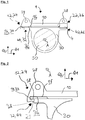
- the bearing arrangement for a brake carrier 1 is shown, the bearing arrangement having a brake means support element 10 and a holding element 30.
- the brake device support element 10 has a first assembly area 12 and a second assembly area 22, the first assembly area 12 forming a first distal end 24 of the brake assembly support element 10 in the negative first transverse direction Q1 and the second assembly area 22 a second distal end 26 of the brake means support element 10 in the positive first transverse direction Q1.
- the first mounting area 12 has a first mounting surface 14 and a second mounting surface 16.
- the first mounting surface 14 is oriented parallel to the first holding surface 34 of the first holding area 32, the first holding area 32 having a first distal end 44 of the holding element 30 and the second holding area 42 form a second distal end 46 of the holding element 30. These distal ends border the holding element 30 in the positive and negative first transverse direction Q1.
- the second holding surface 36 is oriented parallel to the second mounting surface 16. In its middle section - in the direction of the first transverse direction Q1 - the holding element 30 encloses the axis 50 on which the bearing arrangement is fixed.
- the second holding area 42 has a second stop 4.
- the brake means support element 10 has two fixing areas 28, these being formed or arranged in the first assembly area 12 and in the second assembly area 22, respectively.
- the first assembly area 12 is designed such that it surrounds the first holding area 32 by two projections 29 such that it is, inter alia, positively secured against displacement in the positive and negative second transverse direction Q2 and in the positive and negative axial direction A.
- displacement is prevented by the contact of the second mounting surface 16 with the second holding surface 36 and in the negative, second transverse direction by the contact of the third mounting surface 18 with the third holding surface 38.
- FIG. 3 an exploded view of a bearing arrangement for a brake carrier 1 is shown, this exploded view showing the brake means support element 10 shortly before assembly with the holding element 30.
- the brake means support element 10 has two assembly openings 20, each of which is aligned with an assembly hole 40 of the holding element 30.
- the first mounting area 12 is designed as a groove which can be brought into engagement with the first holding area 32 in a manner similar to a feather key, the first mounting surface 14 being oriented in such a way that it can be positively shifted in the direction of the first transverse direction Q1 with the first holding surface 34 prevented.
- FIG. 4 an alternative embodiment of a bearing arrangement for a brake carrier 1 is shown, the brake means support element 10 being clamped together with the holding element 30 via the mounting means 60 in the form of a clamping bracket.
- the first assembly area 12, which is arranged at the first distal end 24 of the brake means support element 10 has a first stop 2, which has an end face in the direction of the axial direction A, which can function as a form-fitting stop face.
- the first mounting surface 14 adjoins the second mounting surface 16 and the third mounting surface 18 at right angles.
- the first holding area 32 has a first holding surface 34 for contact with the first mounting surface 14, a second holding surface 36 for contacting the second mounting surface 16 and a third holding surface 38 for contacting the third mounting surface 18, these surfaces each being parallel to the respective other contact surfaces are oriented.
- the brake means support element 10 has two fixing areas 28, each of which has an opening in the direction of the axial direction A.
- FIG. 5 A bearing arrangement according to the invention for a brake carrier is shown, wherein the first mounting area 12 of the brake means support element 10, in particular by two projections 29, which extend in the direction of the first transverse direction Q1, surrounds the first holding area 32 of the holding element 30 in such a way that at least one relative displacement positively in the positive and negative second transverse direction Q2 and in the positive and negative axial direction A is prevented.
- the mounting means 60 which extends in the direction of the second transverse direction Q2, serves to fasten or brace the second mounting area 22 relative to the second holding area 42.
Landscapes
- Engineering & Computer Science (AREA)
- General Engineering & Computer Science (AREA)
- Mechanical Engineering (AREA)
- Braking Arrangements (AREA)
Description
- Die Erfindung betrifft eine Lageranordnung für einen Bremsträger, welcher insbesondere Anwendung in Nutzfahrzeugen findet.
- Lageranordnungen für Bremsträger sind aus dem Stand der Technik bekannt. Diese dienen dazu, einen Bremsenträger an einer Achse, Welle oder einem Fahrwerksteil festzulegen. Der Bremsträger umfasst oder trägt dabei insbesondere einen Bremssattel, welcher dazu dient, die Bremsbeläge des Bremssattels zu lagern bzw. zu führen. Problematisch bei dem im Stand der Technik bekannten Lageranordnungen ist, dass diese, insbesondere bei der Montage oder bei der Wartung, einen hohen Handhabungsaufwand verursachen, da diese mit externen Mitteln abgestützt oder gehalten werden müssen, bis der Bremsenträger - meist durch Schrauben - ortsfest fixiert werden kann.
- Die
WO 2017/040029 A1 zeigt eine Anordnung zum Lagern von Bremsbacken einer Trommelbremse, wobei die Anordnung einem äußeren und einen inneren Abschnitt aufweist, wobei diese Abschnitte relativ zu einander verstellbar sind. - Es ist daher die Aufgabe der vorliegenden Erfindung eine Lageranordnung für einen Bremsträger bereitzustellen, welcher nur einen geringen Montage- und Wartungsaufwand verursacht.
- Diese Aufgabe wird mittels einer Lageranordnung für einen Bremsenträger mit den Merkmalen des Anspruchs 1 gelöst. Vorteilhafte Weiterbildungen und Merkmale ergeben sich aus den abhängigen Ansprüchen.
- Erfindungsgemäß umfasst eine Lageranordnung für einen Bremsenträger, insbesondere für ein Nutzfahrzeug, ein Halteelement und ein Bremsmitteltragelement, wobei das Halteelement form-, stoff- und/oder kraftschlüssig an einer Achse oder einem Fahrwerksteil festgelegt ist oder festlegbar ist, wobei sich die Achse entlang einer Achsrichtung erstreckt, wobei das Bremsmitteltragelement einen ersten Montagebereich aufweist, wobei das Halteelement einen ersten Haltebereich aufweist, und wobei der erste Montagebereich unmittelbar oder mittelbar mit dem ersten Haltebereich in Eingriff steht oder bringbar ist, sodass eine Verlagerung entlang einer ersten Querrichtung zwischen dem Halteelement und dem Bremsmitteltragelement formschlüssig verhindert ist. Die erfindungsgemäße Lageranordnung findet insbesondere in Scheibenbremsen Anwendung, wobei diese Lageranordnung dazu dient, einen Bremsenträger zu lagern. Ein Bremsenträger ist das Element einer Bremse, insbesondere einer Scheibenbremse, welches die Reibelemente, insbesondere die Bremsbeläge, hält bzw. lagert. In anderen Worten bedeutet dies, dass der Bremsenträger ein Bremssattel sein kann. Das Bremsmitteltragelement ist dasjenige, insbesondere einstückige, Element der Lageranordnung, welches dazu dient, die Reibelemente der Bremse direkt oder indirekt zu halten bzw. zu lagern. Das Bremsmitteltragelement kann dabei ein separates Bauteil sein, welches im Kraftfluss zwischen dem Halteelement und dem Bremsenträger angeordnet ist oder alternativ auch ein Bestandteil des Bremsenträgers sein. Bevorzugt rotiert das Bremsmitteltragelement dabei in einem montierten Zustand nicht oder steht sogar komplett still in Relation zum Fahrzeug, an dem das Bremsmitteltragelement festgelegt ist. Das Halteelement der Lageranordnung ist dasjenige Element, welches zum Festlegen an der Achse einer Welle oder einem Fahrwerksteil dient. Ein Fahrwerksteil ist dabei insbesondere durch ein Teil des Dämpfungs- oder des Federsystems oder durch einen Bereich oder einen Teil des Fahrgestells gebildet. Alternativ bevorzugt kann das Halteelement beispielsweise auch einen Teil des Radlagergehäuses sein. Entscheidend ist, dass das Halteelement dazu ausgelegt ist, das Bremsmitteltragelement an der Achse, Welle oder dem Fahrwerksteil festzulegen. Bevorzugt ist das Halteelement aus einem metallischen Werkstoff, insbesondere Stahl bevorzugt Federstahl, gebildet. In einer beispielhaften Ausführungsform ist das Halteelement auf die Achse aufgepresst oder als ein Spannband um die Achse ausgebildet. Alternativ bevorzugt kann das Halteelement auch als eine Schweißkonstruktion ausgeführt sein. Zweckmäßigerweise besteht das Halteelement aus einem duktilen Werkstoff, wie beispielsweise Federstahl, wobei es bevorzugt ist, wenn zwischen dem Halteelement und der Achse ein Zwischenelement eingebracht ist, sodass das Halteelement mit der Achse über das Zwischenelement verspannt wird. Die Achse, an welcher das Halteelement form-, stoff- und/oder kraftschlüssig angeordnet ist, ist dabei bevorzugt das abstützende oder antreibende Element der zu bremsenden Achse, wobei die Achsrichtung unter anderem die Richtung sein kann, um welche das - mittels der Bremse zu bremsende - Rad rotiert. Bevorzugt ist die Achsrichtung daher insbesondere diejenige Richtung, in welcher sich die Breite des Fahrzeugs bestimmt, in welchem die Lageranordnung angeordnet ist oder dazu ausgelegt ist, angeordnet zu werden. Der erste Haltebereich des Halteelements und der erste Montagebereich des Bremsmitteltragelements dienen dazu, Kräfte und/oder Momente von dem Halteelement auf das Bremsmitteltragelement zu übertragen. In einer beispielhaften Ausführungsform ist der erste Montagebereich und der erste Haltebereich dabei wie eine Passfedernutverbindung ausgestaltet, wobei es bevorzugt ist, wenn sich die Passfeder in Richtung der ersten Querrichtung erstreckt. Wichtig ist, dass der erste Haltebereich derart mit dem ersten Montagebereich in Eingriff steht oder bringbar ist, dass eine Verlagerung zwischen dem Halteelement und dem Bremsmitteltragelement entlang der ersten Querrichtung in positiver und/oder in negativer Richtung formschlüssig verhindert ist. Bevorzugt erfolgt dieser Formschluss dadurch, dass Bereiche des ersten Haltebereichs unmittelbar mit dem ersten Montagebereich kontaktieren. Alternativ bevorzugt kann dieser Formschluss auch durch Einsatz von Zwischenelementen erreicht werden. Die erste Querrichtung ist die Richtung, welche senkrecht auf der Achsrichtung steht. Die erste Querrichtung liegt daher in einer Achsrichtungsebene, welche eine Normale parallel zur Achsrichtung aufweist. Die erste Querrichtung ist insbesondere diejenige Richtung, in welche sich der Bremsenträger beidseitig von der Rotationsachse der Achse erstreckt. In anderen Worten ist die erste Querrichtung daher insbesondere diejenige Richtung in einer Achsrichtungsebene, in welche die Bremsbeläge orientiert sind. Die erste Querrichtung ist daher bei einer vertikalen Anordnung der Bremsbeläge in einem Fahrzeug bevorzugt parallel zu dem Vektor der Erdbeschleunigung gerichtet. Durch das formschlüssige Verhindern der Verlagerung in die erste Querrichtung wird die Montage der Lageranordnung erheblich vereinfacht, sodass insbesondere Kosten bei der Montage und der Wartung gespart werden können.
- Bevorzugt ist das Halteelement reversibel oder lösbar am Bremsmitteltragelement angeordnet. Unter reversibel oder lösbar angeordnet ist dabei zu verstehen, dass das Halteelement reversibel mit dem Bremsmitteltragelement verbunden ist, sodass diese beiden Bauteile zerstörungsfrei voneinander getrennt werden können. Dies kann insbesondere durch eine Schraubverbindung erreicht werden. Durch das reversible Anordnen des Halteelements relativ zum Bremsmitteltragelement wird die Montage und die Wartung der Bremse vereinfacht.
- Vorteilhafterweise ist der erste Haltebereich und/oder der erste Montagebereich spiegelsymmetrisch bezüglich einer Ebene, wobei diese Symmetrieebene insbesondere eine Normale in Achsrichtung aufweist. Durch die spiegelsymmetrische Ausbildung des ersten Haltebereichs und/oder des ersten Montagebereichs - bezüglich der Symmetrieebene - wird erreicht, dass die Fertigung vereinfacht wird, sodass Kosten gespart werden können.
- Zweckmäßigerweise weist der erste Haltebereich eine erste Haltefläche auf, wobei der erste Montagebereich eine erste Montagefläche aufweist und wobei die erste Haltefläche und die erste Montagefläche unmittelbar kontaktieren oder unmittelbar in Kontakt bringbar sind, sodass eine Verlagerung in die erste Querrichtung durch den unmittelbaren Kontakt der ersten Haltefläche mit der ersten Montagefläche verhindert ist oder verhinderbar ist. Die erste Haltefläche ist daher derart ausgebildet, dass diese unmittelbar mit der ersten Montagefläche im ersten Montagebereich in Kontakt tritt oder treten kann. Dieser formschlüssige Kontakt zwischen der ersten Haltefläche des Haltebereichs und der ersten Montagefläche des Montagebereichs ist dabei derart auszugestalten, dass eine Verlagerung dieser beiden Flächen relativ zueinander in die erste Querrichtung durch den unmittelbaren Kontakt verhindert ist oder verhinderbar ist. Insbesondere ist der Kontakt dabei derart ausgestaltet, dass dieser eine Verlagerung in positive und/oder in negative erste Querrichtung verhindert. Die negative erste Querrichtung ist insbesondere dadurch charakterisiert, dass diese die erste Querrichtung ist, die ausgehend vom ersten Montagebereich weg von der Achsrichtung zeigt. Durch den unmittelbaren Kontakt der ersten Haltefläche mit der ersten Montagefläche wird erreicht, dass zum einen die Montage vereinfacht wird und zum anderen, dass durch diesen unmittelbaren Kontakt eine Dämpfungswirkung bei Schwingungen - durch die auftretende Kontaktdämpfung - erreicht wird, welche insbesondere im Hinblick auf Bremsenquietschen vorteilhaft ist.
- Bevorzugt sind die erste Haltefläche und die erste Montagefläche im Wesentlichen eben. Eine Fläche ist im Wesentlichen eben, wenn diese zwei perfekt parallele Ebenen, welche in Normalenrichtungen maximal 1 mm, bevorzugt 0,5 mm und besonders bevorzugt 0,2 mm voneinander beabstandet sind, nicht tangiert oder durchstößt. Die erste Haltefläche und/oder die erste Montagefläche weisen dabei bevorzugt eine ebene Fläche von mindestens 35 mm2 auf. Hierdurch kann eine besonders sichere Last- bzw. Kraftübertragung zwischen den beiden Flächen sichergestellt werden. Besonders bevorzugt ist die ebene Fläche der ersten Montagefläche und/oder der ersten Haltefläche dabei bevorzugt mindestens 70 mm2 groß. Hierdurch wird eine besonders hohe Verdrehsicherheit erreicht, sodass die Montage erleichtert wird.
- Zweckmäßigerweise weisen die erste Haltefläche und/oder die erste Montagefläche eine gemittelte Normale auf, welche im Wesentlichen parallel zur ersten Querrichtung orientiert ist. Im Wesentlichen parallel bedeutet dabei, dass die beiden parallelen Richtungen einen Winkel von ± 20°, bevorzugt von ± 10° und besonders bevorzugt von ± 5° und weiterhin bevorzugt von ± 2° zueinander aufweisen dürfen. Durch die im Wesentlichen parallelen Normalen der Haltefläche und/oder der ersten Montagefläche zur ersten Querrichtung wird erreicht, dass nur geringe Kräfte quer zu der ersten Querrichtung durch den Formschluss zwischen der ersten Haltefläche und der Montagefläche resultieren und so ein definiertes Abstützten erreicht wird, welches die Handhabung bei der Montage vereinfacht.
- In einer bevorzugten Ausführungsform ist die erste Haltefläche im Wesentlichen parallel zur ersten Montagefläche. Durch das im Wesentlichen parallele Ausbilden der beiden kontaktierenden Flächen wird erreicht, dass der Kontakt flächig erfolgt und so die beiden Flächen hohe Kräfte übertragen können, ohne dass die zulässige lokale Flächenbelastung überschritten wird. Im Wesentlichen parallel sind Flächen dann, wenn die gemittelten Normalen der Flächen im Wesentlichen parallel zueinander sind.
- Zweckmäßigerweise weist der erste Haltebereich eine zweite Haltefläche auf, wobei der Montagebereich eine zweite Montagefläche aufweist, und wobei die zweite Haltefläche derart unmittelbar mit der zweiten Montagefläche in Eingriff steht oder bringbar ist, sodass eine Verlagerung entlang einer zweiten Querrichtung zwischen dem Halteelement und dem Bremsmitteltragelement formschlüssig verhindert ist. Die zweite Querrichtung steht senkrecht auf der Achsrichtung und auf der ersten Querrichtung. Die zweite Querrichtung ist daher insbesondere diejenige Richtung, welche von der Achsrichtung zu den Bremsbacken bzw. dem Flächenschwerpunkt des Reibkontakts der Bremsbacken mit dem Bremsenrotor weist. Durch das formschlüssige Abstützen des ersten Haltebereichs über die zweite Haltefläche gegenüber der zweiten Montagefläche des Montagebereichs in die zweite Querrichtung wird die Montage der Lageranordnung weiter vereinfacht, da eine externe oder manuelle Abstützung der Lageranordnung, insbesondere des Halteelements, während der Montage kaum oder gar nicht benötigt wird.
- In einer bevorzugten Ausführungsform weisen die zweite Haltefläche und/oder die zweite Montagefläche eine gemittelte Normale auf, welche im Wesentlichen parallel zur zweiten Querrichtung orientiert ist. Hierdurch kann erreicht werden, dass die durch den Kontakt dieser Flächen induzierten Kräfte im Wesentlichen in die zweite Querrichtung weisen, sodass im Wesentlichen keine Kräfte quer zur zweiten Querrichtung - durch diesen formschlüssigen Kontakt - induziert werden, und somit die Handhabung bei der Montage und der Wartung erleichtert wird.
- Bevorzugt ist die zweite Haltefläche im Wesentlichen parallel zur zweiten Montagefläche. Durch das im Wesentlichen parallele Ausbilden der zweiten Haltefläche zur zweiten Montagefläche wird erreicht, dass diese insbesondere flächig miteinander kontaktieren, sodass auch hohe Lasten zwischen diesen beiden Flächen übertragen werden können.
- Zweckmäßigerweise umgibt der erste Haltebereich den ersten Montagebereich zumindest bereichsweise in Richtung der ersten Querrichtung und/oder in Richtung der zweiten Querrichtung. Ein bereichsweises Umgeben in Richtung der ersten und/oder der zweiten Querrichtung ist insbesondere dadurch charakterisiert, dass der erste Haltebereich relativ zum ersten Montagebereich in positiver und in negativer erster Querrichtung und/oder in positiver und in negativer zweiter Querrichtung gegen eine relative Verlagerung formschlüssig abgestützt ist oder abstützbar ist. Zweckmäßigerweise verfügt der erste Haltebereich dabei über eine dritte Haltefläche und der erste Montagebereich über eine dritte Montagefläche, wobei die Normalen der dritten Haltefläche bzw. der dritten Montagefläche dabei bevorzugt im Wesentlichen parallel zu den Normalen der zweiten Halte- bzw. Montagefläche orientiert ist. Alternativ oder zusätzlich bevorzugt kann der erste Montagebereich auch zwei, insbesondere parallele, Vorsprünge aufweisen, welche sich insbesondere in Richtung der ersten Querrichtung erstrecken, wobei sich der erste Haltebereich bevorzugt zumindest bereichsweise zwischen diesen beiden Vorsprüngen erstreckt oder in den Zwischenraum - zwischen den Vorsprüngen - einbringbar ist, sodass eine Verlagerung quer zu der Erstreckung der Vorsprünge, insbesondere in Achsrichtung und/oder in Richtung der zweiten Querrichtung, formschlüssig verhindert ist. Besonders bevorzugt weist einer oder beide Vorsprünge dabei die dritte Haltefläche oder zumindest einen Teil davon auf. Durch das formschlüssige Abstützen in positiver und negativer erster Querrichtung und/oder in positiver und negativer zweiter Querrichtung wird das Abstützen, insbesondere während des Montageprozesses, erheblich vereinfacht. Alternativ bevorzugt kann auch der erste Montagebereich den ersten Haltebereich zumindest bereichsweise in Richtung der ersten Querrichtung und/oder in Richtung der zweiten Querrichtung umgeben.
- Zweckmäßigerweise umgibt der erste Haltebereich den ersten Montagebereich in Achsrichtung zumindest bereichsweise. Unter umgebenden in Achsrichtung ist dabei zu verstehen, dass der erste Haltebereich relativ zum ersten Montagebereich formschlüssig gegen eine Verlagerung in positiver und negativer Achsrichtung gesichert ist. Durch das formschlüssige Verhindern einer Relativbewegung zwischen dem ersten Haltebereich und dem ersten Montagebereich in Achsrichtung wird erreicht, dass während der Montage ein Verrutschen des Bremsmitteltragelements in Achsrichtung erschwert bzw. verhindert wird, sodass die Montage vereinfacht wird. Das Umgeben des ersten Montagebereichs durch den ersten Haltebereich kann insbesondere dadurch erreicht werden, dass der Haltebereich zwei Vorsprünge in Richtung der ersten Querrichtung oder in Richtung der zweiten Querrichtung aufweist, zwischen welchen sich zumindest ein Teil des ersten Haltebereichs erstreckt oder einbringbar ist. Alternativ bevorzugt umgibt der erste Montagebereich den ersten Haltebereich in Achsrichtung zumindest bereichsweise.
- Bevorzugt weist das Bremsmitteltragelement zumindest eine Montageöffnung und das Halteelement zumindest ein Montageloch auf, wobei eine Montageöffnung mit einem Montageloch fluchtet, und dazu ausgelegt ist, ein Montagemittel aufzunehmen. Die Montageöffnung und das Montageloch können dabei im Prinzip einen beliebigen Querschnitt aufweisen. Bevorzugt ist dieser jedoch bereichsweise rund, insbesondere kreisrund, sodass eine kostengünstige Fertigung resultiert. Unter fluchten ist in diesem Zusammenhang zu verstehen, dass die Montageöffnung derart mit einem Montageloch fluchtet, dass das Montagemittel ohne verformt oder zerstört werden zu müssen, gleichzeitig durch das Montageloch und die Montageöffnung geführt werden kann. Montagemittel sind dabei Mittel, welche dazu dienen das Bremsmitteltragelement an dem Halteelement anzuordnen oder festzulegen. Insbesondere sind die Montagemittel dabei zerstörungsfrei lösbar, bevorzugt sind die Montagemittel Schrauben oder Bolzen. Alternativ bevorzugt kann es sich bei dem Montagemittel jedoch auch um Nieten oder andere Elemente handeln, wesentlich ist dabei, dass die Montagemittel dazu dienen, die beiden Hauptbestandteile der Lageranordnung miteinander zu verbinden, bevorzugt zu verspannen. Besonders bevorzugt ist es, wenn die Montageöffnung oder das Montageloch dabei ein Gewinde aufweisen, um Bauraum zu sparen. Zweckmäßigerweise weist dabei die Montageöffnung das Gewinde auf, denn hierdurch kann die Montage vereinfacht werden.
- Bevorzugt erstrecken sich die zumindest eine Montageöffnung und das zumindest eine Montageloch im Wesentlichen senkrecht zur Achsrichtung. Im Wesentlichen senkrecht erstrecken sich dabei zwei Richtungen zueinander, wenn diese einen Winkel von 75° bis 105°, bevorzugt von 82° bis 98° und besonders bevorzugt von 87 bis 93° miteinander bilden. Durch das im Wesentlichen senkrechte Ausbilden der Montageöffnung bzw. des Montagelochs zur Achsrichtung wird eine in Achsrichtung besonders bauraumsparende Lageranordnung erreicht. Besonders bevorzugt erstreckt sich zumindest eine Montageöffnung bzw. ein Montageloch dabei im Wesentlichen parallel zur zweiten Querrichtung. Durch dieses im Wesentlichen parallele Ausrichten der Montageöffnung bzw. des Montagelochs in Richtung der zweiten Querrichtung wird erreicht, dass eine besonders kompakte Lageranordnung resultiert, weil der vorhandene Bauraum optimal ausgenutzt wird.
- Zweckmäßigerweise bildet der erste Haltebereich ein erstes distales Ende des Halteelements aus, wobei der erste Montagebereich ein erstes distales Ende des Bremsmitteltragelements ausbildet, wobei die ersten distalen Enden das Halteelement und das Bremsmitteltragelement, insbesondere in Richtung der ersten Querrichtung, begrenzen. Durch das Ausbilden der Montagebereiche bzw. der Haltebereiche an den distalen Enden des Bremsmitteltragelements bzw. des Halteelements wird erreicht, dass mittels nur kleinen Kräften in dem ersten Montagebereich bzw. dem ersten Haltebereich ein großes Moment um die Achsrichtung erreicht werden kann, sodass die auftretende Flächenbelastung - in den formschlüssig übertragenen Flächen - gering gehalten werden kann, auch wenn ein großes Drehmoment übertragen werden muss.
- Erfindungsgemäß umfasst das Halteelement einen zweiten Haltebereich und das Bremsmitteltragelement einen zweiten Montagebereich, und wobei der zweite Haltebereich mit dem zweiten Montagebereich derart formschlüssig in Eingriff steht oder bringbar ist, dass eine Kraft formschlüssig, insbesondere parallel zur zweiten Querrichtung, zwischen dem zweiten Haltebereich und dem zweiten Montagebereich übertragbar ist. Bevorzugt ist der zweite Haltebereich vom ersten Haltebereich und/oder der zweite Montagebereich vom ersten Montagebereich mindestens 10 cm beabstandet, um eine gewisse Kippelsicherheit zu erreichen. Durch dieses mittelbar oder unmittelbare formschlüssige Abstützen des zweiten Montagebereichs am zweiten Haltebereich wird erreicht, dass eine sichere formschlüssige Kraftübertragung zwischen dem zweiten Haltebereich und dem zweiten Montagebereich erreicht wird. Zusätzlich wird durch das Abstützen auch noch erzielt, dass die Montage vereinfacht werden kann, da der formschlüssige Kontakt in Richtung der zweiten Querrichtung wie ein Montageanschlag wirkt, sodass eine besonders sichere Positionierung während der Montage stattfinden kann. Dieses formschlüssige Abstützen in Richtung der zweiten Querrichtung ist dabei bevorzugt derart ausgestaltet, dass das formschlüssige Abstützen in positive und/oder in negative zweite Querrichtung erfolgt. Die negative zweite Querrichtung weist dabei bevorzugt - ausgehend von den Bremsbelägen - zu der Achsrichtung hin.
- In einer bevorzugten Ausführungsform ist der zweite Haltebereich und/oder der zweite Montagebereich spiegelsymmetrisch bezüglich einer Ebene, wobei diese Symmetrieebene insbesondere eine Normale in Achsrichtung aufweist. Bevorzugt ist auch der erste Haltebereich spiegelsymmetrisch zum zweiten Haltebereich und/oder der erste Montagebereich spiegelsymmetrisch zum zweiten Montagebereich aufgebaut bzw. ausgebildet. Durch diese spiegelsymmetrische Ausgestaltung der Haltebereiche bzw. der Montagebereiche wird eine Vereinfachung der Fertigung erreicht, sodass Kosten gespart werden können.
- In einer erfindungsgemäßen Weiterbildung bildet der zweite Haltebereich ein zweites distales Ende des Halteelements aus, wobei der zweite Montagebereich ein zweites distales Ende des Bremsmitteltragelements ausbildet, wobei die zweiten distalen Enden das Halteelement und das Bremsmitteltragelement, insbesondere in Richtung der ersten Querrichtung, begrenzen. Durch das Anordnen des zweiten Montagebereichs bzw. des zweiten Haltebereichs an dem jeweiligen zweiten distalen Ende wird erreicht, dass auch mittels kleiner Kräfte ein großes Drehmoment übertragen werden kann, sodass die Flächenbelastung der in Kontakt stehenden Bereiche reduziert wird und so eine besonders standfeste Lageranordnung resultiert. Insbesondere liegen die ersten distalen Enden dabei gegenüber zu den zweiten distalen Enden und beranden das Halteelement bzw. das Bremsmitteltragelement jeweils in eine positive bzw. negative Richtung, insbesondere in die erste Querrichtung. Durch das Ausbilden dieser kraftübertragenden Bereiche an distal gegenüberliegenden Enden wird unter anderem eine besonders große Verdrehsicherung erreicht, sodass die Montage der Lageranordnung erleichtert wird.
- In einer bevorzugten Ausführungsform ist zumindest ein Montageloch im ersten Montagebereich und/oder im zweiten Montagebereich angeordnet und zumindest eine fluchtende Montageöffnung im ersten Haltebereich und/oder im zweiten Haltebereich. Hierdurch wird erreicht, dass die Anordnung des Bremsmitteltragelements an dem Halteelement nur geringe Bereiche um die Montageöffnung bzw. um das Montageloch unter Spannung setzt bzw. setzen kann, da die Montage- bzw. die Halteflächen sich räumlich direkt benachbart zu den Montagelöchern oder den Montageöffnungen befinden, sodass die restlichen Bereiche des Bauteils oder der Bauteile dünnwandig ausgestaltet werden können, sodass Gewicht gespart werden kann. Besonders bevorzugt durchstößt eine Montageöffnung dabei eine zweite Montagefläche und/oder ein Montageloch durchstößt dabei eine zweite Haltefläche.
- Bevorzugt ist am ersten Montagebereich und/oder am ersten Haltebereich ein erster Anschlag angeordnet. Der erste Anschlag ist dabei ein Vorsprung oder eine Anschlagfläche, welche sich insbesondere in Richtung der ersten und/oder der zweiten Querrichtung erstreckt und dazu ausgelegt ist, als Begrenzung in Achsrichtung zu fungieren. Dieser Anschlag ist daher dazu ausgelegt, als ein formschlüssiger Anschlag in positiver oder negativer Achsrichtung zwischen Bremsmitteltragelement und dem Halteelement zu fungieren. Der erste Anschlag ist insbesondere derart angeordnet bzw. ausgebildet, dass die Verlagerung dann formschlüssig verhindert wird, wenn die Montageposition erreicht ist. Hierdurch wird die Montage vereinfacht, sodass Kosten gespart werden können. Bevorzugt ist der erste Anschlag dabei derart ausgeformt, dass dieser ein separates Bauteil darstellt, welches an den ersten Montagebereich und/oder an den ersten Haltebereich stoffschlüssig, formschlüssig und/oder kraftschlüssig angefügt ist. Hierdurch kann eine besonders einfache Fertigung erreicht werden, sodass eine kostengünstige Lageranordnung resultiert. Besonders bevorzugt berandet der Anschlag dabei den ersten Montagebereich und/oder den ersten Haltebereich in Achsrichtung. Hierdurch kann insbesondere ein Eindringen von Schmutz in die abstützenden Kontakte verhindert werden. Besonders bevorzugt sind zwei erste Anschläge an dem ersten Montagebereich und/oder dem ersten Haltebereich angeordnet und wobei der eine erste Anschlag eine Verlagerung in positive und der andere erste Anschlag in negative Achsrichtung formschlüssig verhindern. Hierdurch wird eine besonders exakte Positionierung während des Montageprozesses erreicht, sodass dieser Beschleunigt werden kann und somit Kosten gespart werden können.
- Zweckmäßigerweise ist am zweiten Montagebereich und/oder am zweiten Haltebereich ein zweiter Anschlag angeordnet. Der zweite Anschlag kann dabei die gleichen Merkmale und Vorteile aufweisen wie der erste Anschlag, wobei der zweite Anschlag jedoch am zweiten Montagebereich und/oder am zweiten Haltebereich angeordnet ist. Besonders bevorzugt sind zwei zweite Anschläge an dem zweiten Montagebereich und/oder dem zweiten Haltebereich angeordnet und wobei der eine zweite Anschlag eine Verlagerung in positive und der andere zweite Anschlag in negative Achsrichtung formschlüssig verhindern. Hierdurch wird eine besonders exakte Positionierung während des Montageprozesses erreicht, sodass dieser Beschleunigt werden kann und somit Kosten gespart werden können. Besonders bevorzugt sind der erste und der zweite Anschlag so positioniert, dass sie dem aus der Gewichtskraft des Bremssattels um den ersten Montagebereich herum wirkenden resultierenden Drehmoment entgegenwirken.
- Zweckmäßigerweise weist das Bremsmitteltragelement zumindest einen Festlegungsbereich auf. Der Festlegungsbereich dient dazu, einen Bremsenträger, insbesondere einen Bremssattel, mittelbar oder unmittelbar aufzunehmen oder an dem Bremsmitteltragelement festzulegen. Besonders bevorzugt umfasst der Festlegungsbereich dabei Öffnungen, welche sich bevorzugt in Richtung der Achsrichtung erstrecken und dazu ausgelegt sind, Führungselemente oder Montagemittel aufzunehmen. Hierdurch resultiert ein besonders kostengünstiges Bremsmitteltragelement. Zusätzlich wird hierdurch erreicht, dass bereits existierende Systeme durch eine erfindungsgemäße Lageranordnung für einen Bremsenträger ausgetauscht werden können und so die Vorteile der Erfindung auch in bereits existierenden Systemen verfügbar gemacht werden.
- In einer weiteren bevorzugten Ausführungsform weisen der erste Montagebereich und/oder der zweite Montagebereich einen Festlegungsbereich auf. Durch dieses Anordnen zumindest eines Festlegungsbereichs, bevorzugt aller Festlegungsbereiche, in dem ersten bzw. in dem zweiten Montagebereich wird erreicht, dass ein besonders günstiger Kraftfluss resultiert, sodass die belasteten Bereiche im Bremsmitteltragelement reduziert werden können. Dies führt dazu, dass viele Bereiche des Bremsmitteltragelements dünnwandig ausgestaltet werden können, sodass Gewicht eingespart werden kann.
- Weitere Vorteile und Merkmale der vorliegenden Erfindung ergeben sich aus der nachfolgenden Beschreibung mit Bezug auf die Figuren. Einzelne Merkmale der dargestellten Ausführungsformen können dabei auch in anderen Ausführungsformen eingesetzt werden, sofern dies nicht ausdrücklich ausgeschlossen wurde. Es zeigen:
-
Figur 1 eine erfindungsgemäße Lageranordnung für einen Bremsträger; -
Figur 2 einen Ausschnitt aus einer erfindungsgemäßen Ausführungsform einer Lageranordnung für einen Bremsenträger; -
Figur 3 eine Explosionszeichnung einer weiteren erfindungsgemäßen Ausführungsform einer Lageranordnung für einen Bremsenträger; -
Figur 4 eine alternative Ausführungsform einer erfindungsgemäßen Lageranordnung für einen Bremsenträger; -
Figur 5 eine perspektivische Ansicht einer erfindungsgemäßen Ausführungsform einer Lageranordnung für einen Bremsenträger. - In der
Figur 1 ist eine erfindungsgemäße Lageranordnung für einen Bremsenträger 1 gezeigt, wobei die Lageranordnung ein Bremsmitteltragelement 10 und ein Halteelement 30 aufweist. Zur Kraftübertragung zwischen diesen beiden Elementen verfügt das Bremsmitteltragelement 10 über einen ersten Montagebereich 12 und einen zweiten Montagebereich 22, wobei der erste Montagebereich 12 ein erstes distales Ende 24 des Bremsmitteltragelements 10 in negativer erster Querrichtung Q1 bildet und der zweite Montagebereich 22 ein zweites distales Ende 26 des Bremsmitteltragelements 10 in positiver erster Querrichtung Q1. Der erste Montagebereich 12 verfügt über eine erste Montagefläche 14 und eine zweite Montagefläche 16. Die erste Montagefläche 14 ist dabei parallel zur ersten Haltefläche 34 des ersten Haltebereichs 32 orientiert, wobei der erste Haltebereich 32 ein erstes distales Ende 44 des Halteelements 30 und der zweite Haltebereich 42 ein zweites distales Ende 46 des Halteelements 30 ausbilden. Diese distalen Enden beranden dabei das Halteelement 30 in positive und negative erste Querrichtung Q1. Die zweite Haltefläche 36 ist dabei parallel zur zweiten Montagefläche 16 orientiert. In seinem mittleren Abschnitt - in Richtung der ersten Querrichtung Q1 - umschließt das Halteelement 30 die Achse 50, an welcher die Lageranordnung festgelegt ist. Der zweite Haltebereich 42 weist dabei einen zweiten Anschlag 4 auf. Um einen Bremsenträger aufzunehmen, verfügt das Bremsmitteltragelement 10 über zwei Festlegungsbereiche 28, wobei diese jeweils im ersten Montagebereich 12 bzw. im zweiten Montagebereich 22 ausgebildet bzw. angeordnet sind. - In der
Figur 2 ist ein Ausschnitt aus einer Ausführungsform der Lageranordnung für einen Bremsenträger 1 gezeigt, wobei der dargestellte Ausschnitt zu der in derFigur 1 dargestellten Ausführungsform passen könnte. Bemerkenswert ist dabei in der in derFigur 2 dargestellten Ausführungsform, dass der erste Montagebereich 12 derart ausgestaltet ist, dass dieser den ersten Haltebereich 32 durch zwei Vorsprünge 29 derart umgibt, dass dieser unter anderem formschlüssig gegen eine Verlagerung in positiver und negativer zweiter Querrichtung Q2 und in positiver und negativer Achsrichtung A gesichert ist. In positive Querrichtung Q2 wird eine Verlagerung durch den Kontakt der zweiten Montagefläche 16 mit der zweiten Haltefläche 36 verhindert und in negativer zweiter Querrichtung durch den Kontakt der dritten Montagefläche 18 mit der dritten Haltefläche 38. - In der
Figur 3 ist eine Explosionszeichnung einer Lageranordnung für einen Bremsenträger 1 gezeigt, wobei diese Explosionszeichnung das Bremsmitteltragelement 10 kurz vor der Montage mit dem Halteelement 30 zeigt. Zur Anordnung verfügt das Bremsmitteltragelement 10 über zwei Montageöffnungen 20, welche mit jeweils einem Montageloch 40 des Halteelements 30 fluchten. In der dargestellten Ausführungsform ist der erste Montagebereich 12 als eine Nut ausgebildet, welche mit dem ersten Haltebereich 32 ähnlich einer Passfeder in Eingriff bringbar ist, wobei die erste Montagefläche 14 derart orientiert ist, dass diese formschlüssig eine Verlagerung in Richtung der ersten Querrichtung Q1 mit der ersten Haltefläche 34 verhindert. - In der
Figur 4 ist eine alternative Ausführung einer Lageranordnung für einen Bremsenträger 1 dargestellt, wobei das Bremsmitteltragelement 10 mit dem Halteelement 30 über das Montagemittel 60 in Form eines Spannbügels miteinander verspannt ist. Hervorzuheben ist dabei in der dargestellten Ausführungsform, dass der erste Montagebereich 12, welcher am ersten distalen Ende 24 des Bremsmitteltragelement 10 angeordnet ist, über einen ersten Anschlag 2 verfügt, welcher eine Stirnfläche in Richtung der Achsrichtung A ausgebildet, die als formschlüssige Anschlagsfläche fungieren kann. Die erste Montagefläche 14 grenzt dabei rechtwinklig an die zweite Montagefläche 16 und an die dritte Montagefläche 18 an. Der erste Haltebereich 32 weist eine erste Haltefläche 34 zum Kontakt mit der ersten Montagefläche 14, eine zweite Haltefläche 36 zum Kontakt mit der zweiten Montagefläche 16 und eine dritte Haltefläche 38 zum Kontakt mit der dritten Montagefläche 18 auf, wobei diese Flächen jeweils parallel zu den jeweilig anderen Kontaktflächen orientiert sind. Zur Festlegung eines Bremsenträgers verfügt das Bremsmitteltragelement 10 über zwei Festlegungsbereiche 28, welche jeweils eine Öffnung in Richtung der Achsrichtung A aufweisen. - In der
Figur 5 ist eine erfindungsgemäße Lageranordnung für einen Bremsenträger gezeigt, wobei der erste Montagebereich 12 des Bremsmitteltragelements 10, insbesondere durch zwei Vorsprünge 29, welche sich in Richtung der ersten Querrichtung Q1 erstrecken, derart den ersten Haltebereich 32 des Halteelements 30 umgibt, dass zumindest eine relative Verlagerung formschlüssig in positive und negative zweite Querrichtung Richtung Q2 und in positive und negative Achsrichtung A verhindert ist. Das Montagemittel 60, welches sich in Richtung der zweiten Querrichtung Q2 erstreckt, dient dabei dazu, den zweiten Montagebereich 22 relativ zu dem zweiten Haltebereich 42 zu befestigen bzw. zu verspannen.Bezugszeichenliste: 1 - Lageranordnung für einen Bremsenträger 2 - erster Anschlag 4 - zweiter Anschlag 10 - Bremsmitteltragelement 12 - erster Montagebereich 14 - erste Montagefläche 16 - zweite Montagefläche 18 - dritte Montagefläche 20 - Montageöffnung 22 - zweiter Montagebereich 24 - erstes distales Ende des Bremsmitteltragelements 26 - zweites distales Ende des Bremsmitteltragelements 28 - Festlegungsbereich 29 - Vorsprung 30 - Halteelement 32 - erster Haltebereich 34 - erste Haltefläche 36 - zweite Haltefläche 38 - dritte Haltefläche 40 - Montageloch 42 - zweiter Haltebereich 44 - erstes distales Ende des Halteelements 46 - zweites distales Ende des Halteelements 50 - Achse 60 - Montagemittel A - Achsrichtung Q1 - erste Querrichtung Q2 - zweite Querrichtung
Claims (13)
- Lageranordnung für einen Bremsenträger (1), insbesondere für ein Nutzfahrzeug, umfassend ein Halteelement (30) und ein Bremsmitteltragelement (10), wobei das Halteelement (30) form-, stoff- und/oder kraftschlüssig an einer Achse (50) oder einem Fahrwerksteil festgelegt ist oder festlegbar ist,
wobei die Achse (50) sich entlang einer Achsrichtung (A) erstreckt,
wobei das Bremsmitteltragelement (10) einen ersten Montagebereich (12) aufweist,
wobei das Halteelement (30) einen ersten Haltebereich (32) aufweist,
und wobei der erste Montagebereich (12) unmittelbar oder mittelbar mit dem ersten Haltebereich (32) in Eingriff steht oder bringbar ist,
sodass eine Verlagerung entlang einer ersten Querrichtung (Q1) zwischen dem Halteelement (30) und dem Bremsmitteltragelement (10) formschlüssig verhindert ist,
wobei das Halteelement (30) einen zweiten Haltebereich (42) und das Bremsmitteltragelement (10) einen zweiten Montagebereich (22) umfasst,
und wobei der zweite Haltebereich (42) mit dem zweiten Montagebereich (22) derart formschlüssig in Eingriff steht oder bringbar ist,
dass eine Kraft formschlüssig, insbesondere parallel zur zweiten Querrichtung (Q2), zwischen dem zweiten Haltebereich (42) und dem zweiten Montagebereich (22) übertragbar ist,
dadurch gekennzeichnet, dass
der zweite Haltebereich (42) ein zweites distales Ende (46) des Halteelements (30) ausbildet,
wobei der zweite Montagebereich (22) ein zweites distales Ende (26) des Bremsmitteltragelements (10) ausbildet, und
wobei die zweiten distalen Enden (26,46) das Halteelement (30) und das Bremsmitteltragelement (10), insbesondere in Richtung der ersten Querrichtung (Q1), begrenzen. - Lageranordnung für einen Bremsenträger (1) gemäß Anspruch 1,
wobei der erste Haltebereich (32) und/oder der erste Montagebereich (12) spiegelsymmetrisch bezüglich einer Ebene ist/sind,
wobei diese Symmetrieebene insbesondere eine Normale in Achsrichtung (A) aufweist. - Lageranordnung für einen Bremsenträger (1) gemäß einem der vorhergehenden Ansprüche,
wobei der erste Haltebereich (32) eine erste Haltefläche (34) aufweist, wobei der erste Montagebereich (12) eine erste Montagefläche (14) aufweist, und wobei die erste Haltefläche (34) und die erste Montagefläche (14) unmittelbar kontaktieren oder unmittelbar in Kontakt bringbar sind,
sodass eine Verlagerung in die erste Querrichtung (Q1) durch den unmittelbaren Kontakt der ersten Haltefläche (34) mit der ersten Montagefläche (14) verhindert ist oder verhinderbar ist. - Lageranordnung für Bremsträger (1) gemäß einem der vorhergehenden Ansprüche,
wobei der erste Haltebereich (32) eine zweite Haltefläche (36) aufweist, wobei der erste Montagebereich (12) eine zweite Montagefläche (16) aufweist,
und wobei die zweite Haltefläche (36) derart unmittelbar mit der zweiten Montagefläche (16) in Eingriff steht oder bringbar ist,
sodass eine Verlagerung entlang einer zweiten Querrichtung (Q2) zwischen dem Halteelement (30) und dem Bremsmitteltragelement (10) formschlüssig verhindert ist. - Lageranordnung für einen Bremsenträger (1) gemäß einem der vorhergehenden Ansprüche,
wobei der erste Haltebereich (32) den ersten Montagebereich (12) zumindest bereichsweise in Richtung der ersten Querrichtung (Q1) und/oder in Richtung der zweiten Querrichtung (Q2) umgibt. - Lageranordnung für einen Bremsträger (1) gemäß einem der vorhergehenden Ansprüche,
wobei der erste Haltebereich (32) den ersten Montagebereich (12) in Achsrichtung (A) zumindest bereichsweise umgibt. - Lageranordnung für einen Bremsträger (1) gemäß einem der vorhergehenden Ansprüche,
wobei das Bremsmitteltragelement (10) zumindest eine Montageöffnung (20) und das Halteelement (30) zumindest ein Montageloch (40) aufweist,
wobei eine Montageöffnung (20) mit einem Montageloch (40) fluchtet,
und dazu ausgelegt ist, ein Montagemittel (60) aufzunehmen. - Lageranordnung für einen Bremsträger (1) gemäß Anspruch 7,
wobei sich die zumindest eine Montageöffnung (20) und das zumindest eine Montageloch (40) im Wesentlichen senkrecht zur Achsrichtung (A) erstrecken. - Lageranordnung für einen Bremsträger (1) gemäß einem der vorhergehenden Ansprüche,
wobei der erste Haltebereich (32) ein erstes distales Ende (44) des Halteelements (30) ausbildet,
wobei der erste Montagebereich (12) ein erstes distales Ende (24) des Bremsmitteltragelements (10) ausbildet,
wobei die ersten distalen Enden (24,44) das Halteelement (30) und das Bremsmitteltragelement (10), insbesondere in Richtung der ersten Querrichtung (Q1), begrenzen. - Lageranordnung für einen Bremsträger (1) gemäß einem der vorhergehenden Ansprüche,
wobei am ersten Montagebereich (12) und/oder am ersten Haltebereich (32) ein erster Anschlag (2) angeordnet ist. - Lageranordnung für einen Bremsträger (1) gemäß einem der vorhergehenden Ansprüche,
wobei am zweiten Montagebereich (22) und/oder am zweiten Haltebereich (42) ein zweiter Anschlag (4) angeordnet ist - Lageranordnung für einen Bremsträger (1) gemäß einem der vorhergehenden Ansprüche,
wobei das Bremsmitteltragelement (10) zumindest einen Festlegungsbereich (28) aufweist. - Lageranordnung für einen Bremsträger (1) gemäß einem der vorhergehenden Ansprüche,
wobei der erste Montagebereich (12) und/oder der zweite Montagebereich (22) einen Festlegungsbereich (28) aufweisen.
Applications Claiming Priority (2)
| Application Number | Priority Date | Filing Date | Title |
|---|---|---|---|
| DE102017126200.8A DE102017126200B4 (de) | 2017-11-09 | 2017-11-09 | Lageranordnung für einen Bremsenträger |
| PCT/EP2018/080475 WO2019092019A1 (de) | 2017-11-09 | 2018-11-07 | Lageranordnung für einen bremsenträger |
Publications (2)
| Publication Number | Publication Date |
|---|---|
| EP3707403A1 EP3707403A1 (de) | 2020-09-16 |
| EP3707403B1 true EP3707403B1 (de) | 2021-03-17 |
Family
ID=64270861
Family Applications (1)
| Application Number | Title | Priority Date | Filing Date |
|---|---|---|---|
| EP18800583.9A Active EP3707403B1 (de) | 2017-11-09 | 2018-11-07 | Lageranordnung für einen bremsenträger |
Country Status (4)
| Country | Link |
|---|---|
| US (1) | US11566673B2 (de) |
| EP (1) | EP3707403B1 (de) |
| DE (1) | DE102017126200B4 (de) |
| WO (1) | WO2019092019A1 (de) |
Family Cites Families (13)
| Publication number | Priority date | Publication date | Assignee | Title |
|---|---|---|---|---|
| GB1287415A (en) * | 1968-10-15 | 1972-08-31 | Dunlop Holdings Ltd | Improvements in and relating to disc brakes |
| US3999635A (en) * | 1975-10-06 | 1976-12-28 | The B. F. Goodrich Company | Disc brake caliper and lining carrier supporting means |
| JPS5261675A (en) * | 1975-11-17 | 1977-05-21 | Toyota Motor Corp | Disc brake |
| DE20021587U1 (de) * | 2000-12-21 | 2001-04-05 | BPW Bergische Achsen KG, 51674 Wiehl | Bremseinrichtung |
| BR0306800A (pt) * | 2002-02-08 | 2004-12-07 | Knorr Bremse Systeme | Freio a disco com dispositivo de reajuste acionado eletricamente |
| AU2003215910A1 (en) * | 2003-02-28 | 2004-09-17 | Freni Brembo S.P.A. | Caliper for a disk brake and support element for a caliper |
| DE102004016826A1 (de) * | 2004-04-01 | 2005-10-27 | Daimlerchrysler Ag | Bremsvorrichtung |
| US7673723B2 (en) * | 2005-12-21 | 2010-03-09 | Performance Friction Corporation | Caliper mounting arrangement |
| US20080135352A1 (en) * | 2006-12-12 | 2008-06-12 | Bendix Spicer Foundation Brake Llc | Brake caliper vertical mounting assembly joint arrangement |
| US9506512B2 (en) * | 2013-10-03 | 2016-11-29 | Bendix Spicer Foundation Brake Llc | Brake carrier mounting arrangement |
| DE102014113369A1 (de) * | 2014-09-17 | 2016-03-17 | Knorr-Bremse Systeme für Nutzfahrzeuge GmbH | Anordnung eines Bremsträgers einer Scheibenbremse an einer Fahrzeugachse, Bremsträger und Scheibenbremse |
| WO2017039609A1 (en) * | 2015-08-31 | 2017-03-09 | Compagnie Generale Des Establissements Michelin | Articulating brake component mounting plate for wheel alignment correction |
| US10385936B2 (en) * | 2017-07-19 | 2019-08-20 | Ford Global Technologies, Llc | Mechanically-keyed non-slip brake joints |
-
2017
- 2017-11-09 DE DE102017126200.8A patent/DE102017126200B4/de active Active
-
2018
- 2018-11-07 WO PCT/EP2018/080475 patent/WO2019092019A1/de not_active Ceased
- 2018-11-07 EP EP18800583.9A patent/EP3707403B1/de active Active
- 2018-11-07 US US16/762,377 patent/US11566673B2/en active Active
Non-Patent Citations (1)
| Title |
|---|
| None * |
Also Published As
| Publication number | Publication date |
|---|---|
| WO2019092019A1 (de) | 2019-05-16 |
| EP3707403A1 (de) | 2020-09-16 |
| DE102017126200A1 (de) | 2019-05-09 |
| US11566673B2 (en) | 2023-01-31 |
| DE102017126200B4 (de) | 2020-12-03 |
| US20200284309A1 (en) | 2020-09-10 |
Similar Documents
| Publication | Publication Date | Title |
|---|---|---|
| DE3609149C2 (de) | ||
| EP1730416B1 (de) | Gummilager, insbesondere für ein motorpumpenaggregat einer servolenkung | |
| DE69700942T2 (de) | Scheibenbremsvorrichtung | |
| EP3094889A1 (de) | Planetenbolzen mit verschraubbarem flansch | |
| WO2015004080A1 (de) | Bremsbelaghalterung einer scheibenbremse | |
| EP3606767B1 (de) | Achssystem | |
| EP3172456B1 (de) | Bremssystem | |
| EP1735541B1 (de) | Bremsvorrichtung | |
| DE102004045223B3 (de) | Bremsenträger | |
| DE102007032318A1 (de) | Elektrischer Aktuator für einen geteilten Kraftfahrzeugstabilisator | |
| DE102017126200B4 (de) | Lageranordnung für einen Bremsenträger | |
| WO1994018470A1 (de) | Befestigungsvorrichtung für scheibenbremsen | |
| DE102005059247B4 (de) | Bremsvorrichtung | |
| WO2017144448A2 (de) | Achssystem | |
| EP4291794B1 (de) | Kardanisch weiche kupplung zur übertragung von hohen axialen kräften für triebstränge in windkraftanlagen | |
| EP2751439B2 (de) | Bremssystem einer trommelbremse | |
| DE102006004487A1 (de) | Scheibenbremse | |
| EP3542082B1 (de) | Nachstellvorrichtung für eine scheibenbremse | |
| DE29720240U1 (de) | Drehelastische Kupplung, insbesondere für eine Gelenkwelle | |
| DE102005033078B4 (de) | Festsattelbremse | |
| DE102004014301A1 (de) | Radschraube für ein Kraftfahrzeugrad | |
| EP3199828A1 (de) | Bremsbelaghalterung einer fahrzeug-scheibenbremse sowie niederhalter für die befestigung von bremsbelägen | |
| DE102024204146A1 (de) | Elektromechanische Bremse | |
| EP1561960B1 (de) | Wellensystem | |
| DE102022205948A1 (de) | Schwimmsattelbremse mit einem Führungselement |
Legal Events
| Date | Code | Title | Description |
|---|---|---|---|
| STAA | Information on the status of an ep patent application or granted ep patent |
Free format text: STATUS: UNKNOWN |
|
| STAA | Information on the status of an ep patent application or granted ep patent |
Free format text: STATUS: THE INTERNATIONAL PUBLICATION HAS BEEN MADE |
|
| PUAI | Public reference made under article 153(3) epc to a published international application that has entered the european phase |
Free format text: ORIGINAL CODE: 0009012 |
|
| STAA | Information on the status of an ep patent application or granted ep patent |
Free format text: STATUS: REQUEST FOR EXAMINATION WAS MADE |
|
| 17P | Request for examination filed |
Effective date: 20200428 |
|
| AK | Designated contracting states |
Kind code of ref document: A1 Designated state(s): AL AT BE BG CH CY CZ DE DK EE ES FI FR GB GR HR HU IE IS IT LI LT LU LV MC MK MT NL NO PL PT RO RS SE SI SK SM TR |
|
| AX | Request for extension of the european patent |
Extension state: BA ME |
|
| RIN1 | Information on inventor provided before grant (corrected) |
Inventor name: HARTMANN, MARK Inventor name: WALLMEIER, STEFAN |
|
| GRAP | Despatch of communication of intention to grant a patent |
Free format text: ORIGINAL CODE: EPIDOSNIGR1 |
|
| STAA | Information on the status of an ep patent application or granted ep patent |
Free format text: STATUS: GRANT OF PATENT IS INTENDED |
|
| DAV | Request for validation of the european patent (deleted) | ||
| DAX | Request for extension of the european patent (deleted) | ||
| INTG | Intention to grant announced |
Effective date: 20201214 |
|
| GRAS | Grant fee paid |
Free format text: ORIGINAL CODE: EPIDOSNIGR3 |
|
| GRAA | (expected) grant |
Free format text: ORIGINAL CODE: 0009210 |
|
| STAA | Information on the status of an ep patent application or granted ep patent |
Free format text: STATUS: THE PATENT HAS BEEN GRANTED |
|
| AK | Designated contracting states |
Kind code of ref document: B1 Designated state(s): AL AT BE BG CH CY CZ DE DK EE ES FI FR GB GR HR HU IE IS IT LI LT LU LV MC MK MT NL NO PL PT RO RS SE SI SK SM TR |
|
| REG | Reference to a national code |
Ref country code: GB Ref legal event code: FG4D Free format text: NOT ENGLISH |
|
| REG | Reference to a national code |
Ref country code: CH Ref legal event code: EP |
|
| REG | Reference to a national code |
Ref country code: DE Ref legal event code: R096 Ref document number: 502018004385 Country of ref document: DE |
|
| REG | Reference to a national code |
Ref country code: IE Ref legal event code: FG4D Free format text: LANGUAGE OF EP DOCUMENT: GERMAN |
|
| REG | Reference to a national code |
Ref country code: AT Ref legal event code: REF Ref document number: 1372515 Country of ref document: AT Kind code of ref document: T Effective date: 20210415 |
|
| REG | Reference to a national code |
Ref country code: LT Ref legal event code: MG9D |
|
| PG25 | Lapsed in a contracting state [announced via postgrant information from national office to epo] |
Ref country code: NO Free format text: LAPSE BECAUSE OF FAILURE TO SUBMIT A TRANSLATION OF THE DESCRIPTION OR TO PAY THE FEE WITHIN THE PRESCRIBED TIME-LIMIT Effective date: 20210617 Ref country code: BG Free format text: LAPSE BECAUSE OF FAILURE TO SUBMIT A TRANSLATION OF THE DESCRIPTION OR TO PAY THE FEE WITHIN THE PRESCRIBED TIME-LIMIT Effective date: 20210617 Ref country code: FI Free format text: LAPSE BECAUSE OF FAILURE TO SUBMIT A TRANSLATION OF THE DESCRIPTION OR TO PAY THE FEE WITHIN THE PRESCRIBED TIME-LIMIT Effective date: 20210317 Ref country code: GR Free format text: LAPSE BECAUSE OF FAILURE TO SUBMIT A TRANSLATION OF THE DESCRIPTION OR TO PAY THE FEE WITHIN THE PRESCRIBED TIME-LIMIT Effective date: 20210618 Ref country code: HR Free format text: LAPSE BECAUSE OF FAILURE TO SUBMIT A TRANSLATION OF THE DESCRIPTION OR TO PAY THE FEE WITHIN THE PRESCRIBED TIME-LIMIT Effective date: 20210317 |
|
| REG | Reference to a national code |
Ref country code: NL Ref legal event code: MP Effective date: 20210317 |
|
| PG25 | Lapsed in a contracting state [announced via postgrant information from national office to epo] |
Ref country code: SE Free format text: LAPSE BECAUSE OF FAILURE TO SUBMIT A TRANSLATION OF THE DESCRIPTION OR TO PAY THE FEE WITHIN THE PRESCRIBED TIME-LIMIT Effective date: 20210317 Ref country code: LV Free format text: LAPSE BECAUSE OF FAILURE TO SUBMIT A TRANSLATION OF THE DESCRIPTION OR TO PAY THE FEE WITHIN THE PRESCRIBED TIME-LIMIT Effective date: 20210317 Ref country code: RS Free format text: LAPSE BECAUSE OF FAILURE TO SUBMIT A TRANSLATION OF THE DESCRIPTION OR TO PAY THE FEE WITHIN THE PRESCRIBED TIME-LIMIT Effective date: 20210317 |
|
| PG25 | Lapsed in a contracting state [announced via postgrant information from national office to epo] |
Ref country code: NL Free format text: LAPSE BECAUSE OF FAILURE TO SUBMIT A TRANSLATION OF THE DESCRIPTION OR TO PAY THE FEE WITHIN THE PRESCRIBED TIME-LIMIT Effective date: 20210317 |
|
| PG25 | Lapsed in a contracting state [announced via postgrant information from national office to epo] |
Ref country code: SM Free format text: LAPSE BECAUSE OF FAILURE TO SUBMIT A TRANSLATION OF THE DESCRIPTION OR TO PAY THE FEE WITHIN THE PRESCRIBED TIME-LIMIT Effective date: 20210317 Ref country code: LT Free format text: LAPSE BECAUSE OF FAILURE TO SUBMIT A TRANSLATION OF THE DESCRIPTION OR TO PAY THE FEE WITHIN THE PRESCRIBED TIME-LIMIT Effective date: 20210317 Ref country code: CZ Free format text: LAPSE BECAUSE OF FAILURE TO SUBMIT A TRANSLATION OF THE DESCRIPTION OR TO PAY THE FEE WITHIN THE PRESCRIBED TIME-LIMIT Effective date: 20210317 Ref country code: EE Free format text: LAPSE BECAUSE OF FAILURE TO SUBMIT A TRANSLATION OF THE DESCRIPTION OR TO PAY THE FEE WITHIN THE PRESCRIBED TIME-LIMIT Effective date: 20210317 |
|
| PG25 | Lapsed in a contracting state [announced via postgrant information from national office to epo] |
Ref country code: IS Free format text: LAPSE BECAUSE OF FAILURE TO SUBMIT A TRANSLATION OF THE DESCRIPTION OR TO PAY THE FEE WITHIN THE PRESCRIBED TIME-LIMIT Effective date: 20210717 Ref country code: PL Free format text: LAPSE BECAUSE OF FAILURE TO SUBMIT A TRANSLATION OF THE DESCRIPTION OR TO PAY THE FEE WITHIN THE PRESCRIBED TIME-LIMIT Effective date: 20210317 Ref country code: PT Free format text: LAPSE BECAUSE OF FAILURE TO SUBMIT A TRANSLATION OF THE DESCRIPTION OR TO PAY THE FEE WITHIN THE PRESCRIBED TIME-LIMIT Effective date: 20210719 Ref country code: RO Free format text: LAPSE BECAUSE OF FAILURE TO SUBMIT A TRANSLATION OF THE DESCRIPTION OR TO PAY THE FEE WITHIN THE PRESCRIBED TIME-LIMIT Effective date: 20210317 Ref country code: SK Free format text: LAPSE BECAUSE OF FAILURE TO SUBMIT A TRANSLATION OF THE DESCRIPTION OR TO PAY THE FEE WITHIN THE PRESCRIBED TIME-LIMIT Effective date: 20210317 |
|
| REG | Reference to a national code |
Ref country code: DE Ref legal event code: R097 Ref document number: 502018004385 Country of ref document: DE |
|
| PLBE | No opposition filed within time limit |
Free format text: ORIGINAL CODE: 0009261 |
|
| STAA | Information on the status of an ep patent application or granted ep patent |
Free format text: STATUS: NO OPPOSITION FILED WITHIN TIME LIMIT |
|
| PG25 | Lapsed in a contracting state [announced via postgrant information from national office to epo] |
Ref country code: ES Free format text: LAPSE BECAUSE OF FAILURE TO SUBMIT A TRANSLATION OF THE DESCRIPTION OR TO PAY THE FEE WITHIN THE PRESCRIBED TIME-LIMIT Effective date: 20210317 Ref country code: DK Free format text: LAPSE BECAUSE OF FAILURE TO SUBMIT A TRANSLATION OF THE DESCRIPTION OR TO PAY THE FEE WITHIN THE PRESCRIBED TIME-LIMIT Effective date: 20210317 Ref country code: AL Free format text: LAPSE BECAUSE OF FAILURE TO SUBMIT A TRANSLATION OF THE DESCRIPTION OR TO PAY THE FEE WITHIN THE PRESCRIBED TIME-LIMIT Effective date: 20210317 |
|
| 26N | No opposition filed |
Effective date: 20211220 |
|
| PG25 | Lapsed in a contracting state [announced via postgrant information from national office to epo] |
Ref country code: IT Free format text: LAPSE BECAUSE OF FAILURE TO SUBMIT A TRANSLATION OF THE DESCRIPTION OR TO PAY THE FEE WITHIN THE PRESCRIBED TIME-LIMIT Effective date: 20210317 |
|
| PG25 | Lapsed in a contracting state [announced via postgrant information from national office to epo] |
Ref country code: IS Free format text: LAPSE BECAUSE OF FAILURE TO SUBMIT A TRANSLATION OF THE DESCRIPTION OR TO PAY THE FEE WITHIN THE PRESCRIBED TIME-LIMIT Effective date: 20210717 |
|
| PG25 | Lapsed in a contracting state [announced via postgrant information from national office to epo] |
Ref country code: MC Free format text: LAPSE BECAUSE OF FAILURE TO SUBMIT A TRANSLATION OF THE DESCRIPTION OR TO PAY THE FEE WITHIN THE PRESCRIBED TIME-LIMIT Effective date: 20210317 |
|
| REG | Reference to a national code |
Ref country code: CH Ref legal event code: PL |
|
| PG25 | Lapsed in a contracting state [announced via postgrant information from national office to epo] |
Ref country code: LU Free format text: LAPSE BECAUSE OF NON-PAYMENT OF DUE FEES Effective date: 20211107 Ref country code: BE Free format text: LAPSE BECAUSE OF NON-PAYMENT OF DUE FEES Effective date: 20211130 |
|
| REG | Reference to a national code |
Ref country code: BE Ref legal event code: MM Effective date: 20211130 |
|
| PG25 | Lapsed in a contracting state [announced via postgrant information from national office to epo] |
Ref country code: LI Free format text: LAPSE BECAUSE OF NON-PAYMENT OF DUE FEES Effective date: 20211130 Ref country code: CH Free format text: LAPSE BECAUSE OF NON-PAYMENT OF DUE FEES Effective date: 20211130 |
|
| PG25 | Lapsed in a contracting state [announced via postgrant information from national office to epo] |
Ref country code: IE Free format text: LAPSE BECAUSE OF NON-PAYMENT OF DUE FEES Effective date: 20211107 |
|
| PGFP | Annual fee paid to national office [announced via postgrant information from national office to epo] |
Ref country code: GB Payment date: 20221123 Year of fee payment: 5 |
|
| P01 | Opt-out of the competence of the unified patent court (upc) registered |
Effective date: 20230505 |
|
| PG25 | Lapsed in a contracting state [announced via postgrant information from national office to epo] |
Ref country code: CY Free format text: LAPSE BECAUSE OF FAILURE TO SUBMIT A TRANSLATION OF THE DESCRIPTION OR TO PAY THE FEE WITHIN THE PRESCRIBED TIME-LIMIT Effective date: 20210317 |
|
| PG25 | Lapsed in a contracting state [announced via postgrant information from national office to epo] |
Ref country code: HU Free format text: LAPSE BECAUSE OF FAILURE TO SUBMIT A TRANSLATION OF THE DESCRIPTION OR TO PAY THE FEE WITHIN THE PRESCRIBED TIME-LIMIT; INVALID AB INITIO Effective date: 20181107 |
|
| PG25 | Lapsed in a contracting state [announced via postgrant information from national office to epo] |
Ref country code: SI Free format text: LAPSE BECAUSE OF FAILURE TO SUBMIT A TRANSLATION OF THE DESCRIPTION OR TO PAY THE FEE WITHIN THE PRESCRIBED TIME-LIMIT Effective date: 20210317 |
|
| PG25 | Lapsed in a contracting state [announced via postgrant information from national office to epo] |
Ref country code: MK Free format text: LAPSE BECAUSE OF FAILURE TO SUBMIT A TRANSLATION OF THE DESCRIPTION OR TO PAY THE FEE WITHIN THE PRESCRIBED TIME-LIMIT Effective date: 20210317 |
|
| PG25 | Lapsed in a contracting state [announced via postgrant information from national office to epo] |
Ref country code: TR Free format text: LAPSE BECAUSE OF FAILURE TO SUBMIT A TRANSLATION OF THE DESCRIPTION OR TO PAY THE FEE WITHIN THE PRESCRIBED TIME-LIMIT Effective date: 20210317 |
|
| GBPC | Gb: european patent ceased through non-payment of renewal fee |
Effective date: 20231107 |
|
| PG25 | Lapsed in a contracting state [announced via postgrant information from national office to epo] |
Ref country code: MT Free format text: LAPSE BECAUSE OF FAILURE TO SUBMIT A TRANSLATION OF THE DESCRIPTION OR TO PAY THE FEE WITHIN THE PRESCRIBED TIME-LIMIT Effective date: 20210317 |
|
| PG25 | Lapsed in a contracting state [announced via postgrant information from national office to epo] |
Ref country code: GB Free format text: LAPSE BECAUSE OF NON-PAYMENT OF DUE FEES Effective date: 20231107 |
|
| PG25 | Lapsed in a contracting state [announced via postgrant information from national office to epo] |
Ref country code: GB Free format text: LAPSE BECAUSE OF NON-PAYMENT OF DUE FEES Effective date: 20231107 |
|
| REG | Reference to a national code |
Ref country code: AT Ref legal event code: MM01 Ref document number: 1372515 Country of ref document: AT Kind code of ref document: T Effective date: 20231107 |
|
| PG25 | Lapsed in a contracting state [announced via postgrant information from national office to epo] |
Ref country code: AT Free format text: LAPSE BECAUSE OF NON-PAYMENT OF DUE FEES Effective date: 20231107 |
|
| PG25 | Lapsed in a contracting state [announced via postgrant information from national office to epo] |
Ref country code: AT Free format text: LAPSE BECAUSE OF NON-PAYMENT OF DUE FEES Effective date: 20231107 |
|
| PGFP | Annual fee paid to national office [announced via postgrant information from national office to epo] |
Ref country code: DE Payment date: 20250819 Year of fee payment: 8 |
|
| PGFP | Annual fee paid to national office [announced via postgrant information from national office to epo] |
Ref country code: FR Payment date: 20251120 Year of fee payment: 8 |
|
| PGFP | Annual fee paid to national office [announced via postgrant information from national office to epo] |
Ref country code: AT Payment date: 20260410 Year of fee payment: 5 |