EP3708608A1 - Procédé de production de feuille de résine superabsorbante et feuille de résine superabsorbante ainsi produite - Google Patents
Procédé de production de feuille de résine superabsorbante et feuille de résine superabsorbante ainsi produite Download PDFInfo
- Publication number
- EP3708608A1 EP3708608A1 EP18889354.9A EP18889354A EP3708608A1 EP 3708608 A1 EP3708608 A1 EP 3708608A1 EP 18889354 A EP18889354 A EP 18889354A EP 3708608 A1 EP3708608 A1 EP 3708608A1
- Authority
- EP
- European Patent Office
- Prior art keywords
- super absorbent
- absorbent polymer
- polymer sheet
- preparing method
- blowing agent
- Prior art date
- Legal status (The legal status is an assumption and is not a legal conclusion. Google has not performed a legal analysis and makes no representation as to the accuracy of the status listed.)
- Granted
Links
Images
Classifications
-
- C—CHEMISTRY; METALLURGY
- C08—ORGANIC MACROMOLECULAR COMPOUNDS; THEIR PREPARATION OR CHEMICAL WORKING-UP; COMPOSITIONS BASED THEREON
- C08J—WORKING-UP; GENERAL PROCESSES OF COMPOUNDING; AFTER-TREATMENT NOT COVERED BY SUBCLASSES C08B, C08C, C08F, C08G or C08H
- C08J9/00—Working-up of macromolecular substances to porous or cellular articles or materials; After-treatment thereof
- C08J9/32—Working-up of macromolecular substances to porous or cellular articles or materials; After-treatment thereof from compositions containing microballoons, e.g. syntactic foams
-
- B—PERFORMING OPERATIONS; TRANSPORTING
- B01—PHYSICAL OR CHEMICAL PROCESSES OR APPARATUS IN GENERAL
- B01J—CHEMICAL OR PHYSICAL PROCESSES, e.g. CATALYSIS OR COLLOID CHEMISTRY; THEIR RELEVANT APPARATUS
- B01J20/00—Solid sorbent compositions or filter aid compositions; Sorbents for chromatography; Processes for preparing, regenerating or reactivating thereof
- B01J20/22—Solid sorbent compositions or filter aid compositions; Sorbents for chromatography; Processes for preparing, regenerating or reactivating thereof comprising organic material
- B01J20/26—Synthetic macromolecular compounds
- B01J20/265—Synthetic macromolecular compounds modified or post-treated polymers
- B01J20/267—Cross-linked polymers
-
- A—HUMAN NECESSITIES
- A61—MEDICAL OR VETERINARY SCIENCE; HYGIENE
- A61L—METHODS OR APPARATUS FOR STERILISING MATERIALS OR OBJECTS IN GENERAL; DISINFECTION, STERILISATION OR DEODORISATION OF AIR; CHEMICAL ASPECTS OF BANDAGES, DRESSINGS, ABSORBENT PADS OR SURGICAL ARTICLES; MATERIALS FOR BANDAGES, DRESSINGS, ABSORBENT PADS OR SURGICAL ARTICLES
- A61L15/00—Chemical aspects of, or use of materials for, bandages, dressings or absorbent pads
- A61L15/16—Bandages, dressings or absorbent pads for physiological fluids such as urine or blood, e.g. sanitary towels, tampons
- A61L15/42—Use of materials characterised by their function or physical properties
- A61L15/60—Liquid-swellable gel-forming materials, e.g. super-absorbents
-
- B—PERFORMING OPERATIONS; TRANSPORTING
- B01—PHYSICAL OR CHEMICAL PROCESSES OR APPARATUS IN GENERAL
- B01J—CHEMICAL OR PHYSICAL PROCESSES, e.g. CATALYSIS OR COLLOID CHEMISTRY; THEIR RELEVANT APPARATUS
- B01J20/00—Solid sorbent compositions or filter aid compositions; Sorbents for chromatography; Processes for preparing, regenerating or reactivating thereof
- B01J20/28—Solid sorbent compositions or filter aid compositions; Sorbents for chromatography; Processes for preparing, regenerating or reactivating thereof characterised by their form or physical properties
- B01J20/28014—Solid sorbent compositions or filter aid compositions; Sorbents for chromatography; Processes for preparing, regenerating or reactivating thereof characterised by their form or physical properties characterised by their form
- B01J20/28033—Membrane, sheet, cloth, pad, lamellar or mat
-
- B—PERFORMING OPERATIONS; TRANSPORTING
- B01—PHYSICAL OR CHEMICAL PROCESSES OR APPARATUS IN GENERAL
- B01J—CHEMICAL OR PHYSICAL PROCESSES, e.g. CATALYSIS OR COLLOID CHEMISTRY; THEIR RELEVANT APPARATUS
- B01J20/00—Solid sorbent compositions or filter aid compositions; Sorbents for chromatography; Processes for preparing, regenerating or reactivating thereof
- B01J20/30—Processes for preparing, regenerating, or reactivating
- B01J20/305—Addition of material, later completely removed, e.g. as result of heat treatment, leaching or washing, e.g. for forming pores
- B01J20/3064—Addition of pore forming agents, e.g. pore inducing or porogenic agents
-
- B—PERFORMING OPERATIONS; TRANSPORTING
- B01—PHYSICAL OR CHEMICAL PROCESSES OR APPARATUS IN GENERAL
- B01J—CHEMICAL OR PHYSICAL PROCESSES, e.g. CATALYSIS OR COLLOID CHEMISTRY; THEIR RELEVANT APPARATUS
- B01J20/00—Solid sorbent compositions or filter aid compositions; Sorbents for chromatography; Processes for preparing, regenerating or reactivating thereof
- B01J20/30—Processes for preparing, regenerating, or reactivating
- B01J20/3085—Chemical treatments not covered by groups B01J20/3007 - B01J20/3078
-
- C—CHEMISTRY; METALLURGY
- C08—ORGANIC MACROMOLECULAR COMPOUNDS; THEIR PREPARATION OR CHEMICAL WORKING-UP; COMPOSITIONS BASED THEREON
- C08F—MACROMOLECULAR COMPOUNDS OBTAINED BY REACTIONS ONLY INVOLVING CARBON-TO-CARBON UNSATURATED BONDS
- C08F2/00—Processes of polymerisation
- C08F2/12—Polymerisation in non-solvents
- C08F2/16—Aqueous medium
-
- C—CHEMISTRY; METALLURGY
- C08—ORGANIC MACROMOLECULAR COMPOUNDS; THEIR PREPARATION OR CHEMICAL WORKING-UP; COMPOSITIONS BASED THEREON
- C08F—MACROMOLECULAR COMPOUNDS OBTAINED BY REACTIONS ONLY INVOLVING CARBON-TO-CARBON UNSATURATED BONDS
- C08F2/00—Processes of polymerisation
- C08F2/44—Polymerisation in the presence of compounding ingredients, e.g. plasticisers, dyestuffs, fillers
-
- C—CHEMISTRY; METALLURGY
- C08—ORGANIC MACROMOLECULAR COMPOUNDS; THEIR PREPARATION OR CHEMICAL WORKING-UP; COMPOSITIONS BASED THEREON
- C08F—MACROMOLECULAR COMPOUNDS OBTAINED BY REACTIONS ONLY INVOLVING CARBON-TO-CARBON UNSATURATED BONDS
- C08F220/00—Copolymers of compounds having one or more unsaturated aliphatic radicals, each having only one carbon-to-carbon double bond, and only one being terminated by only one carboxyl radical or a salt, anhydride ester, amide, imide or nitrile thereof
- C08F220/02—Monocarboxylic acids having less than ten carbon atoms; Derivatives thereof
- C08F220/04—Acids; Metal salts or ammonium salts thereof
- C08F220/06—Acrylic acid; Methacrylic acid; Metal salts or ammonium salts thereof
-
- C—CHEMISTRY; METALLURGY
- C08—ORGANIC MACROMOLECULAR COMPOUNDS; THEIR PREPARATION OR CHEMICAL WORKING-UP; COMPOSITIONS BASED THEREON
- C08J—WORKING-UP; GENERAL PROCESSES OF COMPOUNDING; AFTER-TREATMENT NOT COVERED BY SUBCLASSES C08B, C08C, C08F, C08G or C08H
- C08J3/00—Processes of treating or compounding macromolecular substances
- C08J3/02—Making solutions, dispersions, lattices or gels by other methods than by solution, emulsion or suspension polymerisation techniques
- C08J3/03—Making solutions, dispersions, lattices or gels by other methods than by solution, emulsion or suspension polymerisation techniques in aqueous media
- C08J3/075—Macromolecular gels
-
- C—CHEMISTRY; METALLURGY
- C08—ORGANIC MACROMOLECULAR COMPOUNDS; THEIR PREPARATION OR CHEMICAL WORKING-UP; COMPOSITIONS BASED THEREON
- C08J—WORKING-UP; GENERAL PROCESSES OF COMPOUNDING; AFTER-TREATMENT NOT COVERED BY SUBCLASSES C08B, C08C, C08F, C08G or C08H
- C08J3/00—Processes of treating or compounding macromolecular substances
- C08J3/12—Powdering or granulating
-
- C—CHEMISTRY; METALLURGY
- C08—ORGANIC MACROMOLECULAR COMPOUNDS; THEIR PREPARATION OR CHEMICAL WORKING-UP; COMPOSITIONS BASED THEREON
- C08J—WORKING-UP; GENERAL PROCESSES OF COMPOUNDING; AFTER-TREATMENT NOT COVERED BY SUBCLASSES C08B, C08C, C08F, C08G or C08H
- C08J3/00—Processes of treating or compounding macromolecular substances
- C08J3/24—Crosslinking, e.g. vulcanising, of macromolecules
-
- C—CHEMISTRY; METALLURGY
- C08—ORGANIC MACROMOLECULAR COMPOUNDS; THEIR PREPARATION OR CHEMICAL WORKING-UP; COMPOSITIONS BASED THEREON
- C08J—WORKING-UP; GENERAL PROCESSES OF COMPOUNDING; AFTER-TREATMENT NOT COVERED BY SUBCLASSES C08B, C08C, C08F, C08G or C08H
- C08J2203/00—Foams characterized by the expanding agent
- C08J2203/22—Expandable microspheres, e.g. Expancel®
-
- C—CHEMISTRY; METALLURGY
- C08—ORGANIC MACROMOLECULAR COMPOUNDS; THEIR PREPARATION OR CHEMICAL WORKING-UP; COMPOSITIONS BASED THEREON
- C08J—WORKING-UP; GENERAL PROCESSES OF COMPOUNDING; AFTER-TREATMENT NOT COVERED BY SUBCLASSES C08B, C08C, C08F, C08G or C08H
- C08J2333/00—Characterised by the use of homopolymers or copolymers of compounds having one or more unsaturated aliphatic radicals, each having only one carbon-to-carbon double bond, and only one being terminated by only one carboxyl radical, or of salts, anhydrides, esters, amides, imides, or nitriles thereof; Derivatives of such polymers
- C08J2333/04—Characterised by the use of homopolymers or copolymers of compounds having one or more unsaturated aliphatic radicals, each having only one carbon-to-carbon double bond, and only one being terminated by only one carboxyl radical, or of salts, anhydrides, esters, amides, imides, or nitriles thereof; Derivatives of such polymers esters
- C08J2333/06—Characterised by the use of homopolymers or copolymers of compounds having one or more unsaturated aliphatic radicals, each having only one carbon-to-carbon double bond, and only one being terminated by only one carboxyl radical, or of salts, anhydrides, esters, amides, imides, or nitriles thereof; Derivatives of such polymers esters of esters containing only carbon, hydrogen, and oxygen, the oxygen atom being present only as part of the carboxyl radical
- C08J2333/08—Homopolymers or copolymers of acrylic acid esters
-
- C—CHEMISTRY; METALLURGY
- C08—ORGANIC MACROMOLECULAR COMPOUNDS; THEIR PREPARATION OR CHEMICAL WORKING-UP; COMPOSITIONS BASED THEREON
- C08J—WORKING-UP; GENERAL PROCESSES OF COMPOUNDING; AFTER-TREATMENT NOT COVERED BY SUBCLASSES C08B, C08C, C08F, C08G or C08H
- C08J2333/00—Characterised by the use of homopolymers or copolymers of compounds having one or more unsaturated aliphatic radicals, each having only one carbon-to-carbon double bond, and only one being terminated by only one carboxyl radical, or of salts, anhydrides, esters, amides, imides, or nitriles thereof; Derivatives of such polymers
- C08J2333/04—Characterised by the use of homopolymers or copolymers of compounds having one or more unsaturated aliphatic radicals, each having only one carbon-to-carbon double bond, and only one being terminated by only one carboxyl radical, or of salts, anhydrides, esters, amides, imides, or nitriles thereof; Derivatives of such polymers esters
- C08J2333/06—Characterised by the use of homopolymers or copolymers of compounds having one or more unsaturated aliphatic radicals, each having only one carbon-to-carbon double bond, and only one being terminated by only one carboxyl radical, or of salts, anhydrides, esters, amides, imides, or nitriles thereof; Derivatives of such polymers esters of esters containing only carbon, hydrogen, and oxygen, the oxygen atom being present only as part of the carboxyl radical
- C08J2333/10—Homopolymers or copolymers of methacrylic acid esters
Definitions
- the present disclosure relates to a preparing method of a super absorbent polymer sheet and a super absorbent polymer sheet prepared therefrom.
- a super absorbent polymer is a type of synthetic polymeric material capable of absorbing 500 to 1000 times its own weight of moisture.
- SAM Super Absorbency Material
- AGM Absorbent Gel Material
- Such super absorbent polymers started to be practically applied in sanitary products, and they are now being widely used not only for hygiene products such as disposable diapers for children, sanitary napkins, etc., but also for water retaining soil products for gardening, water stop materials for the civil engineering and construction, sheets for raising seedling, fresh-keeping agents for food distribution fields, materials for poultices, or the like.
- hygiene products such as various diapers, sanitary napkins, or pads for urinary incontinence include an absorber containing super absorbent polymer particles. It was common that the absorber mainly includes the super absorbent polymer particles and fluff pulp to properly fasten the super absorbent polymer particles while maintaining the shape of the absorber and hygiene products.
- the present disclosure is to provide a super absorbent polymer sheet exhibiting high flexibility and fast absorption rate, and a super absorbent polymer sheet prepared therefrom.
- a preparing method of a super absorbent polymer sheet including the steps of:
- a super absorbent polymer sheet prepared from the above preparing method.
- the super absorbent polymer sheet prepared according to the present disclosure is in the form of a sheet or a film unlike the conventional super absorbent polymer which is in the form of powder, and can be directly applied to products without scattering or leaking while exhibiting flexibility.
- the super absorbent polymer sheet prepared according to the preparing method of the present disclosure has an open pore channel structure in which pores are connected to each other, so that absorption of water by capillary pressure is possible, thereby improving absorption rate and permeability.
- the super absorbent polymer sheet has high flexibility and fast absorption rate due to inherent physical properties of the super absorbent polymer, it can be applied to various products requiring flexibility and high absorbency.
- the super absorbent polymer sheet can be used as a pulpless absorber.
- a preparing method of a super absorbent polymer sheet including the steps of: preparing a monomer composition including an acrylic acid-based monomer having at least partially neutralized acidic groups, a comonomer containing polyethylene glycol (methyl ether) (meth)acrylate, an internal cross-linking agent containing a polyol, an encapsulated blowing agent, and a polymerization initiator; preparing a hydrogel polymer by thermal polymerization or photopolymerization of the monomer composition; and drying the hydrogel polymer to form a super absorbent polymer sheet.
- the monomer composition which is a raw material of the super absorbent polymer includes an acrylic acid-based monomer having at least partially neutralized acidic groups, a comonomer containing polyethylene glycol (methyl ether) (meth)acrylate, an internal cross-linking agent containing a polyol, an encapsulated blowing agent, and a polymerization initiator.
- the acrylic acid-based monomer is a compound represented by the following Chemical Formula 1: [Chemical Formula 1] R 1 -COOM 1 in Chemical Formula 1,
- the acrylic acid-based monomer includes at least one selected from the group consisting of acrylic acid, methacrylic acid, and a monovalent metal salt, a divalent metal salt, an ammonium salt, and an organic amine salt thereof.
- the acrylic acid-based monomers may be those having acidic groups which are at least partially neutralized.
- the acrylic acid-based monomer partially neutralized with an alkali substance such as sodium hydroxide, potassium hydroxide, ammonium hydroxide, or the like may be used.
- a degree of neutralization of the acrylic acid-based monomer may be 40 to 95 mol%, 40 to 80 mol%, or 45 to 75 mol%. The range of the degree of neutralization can be adjusted according to final properties.
- An excessively high degree of neutralization causes the neutralized monomers to be precipitated, and thus polymerization may not readily occur, whereas an excessively low degree of neutralization not only deteriorates the absorbency of the polymer, but also endows the polymer with hard-to-handle properties, such as those of an elastic rubber.
- the concentration of the acrylic acid-based monomer may be about 20 to about 60 wt%, preferably about 40 to about 50 wt%, based on the monomer composition including the raw materials of the super absorbent polymer and the solvent, and it may be appropriately selected in consideration of the reaction time and the reaction conditions.
- concentration of the monomer is excessively low, the yield of the super absorbent polymer may become low and there may be a problem in economic efficiency.
- concentration is excessively high, it may cause problems in processes that some of the monomer may be extracted or the pulverization efficiency of the prepared hydrogel polymer may be lowered in the pulverizing process, and thus physical properties of the super absorbent polymer may be deteriorated.
- the monomer composition of the present disclosure includes polyethylene glycol (methyl ether) (meth)acrylate as a comonomer.
- the polyethylene glycol (methyl ether) (meth)acrylate is copolymerized with the acrylic acid-based monomer in the polymerization process to enable polymerization of a super absorbent polymer having a flexible polymer structure.
- the number of ethylene glycol repeating units in the polyethylene glycol (methyl ether) (meth)acrylate may be 3 to 100, 3 to 80, or 3 to 50.
- the polyethylene glycol (methyl ether) (meth)acrylate may be included in an amount of 5 to 40 parts by weight, preferably 5 to 30 parts by weight, more preferably 10 to 30 parts by weight, based on 100 parts by weight of the acrylic acid-based monomer.
- the comonomer may be included within the above range.
- the monomer composition of the present disclosure includes a polyol as an internal cross-linking agent.
- the polyol cross-links with the acrylic acid-based monomer and the comonomer to form a flexible polymer structure, and may also contribute to increase the moisture content of the super absorbent polymer sheet due to its hygroscopicity.
- polyol examples include ethylene glycol, propylene glycol, 1,3-propanediol, 1,4-butanediol, 1,6-hexanediol, 1,2-hexanediol, 1,3-hexanediol, 2-methyl-1,3-propanediol, 2,5-hexanediol, 2-methyl-1,3-pentanediol, 2-methyl-2,4-pentanediol, tripropylene glycol and glycerol, and the glycerol is preferable.
- the polyol may be included in an amount of 10 to 100 parts by weight, preferably 20 to 80 parts by weight, more preferably 30 to 60 parts by weight, based on 100 parts by weight of the acrylic acid-based monomer.
- the polyol may be included within the above range.
- the monomer composition of the present disclosure may further include other internal cross-linking agents in addition to the polyol.
- the internal cross-linking agent a poly(meth)acrylate-based compound of polyol, for example, a poly(meth)acrylate-based compound of C2 to C10 polyol may be used.
- trimethylolpropane tri(meth)acrylate ethyleneglycol di(meth)acrylate, polyethyleneglycol di(meth)acrylate, propyleneglycol di(meth)acrylate, polypropyleneglycol di(meth)acrylate, butanediol di(meth)acrylate, butyleneglycol di(meth)acrylate, diethyleneglycol di(meth)acrylate, hexanediol di(meth)acrylate, triethyleneglycol di(meth)acrylate, tripropyleneglycol di(meth)acrylate, tetraethyleneglycol di(meth)acrylate, dipentaerythritol pentaacrylate, glycerin tri(meth)acrylate or pentaerythol tetraacrylate may be used.
- the polyethyleneglycol diacrylate is preferable.
- the monomer composition of the present disclosure includes an encapsulated blowing agent.
- the encapsulated blowing agent is present in an encapsulated state during polymerization of the monomer composition, and is then foamed by the heat applied during a drying process described later.
- pores having an appropriate size are formed in the polymer structure of the super absorbent polymer so that the super absorbent polymer sheet can have an open pore channel structure.
- the encapsulated blowing agent may have a structure including a core containing a hydrocarbon, and a shell surrounding the core and formed of a thermoplastic resin.
- the encapsulated blowing agent varies in expansion characteristics depending on the components constituting the core and the shell, and the weight and diameter of each component. By controlling them, the blowing agent may expand to a desired size and control porosity of the super absorbent polymer sheet.
- the blowing agent encapsulated in the super absorbent polymer may vary depending on manufacturing conditions of the super absorbent polymer, and thus it is difficult to define it. Therefore, it is possible to determine whether the blowing agent is suitable for forming the desired pores, by first foaming the encapsulated blowing agent in air to check an expansion ratio and a size.
- the encapsulated blowing agent is applied on a glass petri dish and then heated at 150 °C for 10 minutes in air to expand the encapsulating blowing agent.
- the encapsulated blowing agent exhibits a maximum expansion ratio in air of 3 to 15 times, 5 to 15 times or 8.5 to 10 times, it is suitable for forming an open pore structure in the preparing method of a super absorbent polymer sheet of the present disclosure.
- the encapsulated blowing agent may have an average diameter of 5 to 50 ⁇ m, 5 to 30 ⁇ m, 5 to 20 ⁇ m, or 7 to 17 ⁇ m. It can be determined that the encapsulated blowing agent is suitable to achieve appropriate porosity when exhibiting such an average diameter.
- the encapsulated blowing agent is suitable for forming a suitable open pore structure in the preparing method of a super absorbent polymer sheet of the present disclosure, when exhibiting a maximum expanded diameter of 20 to 190 ⁇ m, 50 to 190 ⁇ m, 70 to 190 ⁇ m, or 75 to 190 ⁇ m in air.
- the hydrocarbon constituting the core of the encapsulated blowing agent may be at least one selected from the group consisting of n-propane, n-butane, iso-butane, cyclobutane, n-pentane, iso-pentane, cyclopentane, n-hexane, iso-hexane, cyclohexane, n-heptane, iso-heptane, cycloheptane, n-octane, iso-octane and cyclooctane.
- C3 to C5 hydrocarbons are suitable for forming pores having the above-described sizes, and the iso-butane may be most suitable.
- thermoplastic resin constituting the shell of the encapsulated blowing agent may be a polymer formed from at least one monomer selected from the group consisting of (meth)acrylate, (meth)acrylonitrile, aromatic vinyl, vinyl acetate, vinyl halide and vinylidene halide.
- a polymer of the (meth)acrylate and (meth)acrylonitrile may be most suitable for forming pores having the above-described sizes.
- the encapsulated blowing agent may include 10 to 30 wt% of a hydrocarbon based on a total weight of the encapsulated blowing agent. It may be most suitable for forming an open pore structure within this range.
- the encapsulated blowing agent may be prepared and used, or a commercially available blowing agent satisfying the above conditions may be used.
- the encapsulated blowing agent may be included in an amount of 0.1 to 20 parts by weight, preferably 0.5 to 10 parts by weight, more preferably 1 to 10 parts by weight, based on 100 parts by weight of the acrylic acid-based monomer.
- the encapsulated blowing agent may be included within the above range.
- a polymerization initiator that has been generally used for preparing a super absorbent polymer can be applied without particular limitations.
- the polymerization initiator may be an initiator for thermal polymerization or an initiator for photopolymerization by UV radiation according to the polymerization method.
- the composition may additionally include the thermal polymerization initiator.
- any compound which can form a radical by light such as UV rays may be used as the photopolymerization initiator without limitation.
- the photopolymerization initiator may be one or more compounds selected from the group consisting of benzoin ether, dialkyl acetophenone, hydroxyl alkylketone, phenyl glyoxylate, benzyl dimethyl ketal, acyl phosphine, and ⁇ -aminoketone.
- benzoin ether dialkyl acetophenone
- hydroxyl alkylketone phenyl glyoxylate
- benzyl dimethyl ketal acyl phosphine
- acyl phosphine commercial Lucirin TPO, namely, 2,4,6-trimethyl-benzoyl-trimethyl phosphine oxide
- More various photopolymerization initiators are well disclosed in " UV Coatings: Basics, Recent Developments and New Application (Elsevier, 2007)" written by Reinhold Schwalm, p 115 , and the present invention is not limited thereto.
- the concentration of the photopolymerization initiator in the monomer composition may be about 0.01 to about 1.0 wt%.
- concentration of the photopolymerization initiator is excessively low, the polymerization rate may become slow, and when the concentration is excessively high, the molecular weight of the super absorbent polymer may become low and the properties may be uneven.
- one or more initiators selected from the group consisting of a persulfate-based initiator, an azo-based initiator, hydrogen peroxide, and ascorbic acid may be used.
- the concentration of the thermal polymerization initiator included in the monomer composition may be about 0.001 to about 0.5 wt%.
- concentration of the thermal polymerization initiator is excessively low, additional thermal polymerization hardly occurs and there may be less effect according to the addition of the thermal polymerization initiator.
- concentration of the thermal polymerization initiator is excessively high, the molecular weight of the super absorbent polymer may become low and the properties may be uneven.
- the monomer composition may include an additive such as a thickener, a plasticizer, a preservation stabilizer, an antioxidant, and the like, if necessary.
- the raw materials such as the acrylic acid-based monomer, the comonomer, the internal cross-linking agent, the polymerization initiator, and the additive may be prepared in the form of a monomer composition solution dissolved in a solvent.
- the solvent may be included in the monomer composition at a residual quantity except for the above components.
- any solvent which can dissolve the components may be used without limitation, and for example, one or more solvents selected from water, ethanol, ethyleneglycol, diethyleneglycol, triethyleneglycol, 1,4-butanediol, propyleneglycol, ethyleneglycol monobutylether, propyleneglycol monomethylether, propyleneglycol monomethylether acetate, methylethylketone, acetone, methylamylketone, cyclohexanone, cyclopentanone, diethyleneglycol monomethylether, diethyleneglycol ethylether, toluene, xylene, butyrolactone, carbitol, methylcellosolve acetate, N,N-dimethylacetamide, and the like may be used alone or in combination.
- one or more solvents selected from water, ethanol, ethyleneglycol, diethyleneglycol, triethyleneglycol, 1,4-butanediol, prop
- hydrogel polymer is prepared by thermal polymerization or photopolymerization of the monomer composition.
- the method of preparing the hydrogel polymer by thermal polymerization or photopolymerization of the monomer composition is not particularly limited if it is a common polymerization method for preparing a super absorbent polymer.
- the polymerization method is largely divided into the thermal polymerization and the photopolymerization according to the energy source of the polymerization.
- thermal polymerization it is generally carried out in a reactor having a kneading spindle, such as a kneader.
- photopolymerization it may be carried out in a reactor equipped with a movable conveyor belt.
- the polymerization method is just an example, and the present invention is not limited thereto.
- the moisture content of the hydrogel polymer obtained by the above method may be about 40 to about 80 wt%.
- moisture content in the present description is the content of moisture in the entire weight of the hydrogel polymer, and it means a value of which the weight of the dried polymer is subtracted from the weight of the hydrogel polymer.
- the moisture content is defined as a value calculated from the weight loss due to moisture evaporation from the polymer in the process of increasing the temperature of the polymer and drying the same through infrared heating.
- the drying condition for measuring the moisture content is that the temperature is increased to about 180 °C and maintained at 180 °C, and the total drying time is 20 min including 5 min of a heating step.
- the hydrogel polymer is formed into a sheet form and dried to form a super absorbent polymer sheet.
- the drying step may be carried out at a temperature of about 120 to 250 °C.
- the drying temperature is lower than 120 °C, the drying time may become excessively long and the properties of the super absorbent polymer finally prepared may decrease.
- the drying temperature is higher than 250 °C, the surface of the polymer is excessively dried, and the properties of the super absorbent polymer finally prepared may decrease. Therefore, the drying step may be preferably carried out at a temperature of 120 to 250 °C, more preferably at a temperature of 140 to 200 °C.
- drying step may be carried out for about 20 to 90 minutes in consideration of process efficiency, but it is not limited thereto.
- a drying method in the drying step is not particularly limited if it has been generally used in the drying process of the hydrogel polymer. Specifically, the drying step may be carried out by the method of hot air provision, infrared radiation, microwave radiation, UV ray radiation, and the like.
- the moisture content of the super absorbent polymer sheet after the drying step may be about 10 wt% or more, for example, about 10 to about 40 wt%, or about 15 to about 30 wt%.
- the moisture content of the super absorbent polymer sheet is in the above range, flexibility of the sheet can be ensured.
- the super absorbent polymer sheet may have a thickness of about 100 ⁇ m or more, 1,000 ⁇ m or more or 5,000 ⁇ m or more, and about 10 cm or less, about 5 cm or less, or about 1 cm or less.
- the thickness of the super absorbent polymer sheet is excessively thin, strength may be low to make the sheet torn.
- it is excessively thick, drying and processing may be difficult. From this point of view, it may be preferable to make the thickness within the range described above.
- the super absorbent polymer sheet is in a sheet form with an open pore channel structure in which at least a part of pores are connected to each other, absorption of water by capillary pressure is possible, so that absorption rate and permeability are improved. Therefore, the super absorbent polymer sheet can be provided as a pulpless absorber.
- a super absorbent polymer sheet prepared by the above preparing method is provided.
- the super absorbent polymer sheet has an open pore channel structure in which at least a part of pores are connected to each other, so that absorption of water by capillary pressure is possible. Accordingly, absorption rate and permeability can be improved as compared with the conventional powdery super absorbent polymer.
- the super absorbent polymer sheet may have centrifuge retention capacity (CRC) of about 10 to about 40 g/g, preferably about 15 to about 25 g/g, measured in accordance with EDANA WSP 241.2.
- CRC centrifuge retention capacity
- the super absorbent polymer sheet may have absorbency under pressure (AUP) at 0.7 psi of about 5 to about 20 g/g, preferably about 7 to about 15 g/g, measured in accordance with EDANA WSP 242.2.
- AUP absorbency under pressure
- the super absorbent polymer sheet of the present disclosure has excellent absorption properties and permeability, and can be used as a pulpless absorber.
- the monomer composition was high-shear blended for about 10 minutes at 500 rpm using a mechanical mixer.
- the mixture was added through a feeder of a polymerization reactor to carry out polymerization to form a hydrogel polymer.
- the temperature of the polymerization reactor was kept at 100 °C, the maximum temperature during the polymerization was 110 °C, and the polymerization was performed for 10 minutes.
- the hydrogel polymer was dried in a hot-air drier at 140 °C for 30 minutes, and cut into a sheet form (thickness: 5,000 ⁇ m) using a cutter.
- centrifuge retention capacity (CRC) measured in accordance with EDANA WSP 241.2 was 22.7 g/g
- absorbency under pressure (AUP) at 0.7 psi measured in accordance with EDANA WSP 242.2 was 11.0 g/g.
- a super absorbent polymer sheet was prepared in the same manner as in Example 1, except that 20 g of glycerol was used.
- a super absorbent polymer sheet was prepared in the same manner as in Example 1, except that 2.5 g of the encapsulated blowing agent was used.
- a super absorbent polymer sheet was prepared in the same manner as in Example 1, except that the encapsulated blowing and glycerol were not used.
- centrifuge retention capacity (CRC) measured in accordance with EDANA WSP 241.2 was 26.0 g/g
- absorbency under pressure (AUP) at 0.7 psi measured in accordance with EDANA WSP 242.2 was 12.7 g/g.
- a super absorbent polymer sheet was prepared in the same manner as in Example 1, except that polyethylene glycol (methyl ether) (meth)acrylate and glycerol were not used.
- a super absorbent polymer sheet was prepared in the same manner as in Example 1, except that glycerol was not used.
- a super absorbent polymer sheet was prepared in the same manner as in Example 1, except that the encapsulated blowing was not used.
- PEO poly(ethylene oxide)
- Mw 300,000 g/mol
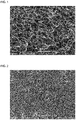
- FIG. 1 is a scanning electron microscope (SEM) photograph of a cross section of the super absorbent polymer sheet according to Example 1 of the present disclosure.
- FIG. 2 is a scanning electron microscope (SEM) photograph of a cross section of the super absorbent polymer sheet according to Comparative Example 1 of the present disclosure.
- the super absorbent polymer sheet was folded in half and then unfolded. Thereafter, it was evaluated as O when returning to the original sheet state, and it was evaluated as X when the folded part did not return to the original sheet state due to cracking or breaking.
- the super absorbent polymer prepared according to the preparing method of the present disclosure had an open pore channel structure and excellent flexibility.
Landscapes
- Chemical & Material Sciences (AREA)
- Chemical Kinetics & Catalysis (AREA)
- Organic Chemistry (AREA)
- Health & Medical Sciences (AREA)
- Medicinal Chemistry (AREA)
- Polymers & Plastics (AREA)
- Analytical Chemistry (AREA)
- Dispersion Chemistry (AREA)
- Engineering & Computer Science (AREA)
- Materials Engineering (AREA)
- Thermal Sciences (AREA)
- Physics & Mathematics (AREA)
- General Health & Medical Sciences (AREA)
- Animal Behavior & Ethology (AREA)
- Epidemiology (AREA)
- Public Health (AREA)
- Veterinary Medicine (AREA)
- Life Sciences & Earth Sciences (AREA)
- Hematology (AREA)
- Addition Polymer Or Copolymer, Post-Treatments, Or Chemical Modifications (AREA)
- Manufacturing & Machinery (AREA)
- Polymerisation Methods In General (AREA)
- Graft Or Block Polymers (AREA)
- Manufacture Of Porous Articles, And Recovery And Treatment Of Waste Products (AREA)
Applications Claiming Priority (3)
| Application Number | Priority Date | Filing Date | Title |
|---|---|---|---|
| KR20170172269 | 2017-12-14 | ||
| KR1020180161304A KR102230189B1 (ko) | 2017-12-14 | 2018-12-13 | 고흡수성 수지 시트의 제조 방법 및 이로부터 제조된 고흡수성 수지 시트 |
| PCT/KR2018/015932 WO2019117670A1 (fr) | 2017-12-14 | 2018-12-14 | Procédé de production de feuille de résine superabsorbante et feuille de résine superabsorbante ainsi produite |
Publications (3)
| Publication Number | Publication Date |
|---|---|
| EP3708608A1 true EP3708608A1 (fr) | 2020-09-16 |
| EP3708608A4 EP3708608A4 (fr) | 2020-12-23 |
| EP3708608B1 EP3708608B1 (fr) | 2023-04-12 |
Family
ID=67056273
Family Applications (1)
| Application Number | Title | Priority Date | Filing Date |
|---|---|---|---|
| EP18889354.9A Active EP3708608B1 (fr) | 2017-12-14 | 2018-12-14 | Procédé de production de feuille de résine superabsorbante et feuille de résine superabsorbante ainsi produite |
Country Status (5)
| Country | Link |
|---|---|
| US (2) | US11857946B2 (fr) |
| EP (1) | EP3708608B1 (fr) |
| JP (1) | JP7020723B2 (fr) |
| KR (1) | KR102230189B1 (fr) |
| CN (1) | CN111465636B (fr) |
Cited By (4)
| Publication number | Priority date | Publication date | Assignee | Title |
|---|---|---|---|---|
| EP4074762A4 (fr) * | 2020-03-23 | 2023-06-21 | Lg Chem, Ltd. | Film polymère superabsorbant et procédé de préparation correspondant |
| EP4074764A4 (fr) * | 2020-03-23 | 2023-06-21 | Lg Chem, Ltd. | Procédé de fabrication d'un film de résine superabsorbante |
| EP4233819A4 (fr) * | 2021-05-11 | 2024-03-27 | Lg Chem, Ltd. | Produit absorbant |
| US12599511B2 (en) | 2021-05-11 | 2026-04-14 | Lg Chem, Ltd. | Absorbent article |
Families Citing this family (9)
| Publication number | Priority date | Publication date | Assignee | Title |
|---|---|---|---|---|
| KR102918601B1 (ko) * | 2019-11-25 | 2026-01-26 | 주식회사 엘지화학 | 고흡수성 수지의 제조 방법 |
| KR102899205B1 (ko) * | 2020-03-23 | 2025-12-11 | 주식회사 엘지화학 | 고흡수성 수지 필름 및 이의 제조 방법 |
| EP4074763A4 (fr) * | 2020-03-23 | 2023-01-25 | Lg Chem, Ltd. | Film de résine super-absorbant et son procédé de préparation |
| KR102769145B1 (ko) * | 2020-03-23 | 2025-02-18 | 주식회사 엘지화학 | 고흡수성 수지 필름 및 이의 제조 방법 |
| KR102907310B1 (ko) * | 2020-08-26 | 2025-12-31 | 주식회사 엘지화학 | 고흡수성 수지 필름의 제조 방법 |
| EP4082783A4 (fr) | 2020-09-08 | 2023-09-20 | Lg Chem, Ltd. | Film polymère, son procédé de préparation, et stratifié de film polymère le comprenant |
| CN115697271B (zh) * | 2021-03-26 | 2024-12-24 | 株式会社Lg化学 | 超吸收性聚合物膜和包括其的吸收性制品 |
| KR102803229B1 (ko) * | 2021-03-26 | 2025-05-07 | 주식회사 엘지화학 | 고흡수성 수지 필름 및 이를 포함하는 흡수성 물품 |
| WO2023018295A1 (fr) * | 2021-08-12 | 2023-02-16 | 주식회사 엘지화학 | Composition de monomère pour la préparation d'un film polymère super-absorbant, procédé de préparation d'un film polymère super-absorbant en utilisant celle-ci, et film polymère superabsorbant préparé à partir de celle-ci |
Family Cites Families (30)
| Publication number | Priority date | Publication date | Assignee | Title |
|---|---|---|---|---|
| US5338766A (en) * | 1993-03-26 | 1994-08-16 | The Procter & Gamble Company | Superabsorbent polymer foam |
| JP4261853B2 (ja) * | 2001-09-19 | 2009-04-30 | 株式会社日本触媒 | 吸水性樹脂、吸水性樹脂粒子、およびその製造方法 |
| CN1309427C (zh) | 2002-05-01 | 2007-04-11 | 巴斯福股份公司 | 增塑的超强吸收性聚合物片材及其在卫生制品中的应用 |
| RU2299075C2 (ru) * | 2003-02-10 | 2007-05-20 | Ниппон Сокубаи Ко., Лтд. | Гигроскопическая добавка |
| US7163966B2 (en) | 2003-12-19 | 2007-01-16 | Stockhausen, Inc. | Superabsorbent polymer having increased rate of water absorption |
| BRPI0509362A (pt) | 2004-03-31 | 2007-09-11 | Nippon Catalytic Chem Ind | agente absorvedor de lìquido aquoso e seu processo de produção |
| US7879923B2 (en) | 2004-12-10 | 2011-02-01 | Nippon Shokubai Co., Ltd. | Method for surface-treatment of water absorbent resin |
| JP5222721B2 (ja) * | 2005-04-22 | 2013-06-26 | エフォニック ストックハウゼン ゲーエムベーハー | 高吸収性を有する吸水性ポリマー構造体 |
| US7335713B2 (en) | 2005-12-02 | 2008-02-26 | Stockhausen, Inc. | Method for preparing a flexible superabsorbent binder polymer composition |
| US8318306B2 (en) | 2008-01-30 | 2012-11-27 | Evonik Stockhausen, Llc | Superabsorbent polymer compositions having a triggering composition |
| US7977530B2 (en) * | 2008-01-30 | 2011-07-12 | Kimberly-Clark Worldwide, Inc. | Absorbent articles comprising absorbent materials exhibiting deswell/reswell |
| DE102009016404A1 (de) * | 2009-04-07 | 2010-10-21 | Evonik Stockhausen Gmbh | Verwendung von Hohlkörpern zur Herstellung wasserabsorbierender Polymergebilde |
| EP2371869A1 (fr) | 2010-03-30 | 2011-10-05 | Evonik Stockhausen GmbH | Procédé pour la production d'un polymère super-absorbant |
| DE102011007723A1 (de) | 2011-04-20 | 2012-10-25 | Evonik Stockhausen Gmbh | Verfahren zur Herstellung von wasserabsorbierenden Polymeren mit hoher Absorptionsgeschwindigkeit |
| KR101604272B1 (ko) | 2013-05-09 | 2016-03-25 | 주식회사 엘지화학 | 고흡수성 수지의 제조방법 |
| KR101632058B1 (ko) | 2013-06-14 | 2016-06-20 | 주식회사 엘지화학 | 고흡수성 수지의 제조 방법 |
| KR101684649B1 (ko) * | 2014-06-13 | 2016-12-08 | 주식회사 엘지화학 | 고흡수성 수지의 제조 방법 및 이를 통해 제조된 고흡수성 수지 |
| JP6425439B2 (ja) | 2014-07-11 | 2018-11-21 | 株式会社イノアック技術研究所 | 吸水シート |
| JP6455065B2 (ja) | 2014-10-15 | 2019-01-23 | デクセリアルズ株式会社 | 吸水性ポリマーシート |
| KR101752384B1 (ko) | 2014-11-27 | 2017-06-30 | 주식회사 엘지화학 | 고흡수성 수지의 제조 방법 및 이를 통해 제조된 고흡수성 수지 |
| KR101769100B1 (ko) * | 2014-11-27 | 2017-08-30 | 주식회사 엘지화학 | 가압하 흡수 속도가 빠른 고흡수성 수지 및 이의 제조 방법 |
| CN107428949B (zh) | 2015-03-31 | 2020-03-17 | 株式会社日本触媒 | 聚丙烯酸(盐)系吸水性树脂粉末及其制造方法、以及其评价方法 |
| KR101966927B1 (ko) | 2015-07-09 | 2019-04-08 | 주식회사 엘지화학 | 고흡수성 수지 및 그 제조 방법 |
| KR101921278B1 (ko) | 2015-12-23 | 2018-11-22 | 주식회사 엘지화학 | 고흡수성 수지, 및 이의 제조 방법 |
| KR101949996B1 (ko) | 2016-01-28 | 2019-02-19 | 주식회사 엘지화학 | 고흡수성 수지의 제조 방법 |
| KR102086058B1 (ko) * | 2017-01-24 | 2020-03-06 | 주식회사 엘지화학 | 고흡수성 수지의 제조 방법 |
| KR102418916B1 (ko) | 2017-09-05 | 2022-07-07 | 주식회사 엘지화학 | 고흡수성 수지 |
| WO2019216592A1 (fr) | 2018-05-11 | 2019-11-14 | 주식회사 엘지화학 | Procédé de fabrication d'une feuille polymère superabsorbante |
| WO2019216591A1 (fr) | 2018-05-11 | 2019-11-14 | 주식회사 엘지화학 | Procédé de préparation d'une feuille de polymère superabsorbant |
| WO2020067662A1 (fr) | 2018-09-27 | 2020-04-02 | 주식회사 엘지화학 | Procédé de fabrication de feuille polymère superabsorbante |
-
2018
- 2018-12-13 KR KR1020180161304A patent/KR102230189B1/ko active Active
- 2018-12-14 EP EP18889354.9A patent/EP3708608B1/fr active Active
- 2018-12-14 JP JP2020528959A patent/JP7020723B2/ja active Active
- 2018-12-14 US US16/772,473 patent/US11857946B2/en active Active
- 2018-12-14 CN CN201880079708.7A patent/CN111465636B/zh active Active
-
2023
- 2023-11-20 US US18/514,061 patent/US12263466B2/en active Active
Cited By (6)
| Publication number | Priority date | Publication date | Assignee | Title |
|---|---|---|---|---|
| EP4074762A4 (fr) * | 2020-03-23 | 2023-06-21 | Lg Chem, Ltd. | Film polymère superabsorbant et procédé de préparation correspondant |
| EP4074764A4 (fr) * | 2020-03-23 | 2023-06-21 | Lg Chem, Ltd. | Procédé de fabrication d'un film de résine superabsorbante |
| US12590193B2 (en) | 2020-03-23 | 2026-03-31 | Lg Chem, Ltd. | Preparation method for super absorbent polymer film |
| US12600849B2 (en) | 2020-03-23 | 2026-04-14 | Lg Chem, Ltd. | Super absorbent polymer film and preparation method thereof |
| EP4233819A4 (fr) * | 2021-05-11 | 2024-03-27 | Lg Chem, Ltd. | Produit absorbant |
| US12599511B2 (en) | 2021-05-11 | 2026-04-14 | Lg Chem, Ltd. | Absorbent article |
Also Published As
| Publication number | Publication date |
|---|---|
| CN111465636B (zh) | 2023-09-05 |
| EP3708608A4 (fr) | 2020-12-23 |
| US20240082819A1 (en) | 2024-03-14 |
| JP2021504530A (ja) | 2021-02-15 |
| EP3708608B1 (fr) | 2023-04-12 |
| KR20190071619A (ko) | 2019-06-24 |
| CN111465636A (zh) | 2020-07-28 |
| KR102230189B1 (ko) | 2021-03-19 |
| US20200384441A1 (en) | 2020-12-10 |
| JP7020723B2 (ja) | 2022-02-16 |
| US12263466B2 (en) | 2025-04-01 |
| US11857946B2 (en) | 2024-01-02 |
Similar Documents
| Publication | Publication Date | Title |
|---|---|---|
| US12263466B2 (en) | Preparing method of super absorbent polymer sheet and super absorbent polymer sheet prepared therefrom | |
| US11865511B2 (en) | Preparation method for super absorbent polymer sheet, super absorbent polymer sheet prepared therefrom | |
| KR102417829B1 (ko) | 고흡수성 수지 및 이의 제조 방법 | |
| US11773236B2 (en) | Method of preparing superabsorbent polymer sheet | |
| KR102788480B1 (ko) | 고흡수성 수지의 제조 방법 | |
| WO2019216592A1 (fr) | Procédé de fabrication d'une feuille polymère superabsorbante | |
| WO2019216591A1 (fr) | Procédé de préparation d'une feuille de polymère superabsorbant | |
| US20210229070A1 (en) | Preparation Method of Super Absorbent Polymer | |
| EP3677621B1 (fr) | Procédé de préparation d'une feuille de polymère superabsorbant | |
| US11278867B2 (en) | Preparation method for super absorbent polymer sheet | |
| WO2019117670A1 (fr) | Procédé de production de feuille de résine superabsorbante et feuille de résine superabsorbante ainsi produite | |
| KR20220043689A (ko) | 고흡수성 수지 및 이의 제조 방법 | |
| KR102718971B1 (ko) | 고흡수성 수지 시트의 제조 방법 | |
| KR20240072926A (ko) | 고흡수성 수지의 제조 방법 |
Legal Events
| Date | Code | Title | Description |
|---|---|---|---|
| STAA | Information on the status of an ep patent application or granted ep patent |
Free format text: STATUS: THE INTERNATIONAL PUBLICATION HAS BEEN MADE |
|
| PUAI | Public reference made under article 153(3) epc to a published international application that has entered the european phase |
Free format text: ORIGINAL CODE: 0009012 |
|
| STAA | Information on the status of an ep patent application or granted ep patent |
Free format text: STATUS: REQUEST FOR EXAMINATION WAS MADE |
|
| 17P | Request for examination filed |
Effective date: 20200609 |
|
| AK | Designated contracting states |
Kind code of ref document: A1 Designated state(s): AL AT BE BG CH CY CZ DE DK EE ES FI FR GB GR HR HU IE IS IT LI LT LU LV MC MK MT NL NO PL PT RO RS SE SI SK SM TR |
|
| AX | Request for extension of the european patent |
Extension state: BA ME |
|
| A4 | Supplementary search report drawn up and despatched |
Effective date: 20201125 |
|
| RIC1 | Information provided on ipc code assigned before grant |
Ipc: C08K 5/00 20060101ALI20201119BHEP Ipc: C08F 220/06 20060101ALI20201119BHEP Ipc: C08J 9/14 20060101ALI20201119BHEP Ipc: C08J 3/12 20060101ALI20201119BHEP Ipc: C08J 5/18 20060101AFI20201119BHEP Ipc: C08J 3/075 20060101ALI20201119BHEP Ipc: C08K 9/10 20060101ALI20201119BHEP Ipc: C08J 3/24 20060101ALI20201119BHEP Ipc: C08K 5/053 20060101ALI20201119BHEP Ipc: C08F 220/26 20060101ALI20201119BHEP |
|
| DAV | Request for validation of the european patent (deleted) | ||
| DAX | Request for extension of the european patent (deleted) | ||
| GRAP | Despatch of communication of intention to grant a patent |
Free format text: ORIGINAL CODE: EPIDOSNIGR1 |
|
| STAA | Information on the status of an ep patent application or granted ep patent |
Free format text: STATUS: GRANT OF PATENT IS INTENDED |
|
| INTG | Intention to grant announced |
Effective date: 20230127 |
|
| GRAS | Grant fee paid |
Free format text: ORIGINAL CODE: EPIDOSNIGR3 |
|
| GRAA | (expected) grant |
Free format text: ORIGINAL CODE: 0009210 |
|
| STAA | Information on the status of an ep patent application or granted ep patent |
Free format text: STATUS: THE PATENT HAS BEEN GRANTED |
|
| AK | Designated contracting states |
Kind code of ref document: B1 Designated state(s): AL AT BE BG CH CY CZ DE DK EE ES FI FR GB GR HR HU IE IS IT LI LT LU LV MC MK MT NL NO PL PT RO RS SE SI SK SM TR |
|
| REG | Reference to a national code |
Ref country code: GB Ref legal event code: FG4D |
|
| REG | Reference to a national code |
Ref country code: CH Ref legal event code: EP |
|
| REG | Reference to a national code |
Ref country code: DE Ref legal event code: R096 Ref document number: 602018048444 Country of ref document: DE |
|
| REG | Reference to a national code |
Ref country code: IE Ref legal event code: FG4D |
|
| REG | Reference to a national code |
Ref country code: AT Ref legal event code: REF Ref document number: 1559764 Country of ref document: AT Kind code of ref document: T Effective date: 20230515 |
|
| P01 | Opt-out of the competence of the unified patent court (upc) registered |
Effective date: 20230523 |
|
| REG | Reference to a national code |
Ref country code: LT Ref legal event code: MG9D |
|
| REG | Reference to a national code |
Ref country code: NL Ref legal event code: MP Effective date: 20230412 |
|
| REG | Reference to a national code |
Ref country code: AT Ref legal event code: MK05 Ref document number: 1559764 Country of ref document: AT Kind code of ref document: T Effective date: 20230412 |
|
| PG25 | Lapsed in a contracting state [announced via postgrant information from national office to epo] |
Ref country code: NL Free format text: LAPSE BECAUSE OF FAILURE TO SUBMIT A TRANSLATION OF THE DESCRIPTION OR TO PAY THE FEE WITHIN THE PRESCRIBED TIME-LIMIT Effective date: 20230412 |
|
| PG25 | Lapsed in a contracting state [announced via postgrant information from national office to epo] |
Ref country code: SE Free format text: LAPSE BECAUSE OF FAILURE TO SUBMIT A TRANSLATION OF THE DESCRIPTION OR TO PAY THE FEE WITHIN THE PRESCRIBED TIME-LIMIT Effective date: 20230412 Ref country code: PT Free format text: LAPSE BECAUSE OF FAILURE TO SUBMIT A TRANSLATION OF THE DESCRIPTION OR TO PAY THE FEE WITHIN THE PRESCRIBED TIME-LIMIT Effective date: 20230814 Ref country code: NO Free format text: LAPSE BECAUSE OF FAILURE TO SUBMIT A TRANSLATION OF THE DESCRIPTION OR TO PAY THE FEE WITHIN THE PRESCRIBED TIME-LIMIT Effective date: 20230712 Ref country code: ES Free format text: LAPSE BECAUSE OF FAILURE TO SUBMIT A TRANSLATION OF THE DESCRIPTION OR TO PAY THE FEE WITHIN THE PRESCRIBED TIME-LIMIT Effective date: 20230412 Ref country code: AT Free format text: LAPSE BECAUSE OF FAILURE TO SUBMIT A TRANSLATION OF THE DESCRIPTION OR TO PAY THE FEE WITHIN THE PRESCRIBED TIME-LIMIT Effective date: 20230412 |
|
| PG25 | Lapsed in a contracting state [announced via postgrant information from national office to epo] |
Ref country code: RS Free format text: LAPSE BECAUSE OF FAILURE TO SUBMIT A TRANSLATION OF THE DESCRIPTION OR TO PAY THE FEE WITHIN THE PRESCRIBED TIME-LIMIT Effective date: 20230412 Ref country code: PL Free format text: LAPSE BECAUSE OF FAILURE TO SUBMIT A TRANSLATION OF THE DESCRIPTION OR TO PAY THE FEE WITHIN THE PRESCRIBED TIME-LIMIT Effective date: 20230412 Ref country code: LV Free format text: LAPSE BECAUSE OF FAILURE TO SUBMIT A TRANSLATION OF THE DESCRIPTION OR TO PAY THE FEE WITHIN THE PRESCRIBED TIME-LIMIT Effective date: 20230412 Ref country code: LT Free format text: LAPSE BECAUSE OF FAILURE TO SUBMIT A TRANSLATION OF THE DESCRIPTION OR TO PAY THE FEE WITHIN THE PRESCRIBED TIME-LIMIT Effective date: 20230412 Ref country code: IS Free format text: LAPSE BECAUSE OF FAILURE TO SUBMIT A TRANSLATION OF THE DESCRIPTION OR TO PAY THE FEE WITHIN THE PRESCRIBED TIME-LIMIT Effective date: 20230812 Ref country code: HR Free format text: LAPSE BECAUSE OF FAILURE TO SUBMIT A TRANSLATION OF THE DESCRIPTION OR TO PAY THE FEE WITHIN THE PRESCRIBED TIME-LIMIT Effective date: 20230412 Ref country code: GR Free format text: LAPSE BECAUSE OF FAILURE TO SUBMIT A TRANSLATION OF THE DESCRIPTION OR TO PAY THE FEE WITHIN THE PRESCRIBED TIME-LIMIT Effective date: 20230713 Ref country code: AL Free format text: LAPSE BECAUSE OF FAILURE TO SUBMIT A TRANSLATION OF THE DESCRIPTION OR TO PAY THE FEE WITHIN THE PRESCRIBED TIME-LIMIT Effective date: 20230412 |
|
| PG25 | Lapsed in a contracting state [announced via postgrant information from national office to epo] |
Ref country code: FI Free format text: LAPSE BECAUSE OF FAILURE TO SUBMIT A TRANSLATION OF THE DESCRIPTION OR TO PAY THE FEE WITHIN THE PRESCRIBED TIME-LIMIT Effective date: 20230412 |
|
| REG | Reference to a national code |
Ref country code: DE Ref legal event code: R097 Ref document number: 602018048444 Country of ref document: DE |
|
| PG25 | Lapsed in a contracting state [announced via postgrant information from national office to epo] |
Ref country code: SK Free format text: LAPSE BECAUSE OF FAILURE TO SUBMIT A TRANSLATION OF THE DESCRIPTION OR TO PAY THE FEE WITHIN THE PRESCRIBED TIME-LIMIT Effective date: 20230412 |
|
| PG25 | Lapsed in a contracting state [announced via postgrant information from national office to epo] |
Ref country code: SM Free format text: LAPSE BECAUSE OF FAILURE TO SUBMIT A TRANSLATION OF THE DESCRIPTION OR TO PAY THE FEE WITHIN THE PRESCRIBED TIME-LIMIT Effective date: 20230412 Ref country code: SK Free format text: LAPSE BECAUSE OF FAILURE TO SUBMIT A TRANSLATION OF THE DESCRIPTION OR TO PAY THE FEE WITHIN THE PRESCRIBED TIME-LIMIT Effective date: 20230412 Ref country code: RO Free format text: LAPSE BECAUSE OF FAILURE TO SUBMIT A TRANSLATION OF THE DESCRIPTION OR TO PAY THE FEE WITHIN THE PRESCRIBED TIME-LIMIT Effective date: 20230412 Ref country code: EE Free format text: LAPSE BECAUSE OF FAILURE TO SUBMIT A TRANSLATION OF THE DESCRIPTION OR TO PAY THE FEE WITHIN THE PRESCRIBED TIME-LIMIT Effective date: 20230412 Ref country code: DK Free format text: LAPSE BECAUSE OF FAILURE TO SUBMIT A TRANSLATION OF THE DESCRIPTION OR TO PAY THE FEE WITHIN THE PRESCRIBED TIME-LIMIT Effective date: 20230412 Ref country code: CZ Free format text: LAPSE BECAUSE OF FAILURE TO SUBMIT A TRANSLATION OF THE DESCRIPTION OR TO PAY THE FEE WITHIN THE PRESCRIBED TIME-LIMIT Effective date: 20230412 |
|
| PLBE | No opposition filed within time limit |
Free format text: ORIGINAL CODE: 0009261 |
|
| STAA | Information on the status of an ep patent application or granted ep patent |
Free format text: STATUS: NO OPPOSITION FILED WITHIN TIME LIMIT |
|
| 26N | No opposition filed |
Effective date: 20240115 |
|
| PG25 | Lapsed in a contracting state [announced via postgrant information from national office to epo] |
Ref country code: SI Free format text: LAPSE BECAUSE OF FAILURE TO SUBMIT A TRANSLATION OF THE DESCRIPTION OR TO PAY THE FEE WITHIN THE PRESCRIBED TIME-LIMIT Effective date: 20230412 |
|
| PG25 | Lapsed in a contracting state [announced via postgrant information from national office to epo] |
Ref country code: SI Free format text: LAPSE BECAUSE OF FAILURE TO SUBMIT A TRANSLATION OF THE DESCRIPTION OR TO PAY THE FEE WITHIN THE PRESCRIBED TIME-LIMIT Effective date: 20230412 Ref country code: IT Free format text: LAPSE BECAUSE OF FAILURE TO SUBMIT A TRANSLATION OF THE DESCRIPTION OR TO PAY THE FEE WITHIN THE PRESCRIBED TIME-LIMIT Effective date: 20230412 |
|
| REG | Reference to a national code |
Ref country code: CH Ref legal event code: PL |
|
| PG25 | Lapsed in a contracting state [announced via postgrant information from national office to epo] |
Ref country code: LU Free format text: LAPSE BECAUSE OF NON-PAYMENT OF DUE FEES Effective date: 20231214 |
|
| PG25 | Lapsed in a contracting state [announced via postgrant information from national office to epo] |
Ref country code: MC Free format text: LAPSE BECAUSE OF FAILURE TO SUBMIT A TRANSLATION OF THE DESCRIPTION OR TO PAY THE FEE WITHIN THE PRESCRIBED TIME-LIMIT Effective date: 20230412 |
|
| PG25 | Lapsed in a contracting state [announced via postgrant information from national office to epo] |
Ref country code: MC Free format text: LAPSE BECAUSE OF FAILURE TO SUBMIT A TRANSLATION OF THE DESCRIPTION OR TO PAY THE FEE WITHIN THE PRESCRIBED TIME-LIMIT Effective date: 20230412 Ref country code: LU Free format text: LAPSE BECAUSE OF NON-PAYMENT OF DUE FEES Effective date: 20231214 |
|
| REG | Reference to a national code |
Ref country code: IE Ref legal event code: MM4A |
|
| PG25 | Lapsed in a contracting state [announced via postgrant information from national office to epo] |
Ref country code: IE Free format text: LAPSE BECAUSE OF NON-PAYMENT OF DUE FEES Effective date: 20231214 |
|
| PG25 | Lapsed in a contracting state [announced via postgrant information from national office to epo] |
Ref country code: CH Free format text: LAPSE BECAUSE OF NON-PAYMENT OF DUE FEES Effective date: 20231231 |
|
| PG25 | Lapsed in a contracting state [announced via postgrant information from national office to epo] |
Ref country code: IE Free format text: LAPSE BECAUSE OF NON-PAYMENT OF DUE FEES Effective date: 20231214 Ref country code: CH Free format text: LAPSE BECAUSE OF NON-PAYMENT OF DUE FEES Effective date: 20231231 |
|
| PG25 | Lapsed in a contracting state [announced via postgrant information from national office to epo] |
Ref country code: BG Free format text: LAPSE BECAUSE OF FAILURE TO SUBMIT A TRANSLATION OF THE DESCRIPTION OR TO PAY THE FEE WITHIN THE PRESCRIBED TIME-LIMIT Effective date: 20230412 |
|
| PG25 | Lapsed in a contracting state [announced via postgrant information from national office to epo] |
Ref country code: BG Free format text: LAPSE BECAUSE OF FAILURE TO SUBMIT A TRANSLATION OF THE DESCRIPTION OR TO PAY THE FEE WITHIN THE PRESCRIBED TIME-LIMIT Effective date: 20230412 |
|
| PG25 | Lapsed in a contracting state [announced via postgrant information from national office to epo] |
Ref country code: CY Free format text: LAPSE BECAUSE OF FAILURE TO SUBMIT A TRANSLATION OF THE DESCRIPTION OR TO PAY THE FEE WITHIN THE PRESCRIBED TIME-LIMIT; INVALID AB INITIO Effective date: 20181214 |
|
| PG25 | Lapsed in a contracting state [announced via postgrant information from national office to epo] |
Ref country code: HU Free format text: LAPSE BECAUSE OF FAILURE TO SUBMIT A TRANSLATION OF THE DESCRIPTION OR TO PAY THE FEE WITHIN THE PRESCRIBED TIME-LIMIT; INVALID AB INITIO Effective date: 20181214 |
|
| PG25 | Lapsed in a contracting state [announced via postgrant information from national office to epo] |
Ref country code: TR Free format text: LAPSE BECAUSE OF FAILURE TO SUBMIT A TRANSLATION OF THE DESCRIPTION OR TO PAY THE FEE WITHIN THE PRESCRIBED TIME-LIMIT Effective date: 20230412 |
|
| PGFP | Annual fee paid to national office [announced via postgrant information from national office to epo] |
Ref country code: DE Payment date: 20251120 Year of fee payment: 8 |
|
| PGFP | Annual fee paid to national office [announced via postgrant information from national office to epo] |
Ref country code: GB Payment date: 20251120 Year of fee payment: 8 |
|
| PGFP | Annual fee paid to national office [announced via postgrant information from national office to epo] |
Ref country code: FR Payment date: 20251125 Year of fee payment: 8 |
|
| PGFP | Annual fee paid to national office [announced via postgrant information from national office to epo] |
Ref country code: BE Payment date: 20251120 Year of fee payment: 8 |