EP3710491B1 - (di)siliciumverbrückte metallocene zur herstellung von polyethylen mit breiter molekulargewichtsverteilung und molekulargewicht - Google Patents
(di)siliciumverbrückte metallocene zur herstellung von polyethylen mit breiter molekulargewichtsverteilung und molekulargewicht Download PDFInfo
- Publication number
- EP3710491B1 EP3710491B1 EP18877520.9A EP18877520A EP3710491B1 EP 3710491 B1 EP3710491 B1 EP 3710491B1 EP 18877520 A EP18877520 A EP 18877520A EP 3710491 B1 EP3710491 B1 EP 3710491B1
- Authority
- EP
- European Patent Office
- Prior art keywords
- high vacuum
- under high
- nitrogen
- reaction
- substituted
- Prior art date
- Legal status (The legal status is an assumption and is not a legal conclusion. Google has not performed a legal analysis and makes no representation as to the accuracy of the status listed.)
- Active
Links
Images










Classifications
-
- C—CHEMISTRY; METALLURGY
- C08—ORGANIC MACROMOLECULAR COMPOUNDS; THEIR PREPARATION OR CHEMICAL WORKING-UP; COMPOSITIONS BASED THEREON
- C08F—MACROMOLECULAR COMPOUNDS OBTAINED BY REACTIONS ONLY INVOLVING CARBON-TO-CARBON UNSATURATED BONDS
- C08F210/00—Copolymers of unsaturated aliphatic hydrocarbons having only one carbon-to-carbon double bond
- C08F210/16—Copolymers of ethene with alpha-alkenes, e.g. EP rubbers
-
- C—CHEMISTRY; METALLURGY
- C08—ORGANIC MACROMOLECULAR COMPOUNDS; THEIR PREPARATION OR CHEMICAL WORKING-UP; COMPOSITIONS BASED THEREON
- C08F—MACROMOLECULAR COMPOUNDS OBTAINED BY REACTIONS ONLY INVOLVING CARBON-TO-CARBON UNSATURATED BONDS
- C08F110/00—Homopolymers of unsaturated aliphatic hydrocarbons having only one carbon-to-carbon double bond
- C08F110/02—Ethene
-
- C—CHEMISTRY; METALLURGY
- C08—ORGANIC MACROMOLECULAR COMPOUNDS; THEIR PREPARATION OR CHEMICAL WORKING-UP; COMPOSITIONS BASED THEREON
- C08F—MACROMOLECULAR COMPOUNDS OBTAINED BY REACTIONS ONLY INVOLVING CARBON-TO-CARBON UNSATURATED BONDS
- C08F2420/00—Metallocene catalysts
- C08F2420/07—Heteroatom-substituted Cp, i.e. Cp or analog where at least one of the substituent of the Cp or analog ring is or contains a heteroatom
-
- C—CHEMISTRY; METALLURGY
- C08—ORGANIC MACROMOLECULAR COMPOUNDS; THEIR PREPARATION OR CHEMICAL WORKING-UP; COMPOSITIONS BASED THEREON
- C08F—MACROMOLECULAR COMPOUNDS OBTAINED BY REACTIONS ONLY INVOLVING CARBON-TO-CARBON UNSATURATED BONDS
- C08F2420/00—Metallocene catalysts
- C08F2420/12—Long bridge, i.e. Cp or analog where the bridging unit linking the two Cps or analogs is composed of at least two atoms which are not part of a cycle and which are not an ethylene bridge
-
- C—CHEMISTRY; METALLURGY
- C08—ORGANIC MACROMOLECULAR COMPOUNDS; THEIR PREPARATION OR CHEMICAL WORKING-UP; COMPOSITIONS BASED THEREON
- C08F—MACROMOLECULAR COMPOUNDS OBTAINED BY REACTIONS ONLY INVOLVING CARBON-TO-CARBON UNSATURATED BONDS
- C08F4/00—Polymerisation catalysts
- C08F4/42—Metals; Metal hydrides; Metallo-organic compounds; Use thereof as catalyst precursors
- C08F4/44—Metals; Metal hydrides; Metallo-organic compounds; Use thereof as catalyst precursors selected from light metals, zinc, cadmium, mercury, copper, silver, gold, boron, gallium, indium, thallium, rare earths or actinides
- C08F4/60—Metals; Metal hydrides; Metallo-organic compounds; Use thereof as catalyst precursors selected from light metals, zinc, cadmium, mercury, copper, silver, gold, boron, gallium, indium, thallium, rare earths or actinides together with refractory metals, iron group metals, platinum group metals, manganese, rhenium technetium or compounds thereof
- C08F4/62—Refractory metals or compounds thereof
- C08F4/64—Titanium, zirconium, hafnium or compounds thereof
- C08F4/659—Component covered by group C08F4/64 containing a transition metal-carbon bond
- C08F4/65912—Component covered by group C08F4/64 containing a transition metal-carbon bond in combination with an organoaluminium compound
-
- C—CHEMISTRY; METALLURGY
- C08—ORGANIC MACROMOLECULAR COMPOUNDS; THEIR PREPARATION OR CHEMICAL WORKING-UP; COMPOSITIONS BASED THEREON
- C08F—MACROMOLECULAR COMPOUNDS OBTAINED BY REACTIONS ONLY INVOLVING CARBON-TO-CARBON UNSATURATED BONDS
- C08F4/00—Polymerisation catalysts
- C08F4/42—Metals; Metal hydrides; Metallo-organic compounds; Use thereof as catalyst precursors
- C08F4/44—Metals; Metal hydrides; Metallo-organic compounds; Use thereof as catalyst precursors selected from light metals, zinc, cadmium, mercury, copper, silver, gold, boron, gallium, indium, thallium, rare earths or actinides
- C08F4/60—Metals; Metal hydrides; Metallo-organic compounds; Use thereof as catalyst precursors selected from light metals, zinc, cadmium, mercury, copper, silver, gold, boron, gallium, indium, thallium, rare earths or actinides together with refractory metals, iron group metals, platinum group metals, manganese, rhenium technetium or compounds thereof
- C08F4/62—Refractory metals or compounds thereof
- C08F4/64—Titanium, zirconium, hafnium or compounds thereof
- C08F4/659—Component covered by group C08F4/64 containing a transition metal-carbon bond
- C08F4/65916—Component covered by group C08F4/64 containing a transition metal-carbon bond supported on a carrier, e.g. silica, MgCl2, polymer
Definitions
- the present disclosure provides catalyst compounds comprising -Si-Si- bridges, catalyst systems comprising catalyst compounds comprising -Si-Si- bridges, and uses thereof.
- Olefin polymerization catalysts are of great use in industry. Hence there is interest in finding new catalyst systems that increase the commercial usefulness of the catalyst and allow the production of polymers having improved properties.
- Catalysts for olefin polymerization are often based on transition metal compounds, e.g., metallocenes, as catalyst precursors, which are activated either with alumoxane or an activator containing a non-coordinating anion.
- transition metal compounds e.g., metallocenes
- WO 2002/002576 discloses metallocene compositions and their use in the preparation of catalyst systems for olefin polymerization, particularly propylene polymerization.
- the bridged bis (2-R 3 -4-phenyl-indenyl) metallocenes described therein include those having at least one phenyl ring substituted at the 3' and 5' positions by butyl groups which may be the same or different, e.g., tert-butyl.
- WO 2017/011073 discloses substituted (Me 2 Si) 2 (Indenyl) 2 ZrCl 2 compounds, such as tetramethylenedisilylene bis(4-(3',5'-di-tert-butylphenyl)-indenyl) zirconium dichloride.
- U.S. Publication No. 2012/0088890 A1 discloses metallocene compositions and their use in catalyst systems for olefin polymerization.
- the bridged metallocenes described therein include ((Me 2 Si) 2 (Indenyl)(Cp)ZrCl 2 .
- MACROMOLECULAR SYMPOSIA Vol. 89, 1995, pp. 237-247 , discloses bridged zirconocenes: rac -(Me 2 Si) 2 (Indenyl) 2 ZrCl 2 , rac -(Me 2 Si) 2 (2-Me-4-Ph-Indenyl) Z ZrCl 2 , rac- (Me 2 Si) 2 (2-Me-4,5-Benzo-Indenyl) 2 ZrCl 2 .
- EP 849 273 A1 discloses (Me 2 Si) 2 bridged catalyst compounds containing a seven membered ring fused with a cyclopentadienyl group.
- KR 2015065084 discloses bis (substituted-fluorenyl)(Me 2 Si-CH 2 ) bridged catalyst compounds
- U.S. 7,842,764 and U.S. 8,865,848 discloses bridged metallocenes, such as (Me 2 Si) 2 (Indenyl) 2 ZrCl 2 .
- the bridged metallocenes described therein have C 6 and C 7 of each indenyl ligand joined to form a saturated cyclic 5-membered ring.
- U.S. 7,728,086 discloses bridged metallocene compositions having two indenyl ligands, such as (Me 2 Si) 2 (Indenyl) 2 ZrCl 2 .
- JP 2015/172037 discloses bridged metallocene compositions such as (Me 2 Si) 2 (Indenyl)(Cp)ZrCl 2 .
- the bridged metallocene compositions described therein consist of a hydrogen atom at C 8 of the indenyl ligand.
- references of interest include: WO 2009027075 ; JP 2011-137146A ; WO 98/403331 ; and US 8,609,793 ; U.S. 8,058,461 ; U.S. 7,405,261 ; U.S. 7,157,531 ; U.S. 6,936,675 ; U.S. 6,903,229 ; U.S. 6,894,179 ; U.S. 6,888,017 ; U.S. 6,825,372 ; U.S. 6,784,305 ; U.S. 6,414,095 ; U.S. 6,399,723 ; U.S. 6,380,334 ; U.S. 6,380,331 ; U.S.
- a catalyst system comprises (a) a transition metal complex represented by formula ( I ); (b) an activator; and (c) a support material, preferably silica or fluoride material.
- the catalyst system further comprises (d) a bridged or unbridged metallocene catalyst compound other than the transition metal complex of formula ( I ).
- a method of polymerizing olefins includes contacting at least one olefin with the catalyst system described above; and obtaining polyolefin.
- Catalysts of the present disclosure include one larger ligand (such as an indenyl-type ligand) and one smaller ligand (such as a Cp-type ligand). Larger and smaller refers to the molecular weight of the ligand.
- Catalysts, catalyst systems and methods of the present disclosure provide polymers having broad molecular weight distribution (MWD), high polydispersity index (PDI), linearity, and improved comonomer incorporation. High PDI, linearity, and improved comonomer incorporation provide improved balance of processability and toughness of polymer compositions.
- a "group 4 metal” is an element from group 4 of the Periodic Table, e.g., Hf, Ti, or Zr.
- transition metal complexes As used herein, the term "complex" is used to describe molecules in which an ancillary ligand is coordinated to a central transition metal atom.
- the ligand is bulky and stably bonded to the transition metal so as to maintain its influence during use of the catalyst, such as polymerization.
- the ligand may be coordinated to the transition metal by covalent bond and/or electron donation coordination or intermediate bonds.
- the transition metal complexes are generally subjected to activation to perform their polymerization or oligomerization function using an activator which is believed to create a cation as a result of the removal of an anionic group, often referred to as a leaving group, from the transition metal.
- Copolymers of polyolefins obtainable by the methods described herein, such as polyethylene have a comonomer, such as hexene, incorporated into the polyethylene backbone.
- a comonomer such as hexene
- These copolymers provide varying physical properties compared to polyethylene alone and are typically produced in a low pressure reactor, utilizing, for example, solution, slurry, or gas phase polymerization processes.
- the comonomer content of a polyolefin e.g., wt% of comonomer incorporated into a polyolefin backbone influences the properties of the polyolefin (and composition of the copolymers) and is dependent on the identity of the polymerization catalyst.
- a copolymer composition such as a resin
- has a composition distribution which refers to the distribution of comonomer that forms short chain branches along the copolymer backbone.
- the composition is said to have a "broad” composition distribution.
- the amount of comonomer per 1000 carbons is similar among the copolymer molecules of different chain lengths, the composition distribution is said to be "narrow”.
- composition distribution influences the properties of a copolymer composition, for example, stiffness, toughness, environmental stress crack resistance, and heat sealing, among other properties.
- the composition distribution of a polyolefin composition may be readily measured by, for example, Temperature Rising Elution Fractionation (TREF) or Crystallization Analysis Fractionation (CRYSTAF).
- a composition distribution of a copolymer composition is influenced by the identity of the catalyst used to form the polyolefins of the composition.
- Ziegler-Natta catalysts and chromium based catalysts produce compositions with broad composition distributions, whereas metallocene catalysts typically produce compositions with narrow composition distributions.
- polyolefins such as polyethylene, which have high molecular weight, generally have desirable mechanical properties over their lower molecular weight counterparts.
- high molecular weight polyolefins can be difficult to process and can be costly to produce.
- Polyolefin compositions having a bimodal molecular weight distribution are desirable because they can combine the advantageous mechanical properties of a high molecular weight fraction of the composition with the improved processing properties of a low molecular weight fraction of the composition.
- “high molecular weight” is defined as a number average molecular weight (Mn) value of 100,000 or more.
- Low molecular weight is defined as an Mn value of less than 100,000 g/mol.
- Catalyst productivity is a measure of how many grams of polymer (P) are produced using a polymerization catalyst comprising W g of catalyst (cat), over a period of time of T hours; and may be expressed by the following formula: P/(T x W) and expressed in units of gPgcat -1 h -1 . Conversion is the amount of monomer that is converted to polymer product, and is reported as mol% and is calculated based on the polymer yield and the amount of monomer fed into the reactor. Catalyst activity is a measure of how active the catalyst is and is reported as the mass of product polymer (P) produced per gram of catalyst (cat) used per hour (gPgcat -1 h -1 ).
- an "olefin,” alternatively referred to as “alkene,” is a linear, branched, or cyclic compound of carbon and hydrogen having at least one double bond.
- alkene is a linear, branched, or cyclic compound of carbon and hydrogen having at least one double bond.
- the olefin present in such polymer or copolymer is the polymerized form of the olefin.
- a copolymer when a copolymer is said to have an "ethylene" content of 35 wt% to 55 wt%, it is understood that the unit in the copolymer is derived from ethylene in the polymerization reaction and said derived units are present at 35 wt% to 55 wt%, based upon the weight of the copolymer.
- a "polymer” has two or more of the same or different mer units.
- a “homopolymer” is a polymer having mer units that are the same.
- a “copolymer” is a polymer having two or more mer units that are different from each other.
- a “terpolymer” is a polymer having three mer units that are different from each other.
- ethylene polymer or "ethylene copolymer” is a polymer or copolymer comprising at least 50 mol% ethylene derived units
- ethylene copolymer is a polymer or copolymer comprising at least 50 mol% propylene derived units
- ethylene polymer or "ethylene copolymer” is a polymer or copolymer comprising at least 50 mol% ethylene derived units
- a "propylene polymer” or “propylene copolymer” is a polymer or copolymer comprising at least 50 mol% propylene derived units, and so on.
- ethylene shall be considered an ⁇ -olefin.
- substituted means that a hydrogen group has been replaced with a heteroatom, a heteroatom containing group (such as halogen (such as Br, Cl, F or I) or at least one functional group such as NR* 2 , OR*, SeR*, TeR*, PR* 2 , AsR* 2 , SbR* 2 , SR*, BR* 2 , SiR* 3 , GeR* 3 , SnR* 3 , PbR* 3 , and the like, or where at least one heteroatom has been inserted within a hydrocarbyl ring), or a hydrocarbyl group, except that a "substituted hydrocarbyl” is a hydrocarbyl in which at least one hydrogen atom of the hydrocarbyl has been substituted with at least one heteroatom or heteroatom containing group, such as halogen (such as Br, Cl, F, or 1) or at least one functional group such as NR
- Mn is number average molecular weight
- Mw is weight average molecular weight
- Mz is z average molecular weight
- wt% is weight percent
- mol% is mole percent.
- Molecular weight distribution also referred to as polydispersity (PDI)
- PDI polydispersity
- melting points are DSC second melt.
- dme is 1,2-dimethoxyethane
- Me is methyl
- Ph is phenyl
- Et is ethyl
- Pr is propyl
- iPr is isopropyl
- n-Pr is normal propyl
- Bu is butyl
- cPR is cyclopropyl
- iBu is isobutyl
- tBu is tertiary butyl
- p-tBu is para-tertiary butyl
- nBu is normal butyl
- sBu is sec-butyl
- TMS is trimethylsilyl
- TIBAL is triisobutylaluminum
- TNOAL is tri(n-octyl)aluminum
- MAO is methylalumoxane
- p-Me is para-methyl
- Ph is phenyl
- Bn is benzyl (i.e., CH 2 Ph)
- THF also referred to
- a "catalyst” includes a single catalyst, or multiple catalysts with each catalyst being conformational isomers or configurational isomers.
- Conformational isomers include, for example, conformers and rotamers.
- Configurational isomers include, for example, stereoisomers.
- a “catalyst system” includes at least one catalyst compound and at least one activator.
- Catalyst system means the unactivated catalyst complex (precatalyst) together with an activator and, optionally, a co-activator.
- combination after activation it means the activated complex and the activator or other charge-balancing moiety.
- the transition metal compound may be neutral as in a precatalyst, or a charged species with a counter ion as in an activated catalyst system.
- catalyst systems are described as comprising neutral stable forms of the components, it is well understood by one of ordinary skill in the art, that the ionic form of the component is the form that reacts with the monomers to produce polymers.
- the metallocene catalyst may be described as a catalyst precursor, a pre-catalyst compound, metallocene catalyst compound or a transition metal compound, and these terms are used interchangeably.
- a polymerization catalyst system is a catalyst system that can polymerize monomers to polymer.
- An "anionic ligand” is a negatively charged ligand which donates one or more pairs of electrons to a metal ion.
- a "neutral donor ligand” is a neutrally charged ligand which donates one or more pairs of electrons to a metal ion.
- Activator and cocatalyst are also used interchangeably.
- a scavenger is a compound that is typically added to facilitate polymerization by scavenging impurities. Some scavengers may also act as activators and may be referred to as co-activators. A co-activator, that is not a scavenger, may also be used in conjunction with an activator in order to form an active catalyst. In some embodiments, a co-activator can be premixed with the transition metal compound to form an alkylated transition metal compound.
- a metallocene catalyst is defined as an organometallic compound with at least one ⁇ -bound cyclopentadienyl moiety (or substituted cyclopentadienyl moiety).
- alkoxides include those where the alkyl group is a C 1 to C 10 hydrocarbyl.
- the alkyl group may be straight chain, branched, or cyclic.
- the alkyl group may be saturated or unsaturated.
- the alkyl group may include at least one aromatic group.
- hydrocarbyl radical refers to C 1 -C 100 radicals, that may be linear, branched, or cyclic, and when cyclic, aromatic or non-aromatic.
- radicals include methyl, ethyl, n-propyl, isopropyl, n-butyl, isobutyl, sec-butyl, tert-butyl, pentyl, isoamyl, hexyl, octyl cyclopropyl, cyclobutyl, cyclopentyl, cyclohexyl, cyclooctyl, and the like including their substituted analogues.
- Substituted hydrocarbyl radicals are radicals in which at least one hydrogen atom of the hydrocarbyl radical has been substituted with at least one halogen (such as Br, Cl, F or I) or at least one functional group such as NR* 2 , OR*, SeR*, TeR*, PR* 2 , AsR* 2 , SbR* 2 , SR*, BR* 2 , SiR* 3 , GeR* 3 , SnR* 3 , PbR* 3 , and the like, or where at least one heteroatom has been inserted within a hydrocarbyl ring.
- at least one hydrogen atom of the hydrocarbyl radical has been substituted with at least one halogen (such as Br, Cl, F or I) or at least one functional group such as NR* 2 , OR*, SeR*, TeR*, PR* 2 , AsR* 2 , SbR* 2 , SR*, BR* 2 , SiR* 3 , GeR*
- R groups when R groups are described as able to join and form a cyclic group (such as a substituted cyclic ring), this cyclic group can include its own groups that join to become a cyclic ring, e.g., the substituted cyclic ring can form multinuclearcyclic groups.
- alkenyl means a straight-chain, branched-chain, or cyclic hydrocarbon radical having one or more double bonds. These alkenyl radicals may be optionally substituted. Examples of suitable alkenyl radicals include, but are not limited to, ethenyl, propenyl, allyl, 1,4-butadienyl cyclopropenyl, cyclobutenyl, cyclopentenyl, cyclohexenyl, cyclooctenyl, and the like, including their substituted analogues.
- alkoxy or "alkoxide” means an alkyl ether or aryl ether radical wherein the term alkyl is as defined above.
- suitable alkyl ether radicals include, but are not limited to, methoxy, ethoxy, n-propoxy, iso-propoxy, n-butoxy, iso-butoxy, sec-butoxy, tert-butoxy, phenoxyl, and the like.
- aryl or "aryl group” includes a C 4 -C 20 aromatic ring, such as a six carbon aromatic ring, and the substituted variants thereof, including but not limited to, phenyl, 2-methylphenyl, xylyl, 4-bromo-xylyl.
- heteroaryl means an aryl group where a ring carbon atom (or two or three ring carbon atoms) has been replaced with a heteroatom, preferably N, O, or S.
- aromatic also refers to pseudoaromatic heterocycles which are heterocyclic substituents that have similar properties and structures (nearly planar) to aromatic heterocyclic ligands, but are not by definition aromatic; likewise the term aromatic also refers to substituted aromatics.
- isomers of a named alkyl, alkenyl, alkoxide, or aryl group exist (e.g., n-butyl, iso-butyl, sec-butyl, and tert-butyl) reference to one member of the group (e.g., n-butyl) shall expressly disclose the remaining isomers (e.g., iso-butyl, sec-butyl, and tert-butyl) in the family.
- alkyl, alkenyl, alkoxide, or aryl group without specifying a particular isomer (e.g., butyl) expressly discloses all isomers (e.g., n-butyl, iso-butyl, sec-butyl, and tert-butyl).
- any general or specific structure presented also encompasses all conformational isomers, regioisomers, and stereoisomers that may arise from a particular set of substituents, unless stated otherwise.
- the general or specific structure also encompasses all enantiomers, isomers, and other optical isomers whether in enantiomeric or racemic forms, as well as mixtures of stereoisomers, as would be recognized by a skilled artisan.
- ring atom means an atom that is part of a cyclic ring structure.
- a benzyl group has six ring atoms and tetrahydrofuran has 5 ring atoms.
- a heterocyclic ring is a ring having a heteroatom in the ring structure as opposed to a heteroatom-substituted ring where a hydrogen on a ring atom is replaced with a heteroatom.
- tetrahydrofuran is a heterocyclic ring and 4-N,N-dimethylamino-phenyl is a heteroatom-substituted ring.
- continuous means a system that operates without interruption or cessation.
- a continuous process to produce a polymer would be one where the reactants are continually introduced into one or more reactors and polymer product is continually withdrawn.
- a solution polymerization means a polymerization process in which the polymer is dissolved in a liquid polymerization medium, such as an inert solvent or monomer(s) or their blends.
- a solution polymerization is typically homogeneous.
- a homogeneous polymerization is one where the polymer product is dissolved in the polymerization medium.
- Such systems are preferably not turbid as described in J. Vladimir Oliveira, C. Dariva and J. C. Pinto, Ind. Eng. Chem. Res., 2000, Vol. 29, p. 4627 .
- a bulk polymerization means a polymerization process in which the monomers and/or comonomers being polymerized are used as a solvent or diluent using little or no inert solvent as a solvent or diluent.
- a small fraction of inert solvent might be used as a carrier for catalyst and scavenger.
- a bulk polymerization system contains less than 25 wt% of inert solvent or diluent, preferably less than 10 wt%, preferably less than 1 wt%, preferably 0 wt%.
- the present disclosure provides bridged metallocene transition metal complexes having at least one indenyl ligand substituted at the 4-position, a Cp ligand with particular combinations of substituents, and bridged with a -Si-Si-, -Si-C-, -Ge-Ge-, -Ge-C-, or -C-C-group.
- the R 4 position is C 6 -C 10 aryl (such as phenyl or naphthyl) or fluorenylidenyl.
- the C 6 -C 10 aryl and fluorenylidenyl can be substituted.
- the present disclosure relates to a catalyst compound, and catalyst systems comprising such compounds, represented by the formula (I): wherein:
- R 9 and R 10 do not form a cyclic ring, preferably R 9 and R 10 do not form an aromatic cyclic ring, preferably R 9 and R 10 do not form a mononuclear aromatic six membered cyclic ring.
- R 9 and R 10 do not cyclize to form indene (substituted or unsubstituted) with the five membered cyclopentadienyl ring.
- R 7 , R 8 , R 9 and/or R 10 groups do not cyclize to form a benzene group (substituted or unsubstituted) fused with the cyclopentadienyl ring group of formula (I) shown below:
- R 3 and R 4 do not form a cyclic ring, preferably R 3 and R 3 do not form an aromatic or saturated cyclic ring, preferably R 3 and R 4 do not form a mononuclear saturated five membered cyclic ring.
- R 3 and R 4 do not cyclize to form a -indacene or as -indacene (substituted or unsubstituted) with the indene group.
- R 1 , R 2 , R 3 and/or R 4 do not cyclize to form a benzene group (substituted or unsubstituted) fused with the indenyl group of formula (I) shown below:
- R 8 is not hydrogen
- R 7 and R 10 are hydrogen
- R 8 is not hydrogen
- R 7 , R 9 , and R 10 are hydrogen
- X 1 and X 2 are independently halide, C 1 -C 10 hydrocarbyl, or C 1 -C 10 substituted hydrocarbyl.
- R 4 is halogen, C 6 -C 10 aryl, substituted C 6 -C 10 aryl, fluorenylidenyl, or substituted fluorenylidenyl, such as C 6 -C 10 aryl or substituted C 6 -C 10 aryl.
- R 8 is C 1 -C 20 hydrocarbyl or substituted C 1 -C 20 hydrocarbyl, such as substituted or unsubstituted methyl, ethyl, propyl, iso-propyl, n-butyl, iso-butyl, or tert-butyl.
- R 2 and R 3 combine to form a cyclobutyl ring, a cyclopentyl ring, or cyclohexyl ring, such as a cyclopentyl ring.
- R 6 is hydrogen, methyl, ethyl, propyl, iso-propyl, n-butyl, iso-butyl, or tert-butyl, such as hydrogen or methyl.
- a catalyst represented by formula (I) is at least one of:
- Catalyst compounds useful herein include those represented by the formulas below (including isomers thereof), where the Zr in each formula is optionally replaced by Hf: Structure Structure Structure 1 51 101 2 52 102 3 53 103 4 54 104 5 55 105 6 56 106 7 57 107 8 58 108 9 59 109 10 60 110 11 61 111 12 62 112 13 63 113 14 64 114 15 65 115 16 66 116 17 67 117 18 68 118 19 69 119 20 70 120 21 71 121 22 72 122 23 73 123 24 74 124 25 75 125 26 76 126 27 77 127 28 78 128 29 79 129 30 80 130 31 81 131 32 82 132 33 83 133 34 84 134 35 85 135 36 86 136 37 87 137 38 88 138 39 89 139 40 90 140 41 91 141 42 92 142 43 93 143 44 94 144 45 95 145 46 96 146 47 97
- Z H, Me, Et, nPr, iPr, nBu, n-pentyl, n-hexyl, Ph.
- Z Me, Et, nPr, iPr, nBu, n-pentyl, n-hexyl, Ph.
- Z H, Me, Et, nPr, iPr, nBu, n-pentyl, n-hexyl, Ph.
- Y H, Me, Et, nPr, nBu, CH 2 iPr, CH 2 tBu, CH 2 SiMe 3.
- the catalyst compounds represented by the formulas above are rac, meso, or a mixture of isomers.
- Amounts of isomers are determined by proton NMR. 1 H NMR data are collected at 23°C in a 5 mm probe using a 400 MHz Bruker spectrometer with deuterated benzene or deuterated chloroform. Data is recorded using a maximum pulse width of 45°, 8 sec between pulses and signal averaging 16 transients. The spectrum is normalized to protonated benzene in the deuterated benzene, which is expected to show a peak at 7.16 ppm.
- one catalyst compound is used, e.g., the catalyst compounds are not different.
- one metallocene catalyst compound is considered different from another if they differ by at least one atom.
- Catalyst compounds that differ only by isomer are considered the same for purposes as used herein.
- two or more different catalyst compounds are present in the catalyst system used herein. In at least one embodiment, two or more different catalyst compounds are present in the reaction zone where the process(es) described herein occur.
- the two transition metal compounds are preferably chosen such that the two are compatible.
- a simple screening method such as by 1 H or 13 C NMR, known to those of ordinary skill in the art, can be used to determine which transition metal compounds are compatible. It is preferable to use the same activator for the transition metal compounds, however, two different activators, such as a non-coordinating anion activator and an alumoxane, can be used in combination.
- one or more transition metal compounds contain an X 1 or X 2 ligand which is not a hydride, hydrocarbyl, or substituted hydrocarbyl, then the alumoxane may be contacted with the transition metal compounds prior to addition of the non-coordinating anion activator.
- transition metal compounds as described above may be used in a polymerization.
- Preferred molar ratios of (A) transition metal compound to (B) transition metal compound fall within the range of (A:B) 1:1000 to 1000:1, alternatively 1:100 to 500:1, alternatively 1:10 to 200:1, alternatively 1:1 to 100:1, and alternatively 1:1 to 75:1, and alternatively 5:1 to 50:1.
- the particular ratio chosen will depend on the exact transition metal compounds chosen, the method of activation, and the end product desired.
- useful mole percents are 10 to 99.9% A to 0.1 to 90% B, alternatively 25 to 99% A to 0.5 to 50% B, alternatively 50 to 99% A to 1 to 25% B, and alternatively 75 to 99% A to 1 to 10% B.
- transition metal compounds one represented by formula I above (A) and one and one not represented by formula I, such as those compounds represented by formula X below (B)
- Preferred molar ratios of (A) transition metal compound to (B) transition metal compound fall within the range of (A:B) 1:1000 to 1000:1, alternatively 1:100 to 500:1, alternatively 1:10 to 200:1, alternatively 1:1 to 100:1, and alternatively 1:1 to 75:1, and alternatively 5:1 to 50:1.
- the particular ratio chosen will depend on the exact transition metal compounds chosen, the method of activation, and the end product desired.
- useful mole percents are 10 to 99.9% A to 0.1 to 90% B, alternatively 25 to 99% A to 0.5 to 50% B, alternatively 50 to 99% A to 1 to 25% B, and alternatively 75 to 99% A to 1 to 10% B.
- each Cp is a cyclopentadiene, indene or fluorene, which may be substituted or unsubstituted
- each M 6 is titanium, zirconium, or hafnium
- each X 5 is, independently, a halide, a hydride, an alkyl group, an alkenyl group or an arylalkyl group.
- y may be 1, m may be one, n may be 1, J may be N, and R* may be methyl, ethyl, propyl, butyl, pentyl, hexyl, heptyl, octyl, nonyl, cyclooctyl, cyclododecyl, decyl, undecyl, dodecyl, adamantyl or an isomer thereof.
- metallocenes of this type are synthesized as shown below where (i) is a deprotonation via a metal salt of alkyl anion (e.g., n -BuLi) to form an substituted indenide (Ind*Li); (ii) reaction of indenide with an appropriate bridging precursor (e.g., ClMe 2 SiSiMe 2 Cl); (iii) reaction of the Ind*Me 2 SiSiMe 2 Cl with another substituted (or unsubstituted) CpLi (iv) double deprotonation via an alkyl anion (e.g., n -BuLi) to form a dianion; (v) reaction of the dianion with a metal halide (e.g., ZrCl 4 ) to get the metal complex.
- a metal salt of alkyl anion e.g., n -BuLi
- an appropriate bridging precursor e.g.,
- a catalyst system in another embodiment, includes (a) a transition metal complex represented by formula ( I ); and (b) a bridged or unbridged metallocene catalyst compound other than the transition metal complex of formula ( I ).
- this invention relates to a catalyst system includes a transition metal complex represented by formula ( I ); an activator; and a support material.
- catalyst and “activator” are used herein interchangeably and are defined to be any compound which can activate any one of the catalyst compounds described above by converting the neutral catalyst compound to a catalytically active catalyst compound cation.
- catalyst systems may be formed by combining them with activators in any manner known from the literature including by supporting them for use in slurry or gas phase polymerization.
- the catalyst systems may also be added to or generated in solution polymerization or bulk polymerization (in the monomer).
- the catalyst system typically includes a complex as described above and an activator such as alumoxane or a non-coordinating anion.
- Non-limiting activators include alumoxanes, aluminum alkyls, ionizing activators, which may be neutral or ionic, and conventional-type cocatalysts.
- Preferred activators typically include alumoxane compounds, modified alumoxane compounds, and ionizing anion precursor compounds that abstract a reactive, ⁇ -bound, metal ligand making the metal complex cationic and providing a charge-balancing non-coordinating or weakly coordinating anion.
- alumoxane activators are utilized as an activator in the catalyst system.
- Alumoxanes are generally oligomeric compounds containing -Al(R 1 )-O- sub-units, where R 1 is an alkyl group.
- Examples of alumoxanes include methylalumoxane (MAO), modified methylalumoxane (MMAO), ethylalumoxane and isobutylalumoxane.
- Alkylalumoxanes and modified alkylalumoxanes are suitable as catalyst activators, particularly when the abstractable ligand is an alkyl, halide, alkoxide or amide.
- alumoxanes Mixtures of different alumoxanes and modified alumoxanes may also be used. It may be preferable to use a visually clear methylalumoxane.
- a cloudy or gelled alumoxane can be filtered to produce a clear solution or clear alumoxane can be decanted from the cloudy solution.
- a useful alumoxane is a modified methyl alumoxane (MMAO) cocatalyst type 3A (commercially available from Akzo Chemicals, Inc. under the trade name Modified Methylalumoxane type 3A, covered under U.S. 5,041,584 ).
- MMAO modified methyl alumoxane
- the activator is an alumoxane (modified or unmodified)
- some embodiments select the maximum amount of activator typically at up to a 5000-fold molar excess Al/M over the catalyst compound (per metal catalytic site).
- the minimum activator-to-catalyst-compound is a 1:1 molar ratio. Alternate preferred ranges include from 1:1 to 500:1, alternately from 1:1 to 200:1, alternately from 1:1 to 100:1, or alternately from 1:1 to 50:1.
- alumoxane is present at zero mole %, alternately the alumoxane is present at a molar ratio of aluminum to catalyst compound transition metal less than 500:1, preferably less than 300:1, preferably less than 100:1, preferably less than 1:1.
- NCA non-coordinating anion
- NCA is defined to mean an anion either that does not coordinate to the catalyst metal cation or that does coordinate to the metal cation, but only weakly.
- NCA is also defined to include multicomponent NCA-containing activators, such as N,N-dimethylanilinium tetrakis(pentafluorophenyl)borate, that contain an acidic cationic group and the non-coordinating anion.
- NCA is also defined to include neutral Lewis acids, such as tris(pentafluorophenyl)boron, that can react with a catalyst to form an activated species by abstraction of an anionic group.
- NCA coordinates weakly enough that a neutral Lewis base, such as an olefinically or acetylenically unsaturated monomer can displace it from the catalyst center.
- a neutral Lewis base such as an olefinically or acetylenically unsaturated monomer can displace it from the catalyst center.
- Any metal or metalloid that can form a compatible, weakly coordinating complex may be used or contained in the non-coordinating anion. Suitable metals include, but are not limited to, aluminum, gold, and platinum. Suitable metalloids include, but are not limited to, boron, aluminum, phosphorus, and silicon.
- Non-coordinating anions can be those which are not degraded to neutrality when the initially formed complex decomposes, and the anion does not transfer an anionic substituent or fragment to the cation so as to cause it to form a neutral transition metal compound and a neutral by-product from the anion.
- Non-coordinating anions useful in accordance with this present disclosure are those that are compatible, stabilize the transition metal cation in the sense of balancing its ionic charge at +1, and yet retain sufficient lability to permit displacement during polymerization.
- an ionizing activator such as tri (n-butyl) ammonium tetrakis (pentafluorophenyl) borate, a tris perfluorophenyl boron metalloid precursor or a tris perfluoronaphthyl boron metalloid precursor, polyhalogenated heteroborane anions ( WO 98/43983 ), boric acid ( U.S. 5,942,459 ), or combination thereof. It is also within the scope of the present disclosure to use neutral or ionic activators alone or in combination with alumoxane or modified alumoxane activators.
- the catalyst systems of the present disclosure can include at least one non-coordinating anion (NCA) activator.
- NCA non-coordinating anion
- boron containing NCA activators represented by the formula below can be used: Z d + (A d- ) where: Z is (L-H) or a reducible Lewis acid; L is a neutral Lewis base; H is hydrogen; (L-H) + is a Bronsted acid; A d- is a non-coordinating anion, for example a boron containing non-coordinating anion having the charge d-; d is 1, 2, or 3.
- the cation component, Z d + may include Bronsted acids such as protons or protonated Lewis bases or reducible Lewis acids capable of protonating or abstracting a moiety, such as an alkyl or aryl, from the bulky ligand metallocene containing transition metal catalyst precursor, resulting in a cationic transition metal species.
- the activating cation Z d + may also be a moiety such as silver, tropylium, carboniums, ferroceniums and mixtures, preferably carboniums and ferroceniums. Most preferably Z d + is triphenyl carbonium.
- Preferred reducible Lewis acids can be any triaryl carbonium (where the aryl can be substituted or unsubstituted, such as those represented by the formula: (Ar 3 C + ), where Ar is aryl or aryl substituted with a heteroatom, a C 1 to C 40 hydrocarbyl, or a substituted C 1 to C 40 hydrocarbyl, preferably the reducible Lewis acids in "Z" include those represented by the formula: (Ph 3 C), where Ph is a substituted or unsubstituted phenyl, preferably substituted with C 1 to C 40 hydrocarbyls or substituted a C 1 to C 40 hydrocarbyls, preferably C 1 to C 20 alkyls or aromatics or substituted C 1 to C 20 alkyls or aromatics, preferably Z is a triphenylcarbonium.
- Z d + is the activating cation (L-H) d + , it is preferably a Bronsted acid, capable of donating a proton to the transition metal catalytic precursor resulting in a transition metal cation, including ammoniums, oxoniums, phosphoniums, silyliums, and mixtures thereof, preferably ammoniums of methylamine, aniline, dimethylamine, diethylamine, N-methylaniline, diphenylamine, trimethylamine, triethylamine, N,N-dimethylaniline, methyldiphenylamine, pyridine, p-bromo N,N-dimethylaniline, p-nitro-N,N-dimethylaniline, phosphoniums from triethylphosphine, triphenylphosphine, and diphenylphosphine, oxoniums from ethers such as dimethyl ether diethyl ether, tetrahydrofur
- each Q is a fluorinated hydrocarbyl group having 1 to 20 carbon atoms, more preferably each Q is a fluorinated aryl group, and most preferably each Q is a pentafluoryl aryl group.
- suitable A d- also include diboron compounds as disclosed in U.S. 5,447,895 .
- Examples of boron compounds which may be used as an activating cocatalyst include the compounds described as (and particularly those specifically listed as) activators in U.S. 8,658,556 .
- the ionic activator Z d + (A d- ) is one or more of N,N-dimethylanilinium tetra(perfluorophenyl)borate, N,N-dimethylanilinium tetrakis(perfluoronaphthyl)borate, N,N-dimethylanilinium tetrakis(perfluorobiphenyl)borate, N,N-dimethylanilinium tetrakis(3,5-bis(trifluoromethyl)phenyl)borate, triphenylcarbenium tetrakis(perfluoronaphthyl)borate, triphenylcarbenium tetrakis(perfluorobiphenyl)borate, triphenylcarbenium tetrakis(3,5-bis(trifluoromethyl)phenyl)borate, triphenylcarbenium tetra(perfluorophenyl)borate, tri
- (Ar 3 C) d + is (Ph 3 C) d + , where Ph is a substituted or unsubstituted phenyl, preferably substituted with C 1 to C 40 hydrocarbyls or substituted C 1 to C 40 hydrocarbyls, preferably C 1 to C 20 alkyls or aromatics or substituted C 1 to C 20 alkyls or aromatics.
- Molecular volume is used herein as an approximation of spatial steric bulk of an activator molecule in solution. Comparison of substituents with differing molecular volumes allows the substituent with the smaller molecular volume to be considered “less bulky” in comparison to the substituent with the larger molecular volume. Conversely, a substituent with a larger molecular volume may be considered “more bulky” than a substituent with a smaller molecular volume.
- Molecular volume may be calculated as reported in " A Simple 'Back of the Envelope' Method for Estimating the Densities and Molecular Volumes of Liquids and Solids," Journal of Chemical Education, Vol. 71, No. 11, November 1994, pp. 962-964 .
- Vs is the sum of the relative volumes of the constituent atoms, and is calculated from the molecular formula of the substituent using the following table of relative volumes. For fused rings, the Vs is decreased by 7.5% per fused ring.
- one or more of the NCA activators is chosen from the activators described in U.S. 6,211,105 .
- Preferred activators include N,N-dimethylanilinium tetrakis(perfluoronaphthyl)borate, N,N-dimethylanilinium tetrakis(perfluorobiphenyl)borate, N,N-dimethylanilinium tetrakis(perfluorophenyl)borate, N,N-dimethylanilinium tetrakis(3,5-bis(trifluoromethyl)phenyl)borate, triphenylcarbenium tetrakis(perfluoronaphthyl)borate, triphenylcarbenium tetrakis(perfluorobiphenyl)borate, triphenylcarbenium tetrakis(3,5-bis(trifluoromethyl)phenyl)borate, triphenylcarbenium tetrakis(perfluorophenyl)borate, [Ph 3 C + ][B(C 6 F 5 )
- the activator includes a triaryl carbonium (such as triphenylcarbenium tetraphenylborate, triphenylcarbenium tetrakis(pentafluorophenyl)borate, triphenylcarbenium tetrakis-(2,3,4,6-tetrafluorophenyl)borate, triphenylcarbenium tetrakis(perfluoronaphthyl)borate, triphenylcarbenium tetrakis(perfluorobiphenyl)borate, triphenylcarbenium tetrakis(3,5-bis(trifluoromethyl)phenyl)borate).
- a triaryl carbonium such as triphenylcarbenium tetraphenylborate, triphenylcarbenium tetrakis(pentafluorophenyl)borate, triphenylcarbenium tetrakis-(2,3,4,6-tetra
- the activator includes one or more of trialkylammonium tetrakis(pentafluorophenyl)borate, N,N-dialkylanilinium tetrakis(pentafluorophenyl)borate, N,N-dimethyl-(2,4,6-trimethylanilinium) tetrakis(pentafluorophenyl)borate, trialkylammonium tetrakis-(2,3,4,6-tetrafluorophenyl) borate, N,N-dialkylanilinium tetrakis-(2,3,4,6-tetrafluorophenyl)borate, trialkylammonium tetrakis(perfluoronaphthyl)borate, N,N-dialkylanilinium tetrakis(perfluoronaphthyl)borate, trialkylammonium tetrakis(perfluorobiphenyl)borate,
- the typical activator-to-catalyst ratio e.g., all NCA activators-to-catalyst ratio is about a 1:1 molar ratio.
- Alternate preferred ranges include from 0.1:1 to 100:1, alternately from 0.5:1 to 200:1, alternately from 1:1 to 500:1, alternately from 1:1 to 1000:1.
- a particularly useful range is from 0.5:1 to 10:1, preferably 1:1 to 5:1.
- the catalyst compounds can be combined with combinations of alumoxanes and NCA's (see for example, U.S. 5,153,157 ; U.S. 5,453,410 ; EP 0 573 120 B1 ; WO 94/07928 ; and WO 95/14044 which discuss the use of an alumoxane in combination with an ionizing activator).
- Useful chain transfer agents are typically alkylalumoxanes, a compound represented by the formula AlR 3 , ZnR 2 (where each R is, independently, a C 1 -C 8 aliphatic radical, preferably methyl, ethyl, propyl, butyl, pentyl, hexyl octyl or an isomer thereof) or a combination thereof, such as diethyl zinc, methylalumoxane, trimethylaluminum, triisobutylaluminum, trioctylaluminum, or a combination thereof.
- scavengers or co-activators may be used.
- Aluminum alkyl or organoaluminum compounds which may be utilized as scavengers or co-activators include, for example, trimethylaluminum, triethylaluminum, triisobutylaluminum, tri-n-hexylaluminum, tri-n-octylaluminum, and diethyl zinc.
- the catalyst system may include an inert support material.
- the supported material is a porous support material, for example, talc, and inorganic oxides.
- Other support materials include zeolites, clays, organoclays, or any other organic or inorganic support material and the like, or mixtures thereof.
- the support material is an inorganic oxide in a finely divided form.
- Suitable inorganic oxide materials for use in metallocene catalyst systems herein include Groups 2, 4, 13, and 14 metal oxides, such as silica, alumina, and mixtures thereof.
- Other inorganic oxides that may be employed either alone or in combination with the silica, or alumina are magnesia, titania, zirconia, and the like.
- suitable support materials can be employed, for example, finely divided functionalized polyolefins, such as finely divided polyethylene.
- Particularly useful supports include magnesia, titania, zirconia, montmorillonite, phyllosilicate, zeolites, talc, clays, and the like.
- support materials may be used, for example, silica-chromium, silica-alumina, silica-titania, and the like.
- Preferred support materials include Al 2 O 3 , ZrO 2 , SiO 2 , and combinations thereof, more preferably SiO 2 , Al 2 O 3 , or SiO 2 /Al 2 O 3 .
- the support material most preferably an inorganic oxide, has a surface area in the range of from about 10 to about 700 m 2 /g, pore volume in the range of from about 0.1 to about 4.0 cc/g and average particle size in the range of from about 5 to about 500 ⁇ m. More preferably, the surface area of the support material is in the range of from about 50 to about 500 m 2 /g, pore volume of from about 0.5 to about 3.5 cc/g and average particle size of from about 10 to about 200 ⁇ m.
- the surface area of the support material is in the range is from about 100 to about 400 m 2 /g, pore volume from about 0.8 to about 3.0 cc/g and average particle size is from about 5 to about 100 ⁇ m.
- the average pore size of the support material is in the range of from 10 to 1000 ⁇ , preferably 50 to about 500 ⁇ , and most preferably 75 to about 350 ⁇ .
- Preferred silicas are marketed under the tradenames of DAVISON 952 or DAVISON 955 by the Davison Chemical Division of W.R. Grace and Company. In other embodiments DAVISON 948 is used.
- the support material should be dry, that is, free of absorbed water. Drying of the support material can be effected by heating or calcining at about 100°C to about 1000°C, preferably at least about 600°C. When the support material is silica, it is heated to at least 200°C, preferably about 200°C to about 850°C, and most preferably at about 600°C; and for a time of about 1 minute to about 100 hours, from about 12 h to about 72 h, or from about 24 h to about 60 h.
- the calcined support material must have at least some reactive hydroxyl (OH) groups to produce supported catalyst systems.
- the calcined support material is then contacted with at least one polymerization catalyst comprising at least one metallocene compound and an activator.
- the support material having reactive surface groups, typically hydroxyl groups, is slurried in a non-polar solvent and the resulting slurry is contacted with a solution of a metallocene compound and an activator.
- the slurry of the support material is first contacted with the activator for a period of time in the range of from about 0.5 h to about 24 h, from about 2 h to about 16 h, or from about 4 h to about 8 h.
- the solution of the metallocene compound is then contacted with the isolated support/activator.
- the supported catalyst system is generated in situ.
- the slurry of the support material is first contacted with the catalyst compound for a period of time in the range of from about 0.5 h to about 24 h, from about 2 h to about 16 h, or from about 4 h to about 8 h.
- the slurry of the supported metallocene compound is then contacted with the activator solution.
- the mixture of the metallocene, activator and support is heated to about 0°C to about 70°C, preferably to about 23°C to about 60°C, preferably at room temperature.
- Contact times typically range from about 0.5 h to about 24 h, from about 2 h to about 16 h, or from about 4 h to about 8 h.
- Suitable non-polar solvents are materials in which all of the reactants used herein, i.e., the activator, and the metallocene compound, are at least partially soluble and which are liquid at reaction temperatures.
- Preferred non-polar solvents are alkanes, such as isopentane, hexane, n-heptane, octane, nonane, and decane, although a variety of other materials including cycloalkanes, such as cyclohexane, aromatics, such as benzene, toluene, and ethylbenzene, may also be employed.
- a fluorided (also referred to as fluoridated) support is used.
- the fluorided supports (such as fluorided silica) can be obtained through the addition of a solution of polar solvent (such as water) and fluorine compound (such as (NH 4 ) 2 SiF 6 ) to a slurry of support (such as a toluene slurry of silica).
- This preparation method contributes to an even distribution of the fluoride compound (such as (NH 4 ) 2 SiF 6 ) onto the support surface (such as the silica surface), in contrast to a less homogeneous distribution observed when the solid salt is combined with the solid silica as described in U.S. Publication No. 2002/0123582 A1 .
- an aqueous solution of fluorinating agent such as (NH 4 ) 2 SiF 6
- a slurry of support such as a toluene slurry of silica
- Vigorous stirring of the mixture allows the dissolved fluorine compound (in water) to be evenly absorbed onto the hydrophilic support surface.
- the wet support is allowed to air dry until it is free flowing, and then may be calcined (typically at temperatures over 100°C for at least 1 h).
- a solution of polar solvent and fluorinating agent such as (NH 4 ) 2 SiF 6
- a slurry of support such as a toluene slurry of silica
- Vigorous stirring of the mixture allows the dissolved fluorine compound (in water) to be evenly absorbed onto the hydrophilic support surface.
- the wet support is allowed to air dry until it is free flowing, and then may be calcined (typically at temperatures over 100°C for at least 1 h).
- the catalyst systems described herein may be prepared by the following exemplary non-limiting method. This exemplary method is set forth for purposes of illustration, not limitation. One skilled in the art will appreciate that a method consistent with the spirit of the present disclosure may be used in other contexts.
- a method of polymerizing olefins to produce at least one polyolefin composition includes contacting at least one olefin with any catalyst system described herein, and obtaining a polyolefin.
- the catalyst system includes a bridged transition metal complex represented by formula ( I ), wherein R 4 is halogen, C 6 -C 10 aryl, or C 6 -C 10 substituted aryl; R 6 is methyl; and R 8 is C 3 -C 10 substituted hydrocarbyl or C 3 -C 10 unsubstituted hydrocarbyl.
- a polymerization process includes contacting a monomer (such as propylene), and optionally comonomer, with a catalyst system comprising an activator and at least one metallocene compound.
- a monomer such as propylene
- a catalyst system comprising an activator and at least one metallocene compound.
- the catalyst compound and activator may be combined in any order, and are combined typically prior to contacting with the monomer.
- Monomers useful herein include substituted or unsubstituted C 2 to C 40 alpha olefins, preferably C 2 to C 20 alpha olefins, preferably C 2 to C 12 alpha olefins, preferably ethylene, propylene, butene, pentene, hexene, heptene, octene, nonene, decene, undecene, dodecene and isomers thereof.
- the monomer includes propylene and an optional comonomer comprising one or more ethylene or C 4 to C 40 olefin, preferably C 4 to C 20 olefin, or preferably C 6 to C 12 olefin.
- the C 4 to C 40 olefin monomer may be linear, branched, or cyclic.
- the C 4 to C 40 cyclic olefin may be strained or unstrained, monocyclic or polycyclic, and may optionally include heteroatoms and/or one or more functional groups.
- the monomer includes ethylene and an optional comonomer comprising one or more C 3 to C 40 olefin, preferably C 4 to C 20 olefin, or preferably C 6 to C 12 olefin.
- the C 3 to C 40 olefin monomer may be linear, branched, or cyclic.
- the C 3 to C 40 cyclic olefins may be strained or unstrained, monocyclic or polycyclic, and may optionally include heteroatoms and/or one or more functional groups.
- Exemplary C 2 to C 40 olefin monomers and optional comonomers include ethylene, propylene, butene, pentene, hexene, heptene, octene, nonene, decene, undecene, dodecene, norbornene, norbomadiene, dicyclopentadiene, cyclopentene, cycloheptene, cyclooctene, cyclooctadiene, cyclododecene, 7-oxanorbornene, 7-oxanorbomadiene, substituted derivatives thereof, and isomers thereof, preferably hexene, heptene, octene, nonene, decene, dodecene, cyclooctene, 1,5-cyclooctadiene, 1-hydroxy-4-cyclooctene, 1-acetoxy-4-cyclooctene, 5-methylcyclopentene,
- one or more dienes are present in the polymer produced herein at up to 10 wt%, preferably at 0.00001 to 1.0 wt%, preferably 0.002 to 0.5 wt%, even more preferably 0.003 to 0.2 wt%, based upon the total weight of the composition.
- 0.1 ppm to 500 ppm or greater of the diene is added to the polymerization, preferably 0 ppm to 400 ppm, preferably 0 ppm to 300 ppm.
- 50 ppm to 500 ppm or greater of diene is added to the polymerization, or 100 ppm to 500 ppm, or 150 ppm to 500 ppm.
- Preferred diolefin monomers include any hydrocarbon structure, preferably C 4 to C 30 , having at least two unsaturated bonds, wherein at least two of the unsaturated bonds are readily incorporated into a polymer by either a stereospecific or a non-stereospecific catalyst(s). It is further preferred that the diolefin monomers be selected from alpha, omega-diene monomers (i.e., di-vinyl monomers). More preferably, the diolefin monomers are linear di-vinyl monomers, most preferably, those containing from 4 to 30 carbon atoms.
- Examples of preferred dienes include butadiene, pentadiene, hexadiene, heptadiene, octadiene, nonadiene, decadiene, undecadiene, dodecadiene, tridecadiene, tetradecadiene, pentadecadiene, hexadecadiene, heptadecadiene, octadecadiene, nonadecadiene, icosadiene, heneicosadiene, docosadiene, tricosadiene, tetracosadiene, pentacosadiene, hexacosadiene, heptacosadiene, octacosadiene, nonacosadiene, triacontadiene, particularly preferred dienes include 1,6-heptadiene, 1,7-octadiene, 1,8-nonadiene, 1,9-decadiene
- Preferred cyclic dienes include cyclopentadiene, vinylnorbornene, norbomadiene, ethylidene norbornene, divinylbenzene, dicyclopentadiene or higher ring containing diolefins with or without substituents at various ring positions.
- Polymerization processes can be carried out in any suitable manner known in the art. Any suspension, homogeneous, bulk, solution, slurry, or gas phase polymerization process known in the art can be used. Such processes can be run in a batch, semi-batch, or continuous mode. Homogeneous polymerization processes and slurry processes are preferred. (A homogeneous polymerization process is defined to be a process where at least 90 wt% of the product is soluble in the reaction media.) A bulk homogeneous process is particularly preferred.
- a bulk process is defined to be a process where monomer concentration in all feeds to the reactor is 70 vol% or more.
- no solvent or diluent is present or added in the reaction medium, (except for the small amounts used as the carrier for the catalyst system or other additives, or amounts typically found with the monomer; e.g., propane in propylene).
- the process is a slurry process.
- a method of polymerizing olefins to produce at least one polyolefin composition includes contacting at least one olefin with any catalyst system described herein; and obtaining an olefin. This method can include introducing the first catalyst compound represented by Formula ( I ) into a reactor as a slurry.
- slurry polymerization process includes a polymerization process where a supported catalyst is employed and monomers are polymerized on the supported catalyst particles. At least 95 wt% of polymer products derived from the supported catalyst are in granular form as solid particles (not dissolved in the diluent).
- Suitable diluents/solvents for polymerization include non-coordinating, inert liquids.
- Examples include straight and branched-chain hydrocarbons, such as isobutane, butane, pentane, isopentane, hexanes, isohexane, heptane, octane, dodecane, and mixtures thereof; cyclic and alicyclic hydrocarbons, such as cyclohexane, cycloheptane, methylcyclohexane, methylcycloheptane, and mixtures thereof, such as can be found commercially (Isopar TM ); perhalogenated hydrocarbons, such as perfluorinated C 4 to C 10 alkanes, chlorobenzene, and aromatic and alkylsubstituted aromatic compounds, such as benzene, toluene, mesitylene, and xylene.
- straight and branched-chain hydrocarbons such as is
- Suitable solvents also include liquid olefins which may act as monomers or comonomers including ethylene, propylene, 1-butene, 1-hexene, 1-pentene, 3-methyl-1-pentene, 4-methyl-1-pentene, 1-octene, 1-decene, and mixtures thereof.
- aliphatic hydrocarbon solvents are used as the solvent, such as isobutane, butane, pentane, isopentane, hexanes, isohexane, heptane, octane, dodecane, and mixtures thereof; cyclic and alicyclic hydrocarbons, such as cyclohexane, cycloheptane, methylcyclohexane, methylcycloheptane, and mixtures thereof.
- the solvent is not aromatic, preferably aromatics are present in the solvent at less than 1 wt%, preferably less than 0.5 wt%, preferably less than 0 wt% based upon the weight of the solvents.
- the feed concentration of the monomers and comonomers for the polymerization is 60 vol% solvent or less, preferably 40 vol% or less, or preferably 20 vol% or less, based on the total volume of the feedstream.
- the polymerization is run in a bulk process.
- Preferred polymerizations can be run at any temperature and/or pressure suitable to obtain the desired ethylene polymers.
- Suitable temperatures and/or pressures include a temperature in the range of from about 0°C to about 300°C, preferably about 20°C to about 200°C, preferably about 35°C to about 150°C, preferably from about 40°C to about 120°C, preferably from about 45°C to about 80°C; and at a pressure in the range of from about 0.35 MPa to about 10 MPa, preferably from about 0.45 MPa to about 6 MPa, or preferably from about 0.5 MPa to about 4 MPa.
- the run time of the reaction is up to 300 min, preferably in the range of from about 5 to 250 min, or preferably from about 10 to 120 min.
- hydrogen is present in the polymerization reactor at a partial pressure of 0.001 to 50 psig (0.007 to 345 kPa), preferably from 0.01 to 25 psig (0.07 to 172 kPa), more preferably 0.1 to 10 psig (0.7 to 70 kPa).
- the activity of the catalyst is at least 50 g/mmol/hour, preferably 500 or more g/mmol/hour, preferably 5000 or more g/mmol/h, preferably 50,000 or more g/mmol/h.
- the conversion of olefin monomer is at least 10%, based upon polymer yield and the weight of the monomer entering the reaction zone, preferably 20% or more, preferably 30% or more, preferably 50% or more, preferably 80% or more.
- alumoxane is present at zero mol%, alternately the alumoxane is present at a molar ratio of aluminum to transition metal less than 500:1, preferably less than 300:1, preferably less than 100:1, preferably less than 1:1.
- scavenger such as trialkyl aluminum
- the scavenger is present at zero mol%, alternately the scavenger is present at a molar ratio of scavenger metal to transition metal of less than 100:1, preferably less than 50:1, preferably less than 15:1, preferably less than 10:1.
- the polymerization 1) is conducted at temperatures of 0 to 300°C (preferably 25 to 150°C, preferably 40 to 120°C, preferably 45 to 80°C); 2) is conducted at a pressure of atmospheric pressure to 10 MPa (preferably 0.35 to 10 MPa, preferably from 0.45 to 6 MPa, preferably from 0.5 to 4 MPa); 3) is conducted in an aliphatic hydrocarbon solvent (such as isobutane, butane, pentane, isopentane, hexanes, isohexane, heptane, octane, dodecane, and mixtures thereof; cyclic and alicyclic hydrocarbons, such as cyclohexane, cycloheptane, methylcyclohexane, methylcycloheptane, and mixtures thereof; preferably where aromatics are preferably present in the solvent at less than 1 wt%, preferably less than 0.5 wt%, preferably at 0 w
- the catalyst system used in the polymerization includes no more than one catalyst compound.
- a "reaction zone” also referred to as a "polymerization zone” is a vessel where polymerization takes place, for example, a batch reactor. When multiple reactors are used in either series or parallel configuration, each reactor is considered as a separate polymerization zone. For a multi-stage polymerization in both a batch reactor and a continuous reactor, each polymerization stage is considered as a separate polymerization zone. In a preferred embodiment, the polymerization occurs in one reaction zone. Room temperature is 23°C unless otherwise noted.
- additives may also be used in the polymerization, as desired, such as one or more scavengers, promoters, modifiers, chain transfer agents (such as diethyl zinc), reducing agents, oxidizing agents, hydrogen, aluminum alkyls, or silanes.
- Useful chain transfer agents are typically alkylalumoxanes, a compound represented by the formula AlR 3 , ZnR 2 (where each R is, independently, a Ci-Cs aliphatic radical, preferably methyl, ethyl, propyl, butyl, pentyl, hexyl, octyl or an isomer thereof) or a combination thereof, such as diethyl zinc, methylalumoxane, trimethylaluminum, triisobutylaluminum, trioctylaluminum, or a combination thereof.
- compositions of matter obtainable by the methods described herein.
- a process of the present disclosure can produce C 2 to C 20 olefin homopolymers or copolymers, such as ethylene-hexene, propylene-ethylene and/or propylene-alpha olefin (preferably C 3 to C 20 ) copolymers (such as propylene-hexene copolymers or propylene-octene copolymers) having low comonomer incorporation (such as low C 6 wt%) and/or broad/high molecular weight distribution (Mw/Mn).
- olefin homopolymers or copolymers such as ethylene-hexene, propylene-ethylene and/or propylene-alpha olefin (preferably C 3 to C 20 ) copolymers (such as propylene-hexene copolymers or propylene-octene copolymers) having low comonomer incorporation (such as low C 6 wt%) and/or broad/high molecular weight distribution (
- a process of the present disclosure can produce olefin polymers, preferably polyethylene and polypropylene homopolymers and copolymers.
- the polymers produced herein are homopolymers of ethylene or copolymers of ethylene preferably having from 0 to 25 mol% (alternately from 0.5 to 20 mol%, alternately from 1 to 15 mol%, preferably from 3 to 10 mol%) of one or more C 3 to C 20 olefin comonomer (preferably C 3 to C 12 alpha-olefin, preferably propylene, butene, hexene, octene, decene, dodecene, preferably propylene, butene, hexene, octene).
- the polymers produced herein are homopolymers of propylene or are copolymers of propylene preferably having from 0 to 25 mol% (alternately from 0.5 to 20 mol%, alternately from 1 to 15 mol%, preferably from 3 to 10 mol%) of one or more of C 2 or C 4 to C 20 olefin comonomer (preferably ethylene or C 4 to C 12 alpha-olefin, preferably ethylene, butene, hexene, octene, decene, dodecene, preferably ethylene, butene, hexene, octene).
- C 2 or C 4 to C 20 olefin comonomer preferably ethylene or C 4 to C 12 alpha-olefin, preferably ethylene, butene, hexene, octene, decene, dodecene, preferably ethylene, butene, hexene, octene.
- the monomer is ethylene and the comonomer is hexene, preferably from 0.5 to 15 mol% hexene, alternately 1 to 10 mol%.
- the polymers produced herein have an Mw of 20,000 to 1,000,000 g/mol (preferably 60,000 to 300,000 g/mol), and/or an Mw/Mn of greater than 1 to 40 (alternately greater than 7, alternately 1.2 to 20, alternately 1.3 to 10, alternately 1.4 to 8, alternately 1.5 to 6, alternately 2 to 6).
- the polymer produced has an Mw/Mn of 2 or more, preferably 2.5 or more preferably 3 or more, a g' vis of 0.95 or more, preferably 0.98 or more, preferably 0.99 or more, more preferably 1.0 or more, and a zero or negative slope that transitions to a positive slope in the GPC-4D plot of comonomer incorporation vs molecular weight (logM).
- the polymer produced has an Mw/Mn of 2 or more, preferably 2.5 or more preferably 3 or more, a g' vis of 0.95 or more, preferably 0.98 or more, preferably 0.99 or more, more preferably 1.0 or more, and a zero or positive slope in the GPC-4D plot of comonomer incorporation vs molecular weight (logM).
- the polymer produced has an Mw/Mn of 3.5 or more. In another embodiment, the polymer produced has an Mw/Mn of 3.5 or more and a g' vis of 0.95 or more, preferably 0.98 or more.
- the polymer produced has an Mw/Mn greater than 6, more preferably an Mw/Mn of 6 or more and a g' vis of 0.95 or more, preferably 0.98 or more.
- a copolymer is obtained by contacting ethylene, at least one alpha-olefin, and a supported catalyst as described herein, the copolymer having a Mw/Mn of 3.5 or more, more preferably 6 or more, and a g' vis of 0.95 or more, more preferably 0.98 or more.
- the copolymer obtained has a total unsaturation/1000C of 0.15 or less, or 0.12 or less.
- the process described herein can produce an ethylene alpha-olefin copolymer having an Mw/Mn of 3.5 or more and g' vis of 0.95 or more, preferably 0.98 or more.
- the process described herein can produce an ethylene alpha-olefin copolymer having an Mw/Mn of 6 or more, g' vis of 0.95 or more, preferably 0.98 or more, and total unsaturation/1000C of 0.15 or less.
- the process described herein can produce an ethylene alpha-olefin copolymer having an Mw/Mn of 3.5 or more, a g' vis of 0.95 or more, preferably 0.98 or more, and a zero or positive slope that transitions to a negative slope in the GPC-4D plot of comonomer incorporation vs molecular weight (LogM).
- the process described herein can produce an ethylene alpha-olefin copolymer having a total unsaturation/1000C of 0.8 or less, preferably 0.7 or less.
- the process described herein can produce an ethylene alpha-olefin copolymer having an Mw/Mn of 6 or more and total unsaturation/1000C of 0.15 or less.
- the process described herein can produce an ethylene alpha-olefin copolymer having an Mw/Mn greater than 6.
- the process described herein can produce an ethylene alpha-olefin copolymer having an Mw/Mn of 6 or more and a g' vis of 0.95 or more, preferably 0.98 or more, and total unsaturation/1000C of 0.15 or less.
- the process described herein can produce an ethylene alpha-olefin copolymer having a Mw/Mn of 6 or more and a g' vis of 0.95 or more, preferably 0.98 or more, and generally decreasing comonomer incorporation with increasing molecular weights (by GPC4D) and total unsaturation/1000C of 0.15 or less.
- the process described herein can produce an ethylene alpha-olefin copolymer having an Mw/Mn of 3.5 or more and g' vis of 0.95 or more, preferably 0.98 or more.
- the process described herein can produce an ethylene alpha-olefin copolymer having a Mw/Mn of 3.5 or more and g' vis of 0.95 or more, preferably 0.98 or more, and generally decreasing comonomer incorporation with increasing molecular weights (by GPC4D).
- the process described herein can produce an ethylene alpha-olefin copolymer having an Mw/Mn of 6 or more, g' vis of 0.95 or more, preferably 0.98 or more, and total unsaturation/1000C of 0.15 or less.
- the process described herein can produce an ethylene alpha-olefin copolymer having a Mw/Mn of 6 or more, g' vis of 0.95 or more, preferably 0.98 or more, and total unsaturation/1000C of 0.15 or less and generally decreasing comonomer incorporation with increasing molecular weights (by GPC4D).
- the polymer can have a unimodal or multimodal molecular weight distribution as determined by Gel Permeation Chromatography (GPC).
- GPC Gel Permeation Chromatography
- unimodal is meant that the GPC trace has one peak or inflection point.
- multimodal is meant that the GPC trace has at least two peaks or inflection points.
- An inflection point is that point where the second derivative of the curve changes in sign (e.g., from negative to positive or vice versus).
- a polymer (preferably the polyethylene or polypropylene) can be combined with one or more additional polymers prior to being formed into a film, molded part or other article.
- Other useful polymers include polyethylene, isotactic polypropylene, highly isotactic polypropylene, syndiotactic polypropylene, random copolymer of propylene and ethylene, and/or butene, and/or hexene, polybutene, ethylene vinyl acetate, LDPE, LLDPE, HDPE, ethylene vinyl acetate, ethylene methyl acrylate, copolymers of acrylic acid, polymethylmethacrylate or any other polymers polymerizable by a high-pressure free radical process, polyvinylchloride, polybutene-1, isotactic polybutene, ABS resins, ethylene-propylene rubber (EPR), vulcanized EPR, EPDM, block copolymer, styrenic block copolymers, polyamides,
- the polymer (such as polyethylene or polypropylene) may be present in the above blends, at from 10 to 99 wt%, based upon the weight of the polymers in the blend, preferably 20 to 95 wt%, even more preferably at least 30 to 90 wt%, even more preferably at least 40 to 90 wt%, even more preferably at least 50 to 90 wt%, even more preferably at least 60 to 90 wt%, even more preferably at least 70 to 90 wt%.
- the blends described above may be produced by mixing the polymers o with one or more polymers (as described above), by connecting reactors together in series to make reactor blends or by using more than one catalyst in the same reactor to produce multiple species of polymer.
- the polymers can be mixed together prior to being put into the extruder or may be mixed in an extruder.
- the blends may be formed using conventional equipment and methods, such as by dry blending the individual components and subsequently melt mixing in a mixer, or by mixing the components together directly in a mixer, such as, for example, a Banbury mixer, a Haake mixer, a Brabender internal mixer, or a single or twin-screw extruder, which may include a compounding extruder and a side-arm extruder used directly downstream of a polymerization process, which may include blending powders or pellets of the resins at the hopper of the film extruder. Additionally, additives may be included in the blend, in one or more components of the blend, and/or in a product formed from the blend, such as a film, as desired.
- a mixer such as, for example, a Banbury mixer, a Haake mixer, a Brabender internal mixer, or a single or twin-screw extruder, which may include a compounding extruder and a side-arm extruder used directly downstream of a polymerization
- additives are well known in the art, and can include, for example: fillers; antioxidants (e.g., hindered phenolics such as IRGANOX TM 1010 or IRGANOX TM 1076 available from Ciba-Geigy); phosphites (e.g., IRGAFOS TM 168 available from Ciba-Geigy); anti-cling additives; tackifiers, such as polybutenes, terpene resins, aliphatic and aromatic hydrocarbon resins, alkali metal and glycerol stearates, and hydrogenated rosins; UV stabilizers; heat stabilizers; anti-blocking agents; release agents; anti-static agents; pigments; colorants; dyes; waxes; silica; fillers; talc; and the like.
- antioxidants e.g., hindered phenolics such as IRGANOX TM 1010 or IRGANOX TM 1076 available from Ci
- a polymer such as the foregoing polyethylenes or blends thereof, may be used in a variety of end-use applications. Such applications include, for example, mono- or multi-layer blown, extruded, and/or shrink films. These films may be formed by any number of well-known extrusion or coextrusion techniques, such as a blown bubble film processing technique, wherein the composition can be extruded in a molten state through an annular die and then expanded to form a uni-axial or biaxial orientation melt prior to being cooled to form a tubular, blown film, which can then be axially slit and unfolded to form a flat film.
- extrusion or coextrusion techniques such as a blown bubble film processing technique
- Films may be subsequently unoriented, uniaxially oriented, or biaxially oriented to the same or different extents.
- One or more of the layers of the film may be oriented in the transverse and/or longitudinal directions to the same or different extents.
- the uniaxial orientation can be accomplished using typical cold drawing or hot drawing methods.
- Biaxial orientation can be accomplished using tenter frame equipment or a double bubble process and may occur before or after the individual layers are brought together.
- a polyethylene layer can be extrusion coated or laminated onto an oriented polypropylene layer or the polyethylene and polypropylene can be coextruded together into a film then oriented.
- oriented polypropylene could be laminated to oriented polyethylene or oriented polyethylene could be coated onto polypropylene then optionally the combination could be oriented even further.
- the films are oriented in the Machine Direction (MD) at a ratio of up to 15, preferably between 5 and 7, and in the Transverse Direction (TD) at a ratio of up to 15, preferably 7 to 9.
- MD Machine Direction
- TD Transverse Direction
- the film is oriented to the same extent in both the MD and TD directions.
- the films may vary in thickness depending on the intended application; however, films of a thickness from 1 to 50 ⁇ m are usually suitable. Films intended for packaging are usually from 10 to 50 ⁇ m thick.
- the thickness of the sealing layer is typically 0.2 to 50 ⁇ m. There may be a sealing layer on both the inner and outer surfaces of the film or the sealing layer may be present on only the inner or the outer surface.
- one or more layers may be modified by corona treatment, electron beam irradiation, gamma irradiation, flame treatment, or microwave.
- one or both of the surface layers is modified by corona treatment.
- Lithium 4-phenyl-1,5,6,7-tetrahydro- s -indacen-1-ide To a stirring solution of 4-phenyl-1,2,3,5-tetrahydro-s-indacene (1.916g, 0.008 mol) in diethyl ether (20mL), n-butyllithium (2.5M solution in hexane, 3.3mL, 0.008 mol) was added. The reaction was stirred at room temperature for 65 minutes. Volatiles were removed under a stream of nitrogen and then under high vacuum. The residue was washed with hexane (10mL) and diethyl ether (4 ⁇ 2mL). The residue was then concentrated under high vacuum to afford the product as an off-white solid, containing diethyl ether (0.08eq) and hexane (0.03eq) (1.203g).
- 1-(3-butylcyclopenta-2,4-dien-1-yl)-1,1,2,2-tetramethyl-2-(4-phenyl-1,5,6,7-tetrahydro-s-indacen-1-yl)disilane To a stirring solution of 1-chloro-1,1,2,2-tetramethyl-2-(4-phenyl-1,5,6,7-tetrahydro-s-indacen-1-yl)disilane (0.888g, 0.002 mol) in tetrahydrofuran (10mL), lithium 1-butylcyclopenta-2,4-dien-1-ide (0.297g, 0.002 mol) with tetrahydrofuran (10mL) was added.
- the reaction was stirred at room temperature for 16h. Volatiles were removed under a stream of nitrogen and then under high vacuum. The residue was stirred in hexane (20mL) to facilitate precipitation of a white solid. The suspension was then concentrated under a stream of nitrogen and then under high vacuum. The residue was extracted with hexane (20mL) and filtered over Celite. The pentane extract was concentrated under a stream of nitrogen and then under high vacuum to afford the product as an amber oil (0.974g).
- Tetramethyldisilylene (3- n -butylcyclopentadienyl) (4-phenyl-1,5,6,7-tetrahydro-s-indacenyl) zirconium(IV) dichloride.
- lithium 1-(2-(3-butylcyclopenta-2,4-dien-1-ide-1-yl)-1,1,2,2-tetramethyldisilanyl)-4-phenyl-1,5,6,7-tetrahydro-s-indacen-1-ide (1.001g, 0.001 mol) in diethyl ether (20mL)
- zirconium(IV) chloride (0.485g, 0.002 mol, 1eq) was added.
- the reaction was stirred at room temperature for 1h. Volatiles were removed under a stream of nitrogen and then under high vacuum. The residue was extracted with dichloromethane (20mL) and filtered over Celite. The extract was concentrated under a stream of nitrogen and then under high vacuum to give a yellow-orange foam. The dichloromethane extract was extracted with pentane. The pentane extract was concentrated under a stream of nitrogen and then under high vacuum. The pentane extract was extracted with cold pentane (-35 °C) and concentrated under a stream of nitrogen and then under high vacuum.
- 1-(cyclopenta-2,4-dien-1-yl)-1,1,2,2-tetramethyl-2-(4-phenyl-1,5,6,7-tetrahydro-s-indacen-1-yl)disilane (0.400g, 0.001 mol) in diethyl ether (20mL)
- n -butyllithium 2.5M solution in hexane, 0.8mL, 0.002 mol
- Tetramethyldisilylene cyclopentadienyl (4-phenyl-1,5,6,7-tetrahydro-s-indacenyl) zirconium(IV) dichloride To a stirring solution of lithium 1-(2-(cyclopenta-2,4-dien-1-ide-1-yl)-1,1,2,2-tetramethyldisilanyl)-4-phenyl-1,5,6,7-tetrahydro-s-indacen-1-ide (0.447g, 0.001 mol) in diethyl ether (20mL), zirconium(IV) chloride (0.226g, 0.001mol, 0.92eq) was added. The reaction was stirred at room temperature for 15h.
- Lithium 4-(3,5-di-tert-butylphenyl)-2-methyl-1H-inden-1-ide To a precooled, stirring solution of 4-(3,5-di-tert-butylphenyl)-2-methyl-1H-indene (0.980g, 0.003 mol) in tetrahydrofuran (10mL), n-butyllithium (2.5M in hexanes, 1.6mL, 0.003 mol, 1.3eq) was added. The reaction was stirred at room temperature for 19h. Volatiles were removed under a stream of nitrogen and then under high vacuum to afford the product as an orange powder, containing tetrahydrofuran (2.93eq) (0.998g).
- Tetramethyldisilylene cyclopentadienyl (2-methyl-4-(3',5'-di-tBu-phenyl)-indenyl) zirconium(IV) dichloride a stirring suspension of zirconium(IV) chloride (0.134g, 0.57 mmol, 1eq) in diethyl ether (20mL), lithium 1-(2-(cyclopenta-2,4-dien-1-ide-1-yl)-1,1,2,2-tetramethyldisilanyl)-4-(3,5-di-tert-butylphenyl)-2-methyl-1H-inden-1-ide (0.293g, 0.57 mmol) was added with diethyl ether (10mL).
- Tetramethyldisilylene (3-n-butyl-cyclopentadienyl) (4-phenyl-1,5,6,7-tetrahydro-s-indacenyl) zirconium(IV) dichloride.
- lithium 1-(2-(3-butylcyclopenta-2,4-dien- 1-ide-1 -yl)-1,1,2,2-tetramethyldisilanyl)-4-(3,5-di-tert-butylphenyl)-2-methyl-1H-inden-1-ide 1.77g, 0.003 mol
- zirconium(IV) chloride 0.10g, 0.003 mol, 1.01eq
- Lithium 2-methyl-4-phenyl-1,5,6,7-tetrahydro-s-indacen-1-ide To a precooled, stirring solution of 6-methyl-8-phenyl-1,2,3,5-tetrahydro-s-indacene (2.408g, 0.010 mol) in diethyl ether (30mL), n-butyllithium (2.5M in hexanes, 4.0mL, 0.010 mol, 1.02eq) was added. The reaction was stirred at room temperature for 80 minutes. Volatiles were removed under a stream of nitrogen and then under high vacuum. The residue was washed with hexane and then concentrated under high vacuum to afford the product as an orange powder with diethyl ether (0.06eq) and hexane (2.58eq) (3.442g).
- Tetrahydrofuran (20mL) was added to the reaction. The reaction was stirred at room temperature for approximately 5.5h. Volatiles were removed under a stream of nitrogen and then under high vacuum. The residue was extracted with pentane (15mL) and then hexane (15mL) and filtered over Celite. The combined extracts were concentrated under a stream of nitrogen and then under high vacuum to afford the product as an oil (0.213g).
- Tetramethyldisilylene cyclopentadienyl (2-methyl-4-phenyl-1,5,6,7-tetrahydro-s-indacenyl) zirconium(IV) dichloride To a precooled, stirring suspension of lithium 1-(2-(cyclopenta-2,4-dien-1-ide-1-yl)-1,1,2,2-tetramethyldisilanyl)-2-methyl-4-phenyl-1,5,6,7-tetrahydro-s-indacen-1-ide (0.226g, 0.5 mmol) in diethyl ether (15mL), zirconium(IV) chloride (0.120g, 0.5 mmol, 1eq) was added.
- the reaction was stirred at room temperature for 16h. Volatiles were removed under a stream of nitrogen and then under high vacuum. The residue was extracted with dichloromethane (15mL) and filtered over Celite. The extract was concentrated under a stream of nitrogen and then under high vacuum. The dichloromethane extract was extracted with hexane (10mL). The hexane extract was cooled to -35°C to facilitate precipitation. The precipitate was collected and concentrated under high vacuum to afford the product as a yellow-orange solid (0.088g, 29%).
- 1,1,2,2-Tetramethyl-1-(2-methyl-4-phenyl-1,5,6,7-tetrahydro-s-indacen-1-yl)-2-(3-methylcyclopenta-2,4-dien-l-yl)disilane To a stirring solution of 1-chloro-1,1,2,2-tetramethyl-2-(4-phenyl-1,5,6,7-tetrahydro-s-indacen-1-yl)disilane (0.497g, 0.001 mol) in tetrahydrofuran (20mL), lithium 1-methylcyclopentadienide (0.114g, 0.001 mol, 1.02eq) was added with tetrahydrofuran (20mL).
- Tetramethyldisilylene (3-methyl-cyclopentadienyl) (2-methyl-4-phenyl-1,5,6,7-tetrahydro-s-indacenyl) zirconium(IV) dichloride To a stirring solution of lithium 2-methyl-4-phenyl-1-(1,1,2,2-tetramethyl-2-(3-methylcyclopenta-2,4-dien-1-ide-1-yl)disilanyl)-1,5,6,7-tetrahydro-s-indacen-1-ide (0.548g, 0.001 mol) in diethyl ether (20mL), zirconium(IV) chloride was added. The reaction was stirred at room temperature for 16h.
- Tetramethyldisilylene (3-n-butyl-cyclopentadienyl) (2-methyl-4-phenyl-1,5,6,7-tetrahydro-s-indacenyl) zirconium(IV) dichloride.
- Tetramethyldisilylene (3-n-butyl-cyclopentadienyl) (2-methyl-4-phenyl-1,5,6,7-tetrahydro-s-indacenyl) hafnium (IV) dichloride.
- the residue was extracted with dichloromethane (2 ⁇ 20mL) and filtered over Celite.
- the combined dichloromethane extracts were concentrated under a stream of nitrogen and then under high vacuum.
- the dichloromethane extract was extracted with hexane (10mL).
- the hexane extract was concentrated under a stream of nitrogen to half the original volume, and the resulting suspension was further cooled to -35°C.
- the orange precipitate was collected and concentrated under high vacuum.
- the solid was washed with minimal cold hexane (2mL) and then hexane (2mL), and the solid was concentrated under high vacuum to afford the product as a tan solid (0.320g, 35%, ratio of 1:1.4 isomers A and B).
- Tetramethyldisilylene (3-n-butyl-cyclopentadienyl) (2-methyl-4-bromo-1,5,6,7-tetrahydro-s-indacenyl) zirconium(IV) dichloride (Metallocene B)
- Tetramethyldisilylene (3-n-butyl-cyclopentadienyl) (2-methyl-4-bromo-1,5,6,7-tetrahydro-s-indacenyl) zirconium(IV) dichloride.
- the residue was extracted with dichloromethane (3 ⁇ 10mL) and filtered over Celite. The combined extracts were concentrated under a stream of nitrogen and then under high vacuum to give an orange-yellow solid.
- the dichloromethane extract was extracted with hexane (20mL). The hexane extract was concentrated under a stream of nitrogen and then under high vacuum. The hexane washed dichloromethane extract was concentrated under high vacuum. The hexane washed dichloromethane extract was washed with diethyl ether (4 ⁇ 2mL) and concentrated under high vacuum to afford one fraction of the product (0.250g, 13%, ratio of 16:1 isomers A:B).
- Tetramethyldisilylene (3-n-butyl-cyclopentadienyl) (2-methyl-4-bromo-1,5,6,7-tetrahydro-s-indacenyl) hafnium (IV) dichloride.
- the combined dichloromethane extracts were concentrated under a stream of nitrogen and then under high vacuum.
- the dichloromethane extract was extracted with hexane (10mL).
- the hexane extract was concentrated under a stream of nitrogen and then under high vacuum.
- the hexane extract was washed with cold hexane (2mL) and then room temperature hexane (2mL) to afford the product as a tan solid (0.154g, 21%, ratio of 5:1 isomers A:B).
- the reaction was stirred at room temperature for 17h. Volatiles were removed under a stream of nitrogen and then under high vacuum. The residue was extracted with dichloromethane (2 ⁇ 20mL) and filtered over Celite. The combined dichloromethane extracts were concentrated under a stream of nitrogen and then under high vacuum. The dichloromethane extract was extracted with hexane (20mL). The hexane extract was concentrated under a stream of nitrogen and then under high vacuum. The hexane extract was washed with cold hexane (2 ⁇ 2mL) and hexane (2mL) and concentrated under high vacuum to afford the product as a red-orange solid (0.120g, 18%, as a 1:1 ratio of isomers A and B).
- Tetramethyldisilylene (3-(2-phenylpropyl)-cyclopentadienyl) (2-methyl-4-phenyl-1,5,6,7-tetrahydro-s-indacenyl) zirconium(IV) dichloride.
- 1,2-Bis(3-butylcyclopenta-2,4-dien-1-yl)-1,1,2,2-tetramethyldisilane To a precooled, stirring solution of lithium 1-butylcyclopentadienide (0.589g, 4.60 mmol, 2eq) in tetrahydrofuran (10mL), a precooled solution of 1,2-dichloro-1,1,2,2-tetramethyldisilane (0.430g, 2.30 mmol) in tetrahydrofuran (5mL) was added. The reaction was stirred at room temperature for 24h. Volatiles were removed under a stream of nitrogen and then under high vacuum. The residue was extracted with hexane and filtered over Celite. The extract was concentrated under a stream of nitrogen and then under high vacuum to afford the product (0.542g).
- Lithium 1,1'-(1,1,2,2-tetramethyldisilane-1,2-diyl)bis(3-butylcyclopenta-2,4-dien-1-ide) To a precooled, stirring solution of 1,2-bis(3-butylcyclopenta-2,4-dien-1-yl)-1,1,2,2-tetramethyldisilane (0.542g, 1.5 mmol) in diethyl ether (10mL), n -butyllithium (2.5M in hexanes, 1.24mL, 3.1 mmol, 2.05eq) was added. The reaction was stirred at room temperature for 16h. Volatiles were removed under a stream of nitrogen and then under high vacuum. The residue was washed with hexane (3 ⁇ 5mL) and concentrated under high vacuum to afford the product as a solid (0.537g).
- Tetramethyldisilylene Bis(3-n-butylcyclopentadienyl) zirconium(IV) chloride To a precooled, stirring suspension of zirconium(IV) chloride (0.343g, 1.48 mmol, 1.02eq) in diethyl ether (10mL), a precooled solution of lithium 1,1'-(1,1,2,2-tetramethyldisilane-1,2-diyl)bis(3-butylcyclopenta-2,4-dien-1-ide) (0.537g, 1.45 mmol) in diethyl ether (20mL) was added. The reaction was stirred at room temperature for 17h. Volatiles were removed under a stream of nitrogen and then under high vacuum.
- the residue was extracted with hexane.
- the hexane extract was concentrated under a stream of nitrogen and then high vacuum.
- the hexane extract was dissolved in hexane and cooled to -35°C.
- the precipitate was collected and washed with minimal cold hexane (5 ⁇ 1mL).
- the cold hexane washed solid was concentrated under high vacuum to afford the product as a white solid (0.087g, 11%, 1:4 ratio of diastereomers A and B).
- Tetramethyldisilylene cyclopentadienyl (4-bromo-indenyl) zirconium(IV) dichloride To a precooled, stirring suspension of zirconium(IV) chloride (0.397g, 0.002 mol, 1.01eq) in diethyl ether (60mL), lithium 4-bromo-1-(2-(cyclopenta-2,4-dien-1-ide-1-yl)-1,1,2,2-tetramethyldisilanyl)-1H-inden-1-ide (0.950g, 0.002 mol) was added with diethyl ether (10mL). The reaction was stirred at room temperature for 2h. Volatiles were removed under a stream of nitrogen and then under high vacuum.
- the residue was extracted with dichloromethane (3 ⁇ 10mL) and filtered over Celite.
- the combined dichloromethane extracts were concentrated under a stream of nitrogen and then under high vacuum to give an orange solid.
- the extract was washed with hexane (30mL), dissolved in toluene (10mL), and cooled to -35°C.
- the precipitate was collected and concentrated under high vacuum.
- the cold toluene extract was concentrated under high vacuum with heat (50°C).
- the residue was dissolved in minimal toluene (2 mL) and cooled to -35°C.
- Tetramethyldisilylene cyclopentadienyl (4-bromo-indenyl) hafnium(IV) dichloride To a precooled, stirring suspension of hafnium(IV) chloride (0.346g, 0.001 mol, 1.02eq) in diethyl ether (60mL), lithium 4-bromo-1-(2-(cyclopenta-2,4-dien-1-ide-1-yl)-1,1,2,2-tetramethyldisilanyl)-1H-inden-1-ide (0.595g, 0.001 mol) was added with diethyl ether (10mL). The reaction was stirred at room temperature for 2h. Volatiles were removed under a stream of nitrogen and then under high vacuum.
- Lithium 4-bromo-1-(2-(3-butylcyclopenta-2,4-dien-1-ide-1-yl)-1,1,2,2-tetramethyldisilaneyl)-1H-inden-1-ide To a precooled, stirring solution of 4-bromo-1-(2-(3-butylcyclopenta-2,4-dien-1-ide-1-yl)-1,1,2,2-tetramethyldisilaneyl)-1H-inden-1-ide (0.793g, 1.84 mmol) in diethyl ether (20mL), n-butyllithium (2.5M in hexanes, 1.5mL, 3.77 mmol, 2.05eq) was added.
- Tetramethyldisilylene (3-n-butyl-cyclopentadienyl) (4-bromo-indenyl) zirconium(IV) dichloride To a precooled, stirring suspension of zirconium(IV) chloride (0.353g, 1.52 mmol, 1.05eq) in diethyl ether (15mL), lithium 4-bromo-1-(2-(3-butylcyclopenta-2,4-dien-1-ide-1-yl)-1,1,2,2-tetramethyldisilaneyl)-1H-inden-1-ide (0.908g, 1.45 mmol) was added with diethyl ether (20mL). The reaction was stirred at room temperature for 17h.
- Lithium 1-(1,1,2,2-tetramethyl-2-(2,3,4,5-tetramethylcyclopenta-2,4-dien-1-ide-1-yl)disilaneyl)-1H-inden-1-ide To a precooled, stirring solution of 1-(1H-inden-1-yl)-1,1,2,2-tetramethyl-2-(2,3,4,5-tetramethylcyclopenta-2,4-dien-1-yl)disilane (0.726g, 0.002 mol) in diethyl ether (30mL), n -butyllithium (2.5M in hexanes, 1.8mL, 0.005 mol, 2.19eq) was added. The reaction was stirred at room temperature for 70 minutes.
- Tetramethyldisilylene (tetramethylcyclopentadienyl) indenyl zirconium(IV) dichloride To a precooled, stirring suspension of lithium 1-(1,1,2,2-tetramethyl-2-(2,3,4,5-tetramethylcyclopenta-2,4-dien-1-ide-1-yl)disilanyl)-1H-inden-1-ide (0.726g, 0.002 mol) in diethyl ether (30mL), zirconium(IV) chloride (0.416g, 0.002 mol, 1.03eq) was added with diethyl ether (10mL). The reaction was stirred at room temperature for 4h. Volatiles were removed under a stream of nitrogen and then under high vacuum.
- Tetramethyldisilylene bis(4-(3',5'-di- tert -butylphenyl)-indenyl) zirconium dichloride (Metallocene F and L) were prepared as described in U.S. Publication No. 2017/0015686 .
- Tetramethyldisilylene (3-neopentyl-cyclopentadienyl) (4-phenyl-1,5,6,7-tetrahydro- s -indacenyl) zirconium dichloride
- 1,1,2,2-Tetramethyl-1-(3-neopentylcyclopenta-2,4-dien-1-yl)-2-(4-phenyl-1,5,6,7-tetrahydro- s -indacen-1-yl)disilane To a stirring solution of 1-chloro-1,1,2,2-tetramethyl-2-(4-phenyl-1,5,6,7-tetrahydro-s-indacen-1-yl)disilane (2.632g, 6.87 mmol) in diethyl ether (30mL), lithium neopentylcyclopentadienide (0.978g, 6.88 mmol, 1eq) was added with diethyl ether (10mL) and tetrahydrofuran (10mL).
- the reaction was stirred at room temperature for 4.5h.
- the reaction was concentrated under a stream of nitrogen and then under high vacuum.
- the residue was extracted with pentane (2 ⁇ 20mL) and filtered over Celite.
- the combined pentane extracts were concentrated under a stream of nitrogen and then under high vacuum to afford the product as a pale, orange oil, containing pentane (0.77eq) and tetrahydrofuran (1.28eq) (3.901g).
- 1,1,2,2-tetramethyl-1-(3-neopentylcyclopenta-2,4-dien-1-yl)-2-(4-phenyl-1,5,6,7-tetrahydro-s-indacen-1-yl)disilane (3.901g, 6.185 mmol) in diethyl ether (20mL), n -butyllithium (5.0mL, 2.5M in hexanes, 12.50 mmol, 2.02eq) was added.
- the reaction was stirred at room temperature for 15.5h. An additional amount of n-butyllithium (1.0mL, 2.5M in hexanes, 2.5 mmol, 0.40eq) was added. The reaction was stirred for an additional 16h. The reaction was filtered on a plastic, fritted funnel. The collected solid was washed with diethyl ether (5mL). The solid was collected and concentrated under high vacuum to afford the product as a tan solid, containing diethyl ether (0.35eq) and hexane (0.3eq) (2.112g).
- zirconium(IV) chloride (0.900g, 3.86 mmol, 1eq) was added.
- the reaction was stirred at room temperature for 16h.
- the reaction was concentrated under a stream of nitrogen and then under high vacuum.
- the residue was extracted with dichloromethane (20mL, then 10mL) and filtered over Celite.
- the combined dichloromethane extracts were concentrated under a stream of nitrogen and then under high vacuum to give a dark brown foam.
- the foam was dissolved in dichloromethane (5mL) and diluted with pentane (20mL) and stirred at room temperature. The mixture was then allowed to settle, and the supernatant was collected.
- the supernatant dichloromethane-pentane mixture was cooled to -35°C, leading to precipitation.
- the precipitate was separated from the cold dichloromethane-pentane supernatant.
- the precipitated was extracted with hexane (2 ⁇ 10mL), and the hexane extracts were concentrated under a stream of nitrogen and then under high vacuum to give the first fraction of product.
- the cold dichloromethane-pentane supernatant was concentrated under a stream of nitrogen and then under high vacuum.
- the concentrated cold dichloromethane-pentane extract was washed with hexane (2mL) and concentrated under high vacuum to give the second fraction of product.
- the product fractions were combined to afford the product as a yellow foam (0.735g, 29%, ratio of 1:4.8 isomers A and B).
- the reaction was allowed to cool to room temperature.
- the reaction was poured into water (200mL) and extracted with ethyl acetate.
- the combined ethyl acetate extracts were washed with brine and dried over sodium sulfate.
- the mixture was filtered, and the filtrate was concentrated in vacuo to give a dark brown oil.
- the oil was purified via silica gel column chromatography to afford the product (5.383g).
- the reaction was stirred at room temperature for 90 minutes.
- the reaction was concentrated under a stream of nitrogen and then under high vacuum.
- the residue was stirred in hexane (40mL) at room temperature for 10 minutes and then cooled to -35°C. While cold, the mixture was filtered over Celite and extracted with additional hexane (5mL).
- the combined hexane extracts were concentrated under a stream of nitrogen and then under high vacuum to afford the product as an amber oil, containing hexane (0.13eq) (1.711g).
- 1-(4-([1,1'-biphenyl]-2-yl)-1 H -inden-1-yl)-2-(3-butylcyclopenta-2,4-dien-1-yl)-1,1,2,2-tetramethyldisilane (1.711g, 3.31 mmol) in diethyl ether (20mL), n -butyllithium (2.7mL, 2.5M in hexanes, 6.75 mmol, 2.04eq) was added.
- lithium 4-([1,1'-biphenyl]-2-yl)-1-(2-(3-butylcyclopenta-2,4-dien-1-ide-1-yl)-1,1,2,2-tetramethyldisilaneyl)-1 H -inden-1-ide (1.704g, 2.91 mmol) in diethyl ether (30mL)
- zirconium(IV) chloride 0.80g, 2.92 mmol, 1eq
- the reaction was stirred at room temperature for 15.5h.
- the reaction was concentrated under a stream of nitrogen and then under high vacuum.
- the residue was extracted with dichloromethane (2 ⁇ 20mL) and filtered over Celite.
- the combined dichloromethane extracts were concentrated under a stream of nitrogen and then under high vacuum to give an orange-red foam.
- Hexane (10mL) was added to the foam, and the mixture was stirred overnight.
- the resulting suspension was filtered over Celite.
- the hexane washed solid filtered onto Celite was extracted with dichloromethane.
- the dichloromethane extract was concentrated under a stream of nitrogen and then under high vacuum to afford a fraction of the product (0.962g, 49%, 1:2 ratio of isomers A and B).
- the reaction was concentrated under a stream of nitrogen and then under high vacuum.
- the residue was extracted with hexane (2 ⁇ 20mL) and filtered over Celite.
- the combined hexane extracts were concentrated under a stream of nitrogen and then under high vacuum to afford the product as a red oil (4.291g).
- 1-(3-butylcyclopenta-2,4-dien-1-yl)-1,1,2,2-tetramethyl-2-(1,5,6,7-tetrahydro- s -indacen-1-yl)disilane (4.291g, 10.93 mmol) in diethyl ether (20mL)
- n -butyllithium (8.8mL, 2.5M in hexanes, 22.00 mmol, 2.01eq) was added.
- the reaction was stirred at room temperature for 16h.
- the reaction was filtered on a plastic fritted funnel and washed with hexane (10mL).
- the filtered solid was collected and concentrated under high vacuum to afford the product as a white solid, containing diethyl ether (0.15eq) and hexane (0.05eq) (4.060g).
- zirconium(IV) chloride 2.284g, 9.80 mmol, 1.02eq
- diethyl ether 20mL
- lithium 1-(2-(3-butylcyclopenta-2,4-dien-1-ide-1-yl)-1,1,2,2-tetramethyldisilaneyl)-1,5,6,7-tetrahydro-s-indacen-1-ide 4.060g, 9.65 mmol
- the reaction was stirred at room temperature for 2.5h.
- the reaction was concentrated under a stream of nitrogen and then under high vacuum.
- the residue was extacted with dichloromethane (3 ⁇ 20mL) and filtered over Celite.
- the combined dichloromethane extracts were concentrated under a stream of nitrogen and then under high vacuum.
- the dichloromethane extract was stirred overnight in hexane (30mL).
- the resulting suspension was filtered over Celite.
- the hexane extract was concentrated under a stream of nitrogen and then under high vacuum to give a yellow foam.
- the hexane extract was washed with cold hexane (2 ⁇ 10mL) and concentrated under high vacuum to give a bright yellow solid.
- the reaction was concentrated under a stream of nitrogen and then under high vacuum.
- the residue was extracted with hexane (3 ⁇ 20mL) and filtered over Celite.
- the combined hexane extracts were concentrated under a stream of nitrogen and then under high vacuum to afford the product as a red oil (3.565g).
- Tetramethyldisilylene (benz[e]inden-3-yl) (3-butyl-cyclopentadienyl) zirconium dichloride To a precooled, stirring suspension of lithium 3-(2-(3-butylcyclopenta-2,4-dien-1-ide-1-yl)-1,1,2,2-tetramethyldisilaneyl)-3 H -cyclopenta[a]naphthalen-3-ide (2.876g, 6.85 mmol) in diethyl ether (40mL), zirconium(IV) chloride (1.616g, 6.94 mmol, 1.01eq) was added with diethyl ether (20mL). The reaction was stirred at room temperature for 16h.
- the reaction was concentrated under a stream of nitrogen and then under high vacuum.
- the residue was extracted with dichloromethane (3 ⁇ 20mL) and filtered over Celite.
- the combined dichloromethane extracts were concentrated under a stream of nitrogen and then under high vacuum to give a yellow foam.
- Diethyl ether (5mL) was added to the foam, and the mixture was stirred until the completion of solid precipitation.
- the suspension was filtered on a plastic fritted funnel, and the solids were washed with diethyl ether (3 ⁇ 5mL).
- the solids were collected and concentrated under high vacuum to afford the product as a pale yellow solid (2.104g, 54%, ratio of 1:2 isomers A and B).
- Tetramethyldisilylene (benz[e]inden-3-yl) (3-butyl-cyclopentadienyl) hafnium dichloride To a stirring suspension of hafnium(IV) chloride (1.639g, 5.12 mmol, 1eq) in diethyl ether (20mL), a suspension of lithium 3-(2-(3-butylcyclopenta-2,4-dien-1-ide-1-yl)-1,1,2,2-tetramethyldisilaneyl)-3 H -cyclopenta[a]naphthalen-3-ide (2.122g, 5.12 mmol) in diethyl ether (40mL) was added. The reaction was stirred at room temperature for 16h.
- the reaction was concentrated under a stream of nitrogen and then under high vacuum.
- the residue was extracted with dichloromethane (2 ⁇ 20mL, then 10mL) and filtered over Celite.
- the combined dichloromethane extracts were concentrated under a stream of nitrogen and then under high vacuum.
- the extract was washed with hexane and concentrated under high vacuum to afford the product as a white solid (2.675g, 80%, ratio of 1:1.2 isomers A and B).
- tetramethyldisilylene (benz[e]inden-3-yl) (3-butyl-cyclopentadienyl) hafnium dichloride 2.765g, 4.12 mmol
- diethyl ether 40mL
- methylmagnesium bromide 5.5mL, 3.0M in diethyl ether, 16.50 mmol, 4.01eq
- the reaction was stirred at room temperature for 22 minutes.
- the reaction was concentrated under a stream of nitrogen and then under high vacuum.
- the residue was extracted with hexane (3 ⁇ 5mL) and filtered over Celite.
- the combined hexane extracts were concentrated under a stream of nitrogen and then under high vacuum to afford the product as a clear, colorless oil (0.417g).
- 1-(3 H- cyclopenta[a]naphthalen-3-yl)-1,1,2,2-tetramethyl-2-(3-neopentylcyclopenta-2,4-dien-1-yl)disilane 0.417g, 1.00 mmol
- diethyl ether (10mL) diethyl ether
- n -butyllithium 0.mL, 2.5M in hexanes, 2.00 mmol, 2eq
- the reaction was stirred at room temperature for 15h.
- the reaction was filtered on a plastic, fritted funnel.
- the filtered solid was washed with diethyl ether (3 ⁇ 5mL).
- the solid was collected and concentrated under high vacuum to afford the product as a white solid, containing diethyl ether (0.08eq) (0.282g).
- zirconium(IV) chloride 0.080g, 0.34 mmol, 1.02eq
- the reaction was concentrated under a stream of nitrogen and then under high vacuum.
- the residue was extracted with dichloromethane (10mL, then 5mL) and filtered over Celite.
- the combined dichloromethane extracts were concentrated under a stream of nitrogen and then under high vacuum to give a light brown solid.
- the solid was washed with hexane (3 ⁇ 1mL) and concentrated under high vacuum to afford the product as an off-white solid (0.090g, 46%, ratio of 1:1.8 isomers A and B).
- hafnium(IV) chloride 0.097g, 0.30 mmol, 1.04eq
- tetramethyldisilylene (benz[e]inden-3-yl) (3-neopentyl-cyclopentadienyl) hafnium dichloride (0.168g, 0.25 mmol) in toluene (10mL)
- methylmagnesium bromide (0.42mL, 3.0M in diethyl ether, 1.26 mmol, 4.98eq) was added.
- the reaction was stirred and heated to 65°C for 14h.
- the reaction was concentrated under a stream of nitrogen at 65°C.
- the reaction was stirred at room temperature for 19 minutes.
- the reaction was concentrated under a stream of nitrogen and then under high vacuum.
- the residue was extracted with hexane (3 ⁇ 20mL) and filtered over Celite.
- the combined hexane extracts were concentrated under a stream of nitrogen and then under high vacuum to afford the product as an amber oil, containing hexane (0.12eq) (4.621g).
- the reaction was stirred at room temperature for 14h.
- the reaction was filtered on a plastic fritted funnel.
- the filtered solid was washed with diethyl ether (2 ⁇ 10mL).
- the solid was collected and concentrated under high vacuum to afford the product as a white powder, containing diethyl ether (0.11eq) (3.636g).
- benz[e]inden-3-yl (3-(trimethylsilylmethyl)-cyclopentadienyl) zirconium dichloride
- lithium 3-(1,1,2,2-tetramethyl-2-(3-((trimethylsilyl)methyl)cyclopenta-2,4-dien-1-ide-1-yl)disilaneyl)-3 H- cyclopenta[a]naphthalen-3-ide (1.776g, 3.92 mmol) in diethyl ether (60mL)
- zirconium(IV) chloride (0.917g, 3.94 mmol, 1eq) was added with diethyl ether (20mL).
- benz[e]inden-3-yl 3-(trimethylsilylmethyl)-cyclopentadienyl) hafnium dichloride
- hafnium(IV) chloride (1.310g, 4.09 mmol, 1eq) was added with diethyl ether (20mL).
- the reaction was stirred at room temperature for 3h.
- the reaction was concentrated under a stream of nitrogen and then under high vacuum.
- the residue was extracted with dichloromethane (3 ⁇ 20mL) and filtered over Celite.
- the combined dichloromethane extracts were concentrated under a stream of nitrogen and then under high vacuum to give a white solid.
- Hexane (20mL) was added to the white solid, and the mixture was stirred.
- the resulting suspension was filtered on a plastic fritted funnel.
- the filtered solid was washed with additional hexane (2 ⁇ 5mL).
- the solid was collected and concentrated under high vacuum to afford the product as a white powder (1.828g, 65%, ratio of 1:1.2 isomers A and B).
- methylmagnesium bromide (4.5mL, 3.0M in diethyl ether, 13.50 mmol, 5.02eq) was added.
- the reaction was stirred and heated to 65°C for 14h.
- the reaction was allowed to cool to room temperature.
- the reaction was then concentrated under high vacuum.
- Lithium 1-(2-(3-butylcyclopenta-2,4-dien-1-ide-1-yl)-1,1,2,2-tetramethyldisilaneyl)-1 H -inden-1-ide To a stirring solution of 1-(3-butylcyclopenta-2,4-dien-1-yl)-2-(1 H -inden-1-yl)-1,1,2,2-tetramethyldisilane (3.903g, 11.07 mmol) in diethyl ether (80mL), n -butyllithium (8.9mL, 2.5M in hexanes, 22.25 mmol, 2.01eq) was added. The reaction was stirred at room temperature for 15h.
- the reaction was concentrated under a stream of nitrogen and then under high vacuum.
- the residue was extracted with hexane (3 ⁇ 20mL) and filtered over Celite.
- the combined hexane extracts were concentrated under a stream of nitrogen and then under high vacuum to afford the product as a red oil (1.590g).
- 1-(3-butylcyclopenta-2,4-dien-1-yl)-1,1,2,2-tetramethyl-2-(4-phenyl-1 H -inden-1-yl)disilane 1.590g, 3.71 mmol
- diethyl ether 40mL
- n -butyllithium (3.0mL, 2.5M in hexanes, 7.50 mmol, 2.02eq) was added.
- the reaction was stirred at room temperature for 4h.
- the reaction was concentrated under a stream of nitrogen and then under high vacuum to afford the product as a tan foam, containing diethyl ether (0.16eq) and hexane (0.39eq) (1.749g).
- Tetramethyldisilylene (3-butyl-cyclopentadienyl) (4-phenyl-indenyl) zirconium dichloride To a stirring suspension of zirconium(IV) chloride (0.901g, 3.87 mmol, 1eq) in diethyl ether (60mL), a solution of lithium 1-(2-(3-butylcyclopenta-2,4-dien-1-ide-1-yl)-1,1,2,2-tetramethyldisilaneyl)-4-phenyl-1 H -inden-1-ide (1.749g, 3.87 mmol) in diethyl ether (40mL) was added. The reaction was stirred at room temperature for 19.5h.
- the reaction was concentrated under a stream of nitrogen and then under high vacuum.
- the residue was extracted with dichloromethane (2 ⁇ 20mL) and filtered over Celite.
- the combined dichloromethane extracts were concentrated under a stream of nitrogen and then under high vacuum to give a brown foam.
- Hexane (10mL) was added to the foam, and the mixture was stirred for 1h.
- the resulting orange suspension was filtered on a plastic, fritted funnel.
- the filtered solid was washed with additional hexane (2 ⁇ 5mL).
- the solid was collected and concentrated under high vacuum to afford the product as a dark yellow solid (1.115g, 48%, ratio of 1:2.5 isomers A and B).
- the combined hexane extracts were washed with saturated, aqueous potassium carbonate (100mL) and then brine (100mL).
- the washed hexane extracts were dried with anhydrous magnesium sulfate and filtered.
- the dried filtrate was concentrated in vacuo.
- the crude material was purified by silica gel column chromatography with isohexane eluent to afford the product as a clear, colorless oil which may begin to solidify around room temperature (2.544g).
- Lithium 4-( o -tolyl)-indenide To a precooled, stirring solution of 7-( o -tolyl)-indene (2.544g, 12.33 mmol) in diethyl ether (40mL), n -butyllithium (5.0mL, 2.5M in hexanes, 12.50 mmol, 1.01eq) was added. The reaction was stirred at room temperature for 15h. The reaction was concentrated under a stream of nitrogen and then under high vacuum. The residue was washed with hexane (40mL) and filtered on a plastic fritted funnel. The filtered solid was collected and concentrated under high vacuum to afford the product as a light orange powder, containing diethyl ether (0.06eq) and hexane (0.16eq) (2.796g).
- the reaction was concentrated under a stream of nitrogen and then under high vacuum.
- the residue was extracted with hexane (4 ⁇ 20mL) and filtered over Celite.
- the combined hexane extracts were concentrated under a stream of nitrogen and then under high vacuum to afford the product as a light amber oil, containing hexane (0.26eq) (3.102g).
- Tetramethyldisilylene (3-butyl-cyclopentadienyl) (4-( o -tolyl)-indenyl) zirconium dichloride To a precooled, stirring suspension of zirconium(IV) chloride (1.555g, 6.67 mmol, 1eq) in diethyl ether (60mL), a solution of lithium 1-(2-(3-butylcyclopenta-2,4-dien-1-ide-1-yl)-1,1,2,2-tetramethyldisilaneyl)-4-( o -tolyl)-1 H -inden-1-ide (3.372g, 6.68 mmol) in diethyl ether (40mL) was added.
- the reaction was stirred at room temperature for 3h.
- the reaction was concentrated under a stream of nitrogen and then under high vacuum.
- the residue was extracted with dichloromethane (3 ⁇ 20mL) and filtered over Celite.
- the combined dichloromethane extracts were concentrated under a stream of nitrogen and then under high vacuum.
- Hexane (20mL) was added to the residue, and the mixture was stirred overnight.
- the resulting yellow suspension was filtered on a plastic, fritted funnel.
- the solid was collected and concentrated under high vacuum.
- the solid was extracted with toluene (30mL) and filtered over Celite.
- the toluene extract was concentrated under high vacuum.
- Tetramethyldisilylene (3-neopentyl-cyclopentadienyl) (1,5,6,7-tetrahydro-s-indacenyl) zirconium dichloride
- 1,1,2,2-Tetramethyl-1-(3-neopentylcyclopenta-2,4-dien-1-yl)-2-(1,5,6,7-tetrahydro-s-indacen-1-yl)disilane To a stirring solution of 1-chloro-1,1,2,2-tetramethyl-2-(1,5,6,7-tetrahydro-s-indacen-1-yl)disilane (0.325g, 1.06 mmol) in diethyl ether (30mL), lithium neopentylcyclopentadienide (0.151g, 1.06 mmol, 1eq) was added with diethyl ether (10mL) and tetrahydrofuran (1mL).
- the reaction was stirred at room temperature for 3.5h.
- the reaction was concentrated under a stream of nitrogen and then under high vacuum.
- the residue was extracted with hexane (2 ⁇ 20mL) and filtered over Celite.
- the combined hexane extracts were concentrated under a stream of nitrogen and then under high vacuum to afford the product as an orange oil, containing hexane (0.15eq) (0.438g).
- zirconium(IV) chloride 0.223g, 0.96 mmol, 1eq
- diethyl ether diethyl ether
- lithium 1-(1,1,2,2-tetramethyl-2-(3-neopentylcyclopenta-2,4-dien-1-ide-1-yl)disilaneyl)-1,5,6,7-tetrahydro- s -indacen-1-ide (0.400g, 0.96 mmol) in diethyl ether (10mL) was added.
- the reaction was stirred at room temperature for 14.5h.
- the reaction was concentrated under a stream of nitrogen and then under high vacuum.
- the residue was extracted with dichloromethane (20mL) and filtered over Celite.
- the dichloromethane extract was concentrated under a stream of nitrogen and then under high vacuum.
- the residue was washed with hexane and concentrated under high vacuum to afford the product as a yellow solid (0.273g, 50%, ratio of 1:1.2 isomers A and B).
- 1-(cyclopenta-2,4-dien-1-yl)-1,1,2,2-tetramethyl-2-(1,5,6,7-tetrahydro-s-indacen-1-yl)disilane 1.93g, 4.44 mmol
- diethyl ether 40mL
- n -butyllithium 3.6mL, 2.5M in hexanes, 9.00 mmol, 2.03eq
- the reaction was stirred at room temperature for approximately 1h.
- the reaction was cooled to -35°C.
- the reaction was then filtered, while cold, on a plastic fritted funnel.
- the filtered solid was collected and concentrated under high vacuum to afford the product (1.209g).
- Tetramethyldisilylene (cyclopentadienyl) (1,5,6,7-tetrahydro- s -indacenyl) zirconium dichloride To a precooled, stirring suspension of lithium 1-(2-(cyclopenta-2,4-dien-1-ide-1-yl)-1,1,2,2-tetramethyldisilaneyl)-1,5,6,7-tetrahydro-s-indacen-1-ide (1.209g, 3.47 mmol) in diethyl ether (40mL), zirconium(IV) chloride (0.808g, 3.47 mmol, 1eq) was added with diethyl ether (20mL). The reaction was stirred at room temperature for 18h.
- the reaction was concentrated under a stream of nitrogen and then under high vacuum.
- the residue was extracted with dichloromethane (3 ⁇ 20mL) and filtered over Celite.
- the combined dichloromethane extracts were concentrated under a stream of nitrogen and then under high vacuum.
- the dichloromethane extract was further extracted with hexane.
- the hexane extract was concentrated under a stream of nitrogen and then under high vacuum.
- the hexane extract was washed with cold hexane and concentrated under high vacuum to afford the product as a yellow solid (0.091g, 5%).
- Tetramethyldisilylene (3-methyl-cyclopentadienyl) (1,5,6,7-tetrahvdro-s-indacenyl) zirconium dichloride
- 1,1,2,2-Tetramethyl-1-(3-methylcyclopenta-2,4-dien-1-yl)-2-(1,5,6,7-tetrahydro- s -indacen-1-yl)disilane To a precooled, stirring solution of 1-chloro-1,1,2,2-tetramethyl-2-(1,5,6,7-tetrahydro-s-indacen-1-yl)disilane (1.441g, 4.69 mmol) in tetrahydrofuran (20mL), a solution of lithium methylcyclopentadienide (0.404g, 4.69 mmol, 1eq) in tetrahydrofuran (20mL) was added. The reaction was stirred at room temperature for 4h.
- the reaction was concentrated under a stream of nitrogen and then under high vacuum.
- the residue was extracted with hexane (3 ⁇ 20mL) and filtered over Celite.
- the combined hexane extracts were concentrated under a stream of nitrogen and then under high vacuum to afford the product (1.089g).
- 1,1,2,2-tetramethyl-1-(3-methylcyclopenta-2,4-dien-1-yl)-2-(1,5,6,7-tetrahydro- s -indacen-1-yl)disilane (1.089g, 3.11 mmol) in diethyl ether (40mL)
- n -butyllithium 2.5mL, 2.5M in hexanes, 6.25 mmol, 2.01eq
- the reaction was stirred at room temperature for 34 minutes. The reaction was cooled to -35°C. The reaction was then filtered, while cold, on a plastic fritted funnel. The filtered solid was collected and concentrated under high vacuum to afford the product as a white solid (0.771g).
- lithium 1-(1,1,2,2-tetramethyl-2-(3-methylcyclopenta-2,4-dien-1-ide-1-yl)disilaneyl)-1,5,6,7-tetrahydro- s- indacen-1-ide 0.771g, 2.13 mmol
- diethyl ether 40mL
- zirconium(IV) chloride 0.496g, 2.13 mmol, 1eq
- the reaction was concentrated under a stream of nitrogen and then under high vacuum.
- the residue was extracted with dichloromethane (3 ⁇ 20mL) and filtered over Celite.
- the combined dichloromethane extracts were concentrated under a stream of nitrogen and then under high vacuum.
- the dichloromethane extract was washed with hexane.
- the residue was extracted with diethyl ether. Hexane was added to the extract, and the mixture was cooled to -35°C.
- the precipitated solid was collected and concentrated under high vacuum to afford the product as a yellow solid (0.285g, 26%, ratio of 1:1 isomers A and B; contains minor amounts of unknown impurity).
- Tetramethyldisilylene (3-propyl-cyclopentadienyl) (1,5,6,7-tetrahydro- s- indacenyl) zirconium dichloride
- 1,1,2,2-Tetramethyl-1-(3-propylcyclopenta-2,4-dien-1-yl)-2-(1,5,6,7-tetrahydro- s -indacen-1-yl)disilane To a precooled, stirring solution of 1-chloro-1,1,2,2-tetramethyl-2-(1,5,6,7-tetrahydro-s-indacen-1-yl)disilane (0.808g, 2.63 mmol) in diethyl ether (40mL), a suspension of lithium propylcyclopentadienide (0.297g, 2.60 mmol, 0.99eq) in diethyl ether (40mL) was added.
- the reaction was stirred at room temperature for 2h. Then, tetrahydrofuran (20mL) was added. The reaction was stirred for an additional 104 minutes. The reaction was concentrated under a stream of nitrogen and then under high vacuum. The residue was extracted with hexane (2 ⁇ 20mL) and filtered over Celite. The combined hexane extracts were concentrated under a stream of nitrogen and then under high vacuum to afford the product as an orange oil, containing diethyl ether (0.01eq) and hexane (0.04eq) (1.010g).
- 1,1,2,2-tetramethyl-1-(3-propylcyclopenta-2,4-dien-1-yl)-2-(1,5,6,7-tetrahydro- s -indacen-1-yl)disilane (1.010g, 2.67 mmol) in diethyl ether (20mL), n -butyllithium (2.2mL, 2.5M in hexanes, 5.50 mmol, 2.06eq) was added.
- lithium 1-(1,1,2,2-tetramethyl-2-(3-propylcyclopenta-2,4-dien-1-ide-1-yl)disilaneyl)-1,5,6,7 -tetrahydro- s -indacen-1-ide (1.104g, 2.70 mmol) in diethyl ether (30mL)
- zirconium(IV) chloride 0.625g, 2.68 mmol, 1eq
- the reaction was stirred at room temperature for 14h.
- the reaction was concentrated under a stream of nitrogen and then under high vacuum.
- the residue was extracted with dichloromethane (2 ⁇ 10mL) and filtered over Celite.
- the combined dichloromethane extracts were concentrated under a stream of nitrogen and then under high vacuum to give a yellow foam.
- Dichloromethane (5mL) was added to the foam to dissolve the material.
- hexane (5mL) was added and the material was mixed. The mixture was allowed to settle for one hour. An oily solid precipitated.
- the supernatant was filtered over Celite.
- the filtrate was collected and concentrated under a stream of nitrogen and then under high vacuum.
- the residue was extracted with hexane and filtered over Celite.
- Lithium 1-(2-(cyclopenta-2,4-dien-1-ide-1-yl)-1,1,2,2-tetramethyldisilaneyl)-1H-inden-1-ide To a precooled, stirring solution of 1-(cyclopenta-2,4-dien-1-yl)-2-(1 H -inden-1-yl)-1,1,2,2-tetramethyldisilane (4.217g, 14.22 mmol) in diethyl ether (30mL), n -butyllithium (11.4mL, 2.5M in hexanes, 28.5 mmol, 2eq) was added. The reaction was stirred at room temperature for 14.5h. The reaction was concentrated under a stream of nitrogen and then under high vacuum.
- Tetramethyldisilylene (cyclopentadienyl) (indenyl) zirconium dichloride To a precooled, stirring solution of lithium 1-(2-(cyclopenta-2,4-dien-1-ide-1-yl)-1,1,2,2-tetramethyldisilaneyl)-1 H -inden-1-ide (2.637g, 8.16 mmol) in diethyl ether (30mL), zirconium(IV) chloride (1.902g, 8.16 mmol, 1eq) was added with diethyl ether (20mL). The reaction was stirred at room temperature for 2.5h. The reaction was concentrated under a stream of nitrogen and then under high vacuum.
- the residue was extracted with dichloromethane (3 ⁇ 20mL) and filtered over Celite.
- the combined dichloromethane extracts were concentrated under a stream of nitrogen and then under high vacuum.
- the residue was washed with hexane (20mL) and extracted with toluene.
- the toluene extract was concentrated under high vacuum.
- the residue was then extracted with hot hexane (2 ⁇ 20mL) and filtered over Celite while hot.
- the combined hot hexane extracts were concentrated under a stream of nitrogen and then under high vacuum.
- the hot hexane extracts were washed with hexane (2 ⁇ 10mL) and concentrated under high vacuum to afford the product as a yellow solid (0.307g, 8%).
- the combined pentane extracts were washed with saturated, aqueous potassium carbonate (50mL).
- the washed pentane extracts were dried with anhydrous magnesium sulfate and filtered.
- the dried filtrate was concentrated in vacuo.
- the crude material was purified by silica gel column chromatography with isohexane eluent to give a black solid.
- the solid was washed with minimal hexane and concentrated under high vacuum to afford the product as a tan solid (2.795g).
- Lithium 4-(1-naphthyl)-indenide To a precooled, stirring solution of 7-(1-naphthyl)-indene (2.795g, 11.53 mmol) in diethyl ether (40mL), n -butyllithium (4.7mL, 2.5M in hexanes, 11.75 mmol, 1.02eq) was added. The reaction was stirred at room temperature for 1.5h. The reaction was filtered over Celite, and the filtered solid was washed with diethyl ether. The filtered solid was then extracted with tetrahydrofuran. The tetrahydrofuran extract was concentrated under a stream of nitrogen and then under high vacuum. The residue was washed with hexane (15mL) and then concentrated under high vacuum to afford the product as a yellow foam, containing tetrahydrofuran (0.14eq) (2.109g).
- the reaction was concentrated under a stream of nitrogen and then under high vacuum.
- the residue was extracted with hexane (2 ⁇ 20mL) and filtered over Celite.
- the combined hexane extracts were concentrated under a stream of nitrogen and then under high vacuum to afford the product as an amber oil (1.477g).
- 1-(cyclopenta-2,4-dien-1-yl)-1,1,2,2-tetramethyl-2-(4-(naphthalen-1-yl)-1 H -inden-1-yl)disilane 1.77g, 3.49 mmol
- diethyl ether (20mL) n -butyllithium (2.8mL, 2.5M in hexanes, 7.00 mmol, 2eq) was added.
- Tetramethyldisilylene (cyclopentadienyl) (4-naphthyl-indenyl) zirconium dichloride To a precooled, stirring suspension of lithium 1-(2-(cyclopenta-2,4-dien-1-ide-1-yl)-1,1,2,2-tetramethyldisilaneyl)-4-(naphthalen-1-yl)-1 H -inden-1-ide (1.482g, 3.41 mmol) in diethyl ether (20mL), zirconium(IV) chloride (0.795g, 3.41 mmol, 1eq) was added with diethyl ether (20mL). The reaction was stirred at room temperature for 15.5h.
- the reaction was concentrated under a stream of nitrogen and then under high vacuum.
- the residue was extracted with dichloromethane (2 ⁇ 20mL) and filtered over Celite.
- the combined dichloromethane extracts were concentrated under a stream of nitrogen and then under high vacuum to give an orange foam.
- the residue was stirred in hexane (20mL) for approximately 1h.
- the resulting suspension was filtered on a plastic fritted funnel.
- the hexane extract was collected and concentrated under a stream of nitrogen and then under high vacuum to afford a fraction of the product as a yellow solid (0.225g, 11%, ratio of 1:1.5 isomers).
- the hexane washed filtered solid was collected and concentrated under high vacuum to give a yellow solid.
- the hexane washed dichloromethane extract was further extracted with hot hexane (2 ⁇ 20mL) and filtered over Celite while hot.
- the combined hot hexane extracts were concentrated under a stream of nitrogen and then under high vacuum.
- the hot hexane extract was washed with hexane (20mL) and concentrated under high vacuum to afford a fraction of the product as a yellow solid (0.216g, 10%, ratio of 1:1.6 isomers A and B).
- reaction was concentrated to approximately half its original volume. The reaction was stirred for an additional 1.5h. The reaction was concentrated under a stream of nitrogen and then under high vacuum. The residue was extracted with hexane (2 ⁇ 20mL) and filtered over Celite. The combined hexane extracts were concentrated under a stream of nitrogen and then under high vacuum to afford the product as a light amber oil (1.521g).
- 1-(3-butylcyclopenta-2,4-dien-1-yl)-1,1,2,2-tetramethyl-2-(4-(naphthalen-1-yl)-1 H -inden-1-yl)disilane 1.521g, 3.18 mmol
- diethyl ether (20mL) n -butyllithium (2.6mL, 2.5M in hexanes, 6.50 mmol, 2.05eq) was added.
- the reaction was stirred at room temperature for 16h.
- the reaction was concentrated under a stream of nitrogen and then under high vacuum.
- the residue was washed with hexane (20mL) and concentrated under high vacuum to afford the product as a dark red-purple solid, containing diethyl ether (0.02eq) and hexane (0.58eq) (1.645g).
- Tetramethyldisilylene (3-butyl-cyclopentadienyl) (4-naphthyl-indenyl) zirconium dichloride To a precooled, stirring solution of lithium 1-(2-(3-butylcyclopenta-2,4-dien-1-ide-1-yl)-1,1,2,2-tetramethyldisilaneyl)-4-(naphthalen-1-yl)-1 H -inden-1-ide (1.645g, 3.35 mmol) in diethyl ether (20mL), zirconium(IV) chloride (0.781g, 3.35 mmol, 1eq) was added with diethyl ether (20mL). The reaction was stirred at room temperature for 16.5h.
- the reaction was concentrated under a stream of nitrogen and then under high vacuum.
- the residue was extracted with dichloromethane (2 ⁇ 20mL) and filtered over Celite.
- the combined dichloromethane extracts were concentrated under a stream of nitrogen and then under high vacuum to give an orange foam.
- the orange foam was stirred in hexane (20mL) for approximately 1h.
- the resulting yellow suspension was filtered on a plastic fritted funnel.
- the solid was collected and concentrated under high vacuum to give a yellow solid.
- the yellow solid was extracted with hot hexane.
- the hot hexane extract was concentrated under a stream of nitrogen and then under high vacuum.
- the hot hexane extract was extracted with hexane cooled to -35°C.
- the cold hexane extract was allowed to slowly evaporate, generating solids.
- the solids were collected and concentrated under high vacuum to afford the product as a yellow solid (0.015g, 1%, ratio of ⁇ 1:2:8:12 isomers A, B, C, and D).
- Tetramethyldisilylene (1,5,6,7-tetrahydro- s -indacenyl) (3-(trimethylsilyl)methyl-cyclopentadienyl) zirconium dichloride
- 1,1,2,2-Tetramethyl-1-(1,5,6,7-tetrahydro- s -indacen-1-yl)-2-(3-((trimethylsilyl)methyl)cyclopenta-2,4-dien-1-yl)disilane To a precooled, stirring solution of 1-chloro-1,1,2,2-tetramethyl-2-(1,5,6,7-tetrahydro-s-indacen-1-yl)disilane (1.297g, 4.23 mmol) in tetrahydrofuran (20mL), a solution of lithium (trimethylsilyl)methylcyclopentadienide (0.669g, 4.23 mmol, 1eq) in tetrahydrofuran (15mL) was added.
- the reaction was stirred at room temperature for 3h.
- the reaction was concentrated under a stream of nitrogen and then under high vacuum.
- the residue was extracted with hexane (2 ⁇ 20mL) and filtered over Celite.
- the combined hexane extracts were concentrated under a stream of nitrogen and then under high vacuum to afford the product as a light amber oil (1.671g).
- 1,1,2,2-tetramethyl-1-(1,5,6,7-tetrahydro- s -indacen-1-yl)-2-(3-((trimethylsilyl)methyl)cyclopenta-2,4-dien-1-yl)disilane (1.671g, 3.95 mmol) in diethyl ether (20mL), n -butyllithium (3.2mL, 2.5M in hexanes, 8.00 mmol, 2.02eq) was added.
- the reaction was stirred at room temperature for 14h.
- the reaction was concentrated under a stream of nitrogen and then under high vacuum.
- the residue was washed with hexane (20mL) and filtered on a plastic fritted funnel.
- the solid was collected and concentrated under high vacuum to afford the product as a white powder, containing diethyl ether (0.06eq) and hexane (0.07eq) (1.672g).
- lithium 1-(1,1,2,2-tetramethyl-2-(3-((trimethylsilyl)methyl)cyclopenta-2,4-dien-1-ide-1-yl)disilaneyl)-1,5,6,7-tetrahydro-s-indacen-1-ide 0.82g, 1.98 mmol
- zirconium(IV) chloride 0.62g, 1.98 mmol, 1eq
- the reaction was stirred at room temperature for 18.5h.
- the reaction was concentrated under a stream of nitrogen and then under high vacuum.
- the residue was extracted with dichloromethane (3 ⁇ 10mL) and filtered over Celite.
- the combined dichloromethane extracts were concentrated under a stream of nitrogen and then under high vacuum to afford the product as a yellow solid (1.070g, 92%, ratio of 1:1.2 isomers A and B).
- Tetramethyldisilylene (1,5,6,7-tetrahydro- s -indacenyl) (3-(trimethylsilyl)methyl-cyclopentadienyl) hafnium dimethyl
- hafnium(IV) chloride 0.574g, 1.79 mmol, 1eq
- diethyl ether 20mL
- lithium 1-(1,1,2,2-tetramethyl-2-(3-((trimethylsilyl)methyl)cyclopenta-2,4-dien-1-ide-1-yl)disilaneyl)-1,5,6,7-tetrahydro-s-indacen-1-ide 0.797g, 1.79 mmol
- the reaction was stirred at room temperature for 20h.
- the reaction was concentrated under a stream of nitrogen and then under high vacuum.
- the residue was extracted with dichloromethane (3 ⁇ 10mL) and filtered over Celite.
- the combined dichloromethane extracts were concentrated under a stream of nitrogen and then under high vacuum.
- the extract was washed with hexane (20mL) and filtered on a plastic fritted funnel. The filtered solid was collected and concentrated under high vacuum to afford the product as an off-white solid (0.480g, 39%, ratio of 1:1.1 isomers A and B).
- tetramethyldisilylene (1,5,6,7-tetrahydro- s -indacenyl) (3-(trimethylsilyl)methyl-cyclopentadienyl) hafnium dichloride (0.480g, 0.72 mmol) in diethyl ether (20mL)
- methylmagnesium bromide 1.2mL, 3.0M in diethyl ether, 3.6 mmol, 5.03eq
- the reaction was concentrated under a stream of nitrogen and then under high vacuum.
- the residue was extracted with hexane (2 ⁇ 10mL) and filtered over Celite.
- the combined hexane extracts were concentrated under a stream of nitrogen and then under high vacuum.
- the residue was washed with cold hexane and concentrated under high vacuum to afford the product as a white solid (0.256g, 56%, ratio of 1:2.5 isomers A and B).
- Methylalumoxane treated silica prepared as follows: SMAO-ES70-875 : Methylalumoxane treated silica was prepared in a manner similar to the following: • In a 4L stirred vessel in a drybox methylalumoxane (MAO, 30 wt% in toluene, approx. 1000 grams) is added along with approx. 2000 g of toluene. This solution is then stirred at 60 RPM for 5 minutes. Next, approx. 800 grams of ES-70-875 silica is added to the vessel. This slurry is then heated at 100°C and stirred at 120 RPM for 3 hours.
- MAO drybox methylalumoxane
- ES-70-875 silica is ES70 TM silica (PQ Corporation, Conshohocken, Pennsylvania) that has been calcined at approx. 875°C. Specifically, the ES70 TM silica is calcined at 880°C for four hours after being ramped to 880°C according to the following ramp rates: °C °C/h °C ambient 100 200 200 50 300 300 133 400 400 200 800 800 50 880
- the desired amount of catalyst 40 ⁇ mol catalyst/g SMAO
- toluene about 3g
- SMAO 0.5g
- the contents of the vial were mixed (60-90 minutes) on a shaker. The contents of the vial were allowed to settle. The supernatant was decanted into solvent waste. If necessary, the remnants of each vial were stored in a freezer (-35 °C) until needed.
- the vials were uncapped and loaded into the sample trays in a SpeedVac.
- the SpeedVac was set to run at 45 °C for 45 min at 0.1 vacuum setting and run for 2-3. Once complete, the vials were removed, and the powder contents of each vial were poured into a separate preweighed 4mL vial.
- the vials were capped, sealed with electrical tape, and stored in the dry box freezer for future use.
- Supported C was a DAVISON 948 supported catalyst made in a manner analogous to that described in U.S. 6,180,736 using the (1-Me-3-nBuCp) 2 ZrCl 2 metallocene.
- ethylene homopolymerization and ethylene-hexene copolymerizations are carried out in a parallel pressure reactor, as generally described in U.S. 6,306,658 ; U.S. 6,455,316 ; WO 00/09255 ; and Murphy et al., J. Am. Chem. Soc., 2003, Vol. 125, pp. 4306-4317 .
- specific quantities, temperatures, solvents, reactants, reactants ratios, pressures, and other variables may need to be adjusted from one reaction to the next, the following describes a typical polymerization performed in a parallel, pressure reactor.
- Runs in Tables 2 and 6 are carried out in a unit whose reactor has a total volume of 23 mL while running internally.
- Runs in Table 7 are carried out in another unit whose reactor has a total volume of 22 mL while running internally.
- TnOAl tri-n-octylaluminum, neat is used as a 2 mmol/L solution in toluene.
- the autoclaves are prepared by purging with dry nitrogen prior to use.
- the transition metal compound "TMC" 100 ⁇ L of a 3 mg/mL toluene slurry, unless indicated otherwise) is added via syringe with the reactor at process conditions. TnOAl is used as 200 ⁇ L of a 20 mmol/L in isohexane solution. Amounts of reagents not specified above are given in Table 1.
- the amount of hexene incorporated in the polymers was estimated by rapid FT-IR spectroscopy on a Bruker Vertex 70 IR in reflection mode. Samples were prepared in a thin film format by evaporative deposition techniques. Weight percent hexene was obtained from the ratio of peak heights in the ranges of 1377-1382cm -1 to 4300-4340cm -1 . This method was calibrated using a set of ethylene hexene copolymers with a range of known wt% hexene content.
- DSC Differential Scanning Calorimetry
- a 2 Liter Autoclave reactor (Parker Autoclave Engineers Research Systems) is heated to 105°C under a continuous purge of anhydrous nitrogen gas ( ⁇ 2-5 SLPM) for 60 minutes to reduce residual oxygen and moisture.
- Anhydrous sodium chloride 50-400g (Fisher, oven-dried 48 hr at 180°C, stored under inert atmosphere in glovebox), is loaded into a 0.5 L Whitey cylinder and charged to the reactor with nitrogen pressure. Reactor is maintained at 105°C with continued nitrogen purge for 30 minutes.
- a solid scavenger (5.0g, SMAO-ES70-875 ) is loaded to a Whitey sample cylinder and added to the reactor with nitrogen charge.
- Nitrogen purge is discontinued and the reactor maintained at 105°C and 70 psig N 2 as impeller rotates the bed for 30 min (100-200 RPM).
- the reactor is adjusted to desired reactor temperature (60°C-100°C) and the nitrogen pressure reduced to ca. 20 psig.
- Comonomer 1-4 mL of 1-butene, 1-hexene, or 1-octene
- Reactor is subsequently pressurized with ethylene monomer to a total pressure of 240 psig.
- Quantities of comonomer and hydrogen are monitored by gas chromatography and adjusted to desired gas phase ratios of comonomer/ethylene and hydrogen/ethylene.
- Solid Catalyst (5.0-100.0 mg, MAO-silica support) is loaded into a small injection tube under inert atmosphere nitrogen in a glovebox.
- the catalyst injection tube is attached to the reactor and catalyst is quickly charged into reactor with high pressure nitrogen (300-350 psig), and polymerization is monitored for the desired reaction time (30-300 min).
- the comonomer and hydrogen are continuously added with mass flow controllers to maintain specific concentrations during the polymerization, as measured by GC.
- Ethylene monomer is continuously added, maintaining a constant total reactor pressure of 300-350 psig (constant C 2 partial pressure of 200-220 psig).
- the reactor is vented and cooled to ambient pressure and temperature.
- reaction product is collected, dried 60-90 min under nitrogen purge, and weighed for crude yield.
- the product is transferred to a standard 2 L beaker and washed with 3 ⁇ 2000 mL of distilled water with rapid magnetic stirring to remove sodium chloride and residual silica.
- Polymer is collected by filtration and oven dried under vacuum at 40°C for 12 hr, then weight is measured for final isolated yield. Polymer is analyzed by thermogravimetric analysis to ensure ⁇ 1 wt% residual inorganic material, then is subsequently characterized by standard ASTM methods for density and molecular weight behavior.
- a 2 Liter Autoclave reactor (Parker Autoclave Engineers Research Systems) is filled with 200-400 grams of granular NaCl.
- the salt is agitated (100 - 200 RPM of impeller rotation speed) and heated to a temperature above 100°C under a continuous purge of house nitrogen gas for 60 minutes. This reduces the residual oxygen and moisture within the reactor and salt bed.
- a solid scavenger (for Table 8: 4.0-6.0 g, SMAO-ES70-875 ; for Table 10: 4.0-6.0g, ⁇ 7-17 wt% TiBAl supported on ES70 that has been calcined at 100 °C) is loaded into a Whitey sample cylinder and added to the reactor with nitrogen charge.
- the reactor is adjusted to the desired reactor temperature (50°C-100°C) and ambient pressure.
- the desired amount of 25% hydrogen gas (nitrogen balance) is loaded into the reactor using a Brooks Mass Flow Controller.
- a specified amount of Iso-pentane is added using a Whitey sample cylinder and injected with high pressure nitrogen.
- the Comonomer (1-butene, 1-hexene, or 1-octene) is pushed into the reactor from a syringe pump (Teledyne Isco) while ethylene is filling the reactor to a total pressure of about 240 psig.
- SSupported catalyst is loaded into a small injection tube under inert atmosphere nitrogen in a glovebox.
- the catalyst injection tube is attached to the reactor and catalyst is quickly charged into reactor with high pressure nitrogen up to 300-350psig, and polymerization is monitored for the desired reaction time (30 - 90 min).
- Ethylene monomer is continuously added, maintaining a constant total reactor pressure of 300-350 psig.
- Nitrogen is continuously injected to maintain a constant ethylene partial pressure.
- the comonomer and hydrogen are continuously added and adjusted to maintain desired gas phase ratios of comonomer/ethylene and hydrogen/ethylene, as monitored by gas chromatography.
- the reactor is vented and cooled to ambient pressure and temperature.
- the reaction product is collected and weighed for an approximate yield.
- the product is transferred to a standard 4 L beaker with 2000 mL of distilled water and soap.
- the solution is rapidly agitated using a magnetic stirring plate and stir bar for the desired time.
- the solution is then transferred to a separator funnel and then allowed to settle.
- the heavy particles that have fallen to the bottom of the solution are washed out.
- the polymer is washed until the remaining water is clear of particles.
- the polymer is collected by filtration flask, oven dried at 100°C overnight, and then weight is measured for final isolated yield.
- RT Room Temperature
- 1 H NMR data was collected at room temperature in a 5 mm probe using a Varian spectrometer with a 1 H frequency of at least 400 MHz. Data was recorded using a maximum pulse width of 45°, 8 sec between pulses and signal averaging 120 transients.
- the distribution and the moments of molecular weight (Mw, Mn, Mw/Mn, etc.), the comonomer content (C 2 , C 3 , C 6 , etc.) and the branching index (g'vis) are determined by using a high temperature Gel Permeation Chromatography (Polymer Char GPC-IR) equipped with a multiple-channel band-filter based Infrared detector IR5, an 18-angle light scattering detector and a viscometer. Three Agilent PLgel 10- ⁇ m Mixed-B LS columns are used to provide polymer separation.
- TCB Aldrich reagent grade 1,2,4-trichlorobenzene
- BHT butylated hydroxytoluene
- the TCB mixture is filtered through a 0.1 ⁇ m Teflon filter and degassed with an online degasser before entering the GPC instrument.
- the nominal flow rate is 1.0 ml/min and the nominal injection volume is 200 ⁇ L.
- the whole system including transfer lines, columns, and detectors are contained in an oven maintained at 145°C.
- the polymer sample is weighed and sealed in a standard vial with 80- ⁇ L flow marker (Heptane) added to it.
- polymer After loading the vial in the autosampler, polymer is automatically dissolved in the instrument with 8 ml added TCB solvent. The polymer is dissolved at 160 °C with continuous shaking for about 1 hour for most PE samples or 2 hour for PP samples.
- the TCB densities used in concentration calculation are 1.463 g/ml at room temperature and 1.284 g/ml at 145°C.
- the sample solution concentration is from 0.2 to 2.0 mg/ml, with lower concentrations being used for higher molecular weight samples.
- the mass recovery is calculated from the ratio of the integrated area of the concentration chromatography over elution volume and the injection mass which is equal to the pre-determined concentration multiplied by injection loop volume.
- the conventional molecular weight (IR MW) is determined by combining universal calibration relationship with the column calibration which is performed with a series of monodispersed polystyrene (PS) standards ranging from 700 to 10M gm/mole.
- PSD monodispersed polystyrene
- the comonomer composition is determined by the ratio of the IR5 detector intensity corresponding to CH 2 and CH 3 channel calibrated with a series of PE and PP homo/copolymer standards whose nominal value are predetermined by NMR or FTIR. In particular, this provides the methyls per 1000 total carbons (CH 3 /1000TC) as a function of molecular weight.
- the short-chain branch (SCB) content per 1000TC (SCB/1000TC) is then computed as a function of molecular weight by applying a chain-end correction to the CH 3 /1000TC function, assuming each chain to be linear and terminated by a methyl group at each end.
- the weight % comonomer is then obtained from the following expression in which f is 0.3, 0.4, 0.6, 0.8, and so on for C 3 , C 4 , C 6 , C 8 , and so on co-monomers, respectively.
- w 2 f ⁇ SCB / 1000 TC
- the LS detector is the 18-angle Wyatt Technology High Temperature DAWN HELEOSII.
- the LS molecular weight ( M ) at each point in the chromatogram is determined by analyzing the LS output using the Zimm model for static light scattering ( Light Scattering from Polymer Solutions; Huglin, M. B., Ed.; Academic Press, 1972).
- K o c ⁇ R ⁇ 1 MP ⁇ + 2 A 2 c
- ⁇ R( ⁇ ) is the measured excess Rayleigh scattering intensity at scattering angle ⁇
- c is the polymer concentration determined from the IR5 analysis
- a 2 is the second virial coefficient
- P( ⁇ ) is the form factor for a monodisperse random coil
- a high temperature Agilent (or Viscotek Corporation) viscometer which has four capillaries arranged in a Wheatstone bridge configuration with two pressure transducers, is used to determine specific viscosity.
- One transducer measures the total pressure drop across the detector, and the other, positioned between the two sides of the bridge, measures a differential pressure.
- the specific viscosity, ⁇ S for the solution flowing through the viscometer is calculated from their outputs.
- the intrinsic viscosity, [ ⁇ ] ⁇ S /c, where c is concentration and is determined from the IR5 broadband channel output.
- the branching index (g' vis ) is calculated using the output of the GPC-IR5-LS-VIS method as follows.
- Methyl groups per 1000 carbons (CH 3 /1000Carbons) is determined by 1 H NMR.
- MI Melt Index
- High Load Melt Index (HLMI, also referred to as I21) is the melt flow rate measured according to ASTM D-1238 at 190°C, under a load of 21.6 kg.
- the units for HLMI are g/10 min or dg/min.
- Melt Index Ratio is the ratio of the high load melt index to the melt index, or I21/I2.
- Temperature Rising Elution Fractionation (TREF) analysis was done using a Crystallization Elution Fractionation (CEF) instrument from Polymer Char, S.A., Valencia, Spain.
- CEF Crystallization Elution Fractionation
- the principles of CEF analysis and a general description of the particular apparatus used are given in the article Monrabal, B. et al. Crystallization Elution Fractionation. A New Separation Process for Polyolefin Resins. Macromol. Symp. 2007, 257, 71 .
- a process conforming to the "TREF separation process" shown in Figure 1a of this article, in which F c 0, was used.
- Pertinent details of the analysis method and features of the apparatus used are as follows.
- the solvent used for preparing the sample solution and for elution was 1,2-Dichlorobenzene (ODCB) filtered using a 0.1- ⁇ m Teflon filter (Millipore).
- ODCB 1,2-Dichlorobenzene
- the sample (6-16 mg) to be analyzed was dissolved in 8 ml of ODCB metered at ambient temperature by stirring (Medium setting) at 150 °C for 90 min.
- a small volume of the polymer solution was first filtered by an inline filter (stainless steel, 10 ⁇ m), which is back-flushed after every filtration. The filtrate was then used to completely fill a 200- ⁇ l injection-valve loop.
- the volume in the loop was then introduced near the center of the CEF column (15-cm long SS tubing, 3/8" o.d., 7.8 mm i.d.) packed with an inert support (SS balls) at 140 °C, and the column temperature was stabilized at 125 °C for 20 min.
- the sample volume was then allowed to crystallize in the column by reducing the temperature to 0 °C at a cooling rate of 1 °C/min.
- the column was kept at 0 °C for 10 min before injecting the ODCB flow (1 ml/min) into the column for 10 min to elute and measure the polymer that did not crystallize (soluble fraction).
- the wide-band channel of the infrared detector used (Polymer Char IR5) generates an absorbance signal that is proportional to the concentration of polymer in the eluting flow.
- a complete TREF curve was then generated by increasing the temperature of the column from 0 to 140 °C at a rate of 2 °C/min while maintaining the ODCB flow at 1 ml/min to elute and measure the concentration of the dissolving polymer.
- the breadth of the composition distribution is characterized by the T 75 - T 25 value.
- a TREF curve is produced as described above. Then the temperature at which 75% of the polymer is eluted is subtracted from the temperature at which 25% of the polymer is eluted, as determined by the integration of the area under the TREF curve.
- the T75-T25 value represents the difference. The closer these temperatures comes together, the narrower the composition distribution.
- CFC Cross-fractionation chromatography
- the solvent used for preparing the sample solution and for elution was 1,2-Dichlorobenzene (ODCB) which was stabilized by dissolving 2 g of 2,6-bis(1,1-dimethylethyl)-4-methylphenol (butylated hydroxytoluene) in a 4-L bottle of fresh solvent at ambient temperature.
- ODCB 1,2-Dichlorobenzene
- the sample to be analyzed 25-125 mg
- a small volume (0.5 ml) of the solution was introduced into a TREF column (stainless steel; o.d., 3/8"; length, 15 cm; packing, non-porous stainless steel micro-balls) at 150 °C, and the column temperature was stabilized for 30 min at a temperature (120-125°C) approximately 20°C higher than the highest-temperature fraction for which the GPC analysis was included in obtaining the final bivariate distribution.
- the sample volume was then allowed to crystallize in the column by reducing the temperature to an appropriate low temperature (30, 0, or -15°C) at a cooling rate of 0.2°C/min.
- the low temperature was held for 10 min before injecting the solvent flow (1 ml/min) into the TREF column to elute the soluble fraction (SF) into the GPC columns (3 ⁇ PLgel 10 ⁇ m Mixed-B 300 ⁇ 7.5 mm, Agilent Technologies, Inc.); the GPC oven was held at high temperature (140°C).
- the SF was eluted for 5 min from the TREF column and then the injection valve was put in the "load" position for 40 min to completely elute all of the SF through the GPC columns (standard GPC injections).
- the universal calibration method was used for determining the molecular weight distribution (MWD) and molecular-weight averages (M n , M w , etc.) of eluting polymer fractions. Thirteen narrow molecular-weight distribution polystyrene standards (obtained from Agilent Technologies, Inc.) within the range of 1.5-8200 kg/mol were used to generate a universal calibration curve. Mark-Houwink parameters were obtained from Appendix I of Mori, S.; Barth, H. G. Size Exclusion Chromatography; Springer, 1999 .
- a polymer fraction, which eluted at a temperature step, that has a weight fraction (weight % recovery) of less than 0.5 % the MWD and the molecular-weight averages were not computed; additionally, such polymer fractions were not included in computing the MWD and the molecular-weight averages of aggregates of fractions.
- Table 1 shows Catalysts A through L.
- Catalysts C, D, E, F and L are used as comparative metallocene catalysts.
- Table 2 Ethylene Polymerization and Ethylene 1-Hexene Copolymerization Using Supported Catalysts.
- Table 2 shows ethylene polymerization and ethylene 1-hexene copolymerization using supported catalysts A through L.
- Catalysts C, D, E, F, and L are used as comparative metallocene catalysts.
- Metallocenes A, B, and D-L were supported on silica ES70 under similar conditions and were tested in HTPT EH slurry polymerizations.
- Metallocene C was supported on DAVISON 948 in a manner analogous to that described in U.S. 6,180,736 .
- metallocenes A and B yielded polyethylene with broader MWD in comparison to catalyst C.
- Figures 3A-C are representative plots of dWt/dLogM versus LogM and a plot of 1-hexene Incorporation (C6 wt%) versus LogM for supported catalysts A, B and K.
- Tables 3 and 4 provide experimental conditions and characterization of the ethylene-hexene copolymerization in a gas phase autoclave reactor at 85°C. As shown in Figures 3A and 3B and Tables 3 and 4, both catalyst A and catalyst B yield a polyethylene having very broad MWD, good C6 incorporation, very low chain unsaturation (0.09 total unsaturation/1000C) as well as g' vis of 1.0.
- Catalyst K produces polyethylene with relatively broad MWD (Mw/Mn of 4.0), good C6 incorporation (8.2 wt% by GPC4D), g' vis of 1.0, and some chain unsaturation (0.64 total unsaturation/1000C).
- Table 5 shows Catalysts 1 through 22.
- Catalysts C are used as comparative metallocene catalysts.
- Tables 8-11 also provide experimental conditions and characterization of the ethylene-hexene copolymerization in a gas phase autoclave reactor at 85°C.
- Catalysts 5, 6, 15, 21 and I produce polyethylene with relatively broad MWD (Mw/Mn of 3 or more) and broad composition distribution (see CFC and TREF below) with good Mw capabilities.
- Catalysts 1, 17 and 19 produce polyethylene with relatively narrow MWD but with broad/bimodal composition distribution (see CFC data).
- catalyst 1 also have a combination of very high comonomer incorporation capability, high Mw capability as well as high activity.
- Cross-fractionation chromatography (CFC) data show that multimodal polyethylene products with various types of composition distribution have been produced in Examples using inventive catalysts.
- inventive catalysts as described herein in general have broad composition distribution.
- Benefits that may be achieved by the catalyst compounds, catalyst systems and methods described herein include generation of polymers having broad molecular weight distribution (high Mw/Mn) linearity (suggested by high g' vis ), and improved comonomer incorporation. High Mw/Mn, linearity, and improved comonomer incorporation are useful for improving balance of processability and toughness.
Landscapes
- Chemical & Material Sciences (AREA)
- Health & Medical Sciences (AREA)
- Chemical Kinetics & Catalysis (AREA)
- Medicinal Chemistry (AREA)
- Polymers & Plastics (AREA)
- Organic Chemistry (AREA)
- Transition And Organic Metals Composition Catalysts For Addition Polymerization (AREA)
Claims (14)
- Katalysatorverbindung, die durch Formel (I) wiedergegeben wird:
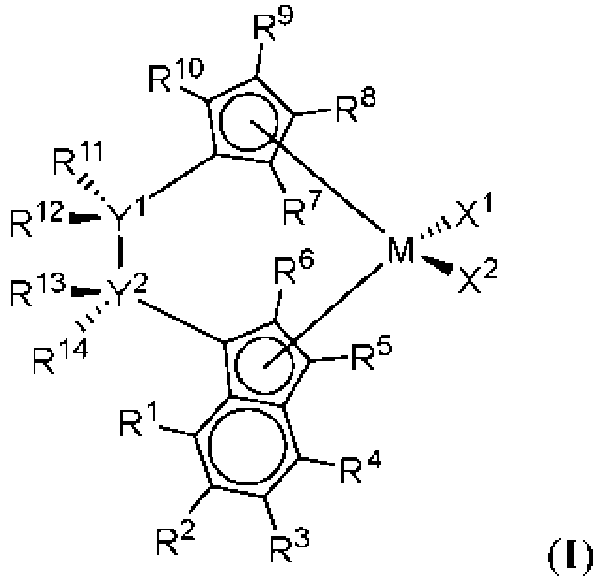 M ein Metall der Gruppe 4 ist, vorzugsweise Zr, Ti oder Hf,Y1 und Y2 unabhängig Si, Ge oder C sind, wobei mindestens eines von Y1 und Y2 nicht C ist, vorzugsweise mindestens eines von Y1 und Y2 Si ist, insbesondere Y1 und Y2 Si sind,X1 und X2 unabhängig Wasserstoff, Halogenid, Hydroxyl oder substituierter oder unsubstituierter C1- bis C50-Kohlenwasserstoffrest, Amid, Alkoxid, Sulfid, Phosphid oder eine Kombination davon sind, oder X1 und X2 unter Bildung eines Metallocyclusrings verbunden sind, oder X1 und X2 unter Bildung eines Chelatbildnerliganden oder eines Alkylidens verbunden sind,jedes von R1, R2, R3, R5, R6, R7, R9, R10, R11, R12, R13, R14 unabhängig Wasserstoff, Halogen, C1- bis C50-Kohlenwasserstoffrest oder substituierter C1- bis C50-Kohlenwasserstoffrest, Halogenkohlenstoffrest, Silylkohlenstoffrest, Alkoxyl, Siloxyl ist, oder eines oder mehrere von R1 und R2, R2 und R3 sowie R5 und R6 verbunden sind, um einen gesättigten cyclischen Ring, einen substituierten gesättigten cyclischen Ring, einen substituierten ungesättigten cyclischen Ring oder einen unsubstiutierten ungesättigten cyclischen Ring zu bilden,R4 Halogen, Silylkohlenstoffrest, substituierter Silylkohlenstoffrest, C1- bis C40-Kohlenwasserstoffrest, substituierter C1- bis C40-Kohlenwasserstoffrest, C6- bis C10-Aryl, substituiertes C6- bis C10-Aryl, Fluorenylidenyl, substituiertes Fluorenylidenyl oder -NR'2, -SR', -OR', - OSiR'3,-PR'2 ist, wobei jedes R' Wasserstoff, Halogen, C1- bis C10-Alkyl oder C6- bis C10-Aryl ist, oder R3 und R4 verbunden sind, um einen gesättigten cyclischen Ring, einen substituierten gesättigten cyclischen Ring, einen substituierten ungesättigten cyclischen Ring oder einen unsubstituierten ungesättigten cyclischen Ring zu bilden, oder R4 Wasserstoff ist und R2 und R3 verbunden sind, um einen gesättigten cyclischen Ring, einen substituierten gesättigten cyclischen Ring oder einen unsubstituierten ungesättigten cyclischen Ring zu bilden, undR8 Wasserstoff, Halogen, C1- bis C40-Kohlenwasserstoffrest, substituierter C4- bis C40-Kohlenwasserstoffrest, Silylkohlenstoffrest, Silyl, substituierter Silylkohlenstoffrest, C6- bis C10-Aryl, substituiertes C6- bis C10-Aryl, -NR'2, -SR', - OR', -OSiR'3, -PR'2 ist, wobei jedes R' Wasserstoff, Halogen, C1- bis C10-Alkyl oder Phenyl ist.
- Katalysatorverbindung nach Anspruch 1, bei der R4 Halogen, C6- bis C10-Aryl oder substituiertes C6- bis C10-Aryl ist, R6 Methyl ist, und R8 substituierter C3- bis C10-Kohlenwasserstoffrest oder unsubstituierter C3- bis C10-Kohlenwasserstoffrest ist.
- Katalysatorverbindung nach Anspruch 1, bei der R4 Halogen, C6- bis C10-Aryl, substituiertes C6- bis C10-Aryl, Fluorenylidenyl oder substituiertes Fluorenylidenyl ist.
- Katalysatorverbindung nach Anspruch 1, bei der R8 C1- bis C20-Kohlenwasserstoffrest oder substituierter C1- bis C20-Kohlenwasserstoffrest ist, vorzugsweise substituiertes oder unsubstituiertes Methyl, Ethyl, Propyl, Isopropyl, n-Butyl, Isobutyl oder tert-Butyl.
- Katalysatorverbindung nach Anspruch 1, bei der R2 und R3 unter Bildung eines Cyclobutylrings, eines Cyclopentylrings oder Cyclohexylrings kombiniert sind.
- Katalysatorverbindung nach Anspruch 1, bei der R6 Wasserstoff, Methyl, Ethyl, Propyl, Isopropyl, n-Butyl, Isobutyl oder tert-Butyl ist.
- Katalysatorverbindung nach Anspruch 1, bei der die Katalysatorverbindung, die durch Formel (I) wiedergegeben wird, eine oder mehrere Verbindungen umfasst, die durch die folgenden Formeln wiedergegeben werden:

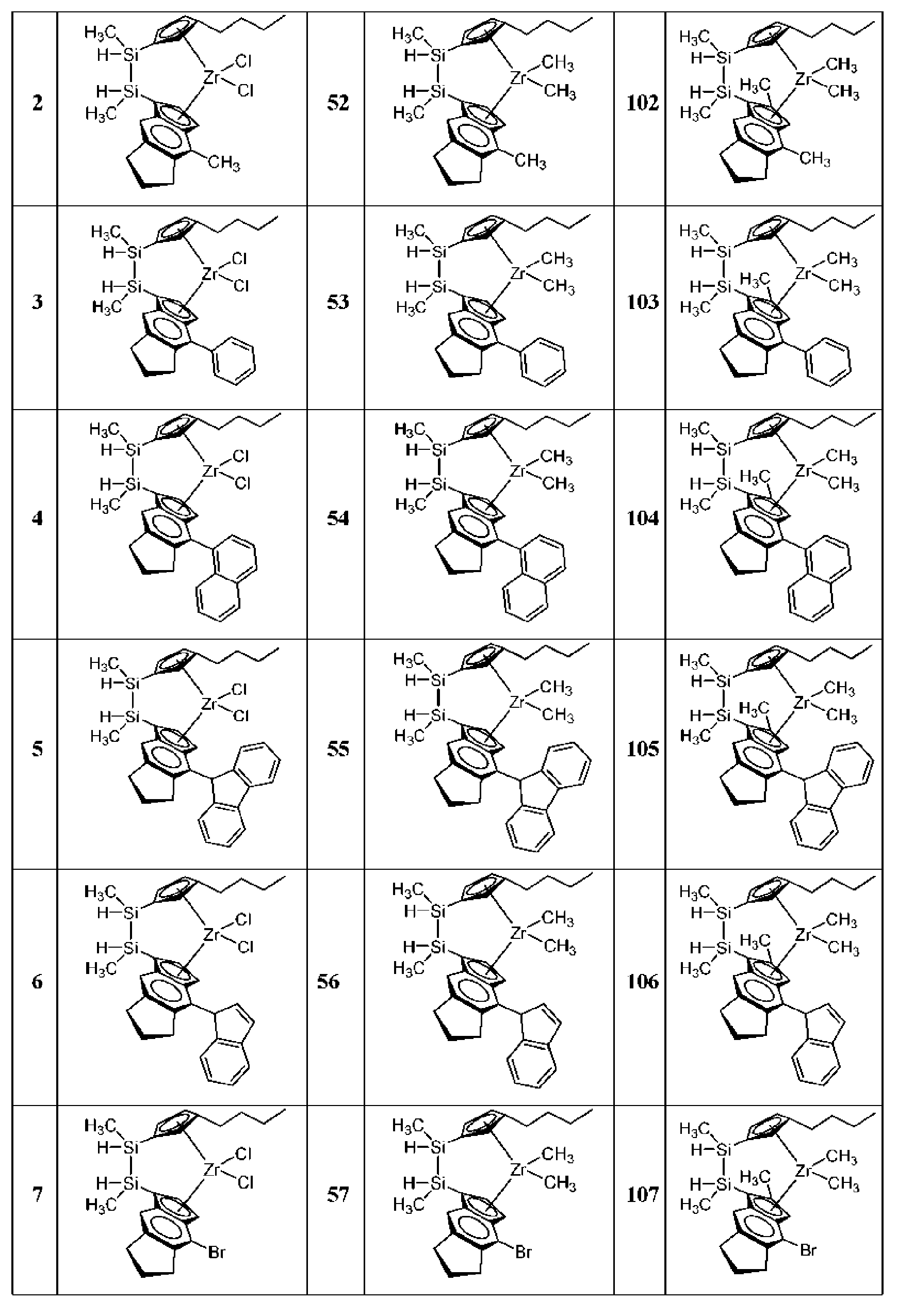


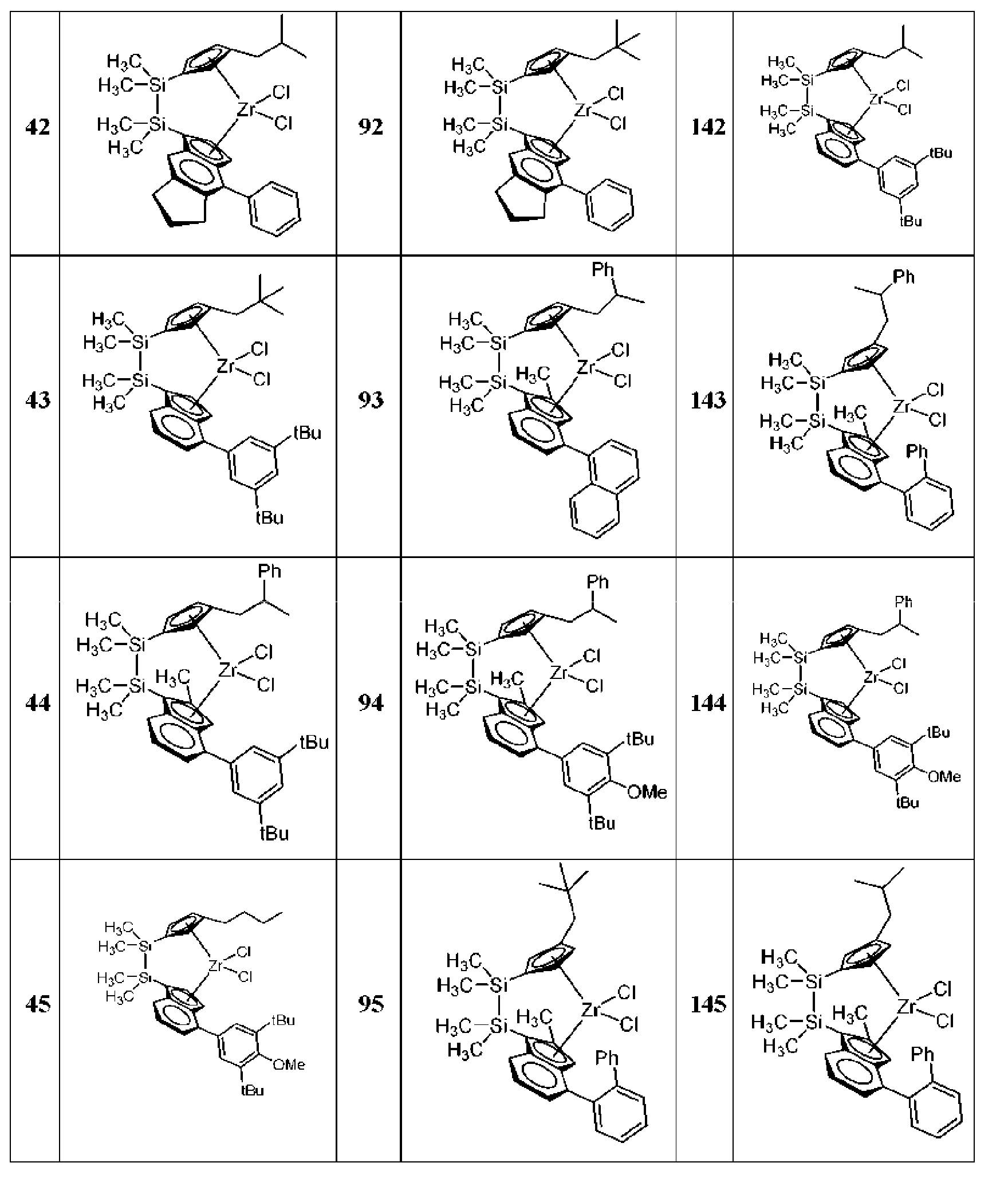

- Katalysatorverbindung nach Anspruch 1, bei der die Katalysatorverbindung, die durch Formel (I) wiedergegeben wird, eine oder mehrere Verbindungen umfasst, die durch die folgenden Formeln wiedergegeben werden:
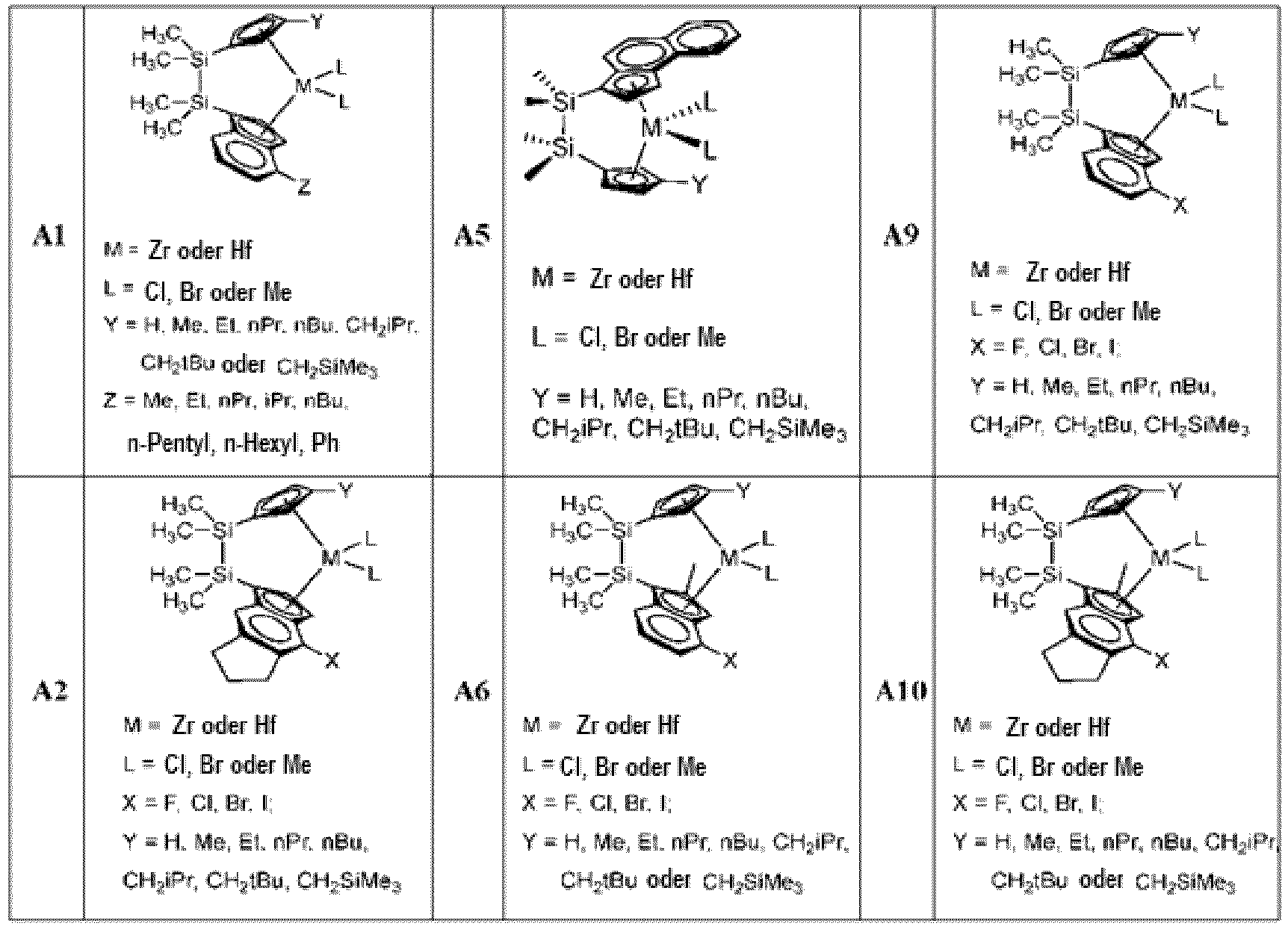
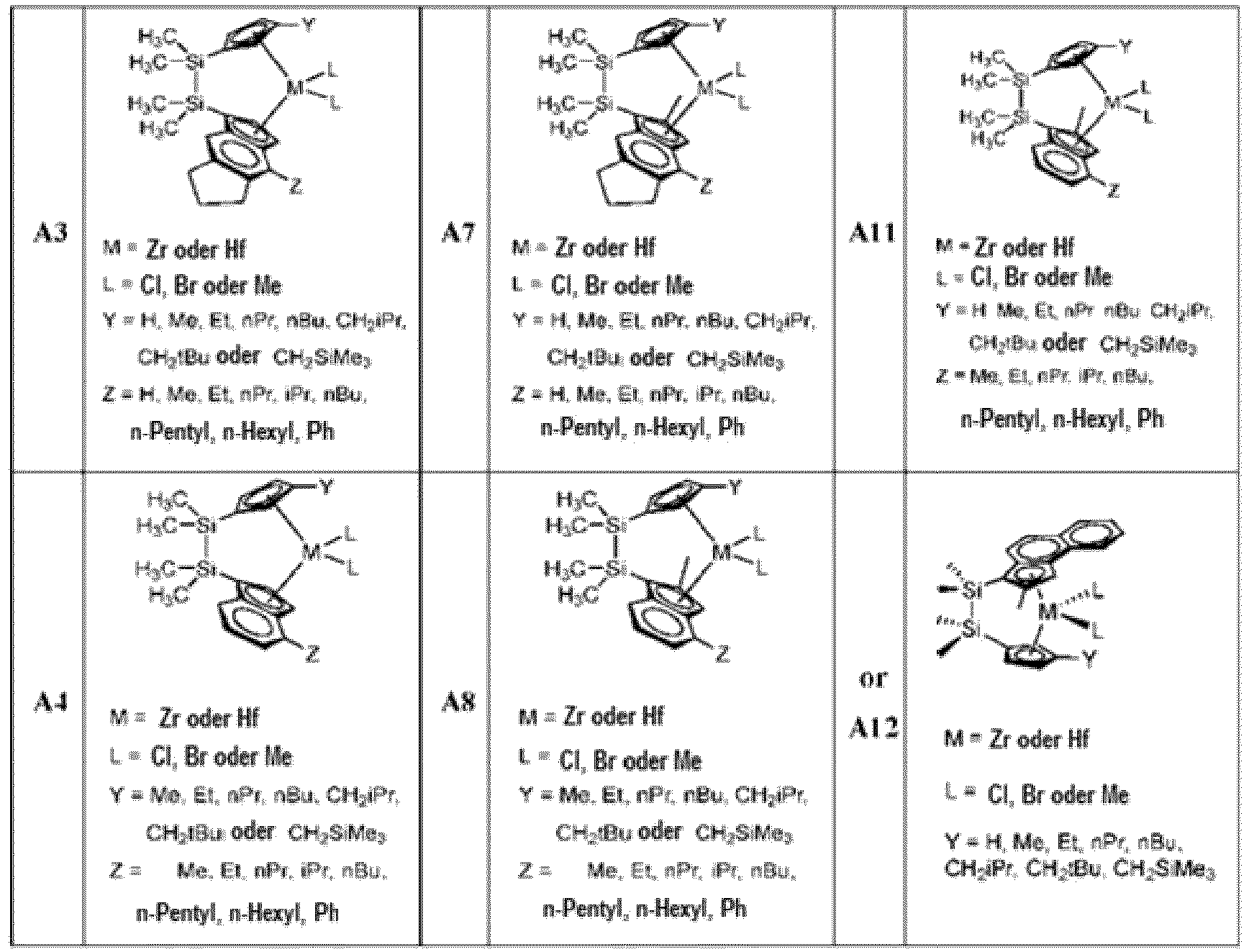
- Katalysatorsystem, das (a) die Katalysatorverbindung nach einem der Ansprüche 1 bis 8, (b) Aktivator und (c) gegebenenfalls Trägermaterial, vorzugsweise Siliciumdioxid oder fluoriertes Material umfasst.
- Katalysatorsystem nach Anspruch 9, das des Weiteren (c) verbrückte oder unverbrückte Metallocenkatalysatorverbindung, die von dem Katalysator von Verbindung (a) verschieden ist, umfasst.
- Katalysatorsystem nach Anspruch 9, bei dem der Aktivator ein oder mehrere von Alkylalumoxan, N,N-Di-methylaniliniumtetra(perfluorphenyl)borat, N,N-Dimethyl-aniliniumtetrakis(perfluornaphthyl)borat, N,N-Dimethyl-aniliniumtetrakis(perfluorbiphenyl)borat, N,N-Dimethylaniliniumtetrakis(3,5-bis-(trifluormethyl)phenyl)borat, Triphenylcarbeniumtetrakis-(perfluornaphthyl)borat, Triphenylcarbeniumtetrakis(per-fluorbiphenyl)borat, Triphenylcarbeniumtetrakis(3,5-bis-(trifluormethyl)phenyl)borat, Triphenylcarbeniumtetra(perfluorphenyl)borat, Trimethylammoniumtetrakis(perfluornaphthyl)borat, Triethylammoniumtetrakis(perfluornaphthyl)borat, Tripropylammoniumtetrakis(perfluornaphthyl)borat, Tri(n-butyl)ammoniumtetrakis(perfluornaphthyl)borat, Tri(t-butyl)ammoniumtetrakis(perfluornaphthyl)borat, N,N-Diethyl-aniliniumtetrakis(perfluornaphthyl)borat, N,N-Dimethyl-(2,4,6-trimethylanilinium)tetrakis(perfluornaphthyl)borat und Tropyliumtetrakis(perfluornaphthyl)borat umfasst.
- Verfahren zum Polymerisieren von Olefinen, um Polyolefin zu produzieren, bei dem: 1) mindestens ein Olefin mit dem Katalysatorsystem gemäß einem der Ansprüche 9 bis 11 in Kontakt gebracht wird und Polyolefin erhalten wird.
- Verfahren nach Anspruch 12, das bei einer Temperatur von 0°C bis 300°C, einem Druck im Bereich von 0,35 MPa bis 10 MPa und für eine Zeit bis zu 300 Minuten erfolgt.
- Verfahren nach Anspruch 12, bei dem die Olefine Ethylen, Propylen, Buten, Penten, Hexen, Hepten, Octen, Nonen, Decen, Undecen, Dodecen oder Mischungen davon umfassen.
Applications Claiming Priority (3)
| Application Number | Priority Date | Filing Date | Title |
|---|---|---|---|
| US201762585629P | 2017-11-14 | 2017-11-14 | |
| EP17209439 | 2017-12-21 | ||
| PCT/US2018/059558 WO2019099250A1 (en) | 2017-11-14 | 2018-11-07 | (di)silicon bridged metallocenes that produce polyethylene broad molecular weight distribution and molecular weight |
Publications (3)
| Publication Number | Publication Date |
|---|---|
| EP3710491A1 EP3710491A1 (de) | 2020-09-23 |
| EP3710491A4 EP3710491A4 (de) | 2021-01-06 |
| EP3710491B1 true EP3710491B1 (de) | 2025-01-01 |
Family
ID=66539103
Family Applications (1)
| Application Number | Title | Priority Date | Filing Date |
|---|---|---|---|
| EP18877520.9A Active EP3710491B1 (de) | 2017-11-14 | 2018-11-07 | (di)siliciumverbrückte metallocene zur herstellung von polyethylen mit breiter molekulargewichtsverteilung und molekulargewicht |
Country Status (3)
| Country | Link |
|---|---|
| EP (1) | EP3710491B1 (de) |
| CN (1) | CN111372954B (de) |
| WO (1) | WO2019099250A1 (de) |
Families Citing this family (10)
| Publication number | Priority date | Publication date | Assignee | Title |
|---|---|---|---|---|
| US11214631B2 (en) * | 2017-11-14 | 2022-01-04 | Exxonmobil Chemical Patents Inc. | (Di)silicon bridged metallocenes that produce polyethylene with broad molecular weight distribution and high molecular weight |
| US11130827B2 (en) | 2017-11-14 | 2021-09-28 | Exxonmobil Chemical Patents Inc. | Polyethylene compositions and articles made therefrom |
| EP3936542B1 (de) * | 2019-06-11 | 2023-11-08 | Lg Chem, Ltd. | Statistisches propylenethylen-copolymer |
| CN114929761A (zh) * | 2019-08-22 | 2022-08-19 | 埃克森美孚化学专利公司 | 用c1对称的茂金属催化剂生产的全同立构的丙烯均聚物和共聚物 |
| BR112022007805A2 (pt) * | 2019-10-25 | 2022-07-05 | Braskem Sa | Processo para produzir uma composição, composição, e, artigo |
| WO2021257264A1 (en) * | 2020-06-16 | 2021-12-23 | Exxonmobil Chemical Patents Inc. | Metallocene catalysts for producing vinyl-terminated polyalphaolefins and methods associated therewith |
| WO2023114815A1 (en) * | 2021-12-17 | 2023-06-22 | Exxonmobil Chemical Patents Inc. | Processes for making polyolefins with composition control |
| CN115160470B (zh) * | 2022-07-18 | 2023-06-30 | 宁夏清研高分子新材料有限公司 | 一种tpx聚合物的制备方法、催化剂及其制备方法 |
| EP4716709A1 (de) * | 2023-05-23 | 2026-04-01 | ExxonMobil Technology and Engineering Company | Polyethylene, katalysatoren für ihre polymerisation und daraus hergestellte filme |
| WO2024242929A1 (en) * | 2023-05-23 | 2024-11-28 | ExxonMobil Technology and Engineering Company | Low density polethylenes, films thereof, and methods and catalysts for production thereof |
Family Cites Families (52)
| Publication number | Priority date | Publication date | Assignee | Title |
|---|---|---|---|---|
| US5153157A (en) | 1987-01-30 | 1992-10-06 | Exxon Chemical Patents Inc. | Catalyst system of enhanced productivity |
| US5453410A (en) | 1992-01-06 | 1995-09-26 | The Dow Chemical Company | Catalyst composition |
| BE1005957A5 (fr) | 1992-06-05 | 1994-04-05 | Solvay | Procede de preparation d'un systeme catalytique, procede de (co)polymerisation d'olefines et (co)polymeres d'au moins une olefine. |
| FI951548A7 (fi) | 1992-10-02 | 1995-05-29 | Dow Global Technologies Inc | Kantajalla olevia homogeenisia katalysaattorikomplekseja olefiinipolymerointia varten |
| WO1995014044A1 (en) | 1993-11-19 | 1995-05-26 | Exxon Chemical Patents Inc. | Polymerization catalyst systems, their production and use |
| US5447895A (en) | 1994-03-10 | 1995-09-05 | Northwestern University | Sterically shielded diboron-containing metallocene olefin polymerization catalysts |
| IT1290856B1 (it) * | 1996-12-19 | 1998-12-14 | Enichem Spa | Metalloceni, loro preparazione ed uso nella polimerizzazione di alfa-olefine |
| US6180736B1 (en) | 1996-12-20 | 2001-01-30 | Exxon Chemical Patents Inc | High activity metallocene polymerization process |
| US6455316B1 (en) | 1998-08-13 | 2002-09-24 | Symyx Technologies, Inc. | Parallel reactor with internal sensing and method of using same |
| US6306658B1 (en) | 1998-08-13 | 2001-10-23 | Symyx Technologies | Parallel reactor with internal sensing |
| JP2002523568A (ja) | 1998-08-26 | 2002-07-30 | エクソンモービル・ケミカル・パテンツ・インク | 高度に活性な担持触媒組成物 |
| US6147173A (en) | 1998-11-13 | 2000-11-14 | Univation Technologies, Llc | Nitrogen-containing group 13 anionic complexes for olefin polymerization |
| US6399723B1 (en) | 2000-06-30 | 2002-06-04 | Exxonmobil Chemical Patents Inc. | Metallocene compositions |
| US6376413B1 (en) | 2000-06-30 | 2002-04-23 | Exxonmobil Chemical Patents Inc. | Metallocene compositions |
| US6376409B1 (en) | 2000-06-30 | 2002-04-23 | Exxonmobil Chemical Patents Inc. | Metallocene compositions |
| US6380124B1 (en) | 2000-06-30 | 2002-04-30 | Exxonmobil Chemical Patents Inc. | Metallocene compositions |
| US6376411B1 (en) | 2000-06-30 | 2002-04-23 | Exxonmobil Chemical Patents Inc. | Metallocene compositions |
| US6376412B1 (en) | 2000-06-30 | 2002-04-23 | Exxonmobil Chemical Patents Inc. | Metallocene compositions |
| US6380334B1 (en) | 2000-06-30 | 2002-04-30 | Exxonmobil Chemical Patents Inc. | Metallocene compositions |
| DE60112307T8 (de) | 2000-06-30 | 2007-02-15 | Exxonmobil Chemical Patents Inc., Baytown | Metallocenverbindungen mit einem verbrückten 4-phenylindenyl-ligandsystem zur polymerisation von olefinen |
| US6380330B1 (en) | 2000-06-30 | 2002-04-30 | Exxonmobil Chemical Patents Inc. | Metallocene compositions |
| US6414095B1 (en) | 2000-06-30 | 2002-07-02 | Exxon Mobil Chemical Patents Inc. | Metallocene compositions |
| US6376410B1 (en) | 2000-06-30 | 2002-04-23 | Exxonmobil Chemical Patents Inc. | Metallocene compositions |
| US6376408B1 (en) | 2000-06-30 | 2002-04-23 | Exxonmobil Chemical Patents Inc. | Metallocene compositions |
| US6380120B1 (en) | 2000-06-30 | 2002-04-30 | Exxonmobil Chemical Patents Inc. | Metallocene compositions |
| US6380121B1 (en) | 2000-06-30 | 2002-04-30 | Exxonmobil Chemical Patents Inc. | Metallocene compositions |
| US6380123B1 (en) | 2000-06-30 | 2002-04-30 | Exxonmobil Chemical Patents Inc. | Metallocene compositions |
| US6376407B1 (en) | 2000-06-30 | 2002-04-23 | Exxonmobil Chemical Patents Inc. | Metallocene compositions |
| US6376627B1 (en) | 2000-06-30 | 2002-04-23 | Exxonmobil Chemical Patents Inc. | Metallocene compositions |
| US6380122B1 (en) | 2000-06-30 | 2002-04-30 | Exxonmobil Chemical Patents Inc. | Metallocene compositions |
| US6380331B1 (en) | 2000-06-30 | 2002-04-30 | Exxonmobil Chemical Patents Inc. | Metallocene compositions |
| DE50105968D1 (de) | 2000-08-29 | 2005-05-25 | Basell Polyolefine Gmbh | VERFAHREN ZUR HERSTELLUNG VON AlKYLVERBRÜCKTEN LIGANDSYSTEMEN UND ÜBERGANGSMETALLVERBINDUNGEN |
| US6936675B2 (en) | 2001-07-19 | 2005-08-30 | Univation Technologies, Llc | High tear films from hafnocene catalyzed polyethylenes |
| JP4020862B2 (ja) | 2001-07-19 | 2007-12-12 | ユニベーション・テクノロジーズ・エルエルシー | コモノマー少量組込み触媒とコモノマー多量組込み触媒を含有する混合メタロセン触媒系 |
| WO2004052945A1 (en) | 2002-12-06 | 2004-06-24 | Basell Polyolefine Gmbh | Organometallic transition metal compound, biscyclopentadienyl ligand system, catalyst system and process for preparing polyolefins |
| DE10358082A1 (de) * | 2003-12-10 | 2005-07-14 | Basell Polyolefine Gmbh | Organübergangsmetallverbindung, Bscyclopentadienyligandsystem, Katalysatorsystem und Hertellung von Polyolefinen |
| US7157531B2 (en) | 2004-06-21 | 2007-01-02 | Univation Technologies, Llc | Methods for producing polymers with control over composition distribution |
| BRPI0611557B1 (pt) * | 2005-03-18 | 2017-03-28 | Basell Polyolefine Gmbh | compostos metalocenos bis-indenila em ponte com simetria c2, sistema catalítico dessa classe de compostos e processo de polimerização de a-olefinas com a referida classe de compostos |
| RU2392283C2 (ru) | 2005-03-23 | 2010-06-20 | Базелль Полиолефине Гмбх | Способ полимеризации олефинов |
| WO2009027075A2 (en) | 2007-08-27 | 2009-03-05 | Borealis Technology Oy | Catalysts |
| JP5487089B2 (ja) | 2009-12-02 | 2014-05-07 | 日本ポリエチレン株式会社 | エチレン系重合体の製造方法 |
| US8058461B2 (en) | 2010-03-01 | 2011-11-15 | Exxonmobil Chemical Patents Inc. | Mono-indenyl transition metal compounds and polymerization therewith |
| EP2402354B1 (de) | 2010-07-01 | 2016-03-02 | Borealis AG | Verfahren zur Polymerisierung von Olefinen unter Verwendung von Gruppe-4-Metallocenen als Katalisatoren |
| US8609793B2 (en) | 2010-10-07 | 2013-12-17 | Chevron Phillips Chemical Company Lp | Catalyst systems containing a bridged metallocene |
| US8637616B2 (en) | 2010-10-07 | 2014-01-28 | Chevron Philips Chemical Company Lp | Bridged metallocene catalyst systems with switchable hydrogen and comonomer effects |
| US8658556B2 (en) | 2011-06-08 | 2014-02-25 | Exxonmobil Chemical Patents Inc. | Catalyst systems comprising multiple non-coordinating anion activators and methods for polymerization therewith |
| BR112014024572A2 (pt) | 2012-04-02 | 2017-08-08 | Chevron Phillips Chemical Co Lp | sistemas catalisadores contendo um metaloceno em ponte |
| KR101722138B1 (ko) | 2013-12-04 | 2017-04-11 | 주식회사 엘지화학 | 신규한 리간드 화합물, 메탈로센 화합물 및 이를 이용하는 올레핀계 중합체의 제조방법 |
| JP6361524B2 (ja) | 2014-02-19 | 2018-07-25 | 日本ポリエチレン株式会社 | メタロセン化合物、それを含むオレフィン重合用触媒成分およびオレフィン重合用触媒、並びにそのオレフィン重合用触媒を用いたオレフィン重合体の製造方法 |
| US9988410B2 (en) * | 2015-07-15 | 2018-06-05 | Exxonmobil Chemical Patents Inc. | Substituted bis indenyl metallocene catalyst compounds comprising-Si—Si-bridge |
| WO2017011073A1 (en) | 2015-07-15 | 2017-01-19 | Exxonmobil Chemical Patents Inc. | Substituted bis indenyl metallocene catalyst compounds comprising-si-si-bridge |
| EP3350236B1 (de) * | 2015-09-17 | 2023-10-04 | ExxonMobil Chemical Patents Inc. | Polyethylenpolymere und daraus hergestellte artikel |
-
2018
- 2018-11-07 EP EP18877520.9A patent/EP3710491B1/de active Active
- 2018-11-07 CN CN201880073376.1A patent/CN111372954B/zh active Active
- 2018-11-07 WO PCT/US2018/059558 patent/WO2019099250A1/en not_active Ceased
Also Published As
| Publication number | Publication date |
|---|---|
| EP3710491A1 (de) | 2020-09-23 |
| CN111372954A (zh) | 2020-07-03 |
| WO2019099250A1 (en) | 2019-05-23 |
| EP3710491A4 (de) | 2021-01-06 |
| CN111372954B (zh) | 2022-06-28 |
Similar Documents
| Publication | Publication Date | Title |
|---|---|---|
| US11214631B2 (en) | (Di)silicon bridged metallocenes that produce polyethylene with broad molecular weight distribution and high molecular weight | |
| EP3452520B1 (de) | Tetrahydro-as-indacenyl-katalysatorzusammensetzung, katalysatorsystem und verfahren zur verwendung davon | |
| US10508166B2 (en) | Production of polyolefins with internal unsaturation structures using a metallocene catalyst system | |
| WO2019099250A1 (en) | (di)silicon bridged metallocenes that produce polyethylene broad molecular weight distribution and molecular weight | |
| US20160244535A1 (en) | Tetrahydroindacenyl Catalyst Composition, Catalyst System, and Processes for Use Thereof | |
| EP3452521B1 (de) | Tetrahydroindacenylkatalysatorzusammensetzung und verfahren zur verwendung davon | |
| US9988410B2 (en) | Substituted bis indenyl metallocene catalyst compounds comprising-Si—Si-bridge | |
| EP3529287A1 (de) | Mischkatalysatorsysteme und verfahren zu deren verwendung | |
| EP3322529A1 (de) | Substituierte bis-indenyl-metallocen-katalysatorverbindungen mit si-si-brücke | |
| EP3802644B1 (de) | Metallocene mit si-si-brücken | |
| US10683377B2 (en) | Catalysts for olefin polymerization | |
| WO2018182860A1 (en) | Solution process to make ethylene copolymers | |
| WO2020018254A1 (en) | Catalysts for olefin polymerization | |
| US11066494B2 (en) | Amine bridged anilide phenolate catalyst compounds | |
| US10519261B2 (en) | Group 6 transition metal catalyst compound and use thereof | |
| EP3755705B1 (de) | Katalysatoren, katalysatorsysteme und verfahren zu ihrer verwendung | |
| US10280234B2 (en) | Catalyst compositions and use thereof | |
| US10941229B2 (en) | Bridged anilinyl phenyl phenol catalyst compounds | |
| WO2018089165A1 (en) | Catalyst compositions and use thereof | |
| EP3365379B1 (de) | Herstellung von polyolefinen mit internen ungesättigten strukturen mit einem metallocenkatalysatorsystem | |
| EP3538567A1 (de) | Katalysatorzusammensetzungen und verwendung davon | |
| WO2016153574A1 (en) | Group 6 transition metal catalyst compound and use thereof |
Legal Events
| Date | Code | Title | Description |
|---|---|---|---|
| STAA | Information on the status of an ep patent application or granted ep patent |
Free format text: STATUS: THE INTERNATIONAL PUBLICATION HAS BEEN MADE |
|
| PUAI | Public reference made under article 153(3) epc to a published international application that has entered the european phase |
Free format text: ORIGINAL CODE: 0009012 |
|
| STAA | Information on the status of an ep patent application or granted ep patent |
Free format text: STATUS: REQUEST FOR EXAMINATION WAS MADE |
|
| 17P | Request for examination filed |
Effective date: 20200612 |
|
| AK | Designated contracting states |
Kind code of ref document: A1 Designated state(s): AL AT BE BG CH CY CZ DE DK EE ES FI FR GB GR HR HU IE IS IT LI LT LU LV MC MK MT NL NO PL PT RO RS SE SI SK SM TR |
|
| AX | Request for extension of the european patent |
Extension state: BA ME |
|
| REG | Reference to a national code |
Ref country code: DE Free format text: PREVIOUS MAIN CLASS: C08F0004659200 Ipc: C08F0210160000 Ref country code: DE Ref legal event code: R079 Ref document number: 602018078227 Country of ref document: DE Free format text: PREVIOUS MAIN CLASS: C08F0004659200 Ipc: C08F0210160000 |
|
| A4 | Supplementary search report drawn up and despatched |
Effective date: 20201209 |
|
| RIC1 | Information provided on ipc code assigned before grant |
Ipc: C08F 210/16 20060101AFI20201203BHEP Ipc: C08F 4/6592 20060101ALI20201203BHEP |
|
| DAV | Request for validation of the european patent (deleted) | ||
| DAX | Request for extension of the european patent (deleted) | ||
| STAA | Information on the status of an ep patent application or granted ep patent |
Free format text: STATUS: EXAMINATION IS IN PROGRESS |
|
| 17Q | First examination report despatched |
Effective date: 20221122 |
|
| GRAP | Despatch of communication of intention to grant a patent |
Free format text: ORIGINAL CODE: EPIDOSNIGR1 |
|
| STAA | Information on the status of an ep patent application or granted ep patent |
Free format text: STATUS: GRANT OF PATENT IS INTENDED |
|
| INTG | Intention to grant announced |
Effective date: 20240730 |
|
| P01 | Opt-out of the competence of the unified patent court (upc) registered |
Free format text: CASE NUMBER: APP_50625/2024 Effective date: 20240906 |
|
| GRAS | Grant fee paid |
Free format text: ORIGINAL CODE: EPIDOSNIGR3 |
|
| GRAA | (expected) grant |
Free format text: ORIGINAL CODE: 0009210 |
|
| STAA | Information on the status of an ep patent application or granted ep patent |
Free format text: STATUS: THE PATENT HAS BEEN GRANTED |
|
| AK | Designated contracting states |
Kind code of ref document: B1 Designated state(s): AL AT BE BG CH CY CZ DE DK EE ES FI FR GB GR HR HU IE IS IT LI LT LU LV MC MK MT NL NO PL PT RO RS SE SI SK SM TR |
|
| REG | Reference to a national code |
Ref country code: GB Ref legal event code: FG4D |
|
| REG | Reference to a national code |
Ref country code: CH Ref legal event code: EP |
|
| REG | Reference to a national code |
Ref country code: DE Ref legal event code: R096 Ref document number: 602018078227 Country of ref document: DE |
|
| REG | Reference to a national code |
Ref country code: IE Ref legal event code: FG4D |
|
| REG | Reference to a national code |
Ref country code: LT Ref legal event code: MG9D |
|
| REG | Reference to a national code |
Ref country code: NL Ref legal event code: MP Effective date: 20250101 |
|
| REG | Reference to a national code |
Ref country code: AT Ref legal event code: MK05 Ref document number: 1756165 Country of ref document: AT Kind code of ref document: T Effective date: 20250101 |
|
| PG25 | Lapsed in a contracting state [announced via postgrant information from national office to epo] |
Ref country code: NL Free format text: LAPSE BECAUSE OF FAILURE TO SUBMIT A TRANSLATION OF THE DESCRIPTION OR TO PAY THE FEE WITHIN THE PRESCRIBED TIME-LIMIT Effective date: 20250101 |
|
| PG25 | Lapsed in a contracting state [announced via postgrant information from national office to epo] |
Ref country code: FI Free format text: LAPSE BECAUSE OF FAILURE TO SUBMIT A TRANSLATION OF THE DESCRIPTION OR TO PAY THE FEE WITHIN THE PRESCRIBED TIME-LIMIT Effective date: 20250101 |
|
| PG25 | Lapsed in a contracting state [announced via postgrant information from national office to epo] |
Ref country code: PL Free format text: LAPSE BECAUSE OF FAILURE TO SUBMIT A TRANSLATION OF THE DESCRIPTION OR TO PAY THE FEE WITHIN THE PRESCRIBED TIME-LIMIT Effective date: 20250101 |
|
| PG25 | Lapsed in a contracting state [announced via postgrant information from national office to epo] |
Ref country code: ES Free format text: LAPSE BECAUSE OF FAILURE TO SUBMIT A TRANSLATION OF THE DESCRIPTION OR TO PAY THE FEE WITHIN THE PRESCRIBED TIME-LIMIT Effective date: 20250101 |
|
| PG25 | Lapsed in a contracting state [announced via postgrant information from national office to epo] |
Ref country code: IS Free format text: LAPSE BECAUSE OF FAILURE TO SUBMIT A TRANSLATION OF THE DESCRIPTION OR TO PAY THE FEE WITHIN THE PRESCRIBED TIME-LIMIT Effective date: 20250501 Ref country code: NO Free format text: LAPSE BECAUSE OF FAILURE TO SUBMIT A TRANSLATION OF THE DESCRIPTION OR TO PAY THE FEE WITHIN THE PRESCRIBED TIME-LIMIT Effective date: 20250401 |
|
| PG25 | Lapsed in a contracting state [announced via postgrant information from national office to epo] |
Ref country code: HR Free format text: LAPSE BECAUSE OF FAILURE TO SUBMIT A TRANSLATION OF THE DESCRIPTION OR TO PAY THE FEE WITHIN THE PRESCRIBED TIME-LIMIT Effective date: 20250101 |
|
| PG25 | Lapsed in a contracting state [announced via postgrant information from national office to epo] |
Ref country code: LV Free format text: LAPSE BECAUSE OF FAILURE TO SUBMIT A TRANSLATION OF THE DESCRIPTION OR TO PAY THE FEE WITHIN THE PRESCRIBED TIME-LIMIT Effective date: 20250101 Ref country code: PT Free format text: LAPSE BECAUSE OF FAILURE TO SUBMIT A TRANSLATION OF THE DESCRIPTION OR TO PAY THE FEE WITHIN THE PRESCRIBED TIME-LIMIT Effective date: 20250502 |
|
| PG25 | Lapsed in a contracting state [announced via postgrant information from national office to epo] |
Ref country code: GR Free format text: LAPSE BECAUSE OF FAILURE TO SUBMIT A TRANSLATION OF THE DESCRIPTION OR TO PAY THE FEE WITHIN THE PRESCRIBED TIME-LIMIT Effective date: 20250402 Ref country code: BG Free format text: LAPSE BECAUSE OF FAILURE TO SUBMIT A TRANSLATION OF THE DESCRIPTION OR TO PAY THE FEE WITHIN THE PRESCRIBED TIME-LIMIT Effective date: 20250101 |
|
| PG25 | Lapsed in a contracting state [announced via postgrant information from national office to epo] |
Ref country code: AT Free format text: LAPSE BECAUSE OF FAILURE TO SUBMIT A TRANSLATION OF THE DESCRIPTION OR TO PAY THE FEE WITHIN THE PRESCRIBED TIME-LIMIT Effective date: 20250101 |
|
| PG25 | Lapsed in a contracting state [announced via postgrant information from national office to epo] |
Ref country code: CZ Free format text: LAPSE BECAUSE OF FAILURE TO SUBMIT A TRANSLATION OF THE DESCRIPTION OR TO PAY THE FEE WITHIN THE PRESCRIBED TIME-LIMIT Effective date: 20250101 |
|
| PG25 | Lapsed in a contracting state [announced via postgrant information from national office to epo] |
Ref country code: SE Free format text: LAPSE BECAUSE OF FAILURE TO SUBMIT A TRANSLATION OF THE DESCRIPTION OR TO PAY THE FEE WITHIN THE PRESCRIBED TIME-LIMIT Effective date: 20250101 |
|
| REG | Reference to a national code |
Ref country code: DE Ref legal event code: R097 Ref document number: 602018078227 Country of ref document: DE |
|
| PG25 | Lapsed in a contracting state [announced via postgrant information from national office to epo] |
Ref country code: SM Free format text: LAPSE BECAUSE OF FAILURE TO SUBMIT A TRANSLATION OF THE DESCRIPTION OR TO PAY THE FEE WITHIN THE PRESCRIBED TIME-LIMIT Effective date: 20250101 |
|
| PG25 | Lapsed in a contracting state [announced via postgrant information from national office to epo] |
Ref country code: DK Free format text: LAPSE BECAUSE OF FAILURE TO SUBMIT A TRANSLATION OF THE DESCRIPTION OR TO PAY THE FEE WITHIN THE PRESCRIBED TIME-LIMIT Effective date: 20250101 |
|
| PG25 | Lapsed in a contracting state [announced via postgrant information from national office to epo] |
Ref country code: IT Free format text: LAPSE BECAUSE OF FAILURE TO SUBMIT A TRANSLATION OF THE DESCRIPTION OR TO PAY THE FEE WITHIN THE PRESCRIBED TIME-LIMIT Effective date: 20250101 |
|
| PG25 | Lapsed in a contracting state [announced via postgrant information from national office to epo] |
Ref country code: EE Free format text: LAPSE BECAUSE OF FAILURE TO SUBMIT A TRANSLATION OF THE DESCRIPTION OR TO PAY THE FEE WITHIN THE PRESCRIBED TIME-LIMIT Effective date: 20250101 |
|
| PG25 | Lapsed in a contracting state [announced via postgrant information from national office to epo] |
Ref country code: RO Free format text: LAPSE BECAUSE OF FAILURE TO SUBMIT A TRANSLATION OF THE DESCRIPTION OR TO PAY THE FEE WITHIN THE PRESCRIBED TIME-LIMIT Effective date: 20250101 |
|
| PG25 | Lapsed in a contracting state [announced via postgrant information from national office to epo] |
Ref country code: SK Free format text: LAPSE BECAUSE OF FAILURE TO SUBMIT A TRANSLATION OF THE DESCRIPTION OR TO PAY THE FEE WITHIN THE PRESCRIBED TIME-LIMIT Effective date: 20250101 |
|
| PLBE | No opposition filed within time limit |
Free format text: ORIGINAL CODE: 0009261 |
|
| STAA | Information on the status of an ep patent application or granted ep patent |
Free format text: STATUS: NO OPPOSITION FILED WITHIN TIME LIMIT |
|
| REG | Reference to a national code |
Ref country code: CH Ref legal event code: L10 Free format text: ST27 STATUS EVENT CODE: U-0-0-L10-L00 (AS PROVIDED BY THE NATIONAL OFFICE) Effective date: 20251112 |
|
| 26N | No opposition filed |
Effective date: 20251002 |
|
| PGFP | Annual fee paid to national office [announced via postgrant information from national office to epo] |
Ref country code: DE Payment date: 20251126 Year of fee payment: 8 |
|
| PGFP | Annual fee paid to national office [announced via postgrant information from national office to epo] |
Ref country code: FR Payment date: 20251125 Year of fee payment: 8 |
|
| REG | Reference to a national code |
Ref country code: CH Ref legal event code: H13 Free format text: ST27 STATUS EVENT CODE: U-0-0-H10-H13 (AS PROVIDED BY THE NATIONAL OFFICE) Effective date: 20260623 |
|
| PG25 | Lapsed in a contracting state [announced via postgrant information from national office to epo] |
Ref country code: LT Free format text: LAPSE BECAUSE OF FAILURE TO SUBMIT A TRANSLATION OF THE DESCRIPTION OR TO PAY THE FEE WITHIN THE PRESCRIBED TIME-LIMIT Effective date: 20250101 |
|
| PG25 | Lapsed in a contracting state [announced via postgrant information from national office to epo] |
Ref country code: MC Free format text: LAPSE BECAUSE OF FAILURE TO SUBMIT A TRANSLATION OF THE DESCRIPTION OR TO PAY THE FEE WITHIN THE PRESCRIBED TIME-LIMIT Effective date: 20250101 |
|
| PG25 | Lapsed in a contracting state [announced via postgrant information from national office to epo] |
Ref country code: RS Free format text: LAPSE BECAUSE OF FAILURE TO SUBMIT A TRANSLATION OF THE DESCRIPTION OR TO PAY THE FEE WITHIN THE PRESCRIBED TIME-LIMIT Effective date: 20250101 |
|
| PG25 | Lapsed in a contracting state [announced via postgrant information from national office to epo] |
Ref country code: LU Free format text: LAPSE BECAUSE OF NON-PAYMENT OF DUE FEES Effective date: 20251107 Ref country code: CH Free format text: LAPSE BECAUSE OF NON-PAYMENT OF DUE FEES Effective date: 20251130 |