EP3715599A1 - Moteur à deux temps - Google Patents
Moteur à deux temps Download PDFInfo
- Publication number
- EP3715599A1 EP3715599A1 EP19164939.1A EP19164939A EP3715599A1 EP 3715599 A1 EP3715599 A1 EP 3715599A1 EP 19164939 A EP19164939 A EP 19164939A EP 3715599 A1 EP3715599 A1 EP 3715599A1
- Authority
- EP
- European Patent Office
- Prior art keywords
- crankshaft
- recess
- crankcase
- stroke engine
- axis
- Prior art date
- Legal status (The legal status is an assumption and is not a legal conclusion. Google has not performed a legal analysis and makes no representation as to the accuracy of the status listed.)
- Granted
Links
Images



Classifications
-
- F—MECHANICAL ENGINEERING; LIGHTING; HEATING; WEAPONS; BLASTING
- F02—COMBUSTION ENGINES; HOT-GAS OR COMBUSTION-PRODUCT ENGINE PLANTS
- F02B—INTERNAL-COMBUSTION PISTON ENGINES; COMBUSTION ENGINES IN GENERAL
- F02B63/00—Adaptations of engines for driving pumps, hand-held tools or electric generators; Portable combinations of engines with engine-driven devices
- F02B63/02—Adaptations of engines for driving pumps, hand-held tools or electric generators; Portable combinations of engines with engine-driven devices for hand-held tools
-
- F—MECHANICAL ENGINEERING; LIGHTING; HEATING; WEAPONS; BLASTING
- F02—COMBUSTION ENGINES; HOT-GAS OR COMBUSTION-PRODUCT ENGINE PLANTS
- F02B—INTERNAL-COMBUSTION PISTON ENGINES; COMBUSTION ENGINES IN GENERAL
- F02B33/00—Engines characterised by provision of pumps for charging or scavenging
- F02B33/02—Engines with reciprocating-piston pumps; Engines with crankcase pumps
- F02B33/04—Engines with reciprocating-piston pumps; Engines with crankcase pumps with simple crankcase pumps, i.e. with the rear face of a non-stepped working piston acting as sole pumping member in co-operation with the crankcase
-
- F—MECHANICAL ENGINEERING; LIGHTING; HEATING; WEAPONS; BLASTING
- F02—COMBUSTION ENGINES; HOT-GAS OR COMBUSTION-PRODUCT ENGINE PLANTS
- F02F—CYLINDERS, PISTONS OR CASINGS, FOR COMBUSTION ENGINES; ARRANGEMENTS OF SEALINGS IN COMBUSTION ENGINES
- F02F7/00—Casings, e.g. crankcases
- F02F7/0021—Construction
- F02F7/0036—Casings for two-stroke engines with scavenging conduits
-
- F—MECHANICAL ENGINEERING; LIGHTING; HEATING; WEAPONS; BLASTING
- F02—COMBUSTION ENGINES; HOT-GAS OR COMBUSTION-PRODUCT ENGINE PLANTS
- F02B—INTERNAL-COMBUSTION PISTON ENGINES; COMBUSTION ENGINES IN GENERAL
- F02B75/00—Other engines
- F02B75/02—Engines characterised by their cycles, e.g. six-stroke
- F02B2075/022—Engines characterised by their cycles, e.g. six-stroke having less than six strokes per cycle
- F02B2075/025—Engines characterised by their cycles, e.g. six-stroke having less than six strokes per cycle two
Definitions
- the invention relates to a two-stroke engine of the type specified in the preamble of claim 1.
- crankcase interior is delimited by two opposing side walls, in each of which a crankshaft bearing is arranged for supporting the crankshaft.
- the side walls are approximately flat and perpendicular to the axis of rotation of the crankshaft.
- a recess in the side wall of a crankcase is known, which is arranged adjacent to the mouth opening of an overflow channel.
- the recess serves to take up the wall film of fuel and to deliver it in such a way that the fuel reaches the area of the mouth opening of another overflow channel.
- the invention is based on the object of specifying an advantageous alternative design of a two-stroke engine which enables low exhaust gas values.
- a recess runs around the crankshaft bearing, which is open over an angle of at least 45 ° and at most 320 ° about the axis of rotation of the crankshaft to the crankcase interior, the recess at both ends of at least one End wall is limited.
- the volume of the crankcase interior can be increased via the recess, which is open at an angle of at least 45 ° and at most 320 ° around the axis of rotation of the crankshaft to the crankcase interior.
- the recess is open over an angle of at least 45 ° and at most 320 ° around the axis of rotation of the crankshaft to the crankcase interior results in a simple structure. Because the recess is delimited at its ends by at least one end wall, the formation of an annular flow through the recess is avoided, and at the same time the stability of the crankcase is increased in the area of the end wall.
- the depression advantageously extends over an angle of at least 45 ° and at most 320 ° around the axis of rotation of the crankshaft. Because the recess extends over a maximum of 320 ° around the axis of rotation of the crankshaft, the recess can be arranged in such a way that it does not protrude into the area of the piston at bottom dead center. Due to the extension over an angle of at least 45 °, a comparatively large volume of the recess is possible with the same small overall width of the crankcase.
- the recess is advantageously open over at least 80% of its length, in particular over its entire length, towards the crankcase interior. Open to the crankcase interior means that there is a connection between the recess and the crankcase interior in a sectional plane through the recess in the radial direction to the axis of rotation of the crankshaft.
- An end wall is preferably arranged at each end of the depression.
- Two end walls are preferably connected to one another via a stiffening rib.
- the two end walls connected via a stiffening rib are preferably the end walls.
- end walls of different depressions can also be connected to one another via a stiffening rib.
- a section of the recess and the stiffening rib are preferably arranged on opposite sides of a crankshaft bearing.
- the at least one depression, preferably precisely one depression, and the stiffening rib encompass the crankshaft bearing advantageously over its entire circumference.
- the two-stroke engine has a crankcase plane which contains the axis of rotation of the crankshaft and which runs perpendicular to a longitudinal cylinder axis.
- the distance between the piston at the bottom dead center of the piston and the plane of the crankcase is advantageously smaller than the greatest distance between the recess and the axis of rotation of the crankshaft.
- the piston In the bottom dead center, the piston is therefore relatively close to the axis of rotation of the crankshaft, so that the two-stroke engine has a small overall size due to the relatively small stroke of the piston.
- the recess is preferably arranged in such a way that the recess and the piston do not overlap in the viewing direction parallel to the axis of rotation of the crankshaft at the bottom dead center of the piston.
- the recess extends over the entire section of the circumference of the crankshaft bearing, which runs on the side of the crankcase plane facing away from the piston.
- the recess preferably extends over an angle of more than 180 ° around the axis of rotation of the crankshaft.
- the longitudinal axis of the cylinder preferably intersects the recess in the viewing direction parallel to the axis of rotation of the crankshaft. The recess accordingly advantageously extends on the side of the crankshaft bearing facing away from the piston.
- the at least one overflow duct preferably opens into the crankcase interior with an opening.
- the mouth opening and the recess are preferably arranged such that there is at least one cutting plane which runs perpendicular to the cylinder longitudinal axis and which intersects both the recess and the mouth opening.
- the recess and the mouth opening accordingly preferably extend at least partially at the same height in relation to the cylinder longitudinal axis.
- the depth of the recess measured in the radial direction to the axis of rotation of the crankshaft is preferably at least 30% of the radial distance between the outer circumference of the crankshaft bearing over at least part of the length of the recess, in particular over more than half of the angular range over which the recess extends and the peripheral wall of the crankcase interior.
- the depth of the recess is at least over part of the length of the recess at least 40%, in particular at least 50% of the radial distance between the outer circumference of the crankshaft bearing and the circumferential wall of the crankshaft interior.
- the recess accordingly extends over a considerable part of the distance between the outer circumference of the crankshaft bearing and the circumferential wall of the crankcase interior.
- a comparatively large volume of the depression can be achieved in a simple manner without the support of the crankshaft bearing deteriorating or the installation space required for the two-stroke engine being increased.
- the width of the recess, measured parallel to the axis of rotation of the crankshaft, is advantageously at least 10% of the width of the crankshaft bearing. As a result, a comparatively large volume of the depression can be achieved.
- the width of the recess is preferably less than 60%, in particular less than 40% of the width of the crankshaft bearing. This enables good support of the crankshaft bearing in the area in which the greatest forces are to be transmitted, despite the recess.
- the width of the recess, measured parallel to the axis of rotation of the crankshaft is advantageously at least 5% of the stroke of the two-stroke engine.
- both side walls of the crankcase interior have at least one recess running around the respective crankshaft bearing.
- at least two depressions have different widths measured parallel to the axis of rotation of the crankshaft. It is advantageously provided that a depression in one side wall has a different width than a depression in the other side wall. However, the same widths of the at least two depressions can also be advantageous.
- the two end walls of a recess preferably also have different widths measured parallel to the axis of rotation of the crankshaft.
- a plurality of depressions in a side wall advantageously have the same width measured parallel to the axis of rotation of the crankshaft.
- the mouth opening is preferably arranged in such a way that the mouth opening is at least partially delimited by an end wall in the direction of the axis of rotation of the crankshaft.
- the end wall accordingly extends on a side wall into the area of the mouth opening of the at least one overflow channel.
- the mouth opening and the end wall run adjacent to one another.
- the mouth opening of the at least one overflow duct is preferably arranged in a circumferential wall of the crankcase which extends between the side walls of the crankcase.
- the two-stroke engine has a crankcase plane which contains the axis of rotation of the crankshaft and which runs perpendicular to the longitudinal axis of the cylinder.
- the cylinder and the mouth opening of the at least one overflow duct are advantageously arranged at least partially, in particular completely, on the same side of the crankcase plane.
- the overflow channel is therefore comparatively short.
- an increase in the volume of the crankcase interior via at least one recess arranged in a side wall of the crankcase is advantageous for influencing the exhaust gas values.
- the two-stroke engine is preferably a single cylinder engine.
- the two-stroke engine is an engine that works with a scavenging reservoir.
- the two-stroke engine preferably has an air duct for supplying flushing air to at least one overflow duct.
- the air duct preferably opens out at the cylinder bore and is connected to the at least one overflow duct in the region of the top dead center via a piston pocket formed in the piston.
- the two-stroke engine is intended in particular to drive the tool in a hand-held implement.
- the crankcase has a recess into which a collar of the cylinder protrudes.
- the collar of the cylinder denotes an extension of the cylinder which extends at least partially, in particular completely, around the cylinder bore, preferably ring-shaped or partially ring-shaped.
- the section of the at least one overflow channel running in the crankcase is advantageously delimited by the collar up to the mouth opening towards the crankcase interior.
- the section of the overflow channel can thereby be designed to be open towards the crankcase interior. This results in a simple design of the crankcase.
- At least one end wall preferably extends up to the collar. This achieves a high level of stability of the arrangement.
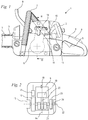
- Fig. 1 shows a motor saw 1 as an exemplary embodiment of a hand-held tool.
- the motor saw 1 has a two-stroke engine 9 for driving a tool.
- the tool of the chainsaw 1 is a saw chain 3 which is driven by the two-stroke engine 9 to rotate around a guide rail 2.
- the chainsaw 1 has a handle 4 and a handle 7 for guiding the chainsaw 1 during operation.
- Control elements, in the exemplary embodiment a throttle lever 5 and a throttle lever lock 6 for operating the two-stroke engine 9 are arranged on the handle 4.
- a hand guard 8 is arranged which can serve to trigger a chain brake, not shown.
- the two-stroke engine 9 can also be provided to drive another hand-held tool, for example a power cutter, a brush cutter, a suction / blower device, a harvesting device, a lawn mower or the like.
- the two-stroke engine 9 is advantageously a two-stroke engine that works with a flushing reservoir, as will be explained in more detail below.
- the two-stroke engine 9 has an air duct 10 and an intake duct 11.
- the intake duct 11 is used to supply a fuel / air mixture.
- the air duct 10 is used to supply flushing original air.
- a fuel supply device 13 is provided in the intake duct 11 for supplying fuel.
- the fuel supply device 13 can be, for example, a carburetor or a fuel valve.
- the air is drawn in via an air filter 12, at which the air duct 10 and the suction duct 11 open in the exemplary embodiment.
- a starter grip 14 is used in the exemplary embodiment, which is shown in FIG Fig. 1 is shown and the one in Fig. 2
- the starting device 15 can for example be a spring starting device.
- the starting device 15 is to be operated manually by a user in the exemplary embodiment.
- an automatic starting device for example an electric starter, can also be provided for starting the two-stroke engine 9.
- the two-stroke engine 9 has a crankshaft 21 which is driven to rotate about an axis of rotation 22 during operation.
- the crankshaft 21 is driven by a piston 19 via a connecting rod 20.
- the two-stroke engine 9 has a central plane 44 which is oriented perpendicular to the axis of rotation 22 of the crankshaft 21 and which contains a cylinder longitudinal axis 46 of the two-stroke engine 9.
- a flywheel 16, which is preferably designed as a fan wheel, is fixed to the crankshaft 21.
- the starting device 15 preferably engages on the flywheel 16.
- the flywheel 16 can carry magnets which induce a voltage for igniting an ignition spark at a spark plug 18 in an ignition module 17 arranged on the outer circumference of the flywheel 16.
- the side of the two-stroke engine 9 opposite the flywheel 16 and the starting device 15 is preferably provided with a centrifugal clutch 23 via which the crankshaft 21 can be coupled to a drive pinion 24.
- the drive pinion 24 serves to drive the saw chain 3.
- the structure of the two-stroke engine 9 is shown in Fig. 3 shown in detail.
- the two-stroke engine 9 has a cylinder 38 in which a combustion chamber 25 is formed.
- the combustion chamber 25 is delimited by the piston 19 and the cylinder 38.
- the spark plug 18 protrudes into the combustion chamber 25.
- the cylinder 38 has a cylinder bore which forms a piston running track 43 for the piston 19.
- the piston 19 is guided to and fro along the piston running track 43.
- the two-stroke engine 9 has a crankcase 39 in which a crankcase interior 40 is formed, which is delimited by the piston 19.
- the crankcase interior 40 and the combustion chamber 25 are separated from the piston 19.
- the crankcase interior 40 and combustion chamber 25 are in the area of FIG Fig.
- the illustrated bottom dead center of the piston 19 is fluidically connected to one another via one or more overflow channels 26.
- the overflow channels 26 have a branch 27 close to the inlet, which opens into the combustion chamber 25 with an overflow window 29 close to the inlet.
- the overflow channels also have a branch 28 close to the outlet which opens into the combustion chamber 25 via an overflow window 30 close to the outlet.
- the overflow windows 29 and 30 are controlled by the piston 19.
- two overflow ducts 26 are provided which are located on opposite sides of the center plane 44 of the two-stroke engine 9 ( Fig. 2 ) and open into the combustion chamber 25 via an overflow window 29 and an overflow window 30.
- the overflow channel 26 opens into the crankcase interior 40 at an opening 31.
- a single opening 31 is provided at which both overflow ducts 26 open into the crankcase interior 40.
- the intake duct 11 opens with a mixture inlet opening 33 into the crankcase interior 40.
- the mixture inlet opening 33 is arranged in the piston track 43 and controlled by the piston 19. In the area of the top dead center of the piston 19, the mixture inlet opening 33 is open towards the crankcase interior 40.
- An outlet opening 35 leads out of the combustion chamber 25.
- the outlet opening 35 is connected to an exhaust gas silencer 37 via an outlet channel 36 formed in the cylinder 38.
- the in Fig. 3 not shown air duct 10 ( Fig. 1 ) opens with air inlet openings 34 on the piston raceway 43.
- an air inlet opening 34 is shown schematically. Two air inlet openings 34 are preferably provided on opposite sides of the center plane 44 of the two-stroke engine 9.
- the air inlet opening 34 in the area of the top dead center of the piston 19 is connected to the overflow windows 29 and 30 via a schematically illustrated piston pocket 62 of the piston 19, so that air can be stored in the overflow channels 26 via the air channel 10 and the piston pocket 62.
- the mixture inlet opening 33 is opened on the upward stroke of the piston 19, and the fuel / air mixture from the intake duct 11 is sucked into the crankcase interior 40.
- the air duct 10 ( Fig. 1 ) is connected to the overflow windows 29 and 30 via the piston pocket 62, and largely fuel-free air from the air channel 11 is stored in the overflow channels 26.
- the fuel / air mixture in the crankcase interior 40 is compressed.
- the overflow windows 29 and 30 are opened by the piston 19 moving downwards, the fuel-free air which is upstream in the overflow channels 26 first flows into the combustion chamber 25.
- the fuel-free air flushes any exhaust gases that are still present from the combustion chamber 25 through the open outlet 35.
- Fresh mixture then flows from the crankcase interior 40 into the combustion chamber 25.
- the fresh mixture is compressed in the combustion chamber 25 and ignited by the spark plug 18 in the region of the top dead center of the piston 19.
- the outlet opening 35 is first opened so that exhaust gases can flow out of the combustion chamber 25. Exhaust gases that still remain are flushed out of the combustion chamber 25 via the air stored in the overflow ducts 26 before fresh mixture flows into the combustion chamber 25 from the crankcase interior 40 for the next engine cycle.
- crankcase 39 has a crankcase plane 45 which contains the axis of rotation 22 of the crankshaft 21 and which is perpendicular to the cylinder longitudinal axis 46.
- Fig. 3 shows the piston 19 at bottom dead center.
- the crankcase plane 45 runs perpendicular to that in FIG Fig. 2 shown center plane 44 of the two-stroke engine 9.
- the crankcase 39 On the side facing the cylinder 38, the crankcase 39 has a recess 41 into which a collar 42 of the cylinder 38 projects.
- the collar 42 delimits the overflow ducts 26 in the section formed in the crankcase 39.
- the overflow channels 26 in the crankcase 39 can be produced as a recess open towards the crankcase interior 40.
- the piston 19 is at a distance k from the crankcase plane 45 at bottom dead center.
- the crankshaft 22 has crank webs 32 which plunge into the piston 19 in the region of the bottom dead center of the piston 19.
- the crankcase 39 has a recess 53, which is described in more detail below.
- the recess 53 is formed in a side wall 51 of the crankcase 39.
- the recess 53 has a maximum distance r to the axis of rotation 22 of the crankshaft 21. How Fig. 3 shows, the distance k of the piston 19 to the crankcase plane 45 at the bottom dead center of the piston 19 is smaller than the maximum distance r.
- Fig. 4 shows the arrangement Fig. 3 Without connecting rod 20, crank web 32 and crankshaft 21.
- Fig. 4 shows the piston 19 at bottom dead center.
- the crankshaft 21 is mounted in the side wall 51 with a crankshaft bearing 47.
- the recess 53 extends over an angle ⁇ about the axis of rotation 22 of the crankshaft 21, which is at least 45 ° and at most 320 °.
- the angle ⁇ is preferably at least 90 °, in particular at least 180 °.
- the angle ⁇ is preferably smaller than 300 °.
- an angle ⁇ is provided which is approximately 270 ° to 290 °.
- the recess 53 extends radially outside an outer circumference 61 of the crankshaft bearing 47.
- the recess 53 has a first, inlet-side end 55 and a second, outlet-side end 56.
- At the first end 55 there is an end wall 65 and at the second end an end wall 66 on the recess 53 provided.
- the two end walls 65 and 66 close the recess 53 in the circumferential direction to the axis of rotation 21.
- the two end walls 65 and 66 are connected to one another via a stiffening rib 49.
- the recess 53 and the stiffening rib 49 together completely enclose the crankshaft bearing 47 arranged in the side wall 51.
- the recess 53 has an interruption 64 which divides the recess 53 into a first recess 53a and a second recess 53b.
- the end wall 65 is arranged at a first end 55 of the recess 53a and the end wall 66 is arranged at a second end 56 of the recess 53b.
- the interruption 64 forms an end wall which delimits the recess 53a at its second end and the recess 53b at its first end.
- Each of the depressions 53a and 53b extends over an angle ⁇ , not shown, of at least 45 ° and at most 320 ° around the axis of rotation 22 of the crankshaft 21.
- the outer circumference 61 of the crankshaft bearing 47 is at a distance a from a circumferential wall 60 of the crankcase 39.
- the recess 53 has a maximum depth c measured radially to the axis of rotation 22 of the crankshaft 21.
- the depth c is advantageously at least 30%, in particular at least 40%, preferably at least 50% of the distance a between the outer circumference 61 of the crankshaft bearing 47 and the circumferential wall 60 of the crankcase interior 40.
- the end wall 65 has a thickness m measured parallel to the cylinder longitudinal axis 46 and the end wall 66 has a thickness n measured parallel to the cylinder longitudinal axis 46.
- the thicknesses m and n are the smallest thicknesses of the end walls 65, 66 measured parallel to the cylinder longitudinal axis 46.
- the thicknesses n and m are advantageously less than the depth c of the recess 53.
- the piston 19 is at a distance o from the end wall 65. As a result, the piston 19 cannot come into contact with the end wall 65. There is a corresponding distance p from the end wall 66.
- the two-stroke engine 9 has an in Fig. 4 Section plane 59 shown, which runs perpendicular to the cylinder longitudinal axis 46.
- the cutting plane 59 runs in such a way that it intersects both the recess 53 and the mouth opening 31. Accordingly, the recess 53 extends in relation to the cylinder longitudinal axis 46 up to the height of the orifice 31.
- the height in relation to the cylinder longitudinal axis 46 denotes the height in relation to an arrangement in which the cylinder longitudinal axis 46 is arranged vertically and the crankcase 39 is below the Combustion chamber 25 is located. How Fig. 4 shows, the cutting plane 59 also intersects the crankshaft bearing 47.
- Fig. 4 the stroke h of the two-stroke engine 9 is also shown.
- the stroke h of the two-stroke engine 9 is the distance measured in the direction of the cylinder longitudinal axis 46 that the piston 19 travels between the in Fig. 4 the position shown at bottom dead center and the position of the piston 19 at top dead center.
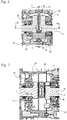
- Fig. 5 shows a view of the side wall 52 opposite the side wall 51. How Fig. 5 shows, the crankshaft 21 is mounted in the side wall 52 with a crankshaft bearing 48.
- the side wall 52 has a recess 54.
- the recess 54 is delimited at its inlet end 57 by an end wall 67 and at its outlet end 58 by an end wall 68.
- the two end walls 67 and 68 are connected to one another via a stiffening rib 50.
- the recess 54 runs along the outer circumference 61 of the second crankshaft bearing 48 and at a distance s from the outer circumference 61 of the crankshaft bearing 48.
- the circumferential wall 60 of the crankcase interior 40 is at a distance t from the axis of rotation 22 of the crankshaft 21.
- the distance s is advantageously less than 60%, in particular less than 30%, preferably less than 20% of the distance t.
- the recess 54 has a distance u from the axis of rotation 21 of the crankshaft 22 which is smaller than the distance t.
- the distance u is advantageously less than 90%, in particular less than 80%, preferably less than 75% of the distance t.
- the recess 43 advantageously has corresponding distances s and u.
- the recess 54 has a depth d measured radially to the axis of rotation 22, which preferably corresponds to the depth c of the recess 43 ( Fig.
- the end walls 65 and 67 and the end walls 66 and 68 are preferably approximately mirror-symmetrical to the center plane 44 ( Fig. 2 ) arranged.
- the stiffening ribs 49 and 50 are also preferably arranged at least partially symmetrically to the center plane 44.
- elevations 63 are arranged in the depressions 52 and 54, at which the depressions 53 and 54 have a smaller depth than the maximum depth c and d, respectively.
- the elevations 63 are advantageously formed by screw domes on the outside of the crankcase 39.
- the stiffening ribs 49 and 50 run in the bottom dead center of the piston 19 at a distance from the piston 19 so that the piston 19 cannot come into contact with the stiffening ribs 49 and 50.
- the mouth opening 31 is partially limited in the direction of the axis of rotation 22 by the end walls 66 and 68.
- the cylinder 38 and the orifice 31 of the at least one overflow channel 26 are arranged on the same side of the crankcase plane 45 in the exemplary embodiment.
- the crankcase plane 45 does not intersect the overflow duct 26.
- another arrangement can also be advantageous.
- the end walls 66 and 68 protrude to the collar 42.
- the arrangement of the end walls 65 to 68 and the Stiffening ribs 49 and 50 close to the cylinder 38 stiffen the crankcase 39 in the area in which the cylinder 38 is usually screwed to the crankcase 39.
- the end walls 65 to 68 and the stiffening ribs 49 and 50 increase the stability of the two-stroke engine 9 without the installation space of the two-stroke engine 1 increasing.
- the side walls 51 and 52 preferably run on the outer circumference 61 of the crankshaft bearings 47, 48 in sectional planes running perpendicular to the axis of rotation 22, which intersect the crankshaft bearings 47 and 48 in a central area between the end faces of the crankshaft bearings 47 and 48. This provides good support for the crankshaft bearings 47 and 48 and a favorable flow of forces.
- the recess 53 has a width b measured axially, that is to say in the direction of the axis of rotation 22.
- the recess 54 has a width e.
- the width e and the width b are advantageously of different sizes.
- the width e is in particular greater than the width b.
- the recesses 53 and 54 are therefore advantageously designed asymmetrically to the central plane 44, although the extent of the recesses 53 and 54 around the crankshaft bearings 47 and 48 is preferably approximately symmetrical to the central plane 44.
- the width b and the width e are significantly smaller than the width f of the crankshaft bearings 47 and 48 measured parallel to the axis of rotation 22.
- the width b, e of the recesses 53 and 54 is preferably at least 10% of the width f of the crankshaft bearing 47 and 48, respectively.
- the width b, e of the recesses 53 and 54 is preferably less than 60%, in particular less than 40% of the width f of the crankshaft bearings 47 and 48, respectively.
- the width b and e of the recesses 53 and 54 is preferably at least 5% of the stroke h ( Fig. 4 ) of the two-stroke engine 9.
- the width e and the width b are equal.
- the width e is smaller than the width b.
- the end wall 65 has a width i measured parallel to the axis of rotation 22.
- the end wall 68 has a width g measured parallel to the axis of rotation 22.
- the width g is greater than the width i in the exemplary embodiment.
- the width i is greater than the width g. In a further alternative embodiment it can also be provided that the width i and the width b are equal.
- the recess is open over an angle ⁇ of at least 45 ° and at most 320 ° around the axis of rotation of the crankshaft to the crankcase interior, and the recess extends over an angle that is greater than the angle ⁇ around the axis of rotation of the crankshaft .
- the recess 53, 54 is not open towards the crankcase interior over its entire length, but over a portion of its length.
- at least one end of the recess can be designed in the manner of a blind hole.
- a section of the recess is designed to be closed towards the crankcase interior in a region which is at a distance from the ends of the recess.
- the subsection of the length over which the recess is open towards the crankcase interior is advantageously at least 80% of the length of the recess.
Landscapes
- Engineering & Computer Science (AREA)
- Chemical & Material Sciences (AREA)
- Combustion & Propulsion (AREA)
- Mechanical Engineering (AREA)
- General Engineering & Computer Science (AREA)
- Cylinder Crankcases Of Internal Combustion Engines (AREA)
Priority Applications (1)
| Application Number | Priority Date | Filing Date | Title |
|---|---|---|---|
| EP19164939.1A EP3715599B1 (fr) | 2019-03-25 | 2019-03-25 | Moteur à deux temps |
Applications Claiming Priority (1)
| Application Number | Priority Date | Filing Date | Title |
|---|---|---|---|
| EP19164939.1A EP3715599B1 (fr) | 2019-03-25 | 2019-03-25 | Moteur à deux temps |
Publications (2)
| Publication Number | Publication Date |
|---|---|
| EP3715599A1 true EP3715599A1 (fr) | 2020-09-30 |
| EP3715599B1 EP3715599B1 (fr) | 2022-02-23 |
Family
ID=65955106
Family Applications (1)
| Application Number | Title | Priority Date | Filing Date |
|---|---|---|---|
| EP19164939.1A Active EP3715599B1 (fr) | 2019-03-25 | 2019-03-25 | Moteur à deux temps |
Country Status (1)
| Country | Link |
|---|---|
| EP (1) | EP3715599B1 (fr) |
Cited By (1)
| Publication number | Priority date | Publication date | Assignee | Title |
|---|---|---|---|---|
| IT202400000063A1 (it) * | 2024-01-04 | 2025-07-04 | Emak Spa | Motore a combustione interna a due tempi con sistema di travaso perfezionato |
Citations (7)
| Publication number | Priority date | Publication date | Assignee | Title |
|---|---|---|---|---|
| WO2012090256A1 (fr) | 2010-12-28 | 2012-07-05 | Husqvarna Zenoah Co., Ltd. | Moteur à deux temps |
| DE102012017514A1 (de) * | 2011-09-09 | 2013-03-14 | Andreas Stihl Ag & Co. Kg | "Zweitaktmotor und Verfahren zu dessen Betrieb" |
| DE102011120464A1 (de) | 2011-12-07 | 2013-06-13 | Andreas Stihl Ag & Co. Kg | Arbeitsgerät |
| CN103790690A (zh) | 2014-02-21 | 2014-05-14 | 浙江天泰机械有限公司 | 一种汽油机 |
| US8800509B2 (en) * | 2010-04-27 | 2014-08-12 | Mitsubishi Heavy Industries, Ltd. | Scavenging passage structure for two-stroke engine |
| US20160032816A1 (en) * | 2014-08-01 | 2016-02-04 | Honda Motor Co., Ltd. | Uniflow two-stroke engine |
| DE102015013786A1 (de) * | 2015-10-20 | 2017-04-20 | Andreas Stihl Ag & Co. Kg | Zweitaktmotor |
-
2019
- 2019-03-25 EP EP19164939.1A patent/EP3715599B1/fr active Active
Patent Citations (7)
| Publication number | Priority date | Publication date | Assignee | Title |
|---|---|---|---|---|
| US8800509B2 (en) * | 2010-04-27 | 2014-08-12 | Mitsubishi Heavy Industries, Ltd. | Scavenging passage structure for two-stroke engine |
| WO2012090256A1 (fr) | 2010-12-28 | 2012-07-05 | Husqvarna Zenoah Co., Ltd. | Moteur à deux temps |
| DE102012017514A1 (de) * | 2011-09-09 | 2013-03-14 | Andreas Stihl Ag & Co. Kg | "Zweitaktmotor und Verfahren zu dessen Betrieb" |
| DE102011120464A1 (de) | 2011-12-07 | 2013-06-13 | Andreas Stihl Ag & Co. Kg | Arbeitsgerät |
| CN103790690A (zh) | 2014-02-21 | 2014-05-14 | 浙江天泰机械有限公司 | 一种汽油机 |
| US20160032816A1 (en) * | 2014-08-01 | 2016-02-04 | Honda Motor Co., Ltd. | Uniflow two-stroke engine |
| DE102015013786A1 (de) * | 2015-10-20 | 2017-04-20 | Andreas Stihl Ag & Co. Kg | Zweitaktmotor |
Cited By (2)
| Publication number | Priority date | Publication date | Assignee | Title |
|---|---|---|---|---|
| IT202400000063A1 (it) * | 2024-01-04 | 2025-07-04 | Emak Spa | Motore a combustione interna a due tempi con sistema di travaso perfezionato |
| WO2025146578A1 (fr) * | 2024-01-04 | 2025-07-10 | Emak S.P.A. | Moteur à combustion interne à deux temps avec système de transfert amélioré |
Also Published As
| Publication number | Publication date |
|---|---|
| EP3715599B1 (fr) | 2022-02-23 |
Similar Documents
| Publication | Publication Date | Title |
|---|---|---|
| DE69230869T2 (de) | Handmaschinenwerkzeug mit einer Viertaktbrennkraftmaschine | |
| DE19512566C2 (de) | Zweitaktmotor mit mehreren Überströmkanälen | |
| DE102009030593B4 (de) | Vergaser und Zweitaktmotor mit einem Vergaser | |
| DE102012025321B4 (de) | Vergaser für ein handgeführtes Arbeitsgerät und handgeführtes Arbeitsgerät | |
| DE10197237T5 (de) | Motor mit innerer Verbrennung und Kurbelgehäusespülung | |
| EP3284938B1 (fr) | Piston pour un moteur a deux temps dote d'un pot catalytique et moteur deux temps | |
| EP3284939B1 (fr) | Piston pour un moteur a deux temps dote d'un pot catalytique et moteur deux temps | |
| EP1141529A1 (fr) | Moteur deux temps a stratification de la charge | |
| EP3748151B1 (fr) | Unité de formation de mélange et moteur à deux temps doté d'une unité de formation de mélange | |
| DE10321571A1 (de) | Zweitaktmotor mit Spülvorlage | |
| DE102007054929B4 (de) | Handgeführtes Arbeitsgerät | |
| DE10064719B4 (de) | Zweitaktmotor mit Ladungsschichtung | |
| DE102013009669B4 (de) | Verbrennungsmotor mit einer Starteinrichtung | |
| EP3315273B1 (fr) | Appareil de travail portatif | |
| EP3715599B1 (fr) | Moteur à deux temps | |
| DE102009059145A1 (de) | Verbrennungsmotor | |
| DE102010045017B4 (de) | Zweitaktmotor | |
| DE102015013785B4 (de) | Zweitaktmotor und Baureihe von Zweitaktmotoren | |
| DE102012004322B4 (de) | Zweitaktmotor mit einer Ansaugvorrichtung | |
| DE102023117841A1 (de) | Abgasschalldämpfer und Auslassstutzen für einen Abgasschalldämpfer | |
| DE102010045016B4 (de) | Handgeführtes Arbeitsgerät | |
| DE102006001570A1 (de) | Arbeitsgerät | |
| DE19953126B4 (de) | Kurzhubiger Verbrennungsmotor | |
| DE10232341A1 (de) | Vergaser | |
| DE102015013784B4 (de) | Handgeführtes Arbeitsgerät mit einem luftgekühlten Verbrennungsmotor |
Legal Events
| Date | Code | Title | Description |
|---|---|---|---|
| PUAI | Public reference made under article 153(3) epc to a published international application that has entered the european phase |
Free format text: ORIGINAL CODE: 0009012 |
|
| STAA | Information on the status of an ep patent application or granted ep patent |
Free format text: STATUS: THE APPLICATION HAS BEEN PUBLISHED |
|
| AK | Designated contracting states |
Kind code of ref document: A1 Designated state(s): AL AT BE BG CH CY CZ DE DK EE ES FI FR GB GR HR HU IE IS IT LI LT LU LV MC MK MT NL NO PL PT RO RS SE SI SK SM TR |
|
| AX | Request for extension of the european patent |
Extension state: BA ME |
|
| STAA | Information on the status of an ep patent application or granted ep patent |
Free format text: STATUS: REQUEST FOR EXAMINATION WAS MADE |
|
| 17P | Request for examination filed |
Effective date: 20210316 |
|
| RBV | Designated contracting states (corrected) |
Designated state(s): AL AT BE BG CH CY CZ DE DK EE ES FI FR GB GR HR HU IE IS IT LI LT LU LV MC MK MT NL NO PL PT RO RS SE SI SK SM TR |
|
| RIC1 | Information provided on ipc code assigned before grant |
Ipc: F02B 75/02 20060101ALN20210802BHEP Ipc: F02F 7/00 20060101ALI20210802BHEP Ipc: F02M 35/10 20060101ALI20210802BHEP Ipc: F02B 63/02 20060101AFI20210802BHEP |
|
| GRAP | Despatch of communication of intention to grant a patent |
Free format text: ORIGINAL CODE: EPIDOSNIGR1 |
|
| STAA | Information on the status of an ep patent application or granted ep patent |
Free format text: STATUS: GRANT OF PATENT IS INTENDED |
|
| INTG | Intention to grant announced |
Effective date: 20210917 |
|
| GRAS | Grant fee paid |
Free format text: ORIGINAL CODE: EPIDOSNIGR3 |
|
| GRAA | (expected) grant |
Free format text: ORIGINAL CODE: 0009210 |
|
| STAA | Information on the status of an ep patent application or granted ep patent |
Free format text: STATUS: THE PATENT HAS BEEN GRANTED |
|
| AK | Designated contracting states |
Kind code of ref document: B1 Designated state(s): AL AT BE BG CH CY CZ DE DK EE ES FI FR GB GR HR HU IE IS IT LI LT LU LV MC MK MT NL NO PL PT RO RS SE SI SK SM TR |
|
| REG | Reference to a national code |
Ref country code: GB Ref legal event code: FG4D Free format text: NOT ENGLISH |
|
| REG | Reference to a national code |
Ref country code: CH Ref legal event code: EP |
|
| REG | Reference to a national code |
Ref country code: AT Ref legal event code: REF Ref document number: 1470632 Country of ref document: AT Kind code of ref document: T Effective date: 20220315 |
|
| REG | Reference to a national code |
Ref country code: IE Ref legal event code: FG4D Free format text: LANGUAGE OF EP DOCUMENT: GERMAN |
|
| REG | Reference to a national code |
Ref country code: DE Ref legal event code: R096 Ref document number: 502019003453 Country of ref document: DE |
|
| REG | Reference to a national code |
Ref country code: LT Ref legal event code: MG9D |
|
| REG | Reference to a national code |
Ref country code: NL Ref legal event code: MP Effective date: 20220223 |
|
| PG25 | Lapsed in a contracting state [announced via postgrant information from national office to epo] |
Ref country code: SE Free format text: LAPSE BECAUSE OF FAILURE TO SUBMIT A TRANSLATION OF THE DESCRIPTION OR TO PAY THE FEE WITHIN THE PRESCRIBED TIME-LIMIT Effective date: 20220223 Ref country code: RS Free format text: LAPSE BECAUSE OF FAILURE TO SUBMIT A TRANSLATION OF THE DESCRIPTION OR TO PAY THE FEE WITHIN THE PRESCRIBED TIME-LIMIT Effective date: 20220223 Ref country code: PT Free format text: LAPSE BECAUSE OF FAILURE TO SUBMIT A TRANSLATION OF THE DESCRIPTION OR TO PAY THE FEE WITHIN THE PRESCRIBED TIME-LIMIT Effective date: 20220623 Ref country code: NO Free format text: LAPSE BECAUSE OF FAILURE TO SUBMIT A TRANSLATION OF THE DESCRIPTION OR TO PAY THE FEE WITHIN THE PRESCRIBED TIME-LIMIT Effective date: 20220523 Ref country code: NL Free format text: LAPSE BECAUSE OF FAILURE TO SUBMIT A TRANSLATION OF THE DESCRIPTION OR TO PAY THE FEE WITHIN THE PRESCRIBED TIME-LIMIT Effective date: 20220223 Ref country code: LT Free format text: LAPSE BECAUSE OF FAILURE TO SUBMIT A TRANSLATION OF THE DESCRIPTION OR TO PAY THE FEE WITHIN THE PRESCRIBED TIME-LIMIT Effective date: 20220223 Ref country code: HR Free format text: LAPSE BECAUSE OF FAILURE TO SUBMIT A TRANSLATION OF THE DESCRIPTION OR TO PAY THE FEE WITHIN THE PRESCRIBED TIME-LIMIT Effective date: 20220223 Ref country code: ES Free format text: LAPSE BECAUSE OF FAILURE TO SUBMIT A TRANSLATION OF THE DESCRIPTION OR TO PAY THE FEE WITHIN THE PRESCRIBED TIME-LIMIT Effective date: 20220223 Ref country code: BG Free format text: LAPSE BECAUSE OF FAILURE TO SUBMIT A TRANSLATION OF THE DESCRIPTION OR TO PAY THE FEE WITHIN THE PRESCRIBED TIME-LIMIT Effective date: 20220523 |
|
| PG25 | Lapsed in a contracting state [announced via postgrant information from national office to epo] |
Ref country code: PL Free format text: LAPSE BECAUSE OF FAILURE TO SUBMIT A TRANSLATION OF THE DESCRIPTION OR TO PAY THE FEE WITHIN THE PRESCRIBED TIME-LIMIT Effective date: 20220223 Ref country code: LV Free format text: LAPSE BECAUSE OF FAILURE TO SUBMIT A TRANSLATION OF THE DESCRIPTION OR TO PAY THE FEE WITHIN THE PRESCRIBED TIME-LIMIT Effective date: 20220223 Ref country code: GR Free format text: LAPSE BECAUSE OF FAILURE TO SUBMIT A TRANSLATION OF THE DESCRIPTION OR TO PAY THE FEE WITHIN THE PRESCRIBED TIME-LIMIT Effective date: 20220524 Ref country code: FI Free format text: LAPSE BECAUSE OF FAILURE TO SUBMIT A TRANSLATION OF THE DESCRIPTION OR TO PAY THE FEE WITHIN THE PRESCRIBED TIME-LIMIT Effective date: 20220223 |
|
| PG25 | Lapsed in a contracting state [announced via postgrant information from national office to epo] |
Ref country code: IS Free format text: LAPSE BECAUSE OF FAILURE TO SUBMIT A TRANSLATION OF THE DESCRIPTION OR TO PAY THE FEE WITHIN THE PRESCRIBED TIME-LIMIT Effective date: 20220623 |
|
| PG25 | Lapsed in a contracting state [announced via postgrant information from national office to epo] |
Ref country code: SM Free format text: LAPSE BECAUSE OF FAILURE TO SUBMIT A TRANSLATION OF THE DESCRIPTION OR TO PAY THE FEE WITHIN THE PRESCRIBED TIME-LIMIT Effective date: 20220223 Ref country code: SK Free format text: LAPSE BECAUSE OF FAILURE TO SUBMIT A TRANSLATION OF THE DESCRIPTION OR TO PAY THE FEE WITHIN THE PRESCRIBED TIME-LIMIT Effective date: 20220223 Ref country code: RO Free format text: LAPSE BECAUSE OF FAILURE TO SUBMIT A TRANSLATION OF THE DESCRIPTION OR TO PAY THE FEE WITHIN THE PRESCRIBED TIME-LIMIT Effective date: 20220223 Ref country code: EE Free format text: LAPSE BECAUSE OF FAILURE TO SUBMIT A TRANSLATION OF THE DESCRIPTION OR TO PAY THE FEE WITHIN THE PRESCRIBED TIME-LIMIT Effective date: 20220223 Ref country code: DK Free format text: LAPSE BECAUSE OF FAILURE TO SUBMIT A TRANSLATION OF THE DESCRIPTION OR TO PAY THE FEE WITHIN THE PRESCRIBED TIME-LIMIT Effective date: 20220223 Ref country code: CZ Free format text: LAPSE BECAUSE OF FAILURE TO SUBMIT A TRANSLATION OF THE DESCRIPTION OR TO PAY THE FEE WITHIN THE PRESCRIBED TIME-LIMIT Effective date: 20220223 |
|
| REG | Reference to a national code |
Ref country code: CH Ref legal event code: PL |
|
| REG | Reference to a national code |
Ref country code: DE Ref legal event code: R097 Ref document number: 502019003453 Country of ref document: DE |
|
| PG25 | Lapsed in a contracting state [announced via postgrant information from national office to epo] |
Ref country code: MC Free format text: LAPSE BECAUSE OF FAILURE TO SUBMIT A TRANSLATION OF THE DESCRIPTION OR TO PAY THE FEE WITHIN THE PRESCRIBED TIME-LIMIT Effective date: 20220223 Ref country code: AL Free format text: LAPSE BECAUSE OF FAILURE TO SUBMIT A TRANSLATION OF THE DESCRIPTION OR TO PAY THE FEE WITHIN THE PRESCRIBED TIME-LIMIT Effective date: 20220223 |
|
| REG | Reference to a national code |
Ref country code: BE Ref legal event code: MM Effective date: 20220331 |
|
| PLBE | No opposition filed within time limit |
Free format text: ORIGINAL CODE: 0009261 |
|
| STAA | Information on the status of an ep patent application or granted ep patent |
Free format text: STATUS: NO OPPOSITION FILED WITHIN TIME LIMIT |
|
| PG25 | Lapsed in a contracting state [announced via postgrant information from national office to epo] |
Ref country code: LU Free format text: LAPSE BECAUSE OF NON-PAYMENT OF DUE FEES Effective date: 20220325 Ref country code: LI Free format text: LAPSE BECAUSE OF NON-PAYMENT OF DUE FEES Effective date: 20220331 Ref country code: IE Free format text: LAPSE BECAUSE OF NON-PAYMENT OF DUE FEES Effective date: 20220325 Ref country code: FR Free format text: LAPSE BECAUSE OF NON-PAYMENT OF DUE FEES Effective date: 20220423 Ref country code: CH Free format text: LAPSE BECAUSE OF NON-PAYMENT OF DUE FEES Effective date: 20220331 |
|
| 26N | No opposition filed |
Effective date: 20221124 |
|
| PG25 | Lapsed in a contracting state [announced via postgrant information from national office to epo] |
Ref country code: SI Free format text: LAPSE BECAUSE OF FAILURE TO SUBMIT A TRANSLATION OF THE DESCRIPTION OR TO PAY THE FEE WITHIN THE PRESCRIBED TIME-LIMIT Effective date: 20220223 Ref country code: BE Free format text: LAPSE BECAUSE OF NON-PAYMENT OF DUE FEES Effective date: 20220331 |
|
| PG25 | Lapsed in a contracting state [announced via postgrant information from national office to epo] |
Ref country code: IT Free format text: LAPSE BECAUSE OF FAILURE TO SUBMIT A TRANSLATION OF THE DESCRIPTION OR TO PAY THE FEE WITHIN THE PRESCRIBED TIME-LIMIT Effective date: 20220223 |
|
| GBPC | Gb: european patent ceased through non-payment of renewal fee |
Effective date: 20230325 |
|
| PG25 | Lapsed in a contracting state [announced via postgrant information from national office to epo] |
Ref country code: GB Free format text: LAPSE BECAUSE OF NON-PAYMENT OF DUE FEES Effective date: 20230325 |
|
| PG25 | Lapsed in a contracting state [announced via postgrant information from national office to epo] |
Ref country code: GB Free format text: LAPSE BECAUSE OF NON-PAYMENT OF DUE FEES Effective date: 20230325 |
|
| PG25 | Lapsed in a contracting state [announced via postgrant information from national office to epo] |
Ref country code: MK Free format text: LAPSE BECAUSE OF FAILURE TO SUBMIT A TRANSLATION OF THE DESCRIPTION OR TO PAY THE FEE WITHIN THE PRESCRIBED TIME-LIMIT Effective date: 20220223 Ref country code: CY Free format text: LAPSE BECAUSE OF FAILURE TO SUBMIT A TRANSLATION OF THE DESCRIPTION OR TO PAY THE FEE WITHIN THE PRESCRIBED TIME-LIMIT Effective date: 20220223 |
|
| PG25 | Lapsed in a contracting state [announced via postgrant information from national office to epo] |
Ref country code: HU Free format text: LAPSE BECAUSE OF FAILURE TO SUBMIT A TRANSLATION OF THE DESCRIPTION OR TO PAY THE FEE WITHIN THE PRESCRIBED TIME-LIMIT; INVALID AB INITIO Effective date: 20190325 |
|
| PG25 | Lapsed in a contracting state [announced via postgrant information from national office to epo] |
Ref country code: TR Free format text: LAPSE BECAUSE OF FAILURE TO SUBMIT A TRANSLATION OF THE DESCRIPTION OR TO PAY THE FEE WITHIN THE PRESCRIBED TIME-LIMIT Effective date: 20220223 |
|
| PG25 | Lapsed in a contracting state [announced via postgrant information from national office to epo] |
Ref country code: MT Free format text: LAPSE BECAUSE OF FAILURE TO SUBMIT A TRANSLATION OF THE DESCRIPTION OR TO PAY THE FEE WITHIN THE PRESCRIBED TIME-LIMIT Effective date: 20220223 |
|
| REG | Reference to a national code |
Ref country code: AT Ref legal event code: MM01 Ref document number: 1470632 Country of ref document: AT Kind code of ref document: T Effective date: 20240325 |
|
| PG25 | Lapsed in a contracting state [announced via postgrant information from national office to epo] |
Ref country code: AT Free format text: LAPSE BECAUSE OF NON-PAYMENT OF DUE FEES Effective date: 20240325 |
|
| PGFP | Annual fee paid to national office [announced via postgrant information from national office to epo] |
Ref country code: DE Payment date: 20260320 Year of fee payment: 8 |
|
| PGFP | Annual fee paid to national office [announced via postgrant information from national office to epo] |
Ref country code: AT Payment date: 20260410 Year of fee payment: 5 |