EP3716372A1 - Aktivmaterial einer positiven elektrode für sekundärbatterie mit wasserfreiem elektrolyt und verfahren zur herstellung von aktivmaterial einer positiven elektrode für sekundärbatterie mit wasserfreiem elektrolyt - Google Patents
Aktivmaterial einer positiven elektrode für sekundärbatterie mit wasserfreiem elektrolyt und verfahren zur herstellung von aktivmaterial einer positiven elektrode für sekundärbatterie mit wasserfreiem elektrolyt Download PDFInfo
- Publication number
- EP3716372A1 EP3716372A1 EP18880527.9A EP18880527A EP3716372A1 EP 3716372 A1 EP3716372 A1 EP 3716372A1 EP 18880527 A EP18880527 A EP 18880527A EP 3716372 A1 EP3716372 A1 EP 3716372A1
- Authority
- EP
- European Patent Office
- Prior art keywords
- lithium
- complex oxide
- nickel complex
- tungsten
- particles
- Prior art date
- Legal status (The legal status is an assumption and is not a legal conclusion. Google has not performed a legal analysis and makes no representation as to the accuracy of the status listed.)
- Pending
Links
- 239000011255 nonaqueous electrolyte Substances 0.000 title claims abstract description 48
- 238000000034 method Methods 0.000 title claims description 65
- 238000004519 manufacturing process Methods 0.000 title claims description 14
- 239000007774 positive electrode material Substances 0.000 title 2
- 239000002245 particle Substances 0.000 claims abstract description 145
- 229910021440 lithium nickel complex oxide Inorganic materials 0.000 claims abstract description 136
- WFKWXMTUELFFGS-UHFFFAOYSA-N tungsten Chemical compound [W] WFKWXMTUELFFGS-UHFFFAOYSA-N 0.000 claims abstract description 108
- 229910052744 lithium Inorganic materials 0.000 claims abstract description 106
- 229910052721 tungsten Inorganic materials 0.000 claims abstract description 106
- 239000010937 tungsten Substances 0.000 claims abstract description 104
- WHXSMMKQMYFTQS-UHFFFAOYSA-N Lithium Chemical compound [Li] WHXSMMKQMYFTQS-UHFFFAOYSA-N 0.000 claims abstract description 100
- 239000006182 cathode active material Substances 0.000 claims abstract description 70
- 150000001875 compounds Chemical class 0.000 claims abstract description 47
- 239000011164 primary particle Substances 0.000 claims abstract description 40
- 239000011163 secondary particle Substances 0.000 claims abstract description 32
- 229910013402 LizNi1-x-yCoxMyO2 Inorganic materials 0.000 claims abstract description 8
- ZNOKGRXACCSDPY-UHFFFAOYSA-N tungsten trioxide Chemical compound O=[W](=O)=O ZNOKGRXACCSDPY-UHFFFAOYSA-N 0.000 claims description 144
- 239000000203 mixture Substances 0.000 claims description 56
- 238000010438 heat treatment Methods 0.000 claims description 55
- 230000008569 process Effects 0.000 claims description 55
- 238000002156 mixing Methods 0.000 claims description 30
- XLYOFNOQVPJJNP-UHFFFAOYSA-N water Substances O XLYOFNOQVPJJNP-UHFFFAOYSA-N 0.000 claims description 28
- 230000001186 cumulative effect Effects 0.000 claims description 23
- 229910052782 aluminium Inorganic materials 0.000 claims description 15
- 229910052748 manganese Inorganic materials 0.000 claims description 10
- 229910052758 niobium Inorganic materials 0.000 claims description 10
- 229910052719 titanium Inorganic materials 0.000 claims description 10
- 229910052720 vanadium Inorganic materials 0.000 claims description 10
- 238000002441 X-ray diffraction Methods 0.000 claims description 6
- AAWZNWVCESLFTD-UHFFFAOYSA-N tungsten;hydrate Chemical compound O.[W] AAWZNWVCESLFTD-UHFFFAOYSA-N 0.000 claims description 6
- PXHVJJICTQNCMI-UHFFFAOYSA-N nickel Substances [Ni] PXHVJJICTQNCMI-UHFFFAOYSA-N 0.000 description 36
- 239000000463 material Substances 0.000 description 33
- 230000000052 comparative effect Effects 0.000 description 18
- 239000007784 solid electrolyte Substances 0.000 description 17
- QVGXLLKOCUKJST-UHFFFAOYSA-N atomic oxygen Chemical compound [O] QVGXLLKOCUKJST-UHFFFAOYSA-N 0.000 description 16
- 238000006243 chemical reaction Methods 0.000 description 16
- 229910052760 oxygen Inorganic materials 0.000 description 16
- 239000001301 oxygen Substances 0.000 description 16
- 239000012298 atmosphere Substances 0.000 description 15
- 150000002642 lithium compounds Chemical class 0.000 description 14
- 229910052759 nickel Inorganic materials 0.000 description 14
- OKTJSMMVPCPJKN-UHFFFAOYSA-N Carbon Chemical compound [C] OKTJSMMVPCPJKN-UHFFFAOYSA-N 0.000 description 12
- HBBGRARXTFLTSG-UHFFFAOYSA-N Lithium ion Chemical compound [Li+] HBBGRARXTFLTSG-UHFFFAOYSA-N 0.000 description 12
- 229910001416 lithium ion Inorganic materials 0.000 description 12
- -1 natural graphite Chemical compound 0.000 description 11
- 239000002002 slurry Substances 0.000 description 10
- 239000011230 binding agent Substances 0.000 description 9
- 239000008151 electrolyte solution Substances 0.000 description 9
- 239000002994 raw material Substances 0.000 description 9
- 239000000843 powder Substances 0.000 description 8
- 238000003756 stirring Methods 0.000 description 8
- 238000005406 washing Methods 0.000 description 8
- WMFOQBRAJBCJND-UHFFFAOYSA-M Lithium hydroxide Chemical compound [Li+].[OH-] WMFOQBRAJBCJND-UHFFFAOYSA-M 0.000 description 7
- 238000011156 evaluation Methods 0.000 description 7
- 238000009826 distribution Methods 0.000 description 6
- 238000003801 milling Methods 0.000 description 6
- 239000002904 solvent Substances 0.000 description 6
- 239000004020 conductor Substances 0.000 description 5
- 150000004696 coordination complex Chemical class 0.000 description 5
- 238000010304 firing Methods 0.000 description 5
- 239000007789 gas Substances 0.000 description 5
- 229910052751 metal Inorganic materials 0.000 description 5
- 239000002184 metal Substances 0.000 description 5
- SECXISVLQFMRJM-UHFFFAOYSA-N N-Methylpyrrolidone Chemical compound CN1CCCC1=O SECXISVLQFMRJM-UHFFFAOYSA-N 0.000 description 4
- 239000006183 anode active material Substances 0.000 description 4
- 239000010406 cathode material Substances 0.000 description 4
- 239000011248 coating agent Substances 0.000 description 4
- 238000000576 coating method Methods 0.000 description 4
- GUTLYIVDDKVIGB-UHFFFAOYSA-N cobalt atom Chemical group [Co] GUTLYIVDDKVIGB-UHFFFAOYSA-N 0.000 description 4
- 238000002149 energy-dispersive X-ray emission spectroscopy Methods 0.000 description 4
- 239000003960 organic solvent Substances 0.000 description 4
- 230000001590 oxidative effect Effects 0.000 description 4
- 238000012552 review Methods 0.000 description 4
- 150000003839 salts Chemical class 0.000 description 4
- OIFBSDVPJOWBCH-UHFFFAOYSA-N Diethyl carbonate Chemical compound CCOC(=O)OCC OIFBSDVPJOWBCH-UHFFFAOYSA-N 0.000 description 3
- KMTRUDSVKNLOMY-UHFFFAOYSA-N Ethylene carbonate Chemical compound O=C1OCCO1 KMTRUDSVKNLOMY-UHFFFAOYSA-N 0.000 description 3
- 239000002033 PVDF binder Substances 0.000 description 3
- UCKMPCXJQFINFW-UHFFFAOYSA-N Sulphide Chemical compound [S-2] UCKMPCXJQFINFW-UHFFFAOYSA-N 0.000 description 3
- 239000003792 electrolyte Substances 0.000 description 3
- 238000001914 filtration Methods 0.000 description 3
- 229910003480 inorganic solid Inorganic materials 0.000 description 3
- 238000007561 laser diffraction method Methods 0.000 description 3
- 229910001386 lithium phosphate Inorganic materials 0.000 description 3
- 238000005259 measurement Methods 0.000 description 3
- 238000013508 migration Methods 0.000 description 3
- 230000005012 migration Effects 0.000 description 3
- 229920001343 polytetrafluoroethylene Polymers 0.000 description 3
- 239000004810 polytetrafluoroethylene Substances 0.000 description 3
- 229920002981 polyvinylidene fluoride Polymers 0.000 description 3
- 238000000790 scattering method Methods 0.000 description 3
- XKRFYHLGVUSROY-UHFFFAOYSA-N Argon Chemical compound [Ar] XKRFYHLGVUSROY-UHFFFAOYSA-N 0.000 description 2
- YCKRFDGAMUMZLT-UHFFFAOYSA-N Fluorine atom Chemical compound [F] YCKRFDGAMUMZLT-UHFFFAOYSA-N 0.000 description 2
- 229910000733 Li alloy Inorganic materials 0.000 description 2
- 229910007780 Li2W2O7 Inorganic materials 0.000 description 2
- 239000004698 Polyethylene Substances 0.000 description 2
- WYURNTSHIVDZCO-UHFFFAOYSA-N Tetrahydrofuran Chemical compound C1CCOC1 WYURNTSHIVDZCO-UHFFFAOYSA-N 0.000 description 2
- 239000006230 acetylene black Substances 0.000 description 2
- 229910021383 artificial graphite Inorganic materials 0.000 description 2
- 229910052799 carbon Inorganic materials 0.000 description 2
- 239000002131 composite material Substances 0.000 description 2
- 238000002425 crystallisation Methods 0.000 description 2
- QHGJSLXSVXVKHZ-UHFFFAOYSA-N dilithium;dioxido(dioxo)manganese Chemical compound [Li+].[Li+].[O-][Mn]([O-])(=O)=O QHGJSLXSVXVKHZ-UHFFFAOYSA-N 0.000 description 2
- 238000004090 dissolution Methods 0.000 description 2
- 238000001035 drying Methods 0.000 description 2
- 230000000694 effects Effects 0.000 description 2
- 238000000921 elemental analysis Methods 0.000 description 2
- 238000001704 evaporation Methods 0.000 description 2
- 239000011737 fluorine Substances 0.000 description 2
- 229910052731 fluorine Inorganic materials 0.000 description 2
- 239000011888 foil Substances 0.000 description 2
- 229910002804 graphite Inorganic materials 0.000 description 2
- 239000010439 graphite Substances 0.000 description 2
- 239000011261 inert gas Substances 0.000 description 2
- 238000004898 kneading Methods 0.000 description 2
- 239000001989 lithium alloy Substances 0.000 description 2
- XGZVUEUWXADBQD-UHFFFAOYSA-L lithium carbonate Chemical compound [Li+].[Li+].[O-]C([O-])=O XGZVUEUWXADBQD-UHFFFAOYSA-L 0.000 description 2
- 229910052808 lithium carbonate Inorganic materials 0.000 description 2
- MHCFAGZWMAWTNR-UHFFFAOYSA-M lithium perchlorate Chemical compound [Li+].[O-]Cl(=O)(=O)=O MHCFAGZWMAWTNR-UHFFFAOYSA-M 0.000 description 2
- 229910001486 lithium perchlorate Inorganic materials 0.000 description 2
- 229910003002 lithium salt Inorganic materials 0.000 description 2
- 159000000002 lithium salts Chemical class 0.000 description 2
- 238000012986 modification Methods 0.000 description 2
- 230000004048 modification Effects 0.000 description 2
- 229910021382 natural graphite Inorganic materials 0.000 description 2
- 229920000573 polyethylene Polymers 0.000 description 2
- 230000009257 reactivity Effects 0.000 description 2
- 229920005989 resin Polymers 0.000 description 2
- 239000011347 resin Substances 0.000 description 2
- 239000007787 solid Substances 0.000 description 2
- 239000000243 solution Substances 0.000 description 2
- 229910052596 spinel Inorganic materials 0.000 description 2
- 239000011029 spinel Substances 0.000 description 2
- 239000000126 substance Substances 0.000 description 2
- TWQULNDIKKJZPH-UHFFFAOYSA-K trilithium;phosphate Chemical compound [Li+].[Li+].[Li+].[O-]P([O-])([O-])=O TWQULNDIKKJZPH-UHFFFAOYSA-K 0.000 description 2
- PBYZMCDFOULPGH-UHFFFAOYSA-N tungstate Chemical compound [O-][W]([O-])(=O)=O PBYZMCDFOULPGH-UHFFFAOYSA-N 0.000 description 2
- ZZXUZKXVROWEIF-UHFFFAOYSA-N 1,2-butylene carbonate Chemical compound CCC1COC(=O)O1 ZZXUZKXVROWEIF-UHFFFAOYSA-N 0.000 description 1
- YBJCDTIWNDBNTM-UHFFFAOYSA-N 1-methylsulfonylethane Chemical compound CCS(C)(=O)=O YBJCDTIWNDBNTM-UHFFFAOYSA-N 0.000 description 1
- RNFJDJUURJAICM-UHFFFAOYSA-N 2,2,4,4,6,6-hexaphenoxy-1,3,5-triaza-2$l^{5},4$l^{5},6$l^{5}-triphosphacyclohexa-1,3,5-triene Chemical compound N=1P(OC=2C=CC=CC=2)(OC=2C=CC=CC=2)=NP(OC=2C=CC=CC=2)(OC=2C=CC=CC=2)=NP=1(OC=1C=CC=CC=1)OC1=CC=CC=C1 RNFJDJUURJAICM-UHFFFAOYSA-N 0.000 description 1
- YEVQZPWSVWZAOB-UHFFFAOYSA-N 2-(bromomethyl)-1-iodo-4-(trifluoromethyl)benzene Chemical compound FC(F)(F)C1=CC=C(I)C(CBr)=C1 YEVQZPWSVWZAOB-UHFFFAOYSA-N 0.000 description 1
- JWUJQDFVADABEY-UHFFFAOYSA-N 2-methyltetrahydrofuran Chemical compound CC1CCCO1 JWUJQDFVADABEY-UHFFFAOYSA-N 0.000 description 1
- GKZFQPGIDVGTLZ-UHFFFAOYSA-N 4-(trifluoromethyl)-1,3-dioxolan-2-one Chemical compound FC(F)(F)C1COC(=O)O1 GKZFQPGIDVGTLZ-UHFFFAOYSA-N 0.000 description 1
- RYGMFSIKBFXOCR-UHFFFAOYSA-N Copper Chemical compound [Cu] RYGMFSIKBFXOCR-UHFFFAOYSA-N 0.000 description 1
- XTHFKEDIFFGKHM-UHFFFAOYSA-N Dimethoxyethane Chemical compound COCCOC XTHFKEDIFFGKHM-UHFFFAOYSA-N 0.000 description 1
- 229920002943 EPDM rubber Polymers 0.000 description 1
- 229910006194 Li1+xAlxGe2-x(PO4)3 Inorganic materials 0.000 description 1
- 229910006196 Li1+xAlxGe2−x(PO4)3 Inorganic materials 0.000 description 1
- 229910006210 Li1+xAlxTi2-x(PO4)3 Inorganic materials 0.000 description 1
- 229910006212 Li1+xAlxTi2−x(PO4)3 Inorganic materials 0.000 description 1
- 229910011498 Li18W5O15 Inorganic materials 0.000 description 1
- 229910008745 Li2O-B2O3-P2O5 Inorganic materials 0.000 description 1
- 229910008523 Li2O-B2O3-ZnO Inorganic materials 0.000 description 1
- 229910008590 Li2O—B2O3—P2O5 Inorganic materials 0.000 description 1
- 229910008627 Li2O—B2O3—ZnO Inorganic materials 0.000 description 1
- 229910008656 Li2O—SiO2 Inorganic materials 0.000 description 1
- 229910009297 Li2S-P2S5 Inorganic materials 0.000 description 1
- 229910009311 Li2S-SiS2 Inorganic materials 0.000 description 1
- 229910007562 Li2SiO3 Inorganic materials 0.000 description 1
- 229910009228 Li2S—P2S5 Inorganic materials 0.000 description 1
- 229910009433 Li2S—SiS2 Inorganic materials 0.000 description 1
- 229910007781 Li2W4O13 Inorganic materials 0.000 description 1
- 229910007778 Li2W5O16 Inorganic materials 0.000 description 1
- 229910007786 Li2WO4 Inorganic materials 0.000 description 1
- 229910012316 Li3.6Si0.6P0.4O4 Inorganic materials 0.000 description 1
- 229910012722 Li3N-LiI-LiOH Inorganic materials 0.000 description 1
- 229910012716 Li3N-LiI—LiOH Inorganic materials 0.000 description 1
- 229910012734 Li3N—LiI—LiOH Inorganic materials 0.000 description 1
- 229910013043 Li3PO4-Li2S-SiS2 Inorganic materials 0.000 description 1
- 229910013035 Li3PO4-Li2S—SiS2 Inorganic materials 0.000 description 1
- 229910012810 Li3PO4—Li2S-SiS2 Inorganic materials 0.000 description 1
- 229910012804 Li3PO4—Li2S—Si2S Inorganic materials 0.000 description 1
- 229910012797 Li3PO4—Li2S—SiS2 Inorganic materials 0.000 description 1
- 229910011321 Li3W10O30 Inorganic materials 0.000 description 1
- 229910011244 Li3xLa2/3-xTiO3 Inorganic materials 0.000 description 1
- 229910011245 Li3xLa2/3−xTiO3 Inorganic materials 0.000 description 1
- 229910012050 Li4SiO4-Li3PO4 Inorganic materials 0.000 description 1
- 229910012053 Li4SiO4-Li3VO4 Inorganic materials 0.000 description 1
- 229910012069 Li4SiO4—Li3PO4 Inorganic materials 0.000 description 1
- 229910012072 Li4SiO4—Li3VO4 Inorganic materials 0.000 description 1
- 229910010557 Li4WO5 Inorganic materials 0.000 description 1
- 229910010712 Li5La3Ta2O12 Inorganic materials 0.000 description 1
- 239000002225 Li5La3Ta2O12 Substances 0.000 description 1
- 229910010865 Li6W2O9 Inorganic materials 0.000 description 1
- 229910010866 Li6WO6 Inorganic materials 0.000 description 1
- 229910002984 Li7La3Zr2O12 Inorganic materials 0.000 description 1
- 229910009694 Li9W19O55 Inorganic materials 0.000 description 1
- 229910013178 LiBO2 Inorganic materials 0.000 description 1
- 229910010835 LiI-Li2S-P2S5 Inorganic materials 0.000 description 1
- 229910010833 LiI-Li2S-SiS2 Inorganic materials 0.000 description 1
- 229910010823 LiI—Li2S—B2S3 Inorganic materials 0.000 description 1
- 229910010842 LiI—Li2S—P2O5 Inorganic materials 0.000 description 1
- 229910010840 LiI—Li2S—P2S5 Inorganic materials 0.000 description 1
- 229910010855 LiI—Li2S—SiS2 Inorganic materials 0.000 description 1
- 229910010847 LiI—Li3PO4-P2S5 Inorganic materials 0.000 description 1
- 229910010864 LiI—Li3PO4—P2S5 Inorganic materials 0.000 description 1
- 229910003327 LiNbO3 Inorganic materials 0.000 description 1
- 229910001290 LiPF6 Inorganic materials 0.000 description 1
- 229910012254 LiPO4—Li2S—SiS Inorganic materials 0.000 description 1
- 229910012463 LiTaO3 Inorganic materials 0.000 description 1
- 229910000857 LiTi2(PO4)3 Inorganic materials 0.000 description 1
- 229910015282 Ni1−x−yCoxMy Inorganic materials 0.000 description 1
- 229920003171 Poly (ethylene oxide) Polymers 0.000 description 1
- 239000004743 Polypropylene Substances 0.000 description 1
- 229920002125 Sokalan® Polymers 0.000 description 1
- 239000002174 Styrene-butadiene Substances 0.000 description 1
- NINIDFKCEFEMDL-UHFFFAOYSA-N Sulfur Chemical compound [S] NINIDFKCEFEMDL-UHFFFAOYSA-N 0.000 description 1
- QXZUUHYBWMWJHK-UHFFFAOYSA-N [Co].[Ni] Chemical compound [Co].[Ni] QXZUUHYBWMWJHK-UHFFFAOYSA-N 0.000 description 1
- VNMWXBWQWFPURO-UHFFFAOYSA-N [Ni].[Li].[Ni] Chemical compound [Ni].[Li].[Ni] VNMWXBWQWFPURO-UHFFFAOYSA-N 0.000 description 1
- 230000001133 acceleration Effects 0.000 description 1
- 239000011149 active material Substances 0.000 description 1
- AZDRQVAHHNSJOQ-UHFFFAOYSA-N alumane Chemical group [AlH3] AZDRQVAHHNSJOQ-UHFFFAOYSA-N 0.000 description 1
- XAGFODPZIPBFFR-UHFFFAOYSA-N aluminium Chemical compound [Al] XAGFODPZIPBFFR-UHFFFAOYSA-N 0.000 description 1
- 229910052786 argon Inorganic materials 0.000 description 1
- MTAZNLWOLGHBHU-UHFFFAOYSA-N butadiene-styrene rubber Chemical compound C=CC=C.C=CC1=CC=CC=C1 MTAZNLWOLGHBHU-UHFFFAOYSA-N 0.000 description 1
- 238000004364 calculation method Methods 0.000 description 1
- 239000006229 carbon black Substances 0.000 description 1
- 239000003575 carbonaceous material Substances 0.000 description 1
- BVKZGUZCCUSVTD-UHFFFAOYSA-N carbonic acid Chemical compound OC(O)=O BVKZGUZCCUSVTD-UHFFFAOYSA-N 0.000 description 1
- 230000001413 cellular effect Effects 0.000 description 1
- 150000005678 chain carbonates Chemical class 0.000 description 1
- 239000011362 coarse particle Substances 0.000 description 1
- 239000000571 coke Substances 0.000 description 1
- 238000007906 compression Methods 0.000 description 1
- 229920001577 copolymer Polymers 0.000 description 1
- 229910052802 copper Inorganic materials 0.000 description 1
- 239000010949 copper Substances 0.000 description 1
- 238000005520 cutting process Methods 0.000 description 1
- 150000005676 cyclic carbonates Chemical class 0.000 description 1
- 230000002950 deficient Effects 0.000 description 1
- 238000011161 development Methods 0.000 description 1
- IEJIGPNLZYLLBP-UHFFFAOYSA-N dimethyl carbonate Chemical compound COC(=O)OC IEJIGPNLZYLLBP-UHFFFAOYSA-N 0.000 description 1
- VUPKGFBOKBGHFZ-UHFFFAOYSA-N dipropyl carbonate Chemical compound CCCOC(=O)OCCC VUPKGFBOKBGHFZ-UHFFFAOYSA-N 0.000 description 1
- 238000007599 discharging Methods 0.000 description 1
- 239000006185 dispersion Substances 0.000 description 1
- 229920001971 elastomer Polymers 0.000 description 1
- RTZKZFJDLAIYFH-UHFFFAOYSA-N ether Substances CCOCC RTZKZFJDLAIYFH-UHFFFAOYSA-N 0.000 description 1
- JBTWLSYIZRCDFO-UHFFFAOYSA-N ethyl methyl carbonate Chemical compound CCOC(=O)OC JBTWLSYIZRCDFO-UHFFFAOYSA-N 0.000 description 1
- 230000008020 evaporation Effects 0.000 description 1
- 230000001747 exhibiting effect Effects 0.000 description 1
- 238000000445 field-emission scanning electron microscopy Methods 0.000 description 1
- 239000000706 filtrate Substances 0.000 description 1
- 239000003063 flame retardant Substances 0.000 description 1
- 150000004677 hydrates Chemical class 0.000 description 1
- XLYOFNOQVPJJNP-UHFFFAOYSA-M hydroxide Chemical compound [OH-] XLYOFNOQVPJJNP-UHFFFAOYSA-M 0.000 description 1
- 238000009830 intercalation Methods 0.000 description 1
- 230000002687 intercalation Effects 0.000 description 1
- 239000007788 liquid Substances 0.000 description 1
- 229910021439 lithium cobalt complex oxide Inorganic materials 0.000 description 1
- 229910001540 lithium hexafluoroarsenate(V) Inorganic materials 0.000 description 1
- RSNHXDVSISOZOB-UHFFFAOYSA-N lithium nickel Chemical compound [Li].[Ni] RSNHXDVSISOZOB-UHFFFAOYSA-N 0.000 description 1
- IDBFBDSKYCUNPW-UHFFFAOYSA-N lithium nitride Chemical compound [Li]N([Li])[Li] IDBFBDSKYCUNPW-UHFFFAOYSA-N 0.000 description 1
- 229910001496 lithium tetrafluoroborate Inorganic materials 0.000 description 1
- QSZMZKBZAYQGRS-UHFFFAOYSA-N lithium;bis(trifluoromethylsulfonyl)azanide Chemical class [Li+].FC(F)(F)S(=O)(=O)[N-]S(=O)(=O)C(F)(F)F QSZMZKBZAYQGRS-UHFFFAOYSA-N 0.000 description 1
- URIIGZKXFBNRAU-UHFFFAOYSA-N lithium;oxonickel Chemical compound [Li].[Ni]=O URIIGZKXFBNRAU-UHFFFAOYSA-N 0.000 description 1
- 239000012528 membrane Substances 0.000 description 1
- 238000000465 moulding Methods 0.000 description 1
- 150000002894 organic compounds Chemical class 0.000 description 1
- MHYFEEDKONKGEB-UHFFFAOYSA-N oxathiane 2,2-dioxide Chemical compound O=S1(=O)CCCCO1 MHYFEEDKONKGEB-UHFFFAOYSA-N 0.000 description 1
- 229920001568 phenolic resin Polymers 0.000 description 1
- 239000005011 phenolic resin Substances 0.000 description 1
- 229910052698 phosphorus Inorganic materials 0.000 description 1
- 239000011574 phosphorus Substances 0.000 description 1
- 239000004584 polyacrylic acid Substances 0.000 description 1
- 229920000642 polymer Polymers 0.000 description 1
- 229920001155 polypropylene Polymers 0.000 description 1
- 229920001451 polypropylene glycol Polymers 0.000 description 1
- 239000011148 porous material Substances 0.000 description 1
- 238000000634 powder X-ray diffraction Methods 0.000 description 1
- 238000003825 pressing Methods 0.000 description 1
- 238000012545 processing Methods 0.000 description 1
- 239000000047 product Substances 0.000 description 1
- 230000001737 promoting effect Effects 0.000 description 1
- RUOJZAUFBMNUDX-UHFFFAOYSA-N propylene carbonate Chemical compound CC1COC(=O)O1 RUOJZAUFBMNUDX-UHFFFAOYSA-N 0.000 description 1
- 239000002516 radical scavenger Substances 0.000 description 1
- 238000012827 research and development Methods 0.000 description 1
- 230000004044 response Effects 0.000 description 1
- 239000005060 rubber Substances 0.000 description 1
- 238000005070 sampling Methods 0.000 description 1
- 238000007789 sealing Methods 0.000 description 1
- 238000007873 sieving Methods 0.000 description 1
- 239000011115 styrene butadiene Substances 0.000 description 1
- 229920003048 styrene butadiene rubber Polymers 0.000 description 1
- 238000006467 substitution reaction Methods 0.000 description 1
- 229910052717 sulfur Inorganic materials 0.000 description 1
- 239000011593 sulfur Substances 0.000 description 1
- 150000003464 sulfur compounds Chemical class 0.000 description 1
- 239000003115 supporting electrolyte Substances 0.000 description 1
- 239000004094 surface-active agent Substances 0.000 description 1
- YLQBMQCUIZJEEH-UHFFFAOYSA-N tetrahydrofuran Natural products C=1C=COC=1 YLQBMQCUIZJEEH-UHFFFAOYSA-N 0.000 description 1
- 239000010409 thin film Substances 0.000 description 1
- DQWPFSLDHJDLRL-UHFFFAOYSA-N triethyl phosphate Chemical compound CCOP(=O)(OCC)OCC DQWPFSLDHJDLRL-UHFFFAOYSA-N 0.000 description 1
Images
Classifications
-
- C—CHEMISTRY; METALLURGY
- C01—INORGANIC CHEMISTRY
- C01G—COMPOUNDS CONTAINING METALS NOT COVERED BY SUBCLASSES C01D OR C01F
- C01G53/00—Compounds of nickel
- C01G53/40—Complex oxides containing nickel and at least one other metal element
- C01G53/42—Complex oxides containing nickel and at least one other metal element containing alkali metals, e.g. LiNiO2
-
- H—ELECTRICITY
- H01—ELECTRIC ELEMENTS
- H01M—PROCESSES OR MEANS, e.g. BATTERIES, FOR THE DIRECT CONVERSION OF CHEMICAL ENERGY INTO ELECTRICAL ENERGY
- H01M4/00—Electrodes
- H01M4/02—Electrodes composed of, or comprising, active material
- H01M4/36—Selection of substances as active materials, active masses, active liquids
- H01M4/48—Selection of substances as active materials, active masses, active liquids of inorganic oxides or hydroxides
- H01M4/52—Selection of substances as active materials, active masses, active liquids of inorganic oxides or hydroxides of nickel, cobalt or iron
- H01M4/525—Selection of substances as active materials, active masses, active liquids of inorganic oxides or hydroxides of nickel, cobalt or iron of mixed oxides or hydroxides containing iron, cobalt or nickel for inserting or intercalating light metals, e.g. LiNiO2, LiCoO2 or LiCoOxFy
-
- H—ELECTRICITY
- H01—ELECTRIC ELEMENTS
- H01M—PROCESSES OR MEANS, e.g. BATTERIES, FOR THE DIRECT CONVERSION OF CHEMICAL ENERGY INTO ELECTRICAL ENERGY
- H01M10/00—Secondary cells; Manufacture thereof
- H01M10/05—Accumulators with non-aqueous electrolyte
- H01M10/052—Li-accumulators
- H01M10/0525—Rocking-chair batteries, i.e. batteries with lithium insertion or intercalation in both electrodes; Lithium-ion batteries
-
- H—ELECTRICITY
- H01—ELECTRIC ELEMENTS
- H01M—PROCESSES OR MEANS, e.g. BATTERIES, FOR THE DIRECT CONVERSION OF CHEMICAL ENERGY INTO ELECTRICAL ENERGY
- H01M4/00—Electrodes
- H01M4/02—Electrodes composed of, or comprising, active material
- H01M4/04—Processes of manufacture in general
- H01M4/0471—Processes of manufacture in general involving thermal treatment, e.g. firing, sintering, backing particulate active material, thermal decomposition, pyrolysis
-
- H—ELECTRICITY
- H01—ELECTRIC ELEMENTS
- H01M—PROCESSES OR MEANS, e.g. BATTERIES, FOR THE DIRECT CONVERSION OF CHEMICAL ENERGY INTO ELECTRICAL ENERGY
- H01M4/00—Electrodes
- H01M4/02—Electrodes composed of, or comprising, active material
- H01M4/13—Electrodes for accumulators with non-aqueous electrolyte, e.g. for lithium-accumulators; Processes of manufacture thereof
- H01M4/131—Electrodes based on mixed oxides or hydroxides, or on mixtures of oxides or hydroxides, e.g. LiCoOx
-
- H—ELECTRICITY
- H01—ELECTRIC ELEMENTS
- H01M—PROCESSES OR MEANS, e.g. BATTERIES, FOR THE DIRECT CONVERSION OF CHEMICAL ENERGY INTO ELECTRICAL ENERGY
- H01M4/00—Electrodes
- H01M4/02—Electrodes composed of, or comprising, active material
- H01M4/36—Selection of substances as active materials, active masses, active liquids
- H01M4/362—Composites
- H01M4/366—Composites as layered products
-
- H—ELECTRICITY
- H01—ELECTRIC ELEMENTS
- H01M—PROCESSES OR MEANS, e.g. BATTERIES, FOR THE DIRECT CONVERSION OF CHEMICAL ENERGY INTO ELECTRICAL ENERGY
- H01M4/00—Electrodes
- H01M4/02—Electrodes composed of, or comprising, active material
- H01M4/36—Selection of substances as active materials, active masses, active liquids
- H01M4/48—Selection of substances as active materials, active masses, active liquids of inorganic oxides or hydroxides
- H01M4/50—Selection of substances as active materials, active masses, active liquids of inorganic oxides or hydroxides of manganese
- H01M4/505—Selection of substances as active materials, active masses, active liquids of inorganic oxides or hydroxides of manganese of mixed oxides or hydroxides containing manganese for inserting or intercalating light metals, e.g. LiMn2O4 or LiMn2OxFy
-
- H—ELECTRICITY
- H01—ELECTRIC ELEMENTS
- H01M—PROCESSES OR MEANS, e.g. BATTERIES, FOR THE DIRECT CONVERSION OF CHEMICAL ENERGY INTO ELECTRICAL ENERGY
- H01M4/00—Electrodes
- H01M4/02—Electrodes composed of, or comprising, active material
- H01M4/36—Selection of substances as active materials, active masses, active liquids
- H01M4/48—Selection of substances as active materials, active masses, active liquids of inorganic oxides or hydroxides
- H01M4/52—Selection of substances as active materials, active masses, active liquids of inorganic oxides or hydroxides of nickel, cobalt or iron
- H01M4/523—Selection of substances as active materials, active masses, active liquids of inorganic oxides or hydroxides of nickel, cobalt or iron for non-aqueous cells
-
- C—CHEMISTRY; METALLURGY
- C01—INORGANIC CHEMISTRY
- C01P—INDEXING SCHEME RELATING TO STRUCTURAL AND PHYSICAL ASPECTS OF SOLID INORGANIC COMPOUNDS
- C01P2004/00—Particle morphology
- C01P2004/80—Particles consisting of a mixture of two or more inorganic phases
- C01P2004/82—Particles consisting of a mixture of two or more inorganic phases two phases having the same anion, e.g. both oxidic phases
- C01P2004/84—Particles consisting of a mixture of two or more inorganic phases two phases having the same anion, e.g. both oxidic phases one phase coated with the other
-
- H—ELECTRICITY
- H01—ELECTRIC ELEMENTS
- H01M—PROCESSES OR MEANS, e.g. BATTERIES, FOR THE DIRECT CONVERSION OF CHEMICAL ENERGY INTO ELECTRICAL ENERGY
- H01M4/00—Electrodes
- H01M4/02—Electrodes composed of, or comprising, active material
- H01M2004/026—Electrodes composed of, or comprising, active material characterised by the polarity
- H01M2004/028—Positive electrodes
-
- H—ELECTRICITY
- H01—ELECTRIC ELEMENTS
- H01M—PROCESSES OR MEANS, e.g. BATTERIES, FOR THE DIRECT CONVERSION OF CHEMICAL ENERGY INTO ELECTRICAL ENERGY
- H01M2220/00—Batteries for particular applications
- H01M2220/20—Batteries in motive systems, e.g. vehicle, ship, plane
-
- Y—GENERAL TAGGING OF NEW TECHNOLOGICAL DEVELOPMENTS; GENERAL TAGGING OF CROSS-SECTIONAL TECHNOLOGIES SPANNING OVER SEVERAL SECTIONS OF THE IPC; TECHNICAL SUBJECTS COVERED BY FORMER USPC CROSS-REFERENCE ART COLLECTIONS [XRACs] AND DIGESTS
- Y02—TECHNOLOGIES OR APPLICATIONS FOR MITIGATION OR ADAPTATION AGAINST CLIMATE CHANGE
- Y02E—REDUCTION OF GREENHOUSE GAS [GHG] EMISSIONS, RELATED TO ENERGY GENERATION, TRANSMISSION OR DISTRIBUTION
- Y02E60/00—Enabling technologies; Technologies with a potential or indirect contribution to GHG emissions mitigation
- Y02E60/10—Energy storage using batteries
Definitions
- the present invention relates to a cathode active material for non-aqueous electrolyte secondary battery and a method of manufacturing the cathode active material for non-aqueous electrolyte secondary battery.
- a lithium ion secondary battery which is a type of non-aqueous electrolyte secondary battery, satisfies these requirements.
- the lithium ion secondary battery is made of, for example, a cathode, an anode, an electrolyte solution, and the like, wherein the active material used as the materials for the cathode and the anode is made of a material capable of de-inserting and inserting lithium.
- lithium ion secondary batteries that use layered or spinel type lithium metal complex oxide as the cathode material have been developed as batteries with high energy density because they can generate a voltage of 4V class.
- Major cathode active materials proposed so far include lithium cobalt complex oxides represented by lithium cobaltate (LiCoO 2 ) as a layered material, lithium nickel complex oxides represented by lithium nickelate (LiNiO 2 ), lithium manganate complex oxides represented by lithium manganate (LiMn 2 O 4 ) as a spinel material, and the like.
- LiCoO 2 lithium cobaltate
- LiNiO 2 lithium nickel complex oxides represented by lithium nickelate
- LiMn 2 O 4 lithium manganate complex oxides represented by lithium manganate
- the lithium nickel complex oxides are attracting attention as a material with good cycle characteristics and low resistance and high output.
- Patent Document 1 discloses a cathode active material for non-aqueous electrolyte secondary battery composed of lithium nickel complex oxide particles consisting of primary particles represented by a general formula: Li z Ni 1-x-y Co x M y O 2 (0.03 ⁇ x ⁇ 0.35, 0.01 ⁇ y ⁇ 0.35, 0.95 ⁇ z ⁇ 1.20, and M is at least one element selected from Mn, V, Mg, Mo, Nb, Ti, and Al) and secondary particles formed by aggregated primary particles.
- a compound including tungsten and lithium on the particle surfaces of secondary particles of the lithium nickel complex oxide particles and the particle surfaces of the primary particles inside the secondary particles is disposed.
- the lithium amount of a lithium compound other than a compound including tungsten and lithium on the surfaces of lithium nickel complex oxide particles is 0.05% by mass or lower of the total amount of the cathode active material, and the lithium amount of lithium carbonate in the lithium compound is 0.02 % by mass or lower of the cathode active material in the disclosed cathode active material for non-aqueous electrolyte secondary battery.
- Patent Document 1 Japanese Laid-Open Patent Application No. 2017-63003
- the battery characteristics of the secondary battery using the cathode active material for the non-aqueous electrolyte secondary battery may vary and the battery characteristics may become inferior.
- the inventors of the present invention have made a review on this reason why the battery characteristics become inferior and found that the compound containing tungsten and lithium disposed on the surface of lithium nickel complex oxide particles may vary between the particles.
- an aspect of the present invention is to provide a cathode active material for non-aqueous electrolyte secondary battery having a plurality of coated lithium nickel complex oxide particles each having a coat including a compound containing tungsten and lithium on the surface so as to suppress a variation in tungsten content between the particles.
- a primary particle having a lithium nickel complex oxide represented by Li z Ni 1-x-y Co x M y O 2+ ⁇ (provided that 0 ⁇ x ⁇ 0.35, 0 ⁇ y ⁇ 0.35, 0.95 ⁇ z ⁇ 1.20, -0.2 ⁇ 0.2, and M is at least one element selected from Mn, V, Mg, Mo, Nb, Ti, and Al) and a secondary particle in which the primary particle aggregates, a cathode active material for a non-aqueous electrolyte secondary battery including a plurality of coated lithium nickel complex oxide particles, wherein a compound containing tungsten and lithium is disposed on the surface of the secondary particles and the surface of the primary particles inside the secondary particles, a cathode active material for a non-aqueous electrolyte secondary battery wherein the relative standard deviation of the ratio of the number of atoms of tungsten to the number of atoms of a metallic component other than lithium contained in the coated lithium nickel complex
- a cathode active material for a non-aqueous electrolyte secondary battery may be provided having a plurality of coated lithium nickel-oxide particles having a compound containing tungsten and lithium on the surface, and suppressing variations in tungsten content between the particles.
- the cathode active material for the non-aqueous electrolyte secondary battery according to this embodiment (hereinafter, also referred to as “active cathode material”) can include a plurality of lithium nickel complex oxide particles with a coating.
- the coated (coating-containing) lithium nickel complex oxide particles include primary particles of lithium nickel complex oxide represented by a general formula: Li z Ni 1-x-y CoxM y O2+ ⁇ , where 0 ⁇ x ⁇ 0.35, 0 ⁇ y ⁇ 0.35, 0.95 ⁇ z ⁇ 1.20, and -0.2 ⁇ 0.2, and one or more types of elements selected from Mn, V, Mg, Mo, Nb, Ti, and Al, and secondary particles in which the primary particles are aggregated, and compounds containing tungsten and lithium are disposed on the surfaces of the secondary particles and the surfaces of the internal primary particles.
- primary particles of lithium nickel complex oxide represented by a general formula: Li z Ni 1-x-y CoxM y O2+ ⁇ , where 0 ⁇ x ⁇ 0.35, 0 ⁇ y ⁇ 0.35, 0.95 ⁇ z ⁇ 1.20, and -0.2 ⁇ 0.2, and one or more types of elements selected from Mn, V, Mg, Mo, Nb, Ti, and Al, and secondary particles in which the primary particles are aggregated, and compounds containing tungsten and
- the relative standard deviation of the ratio of the number of atoms of tungsten to the number of atoms of a metallic component other than lithium contained in the coated lithium nickel complex oxide particles can be set to be 0.4 or smaller.
- the cathode active material of this embodiment can include a plurality of coated lithium nickel complex oxide particles, as described above. Said differently, the cathode active material may be a coated lithium nickel complex oxides powder.
- the cathode active material according to the present embodiment may include any component in addition to the coated lithium nickel complex oxide powder or may be made from the coated lithium nickel complex oxides powder.
- the coated lithium nickel complex oxide particles preferably have primary and secondary particles of the lithium nickel complex oxide represented by a general formula: Li z Ni 1-x-y Co x M y O 2+ ⁇ (provided that 0 ⁇ x ⁇ 0.35, 0 ⁇ y ⁇ 0.35, 0.95 ⁇ z ⁇ 1.20, and -0.2 ⁇ 0.2, where M is at least one element selected from Mn, V, Mg, Mo, Nb, Ti, and Al) .
- M is at least one element selected from Mn, V, Mg, Mo, Nb, Ti, and Al.
- the coated lithium nickel complex oxide particles can have a compound including tungsten and lithium on the surface of the secondary particles of the lithium nickel complex oxide and on the surface of the primary particles inside the second particles.
- the coated lithium nickel complex oxide in which a compound containing tungsten and lithium is disposed on the surfaces of the secondary particles of the lithium nickel complex oxide and the primary particles inside the secondary particles (hereinafter, collectively referred to as "lithium nickel complex oxide particles"), so as to improve the output characteristics while keeping and improving the charge and discharge capacity.
- the cycle characteristics can also be improved.
- lithium nickel complex oxide particles are completely coated with heterogeneous compounds, the properties of having a high capacity of the lithium nickel complex oxide may be degraded because of a significant limitation to migration of lithium ions (intercalation).
- compounds containing tungsten and lithium have high lithium ion conductivity and are effective in promoting lithium ion migration. Therefore, by disposing this compound on the surfaces of the particles of the lithium nickel complex oxide, a conductive path of lithium at the interface with the electrolytic solution can be formed. Therefore, it is possible to reduce the reaction resistance and improve the output characteristics in the coated lithium nickel complex oxide particles having a compound containing tungsten and lithium disposed on the surface of the lithium nickel complex oxide or the cathode active material including the coated lithium nickel complex oxide particles.
- the reaction resistance of the cathode active material By reducing the reaction resistance of the cathode active material in this way, the loss of voltage in the battery can be suppressed, and the output voltage can be increased. Therefore, the output characteristics can be improved as described above. In addition, the migration of lithium in the cathode is sufficient so as to improve battery capacity. Furthermore, by reducing the reaction resistance, the load on the cathode active material of the anode during charging and discharging can be reduced, and the cycle characteristics can be improved.
- the specific composition of the compound including tungsten and lithium is not particularly limited and is sufficient to include tungsten and lithium. It is preferable that tungsten and lithium are in the form of lithium tungstate. Specifically, for example, it is preferable to have one or more forms selected from Li 2 WO 4 , Li 4 WO 5 , Li 6 WO 6 , Li 2 W 4 O 13 , Li 2 W 2 O 7 , Li 6 W 2 O 9 , Li 2 W 2 O 7 , Li 2 W 5 O 16 , Li 9 W 19 O 55 , Li 3 W 10 O 30 , Li 18 W 5 O 15 or any of the hydrates of these compounds.
- lithium tungstate be formed so that lithium ion conductivity is further increased to further enhance an effect of reducing the reaction resistance.
- the compound containing tungsten and lithium may be disposed of the surfaces of secondary particles of lithium nickel complex oxide or of the inside primary particles as described above. However, the compound need not be completely coated, and would be sufficient if disposed on at least a portion of the surfaces of these particles.
- the compound containing tungsten and lithium is disposed on the surfaces of the secondary particles of lithium nickel complex oxide particles or the inside primary particles of lithium nickel complex oxide to form the coated lithium nickel complex oxide particles.
- the reaction resistance of the cathode active material can be suppressed and the output characteristic can be improved.
- the cathode active material has the coated lithium nickel complex oxide
- the battery characteristics of the secondary battery using the cathode active material may vary and the battery characteristics may be even low. In other words, it may not be possible to obtain sufficient output characteristics.
- the inventors of the present invention have made a review on this cause and found that the tungsten content may vary between the coated lithium nickel complex oxide particles .
- the relative standard deviation of the ratio of the number of atoms of tungsten to the number of atoms of a metallic component other than lithium contained in the coated lithium nickel complex oxide particles is 0.4 or lower.
- the relative standard deviation also called a coefficient of variation, is the value obtained by dividing the standard deviation by the mean value (divided by the mean value) . Therefore, it can be applied even when the mean value is different, i.e. the amount of tungsten added is different.
- the ratio of the number of tungsten atoms to the number of atoms of the metallic component other than lithium is measured and calculated for multiple coated lithium nickel complex oxide particles of the cathode active material according to this embodiment.
- N W in the above equation (1) means the number of atoms of tungsten contained in the coated lithium nickel complex oxide particles.
- N Ni , N Co , and N M mean the number of nickel atoms, the number of cobalt atoms, and the number of M atoms contained in the coated lithium nickel complex oxide particles, respectively.
- M is at least one element selected from Mn, V, Mg, Mo, Nb, Ti, and Al.
- the method of measuring the number of atoms of tungsten or the like in the above-described equation (1) for the coated lithium nickel complex oxide particles is not particularly limited. However, for example, EDS (Energy Dispersive X-ray Spectrometry) or the like may be used.
- the number of particles of the coated lithium nickel complex oxide to be measured is not particularly limited, for example, it is preferable that the number be not less than 5 and not more than 100, and it is more preferable that the number be not less than 10 and not more than 20.
- the mean value and the standard deviation of the ratio of the number of tungsten atoms to the number of atoms of a metallic component other than lithium can be calculated, and the relative standard deviation can be obtained from the mean value and the standard deviation.
- the battery characteristics of the secondary battery using the cathode active material containing the coated lithium nickel complex oxide particles can be stably enhanced.
- the coated lithium nickel complex oxide particles contained in the cathode active material contain approximately the same amounts of the compounds of tungsten and lithium. That means that the lithium nickel complex oxide particles are coated with tungsten and lithium. This is probably because the characteristics of the coated lithium nickel complex oxide particles contained in the cathode active material become uniform.
- the relative standard deviation is 0.35 or less.
- the relative standard deviation can be 0 or more.
- the amount of tungsten contained in the coated lithium nickel complex oxide particles of the cathode active material according to the present embodiment is not particularly limited. However, it is preferable that the ratio of the number of atoms of tungsten to the number of atoms of the metallic component other than lithium contained in the coated lithium nickel complex oxide particles is 0.01% or more and 3.0% or less, and it is more preferable that the ratio of the number of atoms of tungsten is 0.05% or more and 2.0% or less. Particularly, it is preferable that the ratio be not less than 0.05% and not more than 1.0%.
- the ratio (in percentage terms) of the number of tungsten atoms to the number of atoms of non-lithium metallic components contained in the coated lithium nickel complex oxide particles can be calculated by the following equation (2).
- N W / N Ni + N Co + N M + N W ⁇ 100 N W in the above equation (2) means the number of atoms of tungsten contained in the coated lithium nickel complex oxide particles.
- N Ni , N CO , and N M mean the number of nickel atoms, the number of cobalt atoms, and the number of M atoms contained in the coated lithium nickel complex oxide particles, respectively.
- M is at least one element selected from Mn, V, Mg, Mo, Nb, Ti, and Al.
- the number of atoms of tungsten By setting the number of atoms of tungsten to 0.01% or more of the number of atoms of the metallic component other than lithium contained in the coated lithium nickel complex oxide particles, a compound containing tungsten and lithium can sufficiently cover the surfaces of the secondary particles and the primary particles of lithium nickel complex oxide. Therefore, it is preferable because the output characteristics can be particularly increased.
- the ratio of the number of atoms of tungsten to the number of atoms of the metallic component other than lithium contained in the coated lithium nickel complex oxide particles is 3.0% or less, so that it is possible to prevent the degree of coating from being excessively high by compounds containing tungsten and lithium.
- the above active cathode material can be manufactured by the method of manufacturing the active cathode material for the non-aqueous electrolyte secondary battery according to the present embodiment. For this reason, some of the matters already explained will be omitted.
- a method of manufacturing an active cathode material for the non-aqueous electrolyte secondary battery according to this embodiment may include the following processes.
- tungsten trioxide has an I WO2.90 /I WO3.00 , which is the ratio of the peak intensity I WO2.90 of the (200) plane of WO 2.90 to the peak intensity I WO3.00 of the (200) plane of WO 3.00 , which is 0.15 or less in the XRD pattern.
- lithium nickel complex oxide particles, tungsten trioxide, and water can be mixed to obtain a mixture of tungsten trioxide and moisture containing lithium nickel complex oxide particles.
- the tungsten mixture is heat-treated in a heat treatment process described below to cause a reaction of the tungsten trioxide with lithium compounds such as excess lithium present on the surfaces of the secondary particles of lithium nickel complex oxide and the surfaces of the inside primary particles.
- a compound containing tungsten and lithium may be disposed on the surface of the secondary particles of lithium nickel complex oxide and the surfaces of the inside primary particles.
- the moisture percentage in the tungsten mixture that is, the moisture content be 3.5% by mass or higher and 7.5% by mass or lower.
- the moisture percentage be within the above-described range, a sufficient amount of moisture is caused to be contained in the tungsten mixture during the heat treatment process to sufficiently disperse a compound containing tungsten and lithium on the surfaces of the primary particles, and an excessive dissolution of lithium from the lithium nickel complex oxide particles can be suppressed.
- the moisture percentage of the tungsten mixture be 3.5% by mass or higher, the compounds containing tungsten and lithium can be uniformly dispersed on the surface of the primary particles, such as lithium nickel complex oxides particles, in the heat treatment process.
- the moisture percentage in the tungsten mixture be 7.5% by mass or lower because the excessive dissolution of lithium can be prevented from the lithium nickel complex oxide.
- the mixing process of tungsten trioxide has an I WO2.90 /I WO3.00 , which is a ratio of the peak intensity I WO2.90 of the (200) plane of WO 2.90 to the peak intensity I WO3.00 of the (200) plane of WO 3.00 , be 0.15 or lower in the XRD pattern. Even if it is sold as high purity tungsten trioxide, which has not been reviewed so far, it may contain WO 2.90 , which is partially oxygen deficient. The inventors of the present invention have also reviewed that WO 2.90 is less reactive with lithium compounds and more likely to remain as an unreacted product.
- the ratio of WO 2.90 in tungsten trioxide is suppressed, so that a compound containing tungsten and lithium can be uniformly disposed on the surfaces of the secondary particles of lithium nickel complex oxide and the surfaces of the inside primary particles . Therefore, it is preferable that the relative standard deviation of the ratio of the number of atoms of tungsten to the number of atoms of the metallic component other than lithium contained in the coated lithium nickel complex oxide particles obtained after firing be particularly low.
- the content of WO 2.90 in tungsten trioxide can be evaluated by I WO2.90 /I WO3.00 , which is the ratio of the peak intensity I WO2.90 on the (200) plane of WO 2.90 to the peak intensity I WO3.00 on the (200) plane of WO 3.00 in the XRD pattern obtained by powder X-ray diffraction measurement as described above. Then, according to the review by the inventors of the present invention, by setting the I WO2.90 /I WO3.00 to 0.15 or less, WO 2.90 is sufficiently inhibited in this tungsten trioxide.
- the I WO2.90 /I WO3.00 of tungsten trioxide is more preferably 0.14 or lower, more preferably 0.12 or lower, and particularly preferably 0.10 or lower.
- the lower limit of I WO2.90 /I WO3.00 is not particularly limited, but may be, for example, equal to or higher than 0.
- the cumulative particle 10% diameter of tungsten trioxide subjected to the mixing process be not less than 10 ⁇ m
- the cumulative particle 50% diameter of tungsten trioxide subjected to the mixing process be not less than 30 ⁇ m
- cumulative particle 90% diameter of tungsten trioxide subjected to the mixing process be not more than 55 ⁇ m, and not more than 100 ⁇ m, respectively.
- tungsten trioxide particles If the content of fine tungsten trioxide particles is too high, the particles will be aggregated and become difficult to disperse. Further, when the coarse particle content ratio of tungsten trioxide is too high, reaction with lithium compounds is difficult to proceed in the heat treatment process, and a portion of tungsten trioxide may remain as unreacted material.
- the cumulative 10% particle diameter, the cumulative 50% particle diameter, and the cumulative 90% particle diameter of tungsten trioxide are within the above-described range, it becomes easy to disperse and is possible to sufficiently increase the reactivity with the lithium compound in the heat treatment process.
- compounds containing tungsten and lithium can be particularly uniformly disposed on the surfaces of the secondary particles and the inside primary particles of lithium nickel complex oxides .
- this composition is preferable because the relative standard deviation of the ratio of the number of atoms of tungsten to the number of atoms of a metallic component other than lithium contained in the coated lithium nickel complex oxide particles be particularly low.
- the upper limit of the cumulative 10% particle diameter is not particularly limited, but may be, for example, 25 ⁇ m or less.
- the lower limit of the cumulative 90% particle diameter may be 60 ⁇ m or more, although it is not particularly limited.
- the cumulative 10% particle diameter (D10) means a particle diameter at a cumulative volume of 10% in the particle size distribution determined by the laser diffraction/scattering method.
- the cumulative 50% particle diameter (D50) refers to the particle diameter at a cumulative volume of 50% in the particle size distribution determined by the laser diffraction/scattering method.
- the cumulative 90% particle diameter (D90) refers to the particle diameter in the cumulative 90% of the particle size distribution obtained by the laser diffraction/scattering method.
- the specific surface area of tungsten trioxide subjected to the mixing process is 0.5 m 2 /g or greater and 7.0 m 2 /g and smaller, and is 4.0 m 2 /g or greater and 6.5 m 2 /g or smaller.
- the compounds containing tungsten and lithium can be particularly uniformly disposed on the surfaces of the secondary particles and the inside primary particles.
- the relative standard deviation of the ratio of the number of atoms of tungsten to the number of atoms of the metallic component other than lithium contained in the coated lithium nickel complex oxide particles can be made particularly low.
- tungsten trioxide 7.0 m 2 /g or less it is preferable to make the specific surface area of tungsten trioxide 7.0 m 2 /g or less because it is considered that a part of the tungsten trioxide can be prevented from changing to WO 2.90 .
- the particle size distribution of tungsten trioxide and the method of adjusting the specific surface area are not particularly limited. However, it is possible to adjust and control tungsten trioxide by, performing a process of crushing to fracture or sieving, for example.
- a method of manufacturing lithium nickel complex oxide particles subjected to the mixing process is not particularly limited.
- the lithium nickel complex oxide particles can be manufactured by firing a raw material mixture of a lithium compound, such as lithium hydroxide or lithium carbonate, and a nickel complex oxide.
- a lithium compound such as lithium hydroxide or lithium carbonate
- the nickel complex oxides is not particularly limited, but preferably has a composition corresponding to lithium nickel complex oxides manufactured from a raw material mixture.
- nickel complex oxide examples include specifically nickel cobalt complex oxide represented by the general formula: Ni 1-x-y Co x M y O 1+ ⁇ (where 0 ⁇ x ⁇ 0.35, 0 ⁇ y ⁇ 0.35, -0.2 ⁇ 0.2, and M is at least one element selected from Mn, V, Mg, Mo, Nb, Ti, and Al) .
- the temperature of firing the raw material mixture is not particularly limited, for example, it is preferable to be 600°C or higher and 950°C or lower and more preferable to be 700°C or higher and 900°C or lower.
- the firing atmosphere is not particularly limited, it is preferable that the atmosphere be an oxidizing gas, and it is more preferable that the atmosphere be under a flow of the oxidizing gas.
- the oxidizing gas is preferably a gas containing oxygen of 18 vol% or higher and 100 vol% or lower.
- air (atmosphere), a mixture gas of oxygen and an inert gas, oxygen, and the like can be used.
- lithium nickel complex oxide particles are water-washed before being subjected to this mixing process.
- the water-washing process is performed such that the obtained lithium nickel complex oxide particles are added to pure water, makes slurry, provides filtration, etc. to separate the liquid.
- the concentration (amount) of lithium nickel complex oxide particles relative to the water contained in the slurry is not particularly limited. However, it is preferable to mix the particles so as to be 750 g/L or higher and 2000 g/L or lower, and it is more preferable to mix the particles so as to be 1000 g/L or lower and 1500 g/L or higher.
- the water used in the water washing process is not particularly limited, it is preferable that the electrical conductivity of the water be 10 ⁇ S/cm or lower, and it is more preferable that the water be 1 ⁇ S/cm or lower. In addition, it is preferable to select the temperature of water so that the temperature of the slurry is 10°C or higher and 40°C or lower.
- the water-washing time is not particularly limited. However, it is preferable that the washing time be not less than five minutes but not more than one hour, for example, from the viewpoint of increasing the productivity while remaining an adequate amount of excessive component adhered to the surfaces of lithium nickel complex oxide particles. It is preferable that the prepared slurry be stirred during the water-washing.
- a filter press or the like may be used.
- the water contained in the filtrate can be used as water of the raw material in the mixing process, for example.
- the ratio of mixing the lithium nickel complex oxide particles and the tungsten trioxide in the mixing process is not particularly limited. However, in the cathode active material obtained after the heat treatment process, it is preferable that the ratio of the number of atoms of tungsten to the number of atoms of the metallic component other than lithium contained in the coated lithium nickel complex oxide particles is mixed so as to be within the desired range.
- the number of atoms of tungsten contained in the tungsten mixture so that it is not less than 0.01% or higher and 3.0% or lower of the total number of atoms of the metallic components other than lithium contained in the tungsten mixture .
- the mixing be such that the ratio is 0.05% or higher and 2.0% or lower, and it is more preferable that the ratio is 0.05% or higher and 1.0% or lower.
- the temperature when mixing and kneading lithium nickel complex oxide particles, tungsten trioxide, and water in the mixing process is not particularly limited. Specifically, for example, it is preferable that the temperature be 10°C or higher and 50°C or lower, and it is more preferable that the temperature be 20°C or higher and 50°C or lower.
- the temperature at the time of mixing is less than 50°C so that tungsten trioxide and water can be uniformly dispersed in lithium nickel complex oxide particles while suppressing the decrease in water content in the tungsten mixture.
- a means for mixing lithium nickel complex oxide particles, tungsten trioxide, and water is not particularly limited, and for example, an ordinary mixer may be used.
- one or more types selected from a shaker mixer, a LODIGE mixer, a Julia mixer, a V blender, or the like can be used as the mixer, and it is preferable to mix the particles sufficiently so that shape of the lithium nickel complex oxide particles are not broken.
- the tungsten mixture can be heat-treated.
- the heat treatment conditions in the heat treatment process are not particularly limited, and preferably the conditions are selected so that the compound containing tungsten and lithium can be formed and disposed on the surfaces of the lithium nickel complex oxide particles.
- the heat treatment process may include, for example, a two-step heat treatment process.
- a first heat treatment process can be performed by reacting a lithium compound present on the surfaces of the primary particles of lithium nickel complex oxide particles with tungsten trioxide to produce a compound containing tungsten and lithium, and dissolving and dispersing the compound containing tungsten and lithium in water.
- a second heat treatment process in which the compounds containing tungsten and lithium are formed on the surface of the secondary particles and the inside primary particles of the lithium nickel complex oxide particles by heat treatment at a temperature higher than the heat treatment temperature of the first heat treatment process.
- the tungsten mixture can be heated to react not only the lithium eluted into the mixture but also the lithium compounds remaining on the surfaces of the primary particles of the lithium nickel complex oxide with tungsten trioxide.
- the compound can then be formed, including tungsten and lithium.
- the production of compounds containing tungsten and lithium can greatly reduce the excess lithium in the obtained cathode active material and improve battery properties.
- Compounds containing tungsten and lithium formed by the first heat treatment process can be dissolved in moisture in the tungsten mixture and dispersed on the surfaces of the secondary particles and the inside primary particles of the lithium nickel complex oxide.
- the lithium compound is reacted tungsten trioxide to disperse the compound containing tungsten and lithium, it is preferable that water remains until the reaction proceed sufficiently and the compound containing tungsten and lithium is dispersed.
- the heat treatment temperature in the first heat treatment process be not less than 60°C or higher and 80°C or lower.
- the heat treatment temperature of the first heat treatment process is set to 80°C or lower, the evaporation of water is suppressed, and dispersion of a compound containing tungsten and lithium can be promoted.
- the heat treatment time of the first heat treatment process is not particularly limited, but is preferably 0.5 hours or longer and 2 hours or shorter, for example.
- the second heat treatment process is capable of sufficiently evaporating the moisture in the tungsten mixture by heat treatment at a temperature higher than the heat treatment temperature of the first heat treatment process to form the compound containing tungsten and lithium on the surfaces of the secondary particles and the internal primary particles of the lithium nickel complex oxide.
- the heat treatment temperature of the second heat treatment process is not particularly limited, but for example, it is preferable that the heat treatment temperature be 100°C or higher and 200°C or lower.
- the heat treatment temperature is preferably 100°C or higher because moisture in the tungsten mixture can be sufficiently evaporated, and the compound containing tungsten and lithium can be sufficiently formed on the surfaces of the secondary particles of the lithium nickel complex oxide and the internal primary particles of the lithium nickel complex oxide.
- the heat treatment temperature is preferably 200°C or lower because it is possible to more reliably prevent each lithium nickel complex oxide particles from forming a necking.
- a heat treatment time of the second heat treatment process is not particularly limited, it is preferably 5 hours or longer and 15 hours or shorter in order to sufficiently evaporate the moisture to form the compound containing tungsten and lithium.
- the atmosphere in the heat treatment process is preferably a decarboxylated air, an inert gas, or a vacuum atmosphere in order to avoid reaction of the moisture or carbonic acid in the atmosphere with lithium on the surfaces of the lithium-nickel composite oxide particles.
- the non-aqueous electrolyte secondary battery according to this embodiment can have a cathode using the above active cathode active material as a cathode material.
- the non-aqueous electrolyte secondary battery according to this embodiment can have a structure substantially similar to that of an ordinary non-aqueous electrolyte secondary battery, except that the cathode material uses the above active cathode material.
- the non-aqueous electrolyte secondary battery according to this embodiment can have a structure including, for example, a case, a cathode, an anode, an electrolyte solution, and a separator included within the case.
- the cathode and the anode can be laminated through a separator to form an electrode body, and the resulting electrode body can be impregnated with an electrolyte solution. It is possible to have a structure, in which a cathode current collector and a cathode terminal coupled to the outside and an anode collector and an anode terminal coupled to the outside are respectively connected using lead wires for current collection and the like, and the cathode and the anode are hermetically sealed in a case.
- the structure of the non-aqueous electrolyte secondary battery according to the present embodiment is not limited to the above-described examples, and various shapes, such as cylindrical and laminated shapes, can be employed.
- the cathode is a sheet-like part.
- the surface of the current collector made of aluminum foil is coated by the cathode mixture material paste containing the lithium nickel complex oxide described above and the coating cathode mixture material paste is dried to form the cathode.
- the cathode is appropriately processed in accordance with the battery to be used. For example, a cutting process may be performed in which a suitable size is formed depending on the desired battery, or a pressurizing compression process may be performed by a roll press or the like in order to increase the electrode density.
- the above-described cathode mixture material paste can be formed by adding a solvent to the cathode mixture material and kneading it.
- the cathode mixture material can be formed by mixing the above lithium nickel complex oxide in powder form, a conductive material, and a binding agent.
- the conductive material is added to provide appropriate conductivity to the electrodes.
- the material of the conductive material is not specifically limited, graphite such as natural graphite, artificial graphite and expanded graphite, or carbon black-based material such as acetylene black and Ketchen Black ("Ketchen Black” is a registered trademark) may be used.
- the binding agent functions to anchor the lithium nickel complex oxide, which is the cathode active material.
- the binding agent used for such a cathode mixture material is not specifically limited. However, one or more kinds selected from, for example, polyvinylidene fluoride (PVDF), polytetrafluoroethylene (PTFE), fluorine rubber, ethylene propylene diene rubber, styrene butadiene, cellulosic resin, polyacrylic acid, or the like can be used.
- PVDF polyvinylidene fluoride
- PTFE polytetrafluoroethylene
- fluorine rubber ethylene propylene diene rubber
- styrene butadiene styrene butadiene
- cellulosic resin polyacrylic acid, or the like
- activated carbon or the like may be added to the cathode mixture material.
- the electric double layer capacity of the cathode can be increased by adding activated carbon or the like to the cathode mixture material.
- the solvent acts to dissolve the binding agent and disperses the lithium nickel complex oxide, conductive material, activated carbon, and the like in the binding agent.
- the solvent is not specifically limited, but an organic solvent such as, for example, N-methyl-2-pyrrolidone may be used.
- the mixing ratio of each substance in the cathode mixture material paste is not specifically limited, and may be the same as in the case of, for example, the cathode of an ordinary non-aqueous electrolyte secondary battery.
- the content of the lithium nickel complex oxide can be 60 parts by mass or higher and 95 parts by mass or lower
- the content of the conductive material can be 1 part by mass or higher and 20 parts by mass or lower
- the content of the binding agent can be 1 part by mass or higher and 20 parts by mass or lower.
- the method of manufacturing the cathode is not limited to the above method.
- the cathode mixture material or the cathode paste may be subjected to press molding and then dried under a vacuum atmosphere.
- the anode is a sheet-like part.
- metallic lithium, lithium alloy, or the like may be used for the anode.
- the anode can also be formed by applying and drying the anode mixture material paste on the surface of a metal foil current collector, such as copper.
- the anode is formed by substantially the same method as the above-described cathode though the components constituting the anode mixture material paste, the composition thereof, the material of the current collector, etc. are different, and various processing is performed as necessary as well as the cathode.
- the anode paste can be made into a paste by adding a suitable solvent to anode mixture material which is a mixture of the anode active material and the binding agent.
- anode active material for example, a material containing lithium, such as metallic lithium or a lithium alloy, or inserting material capable of inserting and de-inserting lithium ions can be employed.
- the inserting material is not specifically limited, one or more kinds selected from, for example, an organic compound firing substance such as natural graphite, artificial graphite, and phenolic resins, and carbon material powders such as coke can be used.
- an organic compound firing substance such as natural graphite, artificial graphite, and phenolic resins
- carbon material powders such as coke
- a fluorine-containing resin such as PVDF may be used as the binding agent, and as a solvent for dispersing the anode active material in the binding agent, an organic solvent such as N-methyl-2-pyrrolidone may be used.
- the separator is arranged between the cathode and the anode, and it separates the cathode and the anode, and functions to keep the electrolyte solution.
- the separator for example, a thin film, such as polyethylene or polypropylene, having a large number of fine pores may be used.
- a thin film such as polyethylene or polypropylene, having a large number of fine pores may be used.
- the separator has the above-described function, the separator is not specifically limited.
- the electrolyte solution is a solution of lithium salt as a supporting salt in the organic solvent.
- the organic solvent may be used as one kind independently of or a mixture of two or more kinds of a cyclic carbonate such as ethylene carbonate, propylene carbonate, butylene carbonate, or trifluoropropylene carbonate; a chain carbonate such as diethyl carbonate, dimethyl carbonate, ethyl methyl carbonate, or dipropyl carbonate; an ether compound such as tetrahydrofuran, 2-methyl tetrahydrofuran, or dimethoxyethane; a sulfur compound such as ethyl methyl sulfone or butane sultone; or a phosphorus compound such as triethyl phosphate or trioctyl phosphate.
- a cyclic carbonate such as ethylene carbonate, propylene carbonate, butylene carbonate, or trifluoropropylene carbonate
- a chain carbonate such as diethyl carbonate, dimethyl carbonate, ethyl methyl carbonate, or
- the supporting salt may be LiPF 6 , LiBF 4 , LiClO 4 , LiAsF 6 , LiN(CF 3 SO 2 ) 2 , or a composite salt thereof.
- the electrolyte solution may include a radical scavenger, a surfactant, a flame retardant, or the like to improve the battery property.
- the non-aqueous electrolyte secondary battery according to this embodiment has been described as an example of a mode in which an electrolyte solution (a non-aqueous electrolyte solution) is used as the electrolyte.
- an electrolyte solution a non-aqueous electrolyte solution
- the non-aqueous electrolyte secondary battery according to this embodiment is not limited to such form.
- a solid electrolyte may be used as the electrolyte (non-aqueous electrolyte).
- the solid electrolyte has the property to withstand high voltages.
- the solid electrolyte include inorganic solid electrolyte and organic solid electrolyte.
- the inorganic solid electrolyte is an oxide-based solid electrolyte and a sulfide-based solid electrolyte.
- the oxide-based solid electrolyte is not specifically limited.
- a material containing oxygen (O) and having a lithium ion conductivity and an electron insulating property may be preferably used.
- An example of the oxide-based solid electrolyte may be at least one kind selected from lithium phosphate (Li 3 PO 4 ), Li 3 PO 4 NX, LiBO 2 N X , LiNbO 3 , LiTaO 3 , Li 2 SiO 3 , Li 4 SiO 4 -Li 3 PO 4 , Li 4 SiO 4 -Li 3 VO 4 , Li 2 O-B 2 O 3 -P 2 O 5 , Li 2 O-SiO 2 , Li 2 O-B 2 O 3 -ZnO, Li 1+X Al X Ti 2-X (PO 4 ) 3 (0 ⁇ X ⁇ 1), Li 1+X Al X Ge 2-X (PO 4 ) 3 (0 ⁇ X ⁇ 1), LiTi 2 (PO 4 ) 3 , Li 3X La 2/3-X TiO 3
- the sulfide-based solid electrolyte is not specifically limited.
- a material containing sulfur (S) and having a lithium ion conductivity and an electron insulating property may be preferably used.
- the sulfide-based solid electrolyte for example, at least one type selected from Li 2 S-P 2 S 5 , Li 2 S-SiS 2 , LiI-Li 2 S-SiS 2 , LiI-Li 2 S-P 2 S 5 , LiI-Li2 S -B 2 S 3 , Li 3 PO 4 -Li 2 S-Si 2 S, Li 3 PO 4 -Li 2 S-SiS 2 , LiPO 4 -Li 2 S-SiS, LiI-Li 2 S-P 2 O 5 , LiI-Li 3 PO 4 -P 2 S 5 , or the like can be used.
- the inorganic solid electrolyte other than the above may be used.
- Li 3 N, LiI, Li 3 N-LiI-LiOH, or the like may be used.
- the organic solid electrolyte is not specifically limited as long as the organic solid electrolyte is a polymer compound exhibiting an ionic conductivity.
- the organic solid electrolyte may also contain supporting salt (lithium salt).
- the structure other than the cathode active material can be changed from the above structure as necessary.
- the non-aqueous electrolyte secondary battery according to this embodiment has a cathode that uses lithium nickel complex oxide as the cathode material. Therefore, it is possible to provide a non-aqueous electrolyte secondary battery having the low reaction resistance at the cathode being an excellent battery property.
- Tungsten trioxide as raw material was evaluated.
- the cathode active material was manufactured using tungsten trioxide according to the following procedure and evaluated.
- the XRD pattern of tungsten trioxide used as the raw material was measured using a powder X-ray diffractometer (Model: Ultima IV, manufactured by Rigaku Corporation). The measurement conditions were as follows: source: CuK ⁇ ray, tube voltage: 40 kV, tube current: 40 mA, sampling width: 0.02 degrees, scan speed: 2.0 degrees/min, diverging slit: 1 degree, scattering slit: 1 degree, and receiving slit: 0.3 mm.
- the particle size distribution of tungsten trioxide used as the raw material was measured using a laser diffraction/scattering particle size analyzer (Model: HRA9320 X-100, manufactured by Nikkiso Co., Ltd.). Then, the cumulative 10% particle diameter, cumulative 50% particle diameter, and cumulative 90% particle diameter were calculated from the obtained particle size distribution.
- the specific surface area of tungsten trioxide used as the raw material was evaluated by a full automatic BET surface area analyzer (Model: Macsorb HM model-1220, manufactured by Mountech Co., Ltd.).
- the obtained cathode active material was fixed to a carbon tape and observed using a field emission scanning electron microscope (Model: JSM-7001F, manufactured by Nippon Electronics Co., Ltd.) without conducting surface conductive treatment.
- the atomic concentration of Ni, Co, Al, and W was measured by elemental analysis using EDS for 10 randomly selected lithium nickel complex oxide particles having a particle diameter of 10 ⁇ m or more.
- N W / N Ni + N Co + N M + N W N W in the above equation (1) means the number of atoms of tungsten contained in the coated lithium nickel complex oxide particles.
- N Ni , N CO , and N M mean the number of nickel atoms, the number of cobalt atoms, and the number of aluminum atoms that are an atom M, respectively, contained in the coated lithium nickel complex oxide particles.
- the relative standard deviation was calculated by dividing the standard deviation by the mean value.
- the resulting cathode active material was immobilized on carbon tape and observed by field emission scanning electron microscopy without surface conductive treatment.
- the atomic concentration of Ni, Co, Al, and W was measured by elemental analysis using EDS of an arbitrarily selected lithium nickel complex oxide particles having a particle diameter of 10 ⁇ m or more.
- N W / N Ni + N Co + N M + N W ⁇ 100 N W in the above equation (2) means the number of atoms of tungsten contained in the coated lithium nickel complex oxide particles.
- N Ni , N CO , and N M mean the number of nickel atoms, the number of cobalt atoms, and the number of Al atoms, which are the atoms M, respectively, contained in the coated lithium nickel-nickel complex oxide particles.
- the performance (initial discharge capacity and reaction resistance) of the obtained secondary battery having the cathode used as the obtained cathode active material was evaluated.
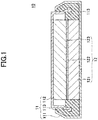
- a coin battery 10 of a type 2032 illustrated in FIG. 1 was fabricated in the following manner, and the initial discharge capacity and reaction resistance ratio were evaluated.
- the coin battery 10 of the type 2032 includes a case 11 and an electrode 12 accommodated in the case 11.
- the case 11 of the coin battery 10 of the type 2032 includes a cathode can 111 which is hollowed out and has an open end, and an anode can 112 which is to be disposed in an opening of the cathode can 111.
- a space for accommodating the electrodes 12 is formed between the anode can 112 and the cathode can 111.
- the electrode 12 is made of a cathode 121, a separator 122, and an anode 123 and is stacked in this order and is accommodated in the case 11 such that the cathode 121 contacts the inner surface of the cathode can 111 and the anode 123 contacts the inner surface of the anode can 112.
- the case 11 includes a gasket 113 which causes the cathode can 111 and the cathode can 112 to be fixed in an electrically insulating condition.
- the gasket 113 also has a function of sealing a gap between the cathode can 111 and the anode can 112 to provide air-tight and liquid-tight shielding between the inside of the case 11 and the outside.
- the coin battery of the type 2032 (CR2032) is made by the following procedure.
- the cathode 121 was prepared by mixing a cathode active material of 52.5 mg, acetylene black of 15 mg, and PTFE of 7.5 mg, pressing at a pressure of 100 MPa to a diameter of 11 mm and a thickness of 100 ⁇ m, and drying in a vacuum dryer at 120°C for 12 hours.
- lithium metal having a diameter of 13 mm and a thickness of 1 mm was used.
- non-aqueous electrolyte solution an equal-mass mixture of ethylene carbonate (EC) and diethyl carbonate (DEC) using LiClO 4 of 1M as the supporting electrolyte (manufactured by Toyama Pharmaceutical Co., Ltd.) was used.
- a polyethylene porous membrane having a thickness of 25 ⁇ m was used for the separator 122.
- the above cathode 121, separator 122, and anode 123 were used to fabricate the coin battery 10 of the type 2032 of the structure illustrated in FIG. 1 in a glove box in an argon (Ar) atmosphere with dew point controlled to-80°C.
- the above coin battery 10 of the type 2032 was manufactured and left at room temperature for about 12 hours. After the open circuit voltage OCV (Open Circuit Voltage) was stabilized, it was charged at the cut-off voltage of 4.3 V with a current density of 0.4 mA/cm 2 relative to the cathode. After a pause of 1 hour, the discharge capacity when the cut-off voltage was discharged at 3.0 V was measured, and the initial discharge capacity was determined.
- the multichannel voltage/current generator (Model: R6741A, manufactured by Advantest corporation) was used to measure the initial discharge capacity.
- the resistance was measured by an AC impedance method using a coin battery of the type 2032 charged at a charge potential of 4.0V. The measurements were made using a frequency response analyzer and potentiogalvanostat (manufactured by Solatron) to obtain a Nyquist plot as illustrated in FIG. 2A . Because the plot is represented as the sum of the solution resistance, the cathode resistance and the capacitance, and the characteristic curve representing the cathode resistance and the capacitance, the fitting calculation was performed using an equivalent circuit illustrated in FIG. 2B , and the value of the cathode resistance was calculated.
- the cathode resistance ( ⁇ ) of Example 1 and the cathode resistance of other Examples and Comparative Examples were evaluated as relative values in the evaluation of the cathode resistance of Example 1 and Comparative Examples, respectively.
- Lithium hydroxide anhydride and nickel complex oxides represented by Ni 0.91 Co 0.045 Al 0.045 O were weighed and mixed so that Li/Me, which is the ratio of lithium (Li) to metal other than lithium (Me) becomes 1.02.
- the metal other than lithium means the metallic component included in the nickel complex oxide, that is, Ni, Co, and Al.
- the nickel complex oxide a nickel complex hydroxide manufactured by the crystallization method was used which was prepared by roasting at 500°C under atmospheric atmosphere (oxygen: 21 vol%).
- the mixture was then fired by putting the mixture into a saggar and keeping it at 765°C for 220 minutes in an atmosphere having an oxygen concentration of 80 vol% or more using Roller Hearth Kiln, thereby forming a lithium nickel complex oxide.
- the conductivity of the ion-exchanged water used was 5 ⁇ S/cm.
- the slurry was stirred for 10 minutes and filtered through a filter press (water-washing process).
- a mixture of tungsten was prepared by adding tungsten trioxide of 26.8 g to the obtained filtrated material so that the ratio of the number of atoms of tungsten to the number of atoms of the metallic component other than lithium contained in the lithium nickel complex oxide particles was 0.15% and mixing at the room temperature (25°C) for 5 minutes.
- the shaker mixer was used for mixing.
- tungsten trioxide with the characteristics illustrated in Table 1 was used as the tungsten trioxide.
- Tungsten trioxide was prepared by subjecting commercially available tungsten trioxide to heat treatment while stirring under a flow of oxygen, followed by a milling process using a hammer mill to obtain the characteristics illustrated in Table 1.
- the resulting water content of the tungsten mixture was 4.5% by mass.
- the tungsten mixture was heat treated under a decarboxylated air atmosphere for 1.0 hours at 70°C (first heat treatment process), and then the temperature was raised to 170°C and kept for 6 hours (second heat treatment process) to obtain the cathode active material.
- Table 1 indicates evaluation results of the obtained cathode active material.
- the cathode active material was produced and evaluated in the same manner as Example 1, except that tungsten trioxide having the characteristics indicated in Table 1 was used as the tungsten trioxide.
- the commercially available tungsten trioxide was subjected to a heat treatment while stirring under a flow of oxygen, and then subjected to a milling process using the hammer mill to obtain the characteristics indicated in Table 1.
- Lithium hydroxide anhydride and nickel complex oxides represented by Ni 0.88 Co 0.09 Al 0.03 O were weighed and mixed so that Li/Me, which is the ratio of lithium (Li) to metal other than lithium (Me), was 1.02.
- the metal other than lithium means a metallic component included in nickel complex oxide, that is, Ni, Co, and Al.
- nickel complex oxide a nickel compound hydroxide manufactured by the crystallization method was used which was prepared by roasting at 500°C under air atmosphere (Oxygen: 21 vol%).
- the mixture was then fired by putting the mixture into a bowl and keeping at 765°C for 220 minutes in an atmosphere having an oxygen concentration of 80 vol% or more using Roller Hearth Kiln, thereby forming a lithium nickel complex oxide.
- lithium metal complex oxide represented by Li 1.02 Ni 0.88 Co 0.09 Al 0.03 O 2
- ion-exchanged water of 6.0L was added to lithium metal complex oxide of 7.5 kg and slurried.
- the conductivity of the ion-exchanged water used was 5 ⁇ S/cm.
- the slurry was stirred for 10 minutes and filtered through a filter press (water-washing process).
- a mixture of tungsten was prepared by adding tungsten trioxide of 26.8 g to the obtained filtrated material so that the ratio of the number of atoms of tungsten to the number of atoms of the metallic component other than lithium contained in the lithium nickel complex oxide particles was 0.15% and mixing at the room temperature (25°C) for 5 minutes.
- the shaker mixer was used for mixing.
- tungsten trioxide with the characteristics indicated in Table 1 was used as the tungsten trioxide.
- Tungsten trioxide was prepared by subjecting commercially available tungsten trioxide to heat treatment while stirring under a flow of oxygen, followed by a milling process using a hammer mill to obtain the characteristics illustrated in Table 1.
- the resulting water content of the tungsten mixture was 4.5% by mass.
- the tungsten mixture was heat treated under a decarboxylated air atmosphere for 1.0 hours at 70°C (first heat treatment process), and then the temperature was raised to 170°C and kept for 6 hours (second heat treatment process) to obtain cathode active material.
- Table 1 indicates the evaluation results of the obtained cathode active material.
- Cathode active material was produced and evaluated in the same manner as Example 6, except that tungsten trioxide having the characteristics indicated in Table 1 used as the tungsten trioxide.
- the commercially available tungsten trioxide was subjected to a heat treatment while stirring under a flow of oxygen, and then subjected to a milling process using the hammer mill to obtain the characteristics indicated in Table 1.
- Cathode active material was produced and evaluated in the same manner as Example 1, except that tungsten trioxide having the characteristics indicated in Table 1 used as the tungsten trioxide.
- Comparative Example 2 commercially available tungsten trioxide was used as is.
- Comparative Examples 1, 3, and 4 commercially available tungsten trioxide was subjected to a heat treatment while stirring under a flow of oxygen, and then subjected to a milling process using the hammer mill to obtain the characteristics indicated in Table 1.
- Cathode active material was produced and evaluated in the same manner as Example 6, except that tungsten trioxide having the characteristics indicated in Table 1 used as the tungsten trioxide.
- Comparative Example 6 commercially available tungsten trioxide was used as is.
- Comparative Examples 5, 7, and 8 the commercially available tungsten trioxide was subjected to a heat treatment while stirring under a flow of oxygen, and then subjected to a milling process using the hammer mill to obtain the characteristics indicated in Table 1.
- Example 1 0.08 40 15 75 5.8 0.10 0.15 216 100
- Example 2 0.12 48 20 100 4.8 0.25 0.15 213 105
- Example 3 0.13 40 15 70 0.9 0.30 0.15 211 100
- Example 4 0.10 40 15 70 5.5 0.10 0.07 215 102
- Example 5 0.11 43 20 65 6.5 0.11 0.80 205
- Example 6 0.08 40 15 75 5.8 0.09 0.15 208 98
- Example 7 0.12 48 20 100 4.8 0.25 0.15 204 102
- Example 9 0.10 40 15 70 5.5 0.11 0.07 205 100
- Example 10 0.11 43 20 65 6.5 0.10 0.85 203
- Comparative Example 1 0.20 41 20 70 6.8 0.50 0.15 198 180
- Comparative Example 2 1.00 40 20 70 5.0 0.50 0.15 195 200
- Comparative Example 3 60 30 105 5.5 0.45 0.18 190 190 Comparative Example 4 0.25 20 8 55 5.2 0.43 0.17
- the coated lithium nickel complex oxide particles which had been contained in the cathode active material, contained the compounds of tungsten and lithium approximately evenly. Said differently, the lithium nickel complex oxide particles were coated particles.
- the initial discharge capacity was higher than that in Comparative Examples 1 to 8, and it was confirmed that the reaction resistance was suppressed. From these results, it was confirmed that the battery characteristics can be stably enhanced in the non-aqueous electrolyte secondary battery using the cathode active material of Examples 1 to 10.
- the active cathode material for the non-aqueous electrolyte secondary battery and the method of manufacturing the active cathode material for the non-aqueous electrolyte secondary battery have been described in the embodiments and the Examples, but the present invention is not limited to the above-described embodiments and the Examples. Various modifications and variations are possible within the scope of the points of the invention as recited in the claims.
Landscapes
- Chemical & Material Sciences (AREA)
- Chemical Kinetics & Catalysis (AREA)
- Electrochemistry (AREA)
- General Chemical & Material Sciences (AREA)
- Engineering & Computer Science (AREA)
- Inorganic Chemistry (AREA)
- Composite Materials (AREA)
- Manufacturing & Machinery (AREA)
- Materials Engineering (AREA)
- Organic Chemistry (AREA)
- Battery Electrode And Active Subsutance (AREA)
- Inorganic Compounds Of Heavy Metals (AREA)
Applications Claiming Priority (2)
| Application Number | Priority Date | Filing Date | Title |
|---|---|---|---|
| JP2017224023 | 2017-11-21 | ||
| PCT/JP2018/042984 WO2019103037A1 (ja) | 2017-11-21 | 2018-11-21 | 非水系電解質二次電池用正極活物質、非水系電解質二次電池用正極活物質の製造方法 |
Publications (2)
| Publication Number | Publication Date |
|---|---|
| EP3716372A1 true EP3716372A1 (de) | 2020-09-30 |
| EP3716372A4 EP3716372A4 (de) | 2021-01-13 |
Family
ID=66631027
Family Applications (1)
| Application Number | Title | Priority Date | Filing Date |
|---|---|---|---|
| EP18880527.9A Pending EP3716372A4 (de) | 2017-11-21 | 2018-11-21 | Aktivmaterial einer positiven elektrode für sekundärbatterie mit wasserfreiem elektrolyt und verfahren zur herstellung von aktivmaterial einer positiven elektrode für sekundärbatterie mit wasserfreiem elektrolyt |
Country Status (5)
| Country | Link |
|---|---|
| US (1) | US11735728B2 (de) |
| EP (1) | EP3716372A4 (de) |
| JP (1) | JP7099475B2 (de) |
| CN (1) | CN111406332A (de) |
| WO (1) | WO2019103037A1 (de) |
Cited By (1)
| Publication number | Priority date | Publication date | Assignee | Title |
|---|---|---|---|---|
| EP4443562A4 (de) * | 2021-11-30 | 2025-08-27 | Panasonic Ip Man Co Ltd | Positivelektrodenaktivmaterial für eine sekundärbatterie, positivelektrode für eine sekundärbatterie und verfahren zur herstellung |
Families Citing this family (6)
| Publication number | Priority date | Publication date | Assignee | Title |
|---|---|---|---|---|
| CN114423542B (zh) * | 2019-12-30 | 2025-07-15 | H.C.施塔克钨业股份有限公司 | 一种钨金属粉末的制备方法 |
| CN115004407B (zh) * | 2020-01-31 | 2024-10-25 | 松下新能源株式会社 | 非水电解质二次电池用正极活性物质、及非水电解质二次电池 |
| CN111916730A (zh) * | 2020-08-10 | 2020-11-10 | 贵州梅岭电源有限公司 | 一种wo3修饰的富镍三元锂离子电池正极材料的制备方法 |
| JP6923730B1 (ja) | 2020-09-04 | 2021-08-25 | 住友化学株式会社 | リチウム二次電池用正極活物質、リチウム二次電池用正極及びリチウム二次電池 |
| JP7284244B1 (ja) * | 2021-12-08 | 2023-05-30 | 住友化学株式会社 | リチウム二次電池用正極活物質、リチウム二次電池用正極及びリチウム二次電池 |
| CN115084505B (zh) * | 2022-08-23 | 2023-01-10 | 欣旺达电动汽车电池有限公司 | 正极活性材料及电化学装置 |
Family Cites Families (15)
| Publication number | Priority date | Publication date | Assignee | Title |
|---|---|---|---|---|
| AU2014336895B2 (en) * | 2013-10-16 | 2016-11-24 | Suzhou Hans Energy Storage Technology Co., Ltd. | Tungsten-based material super battery and supercapacitor |
| KR101844110B1 (ko) * | 2014-10-31 | 2018-05-14 | 주식회사 엘지화학 | 리튬 이차전지용 양극 활물질, 및 이를 포함하는 양극 및 리튬 이차전지 |
| JP6499442B2 (ja) | 2014-12-24 | 2019-04-10 | Jx金属株式会社 | リチウムイオン電池用正極活物質及びリチウムイオン電池用正極活物質の製造方法 |
| WO2016104305A1 (ja) | 2014-12-26 | 2016-06-30 | 住友金属鉱山株式会社 | 非水系電解質二次電池用正極活物質とその製造方法、及び該正極活物質を用いた非水系電解質二次電池 |
| JP6210439B2 (ja) | 2014-12-26 | 2017-10-11 | 住友金属鉱山株式会社 | 非水系電解質二次電池用正極活物質とその製造方法、及び該正極活物質を用いた非水系電解質二次電池 |
| JP6555636B2 (ja) * | 2015-03-03 | 2019-08-07 | 住友金属鉱山株式会社 | 非水系電解質二次電池用正極活物質およびその製造方法 |
| JP6544579B2 (ja) * | 2015-03-25 | 2019-07-17 | 住友金属鉱山株式会社 | タングステン酸リチウムの製造方法、およびタングステン酸リチウムを用いた非水系電解質二次電池用正極活物質の製造方法 |
| JP6569544B2 (ja) * | 2015-05-26 | 2019-09-04 | 住友金属鉱山株式会社 | 非水系電解質二次電池用正極活物質とその製造方法、および該正極活物質を用いた非水系電解質二次電池 |
| JP6998107B2 (ja) | 2015-05-29 | 2022-01-18 | 住友金属鉱山株式会社 | 非水系電解質二次電池用正極材料、正極合材、およびそれぞれを用いた非水系電解質二次電池 |
| JP7055587B2 (ja) * | 2015-09-25 | 2022-04-18 | 住友金属鉱山株式会社 | 非水系電解質二次電池用正極活物質の製造方法 |
| JP2017188428A (ja) | 2016-03-30 | 2017-10-12 | Basf戸田バッテリーマテリアルズ合同会社 | 非水電解質二次電池用の正極活物質及びその製造方法、並びにそれを用いた非水電解質二次電池 |
| KR102363230B1 (ko) * | 2016-03-30 | 2022-02-16 | 바스프 토다 배터리 머티리얼스 엘엘씨 | 비수전해질 이차전지용 양극 활물질, 그 제조방법 및 이를 이용한 비수전해질 이차전지 |
| US10483541B2 (en) | 2016-05-09 | 2019-11-19 | Nichia Corporation | Method of producing nickel-cobalt composite hydroxide and method of producing positive electrode active material for non-aqueous electrolyte secondary battery |
| JP6443489B2 (ja) * | 2016-05-09 | 2018-12-26 | 日亜化学工業株式会社 | ニッケルコバルト複合水酸化物の製造方法及び非水系電解質二次電池用正極活物質の製造方法 |
| JP6764701B2 (ja) | 2016-06-13 | 2020-10-07 | 株式会社キーエンス | 画像処理センサ、画像処理方法、画像処理プログラム及びコンピュータで読み取り可能な記録媒体並びに記録した機器 |
-
2018
- 2018-11-21 CN CN201880074483.6A patent/CN111406332A/zh active Pending
- 2018-11-21 JP JP2019555334A patent/JP7099475B2/ja active Active
- 2018-11-21 EP EP18880527.9A patent/EP3716372A4/de active Pending
- 2018-11-21 WO PCT/JP2018/042984 patent/WO2019103037A1/ja not_active Ceased
- 2018-11-21 US US16/764,976 patent/US11735728B2/en active Active
Cited By (1)
| Publication number | Priority date | Publication date | Assignee | Title |
|---|---|---|---|---|
| EP4443562A4 (de) * | 2021-11-30 | 2025-08-27 | Panasonic Ip Man Co Ltd | Positivelektrodenaktivmaterial für eine sekundärbatterie, positivelektrode für eine sekundärbatterie und verfahren zur herstellung |
Also Published As
| Publication number | Publication date |
|---|---|
| US20200403238A1 (en) | 2020-12-24 |
| EP3716372A4 (de) | 2021-01-13 |
| JP7099475B2 (ja) | 2022-07-12 |
| JPWO2019103037A1 (ja) | 2020-12-17 |
| US11735728B2 (en) | 2023-08-22 |
| CN111406332A (zh) | 2020-07-10 |
| WO2019103037A1 (ja) | 2019-05-31 |
Similar Documents
| Publication | Publication Date | Title |
|---|---|---|
| US11735728B2 (en) | Cathode active material for non-aqueous electrolyte secondary battery and method of manufacturing cathode active material for non-aqueous electrolyte secondary battery | |
| EP3267517A1 (de) | Positivelektrodenaktivsubstanz für sekundärbatterie mit wasserfreiem elektrolyt und verfahren zur herstellung davon | |
| EP3806204B1 (de) | Positivelektrodenaktivmaterial für sekundärbatterie mit wasserfreiem elektrolyt und sekundärbatterie mit wasserfreiem elektrolyt | |
| US11482700B2 (en) | Positive electrode active material for nonaqueous electrolyte secondary batteries and method for producing positive electrode active material for nonaqueous electrolyte secondary batteries | |
| Wang et al. | Improvement of high voltage electrochemical performance of LiNi0. 5Co0. 2Mn0. 3O2 cathode materials via Li2ZrO3 coating | |
| EP4033565B1 (de) | Positives aktives elektrodenmaterial für eine lithium-ionen-sekundärbatterie sowie lithium-ionen-sekundärbatterie | |
| EP3780175B1 (de) | Positivelektrodenaktivmaterial für sekundärbatterie mit wasserfreiem elektrolyt | |
| US11133504B2 (en) | Nickel complex oxide and method of manufacturing lithium nickel complex oxide | |
| JP7226521B2 (ja) | リチウムイオン二次電池用正極活物質、リチウムイオン二次電池用正極活物質の製造方法、リチウムイオン二次電池 | |
| US11390534B2 (en) | Tungsten trioxide | |
| JP2016072188A (ja) | 非水系電解質二次電池用正極活物質用の被覆複合酸化物粒子の製造方法及び当該製造方法によって製造される被覆複合酸化物粒子を用いた非水系電解質二次電池 | |
| EP4033566A1 (de) | Positivelektrodenaktivmaterial für eine lithium-ionen-sekundärbatterie sowie lithium-ionen-sekundärbatterie | |
| EP3929157A1 (de) | Positivelektrodenaktivmaterial für eine lithium-ionen-sekundärbatterie, verfahren zur herstellung des positivelektrodenaktivmaterials für eine lithium-ionen-sekundärbatterie und lithium-ionen-sekundärbatterie | |
| EP4614608A1 (de) | Positivelektrodenaktivmaterial für eine lithium-ionen-sekundärbatterie und lithium-ionen-sekundärbatterie | |
| EP4528854B1 (de) | Positivelektrodenaktivmaterial für eine lithium-ionen-sekundärbatterie sowie lithium-ionen-sekundärbatterie | |
| JP2023093555A (ja) | リチウムイオン二次電池用正極活物質、リチウムイオン二次電池用正極活物質の製造方法、リチウムイオン二次電池 | |
| JP7173275B2 (ja) | リチウムイオン二次電池用正極活物質、リチウムイオン二次電池用正極活物質の製造方法、リチウムイオン二次電池 | |
| EP4564476A1 (de) | Negativelektrodenaktivmaterial für lithium-ionen-sekundärbatterien, verfahren zur herstellung des negativelektrodenaktivmaterials für lithium-ionen-sekundärbatterien und lithium-ionen-sekundärbatterie | |
| JP2024109445A (ja) | リチウムニッケルマンガン複合酸化物粒子、リチウムイオン二次電池 | |
| KR20260032613A (ko) | 리튬 이온 이차전지용 양극 활물질, 리튬 이온 이차전지용 양극 활물질의 제조 방법, 리튬 이온 이차전지 |
Legal Events
| Date | Code | Title | Description |
|---|---|---|---|
| STAA | Information on the status of an ep patent application or granted ep patent |
Free format text: STATUS: THE INTERNATIONAL PUBLICATION HAS BEEN MADE |
|
| PUAI | Public reference made under article 153(3) epc to a published international application that has entered the european phase |
Free format text: ORIGINAL CODE: 0009012 |
|
| STAA | Information on the status of an ep patent application or granted ep patent |
Free format text: STATUS: REQUEST FOR EXAMINATION WAS MADE |
|
| 17P | Request for examination filed |
Effective date: 20200518 |
|
| AK | Designated contracting states |
Kind code of ref document: A1 Designated state(s): AL AT BE BG CH CY CZ DE DK EE ES FI FR GB GR HR HU IE IS IT LI LT LU LV MC MK MT NL NO PL PT RO RS SE SI SK SM TR |
|
| AX | Request for extension of the european patent |
Extension state: BA ME |
|
| A4 | Supplementary search report drawn up and despatched |
Effective date: 20201215 |
|
| RIC1 | Information provided on ipc code assigned before grant |
Ipc: H01M 4/505 20100101ALI20201209BHEP Ipc: C01G 53/00 20060101ALI20201209BHEP Ipc: H01M 4/36 20060101ALI20201209BHEP Ipc: H01M 4/525 20100101AFI20201209BHEP |
|
| DAV | Request for validation of the european patent (deleted) | ||
| DAX | Request for extension of the european patent (deleted) | ||
| STAA | Information on the status of an ep patent application or granted ep patent |
Free format text: STATUS: EXAMINATION IS IN PROGRESS |
|
| 17Q | First examination report despatched |
Effective date: 20230201 |