EP3718393A1 - Système modulaire de plantation - Google Patents
Système modulaire de plantation Download PDFInfo
- Publication number
- EP3718393A1 EP3718393A1 EP20000139.4A EP20000139A EP3718393A1 EP 3718393 A1 EP3718393 A1 EP 3718393A1 EP 20000139 A EP20000139 A EP 20000139A EP 3718393 A1 EP3718393 A1 EP 3718393A1
- Authority
- EP
- European Patent Office
- Prior art keywords
- pot
- system structure
- profile
- modular planting
- modular
- Prior art date
- Legal status (The legal status is an assumption and is not a legal conclusion. Google has not performed a legal analysis and makes no representation as to the accuracy of the status listed.)
- Withdrawn
Links
- 241000196324 Embryophyta Species 0.000 claims abstract description 69
- 238000003973 irrigation Methods 0.000 claims abstract description 60
- 230000002262 irrigation Effects 0.000 claims abstract description 60
- XLYOFNOQVPJJNP-UHFFFAOYSA-N water Substances O XLYOFNOQVPJJNP-UHFFFAOYSA-N 0.000 claims abstract description 45
- 239000000463 material Substances 0.000 claims abstract description 27
- 239000000758 substrate Substances 0.000 claims abstract description 23
- 238000010521 absorption reaction Methods 0.000 claims abstract description 12
- 230000009194 climbing Effects 0.000 claims description 19
- 230000012010 growth Effects 0.000 claims description 16
- 240000000528 Ricinus communis Species 0.000 claims description 8
- 235000004443 Ricinus communis Nutrition 0.000 claims description 8
- 240000003768 Solanum lycopersicum Species 0.000 abstract 1
- 238000003860 storage Methods 0.000 description 6
- 230000004888 barrier function Effects 0.000 description 5
- 238000009423 ventilation Methods 0.000 description 5
- 230000008635 plant growth Effects 0.000 description 4
- 241000227653 Lycopersicon Species 0.000 description 3
- 229910000831 Steel Inorganic materials 0.000 description 3
- 238000004378 air conditioning Methods 0.000 description 3
- 230000008859 change Effects 0.000 description 3
- 230000005484 gravity Effects 0.000 description 3
- 230000008520 organization Effects 0.000 description 3
- 239000002689 soil Substances 0.000 description 3
- 239000010959 steel Substances 0.000 description 3
- 230000008878 coupling Effects 0.000 description 2
- 238000010168 coupling process Methods 0.000 description 2
- 238000005859 coupling reaction Methods 0.000 description 2
- 238000010438 heat treatment Methods 0.000 description 2
- 238000004519 manufacturing process Methods 0.000 description 2
- 238000004171 remote diagnosis Methods 0.000 description 2
- 239000005871 repellent Substances 0.000 description 2
- 210000002023 somite Anatomy 0.000 description 2
- 238000009331 sowing Methods 0.000 description 2
- 239000002982 water resistant material Substances 0.000 description 2
- 235000016068 Berberis vulgaris Nutrition 0.000 description 1
- 241000335053 Beta vulgaris Species 0.000 description 1
- 230000009471 action Effects 0.000 description 1
- 239000000654 additive Substances 0.000 description 1
- 230000000996 additive effect Effects 0.000 description 1
- 230000000903 blocking effect Effects 0.000 description 1
- 238000001816 cooling Methods 0.000 description 1
- 230000001419 dependent effect Effects 0.000 description 1
- 230000000694 effects Effects 0.000 description 1
- 238000012423 maintenance Methods 0.000 description 1
- 238000000034 method Methods 0.000 description 1
- 230000000149 penetrating effect Effects 0.000 description 1
- 230000001105 regulatory effect Effects 0.000 description 1
Images


Classifications
-
- A—HUMAN NECESSITIES
- A01—AGRICULTURE; FORESTRY; ANIMAL HUSBANDRY; HUNTING; TRAPPING; FISHING
- A01G—HORTICULTURE; CULTIVATION OF VEGETABLES, FLOWERS, RICE, FRUIT, VINES, HOPS OR SEAWEED; FORESTRY; WATERING
- A01G9/00—Cultivation in receptacles, forcing-frames or greenhouses; Edging for beds, lawn or the like
- A01G9/12—Supports for plants; Trellis for strawberries or the like
-
- A—HUMAN NECESSITIES
- A01—AGRICULTURE; FORESTRY; ANIMAL HUSBANDRY; HUNTING; TRAPPING; FISHING
- A01G—HORTICULTURE; CULTIVATION OF VEGETABLES, FLOWERS, RICE, FRUIT, VINES, HOPS OR SEAWEED; FORESTRY; WATERING
- A01G27/00—Self-acting watering devices, e.g. for flower-pots
- A01G27/04—Self-acting watering devices, e.g. for flower-pots using wicks or the like
- A01G27/06—Self-acting watering devices, e.g. for flower-pots using wicks or the like having a water reservoir, the main part thereof being located wholly around or directly beside the growth substrate
-
- A—HUMAN NECESSITIES
- A01—AGRICULTURE; FORESTRY; ANIMAL HUSBANDRY; HUNTING; TRAPPING; FISHING
- A01G—HORTICULTURE; CULTIVATION OF VEGETABLES, FLOWERS, RICE, FRUIT, VINES, HOPS OR SEAWEED; FORESTRY; WATERING
- A01G9/00—Cultivation in receptacles, forcing-frames or greenhouses; Edging for beds, lawn or the like
- A01G9/12—Supports for plants; Trellis for strawberries or the like
- A01G9/122—Stakes
- A01G9/124—Means for holding stakes upright in, on, or beside pots
-
- A—HUMAN NECESSITIES
- A01—AGRICULTURE; FORESTRY; ANIMAL HUSBANDRY; HUNTING; TRAPPING; FISHING
- A01G—HORTICULTURE; CULTIVATION OF VEGETABLES, FLOWERS, RICE, FRUIT, VINES, HOPS OR SEAWEED; FORESTRY; WATERING
- A01G9/00—Cultivation in receptacles, forcing-frames or greenhouses; Edging for beds, lawn or the like
- A01G9/14—Greenhouses
- A01G9/16—Dismountable or portable greenhouses ; Greenhouses with sliding roofs
-
- Y—GENERAL TAGGING OF NEW TECHNOLOGICAL DEVELOPMENTS; GENERAL TAGGING OF CROSS-SECTIONAL TECHNOLOGIES SPANNING OVER SEVERAL SECTIONS OF THE IPC; TECHNICAL SUBJECTS COVERED BY FORMER USPC CROSS-REFERENCE ART COLLECTIONS [XRACs] AND DIGESTS
- Y02—TECHNOLOGIES OR APPLICATIONS FOR MITIGATION OR ADAPTATION AGAINST CLIMATE CHANGE
- Y02A—TECHNOLOGIES FOR ADAPTATION TO CLIMATE CHANGE
- Y02A40/00—Adaptation technologies in agriculture, forestry, livestock or agroalimentary production
- Y02A40/10—Adaptation technologies in agriculture, forestry, livestock or agroalimentary production in agriculture
- Y02A40/25—Greenhouse technology, e.g. cooling systems therefor
-
- Y—GENERAL TAGGING OF NEW TECHNOLOGICAL DEVELOPMENTS; GENERAL TAGGING OF CROSS-SECTIONAL TECHNOLOGIES SPANNING OVER SEVERAL SECTIONS OF THE IPC; TECHNICAL SUBJECTS COVERED BY FORMER USPC CROSS-REFERENCE ART COLLECTIONS [XRACs] AND DIGESTS
- Y02—TECHNOLOGIES OR APPLICATIONS FOR MITIGATION OR ADAPTATION AGAINST CLIMATE CHANGE
- Y02P—CLIMATE CHANGE MITIGATION TECHNOLOGIES IN THE PRODUCTION OR PROCESSING OF GOODS
- Y02P60/00—Technologies relating to agriculture, livestock or agroalimentary industries
- Y02P60/20—Reduction of greenhouse gas [GHG] emissions in agriculture, e.g. CO2
- Y02P60/21—Dinitrogen oxide [N2O], e.g. using aquaponics, hydroponics or efficiency measures
Definitions
- the invention relates to a modular planting system.
- the invention relates to a modular planting system or a plant tower for tall plants and climbing plants that require a vertically supporting growth aid.
- Plant systems for tall plants and climbing plants are from the prior art, in particular from the laid-open specification DE 100 28 622 A1 in the form of a plant container with devices for connection to a mobile substructure on the container bottom and with a vertical climbing aid, known.
- the aim of the invention is to create an improved modular planting system.
- a modular planting system with an integral profile tube plug-in system structure that can be dismantled into individual parts, a pot made of a water-impermeable material and an irrigation insert element.
- the profile tube plug-in system structure contains a plurality of hollow profile tubes which can be plugged together and which form a frame of the modular planting system.
- the pot is designed to hold water and plant substrate.
- the irrigation insert element is designed for capillary-absorption irrigation from below.
- the pot and the irrigation insert element are adapted to one another in such a way that the irrigation insert element can be arranged within the pot.
- the profile tube connector system structure and the pot are adapted to one another in such a way that the pot can be arranged within the profile tube plug-in system structure in an assembled state of the profile tube plug-in system structure.
- the invention includes the knowledge that known planting systems for tall plants are not very stable or not very stable.
- the profile tubes form a frame of the modular planting system and the pot for receiving the water and the plant substrate in the assembled state is arranged within the profile tube plug-in system structure, the stability of the planting system can be increased, since a focus of the modular planting system, especially when the pot is filled with water and plant substrate, lies within the profile tube plug-in system structure.
- this also enables an integral climbing aid to be provided from the profile tube plug-in system structure itself.
- the profile tube plug-in system structure can provide enough space in height to accommodate and support tall plants.
- the profile tube plug-in system structure is formed by hollow profile tubes that can be plugged together, the profile tube plug-in system structure can have a low weight. This can make it possible to reduce the weight of the modular planting system compared to planting systems known from the prior art.
- hollow profile tubes that can be plugged together can also reduce storage and transport volumes.
- the profile tube connector system structure can, for example, have a cuboid structure.
- the profile tube plug-in system structure can have two or more areas, for example eight or nine areas.
- the profile tube plug-in system structure can each have four or more vertically arranged profile tubes per area, which define a boundary of the respective area.
- the profile tube plug-in system structure has four vertically arranged profile tubes per area.
- the vertically arranged profile tubes of different areas can be of different lengths.
- the vertically arranged profile tubes of a region are preferably of the same length.
- the vertically arranged profile tubes of a region are particularly preferably arranged parallel to one another.
- An area can have four or more horizontally arranged profile tubes which connect the vertically arranged profile tubes to one another in one plane.
- the horizontally arranged profile tubes of an area can be of different lengths. At least two horizontally arranged profile tubes lying opposite one another are preferably of equal length.
- the horizontally arranged profile tubes are particularly preferably arranged parallel to one another.
- the horizontally arranged profile tubes can be arranged perpendicular to the vertically arranged profile tubes.
- An area can contain one or two levels.
- a lowermost area or an uppermost area of the profile tube plug-in system structure preferably contains two levels.
- a respective area can correspond to a volume which is delimited by the arrangement of a number of vertically arranged profile tubes and horizontally arranged profile tubes.
- the profile tube plug-in system structure can have one or more sections. Each section can contain one or more areas. The sections are preferably of equal length in the vertical direction. The sections particularly preferably each have an identical volume.
- a lowermost section of the profile tube plug-in system structure can be designed to accommodate the pot.
- the lowermost section of the profile tube plug-in system structure can have two or more areas, for example four or five areas.
- the length of the vertically arranged profile tubes in the lowermost section is preferably shorter than the length of the vertically arranged profile tubes in other sections.
- the length of the vertically arranged profile tubes in the lowermost section can be a fifth of the length of the vertically arranged profile tubes in other sections.
- a vertical distance between adjacent planes in the lowest section is less than for other sections. This can enable better fastening of the pot within the profile tube plug-in system structure.
- the modular planting system can have an enclosure.
- the housing can be designed to keep moisture away from the outside and to create a cold frame growth climate.
- the housing can consist of a water-impermeable material.
- the housing can for example have a cover and several side walls, for example three or four side walls. One of the side walls can serve as a rear wall and / or one of the side walls can serve as a front wall. Dimensions of the cover and the side walls can be adapted to the dimensions of the profile tube plug-in system structure so that the profile tube plug-in system structure is complete can cover. This can make it possible, for example when the housing with the cover and four side walls is attached to the profile tube connector system structure, to completely separate an interior space enclosed by the profile tube connector system structure from the surroundings.
- the housing can make it possible to create a cold frame climate and to protect the growing plants from moisture and rain, which is important for tomato plants, for example, since they cannot tolerate water from above.
- the housing can have openings for supplying water at an upper end of the modular planting system into the profile tube plug-in system structure.
- the profile tube plug-in system structure can have openings for supplying the water into the pot at a level below the irrigation insert element, so that the water can be used for capillary-absorption irrigation from below via the irrigation insert element. This makes it possible to use water that falls onto the housing from above, for example rainwater, to irrigate plants from below.
- the material of the pot can be a flexible, water-impermeable material.
- the pot can be composed of several parts, for example plates.
- the plates can form side walls and a bottom of the pot.
- the plates can be connected to one another, for example inserted into one another.
- a plate can also be inserted into the profile tube plug-in system structure as a base and the other plates can be hung on one level of the profile tube plug-in system structure.
- the pot can be formed by the plates.
- the pot can alternatively be a sack.
- the sack can have a shape that can be adapted to the profile tube plug-in system structure.
- the shape of the sack can be adapted to a shape predetermined by the profile tube plug-in system structure by attaching it within the profile tube plug-in system structure and filling it with plant substrate and water.
- the pot can be foldable. This can make it possible to further reduce the space required by the modular planting system for storage and transport.
- the parts can be foldable and / or the pot can be foldable in the assembled state.
- the panels can be foldable.
- the sack can also be foldable.
- the modular planting system can stand on wheels or castors, so that the modular planting system is mobile. This makes it possible to further increase the mobility of the modular planting system.
- the hollow profile tubes of the profile tube connector system structure and / or the profile tube connector system structure can be designed in such a way that the profile tube connector system structure has a lower weight when the planting system is in operation than the pot filled with plant substrate and water with the irrigation insert element .
- the focus of the modular planting system can be in the lowest section of the profile tube plug-in system structure or in the vicinity of a lower end of the modular planting system, for example on the floor of the modular planting system.
- the profile pipe plug-in system structure, the pot and the irrigation insert element can form a unit, the focus of which is on a base of the unit during operation by filling the pot with water and planting substrate. This can make it possible to further increase the stability of the modular planting system.
- the profile tube plug-in system structure can have an intermediate level of the profile tube plug-in system structure formed by one or more profile tubes and arranged above the pot if the pot is arranged in the profile pipe plug-in system structure.
- the intermediate level can make it possible to increase the stability of the modular planting system and its stability.
- the intermediate level can also serve as a climbing aid for plants growing in the planting system.
- the intermediate level may, for example, be four or more, e.g. have five or six horizontally arranged profile tubes.
- Four of the horizontally arranged profile tubes can connect two of the vertically arranged profile tubes of the profile tube plug-in system structure to one another.
- Further horizontally arranged profile tubes, e.g. the fifth and sixth horizontally arranged profile tube can connect two of the horizontally arranged profile tubes to one another. This enables additional climbing aids and possibilities for attaching further climbing aids, such as ropes extending from the other horizontally arranged profile tubes, to be arranged within the profile tube plug-in system structure.
- the modular planting system can have one or more climbing aids which extend downward from the upper end of the profile tube plug-in system structure and which are attached to the intermediate level.
- the climbing aids can be ropes, for example steel ropes or ropes made of a different material.
- the climbing aids can also be cords. This can make it possible to provide an improved climbing aid for plants growing within the profile tube plug-in system structure.
- the climbing aids are preferred on one of the further horizontally arranged profile tubes that connect two of the horizontally arranged profile tubes with each other. This makes it possible to support the growth of the plant within the profile pipe plug-in system structure in order to avoid growth that could shift the center of gravity outwards.
- the planting system can have a cover.
- the cover enables the interior space formed by the profile tube connector system structure to be separated from the environment.
- the profile tube plug-in system structure enables the cover to be easily attached to the modular planting system or to be slipped over the modular planting system.
- the cover can be a rain cover made of a water-impermeable material. The cover can make it possible to protect the interior space formed by the profile tube connector system structure from rain.
- the material of the cover can alternatively or additionally be flexible, so that the shape of the cover can adapt to the shape of the profile tube plug-in system structure.
- a lowermost section of the profile tube plug-in system structure can take up between a fifth and a quarter of the length of the profile tube plug-in system structure.
- the lowermost section can be designed to accommodate the pot. This makes it possible to increase the stability of the modular planting system.
- the lowermost section and the pot can be adapted to one another in such a way that the pot takes up more than half the volume of the lowermost section.
- the lowermost section and the pot can be adapted to one another in such a way that the pot can be inserted into the lowermost section in a form-fitting manner. This can improve the arrangement of the pot within the profile tube connector system structure.
- the lowermost section and the pot can be adapted to one another in such a way that the pot takes up at least four fifths of the volume of the lowermost section. This can improve the stability of the modular planting system.
- the profile tube plug-in system structure can be designed to couple modular planting systems standing next to one another in order to produce a pergola. This makes it possible not only to provide a plant tower, but also larger interconnected structures such as a pergola.
- an aspect of the invention can be described as follows as a plant tower that can be assembled from individual parts with an integral climbing structure, flexible substrate trough and self-watering from below, particularly suitable for tall plants and climbing plants that require a vertically supporting growth aid.
- the invention also relates to a pergola.
- the pergola contains two or more modular planting systems according to claim 12 or a corresponding embodiment of the modular planting system. Two or more of the modular planting systems are arranged next to one another and coupled to one another.
- the modular planting systems can be plugged together using two or more profile tubes.
- the arrangement of several modular planting systems in a pergola makes it possible to create larger interconnected structures and thus to achieve synergy effects in management.
- an air conditioning system can be used jointly for the multiple modular planting systems.
- the modular planting systems can be plugged together at their respective upper ends via two or more profile tubes of the profile tube plug-in system structure.
- the modular planting systems can be plugged together at their respective lower ends via two or more profile tubes of the profile tube plug-in system structure. This makes it possible to enter the pergola without horizontally arranged profile tubes blocking access.
- At least two of the modular planting systems can have an enclosure.
- the modular planting systems and the housing can be arranged in such a way that they create an outwardly closed pergola.
- the pergola which is closed to the outside, can serve as a greenhouse.
- at least one housing of the pergola can contain a door, for example.
- the pergola can have an air conditioning system or a climate regulating system.
- the climate regulation system can be designed to regulate various climate parameters, such as, for example, a temperature and an air humidity within the pergola closed by the housing.
- the climate control system can for example contain a control unit and a temperature change element or ventilation element.
- the control unit can be designed to control the temperature change element and / or the ventilation element in order to regulate the climate inside the pergola closed by the housing.
- the temperature change element can be designed to increase or decrease a temperature.
- the temperature changing element may have a heating element for increasing an ambient temperature and a cooling element for reducing the ambient temperature.
- the ventilation element can have a fan.
- the ventilation element can connect the pergola to an external environment, for example in the form of a fan arranged in an opening in the housing.
- the ventilation element can also be equipped with a water reservoir be connected to regulate the humidity within the pergola closed by the enclosure.
- the climate control system can have a transceiver unit.
- the climate control system can be controlled by a user via the transceiver unit with the aid of a remote control unit, for example a remote control, a mobile phone or the like.
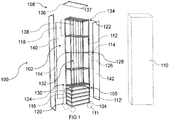
- a modular planting system or a plant tower 100 is shown.
- the plant tower 100 is light in weight and has a small storage and transport volume.
- the plant tower 100 is stable and particularly suitable for growing tall climbing plants, for example tomato plants.
- the plant tower 100 contains an integral profile tube plug-in system structure 102 that can be dismantled into individual parts, a pot 104, an irrigation insert element 106 (cf. Fig. 2 ), a housing 108, a cover 110 and wheels 111.
- the housing 108, the cover 110 and the wheels 111 are optional.
- the plant tower 100 is in Fig. 1 shown in an assembled state. In the assembled state, the irrigation insert element 106 is arranged within the pot 104 and the pot 104 is arranged within the profile tube plug-in system structure 102.
- the profile pipe plug-in system structure 102 contains a plurality of hollow, pluggable, vertically arranged profile pipes 112, 112 'and horizontally arranged profile pipes 114, 114'.
- the profile tubes 112, 112 ′, 114 and 114 are plugged together to form the profile tube plug-in system structure 102.
- the profile tubes 112, 112 ', 114 and 114' then form a frame of the plant tower 100.
- the profile tube plug-in system structure 102 has a cuboid structure. In other exemplary embodiments, it can also have a different shape, for example a prism shape with a hexagonal base area.
- the profile tube plug-in system structure 102 has five sections of equal length, including a lowermost section 116 and an uppermost section 118.
- the sections extend between a lower end 120 of the profile tube plug-in system structure 102 and an upper end 122 and each enclose an equally large volume.
- the lowermost section 116 therefore takes up a fifth of the length and a fifth of the total volume of the profile tube plug-in system structure 102.
- the lowermost section can also take up a different length or a different volume, for example a quarter of the total length or the total volume of the profile tube plug-in system structure.
- the lowest section 116 contains five areas 124, while the other sections each contain only one area.
- the profile tube plug-in system structure 102 thus contains a total of nine areas in this exemplary embodiment. In other exemplary embodiments, the profile tube plug-in system structure can also have a different number of areas and / or sections.
- Each area has four vertically arranged profile tubes 112 or 112 ', which define a boundary of the respective area.
- the vertically arranged profile tubes 112, 112 ' are each arranged parallel to the other vertically arranged profile tubes 112, 112' of the area.
- each of the areas has at least four horizontally arranged profile tubes 114 and 114 ', which are arranged perpendicular to the vertically arranged profile tubes 112 and 112' and connect the vertically arranged profile tubes to one another in one plane.
- a middle section 126 contains a plane 128 at its upper end.
- the horizontally arranged profile tubes 114 ' are shorter in the horizontal direction than the horizontally arranged profile tubes 114.
- a lowermost area of the lowermost section 116 has eight horizontally arranged profile tubes 114 and 114 in this embodiment 'Of which four horizontally arranged profile tubes 114 and 114' form the lower end 120 of the profile tube plug-in system structure 102. In contrast to the other areas, which have only one level, the lowest area therefore contains two levels.
- the profile pipe plug-in system structure 102 and the pot 104 are adapted to one another in such a way that the pot 104 can be arranged within the profile pipe plug-in system structure 102 in the assembled state of the profile pipe plug-in system structure 102.
- the lowermost section 116 is designed to accommodate the pot 104.
- the lowermost section 116 has 5 areas which are defined by the short vertically arranged profile tubes 112 '.
- the vertically arranged profile tubes 112 ' have a fifth of the length of the vertically arranged profile tubes 112.
- Structure 102 are held.
- the lowermost section 116 and the pot 104 are adapted to one another in such a way that the pot 104 takes up four fifths of the volume of the lowermost section 116. The pot 104 thus ends at the level 105.
- the profile tube plug-in system structure 102, the pot 104 and the irrigation insert element 106 form a unit, the focus of which, during operation, is on a base of the unit by filling water and planting substrate into the pot 104. This makes it possible to ensure the stability of the plant tower 100.
- the center of gravity can be located within the profile tube connector system structure, but does not necessarily have to be on the floor.
- the intermediate level 130 is formed by the four horizontally arranged profile tubes 114 and 114 'and two additional horizontally arranged profile tubes 114.
- the two additional horizontally arranged profile tubes 114 connect the two horizontally arranged profile tubes 114 'of the plane that are opposite one another and thus create an additional climbing aid located within the profile tube plug-in system structure 102.
- two climbing aids in the form of a respective steel cable 132 end at each of the additional horizontally arranged profile tubes 114, which extends downward from the upper end 122 of the profile tube plug-in system structure 102 and is attached to the respective additional horizontally arranged profile tube 114 of the intermediate level 130.
- a roof level 134 which is constructed from profile tubes 114 and 114 ′ corresponding to the intermediate level 130.
- the steel cables 132 thus enable plants to grow more easily upwards within the profile tube plug-in system structure 102.
- the intermediate level can also have only one or more than two additional horizontally arranged profile tubes which connect two of the horizontally arranged profile tubes to one another. A diagonal connection between two horizontally arranged profile tubes or between two vertically arranged profile tubes is also conceivable.
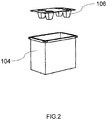
- Pot 104 and irrigation insert member 106 are shown in FIG Fig. 2 shown.
- the pot 104 is made of a flexible water-impermeable material. It is used to absorb water and plant substrate. Furthermore, in this exemplary embodiment it is foldable so that it can be stored and transported in a space-saving manner.
- the pot 104 in this exemplary embodiment is a container made from a flexible, foldable plastic.
- the pot can also be assembled from several parts, for example from several plates or a sack.
- the plates can also be made of a rigid material, i.e. the material of the pot is only optionally a flexible material.
- Several plates can be put together to form a pot, for example.
- the pot can have, for example, 4 side walls and a base plate, which can provide plug-in connections that are matched to one another, so that the pot can be filled with plant substrate and water in an assembled state and is watertight.
- the pot can also consist of a base plate and four side plates.
- the side plates can be hung on the horizontally arranged profile tubes 114 and 114 'of level 105.
- the irrigation insert element 106 is used for capillary-absorption irrigation from below.
- the pot 104 and the irrigation insert element 106 are adapted to one another in such a way that the irrigation insert element 106 can be arranged within the pot 104. Capillary-absorption irrigation from below is thus possible if the irrigation insert element 106 is arranged in the pot 104 and the pot 104 is partially filled with water.
- the irrigation insert element 106 contains four prefabricated recesses 106 for four plants (not shown). In other exemplary embodiments, a different number of recesses can also be provided. An opening is provided at the bottom of the respective recess to enable capillary-absorption irrigation.
- the housing 108 (cf. Fig. 1 ) serves to keep moisture from outside and enables a cold frame growth climate to be created.
- the housing 108 is made of a water-impermeable material.
- the housing 108 has a cover 136 and three side walls 138, 140 and 142.
- the side wall 140 serves as a Back wall.
- a different number of side walls can also be provided, for example two or four.
- the dimensions of the cover 136 and the side walls 138, 140 and 142 are adapted to the dimensions of the profile pipe plug-in system structure 102 in such a way that they cover the profile pipe plug-in system structure 102 in such a way that no water inadvertently gets into the profile pipe plug-in system -Structure 102 penetrates enclosed space.
- the housing 108 in particular the cover 136, has a respective opening 137 at its four corners for feeding water into the profile pipe plug-in system structure 102.
- the vertically arranged profile pipes 112 of the uppermost section 118 are open at their upper end, so that water can flow through the openings 137 of the cover 136 into the vertically arranged profile tubes 112.
- the profile tube plug-in system structure 102 has openings for supplying the water into the pot 104 (not shown) at a level below the irrigation insert element 106, so that the water can be used for capillary-absorption irrigation from below via the irrigation insert element 106.
- the profile tube plug-in system structure 102 can thus serve as an additional water reservoir and, for example, absorb and store rainwater.
- the openings 137 in the cover and the openings for feeding the water into the pot 104 in the profile tube plug-in system structure 102 are optional.
- the wheels 111 are attached to the bottom of the profile tube plug-in system structure 102 and allow the planting tower 100 to be moved easily. This makes the planting tower 100 mobile without it having to be dismantled and reassembled. This means that the planting system is easy to move.
- castors or other means for moving the modular planting system can also be provided, for example chains or rollers.
- the optional cover 110 acts as a rain cover and provides additional rain protection.
- the cover 110 is made of a water-impermeable and flexible material so that it can adapt to the shape of the profile tube plug-in system structure 102.
- the profile tube plug-in system structure of the modular planting system can be designed to couple modular planting systems standing next to one another with one another in order to produce a pergola.
- horizontally arranged profile tubes for connecting adjacent modular planting systems can be provided.
- the planting system can therefore not only be designed modularly in the sense that the planting tower itself is variable, e.g. in height, but also in such a way that further modular planting systems can be connected to the modular planting system and thus an even larger structure, for example in Create the shape of a pergola.
- Fig. 3 shows a pergola 300 made up of four modular planting systems 100 'arranged next to one another and connected to one another via horizontally arranged profile tubes 306, 308, 310, 312, 314, 316, 317 and 318.
- the modular planting systems 100 ' are similar to that in Fig. 1 modular planting system 100 shown. In contrast to this, however, the modular planting systems 100 'have only four instead of five sections and are therefore somewhat shorter in the vertical direction. In other embodiments, the modular planting systems of the pergola can also have a different number of sections. Furthermore, in other exemplary embodiments, two or more of the modular planting systems can be arranged next to one another and coupled to one another.
- the four sections 320, 330, 340 and 350 extend between an upper end 302 and a lower end 304 of the pergola 300.
- the profile tube plug-in system structures 102 ′ are each of two adjacent modular planting systems 100 ′ with one another via two profile tubes 306 and 308 or 310 and 312 or 314 and 316 or 317 and 318 plugged together and thus coupled.
- the adjacent modular planting systems can also be plugged together at a different height, for example at the lower end.
- the lowermost section 320 of the respective profile tube plug-in system structure 102 has five areas 322, 324, 326, 328 and 329. This enables the pot introduced into the respective modular planting system 100' better to hold. The pot takes up four fifths of the volume of the respective lowermost section 320.
- the pergola 300 is closed to the outside.
- the modular planting systems have 100 'enclosures (not shown).
- the cover and side walls of the housing are provided for the areas between the adjacent modular planting systems 100 'in order to be able to close the pergola 300 completely from the outside.
- a side wall between two modular planting systems can be replaced by a door so that the pergola, which is closed to the outside, can be entered through the door without having to remove a side wall.
- a closed pergola can also serve as a greenhouse.
- the pergola can for example have an air conditioning system that can be remotely controlled.
- Fig. 4 a portable, modularly expandable greenhouse 400 similar to a small greenhouse or raised bed or plant trough with permanently installed irrigation device, with cold frame and greenhouse elements and climate control is shown in an exploded view.
- a successfully managed greenhouse, cold frame, raised bed or plant trough does not come about without further ado and requires a deeper study of horticultural techniques, which makes it almost impossible for an unfamiliar user who works elsewhere to build a profitable bed without spending a lot of time or external services or to install and maintain.
- the housing 400 creates a planting unit for urban areas that can be operated with simple instructions without horticultural expertise and still delivers yields largely without manual maintenance.
- the fundamental difficulty lies in the growth of the plants, which depends on numerous natural factors such as the time of sowing or planting, climate, irrigation and soil properties.
- the housing 400 makes it possible to combine the various properties and advantages of a greenhouse, cold frame, raised bed and plant trough and to minimize the effort required for year-round production of living plants in an urban context.
- the invention can be understood as a hybrid of greenhouse, cold frame, raised frame and plant trough.
- the housing 400 has castors 402, a Euro pallet 404, a water depot 406 for watering from below, an insert element 407 for watering from below, a foldable top frame 408, a growth barrier 410, a foldable top frame 412, an irrigation and organization frame 414, a foldable stacking frame 416 and flat roof window flaps 418.
- the growth barrier 410 contains a substrate heater.
- the foldable stacking frames 412 and 416 are transparent and waterproof.
- the flat roof window flaps 418 can be opened by 270 degrees.
- the housing 400 can be transported as a unit in a truck due to its dimensions according to DIN EN 13698-1 EURO pallet.
- the castors 402 make the housing 400 portable.
- the water depot 406 for irrigation from below is used for underfloor irrigation.
- the foldable attachment frame 408 in this embodiment is a frame according to DIN EN 13698-1 made of opaque water-repellent material.
- the foldable stacking frame 408 is used to create 4 side walls as a bed border.
- the foldable stacking frames 412 and 416 can serve as an additive element to create a greenhouse that can be expanded in height.
- the growth barrier 410 protects the underfloor water deposit 406 from penetrating roots.
- substrate and / or soil as well as seed mats can be picked up.
- This substrate is kept warm with the substrate heater (not shown) if necessary in order to initiate plant growth even when outside temperatures are cool, which is possible with the use of seed mats (not shown).
- the water comes via irrigation ducts (not shown) located in hollow chambers of the foldable stacking frame 412 made of hollow-chamber web plates, which are connected to the irrigation ducts by means of a garden hose and conventional connection coupling (not shown).
- the irrigation and order frame 414 is optional and can be removed.
- the irrigation and order frame 414 is suitable for DIN EN 13698-1 stacking frames 408 and for stacking frames 412 and 416. In this embodiment, the irrigation and order frame 414 is also connected to a garden hose with a conventional connection coupling (not shown).
- the system is modularly supplemented to form a cold frame using the two transparent flat roof window flaps 418 for covering the bed.
- the flat roof window flaps 418 are attached to an all-round frame on two sides and can be opened by 270 degrees. This enables the bed to be opened completely at the top and thus easy access to the plants. Rainfall can also be made possible.
- plant growth light (not shown) inserted into the hollow chambers of the multi-wall sheets used.
- the vertically modular stackable components including the swivel castors 402, the Euro pallet 404, the water depot 406 for watering from below, the insert element 407 for watering from below, the foldable top frame 408, the growth barrier 410, the foldable top frame 412, the irrigation and
- the organizational frame 414, the foldable stacking frame 416 and the flat roof window flaps 418 become flexible Applicable, self-building, interoperable hybrid created from greenhouse, cold frame, raised bed and plant trough.
- climate control by means of a sensor and WiFi connection can be provided.
- a wifi automatic watering machine can be provided.
- a temperature-dependent window opener can be provided. Online remote diagnosis and advice on growth can be provided.
- the system offering is rounded off by online remote diagnosis and advice for users on the growth of their crops.
Landscapes
- Life Sciences & Earth Sciences (AREA)
- Environmental Sciences (AREA)
- Engineering & Computer Science (AREA)
- Water Supply & Treatment (AREA)
- Cultivation Receptacles Or Flower-Pots, Or Pots For Seedlings (AREA)
Applications Claiming Priority (2)
| Application Number | Priority Date | Filing Date | Title |
|---|---|---|---|
| DE202019001477.2U DE202019001477U1 (de) | 2019-03-29 | 2019-03-29 | Gehäuse zur ganzjährigen Erzeugung von lebenden Pflanzen |
| DE202019002763.7U DE202019002763U1 (de) | 2019-06-27 | 2019-06-27 | Pflanzenturm mit integraler Rankestruktur und Selbstbewässerung aus Stecksystem-Struktur für hochwachsende Pflanzen, faltbarer Pflanztopf aus wasserundurchlässigem Material mit Einsatzelement für kapillar-absorbtions Bewässerung von unten, mit Klima-Umhausung, auf Rädern steht und modular additiv zu einer Pergola ausbaufähig |
Publications (1)
| Publication Number | Publication Date |
|---|---|
| EP3718393A1 true EP3718393A1 (fr) | 2020-10-07 |
Family
ID=70110003
Family Applications (1)
| Application Number | Title | Priority Date | Filing Date |
|---|---|---|---|
| EP20000139.4A Withdrawn EP3718393A1 (fr) | 2019-03-29 | 2020-03-26 | Système modulaire de plantation |
Country Status (1)
| Country | Link |
|---|---|
| EP (1) | EP3718393A1 (fr) |
Cited By (1)
| Publication number | Priority date | Publication date | Assignee | Title |
|---|---|---|---|---|
| DE202023106175U1 (de) | 2023-10-25 | 2023-12-13 | Funke Kunststoffe Gmbh | Vertikal-Fördereinheit und Fördereinrichtung für Wasser |
Citations (10)
| Publication number | Priority date | Publication date | Assignee | Title |
|---|---|---|---|---|
| US3264783A (en) * | 1964-03-10 | 1966-08-09 | Carl W Bayliss | Collapsible and adjustable trellis |
| DE8609182U1 (de) * | 1986-04-05 | 1986-09-04 | Hinz, Klaus, 8700 Würzburg | Fahrbare Vorrichtung zum Stützen von Blumentopfpflanzen |
| DE10028622A1 (de) | 2000-06-09 | 2001-12-20 | Ekkehard Strauss | Mobiles, demontierbares Pflanzsystem mit Rankhilfe |
| US20030062282A1 (en) * | 2001-09-28 | 2003-04-03 | Riviera | Container for vegetables with a sealed water reserve |
| US20080263949A1 (en) * | 2006-07-13 | 2008-10-30 | Jonathan Early | Tomato growing system |
| JP2012060944A (ja) * | 2010-09-17 | 2012-03-29 | Ietatsu Kowari | 植物支持用棒材保持具及び植物支持具 |
| EP2796076A1 (fr) * | 2013-04-25 | 2014-10-29 | indochina Ambiente GmbH | Tissu en tressage |
| FR3010858A1 (fr) * | 2013-09-20 | 2015-03-27 | Olivier Renon | Ensemble d'accessoires de jardinage comprenant au moins un tuteur et un ou plusieurs contenants associes a celui-ci |
| US20170181385A1 (en) * | 2015-12-29 | 2017-06-29 | Kevin M. Daniel | Stackable and tiered modular kit, assembly and method including a plurality of hoop shaped components for supporting a stem of a growing plant |
| WO2018136548A2 (fr) * | 2017-01-17 | 2018-07-26 | A J Marine, Inc. | Treillis modulaire et système de clôture |
-
2020
- 2020-03-26 EP EP20000139.4A patent/EP3718393A1/fr not_active Withdrawn
Patent Citations (10)
| Publication number | Priority date | Publication date | Assignee | Title |
|---|---|---|---|---|
| US3264783A (en) * | 1964-03-10 | 1966-08-09 | Carl W Bayliss | Collapsible and adjustable trellis |
| DE8609182U1 (de) * | 1986-04-05 | 1986-09-04 | Hinz, Klaus, 8700 Würzburg | Fahrbare Vorrichtung zum Stützen von Blumentopfpflanzen |
| DE10028622A1 (de) | 2000-06-09 | 2001-12-20 | Ekkehard Strauss | Mobiles, demontierbares Pflanzsystem mit Rankhilfe |
| US20030062282A1 (en) * | 2001-09-28 | 2003-04-03 | Riviera | Container for vegetables with a sealed water reserve |
| US20080263949A1 (en) * | 2006-07-13 | 2008-10-30 | Jonathan Early | Tomato growing system |
| JP2012060944A (ja) * | 2010-09-17 | 2012-03-29 | Ietatsu Kowari | 植物支持用棒材保持具及び植物支持具 |
| EP2796076A1 (fr) * | 2013-04-25 | 2014-10-29 | indochina Ambiente GmbH | Tissu en tressage |
| FR3010858A1 (fr) * | 2013-09-20 | 2015-03-27 | Olivier Renon | Ensemble d'accessoires de jardinage comprenant au moins un tuteur et un ou plusieurs contenants associes a celui-ci |
| US20170181385A1 (en) * | 2015-12-29 | 2017-06-29 | Kevin M. Daniel | Stackable and tiered modular kit, assembly and method including a plurality of hoop shaped components for supporting a stem of a growing plant |
| WO2018136548A2 (fr) * | 2017-01-17 | 2018-07-26 | A J Marine, Inc. | Treillis modulaire et système de clôture |
Cited By (2)
| Publication number | Priority date | Publication date | Assignee | Title |
|---|---|---|---|---|
| DE202023106175U1 (de) | 2023-10-25 | 2023-12-13 | Funke Kunststoffe Gmbh | Vertikal-Fördereinheit und Fördereinrichtung für Wasser |
| EP4544904A1 (fr) | 2023-10-25 | 2025-04-30 | Funke Kunststoffe GmbH | Unité de transport vertical et dispositif de transport d'eau |
Similar Documents
| Publication | Publication Date | Title |
|---|---|---|
| EP3481736B1 (fr) | Récipient empilable comprenant des moyens d'évacuation de liquide du côté du fond | |
| EP2946655B1 (fr) | Dispositif de gazonnage vertical | |
| DE69901241T2 (de) | Kulturkastenanlage | |
| DE102018110964B4 (de) | Hochbeet mit integriertem bewässerungssystem | |
| DE102017110988B3 (de) | Stapelbares Behältersystem | |
| DE102021107313A1 (de) | Vorrichtung und Verfahren zur Aufzucht von Pflanzen | |
| EP3718393A1 (fr) | Système modulaire de plantation | |
| DE102018119631B4 (de) | Pflanzvorrichtung | |
| DE10214760B4 (de) | Gewächshaussystem | |
| CH447699A (de) | Selbsttätige Bewässerungsvorrichtung mit einem topfartigen Gefäss und einem in diesem angeordneten Topf zur Aufnahme von Pflanzen, Blumen u. dgl. botanischen Gewächsen | |
| EP2702863B1 (fr) | Module de plante | |
| DE102014107465B3 (de) | Behälter für Wasserpflanzen | |
| EP3050427B1 (fr) | Jardinière | |
| AT392719B (de) | Huegelbeet-umrahmung | |
| DE202019001477U1 (de) | Gehäuse zur ganzjährigen Erzeugung von lebenden Pflanzen | |
| DE202016003442U1 (de) | Pflanzkasten | |
| DE102015209344B3 (de) | Pflanzgefäß mit Wassermanagementsystem | |
| DE8808067U1 (de) | Komposter mit Pflanzkästen | |
| DE10301032A1 (de) | Hochbeet | |
| DE3633390A1 (de) | Behaelter fuer pflanzen und gewaechse zur begruenung von insbesondere trockenen standorten u. verfahren zur anzucht von pflanzen und gewaechsen mittels des behaelters | |
| DE102019108383A1 (de) | Vertikalbeet aus stapelbaren Pflanzmodulen | |
| AT307131B (de) | Einrichtung zur Pflanzenkultur in Pflanzgefäßen | |
| DE20307000U1 (de) | Hochbeet | |
| AT413172B (de) | Zuchtbehälter | |
| DE2044821A1 (de) | Verfahren zur Anzucht von physiologisch und morphologisch hochwertigen Pflanzen in Gewächshäusern |
Legal Events
| Date | Code | Title | Description |
|---|---|---|---|
| PUAI | Public reference made under article 153(3) epc to a published international application that has entered the european phase |
Free format text: ORIGINAL CODE: 0009012 |
|
| STAA | Information on the status of an ep patent application or granted ep patent |
Free format text: STATUS: THE APPLICATION HAS BEEN PUBLISHED |
|
| AK | Designated contracting states |
Kind code of ref document: A1 Designated state(s): AL AT BE BG CH CY CZ DE DK EE ES FI FR GB GR HR HU IE IS IT LI LT LU LV MC MK MT NL NO PL PT RO RS SE SI SK SM TR |
|
| AX | Request for extension of the european patent |
Extension state: BA ME |
|
| TPAC | Observations filed by third parties |
Free format text: ORIGINAL CODE: EPIDOSNTIPA |
|
| STAA | Information on the status of an ep patent application or granted ep patent |
Free format text: STATUS: THE APPLICATION IS DEEMED TO BE WITHDRAWN |
|
| 18D | Application deemed to be withdrawn |
Effective date: 20210408 |