EP3718988A1 - Inhibition de la corrosion de renfort métallique présent dans une construction en béton durcie dotée d'un ou de plusieurs surfaces exposées à l'intrusion de chlorure - Google Patents
Inhibition de la corrosion de renfort métallique présent dans une construction en béton durcie dotée d'un ou de plusieurs surfaces exposées à l'intrusion de chlorure Download PDFInfo
- Publication number
- EP3718988A1 EP3718988A1 EP19166999.3A EP19166999A EP3718988A1 EP 3718988 A1 EP3718988 A1 EP 3718988A1 EP 19166999 A EP19166999 A EP 19166999A EP 3718988 A1 EP3718988 A1 EP 3718988A1
- Authority
- EP
- European Patent Office
- Prior art keywords
- weight
- aqueous
- alanine
- corrosion
- solution
- Prior art date
- Legal status (The legal status is an assumption and is not a legal conclusion. Google has not performed a legal analysis and makes no representation as to the accuracy of the status listed.)
- Withdrawn
Links
Images


Classifications
-
- C—CHEMISTRY; METALLURGY
- C04—CEMENTS; CONCRETE; ARTIFICIAL STONE; CERAMICS; REFRACTORIES
- C04B—LIME, MAGNESIA; SLAG; CEMENTS; COMPOSITIONS THEREOF, e.g. MORTARS, CONCRETE OR LIKE BUILDING MATERIALS; ARTIFICIAL STONE; CERAMICS; REFRACTORIES; TREATMENT OF NATURAL STONE
- C04B41/00—After-treatment of mortars, concrete, artificial stone or ceramics; Treatment of natural stone
- C04B41/45—Coating or impregnating, e.g. injection in masonry, partial coating of green or fired ceramics, organic coating compositions for adhering together two concrete elements
- C04B41/50—Coating or impregnating, e.g. injection in masonry, partial coating of green or fired ceramics, organic coating compositions for adhering together two concrete elements with inorganic materials
- C04B41/5007—Coating or impregnating, e.g. injection in masonry, partial coating of green or fired ceramics, organic coating compositions for adhering together two concrete elements with inorganic materials with salts or salty compositions, e.g. for salt glazing
- C04B41/5009—Coating or impregnating, e.g. injection in masonry, partial coating of green or fired ceramics, organic coating compositions for adhering together two concrete elements with inorganic materials with salts or salty compositions, e.g. for salt glazing containing nitrogen in the anion, e.g. nitrites
-
- C—CHEMISTRY; METALLURGY
- C04—CEMENTS; CONCRETE; ARTIFICIAL STONE; CERAMICS; REFRACTORIES
- C04B—LIME, MAGNESIA; SLAG; CEMENTS; COMPOSITIONS THEREOF, e.g. MORTARS, CONCRETE OR LIKE BUILDING MATERIALS; ARTIFICIAL STONE; CERAMICS; REFRACTORIES; TREATMENT OF NATURAL STONE
- C04B14/00—Use of inorganic materials as fillers, e.g. pigments, for mortars, concrete or artificial stone; Treatment of inorganic materials specially adapted to enhance their filling properties in mortars, concrete or artificial stone
- C04B14/02—Granular materials, e.g. microballoons
- C04B14/34—Metals, e.g. ferro-silicon
-
- C—CHEMISTRY; METALLURGY
- C04—CEMENTS; CONCRETE; ARTIFICIAL STONE; CERAMICS; REFRACTORIES
- C04B—LIME, MAGNESIA; SLAG; CEMENTS; COMPOSITIONS THEREOF, e.g. MORTARS, CONCRETE OR LIKE BUILDING MATERIALS; ARTIFICIAL STONE; CERAMICS; REFRACTORIES; TREATMENT OF NATURAL STONE
- C04B41/00—After-treatment of mortars, concrete, artificial stone or ceramics; Treatment of natural stone
- C04B41/009—After-treatment of mortars, concrete, artificial stone or ceramics; Treatment of natural stone characterised by the material treated
-
- C—CHEMISTRY; METALLURGY
- C04—CEMENTS; CONCRETE; ARTIFICIAL STONE; CERAMICS; REFRACTORIES
- C04B—LIME, MAGNESIA; SLAG; CEMENTS; COMPOSITIONS THEREOF, e.g. MORTARS, CONCRETE OR LIKE BUILDING MATERIALS; ARTIFICIAL STONE; CERAMICS; REFRACTORIES; TREATMENT OF NATURAL STONE
- C04B41/00—After-treatment of mortars, concrete, artificial stone or ceramics; Treatment of natural stone
- C04B41/45—Coating or impregnating, e.g. injection in masonry, partial coating of green or fired ceramics, organic coating compositions for adhering together two concrete elements
- C04B41/4505—Coating or impregnating, e.g. injection in masonry, partial coating of green or fired ceramics, organic coating compositions for adhering together two concrete elements characterised by the method of application
- C04B41/4535—Coating or impregnating, e.g. injection in masonry, partial coating of green or fired ceramics, organic coating compositions for adhering together two concrete elements characterised by the method of application applied as a solution, emulsion, dispersion or suspension
- C04B41/4539—Coating or impregnating, e.g. injection in masonry, partial coating of green or fired ceramics, organic coating compositions for adhering together two concrete elements characterised by the method of application applied as a solution, emulsion, dispersion or suspension as a emulsion, dispersion or suspension
-
- C—CHEMISTRY; METALLURGY
- C04—CEMENTS; CONCRETE; ARTIFICIAL STONE; CERAMICS; REFRACTORIES
- C04B—LIME, MAGNESIA; SLAG; CEMENTS; COMPOSITIONS THEREOF, e.g. MORTARS, CONCRETE OR LIKE BUILDING MATERIALS; ARTIFICIAL STONE; CERAMICS; REFRACTORIES; TREATMENT OF NATURAL STONE
- C04B41/00—After-treatment of mortars, concrete, artificial stone or ceramics; Treatment of natural stone
- C04B41/60—After-treatment of mortars, concrete, artificial stone or ceramics; Treatment of natural stone of only artificial stone
- C04B41/61—Coating or impregnation
- C04B41/65—Coating or impregnation with inorganic materials
-
- C—CHEMISTRY; METALLURGY
- C09—DYES; PAINTS; POLISHES; NATURAL RESINS; ADHESIVES; COMPOSITIONS NOT OTHERWISE PROVIDED FOR; APPLICATIONS OF MATERIALS NOT OTHERWISE PROVIDED FOR
- C09K—MATERIALS FOR MISCELLANEOUS APPLICATIONS, NOT PROVIDED FOR ELSEWHERE
- C09K15/00—Anti-oxidant compositions; Compositions inhibiting chemical change
- C09K15/02—Anti-oxidant compositions; Compositions inhibiting chemical change containing inorganic compounds
-
- C—CHEMISTRY; METALLURGY
- C23—COATING METALLIC MATERIAL; COATING MATERIAL WITH METALLIC MATERIAL; CHEMICAL SURFACE TREATMENT; DIFFUSION TREATMENT OF METALLIC MATERIAL; COATING BY VACUUM EVAPORATION, BY SPUTTERING, BY ION IMPLANTATION OR BY CHEMICAL VAPOUR DEPOSITION, IN GENERAL; INHIBITING CORROSION OF METALLIC MATERIAL OR INCRUSTATION IN GENERAL
- C23F—NON-MECHANICAL REMOVAL OF METALLIC MATERIAL FROM SURFACE; INHIBITING CORROSION OF METALLIC MATERIAL OR INCRUSTATION IN GENERAL; MULTI-STEP PROCESSES FOR SURFACE TREATMENT OF METALLIC MATERIAL INVOLVING AT LEAST ONE PROCESS PROVIDED FOR IN CLASS C23 AND AT LEAST ONE PROCESS COVERED BY SUBCLASS C21D OR C22F OR CLASS C25
- C23F11/00—Inhibiting corrosion of metallic material by applying inhibitors to the surface in danger of corrosion or adding them to the corrosive agent
- C23F11/08—Inhibiting corrosion of metallic material by applying inhibitors to the surface in danger of corrosion or adding them to the corrosive agent in other liquids
-
- C—CHEMISTRY; METALLURGY
- C23—COATING METALLIC MATERIAL; COATING MATERIAL WITH METALLIC MATERIAL; CHEMICAL SURFACE TREATMENT; DIFFUSION TREATMENT OF METALLIC MATERIAL; COATING BY VACUUM EVAPORATION, BY SPUTTERING, BY ION IMPLANTATION OR BY CHEMICAL VAPOUR DEPOSITION, IN GENERAL; INHIBITING CORROSION OF METALLIC MATERIAL OR INCRUSTATION IN GENERAL
- C23F—NON-MECHANICAL REMOVAL OF METALLIC MATERIAL FROM SURFACE; INHIBITING CORROSION OF METALLIC MATERIAL OR INCRUSTATION IN GENERAL; MULTI-STEP PROCESSES FOR SURFACE TREATMENT OF METALLIC MATERIAL INVOLVING AT LEAST ONE PROCESS PROVIDED FOR IN CLASS C23 AND AT LEAST ONE PROCESS COVERED BY SUBCLASS C21D OR C22F OR CLASS C25
- C23F11/00—Inhibiting corrosion of metallic material by applying inhibitors to the surface in danger of corrosion or adding them to the corrosive agent
- C23F11/08—Inhibiting corrosion of metallic material by applying inhibitors to the surface in danger of corrosion or adding them to the corrosive agent in other liquids
- C23F11/18—Inhibiting corrosion of metallic material by applying inhibitors to the surface in danger of corrosion or adding them to the corrosive agent in other liquids using inorganic inhibitors
- C23F11/181—Nitrogen containing compounds
-
- C—CHEMISTRY; METALLURGY
- C04—CEMENTS; CONCRETE; ARTIFICIAL STONE; CERAMICS; REFRACTORIES
- C04B—LIME, MAGNESIA; SLAG; CEMENTS; COMPOSITIONS THEREOF, e.g. MORTARS, CONCRETE OR LIKE BUILDING MATERIALS; ARTIFICIAL STONE; CERAMICS; REFRACTORIES; TREATMENT OF NATURAL STONE
- C04B2111/00—Mortars, concrete or artificial stone or mixtures to prepare them, characterised by specific function, property or use
- C04B2111/20—Resistance against chemical, physical or biological attack
- C04B2111/26—Corrosion of reinforcement resistance
Definitions
- the present disclosure relates to the inhibition of corrosion of metal reinforcements present in hardened, also called “set", concrete constructions such as buildings, bridges, roads, etc. (hereafter called “reinforced concrete constructions”) having one or more surfaces that are exposed to chloride intrusion inducing corrosion to the metal reinforcements.
- Corrosion inhibitors are defined as “substances or mixtures that in low concentration and in aggressive environment inhibit, prevent or minimize the corrosion”.
- Concrete constructions for structural purposes such as buildings, bridges, roads, etc. are made out of hardened concrete and are commonly provided inside their core with metal reinforcements in order to strengthen the hardened concrete and to hold the set concrete into compression. Concrete is strong under compression but has a weak tensile strength.
- the most common form of these metal reinforcements are steel rebars (short for reinforcing bars) and wire mesh. Other types of metal reinforcements are grids, girders, channel beams, and the like.
- the metal can be in the form of iron and steel.
- Steel rebars significantly increase the tensile strength of the concrete structure.
- the net result of a chloride attack is the corrosion of the metal reinforcement, leading to cracking and spalling of the concrete constructions and in some cases catastrophic structural failure as the load bearing capacity of the concrete is compromised.
- the mode of attack originates from salts and other corrosive substances that are carried by moisture, are absorbed into the concrete via its pores and micropores through capillary action. Once absorbed, these substances act to reduce the pH-value of the concrete thereby eliminating its passive oxide layer which would otherwise provide protection to the steel reinforcement. Corrosion takes place as the chloride ions meet with the steel and the surrounding passive material to produce a chemical process which forms hydrochloric acid. The hydrochloric acid eats away at the steel reinforcement.
- a known method for corrosion inhibition of metal reinforcements present inside concrete constructions is to apply calcium nitrite.
- a method is disclosed using calcium nitrite to control corrosion in hydraulic cements that contain metal pieces or structures.
- the method includes introducing into fresh concrete, containing metal elements, at least one compound capable of sequestering chloride ions.
- a method for inhibiting corrosion of existing steel material built in an inorganic material such as concrete.
- the method comprises the step of applying an aqueous solution of an inorganic salt such as calcium nitrite to the surface of the inorganic material.
- the purpose of the present disclosure is to inhibit the corrosion of concrete comprising reinforcements by impregnation of one or more surfaces of the reinforced concrete construction that are exposed to chloride intrusion causing corrosion of the metal reinforcements with a liquid which is harmless for the environment as well as the health of the worker handling the liquid and which is less costly to apply.
- a method for corrosion inhibition of metal reinforcements present in a hardened concrete construction, wherein the method comprises the step of applying an aqueous alkali metal, an aqueous earth alkali metal nitrate solution, an aqueous zinc nitrate solution, an aqueous ammonium nitrate solution, an aqueous ammonium solution or a mixture thereof on the one or more surfaces of the reinforced concrete construction that are exposed to chloride intrusion.
- the aqueous solution does not comprise calcium nitrite (Ca(NO 2 ) 2 ).
- an aqueous alkali metal or alkali earth metal nitrate solution which is less expensive than an aqueous calcium nitrite solution as used in the prior art, and which is furthermore not toxic, is corrosion inhibiting for steel reinforcements embedded in a hardened concrete structure.
- aqueous alkali metal or alkali earth metal nitrate solution penetrates from the surface of the hardened concrete structure to a sufficient depth of the concrete structure to reach the steel reinforcement and to exert the corrosion inhibiting effect. In this way, only corrosion inhibitor needs to be applied on the surface area located above the steel reinforcement through which less solution needs to be used then when it is applied in the concrete mixture before it is hardened.
- an aqueous calcium nitrate solution is applied on one or more of the surfaces comprising between 10 weight% and 20 weight%, more in particular between 15 weight% and 20 weight% and most in particular around 15 weight% of calcium nitrate dissolved in deionized water.
- the aqueous solution further comprises between 0.1 weight% to 5.0 weight%, more in particular between 0.5 weight% and 3.0 weight% of a penetration enhancing agent selected from the group consisting of
- Such surfactants provide enhanced wetting and penetration capability by altering the surface tension of the composition when it is applied in consecutive coatings on the surface of a hardened concrete construction having metal reinforcements that have undergone or are susceptible to corrosion.
- the aqueous solution further comprises between 0.1 weight% to 5.0 weight%, more in particular between 1.0 weight% and 2.0 weight% of organic solvent selected from the group consisting of glycol ethers comprising ethylene substituted mono-ethyl, -methyl, - propyl, and -butyl glycol ethers, more in particular ethylene glycol monobutyl ether.
- Glycol ethers provide good long-term stability and shelf-life of products and improve the wetting properties of water-based products.
- an aqueous alkali metal solution an aqueous earth metal nitrate solution, an aqueous zinc nitrate solution, an aqueous aluminium nitrate solution, an aqueous ammonium solution or a mixture thereof as a corrosion inhibitor by applying it on one or more surfaces of a hardened concrete construction comprising metal reinforcements that are exposed to chloride intrusion.
- an aqueous calcium nitrate solution is applied on the surface of a hardened reinforced concrete construction.
- the aqueous calcium nitrate solution in particular comprises between 10 weight% and 20 weight%, more in particular between 15 weight% and 20 weight%, and most in particular around 15 weight% of calcium nitrate dissolved in deionized water.
- the aqueous solution comprises between 0.1 weight% to 5.0 weight%, more in particular between 0.5 weight% and 3.0 weight% of a penetration enhancing agent selected from the group consisting of :
- the aqueous solution further comprises between 0.1 weight% to 5.0 weight%, more in particular between 1.0 weight% and 2.0 weight% of organic solvent selected from the group consisting of glycol ethers comprising ethylene substituted mono-ethyl, -methyl, -propyl, and - butyl glycol ethers. More in particular, ethylene glycol monobutyl ether is used.
- a corrosion inhibiting composition for inhibition of corrosion of metal reinforcements present in a hardened concrete construction having one or more surfaces that are exposed to chloride intrusion, comprising
- the present disclosure relates to a method for the corrosion inhibition of metal reinforcements present in a hardened concrete construction having one or more (outer) surfaces that are exposed to chloride intrusion.
- Corrosion inhibition is the minimization or prevention of corrosion with a chemical substance (a corrosion inhibitor) when added in small concentrations to an environment. There can however also be an additional effect of rehabilitation of already corroded metal reinforcements.
- an aqueous alkali metal solution, an aqueous earth metal nitrate solution, an aqueous zinc nitrate solution, an aqueous aluminum nitrate solution, an aqueous ammonium solution or a mixture of two or more of these solutions are applied on one or more of the surfaces of the hardened concrete construction that is exposed with chloride intrusion.
- an aqueous calcium nitrate solution is applied on one or more of these surfaces.
- the aqueous calcium nitrate solution in particular comprises between 10 weight% and 20 weight% of calcium nitrate dissolved in deionized water. More in particular, between 15 weight% and 20 weight%, and most in particular around 15 weight%. calcium nitrate is dissolved in deionized water.
- the aqueous solution can furthermore comprise one or more penetration enhancing agents, also called surfactants and/or co-solvents selected from the group comprising:
- surfactants examples include 1,4-dimethyl-1,4-bis-(2-methylpropyl-)-2-butyne-1,4-diol ether, polymerized with oxirane, methyl terminated (Surfynol® 2502 from Evonik), 2,4,7,9-tetramethyl-1,5-decyne-4,7-diol (Surfynol® 104 from Evonik), Poly(oxy-1,2-ethanediyl), alpha-[3,5-dimethyl-1-(2-methylpropyl)hexyl]- ⁇ -hydroxy (Tergitol TMN-6 from Croda), Sodium N-Oleyl Sarcosinate (Crodasinic OS35 from Croda).
- surfactants are in particular present between 0.1 weight% to 5.0 weight%, more in particular between 0.5 weight% and 3.0 weight%.
- the aqueous solution can furthermore comprise an organic solvent selected from the group consisting of glycol ethers comprising ethylene substituted mono-ethyl, -methyl, -propyl, and -butyl glycol ethers, more in particular ethylene glycol monobutyl ether. Of these, ethylene glycol monobutyl ether is preferred. An example thereof is Butyl Cellosolve Solvent from Dow Chemical.
- the organic solvent is in particular present between 0.1 weight% to 5.0 weight%, more in particular between 1.0 weight% and 2.0 weight%.
- the present disclosure further relates to the use of an aqueous alkali metal solution, an aqueous earth metal nitrate solution, an aqueous zinc nitrate solution, an aqueous aluminum nitrate solution, an aqueous ammonium nitrate solution of a mixture of two or more thereof as a corrosion inhibitor by applying it on one or more surfaces of a hardened concrete construction comprising metal reinforcements that are exposed to chloride intrusion.
- the solution can thus be used as a corrosion inhibitor, but can also serve as a corrosion rehabilitator.
- an aqueous calcium nitrate solution is applied.
- This aqueous calcium nitrate solution comprises between 10 weight% to 20 weight%, more in particular between 15 weight% and 20 weight% and most in particular around 15 weight% of calcium nitrate that is dissolved in deionized water.
- the aqueous solution can comprise between 0.1 weight% to 5.0 weight%, more in particular between 0.5 weight% and 3.0 weight% of a penetration enhancing agent selected from the group consisting of
- the aqueous solution can furthermore comprise between 0.1 weight% to 5.0 weight%, more in particular between 1.0 weight% and 2.0 weight% of organic solvent selected from the group consisting of glycol ethers comprising ethylene substituted mono-ethyl, -methyl, -propyl, and -butyl glycol ethers, more in particular ethylene glycol monobutyl ether.
- organic solvent selected from the group consisting of glycol ethers comprising ethylene substituted mono-ethyl, -methyl, -propyl, and -butyl glycol ethers, more in particular ethylene glycol monobutyl ether.
- the present disclosure also relates to a corrosion inhibiting composition for inhibition of corrosion of metal reinforcements present in a hardened concrete construction having one or more surfaces that are exposed to chloride intrusion.
- This corrosion inhibiting composition in particular comprises:
- the composition serves as a corrosion inhibiting composition, but can also serve as a corrosion rehabilitation composition.
- Three hardened steel reinforced concrete specimens with a composition as represented in Table 1 were prepared for every water/cement ratio (0.5 and 0.65) and for every different corrosion inhibitor tested, meaning a total of 6 specimens for every composition.
- the cement/sand ratio was the same for all specimens, i.e. 1/3.
- Two different water/cement ratios were tested (i.e. 0.50 and 0.65).
- 5 kg/m 3 of NaCl was added in the water of the concrete mix to enhance corrosion activity.
- the concrete mix was then casted in cubic molds with a dimension of 100 mm x 100 mm x100 mm. 4 rebars were placed in each mould at equal distances from the centre of the specimen.
- the specimens were fully cured, i.e.
- Table 1 Mix designs of the concrete specimens MATERIAL kg/m 3 kg/m 3 Cement II 42.5N (Lafarge - Holcim) 525.0 525.0 Sand (EN 12620) 1575.0 1575.0 Water 262.5 341.25 NaCl 5.0 5.0 Concrete Mix Characteristics Water/ Cement ratio 0.5 0.65 Compressive Strength 16.2 MPa 15.0 MPa The specimens were treated 3 times by applying 0.3 l/m 2 of two different corrosion inhibiting compositions (composition 1 and composition 2) as shown in tables 2 and 3 below on one of the surfaces of the specimens.
- composition 1 and composition 2 two different corrosion inhibiting compositions
- Corrosion Inhibiting Composition 1 (composition 1) MATERIAL % by weight Calcium Nitrate 15.0 Alcoxylated Acetylenic Diol 0.5 Ethylene Glycol Mono-Butyl Ether 1.5 Deionized Water 83.0
- Table 3 Corrosion Inhibiting Composition 2 (composition 2) MATERIAL % by weight Calcium Nitrate 15.0 Acetylenic Diol 1.0 Ethylene Glycol Mono-Buyl Ether 1.5 Deionized Water 82.5
- composition 1 and composition 2 the ability of the composition to diffuse into the concrete matrix after their surface treatment with composition 1 and composition 2 (or in other words, the depth of penetration) was tested.
- Each fully cured specimen (as described above) was treated 3 times, once every 6 hours, with 0.3 l/m 2 of the respective composition.
- the treated concrete specimens were stored for one week at standard conditions (22°C, 50% RH).
- table 4 the measurements of the penetration depth of the nitrates in the treated concrete specimens are shown. These measurements are based on the detection of nitrates in dust samples collected from concrete specimens at different depths. The detection was based on colour reactions of the extracted samples with sulfanilic acid and a-naphthylamine.
- Sika® FerroGard®-903+ is a surface applied mixed corrosion inhibitor, designed for use as an impregnation of steel reinforced concrete.
- FerroGard®-903+ is based on organic compounds, i.e. amino-alcohols and salts of amino-alcohols.
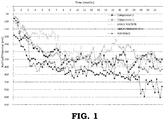
- Figure 3 confirms the conclusion of Figure 1 , while it shows that composition 2 and Grace Postrite® perform similarly. According to Figure 3 , composition 1 actively protects the steel reinforcement, especially during the first 12 months of the test.
- a group of reinforced concrete specimens was prepared according to the ASTM G109-07 method (Standard test method for determining effects of chemical admixtures on corrosion of embedded steel reinforcement in concrete exposed to chloride environments). This test method covers a procedure for determining the effects of chemical admixtures on the corrosion of metals in concrete. This test method can be used to evaluate materials intended to inhibit chloride-induced corrosion of steel in concrete.
- the specimens were prepared properly according to the mix-design presented in table 1 with a water/cement ratio of 0.5. 5 kg of NaCl was added per cubic meter of concrete mix in the water to enhance corrosion activity.
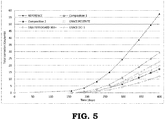
- Table 5a Corrosion test results according to ASTM G109-07 on reference sample without surface treatment and treated samples with composition 1 and composition 2 Reference Composition 1 Composition 2 Time (days) Current ( ⁇ A) Total corrosion (Coulomb) Current ( ⁇ A) Total corrosion (Coulomb) Current ( ⁇ A) Total corrosion (Coulomb) 0 0.0 0.0 0.0 0.0 0.0 0.0 0.0 157 0.2 1.4 0.0 0.0 0.0 0.0 0.0 0.0 192 1.2 3.5 0.5 0.8 0.2 0.3 227 1.9 8.2 0.8 2.7 0.6 1.5 262 2.6 15.0 1.4 6.0 0.8 3.6 297 3.5 24.2 1.9 11.0 1.0 6.4 343 3.7 38.5 2.0 18.8 1.3 10.9 376 3.9 49.3 2.2 24.8 1.3 14.6 400 4.0 57.5 2.2 29.3 1.2 17.2 Table 5b: Corrosion test results according to ASTM G109-07 on treated samples with comparative corrosion inhibiting products Grace Postrite®, Sika® FerroGard®-903
- composition 1 total corrosion (in Coulomb) according to the ASTM G109-07 method are shown in view of the time (in days) for composition 1, composition 2, the comparative corrosion inhibiting products Grace DCI®S, Grace Postrite® and Sika® FerroGard®-903+ and the reference.
- Grace DCI®S is a liquid corrosion inhibitor that is added to concrete during the batching process. It contains a minimum of 30% calcium nitrite.
- the principle of the ASTM G109-07-test is "the lower the total integrated current, the less corrosion there is”. Out of Figure 5 , it can be concluded that composition 2 performs slightly better than Grace Postrite® and Grace DCI®S.
- surface applied corrosion inhibiting composition 2 delays the onset of corrosion of the steel reinforcement embedded in reinforced concrete constructions more effectively than corrosion inhibiting compositions that are applied as admixtures in concrete mix during the batching process, e.g. Grace DCI®S.
Landscapes
- Chemical & Material Sciences (AREA)
- Engineering & Computer Science (AREA)
- Ceramic Engineering (AREA)
- Materials Engineering (AREA)
- Organic Chemistry (AREA)
- Inorganic Chemistry (AREA)
- Structural Engineering (AREA)
- Mechanical Engineering (AREA)
- Metallurgy (AREA)
- Dispersion Chemistry (AREA)
- Civil Engineering (AREA)
- Preventing Corrosion Or Incrustation Of Metals (AREA)
- Aftertreatments Of Artificial And Natural Stones (AREA)
- Working Measures On Existing Buildindgs (AREA)
- Paints Or Removers (AREA)
- Prevention Of Electric Corrosion (AREA)
Priority Applications (12)
| Application Number | Priority Date | Filing Date | Title |
|---|---|---|---|
| EP19166999.3A EP3718988A1 (fr) | 2019-04-03 | 2019-04-03 | Inhibition de la corrosion de renfort métallique présent dans une construction en béton durcie dotée d'un ou de plusieurs surfaces exposées à l'intrusion de chlorure |
| CN202080022402.5A CN113614054B (zh) | 2019-04-03 | 2020-04-03 | 存在于具有暴露于氯化物侵入的一个或多个表面的硬化混凝土结构中的金属增强体的腐蚀抑制 |
| EP20713814.0A EP3870554B1 (fr) | 2019-04-03 | 2020-04-03 | Inhibition de la corrosion de renfort métallique présent dans une construction en béton durci dotée d'une ou de plusieurs surfaces exposées à l'intrusion de chlorure |
| PCT/EP2020/059485 WO2020201470A1 (fr) | 2019-04-03 | 2020-04-03 | Inhibition de la corrosion d'un renfort métallique présent dans une construction en béton durci ayant une ou plusieurs surfaces qui sont exposées à une intrusion de chlorure |
| ES20713814T ES2928614T3 (es) | 2019-04-03 | 2020-04-03 | Inhibición de la corrosión de la armadura metálica presente en una construcción de hormigón endurecido que tiene una o más superficies que están expuestas a la intrusión de cloruro |
| BR112021018414A BR112021018414A2 (pt) | 2019-04-03 | 2020-04-03 | Inibição da corrosão da armadura de metal presente em uma construção de concreto endurecido que tem uma ou mais superfícies que estão expostas à penetração por cloretos |
| AU2020251185A AU2020251185B2 (en) | 2019-04-03 | 2020-04-03 | Corrosion inhibition of metal reinforcement present in a hardened concrete construction having one or more surfaces that are exposed to chloride intrusion |
| MYPI2021005336A MY203829A (en) | 2019-04-03 | 2020-04-03 | Corrosion inhibition of metal reinforcement present in a hardened concrete construction having one or more surfaces that are exposed to chloride intrusion |
| US17/600,809 US12281051B2 (en) | 2019-04-03 | 2020-04-03 | Corrosion inhibition of metal reinforcement present in a hardened concrete construction having one or more surfaces that are exposed to chloride intrusion |
| PT207138140T PT3870554T (pt) | 2019-04-03 | 2020-04-03 | Inibição da corrosão de um reforço metálico presente numa construção em betão endurecido com uma ou várias superfícies expostas à introdução de cloreto |
| CY20221100641T CY1125587T1 (el) | 2019-04-03 | 2022-09-28 | Αναστολη διαβρωσης μεταλλικου οπλισμου που υπαρχει σε μια κατασκευη απο σκληρυμενο σκυροδεμα η οποια εχει μια ή περισσοτερες επιφανειες που εκτιθεται σε διεισδυση χλωριου |
| US19/079,098 US20250206676A1 (en) | 2019-04-03 | 2025-03-13 | Corrosion inhibition of metal reinforcement present in a hardened concrete construction having one or more surfaces that are exposed to chloride intrusion |
Applications Claiming Priority (1)
| Application Number | Priority Date | Filing Date | Title |
|---|---|---|---|
| EP19166999.3A EP3718988A1 (fr) | 2019-04-03 | 2019-04-03 | Inhibition de la corrosion de renfort métallique présent dans une construction en béton durcie dotée d'un ou de plusieurs surfaces exposées à l'intrusion de chlorure |
Publications (1)
| Publication Number | Publication Date |
|---|---|
| EP3718988A1 true EP3718988A1 (fr) | 2020-10-07 |
Family
ID=66248519
Family Applications (2)
| Application Number | Title | Priority Date | Filing Date |
|---|---|---|---|
| EP19166999.3A Withdrawn EP3718988A1 (fr) | 2019-04-03 | 2019-04-03 | Inhibition de la corrosion de renfort métallique présent dans une construction en béton durcie dotée d'un ou de plusieurs surfaces exposées à l'intrusion de chlorure |
| EP20713814.0A Active EP3870554B1 (fr) | 2019-04-03 | 2020-04-03 | Inhibition de la corrosion de renfort métallique présent dans une construction en béton durci dotée d'une ou de plusieurs surfaces exposées à l'intrusion de chlorure |
Family Applications After (1)
| Application Number | Title | Priority Date | Filing Date |
|---|---|---|---|
| EP20713814.0A Active EP3870554B1 (fr) | 2019-04-03 | 2020-04-03 | Inhibition de la corrosion de renfort métallique présent dans une construction en béton durci dotée d'une ou de plusieurs surfaces exposées à l'intrusion de chlorure |
Country Status (10)
| Country | Link |
|---|---|
| US (2) | US12281051B2 (fr) |
| EP (2) | EP3718988A1 (fr) |
| CN (1) | CN113614054B (fr) |
| AU (1) | AU2020251185B2 (fr) |
| BR (1) | BR112021018414A2 (fr) |
| CY (1) | CY1125587T1 (fr) |
| ES (1) | ES2928614T3 (fr) |
| MY (1) | MY203829A (fr) |
| PT (1) | PT3870554T (fr) |
| WO (1) | WO2020201470A1 (fr) |
Citations (7)
| Publication number | Priority date | Publication date | Assignee | Title |
|---|---|---|---|---|
| US4605572A (en) | 1984-03-29 | 1986-08-12 | Onoda Construction Materials Co., Ltd. | Process for inhibiting corrosion of steel materials built in inorganic materials |
| US5422141A (en) * | 1993-03-12 | 1995-06-06 | W. R. Grace & Co.-Conn. | Corrosion inhibiting composition for reinforced concrete and method of applying same |
| US20030075457A1 (en) * | 2000-01-27 | 2003-04-24 | Buenfeld Nicholas Robert | Process for the protection of reinforcement in reinforced concrete |
| US6810634B1 (en) | 2001-11-13 | 2004-11-02 | 352 E. Irvin Ave. Limited Partnership | Method of resisting corrosion in metal reinforcing elements contained in concrete and related compounds and structures |
| US20050258401A1 (en) * | 2002-11-07 | 2005-11-24 | Lane D S | Corrosion protection for metals in cementitious material and method of applying and making the same |
| US20060042517A1 (en) * | 2004-08-27 | 2006-03-02 | Brown Paul W | Methods of reducing hydroxyl ions in concrete pore solutions |
| US7125441B1 (en) * | 2005-02-17 | 2006-10-24 | Cortec Corporation | Corrosion inhibiting materials for reducing corrosion in metallic concrete reinforcements |
Family Cites Families (9)
| Publication number | Priority date | Publication date | Assignee | Title |
|---|---|---|---|---|
| CH194167A (de) | 1936-06-04 | 1937-11-30 | Chem Fab Vormals Sandoz | Verfahren zur Erhöhung der Netz- und Durchdringungswirkung von Alkalisierungsflüssigkeiten von mindestens 15 º Bé. |
| US4406811A (en) | 1980-01-16 | 1983-09-27 | Nalco Chemical Company | Composition and method for controlling corrosion in aqueous systems |
| US5837315A (en) * | 1996-03-06 | 1998-11-17 | Fmc Corporation | Compositions and processes for remediating hardened cementitious materials |
| US5891364A (en) * | 1996-07-09 | 1999-04-06 | Geo Specialty Chemicals, Inc. | Corrosion inhibitors for cement compositions |
| US8220913B2 (en) * | 2008-08-28 | 2012-07-17 | Fujifilm Corporation | Ink-jet recording method |
| CN102757197B (zh) * | 2012-06-26 | 2013-11-27 | 江苏博特新材料有限公司 | 一种表面涂覆型钢筋混凝土阻锈剂及其制备方法 |
| WO2015059238A1 (fr) * | 2013-10-24 | 2015-04-30 | Mapei S.P.A. | Inhibition de corrosion d'acier d'armature intégré dans une structure en béton au moyen d'une application en surface ou par l'addition de la composition inhibitrice de corrosion au béton armé frais |
| BR112018009232B1 (pt) | 2015-11-10 | 2023-01-10 | Yara International Asa | Composição de concreto vertível e curável compreendendo nitrato de cálcio, uso de nitrato de cálcio em concreto reforçado com aço para obter uma elevada resistência à carbonatação, sólido de concreto reforçado com aço e método para produzir o mesmo |
| JP2018172951A (ja) | 2017-03-31 | 2018-11-08 | 太平洋マテリアル株式会社 | 鉄筋コンクリートの劣化抑制方法 |
-
2019
- 2019-04-03 EP EP19166999.3A patent/EP3718988A1/fr not_active Withdrawn
-
2020
- 2020-04-03 WO PCT/EP2020/059485 patent/WO2020201470A1/fr not_active Ceased
- 2020-04-03 BR BR112021018414A patent/BR112021018414A2/pt unknown
- 2020-04-03 CN CN202080022402.5A patent/CN113614054B/zh active Active
- 2020-04-03 EP EP20713814.0A patent/EP3870554B1/fr active Active
- 2020-04-03 ES ES20713814T patent/ES2928614T3/es active Active
- 2020-04-03 PT PT207138140T patent/PT3870554T/pt unknown
- 2020-04-03 US US17/600,809 patent/US12281051B2/en active Active
- 2020-04-03 MY MYPI2021005336A patent/MY203829A/en unknown
- 2020-04-03 AU AU2020251185A patent/AU2020251185B2/en active Active
-
2022
- 2022-09-28 CY CY20221100641T patent/CY1125587T1/el unknown
-
2025
- 2025-03-13 US US19/079,098 patent/US20250206676A1/en active Pending
Patent Citations (7)
| Publication number | Priority date | Publication date | Assignee | Title |
|---|---|---|---|---|
| US4605572A (en) | 1984-03-29 | 1986-08-12 | Onoda Construction Materials Co., Ltd. | Process for inhibiting corrosion of steel materials built in inorganic materials |
| US5422141A (en) * | 1993-03-12 | 1995-06-06 | W. R. Grace & Co.-Conn. | Corrosion inhibiting composition for reinforced concrete and method of applying same |
| US20030075457A1 (en) * | 2000-01-27 | 2003-04-24 | Buenfeld Nicholas Robert | Process for the protection of reinforcement in reinforced concrete |
| US6810634B1 (en) | 2001-11-13 | 2004-11-02 | 352 E. Irvin Ave. Limited Partnership | Method of resisting corrosion in metal reinforcing elements contained in concrete and related compounds and structures |
| US20050258401A1 (en) * | 2002-11-07 | 2005-11-24 | Lane D S | Corrosion protection for metals in cementitious material and method of applying and making the same |
| US20060042517A1 (en) * | 2004-08-27 | 2006-03-02 | Brown Paul W | Methods of reducing hydroxyl ions in concrete pore solutions |
| US7125441B1 (en) * | 2005-02-17 | 2006-10-24 | Cortec Corporation | Corrosion inhibiting materials for reducing corrosion in metallic concrete reinforcements |
Also Published As
| Publication number | Publication date |
|---|---|
| US20220194868A1 (en) | 2022-06-23 |
| EP3870554A1 (fr) | 2021-09-01 |
| CY1125587T1 (el) | 2026-02-25 |
| CN113614054A (zh) | 2021-11-05 |
| WO2020201470A1 (fr) | 2020-10-08 |
| US12281051B2 (en) | 2025-04-22 |
| ES2928614T3 (es) | 2022-11-21 |
| EP3870554B1 (fr) | 2022-08-24 |
| BR112021018414A2 (pt) | 2021-11-23 |
| MY203829A (en) | 2024-07-19 |
| CN113614054B (zh) | 2023-10-24 |
| PT3870554T (pt) | 2022-09-28 |
| US20250206676A1 (en) | 2025-06-26 |
| AU2020251185A1 (en) | 2021-12-09 |
| AU2020251185B2 (en) | 2025-05-22 |
Similar Documents
| Publication | Publication Date | Title |
|---|---|---|
| Al-Kheetan et al. | A novel approach of introducing crystalline protection material and curing agent in fresh concrete for enhancing hydrophobicity | |
| Mechmeche et al. | Investigation of the early effectiveness of an amino-alcohol based corrosion inhibitor using simulated pore solutions and mortar specimens | |
| EP0957071A1 (fr) | Procédé de réhabilitation et/ou de protection d'armatures en acier dans le béton durci par application de compositions inhibitrices de corrosion sur la surface | |
| EP0264540B1 (fr) | Procédé de prévention de la corrosion des constructions en acier ou des armatures en acier des constructions | |
| Chang | Bond degradation due to the desalination process | |
| Bagheri et al. | Effects of foam content on chloride ingress and steel corrosion in foamed concrete | |
| Otunyo et al. | Effect of Corrosion on Flexural Residual Strength and Midspan Deflection of steel coated with Resins/exudates of Trees Reinforced Concrete Beams under Sodium Chloride Medium | |
| Thomas et al. | The performance of concrete in a marine environment | |
| Ueda et al. | Influence of temperature on electrochemical remedial measures and complex deterioration due to chloride attack and ASR | |
| Sohawon et al. | The effect of hydrophobic (silane) treatment on concrete durability characteristics | |
| US5246495A (en) | Material for improving the strength of cementitious material | |
| EP3870554B1 (fr) | Inhibition de la corrosion de renfort métallique présent dans une construction en béton durci dotée d'une ou de plusieurs surfaces exposées à l'intrusion de chlorure | |
| EP0263918B1 (fr) | Procédé pour la réparation de couches proches de la surface de bâtiments armés d'acier de construction | |
| パタダリア et al. | The effect of seawater mixing on corrosion of steel bar in 36-years old RC beams under marine tidal environment | |
| Baltazar-Zamora et al. | Evaluation of the corrosion at early age in reinforced concrete exposed to sulfates | |
| EP1853528B1 (fr) | Structure renforcée comprenant une matrice cimentaire et éléments métalliques revêtus de zinc | |
| RU2810043C2 (ru) | Ингибирование коррозии металлической арматуры, присутствующей в затвердевшей бетонной конструкции, имеющей одну или несколько поверхностей, которые открыты для внедрения хлорида | |
| Maryoto et al. | Reduction of chloride ion ingress into reinforced concrete using a hydrophobic additive material | |
| Nmai et al. | Long-term effectiveness of corrosion inhibiting admixtures and implications on the design of durable reinforced concrete structures: a laboratory investigation | |
| Loto et al. | Inhibition effect of potassium dichromate on the corrosion protection of mild steel reinforcement in concrete | |
| Tomosawa et al. | Experimental study on the effectiveness of corrosion inhibitor in reinforced concrete | |
| Al-Saadi et al. | Pomegranate shell extract as a natural corrosion inhibitor for steel reinforced concrete | |
| US7678193B2 (en) | Product for treating reinforced concrete constructions | |
| Van Tittelboom et al. | Self-healing of concrete cracks by the release of embedded water repellent agents and corrosion inhibitors to reduce the risk for reinforcement corrosion | |
| Sadegzadeh et al. | Effects of urea on durability of reinforced concrete |
Legal Events
| Date | Code | Title | Description |
|---|---|---|---|
| PUAI | Public reference made under article 153(3) epc to a published international application that has entered the european phase |
Free format text: ORIGINAL CODE: 0009012 |
|
| STAA | Information on the status of an ep patent application or granted ep patent |
Free format text: STATUS: THE APPLICATION HAS BEEN PUBLISHED |
|
| AK | Designated contracting states |
Kind code of ref document: A1 Designated state(s): AL AT BE BG CH CY CZ DE DK EE ES FI FR GB GR HR HU IE IS IT LI LT LU LV MC MK MT NL NO PL PT RO RS SE SI SK SM TR |
|
| AX | Request for extension of the european patent |
Extension state: BA ME |
|
| STAA | Information on the status of an ep patent application or granted ep patent |
Free format text: STATUS: THE APPLICATION IS DEEMED TO BE WITHDRAWN |
|
| 18D | Application deemed to be withdrawn |
Effective date: 20210408 |