EP3719164A1 - Ferritischer edelstahl - Google Patents
Ferritischer edelstahl Download PDFInfo
- Publication number
- EP3719164A1 EP3719164A1 EP19746936.4A EP19746936A EP3719164A1 EP 3719164 A1 EP3719164 A1 EP 3719164A1 EP 19746936 A EP19746936 A EP 19746936A EP 3719164 A1 EP3719164 A1 EP 3719164A1
- Authority
- EP
- European Patent Office
- Prior art keywords
- content
- less
- steel
- thermal fatigue
- resistance
- Prior art date
- Legal status (The legal status is an assumption and is not a legal conclusion. Google has not performed a legal analysis and makes no representation as to the accuracy of the status listed.)
- Withdrawn
Links
Images

Classifications
-
- C—CHEMISTRY; METALLURGY
- C22—METALLURGY; FERROUS OR NON-FERROUS ALLOYS; TREATMENT OF ALLOYS OR NON-FERROUS METALS
- C22C—ALLOYS
- C22C38/00—Ferrous alloys, e.g. steel alloys
- C22C38/18—Ferrous alloys, e.g. steel alloys containing chromium
- C22C38/40—Ferrous alloys, e.g. steel alloys containing chromium with nickel
- C22C38/42—Ferrous alloys, e.g. steel alloys containing chromium with nickel with copper
-
- C—CHEMISTRY; METALLURGY
- C22—METALLURGY; FERROUS OR NON-FERROUS ALLOYS; TREATMENT OF ALLOYS OR NON-FERROUS METALS
- C22C—ALLOYS
- C22C38/00—Ferrous alloys, e.g. steel alloys
- C22C38/004—Very low carbon steels, i.e. having a carbon content of less than 0,01%
-
- C—CHEMISTRY; METALLURGY
- C21—METALLURGY OF IRON
- C21D—MODIFYING THE PHYSICAL STRUCTURE OF FERROUS METALS; GENERAL DEVICES FOR HEAT TREATMENT OF FERROUS OR NON-FERROUS METALS OR ALLOYS; MAKING METAL MALLEABLE, e.g. BY DECARBURISATION OR TEMPERING
- C21D6/00—Heat treatment of ferrous alloys
-
- C—CHEMISTRY; METALLURGY
- C21—METALLURGY OF IRON
- C21D—MODIFYING THE PHYSICAL STRUCTURE OF FERROUS METALS; GENERAL DEVICES FOR HEAT TREATMENT OF FERROUS OR NON-FERROUS METALS OR ALLOYS; MAKING METAL MALLEABLE, e.g. BY DECARBURISATION OR TEMPERING
- C21D6/00—Heat treatment of ferrous alloys
- C21D6/004—Heat treatment of ferrous alloys containing Cr and Ni
-
- C—CHEMISTRY; METALLURGY
- C21—METALLURGY OF IRON
- C21D—MODIFYING THE PHYSICAL STRUCTURE OF FERROUS METALS; GENERAL DEVICES FOR HEAT TREATMENT OF FERROUS OR NON-FERROUS METALS OR ALLOYS; MAKING METAL MALLEABLE, e.g. BY DECARBURISATION OR TEMPERING
- C21D8/00—Modifying the physical properties of ferrous metals or ferrous alloys by deformation combined with, or followed by, heat treatment
-
- C—CHEMISTRY; METALLURGY
- C21—METALLURGY OF IRON
- C21D—MODIFYING THE PHYSICAL STRUCTURE OF FERROUS METALS; GENERAL DEVICES FOR HEAT TREATMENT OF FERROUS OR NON-FERROUS METALS OR ALLOYS; MAKING METAL MALLEABLE, e.g. BY DECARBURISATION OR TEMPERING
- C21D8/00—Modifying the physical properties of ferrous metals or ferrous alloys by deformation combined with, or followed by, heat treatment
- C21D8/02—Modifying the physical properties of ferrous metals or ferrous alloys by deformation combined with, or followed by, heat treatment during manufacturing of plates or strips
-
- C—CHEMISTRY; METALLURGY
- C21—METALLURGY OF IRON
- C21D—MODIFYING THE PHYSICAL STRUCTURE OF FERROUS METALS; GENERAL DEVICES FOR HEAT TREATMENT OF FERROUS OR NON-FERROUS METALS OR ALLOYS; MAKING METAL MALLEABLE, e.g. BY DECARBURISATION OR TEMPERING
- C21D8/00—Modifying the physical properties of ferrous metals or ferrous alloys by deformation combined with, or followed by, heat treatment
- C21D8/02—Modifying the physical properties of ferrous metals or ferrous alloys by deformation combined with, or followed by, heat treatment during manufacturing of plates or strips
- C21D8/0221—Modifying the physical properties of ferrous metals or ferrous alloys by deformation combined with, or followed by, heat treatment during manufacturing of plates or strips characterised by the working steps
- C21D8/0226—Hot rolling
-
- C—CHEMISTRY; METALLURGY
- C21—METALLURGY OF IRON
- C21D—MODIFYING THE PHYSICAL STRUCTURE OF FERROUS METALS; GENERAL DEVICES FOR HEAT TREATMENT OF FERROUS OR NON-FERROUS METALS OR ALLOYS; MAKING METAL MALLEABLE, e.g. BY DECARBURISATION OR TEMPERING
- C21D8/00—Modifying the physical properties of ferrous metals or ferrous alloys by deformation combined with, or followed by, heat treatment
- C21D8/02—Modifying the physical properties of ferrous metals or ferrous alloys by deformation combined with, or followed by, heat treatment during manufacturing of plates or strips
- C21D8/0221—Modifying the physical properties of ferrous metals or ferrous alloys by deformation combined with, or followed by, heat treatment during manufacturing of plates or strips characterised by the working steps
- C21D8/0236—Cold rolling
-
- C—CHEMISTRY; METALLURGY
- C21—METALLURGY OF IRON
- C21D—MODIFYING THE PHYSICAL STRUCTURE OF FERROUS METALS; GENERAL DEVICES FOR HEAT TREATMENT OF FERROUS OR NON-FERROUS METALS OR ALLOYS; MAKING METAL MALLEABLE, e.g. BY DECARBURISATION OR TEMPERING
- C21D9/00—Heat treatment, e.g. annealing, hardening, quenching or tempering, adapted for particular articles; Furnaces therefor
- C21D9/46—Heat treatment, e.g. annealing, hardening, quenching or tempering, adapted for particular articles; Furnaces therefor for sheet metals
-
- C—CHEMISTRY; METALLURGY
- C22—METALLURGY; FERROUS OR NON-FERROUS ALLOYS; TREATMENT OF ALLOYS OR NON-FERROUS METALS
- C22C—ALLOYS
- C22C38/00—Ferrous alloys, e.g. steel alloys
-
- C—CHEMISTRY; METALLURGY
- C22—METALLURGY; FERROUS OR NON-FERROUS ALLOYS; TREATMENT OF ALLOYS OR NON-FERROUS METALS
- C22C—ALLOYS
- C22C38/00—Ferrous alloys, e.g. steel alloys
- C22C38/001—Ferrous alloys, e.g. steel alloys containing N
-
- C—CHEMISTRY; METALLURGY
- C22—METALLURGY; FERROUS OR NON-FERROUS ALLOYS; TREATMENT OF ALLOYS OR NON-FERROUS METALS
- C22C—ALLOYS
- C22C38/00—Ferrous alloys, e.g. steel alloys
- C22C38/002—Ferrous alloys, e.g. steel alloys containing In, Mg, or other elements not provided for in one single group C22C38/001 - C22C38/60
-
- C—CHEMISTRY; METALLURGY
- C22—METALLURGY; FERROUS OR NON-FERROUS ALLOYS; TREATMENT OF ALLOYS OR NON-FERROUS METALS
- C22C—ALLOYS
- C22C38/00—Ferrous alloys, e.g. steel alloys
- C22C38/008—Ferrous alloys, e.g. steel alloys containing tin
-
- C—CHEMISTRY; METALLURGY
- C22—METALLURGY; FERROUS OR NON-FERROUS ALLOYS; TREATMENT OF ALLOYS OR NON-FERROUS METALS
- C22C—ALLOYS
- C22C38/00—Ferrous alloys, e.g. steel alloys
- C22C38/02—Ferrous alloys, e.g. steel alloys containing silicon
-
- C—CHEMISTRY; METALLURGY
- C22—METALLURGY; FERROUS OR NON-FERROUS ALLOYS; TREATMENT OF ALLOYS OR NON-FERROUS METALS
- C22C—ALLOYS
- C22C38/00—Ferrous alloys, e.g. steel alloys
- C22C38/04—Ferrous alloys, e.g. steel alloys containing manganese
-
- C—CHEMISTRY; METALLURGY
- C22—METALLURGY; FERROUS OR NON-FERROUS ALLOYS; TREATMENT OF ALLOYS OR NON-FERROUS METALS
- C22C—ALLOYS
- C22C38/00—Ferrous alloys, e.g. steel alloys
- C22C38/06—Ferrous alloys, e.g. steel alloys containing aluminium
-
- C—CHEMISTRY; METALLURGY
- C22—METALLURGY; FERROUS OR NON-FERROUS ALLOYS; TREATMENT OF ALLOYS OR NON-FERROUS METALS
- C22C—ALLOYS
- C22C38/00—Ferrous alloys, e.g. steel alloys
- C22C38/18—Ferrous alloys, e.g. steel alloys containing chromium
- C22C38/40—Ferrous alloys, e.g. steel alloys containing chromium with nickel
- C22C38/44—Ferrous alloys, e.g. steel alloys containing chromium with nickel with molybdenum or tungsten
-
- C—CHEMISTRY; METALLURGY
- C22—METALLURGY; FERROUS OR NON-FERROUS ALLOYS; TREATMENT OF ALLOYS OR NON-FERROUS METALS
- C22C—ALLOYS
- C22C38/00—Ferrous alloys, e.g. steel alloys
- C22C38/18—Ferrous alloys, e.g. steel alloys containing chromium
- C22C38/40—Ferrous alloys, e.g. steel alloys containing chromium with nickel
- C22C38/46—Ferrous alloys, e.g. steel alloys containing chromium with nickel with vanadium
-
- C—CHEMISTRY; METALLURGY
- C22—METALLURGY; FERROUS OR NON-FERROUS ALLOYS; TREATMENT OF ALLOYS OR NON-FERROUS METALS
- C22C—ALLOYS
- C22C38/00—Ferrous alloys, e.g. steel alloys
- C22C38/18—Ferrous alloys, e.g. steel alloys containing chromium
- C22C38/40—Ferrous alloys, e.g. steel alloys containing chromium with nickel
- C22C38/48—Ferrous alloys, e.g. steel alloys containing chromium with nickel with niobium or tantalum
-
- C—CHEMISTRY; METALLURGY
- C22—METALLURGY; FERROUS OR NON-FERROUS ALLOYS; TREATMENT OF ALLOYS OR NON-FERROUS METALS
- C22C—ALLOYS
- C22C38/00—Ferrous alloys, e.g. steel alloys
- C22C38/18—Ferrous alloys, e.g. steel alloys containing chromium
- C22C38/40—Ferrous alloys, e.g. steel alloys containing chromium with nickel
- C22C38/50—Ferrous alloys, e.g. steel alloys containing chromium with nickel with titanium or zirconium
-
- C—CHEMISTRY; METALLURGY
- C22—METALLURGY; FERROUS OR NON-FERROUS ALLOYS; TREATMENT OF ALLOYS OR NON-FERROUS METALS
- C22C—ALLOYS
- C22C38/00—Ferrous alloys, e.g. steel alloys
- C22C38/18—Ferrous alloys, e.g. steel alloys containing chromium
- C22C38/40—Ferrous alloys, e.g. steel alloys containing chromium with nickel
- C22C38/52—Ferrous alloys, e.g. steel alloys containing chromium with nickel with cobalt
-
- C—CHEMISTRY; METALLURGY
- C22—METALLURGY; FERROUS OR NON-FERROUS ALLOYS; TREATMENT OF ALLOYS OR NON-FERROUS METALS
- C22C—ALLOYS
- C22C38/00—Ferrous alloys, e.g. steel alloys
- C22C38/18—Ferrous alloys, e.g. steel alloys containing chromium
- C22C38/40—Ferrous alloys, e.g. steel alloys containing chromium with nickel
- C22C38/54—Ferrous alloys, e.g. steel alloys containing chromium with nickel with boron
-
- C—CHEMISTRY; METALLURGY
- C22—METALLURGY; FERROUS OR NON-FERROUS ALLOYS; TREATMENT OF ALLOYS OR NON-FERROUS METALS
- C22C—ALLOYS
- C22C38/00—Ferrous alloys, e.g. steel alloys
- C22C38/60—Ferrous alloys, e.g. steel alloys containing lead, selenium, tellurium, or antimony, or more than 0.04% by weight of sulfur
-
- C—CHEMISTRY; METALLURGY
- C21—METALLURGY OF IRON
- C21D—MODIFYING THE PHYSICAL STRUCTURE OF FERROUS METALS; GENERAL DEVICES FOR HEAT TREATMENT OF FERROUS OR NON-FERROUS METALS OR ALLOYS; MAKING METAL MALLEABLE, e.g. BY DECARBURISATION OR TEMPERING
- C21D2211/00—Microstructure comprising significant phases
- C21D2211/005—Ferrite
Definitions
- the present invention relates to a ferritic stainless steel and particularly relates to a ferritic stainless steel that has excellent creep resistance and thermal fatigue resistance and that is suitable for use in exhaust system components used at high temperatures, such as automotive and motorcycle exhaust pipes and converter cases as well as exhaust ducts in thermal power generation plants.
- Excellent heat resistance is required for automotive exhaust system components, such as exhaust manifolds, exhaust pipes, converter cases, and mufflers/silencers.
- Heat resistance includes several properties, such as thermal fatigue resistance, high-temperature fatigue resistance, high-temperature strength (high-temperature proof stress), oxidation resistance, creep resistance, and hot salt corrosion resistance.
- Thermal fatigue resistance is one of the most important properties among these properties included in heat resistance.
- Exhaust system components are subjected to repeated heating and cooling as an engine is started and stopped. On such an occasion, thermal expansion and contraction of the exhaust system components is restrained due to peripheral parts connected thereto, thereby generating thermal strain in the materials per se. A low-cycle fatigue phenomenon in which repeated such thermal strain results in failure is referred to as thermal fatigue.
- Type 429 which contains Nb and Si (14%Cr-0.9%Si-0.4%Nb steel), is commonly used today.
- Nb and Si (14%Cr-0.9%Si-0.4%Nb steel
- An exhaust gas temperature has a tendency to rise for the purpose of complying with tightening emission control regulations and/or improving fuel efficiency in these days. Consequently, even SUS444 or the like exhibits unsatisfactory heat resistance in some cases, in particular, thermal fatigue resistance. Moreover, stainless steel readily causes creep deformation when an exhaust gas temperature rises beyond 900°C and thus also needs creep resistance.
- SUS444 has the highest level of heat resistance among ferritic stainless steels, but the heat resistance is not necessarily satisfactory when an exhaust gas temperature rises as a result of recent tightening of emission control regulations and/or improvements in fuel efficiency.
- an exhaust system component undergoes large thermal expansion upon heating. Consequently, further severe thermal strain is applied and a ferritic stainless steel used for the exhaust system component readily undergoes thermal fatigue failure.
- a ferritic stainless steel tends to cause creep deformation when held for a prolonged time in a high-temperature range. Once creep deformation occurs, a portion thinned by creep deformation reaches fracture as it acts a starting point of fracture. Accordingly, it is also needed to improve creep resistance.
- an object of the present invention is to resolve the above-mentioned problems and to provide a ferritic stainless steel having excellent creep resistance and thermal fatigue resistance.
- the expression “excellent creep resistance” means that a rupture time is better than that of SUS444 when a creep test is performed at 900°C.
- excellent thermal fatigue resistance means that resistance better than SUS444 are exhibited, specifically, a thermal fatigue life is better than that of SUS444 when the temperature is elevated and lowered repeatedly between 200°C and 950°C.
- the present invention has been completed by satisfying a specific chemical composition that contains all of Cr, Nb, Mo, and Sb in appropriate amounts.
- a specific chemical composition that contains all of Cr, Nb, Mo, and Sb in appropriate amounts.
- the present invention is summarized as follows.
- the ferritic stainless steel of the present invention can be suitably used for exhaust system components of automobiles and so forth.
- a ferritic stainless steel of the present invention contains, in mass%, C: 0.020% or less, Si: 0.1 to 1.0%, Mn: 0.05 to 0.60%, P: 0.050% or less, S: 0.008% or less, Ni: 0.02 to 0.60%, Al: 0.001 to 0.25%, Cr: 18.0 to 20.0%, Nb: 0.30 to 0.80%, Mo: 1.80 to 2.50%, N: 0.015% or less, and Sb: 0.002 to 0.50%, with the balance being Fe and inevitable impurities, and satisfies the following expression (1); Nb + Mo: 2.3 to 3.0% (1) where Nb and Mo in expression (1) represent the contents (mass%) of the respective elements.
- the balance in the chemical composition is extremely important.
- the chemical composition By satisfying the above-described combinations of the chemical composition, it is possible to obtain a ferritic stainless steel having better creep resistance and better thermal fatigue resistance than SUS444. Meanwhile, even if one of the essential elements (C, Si, Mn, Ni, Al, Cr, Nb, Mo, N, Sb) in the chemical composition falls outside the above-mentioned content range, it is impossible to achieve expected creep resistance and thermal fatigue resistance.
- C is an element effective for increasing the strength of steel, but toughness and formability remarkably deteriorate when C content exceeds 0.020%. Moreover, C combines with Nb, which is important in the present invention, and increases the amount of the resulting carbide. Consequently, the effect of improving thermal fatigue resistance and creep resistance by Nb described hereinafter diminishes. Accordingly, C content is set to 0.020% or less. From a viewpoint of ensuring formability, C content is set to preferably 0.010% or less and more preferably 0.008% or less. Meanwhile, from a viewpoint of ensuring the strength as an exhaust system component, C content is set to preferably 0.001% or more, more preferably 0.003% or more, and further preferably 0.004% or more.
- Si is an important element necessary for improving oxidation resistance. To ensure oxidation resistance in exhaust gases at elevated temperatures, Si content needs to be 0.1% or more. Meanwhile, excessive Si content beyond 1.0% deteriorates workability at room temperature. Accordingly, the upper limit of Si content is set to 1.0%. Si content is set to preferably 0.20% or more, more preferably 0.30% or more, and further preferably 0.40% or more. Meanwhile, Si content is set to preferably 0.90% or less and more preferably 0.60% or less.
- Mn effectively improves thermal fatigue resistance due to improvement of spalling resistance of oxide scale.
- Mn content needs to be 0.05% or more.
- excessive Mn content beyond 0.60% deteriorates heat resistance due to the formation of ⁇ phase at a high temperature.
- Mn content is set to 0.05% or more and 0.60% or less.
- Mn content is set to preferably 0.10% or more and more preferably 0.15% or more.
- Mn content is set to preferably 0.50% or less and more preferably 0.40% or less.
- P is a detrimental element that deteriorates toughness of steel and is thus desirably reduced as much as possible. Accordingly, P content is set to 0.050% or less. P content is preferably 0.040% or less, and more preferably 0.030% or less.
- S reduces elongation and r-value, thereby adversely affecting formability.
- S is also a harmful element that deteriorates corrosion resistance, which is the basic properties of stainless steel, and is thus desirably reduced as much as possible. Accordingly, in the present invention, S content is set to 0.008% or less. S content is preferably 0.006% or less.
- Ni is an element that improves toughness and oxidation resistance of steel. To obtain such an effect, Ni content is set to 0.02% or more. When oxidation resistance is insufficient, thermal fatigue resistance deteriorates due to reduction in a cross-sectional area of a material caused by an increased amount of oxide scale formed and/or spalling of oxide scale. Meanwhile, Ni is a powerful ⁇ phase-forming element. Accordingly, excessive Ni content deteriorates oxidation resistance due to formation of ⁇ phase at a high temperature and deteriorates thermal fatigue resistance due to increase in thermal expansion coefficient. Therefore, the upper limit of Ni content is set to 0.60%. Ni content is preferably 0.05% or more and more preferably 0.10% or more. Meanwhile, Ni content is preferably 0.40% or less and more preferably 0.30% or less.
- Al is an element that effectively improves oxidation resistance. To obtain such an effect, Al content needs to be 0.001% or more. Meanwhile, Al is also an element that increases a thermal expansion coefficient. A large thermal expansion coefficient results in deterioration in thermal fatigue resistance. Moreover, considerable hardening of steel deteriorates workability. Accordingly, Al content is set to 0.25% or less. Al content is preferably 0.005% or more, more preferably more than 0.010%, and further preferably more than 0.020%. Meanwhile, Al content is preferably less than 0.20% and more preferably less than 0.08%.
- Cr is an important element that effectively improves corrosion resistance and oxidation resistance, which are the characteristics of stainless steel.
- Cr content is less than 18.0%, satisfactory oxidation resistance cannot be achieved in a high-temperature range exceeding 900°C.
- oxidation resistance is insufficient, the amount of oxide scale formed increases and consequently, thermal fatigue resistance also deteriorates due to reduction in a cross-sectional area of a material.
- Cr is an element that hardens steel and reduces ductility due to solid solution strengthening of steel at room temperature.
- the upper limit of Cr content is set to 20.0%.
- Cr content is 18.5% or more.
- Cr content is preferably 19.5% or less.
- Nb is an element important to the present invention for increasing high-temperature strength, thereby improving thermal fatigue resistance and creep resistance. Such an effect is obtained when Nb content is 0.30% or more. When Nb content is less than 0.30%, excellent thermal fatigue resistance or creep resistance cannot be obtained due to insufficient strength at a high temperature. Meanwhile, when Nb content exceeds 0.80%, since a Laves phase (Fe 2 Nb), which is an intermetallic compound, or the like tends to be precipitated, high-temperature strength is decreased. Consequently, not only thermal fatigue resistance and creep resistance deteriorate, but also embrittlement is promoted. Accordingly, Nb content is set to 0.30% or more and 0.80% or less. Nb content is preferably 0.40% or more, more preferably 0.45% or more, and further preferably more than 0.50%. Meanwhile, Nb content is preferably 0.70% or less and more preferably 0.60% or less.
- Mo is an effective element that improves thermal fatigue resistance and creep resistance because it dissolves in steel and increase the high-temperature strength of steel. Such an effect is realized when Mo content is 1.80% or more. When Mo content is less than 1.80%, excellent thermal fatigue resistance or creep resistance cannot be obtained due to insufficient high-temperature strength. Meanwhile, excessive Mo content not only deteriorates workability due to hardening of steel, but also deteriorates thermal fatigue resistance because Mo precipitates as a Laves phase (Fe 2 Mo) in a similar manner to Nb and the amount of Mo dissolved in steel is reduced. Moreover, Mo is precipitated, during a thermal fatigue test, since coarse ⁇ phase that acts as a starting point of fracture, thermal fatigue resistance deteriorates. Accordingly, the upper limit of Mo content is set to 2.50%. Mo content is preferably 1.90% or more and more preferably more than 2.00%. Meanwhile, Mo content is preferably 2.30% or less and more preferably 2.10% or less.
- N is an element that deteriorates toughness and formability of steel.
- N content exceeds 0.015%, not only toughness and formability deteriorate considerably, but also creep resistance and thermal fatigue resistance deteriorate due to reduction in an amount of dissolved Nb through formation of Nb nitride. Accordingly, N content is set to 0.015% or less. From a viewpoint of ensuring toughness and formability, N is preferably reduced as much as possible, and N content is desirably set to less than 0.010%.
- Sb is an important element for improving creep resistance in the present invention.
- Sb dissolves in steel and suppresses creep deformation of steel at a high temperature. Without being precipitated as a carbonitride or a Laves phase even in a high-temperature range, Sb remains dissolved in steel even after long-term use and suppresses creep deformation, thereby making it possible to improve creep resistance.
- Such an effect can be obtained when Sb content is 0.002% or more.
- excessive Sb content deteriorates toughness and hot workability of steel. Consequently, not only does cracking readily occur during production, but also thermal fatigue resistance deteriorates due to reduced hot ductility.
- the upper limit of Sb content is set to 0.50%.
- Sb content is preferably 0.005% or more and more preferably 0.020% or more.
- Sb content is preferably 0.30% or less and more preferably 0.10% or less.
- Nb and Mo are elements effective for improving thermal fatigue resistance and creep resistance. Such effects are obtained when the respective contents are 0.30% or more and 1.80% or more.
- it is required to contain both elements within the predetermined ranges and further to satisfy at least Nb + Mo ⁇ 2.3%, in other words, to set the amount of Nb + Mo (total content of Nb and Mo) to 2.3% or more.
- the condition is Nb + Mo > 2.5%.
- the upper limit of the mount of Nb + Mo is set to 3.0%.
- the amount of Nb + Mo is 2.7% or less.
- Nb and Mo in the above expression (1) represent the contents (mass%) of the respective elements.
- the balance is Fe and inevitable impurities.
- the ferritic stainless steel of the present invention may further contain, in addition to the above-described essential elements, one or two or more selected from Ti, Zr, Co, B, V, W, Cu, and Sn as optional elements within the following ranges.
- Ti is an element that improves corrosion resistance and formability, and prevents intergranular corrosion of welds by stabilizing C and N.
- Ti may be contained as necessary. If contained, Ti preferentially combines with C and N compared with Nb. Consequently, it is possible to ensure the amount of Nb dissolved in steel, which is effective for improving high-temperature strength. Moreover, heat resistance is also effectively improved. Such effects can be obtained when Ti content is 0.01% or more. Meanwhile, excessive Ti content beyond 0.16% causes deterioration in toughness and adversely affects manufacturability, such as causing fracture through repeated bending and unbending in a hot-rolled sheet annealing line.
- Ti content is set to 0.01 to 0.16%.
- Ti content is preferably 0.03% or more.
- Ti content is preferably 0.12% or less, more preferably 0.08% or less, and further preferably 0.05% or less.
- Zr is an element that improves oxidation resistance.
- Zr may be contained as necessary. The effect can be obtained when Zr content is 0.01% or more. Meanwhile, when Zr content exceeds 0.50%, a Zr intermetallic compound is precipitated, thereby embrittling steel. Accordingly, if contained, Zr content is set to 0.01 to 0.50%. Zr content is preferably 0.03% or more and more preferably 0.05% or more. Meanwhile, Zr content is preferably 0.30% or less and more preferably 0.10% or less.
- Co is known as an element effective for improving toughness of steel. The effect can be obtained when Co content is 0.01% or more. Meanwhile, since excessive Co content rather deteriorates toughness of steel, the upper limit of Co content is set to 0.50%. Accordingly, if contained, Co content is set to 0.01 to 0.50%. Co content is preferably 0.03% or more. Meanwhile, Co content is preferably 0.30% or less.
- B is an element effective for improving workability, especially secondary workability, of steel. Such an effect can be obtained when B content is 0.0002% or more. Meanwhile, excessive B content deteriorates workability due to formation of BN. Accordingly, if contained, B content is set to 0.0002 to 0.0050%. B content is preferably 0.0005% or more and more preferably 0.0008% or more. Meanwhile, B content is 0.0030% or less and more preferably 0.0020% or less.
- V is an element effective for improving workability of steel as well as an element effective for improving oxidation resistance. These effects are remarkable when V content is 0.01% or more. Meanwhile, excessive V content beyond 1.0% deteriorates not only toughness but also surface quality due to precipitation of coarse V(C, N). Accordingly, if contained, V content is set to 0.01 to 1.0%. V content is preferably 0.03% or more and more preferably 0.05% or more. Meanwhile, V content is preferably 0.50% or less and more preferably 0.20% or less.
- W is an element that significantly increases high-temperature strength through solid solution strengthening in a similar manner to Mo. The effect can be obtained when W content is 0.01% or more. Meanwhile, excessive W content not only hardens steel considerably but also makes descaling during pickling difficult due to formation of stable scale in an annealing step during production. Accordingly, if contained, W content is set to 0.01 to 5.0%. Preferably, W content is 0.05% or more. Meanwhile, W content is preferably 3.5% or less, more preferably 1.0% or less, and further preferably less than 0.30%.
- Cu is an element that effectively improves corrosion resistance of steel and is contained when corrosion resistance is required. The effect can be obtained when Cu content is 0.01% or more. Meanwhile, when Cu content exceeds 0.40%, oxide scale easily spalls and cyclic oxidation resistance deteriorates. Accordingly, if contained, Cu content is set to 0.01 to 0.40%. Cu content is preferably 0.03% or more and more preferably 0.06% or more. Meanwhile, Cu content is preferably 0.20% or less and more preferably 0.10% or less.
- Sn is an element effective for increasing high-temperature strength of steel. The effect can be obtained when Sn content is 0.001% or more. Meanwhile, excessive Sn content rather deteriorates thermal fatigue resistance due to embrittlement of steel. Accordingly, if contained, Sn content is set to 0.001 to 0.005%. Preferably, Sn content is 0.001% or more and 0.003% or less.
- the ferritic stainless steel of the present invention may further contain one or two selected from Ca and Mg as optional elements within the following ranges.
- Ca is an element effective for preventing clogging of nozzles that tend to occur during continuous casting due to precipitation of Ti-based inclusions. The effect can be obtained when Ca content is 0.0002% or more. Meanwhile, Ca content needs to be 0.0050% or less in order to obtain good surface quality without forming surface defects. Accordingly, if contained, Ca content is set to 0.0002 to 0.0050%. Ca content is preferably 0.0005% or more. Meanwhile, Ca content is preferably 0.0030% or less and more preferably 0.0020% or less.
- Mg is an element effective for increasing the equiaxed crystal ratio of a slab and improving workability and toughness.
- Mg also effectively suppresses coarsening of Nb and/or Ti carbonitrides. Such effects can be obtained when Mg content is 0.0002% or more.
- Coarsened Ti carbonitride acts as a starting point of embrittlement cracking and thus considerably deteriorates toughness.
- Nb carbonitride coarsens the amount of Nb dissolved in steel decreases, thereby causing deterioration in thermal fatigue resistance. Meanwhile, when Mg content exceeds 0.0050%, surface quality of steel deteriorates.
- Mg content is set to 0.0002 to 0.0050%.
- Mg content is preferably 0.0003% or more and more preferably 0.0004% or more.
- Mg content is preferably 0.0030% or less and more preferably 0.0020% or less.
- the balance is Fe and inevitable impurities.
- any of the above-described optional elements is contained at less than the above-mentioned lower limit, such an optional element is regarded as being contained as an inevitable impurity.
- the production method for a ferritic stainless steel of the present invention may suitably employ a common production method for a ferritic stainless steel and is not particularly limited.
- a ferritic stainless steel of the present invention can be produced, for example, by a production process including: refining steel in a publicly known melting furnace, such as a converter or an electric furnace; alternatively or additionally subjecting to secondary refining, such as ladle refining or vacuum refining, to prepare steel having the above-described chemical composition of the present invention; forming into a slab by continuous casting or ingot casting and slabbing; and subsequently forming into a cold-rolled annealed sheet through steps of hot rolling, hot-rolled sheet annealing, pickling, cold rolling, finish annealing, pickling, and the like.
- the above-mentioned cold rolling may be performed once or twice or more via intermediate annealing.
- each step of cold rolling, finish annealing, and pickling may be performed repeatedly. Further, the hot-rolled sheet annealing may be omitted, and when adjustment of the surface gloss or roughness of a steel sheet is required, skin-pass rolling may be performed after cold rolling or finish annealing.
- steel melted in a converter, an electric furnace, or the like is preferably subjected to secondary refining through the VOD process, the AOD process, or the like to prepare steel containing the above-described essential elements and optional elements added as necessary.
- the resulting refined molten steel may be formed into a steel material by a publicly known method, but continuous casting is preferably employed in view of productivity and quality.
- the steel material is then heated to preferably 1,050°C to 1,250°C and hot rolled into a hot-rolled sheet having a desirable thickness. From a production viewpoint, the thickness of the hot-rolled sheet is desirably 5 mm or less. Naturally, it is also possible to form materials other than sheets through hot working.
- the hot-rolled sheet is preferably formed into a hot-rolled product by subjecting later, as necessary, to continuous annealing at a temperature of 900°C to 1,150°C or batch annealing at a temperature of 700°C to 900°C, followed by descaling through pickling, polishing, or the like.
- scale may be removed by shot blasting before pickling.
- the hot-rolled product may be formed into a cold-rolled product through steps of cold rolling and so forth.
- cold rolling may be performed once or twice or more via intermediate annealing in view of productivity and/or required quality.
- the total reduction in cold rolling that is performed once or twice or more is preferably 60% or more and more preferably 70% or more.
- the cold-rolled steel sheet is preferably formed into a cold-rolled product (cold-rolled annealed sheet) by subjecting later to continuous annealing (finish annealing) at a temperature of preferably 900°C to 1,200°C and further preferably 1,000°C to 1,150°C, followed by pickling or polishing.
- finish annealing may be performed in a reducing atmosphere.
- pickling or polishing after finish annealing may be omitted.
- shape, surface roughness, and/or material properties of the steel sheet may be adjusted by subjecting to skin-pass rolling or the like after finish annealing.
- the hot-rolled product or cold-rolled product obtained as described above is later subjected to processes, such as cutting, bending, bulging, and drawing, depending on the respective uses and formed, for example, into an automotive or a motorcycle exhaust pipe or converter case, an exhaust duct in a thermal power plant, or a fuel cell-related component, such as a separator, an interconnector, or a reformer.
- a ferritic stainless steel of the present invention is suitably used for exhaust system components, such as exhaust manifolds, exhaust pipes, converter cases, and mufflers.
- exhaust manifolds exhaust pipes, converter cases, and mufflers.
- a welding method for these components is not particularly limited and may employ common arc welding, such as metal inert gas (MIG), metal active gas (MAG), or tungsten inert gas (TIG) welding; electric resistance welding, such as spot welding or seam welding; high-frequency resistance welding, such as electro-seam welding; high-frequency induction welding, or the like.
- MIG metal inert gas
- MAG metal active gas
- TOG tungsten inert gas
- electric resistance welding such as spot welding or seam welding
- high-frequency resistance welding such as electro-seam welding
- high-frequency induction welding or the like.
- Each steel having any of the chemical compositions of No. 1 to 41, 43, and 45 to 47 shown in Table 1 was refined in a vacuum melting furnace, cast into a 50 kg-ingot, heated at 1,170°C, and then hot-rolled into a 35 mm-thick sheet bar.
- the resulting sheet bar was divided into two. One of the sheet bar was heated to 1,100°C, then hot-rolled into a 5 mm-thick hot-rolled sheet, annealed in a temperature range of 1,000°C to 1,150°C, followed by grinding.
- the resulting hot-rolled annealed sheet was cold rolled at a reduction of 70%, finish annealed at a temperature of 1,000°C to 1,150°C, followed by descaling through pickling or polishing.
- the resulting 1.5 mm-thick cold-rolled annealed sheet was subjected to a creep test.
- a cold-rolled annealed sheet was also prepared from SUS444 (Conventional Example No. 28) in the same manner as described above and subjected to a creep test.
- the annealing temperature was determined within the above-mentioned temperature ranges for each steel under observation of the microstructure.
- a specimen having the shape illustrated in Fig. 1 was cut out from each cold-rolled annealed sheet obtained as described above and subjected to a creep test at 900°C and an applied stress of 15 MPa. The specimen was evaluated as follows on the basis of the time until rupture. The time until rupture was 5.5 hr for SUS444 (Conventional Example No. 28), which was tested by way of comparison.
- the other of the above-mentioned sheet bars after divided into two was heated to 1,100°C and then hot forged into a 30 mm-square bar. Subsequently, the bar was annealed at a temperature of 1,000°C to 1,150°C, then machined into a thermal fatigue test specimen having the shape and dimension illustrated in Fig. 2 , and subjected to the following thermal fatigue test.
- the annealing temperature was set to a temperature at which recrystallization is completed under observation of the microstructure for every chemical composition.
- a specimen was also prepared in the same manner as described above for steel having the chemical composition of SUS444 (Conventional Example No. 28) and subjected to the thermal fatigue test.
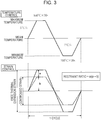
- a thermal fatigue test was performed under conditions that elevate and lower the temperature repeatedly between 200°C and 950°C while restraining the specimen at a restraint ratio of 0.5.
- the elevation rate of the temperature was set to 5°C/s and the lowering rate of the temperature to 2°C/s.
- each holding time at 200°C and 950°C was set to 30 seconds.
- free thermal expansion strain means a strain when the temperature is elevated without applying any mechanical stress
- controlled strain means an absolute value of strain that is generated during the test.
- An actual restraint strain that is generated in the material due to restraint is (free thermal expansion strain - controlled strain).
- the thermal fatigue life was defined as the number of cycles when a stress value is reduced to 75% of the stress value in an early cycle (fifth cycle in which the test is stabilized), where the stress is calculated by dividing a load detected at 200°C by the cross-sectional area of a uniformly heated parallel portion (see Fig. 2 ) of the specimen, and evaluated as follows.
- the thermal fatigue life was 650 cycles for SUS444 (Conventional Example No. 28) tested by way of comparison.
- ferritic stainless steel As shown in Table 1, all the ferritic stainless steels of Examples No. 1 to 27 (hereinafter, ferritic stainless steel is simply referred to as steel) exhibit better properties than SUS444 (Conventional Example No. 28) in the creep test and the thermal fatigue test.
- a ferritic stainless steel of the present invention is not only suitable for exhaust system components of automobiles and so forth but also well usable for exhaust system components in thermal power generation systems and for solid oxide fuel cell components, for both of which similar properties are required.
Landscapes
- Chemical & Material Sciences (AREA)
- Engineering & Computer Science (AREA)
- Mechanical Engineering (AREA)
- Materials Engineering (AREA)
- Metallurgy (AREA)
- Organic Chemistry (AREA)
- Physics & Mathematics (AREA)
- Thermal Sciences (AREA)
- Crystallography & Structural Chemistry (AREA)
- Heat Treatment Of Sheet Steel (AREA)
Applications Claiming Priority (2)
| Application Number | Priority Date | Filing Date | Title |
|---|---|---|---|
| JP2018015830 | 2018-01-31 | ||
| PCT/JP2019/002413 WO2019151125A1 (ja) | 2018-01-31 | 2019-01-25 | フェライト系ステンレス鋼 |
Publications (2)
| Publication Number | Publication Date |
|---|---|
| EP3719164A1 true EP3719164A1 (de) | 2020-10-07 |
| EP3719164A4 EP3719164A4 (de) | 2020-10-07 |
Family
ID=67479296
Family Applications (1)
| Application Number | Title | Priority Date | Filing Date |
|---|---|---|---|
| EP19746936.4A Withdrawn EP3719164A4 (de) | 2018-01-31 | 2019-01-25 | Ferritischer edelstahl |
Country Status (7)
| Country | Link |
|---|---|
| US (1) | US20210032731A1 (de) |
| EP (1) | EP3719164A4 (de) |
| JP (1) | JP6624347B1 (de) |
| KR (1) | KR102508125B1 (de) |
| CN (1) | CN111684092A (de) |
| TW (1) | TWI722377B (de) |
| WO (1) | WO2019151125A1 (de) |
Families Citing this family (3)
| Publication number | Priority date | Publication date | Assignee | Title |
|---|---|---|---|---|
| JP7694815B2 (ja) * | 2023-01-23 | 2025-06-18 | Jfeスチール株式会社 | フェライト系ステンレス鋼およびフェライト系ステンレス冷延鋼板の製造方法 |
| CN118460920A (zh) * | 2024-05-06 | 2024-08-09 | 山西太钢不锈钢股份有限公司 | 低碳排放低氮铁素体不锈钢及其制备方法 |
| WO2026062616A1 (en) | 2024-09-23 | 2026-03-26 | Acciai Speciali Terni S.P.A. | Strip made of ferritic stainless steel and related production process |
Family Cites Families (21)
| Publication number | Priority date | Publication date | Assignee | Title |
|---|---|---|---|---|
| JP3903855B2 (ja) | 2002-06-14 | 2007-04-11 | Jfeスチール株式会社 | 室温で軟質かつ耐高温酸化性に優れたフェライト系ステンレス鋼 |
| EP1818421A1 (de) * | 2006-02-08 | 2007-08-15 | UGINE & ALZ FRANCE | Ferritischer, Niobium-stabilisierter 19% Chrom-Edelstahl |
| US8470237B2 (en) * | 2006-05-09 | 2013-06-25 | Nippon Steel & Sumikin Stainless Steel Corporation | Stainless steel excellent in corrosion resistance, ferritic stainless steel excellent in resistance to crevice corrosion and formability, and ferritic stainless steel excellent in resistance to crevice corrosion |
| JP4998719B2 (ja) * | 2007-05-24 | 2012-08-15 | Jfeスチール株式会社 | 打ち抜き加工性に優れる温水器用フェライト系ステンレス鋼板およびその製造方法 |
| JP5387057B2 (ja) * | 2008-03-07 | 2014-01-15 | Jfeスチール株式会社 | 耐熱性と靭性に優れるフェライト系ステンレス鋼 |
| JP5320034B2 (ja) * | 2008-11-14 | 2013-10-23 | 新日鐵住金ステンレス株式会社 | 加熱後耐食性に優れた自動車排気系部材用省Mo型フェライト系ステンレス鋼 |
| CN101962740B (zh) * | 2009-07-23 | 2013-03-27 | 宝山钢铁股份有限公司 | 汽车尾气排放系统用铁素体不锈钢及其制造方法 |
| JP5609571B2 (ja) * | 2010-11-11 | 2014-10-22 | Jfeスチール株式会社 | 耐酸化性に優れたフェライト系ステンレス鋼 |
| TWI450983B (zh) * | 2011-03-29 | 2014-09-01 | Nippon Steel & Sumikin Sst | Fused parts with excellent corrosion resistance and strength of fat iron and stainless steel TIG welded structure |
| CN102277538B (zh) * | 2011-07-27 | 2013-02-27 | 山西太钢不锈钢股份有限公司 | 一种含锡铁素体不锈钢板及其制造方法 |
| CN104662188B (zh) * | 2012-09-25 | 2017-09-15 | 杰富意钢铁株式会社 | 铁素体系不锈钢 |
| PL2952602T3 (pl) * | 2013-02-04 | 2020-09-07 | Nippon Steel Stainless Steel Corporation | Blacha cienka z nierdzewnej stali ferrytycznej mająca doskonałą obrabialność oraz sposób jej wytwarzania |
| ES2678876T3 (es) * | 2013-03-06 | 2018-08-20 | Nippon Steel & Sumikin Stainless Steel Corporation | Chapa de acero inoxidable ferrítico que tiene excelente resistencia al calor |
| KR101703464B1 (ko) * | 2013-03-29 | 2017-02-06 | 닛폰 스틸 앤드 스미킨 스테인레스 스틸 코포레이션 | 브레이징성이 우수한 페라이트계 스테인리스 강판, 열 교환기, 열 교환기용 페라이트계 스테인리스 강판, 페라이트계 스테인리스강, 연료 공급계 부재용 페라이트계 스테인리스강 및 연료 공급계 부품 |
| JP6295155B2 (ja) * | 2014-07-22 | 2018-03-14 | 新日鐵住金ステンレス株式会社 | フェライト系ステンレス鋼およびその製造方法、並びにフェライト系ステンレス鋼を部材とする熱交換器 |
| JP6542249B2 (ja) * | 2014-10-31 | 2019-07-10 | 日鉄ステンレス株式会社 | フェライト系ステンレス鋼板、鋼管およびその製造方法 |
| ES2922207T3 (es) * | 2014-10-31 | 2022-09-09 | Nippon Steel Stainless Steel Corp | Acero inoxidable a base de ferrita con alta resistencia a la corrosión provocada por gases de escape y condensación y altas propiedades de soldadura fuerte y método de fabricación del mismo |
| KR20190092621A (ko) * | 2015-01-19 | 2019-08-07 | 닛폰 스틸 앤드 스미킨 스테인레스 스틸 코포레이션 | 가열 후 내식성이 우수한 배기계 부재용 페라이트계 스테인리스강 |
| JP6744740B2 (ja) * | 2016-03-28 | 2020-08-19 | 日鉄ステンレス株式会社 | 排気マニホールド用フェライト系ステンレス鋼板 |
| EP3487410B1 (de) * | 2016-08-01 | 2025-02-12 | Cordance Medical Inc. | Ultraschallgeführte öffnung der blut-hirn-schranke |
| JP6418338B2 (ja) * | 2016-09-02 | 2018-11-07 | Jfeスチール株式会社 | フェライト系ステンレス鋼 |
-
2019
- 2019-01-25 CN CN201980010962.6A patent/CN111684092A/zh active Pending
- 2019-01-25 US US16/966,711 patent/US20210032731A1/en not_active Abandoned
- 2019-01-25 EP EP19746936.4A patent/EP3719164A4/de not_active Withdrawn
- 2019-01-25 JP JP2019526014A patent/JP6624347B1/ja active Active
- 2019-01-25 KR KR1020207022119A patent/KR102508125B1/ko active Active
- 2019-01-25 WO PCT/JP2019/002413 patent/WO2019151125A1/ja not_active Ceased
- 2019-01-29 TW TW108103350A patent/TWI722377B/zh active
Also Published As
| Publication number | Publication date |
|---|---|
| US20210032731A1 (en) | 2021-02-04 |
| JP6624347B1 (ja) | 2019-12-25 |
| WO2019151125A1 (ja) | 2019-08-08 |
| KR102508125B1 (ko) | 2023-03-08 |
| TW201934778A (zh) | 2019-09-01 |
| TWI722377B (zh) | 2021-03-21 |
| KR20200100833A (ko) | 2020-08-26 |
| JPWO2019151125A1 (ja) | 2020-02-06 |
| CN111684092A (zh) | 2020-09-18 |
| EP3719164A4 (de) | 2020-10-07 |
Similar Documents
| Publication | Publication Date | Title |
|---|---|---|
| EP2902523B1 (de) | Ferritischer edelstahl | |
| JP6075349B2 (ja) | フェライト系ステンレス鋼 | |
| KR101554835B1 (ko) | 페라이트계 스테인리스강 | |
| EP2474635A1 (de) | Ferritischer edelstahl mit hervorragender hitzebeständigkeit | |
| CN103874779B (zh) | 铁素体系不锈钢 | |
| US10975459B2 (en) | Ferritic stainless steel | |
| KR101581886B1 (ko) | 내열성과 가공성이 우수한 페라이트계 스테인리스강 | |
| EP3118341B1 (de) | Ferritischer edelstahl | |
| JP6908179B2 (ja) | フェライト系ステンレス鋼 | |
| EP3719164A1 (de) | Ferritischer edelstahl | |
| JP2023005308A (ja) | フェライト系ステンレス鋼板およびその製造方法 | |
| JP6624345B1 (ja) | フェライト系ステンレス鋼 | |
| JP3591486B2 (ja) | 高Crフェライト系耐熱鋼 | |
| JP2024088135A (ja) | フェライト系ステンレス鋼 | |
| JP2023037686A (ja) | フェライト系ステンレス鋼 |
Legal Events
| Date | Code | Title | Description |
|---|---|---|---|
| STAA | Information on the status of an ep patent application or granted ep patent |
Free format text: STATUS: THE INTERNATIONAL PUBLICATION HAS BEEN MADE |
|
| PUAI | Public reference made under article 153(3) epc to a published international application that has entered the european phase |
Free format text: ORIGINAL CODE: 0009012 |
|
| STAA | Information on the status of an ep patent application or granted ep patent |
Free format text: STATUS: REQUEST FOR EXAMINATION WAS MADE |
|
| 17P | Request for examination filed |
Effective date: 20200702 |
|
| A4 | Supplementary search report drawn up and despatched |
Effective date: 20200903 |
|
| AK | Designated contracting states |
Kind code of ref document: A1 Designated state(s): AL AT BE BG CH CY CZ DE DK EE ES FI FR GB GR HR HU IE IS IT LI LT LU LV MC MK MT NL NO PL PT RO RS SE SI SK SM TR |
|
| AX | Request for extension of the european patent |
Extension state: BA ME |
|
| DAV | Request for validation of the european patent (deleted) | ||
| DAX | Request for extension of the european patent (deleted) | ||
| STAA | Information on the status of an ep patent application or granted ep patent |
Free format text: STATUS: THE APPLICATION HAS BEEN WITHDRAWN |
|
| 18W | Application withdrawn |
Effective date: 20250509 |