EP3719181A2 - Procédé de fabrication d'une couche d'oxyde thermiquement relaxée et couche d'oxyde - Google Patents
Procédé de fabrication d'une couche d'oxyde thermiquement relaxée et couche d'oxyde Download PDFInfo
- Publication number
- EP3719181A2 EP3719181A2 EP20168188.9A EP20168188A EP3719181A2 EP 3719181 A2 EP3719181 A2 EP 3719181A2 EP 20168188 A EP20168188 A EP 20168188A EP 3719181 A2 EP3719181 A2 EP 3719181A2
- Authority
- EP
- European Patent Office
- Prior art keywords
- energy
- signal
- phase
- oxidation process
- oxide layer
- Prior art date
- Legal status (The legal status is an assumption and is not a legal conclusion. Google has not performed a legal analysis and makes no representation as to the accuracy of the status listed.)
- Pending
Links
- 238000000034 method Methods 0.000 title claims abstract description 116
- 230000008569 process Effects 0.000 claims abstract description 73
- 230000003647 oxidation Effects 0.000 claims abstract description 34
- 238000007254 oxidation reaction Methods 0.000 claims abstract description 34
- 239000000463 material Substances 0.000 claims abstract description 17
- 238000000576 coating method Methods 0.000 claims description 20
- 239000011248 coating agent Substances 0.000 claims description 10
- 230000004888 barrier function Effects 0.000 claims description 8
- 230000003287 optical effect Effects 0.000 claims description 6
- 230000012010 growth Effects 0.000 claims description 3
- 238000004519 manufacturing process Methods 0.000 abstract description 4
- 239000010410 layer Substances 0.000 description 122
- 238000007745 plasma electrolytic oxidation reaction Methods 0.000 description 22
- 239000003792 electrolyte Substances 0.000 description 17
- 229910045601 alloy Inorganic materials 0.000 description 16
- 239000000956 alloy Substances 0.000 description 16
- 238000005259 measurement Methods 0.000 description 14
- 230000007797 corrosion Effects 0.000 description 13
- 238000005260 corrosion Methods 0.000 description 13
- 230000000630 rising effect Effects 0.000 description 13
- 230000015572 biosynthetic process Effects 0.000 description 12
- 239000000919 ceramic Substances 0.000 description 12
- 229910052751 metal Inorganic materials 0.000 description 12
- 239000002184 metal Substances 0.000 description 12
- 238000006243 chemical reaction Methods 0.000 description 10
- 229910000861 Mg alloy Inorganic materials 0.000 description 9
- 229910052782 aluminium Inorganic materials 0.000 description 8
- 239000002585 base Substances 0.000 description 8
- 239000011777 magnesium Substances 0.000 description 8
- 229910052749 magnesium Inorganic materials 0.000 description 7
- 238000012544 monitoring process Methods 0.000 description 7
- 229910052719 titanium Inorganic materials 0.000 description 7
- 239000010936 titanium Substances 0.000 description 7
- RTAQQCXQSZGOHL-UHFFFAOYSA-N Titanium Chemical compound [Ti] RTAQQCXQSZGOHL-UHFFFAOYSA-N 0.000 description 6
- 239000000654 additive Substances 0.000 description 6
- XAGFODPZIPBFFR-UHFFFAOYSA-N aluminium Chemical compound [Al] XAGFODPZIPBFFR-UHFFFAOYSA-N 0.000 description 6
- 239000000758 substrate Substances 0.000 description 6
- 238000012360 testing method Methods 0.000 description 6
- FYYHWMGAXLPEAU-UHFFFAOYSA-N Magnesium Chemical compound [Mg] FYYHWMGAXLPEAU-UHFFFAOYSA-N 0.000 description 5
- 230000000996 additive effect Effects 0.000 description 5
- 230000008901 benefit Effects 0.000 description 5
- 238000011156 evaluation Methods 0.000 description 5
- 238000011065 in-situ storage Methods 0.000 description 5
- 230000010287 polarization Effects 0.000 description 5
- 230000001419 dependent effect Effects 0.000 description 4
- 238000005516 engineering process Methods 0.000 description 4
- 239000011148 porous material Substances 0.000 description 4
- 238000004886 process control Methods 0.000 description 4
- 230000002269 spontaneous effect Effects 0.000 description 4
- 230000000007 visual effect Effects 0.000 description 4
- 208000008918 voyeurism Diseases 0.000 description 4
- 229910000838 Al alloy Inorganic materials 0.000 description 3
- 239000003513 alkali Substances 0.000 description 3
- 150000008044 alkali metal hydroxides Chemical class 0.000 description 3
- XPPKVPWEQAFLFU-UHFFFAOYSA-J diphosphate(4-) Chemical compound [O-]P([O-])(=O)OP([O-])([O-])=O XPPKVPWEQAFLFU-UHFFFAOYSA-J 0.000 description 3
- 235000011180 diphosphates Nutrition 0.000 description 3
- 238000002593 electrical impedance tomography Methods 0.000 description 3
- 150000002739 metals Chemical class 0.000 description 3
- 230000000737 periodic effect Effects 0.000 description 3
- 238000012545 processing Methods 0.000 description 3
- 230000001105 regulatory effect Effects 0.000 description 3
- 229910018072 Al 2 O 3 Inorganic materials 0.000 description 2
- BPQQTUXANYXVAA-UHFFFAOYSA-N Orthosilicate Chemical compound [O-][Si]([O-])([O-])[O-] BPQQTUXANYXVAA-UHFFFAOYSA-N 0.000 description 2
- FAPWRFPIFSIZLT-UHFFFAOYSA-M Sodium chloride Chemical compound [Na+].[Cl-] FAPWRFPIFSIZLT-UHFFFAOYSA-M 0.000 description 2
- QAOWNCQODCNURD-UHFFFAOYSA-N Sulfuric acid Chemical compound OS(O)(=O)=O QAOWNCQODCNURD-UHFFFAOYSA-N 0.000 description 2
- 230000002378 acidificating effect Effects 0.000 description 2
- 229910001854 alkali hydroxide Inorganic materials 0.000 description 2
- 229910052910 alkali metal silicate Inorganic materials 0.000 description 2
- 230000033228 biological regulation Effects 0.000 description 2
- 238000002468 ceramisation Methods 0.000 description 2
- 238000011161 development Methods 0.000 description 2
- 230000000694 effects Effects 0.000 description 2
- 230000006872 improvement Effects 0.000 description 2
- 230000010355 oscillation Effects 0.000 description 2
- 239000011241 protective layer Substances 0.000 description 2
- 238000007086 side reaction Methods 0.000 description 2
- 239000000126 substance Substances 0.000 description 2
- 230000009466 transformation Effects 0.000 description 2
- 230000004222 uncontrolled growth Effects 0.000 description 2
- NLXLAEXVIDQMFP-UHFFFAOYSA-N Ammonia chloride Chemical compound [NH4+].[Cl-] NLXLAEXVIDQMFP-UHFFFAOYSA-N 0.000 description 1
- 101001108245 Cavia porcellus Neuronal pentraxin-2 Proteins 0.000 description 1
- 229910004883 Na2SiF6 Inorganic materials 0.000 description 1
- 238000010521 absorption reaction Methods 0.000 description 1
- 239000002253 acid Substances 0.000 description 1
- 230000004913 activation Effects 0.000 description 1
- 230000006978 adaptation Effects 0.000 description 1
- 239000004411 aluminium Substances 0.000 description 1
- PNEYBMLMFCGWSK-UHFFFAOYSA-N aluminium oxide Inorganic materials [O-2].[O-2].[O-2].[Al+3].[Al+3] PNEYBMLMFCGWSK-UHFFFAOYSA-N 0.000 description 1
- 238000004458 analytical method Methods 0.000 description 1
- 238000013459 approach Methods 0.000 description 1
- QVGXLLKOCUKJST-UHFFFAOYSA-N atomic oxygen Chemical compound [O] QVGXLLKOCUKJST-UHFFFAOYSA-N 0.000 description 1
- VSGNNIFQASZAOI-UHFFFAOYSA-L calcium acetate Chemical compound [Ca+2].CC([O-])=O.CC([O-])=O VSGNNIFQASZAOI-UHFFFAOYSA-L 0.000 description 1
- 229960005147 calcium acetate Drugs 0.000 description 1
- 235000011092 calcium acetate Nutrition 0.000 description 1
- 239000001639 calcium acetate Substances 0.000 description 1
- 238000005524 ceramic coating Methods 0.000 description 1
- 230000008859 change Effects 0.000 description 1
- 238000012512 characterization method Methods 0.000 description 1
- 239000007795 chemical reaction product Substances 0.000 description 1
- 230000002301 combined effect Effects 0.000 description 1
- 229910052593 corundum Inorganic materials 0.000 description 1
- 239000011222 crystalline ceramic Substances 0.000 description 1
- 229910002106 crystalline ceramic Inorganic materials 0.000 description 1
- 230000007547 defect Effects 0.000 description 1
- 230000007812 deficiency Effects 0.000 description 1
- 230000002950 deficient Effects 0.000 description 1
- 230000006735 deficit Effects 0.000 description 1
- 230000008021 deposition Effects 0.000 description 1
- 238000009792 diffusion process Methods 0.000 description 1
- 238000010891 electric arc Methods 0.000 description 1
- 238000011066 ex-situ storage Methods 0.000 description 1
- 238000009499 grossing Methods 0.000 description 1
- 238000001566 impedance spectroscopy Methods 0.000 description 1
- 239000004179 indigotine Substances 0.000 description 1
- 238000011089 mechanical engineering Methods 0.000 description 1
- 230000007246 mechanism Effects 0.000 description 1
- 229910044991 metal oxide Inorganic materials 0.000 description 1
- 150000004706 metal oxides Chemical class 0.000 description 1
- 239000000203 mixture Substances 0.000 description 1
- 239000002114 nanocomposite Substances 0.000 description 1
- 238000013021 overheating Methods 0.000 description 1
- TWNQGVIAIRXVLR-UHFFFAOYSA-N oxo(oxoalumanyloxy)alumane Chemical compound O=[Al]O[Al]=O TWNQGVIAIRXVLR-UHFFFAOYSA-N 0.000 description 1
- 229910052760 oxygen Inorganic materials 0.000 description 1
- 239000001301 oxygen Substances 0.000 description 1
- 239000002245 particle Substances 0.000 description 1
- 238000004540 process dynamic Methods 0.000 description 1
- 230000036632 reaction speed Effects 0.000 description 1
- 238000007789 sealing Methods 0.000 description 1
- 238000010517 secondary reaction Methods 0.000 description 1
- 238000004088 simulation Methods 0.000 description 1
- 239000011780 sodium chloride Substances 0.000 description 1
- 238000001228 spectrum Methods 0.000 description 1
- 230000003068 static effect Effects 0.000 description 1
- 238000012876 topography Methods 0.000 description 1
- 238000000844 transformation Methods 0.000 description 1
- 238000011282 treatment Methods 0.000 description 1
- XLYOFNOQVPJJNP-UHFFFAOYSA-N water Substances O XLYOFNOQVPJJNP-UHFFFAOYSA-N 0.000 description 1
- 229910001845 yogo sapphire Inorganic materials 0.000 description 1
Images






Classifications
-
- C—CHEMISTRY; METALLURGY
- C25—ELECTROLYTIC OR ELECTROPHORETIC PROCESSES; APPARATUS THEREFOR
- C25D—PROCESSES FOR THE ELECTROLYTIC OR ELECTROPHORETIC PRODUCTION OF COATINGS; ELECTROFORMING; APPARATUS THEREFOR
- C25D11/00—Electrolytic coating by surface reaction, i.e. forming conversion layers
- C25D11/02—Anodisation
- C25D11/026—Anodisation with spark discharge
-
- C—CHEMISTRY; METALLURGY
- C25—ELECTROLYTIC OR ELECTROPHORETIC PROCESSES; APPARATUS THEREFOR
- C25D—PROCESSES FOR THE ELECTROLYTIC OR ELECTROPHORETIC PRODUCTION OF COATINGS; ELECTROFORMING; APPARATUS THEREFOR
- C25D11/00—Electrolytic coating by surface reaction, i.e. forming conversion layers
- C25D11/02—Anodisation
- C25D11/024—Anodisation under pulsed or modulated current or potential
-
- C—CHEMISTRY; METALLURGY
- C25—ELECTROLYTIC OR ELECTROPHORETIC PROCESSES; APPARATUS THEREFOR
- C25D—PROCESSES FOR THE ELECTROLYTIC OR ELECTROPHORETIC PRODUCTION OF COATINGS; ELECTROFORMING; APPARATUS THEREFOR
- C25D11/00—Electrolytic coating by surface reaction, i.e. forming conversion layers
- C25D11/02—Anodisation
- C25D11/30—Anodisation of magnesium or alloys based thereon
-
- C—CHEMISTRY; METALLURGY
- C25—ELECTROLYTIC OR ELECTROPHORETIC PROCESSES; APPARATUS THEREFOR
- C25D—PROCESSES FOR THE ELECTROLYTIC OR ELECTROPHORETIC PRODUCTION OF COATINGS; ELECTROFORMING; APPARATUS THEREFOR
- C25D21/00—Processes for servicing or operating cells for electrolytic coating
- C25D21/12—Process control or regulation
-
- C—CHEMISTRY; METALLURGY
- C25—ELECTROLYTIC OR ELECTROPHORETIC PROCESSES; APPARATUS THEREFOR
- C25D—PROCESSES FOR THE ELECTROLYTIC OR ELECTROPHORETIC PRODUCTION OF COATINGS; ELECTROFORMING; APPARATUS THEREFOR
- C25D11/00—Electrolytic coating by surface reaction, i.e. forming conversion layers
- C25D11/02—Anodisation
- C25D11/04—Anodisation of aluminium or alloys based thereon
- C25D11/06—Anodisation of aluminium or alloys based thereon characterised by the electrolytes used
- C25D11/08—Anodisation of aluminium or alloys based thereon characterised by the electrolytes used containing inorganic acids
Definitions
- the invention is based on a method for producing a thermally relaxed oxide layer and an oxide layer produced by means of this method.
- the present invention relates to a method for producing an oxidic, in a special form an ultra-fine ceramic coating on the surface of light metals by means of phase-specific, thermally relaxed oxide layers (PTO).
- PTO phase-specific, thermally relaxed oxide layers
- the present invention relates to a thermoelectrochemical (thermo-optical or acoustic), preferably multifunctional, pulse management for phase-specific, thermally relaxed oxide layers, in particular on valve metals.
- Hydrated oxide layers can be produced on light metal surfaces by means of anodic polarization.
- the layers are created via a barrier layer on the surface to be coated, in which the base material is oxidized in the usually acidic electrolyte.
- Hard, ceramic layers can be produced by means of PEO (plasma electrolytic oxidation processes) due to transformations on a light metal surface.
- the layers are created by spark discharge, i.e. not discharge-free as according to the invention, on the surface to be coated, in which the base material but also reaction products of the electrolyte are melted, which can result in a crystalline or partially crystalline ceramic surface.
- the DE 10 2016 201 951 A1 relates to the coating of hybrid components.
- Paragraphs 18 and 19, in particular, show that different current and voltage amplitudes are not modulated, but rather that they are combined in series.
- the object of the invention is therefore to provide a method for producing an oxide layer and an oxide layer produced by means of this method, by means of which the disadvantages of the prior art are overcome.
- the method according to the invention for producing an oxide layer with the features of claim 1 have the advantage that in the method according to the invention for producing an oxide layer on a surface of a material by means of an electrolytic oxidation process, the energy required for the oxidation process is required, is supplied in pulses, wherein an energy pulse can consist of three phases, namely the initial phase, middle phase and end phase, and, preferably at least in the middle phase, i.e. in the region of an energy maximum of an energy pulse, the oxidation process is discharge-free, i.e. free from spontaneous and / or uncontrolled discharge takes place, preferably essentially free of discharge, and as a result thereof takes place in a thermally relaxed manner.
- thermally relaxed can mean that the oxidation process takes place without or with only a few temperature peaks due to (uncontrolled) discharge between the workpiece and the electrode.
- the discharge-free oxidation according to the invention can be free from uncontrolled lightning discharge.
- No discharge can in particular refer to a spontaneous and / or uncontrolled discharge, in particular a lightning discharge.
- a lightning discharge can in particular have optical / visual effects and / or an arc / lightning flashover between the workpiece to be coated and the electrode.
- a discharge-free oxidation process can therefore be free of optical / visual effects and / or an electric arc / flashover between the workpiece to be coated and the electrode.
- the amount of energy / voltage provided for the coating can thus be provided below the, preferably visual, spark formation (between workpiece and electrode) during the electrolytic oxidation process.
- this first / initial oxide layer a further formation of the oxide layer, in particular until the final, desired layer thickness is reached, can take place without discharge in this sense.
- This requirement can be material-specific.
- the layer thickness formed over time can be determined both in-situ and ex-situ (preliminary tests).
- the layer thickness and / or quality can thus be set particularly reliably via the coating duration and applied voltage / energy (in particular via its modulation).
- a particularly low energy / voltage can favor a particularly low porosity.
- the voltage / energy actually to be applied can be highly dependent on the material, which is why a suitable voltage / energy for a (essentially) discharge-free coating process can be determined, for example, by preliminary tests for the respective coating.
- the ceramic layers produced in this way serve to protect light metal surfaces against wear and corrosion.
- the energy supply can be regulated and / or modulated separately in each phase.
- the middle phase can be short or long, but it can also approach zero, so that the energy pulse then practically only consists of the initial phase and an end phase.
- the material is a metal.
- This can be a light metal or a valve metal, for example.
- a coating ie the oxidation process, takes place (visually / optically) without discharge, but at least essentially without discharge, even during the initial phase and / or in the end phase of an energy pulse.
- the occurrence of discharges on the surface to be coated can cause local overheating of the material, which can promote uncontrolled growth of the oxide layer.
- This uncontrolled growth which can take place in the form of microvolcanoes on the surface of the workpiece to be coated, favors unfavorable pore formation in the oxide layer.
- All common Al, Mg, Ti, wrought and cast alloys can be coated with the method according to the invention. It can also be used to coat components with complex geometry and / or large areas (> 1 m 2 ), preferably 8 m 2 . Of course, it can also be used to coat components with areas ⁇ 1 m 2 .
- a plurality of energy pulses are supplied, of which at least one pulse, preferably a plurality or all pulses, in particular in its middle phase, is / are modulated (deviation from a sinusoidal curve and / or shape, which can be designed as a half trapezoid and / or disruptive digital shape and / or modulation of the maximum energy of a pulse compared to a others).
- the individual energy pulses are preferably modulated as required. This modulation can be based on a feedback with a sensor-based monitoring of the resulting oxide layer and / or its temperature. If, for example, too high a temperature is detected on the workpiece, which can be seen as an indication of an impending discharge, modulation, especially in the middle phase of an energy pulse, can be used to adapt it to lower the temperature of the workpiece.
- a disturbance of the (regular) shape of the pulse can be controlled, which is a half trapezoid and / or disruptive (e.g. disturbed) digital form (e.g. Figures 2a to 3b ) can be designed to be provided.
- This disturbance can take place, for example, in the form of one or more local maxima, in particular in the area of the middle phase.
- the modulation can accordingly provide an energy pulse with more than one (local) maximum.
- These local maxima can differ from 2 individual pulses in that the local minimum between them does not correspond to the global minimum (energy in the range of approximately 0 or less than 20%).
- the local minimum or the multiple local minima can be 0.1% to 10% below the individual local maxima.
- a local minimum can thus preferably have an amount equal to 90% to 99.9% of the maximum energy of an energy pulse.
- modulation of an energy pulse can prevent a discharge, in particular a discharge flash, between the workpiece and the electrode during the oxidation process. This can be possible even if the energy of the Energy pulse or a corresponding applied voltage would be sufficient in terms of height to provoke a discharge on the workpiece.
- a necessary energy range can be a material-dependent activation / or start-up energy for the oxidation process, which is supplemented by additional energy (or voltage) modulated onto the basic form of the energy pulse / voltage pulse.
- the modulated additional (also negative) energy / extra voltage can preferably be in the single-digit percentage range of the actual energy pulse / voltage pulse. It is particularly preferably below 15% of the actual energy pulse.
- the energy supply is varied via voltage and / or current density.
- the voltage can be kept constant and the current density can be regulated or vice versa.
- the voltage and the current density could also be varied at the same time.
- At least two, preferably a plurality, are individually modulated, that is to say differ in their modulation and / or maximum energy.
- a modulation of the energy or the voltage can take place on individual pulses or groups of pulses as required.
- the modulations of the individual pulses can be distinguishable from one another, that is, they can have different values.
- At least one energy pulse has anodic, cathodic and / or bipolar polarization.
- the energy for the oxidation process corresponds to an applied voltage and / or an energy pulse to a voltage amplitude with a corresponding initial phase, middle phase and end phase.
- An energy pulse can thus correspond to a voltage pulse of a corresponding amplitude (energy).
- a modulation can correspond to a superposition of at least two energy pulses or voltage amplitudes. 2, 3 or up to 5 superimpositions are particularly preferably conceivable for modulation according to the method according to the invention.
- At least one energy pulse has an asymmetrical signal shape.
- At least one energy pulse has a rising edge in the initial phase and a falling edge in the end phase, the rising edge of the energy pulse having a different slope than the falling edge of the energy pulse or at least one energy pulse having a a rising edge in the initial phase and a rising edge in the end phase, the falling edge of the energy pulse having a different slope than the rising edge of the energy pulse.
- At least two energy pulses have identical signal shapes.
- it is z. B. act around two or more successive energy pulses.
- a periodic repetition of the energy pulses with an identical signal form is also conceivable.
- At least two energy pulses have different signal shapes. It can be, for. B. act around two or more successive energy pulses. A periodic repetition of the energy pulses, which have a different signal shape, is also conceivable.
- At least two energy pulses have signal shapes that are symmetrical to one another. It can be, for. B. are two or more successive energy pulses, the signal shape is reflected, for example, in each case on a mirror axis or a mirror point. A periodic repetition of the energy pulses, which have a mutually symmetrical signal form, is also conceivable.
- the energy supply and / or the growth of the oxide layer is monitored by means of at least one sensor during the oxidation process. This enables precise monitoring of the entire oxidation process.
- the at least one sensor is an optical sensor, an acoustic sensor or a temperature sensor.
- a combination of different sensors is of course also conceivable.
- the energy supply during the oxidation process is dependent on at least one measured value obtained by means of the at least one sensor is determined varies. Automation of the oxidation process is conceivable as a result, the energy supply being controlled arbitrarily and as a function of the measured value.
- At least one further energy signal is modulated onto at least one energy pulse, at least in phases.
- arbitrary peaks can be modulated onto the signal shape.
- the entire energy pulse as well as the beginning, middle and end phases can be modulated separately or in combination.
- the oxide layer according to the invention produced by a method according to one of claims 1 to 13, consisting of a barrier layer arranged on a surface of a material, an inner layer arranged on the barrier layer and an outer layer arranged on the inner layer, has the advantage that the oxide layer has a total layer thickness of 0.5 - 500 ⁇ m.
- the barrier layer has a thickness of up to 2 ⁇ m.
- the outer layer has a maximum of 10% of the total layer thickness.
- the process presented can also be applied to a wide variety of wrought and cast alloys of aluminum, magnesium and titanium and leads to layers that are efficient, thin and smooth and ensure a homogeneous morphology.
- the method presented is also suitable for generating oxide-hydrated layers. Hydrated oxide layers can be applied by means of anodic polarization Light metal surfaces are generated. In this case, the layers are created via a barrier layer on the surface to be coated, in which the base material is oxidized in the usually acidic electrolyte.
- the invention (innovation) described below represents a significant improvement in the corrosion resistance.
- the main, innovatively implemented idea is the targeted energy supply and precise energy deposition at the reaction site of the metal / metal oxide phase boundary.
- the phase-specific, thermally relaxed (thermo-relaxed) oxide layer formation takes place with the alloy and layer-specific, precisely adapted energy dose and reaction speed (dynamics of the reaction) that correspond to the process maturity.
- the targeted control of the conversion of, for example, the hydrated oxide form into the ceramic oxide forms is an essential part of the invention. There is preferably no direct reaction between the metal and the oxygen present.
- the fast and dynamic process is monitored and regulated in situ through highly efficient, innovative monitoring.
- At least one RDCZ reference detector controller cell
- the RDCZ depicts the cell in which the coating process takes place.
- the same flow velocity of the electrolyte as the same sample alloy for example Al, Mg or Ti
- the batch actually to be refined can be controlled via the coupled MSR (measurement control rule) module (see Fig. 1 ).
- the technique described here can be used to form oxide and / or ceramic layers on light metals.
- the process is suitable for a large number of electrolytes. There are no restrictions on the pH value or the substances contained. Acid and alkaline electrolytes lead to significantly improved layers with this control. In particular, the benefits of this invention can be observed at low concentration. At these concentrations, particularly high energy densities and corresponding current densities (significantly greater than 10A / dm 2 ) can be used helpful for the targeted PTO.
- the environmentally friendly low substance concentrations in the electrolyte enable a broader energy band for the process.
- An electrolyte could contain 1-4 g / l alkali metal hydroxide and up to 15 g / l silicate. The presence of alkali pyrophosphate at up to 20g / l has also been shown to be helpful.
- the layers can be specifically controlled in terms of density (defective secondary reactions such as exothermic electrochemical conversion of intermetallic phases are suppressed) and phases.
- dense secondary reactions such as exothermic electrochemical conversion of intermetallic phases are suppressed
- phases With the very low energy densities ( ⁇ 10 A / dm 2 ) primarily oxide hydrate layers are formed, with the high energy densities ( ⁇ 10 A / dm 2 ), for example, the ⁇ - and ⁇ - Al 2 O 3 phases can be enriched in a targeted manner in aluminum substrates.
- the form of the arbitrary signal on the one hand and the polarization of the signal as a whole are used specifically for this purpose.
- Frequency 0.1Hz to 8kHz, preferably 3k Hz Frequency for repetition should be 3200 Hz Rise time of the signal ...% of the total signal Fall time of the signal ..% of the total signal Base polarization of the signal In% of the signal height up to 80%, preferably 20% Signal on the signal in + -% of the total signal height +/- 60% preferably +/- 25%
- Fig. 1 shows a highly efficient, innovative monitoring (optical, acoustic and temperature sensors), which enables fast and dynamic process control and regulation: RDCZ, which is an option, but not a permanent necessity, as a preferred control after the creation of the process parameters, with light sensor Lab (color and brightness of the events are measured, IR camera (thermal evaluation), microphone (acoustic evaluation - volume, harmonic oscillations, harmonics), the same electrolyte (bypass) and the same flow rate as the batch.
- Fig. 3 shows a picture of the hydrated oxide surface, the left part of the picture a) showing a surface of a hydrated oxide surface as it is currently available on the market, and the right part of the picture b) showing the above-described, produced by the PTO process, the hydrated oxide surface.
- electrochemical impedance measurements of layers produced by PTO on different substrates were carried out for the following examples.
- the measurements were carried out in a 0.1M NaCl solution using an Ag / Ag-Cl reference electrode and a platinum-plated titanium counter electrode. Measurements were made with an amplitude of 10 mV in the frequency range of 10 2 -10 6 Hz around the free corrosion potential.
- Fig. 4 shows the basic structure of a ceramic layer.
- the overall layer consists of a thin barrier layer arranged on the substrate, a dense ceramic inner layer and an outer, porous layer.
- Fig. 5 shows the model with which the measurement data were fitted (model for simulating the EIS results of the PTO shift systems).
- Rs stands for the electrolyte resistance.
- the entire layer is divided into a porous outer layer (pore) and a compactly closed inner layer (inner).
- the CPE is a "constant phase element" that maps the capacity of a layer that has pores and / or unevenness.
- R stands for the resistance of the layer components.
- Example 2 shows the ceramization of the aluminum alloy 6082 (AlMgSi1) using the new, innovative process described here.
- This sample 6082 PTO was produced with the energy regime (signal 3a - high-resolution fully arbitrary phase-reactive bipolar signal) in an electrolyte with the following composition: 3g / l alkali hydroxide and 10g / l alkali silicate as well as 10 g / l alkali pyrophosphate.
- the total duration is 7 minutes and leads to a layer thickness of 38 ⁇ m.
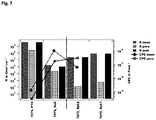
- Fig. 6 shows the fitting results of the EIS measurements of PEO layers on AI EW6082 (fitting results of the PTO layers on AI EW6082: left: layer produced in the novel PTO process, SoA: state-of-the-art process (here a typical Square-wave signal applied, as is currently common in publications and on the market (Aliramezani et al. 2017)), right: Literature values of the existing layer systems (Ref. 4 (Barik et al. 2005), Ref. 5 (Liang 2013)) and Fig.
- Example 3 are PTO layers on the magnesium alloys AZ31, E-Form and AM50.
- the ceramization using the new innovative PTO process described here was also produced in an alkaline electrolyte containing the components alkali hydroxide and alkali silicate as well as alkali pyrophosphate.
- the total duration is 4 minutes and leads to a layer thickness of 27 ⁇ m.
- the energy regime (signal 2a2) was applied to these samples.
- Fig. 8 shows the results of the electrochemical impedance measurement of layers produced by PTO on different magnesium alloys (EIS results of PTO layers on different Mg alloys).
- Fig. 9 shows the fitting results of the EIS measurements in comparison with corresponding literature values (fitting results of the PTO layers on Mg substrates: left: layers produced in the novel PTO process; right: literature values of the existing layer systems (Ref. 1 (Lu et al. 2013)) , Ref. 2 (Lu et al. 2015), Ref 3 (Luca Pezzato 2015))
- R sum total resistance
- the figure includes the capacitances of the two layer sections. The capacities show low values overall, which also suggests that little to no diffusion takes place, which is related to the morphology corresponds to the layers produced, which have a low roughness and only very small pores.
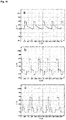
- Fig. 10 shows possible pulse shapes known from the prior art for producing ceramic layers on aluminum.
- the distinction to the novel PTO layers is that in the novel PTO process, pulse signals rise significantly more slowly (rising A) and decay faster than, for example, in the figure above (rapidly falling E).
- the peaks to be observed in the prior art when the pulse is switched on are involuntary system events and not, as in the PTO process, targeted on-top-peak modulations.
- Fig. 11 shows a possible voltage signal for producing PEO layers on titanium as prior art.
- the demarcation from the generation of the new PTO layers can be made with the vertical rise of the voltage signal.
- the layers produced in the novel PTO process show excellent tribological properties. This is shown below using the example of thin PTO layers (10 ⁇ m) on the magnesium alloy E-shape:
- the tribological test was carried out in a pin-on-disc test, a 100Cr6 ball ( ⁇ 6 mm) being used as the static partner.
- the PTO-coated samples were moved in an oscillating manner over a distance of 2.5 mm with a frequency of 0.6 Hz and a normal force of 4N. After a total distance of 80 m, the samples were analyzed.
- Fig. 12 shows the course of the coefficient of friction.
- the coefficient of friction remains very stable in both cases.
- the figure also clearly shows that the layer produced in the 3a process leads to a lower coefficient of friction.
Landscapes
- Chemical & Material Sciences (AREA)
- Engineering & Computer Science (AREA)
- Chemical Kinetics & Catalysis (AREA)
- Electrochemistry (AREA)
- Materials Engineering (AREA)
- Metallurgy (AREA)
- Organic Chemistry (AREA)
- Automation & Control Theory (AREA)
- Formation Of Insulating Films (AREA)
- Other Surface Treatments For Metallic Materials (AREA)
Applications Claiming Priority (1)
| Application Number | Priority Date | Filing Date | Title |
|---|---|---|---|
| DE102019108982 | 2019-04-05 |
Publications (2)
| Publication Number | Publication Date |
|---|---|
| EP3719181A2 true EP3719181A2 (fr) | 2020-10-07 |
| EP3719181A3 EP3719181A3 (fr) | 2020-11-18 |
Family
ID=70189847
Family Applications (1)
| Application Number | Title | Priority Date | Filing Date |
|---|---|---|---|
| EP20168188.9A Pending EP3719181A3 (fr) | 2019-04-05 | 2020-04-06 | Procédé de fabrication d'une couche d'oxyde thermiquement relaxée et couche d'oxyde |
Country Status (1)
| Country | Link |
|---|---|
| EP (1) | EP3719181A3 (fr) |
Citations (6)
| Publication number | Priority date | Publication date | Assignee | Title |
|---|---|---|---|---|
| CN101275263A (zh) | 2007-12-18 | 2008-10-01 | 华南理工大学 | 电压阶跃微弧氧化方法 |
| WO2010112914A1 (fr) | 2009-04-03 | 2010-10-07 | Keronite International Ltd | Procédé de protection renforcée contre la corrosion de métaux de soupapes |
| WO2012107754A2 (fr) | 2011-02-08 | 2012-08-16 | Cambridge Nanolitic Limited | Revêtement non métallique et procédé de sa production |
| DE102011007424A1 (de) | 2011-04-14 | 2012-10-18 | Helmholtz-Zentrum Geesthacht Zentrum für Material- und Küstenforschung GmbH | Verfahren zur Herstellung einer Beschichtung auf der Oberfläche eines Substrats auf Basis von Leichtmetallen durch plasmaelektrolytische Oxidation |
| EP1774067B1 (fr) * | 2004-07-23 | 2016-03-02 | Chemetall GmbH | Procede de production d'un revetement dur hautement resistant a la corrosion sur des articles a base de metaux ou d'alliages pouvant etre anodises |
| DE102016201951A1 (de) | 2016-02-10 | 2017-08-10 | Automoteam Gmbh | Hybridbauteil und Verfahren zur Herstellung eines Hybridbauteils |
Family Cites Families (4)
| Publication number | Priority date | Publication date | Assignee | Title |
|---|---|---|---|---|
| US6126808A (en) * | 1998-03-23 | 2000-10-03 | Pioneer Metal Finishing | Method and apparatus for anodizing objects |
| EA012825B1 (ru) * | 2007-04-02 | 2009-12-30 | Владимир Никандрович Кокарев | Способ формирования на поверхности металлических изделий защитного керамического покрытия |
| KR101061102B1 (ko) * | 2009-03-04 | 2011-09-01 | 코스트 주식회사 | 양극산화용 전원공급장치, 양극산화법 및 양극산화막 |
| FR3017884B1 (fr) * | 2014-02-25 | 2017-09-22 | Snecma | Bord de protection d'aube et son procede de fabrication |
-
2020
- 2020-04-06 EP EP20168188.9A patent/EP3719181A3/fr active Pending
Patent Citations (6)
| Publication number | Priority date | Publication date | Assignee | Title |
|---|---|---|---|---|
| EP1774067B1 (fr) * | 2004-07-23 | 2016-03-02 | Chemetall GmbH | Procede de production d'un revetement dur hautement resistant a la corrosion sur des articles a base de metaux ou d'alliages pouvant etre anodises |
| CN101275263A (zh) | 2007-12-18 | 2008-10-01 | 华南理工大学 | 电压阶跃微弧氧化方法 |
| WO2010112914A1 (fr) | 2009-04-03 | 2010-10-07 | Keronite International Ltd | Procédé de protection renforcée contre la corrosion de métaux de soupapes |
| WO2012107754A2 (fr) | 2011-02-08 | 2012-08-16 | Cambridge Nanolitic Limited | Revêtement non métallique et procédé de sa production |
| DE102011007424A1 (de) | 2011-04-14 | 2012-10-18 | Helmholtz-Zentrum Geesthacht Zentrum für Material- und Küstenforschung GmbH | Verfahren zur Herstellung einer Beschichtung auf der Oberfläche eines Substrats auf Basis von Leichtmetallen durch plasmaelektrolytische Oxidation |
| DE102016201951A1 (de) | 2016-02-10 | 2017-08-10 | Automoteam Gmbh | Hybridbauteil und Verfahren zur Herstellung eines Hybridbauteils |
Non-Patent Citations (22)
| Title |
|---|
| AI BOSTAMOHANNAD M. S.MA, KENG-JENGCHIEN, HSI-HSIN: "Effect of Anodic Current Density on Characteristics and Low Temperature IR Emissivity of Ceramic Coating on Aluminium 6061 Alloy Prepared by Microarc Oxidation", JOURNAL OF CERAMICS, vol. 2, 2013, pages 1 - 14 |
| ALIRAMEZANI, REIHANERAEISSI, KEYVANSANTAMARIA, MONICAHAKIMIZAD, AMIN: "Characterization and properties of PEO coatings on 7075 AI alloy grown in alkaline silicate electrolyte containing KMnO 4 additive", SURFACE AND COATINGS TECHNOLOGY, vol. 329, 2017, pages 250 - 261 |
| BARATI DARBAND, GH.ALIOFKHAZRAEI, M.HAMGHALAM, P.VALIZADE, N.: "Plasma electrolytic oxidation of magnesium and its alloys: Mechanism, properties and applications", JOURNAL OF MAGNESIUM AND ALLOYS, vol. 5, no. 1, 2017, pages 74 - 132 |
| BARIK, R. C.WHARTON, J. A.WOOD, R.J.K.STOKES, K. R.JONES, R. L.: "Corrosion, erosion and erosion-corrosion performance of plasma electrolytic oxidation (PEO) deposited AI203 coatings", SURFACE AND COATINGS TECHNOLOGY, vol. 199, no. 2-3, 2005, pages 158 - 167, XP004997731, DOI: 10.1016/j.surfcoat.2004.09.038 |
| GAO, GUANGRUILI, YINGLI, CHAOZHONGHU, DANLI, ZHENGXIANXI, ZHENGPING: "Influence of KMn0 Concentrationon Infrared Emissivity of Coatings Formed on TC4 Alloys by Micro-Arc Oxidation", MATERIALS, vol. 10, no. 11, 2017 |
| GRABOWSKI, M.: "Leichtbau mit Magnesiumlegierungen im Automobilbau: Charakterisierung der korrosiven Belastung durch Streusalzkomponenten und Auslegung des Korrosionsschutzes", DISSERTATION, 2016 |
| HAKIMIZAD, AMINRAEISSI, KEYVANSANTAMARIA, MONICAASGHARI, MAHASTA: "Effects of pulse current mode on plasma electrolytic oxidation of 7075 AI in Na2WO4 containing Solution: From unipolar to soft-sparking regime", ELECTROCHIMICA ACTA, vol. 284, 2018, pages 618 - 629 |
| LEE, K.-M.JO, J. O.LEE, E. S.YOO, B.SHINZ, D. H.: "Incorporation of Carbon Nanotubes Into Oxide Layer on 7075 AI Alloy by Plasma Electrolytic Oxidation", JOURNAL OFTHE ELECTROCHEMICAL SOCIETY, vol. 158, 2011 |
| LI, HONGZHANG, JIN: "Preparation of a Modified Micro-arc Oxidation Coating Using AI203 Particles on Ti6A14V", J MATERIAL SCI ENG, vol. 06, no. 06, 2017 |
| LI, XIJINLIU, XINGYANGLUAN, BEN LI: "Corrosion and wear properties of PEO coatings formed on AM60B alloy in NaAI02 electrolytes", APPLIED SURFACE SCIENCE, vol. 257, no. 21, 2011, pages 9135 - 9141, XP028099245, DOI: 10.1016/j.apsusc.2011.05.115 |
| LIANG, CHEN-JUI: "Disseration", 2013, UNIVERSITY OF SHEFFIELD, article "Chen-Jui Liang Thesis - In-situ Impedance Spectroscopy Studies of the Plasma Electrolytic Oxidation Coating Process" |
| LU, XIAOPENGBLAWERT, CARSTENMOHEDANO, MARTASCHARNAGL, NICOZHELUDKEVICH, MIKHAIL L.KAINER, KARL ULRICH: "Influence of electrical parameters on particle uptake during plasma electrolytic oxidation processing of AM50 Mg alloy", SURFACE AND COATINGS TECHNOLOGY, vol. 289, 2016, pages 179 - 185 |
| LU, XIAOPENGBLAWERT, CARSTENSCHARNAGL, NICOKAINER, KARL ULRICH: "Influence of incorporating Si3N4 particles into the oxide layer produced by plasma elec trolytic oxidation on AM50 Mg alloy on coating morphology and corrosion properties", JOURNAL OF MAGNESIUM AND ALLOYS, vol. 1, no. 4, 2013, pages 267 - 274 |
| LU, XIAOPENGSAH, SANTOSH PRASADSCHARNAGL, NICOSTÖRMER, MICHAELSTARYKEVICH, MAKSIMMOHEDANO, MARTA ET AL.: "Degradation behavior of PEO coating on AM50 magnesium alloy produced from electrolytes with clay particle addition", SURFACE AND COATINGS TECHNOLOGY, vol. 269, 2015, pages 155 - 169 |
| LUCA PEZZATO: "PhD thesis", 2015, UNIVERSITÄ DEGLI STUDI DI PADOVA, article "PLASMA ELECTROLYTIC OXIDATION COATINGS ON LIGHT ALLOYS" |
| MADHANKUMAR, A.THANGAVEL, ELANGOVANRAMAKRISHNA, SURESHOBOT, I. B.JUNG, HWA CHULSHIN, KWANG SEON ET AL.: "Multi-functional ceramic hybrid coatings on biodegradable AZ31 Mg implants: electrochemical, tribological and quantum chemical aspects for orthopaedic applications", RSC ADV., vol. 4, no. 46, 2014, pages 24272 |
| MINGO, B.ARRABAL, R.MOHEDANO, M.LLAMAZARES, Y.MATYKINA, E.YEROKHIN, A.PARDO, A.: "Influence of sealing post-treatments on the corrosion resistance of PEO coated AZ91 magnesium alloy", APPLIED SURFACE SCIENCE, vol. 433, 2018, pages 653 - 667, XP085321070, DOI: 10.1016/j.apsusc.2017.10.083 |
| NASIRI VATAN, H.: "Wear and Corrosion Performance of PEO-synthesized SiC Nanocomposite Coatings: Effect of Processing Time and Current Density", INT. J. ELECTROCHEM. SCI., 2016, pages 5631 - 5654 |
| REHMAN, ZEESHAN URKOO, BON HEUN: "Combined Effect of Long Processing Time and Na2SiF6 on the Properties of PEO Coatings Formed on AZ91D", J. OF MATERI ENG AND PERFORM, vol. 25, no. 8, 2016, pages 3531 - 3537, XP036038614, DOI: 10.1007/s11665-016-2177-2 |
| WHITE, LEONKOO, YOUNGMINERALLA, SUDHEERSANKAR, JAGANNATHANYUN, YEOHEUNG: "Enhanced mechanical properties and increased corrosion resistance of a biodegradable magnesium alloy by plasma electrolytic oxidation (PEO", MATERIALS SCIENCE & ENGINEERING. B, SOLID-STATE MATERIALS FOR ADVANCED TECHNOLOGY, vol. 208, 2016, pages 39 - 46, XP029475988, DOI: 10.1016/j.mseb.2016.02.005 |
| ZHANG, XUELINYAO, ZHONGPINJIANG, ZHAOHUAZHANG, YUFENGLIU, XIAOWEI: "Investigation of the plasma electrolytic oxidation of Ti6AI4V under single-pulse power supply", CORROSION SCIENCE, vol. 53, no. 6, 2011, pages 2253 - 2262 |
| ZIYAEI, E.ATAPOUR, M.EDRIS, H.HAKIMIZAD, A.: "Corrosion Behavior of PEO Coatings Formed on AZ31 Alloy in Phosphate-Based Electrolytes with Calcium Acetate Additive", J. OF MATERI ENG AND PERFORM, vol. 26, no. 7, 2017, pages 3204 - 3215, XP036274759, DOI: 10.1007/s11665-017-2765-9 |
Also Published As
| Publication number | Publication date |
|---|---|
| EP3719181A3 (fr) | 2020-11-18 |
Similar Documents
| Publication | Publication Date | Title |
|---|---|---|
| EP0545230B2 (fr) | Procédé de préparation d'une couche d'oxyde céramique modifiée sur des métaux formant couche barrière. | |
| DE102011007424B4 (de) | Verfahren zur Herstellung einer Beschichtung auf der Oberfläche eines Substrats auf Basis von Leichtmetallen durch plasmaelektrolytische Oxidation und beschichtetes Substrat | |
| Gowtham et al. | An investigation on pulsed DC plasma electrolytic oxidation of cp-Ti and its corrosion behaviour in simulated body fluid | |
| Dehnavi et al. | Corrosion properties of plasma electrolytic oxidation coatings on an aluminium alloy–The effect of the PEO process stage | |
| Adeleke et al. | The properties of hydroxyapatite ceramic coatings produced by plasma electrolytic oxidation | |
| EP2260127B1 (fr) | Couche de chrome à particules solides structurée et son procédé de fabrication | |
| Fazel et al. | Influence of hydrothermal treatment on the surface characteristics and electrochemical behavior of Ti-6Al-4V bio-functionalized through plasma electrolytic oxidation | |
| Zhang et al. | Electrochemical fabrication of nanoporous copper films in choline chloride–urea deep eutectic solvent | |
| EP2459240B1 (fr) | Surfaces structurées pour implants | |
| DE102012208332B4 (de) | Verfahren zum Verbinden eines Metalls mit einem Substrat | |
| EP2857560B2 (fr) | Procédé plasma-chimique destiné à fabriquer des couches en céramique oxydée noires et objet revêtu correspondant | |
| Kaseem et al. | Corrosion behavior of Al-1wt% Mg-0.85 wt% Si alloy coated by micro-arc-oxidation using TiO2 and Na2MoO4 additives: Role of current density | |
| DE102012208334A1 (de) | Verfahren zum verbinden eines metalls mit einem substrat | |
| DE60202592T2 (de) | Verfahren zur elektrochemischen abscheidung von tantal | |
| EP1146984B1 (fr) | Procede et dispositif pour l'usinage electrochimique de materiaux | |
| DE102016210822A1 (de) | Phosphatierung und Anodisierung zur verbesserten Anbindung einer thermisch gespritzten Beschichtung auf Motorzylinderbohrungen | |
| Wang et al. | Enhanced corrosion resistance and in vitro bioactivity of NiTi alloys modified with hydroxyapatite-containing Al2O3 coatings | |
| EP2195547B1 (fr) | Élément pour le montage glissant d'un autre élément, et son procédé de fabrication | |
| Bozzini et al. | Electrodeposition of nanostructured bioactive hydroxyapatite-heparin composite coatings on titanium for dental implant applications | |
| Awad et al. | Effect of various de-anodizing techniques on the surface stability of non-colored and colored nanoporous AAO films in acidic solution | |
| DE102005039614A1 (de) | Anodische Oxidschicht und Verfahren zur Anodisierung | |
| Yuferov et al. | Ca/P in situ introduction for enhancing coating biocompatibility via plasma electrolytic oxidation in low-temperature molten salt | |
| EP3719181A2 (fr) | Procédé de fabrication d'une couche d'oxyde thermiquement relaxée et couche d'oxyde | |
| DE102010027532A1 (de) | PEO-Beschichtung auf Mg-Schrauben | |
| DE4104847A1 (de) | Verfahren zur keramisierung von metalloberflaechen |
Legal Events
| Date | Code | Title | Description |
|---|---|---|---|
| PUAI | Public reference made under article 153(3) epc to a published international application that has entered the european phase |
Free format text: ORIGINAL CODE: 0009012 |
|
| STAA | Information on the status of an ep patent application or granted ep patent |
Free format text: STATUS: THE APPLICATION HAS BEEN PUBLISHED |
|
| AK | Designated contracting states |
Kind code of ref document: A2 Designated state(s): AL AT BE BG CH CY CZ DE DK EE ES FI FR GB GR HR HU IE IS IT LI LT LU LV MC MK MT NL NO PL PT RO RS SE SI SK SM TR |
|
| AX | Request for extension of the european patent |
Extension state: BA ME |
|
| PUAL | Search report despatched |
Free format text: ORIGINAL CODE: 0009013 |
|
| AK | Designated contracting states |
Kind code of ref document: A3 Designated state(s): AL AT BE BG CH CY CZ DE DK EE ES FI FR GB GR HR HU IE IS IT LI LT LU LV MC MK MT NL NO PL PT RO RS SE SI SK SM TR |
|
| AX | Request for extension of the european patent |
Extension state: BA ME |
|
| RIC1 | Information provided on ipc code assigned before grant |
Ipc: C25D 11/04 20060101ALI20201013BHEP Ipc: C25D 21/12 20060101ALI20201013BHEP Ipc: C25D 11/02 20060101AFI20201013BHEP Ipc: C25D 11/08 20060101ALN20201013BHEP Ipc: C25D 11/30 20060101ALI20201013BHEP |
|
| STAA | Information on the status of an ep patent application or granted ep patent |
Free format text: STATUS: REQUEST FOR EXAMINATION WAS MADE |
|
| 17P | Request for examination filed |
Effective date: 20210518 |
|
| RBV | Designated contracting states (corrected) |
Designated state(s): AL AT BE BG CH CY CZ DE DK EE ES FI FR GB GR HR HU IE IS IT LI LT LU LV MC MK MT NL NO PL PT RO RS SE SI SK SM TR |
|
| STAA | Information on the status of an ep patent application or granted ep patent |
Free format text: STATUS: EXAMINATION IS IN PROGRESS |
|
| 17Q | First examination report despatched |
Effective date: 20211220 |
|
| RAP1 | Party data changed (applicant data changed or rights of an application transferred) |
Owner name: LIZ LIGHTWEIGHT ENGINEERING ZERRER |