EP3719796A1 - Sprachsyntheseverfahren, sprachsynthesevorrichtung und programm - Google Patents
Sprachsyntheseverfahren, sprachsynthesevorrichtung und programm Download PDFInfo
- Publication number
- EP3719796A1 EP3719796A1 EP18882396.7A EP18882396A EP3719796A1 EP 3719796 A1 EP3719796 A1 EP 3719796A1 EP 18882396 A EP18882396 A EP 18882396A EP 3719796 A1 EP3719796 A1 EP 3719796A1
- Authority
- EP
- European Patent Office
- Prior art keywords
- control data
- voice
- data
- trained model
- synthesis
- Prior art date
- Legal status (The legal status is an assumption and is not a legal conclusion. Google has not performed a legal analysis and makes no representation as to the accuracy of the status listed.)
- Withdrawn
Links
Images


Classifications
-
- G—PHYSICS
- G10—MUSICAL INSTRUMENTS; ACOUSTICS
- G10L—SPEECH ANALYSIS TECHNIQUES OR SPEECH SYNTHESIS; SPEECH RECOGNITION; SPEECH OR VOICE PROCESSING TECHNIQUES; SPEECH OR AUDIO CODING OR DECODING
- G10L13/00—Speech synthesis; Text to speech systems
- G10L13/02—Methods for producing synthetic speech; Speech synthesisers
- G10L13/033—Voice editing, e.g. manipulating the voice of the synthesiser
-
- G—PHYSICS
- G10—MUSICAL INSTRUMENTS; ACOUSTICS
- G10L—SPEECH ANALYSIS TECHNIQUES OR SPEECH SYNTHESIS; SPEECH RECOGNITION; SPEECH OR VOICE PROCESSING TECHNIQUES; SPEECH OR AUDIO CODING OR DECODING
- G10L13/00—Speech synthesis; Text to speech systems
- G10L13/02—Methods for producing synthetic speech; Speech synthesisers
- G10L13/033—Voice editing, e.g. manipulating the voice of the synthesiser
- G10L13/0335—Pitch control
-
- G—PHYSICS
- G06—COMPUTING OR CALCULATING; COUNTING
- G06N—COMPUTING ARRANGEMENTS BASED ON SPECIFIC COMPUTATIONAL MODELS
- G06N3/00—Computing arrangements based on biological models
- G06N3/02—Neural networks
- G06N3/04—Architecture, e.g. interconnection topology
- G06N3/045—Combinations of networks
-
- G—PHYSICS
- G06—COMPUTING OR CALCULATING; COUNTING
- G06N—COMPUTING ARRANGEMENTS BASED ON SPECIFIC COMPUTATIONAL MODELS
- G06N3/00—Computing arrangements based on biological models
- G06N3/02—Neural networks
- G06N3/04—Architecture, e.g. interconnection topology
- G06N3/0499—Feedforward networks
-
- G—PHYSICS
- G06—COMPUTING OR CALCULATING; COUNTING
- G06N—COMPUTING ARRANGEMENTS BASED ON SPECIFIC COMPUTATIONAL MODELS
- G06N3/00—Computing arrangements based on biological models
- G06N3/02—Neural networks
- G06N3/08—Learning methods
-
- G—PHYSICS
- G06—COMPUTING OR CALCULATING; COUNTING
- G06N—COMPUTING ARRANGEMENTS BASED ON SPECIFIC COMPUTATIONAL MODELS
- G06N3/00—Computing arrangements based on biological models
- G06N3/02—Neural networks
- G06N3/08—Learning methods
- G06N3/088—Non-supervised learning, e.g. competitive learning
-
- G—PHYSICS
- G06—COMPUTING OR CALCULATING; COUNTING
- G06N—COMPUTING ARRANGEMENTS BASED ON SPECIFIC COMPUTATIONAL MODELS
- G06N3/00—Computing arrangements based on biological models
- G06N3/02—Neural networks
- G06N3/08—Learning methods
- G06N3/09—Supervised learning
-
- G—PHYSICS
- G10—MUSICAL INSTRUMENTS; ACOUSTICS
- G10H—ELECTROPHONIC MUSICAL INSTRUMENTS; INSTRUMENTS IN WHICH THE TONES ARE GENERATED BY ELECTROMECHANICAL MEANS OR ELECTRONIC GENERATORS, OR IN WHICH THE TONES ARE SYNTHESISED FROM A DATA STORE
- G10H1/00—Details of electrophonic musical instruments
- G10H1/0033—Recording/reproducing or transmission of music for electrophonic musical instruments
- G10H1/0041—Recording/reproducing or transmission of music for electrophonic musical instruments in coded form
- G10H1/0058—Transmission between separate instruments or between individual components of a musical system
- G10H1/0066—Transmission between separate instruments or between individual components of a musical system using a MIDI interface
-
- G—PHYSICS
- G10—MUSICAL INSTRUMENTS; ACOUSTICS
- G10L—SPEECH ANALYSIS TECHNIQUES OR SPEECH SYNTHESIS; SPEECH RECOGNITION; SPEECH OR VOICE PROCESSING TECHNIQUES; SPEECH OR AUDIO CODING OR DECODING
- G10L13/00—Speech synthesis; Text to speech systems
- G10L13/06—Elementary speech units used in speech synthesisers; Concatenation rules
-
- G—PHYSICS
- G10—MUSICAL INSTRUMENTS; ACOUSTICS
- G10L—SPEECH ANALYSIS TECHNIQUES OR SPEECH SYNTHESIS; SPEECH RECOGNITION; SPEECH OR VOICE PROCESSING TECHNIQUES; SPEECH OR AUDIO CODING OR DECODING
- G10L13/00—Speech synthesis; Text to speech systems
- G10L13/08—Text analysis or generation of parameters for speech synthesis out of text, e.g. grapheme to phoneme translation, prosody generation or stress or intonation determination
- G10L13/10—Prosody rules derived from text; Stress or intonation
-
- G—PHYSICS
- G10—MUSICAL INSTRUMENTS; ACOUSTICS
- G10H—ELECTROPHONIC MUSICAL INSTRUMENTS; INSTRUMENTS IN WHICH THE TONES ARE GENERATED BY ELECTROMECHANICAL MEANS OR ELECTRONIC GENERATORS, OR IN WHICH THE TONES ARE SYNTHESISED FROM A DATA STORE
- G10H2250/00—Aspects of algorithms or signal processing methods without intrinsic musical character, yet specifically adapted for or used in electrophonic musical processing
- G10H2250/315—Sound category-dependent sound synthesis processes [Gensound] for musical use; Sound category-specific synthesis-controlling parameters or control means therefor
- G10H2250/455—Gensound singing voices, i.e. generation of human voices for musical applications, vocal singing sounds or intelligible words at a desired pitch or with desired vocal effects, e.g. by phoneme synthesis
Definitions
- the present disclosure relates to a technique for synthesizing a voice.
- Patent Document 1 discloses a technique for synthesizing a singing voice, which is obtained by vocalizing a sequence of musical notes designated by a user on an editing screen.
- the editing screen is a piano roll screen on which a time axis and a pitch axis are provided.
- the user designates each phoneme to be vocalized, a pitch, and a sound period for each note that together constitute a song.
- Patent Document 1 Japanese Patent Application Laid-Open Publication No. 2016-90916
- a user may designate a phonetic identifier, a pitch, and a sound period for each note, but it is difficult to accurately reflect an intension or taste of the user in a voice to be synthesized.
- a voice synthesis apparatus includes: an intermediate trained model configured to generate second control data according to first input data including first control data designating phonetic identifiers; an editing processor configured to change the second control data in accordance with a first instruction provided by a user; a final trained model configured to generate, according to final input data including the first control data and the changed second control data, synthesis data representing frequency characteristics of a voice to be synthesized; and a synthesis processor configured to generate a voice signal based on the generated synthesis data.
- a computer program causes a computer to function as: an intermediate trained model configured to generate second control data according to first input data including first control data designating phonetic identifiers; an editing processor configured to change the second control data in accordance with a first instruction provided by a user; a final trained model configured to generate, according to final input data including the first control data and the changed second control data, synthesis data representing frequency characteristics of a voice to be synthesized; and a synthesis processor configured to generate a voice signal based on the generated synthesis data.
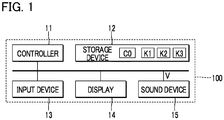
- FIG. 1 is a block diagram illustrating a configuration of a voice synthesis apparatus 100 according to a first embodiment of the present disclosure.
- the voice synthesis apparatus 100 synthesizes a voice (hereafter, "voice to be synthesized") corresponding to phonemes.
- the voice synthesis apparatus 100 in the first embodiment is a singing synthesis apparatus that synthesizes a voice, where the synthesized voice is a singing voice virtually sung by a singer.
- the voice synthesis apparatus 100 in the first embodiment is realized by a computer system including a controller 11, a storage device 12, an input device 13, a display 14, and a sound device 15.
- a portable information terminal such as a mobile phone or a smartphone, or a portable or stationary information terminal such as a personal computer is preferably used as the voice synthesis apparatus 100.
- the display 14 is constituted of, for example, a liquid crystal display panel and displays an image designated by the controller 11.
- the input device 13 is an input device that receives instructions provided by a user. Specifically, operators that are operable by the user or a touch panel that detects contact on a display surface of the display 14 is preferably used as the input device 13.
- the controller 11 is, for example, processing circuitry such as a CPU (Central Processing Unit) and controls overall the components constituting the voice synthesis apparatus 100.
- the controller 11 in the first embodiment generates a voice signal V in a time domain representative of a waveform of a synthesized voice.
- the sound device 15 (for example, a loudspeaker or a headphone) reproduces a voice that is represented by the voice signal V generated by the controller 11.
- a digital-to-analog converter converts the voice signal V generated by the controller 11 from a digital signal to an analog signal, and an amplifier amplifies the voice signal V. For convenience, illustration of the digital-to-analog converter and the amplifier are omitted.
- the sound device 15 is mounted on the voice synthesis apparatus 100 in the configuration shown in FIG. 1 , the sound device 15 separate from the voice synthesis apparatus 100 may be connected either wired or wirelessly to the voice synthesis apparatus 100.
- the storage device 12 is constituted of, for example, a known recording medium such as a magnetic recording medium or a semiconductor recording medium, or a combination of types of recording media, and has stored therein a program to be executed by the controller 11 and various types of data used by the controller 11.
- the storage device 12 (for example, a cloud storage) may be provided separately from the voice synthesis apparatus 100 to enable the controller 11 to write to and read from the storage device 12 via a communication network, such as a mobile communication network or the Internet. That is, the storage device 12 may be omitted from the voice synthesis apparatus 100.
- a single syllable is designated by a phonetic identifier for each note.
- the sound period is a duration for which one note in the song is vocalized; and can be specified as, for example, a start point of the note to an end point of the note, or the start point of the note, and the duration of the period.
- the sound period may be specified by, for example, MIDI duration data.
- the control data C0 in the first embodiment can designate musical symbols representative of musical expressions in the song. For example, symbols denoting musical expression such as forte (f), piano (p), crescendo, decrescendo, staccato, tenuto, or slur are designated by the control data C0.
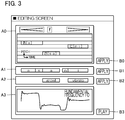
- the editing area A0 comprises a so-called piano roll screen for display of music content corresponding to the control data C0.
- note images (note bars), each of which is representative of a note designated by the control data C0, are chronologically arranged in a coordinate space having a time axis and a pitch axis in the editing area A0.
- the position and length of each of the note images on the time axis is controlled in accordance with the sound period designated by the control data C0, and the position of each of the note images on the pitch axis is controlled in accordance with the pitch designated by the control data C0.
- a phonetic identifier (specifically, a grapheme) designated by the control data C0 is displayed within each of the note images.
- Musical symbols designated by the control data C0 are also displayed in the editing area A0.
- symbols representative of musical expression namely, crescendo, forte, and decrescendo are provided as examples.
- the user can provide an editing instruction Q0 for the editing area A0 by operating the input device 13.
- the editing instruction Q0 may be, for example, an instruction to change a condition (a sound period, pitch, or a phonetic identifier) of a note, or an instruction to change (add or delete) a musical symbol.
- the editing area A1 is an image area for representing at a phonetic level characteristics (that is, characteristics of phonemes), for example, a series of phonemes (vowels or consonants) that are present in a voice to be synthesized. Specifically, the phonemic symbol and the sound period of each phoneme for vocalization of the voice to be synthesized are displayed in the editing area A1.
- the user can provide an editing instruction Q1 for the editing area A1 by operating the input device 13.
- the editing instruction Q1 may be, for example, an instruction to change a phonemic symbol for each phoneme or an instruction to change (for example, move or extend/reduce) a sound period.
- the editing area A2 is an image area for representing at a voicing level characteristics of musical expression that relate to voicing, namely, types of musical expression to be imparted to the voice to be synthesized. Specifically, expression periods and a type of expression (hereafter, "expression type") in each of the expression periods are displayed in the editing area A2.
- An "expression period” is a period during which musical expressions are imparted to the voice to be synthesized.
- a voice quality such as hoarseness or breathiness, and a vocal technique such as vibrato or fall are examples of musical expressions to be imparted to the voice to be synthesized.
- the user can provide an editing instruction Q2 for the editing area A2 by operating the input device 13.
- the editing instruction Q2 is, for example, an instruction to change (for example, move or extend/reduce) each expression period or an instruction to change the expression type in each expression period.
- the editing area A3 is an image representative of temporal variation of characteristics at a vocoder level (that is, characteristics on a vocoder), for example, an image representative of temporal variation in frequency characteristics of the voice to be synthesized. Specifically, a curve representative of temporal variation of a fundamental frequency F0 of the voice to be synthesized is displayed in the editing area A3.
- the user can provide an editing instruction Q3 for the editing area A3 by operating the input device 13.
- the editing instruction Q3 is, for example, an instruction to change the temporal variation in the fundamental frequency F0.
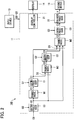
- the trained model M1 outputs control data C1 at the phonetic level according to the control data C0 supplied thereto at the musical level.
- the control data C1 is data representing phonemes of a voice to be synthesized.
- the control data C1 is indicative of a series of phonemes corresponding to the phonetic identifiers designated by the control data C0.
- the control data C1 designates phonemic symbols (representative of phonemes) and sound periods of phonemes of the voice to be synthesized.
- a sound period of a phoneme is specified by, for example, the start point and the end point, or the start point and the duration of the period.
- the trained model M1 in the first embodiment has been trained through machine learning (particularly, deep learning) using teacher data, so as to be a statistical predictive model having learned relations between control data C0 and control data C1.
- control data C0 and control data C1 are associated with each other.
- a neural network that outputs control data C1 according to control data C0 is preferably used as the trained model M1.
- Coefficients K1 that define the trained model M1 are set through the machine learning and are stored in the storage device 12.
- the trained model M1 outputs control data C1 that is statistically adequate for unknown control data C0 under a tendency extracted from the teacher data (relations between control data C0 and control data C1).
- the display controller 21 causes the display 14 to display the editing area A1 in accordance with the control data C1 generated by the trained model M1. That is, the phonemic symbol and the sound period designated by the control data C1 for each of the phonemes are displayed in the editing area A1.
- the editing processor E1 changes at the phonetic level the control data C1 output from the trained model M1 in accordance with the editing instruction Q1 provided by the user for the editing area A1. Specifically, the editing processor E1 changes the phonemic symbol or the sound period designated by the control data C1 for a phoneme in accordance with the editing instruction Q1.
- the display controller 21 updates the displayed content in the editing area A1 corresponding to the changed control data C1. If the editing instruction Q1 is provided, the control data C1 changed by the editing processor E1 is supplied to the trained model M2 and to the trained model M3. If the editing instruction Q1 is not provided, the control data C1 as is output from the trained model M1 is supplied to the trained model M2 and to the trained model M3.
- the trained model M2 outputs control data C2 at the voicing level according to input data D2 supplied thereto.
- the input data D2 includes the control data C0 at the musical level and the control data C1 at the phonetic level.
- the control data C2 relates to musical expression of the voice to be synthesized.
- the control data C2 designates one or more expression periods on the time axis and an expression type in each of the expression periods, which are specified by, for example, the start point and the end point, or the start point and the duration of the period.
- the editing processor E2 changes the control data C2 at the voicing level output from the trained model M2 in accordance with the editing instruction Q2 provided by the user for the editing area A2. Specifically, the editing processor E2 changes an expression period or an expression type designated by the control data C2 in accordance with the editing instruction Q2.
- the display controller 21 updates the displayed content in the editing area A2 corresponding to the changed control data C2. If the editing instruction Q2 is provided, the control data C2 changed by the editing processor E2 is supplied to the trained model M3. If the editing instruction Q2 is not provided, the control data C2 as is output from the trained model M2 is supplied to the trained model M3.
- the trained model M3 outputs control data C3 (an example of synthesis data) at the vocoder level according to input data D3 supplied thereto.
- the input data D3 includes the control data C0 at the musical level, the control data C1 at the phonetic level, and the control data C2 at the voicing level.
- the control data C3 is data representing frequency characteristics of the voice to be synthesized.
- the control data C3 designates a series of the fundamental frequencies F0 of the voice to be synthesized, a series of envelopes of harmonic components, and a series envelopes of non-harmonic components.
- An envelope of harmonic components is a curve representative of a contour of an intensity spectrum (the amplitude spectra or the power spectra) of the harmonic components.
- the harmonic components are frequency components consisting of a fundamental tone component of the fundamental frequency F0 and overtone components having frequencies that are integer multiples of the fundamental frequency F0.
- An envelope of non-harmonic components is a curve representative of a contour of an intensity spectrum of the non-harmonic components.
- the non-harmonic components are non-periodic components (residual components) other than the harmonic components.
- the envelopes of the harmonic components and the non-harmonic components are expressed by, for example, Mel-frequency cepstral coefficients.
- the trained model M3 in the first embodiment has been trained through machine learning (particularly, deep learning) using teacher data, so as to be a statistical predictive model having learned relations between input data D3 and control data C3.
- input data D3 and control data C3 are associated with each other.
- a neural network that outputs control data C3 according to input data D3 is preferably used as the trained model M3.
- Coefficients K3 that define the trained model M3 are set through the machine learning and are stored in the storage device 12.
- the trained model M3 outputs control data C3 that is statistically adequate for unknown input data D3 under a tendency extracted from the teacher data (relations between input data D3 and control data C3).
- the display controller 21 causes the display 14 to display the editing area A3 in accordance with the control data C3 generated by the trained model M3. Specifically, a series of the fundamental frequencies F0 designated by the control data C3 is displayed in the editing area A3.
- the editing processor E1 changes the control data C1 at the phonetic level in accordance with the editing instruction Q1
- the user uses the input device 13 to operate the button B1. If the button B1 is operated, the changed control data C1 is supplied to the trained model M2 and to the trained model M3, and generation of the control data C2 by the trained model M2 and generation of the control data C3 by the trained model M3 are performed. Even if the button B1 is operated, the trained model M1 does not generate the control data C1. Instead, the control data C1 is changed according to the editing instruction Q1 is used to generate the voice signal V.
- the editing processor E0 changes control data C0 at the musical level in accordance with an editing instruction Q0 provided by the user (Sa1). If the editing instruction Q0 is not provided, the change of the control data C0 is not executed.
- the trained model M2 According to input data D2 including the control data C0 and the control data C1, the trained model M2 generates control data C2 designating the musical expression of the voice to be synthesized (Sa4).
- the editing processor E2 changes the control data C2 at the voicing level in accordance with an editing instruction Q2 provided by the user (Sa5). If the editing instruction Q2 is not provided, the change of the control data C2 is not executed.
- the trained model M3 According to input data D3 including the control data C0, the control data C1, and the control data C2, the trained model M3 generates control data C3 designating the frequency characteristics of the voice to be synthesized (Sa6).
- the editing processor E3 changes the control data C3 at the vocoder level in accordance with the editing instruction Q3 made by the user (Sa7). If the editing instruction Q3 is not provided, the change of the control data C3 is not executed.
- the synthesis processor 22 generates the voice signal V based on the control data C3 (Sa8).
- an instruction (the editing instruction Q1 or Q2) operates in a middle stage among processes of generating the control data C3 based on the control data C0.
- a voice signal V of a synthesis voice that better suits a user's intension or taste can be generated, as compared with a configuration in which a user can edit only the control data C0.
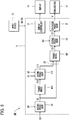
- the trained model M12 outputs control data C12 at a phonetic-voicing level according to the control data C0 at the musical level supplied thereto.
- the control data C12 is data representing phonemes and musical expressions of a voice to be synthesized. Specifically, the control data C12 designates a phonemic symbol and a sound period of each of phonemes corresponding to a phonetic identifier designated by the control data C0. Also designated in the control data C12 are an expression period in which an expression is added to the voice to be synthesized, and an expression type. That is, the control data C12 in the second embodiment consists of a combination of the control data C1 and the control data C2 of the first embodiment.
- the editing processor E12 changes the control data C12 at the phonetic-voicing level output from the trained model M12 in accordance with the editing instruction Q1 for the editing area A1 provided by the user or the editing instruction Q2 for the editing area A2 provided by the user. Specifically, the editing processor E12 changes a phonemic symbol and a sound period designated by the control data C12 for each phoneme in accordance with the editing instruction Q1, and changes an expression period and an expression type designated by the control data C12 in accordance with the editing instruction Q2.
- the display controller 21 updates the displayed content in the editing area A1 and the editing area A2 corresponding to the changed control data C12. If the editing instruction Q1 or the editing instruction Q2 is provided, the control data C12 changed by the editing processor E12 is supplied to the trained model M3. If neither the editing instruction Q1 nor the editing instruction Q2 is provided, the control data C12 as is output from the trained model M12 is supplied to the trained model M3.
- the trained model M3 generates control data C3 representing frequency characteristics of the voice to be synthesized according to input data D3 supplied thereto (Sb4).
- the input data D3 includes the control data C0 and the control data C12.
- the editing processor E3 changes the control data C3 at the vocoder level in accordance with an editing instruction Q3 provided by the user (Sb5). If the editing instruction Q3 is not provided, the change of the control data C3 is not executed.
- the synthesis processor 22 generates the voice signal V based on the control data C3 (Sb6).
- an instruction (the editing instruction Q1 or Q2) operates in a middle stage among processes of generating the control data C3 based on the control data C0. Therefore, similarly to the first embodiment, it is possible to generate the voice signal V of a voice to better suit the intension or taste of a user, as compared with a configuration in which a user can edit only the control data C0.
- the control data C12 representing phonemes and expressions of the voice to be synthesized is changed in accordance with the editing instruction Q1 or the editing instruction Q2 provided by the user.
- the trained model M1 or the trained model M2 in the first embodiment, and the trained model M12 in the second embodiment are preferred examples of the "intermediate trained model” in the first aspect.
- the control data C1 corresponds to the "second control data” and the editing instruction Q1 corresponds to the "first instruction”.
- the control data C2 in the first embodiment is construed as the "intermediate trained model”
- the control data C2 corresponds to the "second control data”
- the editing instruction Q2 corresponds to the "first instruction”.
- the control data C12 corresponds to the "second control data” and the editing instruction Q1 or the editing instruction Q2 corresponds to the "first instruction”.
- the trained model M3 in the first embodiment or the second embodiment is an example of the "final trained model”.
- a voice synthesis apparatus includes: an intermediate trained model configured to generate second control data according to first input data including first control data designating phonetic identifiers; an editing processor configured to change the second control data in accordance with a first instruction provided by a user; a final trained model configured to generate, according to final input data including the first control data and the changed second control data, synthesis data representing frequency characteristics of a voice to be synthesized; and a synthesis processor configured to generate a voice signal based on the generated synthesis data.
- the first instruction provided by the user operates in a middle stage among processes of generating the synthesis data from the first control data. Therefore, it is possible to generate a voice signal representing a voice to be synthesized that better suits an intension or taste of the user, as compared with a configuration in which the user can edit only the first control data.
Landscapes
- Engineering & Computer Science (AREA)
- Physics & Mathematics (AREA)
- Health & Medical Sciences (AREA)
- Computational Linguistics (AREA)
- Multimedia (AREA)
- Acoustics & Sound (AREA)
- Theoretical Computer Science (AREA)
- Human Computer Interaction (AREA)
- Audiology, Speech & Language Pathology (AREA)
- Biophysics (AREA)
- Data Mining & Analysis (AREA)
- Molecular Biology (AREA)
- Computing Systems (AREA)
- General Engineering & Computer Science (AREA)
- General Physics & Mathematics (AREA)
- Mathematical Physics (AREA)
- Software Systems (AREA)
- Evolutionary Computation (AREA)
- General Health & Medical Sciences (AREA)
- Biomedical Technology (AREA)
- Artificial Intelligence (AREA)
- Life Sciences & Earth Sciences (AREA)
- Electrophonic Musical Instruments (AREA)
- Circuit For Audible Band Transducer (AREA)
- Machine Translation (AREA)
- Processing Or Creating Images (AREA)
Applications Claiming Priority (2)
| Application Number | Priority Date | Filing Date | Title |
|---|---|---|---|
| JP2017229042A JP6729539B2 (ja) | 2017-11-29 | 2017-11-29 | 音声合成方法、音声合成システムおよびプログラム |
| PCT/JP2018/043655 WO2019107378A1 (ja) | 2017-11-29 | 2018-11-28 | 音声合成方法、音声合成装置およびプログラム |
Publications (2)
| Publication Number | Publication Date |
|---|---|
| EP3719796A1 true EP3719796A1 (de) | 2020-10-07 |
| EP3719796A4 EP3719796A4 (de) | 2021-08-25 |
Family
ID=66663973
Family Applications (1)
| Application Number | Title | Priority Date | Filing Date |
|---|---|---|---|
| EP18882396.7A Withdrawn EP3719796A4 (de) | 2017-11-29 | 2018-11-28 | Sprachsyntheseverfahren, sprachsynthesevorrichtung und programm |
Country Status (5)
| Country | Link |
|---|---|
| US (2) | US11495206B2 (de) |
| EP (1) | EP3719796A4 (de) |
| JP (1) | JP6729539B2 (de) |
| CN (2) | CN116504218A (de) |
| WO (1) | WO2019107378A1 (de) |
Cited By (1)
| Publication number | Priority date | Publication date | Assignee | Title |
|---|---|---|---|---|
| US11495206B2 (en) | 2017-11-29 | 2022-11-08 | Yamaha Corporation | Voice synthesis method, voice synthesis apparatus, and recording medium |
Families Citing this family (10)
| Publication number | Priority date | Publication date | Assignee | Title |
|---|---|---|---|---|
| JP6737320B2 (ja) * | 2018-11-06 | 2020-08-05 | ヤマハ株式会社 | 音響処理方法、音響処理システムおよびプログラム |
| JP7331588B2 (ja) * | 2019-09-26 | 2023-08-23 | ヤマハ株式会社 | 情報処理方法、推定モデル構築方法、情報処理装置、推定モデル構築装置およびプログラム |
| JP7180642B2 (ja) * | 2020-07-01 | 2022-11-30 | ヤマハ株式会社 | 音声合成方法、音声合成システムおよびプログラム |
| WO2022074753A1 (ja) * | 2020-10-07 | 2022-04-14 | ヤマハ株式会社 | 情報処理方法、情報処理システムおよびプログラム |
| JP2022065566A (ja) * | 2020-10-15 | 2022-04-27 | ヤマハ株式会社 | 音声合成方法およびプログラム |
| WO2022080395A1 (ja) * | 2020-10-15 | 2022-04-21 | ヤマハ株式会社 | 音声合成方法およびプログラム |
| JP2022065554A (ja) * | 2020-10-15 | 2022-04-27 | ヤマハ株式会社 | 音声合成方法およびプログラム |
| WO2022101968A1 (ja) * | 2020-11-10 | 2022-05-19 | ヤマハ株式会社 | 信号処理装置、信号処理システム、及び信号処理方法 |
| JP7658103B2 (ja) * | 2021-02-10 | 2025-04-08 | ヤマハ株式会社 | 機械学習モデルを用いた音生成方法、機械学習モデルの訓練方法、音生成装置、訓練装置、音生成プログラムおよび訓練プログラム |
| JP2022122689A (ja) * | 2021-02-10 | 2022-08-23 | ヤマハ株式会社 | 機械学習モデルを用いた音生成方法、機械学習モデルの訓練方法、音生成装置、訓練装置、音生成プログラムおよび訓練プログラム |
Family Cites Families (21)
| Publication number | Priority date | Publication date | Assignee | Title |
|---|---|---|---|---|
| US4661915A (en) * | 1981-08-03 | 1987-04-28 | Texas Instruments Incorporated | Allophone vocoder |
| JP2001134283A (ja) | 1999-11-04 | 2001-05-18 | Mitsubishi Electric Corp | 音声合成装置および音声合成方法 |
| JP3838039B2 (ja) * | 2001-03-09 | 2006-10-25 | ヤマハ株式会社 | 音声合成装置 |
| JP4311710B2 (ja) * | 2003-02-14 | 2009-08-12 | 株式会社アルカディア | 音声合成制御装置 |
| US20140236597A1 (en) * | 2007-03-21 | 2014-08-21 | Vivotext Ltd. | System and method for supervised creation of personalized speech samples libraries in real-time for text-to-speech synthesis |
| JP2008268477A (ja) | 2007-04-19 | 2008-11-06 | Hitachi Business Solution Kk | 韻律調整可能な音声合成装置 |
| JP5029884B2 (ja) | 2007-05-22 | 2012-09-19 | 富士通株式会社 | 韻律生成装置、韻律生成方法、および、韻律生成プログラム |
| US20100066742A1 (en) * | 2008-09-18 | 2010-03-18 | Microsoft Corporation | Stylized prosody for speech synthesis-based applications |
| JP5293460B2 (ja) * | 2009-07-02 | 2013-09-18 | ヤマハ株式会社 | 歌唱合成用データベース生成装置、およびピッチカーブ生成装置 |
| JP6236765B2 (ja) * | 2011-11-29 | 2017-11-29 | ヤマハ株式会社 | 音楽データ編集装置および音楽データ編集方法 |
| JP5949607B2 (ja) * | 2013-03-15 | 2016-07-13 | ヤマハ株式会社 | 音声合成装置 |
| JP6171711B2 (ja) * | 2013-08-09 | 2017-08-02 | ヤマハ株式会社 | 音声解析装置および音声解析方法 |
| JP6372066B2 (ja) * | 2013-10-15 | 2018-08-15 | ヤマハ株式会社 | 合成情報管理装置および音声合成装置 |
| CN105593936B (zh) * | 2013-10-24 | 2020-10-23 | 宝马股份公司 | 用于文本转语音性能评价的系统和方法 |
| US9978359B1 (en) * | 2013-12-06 | 2018-05-22 | Amazon Technologies, Inc. | Iterative text-to-speech with user feedback |
| JP6507579B2 (ja) | 2014-11-10 | 2019-05-08 | ヤマハ株式会社 | 音声合成方法 |
| CN105206258B (zh) * | 2015-10-19 | 2018-05-04 | 百度在线网络技术(北京)有限公司 | 声学模型的生成方法和装置及语音合成方法和装置 |
| JP6004358B1 (ja) * | 2015-11-25 | 2016-10-05 | 株式会社テクノスピーチ | 音声合成装置および音声合成方法 |
| JP2017107228A (ja) * | 2017-02-20 | 2017-06-15 | 株式会社テクノスピーチ | 歌声合成装置および歌声合成方法 |
| JP6729539B2 (ja) | 2017-11-29 | 2020-07-22 | ヤマハ株式会社 | 音声合成方法、音声合成システムおよびプログラム |
| CN114170997B (zh) * | 2021-12-28 | 2025-06-24 | 科大讯飞股份有限公司 | 发音技巧检测方法、装置、存储介质及电子设备 |
-
2017
- 2017-11-29 JP JP2017229042A patent/JP6729539B2/ja active Active
-
2018
- 2018-11-28 CN CN202310641326.1A patent/CN116504218A/zh not_active Withdrawn
- 2018-11-28 EP EP18882396.7A patent/EP3719796A4/de not_active Withdrawn
- 2018-11-28 CN CN201880077081.1A patent/CN111418006B/zh active Active
- 2018-11-28 WO PCT/JP2018/043655 patent/WO2019107378A1/ja not_active Ceased
-
2020
- 2020-05-28 US US16/886,063 patent/US11495206B2/en active Active
-
2022
- 2022-10-13 US US17/965,185 patent/US20230034572A1/en active Pending
Cited By (1)
| Publication number | Priority date | Publication date | Assignee | Title |
|---|---|---|---|---|
| US11495206B2 (en) | 2017-11-29 | 2022-11-08 | Yamaha Corporation | Voice synthesis method, voice synthesis apparatus, and recording medium |
Also Published As
| Publication number | Publication date |
|---|---|
| CN116504218A (zh) | 2023-07-28 |
| JP6729539B2 (ja) | 2020-07-22 |
| US20200294484A1 (en) | 2020-09-17 |
| CN111418006B (zh) | 2023-09-12 |
| JP2019101094A (ja) | 2019-06-24 |
| CN111418006A (zh) | 2020-07-14 |
| US11495206B2 (en) | 2022-11-08 |
| US20230034572A1 (en) | 2023-02-02 |
| EP3719796A4 (de) | 2021-08-25 |
| WO2019107378A1 (ja) | 2019-06-06 |
Similar Documents
| Publication | Publication Date | Title |
|---|---|---|
| US20230034572A1 (en) | Voice synthesis method, voice synthesis apparatus, and recording medium | |
| EP3719795B1 (de) | Stimmsyntheseverfahren, stimmsynthesevorrichtung und computerprogramm | |
| JP6737320B2 (ja) | 音響処理方法、音響処理システムおよびプログラム | |
| EP3273441B1 (de) | Tonsteuerungsvorrichtung, tonsteuerungsverfahren und tonsteuerungsprogramm | |
| EP3739571A1 (de) | Sprachsyntheseverfahren, sprachsynthesevorrichtung und programm | |
| JP6784022B2 (ja) | 音声合成方法、音声合成制御方法、音声合成装置、音声合成制御装置およびプログラム | |
| JP2020166299A (ja) | 音声合成方法 | |
| WO2019181767A1 (ja) | 音処理方法、音処理装置およびプログラム | |
| US12014723B2 (en) | Information processing method, information processing device, and program | |
| JP7180642B2 (ja) | 音声合成方法、音声合成システムおよびプログラム | |
| JP5157922B2 (ja) | 音声合成装置、およびプログラム | |
| JP5176981B2 (ja) | 音声合成装置、およびプログラム | |
| US11437016B2 (en) | Information processing method, information processing device, and program | |
| JP6372066B2 (ja) | 合成情報管理装置および音声合成装置 | |
| JP5953743B2 (ja) | 音声合成装置及びプログラム | |
| JP6191094B2 (ja) | 音声素片切出装置 | |
| KR100994340B1 (ko) | 문자음성합성을 이용한 음악 컨텐츠 제작장치 | |
| JP2025004384A (ja) | 音響処理方法、音響処理システムおよびプログラム |
Legal Events
| Date | Code | Title | Description |
|---|---|---|---|
| STAA | Information on the status of an ep patent application or granted ep patent |
Free format text: STATUS: THE INTERNATIONAL PUBLICATION HAS BEEN MADE |
|
| PUAI | Public reference made under article 153(3) epc to a published international application that has entered the european phase |
Free format text: ORIGINAL CODE: 0009012 |
|
| STAA | Information on the status of an ep patent application or granted ep patent |
Free format text: STATUS: REQUEST FOR EXAMINATION WAS MADE |
|
| 17P | Request for examination filed |
Effective date: 20200626 |
|
| AK | Designated contracting states |
Kind code of ref document: A1 Designated state(s): AL AT BE BG CH CY CZ DE DK EE ES FI FR GB GR HR HU IE IS IT LI LT LU LV MC MK MT NL NO PL PT RO RS SE SI SK SM TR |
|
| AX | Request for extension of the european patent |
Extension state: BA ME |
|
| DAV | Request for validation of the european patent (deleted) | ||
| DAX | Request for extension of the european patent (deleted) | ||
| REG | Reference to a national code |
Ref country code: DE Ref legal event code: R079 Free format text: PREVIOUS MAIN CLASS: G10L0013100000 Ipc: G10L0013033000 |
|
| A4 | Supplementary search report drawn up and despatched |
Effective date: 20210726 |
|
| RIC1 | Information provided on ipc code assigned before grant |
Ipc: G10L 13/033 20130101AFI20210720BHEP Ipc: G10L 13/10 20130101ALI20210720BHEP Ipc: G06N 3/04 20060101ALI20210720BHEP |
|
| STAA | Information on the status of an ep patent application or granted ep patent |
Free format text: STATUS: THE APPLICATION HAS BEEN WITHDRAWN |
|
| 18W | Application withdrawn |
Effective date: 20230313 |