EP3728355B1 - Nitril-dien-carbonsäureester-copolymere - Google Patents
Nitril-dien-carbonsäureester-copolymere Download PDFInfo
- Publication number
- EP3728355B1 EP3728355B1 EP18814966.0A EP18814966A EP3728355B1 EP 3728355 B1 EP3728355 B1 EP 3728355B1 EP 18814966 A EP18814966 A EP 18814966A EP 3728355 B1 EP3728355 B1 EP 3728355B1
- Authority
- EP
- European Patent Office
- Prior art keywords
- nitrile
- diene
- weight
- carboxylic acid
- units
- Prior art date
- Legal status (The legal status is an assumption and is not a legal conclusion. Google has not performed a legal analysis and makes no representation as to the accuracy of the status listed.)
- Active
Links
Classifications
-
- C—CHEMISTRY; METALLURGY
- C08—ORGANIC MACROMOLECULAR COMPOUNDS; THEIR PREPARATION OR CHEMICAL WORKING-UP; COMPOSITIONS BASED THEREON
- C08F—MACROMOLECULAR COMPOUNDS OBTAINED BY REACTIONS ONLY INVOLVING CARBON-TO-CARBON UNSATURATED BONDS
- C08F236/00—Copolymers of compounds having one or more unsaturated aliphatic radicals, at least one having two or more carbon-to-carbon double bonds
- C08F236/02—Copolymers of compounds having one or more unsaturated aliphatic radicals, at least one having two or more carbon-to-carbon double bonds the radical having only two carbon-to-carbon double bonds
- C08F236/04—Copolymers of compounds having one or more unsaturated aliphatic radicals, at least one having two or more carbon-to-carbon double bonds the radical having only two carbon-to-carbon double bonds conjugated
- C08F236/12—Copolymers of compounds having one or more unsaturated aliphatic radicals, at least one having two or more carbon-to-carbon double bonds the radical having only two carbon-to-carbon double bonds conjugated with nitriles
-
- C—CHEMISTRY; METALLURGY
- C08—ORGANIC MACROMOLECULAR COMPOUNDS; THEIR PREPARATION OR CHEMICAL WORKING-UP; COMPOSITIONS BASED THEREON
- C08F—MACROMOLECULAR COMPOUNDS OBTAINED BY REACTIONS ONLY INVOLVING CARBON-TO-CARBON UNSATURATED BONDS
- C08F220/00—Copolymers of compounds having one or more unsaturated aliphatic radicals, each having only one carbon-to-carbon double bond, and only one being terminated by only one carboxyl radical or a salt, anhydride ester, amide, imide or nitrile thereof
- C08F220/02—Monocarboxylic acids having less than ten carbon atoms; Derivatives thereof
- C08F220/10—Esters
- C08F220/26—Esters containing oxygen in addition to the carboxy oxygen
- C08F220/28—Esters containing oxygen in addition to the carboxy oxygen containing no aromatic rings in the alcohol moiety
- C08F220/285—Esters containing oxygen in addition to the carboxy oxygen containing no aromatic rings in the alcohol moiety and containing a polyether chain in the alcohol moiety
- C08F220/286—Esters containing oxygen in addition to the carboxy oxygen containing no aromatic rings in the alcohol moiety and containing a polyether chain in the alcohol moiety and containing polyethylene oxide in the alcohol moiety, e.g. methoxy polyethylene glycol (meth)acrylate
-
- C—CHEMISTRY; METALLURGY
- C08—ORGANIC MACROMOLECULAR COMPOUNDS; THEIR PREPARATION OR CHEMICAL WORKING-UP; COMPOSITIONS BASED THEREON
- C08F—MACROMOLECULAR COMPOUNDS OBTAINED BY REACTIONS ONLY INVOLVING CARBON-TO-CARBON UNSATURATED BONDS
- C08F220/00—Copolymers of compounds having one or more unsaturated aliphatic radicals, each having only one carbon-to-carbon double bond, and only one being terminated by only one carboxyl radical or a salt, anhydride ester, amide, imide or nitrile thereof
- C08F220/02—Monocarboxylic acids having less than ten carbon atoms; Derivatives thereof
- C08F220/42—Nitriles
-
- C—CHEMISTRY; METALLURGY
- C08—ORGANIC MACROMOLECULAR COMPOUNDS; THEIR PREPARATION OR CHEMICAL WORKING-UP; COMPOSITIONS BASED THEREON
- C08L—COMPOSITIONS OF MACROMOLECULAR COMPOUNDS
- C08L15/00—Compositions of rubber derivatives
- C08L15/005—Hydrogenated nitrile rubber
-
- C—CHEMISTRY; METALLURGY
- C08—ORGANIC MACROMOLECULAR COMPOUNDS; THEIR PREPARATION OR CHEMICAL WORKING-UP; COMPOSITIONS BASED THEREON
- C08L—COMPOSITIONS OF MACROMOLECULAR COMPOUNDS
- C08L9/00—Compositions of homopolymers or copolymers of conjugated diene hydrocarbons
- C08L9/02—Copolymers with acrylonitrile
Definitions
- the present invention relates to nitrile-diene-carboxylic acid ester copolymers, their preparation, vulcanizable compositions containing nitrile-diene-carboxylic acid ester copolymers and their preparation, and vulcanizates based on nitrile-diene-carboxylic acid ester copolymers and their use in elastomeric components.
- nitrile-diene copolymer (nitrile rubber, also referred to as “NBR” for short) is understood to mean rubbers which are co-, ter- or quaternary polymers of at least one ⁇ , ⁇ -ethylenically unsaturated nitrile, at least one conjugated diene and optionally one or more other copolymerizable monomers.
- NBR has been firmly established in the field of special elastomers for many years. It has an excellent property profile in the form of excellent oil resistance and good heat resistance. NBR also has very good mechanical and application properties. For this reason, it is widely used in a wide variety of applications and is used, for example, to manufacture seals and hoses in the automotive and mechanical engineering sectors, as well as for numerous elastomeric components in the construction, rolling and electrical industries.
- the vulcanizate based on NBR has a low glass transition temperature (Tg) so that the functionality of the vulcanizate is guaranteed even at low temperatures.
- Tg glass transition temperature
- NBR copolymers of acrylonitrile and butadiene have a lower glass transition temperature as the amount of acrylonitrile decreases.
- NBR copolymers of acrylonitrile and butadiene show less swelling in oil and fuel as the amount of acrylonitrile increases.
- NBR types are commercially available which, depending on the area of application, are characterized by different monomers, molecular weights and polydispersities and, associated therewith, by different mechanical and physical properties.
- special types are characterized by the content of special termonomers or special functionalization.
- ⁇ , ⁇ -ethylenically unsaturated carboxylic acids including acrylic acid and methacrylic acid
- Terpolymers containing these termonomers are grouped together as XNBR where the "X" represents the acid group.
- XNBR where the "X" represents the acid group.
- monocarboxylic acids, dicarboxylic acids and dicarboxylic acid monoesters including monomethyl maleate or monobutyl maleate).
- terpolymers with ⁇ , ⁇ -ethylenically unsaturated carboxylic acid ester units including monocarboxylic acid esters such as methyl acrylate and butyl acrylate or dicarboxylic acid monoesters such as monobutyl maleate).
- EP-A-185244 and EP-A-1247835 disclose nitrile group-containing copolymers with polymerized carboxylic acid ester termonomers. Butyl acrylate and 2-ethylhexyl acrylate were used in amounts of 5 to 50% by weight as the carboxylic acid ester monomer.
- WO-A-11/141275 discloses nitrile group-containing copolymers with hydroxyethyl acrylate (HEA) or hydroxyethyl methacrylate (HEMA) as the hydroxyl-containing termonomer.
- HAA hydroxyethyl acrylate
- HEMA hydroxyethyl methacrylate
- the amount of termonomer incorporated ranges from 2.0 to 4.8% by weight.
- EP-A-2471852 discloses nitrile group-containing copolymers with glycidyl methacrylate as epoxy group-containing carboxylic acid ester termonomer.
- the amount of termonomer incorporated is 1.2 to 7.2% by weight.
- EP-A-2868677 discloses a nitrile group-containing copolymer with 1 to 9% by weight of monocarboxylic acid monoester units with a glass transition temperature of less than -20° C. and an oil swelling of less than 20%. This explicitly discloses terpolymers with 4.8% by weight and 7.7% by weight of methoxyethyl acrylate, ie PEG-1 acrylate, or with 4.1% by weight of PEG-5 methacrylate.
- EP-A-2868676 discloses a nitrile group-containing copolymer having 1 to 9% by weight of ⁇ , ⁇ -ethylenically unsaturated carbonyl group-containing monomer units. Hydrogenated terpolymers with PEG-11 functionalized methacrylic acid monomers are disclosed as explicit examples.
- EP-A-2392599 discloses an at least partially hydrogenated nitrile-butadiene copolymer containing 5 to 60% by weight of ⁇ , ⁇ -ethylenically unsaturated nitrile units, 20 to 83.9% by weight conjugated diene units, 0.1 to 20% by weight of dicarboxylic acid monoester units, 11 to 50% by weight of alkoxyalkyl (meth)acrylic acid ester units having 2 to 8 carbon atoms.
- Table 2 describes, inter alia, quaternary polymers containing 21.3 or 24.8% by weight of acrylonitrile, 46.6 or 47.3% by weight of butadiene and 4.5 to 5% by weight of mono -n-butyl maleate and 23.0% and 27.1% by weight, respectively, of methoxyethyl acrylate.
- JP-A-2012-031311 describes a nitrile-containing, highly saturated copolymer rubber containing (a) 10.0 to 40.0% by weight of ⁇ , ⁇ -ethylenically unsaturated nitrile units, (b) 5.5 to 10.0% by weight of ⁇ , ⁇ -ethylenically unsaturated dicarboxylic acid monoester units, (c) 11.0 to 30.0% by weight of alkoxyalkyl (meth)acrylate units with alkoxyalkyl groups having 2 to 8 carbon atoms, and (d) 20.0 to 73.5% by weight of conjugated diene units, at least a portion of the conjugated diene moieties being hydrogenated.
- EP-A-3196240 discloses unhydrogenated nitrile-butadiene-PEG-acrylate copolymers containing 8.7 to 22% by weight acrylonitrile, 52.4 to 61.9% by weight butadiene and 10 to 25% by weight ethoxytriethylene glycol methacrylate (PEG-3 MA) or methoxyoctaethylene glycol methacrylate (PEG-8-MA).
- PEG-3 MA ethoxytriethylene glycol methacrylate
- PEG-8-MA methoxyoctaethylene glycol methacrylate
- BDGMA butyl diglycol methacrylate
- WO 02/02657 discloses antistatic polymers, blends and articles of such antistatic polymers.
- the WO 02/02657 in this connection discloses polymers comprising: polymerized units of at least one reactive macromer of at least one alkylene oxide having at least one functional group capable of free radical conversion, wherein the macromer comprises less than about 10% by weight of the total polymer weight and has a molecular weight (average) of from about 100 to about 10,000.
- the macromer has the formula X-(YO) n Z, where Y is a straight-chain or branched alkylene radical having 1 to 6 carbon atoms.
- X is a functional group capable of radical transformation
- Z is H, or C m H 2m , or phosphate, or the same as X.
- n is a variable from 1 to 8, and n varies to reflect molecular weight (average) to reach.
- WO 02/02657 does not disclose butoxydiethylene glycol (meth)acrylates or uses thereof in nitrile diene carboxylic acid ester copolymers.
- the choice of the monomer or monomers and the amount of the monomers used has a decisive influence on the polymer and vulcanizate properties and is therefore not easily predictable.
- nitrile-butadiene-carboxylic acid ester copolymers which in addition to nitrile units and diene units as termonomer units exclusively contain monocarboxylic acids, carboxylic acid esters such as butyl acrylate or monobutyl maleate, PEG-1 acrylate or a small amount of PEG acrylate, meet the requirement of a low glass transition temperature and at the same time low swelling not satisfactory.
- an object of the present invention was to provide a nitrile-diene copolymer which, in a vulcanizate, simultaneously has a low glass transition temperature and low swelling in oil and fuel.
- a further object of the present invention was to provide a vulcanizate based on a nitrile-diene copolymer which has a glass transition temperature of less than -40° C. and swelling in Fuel C of less than 50% after 3 days at 100° C. having.
- the dynamic and mechanical properties of the HNBR copolymer provided be balanced in a manner similar to that in already known NBR polymers.
- copolymer includes polymers with more than one monomer unit.
- the copolymer is derived exclusively from the three types of monomers (a), (b) and (c) and is therefore a terpolymer.
- copolymer also includes, for example, quaternary polymers derived from the three monomer types (a), (b) and (c) and a further ⁇ , ⁇ -ethylenically unsaturated monomer unit (d) which differs from the PEG acrylate unit (c) differs.
- nitrile-diene-carboxylic acid ester copolymer is a copolymer containing at least one ⁇ , ⁇ -ethylenically unsaturated nitrile unit, at least one conjugated diene unit and at least one ⁇ , ⁇ -ethylenically unsaturated carboxylic acid ester unit.
- the term thus also includes copolymers having two or more different ⁇ , ⁇ -ethylenically unsaturated nitrile monomer units, two or more different conjugated diene monomer units and two or more different ⁇ , ⁇ -ethylenically unsaturated carboxylic acid ester units.
- any known ⁇ , ⁇ -ethylenically unsaturated nitrile can be used.
- (C 3 -C 5 )- ⁇ , ⁇ -ethylenically unsaturated nitriles such as acrylonitrile, ⁇ -haloacrylonitrile such as ⁇ -chloroacrylonitrile and ⁇ -bromoacrylonitrile, ⁇ -alkylacrylonitrile such as methacrylonitrile, ethacrylonitrile or mixtures of two or more ⁇ , ⁇ are preferred -ethylenically unsaturated nitriles.
- Acrylonitrile, methacrylonitrile, ethacrylonitrile or mixtures thereof are particularly preferred.
- Acrylonitrile is very particularly preferred.
- the amount of ⁇ , ⁇ -ethylenically unsaturated nitrile units (a) is in the range of 15 to 40% by weight based on the total amount of 100% by weight of all monomer units of the nitrile-diene-carboxylic acid ester copolymer.
- the conjugated diene forming the conjugated diene units (b) can be of any nature, in particular conjugated C 4 -C 12 dienes.
- 1,3-Butadiene, isoprene, 2,3-dimethylbutadiene, 1,3-pentadiene (piperylene) or mixtures thereof are particularly preferred.
- 1,3-Butadiene and isoprene or mixtures thereof are particularly preferred.
- 1,3-Butadiene is very particularly preferred.
- the amount of the conjugated diene is in the range of 30 to 65% by weight based on the total amount of 100% by weight of all the monomer units of the nitrile-diene-carboxylic acid ester copolymer.
- (meth)acrylate stands for “acrylate” and “methacrylate”. If the radical R 1 of the general formula (I) is methyl, then it is a methacrylate.
- polyethylene glycol or the abbreviation "PEG” stands for ethylene glycol sections with two ethylene glycol repeating units (PEG-2; n equals 2) to 12 ethylene glycol repeating units (PEG-2 to PEG-12; n equal to 2 to 12).
- PEG-Acrylate is also abbreviated to PEG-X-(M)A, where "X” represents the number of ethylene glycol repeat units, “MA” represents methacrylate, and "A” represents acrylate.
- PEG acrylate unit acrylate units derived from PEG acrylates of the general formula (I) are referred to as “ PEG acrylate unit” (c).
- PEG acrylate units of the following formulas No. 1 to No. 8 are described, where n is 2, 3, 4, 5, 6, 7, 8, 9, 10, 11 or 12, preferably 2, 3, 4, 5, 6, 7 or 8, particularly preferably 2, 3, 4 or 5 and very particularly preferably 2 or 3 is: Ethoxypolyethylene glycol acrylate (Formula #1) Ethoxypolyethylene glycol methacrylate (Formula #2) Propoxypolyethylene glycol acrylate (Formula #3) Propoxypolyethylene glycol methacrylate (Formula #4) Butoxypolyethylene glycol acrylate (Formula #5) Butoxypolyethylene glycol methacrylate (Formula No. 6) Ethylhexyloxypolyethylene glycol acrylate (Formula #7) Ethylhexyloxypolyethylene glycol methacrylate (For
- ethoxypolyethylene glycol acrylate (formula #1) include poly(ethylene glycol) ethyl ether acrylate, ethoxy PEG acrylate, ethoxy poly(ethylene glycol) monoacrylate, or poly(ethylene glycol) monoethyl ether monoacrylate.
- the most preferred carboxylic acid ester moiety (c) is butoxy diethylene glycol methacrylate (butyl diglycol methacrylate, BDGMA).
- PEG acrylates can be purchased commercially, for example from Arkema under the trade name Sartomer® , from Evonik under the trade name Visiomer® or from Sigma Aldrich.
- the amount of PEG-acrylate units (c) in the copolymers according to the invention is in the range from 20 to 30% by weight, based on the total amount of 100% by weight of all monomer units.
- the nitrile-diene-carboxylic acid ester copolymers according to the invention can have further ⁇ , ⁇ -ethylenically unsaturated carboxylic acid ester units (d) which differ from the PEG acrylate units (c).
- the nitrile-diene-carboxylic acid ester copolymer according to the invention contains as PEG-acrylate units (c) butoxypolyethylene glycol (meth)acrylate having 2 ethylene glycol repeating units.
- n 2 or 3
- R is ethyl or butyl and R 1 is hydrogen or methyl, preferably n is 2, R is butyl and R 1 is methyl.
- the nitrile-diene-carboxylic acid ester copolymer according to the invention contains, in addition to the ⁇ , ⁇ -ethylenically unsaturated nitrile unit (a), the conjugated diene unit (b) and the PEG-acrylate unit (c) as the unsaturated carboxylic acid ester unit (d), an ⁇ , ⁇ -ethylenically unsaturated dicarboxylic acid monoalkyl ester unit, preferably monobutyl maleate.
- the ⁇ , ⁇ -ethylenically unsaturated nitrile unit (a) is derived from acrylonitrile or methacrylonitrile, particularly preferably from acrylonitrile, the conjugated diene unit (b) is from isoprene or 1,3-butadiene , more preferably 1,3-butadiene, and the PEG-acrylate moiety (c) as defined above.
- the ⁇ , ⁇ -ethylenically unsaturated nitrile unit (a) is derived from acrylonitrile or methacrylonitrile, particularly preferably from acrylonitrile
- the conjugated diene unit (b) is from isoprene or 1,3-butadiene , particularly preferably of 1,3-butadiene
- the PEG-acrylate moiety (c) as defined above, wherein no further carboxylic acid ester moiety (d) is present.
- the nitrile-diene carboxylic acid ester copolymer contains 15 to 40% by weight acrylonitrile units, 30 to 65% by weight 1,3-butadiene units and 20 to 30% by weight butoxydiethylene glycol methacrylate units.
- the nitrile-diene-carboxylic acid ester copolymer according to the invention typically has a number-average molecular weight (Mn) of 5,000 g/mol to 2,000,000 g/mol, preferably 10,000 g/mol to 1,000,000 g/mol, particularly preferably 30,000 g/mol to 500,000 g/mol mol and very particularly preferably 40,000 g/mol to 300,000 g/mol based on polystyrene.
- Mn number-average molecular weight
- PPI polydispersity index
- the nitrile-diene-carboxylic acid ester copolymer according to the invention typically has a Mooney viscosity (ML1+4@100° C.) of 10 to 150, preferably 20 to 140 and particularly preferably 25 to 120.
- Also described is a process for preparing unhydrogenated nitrile-diene-carboxylic acid ester copolymers characterized in that at least one ⁇ , ⁇ -ethylenically unsaturated nitrile, at least one conjugated diene and at least one ⁇ , ⁇ -ethylenically unsaturated carboxylic acid monoester are subjected to an emulsion polymerization.
- the preparation of the unhydrogenated nitrile-diene-carboxylic acid ester copolymers can be carried out by polymerizing the aforementioned monomers and is described in the literature (e.g Houben-Weyl, Methods of Organic Chemistry Vol.14/1, 30 Georg Thieme Verlag Stuttgart 1961 ) is extensively described and is not particularly limited. In general, it is a process in which ⁇ , ⁇ -ethylenically unsaturated nitrile units, conjugated diene units, and PEG-acrylate units are copolymerized at will.
- the polymerization method any of known emulsion polymerization methods, suspension polymerization methods, bulk polymerization methods and solution polymerization methods can be used.
- Emulsion polymerization is understood to mean, in particular, a process which is known per se and in which water is usually used as the reaction medium (see, inter alia, Rompp Lexicon of Chemistry, Volume 2, 10th edition 1997 ; PA Lovell, MS EI-Aasser, Emulsion Polymerization and Emulsion Polymers, John Wiley & Sons, ISBN: 0471 96746 7 ; H. Gerrens, Fortschr. high polym. Forsch. 1, 234 (1959 )).
- the rate of incorporation of the termonomer can easily be adjusted by the person skilled in the art in such a way that a terpolymer according to the invention is obtained.
- the monomers can be initially taken or can be reacted by incrementing in several steps.
- the polymerization can be carried out either batchwise or continuously in a cascade of stirred tanks.
- molecular weight regulators in order to regulate the molecular weight.
- They are usually alkyl thiols containing 9-16 carbon atoms.
- alkyl thiols or (isomeric) mixtures of alkyl thiols are either commercially available or can be prepared by a person skilled in the art by processes which are sufficiently described in the literature.
- Nitrile diene carboxylic acid ester copolymer latex serves as an intermediate for the production of nitrile diene carboxylic acid ester copolymer latex as a solid rubber.
- One or more aging inhibitors can be added to the latex before or during the coagulation of the latex. Suitable for this purpose are phenolic, aminic and also other anti-aging agents.
- the latex is adjusted to a pH known to those skilled in the art by adding a base, preferably ammonia or sodium or potassium hydroxide, or an acid, preferably sulfuric acid or acetic acid.
- a base preferably ammonia or sodium or potassium hydroxide
- an acid preferably sulfuric acid or acetic acid.
- the coagulation is carried out using at least one salt selected from the group consisting of aluminium, calcium, magnesium, sodium, potassium and lithium salts.
- Monovalent or divalent anions are usually used as the anions of these salts.
- Halides are preferred, particularly preferably chloride, nitrate, sulfate, bicarbonate, carbonate, formate and acetate.
- the salts are added in an amount of 0.05 to 10% by weight, preferably 0.1 to 8% by weight, particularly preferably 0.2 to 5% by weight, based on the solids content of the latex dispersion
- precipitating aids can also be used in the coagulation.
- Water-soluble polymers for example, are suitable as precipitating aids. These are nonionic, anionic or cationic.
- the latex used for coagulation expediently has a solids concentration in the range from 1% to 40%, preferably in the range from 5% to 35% and particularly preferably in the range from 15 to 30% by weight.
- the latex coagulation is carried out in the temperature range from 10 to 110°C, preferably from 20 to 100°C, particularly preferably 50 to 98°C.
- the latex coagulation can be carried out continuously or discontinuously, but it is preferably carried out continuously.
- the latex which has usually been separated from unreacted monomers can also be treated with acids in a pH range of ⁇ 6, preferably ⁇ 4, particularly preferably 2, as a result of which the polymer precipitates.
- acids in a pH range of ⁇ 6, preferably ⁇ 4, particularly preferably 2, as a result of which the polymer precipitates.
- All mineral and organic acids which allow the selected pH ranges to be set can be used for the precipitation.
- Mineral acids are preferably used to adjust the pH.
- the polymer is then separated off from the suspension in the manner customary to those skilled in the art. This, too, can be carried out continuously or batchwise, but the process is preferably continuous.
- the nitrile rubber is usually in the form of so-called crumbs.
- the washing of the coagulated NBR is therefore also referred to as crumb washing. Either deionized water or non-deionized water can be used for this wash.
- the washing is carried out at a temperature in the range from 15 to 90°C, preferably at a temperature in the range from 20 to 80°C.
- the amount of the washing water is 0.5 to 20 parts by weight, preferably 1 to 10 parts by weight and more preferably 1 to 5 parts by weight based on 100 parts by weight of nitrile rubber.
- the rubber crumbs are preferably subjected to a multistage wash, with the rubber crumbs being partially dewatered between the individual washing stages.
- the residual moisture content of the crumbs between the individual washing stages is in the range from 5 to 50% by weight, preferably in the range from 7 to 25% by weight.
- the number of washing stages is usually from 1 to 7, preferably from 1 to 3.
- the washing is carried out batchwise or continuously. A multi-stage, continuous process is preferably used, countercurrent washing being preferred for careful use of water. After washing is complete, it has proven useful to drain the nitrile rubber crumbs.
- the drying of the pre-dewatered nitrile rubber takes place in a dryer; fluid bed dryers or plate dryers, for example, are suitable.
- the drying temperatures are between 80 and 150°C. Drying with a temperature program is preferred, with the temperature being lowered towards the end of the drying process.
- metathesis is off WO-A-02/100941 as well as the WO-A-02/100905 known and can be used to reduce molecular weight.
- nitrile-diene copolymers The hydrogenation of nitrile-diene copolymers is known, for example from US-A-3,700,637 , DE-A-2 539 132 , DE-A-3 046 008 , DE-A-3 046 251 , DE-A-3 227 650 , DE-A-3 329 974 , EP-A-111 412 , FR-B 2 540 503 .
- Hydrogenated nitrile-diene copolymers are characterized by high tear strength, low abrasion, low permanent deformation after compressive and tensile stress and good oil resistance, but above all by remarkable stability against thermal and oxidative influences.
- Hydrogenated nitrile-diene carboxylic acid ester copolymer based on the nitrile-diene carboxylic acid ester copolymer according to the invention.
- Hydrogenated nitrile-diene carboxylic acid ester copolymer is obtainable from the hydrogenation of nitrile-diene carboxylic acid ester copolymer according to the invention.
- hydrogenated describes that the degree of hydrogenation of the butadiene units in the hydrogenated nitrile-diene-carboxylic acid ester copolymer is 50% to 100%, preferably 90% to 100%, particularly preferably 95% to 100% and very particularly preferably to 99% to 100%.
- the present invention also relates to vulcanizable compositions containing at least one nitrile-diene-carboxylic acid ester copolymer according to the invention and at least one crosslinking agent.
- these are vulcanizable compositions containing at least one nitrile-diene-carboxylic acid ester copolymer according to the invention, at least one crosslinker and, in addition, at least one filler .
- crosslinkers examples include peroxide crosslinkers such as bis(2,4-dichlorobenzyl) peroxide, dibenzoyl peroxide, bis(4-chlorobenzoyl) peroxide, 1,1-bis(t-butylperoxy)-3,3,5-trimethylcyclohexane, tert -butyl perbenzoate, 2,2 bis(t-butylperoxy)butene, 4,4-di-tert-butyl peroxynonylvalerate, dicumyl peroxide, 2,5-dimethyl-2,5-di(t-butylperoxy)hexane, tert-butylcumyl peroxide, 1,3-bis(t-butylperoxy isopropyl)benzene, di-t-butyl peroxide and 2,5-dimethyl-2,5-di(t-butylperoxy)hexyne-3.
- peroxide crosslinkers such as bis(
- the total amount of crosslinker(s) is usually in the range from 1 to 20 phr, preferably in the range from 1.5 to 15 phr and particularly preferably in the range from 2 to 10 phr, based on the nitrile rubber.
- Sulfur in elementary soluble or insoluble form or sulfur donors can also be used as crosslinking agents.
- DTDM Dimorpholyl disulfide
- MBSS 2-morpholinodithiobenzothiazole
- DPTT dipentamethylenethiuram tetrasulfide
- TMTD tetramethylthiuram disulfide
- nitrile rubbers according to the invention can also be crosslinked only in the presence of the additives mentioned above, i.e. without the addition of elemental sulfur or sulfur donors.
- Suitable additives that can be used to increase the crosslinking yield are dithiocarbamates, thiurams, thiazoles, sulfenamides, xanthogenates, guanidine derivatives, caprolactams and thiourea derivatives.
- dithiocarbamates that can be used are: ammonium dimethyldithiocarbamate, sodium diethyldithiocarbamate (SDEC), sodium dibutyldithiocarbamate (SDBC), zinc dimethyldithiocarbamate (ZDMC), zinc diethyldithiocarbamate (ZDEC), zinc dibutyldithiocarbamate (ZDBC), zinc ethylphenyldithiocarbamate (ZEPC), zinc dibenzyldithiocarbamate (ZBEC), zinc pentamethylenedithiocarbamate ( Z5MC), tellurium diethyldithiocarbamate, nickel dibutyldithiocarbamate, nickel dimethyldithiocarbamate and zinc diisononyldithiocarbamate.
- SDEC sodium diethyldithiocarbamate
- SDBC sodium dibutyldithiocarbamate
- ZDMC zinc dimethyl
- thiurams which can be used are tetramethylthiuram disulfide (TMTD), tetramethylthiuram monosulfide (TMTM), dimethyldiphenylthiuram disulfide, tetrabenzylthiuram disulfide, dipentamethylenethiuram tetrasulfide or tetraethylthiuram disulfide (TETD).
- thiazoles examples include 2-mercaptobenzothiazole (MBT), dibenzothiazyl disulphide (MBTS), zinc mercaptobenzothiazole (ZMBT) or copper 2-mercaptobenzothiazole.
- MBT 2-mercaptobenzothiazole
- MBTS dibenzothiazyl disulphide
- ZMBT zinc mercaptobenzothiazole
- copper 2-mercaptobenzothiazole copper 2-mercaptobenzothiazole.
- sulfenamide derivatives that can be used are N-cyclohexyl-2-benzothiazylsulfenamide (CBS), N-tert-butyl-2-benzothiazylsulfenamide (TBBS), N,N'-dicyclohexyl-2-benzothiazylsulfenamide (DCBS), 2-morpholinothiobenzothiazole (MBS), N-oxydiethylenethiocarbamyl-N-tert-butylsulfenamide or oxydiethylenethiocarbamyl-N-oxyethylenesulfenamide can be used.
- CBS N-cyclohexyl-2-benzothiazylsulfenamide
- TBBS N-tert-butyl-2-benzothiazylsulfenamide
- DCBS N,N'-dicyclohexyl-2-benzothiazylsulfenamide
- MFS 2-morpholinothiobenzothiazole
- xanthogenates which can be used are sodium dibutylxanthogenate, zinc isopropyldibutylxanthogenate or zinc dibutylxanthogenate.
- guanidine derivatives which can be used are diphenylguanidine (DPG), di-o-tolylguanidine (DOTG) or o-tolylbiguanide (OTBG).
- DPG diphenylguanidine
- DDG di-o-tolylguanidine
- OTBG o-tolylbiguanide
- Zinc dialkydithiophosphates chain length of the alkyl radicals C2 to C16
- copper dialkyldithiophosphates chain length of the alkyl radicals C2 to C16
- dithiophosphoryl polysulfide can be used as dithiophosphates, for example.
- Dithio-bis- caprolactam for example, can be used as caprolactam.
- thiourea derivatives which can be used are N,N'-diphenylthiourea (DPTU), diethylthiourea (DETU) and ethylene thiourea (ETU).
- DPTU N,N'-diphenylthiourea
- DETU diethylthiourea
- ETU ethylene thiourea
- additives are, for example, zinc diamine diisocyanate, hexamethylene tetramine, 1,3-bis(citraconimidomethyl)benzene and cyclic disulfanes.
- the additives and crosslinking agents mentioned can be used either individually or in mixtures.
- the following substances are preferably used for crosslinking the nitrile rubbers: sulfur, 2-mercaptobenzothiazole, tetramethylthiuram disulfide, tetramethylthiuram monosulfide, zinc dibenzyldithiocarbamate, dipentamethylenethiuram tetrasulfide, zinc dialkyldithiophosphate, dimorpholyl disulfide, tellurium diethyldithiocarbamate, nickel dibutyldithiocarbamate, zinc dibutyldithiocarbamate, zinc dimethyldithiocarbamate and dithiobiscaprolactam.
- crosslinking agents and the aforementioned additives can each be used in amounts of about 0.05 to 10 phr, preferably 0.1 to 8 phr, in particular 0.5 to 5 phr (single dosage, based in each case on the active substance).
- sulfur crosslinking it may also make sense to use other inorganic or organic substances in addition to the crosslinking agents and additives mentioned above, such as zinc oxide, zinc carbonate, lead oxide, magnesium oxide, saturated or unsaturated organic fatty acids and their zinc salts, polyalcohols, aminoalcohols , such as triethanolamine and amines such as dibutylamine, dicyclohexylamine, cyclohexylethylamine and polyetheramines.
- inorganic or organic substances such as zinc oxide, zinc carbonate, lead oxide, magnesium oxide, saturated or unsaturated organic fatty acids and their zinc salts, polyalcohols, aminoalcohols , such as triethanolamine and amines such as dibutylamine, dicyclohexylamine, cyclohexylethylamine and polyetheramines.
- scorch retarders can also be used. These include cyclohexylthiophthalimide (CTP), N,N' dinitrosopentamethylenetetramine (DNPT), phthalic anhydride (PTA) and diphenylnitrosamine. Cyclohexylthiophthalimide (CTP) is preferred.
- the nitrile rubber according to the invention can also be mixed with other customary rubber additives.
- fillers include, for example, the typical substances known to those skilled in the art, such as fillers, filler activators, antiozonants, antioxidants, antioxidants, processing aids, extender oils, plasticizers, reinforcing materials and mold release agents.
- fillers examples include carbon black, silica, barium sulfate, titanium dioxide, zinc oxide, calcium oxide, calcium carbonate, magnesium oxide, aluminum oxide, iron oxide, aluminum hydroxide, magnesium hydroxide, aluminum silicates, diatomaceous earth, talc, kaolins, bentonites, carbon nanotubes, Teflon (the latter preferably in powder form), or silicates are used.
- Organic silanes such as vinyltrimethyloxysilane, vinyldimethoxymethylsilane, vinyltriethoxysilane, vinyltris(2-methoxyethoxy)silane, N-cyclohexyl-3-aminopropyltrimethoxysilane, 3-aminopropyltrimethoxysilane, methyltrimethoxysilane, methyltriethoxysilane, dimethyldimethoxysilane, dimethyldiethoxysilane, trimethylethoxysilane, isooctyltrimethoxysilane are particularly suitable as filler activators , isooctyltriethoxysilane, hexadecyltrimethoxysilane or (octadecyl)methyldimethoxysilane.
- filler activators are, for example, surface-active substances such as triethanolamine and ethylene glycol with molecular weights of 74 to 10,000 g/mol
- the amount of filler activators is usually 0 to 10 phr based on 100 phr of the nitrile rubber.
- Anti- aging agents which can be added to the vulcanizable mixtures are those which have already been described in this application in connection with latex coagulation. They are usually used in amounts of about 0 to 5 phr, preferably 0.5 to 3 phr, based on 100 phr of the nitrile rubber.
- Mold release agents include , for example, saturated or partially unsaturated fatty and oleic acids and their derivatives (fatty acid esters, fatty acid salts, fatty alcohols, fatty acid amides), which are preferably used as a component of the mixture, and products that can be applied to the mold surface, such as products based on low molecular weight silicone compounds, products Based on fluoropolymers and products based on phenolic resins.
- saturated or partially unsaturated fatty and oleic acids and their derivatives fatty acid esters, fatty acid salts, fatty alcohols, fatty acid amides
- products that can be applied to the mold surface such as products based on low molecular weight silicone compounds, products Based on fluoropolymers and products based on phenolic resins.
- the mold release agents are used as part of the mixture in amounts of about 0 to 10 phr, preferably 0.5 to 5 phr, based on 100 phr of the nitrile rubber.
- the reinforcement with strength members (fibers) made of glass according to the teachings of US-A-4,826,721 is possible as well as reinforcement with cords, fabrics, fibers made of aliphatic and aromatic polyamides (Nylon ® , Aramid ® ), polyesters and natural fiber products.
- the invention also relates to a process for producing vulcanizable compositions containing nitrile-diene-carboxylic acid ester copolymers by mixing the nitrile-diene-carboxylic acid ester copolymer with at least one crosslinking agent and the optionally further components present.
- This mixing process can be carried out in all mixing units commonly used in the rubber industry, such as internal mixers, Banbury mixers or rollers.
- the metering sequence can be determined without problems by a person skilled in the art by means of suitable tests.
- the internal mixer is fed with the nitrile-diene-carboxylic acid ester copolymer, which is in bale form, and the bales are broken up.
- the fillers and additives are added.
- Mixing is carried out under temperature control provided that the mixture remains at a temperature in the range of 80°C to 150°C for a suitable time.
- the other composition components such as optional stearic acid, antioxidants, plasticizers, white pigments (e.g. titanium dioxide), colorants and other processing agents are added.
- the internal mixer is vented and the shaft cleaned.
- the internal mixer is emptied to obtain the vulcanizable composition.
- Suitable time periods mean a few seconds to a few minutes.
- the crosslinking chemicals can either be mixed in in a separate step on the roller, especially if mixing is carried out at an elevated mixing temperature, or they can be added directly to the internal mixer. It is important to ensure that the mixing temperature is below the reaction temperature of the crosslinking chemicals.
- the vulcanizable compositions produced in this way can be evaluated in a conventional manner, for example by the Mooney viscosity, by Mooney scorch or by a rheometer test.
- rollers are used as mixing units, the nitrile-diene-carboxylic acid copolymer is first placed on the roller. After a homogeneous rolled sheet has formed, the fillers, plasticizers and other additives besides the crosslinking chemicals are added. After all components have been mixed in, the crosslinking chemicals are added and mixed in. Then the mixture is cut three times on the right and three times on the left and turned over 5 times. The finished sheet is rolled to the desired thickness and further processed according to the desired test methods.
- the invention also relates to the process for producing vulcanizates, preferably as moldings, containing nitrile-diene-carboxylic acid ester copolymers (vulcanization), characterized in that the vulcanizable Composition containing nitrile-diene-carboxylic acid ester copolymers is subjected to vulcanization, preferably in a shaping process and further preferably at temperatures in the range from 100° C. to 250° C., particularly preferably at temperatures in the range from 120° C. to 250° C. and very particularly preferably temperatures in the range of 130°C to 250°C.
- the vulcanizable compositions are further processed with calenders, rollers or extruders.
- the preformed/plasticized mass is then vulcanized in presses, autoclaves, hot air, salt bath, infrared, UHF systems or in so-called automatic mat vulcanization systems ("Auma"), temperatures in the range from 100 °C to 250 °C being preferred , particularly preferably temperatures in the range from 120 °C to 250 °C and very particularly preferably temperatures in the range from 130 °C to 250 °C.
- the vulcanization time is typically 1 minute to 24 hours and preferably 2 minutes to 1 hour.
- a second vulcanization by reheating may be necessary to achieve complete vulcanization.
- the invention also relates to the vulcanizates obtainable in this way based on nitrile-diene-carboxylic acid ester copolymers according to the invention.
- vulcanizates based on nitrile-diene-carboxylic acid ester copolymers according to the invention for the production of elastomeric components selected from the group consisting of belts, seals and sealing profiles, rollers, membranes, shoe components, hoses, damping elements, insulating materials, stators and cable sheaths, prefer hoses and seals.
- Vulcanizates are thus described as moldings based on nitrile-diene-carboxylic acid ester copolymers according to the invention, which are preferably selected from belts, seals and sealing profiles, rollers, membranes, shoe components, hoses, damping elements, insulating materials, stators and cable sheaths, preferably hoses and seals.
- the methods that can be used for this, for example, such as molding, injection molding or extrusion processes and the corresponding injection molding devices or extruders are sufficiently known to the person skilled in the art.
- the nitrile-diene-carboxylic acid ester copolymers according to the invention can also be given the usual auxiliaries known to the person skilled in the art and to be selected by him with his usual specialist knowledge, such as fillers, filler activators, accelerators, crosslinkers, antiozonants, antioxidants, processing oils, extender oils, plasticizers , activators or scorch inhibitors are added.
- the particular advantage of the invention is that the nitrile-diene-carboxylic acid ester copolymers according to the invention are suitable for the production of vulcanizates which have low swelling and at the same time good low-temperature flexibility and are therefore superior to the vulcanizates based on the known NBR copolymers.
- Mooney viscosity (ML 1+4@100°C) are determined in each case using a shear disk viscometer in accordance with DIN 53523/3 or ASTM D 1646 at 100°C.
- the nitrogen content for determining the ACN content is determined in the nitrile-containing copolymer rubbers using the Vario EL cube. Combustion of the weight in the CHN automat at about 1150 °C in the presence of oxidation catalysts and oxygen, aliquoting of the combustion gases, absorption of the interfering components and detection of N 2 by a thermal conductivity measuring cell (TCD).
- TCD thermal conductivity measuring cell
- microstructure and the termonomer content of the individual polymers were determined by means of 1 H-NMR (device: Bruker DPX400 with TopSpin 1.3 software, measuring frequency 400 MHz, solvent 1,1,2,2-tetrachloroethane-d2).
- the crosslink density was determined using a moving die rheometer (MDR 2000E), measuring at an angle of 0.5° and an oscillation frequency of 1.7 Hz at 160° C. for 30 minutes.
- MDR 2000E moving die rheometer
- Hardness was determined using a durometer according to ASTM D2240-81.
- the glass transition temperature was obtained using a DSC measurement according to ASTM E 1356-03 or according to DIN 11357-2. For this purpose, between 10 mg and 15 mg of the sample was weighed into an aluminum pan and sealed. The pan was heated twice from -150 °C to 150 °C in a DSC device from TA Instruments at a heating rate of 20 K/min. The glass transition temperature was determined from the second heating curve using the standard mean value method.
- TR 10 measurement The TR measurement was carried out according to ISO 2921, 2005. For this purpose, the sample was stored in silicone oil at -70 °C for 10 minutes. The curve was then plotted at 1°C/min and the temperature read for 10% change.
- Dumbbell-shaped specimens as used for the tensile test, were stored at 100 °C for 72 h or 168 h in IRM903 or Fuel C according to DIN ISO 1817 to determine the swelling. The samples were then measured and weighed, and the volume swelling and increase in mass were determined. The tensile strength and elongation were then determined according to ASTM D2240-81.
- NBR-carboxylic acid ester copolymers 1 to 4 used in the following series of examples were prepared according to the basic recipe given in Table 1, all ingredients being given in % by weight based on 100% by weight of the monomer mixture. Table 1 also lists the respective polymerization conditions (temperature, conversion and time).
- Table 1 also lists the respective polymerization conditions (temperature, conversion and time).
- ⁇ b>Table 1 Preparation of the unhydrogenated nitrile-diene-carboxylic acid ester copolymers ⁇ /b> (NBR 1 - 4; examples according to the invention are marked with an asterisk *).
- NBR 1 2 3* 4* Sales volume [%]
- ACN (a) / BD (b) [wt%] 21 3/6 -/- -/- 3.5/6 33 -/- 9/- -/- -/- 42 3/7 -/- 3/6 2.5/3 48 3/6 -/- -/- -/- 63 -/- -/- 2/4 2.5/3 *Revenue at 27%
- the nitrile-diene-carboxylic acid ester copolymers were prepared batchwise in a 5-liter autoclave with a stirrer.
- 1.25 kg of the monomer mixture and a total of 2.1 kg of water and EDTA in an equimolar amount based on the Fe(II) were used in each case.
- 1.9 kg of this amount of water were placed in the autoclave with the emulsifier and flushed with a stream of nitrogen.
- the destabilized monomers and the amount of the molecular weight regulator t-DDM given in the table were added and the reactor was sealed. After the reactor contents had been thermostatted, the polymerizations were started by adding the premix solutions and the hydroperoxide.
- NBR latex Before the respective NBR latex was coagulated, it was treated with a 45% dispersion of Vulkanox ® BKF (0.1% by weight Vulkanox ® BKF based on NBR solids) or the stabilizer mixture (2,2'-methylene-bis( 4-methyl-6-nonyl)phenol ( CAS 7786-17-6 ) and styrenated diphenylamine ( CAS 68442-68-2 ), 0.5% by weight based on NBR solids). It was then coagulated with CaCl 2 and washed, and the crumbs obtained were dried.
- Vulkanox ® BKF 0.1% by weight Vulkanox ® BKF based on NBR solids
- stabilizer mixture 2,2'-methylene-bis( 4-methyl-6-nonyl)phenol
- CAS 68442-68-2 styrenated diphenylamine
- the dried NBR rubbers were characterized by Mooney viscosity, ACN content and glass transition temperature, and termonomer content determined by 1 H NMR analysis (Table 3).
- ⁇ b>Table 3 Composition and properties of the unhydrogenated nitrile-diene-carboxylic acid ester copolymers 1 to 4 and the commercially available nitrile-diene rubbers 5 to ⁇ /b> 7 (polymerized monomer amounts in % by weight; examples according to the invention with a asterisk * marked) NBR 1 2 * 3 4 5 6 7 ACN (a) [% by weight] 15 25 16 19 22 28 34 BD (b) [% by weight] 34 51 45 52 78 72 66 PEG-2 MA (c) [% by weight] 51 24 B.A [% by weight] 39 29 Mooney Viscosity ML(1+4@100°C) MU 17 17 29 39 55 43 43 43
- All rubber mixtures were produced on a mixing mill.
- the rollers were 80 mm in diameter and 200 mm in length.
- the rolls were preheated to 30°C, the speed of the front roll was 16.5 RPM, that of the rear roll 20 PRM, giving a friction of 1:1.2.
- crosslinking properties of the vulcanizate V2 according to the invention are comparable to NBR copolymers containing butyl acrylate (V3 and V4) and to the commercially available NBR copolymers (V5 to V7).
- V1 has a lower Tg than the vulcanizate V2 according to the invention.
- Table 7 Physical properties of the vulcanizates V1 to V7 after storage in IRM 903 at 100°C for 3 days ⁇ /b> aging properties Unit V1 V2* V3 V4 V5 V6 V7 TS MPa 8.5 14.2 11.5 13.8 15.5 15.3 17.2 EB % 166 234 219 213 273 285 324 M50 MPa 1.7 2.2 1.9 2.1 1.8 2.1 2.4 M100 MPa 4.7 5.4 4.8 5.8 4.3 4.6 5 hardness Shore A 60 67.2 60 63.7 60.2 66.1 70.9 ⁇ TS % 2.4 26.8 12.7 5.3 0.6 6.3 13.9 ⁇ EB % -21.0 0.9 -3.1 -14.8 -8.1 -10.1 -4.7 ⁇ M50 % 21:4 22.2 5.6 10.5 -10.0 0.0 14.3 ⁇ M100 % 27.0 28.6 14.3 20.8 4.9 9.5 22.0
- the nitrile-diene-carboxylic acid ester copolymer vulcanizate V2 according to the invention has reduced swelling (volume increase) after three days of aging in IRM 903 compared to the comparative vulcanizate V1 or the copolymers V5 and V6 with a similar content of acrylonitrile monomers of 22 to 28% by weight. -%.
- the vulcanizate V2 according to the invention with BDGMA as termonomer thus has both a low glass transition temperature (TR 10 or DSC Tg) of less than ⁇ 40° C. and at the same time low swelling in oil.
- Table 8 Physical properties of the vulcanizates V1 to V7 after storage in IRM 903 at 100°C for 7 days ⁇ /b> aging properties
- the vulcanizate C2 according to the invention has reduced swelling (increase in volume) after 7 days of aging in IRM 903 compared to that Comparative vulcanizate C1 or comparative vulcanizates C5 and C6 with a similar acrylonitrile monomer content of 22 to 28% by weight.
- the vulcanizate C2* according to the invention also exhibits reduced swelling after aging for 3 days in Fuel C compared to the comparison vulcanizate C1 or the comparison vulcanizates C5 and C6 with a similar content of acrylonitrile monomers of 22 to 28% by weight.
- Vulcanizates C3 and C4 containing terpolymers based on butyl acrylate (BA) are not able to simultaneously have a low glass transition temperature and a small change in swelling on aging like the vulcanizate C2* according to the invention.
- the swelling properties of the terpolymer C2 according to the invention are similar to those of the copolymer C7, which, however, contains significantly more acrylonitrile (namely 34% by weight compared to only 25% by weight in C2). Compared to C7, however, the glass transition temperature of the vulcanizate C2* according to the invention is significantly lower.
- the mechanical properties of the vulcanizate C2* according to the invention are essentially not impaired in comparison to the vulcanizates based on the commercially available copolymers C5 to C7.
- the advantage of the invention lies in particular in the fact that vulcanizates based on the nitrile-diene-carboxylic acid ester copolymers according to the invention have low swelling and at the same time good flexibility at low temperatures.
- the nitrile-diene carboxylic acid ester copolymers according to the invention are superior to nitrile-diene carboxylic acid ester copolymers which have hitherto been commercially available or are known from the prior art.
Landscapes
- Chemical & Material Sciences (AREA)
- Health & Medical Sciences (AREA)
- Chemical Kinetics & Catalysis (AREA)
- Medicinal Chemistry (AREA)
- Polymers & Plastics (AREA)
- Organic Chemistry (AREA)
- Addition Polymer Or Copolymer, Post-Treatments, Or Chemical Modifications (AREA)
- Compositions Of Macromolecular Compounds (AREA)
Description
- Die vorliegende Erfindung betrifft Nitril-Dien-Carbonsäureester-Copolymere, deren Herstellung, vulkanisierbare Zusammensetzungen enthaltend Nitril-Dien-Carbonsäureester-Copolymere und deren Herstellung, sowie Vulkanisate, basierend auf Nitril-Dien-Carbonsäureester-Copolymeren und deren Verwendung in elastomeren Bauteilen.
- Unter Nitril-Dien-Copolymer (Nitrilkautschuk, abgekürzt auch als "NBR" bezeichnet) werden im Rahmen dieser Anmeldung Kautschuke verstanden, bei denen es sich um Co-, Ter- oder Quartärpolymere aus mindestens einem α,β-ethylenisch ungesättigten Nitril, mindestens einem konjugierten Dien und gegebenenfalls einem oder mehreren weiteren copolymerisierbaren Monomeren handelt.
- NBR nimmt seit vielen Jahren einen festen Platz im Bereich der Spezialelastomere ein. Es verfügt über ein ausgezeichnetes Eigenschaftsprofil in Form einer ausgezeichneten Ölbeständigkeit und einer guten Hitzebeständigkeit. NBR weist ferner sehr gute mechanische sowie anwendungstechnische Eigenschaften auf. Aus diesem Grund finden es breite Verwendung in den verschiedensten Anwendungsgebieten und wird beispielsweise eingesetzt zur Herstellung von Dichtungen, Schläuchen im Automobil- und Maschinenbausektor, sowie auch für zahlreiche elastomere Bauteile der in der Bau-, Walzen- und Elektroindustrie.
- Für viele Anwendungen ist es entscheidend, dass das Vulkanisat auf Basis von NBR eine niedrige Glasübergangstemperatur (Tg) aufweist, damit die Funktionalität des Vulkanisats auch bei geringen Temperaturen gewährleistet ist. Zusätzlich ist es auch erforderlich, dass das Vulkanisat in Kontakt mit bspw. Öl oder Kraftstoffen, eine möglichst geringe Quellung aufweist, da ansonsten das Vulkanisat an Volumen zunimmt und nicht mehr einsatzfähig ist.
- Es ist bekannt, dass NBR-Copolymere aus Acrylnitril und Butadien mit sinkender Menge an Acrylnitril eine geringere Glasübergangstemperatur aufweisen.
- Umgekehrt ist bekannt, dass NBR-Copolymere aus Acrylnitril und Butadien mit steigender Menge an Acrylnitril eine geringere Quellung in Öl und Kraftstoff aufweisen.
- Kommerziell erhältlich ist eine Vielzahl unterschiedlicher NBR-Typen, die sich je nach Anwendungsbereich durch unterschiedliche Monomere, Molekulargewichte und Polydispersitäten sowie damit einhergehend durch unterschiedliche mechanische und physikalische Eigenschaften auszeichnen. Neben den Standardtypen werden vor allem Spezialtypen, die sich durch Gehalte spezieller Termonomere oder besondere Funktionalisierungen auszeichnen, zunehmend nachgefragt.
- Als spezielle Termonomere sind beispielsweise α,β-ethylenisch ungesättigte Carbonsäuren bekannt (u.a. Acrylsäure und Methacrylsäure). Terpolymere mit diesen Termonomeren werden zusammengefasst als XNBR wobei das "X" für die Säuregruppe steht. Darunter fallen beispielsweise Monocarbonsäuren, Dicarbonsäuren und Dicarbonsäuremonoester (u.a. Monomethylmaleat oder Monobutylmaleat).
- Ebenfalls bekannt sind Terpolymere mit α,β-ethylenisch ungesättigten Carbonsäureestereinheiten (u.a. Monocarbonsäureester wie Methylacrylat und Butylacrylat oder Dicarbonsäuremonoester wie Monobutylmaleat).
-
EP-A-185244 EP-A-1247835 offenbaren nitrilgruppenhaltige Copolymere mit einpolymerisierten Carbonsäureestertermonomeren. Als Carbonsäureestermonomer wurde Butylacrylat und 2-Ethylhexyl-acrylat in Mengen von 5 bis 50 Gew.-% eingesetzt. -
WO-A-11/141275 -
EP-A-2471852 offenbart nitrilgruppenhaltigen Copolymere mit Glycidylmethacrylat als Epoxygruppen-haltigem Carbonsäureester Termonomer. Die Menge an eingebautem Termonomer beträgt 1,2 bis 7,2 Gew.-%. - Weiterhin bekannt sind Nitril-Dien-Carbonsäureester-Copolymere mit PEG-Acrylateinheiten als Termonomere.
-
EP-A-2868677 offenbart ein nitrilgruppenhaltiges Copolymer mit 1 bis 9 Gew.-% Monocarbonsäuremonoestereinheiten mit einer Glastemperatur von weniger als -20 °C und einer Ölquellung kleiner als 20 %. Darin werden explizit Terpolymere mit 4,8 Gew.-% und 7,7 Gew.-% Methoxyethylacrylat, d.h. PEG-1-Acrylat, bzw. mit 4,1 Gew.-% PEG-5-Methacrylat offenbart. -
EP-A-2868676 offenbart ein nitrilgruppenhaltiges Copolymer- mit 1 bis 9 Gew.-% α,β-ethylenisch ungesättigten carbonylgruppenhaltigen Monomereinheiten. Als explizite Beispiele werden hydrierte Terpolymere mit PEG-11-funktionalisierten Methacrylsäure Monomeren offenbart. -
EP-A-2392599 offenbart ein zumindest teilweise hydriertes Nitril-Butadien-Copolymer enthaltend 5 bis 60 Gew.-% α,β-ethylenisch ungesättigte Nitrileinheiten, 20 bis 83,9 Gew.-% konjugierte Dieneinheiten, 0,1 bis 20 Gew.-% Dicarbonsäuremonoestereinheiten, 11 bis 50 Gew.-% Alkoxyalkyl(meth)acrylsäureestereinheiten mit 2 bis 8 Kohlenstoffatomen. In Tabelle 2 werden unter anderem Quartärpolymere beschrieben mit einem Gehalt von 21,3 bzw. 24,8 Gew.-% Acrylnitril, 46,6 bzw. 47,3 Gew.-% Butadien, 4,5 bis 5 Gew.-% Mono-n-butyl-maleat und 23,0 bzw. 27,1 Gew.-% Methoxyethylacrylat. -
JP-A-2012-031311 -
EP-A-3196240 offenbart unhydrierte Nitril-Butadien-PEG-Acrylat-Copolymere, enthaltend 8,7 bis 22 Gew.-% Acrylnitril, 52,4 bis 61,9 Gew.-% Butadien und 10 bis 25 Gew.-% Ethoxytriethylenglycolmethacrylat (PEG-3-MA) bzw. Methoxyoctaethylenglycolmethacrylat (PEG-8-MA). Nitril-Dien-Carbonsäureester-Copolymere mit Butyldiglycolmethacrylat (BDGMA) sind nicht offenbart. -
WO 02/02657 WO 02/02657 WO 02/02657 - Die Wahl des Monomers bzw. der Monomere sowie die Menge der eingesetzten Monomere hat entscheidenden Einfluss auf die Polymer- und Vulkanisateigenschaften und ist somit nicht ohne Weiteres vorhersagbar.
- Die bisher bekannten Nitril-Butadien-Carbonsäureester-Copolymere, welche neben Nitrileinheiten und Dieneinheiten als Termonomereinheiten ausschließlich Monocarbonsäuren, Carbonsäureester wie Butylacrylat oder Monobutylmaleat, PEG-1-Acrylat oder geringe Menge an PEG-Acrylat enthalten, erfüllen die Anforderung einer niedrigen Glasübergangstemperatur und gleichzeitig einer niedrigen Quellung nicht zufriedenstellend.
- Demgemäß lag eine Aufgabe der vorliegenden Erfindung in der Bereitstellung eines Nitril-Dien-Copolymers, welches in einem Vulkanisat gelichzeitig eine geringe Glasübergangstemperatur und eine geringe Quellung in Öl und Kraftstoff aufweist.
- Eine weitere Aufgabe der vorliegenden Erfindung lag in der Bereitstellung eines Vulkanisats auf Basis eines Nitril-Dien-Copolymers, welches eine Glasübergangstemperatur von weniger als -40 °C aufweist und eine Quellung in Fuel C nach 3 Tagen bei 100 °C von weniger als 50% aufweist. Außerdem war es eine weitere Aufgabe, dass die dynamischen und mechanischen Eigenschaften des bereitgestellten HNBR-Copolymers ähnlich ausgewogen sind wie in bereits bekannten NBR-Polymeren.
- Die Lösung der Aufgabe und Gegenstand der vorliegenden Erfindung ist nun ein Nitril-Dien-Carbonsäureester-Copolymer, enthaltend
- (a) 15 bis 40 Gew.-% zumindest einer α,β-ethylenisch ungesättigten Nitrileinheit,
- (b) 30 bis 65 Gew.-% zumindest einer konjugierten Dieneinheit und
- (c) 20 bis 30 Gew.-% zumindest einer PEG-Acrylateinheit, (c) wobei die PEG-Acrylateinheit (c) Butoxypolyethylenglycol(meth)acrylat mit 2 Ethylenglycol-Wiederholungseinheiten ist.
- Es sei an dieser Stelle angemerkt, dass der Rahmen der Erfindung alle beliebigen und möglichen Kombinationen der oben stehenden und im Folgenden aufgeführten, allgemeinen oder in Vorzugsbereichen genannten Komponenten, Wertebereiche, Restedefinitionen bzw. Verfahrensparameter umfasst.
- Der Begriff "Copolymer" umfasst Polymere mit mehr als einer Monomereinheit.
- In einer Ausführungsform der Erfindung ist das Copolymer beispielsweise ausschließlich abgeleitet von den drei Monomertypen (a), (b) und (c) und ist daher ein Terpolymer.
- Ebenso umfasst vom Begriff Copolymer sind beispielsweise weiterhin Quartärpolymere, abgeleitet von den drei Monomertypen (a), (b) und (c) und einer weiteren α,β-ethylenisch ungesättigten Monomereinheit (d), die sich von der PEG-Acrylateinheit (c) unterscheidet.
- Bei dem Begriff "Nitril-Dien-Carbonsäureester-Copolymer" handelt es sich im Rahmen dieser Erfindung um ein Copolymer enthaltend zumindest eine α,β-ethylenisch ungesättigte Nitrileinheit, zumindest eine konjugierte Dieneinheit und zumindest eine α,β-ethylenisch ungesättigten Carbonsäureestereinheit. Der Begriff umfasst somit auch Copolymere mit zwei oder mehr α,β-ethylenisch ungesättigten, unterschiedlichen Nitrilmonomereinheiten, zwei oder mehr unterschiedlichen konjugierten Dienmonomereinheiten und zwei oder mehr unterschiedlichen α,β-ethylenisch ungesättigten Carbonsäureestereinheiten.
- Als α,β-ethylenisch ungesättigtes Nitril, das die α,β-ethylenisch ungesättigten Nitrileinheiten (a) bildet, kann jedes bekannte α,β-ethylenisch ungesättigte Nitril eingesetzt werden. Bevorzugt sind (C3-C5)-α,β-ethylenisch ungesättigte Nitrile wie Acrylnitril, α-Haloacrylnitril wie beispielsweise α-Chloracrylnitril und α-Bromacrylnitril, α-Alkylacrylnitril wie beispielsweise Methacrylnitril, Ethacrylnitril oder Mischungen aus zwei oder mehr α,β-ethylenisch ungesättigten Nitrilen. Besonders bevorzugt sind Acrylnitril, Methacrylnitril, Ethacrylnitril oder Mischungen davon. Ganz besonders bevorzugt ist Acrylnitril.
- Die Menge an α,β-ethylenisch ungesättigten Nitrileinheiten (a) liegt im Bereich von 15 bis 40 Gew.-% bezogen auf die Gesamtmenge von 100 Gew.-% aller Monomereinheiten des Nitril-Dien-Carbonsäureester-Copolymers.
- Das konjugierte Dien, das die konjugierten Dieneinheiten (b) bildet, kann von jeder Natur sein, insbesondere konjugierte C4-C12-Diene. Besonders bevorzugt sind 1,3-Butadien, Isopren, 2,3-Dimethylbutadien, 1,3-Pentadien (Piperylen) oder Mischungen davon. Insbesondere bevorzugt sind 1,3-Butadien und Isopren oder Gemische daraus. Ganz besonders bevorzugt ist 1,3-Butadien.
- Die Menge an konjugiertem Dien liegt im Bereich von 30 bis 65 Gew.-%, bezogen auf die Gesamtmenge von 100 Gew.-% aller Monomereinheiten des Nitril-Dien-Carbonsäureester-Copolymers.
- Zusätzlich zu den α,β-ethylenisch ungesättigten Nitrileinheiten und den konjugierten Dieneinheiten enthält das Nitril-Dien-Carbonsäureester-Copolymer als dritte Einheit zumindest eine PEG-Acrylateinheit (c) abgeleitet von der allgemeinen Formel (I)

- R gleich verzweigtes oder unverzweigtes C1-C20-Alkyl, bevorzugt C2-C20-Alkyl, besonders bevorzugt Ethyl, Butyl oder Ethylhexyl, ist,
- n gleich 2 bis 12, bevorzugt 2 bis 8, besonders bevorzugt 2 bis 5 und ganz besonders bevorzugt 2 oder 3 ist und
- R1 gleich Wasserstoff oder Methyl ist,
- Der Begriff "(Meth)acrylat" steht im Rahmen dieser Erfindung für "Acrylat" und "Methacrylat". Wenn der Rest R1 der allgemeinen Formel (I) Methyl ist, so handelt es sich um ein Methacrylat.
- Der Begriff "Polyethylenglycol" bzw. die Abkürzung "PEG" steht im Rahmen dieser Erfindung für Ethylenglycol-Abschnitte mit zwei Ethylenglycol-Wiederholungseinheit (PEG-2; n gleich 2) bis 12 Ethylenglycol-Wiederholungeinheiten (PEG-2 bis PEG-12; n gleich 2 bis 12).
- Der Begriff "PEG-Acrylat" wird auch mit PEG-X-(M)A abgekürzt, wobei "X" für die Anzahl an Ethylenglycol-Wiederholungseinheiten steht, "MA" für Methacrylat steht und "A" für Acrylat steht.
- Acrylateinheiten, abgeleitet von PEG-Acrylaten der allgemeinen Formel (I) werden im Rahmen dieser Erfindung als "PEG-Acrylateinheit" (c) bezeichnet. PEG-Acrylateinheiten der nachfolgenden Formeln Nr. 1 bis Nr. 8 sind beschrieben, wobei n gleich 2, 3, 4, 5, 6, 7, 8, 9, 10, 11 oder 12, bevorzugt 2, 3, 4, 5, 6, 7 oder 8, besonders bevorzugt 2, 3, 4 oder 5 und ganz besonders bevorzugt 2 oder 3 ist:
Ethoxypolyethylenglycolacrylat (Formel Nr. 1) 
Ethoxypolyethylenglycolmethacrylat (Formel Nr. 2) 
Propoxypolyethylenglycolacrylat (Formel Nr. 3) 
Propoxypolyethylenglycolmethacrylat (Formel Nr. 4) 
Butoxypolyethylenglycolacrylat (Formel Nr. 5) 
Butoxypolyethylenglycolmeth acryl at (Formel Nr. 6) 
Ethylhexyloxypolyethylenglycolacrylat (Formel Nr. 7) 
Ethylhexyloxypolyethylenglycolmethacrylat (Formel Nr. 8) 
- Andere gebräuchliche Bezeichnungen für Ethoxypolyethylenglycolacrylat (Formel Nr. 1) sind beispielsweise Poly(ethylenglycol)ethyletheracrylat, Ethoxy-PEG-acrylat, Ethoxypoly(ethylenglycol)monoacrylat oder Poly(ethylenglycol)monoethylether-monoacrylat.
- Die am meisten bevorzugte Carbonsäureestereinheit (c) ist Butoxydiethylenglycolmethacrylat (Butyldiglycolmethacrylat, BDGMA).
- Diese PEG-Acrylate können kommerziell erworben werden, beispielsweise bei Arkema unter dem Handelsnamen Sartomer®, bei Evonik unter dem Handelsnamen Visiomer® oder bei Sigma Aldrich.
- Die Menge der PEG-Acrylateinheiten (c) liegt in erfindungsgemäßen Copolymeren im Bereich von 20 bis 30 Gew.-%, bezogen auf die Gesamtmenge von 100 Gew.-% aller Monomereinheiten.
- In alternativen Ausführungsformen können die erfindungsgemäßen Nitril-Dien-Carbonsäureester-Copolymere weitere α,β-ethylenisch ungesättigte Carbonsäureestereinheiten (d) aufweisen, welche sich von den PEG-Acrylateinheiten (c) unterscheiden.
- Typische α,β-ethylenisch ungesättigten Carbonsäureestereinheiten (d), welche sich von den PEG-Acrylateinheiten (c) unterscheiden sind
- Alkyl-, insbesondere C1-C18-Alkyl-, bevorzugt Methyl, Ethyl, Propyl, n-Butyl-, tert.-Butyl-, n-Pentyl- oder n-Hexyl(meth)acrylat;
- Alkoxyalkyl-, insbesondere C4-C18-Alkoxyalkyl-, bevorzugt C4-C12-Alkoxyalkyl(meth)acrylat;
- Hydroxyalkyl-, insbesondere C4-C18-Hydroxyalkyl-, bevorzugt C4-C12-Hydroxyalkyl(meth)acrylat;
- Cycloalkyl-, insbesondere C5-C18-Cycloalkyl-, bevorzugt C6-C12-Cycloalkyl, besonders bevorzugt Cyclopenty(meth)acrylat, Cyclohexyl(meth)acrylat, Cycloheptyl(meth)acrylat;
- Alkylcycloalkyl-, insbesondere C6-C12-Alkylcycloalkyl-, bevorzugt C7-C10-Alkylcycloalkyl, besonders bevorzugt Methylcyclopentyl(meth)acrylat und Ethylcyclohexyl(meth)acrylat;
- Aryl-, insbesondere C6-C14-Aryl-Monoester, bevorzugt Phenyl(meth)acrylat oder Benzyl(meth)acrylat;
- aminogruppenhaltige α,β-ethylenisch ungesättigte Carboxylsäureester wie beispielsweise Dimethylaminomethylacrylat oder Diethylaminoethylacrylat;
- α,β-ethylenisch ungesättigte Dicarbonsäuremonoalkylester, bevorzugt
- ∘ Alkyl-, insbesondere C1-C18-Alkyl-, bevorzugt Methyl, Ethyl, Propyl, n-Butyl-, tert.-Butyl-, n-Pentyl- oder n-Hexyl-, besonders bevorzugt Mono-n-butylmaleat, Mono-n-butylfumarat, Mono-n-butylcitraconat, Mono-n-butylitaconat, ganz besonders bevorzugt Mono-n-butylmaleat,
- ∘ Alkoxyalkyl-, insbesondere C4-C18-Alkoxyalkyl-, bevorzugt C4-C12-Alkoxyalkyl-,
- ∘ Hydroxyalkyl-, insbesondere C4-C18-Hydroxyalkyl-, bevorzugt C4-C12-Hydroxyalkyl-,
- ∘ Cycloalkyl-, insbesondere C5-C18-Cycloalkyl-, bevorzugt C6-C12-Cycloalkyl, besonders bevorzugt Monocyclopentylmaleat, Monocyclohexylmaleat, Monocycloheptylmaleat, Monocyclopentylfumarat, Monocyclohexylfumarat, Monocycloheptylfumarat, Monocyclopentylcitraconat, Monocyclohexylcitraconat, Monocycloheptylcitraconat, Monocyclopentylitaconat, Monocyclohexylitaconat und Monocycloheptylitaconat,
- ∘ Alkylcycloalkyl-, insbesondere C6-C12-Alkylcycloalkyl-, bevorzugt C7-C10-Alkylcycloalkyl, besonders bevorzugt Monomethylcyclopentylmaleat und Monoethylcyclohexylmaleat, Monomethylcyclopentylfumarat und Monoethylcyclohexylfumarat, Monomethylcyclopentylcitraconat und Monoethylcyclohexylcitraconat; Monomethylcyclopentylitaconat und Monoethylcyclohexylitaconat;
- ∘ Aryl-, insbesondere C6-C14-Aryl-Monoester, bevorzugt Maleinsäuremonoarylester, Fumarsäuremonoarylester, Citraconsäuremonoarylester oder Itaconsäuremonoarylester, besonders bevorzugt Monophenylmaleat oder Monobenzylmaleat, Monophenylfumarat oder Monobenzylfumarat, Monophenylcitraconat oder Monobenzylcitraconat, Monophenylitaconat oder Monobenzylitaconat,
- ∘ ungesättigte Polycarboxylsäurepolyalkylester wie beispielsweise Dimethylmaleat, Dimethylfumarat, Dimethylitaconat oder Diethylitaconat;
- Zusätzlich kann das Nitril-Dien-Carbonsäureester-Copolymer ein oder mehrere weitere copolymerisierbare Monomere (e) in einer Menge von 0 Gew.-% bis 20 Gew.-%, bevorzugt 0,1 Gew.-% bis 10 Gew.-% bezogen auf die Gesamtmenge von 100 Gew.-% aller Monomereinheiten enthalten. Die Mengen der übrigen Monomereinheiten (a), (b), (c) und gegebenenfalls (d) werden dann geeignet reduziert, so dass die Summe aller Monomereinheiten immer 100 Gew.-% ergibt. Das Nitril-Dien-Carbonsäureester-Copolymer kann als weitere copolymerisierbare Monomere (e) ein oder mehrere
- aromatische Vinylmonomere, bevorzugt Styrol, α-Methylstyrol und Vinylpyridin,
- fluorhaltige Vinylmonomere, bevorzugt Fluorethylvinylether, Fluorpropylvinylether, o-Fluormethylstyrol, Vinylpentafluorbenzoat, Difluorethylen und Tetrafluorethylen, oder auch
- α-Olefine, bevorzugt C2-C12-Olefine wie beispielsweise Ethylen, 1-Buten, 2-Buten, 4-Methyl-1-penten, 1-Hexen oder 1-Octen,
- nicht-konjugierte Diene, bevorzugt C4-C12-Diene wie 1,4-Pentadien, 1,4-Hexadien, 4-Cyanocyclohexen, 4-Vinylcyclohexen, Vinylnorbonen, Dicyclopentadien oder auch
- Alkine wie 1- oder 2-Butin,
- α,β-ethylenisch ungesättigte Monocarbonsäuren, bevorzugt Acrylsäure, Methacrylsäure, Crotonsäure oder Zimtsäure,
- α,β-ethylenisch ungesättigte Dicarbonsäuren, bevorzugt Maleinsäure, Fumarsäure, Citraconsäure, Itakonsäure,
- copolymerisierbare Antioxidantien, beispielsweise N-(4-Anilinphenyl)acrylamid, N-(4-Anilinphenyl)methacrylamid, N-(4-Anilinphenyl)cinnamamid, N-(4-Anilinphenyl)crotonamid, N-Phenyl-4-(3-vinylbenzyloxy)anilin, N-Phenyl-4-(4-vinylbenzyloxy)anilin oder
- vernetzbare Monomere, radikalisch polymerisierbare Verbindungen, die pro Molekül mindestens zwei olefinische Doppelbindungen enthalten, beispielsweise Divinyl-Komponenten wie beispielsweise Divinylbenzol oder Ethylenglykoldiacrylat, Diethylenglykoldimethacrylat und Triethylenglylkoldiacrylat;
- Erfindungsgemäß enthält das erfindungsgemäße Nitril-Dien-Carbonsäureester-Copolymere als PEG-Acrylateinheiten (c) Butoxypolyethylenglycol(meth)acrylat mit 2 Ethylenglycol-Wiederholungseinheiten.
- In einer alternativen Ausführungsform des Nitril-Dien-Carbonsäureester-Copolymers ist n gleich 2 oder 3, R gleich Ethyl oder Butyl und R1 gleich Wasserstoff oder Methyl, bevorzugt n gleich 2, R gleich Butyl und R1 gleich Methyl.
- In einer alternativen Ausführungsform enthält das erfindungsgemäße Nitril-Dien-Carbonsäureester-Copolymer neben der α,β-ethylenisch ungesättigten Nitrileinheit (a), der konjugierten Dieneinheit (b) und der PEG-Acrylateinheit (c) als ungesättigte Carbonsäureestereinheit (d) eine α,β-ethylenisch ungesättigte Dicarbonsäuremonoalkylestereinheit, bevorzugt Monobutylmaleat.
- In einer alternativen Ausführungsform des erfindungsgemäßen Nitril-Dien-Carbonsäureester-Copolymers ist die α,β-ethylenisch ungesättigte Nitrileinheit (a) abgeleitet von Acrylnitril oder Methacrylnitril, besonders bevorzugt von Acrylnitril, die konjugierte Dieneinheit (b) von Isopren oder 1,3-Butadien, besonders bevorzugt von 1,3-Butadien, und die PEG-Acrylateinheit (c) wie vorstehend definiert.
- In einer alternativen Ausführungsform des erfindungsgemäßen Nitril-Dien-Carbonsäureester-Copolymers ist die α,β-ethylenisch ungesättigte Nitrileinheit (a) abgeleitet von Acrylnitril oder Methacrylnitril, besonders bevorzugt von Acrylnitril, die konjugierte Dieneinheit (b) von Isopren oder 1,3-Butadien, besonders bevorzugt von 1,3-Butadien, und die PEG-Acrylateinheit (c) wie vorstehend definiert, wobei keine weitere Carbonsäureestereinheit (d) vorliegt.
- Erfindungsgemäß enthält das Nitril-Dien-Carbonsäureester-Copolymer
- 15 bis 40 Gew.-% α,β-ethylenisch ungesättigten Nitrileinheit (a), bevorzugt Acrylnitril,
- 30 bis 65 Gew.-% der konjugierten Dieneinheit (b), bevorzugt 1,3-Butadien, und
- 20 bis 30 Gew.-% Butoxydiethylenglycol(meth)acrylat.
- In der am meisten bevorzugten Ausführungsform enthält das Nitril-Dien-Carbonsäureester-Copolymer 15 bis 40 Gew.-% Acrylnitrileinheiten, 30 bis 65 Gew.-% 1,3-Butadieneinheiten und 20 bis 30 Gew.-% Butoxydiethylenglycolmethacrylateinheiten. Das erfindungsgemäße Nitril-Dien-Carbonsäureester-Copolymer weist typischerweise ein Zahlenmittel des Molekulargewichts (Mn) von 5,000 g/mol bis 2,000,000 g/mol, bevorzugt 10,000 g/mol bis 1,000,000 g/mol, besonders bevorzugt 30,000 g/mol bis 500,000 g/mol und ganz besonders bevorzugt 40,000 g/mol bis 300,000 g/mol bezogen auf Polystyrol auf.
- Das erfindungsgemäße Nitril-Dien-Carbonsäureester-Copolymer weist typischerweise einen Polydispersitätsindex (PDI = Mw/Mn, wobei Mw das Gewichtsmittel des Molekulargewichts darstellt) von 1,5 bis 6, bevorzugt 2 bis 5 und besonders bevorzugt 2,5 bis 4,5 auf.
- Das erfindungsgemäße Nitril-Dien-Carbonsäureester-Copolymer weist typischerweise eine Mooney Viskosität (ML1+4@100°C) von 10 bis 150, bevorzugt von 20 bis 140 und besonders bevorzugt von 25 bis 120 auf.
- Beschrieben ist ferner ein Verfahren zur Herstellung von unhydrierten Nitril-Dien-Carbonsäureester-Copolymeren, dadurch gekennzeichnet, dass mindestens ein α,β-ethylenisch ungesättigtes Nitril, mindestens ein konjugiertes Dien und mindestens ein α,β-ethylenisch ungesättigter Carbonsäuremonoester einer Emulsionspolymerisation unterworfen werden.
- Beschrieben ist ein Verfahren zur Herstellung von unhydrierten Nitril-Dien-Carbonsäureester-Copolymeren, dadurch gekennzeichnet, dass 5 bis 80 Gew.-%, bevorzugt 10 bis 60 Gew.-% und besonders bevorzugt 15 bis 40 Gew.-% zumindest eines α,β-ethylenisch ungesättigten Nitrils, 10 bis 90 Gew.-%, bevorzugt 20 bis 80 Gew.-% und besonders bevorzugt 30 bis 65 Gew.-% zumindest eines konjugierten Diens und 5 bis 50 Gew.-%, bevorzugt 10 bis 40 Gew.-% und besonders bevorzugt 20 bis 30 Gew.-% zumindest eines α,β-ethylenisch ungesättigten Carbonsäureesters, PEG-Acrylat der allgemeinen Formel (I)
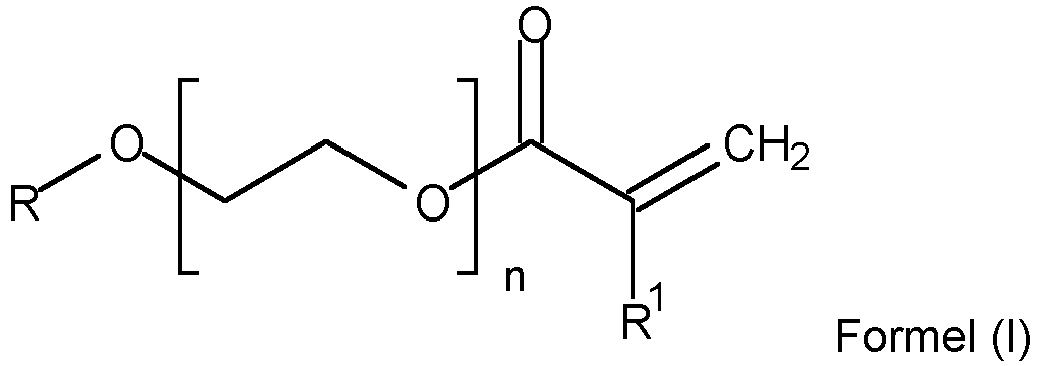
- R
- gleich verzweigtes oder unverzweigtes C1-C20-Alkyl, bevorzugt C2-C20-Alkyl, besonders bevorzugt Ethyl, Butyl oder Ethylhexyl, ist,
- n
- gleich 2 bis 12, bevorzugt 2 bis 8, besonders bevorzugt 2 bis 5 und ganz besonders bevorzugt 2 oder 3 ist und
- R1
- gleich Wasserstoff oder Methyl ist,
- Die Herstellung der unhydrierten Nitril-Dien-Carbonsäureester-Copolymeren kann durch Polymerisation der vorgenannten Monomere erfolgen und ist in der Literatur (z.B. Houben-Weyl, Methoden der Organischen Chemie Bd.14/1, 30 Georg Thieme Verlag Stuttgart 1961) umfangreich beschrieben und ist nicht im Besonderen beschränkt. Im Allgemeinen handelt es sich um ein Verfahren in dem α,β-ethylenisch ungesättigte Nitrileinheiten, konjugierte Dieneinheiten, und PEG-Acrylateinheiten nach Belieben copolymerisiert werden. Als Polymerisationsverfahren kann jedes bekannte Emulsions-Polymerisationsverfahren, Suspensions-Polymerisationsverfahren, Bulk-Polymerisationsverfahren und Lösungs-Polymerisationsverfahren verwendet werden. Bevorzugt ist dabei das Emulsions-Polymerisationsverfahren. Unter Emulsionspolymerisation wird insbesondere ein an sich bekanntes Verfahren verstanden, bei dem als Reaktionsmedium meist Wasser verwendet wird (siehe u. a. Römpp Lexikon der Chemie, Band 2, 10. Auflage 1997; P. A. Lovell, M. S. EI-Aasser, Emulsion Polymerization and Emulsion Polymers, John Wiley & Sons, ISBN: 0471 96746 7; H. Gerrens, Fortschr. Hochpolym. Forsch. 1, 234 (1959)). Die Einbaurate des Termonomers kann durch den Fachmann ohne weiteres so eingestellt werden, dass ein erfindungsgemäßes Terpolymer erhalten wird. Die Monomere können vorgelegt werden bzw. durch Inkrementierung in mehreren Schritten umgesetzt werden.
- Die Polymerisation kann entweder diskontinuierlich oder auch kontinuierlich in einer Rührkesselkaskade durchgeführt werden.
- Ferner wird häufig in Gegenwart sogenannter Molekulargewichtsregler polymerisiert, um das Molekulargewicht zu regeln. Es handelt sich in der Regel um Alkylthiole, die 9-16 Kohlenstoffatome enthalten. Solche Alkylthiole bzw. (Isomeren)-Mischungen von Alkylthiolen sind entweder käuflich erhältlich oder aber nach Verfahren, die in der Literatur hinlänglich beschrieben sind, für den Fachmann herstellbar.
- Beschrieben ist auch der Nitril-Dien-Carbonsäureester-Copolymer-Latex, optional enthaltend einen phenolischen, aminischen und auch sonstigen Alterungsschutzmittel, enthaltend das erfindungsgemäße Nitril-Dien-Carbonsäureester-Copolymer. Nitril-Dien-Carbonsäureester-Copolymer-Latex dient als Zwischenstufe zur Herstellung von Nitril-Dien-Carbonsäureester-Copolymer-Latex als Festkautschuk.
- Vor oder bei der Latexkoagulation können dem Latex ein oder mehrere Alterungsschutzmittel zugesetzt werden. Hierfür eigenen sich phenolische, aminische und auch sonstige Alterungsschutzmittel.
- Für die Koagulation wird der Latex auf einen für den Fachmann bekannten pH-Wert und zwar durch Zusatz einer Base, bevorzugt Ammoniak oder Natrium- oder Kaliumhydroxid, oder einer Säure, bevorzugt Schwefelsäure oder Essigsäure, eingestellt.
- In einer Ausführungsform des Verfahrens wird die Koagulation unter Einsatz mindestens eines Salzes ausgewählt aus der Gruppe bestehend aus Aluminium-, Calcium-, Magnesium-, Natrium-, Kalium- und Lithium-Salzen durchgeführt. Als Anionen dieser Salze werden üblicherweise ein- oder zweiwertige Anionen eingesetzt. Bevorzugt sind Halogenide, besonders bevorzugt Chlorid, Nitrat, Sulfat, Hydrogencarbonat, Carbonat, Formiat und Acetat.
- Die Salze werden in einer Menge von 0,05 bis 10 Gew%, bevorzugt 0,1 bis 8 Gew%, besonders bevorzugt 0,2 bis 5 Gew%, bezogen auf den Feststoffgehalt der Latexdispersion zugegeben
- Neben mindestens einem Salz aus der oben definierten Gruppe können bei der Koagulation auch Fällhilfsmittel eingesetzt werden. Als Fällhilfsmittel kommen beispielsweise wasserlöslichen Polymere in Frage. Diese sind nichtionisch, anionisch oder kationisch.
- Der zur Koagulation eingesetzte Latex besitzt zweckmäßigerweise eine Feststoffkonzentration im Bereich von 1 % bis 40 %, vorzugsweise im Bereich von 5 % bis 35 % und besonders bevorzugt im Bereich von 15 bis 30 Gew. %.
- Die Latexkoagulation wird im Temperaturbereich von 10 bis 110°C durchgeführt, vorzugsweise von 20 bis 100°C, besonders bevorzugt 50 bis 98°C. Die Latexkoagulation kann kontinuierlich oder diskontinuierlich erfolgen, bevorzugt wird kontinuierlich gearbeitet.
- In einer alternativen Ausführungsform kann der üblicherweise von nicht umgesetzten Monomeren abgetrennte Latex auch mit Säuren in einem pH-Bereich von ≤ 6, bevorzugt ≤ 4, besonders bevorzugt 2, behandelt werden, wodurch das Polymer ausfällt. Zur Fällung können alle mineralischen und organischen Säuren verwendet werden, die es gestatten die gewählten pH-Bereiche einzustellen. Mineralische Säuren werden bevorzugt zur pH-Einstellung verwendet. Anschließend wird das Polymer in der dem Fachmann üblichen Weise von der Suspension abgetrennt. Auch dies kann kontinuierlich oder diskontinuierlich erfolgen, bevorzugt wird kontinuierlich gearbeitet.
- Nach der Koagulation liegt der Nitrilkautschuk üblicherweise in Form sogenannter Krümel vor. Die Wäsche des koagulierten NBR wird daher auch als Krümelwäsche bezeichnet. Für diese Wäsche kann entweder entionisiertes Wasser oder nicht entionisiertes Wasser eingesetzt werden. Die Wäsche wird bei einer Temperatur im Bereich von 15 bis 90°C durchgeführt, bevorzugt bei einer Temperatur im Bereich von 20 bis 80°C. Die Menge des Waschwassers beträgt 0,5 bis 20 Gew.-Teile, bevorzugt 1 bis 10 Gew.-Teile und besonders bevorzugt 1 bis 5 Gew.-Teile bezogen auf 100 Gew.-Teile Nitrilkautschuk. Bevorzugterweise werden die Kautschukkrümel einer mehrstufigen Wäsche unterworfen, wobei die Kautschukkrümel zwischen den einzelnen Waschstufen teilweise entwässert werden. Die Restfeuchten der Krümel zwischen den einzelnen Waschstufen liegen im Bereich von 5 bis 50 Gew.%, vorzugsweise im Bereich von 7 bis 25 Gew. %. Die Zahl der Waschstufen liegt üblicherweise bei 1 bis 7, vorzugsweise bei 1 bis 3. Die Wäsche wird diskontinuierlich oder kontinuierlich durchgeführt. Vorzugsweise verwendet man ein mehrstufiges, kontinuierliches Verfahren, wobei für den schonenden Umgang mit Wasser eine Gegenstromwäsche bevorzugt ist. Nach Abschluss der Wäsche hat es sich bewährt, die Nitrilkautschuk-Krümel zu entwässern. Die Trocknung des vorentwässerten Nitrilkautschuks erfolgt in einem Trockner, geeignet sind beispielsweise Fließbetttrockner oder Plattentrockner. Die Temperaturen bei der Trocknung liegen bei 80 bis 150°C. Bevorzugt ist eine Trocknung mit Temperaturprogramm, wobei gegen Ende des Trockenprozesses die Temperatur abgesenkt wird.
- Es ist auch möglich, dass sich an die Herstellung des unhydrierten Nitril-Dien-Carbonsäureester-Copolymers eine Metathese-Reaktion zur Reduktion des Molekulargewichts des Nitril-Dien-Carbonsäureester-Copolymers oder eine Metathese-Reaktion und eine nachfolgende Hydrierung oder nur eine Hydrierung anschließt. Diese Metathese- bzw. Hydrierungsreaktionen sind bei dem Fachmann hinlänglich bekannt und in der Literatur beschrieben.
- Die Metathese ist beispielsweise aus
WO-A-02/100941 WO-A-02/100905 - Die Hydrierung von Nitril-Dien-Copolymeren ist bekannt, beispielsweise aus
US-A-3 700 637 ,DE-A-2 539 132 ,DE-A-3 046 008 ,DE-A-3 046 251 ,DE-A-3 227 650 ,DE-A-3 329 974 ,EP-A-111 412 FR-B 2 540 503 - Beschrieben ist ferner ein hydriertes Nitril-Dien-Carbonsäureester-Copolymer auf Basis des erfindungsgemäßen Nitril-Dien-Carbonsäureester-Copolymers. Hydriertes Nitril-Dien-Carbonsäureester-Copolymer ist erhältlich aus der Hydrierung von erfindungsgemäßem Nitril-Dien-Carbonsäureester-Copolymer. Bevorzugt ist hydrierter Nitril-Dien-Copolymerkautschuk mit 15 bis 40 Gew.-% Acrylnitrileinheiten, 20 bis 30 Gew.-% Butyldiglycolmethacrylat und 30 bis 65 Gew.-%, ganz oder teilweise hydriertes, Butadien.
- Der Begriff "hydriert" beschreibt, dass der Grad der Hydrierung der Butadieneinheiten im hydrierten Nitril-Dien-Carbonsäureester-Copolymer und beträgt 50 % bis 100 %, bevorzugt 90 % bis 100 %, besonders bevorzugt 95 % bis 100 % und ganz besonders bevorzugt zu 99 % bis 100 %.
- Gegenstand der vorliegenden Erfindung sind ferner vulkanisierbare Zusammensetzungen enthaltend zumindest ein erfindungsgemäßes Nitril-Dien-Carbonsäureester-Copolymer und mindestens einen Vernetzer.
- In einer bevorzugten Ausführungsform handelt es sich um vulkanisierbare Zusammensetzungen, enthaltend zumindest ein erfindungsgemäßes Nitril-Dien-Carbonsäureester-Copolymer, mindestens einen Vernetzer und zusätzlich mindestens einen Füllstoff enthalten.
- Als Vernetzer kommen beispielsweise peroxidische Vernetzer in Frage wie Bis(2,4-dichlorbenzyl)peroxid, Dibenzoylperoxid, Bis(4-chlorbenzoyl)peroxid, 1,1-Bis-(t-butylperoxy)-3,3,5-trimethylcylohexan, tert-Butylperbenzoat, 2,2 Bis(t-butylperoxy) buten, 4,4-di-tert.Butyl peroxynonylvalerat, Dicumylperoxid, 2,5-Dimethyl-2,5-di(t-butylperoxy)-hexan, tert-Butylcumylperoxid, 1,3-Bis(t-butylperoxy isopropyl)-benzol, Di-t-butylperoxid und 2,5-Dimethyl-2,5-di(t-butylperoxy)-hexyn-3.
- Es kann vorteilhaft sein, neben diesen peroxidischen Vernetzern noch weitere Zusätze zu verwenden, mit deren Hilfe die Vernetzungsausbeute erhöht werden kann: Hierfür sind beispielsweise Triallylisocyanurat, Triallylcyanurat, Trimethylolpropantri(meth)acrylat, Triallyl-trimellithat, Ethylenglycoldimethacrylat, Butandioldimethacrylat, Trimethylolpropantrimethacrylat, Zn-diacrylat, Zn-dimethacrylat, 1,2-Polybutadien oder N,N-'m-Phenylendimaleinimid geeignet.
- Die Gesamtmenge des oder der Vernetzer liegt üblicherweise im Bereich von 1 bis 20 phr, bevorzugt im Bereich von 1,5 bis 15 phr und besonders bevorzugt im Bereich von 2 bis 10 phr, bezogen auf den Nitrilkautschuk.
- Als Vernetzer können auch Schwefel in elementarer löslicher oder unlöslicher Form oder Schwefelspender eingesetzt werden.
- Als Schwefelspender kommen beispielsweise Dimorpholyldisulfid (DTDM), 2-Morpholino-dithiobenzothiazol (MBSS), Caprolactamdisulfid, Dipentamethylenthiuramtetrasulfid (DPTT), und Tetramethylthiuramdisulfid (TMTD) in Frage.
- Auch bei der Schwefelvulkanisation der erfindungsgemäßen Nitrilkautschuke ist es möglich, noch weitere Zusätze zu verwenden, mit deren Hilfe die Vernetzungsausbeute erhöht werden kann. Grundsätzlich kann die Vernetzung aber auch mit Schwefel oder Schwefelspendern allein erfolgen.
- Umgekehrt kann die Vernetzung der erfindungsgemäßen Nitrilkautschuke aber auch nur in Gegenwart der oben genannten Zusätze erfolgen, d.h. ohne Zusatz von elementarem Schwefel oder Schwefelspendern.
- Als Zusätze, mit deren Hilfe die Vernetzungsausbeute erhöht werden kann, eignen sich z.B. Dithiocarbamate, Thiurame, Thiazole, Sulfenamide, Xanthogenate, Guanidinderivate, Caprolactame und Thioharnstoffderivate.
- Als Dithiocarbamate können beispielsweise eingesetzt werden: Ammoniumdimethyldithiocarbamat, Natriumdiethyldithiocarbamat (SDEC), Natriumdibutyl-dithiocarbamat (SDBC), Zinkdimethyldithiocarbamat (ZDMC), Zinkdiethyldithiocarbamat (ZDEC), Zinkdibutyldithiocarbamat (ZDBC), Zinkethylphenyldithiocarbamat (ZEPC), Zinkdibenzyldithio-carbamat (ZBEC), Zinkpentamethylendithiocarbamat (Z5MC), Tellurdiethyldithiocarbamat, Nickeldibutyldithiocarbamat, Nickeldimethyldithiocarbamat und Zinkdiisononyldithiocarbamat.
- Als Thiurame können z.B. Tetramethylthiuramdisulfid (TMTD), Tetramethylthiurammonosulfid (TMTM), Dimethyldiphenylthiuramdisulfid, Tetrabenzylthiuramdisulfid, Dipentamethylenthiuram-tetrasulfid oder Tetraethylthiuramdisulfid (TETD) eingesetzt werden.
- Als Thiazole können z.B. 2-Mercaptobenzothiazol (MBT), Dibenzthiazyldisulfid (MBTS), Zinkmercaptobenzothiazol (ZMBT) oder Kupfer-2-mercaptobenzothiazol eingesetzt werden.
- Als Sulfenamidderivate können z.B. N-Cyclohexyl-2-benzothiazylsulfenamid (CBS), N-tert.-Butyl-2-benzthiazylsulfenamid (TBBS), N,N'-Dicyclohexyl-2-benzthiazylsulfenamid (DCBS), 2-Morpholinothiobenzthiazol (MBS), N-Oxydiethylenthiocarbamyl-N-tert.butylsulfenamid oder Oxydiethylenthiocarbamyl-N-oxyethylensulfenamid eingesetzt werden.
- Als Xanthogenate können z.B. Natriumdibutylxanthogenat, Zinkisopropyldibutylxanthogenat oder Zinkdibutylxanthogenat eingesetzt werden.
- Als Guanidinderivate können z.B. Diphenylguanidin (DPG), Di-o-tolylguanidin (DOTG) oder o-Tolylbiguanid (OTBG) eingesetzt werden.
- Als Dithiophosphate können z.B. Zinkdialkydithiophosphate (Kettenlänge der Alkylreste C2 bis C16), Kupferdialkyldithiophosphate (Kettenlänge der Alkylreste C2 bis C16) oder Dithiophoshorylpolysulfid eingesetzt werden.
- Als Caprolactam kann beispielsweise Dithio-bis-caprolactam eingesetzt werden.
- Als Thioharnstoffderivate können beispielsweise N,N'-Diphenylthioharnstoff (DPTU), Diethylthioharnstoff (DETU) und Ethylenthioharnstoff (ETU) eingesetzt werden.
- Ebenso als Zusätze geeignet sind beispielsweise Zinkdiamindiisocyanat, Hexamethylentetramin, 1,3-Bis(citraconimidomethyl)benzol sowie zyklische Disulfane.
- Die genannten Zusätze und Vernetzungsmittel können sowohl einzeln als auch in Mischungen eingesetzt werden. Bevorzugt werden folgende Substanzen für die Vernetzung der Nitrilkautschuke eingesetzt: Schwefel, 2-Mercaptobenzthiazol, Tetramethylthiuramdisulfid, Tetramethylthiurammonosulfid, Zinkdibenzyldithiocarbamat, Dipentamethylenthiuramtetrasulfid, Zinkdialkyldithiophosphat, Dimorpholyldisulfid, Tellurdiethyldithiocarbamat, Nickeldibutyldithiocarbamat, Zinkdibutyldithiocarbamat, Zinkdimethyldithiocarbamat und Dithio-bis-caprolactam.
- Die Vernetzungsmittel und zuvor genannten Zusätze können jeweils in Mengen von ca. 0,05 bis 10 phr, vorzugsweise 0,1 bis 8 phr, insbesondere 0,5 bis 5 phr (Einzeldosierung, jeweils bezogen auf die Wirksubstanz) eingesetzt werden.
- Bei der erfindungsgemäßen Schwefelvernetzung ist es gegebenenfalls auch sinnvoll, zusätzlich zu den Vernetzungsmitteln und oben genannten Zusätzen auch weitere anorganische bzw. organische Substanzen mit zu verwenden, wie Zinkoxid, Zinkcarbonat, Bleioxid, Magnesiumoxid, gesättigte oder ungesättigte organische Fettsäuren und deren Zinksalze, Polyalkohole, Aminoalkohole, wie zum Beispiel Triethanolamin sowie Amine wie zum Beispiel Dibutylamin, Dicyclohexylamin, Cyclohexylethylamin und Polyetheramine.
- Daneben können auch Anvulkanisationsverzögerer eingesetzt werden. Hierzu gehören Cyclohexylthiophthalimid (CTP), N,N' Dinitrosopentamethlyentetramin (DNPT), Phthalsäure-anhydrid (PTA) und Diphenylnitrosamin. Bevorzugt ist Cyclohexylthiophthalimid (CTP).
- Neben der Zugabe des oder der Vernetzer kann der erfindungsgemäße Nitrilkautschuk auch mit weiteren üblichen Kautschukadditiven gemischt werden.
- Diese umfassen z.B. die typischen und dem Fachmann bekannten Substanzen wie Füllstoffe, Füllstoffaktivatoren, Ozonschutzmittel, Alterungsschutzmittel, Antioxidationsmittel, Verarbeitungshilfsmittel, Extenderöle, Weichmacher, Verstärkungsmaterialien und Formtrennmittel.
- Als Füllstoffe können beispielsweise Ruß, Kieselsäure, Bariumsulfat, Titandioxid, Zinkoxid, Calciumoxid, Calciumcarbonat, Magnesiumoxid, Aluminiumoxid, Eisenoxid, Aluminiumhydroxid, Magnesiumhydroxid, Aluminiumsilikate, Diatomeenerde, Talkum, Kaoline, Bentonite, Kohlenstoff Nanotubes, Teflon (letzteres bevorzugt in Pulverform), oder Silikate eingesetzt werden.
- Als Füllstoffaktivatoren kommen insbesondere organische Silane, wie beispielsweise Vinyltrimethyloxysilan, Vinyldimethoxymethylsilan, Vinyltriethoxysilan, Vinyltris(2-methoxy-ethoxy)silan, N-Cyclohexyl-3-aminopropyltrimethoxysilan, 3-Aminopropyl-trimethoxysilan, Methyltrimethoxysilan, Methyltlriethoxysilan, Dimethyldimethoxysilan, Dimethyldiethoxysilan, Trimethylethoxysilan, Isooctyltrimethoxysilan, Isooctyltriethoxysilan, Hexadecyltrimethoxysilan oder (Octadecyl)methyldimethoxysilan in Betracht. Weitere Füllstoffaktivatoren stellen zum Beispiel grenzflächenaktive Substanzen wie Triethanolamin und Ethylenglycole mit Molekular-gewichten von 74 bis 10 000 g/mol dar. Die Menge an Füllstoffaktivatoren beträgt üblicherweise 0 bis 10 phr, bezogen auf 100 phr des Nitrilkautschuks.
- Als Alterungsschutzmittel können den vulkanisierbaren Mischungen diejenigen zugesetzt werden, die bereits im Zusammenhang mit der Latexkoagulation in dieser Anmeldung beschrieben werden. Sie werden üblicherweise in Mengen von ca. 0 bis 5 phr, bevorzugt 0,5 bis 3 phr, bezogen auf 100 phr des Nitrilkautschuks eingesetzt.
- Als Formtrennmittel kommen z.B. gesättigte oder teilweise ungesättigte Fett- und Ölsäuren und deren Derivate (Fettsäureester, Fettsäuresalze, Fettalkohole, Fettsäureamide), die vorzugsweise als Mischungsbestandteil Verwendung finden, weiterhin auf die Formoberfläche applizierbare Produkte, wie beispielsweise Produkte auf Basis von niedermolekularen Silikonverbindungen, Produkte auf Basis von Fluorpolymeren sowie Produkte auf Basis von Phenolharzen in Betracht.
- Die Formtrennmittel werden als Mischungsbestandteil in Mengen von ca. 0 bis 10 phr, bevorzugt 0,5 bis 5 phr, bezogen auf 100 phr des Nitrilkautschuks eingesetzt.
- Auch die Verstärkung mit Festigkeitsträgern (Fasern) aus Glas, nach der Lehre von
US-A-4,826,721 ist möglich sowie die Verstärkung durch Corde, Gewebe, Fasern aus aliphatischen und aromatischen Polyamiden (Nylon®, Aramid®), Polyestern und Naturfaserprodukten. - Gegenstand der Erfindung ist ferner ein Verfahren zur Herstellung vulkanisierbarer Zusammensetzungen enthaltend Nitril-Dien-Carbonsäureester-Copolymere durch Mischung des Nitril-Dien-Carbonsäureester-Copolymers mit mindestens einem Vernetzer und den optional weiteren enthaltenen Komponenten. Dieser Mischvorgang kann in allen in der Gummiindustrie üblichen Mischaggregaten, wie z.B. Innenmischern, Banbury Mischern oder Walzen, durchgeführt werden. Die Reihenfolge der Zudosierung ist für den Fachmann durch geeignete Versuche ohne Probleme ermittelbar.
- Beispielhaft sind nachfolgend zwei Varianten dargestellt, wie vorgegangen werden kann:
- Bevorzugt sind Innenmischer mit ineinandergreifender Rotorgeometrie.
- Zum Startzeitpunkt erfolgt die Beschickung des Innenmischers mit dem in Ballenform vorliegenden Nitril-Dien-Carbonsäureester-Copolymer und es kommt zur Zerkleinerung der Ballen. Nach einem geeigneten Mischzeitraum erfolgt die Zugabe der Füllstoffe und Additive. Das Mischen erfolgt unter Kontrolle der Temperatur mit der Maßgabe, dass das Mischgut für eine geeignete Zeit bei einer Temperatur im Bereich von 80 °C bis 150 °C verbleibt. Nach einem weiteren geeigneten Mischzeitraum erfolgt die Zugabe der weiteren Zusammensetzungsbestandteile wie optional Stearinsäure, Antioxidantien, Weichmacher, Weißpigmente (beispielsweise Titandioxid), Farbstoffen und sonstigen Verarbeitungswirkstoffen. Nach einem weiteren geeigneten Mischzeitraum wird der Innenmischer gelüftet und der Schacht gereinigt. Nach einem weiteren geeigneten Zeitraum wird der Innenmischer unter Erhalt der vulkanisierbaren Zusammensetzung entleert. Unter geeigneten Zeiträumen sind einige Sekunden bis einige Minuten zu verstehen. Die Vernetzungschemikalien können entweder in einem separaten Schritt auf der Walze eingemischt werden, vor allem wenn bei erhöhter Mischtemperatur gemischt wird oder direkt im Innenmischer mit hinzugegeben werden. Hierbei ist darauf zu achten, dass die Mischtemperatur unterhalb der Reaktionstemperatur der Vernetzungschemikalien liegt.
- Die so hergestellten vulkanisierbaren Zusammensetzungen können in üblicher Weise, etwa durch die Mooney-Viskosität, durch Mooney-Scorch oder durch einen Rheometertest beurteilt werden.
- Werden Walzen als Mischaggregate verwendet, wird zuerst das Nitril-Dien-Carbonsäure Copolymer auf die Walze gegeben. Nachdem sich ein homogenes Walzfell gebildet hat werden die Füllstoffe, Weichmacher und andere Additive außer den Vernetzungschemikalien zugegeben. Nach Einmischung aller Komponenten werden die Vernetzungschemikalien zugegeben und eingemischt. Danach wird die Mischung je dreimal rechts und dreimal links eingeschnitten und 5 mal gestürzt. Das fertige Walzfell wird auf die gewünschte Dicke gewalzt und entsprechend der gewünschten Testmethoden weiterverarbeitet..
- Gegenstand der Erfindung ist ferner das Verfahren zur Herstellung von Vulkanisaten, bevorzugt als Formteile, enthaltend Nitril-Dien-Carbonsäureester-Copolymere (Vulkanisation), dadurch gekennzeichnet, dass man die vulkanisierbare Zusammensetzung enthaltend Nitril-Dien-Carbonsäureester-Copolymere einer Vulkanisation unterwirft, bevorzugt in einem Formgebungsverfahren und ferner bevorzugt bei Temperaturen im Bereich von 100 °C bis 250 °C, besonders bevorzugt bei Temperaturen im Bereich von 120 °C bis 250 °C und ganz besonders bevorzugt Temperaturen im Bereich von 130 °C bis 250 °C. Die vulkanisierbaren Zusammensetzungen werden hierzu mit Kalandern, Walzen oder Extrudern weiterverarbeitet. Die vorgeformte/plastifizierte Masse wird sodann in Pressen, Autoklaven, Heißluft-, Salzbad-, Infrarot-, UHF-Anlagen oder in sogenannten automatischen Mattenvulkanisationsanlagen ("Auma") vulkanisiert, wobei sich bevorzugt Temperaturen im Bereich von 100 °C bis 250 °C, besonders bevorzugt Temperaturen im Bereich von 120 °C bis 250 °C und ganz besonders bevorzugt Temperaturen im Bereich von 130 °C bis 250 °C bewährt haben. Die Vulkanisationszeit beträgt typischerweise 1 Minute bis 24 Stunden und bevorzugt 2 Minuten bis 1 Stunde. Abhängig von der Form und der Größe der Vulkanisate kann eine zweite Vulkanisation durch erneutes Erhitzen notwendig sein, um eine vollständige Vulkanisation zu erreichen.
- Gegenstand der Erfindung sind ferner die so erhältlichen Vulkanisate basierend auf erfindungsgemäßen Nitril-Dien-Carbonsäureester-Copolymeren.
- Beschrieben ist auch die Verwendung der Vulkanisate basierend auf erfindungsgemäßen Nitril-Dien-Carbonsäureester-Copolymeren zur Herstellung von elastomeren Bauteilen ausgewählt aus der Gruppe bestehend aus Riemen, Dichtungen und Dichtprofilen, Walzen, Membranen, Schuhkomponenten, Schläuchen, Dämpfungselementen, Dämmstoffen, Statoren und Kabelmänteln, bevorzugt Schläuche und Dichtungen.
- Beschrieben sind somit Vulkanisate als Formteile basierend auf erfindungsgemäßem Nitril-Dien-Carbonsäureester-Copolymeren, die bevorzugt ausgewählt sind aus Riemen, Dichtungen und Dichtprofilen, Walzen, Membranen, Schuhkomponenten, Schläuchen, Dämpfungselementen, Dämmstoffen, Statoren und Kabelmänteln, bevorzugt Schläuche und Dichtungen. Die hierfür beispielsweise einsetzbaren Methoden wie Molding, Spritzguss- oder Extrusionsverfahren sowie die entsprechende Spritzgießvorrichtungen oder Extruder sind dem Fachmann hinlänglich bekannt. Bei der Herstellung dieser Formteile können den erfindungsgemäßen Nitril-Dien-Carbonsäureester-Copolymeren noch die gängigen, dem Fachmann bekannten und von ihm mit üblichem Fachwissen geeignet auszuwählenden Hilfsmittel wie z.B. Füllstoffe, Füllstoffaktivatoren, Beschleuniger, Vernetzer, Ozonschutzmittel, Antioxidationsmittel, Verarbeitungsöle, Extenderöle, Weichmacher, Aktivatoren oder Anvulkanisationshemmer zugesetzt werden.
- Der Vorteil der Erfindung liegt insbesondere darin, dass die erfindungsgemäßen, Nitril-Dien-Carbonsäureester-Copolymere zur Herstellung von Vulkanisaten geeignet sind, die eine geringe Quellung und gleichzeitig eine gute Kälteflexibilität aufweisen und somit den Vulkanisaten auf Basis der bekannten NBR-Copolymeren überlegen sind.
- Die Bestimmung der Werte für die Mooney-Viskosität (ML 1+4@100°C) erfolgt jeweils mittels eines Scherscheibenviskosimeters nach DIN 53523/3 bzw. ASTM D 1646 bei 100°C.
- Der Stickstoffgehalt zur Bestimmung des ACN-Gehalts wird in den nitrilgruppenhaltigen Copolymerkautschuken nach Vario EL cube bestimmt. Verbrennung der Einwaage im CHN-Automaten bei etwa 1150 °C in Gegenwart von Oxidationskatalysatoren und Sauerstoff, Aliquotierung der Verbrennungsgase, Absorption der Störkomponenten und Detektion von N2 durch Wärmeleitfähigkeitsmesszelle (WLD).
- Die Bestimmung der Mikrostruktur und des Termonomergehaltes der einzelnen Polymere erfolgte mittels 1H-NMR (Gerät: Bruker DPX400 mit Software TopSpin 1.3, Messfrequenz 400 MHz, Lösungsmittel 1,1,2,2-Tetrachlorethan-d2).
- Die Vernetzungsdichte wurde mit einem Moving Die Rheometer (MDR 2000E) bestimmt, wobei mit einem Winkel von 0,5° und einer Oszillationsfrequenz von 1,7 Hz bei 160 °C für 30 Minuten gemessen wurde.
- Für die Zugprüfung wurden 2 mm Platten durch Vulkanisation der vulkanisierbaren Mischung bei 180 °C hergestellt. Aus diesen Platten wurden die hantelförmigen Prüfkörper ausgestanzt und nach ASTM D2240-81 die Zugfestigkeit und Dehnung bestimmt.
- Die Härte wurde mit einem Durometer nach ASTM D2240-81 bestimmt.
- Die Glasübergangstemperatur wurde mit Hilfe einer DSC Messung nach ASTM E 1356-03 bzw. nach DIN 11357-2 erhalten. Dafür wurden zwischen 10 mg und 15 mg der Probe in ein Aluminiumpfännchen eingewogen und versiegelt. Das Pfännchen wurde in einem DSC Gerät von TA Instruments mit einer Heizrate von 20 K/min zweimal von -150 °C auf 150 °C aufgeheizt. Die Glasübergangstemperatur wurde aus der zweiten Aufheizkurve nach dem Standard Mittelwertverfahren bestimmt.
- TR 10 Messung: Die TR Messung wurde nach ISO 2921, 2005 durchgeführt. Hierfür wurde die Probe bei -70 °C in Silikonöl für 10 Minuten gelagert. Anschließend wurde die Kurve mit 1°C/min aufgezeichnet und die Temperatur für 10 % Veränderung abgelesen.
- Quellung: Hantelförmige Probekörper, wie sie für die Zugprüfung verwendet werden, wurden zur Bestimmung der Quellung bei 100 °C für 72 h bzw. 168h in IRM903 oder Fuel C nach DIN ISO 1817 gelagert. Im Anschluss wurden die Proben ausgemessen und ausgewogen und die Volumenquellung und Massezunahme bestimmt. Daran anschließend wurden die Zugfestigkeit und Dehnung nach ASTM D2240-81 bestimmt.
- Die in den nachfolgenden Tabellen angegebenen Abkürzungen haben folgende Bedeutungen:
- "RT" Raumtemperatur (23±2 °C)
- "S min" ist das minimale Drehmoment der Vernetzungsisotherme
- "S max" ist das maximale Drehmoment der Vernetzungsisotherme
- "Delta S" ist "S max - S min"
- "TS1" steht für die Zeit, bis die Mooney-Viskosität sich um eine Einheit erhöht hat nachdem das Mooney-Viskositäts-Minimum erreicht wurde, im Vergleich zum Ausgangspunkt
- "TS2" steht für die Zeit, bis die Mooney-Viskosität sich um zwei Einheiten erhöht hat nachdem das Mooney-Viskositäts-Minimum erreicht wurde, im Vergleich zum Ausgangspunkt
- "t 50" ist die Zeit, wenn 50 % von S max erreicht wurde
- "t 90" ist die Zeit, wenn 90 % von S max erreicht wurde
- "t 95" ist die Zeit, wenn 95 % von S max erreicht wurde
- "M 10" Modul bei 10 % Dehnung, gemessen bei RT
- "M 25" Modul bei 25 % Dehnung, gemessen bei RT
- "M 50" Modul bei 50 % Dehnung, gemessen bei RT
- "M 100" Modul bei 100 % Dehnung, gemessen bei RT
- "M 300" Modul bei 300 % Dehnung, gemessen bei RT
- "EB" elongation at break (engl.), Bruchdehnung, gemessen bei RT
- "TS" Tensile strength (engl.), Zugspannung, gemessen bei RT
- "H" Hardness (engl.), Härte, gemessen bei RT
- Die nachfolgenden Chemikalien wurden als Handelsprodukte der jeweils angegebenen Firmen bezogen oder stammen aus Produktionsanlagen der angegebenen Firmen.
-
- ACN
- Acrylnitril, CAS 107-13-1
- BD
- 1,3-Butadien, CAS 106-99-0
- BA
- Butylacrylat, CAS 141-32-2
- PEG-2-MA
- Butoxydiethylenglycolmethacrylat (BDGMA), CAS 7328-22-5
- Natriumdodecylsulfat (SDS)
- CAS 151-21-3
- Na-Salz der disproportionierten Harzsäure
- CAS 61790-51-0
- Fettsäure
- CAS 67701-08-8
- Na2CO3
- CAS 24551-51-7
- t-DDM
- tertiäres Dodecylmercaptan; LANXESS Deutschland GmbH
- Glidox® 500
- Pinanhydroperoxid; Renessenz
- "Prämix-Lösung Fe(II)SO4"
- enthält 0,986 g Fe(II)SO4*7 H2O und 2,0 g Rongalit® C in 400 g Wasser
- Rongalit C®
- Natriumsalz eines Sulfinsäurederivates; Handelsprodukt der BASF
- Diethylhydroxylamin
- CAS 3710-84-7
- Vulkanox® BKF
- 2,2'-Methylen-bis-(4-methyl-6-tert-butyl-phenol); LANXESS Deutschland GmbH
-
- NBR 5
- PERBUNAN® 2255VP, 22,1 Gew.-% ACN; Mooney Viskosität 55 Mu
- NBR 6
- PERBUNAN® 2845 F, 28,2 Gew.-% ACN; Mooney Viskosität 43 Mu
- NBR 7
- PERBUNAN® 3445 F, 34,2 Gew.-% ACN; Mooney Viskosität 43 Mu
- Corax® N550/30
- Ruß; Orion Engineered Carbons
- REGAL® SRF / N772
- Ruß; Carbot
- VULKANOL® OT
- 2-[2-(Butoxyethoxy)-ethoxy]ethanol mit 2,2'-Thiobis-(ethanol) (LANXESS)
- EDENOR® C18-98 MY
- Stearinsäure (Oleo Sultions Ltd.)
- VULKANOX® HS/LG
- 2,2,4-Trimethyl-1,2-dihydrochinolin (LANXESS)
- VULKANOX® MB2/MG
- 4/5-Methyl-2-mercaptobenzimidazol (LANXESS)
- RHENOCURE® IS 90-20
- unlöslicher/löslicher Schwefel in einem 90:10 Verhältnis plus 20% Mineralöl (LANXESS)
- ZINKOXYD AKTIV
- ZnO (LANXESS)
- VULKACIT® NZ/EGC
- N-tert-butyl-benzo-thiazyl sulfenamid (TBBS) (LANXESS)
- VULKACIT® THIURAM/C
- Tetramethylthiuram disulfide (LANXESS)
- VULKALENT® E/C
- N-Phenyl-N-(trichloromethylsulfenyl)-benzenesulfonamide (LANXESS)
- Stabilisator
- Mischung aus 2,2'-Methylene-bis(4-methyl-6-nonyl)phenol (CAS 7786-17-6) und styrolisiertes Diphenylamin (CAS 68442-68-2)
- Die Herstellung der in den folgenden Beispielserien eingesetzten NBR-Carbonsäureester-Copolymere 1 bis 4 erfolgte nach der in Tabelle 1 angegebenen Basisrezeptur, wobei sämtliche Einsatzstoffe in Gew.-% bezogen auf 100Gew.-% der Monomermischung angegeben sind. Tabelle 1 nennt auch die jeweiligen Polymerisationsbedingungen (Temperatur, Umsatz und Zeit).
Tabelle 1: Herstellung der unhydrierten Nitril-Dien-Carbonsäureester-Copolymere (NBR 1 - 4; erfindungsgemäße Beispiele sind mit einem Stern * gekennzeichnet). NBR-Carbonsäureester 1 2* 3 4 Monomere Acrylnitril (ACN) 18 27 16 21 1,3-Butadien (BD) 31 46 32 24 Butoxydiethylenglycol-methacrylat (PEG-2-MA) 51 27 Butylacrylat (BA) 52 55 Gesamtwassermenge 190 190 190 190 SDS 2,4 2,4 1,44 1,44 Na-Salz der dispro-portionierten Harzsäure 0,5 0,5 0,4 0,4 Na2CO3 0,12 0,12 0,12 0,12 pH 10,5 ±0,5 10,5 ±0,5 10,5 ±0,5 10,5 ±0,5 t-DDM 0,25 0,30 0,29 0,29 Glidox® 500 0,02 0,02 0,02 0,02 Prämix-Lösung FeSO4 0,03 0,02 0,03 0,03 Diethylhydroxylamin 0,2 0,2 0,2 0,2 Stabilisator 0,5 0,5 Polymerisations-bedingungen Polymerisations-temperatur [°C] 12 12 12 12 Polymerisationsumsatz [%] 71,5 72,2 68,4 71,1 Polymerisationszeit [h] 5 7 6,5 7 Tabelle 2: Zugabe der Inkremente der Nitril-Dien-Carbonsäureester-Copolymere (NBR 1 - 4) Die Zugabe der Inkremente der Monomere erfolgte bei den angegebenen Monomerumsätzen ± 5%. NBR 1 2 3* 4* Umsatz [%] ACN (a) / BD (b) [Gew.-%] 21 3/6 -/- -/- 3,5/6 33 -/- 9/- -/- -/- 42 3/7 -/- 3/6 2,5/3 48 3/6 -/- -/- -/- 63 -/- -/- 2/4 2,5/3 *Umsatz bei 27% - Die Herstellung der Nitril-Dien-Carbonsäureester-Copolymere erfolgte diskontinuierlich in einem 5 L- Autoklaven mit Rührwerk. Bei den Autoklavenansätzen wurden jeweils 1,25 kg der Monomermischung und eine Gesamtwassermenge von 2,1 kg sowie EDTA in einer äquimolaren Menge bezogen auf das Fe-II verwendet. Von dieser Wassermenge wurden 1,9 kg mit dem Emulgator im Autoklaven vorgelegt und mit einem Stickstoffstrom gespült. Danach wurden die entstabilisierten Monomeren und die in der Tabelle angegebene Menge des Molekulargewichtsreglers t-DDM zugegeben und der Reaktor verschlossen. Nach der Thermostatisierung des Reaktorinhalts wurden die Polymerisationen durch die Zugabe der Prämix-Lösungen und des Hydroperoxid gestartet.
- Der Polymerisationsverlauf wurde durch gravimetrische Umsatzbestimmungen verfolgt. Bei Erreichen der in Tabelle 1 angegebenen Umsätze wurde die Polymerisation durch Zugabe einer wässrigen Lösung von Diethylhydroxylamin abgestoppt. Nicht umgesetzte Monomere und sonstige flüchtige Bestandteile wurden mittels Wasserdampfdestillation entfernt.
- Vor der Koagulation des jeweiligen NBR-Latex wurde dieser jeweils mit einer 45%igen Dispersion von Vulkanox® BKF (0,1 Gew. % Vulkanox® BKF bezogen auf NBR-Feststoff) oder der Stabilisatormischung (2,2'-Methylene-bis(4-methyl-6-nonyl)phenol (CAS 7786-17-6) und styrolisiertes Diphenylamin (CAS 68442-68-2), 0.5 Gew% bezogen auf NBR Feststoff) versetzt. Anschließend wurde mit CaCl2 koaguliert, gewaschen und die erhaltenen Krümel getrocknet.
- Die getrockneten NBR-Kautschuke wurden durch die Mooney-Viskosität, den ACN-Gehalt und die Glasübergangstemperatur charakterisiert und der Gehalt der Termonomere durch 1H-NMR-Analyse bestimmt (Tabelle 3).
Tabelle 3: Zusammensetzung und Eigenschaften der unhydrierten Nitril-Dien-Carbonsäureester-Copolymere 1 bis 4 und der kommerziell erhältlichen Nitril-Dien-Kautschuke 5 bis 7 (einpolymerisierte Monomermengen in Gew.-%; erfindungsgemäße Beispiele mit einem Stern * gekennzeichnet) NBR 1 2* 3 4 5 6 7 ACN (a) [Gew.-%] 15 25 16 19 22 28 34 BD (b) [Gew.-%] 34 51 45 52 78 72 66 PEG-2-MA (c) [Gew.-%] 51 24 BA [Gew.-%] 39 29 Mooney Viskosität ML(1+4@100°C) MU 17 17 29 39 55 43 43 - Alle Kautschukmischungen wurden auf einem Mischwalzwerk hergestellt. Der Durchmesser der Walzen war 80 mm, die Länge 200 mm. Die Walzen wurden auf 30°C vorgewärmt, die Geschwindigkeit der vorderen Walze war 16,5 RPM, die der hinteren Walze 20 PRM, wodurch eine Friktion von 1:1,2 erreicht wurde.
- Der Kautschuk wurde vorgelegt und eine (1) Minute gemischt, bis sich ein glattes Walzfell gebildet hat. Nachfolgend wurde zuerst der Ruß, dann die Additive und zuletzt die Vernetzungschemikalien eingemischt. Insgesamt betrug die Mischzeit 10 bis 12 Minuten.
Tabelle 4: Zusammensetzung der vulkanisierbaren Zusammensetzungen (V1 bis V7; erfindungsgemäße Beispiele sind mit einem Stern * gekennzeichnet). Beispiel V1 V2* V3 V4 V5 V6 V7 NBR-Copolymer-Zusammensetzung Gew.-% Gew.-% Gew.-% Gew.-% Gew.-% Gew.-% Gew.-% ACN (a) 15 25 16 19 22 28 34 BD (b) 34 51 45 52 78 72 66 PEG-2-MA (c) 51 24 BA (d) 39 29 NBR-Copolymer Teile Teile Teile Teile Teile Teile Teile NBR 1* 100 NBR 2* 100 NBR 3 100 NBR 4 100 NBR 5 100 NBR 6 100 NBR 7 NBR 8 100 Andere Komponenten phr phr phr phr phr phr phr Corax® N 550/30 30 30 30 30 30 30 30 Regal® SRF / N772 50 50 50 50 50 50 50 Vulkanol® OT 10 10 10 10 10 10 10 Edenor® C18-98 MY 0,3 0,3 0,3 0,3 0,3 0,3 0,3 Vulkanox® HS/LG 1,5 1,5 1,5 1,5 1,5 1,5 1,5 Vulkanox® MB2/MG 1,5 1,5 1,5 1,5 1,5 1,5 1,5 Rhenocure® IS 90-20 0,37 0,37 0,37 0,37 0,37 0,37 0,37 Zinkoxyd Aktiv 5 5 5 5 5 5 5 Vulkacit® NZ/EGC 1,5 1,5 1,5 1,5 1,5 1,5 1,5 Vulkacit® Thiuram/C 2 2 2 2 2 2 2 Vulkalent® E/C 1 1 1 1 1 1 1 Tabelle 5: Vernetzungsdichte der Vulkanisate V1 bis V7 MDR 160°C Einheit V1 V2* V3 V4 V5 V6 V7 S min dNm 0,8 1,5 1,1 1,1 2,5 1,4 1,2 S max dNm 12,7 17,4 18,7 16,6 22,1 21,7 21,5 TS 1 min 2,1 1,6 2,0 2,0 1,5 1,5 1,4 TS 2 min 2,3 1,9 2,3 2,3 1,7 1,7 1,5 t 10 min 2,1 1,8 2,2 2,2 1,7 1,7 1,5 t 25 min 2,5 2,1 2,7 2,7 2,0 2,0 1,8 t 50 min 3,0 2,6 3,3 3,5 2,4 2,5 2,2 t 70 min 3,6 3,1 4,0 4,3 2,8 3,0 2,7 t 80 min 4,1 3,5 4,8 5,1 3,1 3,4 3,1 t 90 min 4,8 4,2 6,5 7,0 3,8 4,2 4,0 t 95 min 5,4 5,3 8,7 9,7 4,7 5,2 5,3 - Die Vernetzungseigenschaften des erfindungsgemäßen Vulkanisats V2 ist vergleichbar mit Butylacrylathaltigen NBR Copolymeren (V3 und V4) sowie den kommerziell erhältlichen NBR Copolymeren (V5 bis V7).
- Die Formkörper (Platten mit 2 mm Dicke) für die Durchführung der weiteren Bestimmungen wurden durch Vulkanisation bei 160°C für 15 Minuten hergestellt.
Tabelle 6: Physikalische Eigenschaften der ungealterten Vulkanisate V1 bis V7 Zugprüfung V1 V2* V3 V4 V5 V6 V7 TS MPa 8,3 11,2 10,2 13,1 15,4 14,4 15,1 EB % 210 232 226 250 297 317 340 M50 MPa 1,4 1,8 1,8 1,9 2 2,1 2,1 M100 MPa 3,7 4,2 4,2 4,8 4,1 4,2 4,1 Härte Shore A 58,1 63,5 64,8 62,5 68,3 69,4 69,7 Glasübergangstemperatur TR 10 °C -48,7 -41,8 -39,2 -31,1 -40,8 -32,8 -27 TR 30 °C -43,2 -37 -35,3 -26,7 -36 -28,9 -23,4 TR 50 °C -38,7 -32,8 -31,9 -23,3 -31,2 -25 -20 TR 70 °C -33,1 -27,2 -27,2 -19,1 -23,8 -19,2 -14,9 TR 70 - TR 10 °C 15,5 14,6 12 11,9 17 13,6 12,1 DSC Tg °C -57,5 -48,5 -44,5 -37,3 -50,0 -38,4 -31,3 - Der Vergleich von V1 mit V2* sowie V5 mit V6 und V7 zeigt, das mit einem verringerten Gehalt an ACN die Tg des Vulkanisats sinkt.
- Beim Vergleich von V2 mit V5 ist zu sehen, dass der Austausch von BD durch BDGMA bei ungefähr gleichbleibender Menge an ACN zu vergleichbaren TR10 und DSC-Werten führt.
- V1 weist eine niedrigere Tg auf als das erfindungsgemäße Vulkanisat V2.
Tabelle 7: Physikalische Eigenschaften der Vulkanisate V1 bis V7 nach Lagerung in IRM 903 bei 100°C für 3 Tage Alterungs-Eigenschaften Einheit V1 V2* V3 V4 V5 V6 V7 TS MPa 8,5 14,2 11,5 13,8 15,5 15,3 17,2 EB % 166 234 219 213 273 285 324 M50 MPa 1,7 2,2 1,9 2,1 1,8 2,1 2,4 M100 MPa 4,7 5,4 4,8 5,8 4,3 4,6 5 Härte Shore A 60 67,2 60 63,7 60,2 66,1 70,9 Δ TS % 2,4 26,8 12,7 5,3 0,6 6,3 13,9 Δ EB % -21,0 0,9 -3,1 -14,8 -8,1 -10,1 -4,7 Δ M50 % 21,4 22,2 5,6 10,5 -10,0 0,0 14,3 Δ M100 % 27,0 28,6 14,3 20,8 4,9 9,5 22,0 Δ Härte Shore A 1,9 3,7 -4,8 1,2 -8,1 -3,3 1,2 Δ Volumen % 2,4 -0,2 11,9 4,9 18,3 8,1 2,4 Δ Gewicht % 1,0 -1,0 8,2 2,9 13,1 5,7 1,3 - Das erfindungsgemäße Nitril-Dien-Carbonsäureester-Copolymer Vulkanisat V2 weist eine verringerte Quellung (Volumenszunahme) nach drei Tagen Alterung in IRM 903 auf, verglichen mit dem Vergleichsvulkanisat V1 oder den Copolymeren V5 und V6 mit einem ähnlichen Gehalt an Acrylnitrilmonomeren von 22 bis 28 Gew.-%.
- Das erfindungsgemäße Vulkanisat V2 mit BDGMA als Termonomer weist somit sowohl eine niedrige Glasübergangstemperatur (TR 10 bzw. DSC Tg) von weniger als -40 °C und zugleich eine geringe Quellung in Öl auf.
Tabelle 8: Physikalische Eigenschaften der Vulkanisate V1 bis V7 nach Lagerung in IRM 903 bei 100°C für 7 Tage Alterungs-Eigenschaften Einheit V1 V2* V3 V4 V5 V6 V7 TS MPa 10,2 13,3 12 14,8 15,8 14,8 17 EB % 190 208 214 223 260 255 270 M50 MPa 1,9 2,3 1,9 2,3 1,8 2,2 2,7 M100 MPa 4,9 5,6 5 6,1 4,4 4,9 5,6 Härte Shore A 63,5 69,9 61,8 65,7 60,4 67,7 72,6 Δ TS % 22,9 18,8 17,6 13,0 2,6 2,8 12,6 Δ EB % -9,5 -10,3 -5,3 -10,8 -12,5 -19,6 -20,6 Δ M50 % 35,7 27,8 5,6 21,1 -10,0 4,8 28,6 Δ M100 % 32,4 33,3 19,0 27,1 7,3 16,7 36,6 Δ Härte Shore A 5,4 6,4 -3 3,2 -7,9 -1,7 2,9 Δ Volumen % 3,4 0,6 13,3 5,9 18,9 8,6 3,7 Δ Gewicht % 0,1 -1,7 7,8 2,2 12,1 4,8 0,8 - Das erfindungsgemäße Vulkanisat V2 weist eine verringerte Quellung (Volumenszunahme) nach 7 Tagen Alterung in IRM 903 auf, verglichen mit dem Vergleichsvulkanisat V1 oder den Vergleichsvulkanisaten V5 und V6 mit einem ähnlichen Gehalt an Acrylnitrilmonomeren von 22 bis 28 Gew.-%.
Tabelle 9: Eigenschaften der Vulkanisate vor und nach Lagerung in Fuel C bei 23°C für 3 Tage Alterungs-Eigenschaften V1 V2* V3 V4 V5 V6 V7 TS MPa 3,8 5,8 4,3 5,6 4,7 6,8 7,1 EB % 88 118 89 102 96 147 157 M50 MPa 1,6 1,7 2 1,9 1,9 1,7 1,6 M100 MPa 4,7 5,4 5,1 4,2 4 Härte Shore A 45 51,5 49,7 49,8 49,6 52,2 54,6 Δ TS % -54,2 -48,2 -57,8 -57,3 -69,5 -52,8 -53,0 Δ EB % -58,1 -49,1 -60,6 -59,2 -67,7 -53,6 -53,8 Δ M50 % 14,3 -5,6 11,1 0,0 -5,0 -19,0 -23,8 Δ M100 % 11,9 12,5 24,4 0,0 -2,4 Δ Härte Shore A -13,1 -12 -15,1 -12,7 -18,7 -17,2 -15,1 Δ Volumen % 64,8 45,3 81,2 62,8 79,2 54,9 40,6 Δ Gewicht % 39,3 28,0 51,5 39,0 51,3 35,8 26,4 - Das erfindungsgemäße Vulkanisat V2* weist ebenfalls eine verringerte Quellung nach 3 Tagen Alterung in Fuel C auf, verglichen mit dem Vergleichsvulkanisat V1 oder den Vergleichsvulkanisaten V5 und V6 mit einem ähnlichen Gehalt an Acrylnitrilmonomeren von 22 bis 28 Gew.-%.
- Vulkanisate V3 und V4 enthaltend Terpolymere auf Basis von Butylacrylat (BA) sind nicht in der Lage gleichzeitig eine niedrige Glasübergangstemperatur und eine geringe Veränderung der Quellung bei Alterung aufzuweisen wie das erfindungsgemäße Vulkanisat V2*.
- Der Vergleich von V1 mit V3, welche beide eine ähnliche Menge an Acrylnitril-Monomeren aufweisen, zeigt, dass der Austausch der Butylacrylat-Termonomers in V3 durch das PEG-2-MA (BDGMA) eine deutliche Reduktion der Volumensveränderung (Quellung) bewirkt.
- Die Quellungseigenschaften des erfindungsgemäßen Terpolymers V2 ähneln jenen des Copolymers V7, welches jedoch deutlich mehr Acrylnitril enthält (nämlich 34 Gew.-% vergleichen von nur 25 Gew.-% in V2). Im Vergleich zu V7 ist die Glasübergangstemperatur des erfindungsgemäßen Vulkanisats V2* jedoch deutlich geringer.
- Der Vergleich von V1 mit V2* macht deutlich, dass Vulkanisate alleine auf Basis von Terpolymeren mit geringen Mengen an Nitrilmonomereinheiten nicht ausreichend sind um gleichzeitig auch eine besonders niedrige Quellung zu erzielen.
- Die mechanischen Eigenschaften des erfindungsgemäßen Vulkanisats V2* sind im Wesentlichen nicht verschlechtert im Vergleich zu den Vulkanisaten auf Basis der kommerziell erhältlichen Copolymeren V5 bis V7.
- Der Vorteil der Erfindung liegt insbesondere darin, dass Vulkanisate auf Basis der erfindungsgemäßen Nitril-Dien-Carbonsäureester-Copolymere eine geringe Quellung und gleichzeitig eine gute Kälteflexibilität aufweisen.
- In der Kombination dieser Eigenschaften sind die erfindungsgemäßen Nitril-Dien-Carbonsäureester-Copolymere bislang kommerziell verfügbaren bzw. aus dem Stand der Technik bekannten Nitril-Dien-Carbonsäureester-Copolymeren überlegen.
Claims (10)
- Unhydrierte Nitril-Dien-Carbonsäureester-Copolymere, enthaltend(a) 15 bis 40 Gew.-% zumindest einer α,β-ethylenisch ungesättigten Nitrileinheit,(b) 30 bis 65 Gew.-% zumindest einer konjugierten Dieneinheit und(c) 20 bis 30 Gew.-% zumindest einer PEG-Acrylateinheit (c), dadurch gekennzeichnet, dass die PEG-Acrylateinheit (c) Butoxy-polyethylenglycol(meth)acrylat mit 2 Ethylenglycol-Wiederholungseinheiten ist.
- Unhydrierte Nitril-Dien-Carbonsäureester-Copolymere nach Anspruch 1, dadurch gekennzeichnet, dass die α,β-ethylenisch ungesättigten Nitrileinheiten (a) von Acrylnitril, Methacrylnitril, Ethacrylnitril oder Mischungen davon, bevorzugt Acrylnitril abgeleitet sind.
- Unhydrierte Nitril-Dien-Carbonsäureester-Copolymere nach einem der Ansprüche 1 oder 2, dadurch gekennzeichnet, dass die konjugierten Dieneinheiten (b) von 1,3-Butadien, Isopren, 2,3-Dimethylbutadien, 1,3-Pentadien (Piperylen) oder Mischungen davon, bevorzugt 1,3-Butadien abgeleitet sind.
- Unhydrierte Nitril-Dien-Carbonsäureester-Copolymere nach einem der Ansprüche 1 bis 3, dadurch gekennzeichnet dass es sich um Copolymere enthaltend 15 bis 40 Gew.-% Acrylnitrileinheiten, 30 bis 65 Gew.-% 1,3-Butadieneinheiten und 20 bis 30 Gew.-% Butoxydiethylenglycol(meth)acrylateinheiten handelt.
- Vulkanisierbare Zusammensetzungen enthaltend unhydrierte Nitril-Dien-Carbonsäureester-Copolymere nach einem der Ansprüche 1 bis 4 und mindestens einen Vernetzer.
- Verfahren zur Herstellung von vulkanisierbaren Zusammensetzungen gemäß Anspruch 5, durch Mischen eines unhydrierten Nitril-Dien-Carbonsäureester-Copolymers nach einem der Ansprüche 1 bis 4 mit mindestens einem Vernetzer.
- Verfahren zur Herstellung von Vulkanisaten, bevorzugt als Formteilen, basierend auf unhydrierten Nitril-Dien-Carbonsäureester-Copolymeren, dadurch gekennzeichnet, dass man die vulkanisierbare Zusammensetzung gemäß Anspruch 5 einer Vulkanisation unterwirft, bevorzugt in einem Formgebungsverfahren und ferner bevorzugt bei Temperaturen im Bereich von 100 °C bis 250 °C, besonders bevorzugt bei Temperaturen im Bereich von 120 °C bis 250 °C und ganz besonders bevorzugt von 130 °C bis 250 °C.
- Vulkanisate basierend auf unhydrierten Nitril-Dien-Carbonsäureester-Copolymeren nach einem der Ansprüche 1 bis 4, erhältlich gemäß dem Verfahren nach Anspruch 7.
- Vulkanisate nach Anspruch 8, dadurch gekennzeichnet, dass es sich um Formteile handelt die bevorzugt ausgewählt sind aus der Gruppe bestehend aus Riemen, Dichtungen und Dichtprofilen, Walzen, Membranen, Schuhkomponenten, Schläuchen, Dämpfungselementen, Dämmstoffen, Statoren und Kabelmänteln, bevorzugt Schläuche und Dichtungen.
- Verwendung des unhydrierten Nitril-Dien-Carbonsäureester-Copolymers nach Anspruch 1 bis 4 zur Herstellung von Formteilen, bevorzugt zur Herstellung von Formteilen ausgewählt aus der Gruppe bestehend aus Riemen, Dichtungen und Dichtprofilen, Walzen, Membranen, Schuhkomponenten, Schläuchen, Dämpfungselementen, Dämmstoffen, Statoren und Kabelmänteln, bevorzugt Schläuche und Dichtungen, besonders bevorzugt Riemen Schläuchen und Dichtungen.
Applications Claiming Priority (2)
| Application Number | Priority Date | Filing Date | Title |
|---|---|---|---|
| EP17290164 | 2017-12-21 | ||
| PCT/EP2018/084755 WO2019121321A1 (de) | 2017-12-21 | 2018-12-13 | Nitril-dien-carbonsäureester-copolymere |
Publications (2)
| Publication Number | Publication Date |
|---|---|
| EP3728355A1 EP3728355A1 (de) | 2020-10-28 |
| EP3728355B1 true EP3728355B1 (de) | 2022-04-20 |
Family
ID=60971945
Family Applications (1)
| Application Number | Title | Priority Date | Filing Date |
|---|---|---|---|
| EP18814966.0A Active EP3728355B1 (de) | 2017-12-21 | 2018-12-13 | Nitril-dien-carbonsäureester-copolymere |
Country Status (7)
| Country | Link |
|---|---|
| US (1) | US11286325B2 (de) |
| EP (1) | EP3728355B1 (de) |
| JP (1) | JP7426933B2 (de) |
| KR (1) | KR20200098516A (de) |
| PL (1) | PL3728355T3 (de) |
| TW (1) | TW201936676A (de) |
| WO (1) | WO2019121321A1 (de) |
Families Citing this family (1)
| Publication number | Priority date | Publication date | Assignee | Title |
|---|---|---|---|---|
| WO2021001357A1 (en) * | 2019-07-02 | 2021-01-07 | Arlanxeo Deutschland Gmbh | Use of vulcanisates comprising peg acrylate-hnbr copolymer in contact with pah |
Family Cites Families (28)
| Publication number | Priority date | Publication date | Assignee | Title |
|---|---|---|---|---|
| US3700637A (en) | 1970-05-08 | 1972-10-24 | Shell Oil Co | Diene-nitrile rubbers |
| DE2539132C2 (de) | 1975-09-03 | 1987-04-09 | Bayer Ag, 5090 Leverkusen | Verwendung hydrierter Dien-Copolymere als temperaturbeständige Materialien auf dem Dichtungssektor |
| US4337329A (en) | 1979-12-06 | 1982-06-29 | Nippon Zeon Co., Ltd. | Process for hydrogenation of conjugated diene polymers |
| JPS5682803A (en) | 1979-12-08 | 1981-07-06 | Nippon Zeon Co Ltd | Preparation of hydrogenated conjugated polymer |
| JPS5817103A (ja) | 1981-07-24 | 1983-02-01 | Nippon Zeon Co Ltd | 共役ジエン系重合体の水素化方法 |
| CA1220300A (en) | 1982-12-08 | 1987-04-07 | Polysar Limited | Polymer hydrogenation process |
| CA1203047A (en) | 1982-12-08 | 1986-04-08 | Hormoz Azizian | Polymer hydrogenation process |
| DE3329974A1 (de) | 1983-08-19 | 1985-02-28 | Bayer Ag, 5090 Leverkusen | Herstellung von hydrierten nitrilkautschuken |
| DE3444699A1 (de) | 1984-12-07 | 1986-06-19 | Telefunken electronic GmbH, 7100 Heilbronn | Elektrisches leistungsbauteil |
| JPS61185515A (ja) * | 1985-02-13 | 1986-08-19 | Japan Synthetic Rubber Co Ltd | 親水基含有ランダム共役ジエン系共重合体およびその製造方法 |
| JPS621536A (ja) * | 1985-06-28 | 1987-01-07 | バンドー化学株式会社 | オイルサンド運搬用コンベヤベルト |
| JPS621537A (ja) * | 1985-06-28 | 1987-01-07 | バンドー化学株式会社 | オイルサンド運搬用コンベヤベルト |
| DE3618907A1 (de) | 1986-06-05 | 1987-12-10 | Bayer Ag | Verbundwerkstoffe aus vorbehandeltem fasermaterial und vulkanisaten aus hnbr |
| JP4081938B2 (ja) | 1999-10-15 | 2008-04-30 | 日本ゼオン株式会社 | ゴム、架橋性ゴム組成物および架橋物、並びにゴムの製造方法 |
| US6794475B1 (en) * | 2000-06-30 | 2004-09-21 | Noveon Ip Holdings Corp. | Antistatic polymers, blends, and articles |
| CA2350280A1 (en) | 2001-06-12 | 2002-12-12 | Bayer Inc. | Low molecular weight hydrogenated nitrile rubber |
| US6673881B2 (en) | 2001-06-12 | 2004-01-06 | Bayer Inc. | Process for the preparation of low molecular weight hydrogenated nitrile rubber |
| CN102300882B (zh) | 2009-01-30 | 2016-08-03 | 日本瑞翁株式会社 | 含腈基高饱和共聚物橡胶 |
| KR20110038992A (ko) * | 2009-10-09 | 2011-04-15 | 주식회사 엘지화학 | 카르본산 변성 니트릴계 공중합체 라텍스, 이를 포함하는 딥 성형용 라텍스 조성물, 및 이로부터 제조된 성형품 |
| EP2386600B1 (de) | 2010-04-15 | 2013-06-19 | LANXESS Deutschland GmbH | Isocyanatgruppen-enthaltende Vernetzer für Nitrilkautschuke |
| JP5429097B2 (ja) | 2010-07-30 | 2014-02-26 | 日本ゼオン株式会社 | ニトリル基含有高飽和共重合体ゴム |
| EP2471852A1 (de) | 2010-12-29 | 2012-07-04 | Lanxess Deutschland GmbH | Vulkanisierbare Zusammensetzungen auf Basis Epoxygruppen-haltiger Nitrilkautschuke |
| EP2868676A1 (de) * | 2013-10-30 | 2015-05-06 | LANXESS Deutschland GmbH | Funktionalisierter nitrilgruppenhaltiger Copolymerkautschuk |
| EP2868677A1 (de) | 2013-10-30 | 2015-05-06 | LANXESS Deutschland GmbH | Nitrilgruppenhaltiger Copolymerkautschuk |
| EP3196240B1 (de) | 2016-01-25 | 2020-06-10 | ARLANXEO Deutschland GmbH | Hydrierte nitril-butadien-peg-acrylat-copolymere |
| EP3330294B1 (de) * | 2016-12-05 | 2020-08-26 | Dayco Europe S.R.L. | Kraftübertragungsband |
| EP3333196B1 (de) * | 2016-12-09 | 2020-05-13 | ARLANXEO Deutschland GmbH | Hydrierte nitril-dien-carbonsäureester-copolymere |
| US20200140595A1 (en) * | 2017-07-25 | 2020-05-07 | Arlanxeo Deutschland Gmbh | Vulcanizable Compositions Comprising Hydrogenated Nitrile-Diene-Carboxylic Ester Copolymer and Silica |
-
2018
- 2018-12-13 EP EP18814966.0A patent/EP3728355B1/de active Active
- 2018-12-13 US US16/955,988 patent/US11286325B2/en active Active
- 2018-12-13 KR KR1020207016511A patent/KR20200098516A/ko not_active Ceased
- 2018-12-13 WO PCT/EP2018/084755 patent/WO2019121321A1/de not_active Ceased
- 2018-12-13 JP JP2020534917A patent/JP7426933B2/ja active Active
- 2018-12-13 PL PL18814966.0T patent/PL3728355T3/pl unknown
- 2018-12-19 TW TW107145829A patent/TW201936676A/zh unknown
Also Published As
| Publication number | Publication date |
|---|---|
| JP7426933B2 (ja) | 2024-02-02 |
| US11286325B2 (en) | 2022-03-29 |
| PL3728355T3 (pl) | 2022-09-05 |
| WO2019121321A1 (de) | 2019-06-27 |
| TW201936676A (zh) | 2019-09-16 |
| EP3728355A1 (de) | 2020-10-28 |
| JP2021507078A (ja) | 2021-02-22 |
| KR20200098516A (ko) | 2020-08-20 |
| US20210079145A1 (en) | 2021-03-18 |
Similar Documents
| Publication | Publication Date | Title |
|---|---|---|
| EP2316860B1 (de) | Nitrilkautschuke | |
| EP2152758B1 (de) | Nitrilkautschuke | |
| EP3063192B1 (de) | Copolymerkautschuk mit nitrilgruppen | |
| EP3333196B1 (de) | Hydrierte nitril-dien-carbonsäureester-copolymere | |
| EP2860197B1 (de) | Nitrilkautschuke mit niedrigen Emissionswerten | |
| EP2868676A1 (de) | Funktionalisierter nitrilgruppenhaltiger Copolymerkautschuk | |
| EP3196240B1 (de) | Hydrierte nitril-butadien-peg-acrylat-copolymere | |
| EP3034518B1 (de) | Farbstabile Nitrilkautschuke | |
| EP2889326A1 (de) | Lagerstabile Nitrilkautschuke und Verfahren zu deren Herstellung | |
| EP3728355B1 (de) | Nitril-dien-carbonsäureester-copolymere | |
| JP7513610B2 (ja) | Pegアクリレート-hnbrコポリマーを製造するためのプロセス | |
| JP7177133B2 (ja) | 水素化ニトリル-ジエン-カルボン酸エステルコポリマー及びシリカを含む加硫可能な組成物 | |
| EP2298824A1 (de) | Nitrilkautschuke und deren Herstellung in organischen Lösungsmitteln | |
| EP2385074A1 (de) | Nitrilkautschuke und deren Herstellung in organischen Lösungsmitteln |
Legal Events
| Date | Code | Title | Description |
|---|---|---|---|
| STAA | Information on the status of an ep patent application or granted ep patent |
Free format text: STATUS: UNKNOWN |
|
| STAA | Information on the status of an ep patent application or granted ep patent |
Free format text: STATUS: THE INTERNATIONAL PUBLICATION HAS BEEN MADE |
|
| PUAI | Public reference made under article 153(3) epc to a published international application that has entered the european phase |
Free format text: ORIGINAL CODE: 0009012 |
|
| STAA | Information on the status of an ep patent application or granted ep patent |
Free format text: STATUS: REQUEST FOR EXAMINATION WAS MADE |
|
| 17P | Request for examination filed |
Effective date: 20200721 |
|
| AK | Designated contracting states |
Kind code of ref document: A1 Designated state(s): AL AT BE BG CH CY CZ DE DK EE ES FI FR GB GR HR HU IE IS IT LI LT LU LV MC MK MT NL NO PL PT RO RS SE SI SK SM TR |
|
| AX | Request for extension of the european patent |
Extension state: BA ME |
|
| RIN1 | Information on inventor provided before grant (corrected) |
Inventor name: LIEBER, SUSANNA Inventor name: BRANDAU, SVEN Inventor name: STAEBER, ROBERT |
|
| DAV | Request for validation of the european patent (deleted) | ||
| DAX | Request for extension of the european patent (deleted) | ||
| STAA | Information on the status of an ep patent application or granted ep patent |
Free format text: STATUS: EXAMINATION IS IN PROGRESS |
|
| 17Q | First examination report despatched |
Effective date: 20210709 |
|
| GRAP | Despatch of communication of intention to grant a patent |
Free format text: ORIGINAL CODE: EPIDOSNIGR1 |
|
| STAA | Information on the status of an ep patent application or granted ep patent |
Free format text: STATUS: GRANT OF PATENT IS INTENDED |
|
| RIC1 | Information provided on ipc code assigned before grant |
Ipc: C08L 15/00 20060101ALI20211029BHEP Ipc: C08L 9/02 20060101ALI20211029BHEP Ipc: C08F 236/12 20060101AFI20211029BHEP |
|
| INTG | Intention to grant announced |
Effective date: 20211122 |
|
| GRAS | Grant fee paid |
Free format text: ORIGINAL CODE: EPIDOSNIGR3 |
|
| GRAA | (expected) grant |
Free format text: ORIGINAL CODE: 0009210 |
|
| STAA | Information on the status of an ep patent application or granted ep patent |
Free format text: STATUS: THE PATENT HAS BEEN GRANTED |
|
| AK | Designated contracting states |
Kind code of ref document: B1 Designated state(s): AL AT BE BG CH CY CZ DE DK EE ES FI FR GB GR HR HU IE IS IT LI LT LU LV MC MK MT NL NO PL PT RO RS SE SI SK SM TR |
|
| REG | Reference to a national code |
Ref country code: GB Ref legal event code: FG4D Free format text: NOT ENGLISH |
|
| REG | Reference to a national code |
Ref country code: CH Ref legal event code: EP |
|
| REG | Reference to a national code |
Ref country code: IE Ref legal event code: FG4D Free format text: LANGUAGE OF EP DOCUMENT: GERMAN |
|
| REG | Reference to a national code |
Ref country code: DE Ref legal event code: R096 Ref document number: 502018009468 Country of ref document: DE |
|
| REG | Reference to a national code |
Ref country code: AT Ref legal event code: REF Ref document number: 1485119 Country of ref document: AT Kind code of ref document: T Effective date: 20220515 |
|
| REG | Reference to a national code |
Ref country code: LT Ref legal event code: MG9D |
|
| REG | Reference to a national code |
Ref country code: NL Ref legal event code: MP Effective date: 20220420 |
|
| PG25 | Lapsed in a contracting state [announced via postgrant information from national office to epo] |
Ref country code: NL Free format text: LAPSE BECAUSE OF FAILURE TO SUBMIT A TRANSLATION OF THE DESCRIPTION OR TO PAY THE FEE WITHIN THE PRESCRIBED TIME-LIMIT Effective date: 20220420 |
|
| PG25 | Lapsed in a contracting state [announced via postgrant information from national office to epo] |
Ref country code: SE Free format text: LAPSE BECAUSE OF FAILURE TO SUBMIT A TRANSLATION OF THE DESCRIPTION OR TO PAY THE FEE WITHIN THE PRESCRIBED TIME-LIMIT Effective date: 20220420 Ref country code: PT Free format text: LAPSE BECAUSE OF FAILURE TO SUBMIT A TRANSLATION OF THE DESCRIPTION OR TO PAY THE FEE WITHIN THE PRESCRIBED TIME-LIMIT Effective date: 20220822 Ref country code: NO Free format text: LAPSE BECAUSE OF FAILURE TO SUBMIT A TRANSLATION OF THE DESCRIPTION OR TO PAY THE FEE WITHIN THE PRESCRIBED TIME-LIMIT Effective date: 20220720 Ref country code: LT Free format text: LAPSE BECAUSE OF FAILURE TO SUBMIT A TRANSLATION OF THE DESCRIPTION OR TO PAY THE FEE WITHIN THE PRESCRIBED TIME-LIMIT Effective date: 20220420 Ref country code: HR Free format text: LAPSE BECAUSE OF FAILURE TO SUBMIT A TRANSLATION OF THE DESCRIPTION OR TO PAY THE FEE WITHIN THE PRESCRIBED TIME-LIMIT Effective date: 20220420 Ref country code: GR Free format text: LAPSE BECAUSE OF FAILURE TO SUBMIT A TRANSLATION OF THE DESCRIPTION OR TO PAY THE FEE WITHIN THE PRESCRIBED TIME-LIMIT Effective date: 20220721 Ref country code: FI Free format text: LAPSE BECAUSE OF FAILURE TO SUBMIT A TRANSLATION OF THE DESCRIPTION OR TO PAY THE FEE WITHIN THE PRESCRIBED TIME-LIMIT Effective date: 20220420 Ref country code: ES Free format text: LAPSE BECAUSE OF FAILURE TO SUBMIT A TRANSLATION OF THE DESCRIPTION OR TO PAY THE FEE WITHIN THE PRESCRIBED TIME-LIMIT Effective date: 20220420 Ref country code: BG Free format text: LAPSE BECAUSE OF FAILURE TO SUBMIT A TRANSLATION OF THE DESCRIPTION OR TO PAY THE FEE WITHIN THE PRESCRIBED TIME-LIMIT Effective date: 20220720 |
|
| PG25 | Lapsed in a contracting state [announced via postgrant information from national office to epo] |
Ref country code: RS Free format text: LAPSE BECAUSE OF FAILURE TO SUBMIT A TRANSLATION OF THE DESCRIPTION OR TO PAY THE FEE WITHIN THE PRESCRIBED TIME-LIMIT Effective date: 20220420 Ref country code: LV Free format text: LAPSE BECAUSE OF FAILURE TO SUBMIT A TRANSLATION OF THE DESCRIPTION OR TO PAY THE FEE WITHIN THE PRESCRIBED TIME-LIMIT Effective date: 20220420 Ref country code: IS Free format text: LAPSE BECAUSE OF FAILURE TO SUBMIT A TRANSLATION OF THE DESCRIPTION OR TO PAY THE FEE WITHIN THE PRESCRIBED TIME-LIMIT Effective date: 20220820 |
|
| PGFP | Annual fee paid to national office [announced via postgrant information from national office to epo] |
Ref country code: PL Payment date: 20220926 Year of fee payment: 5 |
|
| REG | Reference to a national code |
Ref country code: DE Ref legal event code: R097 Ref document number: 502018009468 Country of ref document: DE |
|
| PG25 | Lapsed in a contracting state [announced via postgrant information from national office to epo] |
Ref country code: SM Free format text: LAPSE BECAUSE OF FAILURE TO SUBMIT A TRANSLATION OF THE DESCRIPTION OR TO PAY THE FEE WITHIN THE PRESCRIBED TIME-LIMIT Effective date: 20220420 Ref country code: SK Free format text: LAPSE BECAUSE OF FAILURE TO SUBMIT A TRANSLATION OF THE DESCRIPTION OR TO PAY THE FEE WITHIN THE PRESCRIBED TIME-LIMIT Effective date: 20220420 Ref country code: RO Free format text: LAPSE BECAUSE OF FAILURE TO SUBMIT A TRANSLATION OF THE DESCRIPTION OR TO PAY THE FEE WITHIN THE PRESCRIBED TIME-LIMIT Effective date: 20220420 Ref country code: EE Free format text: LAPSE BECAUSE OF FAILURE TO SUBMIT A TRANSLATION OF THE DESCRIPTION OR TO PAY THE FEE WITHIN THE PRESCRIBED TIME-LIMIT Effective date: 20220420 Ref country code: DK Free format text: LAPSE BECAUSE OF FAILURE TO SUBMIT A TRANSLATION OF THE DESCRIPTION OR TO PAY THE FEE WITHIN THE PRESCRIBED TIME-LIMIT Effective date: 20220420 Ref country code: CZ Free format text: LAPSE BECAUSE OF FAILURE TO SUBMIT A TRANSLATION OF THE DESCRIPTION OR TO PAY THE FEE WITHIN THE PRESCRIBED TIME-LIMIT Effective date: 20220420 |
|
| PLBE | No opposition filed within time limit |
Free format text: ORIGINAL CODE: 0009261 |
|
| STAA | Information on the status of an ep patent application or granted ep patent |
Free format text: STATUS: NO OPPOSITION FILED WITHIN TIME LIMIT |
|
| 26N | No opposition filed |
Effective date: 20230123 |
|
| PG25 | Lapsed in a contracting state [announced via postgrant information from national office to epo] |
Ref country code: AL Free format text: LAPSE BECAUSE OF FAILURE TO SUBMIT A TRANSLATION OF THE DESCRIPTION OR TO PAY THE FEE WITHIN THE PRESCRIBED TIME-LIMIT Effective date: 20220420 |
|
| PG25 | Lapsed in a contracting state [announced via postgrant information from national office to epo] |
Ref country code: SI Free format text: LAPSE BECAUSE OF FAILURE TO SUBMIT A TRANSLATION OF THE DESCRIPTION OR TO PAY THE FEE WITHIN THE PRESCRIBED TIME-LIMIT Effective date: 20220420 |
|
| P01 | Opt-out of the competence of the unified patent court (upc) registered |
Effective date: 20230608 |
|
| REG | Reference to a national code |
Ref country code: CH Ref legal event code: PL |
|
| GBPC | Gb: european patent ceased through non-payment of renewal fee |
Effective date: 20221213 |
|
| REG | Reference to a national code |
Ref country code: BE Ref legal event code: MM Effective date: 20221231 |
|
| PG25 | Lapsed in a contracting state [announced via postgrant information from national office to epo] |
Ref country code: LU Free format text: LAPSE BECAUSE OF NON-PAYMENT OF DUE FEES Effective date: 20221213 |
|
| PG25 | Lapsed in a contracting state [announced via postgrant information from national office to epo] |
Ref country code: LI Free format text: LAPSE BECAUSE OF NON-PAYMENT OF DUE FEES Effective date: 20221231 Ref country code: IE Free format text: LAPSE BECAUSE OF NON-PAYMENT OF DUE FEES Effective date: 20221213 Ref country code: GB Free format text: LAPSE BECAUSE OF NON-PAYMENT OF DUE FEES Effective date: 20221213 Ref country code: CH Free format text: LAPSE BECAUSE OF NON-PAYMENT OF DUE FEES Effective date: 20221231 |
|
| PG25 | Lapsed in a contracting state [announced via postgrant information from national office to epo] |
Ref country code: BE Free format text: LAPSE BECAUSE OF NON-PAYMENT OF DUE FEES Effective date: 20221231 |
|
| PG25 | Lapsed in a contracting state [announced via postgrant information from national office to epo] |
Ref country code: CY Free format text: LAPSE BECAUSE OF FAILURE TO SUBMIT A TRANSLATION OF THE DESCRIPTION OR TO PAY THE FEE WITHIN THE PRESCRIBED TIME-LIMIT Effective date: 20220420 |
|
| PG25 | Lapsed in a contracting state [announced via postgrant information from national office to epo] |
Ref country code: MK Free format text: LAPSE BECAUSE OF FAILURE TO SUBMIT A TRANSLATION OF THE DESCRIPTION OR TO PAY THE FEE WITHIN THE PRESCRIBED TIME-LIMIT Effective date: 20220420 Ref country code: HU Free format text: LAPSE BECAUSE OF FAILURE TO SUBMIT A TRANSLATION OF THE DESCRIPTION OR TO PAY THE FEE WITHIN THE PRESCRIBED TIME-LIMIT; INVALID AB INITIO Effective date: 20181213 |
|
| PG25 | Lapsed in a contracting state [announced via postgrant information from national office to epo] |
Ref country code: MC Free format text: LAPSE BECAUSE OF FAILURE TO SUBMIT A TRANSLATION OF THE DESCRIPTION OR TO PAY THE FEE WITHIN THE PRESCRIBED TIME-LIMIT Effective date: 20220420 |
|
| PG25 | Lapsed in a contracting state [announced via postgrant information from national office to epo] |
Ref country code: TR Free format text: LAPSE BECAUSE OF FAILURE TO SUBMIT A TRANSLATION OF THE DESCRIPTION OR TO PAY THE FEE WITHIN THE PRESCRIBED TIME-LIMIT Effective date: 20220420 Ref country code: MC Free format text: LAPSE BECAUSE OF FAILURE TO SUBMIT A TRANSLATION OF THE DESCRIPTION OR TO PAY THE FEE WITHIN THE PRESCRIBED TIME-LIMIT Effective date: 20220420 |
|
| PG25 | Lapsed in a contracting state [announced via postgrant information from national office to epo] |
Ref country code: MT Free format text: LAPSE BECAUSE OF FAILURE TO SUBMIT A TRANSLATION OF THE DESCRIPTION OR TO PAY THE FEE WITHIN THE PRESCRIBED TIME-LIMIT Effective date: 20220420 |
|
| PG25 | Lapsed in a contracting state [announced via postgrant information from national office to epo] |
Ref country code: BG Free format text: LAPSE BECAUSE OF FAILURE TO SUBMIT A TRANSLATION OF THE DESCRIPTION OR TO PAY THE FEE WITHIN THE PRESCRIBED TIME-LIMIT Effective date: 20220420 |
|
| PG25 | Lapsed in a contracting state [announced via postgrant information from national office to epo] |
Ref country code: BG Free format text: LAPSE BECAUSE OF FAILURE TO SUBMIT A TRANSLATION OF THE DESCRIPTION OR TO PAY THE FEE WITHIN THE PRESCRIBED TIME-LIMIT Effective date: 20220420 |
|
| REG | Reference to a national code |
Ref country code: AT Ref legal event code: MM01 Ref document number: 1485119 Country of ref document: AT Kind code of ref document: T Effective date: 20231213 |
|
| PG25 | Lapsed in a contracting state [announced via postgrant information from national office to epo] |
Ref country code: AT Free format text: LAPSE BECAUSE OF NON-PAYMENT OF DUE FEES Effective date: 20231213 |
|
| PG25 | Lapsed in a contracting state [announced via postgrant information from national office to epo] |
Ref country code: PL Free format text: LAPSE BECAUSE OF NON-PAYMENT OF DUE FEES Effective date: 20231213 |
|
| PGFP | Annual fee paid to national office [announced via postgrant information from national office to epo] |
Ref country code: FR Payment date: 20250930 Year of fee payment: 8 |
|
| PGFP | Annual fee paid to national office [announced via postgrant information from national office to epo] |
Ref country code: DE Payment date: 20250930 Year of fee payment: 8 |
|
| PGFP | Annual fee paid to national office [announced via postgrant information from national office to epo] |
Ref country code: IT Payment date: 20251121 Year of fee payment: 8 |
|
| PGFP | Annual fee paid to national office [announced via postgrant information from national office to epo] |
Ref country code: AT Payment date: 20260410 Year of fee payment: 5 |