EP3733554B1 - Corps de boîte d'aérosol ayant une partie usinée ondulée sur une partie tronc, et procédé de fabrication du corps de boîte d'aérosol - Google Patents
Corps de boîte d'aérosol ayant une partie usinée ondulée sur une partie tronc, et procédé de fabrication du corps de boîte d'aérosol Download PDFInfo
- Publication number
- EP3733554B1 EP3733554B1 EP18894886.3A EP18894886A EP3733554B1 EP 3733554 B1 EP3733554 B1 EP 3733554B1 EP 18894886 A EP18894886 A EP 18894886A EP 3733554 B1 EP3733554 B1 EP 3733554B1
- Authority
- EP
- European Patent Office
- Prior art keywords
- trunk portion
- upper region
- surface pattern
- trunk
- aerosol
- Prior art date
- Legal status (The legal status is an assumption and is not a legal conclusion. Google has not performed a legal analysis and makes no representation as to the accuracy of the status listed.)
- Active
Links
Images


Classifications
-
- B—PERFORMING OPERATIONS; TRANSPORTING
- B21—MECHANICAL METAL-WORKING WITHOUT ESSENTIALLY REMOVING MATERIAL; PUNCHING METAL
- B21D—WORKING OR PROCESSING OF SHEET METAL OR METAL TUBES, RODS OR PROFILES WITHOUT ESSENTIALLY REMOVING MATERIAL; PUNCHING METAL
- B21D51/00—Making hollow objects
- B21D51/16—Making hollow objects characterised by the use of the objects
- B21D51/26—Making hollow objects characterised by the use of the objects cans or tins; Closing same in a permanent manner
- B21D51/2607—Locally embossing the walls of formed can bodies
-
- B—PERFORMING OPERATIONS; TRANSPORTING
- B05—SPRAYING OR ATOMISING IN GENERAL; APPLYING FLUENT MATERIALS TO SURFACES, IN GENERAL
- B05B—SPRAYING APPARATUS; ATOMISING APPARATUS; NOZZLES
- B05B9/00—Spraying apparatus for discharge of liquids or other fluent material, without essentially mixing with gas or vapour
- B05B9/03—Spraying apparatus for discharge of liquids or other fluent material, without essentially mixing with gas or vapour characterised by means for supplying liquid or other fluent material
- B05B9/04—Spraying apparatus for discharge of liquids or other fluent material, without essentially mixing with gas or vapour characterised by means for supplying liquid or other fluent material with pressurised or compressible container; with pump
-
- B—PERFORMING OPERATIONS; TRANSPORTING
- B21—MECHANICAL METAL-WORKING WITHOUT ESSENTIALLY REMOVING MATERIAL; PUNCHING METAL
- B21D—WORKING OR PROCESSING OF SHEET METAL OR METAL TUBES, RODS OR PROFILES WITHOUT ESSENTIALLY REMOVING MATERIAL; PUNCHING METAL
- B21D22/00—Shaping without cutting, by stamping, spinning, or deep-drawing
- B21D22/20—Deep-drawing
- B21D22/28—Deep-drawing of cylindrical articles using consecutive dies
-
- B—PERFORMING OPERATIONS; TRANSPORTING
- B65—CONVEYING; PACKING; STORING; HANDLING THIN OR FILAMENTARY MATERIAL
- B65D—CONTAINERS FOR STORAGE OR TRANSPORT OF ARTICLES OR MATERIALS, e.g. BAGS, BARRELS, BOTTLES, BOXES, CANS, CARTONS, CRATES, DRUMS, JARS, TANKS, HOPPERS, FORWARDING CONTAINERS; ACCESSORIES, CLOSURES, OR FITTINGS THEREFOR; PACKAGING ELEMENTS; PACKAGES
- B65D1/00—Rigid or semi-rigid containers having bodies formed in one piece, e.g. by casting metallic material, by moulding plastics, by blowing vitreous material, by throwing ceramic material, by moulding pulped fibrous material or by deep-drawing operations performed on sheet material
- B65D1/02—Bottles or similar containers with necks or like restricted apertures, designed for pouring contents
-
- B—PERFORMING OPERATIONS; TRANSPORTING
- B65—CONVEYING; PACKING; STORING; HANDLING THIN OR FILAMENTARY MATERIAL
- B65D—CONTAINERS FOR STORAGE OR TRANSPORT OF ARTICLES OR MATERIALS, e.g. BAGS, BARRELS, BOTTLES, BOXES, CANS, CARTONS, CRATES, DRUMS, JARS, TANKS, HOPPERS, FORWARDING CONTAINERS; ACCESSORIES, CLOSURES, OR FITTINGS THEREFOR; PACKAGING ELEMENTS; PACKAGES
- B65D1/00—Rigid or semi-rigid containers having bodies formed in one piece, e.g. by casting metallic material, by moulding plastics, by blowing vitreous material, by throwing ceramic material, by moulding pulped fibrous material or by deep-drawing operations performed on sheet material
- B65D1/02—Bottles or similar containers with necks or like restricted apertures, designed for pouring contents
- B65D1/0223—Bottles or similar containers with necks or like restricted apertures, designed for pouring contents characterised by shape
-
- B—PERFORMING OPERATIONS; TRANSPORTING
- B65—CONVEYING; PACKING; STORING; HANDLING THIN OR FILAMENTARY MATERIAL
- B65D—CONTAINERS FOR STORAGE OR TRANSPORT OF ARTICLES OR MATERIALS, e.g. BAGS, BARRELS, BOTTLES, BOXES, CANS, CARTONS, CRATES, DRUMS, JARS, TANKS, HOPPERS, FORWARDING CONTAINERS; ACCESSORIES, CLOSURES, OR FITTINGS THEREFOR; PACKAGING ELEMENTS; PACKAGES
- B65D7/00—Containers having bodies formed by interconnecting or uniting two or more rigid, or substantially rigid, components made wholly or mainly of metal
- B65D7/42—Details of metal walls
- B65D7/44—Reinforcing or strengthening parts or members
-
- B—PERFORMING OPERATIONS; TRANSPORTING
- B65—CONVEYING; PACKING; STORING; HANDLING THIN OR FILAMENTARY MATERIAL
- B65D—CONTAINERS FOR STORAGE OR TRANSPORT OF ARTICLES OR MATERIALS, e.g. BAGS, BARRELS, BOTTLES, BOXES, CANS, CARTONS, CRATES, DRUMS, JARS, TANKS, HOPPERS, FORWARDING CONTAINERS; ACCESSORIES, CLOSURES, OR FITTINGS THEREFOR; PACKAGING ELEMENTS; PACKAGES
- B65D83/00—Containers or packages with special means for dispensing contents
- B65D83/14—Containers for dispensing liquid or semi-liquid contents by internal gaseous pressure, i.e. aerosol containers comprising propellant
- B65D83/38—Details of the container body
Definitions
- the present invention relates to a can body containing pressurized aerosol, and more specifically, to a can body having a patterned surface formed by embossing or debossing a trunk portion, and a manufacturing method thereof.
- Patent Document 1 describes a two-piece type aerosol metal can.
- a cylindrical can body is formed by drawing or ironing a steel thin plate such as tin free steel, and a bottom lid is attached to one of open ends (lower end opening) of the can body by a seaming method.
- the other end of the can body is shaped into a domed shape having an arcuate cross-sectional shape by drawing/ironing method, and an opening curled portion to which a valve is attached is formed at a center peak of the domed portion.
- Patent Document 2 describes an aerosol container having a beaded thin wall.
- a can trunk of the aerosol container is made of aluminum and is formed integrally with a cylindrical thin wall and a bottom lid.
- the bottom lid is shaped into a domed shape protruding into the can trunk, and ridges and grooves extending in a height direction of the thin wall are formed alternately on an entire circumference of the thin wall.
- a canopy having a nozzle is attached to an upper opening of the can trunk. See also Patent Document 3.
- a thickness of the can trunk of the metal can described in Patent Document 1 may be reduced by forming the surface pattern of this kind on the can trunk.
- the container described in the reference 2 is made of aluminum
- the metal can described in Patent Document 1 is made of steel. For this reason, a load required to form the surface pattern on the metal can described in Patent Document 1 is significantly larger than that required to form the surface pattern on the container made of soft material such as aluminum.
- a so-called shoulder portion is shaped into a domed shape and the cylindrical portion is formed continuously from a lower portion of the shoulder portion, therefore, the surface pattern would be formed on the cylindrical portion.
- the surface pattern is formed partially in the upper portion of the cylindrical trunk but the remaining portion of the upper portion of the can trunk is plane.
- a bead is formed entirely on the cylindrical thin wall. That is, there is no site where a wall thickness or a cross-sectional shape changes significantly.
- a wall thickness or a cross-sectional shape changes significantly at a boundary between the patterned surface and the plane surface. Such boundary may reduce rigidity.
- any one of an outer mold (outer tool) and the inner mold may be inclined in such a manner that an upper end of the inclined one comes close to the other one thereby forming the surface pattern taking account of deflection due to lack of support rigidity.
- the present invention has been conceived noting the foregoing technical problems, and it is therefore an object of the present invention is to increase a buckling strength of an aerosol can body in which a surface pattern is formed on a cylindrical trunk portion extending from a domed shoulder portion having an arcuate cross-section, and a method for manufacturing such aerosol can.
- an aerosol can body having a surface pattern on a trunk portion according to claim 1.
- a hardness of the upper region may be work hardened to be harder than a portion of the trunk portion below the upper region, and Vickers hardness of the upper region may be greater than 200Hv but less than 250Hv.
- Vickers hardness of the upper region may be increased harder than Vickers hardness of the portion of the trunk portion below the upper region, by setting a wall thickness of the upper region thicker than 0.18 mm but thinner than 0.28 mm, setting a wall thickness of the portion of the trunk portion below the upper region thicker than 0.16 mm but thinner than 0.22 mm, and the wall thickness of the upper region is set thicker than the wall thickness of the portion of the trunk portion below the upper region.
- a buckling strength of the can body in which the bottom lid is attached to the lower opening may be greater than 1700N but less than 2500N.
- Vickers hardness of the upper region may be set greater than 200Hv but less than 250Hv, by increasing a work hardness of the upper region harder than a work hardness of the portion below the upper region, or increasing a wall thickness of the upper region thicker than a wall thickness of the portion below the upper region.
- an upper end portion of the inner tool may be supported by a support rod falling from above the inner tool on which the can body is mounted to come into contact to the upper end portion of the inner tool though the opening curled portion.
- relative positions of molds or tools are set such that the molds or tools are brought into correct postures after starting forming of the surface pattern taking account of deformation or displacement of the molds or tools caused by a forming load. Therefore, the forming load is concentrated to a specific point in an initial phase and a final phase of forming of the surface pattern.
- the forming load is concentrated to the point in the upper region, and Vickers hardness of the upper region is set greater than 200Hv but less than 250Hv. For this reason, the can trunk will not be processed excessively at the specific point.
- the surface pattern may be effective to enhance a so-called "panel strength", but may be disadvantageous in terms of a buckling strength.
- the surface pattern will not be processed excessively to be deformed. For this reason, the buckling strength of the can body may be maintained to a desired value. According to the present invention, therefore, the can body may be thinned and lightened without reducing the panel strength and the buckling strength.
- the present invention relates to a can body containing aerosol.
- An internal pressure of the can body containing aerosol is high, and hence a strength of the can body has to be high enough to receive a load perpendicular to a peripheral wall.
- a strength of the can body has to be high enough also in the height direction.
- the can body has to have a good appearance.
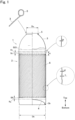
- Fig. 1 shows the can body 1 in which a nozzle and a valve for spraying aerosol have not yet attached thereto.
- the can body 1 is a two-piece type can body formed by processing a steel sheet.
- a tin-plated steel sheet, an extremely thin tin-plated steel sheet, a nickel-plated steel sheet, an electrolytic chromate-treated steel sheet, a zinc-plated steel sheet or the like may be used as a material of the can body 1.
- a metallic sheet in which both faces are coated by thermoplastic resin films may also be used to form the can body 1.
- Material of the resin film is not limited to the specific resin, and the resin film may be formed of two or more layers of different resins.
- a polyester resin, a polycarbonate resin, a nylon resin, a mixture of two or more kinds of those resins may be used to cover the metallic sheet.
- the polyester resin can be exemplified by: a copolymer of polyethylene, polypropylene, and ethylene-propylene; an olefin resin such as modified olefin; a copolymer of polyethylene terephthalate, polybutylene terephthalate, polyethylene naphthalate, ethylene terephthalate-isophthalate; a copolymer of ethylene terephthalate-adipate; a copolymer of butylene terephthalate-isophthalate; and a coplymer of ethylene naphthalate-terephthalate.
- An inner surface and an outer surface of the can body 1 may also be painted.
- painting materials described in Japanese Patent Laid-Open No. H4-11974 may be used.
- the inner surface may be painted by epoxy-phenol material, and clear polyester material may be used as an overcoat of a printed layer of the outer surface.
- the can body 1 comprises a cylindrical trunk portion 2 and a shoulder portion 3 formed continuously from an upper end of the trunk portion 2.
- the shoulder portion 3 is shaped into domed shape having an arcuate cross-section. That is, the cylindrical trunk portion 2 is situated below a boundary B23 at which a curvature is changed toward the domed shoulder portion 3.
- a bottom lid 4 as a thin plate member is attached to an opening of lower end of the trunk portion 2.
- the bottom lid 4 is manufactured separately from the can body 1 using the same material as the can body 1, and curved upwardly to protrude into an internal space of the trunk portion 2. Specifically, a circumferential edge of the bottom lid 4 is seamed to a lower opening Ob of the trunk portion 2.
- An opening curled portion 5 is formed on a center of a leading end (upper end) of the shoulder portion (domed portion). As illustrated in an enlarged scale in Fig. 1 , the opening curled portion 5 is formed by curling a cut end outwardly, and a not shown valve member or the like is attached thereto.
- An inner diameter or an outer diameter Du of the opening curled portion 5 is approximately one-half of an inner diameter or outer diameter of the trunk portion 2, or an inner diameter or an outer diameter Db of the lower opening Ob.
- a surface pattern 6 is formed entirely on an outer periphery of the trunk portion 2.
- the surface pattern 6 is formed by embossing or debossing the trunk portion 2 in a thickness direction to form ridges and grooves.
- ridges and grooves In the example shown in Fig. 1 , helical ridges or grooves are formed.
- a height of the ridge or a depth of the groove (to be referred to as the height hereinafter) h is approximately 0.07 mm to 0.23 mm.
- the surface pattern 6 may also be formed into a grid pattern, a lattice pattern, a hexagonal pattern etc.
- An upper end level T6 of the surface pattern 6 is set slightly lower than the boundary B23 between the trunk portion 2 and the shoulder portion 3, and a strength of a predetermined region (as will be referred to as the upper region hereinafter) A including the upper end level T6 in the height direction of the trunk portion 2 is greater than that of the remaining portion.
- a wall thickness ta of the upper region A is thicker than a wall thickness t2 of an intermediate portion of the trunk portion 2 below the upper region A.
- the wall thickness ta of the upper region A is 0.2 mm to 0.28 mm
- the wall thickness t2 of the intermediate portion of the trunk portion 2 is 0.19 mm.
- Each of those thicknesses is a net thickness of the metallic sheet, and increased by thicknesses of the resin layers (approximately 20 ⁇ m) covering the inner and outer surfaces.
- a width (in the height direction of the trunk portion 2) of the upper region A is 1 mm to 20 mm (preferably 3 mm to 20 mm). If it is narrower than 1 mm, rigidity or hardness may not fall within a desired range, and if it is wider than 20 mm, such effect is no longer expected.
- a straight portion ST is formed above the upper end level T6 of the surface pattern 6, and a straight portion SB is formed below a lower end level B6 of the surface pattern 6.
- Each of those straight portions ST and SB is a part of the trunk portion 2, and an outer diameter of each of the straight portion ST and SB is substantially constant.
- a width (in the height direction of the trunk portion 2) of each of the straight portion ST and SB is wider than 5 mm.
- the upper straight portion ST is formed between the upper end level T6 of the surface pattern 6 and the boundary B23.
- the trunk portion 2 (especially a portion on which the surface pattern 6 is applied) can be held by clamping the straight portions ST and SB when embossing or debossing the trunk portion 2 to form the surface pattern 6. Consequently, the trunk portion 2 is allowed to be processed as intended without being deformed.
- the can body 1 is a seamless can formed by drawing and ironing the metallic sheet. Rigidity or stiffness of the can body 1 is adjusted by adjusting the wall thickness and work-hardness during processing.
- Vickers hardness of at least the upper region A of the trunk portion 2 is set to 200 to 250 Hv (greater than 200 Hv but less than 250 Hv).
- Vickers hardness of entire trunk portion 2 may be set to 200 to 250Hv.
- Vickers hardness of the upper region A is set to 200 to 250Hv
- a portion below the upper region A may be set e.g., to 190 to 240 Hv (greater than 190 Hv but less than 240 Hv).
- Vickers hardness of the trunk portion 2 may also be adjusted within the above explained ranges by adjusting the wall thickness ta thereby differentiating Vickers hardness of the portion below the upper region A from Vickers hardness of the upper region A.
- the wall thickness ta of the upper region A may be kept thicker than that of the portion below the upper region A by adjusting the drawing and the ironing.
- the above-explained wall thickness and hardness are thickness and hardness before forming the surface pattern 6 after drawing and ironing.
- a height or a depth of the surface pattern 6 is substantially constant. For this reason, strength (panel strength) against a load applied perpendicular to the trunk portion 2 is increased. In addition, since the height or the depth of the surface pattern 6 is homogenized, points to cause buckling distortion can be eliminated to increase buckling strength.
- the can body 1 may be formed basically by the manufacturing method described in the above explained Japanese Patent Laid-Open No. 2004-276068 .
- Fig. 2 schematically shows steps for manufacturing the can body 1.
- the can body 1 is formed from a metallic sheet prepared by forming a thermoplastic resin coating layer on both surfaces of a surface-treated steel sheet, and lubricant is applied to both surfaces of the metallic sheet (to the resin coating layers).
- a blank 10 is punched out of the metallic sheet.
- cup shaping step (1st press) the blank 10 is shaped into a cup 11 by a drawing treatment.
- a thinning treatment such as drawing and ironing is applied to the cup 11.
- at can trunk shaping step (2nd press) a thinning treatment such as drawing and ironing is applied to the cup 11.
- at least one or more times of re-drawing, and stretching or ironing may also be applied to the cup 11. Consequently, a bottomed-cylindrical seamless can 12 in which the trunk portion 2 is thinned is formed.
- the seamless can 12 has a vertically long shape in which one of end portions of the trunk portion opens.
- the portion corresponding to the upper region A of a closed end side is thickened to have greater hardness than the remaining portion by ironing or drawing.
- a closed bottom portion of the seamless can 12 is shaped into a bottomed-cylindrical portion 13 that is diametrically smaller than the trunk portion 2 by a first drawing step, and a curved shoulder face 14 whose longitudinal section is arcuate is also formed by the first drawing step. Then, a diameter of the bottomed-cylindrical portion 13 is further reduced and the bottomed-cylindrical portion 13 is elongated by a second drawing (re-drawing).
- a tapered face having a substantially straight longitudinal section approximating a tangential line drawn to an arcuate longitudinal section of a virtual curved face leading to the curved shoulder face 14 is re-drawn, and such re-drawing is executed repeatedly.
- a plurality of tapered faces of the shoulder portion 3 approximated to the curved shoulder face 14 is pressed to be extended into a smooth curved face leading to the curved shoulder face 14. Consequently, the shoulder portion 3 is entirely shaped into a smooth domed face, and the portion corresponding to the upper region A is thickened to have greater hardness than the remaining portion by ironing or drawing.
- a method of shaping the shoulder portion 3 entirely into a domed shape is also described in Japanese Patent Laid-Open No. 2004-276068 . Such method will be briefly explained with reference to Fig. 3 .
- a punch 20 is inserted into a pusher 21, and the seamless can 12 is mounted on the pusher 21 in such a manner that the bottom portion is situated at an upper side.
- the pusher 21 is a tool for unwrinkling the seamless can 12 in cooperation with a die 22.
- the pusher 21 has a convex curve on its upper end portion
- the die 22 has a concave curve corresponding to the convex curve of the pusher 21 on its lower end portion.
- a corner portion of the seamless can 12 is clamped by the pusher 21 and the die 22 to be unwrinkled, and the flat bottom portion of the seamless can 12 is redrawin into the bottomed-cylindrical portion 13 by the punch 20.
- the bottomed-cylindrical portion 13 that is diametrically smaller than the trunk portion 2 of the seamless can 12 and the curved shoulder face whose longitudinal section is arcuate are formed by the first drawing step.
- the opening curled portion 5 is formed by trimming the center portion of the leading end of the shoulder portion 3.
- the bottomed-cylindrical portion 13 is further drawn using a punch, a pusher, and a die whose diameters are respectively smaller than those of the punch 20, the pusher 21, and the die 22.
- the shoulder portion 3 and the bottomed-cylindrical portion 13 having the opening curled portion 5 are formed by drawing the seamless can 12 one or more times. Further, the shoulder portion is reformed by a not shown pusher and a die respectively having a virtual curved face corresponding to a desired domed shape.
- the trunk portion 2 is work hardened.
- Vickers hardness of entire trunk portion 2 may be set to 200 to 250Hv by adjusting a drawing rate.
- a shape of a portion of the punch corresponding to the upper region A may be differentiated from a shape of a portion of the punch corresponding to the portion below the upper region A.
- an outer diameter of the portion of the punch P corresponding to the upper region A may be reduced, and an outer diameter of the portion of the punch P below the upper region A may be increased.
- such difference between the diameters falls within a range between 0.1 mm and 0.4 mm (more preferably, greater than 0.12 mm but smaller than 0.36 mm), and a portion at which the diameter changes is curved or tapered smoothly.
- the lower opening Ob of the trunk portion 2 of the seamless can 12 is trimmed to realize a constant height. Then, at trimming/curling step, the leading end of the bottomed-cylindrical portion 13 is trimmed and opened. An opening end 15 is curled outwardly to form the opening curled portion 5. Thereafter, the bottom lid 4 is attached by the method described in Japanese Patent Laid-Open No. 2004-276068 .
- the surface pattern 6 is formed by embossing, debossing, or beading the trunk portion 2 of the can body 1.
- a structure of a forming tool is schematically shown in Figs. 5 and 6 .
- the forming tool comprises an inner tool 30 as a male die, and an outer tool 31 as a female die.
- the inner tool 30 is a cylindrical member that is inserted into the can body 1 to which the bottom lid 4 has not yet been attached, from the lower opening Ob.
- the can body 1 is mounted on the inner tool 30 from above.
- an outer diameter of the inner tool 30 is slightly smaller than an inner diameter of the trunk portion 2, and a pattern 32 for forming a desired pattern on the trunk portion 2 is formed on an outer circumferential face.
- the inner tools 30 are held upright in a circumferential portion of a turntable 33 at regular intervals while being allowed to rotate.
- the inner tool 30 revolves around a rotational center axis of the turntable 33 while rotating around a center axis thereof with a rotation of the turntable 33.
- a gear may be arranged coaxially with the inner tool 30, and a fixed gear may be arranged in an outer circumferential side of an orbit of the gear. Those gears are meshed with each other so that the inner tool 30 is rotated with a rotation of the gear arranged coaxially with the inner tool 30.
- each of the inner tools 30 is provided individually with a support rod 34 arranged at the upper end.
- the support rod 34 is allowed to rotate synchronously with the inner tool 30 and to reciprocate vertically.
- a diameter of the support rod 34 is set to a value possible to be inserted into the opening curled portion 5 of the can body 1, and bending stiffness of the support rod 34 is significantly lower than that of the inner tool 30.
- the support rod 34 falls from above the inner tool 30 on which the can body 1 is mounted, and comes into contact to an upper end of the inner tool 30 though the opening curled portion 5 thereby supporting the upper end of the inner tool 30.
- the inner tool 30 and the support rod 34 are rotated at a high speed, therefore, those members are merely contacted to each other. That is, the inner tool 30 and the support rod 34 are not integrated completely at least in the lateral direction, and slightly deformed by a load to form the surface pattern 6 (in a direction away from the outer tool 31).
- the outer tool 31 is a plate forming tool having an arcuate surface on which a pattern 35 paired with the pattern 32 formed on the surface of the inner tool 30.
- the outer tool 31 is fixed in such a manner that the arcuate surface on which the pattern 35 is formed is situated along an orbit of an outer circumferential face of the can body 1 mounted on the inner tool 30 to be revolved.
- a clearance between the inner tool 30 and the outer tool 31 is set in such a manner that the patterns 32 and 35 are engaged with each other through the trunk portion 2.
- the surface pattern 6 is debossed or embossed by rolling the can body 1 mounted on the inner tool 30 on the arcuate surface of the outer tool 31, and consequently the surface pattern 6 is formed on the trunk portion 2 by the patterns 32 and 35.
- the can body 1 is made of a steel sheet, and a wall thickness of the trunk portion 2 is approximately 0.2 mm and the height h of the surface pattern 6 is approximately 0.2 mm. Therefore, a forming load greater than 3000N is required, whereas a forming load required to form a surface pattern on a can body made of aluminum is less than 1000N. Since the outer tool 31 is fixed at an outer circumferential side of the turntable 33, support stiffness and strength of the outer tool 31 may be increased sufficiently. By contrast, the inner tool 30 is held in the turntable 33 in a rotatable manner and the upper end of the inner tool 30 is a free end.
- support stiffness and strength of the inner tool 30 may not be increased significantly, and hence the support stiffness and the strength of the inner tool 30 may be lower than those of the outer tool 31.
- the upper end of the inner tool 30 may be deformed in the direction away from the outer tool 31 as a result of forming the surface pattern 6. Consequently, the height h of the surface pattern 6 may be lower at the upper end side of the trunk portion 2 than those at the intermediate portion and the lower end portion. In other word, a depth of the formed surface pattern 6 may be shallower.
- the upper end portion of the outer tool 31 is inclined at predetermined angle ⁇ toward the inner tool 30 taking account of the above-explained deformation or deflection of the inner tool 30, and the surface pattern 6 is formed by the outer tool 31 thus inclined.
- Fig. 7 schematically shows the inclined outer tool 31.
- the bending stiffness or the support stiffness of the inner tool 30 is low, and the support rod 34 does not restrict bending deformation of the inner tool 30 completely. Therefore, the inner tool 30 is slightly deformed. However, since the outer tool 31 is inclined taking account of such bending deformation of the inner tool 30, the inner tool 30 is brought into parallel to the outer tool 31 when the forming process is started. As a result, the height h of the surface pattern 6 is homogenized entirely.
- the height h of the formed surface pattern 6 can be further homogenized, and a difference between the height h at the portion above the trunk portion 2 and the height h of the portion below the trunk portion 2 can be reduced.
- the surface pattern 6 is formed by rolling the can body 1 mounted on the inner tool 30 on the surface of the outer tool 31, and the inner tool 30 is deformed to be brought into parallel to the outer tool 31 by the forming load after starting the forming of the surface pattern 6.
- the inner tool 30 and the outer tool 31 are not parallel to each other in the initial phase of the forming of the surface pattern 6 in which the forming load is not applied to the inner tool 30 entirely.
- an area of the outer tool 31 pushing the inner tool 30 is reduced gradually in a final phase of forming. Therefore, when the can body 1 mounted on the inner tool 30 reaches the region where the outer tool 31 is arranged, and when the can body 1 leaves from the outer tool 31, the upper portion of the trunk portion 2 (above the upper region A) is clamped between the upper portions of the inner tool 30 and the outer tool 31 where the clearance therebetween is narrowest. That is, the forming load is concentrated to an extremely narrow region in the upper region A.
- the forming load is increased locally in the initial phase and the final phase of forming of the surface pattern 6.
- a depth i.e., a height h
- a crack will not be generated by the forming load increased locally.
- the height h of the surface pattern 6 is homogenized entirely.
- a hardness or strength of the processed site against a load applied perpendicular thereto is increased.
- the load perpendicular to the surface pattern in other words, the load parallel to the center axis of the trunk portion 2 (i.e., the buckling load) is applied to the surface pattern in the direction to narrow the ridge or the groove of the surface pattern. Therefore, if a height or a depth of the surface pattern is locally high or deep, or if the surface pattern is locally thin, stiffness or hardness against the buckling load is reduced.
- the height h of the surface pattern 6 is homogenized, and the portion where the height h is locally high or the thickness is locally thin does not exist. Therefore, appearance of the can body 1 can be improved.
- strength of the can body 1 against the load applied perpendicular to the trunk portion i.e., a panel strength
- buckling strength of the can body 1 can be enhanced.
- a plurality of the can bodies according to the present invention and a plurality of can bodies as comparison examples were prepared using a TFS (tin-free steel) sheet whose thickness was 0.25 mm, and buckling strength of those can bodies were measured respectively.
- Those can bodies were manufactured by the method explained with reference to Fig. 2 , and the surface pattern was applied to each of the can bodies by the tools explained with reference to Figs. 5 to 7 .
- a test piece of predetermined size was cut out of each of the can bodies.
- An indenter was pushed onto the test piece by a load of 245 Newton to apply a Vickers indentation to a predetermined site of the test piece in the thickness direction.
- the Vickers hardness was measured at ten points in the Vickers indentation, and an average value of the Vickers indentation was employed as the Vickers hardness.
- the Vickers hardness of the can bodies of the below-explained examples and comparative examples were measured by the same procedure.
- the panel strength is a vacuum pressure level at which the can body is deformed inwardly by reducing an internal pressure
- the buckle pressure capacity is a pressure level at which the can body is expanded by increasing the internal pressure
- the burst pressure capacity is a pressure level at which the can body is burst by increasing the internal pressure
- the buckling strength is a magnitude of a load at which the can body to which the bottom lid is attached is deformed by applying a load in the axial direction.
- Vickers hardness of an upper region of the work-hardened trunk portion 200 to 250Hv.
- Vickers hardness of a lower region of the work-hardened trunk portion 190 to 240Hv.
- the remaining conditions were identical to those of the example 1.
- Wall thickness of the upper region of the trunk portion 0.18 to 0.28 mm.
- Wall thickness of the lower region of the trunk portion 0.16 to 0.22 mm. The remaining conditions were identical to those of the example 1.
- Vickers hardness of the trunk portion before embossing 260Hv.
- the remaining conditions were identical to those of the example 2 except for the height of the formed surface pattern.
- the Vickers hardness of the trunk portion or the Vickers hardness of at least the above-mentioned upper region is set within a range between 200 and 250Hv.
- the outer tool 31 is inclined, and hence the forming load is increased locally in the initial phase and the final phase of the forming process of the surface pattern 6.
- hardness or wall thickness of the upper region A to which the increased forming load is locally applied is increased greater than that of the remaining portion. Therefore, the buckling strength is increased sufficiently. This is because the upper portion of the surface pattern 6 will not be processed excessively in the initial phase and the final phase of the forming process.
- 1 can body; 2: trunk portion: 3; shoulder portion; 4: bottom lid; 5: opening curled portion; 6: surface pattern; 20: inner tool; 21: outer tool; A: upper region; h: height; Ob: lower opening; ta, t2: wall thickness.
Landscapes
- Engineering & Computer Science (AREA)
- Mechanical Engineering (AREA)
- Ceramic Engineering (AREA)
- Chemical & Material Sciences (AREA)
- Dispersion Chemistry (AREA)
- Rigid Containers With Two Or More Constituent Elements (AREA)
- Containers And Packaging Bodies Having A Special Means To Remove Contents (AREA)
- Nozzles (AREA)
- Containers Having Bodies Formed In One Piece (AREA)
Claims (7)
- Corps de boîte à aérosol (1) présentant un motif de surface (6) sur une partie formant tronc (2), comprenant :une ouverture inférieure (Ob) à laquelle un couvercle formant fond (4) est fixé, et qui est formé à une extrémité de la partie formant tronc sans joint (2), formée à partir d'une feuille d'acier ;une partie à dôme formant épaule (3) présentant une section transversale en arc, qui est formée à l'autre extrémité de la partie formant tronc (2) en continuité de la partie formant tronc (2) ; etune partie recourbée ouvrante (5) qui est plus petite diamétralement que l'ouverture inférieure (Ob), et qui est formée sur un centre d'une extrémité de tête de la partie formant épaule (3),selon lequel le motif de surface (6) est formé sur la partie formant tronc (2) entre une extrémité supérieure du côté de la partie formant épaule (3) et une extrémité inférieure du côté de l'ouverture inférieure (Ob), par gaufrage positif ou gaufrage négatif de la partie formant tronc (2), selon une direction d'épaisseur, caractérisé en ce que :un niveau d'extrémité supérieure (T6) du motif de surface (6) est réglé plus bas qu'une frontière (823) entre la partie formant tronc (2) et la partie formant épaule (3) ;une zone supérieure (A) de la partie formant tronc (2), présentant une largeur prédéterminée selon une direction de hauteur de la partie formant tronc (2), comporte le niveau d'extrémité supérieure (T6) du motif de surface (6) ; etune dureté Vickers d'au moins la région supérieure (A) de la partie formant tronc (2) est supérieure à 200Hv, mais inférieure à 250Hv.
- Corps de boîte à aérosol (1) présentant le motif de surface (6) sur la partie formant tronc (2) selon la revendication 1, selon lequel une dureté de la région supérieure (A) est augmentée par le travail de manière à être plus dure qu'une partie de la partie formant tronc (2) en-dessous de la région supérieure (A), et une dureté Vickers de la zone supérieure (A) est supérieure à 200Hv, mais inférieure à 250Hv.
- Corps de boîte à aérosol (1) présentant le motif de surface (6) sur la partie formant tronc (2) selon la revendication 2, selon lequel la dureté Vickers de la région supérieure (A) est augmentée de manière à être plus dure que la dureté de la partie de la partie formant tronc (2) en-dessous de la région supérieure (A), en présentant une épaisseur de paroi de la zone supérieure (A) qui est supérieure à 0,18 mm, mais inférieure à 0,28 mm, en présentant une épaisseur de paroi de la partie de la partie formant tronc (2) en-dessous de la zone supérieure (A) qui est supérieure à 0,16 mm, mais inférieure à 0,22 mm, et en présentant l'épaisseur de la paroi de la zone supérieure (A) supérieure à l'épaisseur de la paroi de la partie de la partie formant tronc (2) en-dessous de la zone supérieure (A).
- Corps de boîte à aérosol (1) présentant le motif de surface (6) sur la partie formant tronc (2) selon l'une quelconque des revendications 1 à 3, selon lequel une résistance au flambage du corps de boîte (1), dans lequel le couvercle formant fond (4) est fixé à l'ouverture inférieure (Ob), est supérieure à 1700N, mais inférieure à 2500N.
- Procédé de fabrication d'un corps de boîte à aérosol (1) présent un motif de surface (6) sur une partie formant tronc (2), selon lequel le motif de surface (6) est formé par gaufrage positif ou gaufrage négatif de la partie formant tronc (2), formée d'une feuille d'acier, et un couvercle formant fond (4) est fixé à une ouverture inférieure (Ob) de la partie formant tronc (2), selon lequel une partie à dôme formant épaule (3) présentant une section transversale en arc est formée de manière continue depuis une extrémité supérieure de la partie formant tronc (2), et selon lequel une partie recourbée ouvrante (5) qui est plus petite diamétralement que l'ouverture inférieure (Ob) est formée sur un centre d'une extrémité de tête de la partie formant épaule (3), comprenant :la présentation d'une partie de largeur prédéterminée de la partie formant tronc (2) comportant un niveau d'extrémité supérieure (T6) du motif de surface (6) plus bas qu'une frontière (823) entre la partie formant tronc (2) et la partie formant épaule (3), en tant que zone supérieure (A) ;la présentation d'une dureté Vickers, d'au moins la région supérieure (A) de la partie formant tronc (2), supérieure à 200Hv, mais inférieure à 250Hv, en formant la partie formant tronc (2) en cylindre par le biais d'un repassage ;la formation de la partie formant épaule (3) de manière continue depuis une extrémité supérieure de la partie formant tronc (2) ;la formation de la partie recourbée ouvrante (5) sur le centre de l'extrémité de tête de la partie formant épaule (3) ; etle montage du corps de boîte (1), dans lequel la partie formant épaule (3) et la partie recourbée ouvrante (5) ont été formées, sur un outil intérieur (30), et la formation du motif de surface (6) en poussant la partie formant tronc (2) contre une surface d'un outil extérieur (31), qui est incliné de sorte qu'une partie d'extrémité supérieure de l'outil extérieur (31) s'approche de l'outil intérieur (30), tout en roulant la partie formant tronc (2) sur la surface de l'outil extérieur (31).
- Procédé dé fabrication du corps de boîte à aérosol (1) présentant le motif de surface (6) sur la partie formant tronc (2) selon la revendication 5, selon lequel la dureté Vickers de la région supérieure (A) est réglée de manière à être supérieure à 200Hv, mais inférieure à 250Hv, en augmentant une dureté au travail de la zone supérieure (A), de manière à être plus dure qu'une dureté au travail de la partie en-dessous de la zone supérieure (A), ou en augmentant une épaisseur de paroi de la zone supérieure (A), de manière à être plus épaisse qu'une épaisseur de paroi de la partie en-dessous de la zone supérieure (A).
- Procédé de fabrication du corps de boîte d'aérosol (1) présentant le motif de surface (6) sur la partie formant tronc (2) selon la revendication 5 ou la revendication 6, selon lequel une partie d'extrémité supérieure de l'outil intérieur (30) est maintenue par une tige de support (34) tombant d'au-dessus de l'outil intérieur (30) et sur laquelle le corps de boîte (1) est monté pour venir au contact de la partie d'extrémité supérieure de l'outil intérieur (30), via la partie recourbée ouvrante (5).
Applications Claiming Priority (2)
| Application Number | Priority Date | Filing Date | Title |
|---|---|---|---|
| JP2017252945 | 2017-12-28 | ||
| PCT/JP2018/013551 WO2019130609A1 (fr) | 2017-12-28 | 2018-03-30 | Corps de boîte d'aérosol ayant une partie usinée ondulée sur une partie tronc, et procédé de fabrication du corps de boîte d'aérosol |
Publications (3)
| Publication Number | Publication Date |
|---|---|
| EP3733554A1 EP3733554A1 (fr) | 2020-11-04 |
| EP3733554A4 EP3733554A4 (fr) | 2021-09-15 |
| EP3733554B1 true EP3733554B1 (fr) | 2023-11-01 |
Family
ID=67066987
Family Applications (1)
| Application Number | Title | Priority Date | Filing Date |
|---|---|---|---|
| EP18894886.3A Active EP3733554B1 (fr) | 2017-12-28 | 2018-03-30 | Corps de boîte d'aérosol ayant une partie usinée ondulée sur une partie tronc, et procédé de fabrication du corps de boîte d'aérosol |
Country Status (5)
| Country | Link |
|---|---|
| US (1) | US20210178449A1 (fr) |
| EP (1) | EP3733554B1 (fr) |
| JP (1) | JP7027455B2 (fr) |
| CN (1) | CN111770885B (fr) |
| WO (1) | WO2019130609A1 (fr) |
Family Cites Families (29)
| Publication number | Priority date | Publication date | Assignee | Title |
|---|---|---|---|---|
| US4320848A (en) * | 1979-06-07 | 1982-03-23 | Dye Richard G | Deep drawn and ironed pressure vessel having selectively controlled side-wall thicknesses |
| GB2083382B (en) * | 1980-09-08 | 1984-06-20 | Metal Box Co Ltd | Forming can bodies |
| DE69120983T2 (de) * | 1990-02-07 | 1997-02-06 | Toyo Seikan Kaisha Ltd | Verpackungsbehälter |
| JPH0411974A (ja) | 1990-05-02 | 1992-01-16 | Daiwa Can Co Ltd | 絞りしごき缶の被覆方法 |
| JP2748856B2 (ja) * | 1994-03-31 | 1998-05-13 | 東洋製罐株式会社 | スチール製絞りしごき缶 |
| US5704513A (en) * | 1995-07-25 | 1998-01-06 | Dispensing Containers Corporation | Thin walled cover for aerosol container and method of making same |
| US5938389A (en) * | 1996-08-02 | 1999-08-17 | Crown Cork & Seal Technologies Corporation | Metal can and method of making |
| US5713235A (en) * | 1996-08-29 | 1998-02-03 | Aluminum Company Of America | Method and apparatus for die necking a metal container |
| JP3604835B2 (ja) * | 1996-09-11 | 2004-12-22 | 大和製罐株式会社 | 胴部に凹凸模様をもつアルミニウムdi缶の製造方法 |
| HK1042865B (en) * | 1999-08-30 | 2006-01-13 | Daiwa Can Company | Production method for bottle type can and form-working tool |
| US6857304B2 (en) * | 1999-08-30 | 2005-02-22 | Daiwa Can Company | Bottle-shaped can manufacturing method |
| CN1207116C (zh) * | 1999-09-30 | 2005-06-22 | 大和制罐株式会社 | 瓶形罐的制造方法 |
| JP2003285814A (ja) * | 2002-03-27 | 2003-10-07 | Yoshino Kogyosho Co Ltd | 合成樹脂製壜体 |
| JP4822659B2 (ja) * | 2002-06-27 | 2011-11-24 | 株式会社ダイゾー | 耐圧容器およびそれを用いた吐出製品 |
| JP4229650B2 (ja) * | 2002-07-12 | 2009-02-25 | 大和製罐株式会社 | ボトル型缶 |
| JP4208511B2 (ja) * | 2002-07-23 | 2009-01-14 | 大和製罐株式会社 | 缶体の胴部成形方法 |
| US6786370B1 (en) | 2002-09-10 | 2004-09-07 | United States Can Company | Beaded thin wall aerosol container |
| JP2004276068A (ja) * | 2003-03-17 | 2004-10-07 | Daiwa Can Co Ltd | エアゾール容器用金属缶の製造方法 |
| KR100992831B1 (ko) * | 2006-04-21 | 2010-11-08 | 다이와 세칸 가부시키가이샤 | 캔용기 |
| JP4999373B2 (ja) * | 2006-07-03 | 2012-08-15 | 北海製罐株式会社 | 内容物充填ボトルの製造方法及びその装置 |
| JP4931049B2 (ja) * | 2006-08-08 | 2012-05-16 | 大和製罐株式会社 | ヘアライン加工面付きアルミ缶 |
| JP5085411B2 (ja) * | 2007-12-26 | 2012-11-28 | 大和製罐株式会社 | レトルト対応小容量ネジ付き缶 |
| KR20080056775A (ko) * | 2008-05-21 | 2008-06-23 | 도요 세이칸 가부시키가이샤 | 수지 피복 금속판의 드로잉·아이어닝 가공 방법, 및 그것을사용한 수지 피복 드로잉·아이어닝 캔 |
| WO2010048727A1 (fr) * | 2008-10-31 | 2010-05-06 | Novelis Inc. | Matrice à rétreindre avec surface pour emboutissage de reprise et procédé de rétreinte |
| JP5319390B2 (ja) * | 2009-05-14 | 2013-10-16 | 大和製罐株式会社 | エンボス成形方法およびその装置 |
| JP2014111463A (ja) * | 2012-12-05 | 2014-06-19 | Daiwa Can Co Ltd | 缶体 |
| JP6198471B2 (ja) * | 2013-06-07 | 2017-09-20 | 株式会社ダイゾー | 二重エアゾール容器 |
| KR20150124071A (ko) * | 2014-04-25 | 2015-11-05 | 아셉시스글로벌 주식회사 | 합성수지제 용기 |
| CN204776466U (zh) * | 2014-05-30 | 2015-11-18 | 环宇制罐株式会社 | 饮料罐 |
-
2018
- 2018-03-30 EP EP18894886.3A patent/EP3733554B1/fr active Active
- 2018-03-30 US US16/077,206 patent/US20210178449A1/en not_active Abandoned
- 2018-03-30 JP JP2019562724A patent/JP7027455B2/ja active Active
- 2018-03-30 CN CN201880090296.7A patent/CN111770885B/zh active Active
- 2018-03-30 WO PCT/JP2018/013551 patent/WO2019130609A1/fr not_active Ceased
Also Published As
| Publication number | Publication date |
|---|---|
| WO2019130609A1 (fr) | 2019-07-04 |
| JP7027455B2 (ja) | 2022-03-01 |
| EP3733554A1 (fr) | 2020-11-04 |
| EP3733554A4 (fr) | 2021-09-15 |
| US20210178449A1 (en) | 2021-06-17 |
| JPWO2019130609A1 (ja) | 2021-01-07 |
| CN111770885B (zh) | 2022-07-22 |
| CN111770885A (zh) | 2020-10-13 |
Similar Documents
| Publication | Publication Date | Title |
|---|---|---|
| AU589618B2 (en) | Apparatus and method for drawing a can body | |
| US8313003B2 (en) | Can manufacture | |
| US9555459B2 (en) | Can manufacture | |
| GB2083382A (en) | Forming can bodies | |
| US4485663A (en) | Tool for making container | |
| US9545655B2 (en) | Can manufacture | |
| US4405058A (en) | Container | |
| US20230302517A1 (en) | Tapered cup and method of forming the same | |
| EP0505562A1 (fr) | Production de boites en une seule piece par allongement controle de la paroi laterale. | |
| US4412440A (en) | Process for making container | |
| EP3733554B1 (fr) | Corps de boîte d'aérosol ayant une partie usinée ondulée sur une partie tronc, et procédé de fabrication du corps de boîte d'aérosol | |
| GB2092932A (en) | Improved tooling for making container bodies | |
| US5199596A (en) | Drawn can body methods, apparatus and products | |
| US20130032602A1 (en) | Can manufacture using an annealing step | |
| CA1316764C (fr) | Collier de serrage pour emboutisseuse de boites metalliques |
Legal Events
| Date | Code | Title | Description |
|---|---|---|---|
| STAA | Information on the status of an ep patent application or granted ep patent |
Free format text: STATUS: THE INTERNATIONAL PUBLICATION HAS BEEN MADE |
|
| PUAI | Public reference made under article 153(3) epc to a published international application that has entered the european phase |
Free format text: ORIGINAL CODE: 0009012 |
|
| STAA | Information on the status of an ep patent application or granted ep patent |
Free format text: STATUS: REQUEST FOR EXAMINATION WAS MADE |
|
| 17P | Request for examination filed |
Effective date: 20200626 |
|
| AK | Designated contracting states |
Kind code of ref document: A1 Designated state(s): AL AT BE BG CH CY CZ DE DK EE ES FI FR GB GR HR HU IE IS IT LI LT LU LV MC MK MT NL NO PL PT RO RS SE SI SK SM TR |
|
| AX | Request for extension of the european patent |
Extension state: BA ME |
|
| DAV | Request for validation of the european patent (deleted) | ||
| DAX | Request for extension of the european patent (deleted) | ||
| A4 | Supplementary search report drawn up and despatched |
Effective date: 20210817 |
|
| RIC1 | Information provided on ipc code assigned before grant |
Ipc: B65D 1/02 20060101ALI20210811BHEP Ipc: B21D 51/26 20060101ALI20210811BHEP Ipc: B21D 22/28 20060101ALI20210811BHEP Ipc: B05B 9/04 20060101ALI20210811BHEP Ipc: B65D 83/38 20060101AFI20210811BHEP |
|
| STAA | Information on the status of an ep patent application or granted ep patent |
Free format text: STATUS: EXAMINATION IS IN PROGRESS |
|
| 17Q | First examination report despatched |
Effective date: 20221114 |
|
| GRAP | Despatch of communication of intention to grant a patent |
Free format text: ORIGINAL CODE: EPIDOSNIGR1 |
|
| STAA | Information on the status of an ep patent application or granted ep patent |
Free format text: STATUS: GRANT OF PATENT IS INTENDED |
|
| INTG | Intention to grant announced |
Effective date: 20230614 |
|
| GRAS | Grant fee paid |
Free format text: ORIGINAL CODE: EPIDOSNIGR3 |
|
| GRAA | (expected) grant |
Free format text: ORIGINAL CODE: 0009210 |
|
| STAA | Information on the status of an ep patent application or granted ep patent |
Free format text: STATUS: THE PATENT HAS BEEN GRANTED |
|
| AK | Designated contracting states |
Kind code of ref document: B1 Designated state(s): AL AT BE BG CH CY CZ DE DK EE ES FI FR GB GR HR HU IE IS IT LI LT LU LV MC MK MT NL NO PL PT RO RS SE SI SK SM TR |
|
| REG | Reference to a national code |
Ref country code: GB Ref legal event code: FG4D |
|
| REG | Reference to a national code |
Ref country code: CH Ref legal event code: EP |
|
| REG | Reference to a national code |
Ref country code: IE Ref legal event code: FG4D |
|
| REG | Reference to a national code |
Ref country code: DE Ref legal event code: R096 Ref document number: 602018060631 Country of ref document: DE |
|
| REG | Reference to a national code |
Ref country code: NL Ref legal event code: FP |
|
| REG | Reference to a national code |
Ref country code: LT Ref legal event code: MG9D |
|
| PG25 | Lapsed in a contracting state [announced via postgrant information from national office to epo] |
Ref country code: GR Free format text: LAPSE BECAUSE OF FAILURE TO SUBMIT A TRANSLATION OF THE DESCRIPTION OR TO PAY THE FEE WITHIN THE PRESCRIBED TIME-LIMIT Effective date: 20240202 |
|
| PG25 | Lapsed in a contracting state [announced via postgrant information from national office to epo] |
Ref country code: IS Free format text: LAPSE BECAUSE OF FAILURE TO SUBMIT A TRANSLATION OF THE DESCRIPTION OR TO PAY THE FEE WITHIN THE PRESCRIBED TIME-LIMIT Effective date: 20240301 |
|
| PG25 | Lapsed in a contracting state [announced via postgrant information from national office to epo] |
Ref country code: LT Free format text: LAPSE BECAUSE OF FAILURE TO SUBMIT A TRANSLATION OF THE DESCRIPTION OR TO PAY THE FEE WITHIN THE PRESCRIBED TIME-LIMIT Effective date: 20231101 |
|
| REG | Reference to a national code |
Ref country code: AT Ref legal event code: MK05 Ref document number: 1626999 Country of ref document: AT Kind code of ref document: T Effective date: 20231101 |
|
| PG25 | Lapsed in a contracting state [announced via postgrant information from national office to epo] |
Ref country code: AT Free format text: LAPSE BECAUSE OF FAILURE TO SUBMIT A TRANSLATION OF THE DESCRIPTION OR TO PAY THE FEE WITHIN THE PRESCRIBED TIME-LIMIT Effective date: 20231101 |
|
| PG25 | Lapsed in a contracting state [announced via postgrant information from national office to epo] |
Ref country code: ES Free format text: LAPSE BECAUSE OF FAILURE TO SUBMIT A TRANSLATION OF THE DESCRIPTION OR TO PAY THE FEE WITHIN THE PRESCRIBED TIME-LIMIT Effective date: 20231101 |
|
| PG25 | Lapsed in a contracting state [announced via postgrant information from national office to epo] |
Ref country code: LT Free format text: LAPSE BECAUSE OF FAILURE TO SUBMIT A TRANSLATION OF THE DESCRIPTION OR TO PAY THE FEE WITHIN THE PRESCRIBED TIME-LIMIT Effective date: 20231101 Ref country code: IS Free format text: LAPSE BECAUSE OF FAILURE TO SUBMIT A TRANSLATION OF THE DESCRIPTION OR TO PAY THE FEE WITHIN THE PRESCRIBED TIME-LIMIT Effective date: 20240301 Ref country code: GR Free format text: LAPSE BECAUSE OF FAILURE TO SUBMIT A TRANSLATION OF THE DESCRIPTION OR TO PAY THE FEE WITHIN THE PRESCRIBED TIME-LIMIT Effective date: 20240202 Ref country code: ES Free format text: LAPSE BECAUSE OF FAILURE TO SUBMIT A TRANSLATION OF THE DESCRIPTION OR TO PAY THE FEE WITHIN THE PRESCRIBED TIME-LIMIT Effective date: 20231101 Ref country code: BG Free format text: LAPSE BECAUSE OF FAILURE TO SUBMIT A TRANSLATION OF THE DESCRIPTION OR TO PAY THE FEE WITHIN THE PRESCRIBED TIME-LIMIT Effective date: 20240201 Ref country code: AT Free format text: LAPSE BECAUSE OF FAILURE TO SUBMIT A TRANSLATION OF THE DESCRIPTION OR TO PAY THE FEE WITHIN THE PRESCRIBED TIME-LIMIT Effective date: 20231101 Ref country code: PT Free format text: LAPSE BECAUSE OF FAILURE TO SUBMIT A TRANSLATION OF THE DESCRIPTION OR TO PAY THE FEE WITHIN THE PRESCRIBED TIME-LIMIT Effective date: 20240301 |
|
| PG25 | Lapsed in a contracting state [announced via postgrant information from national office to epo] |
Ref country code: SE Free format text: LAPSE BECAUSE OF FAILURE TO SUBMIT A TRANSLATION OF THE DESCRIPTION OR TO PAY THE FEE WITHIN THE PRESCRIBED TIME-LIMIT Effective date: 20231101 Ref country code: RS Free format text: LAPSE BECAUSE OF FAILURE TO SUBMIT A TRANSLATION OF THE DESCRIPTION OR TO PAY THE FEE WITHIN THE PRESCRIBED TIME-LIMIT Effective date: 20231101 Ref country code: PL Free format text: LAPSE BECAUSE OF FAILURE TO SUBMIT A TRANSLATION OF THE DESCRIPTION OR TO PAY THE FEE WITHIN THE PRESCRIBED TIME-LIMIT Effective date: 20231101 Ref country code: NO Free format text: LAPSE BECAUSE OF FAILURE TO SUBMIT A TRANSLATION OF THE DESCRIPTION OR TO PAY THE FEE WITHIN THE PRESCRIBED TIME-LIMIT Effective date: 20240201 Ref country code: LV Free format text: LAPSE BECAUSE OF FAILURE TO SUBMIT A TRANSLATION OF THE DESCRIPTION OR TO PAY THE FEE WITHIN THE PRESCRIBED TIME-LIMIT Effective date: 20231101 Ref country code: HR Free format text: LAPSE BECAUSE OF FAILURE TO SUBMIT A TRANSLATION OF THE DESCRIPTION OR TO PAY THE FEE WITHIN THE PRESCRIBED TIME-LIMIT Effective date: 20231101 |
|
| PG25 | Lapsed in a contracting state [announced via postgrant information from national office to epo] |
Ref country code: DK Free format text: LAPSE BECAUSE OF FAILURE TO SUBMIT A TRANSLATION OF THE DESCRIPTION OR TO PAY THE FEE WITHIN THE PRESCRIBED TIME-LIMIT Effective date: 20231101 |
|
| PG25 | Lapsed in a contracting state [announced via postgrant information from national office to epo] |
Ref country code: CZ Free format text: LAPSE BECAUSE OF FAILURE TO SUBMIT A TRANSLATION OF THE DESCRIPTION OR TO PAY THE FEE WITHIN THE PRESCRIBED TIME-LIMIT Effective date: 20231101 |
|
| PG25 | Lapsed in a contracting state [announced via postgrant information from national office to epo] |
Ref country code: SK Free format text: LAPSE BECAUSE OF FAILURE TO SUBMIT A TRANSLATION OF THE DESCRIPTION OR TO PAY THE FEE WITHIN THE PRESCRIBED TIME-LIMIT Effective date: 20231101 |
|
| PG25 | Lapsed in a contracting state [announced via postgrant information from national office to epo] |
Ref country code: SM Free format text: LAPSE BECAUSE OF FAILURE TO SUBMIT A TRANSLATION OF THE DESCRIPTION OR TO PAY THE FEE WITHIN THE PRESCRIBED TIME-LIMIT Effective date: 20231101 Ref country code: SK Free format text: LAPSE BECAUSE OF FAILURE TO SUBMIT A TRANSLATION OF THE DESCRIPTION OR TO PAY THE FEE WITHIN THE PRESCRIBED TIME-LIMIT Effective date: 20231101 Ref country code: IT Free format text: LAPSE BECAUSE OF FAILURE TO SUBMIT A TRANSLATION OF THE DESCRIPTION OR TO PAY THE FEE WITHIN THE PRESCRIBED TIME-LIMIT Effective date: 20231101 Ref country code: EE Free format text: LAPSE BECAUSE OF FAILURE TO SUBMIT A TRANSLATION OF THE DESCRIPTION OR TO PAY THE FEE WITHIN THE PRESCRIBED TIME-LIMIT Effective date: 20231101 Ref country code: DK Free format text: LAPSE BECAUSE OF FAILURE TO SUBMIT A TRANSLATION OF THE DESCRIPTION OR TO PAY THE FEE WITHIN THE PRESCRIBED TIME-LIMIT Effective date: 20231101 Ref country code: CZ Free format text: LAPSE BECAUSE OF FAILURE TO SUBMIT A TRANSLATION OF THE DESCRIPTION OR TO PAY THE FEE WITHIN THE PRESCRIBED TIME-LIMIT Effective date: 20231101 |
|
| REG | Reference to a national code |
Ref country code: DE Ref legal event code: R097 Ref document number: 602018060631 Country of ref document: DE |
|
| PLBE | No opposition filed within time limit |
Free format text: ORIGINAL CODE: 0009261 |
|
| STAA | Information on the status of an ep patent application or granted ep patent |
Free format text: STATUS: NO OPPOSITION FILED WITHIN TIME LIMIT |
|
| 26N | No opposition filed |
Effective date: 20240802 |
|
| PG25 | Lapsed in a contracting state [announced via postgrant information from national office to epo] |
Ref country code: SI Free format text: LAPSE BECAUSE OF FAILURE TO SUBMIT A TRANSLATION OF THE DESCRIPTION OR TO PAY THE FEE WITHIN THE PRESCRIBED TIME-LIMIT Effective date: 20231101 |
|
| PG25 | Lapsed in a contracting state [announced via postgrant information from national office to epo] |
Ref country code: SI Free format text: LAPSE BECAUSE OF FAILURE TO SUBMIT A TRANSLATION OF THE DESCRIPTION OR TO PAY THE FEE WITHIN THE PRESCRIBED TIME-LIMIT Effective date: 20231101 |
|
| REG | Reference to a national code |
Ref country code: CH Ref legal event code: PL |
|
| PG25 | Lapsed in a contracting state [announced via postgrant information from national office to epo] |
Ref country code: LU Free format text: LAPSE BECAUSE OF NON-PAYMENT OF DUE FEES Effective date: 20240330 |
|
| PG25 | Lapsed in a contracting state [announced via postgrant information from national office to epo] |
Ref country code: MC Free format text: LAPSE BECAUSE OF FAILURE TO SUBMIT A TRANSLATION OF THE DESCRIPTION OR TO PAY THE FEE WITHIN THE PRESCRIBED TIME-LIMIT Effective date: 20231101 |
|
| PG25 | Lapsed in a contracting state [announced via postgrant information from national office to epo] |
Ref country code: MC Free format text: LAPSE BECAUSE OF FAILURE TO SUBMIT A TRANSLATION OF THE DESCRIPTION OR TO PAY THE FEE WITHIN THE PRESCRIBED TIME-LIMIT Effective date: 20231101 Ref country code: LU Free format text: LAPSE BECAUSE OF NON-PAYMENT OF DUE FEES Effective date: 20240330 |
|
| REG | Reference to a national code |
Ref country code: BE Ref legal event code: MM Effective date: 20240331 |
|
| PG25 | Lapsed in a contracting state [announced via postgrant information from national office to epo] |
Ref country code: BE Free format text: LAPSE BECAUSE OF NON-PAYMENT OF DUE FEES Effective date: 20240331 |
|
| PG25 | Lapsed in a contracting state [announced via postgrant information from national office to epo] |
Ref country code: FR Free format text: LAPSE BECAUSE OF NON-PAYMENT OF DUE FEES Effective date: 20240331 |
|
| PG25 | Lapsed in a contracting state [announced via postgrant information from national office to epo] |
Ref country code: IE Free format text: LAPSE BECAUSE OF NON-PAYMENT OF DUE FEES Effective date: 20240330 |
|
| PG25 | Lapsed in a contracting state [announced via postgrant information from national office to epo] |
Ref country code: IE Free format text: LAPSE BECAUSE OF NON-PAYMENT OF DUE FEES Effective date: 20240330 Ref country code: FR Free format text: LAPSE BECAUSE OF NON-PAYMENT OF DUE FEES Effective date: 20240331 Ref country code: BE Free format text: LAPSE BECAUSE OF NON-PAYMENT OF DUE FEES Effective date: 20240331 Ref country code: CH Free format text: LAPSE BECAUSE OF NON-PAYMENT OF DUE FEES Effective date: 20240331 |
|
| PG25 | Lapsed in a contracting state [announced via postgrant information from national office to epo] |
Ref country code: RO Free format text: LAPSE BECAUSE OF FAILURE TO SUBMIT A TRANSLATION OF THE DESCRIPTION OR TO PAY THE FEE WITHIN THE PRESCRIBED TIME-LIMIT Effective date: 20231101 |
|
| PG25 | Lapsed in a contracting state [announced via postgrant information from national office to epo] |
Ref country code: CY Free format text: LAPSE BECAUSE OF FAILURE TO SUBMIT A TRANSLATION OF THE DESCRIPTION OR TO PAY THE FEE WITHIN THE PRESCRIBED TIME-LIMIT; INVALID AB INITIO Effective date: 20180330 |
|
| PG25 | Lapsed in a contracting state [announced via postgrant information from national office to epo] |
Ref country code: HU Free format text: LAPSE BECAUSE OF FAILURE TO SUBMIT A TRANSLATION OF THE DESCRIPTION OR TO PAY THE FEE WITHIN THE PRESCRIBED TIME-LIMIT; INVALID AB INITIO Effective date: 20180330 |
|
| PG25 | Lapsed in a contracting state [announced via postgrant information from national office to epo] |
Ref country code: FI Free format text: LAPSE BECAUSE OF FAILURE TO SUBMIT A TRANSLATION OF THE DESCRIPTION OR TO PAY THE FEE WITHIN THE PRESCRIBED TIME-LIMIT Effective date: 20231101 |
|
| PG25 | Lapsed in a contracting state [announced via postgrant information from national office to epo] |
Ref country code: TR Free format text: LAPSE BECAUSE OF FAILURE TO SUBMIT A TRANSLATION OF THE DESCRIPTION OR TO PAY THE FEE WITHIN THE PRESCRIBED TIME-LIMIT Effective date: 20231101 |
|
| PGFP | Annual fee paid to national office [announced via postgrant information from national office to epo] |
Ref country code: NL Payment date: 20260213 Year of fee payment: 9 |
|
| PGFP | Annual fee paid to national office [announced via postgrant information from national office to epo] |
Ref country code: GB Payment date: 20260209 Year of fee payment: 9 |
|
| PGFP | Annual fee paid to national office [announced via postgrant information from national office to epo] |
Ref country code: DE Payment date: 20260204 Year of fee payment: 9 |