EP3733893B1 - Tôle d'acier plaquée - Google Patents
Tôle d'acier plaquée Download PDFInfo
- Publication number
- EP3733893B1 EP3733893B1 EP18894900.2A EP18894900A EP3733893B1 EP 3733893 B1 EP3733893 B1 EP 3733893B1 EP 18894900 A EP18894900 A EP 18894900A EP 3733893 B1 EP3733893 B1 EP 3733893B1
- Authority
- EP
- European Patent Office
- Prior art keywords
- steel plate
- base steel
- phase
- hardness
- microstructure
- Prior art date
- Legal status (The legal status is an assumption and is not a legal conclusion. Google has not performed a legal analysis and makes no representation as to the accuracy of the status listed.)
- Active
Links
Images
Classifications
-
- C—CHEMISTRY; METALLURGY
- C21—METALLURGY OF IRON
- C21D—MODIFYING THE PHYSICAL STRUCTURE OF FERROUS METALS; GENERAL DEVICES FOR HEAT TREATMENT OF FERROUS OR NON-FERROUS METALS OR ALLOYS; MAKING METAL MALLEABLE, e.g. BY DECARBURISATION OR TEMPERING
- C21D9/00—Heat treatment, e.g. annealing, hardening, quenching or tempering, adapted for particular articles; Furnaces therefor
- C21D9/46—Heat treatment, e.g. annealing, hardening, quenching or tempering, adapted for particular articles; Furnaces therefor for sheet metals
-
- C—CHEMISTRY; METALLURGY
- C22—METALLURGY; FERROUS OR NON-FERROUS ALLOYS; TREATMENT OF ALLOYS OR NON-FERROUS METALS
- C22C—ALLOYS
- C22C38/00—Ferrous alloys, e.g. steel alloys
- C22C38/04—Ferrous alloys, e.g. steel alloys containing manganese
-
- B—PERFORMING OPERATIONS; TRANSPORTING
- B23—MACHINE TOOLS; METAL-WORKING NOT OTHERWISE PROVIDED FOR
- B23K—SOLDERING OR UNSOLDERING; WELDING; CLADDING OR PLATING BY SOLDERING OR WELDING; CUTTING BY APPLYING HEAT LOCALLY, e.g. FLAME CUTTING; WORKING BY LASER BEAM
- B23K20/00—Non-electric welding by applying impact or other pressure, with or without the application of heat, e.g. cladding or plating
- B23K20/04—Non-electric welding by applying impact or other pressure, with or without the application of heat, e.g. cladding or plating by means of a rolling mill
-
- B—PERFORMING OPERATIONS; TRANSPORTING
- B23—MACHINE TOOLS; METAL-WORKING NOT OTHERWISE PROVIDED FOR
- B23K—SOLDERING OR UNSOLDERING; WELDING; CLADDING OR PLATING BY SOLDERING OR WELDING; CUTTING BY APPLYING HEAT LOCALLY, e.g. FLAME CUTTING; WORKING BY LASER BEAM
- B23K20/00—Non-electric welding by applying impact or other pressure, with or without the application of heat, e.g. cladding or plating
- B23K20/22—Non-electric welding by applying impact or other pressure, with or without the application of heat, e.g. cladding or plating taking account of the properties of the materials to be welded
- B23K20/227—Non-electric welding by applying impact or other pressure, with or without the application of heat, e.g. cladding or plating taking account of the properties of the materials to be welded with ferrous layer
-
- B—PERFORMING OPERATIONS; TRANSPORTING
- B23—MACHINE TOOLS; METAL-WORKING NOT OTHERWISE PROVIDED FOR
- B23K—SOLDERING OR UNSOLDERING; WELDING; CLADDING OR PLATING BY SOLDERING OR WELDING; CUTTING BY APPLYING HEAT LOCALLY, e.g. FLAME CUTTING; WORKING BY LASER BEAM
- B23K20/00—Non-electric welding by applying impact or other pressure, with or without the application of heat, e.g. cladding or plating
- B23K20/24—Preliminary treatment
-
- B—PERFORMING OPERATIONS; TRANSPORTING
- B23—MACHINE TOOLS; METAL-WORKING NOT OTHERWISE PROVIDED FOR
- B23K—SOLDERING OR UNSOLDERING; WELDING; CLADDING OR PLATING BY SOLDERING OR WELDING; CUTTING BY APPLYING HEAT LOCALLY, e.g. FLAME CUTTING; WORKING BY LASER BEAM
- B23K20/00—Non-electric welding by applying impact or other pressure, with or without the application of heat, e.g. cladding or plating
- B23K20/26—Auxiliary equipment
-
- B—PERFORMING OPERATIONS; TRANSPORTING
- B23—MACHINE TOOLS; METAL-WORKING NOT OTHERWISE PROVIDED FOR
- B23K—SOLDERING OR UNSOLDERING; WELDING; CLADDING OR PLATING BY SOLDERING OR WELDING; CUTTING BY APPLYING HEAT LOCALLY, e.g. FLAME CUTTING; WORKING BY LASER BEAM
- B23K31/00—Processes relevant to this subclass, specially adapted for particular articles or purposes, but not covered by any single one of main groups B23K1/00 - B23K28/00
- B23K31/02—Processes relevant to this subclass, specially adapted for particular articles or purposes, but not covered by any single one of main groups B23K1/00 - B23K28/00 relating to soldering or welding
-
- C—CHEMISTRY; METALLURGY
- C21—METALLURGY OF IRON
- C21D—MODIFYING THE PHYSICAL STRUCTURE OF FERROUS METALS; GENERAL DEVICES FOR HEAT TREATMENT OF FERROUS OR NON-FERROUS METALS OR ALLOYS; MAKING METAL MALLEABLE, e.g. BY DECARBURISATION OR TEMPERING
- C21D8/00—Modifying the physical properties of ferrous metals or ferrous alloys by deformation combined with, or followed by, heat treatment
- C21D8/02—Modifying the physical properties of ferrous metals or ferrous alloys by deformation combined with, or followed by, heat treatment during manufacturing of plates or strips
-
- C—CHEMISTRY; METALLURGY
- C22—METALLURGY; FERROUS OR NON-FERROUS ALLOYS; TREATMENT OF ALLOYS OR NON-FERROUS METALS
- C22C—ALLOYS
- C22C38/00—Ferrous alloys, e.g. steel alloys
- C22C38/005—Ferrous alloys, e.g. steel alloys containing rare earths, i.e. Sc, Y, Lanthanides
-
- C—CHEMISTRY; METALLURGY
- C22—METALLURGY; FERROUS OR NON-FERROUS ALLOYS; TREATMENT OF ALLOYS OR NON-FERROUS METALS
- C22C—ALLOYS
- C22C38/00—Ferrous alloys, e.g. steel alloys
- C22C38/02—Ferrous alloys, e.g. steel alloys containing silicon
-
- C—CHEMISTRY; METALLURGY
- C22—METALLURGY; FERROUS OR NON-FERROUS ALLOYS; TREATMENT OF ALLOYS OR NON-FERROUS METALS
- C22C—ALLOYS
- C22C38/00—Ferrous alloys, e.g. steel alloys
- C22C38/18—Ferrous alloys, e.g. steel alloys containing chromium
- C22C38/40—Ferrous alloys, e.g. steel alloys containing chromium with nickel
- C22C38/44—Ferrous alloys, e.g. steel alloys containing chromium with nickel with molybdenum or tungsten
-
- C—CHEMISTRY; METALLURGY
- C22—METALLURGY; FERROUS OR NON-FERROUS ALLOYS; TREATMENT OF ALLOYS OR NON-FERROUS METALS
- C22C—ALLOYS
- C22C38/00—Ferrous alloys, e.g. steel alloys
- C22C38/18—Ferrous alloys, e.g. steel alloys containing chromium
- C22C38/40—Ferrous alloys, e.g. steel alloys containing chromium with nickel
- C22C38/46—Ferrous alloys, e.g. steel alloys containing chromium with nickel with vanadium
-
- C—CHEMISTRY; METALLURGY
- C22—METALLURGY; FERROUS OR NON-FERROUS ALLOYS; TREATMENT OF ALLOYS OR NON-FERROUS METALS
- C22C—ALLOYS
- C22C38/00—Ferrous alloys, e.g. steel alloys
- C22C38/18—Ferrous alloys, e.g. steel alloys containing chromium
- C22C38/40—Ferrous alloys, e.g. steel alloys containing chromium with nickel
- C22C38/50—Ferrous alloys, e.g. steel alloys containing chromium with nickel with titanium or zirconium
-
- C—CHEMISTRY; METALLURGY
- C22—METALLURGY; FERROUS OR NON-FERROUS ALLOYS; TREATMENT OF ALLOYS OR NON-FERROUS METALS
- C22C—ALLOYS
- C22C38/00—Ferrous alloys, e.g. steel alloys
- C22C38/18—Ferrous alloys, e.g. steel alloys containing chromium
- C22C38/40—Ferrous alloys, e.g. steel alloys containing chromium with nickel
- C22C38/58—Ferrous alloys, e.g. steel alloys containing chromium with nickel with more than 1.5% by weight of manganese
-
- B—PERFORMING OPERATIONS; TRANSPORTING
- B23—MACHINE TOOLS; METAL-WORKING NOT OTHERWISE PROVIDED FOR
- B23K—SOLDERING OR UNSOLDERING; WELDING; CLADDING OR PLATING BY SOLDERING OR WELDING; CUTTING BY APPLYING HEAT LOCALLY, e.g. FLAME CUTTING; WORKING BY LASER BEAM
- B23K2101/00—Articles made by soldering, welding or cutting
- B23K2101/18—Sheet panels
-
- B—PERFORMING OPERATIONS; TRANSPORTING
- B23—MACHINE TOOLS; METAL-WORKING NOT OTHERWISE PROVIDED FOR
- B23K—SOLDERING OR UNSOLDERING; WELDING; CLADDING OR PLATING BY SOLDERING OR WELDING; CUTTING BY APPLYING HEAT LOCALLY, e.g. FLAME CUTTING; WORKING BY LASER BEAM
- B23K2103/00—Materials to be soldered, welded or cut
- B23K2103/02—Iron or ferrous alloys
- B23K2103/04—Steel or steel alloys
-
- B—PERFORMING OPERATIONS; TRANSPORTING
- B23—MACHINE TOOLS; METAL-WORKING NOT OTHERWISE PROVIDED FOR
- B23K—SOLDERING OR UNSOLDERING; WELDING; CLADDING OR PLATING BY SOLDERING OR WELDING; CUTTING BY APPLYING HEAT LOCALLY, e.g. FLAME CUTTING; WORKING BY LASER BEAM
- B23K2103/00—Materials to be soldered, welded or cut
- B23K2103/02—Iron or ferrous alloys
- B23K2103/04—Steel or steel alloys
- B23K2103/05—Stainless steel
-
- B—PERFORMING OPERATIONS; TRANSPORTING
- B23—MACHINE TOOLS; METAL-WORKING NOT OTHERWISE PROVIDED FOR
- B23K—SOLDERING OR UNSOLDERING; WELDING; CLADDING OR PLATING BY SOLDERING OR WELDING; CUTTING BY APPLYING HEAT LOCALLY, e.g. FLAME CUTTING; WORKING BY LASER BEAM
- B23K2103/00—Materials to be soldered, welded or cut
- B23K2103/18—Dissimilar materials
-
- B—PERFORMING OPERATIONS; TRANSPORTING
- B32—LAYERED PRODUCTS
- B32B—LAYERED PRODUCTS, i.e. PRODUCTS BUILT-UP OF STRATA OF FLAT OR NON-FLAT, e.g. CELLULAR OR HONEYCOMB, FORM
- B32B15/00—Layered products comprising a layer of metal
- B32B15/01—Layered products comprising a layer of metal all layers being exclusively metallic
- B32B15/011—Layered products comprising a layer of metal all layers being exclusively metallic all layers being formed of iron alloys or steels
-
- C—CHEMISTRY; METALLURGY
- C21—METALLURGY OF IRON
- C21D—MODIFYING THE PHYSICAL STRUCTURE OF FERROUS METALS; GENERAL DEVICES FOR HEAT TREATMENT OF FERROUS OR NON-FERROUS METALS OR ALLOYS; MAKING METAL MALLEABLE, e.g. BY DECARBURISATION OR TEMPERING
- C21D1/00—General methods or devices for heat treatment, e.g. annealing, hardening, quenching or tempering
- C21D1/18—Hardening; Quenching with or without subsequent tempering
- C21D1/25—Hardening, combined with annealing between 300 degrees Celsius and 600 degrees Celsius, i.e. heat refining ("Vergüten")
-
- C—CHEMISTRY; METALLURGY
- C21—METALLURGY OF IRON
- C21D—MODIFYING THE PHYSICAL STRUCTURE OF FERROUS METALS; GENERAL DEVICES FOR HEAT TREATMENT OF FERROUS OR NON-FERROUS METALS OR ALLOYS; MAKING METAL MALLEABLE, e.g. BY DECARBURISATION OR TEMPERING
- C21D2211/00—Microstructure comprising significant phases
- C21D2211/002—Bainite
-
- C—CHEMISTRY; METALLURGY
- C21—METALLURGY OF IRON
- C21D—MODIFYING THE PHYSICAL STRUCTURE OF FERROUS METALS; GENERAL DEVICES FOR HEAT TREATMENT OF FERROUS OR NON-FERROUS METALS OR ALLOYS; MAKING METAL MALLEABLE, e.g. BY DECARBURISATION OR TEMPERING
- C21D2211/00—Microstructure comprising significant phases
- C21D2211/005—Ferrite
-
- C—CHEMISTRY; METALLURGY
- C21—METALLURGY OF IRON
- C21D—MODIFYING THE PHYSICAL STRUCTURE OF FERROUS METALS; GENERAL DEVICES FOR HEAT TREATMENT OF FERROUS OR NON-FERROUS METALS OR ALLOYS; MAKING METAL MALLEABLE, e.g. BY DECARBURISATION OR TEMPERING
- C21D2211/00—Microstructure comprising significant phases
- C21D2211/008—Martensite
-
- C—CHEMISTRY; METALLURGY
- C21—METALLURGY OF IRON
- C21D—MODIFYING THE PHYSICAL STRUCTURE OF FERROUS METALS; GENERAL DEVICES FOR HEAT TREATMENT OF FERROUS OR NON-FERROUS METALS OR ALLOYS; MAKING METAL MALLEABLE, e.g. BY DECARBURISATION OR TEMPERING
- C21D2251/00—Treating composite or clad material
- C21D2251/02—Clad material
-
- C—CHEMISTRY; METALLURGY
- C21—METALLURGY OF IRON
- C21D—MODIFYING THE PHYSICAL STRUCTURE OF FERROUS METALS; GENERAL DEVICES FOR HEAT TREATMENT OF FERROUS OR NON-FERROUS METALS OR ALLOYS; MAKING METAL MALLEABLE, e.g. BY DECARBURISATION OR TEMPERING
- C21D6/00—Heat treatment of ferrous alloys
- C21D6/005—Heat treatment of ferrous alloys containing Mn
-
- C—CHEMISTRY; METALLURGY
- C21—METALLURGY OF IRON
- C21D—MODIFYING THE PHYSICAL STRUCTURE OF FERROUS METALS; GENERAL DEVICES FOR HEAT TREATMENT OF FERROUS OR NON-FERROUS METALS OR ALLOYS; MAKING METAL MALLEABLE, e.g. BY DECARBURISATION OR TEMPERING
- C21D6/00—Heat treatment of ferrous alloys
- C21D6/008—Heat treatment of ferrous alloys containing Si
-
- C—CHEMISTRY; METALLURGY
- C21—METALLURGY OF IRON
- C21D—MODIFYING THE PHYSICAL STRUCTURE OF FERROUS METALS; GENERAL DEVICES FOR HEAT TREATMENT OF FERROUS OR NON-FERROUS METALS OR ALLOYS; MAKING METAL MALLEABLE, e.g. BY DECARBURISATION OR TEMPERING
- C21D8/00—Modifying the physical properties of ferrous metals or ferrous alloys by deformation combined with, or followed by, heat treatment
- C21D8/02—Modifying the physical properties of ferrous metals or ferrous alloys by deformation combined with, or followed by, heat treatment during manufacturing of plates or strips
- C21D8/0221—Modifying the physical properties of ferrous metals or ferrous alloys by deformation combined with, or followed by, heat treatment during manufacturing of plates or strips characterised by the working steps
- C21D8/0226—Hot rolling
-
- C—CHEMISTRY; METALLURGY
- C21—METALLURGY OF IRON
- C21D—MODIFYING THE PHYSICAL STRUCTURE OF FERROUS METALS; GENERAL DEVICES FOR HEAT TREATMENT OF FERROUS OR NON-FERROUS METALS OR ALLOYS; MAKING METAL MALLEABLE, e.g. BY DECARBURISATION OR TEMPERING
- C21D8/00—Modifying the physical properties of ferrous metals or ferrous alloys by deformation combined with, or followed by, heat treatment
- C21D8/02—Modifying the physical properties of ferrous metals or ferrous alloys by deformation combined with, or followed by, heat treatment during manufacturing of plates or strips
- C21D8/0247—Modifying the physical properties of ferrous metals or ferrous alloys by deformation combined with, or followed by, heat treatment during manufacturing of plates or strips characterised by the heat treatment
- C21D8/0263—Modifying the physical properties of ferrous metals or ferrous alloys by deformation combined with, or followed by, heat treatment during manufacturing of plates or strips characterised by the heat treatment following hot rolling
-
- C—CHEMISTRY; METALLURGY
- C22—METALLURGY; FERROUS OR NON-FERROUS ALLOYS; TREATMENT OF ALLOYS OR NON-FERROUS METALS
- C22C—ALLOYS
- C22C38/00—Ferrous alloys, e.g. steel alloys
- C22C38/08—Ferrous alloys, e.g. steel alloys containing nickel
-
- C—CHEMISTRY; METALLURGY
- C22—METALLURGY; FERROUS OR NON-FERROUS ALLOYS; TREATMENT OF ALLOYS OR NON-FERROUS METALS
- C22C—ALLOYS
- C22C38/00—Ferrous alloys, e.g. steel alloys
- C22C38/12—Ferrous alloys, e.g. steel alloys containing tungsten, tantalum, molybdenum, vanadium, or niobium
-
- C—CHEMISTRY; METALLURGY
- C22—METALLURGY; FERROUS OR NON-FERROUS ALLOYS; TREATMENT OF ALLOYS OR NON-FERROUS METALS
- C22C—ALLOYS
- C22C38/00—Ferrous alloys, e.g. steel alloys
- C22C38/14—Ferrous alloys, e.g. steel alloys containing titanium or zirconium
-
- C—CHEMISTRY; METALLURGY
- C22—METALLURGY; FERROUS OR NON-FERROUS ALLOYS; TREATMENT OF ALLOYS OR NON-FERROUS METALS
- C22C—ALLOYS
- C22C38/00—Ferrous alloys, e.g. steel alloys
- C22C38/16—Ferrous alloys, e.g. steel alloys containing copper
-
- C—CHEMISTRY; METALLURGY
- C22—METALLURGY; FERROUS OR NON-FERROUS ALLOYS; TREATMENT OF ALLOYS OR NON-FERROUS METALS
- C22C—ALLOYS
- C22C38/00—Ferrous alloys, e.g. steel alloys
- C22C38/18—Ferrous alloys, e.g. steel alloys containing chromium
-
- C—CHEMISTRY; METALLURGY
- C22—METALLURGY; FERROUS OR NON-FERROUS ALLOYS; TREATMENT OF ALLOYS OR NON-FERROUS METALS
- C22C—ALLOYS
- C22C38/00—Ferrous alloys, e.g. steel alloys
- C22C38/18—Ferrous alloys, e.g. steel alloys containing chromium
- C22C38/40—Ferrous alloys, e.g. steel alloys containing chromium with nickel
Definitions
- This disclosure relates to clad steel plates used in chemical tankers and the like.
- a clad steel plate is a steel plate where two or more metals having different properties are bonded or joined together, such as a steel plate obtained by bonding or joining a cladding metal made of a high-alloy steel material showing high corrosion resistance to a base steel plate made of a so-called common steel such as carbon steel. That is, a clad steel plate is formed by metallurgically bonding or joining two types of metals having different properties, and unlike platings, there is no concern of peeling. Further, a clad steel plate has various characteristics which can not be achieved with a single metal or alloy.
- a clad steel plate As such, in a clad steel plate, it is possible to provide corrosion resistance equivalent to that of a solid metal while suppressing the use of expensive alloying elements, as well as strength and toughness equivalent to those of carbon steel and low-alloy steel. Therefore, a clad steel plate has an advantage that it can provide both economic efficiency and functionality.
- a clad steel plate using a high-alloy steel material as a cladding metal is considered to be a very useful functional steel material, and in recent years the needs thereof have been increasing more and more in various industrial fields.
- JPH7292445A (PTL 1) describes:
- a duplex stainless clad steel using a duplex stainless steel as a cladding metal and using a steel as a base steel the steel having a chemical composition containing, in weight %, C: 0.02 % to 0.15 %, Si: 0.5 % or less, Mn: 0.8 % to 2 %, Ni: 1 % or less, Cu: 0.2 % to 1 %, Mo: 0.15 % or less, V: 0.06 % or less, Ti: 0.008 % to 0.04 %, Al: 0.01 % to 0.07 %, and N: 0.003 % to 0.015 %, with the balance consisting of Fe and inevitable impurities.”
- JPH5154672A (PTL 2) describes:
- a method of producing a high strength and high toughness clad steel plate comprising: assembling an asymmetric clad slab from a cladding metal and a base steel, the cladding metal composed of an austenitic stainless steel or an austenitic Ni-based alloy containing 0.03 wt% or less of C and the base steel composed of a carbon steel or a low-alloy steel containing 0.08 wt% or less of C; then heating the asymmetric clad slab to a temperature range of 1050 °C or higher; then rolling the asymmetric clad slab with a cumulative rolling reduction ratio of 30 % or more in a temperature range of 850 °C to 1000 °C, then with a cumulative rolling reduction ratio of 30 % or more in a temperature range of 750 °C to 850 °C; then finishing the rolling in a temperature range of 750 °C or higher and lower than 800 °C; and then performing air cooling.”
- JP2015224376A (PTL 3) describes a low-yield-ratio clad steel plate having a complex structure containing hard martensite in soft bainite that is produced by performing reheating to a temperature range of 550 °C to 750 °C at a heating rate of 0.5 °C/s or higher immediately after stopping accelerated cooling to concentrate C into untransformed austenite.
- JP 2008 030086 A discloses a clad steel plate.
- Ductility is also required for a clad steel plate from the viewpoint of formability and the like, and is a particularly important characteristic in applications requiring processing to complicated shapes such as chemical tanker members.
- this clad steel plate is particularly advantageous for applications requiring processing to complicated shapes, such as for chemical tanker members.
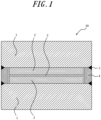
- FIG. 1 schematically illustrates a cross section of a clad slab.
- the present disclosure is directed to a clad steel plate comprising: a base steel plate; and a cladding metal made of a corrosion-resistant alloy bonded or joined to one surface of the base steel plate.
- the thickness of the clad steel plate is not particularly limited, yet is preferably 6 mm to 45 mm. Also, the thicknesses of the base steel plate and the cladding metal are preferably about 5 mm to 40 mm and 1 mm to 5 mm, respectively.
- C is an element for improving the strength of steel. To obtain this effect, C content is to be 0.02 % or more. However, a C content beyond 0.10 % causes deterioration of weldability and toughness. Therefore, the C content is 0.02 % to 0.10 %. It is preferably 0.08 % or less, and more preferably 0.07 % or less.
- Si is an element effective for deoxidation and for improving the strength of steel.
- Si content is set to 0.01 % or more.
- the Si content is 1.00 % or less. It is preferably 0.10 % or more. It is preferably 0.70 % or less, and more preferably 0.50 % or less.
- Mn is an element for improving the strength of steel.
- Mn content is to be 0.50 % or more.
- the Mn content is 0.50 % to 2.00 %. It is preferably 0.80 % or more, and more preferably 1.00 % or more. It is preferably 1.80 % or less.
- the P content is 0.030 % or less. It is preferably 0.0001 % or more. It is preferably 0.020 % or less.
- the S content is 0.020 % or less. It is preferably 0.0001 % or more. It is preferably 0.010 % or less.
- Ceq is a hardenability index of steel defined by the following formula (1), and it is necessary to set Ceq within an appropriate range in order to obtain a desired microstructure, and hence desired strength and toughness. By setting Ceq to 0.20 or more, sufficient hardenability and desired strength are secured. However, when Ceq exceeds 0.50, the microstructure of the surface portion of the base steel plate becomes excessively hard, deteriorating the toughness. Therefore, Ceq is from 0.20 to 0.50. It is preferably 0.25 or more. It is preferably 0.40 or less.
- Ceq C + Mn / 6 + Cu + Ni / 15 + Cr + Mo + V / 5
- C, Mn, Cu, Ni, Cr, Mo, and V are contents in mass% of the corresponding elements in the chemical composition of the base steel plate.
- C, Mn, Cu, Ni, Cr, Mo, and/or V are not contained in the chemical composition of the base steel plate, they may be calculated as "0", respectively.
- the chemical composition may further contain at least one selected from the group consisting of Ni: 0.01 % to 1.00 %, Cr: 0.01 % to 0.50 %, Mo: 0.01 % to 0.50 %, V: 0.001 % to 0.100 %, Nb: 0.005 % to 0.050 %, Ti: 0.005 % to 0.100 %, Al: 0.005 % to 0.200 %, Cu: 0.01 % to 0.70 %, Ca: 0.0003 % to 0.0050 %, B: 0.0003 % to 0.0030 %, and REM: 0.0003 % to 0.0100 %.
- Ni is an element effective for improving the hardenability and toughness of steel. This effect is exhibited when the Ni content is 0.01 % or more. However, when the Ni content exceeds 1.00 %, the weldability deteriorates and the alloy cost also increases. Therefore, when Ni is contained, the Ni content is 0.01 % to 1.00 %. It is more preferably 0.50 % or less.
- Cr is an element for improving the hardenability of steel, and improves the strength and toughness of the steel after rolling. This effect is exhibited when the Cr content is 0.01 % or more. However, when the Cr content exceeds 0.50 %, weldability and toughness deteriorate. Therefore, when Cr is contained, the Cr content is 0.01 % to 0.50 %. It is more preferably 0.30 % or less.
- Mo is an element for improving the hardenability of steel, and improves the strength and toughness of the steel after rolling. This effect is exhibited when the Mo content is 0.01 % or more. However, when the Mo content exceeds 0.50 %, weldability and toughness deteriorate. Therefore, when Mo is contained, the Mo content is 0.01 % to 0.50 %. It is more preferably 0.30 % or less.
- V 0.001 % to 0.100 %
- V improves the strength of the steel by forming carbonitrides. This effect is exhibited when the V content is 0.001 % or more. However, when the V content exceeds 0.100 %, toughness deteriorates. Therefore, when V is contained, the V content is 0.001 % to 0.100 %. It is more preferably 0.005 % or more. It is more preferably 0.050 % or less.
- Nb improves the strength of steel by forming carbonitrides. This effect is exhibited when the Nb content is 0.005 % or more. However, when the Nb content exceeds 0.050 %, toughness deteriorates. Therefore, when Nb is contained, the Nb content is 0.005 % to 0.050 %. It is more preferably 0.030 % or less.
- Ti improves the strength and toughness of steel by forming carbonitrides and then refining crystal grains. This effect is exhibited when the Ti content is 0.005 % or more. However, when the Ti content exceeds 0.100 %, the toughness of the steel including the welded portion deteriorates. Therefore, when Ti is contained, the Ti content is 0.005 % to 0.100 %. It is more preferably 0.050 % or less.
- Al is added as a deoxidizer, and its deoxidation effect can be obtained when its content is 0.005 % or more.
- the Al content exceeds 0.200 %, the toughness of the welded portion deteriorates. Therefore, when Al is contained, the Al content is 0.005 % to 0.200 %. It is more preferably 0.100 % or less.
- Cu is an element for improving the hardenability of steel, and improves the strength and toughness of the steel after rolling. This effect is exhibited when the Cu content is 0.01 % or more. However, when the Cu content exceeds 0.70 %, weldability and toughness deteriorate. Therefore, when Cu is contained, the Cu content is 0.01 % to 0.70 %. It is more preferably 0.50 % or less.
- Ca refines the microstructure of a heat-affected zone and improves the toughness. This effect is exhibited when the Ca content is 0.0003 % or more. However, when the Ca content exceeds 0.0050 %, coarse inclusions form and the toughness deteriorates. Therefore, when Ca is contained, the Ca content is 0.0003 % to 0.0050 %. It is more preferably 0.0030 % or less.
- B improves the hardenability and improves the strength and toughness of steel after rolling. This effect is exhibited when the B content is 0.0003 % or more. However, when the B content exceeds 0.0030 %, the toughness of the welded portion deteriorates. Therefore, when B is contained, the B content is 0.0003 % to 0.0030 %. It is more preferably 0.0020 % or less.
- REM refines the structure of a heat-affected zone and improves the toughness. This effect is exhibited when the REM content is 0.0003 % or more. However, when the REM content exceeds 0.0100 %, coarse inclusions form and the toughness deteriorates. Therefore, when REM is contained, the REM content is 0.0003 % to 0.0100 %. It is more preferably 0.0080 % or less.
- Components other than the above are Fe and inevitable impurities.
- the base steel plate constituting the clad steel plate comprises a microstructure of a surface portion containing, in terms of area fraction, at least one of a bainite phase or a martensite phase in an amount of 80 % or more in total, and a microstructure of an inner portion containing, in terms of area fraction, a ferrite phase in an amount of 30 % or more.
- the microstructure of the surface portion of the base steel plate is one measured at a position of 1 mm in depth in a thickness direction from another surface of the base steel plate on a side not bonded or joined to the cladding metal.
- the microstructure of the inner portion of the base steel plate is one measured at a position of 1 mm in depth in the thickness direction from an interface between the base steel plate and the cladding metal bonded or joined together.
- the microstructures of the surface portion and the inner portion of the base steel plate will be described.
- the area fraction of the bainite phase and the martensite phase is 80 % or more in total
- the surface portion of the base steel plate has high hardness. Therefore, the area fraction of the bainite phase and the martensite phase in the hard phase of the surface portion of the base steel plate is 80 % or more in total. It is preferably 90 % or more.
- the upper limit is not particularly limited, and may be 100 %.
- the residual microstructures may include one or more phases other than the bainite phase and the martensite phase, such as a ferrite phase or a pearlite phase.
- the total area fraction is 20 % or less.
- the area fraction is preferably 10 % or less.
- the area fraction of the residual microstructures may be 0 %.
- Microstructure of the inner portion of the base steel plate area fraction of ferrite phase is 30 % or more
- the inner portion of the base steel plate is soft.
- the area fraction of the ferrite phase needs to be 30 % or more. It is preferably 35 % or more. It is more preferably 40 % or more.
- the upper limit is not particularly limited, yet from the viewpoint of securing the overall strength, the upper limit of the area fraction of the ferrite phase is preferably about 95 %.
- a bainite phase, a martensite phase, and the like may be included as the residual microstructures other than the ferrite phase, and it is acceptable if the total area fraction of these remaining microstructures is 70 % or less. It is preferably 65 % or less, and more preferably 60 % or less. The lower limit of the total area fraction of the residual microstructure is preferably about 5 %.
- the martensite phase and the bainite phase include so-called tempered martensite and tempered bainite, respectively.
- the ductility of the base steel plate is greatly influenced by the hardness difference in the thickness direction of the base steel plate. If the hardness difference between the hard surface portion of the base steel plate and the soft inner portion of the base steel plate becomes too large, necking phenomenon occurs early due to localization of the strain when a tensile stress exceeding the yielding stress is applied, and consequently fracture occurs at an early stage. Therefore, the difference in hardness between the surface portion and the inner portion of the base steel plate needs to be 80 or less in terms of Vickers hardness. It is preferably 60 or less.
- the difference in hardness between the surface portion and the inner portion of the base steel plate is 25 or more, and more preferably 30 or more.
- the hardness of the surface portion of the base steel plate is one measured at a position of 1 mm in depth in a thickness direction from another surface of the base steel plate on a side not bonded or joined to the cladding metal.
- the hardness of the inner portion of the base steel plate is one measured at a position of 1 mm in depth in the thickness direction from an interface between the base steel plate and the cladding metal bonded or joined together.
- the clad steel plate disclosed herein comprises: a base steel plate; and a cladding metal made of a corrosion-resistant alloy bonded or joined to one surface of the base steel plate.
- the corrosion-resistant alloy examples include austenitic stainless steels (for example, austenitic stainless steels such as SUS 304, SUS 304L, SUS 316, and SUS 316L as specified in the JIS standard, and austenitic-ferritic duplex stainless steels such as SUS 329J1, SUS 329J3L, SUS 329J4L, SUS323L, SUS821L1, and SUS327L1 as specified in the JIS standard [hereinafter also referred to as duplex stainless steels]), and nickel-based alloys (for example, NCF 625 and NCF 825 as specified in the JIS standard), and may be appropriately selected in accordance with the application and the like.
- austenitic stainless steel (SUS 316L), duplex stainless steel, or the like is suitable for use in a cargo tank of a chemical tanker.
- a slab is prepared by stacking a base steel plate material having the chemical composition of the above-described base steel plate and a cladding metal material made of a corrosion-resistant alloy.
- the base steel plate material may be prepared by a conventional smelting process.
- FIG. 1 illustrates a cross-sectional view of the clad slab 10 as an example.
- a clad slab 10 can be formed by piling one stacked set of a base steel plate material 1 and a cladding metal material 2 on another such that the cladding metal materials face each other.
- a separating agent 3 can be applied between the cladding metal materials 2.
- the separating agent 3 is not particularly limited, yet is preferably a relatively inexpensive one with sufficient separatability, such as Al 2 O 3 .
- reference numeral 4 denotes a spacer
- reference numeral 6 denotes a welded portion.
- the base steel plate materials are equal in thickness to one another, and so are the cladding metal materials.
- the slab is rolled with a rolling reduction ratio of 2.0 or more to obtain a rolled clad material made of a base steel plate and a cladding metal.
- the heating temperature is preferably 1000 °C or higher. It is more preferably 1050 °C or higher. However, when the heating temperature exceeds 1300 °C, the crystal grains become coarse and the toughness of the base steel plate may be deteriorated. Therefore, the heating temperature is preferably 1300 °C or lower.
- the base steel plate and the cladding metal In bonding or joining the base steel plate and the cladding metal together, by performing rolling at high temperature, metals gain bonding strength, and by setting the rolling reduction ratio to 2.0 or more, the base steel plate and the cladding metal can be satisfactorily bonded or joined together. Also, by performing rolling with a rolling reduction ratio of 2.0 or more, the crystal grains of the base steel plate are refined and the toughness of the base steel plate is improved.
- the rolling reduction ratio is preferably 3.0 or more.
- the upper limit of the rolling reduction ratio is not particularly limited, yet is normally about 20.0.
- the rolling reduction ratio is given by: the thickness of the slab (before rolling)/the thickness of the rolled clad material (after rolling).
- the temperature of the steel plate surface at the end of rolling is 900 °C or higher.
- the rolled clad material is cooled until the temperature at the surface of the base steel plate (the surface of the base steel plate on the side not bonded or joined to the cladding metal) drops to or below the Ar 3 point, such that the cooling rate at the surface of the base steel plate (the surface of the base steel plate on the side not bonded or joined to the cladding metal) is 30 °C/s or higher (preferably 40 °C/s or higher) and the cooling rate at the inner portion of the base steel plate is 15 °C/s or lower (preferably 10 °C/s or lower).
- Ar 3 C ⁇ 868 ⁇ 396 C + 25Si ⁇ 68 Mn ⁇ 21 Cu ⁇ 36 Ni ⁇ 25 Cr ⁇ 30 Mo
- the cooling start temperature is 850 °C or higher.
- the lower limit of the cooling rate at the inner portion of the base steel plate is not particularly limited, yet is normally about 0.5 ° C/s.
- the lower limit of the cooling end temperature is not particularly limited, yet is normally 200 °C or higher when measured at the inner portion of the base steel plate.
- the base steel plate may comprise a microstructure of a surface portion containing, in terms of area fraction, at least one of a bainite phase or a martensite phase in an amount of 80 % or more in total, and a microstructure of an inner portion containing, in terms of area fraction, a ferrite phase in an amount of 30 % or more.
- the cooling rate at the inner portion of the base steel plate is 15 °C/s or lower by cooling the rolled clad material from both sides by water cooling such that the cooling rate at the surface of the rolled clad material (the surface of the base steel plate on the side not bonded or joined to the cladding metal) is 30 °C/s or higher and 50 °C/s or lower.
- the temperature at the surface of the base steel plate (the surface of the base steel plate on the side not bonded or joined to the cladding metal) can be measured with a radiation thermometer, a thermocouple, or the like.
- the temperature at the inner portion of the base steel plate can be determined by, for example, the plate thickness, surface temperature, or cooling conditions through simulation calculation or the like.
- the temperature at the inner portion of the base steel plate can be determined by calculating the temperature distribution in the plate thickness direction using a finite difference method.
- the cooling rate at the surface of the base steel plate and the cooling rate at the inner portion of the base steel plate can be calculated from the temperature measured or determined as mentioned above.
- the resulting rolled clad material is subjected to tempering treatment at a tempering temperature of 550 °C to 750 °C and a holding time of 100 minutes or less.
- the tempering temperature is 550 °C to 750 °C and the holding time is 100 minutes or less.
- the tempering temperature is preferably 600 °C or higher.
- the tempering temperature is preferably 700 °C or lower.
- the holding time is preferably 1 minute or more.
- the holding time is preferably 60 minutes or less.
- the tempering temperature is the temperature as measured at a 1/2 position of the thickness in the thickness direction in the base steel plate of the rolled clad material.
- the cladding metals are separated by the separating agent applied therebetween, and the resulting rolled clad material is formed into clad steel plates as finished products.
- the resulting rolled clad material is subjected to cooling to a temperature at or below the Ar 3 point and tempering under the conditions listed in Table 3, then the cladding metals were separated, and a clad steel plate was obtained.
- the tempering time was set to 10 minutes.
- the manufacturing condition (b) in Table 3 indicates a general quenching and tempering process. Specifically, the rolled clad material is cooled after rolling, reheated to 900 °C, water-cooled after reheating, then cooled to room temperature, then heated again to 550 °C, and held at that temperature for 10 minutes.
- Test specimens were taken from the clad steel plates thus obtained, and (1) observation of metallic microstructure, (2) hardness test, (3) tensile test, (4) toughness evaluation, and (5) corrosion resistance evaluation were carried out as follows. The results are listed in Table 4.
- a specimen for microstructure observation is taken such that the plane parallel to the surface of the base steel plate becomes the observation plane. Then, the observation plane is polished, etched in a 3 vol% nital solution to reveal the microstructure, and the microstructure is observed and imaged with a scanning electron microscope (magnification: 3000 times). From the obtained micrographs, the microstructures are identified by image interpretation.
- the above-described observation of metallic microstructure is performed in 10 fields at a position of 1 mm in depth in the thickness direction from the surface of each base steel plate (on the side not bonded or joined to the cladding metal), and the result of averaging the occupied area fractions of each phase in the micrographs in each field is used as the area fraction of the phase in the surface portion of the base steel plate.
- the above-described observation of metallic microstructure is performed in 10 fields at a position of 1 mm in depth in the thickness direction from the interface between the base steel plate and the cladding metal bonded or joined together, and the result of averaging the occupied area fractions of each phase in the micrographs in each field is used as the area fraction of the phase in the inner portion of the base steel plate.
- the difference in hardness between the surface portion and the inner portion of each base steel plate was measured by a Vickers test. Specifically, a test specimen was taken from each base steel plate such that a cross section (L-cross section) taken in the thickness direction parallel to the rolling direction of the clad steel plate became the measurement surface. Then, using each sampled specimen, the hardness of the surface portion and the hardness of the inner portion of the base steel plate were respectively measured in terms of Vickers hardness at a position of 1 mm in depth in the thickness direction from the surface of the base steel plate (on the side not bonded or joined to the cladding metal), and at a position of 1 mm in depth in the thickness direction from the interface between the base steel plate and the cladding metal bonded or joined together.
- the Vickers hardness was measured in accordance with JIS Z 2244 with a test load of 10 kgf. Then, the result of subtracting the measured hardness of the inner portion from the measured hardness of the surface portion was used as the difference in hardness between the surface portion and the inner portion of the base steel plate.
- each base steel was evaluated by tensile test. Specifically, from each clad steel plate, the cladding metal part was removed by machining, a tensile test specimen of JIS 1A was taken from the base steel plate part, a tensile test according to JIS Z 2241 was carried out, and the tensile strength (TS) and total elongation (El) were determined. The strength was evaluated as good when the tensile strength (TS) was 490 MPa or more, and the ductility was evaluated as good when the total elongation (El) was 16.0 % or more.
- the toughness was evaluated by Charpy impact test. Specifically, a Charpy impact test specimen (length: 55 mm ⁇ width: 10 mm ⁇ height: 10 mm, notch shape: V notch [provided in a cross section in the thickness direction]) was taken from each base steel plate, and subjected to a Charpy impact test in conformity with JIS Z 2242. When the absorbed energy measured by the Charpy impact test at -40 °C exceeds 100 J, the toughness was evaluated as being good.
- Corrosion resistance was evaluated by copper sulfate-sulfuric acid test. Specifically, a corrosion test specimen of 1 mm ⁇ 10 mm ⁇ 70 mm was collected from the cladding metal part of each clad steel plate, and each corrosion test specimen was used to conduct a copper sulfate-sulfuric acid test according to JIS G 0575 (2012). Then, those having no cracks at the top of the bent portion thereof after the bend test were evaluated as having good corrosion resistance. Table 1 Base steel No.
- Cladding metal ID Manufacturing condition ID (1) Observation of metallic microstructure (2) Hardness test (3) Tensile test (4) Toughness evaluation (5) Corrosion resistance evaluation Remarks Surface portion of base steel plate Inner portion of base steel plate Difference inhardness between surface portion and inner portion of base steel plate TS (MPa) El (%) vE (J) Total area ratio of bainite phase and martensite phase (%) Residual microstructure Area ratio of ferrite phase (%) Residual microstructure 1 1 A (a) 87 ferrite phase 43 bainite phase, pearlite phase 60 505 18.2 203 no cracks Example 2 2 B (a) 92 ferrite phase 37 bainite phase, pearlite phase 51 507 17.1 196 no cracks Example 3 3 A (a) 90 ferrite phase 40 bainite phase, pearlite phase 55 498 18.6 209 no cracks Example 4 4 B (a) 89 ferrite phase 41 bainite phase, pearlite phase S9 492 17.9 213 no cracks Example 5 5 A (
Landscapes
- Chemical & Material Sciences (AREA)
- Engineering & Computer Science (AREA)
- Mechanical Engineering (AREA)
- Materials Engineering (AREA)
- Metallurgy (AREA)
- Organic Chemistry (AREA)
- Physics & Mathematics (AREA)
- Thermal Sciences (AREA)
- Crystallography & Structural Chemistry (AREA)
- Heat Treatment Of Steel (AREA)
- Pressure Welding/Diffusion-Bonding (AREA)
Claims (1)
- Plaque d'acier plaquée comprenant : une plaque d'acier de base ; et un métal de placage constitué d'un alliage résistant à la corrosion d'un acier inoxydable austénitique, d'un acier inoxydable duplex austénitique-ferritique ou d'un alliage à base de nickel lié ou joint à une surface de la plaque d'acier de base, dans laquelle
la plaque d'acier de base comprend :une composition chimique contenant, en % massique,C : de 0,02 % à 0,10 %,Si : 1,00 % ou moins,Mn : de 0,50 % à 2,00 %,P : 0,030 % ou moins, etS : 0,020 % ou moins,éventuellement, en % massique, au moins un élément choisi dans le groupe constitué parNi : de 0,01 % à 1,00 %,Cr : de 0,01 % à 0,50 %,Mo : de 0,01 % à 0,50 %,V: de 0,001 % à 0,100 %,Nb : de 0,005 % à 0,050 %,Ti : de 0,005 % à 0,100 %,Al : de 0,005 % à 0,200 %,Cu : de 0,01 % à 0,70 %,Ca : de 0,0003 % à 0,0050 %,B : de 0,0003 % à 0,0030 %, etterres rares : de 0,0003 % à 0,0100 %,le reste étant du Fe et des impuretés inévitables, où Ceq va de 0,20 à 0,50, Ceq étant défini par : où C, Mn, Cu, Ni, Cr, Mo et V sont les teneurs, en % massique, des éléments correspondants dans la composition chimique de la plaque d'acier de base,une microstructure d'une partie superficielle contenant, en termes de fraction surfacique, au moins l'une d'une phase de bainite ou d'une phase de martensite à raison de 80 % ou plus au total ; etune microstructure d'une partie interne contenant, en termes de fraction surfacique, une phase de ferrite à raison de 30 % ou plus, etla différence de dureté entre la partie superficielle et la partie interne étant de 25 ou plus jusqu'à 80 ou moins en termes de dureté Vickers,où la microstructure et la dureté de la partie superficielle de la plaque d'acier de base sont mesurées à une position de 1 mm de profondeur dans un sens épaisseur à partir d'une autre surface de la plaque d'acier de base sur un côté non lié ou joint au métal de plaquage, et la microstructure et la dureté de la partie interne de la plaque d'acier de base sont mesurées à une position de 1 mm de profondeur dans le sens épaisseur à partir d'une interface entre la plaque d'acier de base et le métal de placage liés ou joints ensemble,dans laquelle la microstructure est mesurée sous forme de moyenne des fractions surfaciques occupées par chaque phase sur 10 champs d'observations capturés au moyen d'un microscope électronique à balayage, où chaque phase est identifiée par interprétation d'image, et dans laquelle la différence de dureté est mesurée sous forme de résultat de la soustraction d'une dureté de la partie interne d'une dureté de la partie superficielle, où la dureté est mesurée par un essai Vickers d'après JIS Z 2244 avec une charge d'essai de 10 kgf.
Applications Claiming Priority (2)
| Application Number | Priority Date | Filing Date | Title |
|---|---|---|---|
| JP2017253966 | 2017-12-28 | ||
| PCT/JP2018/042875 WO2019130914A1 (fr) | 2017-12-28 | 2018-11-20 | Plaque d'acier bardée |
Publications (3)
| Publication Number | Publication Date |
|---|---|
| EP3733893A1 EP3733893A1 (fr) | 2020-11-04 |
| EP3733893A4 EP3733893A4 (fr) | 2020-11-25 |
| EP3733893B1 true EP3733893B1 (fr) | 2024-01-31 |
Family
ID=67066990
Family Applications (1)
| Application Number | Title | Priority Date | Filing Date |
|---|---|---|---|
| EP18894900.2A Active EP3733893B1 (fr) | 2017-12-28 | 2018-11-20 | Tôle d'acier plaquée |
Country Status (5)
| Country | Link |
|---|---|
| EP (1) | EP3733893B1 (fr) |
| JP (1) | JP6573060B1 (fr) |
| KR (1) | KR102439486B1 (fr) |
| CN (1) | CN111527222B (fr) |
| WO (1) | WO2019130914A1 (fr) |
Families Citing this family (8)
| Publication number | Priority date | Publication date | Assignee | Title |
|---|---|---|---|---|
| KR102579428B1 (ko) * | 2021-04-12 | 2023-09-18 | 동국제강 주식회사 | 경도 변화가 제어된 클래드 강 |
| JP7674159B2 (ja) * | 2021-06-04 | 2025-05-09 | 日鉄ステンレス株式会社 | クラッド鋼板およびその製造方法ならびに溶接構造物 |
| JP7765696B2 (ja) * | 2021-12-03 | 2025-11-07 | 日本製鉄株式会社 | クラッド鋼板およびその製造方法 |
| CN116516244A (zh) * | 2022-01-21 | 2023-08-01 | 宝山钢铁股份有限公司 | 一种耐氢氧化钠腐蚀高强度管道及其制造方法 |
| JP7769219B2 (ja) * | 2022-03-28 | 2025-11-13 | 日本製鉄株式会社 | クラッド鋼板およびその製造方法 |
| CN115165729A (zh) * | 2022-06-06 | 2022-10-11 | 广东韶钢松山股份有限公司 | 不锈钢覆层钢材覆层结合强度评价方法 |
| JP7541654B1 (ja) * | 2022-11-08 | 2024-08-29 | Jfeスチール株式会社 | クラッド鋼板およびその製造方法 |
| CN118418539A (zh) * | 2023-01-31 | 2024-08-02 | 宝山钢铁股份有限公司 | 复合钢板及其制造方法 |
Family Cites Families (19)
| Publication number | Priority date | Publication date | Assignee | Title |
|---|---|---|---|---|
| JPH05154672A (ja) | 1991-11-29 | 1993-06-22 | Sumitomo Metal Ind Ltd | 高強度および高靱性クラッド鋼板の製造法 |
| JPH0665686A (ja) * | 1992-08-19 | 1994-03-08 | Nippon Steel Corp | 加工性に優れたオーステナイト系ステンレス鋳込みクラッド鋼材およびその製造方法 |
| JP3260232B2 (ja) * | 1993-03-15 | 2002-02-25 | 新日本製鐵株式会社 | 海岸高耐候性クラッド鋼板の製造方法 |
| JPH07292445A (ja) | 1994-04-22 | 1995-11-07 | Japan Steel Works Ltd:The | 二相ステンレスクラッド鋼およびその製造方法ならびに溶接方法 |
| JP2008030086A (ja) * | 2006-07-28 | 2008-02-14 | Japan Steel Works Ltd:The | 高強度クラッド鋼板の製造方法 |
| JP4960289B2 (ja) * | 2008-03-27 | 2012-06-27 | 国立大学法人 東京大学 | 複層鋼 |
| CN102301026B (zh) * | 2009-01-30 | 2014-11-05 | 杰富意钢铁株式会社 | 低温韧性优良的厚壁高强度热轧钢板及其制造方法 |
| JP5499733B2 (ja) * | 2009-01-30 | 2014-05-21 | Jfeスチール株式会社 | 低温靭性に優れた厚肉高張力熱延鋼板およびその製造方法 |
| JP5655295B2 (ja) * | 2009-11-30 | 2015-01-21 | Jfeスチール株式会社 | 低炭素鋼板およびその製造方法 |
| CN103249853B (zh) * | 2010-10-18 | 2015-05-20 | 新日铁住金株式会社 | 高速变形下均一韧性及局部韧性优异的热轧钢板、冷轧钢板以及镀覆钢板 |
| EP2702178A1 (fr) * | 2011-04-27 | 2014-03-05 | Tata Steel Nederland Technology B.V. | Composite de feuillard en acier et son procédé de fabrication |
| JP6210114B2 (ja) * | 2013-10-21 | 2017-10-11 | Jfeスチール株式会社 | オーステナイト系ステンレスクラッド鋼板およびその製造方法 |
| CN103498108A (zh) * | 2013-10-22 | 2014-01-08 | 江苏盛伟模具材料有限公司 | 具有良好红硬性的高硼高铬低碳耐磨合金钢及其制备方法 |
| JP6024643B2 (ja) | 2013-10-30 | 2016-11-16 | Jfeスチール株式会社 | 母材の低温靭性とHAZ靭性及び合せ材の耐食性に優れたNi合金クラッド鋼板の製造方法 |
| JP6127939B2 (ja) | 2013-11-29 | 2017-05-17 | Jfeスチール株式会社 | 母材の低温靭性とhaz靭性並びに合せ材の耐食性に優れたオーステナイト系ステンレスクラッド鋼板の製造方法 |
| JP6128057B2 (ja) | 2014-05-29 | 2017-05-17 | Jfeスチール株式会社 | 低yrクラッド鋼板及びその製造方法 |
| CN107075645B (zh) * | 2014-11-11 | 2020-06-16 | 杰富意钢铁株式会社 | Ni合金包层钢板及其制造方法 |
| CN105063484B (zh) * | 2015-08-28 | 2017-10-31 | 宝山钢铁股份有限公司 | 屈服强度500MPa级高延伸率热镀铝锌及彩涂钢板及其制造方法 |
| CN105671424A (zh) * | 2016-01-26 | 2016-06-15 | 宝山钢铁股份有限公司 | 一种管线用镍基合金复合钢板及其制造方法 |
-
2018
- 2018-11-20 EP EP18894900.2A patent/EP3733893B1/fr active Active
- 2018-11-20 CN CN201880083743.6A patent/CN111527222B/zh active Active
- 2018-11-20 WO PCT/JP2018/042875 patent/WO2019130914A1/fr not_active Ceased
- 2018-11-20 KR KR1020207018758A patent/KR102439486B1/ko active Active
- 2018-11-20 JP JP2019527570A patent/JP6573060B1/ja active Active
Also Published As
| Publication number | Publication date |
|---|---|
| JPWO2019130914A1 (ja) | 2020-01-16 |
| CN111527222A (zh) | 2020-08-11 |
| KR102439486B1 (ko) | 2022-09-05 |
| EP3733893A4 (fr) | 2020-11-25 |
| JP6573060B1 (ja) | 2019-09-11 |
| EP3733893A1 (fr) | 2020-11-04 |
| CN111527222B (zh) | 2021-10-19 |
| KR20200089744A (ko) | 2020-07-27 |
| WO2019130914A1 (fr) | 2019-07-04 |
Similar Documents
| Publication | Publication Date | Title |
|---|---|---|
| EP3733893B1 (fr) | Tôle d'acier plaquée | |
| EP3816318B1 (fr) | Plaque d'acier plaquée et son procédé de fabrication | |
| EP3604597B1 (fr) | Tôle d'acier plaquée et son procédé de production | |
| EP3219820B1 (fr) | Tôle d'acier à base d'alliage à base de nickel et son procédé de fabrication | |
| EP3575427B1 (fr) | Acier inoxydable à deux phases plaquée et son procédé de production | |
| EP2617852A1 (fr) | Feuille d'acier laminée à chaud à haute résistance possédant une excellente aptitude au cintrage et procédé de production | |
| JP7006855B2 (ja) | クラッド鋼およびその製造方法 | |
| EP3862456A1 (fr) | Tôle d'acier inoxydable austénitique plaquée, tôle d'acier de base et procédé de production de tôle d'acier plaquée | |
| EP3778965B1 (fr) | Tôle d'acier inoxydable à deux phases et son procédé de fabrication | |
| EP3778958A1 (fr) | Tôle d'acier plaqué inoxydable à deux phases et son procédé de fabrication | |
| US20250154632A1 (en) | Steel plate and method of producing same | |
| JP2021143387A (ja) | クラッド鋼板およびその製造方法 | |
| CN115210399A (zh) | 包层钢板及其制造方法以及焊接结构物 | |
| EP4667593A1 (fr) | Procédé de fabrication de feuille d'acier plaquée | |
| JP2022186396A (ja) | クラッド鋼板およびその製造方法ならびに溶接構造物 | |
| JP2022038084A (ja) | クラッド鋼板およびその製造方法ならびに溶接構造物 | |
| JP7666753B1 (ja) | クラッド鋼板、その製造方法およびラインパイプ | |
| EP1160347A1 (fr) | Alliage Fe-Cr ayant une excellente résistance à la corrosion, une excellente aptitude à l' usinage et une excellente sondabilité | |
| US20250115973A1 (en) | Steel plate and method of producing same | |
| WO2024101317A1 (fr) | Tôle d'acier plaquée et son procédé de production |
Legal Events
| Date | Code | Title | Description |
|---|---|---|---|
| STAA | Information on the status of an ep patent application or granted ep patent |
Free format text: STATUS: THE INTERNATIONAL PUBLICATION HAS BEEN MADE |
|
| PUAI | Public reference made under article 153(3) epc to a published international application that has entered the european phase |
Free format text: ORIGINAL CODE: 0009012 |
|
| STAA | Information on the status of an ep patent application or granted ep patent |
Free format text: STATUS: REQUEST FOR EXAMINATION WAS MADE |
|
| 17P | Request for examination filed |
Effective date: 20200713 |
|
| AK | Designated contracting states |
Kind code of ref document: A1 Designated state(s): AL AT BE BG CH CY CZ DE DK EE ES FI FR GB GR HR HU IE IS IT LI LT LU LV MC MK MT NL NO PL PT RO RS SE SI SK SM TR |
|
| AX | Request for extension of the european patent |
Extension state: BA ME |
|
| A4 | Supplementary search report drawn up and despatched |
Effective date: 20201027 |
|
| RIC1 | Information provided on ipc code assigned before grant |
Ipc: C22C 38/12 20060101ALI20201021BHEP Ipc: C22C 38/16 20060101ALI20201021BHEP Ipc: C22C 38/02 20060101ALI20201021BHEP Ipc: B23K 20/04 20060101ALI20201021BHEP Ipc: C22C 38/58 20060101ALI20201021BHEP Ipc: B21B 1/38 20060101ALI20201021BHEP Ipc: C21D 9/00 20060101ALI20201021BHEP Ipc: C22C 38/40 20060101ALN20201021BHEP Ipc: C22C 38/04 20060101ALI20201021BHEP Ipc: C21D 9/46 20060101ALI20201021BHEP Ipc: C21D 6/00 20060101ALI20201021BHEP Ipc: C21D 1/25 20060101ALI20201021BHEP Ipc: C22C 38/14 20060101ALI20201021BHEP Ipc: C22C 38/18 20060101ALI20201021BHEP Ipc: C22C 38/00 20060101AFI20201021BHEP Ipc: B32B 15/01 20060101ALI20201021BHEP Ipc: C22C 38/08 20060101ALI20201021BHEP Ipc: B23K 20/227 20060101ALI20201021BHEP Ipc: C21D 8/02 20060101ALI20201021BHEP |
|
| DAV | Request for validation of the european patent (deleted) | ||
| DAX | Request for extension of the european patent (deleted) | ||
| STAA | Information on the status of an ep patent application or granted ep patent |
Free format text: STATUS: EXAMINATION IS IN PROGRESS |
|
| 17Q | First examination report despatched |
Effective date: 20230223 |
|
| GRAP | Despatch of communication of intention to grant a patent |
Free format text: ORIGINAL CODE: EPIDOSNIGR1 |
|
| STAA | Information on the status of an ep patent application or granted ep patent |
Free format text: STATUS: GRANT OF PATENT IS INTENDED |
|
| RIC1 | Information provided on ipc code assigned before grant |
Ipc: B23K 103/18 20060101ALN20230804BHEP Ipc: B23K 103/04 20060101ALN20230804BHEP Ipc: B23K 101/18 20060101ALN20230804BHEP Ipc: C21D 8/02 20060101ALN20230804BHEP Ipc: C21D 6/00 20060101ALN20230804BHEP Ipc: C21D 1/25 20060101ALN20230804BHEP Ipc: C22C 38/40 20060101ALN20230804BHEP Ipc: B23K 20/227 20060101ALI20230804BHEP Ipc: B32B 15/01 20060101ALI20230804BHEP Ipc: B23K 20/04 20060101ALI20230804BHEP Ipc: C22C 38/18 20060101ALI20230804BHEP Ipc: C22C 38/14 20060101ALI20230804BHEP Ipc: C21D 9/46 20060101ALI20230804BHEP Ipc: C22C 38/16 20060101ALI20230804BHEP Ipc: C22C 38/12 20060101ALI20230804BHEP Ipc: C22C 38/08 20060101ALI20230804BHEP Ipc: B21B 1/38 20060101ALI20230804BHEP Ipc: C22C 38/02 20060101ALI20230804BHEP Ipc: C22C 38/58 20060101ALI20230804BHEP Ipc: C22C 38/04 20060101ALI20230804BHEP Ipc: B23K 31/02 20060101ALI20230804BHEP Ipc: B23K 20/24 20060101ALI20230804BHEP Ipc: B23K 20/26 20060101ALI20230804BHEP Ipc: C22C 38/00 20060101AFI20230804BHEP |
|
| INTG | Intention to grant announced |
Effective date: 20230911 |
|
| RIN1 | Information on inventor provided before grant (corrected) |
Inventor name: HASE, KAZUKUNI Inventor name: YOKOTA, TOMOYUKI Inventor name: KURONUMA, YOTA |
|
| GRAS | Grant fee paid |
Free format text: ORIGINAL CODE: EPIDOSNIGR3 |
|
| GRAA | (expected) grant |
Free format text: ORIGINAL CODE: 0009210 |
|
| STAA | Information on the status of an ep patent application or granted ep patent |
Free format text: STATUS: THE PATENT HAS BEEN GRANTED |
|
| AK | Designated contracting states |
Kind code of ref document: B1 Designated state(s): AL AT BE BG CH CY CZ DE DK EE ES FI FR GB GR HR HU IE IS IT LI LT LU LV MC MK MT NL NO PL PT RO RS SE SI SK SM TR |
|
| REG | Reference to a national code |
Ref country code: GB Ref legal event code: FG4D Ref country code: CH Ref legal event code: EP |
|
| REG | Reference to a national code |
Ref country code: DE Ref legal event code: R096 Ref document number: 602018064826 Country of ref document: DE |
|
| REG | Reference to a national code |
Ref country code: IE Ref legal event code: FG4D |
|
| REG | Reference to a national code |
Ref country code: LT Ref legal event code: MG9D |
|
| REG | Reference to a national code |
Ref country code: NL Ref legal event code: MP Effective date: 20240131 |
|
| PG25 | Lapsed in a contracting state [announced via postgrant information from national office to epo] |
Ref country code: IS Free format text: LAPSE BECAUSE OF FAILURE TO SUBMIT A TRANSLATION OF THE DESCRIPTION OR TO PAY THE FEE WITHIN THE PRESCRIBED TIME-LIMIT Effective date: 20240531 |
|
| PG25 | Lapsed in a contracting state [announced via postgrant information from national office to epo] |
Ref country code: LT Free format text: LAPSE BECAUSE OF FAILURE TO SUBMIT A TRANSLATION OF THE DESCRIPTION OR TO PAY THE FEE WITHIN THE PRESCRIBED TIME-LIMIT Effective date: 20240131 |
|
| PG25 | Lapsed in a contracting state [announced via postgrant information from national office to epo] |
Ref country code: GR Free format text: LAPSE BECAUSE OF FAILURE TO SUBMIT A TRANSLATION OF THE DESCRIPTION OR TO PAY THE FEE WITHIN THE PRESCRIBED TIME-LIMIT Effective date: 20240501 |
|
| PG25 | Lapsed in a contracting state [announced via postgrant information from national office to epo] |
Ref country code: RS Free format text: LAPSE BECAUSE OF FAILURE TO SUBMIT A TRANSLATION OF THE DESCRIPTION OR TO PAY THE FEE WITHIN THE PRESCRIBED TIME-LIMIT Effective date: 20240430 Ref country code: NL Free format text: LAPSE BECAUSE OF FAILURE TO SUBMIT A TRANSLATION OF THE DESCRIPTION OR TO PAY THE FEE WITHIN THE PRESCRIBED TIME-LIMIT Effective date: 20240131 Ref country code: HR Free format text: LAPSE BECAUSE OF FAILURE TO SUBMIT A TRANSLATION OF THE DESCRIPTION OR TO PAY THE FEE WITHIN THE PRESCRIBED TIME-LIMIT Effective date: 20240131 |
|
| PG25 | Lapsed in a contracting state [announced via postgrant information from national office to epo] |
Ref country code: ES Free format text: LAPSE BECAUSE OF FAILURE TO SUBMIT A TRANSLATION OF THE DESCRIPTION OR TO PAY THE FEE WITHIN THE PRESCRIBED TIME-LIMIT Effective date: 20240131 |
|
| PG25 | Lapsed in a contracting state [announced via postgrant information from national office to epo] |
Ref country code: RS Free format text: LAPSE BECAUSE OF FAILURE TO SUBMIT A TRANSLATION OF THE DESCRIPTION OR TO PAY THE FEE WITHIN THE PRESCRIBED TIME-LIMIT Effective date: 20240430 Ref country code: NO Free format text: LAPSE BECAUSE OF FAILURE TO SUBMIT A TRANSLATION OF THE DESCRIPTION OR TO PAY THE FEE WITHIN THE PRESCRIBED TIME-LIMIT Effective date: 20240430 Ref country code: NL Free format text: LAPSE BECAUSE OF FAILURE TO SUBMIT A TRANSLATION OF THE DESCRIPTION OR TO PAY THE FEE WITHIN THE PRESCRIBED TIME-LIMIT Effective date: 20240131 Ref country code: LT Free format text: LAPSE BECAUSE OF FAILURE TO SUBMIT A TRANSLATION OF THE DESCRIPTION OR TO PAY THE FEE WITHIN THE PRESCRIBED TIME-LIMIT Effective date: 20240131 Ref country code: IS Free format text: LAPSE BECAUSE OF FAILURE TO SUBMIT A TRANSLATION OF THE DESCRIPTION OR TO PAY THE FEE WITHIN THE PRESCRIBED TIME-LIMIT Effective date: 20240531 Ref country code: HR Free format text: LAPSE BECAUSE OF FAILURE TO SUBMIT A TRANSLATION OF THE DESCRIPTION OR TO PAY THE FEE WITHIN THE PRESCRIBED TIME-LIMIT Effective date: 20240131 Ref country code: GR Free format text: LAPSE BECAUSE OF FAILURE TO SUBMIT A TRANSLATION OF THE DESCRIPTION OR TO PAY THE FEE WITHIN THE PRESCRIBED TIME-LIMIT Effective date: 20240501 Ref country code: FI Free format text: LAPSE BECAUSE OF FAILURE TO SUBMIT A TRANSLATION OF THE DESCRIPTION OR TO PAY THE FEE WITHIN THE PRESCRIBED TIME-LIMIT Effective date: 20240131 Ref country code: ES Free format text: LAPSE BECAUSE OF FAILURE TO SUBMIT A TRANSLATION OF THE DESCRIPTION OR TO PAY THE FEE WITHIN THE PRESCRIBED TIME-LIMIT Effective date: 20240131 Ref country code: BG Free format text: LAPSE BECAUSE OF FAILURE TO SUBMIT A TRANSLATION OF THE DESCRIPTION OR TO PAY THE FEE WITHIN THE PRESCRIBED TIME-LIMIT Effective date: 20240131 |
|
| PG25 | Lapsed in a contracting state [announced via postgrant information from national office to epo] |
Ref country code: PT Free format text: LAPSE BECAUSE OF FAILURE TO SUBMIT A TRANSLATION OF THE DESCRIPTION OR TO PAY THE FEE WITHIN THE PRESCRIBED TIME-LIMIT Effective date: 20240531 Ref country code: PL Free format text: LAPSE BECAUSE OF FAILURE TO SUBMIT A TRANSLATION OF THE DESCRIPTION OR TO PAY THE FEE WITHIN THE PRESCRIBED TIME-LIMIT Effective date: 20240131 |
|
| PG25 | Lapsed in a contracting state [announced via postgrant information from national office to epo] |
Ref country code: SE Free format text: LAPSE BECAUSE OF FAILURE TO SUBMIT A TRANSLATION OF THE DESCRIPTION OR TO PAY THE FEE WITHIN THE PRESCRIBED TIME-LIMIT Effective date: 20240131 Ref country code: PT Free format text: LAPSE BECAUSE OF FAILURE TO SUBMIT A TRANSLATION OF THE DESCRIPTION OR TO PAY THE FEE WITHIN THE PRESCRIBED TIME-LIMIT Effective date: 20240531 Ref country code: PL Free format text: LAPSE BECAUSE OF FAILURE TO SUBMIT A TRANSLATION OF THE DESCRIPTION OR TO PAY THE FEE WITHIN THE PRESCRIBED TIME-LIMIT Effective date: 20240131 Ref country code: LV Free format text: LAPSE BECAUSE OF FAILURE TO SUBMIT A TRANSLATION OF THE DESCRIPTION OR TO PAY THE FEE WITHIN THE PRESCRIBED TIME-LIMIT Effective date: 20240131 |
|
| REG | Reference to a national code |
Ref country code: AT Ref legal event code: UEP Ref document number: 1653910 Country of ref document: AT Kind code of ref document: T Effective date: 20240131 |
|
| PG25 | Lapsed in a contracting state [announced via postgrant information from national office to epo] |
Ref country code: DK Free format text: LAPSE BECAUSE OF FAILURE TO SUBMIT A TRANSLATION OF THE DESCRIPTION OR TO PAY THE FEE WITHIN THE PRESCRIBED TIME-LIMIT Effective date: 20240131 |
|
| PG25 | Lapsed in a contracting state [announced via postgrant information from national office to epo] |
Ref country code: SM Free format text: LAPSE BECAUSE OF FAILURE TO SUBMIT A TRANSLATION OF THE DESCRIPTION OR TO PAY THE FEE WITHIN THE PRESCRIBED TIME-LIMIT Effective date: 20240131 |
|
| PG25 | Lapsed in a contracting state [announced via postgrant information from national office to epo] |
Ref country code: CZ Free format text: LAPSE BECAUSE OF FAILURE TO SUBMIT A TRANSLATION OF THE DESCRIPTION OR TO PAY THE FEE WITHIN THE PRESCRIBED TIME-LIMIT Effective date: 20240131 Ref country code: EE Free format text: LAPSE BECAUSE OF FAILURE TO SUBMIT A TRANSLATION OF THE DESCRIPTION OR TO PAY THE FEE WITHIN THE PRESCRIBED TIME-LIMIT Effective date: 20240131 |
|
| PG25 | Lapsed in a contracting state [announced via postgrant information from national office to epo] |
Ref country code: SK Free format text: LAPSE BECAUSE OF FAILURE TO SUBMIT A TRANSLATION OF THE DESCRIPTION OR TO PAY THE FEE WITHIN THE PRESCRIBED TIME-LIMIT Effective date: 20240131 |
|
| PG25 | Lapsed in a contracting state [announced via postgrant information from national office to epo] |
Ref country code: SM Free format text: LAPSE BECAUSE OF FAILURE TO SUBMIT A TRANSLATION OF THE DESCRIPTION OR TO PAY THE FEE WITHIN THE PRESCRIBED TIME-LIMIT Effective date: 20240131 Ref country code: SK Free format text: LAPSE BECAUSE OF FAILURE TO SUBMIT A TRANSLATION OF THE DESCRIPTION OR TO PAY THE FEE WITHIN THE PRESCRIBED TIME-LIMIT Effective date: 20240131 Ref country code: RO Free format text: LAPSE BECAUSE OF FAILURE TO SUBMIT A TRANSLATION OF THE DESCRIPTION OR TO PAY THE FEE WITHIN THE PRESCRIBED TIME-LIMIT Effective date: 20240131 Ref country code: EE Free format text: LAPSE BECAUSE OF FAILURE TO SUBMIT A TRANSLATION OF THE DESCRIPTION OR TO PAY THE FEE WITHIN THE PRESCRIBED TIME-LIMIT Effective date: 20240131 Ref country code: DK Free format text: LAPSE BECAUSE OF FAILURE TO SUBMIT A TRANSLATION OF THE DESCRIPTION OR TO PAY THE FEE WITHIN THE PRESCRIBED TIME-LIMIT Effective date: 20240131 Ref country code: CZ Free format text: LAPSE BECAUSE OF FAILURE TO SUBMIT A TRANSLATION OF THE DESCRIPTION OR TO PAY THE FEE WITHIN THE PRESCRIBED TIME-LIMIT Effective date: 20240131 |
|
| REG | Reference to a national code |
Ref country code: DE Ref legal event code: R097 Ref document number: 602018064826 Country of ref document: DE |
|
| PG25 | Lapsed in a contracting state [announced via postgrant information from national office to epo] |
Ref country code: IT Free format text: LAPSE BECAUSE OF FAILURE TO SUBMIT A TRANSLATION OF THE DESCRIPTION OR TO PAY THE FEE WITHIN THE PRESCRIBED TIME-LIMIT Effective date: 20240131 |
|
| PLBE | No opposition filed within time limit |
Free format text: ORIGINAL CODE: 0009261 |
|
| STAA | Information on the status of an ep patent application or granted ep patent |
Free format text: STATUS: NO OPPOSITION FILED WITHIN TIME LIMIT |
|
| PG25 | Lapsed in a contracting state [announced via postgrant information from national office to epo] |
Ref country code: IT Free format text: LAPSE BECAUSE OF FAILURE TO SUBMIT A TRANSLATION OF THE DESCRIPTION OR TO PAY THE FEE WITHIN THE PRESCRIBED TIME-LIMIT Effective date: 20240131 |
|
| 26N | No opposition filed |
Effective date: 20241101 |
|
| PG25 | Lapsed in a contracting state [announced via postgrant information from national office to epo] |
Ref country code: SI Free format text: LAPSE BECAUSE OF FAILURE TO SUBMIT A TRANSLATION OF THE DESCRIPTION OR TO PAY THE FEE WITHIN THE PRESCRIBED TIME-LIMIT Effective date: 20240131 |
|
| REG | Reference to a national code |
Ref country code: DE Ref legal event code: R119 Ref document number: 602018064826 Country of ref document: DE |
|
| REG | Reference to a national code |
Ref country code: CH Ref legal event code: PL |
|
| PG25 | Lapsed in a contracting state [announced via postgrant information from national office to epo] |
Ref country code: MC Free format text: LAPSE BECAUSE OF FAILURE TO SUBMIT A TRANSLATION OF THE DESCRIPTION OR TO PAY THE FEE WITHIN THE PRESCRIBED TIME-LIMIT Effective date: 20240131 |
|
| PG25 | Lapsed in a contracting state [announced via postgrant information from national office to epo] |
Ref country code: LU Free format text: LAPSE BECAUSE OF NON-PAYMENT OF DUE FEES Effective date: 20241120 |
|
| REG | Reference to a national code |
Ref country code: CH Ref legal event code: PL |
|
| GBPC | Gb: european patent ceased through non-payment of renewal fee |
Effective date: 20241120 |
|
| PG25 | Lapsed in a contracting state [announced via postgrant information from national office to epo] |
Ref country code: CH Free format text: LAPSE BECAUSE OF NON-PAYMENT OF DUE FEES Effective date: 20241130 |
|
| REG | Reference to a national code |
Ref country code: BE Ref legal event code: MM Effective date: 20241130 |
|
| PG25 | Lapsed in a contracting state [announced via postgrant information from national office to epo] |
Ref country code: DE Free format text: LAPSE BECAUSE OF NON-PAYMENT OF DUE FEES Effective date: 20250603 |
|
| PG25 | Lapsed in a contracting state [announced via postgrant information from national office to epo] |
Ref country code: GB Free format text: LAPSE BECAUSE OF NON-PAYMENT OF DUE FEES Effective date: 20241120 Ref country code: BE Free format text: LAPSE BECAUSE OF NON-PAYMENT OF DUE FEES Effective date: 20241130 |
|
| PGFP | Annual fee paid to national office [announced via postgrant information from national office to epo] |
Ref country code: FR Payment date: 20250930 Year of fee payment: 8 |
|
| PG25 | Lapsed in a contracting state [announced via postgrant information from national office to epo] |
Ref country code: IE Free format text: LAPSE BECAUSE OF NON-PAYMENT OF DUE FEES Effective date: 20241120 |
|
| PGFP | Annual fee paid to national office [announced via postgrant information from national office to epo] |
Ref country code: AT Payment date: 20251027 Year of fee payment: 8 |
|
| PG25 | Lapsed in a contracting state [announced via postgrant information from national office to epo] |
Ref country code: HU Free format text: LAPSE BECAUSE OF FAILURE TO SUBMIT A TRANSLATION OF THE DESCRIPTION OR TO PAY THE FEE WITHIN THE PRESCRIBED TIME-LIMIT; INVALID AB INITIO Effective date: 20181120 |
|
| PG25 | Lapsed in a contracting state [announced via postgrant information from national office to epo] |
Ref country code: CY Free format text: LAPSE BECAUSE OF FAILURE TO SUBMIT A TRANSLATION OF THE DESCRIPTION OR TO PAY THE FEE WITHIN THE PRESCRIBED TIME-LIMIT; INVALID AB INITIO Effective date: 20181120 |