EP3735546B1 - Rückschlagventil und verfahren zur steuerung eines flüssigkeitsstroms durch flüssigkeitsdruck - Google Patents
Rückschlagventil und verfahren zur steuerung eines flüssigkeitsstroms durch flüssigkeitsdruck Download PDFInfo
- Publication number
- EP3735546B1 EP3735546B1 EP18700850.3A EP18700850A EP3735546B1 EP 3735546 B1 EP3735546 B1 EP 3735546B1 EP 18700850 A EP18700850 A EP 18700850A EP 3735546 B1 EP3735546 B1 EP 3735546B1
- Authority
- EP
- European Patent Office
- Prior art keywords
- housing
- check valve
- valve element
- fluid
- flange
- Prior art date
- Legal status (The legal status is an assumption and is not a legal conclusion. Google has not performed a legal analysis and makes no representation as to the accuracy of the status listed.)
- Active
Links
Images



Classifications
-
- E—FIXED CONSTRUCTIONS
- E03—WATER SUPPLY; SEWERAGE
- E03C—DOMESTIC PLUMBING INSTALLATIONS FOR FRESH WATER OR WASTE WATER; SINKS
- E03C1/00—Domestic plumbing installations for fresh water or waste water; Sinks
- E03C1/12—Plumbing installations for waste water; Basins or fountains connected thereto; Sinks
- E03C1/28—Odour seals
- E03C1/298—Odour seals consisting only of non-return valve
-
- F—MECHANICAL ENGINEERING; LIGHTING; HEATING; WEAPONS; BLASTING
- F16—ENGINEERING ELEMENTS AND UNITS; GENERAL MEASURES FOR PRODUCING AND MAINTAINING EFFECTIVE FUNCTIONING OF MACHINES OR INSTALLATIONS; THERMAL INSULATION IN GENERAL
- F16K—VALVES; TAPS; COCKS; ACTUATING-FLOATS; DEVICES FOR VENTING OR AERATING
- F16K15/00—Check valves
- F16K15/14—Check valves with flexible valve members
- F16K15/144—Check valves with flexible valve members the closure elements being fixed along all or a part of their periphery
- F16K15/145—Check valves with flexible valve members the closure elements being fixed along all or a part of their periphery the closure elements being shaped as a solids of revolution, e.g. cylindrical or conical
Definitions
- the invention relates to a check valve and a method for controlling a flow of fluid by fluid pressure.
- Check valves are one-way valves that allows fluids to flow through the check valve in only one direction, wherein a flow of fluid in a first direction is allowed and a flow of fluid in an opposite second direction is prevented.
- check valves and methods are generally used for controlling a flow of fluid in the form of liquids and/or gases.
- Such check valves can be used to prevent backflow in pipe systems and networks, such as domestic pipe systems and municipal and private pipe networks, e.g. in the form of wastewater or storm water pipe systems.
- check valves can be used to stop odours spreading, e.g. in pipe systems or through an inlet to a chamber or container.
- this type of check valves can be used to protect wastewater and storm water pipe systems from backflow caused by high water levels in rivers, lakes, tidal areas and similar. Also, insects and small animals can be prevented from entering such pipe systems by means of such check valves.
- check valves for controlling a flow of fluid by fluid pressure in the prior art.
- One such type of check valve is for example disclosed in EP3006632 or in EP1244882 .
- the check valves disclosed in these documents comprise a conduit and a resilient flexible valve element operatively arranged therein by means of pressure.
- the valve element is arranged to allow a normal flow of fluid from an inlet towards an outlet of the conduit and to prevent a backflow in the opposite direction.
- the valve element comprises a hollow body with a tubular portion and a tapered portion, wherein the tubular portion has an open end and the tapered portion has a closed end.
- valve element In a default configuration, when a fluid pressure on both sides of the valve element is substantially equal, the tubular portion of the valve element engages the inner surface of the conduit around its entire circumference for closing the valve.
- the valve element When the fluid pressure against the outside of the tapered end portion is increased by a normal flow the valve element will be deformed from its default configuration to open the valve.
- the valve element When the fluid pressure from the normal flow decreases the valve element will return to its default configuration by means of inherent resilient properties of the valve element.
- the valve element When the fluid pressure increases in an opposite direction by a backflow the valve element will be filled with fluid and forced against the inner surface of the conduit to keep the valve closed.
- check valves according to EP3006632 or EP1244882 have many advantages there is always a need to further improve the function and operation of such check valves.
- An object of the present invention is to further improve check valves of the prior art.
- the check valve according to the invention results in improved operation both to prevent backflow and to allow the normal flow.
- the present invention results in an increased ability to withstand backflow pressure without leakage.
- the present invention results in improved opening of the check valve for the normal flow, wherein the check valve according to the present invention will open more easily.
- a check valve opening for a flow in the normal direction at lower fluid pressure results in improved operation and also a wider field of use compared to prior art check valves.
- a check valve allowing for fast, easy and reliable installation is provided.
- the present invention relates to a check valve for controlling a flow of fluid by fluid pressure, comprising a tubular housing and a resilient flexible valve element arranged at least partially inside the housing, wherein the housing forms a conduit having a longitudinal axis for the fluid and comprises an inlet and an outlet for the fluid, wherein the valve element is formed as a hollow and longitudinally tapered body with an open wide end directed towards the outlet and a closed narrow end directed towards the inlet, and wherein the wide end of the valve element, in a default configuration, engages an inner surface of the housing to close the check valve and is deformable by a predetermined fluid pressure from the inlet to open the check valve, characterised in that the tapered body comprises a radially outwardly projecting flange at the wide end, that the flange comprises a curved outer surface portion having a degree of curvature of 85 to 95 degrees, and that the housing is formed with a protrusion having a curved surface for engaging the curved outer surface portion of the flange.
- valve element is easily deformed for improved opening of the check valve while backflow is efficiently prevented.
- valve element being formed as a tapered body, such as substantially a cone or an oblique cone, being terminated with the flange results in reliable and efficient deformation of the valve element at relatively low fluid pressure in the normal flow direction to open the check valve.
- the curvature of the curved outer surface portion of the flange interacting with the corresponding curved surface of the housing has been found to provide a particularly efficient backflow prevention and reliable operation for a relatively long time.
- the curved outer surface portion has a degree of curvature of 90 degrees, which can correspond to a quarter of a circle arc and which can extend between a longitudinal direction and a radial direction, has been found to provide even more efficient sealing properties.
- the curved surface of the protrusion can correspond to the curved outer surface portion of the flange to provide a snug fit.
- the curved outer surface portion of the flange can be followed by a straight portion extending from the curved outer surface portion in the longitudinal direction towards the outlet.
- the straight portion results in increased contact surface towards the inside of the housing and increased sealing properties.
- the valve element can comprise a straight interior circumferential edge portion at the wide end of the tapered body, which edge portion can be arranged in an oblique angle to the longitudinal axis when the valve element is in its default position.
- the edge portion can be arranged in parallel to a tangent plane of the centre of the curved outer surface portion of the flange in the default position of the valve element.
- the edge portion can be arranged at an angle of 45 to the longitudinal centre axis of the check valve when the valve element is in the default position.
- the check valve can comprise a resiliently flexible fastening element for clamping the valve element to the housing by a snap-fit locking function with the housing, e.g. by means of one or more interacting projections and corresponding recesses of the housing and fastening element.
- the fastening element and the housing can comprise interacting ribs and grooves for preventing displacement in the longitudinal direction, and also interacting projection and recess for preventing the fastening element from rotating inside the housing.
- the fastening element comprises a clamping surface for engaging a portion of the edge portion of the valve element.
- the valve element can comprise an exterior longitudinal tongue to be received in a corresponding groove of the housing. Hence, the valve element is efficiently guided into place and rotation of the valve element inside the housing is prevented.
- the tongue can be tapered towards the flange, forming an indentation for receiving a corresponding protrusion of the housing, which also contributes to preventing longitudinal displacement of the valve element inside the housing.
- the valve element can be formed with a distinct edge between the flange and the tapered body, wherein the curved outer surface portion of the flange can be terminated with the distinct edge, and wherein the housing can be formed with a corresponding distinct edge.
- This shape has been found to efficiently seal the check valve and prevent backflow as the flange is pressed against the inside of the housing in the recess during high backflow pressures.
- the distinct edge of the flange in combination with the oblique interior edge portion efficiently prevents the flange from leaving the recess during backflows.
- Disclosed is also a method for controlling a flow of fluid by fluid pressure, comprising the steps of
- the method can also include the steps of bringing a backflow of fluid entering through the outlet to engage a straight interior circumferential edge portion at the wide end of the tapered body, and forcing the edge portion radially outwards by means of the edge portion being arranged in an oblique angle to the longitudinal axis and thereby pressing the flange into the recess.
- the edge portion can be forced radially outwards at an angle of 45 degrees to the longitudinal axis.
- the disclosed check valve can easily be installed in a pipeline or chamber. It can be installed horizontally or vertically or at any angle and can be used to prevent substantially any types of backflow. Flow in the normal direction causes a pressure buildup against the valve element which causes the valve element to deform just enough to allow the normal flow to pass. When backflow occurs the valve element is filled with fluid, such as liquid and/or gas, and forces the valve element outwards to seal the check valve and prevent backflow.
- fluid such as liquid and/or gas
- a check valve 10 for controlling a flow of fluid by fluid pressure is illustrated schematically.
- the check valve 10 is arranged for allowing a fluid flow in one direction, a so-called normal direction, and prevent a backflow in the opposite direction, a so-called backflow direction.
- the check valve 10 is arranged for installation in or as part of a pipe system, such as a domestic, private or municipal water supply system, waste water system, a sewerage or similar.
- the check valve 10 is arranged for installation in any gas and/or liquid pipe system or container system for handling gas and/or liquid with or without debris or other wastes.
- fluid as used herein includes liquids, gases and combinations thereof, optionally also including solid or semi-liquid material, such as debris, mud, wastes and similar.
- the check valve 10 comprises a tubular housing 11 and a valve element 12 operatively arranged inside the housing 11.
- the housing 11 is formed as a conduit or pipe element having an inlet 13 and an outlet 14 for the fluid, wherein a direction from the inlet 13 to the outlet 14 is the normal direction and the opposite direction is the backflow direction.
- the housing 11 is arranged with a rounded cross section. In the illustrated embodiment the housing 11 is arranged with circular cross section. Alternatively, the housing 11 is arranged with an oval or elliptic cross section.
- the housing 11 is arranged in plastic materials, such as polyethylene, PVC or other suitable plastic materials.
- the housing 11 is arranged in metal or a metal alloy, such as stainless steel, aluminium or other suitable alloys.
- the valve element 12 is arranged inside the housing 11 and is connected to the interior of the housing 11 to keep the valve element 12 in place therein.
- the valve element 12 is arranged entirely or at least partially inside the housing 11. In the illustrated embodiment, the valve element 12 is attached to the housing 11 through a fastening element 15, which is described in more detail below.
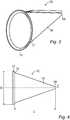
- the valve element 12 is illustrated without the housing 11 in Figs. 3-8 .
- the valve element 12 is arranged in a resilient flexible material, such as an elastomer material, rubber or similar, wherein it is deformable from a default configuration to a deformed configuration upon application of a force and then returns to its default configuration when the application of the force ceases.
- the valve element 12 is illustrated in its default configuration in Figs. 3-8 and any given dimensions and angles are given for the valve element 12 in its default configuration.
- the valve element 12 is formed in polyurethane.
- the valve element 12 is impermeable to water or at least substantially impermeable to water.
- the valve element 12 is also impermeable to gas, such as methane gas and other odorous gases.
- the valve element 12 is both liquid and gas proof.
- the valve element 12 comprises a tapered body 16 and an outwardly projecting flange 17.
- the valve element 12 and the tapered body 16 has a wide end 18 and a narrow end 19.
- the tapered body 16 is continuously tapered between the wide and narrow ends 18, 19, e.g. with the same angle from the wide end 18 to the narrow end 19.
- the tapered body 16 is formed substantially as a cone, such as an oblique circular cone.
- the tapered body 16 is, e.g. terminated with the flange 17 at the wide end.
- the outer circumference adjacent to the base of the cone shaped tapered body 16 is formed with the flange 17.
- the flange 17 extends around the circumference of the tapered body 16, such as around the entire circumference of the wide end 18 of the tapered body 16, wherein the flange 17 is continuous, closed and ring shaped.
- the valve element 12 has a longitudinal centre axis C, which also is the longitudinal centre axis of the tapered body 16.
- the valve element 12 is formed with suitable dimensions for the desired application.
- the check valve 10 is arranged for pipes having an inner diameter of 10-2100 mm, wherein a largest outer diameter D of the valve element 12 is 10-2100 mm or slightly more than the inner diameter of the pipes.
- the diameter D at the wide end 18 is 101 mm.
- the length L of the valve element 12 is larger than the diameter D, such as about 25% larger.
- the length L of the tapered body 16, i.e. excluding the flange 17 is, e.g. 122 mm.
- the tapered body 16 is arranged with an apex angle ⁇ of 30-45 degrees or about 35 degrees.
- the entire length of the tapered body 16 is arranged with the same interior apex angle ⁇ up to the flange 17.
- a first part of the tapered body 16 is arranged in parallel to the centre axis C and hence extends in the longitudinal direction.
- the flange 17 comprises a curved outer surface portion 20 having a degree of curvature of 85 to 95 degrees or 90 degrees.
- the curved outer surface portion 20 is formed as a part of a circle or ellipse, i.e. an arc.
- the curved outer surface portion 20 is formed as an arc turning 85 to 95 degrees or 90 degrees, wherein the angle between a first end of the curved outer surface portion 20 and a second end of the curved outer surface portion 20 is 85 to 95 degrees or 90 degrees.
- the curved outer surface portion 20 is formed as an arc corresponding to a quarter circle.
- the curved outer surface portion 20 extends from a radially directed first end to an axially directed second end.
- an outer radius R of the flange 17 is 1-25 mm, 2-10 mm, 4-6 mm or 5 mm.
- a valve element 12 having a tapered body 16 with a length L of 122 mm and a diameter D of the wide end 18 of 101 mm has a radius R of the flange 17 of 5 mm.
- the first end of the curved outer surface portion 20 is directly connected to the outer surface of the tapered body 16 forming a distinct edge 21 to the outer surface of the tapered body 16.
- the opposite second end of the curved outer surface portion 20 is directly followed by a straight portion 22 extending from the second end of the curved outer surface portion 20 in the longitudinal direction towards the outlet 14.
- the flange 17 is terminated at the wide end 18 of the valve element with the straight portion 22.
- the straight portion 22 is arranged with a length S of at least 0.5 mm, such as 0.5 to 30 mm or 0.5 to 10 mm.
- the length S of the straight portion is at least 1 mm.
- the straight portion 22 is followed by a radially extending surface 23.
- the radially extending surface 23 is straight, level and extends perpendicular to the straight portion 22 of the flange 17.
- the radially extending surface 23 is arranged with a height H of not more than 5 mm or not more than 2 mm or less than 2 mm.
- a thickness T of the wall of the tapered body 16, i.e. excluding the flange 17, is, for example 1-10 mm, such as 2 mm for a tapered body 16 having a length L of 122 mm and a diameter D of the wide end 18 of the valve element 12 of 101 mm.
- the valve element 12 comprises a circumferential interior edge portion 24.
- the interior edge portion 24 is arranged at the wide end 18 of the tapered body 16.
- the interior edge portion 24 is arranged opposite to the flange 17, wherein the flange 17 projects radially outwardly at the wide end 18 of the tapered body 16 while the interior edge portion 24 is arranged on the interior side at the wide end 18.
- the tapered body 16 is terminated at the wide end 18 with the flange 17 on the outer side and the interior edge portion 24 on the inner side.
- the interior edge portion 24 is arranged in an oblique angle to the longitudinal axis C.
- the interior edge portion 24 is a flat straight surface.
- the interior edge portion 24 is, e.g.
- the interior edge portion 24 extends in a plane parallel to a tangent plane to the middle of the curved outer surface portion 20, i.e. along a line in which the flange 17 is thickest and the distance between the interior edge portion 24 and the curved outer surface portion 20 is at its biggest.
- the interior edge portion 24 is arranged at an angle of 40-50 , such as 45 , to the longitudinal centre axis C.
- the interior edge portion 24 is arranged to form a chamfer of the tapered body 16, at least around a portion of its circumference, at the inner side of the wide end 18.
- the interior edge portion 24 is arranged in an oblique angle outward in relation to the longitudinal axis C to further widen the interior side of the wide end 18.
- the interior edge portion 24 extends around the entire interior circumference of the valve element 12.
- the interior edge portion 24 is arranged with an angle to the longitudinal axis C being larger than the angle ⁇ of the tapered body 16.
- the illustrated embodiment of the valve element 12 comprises an optional tongue 25.
- the tongue 25 is arranged on the exterior of the tapered body 16 and extends in the longitudinal direction thereof, wherein the tongue 25 projects in a radial plane.
- the tongue 25 is elongated.
- the tongue 25 is tapered towards the flange 17 so that the height of the tongue 25 is decreased towards the flange 17.
- the tongue 25 is substantially formed as two parallel and radially displaced cylindrical portions 26, 27 connected to each other through a connecting portion 28.
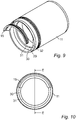
- the housing 11 and the fastening element 15 are illustrated according to one embodiment without the valve element 12.
- the housing 11 is formed with a protrusion 29 having a curved surface 30 for engaging the curved outer surface portion 20 of the flange 17.
- the curved surface 30 of the protrusion 29 corresponds to the curved outer surface portion 20 of the flange 17.
- the curved surface 30 of the protrusion 29 extends around the entire interior circumference of the housing 11 and is arranged for engaging the curved outer surface portion 20 around the entire circumference of the flange 17 when the valve is closed.
- the curved surface 30 is generally directed towards the outlet 14 and prevents the valve element 12 from displacement in the longitudinal direction towards the inlet 13.
- the curved surface 30 extends from a first end being arranged substantially in the longitudinal direction C to a second end being arranged substantially perpendicular to the longitudinal direction C.
- the curved surface has a curvature of around 85-95 degrees or 90 degrees and is, e.g. formed as a quarter of a circle and has a radius corresponding to the radius of the curved outer surface portion 20 of the flange 17.
- the protrusion 29 is formed with a distinct edge 31 corresponding to the distinct edge 21 of the flange 17.
- the protrusion 29 is, for example arranged with a tapered surface 32 tapered towards the inlet 13, wherein the protrusion 29 is arranged with lower height towards the inlet 13.
- the distinct edge 31 is arranged between the curved surface 30 and the tapered surface 32.
- the curved surface 30 is terminated with the distinct edge 31.
- the curved surface 30 is arranged to engage the flange 17 to prevent the valve element 12 from being displaced towards the inlet 13, e.g. due to a high backflow pressure.
- the curved surface 30 is also arranged to support the valve element 12 when a backflow pressure forces the wide end 18 of the tapered body 16 outwards.
- the fastening element 15 is arranged for fastening the valve element 12 to the housing 11.
- the fastening element 15 is arranged resiliently flexible and with a profile to form a snap-in fastening function with the housing 11.
- the fastening element 15 is arranged for fastening to the housing 11 through of inherent resiliently flexible properties of the fastening element 15.
- the fastening element 15 is arched, wherein the ends of the fastening element 15 is resiliently displaceable towards each other, so that the fastening element 15 is insertable into the housing 11 in a compressed configuration and is expandable inside the housing 11.
- the fastening element 15 is arranged for fastening the valve element 12 by clamping it to the housing 11.
- the fastening element 15 is arranged for engaging a portion of the interior circumference of the housing 11 and the valve element 12, such as less than half of the circumference thereof.
- the fastening element 15 is arranged for engaging a portion of the interior circumference of the housing 11 and the valve element 12.
- one of the housing 11 and the fastening element 15 comprises at least one projection 33, such as a ridge, and the other comprises at least one recess 34, such as a groove, for receiving the projection to prevent displacement between the fastening element 15 and the housing 11.
- the projection is a radially extending ridge
- the recess is a radially extending groove.
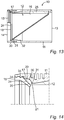
- the fastening element 15 comprises a clamping surface 35 for engaging a portion of the interior edge portion 24 of the valve element 12, which is illustrated in Figs. 13 and 14 .
- the flange 17 is clamped between the fastening element 15 and the curved surface 30 of the housing 11.
- the clamping surface 35 extends obliquely to the longitudinal axis C and substantially in parallel to the edge portion 24 of the valve element 12, such as 45 degrees to the longitudinal axis C.
- the housing 11 is formed with a groove 36 for receiving the tongue 25 of the valve element 12.
- the groove 36 extends in the longitudinal direction C of the check valve 10.
- a section view along a longitudinal centre axis C of the check valve 10 is illustrated schematically.
- the housing 11 extends in the longitudinal direction C and is, e.g. straight, wherein the inlet 13 and the outlet 14 are aligned, longitudinally displaced and arranged in parallel, so that they are spaced apart to form a gap between them.
- the check valve 10 is arranged to be mounted with its longitudinal axis at any angle, such as horizontally, vertically or at an oblique angle.
- valve element 12 is formed with the wide end 18 open and the narrow end 19 closed, wherein the valve element 12 is hollow and the tapered body 16 is open in a direction towards the outlet 14 and closed in a direction towards the inlet 13.
- the tapered body 16 is tapered in the longitudinal direction C towards the inlet 13.
- the narrow end 19 of the tapered body 16 is displaced radially from the longitudinal centre axis C.
- a first portion of the tapered body 16 is arranged in the longitudinal direction along the inner surface of the housing 11, wherein a radially opposite second portion of the tapered body 16 is inclined in relation to the longitudinal axis C.
- the first portion of the tapered body 16 engages the inner surface of the housing 11 and is arranged in parallel therewith and in parallel with the longitudinal axis C, wherein the second portion extends substantially diagonally through the housing 11.
- the first portion is a top portion and the second portion is a lower portion when the longitudinal axis C is horizontal.
- a part of a pipe system is illustrated schematically according to one embodiment, wherein the check valve 10 is arranged between a first pipe 37 and a second pipe 38.
- the illustrated embodiment is an inline installation.
- the check valve 10 is arranged at an inlet or outlet in a pipe system, wherein the check valve 10 is arranged in an inlet installation or an outlet installation.
- the check valve 10 is arranged at an inlet or outlet to a container, chamber or similar, wherein the check valve 10 is arranged in a chamber installation.
- a fluid such as waste water which can include liquids, gases, and/or semiliquid materials possibly in combination also with solid materials, is indicated by means of the wavy line F.
- the fluid F is entering the check valve 10 through the inlet 13 from the first pipe 37 in a direction illustrated by means of the arrow N, wherein the arrow N illustrates a normal flow direction.
- the check valve 10 is closed, wherein the valve element 12 is in its default configuration and the flange 17 engages the curved surface 30 of the housing 11 around the entire circumference thereof.
- the narrow end 19 of the tapered body 16 is arranged towards the inlet 13.
- the wide end 18 of the tapered body 16 engages the inner surface of the housing 11 to close the check valve 10.
- the fluid flow into the check valve 10 results in a fluid pressure against the valve element 12.
- the fluid flow into the check valve 10 from the inlet 13 results in a fluid pressure against the exterior surface of the tapered body 16.
- the fluid flow engages the exterior inclined surface of the tapered body 16, i.e. the surface of the tapered body 16 obliquely facing the inlet 13.
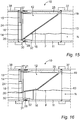
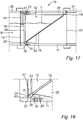
- the valve element 12 deforms to open the check valve 10, which is illustrated schematically in Fig. 16 .
- the valve element 12 is deformed by fluid pressure against it from the inlet 13, wherein the check valve 10 is open to let the fluid pass in the normal direction from the inlet 13 to the outlet 14 as illustrated by the arrow N.
- the fluid pressure required for opening the check valve 10 by deformation of the valve element 12 is predetermined, such as by adapting the material properties and thickness of the valve element 12, which e.g. is made in a conventional manner by a skilled person in view of the present disclosure.
- the valve element 12 returns to its closed default position by the inherent resilient flexible properties thereof.
- a backflow is illustrated wherein the fluid F enters through the outlet 14 and flows into the check valve 10 in a direction illustrated by means of the arrow B.
- the backflow enters into the interior of the hollow tapered body 16 through the wide end 18 thereof, wherein the check valve 10 remains closed and the backflow is stopped.
- the backflow fluid engages the oblique interior edge portion 24 of the tapered body 16 and forces the edge portion 24 towards the inner surface of the housing 11, which is illustrated by means of the arrow P in Fig. 18 .
- the backflow exerts a pressure on the edge portion 24 and presses the flange 17 and the curved outer surface portion 20 thereof towards the curved surface 30 to keep the check valve 10 closed.
- the inclined edge portion 24 results in a force directed obliquely outwards in the radial direction to press the wide end 18 of the tapered body 16 in the corresponding direction, such as 45 degrees to the longitudinal centre axis C, and forces the flange 17 towards the curved surface 30 of the housing 11 in said direction to prevent the backflow from leaking.
- the backflow is illustrated schematically.
- the backflow fills the tapered body 16 and exerts a pressure around the entire interior circumference of the tapered body 16 and towards the entire edge portion 24.
- the backflow pressure increases the force applied on the edge portion 24 is also increased to keep the check valve 10 closed.
Landscapes
- Engineering & Computer Science (AREA)
- General Engineering & Computer Science (AREA)
- Environmental & Geological Engineering (AREA)
- Health & Medical Sciences (AREA)
- Life Sciences & Earth Sciences (AREA)
- Hydrology & Water Resources (AREA)
- Public Health (AREA)
- Water Supply & Treatment (AREA)
- Mechanical Engineering (AREA)
- Check Valves (AREA)
Claims (15)
- Rückschlagventil (10) zum Steuern eines Fluidstroms durch Fluiddruck, das ein rohrförmiges Gehäuse (11) und ein elastisches flexibles Ventilelement (12) umfasst, das wenigstens teilweise innerhalb des Gehäuses (11) angeordnet ist, wobei das Gehäuse (11) eine Leitung, die eine Längsmittelachse (C) für das Fluid aufweist, ausbildet und einen Einlass (13) und einen Auslass (14) für das Fluid umfasst, wobei das Ventilelement (12) als ein hohler und sich in Längsrichtung verjüngender Körper (16) mit einem zu dem Auslass (14) gerichteten offenen breiten Ende (18) und einem zu dem Einlass (13) gerichteten geschlossenen schmalen Ende (19) ausgebildet ist, und wobei das breite Ende (18) des Ventilelements (12) in einer Standardkonfiguration eine Innenoberfläche des Gehäuses (11) in Eingriff nimmt, um das Rückschlagventil (10) zu schließen, und durch einen zuvor bestimmten Fluiddruck von dem Einlass (13) verformbar ist, um das Rückschlagventil (10) zu öffnen,wobei der sich verjüngende Körper (16) einen radial nach außen vorstehenden Flansch (17) an dem breiten Ende (18) umfasst,dadurch gekennzeichnet, dass der Flansch (17) einen gekrümmten Außenoberflächenabschnitt (20) umfasst, der einen Krümmungsgrad von 85 bis 95 Grad aufweist, wenn er in einem Schnitt entlang der Längsmittelachse betrachtet wird, unddass das Gehäuse (11) mit einem Vorsprung (29) ausgebildet ist, der eine gekrümmte Oberfläche (30) zum Ineingriffnehmen des gekrümmten Außenoberflächenabschnitts (20) des Flansches (17) aufweist.
- Rückschlagventil nach Anspruch 1, wobei der gekrümmte Außenoberflächenabschnitt (20) einen Krümmungsgrad von 90 Grad aufweist.
- Rückschlagventil nach Anspruch 1 oder 2, wobei die gekrümmte Oberfläche (30) des Vorsprungs (29) dem gekrümmten Außenoberflächenabschnitt (20) des Flansches (17) entspricht.
- Rückschlagventil nach einem der vorhergehenden Ansprüche, wobei dem gekrümmten Außenoberflächenabschnitt (20) des Flansches (17) ein gerader Abschnitt (22) folgt, der sich von dem gekrümmten Außenoberflächenabschnitt (20) in der Längsrichtung (C) zu dem Auslass (14) hin erstreckt.
- Rückschlagventil nach einem der vorhergehenden Ansprüche, wobei ein gerader umlaufender Innenkantenabschnitt (24) an dem breiten Ende (18) des sich verjüngenden Körpers (16) in einem schrägen Winkel zu der Längsachse (C) angeordnet ist.
- Rückschlagventil nach Anspruch 5, wobei der gerade Innenkantenabschnitt (24) senkrecht zu einer gedachten Radiuslinie durch die Mitte des gekrümmten Außenoberflächenabschnitts (20) angeordnet ist.
- Rückschlagventil nach Anspruch 5 oder 6, wobei der gerade Innenkantenabschnitt (24) in einem Winkel von 45 zu der Längsachse (C) angeordnet ist.
- Rückschlagventil nach einem der vorhergehenden Ansprüche, das ein elastisch flexibles Befestigungselement (15) zum Festklemmen des Ventilelements (12) an das Gehäuse (11) mittels inhärenter elastisch flexibler Eigenschaften des Befestigungselements (15) umfasst.
- Rückschlagventil nach Anspruch 8, wobei das Gehäuse (11) oder das Befestigungselement (15) ein vorstehendes Teil (33) umfasst und das andere eine Aussparung (34) zum Aufnehmen des vorstehenden Teils (33) umfasst, um eine Verschiebung zwischen dem Befestigungselement (15) und dem Gehäuse (11) in Längsrichtung (C) zu verhindern.
- Rückschlagventil nach Anspruch 8 oder 9 und nach einem der Ansprüche 5 bis 7, wobei das Befestigungselement (15) eine Klemmoberfläche (35) zum Ineingriffnehmen eines Abschnitts des geraden Innenkantenabschnitts (24) an dem breiten Ende (18) des sich verjüngenden Körpers (16) umfasst.
- Rückschlagventil nach einem der vorhergehenden Ansprüche, wobei der sich verjüngende Körper (16) des Ventilelements (12) eine äußere Längszunge (25) umfasst und wobei das Gehäuse (11) eine Nut (36) zum Aufnehmen der Zunge (25) umfasst.
- Rückschlagventil nach einem der vorhergehenden Ansprüche, wobei die gekrümmte Oberfläche (30) des Vorsprungs (29) mit einer eindeutigen Kante (31) abgeschlossen ist.
- Verfahren zum Steuern eines Fluidstroms durch Fluiddruck, das die folgenden Schritte umfasst:a) Leiten von Fluid zu einem Einlass (13) in einem rohrförmigen Gehäuse (11) eines Rückschlagventils (10), wobei das Gehäuse (11) eine Längsachse (C) aufweist,b) innerhalb des Gehäuses (11), Leiten des Fluids in Kontakt mit einem elastischen, flexiblen Ventilelement (12), das als ein hohler, sich in Längsrichtung verjüngender Körper (16) ausgebildet ist, der ein zu einem Auslass (14) des Gehäuses (11) gerichtetes offenes breites Ende (18) und ein zu dem Einlass (13) gerichtetes geschlossenes schmales Ende (19) aufweist,c) Erhöhen des Fluiddrucks gegen das Ventilelement (12) auf einen zuvor bestimmten Schwellenwert,d) mittels des erhöhten Fluiddrucks, Verformen des Ventilelements (12) aus einer Standardkonfiguration, in der ein gekrümmter Außenoberflächenabschnitt (20), der einen Krümmungsgrad von 85 bis 95 Grad aufweist, wenn er in einem Schnitt entlang der Längsmittelachse betrachtet wird, eines nach außen vorstehenden Umfangsflansches (17) an dem breiten Ende (18) des sich verjüngenden Körpers (16) mit einer entsprechenden gekrümmten Oberfläche (30) eines Vorsprungs (29) des Gehäuses (11) in Eingriff steht, um das Rückschlagventil (10) zu schließen, in eine verformte Konfiguration, in der der Flansch (17) von der gekrümmten Oberfläche (30) um einen Abschnitt des Umfangs gelöst ist und dadurch das Rückschlagventil (10) öffnet,e) Leiten von Fluid aus dem Gehäuse (11) durch den Auslass (14), undf) Zurückführen des Ventilelements (12) in seine Standardkonfiguration mittels inhärenter elastischer Eigenschaften des Ventilelements (12), wenn der Fluiddruck auf ein Niveau unter dem zuvor bestimmten Schwellenwert verringert wird.
- Verfahren nach Anspruch 13, das die folgenden Schritte umfasst:- Veranlassen eines Rückstroms des durch den Auslass (14) eintretenden Fluids, einen geraden inneren Umfangskantenabschnitt (24) an dem breiten Ende (18) des sich verjüngenden Körpers (16) in Eingriff zu nehmen, und- Drücken des Kantenabschnitts (24) schräg radial nach außen, indem der Kantenabschnitt (24) in einem schrägen Winkel zu der Längsachse (C) angeordnet ist und dadurch den Flansch (17) gegen die gekrümmte Oberfläche (30) drückt.
- Verfahren nach Anspruch 14, das den folgenden Schritt umfasst:- Drücken des Kantenabschnitts (24) schräg radial nach außen, indem der Kantenabschnitt (22) in einem Winkel von 45 zu der Längsachse (C) angeordnet ist und dadurch den Flansch (17) in dem entsprechenden Winkel gegen die gekrümmte Oberfläche (30) drückt.
Applications Claiming Priority (1)
| Application Number | Priority Date | Filing Date | Title |
|---|---|---|---|
| PCT/EP2018/050106 WO2019134740A1 (en) | 2018-01-03 | 2018-01-03 | A check valve and a method for controlling a flow of fluid by fluid pressure |
Publications (2)
| Publication Number | Publication Date |
|---|---|
| EP3735546A1 EP3735546A1 (de) | 2020-11-11 |
| EP3735546B1 true EP3735546B1 (de) | 2021-11-10 |
Family
ID=61007668
Family Applications (1)
| Application Number | Title | Priority Date | Filing Date |
|---|---|---|---|
| EP18700850.3A Active EP3735546B1 (de) | 2018-01-03 | 2018-01-03 | Rückschlagventil und verfahren zur steuerung eines flüssigkeitsstroms durch flüssigkeitsdruck |
Country Status (3)
| Country | Link |
|---|---|
| US (1) | US11261589B2 (de) |
| EP (1) | EP3735546B1 (de) |
| WO (1) | WO2019134740A1 (de) |
Families Citing this family (3)
| Publication number | Priority date | Publication date | Assignee | Title |
|---|---|---|---|---|
| CN113737930A (zh) * | 2020-05-29 | 2021-12-03 | 洼石环境工程(上海)有限公司 | 一种无动力管内型防倒灌装置 |
| EP4141299B1 (de) * | 2021-08-27 | 2025-02-19 | Norham | Rückschlagventil mit membran |
| FR3130348B1 (fr) * | 2021-12-13 | 2023-11-03 | Zeller Thiebaut | Insert pour siphon de canalisation comportant un joint anti-retour intégré et une bague de connexion |
Family Cites Families (6)
| Publication number | Priority date | Publication date | Assignee | Title |
|---|---|---|---|---|
| US24479A (en) * | 1859-06-21 | Window-curtain fixture | ||
| US2347988A (en) * | 1943-10-20 | 1944-05-02 | Ormonde J Burke | Valve construction |
| SE522313C2 (sv) * | 2000-01-04 | 2004-02-03 | Mats Persson | Sätt och anordning för åstadkommande av envägsflöde |
| US20030183286A1 (en) * | 2002-03-27 | 2003-10-02 | Yang Tsai Chen | Water control valve device having check valve |
| SE526363C2 (sv) * | 2004-03-15 | 2005-08-30 | Sjoebo Bruk Ab | Luktspärr |
| NL2013615B1 (nl) * | 2014-10-10 | 2016-10-04 | Herikon B V | Stankafsluiter en werkwijze voor het plaatsen van de stankafsluiter in een afvoerbuis. |
-
2018
- 2018-01-03 EP EP18700850.3A patent/EP3735546B1/de active Active
- 2018-01-03 WO PCT/EP2018/050106 patent/WO2019134740A1/en not_active Ceased
- 2018-01-03 US US16/958,238 patent/US11261589B2/en active Active
Also Published As
| Publication number | Publication date |
|---|---|
| US11261589B2 (en) | 2022-03-01 |
| WO2019134740A1 (en) | 2019-07-11 |
| EP3735546A1 (de) | 2020-11-11 |
| US20200399879A1 (en) | 2020-12-24 |
Similar Documents
| Publication | Publication Date | Title |
|---|---|---|
| US5687976A (en) | Symmetrical gasket for a pipe joint | |
| US20230250903A1 (en) | Compression pipe fitting with wide range grip rings | |
| US4870992A (en) | Backflow prevention device | |
| US6343623B2 (en) | Sealing ring for connecting the spigot of a corrugated pipe with a pipe socket having a smooth inside wall | |
| AU2017334556B2 (en) | Sealing gasket with corrugated insert for sealing restrained or non-restrained plastic pipelines | |
| US8801048B2 (en) | Mechanical pipe coupling assembly without adhesive or bonding agent | |
| US11261589B2 (en) | Check valve and a method for controlling a flow of fluid by fluid pressure | |
| CN107076323B (zh) | 改进的阀 | |
| AU2011258534B2 (en) | Simplified low insertion force sealing device capable of self restraint and joint deflection | |
| CN102498321B (zh) | 止回阀 | |
| EA014478B1 (ru) | Раструбное соединение | |
| US20110132474A1 (en) | Back Flow Prevention System | |
| EP3488131B1 (de) | Elastomeres inline-gezeitenabsperrventil | |
| WO2018006949A1 (en) | A check valve and a method for controlling a flow of fluid by fluid pressure | |
| GB2346198A (en) | Non-return device | |
| WO2006062392A1 (en) | Backflow-preventer | |
| US20180252344A1 (en) | Mechanical pipe coupling assembly without adhesive or bonding agent | |
| US7363944B2 (en) | Sealing mechanism for diaphragm tank | |
| KR102661554B1 (ko) | 합성수지 재질의 버터플라이 밸브 | |
| US20200325666A1 (en) | One way Valve For Water Fixture | |
| US20250067355A1 (en) | Tide Gate Check Valve with an Enlarged Integral Annular Wall | |
| JP6371890B2 (ja) | 分岐装置 | |
| US20260132859A1 (en) | Check Valve With Secondary Flap | |
| JP6126117B2 (ja) | 逆流防止装置 | |
| KR102074503B1 (ko) | 싱크대용 배수장치 |
Legal Events
| Date | Code | Title | Description |
|---|---|---|---|
| STAA | Information on the status of an ep patent application or granted ep patent |
Free format text: STATUS: UNKNOWN |
|
| STAA | Information on the status of an ep patent application or granted ep patent |
Free format text: STATUS: THE INTERNATIONAL PUBLICATION HAS BEEN MADE |
|
| PUAI | Public reference made under article 153(3) epc to a published international application that has entered the european phase |
Free format text: ORIGINAL CODE: 0009012 |
|
| STAA | Information on the status of an ep patent application or granted ep patent |
Free format text: STATUS: REQUEST FOR EXAMINATION WAS MADE |
|
| 17P | Request for examination filed |
Effective date: 20200608 |
|
| AK | Designated contracting states |
Kind code of ref document: A1 Designated state(s): AL AT BE BG CH CY CZ DE DK EE ES FI FR GB GR HR HU IE IS IT LI LT LU LV MC MK MT NL NO PL PT RO RS SE SI SK SM TR |
|
| AX | Request for extension of the european patent |
Extension state: BA ME |
|
| DAV | Request for validation of the european patent (deleted) | ||
| DAX | Request for extension of the european patent (deleted) | ||
| GRAP | Despatch of communication of intention to grant a patent |
Free format text: ORIGINAL CODE: EPIDOSNIGR1 |
|
| STAA | Information on the status of an ep patent application or granted ep patent |
Free format text: STATUS: GRANT OF PATENT IS INTENDED |
|
| INTG | Intention to grant announced |
Effective date: 20210809 |
|
| GRAS | Grant fee paid |
Free format text: ORIGINAL CODE: EPIDOSNIGR3 |
|
| GRAA | (expected) grant |
Free format text: ORIGINAL CODE: 0009210 |
|
| STAA | Information on the status of an ep patent application or granted ep patent |
Free format text: STATUS: THE PATENT HAS BEEN GRANTED |
|
| AK | Designated contracting states |
Kind code of ref document: B1 Designated state(s): AL AT BE BG CH CY CZ DE DK EE ES FI FR GB GR HR HU IE IS IT LI LT LU LV MC MK MT NL NO PL PT RO RS SE SI SK SM TR |
|
| REG | Reference to a national code |
Ref country code: GB Ref legal event code: FG4D |
|
| REG | Reference to a national code |
Ref country code: AT Ref legal event code: REF Ref document number: 1446381 Country of ref document: AT Kind code of ref document: T Effective date: 20211115 Ref country code: CH Ref legal event code: EP |
|
| REG | Reference to a national code |
Ref country code: DE Ref legal event code: R096 Ref document number: 602018026410 Country of ref document: DE |
|
| REG | Reference to a national code |
Ref country code: IE Ref legal event code: FG4D |
|
| REG | Reference to a national code |
Ref country code: SE Ref legal event code: TRGR |
|
| REG | Reference to a national code |
Ref country code: LT Ref legal event code: MG9D |
|
| REG | Reference to a national code |
Ref country code: NL Ref legal event code: MP Effective date: 20211110 |
|
| PG25 | Lapsed in a contracting state [announced via postgrant information from national office to epo] |
Ref country code: RS Free format text: LAPSE BECAUSE OF FAILURE TO SUBMIT A TRANSLATION OF THE DESCRIPTION OR TO PAY THE FEE WITHIN THE PRESCRIBED TIME-LIMIT Effective date: 20211110 Ref country code: LT Free format text: LAPSE BECAUSE OF FAILURE TO SUBMIT A TRANSLATION OF THE DESCRIPTION OR TO PAY THE FEE WITHIN THE PRESCRIBED TIME-LIMIT Effective date: 20211110 Ref country code: FI Free format text: LAPSE BECAUSE OF FAILURE TO SUBMIT A TRANSLATION OF THE DESCRIPTION OR TO PAY THE FEE WITHIN THE PRESCRIBED TIME-LIMIT Effective date: 20211110 Ref country code: BG Free format text: LAPSE BECAUSE OF FAILURE TO SUBMIT A TRANSLATION OF THE DESCRIPTION OR TO PAY THE FEE WITHIN THE PRESCRIBED TIME-LIMIT Effective date: 20220210 |
|
| PG25 | Lapsed in a contracting state [announced via postgrant information from national office to epo] |
Ref country code: IS Free format text: LAPSE BECAUSE OF FAILURE TO SUBMIT A TRANSLATION OF THE DESCRIPTION OR TO PAY THE FEE WITHIN THE PRESCRIBED TIME-LIMIT Effective date: 20220310 Ref country code: PT Free format text: LAPSE BECAUSE OF FAILURE TO SUBMIT A TRANSLATION OF THE DESCRIPTION OR TO PAY THE FEE WITHIN THE PRESCRIBED TIME-LIMIT Effective date: 20220310 Ref country code: PL Free format text: LAPSE BECAUSE OF FAILURE TO SUBMIT A TRANSLATION OF THE DESCRIPTION OR TO PAY THE FEE WITHIN THE PRESCRIBED TIME-LIMIT Effective date: 20211110 Ref country code: NO Free format text: LAPSE BECAUSE OF FAILURE TO SUBMIT A TRANSLATION OF THE DESCRIPTION OR TO PAY THE FEE WITHIN THE PRESCRIBED TIME-LIMIT Effective date: 20220210 Ref country code: NL Free format text: LAPSE BECAUSE OF FAILURE TO SUBMIT A TRANSLATION OF THE DESCRIPTION OR TO PAY THE FEE WITHIN THE PRESCRIBED TIME-LIMIT Effective date: 20211110 Ref country code: LV Free format text: LAPSE BECAUSE OF FAILURE TO SUBMIT A TRANSLATION OF THE DESCRIPTION OR TO PAY THE FEE WITHIN THE PRESCRIBED TIME-LIMIT Effective date: 20211110 Ref country code: HR Free format text: LAPSE BECAUSE OF FAILURE TO SUBMIT A TRANSLATION OF THE DESCRIPTION OR TO PAY THE FEE WITHIN THE PRESCRIBED TIME-LIMIT Effective date: 20211110 Ref country code: GR Free format text: LAPSE BECAUSE OF FAILURE TO SUBMIT A TRANSLATION OF THE DESCRIPTION OR TO PAY THE FEE WITHIN THE PRESCRIBED TIME-LIMIT Effective date: 20220211 |
|
| PG25 | Lapsed in a contracting state [announced via postgrant information from national office to epo] |
Ref country code: SM Free format text: LAPSE BECAUSE OF FAILURE TO SUBMIT A TRANSLATION OF THE DESCRIPTION OR TO PAY THE FEE WITHIN THE PRESCRIBED TIME-LIMIT Effective date: 20211110 Ref country code: SK Free format text: LAPSE BECAUSE OF FAILURE TO SUBMIT A TRANSLATION OF THE DESCRIPTION OR TO PAY THE FEE WITHIN THE PRESCRIBED TIME-LIMIT Effective date: 20211110 Ref country code: RO Free format text: LAPSE BECAUSE OF FAILURE TO SUBMIT A TRANSLATION OF THE DESCRIPTION OR TO PAY THE FEE WITHIN THE PRESCRIBED TIME-LIMIT Effective date: 20211110 Ref country code: ES Free format text: LAPSE BECAUSE OF FAILURE TO SUBMIT A TRANSLATION OF THE DESCRIPTION OR TO PAY THE FEE WITHIN THE PRESCRIBED TIME-LIMIT Effective date: 20211110 Ref country code: EE Free format text: LAPSE BECAUSE OF FAILURE TO SUBMIT A TRANSLATION OF THE DESCRIPTION OR TO PAY THE FEE WITHIN THE PRESCRIBED TIME-LIMIT Effective date: 20211110 Ref country code: DK Free format text: LAPSE BECAUSE OF FAILURE TO SUBMIT A TRANSLATION OF THE DESCRIPTION OR TO PAY THE FEE WITHIN THE PRESCRIBED TIME-LIMIT Effective date: 20211110 Ref country code: CZ Free format text: LAPSE BECAUSE OF FAILURE TO SUBMIT A TRANSLATION OF THE DESCRIPTION OR TO PAY THE FEE WITHIN THE PRESCRIBED TIME-LIMIT Effective date: 20211110 |
|
| REG | Reference to a national code |
Ref country code: DE Ref legal event code: R097 Ref document number: 602018026410 Country of ref document: DE |
|
| PG25 | Lapsed in a contracting state [announced via postgrant information from national office to epo] |
Ref country code: MC Free format text: LAPSE BECAUSE OF FAILURE TO SUBMIT A TRANSLATION OF THE DESCRIPTION OR TO PAY THE FEE WITHIN THE PRESCRIBED TIME-LIMIT Effective date: 20211110 |
|
| PLBE | No opposition filed within time limit |
Free format text: ORIGINAL CODE: 0009261 |
|
| STAA | Information on the status of an ep patent application or granted ep patent |
Free format text: STATUS: NO OPPOSITION FILED WITHIN TIME LIMIT |
|
| REG | Reference to a national code |
Ref country code: BE Ref legal event code: MM Effective date: 20220131 |
|
| 26N | No opposition filed |
Effective date: 20220811 |
|
| PG25 | Lapsed in a contracting state [announced via postgrant information from national office to epo] |
Ref country code: LU Free format text: LAPSE BECAUSE OF NON-PAYMENT OF DUE FEES Effective date: 20220103 Ref country code: AL Free format text: LAPSE BECAUSE OF FAILURE TO SUBMIT A TRANSLATION OF THE DESCRIPTION OR TO PAY THE FEE WITHIN THE PRESCRIBED TIME-LIMIT Effective date: 20211110 |
|
| PG25 | Lapsed in a contracting state [announced via postgrant information from national office to epo] |
Ref country code: SI Free format text: LAPSE BECAUSE OF FAILURE TO SUBMIT A TRANSLATION OF THE DESCRIPTION OR TO PAY THE FEE WITHIN THE PRESCRIBED TIME-LIMIT Effective date: 20211110 Ref country code: BE Free format text: LAPSE BECAUSE OF NON-PAYMENT OF DUE FEES Effective date: 20220131 |
|
| PG25 | Lapsed in a contracting state [announced via postgrant information from national office to epo] |
Ref country code: IE Free format text: LAPSE BECAUSE OF NON-PAYMENT OF DUE FEES Effective date: 20220103 |
|
| REG | Reference to a national code |
Ref country code: AT Ref legal event code: UEP Ref document number: 1446381 Country of ref document: AT Kind code of ref document: T Effective date: 20211110 |
|
| PG25 | Lapsed in a contracting state [announced via postgrant information from national office to epo] |
Ref country code: IT Free format text: LAPSE BECAUSE OF FAILURE TO SUBMIT A TRANSLATION OF THE DESCRIPTION OR TO PAY THE FEE WITHIN THE PRESCRIBED TIME-LIMIT Effective date: 20211110 |
|
| P01 | Opt-out of the competence of the unified patent court (upc) registered |
Effective date: 20230502 |
|
| PG25 | Lapsed in a contracting state [announced via postgrant information from national office to epo] |
Ref country code: MK Free format text: LAPSE BECAUSE OF FAILURE TO SUBMIT A TRANSLATION OF THE DESCRIPTION OR TO PAY THE FEE WITHIN THE PRESCRIBED TIME-LIMIT Effective date: 20211110 Ref country code: CY Free format text: LAPSE BECAUSE OF FAILURE TO SUBMIT A TRANSLATION OF THE DESCRIPTION OR TO PAY THE FEE WITHIN THE PRESCRIBED TIME-LIMIT Effective date: 20211110 |
|
| PG25 | Lapsed in a contracting state [announced via postgrant information from national office to epo] |
Ref country code: HU Free format text: LAPSE BECAUSE OF FAILURE TO SUBMIT A TRANSLATION OF THE DESCRIPTION OR TO PAY THE FEE WITHIN THE PRESCRIBED TIME-LIMIT; INVALID AB INITIO Effective date: 20180103 |
|
| PG25 | Lapsed in a contracting state [announced via postgrant information from national office to epo] |
Ref country code: MT Free format text: LAPSE BECAUSE OF FAILURE TO SUBMIT A TRANSLATION OF THE DESCRIPTION OR TO PAY THE FEE WITHIN THE PRESCRIBED TIME-LIMIT Effective date: 20211110 |
|
| PG25 | Lapsed in a contracting state [announced via postgrant information from national office to epo] |
Ref country code: TR Free format text: LAPSE BECAUSE OF FAILURE TO SUBMIT A TRANSLATION OF THE DESCRIPTION OR TO PAY THE FEE WITHIN THE PRESCRIBED TIME-LIMIT Effective date: 20211110 |
|
| REG | Reference to a national code |
Ref country code: CH Ref legal event code: U11 Free format text: ST27 STATUS EVENT CODE: U-0-0-U10-U11 (AS PROVIDED BY THE NATIONAL OFFICE) Effective date: 20260202 |
|
| PGFP | Annual fee paid to national office [announced via postgrant information from national office to epo] |
Ref country code: SE Payment date: 20260122 Year of fee payment: 9 |
|
| PGFP | Annual fee paid to national office [announced via postgrant information from national office to epo] |
Ref country code: GB Payment date: 20260122 Year of fee payment: 9 |
|
| PGFP | Annual fee paid to national office [announced via postgrant information from national office to epo] |
Ref country code: DE Payment date: 20260123 Year of fee payment: 9 |
|
| PGFP | Annual fee paid to national office [announced via postgrant information from national office to epo] |
Ref country code: AT Payment date: 20260126 Year of fee payment: 9 |
|
| PGFP | Annual fee paid to national office [announced via postgrant information from national office to epo] |
Ref country code: FR Payment date: 20260122 Year of fee payment: 9 |
|
| PGFP | Annual fee paid to national office [announced via postgrant information from national office to epo] |
Ref country code: CH Payment date: 20260202 Year of fee payment: 9 |