EP3736014A2 - Protection contre le pliage de la lumière de gonflage et profil de ballonnet - Google Patents
Protection contre le pliage de la lumière de gonflage et profil de ballonnet Download PDFInfo
- Publication number
- EP3736014A2 EP3736014A2 EP20173509.9A EP20173509A EP3736014A2 EP 3736014 A2 EP3736014 A2 EP 3736014A2 EP 20173509 A EP20173509 A EP 20173509A EP 3736014 A2 EP3736014 A2 EP 3736014A2
- Authority
- EP
- European Patent Office
- Prior art keywords
- balloon
- catheter
- inflation
- inflation lumen
- tubular member
- Prior art date
- Legal status (The legal status is an assumption and is not a legal conclusion. Google has not performed a legal analysis and makes no representation as to the accuracy of the status listed.)
- Pending
Links
Images












Classifications
-
- A—HUMAN NECESSITIES
- A61—MEDICAL OR VETERINARY SCIENCE; HYGIENE
- A61M—DEVICES FOR INTRODUCING MEDIA INTO, OR ONTO, THE BODY; DEVICES FOR TRANSDUCING BODY MEDIA OR FOR TAKING MEDIA FROM THE BODY; DEVICES FOR PRODUCING OR ENDING SLEEP OR STUPOR
- A61M25/00—Catheters; Hollow probes
- A61M25/10—Balloon catheters
- A61M25/1002—Balloon catheters characterised by balloon shape
-
- A—HUMAN NECESSITIES
- A61—MEDICAL OR VETERINARY SCIENCE; HYGIENE
- A61M—DEVICES FOR INTRODUCING MEDIA INTO, OR ONTO, THE BODY; DEVICES FOR TRANSDUCING BODY MEDIA OR FOR TAKING MEDIA FROM THE BODY; DEVICES FOR PRODUCING OR ENDING SLEEP OR STUPOR
- A61M25/00—Catheters; Hollow probes
- A61M25/10—Balloon catheters
- A61M25/1018—Balloon inflating or inflation-control devices
-
- A—HUMAN NECESSITIES
- A61—MEDICAL OR VETERINARY SCIENCE; HYGIENE
- A61M—DEVICES FOR INTRODUCING MEDIA INTO, OR ONTO, THE BODY; DEVICES FOR TRANSDUCING BODY MEDIA OR FOR TAKING MEDIA FROM THE BODY; DEVICES FOR PRODUCING OR ENDING SLEEP OR STUPOR
- A61M25/00—Catheters; Hollow probes
- A61M25/10—Balloon catheters
- A61M25/104—Balloon catheters used for angioplasty
-
- A—HUMAN NECESSITIES
- A61—MEDICAL OR VETERINARY SCIENCE; HYGIENE
- A61B—DIAGNOSIS; SURGERY; IDENTIFICATION
- A61B17/00—Surgical instruments, devices or methods
- A61B17/12—Surgical instruments, devices or methods for ligaturing or otherwise compressing tubular parts of the body, e.g. blood vessels or umbilical cord
- A61B17/12022—Occluding by internal devices, e.g. balloons or releasable wires
- A61B17/12099—Occluding by internal devices, e.g. balloons or releasable wires characterised by the location of the occluder
- A61B17/12109—Occluding by internal devices, e.g. balloons or releasable wires characterised by the location of the occluder in a blood vessel
-
- A—HUMAN NECESSITIES
- A61—MEDICAL OR VETERINARY SCIENCE; HYGIENE
- A61B—DIAGNOSIS; SURGERY; IDENTIFICATION
- A61B17/00—Surgical instruments, devices or methods
- A61B17/12—Surgical instruments, devices or methods for ligaturing or otherwise compressing tubular parts of the body, e.g. blood vessels or umbilical cord
- A61B17/12022—Occluding by internal devices, e.g. balloons or releasable wires
- A61B17/12131—Occluding by internal devices, e.g. balloons or releasable wires characterised by the type of occluding device
- A61B17/12136—Balloons
-
- A—HUMAN NECESSITIES
- A61—MEDICAL OR VETERINARY SCIENCE; HYGIENE
- A61B—DIAGNOSIS; SURGERY; IDENTIFICATION
- A61B17/00—Surgical instruments, devices or methods
- A61B17/22—Implements for squeezing-off ulcers or the like on inner organs of the body; Implements for scraping-out cavities of body organs, e.g. bones; for invasive removal or destruction of calculus using mechanical vibrations; for removing obstructions in blood vessels, not otherwise provided for
-
- A—HUMAN NECESSITIES
- A61—MEDICAL OR VETERINARY SCIENCE; HYGIENE
- A61M—DEVICES FOR INTRODUCING MEDIA INTO, OR ONTO, THE BODY; DEVICES FOR TRANSDUCING BODY MEDIA OR FOR TAKING MEDIA FROM THE BODY; DEVICES FOR PRODUCING OR ENDING SLEEP OR STUPOR
- A61M25/00—Catheters; Hollow probes
- A61M25/0021—Catheters; Hollow probes characterised by the form of the tubing
- A61M25/0023—Catheters; Hollow probes characterised by the form of the tubing by the form of the lumen, e.g. cross-section, variable diameter
- A61M25/0026—Multi-lumen catheters with stationary elements
-
- A—HUMAN NECESSITIES
- A61—MEDICAL OR VETERINARY SCIENCE; HYGIENE
- A61M—DEVICES FOR INTRODUCING MEDIA INTO, OR ONTO, THE BODY; DEVICES FOR TRANSDUCING BODY MEDIA OR FOR TAKING MEDIA FROM THE BODY; DEVICES FOR PRODUCING OR ENDING SLEEP OR STUPOR
- A61M25/00—Catheters; Hollow probes
- A61M25/0021—Catheters; Hollow probes characterised by the form of the tubing
- A61M25/0023—Catheters; Hollow probes characterised by the form of the tubing by the form of the lumen, e.g. cross-section, variable diameter
- A61M25/0026—Multi-lumen catheters with stationary elements
- A61M25/0032—Multi-lumen catheters with stationary elements characterized by at least one unconventionally shaped lumen, e.g. polygons, ellipsoids, wedges or shapes comprising concave and convex parts
-
- A—HUMAN NECESSITIES
- A61—MEDICAL OR VETERINARY SCIENCE; HYGIENE
- A61M—DEVICES FOR INTRODUCING MEDIA INTO, OR ONTO, THE BODY; DEVICES FOR TRANSDUCING BODY MEDIA OR FOR TAKING MEDIA FROM THE BODY; DEVICES FOR PRODUCING OR ENDING SLEEP OR STUPOR
- A61M25/00—Catheters; Hollow probes
- A61M25/0043—Catheters; Hollow probes characterised by structural features
- A61M25/005—Catheters; Hollow probes characterised by structural features with embedded materials for reinforcement, e.g. wires, coils, braids
-
- A—HUMAN NECESSITIES
- A61—MEDICAL OR VETERINARY SCIENCE; HYGIENE
- A61M—DEVICES FOR INTRODUCING MEDIA INTO, OR ONTO, THE BODY; DEVICES FOR TRANSDUCING BODY MEDIA OR FOR TAKING MEDIA FROM THE BODY; DEVICES FOR PRODUCING OR ENDING SLEEP OR STUPOR
- A61M25/00—Catheters; Hollow probes
- A61M25/0097—Catheters; Hollow probes characterised by the hub
-
- A—HUMAN NECESSITIES
- A61—MEDICAL OR VETERINARY SCIENCE; HYGIENE
- A61M—DEVICES FOR INTRODUCING MEDIA INTO, OR ONTO, THE BODY; DEVICES FOR TRANSDUCING BODY MEDIA OR FOR TAKING MEDIA FROM THE BODY; DEVICES FOR PRODUCING OR ENDING SLEEP OR STUPOR
- A61M25/00—Catheters; Hollow probes
- A61M25/10—Balloon catheters
- A61M25/1006—Balloons formed between concentric tubes
-
- A—HUMAN NECESSITIES
- A61—MEDICAL OR VETERINARY SCIENCE; HYGIENE
- A61M—DEVICES FOR INTRODUCING MEDIA INTO, OR ONTO, THE BODY; DEVICES FOR TRANSDUCING BODY MEDIA OR FOR TAKING MEDIA FROM THE BODY; DEVICES FOR PRODUCING OR ENDING SLEEP OR STUPOR
- A61M25/00—Catheters; Hollow probes
- A61M25/10—Balloon catheters
- A61M25/1018—Balloon inflating or inflation-control devices
- A61M25/10181—Means for forcing inflation fluid into the balloon
-
- A—HUMAN NECESSITIES
- A61—MEDICAL OR VETERINARY SCIENCE; HYGIENE
- A61M—DEVICES FOR INTRODUCING MEDIA INTO, OR ONTO, THE BODY; DEVICES FOR TRANSDUCING BODY MEDIA OR FOR TAKING MEDIA FROM THE BODY; DEVICES FOR PRODUCING OR ENDING SLEEP OR STUPOR
- A61M25/00—Catheters; Hollow probes
- A61M25/10—Balloon catheters
- A61M25/1018—Balloon inflating or inflation-control devices
- A61M25/10184—Means for controlling or monitoring inflation or deflation
- A61M25/10185—Valves
-
- A—HUMAN NECESSITIES
- A61—MEDICAL OR VETERINARY SCIENCE; HYGIENE
- A61M—DEVICES FOR INTRODUCING MEDIA INTO, OR ONTO, THE BODY; DEVICES FOR TRANSDUCING BODY MEDIA OR FOR TAKING MEDIA FROM THE BODY; DEVICES FOR PRODUCING OR ENDING SLEEP OR STUPOR
- A61M25/00—Catheters; Hollow probes
- A61M25/10—Balloon catheters
- A61M25/1027—Making of balloon catheters
- A61M25/1034—Joining of shaft and balloon
-
- A—HUMAN NECESSITIES
- A61—MEDICAL OR VETERINARY SCIENCE; HYGIENE
- A61M—DEVICES FOR INTRODUCING MEDIA INTO, OR ONTO, THE BODY; DEVICES FOR TRANSDUCING BODY MEDIA OR FOR TAKING MEDIA FROM THE BODY; DEVICES FOR PRODUCING OR ENDING SLEEP OR STUPOR
- A61M39/00—Tubes, tube connectors, tube couplings, valves, access sites or the like, specially adapted for medical use
- A61M39/22—Valves or arrangement of valves
- A61M39/223—Multiway valves
-
- A—HUMAN NECESSITIES
- A61—MEDICAL OR VETERINARY SCIENCE; HYGIENE
- A61B—DIAGNOSIS; SURGERY; IDENTIFICATION
- A61B17/00—Surgical instruments, devices or methods
- A61B17/22—Implements for squeezing-off ulcers or the like on inner organs of the body; Implements for scraping-out cavities of body organs, e.g. bones; for invasive removal or destruction of calculus using mechanical vibrations; for removing obstructions in blood vessels, not otherwise provided for
- A61B2017/22038—Implements for squeezing-off ulcers or the like on inner organs of the body; Implements for scraping-out cavities of body organs, e.g. bones; for invasive removal or destruction of calculus using mechanical vibrations; for removing obstructions in blood vessels, not otherwise provided for with a guide wire
- A61B2017/22047—Means for immobilising the guide wire in the patient
- A61B2017/22048—Balloons
-
- A—HUMAN NECESSITIES
- A61—MEDICAL OR VETERINARY SCIENCE; HYGIENE
- A61B—DIAGNOSIS; SURGERY; IDENTIFICATION
- A61B17/00—Surgical instruments, devices or methods
- A61B17/22—Implements for squeezing-off ulcers or the like on inner organs of the body; Implements for scraping-out cavities of body organs, e.g. bones; for invasive removal or destruction of calculus using mechanical vibrations; for removing obstructions in blood vessels, not otherwise provided for
- A61B2017/22051—Implements for squeezing-off ulcers or the like on inner organs of the body; Implements for scraping-out cavities of body organs, e.g. bones; for invasive removal or destruction of calculus using mechanical vibrations; for removing obstructions in blood vessels, not otherwise provided for with an inflatable part, e.g. balloon, for positioning, blocking, or immobilisation
- A61B2017/22065—Functions of balloons
- A61B2017/22067—Blocking; Occlusion
-
- A—HUMAN NECESSITIES
- A61—MEDICAL OR VETERINARY SCIENCE; HYGIENE
- A61B—DIAGNOSIS; SURGERY; IDENTIFICATION
- A61B17/00—Surgical instruments, devices or methods
- A61B17/22—Implements for squeezing-off ulcers or the like on inner organs of the body; Implements for scraping-out cavities of body organs, e.g. bones; for invasive removal or destruction of calculus using mechanical vibrations; for removing obstructions in blood vessels, not otherwise provided for
- A61B2017/22079—Implements for squeezing-off ulcers or the like on inner organs of the body; Implements for scraping-out cavities of body organs, e.g. bones; for invasive removal or destruction of calculus using mechanical vibrations; for removing obstructions in blood vessels, not otherwise provided for with suction of debris
-
- A—HUMAN NECESSITIES
- A61—MEDICAL OR VETERINARY SCIENCE; HYGIENE
- A61M—DEVICES FOR INTRODUCING MEDIA INTO, OR ONTO, THE BODY; DEVICES FOR TRANSDUCING BODY MEDIA OR FOR TAKING MEDIA FROM THE BODY; DEVICES FOR PRODUCING OR ENDING SLEEP OR STUPOR
- A61M25/00—Catheters; Hollow probes
- A61M25/0021—Catheters; Hollow probes characterised by the form of the tubing
- A61M25/0023—Catheters; Hollow probes characterised by the form of the tubing by the form of the lumen, e.g. cross-section, variable diameter
- A61M25/0026—Multi-lumen catheters with stationary elements
- A61M2025/0039—Multi-lumen catheters with stationary elements characterized by lumina being arranged coaxially
-
- A—HUMAN NECESSITIES
- A61—MEDICAL OR VETERINARY SCIENCE; HYGIENE
- A61M—DEVICES FOR INTRODUCING MEDIA INTO, OR ONTO, THE BODY; DEVICES FOR TRANSDUCING BODY MEDIA OR FOR TAKING MEDIA FROM THE BODY; DEVICES FOR PRODUCING OR ENDING SLEEP OR STUPOR
- A61M25/00—Catheters; Hollow probes
- A61M25/0021—Catheters; Hollow probes characterised by the form of the tubing
- A61M25/0023—Catheters; Hollow probes characterised by the form of the tubing by the form of the lumen, e.g. cross-section, variable diameter
- A61M25/0026—Multi-lumen catheters with stationary elements
- A61M2025/004—Multi-lumen catheters with stationary elements characterized by lumina being arranged circumferentially
-
- A—HUMAN NECESSITIES
- A61—MEDICAL OR VETERINARY SCIENCE; HYGIENE
- A61M—DEVICES FOR INTRODUCING MEDIA INTO, OR ONTO, THE BODY; DEVICES FOR TRANSDUCING BODY MEDIA OR FOR TAKING MEDIA FROM THE BODY; DEVICES FOR PRODUCING OR ENDING SLEEP OR STUPOR
- A61M25/00—Catheters; Hollow probes
- A61M25/0043—Catheters; Hollow probes characterised by structural features
- A61M2025/0059—Catheters; Hollow probes characterised by structural features having means for preventing the catheter, sheath or lumens from collapsing due to outer forces, e.g. compressing forces, or caused by twisting or kinking
-
- A—HUMAN NECESSITIES
- A61—MEDICAL OR VETERINARY SCIENCE; HYGIENE
- A61M—DEVICES FOR INTRODUCING MEDIA INTO, OR ONTO, THE BODY; DEVICES FOR TRANSDUCING BODY MEDIA OR FOR TAKING MEDIA FROM THE BODY; DEVICES FOR PRODUCING OR ENDING SLEEP OR STUPOR
- A61M25/00—Catheters; Hollow probes
- A61M25/0043—Catheters; Hollow probes characterised by structural features
- A61M2025/006—Catheters; Hollow probes characterised by structural features having a special surface topography or special surface properties, e.g. roughened or knurled surface
-
- A—HUMAN NECESSITIES
- A61—MEDICAL OR VETERINARY SCIENCE; HYGIENE
- A61M—DEVICES FOR INTRODUCING MEDIA INTO, OR ONTO, THE BODY; DEVICES FOR TRANSDUCING BODY MEDIA OR FOR TAKING MEDIA FROM THE BODY; DEVICES FOR PRODUCING OR ENDING SLEEP OR STUPOR
- A61M25/00—Catheters; Hollow probes
- A61M25/10—Balloon catheters
- A61M2025/1043—Balloon catheters with special features or adapted for special applications
- A61M2025/1052—Balloon catheters with special features or adapted for special applications for temporarily occluding a vessel for isolating a sector
-
- A—HUMAN NECESSITIES
- A61—MEDICAL OR VETERINARY SCIENCE; HYGIENE
- A61M—DEVICES FOR INTRODUCING MEDIA INTO, OR ONTO, THE BODY; DEVICES FOR TRANSDUCING BODY MEDIA OR FOR TAKING MEDIA FROM THE BODY; DEVICES FOR PRODUCING OR ENDING SLEEP OR STUPOR
- A61M25/00—Catheters; Hollow probes
- A61M25/10—Balloon catheters
- A61M2025/1043—Balloon catheters with special features or adapted for special applications
- A61M2025/1061—Balloon catheters with special features or adapted for special applications having separate inflations tubes, e.g. coaxial tubes or tubes otherwise arranged apart from the catheter tube
-
- A—HUMAN NECESSITIES
- A61—MEDICAL OR VETERINARY SCIENCE; HYGIENE
- A61M—DEVICES FOR INTRODUCING MEDIA INTO, OR ONTO, THE BODY; DEVICES FOR TRANSDUCING BODY MEDIA OR FOR TAKING MEDIA FROM THE BODY; DEVICES FOR PRODUCING OR ENDING SLEEP OR STUPOR
- A61M25/00—Catheters; Hollow probes
- A61M25/10—Balloon catheters
- A61M2025/1043—Balloon catheters with special features or adapted for special applications
- A61M2025/1084—Balloon catheters with special features or adapted for special applications having features for increasing the shape stability, the reproducibility or for limiting expansion, e.g. containments, wrapped around fibres, yarns or strands
-
- A—HUMAN NECESSITIES
- A61—MEDICAL OR VETERINARY SCIENCE; HYGIENE
- A61M—DEVICES FOR INTRODUCING MEDIA INTO, OR ONTO, THE BODY; DEVICES FOR TRANSDUCING BODY MEDIA OR FOR TAKING MEDIA FROM THE BODY; DEVICES FOR PRODUCING OR ENDING SLEEP OR STUPOR
- A61M25/00—Catheters; Hollow probes
- A61M25/10—Balloon catheters
- A61M2025/1043—Balloon catheters with special features or adapted for special applications
- A61M2025/1086—Balloon catheters with special features or adapted for special applications having a special balloon surface topography, e.g. pores, protuberances, spikes or grooves
-
- A—HUMAN NECESSITIES
- A61—MEDICAL OR VETERINARY SCIENCE; HYGIENE
- A61M—DEVICES FOR INTRODUCING MEDIA INTO, OR ONTO, THE BODY; DEVICES FOR TRANSDUCING BODY MEDIA OR FOR TAKING MEDIA FROM THE BODY; DEVICES FOR PRODUCING OR ENDING SLEEP OR STUPOR
- A61M25/00—Catheters; Hollow probes
- A61M25/10—Balloon catheters
- A61M2025/1043—Balloon catheters with special features or adapted for special applications
- A61M2025/109—Balloon catheters with special features or adapted for special applications having balloons for removing solid matters, e.g. by grasping or scraping plaque, thrombus or other matters that obstruct the flow
Definitions
- the present invention generally relates to medical instruments, and more particularly, to balloon devices for occluding blood vessels during vascular surgery.
- Catheters can be pliable tubular structures that enter the vasculature of a patient. Catheters can be used for a variety of purposes and applications. For example, they can be introduced into a particular area of interest within a vasculature and then act as a guide for introducing other peripheral, central venous, or arterial devices therein through its lumen. Such devices can include single or multi-lumen catheters, clot capturing devices, balloon catheters, and the like.
- Balloon guide catheters can be used in ischemic stroke procedures to act as a conduit for diagnostic and therapeutic devices and also to provide flow arrest and/or flow control and/or flow reversal to aid in the safe retrieval of a clot from the patient.
- These balloon guide catheters must be sufficiently flexible to be delivered through tortuous vasculature to the target site (typically the Internal Carotid Artery of a patient if used in the anterior vasculature) and sufficiently robust to remain stable in that position while other devices are advanced, manipulated and withdrawn through the catheter.
- balloon guide catheters used in such applications prefferably have as large an internal lumen as possible in order that the largest possible therapeutic catheters (such as intermediate or aspiration catheters) can be advanced through them, and to maximize the distal opening size for the safe retrieval of clot. It is also desirable for any guides or sheaths used to have as small an outer diameter as possible to minimize trauma to the patient and minimize the size of the entry orifice that must be closed once the catheters are removed from the patient.
- This invention facilitates the installation of a catheter into the Internal Carotid Artery to serve as a conduit for devices, as well as securing the catheter, arresting blood flow, and generating improved aspiration efficacy when aspirating the main central lumen of the catheter.
- This invention accomplishes such objectives through the increased flexibility of the distal end of the catheter and through the shape and profile of a seamless balloon.
- Procedures can involve placing a balloon guide catheter into the Internal Carotid Artery to serve as conduit for devices such as guidewire(s), microcatheter, stentriever or intermediate catheters.
- the installation of the guide catheter can protect the access vessels and shorten procedural times.
- the balloon can secure the balloon guide catheter approximate a treatment site, arrest blood flow, and generate improved aspiration efficacy when aspirating the main central lumen of the balloon guide catheter and/or when aspirating through an intermediate catheter and/or when manipulating a stentriever or other thrombectomy device.
- a balloon guide catheter can be exposed to extreme angulations presented by the vessels as well as carotid artery loops and syphon-like geometries. Tortuosity can induce forces on the catheter and the inflation lumen. In some instances, extreme angulations and/or force can cause a "kink" or "kinking" within the inflation lumen.
- a kinked inflation lumen can inhibit flow to and from the balloon of the balloon guide catheter, which can reduce the rate of inflation or deflation of the balloon.
- a kinked inflation lumen can result in the complete failure of the balloon or complete inability to inflate or deflate the balloon. This can create complications during a treatment as the non-functioning balloon guide catheter may need to be removed, a physician may need to conduct a procedure without blood-flow arrest, or a mandrel may need to be inserted through the inflation lumen to deflate the balloon.
- the disclosed invention incorporates a reinforcing wire configuration within the catheter and alters the balloon profile and/or shape.
- the wire configuration can be braided over and below the inflation lumen thereby reinforcing the catheter and elongated tubular member.
- the disclosed invention also incorporates tie-layers, welds, and bonds to facilitate the balloon shape and profile.
- the disclosed invention can increase the flexibility of the distal end of the catheter while minimizing the likelihood of kinking through the wire configuration design and balloon profile and/or shape.
- the devices can generally include an elongated tubular member and a balloon.
- the elongated tubular member can have a proximal end, a distal end, an outer surface, a top, and a bottom.
- the elongated tubular member having an inner hollow lumen, an inner core, and an inflation lumen.
- the inner hollow lumen can extend between the proximal end and distal end of the elongated tubular member.
- the inner lumen can be sized to maximize clot capture and can be indicated for use as a conduit for clot retrieval devices.
- the inner lumen can have an inner diameter of about 0.088".
- the inner core can extend between the proximal end and distal end of the elongated tubular member having an inner core thickness.
- the inflation lumen can extend between a port at the proximal end and the inside of the balloon at the distal end of the elongated tubular member.
- the elongated tubular member can have wires configured to secure the inflation lumen.
- the inflation lumen can serve as a conduit for inflating and deflating the balloon.
- the inflation lumen can connect to a port at the proximal end of the catheter, extend a majority of the length of the elongated tubular member, and connect to the inside of the balloon.
- the inflation lumen can have any number of shapes, including but not limited to particular arc radius dimensions.
- the inflation lumen can be a sleeve of Polytetrafluoroethylene (PPTFE), Polyethylene (PE), Polyethylene terephthalate (PET), fluorinated ethylene propylene (FEP), and the like.
- the inflation lumen can be a crescent shape with a CSA of approximately or about 0.2 mm 2 .
- the elongated tubular member can include two inflation lumens.
- Each inflation lumen can serve as a conduit for inflating and deflating the balloon.
- the combination of the inflation lumens can serve as a contiguous path for flushing the balloon and inflation lumens with fluid such that fluid can enter one of the two inflation lumens and exit the other inflation lumen during flushing.
- the combination of inflation lumens can provide an additional flow path to expedite inflation and deflation of the balloon.
- the combination of inflation lumens can provide redundancy in flow path; in an instance where one of the inflation lumens becomes blocked, kinked, or otherwise compromised, the other of the inflation lumens can be used to inflate and deflate the balloon.
- the elongated tubular member can include three inflation lumens. Each inflation lumen can serve as a conduit for inflating and deflating the balloon.
- the third lumen can provide the benefits of having two inflation lumens as described with an additional inflation lumen for additional redundancy.
- the inflation lumen can have a cross sectional area, or the combination of multiple inflation lumens can collectively have a cross sectional area that is about 0.15mm 2 to about 0.20mm 2 , about 0.20mm 2 to about 0.25mm 2 , and/or about 0.25mm 2 to about 0.30mm 2 .
- the total inflation lumen cross sectional area can be made up of more than one inflation lumen.
- the elongated tubular member can include wires configured to secure the inflation lumen along at least a portion of or a majority of the length of the elongated tubular member.
- the wires can provide kink protection for the inflation lumen.
- the wire configuration can enhance the torque of the catheter and flexibility of the distal end of the catheter.
- the wire configuration can also contribute to the strength of the elongated tubular member while increasing the flexibility and reducing the overall stiffness of the catheter.
- the elongate tubular member can be reinforced with a braided wire matrix in such a pattern that all of the wires running over the inflation lumen run substantially parallel to one other, and do not cross over each other in the region of the inflation lumen. The same is true for those wires running beneath the inflation lumen. They do cross over each other either side of the inflation lumen, but not above or below it. This minimizes the chance of the wires pinching and rupturing the inflation lumen, causing a leak.
- the wire configuration can be a braid configuration that splits over and under the inflation lumen.
- the wire configuration can be a dual wire double diamond.
- the wire configuration can be a dual wire double diamond wrapping both of the inflation lumens.
- the wire configuration can help lower the flexural stiffness of the catheter compared to known balloon guide catheters. Therefore, the wire configuration can lower the stiffness and/or increase the flexibility potentially offsetting the increased stiffness due to the inflation lumen, resulting in a balloon guide catheter with increased flexibility compared to known balloon guide catheters.
- the reduced stiffness and/or increased flexibility provided by the wire configuration can allow easier orientation during insertion of the device.
- the elongated tubular member can have a uniform stiffness across its length, a stiffness that varies along the length of the elongated tubular member.
- materials and/or additives having desired stiffness properties can be used in the construction of the elongated tubular member.
- Materials and/or additives can be varied along the length of the elongated tubular member to create portions having differing stiffness, each portion being of a different stiffness or durometer. Additional layers or additives can be provided to control the individual stiffness.
- the stiffness of the elongated tubular member can decrease from the proximal end to the distal end.
- the stiffness of the elongated tubular member can increase from the proximal end to the distal end.
- the stiffness gradients can transition gradually along the length of the elongated tubular member. A transition of stiffness, in certain examples, can prevent localized stiffness and potential kink points.
- the strength, flexibility, and/or stiffness of the elongated tubular member can be varied through the use of the number of wires, different wire materials or wire configurations including, but not limited to braided, coiled, doubled, and split-coil configurations.
- the wire can reinforce the polymeric matrix and thus the inflation lumen can be supported and protected from kinking.
- the wire configuration for the inflation lumen can be conducted for single, dual, and triple lumen.
- the braided wire configuration can be present below the inflation lumen, whereas, the coil configuration can be present above and/or around the inflation lumen.
- the wire configuration can consist of a number of wires and wrapping configuration to meet the needs of flexibility and structural support of the inflation lumen.
- the wire configuration can be a doubled wire configuration.
- the wire configuration can include a split wire configuration wherein the wires are braided above and below the inflation lumen. Additionally, the wire configuration can include a dual wire with a diamond design over the length of the elongated tubular member and a dual coil design over the inflation lumen axis. The individual wires themselves made be round, square or rectangular in profile.
- the elongated tubular member can include an outer jacket covering at least a portion of the wrapped wires, providing a reduced friction outer surface of the elongated tubular member.
- the outer jacket can be effective to provide a smooth surface for contacting the interior of blood vessels without harming or abrading the vessels or generating undue friction force that would resist the catheter being delivered to a treatment site.
- the elongated tubular member can include a strike layer covering at least a portion of the inflation lumen.
- the strike layer can be positioned between the inflation lumen and overlapping braid wires to reduce the likelihood of rupture, pin holes, and abrasion due to movement of the wires over the inflation lumen.
- the strike layer can include a Pebax®, urethane material, PU, and the like. The strike layer can provide a protection layer around the inflation lumen, minimizing the risk of rupture, pin holes, and abrasion.
- the inflation lumen and the strike layer can include materials compatible such that if the inflation lumen becomes compromised the strike layer is effective to seal the compromised portion, thereby preventing the inflation lumen from leaking.
- a strike layer constructed of Pebax®, urethane material can be effective at sealing compromised portion of an inflation lumen including PTFE (e.g. dipped PTFE).
- the polymer strike layer can include materials compatible with materials of the outer jacket.
- the outer jacket is laminated into place. During manufacturing, the strike layer and the outer jacket can melt into each other during the manufacturing process.
- the polymer strike layer can include materials compatible with the inner core.
- the inner core can be made of PTFE and the strike layer can be made with PU.
- the balloon can be located at the distal end of the elongated tubular member.
- the balloon can enable the securing of the catheter, the arresting of blood flow, and the generating of improved aspiration efficacy when aspirating the main central lumen of the catheter.
- the balloon can be connected to the elongated tubular member by a weld joint, the weld joint being in some embodiments made between the balloon and an intermediate material hereinafter referred to as a tie-layer.
- the balloon can be made from a number of materials and can be coated, non-coated, tacky, or non-tacky.
- catheter balloons are made from silicone as this material has a very high recoverable elastic strain and can be used to make a very soft and compliant balloon.
- silicone is a very difficult material to join to other materials. It can require an adhesive joint which can add to the stiffness and profile of the distal end of the catheter.
- the catheter of this invention preferably includes a balloon made from a blend of ChronoPrene® and urethane materials (such as Polyblend 1100 from AdvanSource Biomaterials), which can be welded to other similar materials, enabling a much more flexible and low-profile construction.
- a weld can be further assisted by providing another material (a tie-layer) made from a blend of the balloon material and either a urethane or a Pebax® material.
- This tie-layer is thus configured to be compatible with both the balloon material and the material used in the construction of the outer layer of the elongate tubular member (the jacket material), allowing much better reflow behavior and much better welds than could be attained by welding the balloon directly to the jacket material.
- the balloon can be designed as a seamless balloon.
- the seamless balloon can be designed such that the balloon can reach or extend beyond the distal end of the elongated tubular member and minimize any dead space at the distal end of the catheter.
- the seamless balloon's profile and/or shape can be constrained in any number of ways, including, but not limited to on one side of the elongated tubular member by one or more bonds.
- the bond or bonds can be in any number of shapes and or patterns.
- the bond can ensure that when the seamless balloon is inflated it does not inflate circumferentially.
- the bond could ensure that when inflated the seamless balloon has more than one section.
- the bonded seamless balloon can facilitate the retrieval of medical devices through the inner hollow lumen maximizing clot capture while minimizing the catching of soft clots.
- soft clots can shear off the distal end of the catheter due to "dead space" between the catheter and blood vessel wall, distal the balloon.
- these soft clots can travel distally and result in embolization of distal vessels potentially resulting in additional procedural time or impact to patient health.
- the bonded seamless balloon can be shaped to have minimal or to no "dead space" thereby reducing the likelihood of aforementioned complications.
- FIG. 1 illustrates the catheter 100.
- the catheter 100 can have an elongate tubular member 110.
- the elongated tubular member 110 can have a proximal end 112, a distal end 114, a top 122, a bottom 124, and an outer surface 126, two inner surfaces of an inner hollow lumen 130, an inflation lumen 200, and an inner core 140.
- the inner hollow lumen 130 can extend from the proximal end 112 of the elongated tubular member 110 to the distal end 114 of the elongated tubular member 110.
- the inflation lumen 200 can extend between the proximal end 112 of the elongated tubular member 110 to the distal end 114 of the elongated tubular member 110.
- the inflation lumen 200 can be smaller than the inner hollow lumen 130.
- the inflation lumen 200 can be located approximately at the top 122 of the elongated tubular member 110 or the bottom 124 of the elongated tubular member and outside the inner hollow
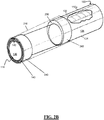
- FIG. 2A illustrates an inflated, seamless balloon 210 profile of the catheter 100.
- the seamless balloon 210 can be secured to the elongated tubular member 110 by a tie-layer 240.
- the seamless balloon 210 can extend beyond the distal end 114 of the elongated tubular member 110.
- the seamless balloon 210 can be inflated as illustrated.
- the tie-layer 240 can include a material to which both the balloon and the shaft jacket material can be welded.
- the jacket can include a polyurethane material at least over a few centimeters of a distal portion of the catheter 100.
- the tie-layer 240 can include a 50/50 blend of the balloon material and the polyurethane jacket material.
- the balloon 210 can be welded onto the jacket.
- FIG. 2B illustrates a deflated, seamless balloon 210 profile of the catheter 100.
- the seamless balloon 210 can be secured to the elongated tubular member 110 by a tie-layer 240.
- the seamless balloon 210 can extend beyond the distal end 114 of the elongated tubular member 110.
- the seamless balloon 210 can be deflated as illustrated.
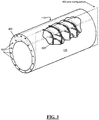
- FIG. 3 illustrates a wire configuration 400 of wire 300 of the inflation lumen kink protection of the catheter 100 including a cross-section of the elongated tubular member 110.
- the wire configuration 400 can have the wire 300, which can be located within the elongated tubular member 110, go above and below the inflation lumen 200.
- the wire configuration 400 allows for a more flexible catheter 100 and transfer of torque from the proximal end 112 to the distal end 114 of the catheter 100. This permits the user to apply torque to the proximal end 112 to more easily orientate the distal end 114 in the needed direction to advance the catheter through the vasculature while still maintaining the integrity of the inflation lumen 200.
- certain catheters 100 can be advanced from a patient's inner thigh, over the cardiac arch, and up into the neurovascular inside the patient's skull and thus the distance and tortuosity can be significant.
- the wiring 400 is acting similarly to rebar in concrete reinforcement of an air plane hangar or ground bunker, supporting an arched structure. Reinforcing the wire network 400 with the polymer matrix of the elongated tubular member 110 above and below the inflation lumen 200 helps reduce or prevent kinking.
- the braid wires 300 when encountering the inflation lumen 200 on the braiding machine, separate out to go over and below the inflation lumen 200.
- the wire reinforces the polymeric matrix of the catheter 100 and thus a thin PTFE sleeve or lumen with standard sleeve such as PE or PET or FEP or no sleeve (i.e. a "raw extrusion lumen") is supported and protected from kinking.
- the braid 200 essentially occurs along the majority of the elongated tubular member 110 to enhancing torque ability and push ability of the shaft.
- Other examples can change the coil geometry to lower the flexural stiffness of the catheter 100 as compared to ta braid.
- the PTFE lumen adds to the flexural stiffness and the coils help to lower this stiffness.
- the stiffness can deliver a preference for the device to orientate during insertion of the device and the addition of the coils instead of the braid lessens this "whip" orientation around a bend in the vascular.
- the example wire protection for the inflation lumen 200 can be conducted for dual and triple lumens within the catheter (not illustrated).
- the wire configuration 400 is ideally suited to a single lumen of particular arc radius dimensions.
- the cross-section of the elongated tubular member 110 illustrates the positioning (i.e. wire configuration 400) of the wires 300 above and below the inflation lumen 200.
- the wire configuration 400 contributes to the strength and reduces the stiffness of the catheter 100. Additionally, the wire configuration 400 helps lower the flexural stiffness of the catheter compared to the wires 300.
- the inflation lumen 200 can increase the stiffness of the catheter 100 and the wire configuration can lower the stiffness and/or increase the flexibility. The stiffness and/or flexibility can deliver a preference for the device to orientate during insertion of the devices and the wire configuration 400 lessens the challenges seen with prior art devices.
- the stiffness and flexibility can be also be altered by using different materials for each portion of the shaft, each portion being of a different stiffness or durometer, in addition to using various numbers of wires 300, different wire 300 materials or wire configurations 400 including, but not limited to braided, coil, doubled 500, and split-coil 510 configurations.
- the braided wire configuration 400 can be present below the inflation lumen 200, whereas, the coil configuration can be present above and/or around the inflation lumen 200. Additionally, the wire configuration 400 can consist of any number of wires 300 including the doubled wire configuration 500.
- the wire configuration 400 can include a split wire configuration 510 wherein the wires 300 are braided above and below the inflation lumen 200.
- the elongated tubular member 110 can be made of the same material and additional layers or additives can be provided to control the individual stiffness. These examples can be combined to provide the needed flexibility and/or stiffness.
- the elongated tubular member can have a uniform stiffness across its length, or it can vary. As an example, the stiffness of the elongated tubular member 110 can decrease from the proximal end 112 to the distal end 114. As another example, the stiffness of the elongated tubular member 110 can increase from the proximal end 112 to the distal end 114. Any transition of stiffness, in certain examples, can prevent localized stiffness.
- FIG. 4A illustrates an inflated, seamless balloon 210 profile and wire 300 wire configuration 400 of the catheter 100.
- the seamless balloon 210 can be secured to the elongated tubular member 110 by a tie-layer 240.
- the seamless balloon 210 can extend beyond the distal end 114 of the elongated tubular member 110.
- the seamless balloon 210 can be inflated as illustrated.
- the reinforcement of the wire configuration 400 by the wire 300 does not impede the inflation of the seamless balloon 210.
- the seamless balloon 210 can inflate concentric to inner hollow lumen 130, or where the outer edge of the inflated balloon is approximately equidistant from a center of the inner hollow lumen 130. There can be some eccentricity based on the location of the inflation lumen 200.
- FIG. 4B illustrates a deflated, seamless balloon 210 profile and wire 300 wire configuration 400 of the catheter 100.
- the seamless balloon 210 can be secured to the elongated tubular member 110 by a tie-layer 240.
- the seamless balloon 210 can extend beyond the distal end 114 of the elongated tubular member 110.
- the seamless balloon 210 can be deflated as illustrated.
- the reinforcement of the wire configuration 400 by the wire 300 does not impede the deflation of the seamless balloon 210.
- the seamless balloon 210 when deflated, can have the same outer profile as the elongated tubular member 110, giving the catheter 100 a uniform diameter/profile for insertion and removal.
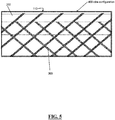
- FIG. 5 illustrates a sideview of a braided and coil wire configuration 400 of the catheter 100.
- the wire 300 can go above and below the inflation lumen 200.
- the braided wire configuration 400 allows for a stiffer catheter 100 while minimizing cost and weight among many other factors.
- the braided design facilitates the transfer of torque from the proximal end 112 to the distal end 114 of the catheter 100. This permits the user to apply torque to the proximal end 112 to more easily orientate the distal end 114 in the needed direction to advance the catheter through the vasculature while still maintaining the integrity of the inflation lumen 200.
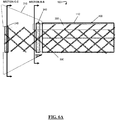
- FIG.6A illustrates an inflated, seamless balloon 210 profile and braided and coil wire configuration 400 of the catheter 100.
- the seamless balloon 210 can be secured to the elongated tubular member 110 by a tie-layer 240.
- the seamless balloon 210 can extend beyond the distal end 114 of the elongated tubular member 110.
- the seamless balloon 210 can be inflated as illustrated.
- the reinforcement of the braided, wire configuration 400 by the wire 300 does not impede the inflation of the seamless balloon 210.
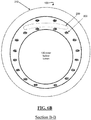
- FIG. 6B illustrates the cross-section of FIG. 6A across Section B-B depicting an inflated, seamless balloon 210 profile and wire configuration 400 of the catheter 100.
- the cross-section depicts the location of the wires 300 above and below the inflation lumen 200 within the elongated tubular member 110.
- the cross-section also illustrates the relative positions of the seamless balloon 210, inflation lumen 200, and wire 300 and how the wire configuration 400 does not impede the inflation of the seamless balloon 210.
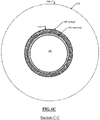
- FIG. 6C illustrates the cross-section of FIG. 6A across Section C-C depicting an inflated, seamless balloon 210 profile and wire configuration 400 of the catheter 100.
- the cross-section illustrates the relative positions of the seamless balloon 210, tie-layer 240, inner core 140, and inner hollow lumen 130 and how tie-layer 240 does not impede the inflation of the seamless balloon 210.
- the balloon 210 when inflated can have an aspect ratio and height that effectively blocks the blood vessel while minimizing fluid shear.
- the balloon can have a height of about 0.004" to about 0.008". In some applications, the balloon can have a height of about 0.0055" to about 0.0065".
- the balloon 210 when inflated can have a substantially trapezoidal profile when viewed from the side as illustrated in FIG. 6A , tapering to a smaller width on the proximal end of the balloon 210 and expanding to a larger width when on the distal end of the balloon.
- the tapering can define an angle ⁇ that is the angle between an angled surface of the balloon and a line parallel to the tubular elongated member 110.
- the balloon 210 when inflated can define an angle ⁇ less than 70° when used on a tubular elongated member 110 having inner lumen 130 of about 0.088" in diameter.
- the balloon 210 when inflated can define an angle ⁇ of about 60° to about 65° when used on a tubular elongated member 110 having inner lumen 130 of about 0.088" in diameter.
- FIG. 7A illustrates a deflated, seamless balloon 210 profile and braided and coil wire configuration 400 of the catheter 100.
- the seamless balloon 210 can be secured to the elongated tubular member 110 by a tie-layer 240.
- the seamless balloon 210 can extend beyond the distal end 114 of the elongated tubular member 110.
- the seamless balloon 210 can be deflated as illustrated.
- the reinforcement of the braided and coil wire configuration 400 by the wire 300 does not impede the deflation of the seamless balloon 210.
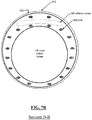
- FIG. 7B illustrates the cross-section of FIG. 7A across Section B-B depicting a deflated, seamless balloon 210 profile and wire configuration 400 of the catheter 100.
- the cross-section depicts the location of the wires 300 above and below the inflation lumen 200 within the elongated tubular member 110.
- the cross-section also illustrates the relative positions of the seamless balloon 210, inflation lumen 200, and wire 300 and how the wire configuration 400 does not impede the deflation of the seamless balloon 210.
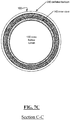
- FIG. 7C illustrates the cross-section of FIG. 7A across Section C-C depicting a deflated, seamless balloon 210 profile and wire configuration 400 of the catheter 100.
- the cross-section illustrates the relative positions of the seamless balloon 210, tie-layer 240, inner core 140, and inner hollow lumen 130 and how tie-layer 240 does not impede the deflation of the seamless balloon 210.
- FIG. 8 illustrates a top view depicting an inflated seamless balloon 210 profile and wire configuration 400 of the catheter.
- the view illustrates the relative positions of the seamless balloon 210, inflation lumen 200, and wire 300 and how the wire configuration 400 does not impede the inflation of the seamless balloon 210.
- the view also illustrates the coil configuration above the inflation lumen 200.
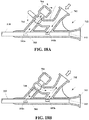
- FIG. 9 illustrates a top view depicting a deflated seamless balloon 210 profile and wire configuration 400 of the catheter.
- the view illustrates the relative positions of the seamless balloon 210, inflation lumen 200, and wire 300 and how the wire configuration 400 does not impede the deflation of the seamless balloon 210.
- the view also illustrates the coil configuration above the inflation lumen 200.
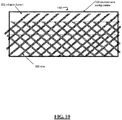
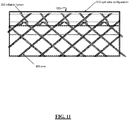
- FIGs. 10 and 11 illustrates side views of possible wire configurations 400. Specifically, FIG. 10 illustrates the doubled wire configuration 500 and FIG. 11 illustrates the split wire configuration 510.
- FIG. 12 illustrates a split wire configuration 510 of wire 300 of the inflation lumen kink protection of the catheter 100 including a cross-section of the elongated tubular member 110.
- the wire configuration 400 can have the wire 300, which can be located within the elongated tubular member 110, braided above and below the inflation lumen 200.
- the split wire configuration 510 allows for a more flexible catheter 100 and transfer of torque from the proximal end 112 to the distal end 114 of the catheter 100. This permits the user to apply torque to the proximal end 112 to more easily orientate the distal end 114 in the needed direction to advance the catheter through the vasculature while still maintaining the integrity of the inflation lumen 200. Note that certain catheters 100 can be advanced from a patient's inner thigh, over the cardiac arch, and up into the neurovascular inside the patient's skull and thus the distance and tortuosity can be significant.
- FIG. 13A illustrates an inflated, bonded 600 seamless balloon 210 profile and wire 300 wire configuration 400 of the catheter 100.
- the seamless balloon 210 can be secured to the elongated tubular member 110 by a tie-layer 240 and/or bond 600, so that when inflated it does not inflate circumstantially.
- the seamless balloon 210 can extend beyond the distal end 114 of the elongated tubular member 110.
- the seamless balloon 210 can be inflated as illustrated.
- the reinforcement of the wire configuration 400 by the wire 300 does not impede the inflation of the seamless balloon 210.
- the seamless balloon 210 can be constrained on one side of the elongated tubular member 110 by a bond 600.
- the bond 600 can be in any number of shapes and or patterns.
- the bond 600 connecting the seamless balloon 210 to the elongated tubular member 110 ensures that the when inflated the seamless balloon 210 does not inflate circumstantially.
- the bonded 600 seamless balloon 210 facilitates the retrieval of medical devices through the inner hollow lumen 130 maximize clot capture while minimizing the catching of soft clots.
- Soft clots can shear off the catheter 100 and remain on the distal end 114 of the catheter 100. On deflation of the seamless balloon 210, these soft clots may travel distally and result in embolization of distal vessels - potentially resulting in additional procedural time or impact to patient health.
- FIG. 13B illustrates a deflated, bonded 600 seamless balloon 210 profile and wire 300 wire configuration 400 of the catheter 100.
- the seamless balloon 210 can be secured to the elongated tubular member 110 by a tie-layer 240 and/or bond 600.
- the seamless balloon 210 can extend beyond the distal end 114 of the elongated tubular member 110.
- the seamless balloon 210 can be deflated as illustrated.
- the reinforcement of the wire configuration 400 by the wire 300 does not impede the deflation of the seamless balloon 210.
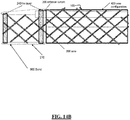
- FIG.14A illustrates an inflated, bonded 600 seamless balloon 210 profile and wire configuration 400 of the catheter 100.
- the seamless balloon 210 can be secured to the elongated tubular member 110 by a tie-layer 240 and/or bond 600, so that when inflated it does not inflate circumstantially.
- the seamless balloon 210 can extend beyond the distal end 114 of the elongated tubular member 110.
- the seamless balloon 210 can be inflated as illustrated.
- the reinforcement of the braided, wire configuration 400 by the wire 300 does not impede the inflation of the seamless balloon 210.
- FIG. 14B illustrates a deflated, bonded 600 seamless balloon 210 profile and wire configuration 400 of the catheter 100.
- the seamless balloon 210 can be secured to the elongated tubular member 110 by a tie-layer 240 and/or bond 600.
- the seamless balloon 210 can extend beyond the distal end 114 of the elongated tubular member 110.
- the seamless balloon 210 can be deflated as illustrated.
- the reinforcement of the braided and coil wire configuration 400 by the wire 300 does not impede the deflation of the seamless balloon 210.
- the degree of eccentricity or inflation asymmetry can be altered by the placement of the bond 600.
- the seamless balloon 210 can be bonded 600 across either a small or large arc of the elongated tubular member 110.
- eccentricity can be imposed by changing the inner core thickness 144 between the top and the bottom, making the inner hollow lumen 130 off center from a center axis of the catheter 100.
- the seamless balloon 210 is inflated inside the patient's vascular using a saline or other neutral fluid.
- the fluid is pumped into the proximal end 112 of the inflation lumen 200 and fills the seamless balloon 210.
- the fluid volume and/or pressure is held constant to keep the balloon 210 engaged with the vascular lumen to prevent flow past the balloon 210.
- the fluid is drawn out through the same lumen 200.
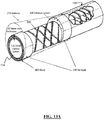
- FIG. 15A illustrates a distal portion of a balloon guide catheter 100 of the present invention with an inflated balloon 210.
- the catheter 100 can include a tubular jacket 250 extending over wires 300.
- the tubular jacket 250 can extend over the distal portion of the balloon guide catheter 100, beyond the distal end 204 of the inflation lumen 200.
- the balloon 210 can be welded proximally and distally to an intermediate (or tie-layer) jacket material 250 formed from a blend of the balloon material and a soft urethane (such as Pellethane 80A).
- the jacket 250 can include openings 252 to allow a flow path between the inflation lumen 200 and the interior of the balloon 210.
- the distal tip 114 of the catheter 100 can be formed from this intermediate (or tie-layer) material, or from the balloon material itself, or form another soft material compatible with the intermediate (or tie-layer) material.
- the distal tip material can extend slightly beyond the inner PTFE liner, inner core 140 of the main catheter lumen 130, creating a very soft tip that can flare to accept soft clot with minimal risk of shear.
- a radiopaque marker band 260 can be positioned just proximal of the distal end 114 of the catheter 100, and the catheter reinforcing braid 300 can terminate beneath this marker 260 to minimize the risk of exposed braid wires 300.
- the inflation lumen 200 can terminate under the balloon 210 and a skive or cut-away 212 can be added to allow the lumen of the inflation lumen 200 to communicate with the interior of the balloon 210 to allow inflation / deflation.
- the stiffness of this catheter 100 can increase gradually from distal to proximal.
- the stiffness gradient can be primarily created by the modulus of the different segments of polymer jacket material 250.
- Polymer jacket material 250 can be laminated onto the catheter 100 over the braid 300 and inflation lumen 200. This lamination process ideally melts the jacket material sufficiently to allow it to flow beneath the inflation lumen and integrate to the strike layers of the inflation lumen and of the PTFE liner of the main catheter lumen.
- FIG. 15B illustrates a proximal portion of a balloon guide 100 of the invention inserted in a proximal luer 700.
- a skive or cut-away 152 in the outer jacket 250, wires 300, and inflation lumen 200 can provide a flow path through the inflation lumen 200 to an angled port 702 of the proximal luer 700 and thus to facilitate control of balloon inflation / deflation through this port 702.
- FIGs. 16A-D illustrate various alternative inflation lumen configurations using multiple inflation lumens 200a, 200b, 200c, 200d.
- the inner hollow lumens 130a, 130b, 130c, 130d of each elongated tubular member 110a, 110b, 110c, 110d is identified in each respective figure to orient the reader.
- Catheters having multiple inflation lumens can aid in preparation of the catheter and facilitate expedited inflation and deflation of a balloon.
- one or more inflation lumens can receive an injection of 50/50 contrast mix to inflate the balloon and one or more different inflation lumens can be used as a vent or exhaust for any air in the system and the contrast mixture.
- contrast mixture would enter a first of the inflation lumens, travel distally along the elongated tubular member, enter the balloon, enter a second of the inflation lumens at its distal end, travel proximally along the elongated tubular member, and exit the catheter form the second inflation lumen.
- An inflation lumen that is used for venting e.g.
- the second inflation lumen in the dual lumen catheter in the previous example can also be referred to as a venting lumen.
- Utilizing an inflation lumen and a vent lumen as described can purge air from the inflation lumen, vent lumen, and balloon during preparation. During a procedure, all lumens can be used in parallel to simultaneously inflate or simultaneously deflate. Multiple inflation lumens can therefore facilitate faster inflation and deflation of the balloon compare to single lumen catheters. Multiple inflation lumens can also provide redundancy; in the case that one inflation lumen is kinked, blocked, otherwise compromised, in some applications the remaining operable inflation lumen or lumens can provide sufficient flow to and from the balloon to inflate and/or deflate the balloon.
- FIG. 16A illustrates a cross section of an elongated tubular member 110a having dual inflation lumens 200a with a wire pattern in which the reinforcing wires 300a run over and under both inflation lumens 200a together.
- FIG. 16B illustrates a cross section of an elongated tubular member 110b having dual inflation lumens 200b with a wire pattern in which the reinforcing wires 300b run over and under each inflation lumen 200b individually.
- the wires 300b can separate the inflation lumens 200b such that the inflation lumens 200b are inhibited from shifting to overlap as the elongated tubular member 110b flexes.
- FIG. 16C illustrates a cross section of an elongated tubular member 110c having three inflation lumens 200c. Although not illustrated, other variants with more than 3 inflation lumens are also envisaged.
- FIG. 16D illustrates a cross section of an elongated tubular member 110d having dual inflation lumens 200d positioned on opposite sides of the circumference of the elongated tubular member 110d, offset approximately 180 degrees apart.
- FIG. 17A illustrates a dual inflation lumen catheter 100 connected to a proximal luer 700 configured to flush, inflate, and deflate a balloon.
- FIG. 17B illustrates a cross section of an elongated tubular member 110 that can be used as the elongated tubular member 110 illustrated in FIG. 17A .
- a dual inflation lumen catheter having an alternative configuration can be used as the catheter 100 illustrated in FIG. 17A .
- a catheter having an elongated tubular member 110a, 110b, 110d as illustrated in FIGs. 16A, 16B, and 16D are suitable.
- the catheter 100 can include an inflation port 252 positioned under the balloon that is an opening in the elongated tubular member 110d that provides a flow path from one or both of the inflation lumens 200 into the balloon 210.
- the catheter 100 can include two inflation ports 252, one for each inflation lumen 200 in the dual inflation lumen catheter 100.
- the proximal luer 700 can include two inflation lumen ports 702, 704 that can be used to provide fluid for flushing and inflating the inflation lumens and balloons and that can be used to provide suction to deflate the balloon.
- the proximal luer 700 can include a valve 710 that can be moved to isolate the inflation lumens from each other within the proximal luer 700 or to provide a flow path between the two inflation lumens within the proximal luer 700.
- FIGs. 18A and 18B illustrate cross sectional views of a proximal luer 700 that can receive an elongated tubular member 110, 110a, 110b, 110d having dual inflation lumens 200, 200a, 200b, 200d.
- FIG. 18A illustrates the proximal luer 700 with the valve 710 in an isolation position such that the two inflation lumens are isolated from each other within the proximal luer 700.
- FIG. 18B illustrates the proximal luer 700 with the valve 710 in a communication position such that the two inflation lumens are in communication with each other within the proximal luer 700.
- the proximal luer 700 can be used to flush the inflation lumens and balloon.
- Fluid such as a 50 / 50 contrast mix can be injected into a first port 702, flow through the port into a cut-away 152b in the elongated tubular member 110 providing a fluidic flow into one of the inflation lumens. Fluid can be flowed through the system as indicated by the arrows.
- the injected fluid can flow distally through the elongated tubular member 110, through an inflation port 252 under the balloon 210, into the balloon 210, back into an inflation port 252 under the balloon, proximally through the elongated tubular member 110, out a second cut-away 152a in the elongated tubular member 110, into the proximal luer 700, through an opening in the valve 710, and out a second port 704 in the proximal luer.
- the proximal luer 700 can also include a proximal opening 712 through which devices can be delivered into the proximal end 112 of the elongated tubular member 110 and through the inner lumen 130 of the elongated tubular member 110.
- the luer 700 can also include a filter that allows air flow but is impervious to liquid that is in communication with the second port 704 such that fluid flowed into the first port 702 can fill the inflation lumens and balloon with fluid and purge the inflation lumens and balloon of air.
- the proximal luer 700 when the valve 710 is in the communication position, the proximal luer 700 can be used to inflate or deflate the balloon simultaneously through both inflation lumens of the dual lumen catheter.
- FIG. 18B illustrates fluid flow during deflation as indicated by the arrows. For inflation, fluid flow is in the opposite direction as indicated by the arrows.
- the second port 704 in the proximal luer 700 can be blocked and a channel connecting the two inflation lumens can be unblocked.
- a vacuum can be applied to the first port 702 of the proximal luer 700.
- Vacuum can be translated through the proximal luer 700 as indicated by the arrows and withdraw fluid from the dual lumens via each cut-away 152a, 152b in the elongated tubular member 110.
- the vacuum can be translated through both inflation lumens to the balloon, thereby extracting fluid from the balloon via both inflation lumens simultaneously.
- a pressurized fluid source can be provided at the first port 702 of the proximal luer 700 and fluid flow is in the opposite direction as described.
Landscapes
- Health & Medical Sciences (AREA)
- Life Sciences & Earth Sciences (AREA)
- Heart & Thoracic Surgery (AREA)
- Public Health (AREA)
- Engineering & Computer Science (AREA)
- Biomedical Technology (AREA)
- Animal Behavior & Ethology (AREA)
- General Health & Medical Sciences (AREA)
- Veterinary Medicine (AREA)
- Pulmonology (AREA)
- Anesthesiology (AREA)
- Hematology (AREA)
- Biophysics (AREA)
- Child & Adolescent Psychology (AREA)
- Surgery (AREA)
- Vascular Medicine (AREA)
- Molecular Biology (AREA)
- Nuclear Medicine, Radiotherapy & Molecular Imaging (AREA)
- Medical Informatics (AREA)
- Reproductive Health (AREA)
- Orthopedic Medicine & Surgery (AREA)
- Physics & Mathematics (AREA)
- Geometry (AREA)
- Media Introduction/Drainage Providing Device (AREA)
Applications Claiming Priority (5)
| Application Number | Priority Date | Filing Date | Title |
|---|---|---|---|
| US201962845699P | 2019-05-09 | 2019-05-09 | |
| US201962845683P | 2019-05-09 | 2019-05-09 | |
| US201962845747P | 2019-05-09 | 2019-05-09 | |
| US201962845711P | 2019-05-09 | 2019-05-09 | |
| US16/601,185 US11931522B2 (en) | 2019-05-09 | 2019-10-14 | Inflation lumen kink protection and balloon profile |
Publications (2)
| Publication Number | Publication Date |
|---|---|
| EP3736014A2 true EP3736014A2 (fr) | 2020-11-11 |
| EP3736014A3 EP3736014A3 (fr) | 2020-11-18 |
Family
ID=70616999
Family Applications (1)
| Application Number | Title | Priority Date | Filing Date |
|---|---|---|---|
| EP20173509.9A Pending EP3736014A3 (fr) | 2019-05-09 | 2020-05-07 | Protection contre le pliage de la lumière de gonflage et profil de ballonnet |
Country Status (5)
| Country | Link |
|---|---|
| US (3) | US11931522B2 (fr) |
| EP (1) | EP3736014A3 (fr) |
| JP (1) | JP7547075B2 (fr) |
| KR (1) | KR20200130666A (fr) |
| CN (1) | CN111991679B (fr) |
Families Citing this family (18)
| Publication number | Priority date | Publication date | Assignee | Title |
|---|---|---|---|---|
| US11660420B2 (en) | 2018-09-17 | 2023-05-30 | Seigla Medical, Inc. | Catheters and related devices and methods of manufacture |
| JP7076561B2 (ja) * | 2018-09-04 | 2022-05-27 | 富士フイルム株式会社 | オーバーチューブ |
| US12539389B2 (en) | 2018-09-17 | 2026-02-03 | Seigla Medical, Inc. | Catheters and related devices and methods of manufacture |
| US12285182B2 (en) | 2018-10-10 | 2025-04-29 | Innova Vascular, Inc. | Devices and methods for removing an embolus |
| US11607531B2 (en) | 2019-05-09 | 2023-03-21 | Neuravi Limited | Balloon catheter with venting of residual air in a proximal direction |
| US11931522B2 (en) * | 2019-05-09 | 2024-03-19 | Neuravi Limited | Inflation lumen kink protection and balloon profile |
| EP4114285A4 (fr) | 2020-03-04 | 2024-03-06 | Shifamed Holdings, LLC | Systèmes de retrait de trhombus et procédés associés |
| CN114533208B (zh) * | 2020-11-24 | 2024-07-16 | 先健科技(深圳)有限公司 | 穿刺鞘及可调弯系统 |
| CN112587202A (zh) * | 2020-12-08 | 2021-04-02 | 上海璞慧医疗器械有限公司 | 一种血栓抽吸导管 |
| WO2022170187A1 (fr) * | 2021-02-05 | 2022-08-11 | Pyne Devaraj | Dispositif et méthodes d'embolisation à ballonnet détachable |
| CN112807553A (zh) * | 2021-02-20 | 2021-05-18 | 科睿驰(深圳)医疗科技发展有限公司 | 一种球囊微导管 |
| US11197684B1 (en) | 2021-03-04 | 2021-12-14 | Nventric Corporation | Thrombectomy device and method |
| US11478262B2 (en) | 2021-03-04 | 2022-10-25 | Nventric Corporation | Thrombectomy device and method |
| EP4340751A4 (fr) | 2021-05-19 | 2025-03-26 | Shifamed Holdings, LLC | Systèmes de retrait de thrombus et procédés associés |
| WO2023147460A1 (fr) | 2022-01-27 | 2023-08-03 | Contego Medical, Inc. | Système de thrombectomie et d'aspiration et méthodes d'utilisation |
| US12514600B2 (en) | 2022-09-28 | 2026-01-06 | DeepIn Technologies, LLC | Single lumen balloon guide catheter |
| CN116212191A (zh) * | 2023-02-28 | 2023-06-06 | 丰凯利医疗器械(上海)有限公司 | 多腔管和介入导管 |
| US12114880B1 (en) | 2023-08-03 | 2024-10-15 | Nventric Corporation | Thrombectomy device having open frame cell ring |
Citations (2)
| Publication number | Priority date | Publication date | Assignee | Title |
|---|---|---|---|---|
| US20080091169A1 (en) * | 2006-05-16 | 2008-04-17 | Wayne Heideman | Steerable catheter using flat pull wires and having torque transfer layer made of braided flat wires |
| WO2018097258A1 (fr) * | 2016-11-25 | 2018-05-31 | 住友ベークライト株式会社 | Cathéter et procédé de fabrication d'un cathéter |
Family Cites Families (202)
| Publication number | Priority date | Publication date | Assignee | Title |
|---|---|---|---|---|
| US4188954A (en) * | 1976-08-05 | 1980-02-19 | The Kendall Company | Catheter with improved balloon assembly |
| US4323071A (en) | 1978-04-24 | 1982-04-06 | Advanced Catheter Systems, Inc. | Vascular guiding catheter assembly and vascular dilating catheter assembly and a combination thereof and methods of making the same |
| JPS59166163A (ja) | 1983-03-14 | 1984-09-19 | テルモ株式会社 | バル−ンカテ−テル |
| JPS59177064A (ja) | 1983-03-29 | 1984-10-06 | テルモ株式会社 | バル−ンカテ−テル |
| US4684363A (en) | 1984-10-31 | 1987-08-04 | American Hospital Supply Corporation | Rapidly inflatable balloon catheter and method |
| US4715378A (en) | 1986-07-28 | 1987-12-29 | Mansfield Scientific, Inc. | Balloon catheter |
| JPS6395065A (ja) | 1986-10-09 | 1988-04-26 | オリンパス光学工業株式会社 | バル−ンカテ−テル |
| JPS63158064A (ja) | 1986-12-23 | 1988-07-01 | テルモ株式会社 | 血管拡張カテ−テル |
| US5256143A (en) | 1987-01-06 | 1993-10-26 | Advanced Cardiovascular Systems, Inc. | Self-venting balloon dilatation catheter |
| US4753238A (en) | 1987-01-06 | 1988-06-28 | Advanced Cardiovascular Systems, Inc. | Proximal manifold and adapter |
| US4821722A (en) | 1987-01-06 | 1989-04-18 | Advanced Cardiovascular Systems, Inc. | Self-venting balloon dilatation catheter and method |
| US4793351A (en) | 1987-06-15 | 1988-12-27 | Mansfield Scientific, Inc. | Multi-lumen balloon catheter |
| US4811737A (en) | 1987-11-16 | 1989-03-14 | Schneider-Shiley (Usa) Inc. | Self-purging balloon catheter |
| US4838268A (en) * | 1988-03-07 | 1989-06-13 | Scimed Life Systems, Inc. | Non-over-the wire balloon catheter |
| US5035705A (en) | 1989-01-13 | 1991-07-30 | Scimed Life Systems, Inc. | Method of purging a balloon catheter |
| US5100385A (en) | 1989-01-27 | 1992-03-31 | C. R. Bard, Inc. | Fast purge balloon dilatation catheter |
| US5135486A (en) | 1990-08-31 | 1992-08-04 | Endosonics Corporation | Self-venting balloon dilitation catheter |
| US5176698A (en) | 1991-01-09 | 1993-01-05 | Scimed Life Systems, Inc. | Vented dilatation cathether and method for venting |
| US5224933A (en) | 1992-03-23 | 1993-07-06 | C. R. Bard, Inc. | Catheter purge device |
| JP3169468B2 (ja) * | 1992-03-27 | 2001-05-28 | 竹本油脂株式会社 | 炭素繊維のサイジング方法 |
| DE4324218A1 (de) * | 1993-07-19 | 1995-01-26 | Bavaria Med Tech | Manschettenkatheter |
| US5429597A (en) * | 1994-03-01 | 1995-07-04 | Boston Scientific Corporation | Kink resistant balloon catheter and method for use |
| JPH0810334A (ja) * | 1994-06-29 | 1996-01-16 | Ado Polymer:Kk | 医療用カテーテル |
| US5800421A (en) | 1996-06-12 | 1998-09-01 | Lemelson; Jerome H. | Medical devices using electrosensitive gels |
| US6869431B2 (en) * | 1997-07-08 | 2005-03-22 | Atrionix, Inc. | Medical device with sensor cooperating with expandable member |
| US6010521A (en) * | 1997-11-25 | 2000-01-04 | Advanced Cardiovasular Systems, Inc. | Catheter member with bondable layer |
| NL1008051C2 (nl) | 1998-01-16 | 1999-07-19 | Cordis Europ | Ballonkatheter. |
| US6517515B1 (en) | 1998-03-04 | 2003-02-11 | Scimed Life Systems, Inc. | Catheter having variable size guide wire lumen |
| US6960222B2 (en) * | 1998-03-13 | 2005-11-01 | Gore Enterprise Holdins, Inc. | Catheter having a funnel-shaped occlusion balloon of uniform thickness and methods of manufacture |
| JPH11262529A (ja) * | 1998-03-18 | 1999-09-28 | Nippon Zeon Co Ltd | バルーンカテーテル |
| US6709429B1 (en) * | 2000-01-19 | 2004-03-23 | Scimed Life Systems, Inc. | Intravascular catheter with multiple axial fibers |
| JP2003521286A (ja) | 1999-06-14 | 2003-07-15 | アルテリア メディカル サイエンス, インコーポレイテッド | 頸動脈疾患の処置中に塞栓形成を軽減するための方法および低プロフィール装置 |
| US6464625B2 (en) * | 1999-06-23 | 2002-10-15 | Robert A. Ganz | Therapeutic method and apparatus for debilitating or killing microorganisms within the body |
| US6102931A (en) | 1999-08-09 | 2000-08-15 | Embol-X, Inc. | Intravascular device for venting an inflatable chamber |
| US6994687B1 (en) | 2000-01-19 | 2006-02-07 | Cordis Neurovascular, Inc. | Inflatable balloon catheter with purge mechanism and method |
| US7163504B1 (en) * | 2000-02-16 | 2007-01-16 | Advanced Cardiovascular Systems, Inc. | Multi-lumen fluted balloon radiation centering catheter |
| GB0011053D0 (en) * | 2000-05-09 | 2000-06-28 | Hudson John O | Medical device and use thereof |
| US6364894B1 (en) * | 2000-06-12 | 2002-04-02 | Cordis Corporation | Method of making an angioplasty balloon catheter |
| US6786887B2 (en) | 2001-01-26 | 2004-09-07 | Scimed Life Systems, Inc. | Intravascular occlusion balloon catheter |
| US8252040B2 (en) | 2001-07-20 | 2012-08-28 | Microvention, Inc. | Aneurysm treatment device and method of use |
| US8715312B2 (en) | 2001-07-20 | 2014-05-06 | Microvention, Inc. | Aneurysm treatment device and method of use |
| US6923787B2 (en) * | 2001-12-20 | 2005-08-02 | Scimed Life Systems, Inc. | Catheter having an improved balloon-to-catheter bond |
| JP2003250896A (ja) * | 2002-02-28 | 2003-09-09 | Terumo Corp | 動脈瘤塞栓術用バルーンカテーテル |
| US6953431B2 (en) * | 2002-04-11 | 2005-10-11 | University Of South Florida | Eccentric dilation balloons for use with endoscopes |
| US7338511B2 (en) | 2002-05-24 | 2008-03-04 | Boston Scientific-Scimed, Inc. | Solid embolic material with variable expansion |
| WO2004026371A2 (fr) * | 2002-09-20 | 2004-04-01 | Flowmedica, Inc. | Procede et dispositif de perfusion selective de medicament par l'intermediaire d'un catheter intra-aortique a deviation du flux |
| US8608691B2 (en) * | 2003-02-07 | 2013-12-17 | Pierpont Family Limited Partnership | Angioplasty method and means for performing angioplasty |
| US20040260329A1 (en) * | 2003-06-19 | 2004-12-23 | Richard Gribbons | Catheter and guide wire exchange system with decoupled guide member |
| US7371228B2 (en) | 2003-09-19 | 2008-05-13 | Medtronic Vascular, Inc. | Delivery of therapeutics to treat aneurysms |
| US20050070881A1 (en) * | 2003-09-26 | 2005-03-31 | Richard Gribbons | Transition section for a catheter |
| US20050124932A1 (en) | 2003-12-05 | 2005-06-09 | Kimberly-Clark Worldwide, Inc. | Venting catheter |
| US20080147048A1 (en) * | 2004-01-09 | 2008-06-19 | Deutsch Harvey L | Drain with Occlusion Removing Structure |
| US7641631B2 (en) | 2004-02-17 | 2010-01-05 | Scimed Life Systems, Inc. | Dilatation balloon having a valved opening and related catheters and methods |
| US9308382B2 (en) | 2004-06-10 | 2016-04-12 | Medtronic Urinary Solutions, Inc. | Implantable pulse generator systems and methods for providing functional and/or therapeutic stimulation of muscles and/or nerves and/or central nervous system tissue |
| US9655633B2 (en) | 2004-09-10 | 2017-05-23 | Penumbra, Inc. | System and method for treating ischemic stroke |
| US20060089637A1 (en) | 2004-10-14 | 2006-04-27 | Werneth Randell L | Ablation catheter |
| US8562672B2 (en) | 2004-11-19 | 2013-10-22 | Medtronic, Inc. | Apparatus for treatment of cardiac valves and method of its manufacture |
| US7678075B2 (en) * | 2004-12-30 | 2010-03-16 | Advanced Cardiovascular Systems, Inc. | Infusion catheter and use thereof |
| US9636115B2 (en) | 2005-06-14 | 2017-05-02 | Stryker Corporation | Vaso-occlusive delivery device with kink resistant, flexible distal end |
| CN101309651B (zh) | 2005-06-20 | 2011-12-07 | 麦德托尼克消融前沿有限公司 | 消融导管 |
| US7500982B2 (en) | 2005-06-22 | 2009-03-10 | Futurematrix Interventional, Inc. | Balloon dilation catheter having transition from coaxial lumens to non-coaxial multiple lumens |
| CA2630021C (fr) | 2005-11-17 | 2013-08-13 | Microvention, Inc. | Bobine complexe tridimensionnelle |
| US9757260B2 (en) | 2006-03-30 | 2017-09-12 | Medtronic Vascular, Inc. | Prosthesis with guide lumen |
| US9615832B2 (en) | 2006-04-07 | 2017-04-11 | Penumbra, Inc. | Aneurysm occlusion system and method |
| US20100030251A1 (en) | 2006-05-24 | 2010-02-04 | Mayo Foundation For Medical Education And Research | Devices and methods for crossing chronic total occlusions |
| JP2010500917A (ja) | 2006-06-15 | 2010-01-14 | マイクロベンション, インコーポレイテッド | 膨張性ポリマーで構成される塞栓形成デバイス |
| US8066670B2 (en) | 2006-11-06 | 2011-11-29 | Becton, Dickinson And Company | Vascular access device septum venting |
| US11660420B2 (en) * | 2018-09-17 | 2023-05-30 | Seigla Medical, Inc. | Catheters and related devices and methods of manufacture |
| US20090124968A1 (en) * | 2007-11-12 | 2009-05-14 | Medtronic Vascular, Inc. | Self-Orientating Bifurcate Catheter |
| AU2008345590B2 (en) | 2007-12-21 | 2014-10-30 | Microvention, Inc. | Hydrogel filaments for biomedical uses |
| US8974518B2 (en) | 2008-03-25 | 2015-03-10 | Medtronic Vascular, Inc. | Eversible branch stent-graft and deployment method |
| EP2192947A1 (fr) | 2008-04-30 | 2010-06-09 | Medtronic, Inc. | Techniques de pose de fils électriques médicaux pour la stimulation électrique de tissu nerveux |
| US8070694B2 (en) | 2008-07-14 | 2011-12-06 | Medtronic Vascular, Inc. | Fiber based medical devices and aspiration catheters |
| US8333796B2 (en) | 2008-07-15 | 2012-12-18 | Penumbra, Inc. | Embolic coil implant system and implantation method |
| US8721714B2 (en) | 2008-09-17 | 2014-05-13 | Medtronic Corevalve Llc | Delivery system for deployment of medical devices |
| US8764727B2 (en) * | 2009-03-06 | 2014-07-01 | Cook Medical Technologies Llc | Reinforced rapid exchange catheter |
| US8021420B2 (en) * | 2009-03-12 | 2011-09-20 | Medtronic Vascular, Inc. | Prosthetic valve delivery system |
| US9717500B2 (en) | 2009-04-15 | 2017-08-01 | Microvention, Inc. | Implant delivery system |
| US8298218B2 (en) | 2009-07-29 | 2012-10-30 | Medtronic Cryocath Lp | Compliant balloon |
| US20120265233A1 (en) | 2009-08-28 | 2012-10-18 | Lea Waisman | Inverted balloon neck on catheter |
| WO2011038017A1 (fr) | 2009-09-22 | 2011-03-31 | Penumbra, Inc. | Système d'actionnement manuel pour le déploiement d'un implant |
| KR20130054952A (ko) | 2010-04-14 | 2013-05-27 | 마이크로벤션, 인코포레이티드 | 임플란트 전달 장치 |
| US8764811B2 (en) | 2010-04-20 | 2014-07-01 | Medtronic Vascular, Inc. | Controlled tip release stent graft delivery system and method |
| WO2011136815A1 (fr) | 2010-04-30 | 2011-11-03 | Abbott Cardiovascular Systems Inc. | Système de cathéter ayant un circuit fluidique |
| US8876878B2 (en) | 2010-07-23 | 2014-11-04 | Medtronic, Inc. | Attachment mechanism for stent release |
| US8616040B2 (en) | 2010-09-17 | 2013-12-31 | Medtronic Vascular, Inc. | Method of forming a drug-eluting medical device |
| EP2646102A4 (fr) | 2010-12-03 | 2017-12-06 | AngioDynamics, Inc. | Dispositifs et procédés d'élimination de caillots |
| KR20140004679A (ko) | 2010-12-20 | 2014-01-13 | 마이크로벤션, 인코포레이티드 | 폴리머 스텐트 및 제조방법 |
| US8721588B2 (en) * | 2011-04-15 | 2014-05-13 | DePuy Synthes Products, LLC | Noncircular inner lumen guiding catheter with assisted variable support |
| US9486604B2 (en) | 2011-05-12 | 2016-11-08 | Medtronic, Inc. | Packaging and preparation tray for a delivery system |
| WO2012158668A1 (fr) | 2011-05-17 | 2012-11-22 | Stryker Corporation | Procédé de fabrication d'un dispositif médical implantable comprenant une ou plusieurs couches de support de film mince polymère |
| WO2012162183A1 (fr) * | 2011-05-20 | 2012-11-29 | Boston Scientific Scimed, Inc. | Cathéter à ballonnet avec poussabilité améliorée |
| WO2012166467A1 (fr) | 2011-05-27 | 2012-12-06 | Stryker Corporation | Assemblage pour l'insertion par voie percutanée d'un dispositif médical implantable, pilotage du dispositif à un endroit cible et déploiement du dispositif |
| EP2572749B1 (fr) | 2011-09-23 | 2022-04-27 | Covidien LP | Cathéter de guidage à ballonnet d'accès distal |
| US9750565B2 (en) | 2011-09-30 | 2017-09-05 | Medtronic Advanced Energy Llc | Electrosurgical balloons |
| EP3156006B1 (fr) | 2012-03-16 | 2022-05-18 | Terumo Corporation | Endoprothèse vasculaire et dispositif de mise en place d'une endoprothèse vasculaire |
| US9833625B2 (en) | 2012-03-26 | 2017-12-05 | Medtronic, Inc. | Implantable medical device delivery with inner and outer sheaths |
| US9717421B2 (en) | 2012-03-26 | 2017-08-01 | Medtronic, Inc. | Implantable medical device delivery catheter with tether |
| US9242290B2 (en) | 2012-04-03 | 2016-01-26 | Medtronic Vascular, Inc. | Method and apparatus for creating formed elements used to make wound stents |
| EP2841142A4 (fr) | 2012-04-24 | 2015-12-09 | Mayser Llc | Cathéter à ballonnet à valve d'étirement et ses procédés de production et d'utilisation |
| US9700399B2 (en) | 2012-04-26 | 2017-07-11 | Medtronic Vascular, Inc. | Stopper to prevent graft material slippage in a closed web stent-graft |
| US9549832B2 (en) | 2012-04-26 | 2017-01-24 | Medtronic Vascular, Inc. | Apparatus and methods for filling a drug eluting medical device via capillary action |
| US9241752B2 (en) | 2012-04-27 | 2016-01-26 | Medtronic Ardian Luxembourg S.A.R.L. | Shafts with pressure relief in cryotherapeutic catheters and associated devices, systems, and methods |
| US9445828B2 (en) | 2012-07-05 | 2016-09-20 | Cognition Medical Corp. | Methods, devices, and systems for postconditioning with clot removal |
| US9149190B2 (en) | 2012-07-17 | 2015-10-06 | Stryker Corporation | Notification system of deviation from predefined conditions |
| US9770251B2 (en) | 2012-08-13 | 2017-09-26 | Microvention, Inc. | Shaped removal device |
| US9993628B2 (en) * | 2012-08-22 | 2018-06-12 | Volcano Corporation | Balloon catheter junction |
| US9504476B2 (en) | 2012-10-01 | 2016-11-29 | Microvention, Inc. | Catheter markers |
| PT2852356T (pt) | 2012-10-01 | 2017-06-14 | Bard Inc C R | Cateter de balão com lúmens de insuflação múltiplos e métodos relacionados |
| WO2014062696A1 (fr) | 2012-10-15 | 2014-04-24 | Microvention, Inc. | Compositions polymères de traitement |
| US9539022B2 (en) | 2012-11-28 | 2017-01-10 | Microvention, Inc. | Matter conveyance system |
| US9826963B2 (en) | 2012-12-07 | 2017-11-28 | Medtronic, Inc. | Minimally invasive implantable neurostimulation system |
| JP5242848B1 (ja) | 2012-12-27 | 2013-07-24 | 富士システムズ株式会社 | パージ孔付きバルーンカテーテル |
| JP6149431B2 (ja) * | 2013-03-08 | 2017-06-21 | 住友ベークライト株式会社 | 医療用機器、カテーテルおよび医療用機器の製造方法 |
| US20140257359A1 (en) * | 2013-03-11 | 2014-09-11 | St. Jude Medical Puerto Rico Llc | Temporary sealing device with blood flashback for vessel location |
| US9539382B2 (en) | 2013-03-12 | 2017-01-10 | Medtronic, Inc. | Stepped catheters with flow restrictors and infusion systems using the same |
| EP2967573B1 (fr) | 2013-03-14 | 2021-04-21 | Stryker Corporation | Système de pose d'un dispositif de vaso-occlusion |
| WO2014159584A2 (fr) | 2013-03-14 | 2014-10-02 | Stryker Corporation | Systeme de pose de dispositif pour occlusion vasculaire |
| US9451964B2 (en) | 2013-03-14 | 2016-09-27 | Stryker Corporation | Vaso-occlusive device delivery system |
| US9398966B2 (en) | 2013-03-15 | 2016-07-26 | Medtronic Vascular, Inc. | Welded stent and stent delivery system |
| CN105377184B (zh) | 2013-03-15 | 2017-06-30 | 微仙美国有限公司 | 栓塞保护装置 |
| WO2014151123A1 (fr) | 2013-03-15 | 2014-09-25 | Microvention, Inc. | Système et procédé de suppression d'une obstruction à composants multiples |
| US20140276028A1 (en) * | 2013-03-15 | 2014-09-18 | Volcano Corporation | Integrated Therapeutic Imaging Catheter and Methods |
| WO2014174437A1 (fr) | 2013-04-22 | 2014-10-30 | Sandvik Intellectual Property Ab | Procédé pour charger en médicament des surfaces d'implant revêtues d'hydroxyapatite |
| US9445928B2 (en) | 2013-05-30 | 2016-09-20 | Medtronic Vascular, Inc. | Delivery system having a single handed deployment handle for a retractable outer sheath |
| US10086173B2 (en) * | 2013-07-25 | 2018-10-02 | Merit Medical Systems, Inc. | Balloon catheter systems and methods |
| US9901716B2 (en) * | 2013-09-10 | 2018-02-27 | Cook Medical Technologies Llc | Tipless balloon catheter with stiffening member through balloon |
| US9675782B2 (en) | 2013-10-10 | 2017-06-13 | Medtronic Vascular, Inc. | Catheter pull wire actuation mechanism |
| US9955978B2 (en) | 2013-10-25 | 2018-05-01 | Medtronic Vascular, Inc. | Tissue compression device with multi-chamber bladder |
| US9808599B2 (en) | 2013-12-20 | 2017-11-07 | Microvention, Inc. | Device delivery system |
| JP6412137B2 (ja) | 2013-12-20 | 2018-10-24 | マイクロベンション インコーポレイテッドMicrovention, Inc. | 吐液アダプタ |
| CN110898312B (zh) * | 2013-12-20 | 2022-11-15 | 波士顿科学国际有限公司 | 集成导管系统 |
| US9855089B2 (en) * | 2014-03-21 | 2018-01-02 | Medtronic Cryocath Lp | Shape changing ablation balloon |
| CN106163459B (zh) | 2014-04-08 | 2018-05-29 | 斯瑞克公司 | 植入物递送系统 |
| WO2015167997A1 (fr) | 2014-04-30 | 2015-11-05 | Stryker Corporation | Système de pose d'implant et son procédé d'utilisation |
| US9833597B2 (en) * | 2014-05-12 | 2017-12-05 | Cook Medical Technologies Llc | Textile balloon catheters |
| US9060777B1 (en) | 2014-05-28 | 2015-06-23 | Tw Medical Technologies, Llc | Vaso-occlusive devices and methods of use |
| ES2989493T3 (es) | 2014-06-13 | 2024-11-26 | Neuravi Ltd | Dispositivos para eliminar las obstrucciones agudas de los vasos sanguíneos |
| US9668898B2 (en) | 2014-07-24 | 2017-06-06 | Medtronic Vascular, Inc. | Stent delivery system having dynamic deployment and methods of manufacturing same |
| US9770577B2 (en) | 2014-09-15 | 2017-09-26 | Medtronic Xomed, Inc. | Pressure relief for a catheter balloon device |
| US9579484B2 (en) | 2014-09-19 | 2017-02-28 | Medtronic Vascular, Inc. | Sterile molded dispenser |
| US10357638B2 (en) * | 2014-11-21 | 2019-07-23 | Microvention, Inc. | Reinforced balloon catheter |
| US9692557B2 (en) | 2015-02-04 | 2017-06-27 | Stryker European Holdings I, Llc | Apparatus and methods for administering treatment within a bodily duct of a patient |
| JP2016168151A (ja) | 2015-03-12 | 2016-09-23 | 株式会社東海メディカルプロダクツ | バルーンカテーテル |
| WO2016149653A2 (fr) | 2015-03-19 | 2016-09-22 | Prytime Medical Devices, Inc. | Système et procédé pour cathéter d'occlusion à ballonnet à faible encombrement |
| CN107635619B (zh) * | 2015-03-19 | 2020-12-25 | 波士顿科学国际有限公司 | 内膜下再进入球囊导管 |
| US10307168B2 (en) | 2015-08-07 | 2019-06-04 | Terumo Corporation | Complex coil and manufacturing techniques |
| US10154905B2 (en) | 2015-08-07 | 2018-12-18 | Medtronic Vascular, Inc. | System and method for deflecting a delivery catheter |
| US10492938B2 (en) | 2015-08-11 | 2019-12-03 | Terumo Corporation | System and method for implant delivery |
| WO2017049312A1 (fr) | 2015-09-18 | 2017-03-23 | Microvention, Inc. | Système de délivrance amovible |
| EP3349671B1 (fr) | 2015-09-18 | 2024-01-24 | Terumo Corporation | Système de pose d'implant pouvant être poussé |
| EP3349689B1 (fr) | 2015-09-18 | 2023-12-27 | Microvention, Inc. | Système de rétenue, de libération et de pose d'implant |
| WO2017049212A1 (fr) | 2015-09-18 | 2017-03-23 | Microvention, Inc. | Prothèse de vaisseau |
| EP3352689B1 (fr) | 2015-09-21 | 2018-12-26 | Stryker Corporation | Dispositifs d'embolectomie |
| CN108135626B (zh) | 2015-09-21 | 2021-02-12 | 斯瑞克公司 | 取栓装置 |
| US10172632B2 (en) | 2015-09-22 | 2019-01-08 | Medtronic Vascular, Inc. | Occlusion bypassing apparatus with a re-entry needle and a stabilization tube |
| JP2018529495A (ja) | 2015-09-28 | 2018-10-11 | ストライカー コーポレイションStryker Corporation | 機械的血栓摘出装置および方法 |
| US10327791B2 (en) | 2015-10-07 | 2019-06-25 | Medtronic Vascular, Inc. | Occlusion bypassing apparatus with a re-entry needle and a distal stabilization balloon |
| US20170100143A1 (en) | 2015-10-07 | 2017-04-13 | Stryker Corporation | Multiple barrel clot removal devices |
| US10786302B2 (en) | 2015-10-09 | 2020-09-29 | Medtronic, Inc. | Method for closure and ablation of atrial appendage |
| US10271873B2 (en) | 2015-10-26 | 2019-04-30 | Medtronic Vascular, Inc. | Sheathless guide catheter assembly |
| WO2017087195A1 (fr) * | 2015-11-18 | 2017-05-26 | Shockwave Medical, Inc. | Électrodes d'onde de choc |
| WO2017087816A1 (fr) | 2015-11-19 | 2017-05-26 | Penumbra, Inc. | Systèmes et procédés de traitement d'avc |
| US10631946B2 (en) | 2015-11-30 | 2020-04-28 | Penumbra, Inc. | System for endoscopic intracranial procedures |
| EP3386580B1 (fr) | 2015-12-09 | 2023-11-01 | Medtronic Vascular Inc. | Cathéter à lumière sous forme de symbole d'identification |
| US10500046B2 (en) | 2015-12-14 | 2019-12-10 | Medtronic, Inc. | Delivery system having retractable wires as a coupling mechanism and a deployment mechanism for a self-expanding prosthesis |
| US10159568B2 (en) | 2015-12-14 | 2018-12-25 | Medtronic, Inc. | Delivery system having retractable wires as a coupling mechanism and a deployment mechanism for a self-expanding prosthesis |
| CN108472043B (zh) | 2015-12-30 | 2022-05-31 | 斯瑞克公司 | 栓塞装置及其制造方法 |
| US20170189033A1 (en) | 2016-01-06 | 2017-07-06 | Microvention, Inc. | Occlusive Embolic Coil |
| US10070950B2 (en) | 2016-02-09 | 2018-09-11 | Medtronic Vascular, Inc. | Endoluminal prosthetic assemblies, and associated systems and methods for percutaneous repair of a vascular tissue defect |
| CN109069796B (zh) | 2016-02-10 | 2021-07-30 | 微仙美国有限公司 | 血管内治疗部位进入 |
| AU2017218115B2 (en) | 2016-02-10 | 2020-03-05 | Microvention, Inc. | Devices for vascular occlusion |
| US10188500B2 (en) | 2016-02-12 | 2019-01-29 | Medtronic Vascular, Inc. | Stent graft with external scaffolding and method |
| AU2017240507B2 (en) | 2016-03-31 | 2020-01-30 | Medtronic Vascular Inc. | Expandable introducer sheath having a steering mechanism |
| WO2017172735A1 (fr) | 2016-03-31 | 2017-10-05 | 1/1Medtronic Vascular Inc. | Dispositifs prothétiques endoluminaux ayant des compositions résorbables par fluide pour la réparation d'un défaut de tissu vasculaire |
| US10695542B2 (en) | 2016-04-04 | 2020-06-30 | Medtronic Vascular, Inc. | Drug coated balloon |
| US10252024B2 (en) | 2016-04-05 | 2019-04-09 | Stryker Corporation | Medical devices and methods of manufacturing same |
| US10441407B2 (en) | 2016-04-12 | 2019-10-15 | Medtronic Vascular, Inc. | Gutter filling stent-graft and method |
| US9987122B2 (en) | 2016-04-13 | 2018-06-05 | Medtronic Vascular, Inc. | Iliac branch device and method |
| US10010403B2 (en) | 2016-04-18 | 2018-07-03 | Medtronic Vascular, Inc. | Stent-graft prosthesis and method of manufacture |
| US20170304097A1 (en) | 2016-04-21 | 2017-10-26 | Medtronic Vascular, Inc. | Stent-graft delivery system having an inner shaft component with a loading pad or covering on a distal segment thereof for stent retention |
| WO2017189591A1 (fr) | 2016-04-25 | 2017-11-02 | Stryker Corporation | Appareils de thrombectomie mécanique à inverseur et leurs procédés d'utilisation dans le système vasculaire |
| US10940294B2 (en) | 2016-04-25 | 2021-03-09 | Medtronic Vascular, Inc. | Balloon catheter including a drug delivery sheath |
| US10517711B2 (en) | 2016-04-25 | 2019-12-31 | Medtronic Vascular, Inc. | Dissection prosthesis system and method |
| CN109890304B (zh) | 2016-04-25 | 2021-11-09 | 斯瑞克公司 | 防阻塞和浸软血栓切除装置及方法 |
| WO2017189615A1 (fr) | 2016-04-25 | 2017-11-02 | Stryker Corporation | Appareils de thrombectomie mécanique capteurs de caillots |
| US11147952B2 (en) | 2016-04-28 | 2021-10-19 | Medtronic Vascular, Inc. | Drug coated inflatable balloon having a thermal dependent release layer |
| US10406011B2 (en) | 2016-04-28 | 2019-09-10 | Medtronic Vascular, Inc. | Implantable medical device delivery system |
| US10191615B2 (en) | 2016-04-28 | 2019-01-29 | Medtronic Navigation, Inc. | Method and apparatus for image-based navigation |
| US20200246036A1 (en) * | 2016-05-06 | 2020-08-06 | Mayo Foundation For Medical Education And Research | Internal carotid artery thrombectomy devices and methods |
| US10292844B2 (en) | 2016-05-17 | 2019-05-21 | Medtronic Vascular, Inc. | Method for compressing a stented prosthesis |
| US10786659B2 (en) | 2016-06-01 | 2020-09-29 | Microvention, Inc. | Reinforced balloon catheter |
| ES2924974T3 (es) | 2016-06-03 | 2022-10-13 | Stryker Corp | Aparatos de trombectomía de inversión |
| US10576254B2 (en) * | 2016-08-05 | 2020-03-03 | Covidien Lp | Medical balloon having a plurality of structural layers |
| EP3782562A1 (fr) | 2016-08-17 | 2021-02-24 | Neuravi Limited | Dispositif de récupération de caillot pour éliminer un caillot d'occlusion dans un vaisseau sanguin |
| CN110198821A (zh) | 2016-11-11 | 2019-09-03 | 生活实验公司 | 使可膨胀性聚合物微球膨胀的方法 |
| GB2558930A (en) * | 2017-01-20 | 2018-07-25 | The Flume Catheter Company Ltd | Urinary catheter |
| US20180333192A1 (en) | 2017-05-16 | 2018-11-22 | St. Jude Medical, Cardiology Division, Inc. | Apparatus and system for heated ablation balloon |
| US10058684B1 (en) * | 2017-12-05 | 2018-08-28 | Justin Panian | Method and devices for passing a chronic total occlusion and re-entry into a true lumen |
| CN118454060A (zh) * | 2018-12-10 | 2024-08-09 | 阿比奥梅德公司 | 抗扭结剥离医疗护套 |
| US11571553B2 (en) * | 2019-05-09 | 2023-02-07 | Neuravi Limited | Balloon guide catheter with thermally expandable material |
| US11931522B2 (en) * | 2019-05-09 | 2024-03-19 | Neuravi Limited | Inflation lumen kink protection and balloon profile |
-
2019
- 2019-10-14 US US16/601,185 patent/US11931522B2/en active Active
-
2020
- 2020-05-07 EP EP20173509.9A patent/EP3736014A3/fr active Pending
- 2020-05-08 CN CN202010382146.2A patent/CN111991679B/zh active Active
- 2020-05-08 JP JP2020082461A patent/JP7547075B2/ja active Active
- 2020-05-08 KR KR1020200055446A patent/KR20200130666A/ko active Pending
-
2024
- 2024-02-20 US US18/581,692 patent/US12434035B2/en active Active
-
2025
- 2025-09-05 US US19/319,878 patent/US20260000863A1/en active Pending
Patent Citations (2)
| Publication number | Priority date | Publication date | Assignee | Title |
|---|---|---|---|---|
| US20080091169A1 (en) * | 2006-05-16 | 2008-04-17 | Wayne Heideman | Steerable catheter using flat pull wires and having torque transfer layer made of braided flat wires |
| WO2018097258A1 (fr) * | 2016-11-25 | 2018-05-31 | 住友ベークライト株式会社 | Cathéter et procédé de fabrication d'un cathéter |
Also Published As
| Publication number | Publication date |
|---|---|
| US12434035B2 (en) | 2025-10-07 |
| US11931522B2 (en) | 2024-03-19 |
| JP7547075B2 (ja) | 2024-09-09 |
| KR20200130666A (ko) | 2020-11-19 |
| JP2020185383A (ja) | 2020-11-19 |
| US20200353205A1 (en) | 2020-11-12 |
| US20240189544A1 (en) | 2024-06-13 |
| CN111991679B (zh) | 2025-03-11 |
| US20260000863A1 (en) | 2026-01-01 |
| EP3736014A3 (fr) | 2020-11-18 |
| CN111991679A (zh) | 2020-11-27 |
Similar Documents
| Publication | Publication Date | Title |
|---|---|---|
| US12434035B2 (en) | Inflation lumen kink protection and balloon profile | |
| US20220401710A1 (en) | Reinforced Balloon Catheter | |
| US12035930B2 (en) | Reentry catheter for crossing a vascular occlusion | |
| US10780252B2 (en) | Catheter with inflatable balloon | |
| EP2510971B1 (fr) | Cathéter de guidage de lumière interne non circulaire avec un support variable assisté | |
| US7678075B2 (en) | Infusion catheter and use thereof | |
| US20040006305A1 (en) | Balloon catheter having an expandable distal end | |
| CN101511419B (zh) | 用于导入脉管的装置 | |
| EP2231249A2 (fr) | Cathéter d'administration d'agent comportant un pont de gonflement entre deux ballonnets espacés l'un de l'autre sur l'axe | |
| US20260020870A1 (en) | Insert catheter with side port | |
| HK40113608A (en) | Reentry catheters for traversing chronic total occlusions | |
| HK40068690B (en) | Reentry catheters for traversing chronic total occlusions | |
| HK40068690A (en) | Reentry catheters for traversing chronic total occlusions |
Legal Events
| Date | Code | Title | Description |
|---|---|---|---|
| PUAI | Public reference made under article 153(3) epc to a published international application that has entered the european phase |
Free format text: ORIGINAL CODE: 0009012 |
|
| STAA | Information on the status of an ep patent application or granted ep patent |
Free format text: STATUS: THE APPLICATION HAS BEEN PUBLISHED |
|
| PUAL | Search report despatched |
Free format text: ORIGINAL CODE: 0009013 |
|
| AK | Designated contracting states |
Kind code of ref document: A2 Designated state(s): AL AT BE BG CH CY CZ DE DK EE ES FI FR GB GR HR HU IE IS IT LI LT LU LV MC MK MT NL NO PL PT RO RS SE SI SK SM TR |
|
| AX | Request for extension of the european patent |
Extension state: BA ME |
|
| AK | Designated contracting states |
Kind code of ref document: A3 Designated state(s): AL AT BE BG CH CY CZ DE DK EE ES FI FR GB GR HR HU IE IS IT LI LT LU LV MC MK MT NL NO PL PT RO RS SE SI SK SM TR |
|
| AX | Request for extension of the european patent |
Extension state: BA ME |
|
| RIC1 | Information provided on ipc code assigned before grant |
Ipc: A61M 25/00 20060101ALI20201009BHEP Ipc: A61M 25/10 20130101AFI20201009BHEP |
|
| STAA | Information on the status of an ep patent application or granted ep patent |
Free format text: STATUS: REQUEST FOR EXAMINATION WAS MADE |
|
| 17P | Request for examination filed |
Effective date: 20210505 |
|
| RBV | Designated contracting states (corrected) |
Designated state(s): AL AT BE BG CH CY CZ DE DK EE ES FI FR GB GR HR HU IE IS IT LI LT LU LV MC MK MT NL NO PL PT RO RS SE SI SK SM TR |
|
| STAA | Information on the status of an ep patent application or granted ep patent |
Free format text: STATUS: EXAMINATION IS IN PROGRESS |
|
| 17Q | First examination report despatched |
Effective date: 20220802 |
|
| GRAP | Despatch of communication of intention to grant a patent |
Free format text: ORIGINAL CODE: EPIDOSNIGR1 |
|
| STAA | Information on the status of an ep patent application or granted ep patent |
Free format text: STATUS: GRANT OF PATENT IS INTENDED |
|
| RIC1 | Information provided on ipc code assigned before grant |
Ipc: A61M 25/00 20060101ALI20240627BHEP Ipc: A61M 25/10 20130101AFI20240627BHEP |
|
| INTG | Intention to grant announced |
Effective date: 20240708 |
|
| GRAJ | Information related to disapproval of communication of intention to grant by the applicant or resumption of examination proceedings by the epo deleted |
Free format text: ORIGINAL CODE: EPIDOSDIGR1 |
|
| STAA | Information on the status of an ep patent application or granted ep patent |
Free format text: STATUS: EXAMINATION IS IN PROGRESS |
|
| INTC | Intention to grant announced (deleted) | ||
| GRAP | Despatch of communication of intention to grant a patent |
Free format text: ORIGINAL CODE: EPIDOSNIGR1 |
|
| STAA | Information on the status of an ep patent application or granted ep patent |
Free format text: STATUS: GRANT OF PATENT IS INTENDED |
|
| GRAJ | Information related to disapproval of communication of intention to grant by the applicant or resumption of examination proceedings by the epo deleted |
Free format text: ORIGINAL CODE: EPIDOSDIGR1 |
|
| STAA | Information on the status of an ep patent application or granted ep patent |
Free format text: STATUS: EXAMINATION IS IN PROGRESS |
|
| INTG | Intention to grant announced |
Effective date: 20260320 |