EP3736709A1 - Système de classification et procédé de génération distribuée des modèles de classification - Google Patents
Système de classification et procédé de génération distribuée des modèles de classification Download PDFInfo
- Publication number
- EP3736709A1 EP3736709A1 EP19201156.7A EP19201156A EP3736709A1 EP 3736709 A1 EP3736709 A1 EP 3736709A1 EP 19201156 A EP19201156 A EP 19201156A EP 3736709 A1 EP3736709 A1 EP 3736709A1
- Authority
- EP
- European Patent Office
- Prior art keywords
- classifier
- central
- parameter values
- decentralized
- model
- Prior art date
- Legal status (The legal status is an assumption and is not a legal conclusion. Google has not performed a legal analysis and makes no representation as to the accuracy of the status listed.)
- Ceased
Links
Images


Classifications
-
- G—PHYSICS
- G06—COMPUTING OR CALCULATING; COUNTING
- G06F—ELECTRIC DIGITAL DATA PROCESSING
- G06F16/00—Information retrieval; Database structures therefor; File system structures therefor
- G06F16/50—Information retrieval; Database structures therefor; File system structures therefor of still image data
- G06F16/55—Clustering; Classification
-
- G—PHYSICS
- G06—COMPUTING OR CALCULATING; COUNTING
- G06F—ELECTRIC DIGITAL DATA PROCESSING
- G06F18/00—Pattern recognition
- G06F18/20—Analysing
- G06F18/24—Classification techniques
- G06F18/243—Classification techniques relating to the number of classes
- G06F18/2431—Multiple classes
-
- G—PHYSICS
- G06—COMPUTING OR CALCULATING; COUNTING
- G06N—COMPUTING ARRANGEMENTS BASED ON SPECIFIC COMPUTATIONAL MODELS
- G06N3/00—Computing arrangements based on biological models
- G06N3/02—Neural networks
- G06N3/04—Architecture, e.g. interconnection topology
- G06N3/0464—Convolutional networks [CNN, ConvNet]
-
- G—PHYSICS
- G06—COMPUTING OR CALCULATING; COUNTING
- G06N—COMPUTING ARRANGEMENTS BASED ON SPECIFIC COMPUTATIONAL MODELS
- G06N3/00—Computing arrangements based on biological models
- G06N3/02—Neural networks
- G06N3/04—Architecture, e.g. interconnection topology
- G06N3/0499—Feedforward networks
-
- G—PHYSICS
- G06—COMPUTING OR CALCULATING; COUNTING
- G06N—COMPUTING ARRANGEMENTS BASED ON SPECIFIC COMPUTATIONAL MODELS
- G06N3/00—Computing arrangements based on biological models
- G06N3/02—Neural networks
- G06N3/08—Learning methods
-
- G—PHYSICS
- G06—COMPUTING OR CALCULATING; COUNTING
- G06N—COMPUTING ARRANGEMENTS BASED ON SPECIFIC COMPUTATIONAL MODELS
- G06N3/00—Computing arrangements based on biological models
- G06N3/02—Neural networks
- G06N3/08—Learning methods
- G06N3/09—Supervised learning
-
- G—PHYSICS
- G06—COMPUTING OR CALCULATING; COUNTING
- G06N—COMPUTING ARRANGEMENTS BASED ON SPECIFIC COMPUTATIONAL MODELS
- G06N3/00—Computing arrangements based on biological models
- G06N3/02—Neural networks
- G06N3/08—Learning methods
- G06N3/098—Distributed learning, e.g. federated learning
-
- G—PHYSICS
- G06—COMPUTING OR CALCULATING; COUNTING
- G06N—COMPUTING ARRANGEMENTS BASED ON SPECIFIC COMPUTATIONAL MODELS
- G06N3/00—Computing arrangements based on biological models
- G06N3/02—Neural networks
- G06N3/04—Architecture, e.g. interconnection topology
- G06N3/045—Combinations of networks
Definitions
- the invention relates to a classifier system that comprises several federated binary classifier units and a method for the distributed generation of classification models.
- Binary classifier units are designed to assign an object described by parameter values or a state of a system described by parameter values to one of two classes, the classes being able to mean possible states or objects, for example. If the system whose state is to be classified can only assume two states, e.g. state A or state B, a binary classifier unit from an input data set containing measured or derived input parameter values can form a membership value as an output value that indicates which of the the parameter values belong to both possible states, ie which of the two possible states the system assumed at the point in time when the parameter values were measured.
- the membership value does not necessarily have to be unique, but can also indicate a probability that the input parameter values belong to state A or state B.
- a possible membership value can thus be 0.78, for example, and mean that the system was in state A with 78% probability and in state B with 22% probability. If a system can assume more than two states, an assignment can nevertheless be made with the aid of several binary classifier units in that a respective binary classifier unit determines how great the probability is that the system is in one of the possible states. If the system can assume one of the states A, B or C, for example, a first classifier unit can be designed to form an affiliation value which indicates how great the probability is that the system is in state A. This classifier unit assigns the input parameter values either to state A or to state not-A. Correspondingly, a second classifier unit can be designed to generate a membership value which indicates how great the probability is that the system is in state B.
- This second classifier unit assigns the input parameter values either to the state B or the state not-B.
- a third binary classifier unit can be designed to determine the association with state B.
- the classifier units can be connected logically one behind the other so that a check for belonging to state B only takes place if the check for belonging to state A shows that the input parameter values are to be assigned to state not-A.
- multi-class classifier units that can assign an object or system described by input parameter values to one of several classes (more than two classes), i.e. can form membership values for several possible objects or states at the same time.
- a multi-class classifier unit can form four membership values, namely one for state A, one for state B, one for state C and one for state neither A nor B nor C.
- Binary as well as multiclass classifier units can be formed by artificial neural networks.
- Artificial neural networks have a topology that is formed by nodes and connections between the nodes and in which the nodes are organized in successive layers.
- the nodes of an artificial neural network are formed by artificial neurons, which add up one or more input values weighted and output an output value that depends on whether the sum of the wiped input values exceeds a threshold value.
- an artificial neuron can apply a sigmoid function to the sum of the weighted input values, i.e. a kind of soft threshold at which the output value can also assume values between zero and one.
- the input parameter values contained in an input data set are assigned to the artificial neurons (nodes) of an input layer.
- the artificial neurons of the input layer supply their output values as input values to typically several (or all) neurons of the next layer of the artificial neural network.
- a neuron in an output layer of the artificial neural network finally supplies the membership value, which indicates the probability (or whether) the input parameter values belong to a certain state of a system or to a certain object.
- several intermediate layers are provided between the input layer and the output layer, which, together with the input layer and the output layer, define the topology of the neural network.
- a binary classifier unit can have two neurons in the output layer, namely one that supplies the membership value for class A and one that supplies the membership value for class non-A as the output value.
- a multi-class classifier unit can have several neurons in the output layer, namely one in each case that supplies a membership value for one of the classes for which the multi-class classifier unit was trained, and another neuron that indicates the probability that the one described by the input parameter values The object or the state described by the input parameter values cannot be assigned to any of the classes for which the multi-class classifier unit was trained.
- a multi-class classifier unit can be formed from several binary sub-classification models in such a way that the multi-class classifier unit is composed of several parallel binary sub-classification models (hereinafter also referred to as binary sub-paths) each with its own intermediate layers (hidden layers), the several parallel binary classification models being one have common input layer and a common output layer.
- Artificial neural networks especially suitable for image processing are convolutional neural networks, in which a comparatively small convolutional matrix (filter kernel) is applied to a value matrix formed by input parameter values in a convolutional layer.
- the input values of a respective neuron are thus determined by means of discrete convolution.
- the input values of a neuron in the convolutional layer are calculated as the inner product of the convolution matrix with the values of the input value matrix currently assigned in a respective step.
- the comparatively small convolution matrix is moved step by step over the relatively larger input value matrix and the inner product is formed in each case.
- Classifier units and especially neural networks are typically characterized by their predetermined topology and by the model parameter values that define the weighting of the input values of a respective neuron and the function of the neuron.
- the function of the neuron defines how the meaningful value of the respective neuron results from its weighted input values.
- the function of a neuron can be a simple threshold value function and the associated model parameter value would then be the associated threshold value.
- the function of the neuron can, however, also be, for example, a sigmoid function that can be parameterized by appropriate model parameter values. All model parameter values together define a classification model which, together with the topology of the neural network, defines the respective classifier unit.
- the model parameter values for a respective classifier unit are determined through training.
- training also referred to as the learning phase in the context of machine learning
- both input parameter values and the associated class are specified for a classifier unit.
- the model parameter values for the classifier unit are then determined in an optimization process in such a way that a high membership value for the target value (i.e. the predefined class) results when the classifier unit processes an input data set with system parameter values as specified during training .
- the specified topology of a classifier unit and the model parameter values determined through training define a respective classification model that can typically be described solely by the set of underlying model parameter values, since the underlying topology is specified.
- a classification model is thus defined, for example, by the topology of the underlying artificial neural network and by the model parameter values.
- Important model parameter values are typically the weights with which the various input values of a respective neuron are weighted.
- the weights are gradually optimized in an iterative process in such a way that the deviation between a predefined target value (ie a predefined class) and the initial value of the classifier unit is as small as possible.
- the deviation between the specified target value and the initial value of the classifier unit can be evaluated using a quality criterion and the weights can be optimized using a gradient algorithm in which a typically quadratic quality criterion is optimized, ie minima of the quality criterion are searched for.
- a minimum is approached with the aid of a known gradient algorithm, at which determines the gradients with which the weights change from iteration step to iteration step.
- a classifier unit is trained with many more or less different input data sets for a respective class and the model parameter values are determined in the course of the optimization process in such a way that they are as reliable as possible despite individual deviating system parameter values Provide membership value for a respective class. For example, if a given class for an object is "rose" and the system parameter values are pixels of a photo, which represent the color and brightness of a pixel in the photo, the color of the petals of the rose is obviously less important than, for example, their shape. to assign the object shown in the photo to the class "Rose".
- One possibility of at least partially avoiding such an overfitting consists in assigning different classifier units to different data records for the same class (or in the case of multiclass classifier units for the same classes) train and merge the model parameter values obtained by means of various classifier units. This is known as "distributed learning”. Problems here are the efficient merging of the models and their model parameter values.
- the models can be merged during training, but also after training - i.e. during or after the learning phase.
- the merging of the gradients is particularly relevant.
- the gradients represent the model changes - in particular the change in the weights for the input values of the neurons - between the individual optimization steps that a machine learning algorithm undertakes in the learning phase to optimize the model parameters.
- the model changes are merged after each or after n model updates (iteration steps).
- a global model for a central classifier unit
- Such a generation of central classification models by merging decentrally generated models is known, inter alia, from the “Federated Learning” of the Google company (Alphabet).
- a classifier system for classifying states of a system characterized by measurable system parameters or for classifying objects is proposed that several decentralized, i.e. having local classifier units and a central classifier unit.
- the decentralized classifier units can be clients, for example, and the central classifier unit can be a server in a client-server system.
- the decentralized classifier units are formed (trained) decentrally and then merged centrally to form binary classifier units, which in turn can form a multi-class classifier unit.
- a classifier unit can implement one or more classification models.
- the central classifier unit can, for example, implement several binary classification models and also a multi-class classification model.
- a central multi-class classification model can for example be generated from two or more decentralized binary models for different classes.
- the decentralized classifier units can also be implemented by one or more binary classification models and / or one or more multi-class classification models composed of binary classification models. Model updates of such composite models then only ever affect relevant model paths.
- a respective classification model is defined, for example, by the topology of the underlying artificial neural network and by the model parameter values.
- Model parameters are, for example, coefficients of the function defining a particular artificial neuron (for example a sigmoid function) and the weights with which the input values of the artificial neurons are weighted.
- the state of the system to be classified or the object to be classified is described by measurable or derived system parameter values.
- Derived system parameter values can, for example, describe relations between measured system parameter values, e.g. Distributions or differences, mean values etc.
- the decentralized classifier units are designed to determine an association value for a (respective) input data record formed by system parameter values of the measurable system parameters on the basis of model parameter values specific for a respective decentralized classifier unit, which indicates the association of a status or object represented by the data record formed by the system parameter values of the measurable system parameters for a state or object class.
- the central classifier unit is connected to the decentralized classifier units for the transmission of model parameter values defining classification models.
- the model parameter values generated by the decentralized classifier units are transferred to a central processing unit which, as a result, forms a central (multi-class) classification model and thus defines the central classifier unit.
- the model parameter values of a respective classification model defined in a decentralized classifier unit are formed by training the decentralized classifier unit with training data sets formed from locally determined system parameter values and an associated, predefined condition or object class.
- the condition or object class assigned to a respective training data set forms a target value.
- a training data set represents an input data set for the classifier unit to be trained, which together with the target value forms a training data tuple.
- the target value belonging to a respective training data tuple can be specified explicitly by a user, for example by the user selecting a target value from a specified list of possible target values and a target value that matches the respective input data set.
- the default by the user can also take place in the form of a textual description, from which the target value is then extracted using language processing (NLP, natural language processing).
- NLP natural language processing
- training data is created, for example by taking a picture or entering information
- the associated target value can be given by the user via a user interface created for this purpose or automatically generated from the user behavior (for example using natural language processing from a report).
- the associated decentralized binary classification model is updated and the data used for training as part of the update, ie the system parameter values, no longer have to be stored. For reasons of data protection, this is particularly advantageous in the medical field.
- At least one of the decentralized classification units is designed to update the corresponding decentralized binary classification model for this condition class in the case of a new training data set for a condition class and to transmit the updated model parameter values resulting therefrom and / or gradients obtained as part of the update to the central classifier unit.
- the central classifier unit is preferably designed, in response to the receipt of updated model parameter values and / or gradients, to update only that central binary classification model or that central partial classification model of a multi-class classification model that has been trained for the affected condition class.
- the classifier system has several different decentralized classifier units, for which the decentralized model parameter values of a respective classification model are the result of training the respective decentralized classifier unit with training data sets, the different measured system parameter values of the same system parameters and a target value representing a state of the system characterized by these system parameters , which represents the association of the system parameter values contained in the training data set with a status class.
- the central classifier unit is designed to form central model parameter values from different decentralized classifier units, formed on the basis of the measured system parameter values of the same system parameters, and / or gradients occurring in the context of the modeling (iterative optimization), which form a central classification model for the Define the status class assigned to the system parameters.
- the central classifier unit is also designed to define the binary classification models or binary partial classification models of one or more decentralized multi-class classification models for different classes on the basis of central model parameter values, and / or on the basis of the central gradients occurring in the context of the modeling (iterative optimization) Derive model parameter values for a central multi-class classification model. This can also be done only for individual partial classification models, for example also when updating a central classification model with the help of updated decentralized model parameter values.
- the central classifier unit is preferably designed to (back) transmit central model parameter values formed by it to one or more decentralized classifier units, so that the respective decentralized classifier unit embodies the corresponding central classification model.
- the respective decentralized classifier unit can in this case and in this way also be a multiclass classifier unit. It is also possible that only parts, i.e. individual binary classification models, a central multi-class classification model implemented by the central classifier unit, can be transmitted back to one or more of the decentralized classifier units.
- the invention includes the knowledge that the approximation of classification models using machine learning methods requires a sufficiently large training data set or training data sets that have a class distribution that is as uniform as possible. These distributions are usually only available for data records that have been prepared in a complex manner and only for problem domains that allow such data records to be compiled.
- the invention further includes the knowledge that these training data sets often cannot be put together in practical use for reasons of data protection.
- Data records are distributed across different decentralized units, which may produce different distributions in the data records. These different distributions arise from a certain focus of the respective decentralized units or from external factors of the decentralized units (eg geographical patterns).
- the models approximated on the decentralized units are over-adapted to the present distribution and, in some places, models on individual decentralized units only represent a part of the classes (e.g. the possible states). Likewise, it cannot be determined whether there is enough data for each class, since quantitative studies in advance are not possible due to the distribution.
- the classification system according to the invention can be operated with a method which comprises the training of binary classification models on decentralized classifier units that are separate from one another.
- the method also includes transferring the models and combining the binary classification models from the decentralized classifier units to form a multi-class classification model.
- Models of different types can also be used.
- the model merging does not have to be a merging of complete models, but can also be a merging of individual gradients or model changes.
- Model parameter values and / or gradients defining a respective binary classification model are preferably transmitted to the central classifier unit after each update of a decentralized binary classification model, or at fixed intervals or as a function of intervals predetermined by a parameter, or after the formation of a respective decentralized binary one has been completed Classification model.
- the system parameter values are parameter values that describe a technical or biological system, for example an object such as a machine, a data processing system, a part of the body, a plant or the like.
- the system parameter values can also be parameter values that describe a state of a technical or biological system, that is to say, for example, a functional state, an operating state, an error state, a state of health, a training state or the like.
- System parameters are measurable parameters, e.g. Dimensions, mass, distances, brightness, temperature, etc. or parameters derived from measurable parameters, e.g. Value distributions, differences, mean values, etc.
- a respective system parameter value is a measured or derived (numerical) value of a respective system parameter.
- System parameter values that belong together can form an input data record which has a structure via which the (numerical) system parameter values contained in the data record are uniquely assigned to a respective system parameter
- a classification model can be defined, for example, by a trained artificial neural network or a model defined by coefficients of a linear regression, which supplies one or more membership value (s) as output value (s), each of which shows the membership of the parameter values contained in the structured input data sets to a show the respective system status.
- Model parameters can be weights of a trained neural network or coefficients of a linear regression and model parameter values are then the (numerical) Values of the respective weights of a trained neural network or the coefficients of a linear regression.
- the system parameter values result in (each) an input data record for the local binary classifier units.
- the individual system parameter values of an input data set are weighted in the input layer (and the resulting internal values (output values of the nodes) in the following layers).
- the weights can be extracted as model parameter values and e.g. be transmitted in the form of a matrix to the central classifier unit.
- the model parameter values are generated locally in that the decentralized classifier units are trained locally with the aid of input data sets containing system parameter values and the associated binary target value (class).
- the model parameter values and / or gradients generated in a decentralized manner can be transmitted to the central classifier unit and possibly to other decentralized classifier units.
- the different decentralized classifier units can be trained for different binary target values (i.e. for different classes).
- the central classifier unit From the transmitted model parameter values and / or gradients, the central classifier unit generates a plurality of central binary classification models into which the model parameter values of all those decentralized classifier units that were trained for this class are included for a respective class.
- the central classifier unit can also combine different binary classification models into a central multi-class classification model.
- the classification models generated centrally are reflected back to the decentralized classifier units (deployment). If the centrally generated classification model is a multi-class classification model, only parts of this multi-class classification model can be transferred back to one or more of the decentralized classifier units (partial deployment)
- the centrally generated classification models ie classification models based on the centrally generated model parameter values
- These classification models are preferably multi-class classification models, but can also be binary classification models that define a multi-class class classifier unit or a binary classifier unit together with the respectively specified topology.
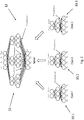
- Figure 1 shows by way of example a classifier system 10 with a central classifier unit 12 and three decentralized classifier units 14.1, 14.2 and 14.3.
- the central classifier unit 12 can be implemented in the form of a server in a server-client network.
- the decentralized classifier units 14.1, 14.2, 14.3 can then be clients in the server-client network.
- both the central classifier unit 12 and the decentralized classifier units 14.1, 14.2, 14.3 each implement classification models that are defined by artificial neural networks.
- the implementation of the artificial neural networks is identical for the classifier units 12, 14.1, 14.2 and 14.3 shown. This means that the artificial neural networks implemented in the classifier units are each identical Have topology.
- the topology of a respective artificial neural network is defined by artificial neurons 20 and connections 22 between the artificial neurons 20.
- the artificial neurons 20 thus form nodes in a network.
- the artificial neurons 20 are arranged in a plurality of layers, namely in an input layer 24, one or more hidden layers 26 and an output layer 28.
- the neurons 20 receive a plurality of input values that are weighted and summed up so that a sum value is obtained to which a fast value or a sigmoid function is applied, which is one of supplies the output value dependent on the sum value and the applied sigmoid or threshold function.
- This output value of a respective artificial neuron 20 is transmitted to one or more - typically all - artificial neurons 20 of a subsequent layer as an input value.
- the artificial neurons 20 of a subsequent, for example hidden, layer such as, for example, layer 26 receive their input values, which in turn are individually weighted and added up.
- the sum values formed in this way are in turn converted into output values in each of the neurons 20, for example via a sigmoid or threshold value function.
- the artificial neurons 20 of the output layer 28 each supply an output value which is an affiliation value which indicates the probability with which a state or an object, which is characterized by the system parameter values supplied to the artificial neurons 20 of the input layer 26, of a specific class of Is to be assigned to objects or states.
- One of the artificial neurons 20 of the output layer 28 indicates the probability that the system parameter values provided in the form of an input data set describe a system that can be assigned to a certain class (y 1, true ) and a second artificial neuron of the output layer 28 indicates the probability that the system described by the system parameter values contained in an input data record cannot be assigned to the state (y 1, false ).
- the binary classifier unit defined by the respective artificial neural network thus provides two membership values, namely one that indicates the probability of belonging to a class for which the artificial neural network was trained, and a second membership value that indicates the probability that this is due to the system described in the system parameter values of the input data set does not belong to the class for which the artificial neural network was trained.
- both the decentralized classifier units 14.1, 14.2 and 14.3 and the central classifier unit 12 each implement only a single neural network. It is possible for each of the classifier units 12, 14.1, 14.2 and 14.3 to also implement a plurality of neural networks. The topology of the neural networks can also differ from one another. It is only important that the neural networks for a specific object or condition class are constructed identically both in the decentralized classifier units 14.1, 14.2 and 14.3 and in the central classifier unit 12.
- a classification model for a class (in the case of binary classification models) or for several classes (in the case of multi-class classification models) is defined by the topology of a respective artificial neural network and the associated model parameter values.
- Model parameter values are the values of the weights ⁇ with which the input values of the individual neurons 20 are weighted, as well as coefficients that describe the function of the artificial neurons 20, for example the sigmoid function or the threshold value of a threshold value function. With a known topology, a classification model is thus clearly described by the model parameter values.
- the appropriate model parameter values are generated with a given topology in that a respective artificial neural network is trained with training data sets and an associated target value.
- the training data sets contain system parameter values and, together with the target value, form an input data tuple for the training (training data tuple).
- a target value indicates the class to which the system parameter values contained in the input data record are to be assigned.
- the class can designate a specific one of several objects or a specific one of several states.
- artificial neural networks are typically trained with a large number of different training data tuples for the same class.
- the decentralized classifier units 14.1, 14.2 and 14.3 are typically trained with a large number of different training data tuples, the training data tuples with which, for example, the first decentralized classifier unit 14.1 is trained, differing from the training data tuples with which the second decentralized classifier unit 14.2 trains as the respective system parameter values typically occur differently.
- the resulting model parameter values and thus also the resulting classification models differ from one another to a greater or lesser extent.
- the decentralized classifier units 14.1, 14.2 and 14.3 each transmit the model parameter values of the classification model implemented by them to the central classifier unit 12. This then combines the model parameter values so that, for example, from all model parameter values for a respective model parameter (i.e. for a specific weight in each case in the artificial neural network) a mean value is formed. This is in Figure 1 indicated by the formula shown. The mean values formed in this way are then the model parameter values of the central classification model.
- the central classifier unit 12 can form a central binary classification model for a specific class (for example index 1).
- FIG. 2 shows that a central classifier unit 12 can implement several classification models at the same time, which can be implemented by different artificial neural networks.
- these are three different neural networks 30.1, 30.2 and 30.3, each of which defines a central binary classification model for a different class (i.e. for a different object or a completely different state).
- the central classifier unit 12 is designed to form a combined multi-class classification model 32 from the three different binary classification models 30.1, 30.2 and 30.3 in the example.
- the result of the multi-class classification model 32 is composed of three binary partial classification models which have a common input layer 34 and a common output layer 36 and each have their own intermediate layers 38 (hidden layers). If such a multi-class classification model is implemented by the central classifier unit or one of the decentralized classifier units, it is possible to only exchange model parameters for one of the partial classification models between one of the local classifier units and the central classifier unit.
- model parameter values from a decentralized classifier unit to the central classifier unit always takes place when a (partial) classification model implemented by the decentralized classifier unit has been updated by new training data sets and so updated decentralized, i.e. local, model parameter values have been formed .
- a (partial) classification model implemented by the decentralized classifier unit has been updated by new training data sets and so updated decentralized, i.e. local, model parameter values have been formed .
- the central (multi-class) classification model implemented by the central classifier unit is also updated.
- the updated central model parameter values resulting therefrom can then in turn be transmitted from the central classifier unit to the corresponding decentralized classifier units in order to also update the decentralized classification models implemented by them accordingly.
- the combined multiclass classification model 32 generated and implemented as a result by the central classifier unit 12 can then be transferred back to at least some of the decentralized classifier units (deployment), so that a classification model ultimately implemented by these decentralized classifier units is also optimized taking into account training data sets from other decentralized classifier units .
- the retransmission can also only take place partially, for example by retransmitting only one or a few selected binary classification models 30.1, 30.2 and 30.3, i.e. not the entire multiclass classification model implemented by the central classifier unit 12.
Landscapes
- Engineering & Computer Science (AREA)
- Theoretical Computer Science (AREA)
- Physics & Mathematics (AREA)
- Data Mining & Analysis (AREA)
- General Physics & Mathematics (AREA)
- General Engineering & Computer Science (AREA)
- Life Sciences & Earth Sciences (AREA)
- Artificial Intelligence (AREA)
- Evolutionary Computation (AREA)
- Molecular Biology (AREA)
- Computational Linguistics (AREA)
- Software Systems (AREA)
- Mathematical Physics (AREA)
- Health & Medical Sciences (AREA)
- Biomedical Technology (AREA)
- Biophysics (AREA)
- Computing Systems (AREA)
- General Health & Medical Sciences (AREA)
- Bioinformatics & Cheminformatics (AREA)
- Evolutionary Biology (AREA)
- Bioinformatics & Computational Biology (AREA)
- Computer Vision & Pattern Recognition (AREA)
- Databases & Information Systems (AREA)
- Information Retrieval, Db Structures And Fs Structures Therefor (AREA)
- Image Analysis (AREA)
Priority Applications (4)
| Application Number | Priority Date | Filing Date | Title |
|---|---|---|---|
| EP25152004.5A EP4535191A3 (fr) | 2019-05-10 | 2019-10-02 | Système de classificateur et procédé de génération distribuée de modèles de classification |
| CN202080034814.0A CN113841139A (zh) | 2019-05-10 | 2020-05-11 | 分类器系统和用于分布式地生成分类模型的方法 |
| US17/609,252 US20220207285A1 (en) | 2019-05-10 | 2020-05-11 | Classifier system and method for generating classification models in a distributed manner |
| PCT/EP2020/063047 WO2020229407A1 (fr) | 2019-05-10 | 2020-05-11 | Système de classificateur et procédé pour la génération répartie de modèles de classification |
Applications Claiming Priority (1)
| Application Number | Priority Date | Filing Date | Title |
|---|---|---|---|
| EP19173947 | 2019-05-10 |
Related Child Applications (1)
| Application Number | Title | Priority Date | Filing Date |
|---|---|---|---|
| EP25152004.5A Division EP4535191A3 (fr) | 2019-05-10 | 2019-10-02 | Système de classificateur et procédé de génération distribuée de modèles de classification |
Publications (1)
| Publication Number | Publication Date |
|---|---|
| EP3736709A1 true EP3736709A1 (fr) | 2020-11-11 |
Family
ID=66668683
Family Applications (2)
| Application Number | Title | Priority Date | Filing Date |
|---|---|---|---|
| EP19201156.7A Ceased EP3736709A1 (fr) | 2019-05-10 | 2019-10-02 | Système de classification et procédé de génération distribuée des modèles de classification |
| EP25152004.5A Pending EP4535191A3 (fr) | 2019-05-10 | 2019-10-02 | Système de classificateur et procédé de génération distribuée de modèles de classification |
Family Applications After (1)
| Application Number | Title | Priority Date | Filing Date |
|---|---|---|---|
| EP25152004.5A Pending EP4535191A3 (fr) | 2019-05-10 | 2019-10-02 | Système de classificateur et procédé de génération distribuée de modèles de classification |
Country Status (4)
| Country | Link |
|---|---|
| US (1) | US20220207285A1 (fr) |
| EP (2) | EP3736709A1 (fr) |
| CN (1) | CN113841139A (fr) |
| WO (1) | WO2020229407A1 (fr) |
Families Citing this family (1)
| Publication number | Priority date | Publication date | Assignee | Title |
|---|---|---|---|---|
| US20230376859A1 (en) * | 2022-05-19 | 2023-11-23 | Microsoft Technology Licensing, Llc | Federated Learning Solutions for Machine Learning |
Citations (1)
| Publication number | Priority date | Publication date | Assignee | Title |
|---|---|---|---|---|
| US20150324686A1 (en) * | 2014-05-12 | 2015-11-12 | Qualcomm Incorporated | Distributed model learning |
Family Cites Families (2)
| Publication number | Priority date | Publication date | Assignee | Title |
|---|---|---|---|---|
| US7840502B2 (en) * | 2007-06-13 | 2010-11-23 | Microsoft Corporation | Classification of images as advertisement images or non-advertisement images of web pages |
| WO2010105988A1 (fr) * | 2009-03-20 | 2010-09-23 | Semeion Centro Ricerche | Machine de calcul naturelle |
-
2019
- 2019-10-02 EP EP19201156.7A patent/EP3736709A1/fr not_active Ceased
- 2019-10-02 EP EP25152004.5A patent/EP4535191A3/fr active Pending
-
2020
- 2020-05-11 WO PCT/EP2020/063047 patent/WO2020229407A1/fr not_active Ceased
- 2020-05-11 CN CN202080034814.0A patent/CN113841139A/zh active Pending
- 2020-05-11 US US17/609,252 patent/US20220207285A1/en active Pending
Patent Citations (1)
| Publication number | Priority date | Publication date | Assignee | Title |
|---|---|---|---|---|
| US20150324686A1 (en) * | 2014-05-12 | 2015-11-12 | Qualcomm Incorporated | Distributed model learning |
Also Published As
| Publication number | Publication date |
|---|---|
| US20220207285A1 (en) | 2022-06-30 |
| WO2020229407A1 (fr) | 2020-11-19 |
| EP4535191A2 (fr) | 2025-04-09 |
| EP4535191A3 (fr) | 2025-06-11 |
| CN113841139A (zh) | 2021-12-24 |
Similar Documents
| Publication | Publication Date | Title |
|---|---|---|
| DE69014613T2 (de) | Genetische synthese von neuronalen netzwerken. | |
| DE60318471T2 (de) | Extraktion von wissen mittels eines objektbasierten semantischen netzes | |
| DE69315378T2 (de) | Einen dynamischen Nachrichtenservice verwendendes objektorientiertes Softwaresystem, besonders für eine Kontroll-/Steuer-Vorrichtung für eine redundante Architektur | |
| EP3575890A1 (fr) | Système d'aide à l'appui de la planification de systèmes d'automatisation | |
| WO2000063788A2 (fr) | Reseau semantique d'ordre n, operant en fonction d'une situation | |
| WO2021104608A1 (fr) | Procédé de génération d'une proposition d'ingénierie pour un dispositif ou une installation | |
| EP0901658B1 (fr) | Procede d'optimisation d'un ensemble de regles floues au moyen d'un ordinateur | |
| DE60125536T2 (de) | Anordnung zur generierung von elementensequenzen | |
| EP4081950A1 (fr) | Système et procédé d'assurance qualité de modèles basée sur des données | |
| CH714206A2 (de) | Verfahren und Vorrichtungen zum Entwerfen optischer Systeme. | |
| DE102019216973A1 (de) | Lernverfahren für neuronale netze basierend auf evolutionären algorithmen | |
| DE10201018B4 (de) | Neuronales Netz, Opimierungsverfahren zur Einstellung der Verbindungsgewichte eines neuronalen Netzes sowie Analyseverfahren zur Überwachung eines Optimierungsverfahrens | |
| Barenkamp | Wertschöpfung durch KI | |
| WO2020229407A1 (fr) | Système de classificateur et procédé pour la génération répartie de modèles de classification | |
| DE19703964C1 (de) | Verfahren zur Transformation einer zur Nachbildung eines technischen Prozesses dienenden Fuzzy-Logik in ein neuronales Netz | |
| WO1997036248A1 (fr) | Procede de determination de poids aptes a etre elimines, d'un reseau neuronal, au moyen d'un ordinateur | |
| WO2020193481A1 (fr) | Procédé et dispositif d'apprentissage et de réalisation d'un réseau neuronal artificiel | |
| WO2020193294A1 (fr) | Procédé et dispositif destinés à commander de manière compatible un appareil avec un nouveau code de programme | |
| DE112010005924T5 (de) | Verfahren und System zum Weitergeben von Änderungen an einer Master-Einheit zu Duplikaten | |
| DE102020213057A1 (de) | Verfahren und Vorrichtung zum Überprüfen eines beim teilautomatisierten oder vollautomatisierten Steuern eines Fahrzeugs verwendeten KI-basierten Informationsverarbeitungssystems | |
| DE10048308B4 (de) | Verfahren und Vorrichtung zum Klassifizieren von Objekten aus als Pixelmuster vorliegenden eingangsseitigen Bilddaten | |
| DE3609925A1 (de) | Einrichtung zur simulation von neuronensystemen | |
| WO2021180663A1 (fr) | Système de microscopie et procédé de traitement d'images microscopiques | |
| DE112021008422T5 (de) | Verfahren zur Bestimmung von ersten und zweiten abgebildeten Zielmerkmalen, die einem realen Zielmerkmal in einer mikroskopischen Probe entsprechen, und Implementierungsmittel | |
| DE102021208368A1 (de) | Computerimplementiertes Verfahren zur Entwicklung eines Produkts in einem vernetzten System und Anwendersystem zur computergestützten Entwicklung eines Produkts |
Legal Events
| Date | Code | Title | Description |
|---|---|---|---|
| PUAI | Public reference made under article 153(3) epc to a published international application that has entered the european phase |
Free format text: ORIGINAL CODE: 0009012 |
|
| STAA | Information on the status of an ep patent application or granted ep patent |
Free format text: STATUS: THE APPLICATION HAS BEEN PUBLISHED |
|
| AK | Designated contracting states |
Kind code of ref document: A1 Designated state(s): AL AT BE BG CH CY CZ DE DK EE ES FI FR GB GR HR HU IE IS IT LI LT LU LV MC MK MT NL NO PL PT RO RS SE SI SK SM TR |
|
| AX | Request for extension of the european patent |
Extension state: BA ME |
|
| STAA | Information on the status of an ep patent application or granted ep patent |
Free format text: STATUS: REQUEST FOR EXAMINATION WAS MADE |
|
| 17P | Request for examination filed |
Effective date: 20210511 |
|
| RBV | Designated contracting states (corrected) |
Designated state(s): AL AT BE BG CH CY CZ DE DK EE ES FI FR GB GR HR HU IE IS IT LI LT LU LV MC MK MT NL NO PL PT RO RS SE SI SK SM TR |
|
| APBK | Appeal reference recorded |
Free format text: ORIGINAL CODE: EPIDOSNREFNE |
|
| APBN | Date of receipt of notice of appeal recorded |
Free format text: ORIGINAL CODE: EPIDOSNNOA2E |
|
| APBR | Date of receipt of statement of grounds of appeal recorded |
Free format text: ORIGINAL CODE: EPIDOSNNOA3E |
|
| APAF | Appeal reference modified |
Free format text: ORIGINAL CODE: EPIDOSCREFNE |
|
| APBT | Appeal procedure closed |
Free format text: ORIGINAL CODE: EPIDOSNNOA9E |
|
| STAA | Information on the status of an ep patent application or granted ep patent |
Free format text: STATUS: THE APPLICATION HAS BEEN REFUSED |
|
| 18R | Application refused |
Effective date: 20250116 |