EP3738457B1 - Chaussure dotée d'une alimentation en air frais et mode air frais du dispositif d'aération commutable - Google Patents
Chaussure dotée d'une alimentation en air frais et mode air frais du dispositif d'aération commutable Download PDFInfo
- Publication number
- EP3738457B1 EP3738457B1 EP19174048.9A EP19174048A EP3738457B1 EP 3738457 B1 EP3738457 B1 EP 3738457B1 EP 19174048 A EP19174048 A EP 19174048A EP 3738457 B1 EP3738457 B1 EP 3738457B1
- Authority
- EP
- European Patent Office
- Prior art keywords
- shoe
- air
- valve closing
- closing element
- servomotor
- Prior art date
- Legal status (The legal status is an assumption and is not a legal conclusion. Google has not performed a legal analysis and makes no representation as to the accuracy of the status listed.)
- Active
Links
Images

Classifications
-
- A—HUMAN NECESSITIES
- A43—FOOTWEAR
- A43B—CHARACTERISTIC FEATURES OF FOOTWEAR; PARTS OF FOOTWEAR
- A43B7/00—Footwear with health or hygienic arrangements
- A43B7/06—Footwear with health or hygienic arrangements ventilated
- A43B7/08—Footwear with health or hygienic arrangements ventilated with air-holes, with or without closures
- A43B7/081—Footwear with health or hygienic arrangements ventilated with air-holes, with or without closures the air being forced from outside
-
- A—HUMAN NECESSITIES
- A43—FOOTWEAR
- A43B—CHARACTERISTIC FEATURES OF FOOTWEAR; PARTS OF FOOTWEAR
- A43B3/00—Footwear characterised by the shape or the use
- A43B3/34—Footwear characterised by the shape or the use with electrical or electronic arrangements
-
- A—HUMAN NECESSITIES
- A43—FOOTWEAR
- A43B—CHARACTERISTIC FEATURES OF FOOTWEAR; PARTS OF FOOTWEAR
- A43B3/00—Footwear characterised by the shape or the use
- A43B3/34—Footwear characterised by the shape or the use with electrical or electronic arrangements
- A43B3/38—Footwear characterised by the shape or the use with electrical or electronic arrangements with power sources
-
- A—HUMAN NECESSITIES
- A43—FOOTWEAR
- A43B—CHARACTERISTIC FEATURES OF FOOTWEAR; PARTS OF FOOTWEAR
- A43B3/00—Footwear characterised by the shape or the use
- A43B3/34—Footwear characterised by the shape or the use with electrical or electronic arrangements
- A43B3/38—Footwear characterised by the shape or the use with electrical or electronic arrangements with power sources
- A43B3/42—Footwear characterised by the shape or the use with electrical or electronic arrangements with power sources where power is generated by conversion of mechanical movement to electricity, e.g. by piezoelectric means
-
- A—HUMAN NECESSITIES
- A43—FOOTWEAR
- A43B—CHARACTERISTIC FEATURES OF FOOTWEAR; PARTS OF FOOTWEAR
- A43B3/00—Footwear characterised by the shape or the use
- A43B3/34—Footwear characterised by the shape or the use with electrical or electronic arrangements
- A43B3/44—Footwear characterised by the shape or the use with electrical or electronic arrangements with sensors, e.g. for detecting contact or position
-
- A—HUMAN NECESSITIES
- A43—FOOTWEAR
- A43B—CHARACTERISTIC FEATURES OF FOOTWEAR; PARTS OF FOOTWEAR
- A43B7/00—Footwear with health or hygienic arrangements
- A43B7/06—Footwear with health or hygienic arrangements ventilated
- A43B7/08—Footwear with health or hygienic arrangements ventilated with air-holes, with or without closures
- A43B7/084—Footwear with health or hygienic arrangements ventilated with air-holes, with or without closures characterised by the location of the holes
- A43B7/085—Footwear with health or hygienic arrangements ventilated with air-holes, with or without closures characterised by the location of the holes in the upper
Definitions
- the invention relates to a shoe with a ventilation device Suction of fresh air is arranged on the outside of the shoe, a second air suction line with a second suction opening, which is arranged in the interior of the shoe, and a switching device coupling the first and second air suction lines to the air pumping device, which either the first or the second air suction line with at least one suction opening the air pumping device connects.
- Such a shoe with a ventilation device that can be switched between fresh air supply and circulating air operation is, for example, from the patent application EP 3 106 051 A1 known. It is proposed, inter alia, to use an electromagnetically controllable valve as a switching device for switching from circulating air to fresh air mode and vice versa. This document does not disclose any further details regarding the configuration of a switching device implemented by means of the electromagnetically controllable valve.
- a shoe with a ventilation device in the form of closable ventilation openings in the sole of the shoe is also known.
- the sole contains an adjusting device driven by an electric motor, which actuates a slide which, in one end position, releases the ventilation openings of the sole and closes them in the other end position.
- the electromotive adjusting device contains either a stepper motor that drives a worm shaft or a pull magnet with a return spring.
- a shoe is known with a ventilation device which has an air pump device accommodated in the shoe heel, an air supply line transporting air from the air pump device into the interior of the shoe, and an air intake line transporting air into the air pump device.
- a manually reversible switching device couples the air intake line opening into the air pumping device either with an air intake socket with a filter surface for sucking in fresh air or with a suction line that leads to an intake opening in the interior of the shoe.
- the object of the invention is to create a switchover device in a shoe that is suitable for switching between fresh air supply and circulating air operation.
- this object is achieved by a shoe with the features of claim 1 or, alternatively, a shoe with the features of claim 2.
- a shoe of the type mentioned at the outset is characterized in that the switching device has a valve closing element driven by a servomotor, which can be moved between two setting positions when the servomotor is actuated, the valve closing element in a first setting position the first air intake line with at least one of the at least one intake opening the air pumping device and separates the second air suction line from the at least one suction opening of the air pumping device and in a second setting position connects the second air suction line to at least one of the at least one suction opening of the air pumping device and separating the first air suction line from the at least one suction opening of the air pumping device, the servomotor via a coupling element with the Valve closing element is connected and the servomotor and the coupling element are designed so that the valve closing element is held in the two setting positions without energy consumption.
- the valve closing element is pivotable about an axis and has a sealing surface, the sealing surface sliding over a bearing surface of a housing when the valve closing element is pivoted, a first opening of the first air intake line and a second opening of the second air intake line opening into the bearing surface, the valve closing element in in the first set position closes the second opening with its sealing surface and releases the first opening and in the second set position closes the first opening with its sealing surface and releases the second opening.
- This preferred embodiment of the valve closing element allows a structurally simple and thus inexpensive and also robust design of the switching device with little space requirement and low mass.
- the sliding of the sealing surface on the support surface ensures static friction for better holding the valve closing element in the respective setting positions.
- the first and the second opening can each also comprise a plurality of partial openings which open into the bearing surface next to one another and are jointly closed or released by the sealing surface.
- valve closing element comprises a valve flap in the form of a plate, which can be pivoted back and forth and thereby covers an opening of the first air intake line with its one upper side in the first setting position and an opening of the second air intake line with its opposite upper side in the second setting position.
- “Maintained without energy consumption” in this context means, on the one hand, that the energy supply both to the servomotor and to a control circuit which controls this servomotor can be switched off because none Energy supply is required to maintain the respective position assumed.
- the mass of the closing element and the coupled moving parts of the switching device should be as low as possible in order to minimize forces caused by inertia.
- This configuration of the switching device with a valve closing element that can be held in the two stable setting positions without energy consumption has the advantage of low energy consumption, so that an energy storage device (for example a rechargeable battery) can be carried in the shoe.
- an energy storage device for example a rechargeable battery
- the coupling element could comprise a transmission.
- the coupling element is merely a fastening of the valve closing element directly on a shaft of the servomotor, the axis of rotation of the shaft of the servomotor corresponding to the axis about which the valve closing element can be pivoted.
- the attachment includes, for example, a hole in the Valve closing element in which the shaft is attached by means of an adhesive connection.
- the shaft can be provided with teeth or projections which engage in corresponding recesses in the bore of the valve closing element.
- the servomotor is preferably a miniature DC motor or a miniature stepper motor which is controlled by a control circuit, the control circuit being configured in such a way that the servomotor for moving the valve closing element is controlled until the valve closing element has reached the other setting position.
- a miniature motor which preferably has maximum dimensions of less than 10 mm, also contributes to the small overall size and low mass of the moving parts.
- inexpensive miniature DC motors suitable for this application which are currently used, for example, for vibration units in mobile telephones) and miniature stepper motors.
- the control circuit is coupled to a sensor device which generates a sensor signal indicating that the valve closing element has reached the first and second actuating positions.
- the sensor device comprises, for example, a mechano-electrical converter actuated by the valve closing element or the coupling element.
- the mechano-electrical converter includes, for example, one or more mechanical limit switches or other position sensors or force or pressure sensors.
- the sensor device comprises at least one sensor that detects a motor current and / or a motor voltage of the servomotor, with the aid of which a signal dependent on the motor load is generated that indicates that it has been reached indicates the first and second set position by the valve closing element.
- control circuit is configured in such a way that the servomotor for moving the valve closing element is activated for a predetermined period of time, so that the valve closing element has reached the respective other setting position before or after this period of time has elapsed.
- the servomotor is a stepper motor and the control circuit is configured in such a way that the stepper motor for moving the valve closing element is controlled in such a way that it reaches a predetermined rotational position in each case such that the valve closing element reaches the first or second setting position.
- additional sensors attached to the valve closing element can be dispensed with.
- the second suction opening is arranged in a shaft region of the shoe interior remote from the sole. This also allows an improved lowering of the air humidity in the sole area in the air circulation mode.
- a preferred development of the shoe according to the invention is characterized by an energy store for storing the energy required to operate the servomotor and to operate the control circuit, a charging circuit for charging the energy store and an energy generator coupled to the charging circuit for converting mechanical into electrical energy, the energy being obtained by deformation or movement of an element of the energy generator during a running movement.
- an energy store for storing the energy required to operate the servomotor and to operate the control circuit
- a charging circuit for charging the energy store
- an energy generator coupled to the charging circuit for converting mechanical into electrical energy, the energy being obtained by deformation or movement of an element of the energy generator during a running movement.
- the shoe preferably has a temperature sensor coupled to a control circuit of the servomotor for detecting a temperature at a predetermined point in the interior of the shoe, the control circuit being configured in such a way that when a predetermined temperature is detected in the interior of the shoe, the servomotor is controlled in such a way that the Valve closing element is moved into the first set position.
- the control circuit is further configured in such a way that when the temperature falls below a second predetermined temperature in the interior of the shoe, the servomotor is actuated in such a way that the valve closing element is moved into the second actuating position. This allows an automated switchover from fresh air supply to recirculation mode and vice versa.
- a moisture sensor for detecting a moisture value at the specified point in the interior of the shoe is coupled to the control circuit of the servomotor, the control circuit being configured such that the servomotor is also controlled as a function of the detected humidity value. This improves the automated switching from fresh air supply to recirculation mode and vice versa and increases wearing comfort.
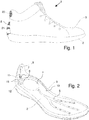
- the air intake line opening into the intake opening 6 has a first air intake line 7 (for example a hose, in particular a plastic hose) with a suction opening 8 arranged on the outer wall of the shoe 1 and a second air intake line 9 (also a hose) with a second air intake line opening into the interior of the shoe Intake opening 10.
- the first air intake line 7 and the second air intake line 9 open into a switching device 11, which connects either the first or the second air intake line to the intake opening 6 of the air pump device 4.
- the switching device 11 connects the first air suction line 7 to the line (e.g.
- the switching device 11 connects the second air suction line 9 to the line leading to the suction opening 6, then air is sucked in from the shoe interior via the suction opening 10 opening into the shoe interior and then again via the Air pumping device 4 and the air supply line 5 are fed back into the interior of the shoe, which leads to a circulating air operation.
- the switching device 11 comprises a valve closing element driven by a servomotor, which can be moved between two setting positions when the servomotor is actuated, the valve closing element in a first setting position connecting the first air intake line 7 to the intake opening 6 of the air pumping device 4 and the second air intake line 9 from the intake opening 6 separates and in a second setting position connects the second air intake line 9 to the intake opening 6 and separates the first air intake line 7 from the intake opening 6.
- the servomotor is driven by an in Figure 2
- the control circuit 12 shown schematically is controlled and is connected to the control circuit 12 via the control and supply lines 15.
- an air intake assembly 21 is provided, which is mounted on the heel of the shoe 1 and accommodates the first air intake line 7 with the intake opening 8, the switching device 11 and the control circuit 12.
- This air intake assembly 21 is fastened during the assembly of the sole construction in such a way that the switching device 11 is coupled to the second air intake line 9 and the line leading to the intake opening 6 of the air pump device 4.
- FIG 3A shows a schematic representation of the switching device 11, each with a section of the first air suction line 7 attached to it for sucking in fresh air and the second air suction line 9 for sucking in circulating air from the interior of the shoe.
- this switching device 11 in contrast to the illustration in FIG Figure 2 shown with their underside facing up.
- the switching device 11 shown comprises a housing 13 and a servomotor 14 fastened to the housing with the supply lines 15 to the control circuit 12.
- FIG 3B shows the in Figure 3A
- the switching device shown with the housing 13 open.
- the housing 13 comprises a housing cover 13A and a housing lower shell 13B.
- the housing cover 13A has a bore onto which a check valve 16 is placed and to which the supply line to the suction opening 6 of the air pump device 4, preferably in the form of a flexible hose, is attached.
- the hoses of the first air intake line 7 and the second air intake line 9 are plugged onto the lower housing shell 13B.
- a valve closing element 17 is shown in a first setting position.
- FIG 3C shows the in the Figures 3A and 3B Switching device 11 shown in an exploded view, in which the hoses of the first air intake line 7 and the second air intake line 9 and the servomotor 14 are pulled out downwards and in which the valve closing element 17 is pulled out of the lower housing shell 13B and the check valve 16 is pulled out of the housing cover 13A upwards.
- a first opening 19 and a second opening 20, into which the first air intake line 7 and the second air intake line 9 open, can be seen in the interior of the lower housing shell 13.
- the openings 19 and 20 in turn open onto a flat support surface 25 of the lower housing shell 13B.
- a sealing surface 26 of the valve closing element 17 slides on this support surface 25.
- the servomotor 14 has a shaft 18 which protrudes into the interior of the housing 13 and on which the valve closing element 17 with the in the Figures 3B and 3C visible hole is attached and fastened.
- the shaft rotates counterclockwise by a predetermined angle
- the valve closing element 17 connected to the shaft 18 is pivoted until the sealing surface 26 on the underside of the valve closing element 17 closes the first opening 19 and thereby exposes the second opening 20.
- the sealing surface 26 slides on the bearing surface 25 of the lower housing shell.
- the servomotor 19 is a direct current miniature motor which, in one embodiment, is caused to rotate either in one direction or in the opposite direction by reversing the polarity of the voltage supply.
- the motor can contain a simple miniature gearbox.
- the miniature motor is controlled in such a way that the shaft 18 rotates either clockwise or in the opposite direction, so that the valve closing element 17 fastened on the shaft 18 is pivoted until it is in the first or the second setting position on a side wall the lower housing shell 13b strikes.
- the motor 14 is then switched off, so that the valve closing element 17 remains in the set position it has assumed.
- the control of the motor 14 takes place with a fixed predetermined period of time, which ensures complete pivoting of the valve closing element 17.
- the power of the motor 14 is dimensioned so that on the one hand it is sufficient to overcome any frictional forces, but on the other hand is so low that the motor 14 when the valve closing element 17 hits the side wall of the Lower housing shell 13B is braked.
- the control circuit 17 can have a sensor device for detecting a motor current and / or a motor voltage of the servomotor 14, with the aid of the detected currents and / or voltages being used to generate a signal which is dependent on the motor load and which the Indicates that the valve closing element 17 has reached the first and second actuating position and, depending on this, switches off the motor 14 when the actuating position is reached.
- sensors can be arranged in the housing 13, which detect the reaching of the first and second setting positions by the valve closing element 17 and transmit corresponding signals to the control circuit 12, so that the servomotor 14 is switched off when the setting positions are reached.
- the switchover between fresh air supply and circulating air operation takes place as a function of temperatures and / or humidity values, which are detected by sensors in the interior of the shoe and / or on the exterior of the shoe.
- Figure 1 shows schematically a combination of temperature and humidity sensor 22 attached to the heel area of the shoe 1
- Figure 4 a temperature and humidity sensor 23, which is arranged in the inner sole of the shoe and is connected to the control circuit 12 via signal lines 24, is shown schematically.
- the switchover from fresh air mode to air circulation mode takes place as a function of a temperature in the interior of the shoe detected by the sensor 23 in such a way that, when a predetermined temperature is detected, the servomotor 14 is controlled in such a way that the valve closing element 17 is moved into the first setting position, and that when it is detected that the temperature falls below a second predetermined temperature, the servomotor 14 is activated in such a way that the valve closing element 17 is moved into the second set position.
- control can be carried out as a function of the moisture measured in the interior of the shoe by the sensor 23.
- switching from recirculating air to fresh air operation can be triggered with increasing humidity at a lower temperature measured in the interior.
- the switchover from fresh air mode to circulating mode and vice versa can also take place as a function of an outside temperature or, alternatively, solely as a function of a measured outside temperature, in which case the sensor in the shoe interior could be omitted in the latter case.
- a switch is made, for example, to recirculation mode if the outside temperature falls below a predetermined value at which a supply of fresh air would be perceived as unpleasant by the wearer of the shoe.
- the shoe according to the invention has an energy store, not shown in the figures, for storing the energy required to operate the servomotor 14 and to operate the control circuit 12, for example a battery or an accumulator.
- a charging circuit is preferably provided for recharging the fully or partially discharged energy store.
- the charging circuit is preferably coupled to an energy generator for converting mechanical energy into electrical energy.
- the mechanical energy is obtained by deforming or moving an element of the energy generator during a running movement.
- the element comprises a permanent magnet and a coil, which are brought into a relative movement to one another with the aid of the running movement and a corresponding gear, mechanical energy being converted into electrical energy by induction.
- electrical energy can be generated using a deformed piezoelectric Elements can be obtained.
- a further energy generator can also be provided which converts thermal energy into electrical energy, for example by utilizing the temperature difference between the interior of the shoe and the surroundings of the shoe.
Landscapes
- Engineering & Computer Science (AREA)
- Microelectronics & Electronic Packaging (AREA)
- Health & Medical Sciences (AREA)
- Epidemiology (AREA)
- General Health & Medical Sciences (AREA)
- Public Health (AREA)
- Footwear And Its Accessory, Manufacturing Method And Apparatuses (AREA)
Claims (15)
- Chaussure (1) dotée d'un dispositif d'aération,sachant que le dispositif d'aération comporte un dispositif de pompage d'air (4), un conduit d'alimentation d'air (5) transportant de l'air du dispositif de pompage d'air (4) dans l'espace intérieur de chaussure et un conduit d'aspiration d'air transportant de l'air dans le dispositif de pompage d'air (4),sachant que la conduit d'aspiration d'air comporte :un premier conduit d'aspiration d'air (7) avec une première ouverture d'aspiration (8), qui est disposée sur la zone extérieure de la chaussure (1) pour aspirer de l'air frais,un deuxième conduit d'aspiration d'air (9) avec une deuxième ouverture d'aspiration (10), qui est disposée dans l'espace intérieur de chaussure, etun dispositif de commutation (11) couplant le premier (7) et le deuxième conduit d'aspiration d'air (9) au dispositif de pompage d'air (4), qui relie soit le premier conduit d'aspiration d'air (7) soit le deuxième (9) à au moins une ouverture d'aspiration (6) du dispositif de pompage d'air (4),caractérisée en ce quele dispositif de commutation (11) comporte un élément de fermeture de soupape (17) entraîné par un servomoteur (14), qui peut être déplacé en actionnant le servomoteur (14) entre deux positions de réglage, sachant que l'élément de fermeture de soupape (17) relie dans une première position de réglage le conduit d'aspiration d'air (7) à au moins une ouverture d'aspiration (6) du dispositif de pompage d'air (4) et sépare le deuxième conduit d'aspiration d'air (9) d'au moins une ouverture d'aspiration d'air (6) du dispositif de pompage d'air (4) et dans une deuxième position de réglage, relie le deuxième conduit d'aspiration d'air (9) à au moins une ouverture d'aspiration (6) du dispositif de pompage d'air (4) et sépare le premier conduit d'aspiration d'air (7) d'au moins une ouverture d'aspiration (6) du dispositif de pompage d'air (4),sachant que le servomoteur (14) est relié par un élément de couplage à l'élément de fermeture de soupape (17) et le servomoteur (14) et l'élément de couplage sont constitués de telle sorte que l'élément de fermeture de soupape (17) est maintenu dans les deux positions de réglage sans consommation d'énergie,sachant que l'élément de fermeture de soupape (17) peut pivoter autour d'un axe et comporte une surface d'étanchéité (26), sachant que la surface d'étanchéité (26) coulisse lors du pivotement de l'élément de fermeture de soupape (17) sur une surface d'appui (25) d'un boîtier (13B), sachant qu'une première ouverture (19) du premier conduit d'aspiration d'air (7) et une deuxième ouverture (20) du deuxième conduit d'aspiration d'air (9) débouchent dans la surface d'appui (25), sachant que l'élément de fermeture de soupape (17) ferme dans la première position de réglage la deuxième ouverture (20) avec sa surface d'étanchéité (26) et libère la première ouverture (19) et dans la deuxième position de réglage ferme la première ouverture (19) avec sa surface d'étanchéité (26) et libère la deuxième ouverture (20).
- Chaussure (1) dotée d'un dispositif d'aération,sachant que le dispositif d'aération comporte un dispositif de pompage d'air (4), un conduit d'alimentation d'air (5) transportant de l'air du dispositif de pompage d'air (4) dans l'espace intérieur de chaussure et un conduit d'aspiration d'air transportant de l'air dans le dispositif de pompage d'air (4),sachant que la conduit d'aspiration d'air comporte :un premier conduit d'aspiration d'air (7) avec une première ouverture d'aspiration (8), qui est disposée sur la zone extérieure de la chaussure (1) pour aspirer de l'air frais,un deuxième conduit d'aspiration d'air (9) avec une deuxième ouverture d'aspiration (10), qui est disposée dans l'espace intérieur de chaussure, etun dispositif de commutation (11) couplant le premier (7) et le deuxième conduit d'aspiration d'air (9) au dispositif de pompage d'air (4), qui relie soit le premier conduit d'aspiration d'air (7) soit le deuxième (9) à au moins une ouverture d'aspiration (6) du dispositif de pompage d'air (4),caractérisée en ce quele dispositif de commutation (11) comporte un élément de fermeture de soupape (17) entraîné par un servomoteur (14), qui peut être déplacé en actionnant le servomoteur (14) entre deux positions de réglage, sachant que l'élément de fermeture de soupape (17) relie dans une première position de réglage le conduit d'aspiration d'air (7) à au moins une ouverture d'aspiration (6) du dispositif de pompage d'air (4) et sépare le deuxième conduit d'aspiration d'air (9) d'au moins une ouverture d'aspiration d'air (6) du dispositif de pompage d'air (4) et dans une deuxième position de réglage relie le deuxième conduit d'aspiration d'air (9) à au moins une ouverture d'aspiration (6) du dispositif de pompage d'air (4) et sépare le premier conduit d'aspiration d'air (7) d'au moins une ouverture d'aspiration (6) du dispositif de pompage d'air (4),sachant que le servomoteur (14) est relié par un élément de couplage à l'élément de fermeture de soupape (17) et le servomoteur (14) et l'élément de couplage sont constitués de telle sorte que l'élément de fermeture de soupape (17) est maintenu dans les deux positions de réglage sans consommation d'énergie,sachant que l'élément de fermeture de soupape comprend un clapet de soupape sous la forme d'une plaque, qui peut être pivotée d'avant en arrière et couvre à cet effet, dans la première position de réglage, une ouverture du premier conduit d'aspiration d'air avec sa face supérieure et couvre dans la deuxième position de réglage avec sa face supérieure opposée une ouverture du deuxième conduit d'aspiration.
- Chaussure (1) selon la revendication 1 ou 2, caractérisée en ce que l'élément de couplage comprend une fixation de l'élément de fermeture de soupape (17) directement sur un arbre (18) du servomoteur (14).
- Chaussure (1) selon l'une quelconque des revendications 1 - 3, caractérisée en ce que le servomoteur (14) est un moteur à courant continu miniaturisé ou un moteur pas-à-pas miniaturisé, qui est actionné par un circuit de commande (12), sachant que le circuit de commande (12) est configuré de telle manière que le servomoteur (14) est actionné pour déplacer l'élément de fermeture de soupape (17) respectivement tant que l'élément de fermeture de soupape (17) n'a pas atteint l'autre position de réglage.
- Chaussure (1) selon la revendication 4, caractérisée en ce que le circuit de commande (12) est couplé à un dispositif de détection qui produit un signal de détection indiquant l'atteinte de la première et de la deuxième position de réglage par l'élément de fermeture de soupape (17).
- Chaussure (1) selon la revendication 5, caractérisée en ce que le dispositif de détection comprend un convertisseur mécano-électrique actionné par l'élément de fermeture de soupape (17) ou l'élément de couplage.
- Chaussure (1) selon la revendication 6, caractérisée en ce que le convertisseur mécanico-électrique est un commutateur de fin de course ou un autre capteur de position ou un capteur de force ou de pression.
- Chaussure (1) selon la revendication 5, caractérisée en ce que le dispositif de détection comprend au moins un capteur saisissant un courant de moteur et/ou une tension de moteur du servomoteur (14) à l'aide duquel un signal en fonction de la charge du moteur est produit, qui indique l'atteinte de la première et de la deuxième position de réglage par l'élément de fermeture de soupape (17) .
- Chaussure (1) selon la revendication 4, caractérisée en ce que le circuit de commande (12) est configuré de telle manière que le servomoteur (14) est actionné pour déplacer respectivement l'élément de fermeture de soupape (17) pour une durée de temps prédéfinie de telle sorte que l'élément de fermeture de soupape (17) a atteint respectivement l'autre position de réglage avant ou à l'expiration de cette période de temps.
- Chaussure (1) selon la revendication 4, caractérisée en ce que le servomoteur (14) est un moteur pas-à-pas et en ce que le circuit de commande (12) est configuré de telle manière que le moteur pas-à-pas est actionné pour déplacer l'élément de fermeture de soupape (17) de telle sorte qu'il a atteint respectivement une position de rotation prédéfinie de manière que l'élément de fermeture de soupape (17) atteint la première ou la deuxième position de réglage.
- Chaussure (1) selon l'une quelconque des revendication 1 - 10, caractérisée en ce que la deuxième ouverture d'aspiration (10) est disposée dans une zone de tige éloignée de la semelle de l'espace intérieur de chaussure.
- Chaussure (1) selon l'une quelconque des revendications 1 à 11, caractérisée parun accumulateur d'énergie pour accumuler l'énergie nécessaire pour actionner le servomoteur (14) et pour faire fonctionner le circuit de commande (12),un circuit de charge pour charger l'accumulateur d'énergie etun générateur d'énergie couplé au circuit de charge pour transformer de l'énergie mécanique en énergie électrique, sachant que l'énergie mécanique est obtenue par déformation ou mouvement d'un élément du générateur d'énergie pendant un mouvement de marche.
- Chaussure (1) selon l'une quelconque des revendications 1 - 12, caractérisée par un capteur de température (23) couplé à un circuit de commande (12) du servomoteur (14) pour la saisie d'une température à un emplacement prédéfini dans l'espace intérieur de chaussure,
sachant que le circuit de commande (12) est configuré de telle sorte que lors de la saisie du dépassement d'une température prédéfinie dans l'espace intérieur de chaussure, le servomoteur (14) est actionné de telle manière que l'élément de fermeture de soupape (17) est déplacé dans la première position de réglage. - Chaussure (1) selon la revendication 13, caractérisée en ce que le circuit de commande (12) est en plus configuré de telle sorte que lors d'une saisie du dépassement d'une deuxième température prédéfinie dans l'espace intérieur de chaussure, le servomoteur (14) est actionné de telle manière que l'élément de fermeture de soupape (17) est déplacé dans la deuxième position de réglage.
- Chaussure (1) selon la revendication 13 ou 14, caractérisée en ce qu'en plus un capteur d'humidité pour la saisie d'une valeur d'humidité à l'emplacement prédéfini dans l'espace intérieur de chaussure est couplé au circuit de commande (12) du servomoteur (14), sachant que le circuit de commande (12) est configuré de telle manière que le servomoteur (14) est actionné en outre en fonction de la valeur d'humidité saisie.
Priority Applications (1)
| Application Number | Priority Date | Filing Date | Title |
|---|---|---|---|
| EP19174048.9A EP3738457B1 (fr) | 2019-05-13 | 2019-05-13 | Chaussure dotée d'une alimentation en air frais et mode air frais du dispositif d'aération commutable |
Applications Claiming Priority (1)
| Application Number | Priority Date | Filing Date | Title |
|---|---|---|---|
| EP19174048.9A EP3738457B1 (fr) | 2019-05-13 | 2019-05-13 | Chaussure dotée d'une alimentation en air frais et mode air frais du dispositif d'aération commutable |
Publications (2)
| Publication Number | Publication Date |
|---|---|
| EP3738457A1 EP3738457A1 (fr) | 2020-11-18 |
| EP3738457B1 true EP3738457B1 (fr) | 2021-11-10 |
Family
ID=66529848
Family Applications (1)
| Application Number | Title | Priority Date | Filing Date |
|---|---|---|---|
| EP19174048.9A Active EP3738457B1 (fr) | 2019-05-13 | 2019-05-13 | Chaussure dotée d'une alimentation en air frais et mode air frais du dispositif d'aération commutable |
Country Status (1)
| Country | Link |
|---|---|
| EP (1) | EP3738457B1 (fr) |
Family Cites Families (4)
| Publication number | Priority date | Publication date | Assignee | Title |
|---|---|---|---|---|
| AU2658571A (fr) * | 1971-03-16 | 1972-09-21 | ||
| EP3106051B1 (fr) | 2015-06-15 | 2019-09-11 | ATMOS airwalk ag | Chaussure équipée d'un dispositif de ventilation électrique |
| EP3318147B1 (fr) | 2016-11-04 | 2019-08-14 | ATMOS airwalk ag | Chaussure comprenant une structure de semelle et un dispositif de pompe à air destiné à injecter de l'air dans l'espace intérieur de la chaussure |
| CN106942826A (zh) * | 2017-04-20 | 2017-07-14 | 景素玲 | 一种可以电动调节鞋底透气性的鞋子 |
-
2019
- 2019-05-13 EP EP19174048.9A patent/EP3738457B1/fr active Active
Also Published As
| Publication number | Publication date |
|---|---|
| EP3738457A1 (fr) | 2020-11-18 |
Similar Documents
| Publication | Publication Date | Title |
|---|---|---|
| AT505126B1 (de) | Klappenantriebssystem | |
| DE10314247B4 (de) | Scharnier für eine Kamera enthaltende Mobiltelefone und Mobiltelefon mit einem solchen Scharnier | |
| EP3532689B2 (fr) | Système d'ouverture et de fermeture comprenant un dispositif de poussée pour un meuble et procédé de fonctionnement d'un système d'ouverture et de fermeture | |
| EP2105151B1 (fr) | Pompe à membrane comportant une soupape de ventilation | |
| DE10051618B4 (de) | Klappdeckel-Betätigungsvorrichtung für ein Mobiltelefon | |
| DE102010060735A1 (de) | Elektrische Pumpe | |
| EP4344712A2 (fr) | Pompe tire-lait | |
| EP1179458A2 (fr) | Dispositif pour véhicule, de déplacement du capot et de protection de piétons | |
| DE102015214301A1 (de) | Möbelstück und Stellanordnung, insbesondere für eine Lehnenverstellung | |
| DE69111066T2 (de) | Ventilvorrichtung. | |
| EP3738457B1 (fr) | Chaussure dotée d'une alimentation en air frais et mode air frais du dispositif d'aération commutable | |
| EP0266657A2 (fr) | Moyen de commande | |
| DE69114132T2 (de) | Pulsator für melkmaschinen. | |
| DE102018114829B3 (de) | Medizinisches Implantat, Bedienungsvorrichtung für ein medizinisches Implantat, Medizinprodukt und Verfahren zur elektrischen Versorgung eines medizinischen Implantats | |
| DE102010055466A1 (de) | Futterabdeckungsbetätigungsvorrichtung, insbesondere für Futterbehältnisse und eine Futtereinrichtung | |
| DE19830312B4 (de) | Durch einen Verbrennungs- und Elektromotor angetriebener Hybridkompressor | |
| EP3454919B1 (fr) | Pompe sous vide à membrane | |
| EP0991877A1 (fr) | Dispositif, en particulier une pompe | |
| EP3655685A1 (fr) | Dispositif de réglage à fonction de réglage de sécurité | |
| DE102017102069A1 (de) | Ablaufbetätigungsvorrichtung | |
| DE102017106546A1 (de) | Ölpumpe mit elektrisch verstellbarer Verdrängung | |
| WO2023006688A1 (fr) | Dispositif de massage par ondes de pression pour des parties du corps à stimuler | |
| EP1727270B1 (fr) | Actionneur avec moteur électrique et dispositif de réglage pour commander la vitesse du moteur | |
| CH389755A (de) | Nullspannungs-Rückstelleinrichtung an einem elektromotorischen Antrieb für ein mechanisches bzw. hydraulisches Stellglied | |
| WO2019068309A1 (fr) | Appareil de stimulation |
Legal Events
| Date | Code | Title | Description |
|---|---|---|---|
| PUAI | Public reference made under article 153(3) epc to a published international application that has entered the european phase |
Free format text: ORIGINAL CODE: 0009012 |
|
| STAA | Information on the status of an ep patent application or granted ep patent |
Free format text: STATUS: THE APPLICATION HAS BEEN PUBLISHED |
|
| AK | Designated contracting states |
Kind code of ref document: A1 Designated state(s): AL AT BE BG CH CY CZ DE DK EE ES FI FR GB GR HR HU IE IS IT LI LT LU LV MC MK MT NL NO PL PT RO RS SE SI SK SM TR |
|
| AX | Request for extension of the european patent |
Extension state: BA ME |
|
| STAA | Information on the status of an ep patent application or granted ep patent |
Free format text: STATUS: REQUEST FOR EXAMINATION WAS MADE |
|
| 17P | Request for examination filed |
Effective date: 20210518 |
|
| RBV | Designated contracting states (corrected) |
Designated state(s): AL AT BE BG CH CY CZ DE DK EE ES FI FR GB GR HR HU IE IS IT LI LT LU LV MC MK MT NL NO PL PT RO RS SE SI SK SM TR |
|
| GRAP | Despatch of communication of intention to grant a patent |
Free format text: ORIGINAL CODE: EPIDOSNIGR1 |
|
| STAA | Information on the status of an ep patent application or granted ep patent |
Free format text: STATUS: GRANT OF PATENT IS INTENDED |
|
| INTG | Intention to grant announced |
Effective date: 20210719 |
|
| GRAS | Grant fee paid |
Free format text: ORIGINAL CODE: EPIDOSNIGR3 |
|
| GRAA | (expected) grant |
Free format text: ORIGINAL CODE: 0009210 |
|
| STAA | Information on the status of an ep patent application or granted ep patent |
Free format text: STATUS: THE PATENT HAS BEEN GRANTED |
|
| AK | Designated contracting states |
Kind code of ref document: B1 Designated state(s): AL AT BE BG CH CY CZ DE DK EE ES FI FR GB GR HR HU IE IS IT LI LT LU LV MC MK MT NL NO PL PT RO RS SE SI SK SM TR |
|
| REG | Reference to a national code |
Ref country code: GB Ref legal event code: FG4D Free format text: NOT ENGLISH |
|
| REG | Reference to a national code |
Ref country code: AT Ref legal event code: REF Ref document number: 1445241 Country of ref document: AT Kind code of ref document: T Effective date: 20211115 Ref country code: CH Ref legal event code: EP |
|
| REG | Reference to a national code |
Ref country code: DE Ref legal event code: R096 Ref document number: 502019002684 Country of ref document: DE |
|
| REG | Reference to a national code |
Ref country code: IE Ref legal event code: FG4D Free format text: LANGUAGE OF EP DOCUMENT: GERMAN |
|
| REG | Reference to a national code |
Ref country code: LT Ref legal event code: MG9D |
|
| REG | Reference to a national code |
Ref country code: NL Ref legal event code: MP Effective date: 20211110 |
|
| PG25 | Lapsed in a contracting state [announced via postgrant information from national office to epo] |
Ref country code: RS Free format text: LAPSE BECAUSE OF FAILURE TO SUBMIT A TRANSLATION OF THE DESCRIPTION OR TO PAY THE FEE WITHIN THE PRESCRIBED TIME-LIMIT Effective date: 20211110 Ref country code: LT Free format text: LAPSE BECAUSE OF FAILURE TO SUBMIT A TRANSLATION OF THE DESCRIPTION OR TO PAY THE FEE WITHIN THE PRESCRIBED TIME-LIMIT Effective date: 20211110 Ref country code: FI Free format text: LAPSE BECAUSE OF FAILURE TO SUBMIT A TRANSLATION OF THE DESCRIPTION OR TO PAY THE FEE WITHIN THE PRESCRIBED TIME-LIMIT Effective date: 20211110 Ref country code: BG Free format text: LAPSE BECAUSE OF FAILURE TO SUBMIT A TRANSLATION OF THE DESCRIPTION OR TO PAY THE FEE WITHIN THE PRESCRIBED TIME-LIMIT Effective date: 20220210 |
|
| PG25 | Lapsed in a contracting state [announced via postgrant information from national office to epo] |
Ref country code: IS Free format text: LAPSE BECAUSE OF FAILURE TO SUBMIT A TRANSLATION OF THE DESCRIPTION OR TO PAY THE FEE WITHIN THE PRESCRIBED TIME-LIMIT Effective date: 20220310 Ref country code: SE Free format text: LAPSE BECAUSE OF FAILURE TO SUBMIT A TRANSLATION OF THE DESCRIPTION OR TO PAY THE FEE WITHIN THE PRESCRIBED TIME-LIMIT Effective date: 20211110 Ref country code: PT Free format text: LAPSE BECAUSE OF FAILURE TO SUBMIT A TRANSLATION OF THE DESCRIPTION OR TO PAY THE FEE WITHIN THE PRESCRIBED TIME-LIMIT Effective date: 20220310 Ref country code: PL Free format text: LAPSE BECAUSE OF FAILURE TO SUBMIT A TRANSLATION OF THE DESCRIPTION OR TO PAY THE FEE WITHIN THE PRESCRIBED TIME-LIMIT Effective date: 20211110 Ref country code: NO Free format text: LAPSE BECAUSE OF FAILURE TO SUBMIT A TRANSLATION OF THE DESCRIPTION OR TO PAY THE FEE WITHIN THE PRESCRIBED TIME-LIMIT Effective date: 20220210 Ref country code: NL Free format text: LAPSE BECAUSE OF FAILURE TO SUBMIT A TRANSLATION OF THE DESCRIPTION OR TO PAY THE FEE WITHIN THE PRESCRIBED TIME-LIMIT Effective date: 20211110 Ref country code: LV Free format text: LAPSE BECAUSE OF FAILURE TO SUBMIT A TRANSLATION OF THE DESCRIPTION OR TO PAY THE FEE WITHIN THE PRESCRIBED TIME-LIMIT Effective date: 20211110 Ref country code: HR Free format text: LAPSE BECAUSE OF FAILURE TO SUBMIT A TRANSLATION OF THE DESCRIPTION OR TO PAY THE FEE WITHIN THE PRESCRIBED TIME-LIMIT Effective date: 20211110 Ref country code: GR Free format text: LAPSE BECAUSE OF FAILURE TO SUBMIT A TRANSLATION OF THE DESCRIPTION OR TO PAY THE FEE WITHIN THE PRESCRIBED TIME-LIMIT Effective date: 20220211 |
|
| PG25 | Lapsed in a contracting state [announced via postgrant information from national office to epo] |
Ref country code: SM Free format text: LAPSE BECAUSE OF FAILURE TO SUBMIT A TRANSLATION OF THE DESCRIPTION OR TO PAY THE FEE WITHIN THE PRESCRIBED TIME-LIMIT Effective date: 20211110 Ref country code: SK Free format text: LAPSE BECAUSE OF FAILURE TO SUBMIT A TRANSLATION OF THE DESCRIPTION OR TO PAY THE FEE WITHIN THE PRESCRIBED TIME-LIMIT Effective date: 20211110 Ref country code: RO Free format text: LAPSE BECAUSE OF FAILURE TO SUBMIT A TRANSLATION OF THE DESCRIPTION OR TO PAY THE FEE WITHIN THE PRESCRIBED TIME-LIMIT Effective date: 20211110 Ref country code: ES Free format text: LAPSE BECAUSE OF FAILURE TO SUBMIT A TRANSLATION OF THE DESCRIPTION OR TO PAY THE FEE WITHIN THE PRESCRIBED TIME-LIMIT Effective date: 20211110 Ref country code: EE Free format text: LAPSE BECAUSE OF FAILURE TO SUBMIT A TRANSLATION OF THE DESCRIPTION OR TO PAY THE FEE WITHIN THE PRESCRIBED TIME-LIMIT Effective date: 20211110 Ref country code: DK Free format text: LAPSE BECAUSE OF FAILURE TO SUBMIT A TRANSLATION OF THE DESCRIPTION OR TO PAY THE FEE WITHIN THE PRESCRIBED TIME-LIMIT Effective date: 20211110 Ref country code: CZ Free format text: LAPSE BECAUSE OF FAILURE TO SUBMIT A TRANSLATION OF THE DESCRIPTION OR TO PAY THE FEE WITHIN THE PRESCRIBED TIME-LIMIT Effective date: 20211110 |
|
| REG | Reference to a national code |
Ref country code: DE Ref legal event code: R097 Ref document number: 502019002684 Country of ref document: DE |
|
| PLBE | No opposition filed within time limit |
Free format text: ORIGINAL CODE: 0009261 |
|
| STAA | Information on the status of an ep patent application or granted ep patent |
Free format text: STATUS: NO OPPOSITION FILED WITHIN TIME LIMIT |
|
| 26N | No opposition filed |
Effective date: 20220811 |
|
| PG25 | Lapsed in a contracting state [announced via postgrant information from national office to epo] |
Ref country code: AL Free format text: LAPSE BECAUSE OF FAILURE TO SUBMIT A TRANSLATION OF THE DESCRIPTION OR TO PAY THE FEE WITHIN THE PRESCRIBED TIME-LIMIT Effective date: 20211110 |
|
| PG25 | Lapsed in a contracting state [announced via postgrant information from national office to epo] |
Ref country code: SI Free format text: LAPSE BECAUSE OF FAILURE TO SUBMIT A TRANSLATION OF THE DESCRIPTION OR TO PAY THE FEE WITHIN THE PRESCRIBED TIME-LIMIT Effective date: 20211110 |
|
| REG | Reference to a national code |
Ref country code: CH Ref legal event code: PL |
|
| REG | Reference to a national code |
Ref country code: BE Ref legal event code: MM Effective date: 20220531 |
|
| PG25 | Lapsed in a contracting state [announced via postgrant information from national office to epo] |
Ref country code: MC Free format text: LAPSE BECAUSE OF FAILURE TO SUBMIT A TRANSLATION OF THE DESCRIPTION OR TO PAY THE FEE WITHIN THE PRESCRIBED TIME-LIMIT Effective date: 20211110 Ref country code: LU Free format text: LAPSE BECAUSE OF NON-PAYMENT OF DUE FEES Effective date: 20220513 Ref country code: LI Free format text: LAPSE BECAUSE OF NON-PAYMENT OF DUE FEES Effective date: 20220531 Ref country code: CH Free format text: LAPSE BECAUSE OF NON-PAYMENT OF DUE FEES Effective date: 20220531 |
|
| PG25 | Lapsed in a contracting state [announced via postgrant information from national office to epo] |
Ref country code: IE Free format text: LAPSE BECAUSE OF NON-PAYMENT OF DUE FEES Effective date: 20220513 |
|
| PG25 | Lapsed in a contracting state [announced via postgrant information from national office to epo] |
Ref country code: IT Free format text: LAPSE BECAUSE OF FAILURE TO SUBMIT A TRANSLATION OF THE DESCRIPTION OR TO PAY THE FEE WITHIN THE PRESCRIBED TIME-LIMIT Effective date: 20211110 Ref country code: BE Free format text: LAPSE BECAUSE OF NON-PAYMENT OF DUE FEES Effective date: 20220531 |
|
| PG25 | Lapsed in a contracting state [announced via postgrant information from national office to epo] |
Ref country code: MK Free format text: LAPSE BECAUSE OF FAILURE TO SUBMIT A TRANSLATION OF THE DESCRIPTION OR TO PAY THE FEE WITHIN THE PRESCRIBED TIME-LIMIT Effective date: 20211110 Ref country code: CY Free format text: LAPSE BECAUSE OF FAILURE TO SUBMIT A TRANSLATION OF THE DESCRIPTION OR TO PAY THE FEE WITHIN THE PRESCRIBED TIME-LIMIT Effective date: 20211110 |
|
| PG25 | Lapsed in a contracting state [announced via postgrant information from national office to epo] |
Ref country code: HU Free format text: LAPSE BECAUSE OF FAILURE TO SUBMIT A TRANSLATION OF THE DESCRIPTION OR TO PAY THE FEE WITHIN THE PRESCRIBED TIME-LIMIT; INVALID AB INITIO Effective date: 20190513 |
|
| PG25 | Lapsed in a contracting state [announced via postgrant information from national office to epo] |
Ref country code: TR Free format text: LAPSE BECAUSE OF FAILURE TO SUBMIT A TRANSLATION OF THE DESCRIPTION OR TO PAY THE FEE WITHIN THE PRESCRIBED TIME-LIMIT Effective date: 20211110 |
|
| PG25 | Lapsed in a contracting state [announced via postgrant information from national office to epo] |
Ref country code: MT Free format text: LAPSE BECAUSE OF FAILURE TO SUBMIT A TRANSLATION OF THE DESCRIPTION OR TO PAY THE FEE WITHIN THE PRESCRIBED TIME-LIMIT Effective date: 20211110 |
|
| PGFP | Annual fee paid to national office [announced via postgrant information from national office to epo] |
Ref country code: DE Payment date: 20250531 Year of fee payment: 7 |
|
| PGFP | Annual fee paid to national office [announced via postgrant information from national office to epo] |
Ref country code: GB Payment date: 20250527 Year of fee payment: 7 |
|
| REG | Reference to a national code |
Ref country code: AT Ref legal event code: MM01 Ref document number: 1445241 Country of ref document: AT Kind code of ref document: T Effective date: 20240513 |
|
| PGFP | Annual fee paid to national office [announced via postgrant information from national office to epo] |
Ref country code: FR Payment date: 20250528 Year of fee payment: 7 |
|
| PG25 | Lapsed in a contracting state [announced via postgrant information from national office to epo] |
Ref country code: AT Free format text: LAPSE BECAUSE OF NON-PAYMENT OF DUE FEES Effective date: 20240513 |
|
| PGFP | Annual fee paid to national office [announced via postgrant information from national office to epo] |
Ref country code: AT Payment date: 20260410 Year of fee payment: 5 |