EP3738461A1 - Bijou en argent et procédé de fabrication de bijoux en argent - Google Patents
Bijou en argent et procédé de fabrication de bijoux en argent Download PDFInfo
- Publication number
- EP3738461A1 EP3738461A1 EP20751463.9A EP20751463A EP3738461A1 EP 3738461 A1 EP3738461 A1 EP 3738461A1 EP 20751463 A EP20751463 A EP 20751463A EP 3738461 A1 EP3738461 A1 EP 3738461A1
- Authority
- EP
- European Patent Office
- Prior art keywords
- silver
- jewelry article
- silver jewelry
- treatment
- value
- Prior art date
- Legal status (The legal status is an assumption and is not a legal conclusion. Google has not performed a legal analysis and makes no representation as to the accuracy of the status listed.)
- Pending
Links
- BQCADISMDOOEFD-UHFFFAOYSA-N Silver Chemical compound [Ag] BQCADISMDOOEFD-UHFFFAOYSA-N 0.000 title claims abstract description 342
- 229910052709 silver Inorganic materials 0.000 title claims abstract description 342
- 239000004332 silver Substances 0.000 title claims abstract description 342
- 238000000034 method Methods 0.000 title claims abstract description 14
- 238000004519 manufacturing process Methods 0.000 title claims description 20
- 238000007747 plating Methods 0.000 claims description 96
- 238000002441 X-ray diffraction Methods 0.000 claims description 58
- 229910001316 Ag alloy Inorganic materials 0.000 claims description 29
- 238000004381 surface treatment Methods 0.000 claims description 8
- 238000002845 discoloration Methods 0.000 abstract description 24
- 238000011282 treatment Methods 0.000 description 188
- 238000011156 evaluation Methods 0.000 description 41
- 238000003825 pressing Methods 0.000 description 39
- 201000005299 metal allergy Diseases 0.000 description 31
- 238000012545 processing Methods 0.000 description 27
- 238000011161 development Methods 0.000 description 22
- 230000018109 developmental process Effects 0.000 description 22
- 239000013078 crystal Substances 0.000 description 21
- 238000010586 diagram Methods 0.000 description 19
- 230000032683 aging Effects 0.000 description 18
- 238000003756 stirring Methods 0.000 description 15
- 238000009713 electroplating Methods 0.000 description 14
- 239000007788 liquid Substances 0.000 description 13
- 239000000463 material Substances 0.000 description 13
- 238000005498 polishing Methods 0.000 description 13
- 238000005266 casting Methods 0.000 description 12
- 230000000052 comparative effect Effects 0.000 description 10
- 238000010438 heat treatment Methods 0.000 description 8
- 229910052751 metal Inorganic materials 0.000 description 8
- 239000002184 metal Substances 0.000 description 8
- 239000011669 selenium Substances 0.000 description 8
- BUGBHKTXTAQXES-UHFFFAOYSA-N Selenium Chemical compound [Se] BUGBHKTXTAQXES-UHFFFAOYSA-N 0.000 description 7
- BASFCYQUMIYNBI-UHFFFAOYSA-N platinum Chemical compound [Pt] BASFCYQUMIYNBI-UHFFFAOYSA-N 0.000 description 7
- 229910052711 selenium Inorganic materials 0.000 description 7
- 238000007772 electroless plating Methods 0.000 description 6
- 239000010935 stainless steel Substances 0.000 description 5
- 229910001220 stainless steel Inorganic materials 0.000 description 5
- 238000005482 strain hardening Methods 0.000 description 5
- 238000000137 annealing Methods 0.000 description 4
- 239000010953 base metal Substances 0.000 description 4
- 230000003247 decreasing effect Effects 0.000 description 4
- 239000010931 gold Substances 0.000 description 4
- 150000002739 metals Chemical class 0.000 description 4
- 229910000679 solder Inorganic materials 0.000 description 4
- 229910052782 aluminium Inorganic materials 0.000 description 3
- 229910052802 copper Inorganic materials 0.000 description 3
- 239000010949 copper Substances 0.000 description 3
- 230000000694 effects Effects 0.000 description 3
- PCHJSUWPFVWCPO-UHFFFAOYSA-N gold Chemical compound [Au] PCHJSUWPFVWCPO-UHFFFAOYSA-N 0.000 description 3
- 229910052737 gold Inorganic materials 0.000 description 3
- 238000005259 measurement Methods 0.000 description 3
- 238000002844 melting Methods 0.000 description 3
- 230000008018 melting Effects 0.000 description 3
- 238000002156 mixing Methods 0.000 description 3
- 229910052697 platinum Inorganic materials 0.000 description 3
- RYGMFSIKBFXOCR-UHFFFAOYSA-N Copper Chemical compound [Cu] RYGMFSIKBFXOCR-UHFFFAOYSA-N 0.000 description 2
- XEEYBQQBJWHFJM-UHFFFAOYSA-N Iron Chemical compound [Fe] XEEYBQQBJWHFJM-UHFFFAOYSA-N 0.000 description 2
- BGPVFRJUHWVFKM-UHFFFAOYSA-N N1=C2C=CC=CC2=[N+]([O-])C1(CC1)CCC21N=C1C=CC=CC1=[N+]2[O-] Chemical compound N1=C2C=CC=CC2=[N+]([O-])C1(CC1)CCC21N=C1C=CC=CC1=[N+]2[O-] BGPVFRJUHWVFKM-UHFFFAOYSA-N 0.000 description 2
- XAGFODPZIPBFFR-UHFFFAOYSA-N aluminium Chemical compound [Al] XAGFODPZIPBFFR-UHFFFAOYSA-N 0.000 description 2
- 210000000078 claw Anatomy 0.000 description 2
- 239000011248 coating agent Substances 0.000 description 2
- 238000000576 coating method Methods 0.000 description 2
- 230000000881 depressing effect Effects 0.000 description 2
- 230000005684 electric field Effects 0.000 description 2
- 238000004993 emission spectroscopy Methods 0.000 description 2
- 238000013532 laser treatment Methods 0.000 description 2
- 238000000465 moulding Methods 0.000 description 2
- 230000001105 regulatory effect Effects 0.000 description 2
- 239000010409 thin film Substances 0.000 description 2
- XLYOFNOQVPJJNP-UHFFFAOYSA-N water Chemical compound O XLYOFNOQVPJJNP-UHFFFAOYSA-N 0.000 description 2
- 238000004846 x-ray emission Methods 0.000 description 2
- AWFYPPSBLUWMFQ-UHFFFAOYSA-N 2-[5-[2-(2,3-dihydro-1H-inden-2-ylamino)pyrimidin-5-yl]-1,3,4-oxadiazol-2-yl]-1-(1,4,6,7-tetrahydropyrazolo[4,3-c]pyridin-5-yl)ethanone Chemical compound C1C(CC2=CC=CC=C12)NC1=NC=C(C=N1)C1=NN=C(O1)CC(=O)N1CC2=C(CC1)NN=C2 AWFYPPSBLUWMFQ-UHFFFAOYSA-N 0.000 description 1
- MGGVALXERJRIRO-UHFFFAOYSA-N 4-[2-(2,3-dihydro-1H-inden-2-ylamino)pyrimidin-5-yl]-2-[2-oxo-2-(2,4,6,7-tetrahydrotriazolo[4,5-c]pyridin-5-yl)ethyl]-1H-pyrazol-5-one Chemical compound C1C(CC2=CC=CC=C12)NC1=NC=C(C=N1)C=1C(=NN(C=1)CC(=O)N1CC2=C(CC1)NN=N2)O MGGVALXERJRIRO-UHFFFAOYSA-N 0.000 description 1
- DEXFNLNNUZKHNO-UHFFFAOYSA-N 6-[3-[4-[2-(2,3-dihydro-1H-inden-2-ylamino)pyrimidin-5-yl]piperidin-1-yl]-3-oxopropyl]-3H-1,3-benzoxazol-2-one Chemical compound C1C(CC2=CC=CC=C12)NC1=NC=C(C=N1)C1CCN(CC1)C(CCC1=CC2=C(NC(O2)=O)C=C1)=O DEXFNLNNUZKHNO-UHFFFAOYSA-N 0.000 description 1
- 206010012434 Dermatitis allergic Diseases 0.000 description 1
- VCUFZILGIRCDQQ-KRWDZBQOSA-N N-[[(5S)-2-oxo-3-(2-oxo-3H-1,3-benzoxazol-6-yl)-1,3-oxazolidin-5-yl]methyl]-2-[[3-(trifluoromethoxy)phenyl]methylamino]pyrimidine-5-carboxamide Chemical compound O=C1O[C@H](CN1C1=CC2=C(NC(O2)=O)C=C1)CNC(=O)C=1C=NC(=NC=1)NCC1=CC(=CC=C1)OC(F)(F)F VCUFZILGIRCDQQ-KRWDZBQOSA-N 0.000 description 1
- ATJFFYVFTNAWJD-UHFFFAOYSA-N Tin Chemical compound [Sn] ATJFFYVFTNAWJD-UHFFFAOYSA-N 0.000 description 1
- 238000004458 analytical method Methods 0.000 description 1
- 229910052787 antimony Inorganic materials 0.000 description 1
- WATWJIUSRGPENY-UHFFFAOYSA-N antimony atom Chemical compound [Sb] WATWJIUSRGPENY-UHFFFAOYSA-N 0.000 description 1
- 239000007864 aqueous solution Substances 0.000 description 1
- 238000001479 atomic absorption spectroscopy Methods 0.000 description 1
- 201000008937 atopic dermatitis Diseases 0.000 description 1
- 208000010668 atopic eczema Diseases 0.000 description 1
- 238000005282 brightening Methods 0.000 description 1
- 239000003795 chemical substances by application Substances 0.000 description 1
- 239000002131 composite material Substances 0.000 description 1
- 239000004020 conductor Substances 0.000 description 1
- 239000006185 dispersion Substances 0.000 description 1
- 239000012153 distilled water Substances 0.000 description 1
- 238000004070 electrodeposition Methods 0.000 description 1
- 239000004744 fabric Substances 0.000 description 1
- 239000010408 film Substances 0.000 description 1
- 238000005187 foaming Methods 0.000 description 1
- -1 for example Substances 0.000 description 1
- 230000020169 heat generation Effects 0.000 description 1
- 239000012535 impurity Substances 0.000 description 1
- 238000010348 incorporation Methods 0.000 description 1
- 238000011835 investigation Methods 0.000 description 1
- 229910052742 iron Inorganic materials 0.000 description 1
- 239000000696 magnetic material Substances 0.000 description 1
- 239000003550 marker Substances 0.000 description 1
- 239000000203 mixture Substances 0.000 description 1
- 229910052759 nickel Inorganic materials 0.000 description 1
- 230000003287 optical effect Effects 0.000 description 1
- 230000002093 peripheral effect Effects 0.000 description 1
- 239000000243 solution Substances 0.000 description 1
- LPSWFOCTMJQJIS-UHFFFAOYSA-N sulfanium;hydroxide Chemical compound [OH-].[SH3+] LPSWFOCTMJQJIS-UHFFFAOYSA-N 0.000 description 1
- 239000012756 surface treatment agent Substances 0.000 description 1
- 239000008399 tap water Substances 0.000 description 1
- 235000020679 tap water Nutrition 0.000 description 1
- 238000012360 testing method Methods 0.000 description 1
- 238000003466 welding Methods 0.000 description 1
- 229910052725 zinc Inorganic materials 0.000 description 1
Images






Classifications
-
- A—HUMAN NECESSITIES
- A44—HABERDASHERY; JEWELLERY
- A44C—PERSONAL ADORNMENTS, e.g. JEWELLERY; COINS
- A44C27/00—Making jewellery or other personal adornments
- A44C27/001—Materials for manufacturing jewellery
- A44C27/002—Metallic materials
- A44C27/003—Metallic alloys
-
- A—HUMAN NECESSITIES
- A44—HABERDASHERY; JEWELLERY
- A44C—PERSONAL ADORNMENTS, e.g. JEWELLERY; COINS
- A44C1/00—Brooches or clips in their decorative or ornamental aspect
-
- A—HUMAN NECESSITIES
- A44—HABERDASHERY; JEWELLERY
- A44C—PERSONAL ADORNMENTS, e.g. JEWELLERY; COINS
- A44C15/00—Other forms of jewellery
- A44C15/0045—Jewellery specially adapted to be worn on a specific part of the body not fully provided for in groups A44C1/00 - A44C9/00
- A44C15/005—Necklaces
-
- A—HUMAN NECESSITIES
- A44—HABERDASHERY; JEWELLERY
- A44C—PERSONAL ADORNMENTS, e.g. JEWELLERY; COINS
- A44C25/00—Miscellaneous fancy ware for personal wear, e.g. pendants, crosses, crucifixes, charms
-
- A—HUMAN NECESSITIES
- A44—HABERDASHERY; JEWELLERY
- A44C—PERSONAL ADORNMENTS, e.g. JEWELLERY; COINS
- A44C25/00—Miscellaneous fancy ware for personal wear, e.g. pendants, crosses, crucifixes, charms
- A44C25/001—Pendants
-
- A—HUMAN NECESSITIES
- A44—HABERDASHERY; JEWELLERY
- A44C—PERSONAL ADORNMENTS, e.g. JEWELLERY; COINS
- A44C5/00—Bracelets; Wrist-watch straps; Fastenings for bracelets or wrist-watch straps
-
- A—HUMAN NECESSITIES
- A44—HABERDASHERY; JEWELLERY
- A44C—PERSONAL ADORNMENTS, e.g. JEWELLERY; COINS
- A44C7/00—Ear-rings; Devices for piercing the ear-lobes
-
- A—HUMAN NECESSITIES
- A44—HABERDASHERY; JEWELLERY
- A44C—PERSONAL ADORNMENTS, e.g. JEWELLERY; COINS
- A44C9/00—Finger-rings
-
- B—PERFORMING OPERATIONS; TRANSPORTING
- B44—DECORATIVE ARTS
- B44C—PRODUCING DECORATIVE EFFECTS; MOSAICS; TARSIA WORK; PAPERHANGING
- B44C1/00—Processes, not specifically provided for elsewhere, for producing decorative surface effects
- B44C1/18—Applying ornamental structures, e.g. shaped bodies consisting of plastic material
-
- C—CHEMISTRY; METALLURGY
- C21—METALLURGY OF IRON
- C21D—MODIFYING THE PHYSICAL STRUCTURE OF FERROUS METALS; GENERAL DEVICES FOR HEAT TREATMENT OF FERROUS OR NON-FERROUS METALS OR ALLOYS; MAKING METAL MALLEABLE, e.g. BY DECARBURISATION OR TEMPERING
- C21D1/00—General methods or devices for heat treatment, e.g. annealing, hardening, quenching or tempering
- C21D1/06—Surface hardening
- C21D1/09—Surface hardening by direct application of electrical or wave energy; by particle radiation
-
- C—CHEMISTRY; METALLURGY
- C22—METALLURGY; FERROUS OR NON-FERROUS ALLOYS; TREATMENT OF ALLOYS OR NON-FERROUS METALS
- C22C—ALLOYS
- C22C5/00—Alloys based on noble metals
- C22C5/06—Alloys based on silver
-
- C—CHEMISTRY; METALLURGY
- C22—METALLURGY; FERROUS OR NON-FERROUS ALLOYS; TREATMENT OF ALLOYS OR NON-FERROUS METALS
- C22F—CHANGING THE PHYSICAL STRUCTURE OF NON-FERROUS METALS AND NON-FERROUS ALLOYS
- C22F1/00—Changing the physical structure of non-ferrous metals or alloys by heat treatment or by hot or cold working
- C22F1/14—Changing the physical structure of non-ferrous metals or alloys by heat treatment or by hot or cold working of noble metals or alloys based thereon
Definitions
- the present invention relates to a silver jewelry article and a method for producing a silver jewelry article.
- the invention relates to a silver jewelry article that has high hardness despite using pure silver and a silver alloy having a purity of 99.9% by weight or higher and causes the development of metal allergy, the occurrence of discoloration, and the like to a lesser extent, and to a method for producing a silver jewelry article.
- SV925 is a silver alloy having a purity of about 92.5% for silver jewelry.
- this SV925 includes a predetermined amount of copper and the like as other metal components from the viewpoint of imparting high hardness, the other metal components have been causative of the development of metal allergy and the occurrence of discoloration when a silver jewelry article such as a piercing or a ring comes into direct contact with the skin.
- pure silver and SV999 have Vickers hardness (hereinafter, may be simply referred to as HV) and mechanical strength that are insufficient for jewelry, pure silver and SV999 have a problem that not only the processability is poor but it is also difficult to maintain the shape over a long time period.
- HV Vickers hardness
- an Ag alloy having a Vickers hardness of 50 or higher the Ag alloy being formed by coating a very small amount of Al with Ag
- the method including introducing 100 parts by weight of silver (Ag) having a purity of 99.9% by weight or higher and a very small amount of aluminum (Al) into a melting furnace, casting the metals into a casting product, subsequently melting the casting product again, and molding the molten product.
- Patent Document 1 JP 6302780 B
- the Vickers hardness of the Ag alloy thus obtained is 50 HV or higher. More specifically, when the mixing amount of Al is 0.05% by weight, the Vickers hardness is about 63 HV, and even when the mixing amount of Al is 0.09% by weight, the Vickers hardness is about 83 HV. Thus, the respective Vickers hardness values are still insufficient.
- the Ag alloy thus obtained contains Al at a content of 0.05% by weight, 0.09% by weight, or the like, there is a problem that the Ag alloy causes the development of metal allergy and the occurrence of discoloration.
- the inventors of the present invention conducted a thorough investigation, and as a result, the inventors found that a silver jewelry article that acquires high Vickers hardness and causes the development metal allergy and the occurrence of discoloration to a lesser extent, is obtained by adjusting a predetermined crystal structure without substantially incorporating a metal such as Al into pure silver or a silver alloy having an ultrahigh-purity of 99.9% by weight or higher. Thus, the inventors completed the present invention.
- silver jewelry is formed from pure silver or an ultrahigh-purity silver alloy, both of which have a particular crystal structure as characterized by XRD, it is an object of the present invention to provide a silver jewelry article, the Vickers hardness of which can be easily controlled, and which causes the development of metal allergy and the occurrence of discoloration to a lesser extent; and an efficient and economic method for producing such a silver jewelry article.
- the silver jewelry article of the present invention since the silver jewelry article is formed from pure silver or a silver alloy, both of which have a predetermined crystal structure, a Vickers hardness that is high for silver jewelry can be easily obtained regardless of whether there is a plating layer.
- the silver jewelry article By configuring the silver jewelry article as such, for example, in a case in which the silver jewelry article is derived from a pressing-treated and further plating-treated silver base metal and has been subjected to a predetermined barrel treatment or the like, the silver jewelry article can have very high Vickers hardness.
- the silver jewelry article thus obtained can be suitably used, and while the development of metal allergy in a user and the occurrence of discoloration are suppressed, the external appearance of the silver jewelry can be maintained over a longer time period.
- a silver-plating layer formed from pure silver or a silver alloy having a purity of 99.9% by weight or higher is provided on the silver jewelry article.
- the silver jewelry article By configuring the silver jewelry article as such, in a silver jewelry article having a silver-plating layer, the crystal structure of the silver-plating layer is mainly changed, and even higher Vickers hardness can be obtained.
- the Vickers hardness of the silver jewelry article is designated as HV
- the value of HV ⁇ W2 is adjusted to a value of 18 or greater.
- the crystal structure of the silver jewelry article becomes more suitable, and the Vickers hardness of the silver jewelry article can be controlled more easily and accurately.
- the Vickers hardness of the silver jewelry article is designated as HV
- the crystal structure of the silver jewelry article becomes more suitable, and the Vickers hardness of the silver jewelry article can be controlled more easily and accurately.
- the volume resistivity is adjusted to a value of 2 ⁇ cm or less.
- the conductivity of the silver jewelry article after processing can be further increased, and satisfactory antistatic properties can be exhibited.
- the silver jewelry article is any one of an earring, a pendant, a piercing, a ring, a necklace, a brooch, a bracelet, a chain, and a charm.
- the silver jewelry article of the present invention is a silver jewelry article having a predetermined crystal structure, hardenability of the silver jewelry article can be easily controlled, and in addition, a piercing, a ring, a necklace, or the like, in which the development of metal allergy and the occurrence of discoloration are induced to a lesser extent while excellent processability is maintained after processing, can be obtained.
- another embodiment of the present invention is a method for producing a silver jewelry article formed from pure silver or a silver alloy having a purity of higher than 99.9% by weight, the method including the following steps (1) and (2):
- the silver jewelry article is formed from pure silver or a silver alloy, both of which have a predetermined crystal structure, for example, even when the silver jewelry article is a silver jewelry article that is derived from a pressing-treated and plating-treated silver base metal and has been subjected to a predetermined barrel treatment or the like, high Vickers hardness can be easily obtained.
- a silver jewelry article which causes the development of metal allergy in the wearer and the occurrence of discoloration to a lesser extent and has excellent external appearance over a long time period, can be produced economically and efficiently.
- Fig. 1(a) is an X-ray diffraction chart obtained by an XRD analysis based on Example 1
- Fig. 1(b) shows an X-ray diffraction chart obtained by an XRD analysis based on Comparative Example 1.
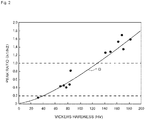
- Fig. 2 is a diagram showing the relationship between the Vickers hardness (initial value) of a silver jewelry article and the ratio (h2/h1) of the heights of predetermined peaks (h1 and h2) in an X-ray diffraction chart obtained by an XRD analysis.
- the silver jewelry article of the first embodiment is formed from pure silver or a silver alloy having a purity of 99.9% by weight or higher.
- the silver jewelry article contains 99.9% by weight or more of silver, which means extremely high purity.
- pure silver implies that with regard to elements other than silver element, for example, the mass fraction measured by a glow discharge mass analyzer or the like is not above 0.001% by weight.
- the purity of silver has a value within the range of 99.9% to 100% by weight, more preferably a value within the range of 99.93% to 100% by weight, and even more preferably a value within the range of 99.98% to 100% by weight.
- the residual components other than silver includes gold (Au), platinum (Pt), tin (Sn), or the like.
- the purity of silver and the amount of trace components included in a silver alloy having a purity of 99.9% by weight or higher can be carried out using an element analysis method, for example, an X-ray fluorescence spectroscopy (XPS), an atomic absorption spectroscopy (AAS), or an ICP emission spectroscopy.
- XPS X-ray fluorescence spectroscopy
- AAS atomic absorption spectroscopy
- ICP emission spectroscopy ICP emission spectroscopy
- the shape, configuration, and the like of the silver jewelry article of the first embodiment are not particularly limited; however, for example, the silver jewelry article is preferably any one of an earring, a pendant, a piercing, a ring, a necklace, a brooch, a bracelet, a chain, and a charm.
- the Vickers hardness (initial value) after a barrel treatment is adjusted to a value of 60 HV or higher.
- the Vickers hardness is higher, it is preferable from the viewpoint of durability; however, in a case in which the Vickers hardness is excessively high, it may not be preferable from the viewpoint of processability.
- the Vickers hardness after a barrel treatment of the silver jewelry article is adjusted to a value within the range of 70 to 200 HV, and it is more preferable that such Vickers hardness is adjusted to a value within the range of 80 to 180 HV.
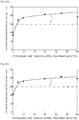
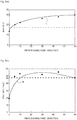
- Fig. 3(a) employs and shows the processing time (minutes) by a barrel treatment on the axis of abscissa, and employs and shows the Vickers hardness (initial value) after a barrel treatment of a silver jewelry article that was subjected to neither a plating treatment nor a pressing treatment, on the axis of ordinate.
- the Vickers hardness can be further increased.
- the Vickers hardness (initial value) per unit thickness of the plating treatment can be adjusted high to a value within the range of 0.8 to 1.2 HV.
- a value of 100 HV or higher can be obtained.
- the Vickers hardness initial value
- the Vickers hardness (initial value) after a barrel treatment can be adjusted to a value of 140 HV or higher. Therefore, it is more preferable that the Vickers hardness (initial value) after a barrel treatment of the silver jewelry article is adjusted to a value within the range of 150 to 200 HV, and even more preferably to a value within the range of 160 to 180 HV.
- a silver jewelry article that has been subjected to a plating treatment or a pressing treatment in a case in which Vickers hardness after a barrel treatment is mentioned, it means the Vickers hardness obtained in a case in which a plating treatment or a pressing treatment is carried out for the silver jewelry article that has been subjected to a barrel treatment.
- the silver jewelry article of the first embodiment is placed in an oven at 80°C for 48 hours to be subjected to an aging treatment, and then the Vickers hardness is adjusted to a value of 60 HV or higher.
- the reason for this is that by an aging treatment, a return phenomenon of the silver jewelry article occurs, and when the value of such Vickers hardness is below 60 HV, the silver jewelry article may be easily deformed by pressure from an external source, or the durability of the resulting silver jewelry article may also become insufficient.
- the Vickers hardness after performing an aging treatment at 80°C for 48 hours is adjusted to a value within the range of 70 to 200 HV, and it is more preferable that the Vickers hardness is adjusted to a value within the range of 80 to 180 HV.
- Fig. 3(b) employs and shows the processing time taken by a barrel treatment on the axis of abscissa, and employs and shows the Vickers hardness (after aging) in a case in which after a barrel treatment of a silver jewelry article that had been subjected to neither a plating treatment nor a pressing treatment, the silver jewelry article was subjected to an aging treatment at 80°C for 48 hours.
- the Vickers hardness (after aging) after a barrel treatment is adjusted to a value within the range of 120 to 200 HV, and it is even more preferable that the Vickers hardness is adjusted to a value within the range of 140 to 180 HV.
- the Vickers hardness of a silver jewelry article that has been annealed by heating for 5 minutes at 100°C is adjusted to a value of 60 HV or higher.
- metals have a property of becoming hard when subjected to processing (plastic deformation) such as drawing; however, metals are softened by heating, and the hardness may be decreased to the hardness value before processing.
- the Vickers hardness of a silver jewelry article that has annealed for 10 minutes at 100°C is adjusted to a value of 60 HV or higher, and it is even more preferable that the Vickers hardness of a silver jewelry article that has been annealed for 30 minutes at 100°C is adjusted to a value of 60 HV or higher.
- the value of h2/h1 is adjusted to 0.5 or greater, and even more preferably to 1.0 or greater.
- the silver jewelry article is subjected not only to the above-mentioned barrel treatment but also to a plating treatment or a pressing treatment in advance.
- the crystal structure of the silver jewelry article may not be made more suitable.
- the value of h2/h1 is adjusted to 1.3 or greater, and it is even more preferable that the value of h2/h1 is adjusted to 1.5 or greater.
- h2/h1 is adjusted to 1.1 or greater.
- the value of h2/h1 of a silver jewelry article that has been annealed for 10 minutes at 100°C after a barrel treatment is adjusted to 1.3 or greater, and it is even more preferable that the value is adjusted to 1.5 or greater.
- the Vickers hardness of the silver jewelry article is designated as HV
- the value of HV ⁇ (W1/W2) is adjusted to 48 or greater.
- the volume resistivity is adjusted to a value of 2 ⁇ cm or less.
- the volume resistivity of the silver jewelry article is adjusted to a value within the range of 0.001 to 1.8 ⁇ cm, and even more preferably to a value within the range of 0.01 to 1.5 ⁇ cm.
- the volume resistivity of a silver jewelry article can be measured by a four-terminal method of using a digital voltmeter, by changing the measurement length (for example, four points).
- a graph is obtained by plotting the resistance measured by a four-terminal method for each measurement length on the axis of ordinate and plotting the measurement length on the axis of abscissa, and the volume resistivity can be calculated from the gradient of a straight line thus obtained.
- the thickness of the plating layer can be determined while taking the increase in the Vickers hardness, the increase in glossiness, and the ease of a polishing treatment or the like into consideration; however, usually, it is preferable to adjust the average thickness to a value within the range of 0.01 to 100 ⁇ m.
- a plating layer having such a thickness can be stably formed in a short period of time by conventional electroplating or electroless plating, and an increase in the Vickers hardness, an increase in glossiness, and the ease of a polishing treatment or the like are obtained.
- the average thickness is adjusted to a value within the range of 0.1 to 80 ⁇ m, and even more preferably to a value within the range of 1 to 50 ⁇ m.
- a surface treatment is applied to a silver jewelry article that has been subjected to a barrel treatment before a plating layer is formed, using a surface treatment agent including selenium (Se) and antimony (Sb), or any one of them (hereinafter, may be simply referred to as selenium and the like).
- a surface treatment agent including selenium (Se) and antimony (Sb), or any one of them (hereinafter, may be simply referred to as selenium and the like).
- the dissolved selenium and the like form a layer that occupies 0.001% to 0.01% by weight as a mass fraction measured by a glow discharge mass analyzer, an ICP emission spectroscopy, or the like, at a position 1 to 5 ⁇ m away from the surface.
- the Vickers hardness of the plating layer can be increased to a certain extent; however, higher Vickers hardness can be achieved compared to the case of mixing the same concentration of selenium and the like into the plating liquid.
- the Vickers hardness in the case of forming a plating layer can be further increased.
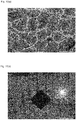
- the silver jewelry article has a polygonal pattern on the surface.
- a simply smooth surface of a silver jewelry article into a surface of a silver jewelry article having a polygonal pattern (may also be referred to as hexagonal pattern).
- the reason for this is that by utilizing such a polygonal pattern as a marker, the degree of barrel polishing and the Vickers hardness of the silver jewelry article after processing can be inferred, and furthermore, it can be confirmed that the Vickers hardness is in a predetermined range.
- silver accessories such as a piercing post (foot) are fixed to the piercing main body using silver solder.
- fasteners or the like at the two ends of a necklace main body such as the fasteners of a necklace, are fixed using silver solder.
- the content of metals other than silver, for example, Ni, Cu, Zn, and Al, included in the silver solder is adjusted to 0.1 ppm or less, preferably to 0.01 ppm or less, and even more preferably 0.001 ppm or less.
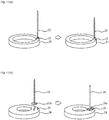
- a needle-shaped accessory silver member 23 such as a piercing post, fasteners at two ends of a necklace main body, and the like are firmly fixed to predetermined sites by a caulking structure obtained by mechanically depressing and a laser treatment.
- Fig. 11(a) shows parts of a production process including a caulking process.
- a cylindrical hole 22 provided in the main body 21 of a silver jewelry article and a needle-shaped silver member 23 are prepared, and the tip of the needle-shaped silver member 23 is inserted into the cylindrical hole 22 provided in the main body 21.
- a nail-shaped silver member 26 in which the head portion 26a thereof is spread flat in a direction perpendicular to the axis by means of a pressing machine or the like and is hardened by a barrel treatment.
- a second embodiment is a method for producing a silver jewelry article formed from pure silver or a silver alloy having a purity of 99.9% by weight or higher, the method including the following steps (1) and (2):
- this accessory is bonded to the piercing main body that has been produced into a predetermined shape using a casting mold or the like, and thus a silver jewelry article having a predetermined shape is prepared.
- the Vickers hardness acquires a significantly high value through a barrel treatment.
- Fig. 12 shows an example of a barrel apparatus 10 for subjecting a silver jewelry article having a predetermined shape to surface polishing or the like.
- the barrel apparatus 10 is composed of a barrel tank 1 storing a barrel liquid 2 that includes a silver jewelry article to be treated, barrel materials 3 (3a, 3b), a rotating magnet 4, a magnet case 5, a motor 6, a rotating shaft 7, and a jacket 8.
- the rotating shaft 7 connected to the motor 6 is rotated, and the rotating magnet 4 is also rotated along therewith.
- the object to be treated (not shown in the diagram) and the barrel materials 3 (3a, 3b) in the barrel liquid 2 rotationally move while colliding with each other, and thus a barrel treatment as a surface treatment is carried out.
- the stirring treatment time by the barrel apparatus for the silver jewelry article having a predetermined shape can be appropriately modified; however, usually, it is preferable to adjust the stirring treatment time to a value within the range of 1 to 120 minutes.
- the stirring treatment time by a barrel apparatus is adjusted to a value within the range of 5 to 60 minutes, and even more preferably to a value within the range of 10 to 45 minutes.
- the stirring speed by a barrel apparatus for the silver jewelry article having a predetermined shape can also be appropriately modified; however, usually, it is preferable to adjust the stirring speed to a value within the range of 1 to 120 rpm in accordance with the speed of rotation.
- the stirring speed by a barrel apparatus is adjusted to a value within the range of 10 to 80 rpm, and even more preferably to a value within the range of 20 to 60 rpm.
- the barrel materials (may also be referred to as media) used in the barrel apparatus can be appropriately changed; however, usually, it is preferable to use spherical objects or needle-shaped objects made of stainless steel (SUS304, 403, or the like), from the viewpoint of having less impurities and having predetermined hardness.
- the barrel materials are formed of the above-mentioned stainless steel, or a magnetized material obtained by magnetizing stainless steel.
- barrel liquid a solution state called barrel liquid.
- the barrel liquid may be tap water; however, from the viewpoint of performing the processing treatment safely and reliably, it is more preferable to use distilled water.
- the temperature of the barrel liquid is managed to be 20°C to 50°C and the pH of the barrel liquid to be between 6 and 8, and it is preferable that the contents of unavoidable copper, iron, and aluminum in the barrel liquid are each adjusted to a value of 0.1 ppm or less, more preferably to a value of 0.05 ppm or less, and even more preferably to a value of 0.01 ppm or less.
- the plating contains silver as a main component; however, in addition to that, gold plating or platinum plating is also preferable.
- plating treatment conditions any known treatment conditions are employed, and typically, electroless plating 12, electroplating, and the like are suitable.
- the plating conditions for electroplating it is preferable that after a plating liquid is stored in a plating tank, a silver jewelry article is used as one of the electrodes, and usually, the electric current value is set within the range of 10 to 200 mA/cm 2 , while the current application time is set within the range of 30 seconds to 30 minutes.
- a thin film plating layer having a thickness t1 of 1 ⁇ m or less is formed directly and partially on the surface of a silver jewelry article by electroless plating 12, and the thin film plating layer is made substantially smooth.
- the silver jewelry article is subjected to a pressing treatment in order to obtain a predetermined shape.
- the surface can be made smooth by the plating treatment.
- any known method can be used, and a roller press, a friction press, and the like can be used as appropriate.
- the pressure to be applied as a linear pressure of a roller is adjusted to a value within the range of 2 to 100 N/cm.
- the pressure to be applied as a linear pressure of the roller is adjusted to a value within the range of 10 to 80 N/cm, and even more preferably to a value within the range of 20 to 50 N/cm.
- Silver having a purity of 100% by weight was prepared, and a step of heating the silver to melt, and preparing a silver jewelry article having a predetermined shape using a casting mold or the like was carried out.
- the accessory in a case in which there was an accessory such as a piercing post as in the case of a piercing, the accessory was bonded to a piercing main body that had been produced into a predetermined shape using a casting mold or the like, by a caulking method, thereby a silver jewelry article (piercing) having a predetermined shape was prepared, and the caulking part was subjected to a laser treatment.
- the silver jewelry article having a predetermined shape thus prepared was subjected to a barrel treatment using a magnetic barrel apparatus, PRITIC M (manufactured by Priority Company), the outline of which is shown in Fig. 8 .
- PRITIC M manufactured by Priority Company
- the barrel apparatus was operated, and while the stirring tank was rotated in a horizontal direction and a vertical direction at a speed of rotation of 60 rpm, a barrel treatment was carried out for a barrel treatment time of 10 minutes.
- samples for which the HV hardness had been measured were stored for 48 hours in an oven that was maintained at 80°C, and then those were taken out.
- the silver jewelry articles were returned to room temperature, subsequently the Vickers hardness (after aging) of the surface of each of the silver jewelry articles having a predetermined shape was measured at at least three points using a Vickers hardness meter, and the average value thereof was calculated.
- a string-shaped silver jewelry article having a diameter of 1 mm was similarly used, and a barrel treatment was carried out similarly to the conditions described above.
- the resistance value of each of the string-shaped silver jewelry articles obtained by the barrel treatment was measured at four points at an interval of 1 cm using a four-terminal method, and a graph was produced by plotting the length on the axis of abscissa and the resistance value on the axis of ordinate.
- the volume resistivity ( ⁇ cm) of the silver jewelry article obtained by the barrel treatment was determined from the gradient of the characteristic straight line of the graph. ⁇ : 1.5 ⁇ cm or less. ⁇ : 1.8 ⁇ cm or less. ⁇ : 2.0 ⁇ cm or less. ⁇ : Above 2.0 ⁇ cm.
- test subjects A, B, C, D, and E having metal allergy were prepared, they were asked to wear silver jewelry articles (piercings) obtained by the barrel treatment on the ear for two days, and whether the silver jewelry articles developed metal allergy was visually inspected.
- the metal allergy characteristics were evaluated according to the following criteria. ⁇ : Development of metal allergy was not observed in the five persons. ⁇ : Development of metal allergy was observed in one person among the five persons. ⁇ : Development of metal allergy was observed in two persons among the five persons. ⁇ : Development of metal allergy was observed in three to five persons among the five persons.
- the silver jewelry articles thus obtained were immersed in 200 g of hydrogen sulfide water stored in a 500-liter vessel for 168 hours.
- discoloration occurred in the silver jewelry articles in the 500-liter vessel was evaluated according to the following criteria. ⁇ : There was no noticeable discoloration even after a lapse of 168 hours. ⁇ : Slight discoloration was observed after a lapse of 168 hours. ⁇ : Noticeable discoloration was observed after a lapse of 168 hours. ⁇ : Noticeable discoloration was observed in a time below 168 hours.
- Example 2 silver jewelry articles were obtained in the same manner as in Example 1, except that the barrel treatment time was lengthened to 30 minutes, and the Vickers hardness and the like were evaluated.
- Example 3 silver jewelry articles were obtained in the same manner as in Example 1, except that the barrel treatment time was further lengthened to 45 minutes, and the Vickers hardness and the like were evaluated.
- Example 4 silver jewelry articles were obtained in the same manner as in Example 1, except that the barrel treatment time was further lengthened to 60 minutes, and the Vickers hardness and the like were evaluated.
- Example 5 silver jewelry articles were obtained in the same manner as in Example 1, except that the barrel treatment time was shortened to 5 minutes, and the Vickers hardness and the like were evaluated.
- Example 6 silver jewelry articles were obtained in the same manner as in Example 1, except that electroplating was performed to obtain a thickness of 20 ⁇ m on the surface of the silver jewelry articles of Example 1, and the electroplating was subjected to a polishing treatment to smoothen the surface, and the Vickers hardness and the like were evaluated.
- Example 7 silver jewelry articles were obtained in the same manner as in Example 1, except that electroplating was performed to obtain a thickness of 30 ⁇ m on the surface of the silver jewelry articles of Example 1, and then the electroplating was subjected to a barrel polishing treatment for 30 minutes, and the Vickers hardness and the like were evaluated.
- Example 8 silver jewelry articles were obtained in the same manner as in Example 1, except that electroplating was performed to obtain a thickness of 10 ⁇ m on the surface of the silver jewelry articles of Example 1, and then the electroplating was subjected to a barrel polishing treatment for 45 minutes, and the Vickers hardness and the like were evaluated.
- Examples 9 to 16 silver jewelry articles were obtained in the same manner as in Examples 1 to 8, except that the base metals for the silver jewelry articles of Examples 1 to 8 were each subjected to a pressing treatment before a barrel treatment and the like, using a metal press roll apparatus under the conditions of a linear pressure of 50 N/cm, and the Vickers hardness and the like were evaluated.
- Comparative Example 1 silver jewelry articles were obtained in the same manner as in Example 1, except that a barrel treatment was not carried out, and the Vickers hardness and the like were evaluated.
- the silver jewelry article and the method for producing a silver jewelry article of the present invention it is possible to provide a silver jewelry article in which, despite that pure silver and an ultrahigh-purity silver alloy were used, Vickers hardness (HV) equal to or higher than a predetermined level compared to pure silver is exhibited by carrying out a barrel treatment and the like, and the development of metal allergy and the occurrence of discoloration are induced to a lesser extent; and to provide a method for producing the silver jewelry article.
- HV Vickers hardness
- the silver jewelry articles and the method for producing a silver jewelry article of the present invention even if plastic deformation of silver occurred significantly, and the silver jewelry article was subjected to aging or annealing under predetermined conditions (80°C, 48 hours), a phenomenon in which the crystal structure returns to the original structure, and thereby the Vickers hardness is decreased, was not observed in particular.
- volume resistivity of pure silver can be adjusted to a predetermined value or lower by performing a barrel treatment and the like.
- the silver itself that constitutes the silver jewelry article derived from the present invention is expected to be used also for use applications related to electrically conductive materials with lower heat generation characteristics.
Landscapes
- Chemical & Material Sciences (AREA)
- Engineering & Computer Science (AREA)
- Materials Engineering (AREA)
- Mechanical Engineering (AREA)
- Metallurgy (AREA)
- Organic Chemistry (AREA)
- Manufacturing & Machinery (AREA)
- Physics & Mathematics (AREA)
- Thermal Sciences (AREA)
- Crystallography & Structural Chemistry (AREA)
- Adornments (AREA)
Applications Claiming Priority (2)
| Application Number | Priority Date | Filing Date | Title |
|---|---|---|---|
| JP2019037168 | 2019-03-01 | ||
| PCT/JP2020/003738 WO2020179310A1 (fr) | 2019-03-01 | 2020-01-31 | Bijou en argent et procédé de fabrication de bijoux en argent |
Publications (2)
| Publication Number | Publication Date |
|---|---|
| EP3738461A1 true EP3738461A1 (fr) | 2020-11-18 |
| EP3738461A4 EP3738461A4 (fr) | 2021-03-03 |
Family
ID=72336979
Family Applications (1)
| Application Number | Title | Priority Date | Filing Date |
|---|---|---|---|
| EP20751463.9A Pending EP3738461A4 (fr) | 2019-03-01 | 2020-01-31 | Bijou en argent et procédé de fabrication de bijoux en argent |
Country Status (5)
| Country | Link |
|---|---|
| US (1) | US11470928B2 (fr) |
| EP (1) | EP3738461A4 (fr) |
| CN (1) | CN111885940B (fr) |
| TW (1) | TWI737186B (fr) |
| WO (1) | WO2020179310A1 (fr) |
Family Cites Families (8)
| Publication number | Priority date | Publication date | Assignee | Title |
|---|---|---|---|---|
| JPS5825926A (ja) | 1981-08-04 | 1983-02-16 | スコツト・ペ−パ−・コンパニ− | 剥離シ−ト |
| JPH06279961A (ja) * | 1993-03-25 | 1994-10-04 | Tanaka Kikinzoku Kogyo Kk | 純Ag材 |
| US6139652A (en) * | 1997-01-23 | 2000-10-31 | Stern-Leach | Tarnish-resistant hardenable fine silver alloys |
| JP2006274380A (ja) * | 2005-03-30 | 2006-10-12 | Citizen Watch Co Ltd | 装飾部品とその製造方法 |
| CN101802267A (zh) * | 2007-09-19 | 2010-08-11 | 西铁城控股株式会社 | 装饰部件 |
| JP6216953B2 (ja) * | 2013-09-11 | 2017-10-25 | オリエンタル鍍金株式会社 | 銀−錫合金めっき層を含む金属積層体の製造方法 |
| JP6302780B2 (ja) * | 2014-07-14 | 2018-03-28 | 株式会社グローバルコーポレーション | 高硬度と高強度を有する999金合金及び銀合金の製造方法 |
| JP3196546U (ja) | 2015-01-06 | 2015-03-19 | 株式会社ミキモト装身具 | ブローチクリップ |
-
2020
- 2020-01-31 US US16/967,413 patent/US11470928B2/en active Active
- 2020-01-31 EP EP20751463.9A patent/EP3738461A4/fr active Pending
- 2020-01-31 CN CN202080001438.5A patent/CN111885940B/zh active Active
- 2020-01-31 WO PCT/JP2020/003738 patent/WO2020179310A1/fr not_active Ceased
- 2020-02-20 TW TW109105534A patent/TWI737186B/zh active
Also Published As
| Publication number | Publication date |
|---|---|
| TW202033778A (zh) | 2020-09-16 |
| CN111885940A (zh) | 2020-11-03 |
| WO2020179310A1 (fr) | 2020-09-10 |
| EP3738461A4 (fr) | 2021-03-03 |
| US11470928B2 (en) | 2022-10-18 |
| TWI737186B (zh) | 2021-08-21 |
| US20210112931A1 (en) | 2021-04-22 |
| CN111885940B (zh) | 2023-04-04 |
Similar Documents
| Publication | Publication Date | Title |
|---|---|---|
| EP0834586B1 (fr) | Alliage de titane a haute resistance, produits issus de cet alliage et procede de fabrication | |
| DE2705225C2 (de) | Ornamentteil für Uhren usw. | |
| US7867625B2 (en) | Copper-tin-oxygen alloy plating | |
| EP2517593A1 (fr) | Composant de fermeture à glissière et fermeture à glissière avec curseur, et procédé de production d'un composant de fermeture à glissière | |
| WO2017092715A1 (fr) | Matériau de fil d'électrode à micro-texture du type écaille, son procédé de préparation et son utilisation | |
| KR102341757B1 (ko) | 은 장신구 및 은 장신구의 제조 방법 | |
| EP3738461A1 (fr) | Bijou en argent et procédé de fabrication de bijoux en argent | |
| EP3135781A1 (fr) | Alliage de bijouterie en acier inoxydable | |
| US11655522B2 (en) | Silver article | |
| EP3778257A1 (fr) | Produit à base d'argent et procédé de fabrication d'un produit à base d'argent | |
| JP2022024267A (ja) | 銀合金及び銀合金の製造方法 | |
| JPH0297696A (ja) | Ni‐Ti基合金材及びその製造方法 | |
| DE2350394B2 (de) | Verfahren zur verbesserung der anlaufbestaendigkeit von silbergegenstaenden | |
| JP2502058B2 (ja) | NiTi系合金の製造法 | |
| JPH0344454A (ja) | 電子部品および機器用リード線の製造方法 | |
| CN121915291A (zh) | 一种用于首饰的耐磨耐腐蚀1k金合金及其制备方法 | |
| JP3962841B2 (ja) | めっき部材の製造方法、その方法で製造された装身具用めっき部材 | |
| JPH0467726B2 (fr) | ||
| JPH03184219A (ja) | 電気接点用材料の製造方法 | |
| JP2008184649A (ja) | 装飾品とその表面加工方法 | |
| HK1171345B (en) | Zipper component and slide zipper |
Legal Events
| Date | Code | Title | Description |
|---|---|---|---|
| STAA | Information on the status of an ep patent application or granted ep patent |
Free format text: STATUS: UNKNOWN |
|
| STAA | Information on the status of an ep patent application or granted ep patent |
Free format text: STATUS: THE INTERNATIONAL PUBLICATION HAS BEEN MADE |
|
| PUAI | Public reference made under article 153(3) epc to a published international application that has entered the european phase |
Free format text: ORIGINAL CODE: 0009012 |
|
| STAA | Information on the status of an ep patent application or granted ep patent |
Free format text: STATUS: REQUEST FOR EXAMINATION WAS MADE |
|
| 17P | Request for examination filed |
Effective date: 20200814 |
|
| AK | Designated contracting states |
Kind code of ref document: A1 Designated state(s): AL AT BE BG CH CY CZ DE DK EE ES FI FR GB GR HR HU IE IS IT LI LT LU LV MC MK MT NL NO PL PT RO RS SE SI SK SM TR |
|
| AX | Request for extension of the european patent |
Extension state: BA ME |
|
| A4 | Supplementary search report drawn up and despatched |
Effective date: 20210202 |
|
| RIC1 | Information provided on ipc code assigned before grant |
Ipc: A44C 7/00 20060101AFI20210127BHEP Ipc: C22F 1/14 20060101ALI20210127BHEP Ipc: B44C 1/18 20060101ALI20210127BHEP Ipc: A44C 25/00 20060101ALI20210127BHEP Ipc: C22C 5/06 20060101ALI20210127BHEP Ipc: A44C 27/00 20060101ALI20210127BHEP |
|
| STAA | Information on the status of an ep patent application or granted ep patent |
Free format text: STATUS: EXAMINATION IS IN PROGRESS |
|
| 17Q | First examination report despatched |
Effective date: 20220105 |
|
| DAV | Request for validation of the european patent (deleted) | ||
| DAX | Request for extension of the european patent (deleted) |