EP3738977B1 - Extrazelluläre domäne der alpha-untereinheit von ige-fc-rezeptor, pharmazeutische zusammensetzung damit und verfahren zur herstellung davon - Google Patents
Extrazelluläre domäne der alpha-untereinheit von ige-fc-rezeptor, pharmazeutische zusammensetzung damit und verfahren zur herstellung davon Download PDFInfo
- Publication number
- EP3738977B1 EP3738977B1 EP19735715.5A EP19735715A EP3738977B1 EP 3738977 B1 EP3738977 B1 EP 3738977B1 EP 19735715 A EP19735715 A EP 19735715A EP 3738977 B1 EP3738977 B1 EP 3738977B1
- Authority
- EP
- European Patent Office
- Prior art keywords
- glu
- ige
- seq
- lys
- polypeptide dimer
- Prior art date
- Legal status (The legal status is an assumption and is not a legal conclusion. Google has not performed a legal analysis and makes no representation as to the accuracy of the status listed.)
- Active
Links
Images







Classifications
-
- A—HUMAN NECESSITIES
- A23—FOODS OR FOODSTUFFS; TREATMENT THEREOF, NOT COVERED BY OTHER CLASSES
- A23L—FOODS, FOODSTUFFS OR NON-ALCOHOLIC BEVERAGES, NOT OTHERWISE PROVIDED FOR; PREPARATION OR TREATMENT THEREOF
- A23L33/00—Modifying nutritive qualities of foods; Dietetic products; Preparation or treatment thereof
- A23L33/10—Modifying nutritive qualities of foods; Dietetic products; Preparation or treatment thereof using additives
- A23L33/17—Amino acids, peptides or proteins
- A23L33/18—Peptides; Protein hydrolysates
-
- A—HUMAN NECESSITIES
- A61—MEDICAL OR VETERINARY SCIENCE; HYGIENE
- A61P—SPECIFIC THERAPEUTIC ACTIVITY OF CHEMICAL COMPOUNDS OR MEDICINAL PREPARATIONS
- A61P37/00—Drugs for immunological or allergic disorders
- A61P37/08—Antiallergic agents
-
- C—CHEMISTRY; METALLURGY
- C07—ORGANIC CHEMISTRY
- C07K—PEPTIDES
- C07K14/00—Peptides having more than 20 amino acids; Gastrins; Somatostatins; Melanotropins; Derivatives thereof
- C07K14/435—Peptides having more than 20 amino acids; Gastrins; Somatostatins; Melanotropins; Derivatives thereof from animals; from humans
- C07K14/705—Receptors; Cell surface antigens; Cell surface determinants
- C07K14/70503—Immunoglobulin superfamily
- C07K14/70535—Fc-receptors, e.g. CD16, CD32, CD64 (CD2314/705F)
-
- C—CHEMISTRY; METALLURGY
- C07—ORGANIC CHEMISTRY
- C07K—PEPTIDES
- C07K16/00—Immunoglobulins [IG], e.g. monoclonal or polyclonal antibodies
-
- C—CHEMISTRY; METALLURGY
- C12—BIOCHEMISTRY; BEER; SPIRITS; WINE; VINEGAR; MICROBIOLOGY; ENZYMOLOGY; MUTATION OR GENETIC ENGINEERING
- C12N—MICROORGANISMS OR ENZYMES; COMPOSITIONS THEREOF; PROPAGATING, PRESERVING, OR MAINTAINING MICROORGANISMS; MUTATION OR GENETIC ENGINEERING; CULTURE MEDIA
- C12N15/00—Mutation or genetic engineering; DNA or RNA concerning genetic engineering, vectors, e.g. plasmids, or their isolation, preparation or purification; Use of hosts therefor
- C12N15/09—Recombinant DNA-technology
- C12N15/11—DNA or RNA fragments; Modified forms thereof; Non-coding nucleic acids having a biological activity
- C12N15/62—DNA sequences coding for fusion proteins
-
- A—HUMAN NECESSITIES
- A23—FOODS OR FOODSTUFFS; TREATMENT THEREOF, NOT COVERED BY OTHER CLASSES
- A23V—INDEXING SCHEME RELATING TO FOODS, FOODSTUFFS OR NON-ALCOHOLIC BEVERAGES AND LACTIC OR PROPIONIC ACID BACTERIA USED IN FOODSTUFFS OR FOOD PREPARATION
- A23V2002/00—Food compositions, function of food ingredients or processes for food or foodstuffs
-
- A—HUMAN NECESSITIES
- A23—FOODS OR FOODSTUFFS; TREATMENT THEREOF, NOT COVERED BY OTHER CLASSES
- A23V—INDEXING SCHEME RELATING TO FOODS, FOODSTUFFS OR NON-ALCOHOLIC BEVERAGES AND LACTIC OR PROPIONIC ACID BACTERIA USED IN FOODSTUFFS OR FOOD PREPARATION
- A23V2200/00—Function of food ingredients
- A23V2200/30—Foods, ingredients or supplements having a functional effect on health
- A23V2200/304—Foods, ingredients or supplements having a functional effect on health having a modulation effect on allergy and risk of allergy
-
- A—HUMAN NECESSITIES
- A61—MEDICAL OR VETERINARY SCIENCE; HYGIENE
- A61K—PREPARATIONS FOR MEDICAL, DENTAL OR TOILETRY PURPOSES
- A61K38/00—Medicinal preparations containing peptides
-
- C—CHEMISTRY; METALLURGY
- C07—ORGANIC CHEMISTRY
- C07K—PEPTIDES
- C07K2317/00—Immunoglobulins specific features
- C07K2317/50—Immunoglobulins specific features characterized by immunoglobulin fragments
- C07K2317/52—Constant or Fc region; Isotype
-
- C—CHEMISTRY; METALLURGY
- C07—ORGANIC CHEMISTRY
- C07K—PEPTIDES
- C07K2319/00—Fusion polypeptide
-
- C—CHEMISTRY; METALLURGY
- C07—ORGANIC CHEMISTRY
- C07K—PEPTIDES
- C07K2319/00—Fusion polypeptide
- C07K2319/30—Non-immunoglobulin-derived peptide or protein having an immunoglobulin constant or Fc region, or a fragment thereof, attached thereto
Definitions
- the present invention relates to modified IgE Fc receptors and uses thereof.
- Allergic diseases such as allergic rhinitis, atopic dermatitis, and food allergy, including asthma are spreading at a high rate in industrialized and westernized modern societies, and development of anaphylaxis, a severe allergic disease, is also increasing. These chronic immune diseases severely impair individuals' quality of life and socioeconomic costs are soaring accordingly. Thus, there is a desperate need for measures to overcome such diseases.
- IgE immunoglobulin E
- IgE immunoglobulin E
- Fc ⁇ RIs high-affinity IgE Fc receptors
- mast cells or basophils Such binding causes mast cells or basophils to release chemical mediators such as histamine, leukotriene, prostaglandin, bradykinin, and platelet-activating factors. Release of these chemical mediators results in allergic symptoms.
- allergic diseases may exhibit worsened symptoms due to the binding between IgE and Fc ⁇ RI.
- Fc ⁇ RI-expressing cells are known to increase in allergic patients.
- immunoglobulin compositions capable of binding to IgE and FcyRIIb with high affinity and inhibiting cells expressing IgE have been studied ( KR10-1783272B1 ). Such compositions have been reported to be useful for treating IgE-mediated disorders including allergy and asthma.
- omalizumab (trade name: Xolair), which targets an Fc portion of an IgE antibody, has been developed and used as a therapeutic agent for intractable severe asthma and intractable urticaria.
- EP3260469 discloses an Fc fusion protein with utility as a pharmaceutical product.
- the fusion protein comprises an Fc ⁇ RI ⁇ ECD and an IgG1-derived Fc region, with a linker fragment region between Fc ⁇ RI ⁇ ECD and an IgG1-derived Fc region.
- Saban R et al 1994 and Haak-Frendscho M et al., 1993 relate to Fc fusion protein dimers, these dimers comprise an IgG-derived Fc region and the Fc ⁇ RI ⁇ ECD that are linked via a linker.
- Both Saban R et al., 1994 and Haak-Frendscho M et al., 1993 contemplate the use of these dimers in treating IgE related diseases.
- WO2008/028068 relates to isolated non-human primate Fc ⁇ RI ⁇ polypeptides.
- WO2008/028068 specifically discloses a polypeptide dimer comprising a modified non-human primate Fc ⁇ RI ⁇ ECD and a modified IgG-derived Fc region.
- An object of the present invention is to provide a polypeptide dimeric protein for treating an IgE-mediated allergic disease. Another object of the present invention is to provide a nucleic acid molecule encoding the protein, an expression vector containing the nucleic acid molecule, and a host cell containing the expression vector. Yet another object of the present invention is to provide a method for preparing the polypeptide dimer.
- a polypeptide dimer comprising two monomers, each of which contains an extracellular domain of an alpha subunit of an IgE Fc receptor consisting of the amino acid sequence of SEQ ID NO: 1.
- the monomer contains a modified Fc region consisting of the amino acid sequence of SEQ ID NO: 2, and the modified Fc region and the extracellular domain of the alpha subunit of the IgE Fc receptor are linked via a hinge, wherein the hinge is a variant of a hinge region derived from immunoglobulin IgD, which is Arg Asn Thr Gly Arg Gly Gly Glu Glu Lys Lys Xaa1 Xaa2 Lys Glu Lys Glu Glu Gln Glu Arg Glu Thr Lys Thr Pro Glu Cys Pro (SEQ ID NO: 17) or Ala Gln Pro Gln Ala Glu Gly Ser Leu Ala Lys Ala Thr Thr Ala Pro Ala Thr Thr Thr Thr Thr Thr Thr Thr
- the polypeptide dimeric protein according to the present invention not only has excellent safety and persistence in the body as compared with conventionally used anti-IgE antibodies, but also binds to IgE very strongly due to having a binding capacity to IgE which is 70-fold higher than the conventionally used anti-IgE antibody, omalizumab, which allows an extended administration cycle.
- the polypeptide dimeric protein according to the present invention is a substance obtained by applying a modified Fc, which has IgE alone as a single target and does not bind to an Fc gamma receptor, and thus lacks antibody dependent cellular cytotoxicity (ADCC) and complement dependent cytotoxicity (CDC) functions.
- the polypeptide dimeric protein does not bind to an Fc gamma receptor, and thus can inhibit release of mediators caused by being bound to the Fc gamma receptor on the surface of mast cells, so that severe side effects such as occurrence of anaphylaxis which can be caused by binding between IgG1 and Fc gamma receptor III on mast cells can be minimized. Therefore, the polypeptide dimeric protein according to the present invention can be utilized as a new pharmaceutical composition which can replace therapeutic agents containing a conventional anti-IgE antibody.
- the present invention relates to a polypeptide dimer, comprising two monomers, each of which contains an extracellular domain of an alpha subunit of an IgE Fc receptor (Fc ⁇ RI ⁇ ECD), consisting of the amino acid sequence of SEQ ID NO: 1, wherein the monomer contains a modified Fc region, consisting of the amino acid sequence of SEQ ID NO: 2 and the modified Fc region and the Fc ⁇ RI ⁇ -ECD are linked via a hinge, wherein the hinge is a variant of a hinge region derived from immunoglobulin IgD, which is Arg Asn Thr Gly Arg Gly Gly Glu Glu Lys Lys Xaa1 Xaa2 Lys Glu Lys Glu Glu Gln Glu Arg Glu Thr Lys Thr Pro Glu Cys Pro (SEQ ID NO: 17) or Ala Gln Pro Gln Ala Glu Gly Ser Leu Ala Lys Ala Thr Thr Ala Pro Ala Thr Thr Arg Arg
- IgE means an antibody protein known as immunoglobulin E. IgE has an affinity to mast cells, blood basophils, or the like. In addition, reaction between an IgE antibody and an antigen (allergen) corresponding thereto causes an inflammatory reaction. In addition, IgE is known to be an antibody that causes anaphylaxis which occurs due to sudden secretion of mast cells or basophils.
- IgE Fc receptor is also referred to as Fc ⁇ receptor and binds to an Fc portion of IgE.
- Fc ⁇ RI The receptor having high affinity to IgE Fc is called Fc ⁇ receptor I (Fc ⁇ RI).
- Fc ⁇ RII The receptor having low affinity to IgE Fc is called Fc ⁇ receptor II (Fc ⁇ RII).
- Fc ⁇ RI is expressed in mast cells and basophils.
- IgE antibodies bound to Fc ⁇ RI are cross-linked by polyvalent antigens, degranulation occurs in mast cells or basophils, thereby releasing various chemical transmitter substances including histamine. This release leads to an immediate allergic reaction.
- the Fc ⁇ RI is a membrane protein composed of one ⁇ chain, one ⁇ chain, and two ⁇ chains linked by a disulfide bond. Among these chains, a portion to which IgE binds is the ⁇ chain (Fc ⁇ RI ⁇ ).
- Fc ⁇ RI ⁇ has a size of about 60 kDa, and is composed of a hydrophobic domain existing inside the cell membrane and a hydrophilic domain existing outside the cell membrane. In particular, IgE binds to an extracellular domain of the ⁇ chain.
- the alpha subunit of the IgE Fc receptor may have the amino acid sequence set forth in NP_001992.1.
- the extracellular domain (Fc ⁇ RIa-ECD) of the alpha subunit of the IgE Fc receptor has the amino acid sequence of SEQ ID NO: 1.
- the extracellular domain of the alpha subunit of the IgE Fc receptor may be a fragment or variant of the extracellular domain of the alpha subunit of the IgE Fc receptor, as long as the fragment or variant is capable of binding to IgE.
- the variant may be prepared through a method of substituting, deleting, or adding one or more proteins in the wild-type Fc ⁇ RIa-ECD (extracellular domain), as long as the method does not alter a function of the ⁇ chain of Fc ⁇ RI.
- Such various proteins or peptides may be 90%, 91%, 92%, 93%, 94%, 95%, 96%, 97%, 98%, 99% or more identical to the amino acid sequence of SEQ ID NO: 1.
- the Fc ⁇ RIa-ECD of SEQ ID NO: 1 may be encoded by a polynucleotide having the sequence of SEQ ID NO: 5.
- modified Fc region means a region in which a part of an Fc portion of an antibody has been modified.
- Fc region refers to a protein which contains heavy chain constant region 2 (CH2) and heavy chain constant region 3 (CH3) of an immunoglobulin, and does not contain variable regions of heavy and light chains and light chain constant region 1 (CH1) of an immunoglobulin.
- the modified Fc region means a region obtained by substituting some amino acids in the Fc region or by combining different types of Fc regions.
- the modified Fc region has the amino acid sequence of SEQ ID NO: 2.
- the modified Fc region of SEQ ID NO: 2 may be encoded by a polynucleotide having the sequence of SEQ ID NO: 6.
- modified Fc region of the present invention may be in the form of having sugar chains in a native form, increased sugar chains relative to a native form, or decreased sugar chains relative to a native form, or may be in the form of being sugar chain-removed.
- Immunoglobulin Fc sugar chains may be modified by conventional methods such as chemical methods, enzymatic methods, and genetic engineering methods using microorganisms.
- the modified Fc region of the present invention may be a region that lacks antibody dependent cellular cytotoxicity (ADCC) and complement dependent cytotoxicity (CDC) functions due to having no binding site for FcyR or C1q.
- the modified Fc region and the Fc ⁇ RI ⁇ -ECD may be linked via a hinge of an IgD antibody.
- the hinge of the IgD antibody is composed of 64 amino acids, and may selectively contain 20 to 60 consecutive amino acids, 25 to 50 consecutive amino acids, or 30 to 40 amino acids. In an embodiment, the hinge of the IgD antibody may be composed of 30 or 49 amino acids as shown below.
- the hinge of the IgD antibody may be a hinge variant obtained by modifying the hinge region, in which the hinge may contain at least one cysteine.
- the hinge variant may be obtained by modifying some in a hinge sequence of the IgD antibody in order to minimize generation of truncated forms during a protein production process.
- the hinge may contain the following sequence: Arg Asn Thr Gly Arg Gly Gly Glu Glu Lys Lys Xaa1 Xaa2 Lys Glu Lys Glu Glu Gln Glu Glu Arg Glu Thr Lys Thr Pro Glu Cys Pro (SEQ ID NO: 17), where Xaa1 may be Lys or Gly, and Xaa2 may be Glu, Gly, or Ser.
- the hinge may have the amino acid sequence of SEQ ID NO: 3 or SEQ ID NO: 19, thereby minimizing generation of truncated forms during a protein production process.
- the hinge may contain the following sequence: Ala Gln Pro Gln Ala Glu Gly Ser Leu Ala Lys Ala Thr Thr Ala Pro Ala Thr Thr Arg Asn Thr Gly Arg Gly Gly Glu Glu Lys Lys Xaa3 Xaa4 Lys Glu Lys Glu Gln Glu Glu Arg Glu Thr Lys Thr Pro Glu Cys Pro (SEQ ID NO: 18), where Xaa3 may be Lys or Gly, and Xaa4 may be Glu, Gly, or Ser.
- the hinge may have the amino acid sequence of SEQ ID NO: 4, thereby minimizing generation of truncated forms during a protein production process.
- Thr's may be glycosylated.
- the amino acids of SEQ ID NO: 18 the 13 th , 14 th , 18 th , or 19 th Thr's may be glycosylated.
- all four amino acids may be glycosylated.
- the glycosylation may be O-glycosylation.
- the polypeptide dimer provided by the present invention may be in a form in which two monomers are bound to each other and each monomer is obtained by binding between an extracellular domain of an alpha subunit of an IgE Fc receptor and a modified Fc region.
- the polypeptide dimer may be in a form in which the same two monomers are bound to each other by cysteine located at a hinge site.
- the polypeptide dimer may be in a form in which two different monomers are bound to each other.
- the polypeptide dimer may be in a form in which one monomer contains the extracellular domain of the alpha subunit of the IgE Fc receptor, and the other monomer contains a fragment of the extracellular domain of the alpha subunit of the IgE Fc receptor.
- an embodiment of the monomer may have the amino acid sequence of SEQ ID NO: 20, SEQ ID NO: 21, or SEQ ID NO: 22.
- polypeptide dimer provided by the present invention exhibits a binding capacity to IgE which is 10- to 100-fold, 20- to 90-fold, 20- to 70-fold, 30- to 70-fold, or 40- to 70-fold higher than omalizumab, an anti-IgE antibody, and may preferably exhibit a binding capacity to IgE which is 70-fold higher than omalizumab.
- a polynucleotide encoding a monomer the of polypeptide dimer of the invention that contains an extracellular domain of an alpha subunit of an IgE Fc receptor to which a modified Fc region is bound.
- the polynucleotide may additionally contain a signal sequence or a leader sequence.
- signal sequence means a nucleic acid encoding a signal peptide that directs secretion of a target protein. The signal peptide is translated and then cleaved in a host cell.
- the signal sequence of the present invention is a nucleotide encoding an amino acid sequence that initiates protein translocation across the endoplasmic reticulum (ER) membrane.
- useful signal sequences in the present invention include antibody light chain signal sequences, for example, antibody 14.18 ( Gillies et al., J. Immunol. Meth 1989.
- antibody heavy chain signal sequences for example, the MOPC141 antibody heavy chain signal sequence ( Sakano et al., Nature, 1980. 286:676-683 ), and other signal sequences known in the art ( see, for example, Watson et al., Nucleic Acid Research, 1984. 12:5145-5164 ).
- the signal sequences are well known in the art for their characteristics.
- the signal sequences typically contain 16 to 30 amino acid residues, and may contain greater or fewer amino acid residues.
- a typical signal peptide consists of three regions which are a basic N-terminal region, a central hydrophobic region, and a more polar C-terminal region.
- the central hydrophobic region contains 4 to 12 hydrophobic residues that immobilize the signal sequence through the membrane lipid bilayer during translocation of an immature polypeptide.
- a signal sequence is cleaved in the lumen of ER by cellular enzymes commonly known as signal peptidases.
- the signal sequence may be a secretory signal sequence for tissue plasminogen activator (tPA), Herpes simplex virus glycoprotein D (HSV gD), or growth hormone.
- tPA tissue plasminogen activator
- HSV gD Herpes simplex virus glycoprotein D
- secretory signal sequences used in higher eukaryotic cells, including mammals and the like can be used.
- the secretory signal sequence may be substituted with a codon having a high frequency of expression in a host cell, and used.
- an extracellular domain monomer of the alpha subunit of the IgE Fc receptor to which a signal sequence and a modified Fc region are bound may have the amino acid sequence of SEQ ID NO: 11 or SEQ ID NO: 13.
- the proteins of SEQ ID NO: 11 and SEQ ID NO: 13 may be encoded by polynucleotides having the sequences of SEQ ID NO: 12 and SEQ ID NO: 14, respectively.
- an expression vector loaded with a polynucleotide of the invention encoding the monomer.
- the polynucleotide may have the sequence of SEQ ID NO: 12 or SEQ ID NO: 14.
- the term "vector" is intended to be introduced into a host cell and to be capable of being recombined with a host cell genome and inserted thereinto.
- the vector is an episome and is understood as a nucleic acid unit containing a nucleotide sequence that can be autonomously replicated.
- the vectors include linear nucleic acids, plasmids, phagemids, cosmids, RNA vectors, viral vectors, and analogs thereof.
- the viral vectors include, but are not limited to, retroviruses, adenoviruses, and adeno-associated viruses.
- the plasmids may contain a selectable marker such as an antibiotic-resistant gene, and host cells harboring the plasmids may be cultured under selective conditions.
- the term "genetic expression” or "expression” of a target protein is understood to mean transcription of a DNA sequence, translation of an mRNA transcript, and secretion of a fusion protein product or a fragment thereof.
- a useful expression vector may be RcCMV (Invitrogen, Carlsbad) or a variant thereof.
- the expression vector may contain human cytomegalovirus (CMV) promoter for promoting continuous transcription of a target gene in mammalian cells, and a bovine growth hormone polyadenylation signal sequence for increasing a stability level of RNA after transcription.
- CMV human cytomegalovirus
- a host cell into which the expression vector is introduced.
- the term "host cell” refers to a prokaryotic or eukaryotic cell into which a recombinant expression vector can be introduced.
- the terms "transduced”, “transformed”, and “transfected” means introducing a nucleic acid (for example, a vector) into a cell using techniques known in the art.
- Preferred host cells that can be used in the present invention include immortal hybridoma cells, NS/0 myeloma cells, 293 cells, Chinese hamster ovary cells (CHO cells), HeLa cells, human amniotic fluid-derived cells (CapT cells), or COS cells.
- the host cells may be CHO cells.
- the host cell may be one in which the vector and a vector loaded with a sialic acid transferase gene are introduced.
- the sialic acid transferase may be 2,3-sialic acid transferase or 2,6-sialic acid transferase.
- the 2,6-sialic acid transferase may have the amino acid sequence of SEQ ID NO: 15.
- a pharmaceutical composition for treating or preventing an allergic disease comprising the polypeptide dimer as an active ingredient.
- allergic disease means a pathological symptom caused by an allergic reaction mediated by mast cell activation such as mast cell degranulation.
- allergic diseases include food allergy, atopic dermatitis, asthma, allergic rhinitis, allergic conjunctivitis, allergic dermatitis, allergic contact dermatitis, anaphylaxis, urticaria, pruritus, insect allergy, chronic idiopathic urticaria, drug allergy, and the like.
- the allergic diseases may be IgE-mediated.
- an active ingredient may be contained in any amount (effective amount) depending on use, formulation, blending purpose, and the like, as long as the active ingredient can exhibit anti-allergic activity.
- a typical effective amount of the active ingredient will be determined within a range of 0.001% by weight to 20.0% by weight based on a total weight of the composition.
- "effective amount” refers to an amount of an active ingredient which is capable of inducing an anti-allergic effect. Such an effective amount can be determined experimentally within the ordinary skill of those skilled in the art.
- the pharmaceutical composition may further contain a pharmaceutically acceptable carrier.
- a pharmaceutically acceptable carrier any carrier can be used as long as the carrier is a non-toxic substance suitable for delivery to a patient. Distilled water, alcohol, fat, wax, and an inert solid may be contained as carriers. Pharmaceutically acceptable adjuvants (buffers and dispersants) may also be contained in the pharmaceutically composition.
- the pharmaceutical composition of the present invention contains, in addition to an active ingredient, a pharmaceutically acceptable carrier, and may be made into an oral or parenteral formulation depending on a route of administration by a conventional method known in the art.
- pharmaceutically acceptable means not having more toxicity than a subject to be applied (prescribed) can accommodate without inhibiting activity of the active ingredient.
- the pharmaceutical composition of the present invention may be made into formulations such as powders, granules, tablets, pills, sugar coating tablets, capsules, liquids, gels, syrups, suspensions, and wafers, together with suitable carriers, in accordance with methods known in the art.
- suitable pharmaceutically acceptable carriers can include sugars such as lactose, glucose, sucrose, dextrose, sorbitol, mannitol, and xylitol, starches such as corn starch, potato starch, and wheat starch, celluloses such as cellulose, methylcellulose, ethylcellulose, sodium carboxymethyl cellulose, and hydroxypropylmethyl cellulose, polyvinyl pyrrolidone, water, methylhydroxybenzoate, propylhydroxybenzoate, magnesium stearate, mineral oil, malt, gelatin, talc, polyol, vegetable oil, and the like.
- sugars such as lactose, glucose, sucrose, dextrose, sorbitol, mannitol, and xylitol
- starches such as corn starch, potato starch, and wheat starch
- celluloses such as cellulose, methylcellulose, ethylcellulose, sodium carboxymethyl cellulose, and hydroxypropylmethyl cellulose
- the preparations can be carried out, as necessary, by including diluents and/or excipients such as a filler, an extender, a binder, a wetting agent, a disintegrant, and a surfactant.
- diluents and/or excipients such as a filler, an extender, a binder, a wetting agent, a disintegrant, and a surfactant.
- the pharmaceutical composition of the present invention may be made into preparations in the form of injections, transdermal drugs, nasal inhalers, and suppositories, together with suitable carriers, in accordance with methods known in the art.
- suitable carriers sterilized water, ethanol, polyol such as glycerol and propylene glycol, or a mixture thereof may be used as a suitable carrier.
- isotonic solutions such as Ringer's solution, phosphate buffered saline (PBS) containing triethanolamine, sterile water for injection, and 5% dextrose, and the like may be preferably used.
- a preferable daily dosage of the pharmaceutical composition of the present invention is ranged from 0.01 ug/kg to 10 g/kg, and preferably from 0.01 mg/kg to 1 g/kg, depending on the patient's condition, body weight, sex, age, disease severity, or route of administration. Administration may be carried out once or several times a day. Such a dosage should in no way be interpreted as limiting the scope of the present invention.
- composition of the present invention can be applied (prescribed) is a mammal and a human, with a human being particularly preferred.
- composition for anti-allergy of the present invention may further comprise, in addition to the active ingredient, any compound or natural extract, on which safety has already been verified and which is known to have anti-allergic activity, for the purpose of raising and reinforcing the anti-allergic activity.
- a food composition for ameliorating and alleviating an allergic symptom comprising the polypeptide dimer as an active ingredient.
- the polypeptide dimer may be bound to an appropriate delivery unit for efficient delivery into the intestines.
- the food composition may be prepared in any form and may be, for example, prepared in the form of beverages such as tea, juice, carbonated beverage, and ionic beverage, processed dairy products such as milk and yogurt, health functional food preparations such as tablets, capsules, pills, granules, liquids, powders, flakes, pastes, syrups, gels, jellies, and bars, or the like.
- the food composition may fall within any product category in legal or functional classification as long as the food composition complies with the enforcement regulations at the time of being manufactured and distributed.
- the food composition may be a health functional food according to the Health Functional Foods Act, or may fall within confectioneries, beans, teas, beverages, special-purpose foods, or the like according to each food type in the Food Code of Food Sanitation Act (standards and specifications for food, notified by Food and Drug Administration).
- Food Code of Food Sanitation Act standards and specifications for food, notified by Food and Drug Administration.
- other food additives that may be contained in the food composition, reference can be made to the Food Code or the Food Additive Code according to the Food Sanitation Act.
- a method for producing a polypeptide dimer of the invention comprising a step of culturing a host cell into which a polynucleotide encoding a monomer of the invention and a sialic acid transferase gene have been introduced; and a step of recovering a polypeptide dimer.
- the polynucleotide encoding the monomer may be introduced into the host cell in the form of being loaded on an expression vector.
- the sialic acid transferase gene may be introduced into the host cell in the form of being loaded on a vector.
- a step of introducing, into a host cell, a vector loaded with a polynucleotide encoding a monomer and a vector loaded with a sialic acid transferase gene is carried out.
- the sialic acid transferase may be 2,3-sialic acid transferase or 2,6-sialic acid transferase.
- the polypeptide dimer may be purified from a culture medium or a cell extract.
- the supernatant may be concentrated using a commercially available protein concentration filter, for example, an Amicon or Millipore Pellicon ultrafiltration unit.
- the concentrate may be purified by methods known in the art. For example, the purification may be achieved using a matrix coupled to protein A.
- the polypeptide dimer has a high sialic acid content, and thus has a very high content of acidic proteins relative to the theoretical pI value.
- a pharmaceutical composition for treating or preventing an allergic disease comprising, as an active ingredient, the polypeptide dimer produced by the above-described method for producing a dimer.
- a food composition for ameliorating or alleviating an allergic symptom comprising, as an active ingredient, the polypeptide dimer produced by the above-described method for producing a dimer.
- a method for treating or preventing an allergic disease comprising a step of administering to a subject a polypeptide dimer of the invention that contains two monomers, each of which contains the extracellular domain (Fc ⁇ RIa-ECD) of the alpha subunit of the IgE Fc receptor.
- the subject may be a mammal, preferably a human.
- administration may be achieved orally or parenterally.
- parenteral administration may be performed by methods such as subcutaneous administration, intravenous administration, mucosal administration, and muscular administration.
- a C-terminal modified polypeptide of the extracellular domain (Fc ⁇ RI ⁇ -ECD) of the alpha subunit of the IgE Fc receptor was prepared according to the method disclosed in U.S. Patent No. 7,867,491 .
- an expression vector obtained by cloning an ⁇ -2,6-sialic acid transferase gene into the pCI Hygro vector (Invitrogen) was simultaneously transduced to separately prepare cell lines which are capable of expressing Fc ⁇ RI ⁇ ECD-Fc2ST and Fc ⁇ RI ⁇ ECD-Fc3ST proteins to which sialic acid is added.
- the Fc ⁇ RI ⁇ ECD-Fc3 cell line exhibited productivity of 16.9 ug/10 6 cells after the methotrexate amplification at 2 uM.
- the Fc ⁇ RI ⁇ ECD-Fc3 cell line (Fc ⁇ RI ⁇ ECD-Fc3ST) co-transduced with 2,6-sialic acid transferase exhibited productivity of 17.5 ug/10 6 cells after the methotrexate amplification at 1 uM.
- the Fc ⁇ RI ⁇ ECD-Fc2 cell line exhibited productivity of 20.9 ug/10 6 cells under the methotrexate amplification condition at 0.5 uM.
- the Fc ⁇ RI ⁇ ECD-Fc2 cell line (Fc ⁇ RI ⁇ ECD-Fc2ST) co-transduced with 2,6-sialic acid transferase exhibited productivity of 25.1 ug/10 6 cells after the methotrexate amplification at 0.1 uM. That is, it was identified that the Fc ⁇ RI ⁇ ECD-Fc2 cell line co-transfected with 2,6-sialic acid transferase, which had been selected under the methotrexate amplification condition at 0.1 uM, exhibits the most excellent productivity.
- Fc ⁇ RI ⁇ ECD-Fc3 i) Fc ⁇ RI ⁇ ECD-Fc3ST, and iii) Fc ⁇ RI ⁇ ECD-Fc2ST were cultured at a 60 ml scale by a batch culture method.
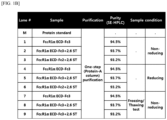
- FIG. 1 it was identified that all respective proteins purified by the SE-HPLC method have purity of 93% or higher.
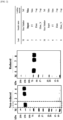
- SDS-PAGE analysis it was identified that proteins having sizes of about 150 kDa and about 75 kDa are detected, respectively, in the non-reducing and reducing conditions ( FIG. 1 , Lanes 1 to 6). From this, it was found that the Fc-bound Fc ⁇ RI ⁇ ECD forms a dimer. In addition, no impurities such as a truncated form were observed in the SDS-PAGE results. In particular, even after the process of thawing/freezing ( FIG.
- the Fc ⁇ RI ⁇ ECD-Fc2ST cell line was batch-cultured in a 1 L flask at a 250 ml scale and purified using a Protein-A affinity column. Subsequently, the culture supernatant and the purified product were subjected to running on a 4% to 15% TGX TM gel (Bio-Rad Laboratories, Inc.) for 30 minutes at a condition of Tris-Glycine SDS (TGS) buffer and 200 V, and then subjected to SDS PAGE analysis.
- TGS Tris-Glycine SDS
- a binding ability to IgE was comparatively measured for the four proteins, i) Fc ⁇ RI ⁇ ECD-Fc2, ii) Fc ⁇ RI ⁇ ECD-Fc2ST, iii) Fc ⁇ RI ⁇ ECD-Fc3, and iv) Fc ⁇ RI ⁇ ECD-Fc3ST which had been purified through the method of Example 2 above, and the commercially available anti-IgE antibody, omalizumab (trade name: Xolair).
- the binding ability to IgE was measured by coating IgE on the channel of the Protein GLC sensor chip (Bio-Rad Laboratories, Inc., Cat # 176-5011), and causing omalizumab or each FceR1 ⁇ ECD-Fc protein at various concentrations to flow at a rate of 30 ⁇ l per minute.
- the association rate (ka) value of the polypeptide dimer according to an embodiment of the present invention was measured to be 1.5- to 2.0-fold lower than that of omalizumab. That is, it was found that a binding ability thereof to substances other than IgE is 1.5- to 2.0-fold lower than that of omalizumab.
- the dissociation rate (kd) value of the polypeptide dimer according to an embodiment of the present invention was measured to be 40- to 106-fold higher than that of omalizumab.
- the polypeptide dimer of the present invention is not easily separated from IgE, and has a much better ability to maintain its bound state than omalizumab.
- the polypeptide dimer according to an embodiment of the present invention has an equilibrium dissociation constant (KD ⁇ kd/ka>) value which is 22- to 69-fold higher than omalizumab. From this, it was identified that the Fc ⁇ RI ⁇ ECD fusion protein of the present invention has a remarkably increased binding ability to IgE as compared with omalizumab.
- a degree of binding of IgE TRAP and omalizumab to IgG receptors was identified using the Octet RED384 system (ForteBio, CA, USA).
- FcyRI, FcyRIIA, FcyRIIB, FcyRIIIA, and FcyRIIIB recombinant proteins (R & D Systems Inc., 5 ⁇ g/ml) were immobilized in 300 mM acetate buffer (pH 5) on the activated AR2G biosensor.
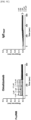
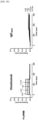
- PBS containing 0.1% Tween-20 and 1% bovine serum was used. All experiments were carried out at 30°C with a sample plate shaker at a rate of 1,000 rpm. The results are shown in FIGS. 5A to 5E , and binding abilities of omalizumab and IgE TRAP to the IgG receptors are quantified and shown in FIG. 6 .
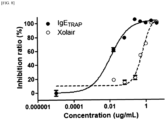
- ⁇ -Hexosaminidase assay was conducted to identify superiority of the Fc ⁇ RI ⁇ ECD fusion protein relative to Xolair through in vitro activity analysis.
- the respective drugs, Fc ⁇ RI ⁇ ECD-Fc2ST (IgE TRAP ) and Xolair were prepared at each concentration, and then mixed with human IgE (1 ug/mL). Then, incubation was performed at room temperature for 30 minutes. During pre-incubation of the drug, a human Fc ⁇ RI gene was introduced, and mast cells derived from and differentiated from mouse bone marrow, in which the mouse Fc ⁇ RI gene had been removed, were prepared.
- OVA ovalbumin
- alum 50 ug of ovalbumin (OVA) and 1 mg of alum were intraperitoneally administered to Balb/c mice (Orientbio Inc.) two times at a 14-day interval to induce sensitization. Thereafter, 50 mg of OVA was orally administered five times in total on days 28, 30, 32, 34, and 36, to induce food allergy in intestines.
- OVA ovalbumin
- mice After the OVA was orally administered two times, that is, on day 31, the mice were divided into three groups, each containing 7 mice.
- the three divided groups were as follows: The first group receiving the Fc ⁇ RI ⁇ ECD-Fc2ST fusion protein at a high concentration (200 ug), the second group receiving the Fc ⁇ RI ⁇ ECD-Fc2ST fusion protein at a low concentration (20 ug), and the third group receiving nothing. While orally administering the OVA, it was identified whether diarrhea occurs due to food allergy induction.
- mice were sacrificed on day 37, and the number of mast cells in the small intestine, the IgE concentration in blood, and the concentration of enzyme (mast cell protease-1 (MCPT-1)) with mast cell degranulation in blood were analyzed for the mice belonging to each group.
- MCPT-1 massive cell protease-1
- mice belonging to the group receiving the Fc ⁇ RI ⁇ ECD-Fc2ST which is a polypeptide dimer
Landscapes
- Health & Medical Sciences (AREA)
- Life Sciences & Earth Sciences (AREA)
- Chemical & Material Sciences (AREA)
- Organic Chemistry (AREA)
- Immunology (AREA)
- Proteomics, Peptides & Aminoacids (AREA)
- Engineering & Computer Science (AREA)
- Molecular Biology (AREA)
- General Health & Medical Sciences (AREA)
- Medicinal Chemistry (AREA)
- Genetics & Genomics (AREA)
- Biochemistry (AREA)
- Biophysics (AREA)
- Bioinformatics & Cheminformatics (AREA)
- Zoology (AREA)
- Polymers & Plastics (AREA)
- Pharmacology & Pharmacy (AREA)
- Public Health (AREA)
- Animal Behavior & Ethology (AREA)
- Mycology (AREA)
- Nutrition Science (AREA)
- Food Science & Technology (AREA)
- Gastroenterology & Hepatology (AREA)
- Veterinary Medicine (AREA)
- Cell Biology (AREA)
- Toxicology (AREA)
- Nuclear Medicine, Radiotherapy & Molecular Imaging (AREA)
- General Chemical & Material Sciences (AREA)
- Chemical Kinetics & Catalysis (AREA)
- Pulmonology (AREA)
- Biomedical Technology (AREA)
- Epidemiology (AREA)
- Biotechnology (AREA)
- General Engineering & Computer Science (AREA)
- Wood Science & Technology (AREA)
- Plant Pathology (AREA)
- Microbiology (AREA)
- Physics & Mathematics (AREA)
- Peptides Or Proteins (AREA)
- Medicines That Contain Protein Lipid Enzymes And Other Medicines (AREA)
Claims (10)
- Polypeptid-Dimer, umfassend:zwei Monomere, von denen jedes eine extrazelluläre Domäne einer Alpha-Untereinheit eines IgE-Fc-Rezeptors (FcεRIαECD) enthält, bestehend aus der Aminosäuresequenz von SEQ ID NO: 1,wobei das Monomer eine modifizierte Fc-Region enthält, die aus der Aminosäuresequenz von SEQ ID NO: 2 besteht, unddie modifizierte Fc-Region und das FcεRIα-ECD über ein Gelenk verbunden sind,wobei das Gelenk eine Variante einer von Immunglobulin IgD abgeleiteten Gelenkregion ist, nämlich Arg Asn Thr Gly Arg Gly Gly Glu Glu Lys Lys Xaa1 Xaa2 Lys Glu Lys Glu Glu Gln Glu Glu Arg Glu Thr Lys Thr Pro Glu Cys Pro (SEQ ID NO: 17) oderAla Gln Pro Gln Ala Glu Gly Ser Leu Ala Lys Ala Thr Thr Ala Pro Ala Thr Thr Arg Asn Thr Gly Arg Gly Gly Glu Glu Lys Lys Xaa3 Xaa4 Lys Glu Lys Glu Glu Gln Glu Glu Arg Glu Thr Lys Thr Pro Glu Cys Pro (SEQ ID NO: 18),Xaa1 und Xaa3 Gly sind undXaa2 und Xaa4 Gly oder Ser sind.
- Polypeptid-Dimer nach Anspruch 1,
wobei das Gelenk eine beliebige Aminosäuresequenz aufweist, die aus der Gruppe ausgewählt ist, die aus SEQ ID NO: 3 und SEQ ID NO: 4 besteht. - Polynukleotid, das für das Monomer des Polypeptid-Dimers gemäß Anspruch 1 kodiert, das eine extrazelluläre Domäne einer Alpha-Untereinheit eines IgE-Fc-Rezeptors (FcεRIαECD) enthält.
- Expressionsvektor, enthaltend das Polynukleotid gemäß Anspruch 3.
- Wirtszelle, umfassend den Expressionsvektor nach Anspruch 4.
- Pharmazeutische Zusammensetzung zur Verwendung bei der Behandlung oder Prävention einer allergischen Erkrankung, wobei die pharmazeutische Zusammensetzung als Wirkstoff ein Polypeptid-Dimer gemäß einem der Ansprüche 1 bis 2 umfasst, wobei
vorzugsweise die allergische Erkrankung aus der Gruppe ausgewählt ist, die aus Folgendem besteht: Nahrungsmittelallergie, atopischer Dermatitis, Asthma, allergischer Rhinitis, allergischer Konjunktivitis, allergischer Dermatitis, chronischer idiopathischer Urtikaria und allergischer Kontaktdermatitis. - Verfahren zur Herstellung eines Polypeptid-Dimers gemäß Anspruch 1, umfassend:einen Schritt des Kultivierens einer Zelle, in die das Polynukleotid gemäß Anspruch 3 und ein Sialinsäure-Transferase-Gen eingeführt werden; undeinen Schritt des Rückgewinnens des Polypeptid-Dimers.
- Polypeptid-Dimer, erhalten nach Anspruch 7.
- Pharmazeutische Zusammensetzung zur Verwendung bei der Behandlung oder Prävention einer allergischen Erkrankung, wobei die pharmazeutische Zusammensetzung als Wirkstoff das Polypeptid-Dimer gemäß Anspruch 8 umfasst.
- Polypeptid-Dimer gemäß Anspruch 1 und/oder 8 zur Verwendung bei der Behandlung oder Prävention einer allergischen Erkrankung, wobei das Polypeptid-Dimer zur Verabreichung an ein Subjekt dient.
Priority Applications (1)
| Application Number | Priority Date | Filing Date | Title |
|---|---|---|---|
| EP25179227.1A EP4595971A3 (de) | 2018-01-08 | 2019-01-08 | Extrazelluläre domäne der alpha-untereinheit von ige-fc-rezeptor, pharmazeutische zusammensetzung damit und verfahren zur herstellung davon |
Applications Claiming Priority (2)
| Application Number | Priority Date | Filing Date | Title |
|---|---|---|---|
| KR20180002248 | 2018-01-08 | ||
| PCT/KR2019/000274 WO2019135668A1 (ko) | 2018-01-08 | 2019-01-08 | Ige fc 수용체의 알파 서브유닛의 세포외 도메인, 이를 포함하는 약학적 조성물 및 이의 제조방법 |
Related Child Applications (1)
| Application Number | Title | Priority Date | Filing Date |
|---|---|---|---|
| EP25179227.1A Division EP4595971A3 (de) | 2018-01-08 | 2019-01-08 | Extrazelluläre domäne der alpha-untereinheit von ige-fc-rezeptor, pharmazeutische zusammensetzung damit und verfahren zur herstellung davon |
Publications (4)
| Publication Number | Publication Date |
|---|---|
| EP3738977A1 EP3738977A1 (de) | 2020-11-18 |
| EP3738977A4 EP3738977A4 (de) | 2021-12-22 |
| EP3738977C0 EP3738977C0 (de) | 2025-06-25 |
| EP3738977B1 true EP3738977B1 (de) | 2025-06-25 |
Family
ID=67143676
Family Applications (2)
| Application Number | Title | Priority Date | Filing Date |
|---|---|---|---|
| EP25179227.1A Pending EP4595971A3 (de) | 2018-01-08 | 2019-01-08 | Extrazelluläre domäne der alpha-untereinheit von ige-fc-rezeptor, pharmazeutische zusammensetzung damit und verfahren zur herstellung davon |
| EP19735715.5A Active EP3738977B1 (de) | 2018-01-08 | 2019-01-08 | Extrazelluläre domäne der alpha-untereinheit von ige-fc-rezeptor, pharmazeutische zusammensetzung damit und verfahren zur herstellung davon |
Family Applications Before (1)
| Application Number | Title | Priority Date | Filing Date |
|---|---|---|---|
| EP25179227.1A Pending EP4595971A3 (de) | 2018-01-08 | 2019-01-08 | Extrazelluläre domäne der alpha-untereinheit von ige-fc-rezeptor, pharmazeutische zusammensetzung damit und verfahren zur herstellung davon |
Country Status (20)
| Country | Link |
|---|---|
| US (2) | US12410233B2 (de) |
| EP (2) | EP4595971A3 (de) |
| JP (2) | JP7128291B2 (de) |
| KR (1) | KR102038675B1 (de) |
| CN (2) | CN111587251B (de) |
| AU (1) | AU2019205743B2 (de) |
| BR (1) | BR112020013805A2 (de) |
| CA (1) | CA3086222A1 (de) |
| CL (1) | CL2020001798A1 (de) |
| ES (1) | ES3037040T3 (de) |
| HU (1) | HUE073422T2 (de) |
| IL (1) | IL275591B2 (de) |
| MX (1) | MX2020007030A (de) |
| MY (1) | MY209615A (de) |
| PE (1) | PE20210043A1 (de) |
| PH (1) | PH12020551021A1 (de) |
| PL (1) | PL3738977T3 (de) |
| SG (1) | SG11202005858WA (de) |
| TW (1) | TWI713971B (de) |
| WO (1) | WO2019135668A1 (de) |
Families Citing this family (7)
| Publication number | Priority date | Publication date | Assignee | Title |
|---|---|---|---|---|
| WO2019135668A1 (ko) * | 2018-01-08 | 2019-07-11 | 주식회사 프로젠 | Ige fc 수용체의 알파 서브유닛의 세포외 도메인, 이를 포함하는 약학적 조성물 및 이의 제조방법 |
| SG11202005863TA (en) * | 2018-01-12 | 2020-07-29 | Gi Innovation Inc | Composition comprising probiotics and polypeptide having binding affinity for ige and use thereof |
| KR102561135B1 (ko) | 2019-07-08 | 2023-07-31 | (주)지아이이노베이션 | IgE Fc 수용체의 알파 서브유닛의 세포외 도메인을 포함하는 시알산 함량이 높은 폴리펩티드 이량체 및 이를 포함하는 약학적 조성물 |
| US20240368239A1 (en) * | 2020-03-12 | 2024-11-07 | Sl Metagen | Novel bispecific protein and use thereof |
| WO2022015049A1 (ko) * | 2020-07-17 | 2022-01-20 | (주)지아이이노베이션 | IgE Fc 수용체 알파서브유닛의 세포외 도메인 및 항-IL-4R 항체를 포함하는 융합단백질 및 이의 용도 |
| KR20220011931A (ko) * | 2020-07-22 | 2022-02-03 | (주)지아이이노베이션 | IgE Fc 수용체를 포함하는 융합단백질 및 이를 포함하는 개 알레르기성 질환 치료 용도 |
| JP2024509937A (ja) * | 2021-03-09 | 2024-03-05 | ジーアイ・イノベイション・インコーポレイテッド | Ige fc受容体のアルファサブユニットの細胞外ドメインを含む融合タンパク質の製剤 |
Family Cites Families (21)
| Publication number | Priority date | Publication date | Assignee | Title |
|---|---|---|---|---|
| US3006734A (en) | 1957-11-14 | 1961-10-31 | Plessey Co Ltd | Process for preparing pure silicon |
| US3067334A (en) | 1959-03-13 | 1962-12-04 | Garrett Corp | Driving and control means for a plurality of alternators |
| KR20030036835A (ko) * | 2000-09-26 | 2003-05-09 | 제넨테크, 인크. | Ige 수용체 길항제 |
| US7829084B2 (en) | 2001-01-17 | 2010-11-09 | Trubion Pharmaceuticals, Inc. | Binding constructs and methods for use thereof |
| PT1896071E (pt) | 2005-06-30 | 2015-07-09 | Janssen Biotech Inc | Métodos e composições com melhorias na atividade terapêutica |
| WO2008028068A2 (en) * | 2006-08-30 | 2008-03-06 | Genentech, Inc. | NON-HUMAN PRIMATE FCεR1α POLYPEPTIDES |
| CN101611052A (zh) | 2006-12-13 | 2009-12-23 | 苏伯利莫尔公司 | 包含修饰的Fc结构域的多聚Fc受体多肽 |
| SI2132230T1 (sl) | 2007-03-22 | 2014-07-31 | Genentech, Inc. | Apoptotska protitelesa, ki veĹľejo membransko-vezan IgE |
| CN105175553B (zh) | 2007-05-30 | 2019-11-22 | 浦项工科大学校产学协力团 | 免疫球蛋白融合蛋白 |
| ES2623925T3 (es) * | 2007-05-30 | 2017-07-12 | Postech Academy-Industry- Foundation | Proteínas de fusión de inmunoglobulina |
| EP2072527A1 (de) * | 2007-12-21 | 2009-06-24 | Altonabiotec AG | Fusionspolypeptide, die einen SHBG-Dimerisierungsbestandteil umfassen, und deren Verwendung |
| BRPI0918670B8 (pt) | 2008-09-17 | 2021-05-25 | Xencor Inc | anticorpo |
| KR101832510B1 (ko) * | 2009-10-26 | 2018-02-26 | 제넨테크, 인크. | 치료 항-ige 항체에 대해 특이적인 항체를 검출하기 위한 검정 및 아나필락시스에서의 이의 용도 |
| US20110256641A1 (en) * | 2010-04-19 | 2011-10-20 | Michael Ling | Methods and Systems for Detecting Free IgE |
| KR101825048B1 (ko) | 2014-12-31 | 2018-02-05 | 주식회사 제넥신 | GLP 및 면역글로불린 하이브리드 Fc 융합 폴리펩타이드 및 이의 용도 |
| TWI691512B (zh) | 2015-02-20 | 2020-04-21 | 日商橘生藥品工業股份有限公司 | Fc融合高親和性IgE受體α鏈 |
| US10195272B2 (en) * | 2015-03-02 | 2019-02-05 | The Nemours Foundation | Adoptive t-cell therapy using FcεRI-based chimeric antigen receptors for treating IgE-mediated allergic diseases |
| CN114853873B (zh) * | 2015-06-11 | 2025-01-28 | 格纳西尼有限公司 | 经修饰的白细胞介素-7蛋白及其用途 |
| TW201930343A (zh) | 2018-01-08 | 2019-08-01 | 南韓商普羅根有限公司 | 包含IgE受體之重組型胞外區域的藥學組成物 |
| WO2019135668A1 (ko) * | 2018-01-08 | 2019-07-11 | 주식회사 프로젠 | Ige fc 수용체의 알파 서브유닛의 세포외 도메인, 이를 포함하는 약학적 조성물 및 이의 제조방법 |
| SG11202005863TA (en) * | 2018-01-12 | 2020-07-29 | Gi Innovation Inc | Composition comprising probiotics and polypeptide having binding affinity for ige and use thereof |
-
2019
- 2019-01-08 WO PCT/KR2019/000274 patent/WO2019135668A1/ko not_active Ceased
- 2019-01-08 CN CN201980007917.5A patent/CN111587251B/zh active Active
- 2019-01-08 AU AU2019205743A patent/AU2019205743B2/en active Active
- 2019-01-08 CN CN202410672936.2A patent/CN118638245A/zh active Pending
- 2019-01-08 US US16/958,861 patent/US12410233B2/en active Active
- 2019-01-08 MX MX2020007030A patent/MX2020007030A/es unknown
- 2019-01-08 CA CA3086222A patent/CA3086222A1/en active Pending
- 2019-01-08 PE PE2020000919A patent/PE20210043A1/es unknown
- 2019-01-08 SG SG11202005858WA patent/SG11202005858WA/en unknown
- 2019-01-08 EP EP25179227.1A patent/EP4595971A3/de active Pending
- 2019-01-08 MY MYPI2020003145A patent/MY209615A/en unknown
- 2019-01-08 ES ES19735715T patent/ES3037040T3/es active Active
- 2019-01-08 TW TW108100730A patent/TWI713971B/zh active
- 2019-01-08 HU HUE19735715A patent/HUE073422T2/hu unknown
- 2019-01-08 PL PL19735715.5T patent/PL3738977T3/pl unknown
- 2019-01-08 BR BR112020013805-3A patent/BR112020013805A2/pt unknown
- 2019-01-08 EP EP19735715.5A patent/EP3738977B1/de active Active
- 2019-01-08 KR KR1020190002029A patent/KR102038675B1/ko active Active
- 2019-01-08 JP JP2020557108A patent/JP7128291B2/ja active Active
-
2020
- 2020-06-22 IL IL275591A patent/IL275591B2/en unknown
- 2020-06-30 PH PH12020551021A patent/PH12020551021A1/en unknown
- 2020-07-03 CL CL2020001798A patent/CL2020001798A1/es unknown
-
2022
- 2022-08-18 JP JP2022130533A patent/JP7488303B2/ja active Active
-
2025
- 2025-08-08 US US19/294,680 patent/US20260062457A1/en active Pending
Also Published As
Similar Documents
| Publication | Publication Date | Title |
|---|---|---|
| EP3738977B1 (de) | Extrazelluläre domäne der alpha-untereinheit von ige-fc-rezeptor, pharmazeutische zusammensetzung damit und verfahren zur herstellung davon | |
| KR102038672B1 (ko) | IgE Fc 수용체의 알파 서브유닛의 세포외 도메인을 포함하는 약학적 조성물 | |
| CN111587118B (zh) | 包含益生菌和具有与IgE结合能力的多肽的组合物及其用途 | |
| US20260061022A1 (en) | Polypeptide dimer with high sialic acid content, comprising extracellular domain of alpha subunit of ige fc receptor, and pharmaceutical composition comprising same | |
| JP7784412B2 (ja) | Ige fc受容体アルファサブユニット細胞外ドメイン及び抗il-4抗体を含む融合タンパク質並びにその融合タンパク質の使用 | |
| HK40111324A (zh) | IGE FC受体的α亚基的胞外域、包含其的药物组合物及其制备方法 | |
| RU2796162C2 (ru) | Внеклеточный домен альфа-субъединицы fc-рецептора ige, фармацевтическая композиция, содержащая его, и способ его получения | |
| HK40028193B (zh) | IGE FC受体的α亚基的胞外域、包含其的药物组合物及其制备方法 | |
| HK40028193A (en) | Extracellular domain of alpha subunit of ige fc receptor, pharmaceutical composition comprising same and method for producing same | |
| HK40064347B (zh) | 包含IGE FC受体的α亚基的胞外结构域且具有高唾液酸含量的多肽二聚体及包含其的药物组合物 | |
| HK40064347A (en) | Polypeptide dimer with high sialic acid content, comprising extracellular domain of alpha subunit of ige fc receptor, and pharmaceutical composition comprising same | |
| KR20220011931A (ko) | IgE Fc 수용체를 포함하는 융합단백질 및 이를 포함하는 개 알레르기성 질환 치료 용도 |
Legal Events
| Date | Code | Title | Description |
|---|---|---|---|
| STAA | Information on the status of an ep patent application or granted ep patent |
Free format text: STATUS: THE INTERNATIONAL PUBLICATION HAS BEEN MADE |
|
| PUAI | Public reference made under article 153(3) epc to a published international application that has entered the european phase |
Free format text: ORIGINAL CODE: 0009012 |
|
| STAA | Information on the status of an ep patent application or granted ep patent |
Free format text: STATUS: REQUEST FOR EXAMINATION WAS MADE |
|
| 17P | Request for examination filed |
Effective date: 20200629 |
|
| AK | Designated contracting states |
Kind code of ref document: A1 Designated state(s): AL AT BE BG CH CY CZ DE DK EE ES FI FR GB GR HR HU IE IS IT LI LT LU LV MC MK MT NL NO PL PT RO RS SE SI SK SM TR |
|
| AX | Request for extension of the european patent |
Extension state: BA ME |
|
| DAV | Request for validation of the european patent (deleted) | ||
| DAX | Request for extension of the european patent (deleted) | ||
| A4 | Supplementary search report drawn up and despatched |
Effective date: 20211119 |
|
| RIC1 | Information provided on ipc code assigned before grant |
Ipc: A61K 38/00 20060101ALI20211115BHEP Ipc: A23L 33/18 20160101ALI20211115BHEP Ipc: C07K 14/735 20060101AFI20211115BHEP |
|
| STAA | Information on the status of an ep patent application or granted ep patent |
Free format text: STATUS: EXAMINATION IS IN PROGRESS |
|
| 17Q | First examination report despatched |
Effective date: 20240801 |
|
| GRAP | Despatch of communication of intention to grant a patent |
Free format text: ORIGINAL CODE: EPIDOSNIGR1 |
|
| STAA | Information on the status of an ep patent application or granted ep patent |
Free format text: STATUS: GRANT OF PATENT IS INTENDED |
|
| INTG | Intention to grant announced |
Effective date: 20250121 |
|
| GRAS | Grant fee paid |
Free format text: ORIGINAL CODE: EPIDOSNIGR3 |
|
| GRAA | (expected) grant |
Free format text: ORIGINAL CODE: 0009210 |
|
| STAA | Information on the status of an ep patent application or granted ep patent |
Free format text: STATUS: THE PATENT HAS BEEN GRANTED |
|
| AK | Designated contracting states |
Kind code of ref document: B1 Designated state(s): AL AT BE BG CH CY CZ DE DK EE ES FI FR GB GR HR HU IE IS IT LI LT LU LV MC MK MT NL NO PL PT RO RS SE SI SK SM TR |
|
| REG | Reference to a national code |
Ref country code: GB Ref legal event code: FG4D |
|
| REG | Reference to a national code |
Ref country code: CH Ref legal event code: EP |
|
| REG | Reference to a national code |
Ref country code: DE Ref legal event code: R096 Ref document number: 602019071546 Country of ref document: DE |
|
| REG | Reference to a national code |
Ref country code: CH Ref legal event code: EP |
|
| REG | Reference to a national code |
Ref country code: IE Ref legal event code: FG4D |
|
| U01 | Request for unitary effect filed |
Effective date: 20250630 |
|
| U07 | Unitary effect registered |
Designated state(s): AT BE BG DE DK EE FI FR IT LT LU LV MT NL PT RO SE SI Effective date: 20250707 |
|
| REG | Reference to a national code |
Ref country code: ES Ref legal event code: FG2A Ref document number: 3037040 Country of ref document: ES Kind code of ref document: T3 Effective date: 20250926 |
|
| PG25 | Lapsed in a contracting state [announced via postgrant information from national office to epo] |
Ref country code: HR Free format text: LAPSE BECAUSE OF FAILURE TO SUBMIT A TRANSLATION OF THE DESCRIPTION OR TO PAY THE FEE WITHIN THE PRESCRIBED TIME-LIMIT Effective date: 20250625 |
|
| PG25 | Lapsed in a contracting state [announced via postgrant information from national office to epo] |
Ref country code: RS Free format text: LAPSE BECAUSE OF FAILURE TO SUBMIT A TRANSLATION OF THE DESCRIPTION OR TO PAY THE FEE WITHIN THE PRESCRIBED TIME-LIMIT Effective date: 20250925 |
|
| REG | Reference to a national code |
Ref country code: GR Ref legal event code: EP Ref document number: 20250401596 Country of ref document: GR Effective date: 20251009 |
|
| PG25 | Lapsed in a contracting state [announced via postgrant information from national office to epo] |
Ref country code: IS Free format text: LAPSE BECAUSE OF FAILURE TO SUBMIT A TRANSLATION OF THE DESCRIPTION OR TO PAY THE FEE WITHIN THE PRESCRIBED TIME-LIMIT Effective date: 20251025 |
|
| PGFP | Annual fee paid to national office [announced via postgrant information from national office to epo] |
Ref country code: GB Payment date: 20251211 Year of fee payment: 8 |
|
| PG25 | Lapsed in a contracting state [announced via postgrant information from national office to epo] |
Ref country code: SM Free format text: LAPSE BECAUSE OF FAILURE TO SUBMIT A TRANSLATION OF THE DESCRIPTION OR TO PAY THE FEE WITHIN THE PRESCRIBED TIME-LIMIT Effective date: 20250625 |
|
| PGFP | Annual fee paid to national office [announced via postgrant information from national office to epo] |
Ref country code: GR Payment date: 20251230 Year of fee payment: 8 |
|
| PGFP | Annual fee paid to national office [announced via postgrant information from national office to epo] |
Ref country code: CZ Payment date: 20251219 Year of fee payment: 8 |
|
| U20 | Renewal fee for the european patent with unitary effect paid |
Year of fee payment: 8 Effective date: 20251218 |
|
| PGFP | Annual fee paid to national office [announced via postgrant information from national office to epo] |
Ref country code: PL Payment date: 20251223 Year of fee payment: 8 |
|
| PG25 | Lapsed in a contracting state [announced via postgrant information from national office to epo] |
Ref country code: SK Free format text: LAPSE BECAUSE OF FAILURE TO SUBMIT A TRANSLATION OF THE DESCRIPTION OR TO PAY THE FEE WITHIN THE PRESCRIBED TIME-LIMIT Effective date: 20250625 |
|
| REG | Reference to a national code |
Ref country code: HU Ref legal event code: AG4A Ref document number: E073422 Country of ref document: HU |
|
| REG | Reference to a national code |
Ref country code: CH Ref legal event code: U11 Free format text: ST27 STATUS EVENT CODE: U-0-0-U10-U11 (AS PROVIDED BY THE NATIONAL OFFICE) Effective date: 20260201 |
|
| PGFP | Annual fee paid to national office [announced via postgrant information from national office to epo] |
Ref country code: HU Payment date: 20260122 Year of fee payment: 8 |
|
| PGFP | Annual fee paid to national office [announced via postgrant information from national office to epo] |
Ref country code: ES Payment date: 20260213 Year of fee payment: 8 |
|
| PGFP | Annual fee paid to national office [announced via postgrant information from national office to epo] |
Ref country code: NO Payment date: 20260109 Year of fee payment: 8 |
|
| PGFP | Annual fee paid to national office [announced via postgrant information from national office to epo] |
Ref country code: TR Payment date: 20260107 Year of fee payment: 8 |
|
| PGFP | Annual fee paid to national office [announced via postgrant information from national office to epo] |
Ref country code: CH Payment date: 20260201 Year of fee payment: 8 |
|
| PLBE | No opposition filed within time limit |
Free format text: ORIGINAL CODE: 0009261 |
|
| STAA | Information on the status of an ep patent application or granted ep patent |
Free format text: STATUS: NO OPPOSITION FILED WITHIN TIME LIMIT |