EP3745452A1 - Verfahren zur herstellung eines substrats für leistungsmodul und keramik-kupfer-verbindungskörper - Google Patents
Verfahren zur herstellung eines substrats für leistungsmodul und keramik-kupfer-verbindungskörper Download PDFInfo
- Publication number
- EP3745452A1 EP3745452A1 EP19744045.6A EP19744045A EP3745452A1 EP 3745452 A1 EP3745452 A1 EP 3745452A1 EP 19744045 A EP19744045 A EP 19744045A EP 3745452 A1 EP3745452 A1 EP 3745452A1
- Authority
- EP
- European Patent Office
- Prior art keywords
- copper
- board
- ceramic
- forming
- layer
- Prior art date
- Legal status (The legal status is an assumption and is not a legal conclusion. Google has not performed a legal analysis and makes no representation as to the accuracy of the status listed.)
- Granted
Links
Images





Classifications
-
- H—ELECTRICITY
- H10—SEMICONDUCTOR DEVICES; ELECTRIC SOLID-STATE DEVICES NOT OTHERWISE PROVIDED FOR
- H10W—GENERIC PACKAGES, INTERCONNECTIONS, CONNECTORS OR OTHER CONSTRUCTIONAL DETAILS OF DEVICES COVERED BY CLASS H10
- H10W70/00—Package substrates; Interposers; Redistribution layers [RDL]
- H10W70/60—Insulating or insulated package substrates; Interposers; Redistribution layers
- H10W70/67—Insulating or insulated package substrates; Interposers; Redistribution layers characterised by their insulating layers or insulating parts
- H10W70/69—Insulating materials thereof
- H10W70/692—Ceramics or glasses
-
- H—ELECTRICITY
- H10—SEMICONDUCTOR DEVICES; ELECTRIC SOLID-STATE DEVICES NOT OTHERWISE PROVIDED FOR
- H10W—GENERIC PACKAGES, INTERCONNECTIONS, CONNECTORS OR OTHER CONSTRUCTIONAL DETAILS OF DEVICES COVERED BY CLASS H10
- H10W40/00—Arrangements for thermal protection or thermal control
- H10W40/20—Arrangements for cooling
- H10W40/25—Arrangements for cooling characterised by their materials
- H10W40/255—Arrangements for cooling characterised by their materials having a laminate or multilayered structure, e.g. direct bond copper [DBC] ceramic substrates
-
- C—CHEMISTRY; METALLURGY
- C04—CEMENTS; CONCRETE; ARTIFICIAL STONE; CERAMICS; REFRACTORIES
- C04B—LIME, MAGNESIA; SLAG; CEMENTS; COMPOSITIONS THEREOF, e.g. MORTARS, CONCRETE OR LIKE BUILDING MATERIALS; ARTIFICIAL STONE; CERAMICS; REFRACTORIES; TREATMENT OF NATURAL STONE
- C04B37/00—Joining burned ceramic articles with other burned ceramic articles or other articles by heating
- C04B37/02—Joining burned ceramic articles with other burned ceramic articles or other articles by heating with metallic articles
- C04B37/021—Joining burned ceramic articles with other burned ceramic articles or other articles by heating with metallic articles in a direct manner, e.g. direct copper bonding [DCB]
-
- H—ELECTRICITY
- H05—ELECTRIC TECHNIQUES NOT OTHERWISE PROVIDED FOR
- H05K—PRINTED CIRCUITS; CASINGS OR CONSTRUCTIONAL DETAILS OF ELECTRIC APPARATUS; MANUFACTURE OF ASSEMBLAGES OF ELECTRICAL COMPONENTS
- H05K1/00—Printed circuits
- H05K1/02—Details
- H05K1/09—Use of materials for the conductive, e.g. metallic pattern
-
- H—ELECTRICITY
- H05—ELECTRIC TECHNIQUES NOT OTHERWISE PROVIDED FOR
- H05K—PRINTED CIRCUITS; CASINGS OR CONSTRUCTIONAL DETAILS OF ELECTRIC APPARATUS; MANUFACTURE OF ASSEMBLAGES OF ELECTRICAL COMPONENTS
- H05K3/00—Apparatus or processes for manufacturing printed circuits
- H05K3/02—Apparatus or processes for manufacturing printed circuits in which the conductive material is applied to the surface of the insulating support and is thereafter removed from such areas of the surface which are not intended for current conducting or shielding
- H05K3/04—Apparatus or processes for manufacturing printed circuits in which the conductive material is applied to the surface of the insulating support and is thereafter removed from such areas of the surface which are not intended for current conducting or shielding the conductive material being removed mechanically, e.g. by punching
-
- H—ELECTRICITY
- H05—ELECTRIC TECHNIQUES NOT OTHERWISE PROVIDED FOR
- H05K—PRINTED CIRCUITS; CASINGS OR CONSTRUCTIONAL DETAILS OF ELECTRIC APPARATUS; MANUFACTURE OF ASSEMBLAGES OF ELECTRICAL COMPONENTS
- H05K3/00—Apparatus or processes for manufacturing printed circuits
- H05K3/02—Apparatus or processes for manufacturing printed circuits in which the conductive material is applied to the surface of the insulating support and is thereafter removed from such areas of the surface which are not intended for current conducting or shielding
- H05K3/06—Apparatus or processes for manufacturing printed circuits in which the conductive material is applied to the surface of the insulating support and is thereafter removed from such areas of the surface which are not intended for current conducting or shielding the conductive material being removed chemically or electrolytically, e.g. by photo-etch process
-
- H—ELECTRICITY
- H10—SEMICONDUCTOR DEVICES; ELECTRIC SOLID-STATE DEVICES NOT OTHERWISE PROVIDED FOR
- H10P—GENERIC PROCESSES OR APPARATUS FOR THE MANUFACTURE OR TREATMENT OF DEVICES COVERED BY CLASS H10
- H10P54/00—Cutting or separating of wafers, substrates or parts of devices
-
- H—ELECTRICITY
- H10—SEMICONDUCTOR DEVICES; ELECTRIC SOLID-STATE DEVICES NOT OTHERWISE PROVIDED FOR
- H10W—GENERIC PACKAGES, INTERCONNECTIONS, CONNECTORS OR OTHER CONSTRUCTIONAL DETAILS OF DEVICES COVERED BY CLASS H10
- H10W10/00—Isolation regions in semiconductor bodies between components of integrated devices
- H10W10/01—Manufacture or treatment
-
- H—ELECTRICITY
- H10—SEMICONDUCTOR DEVICES; ELECTRIC SOLID-STATE DEVICES NOT OTHERWISE PROVIDED FOR
- H10W—GENERIC PACKAGES, INTERCONNECTIONS, CONNECTORS OR OTHER CONSTRUCTIONAL DETAILS OF DEVICES COVERED BY CLASS H10
- H10W40/00—Arrangements for thermal protection or thermal control
- H10W40/20—Arrangements for cooling
- H10W40/25—Arrangements for cooling characterised by their materials
- H10W40/258—Metallic materials
-
- H—ELECTRICITY
- H10—SEMICONDUCTOR DEVICES; ELECTRIC SOLID-STATE DEVICES NOT OTHERWISE PROVIDED FOR
- H10W—GENERIC PACKAGES, INTERCONNECTIONS, CONNECTORS OR OTHER CONSTRUCTIONAL DETAILS OF DEVICES COVERED BY CLASS H10
- H10W70/00—Package substrates; Interposers; Redistribution layers [RDL]
- H10W70/01—Manufacture or treatment
- H10W70/02—Manufacture or treatment of conductive package substrates serving as an interconnection, e.g. of metal plates
-
- H—ELECTRICITY
- H10—SEMICONDUCTOR DEVICES; ELECTRIC SOLID-STATE DEVICES NOT OTHERWISE PROVIDED FOR
- H10W—GENERIC PACKAGES, INTERCONNECTIONS, CONNECTORS OR OTHER CONSTRUCTIONAL DETAILS OF DEVICES COVERED BY CLASS H10
- H10W70/00—Package substrates; Interposers; Redistribution layers [RDL]
- H10W70/60—Insulating or insulated package substrates; Interposers; Redistribution layers
- H10W70/67—Insulating or insulated package substrates; Interposers; Redistribution layers characterised by their insulating layers or insulating parts
- H10W70/68—Shapes or dispositions thereof
-
- C—CHEMISTRY; METALLURGY
- C04—CEMENTS; CONCRETE; ARTIFICIAL STONE; CERAMICS; REFRACTORIES
- C04B—LIME, MAGNESIA; SLAG; CEMENTS; COMPOSITIONS THEREOF, e.g. MORTARS, CONCRETE OR LIKE BUILDING MATERIALS; ARTIFICIAL STONE; CERAMICS; REFRACTORIES; TREATMENT OF NATURAL STONE
- C04B2237/00—Aspects relating to ceramic laminates or to joining of ceramic articles with other articles by heating
- C04B2237/30—Composition of layers of ceramic laminates or of ceramic or metallic articles to be joined by heating, e.g. Si substrates
- C04B2237/40—Metallic
- C04B2237/407—Copper
-
- C—CHEMISTRY; METALLURGY
- C04—CEMENTS; CONCRETE; ARTIFICIAL STONE; CERAMICS; REFRACTORIES
- C04B—LIME, MAGNESIA; SLAG; CEMENTS; COMPOSITIONS THEREOF, e.g. MORTARS, CONCRETE OR LIKE BUILDING MATERIALS; ARTIFICIAL STONE; CERAMICS; REFRACTORIES; TREATMENT OF NATURAL STONE
- C04B2237/00—Aspects relating to ceramic laminates or to joining of ceramic articles with other articles by heating
- C04B2237/50—Processing aspects relating to ceramic laminates or to the joining of ceramic articles with other articles by heating
- C04B2237/70—Forming laminates or joined articles comprising layers of a specific, unusual thickness
- C04B2237/706—Forming laminates or joined articles comprising layers of a specific, unusual thickness of one or more of the metallic layers or articles
-
- H—ELECTRICITY
- H05—ELECTRIC TECHNIQUES NOT OTHERWISE PROVIDED FOR
- H05K—PRINTED CIRCUITS; CASINGS OR CONSTRUCTIONAL DETAILS OF ELECTRIC APPARATUS; MANUFACTURE OF ASSEMBLAGES OF ELECTRICAL COMPONENTS
- H05K1/00—Printed circuits
- H05K1/02—Details
-
- H—ELECTRICITY
- H05—ELECTRIC TECHNIQUES NOT OTHERWISE PROVIDED FOR
- H05K—PRINTED CIRCUITS; CASINGS OR CONSTRUCTIONAL DETAILS OF ELECTRIC APPARATUS; MANUFACTURE OF ASSEMBLAGES OF ELECTRICAL COMPONENTS
- H05K1/00—Printed circuits
- H05K1/02—Details
- H05K1/03—Use of materials for the substrate
- H05K1/0306—Inorganic insulating substrates, e.g. ceramic, glass
-
- H—ELECTRICITY
- H05—ELECTRIC TECHNIQUES NOT OTHERWISE PROVIDED FOR
- H05K—PRINTED CIRCUITS; CASINGS OR CONSTRUCTIONAL DETAILS OF ELECTRIC APPARATUS; MANUFACTURE OF ASSEMBLAGES OF ELECTRICAL COMPONENTS
- H05K3/00—Apparatus or processes for manufacturing printed circuits
-
- H—ELECTRICITY
- H05—ELECTRIC TECHNIQUES NOT OTHERWISE PROVIDED FOR
- H05K—PRINTED CIRCUITS; CASINGS OR CONSTRUCTIONAL DETAILS OF ELECTRIC APPARATUS; MANUFACTURE OF ASSEMBLAGES OF ELECTRICAL COMPONENTS
- H05K3/00—Apparatus or processes for manufacturing printed circuits
- H05K3/0011—Working of insulating substrates or insulating layers
- H05K3/0044—Mechanical working of the substrate, e.g. drilling or punching
- H05K3/0052—Depaneling, i.e. dividing a panel into circuit boards; Working of the edges of circuit boards
Definitions
- the present invention relates to a method of manufacturing a power module substrate board used for manufacturing power modules and the like controlling large electric current and high voltage, and a ceramic-copper bonded body.
- a method of manufacturing a power module substrate board used for power modules and the like known is a method of manufacturing a plurality of power module substrate boards from one ceramic board having a large area which can be formed into a plurality of the power module substrate boards, as described in Patent Document 1 or Patent Document 2 for example, by forming dividing grooves (scribe lines) to partition into respective sizes of the power module substrate boards on the ceramic material to separate the ceramic material into pieces along the dividing grooves.
- Patent Document 1 describes that a metal board made of aluminum or copper is brazed on a ceramic base material (a ceramic board) on which scribe lines are previously formed, then the metal board is etched so that a circuit patterns are formed.
- Patent Document 2 describes that after a ceramic substrate board (a ceramic board) and a metal board made of aluminum are bonded, circuit patterns are formed by etching the metal board, and then grooves (dividing grooves) are formed between the circuit patterns on the ceramic substrate board.
- a thickness of a resist film may be uneven in a resist print, forms of resist patterns may be inferior and so on, when the circuit pattern is formed: and there are problems in which the circuit patterns are shifted, an inspection accuracy is deteriorated in an inspection step, and so forth.
- a thickness be relatively large (thick) in order to improve an effect of heat-spreading: by contrast, a metal layer (a heat-radiation layer) arranged on a back surface is formed to have a smaller thickness than that of the circuit layer, in order to balance with the circuit layer where the patterns will be formed and to reduce the warp in a whole.
- the metal board on the circuit layer side is thicker than the metal board on the metal layer side before the circuit patterns are formed, the warp becomes large and the ceramic substrate board may be broken.
- copper is more suitable than aluminum for the metal board forming the circuit patterns and the like in a view point of electric conductivity and heat dissipation property; since copper has higher rigidness than that of aluminum, it is difficult to flatten a bonded body using copper if it warps when forming the circuit pattern, and accuracy of the circuit patterns is easy to be deteriorated.
- the present invention is achieved in consideration of the above circumstances, and has an object to provide a method of manufacturing power module substrate boards at high productivity and a ceramic-copper bonded body in which the warp is reduced.
- a method of manufacturing a power module substrate board of the present invention includes: a bonded body-forming step forming a bonded body having a ceramic board having a dividing groove for dividing into two or more ceramic substrate boards, a circuit layer-forming copper layer bonded on a first surface of the ceramic board, and a metal layer-forming copper layer bonded on a second surface of the ceramic board; a pattern-forming step forming a circuit layer and a metal layer on respective substrate board-forming areas of the ceramic substrate boards partitioned by the dividing groove, by etching on the bonded body after the bonded body-forming step; and a dividing step forming a plurality of the power module substrate boards including the ceramic substrate board, the circuit layer, and the metal layer, by dividing the ceramic board along the dividing groove after the pattern-forming step: in the bonded body-forming step, the circuit layer-forming copper layer consisting of first copper layers is formed by arranging and bonding first copper boards on the first surface of the ceramic board; and the metal layer-forming copper layer consisting of
- the thicker circuit layer-forming copper layer is composed of the first copper layer which are divided into several pieces (the first copper boards): accordingly, it is possible to reduce a difference of inner stress between the front and back surfaces of the ceramic board in a combination with the thinner metal layer-forming copper layer, and a warp in the bonded body (the ceramic-copper bonded body) of the ceramic board, the circuit layer-forming copper layer (the first copper boards), and the metal layer-forming copper layer (the second copper board) can be reduced.
- the warp in the bonded body can be reduced as described above, in the pattern-forming step, defects of unevenness of the thickness of the resist film and the form of the resist pattern are not easily occurred, and the circuit layer and the metal layer can be patterned and formed accurately on the respective substrate board-forming areas. Accordingly, it is possible to manufacture the power module substrate boards at once with high accuracy and improve the productivity of the power module substrate boards.
- a thickness of the first copper layer is t1
- a bonded area of the first copper layer and the ceramic board is A1
- a thickness of the second copper layer is t2
- a bonded area of the second copper layer and the ceramic board is A2
- a product of multiplying an area ratio (A1/A2) of the bonded area A1 and the bonded area A2 and a thickness ratio (t1/t2) of the thickness t1 and the thickness t2, ⁇ (A1/A2) ⁇ (t1/t2) ⁇ be not less than 0.080 and not more than 0.600.
- the thickness t1 and the bonding area A1 of the first copper boards and the thickness t2 and the bonding area A2 of the second copper board are in the above mentioned relation, so it is possible to form the bonded body in which a warp is as small as the flatness of the metal layer-forming copper layer is not more than 0.5 mm. Accordingly, in the pattern-forming step, it is possible to form the circuit layer and the metal layer reliably which are patterned on the respective substrate board-forming areas of the ceramic substrate board with high accuracy.
- a dividing groove-forming step be carried out before the bonded body-forming step: in this step, the dividing groove is formed on at least one of the first surface or the second surface of the ceramic board along outlines of the substrate board-forming areas.
- a ceramic-copper bonded body of the present invention includes a ceramic board having a dividing groove for dividing into a plurality of ceramic substrate boards, a circuit layer-forming copper layer consisting of a plurality of first copper layers bonded on a first surface of the ceramic board, and a metal layer-forming copper layer consisting of one or more second copper layers with a smaller arrangement number than that of the first copper layers, bonded on a second surface of the ceramic board and having a larger planar area than that of the first copper layers and a smaller thickness than that of the first copper layers: among substrate board-forming areas of the ceramic substrate board partitioned by the dividing groove, the second copper layer covers at least two of the adjacent substrate board-forming area.
- the warp of the ceramic-copper bonded body can be reduced, so that it is possible to form the circuit layer and the metal layer with high accuracy on the respective substrate board-forming areas of the ceramic board, and it is possible to improve the productivity of the power module substrate board.
- FIGS. 3A to 3C show a power module substrate board 10 manufactured by a method of manufacturing a power module substrate board according to a first embodiment of the present invention.
- a power module 101 is manufactured by installing (mounting) elements 91 such as semiconductor elements and the like on a surface (an upper surface in FIG. 3A ) of the power module substrate board 10, as shown in FIG. 3A .
- the power module substrate board 10 is provided with a ceramic substrate board 11, a circuit layer 12 formed on a first surface (the upper surface in FIG. 3A ) of the ceramic substrate board 11, and a metal layer 13 formed on a second surface (a lower surface in FIG. 3A ) of the ceramic substrate board 11, as shown in FIGS. 3A to 3C .
- the ceramic substrate board 11 is made of ceramic material such as AlN (aluminum nitride), Al 2 O 3 (alumina), Si 3 N 4 (silicon nitride), or the like.
- the circuit layer 12 is formed by bonding copper boards made of copper (copper or copper alloy) on the first surface of the ceramic substrate board 11 by brazing or the like.
- the metal layer 13 is formed by bonding a copper board made of copper (copper or copper alloy) on the second surface of the ceramic substrate board 11 by brazing or the like, as the circuit layer 12.
- the circuit layer 12 is formed from a plurality of small circuit layers 121 and forms circuit patterns. Consequently, a bonding area of the ceramic substrate board 11 and the circuit layer 12 is smaller than a bonding area of the ceramic substrate board 11 and the metal layer 13.
- a thickness (a board thickness) t11 of the circuit layer 12 is larger (thicker) than a thickness (a board thickness) t12 of the metal layer 13.
- a form of the metal layer 13 is adjusted considering the circuit layer 12 in order to reduce a difference of inner stress by a difference of thermal expansion between the circuit layer 12 and the metal layer 13 which are bonded on both surfaces of the ceramic substrate board 11 respectively.
- a thickness (a board thickness) of the ceramic substrate board 11 made of Si 3 N 4 (silicon nitride) is 0.1 mm to 1.5 mm; the thickness t11 of the circuit layer 12 made of OFC (pure copper) is 0.5 mm to 2.0 mm; and the thickness t12 of the metal layer 13 also made of OFC is 0.35 mm to 1.8 mm.
- these dimensions are not limited to the above value ranges.
- the elements 91 mounted on the power module substrate board 10 are electric components having semiconductor: in accordance with required functions, various semiconductors are selected such as IGBT (Insulated Gate Bipolar Transistor), MOSFET (Metal Oxide Semiconductor Field Effect Transistor), FWD (Free Wheeling Diode), and the like.
- IGBT Insulated Gate Bipolar Transistor
- MOSFET Metal Oxide Semiconductor Field Effect Transistor
- FWD Free Wheeling Diode
- a top electrode part is provided at a top and a bottom electrode part is provided at a bottom, although the illustration is omitted.
- the elements 91 are mounted on an upper surface of the circuit layer 12 by the bottom electrode parts of the elements 91 are bonded on the upper surface of the circuit layer 12 by soldering or the like.
- the top electrode parts of the elements 91 are connected to a circuit electrode part or the like of the circuit layer 12 via lead frames (not illustrated).
- the method of manufacturing the power module substrate board of the present embodiment is composed of a plurality of manufacturing steps S11 to S13 as shown in a flow drawing in FIG. 2 .
- FIG. 1 shows an instance of manufacturing steps of the method of manufacturing the power module substrate board of the present embodiment. Below, it will be explained in order of the steps.
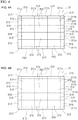
- dividing grooves 211v and 211h are formed along boundary lines of a plurality of substrate board-forming areas by linearly removing the surface(s) of the ceramic board 21 to a middle in a thickness direction. Namely, the large ceramic board 21 having the dividing grooves 211v and 211h for dividing into the plurality of ceramic substrate boards 11 as shown in FIGS. 4A and 4B is prepared.
- FIG. 4A is a plan view of the first surface of the ceramic board 21.
- FIG. 4B is a plan view showing the second surface of the ceramic board 21.
- the dividing grooves 211v and 211h are formed on at least one surface (the first surface) of the ceramic board 21.
- the dividing grooves 211v and 211h are formed only on the first surface of the ceramic board 21 as shown in FIG. 4A : the dividing grooves 211v and 211h formed on the first surface of the ceramic board 21 are denoted by broken lines in FIG. 4B .
- the dividing grooves 211v and 211h may be formed only on the second surface of the ceramic board 21, and may be formed on both the first surface and the second surface.
- the ceramic board 21 is partitioned by the dividing grooves 211v and 211h formed on the surface thereof, so that a plurality (twelve in FIGS. 4A and 4B ) of substrate board-forming areas 212 which will be the ceramic substrate boards 11 are formed on the surface.
- the dividing grooves 211v and 211h can be formed by removing the surface of the ceramic board 21 linearly by laser machining, dicing, and the like, for example.
- the dividing grooves 211v and 211h are formed by straight lines connecting opposed sides of the ceramic board 21 to each other, as shown in FIG. 4A .
- the four dividing grooves 211v with even interval are formed extending vertically and connecting long sides with each other; and the five dividing grooves 211h with even interval are formed extending horizontally and connecting short sides with each other.
- the substrate board-forming areas 212 partitioned into a size of the outline of the ceramic substrate board 11 by the nine dividing grooves 211v and 211h are formed with aligned in four vertical rows and three horizontal rows: twelve in total.
- margin areas 213 On a peripheral part of the ceramic board 21, margin areas 213 having a small area are partitioned enclosing around the twelve substrate board-forming areas 212.
- the margin areas 213 are not used for the ceramic substrate board 11 and removed in a dividing step S13 mentioned below.
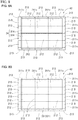
- a circuit layer-forming copper layer 31 is formed as shown in FIG. 5A on the first surface of the ceramic board 21 composed as above, and a metal layer-forming copper layer 32 is formed on the second surface of the ceramic board 21 as shown in FIG. 5B ; thereby a ceramic-copper bonded body 30 (hereinafter, it is omitted as a bonded body 30) having the ceramic board 21, the circuit layer-forming copper layer 31, and the metal layer forming-copper layer 32 are formed.
- FIG. 1A by bonding a plurality (three in the illustrated example) of first copper boards 301 and 302 even on the first surface of the ceramic board 21, a circuit layer-forming copper layer 31 formed of a plurality of first copper layers 311 and 312 is formed as shown in FIG. 1B and FIG. 5A .
- a second copper board 303 on the second surface of the ceramic board 21 as shown in FIG. 1A , the metal layer-forming copper layer 32 composed of a second copper layer 321 with a smaller arrangement number (one in the illustrated example) than the arrangement number of the first copper layers 311 and 312 is formed as shown in FIG. 1B and FIG. 5B .
- brazing bonding material such as Ag-Cu-Ti type brazing material for example.
- the brazing bonding material is easy to be handled by spreading in advance on respective bonding surfaces of the first copper boards 301 and 302 and the second copper board 303.
- the first copper boards 301 and 302 and the second copper board 303 are formed into desired outer forms respectively by punching a material board made of copper or copper alloy by press machining for example.
- the first copper boards 301 and 302 are provided three in total: each single planar area of the first copper boards 301 and 302 is larger than a total of respective planar areas of the four substrate board-forming areas 212 aligned in the vertical direction of the ceramic board 21 (sum of the planar areas of the substrate board-forming areas 212, covered by the first copper boards 301 and 302 respectively): those are formed in sizes having rectangular form so that both end parts in the vertical direction span the upper and lower margin areas 213 (refer to FIG. 5A ).
- the first copper boards 302 arranged on the left and right (both sides of the width direction) in FIG. 1A are larger in the left and right (a lateral direction) than the first copper board 301 arranged on a center and formed so as to span the margin areas 213 arranged in the peripheral edge parts of the ceramic board 21.
- the second copper board 303 is provided with one in the present embodiment: a planar area of the second copper board 303 is larger than a planar area entirely covering the twelve substrate board-forming areas 212 aligned in the vertical and horizontal directions of the ceramic board 21; and the second copper board 303 is formed to span the margin areas 213 enclosing around these substrate board-forming areas 212 (refer to FIG. 5B ).
- the second copper board 303 is larger in the planar area than the respective planar areas of the first copper boards 301 and 302 and formed to have a smaller thickness (thinner) than the first copper boards 301 and 302.
- the planar area of the second copper board 303 is formed to be larger than the total area of the planar areas of the three first copper boards 301 and 302.
- the thickness (the board thickness) of the respective first copper boards 301 and 302 which will be the first copper layers 311 and 312 to be t1
- the thickness (the board thickness) of the second copper board 303 which will be the second layer 321 to be t2
- the area ratio (A1/A2) of the bonding area A1 of the first copper boards 301 and 302 and the bonding area A2 of the second copper board 303 be less than 0.5.
- the thickness ratio (t1/t2) of the thickness t1 of the first copper boards 301 and 302 and the thickness t2 of the second copper board 303 is a value more than 1.0 because the thickness t2 is less (thinner) than the thickness t1.
- the first copper boards 311 and 312, which form the circuit layer-forming copper layer 31, are formed by bonding the first copper boards 301 and 302 on the ceramic board 21; thus the first copper layers 311 and 312 have substantially the same thickness as the thickness t1 of the first copper boards 301 and 302, and the bonding area of the first copper layers 311 and 312 and the ceramic board 21 is also the same as the planar area (the bonding area) A1 of the bonding surface of the first copper board 301 and 302.
- the second copper layer 321 is formed by bonding the second copper board 303 on the ceramic board 21, so that the second copper layer 321 has substantially the same thickness as the thickness t2 of the second copper board 303: the bonding area of the second copper layer 321 and the ceramic board 21 is also the same as the planar area (the bonding area) A2 of the second copper board 303.
- the thickness of the first copper layers 311 and 312 is treated as the same thickness t1 as of the first copper boards 301 and 302, and the bonding area of the first copper layers 311 and 312 are treated as the same area A1 as the planar area (the bonding area) A1 of the first copper board 301 and 302.
- the thickness of the second copper layer 321 is treated as the thickness t2 as that of the second copper board 303, and also the bonding area of the second copper layer 321 is treated as the same area A2 as the planar area (the bonding area) A2 of the bonding surface of the second copper board 303.
- the first copper boards 301 arranged on a center of the ceramic board 21 and the first copper boards 302 arranged on the left and right are formed of copper boards having the different planar area A1. Therefore, the first copper board 301 arranged at the center of the ceramic board 21 and the first copper boards 302 arranged at the left and right of the ceramic board 21 are respectively adjusted for the relation with the second copper board 303. Namely, they are adjusted for the relation between the center first copper board 301 and the second copper board 303, and the relation between the left and right first copper boards 302 and the second copper boards 303, which are respectively in a position relation opposed to each other with the ceramic board 21 therebetween.
- the thicknesses t1 and the bonding areas A1 of the respective first copper boards 301 and 302 are not necessarily the same: in the relation to the opposed second copper board 303 (the second copper layer 321), it is sufficient to adjust the relation into a range ⁇ (A1/A2) ⁇ (t1/t2) ⁇ being not less than 0.080 and not more than 0.600.
- the thickness t1 of the first copper boards 301 and 302 is 0.8 mm; the planar area (the bonding area) A1 of the first copper board arranged on the center of the ceramic board 21 is (84 mm ⁇ 64.5 mm); the plane are (the bonding area) A1 of the first copper boards 302 arranged on the left and right side of the ceramic board 21 is a rectangle board form (84 mm ⁇ 64.5 mm); and the thickness t2 of the second copper board 303 is 0.7 mm and the planar area (the bonding area) A2 is a rectangle board form (171 mm ⁇ 126 mm).
- the first copper boards 301 and 302 are arranged to be laminated on the first surface of the ceramic board 21 with the brazing bonding material (not illustrated) therebetween in order to bond the first copper boards 301 and 301 to the ceramic board 21 and bond the second copper board 303 to the ceramic board 21.
- the second copper board 303 is arranged to be laminated on the second surface of the ceramic board 21 with the brazing bonding material (not illustrate) therebetween.
- the first copper boards 301 and 302 are arranged avoiding the two dividing grooves 211v so as to bare the center two of the four dividing grooves 211v vertically extending on the ceramic board 21. Therefore, the first copper board 301 and 302 can be reliably bonded on positions including the circuit layer 12 formed in a pattern-forming steps S12.
- the three first copper boards 301 and 302 are arranged evenly on the first surface of the ceramic board 21 by disposing symmetry at the left and right as shown in FIG. 1A .
- the second copper board 303 is arranged so as to match a center position of the second surface of the ceramic board 21 and a center position of the bonding surface of the second copper board 303 and to cover the all twelve substrate board-forming areas 212 partitioned on the ceramic board 21.
- the second copper board 303 is arranged to evenly cover the second surface of the ceramic board 21.
- the second copper board 303 is arranged at a position matching the three first copper boards 301 and 302 with the ceramic board 21 therebetween.
- a laminated body of the first copper boards 301 and 302, the ceramic board 21, and the second copper board 303 is heated while adding load in a lamination direction of them as shown by white arrows in FIG. 1B .
- the circuit layer-forming copper layer 31 formed from three first copper layers 311 and 322 is formed, by bonding the first copper boards 301 and 302 on the first surface of the ceramic board 21.
- the metal layer-forming copper layer 32 formed from the single second copper layer 321 is formed by bonding the second copper board 303 on the second surface of the ceramic board 21.
- the bonded body 30 having the ceramic board 21, the circuit layer-forming copper layer 31, and the metal layer-forming copper layer 32 is formed as shown in FIG. 1B , FIGS. 5A and 5B .
- the first copper boards 301 and 302 and the second copper board 303 having different thicknesses respectively are bonded; so that the circuit layer-forming copper layer 31 having the larger (thicker) thickness on the first surface of the ceramic board 21 is formed; and the metal layer-forming copper layer 32 having the smaller (thinner) thickness is formed on the second surface of the ceramic board 21 than the circuit layer-forming copper layer 31.
- the circuit layer-forming copper layer 32 having the large thickness is composed of the first copper layers 311 and 312 which are separated; and the metal layer-forming copper layer 32 having the smaller thickness is composed of the second copper layer 321 having the smaller arrangement number than that of the first copper layers 311 and 312: accordingly, in the combination of the copper layers 311, 312, and 321 bonded on the front and back surfaces of the ceramic board 21, a symmetry structure centering the ceramic board 21 can be formed. As a result, it is possible to reduce the difference between the inner stresses in the front and back surfaces of the ceramic board 21 and reduce the warps of the bonded body 30.
- the bonded body 30 is etched so as to form the circuit layer 12 and the metal layer 13 which are patterned in the respective substrate board-forming areas 212 on the ceramic board 21, as shown in FIG. 1C , FIGS. 6A and 6B .
- the etching can be carried out by known methods. For example, after masking such as applying a resist or pasting a masking tape and the like, etchant such as ferric chloride is in contact with parts in which the copper layers that is not masked are bared and removes to make patterns.
- the circuit layer-forming copper layer 31 consisting of the first copper layers 311 and 312 disposed on the first surface of the ceramic board 21, formed is the circuit layer 12 composed of the separated plurality of small circuit layers 121 on the respective substrate board-forming areas 212, as shown in FIG. 6A .
- the metal layer-forming copper layer 32 consisting of the second copper layer 321 disposed on the second surface of the ceramic board 21, the metal layers 13 are formed separately in the respective substrate board-forming areas 21, as shown in FIG. 6B .
- the pattern-forming steps S12 the parts of the copper layers 311, 312, and 321 on the dividing grooves 211v and 211h are removed, so that the dividing grooves 211v and 211h are entirely bared.
- the warp of the bonded body 30 formed by the bonded body-forming step S11 is reduced, a thickness of the resist film or a pattern form of the resist are not easily inferior in the pattern-forming steps S12. Accordingly, the circuit layer 12 and the metal layer 13 which are patterned can be accurately formed in the respective substrate board-forming areas 212.
- the ceramic board 21 is divided along the dividing grooves 211v and 211h into pieces of the respective substrate board-forming areas 212; and the margin areas 213 are separated from the substrate board-forming areas 212. Then, as shown in FIGS. 3A to 3C , a plurality (twelve in the present embodiment) of the power module substrate boards 10 having the ceramic substrate board 11, the circuit layer 12, and the metal layer 13 are manufactured.
- the first copper boards 301 and 302 and the second copper board 303 having the different thicknesses are bonded respectively on the front and back surfaces of the large plane ceramic board 21: however, since the thick circuit layer-forming copper layer 31 is composed of the segmented first copper layers 311 and 312 (the first copper boards 301 and 302), in the combination with the thin metal layer-forming copper layer 32 (the second copper board 303), it is possible to reduce the difference of the inner stresses on the front and back surface of the ceramic board 21, and the warps in the bonded body 30 in which the ceramic board 21, the circuit layer-forming copper layer 31 and the metal layer-forming copper layer 32 are bonded.
- the small bonded body 30 of which the warp is small in which a flatness of the metal layer-forming copper layer 32 is not more than 0.5 mm by adjusting the thickness t1 and the bonding area A1 of the first copper layer 311 and 312, and the thickness t2 and the bonding area A2 of the second copper layer 321 to satisfy ⁇ (A1/A2) ⁇ (t1/t2) ⁇ to be not less than 0.080 and not more than 0.600, which is the product of area ratio (A1/A2) and the thickness ratio (t1/t2).
- the warps of the bonded body 30 can be reduced as described above, in the pattern-forming steps S12, the unevenness in the thickness of the resist film nor the defects of the form of the resist patterns are not easily generated, so that the circuit layer 12 and the metal layer 13 which are patterned in the respective substrate board-forming areas 212 can be accurately formed. Accordingly, a plurality of the power module substrate boards 10 can be accurately manufactured all together, and the productivity of the power module substrate boards 10 can be improved.
- the three first copper boards 301 and 302 are formed with the different form between the center first copper board 301 and the left and right first copper boards 302; however, as in a bonded body 41 of a second embodiment shown in FIGS. 7A and 7B , it is applicable to compose the circuit layer-forming copper layer 33 having the first copper boards 313 with a same form by forming the three first copper boards in the same form. It is not essential to bare the dividing grooves 211v of the ceramic board 21 between the first copper layers 313, but it is sufficient to bond the respective first copper layers 313 in accordance with a form of the patterns of the circuit layer 12 formed by the pattern-forming steps S12, in other words, on positions in which the circuit layer 12 is reliably included.
- the arrangement number of the first copper layer configuring the circuit layer-forming copper layer is not limited to three.
- a bonded body 42 of a third embodiment is shown in FIGS. 8A and 8B .
- FIG. 8A a structure in which first copper layers 314 are separated in two is also applicable.
- an arrangement number of the second copper layer 321 is one, smaller than an arrangement number of first copper layers 314.
- an arrangement number of the first copper layers is not limited to two or three. As shown in FIG. 9A , it is applicable that an arrange number of first copper layers 315 and 316 is six in total; and the bonded body 43 may be composed by providing circuit layer-forming copper layers 35 with an arrangement number more than three.
- An arrangement number of second copper layers configuring a metal layer-forming copper layer is not limited to one: a metal layer-forming copper layer 36 can be composed of a smaller arrangement number of second copper layers 322 than the total arrangement number of the first copper layer 315 and 316; for example, the second copper layers 322 is two as shown in FIG. 9B .
- a ceramic board made of Si 3 N 4 with a board thickness 0.32 mm and a first copper board and a second copper board made of OFC (pure copper) were prepared.
- the ceramic board was prepared to have two plane sizes, which were 190.8 mm vertical ⁇ 138 mm horizontal (invention Examples 1, 4, and 6 and Comparative Example 1) and 100 mm vertical ⁇ 120 mm horizontal (Invention Examples 2, 3, 5, 7, and 8).
- the plane form ceramic board in which the dividing grooves were not formed was used.
- the first copper boards which would be the first copper layer and the second copper boards which would be the second copper layer were prepared with the arrangement number shown in Table 1 to have the plane size (vertical and lateral) and the thicknesses t1 and t2 shown in Table 1. These were bonded together by the manufacturing method in the first embodiment, and test pieces of the bonded body (the ceramic-copper bonded body) having the ceramic board and the copper layers (the circuit layer-forming copper layer and the metal layer-forming copper layer) were made.
- the first copper board and the second copper board were aligned on the respective bonding surface of the ceramic board so as to be symmetrical in up and down and symmetrical in left and right, and evenly arranged.
- the flatness in normal temperature was measured after bonding.
- the flatness was measured by a moire-type three-dimensional form measuring device on a surface of the metal layer-forming copper layer.
- the thickness t1 and the bonded area A1 of the first copper layers, the thickness t2 and the bonded area A2 of the second copper layer were adjusted into the relation of the product of multiplying the area ratio (A1/A2) and the thickness ratio (t1/t2) ⁇ (A1/A2) ⁇ (t1/t2) ⁇ to be not less than 0.080 and not more than 0.600, it was possible to make the bonded body in which the warps were as small as the flatness of the metal layer-forming copper layer not more than 0.5 mm.
Landscapes
- Engineering & Computer Science (AREA)
- Microelectronics & Electronic Packaging (AREA)
- Chemical & Material Sciences (AREA)
- Ceramic Engineering (AREA)
- Manufacturing & Machinery (AREA)
- Materials Engineering (AREA)
- Inorganic Chemistry (AREA)
- Structural Engineering (AREA)
- Organic Chemistry (AREA)
- Structure Of Printed Boards (AREA)
- Manufacturing Of Printed Wiring (AREA)
- Cooling Or The Like Of Semiconductors Or Solid State Devices (AREA)
- Ceramic Products (AREA)
Applications Claiming Priority (2)
| Application Number | Priority Date | Filing Date | Title |
|---|---|---|---|
| JP2018009275A JP6939596B2 (ja) | 2018-01-24 | 2018-01-24 | パワーモジュール用基板の製造方法及びセラミックス‐銅接合体 |
| PCT/JP2019/002074 WO2019146638A1 (ja) | 2018-01-24 | 2019-01-23 | パワーモジュール用基板の製造方法及びセラミックス‐銅接合体 |
Publications (3)
| Publication Number | Publication Date |
|---|---|
| EP3745452A1 true EP3745452A1 (de) | 2020-12-02 |
| EP3745452A4 EP3745452A4 (de) | 2021-10-27 |
| EP3745452B1 EP3745452B1 (de) | 2026-03-11 |
Family
ID=67394664
Family Applications (1)
| Application Number | Title | Priority Date | Filing Date |
|---|---|---|---|
| EP19744045.6A Active EP3745452B1 (de) | 2018-01-24 | 2019-01-23 | Verfahren zur herstellung eines substrats für leistungsmodul und keramik-kupfer-verbindungskörper |
Country Status (7)
| Country | Link |
|---|---|
| US (1) | US11676882B2 (de) |
| EP (1) | EP3745452B1 (de) |
| JP (1) | JP6939596B2 (de) |
| KR (1) | KR102409813B1 (de) |
| CN (1) | CN111566807B (de) |
| TW (1) | TWI770346B (de) |
| WO (1) | WO2019146638A1 (de) |
Families Citing this family (7)
| Publication number | Priority date | Publication date | Assignee | Title |
|---|---|---|---|---|
| CN115136297A (zh) * | 2020-02-13 | 2022-09-30 | 阿莫绿色技术有限公司 | 功率模块及其制造方法 |
| JP2023009379A (ja) * | 2021-07-07 | 2023-01-20 | 住友ベークライト株式会社 | 回路基板の製造方法および切削加工装置 |
| JP7695850B2 (ja) * | 2021-09-21 | 2025-06-19 | デンカ株式会社 | セラミック複合基板、及びセラミック複合基板の製造方法 |
| CN113573484B (zh) * | 2021-09-23 | 2022-03-25 | 西安宏星电子浆料科技股份有限公司 | 一种ltcc基板小批量快速制作方法 |
| JP2023147241A (ja) * | 2022-03-29 | 2023-10-12 | 株式会社プロテリアル | セラミックス基板 |
| JP7243888B1 (ja) * | 2022-03-29 | 2023-03-22 | 株式会社プロテリアル | セラミックス基板、セラミックス分割基板、及びセラミックス基板の製造方法 |
| KR102855285B1 (ko) * | 2023-08-07 | 2025-09-04 | 주식회사 아모그린텍 | 세라믹 기판 유닛 및 그 제조방법 |
Family Cites Families (48)
| Publication number | Priority date | Publication date | Assignee | Title |
|---|---|---|---|---|
| JPS6459986A (en) | 1987-08-31 | 1989-03-07 | Toshiba Corp | Ceramic circuit board |
| JPH01161892A (ja) * | 1987-12-18 | 1989-06-26 | Toshiba Corp | セラミックス回路基板およびその製造方法 |
| JP2815498B2 (ja) | 1991-08-06 | 1998-10-27 | 同和鉱業株式会社 | 耐熱衝撃性に優れたセラミックス−銅接合基板 |
| US5403651A (en) * | 1991-10-14 | 1995-04-04 | Fuji Electric Co., Ltd. | Insulating substrate for mounting semiconductor devices |
| JPH0883864A (ja) * | 1994-09-13 | 1996-03-26 | Meidensha Corp | 電力用半導体装置 |
| JPH09172231A (ja) * | 1995-12-19 | 1997-06-30 | Sanyo Electric Co Ltd | セラミック基板の分割方法 |
| DE19614501C2 (de) | 1996-04-13 | 2000-11-16 | Curamik Electronics Gmbh | Verfahren zum Herstellen eines Keramik-Metall-Substrates sowie Keramik-Metall-Substrat |
| DE19827414C2 (de) * | 1998-06-19 | 2000-05-31 | Schulz Harder Juergen | Verfahren zum Herstellen eines Metall-Keramik-Substrates |
| DE19927046B4 (de) * | 1999-06-14 | 2007-01-25 | Electrovac Ag | Keramik-Metall-Substrat als Mehrfachsubstrat |
| US6787706B2 (en) | 2001-02-21 | 2004-09-07 | Kyocera Corporation | Ceramic circuit board |
| JP3924479B2 (ja) * | 2002-03-04 | 2007-06-06 | 京セラ株式会社 | セラミック回路基板の製造方法 |
| JP3868854B2 (ja) * | 2002-06-14 | 2007-01-17 | Dowaホールディングス株式会社 | 金属−セラミックス接合体およびその製造方法 |
| KR101255334B1 (ko) * | 2006-05-08 | 2013-04-16 | 페어차일드코리아반도체 주식회사 | 저 열저항 파워 모듈 및 그 제조방법 |
| DE102006028675B4 (de) * | 2006-06-22 | 2008-08-21 | Siemens Ag | Kühlanordnung für auf einer Trägerplatte angeordnete elektrische Bauelemente |
| JP2008010520A (ja) | 2006-06-28 | 2008-01-17 | Sumitomo Metal Electronics Devices Inc | パワーモジュール用基板及びその製造方法 |
| JP2009252971A (ja) * | 2008-04-04 | 2009-10-29 | Dowa Metaltech Kk | 金属セラミックス接合基板及びその製造方法及び金属セラミックス接合体 |
| US8254422B2 (en) * | 2008-08-05 | 2012-08-28 | Cooligy Inc. | Microheat exchanger for laser diode cooling |
| JP2010050164A (ja) | 2008-08-19 | 2010-03-04 | Mitsubishi Materials Corp | パワーモジュール用基板の製造方法 |
| TW201041093A (en) * | 2009-05-15 | 2010-11-16 | High Conduction Scient Co Ltd | Section-difference type ceramics base copper-clad laminate set and manufacturing method thereof |
| US8159821B2 (en) * | 2009-07-28 | 2012-04-17 | Dsem Holdings Sdn. Bhd. | Diffusion bonding circuit submount directly to vapor chamber |
| JP2012074532A (ja) * | 2010-09-29 | 2012-04-12 | Dowa Metaltech Kk | 金属−セラミックス接合基板の製造方法 |
| US8995134B2 (en) * | 2011-05-27 | 2015-03-31 | Lear Corporation | Electrically-cooled power module |
| CN104011852B (zh) * | 2011-12-20 | 2016-12-21 | 株式会社东芝 | 陶瓷铜电路基板和使用了陶瓷铜电路基板的半导体装置 |
| JP2013201256A (ja) * | 2012-03-23 | 2013-10-03 | Toshiba Lighting & Technology Corp | 配線基板装置、発光モジュール、照明装置および配線基板装置の製造方法 |
| JP2013201255A (ja) * | 2012-03-23 | 2013-10-03 | Toshiba Lighting & Technology Corp | 配線基板装置、発光モジュール、照明装置および配線基板装置の製造方法 |
| DE102012104903B4 (de) | 2012-05-10 | 2023-07-13 | Rogers Germany Gmbh | Verfahren zum Herstellen von Metall-Keramik-Substraten sowie nach diesem Verfahren hergestelltes Metall-Keramik-Substrat |
| JP6307832B2 (ja) * | 2013-01-22 | 2018-04-11 | 三菱マテリアル株式会社 | パワーモジュール用基板、ヒートシンク付パワーモジュール用基板、ヒートシンク付パワーモジュール |
| US9725367B2 (en) * | 2013-03-29 | 2017-08-08 | Mitsubishi Materials Corporation | Apparatus and method for producing (metal plate)-(ceramic board) laminated assembly, and apparatus and method for producing power-module substrate |
| JP6201761B2 (ja) * | 2014-01-08 | 2017-09-27 | 三菱マテリアル株式会社 | パワーモジュール用基板の製造方法 |
| JP5825380B2 (ja) * | 2014-03-14 | 2015-12-02 | 三菱マテリアル株式会社 | 銅/セラミックス接合体、及び、パワーモジュール用基板 |
| JP6398243B2 (ja) * | 2014-03-20 | 2018-10-03 | 三菱マテリアル株式会社 | パワーモジュール用基板の製造方法 |
| JP6550971B2 (ja) | 2014-07-02 | 2019-07-31 | 三菱マテリアル株式会社 | 接合体の製造方法、多層接合体の製造方法、パワーモジュール用基板の製造方法及びヒートシンク付パワーモジュール用基板の製造方法 |
| JP6488917B2 (ja) | 2014-07-04 | 2019-03-27 | 三菱マテリアル株式会社 | 放熱板付パワーモジュール用基板及びパワーモジュール |
| EP3166140B1 (de) * | 2014-07-04 | 2020-06-03 | Mitsubishi Materials Corporation | Substrateinheit für strommodule sowie strommodul |
| US10211158B2 (en) | 2014-10-31 | 2019-02-19 | Infineon Technologies Ag | Power semiconductor module having a direct copper bonded substrate and an integrated passive component, and an integrated power module |
| US9397017B2 (en) * | 2014-11-06 | 2016-07-19 | Semiconductor Components Industries, Llc | Substrate structures and methods of manufacture |
| US11437304B2 (en) * | 2014-11-06 | 2022-09-06 | Semiconductor Components Industries, Llc | Substrate structures and methods of manufacture |
| US9408301B2 (en) * | 2014-11-06 | 2016-08-02 | Semiconductor Components Industries, Llc | Substrate structures and methods of manufacture |
| CN105990266B (zh) * | 2015-02-26 | 2018-12-07 | 台达电子工业股份有限公司 | 功率转换电路的封装模块及其制造方法 |
| EP3306655B1 (de) * | 2015-05-27 | 2021-06-23 | NGK Electronics Devices, Inc. | Träger für strommodule, trägeranordnung für strommodule und verfahren zur herstellung eines trägers für strommodule |
| JP6332190B2 (ja) * | 2015-07-31 | 2018-05-30 | 株式会社村田製作所 | セラミック配線基板、電子回路モジュールおよび電子回路モジュールの製造方法 |
| DE102015224464A1 (de) * | 2015-12-07 | 2017-06-08 | Aurubis Stolberg Gmbh & Co. Kg | Kupfer-Keramik-Substrat, Kupferhalbzeug zur Herstellung eines Kupfer-Keramik-Substrats und Verfahren zur Herstellung eines Kupfer-Keramik-Substrats |
| CN107172808A (zh) | 2016-03-08 | 2017-09-15 | 讯芯电子科技(中山)有限公司 | 双面直接镀铜陶瓷电路板及其制造方法 |
| JP6631333B2 (ja) * | 2016-03-11 | 2020-01-15 | 三菱マテリアル株式会社 | パワーモジュール用基板の製造方法 |
| JP6904088B2 (ja) | 2016-06-30 | 2021-07-14 | 三菱マテリアル株式会社 | 銅/セラミックス接合体、及び、絶縁回路基板 |
| JP6451040B2 (ja) | 2016-07-01 | 2019-01-16 | 有限会社ポルテ | 指用プロテクター部材 |
| US11367669B2 (en) * | 2016-11-21 | 2022-06-21 | Rohm Co., Ltd. | Power module and fabrication method of the same, graphite plate, and power supply equipment |
| US10476380B2 (en) * | 2018-01-15 | 2019-11-12 | Ford Global Technologies, Llc | Common-mode choke for paralleled power semiconductor |
-
2018
- 2018-01-24 JP JP2018009275A patent/JP6939596B2/ja active Active
-
2019
- 2019-01-23 US US16/963,523 patent/US11676882B2/en active Active
- 2019-01-23 EP EP19744045.6A patent/EP3745452B1/de active Active
- 2019-01-23 KR KR1020207020790A patent/KR102409813B1/ko not_active Expired - Fee Related
- 2019-01-23 CN CN201980007310.7A patent/CN111566807B/zh active Active
- 2019-01-23 WO PCT/JP2019/002074 patent/WO2019146638A1/ja not_active Ceased
- 2019-01-24 TW TW108102678A patent/TWI770346B/zh active
Also Published As
| Publication number | Publication date |
|---|---|
| TWI770346B (zh) | 2022-07-11 |
| JP2019129207A (ja) | 2019-08-01 |
| US11676882B2 (en) | 2023-06-13 |
| CN111566807A (zh) | 2020-08-21 |
| US20210050278A1 (en) | 2021-02-18 |
| KR20200112841A (ko) | 2020-10-05 |
| CN111566807B (zh) | 2024-10-25 |
| JP6939596B2 (ja) | 2021-09-22 |
| WO2019146638A1 (ja) | 2019-08-01 |
| TW201933552A (zh) | 2019-08-16 |
| KR102409813B1 (ko) | 2022-06-15 |
| EP3745452A4 (de) | 2021-10-27 |
| EP3745452B1 (de) | 2026-03-11 |
Similar Documents
| Publication | Publication Date | Title |
|---|---|---|
| EP3745452B1 (de) | Verfahren zur herstellung eines substrats für leistungsmodul und keramik-kupfer-verbindungskörper | |
| EP4050647B1 (de) | Verfahren zur herstellung von substratstruktur | |
| JP7738082B2 (ja) | パワーモジュール用基板、パワーモジュール、およびパワーモジュールの製造方法 | |
| WO2013118478A1 (ja) | 半導体装置 | |
| US20140190732A1 (en) | Carrier Device, Electrical Device Having a Carrier Device and Method for Producing Same | |
| KR101985056B1 (ko) | 배선 기판 및 다수 개 연결 배선 기판 | |
| KR20170095681A (ko) | 파워 모듈 및 그 제조 방법 | |
| EP3761351B1 (de) | Isolierte leiterplatte | |
| EP3761764A1 (de) | Isolierende leiterplatte | |
| US20160135293A1 (en) | Substrate structures and methods of manufacture | |
| EP0582694B1 (de) | Halbleitervorrichtung mit einem halbleitersubstrat und einer keramischen scheibe als decke | |
| CN107135601B (zh) | 多重基底 | |
| US20240120253A1 (en) | Integrated substrates and related methods | |
| JPH02177342A (ja) | 集積回路実装用テープ | |
| JP2015164167A (ja) | 回路基板、その製造方法、および電子装置 | |
| US12432852B2 (en) | Circuit board structure with embedded ceramic substrate and manufacturing process thereof | |
| US20200105723A1 (en) | Module | |
| US11562938B2 (en) | Spacer with pattern layout for dual side cooling power module | |
| US20260040959A1 (en) | Chip on lead device and manufacturing method | |
| JP4549287B2 (ja) | 半導体モジュール | |
| KR101910587B1 (ko) | 광디바이스용 단위 기판 및 원판 | |
| CN119581332A (zh) | 用于实现散热的封装方法 | |
| KR20230148113A (ko) | 반도체 디바이스 어셈블리 | |
| TW202533645A (zh) | 電路板及其製造方法 | |
| JP4303539B2 (ja) | 多数個取り配線基板 |
Legal Events
| Date | Code | Title | Description |
|---|---|---|---|
| STAA | Information on the status of an ep patent application or granted ep patent |
Free format text: STATUS: THE INTERNATIONAL PUBLICATION HAS BEEN MADE |
|
| PUAI | Public reference made under article 153(3) epc to a published international application that has entered the european phase |
Free format text: ORIGINAL CODE: 0009012 |
|
| STAA | Information on the status of an ep patent application or granted ep patent |
Free format text: STATUS: REQUEST FOR EXAMINATION WAS MADE |
|
| 17P | Request for examination filed |
Effective date: 20200813 |
|
| AK | Designated contracting states |
Kind code of ref document: A1 Designated state(s): AL AT BE BG CH CY CZ DE DK EE ES FI FR GB GR HR HU IE IS IT LI LT LU LV MC MK MT NL NO PL PT RO RS SE SI SK SM TR |
|
| AX | Request for extension of the european patent |
Extension state: BA ME |
|
| DAV | Request for validation of the european patent (deleted) | ||
| DAX | Request for extension of the european patent (deleted) | ||
| REG | Reference to a national code |
Ref country code: DE Ref legal event code: R079 Free format text: PREVIOUS MAIN CLASS: H01L0023120000 Ipc: H05K0003000000 |
|
| A4 | Supplementary search report drawn up and despatched |
Effective date: 20210927 |
|
| RIC1 | Information provided on ipc code assigned before grant |
Ipc: H05K 3/06 20060101ALN20210921BHEP Ipc: H05K 1/03 20060101ALN20210921BHEP Ipc: H01L 21/48 20060101ALI20210921BHEP Ipc: H01L 23/373 20060101ALI20210921BHEP Ipc: C04B 37/02 20060101ALI20210921BHEP Ipc: H05K 3/00 20060101AFI20210921BHEP |
|
| STAA | Information on the status of an ep patent application or granted ep patent |
Free format text: STATUS: EXAMINATION IS IN PROGRESS |
|
| 17Q | First examination report despatched |
Effective date: 20240710 |
|
| GRAP | Despatch of communication of intention to grant a patent |
Free format text: ORIGINAL CODE: EPIDOSNIGR1 |
|
| STAA | Information on the status of an ep patent application or granted ep patent |
Free format text: STATUS: GRANT OF PATENT IS INTENDED |
|
| RIC1 | Information provided on ipc code assigned before grant |
Ipc: H05K 3/00 20060101AFI20250926BHEP Ipc: C04B 37/02 20060101ALI20250926BHEP Ipc: H01L 23/373 20060101ALI20250926BHEP Ipc: H01L 21/48 20060101ALI20250926BHEP Ipc: H05K 1/03 20060101ALN20250926BHEP Ipc: H05K 3/06 20060101ALN20250926BHEP |
|
| RIC1 | Information provided on ipc code assigned before grant |
Ipc: H05K 3/00 20060101AFI20251003BHEP Ipc: C04B 37/02 20060101ALI20251003BHEP Ipc: H01L 23/373 20060101ALI20251003BHEP Ipc: H01L 21/48 20060101ALI20251003BHEP Ipc: H05K 1/03 20060101ALN20251003BHEP Ipc: H05K 3/06 20060101ALN20251003BHEP |
|
| INTG | Intention to grant announced |
Effective date: 20251029 |
|
| GRAS | Grant fee paid |
Free format text: ORIGINAL CODE: EPIDOSNIGR3 |
|
| GRAA | (expected) grant |
Free format text: ORIGINAL CODE: 0009210 |
|
| STAA | Information on the status of an ep patent application or granted ep patent |
Free format text: STATUS: THE PATENT HAS BEEN GRANTED |
|
| AK | Designated contracting states |
Kind code of ref document: B1 Designated state(s): AL AT BE BG CH CY CZ DE DK EE ES FI FR GB GR HR HU IE IS IT LI LT LU LV MC MK MT NL NO PL PT RO RS SE SI SK SM TR |
|
| REG | Reference to a national code |
Ref country code: CH Ref legal event code: F10 Free format text: ST27 STATUS EVENT CODE: U-0-0-F10-F00 (AS PROVIDED BY THE NATIONAL OFFICE) Effective date: 20260311 Ref country code: GB Ref legal event code: FG4D |
|
| REG | Reference to a national code |
Ref country code: DE Ref legal event code: R096 Ref document number: 602019082343 Country of ref document: DE |
|
| REG | Reference to a national code |
Ref country code: IE Ref legal event code: FG4D |