EP3748706B1 - Composé hétérocyclique et dispositif électroluminescent organique l'incluant - Google Patents
Composé hétérocyclique et dispositif électroluminescent organique l'incluant Download PDFInfo
- Publication number
- EP3748706B1 EP3748706B1 EP20166292.1A EP20166292A EP3748706B1 EP 3748706 B1 EP3748706 B1 EP 3748706B1 EP 20166292 A EP20166292 A EP 20166292A EP 3748706 B1 EP3748706 B1 EP 3748706B1
- Authority
- EP
- European Patent Office
- Prior art keywords
- group
- substituted
- unsubstituted
- aromatic condensed
- alkyl
- Prior art date
- Legal status (The legal status is an assumption and is not a legal conclusion. Google has not performed a legal analysis and makes no representation as to the accuracy of the status listed.)
- Active
Links
- 0 NC1=CC=CC2=*=C12 Chemical compound NC1=CC=CC2=*=C12 0.000 description 16
- INXMVCCAEZPMNO-UHFFFAOYSA-N C(C1c2ccccc22)=CC=CC1N2c1cccc(-c2cncc(-c3cc(-[n]4c5ccccc5c5c4cccc5)ccc3)c2)c1 Chemical compound C(C1c2ccccc22)=CC=CC1N2c1cccc(-c2cncc(-c3cc(-[n]4c5ccccc5c5c4cccc5)ccc3)c2)c1 INXMVCCAEZPMNO-UHFFFAOYSA-N 0.000 description 1
- JUUKMKYLKPCXRH-UHFFFAOYSA-N CC(C(C=C1)c(cc2)cc(c3ccccc33)c2[n]3-c2ccccc2)C=C1N(C1C=C(C(C)(C)c2ccccc22)C2=CC1C)c1ncccc1 Chemical compound CC(C(C=C1)c(cc2)cc(c3ccccc33)c2[n]3-c2ccccc2)C=C1N(C1C=C(C(C)(C)c2ccccc22)C2=CC1C)c1ncccc1 JUUKMKYLKPCXRH-UHFFFAOYSA-N 0.000 description 1
- JUYBVJLQGJKGPO-UHFFFAOYSA-N CC(c1c(C)cc(C)cc1C)(NC(c1c(C)cc(C)cc1C)=C1Cl)N=C1[n]1c2ccccc2c2c1cccc2 Chemical compound CC(c1c(C)cc(C)cc1C)(NC(c1c(C)cc(C)cc1C)=C1Cl)N=C1[n]1c2ccccc2c2c1cccc2 JUYBVJLQGJKGPO-UHFFFAOYSA-N 0.000 description 1
- YLZJUEVFUJZAOS-UHFFFAOYSA-N CN1C(c2cc(-[n]3c4ccccc4c4c3cccc4)cc(-[n]3c4ccccc4c4c3cccc4)c2)=NC(c2ccccc2)=NC1c1ccccc1 Chemical compound CN1C(c2cc(-[n]3c4ccccc4c4c3cccc4)cc(-[n]3c4ccccc4c4c3cccc4)c2)=NC(c2ccccc2)=NC1c1ccccc1 YLZJUEVFUJZAOS-UHFFFAOYSA-N 0.000 description 1
- QACZTKSLFXTHAU-UHFFFAOYSA-N IC(C(C=C1)N(c(cc2)ccc2-c(cc2)ccc2N(c(cc2)cc(c3ccccc33)c2[n]3-c2ccccc2)c2cccc(-c3ccccc3)c2)c2cc(-c3ccccc3)ccc2)c(c2c3cccc2)c1[n]3-c1ccccc1 Chemical compound IC(C(C=C1)N(c(cc2)ccc2-c(cc2)ccc2N(c(cc2)cc(c3ccccc33)c2[n]3-c2ccccc2)c2cccc(-c3ccccc3)c2)c2cc(-c3ccccc3)ccc2)c(c2c3cccc2)c1[n]3-c1ccccc1 QACZTKSLFXTHAU-UHFFFAOYSA-N 0.000 description 1
- FRYWEEPPMHFHPK-UHFFFAOYSA-N c(cc1)cc(c2ccccc22)c1[n]2-c(cc1)cc2c1c(cccc1)c1[n]2-c(cc1)ccc1-c(cc1)ccc1-[n]1c2cc(-[n]3c4ccccc4c4c3cccc4)ccc2c2ccccc12 Chemical compound c(cc1)cc(c2ccccc22)c1[n]2-c(cc1)cc2c1c(cccc1)c1[n]2-c(cc1)ccc1-c(cc1)ccc1-[n]1c2cc(-[n]3c4ccccc4c4c3cccc4)ccc2c2ccccc12 FRYWEEPPMHFHPK-UHFFFAOYSA-N 0.000 description 1
- MHTPESFJWCJELK-UHFFFAOYSA-N c(cc1)ccc1-[n]1c(ccc(-c(cc2c3c4cccc3)ccc2[n]4-c2ccccc2)c2)c2c2ccccc12 Chemical compound c(cc1)ccc1-[n]1c(ccc(-c(cc2c3c4cccc3)ccc2[n]4-c2ccccc2)c2)c2c2ccccc12 MHTPESFJWCJELK-UHFFFAOYSA-N 0.000 description 1
- NZGRSMSDAITRIO-UHFFFAOYSA-N c(cc1)ccc1-c1nc(-c2ccccc2)nc(-c2cccc(-[n]3c(cccc4)c4c4c3cccc4)c2)n1 Chemical compound c(cc1)ccc1-c1nc(-c2ccccc2)nc(-c2cccc(-[n]3c(cccc4)c4c4c3cccc4)c2)n1 NZGRSMSDAITRIO-UHFFFAOYSA-N 0.000 description 1
- GJGXTKHPZJZLOJ-UHFFFAOYSA-N c(cc1)ccc1N(c(cc1)ccc1-c(cc1)ccc1N(c1ccccc1)c(cc1)cc2c1c1ccccc1[n]2-c1ccccc1)c1ccc(c2ccccc2[n]2-c3ccccc3)c2c1 Chemical compound c(cc1)ccc1N(c(cc1)ccc1-c(cc1)ccc1N(c1ccccc1)c(cc1)cc2c1c1ccccc1[n]2-c1ccccc1)c1ccc(c2ccccc2[n]2-c3ccccc3)c2c1 GJGXTKHPZJZLOJ-UHFFFAOYSA-N 0.000 description 1
Images


Classifications
-
- H—ELECTRICITY
- H10—SEMICONDUCTOR DEVICES; ELECTRIC SOLID-STATE DEVICES NOT OTHERWISE PROVIDED FOR
- H10K—ORGANIC ELECTRIC SOLID-STATE DEVICES
- H10K85/00—Organic materials used in the body or electrodes of devices covered by this subclass
- H10K85/60—Organic compounds having low molecular weight
- H10K85/649—Aromatic compounds comprising a hetero atom
- H10K85/657—Polycyclic condensed heteroaromatic hydrocarbons
-
- H—ELECTRICITY
- H10—SEMICONDUCTOR DEVICES; ELECTRIC SOLID-STATE DEVICES NOT OTHERWISE PROVIDED FOR
- H10K—ORGANIC ELECTRIC SOLID-STATE DEVICES
- H10K50/00—Organic light-emitting devices
- H10K50/10—OLEDs or polymer light-emitting diodes [PLED]
- H10K50/11—OLEDs or polymer light-emitting diodes [PLED] characterised by the electroluminescent [EL] layers
-
- C—CHEMISTRY; METALLURGY
- C07—ORGANIC CHEMISTRY
- C07D—HETEROCYCLIC COMPOUNDS
- C07D471/00—Heterocyclic compounds containing nitrogen atoms as the only ring hetero atoms in the condensed system, at least one ring being a six-membered ring with one nitrogen atom, not provided for by groups C07D451/00 - C07D463/00
- C07D471/12—Heterocyclic compounds containing nitrogen atoms as the only ring hetero atoms in the condensed system, at least one ring being a six-membered ring with one nitrogen atom, not provided for by groups C07D451/00 - C07D463/00 in which the condensed system contains three hetero rings
- C07D471/16—Peri-condensed systems
-
- C—CHEMISTRY; METALLURGY
- C07—ORGANIC CHEMISTRY
- C07D—HETEROCYCLIC COMPOUNDS
- C07D487/00—Heterocyclic compounds containing nitrogen atoms as the only ring hetero atoms in the condensed system, not provided for by groups C07D451/00 - C07D477/00
- C07D487/12—Heterocyclic compounds containing nitrogen atoms as the only ring hetero atoms in the condensed system, not provided for by groups C07D451/00 - C07D477/00 in which the condensed system contains three hetero rings
- C07D487/14—Ortho-condensed systems
-
- C—CHEMISTRY; METALLURGY
- C07—ORGANIC CHEMISTRY
- C07D—HETEROCYCLIC COMPOUNDS
- C07D487/00—Heterocyclic compounds containing nitrogen atoms as the only ring hetero atoms in the condensed system, not provided for by groups C07D451/00 - C07D477/00
- C07D487/12—Heterocyclic compounds containing nitrogen atoms as the only ring hetero atoms in the condensed system, not provided for by groups C07D451/00 - C07D477/00 in which the condensed system contains three hetero rings
- C07D487/16—Peri-condensed systems
-
- C—CHEMISTRY; METALLURGY
- C07—ORGANIC CHEMISTRY
- C07F—ACYCLIC, CARBOCYCLIC OR HETEROCYCLIC COMPOUNDS CONTAINING ELEMENTS OTHER THAN CARBON, HYDROGEN, HALOGEN, OXYGEN, NITROGEN, SULFUR, SELENIUM OR TELLURIUM
- C07F7/00—Compounds containing elements of Groups 4 or 14 of the Periodic Table
- C07F7/02—Silicon compounds
- C07F7/08—Compounds having one or more C—Si linkages
- C07F7/0803—Compounds with Si-C or Si-Si linkages
- C07F7/081—Compounds with Si-C or Si-Si linkages comprising at least one atom selected from the elements N, O, halogen, S, Se or Te
- C07F7/0812—Compounds with Si-C or Si-Si linkages comprising at least one atom selected from the elements N, O, halogen, S, Se or Te comprising a heterocyclic ring
-
- C—CHEMISTRY; METALLURGY
- C07—ORGANIC CHEMISTRY
- C07F—ACYCLIC, CARBOCYCLIC OR HETEROCYCLIC COMPOUNDS CONTAINING ELEMENTS OTHER THAN CARBON, HYDROGEN, HALOGEN, OXYGEN, NITROGEN, SULFUR, SELENIUM OR TELLURIUM
- C07F7/00—Compounds containing elements of Groups 4 or 14 of the Periodic Table
- C07F7/02—Silicon compounds
- C07F7/08—Compounds having one or more C—Si linkages
- C07F7/0803—Compounds with Si-C or Si-Si linkages
- C07F7/081—Compounds with Si-C or Si-Si linkages comprising at least one atom selected from the elements N, O, halogen, S, Se or Te
- C07F7/0812—Compounds with Si-C or Si-Si linkages comprising at least one atom selected from the elements N, O, halogen, S, Se or Te comprising a heterocyclic ring
- C07F7/0814—Compounds with Si-C or Si-Si linkages comprising at least one atom selected from the elements N, O, halogen, S, Se or Te comprising a heterocyclic ring said ring is substituted at a C ring atom by Si
-
- H—ELECTRICITY
- H10—SEMICONDUCTOR DEVICES; ELECTRIC SOLID-STATE DEVICES NOT OTHERWISE PROVIDED FOR
- H10K—ORGANIC ELECTRIC SOLID-STATE DEVICES
- H10K50/00—Organic light-emitting devices
- H10K50/10—OLEDs or polymer light-emitting diodes [PLED]
- H10K50/11—OLEDs or polymer light-emitting diodes [PLED] characterised by the electroluminescent [EL] layers
- H10K50/12—OLEDs or polymer light-emitting diodes [PLED] characterised by the electroluminescent [EL] layers comprising dopants
-
- H—ELECTRICITY
- H10—SEMICONDUCTOR DEVICES; ELECTRIC SOLID-STATE DEVICES NOT OTHERWISE PROVIDED FOR
- H10K—ORGANIC ELECTRIC SOLID-STATE DEVICES
- H10K85/00—Organic materials used in the body or electrodes of devices covered by this subclass
- H10K85/40—Organosilicon compounds, e.g. TIPS pentacene
-
- H—ELECTRICITY
- H10—SEMICONDUCTOR DEVICES; ELECTRIC SOLID-STATE DEVICES NOT OTHERWISE PROVIDED FOR
- H10K—ORGANIC ELECTRIC SOLID-STATE DEVICES
- H10K85/00—Organic materials used in the body or electrodes of devices covered by this subclass
- H10K85/60—Organic compounds having low molecular weight
- H10K85/615—Polycyclic condensed aromatic hydrocarbons, e.g. anthracene
- H10K85/624—Polycyclic condensed aromatic hydrocarbons, e.g. anthracene containing six or more rings
-
- H—ELECTRICITY
- H10—SEMICONDUCTOR DEVICES; ELECTRIC SOLID-STATE DEVICES NOT OTHERWISE PROVIDED FOR
- H10K—ORGANIC ELECTRIC SOLID-STATE DEVICES
- H10K85/00—Organic materials used in the body or electrodes of devices covered by this subclass
- H10K85/60—Organic compounds having low molecular weight
- H10K85/649—Aromatic compounds comprising a hetero atom
- H10K85/654—Aromatic compounds comprising a hetero atom comprising only nitrogen as heteroatom
-
- H—ELECTRICITY
- H10—SEMICONDUCTOR DEVICES; ELECTRIC SOLID-STATE DEVICES NOT OTHERWISE PROVIDED FOR
- H10K—ORGANIC ELECTRIC SOLID-STATE DEVICES
- H10K85/00—Organic materials used in the body or electrodes of devices covered by this subclass
- H10K85/60—Organic compounds having low molecular weight
- H10K85/649—Aromatic compounds comprising a hetero atom
- H10K85/657—Polycyclic condensed heteroaromatic hydrocarbons
- H10K85/6572—Polycyclic condensed heteroaromatic hydrocarbons comprising only nitrogen in the heteroaromatic polycondensed ring system, e.g. phenanthroline or carbazole
-
- H—ELECTRICITY
- H10—SEMICONDUCTOR DEVICES; ELECTRIC SOLID-STATE DEVICES NOT OTHERWISE PROVIDED FOR
- H10K—ORGANIC ELECTRIC SOLID-STATE DEVICES
- H10K85/00—Organic materials used in the body or electrodes of devices covered by this subclass
- H10K85/60—Organic compounds having low molecular weight
- H10K85/649—Aromatic compounds comprising a hetero atom
- H10K85/657—Polycyclic condensed heteroaromatic hydrocarbons
- H10K85/6574—Polycyclic condensed heteroaromatic hydrocarbons comprising only oxygen in the heteroaromatic polycondensed ring system, e.g. cumarine dyes
-
- H—ELECTRICITY
- H10—SEMICONDUCTOR DEVICES; ELECTRIC SOLID-STATE DEVICES NOT OTHERWISE PROVIDED FOR
- H10K—ORGANIC ELECTRIC SOLID-STATE DEVICES
- H10K2101/00—Properties of the organic materials covered by group H10K85/00
- H10K2101/10—Triplet emission
Definitions
- One or more aspects of embodiments of the present disclosure relate to a heterocyclic compound and an organic light-emitting device including the same.
- Organic light-emitting devices are self-emission devices that produce full-color images, and may also have wide viewing angles, high contrast ratios, short response times, and/or excellent characteristics in terms of brightness, driving voltage, and response speed, as compared to other devices in the related art.
- the organic light-emitting device may include a first electrode on a substrate, and a hole transport region, an emission layer, an electron transport region, and a second electrode sequentially on the first electrode. Holes provided from the first electrode may move toward the emission layer through the hole transport region, and electrons provided from the second electrode may move toward the emission layer through the electron transport region. Carriers, such as holes and electrons, recombine in the emission layer to produce excitons. These excitons may transition (or relax) from an excited state to a ground state to thereby generate light.
- Organic light-emitting devices comprising polycyclic heteroaromatic compounds are known in the art such as in e.g. WO 2016/080791 A1 and US 2016/163998 A1 .
- One or more aspects of embodiments of the present disclosure are directed toward a heterocyclic compound and an organic light-emitting device including the same.
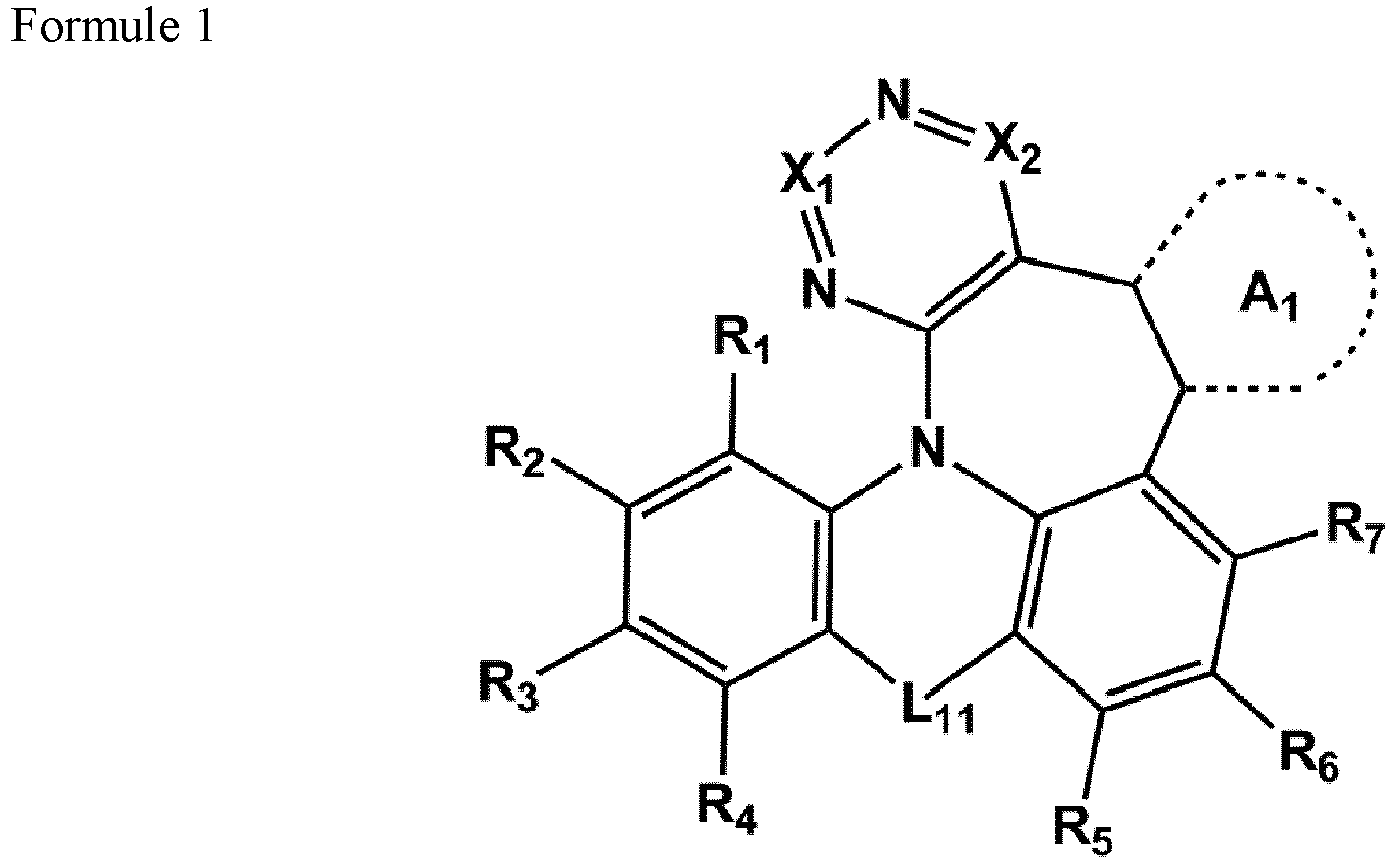
- One or more embodiments of the present disclosure provide a heterocyclic compound represented by Formula 1 below: Formula 2 *-(L 1 ) a1 -(Ar 1 ) b1 .
- Formulae 1 and 2
- One or more embodiments of the present disclosure provide an organic light-emitting device including: a first electrode; a second electrode facing the first electrode; an organic layer between the first electrode and the second electrode and including an emission layer; and at least one of the heterocyclic compound described herein.
- One or more embodiments of the present disclosure provide a heterocyclic compound represented by Formula 1 below: Formula 2 *- (L 1 ) a1 -(Ar 1 ) b1
- a 1 in Formula 1 is a substituted or unsubstituted C 5 -C 60 carbocyclic group or a substituted or unsubstituted C 1 -C 60 heterocyclic group.
- a 1 in Formula 1 may be a substituted or unsubstituted C 5 -C 30 carbocyclic group or a substituted or unsubstituted C 1 -C 20 heterocyclic group.
- a 1 may be selected from:
- X 1 and X 2 in Formula 1 are each independently C(Rs) or N.
- X 1 and X 2 may each independently be C(Rs).
- L 1 in Formula 2 is a substituted or unsubstituted C 5 -C 60 carbocyclic group or a substituted or unsubstituted C 1 -C 60 heterocyclic group.
- L 1 in Formula 2 may be a substituted or unsubstituted C 5 -C 30 carbocyclic group or a substituted or unsubstituted C 1 -C 20 heterocyclic group.
- L 1 may be selected from:
- L 1 may be selected from a benzene group; and a benzene group substituted with at least one selected from deuterium, -F, -CI, -Br, -I, a hydroxyl group, a cyano group, a nitro group, an amidino group, a hydrazino group, a hydrazono group, a C 1 -C 60 ( e.g. C 1 -C 20 ) alkyl group, a C 2 -C 60 ( e.g. C 2 -C 20 ) alkenyl group, a C 2 -C 60 ( e.g.
- C 2 -C 20 alkynyl group, a C 1 -C 60 ( e.g. C 1 -C 20 ) alkoxy group, a C 3 -C 10 cycloalkyl group, a C 1 -C 10 heterocycloalkyl group, a C 3 -C 10 cycloalkenyl group, a C 1 -C 10 heterocycloalkenyl group, a C 6 -C 60 ( e.g. C 6 -C 30 ) aryl group, a C 6 -C 60 ( e.g. C 6 -C 30 ) aryloxy group, a C 6 -C 60 ( e.g.
- Q 21 to Q 23 may be each independently selected from hydrogen, deuterium, - CI, -Br, -I, a hydroxyl group, a cyano group, a nitro group, an amidino group, a hydrazino group, a hydrazono group, a C 1 -C 60 alkyl group, a C 2 -C 60 alkenyl group, a C2-C60 alkynyl group, a C 1 -C 60 alkoxy group, a C 3 -C 10 cycloalkyl group, a C 1 -C 10 heterocycloalkyl group, a C 3 -C 10 cycloalkenyl group, a C 1 -C 10 heterocycloalkenyl group, a C 6 -C 60 aryl group, a C 6 -C 60 aryl group substituted with a C 1 -C 60 alkyl group, a C 1 -C 60 heteroaryl group, a monovalent non-
- L 1 may be selected from groups represented by Formula 3-1 or 3-2: In Formulae 3-1 and 3-2,
- a1 is an integer from 0 to 3.
- a1 may be 0 or 1.
- L 11 is a single bond, *-N(R 9 )-*', *-C(R 10 )(R 11 )-*', *-O-*', or *-S-*'.
- L 11 may be a single bond or *-C(R 10 )(R 11 )-*'.
- L 11 may be a single bond or *-C(R 10 )(R 11 )-*',
- R 10 and R 11 may each independently be selected from:
- Ar 1 is a substituted or unsubstituted C 5 -C 60 carbocyclic group or a substituted or unsubstituted C 1 -C 60 heterocyclic group.
- Ar 1 in Formula 2 may be a substituted or unsubstituted C 5 -C 30 carbocyclic group or a substituted or unsubstituted C 1 -C 20 heterocyclic group.
- Ar 1 may be selected from:
- Ar 1 may be represented by one of Formulae 4-1 to 4-9, but embodiments of the present disclosure are not limited thereto: In Formulae 4-1 to 4-9,
- Z 31 to Z 37 may each independently be selected from hydrogen, a cyano group, a C 1 -C 20 (e.g. C 1 -C 10 ) alkyl group, a phenyl group, a dibenzofuranyl group, a dibenzothiophenyl group, a carbazolyl group, and -Si(Q 31 )(Q 32 )(Q 33 ), and Q 31 to Q 33 may each independently be selected from a C 1 -C 20 ( e.g. C 1 -C 10 ) alkyl group, a C 1 -C 20 ( e.g.
- C 1 -C 10 alkoxy group, a phenyl group, a biphenyl group, a terphenyl group, a naphthyl group, and a pyridinyl group, but embodiments of the present disclosure are not limited thereto.
- b1 is an integer from 1 to 3.
- b1 may be 1, but embodiments of the present disclosure are not limited thereto.
- R 1 to R 11 are each independently selected from a group represented by Formula 2, hydrogen, deuterium, -CI, -Br, -I, a hydroxyl group, a cyano group, a nitro group, an amino group, an amidino group, a hydrazino group, a hydrazono group, a carboxylic acid group or a salt thereof, a sulfonic acid group or a salt thereof, a phosphoric acid group or a salt thereof, a substituted or unsubstituted C1-C60 ( e.g. C 1 -C 20 ) alkyl group, a substituted or unsubstituted C 2 -C 60 (e.g.
- C 2 -C 20 alkenyl group, a substituted or unsubstituted C 2 -C 60 ( e.g. C 2 -C 20 ) alkynyl group, a substituted or unsubstituted C 1 -C 60 ( e.g.
- C 1 -C 20 alkoxy group, a substituted or unsubstituted C 3 -C 10 cycloalkyl group, a substituted or unsubstituted C 1 -C 10 heterocycloalkyl group, a substituted or unsubstituted C 3 -C 10 cycloalkenyl group, a substituted or unsubstituted C 1 -C 10 heterocycloalkenyl group, a substituted or unsubstituted C 6 -C 60 ( e.g. C 6 -C 30 ) aryl group, a substituted or unsubstituted C 6 -C 60 ( e.g.
- C 6 -C 30 aryloxy group, a substituted or unsubstituted C 6 -C 60 ( e.g. C 6 -C 30 ) arylthio group, a substituted or unsubstituted C 1 -C 60 ( e.g.
- R 1 to R 11 may each independently be selected from a group represent independently Formula 2, hydrogen, deuterium, -CI, -Br, -I, a hydroxyl group, a cyano group, a nitro group, an amino group, an amidino group, a hydrazino group, a hydrazono group, a C 1 -C 20 ( e.g.
- C 1 -C 10 alkyl group substituted with at least one selected from deuterium, -CI, -Br, -I, a hydroxyl group, and a cyano group
- Q 1 to Q 3 may each independently be selected from hydrogen, deuterium, -CI, -Br, -I, a hydroxyl group, a cyano group, a nitro group, an amidino group, a hydrazino group, a hydrazono group, a C 1 -C 60 ( e.g. C 1 -C 20 ) alkyl group, a C 2 -C 60 ( e.g.
- C 2 -C 20 alkenyl group, a C 2 -C 60 ( e.g. C 2 -C 20 ) alkynyl group, a C 1 -C 60 ( e.g. C 1 -C 20 ) alkoxy group, a C 3 -C 10 cycloalkyl group, a C 1 -C 10 heterocycloalkyl group, a C 3 -C 10 cycloalkenyl group, a C 1 -C 10 heterocycloalkenyl group, a C 6 -C 60 ( e.g. C 6 -C 30 ) aryl group, a C 6 -C 60 ( e.g.
- C 6 -C 30 aryl group substituted with a C 1 -C 60 ( e.g. C 1 -C 20 ) alkyl group, a C 1 -C 60 ( e.g. C 1 -C 20 ) heteroaryl group, a monovalent non-aromatic condensed polycyclic group, a monovalent non-aromatic condensed heteropolycyclic group, a biphenyl group, and a terphenyl group.
- R 1 to R 7 may be hydrogen, but embodiments of the present disclosure are not limited thereto.
- R 8 may be a group represented by Formula 2, but embodiments of the present disclosure are not limited thereto.
- R 9 to R 11 may each independently be a C 1 -C 20 ( e.g . C 1 -C 10 ) alkyl group, but embodiments of the present disclosure are not limited thereto.
- the heterocyclic compound may be selected from Compounds 1 to 30, but embodiments of the present disclosure are not limited thereto:
- heterocyclic compound has the structure of Formula 1 described herein above, triplet energy may be increased. In this manner, thermally activated delayed fluorescence (TADF) may be exhibited.
- TADF thermally activated delayed fluorescence
- the heterocyclic compound includes two or more nitrogen atoms in an azine-based moiety
- the two or more nitrogen atoms reduce a lowest unoccupied molecular orbital (LUMO) level (e.g., energy level) of the compound, thereby improving electron transport characteristics of the heterocyclic compound.
- LUMO lowest unoccupied molecular orbital
- the heterocyclic compound includes (or essentially includes) a nitrogen atom at ortho- or para-position with respect to a linking position of a carbazole-based moiety in an azine-based moiety, a resonance effect of stabilizing electrons may stabilize an electron energy level and improve electron mobility of the heterocyclic compound.
- the heterocyclic compound fixes a dihedral angle between the azine-based moiety and the carbazole-based moiety via ring "A 1 .”
- the molecular structure may be rigidly fixed (e.g., substantially rigidly fixed) by fixing the dihedral angle, thereby stabilizing the molecule and improving charge transport characteristics of the compound.
- an electronic device for example, an organic light-emitting device, which includes the heterocyclic compound represented by Formula 1, may have a low driving voltage, and/or high maximum quantum efficiency.
- At least one of the heterocyclic compound of Formula 1 may be used between a pair of electrodes of an organic light-emitting device.
- the heterocyclic compound may be included in an emission layer.
- the heterocyclic compound represented by Formula 1 may be used as a material for forming a capping layer positioned outside the pair of electrodes of the organic light-emitting device.
- an organic light-emitting device including: a first electrode; a second electrode facing the first electrode; an organic layer between the first electrode and the second electrode and including an emission layer; and at least one of the heterocyclic compound represented by Formula 1.
- the organic layer may include the at least one of the heterocyclic compound represented by Formula 1.
- (an organic layer) includes at least one of heterocyclic compounds used herein may include a case in which "(an organic layer) includes identical heterocyclic compounds represented by Formula 1" and a case in which "(an organic layer) includes two or more different heterocyclic compounds represented by Formula 1.”
- the organic layer may include, as the heterocyclic compound, only Compound 1.
- Compound 1 may exist (e.g., be included) only in the emission layer of the organic light-emitting device.
- the organic layer may include, as the heterocyclic compound, Compound 1 and Compound 2.
- Compound 1 and Compound 2 may exist in the same layer (for example, Compound 1 and Compound 2 may both (e.g., simultaneously) exist in an emission layer), or in different layers (for example, Compound 1 may exist in the emission layer and Compound 2 may exist in an electron transport layer).
- the emission layer may include the at least one of the heterocyclic compound represented by Formula 1.
- the emission layer may include a dopant and a host, and
- the host may include at least one of the heterocyclic compound represented by Formula 1.
- an amount of the heterocyclic compound may be in a range of about 50 parts by weight to about 99.9 parts by weight based on 100 parts by weight of the emission layer.
- the dopant may be a phosphorescent dopant.
- the emission layer may include a dopant and a host
- the dopant may include at least one of the heterocyclic compound represented by Formula 1.
- the host may further include a compound represented by Formula 301: Formula 301 [Ar 301 ] xb11 -[(L 301 ) xb1 -R 301 ] xb21 .
- Formula 301 [Ar 301 ] xb11 -[(L 301 ) xb1 -R 301 ] xb21 .
- the hole transport region may include a p-dopant having a lowest unoccupied molecular orbital (LUMO) energy level of about -3.5 eV or less.
- LUMO lowest unoccupied molecular orbital
- the electron transport region may include an alkali metal, an alkaline earth metal, a rare earth metal, an alkali metal compound, an alkaline earth metal compound, a rare earth metal compound, an alkali metal complex, an alkaline earth metal complex, a rare earth metal complex, or any combination thereof.
- the emission layer may be a first emission layer configured to emit a first color light
- the organic light-emitting device may further include i) at least one second emission layer configured to emit a second color light or ii) at least one second emission layer configured to emit a second color light and at least one third emission layer configured to emit a third color light, between the first electrode and the second electrode, a maximum emission wavelength of the first color light, a maximum emission wavelength of the second color light, and a maximum emission wavelength of the third color light may be identical to or different from each other, and the first color light and the second color light may be emitted in the form of mixed light, or the first color light, the second color light, and the third color light may be emitted in the form of mixed light.
- organic layer refers to a single layer and/or a plurality of layers between the first electrode and the second electrode of the organic light-emitting device.
- Materials included in the "organic layer” are not limited to being organic materials.
- the organic layer may include an inorganic material.
- the organic light-emitting device may have i) a stacked structure including a first electrode, an organic layer, a second electrode, and a second capping layer sequentially stacked in this stated order, ii) a stacked structure including a first capping layer, a first electrode, an organic layer, and a second electrode sequentially stacked in this stated order, or iii) a stacked structure including a first capping layer, a first electrode, an organic layer, a second electrode, and a second capping layer sequentially stacked in this stated order, where at least one selected from the first capping layer and the second capping layer may include the heterocyclic compound.
- FIG. 1 is a schematic cross-sectional view of an organic light-emitting device 10 according to an embodiment of the present disclosure.
- the organic light-emitting device 10 includes a first electrode 110, an organic layer 150, and a second electrode 190.
- a substrate may be additionally under the first electrode 110 and/or above the second electrode 190.
- the substrate may be a glass substrate or a plastic substrate, each having excellent mechanical strength, thermal stability, transparency, surface smoothness, ease of handling, and/or water resistance.
- the first electrode 110 may be formed by depositing or sputtering a material for forming the first electrode 110 on the substrate.
- the material for forming the first electrode 110 may be selected from materials with a high work function to thereby facilitate hole injection.
- the first electrode 110 may be a reflective electrode, a semi-transmissive electrode, or a transmissive electrode.
- the material for forming a first electrode 110 may be selected from indium tin oxide (ITO), indium zinc oxide (IZO), tin oxide (SnO 2 ), zinc oxide (ZnO), and any combination thereof, but embodiments of the present disclosure are not limited thereto.
- the material for forming a first electrode 110 may be selected from magnesium (Mg), silver (Ag), aluminium (Al), aluminium-lithium (Al-Li), calcium (Ca), magnesium-indium (Mg-In), magnesium-silver (Mg-Ag), and any combination thereof, but embodiments of the present disclosure are not limited thereto.
- the first electrode 110 may have a single-layered structure, or a multi-layered structure including two or more layers.
- the first electrode 110 may have a three-layered structure of ITO/Ag/ITO, but the structure of the first electrode 110 is not limited thereto.
- the organic layer 150 is on the first electrode 110.
- the organic layer 150 may include an emission layer.
- the organic layer 150 may further include a hole transport region between the first electrode 110 and the emission layer and an electron transport region between the emission layer and the second electrode 190.
- the hole transport region may have i) a single-layered structure including a single layer including a single material, ii) a single-layered structure including a single layer including a plurality of different materials, or iii) a multi-layered structure having a plurality of layers including a plurality of different materials.
- the hole transport region may include at least one layer selected from a hole injection layer, a hole transport layer, an emission auxiliary layer, and an electron blocking layer.
- the hole transport region may have a single-layered structure including a single layer including a plurality of different materials, or a multi-layered structure having a hole injection layer/hole transport layer structure, a hole injection layer/hole transport layer/emission auxiliary layer structure, a hole injection layer/emission auxiliary layer structure, a hole transport layer/emission auxiliary layer structure, or a hole injection layer/hole transport layer/electron blocking layer structure, wherein for each structure, constituting layers are sequentially stacked from the first electrode 110 in this stated order, but the structure of the hole transport region is not limited thereto.
- the hole transport region may include at least one selected from m-MTDATA, TDATA, 2-TNATA, NPB(NPD), ⁇ -NPB, TPD, spiro-TPD, spiro-NPB, methylated-NPB, TAPC, HMTPD, 4,4',4"-tris(N-carbazolyl)triphenylamine (TCTA), polyaniline/dodecylbenzenesulfonic acid (PANI/DBSA), poly(3,4-ethylenedioxythiophene)/poly(4-styrenesulfonate) (PEDOT/PSS), polyaniline/camphor sulfonic acid (PANI/CSA), polyaniline/poly(4-styrenesulfonate) (PANI/PSS), a compound represented by Formula 201, and a compound represented by Formula 202: In Formulae 201 and 202,
- R 201 and R 202 in Formula 202 may optionally be linked to each other via a single bond, a dimethyl-methylene group, or a diphenyl-methylene group, and/or R 203 and R 204 may optionally be linked via a single bond, a dimethyl-methylene group, or a diphenyl-methylene group.
- L 201 to L 205 may each independently be selected from:
- xa1 to xa4 may each independently be 0, 1, or 2.
- xa5 may be 1, 2, 3, or 4.
- R 201 to R 204 and Q 201 may each independently be selected from:
- At least one selected from R 201 to R 203 in Formula 201 may each independently be selected from:
- R 201 and R 202 may be linked to each other via a single bond, and/or ii) R 203 and R 204 may be linked to each other via a single bond.
- At least one selected from R 201 to R 204 in Formula 202 may be selected from:
- the compound represented by Formula 201 may be represented by Formula 201A:
- the compound represented by Formula 201 may be represented by Formula 201 A(1) below, but embodiments of the present disclosure are not limited thereto:
- the compound represented by Formula 201 may be represented by Formula 201A-1 below, but embodiments of the present disclosure are not limited thereto:
- the compound represented by Formula 202 may be represented by Formula 202A below, but embodiments of the present disclosure are not limited thereto:
- the compound represented by Formula 202 may be represented by Formula 202A-1 below, but embodiments of the present disclosure are not limited thereto: In Formulae 201A, 201A(1), 201A-1, 202A, and 202A-1,
- the hole transport region may include at least one compound selected from Compounds HT1 to HT39, but embodiments of the present disclosure are not limited thereto:
- a thickness of the hole transport region may be in a range of about 100 ⁇ to about 10,000 ⁇ , for example, about 100 ⁇ to about 7000 ⁇ , about 100 ⁇ to about 5000 ⁇ , about 100 ⁇ to about 3000 ⁇ , about 100 ⁇ to about 1,000 ⁇ .
- the thickness of the hole injection layer may be in a range of about 100 ⁇ to about 9,000 ⁇ , and for example, about 100 ⁇ to about 7,000 ⁇ , about 100 ⁇ to about 5,000 ⁇ , about 100 ⁇ to about 3,000 ⁇ , about 100 ⁇ to about 2,000 ⁇ , about 100 ⁇ to about 1,000 ⁇ , or about 200 ⁇ to about 400 ⁇ , and the thickness of the hole transport layer may be in a range of about 50 ⁇ to about 2,000 ⁇ , and for example, about 100 ⁇ to about 1500 ⁇ , or about 150 ⁇ to about 250 ⁇ .
- suitable or satisfactory hole transporting characteristics may be obtained without a substantial increase in driving voltage.
- the emission auxiliary layer may increase light-emission efficiency by compensating for an optical resonance distance according to the wavelength of light emitted by an emission layer (e.g., by adjusting the optical resonance distance to match the wavelength of light emitted from the emission layer), and the electron blocking layer may block or reduce the flow of electrons from an electron transport region (e.g., from flowing further into the hole transport region).
- the emission auxiliary layer and the electron blocking layer may each include or be formed of materials as described herein above.
- the hole transport region may further include, in addition to these materials, a charge-generation material for the improvement of conductive properties.
- the charge-generation material may be homogeneously or non-homogeneously dispersed in the hole transport region.
- the charge-generation material may be, for example, a p-dopant.
- the p-dopant may have a LUMO energy level of about - 3.5 eV or less.
- the p-dopant may include at least one selected from a quinone derivative, a metal oxide, and a cyano group-containing compound, but embodiments of the present disclosure are not limited thereto.
- the p-dopant may include at least one selected from:
- R 221 to R 223 may each independently be selected from a substituted or unsubstituted C 3 -C 10 cycloalkyl group, a substituted or unsubstituted C 1 -C 10 heterocycloalkyl group, a substituted or unsubstituted C 3 -C 10 cycloalkenyl group, a substituted or unsubstituted C 1 -C 10 heterocycloalkenyl group, a substituted or unsubstituted C 6 -C 60 ( e.g. C 6 -C 32 ) aryl group, a substituted or unsubstituted C 1 -C 60 ( e.g.
- R 221 to R 223 may have at least one substituent selected from a cyano group, -F, -CI, -Br, -I, a C 1 -C 20 alkyl group substituted with -F, a C 1 -C 20 alkyl group substituted with -CI, a C 1 -C 20 alkyl group substituted with -Br, and a C 1 -C 20 alkyl group substituted with -I.
- the emission layer may be patterned into a red emission layer, a green emission layer, or a blue emission layer, according to a sub-pixel.
- the emission layer may have a stacked structure of two or more layers selected from a red emission layer, a green emission layer, and a blue emission layer, in which the two or more layers may contact each other or may be separated from each other.
- the emission layer may include two or more materials selected from a red light-emitting material, a green light-emitting material, and a blue light-emitting material, in which the two or more materials are mixed with each other in a single layer to emit white light.
- the host may include the heterocyclic compound represented by Formula 1.
- the emission layer may include a host and a dopant.
- the dopant may include at least one selected from a phosphorescent dopant and a fluorescent dopant.
- an amount of the dopant may be in a range of about 0.01 parts by weight to about 15 parts by weight based on 100 parts by weight of the host, but embodiments of the present disclosure are not limited thereto.
- a thickness of the emission layer may be in a range of about 100 ⁇ to about 1,000 ⁇ , for example, about 100 ⁇ to about 800 ⁇ , about 150 ⁇ to about 800 ⁇ , about 150 ⁇ to about 700 ⁇ , about 150 ⁇ to about 650 ⁇ , about 200 ⁇ to about 600 ⁇ or about 200 ⁇ to about 300 ⁇ .
- excellent light-emission characteristics may be obtained without a substantial increase in driving voltage.
- the host may include the heterocyclic compound represented by Formula 1.
- the host may further include a compound represented by Formula 301 below: Formula 301 [Ar 301 ] xb11 -[(L 301 ) xb1 -R 301 ] xb21 .
- Formula 301 [Ar 301 ] xb11 -[(L 301 ) xb1 -R 301 ] xb21 .
- Ar 301 may be a substituted or unsubstituted C 6 -C 32 carbocyclic group or a substituted or unsubstituted C 1 -C 12 heterocyclic group, but embodiments are not limited thereto.
- Ar 301 in Formula 301 may be selected from:
- Q 31 to Q 33 may each independently be selected from a C 1 -C 10 alkyl group, a C 1 -C 10 alkoxy group, a phenyl group, a biphenyl group, a terphenyl group, and a naphthyl group, but embodiments of the present disclosure are not limited thereto.
- xb11 in Formula 301 is 2 or more, two or more Ar 301 (s) may be linked via a single bond.
- the compound represented by Formula 301 may be represented by Formula 301-1 or 301-2: In Formulae 301-1 to 301-2,
- L 301 to L 304 in Formulae 301, 301-1, and 301-2 may each independently be selected from:
- R 301 to R 304 in Formulae 301, 301-1, and 301-2 may each independently be selected from: deuterium, -F, -CI, -Br, -I, a hydroxyl group, a cyano group, a nitro group, an amidino group, a hydrazino group, a hydrazono group, a substituted or unsubstituted C 1 -C 60 (e.g. C 1 -C 10 ) alkyl group, a substituted or unsubstituted C 2 -C 60 (e.g. C 2 -C 10 ) alkenyl group, a substituted or unsubstituted C 2 -C 60 (e.g.
- C 2 -C 10 alkynyl group, a substituted or unsubstituted C 1 -C 60 ( e.g. C 1 -C 10 ) alkoxy group, a substituted or unsubstituted C 3 -C 10 cycloalkyl group, a substituted or unsubstituted C 1 -C 10 heterocycloalkyl group, a substituted or unsubstituted C 3 -C 10 cycloalkenyl group, a substituted or unsubstituted C 1 -C 10 heterocycloalkenyl group, a substituted or unsubstituted C 6 -C 30 aryl group, a substituted or unsubstituted C 6 -C 30 aryloxy group, a substituted or unsubstituted C 6 -C 30 arylthio group, a substituted or unsubstituted C 1 -C 20 heteroaryl group, a substituted or unsubstituted C
- R 301 to R 304 in Formulae 301, 301-1, and 301-2 may each independently be selected from:
- the host may include an alkaline earth metal complex.
- the host may include a complex selected from a Be complex (for example, Compound H55), a Mg complex, and a Zn complex.
- the host may be selected from a Be complex (for example, Compound H55), a Mg complex, and a Zn complex.
- the host may include at least one selected from 9,10-di(2-naphthyl)anthracene (ADN), 2-methyl-9,10-bis(naphthalen-2-yl)anthracene (MADN), 9,10-di-(2-naphthyl)-2-t-butyl-anthracene (TBADN), 4,4'-bis(N-carbazolyl)-1,1'-biphenyl (CBP), 1,3-di-9-carbazolylbenzene (mCP), 1,3,5-tri(carbazol-9-yl)benzene (TCP), and Compounds H1 to H55, but embodiments of the present disclosure are not limited thereto:
- Phosphorescent dopant included in emission layer in organic layer 150 includes Phosphorescent dopant included in emission layer in organic layer 150
- the phosphorescent dopant may include an organometallic complex represented by Formula 401 below: Formula 401 M(L 401 ) xc1 (L402) xc2 In Formulae 401 and 402,
- a 401 and A 402 in Formula 402 may each independently be selected from a benzene group, a naphthalene group, a fluorene group, a spiro-bifluorene group, an indene group, a pyrrole group, a thiophene group, a furan group, an imidazole group, a pyrazole group, a thiazole group, an isothiazole group, an oxazole group, an isoxazole group, a pyridine group, a pyrazine group, a pyrimidine group, a pyridazine group, a quinoline group, an isoquinoline group, a benzoquinoline group, a quinoxaline group, a quinazoline group, a carbazole group, a benzimidazole group, a benzofuran group, a benzothiophene group, an isobenzothiophene
- X 401 may be nitrogen
- X402 may be carbon
- X 401 and X 402 may each be nitrogen at the same time.
- R 401 and R 402 in Formula 402 may each independently be selected from:
- two A 401 (s) in two or more L 401 (s) may optionally be linked via X407, which is a linking group, or when xc1 is 2 or more, two A 402 (s) in two or more L 401 (s) may optionally be linked via X 408 , which is a linking group (see Compounds PD1 to PD4 and PD7).
- L 402 in Formula 401 may be a monovalent, divalent, or trivalent organic ligand.
- the phosphorescent dopant may be selected from, for example, Compounds PD1 to PD26, but embodiments of the present disclosure are not limited thereto:
- the fluorescent dopant may include the heterocyclic compound represented by Formula 1.
- the fluorescent dopant may include an arylamine compound or a styrylamine compound.
- the fluorescent dopant may include a compound represented by Formula 501 below: In Formula 501,
- Ar 501 may be a substituted or unsubstituted C 5 -C 30 carbocyclic group or a substituted or unsubstituted C 1 -C 20 heterocyclic group, but embodiments are not limited thereto.
- Ar 501 in Formula 501 may be selected from:
- L 501 to L 503 in Formula 501 may each independently be selected from:
- R 501 and R 502 in Formula 501 may each independently be selected from:
- xd4 in Formula 501 may be 2, but embodiments of the present disclosure are not limited thereto.
- the fluorescent dopant may be selected from Compounds FD1 to FD22:
- the fluorescent dopant may be selected from the following compounds, but embodiments of the present disclosure are not limited thereto:
- Electron transport region in organic layer 150 is Electron transport region in organic layer 150
- the electron transport region may have: i) a single-layered structure including a single layer including a single material, ii) a single-layered structure including a single layer including a plurality of different materials, or iii) a multi-layered structure having a plurality of layers including a plurality of different materials.
- the electron transport region may include at least one selected from a buffer layer, a hole blocking layer, an electron control layer, an electron transport layer, and an electron injection layer, but embodiments of the present disclosure are not limited thereto.
- the electron transport region may have an electron transport layer/electron injection layer structure, a hole blocking layer/electron transport layer/electron injection layer structure, an electron control layer/electron transport layer/electron injection layer structure, or a buffer layer/electron transport layer/electron injection layer structure, wherein the constituting layers of each structures are sequentially stacked from the emission layer.
- embodiments of the structure of the electron transport region are not limited thereto.
- the electron transport region (for example, a buffer layer, a hole blocking layer, an electron control layer, and/or an electron transport layer in the electron transport region) may include a metal-free compound containing at least one ⁇ electron-depleted nitrogen-containing ring.
- C 5 -C 60 e.g. a C 5 -C 30
- Non-limiting examples of the ⁇ electron-depleted nitrogen-containing ring include an imidazole, a pyrazole, a thiazole, an isothiazole, an oxazole, an isoxazole, a pyridine, a pyrazine, a pyrimidine, a pyridazine, an indazole, a purine, a quinoline, an isoquinoline, a benzoquinoline, a phthalazine, a naphthyridine, a quinoxaline, a quinazoline, a cinnoline, a phenanthridine, an acridine, a phenanthroline, a phenazine, a benzimidazole, an isobenzothiazole, a benzoxazole, an isobenzoxazole, a triazole, a tetrazole, an oxadiazole, a tri
- the electron transport region may include a compound represented by Formula 601: Formula 601 [Ar 601 ] xe11 -[(L 601 ) xe1 -R 601 ] xe21 .
- Formula 601 [Ar 601 ] xe11 -[(L 601 ) xe1 -R 601 ] xe21 .
- At least one of Ar 601 (s) in the number of xe11 and R 601 (s) in the number of xe21 may include the ⁇ electron-depleted nitrogen-containing ring.
- Ar 601 may be a substituted or unsubstituted C 5 -C 30 carbocyclic group or a substituted or unsubstituted C 1 -C 20 heterocyclic group, but embodiments are not limited thereto.
- Ar 601 in Formula 601 may be selected from:
- xe11 in Formula 601 is 2 or more, two or more Ar 601 (s) may be linked via a single bond.
- Ar 601 in Formula 601 may be an anthracene group.
- the compound represented by Formula 601 may be represented by Formula 601-1 : In Formula 601-1,
- L 601 and L 611 to L 613 in Formulae 601 and 601-1 may each independently be selected from: a substituted or unsubstituted C 3 -C 10 cycloalkylene group, a substituted or unsubstituted C 1 -C 10 heterocycloalkylene group, a substituted or unsubstituted C 3 -C 10 cycloalkenylene group, a substituted or unsubstituted C 1 -C 10 heterocycloalkenylene group, a substituted or unsubstituted C 6 -C 30 arylene group, a substituted or unsubstituted C 1 -C 20 heteroarylene group, a substituted or unsubstituted divalent non-aromatic condensed polycyclic group, and a substituted or unsubstituted divalent non-aromatic condensed heteropolycyclic group, but embodiments are not limited thereto.
- L 601 and L 611 to L 613 in Formulae 601 and 601-1 may each independently be selected from:
- xe 1 and xe 611 to xe 613 in Formulae 601 and 601-1 may each independently be 0, 1, or 2.
- R 601 and R 611 to R 613 in Formulae 601 and 601-1 may each independently be selected from: a substituted or unsubstituted C 3 -C 10 cycloalkyl group, a substituted or unsubstituted C 1 -C 10 heterocycloalkyl group, a substituted or unsubstituted C 3 -C 10 cycloalkenyl group, a substituted or unsubstituted C 1 -C 10 heterocycloalkenyl group, a substituted or unsubstituted C 6 -C 30 aryl group, a substituted or unsubstituted C 6 -C 30 aryloxy group, a substituted or unsubstituted C 6 -C 30 arylthio group, a substituted or unsubstituted C 1 -C 20 heteroaryl group, a substituted or unsubstituted monovalent non-aromatic condensed polycyclic group, a substituted or un
- R 601 and R 611 to R 613 in Formulae 601 and 601-1 may each independently be selected from:
- the electron transport region may include at least one compound selected from Compounds ET1 to ET36, but embodiments of the present disclosure are not limited thereto:
- the electron transport region may include at least one selected from 2,9-dimethyl-4,7-diphenyl-1,10-phenanthroline (BCP), 4,7-diphenyl-1,10-phenanthroline (Bphen), Alq 3 , BAlq, 3-(biphenyl-4-yl)-5-(4-tert-butylphenyl)-4-phenyl-4H-1,2,4-triazole (TAZ), and NTAZ:
- Thicknesses of the buffer layer, the hole blocking layer, and the electron control layer may each be in a range of about 20 ⁇ to about 1,000 ⁇ , for example, about 20 ⁇ to about 700 ⁇ , about 20 ⁇ to about 500 ⁇ , about 20 ⁇ to about 400 ⁇ , about 30 ⁇ to about 400 ⁇ or about 30 ⁇ to about 300 ⁇ .
- the hole blocking layer and/or the electron control layer may have excellent hole blocking characteristics and/or electron control characteristics without a substantial increase in driving voltage.
- a thickness of the electron transport layer may be in a range of about 100 ⁇ to about 1,000 ⁇ , for example, about 100 ⁇ to about 700 ⁇ , about 100 ⁇ to about 600 ⁇ , about 150 ⁇ to about 600 ⁇ , about 150 ⁇ to about 500 ⁇ or about 150 ⁇ to about 250 ⁇ .
- the electron transport layer may have suitable or satisfactory electron transport characteristics without a substantial increase in driving voltage.
- the electron transport region (for example, the electron transport layer in the electron transport region) may further include, in addition to the materials described herein above, a metal-containing material.
- the metal-containing material may include at least one selected from an alkali metal complex and an alkaline earth-metal complex.
- the alkali metal complex may include a metal ion selected from a Li ion, a Na ion, a K ion, a Rb ion, and a Cs ion
- the alkaline earth-metal complex may include a metal ion selected from a Be ion, a Mg ion, a Ca ion, a Sr ion, and a Ba ion.
- a ligand coordinated with the metal ion of the alkali metal complex or the alkaline earth-metal complex may be selected from a hydroxy quinoline, a hydroxy isoquinoline, a hydroxy benzoquinoline, a hydroxy acridine, a hydroxy phenanthridine, a hydroxy phenyloxazole, a hydroxy phenylthiazole, a hydroxy diphenyloxadiazole, a hydroxy diphenylthiadiazole, a hydroxy phenylpyridine, a hydroxy phenylbenzimidazole, a hydroxy phenylbenzothiazole, a bipyridine, a phenanthroline, and a cyclopentadiene, but embodiments of the present disclosure are not limited thereto.
- the metal-containing material may include a Li complex.
- the Li complex may include, for example, Compound ET-D1 (lithium quinolate, LiQ) or ET-D2:
- the electron transport region may include an electron injection layer that facilitates electron injection from the second electrode 190.
- the electron injection layer may directly contact the second electrode 190.
- the electron injection layer may have i) a single-layered structure including a single layer including a single material, ii) a single-layered structure including a single layer including a plurality of different materials, or iii) a multi-layered structure having a plurality of layers including a plurality of different materials.
- the electron injection layer may include an alkali metal, an alkaline earth metal, a rare earth metal, an alkali metal compound, an alkaline earth-metal compound, a rare earth metal compound, an alkali metal complex, an alkaline earth-metal complex, a rare earth metal complex, or any combination thereof.
- the alkali metal may be selected from Li, Na, K, Rb, and Cs. In one embodiment, the alkali metal may be Li, Na, or Cs. In one or more embodiments, the alkali metal may be Li or Cs, but embodiments of the present disclosure are not limited thereto.
- the alkaline earth metal may be selected from Mg, Ca, Sr, and Ba.
- the rare earth metal may be selected from Sc, Y, Ce, Tb, Yb, and Gd.
- the alkali metal compound, the alkaline earth-metal compound, and the rare earth metal compound may be selected from oxides and halides (for example, fluorides, chlorides, bromides, or iodides) of the alkali metal, the alkaline earth-metal, and the rare earth metal.
- oxides and halides for example, fluorides, chlorides, bromides, or iodides
- the alkali metal compound may be selected from alkali metal oxides, such as Li 2 O, Cs 2 O, and/or K 2 O, and alkali metal halides, such as LiF, NaF, CsF, KF, Lil, Nal, Csl, and/or Kl.
- the alkali metal compound may be selected from LiF, Li 2 O, NaF, Lil, Nal, Csl, and Kl, but embodiments of the present disclosure are not limited thereto.
- the alkaline earth-metal compound may be selected from alkaline earth-metal oxides, such as BaO, SrO, CaO, Ba x Sr 1-x O (0 ⁇ x ⁇ 1), and/or Ba x Ca 1-x O (0 ⁇ x ⁇ 1).
- the alkaline earth-metal compound may be selected from BaO, SrO, and CaO, but embodiments of the present disclosure are not limited thereto.
- the rare earth metal compound may be selected from YbF 3 , ScF 3 , Sc 2 O 3 , Y 2 O 3 , Ce 2 O 3 , GdF 3 , and TbF 3 .
- the rare earth metal compound may be selected from YbF 3 , ScF 3 , TbF 3 , Ybl 3 , Scl 3 , and Tbl 3 , but embodiments of the present disclosure are not limited thereto.
- the alkali metal complex, the alkaline earth-metal complex, and the rare earth metal complex may include an ion of alkali metal, alkaline earth-metal, and rare earth metal as described herein above, and a ligand coordinated with the metal ion of the alkali metal complex, the alkaline earth-metal complex, or the rare earth metal complex may be selected from hydroxy quinoline, hydroxy isoquinoline, hydroxy benzoquinoline, hydroxy acridine, hydroxy phenanthridine, hydroxy phenyloxazole, hydroxy phenylthiazole, hydroxy diphenyloxadiazole, hydroxy diphenylthiadiazole, hydroxy phenylpyridine, hydroxy phenylbenzimidazole, hydroxy phenylbenzothiazole, bipyridine, phenanthroline, and cyclopentadiene, but embodiments of the present disclosure are not limited thereto.
- the electron injection layer may include (e.g., consist of) an alkali metal, an alkaline earth metal, a rare earth metal, an alkali metal compound, an alkaline earth-metal compound, a rare earth metal compound, an alkali metal complex, an alkaline earth-metal complex, a rare earth metal complex, or any combination thereof, as described herein above.
- the electron injection layer may further include an organic material.
- an alkali metal, an alkaline earth metal, a rare earth metal, an alkali metal compound, an alkaline earth-metal compound, a rare earth metal compound, an alkali metal complex, an alkaline earth-metal complex, a rare earth metal complex, or any combination thereof may be homogeneously or non-homogeneously dispersed in a matrix including the organic material.
- a thickness of the electron injection layer may be in a range of about 1 ⁇ to about 100 ⁇ , for example, about 3 ⁇ to about 90 ⁇ or about 3 ⁇ to about 20 ⁇ .
- the electron injection layer may have suitable or satisfactory electron injection characteristics without a substantial increase in driving voltage.
- the second electrode 190 may be on the organic layer 150 having such a structure.
- the second electrode 190 may be a cathode which is an electron injection electrode, and in this regard, a material for forming the second electrode 190 may be selected from metal, an alloy, an electrically conductive compound, and a combination thereof, which have a relatively low work function.
- the second electrode 190 may include at least one selected from lithium (Li), silver (Ag), magnesium (Mg), aluminium (Al), aluminium-lithium (Al-Li), calcium (Ca), magnesium-indium (Mg-ln), magnesium-silver (Mg-Ag), ITO, and IZO, but embodiments of the present disclosure are not limited thereto.
- the second electrode 190 may be a transmissive electrode, a semi-transmissive electrode, or a reflective electrode.
- the second electrode 190 may have a single-layered structure, or a multi-layered structure including two or more layers.
- FIG. 2 is a schematic view of an organic light-emitting device 20 according to an embodiment of the present disclosure.
- the organic light-emitting device 20 includes a first capping layer 210, the first electrode 110, the organic layer 150, and the second electrode 190, which are sequentially stacked in this stated order.
- FIG. 3 is a schematic view of an organic light-emitting device 30 according to an embodiment of the present disclosure.
- the organic light-emitting device 30 includes the first electrode 110, the organic layer 150, the second electrode 190, and a second capping layer 220, which are sequentially stacked in this stated order.
- FIG. 4 is a schematic view of an organic light-emitting device 40 according to an embodiment of the present disclosure.
- the organic light-emitting device 40 includes the first capping layer 210, the first electrode 110, the organic layer 150, the second electrode 190, and the second capping layer 220, which are sequentially stacked in this stated order.
- the first electrode 110, the organic layer 150, and the second electrode 190 may be understood by referring to the descriptions presented in connection with FIG. 1 .
- the organic layer 150 of each of the organic light-emitting devices 20 and 40 light generated in an emission layer may pass through the first electrode 110 and the first capping layer 210 toward the outside, wherein the first electrode 110 may be a semi-transmissive electrode or a transmissive electrode.
- the organic layer 150 of each of the organic light-emitting devices 30 and 40 light generated in an emission layer may pass through the second electrode 190 and the second capping layer 220 toward the outside, wherein the second electrode 190 may be a semi-transmissive electrode or a transmissive electrode.
- the first capping layer 210 and the second capping layer 220 may increase external luminescence efficiency according to the principle of constructive interference.
- the first capping layer 210 and the second capping layer 220 may each independently be an organic capping layer including an organic material, an inorganic capping layer including an inorganic material, or a composite capping layer including an organic material and an inorganic material.
- At least one selected from the first capping layer 210 and the second capping layer 220 may each independently include at least one material selected from carbocyclic compounds, heterocyclic compounds, amine-based compounds, porphyrin derivatives, phthalocyanine derivatives, a naphthalocyanine derivatives, alkali metal complexes, and alkaline earth-metal complexes.
- the carbocyclic compound, the heterocyclic compound, and the amine-based compound may be optionally substituted with a substituent containing at least one element selected from O, N, S, Se, Si, F, CI, Br, and I.
- At least one selected from the first capping layer 210 and the second capping layer 220 may each independently include an amine-based compound.
- At least one selected from the first capping layer 210 and the second capping layer 220 may each independently include the compound represented by Formula 201 or the compound represented by Formula 202.
- At least one selected from the first capping layer 210 and the second capping layer 220 may each independently include a compound selected from Compounds HT28 to HT33 and Compounds CP1 to CP5, but embodiments of the present disclosure are not limited thereto:
- the layers constituting the hole transport region, the emission layer, and the layers constituting the electron transport region may be formed in a certain (set or predetermined) region using one or more suitable methods selected from vacuum deposition, spin coating, casting, Langmuir-Blodgett (LB) deposition, ink-jet printing, laser-printing, and laser-induced thermal imaging.
- suitable methods selected from vacuum deposition, spin coating, casting, Langmuir-Blodgett (LB) deposition, ink-jet printing, laser-printing, and laser-induced thermal imaging.
- the deposition may be performed at a deposition temperature of about 100 °C to about 500 °C, a vacuum degree of about 10 -8 torr to about 10 -3 torr, and a deposition speed of about 0.01 ⁇ /sec to about 100 ⁇ /sec by taking into account a material to be included in a layer to be formed, and the structure of a layer to be formed.
- the spin coating may be performed at a coating speed of about 2,000 rpm to about 5,000 rpm and at a heat treatment temperature of about 80 °C to 200 °C by taking into account a material to be included in a layer to be formed, and the structure of a layer to be formed.
- C 1 -C 60 alkyl group refers to a linear or branched aliphatic saturated hydrocarbon monovalent group having 1 to 60 carbon atoms, and non-limiting examples thereof include a methyl group, an ethyl group, a propyl group, an isobutyl group, a sec-butyl group, a tert-butyl group, a pentyl group, an isoamyl group, and a hexyl group.
- C 1 -C 60 alkylene group refers to a divalent group having substantially the same structure as the C 1 -C 60 alkyl group. Corresponding definitions apply to other ranges given for the number of carbon atoms in an alkyl/alkylene group.
- C 2 -C 60 alkenyl group refers to a hydrocarbon group having at least one carbon-carbon double bond at a main chain (e.g., in the middle) or at a terminal end (e.g., the terminus) of the C 2 -C 60 alkyl group, and non-limiting examples thereof include an ethenyl group, a propenyl group, and a butenyl group.
- C 2 -C 60 alkenylene group refers to a divalent group having substantially the same structure as the C 2 -C 60 alkenyl group. Corresponding definitions apply to other ranges given for the number of carbon atoms in an alkenyl/alkenylene group.
- C 2 -C 60 alkynyl group refers to a hydrocarbon group having at least one carbon-carbon triple bond at a main chain (e.g., in the middle) or at a terminal end (e.g., the terminus) of the C 2 -C 60 alkyl group, and non-limiting examples thereof include an ethynyl group, and a propynyl group.
- C 2 -C 60 alkynylene group refers to a divalent group having substantially the same structure as the C 2 -C 60 alkynyl group. Corresponding definitions apply to other ranges given for the number of carbon atoms in an alkynyl/alkynylene group.
- C 1 -C 60 alkoxy group refers to a monovalent group represented by -OA 101 (wherein A 101 is a C 1 -C 60 alkyl group), and non-limiting examples thereof include a methoxy group, an ethoxy group, and an isopropyloxy group.
- C 3 -C 10 cycloalkyl group refers to a monovalent saturated hydrocarbon monocyclic group having 3 to 10 carbon atoms, and non-limiting examples thereof include a cyclopropyl group, a cyclobutyl group, a cyclopentyl group, a cyclohexyl group, and a cycloheptyl group.
- C 3 -C 10 cycloalkylene group refers to a divalent group having substantially the same structure as the C 3 -C 10 cycloalkyl group.
- C 1 -C 10 heterocycloalkyl group refers to a monovalent monocyclic group having at least one heteroatom selected from N, O, Si, P, and S as a ring-forming atom and 1 to 10 carbon atoms, and non-limiting examples thereof include a 1,2,3,4-oxatriazolidinyl group, a tetrahydrofuranyl group, and a tetrahydrothiophenyl group.
- C 1 -C 10 heterocycloalkylene group refers to a divalent group having substantially the same structure as the C 1 -C 10 heterocycloalkyl group.
- C 3 -C 10 cycloalkenyl group refers to a monovalent monocyclic group that has 3 to 10 carbon atoms and at least one carbon-carbon double bond in the ring thereof and no aromaticity (e.g., is not aromatic), and non-limiting examples thereof include a cyclopentenyl group, a cyclohexenyl group, and a cycloheptenyl group.
- C 3 -C 10 cycloalkenylene group refers to a divalent group having substantially the same structure as the C 3 -C 10 cycloalkenyl group.
- C 1 -C 10 heterocycloalkenyl group refers to a monovalent monocyclic group that has at least one heteroatom selected from N, O, Si, P, and S as a ring-forming atom, 1 to 10 carbon atoms, and at least one carbon-carbon double bond in its ring.
- Non-limiting examples of the C 1 -C 10 heterocycloalkenyl group include a 4,5-dihydro-1,2,3,4-oxatriazolyl group, a 2,3-dihydrofuranyl group, and a 2,3-dihydrothiophenyl group.
- C 1 -C 10 heterocycloalkenylene group refers to a divalent group having substantially the same structure as the C 1 -C 10 heterocycloalkenyl group.
- C 6 -C 60 aryl group refers to a monovalent group having a carbocyclic aromatic system having 6 to 60 carbon atoms
- a C 6 -C 60 arylene group used herein refers to a divalent group having a carbocyclic aromatic system having 6 to 60 carbon atoms.
- Non-limiting examples of the C 6 -C 60 aryl group include a phenyl group, a naphthyl group, an anthracenyl group, a phenanthrenyl group, a pyrenyl group, and a chrysenyl group.
- the rings may be fused to each other (e.g., combined together).
- Corresponding definitions apply to other ranges given for the number of carbon atoms in an aryl/arylene group.
- C 1 -C 60 heteroaryl group refers to a monovalent group having a carbocyclic aromatic system that has at least one heteroatom selected from N, O, Si, P, and S as a ring-forming atom, in addition to 1 to 60 carbon atoms.
- C 1 -C 60 heteroarylene group refers to a divalent group having a carbocyclic aromatic system that has at least one heteroatom selected from N, O, Si, P, and S as a ring-forming atom, in addition to 1 to 60 carbon atoms.
- Non-limiting examples of the C 1 -C 60 heteroaryl group include a pyridinyl group, a pyrimidinyl group, a pyrazinyl group, a pyridazinyl group, a triazinyl group, a quinolinyl group, and an isoquinolinyl group.
- the C 1 -C 60 heteroaryl group and the C 1 -C 60 heteroarylene group each include two or more rings, the rings may be condensed with each other (e.g., combined together).
- Corresponding definitions apply to other ranges given for the number of carbon atoms in an heteroaryl/heteroarylene group.
- C 6 -C 60 aryloxy group refers to -OA 102 (wherein A 102 is a C 6 -C 60 aryl group), and the term “C 6 -C 60 arylthio group,” as used herein, refers to -SA 103 (wherein A 103 is a C 6 -C 60 aryl group).
- Corresponding definitions apply to other ranges given for the number of carbon atoms in an aryloxy group and an arylthio group.
- a non-limiting example of the monovalent non-aromatic condensed polycyclic group is a fluorenyl group.
- divalent non-aromatic condensed polycyclic group refers to a divalent group having substantially the same structure as the monovalent non-aromatic condensed polycyclic group.
- a non-limiting example of the monovalent non-aromatic condensed heteropolycyclic group is a carbazolyl group.
- divalent non-aromatic condensed heteropolycyclic group refers to a divalent group having substantially the same structure as the monovalent non-aromatic condensed heteropolycyclic group.
- C 5 -C 60 carbocyclic group refers to a monocyclic or polycyclic group having 5 to 60 carbon atoms in which a ring-forming atom is a carbon atom only.
- C 5 -C 60 carbocyclic group refers to an aromatic carbocyclic group or a non-aromatic carbocyclic group.
- the C 5 -C 60 carbocyclic group may be a ring, such as benzene, a monovalent group, such as a phenyl group, or a divalent group, such as a phenylene group.
- the C 5 -C 60 carbocyclic group may be a trivalent group or a quadrivalent group.
- Corresponding definitions apply to other ranges given for the number of carbon atoms in a carbocyclic group.
- C 1 -C 60 heterocyclic group refers to a group having substantially the same structure as the C 5 -C 60 carbocyclic group, except that at least one heteroatom selected from N, O, Si, P, and S is used as a ring-forming atom, in addition to carbon (the number of carbon atoms may be 1 to 60). Corresponding definitions apply to other ranges given for the number of carbon atoms in a heterocyclic group.
- At least one substituent of the substituted C 5 -C 60 (e.g. C 5 -C 30 ) carbocyclic group, the substituted C 1 -C 60 ( e.g. C 1 -C 20 ) heterocyclic group, the substituted C 3 -C 10 cycloalkylene group, the substituted C 1 -C 10 heterocycloalkylene group, the substituted C 3 -C 10 cycloalkenylene group, the substituted C 1 -C 10 heterocycloalkenylene group, the substituted C 6 -C 60 ( e.g. C 6 -C 30 ) arylene group, the substituted C 1 -C 60 ( e.g.
- C 1 -C 20 heteroarylene group, the substituted divalent non-aromatic condensed polycyclic group, the substituted divalent non-aromatic condensed heteropolycyclic group, the substituted C 1 -C 60 ( e.g. C 1 -C 20 ) alkyl group, the substituted C 2 -C 60 ( e.g. C 2 -C 20 ) alkenyl group, the substituted C 2 -C 60 ( e.g. C 2 -C 20 ) alkynyl group, the substituted C 1 -C 60 ( e.g.
- the substituted C 3 -C 10 cycloalkyl group, the substituted C 1 -C 10 heterocycloalkyl group, the substituted C 3 -C 10 cycloalkenyl group, the substituted C 1 -C 10 heterocycloalkenyl group, the substituted C 6 -C 60 ( e.g. C 6 -C 30 ) aryl group, the substituted C 6 -C 60 ( e.g. C 6 -C 30 ) aryloxy group, the substituted C 6 -C 60 ( e.g. C 6 -C 30 ) arylthio group, the substituted C 1 -C 60 ( e.g. C 1 -C 20 ) heteroaryl group, the substituted monovalent non-aromatic condensed polycyclic group, and the substituted monovalent non-aromatic condensed heteropolycyclic group may each independently be selected from:
- Ph refers to a phenyl group
- Me refers to a methyl group
- Et refers to an ethyl group
- ter-Bu refers to a tert-butyl group
- OMe refers to a methoxy group
- biphenyl group refers to "a phenyl group substituted with a phenyl group.”
- the "biphenyl group” is a substituted phenyl group having a C 6 -C 60 aryl group as a substituent.
- terphenyl group refers to "a phenyl group substituted with a biphenyl group.”
- the "terphenyl group” is a phenyl group having, as a substituent, a C 6 -C 60 aryl group substituted with a C 6 -C 60 aryl group.
- a 15 ⁇ /cm 2 (1,200 ⁇ ) ITO glass substrate from Corning was cut to a size of 50 mm x 50 mm x 0.5 mm, sonicated with isopropyl alcohol and pure water each for 5 minutes, and then cleaned by exposure to ultraviolet rays and ozone for 30 minutes. Then, the ITO glass substrate was provided to a vacuum deposition apparatus.
- N,N'-di(1-naphthyl)-N,N'-diphenylbenzidine was vacuum-deposited on the ITO glass substrate to form a hole injection layer having a thickness of 300 ⁇ , and a hole transport material mCP was vacuum-deposited on the hole injection layer to form a hole transport layer having a thickness of 200 ⁇ .
- Compound 1 (host) and a phosphorescent dopant PD26 were co-deposited on the hole transport layer to a weight ratio of 92:8 to form an emission layer having a thickness of 250 ⁇ .
- 3-(4-biphenylyl)-4-phenyl-5-tert-butylphenyl-1,2,4-triazole (TAZ) was deposited on the emission layer to form an electron transport layer having a thickness of 200 ⁇
- an alkali metal halide LiF was deposited on the electron transport layer to form an electron injection layer having a thickness of 10 ⁇
- Al was vacuum-deposited to a thickness of 100 ⁇ to form a LiF/AI electrode, thereby completing the manufacture of an organic light-emitting device.
- Organic light-emitting devices were manufactured in substantially the same manner as in Example 1, except that Compounds shown in Table 2 were each used instead of Compound 1 in forming an emission layer.
- Organic light-emitting devices were manufactured in substantially the same manner as in Example 1, except that Compounds A to E were each used instead of Compound 1 in forming an emission layer.
- the driving voltage, and maximum quantum efficiency of the organic light-emitting devices were measured at a current density of 10 mA/cm 2 .
- the driving voltage of the organic light-emitting devices were measured by using a source meter (2400 series, manufactured by Keithley Instrument), and the maximum quantum efficiency of the organic light-emitting devices was measured by using an external quantum efficiency measurement apparatus C9920-2-12 (manufactured by Hamamatsu Photonics Co., Ltd.).
- the organic light-emitting device including the heterocyclic compound may have a low driving voltage, and high maximum quantum efficiency.
- first,” “second,” “third,” etc. may be used herein to describe various elements, components, regions, layers and/or sections, these elements, components, regions, layers and/or sections should not be limited by these terms. These terms are used to distinguish one element, component, region, layer or section from another element, component, region, layer or section. Thus, a first element, component, region, layer or section described below could be termed a second element, component, region, layer or section, without departing from the scope of the present disclosure.
- spatially relative terms such as “beneath,” “below,” “lower,” “under,” “above,” “upper,” and the like, may be used herein for ease of explanation to describe one element or feature's relationship to another element(s) or feature(s) as illustrated in the figures. It will be understood that the spatially relative terms are intended to encompass different orientations of the device in use or in operation, in addition to the orientation depicted in the figures. For example, if the device in the figures is turned over, elements described as “below” or “beneath” or “under” other elements or features would then be oriented “above” the other elements or features. Thus, the example terms “below” and “under” can encompass both an orientation of above and below. The device may be otherwise oriented (e.g., rotated 90 degrees or at other orientations) and the spatially relative descriptors used herein should be interpreted accordingly.
- the terms “substantially,” “about,” and similar terms are used as terms of approximation and not as terms of degree, and are intended to account for the inherent deviations in measured or calculated values that would be recognized by those of ordinary skill in the art. Further, the use of “may” when describing embodiments of the present disclosure refers to “one or more embodiments of the present disclosure.” As used herein, the terms “use,” “using,” and “used” may be considered synonymous with the terms “utilize,” “utilizing,” and “utilized,” respectively.
- any numerical range recited herein is intended to include all subranges of the same numerical precision subsumed within the recited range.
- a range of "1.0 to 10.0" is intended to include all subranges between (and including) the recited minimum value of 1.0 and the recited maximum value of 10.0, that is, having a minimum value equal to or greater than 1.0 and a maximum value equal to or less than 10.0, such as, for example, 2.4 to 7.6.
- Any maximum numerical limitation recited herein is intended to include all lower numerical limitations subsumed therein, and any minimum numerical limitation recited in this specification is intended to include all higher numerical limitations subsumed therein.
Landscapes
- Chemical & Material Sciences (AREA)
- Organic Chemistry (AREA)
- Physics & Mathematics (AREA)
- Engineering & Computer Science (AREA)
- Materials Engineering (AREA)
- Spectroscopy & Molecular Physics (AREA)
- Optics & Photonics (AREA)
- Electroluminescent Light Sources (AREA)
Claims (15)
- Dispositif électroluminescent comprenant :une première électrode (110) ;une seconde électrode (190) faisant face à la première électrode (110) ;une couche organique (150) entre la première électrode (110) et la seconde électrode (190) et comprenant une couche d'émission ; etau moins un du composé hétérocyclique représenté par la Formule 1 :
Formule 2 *-(L1)a1-(Ar1)b1
dans lequel, dans les Formules 1 et 2,A1 est un groupe carbocyclique en C5-C60 substitué ou non substitué ou un groupe hétérocyclique en C1-C60 substitué ou non substitué,X1 et X2 sont chacun indépendamment un C(R8) ou un N,L1 est un groupe carbocyclique en C5-C60 substitué ou non substitué ou un groupe hétérocyclique en C1-C60 substitué ou non substitué,a1 est un nombre entier de 0 à 3,L11 est une liaison simple, *-N(R9)-*', *-C(R10)(R11)-*', *-O-*' ou *-S-*',Ar1 est un groupe carbocyclique en C5-C60 substitué ou non substitué ou un groupe hétérocyclique en C1-C60 substitué ou non substitué,b1 est un nombre entier de 1 à 3,R1 à R11 sont chacun indépendamment sélectionnés dans un groupe représenté par la Formule 2, un hydrogène, un deutérium, un -Cl, un -Br, un -I, un groupe hydroxyle, un groupe cyano, un groupe nitro, un groupe amino, un groupe amidino, un groupe hydrazino, un groupe hydrazono, un groupe acide carboxylique ou un sel de celui-ci, un groupe acide sulfonique ou un sel de celui-ci, un groupe acide phosphorique ou un sel de celui-ci, un groupe alkyle en C1-C60 substitué ou non substitué, un groupe alcényle en C2-C60 substitué ou non substitué, un groupe alcynyle en C2-C60 substitué ou non substitué, un groupe alcoxy en C1-C60 substitué ou non substitué, un groupe cycloalkyle en C3-C10 substitué ou non substitué, un groupe hétérocycloalkyle en C1-C10 substitué ou non substitué, un groupe cycloalcényle en C3-C10 substitué ou non substitué, un groupe hétérocycloalcényle en C1-C10 substitué ou non substitué, un groupe aryle en C6-C60 substitué ou non substitué, un groupe aryloxy en C6-C60 substitué ou non substitué, un groupe arylthio en C6-C60 substitué ou non substitué, un groupe hétéroaryle en C1-C60 substitué ou non substitué, un groupe polycyclique condensé non-aromatique monovalent substitué ou non substitué, un groupe hétéropolycyclique condensé non-aromatique monovalent substitué ou non substitué, -Si(Q1)(Q2)(Q3), -N(Q1)(Q2), -B(Q1)(Q2), -S(=O)2(Q1), et -P(=O)(Q1)(Q2),au moins un substituant du groupe carbocyclique en C5-C60 substitué, du groupe hétérocyclique en C1-C60 substitué, du groupe alkyle en C1-C60 substitué, du groupe alcényle en C2-C60 substitué, du groupe alcynyle en C2-C60 substitué, du groupe alcoxy en C1-C60 substitué, du groupe cycloalkyle en C3-C10 substitué, du groupe hétérocycloalkyle C1-C10 substitué, du groupe cycloalcényle en C3-C10 substitué, du groupe hétérocycloalcényle en C1-C10 substitué, du groupe aryle en C6-C60 substitué, du groupe aryloxy en C6-C60 substitué, du groupe arylthio en C6-C60 substitué, du groupe hétéroaryle en C1-C60 substitué, du groupe polycyclique condensé non-aromatique monovalent substitué, et du groupe hétéropolycyclique condensé non-aromatique monovalent substitué est sélectionné parmi :le deutérium, -Cl, -Br, -I, un groupe hydroxyle, un groupe cyano, un groupe nitro, un groupe amidino, un groupe hydrazino, un groupe hydrazono, un groupe alkyle en C1-C60, un groupe alcényle en C2-C60, un groupe alcynyle en C2-C60, et un groupe alcoxy en C1-C60 ;un groupe alkyle en C1-C60, un groupe alcényle en C2-C60, un groupe alcynyle en C2-C60, et un groupe alcoxy en C1-C60, chacun substitué par au moins l'un sélectionné parmi le deutérium, -Cl, -Br, -I, un groupe hydroxyle, un groupe cyano, un groupe nitro, un groupe amidino, un groupe hydrazino, un groupe hydrazono, un groupe cycloalkyle en C3-C10, un groupe hétérocycloalkyle en C1-C10, un groupe cycloalcényle en C3-C10, un groupe hétérocycloalcényle en C1-C10, un groupe aryle en C6-C60, un groupe aryloxy en C6-C60, un groupe arylthio en C6-C60, un groupe hétéroaryle en C1-C60, un groupe polycyclique condensé non-aromatique monovalent, un groupe hétéropolycyclique condensé non-aromatique monovalent, -Si(Q11)(Q12)(Q13), -N(Q11)(Q12), -B(Q11)(Q12), -C(=O)(Q11), -S(=O)2(Q11), et -P(=O)(Q11)(Q12) ;un groupe cycloalkyle en C3-C10, un groupe hétérocycloalkyle en C1-C10, un groupe cycloalcényle en C3-C10, un groupe hétérocycloalcényle en C1-C10, un groupe aryle en C6-C60, un groupe aryloxy en C6-C60, un groupe arylthio en C6-C60, un groupe hétéroaryle en C1-C60, un groupe polycyclique condensé non-aromatique monovalent, un groupe hétéropolycyclique condensé non-aromatique monovalent, un groupe biphényle et un groupe terphényle ;un groupe cycloalkyle en C3-C10, un groupe hétérocycloalkyle en C1-C10, un groupe cycloalcényle en C3-C10, un groupe hétérocycloalcényle en C1-C10, un groupe aryle en C6-C60, un groupe aryloxy en C6-C60, un groupe arylthio en C6-C60, un groupe hétéroaryle en C1-C60, un groupe polycyclique condensé non-aromatique monovalent, un groupe hétéropolycyclique condensé non-aromatique monovalent, un groupe biphényle et un groupe terphényle, chacun substitué par au moins l'un sélectionné parmi le deutérium, -Cl, -Br, -I, un groupe hydroxyle, un groupe cyano, un groupe nitro, un groupe amidino, un groupe hydrazino, un groupe hydrazono, un groupe alkyle en C1-C60, un groupe alcényle en C2-C60, un groupe alcynyle en C2-C60, un groupe alcoxy en C1-C60, un groupe cycloalkyle en C3-C10, un groupe hétérocycloalkyle en C1-C10, un groupe cycloalcényle en C3-C10, un groupe hétérocycloalcényle en C1-C10, un groupe aryle en C6-C60, un groupe aryloxy en C6-C60, un groupe arylthio en C6-C60, un groupe hétéroaryle en C1-C60, un groupe polycyclique condensé non-aromatique monovalent, un groupe hétéropolycyclique condensé non-aromatique monovalent, un groupe biphényle, un groupe terphényle, -Si(Q21)(Q22)(Q23), -N(Q21)(Q22), -B(Q21)(Q22), -C(=O)(Q21), -S(=O)2(Q21), et -P(=O)(Q21)(Q22) ; et-Si(Q31)(Q32)(Q33), -N(Q31)(Q32), -B(Q31)(Q32), -C(=O)(Q31), -S(=O)2(Q31), et -P(=O)(Q31)(Q32) ;Q1 à Q3, Q11 à Q13, Q21 à Q23, et Q31 à Q33 sont chacun indépendamment sélectionnés parmi l'hydrogène, le deutérium, -Cl, -Br, -I, un groupe hydroxy, un groupe cyano, un groupe nitro, un groupe amidino, un groupe hydrazino, un groupe hydrazono, un groupe alkyle en C1-C60, un groupe alcényle en C2-C60, un groupe alcynyle en C2-C60, un groupe alcoxy en C1-C60, un groupe cycloalkyle en C3-C10, un groupe hétérocycloalkyle en C1-C10, un groupe cycloalcényle en C3-C10, un groupe hétérocycloalcényle en C1-C10, un groupe aryle en C6-C60, un groupe aryle en C6-C60, substitué avec un groupe alkyle en C1-C60, un groupe hétéroaryle en C1-C60, un groupe polycyclique condensé non-aromatique monovalent, un groupe hétéropolycyclique condensé non-aromatique monovalent, un groupe biphényle, et un groupe terphényle, et* et *' indiquent un site de liaison à un atome voisin. - Dispositif électroluminescent organique selon la revendication 1, dans lequel :la première électrode est une anode,la seconde électrode est une cathode,la couche organique comprend au moins un du composé hétérocyclique représenté par la Formule 1,la couche organique comprend en outre une région de transport de trou entre la première électrode et la couche d'émission et une région de transport d'électron entre la couche d'émission et la seconde électrode,la région de transport de trou comprend une couche d'injection de trou, une couche de transport de trou, une couche auxiliaire d'émission, une couche de blocage d'électron, ou toute combinaison de celles-ci, etla région de transport d'électron comprend une couche tampon, une couche de blocage de trou, une couche de transport d'électrons, une couche de contrôle d'électrons, une couche d'injection d'électrons ou toute combinaison de celles-ci.
- Dispositif électroluminescent organique selon la revendication 1 ou la revendication 2, dans lequel :la couche d'émission comprend un dopant et un hôte, etl'hôte comprend au moins un du composé hétérocyclique représenté par la Formule 1, optionnellement dans lequelle dopant comprend un dopant phosphorescent.
- Dispositif électroluminescent organique selon la revendication 1 ou la revendication 2, dans lequel
la couche d'émission comprend un dopant et un hôte, et
le dopant comprend au moins un du composé hétérocyclique. - Dispositif électroluminescent organique selon la revendication 4, dans lequel
l'hôte comprend en outre un composé représenté par la Formule 301 :
Formule 301 [Ar301]xb11-[(L301)xb1-R301]xb21,
dans laquelle, dans la Formule 301,Ar301 est un groupe carbocyclique en C5-C60 substitué ou non substitué ou un groupe hétérocyclique en C1-C60 substitué ou non substitué,xb11 est égal à 1, 2, ou 3,L301 est sélectionné à partir d'un groupe cycloalcylène en C3-C10 substitué ou non substitué, un groupe hétérocycloalcylène en C1-C10 substitué ou non substitué, un groupe cycloalcénylène en C3-C10 substitué ou non substitué, un groupe hétérocycloalcénylène en C1-C10 substitué ou non substitué, un groupe arylène en C6-C60 substitué ou non substitué, un groupe hétéroarylène en C1-C60 substitué ou non substitué, un groupe polycyclique condensé non-aromatique divalent substitué ou non substitué, et un groupe hétéropolycyclique condensé non-aromatique divalent substitué ou non substitué,xb1 est un nombre entier de 0 à 5,R301 est sélectionné parmi le deutérium, -F, -Cl, -B, -I, un groupe hydroxyle, un groupe cyano, un groupe nitro, un groupe amidino, un groupe hydrazino, un groupe hydrazono, un groupe alkyle en C1-C60 substitué ou non substitué, un groupe alcényle en C2-C60 substitué ou non substitué, un groupe alcynyle en C2-C60 substitué ou non substitué, un groupe alcoxy en C1-C60 substitué ou non substitué, un groupe cycloalkyle en C3-C10 substitué ou non substitué, un groupe hétérocycloalkyle en C1-C10 substitué ou non substitué, un groupe cycloalcényle en C3-C10 substitué ou non substitué, un groupe hétérocycloalcényle en C1-C10 substitué ou non substitué, un groupe aryle en C6-C60 substitué ou non substitué, un groupe aryloxy en C6-C60 substitué ou non substitué, un groupe arylthio en C6-C60 substitué ou non substitué, un groupe hétéroaryle en C1-C60 substitué ou non substitué, un groupe polycyclique condensé non-aromatique monovalent substitué ou non substitué, un groupe hétéropolycyclique condensé non-aromatique monovalent substitué ou non substitué, -Si(Q301)(Q302)(Q303), -N(Q301)(Q302), -B(Q301)(Q302), -C(=O)(Q301), -S(=O)2(Q301) et -P(=O)(Q301)(Q302),xb21 est un nombre entier de 1 à 5, etQ301 à Q303 sont chacun indépendamment sélectionnés parmi un groupe alkyle en C1-C10, un groupe alcoxy en C1-C10, un groupe phényle, un groupe biphényle, un groupe terphényle, et un groupe naphthyle, optionnellement dans lequel :
la région de transport d'électron comprend un métal alcalin, un métal alcalino-terreux, un métal terreux rare, un composé de métal alcalin, un composé de métal alcalino-terreux, un composé de métal terreux rare, un complexe de métal alcalin, un complexe de métal alcalino-terreux, un complexe de métal terreux rare ou toute combinaison de ceux-ci. - Dispositif électroluminescent organique selon l'une quelconque des revendications 1 à 5, dans lequel
la couche d'émission est une première couche d'émission configurée pour émettre une première lumière de couleur,
le dispositif électroluminescent organique comprend en outre, entre la première électrode et la seconde électrode, i) au moins une seconde couche d'émission configurée pour émettre une seconde lumière de couleur ou ii) au moins une deuxième couche d'émission configurée pour émettre une deuxième lumière de couleur et au moins une troisième couche d'émission configurée pour émettre une troisième lumière de couleur,
une longueur d'onde d'émission maximale de la première lumière de couleur, une longueur d'onde d'émission maximale de la deuxième lumière de couleur, et une longueur d'onde d'émission maximale de la troisième lumière de couleur sont identiques ou différentes les unes des autres, et
la première lumière de couleur et la deuxième lumière de couleur sont émises sous la forme d'une lumière mélangée, ou la première lumière de couleur, la deuxième lumière de couleur et la troisième lumière de couleur sont émises sous la forme de lumière mélangée. - Composé hétérocyclique représenté par la Formule 1 :

Formule 2 -(L1)a1-(Ar1)b1,
dans lequel, dans les Formules 1 et 2,A1 est un groupe carbocyclique en C5-C60 substitué ou non substitué ou un groupe hétérocyclique en C1-C60 substitué ou non substitué,X1 et X2 sont chacun indépendamment un C(R8) ou un N,L1 est un groupe carbocyclique en C5-C60 substitué ou non substitué ou un groupe hétérocyclique en C1-C60 substitué ou non substitué,al est un nombre entier de 0 à 3,L11 est une liaison simple, *-N(R9)-*', *-C(R10)(R11)-*', *-O-*' ou *-S-*',Ar1 est un groupe carbocyclique en C5-C60 substitué ou non substitué ou un groupe hétérocyclique en C1-C60 substitué ou non substitué,b1 est un nombre entier de 1 à 3,R1 à R11 sont chacun indépendamment sélectionnés dans un groupe représenté par la Formule 2, un hydrogène, un deutérium, un -Cl, un -Br, un -I, un groupe hydroxyle, un groupe cyano, un groupe nitro, un groupe amino, un groupe amidino, un groupe hydrazino, un groupe hydrazono, un groupe acide carboxylique ou un sel de celui-ci, un groupe acide sulfonique ou un sel de celui-ci, un groupe acide phosphorique ou un sel de celui-ci, un groupe alkyle en C1-C60 substitué ou non substitué, un groupe alcényle en C2-C60 substitué ou non substitué, un groupe alcynyle en C2-C60 substitué ou non substitué, un groupe alcoxy en C1-C60 substitué ou non substitué, un groupe cycloalkyle en C3-C10 substitué ou non substitué, un groupe hétérocycloalkyle en C1-C10 substitué ou non substitué, un groupe cycloalcényle en C3-C10 substitué ou non substitué, un groupe hétérocycloalcényle en C1-C10 substitué ou non substitué, un groupe aryle en C6-C60 substitué ou non substitué, un groupe aryloxy en C6-C60 substitué ou non substitué, un groupe arylthio en C6-C60 substitué ou non substitué, un groupe hétéroaryle en C1-C60 substitué ou non substitué, un groupe polycyclique condensé non-aromatique monovalent substitué ou non substitué, un groupe hétéropolycyclique condensé non-aromatique monovalent substitué ou non substitué, -Si(Q1)(Q2)(Q3), -N(Q1)(Q2), -B(Q1)(Q2), -S(=O)2(Q1), et -P(=O)(Q1)(Q2),au moins un substituant du groupe carbocyclique en C5-C60 substitué, du groupe hétérocyclique en C1-C60 substitué, du groupe alkyle en C1-C60 substitué, du groupe alcényle en C2-C60 substitué, du groupe alcynyle en C2-C60 substitué, du groupe alcoxy en C1-C60 substitué, du groupe cycloalkyle en C3-C10 substitué, du groupe hétérocycloalkyle C1-C10 substitué, du groupe cycloalcényle en C3-C10 substitué, du groupe hétérocycloalcényle en C1-C10 substitué, du groupe aryle en C6-C60 substitué, du groupe aryloxy en C6-C60 substitué, du groupe arylthio en C6-C60 substitué, du groupe hétéroaryle en C1-C60 substitué, du groupe polycyclique condensé non-aromatique monovalent substitué, et du groupe hétéropolycyclique condensé non-aromatique monovalent substitué est sélectionné parmi :le deutérium, -Cl, -Br, -I, un groupe hydroxyle, un groupe cyano, un groupe nitro, un groupe amidino, un groupe hydrazino, un groupe hydrazono, un groupe alkyle en C1-C60, un groupe alcényle en C2-C60, un groupe alcynyle en C2-C60, et un groupe alcoxy en C1-C60 ;un groupe alkyle en C1-C60, un groupe alcényle en C2-C60, un groupe alcynyle en C2-C60, et un groupe alcoxy en C1-C60, chacun substitué par au moins l'un sélectionné parmi le deutérium, -Cl, -Br, -I, un groupe hydroxyle, un groupe cyano, un groupe nitro, un groupe amidino, un groupe hydrazino, un groupe hydrazono, un groupe cycloalkyle en C3-C10, un groupe hétérocycloalkyle en C1-C10, un groupe cycloalcényle en C3-C10, un groupe hétérocycloalcényle en C1-C10, un groupe aryle en C6-C60, un groupe aryloxy en C6-C60, un groupe arylthio en C6-C60, un groupe hétéroaryle en C1-C60, un groupe polycyclique condensé non-aromatique monovalent, un groupe hétéropolycyclique condensé non-aromatique monovalent, -Si(Q11)(Q12)(Q13), -N(Q11)(Q12), -B(Q11)(Q12), -C(=O)(Q11), -S(=O)2(Q11), et -P(=O)(Q11)(Q12) ;un groupe cycloalkyle en C3-C10, un groupe hétérocycloalkyle en C1-C10, un groupe cycloalcényle en C3-C10, un groupe hétérocycloalcényle en C1-C10, un groupe aryle en C6-C60, un groupe aryloxy en C6-C60, un groupe arylthio en C6-C60, un groupe hétéroaryle en C1-C60, un groupe polycyclique condensé non-aromatique monovalent, un groupe hétéropolycyclique condensé non-aromatique monovalent, un groupe biphényle et un groupe terphényle ;un groupe cycloalkyle en C3-C10, un groupe hétérocycloalkyle en C1-C10, un groupe cycloalcényle en C3-C10, un groupe hétérocycloalcényle en C1-C10, un groupe aryle en C6-C60, un groupe aryloxy en C6-C60, un groupe arylthio en C6-C60, un groupe hétéroaryle en C1-C60, un groupe polycyclique condensé non-aromatique monovalent, un groupe hétéropolycyclique condensé non-aromatique monovalent, un groupe biphényle et un groupe terphényle, chacun substitué par au moins l'un sélectionné parmi le deutérium, -Cl, -Br, -I, un groupe hydroxyle, un groupe cyano, un groupe nitro, un groupe amidino, un groupe hydrazino, un groupe hydrazono, un groupe alkyle en C1-C60, un groupe alcényle en C2-C60, un groupe alcynyle en C2-C60, un groupe alcoxy en C1-C60, un groupe cycloalkyle en C3-C10, un groupe hétérocycloalkyle en C1-C10, un groupe cycloalcényle en C3-C10, un groupe hétérocycloalcényle en C1-C10, un groupe aryle en C6-C60, un groupe aryloxy en C6-C60, un groupe arylthio en C6-C60, un groupe hétéroaryle en C1-C60, un groupe polycyclique condensé non-aromatique monovalent, un groupe hétéropolycyclique condensé non-aromatique monovalent, un groupe biphényle, un groupe terphényle, -Si(Q21)(Q22)(Q23), -N(Q21)(Q22), -B(Q21)(Q22), -C(=O)(Q21), -S(=O)2(Q21), et -P(=O)(Q21)(Q22) ; et-Si(Q31)(Q32)(Q33), -N(Q31)(Q32), -B(Q31)(Q32), -C(=O)(Q31), -S(=O)2(Q31), et -P(=O)(Q31)(Q32) ;Q1 à Q3, Q11 à Q13, Q21 à Q23, et Q31 à Q33 sont chacun indépendamment sélectionnés parmi l'hydrogène, le deutérium, -Cl, -Br, -I, un groupe hydroxyle, un groupe cyano, un groupe nitro, un groupe amidino, un groupe hydrazino, un groupe hydrazono, un groupe alkyle en C1-C60, un groupe alcényle en C2-C60, un groupe alcynyle en C2-C60, un groupe alcoxy en C1-C60, un groupe cycloalkyle en C3-C10, un groupe hétérocycloalkyle en C1-C10, un groupe cycloalcényle en C3-C10, un groupe hétérocycloalcényle en C1-C10, un groupe aryle en C6-C60, un groupe aryle en C6-C60, substitué avec un groupe alkyle en C1-C60, un groupe hétéroaryle en C1-C60, un groupe polycyclique condensé non-aromatique monovalent, un groupe hétéropolycyclique condensé non-aromatique monovalent, un groupe biphényle, et un groupe terphényle, et* et *' indiquent chacun un site de liaison à un atome voisin. - Composé hétérocyclique selon la revendication 7, dans lequel
A1 est sélectionné parmi un groupe benzène, un groupe pentalène, un groupe indène, un groupe naphtalène, un groupe azulène, un groupe heptalène, un groupe indacène, un groupe acénaphtalène, un groupe fluorène, un groupe spiro-bifluorène, un groupe spiro-benzofluorène-fluorène, un groupe benzofluorène, un groupe dibenzofluorène, un groupe phénalène, un groupe phénanthrène, un groupe anthracène, un groupe fluoranthène, un groupe pyrène, un groupe chrysène, un groupe naphtacène, un groupe picène, un groupe pérylène, un groupe pyrrole, un groupe thiophène, un groupe furane, un groupe silole, un groupe imidazole, un groupe pyrazole, un groupe thiazole, un groupe isothiazole, un groupe oxazole, un groupe isoxazole, un groupe pyridine, un groupe pyrazine, un groupe pyrimidine, un groupe pyridazine, un groupe triazine, un groupe benzofurane, un groupe benzothiophène, un groupe dibenzofurane, un groupe dibenzothiophène, un groupe carbazole, un groupe benzosilole, un groupe dibenzosilole, un groupe quinoline, un groupe isoquinoline, un groupe benzimidazole, un groupe imidazopyridine, et un groupe imidazopyrimidine ;
un groupe benzène, un groupe pentalène, un groupe indène, un groupe naphtalène, un groupe azulène, un groupe heptalène, un groupe indacène, un groupe acénaphtalène, un groupe fluorène, un groupe spiro-bifluorène, un groupe spiro-benzofluorène-fluorène, un groupe benzofluorène, un groupe dibenzofluorène, un groupe phénalène, un groupe phénanthrène, un groupe anthracène, un groupe fluoranthène, un groupe pyrène, un groupe chrysène, un groupe naphtacène, un groupe picène, un groupe pérylène, un groupe pyrrole, un groupe thiophène, un groupe furane, un groupe silole, un groupe imidazole, un groupe pyrazole, un groupe thiazole, un groupe isothiazole, un groupe oxazole, un groupe isoxazole, un groupe pyridine, un groupe pyrazine, un groupe pyrimidine, un groupe pyridazine, un groupe triazine, un groupe benzofurane, un groupe benzothiophène, un groupe dibenzofurane, un groupe dibenzothiophène, un groupe carbazole, un groupe benzosilole, un groupe dibenzosilole, un groupe quinoline, un groupe isoquinoline, un groupe benzimidazole, un groupe imidazopyridine, et un groupe imidazopyrimidine, chacun substitué avec au moins l'un sélectionné parmi le deutérium, -Cl, -Br, -I, un groupe hydroxyle, un groupe cyano, un groupe alkyle en C1-C20, un groupe alcoxy en C1-C20, un groupe cyclopentyle, un groupe cyclohexyle, un groupe cycloheptyle, un groupe cyclopentényle, un groupe cyclohexényle, un groupe phényle, un groupe biphényle, un groupe terphényle, un groupe pentalényle, un groupe indényle, un groupe naphtyle, un groupe azulényle, un groupe heptalényle, un groupe indacényle, un groupe acénaphtyle, un groupe fluorényle, un groupe spiro-bifluorényle, un groupe benzofluorényle, un groupe dibenzofluorényle, un groupe phénalényle, un groupe phénanthrényle, un groupe anthracényle, un groupe fluoranthényle, un groupe pyrényle, un groupe chrysényle, un groupe naphtacényle, un groupe picényle, un groupe pérylényle, un groupe pentaphényle, un groupe hexacényle, un groupe pentacényle, un groupe rubicényle, un groupe coronényle, un groupe ovalényle, un groupe pyrrolyle, un groupe thiophényle, un groupe furanyle, un groupe pyridynile, un groupe pyrazinyle, un groupe pyrimidinyle, un groupe pyridazinyle, un groupe quinolinyle, un groupe isoquinolinyle, un groupe benzofuranyle, un groupe benzothiophényle, un -Si(Q31)(Q32)(Q33), -N(Q31)(Q32), et -B(Q31)(Q32), et
Q31 à Q33 sont chacun indépendamment sélectionnés parmi un groupe alkyle en C1-C20, un groupe alcoxy en C1-C20, un groupe phényle, un groupe biphényle, un groupe terphényle, un groupe naphtyle, et un groupe pyridinyle. - Composé hétérocyclique selon la revendication 7 ou la revendication 8, dans lequel :
X1 et X2 sont chacun indépendamment C(R8) ; et/ou L1 est sélectionné à partir de :un groupe benzène, un groupe pentalène, un groupe indène, un groupe naphtalène, un groupe azulène, un groupe heptalène, un groupe indacène, un groupe acénaphtalène, un groupe fluorène, un groupe spiro-bifluorène, un groupe spiro-benzofluorène-fluorène, un groupe benzofluorène, un groupe dibenzofluorène, un groupe phénalène, un groupe phénanthrène, un groupe anthracène, un groupe fluoranthrène, un groupe pyrène, un groupe chrysène, un groupe naphtacène, un groupe picène, un groupe pérylène, un groupe pyrrole, un groupe thiophène, un groupe furane, un groupe silole, un groupe imidazole, un groupe pyrazole, un groupe thiazole, un groupe isothiazole, un groupe oxazole, un groupe isoxazole, un groupe pyridine, un groupe pyrazine, un groupe pyrimidine, un groupe pyridazine, un groupe triazine, un groupe benzofurane, un groupe benzothiophène, un groupe dibenzofurane, un groupe dibenzothiophène, un groupe carbazole, un groupe benzosilole, un groupe dibenzosilole, un groupe quinoline, un groupe isoquinoline, un groupe benzimidazole, un groupe imidazopyridine, et un groupe imidazopyrimidine ; etun groupe benzène, un groupe pentalène, un groupe indène, un groupe naphtalène, un groupe azulène, un groupe heptalène, un groupe indacène, un groupe acénaphtalène, un groupe fluorène, un groupe spiro-bifluorène, un groupe spiro-benzofluorène-fluorène, un groupe benzofluorène, un groupe dibenzofluorène, un groupe phénalène, un groupe phénanthrène, un groupe anthracène, un groupe fluoranthrène, un groupe pyrène, un groupe chrysène, un groupe naphtacène, un groupe picène, un groupe pérylène, un groupe pyrrole, un groupe thiophène, un groupe furane, un groupe silole, un groupe imidazole, un groupe pyrazole, un groupe thiazole, un groupe isothiazole, un groupe oxazole, un groupe isoxazole, un groupe pyridine, un groupe pyrazine, un groupe pyrimidine, un groupe pyridazine, un groupe triazine, un groupe benzofurane, un groupe benzothiophène, un groupe dibenzofurane, un groupe dibenzothiophène, un groupe carbazole, un groupe benzosilole, un groupe dibenzosilole, un groupe quinoline, un groupe isoquinoline, un groupe benzimidazole, un groupe imidazopyridine, et un groupe imidazopyrimidine, chacun substitué avec au moins l'un sélectionné parmi le deutérium, le -Cl, -B, -I, un groupe hydroxyle, un groupe cyano, un groupe alkyle en C1-C20, un groupe alcoxy en C1-C20, un groupe cyclopentyle, un groupe cyclohexyle, un groupe cycloheptyle, un groupe cyclopentényle, un groupe cyclohexényle, un groupe phényle, un groupe biphényle, un groupe terphényle, un groupe pentalényle, un groupe indényle, un groupe naphtyle, un groupe azulényle, un groupe heptalényle, un groupe indacényle, un groupe acénaphtyle, un groupe fluorényle, un groupe spiro-bifluorényle, un groupe benzofluorényle, un groupe dibenzofluorényle, un groupe phénalényle, un groupe phénanthrényle, un groupe anthracényle, un groupe fluoranthényle, un groupe pyrényle, un groupe chrysényle, un groupe naphtacényle, un groupe picényle, un groupe pérylényle, un groupe pentaphényle, un groupe hexacényle, un groupe pentacényle, un groupe rubicényle, un groupe coronényle, un groupe ovalényle, un groupe pyrrolyle, un groupe thiophényle, un groupe furanyle, un groupe pyridinyle, un groupe pyrazinyle, un groupe pyrimidinyle, un groupe pyridazinyle, un groupe quinolinyle, un groupe isoquinolinyle, un groupe benzofuranyle, un groupe benzothiophényle, un -Si(Q31)(Q32)(Q33), -N(Q31)(Q32), et -B(Q31)(Q32), etQ31 à Q33 sont chacun indépendamment sélectionnés parmi un groupe alkyle en C1-C20, un groupe alcoxy en C1-C20, un groupe phényle, un groupe biphényle, un groupe terphényle, un groupe naphtyle, et un groupe pyridinyle. - Composé hétérocyclique selon l'une quelconque des revendications 7 à 9, dans lequel :
L1 est sélectionné parmi des groupes représentés par les Formules 3-1 ou 3-2 : Z1 est sélectionné parmi l'hydrogène, le deutérium, -F, -Cl, -Br, -I, un groupe hydroxyle, un groupe cyano, un groupe alkyle en C1-C20, un groupe alcoxy en C1-C20, un groupe cyclopentyle, un groupe cyclohexyle, un groupe cycloheptyle, un groupe cyclopentényle, un groupe cyclohexényle, un groupe phényle, un groupe biphényle, un groupe terphényle, un groupe naphtyle, un groupe fluorényle, un groupe spiro-bifluorényle, un groupe benzofluorényle, un groupe dibenzofluorényle, un groupe phénanthrényle, un groupe anthracényle, un groupe fluoranthényle, un groupe pyrényle, un groupe chrysényle, un groupe pyrrolyle, un groupe thiophényle, un groupe furanyle, un groupe silolyle, un groupe imidazolyle, un groupe pyrazolyle, un groupe thiazolyle, un groupe isothiazolyle, un groupe oxazolyle, un groupe isoxazolyle, un groupe pyridinyle, un groupe pyrazinyle, un groupe pyrimidinyle, un groupe pyridazinyle, un groupe benzofuranyle, un groupe benzothiophényle, un groupe benzosilolyle, un groupe dibenzosilolyle, et -Si(Q31)(Q32)(Q33),Q31 à Q33 sont chacun indépendamment sélectionnés parmi un groupe alkyle en C1-C20, un groupe alcoxy en C1-C20, un groupe phényle, un groupe biphényle, un groupe terphényle, un groupe naphtyle, et un groupe pyridinyle,d4 est un nombre entier de 0 à 4, et* et *' indiquent chacun un site de liaison à un atome voisin.
 - Composé hétérocyclique selon l'une quelconque des revendications 7 à 10, dans lequel
L11 est une liaison simple, ou *-C(R10)(R11)-*', et
R10 et R11 sont chacun indépendamment sélectionnés parmi :l'hydrogène, le deutérium, -Cl, -Br, -I, un groupe hydroxyle, un groupe cyano, un groupe nitro, un groupe amino, un groupe amidino, un groupe hydrazino, un groupe hydrazono, et un groupe alkyle en C1-C20 ; etun groupe alkyle en C1-C20 substitué avec au moins l'un sélectionné parmi le deutérium, -Cl, -Br, -I, un groupe hydroxyle et un groupe cyano. - Composé hétérocyclique selon l'une quelconque des revendications 7 à 11, dans lequel
Ar1 est sélectionné parmi :un groupe benzène, un groupe pentalène, un groupe indène, un groupe naphtalène, un groupe azulène, un groupe heptalène, un groupe indacène, un groupe acénaphtalène, un groupe fluorène, un groupe spiro-bifluorène, un groupe spiro-benzofluorène-fluorène, un groupe benzofluorène, un groupe dibenzofluorène, un groupe phénalène, un groupe phénanthrène, un groupe anthracène, un groupe fluoranthène, un groupe pyrène, un groupe chrysène, un groupe naphtacène, un groupe picène, un groupe pérylène, un groupe pyrrole, un groupe thiophène, un groupe furane, un groupe silole, un groupe imidazole, un groupe pyrazole, un groupe thiazole, un groupe isothiazole, un groupe oxazole, un groupe isoxazole, un groupe pyridine, un groupe pyrazine, un groupe pyrimidine, un groupe pyridazine, un groupe triazine, un groupe benzofurane, un groupe benzothiophène, un groupe dibenzofurane, un groupe dibenzothiophène, un groupe carbazole, un groupe benzosilole, un groupe dibenzosilole, un groupe quinoline, un groupe isoquinoline, un groupe benzimidazole, un groupe imidazopyridine, et un groupe imidazopyrimidine ; etun groupe benzène, un groupe pentalène, un groupe indène, un groupe naphtalène, un groupe azulène, un groupe heptalène, un groupe indacène, un groupe acénaphtalène, un groupe fluorène, un groupe spiro-bifluorène, un groupe spiro-benzofluorène-fluorène, un groupe benzofluorène, un groupe dibenzofluorène, un groupe phénalène, un groupe phénanthrène, un groupe anthracène, un groupe fluoranthrène, un groupe pyrène, un groupe chrysène, un groupe naphtacène, un groupe picène, un groupe pérylène, un groupe pyrrole, un groupe thiophène, un groupe furane, un groupe silole, un groupe imidazole, un groupe pyrazole, un groupe thiazole, un groupe isothiazole, un groupe oxazole, un groupe isoxazole, un groupe pyridine, un groupe pyrazine, un groupe pyrimidine, un groupe pyridazine, un groupe triazine, un groupe benzofurane, un groupe benzothiophène, un groupe dibenzofurane, un groupe dibenzothiophène, un groupe carbazole, un groupe benzosilole, un groupe dibenzosilole, un groupe quinoline, un groupe isoquinoline, un groupe benzimidazole, un groupe imidazopyridine, et un groupe imidazopyrimidine, chacun substitué avec au moins l'un sélectionné parmi le deutérium, -Cl, -Br, -I, un groupe hydroxyle, un groupe cyano, un groupe alkyle en C1-C20, un groupe alcoxy en C1-C20, un groupe cyclopentyle, un groupe cyclohexyle, un groupe cycloheptyle, un groupe cyclopentényle, un groupe cyclohexényle, un groupe phényle, un groupe biphényle, un groupe terphényle, un groupe pentalényle, un groupe indényle, un groupe naphtyle, un groupe azulényle, un groupe heptalényle, un groupe indacényle, un groupe acénaphtyle, un groupe fluorényle, un groupe spiro-fluorényle, un groupe benzofluorényle, un groupe dibenzofluorényle, un groupe phénalényle, un groupe phénanthrényle, un groupe anthracényle, un groupe fluoranthényle, un groupe pyrényle, un groupe chrysényle, un groupe naphtacényle, un groupe picényle, un groupe pérylényle, un groupe pentaphényle, un groupe hexacényle, un groupe pentacényle, un groupe rubicényle, un groupe coronényle, un groupe ovalényle, un groupe pyrrolyle, un groupe thiophényle, un groupe furanyle, un groupe pyridinyle, un groupe pyrazinyle, un groupe pyrimidinyle, un groupe pyridazinyle, un groupe quinolinyle, un groupe isoquinolinyle, un groupe benzofuranyle, un groupe benzothiophényle, -Si(Q31)(Q32)(Q33), -N(Q31)(Q32), et -B(Q31)(Q32), etQ31 à Q33 sont chacun indépendamment sélectionnés parmi un groupe alkyle en C1-C20, un groupe alcoxy en C1-C20, un groupe phényle, un groupe biphényle, un groupe terphényle, un groupe naphtyle, et un groupe pyridinyle. - Composé hétérocyclique selon l'une quelconque des revendications 7 à 12, dans lequel
Ar1 est représenté par une des Formules 4-1 à 4-9 :
 Y31 est un O, S, C(Z33)(Z34), N(Z35) ou Si(Z36)(Z37),Z31 à Z37 sont chacun indépendamment sélectionnés parmi un hydrogène, un deutérium, -F, -Cl, -Br, -I, un groupe hydroxyle, un groupe cyano, un groupe alkyle en C1-C20, un groupe alcoxy en C1-C20, un groupe cyclopentyle, un groupe cyclohexyle, un groupe cycloheptyle, un groupe cyclopentényle, un groupe cyclohexényle, un groupe phényle, un groupe biphényle, un groupe terphényle, un groupe naphtyle, un groupe fluorényle, un groupe spiro-bifluorényle, un groupe benzofluorényle, un groupe dibenzofluorényle, un groupe phénanthrényle, un groupe anthracényle, un groupe fluoranthényle, un groupe pyrényle, un groupe chrysényle, un groupe pyrrolyle, un groupe thiophényle, un groupe furanyle, un groupe silolyle, un groupe imidazolyle, un groupe pyrazolyle, un groupe thiazolyle, un groupe isothiazolyle, un groupe oxazolyle, un groupe isoxazolyle, un groupe pyridinyle, un groupe pyrazinyle, un groupe pyrimidinyle, un groupe pyridazinyle, un groupe benzofuranyle, un groupe benzothiophényle, un groupe dibenzofuranyle, un groupe dibenzothiophényle, un groupe carbazolyle, un groupe benzosilolyle, un groupe dibenzosilolyle, et -Si(Q31)(Q32)(Q33),Q31 à Q33 sont chacun indépendamment sélectionnés parmi un groupe alkyle en C1-C20, un groupe alcoxy en C1-C20, un groupe phényle, un groupe biphényle, un groupe terphényle, un groupe naphtyle, et un groupe pyridinyle.e3 est un nombre entier de 0 à 3,e4 est un nombre entier de 0 à 4,e5 est un nombre entier de 0 à 5, et* indique un site de liaison à un atome voisin, optionnellement dans lequelZ31 à Z37 sont chacun indépendamment sélectionnés parmi l'hydrogène, un groupe cyano, un groupe alkyle en C1-C20, un groupe phényle, un groupe dibenzofuranyle, un groupe dibenzothiophényle, un groupe carbazolyle, et -Si(Q31)(Q32)(Q33), etQ31 à Q33 sont chacun indépendamment sélectionnés parmi un groupe alkyle en C1-C20, un groupe alcoxy en C1-C20, un groupe phényle, un groupe biphényle, un groupe terphényle, un groupe naphtyle, et un groupe pyridinyle.
 - Composé hétérocyclique selon l'une quelconque des revendications 7 à 13, dans lequel(A) R1 à R11 sont chacun indépendamment sélectionnés dans un groupe représenté par la Formule 2, de l'hydrogène, un deutérium, -Cl, -Br, -I, un groupe hydroxyle, un groupe cyano, un groupe nitro, un groupe amino, un groupe amidino, un groupe hydrazino, un groupe hydrazono, un groupe alkyle en C1-C20, -Si(Q1)(Q2)(Q3), -N(Q1)(Q2), -B(Q1)(Q2), -S(=O)2(Q1), et -P(=O)(Q1)(Q2) ; et
un groupe alkyle en C1-C20 substitué par au moins l'un sélectionné parmi le deutérium, -Cl, -Br, -I, un groupe hydroxyle et un groupe cyano, et
Q31 à Q33 sont chacun indépendamment sélectionnés parmi l'hydrogène, le deutérium, -Cl, -Br, -I, d'un groupe hydroxyle, un groupe cyano, un groupe nitro, un groupe amidino, un groupe hydrazino, un groupe hydrazono, un groupe alkyle en C1-C60, un groupe alcényle en C2-C60, un groupe alcynyle en C2-C60, un groupe alcoxy en C1-C60, un groupe cycloalcoxy en C3-C10, un groupe hétérocycloalkyle en C1-C10, un groupe cycloalcényle en C3-C10, un groupe hétérocycloalcényle en C1-C10, un groupe aryle en C6-C60, un groupe aryle en C6-C60 substitué par un groupe alkyle en C1-C60, un groupe hétéroaryle en C1-C60, un groupe polycyclique condensé non-aromatique monovalent, un groupe hétéropolycyclique condensé non-aromatique monovalent, un groupe biphényle, et un groupe terphényle ; et/ou(B) R1 à R7 sont de l'hydrogène. - Composé hétérocyclique selon la revendication 7, dans lequel :
le composé hétérocyclique est sélectionné parmi les Composés 1 à 30 :


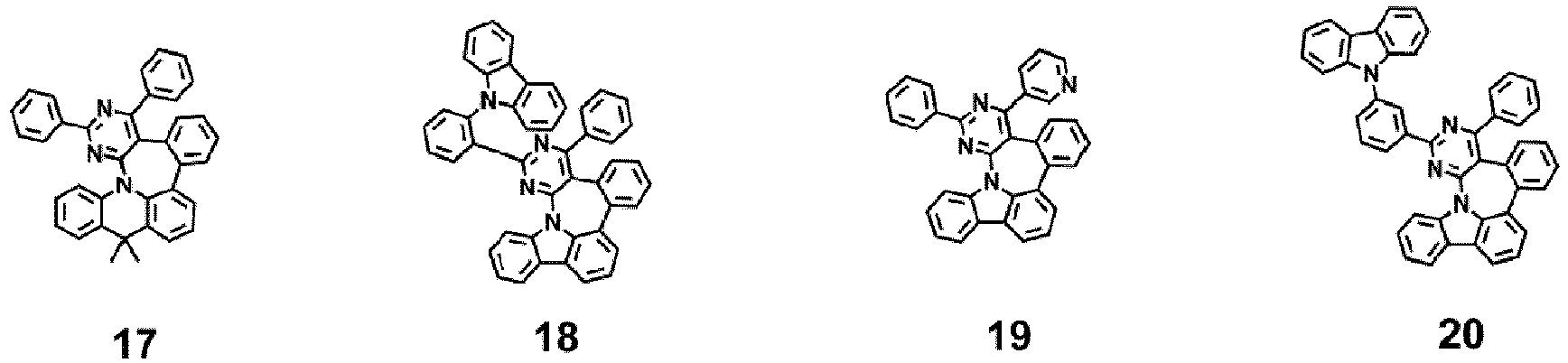


Applications Claiming Priority (1)
| Application Number | Priority Date | Filing Date | Title |
|---|---|---|---|
| KR1020190067419A KR102781575B1 (ko) | 2019-06-07 | 2019-06-07 | 헤테로시클릭 화합물 및 이를 포함한 유기 발광 소자 |
Publications (2)
| Publication Number | Publication Date |
|---|---|
| EP3748706A1 EP3748706A1 (fr) | 2020-12-09 |
| EP3748706B1 true EP3748706B1 (fr) | 2021-10-06 |
Family
ID=70056927
Family Applications (1)
| Application Number | Title | Priority Date | Filing Date |
|---|---|---|---|
| EP20166292.1A Active EP3748706B1 (fr) | 2019-06-07 | 2020-03-27 | Composé hétérocyclique et dispositif électroluminescent organique l'incluant |
Country Status (4)
| Country | Link |
|---|---|
| US (1) | US11903309B2 (fr) |
| EP (1) | EP3748706B1 (fr) |
| KR (1) | KR102781575B1 (fr) |
| CN (1) | CN112054128B (fr) |
Families Citing this family (2)
| Publication number | Priority date | Publication date | Assignee | Title |
|---|---|---|---|---|
| KR102563234B1 (ko) * | 2020-10-30 | 2023-08-04 | 주식회사 랩토 | 피리미딘 유도체 및 이를 포함한 유기전계발광소자 |
| WO2025023149A1 (fr) * | 2023-07-21 | 2025-01-30 | 出光興産株式会社 | Composé, élément électroluminescent organique et dispositif électronique |
Family Cites Families (11)
| Publication number | Priority date | Publication date | Assignee | Title |
|---|---|---|---|---|
| EP2770036B1 (fr) | 2002-03-15 | 2017-12-20 | Idemitsu Kosan Co., Ltd | Matériau pour dispositifs électroluminescents organiques et dispositifs électroluminescents organiques l'utilisant |
| JP5209604B2 (ja) | 2007-03-27 | 2013-06-12 | 新日鉄住金化学株式会社 | 有機電界発光素子用化合物及び有機電界発光素子 |
| JP6199752B2 (ja) * | 2013-01-24 | 2017-09-20 | 出光興産株式会社 | 有機エレクトロルミネッセンス素子用材料及びそれを用いた有機エレクトロルミネッセンス素子、並びに含窒素複素環化合物 |
| GB201306365D0 (en) * | 2013-04-09 | 2013-05-22 | Kathirgamanathan Poopathy | Heterocyclic compounds and their use in electro-optical or opto-electronic devices |
| KR102078365B1 (ko) * | 2013-07-01 | 2020-04-03 | 삼성디스플레이 주식회사 | 유기 발광 장치 |
| KR102491211B1 (ko) * | 2014-09-29 | 2023-01-26 | 롬엔드하스전자재료코리아유한회사 | 유기 전계 발광 화합물 및 이를 포함하는 유기 전계 발광 소자 |
| KR20160060569A (ko) | 2014-11-20 | 2016-05-30 | 롬엔드하스전자재료코리아유한회사 | 복수종의 호스트 재료 및 이를 포함하는 유기 전계 발광 소자 |
| WO2016080791A1 (fr) * | 2014-11-20 | 2016-05-26 | Rohm And Haas Electronic Materials Korea Ltd. | Matériaux hôtes multiples et dispositif électroluminescent organique les comprenant |
| KR102677628B1 (ko) * | 2015-11-20 | 2024-06-25 | 듀폰스페셜티머터리얼스코리아 유한회사 | 유기 전계 발광 화합물, 유기 전계 발광 재료, 및 이를 포함하는 유기 전계 발광 소자 |
| KR102738038B1 (ko) * | 2017-01-06 | 2024-12-06 | 삼성디스플레이 주식회사 | 헤테로고리 화합물 및 이를 포함한 유기 발광 소자 |
| KR102414108B1 (ko) * | 2017-08-08 | 2022-06-29 | 삼성디스플레이 주식회사 | 헤테로고리 화합물 및 이를 포함한 유기 발광 소자 |
-
2019
- 2019-06-07 KR KR1020190067419A patent/KR102781575B1/ko active Active
-
2020
- 2020-03-27 EP EP20166292.1A patent/EP3748706B1/fr active Active
- 2020-05-19 US US16/878,448 patent/US11903309B2/en active Active
- 2020-05-20 CN CN202010428612.6A patent/CN112054128B/zh active Active
Also Published As
| Publication number | Publication date |
|---|---|
| US11903309B2 (en) | 2024-02-13 |
| CN112054128A (zh) | 2020-12-08 |
| EP3748706A1 (fr) | 2020-12-09 |
| CN112054128B (zh) | 2024-06-18 |
| US20200388771A1 (en) | 2020-12-10 |
| KR102781575B1 (ko) | 2025-03-18 |
| KR20200140968A (ko) | 2020-12-17 |
Similar Documents
| Publication | Publication Date | Title |
|---|---|---|
| EP3657563B1 (fr) | Composé hétérocyclique et dispositif électroluminescent organique l'incluant | |
| EP3447062B1 (fr) | Composé organométallique, dispositif électroluminescent organique comprenant le composé organométallique et appareil électroluminescent organique comprenant le dispositif électroluminescent organique | |
| EP3441391B1 (fr) | Composé hétérocyclique et élément électroluminescent organique le comprenant | |
| EP3723151B1 (fr) | Composé cyclique condensé et dispositif électroluminescent organique le comprenant | |
| EP3406597B1 (fr) | Composé cyclique condensé et dispositif électroluminescent organique l'incluant | |
| EP3444241B1 (fr) | Composé aminé et dispositif électroluminescent organique contenant ce composé | |
| EP3389109B1 (fr) | Derivés de phosphore substitués par des hétérocycles et diodes électroluminiscentes organiques les contenant | |
| EP3214153A1 (fr) | Dispositif électroluminescent organique | |
| JP7601562B2 (ja) | 有機金属化合物、及びそれを含む有機発光素子 | |
| EP3502107B1 (fr) | Composé basé sur le 1-aminodibenzofurane et dispositif électroluminescent organique le comprenant | |
| EP3561894B1 (fr) | Composé de diamine et dispositif électroluminescent organique l'incluant | |
| EP3537495B1 (fr) | Dispositif électroluminescent organique | |
| EP3428149A2 (fr) | Composé cyclique condensé et dispositif électroluminescent organique le comprenant | |
| EP3467894A1 (fr) | Dispositif électroluminescent organique | |
| EP3530658B1 (fr) | Composé hétérocyclique et dispositif électroluminescent organique l'incluant | |
| EP3296288B1 (fr) | Composé cyclique condensé et dispositif électroluminescent organique le comprenant | |
| EP3748706B1 (fr) | Composé hétérocyclique et dispositif électroluminescent organique l'incluant | |
| EP3854795B1 (fr) | Composé cyclique condensé et diode électroluminescente organique le comprenant | |
| US10873041B2 (en) | Condensed cyclic compound and organic light-emitting device including the same | |
| EP3575295B1 (fr) | Composé hétérocyclique et dispositif électroluminescent organique l'incluant | |
| EP3333168B1 (fr) | Composé cyclique condensé et dispositif électroluminescent organique le comprenant |
Legal Events
| Date | Code | Title | Description |
|---|---|---|---|
| PUAI | Public reference made under article 153(3) epc to a published international application that has entered the european phase |
Free format text: ORIGINAL CODE: 0009012 |
|
| STAA | Information on the status of an ep patent application or granted ep patent |
Free format text: STATUS: THE APPLICATION HAS BEEN PUBLISHED |
|
| AK | Designated contracting states |
Kind code of ref document: A1 Designated state(s): AL AT BE BG CH CY CZ DE DK EE ES FI FR GB GR HR HU IE IS IT LI LT LU LV MC MK MT NL NO PL PT RO RS SE SI SK SM TR |
|
| AX | Request for extension of the european patent |
Extension state: BA ME |
|
| STAA | Information on the status of an ep patent application or granted ep patent |
Free format text: STATUS: REQUEST FOR EXAMINATION WAS MADE |
|
| 17P | Request for examination filed |
Effective date: 20210128 |
|
| RBV | Designated contracting states (corrected) |
Designated state(s): AL AT BE BG CH CY CZ DE DK EE ES FI FR GB GR HR HU IE IS IT LI LT LU LV MC MK MT NL NO PL PT RO RS SE SI SK SM TR |
|
| REG | Reference to a national code |
Ref country code: DE Ref legal event code: R079 Ref document number: 602020000674 Country of ref document: DE Free format text: PREVIOUS MAIN CLASS: H01L0051000000 Ipc: H01L0051540000 |
|
| RIC1 | Information provided on ipc code assigned before grant |
Ipc: H01L 51/54 20060101AFI20210527BHEP |
|
| GRAP | Despatch of communication of intention to grant a patent |
Free format text: ORIGINAL CODE: EPIDOSNIGR1 |
|
| STAA | Information on the status of an ep patent application or granted ep patent |
Free format text: STATUS: GRANT OF PATENT IS INTENDED |
|
| INTG | Intention to grant announced |
Effective date: 20210707 |
|
| GRAS | Grant fee paid |
Free format text: ORIGINAL CODE: EPIDOSNIGR3 |
|
| GRAA | (expected) grant |
Free format text: ORIGINAL CODE: 0009210 |
|
| STAA | Information on the status of an ep patent application or granted ep patent |
Free format text: STATUS: THE PATENT HAS BEEN GRANTED |
|
| AK | Designated contracting states |
Kind code of ref document: B1 Designated state(s): AL AT BE BG CH CY CZ DE DK EE ES FI FR GB GR HR HU IE IS IT LI LT LU LV MC MK MT NL NO PL PT RO RS SE SI SK SM TR |
|
| REG | Reference to a national code |
Ref country code: GB Ref legal event code: FG4D |
|
| REG | Reference to a national code |
Ref country code: CH Ref legal event code: EP Ref country code: AT Ref legal event code: REF Ref document number: 1436971 Country of ref document: AT Kind code of ref document: T Effective date: 20211015 |
|
| REG | Reference to a national code |
Ref country code: DE Ref legal event code: R096 Ref document number: 602020000674 Country of ref document: DE |
|
| REG | Reference to a national code |
Ref country code: IE Ref legal event code: FG4D |
|
| REG | Reference to a national code |
Ref country code: LT Ref legal event code: MG9D |
|
| REG | Reference to a national code |
Ref country code: NL Ref legal event code: MP Effective date: 20211006 |
|
| REG | Reference to a national code |
Ref country code: AT Ref legal event code: MK05 Ref document number: 1436971 Country of ref document: AT Kind code of ref document: T Effective date: 20211006 |
|
| PG25 | Lapsed in a contracting state [announced via postgrant information from national office to epo] |
Ref country code: RS Free format text: LAPSE BECAUSE OF FAILURE TO SUBMIT A TRANSLATION OF THE DESCRIPTION OR TO PAY THE FEE WITHIN THE PRESCRIBED TIME-LIMIT Effective date: 20211006 Ref country code: LT Free format text: LAPSE BECAUSE OF FAILURE TO SUBMIT A TRANSLATION OF THE DESCRIPTION OR TO PAY THE FEE WITHIN THE PRESCRIBED TIME-LIMIT Effective date: 20211006 Ref country code: FI Free format text: LAPSE BECAUSE OF FAILURE TO SUBMIT A TRANSLATION OF THE DESCRIPTION OR TO PAY THE FEE WITHIN THE PRESCRIBED TIME-LIMIT Effective date: 20211006 Ref country code: BG Free format text: LAPSE BECAUSE OF FAILURE TO SUBMIT A TRANSLATION OF THE DESCRIPTION OR TO PAY THE FEE WITHIN THE PRESCRIBED TIME-LIMIT Effective date: 20220106 Ref country code: AT Free format text: LAPSE BECAUSE OF FAILURE TO SUBMIT A TRANSLATION OF THE DESCRIPTION OR TO PAY THE FEE WITHIN THE PRESCRIBED TIME-LIMIT Effective date: 20211006 |
|
| PG25 | Lapsed in a contracting state [announced via postgrant information from national office to epo] |
Ref country code: IS Free format text: LAPSE BECAUSE OF FAILURE TO SUBMIT A TRANSLATION OF THE DESCRIPTION OR TO PAY THE FEE WITHIN THE PRESCRIBED TIME-LIMIT Effective date: 20220206 Ref country code: SE Free format text: LAPSE BECAUSE OF FAILURE TO SUBMIT A TRANSLATION OF THE DESCRIPTION OR TO PAY THE FEE WITHIN THE PRESCRIBED TIME-LIMIT Effective date: 20211006 Ref country code: PT Free format text: LAPSE BECAUSE OF FAILURE TO SUBMIT A TRANSLATION OF THE DESCRIPTION OR TO PAY THE FEE WITHIN THE PRESCRIBED TIME-LIMIT Effective date: 20220207 Ref country code: PL Free format text: LAPSE BECAUSE OF FAILURE TO SUBMIT A TRANSLATION OF THE DESCRIPTION OR TO PAY THE FEE WITHIN THE PRESCRIBED TIME-LIMIT Effective date: 20211006 Ref country code: NO Free format text: LAPSE BECAUSE OF FAILURE TO SUBMIT A TRANSLATION OF THE DESCRIPTION OR TO PAY THE FEE WITHIN THE PRESCRIBED TIME-LIMIT Effective date: 20220106 Ref country code: NL Free format text: LAPSE BECAUSE OF FAILURE TO SUBMIT A TRANSLATION OF THE DESCRIPTION OR TO PAY THE FEE WITHIN THE PRESCRIBED TIME-LIMIT Effective date: 20211006 Ref country code: LV Free format text: LAPSE BECAUSE OF FAILURE TO SUBMIT A TRANSLATION OF THE DESCRIPTION OR TO PAY THE FEE WITHIN THE PRESCRIBED TIME-LIMIT Effective date: 20211006 Ref country code: HR Free format text: LAPSE BECAUSE OF FAILURE TO SUBMIT A TRANSLATION OF THE DESCRIPTION OR TO PAY THE FEE WITHIN THE PRESCRIBED TIME-LIMIT Effective date: 20211006 Ref country code: GR Free format text: LAPSE BECAUSE OF FAILURE TO SUBMIT A TRANSLATION OF THE DESCRIPTION OR TO PAY THE FEE WITHIN THE PRESCRIBED TIME-LIMIT Effective date: 20220107 Ref country code: ES Free format text: LAPSE BECAUSE OF FAILURE TO SUBMIT A TRANSLATION OF THE DESCRIPTION OR TO PAY THE FEE WITHIN THE PRESCRIBED TIME-LIMIT Effective date: 20211006 |
|
| REG | Reference to a national code |
Ref country code: DE Ref legal event code: R097 Ref document number: 602020000674 Country of ref document: DE |
|
| PG25 | Lapsed in a contracting state [announced via postgrant information from national office to epo] |
Ref country code: SM Free format text: LAPSE BECAUSE OF FAILURE TO SUBMIT A TRANSLATION OF THE DESCRIPTION OR TO PAY THE FEE WITHIN THE PRESCRIBED TIME-LIMIT Effective date: 20211006 Ref country code: SK Free format text: LAPSE BECAUSE OF FAILURE TO SUBMIT A TRANSLATION OF THE DESCRIPTION OR TO PAY THE FEE WITHIN THE PRESCRIBED TIME-LIMIT Effective date: 20211006 Ref country code: RO Free format text: LAPSE BECAUSE OF FAILURE TO SUBMIT A TRANSLATION OF THE DESCRIPTION OR TO PAY THE FEE WITHIN THE PRESCRIBED TIME-LIMIT Effective date: 20211006 Ref country code: EE Free format text: LAPSE BECAUSE OF FAILURE TO SUBMIT A TRANSLATION OF THE DESCRIPTION OR TO PAY THE FEE WITHIN THE PRESCRIBED TIME-LIMIT Effective date: 20211006 Ref country code: DK Free format text: LAPSE BECAUSE OF FAILURE TO SUBMIT A TRANSLATION OF THE DESCRIPTION OR TO PAY THE FEE WITHIN THE PRESCRIBED TIME-LIMIT Effective date: 20211006 Ref country code: CZ Free format text: LAPSE BECAUSE OF FAILURE TO SUBMIT A TRANSLATION OF THE DESCRIPTION OR TO PAY THE FEE WITHIN THE PRESCRIBED TIME-LIMIT Effective date: 20211006 |
|
| PLBE | No opposition filed within time limit |
Free format text: ORIGINAL CODE: 0009261 |
|
| STAA | Information on the status of an ep patent application or granted ep patent |
Free format text: STATUS: NO OPPOSITION FILED WITHIN TIME LIMIT |
|
| 26N | No opposition filed |
Effective date: 20220707 |
|
| PG25 | Lapsed in a contracting state [announced via postgrant information from national office to epo] |
Ref country code: MC Free format text: LAPSE BECAUSE OF FAILURE TO SUBMIT A TRANSLATION OF THE DESCRIPTION OR TO PAY THE FEE WITHIN THE PRESCRIBED TIME-LIMIT Effective date: 20211006 Ref country code: AL Free format text: LAPSE BECAUSE OF FAILURE TO SUBMIT A TRANSLATION OF THE DESCRIPTION OR TO PAY THE FEE WITHIN THE PRESCRIBED TIME-LIMIT Effective date: 20211006 |
|
| REG | Reference to a national code |
Ref country code: DE Ref legal event code: R079 Ref document number: 602020000674 Country of ref document: DE Free format text: PREVIOUS MAIN CLASS: H01L0051540000 Ipc: H10K0085000000 |
|
| PG25 | Lapsed in a contracting state [announced via postgrant information from national office to epo] |
Ref country code: SI Free format text: LAPSE BECAUSE OF FAILURE TO SUBMIT A TRANSLATION OF THE DESCRIPTION OR TO PAY THE FEE WITHIN THE PRESCRIBED TIME-LIMIT Effective date: 20211006 |
|
| REG | Reference to a national code |
Ref country code: BE Ref legal event code: MM Effective date: 20220331 |
|
| PG25 | Lapsed in a contracting state [announced via postgrant information from national office to epo] |
Ref country code: LU Free format text: LAPSE BECAUSE OF NON-PAYMENT OF DUE FEES Effective date: 20220327 Ref country code: IE Free format text: LAPSE BECAUSE OF NON-PAYMENT OF DUE FEES Effective date: 20220327 |
|
| PG25 | Lapsed in a contracting state [announced via postgrant information from national office to epo] |
Ref country code: BE Free format text: LAPSE BECAUSE OF NON-PAYMENT OF DUE FEES Effective date: 20220331 |
|
| PG25 | Lapsed in a contracting state [announced via postgrant information from national office to epo] |
Ref country code: IT Free format text: LAPSE BECAUSE OF FAILURE TO SUBMIT A TRANSLATION OF THE DESCRIPTION OR TO PAY THE FEE WITHIN THE PRESCRIBED TIME-LIMIT Effective date: 20211006 |
|
| P01 | Opt-out of the competence of the unified patent court (upc) registered |
Effective date: 20230516 |
|
| REG | Reference to a national code |
Ref country code: CH Ref legal event code: PL |
|
| PG25 | Lapsed in a contracting state [announced via postgrant information from national office to epo] |
Ref country code: LI Free format text: LAPSE BECAUSE OF NON-PAYMENT OF DUE FEES Effective date: 20230331 Ref country code: CH Free format text: LAPSE BECAUSE OF NON-PAYMENT OF DUE FEES Effective date: 20230331 |
|
| PG25 | Lapsed in a contracting state [announced via postgrant information from national office to epo] |
Ref country code: MK Free format text: LAPSE BECAUSE OF FAILURE TO SUBMIT A TRANSLATION OF THE DESCRIPTION OR TO PAY THE FEE WITHIN THE PRESCRIBED TIME-LIMIT Effective date: 20211006 Ref country code: CY Free format text: LAPSE BECAUSE OF FAILURE TO SUBMIT A TRANSLATION OF THE DESCRIPTION OR TO PAY THE FEE WITHIN THE PRESCRIBED TIME-LIMIT Effective date: 20211006 |
|
| PG25 | Lapsed in a contracting state [announced via postgrant information from national office to epo] |
Ref country code: HU Free format text: LAPSE BECAUSE OF FAILURE TO SUBMIT A TRANSLATION OF THE DESCRIPTION OR TO PAY THE FEE WITHIN THE PRESCRIBED TIME-LIMIT; INVALID AB INITIO Effective date: 20200327 |
|
| PG25 | Lapsed in a contracting state [announced via postgrant information from national office to epo] |
Ref country code: MT Free format text: LAPSE BECAUSE OF FAILURE TO SUBMIT A TRANSLATION OF THE DESCRIPTION OR TO PAY THE FEE WITHIN THE PRESCRIBED TIME-LIMIT Effective date: 20211006 |
|
| PG25 | Lapsed in a contracting state [announced via postgrant information from national office to epo] |
Ref country code: TR Free format text: LAPSE BECAUSE OF FAILURE TO SUBMIT A TRANSLATION OF THE DESCRIPTION OR TO PAY THE FEE WITHIN THE PRESCRIBED TIME-LIMIT Effective date: 20211006 |
|
| PGFP | Annual fee paid to national office [announced via postgrant information from national office to epo] |
Ref country code: GB Payment date: 20260224 Year of fee payment: 7 |
|
| PGFP | Annual fee paid to national office [announced via postgrant information from national office to epo] |
Ref country code: DE Payment date: 20260220 Year of fee payment: 7 |
|
| PGFP | Annual fee paid to national office [announced via postgrant information from national office to epo] |
Ref country code: FR Payment date: 20260224 Year of fee payment: 7 |