EP3406597B1 - Composé cyclique condensé et dispositif électroluminescent organique l'incluant - Google Patents
Composé cyclique condensé et dispositif électroluminescent organique l'incluant Download PDFInfo
- Publication number
- EP3406597B1 EP3406597B1 EP18173444.3A EP18173444A EP3406597B1 EP 3406597 B1 EP3406597 B1 EP 3406597B1 EP 18173444 A EP18173444 A EP 18173444A EP 3406597 B1 EP3406597 B1 EP 3406597B1
- Authority
- EP
- European Patent Office
- Prior art keywords
- group
- substituted
- unsubstituted
- layer
- phenyl
- Prior art date
- Legal status (The legal status is an assumption and is not a legal conclusion. Google has not performed a legal analysis and makes no representation as to the accuracy of the status listed.)
- Active
Links
- 0 CC1(C23*)C=CC2=CN=C(*)C=C3C=C1 Chemical compound CC1(C23*)C=CC2=CN=C(*)C=C3C=C1 0.000 description 46
- GCZNTTUTZZVIRJ-UQCOIBPSSA-N C/C=C\c(ccc(C=C1)c2NC1c(cc1)ccc1-c1cc3nc(C(CC4)=CC=C4F)c(c(C=CCC4)c4c4ccccc44)c4c3cc1)c2N Chemical compound C/C=C\c(ccc(C=C1)c2NC1c(cc1)ccc1-c1cc3nc(C(CC4)=CC=C4F)c(c(C=CCC4)c4c4ccccc44)c4c3cc1)c2N GCZNTTUTZZVIRJ-UQCOIBPSSA-N 0.000 description 1
- DBRKEMACYPHHAY-UHFFFAOYSA-N C=Cc1cccc(-c(cc2)ccc2-c(c2c3cccc2)c(cccc2)c2c3-c(c(O)c(c(O)c2O)O)c2O)c1C=C Chemical compound C=Cc1cccc(-c(cc2)ccc2-c(c2c3cccc2)c(cccc2)c2c3-c(c(O)c(c(O)c2O)O)c2O)c1C=C DBRKEMACYPHHAY-UHFFFAOYSA-N 0.000 description 1
- GAVSLLKWJXCZKP-UHFFFAOYSA-N CC(C)(C(C)(C)OSc1cccc(-c(cc2)cc3c2c(c(cccc2)c2c2c4cccc2)c4c(-c(cc2)ccc2F)n3)c1)O Chemical compound CC(C)(C(C)(C)OSc1cccc(-c(cc2)cc3c2c(c(cccc2)c2c2c4cccc2)c4c(-c(cc2)ccc2F)n3)c1)O GAVSLLKWJXCZKP-UHFFFAOYSA-N 0.000 description 1
- QVCPGBLLUGKKOP-UHFFFAOYSA-N CC(C)(C(C)(C)[O-]Bc(cc1)ccc1-c(cc1)cc2c1c(c1ccccc1c1c3cccc1)c3c(-c(cc1)ccc1F)n2)O Chemical compound CC(C)(C(C)(C)[O-]Bc(cc1)ccc1-c(cc1)cc2c1c(c1ccccc1c1c3cccc1)c3c(-c(cc1)ccc1F)n2)O QVCPGBLLUGKKOP-UHFFFAOYSA-N 0.000 description 1
- JHABSPWSXFXXSD-UHFFFAOYSA-N CC(C)(C(C1(C)C=C2)C=C2F)c2c1ccc(-c1cc(C(C=CC34)=CC3NC(C)(c(cc3F)ccc3F)c3c4c(cccc4)c4c4c3cccc4)ccc1)c2 Chemical compound CC(C)(C(C1(C)C=C2)C=C2F)c2c1ccc(-c1cc(C(C=CC34)=CC3NC(C)(c(cc3F)ccc3F)c3c4c(cccc4)c4c4c3cccc4)ccc1)c2 JHABSPWSXFXXSD-UHFFFAOYSA-N 0.000 description 1
- GAGIQOAHYUJVFT-UHFFFAOYSA-N CC(C)(c1ccccc1-c1c2)c1ccc2N Chemical compound CC(C)(c1ccccc1-c1c2)c1ccc2N GAGIQOAHYUJVFT-UHFFFAOYSA-N 0.000 description 1
- MTGDRMULXFBGDH-UHFFFAOYSA-O CC(C1)C(c(cc2)cc3c2nc(-c(cc2)ccc2F)c2c3c(cccc3)c3c3c2cccc3)=CC=C1[PH+](C1(C)C=CC=CC1)c1ccccc1 Chemical compound CC(C1)C(c(cc2)cc3c2nc(-c(cc2)ccc2F)c2c3c(cccc3)c3c3c2cccc3)=CC=C1[PH+](C1(C)C=CC=CC1)c1ccccc1 MTGDRMULXFBGDH-UHFFFAOYSA-O 0.000 description 1
- XRDQASJDZMKJSQ-UHFFFAOYSA-N CC(C1)C=Cc2c1c(-c1c(cccc3)c3c(-c3ccccc3)c(c(O)c3O)c1c(O)c3O)cc1ccccc21 Chemical compound CC(C1)C=Cc2c1c(-c1c(cccc3)c3c(-c3ccccc3)c(c(O)c3O)c1c(O)c3O)cc1ccccc21 XRDQASJDZMKJSQ-UHFFFAOYSA-N 0.000 description 1
- AFGJVJRQAZXHGK-UHFFFAOYSA-N CC1(C)c(c(N)ccc2)c2-c2c1cccc2 Chemical compound CC1(C)c(c(N)ccc2)c2-c2c1cccc2 AFGJVJRQAZXHGK-UHFFFAOYSA-N 0.000 description 1
- DWFDKKOJAZKZMG-UHFFFAOYSA-O CC1(c(cc2)ccc2F)Nc(cc(C2N(C3c4ccccc4)[N]3(C)C(c3ccccc3)[NH2+]2)cc2)c2-c2c1c(cccc1)c1c1c2cccc1 Chemical compound CC1(c(cc2)ccc2F)Nc(cc(C2N(C3c4ccccc4)[N]3(C)C(c3ccccc3)[NH2+]2)cc2)c2-c2c1c(cccc1)c1c1c2cccc1 DWFDKKOJAZKZMG-UHFFFAOYSA-O 0.000 description 1
- QRDJCCQTEQVLKC-UHFFFAOYSA-N CC1C(C2)C2CC1 Chemical compound CC1C(C2)C2CC1 QRDJCCQTEQVLKC-UHFFFAOYSA-N 0.000 description 1
- FJQIKFLKAOWQJH-UHFFFAOYSA-N CC1C=C(C)C(B(c(cc2)ccc2-c(cc2)cc3c2C2=C4C#CC=CC4C(C=CC=C4)C4=C2C(c(cc2F)ccc2F)=N3)c2c(C)cc(C)cc2C)=C(C)C1 Chemical compound CC1C=C(C)C(B(c(cc2)ccc2-c(cc2)cc3c2C2=C4C#CC=CC4C(C=CC=C4)C4=C2C(c(cc2F)ccc2F)=N3)c2c(C)cc(C)cc2C)=C(C)C1 FJQIKFLKAOWQJH-UHFFFAOYSA-N 0.000 description 1
- RVIYGIMFHVDDFA-UHFFFAOYSA-O CC1C=CC(C2[NH2+]C(c(cc3)ccc3C(C=CC3C4=C(C=CC=C5)C5=C5C=CC=CC5(C)C44)=CC3(C)N=C4C(C=CC3(C)F)=CC3F)N=C(C3=CCC(C)C=C3)N2)=CC1 Chemical compound CC1C=CC(C2[NH2+]C(c(cc3)ccc3C(C=CC3C4=C(C=CC=C5)C5=C5C=CC=CC5(C)C44)=CC3(C)N=C4C(C=CC3(C)F)=CC3F)N=C(C3=CCC(C)C=C3)N2)=CC1 RVIYGIMFHVDDFA-UHFFFAOYSA-O 0.000 description 1
- XVQVCJFELYRCBV-UHFFFAOYSA-N CC1C=CC(c2cc(-c3ccccc3)nc(-c3cc(-c4cccc5c4N=C(c(cc4)ccc4F)C4=C6C=CC=CC6C(C)(C=CC=C6)C6=C54)ccc3)n2)=CC1 Chemical compound CC1C=CC(c2cc(-c3ccccc3)nc(-c3cc(-c4cccc5c4N=C(c(cc4)ccc4F)C4=C6C=CC=CC6C(C)(C=CC=C6)C6=C54)ccc3)n2)=CC1 XVQVCJFELYRCBV-UHFFFAOYSA-N 0.000 description 1
- ARMVLWVAFFHWOW-UUWRZZSWSA-N CC[C@H](C=C1)C=C1c1cc(C2=CC=N2)cc(-c(cc2)ccc2-c2cc3nc(-c(cc4)ccc4-c(cc4)ccc4F)c(c4ccccc4c4ccccc44)c4c3cc2)c1 Chemical compound CC[C@H](C=C1)C=C1c1cc(C2=CC=N2)cc(-c(cc2)ccc2-c2cc3nc(-c(cc4)ccc4-c(cc4)ccc4F)c(c4ccccc4c4ccccc44)c4c3cc2)c1 ARMVLWVAFFHWOW-UUWRZZSWSA-N 0.000 description 1
- SYKLSOGSEUTXIF-QHFHAUSPSA-N C[C@H](C/C=C/C=C(\C1C)/C=CC1N=C)CN1C#CC1 Chemical compound C[C@H](C/C=C/C=C(\C1C)/C=CC1N=C)CN1C#CC1 SYKLSOGSEUTXIF-QHFHAUSPSA-N 0.000 description 1
- SHLINOQEJGDCBA-MRVPVSSYSA-N C[C@](C1)(C=CC=C1N)C#N Chemical compound C[C@](C1)(C=CC=C1N)C#N SHLINOQEJGDCBA-MRVPVSSYSA-N 0.000 description 1
- XUYRVBNKDZNXOJ-UHFFFAOYSA-N C[N]1(C)(C)(CC1)=C Chemical compound C[N]1(C)(C)(CC1)=C XUYRVBNKDZNXOJ-UHFFFAOYSA-N 0.000 description 1
- YCSFCQUMKXGKNB-UHFFFAOYSA-N Cc1c(-c2ccccc2)nc(-c2ccccc2)nc1-c1cc(-c(cc2)ccc2-c2cc3nc(-c(cc4)ccc4F)c(c4ccccc4c4ccccc44)c4c3cc2)ccc1 Chemical compound Cc1c(-c2ccccc2)nc(-c2ccccc2)nc1-c1cc(-c(cc2)ccc2-c2cc3nc(-c(cc4)ccc4F)c(c4ccccc4c4ccccc44)c4c3cc2)ccc1 YCSFCQUMKXGKNB-UHFFFAOYSA-N 0.000 description 1
- LVMBSKUCRVAROP-UHFFFAOYSA-N Fc(cc1)ccc1-c1nc(cc(cc2)-c3cc(-c4nc(-c(cc5)ccc5F)nc(-c(cc5)ccc5F)n4)ccc3)c2c2c1c(cccc1)c1c1c2cccc1 Chemical compound Fc(cc1)ccc1-c1nc(cc(cc2)-c3cc(-c4nc(-c(cc5)ccc5F)nc(-c(cc5)ccc5F)n4)ccc3)c2c2c1c(cccc1)c1c1c2cccc1 LVMBSKUCRVAROP-UHFFFAOYSA-N 0.000 description 1
- DKPSSMOJHLISJI-UHFFFAOYSA-N Nc(c1c2nccc1)cc1c2nccc1 Chemical compound Nc(c1c2nccc1)cc1c2nccc1 DKPSSMOJHLISJI-UHFFFAOYSA-N 0.000 description 1
- YBAZINRZQSAIAY-UHFFFAOYSA-N Nc(cc1)ccc1C#N Chemical compound Nc(cc1)ccc1C#N YBAZINRZQSAIAY-UHFFFAOYSA-N 0.000 description 1
- FORHUMZQWSIXBI-UHFFFAOYSA-N Nc(ccc1c2cccc1)c2F Chemical compound Nc(ccc1c2cccc1)c2F FORHUMZQWSIXBI-UHFFFAOYSA-N 0.000 description 1
- HLCPWBZNUKCSBN-UHFFFAOYSA-N Nc(cccc1)c1C#N Chemical compound Nc(cccc1)c1C#N HLCPWBZNUKCSBN-UHFFFAOYSA-N 0.000 description 1
- LODJILPQZWAWOI-UHFFFAOYSA-N Nc1c(cc(cc2)[F]Nc(cc3)cc4c3ccc(F)c4)c2ccc1 Chemical compound Nc1c(cc(cc2)[F]Nc(cc3)cc4c3ccc(F)c4)c2ccc1 LODJILPQZWAWOI-UHFFFAOYSA-N 0.000 description 1
- KQOIBXZRCYFZSO-UHFFFAOYSA-N Nc1cc(F)cc(F)c1 Chemical compound Nc1cc(F)cc(F)c1 KQOIBXZRCYFZSO-UHFFFAOYSA-N 0.000 description 1
- NEMAJGLKKASGQD-UHFFFAOYSA-N Nc1cc2cc([Ar])ccc2cc1 Chemical compound Nc1cc2cc([Ar])ccc2cc1 NEMAJGLKKASGQD-UHFFFAOYSA-N 0.000 description 1
- UMWUKSTYPWRPPR-UHFFFAOYSA-N Nc1cnc2c(nccc3)c3ccc2c1 Chemical compound Nc1cnc2c(nccc3)c3ccc2c1 UMWUKSTYPWRPPR-UHFFFAOYSA-N 0.000 description 1
- XFGWEIMLSNYDIH-UHFFFAOYSA-N Nc1nc(c2c(cc3)C=CCN2)c3cc1 Chemical compound Nc1nc(c2c(cc3)C=CCN2)c3cc1 XFGWEIMLSNYDIH-UHFFFAOYSA-N 0.000 description 1
Images


Classifications
-
- C—CHEMISTRY; METALLURGY
- C07—ORGANIC CHEMISTRY
- C07D—HETEROCYCLIC COMPOUNDS
- C07D401/00—Heterocyclic compounds containing two or more hetero rings, having nitrogen atoms as the only ring hetero atoms, at least one ring being a six-membered ring with only one nitrogen atom
- C07D401/02—Heterocyclic compounds containing two or more hetero rings, having nitrogen atoms as the only ring hetero atoms, at least one ring being a six-membered ring with only one nitrogen atom containing two hetero rings
- C07D401/10—Heterocyclic compounds containing two or more hetero rings, having nitrogen atoms as the only ring hetero atoms, at least one ring being a six-membered ring with only one nitrogen atom containing two hetero rings linked by a carbon chain containing aromatic rings
-
- C—CHEMISTRY; METALLURGY
- C07—ORGANIC CHEMISTRY
- C07D—HETEROCYCLIC COMPOUNDS
- C07D221/00—Heterocyclic compounds containing six-membered rings having one nitrogen atom as the only ring hetero atom, not provided for by groups C07D211/00 - C07D219/00
- C07D221/02—Heterocyclic compounds containing six-membered rings having one nitrogen atom as the only ring hetero atom, not provided for by groups C07D211/00 - C07D219/00 condensed with carbocyclic rings or ring systems
- C07D221/04—Ortho- or peri-condensed ring systems
- C07D221/18—Ring systems of four or more rings
-
- C—CHEMISTRY; METALLURGY
- C07—ORGANIC CHEMISTRY
- C07D—HETEROCYCLIC COMPOUNDS
- C07D401/00—Heterocyclic compounds containing two or more hetero rings, having nitrogen atoms as the only ring hetero atoms, at least one ring being a six-membered ring with only one nitrogen atom
- C07D401/02—Heterocyclic compounds containing two or more hetero rings, having nitrogen atoms as the only ring hetero atoms, at least one ring being a six-membered ring with only one nitrogen atom containing two hetero rings
- C07D401/04—Heterocyclic compounds containing two or more hetero rings, having nitrogen atoms as the only ring hetero atoms, at least one ring being a six-membered ring with only one nitrogen atom containing two hetero rings directly linked by a ring-member-to-ring-member bond
-
- C—CHEMISTRY; METALLURGY
- C07—ORGANIC CHEMISTRY
- C07D—HETEROCYCLIC COMPOUNDS
- C07D401/00—Heterocyclic compounds containing two or more hetero rings, having nitrogen atoms as the only ring hetero atoms, at least one ring being a six-membered ring with only one nitrogen atom
- C07D401/14—Heterocyclic compounds containing two or more hetero rings, having nitrogen atoms as the only ring hetero atoms, at least one ring being a six-membered ring with only one nitrogen atom containing three or more hetero rings
-
- C—CHEMISTRY; METALLURGY
- C07—ORGANIC CHEMISTRY
- C07D—HETEROCYCLIC COMPOUNDS
- C07D403/00—Heterocyclic compounds containing two or more hetero rings, having nitrogen atoms as the only ring hetero atoms, not provided for by group C07D401/00
- C07D403/02—Heterocyclic compounds containing two or more hetero rings, having nitrogen atoms as the only ring hetero atoms, not provided for by group C07D401/00 containing two hetero rings
- C07D403/04—Heterocyclic compounds containing two or more hetero rings, having nitrogen atoms as the only ring hetero atoms, not provided for by group C07D401/00 containing two hetero rings directly linked by a ring-member-to-ring-member bond
-
- C—CHEMISTRY; METALLURGY
- C07—ORGANIC CHEMISTRY
- C07D—HETEROCYCLIC COMPOUNDS
- C07D403/00—Heterocyclic compounds containing two or more hetero rings, having nitrogen atoms as the only ring hetero atoms, not provided for by group C07D401/00
- C07D403/02—Heterocyclic compounds containing two or more hetero rings, having nitrogen atoms as the only ring hetero atoms, not provided for by group C07D401/00 containing two hetero rings
- C07D403/10—Heterocyclic compounds containing two or more hetero rings, having nitrogen atoms as the only ring hetero atoms, not provided for by group C07D401/00 containing two hetero rings linked by a carbon chain containing aromatic rings
-
- C—CHEMISTRY; METALLURGY
- C07—ORGANIC CHEMISTRY
- C07D—HETEROCYCLIC COMPOUNDS
- C07D471/00—Heterocyclic compounds containing nitrogen atoms as the only ring hetero atoms in the condensed system, at least one ring being a six-membered ring with one nitrogen atom, not provided for by groups C07D451/00 - C07D463/00
- C07D471/02—Heterocyclic compounds containing nitrogen atoms as the only ring hetero atoms in the condensed system, at least one ring being a six-membered ring with one nitrogen atom, not provided for by groups C07D451/00 - C07D463/00 in which the condensed system contains two hetero rings
- C07D471/04—Ortho-condensed systems
-
- C—CHEMISTRY; METALLURGY
- C07—ORGANIC CHEMISTRY
- C07F—ACYCLIC, CARBOCYCLIC OR HETEROCYCLIC COMPOUNDS CONTAINING ELEMENTS OTHER THAN CARBON, HYDROGEN, HALOGEN, OXYGEN, NITROGEN, SULFUR, SELENIUM OR TELLURIUM
- C07F5/00—Compounds containing elements of Groups 3 or 13 of the Periodic Table
- C07F5/02—Boron compounds
-
- C—CHEMISTRY; METALLURGY
- C07—ORGANIC CHEMISTRY
- C07F—ACYCLIC, CARBOCYCLIC OR HETEROCYCLIC COMPOUNDS CONTAINING ELEMENTS OTHER THAN CARBON, HYDROGEN, HALOGEN, OXYGEN, NITROGEN, SULFUR, SELENIUM OR TELLURIUM
- C07F5/00—Compounds containing elements of Groups 3 or 13 of the Periodic Table
- C07F5/02—Boron compounds
- C07F5/025—Boronic and borinic acid compounds
-
- C—CHEMISTRY; METALLURGY
- C07—ORGANIC CHEMISTRY
- C07F—ACYCLIC, CARBOCYCLIC OR HETEROCYCLIC COMPOUNDS CONTAINING ELEMENTS OTHER THAN CARBON, HYDROGEN, HALOGEN, OXYGEN, NITROGEN, SULFUR, SELENIUM OR TELLURIUM
- C07F5/00—Compounds containing elements of Groups 3 or 13 of the Periodic Table
- C07F5/02—Boron compounds
- C07F5/027—Organoboranes and organoborohydrides
-
- C—CHEMISTRY; METALLURGY
- C07—ORGANIC CHEMISTRY
- C07F—ACYCLIC, CARBOCYCLIC OR HETEROCYCLIC COMPOUNDS CONTAINING ELEMENTS OTHER THAN CARBON, HYDROGEN, HALOGEN, OXYGEN, NITROGEN, SULFUR, SELENIUM OR TELLURIUM
- C07F9/00—Compounds containing elements of Groups 5 or 15 of the Periodic Table
- C07F9/02—Phosphorus compounds
- C07F9/28—Phosphorus compounds with one or more P—C bonds
- C07F9/50—Organo-phosphines
- C07F9/53—Organo-phosphine oxides; Organo-phosphine thioxides
- C07F9/5325—Aromatic phosphine oxides or thioxides (P-C aromatic linkage)
-
- C—CHEMISTRY; METALLURGY
- C07—ORGANIC CHEMISTRY
- C07F—ACYCLIC, CARBOCYCLIC OR HETEROCYCLIC COMPOUNDS CONTAINING ELEMENTS OTHER THAN CARBON, HYDROGEN, HALOGEN, OXYGEN, NITROGEN, SULFUR, SELENIUM OR TELLURIUM
- C07F9/00—Compounds containing elements of Groups 5 or 15 of the Periodic Table
- C07F9/02—Phosphorus compounds
- C07F9/547—Heterocyclic compounds, e.g. containing phosphorus as a ring hetero atom
- C07F9/553—Heterocyclic compounds, e.g. containing phosphorus as a ring hetero atom having one nitrogen atom as the only ring hetero atom
- C07F9/576—Six-membered rings
- C07F9/5765—Six-membered rings condensed with carbocyclic rings or carbocyclic ring systems
-
- C—CHEMISTRY; METALLURGY
- C09—DYES; PAINTS; POLISHES; NATURAL RESINS; ADHESIVES; COMPOSITIONS NOT OTHERWISE PROVIDED FOR; APPLICATIONS OF MATERIALS NOT OTHERWISE PROVIDED FOR
- C09K—MATERIALS FOR MISCELLANEOUS APPLICATIONS, NOT PROVIDED FOR ELSEWHERE
- C09K11/00—Luminescent materials, e.g. electroluminescent or chemiluminescent
- C09K11/06—Luminescent materials, e.g. electroluminescent or chemiluminescent containing organic luminescent materials
-
- H—ELECTRICITY
- H10—SEMICONDUCTOR DEVICES; ELECTRIC SOLID-STATE DEVICES NOT OTHERWISE PROVIDED FOR
- H10K—ORGANIC ELECTRIC SOLID-STATE DEVICES
- H10K85/00—Organic materials used in the body or electrodes of devices covered by this subclass
- H10K85/60—Organic compounds having low molecular weight
- H10K85/615—Polycyclic condensed aromatic hydrocarbons, e.g. anthracene
-
- H—ELECTRICITY
- H10—SEMICONDUCTOR DEVICES; ELECTRIC SOLID-STATE DEVICES NOT OTHERWISE PROVIDED FOR
- H10K—ORGANIC ELECTRIC SOLID-STATE DEVICES
- H10K85/00—Organic materials used in the body or electrodes of devices covered by this subclass
- H10K85/60—Organic compounds having low molecular weight
- H10K85/649—Aromatic compounds comprising a hetero atom
- H10K85/654—Aromatic compounds comprising a hetero atom comprising only nitrogen as heteroatom
-
- H—ELECTRICITY
- H10—SEMICONDUCTOR DEVICES; ELECTRIC SOLID-STATE DEVICES NOT OTHERWISE PROVIDED FOR
- H10K—ORGANIC ELECTRIC SOLID-STATE DEVICES
- H10K85/00—Organic materials used in the body or electrodes of devices covered by this subclass
- H10K85/60—Organic compounds having low molecular weight
- H10K85/649—Aromatic compounds comprising a hetero atom
- H10K85/657—Polycyclic condensed heteroaromatic hydrocarbons
- H10K85/6572—Polycyclic condensed heteroaromatic hydrocarbons comprising only nitrogen in the heteroaromatic polycondensed ring system, e.g. phenanthroline or carbazole
-
- C—CHEMISTRY; METALLURGY
- C09—DYES; PAINTS; POLISHES; NATURAL RESINS; ADHESIVES; COMPOSITIONS NOT OTHERWISE PROVIDED FOR; APPLICATIONS OF MATERIALS NOT OTHERWISE PROVIDED FOR
- C09K—MATERIALS FOR MISCELLANEOUS APPLICATIONS, NOT PROVIDED FOR ELSEWHERE
- C09K2211/00—Chemical nature of organic luminescent or tenebrescent compounds
- C09K2211/10—Non-macromolecular compounds
- C09K2211/1018—Heterocyclic compounds
- C09K2211/1025—Heterocyclic compounds characterised by ligands
- C09K2211/1029—Heterocyclic compounds characterised by ligands containing one nitrogen atom as the heteroatom
-
- H—ELECTRICITY
- H10—SEMICONDUCTOR DEVICES; ELECTRIC SOLID-STATE DEVICES NOT OTHERWISE PROVIDED FOR
- H10K—ORGANIC ELECTRIC SOLID-STATE DEVICES
- H10K2101/00—Properties of the organic materials covered by group H10K85/00
- H10K2101/40—Interrelation of parameters between multiple constituent active layers or sublayers, e.g. HOMO values in adjacent layers
-
- H—ELECTRICITY
- H10—SEMICONDUCTOR DEVICES; ELECTRIC SOLID-STATE DEVICES NOT OTHERWISE PROVIDED FOR
- H10K—ORGANIC ELECTRIC SOLID-STATE DEVICES
- H10K50/00—Organic light-emitting devices
- H10K50/10—OLEDs or polymer light-emitting diodes [PLED]
- H10K50/11—OLEDs or polymer light-emitting diodes [PLED] characterised by the electroluminescent [EL] layers
-
- H—ELECTRICITY
- H10—SEMICONDUCTOR DEVICES; ELECTRIC SOLID-STATE DEVICES NOT OTHERWISE PROVIDED FOR
- H10K—ORGANIC ELECTRIC SOLID-STATE DEVICES
- H10K50/00—Organic light-emitting devices
- H10K50/10—OLEDs or polymer light-emitting diodes [PLED]
- H10K50/11—OLEDs or polymer light-emitting diodes [PLED] characterised by the electroluminescent [EL] layers
- H10K50/125—OLEDs or polymer light-emitting diodes [PLED] characterised by the electroluminescent [EL] layers specially adapted for multicolour light emission, e.g. for emitting white light
- H10K50/13—OLEDs or polymer light-emitting diodes [PLED] characterised by the electroluminescent [EL] layers specially adapted for multicolour light emission, e.g. for emitting white light comprising stacked EL layers within one EL unit
-
- H—ELECTRICITY
- H10—SEMICONDUCTOR DEVICES; ELECTRIC SOLID-STATE DEVICES NOT OTHERWISE PROVIDED FOR
- H10K—ORGANIC ELECTRIC SOLID-STATE DEVICES
- H10K50/00—Organic light-emitting devices
- H10K50/10—OLEDs or polymer light-emitting diodes [PLED]
- H10K50/14—Carrier transporting layers
- H10K50/15—Hole transporting layers
-
- H—ELECTRICITY
- H10—SEMICONDUCTOR DEVICES; ELECTRIC SOLID-STATE DEVICES NOT OTHERWISE PROVIDED FOR
- H10K—ORGANIC ELECTRIC SOLID-STATE DEVICES
- H10K50/00—Organic light-emitting devices
- H10K50/10—OLEDs or polymer light-emitting diodes [PLED]
- H10K50/14—Carrier transporting layers
- H10K50/15—Hole transporting layers
- H10K50/155—Hole transporting layers comprising dopants
-
- H—ELECTRICITY
- H10—SEMICONDUCTOR DEVICES; ELECTRIC SOLID-STATE DEVICES NOT OTHERWISE PROVIDED FOR
- H10K—ORGANIC ELECTRIC SOLID-STATE DEVICES
- H10K50/00—Organic light-emitting devices
- H10K50/10—OLEDs or polymer light-emitting diodes [PLED]
- H10K50/14—Carrier transporting layers
- H10K50/16—Electron transporting layers
-
- H—ELECTRICITY
- H10—SEMICONDUCTOR DEVICES; ELECTRIC SOLID-STATE DEVICES NOT OTHERWISE PROVIDED FOR
- H10K—ORGANIC ELECTRIC SOLID-STATE DEVICES
- H10K50/00—Organic light-emitting devices
- H10K50/10—OLEDs or polymer light-emitting diodes [PLED]
- H10K50/17—Carrier injection layers
-
- H—ELECTRICITY
- H10—SEMICONDUCTOR DEVICES; ELECTRIC SOLID-STATE DEVICES NOT OTHERWISE PROVIDED FOR
- H10K—ORGANIC ELECTRIC SOLID-STATE DEVICES
- H10K50/00—Organic light-emitting devices
- H10K50/10—OLEDs or polymer light-emitting diodes [PLED]
- H10K50/17—Carrier injection layers
- H10K50/171—Electron injection layers
-
- H—ELECTRICITY
- H10—SEMICONDUCTOR DEVICES; ELECTRIC SOLID-STATE DEVICES NOT OTHERWISE PROVIDED FOR
- H10K—ORGANIC ELECTRIC SOLID-STATE DEVICES
- H10K50/00—Organic light-emitting devices
- H10K50/10—OLEDs or polymer light-emitting diodes [PLED]
- H10K50/18—Carrier blocking layers
Definitions
- One or more embodiments relate to a condensed cyclic compound for an organic light-emitting device and an organic light-emitting device including the same.
- Organic light-emitting devices are self-emission devices and have wide viewing angles, high contrast ratios, short response times, and excellent characteristics in terms of brightness, driving voltage, and response speed, compared to devices in the art.
- organic light-emitting devices may include a first electrode disposed on a substrate, and a hole transport region, an emission layer, an electron transport region, and a second electrode, which are sequentially disposed on the first electrode. Holes provided from the first electrode may move toward the emission layer through the hole transport region, and electrons provided from the second electrode may move toward the emission layer through the electron transport region. Carriers, such as holes and electrons, recombine in the emission layer to produce excitons. These excitons transit from an excited state to a ground state, thereby generating light.
- US 2015/0349275 A1 relates to condensed cyclic compounds and an organic light-emitting device including the same.
- Embodiments are directed to a condensed cyclic compound represented by Formula 1, ⁇ Formula 2> *-(L 11 ) a11 -(Ar 11 ) b11
- Embodiments are also directed to an organic light-emitting device, including a first electrode; a second electrode facing the first electrode; and an organic layer between the first electrode and the second electrode, the organic layer including an emission layer, wherein the organic layer includes at least one of the condensed cyclic compound.
- the term "and/or” includes any and all combinations of one or more of the associated listed items. Expressions such as “at least one of' when preceding a list of elements, modify the entire list of elements and do not modify the individual elements of the list.
- a condensed cyclic compound is represented by Formula 1: ⁇ Formula 2> *-(L 11 ) a11 -(Ar 11 ) b11.
- L 1 and L 11 are each independently a substituted or unsubstituted C 3 -C 60 carbocyclic group or a substituted or unsubstituted C 1 -C 60 heterocyclic group.
- L 1 and L 11 may each independently be a substituted or unsubstituted C 3 -C 30 carbocyclic group or a substituted or unsubstituted C 1 -C 20 heterocyclic group.
- L 1 and L 11 may each independently selected from:
- L 1 and L 11 may each independently be selected from:
- L 1 and L 11 may each independently be selected from: groups represented by Formulae 3-1 to Formula 3-33, but embodiments are not limited thereto:
- a1 and a11 are each independently an integer from 0 to 3.
- *-(L 1 ) a1 -*' is a single bond
- two or more of L 1 (s) may be identical to or different from each other.
- *-(L 11 ) a11 -*' is a single bond
- two or more of L 11 (s) may be identical to or different from each other.
- a1 is 0 or 1, and a11 is an integer from 0 to 2. In one or more embodiments, a1 may be 0. In one or more embodiments, a1 may be 1. In one or more embodiments, a11 may be 0. In one or more embodiments, a11 may be 1. In one or more embodiments, a11 may be 2.
- Ar 11 in Formula 2 is selected from a substituted or unsubstituted C 3 -C 10 cycloalkyl group, a substituted or unsubstituted C 1 -C 10 heterocycloalkyl group, a substituted or unsubstituted C 3 -C 10 cycloalkenyl group, a substituted or unsubstituted C 1 -C 10 heterocycloalkenyl group, a substituted or unsubstituted C 6 -C 60 aryl group, a substituted or unsubstituted C 6 -C 60 aryloxy group, a substituted or unsubstituted C 6 -C 60 arylthio group, a substituted or unsubstituted C 1 -C 60 heteroaryl group, a substituted or unsubstituted monovalent non-aromatic condensed polycyclic group, a substituted or unsubstituted monovalent non-aromatic condensed heteropolycyclic group
- Ar 11 in Formula 2 may be selected from a substituted or unsubstituted C 3 -C 10 cycloalkyl group, a substituted or unsubstituted C 1 -C 10 heterocycloalkyl group, a substituted or unsubstituted C 3 -C 10 cycloalkenyl group, a substituted or unsubstituted C 1 -C 10 heterocycloalkenyl group, a substituted or unsubstituted C 6 -C 32 aryl group, a substituted or unsubstituted C 6 -C 32 aryloxy group, a substituted or unsubstituted C 6 -C 32 arylthio group, a substituted or unsubstituted C 1 -C 20 heteroaryl group, a substituted or unsubstituted monovalent non-aromatic condensed polycyclic group, a substituted or unsubstituted monovalent non-aromatic condensed heteropoly
- Ar 11 may be selected from a phenyl group, a biphenyl group, a terphenyl group, a pentalenyl group, an indenyl group, a naphthyl group, an azulenyl group, a heptalenyl group, an indacenyl group, an acenaphthyl group, a fluorenyl group, a spiro-bifluorenyl group, a benzofluorenyl group, a dibenzofluorenyl group, a phenalenyl group, a phenanthrenyl group, an anthracenyl group, a fluoranthenyl group, a triphenylenyl group, a pyrenyl group, a chrysenyl group, a naphthacenyl group, a picenyl group, a perylenyl group, a pentaphenyl group,
- Ar 11 may be selected from a phenyl group, a biphenyl group, a naphthyl group, a fluorenyl group, a pyridinyl group, a pyrimidinyl group, a triazinyl group, a quinolinyl group, a carbazolyl group, and a phenanthrolinyl group; a phenyl group, a biphenyl group, a naphthyl group, a fluorenyl group, a pyridinyl group, a pyrimidinyl group, a triazinyl group, a quinolinyl group, a carbazolyl group, and a phenanthrolinyl group, each substituted with at least one selected from deuterium, -F, -Cl, -Br, -I, a hydroxyl group, a cyano group, a nitro group, an amidino group, a
- Ar 11 may be selected from a group represented by one of Formulae 6-1 to 6-62 and a group represented by one of Formulae 10-1 to 10-20, but embodiments are not limited thereto:
- Ph refers to a phenyl group
- * indicates a binding site to a neighboring atom
- Ar 1 may be selected from a group represented by one of Formulae 6-1 to 6-3, 6-11, 6-14, 6-23, 6-35 to 6-38, 6-43 to 6-46, and 6-55 to 6-62 and a group represented by one of Formulae 10-1 to 10-12, 10-14, 10-15, and 10-17 to 10-20, but embodiments are not limited thereto.
- R 1 in Formula 1 may be selected from a C 6 -C 60 aryl group, a C 1 -C 60 heteroaryl group, a monovalent non-aromatic condensed polycyclic group, and a monovalent non-aromatic condensed heteropolycyclic group, each substituted with at least one selected from -F.
- R 1 in Formula 1 may be selected from a C 6 -C 30 aryl group, a C 1 -C 20 heteroaryl group, a monovalent non-aromatic condensed polycyclic group, and a monovalent non-aromatic condensed heteropolycyclic group, each substituted with at least one selected from -F.
- R 1 in Formula 1 may be selected from a C 6 -C 10 aryl group and a C 1 -C 10 heteroaryl group, each substituted with at least one selected from -F.
- R 1 in Formula 1 may be selected from a C 6 -C 10 aryl group substituted with at least one selected from -F.
- R 1 in Formula 1 may be selected from a C 6 -C 10 aryl group substituted with at least one -F.
- R 1 may be a group represented by one of Formulae 4-1 to 4-6 and 4-10 to 4-23 3, but embodiments are not limited thereto: * in Formulae 4-1 to 4-23 indicates a binding site to a neighboring atom.
- At least one selected from R 2 to R 13 in Formula 1 is a group represented by Formula 2.
- At least one selected from R 2 to R 5 may be a group represented by Formula 2.
- at least one selected from R 2 to R 4 may be a group represented by Formula 2.
- R 6 to R 13 may each be hydrogen.
- the condensed cyclic compound may be selected from Compounds 1 to 48 and 57 to 77:
- the condensed cyclic compound includes the structure of Formula 1, which includes the structure of Formula 2.
- EWG electron-withdrawing group
- At least one condensed cyclic compound represented by Formula 1 may be used between a pair of electrodes constituting an organic light-emitting device.
- the condensed cyclic compound may be included in at least one layer selected from a hole transport region, an electron transport region, and an emission layer.
- the condensed cyclic compound of Formula 1 may be used as a material for a capping layer located outside a pair of electrodes of an organic light-emitting device.
- an organic light-emitting device including: a first electrode; a second electrode facing the first electrode; and an organic layer between the first electrode and the second electrode, the organic layer including an emission layer, wherein the organic layer includes at least one condensed cyclic compound.
- (an organic layer) includes at least one condensed cyclic compound used herein may include a case in which "(an organic layer) includes identical compounds represented by Formula 1" and a case in which "(an organic layer) includes two or more different condensed cyclic compounds.”
- the first electrode is an anode
- the second electrode is a cathode
- the organic layer includes a hole transport region between the first electrode and the emission layer and an electron transport region between the emission layer and the second electrode, wherein the hole transport region includes a hole injection layer, a hole transport layer, an emission auxiliary layer, an electron blocking layer, or any combination thereof
- the electron transport region includes a buffer layer, a hole blocking layer, an electron control layer, an electron transport layer, an electron injection layer, or any combination thereof.
- the electron transport region may include at least one of the condensed cyclic compounds.
- the electron transport region may include an electron transport layer, and the electron transport layer may include the condensed cyclic compound.
- the electron transport region may include an emission auxiliary layer, and the condensed cyclic compound may be included in the emission auxiliary layer.
- the hole transport region may include a p-dopant, and a lowest unoccupied molecular orbital (LUMO) of the p-dopant may be -3.5 eV or less.
- LUMO lowest unoccupied molecular orbital
- the p-dopant may contain a cyano group-containing compound.
- the emission layer may include a host, and the host of the emission layer may include at least one selected from an anthracene-based compound, a pyrene-based compound, and a spiro-bifluorene-based compound, but embodiments are not limited thereto.
- the emission layer may include a dopant, and the dopant of the emission layer may include at least one selected from a styryl-based compound and an amine-based compound, but embodiments are not limited thereto.
- the emission layer of the organic light-emitting device may be a first color light-emitting first emission layer, i) at least one second color light-emitting second emission layer, or ii) at least one second color light-emitting second emission layer and at least one third color light-emitting third emission layer may be additionally included between the first electrode and the second electrode, a maximum emission wavelength of the first color light, a maximum emission wavelength of the second color light, and a maximum emission wavelength of the third color light are identical to or different from each other, and the first color light and the second color light are emitted as mixed light, or the first color light, the second color light, and the third color light are emitted as mixed light.
- maximum emission wavelength indicates a wavelength of maximum emission.
- the organic light-emitting device may further include at least one selected from a first capping layer disposed in a pathway along which light generated in an emission layer proceeds toward the outside through the first electrode and a second capping layer disposed in a pathway along which light generated in an emission layer proceeds toward the outside through the second electrode, and the at least one selected from the first capping layer and the second capping layer may include at least one condensed cyclic compound represented by Formula 1.
- the organic light-emitting device may have i) a stacked structure including a first electrode, an organic layer, a second electrode, and a second capping layer which are sequentially stacked in this stated order, ii) a stacked structure including a first capping layer, a first electrode, an organic layer, and a second electrode which are sequentially stacked in this stated order, or iii) a stacked structure including a first capping layer, a first electrode, an organic layer, a second electrode, and a second capping layer which are sequentially stacked in this stated order, and at least one selected from the first capping layer and the second capping layer may include the condensed cyclic compound.
- organic layer refers to a single layer and/or a plurality of layers disposed between the first electrode and the second electrode of the organic light-emitting device.
- a material included in the "organic layer” is not limited to an organic material.
- FIG. 1 is a schematic view of an organic light-emitting device 10 according to an embodiment.
- the organic light-emitting device 10 includes a first electrode 110, an organic layer 150, and a second electrode 190.
- a substrate may be additionally disposed under the first electrode 110 or above the second electrode 190.
- the substrate may be a glass substrate or a plastic substrate, each having excellent mechanical strength, thermal stability, transparency, surface smoothness, ease of handling, and water resistance.
- the first electrode 110 may be formed by depositing or sputtering a material for forming the first electrode 110 on the substrate.
- the material for a first electrode may be selected from materials with a high work function to facilitate hole injection.
- the first electrode 110 may be a reflective electrode, a semi-transmissive electrode, or a transmissive electrode.
- a material for forming a first electrode may be selected from indium tin oxide (ITO), indium zinc oxide (IZO), tin oxide (SnO 2 ), zinc oxide (ZnO), and any combinations thereof, but embodiments are not limited thereto.
- a material for forming a first electrode may be selected from magnesium (Mg), silver (Ag), aluminium (Al), aluminium-lithium (Al-Li), calcium (Ca), magnesium-indium (Mg-In), magnesium-silver (Mg-Ag), and any combinations thereof, but embodiments are not limited thereto.
- the first electrode 110 may have a single-layered structure, or a multi-layered structure including two or more layers.
- the first electrode 110 may have a three-layered structure of ITO/Ag/ITO, but the structure of the first electrode 110 is not limited thereto.
- the organic layer 150 is disposed on the first electrode 110.
- the organic layer 150 may include an emission layer.
- the organic layer 150 may further include a hole transport region between the first electrode 110 and the emission layer, and an electron transport region between the emission layer and the second electrode 190.
- the hole transport region may have i) a single-layered structure including a single layer including a single material, ii) a single-layered structure including a single layer including a plurality of different materials, or iii) a multi-layered structure having a plurality of layers including a plurality of different materials.
- the hole transport region may include at least one layer selected from a hole injection layer (HIL), a hole transport layer (HTL), an emission auxiliary layer, and an electron blocking layer (EBL).
- HIL hole injection layer
- HTL hole transport layer
- EBL electron blocking layer
- the hole transport region may have a single-layered structure including a single layer including a plurality of different materials, or a multi-layered structure having a hole injection layer/hole transport layer structure, a hole injection layer/hole transport layer/emission auxiliary layer structure, a hole injection layer/emission auxiliary layer structure, a hole transport layer/emission auxiliary layer structure, or a hole injection layer/hole transport layer/electron blocking layer structure, wherein for each structure, constituting layers are sequentially stacked from the first electrode 110 in this stated order, but the structure of the hole transport region is not limited thereto.
- the hole transport region may include at least one selected from m-MTDATA, TDATA, 2-TNATA, NPB(NPD), ⁇ -NPB, TPD, Spiro-TPD, Spiro-NPB, methylated-NPB, TAPC, HMTPD, 4,4',4"-tris(N-carbazolyl)triphenylamine (TCTA), polyaniline/dodecylbenzenesulfonic acid (PANI/DBSA), poly(3,4-ethylenedioxythiophene)/poly(4-styrenesulfonate) (PEDOT/PSS), polyaniline/camphor sulfonic acid (PANI/CSA), polyaniline/poly(4-styrenesulfonate) (PANI/PSS), a compound represented by Formula 201, and a compound represented by Formula 202:
- R 201 and R 202 may optionally be linked via a single bond, a dimethyl-methylene group, or a diphenyl-methylene group
- R 203 and R 204 may optionally be linked via a single bond, a dimethyl-methylene group, or a diphenyl-methylene group.
- L 201 to L 205 may each independently be selected from:
- xa1 to xa4 may each independently be 0, 1, or 2.
- xa5 may be 1,2, 3, or 4.
- R 201 to R 204 and Q 201 may each independently be selected from a phenyl group, a biphenyl group, a terphenyl group, a pentalenyl group, an indenyl group, a naphthyl group, an azulenyl group, a heptalenyl group, an indacenyl group, an acenaphthyl group, a fluorenyl group, a spiro-bifluorenyl group, a benzofluorenyl group, a dibenzofluorenyl group, a phenalenyl group, a phenanthrenyl group, an anthracenyl group, a fluoranthenyl group, a triphenylenyl group, a pyrenyl group, a chrysenyl group, a naphthacenyl group, a picenyl group, a
- At least one selected from R 201 to R 203 in Formula 201 may each independently be selected from:
- R 201 and R 202 may be linked via a single bond, and/or ii) R 203 and R 204 may be linked via a single bond.
- At least one selected from R 201 to R 204 in Formula 202 may be selected from, a carbazolyl group; and a carbazolyl group, each substituted with at least one selected from deuterium, -F, -Cl, -Br, -I, a hydroxyl group, a cyano group, a nitro group, an amidino group, a hydrazino group, a hydrazono group, a C 1 -C 20 alkyl group, a C 1 -C 20 alkoxy group, a cyclopentyl group, a cyclohexyl group, a cycloheptyl group, a cyclopentenyl group, a cyclohexenyl group, a phenyl group, a biphenyl group, a terphenyl group, a phenyl group substituted with a C 1 -C 10 alkyl group, a phenyl group
- the compound represented by Formula 201 may be represented by Formula 201A:
- the compound represented by Formula 201 may be represented by Formula 201A(1), but embodiments are not limited thereto:
- the compound represented by Formula 201 may be represented by Formula 201A-1, but embodiments are not limited thereto:
- the compound represented by Formula 202 may be represented by Formula 202A:
- the compound represented by Formula 202 may be represented by Formula 202A-1: In Formulae 201A, 201A(1), 201A-1, 202A, and 202A-1,
- the hole transport region may include at least one compound selected from Compounds HT1 to HT39, but embodiments are not limited thereto:
- a thickness of the hole transport region may be in a range of about 100 ⁇ to about 10,000 ⁇ , for example, about 100 ⁇ to about 7000 ⁇ , about 100 ⁇ to about 5000 ⁇ , about 100 ⁇ to about 3000 ⁇ , or about 100 ⁇ to about 1,000 ⁇ .
- the thickness of the hole injection layer may be in a range of about 100 ⁇ to about 9,000 ⁇ , and for example, about 100 ⁇ to about 7,000 ⁇ , about 100 ⁇ to about 5,000 ⁇ , about 100 ⁇ to about 3,000 ⁇ , about 100 ⁇ to about 1,000 ⁇ , and the thickness of the hole transport layer may be in a range of about 50 ⁇ to about 2,000 ⁇ , and for example, about 100 ⁇ to about 1500 ⁇ or about 200 ⁇ to about 400 ⁇ .
- the thicknesses of the hole transport region, the hole injection layer, and the hole transport layer are within these ranges, satisfactory hole transporting characteristics may be obtained without a substantial increase in driving voltage.
- the emission auxiliary layer may increase light-emission efficiency by compensating for an optical resonance distance according to the wavelength of light emitted by an emission layer, and the electron blocking layer may block the flow of electrons from an electron transport region.
- the emission auxiliary layer and the electron blocking layer may include the materials as described above.
- the hole transport region may further include, in addition to these materials, a charge-generation material for the improvement of conductive properties.
- the charge-generation material may be homogeneously or non-homogeneously dispersed in the hole transport region.
- the charge-generation material may be, for example, a p-dopant.
- the LUMO of the p-dopant may be -3.5 eV or less.
- the p-dopant may include at least one selected from a quinone derivative, a metal oxide, and a cyano group-containing compound, but embodiments are not limited thereto.
- the p-dopant may include at least one selected from [00190] a quinone derivative, such as tetracyanoquinodimethane (TCNQ) or 2,3,5,6-tetrafluoro-7,7,8,8-tetracyanoquinodimethane (F4-TCNQ); a metal oxide, such as tungsten oxide or molybdenum oxide; 1,4,5,8,9,12-hexaazatriphenylene-hexacarbonitrile (HAT-CN); and a compound represented by Formula 221 below: but embodiments are not limited thereto:
- R 221 to R 223 may each independently be selected from a substituted or unsubstituted C 3 -C 10 cycloalkyl group, a substituted or unsubstituted C 1 -C 10 heterocycloalkyl group, a substituted or unsubstituted C 3 -C 10 cycloalkenyl group, a substituted or unsubstituted or unsub
- C 6 -C 32 aryl group, a substituted or unsubstituted C 1 -C 60 ( e.g. C 1 -C 20 ) heteroaryl group, a substituted or unsubstituted monovalent non-aromatic condensed polycyclic group, and a substituted or unsubstituted monovalent non-aromatic condensed heteropolycyclic group, provided that at least one selected from R 221 to R 223 has at least one substituent selected from a cyano group, -F, -Cl, -Br, -I, a C 1 -C 20 alkyl group substituted with -F, a C 1 -C 20 alkyl group substituted with -Cl, a C 1 -C 20 alkyl group substituted with -Br, and a C 1 -C 20 alkyl group substituted with -I.
- the emission layer may be patterned into a red emission layer, a green emission layer, or a blue emission layer, according to a sub-pixel.
- the emission layer may have a stacked structure of two or more layers selected from a red emission layer, a green emission layer, and a blue emission layer, in which the two or more layers contact each other or are separated from each other.
- the emission layer may include two or more materials selected from a red light-emitting material, a green light-emitting material, and a blue light-emitting material, in which the two or more materials are mixed with each other in a single layer to emit white light.
- the emission layer may include a host and a dopant.
- the dopant may include at least one selected from a phosphorescent dopant and a fluorescent dopant.
- An amount of the dopant in the emission layer may be, in general, in a range of about 0.01 parts by weight to about 15 parts by weight based on 100 parts by weight of the host, but embodiments are not limited thereto.
- a thickness of the emission layer may be in a range of about 100 ⁇ to about 1,000 ⁇ , for example, about 100 ⁇ to about 800 ⁇ , about 150 ⁇ to about 800 ⁇ , about 150 ⁇ to about 700 ⁇ , about 150 ⁇ to about 650 ⁇ , about 200 ⁇ to about 600 ⁇ or about 200 ⁇ to about 400 ⁇ .
- excellent light-emission characteristics may be obtained without a substantial increase in driving voltage.
- the host may further include a compound represented by Formula 301 below.
- Formula 301 ⁇ Formula 301> [Ar 301 ] xb11 -[(L 301 ) xb1 -R 301 ] xb21 In Formula 301,
- Ar 301 may be a substituted or unsubstituted C 6 -C 32 carbocyclic group or a substituted or unsubstituted C 1 -C 12 heterocyclic group, but embodiments are not limited thereto.
- Ar 301 in Formula 301 may be selected from:
- xb11 in Formula 301 is two or more, two or more of Ar 301 may be linked via a single bond.
- the compound represented by Formula 301 may be a group represented by Formula 301-1 or 301-2: In Formulae 301-1 and 301-2,
- L 301 to L 304 in Formulae 301, 301-1, and 301-2 may each independently be selected from: a substituted or unsubstituted C 3 -C 10 cycloalkylene group, a substituted or unsubstituted C 1 -C 10 heterocycloalkylene group, a substituted or unsubstituted C 3 -C 10 cycloalkenylene group, a substituted or unsubstituted C 1 -C 10 heterocycloalkenylene group, a substituted or unsubstituted C 6 -C 30 arylene group, a substituted or unsubstituted C 1 -C 20 heteroarylene group, a substituted or unsubstituted divalent non-aromatic condensed polycyclic group, and a substituted or unsubstituted divalent non-aromatic condensed heteropolycyclic group, but embodiments are not limited thereto.
- L 301 to L 304 in Formulae 301, 301-1, and 301-2 may each independently be selected from:
- R 301 to R 304 in Formulae 301, 301-1, and 301-2 may each independently be selected from: deuterium, -F, -Cl, -Br, -I, a hydroxyl group, a cyano group, a nitro group, an amidino group, a hydrazino group, a hydrazono group, a substituted or unsubstituted C 1 -C 60 (e.g. C 1 -C 10 ) alkyl group, a substituted or unsubstituted C 2 -C 60 ( e.g. C 2 -C 10 ) alkenyl group, a substituted or unsubstituted C 2 -C 60 ( e.g.
- C 2 -C 10 alkynyl group, a substituted or unsubstituted C 1 -C 60 ( e.g. C 1 -C 10 ) alkoxy group, a substituted or unsubstituted C 3 -C 10 cycloalkyl group, a substituted or unsubstituted C 1 -C 10 heterocycloalkyl group, a substituted or unsubstituted C 3 -C 10 cycloalkenyl group, a substituted or unsubstituted C 1 -C 10 heterocycloalkenyl group, a substituted or unsubstituted C 6 -C 30 aryl group, a substituted or unsubstituted C 6 -C 30 aryloxy group, a substituted or unsubstituted C 6 -C 30 arylthio group, a substituted or unsubstituted C 1 -C 20 heteroaryl group, a substituted or unsubstituted C
- R 301 to R 304 in Formulae 301, 301-1, and 301-2 may each independently be selected from:
- the host may include an alkali earth metal complex.
- the host may include a complex selected from a Be complex (for example, Compound H55), a Mg complex, and a Zn complex.
- the host may be selected from a Be complex (for example, Compound H55), a Mg complex, and a Zn complex.
- the host may include at least one selected from 9,10-di(2-naphthyl)anthracene (ADN), 2-methyl-9,10-bis(naphthalen-2-yl)anthracene (MADN), 9,10-di-(2-naphthyl)-2-t-butyl-anthracene (TBADN), 4,4'-bis(N-carbazolyl)-1,1'-biphenyl (CBP), 1,3-di-9-carbazolylbenzene (mCP), 1,3,5-tri(carbazol-9-yl)benzene (TCP), and Compounds H1 to H55, but is not limited thereto:
- the phosphorescent dopant may include an organometallic complex represented by Formula 401: ⁇ Formula 401> M(L 401 ) xc1 (L 402 ) xc2 In Formulae 401 and 402,
- a 401 and A 402 in Formula 402 may each independently be selected from a benzene group, a naphthalene group, a fluorene group, a spiro-bifluorene group, an indene group, a pyrrole group, a thiophene group, a furan group, an imidazole group, a pyrazole group, a thiazole group, an isothiazole group, an oxazole group, an isoxazole group, a pyridine group, a pyrazine group, a pyrimidine group, a pyridazine group, a quinoline group, an isoquinoline group, a benzoquinoline group, a quinoxaline group, a quinazoline group, a carbazole group, a benzimidazole group, a benzofuran group, a benzothiophene group, an isobenzothiophene
- X 401 may be nitrogen and X 402 may be carbon, or ii) X 401 and X 402 may each be nitrogen.
- R 401 and R 402 may each independently be selected from:
- two A 401 (s) in two or more L 401 (s) may be optionally linked via X 407 , which is a linking group, and two A 402 (S) may be optionally linked via X 408 , which is a linking group (see Compounds PD1 to PD4 and PD7).
- Q 413 and Q 414 may each independently be hydrogen, deuterium, a C 1 -C 20 alkyl group, a C 1 -C 20 alkoxy group, a phenyl group, a biphenyl group, a terphenyl group, or a naphthyl group), but embodiments are not limited thereto.
- L 402 in Formula 401 may be a monovalent, divalent, or trivalent organic ligand.
- the phosphorescent dopant may be, for example, selected from Compounds PD1 to PD25, but embodiments are not limited thereto:
- the fluorescent dopant may include an arylamine compound or a styrylamine compound.
- the fluorescent dopant may include a compound represented by Formula 501 below.
- Formula 501 a compound represented by Formula 501 below.
- Ar 501 may be a substituted or unsubstituted C 5 -C 30 carbocyclic group or a substituted or unsubstituted C 1 -C 20 heterocyclic group, but embodiments are not limited thereto.
- Ar 501 in Formula 501 may be selected from:
- L 501 to L 503 in Formula 501 may each independently be selected from:
- R 501 and R 502 in Formula 501 may each independently be selected from a phenyl group, a biphenyl group, a terphenyl group, a naphthyl group, a fluorenyl group, a spiro-bifluorenyl group, a benzofluorenyl group, a dibenzofluorenyl group, a phenanthrenyl group, an anthracenyl group, a fluoranthenyl group, a triphenylenyl group, a pyrenyl group, a chrysenyl group, a perylenyl group, a pentaphenyl group, a hexacenyl group, a pentacenyl group, a thiophenyl group, a furanyl group, a carbazolyl group, an indolyl group, an isoindolyl group, a benzofurany
- xd4 in Formula 501 may be 2, but embodiments are not limited thereto.
- the fluorescent dopant may be selected from Compounds FD1 to FD22:
- the fluorescent dopant may be selected from the following compounds, but embodiments are not limited thereto.
- the electron transport region may have i) a single-layered structure including a single layer including a single material, ii) a single-layered structure including a single layer including a plurality of different materials, or iii) a multi-layered structure having a plurality of layers including a plurality of different materials.
- the electron transport region may include at least one selected from a buffer layer, a hole blocking layer, an electron control layer, an electron transport layer, and an electron injection layer, but embodiments are not limited thereto.
- the electron transport region may have an electron transport layer/electron injection layer structure, a hole blocking layer/electron transport layer/electron injection layer structure, an electron control layer/electron transport layer/electron injection layer structure, or a buffer layer/electron transport layer/electron injection layer structure, wherein for each structure, constituting layers are sequentially stacked from an emission layer.
- embodiments of the structure of the electron transport region are not limited thereto.
- the electron transport region may include the condensed cyclic compound represented by Formula 1.
- the electron transport region (for example, a buffer layer, a hole blocking layer, an electron control layer, or an electron transport layer in the electron transport region) may include a metal-free compound containing at least one ⁇ electron-depleted nitrogen-containing ring.
- C 5 -C 60 e.g. a C 5 -C 30
- Examples of the ⁇ electron-depleted nitrogen-containing ring include an imidazole, a pyrazole, a thiazole, an isothiazole, an oxazole, an isoxazole, a pyridine, a pyrazine, a pyrimidine, a pyridazine, an indazole, a purine, a quinoline, an isoquinoline, a benzoquinoline, a phthalazine, a naphthyridine, a quinoxaline, a quinazoline, a cinnoline, a phenanthridine, an acridine, a phenanthroline, a phenazine, a benzimidazole, an isobenzothiazole, a benzoxazole, an isobenzoxazole, a triazole, a tetrazole, an oxadiazole, a triazine
- the electron transport region may include a compound represented by Formula 601: ⁇ Formula 601> [Ar 601 ] xe11 -[(L 601 ) xe1 -R 601 ] xe21 In Formula 601,
- At least one of Ar 601 (s) in the number of xe11 and R 601 (s) in the number of xe21 may include the ⁇ electron-depleted nitrogen-containing ring.
- Ar 601 may be a substituted or unsubstituted C 5 -C 30 carbocyclic group or a substituted or unsubstituted C 1 -C 20 heterocyclic group, but embodiments are not limited thereto.
- ring Ar 601 in Formula 601 may be selected from a benzene group, a naphthalene group, a fluorene group, a spiro-bifluorene group, a benzofluorene group, a dibenzofluorene group, a phenalene group, a phenanthrene group, an anthracene group, a fluoranthene group, a triphenylene group, a pyrene group, a chrysene group, a naphthacene group, a picene group, a perylene group, a pentaphene group, an indenoanthracene group, a dibenzofuran group, a dibenzothiophene group, a carbazole group, an imidazole group, a pyrazole group, a thiazole group, an isothiazole group, an oxazole group, an isoxazole group, an
- xe11 in Formula 601 is two or more, two or more Ar 601 (s) may be linked via a single bond.
- Ar 601 in Formula 601 may be an anthracene group.
- the compound represented by Formula 601 may be represented by Formula 601-1: In Formula 601-1,
- L 601 and L 611 to L 613 in Formulae 601 and 601-1 may each independently be selected from: a substituted or unsubstituted C 3 -C 10 cycloalkylene group, a substituted or unsubstituted C 1 -C 10 heterocycloalkylene group, a substituted or unsubstituted C 3 -C 10 cycloalkenylene group, a substituted or unsubstituted C 1 -C 10 heterocycloalkenylene group, a substituted or unsubstituted C 6 -C 30 arylene group, a substituted or unsubstituted C 1 -C 20 heteroarylene group, a substituted or unsubstituted divalent non-aromatic condensed polycyclic group, and a substituted or unsubstituted divalent non-aromatic condensed heteropolycyclic group, but embodiments are not limited thereto.
- L 601 and L 611 to L 613 in Formulae 601 and 601-1 may each independently be selected from:
- xe1 and xe611 to xe613 in Formulae 601 and 601-1 may each independently be 0, 1, or 2.
- R 601 and R 611 to R 613 in Formulae 601 and 601-1 may each independently be selected from: a substituted or unsubstituted C 3 -C 10 cycloalkyl group, a substituted or unsubstituted C 1 -C 10 heterocycloalkyl group, a substituted or unsubstituted C 3 -C 10 cycloalkenyl group, a substituted or unsubstituted C 1 -C 10 heterocycloalkenyl group, a substituted or unsubstituted C 6 -C 30 aryl group, a substituted or unsubstituted C 6 -C 30 aryloxy group, a substituted or unsubstituted C 6 -C 30 arylthio group, a substituted or unsubstituted C 1 -C 20 heteroaryl group, a substituted or unsubstituted monovalent non-aromatic condensed polycyclic group, a substituted or un
- R 601 and R 611 to R 613 in Formulae 601 and 601-1 may each independently be selected from:
- the electron transport region may include at least one compound selected from Compounds ET1 to ET36, but embodiments are not limited thereto:
- the electron transport region may include at least one selected from 2,9-dimethyl-4,7-diphenyl-1,10-phenanthroline (BCP), 4,7-dphenyl-1,10-phenanthroline (Bphen), Alq 3 , BAlq, 3-(biphenyl-4-yl)-5-(4-tert-butylphenyl)-4-phenyl-4H-1,2,4-triazole (TAZ), and NTAZ.
- BCP 2,9-dimethyl-4,7-diphenyl-1,10-phenanthroline
- Bphen 4,7-dphenyl-1,10-phenanthroline
- Alq 3 a compound having at least one selected from 2,9-dimethyl-4,7-diphenyl-1,10-phenanthroline (Bphen), Alq 3 , BAlq, 3-(biphenyl-4-yl)-5-(4-tert-butylphenyl)-4-phenyl-4H-1,2,4-triazole (TA
- Thicknesses of the buffer layer, the hole blocking layer, and the electron control layer may each be in a range of about 20 ⁇ to about 1,000 ⁇ , for example, about 20 ⁇ to about 700 ⁇ , about 20 ⁇ to about 500 ⁇ , about 20 ⁇ to about 400, about 30 ⁇ to about 400 ⁇ or about 30 ⁇ to about 300 ⁇ .
- the electron blocking layer may have excellent electron blocking characteristics or electron control characteristics without a substantial increase in driving voltage.
- a thickness of the electron transport layer may be in a range of about 100 ⁇ to about 1,000 ⁇ , for example, about 100 ⁇ to about 700 ⁇ , about 100 ⁇ to about 600 ⁇ . about 150 ⁇ to about 600 ⁇ ,about 150 ⁇ to about 500 ⁇ or about 250 ⁇ to about 350 ⁇ .
- the electron transport layer may have satisfactory electron transport characteristics without a substantial increase in driving voltage.
- the electron transport region (for example, the electron transport layer in the electron transport region) may further include, in addition to the materials described above, a metal-containing material.
- the metal-containing material may include at least one selected from alkali metal complex and alkaline earth-metal complex.
- the alkali metal complex may include a metal ion selected from a Li ion, a Na ion, a K ion, a Rb ion, and a Cs ion
- the alkaline earth-metal complex may include a metal ion selected from a Be ion, a Mg ion, a Ca ion, a Sr ion, and a Ba ion.
- a ligand coordinated with the metal ion of the alkali metal complex or the alkaline earth-metal complex may be selected from a hydroxy quinoline, a hydroxy isoquinoline, a hydroxy benzoquinoline, a hydroxy acridine, a hydroxy phenanthridine, a hydroxy phenylan oxazole, a hydroxy phenylthiazole, a hydroxy diphenylan oxadiazole, a hydroxy diphenylthiadiazole, a hydroxy phenylpyridine, a hydroxy phenylbenzimidazole, a hydroxy phenylbenzothiazole, a bipyridine, a phenanthroline, and a cyclopentadiene, but embodiments are not limited thereto.
- the metal-containing material may include a Li complex.
- the Li complex may include, for example, Compound ET-D1 (lithium quinolate, LiQ) or ET-D2.
- the electron transport region may include an electron injection layer that facilitates injection of electrons from the second electrode 190.
- the electron injection layer may directly contact the second electrode 190.
- the electron injection layer may have i) a single-layered structure including a single layer including a single material, ii) a single-layered structure including a single layer including a plurality of different materials, or iii) a multi-layered structure having a plurality of layers including a plurality of different materials.
- the electron injection layer may include an alkali metal, an alkaline earth metal, a rare earth metal, an alkali metal compound, an alkaline earth-metal compound, a rare earth metal compound, an alkali metal complex, an alkaline earth-metal complex, a rare earth metal complex, or any combinations thereof.
- the alkali metal may be selected from Li, Na, K, Rb, and Cs. In one embodiment, the alkali metal may be Li, Na, or Cs. In one or more embodiments, the alkali metal may be Li or Cs, but embodiments are not limited thereto.
- the alkaline earth metal may be selected from Mg, Ca, Sr, and Ba.
- the rare earth metal may be selected from Sc, Y, Ce, Tb, Yb, and Gd.
- the alkali metal compound, the alkaline earth-metal compound, and the rare earth metal compound may be selected from oxides and halides (for example, fluorides, chlorides, bromides, or iodides) of the alkali metal, the alkaline earth-metal, and the rare earth metal.
- oxides and halides for example, fluorides, chlorides, bromides, or iodides
- the alkali metal compound may be selected from alkali metal oxides, such as Li 2 O, Cs 2 O, or K 2 O, and alkali metal halides, such as LiF, NaF, CsF, KF, LiI, NaI, CsI, or KI.
- the alkali metal compound may be selected from LiF, Li 2 O, NaF, LiI, NaI, CsI, and KI, but embodiments are not limited thereto.
- the alkaline earth-metal compound may be selected from alkaline earth-metal oxides, such as BaO, SrO, CaO, Ba x Sr 1-x O (0 ⁇ x ⁇ 1), or Ba x Ca 1-x O (0 ⁇ x ⁇ 1).
- the alkaline earth-metal compound may be selected from BaO, SrO, and CaO, but embodiments are not limited thereto.
- the rare earth metal compound may be selected from YbF 3 , ScF 3 , SCO 3 , Y 2 O 3 , Ce 2 O 3 , GdF 3 , and TbF 3 .
- the rare earth metal compound may be selected from YbF 3 , ScF 3 , TbF 3 , YbI 3 , ScI 3 , and TbI 3 , but embodiments are not limited thereto.
- the alkali metal complex, the alkaline earth-metal complex, and the rare earth metal complex may include an ion of alkali metal, alkaline earth-metal, and rare earth metal as described above, and a ligand coordinated with a metal ion of the alkali metal complex, the alkaline earth-metal complex, or the rare earth metal complex may be selected from hydroxy quinoline, hydroxy isoquinoline, hydroxy benzoquinoline, hydroxy acridine, hydroxy phenanthridine, hydroxy phenylan oxazole, hydroxy phenylthiazole, hydroxy diphenylan oxadiazole, hydroxy diphenylthiadiazole, hydroxy phenylpyridine, hydroxy phenylbenzimidazole, hydroxy phenylbenzothiazole, bipyridine, phenanthroline, and cyclopentadiene, but embodiments are not limited thereto.
- the electron injection layer may consist of an alkali metal, an alkaline earth metal, a rare earth metal, an alkali metal compound, an alkaline earth-metal compound, a rare earth metal compound, an alkali metal complex, an alkaline earth-metal complex, a rare earth metal complex, or any combinations thereof, as described above.
- the electron injection layer may further include an organic material.
- an alkali metal, an alkaline earth metal, a rare earth metal, an alkali metal compound, an alkaline earth-metal compound, a rare earth metal compound, an alkali metal complex, an alkaline earth-metal complex, a rare earth metal complex, or any combinations thereof may be homogeneously or non-homogeneously dispersed in a matrix including the organic material.
- a thickness of the electron injection layer may be in a range of about 1 ⁇ to about 100 ⁇ , for example, about 1 ⁇ to about 95 ⁇ , about 2 ⁇ to about 95 ⁇ or about 3 ⁇ to about 90 ⁇ .
- the electron injection layer may have satisfactory electron injection characteristics without a substantial increase in driving voltage.
- the second electrode 190 may be disposed on the organic layer 150 having such a structure.
- the second electrode 190 may be a cathode which is an electron injection electrode, and in this regard, a material for forming the second electrode 190 may be selected from metal, an alloy, an electrically conductive compound, and a combination thereof, which have a relatively low work function.
- the second electrode 190 may include at least one selected from lithium (Li), silver (Ag), magnesium (Mg), aluminium (Al), aluminium-lithium (Al-Li), calcium (Ca), magnesium-indium (Mg-In), magnesium-silver (Mg-Ag), ITO, and IZO, but embodiments are not limited thereto.
- the second electrode 190 may be a transmissive electrode, a semi-transmissive electrode, or a reflective electrode.
- the second electrode 190 may have a single-layered structure, or a multi-layered structure including two or more layers.
- An organic light-emitting device 20 of FIG. 2 includes a first capping layer 210, a first electrode 110, an organic layer 150, and a second electrode 190 which are sequentially stacked in this stated order.
- An organic light-emitting device 30 of FIG. 3 includes a first electrode 110, an organic layer 150, a second electrode 190, and a second capping layer 220 which are sequentially stacked in this stated order.
- An organic light-emitting device 40 of FIG. 4 includes a first capping layer 210, a first electrode 110, an organic layer 150, a second electrode 190, and a second capping layer 220.
- the first electrode 110, the organic layer 150, and the second electrode 190 may be understood by referring to the description presented in connection with FIG. 1 .
- the organic layer 150 of each of the organic light-emitting devices 20 and 40 light generated in an emission layer may pass through the first electrode 110, which is a semi-transmissive electrode or a transmissive electrode, and the first capping layer 210 toward the outside, and in the organic layer 150 of each of the organic light-emitting devices 30 and 40, light generated in an emission layer may pass through the second electrode 190, which is a semi-transmissive electrode or a transmissive electrode, and the second capping layer 220 toward the outside.
- the first capping layer 210 and the second capping layer 220 may increase external luminescent efficiency according to the principle of constructive interference.
- the first capping layer 210 and the second capping layer 220 may each independently be an organic capping layer including an organic material, an inorganic capping layer including an inorganic material, or a composite capping layer including an organic material and an inorganic material.
- At least one selected from the first capping layer 210 and the second capping layer 220 may each independently include at least one material selected from carbocyclic compounds, heterocyclic compounds, amine-based compounds, porphyrine derivatives, phthalocyanine derivatives, a naphthalocyanine derivatives, alkali metal complexes, and alkaline earth-based complexes.
- the carbocyclic compound, the heterocyclic compound, and the amine-based compound may be optionally substituted with a substituent containing at least one element selected from O, N, S, Se, Si, F, Cl, Br, and I.
- at least one selected from the first capping layer 210 and the second capping layer 220 may each independently include an amine-based compound.
- At least one selected from the first capping layer 210 and the second capping layer 220 may each independently include the compound represented by Formula 201 or the compound represented by Formula 202.
- At least one selected from the first capping layer 210 and the second capping layer 220 may each independently include a compound selected from Compounds HT28 to HT33 and Compounds CP1 to CP5, but embodiments are not limited thereto.
- Layers constituting the hole transport region, an emission layer, and layers constituting the electron transport region may be formed in a certain region by using one or more suitable methods selected from vacuum deposition, spin coating, casting, Langmuir-Blodgett (LB) deposition, ink-jet printing, laser-printing, and laser-induced thermal imaging.
- suitable methods selected from vacuum deposition, spin coating, casting, Langmuir-Blodgett (LB) deposition, ink-jet printing, laser-printing, and laser-induced thermal imaging.
- the vacuum deposition may be performed at a deposition temperature of about 100 to about 500°C at a vacuum degree of about 10 -8 to about 10 -3 torr, and at a deposition rate of about 0.01 to about 100 ⁇ /sec by taking into account a material to be included in a layer to be formed, and the structure of a layer to be formed.
- the spin coating may be performed at a coating speed of about 2,000 rpm to about 5,000 rpm and at a heat treatment temperature of about 80°C to 200°C by taking into account a material to be included in a layer to be formed, and the structure of a layer to be formed.
- C 1 -C 60 alkyl group refers to a linear or branched aliphatic saturated hydrocarbon monovalent group having 1 to 60 carbon atoms, and examples thereof include a methyl group, an ethyl group, a propyl group, an isobutyl group, a sec-butyl group, a tert-butyl group, a pentyl group, an iso-amyl group, and a hexyl group.
- C 1 -C 60 alkylene group used herein refers to a divalent group having the same structure as the C 1 -C 60 alkyl group. Corresponding definitions apply to other ranges given for the number of carbon atoms in an alkyl/alkylene group.
- C 2 -C 60 alkenyl group refers to a hydrocarbon group having at least one carbon-carbon double bond in the middle or at the terminus of the C 2 -C 60 alkyl group, and examples thereof include an ethenyl group, a propenyl group, and a butenyl group.
- C 2 -C 60 alkenylene group refers to a divalent group having the same structure as the C 2 -C 60 alkenyl group. Corresponding definitions apply to other ranges given for the number of carbon atoms in an alkenyl/alkenylene group.
- C 2 -C 60 alkynyl group refers to a hydrocarbon group having at least one carbon-carbon triple bond in the middle or at the terminus of the C 2 -C 60 alkyl group, and examples thereof include an ethynyl group, and a propynyl group.
- C 2 -C 60 alkynylene group refers to a divalent group having the same structure as the C 2 -C 60 alkynyl group. Corresponding definitions apply to other ranges given for the number of carbon atoms in an alkynyl/alkynylene group.
- C 1 -C 60 alkoxy group refers to a monovalent group represented by -OA 101 (wherein A 101 is the C 1 -C 60 alkyl group), and examples thereof include a methoxy group, an ethoxy group, and an isopropyloxy group. Corresponding definitions apply to other ranges given for the number of carbon atoms in an alkoxy group.
- C 3 -C 10 cycloalkyl group refers to a monovalent saturated hydrocarbon monocyclic group having 3 to 10 carbon atoms, and examples thereof include a cyclopropyl group, a cyclobutyl group, a cyclopentyl group, a cyclohexyl group, and a cycloheptyl group.
- C 3 -C 10 cycloalkylene group refers to a divalent group having the same structure as the C 3 -C 10 cycloalkyl group.
- C 1 -C 10 heterocycloalkyl group used herein refers to a monovalent monocyclic group having at least one heteroatom selected from N, O, Si, P, and S as a ring-forming atom and 1 to 10 carbon atoms, and examples thereof include a 1,2,3,4-oxatriazolidinyl group, a tetrahydrofuranyl group, and a tetrahydrothiophenyl group.
- C 1 -C 10 heterocycloalkylene group refers to a divalent group having the same structure as the C 1 -C 10 heterocycloalkyl group.
- C 3 -C 10 cycloalkenyl group used herein refers to a monovalent monocyclic group that has 3 to 10 carbon atoms and at least one carbon-carbon double bond in the ring thereof and no aromaticity, and examples thereof include a cyclopentenyl group, a cyclohexenyl group, and a cycloheptenyl group.
- C 3 -C 10 cycloalkenylene group refers to a divalent group having the same structure as the C 3 -C 10 cycloalkenyl group.
- C 1 -C 10 heterocycloalkenyl group refers to a monovalent monocyclic group that has at least one heteroatom selected from N, O, Si, P, and S as a ring-forming atom, 1 to 10 carbon atoms, and at least one double bond in its ring.
- Non-limiting examples of the C 1 -C 10 heterocycloalkenyl group include a 4,5-dihydro-1,2,3,4-oxatriazolyl group, a 2,3-dihydrofuranyl group, and a 2,3-dihydrothiophenyl group.
- C 1 -C 10 heterocycloalkenylene group refers to a divalent group having the same structure as the C 1 -C 10 heterocycloalkenyl group.
- C 6 -C 60 aryl group refers to a monovalent group having a carbocyclic aromatic system having 6 to 60 carbon atoms
- a C 6 -C 60 arylene group used herein refers to a divalent group having a carbocyclic aromatic system having 6 to 60 carbon atoms.
- Non-limiting examples of the C 6 -C 60 aryl group include a phenyl group, a naphthyl group, an anthracenyl group, a phenanthrenyl group, a pyrenyl group, and a chrysenyl group.
- the rings may be fused to each other.
- Corresponding definitions apply to other ranges given for the number of carbon atoms in an aryl/arylene group.
- C 1 -C 60 heteroaryl group refers to a monovalent group having a carbocyclic aromatic system that has at least one heteroatom selected from N, O, Si, P, and S as a ring-forming atom, in addition to 1 to 60 carbon atoms.
- C 1 -C 60 heteroarylene group refers to a divalent group having a carbocyclic aromatic system that has at least one heteroatom selected from N, O, Si, P, and S as a ring-forming atom, in addition to 1 to 60 carbon atoms.
- Non-limiting examples of the C 1 -C 60 heteroaryl group include a pyridinyl group, a pyrimidinyl group, a pyrazinyl group, a pyridazinyl group, a triazinyl group, a quinolinyl group, and an isoquinolinyl group.
- the C 1 -C 60 heteroaryl group and the C 1 -C 60 heteroarylene group each include two or more rings, the rings may be condensed with each other.
- Corresponding definitions apply to other ranges given for the number of carbon atoms in an heteroaryl/heteroarylene group.
- C 6 -C 60 aryloxy group refers to -OA 102 (wherein A 102 is the C 6 -C 60 aryl group), and a C 6 -C 60 arylthio group used herein indicates -SA 103 (wherein A 103 is the C 6 -C 60 aryl group).
- a 102 is the C 6 -C 60 aryl group
- a C 6 -C 60 arylthio group used herein indicates -SA 103 (wherein A 103 is the C 6 -C 60 aryl group).
- Corresponding definitions apply to other ranges given for the number of carbon atoms in an aryloxy group and an arylthio group.
- monovalent non-aromatic condensed polycyclic group refers to a monovalent group (for example, having 8 to 60 carbon atoms) having two or more rings condensed with each other, only carbon atoms as ring-forming atoms, and no aromaticity in its entire molecular structure.
- a detailed example of the monovalent non-aromatic condensed polycyclic group is a fluorenyl group.
- divalent non-aromatic condensed polycyclic group used herein, refers to a divalent group having the same structure as the monovalent non-aromatic condensed polycyclic group.
- the term "monovalent non-aromatic condensed heteropolycyclic group” as used herein refers to a monovalent group (for example, having 1 to 60 carbon atoms) having two or more rings condensed to each other, at least one heteroatom selected from N, O, Si, P, and S, other than carbon atoms, as a ring-forming atom, and no aromaticity in its entire molecular structure.
- An example of the monovalent non-aromatic condensed heteropolycyclic group is a carbazolyl group.
- divalent non-aromatic condensed heteropolycyclic group refers to a divalent group having the same structure as the monovalent non-aromatic condensed heteropolycyclic group.
- C 5 -C 60 carbocyclic group refers to a monocyclic or polycyclic group having 5 to 60 carbon atoms in which a ring-forming atom is a carbon atom only.
- the C 5 -C 60 carbocyclic group may be an aromatic carbocyclic group or a non-aromatic carbocyclic group.
- the C 5 -C 60 carbocyclic group may be a ring, such as benzene, a monovalent group, such as a phenyl group, or a divalent group, such as a phenylene group.
- the C 5 -C 60 carbocyclic group may be a trivalent group or a quadrivalent group.
- Corresponding definitions apply to other ranges given for the number of carbon atoms in a carbocyclic group.
- C 1 -C 60 heterocyclic group refers to a group having the same structure as the C 1 -C 60 carbocyclic group, except that as a ring-forming atom, at least one heteroatom selected from N, O, Si, P, and S is used in addition to carbon (the number of carbon atoms may be in a range of 1 to 60). Corresponding definitions apply to other ranges given for the number of carbon atoms in a heterocyclic group.
- Ph used herein refers to a phenyl group
- Me used herein refers to a methyl group
- Et used herein refers to an ethyl group
- ter-Bu or “Bu t” used herein refers to a tert-butyl group
- OMe used herein refers to a methoxy group
- biphenyl group refers to "a phenyl group substituted with a phenyl group.”
- the "biphenyl group” is a substituted phenyl group having a C 6 -C 60 aryl group as a substituent.
- terphenyl group refers to "a phenyl group substituted with a biphenyl group.”
- the "terphenyl group” is a phenyl group having, as a substituent, a C 6 -C 60 aryl group substituted with a C 6 -C 60 aryl group.
- reaction solution was cooled to room temperature, and then subjected to an extraction process three times by using 60 mL of water and 60 mL of diethylether.
- An organic layer obtained by the extraction process was dried by using magnesium sulfate, and the residual obtained by evaporating a solvent was separation-purified by silica gel column chromatography to obtain 3.03 g (yield of 80%) of Intermediate 1-2.
- the obtained compound was identified by LC-MS.
- C 20 H 12 BrNO 2 M+1 377.0
- the reaction solution was cooled to room temperature, and then, 40 mL of water was added thereto, and then, the resultant reaction solution was subjected to an extraction process three times by using 50 mL of ethylether.
- the collected organic layer was dried by using magnesium sulfate and the residual obtained by evaporating a solvent therefrom was separation-purified by silica gel column chromatography to obtain 4.21 g of Compound 2 (yield of 62%).
- the obtained compound was confirmed by MS/FAB and 1 H NMR. C 49 H 30 FN 3 cal. 679.24, found 679.25
- Table 1 shows 1 H NMR and MS/FAB of the synthesized compounds. Compounds other than the compounds shown in Table 1 may be easily recognized by those skilled in the art with reference to the above synthetic routes and raw materials. [Table 1] Compound 1 H NMR (CDCl 3 , 400 MHz) ⁇ MS/FAB found calc.
- a Corning 15 ⁇ /cm 2 (1,200 ⁇ ) ITO glass substrate was cut to a size of 50 mm x 50 mm x 0.7 mm, and then, sonicated by using isopropyl alcohol and pure water, each for 5 minutes, and cleaned by exposure to ultraviolet rays for 30 minutes and then to ozone.
- the resultant glass substrate was mounted on a vacuum deposition apparatus.
- 2-TNATA which is a known material
- NPB 4,4'-bis[N-(1-naphthyl)-N-phenylamino]biphenyl(hereinafter, referred to as NPB), which is a known hole transport compound, was vacuum-deposited thereon to form a hole transport layer having a thickness of 300 ⁇ .
- ADN 9,10-di-naphthalene-2-yl-anthracene
- DPAVBi 4,4'-bis[2-(4-(N,N-diphenylamino)phenyl)vinyl]biphenyl
- DPAVBi 4,4'-bis[2-(4-(N,N-diphenylamino)phenyl)vinyl]biphenyl
- Compound 2 was deposited on the emission layer to form an electron transport layer having a thickness of 300 ⁇ , and then, LiF, which is a halogenated alkali metal, was deposited on the electron transport layer to form an electron injection layer having a thickness of 10 ⁇ , and Al was vacuum-deposited thereon to a thickness of 3,000 ⁇ (cathode), thereby completing the formation of a LiF/Al electrode and thus, the manufacture of an organic light-emitting device.
- LiF which is a halogenated alkali metal
- An organic light-emitting device was manufactured in the same manner as used in Example 1, except that, in forming the electron transport layer, Compound 12 was used instead of Compound 2.
- An organic light-emitting device was manufactured in the same manner as used in Example 1, except that, in forming the electron transport layer, Compound 13 was used instead of Compound 2.
- An organic light-emitting device was manufactured in the same manner as used in Example 1, except that, in forming the electron transport layer, Compound 15 was used instead of Compound 2.
- An organic light-emitting device was manufactured in the same manner as used in Example 1, except that, in forming the electron transport layer, Compound 17 was used instead of Compound 2.
- An organic light-emitting device was manufactured in the same manner as used in Example 1, except that, in forming the electron transport layer, Compound 19 was used instead of Compound 2.
- An organic light-emitting device was manufactured in the same manner as used in Example 1, except that, in forming the electron transport layer, Compound 22 was used instead of Compound 2.
- An organic light-emitting device was manufactured in the same manner as used in Example 1, except that, in forming the electron transport layer, Compound 24 was used instead of Compound 2.
- An organic light-emitting device was manufactured in the same manner as used in Example 1, except that, in forming the electron transport layer, Compound 29 was used instead of Compound 2.
- An organic light-emitting device was manufactured in the same manner as used in Example 1, except that, in forming the electron transport layer, Compound 32 was used instead of Compound 2.
- An organic light-emitting device was manufactured in the same manner as used in Example 1, except that, in forming the electron transport layer, Compound 48 was used instead of Compound 2.
- An organic light-emitting device was manufactured in the same manner as used in Example 1, except that, in forming the electron transport layer, Compound 60 was used instead of Compound 2.
- An organic light-emitting device was manufactured in the same manner as used in Example 1, except that, in forming the electron transport layer, Compound 72 was used instead of Compound 2.
- An organic light-emitting device was manufactured in the same manner as used in Example 1, except that, in forming the electron transport layer, Compound 77 was used instead of Compound 2.
- An organic light-emitting device was manufactured in the same manner as used in Example 1, except that, in forming the electron transport layer, Compound 200, which is a known material, was used instead of Compound 2.
- An organic light-emitting device was manufactured in the same manner as used in Example 1, except that, in forming the electron transport layer, Compound 201 was used instead of Compound 2.
- Table 1 shows that, when used as an electron transport material, the compound according to embodiments shows a lower driving voltage, better I-V-L characteristics having higher efficiency and luminance, and better lifetime improvement effects than Compound 200 and Compound 201, which are known materials.
Landscapes
- Chemical & Material Sciences (AREA)
- Organic Chemistry (AREA)
- Engineering & Computer Science (AREA)
- Materials Engineering (AREA)
- Physics & Mathematics (AREA)
- Spectroscopy & Molecular Physics (AREA)
- Biochemistry (AREA)
- Life Sciences & Earth Sciences (AREA)
- Health & Medical Sciences (AREA)
- General Health & Medical Sciences (AREA)
- Molecular Biology (AREA)
- Electroluminescent Light Sources (AREA)
- Other In-Based Heterocyclic Compounds (AREA)
- Plural Heterocyclic Compounds (AREA)
- Nitrogen Condensed Heterocyclic Rings (AREA)
- Optics & Photonics (AREA)
Claims (20)
- Composé cyclique condensé représenté par la Formule 1:

<Formule 2> *-(L11)a11-(Ar11)b11,
dans lequel, dans les Formules 1 et 2,L1 et L11 sont chacun indépendamment un groupe C3-C60 carbocyclique substitué ou non substitué ou un groupe C1-C60 hétérocyclique substitué ou non substitué,a1 et a11 sont chacun indépendamment un nombre entier de 0 à 3,Ar11 est choisi parmi un groupe C3-C10 cycloalkyle substitué ou non substitué, un groupe C1-C10 hétérocycloalkyle substitué ou non substitué, un groupe C3-C10 cycloalcényle substitué ou non substitué, un groupe C1-C10 hétérocycloalcényle substitué ou non substitué, un groupe C6-C60 aryle substitué ou non substitué, un groupe C6-C60 aryloxy substitué ou non substitué, un groupe C6-C60 arylthio substitué ou non substitué, un groupe C1-C60 hétéroaryle substitué ou non substitué, un groupe polycyclique condensé non aromatique monovalent substitué ou non substitué, un groupe hétéropolycyclique condensé non aromatique monovalent substitué ou non substitué, - Si(Q1)(Q2)(Q3), -N(Q1)(Q2), -B(Q1)(Q2), -C(=O)(Q1), -S(=O)2(Q1) et -P(=O)(Q1)(Q2),b11 est un nombre entier de 1 à 4,R1 est choisi parmi un groupe C6-C60 aryle, un groupe C1-C60 hétéroaryle, un groupe polycyclique condensé non aromatique monovalent et un groupe hétéropolycyclique condensé non aromatique monovalent, chacun étant substitué avec au moins un -F,R2 à R13 sont chacun indépendamment choisis parmi un groupe représenté par la Formule 2, un hydrogène, un deutérium, -F, -Cl, -Br, -I, un groupe hydroxyle, un groupe cyano, un groupe nitro, un groupe amino, un groupe amidino, un groupe hydrazine, un groupe hydrazone, un groupe acide carboxylique ou un sel de celui-ci, un groupe acide sulfonique ou un sel de celui-ci, un groupe acide phosphorique ou un sel de celui-ci, un groupe C1-C60 alkyle substitué ou non substitué, un groupe C2-C60 alcényle substitué ou non substitué, un groupe C2-C60 alcynyle substitué ou non substitué, un groupe C1-C60 alcoxy substitué ou non substitué, un groupe C3-C10 cycloalkyle substitué ou non substitué, un groupe C2-C10 hétérocycloalkyle substitué ou non substitué, un groupe C3-C10 cycloalcényle substitué ou non substitué, un groupe C2-C10 hétérocycloalcényle substitué ou non substitué, un groupe C6-C60 aryle substitué ou non substitué, un groupe C6-C60 aryloxy substitué ou non substitué, un groupe C6-C60 arylthio substitué ou non substitué, un groupe C2-C60 hétéroaryle substitué ou non substitué, un groupe polycyclique condensé non aromatique monovalent substitué ou non substitué et un groupe hétéropolycyclique condensé non aromatique monovalent substitué ou non substitué, -Si(Q1)(Q2)(Q3), -N(Q1)(Q2), -B(Q1)(Q2), -S(=O)2(Q1) et -P(=O)(Q1)(Q2),dans lequel au moins un choisi parmi R2 à R13 est un groupe représenté par la Formule 2,au moins un substituant du groupe C3-C60 carbocyclique substitué, du groupe C1-C60 hétérocyclique substitué, du groupe C1-C60 alkyle substitué, du groupe C2-C60 alcényle substitué, du groupe C2-C60 alcynyle substitué, du groupe C1-C60 alcoxy substitué, du groupe C3-C10 cycloalkyle substitué, du groupe C2-C10 hétérocycloalkyle substitué, du groupe C3-C10 cycloalcényle substitué, du groupe C2-C10 hétérocycloalcényle substitué, du groupe C6-C60 aryle substitué, du groupe C6-C60 aryloxy substitué, du groupe C6-C60 arylthio substitué, du groupe C2-C60 hétéroaryle substitué, du groupe polycyclique condensé non aromatique monovalent substitué et du groupe hétéropolycyclique condensé non aromatique monovalent substitué est choisi parmi:un deutérium, -F, -Cl, -Br, -I, un groupe hydroxyle, un groupe cyano, un groupe nitro, un groupe amidino, un groupe hydrazino, un groupe hydrazono, un groupe C1-C60 alkyle, un groupe C2-C60 alcényle, un groupe C2-C60 alcynyle et un groupe C1-C60 alcoxy;un groupe C1-C60 alkyle, un groupe C2-C60 alcényle, un groupe C2-C60 alcynyle et un groupe C1-C60 alcoxy, chacun étant substitué avec au moins un choisi parmi un deutérium, -F, -Cl, -Br, -I, un groupe hydroxyle, un groupe cyano, un groupe nitro, un groupe amidino, un groupe hydrazino, un groupe hydrazono, un groupe C3-C10 cycloalkyle, un groupe C1-C10 hétérocycloalkyle, un groupe C3-C10 cycloalcényle, un groupe C1-C10 hétérocycloalcényle, un groupe C6-C60 aryle, un groupe C6-C60 aryloxy, un groupe C6-C60 arylthio, un groupe C1-C60 hétéroaryle, un groupe polycyclique condensé non aromatique monovalent, un groupe hétéropolycyclique condensé non aromatique monovalent, -Si(Q11)(Q12)(Q13), -N(Q11)(Q12), -B(Q11)(Q12), -C(=O)(Q11), -S(=O)2(Q11) et -P(=O)(Q11)(Q12);un groupe C3-C10 cycloalkyle, un groupe C1-C10 hétérocycloalkyle, un groupe C3-C10 cycloalcényle, un groupe C1-C10 hétérocycloalcényle, un groupe C6-C60 aryle, un groupe C6-C60 aryloxy, un groupe C6-C60 arylthio, un groupe C1-C60 hétéroaryle, un groupe polycyclique condensé non aromatique monovalent, un groupe hétéropolycyclique condensé non aromatique monovalent, un groupe biphényle et un groupe terphényle;un groupe C3-C10 cycloalkyle, un groupe C1-C10 hétérocycloalkyle, un groupe C3-C10 cycloalcényle, un groupe C1-C10 hétérocycloalcényle, un groupe C6-C60 aryle, un groupe C6-C60 aryloxy, un groupe C6-C60 arylthio, un groupe C1-C60 hétéroaryle, un groupe polycyclique condensé non aromatique monovalent, un groupe hétéropolycyclique condensé non aromatique monovalent, un groupe biphényle et un groupe terphényle, chacun étant substitué avec au moins un choisi parmi un deutérium, -F, -Cl, -Br, -I, un groupe hydroxyle, un groupe cyano, un groupe nitro, un groupe amidino, un groupe hydrazino, un groupe hydrazono, un groupe C1-C60 alkyle, un groupe C2-C60 alcényle, un groupe C2-C60 alcynyle, un groupe C1-C60 alcoxy, un groupe C3-C10 cycloalkyle, un groupe C1-C10 hétérocycloalkyle, un groupe C3-C10 cycloalcényle, un groupe C1-C10 hétérocycloalcényle, un groupe C6-C60 aryle, un groupe C6-C60 aryloxy, un groupe C6-C60 arylthio, un groupe C1-C60 hétéroaryle, un groupe polycyclique condensé non aromatique monovalent, un groupe hétéropolycyclique condensé non aromatique monovalent, un groupe biphényle, un groupe terphényle, -Si(Q21)(Q22)(Q23), -N(Q21)(Q22), -B(Q21)(Q22), - C(=O)(Q21), -S(=O)2(Q21) et -P(=O)(Q21)(Q22); et-Si(Q31)(Q32)(Q33), -N(Q31)(Q32), -B(Q31)(Q32), -C(=O)(Q31), -S(=O)2(Q31) et - P(=O)(Q31)(Q32),Q1 à Q3, Q11 à Q13, Q21 à Q23 et Q31 à Q33 sont chacun indépendamment choisis parmi un hydrogène, un deutérium, -F, -Cl, -Br, -I, un groupe hydroxyle, un groupe cyano, un groupe nitro, un groupe amidino, un groupe hydrazino, un groupe hydrazono, un groupe C1-C60 alkyle, un groupe C2-C60 alcényle, un groupe C2-C60 alcynyle, un groupe C1-C60 alcoxy, un groupe C3-C10 cycloalkyle, un groupe C1-C10 hétérocycloalkyle, un groupe C3-C10 cycloalcényle, un groupe C1-C10 hétérocycloalcényle, un groupe C6-C60 aryle, un groupe C6-C60 aryle substitué avec un groupe C1-C60 alkyle, un groupe C1-C60 hétéroaryle, un groupe polycyclique condensé non aromatique monovalent, un groupe hétéropolycyclique condensé non aromatique monovalent, un groupe biphényle et un groupe terphényle;un groupe C6-C60 aryle substitué avec au moins un choisi parmi -F, -Cl, -Br, -I et un groupe cyano, et* indique un site de liaison à un atome avoisinant. - Composé cyclique condensé selon la revendication 1, dans lequel L1 et L11 sont chacun indépendamment choisis parmi:un groupe benzène, un groupe pentalène, un groupe indène, un groupe naphtalène, un groupe azulène, un groupe heptalène, un groupe indacène, un groupe acénaphtalène, un groupe fluorène, un groupe spiro-bifluorène, un groupe spiro-benzofluorène-fluorène, un groupe benzofluorène, un groupe dibenzofluorène, un groupe phénalène, un groupe phénanthrène, un groupe anthracène, un groupe fluoranthène, un groupe triphénylène, un groupe pyrène, un groupe chrysène, un groupe naphtacène, un groupe picène, un groupe pérylène, un groupe pyrrole, un groupe thiophène, un groupe furane, un groupe silole, un groupe imidazole, un groupe pyrazole, un groupe thiazole, un groupe isothiazole, un groupe oxazole, un groupe isoxazole, un groupe pyridine, un groupe pyrazine, un groupe pyrimidine, un groupe pyridazine, un groupe triazine, un groupe benzofurane, un groupe benzothiophène, un groupe benzosilole, un groupe dibenzofurane, un groupe dibenzothiophène, un groupe dibenzosilole, un groupe carbazole, un groupe quinoléine, un groupe isoquinoléine, un groupe benzocarbazole, un groupe dibenzocarbazole, un groupe benzimidazole, un groupe imidazopyridine et un groupe imidazopyrimidine; etun groupe benzène, un groupe pentalène, un groupe indène, un groupe naphtalène, un groupe azulène, un groupe heptalène, un groupe indacène, un groupe acénaphtalène, un groupe fluorène, un groupe spiro-bifluorène, un groupe spiro-benzofluorène-fluorène, un groupe benzofluorène, un groupe dibenzofluorène, un groupe phénalène, un groupe phénanthrène, un groupe anthracène, un groupe fluoranthène, un groupe triphénylène, un groupe pyrène, un groupe chrysène, un groupe naphtacène, un groupe picène, un groupe pérylène, un groupe pyrrole, un groupe thiophène, un groupe furane, un groupe silole, un groupe imidazole, un groupe pyrazole, un groupe thiazole, un groupe isothiazole, un groupe oxazole, un groupe isoxazole, un groupe pyridine, un groupe pyrazine, un groupe pyrimidine, un groupe pyridazine, un groupe triazine, un groupe benzofurane, un groupe benzothiophène, un groupe benzosilole, un groupe dibenzofurane, un groupe dibenzothiophène, un groupe dibenzosilole, un groupe carbazole, un groupe quinoléine, un groupe isoquinoléine, un groupe benzocarbazole, un groupe dibenzocarbazole, un groupe benzimidazole, un groupe imidazopyridine et un groupe imidazopyrimidine, chacun étant substitué avec au moins un choisi parmi un deutérium, -F, -Cl, -Br, -I, un groupe hydroxyle, un groupe cyano, un groupe C1-C20 alkyle, un groupe C1-C20 alcoxy, un groupe cyclopentyle, un groupe cyclohexyle, un groupe cycloheptyle, un groupe cyclopentényle, un groupe cyclohexényle, un groupe phényle, un groupe biphényle, un groupe terphényle, un groupe pentalényle, un groupe indényle, un groupe naphtyle, un groupe azulényle, un groupe heptalényle, un groupe indacényle, un groupe acénaphtyle, un groupe fluorényle, un groupe spiro-bifluorényle, un groupe benzofluorényle, un groupe dibenzofluorényle, un groupe phénalényle, un groupe phénanthrényle, un groupe anthracényle, un groupe fluoranthényle, un groupe triphénylényle, un groupe pyrényle, un groupe chrysényle, un groupe naphtacényle, un groupe picényle, un groupe pérylényle, un groupe pentaphényle, un groupe hexacényle, un groupe pentacényle, un groupe rubicényle, un groupe coronényle, un groupe ovalényle, un groupe pyrrolyle, un groupe thiophényle, un groupe furanyle, un groupe carbazolyle, un groupe pyridinyle, un groupe pyrazinyle, un groupe pyrimidinyle, un groupe pyridazinyle, un groupe quinoléinyle, un groupe isoquinoléinyle, un groupe benzofuranyle, un groupe benzothiophényle, un groupe dibenzofuranyle, un groupe dibenzothiophényle, un groupe benzocarbazolyle, un groupe dibenzocarbazolyle, -Si(Q31)(Q32)(Q33), -N(Q31)(Q32) et -B(Q31)(Q32),dans lequel Q1 et Q31 à Q33 sont chacun indépendamment choisis parmi un groupe C1-C20 alkyle, un groupe C1-C20 alcoxy, un groupe phényle, un groupe biphényle, un groupe terphényle, un groupe naphtyle et un groupe pyridinyle.
- Composé cyclique condensé selon la revendication 1 ou la revendication 2, dans lequel L1 et L11 sont chacun indépendamment un groupe représenté par l'une des Formules 3-1 à 3-33:

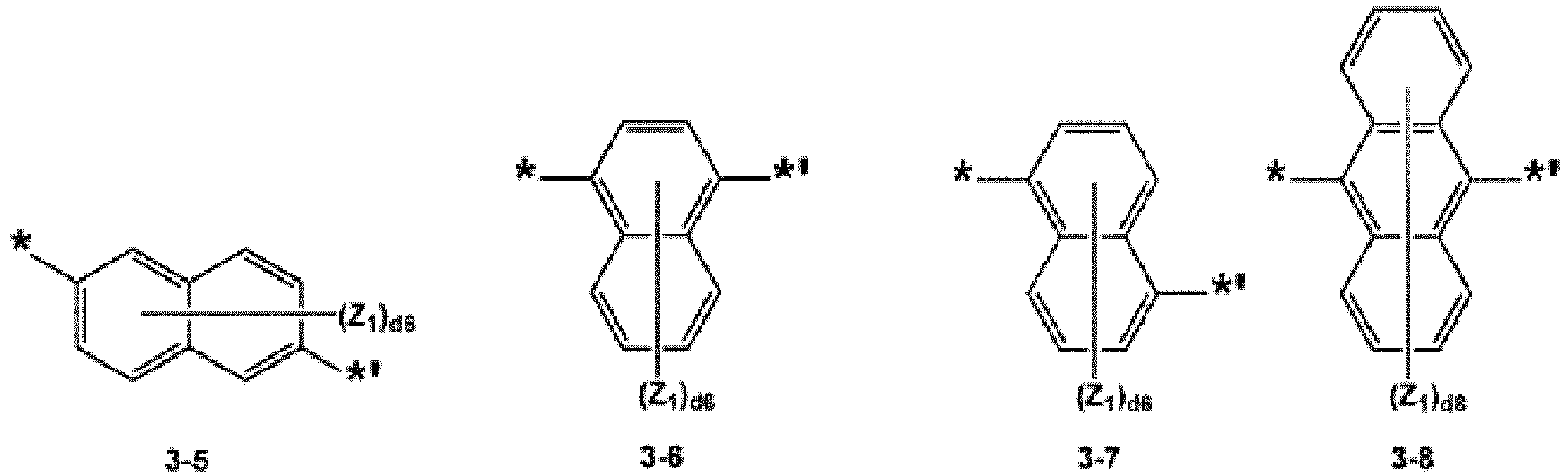


 Y1 est O, S, C(Z3)(Z4), N(Z5) ou Si(Z6)(Z7),Z1 à Z7 sont chacun indépendamment choisis parmi un hydrogène, un deutérium, - F, -Cl, -Br, -I, un groupe hydroxyle, un groupe cyano, un groupe C1-C20 alkyle, un groupe C1-C20 alcoxy, un groupe cyclopentyle, un groupe cyclohexyle, un groupe cycloheptyle, un groupe cyclopentényle, un groupe cyclohexényle, un groupe phényle, un groupe biphényle, un groupe terphényle, un groupe naphtyle, un groupe fluorényle, un groupe spiro-bifluorényle, un groupe benzofluorényle, un groupe dibenzofluorényle, un groupe phénanthrényle, un groupe anthracényle, un groupe fluoranthényle, un groupe triphénylényle, un groupe pyrényle, un groupe chrysényle, un groupe pyrrolyle, un groupe thiophényle, un groupe furanyle, un groupe silolyle, un groupe imidazolyle, un groupe pyrazolyle, un groupe thiazolyle, un groupe isothiazolyle, un groupe oxazolyle, un groupe isoxazolyle, un groupe pyridinyle, un groupe pyrazinyle, un groupe pyrimidinyle, un groupe pyridazinyle, un groupe benzofuranyle, un groupe benzothiophényle, un groupe benzosilolyle, un groupe dibenzofuranyle, un groupe dibenzothiophényle, un groupe dibenzosilolyle, un groupe carbazolyle, un groupe benzocarbazolyle, un groupe dibenzocarbazolyle et -Si(Q31)(Q32)(Q33); etun groupe phényle substitué avec au moins un choisi parmi -F, -Cl, -Br, -I et un groupe cyano,dans lequel Q31 à Q33 sont chacun indépendamment choisis parmi un groupe C1-C20 alkyle, un groupe C1-C20 alcoxy, un groupe phényle, un groupe biphényle, un groupe terphényle, un groupe naphtyle et un groupe pyridinyle,d2 est un nombre entier de 0 à 2,d3 est un nombre entier de 0 à 3,d4 est un nombre entier de 0 à 4,d6 est un nombre entier de 0 à 6,d8 est un nombre entier de 0 à 8, et* et *' indiquent chacun un site de liaison à un atome avoisinant.
 - Composé cyclique condensé selon l'une quelconque des revendications 1 à 3, dans lequel Ar11 est choisi parmi:un groupe phényle, un groupe biphényle, un groupe terphényle, un groupe pentalényle, un groupe indényle, un groupe naphtyle, un groupe azulényle, un groupe heptalényle, un groupe indacényle, un groupe acénaphtyle, un groupe fluorényle, un groupe spiro-bifluorényle, un groupe benzofluorényle, un groupe dibenzofluorényle, un groupe phénalényle, un groupe phénanthrényle, un groupe anthracényle, un groupe fluoranthényle, un groupe triphénylényle, un groupe pyrényle, un groupe chrysényle, un groupe naphtacényle, un groupe picényle, un groupe pérylényle, un groupe pentaphényle, un groupe hexacényle, un groupe pentacényle, un groupe rubicényle, un groupe coronényle, un groupe ovalényle, un groupe pyridinyle, un groupe pyrazinyle, un groupe pyrimidinyle, un groupe pyridazinyle, un groupe triazinyle, un groupe thiophényle, un groupe furanyle, un groupe quinoléinyle, un groupe isoquinoléinyle, un groupe carbazolyle, un groupe benzofuranyle, un groupe benzothiophényle, un groupe dibenzofuranyle, un groupe dibenzothiophényle, un groupe benzonaphtofuranyle, un groupe dinaphtofuranyle, un groupe benzocarbazolyle, un groupe dibenzocarbazolyle, un groupe dibenzosilolyle, un groupe benzonaphtosilolyle, un groupe dinaphtosilolyle, un groupe benzimidazolyle, un groupe phénanthrolinyle et un groupe imidazopyridinyle;un groupe phényle, un groupe biphényle, un groupe terphényle, un groupe pentalényle, un groupe indényle, un groupe naphtyle, un groupe azulényle, un groupe heptalényle, un groupe indacényle, un groupe acénaphtyle, un groupe fluorényle, un groupe spiro-bifluorényle, un groupe benzofluorényle, un groupe dibenzofluorényle, un groupe phénalényle, un groupe phénanthrényle, un groupe anthracényle, un groupe fluoranthényle, un groupe triphénylényle, un groupe pyrényle, un groupe chrysényle, un groupe naphtacényle, un groupe picényle, un groupe pérylényle, un groupe pentaphényle, un groupe hexacényle, un groupe pentacényle, un groupe rubicényle, un groupe coronényle, un groupe ovalényle, un groupe pyridinyle, un groupe pyrazinyle, un groupe pyrimidinyle, un groupe pyridazinyle, un groupe triazinyle, un groupe thiophényle, un groupe furanyle, un groupe quinoléinyle, un groupe isoquinoléinyle, un groupe carbazolyle, un groupe benzofuranyle, un groupe benzothiophényle, un groupe dibenzofuranyle, un groupe dibenzothiophényle, un groupe benzonaphtofuranyle, un groupe dinaphtofuranyle, un groupe benzocarbazolyle, un groupe dibenzocarbazolyle, un groupe dibenzosilolyle, un groupe benzonaphtosilolyle, un groupe dinaphtosilolyle, un groupe benzimidazolyle, un groupe phénanthrolinyle et un groupe imidazopyridinyle, chacun étant substitué avec au moins un choisi parmi un deutérium, -F, -Cl, -Br, -I, un groupe hydroxyle, un groupe cyano, un groupe nitro, un groupe amidino, un groupe hydrazino, un groupe hydrazono, un groupe C1-C20 alkyle, un groupe C1-C20 alcoxy, un groupe cyclopentyle, un groupe cyclohexyle, un groupe cycloheptyle, un groupe cyclopentényle, un groupe cyclohexényle, un groupe phényle, un groupe biphényle, un groupe terphényle, un groupe pentalényle, un groupe indényle, un groupe naphtyle, un groupe azulényle, un groupe heptalényle, un groupe indacényle, un groupe acénaphtyle, un groupe fluorényle, un groupe spiro-bifluorényle, un groupe benzofluorényle, un groupe dibenzofluorényle, un groupe phénalényle, un groupe phénanthrényle, un groupe anthracényle, un groupe fluoranthényle, un groupe triphénylényle, un groupe pyrényle, un groupe chrysényle, un groupe naphtacényle, un groupe picényle, un groupe pérylényle, un groupe pentaphényle, un groupe hexacényle, un groupe pentacényle, un groupe rubicényle, un groupe coronényle, un groupe ovalényle, un groupe pyridinyle, un groupe pyrazinyle, un groupe pyrimidinyle, un groupe pyridazinyle, un groupe triazinyle, un groupe thiophényle, un groupe furanyle, un groupe quinoléinyle, un groupe isoquinoléinyle, un groupe carbazolyle, un groupe benzofuranyle, un groupe benzothiophényle, un groupe dibenzofuranyle, un groupe dibenzothiophényle, un groupe benzocarbazolyle, un groupe dibenzocarbazolyle et un groupe dibenzosilolyle, - N(Q31)(Q32) et -Si(Q31)(Q32)(Q33); et-N(Q1)(Q2), -B(Q1)(Q2), -S(=O)2(Q1) et -P(=O)(Q1)(Q2),Q1, Q2 et Q31 à Q33 sont chacun indépendamment choisis parmi un groupe C1-C20 alkyle, un groupe C1-C20 alcoxy, un groupe phényle, un groupe biphényle, un groupe terphényle, un groupe naphtyle et un groupe pyridinyle; etun groupe phényle substitué avec au moins un choisi parmi -F, -Cl, -Br, -I, un groupe cyano et un groupe C1-C20 alkyle.
- Composé cyclique condensé selon la revendication 4, dans lequel Ar11 est choisi parmi:un groupe phényle, un groupe biphényle, un groupe naphtyle, un groupe fluorényle, un groupe pyridinyle, un groupe pyrimidinyle, un groupe triazinyle, un groupe quinoléinyle, un groupe carbazolyle et un groupe phénanthrolinyle;un groupe phényle, un groupe biphényle, un groupe naphtyle, un groupe fluorényle, un groupe pyridinyle, un groupe pyrimidinyle, un groupe triazinyle, un groupe quinoléinyle, un groupe carbazolyle et un groupe phénanthrolinyle, chacun étant substitué avec au moins un choisi parmi un deutérium, -F, -Cl, -Br, -I, un groupe hydroxyle, un groupe cyano, un groupe nitro, un groupe amidino, un groupe hydrazino, un groupe hydrazono, un groupe C1-C20 alkyle, un groupe C1-C20 alcoxy, un groupe phényle, un groupe biphényle, un groupe naphtyle, un groupe fluorényle, un groupe pyridinyle, un groupe pyrimidinyle, un groupe triazinyle, un groupe quinoléinyle, un groupe carbazolyle, un groupe phénanthrolinyle, -N(Q31)(Q32) et -Si(Q31)(Q32)(Q33); et-N(Q1)(Q2), -B(Q1)(Q2), -S(=O)2(Q1) et -P(=O)(Q1)(Q2),Q1, Q2 et Q31 à Q33 sont chacun indépendamment choisis parmi un groupe C1-C20 alkyle, un groupe C1-C20 alcoxy, un groupe phényle, un groupe biphényle, un groupe terphényle, un groupe naphtyle et un groupe pyridinyle; etun groupe phényle substitué avec au moins un choisi parmi -F, -Cl, -Br, -I, un groupe cyano et un groupe C1-C20 alkyle.
- Composé cyclique condensé selon l'une quelconque des revendications 1 à 5, dans lequel Ar11 est choisi parmi un groupe représenté par l'une des Formules 5-1 à 5-47, - N(Q1)(Q2), -B(Q1)(Q2), -S(=O)2(Q1) et -P(=O)(Q1)(Q2):


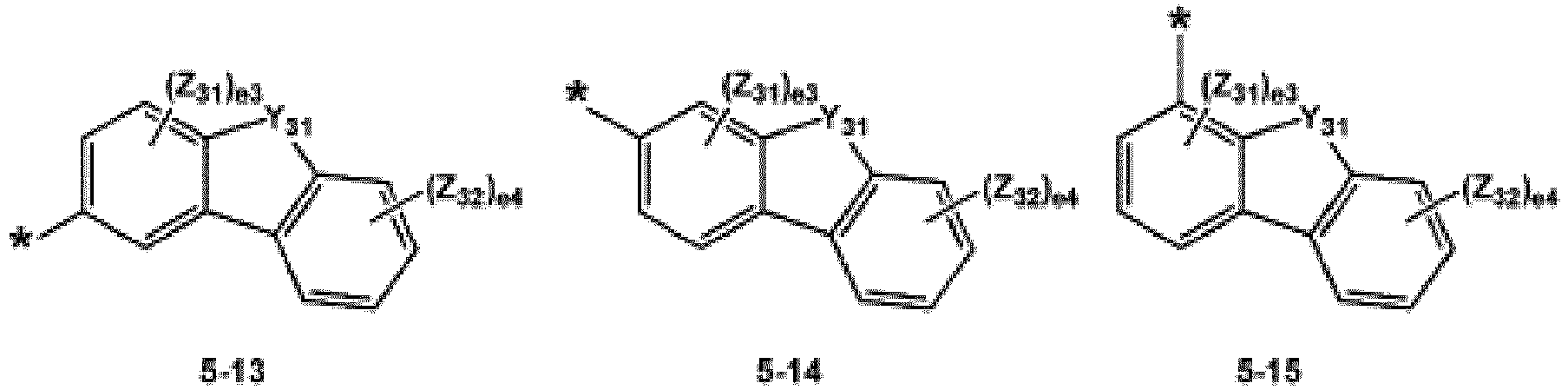


 Y31 est O, S, C(Z33)(Z34), N(Z35) ou Si(Z36)(Z37),Z31 à Z37 sont chacun indépendamment choisis parmi un hydrogène, un deutérium, -F, -Cl, -Br, -I, un groupe hydroxyle, un groupe cyano, un groupe C1-C20 alkyle, un groupe C1-C20 alcoxy, un groupe cyclopentyle, un groupe cyclohexyle, un groupe cycloheptyle, un groupe cyclopentényle, un groupe cyclohexényle, un groupe phényle, un groupe biphényle, un groupe terphényle, un groupe pentalényle, un groupe indényle, un groupe naphtyle, un groupe azulényle, un groupe heptalényle, un groupe indacényle, un groupe acénaphtyle, un groupe fluorényle, un groupe spiro-bifluorényle, un groupe benzofluorényle, un groupe dibenzofluorényle, un groupe phénalényle, un groupe phénanthrényle, un groupe anthracényle, un groupe fluoranthényle, un groupe triphénylényle, un groupe pyrényle, un groupe chrysényle, un groupe naphtacényle, un groupe picényle, un groupe pérylényle, un groupe pentaphényle, un groupe hexacényle, un groupe pentacényle, un groupe rubicényle, un groupe coronényle, un groupe ovalényle, un groupe pyrrolyle, un groupe thiophényle, un groupe furanyle, un groupe silolyle, un groupe pyridinyle, un groupe indolyle, un groupe isoindolyle, un groupe benzofuranyle, un groupe benzothiophényle, un groupe benzosilolyle, un groupe dibenzofuranyle, un groupe dibenzothiophényle, un groupe dibenzosilolyle, un groupe carbazolyle, un groupe benzocarbazolyle, un groupe dibenzocarbazolyle et - Si(Q31)(Q32)(Q33); etun groupe phényle substitué avec au moins un choisi parmi -F, -Cl, -Br, -I et un groupe cyano,Q1, Q2 et Q31 à Q33 sont chacun indépendamment choisis parmi un groupe C1-C20 alkyle, un groupe C1-C20 alcoxy, un groupe phényle, un groupe biphényle, un groupe terphényle, un groupe naphtyle et un groupe pyridinyle, etun groupe phényle substitué avec au moins un choisi parmi -F, -Cl, -Br, -I, un groupe cyano et un groupe C1-C20 alkyle,e2 est un nombre entier de 0 à 2,e3 est un nombre entier de 0 à 3,e4 est un nombre entier de 0 à 4,e5 est un nombre entier de 0 à 5,e6 est un nombre entier de 0 à 6,e7 est un nombre entier de 0 à 7,e9 est un nombre entier de 0 à 9, et* indique un site de liaison à un atome avoisinant.
 - Composé cyclique condensé selon l'une quelconque des revendications 1 à 6, dans lequel Ar11 est choisi parmi un groupe représenté par l'une des Formules 6-1 à 6-62 et un groupe représenté par l'une des Formules 10-1 à 10-20:


- Composé cyclique condensé selon l'une quelconque des revendications 1 à 7, dans lequel R1 est un groupe représenté par l'une des Formules 4-1 à 4-6 et 4-10 à 4-23:


- Composé cyclique condensé selon l'une quelconque des revendications 1 à 8, dans lequel au moins un choisi parmi R2 à R5 est un groupe représenté par la Formule 2.
- Composé cyclique condensé selon l'une quelconque des revendications 1 à 9, dans lequel R6 à R13 sont chacun un hydrogène.
- Composé cyclique condensé selon l'une quelconque des revendications 1 à 10, dans lequel:i) R2 est un groupe représenté par la Formule 2, et R3 à R13 sont chacun un hydrogène; ouii) R3 est un groupe représenté par la Formule 2, et R2 et R4 à R13 sont chacun un hydrogène; ouiii) R4 est un groupe représenté par la Formule 2, et R2, R3 et R5 à R13 sont chacun un hydrogène.
- Composé cyclique condensé selon l'une quelconque des revendications 1 à 11, où le composé cyclique condensé est choisi parmi les Composés 1 à 48 et 57 à 77:


- Dispositif électroluminescent organique comprenant:une première électrode;une deuxième électrode faisant face à la première électrode; etune couche organique entre la première électrode et la deuxième électrode, la couche organique incluant une couche d'émission,dans lequel la couche organique inclut au moins un composé cyclique condensé selon l'une quelconque des revendications 1 à 12.
- Dispositif électroluminescent organique selon la revendication 13, dans lequel:la première électrode est une anode,la deuxième électrode est une cathode,la couche organique inclut une région de transport de trous entre la première électrode et la couche d'émission et une région de transport d'électrons entre la couche d'émission et la deuxième électrode, dans lequel:la région de transport de trous inclut une couche d'injection de trous, une couche de transport de trous, une couche auxiliaire d'émission, une couche de blocage d'électrons ou toute combinaison de celles-ci, etla région de transport d'électrons inclut une couche tampon, une couche de blocage de trous, une couche de régulation d'électrons, une couche de transport d'électrons, une couche d'injection d'électrons ou toute combinaison de celles-ci.
- Dispositif électroluminescent organique selon la revendication 14, dans lequel la région de transport d'électrons inclut le au moins un composé cyclique condensé.
- Dispositif électroluminescent organique selon la revendication 14 ou la revendication 15, dans lequel la région de transport d'électrons inclut une couche de transport d'électrons et la couche de transport d'électrons inclut le au moins un composé cyclique condensé.
- Dispositif électroluminescent organique selon la revendication 16, dans lequel la région de transport d'électrons inclut une couche auxiliaire d'émission et le au moins un composé cyclique condensé est inclus dans la couche auxiliaire d'émission.
- Dispositif électroluminescent organique selon l'une quelconque des revendications 14 à 17, dans lequel:la région de transport de trous inclut un dopant p, etle dopant p a un niveau orbital moléculaire non occupé le plus bas (LUMO) de - 3,5 eV ou moins.
- Dispositif électroluminescent organique selon la revendication 18, dans lequel le dopant p inclut un composé contenant un groupe cyano.
- Dispositif électroluminescent organique selon l'une quelconque des revendications 13 à 19, dans lequel:la couche d'émission est une première couche d'émission émettant une lumière de première couleur,incluse entre la première électrode et la deuxième électrode, est: i) au moins une deuxième couche d'émission émettant une lumière de deuxième couleur, ou ii) au moins une deuxième couche d'émission émettant une lumière de deuxième couleur et au moins une troisième couche d'émission émettant une lumière de troisième couleur,la longueur d'onde d'émission maximum de la lumière de première couleur, la longueur d'onde d'émission maximum de la lumière de deuxième couleur et la longueur d'onde d'émission maximum de la lumière de troisième couleur sont identiques ou différentes les unes des autres, etla lumière de première couleur et la lumière de deuxième couleur sont émises comme des lumières mêlées ou la lumière de première couleur, la lumière de deuxième couleur et la lumière de troisième couleur sont émises comme des lumières mêlées.
Applications Claiming Priority (1)
| Application Number | Priority Date | Filing Date | Title |
|---|---|---|---|
| KR1020170063520A KR102504130B1 (ko) | 2017-05-23 | 2017-05-23 | 축합환 화합물 및 이를 포함한 유기 발광 소자 |
Publications (2)
| Publication Number | Publication Date |
|---|---|
| EP3406597A1 EP3406597A1 (fr) | 2018-11-28 |
| EP3406597B1 true EP3406597B1 (fr) | 2019-10-30 |
Family
ID=62222446
Family Applications (1)
| Application Number | Title | Priority Date | Filing Date |
|---|---|---|---|
| EP18173444.3A Active EP3406597B1 (fr) | 2017-05-23 | 2018-05-21 | Composé cyclique condensé et dispositif électroluminescent organique l'incluant |
Country Status (5)
| Country | Link |
|---|---|
| US (1) | US11133473B2 (fr) |
| EP (1) | EP3406597B1 (fr) |
| JP (1) | JP7170425B2 (fr) |
| KR (1) | KR102504130B1 (fr) |
| CN (1) | CN108929308B (fr) |
Families Citing this family (15)
| Publication number | Priority date | Publication date | Assignee | Title |
|---|---|---|---|---|
| CN116583131A (zh) | 2017-04-26 | 2023-08-11 | Oti照明公司 | 用于图案化表面上覆层的方法和包括图案化覆层的装置 |
| KR102571084B1 (ko) * | 2017-10-31 | 2023-08-28 | 삼성디스플레이 주식회사 | 헤테로시클릭 화합물 및 이를 포함한 유기 발광 소자 |
| KR102530627B1 (ko) * | 2017-12-26 | 2023-05-10 | 엘티소재주식회사 | 헤테로고리 화합물 및 이를 포함하는 유기 발광 소자 |
| US11751415B2 (en) | 2018-02-02 | 2023-09-05 | Oti Lumionics Inc. | Materials for forming a nucleation-inhibiting coating and devices incorporating same |
| KR102666983B1 (ko) * | 2019-02-26 | 2024-05-20 | 삼성디스플레이 주식회사 | 유기 발광 소자 |
| JP7390739B2 (ja) | 2019-03-07 | 2023-12-04 | オーティーアイ ルミオニクス インコーポレーテッド | 核生成抑制コーティングを形成するための材料およびそれを組み込んだデバイス |
| KR102831863B1 (ko) | 2019-04-18 | 2025-07-10 | 오티아이 루미오닉스 인크. | 핵 생성 억제 코팅 형성용 물질 및 이를 포함하는 디바이스 |
| JP7576337B2 (ja) | 2019-05-08 | 2024-11-01 | オーティーアイ ルミオニクス インコーポレーテッド | 核生成抑制コーティングを形成するための材料およびそれを組み込んだデバイス |
| CN110483529B (zh) * | 2019-08-09 | 2021-04-13 | 宁波卢米蓝新材料有限公司 | 一种稠杂环化合物及其应用 |
| CN110746425B (zh) * | 2019-10-21 | 2020-12-01 | 清华大学 | 一种有机化合物及其应用 |
| KR102341068B1 (ko) * | 2019-12-23 | 2021-12-17 | 에스케이머티리얼즈 주식회사 | 화합물, 유기 전계 발광 소자 및 표시 장치 |
| KR102877612B1 (ko) * | 2020-05-07 | 2025-10-29 | 삼성디스플레이 주식회사 | 헤테로시클릭 화합물 및 이를 포함한 발광 소자 |
| KR20220052384A (ko) * | 2020-10-19 | 2022-04-28 | 삼성디스플레이 주식회사 | 발광 소자 및 이를 포함하는 장치 |
| WO2022123431A1 (fr) | 2020-12-07 | 2022-06-16 | Oti Lumionics Inc. | Formation de motifs sur une couche conductrice déposée à l'aide de revêtement inhibiteur de nucléation et revêtement métallique sous-jacent |
| CN117343078A (zh) | 2021-11-25 | 2024-01-05 | 北京夏禾科技有限公司 | 有机电致发光材料和器件 |
Family Cites Families (8)
| Publication number | Priority date | Publication date | Assignee | Title |
|---|---|---|---|---|
| JP3755196B2 (ja) | 1996-06-28 | 2006-03-15 | チッソ株式会社 | シクロペンタジエン誘導体を用いることを特徴とする電界発光素子 |
| US5645948A (en) | 1996-08-20 | 1997-07-08 | Eastman Kodak Company | Blue organic electroluminescent devices |
| JP3834954B2 (ja) | 1997-09-05 | 2006-10-18 | チッソ株式会社 | シラシクロペンタジエン環を有する正孔輸送材料 |
| JP4060669B2 (ja) | 2002-08-28 | 2008-03-12 | 富士フイルム株式会社 | 1,3,6,8−四置換ピレン化合物、有機el素子及び有機elディスプレイ |
| KR100525408B1 (ko) | 2002-12-24 | 2005-11-02 | 엘지전자 주식회사 | 유기 전계 발광 소자 |
| US20150243895A1 (en) | 2014-02-26 | 2015-08-27 | Samsung Display Co., Ltd. | Compound and organic light-emitting device including the same |
| KR101808677B1 (ko) | 2014-06-02 | 2017-12-14 | 삼성디스플레이 주식회사 | 축합환 화합물 및 이를 포함한 유기 발광 소자 |
| KR101558495B1 (ko) | 2014-06-27 | 2015-10-12 | 희성소재 (주) | 다환 화합물 및 이를 이용한 유기발광소자 |
-
2017
- 2017-05-23 KR KR1020170063520A patent/KR102504130B1/ko active Active
-
2018
- 2018-01-11 US US15/867,855 patent/US11133473B2/en active Active
- 2018-05-21 EP EP18173444.3A patent/EP3406597B1/fr active Active
- 2018-05-22 JP JP2018097981A patent/JP7170425B2/ja active Active
- 2018-05-23 CN CN201810502892.3A patent/CN108929308B/zh active Active
Non-Patent Citations (1)
| Title |
|---|
| None * |
Also Published As
| Publication number | Publication date |
|---|---|
| CN108929308B (zh) | 2023-10-24 |
| KR20180128546A (ko) | 2018-12-04 |
| EP3406597A1 (fr) | 2018-11-28 |
| US20180342682A1 (en) | 2018-11-29 |
| US11133473B2 (en) | 2021-09-28 |
| KR102504130B1 (ko) | 2023-02-28 |
| JP7170425B2 (ja) | 2022-11-14 |
| JP2018197230A (ja) | 2018-12-13 |
| CN108929308A (zh) | 2018-12-04 |
Similar Documents
| Publication | Publication Date | Title |
|---|---|---|
| EP3406597B1 (fr) | Composé cyclique condensé et dispositif électroluminescent organique l'incluant | |
| EP3657563B1 (fr) | Composé hétérocyclique et dispositif électroluminescent organique l'incluant | |
| EP3441391B1 (fr) | Composé hétérocyclique et élément électroluminescent organique le comprenant | |
| JP7304682B2 (ja) | ヘテロ環式化合物、及びそれを含んだ有機発光素子 | |
| EP3214153B1 (fr) | Dispositif électroluminescent organique | |
| EP3444241B1 (fr) | Composé aminé et dispositif électroluminescent organique contenant ce composé | |
| EP3301097B1 (fr) | Dérivés de [1]benzothieno[3',2':4,5]imidazo[1,2-a]pyridine et composés similaires à être utilisés dans de dispositifs d'émission de lumière organiques (oleds) | |
| EP3389109A1 (fr) | Derivés de phosphore substitués par des hétérocycles et diodes électroluminiscentes organiques les contenant | |
| EP3502107B1 (fr) | Composé basé sur le 1-aminodibenzofurane et dispositif électroluminescent organique le comprenant | |
| EP3539972A1 (fr) | Composé organométallique et dispositif électroluminescent organique l'incluant | |
| EP3561894B1 (fr) | Composé de diamine et dispositif électroluminescent organique l'incluant | |
| EP3537495B1 (fr) | Dispositif électroluminescent organique | |
| EP3476852B1 (fr) | Composé hétérocyclique et dispositif électroluminescent organique l'incluant | |
| EP3428149A2 (fr) | Composé cyclique condensé et dispositif électroluminescent organique le comprenant | |
| EP3783007A1 (fr) | Composé organométallique et dispositif électroluminescent organique l'incluant | |
| EP3296288B1 (fr) | Composé cyclique condensé et dispositif électroluminescent organique le comprenant | |
| CN120568978A (zh) | 杂环化合物和包括该杂环化合物的有机发光器件 | |
| EP3418272B1 (fr) | Composés triazine et dispositifs électroluminescents organiques les incluant | |
| EP3748706B1 (fr) | Composé hétérocyclique et dispositif électroluminescent organique l'incluant | |
| EP3854795B1 (fr) | Composé cyclique condensé et diode électroluminescente organique le comprenant | |
| EP3575295B1 (fr) | Composé hétérocyclique et dispositif électroluminescent organique l'incluant | |
| EP3333168B1 (fr) | Composé cyclique condensé et dispositif électroluminescent organique le comprenant | |
| KR20200052503A (ko) | 아민계 화합물 및 이를 포함한 유기 발광 소자 |
Legal Events
| Date | Code | Title | Description |
|---|---|---|---|
| PUAI | Public reference made under article 153(3) epc to a published international application that has entered the european phase |
Free format text: ORIGINAL CODE: 0009012 |
|
| STAA | Information on the status of an ep patent application or granted ep patent |
Free format text: STATUS: THE APPLICATION HAS BEEN PUBLISHED |
|
| AK | Designated contracting states |
Kind code of ref document: A1 Designated state(s): AL AT BE BG CH CY CZ DE DK EE ES FI FR GB GR HR HU IE IS IT LI LT LU LV MC MK MT NL NO PL PT RO RS SE SI SK SM TR |
|
| AX | Request for extension of the european patent |
Extension state: BA ME |
|
| STAA | Information on the status of an ep patent application or granted ep patent |
Free format text: STATUS: REQUEST FOR EXAMINATION WAS MADE |
|
| 17P | Request for examination filed |
Effective date: 20181207 |
|
| RBV | Designated contracting states (corrected) |
Designated state(s): AL AT BE BG CH CY CZ DE DK EE ES FI FR GB GR HR HU IE IS IT LI LT LU LV MC MK MT NL NO PL PT RO RS SE SI SK SM TR |
|
| GRAP | Despatch of communication of intention to grant a patent |
Free format text: ORIGINAL CODE: EPIDOSNIGR1 |
|
| STAA | Information on the status of an ep patent application or granted ep patent |
Free format text: STATUS: GRANT OF PATENT IS INTENDED |
|
| RIC1 | Information provided on ipc code assigned before grant |
Ipc: C07D 221/18 20060101AFI20190411BHEP Ipc: C07D 401/14 20060101ALI20190411BHEP Ipc: C07F 9/53 20060101ALI20190411BHEP Ipc: C07D 403/10 20060101ALI20190411BHEP Ipc: C07D 403/04 20060101ALI20190411BHEP Ipc: C07D 471/04 20060101ALI20190411BHEP Ipc: C07D 401/10 20060101ALI20190411BHEP Ipc: C07F 5/02 20060101ALI20190411BHEP Ipc: H01L 51/00 20060101ALI20190411BHEP |
|
| INTG | Intention to grant announced |
Effective date: 20190502 |
|
| RAP1 | Party data changed (applicant data changed or rights of an application transferred) |
Owner name: SAMSUNG DISPLAY CO., LTD. |
|
| GRAS | Grant fee paid |
Free format text: ORIGINAL CODE: EPIDOSNIGR3 |
|
| GRAA | (expected) grant |
Free format text: ORIGINAL CODE: 0009210 |
|
| STAA | Information on the status of an ep patent application or granted ep patent |
Free format text: STATUS: THE PATENT HAS BEEN GRANTED |
|
| AK | Designated contracting states |
Kind code of ref document: B1 Designated state(s): AL AT BE BG CH CY CZ DE DK EE ES FI FR GB GR HR HU IE IS IT LI LT LU LV MC MK MT NL NO PL PT RO RS SE SI SK SM TR |
|
| REG | Reference to a national code |
Ref country code: GB Ref legal event code: FG4D |
|
| REG | Reference to a national code |
Ref country code: CH Ref legal event code: EP |
|
| REG | Reference to a national code |
Ref country code: DE Ref legal event code: R096 Ref document number: 602018001028 Country of ref document: DE |
|
| REG | Reference to a national code |
Ref country code: AT Ref legal event code: REF Ref document number: 1195978 Country of ref document: AT Kind code of ref document: T Effective date: 20191115 |
|
| REG | Reference to a national code |
Ref country code: IE Ref legal event code: FG4D |
|
| REG | Reference to a national code |
Ref country code: LT Ref legal event code: MG4D |
|
| PG25 | Lapsed in a contracting state [announced via postgrant information from national office to epo] |
Ref country code: NO Free format text: LAPSE BECAUSE OF FAILURE TO SUBMIT A TRANSLATION OF THE DESCRIPTION OR TO PAY THE FEE WITHIN THE PRESCRIBED TIME-LIMIT Effective date: 20200130 Ref country code: PL Free format text: LAPSE BECAUSE OF FAILURE TO SUBMIT A TRANSLATION OF THE DESCRIPTION OR TO PAY THE FEE WITHIN THE PRESCRIBED TIME-LIMIT Effective date: 20191030 Ref country code: GR Free format text: LAPSE BECAUSE OF FAILURE TO SUBMIT A TRANSLATION OF THE DESCRIPTION OR TO PAY THE FEE WITHIN THE PRESCRIBED TIME-LIMIT Effective date: 20200131 Ref country code: NL Free format text: LAPSE BECAUSE OF FAILURE TO SUBMIT A TRANSLATION OF THE DESCRIPTION OR TO PAY THE FEE WITHIN THE PRESCRIBED TIME-LIMIT Effective date: 20191030 Ref country code: LT Free format text: LAPSE BECAUSE OF FAILURE TO SUBMIT A TRANSLATION OF THE DESCRIPTION OR TO PAY THE FEE WITHIN THE PRESCRIBED TIME-LIMIT Effective date: 20191030 Ref country code: LV Free format text: LAPSE BECAUSE OF FAILURE TO SUBMIT A TRANSLATION OF THE DESCRIPTION OR TO PAY THE FEE WITHIN THE PRESCRIBED TIME-LIMIT Effective date: 20191030 Ref country code: SE Free format text: LAPSE BECAUSE OF FAILURE TO SUBMIT A TRANSLATION OF THE DESCRIPTION OR TO PAY THE FEE WITHIN THE PRESCRIBED TIME-LIMIT Effective date: 20191030 Ref country code: PT Free format text: LAPSE BECAUSE OF FAILURE TO SUBMIT A TRANSLATION OF THE DESCRIPTION OR TO PAY THE FEE WITHIN THE PRESCRIBED TIME-LIMIT Effective date: 20200302 Ref country code: FI Free format text: LAPSE BECAUSE OF FAILURE TO SUBMIT A TRANSLATION OF THE DESCRIPTION OR TO PAY THE FEE WITHIN THE PRESCRIBED TIME-LIMIT Effective date: 20191030 Ref country code: BG Free format text: LAPSE BECAUSE OF FAILURE TO SUBMIT A TRANSLATION OF THE DESCRIPTION OR TO PAY THE FEE WITHIN THE PRESCRIBED TIME-LIMIT Effective date: 20200130 |
|
| REG | Reference to a national code |
Ref country code: NL Ref legal event code: MP Effective date: 20191030 |
|
| PG25 | Lapsed in a contracting state [announced via postgrant information from national office to epo] |
Ref country code: HR Free format text: LAPSE BECAUSE OF FAILURE TO SUBMIT A TRANSLATION OF THE DESCRIPTION OR TO PAY THE FEE WITHIN THE PRESCRIBED TIME-LIMIT Effective date: 20191030 Ref country code: RS Free format text: LAPSE BECAUSE OF FAILURE TO SUBMIT A TRANSLATION OF THE DESCRIPTION OR TO PAY THE FEE WITHIN THE PRESCRIBED TIME-LIMIT Effective date: 20191030 Ref country code: IS Free format text: LAPSE BECAUSE OF FAILURE TO SUBMIT A TRANSLATION OF THE DESCRIPTION OR TO PAY THE FEE WITHIN THE PRESCRIBED TIME-LIMIT Effective date: 20200229 |
|
| PG25 | Lapsed in a contracting state [announced via postgrant information from national office to epo] |
Ref country code: AL Free format text: LAPSE BECAUSE OF FAILURE TO SUBMIT A TRANSLATION OF THE DESCRIPTION OR TO PAY THE FEE WITHIN THE PRESCRIBED TIME-LIMIT Effective date: 20191030 |
|
| PG25 | Lapsed in a contracting state [announced via postgrant information from national office to epo] |
Ref country code: ES Free format text: LAPSE BECAUSE OF FAILURE TO SUBMIT A TRANSLATION OF THE DESCRIPTION OR TO PAY THE FEE WITHIN THE PRESCRIBED TIME-LIMIT Effective date: 20191030 Ref country code: DK Free format text: LAPSE BECAUSE OF FAILURE TO SUBMIT A TRANSLATION OF THE DESCRIPTION OR TO PAY THE FEE WITHIN THE PRESCRIBED TIME-LIMIT Effective date: 20191030 Ref country code: RO Free format text: LAPSE BECAUSE OF FAILURE TO SUBMIT A TRANSLATION OF THE DESCRIPTION OR TO PAY THE FEE WITHIN THE PRESCRIBED TIME-LIMIT Effective date: 20191030 Ref country code: EE Free format text: LAPSE BECAUSE OF FAILURE TO SUBMIT A TRANSLATION OF THE DESCRIPTION OR TO PAY THE FEE WITHIN THE PRESCRIBED TIME-LIMIT Effective date: 20191030 Ref country code: CZ Free format text: LAPSE BECAUSE OF FAILURE TO SUBMIT A TRANSLATION OF THE DESCRIPTION OR TO PAY THE FEE WITHIN THE PRESCRIBED TIME-LIMIT Effective date: 20191030 |
|
| REG | Reference to a national code |
Ref country code: DE Ref legal event code: R097 Ref document number: 602018001028 Country of ref document: DE |
|
| REG | Reference to a national code |
Ref country code: AT Ref legal event code: MK05 Ref document number: 1195978 Country of ref document: AT Kind code of ref document: T Effective date: 20191030 |
|
| PG25 | Lapsed in a contracting state [announced via postgrant information from national office to epo] |
Ref country code: SK Free format text: LAPSE BECAUSE OF FAILURE TO SUBMIT A TRANSLATION OF THE DESCRIPTION OR TO PAY THE FEE WITHIN THE PRESCRIBED TIME-LIMIT Effective date: 20191030 Ref country code: SM Free format text: LAPSE BECAUSE OF FAILURE TO SUBMIT A TRANSLATION OF THE DESCRIPTION OR TO PAY THE FEE WITHIN THE PRESCRIBED TIME-LIMIT Effective date: 20191030 Ref country code: IT Free format text: LAPSE BECAUSE OF FAILURE TO SUBMIT A TRANSLATION OF THE DESCRIPTION OR TO PAY THE FEE WITHIN THE PRESCRIBED TIME-LIMIT Effective date: 20191030 |
|
| PLBE | No opposition filed within time limit |
Free format text: ORIGINAL CODE: 0009261 |
|
| STAA | Information on the status of an ep patent application or granted ep patent |
Free format text: STATUS: NO OPPOSITION FILED WITHIN TIME LIMIT |
|
| 26N | No opposition filed |
Effective date: 20200731 |
|
| PG25 | Lapsed in a contracting state [announced via postgrant information from national office to epo] |
Ref country code: SI Free format text: LAPSE BECAUSE OF FAILURE TO SUBMIT A TRANSLATION OF THE DESCRIPTION OR TO PAY THE FEE WITHIN THE PRESCRIBED TIME-LIMIT Effective date: 20191030 Ref country code: AT Free format text: LAPSE BECAUSE OF FAILURE TO SUBMIT A TRANSLATION OF THE DESCRIPTION OR TO PAY THE FEE WITHIN THE PRESCRIBED TIME-LIMIT Effective date: 20191030 |
|
| PG25 | Lapsed in a contracting state [announced via postgrant information from national office to epo] |
Ref country code: MC Free format text: LAPSE BECAUSE OF FAILURE TO SUBMIT A TRANSLATION OF THE DESCRIPTION OR TO PAY THE FEE WITHIN THE PRESCRIBED TIME-LIMIT Effective date: 20191030 |
|
| REG | Reference to a national code |
Ref country code: BE Ref legal event code: MM Effective date: 20200531 |
|
| PG25 | Lapsed in a contracting state [announced via postgrant information from national office to epo] |
Ref country code: LU Free format text: LAPSE BECAUSE OF NON-PAYMENT OF DUE FEES Effective date: 20200521 |
|
| PG25 | Lapsed in a contracting state [announced via postgrant information from national office to epo] |
Ref country code: IE Free format text: LAPSE BECAUSE OF NON-PAYMENT OF DUE FEES Effective date: 20200521 |
|
| PG25 | Lapsed in a contracting state [announced via postgrant information from national office to epo] |
Ref country code: BE Free format text: LAPSE BECAUSE OF NON-PAYMENT OF DUE FEES Effective date: 20200531 |
|
| REG | Reference to a national code |
Ref country code: CH Ref legal event code: PL |
|
| PG25 | Lapsed in a contracting state [announced via postgrant information from national office to epo] |
Ref country code: LI Free format text: LAPSE BECAUSE OF NON-PAYMENT OF DUE FEES Effective date: 20210531 Ref country code: CH Free format text: LAPSE BECAUSE OF NON-PAYMENT OF DUE FEES Effective date: 20210531 |
|
| PG25 | Lapsed in a contracting state [announced via postgrant information from national office to epo] |
Ref country code: TR Free format text: LAPSE BECAUSE OF FAILURE TO SUBMIT A TRANSLATION OF THE DESCRIPTION OR TO PAY THE FEE WITHIN THE PRESCRIBED TIME-LIMIT Effective date: 20191030 Ref country code: MT Free format text: LAPSE BECAUSE OF FAILURE TO SUBMIT A TRANSLATION OF THE DESCRIPTION OR TO PAY THE FEE WITHIN THE PRESCRIBED TIME-LIMIT Effective date: 20191030 Ref country code: CY Free format text: LAPSE BECAUSE OF FAILURE TO SUBMIT A TRANSLATION OF THE DESCRIPTION OR TO PAY THE FEE WITHIN THE PRESCRIBED TIME-LIMIT Effective date: 20191030 |
|
| PG25 | Lapsed in a contracting state [announced via postgrant information from national office to epo] |
Ref country code: MK Free format text: LAPSE BECAUSE OF FAILURE TO SUBMIT A TRANSLATION OF THE DESCRIPTION OR TO PAY THE FEE WITHIN THE PRESCRIBED TIME-LIMIT Effective date: 20191030 |
|
| P01 | Opt-out of the competence of the unified patent court (upc) registered |
Effective date: 20230516 |
|
| PGFP | Annual fee paid to national office [announced via postgrant information from national office to epo] |
Ref country code: DE Payment date: 20250422 Year of fee payment: 8 |
|
| PGFP | Annual fee paid to national office [announced via postgrant information from national office to epo] |
Ref country code: FR Payment date: 20250422 Year of fee payment: 8 |
|
| PGFP | Annual fee paid to national office [announced via postgrant information from national office to epo] |
Ref country code: GB Payment date: 20260324 Year of fee payment: 9 |