EP3754101A1 - Laserendbearbeitungsverfahren zur bereitstellung eines endbearbeitungsmusters auf einem gewebe - Google Patents
Laserendbearbeitungsverfahren zur bereitstellung eines endbearbeitungsmusters auf einem gewebe Download PDFInfo
- Publication number
- EP3754101A1 EP3754101A1 EP19181296.5A EP19181296A EP3754101A1 EP 3754101 A1 EP3754101 A1 EP 3754101A1 EP 19181296 A EP19181296 A EP 19181296A EP 3754101 A1 EP3754101 A1 EP 3754101A1
- Authority
- EP
- European Patent Office
- Prior art keywords
- scribed
- fabric
- pattern
- article
- model
- Prior art date
- Legal status (The legal status is an assumption and is not a legal conclusion. Google has not performed a legal analysis and makes no representation as to the accuracy of the status listed.)
- Pending
Links
Images




Classifications
-
- D—TEXTILES; PAPER
- D06—TREATMENT OF TEXTILES OR THE LIKE; LAUNDERING; FLEXIBLE MATERIALS NOT OTHERWISE PROVIDED FOR
- D06M—TREATMENT, NOT PROVIDED FOR ELSEWHERE IN CLASS D06, OF FIBRES, THREADS, YARNS, FABRICS, FEATHERS OR FIBROUS GOODS MADE FROM SUCH MATERIALS
- D06M10/00—Physical treatment of fibres, threads, yarns, fabrics or fibrous goods made from such materials, e.g. by ultrasonic waves, corona discharge, irradiation, electric currents or magnetic fields; Physical treatment combined with treatment with chemical compounds or elements
- D06M10/005—Laser beam treatment
-
- D—TEXTILES; PAPER
- D06—TREATMENT OF TEXTILES OR THE LIKE; LAUNDERING; FLEXIBLE MATERIALS NOT OTHERWISE PROVIDED FOR
- D06B—TREATING TEXTILE MATERIALS USING LIQUIDS, GASES OR VAPOURS
- D06B11/00—Treatment of selected parts of textile materials, e.g. partial dyeing
- D06B11/0093—Treatments carried out during or after a regular application of treating materials, in order to get differentiated effects on the textile material
- D06B11/0096—Treatments carried out during or after a regular application of treating materials, in order to get differentiated effects on the textile material to get a faded look
-
- D—TEXTILES; PAPER
- D06—TREATMENT OF TEXTILES OR THE LIKE; LAUNDERING; FLEXIBLE MATERIALS NOT OTHERWISE PROVIDED FOR
- D06M—TREATMENT, NOT PROVIDED FOR ELSEWHERE IN CLASS D06, OF FIBRES, THREADS, YARNS, FABRICS, FEATHERS OR FIBROUS GOODS MADE FROM SUCH MATERIALS
- D06M23/00—Treatment of fibres, threads, yarns, fabrics or fibrous goods made from such materials, characterised by the process
- D06M23/16—Processes for the non-uniform application of treating agents, e.g. one-sided treatment; Differential treatment
-
- D—TEXTILES; PAPER
- D06—TREATMENT OF TEXTILES OR THE LIKE; LAUNDERING; FLEXIBLE MATERIALS NOT OTHERWISE PROVIDED FOR
- D06P—DYEING OR PRINTING TEXTILES; DYEING LEATHER, FURS OR SOLID MACROMOLECULAR SUBSTANCES IN ANY FORM
- D06P5/00—Other features in dyeing or printing textiles, or dyeing leather, furs, or solid macromolecular substances in any form
- D06P5/13—Fugitive dyeing or stripping dyes
-
- D—TEXTILES; PAPER
- D06—TREATMENT OF TEXTILES OR THE LIKE; LAUNDERING; FLEXIBLE MATERIALS NOT OTHERWISE PROVIDED FOR
- D06P—DYEING OR PRINTING TEXTILES; DYEING LEATHER, FURS OR SOLID MACROMOLECULAR SUBSTANCES IN ANY FORM
- D06P5/00—Other features in dyeing or printing textiles, or dyeing leather, furs, or solid macromolecular substances in any form
- D06P5/15—Locally discharging the dyes
-
- D—TEXTILES; PAPER
- D06—TREATMENT OF TEXTILES OR THE LIKE; LAUNDERING; FLEXIBLE MATERIALS NOT OTHERWISE PROVIDED FOR
- D06P—DYEING OR PRINTING TEXTILES; DYEING LEATHER, FURS OR SOLID MACROMOLECULAR SUBSTANCES IN ANY FORM
- D06P5/00—Other features in dyeing or printing textiles, or dyeing leather, furs, or solid macromolecular substances in any form
- D06P5/20—Physical treatments affecting dyeing, e.g. ultrasonic or electric
- D06P5/2005—Treatments with alpha, beta, gamma or other rays, e.g. stimulated rays
-
- D—TEXTILES; PAPER
- D06—TREATMENT OF TEXTILES OR THE LIKE; LAUNDERING; FLEXIBLE MATERIALS NOT OTHERWISE PROVIDED FOR
- D06Q—DECORATING TEXTILES
- D06Q1/00—Decorating textiles
- D06Q1/02—Producing patterns by locally destroying or modifying the fibres of a web by chemical actions, e.g. making translucent
Definitions
- the present invention relates to a laser finishing method of a fabric, and in particular of fabric suitable for assembling an article and preferably a clothing article, in order to obtain a desired finishing or appearance pattern such as for example a faded, or worn finish look effect, or to reproduce an image from a graphic file, for example to replicate on the clothing article an image or a printed pattern.
- the present invention relates to a method for finishing of fabrics, and in particular fabrics or articles (and in particular clothing article) having a so-called diagonal weaving pattern, such as a twill weave, for example of denim and denim apparel including for example jeans, shirts, shorts, jackets, skirts, to obtain a faded, washed, or worn finish or appearance.
- a diagonal weaving pattern such as a twill weave
- denim and denim apparel including for example jeans, shirts, shorts, jackets, skirts
- the apparatus and the method according to the present invention are not limited to this application, but can be applied to any field wherein a laser beam is used to form a finishing or appearance pattern on workpiece, preferably having a suitable weave pattern formed by a plurality of woven yarns, e.g. a fabric used to manufacture an article comprising such a fabric.
- the finishing pattern is provided by a laser, which scans the working surface.
- the surface of the workpiece for example a fabric
- the output power of the laser is varied according to the pattern to be reproduced, since each change in output power value is associated with the change in abrasion along the pattern geometry and the energy of the single pulse is varied according to the specific grey tone of the image (pattern) to be reproduced.
- the finishing pattern on the clothing article is typically carried out by a laser apparatus comprising a laser source, by providing an input graphic file containing the predetermined finishing pattern to be scribed on the article of clothing.
- the pattern is scribed on the finished clothing article, i.e. on a clothing article whose portions are assembled, e.g. sewed together, not taking into account possible seams or hidden portions, such as the internal part of the pockets, or portions of clothing article which lies under possible belt loops, or hems which may require specific scribing operation with respect to other areas of the clothing article to be scribed. Consequently, the pattern which is reproduced on the clothing article does not provide the desired visual effect.
- finishing techniques known in the art the clothing article on which the finishing pattern has to be provided, is scribed with a finishing pattern by a laser source so that the one or more line of the finishing pattern is perpendicular, or parallel to the warp yarns, and in particular with respect to the direction of extension of the warp yarns of the fabric.
- a fabric or garment and in particular a woven fabric, is provided with warp and weft yarns woven together, according to a weaving pattern.
- the warp yarns are substantially parallel one to another, arranged along a direction of extension, e.g. a substantially straight line according to which the warp yarn is arranged within the fabric, that is also indicated herein as warp yarns direction.
- the direction of extension of the warp yarns is usually perpendicular to the weft yarns direction.
- one side of the fabric exposes more of the warp yarns (e.g., warp-faced side), while the other side exposes more of the weft yarns (e.g., weft-faced side).
- the warp yarns are coloured (e.g. indigo dyed) and weft yarns are white, a result of the weave is the warp-faced side will appear mostly blue (indigo dyed) while the reverse side, weft-faced side, will appear mostly white.
- the one or more lines of the finishing pattern scribed on the fabric or garment are scribed (marked) to be perpendicular, or parallel, to the warp yarns i.e. the indigo dyed yarns.
- the one or more lines of the finishing pattern are scribed (marked) on the fabric or garment to be perpendicular, or parallel, with respect to the direction of extension of the warp yarns, in order to abrade or remove the desired amount of the die or of the yarn.
- scribing a line on a clothing article or fabric is intended as scribing or marking a line by means of a laser beam, preferably wherein the localized thermal effect of the laser beam selectively removes dyes, paints or breaks yarns, according with power density values.
- the line of the finishing pattern e.g. a straight line of the finishing pattern, is forming a right angle, or substantially a right angle, with respect to the warp direction.
- a suitable type of weaving pattern in particular a diagonal weaving pattern, e.g. a twill weave, for example denim and denim apparel.
- Another object of the present invention is to provide a method for the reproduction of a pattern on a clothing article by which a more realistic visual effect, with respect to known methods, may be reached.
- Still another object of the present invention is to provide a laser finishing method allowing a rapid marking of a predetermined pattern on a clothing article which provides a high - quality pattern due to a high accuracy formed lines.
- Still another object of the present invention is to provide a method for the formation of a pattern on a clothing article which can be easily adapted to the real shape and 3D geometry of the clothing article to be scribed or marked.
- the method for providing a finishing pattern on fabric by a laser apparatus comprising at least one laser source generating an output laser beam and moving means for said laser beam and a control unit, the method comprising the steps of:
- the present invention can be applied to any article made of a fabric, e.g. an article that is not wearable by a user. It has to be also noted in the following reference will be made to a lines and/or dots scribed (marked) by the laser beam for providing the finishing pattern to indicate continuous lines (preferably straight lines), or lines made by a plurality of dots (for example provided by a pulsed laser) and arranged in succession one to another (preferably along a straight path), so as to form a line. It has to be noted that the according to the laser beam used the dots marked on the fabric can be provided to be connected one to another so as to form a continuous line of the scribed pattern.
- a model of the article and in particular of a clothing article to be scribed and also of the article with the predetermined finishing pattern applied thereon i.e. the output model
- a realistic model of the final clothing article as will be scribed by the laser apparatus, can be prepared and thus the position of the finishing pattern on each portion of the clothing article can be provided before carrying out the step of scribing the finishing pattern lines by the laser.
- the use of a model of the clothing article on which the desired finishing pattern is applied allow to provide a certain and correct position of the finishing pattern on the fabric scribed by the laser.
- the command instructions comprise instructions for operating said laser apparatus for generating said output laser beam for cutting said fabric, obtaining at least one portion or surface, preferably a plurality of portions or surfaces of the clothing article according to said output model.
- the pattern has to be applied on a clothing article comprising several portions, such as trousers and in particular jeans.
- the pattern is scribed (marked) on distinct portions of clothing article already cut from a fabric, with the disadvantage that the portions have to be positioned in precise predetermined positions with respect to the laser apparatus, in order to be scribed by the latter, according to the predetermined finishing pattern. If one or more portions are slightly displaced from the predetermined positions, the pattern is scribed displaced with respect to the output model.
- the pattern can be scribed on a fabric according to the output model, and then each portion of a clothing article can be obtained by laser cutting according to the information provided with the same output model.
- the laser apparatus scans the fabric, selectively scribing only the areas of the fabric which correspond to the portions forming the clothing article, while not scribing other areas of the fabric.
- the laser apparatus is operated to cut the scribed portions and the non-scribed portions (in any), following the profiles contained in the output model.
- the portions are assembled, for example by known techniques, e.g. by sewing, to provide the required final article, and in particular to provide the required final clothing article, garment or apparel.
- the input model comprises a 2D input model comprising at least one surface or portion, preferably a plurality of surfaces or portions, each corresponding to a different portion of the clothing article and/or a 3D input model of the clothing article to be scribed.
- An advantage of this embodiment is that the laser apparatus, preferably via a control unit, can be easily and effectively controlled according to a 2D and/ or 3D output model containing both information relating for example to the shape, profile, dimension (or a combination thereof) of the portions of the clothing article and also containing information relating to the finishing pattern to be applied on the clothing article.
- the finishing pattern applied thereon allow to effectively obtain the correct and desired position of the finishing pattern on each part of the clothing article scribed by means of the laser.
- the input model can comprise information according to the size of the article and thus dimension of the at least one portion or surface of the article.
- the operator can select or insert the required size of the article (e.g. the size of the clothing article) and the input model comprises accordingly at least one portion or surface having dimension according to the selected or inserted size of the article.
- the operator advantageously has the possibility of displaying both the 2D and the 3D input model on a monitor at the same time.
- said model of said at least one portion of said clothing article to be scribed is obtained by converting said 3D model of the clothing article in said 2D model comprising a plurality of 2D surfaces.
- the model of the clothing article intended to be scribed (marked) with the method according to the invention can be provided as a flat body, or flat portions.
- model of the clothing article is provided (e.g. shown) arranged on a dummy or a hanger or similar support in order to simulate the real shape when worn.
- the clothing article intended to be scribed can be provided with the real shape they have when worn, having a 3D geometry.
- the step of combining the predetermined finishing pattern to be scribed on said fabric and the input model of said at least one portion of clothing article to be scribed, obtaining said output model further comprises the step of modifying said output model by adjusting the pattern appearance on said input model, in order to modify the final length and/or width and/or shape of said pattern as it appears on the clothing article.
- combining the predetermined finishing pattern to be scribed and the input model of the clothing article to be scribed allows to provide a much more realistic model of the final clothing article, as it will be scribed by the laser apparatus.
- said output model comprises a 2D output model comprising at least one surface each corresponding to a scribed portion of the clothing article and/or a 3D output model of the clothing article to be scribed.
- an operator can display both the 3D and the 2D output models on a monitor, in order to have a full view of the final result.
- an operator can modify the output model according to the needed result allowing for a better customization of the clothing article thanks to the digitalized output model, and avoiding the use of prior art finishing techniques such as use of chemicals and abrasions on the final clothing article.
- the method comprises the further step of unfolding the 3D model of the scribed clothing article in a plurality of surfaces, each corresponding to a different portion of the clothing article to be scribed, obtaining the 2D output model of a plurality of scribed portions of the clothing article according to said 3D output model.
- the step of scribing said pattern on the clothing article is performed by said laser apparatus which receives said command instructions according to said output 2D and/or 3D model of at least one of scribed portions of said clothing article.
- different portions of the clothing article can be scribed separately from each other, in order to avoid different portions of the clothing article to be scribed in a non-homogeneous manner.
- the desired portion of the clothing article can be scribed according to information for scribing the corresponding portion of the clothing article provided by said output model.
- the 2D output model can be being directly provided by combining the pattern and the 2D input model, or generated from the 3D output model by unfolding or dividing it, thus providing a certain and accurate position of the finishing pattern on each portion of the clothing article.
- unfolding the 3D output model of the scribed clothing article in a 2D output model allows to simplify the instruction to be provided to the laser apparatus and allow to provide the scribing pattern for at least one portion used to assembly the final and complete clothing article. As above mentioned, some portions of the final clothing article may not be scribed.
- the fabric of which the clothing article is made comprises a plurality of warp yarns and weft yarns woven together to form a diagonal pattern comprising a plurality of diagonal lines, wherein in said step of scribing lines forming the predetermined finishing pattern on the clothing article, the lines are arranged perpendicular, or substantially perpendicular with respect to the pattern of diagonal lines formed by said woven warp yarns and weft yarns.
- the arrangement of the lines of the finishing pattern with respect to the pattern of diagonal lines formed by the woven warp and weft yarns has been found to result in a finishing appearance that is similar to realistic wear with respect to the arrangement wherein the fabric undergoes while it is normally worn by the user.
- the arrangement of the lines of the finishing pattern with respect to the pattern of diagonal lines formed by the woven warp and weft yarns can be used independently from the method of providing an output model of the article.
- the arrangement of the lines of the finishing pattern with respect to the pattern of diagonal lines formed by the woven warp and weft yarns can be used in combination with, or independently from, the method of providing a finishing pattern on a fabric according to claim 1 - 10.
- the present invention also relates to a method for providing a finishing pattern on a fabric, the fabric being provided with a plurality of warp yarns and weft yarns woven together to form a diagonal pattern comprising a plurality of diagonal lines, by a laser apparatus comprising at least one laser source, generating an output laser beam, moving means for said laser beam and a control unit, the method comprising the steps of:
- An advantage of the method according to the invention, and in particular of the arrangement of the lines of the finishing pattern with respect to the pattern of diagonal lines (e.g. with respect to the one or more diagonal lines) formed by the woven warp and weft yarns is that the finishing appearance is similar to wear that the fabric undergoes while it is normally worn by the user.
- the claimed arrangement of the scribed lines of the finishing pattern allow to replicate in a more realist and accurate way the faded, washed or worn appearance that the fabric normally undergoes when it is used.
- the fabric to be finished is a denim fabric, preferably an indigo dyed denim fabric, and according to an aspect of the invention the colour of indigo died warp yarns can be effectively modified by the thermal energy supplied by laser source according to the finishing pattern, if one or more line is perpendicular to the pattern of diagonal lines formed by said woven warp and weft yarns.
- finishing pattern is obtained only by the laser finishing, thus in rapid and economic way compared to the known finishing process involving washing process, or chemical treatment of the fabric.
- the claimed solution allows to the reduce not only the time needed for providing the finishing pattern but also allows to reduce chemical products, and in general the non-environmentally friendly process, actually used in known mechanical and chemical processes to provide the desired finishing appearance to the fabric.
- said lines of the finishing pattern, scribed by said laser source are arranged substantially perpendicular with respect to the pattern of diagonal lines formed by said woven warp and weft yarns, so that said lines are arranged with an angle of ⁇ 10°, preferably ⁇ 5°, with respect to a direction that is perpendicular with respect to the pattern of diagonal lines formed by said woven warp yarns and weft yarns.
- the method is characterized in that said lines are arranged parallel or substantially parallel to each other.
- the arrangement of the one or more lines of the finishing pattern scribed (marked) by a laser source allow to provide a visual effect that is much more similar to a normal or natural wear effect, on a fabric, and in particular in a denim fabric or garment with respect to the visual effect obtained with known techniques.
- said weft yarn and said warp yarn are woven in order to have a weft yarn which is passed (floats) over one or more warp yarns and then under two or more warp yarns and preferably said weft yarn and said warp yarn are woven in order to have a weft yarn which is passed (floats) over two or more warp yarns and then under three or more warp yarns.
- the method for providing a finishing pattern according to the invention can be applied to different fabric, or clothing articles comprising said fabric, wherein the fabric has a diagonal pattern, such as for example is twill weave fabric, and in particular a denim fabric having a twill weaving pattern.
- said laser source can scan said fabric at least in two directions, i.e. backward and forward in order to scribe said lines which are perpendicular or substantially perpendicular with respect to the pattern of diagonal lines formed by said woven warp and weft yarns.
- command instructions for operating said laser apparatus are provided in a control file, preferably a raster format file or a vector format file or a hybrid raster/vector file, and preferably they also comprise the predetermined finishing pattern to be scribed on the fabric.
- the present invention also relates to a method for providing a finishing pattern on a fabric, the fabric being provided with a plurality of warp yarns and weft yarns woven together to form a diagonal pattern comprising a plurality of diagonal lines, by a laser apparatus comprising at least one laser source, generating an output laser beam, moving means for said laser beam and a control unit, the method comprising the step of providing command instructions for operating said laser apparatus for scribing a predetermined finishing pattern on said fabric, the step of operating said laser source and said moving means for generating said output laser beam for scribing lines of the predetermined finishing pattern on said fabric according to said command instructions, the method being characterized in that said lines, scribed by said laser source are arranged at an angle measured between the direction of the lines scribed by the laser source and the direction of extension of the warp yarns comprised in a range between 20° and 70°, preferably in a range between 30° and 60°, more preferably it is substantially equal to 45°.
- the present invention also relates to a fabric or to a clothing article comprising a fabric, the fabric being provided with a plurality of warp yarns and weft yarns woven to form a diagonal pattern comprising a plurality of diagonal lines, the fabric further comprising a finishing pattern comprising a plurality of lines arranged perpendicular, or substantially perpendicular, with respect to the pattern of diagonal lines formed by said woven warp yarns and weft yarn.
- the present invention also relates to an apparatus for providing a finishing pattern on a fabric, or on a clothing article comprising a fabric, the apparatus comprising at least one laser source generating an output laser beam, moving means for said laser beam and a control unit, said control unit being configured to perform the steps of the method according to the present invention.
- control unit of the apparatus is configured to perform the steps of the method according to claim 1 and the relative dependent claims, and/or the method according to claim 11 and the relative dependent claims.
- the finishing pattern 3 can be directly provided on the fabric 20, preferably before it is cut (divided) into portions 20b, 20c, 20d, 20e, 20f, 20g, 20h, 20i that are later on used for assembling (e.g. by sewing) the clothing article. It will be also disclosed an embodiment of the method for providing a finishing pattern wherein the lines and/or dots 13 of the finishing pattern 3 provided on the fabric 20, by a laser source 10 are arranged perpendicular, or substantially perpendicular with respect to the pattern of diagonal lines 23 formed woven warp yarns 22 and weft yarns 21 of the fabric 20.
- finishing pattern 3 (or appearance pattern) is used herein to indicate for example a faded, or worn finish look effect, or to reproduce an image from a graphic file, for example to replicate on the clothing article an image or a printed pattern.
- clothing article is used herein to indicate an article 20a comprising a fabric 20 (and in partial made of portions of fabric 20) which, in use, can be worn by a user.
- the present invention is not limited to clothing article but also apply to other non-wearable articles made from a fabric.
- a fabric 20 is provided with a plurality of warp yarns 22 and weft yarns 21 woven together, according to a weaving pattern, to form said fabric.
- the fabric is provided with warp yarns 22 and weft yarns 21 woven together to form a diagonal pattern comprising a plurality of diagonal lines 23.
- a weaving pattern comprising such a diagonal pattern is a twill fabric.
- the fabric 20, and the clothing articles 20a comprising such a fabric, which can be scribed with a method according to the invention are suitable for laser finishing, for example denim and denim apparel including jeans, shirts, shorts, jackets, skirts, in order to obtain a faded, washed, or worn finish or appearance.
- the fabric 20 to be scribed (marked) by the apparatus 1 according to the invention is preferably substantially planar, i.e. having two dimensions greater than a third dimension.
- a flat piece of fabric 20 can be arranged on a flat surface and then be scribed and divided, by means of laser cut, into portions 20b, 20c, 20d, 20e, 20f, 20g, 20h, 20i used for assembling the clothing article 20a.
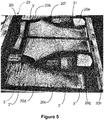
- FIG. 5 shows portions 20b, 20c, 20d, 20e, 20f, 20g, 20h, 20i which assembled together form a pair of jeans, wherein portions 20b - 20e forming the main front and back portions of the pair of jeans are marked according to a pattern 3 which comprises seams 3', flat fell seams 3" for hems and belt and faded decorative pattern 3"', while portions 20f, 20g of the pockets and belt are marked with a different faded decorative pattern 3"' as well as other portions 20h, 20i which comprise tags and labels for information related to the clothing article 20a such as codes, size or washing program, and belt portions.
- portions 20b, 20c, 20d, 20e, 20f, 20g, 20h, 20i are shown in figure 5 after laser cutting of the fabric 20 occurred, and the cutting profiles 31 are visible.
- FIG. 2a A possible embodiment of an apparatus 1, that can be used to carry out the method according to the invention, is for example schematically represented in Figure 2a .
- the apparatus 1 is provided with a laser source 10, which can be a pulsed laser source, or a continuous laser source, e.g. a CO 2 laser source RF excited.
- the laser source can be controlled with a pulse width modulation technique to provide a pulsed laser beam, and which can include, but is not limited to, gas lasers, more preferably a CO 2 laser.
- the laser source can alternatively include a fiber laser, preferably producing a laser beam having a wavelength value which is comprised in near IR range values.
- pulsed laser source is used herein to indicate a laser source that is pulsed per se , and also continuous laser source that can be excited or modulated to provide a pulsed laser beam output (such laser sources are also known as “pulsable” laser sources, e.g. continuous laser source able to be pulsed).
- Lines and /or dots 13 are scribed (marked) by the laser beam on the fabric 20. It has to be noted that a pulsed laser beam can be controlled to provide a plurality of dots one next to another (thus partially overlapping), thus creating a continuous line.
- the laser beam 11 scans the surface of a fabric 20 by means of laser beam moving means or elements 12, which can include one or more galvanometers, preferably two galvanometers and relative mirrors, actuators or motors.
- the apparatus can be also provided with suitable optical elements (not shown), such as for example one or more mirror and/or a rotating prism and/or a lens or similar focusing optical elements, which can be positioned along the laser beam path, before or after the at least one galvanometer, and which are intended to guide the laser beam 11 reflected from the moving mirror of the moving element 12, towards the fabric 20, or portions thereof.
- the apparatus 1 further comprises a control unit 200 which controls the laser source 10 for the laser beam 11 emission, for example by controlling the radiofrequency amplifier of the laser by a PWM signal, the moving elements 12 for moving the laser beam on the workpiece 2 and suitable optical elements (if provided, e.g. before or after the moving elements 12) to receive the laser beam 11 and to focus it into a pattern line on the fabric 20.
- a control unit 200 which controls the laser source 10 for the laser beam 11 emission, for example by controlling the radiofrequency amplifier of the laser by a PWM signal, the moving elements 12 for moving the laser beam on the workpiece 2 and suitable optical elements (if provided, e.g. before or after the moving elements 12) to receive the laser beam 11 and to focus it into a pattern line on the fabric 20.
- the control unit 200 can be provided with a storage memory, wherein command instructions, e.g. in the form of a command file, for control the apparatus to carry out the laser scan in order to scribe and/or cut the fabric 20, according to the invention, can be stored.
- command instructions e.g. in the form of a command file
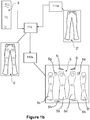
- the method comprises the step 110 of providing to the control unit 200 a predetermined finishing pattern 3 to be scribed on the fabric 20 from which a clothing article 20a is assembled.
- the step 110 further comprises providing to the control unit 200 instructions for cutting a fabric 20, in order to obtain at least one, preferably a plurality of portions of the clothing article 20b, 20c, 20d, 20e, 20f, 20g, 20h, 20i.
- the predetermined finishing pattern 3 and/or cutting instructions can be provided to the control unit 200 providing a the 2D model of the pattern 3 to be marked and/or of the profile 31 of the portions 20b, 20c, 20d, 20e, 20f, 20g, 20h, 20i to be cut from the fabric 20.
- the pattern 3 to be scribed on the fabric 20 is preferably a pattern 3 which reproduces a faded, or worn finish look effect, but the possibility to reproduce an image from a graphic file, for example for replicating on the clothing article an image or writing, or a printed pattern, is not excluded.
- the method comprises the step 111 of providing to the control unit 200 a 2D model 2 of the at least one portion or surface 2b, 2c, 2d, 2e, 2f, 2g, 2h, 2i each representing a portion 20b, 20c, 20d, 20e, 20f, 20g, 20h, 20i of the clothing article 20a to be assembled form the fabric 20.
- the method further comprises the step 111a of providing to the control unit 200 a 3D model 2' of the clothing article 20a to be scribed, in order to reproduce and thus provide to the operator the real shape of the clothing article 20a when worn.
- model 2' of the clothing article to be scribed is a pair of jeans, but other models 2' of different clothing article 20a can be provided, for example skirts or jackets.
- the step 111 of providing to the control unit 200 the 2D model 2 of the at least one portion or surface 2b, 2c, 2d, 2e, 2f, 2g, 2h, 2i can be realized by unfolding, or dividing the 3D model 2' of the clothing article 20a, provided in the step 111a, into at least one portion, preferably a plurality of portions or surfaces 2b, 2c, 2d, 2e, 2f, 2g, 2h, 2i .
- step 111a of previously providing a 3D model 2' of the clothing article, in order to unfold it in a plurality of 2D surfaces is represented with dashed lines, since it is not mandatory.
- the model 2 of the at least one portion or surface 2b, 2c, 2d, 2e, 2f, 2g, 2h, 2i can be directly provided to the control unit 200.
- the 2D model 2 of portions or surfaces 2b, 2c, 2d, 2e, 2f, 2g, 2h, 2i and the 3D model 2' of the clothing article 20a can be both provided to the control unit 200, and can be both displayed on a monitor or any video terminal, and modified by an operator.
- the 2D and 3D input models can be displayed at the same time by an operator, allowing a full view of the clothing article to be marked as shown in figure 2c .
- some tabs or link to select one or more portions of the model can be provided on the monitor so that the operator can easily select one of the portions of the model and apply thereon the finishing pattern.
- an output model 5, 5' is provided.
- the output model 5, 5' comprises a 3D output model 5' of the scribed clothing article 20a and/or the 2D output model 5 of a plurality of scribed portions 5b, 5c, 5d, 5e, 5f, 5g, 5h, 5i of the scribed clothing article, scribed with the predetermined finishing pattern 3 is created.
- the output model 5, 5' provided in the step 113 is the 2D output model 5 of a plurality of scribed portions 5b, 5c, 5d, 5e, 5f, 5g, 5h, 5i) provided by combining the predetermined finishing pattern 3 to be scribed and the 2D model 2 of the at least one portion or surface 2b, 2c, 2d, 2e, 2f, 2g, 2h, 2i representing the portions 20b, 20c, 20d, 20e, 20f, 20g, 20h, 20i of the clothing article to be scribed.
- the 2D output model 5 can be modified and adapted, by adjusting the pattern 3 appearance on each portion 2b, 2c, 2d, 2e, 2f, 2g, 2h, 2i of the 2D model 2, in order to modify the final appearance of each of scribed portion 5b, 5c, 5d, 5e, 5f, 5g, 5h, 5i.
- the pattern 3 is adjusted separately on each portion 2b, 2c, 2d, 2e, 2f, 2g, 2h, 2i, considering its configuration, for example, the pattern 3 can be adjusted considering the presence of possible seams or pockets, or hems.
- the output model 5' of the scribed clothing article is a 3D model, and is provided by combining the predetermined finishing pattern 3 to be scribed on said clothing article 20a and the 3D model 2' of the clothing article 20a to be scribed.
- the 3D output model 5' is modified by adjusting the pattern 3 appearance on the clothing article model 2', in order to modify the final appearance of the clothing article 20a as desired, for example the pattern 3 can be adjusted modifying the length and/or the width and/or the shape of the pattern 3 in order to better follow the realistic shape and curves of a clothing article 20a when worn, reproduced by the 3D output model 5' of the clothing article 20a.
- the method comprises the further step 113a of providing the output 2D model 5 by unfolding the output 3D model 5' in the plurality of 2D scribed portions or surfaces 5b, 5c, 5d, 5e, 5f, 5g, 5h, 5i.
- the 2D output model 5 and the 3D output model 5' can be both displayed and modified by an operator as shown in figure 2c .
- the 3D model 5' of a scribed pair of jeans, scribed with a predetermined finishing pattern 3 can be unfolded or divided in a plurality of 2D surfaces 5b, 5c, 5d, 5e, 5f, 5g, 5h, 5i each 2D surface corresponding to a surface of the 3D model 5' of the scribed pair of jeans, which in turn correspond to a portion 20b, 20c, 20d, 20e, 20f, 20g, 20h, 20i of the clothing article 20a.
- Command instructions 100 are finally provided to the laser apparatus 1 for scribing a predetermined finishing pattern 3 on the fabric 20 thus forming the portions or surfaces 20b, 20c, 20d, 20e, 20f, 20g, 20h, 20i forming the clothing article 20a.
- command instructions 100 are finally provided to the control unit 200 of the laser apparatus 1 also for cutting the fabric 20 in order to realize the portions 20b, 20c, 20d, 20e, 20f, 20g, 20h, 20i of a clothing article 20a.
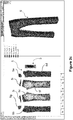
- the clothing article 20a to be assembled is divided in flat pieces or portions 20b, 20c, 20d, 20e, 20f, 20g, 20h, 20i , for example in figure 2a, 2b , 5 it is shown a pair of jeans divided in a plurality of portions, comprising the front and the back surface of each leg, pockets, belt portions and labels.
- the scribing operation is performed by operating the laser source 10 and moving means 12 for generating an output laser beam 11 for scribing lines or dots 13 of the predetermined finishing pattern 3 on the fabric according to the command instructions 100 containing the 2D model 5 of the plurality of scribed portions 5b, 5c, 5d, 5e, 5f, 5g, 5h, 5i of the clothing article scribed with the predetermined finishing pattern 3.
- the portions 20b, 20c, 20d, 20e, 20f, 20g, 20h, 20i are subsequently sewn (and in general, assembled) together in order to form the clothing article 20a, after the scribing and/or cutting operation of each portion is complete.
- the desired finishing or appearance pattern 3 can be for example a faded, or worn finish look effect, which can include a change in colour and/or abrasion effects, showing rips and tears on the clothing article.
- command instructions 100 further contains instructions for operating the laser apparatus 1 for generating said output laser beam 11 for cutting the fabric 20, obtaining said portions of clothing article 20b, 20c, 20d, 20e, 20f, 20g, 20h, 20i according to the 2D output model 5.
- the operation of cutting the fabric 20 is performed after the operation of scribing the predetermined finishing pattern 3.
- the fabric 20 is provided on a flat support, and the laser apparatus 1 is operated to scribe the finishing pattern 3 according to the 2D output model 5 of the plurality of scribed portions 5b, 5c, 5d, 5e, 5f, 5g, 5h, 5i of article of clothing.
- the laser apparatus 1 is operated in order to cut the fabric 20, obtaining said portions of clothing article 20b, 20c, 20d, 20e, 20f, 20g, 20h, 20i according to the 2D output model 5.
- the clothing article 20a to be scribed and in particular the fabric 20 (of which the clothing article is made), is provided with weft yarns 21 and warp yarns 22 which are woven in order to have a weft yarn 21 which is passed over one or more warp yarns 22 and then under two or more warp yarns 22, resulting in the so called 1:2 twill weave configuration.
- the clothing article 20a to be scribed and in particular the fabric 20 (of which the clothing article is made), is provided with weft yarns 21 and warp yarns 22 which are woven in order to have a weft yarn 21 which is passed over two or more warp yarns 22 and then under three or more warp yarns 22 resulting in the so called 2:3 twill weave configuration.
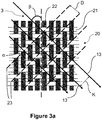
- Both the 1:2 and 2:3 twill weaves configurations result in a diagonal pattern comprising a plurality of parallel diagonal lines 23, preferably each having a thickness L, wherein the parallel diagonal lines 23 are distanced from each other of a constant distance, or pitch, D comprised between 0,2 and 2 mm, preferably between 0,5 and 1,5 mm.
- the method according to the invention comprises the step of providing command instructions 100 for operating the laser apparatus 1 for scribing a predetermined finishing pattern 3 on the fabric 20, or on a clothing article 20a.
- command instructions 100 for operating said laser apparatus 1 are provided in a control file 102, preferably a raster and/or a vector format file.
- control file 102 preferably a raster and/or a vector format file.
- predetermined finishing pattern 3 to be scribed on the clothing article is provided to control unit 200.
- the laser source 10 can be operated for generating the output laser beam 11 for scribing lines and/or dots 13 of the predetermined finishing pattern 3 on the clothing article 20a according to command instructions 100.
- lines also indicating a plurality of dots arranged in succession along a line.
- scribing a line on an article is intended as scribing or marking a line and/or dots by means of a laser beam, wherein the localized thermal effect of the laser beam selectively removes dyes, paints or breaks yarns, according to power density values.
- the laser source 10 can scan the fabric in order to scribe diagonal lines and/or dots (a plurality of dots arranged along a line) 13 which are arranged parallel or substantially parallel to each other.
- the finishing pattern 3 comprises a plurality of diagonal lines 13, preferably a plurality of parallel diagonal lines and/or dots 13, and said two or more lines are spaced one from another, preferably of a constant pitch K (e.g. constant space between two subsequent diagonal lines 13) that is provided as a function of the distance D between the diagonal lines 23 of the fabric 20 (or of the clothing article 20a) on which the finishing pattern 3 has to be scribed.
- K e.g. constant space between two subsequent diagonal lines 13
- the distance or pitch K between two or more lines and/or dots 13 of the finishing pattern 3 is equal to the distance D, i.e. a value preferably comprised between 0,5 and 1,5 mm, between two adjacent apparent diagonal lines 23 formed by woven warp and weft yarns 22, 21 of the fabric 20 on which the finishing pattern 3 has to be scribed by the laser source 10.
- the pitch K between two or more lines 13 is comprised between 0,5 and 1,5 mm, in order to reproduce the weave of the fabric.
- the lines 13 appears as continuous lines, since in the scanning direction the laser pulses are enveloped, and the dpi value is comprised between 30 - 150 dpi.
- the distance or pitch K between two or more lines 13 of the finishing pattern 3 is equal to a fraction or to a multiple of the distance D between two adjacent apparent diagonal lines 23 formed by woven warp and weft yarns 22, 21 of the fabric 20a on which the finishing pattern 3 has to be scribed by the laser source 10.
- the laser source 10 can scan the fabric 20 at least in one direction, preferably in two directions, i.e. backward and forward, in order to scribe said lines 13 which are perpendicular or substantially perpendicular with respect to the pattern of distinct diagonal lines 23 formed by said woven warp and weft yarns 22, 21.
- lines 13 of the finishing pattern, scribed by the laser source 10 are arranged substantially perpendicular with respect to the pattern of diagonal lines 23 formed by said woven warp and weft yarns, so that said lines are arranged with an angle of ⁇ 10°, preferably ⁇ 5°, with respect to a direction that is perpendicular with respect to the pattern of diagonal lines formed by said woven warp yarns and weft yarns.
- the scribed lines 13 of the finishing pattern are arranged at an angle ⁇ that is preferably perpendicular with respect to the diagonal lines 23 of weaving pattern and that can be also inclined of an angle of about ⁇ 10°, preferably ⁇ 5°, with respect to the perpendicular relative arrangement of the scribed lines 13 and the diagonal lines 23 of the diagonal pattern of the fabric.
- the finishing pattern 3 comprises a plurality of parallel diagonal lines 13, preferably a plurality of parallel straight lines 13, each of the line being perpendicular or substantially perpendicular, with respect to the pattern of diagonal lines 23 formed by said woven warp and weft yarns 22, 21, i.e. a direction which has an inclination of an angle ⁇ with respect to the direction of extension of the warp yarns 22.
- the angle ⁇ between the direction of the diagonal parallel lines 13 scribed by the laser source 10 and the direction of extension of the warp yarns 22 is comprised in a range between 20° and 70°, preferably in a range between 30° and 60°, more preferably it is substantially equal to 45°.
- Figure 4b shows a portion of fabric marked with the arrangement according to the invention, wherein diagonal lines 13 of the finishing pattern 3 are scanned substantially perpendicularly with respect to the diagonal lines 23 of weaving pattern, resulting in a finishing appearance that is much more similar to wear that the fabric undergoes while it is normally worn by the user, with respect to the one obtained with prior art techniques as shown in figure 4a .
- the lines 13 are visible and extend substantially between the top left side and bottom right side of the figure, i.e. perpendicular to the diagonal lines 23 of the weaving pattern (that are extending substantially between left bottom side to the right upper side of the figure).
- diagonal lines 13 scribed by the laser, substantially replicating (or simulating) the diagonal lines 23 of the weaving pattern are provided on the fabric and are oriented substantially at right angle with respect to the diagonal ones 23 of the weaving pattern.
- the inclination of the diagonal lines 13 scribed by the laser source 10 can be varied by an operator, in order to increase or decrease the change in colour and/or in abrasion visual effect according to the pattern 3 to be scribed.
- the colour of indigo died warp yarns 22 is more intensely modified when the diagonal lines 13 are scribed by the laser source 10 along a direction having an inclination of an angle ⁇ smaller than 45° with respect to the direction of extension of the warp yarns 22.
Landscapes
- Engineering & Computer Science (AREA)
- Textile Engineering (AREA)
- Chemical & Material Sciences (AREA)
- Chemical Kinetics & Catalysis (AREA)
- General Chemical & Material Sciences (AREA)
- Materials Engineering (AREA)
- Physics & Mathematics (AREA)
- Optics & Photonics (AREA)
- Treatment Of Fiber Materials (AREA)
Priority Applications (1)
| Application Number | Priority Date | Filing Date | Title |
|---|---|---|---|
| EP19181296.5A EP3754101A1 (de) | 2019-06-19 | 2019-06-19 | Laserendbearbeitungsverfahren zur bereitstellung eines endbearbeitungsmusters auf einem gewebe |
Applications Claiming Priority (1)
| Application Number | Priority Date | Filing Date | Title |
|---|---|---|---|
| EP19181296.5A EP3754101A1 (de) | 2019-06-19 | 2019-06-19 | Laserendbearbeitungsverfahren zur bereitstellung eines endbearbeitungsmusters auf einem gewebe |
Publications (1)
| Publication Number | Publication Date |
|---|---|
| EP3754101A1 true EP3754101A1 (de) | 2020-12-23 |
Family
ID=66999625
Family Applications (1)
| Application Number | Title | Priority Date | Filing Date |
|---|---|---|---|
| EP19181296.5A Pending EP3754101A1 (de) | 2019-06-19 | 2019-06-19 | Laserendbearbeitungsverfahren zur bereitstellung eines endbearbeitungsmusters auf einem gewebe |
Country Status (1)
| Country | Link |
|---|---|
| EP (1) | EP3754101A1 (de) |
Cited By (1)
| Publication number | Priority date | Publication date | Assignee | Title |
|---|---|---|---|---|
| CN114045664A (zh) * | 2021-11-26 | 2022-02-15 | 广东溢达纺织有限公司 | 面料及其制造方法 |
Citations (6)
| Publication number | Priority date | Publication date | Assignee | Title |
|---|---|---|---|---|
| US6819972B1 (en) * | 1999-10-05 | 2004-11-16 | Clarence H Martin | Material surface processing with a laser that has a scan modulated effective power to achieve multiple worn looks |
| US20150079359A1 (en) * | 2013-09-19 | 2015-03-19 | Revolaze, LLC | System and method of generating a pattern used to process a surface of a fabric through laser irradiation, and fabric created thereby |
| WO2015171363A1 (en) * | 2014-05-09 | 2015-11-12 | The North Face Apparel Corp. | Unitary woven fabric construct of multiple zones |
| WO2016033367A1 (en) * | 2014-08-27 | 2016-03-03 | Revolaze, LLC | System and method of generating a pattern or image on fabric with linear laser irradiation, fabric made by said method, and products made with said fabric |
| US20190129605A1 (en) * | 2017-10-31 | 2019-05-02 | Levi Strauss & Co. | Laser Finishing Design Tool with Damage Assets |
| WO2020113236A1 (en) * | 2018-11-30 | 2020-06-04 | Levi Strauss & Co. | Shadow neutral 3-d garment rendering |
-
2019
- 2019-06-19 EP EP19181296.5A patent/EP3754101A1/de active Pending
Patent Citations (6)
| Publication number | Priority date | Publication date | Assignee | Title |
|---|---|---|---|---|
| US6819972B1 (en) * | 1999-10-05 | 2004-11-16 | Clarence H Martin | Material surface processing with a laser that has a scan modulated effective power to achieve multiple worn looks |
| US20150079359A1 (en) * | 2013-09-19 | 2015-03-19 | Revolaze, LLC | System and method of generating a pattern used to process a surface of a fabric through laser irradiation, and fabric created thereby |
| WO2015171363A1 (en) * | 2014-05-09 | 2015-11-12 | The North Face Apparel Corp. | Unitary woven fabric construct of multiple zones |
| WO2016033367A1 (en) * | 2014-08-27 | 2016-03-03 | Revolaze, LLC | System and method of generating a pattern or image on fabric with linear laser irradiation, fabric made by said method, and products made with said fabric |
| US20190129605A1 (en) * | 2017-10-31 | 2019-05-02 | Levi Strauss & Co. | Laser Finishing Design Tool with Damage Assets |
| WO2020113236A1 (en) * | 2018-11-30 | 2020-06-04 | Levi Strauss & Co. | Shadow neutral 3-d garment rendering |
Cited By (2)
| Publication number | Priority date | Publication date | Assignee | Title |
|---|---|---|---|---|
| CN114045664A (zh) * | 2021-11-26 | 2022-02-15 | 广东溢达纺织有限公司 | 面料及其制造方法 |
| CN114045664B (zh) * | 2021-11-26 | 2023-10-13 | 广东溢达纺织有限公司 | 面料及其制造方法 |
Similar Documents
| Publication | Publication Date | Title |
|---|---|---|
| US11952710B2 (en) | Corrected finishing pattern for projection onto 3D surface | |
| US11680366B2 (en) | Laser finishing design tool | |
| US11001090B2 (en) | System and method of generating a pattern used to process a surface of a fabric through laser irradiation, and fabric created thereby | |
| US12364301B2 (en) | Visualizing garments in shadow neutral 3-D | |
| US20240231587A1 (en) | Design Tool with Damage Assets | |
| US6252196B1 (en) | Laser method of scribing graphics | |
| US5990444A (en) | Laser method and system of scribing graphics | |
| US6685868B2 (en) | Laser method of scribing graphics | |
| US20230051783A1 (en) | 3D Digital Imaging Technology for Apparel Sales and Manufacture | |
| EP3754101A1 (de) | Laserendbearbeitungsverfahren zur bereitstellung eines endbearbeitungsmusters auf einem gewebe | |
| EP0954404A1 (de) | Laserverfahren zum trassieren von graphiken | |
| EP4692453A1 (de) | Lasermarker für ein textiles material | |
| JPH0327948B2 (de) | ||
| CN120372727A (zh) | 牛仔布洗涤均衡器及其数字编辑系统 | |
| MXPA98003421A (en) | Method to laser de trazar grafi | |
| JPH0726313B2 (ja) | 絣糸で織成された布の修正方法 |
Legal Events
| Date | Code | Title | Description |
|---|---|---|---|
| PUAI | Public reference made under article 153(3) epc to a published international application that has entered the european phase |
Free format text: ORIGINAL CODE: 0009012 |
|
| STAA | Information on the status of an ep patent application or granted ep patent |
Free format text: STATUS: THE APPLICATION HAS BEEN PUBLISHED |
|
| AK | Designated contracting states |
Kind code of ref document: A1 Designated state(s): AL AT BE BG CH CY CZ DE DK EE ES FI FR GB GR HR HU IE IS IT LI LT LU LV MC MK MT NL NO PL PT RO RS SE SI SK SM TR |
|
| AX | Request for extension of the european patent |
Extension state: BA ME |
|
| STAA | Information on the status of an ep patent application or granted ep patent |
Free format text: STATUS: REQUEST FOR EXAMINATION WAS MADE |
|
| 17P | Request for examination filed |
Effective date: 20210622 |
|
| RBV | Designated contracting states (corrected) |
Designated state(s): AL AT BE BG CH CY CZ DE DK EE ES FI FR GB GR HR HU IE IS IT LI LT LU LV MC MK MT NL NO PL PT RO RS SE SI SK SM TR |
|
| STAA | Information on the status of an ep patent application or granted ep patent |
Free format text: STATUS: EXAMINATION IS IN PROGRESS |
|
| 17Q | First examination report despatched |
Effective date: 20220928 |