EP3757105B1 - Polycyclisches pyridonderivat mit integrasehemmender wirkung - Google Patents
Polycyclisches pyridonderivat mit integrasehemmender wirkung Download PDFInfo
- Publication number
- EP3757105B1 EP3757105B1 EP20191499.1A EP20191499A EP3757105B1 EP 3757105 B1 EP3757105 B1 EP 3757105B1 EP 20191499 A EP20191499 A EP 20191499A EP 3757105 B1 EP3757105 B1 EP 3757105B1
- Authority
- EP
- European Patent Office
- Prior art keywords
- substituted
- unsubstituted
- alkyl
- group
- alkyl group
- Prior art date
- Legal status (The legal status is an assumption and is not a legal conclusion. Google has not performed a legal analysis and makes no representation as to the accuracy of the status listed.)
- Active
Links
Classifications
-
- C—CHEMISTRY; METALLURGY
- C07—ORGANIC CHEMISTRY
- C07D—HETEROCYCLIC COMPOUNDS
- C07D513/00—Heterocyclic compounds containing in the condensed system at least one hetero ring having nitrogen and sulfur atoms as the only ring hetero atoms, not provided for in groups C07D463/00, C07D477/00 or C07D499/00 - C07D507/00
- C07D513/12—Heterocyclic compounds containing in the condensed system at least one hetero ring having nitrogen and sulfur atoms as the only ring hetero atoms, not provided for in groups C07D463/00, C07D477/00 or C07D499/00 - C07D507/00 in which the condensed system contains three hetero rings
- C07D513/14—Ortho-condensed systems
-
- A—HUMAN NECESSITIES
- A61—MEDICAL OR VETERINARY SCIENCE; HYGIENE
- A61K—PREPARATIONS FOR MEDICAL, DENTAL OR TOILETRY PURPOSES
- A61K31/00—Medicinal preparations containing organic active ingredients
- A61K31/33—Heterocyclic compounds
- A61K31/395—Heterocyclic compounds having nitrogen as a ring hetero atom, e.g. guanethidine or rifamycins
- A61K31/495—Heterocyclic compounds having nitrogen as a ring hetero atom, e.g. guanethidine or rifamycins having six-membered rings with two or more nitrogen atoms as the only ring heteroatoms, e.g. piperazine or tetrazines
- A61K31/4985—Pyrazines or piperazines ortho- or peri-condensed with heterocyclic ring systems
-
- A—HUMAN NECESSITIES
- A61—MEDICAL OR VETERINARY SCIENCE; HYGIENE
- A61K—PREPARATIONS FOR MEDICAL, DENTAL OR TOILETRY PURPOSES
- A61K31/00—Medicinal preparations containing organic active ingredients
- A61K31/33—Heterocyclic compounds
- A61K31/395—Heterocyclic compounds having nitrogen as a ring hetero atom, e.g. guanethidine or rifamycins
- A61K31/53—Heterocyclic compounds having nitrogen as a ring hetero atom, e.g. guanethidine or rifamycins having six-membered rings with three nitrogens as the only ring hetero atoms, e.g. chlorazanil, melamine
-
- A—HUMAN NECESSITIES
- A61—MEDICAL OR VETERINARY SCIENCE; HYGIENE
- A61P—SPECIFIC THERAPEUTIC ACTIVITY OF CHEMICAL COMPOUNDS OR MEDICINAL PREPARATIONS
- A61P31/00—Antiinfectives, i.e. antibiotics, antiseptics, chemotherapeutics
- A61P31/12—Antivirals
- A61P31/14—Antivirals for RNA viruses
- A61P31/18—Antivirals for RNA viruses for HIV
-
- A—HUMAN NECESSITIES
- A61—MEDICAL OR VETERINARY SCIENCE; HYGIENE
- A61P—SPECIFIC THERAPEUTIC ACTIVITY OF CHEMICAL COMPOUNDS OR MEDICINAL PREPARATIONS
- A61P43/00—Drugs for specific purposes, not provided for in groups A61P1/00-A61P41/00
-
- C—CHEMISTRY; METALLURGY
- C07—ORGANIC CHEMISTRY
- C07D—HETEROCYCLIC COMPOUNDS
- C07D471/00—Heterocyclic compounds containing nitrogen atoms as the only ring hetero atoms in the condensed system, at least one ring being a six-membered ring with one nitrogen atom, not provided for by groups C07D451/00 - C07D463/00
- C07D471/02—Heterocyclic compounds containing nitrogen atoms as the only ring hetero atoms in the condensed system, at least one ring being a six-membered ring with one nitrogen atom, not provided for by groups C07D451/00 - C07D463/00 in which the condensed system contains two hetero rings
- C07D471/04—Ortho-condensed systems
-
- C—CHEMISTRY; METALLURGY
- C07—ORGANIC CHEMISTRY
- C07D—HETEROCYCLIC COMPOUNDS
- C07D471/00—Heterocyclic compounds containing nitrogen atoms as the only ring hetero atoms in the condensed system, at least one ring being a six-membered ring with one nitrogen atom, not provided for by groups C07D451/00 - C07D463/00
- C07D471/12—Heterocyclic compounds containing nitrogen atoms as the only ring hetero atoms in the condensed system, at least one ring being a six-membered ring with one nitrogen atom, not provided for by groups C07D451/00 - C07D463/00 in which the condensed system contains three hetero rings
- C07D471/14—Ortho-condensed systems
-
- C—CHEMISTRY; METALLURGY
- C07—ORGANIC CHEMISTRY
- C07D—HETEROCYCLIC COMPOUNDS
- C07D471/00—Heterocyclic compounds containing nitrogen atoms as the only ring hetero atoms in the condensed system, at least one ring being a six-membered ring with one nitrogen atom, not provided for by groups C07D451/00 - C07D463/00
- C07D471/22—Heterocyclic compounds containing nitrogen atoms as the only ring hetero atoms in the condensed system, at least one ring being a six-membered ring with one nitrogen atom, not provided for by groups C07D451/00 - C07D463/00 in which the condensed systems contains four or more hetero rings
-
- C—CHEMISTRY; METALLURGY
- C07—ORGANIC CHEMISTRY
- C07D—HETEROCYCLIC COMPOUNDS
- C07D498/00—Heterocyclic compounds containing in the condensed system at least one hetero ring having nitrogen and oxygen atoms as the only ring hetero atoms
- C07D498/12—Heterocyclic compounds containing in the condensed system at least one hetero ring having nitrogen and oxygen atoms as the only ring hetero atoms in which the condensed system contains three hetero rings
- C07D498/14—Ortho-condensed systems
-
- C—CHEMISTRY; METALLURGY
- C07—ORGANIC CHEMISTRY
- C07D—HETEROCYCLIC COMPOUNDS
- C07D498/00—Heterocyclic compounds containing in the condensed system at least one hetero ring having nitrogen and oxygen atoms as the only ring hetero atoms
- C07D498/22—Heterocyclic compounds containing in the condensed system at least one hetero ring having nitrogen and oxygen atoms as the only ring hetero atoms in which the condensed system contains four or more hetero rings
Definitions
- the present invention relates to novel compounds having antiviral activity, more particularly, specific polycyclic pyridone derivatives having HIV integrase inhibitory activity; a pharmaceutical composition comprising the same; and the compounds or composition for use as an anti-HIV agent or for use as a therapeutic or preventive agent for AIDS.
- HIV human immunodeficiency virus
- AIDS acquired immunodeficiency syndrome
- the therapeutic agent for AIDS is mainly selected from a group of reverse transcriptase inhibitors (e.g., AZT, 3TC, etc.) and protease inhibitors (e.g., Indinavir, etc.), but they are proved to be accompanied by the following problems: side effects such as nephropathy, the emergence of resistant viruses, and the like.
- side effects such as nephropathy, the emergence of resistant viruses, and the like.
- Patent Documents 1 and 2 As an anti-HIV agent having such a mechanism of action, known are carbamoyl-substituted hydroxypyrimidinone derivative (Patent Document 3) and carbamoyl-substituted hydroxypyrrolidione derivative (Patent Document 4). Further, a patent application concerning carbamoyl-substituted hydroxypyridone derivative has been filed (Patent Document 5, Example 8).
- carbamoylpyridone derivatives include 5-alkoxypyridine-3-carboxamide derivatives and ⁇ -pyrone-3-carboxamide derivatives, which are a plant growth inhibitor or herbicide (Patent Documents 6-8).
- HIV integrase inhibitors include nitrogen-containing condensed cyclic compounds (Patent Document 9).
- HIV integrase inhibitors are known, and in such compounds, the terminal of an amide side chain is aryl (Patent Documents 10 and 11).
- Patent Document 12 a bicyclic HIV integrase inhibitor is known (Patent Document 12).
- Patent Document 13 an anti-influenza agent comprising a nitrogen-containing condensed cyclic compound as an active ingredient
- Patent Document 14 and 15 disclose a patent application of an HIV integrase inhibitor comprising a nitrogen-containing condensed cyclic compound as an active ingredient.
- HIV integrase inhibitors comprising a nitrogen-containing condensed cyclic compound having a spiro cycle or a bridge as an active ingredient were filed (Patent Documents 16 to 27).
- a compound of the present invention and a medicament containing the same are useful as an antiviral agent (e.g., antiretroviral agent, anti-HIV agent, anti-HTLV-1 (Human T cell leukemia virus type 1) agent, anti-FIV (Feline immunodeficiency virus) agent, anti-SIV (Simian immunodeficiency virus) agent), especially an anti-HIV agent, an anti-AIDS agent, a therapeutic for associated diseases, or the like, to accomplish the present invention.
- an antiviral agent e.g., antiretroviral agent, anti-HIV agent, anti-HTLV-1 (Human T cell leukemia virus type 1) agent, anti-FIV (Feline immunodeficiency virus) agent, anti-SIV (Simian immunodeficiency virus) agent
- an antiviral agent e.g., antiretroviral agent, anti-HIV agent, anti-HTLV-1 (Human T cell leukemia virus type 1) agent, anti-FIV (Feline immunodefic
- the present invention accordingly provides the following:
- references herein to methods of treatment by therapy are to be interpreted as references to compounds, pharmaceutical compositions and medicaments of the present invention for use in those methods.
- the present compound has integrase inhibitory activity and/or cell proliferation inhibitory activity against viruses, in particular, HIV and drug-resistant strains thereof.
- the compound is useful in preventing or treating various diseases and viral infections (e.g., AIDS) in which integrase participates.
- the present compound is also excellent in resistance profile that it is difficult for the compound to cause a new HIV-resistant virus.
- the present compound has a preventive or therapeutic effect on HIV drug-resistant virus.
- the present compound is useful as a pharmaceutical agent that is excellent in solubility, peroral absorbability, metabolic stability, bioavailability or the like, and for which there is little concern about cytotoxicity and a side effect (e.g., mutagenicity, the QT interval prolongation of the electrocardiogram).
- “Lower alkylene” means a linear or branched C 1-6 lower alkylene such as methylene, ethylene, trimethylene, propylene, tetramethylene, ethylethylene, pentamethylene, hexamethylene, or the like.
- a C 1-4 linear lower alkylene such as methylene, ethylene, trimethylene, or tetramethylene. More preferred is methylene or ethylene.
- “Lower alkenylene” means a linear or branched C 2-6 lower alkenylene group, which consists of the above “Lower alkylene” having one or more double bonds, such as vinylene, propylene, or butenylene. Preferred is a C 2-3 linear lower alkenylene such as vinylene or propylene.
- Alkyl means a linear or branched C 1-10 alkyl group, such as methyl, ethyl, n- propyl, isopropyl, n -butyl, isobutyl, sec -butyl, tert -butyl, n -pentyl, isopentyl, neopentyl, tert -pentyl, n -hexyl, isohexyl, n -heptyl, n -octyl, n -nonyl, and n -decyl.
- a C 1-6 lower alkyl and more preferred is a C 1-4 lower alkyl, such as methyl, ethyl, n -propyl, isopropyl, n -butyl, isobutyl, sec -butyl, tert -butyl, n -pentyl, isopentyl, neopentyl, tert -pentyl, n -hexyl, and isohexyl.
- Alkenyl means a linear or branched C 2-8 alkenyl, which consists of the above “alkyl” having one or more double bonds, such as vinyl, 1-propenyl, 2-propenyl, 1-butenyl, 2-butenyl, 3-butenyl, 1,3-butadienyl, and 3-methyl-2-butenyl. Preferred is C 2-6 lower alkenyl, and more preferred is C 2-4 lower alkenyl.
- “Lower alkenyloxy” means an oxy attached to the above “lower alkenyl”, such as vinyloxy, 1-propenyloxy, 2-propenyloxy, 1-butenyloxy, 2-butenyloxy, 3-butenyloxy, 1,3-butadienyloxy, 3-methyl-2-butenyloxy.
- Alkynyl means a linear or branched C 2-8 alkenyl, which consists of the above “alkyl” having one or more triple bonds, such as ethynyl, propargyl. Preferred is C 2-6 lower alkynyl, and more preferred is C 2-4 lower alkynyl.
- Carbocyclic group means a saturated or unsaturated C 3-10 carbocyclic group, and includes cycloalkyl, cycloalkenyl, and aryl.
- Cycloalkyl means a C 3-10 cyclic saturated hydrocarbon group, such as cyclopropyl, cyclobutyl, cyclopentyl, cyclohexyl, cyclopentyl, cyclooctyl. Preferred is C 3-6 cycloalkyl.
- Cycloalkyl lower alkyl means a lower alkyl substituted with the above cycloalkyl, such as cyclopropylmethyl, cyclopropylethyl, cyclobutylmethyl, cyclopentylmethyl, cyclohexylmethyl, and cyclohexylethyl. Preferred is C 3-6 cycloalkyl lower alkyl.
- Aryl means a monocyclic aromatic hydrocarbon group (phenyl) and a polycyclic aromatic hydrocarbon (e.g., 1-naphthyl, 2-naphthyl, 1-anthryl, 2-anthryl, 9-anthryl, 1-phenanthryl, 2-phenanthryl, 3-phenanthryl, 4-phenanthryl, 9-phenanthryl).
- phenyl or naphthyl e.g., 1-napthyl, 2-naphthyl.
- Alkyl or aryl lower alkyl means the above “lower alkyl” substituted with one to three of the above “aryl”, such as benzyl, diphenylmethyl, triphenylmethyl, phenethyl, 1-napthylmethyl, and 2-napthylmethyl. Preferred is benzyl.
- Aryloxy means an oxy attached to the above “aryl”, such as 1-naphthyloxy, 2-naphthyloxy, 1-anthryloxy, 2-anthryloxy, 9-anthryloxy, 1-phenanthryloxy, 2-phenanthryloxy, 3-phenanthryloxy, 4-phenanthryloxy, and 9-phenanthryloxy.
- Preferred is phenyloxy or naphthyloxy (e.g., 1-napthyloxy, 2-naphthyloxy).
- Heterocyclic group means “heteroring” or “heteroaryl”.
- Heteroring means a non-aromatic heterocyclic group (preferably 5- to 7-membered ring) which has at least one of nitrogen, oxygen, phosphorus and/or sulfur atoms in the ring and may be bonded at any substitutable position such as 1-pyrrolinyl, 2-pyrrolinyl, 3-pyrrolinyl, 1-pyrrolidinyl, 2-pyrrolidinyl, 3-pyrrolidinyl, 1-imidazolinyl, 2-imidazolinyl, 4-imidazolinyl, 1-imidazolidinyl, 2-imidazolidinyl, 4-imidazolidinyl, 1-pyrazolinyl, 3-pyrazolinyl, 4-pyrazolinyl, 1-pyrazolidinyl, 3-pyrazolidinyl, 4-pyrazolidinyl, piperidino, 2-piperidyl, 3-piperidyl, 4-piperidyl, 1-piperadinyl, 2-piperadinyl, 2-morpholinyl
- Heteroaryl means a monocyclic aromatic heterocyclic group or a condensed aromatic heterocyclic group.
- Monocyclic aromatic heterocyclic group means a group derived from a 5- to 8-membered aromatic ring optionally containing one to four of oxygen, sulfur, phosphorus and/or nitrogen atoms in the ring wherein the group may be bonded at any substitutable position.
- Condensed aromatic heterocyclic group means a group wherein a 5- to 8-membered aromatic ring optionally containing one to four of oxygen, sulfur, phosphorus and/or nitrogen atoms in the ring is condensed with one to four of 5- to 8-membered aromatic carbocycle(s) or the other 5- to 8-membered aromatic heterocycle(s), and wherein the group may be bonded at any substitutable position.
- heteroaryl examples include furyl (e.g., 2-furyl, 3-furyl), thienyl (e.g., 2-thienyl, 3-thienyl), pyrrolyl (e.g., 1-pyrrolyl, 2-pyrrolyl, 3-pyrrolyl), imidazolyl (e.g., 1-imidazolyl, 2-imidazolyl, 4-imidazolyl), pyrazolyl (e.g., 1-pyrazolyl, 3-pyrazolyl, 4-pyrazolyl), triazolyl (e.g., 1,2,4-triazol-1-yl, 1,2,4-triazol-3-yl, 1,2,4-triazol-4-yl), tetrazolyl (e.g., 1-tetrazolyl, 2-tetrazolyl, 5-tetrazolyl), oxazolyl (e.g., 2-oxazolyl, 4-oxazolyl, 5-oxazolyl), e
- Heterocycle and “heterocyclic ring” mean a ring from which the above heterocyclic group can be derived.
- “Spiro cycle” means a ring constituted two rings sharing a carbon atom. Two tings may be each independently carbocycle or heterocycle.
- Heterocyclic lower alkyl and “heterocyclyl lower alkyl” mean lower alkyl substituted with the above “heterocyclic group”.
- Heterocyclyloxy means an oxy attached to the above “heterocyclic group”.
- “Lower alkoxy” or “alkoxy” mean an oxy attached to the above “lower alkyl” or “alkoxy”, such as methoxy, ethoxy, n -propoxy, isopropoxy, n -butoxy, isobutoxy, and tert -butoxy.
- “Lower alkylcarbonyl”, “cycloalkylcarbonyl”, “cycloalkyl lower alkylcarbonyl”, “lower alkoxycarbonyl”, “arylcarbonyl”, “aryl lower alkylcarbonyl”, “aryloxycarbonyl”, “heterocyclylcarbonyl”, “heterocyclyl lower alkylcarbonyl”, and “heterocyclyloxycarbonyl” means a carbonyl attached to the above “lower alkyl”, “cycloalkyl”, “cycloalkyl lower alkyl”, “lower alkoxy", "aryl", “aryl lower alkyl”, “aryloxy”, “heterocyclic group”, and “heterocyclyl lower alkyl”, respectively.
- Lower alkylsulfonyl means the alkyl part of a lower alkylsulfonyl is the above “lower alkyl”, such as methylsulfonyl.
- Substituent group B examples include hydroxy, carboxy, halogen (F, Cl, Br, I), halo lower alkyl (e.g., CF 3 , CH 2 CF 3 , CH 2 CCl 3 ), halo lower alkoxy (e.g., OCF 3 , OCH 2 CF 3 , OCH 2 CCl 3 ), lower alkyl (e.g., methyl, ethyl, isopropyl, tert -butyl), lower alkenyl (e.g., vinyl), lower alkynyl (e.g., ethynyl), cycloalkyl (e.g., cyclopropyl), cycloalkenyl (e.g., cyclopropenyl), lower alkoxy (e.g., methoxy, ethoxy, propoxy, butoxy), lower alkenyloxy (e.g., vinyloxy, allyloxy), lower alkoxycarbonyl
- substituent(s) of "substituted or unsubstituted amino", “substituted or unsubstituted carbamoyl", “substituted or unsubstituted aminocarbonyl", “substituted or unsubstituted ureido” or “substituted or unsubstituted thioureido” include mono- or di-lower alkyl, lower alkylcarbonyl, or lower alkylsulfonyl, substituted or unsubstituted lower alkyl (e.g., methyl, ethyl, isopropyl, benzyl, carbamoylalkyl (e.g., carbamoylmethyl), mono- or di-lower alkylcarbamoyl lower alkyl (e.g., dimethylcarbamoylethyl), hydroxy lower alkyl, heterocyclyl lower alkyl (e.g.,
- two substituents on the amino group together with the adjacent nitrogen atom may form a nitrogen-containing heterocycle which may contains sulfur and/or oxygen atoms in the ring (preferably 5- to 7-membered ring, also preferably saturated ring) and the ring is substituted or unsubstituted with oxo or hydroxy.
- Phosphoric acid residue means a group represented by the formula: - PO(OH) 2 .
- Substituted or unsubstituted phosphoric acid residue means a phosphoric acid residue in which the OH part and/or hydrogen of the OH may be substituted.
- Q is a carbocyclic group that is optionally substituted and optionally condensed or a heterocyclic group that is optionally substituted and optionally condensed.
- Q is preferably a substituted or unsubstituted heterocyclic group.
- Q is more preferably a 5- to 7-membered monocyclic heterocyclic group that is optionally substituted and contains one to four heteroatoms that are one or the same or different, two or more heteroatoms selected from O, S, and N atoms.
- Q is, further preferably, a monocyclic aromatic heterocyclic group containing one to three of the heteroatoms, particularly preferably, a 5-membered ring, and most preferably, a 5-membered monocyclic aromatic heterocyclic group containing one S atom and one or two N atoms.
- Preferred Q is, specifically, a ring shown below:
- Q is, more preferably, a ring of the above-described (1), (2), (3), (5), (6), (7), (10), (11), (12), (13), (14), (15), (16), or (17) particularly preferably a ring of the above-described (1), (2), (3), (5), or (17) and most preferably a ring of the above-described (1), (2), or (17).
- Examples of a condensed ring of the above-described monocyclic heterocyclic group include a benzene ring and other monocyclic heterocycle (preferably 5- to 7-membered).
- Q is more preferably a carbocyclyl or heterocyclyl substituted with the same or different, one to four, further preferably one or two, substituent(s) selected from Substituent group A.
- Substituent group A lower alkyl (e.g., methyl, ethyl), lower alkoxy (e.g., methoxy, ethoxy), halogen (e.g., F, Br), halogenated lower alkyl (e.g., -CH 2 F, -CHF 2 , -CFs, - CH 2 CH 2 F, -CH 2 CHF 2 , -CH 2 CF 3 ), halogenated lower alkoxy (e.g., -OCH 2 F, -OCHF 2 , - OCFs, -OCH 2 CH 2 F, -OCH 2 CHF 2 , -OCH 2 CF 3 ), and a group represented by the formula: in the above formula, X A is a group selected from the following group:
- X A “intervene” may be any of cases where one or any two or more groups selected from X A2 , X A3 , X A4 , and X A5 1) are present between carbon atoms constituting lower alkylene or lower alkenylene, 2) are present at an end of lower alkylene or lower alkenylene, and where 1) and 2) coexist.
- X A is a spacer consisting of, preferably, one to five atoms linked, and more preferably, one to three atoms linked.
- X A is more preferably lower alkylene, and further preferably C1-C3 alkylene.
- R is a group independently selected from the following group:
- R is preferably, independently lower alkoxy, halogen, or halogenated lower alkyl, and more preferably halogen.
- n is an integer of 0 to 5, preferably, 1 or 2.
- Q is more preferably substituted with a group shown in the above-described (B).
- Q is, more preferably, a ring of the above-described (Q1) to (Q30). Particularly preferable Q is (Q1), (Q2), (Q15), (Q21), (Q23), (Q24) or (Q25).
- Substituent group S2 hydrogen, halogen, substituted or unsubstituted lower alkyl, substituted or unsubstituted cycloalkyl, substituted or unsubstituted cycloalkyl lower alkyl, substituted or unsubstituted lower alkenyl, substituted or unsubstituted lower alkoxy, substituted or unsubstituted lower alkenyloxy, substituted or unsubstituted aryl, substituted or unsubstituted aryl lower alkyl, substituted or unsubstituted aryloxy, substituted or unsubstituted heterocyclyl, substituted or unsubstituted heterocyclyl lower alkyl, substituted or unsubstituted heterocyclyloxy, hydroxy, substituted or unsubstituted amino, substituted or unsubstituted lower alkylcarbonyl, substituted or unsubstituted cycloalkylcarbonyl, substituted or un
- R 4 and R 2 2 may be taken together with neighboring atoms to form substituted or unsubstituted heterocycle (e.g., F ring).
- B 1 is CR 2 0 R 2 1 and B 2 is NR 2 2
- B 1 is NR 2 2 and B 2 is CR 2 0 R 2 1
- R 2 0 and R 2 2 may be taken together with neighboring atoms to form substituted or unsubstituted heterocycle (e.g., G ring).
- B 2 is CR 2 0 R 2 1
- R 4 and R 2 1 may be taken together with neighboring atom to form substituted or unsubstituted heterocycle.
- B 1 and B 2 When either one of B 1 and B 2 is CR 2 3 and the other is N, the broken line represents the presence of a bond; when B 2 is CR 2 3 , R 4 and R 2 3 may be taken together with neighboring atoms to form substituted or unsubstituted heterocycle.
- B 1 and B 2 are each independently CR 2 0 R 2 1 or CR 2 3 .
- R 3 is hydrogen, halogen, hydroxy, substituted or unsubstituted C 1-6 alkyl, substituted or unsubstituted cycloalkyl, substituted or unsubstituted C 2-6 alkenyl, substituted or unsubstituted C 1-6 alkoxy, substituted or unsubstituted C 2-6 alkenyloxy, substituted or unsubstituted aryl, substituted or unsubstituted aryloxy, substituted or unsubstituted heterocyclyl, substituted or unsubstituted heterocyclyloxy or substituted or unsubstituted amino.
- Examples of a substituent(s) in the "substituted or unsubstituted" on R 3 include halogen, hydroxy, amino, lower alkylamino, cyano, carboxy, formyl, oxo, lower alkyl, lower alkoxy, lower alkylthio, carbamoyl, lower alkylcarbamoyl, aryl, heterocyclyl, lower alkylcarbonyl, lower alkylcarbonyloxy, lower alkoxycarbonyl, halogenated lower alkyl, and halogenated lower alkoxy, more preferably, halogen, hydroxy, amino, lower alkylamino, lower alkyl, and lower alkoxy.
- R 3 is more preferably, hydrogen, halogen, hydroxy, lower alkyl, lower alkenyl, lower alkoxy, lower alkenyloxy or amino, further preferably, hydrogen or lower alkyl (e.g., methyl), particularly preferably, hydrogen.
- R 4 is hydrogen, substituted or unsubstituted C 1-6 alkyl, substituted or unsubstituted cycloalkyl, substituted or unsubstituted cycloalkyl alkyl (wherein the alkyl group is C 1-6 ), substituted or unsubstituted C 2-6 alkenyl, substituted or unsubstituted C 1-6 alkoxy, substituted or unsubstituted aryl, substituted or unsubstituted aryl alkyl (wherein the alkyl group is C 1-6 ), substituted or unsubstituted aryloxy, substituted or unsubstituted heterocyclyl, substituted or unsubstituted heterocyclyl alkyl (wherein the alkyl group is C 1-6 ), substituted or unsubstituted heterocyclyloxy, hydroxy, substituted or unsubstituted amino, substituted or unsubstituted phosphoric acid residue, aryl substituted with substituted
- R 4 is, preferably, subsutituted or unsubstituted lower alkyl (e.g., methyl, ethyl, n-propyl, i -propyl, n -butyl; example of substituent: hydroxy, amino, lower alkylamino, lower alkoxy, aryloxy, oxo, lower alkoxycarbonyl, subsutituted or unsubstituted heterocyclylcarbonyl (example of substituent: lower alkyl, lower alkoxy)), specifically, lower alkylamino lower alkyl (e.g., 2-dimethylaminoethyl, 2-diethylaminoethyl), lower alkoxy lower alkyl (e.g., 1-methoxyethyl, 2-methoxypropyl, 2-methoxyethyl, 3-methoxypropyl, 4-methoxybutyl, 2-ethoxyethyl, 3-ethoxy
- R 2 0 , R 2 1 , R 2 2 and R 2 3 are each independently, hydrogen, halogen, substituted or unsubstituted C 1-6 alkyl, substituted or unsubstituted cycloalkyl, substituted or unsubstituted cycloalkyl C 1-6 alkyl, substituted or unsubstituted C 2-6 alkenyl, substituted or unsubstituted C 1-6 alkoxy, substituted or unsubstituted C 2-6 alkenyloxy, substituted or unsubstituted aryl, substituted or unsubstituted aryl alkyl (wherein the alkyl group is C 1-6 ), substituted or unsubstituted aryloxy, substituted or unsubstituted heterocyclyl, substituted or unsubstituted heterocyclyl alkyl (wherein the alkyl group is C 1-6 ), substituted or unsubstituted heterocyclyloxy, substituted or unsubsti
- R 2 0 , R 2 1 , R 2 2 and R 2 3 are preferably, each independently, hydrogen, substituted or unsubstituted lower alkyl (example of substituent:amino, lower alkylamino, lower carbonylamino, lower alkoxy, aryloxy, cyano, halogen, acylamino (e.g., lower carbonylamino), lower alkynyl, hydroxy, lower alkoxycarbonyl, substituted or unsubstituted heterocyclylcarbonyl (example of substituent: lower alkyl, lower alkoxy), lower alkenyl, substituted or unsubstituted carbamoyl (example of substituent: lower alkyl), lower alkylcarbonyloxy, lower alkyloxycarbonyl, lower alkylcarbonylamino, oxo, lower alkynyl), cycloalkyl, cycloalkyl lower alkyl, substituted or unsubstituted
- R 20 and R 21 are more preferably, hydrogen.
- the broken line represents the presence or absence of a bond, more preferably, represents the absence of a bond.
- B 1 is NR 2 2
- the broken line represents the absence of a bond
- the compound whose R 4 is unsubstituted ethyl or unsubstituted isopropyl are excluded from the present compound.
- F ring is substituted or unsubstituted heterocycle, preferably, the following 5-to 7-membered substituted or unsubstituted heterocycle.
- Z 1 , Z 2 , Z 3 , Z 4 and Z 5 are each independently, CR 1 R 2 , CR 1 , O, S, SO, SO 2 , N or NR 1 9 .
- Z 1 is preferably, CR 1 R 2 , O, S or NR 1 9 , and more preferably is CR 1 R 2 .
- Z 2 is preferably, CR 1 R 2 , O, S or NR 1 9 , and more preferably is CR 1 R 2 .
- Z 3 is preferably, CR 1 R 2 , O, S or NR 1 9 , and more preferably is CR 1 R 2 or O.
- Z 4 is preferably, CR 1 R 2 , O, S or NR 1 9 , and more preferably is CR 1 R 2 , O or NR 1 9 , and particularly preferably is CR 1 R 2 or O.
- Z 5 is preferably, CR 1 R 2 , O, S or NR 1 9 , and more preferably is CR 1 R 2 or O.
- Z 1 and Z 3 , Z 1 and Z 4 , Z 1 and Z 5 , Z 2 and Z 4 , Z 2 and Z 5 , or Z 3 and Z 5 may be taken together to form substituted or unsubstituted (C2-C4) bridge (example of substituent: lower alkyl, hydroxy, halogen).
- R 1 and R 2 may be a variety of substituents as far as they do not adversely affect on the pharmacological activity of the present compound.
- R 1 and R 2 are each independently, hydrogen, halogen, substituted or unsubstituted C 1-6 alkyl, substituted or unsubstituted cycloalkyl, substituted or unsubstituted cycloalkyl alkyl (wherein the alkyl group is C 1-6 ), substituted or unsubstituted C 2-6 alkenyl, substituted or unsubstituted C 1-6 alkoxy, substituted or unsubstituted C 2-6 alkenyloxy, substituted or unsubstituted aryl, substituted or unsubstituted aryl alkyl (wherein the alkyl group is C 1-6 ), substituted or unsubstituted aryloxy, substituted or unsubstituted heterocyclyl, substituted or unsubstituted heterocyclyl alkyl (
- Examples of a substituent(s) in the "substituted or unsubstituted" on R 1 and R 2 include halogen, hydroxy, amino, lower alkylamino, cyano, carboxy, formyl, oxo, lower alkyl, lower alkoxy, lower alkylthio, carbamoyl, lower alkylcarbamoyl, aryl, heterocyclyl, lower alkylcarbonyl, lower alkylcarbonyloxy, lower alkoxycarbonyl, halogenated lower alkyl, and halogenated lower alkoxy, more preferably, halogen, hydroxy, amino, lower alkylamino, lower alkyl, and lower alkoxy.
- R 1 and R 2 are more preferably, each independently, hydrogen, halogen, hydroxy, lower alkyl, lower alkenyl, lower alkoxy, lower alkenyloxy or substituted or unsubstituted amino, further preferably, each independently, hydrogen or lower alkyl (e.g., methyl), particularly preferably, hydrogen.
- R 1 and R 2 may be taken together to form oxo, thioxo or substituted or unsubstituted spiro ring (example of substituent: lower alkyl, halogen, halogenated lower alkyl, hydroxy, amino), preferably, oxo or unsubstituted spiro ring.
- R 19 is 1) hydrogen, 2) substituted or unsubstituted C 1-6 alkyl (example of substituent: amino substituted or unsubstituted with mono- or di-lower alkyl, cycloalkyl, hydroxy, an substituted or unsubstituted heterocyclic group (wherein the heterocycle is preferably a 5- to 7-membered ring; example: furyl, thienyl, thiazolyl, pyridyl, morpholino, imidazole; example of substituent: lower alkyl, halogen), substituted or unsubstituted heterocyclylcarbonyl (wherein the heterocycle is preferably a 5- to 7-membered ring; example: morpholinocarbonyl), substituted or unsubstituted phenyl (substituent: lower alkyl, amino, lower alkylamino, hydroxy, halogen, halogenated lower alkyl, lower alkoxy, halogenated lower alk
- the broken line represents the presence or absence of a bond, preferably represents the absence of a bond.
- F ring may have H ring as the following.
- Z 1 , Z 2 , Z 3 , Z 4 and Z 5 constituting H ring are each independently, CR 1 , C or N.
- H ring is each independently, substituted or unsubstituted carbocycle or substituted or unsubstituted heterocycle, preferably, substituted or unsubstituted 4-to 7-membered carbocycle (example of substituent: lower alkyl, halogen, hydroxy, halogenated lower alkyl) or substituted or unsubstituted 4- to 7-membered heterocycle (example of substituent: lower alkyl, halogen, hydroxy, halogenated lower alkyl), more preferably, 5- to 6-membered unsubstituted carbocycle or 5- to 6-membered unsubstituted heterocycle, particularly preferably, 5-membered unsubstituted carbocycle or 5-membered unsubstituted heterocycle.
- G ring is substituted or unsubstituted carbocycle or substituted or unsubstituted heterocycle.
- B 1 is CR 21 or N.
- B 2 is N.
- B 1 is N, B 2 is CR 21 .
- the same heterocycle of F ring is exemplified for G ring.
- the substituent on G ring is the same or different, one to four, further preferably one or two, substituent(s) selected from Substituent group S2.
- the part of substituent on G ring may be taken together with neighboring atoms to form , further condensed ring or spiro ring, preferablysubstituted or unsubstituted carbocycle (preferably 5- to 6-membered ring) or substituted or unsubstituted heterocycle (preferably 5- to 6-membered ring).
- B 1 and B 2 are each independently C or CH. 5- to 7-membered ring as carbocycle are exampled.
- G ring includes the following rings.
- Preferable substituent on G ring is lower alkyl (e.g., methyl, isopropyl), lower alkoxylower alkyl (e.g., 2-methoxyethyl), substituted or unsubstituted amino (example of substituent: lower alkyl (e.g., methyl), lower alkylcarbonyl (e.g., acetyl)).
- R 3 is preferably, hydrogen or substituted or unsubstituted lower alkyl, more preferablyhydrogen.
- R 4 is, preferably, substituted or unsubstituted lower alkyl (e.g., methyl, ethyl, n-propyl, i -propyl, n -butyl; example of substituent: hydroxy, amino, lower alkylamino, lower alkoxy, aryloxy, oxo, lower alkoxycarbonyl, substituted or unsubstituted heterocyclylcarbonyl (example of substituent: lower alkyl, lower alkoxy)), specifically, lower alkylamino lower alkyl (e.g., 2-dimethylaminoethyl, 2-diethylaminoethyl), lower alkoxy lower alkyl (e.g., 1-methoxyethyl, 2-methoxypropyl, 2-methoxyethyl, 3-methoxypropyl, 4-methoxybutyl, 2-ethoxyethyl, 3-ethoxypropyl, 4-ethoxybuty
- R 1 1 , R 1 2 a , R 1 2 b and R 1 3 are each independently, hydrogen, halogen, substituted or unsubstituted C 1-6 alkyl, substituted or unsubstituted cycloalkyl, substituted or unsubstituted cycloalkyl alkyl (wherein the alkyl group is C 1-6 ), substituted or unsubstituted C 2-6 alkenyl, substituted or unsubstituted C 1-6 alkoxy, substituted or unsubstituted C 2-6 alkenyloxy, substituted or unsubstituted aryl, substituted or unsubstituted aryl alkyl (wherein the alkyl group is C 1-6 ), substituted or unsubstituted aryloxy, substituted or unsubstituted heterocyclyl, substituted or unsubstituted heterocyclyl alkyl (wherein the alkyl group is C 1-6 ), substituted or unsubstitute
- R 1 1 is preferably, substituted or unsubstituted lower alkyl (e.g., methyl, n-propyl, n-buthyl (proviso ethyl and isopropyl are excluded); example of substituent:hydroxy, amino, lower alkylamino, lower alkoxy, aryloxy, oxo, lower alkoxycarbonyl, substituted or unsubstituted heterocyclylcarbonyl (example of substituent: lower alkyl, lower alkoxy), specifically, lower alkylaminolower alkyl (e.g., 2-dimethylaminoethyl, 2-diethylaminoethyl), lower alkoxylower alkyl (e.g., 1-methoxyethyl, 2-methoxypropyl, 2-methoxyethyl, 3-methoxypropyl, 4-methoxybuthyl, 2-ethoxyethyl, 3-ethoxypropyl, 4-e
- R 1 2 a and R 1 2 b are preferably, each independently, hydrogen, substituted or unsubstituted lower alkyl (example of substituent:amino, lower alkylamino, lower carbonylamino, lower alkoxy, aryloxy, cyano, halogen, acylamino (e.g., lower carbonylamino), lower alkynyl, hydroxy, lower alkoxycarbonyl, substituted or unsubstituted heterocyclylcarbonyl (example of substituent: lower alkyl, lower alkoxy), lower alkenyl, substituted or unsubstituted carbamoyl (example of substituent: lower alkyl), lower alkylcarbonyloxy, lower alkyloxycarbonyl, lower alkylcarbonylamino, oxo, lower alkynyl), cycloalkyl, cycloalkyl lower alkyl, substituted or unsubstituted aryl (example
- R 1 2 a and R 1 2 b are hydrogen.
- R 1 2 a and R 1 2 b may be taken together to form oxo or thioxo.
- R 1 1 , R 1 2 a , R 1 2 b and R 1 3 are each independently, hydrogen, halogen, substituted or unsubstituted C 1-6 alkyl, substituted or unsubstituted cycloalkyl, substituted or unsubstituted cycloalkyl alkyl (wherein the alkyl group is C 1-6 ), substituted or unsubstituted C 2-6 alkenyl, substituted or unsubstituted C 1-6 alkoxy, substituted or unsubstituted C 2-6 alkenyloxy, substituted or unsubstituted aryl, substituted or unsubstituted aryl alkyl (wherein the alkyl group is C 1-6 ), substituted or unsubstituted aryloxy, substituted or unsubstituted heterocyclyl, substituted or unsubstituted heterocyclyl alkyl (wherein the alkyl group is C 1-6 ), substituted or unsubstitute
- R 1 1 is preferably, substituted or unsubstituted lower alkyl (e.g., methyl, n-propyl, n-buthyl (proviso ethyl and isopropyl are excluded); example of substituent: hydroxy, amino, lower alkylamino, lower alkoxy, aryloxy, oxo, lower alkoxycarbonyl, substituted or unsubstituted heterocyclylcarbonyl (example of substituent: lower alkyl, lower alkoxy), specifically, lower alkylaminolower alkyl (e.g., 2-dimethylaminoethyl, 2-diethylaminoethyl), lower alkoxylower alkyl (e.g., 1-methoxyethyl, 2-methoxypropyl, 2-methoxyethyl, 3-methoxypropyl, 4-methoxybuthyl, 2-ethoxyethyl, 3-ethoxypropyl, 4-
- R 1 2 a and R 1 2 b are preferably, each independently, hydrogen, substituted or unsubstituted lower alkyl (example of substituent:amino, lower alkylamino, lower carbonylamino, lower alkoxy, aryloxy, cyano, halogen, acylamino (e.g., lower carbonylamino), lower alkynyl, hydroxy, lower alkoxycarbonyl, substituted or unsubstituted heterocyclylcarbonyl (example of substituent: lower alkyl, lower alkoxy), lower alkenyl, substituted or unsubstituted carbamoyl (example of substituent: lower alkyl), lower alkylcarbonyloxy, lower alkyloxycarbonyl, lower alkylcarbonylamino, oxo, lower alkynyl), cycloalkyl, cycloalkyl lower alkyl, substituted or unsubstituted aryl (example
- R 1 2 a and R 1 2 b are hydrogen.
- R 1 2 a and R 1 2 b may be taken together to form oxo, thioxo or substituted or unsubstituted spiro ring (example of substituent: halogen, hydroxy, amino, lower alkylamino, cyano, carboxy, formyl, oxo, lower alkyl, lower alkoxy, lower alkylthio, carbamoyl, lower alkylcarbamoyl, aryl, heterocyclyl, lower alkylcarbonyl, lower alkylcarbonyloxy, lower alkoxycarbonyl, halogenated lower alkyl, and halogenated lower alkoxy, more preferably, halogen, hydroxy, amino, lower alkylamino, lower alkyl, and lower alkoxy.).
- X is CR 1 8 a R 1 8 b , NR 2 4 , O or S, preferably, is CR 1 8 a R 1 8 b or O.
- R 1 5 a , R 1 5 b , R 1 6 a , R 1 6 b , R 1 7 a , R 1 7 b , R 1 8 a , R 1 8 b and R 2 4 may be a variety of substituents as far as they do not adversely affect on the pharmacological activity of the present compound.
- R 1 5 a , R 1 5 b , R 1 6 a , R 1 6 b , R 1 7 a , R 1 7 b , R 1 8 a , R 1 8 b and R 2 4 are: each independently, hydrogen, halogen, substituted or unsubstituted C 1-6 alkyl, substituted or unsubstituted cycloalkyl, substituted or unsubstituted cycloalkyl alkyl (wherein the alkyl group is C 1-6 ), substituted or unsubstituted C 2-6 alkenyl, substituted or unsubstituted C 1-6 alkoxy, substituted or unsubstituted C 2-6 alkenyloxy, substituted or unsubstituted aryl, substituted or unsubstituted aryl alkyl (wherein the alkyl group is C 1-6 ), substituted or unsubstituted aryloxy, substituted or unsubstituted heterocycly
- R 1 5 a , R 1 5 b , R 1 6 a , R 1 6 b , R 1 7 a , R 1 7 b , R 1 8 a , R 1 8 b and R 2 4 are preferably, each independently, hydrogen, halogen, hydroxy, substituted or unsubstituted lower alkyl, or substituted or unsubstituted cycloalkyl.
- Examples of a substituent(s) in the "substituted or unsubstituted" on R 1 5 a , R 1 5 b , R 1 6 a , R 1 6 b , R 1 7 a , R 1 7 b , R 1 8 a , R 1 8 b or R 2 4 include halogen, hydroxy, amino, lower alkylamino, cyano, carboxy, formyl, oxo, lower alkyl, lower alkoxy, lower alkylthio, carbamoyl, lower alkylcarbamoyl, aryl, heterocyclyl, lower alkylcarbonyl, lower alkylcarbonyloxy, lower alkoxycarbonyl, halogenated lower alkyl, and halogenated lower alkoxy, more preferably, halogen, hydroxy, amino, lower alkylamino, lower alkyl, and lower alkoxy.
- R 1 6 a , R 1 5 b , R 1 6 a , R 1 6 b , R 1 7 a , R 1 7 b , R 1 8 a , R 1 8 b and R 2 4 are more preferably, each independently, hydrogen, halogen, hydroxy, lower alkyl, lower alkenyl, lower alkoxy, lower alkenyloxy or substituted or unsubstituted amino, further preferably, each independently, hydrogen or lower alkyl (e.g., methyl).
- R 1 5 a andR 1 5 b , R 1 6 a andR 1 6 b , R 1 7 a and R 1 7 b , or R 1 8 a and R 1 8 b maybe taken together to form oxo, thioxo or substituted or unsubstituted spiro ring.
- R 1 5 b and R 1 6 b , R 1 6 b and R 1 8 b , and/or R 1 7 and R 1 8 b may be taken together to form substituted or unsubstituted carbocycle or substituted or unsubstituted heterocycle, or R 1 5 b and R 1 7 b , R 1 5 b and R 1 8 b , or R 1 6 b and R 1 7 b may be taken together to form substituted or unsubstituted (C2-C4) bridge.
- R 1 6 b and R 2 4 , or R 1 7 b and R 2 4 may be taken together to form substituted or unsubstituted heterocycle, or R 1 5 b and R 2 4 may be taken together to form substituted or unsubstituted (C2-C4) bridge.
- substituent of "substituted or unsubstituted carbocycle", “substituted or unsubstituted heterocycle", “substituted or unsubstituted (C 2 -C 4 ) bridge” or “substituted or unsubstituted spiro ring” is halogen, hydroxy, amino, lower alkylamino, cyano, carboxy, formyl, oxo, lower alkyl, lower alkoxy, lower alkylthio, carbamoyl, lower alkylcarbamoyl, aryl, heterocyclyl, lower alkylcarbonyl, lower alkylcarbonyloxy, lower alkoxycarbonyl, halogenated lower alkyl, and halogenated lower alkoxy, more preferably, halogen, hydroxy, amino, lower alkylamino, lower alkyl, and lower alkoxy.
- the present compound is including the compound combined any one of the above core structures formula (I-3-7) to (I-3-21) with any one of the side chains formula (Q1) to (Q30).
- the present compound includes prodrug.
- R Y is preferably, methyl, ethyl, n-propyl, isopropyl, n-buthyl, isobuthyl, sec-buthyl, tert-buthyl, or methoxyethyl.
- R Y is further preferably, methyl, tert-buthyl, or methoxyethyl.
- the present compound or its pharmaceutically acceptable salts may form solvates (e.g., hydrates or the like), cocrystal and/or crystal polymorphs.
- the present invention encompasses those various solvates, cocrystal and crystal polymorphs.
- “Solvates” may be those wherein any numbers of solvent molecules (e.g., water molecules or the like) are coordinated with the present compound or its pharmaceutically acceptable salts.
- solvent molecules e.g., water molecules or the like
- the compounds may absorb water, resulting in attachment of adsorbed water or formation of hydrates. Recrystallization of the present compound or its pharmaceutically acceptable salts may produce crystal polymorphs.
- crystal means that a present compound or salts and a counter-molecule exsist in the same crystal lattice, and it can be formed with any number of counter-molecules. All theoretically possible tautomers, geometrical isomers, stereoisomers, optical isomers, and racemates of the present compound are also within the scope of the invention.
- Pharmaceutically acceptable salts of a compound of the present invention include, as basic salts, for example, alkali metal salts such as sodium salts and potassium salts; alkaline-earth metal salts such as calcium salts and magnesium salts; ammonium salts; aliphatic amine salts such as trimethylamine salts, triethylamine salts, dicyclohexylamine salts, ethanolamine salts, diethanolamine salts, triethanolamine salts, procaine salts, meglumine salts, diethanolamine salts, and ethylenediamine salts; aralkylamine salts such as N,N-dibenzylethylenediamine salts and benethamine salts; heterocyclic aromatic amine salts such as pyridine salts, picoline salts, quinoline salts, and isoquinoline salts; quaternary ammonium salts such as tetramethylammonium salts, tetraethylammonium salts, benzyl
- Acid salts thereof include, for example, inorganic acid salts such as hydrochlorides, sulfates, nitrates, phosphates, carbonates, hydrogen carbonates, and perchlorates; organic acid salts such as acetates, propionates, lactates, maleates, fumarates, tartrates, malates, citrates, and ascorbates; sulfonates such as methanesulfonates, isethionates, benzenesulfonates, and p-toluenesulfonates! and acidic amino acid salts such as aspartates, and glutamates.
- inorganic acid salts such as hydrochlorides, sulfates, nitrates, phosphates, carbonates, hydrogen carbonates, and perchlorates
- organic acid salts such as acetates, propionates, lactates, maleates, fumarates, tartrates, malates, citrates, and ascorbates
- Solvates of a compound of the present invention include solvates with alcohol, and hydrates.
- the compounds of the present invention can be synthesized using commercially available reagents and known compounds as raw materials, preferably by the method described in Patent Document 15 or in accordance with the following method.
- P 1 is a hydroxy-protecting group
- P 2 is an amino-protecting group
- P 3 is a carboxy-protecting group
- Hal is halogen; other symbols are defined the same as above
- P 1 , P 2 and P 3 are a group which can be protected and/or deprotected described in Protective Groups in Organic Synthesis, Theodora W Green (John Wiley & Sons ) etc., for example, P 1 is arylalkyl; P 2 is lower alkyloxycarbonyl; P 3 is lower alkyl.
- Condensing agent such as HATU, WSC ⁇ HCl is added to Compound da prepared by a known method in solvent such as DMF, DMA, NMP, THF, and Compound db commercially available or prepared by a known method and tertiary amine such as triethylamine, N-methylmorphiline, pyridine are added to the mixture.
- Compound dc can be obtained by reacting at 10°C to 60°C, preferably 20°C to 40°C for 0.1 hours to 24 hours, preferably an hour to 12 hours.
- Compound de can be obtained from Compound dc by a known deprotective reaction of an amino-protecting group.
- Compound df commercially available or prepared by a known method, tertiary amine such as triethylamine, diisopropylethylamine, N-methylmorphiline and acetic acid are added to Compound de in solvent such as toluene, DMF, DMA, NMP.
- Compound dg can be obtained by reacting at 60°C to 120°C, preferably 80°C to 100°C for 0.1 hours to 24 hours, preferably an hour to 12 hours.
- Halogenated agent such as bromine, NBS, NCS, or NIS
- solvent such as dichloromethane, dichloroethane, acetonitrile, DMF.
- Hal bromine
- Compound dh can be obtained by reacting at -30°C to 50°C, preferably - 10°C to 20°C for 0.1 hours to 10 hours, preferably 0.5 hours to 2 hours.
- Hal chlorine or iodine
- Compound dh can be obtained by reacting at 10°C to 150°C, preferably 60°C to 120°C for 0.5 hours to 24 hours, preferably an hour to 6 hours.
- a palladium catalyst such as Pd(PPh 3 ) 4 , Pd(OAc) 2 , Pd(PPh 3 ) 2 Cl 2 , Pd(dppf) 2 Cl 2 , or Pd(dtbpf), and lower alkylalchol such as ethanol, propanol, or butanol, are added to Compound dh in solvent such as dioxane, DMF, DME, or tetrahydrofuran, or its reaction mixture.
- Compound di can be obtained by reacting at 0°C to 150°C, preferably 60°C to 120°C for 0.5 hours to 24 hours, preferably an hour to 12 hours under the carbon monoxide atmosphere.
- Compound dj can be obtained from Compound di by a known deprotective reaction of a carboxy-protecting group.
- the present compound obtained above may be further chemically modified to synthesize another compound.
- a reactive functional group e.g., OH, COOH, NH 2
- the group may be protected before the reaction and may be deprotected after the reaction if desired.
- protecting groups can include protecting groups, such as ethoxycarbonyl, t-butoxycarbonyl, acetyl, and benzyl, which are described in Protective Groups in Organic Synthesis, written by T. W. Greene, John Wiley & Sons Inc. (1991 ), or the like.
- Methods for the introduction and removal of a protecting group are methods commonly used in synthetic organic chemistry (see, for example, methods described in Protective Groups in Organic Synthesis, written by T. W. Greene, John Wiley & Sons Inc., (1991 ), or the like) or can be obtained in accordance therewith.
- a functional group included in each substituent can be converted by a known method (for example, those described in Comprehensive Organic Transformations, written by R. C. Larock (1989 )) in addition to the above production methods.
- Some of the compounds of the present invention can be used as a synthetic intermediate, further leading to a new derivative.
- Intermediates and target compounds produced in each of the above production methods can be isolated and purified by a purification method commonly used in synthetic organic chemistry, for example, subjecting them to neutralization, filtration, extraction, washing, drying, concentration, recrystallization, any kind of chromatography, or the like.
- intermediates can be subjected to a next reaction without further purification.
- the present compound is useful, for example, as a medicament such as antiviral agent.
- the present compound has remarkable inhibitory activity against virus integrase. Therefore, the present compound can be expected to have a preventive or therapeutic effect on various diseases caused by a virus which produces at least integrase and increases at infection in an animal cell; and, for example, it is useful as an integrase inhibiting agent against retroviruses (e.g., HIV-1, HIV-2, HTLV-1, SIV, FIV, etc. ); and useful as an anti-HIV agent.
- retroviruses e.g., HIV-1, HIV-2, HTLV-1, SIV, FIV, etc.
- a preferred compound also has the following characteristics as pharmacokinetics in the body: the blood concentration is high; the duration of an effect is long; the transitivity to tissue is remarkable; and/or the like. In addition, a preferred compound is safe with regard to a side effect.
- the present compound may be used in a combination therapy in combination with an anti-HIV agent having the different action mechanism such as a reverse transcriptase inhibitor and/or a protease inhibiting agent, etc.
- the above use includes not only use as a mixture for anti-HIV, but also use as a concomitant agent for increasing the anti-HIV activity of another anti-HIV agent such as cocktail therapy.
- the present compound can be used to prevent infection with a retrovirus vector from spreading into a tissue other than a target tissue, upon use of a retrovirus vector based on HIV or MLV in the field of gene therapy.
- a retrovirus vector based on HIV or MLV in the field of gene therapy.
- a cell or the like is infected with a vector in vitro and then returned into a body, if the present compound is administered in advance, unnecessary infection in the body can be prevented.
- the present compound can be administered orally or parenterally.
- the present compound can be also used as a conventional preparation, for example, as any dosage form of a solid agent such as tablet, powder, granule, and capsule; pharmaceutical solution; oleaginous suspension; and liquid such as syrup and elixir.
- the present compound can be used as an aqueous or oleaginous suspended injection, or a nasal drop.
- any conventional excipients, binders, lubricants, aqueous solvents, oleaginous solvents, emulsifiers, suspending agents, preservatives, stabilizers may be used.
- an oral agent is particularly preferred.
- a preparation of the present invention is produced by combining (e.g. mixing) a therapeutically effective amount of the present compound with a pharmaceutically acceptable carrier or diluent.
- the dose of a compound of the present invention varies depending on an administration method, the age, weight and condition of a patient, and the type of a disease.
- about 0.05 mg to 3000 mg, preferably about 0.1 mg to 1000 mg may be administered per adult daily, if necessary, by dividing the dose.
- about 0.01 mg to 1000 mg, preferably about 0.05 mg to 500 mg is administered per adult daily.
- Pinacolatodiboron (6.06g, 23.9mmol), potassium acetate (2.39g, 24.3mmol) and PdCl 2 (dppf) CH 2 Cl 2 (390mg, 0.477mmol) were added to DMF solution (20ml) of Compound 2 (2.00g, 4.77mmol). The mixture was stirred at 110°C for 10 minutes. After the obtained solution was cooled to room temperature, water was added. The mixture was extracted with ethyl acetate. The organic phase was washed with water twice and brine solvent, and dried by sodium sulfate anhydrate to remove the solvent. The residue was suspended to hexane ethyl acetate (40:1, v:v). The obtained solids were filtrated and washed with hexane to give Compound 3 (1.39g, 76%).
- Compound A-45 was synthesized by a similar procedure to Example 2 by using 2-bromo-4-methylthiazole-5-carbaldehyde as starting material.
- Compound B-12 was synthesized by a similar procedure to Example 1 of Patent Document 15 ( WO2013/054862 ) from Compound 5.
- Compound 2 was synthesized by a similar procedure to Compound 177A of Patent Document 13 ( WO2010/147068 ).
- a series of two-fold dilution on test samples were carried out in a 96-well plate (50 pL/well). Two plates were made for measuring anti-HIV activity and measuring cytotoxicity. For each agent, measurement in duplicate was carried out.
- An MT-4 cell suspension of 2.5 ⁇ 10 ⁇ 5/mL was dispensed at 100 ⁇ L/well onto the 96-well plate containing the test samples.
- An HIV virus solution was dispensed at 50 ⁇ L/well onto the 96-well plate containing the test samples and the cell.
- a culture solution was dispensed at 50 ⁇ L/well. It was mixed by a plate mixer, and then incubated in a CO 2 incubator for 4 days.
- the 96-well plate incubated for 4 days was observed with the naked eye and under a microscope, and it was confirmed that there is no problem with virus proliferation and inhibition in the wells of the positive control and the negative control.
- Thirty microliters of a MTT (3-(4,5-dimethylthiazol-2-yl)-2,5-diphenyltetrazolium bromide) solution was dispensed to each well.
- SI selectivity index
- active ingredient means the present compound, a tautomer thereof, a pharmaceutically acceptable salt thereof, or a solvate thereof.
- a hard gelatin capsule is prepared using the following ingredients: Dose (mg/capsule) Active ingredient 250 Starch (dried) 200 Magnesium stearate 10 Total 460 mg
- a tablet is prepared using the following ingredients: Dose (mg/capsule) Active ingredient 250 Cellulose (microcrystalline) 200 Silicon dioxide (fumed) 10 Stearic acid 5 Total 665 mg Ingredients are mixed, and compressed to obtain tablets, each weighing 665 mg.
- the present compound has integrase inhibitory activity and/or cell proliferation inhibitory activity against viruses, in particular, HIV.
- the compound is useful in preventing or treating various diseases and viral infections (e.g., AIDS) in which integrase participates.
Landscapes
- Chemical & Material Sciences (AREA)
- Organic Chemistry (AREA)
- Health & Medical Sciences (AREA)
- Life Sciences & Earth Sciences (AREA)
- General Health & Medical Sciences (AREA)
- Medicinal Chemistry (AREA)
- Pharmacology & Pharmacy (AREA)
- Animal Behavior & Ethology (AREA)
- Public Health (AREA)
- Veterinary Medicine (AREA)
- Epidemiology (AREA)
- General Chemical & Material Sciences (AREA)
- Nuclear Medicine, Radiotherapy & Molecular Imaging (AREA)
- Chemical Kinetics & Catalysis (AREA)
- Virology (AREA)
- AIDS & HIV (AREA)
- Tropical Medicine & Parasitology (AREA)
- Molecular Biology (AREA)
- Engineering & Computer Science (AREA)
- Communicable Diseases (AREA)
- Oncology (AREA)
- Bioinformatics & Cheminformatics (AREA)
- Pharmaceuticals Containing Other Organic And Inorganic Compounds (AREA)
- Nitrogen Condensed Heterocyclic Rings (AREA)
- Nitrogen And Oxygen Or Sulfur-Condensed Heterocyclic Ring Systems (AREA)
Claims (18)
- Verbindung, dargestellt durch die folgende Formel (I-3), oder ihr pharmazeutisch annehmbares Salz:
 die gestrichelte Linie die Anwesenheit oder Abwesenheit einer Bindung darstellt; und(a) eines aus B1 und B2 CR20R21 ist und das andere NR22 ist, und die gestrichelte Linie die Anwesenheit einer Bindung darstellt; und R20 und R22 mit den benachbarten Atomen zusammengenommen werden können, um substituierten oder unsubstituierten Heterocyclus zu bilden; oderwenn B2 NR22 ist, können R4 und R22 mit den benachbarten Atomen zusammengenommen werden, um substituierten oder unsubstituierten Heterocyclus zu bilden; oderwenn B2 CR20R21 ist, können R4 und R21 mit den benachbarten Atomen zusammengenommen werden, um substituierten oder unsubstituierten Heterocyclus zu bilden; oder(b) eines aus B1 und B2 CR23 ist und das andere N ist, und die gestrichelte Linie die Anwesenheit einer Bindung darstellt; und wenn B2 CR23 ist, können R4 und R23 mit den benachbarten Atomen zusammengenommen werden, um substituierten oder unsubstituierten Heterocyclus zu bilden;R20, R21, R22 und R23 jeweils unabhängig Wasserstoff, Halogen, substituiertes oder unsubstituiertes C1-6-Alkyl, substituiertes oder unsubstituiertes Cycloalkyl, substituiertes oder unsubstituiertes Cycloalkyl-C1-6-Alkyl, substituiertes oder unsubstituiertes C2-6-Alkenyl, substituiertes oder unsubstituiertes C1-6-Alkoxy, substituiertes oder unsubstituiertes C2-6-Alkenyloxy, substituiertes oder unsubstituiertes Aryl, substituiertes oder unsubstituiertes Arylalkyl (wobei die Alkylgruppe C1-6 ist), substituiertes oder unsubstituiertes Aryloxy, substituiertes oder unsubstituiertes Heterocyclyl, substituiertes oder unsubstituiertes Heterocyclylalkyl (wobei die Alkylgruppe C1-6 ist), substituiertes oder unsubstituiertes Heterocyclyloxy, substituierter oder unsubstituierter Phosphorsäurerest, Aryl substituiert mit substituiertem oder unsubstituiertem Phosphorsäurerest, Hydroxy substituiert mit substituiertem oder unsubstituiertem Phosphorsäurerest, Amino substituiert mit substituiertem oder unsubstituiertem Phosphorsäurerest, C1-6-Alkyl substituiert mit substituiertem oder unsubstituiertem Phosphorsäurerest (wobei eine Heteroatomgruppe, ausgewählt aus der Gruppe bestehend aus O, S, SO, SO2, NR5 (wobei R5 unabhängig ausgewählt ist aus derselben Substituentengruppe wie R4), -N= und =N-, im Alkyl eingreifen kann), Hydroxy, substituiertes oder unsubstituiertes Amino, substituiertes oder unsubstituiertes Alkylcarbonyl (wobei die Alkylgruppe C1-6 ist), substituiertes oder unsubstituiertes Cycloalkylcarbonyl, substituiertes oder unsubstituiertes Cycloalkyl-Alkylcarbonyl (wobei die Alkylgruppe C1-6 ist), substituiertes oder unsubstituiertes Alkoxycarbonyl (wobei die Alkoxygruppe C1-6 ist), substituiertes oder unsubstituiertes Arylcarbonyl, substituiertes oder unsubstituiertes Arylalkylcarbonyl (wobei die Alkylgruppe C1-6 ist), substituiertes oder unsubstituiertes Aryloxycarbonyl, substituiertes oder unsubstituiertes Heterocyclylcarbonyl, substituiertes oder unsubstituiertes Heterocyclyl-Alkylcarbonyl (wobei die Alkylgruppe C1-6 ist), substituiertes oder unsubstituiertes Heterocyclyloxycabonyl, substituiertes oder unsubstituiertes Aminocarbonyl, substituiertes oder unsubstituiertes Ureido oder substituiertes oder unsubstituiertes Thioureido sind;R3 Wasserstoff, Halogen, Hydroxy, substituiertes oder unsubstituiertes C1-6-Alkyl, substituiertes oder unsubstituiertes Cycloalkyl, substituiertes oder unsubstituiertes C2-6-Alkenyl, substituiertes oder unsubstituiertes C1-6-Alkoxy, substituiertes oder unsubstituiertes C2-6-Alkenyloxy, substituiertes oder unsubstituiertes Aryl, substituiertes oder unsubstituiertes Aryloxy, substituiertes oder unsubstituiertes Heterocyclyl, substituiertes oder unsubstituiertes Heterocyclyloxy oder substituiertes oder unsubstituiertes Amino ist;R4 Wasserstoff, substituiertes oder unsubstituiertes C1-6-Alkyl, substituiertes oder unsubstituiertes Cycloalkyl, substituiertes oder unsubstituiertes Cycloalkylalkyl (wobei die Alkylgruppe C1-6 ist), substituiertes oder unsubstituiertes C2-6-Alkenyl, substituiertes oder unsubstituiertes C1-6-Alkoxy, substituiertes oder unsubstituiertes Aryl, substituiertes oder unsubstituiertes Arylalkyl (wobei die Alkylgruppe C1-6 ist), substituiertes oder unsubstituiertes Aryloxy, substituiertes oder unsubstituiertes Heterocyclyl, substituiertes oder unsubstituiertes Heterocyclylalkyl (wobei die Alkylgruppe C1-6 ist), substituiertes oder unsubstituiertes Heterocyclyloxy, Hydroxy, substituiertes oder unsubstituiertes Amino, substituierter oder unsubstituierter Phosphorsäurerest, Aryl substituiert mit substituiertem oder unsubstituiertem Phosphorsäurerest, Hydroxy substituiert mit substituiertem oder unsubstituiertem Phosphorsäurerest, Amino substituiert mit substituiertem oder unsubstituiertem Phosphorsäurerest oder Alkyl (wobei die Alkylgruppe C1-6 ist) substituiert mit substituiertem oder unsubstituiertem Phosphorsäurerest (wobei eine Heteroatomgruppe, ausgewählt aus der Gruppe bestehend aus CO, O, S, SO, SO2, NRa (Ra ist Wasserstoff oder C1-6-Alkyl), -N= und =N-, im Alkyl eingreifen kann); undvorausgesetzt, dass die Verbindungen, wobei B1 NR22 ist, die gestrichelte Linie die Abwesenheit einer Bindung darstellt und R4 unsubstituiertes Ethyl oder unsubstituiertes Isopropyl ist, ausgeschlossen sind.
 - Verbindung, dargestellt durch die folgende Formel (I-3-1), oder ihr pharmazeutisch annehmbares Salz nach Anspruch 1:
 B1 CR20R21, N oder NR22 ist;wenn B1 CR20R21 ist, die gestrichelte Linie die Abwesenheit einer Bindung darstellt, und B2 N ist;wenn B1 N ist, die gestrichelte Linie die Anwesenheit einer Bindung darstellt, und B2 C ist;wenn B1 NR22 ist, die gestrichelte Linie die Abwesenheit einer Bindung darstellt, und B2 CR20 ist; unddie anderen Symbole gleich wie in Anspruch 1 definiert sind.
 - Verbindung oder ihr pharmazeutisch annehmbares Salz nach Anspruch 2, wobei der F-Ring durch jeglichen der folgenden Ringe dargestellt ist:
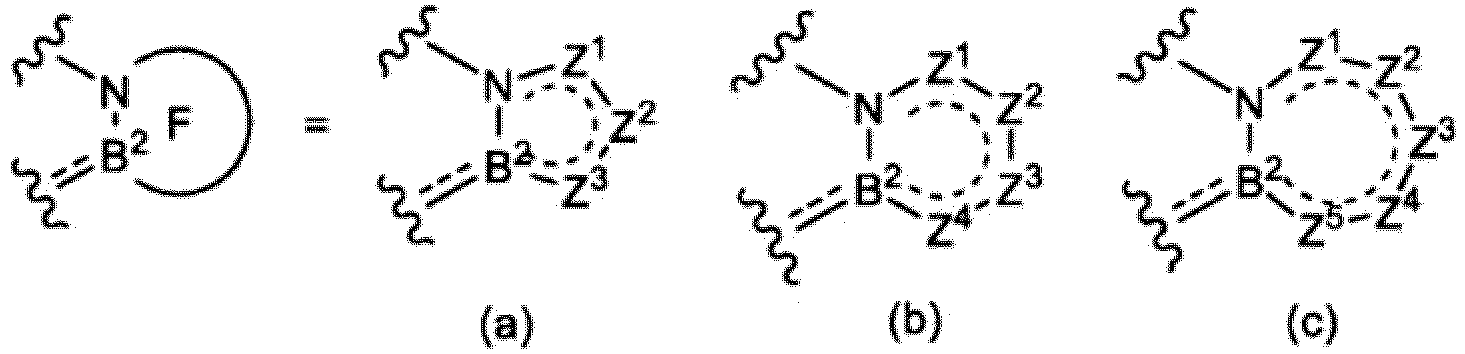 oder Z1 und Z3, Z1 und Z4, Z1 und Z5, Z2 und Z4, Z2 und Z5, oder Z3 und Z5 zusammengenommen werden können, um substituierte oder unsubstituierte (C2-C4)-Brücke zu bilden;R1 und R2 jeweils unabhängig Wasserstoff, Halogen, substituiertes oder unsubstituiertes C1-6-Alkyl, substituiertes oder unsubstituiertes Cycloalkyl, substituiertes oder unsubstituiertes Cycloalkylalkyl (wobei die Alkylgruppe C1-6 ist), substituiertes oder unsubstituiertes C2-6-Alkenyl, substituiertes oder unsubstituiertes C1-6-Alkoxy, substituiertes oder unsubstituiertes C2-6-Alkenyloxy, substituiertes oder unsubstituiertes Aryl, substituiertes oder unsubstituiertes Arylalkyl (wobei die Alkylgruppe C1-6 ist), substituiertes oder unsubstituiertes Aryloxy, substituiertes oder unsubstituiertes Heterocyclyl, substituiertes oder unsubstituiertes Heterocyclylalkyl (wobei die Alkylgruppe C1-6 ist), substituiertes oder unsubstituiertes Heterocyclyloxy, substituierter oder unsubstituierter Phosphorsäurerest, Aryl substituiert mit substituiertem oder unsubstituiertem Phosphorsäurerest, Hydroxy substituiert mit substituiertem oder unsubstituiertem Phosphorsäurerest, Amino substituiert mit substituiertem oder unsubstituiertem Phosphorsäurerest, Alkyl (wobei die Alkylgruppe C1-6 ist) substituiert mit substituiertem oder unsubstituiertem Phosphorsäurerest (wobei eine Heteroatomgruppe, ausgewählt aus der Gruppe bestehend aus O, S, SO, SO2, NR5 (wobei R5 gleich wie in Anspruch 1 definiert ist), -N= und =N-, im Alkyl eingreifen kann), Hydroxy, substituiertes oder unsubstituiertes Amino, substituiertes oder unsubstituiertes Alkylcarbonyl (wobei die Alkylgruppe C1-6 ist), substituiertes oder unsubstituiertes Cycloalkylcarbonyl, substituiertes oder unsubstituiertes Cycloalkyl-Alkylcarbonyl (wobei die Alkylgruppe C1-6 ist), substituiertes oder unsubstituiertes Alkoxycarbonyl (wobei die Alkoxygruppe C1-6 ist), substituiertes oder unsubstituiertes Arylcarbonyl, substituiertes oder unsubstituiertes Arylalkylcarbonyl (wobei die Alkylgruppe C1-6 ist), substituiertes oder unsubstituiertes Aryloxycarbonyl, substituiertes oder unsubstituiertes Heterocyclylcarbonyl, substituiertes oder unsubstituiertes Heterocyclyl-Alkylcarbonyl (wobei die Alkylgruppe C1-6 ist), substituiertes oder unsubstituiertes Heterocyclyloxycabonyl, substituiertes oder unsubstituiertes Aminocarbonyl, substituiertes oder unsubstituiertes Ureido oder substituiertes oder unsubstituiertes Thioureido sind;oder R1 und R2 zusammengenommen werden können, um Oxo, Thioxo oder substituierten oder unsubstituierten Spiroring zu bilden;R19 Wasserstoff, substituiertes oder unsubstituiertes C1-6-Alkyl, C2-6-Alkenyl, substituiertes oder unsubstituiertes Alkylcarbonyl (wobei die Alkylgruppe C1-6 ist) oder substituiertes oder unsubstituiertes Alkylsulfonyl (wobei die Alkylgruppe C1-6 ist) ist;die gestrichelte Linie die Anwesenheit oder Abwesenheit einer Bindung darstellt; unddie anderen Symbole gleich wie in Anspruch 1 definiert sind.
 - Verbindung oder ihr pharmazeutisch annehmbares Salz nach Anspruch 2, wobei F-Ring durch jeglichen der folgenden Ringe dargestellt ist:
 Z1, Z2, Z3, Z4 und Z5 jeweils unabhängig CR1R2, CR1, C, O, S, SO, SO2, N oder NR19 sind (wenn Z1, Z2, Z3, Z4 oder Z5 einzelne(s) Atom(e) des H-Rings ist/sind, sind Z1, Z2, Z3, Z4 und Z5 jeweils unabhängig CR1, C oder N);oder Z1 und Z3, Z1 und Z4, Z1 und Z5, Z2 und Z4, Z2 und Z5, oder Z3 und Z5 zusammengenommen werden können, um substituierte oder unsubstituierte (C2-C4)-Brücke zu bilden;R1 und R2 jeweils unabhängig Wasserstoff, Halogen, substituiertes oder unsubstituiertes C1-6-Alkyl, substituiertes oder unsubstituiertes Cycloalkyl, substituiertes oder unsubstituiertes Cycloalkylalkyl (wobei die Alkylgruppe C1-6 ist), substituiertes oder unsubstituiertes C2-6-Alkenyl, substituiertes oder unsubstituiertes C1-6-Alkoxy, substituiertes oder unsubstituiertes C2-6-Alkenyloxy, substituiertes oder unsubstituiertes Aryl, substituiertes oder unsubstituiertes Arylalkyl (wobei die Alkylgruppe C1-6 ist), substituiertes oder unsubstituiertes Aryloxy, substituiertes oder unsubstituiertes Heterocyclyl, substituiertes oder unsubstituiertes Heterocyclylalkyl (wobei die Alkylgruppe C1-6 ist), substituiertes oder unsubstituiertes Heterocyclyloxy, substituierter oder unsubstituierter Phosphorsäurerest, Aryl substituiert mit substituiertem oder unsubstituiertem Phosphorsäurerest, Hydroxy substituiert mit substituiertem oder unsubstituiertem Phosphorsäurerest, Amino substituiert mit substituiertem oder unsubstituiertem Phosphorsäurerest, Alkyl (wobei die Alkylgruppe C1-6 ist) substituiert mit substituiertem oder unsubstituiertem Phosphorsäurerest (wobei eine Heteroatomgruppe, ausgewählt aus der Gruppe bestehend aus O, S, SO, SO2, NR5 (wobei R5 gleich wie in Anspruch 1 definiert ist), -N= und =N-, im Alkyl eingreifen kann), Hydroxy, substituiertes oder unsubstituiertes Amino, substituiertes oder unsubstituiertes Alkylcarbonyl (wobei die Alkylgruppe C1-6 ist), substituiertes oder unsubstituiertes Cycloalkylcarbonyl, substituiertes oder unsubstituiertes Cycloalkyl-Alkylcarbonyl (wobei die Alkylgruppe C1-6 ist), substituiertes oder unsubstituiertes Alkoxycarbonyl (wobei die Alkoxygruppe C1-6 ist), substituiertes oder unsubstituiertes Arylcarbonyl, substituiertes oder unsubstituiertes Arylalkylcarbonyl (wobei die Alkylgruppe C1-6 ist), substituiertes oder unsubstituiertes Aryloxycarbonyl, substituiertes oder unsubstituiertes Heterocyclylcarbonyl, substituiertes oder unsubstituiertes Heterocyclyl-Alkylcarbonyl (wobei die Alkylgruppe C1-6 ist), substituiertes oder unsubstituiertes Heterocyclyloxycabonyl, substituiertes oder unsubstituiertes Aminocarbonyl, substituiertes oder unsubstituiertes Ureido oder substituiertes oder unsubstituiertes Thioureido sind;oder R1 und R2 zusammengenommen werden können, um Oxo, Thioxo oder substituierten oder unsubstituierten Spiroring zu bilden;R19 Wasserstoff, substituiertes oder unsubstituiertes C1-6-Alkyl, C2-6-Alkenyl, substituiertes oder unsubstituiertes Alkylcarbonyl (wobei die Alkylgruppe C1-6 ist) oder substituiertes oder unsubstituiertes Alkylsulfonyl (wobei die Alkylgruppe C1-6 ist) ist;die gestrichelte Linie die Anwesenheit oder Abwesenheit einer Bindung darstellt; unddie anderen Symbole gleich wie in Anspruch 1 definiert sind;wobei bevorzugt der H-Ring substituierter oder unsubstituierter 4- bis 7-gliedriger Carbocyclus oder substituierter oder unsubstituierter 4- bis 7-gliedriger Heterocyclus ist.
 - Verbindung, dargestellt durch die folgende Formel (I-3-2), oder ihr pharmazeutisch annehmbares Salz nach Anspruch 1:
 B1 CR21 oder N ist;wenn B1 CR21 ist, B2 N ist; wenn B1 N ist; B2 CR21 ist; unddie anderen Symbole gleich wie in Anspruch 1 definiert sind;wobei bevorzugt der G-Ring durch jeglichen der folgenden Ringe dargestellt ist:
- Verbindung oder ihr pharmazeutisch annehmbares Salz nach einem der vorhergehenden Ansprüche, wobei B2 N oder NR22 ist (wobei R22 gleich wie in Anspruch 1 definiert ist; vorausgesetzt, dass, wenn die gestrichelte Linie die Anwesenheit einer Bindung darstellt oder wenn B2 ein einzelnes Atom des F-Rings oder G-Rings ist, B2 N ist).
- Verbindung, dargestellt durch die folgende Formel (I-3-3) oder (I-3-4) oder ihr pharmazeutisch annehmbares Salz:
 oder R12a und R12b zusammengenommen werden können, um Oxo oder Thioxo zu bilden;wenn die Verbindung durch Formel (I-3-4) dargestellt ist, R12a und R12b zusammengenommen werden können, um substituierten oder unsubstituierten Spiroring zu bilden;Q substituiertes oder unsubstituiertes Carbocyclyl oder substituiertes oder unsubstituiertes Heterocyclyl ist;R5 Wasserstoff, substituiertes oder unsubstituiertes C1-6-Alkyl, substituiertes oder unsubstituiertes Cycloalkyl, substituiertes oder unsubstituiertes Cycloalkylalkyl (wobei die Alkylgruppe C1-6 ist), substituiertes oder unsubstituiertes C2-6-Alkenyl, substituiertes oder unsubstituiertes C1-6-Alkoxy, substituiertes oder unsubstituiertes Aryl, substituiertes oder unsubstituiertes Arylalkyl (wobei die Alkylgruppe C1-6 ist), substituiertes oder unsubstituiertes Aryloxy, substituiertes oder unsubstituiertes Heterocyclyl, substituiertes oder unsubstituiertes Heterocyclylalkyl (wobei die Alkylgruppe C1-6 ist), substituiertes oder unsubstituiertes Heterocyclyloxy, Hydroxy, substituiertes oder unsubstituiertes Amino, substituierter oder unsubstituierter Phosphorsäurerest, Aryl substituiert mit substituiertem oder unsubstituiertem Phosphorsäurerest, Hydroxy substituiert mit substituiertem oder unsubstituiertem Phosphorsäurerest, Amino substituiert mit substituiertem oder unsubstituiertem Phosphorsäurerest oder Alkyl (wobei die Alkylgruppe C1-6 ist) substituiert mit substituiertem oder unsubstituiertem Phosphorsäurerest (wobei eine Heteroatomgruppe, ausgewählt aus der Gruppe bestehend aus CO, O, S, SO, SO2, NRa (Ra ist Wasserstoff oder C1-6-Alkyl), -N= und =N-, im Alkyl eingreifen kann) ist; undvorausgesetzt, dass die Verbindungen der Formel (I-3-3), wobei R11 unsubstituiertes Ethyl oder unsubstituiertes Isopropyl ist, ausgeschlossen sind.
 - Verbindung, dargestellt durch die folgende Formel (I-3-5) oder (I-3-6), oder ihr pharmazeutisch annehmbares Salz nach einem der Ansprüche 1 bis 3:
 R15a, R15b, R16a, R16b, R17a, R17b, R18a, R18b und R24 jeweils unabhängig Wasserstoff, Halogen, substituiertes oder unsubstituiertes C1-6-Alkyl, substituiertes oder unsubstituiertes Cycloalkyl, substituiertes oder unsubstituiertes Cycloalkylalkyl (wobei die Alkylgruppe C1-6 ist), substituiertes oder unsubstituiertes C2-6-Alkenyl, substituiertes oder unsubstituiertes C1-6-Alkoxy, substituiertes oder unsubstituiertes C2-6-Alkenyloxy, substituiertes oder unsubstituiertes Aryl, substituiertes oder unsubstituiertes Arylalkyl (wobei die Alkylgruppe C1-6 ist), substituiertes oder unsubstituiertes Aryloxy, substituiertes oder unsubstituiertes Heterocyclyl, substituiertes oder unsubstituiertes Heterocyclylalkyl (wobei die Alkylgruppe C1-6 ist), substituiertes oder unsubstituiertes Heterocyclyloxy, substituierter oder unsubstituierter Phosphorsäurerest, Aryl substituiert mit substituiertem oder unsubstituiertem Phosphorsäurerest, Hydroxy substituiert mit substituiertem oder unsubstituiertem Phosphorsäurerest, Amino substituiert mit substituiertem oder unsubstituiertem Phosphorsäurerest, Alkyl (wobei die Alkylgruppe C1-6 ist) substituiert mit substituiertem oder unsubstituiertem Phosphorsäurerest (wobei eine Heteroatomgruppe, ausgewählt aus der Gruppe bestehend aus O, S, SO, SO2, NR5 (wobei R5 gleich wie in Anspruch 1 definiert ist), -N= und =N-, im Alkyl eingreifen kann), Hydroxy, substituiertes oder unsubstituiertes Amino, substituiertes oder unsubstituiertes Alkylcarbonyl (wobei die Alkylgruppe C1-6 ist), substituiertes oder unsubstituiertes Cycloalkylcarbonyl, substituiertes oder unsubstituiertes Cycloalkyl-Alkylcarbonyl (wobei die Alkylgruppe C1-6 ist), substituiertes oder unsubstituiertes Alkoxycarbonyl (wobei die Alkoxygruppe C1-6 ist), substituiertes oder unsubstituiertes Arylcarbonyl, substituiertes oder unsubstituiertes Arylalkylcarbonyl (wobei die Alkylgruppe C1-6 ist), substituiertes oder unsubstituiertes Aryloxycarbonyl, substituiertes oder unsubstituiertes Heterocyclylcarbonyl, substituiertes oder unsubstituiertes Heterocyclyl-Alkylcarbonyl (wobei die Alkylgruppe C1-6 ist), substituiertes oder unsubstituiertes Heterocyclyloxycabonyl, substituiertes oder unsubstituiertes Aminocarbonyl, substituiertes oder unsubstituiertes Ureido oder substituiertes oder unsubstituiertes Thioureido sind;oder R15a und R15b, R16a und R16b, R17a und R17b, oder R18a und R18b zusammengenommen werden können, um Oxo, Thioxo oder einen substituierten oder unsubstituierten Spiroring zu bilden;oder R15b und R16b, R16b und R18b und/oder R17b und R18b zusammengenommen werden können, um substituierten oder unsubstituierten Carbocyclus oder substituierten oder unsubstituierten Heterocyclus zu bilden; oder R15b und R17b, R15b und R18b, oder R16b und R17b zusammengenommen werden können, um substituierte oder unsubstituierte (C2-C4)-Brücke zu bilden;oder R16b und R24, oder R17b und R24 zusammengenommen werden können, um substituierten oder unsubstituierten Heterocyclus zu bilden; oder R15b und R24 zusammengenommen werden können, um substituierte oder unsubstituierte (C2-C4)-Brücke zu bilden;R12a und R12b jeweils unabhängig Wasserstoff, Halogen, substituiertes oder unsubstituiertes C1-6-Alkyl, substituiertes oder unsubstituiertes Cycloalkyl, substituiertes oder unsubstituiertes Cycloalkyl-C1-6-Alkyl, substituiertes oder unsubstituiertes C2-6-Alkenyl, substituiertes oder unsubstituiertes C1-6-Alkoxy, substituiertes oder unsubstituiertes C2-6-Alkenyloxy, substituiertes oder unsubstituiertes Aryl, substituiertes oder unsubstituiertes Arylalkyl (wobei die Alkylgruppe C1-6 ist), substituiertes oder unsubstituiertes Aryloxy, substituiertes oder unsubstituiertes Heterocyclyl, substituiertes oder unsubstituiertes Heterocyclylalkyl (wobei die Alkylgruppe C1-6 ist), substituiertes oder unsubstituiertes Heterocyclyloxy, substituierter oder unsubstituierter Phosphorsäurerest, Aryl substituiert mit substituiertem oder unsubstituiertem Phosphorsäurerest, Hydroxy substituiert mit substituiertem oder unsubstituiertem Phosphorsäurerest, Amino substituiert mit substituiertem oder unsubstituiertem Phosphorsäurerest, C1-6-Alkyl substituiert mit substituiertem oder unsubstituiertem Phosphorsäurerest (wobei eine Heteroatomgruppe, ausgewählt aus der Gruppe bestehend aus O, S, SO, SO2, NR5 (wobei R5 gleich wie in Anspruch 1 definiert ist), -N= und =N-, im Alkyl eingreifen kann), Hydroxy, substituiertes oder unsubstituiertes Amino, substituiertes oder unsubstituiertes Alkylcarbonyl (wobei die Alkylgruppe C1-6 ist), substituiertes oder unsubstituiertes Cycloalkylcarbonyl, substituiertes oder unsubstituiertes Cycloalkyl-Alkylcarbonyl (wobei die Alkylgruppe C1-6 ist), substituiertes oder unsubstituiertes Alkoxycarbonyl (wobei die Alkoxygruppe C1-6 ist), substituiertes oder unsubstituiertes Arylcarbonyl, substituiertes oder unsubstituiertes Arylalkylcarbonyl (wobei die Alkylgruppe C1-6 ist), substituiertes oder unsubstituiertes Aryloxycarbonyl, substituiertes oder unsubstituiertes Heterocyclylcarbonyl, substituiertes oder unsubstituiertes Heterocyclyl-Alkylcarbonyl (wobei die Alkylgruppe C1-6 ist), substituiertes oder unsubstituiertes Heterocyclyloxycabonyl, substituiertes oder unsubstituiertes Aminocarbonyl, substituiertes oder unsubstituiertes Ureido oder substituiertes oder unsubstituiertes Thioureido sind; unddie anderen Symbole gleich wie in Anspruch 1 definiert sind.
 - Verbindung oder ihr pharmazeutisch annehmbares Salz nach Anspruch 8, wobei:(a) R15a Wasserstoff oder substituiertes oder unsubstituiertes C1-6-Alkyl ist; oder(b) R15b Wasserstoff ist; oder(c) R16a Wasserstoff oder substituiertes oder unsubstituiertes C1-6-Alkyl ist; oder(d) R16b Wasserstoff ist; oder(e) R17a Wasserstoff oder substituiertes oder unsubstituiertes C1-6-Alkyl ist; oder(f) R17b Wasserstoff ist; oder(g) R18a Wasserstoff oder substituiertes oder unsubstituiertes C1-6-Alkyl ist; oder(h) R18b Wasserstoff ist; oder(i) R24 Wasserstoff oder substituiertes oder unsubstituiertes C1-6-Alkyl ist.
- Verbindung, dargestellt durch jegliche der folgenden Formeln, oder ihr pharmazeutisch annehmbares Salz nach Anspruch 1:


- Verbindung oder ihr pharmazeutisch annehmbares Salz nach einem der vorhergehenden Ansprüche, wobei Q substituiertes oder unsubstituiertes Heterocyclyl ist;wobei bevorzugt Q substituiertes oder unsubstituiertes 5- bis 7-gliedriges monozyklisches Heterocyclyl ist;wobei bevorzugter Q durch jegliche der folgenden Formeln dargestellt ist:


- Verbindung oder ihr pharmazeutisch annehmbares Salz nach einem der vorhergehenden Ansprüche, wobei Q Carbocyclyl oder Heterocyclyl ist, substituiert mit den gleichen oder unterschiedlichen 1 bis 4 Substituent(en), ausgewählt aus Substituentengruppe A. Substituentengruppe A: C1-6-Alkyl, C1-6-Alkoxy, Halogen, halogeniertes C1-6-Alkyl, halogeniertes C1-6-Alkoxy und die Gruppe der Formel (B):
 XA1: eine Einfachbindung;XA2: eine Gruppe, ausgewählt aus C(=O) und C(=S);XA3: eine Heteroatomgruppe, ausgewählt aus O, S, SO, SO2 und N(R1'), wobei R1' Wasserstoff oder C1-6-Alkyl ist;XA4: eine Gruppe, gebildet durch Verknüpfen der gleichen oder unterschiedlichen mehreren Gruppen, ausgewählt aus XA2 und XA3;XA5: eine Gruppe, ausgewählt aus -N=N-, -C(R1')=N- oder -N=C(R1')-, wobei R1' Wasserstoff oder C1-6-Alkyl ist;XA6: substituiertes oder unsubstituiertes C1-6-Alkylen oder substituiertes oder unsubstituiertes C2-6-Alkenylen;XA7: XA6 eingegriffen durch eine oder jegliche zwei oder mehrere Gruppen, ausgewählt aus XA2, XA3, XA4 und XA5;XA8: eine Gruppe CR1'R2', wobei R1' und R2' mit benachbarten Atomen zusammengenommen werden, um Carbocyclus oder Heterocyclus zu bilden; undXA9: ein Spacer, bestehend aus jeglicher Kombination aus XA1 bis XA8;
R eine Gruppe ist, unabhängig ausgewählt aus den folgenden Gruppen:(1) C1-6-Alkyl,(2) C1-6-Alkoxy,(3) Halogen,(4) halogeniertes C1-6-Alkyl,(5) halogeniertes C1-6-Alkoxy und(6) C3-6-Cycloalkyl.m eine Ganzzahl von 0 bis 5 ist;
wobei bevorzugt:(a) Q durch die folgende Formel (1) oder (2) dargestellt ist: (b) XA C1-6-Alkylen ist; R unabhängig C1-6-Alkoxy, Halogen oder halogeniertes C1-6-Alkyl ist; und m 1 oder 2 ist.
 - Verbindung oder ihr pharmazeutisch annehmbares Salz nach einem der vorhergehenden Ansprüche, wobei Q substituiertes oder unsubstituiertes Carbocyclyl oder substituiertes oder unsubstituiertes Heterocyclyl ist
vorausgesetzt, dass die folgenden Verbindungen ausgeschlossen sind:

- Verbindung oder ihr pharmazeutisch annehmbares Salz nach einem der vorhergehenden Ansprüche, wobei Q durch jegliche der folgenden Gruppen dargestellt ist:


- Verbindung, dargestellt durch jegliche der folgenden Formel (I-3') oder ihr pharmazeutisch annehmbares Salz:

 wobei RY substituiertes oder unsubstituiertes Alkyl ist; unddie anderen Symbole gleich wie in Anspruch 1 definiert sind.
 - Pharmazeutische Zusammensetzung, umfassend die Verbindung nach einem der Ansprüche 1 bis 15 oder ein pharmazeutisch annehmbares Salz davon.
- Verbindung nach einem der Ansprüche 1 bis 15 oder ein pharmazeutisch annehmbares Salz davon zur Verwendung in einem Verfahren der Behandlung des Menschen- oder Tierkörpers durch Therapie.
- Verbindung nach einem der Ansprüche 1 bis 15 oder ein pharmazeutisch annehmbares Salz davon zur Verwendung als ein Anti-HIV-Mittel oder zur Verwendung als ein therapeutisches oder präventives Mittel gegen AIDS.
Applications Claiming Priority (3)
| Application Number | Priority Date | Filing Date | Title |
|---|---|---|---|
| JP2014169776 | 2014-08-22 | ||
| EP15833356.7A EP3196201B1 (de) | 2014-08-22 | 2015-08-21 | Polycyclisches pyridonderivat mit integrasehemmender wirkung |
| PCT/JP2015/073487 WO2016027879A1 (ja) | 2014-08-22 | 2015-08-21 | インテグラーゼ阻害活性を有する多環性ピリドン誘導体 |
Related Parent Applications (2)
| Application Number | Title | Priority Date | Filing Date |
|---|---|---|---|
| EP15833356.7A Division EP3196201B1 (de) | 2014-08-22 | 2015-08-21 | Polycyclisches pyridonderivat mit integrasehemmender wirkung |
| EP15833356.7A Division-Into EP3196201B1 (de) | 2014-08-22 | 2015-08-21 | Polycyclisches pyridonderivat mit integrasehemmender wirkung |
Publications (4)
| Publication Number | Publication Date |
|---|---|
| EP3757105A2 EP3757105A2 (de) | 2020-12-30 |
| EP3757105A3 EP3757105A3 (de) | 2021-01-06 |
| EP3757105C0 EP3757105C0 (de) | 2024-07-24 |
| EP3757105B1 true EP3757105B1 (de) | 2024-07-24 |
Family
ID=55350819
Family Applications (2)
| Application Number | Title | Priority Date | Filing Date |
|---|---|---|---|
| EP20191499.1A Active EP3757105B1 (de) | 2014-08-22 | 2015-08-21 | Polycyclisches pyridonderivat mit integrasehemmender wirkung |
| EP15833356.7A Active EP3196201B1 (de) | 2014-08-22 | 2015-08-21 | Polycyclisches pyridonderivat mit integrasehemmender wirkung |
Family Applications After (1)
| Application Number | Title | Priority Date | Filing Date |
|---|---|---|---|
| EP15833356.7A Active EP3196201B1 (de) | 2014-08-22 | 2015-08-21 | Polycyclisches pyridonderivat mit integrasehemmender wirkung |
Country Status (4)
| Country | Link |
|---|---|
| US (2) | US10011613B2 (de) |
| EP (2) | EP3757105B1 (de) |
| JP (2) | JPWO2016027879A1 (de) |
| WO (1) | WO2016027879A1 (de) |
Families Citing this family (19)
| Publication number | Priority date | Publication date | Assignee | Title |
|---|---|---|---|---|
| JOP20190130A1 (ar) * | 2016-12-02 | 2019-06-02 | Merck Sharp & Dohme | مركبات حلقية غير متجانسة رباعية الحلقات مفيدة كمثبطات إنزيم مدمج لفيروس نقص المناعة البشرية (hiv) |
| CN120518604A (zh) * | 2017-10-18 | 2025-08-22 | 艾弗里斯生物有限责任公司 | 广谱抗病毒组合物和方法 |
| CN110526930B (zh) * | 2018-05-23 | 2022-06-03 | 莫云芬 | 抗hiv病毒的含硫多环-羟基吡啶酮甲酰胺类似物及其应用 |
| TWI820141B (zh) * | 2018-05-31 | 2023-11-01 | 日商鹽野義製藥股份有限公司 | 衍生物 |
| EP4257137A3 (de) | 2018-05-31 | 2023-11-01 | Shionogi & Co., Ltd | Polycyclische carbamoylpyridonderivate zur behandlung von hiv |
| MA52802A (fr) * | 2018-05-31 | 2021-04-14 | Shionogi & Co | Dérivé de pyridone polycyclique |
| MY201239A (en) | 2019-03-22 | 2024-02-13 | Gilead Sciences Inc | Bridged tricyclic carbamoylpyridone compounds and their pharmaceutical use |
| RU2717101C1 (ru) | 2019-06-03 | 2020-03-18 | Андрей Александрович Иващенко | Анелированные 9-гидрокси-1,8-диоксо-1,3,4,8-тетрагидро-2Н-пиридо[1,2-a]пиразин-7-карбоксамиды - ингибиторы интегразы ВИЧ, способы их получения и применения |
| US20200398978A1 (en) | 2019-06-20 | 2020-12-24 | Bell Helicopter Textron Inc. | Low-drag rotor blade extension |
| CN110698473B (zh) * | 2019-10-08 | 2020-12-18 | 浙江大学 | 哌嗪酮并羟基吡啶酮-5-羧基类化合物及制备和应用 |
| JP2021091671A (ja) * | 2019-11-28 | 2021-06-17 | 塩野義製薬株式会社 | 多環性ピリドン誘導体を含有する医薬組成物 |
| EP4066839A4 (de) * | 2019-11-28 | 2023-12-27 | Shionogi & Co., Ltd | Prophylaktisches und therapeutisches arzneimittel für hiv-infektionskrankheiten, dadurch gekennzeichnet, dass es die kombination von integraseinhibitoren und anti-hiv-mittel enthält |
| WO2021107065A1 (ja) * | 2019-11-28 | 2021-06-03 | 塩野義製薬株式会社 | 多環性ピリドピラジン誘導体 |
| PE20221569A1 (es) | 2020-02-24 | 2022-10-06 | Gilead Sciences Inc | Compuestos tetraciclicos para el tratamiento de infecciones por vih |
| CN113527334B (zh) * | 2020-04-13 | 2022-04-29 | 济南爱思医药科技有限公司 | 具有影响肿瘤细胞钙离子通道的三氮唑衍生物及其制备方法和应用 |
| ES3064867T3 (en) | 2020-09-30 | 2026-04-29 | Gilead Sciences Inc | Bridged tricyclic carbamoylpyridone compounds for a use in the treatment of hiv |
| US11613546B2 (en) | 2021-01-19 | 2023-03-28 | Gilead Sciences, Inc. | Substituted pyridotriazine compounds and uses thereof |
| CN114230579A (zh) * | 2021-11-12 | 2022-03-25 | 南京艾迪医药科技有限公司 | 多环氨基甲酰基吡啶酮衍生物及其制备方法和药物组合物 |
| TW202446773A (zh) | 2022-04-06 | 2024-12-01 | 美商基利科學股份有限公司 | 橋聯三環胺甲醯基吡啶酮化合物及其用途 |
Family Cites Families (28)
| Publication number | Priority date | Publication date | Assignee | Title |
|---|---|---|---|---|
| JPH0296506A (ja) | 1988-09-30 | 1990-04-09 | Daicel Chem Ind Ltd | 除草剤組成物 |
| JP2551472B2 (ja) | 1988-10-18 | 1996-11-06 | ダイセル化学工業株式会社 | 5−アルコキシ−γ−ピロン−3−カルボキサミド誘導体とその製造方法及び植物成長抑制剤 |
| JP2533796B2 (ja) | 1988-10-18 | 1996-09-11 | ダイセル化学工業株式会社 | 5−アルコキシピリジン−3−カルボキサミド誘導体とその製造方法及び植物成長抑制剤 |
| ES2572030T3 (es) | 2001-08-10 | 2017-07-19 | Shionogi & Co., Ltd. | Agente antiviral |
| ATE355064T1 (de) | 2001-10-26 | 2006-03-15 | Angeletti P Ist Richerche Bio | Dihydroxypyrimidin-carbonsäueramid-hemmer der hiv-integrase |
| US7109186B2 (en) | 2002-07-09 | 2006-09-19 | Bristol-Myers Squibb Company | HIV integrase inhibitors |
| ATE404537T1 (de) | 2002-08-13 | 2008-08-15 | Shionogi & Co | Heterocyclische verbindungen mit hiv-integrase- hemmender wirkung |
| JP2004244320A (ja) | 2003-02-10 | 2004-09-02 | Shionogi & Co Ltd | 含窒素複素環抗ウイルス剤 |
| TW200510425A (en) | 2003-08-13 | 2005-03-16 | Japan Tobacco Inc | Nitrogen-containing fused ring compound and use thereof as HIV integrase inhibitor |
| KR101363875B1 (ko) | 2005-04-28 | 2014-02-21 | 시오노기세야쿠 가부시키가이샤 | Hiv 통합효소 억제 활성을 가지는 다환식카르바모일피리돈 유도체 |
| MX2008005137A (es) | 2005-10-27 | 2008-09-29 | Shionogi & Co | Derivado de carbamoilpiridona policiclica que tiene actividad inhibidora en vih integrasa. |
| US8927710B2 (en) | 2009-06-15 | 2015-01-06 | Shionogi & Co., Ltd. | Substituted polycyclic carbamoylpyridone derivative |
| CA2789457A1 (en) | 2010-02-26 | 2011-09-01 | Susumu Miyazaki | 1,3,4,8-tetrahydro-2h-pyrido[1,2-a]pyrazine derivative and use of same as hiv integrase inhibitor |
| US9216995B2 (en) | 2010-04-12 | 2015-12-22 | Shionogi & Co., Ltd. | Pyridone derivative having integrase inhibitory activity |
| DK2620436T3 (en) * | 2010-09-24 | 2018-07-30 | Shionogi & Co | Substituted polycyclic carbamoylpyridone derivative prodrug |
| JP5777454B2 (ja) | 2011-09-01 | 2015-09-09 | 京セラ株式会社 | 照明制御システム、照明制御装置、および照明制御方法 |
| RU2014113230A (ru) * | 2011-10-12 | 2015-11-20 | Шионоги Энд Ко., Лтд. | Полициклическое производное пиридона, обладающее ингибирующей активностью в отношении интегразы |
| EP2931730B1 (de) | 2012-12-17 | 2019-08-07 | Merck Sharp & Dohme Corp. | 4-pyridinonetriazinderivate als hiv-integrase-hemmer |
| EA030003B1 (ru) * | 2012-12-21 | 2018-06-29 | Джилид Сайэнс, Инк. | Полициклическое карбамоилпиридоновое соединение и его фармацевтическое применение для лечения вич-инфекции |
| PE20151063A1 (es) | 2012-12-27 | 2015-08-03 | Japan Tobacco Inc | DERIVADO SUSTITUIDO DE ESPIROPIRIDO[1,2-a]PIRAZINA Y USO MEDICO DEL MISMO COMO INHIBIDOR DE LA INTEGRASA DEL VIH |
| US9493479B2 (en) | 2013-04-16 | 2016-11-15 | Merck Sharp & Dohme Corp. | Substituted pyrido[1,2-a]pyrazines as HIV integrase inhibitors |
| RS56701B1 (sr) | 2013-05-17 | 2018-03-30 | Merck Sharp & Dohme | Fuzionisana triciklična heterociklična jedinjenja kao inhibitori hiv integraze |
| EP3008044B1 (de) * | 2013-06-13 | 2018-11-21 | Merck Sharp & Dohme Corp. | Kondensierte tricyclische heterocyclische verbindungen als hiv-integrase-hemmer |
| NO2865735T3 (de) | 2013-07-12 | 2018-07-21 | ||
| ES2859102T3 (es) | 2013-07-12 | 2021-10-01 | Gilead Sciences Inc | Compuestos de carbamoilpiridona policíclica y su uso para el tratamiento de infecciones por VIH |
| WO2015039348A1 (en) | 2013-09-23 | 2015-03-26 | Merck Sharp & Dohme Corp. | Tetracyclic heterocycle compounds useful as hiv integrase inhibitors |
| UA117499C2 (uk) | 2013-09-27 | 2018-08-10 | Мерк Шарп Енд Доум Корп. | Заміщені похідні хінолізину, які можна використовувати як інгібітори інтегрази віл |
| WO2015089847A1 (en) | 2013-12-20 | 2015-06-25 | Merck Sharp & Dohme Corp. | Spirocyclic heterocycle compounds useful as hiv integrase inhibitors |
-
2015
- 2015-08-21 JP JP2016544261A patent/JPWO2016027879A1/ja active Pending
- 2015-08-21 EP EP20191499.1A patent/EP3757105B1/de active Active
- 2015-08-21 US US15/502,884 patent/US10011613B2/en active Active
- 2015-08-21 WO PCT/JP2015/073487 patent/WO2016027879A1/ja not_active Ceased
- 2015-08-21 EP EP15833356.7A patent/EP3196201B1/de active Active
-
2018
- 2018-05-24 US US15/988,388 patent/US10202404B2/en active Active
-
2020
- 2020-11-27 JP JP2020196448A patent/JP2021042237A/ja active Pending
Also Published As
| Publication number | Publication date |
|---|---|
| JP2021042237A (ja) | 2021-03-18 |
| EP3196201A1 (de) | 2017-07-26 |
| EP3757105C0 (de) | 2024-07-24 |
| US10011613B2 (en) | 2018-07-03 |
| EP3757105A2 (de) | 2020-12-30 |
| JPWO2016027879A1 (ja) | 2017-06-01 |
| US20170226128A1 (en) | 2017-08-10 |
| EP3757105A3 (de) | 2021-01-06 |
| WO2016027879A1 (ja) | 2016-02-25 |
| EP3196201B1 (de) | 2021-04-28 |
| US20180265525A1 (en) | 2018-09-20 |
| EP3196201A4 (de) | 2018-09-12 |
| US10202404B2 (en) | 2019-02-12 |
Similar Documents
| Publication | Publication Date | Title |
|---|---|---|
| EP3757105B1 (de) | Polycyclisches pyridonderivat mit integrasehemmender wirkung | |
| EP2774928B1 (de) | Polycyclisches pyridonderivat mit integrasehemmender wirkung | |
| US9216995B2 (en) | Pyridone derivative having integrase inhibitory activity | |
| EP1852434B1 (de) | Bicyclisches carbamoylpyridonderivat mit hiv-integrase-hemmender wirkung | |
| EP3187225B1 (de) | Polycyclisches carbamoylpyridonderivat mit hiv-integrase-hemmender aktivität | |
| JP5131689B2 (ja) | Hivインテグラーゼ阻害活性を有する多環性カルバモイルピリドン誘導体 | |
| JP2006342115A (ja) | Hivインテグラーゼ阻害活性を有する多環性化合物 | |
| EP2141154A1 (de) | Oxazolidinonderivat mit hemmender wirkung auf die 11-hydroxysteroiddehydrogenase vom typ i | |
| WO2024054954A1 (en) | Heterobifunctional compounds and methods of treating disease | |
| US7919623B2 (en) | Naphthyridine derivatives having inhibitory activity against HIV integrase | |
| EP1659117A1 (de) | 2-naphthylimino-1,3-thiazinderivate |
Legal Events
| Date | Code | Title | Description |
|---|---|---|---|
| PUAI | Public reference made under article 153(3) epc to a published international application that has entered the european phase |
Free format text: ORIGINAL CODE: 0009012 |
|
| STAA | Information on the status of an ep patent application or granted ep patent |
Free format text: STATUS: THE APPLICATION HAS BEEN PUBLISHED |
|
| PUAL | Search report despatched |
Free format text: ORIGINAL CODE: 0009013 |
|
| AC | Divisional application: reference to earlier application |
Ref document number: 3196201 Country of ref document: EP Kind code of ref document: P |
|
| AK | Designated contracting states |
Kind code of ref document: A2 Designated state(s): AL AT BE BG CH CY CZ DE DK EE ES FI FR GB GR HR HU IE IS IT LI LT LU LV MC MK MT NL NO PL PT RO RS SE SI SK SM TR |
|
| AK | Designated contracting states |
Kind code of ref document: A3 Designated state(s): AL AT BE BG CH CY CZ DE DK EE ES FI FR GB GR HR HU IE IS IT LI LT LU LV MC MK MT NL NO PL PT RO RS SE SI SK SM TR |
|
| RIC1 | Information provided on ipc code assigned before grant |
Ipc: C07D 498/22 20060101ALI20201130BHEP Ipc: A61K 31/53 20060101ALI20201130BHEP Ipc: A61P 31/18 20060101ALI20201130BHEP Ipc: C07D 471/22 20060101ALI20201130BHEP Ipc: C07D 513/14 20060101ALI20201130BHEP Ipc: C07D 498/14 20060101ALI20201130BHEP Ipc: C07D 471/04 20060101AFI20201130BHEP Ipc: A61K 31/4985 20060101ALI20201130BHEP Ipc: C07D 471/14 20060101ALI20201130BHEP |
|
| STAA | Information on the status of an ep patent application or granted ep patent |
Free format text: STATUS: REQUEST FOR EXAMINATION WAS MADE |
|
| 17P | Request for examination filed |
Effective date: 20210407 |
|
| RBV | Designated contracting states (corrected) |
Designated state(s): AL AT BE BG CH CY CZ DE DK EE ES FI FR GB GR HR HU IE IS IT LI LT LU LV MC MK MT NL NO PL PT RO RS SE SI SK SM TR |
|
| STAA | Information on the status of an ep patent application or granted ep patent |
Free format text: STATUS: EXAMINATION IS IN PROGRESS |
|
| 17Q | First examination report despatched |
Effective date: 20230206 |
|
| REG | Reference to a national code |
Ref country code: DE Ref legal event code: R079 Free format text: PREVIOUS MAIN CLASS: C07D0471040000 Ipc: A61K0031498500 Ref country code: DE Ref legal event code: R079 Ref document number: 602015089353 Country of ref document: DE Free format text: PREVIOUS MAIN CLASS: C07D0471040000 Ipc: A61K0031498500 |
|
| GRAP | Despatch of communication of intention to grant a patent |
Free format text: ORIGINAL CODE: EPIDOSNIGR1 |
|
| STAA | Information on the status of an ep patent application or granted ep patent |
Free format text: STATUS: GRANT OF PATENT IS INTENDED |
|
| RIC1 | Information provided on ipc code assigned before grant |
Ipc: C07D 513/14 20060101ALI20240131BHEP Ipc: C07D 498/22 20060101ALI20240131BHEP Ipc: C07D 498/14 20060101ALI20240131BHEP Ipc: C07D 471/22 20060101ALI20240131BHEP Ipc: C07D 471/14 20060101ALI20240131BHEP Ipc: A61P 31/18 20060101ALI20240131BHEP Ipc: A61K 31/53 20060101ALI20240131BHEP Ipc: C07D 471/04 20060101ALI20240131BHEP Ipc: A61K 31/4985 20060101AFI20240131BHEP |
|
| INTG | Intention to grant announced |
Effective date: 20240216 |
|
| GRAS | Grant fee paid |
Free format text: ORIGINAL CODE: EPIDOSNIGR3 |
|
| GRAA | (expected) grant |
Free format text: ORIGINAL CODE: 0009210 |
|
| STAA | Information on the status of an ep patent application or granted ep patent |
Free format text: STATUS: THE PATENT HAS BEEN GRANTED |
|
| RAP3 | Party data changed (applicant data changed or rights of an application transferred) |
Owner name: SHIONOGI & CO., LTD. |
|
| AC | Divisional application: reference to earlier application |
Ref document number: 3196201 Country of ref document: EP Kind code of ref document: P |
|
| AK | Designated contracting states |
Kind code of ref document: B1 Designated state(s): AL AT BE BG CH CY CZ DE DK EE ES FI FR GB GR HR HU IE IS IT LI LT LU LV MC MK MT NL NO PL PT RO RS SE SI SK SM TR |
|
| REG | Reference to a national code |
Ref country code: GB Ref legal event code: FG4D |
|
| REG | Reference to a national code |
Ref country code: CH Ref legal event code: EP |
|
| REG | Reference to a national code |
Ref country code: DE Ref legal event code: R096 Ref document number: 602015089353 Country of ref document: DE |
|
| REG | Reference to a national code |
Ref country code: IE Ref legal event code: FG4D |
|
| U01 | Request for unitary effect filed |
Effective date: 20240821 |
|
| U07 | Unitary effect registered |
Designated state(s): AT BE BG DE DK EE FI FR IT LT LU LV MT NL PT RO SE SI Effective date: 20240902 |
|
| U20 | Renewal fee for the european patent with unitary effect paid |
Year of fee payment: 10 Effective date: 20240830 |
|
| PG25 | Lapsed in a contracting state [announced via postgrant information from national office to epo] |
Ref country code: NO Free format text: LAPSE BECAUSE OF FAILURE TO SUBMIT A TRANSLATION OF THE DESCRIPTION OR TO PAY THE FEE WITHIN THE PRESCRIBED TIME-LIMIT Effective date: 20241024 |
|
| PG25 | Lapsed in a contracting state [announced via postgrant information from national office to epo] |
Ref country code: GR Free format text: LAPSE BECAUSE OF FAILURE TO SUBMIT A TRANSLATION OF THE DESCRIPTION OR TO PAY THE FEE WITHIN THE PRESCRIBED TIME-LIMIT Effective date: 20241025 Ref country code: PL Free format text: LAPSE BECAUSE OF FAILURE TO SUBMIT A TRANSLATION OF THE DESCRIPTION OR TO PAY THE FEE WITHIN THE PRESCRIBED TIME-LIMIT Effective date: 20240724 |
|
| PG25 | Lapsed in a contracting state [announced via postgrant information from national office to epo] |
Ref country code: IS Free format text: LAPSE BECAUSE OF FAILURE TO SUBMIT A TRANSLATION OF THE DESCRIPTION OR TO PAY THE FEE WITHIN THE PRESCRIBED TIME-LIMIT Effective date: 20241124 |
|
| PG25 | Lapsed in a contracting state [announced via postgrant information from national office to epo] |
Ref country code: HR Free format text: LAPSE BECAUSE OF FAILURE TO SUBMIT A TRANSLATION OF THE DESCRIPTION OR TO PAY THE FEE WITHIN THE PRESCRIBED TIME-LIMIT Effective date: 20240724 |
|
| PG25 | Lapsed in a contracting state [announced via postgrant information from national office to epo] |
Ref country code: ES Free format text: LAPSE BECAUSE OF FAILURE TO SUBMIT A TRANSLATION OF THE DESCRIPTION OR TO PAY THE FEE WITHIN THE PRESCRIBED TIME-LIMIT Effective date: 20240724 |
|
| PG25 | Lapsed in a contracting state [announced via postgrant information from national office to epo] |
Ref country code: PL Free format text: LAPSE BECAUSE OF FAILURE TO SUBMIT A TRANSLATION OF THE DESCRIPTION OR TO PAY THE FEE WITHIN THE PRESCRIBED TIME-LIMIT Effective date: 20240724 Ref country code: NO Free format text: LAPSE BECAUSE OF FAILURE TO SUBMIT A TRANSLATION OF THE DESCRIPTION OR TO PAY THE FEE WITHIN THE PRESCRIBED TIME-LIMIT Effective date: 20241024 Ref country code: IS Free format text: LAPSE BECAUSE OF FAILURE TO SUBMIT A TRANSLATION OF THE DESCRIPTION OR TO PAY THE FEE WITHIN THE PRESCRIBED TIME-LIMIT Effective date: 20241124 Ref country code: HR Free format text: LAPSE BECAUSE OF FAILURE TO SUBMIT A TRANSLATION OF THE DESCRIPTION OR TO PAY THE FEE WITHIN THE PRESCRIBED TIME-LIMIT Effective date: 20240724 Ref country code: GR Free format text: LAPSE BECAUSE OF FAILURE TO SUBMIT A TRANSLATION OF THE DESCRIPTION OR TO PAY THE FEE WITHIN THE PRESCRIBED TIME-LIMIT Effective date: 20241025 Ref country code: ES Free format text: LAPSE BECAUSE OF FAILURE TO SUBMIT A TRANSLATION OF THE DESCRIPTION OR TO PAY THE FEE WITHIN THE PRESCRIBED TIME-LIMIT Effective date: 20240724 |
|
| REG | Reference to a national code |
Ref country code: CH Ref legal event code: PL |
|
| PG25 | Lapsed in a contracting state [announced via postgrant information from national office to epo] |
Ref country code: SM Free format text: LAPSE BECAUSE OF FAILURE TO SUBMIT A TRANSLATION OF THE DESCRIPTION OR TO PAY THE FEE WITHIN THE PRESCRIBED TIME-LIMIT Effective date: 20240724 |
|
| PG25 | Lapsed in a contracting state [announced via postgrant information from national office to epo] |
Ref country code: MC Free format text: LAPSE BECAUSE OF FAILURE TO SUBMIT A TRANSLATION OF THE DESCRIPTION OR TO PAY THE FEE WITHIN THE PRESCRIBED TIME-LIMIT Effective date: 20240724 Ref country code: CH Free format text: LAPSE BECAUSE OF NON-PAYMENT OF DUE FEES Effective date: 20240831 |
|
| PG25 | Lapsed in a contracting state [announced via postgrant information from national office to epo] |
Ref country code: CZ Free format text: LAPSE BECAUSE OF FAILURE TO SUBMIT A TRANSLATION OF THE DESCRIPTION OR TO PAY THE FEE WITHIN THE PRESCRIBED TIME-LIMIT Effective date: 20240724 |
|
| PG25 | Lapsed in a contracting state [announced via postgrant information from national office to epo] |
Ref country code: SK Free format text: LAPSE BECAUSE OF FAILURE TO SUBMIT A TRANSLATION OF THE DESCRIPTION OR TO PAY THE FEE WITHIN THE PRESCRIBED TIME-LIMIT Effective date: 20240724 |
|
| PLBE | No opposition filed within time limit |
Free format text: ORIGINAL CODE: 0009261 |
|
| STAA | Information on the status of an ep patent application or granted ep patent |
Free format text: STATUS: NO OPPOSITION FILED WITHIN TIME LIMIT |
|
| PG25 | Lapsed in a contracting state [announced via postgrant information from national office to epo] |
Ref country code: RS Free format text: LAPSE BECAUSE OF FAILURE TO SUBMIT A TRANSLATION OF THE DESCRIPTION OR TO PAY THE FEE WITHIN THE PRESCRIBED TIME-LIMIT Effective date: 20240724 |
|
| 26N | No opposition filed |
Effective date: 20250425 |
|
| PG25 | Lapsed in a contracting state [announced via postgrant information from national office to epo] |
Ref country code: IE Free format text: LAPSE BECAUSE OF NON-PAYMENT OF DUE FEES Effective date: 20240821 |
|
| U20 | Renewal fee for the european patent with unitary effect paid |
Year of fee payment: 11 Effective date: 20250709 |
|
| PGFP | Annual fee paid to national office [announced via postgrant information from national office to epo] |
Ref country code: GB Payment date: 20250703 Year of fee payment: 11 |
|
| PG25 | Lapsed in a contracting state [announced via postgrant information from national office to epo] |
Ref country code: CY Free format text: LAPSE BECAUSE OF FAILURE TO SUBMIT A TRANSLATION OF THE DESCRIPTION OR TO PAY THE FEE WITHIN THE PRESCRIBED TIME-LIMIT; INVALID AB INITIO Effective date: 20150821 |
|
| PG25 | Lapsed in a contracting state [announced via postgrant information from national office to epo] |
Ref country code: HU Free format text: LAPSE BECAUSE OF FAILURE TO SUBMIT A TRANSLATION OF THE DESCRIPTION OR TO PAY THE FEE WITHIN THE PRESCRIBED TIME-LIMIT; INVALID AB INITIO Effective date: 20150821 |