EP3760108A1 - Vitalparameter-monitore für stationäre medizinische abteilungen - Google Patents
Vitalparameter-monitore für stationäre medizinische abteilungen Download PDFInfo
- Publication number
- EP3760108A1 EP3760108A1 EP20183731.7A EP20183731A EP3760108A1 EP 3760108 A1 EP3760108 A1 EP 3760108A1 EP 20183731 A EP20183731 A EP 20183731A EP 3760108 A1 EP3760108 A1 EP 3760108A1
- Authority
- EP
- European Patent Office
- Prior art keywords
- determining
- individual
- average
- time period
- measurements
- Prior art date
- Legal status (The legal status is an assumption and is not a legal conclusion. Google has not performed a legal analysis and makes no representation as to the accuracy of the status listed.)
- Granted
Links
Images





Classifications
-
- A—HUMAN NECESSITIES
- A61—MEDICAL OR VETERINARY SCIENCE; HYGIENE
- A61B—DIAGNOSIS; SURGERY; IDENTIFICATION
- A61B5/00—Measuring for diagnostic purposes; Identification of persons
- A61B5/74—Details of notification to user or communication with user or patient; User input means
- A61B5/746—Alarms related to a physiological condition, e.g. details of setting alarm thresholds or avoiding false alarms
-
- G—PHYSICS
- G16—INFORMATION AND COMMUNICATION TECHNOLOGY [ICT] SPECIALLY ADAPTED FOR SPECIFIC APPLICATION FIELDS
- G16H—HEALTHCARE INFORMATICS, i.e. INFORMATION AND COMMUNICATION TECHNOLOGY [ICT] SPECIALLY ADAPTED FOR THE HANDLING OR PROCESSING OF MEDICAL OR HEALTHCARE DATA
- G16H50/00—ICT specially adapted for medical diagnosis, medical simulation or medical data mining; ICT specially adapted for detecting, monitoring or modelling epidemics or pandemics
- G16H50/30—ICT specially adapted for medical diagnosis, medical simulation or medical data mining; ICT specially adapted for detecting, monitoring or modelling epidemics or pandemics for calculating health indices; for individual health risk assessment
-
- A—HUMAN NECESSITIES
- A61—MEDICAL OR VETERINARY SCIENCE; HYGIENE
- A61B—DIAGNOSIS; SURGERY; IDENTIFICATION
- A61B5/00—Measuring for diagnostic purposes; Identification of persons
- A61B5/0002—Remote monitoring of patients using telemetry, e.g. transmission of vital signals via a communication network
- A61B5/0015—Remote monitoring of patients using telemetry, e.g. transmission of vital signals via a communication network characterised by features of the telemetry system
- A61B5/002—Monitoring the patient using a local or closed circuit, e.g. in a room or building
-
- A—HUMAN NECESSITIES
- A61—MEDICAL OR VETERINARY SCIENCE; HYGIENE
- A61B—DIAGNOSIS; SURGERY; IDENTIFICATION
- A61B5/00—Measuring for diagnostic purposes; Identification of persons
- A61B5/01—Measuring temperature of body parts ; Diagnostic temperature sensing, e.g. for malignant or inflamed tissue
-
- A—HUMAN NECESSITIES
- A61—MEDICAL OR VETERINARY SCIENCE; HYGIENE
- A61B—DIAGNOSIS; SURGERY; IDENTIFICATION
- A61B5/00—Measuring for diagnostic purposes; Identification of persons
- A61B5/02—Detecting, measuring or recording for evaluating the cardiovascular system, e.g. pulse, heart rate, blood pressure or blood flow
- A61B5/0205—Simultaneously evaluating both cardiovascular conditions and different types of body conditions, e.g. heart and respiratory condition
-
- A—HUMAN NECESSITIES
- A61—MEDICAL OR VETERINARY SCIENCE; HYGIENE
- A61B—DIAGNOSIS; SURGERY; IDENTIFICATION
- A61B5/00—Measuring for diagnostic purposes; Identification of persons
- A61B5/02—Detecting, measuring or recording for evaluating the cardiovascular system, e.g. pulse, heart rate, blood pressure or blood flow
- A61B5/0205—Simultaneously evaluating both cardiovascular conditions and different types of body conditions, e.g. heart and respiratory condition
- A61B5/02055—Simultaneously evaluating both cardiovascular condition and temperature
-
- A—HUMAN NECESSITIES
- A61—MEDICAL OR VETERINARY SCIENCE; HYGIENE
- A61B—DIAGNOSIS; SURGERY; IDENTIFICATION
- A61B5/00—Measuring for diagnostic purposes; Identification of persons
- A61B5/145—Measuring characteristics of blood in vivo, e.g. gas concentration or pH-value ; Measuring characteristics of body fluids or tissues, e.g. interstitial fluid or cerebral tissue
- A61B5/14532—Measuring characteristics of blood in vivo, e.g. gas concentration or pH-value ; Measuring characteristics of body fluids or tissues, e.g. interstitial fluid or cerebral tissue for measuring glucose, e.g. by tissue impedance measurement
-
- A—HUMAN NECESSITIES
- A61—MEDICAL OR VETERINARY SCIENCE; HYGIENE
- A61B—DIAGNOSIS; SURGERY; IDENTIFICATION
- A61B5/00—Measuring for diagnostic purposes; Identification of persons
- A61B5/145—Measuring characteristics of blood in vivo, e.g. gas concentration or pH-value ; Measuring characteristics of body fluids or tissues, e.g. interstitial fluid or cerebral tissue
- A61B5/14542—Measuring characteristics of blood in vivo, e.g. gas concentration or pH-value ; Measuring characteristics of body fluids or tissues, e.g. interstitial fluid or cerebral tissue for measuring blood gases
-
- A—HUMAN NECESSITIES
- A61—MEDICAL OR VETERINARY SCIENCE; HYGIENE
- A61B—DIAGNOSIS; SURGERY; IDENTIFICATION
- A61B5/00—Measuring for diagnostic purposes; Identification of persons
- A61B5/48—Other medical applications
- A61B5/4857—Indicating the phase of biorhythm
-
- A—HUMAN NECESSITIES
- A61—MEDICAL OR VETERINARY SCIENCE; HYGIENE
- A61B—DIAGNOSIS; SURGERY; IDENTIFICATION
- A61B5/00—Measuring for diagnostic purposes; Identification of persons
- A61B5/72—Signal processing specially adapted for physiological signals or for diagnostic purposes
- A61B5/7271—Specific aspects of physiological measurement analysis
- A61B5/7275—Determining trends in physiological measurement data; Predicting development of a medical condition based on physiological measurements, e.g. determining a risk factor
-
- A—HUMAN NECESSITIES
- A61—MEDICAL OR VETERINARY SCIENCE; HYGIENE
- A61B—DIAGNOSIS; SURGERY; IDENTIFICATION
- A61B5/00—Measuring for diagnostic purposes; Identification of persons
- A61B5/74—Details of notification to user or communication with user or patient; User input means
- A61B5/7405—Details of notification to user or communication with user or patient; User input means using sound
-
- A—HUMAN NECESSITIES
- A61—MEDICAL OR VETERINARY SCIENCE; HYGIENE
- A61B—DIAGNOSIS; SURGERY; IDENTIFICATION
- A61B5/00—Measuring for diagnostic purposes; Identification of persons
- A61B5/74—Details of notification to user or communication with user or patient; User input means
- A61B5/742—Details of notification to user or communication with user or patient; User input means using visual displays
-
- A—HUMAN NECESSITIES
- A61—MEDICAL OR VETERINARY SCIENCE; HYGIENE
- A61B—DIAGNOSIS; SURGERY; IDENTIFICATION
- A61B2505/00—Evaluating, monitoring or diagnosing in the context of a particular type of medical care
- A61B2505/03—Intensive care
-
- A—HUMAN NECESSITIES
- A61—MEDICAL OR VETERINARY SCIENCE; HYGIENE
- A61B—DIAGNOSIS; SURGERY; IDENTIFICATION
- A61B2560/00—Constructional details of operational features of apparatus; Accessories for medical measuring apparatus
- A61B2560/02—Operational features
- A61B2560/0242—Operational features adapted to measure environmental factors, e.g. temperature, pollution
- A61B2560/0247—Operational features adapted to measure environmental factors, e.g. temperature, pollution for compensation or correction of the measured physiological value
Definitions
- a single care provider may be responsible for monitoring multiple patients.
- the care provider may actively measure vital signs of the patients and compare the vital signs to predetermined ranges that are consistent with healthy individuals.
- the care provider may initiate additional medical treatment for the patient.
- the vital signs may indicate that the patient requires critical care, and the care provider may transfer the patient to an ICU.
- the patient may be monitored continuously by a devoted care provider.
- the care provider may measure vital signs less frequently. In non-emergency conditions, a care provider may measure a patient's vital signs once every eight hours, in some cases. Although measuring the patient's vital signs at this frequency can enable the care provider to monitor other patients as well, a patient's condition may deteriorate rapidly between the eight-hour sampling period. As a result, the care provider may be less likely to catch early signs of patient deterioration, and the care provider may be unable to initiate early interventions for a deteriorating patient.
- Automated sensors configured to automatically determine patient vital signs can assist care providers with large patient caseloads. Unlike manual vital sign measurements, automated sensors can measure a patient's vital signs without the presence or intervention of the care provider. However, the quality of vital sign determinations made by automated sensors can be significantly lower than the quality of vital sign measurements taken directly by care providers. For instance, in cases of measuring heart rate measurements, automated sensors may measure a patient's heart rate regardless of the patient's physical position or sensor placement. In contrast, a care provider may ensure that a patient is in a relaxed physical position and that the placement of sensors is ideal before measuring the patient's heart rate. Accordingly, some measurements measured by automated sensors are more likely to be inaccurate than measurements measured directly by care providers.
- automated sensors can measure vital signs semi-continuously, such as once every minute.
- these measurements may have a significant amount of noise.
- the noise in the measurements may increase the risk that a care provider may be called to a patient's bedside when the patient is not in distress.
- the noise may also increase the risk that a care provider is not notified when the patient is in distress.
- the present disclosure provides various devices, systems, and methods for monitoring vital signs and other biological conditions of patients.
- a patient's vital signs are measured by automated sensors over a time period (e.g., an hour) and only an average vital sign measurement over the time period may be reported to a device operated by a care provider.
- corrections can be applied to the average based on a trend of the patient's vital signs over the course of the time period. Accordingly, the care provider can be undistracted by short-term variations in the measurements determined by the automated sensors.
- a warning score may be determined based on a patient's average vital signs.
- the warning score can be an early warning score (e.g., a National Early Warning Score (NEWS)), or similar value, that combines multiple vital signs into a single metric that can be used to assess whether a patient's condition may be deteriorating or may be likely to deteriorate.
- NEWS National Early Warning Score
- the warning score can further simplify the information provided to the care provider, so that the care provider can assess a patient's condition based on a single value rather than multiple vital signs.
- a patient's vital signs, warning score, and other health indicators can vary periodically over a 24-hour period, but may also be associated with an offset when the periodic variance is removed.
- the term "circadian offset" can refer to a change in a health indicator separated by a period of about 24 hours. A circadian offset can therefore remove the variations of the health indicator due to a patient's circadian rhythm.
- a patient's current vital signs and/or warning score are compared to previously stored vital signs and/or warning score that were determined approximately 24 hours prior. For instance, a patient's average vital sign for the past hour can be compared to an average vital sign of the patient determined approximately 24 hours ago.
- a first average of a vital sign may be generated by averaging measurements in a first time period and a second average of a vital sign may be generated by averaging measurements in a second time period, where the second time period is, at least in part, 24 hours after the first time period.
- the first time period may be longer than the second time period.
- the patient's circadian offset may also be reported to the device operated by the care provider.
- the circadian offset can provide an additional metric that the care provider can use to determine whether the patient may require critical care intervention.
- a patient that requires critical care intervention may require transfer to an ICU.
- a care provider may be alerted when a patient's average vital signs, warning score, and/or circadian offset are determined to be abnormal (e.g., outside of at least one normal range) or otherwise indicate that the patient may be likely to require critical care intervention.
- the average vital sign reduces the impacts of short-term variations in the measurements determined by the automated sensors, the average vital sign can further enhance the specificity of alerts provided when the patient's vital signs, warning score, and/or circadian offset are outside of normal ranges.
- the alert may be triggered only if multiple metrics (e.g., a vital sign and the circadian offset, multiple vital signs, the warning score and the circadian offset, etc.) are determined to be abnormal. In these cases, the specificity of the alert may be further enhanced.
- normal range can refer to a range of a metric that is associated with a relatively low likelihood of disease or medical complications.
- a normal range can be predetermined.
- a normal range is defined according to a government authority (e.g., an agency designed to promote public health, such as the Center for Disease Control (CDC) in the United States), according to an academic authority (e.g., a medical school), or the like.
- CDC Center for Disease Control
- a normal range can be determined based on machine learning. For instance, one or more neural networks may be trained to identify whether an individual is likely (e.g., over 75% likely) to require critical care based on one or more vital signs.
- information about the patient can be selectively reported to a clinical device.
- significant information about multiple patients can be displayed on a single user interface output by the device.
- the information output reported to the device and output by the device can enable a single care provider to manage multiple patients in a hospital environment.
- the device may selectively output average vital signs, a warning score, and/or a circadian offset for each of multiple patients on the same screen.
- the average vital sign may be averaged over a previous hour and may be labeled an "hourly vital sign.”
- the circadian offset may be labeled a "change since yesterday.”
- the device may selectively output an alert corresponding to any of the multiple patients whose average vital signs deviate from normal ranges, whose warning score deviates from a normal range, and/or whose circadian offset deviates from a normal range.
- the device may refrain from outputting individual vital sign measurements determined by automatic sensors.
- the device may provide an efficient and easy-to-use user interface for providers monitoring multiple patients in a hospital environment.
- the device may be used to effectively monitor multiple patients in a ward environment. The device can be used by clinicians to determine whether patients should be transferred to an ICU for more continuous monitoring, in some cases.
- Various implementations of the present disclosure provide improvements to the technical field of semi-continuous healthcare monitoring systems. By providing and assessing patient conditions based on running averages, short-term noise can be ignored and false positives can be avoided. As a result, certain implementations of the present disclosure enhance the specificity of systems that semi-continuously monitor biological conditions of patients.
- alerts can be avoided based on healthy periodic variations in patient conditions occurring throughout 24-hour periods. Accordingly, the sensitivity and specificity of systems that continuously monitor biological conditions of patients can be further enhanced.
- Particular user interfaces and reporting systems disclosed herein can also improve monitoring systems.
- the care provider can remotely monitor a patient's condition.
- the care provider can efficiently identify and intervene when a patient requires additional medical attention.
- the care provider can effectively provide high-quality care to a relatively large number of patients.
- Various implementations of the present disclosure can have practical applications to the fields of medical devices and healthcare management. Particular implementations will be discussed below with respect to the accompanying figures.
- FIG. 1 illustrates an example environment 100 for continuously monitoring vital signs of multiple patients.
- the example environment 100 can be associated with a healthcare facility, in some cases.
- first through n th individuals 102-1 to 102- n can be monitored by first through n th sensor devices 104-1 to 104- n , wherein n is a positive integer.
- the terms "individual,” "patient,” and their equivalents can refer to a person who may be being actively monitored by a healthcare facility.
- the individuals 102-1 to 102- n can be individuals residing at least temporarily in a healthcare facility.
- the first individual 102-1 may be an individual who may be being monitored after a surgical procedure.
- the individuals 102-1 to 102-n may be monitored outside of an ICU or other environment providing constant care and oversight from healthcare providers.
- the individuals 102-1 to 102-n may be monitored in medical wards.
- the sensor devices 104-1 to 104- n may include sensors that measure, sense, detect, and/or otherwise determine various conditions of the individuals 102-1 to 102- n .
- the terms “sensor,” “biological sensor,” “vital sign sensor,” and their equivalents can refer to a device configured to measure, sense, detect, and/or otherwise determine a biological condition of an individual.
- the terms “biological condition,” “condition,” and their equivalents can refer to a physical parameter of an individual's body or a metric based on a physical measurement of the individual's body.
- a biological condition can be a vital sign (e.g., blood pressure, heart rate, temperature, respiration rate, blood oxygen saturation, etc.).
- sensors can further report the measured biological conditions to one or more external devices.
- sensors include pressure sensors, blood-pressure sensors, heart rate sensors, body temperature sensors, respiratory rate sensors, end-tidal CO 2 sensors, blood oxygen saturation sensors (e.g., pulse oximeters and/or other sensors that measure peripheral oxygen saturation (SpO 2 ) oxygen saturation in arterial blood), chemical sensors (e.g., glucose sensors), electrical sensors (e.g., Electrocardiogram (ECG) sensors, Electroencephalogram (EEG) sensors, etc.), consciousness sensors (e.g., devices prompting individuals to engage in interactive mental exercises) and the like.
- ECG Electrocardiogram
- EEG Electroencephalogram
- the sensor devices 104-1 to 104- n can measure the conditions multiple times in a time interval. In some cases, the sensor devices 104-1 to 104- n can sample the conditions semi-continuously or periodically. As used herein, the term "semi-continuously" can mean something that may be performed at a sampling rate that meets or exceeds a minimum sampling rate defined according to the Nyquist theorem. In some examples, any one of the sensor devices 104-1 to 104- n may have a sampling rate of approximately 1-100 samples per minute, approximately 1-100 samples per hour, approximately 1-100 samples per day, or the like.
- the sensor devices 104-1 to 104- n can transmit data indicating the measurements over a first network 106 to a monitoring system 108.
- the sensor devices 104-1 to 104- n can measure various parameters (e.g., pressure, temperature, pulse frequency, electrical signals, etc.) associated with the individuals 102-1 to 102- n , generate signals indicating the measurements based on the parameters, and transmit the signals to the monitoring system 108.
- the measurements can be derived by the sensor devices 104-1 to 104- n and/or the monitoring system 108 based on the parameters.
- the term "network,” and its equivalents can refer to any suitable communication network by which multiple nodes can exchange data.
- networks examples include Wide Area Networks (WANs), such as the Internet; Personal Area Networks (PANs); Local-Area Networks (LANs), Metropolitan-Area Networks (MANs), and the like.
- Networks can be wireless, such that nodes can communicate with each other over one or more wireless protocols, such as WLAN, Wi-Fi, Bluetooth, and the like.
- nodes can exchange data in the form of one or more data packets.
- the sensor devices 104-1 to 104- n can generate data packets by packaging the data indicating the measurements into data packets and transmit the data packets to the monitoring system 108 over the first network 106.
- the monitoring system 108 may be configured to analyze the measurements and selectively report indications of the measurements. According to various implementations, the monitoring system 108 may time-average measurements and report the averages. In some examples, the monitoring system 108 may refrain from reporting every one of the measurements. For instance, the monitoring system 108 may identify multiple measurements of the first individual's 102-1 blood pressure determined over the course of a time period (e.g., one hour), determine an average of the first individual's 102-1 blood pressure over the time period, and report the average without reporting each of the measurements.
- a time period e.g., one hour
- the monitoring system 108 may determine and apply corrections to the averages based on identified trends in the measurements.
- the monitoring system 108 may determine a linear line-of-best-fit (e.g., a "trend line") for multiple measurements determined over the course of the time period.
- the monitoring system 108 can determine the linear line-of-best-fit by performing linear regression on the multiple measurements.
- the monitoring system 108 may report a value on the linear line-of-best-fit.
- the monitoring system 108 may identify multiple measurements of the first individual's 102-1 blood pressure determined over the course of a time period (e.g., one hour), determine a linear line-of-best-fit by performing linear regression on the measurements, and determine an estimated value of the individual's blood pressure at the end of the time period to be a value of the line-of-best-fit corresponding to the end of the time period.
- the linear regression may be performed with the assumptions of weak exogeneity of the time variable, linearity of the measurements over time, constant variance among the measurements, independence of errors within the measurements, and lack of perfect multicollinearity.
- the monitoring system 108 may determine a circadian offset.
- the monitoring system 108 may determine the circadian offset of an individual based on a first set of measurements determined in a first time period and a second set of measurements determined in a second time period, wherein the first time period and the second time period are at least partially 24 hours apart.
- the center of the first time period and the center of the second time period can be 24 hours apart.
- the second time period may be at least, in part, 24 hours before the first time period.
- a length of the first time period may be different than a length of the second time period.
- the earlier of the first and second time periods can be longer than the later of the first and second time periods.
- the earlier time period may be 1-10 times as long as the later time period.
- the circadian offset may be determined by subtracting an average measurement of the earlier time period by an average measurement of the later time period.
- the circadian offset may be determined by subtracting a corrected average corresponding to an earlier time point from a corrected average corresponding to a later time point, wherein the earlier time point may be 24 hours prior to the later time point.
- the monitoring system 108 may further compare at least one metric associated with an individual to at least one normal range corresponding to the metric. In some cases, the monitoring system 108 can determine whether an average measurement of a biological condition of the individual may be outside of a normal range.
- the normal range may be a predetermined range of the biological condition for healthy individuals.
- a normal range may be customized for a particular individual. For instance, an individual who may be known to have a relatively low resting heart rate may have a customized normal range for heart rate that has a lower minimum threshold than a standardized normal range for heart rates of the population at large.
- a normal range for a systolic blood pressure may be between 90 and 120 mmHg
- a normal range for a diastolic blood pressure may be between 60 and 80 mmHg
- a normal range for a heart rate may be 60 to 100 beats per minute
- a normal range for a temperature may be between 97 and 99 °F
- a normal range for a respiration rate may be between 12 and 20 breaths per minute
- a normal range for a blood oxygen saturation may be 95 to 100 mmHg, and so on.
- the monitoring system 108 can determine a warning score associated with the individual.
- the warning score may be determined based on one or more measurements determined from the individual.
- the warning score can be an aggregated value based on multiple measurements.
- the warning score can be weighted, such that larger deviations of measurements can provide greater earning score values.
- Examples of warning scores determined by the monitoring system 108 can include a Pediatric Early Warning Score (PEWS) a Modified Early Obstetric Warning Score (MEOWS) a Modified Early Warning Score (MEWS), an Early Warning Score (EWS), a National Early Warning Score (NEWS 1 and NEWS2), and the like.
- PEWS Pediatric Early Warning Score
- MEOWS Modified Early Obstetric Warning Score
- MEWS Modified Early Warning Score
- EWS Early Warning Score
- NEWS 1 and NEWS2 National Early Warning Score
- a warning score can indicate, to a healthcare provider, whether an individual may be likely to require critical care intervention and/or transfer to an ICU.
- NEWS2 can be used to estimate whether a patient requires critical care intervention.
- NEWS2 provides a single numerical value based on a patient's vital signs, wherein the vital signs include respiration rate, SpO 2 ) (defined according to a Scale 1 or a Scale 2, as defined according to National Health Service (NHS) guidelines), exposure to air or supplemental oxygen, systolic blood pressure, pulse, level of consciousness, and temperature.
- the monitoring system 108 can determine an additive factor for each vital sign, based on which of multiple ranges each vital sign fits into.
- the single numerical value can be determined by summing the additive factors together.
- Table 1 provides example additive factors corresponding to each vital sign: Table 1 Additive Factor 3 2 1 0 1 2 3 Respiration Rate (per minute) ⁇ 8 9-11 12-20 21-24 ⁇ 25 SpO 2 Scale 1 (%) ⁇ 91 92-93 94-95 ⁇ 96 SpO 2 Scale 2 (%) ⁇ 83 84-85 86-87 88-92 ⁇ 93 (Air) 93-94 (O2) 95-96 (O2) ⁇ 97 (O2) Air or O 2 O 2 Air Systolic Blood Pressure (mmHg) ⁇ 90 91-100 101-110 111-219 ⁇ 220 Pulse (per minute) ⁇ 40 41-50 51-90 ⁇ 131 Consciousness Alert CVPU Temperature (°C) ⁇ 35 35.1-36 36.1-38 38.1-39 ⁇ 39.1 wherein "CVPU” stands for "Confusion but responds to Voice and Pain or Unresponsive.” Accordingly, a hypercapnic patient (for which SpO 2 Scale 2 is utilized) with a respiration rate
- a non-hypercapnic patient (for which SpO 2 Scale 2 is utilized) with a respiration rate of 15 breaths per minute, an SpO 2 of 97%, a systolic blood pressure of 200 mmHg, a pulse of 60 beats per minute, a temperature of 37 °C, and who has not been provided supplemental oxygen and who is alert, may have a NEWS2 score of 0.
- the NEWS2 score can range from 0 to 24.
- the sensor devices 104-1 to 104- n may automatically measure any of the vital signs considered in the NEWS2 score, and the monitoring system 108 can determine the NEWS2 score based on the measurements determined by the sensor devices 104-1 to 104- n .
- the monitoring system 108 can compare the warning score of the individual to a threshold.
- the threshold for the warning score may be predetermined.
- the threshold may be a threshold of 5, which may be known to be statistically linked to increased likelihood of death or admission to an ICU. If the warning score may be greater than the threshold, the monitoring system 108 may determine that the individual may be likely to require further assistance and/or treatment from care providers.
- the monitoring system 108 can determine a circadian offset of an individual.
- Various biological conditions of an individual vary cyclically with the individual's sleep schedule. In many cases, an individual's periodic sleep schedule has period of 24 hours.
- the monitoring system 108 may determine an individual's circadian offset based on the measurements determined by the sensor devices 104-1 to 104- n .
- the metric m may be a vital sign or a warning score, in various examples. In some cases, t can represent a current time.
- the metric can be an average metric.
- the metric m t may be an average metric (e.g., a corrected average metric) over a first time period and the metric m t -24 may be an average metric (e.g., a corrected average metric) over a second time period.
- the first time period may be at least partially 24 hours after the second time period.
- the second time period can be longer than the first time period. Accordingly, unusual variations in the metric during the previous day are less likely to trigger high circadian offsets in the next day.
- the monitoring system 108 may determine whether the circadian offset may be outside of a normal range.
- the normal range of a circadian offset can be referred to as a "stable range.”
- the monitored individual When the circadian offset is outside of the normal range, the monitored individual may be deteriorating and require additional medical care.
- an absolute value of the circadian offset may be determined and compared to a threshold. When the absolute value of the circadian offset is above the threshold, the monitored individual may be deteriorating and require additional medical care.
- the normal range can be a predetermined range of circadian offsets indicating that an individual may be unlikely to require critical care.
- the monitoring system 108 may be in further communication with an Electronic Medical Record (EMR) system 110 over a second network 112.
- EMR Electronic Medical Record
- the EMR system 110 may store various health record information and selectively transmit data indicating the health record information to the monitoring system 108.
- the monitoring system 108 may further analyze the measurements made by the sensor devices 104-1 to 104- n in view of the health record information. For instance, the health record information may indicate that an individual is receiving supplemental O 2 , and the monitoring system 108 may determine the NEWS2 for the individual based on whether the individual is receiving supplemental O 2 .
- the monitoring system 108 may be in communication with first to m th clinical devices 114-1 to 114- m over a third network 116, wherein m is a positive integer.
- the monitoring system 108 may selectively report information about the individuals 102-1 to 102- n to the clinical devices 114-1 to 114- m . The information may be indicated in data transmitted from the monitoring system 108 to the clinical devices 114-1 to 114- m .
- the monitoring system 108 may control, or otherwise cause at least one user interface associated with the clinical devices 114-1 to 114- m ,
- the monitoring system 108 may cause at least one of the clinical devices 114-1 to 114- m to output an alert associated with an individual based on at least one health indicator of the individual.
- the term "health indicator” may refer to at least one of a vital sign, a warning score, or a circadian offset.
- the monitoring system 108 may cause at least one of the clinical devices 114-1 to 114- m to output the alert by transmitting, to the clinical device, data instructing the clinical device to output the alert.
- the data may identify the individual by at least one of name, bed number, location, identification number, demographics, or the like. In some cases, the data may further indicate which health indicator indicates the individual requires further care.
- the monitoring system 108 may cause at least one of the clinical devices 114-1 to 114- m to output the alert in response to determining that at least one health indicator of the individual may be variant (e.g., at least one health indicator is outside of a normal range, is below a threshold, is above a threshold, or the like). In some cases, the monitoring system 108 may only output the alert in response to determining that multiple health indicators are variant.
- the monitoring system 108 may instruct the first clinical device 114-1 to output an alert associated with the first individual 102-1, when both a vital sign and a circadian offset of the first individual 102-1 are determined to be outside of normal ranges for the first individual 102-1, but may refrain from instructing the first clinical device 114-1 to output the alert when the vital sign is outside of a normal range for the first individual 102-1 but the circadian offset is within a normal range for the first individual 102-1.
- the clinical devices 114-1 to 114- m may output alerts in various manners.
- the clinical devices 114-1 to 114- m may output the alert as auditory signals that can be heard by at least one care provider.
- the clinical devices 114-1 to 114- m could be pagers that output an alarm indicating that a care provider should call another care provider or should attend an individual directly.
- the clinical devices 114-1 to 114- m may output the alert as a haptic signal that can be felt by at least one care provider.
- the clinical devices 114-1 to 114- m may vibrate.
- the clinical devices may output the alert as visual signals.
- the clinical devices 114-1 to 114- m may display pop-ups, blinking icons, colors, and various user interface elements portraying the alert.
- the alerts may be provided on various user interfaces of the clinical devices 114-1 to 114- m .
- the alerts output by the clinical devices 114-1 to 114- m may prompt care providers to monitor the individuals 102-1 to 102- n associated with the alerts.
- the alerts can be disabled by at least one care provider via the user interfaces. For instance, an alert indicating that the first individual 102-1 requires additional attention can be disabled in response to a care provider acknowledging the alert and/or reaching the first individual's 102-1 bedside.
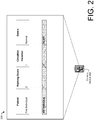
- FIG. 2 illustrates an example user interface 200 displayed by a clinical device 202.
- the clinical device 202 may correspond to any of the clinical devices 114-1 to 114- m described above with reference to FIG. 1 .
- the clinical device 202 may be utilized by at least one care provider responsible for monitoring multiple patients.
- the clinical device 202 may display a table that indicates whether any of the multiple patients are in need of additional care.
- the table includes a column identifying the patients (e.g., first through n th individuals), warning scores associated with the patients, circadian offsets of the patients, and statuses of the patients.
- the first individual has a "normal" status.
- the status of the first individual may indicate that the warnings score of the first individual may be below a threshold (e.g., 2 is below the threshold).
- the status of the individual may indicate that the circadian offset of the first individual may be within a normal range (e.g., 1 is within a normal range).
- the nth individual has an "ALERT" status.
- the status of the n th individual may indicate that the warnings score of the n th individual may be above a threshold (e.g., 7 is above the threshold).
- the status of the individual may indicate that the circadian offset of the first individual may be outside of a normal range (e.g., 5 is outside of a normal range).
- the user interface 200 may emphasize the ALERT status of the nth individual in a variety of ways.
- a row of the table associated with the nth individual may be a color (e.g., red) that may be different than a color (e.g., green) of the row(s) of the table associated with individuals that do not have the ALERT status.
- text in the row of the table associated with the nth individual may be selectively bolded.
- the row of the table associated with the nth individual may blink.
- FIGS. 3A to 3D illustrate examples of health indicators determined for an individual that does not require additional care.
- FIG. 3A illustrates a graph of a semi-continuous dataset associated with a vital sign measured over the course of multiple days. An x axis of the graph represents time in hours. A y axis of the graph represents the measured vital sign. A maximum threshold 302 and a minimum threshold 304 may represent a normal range for the illustrated vital sign.
- the example vital sign varies randomly due to random noise.
- the vital sign varies periodically over the course of each 24-hour cycle based on circadian offsets. Both the noise and the circadian offsets cause the dataset to exceed the maximum threshold 302 and fall below the minimum threshold 304 at various points throughout each day. Accordingly, if care providers were alerted whenever the dataset is outside of the range represented by the maximum threshold 302 and the minimum threshold 304, the care providers may be unnecessarily alerted multiple times, even though the monitored individual does not require additional care.
- FIG. 3B illustrates a graph of a circadian offset of the vital sign illustrated in FIG. 3A .
- An x axis of the graph represents time in hours.
- a y axis of the graph represents the circadian offset of the vital sign.
- a maximum variance 306 and a minimum variance 308 may represent a normal range for the circadian offset.
- the example circadian offset omits the periodic, 24-hour cycle variations in the vital sign.
- the circadian offset illustrated in FIG. 3B still varies outside of the maximum variance 306 and the minimum variance 308.
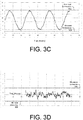
- FIG. 3C illustrates a graph of a running average of the semi-continuous vital sign dataset of FIG. 3A .
- An x axis of the graph represents time in hours.
- a y axis of the graph represents the running average of the measured vital sign.
- the vital sign is averaged over the course of an hour.
- the running average significantly reduces the impact of the random noise in the dataset of FIG. 3A .
- the running average effectively eliminates the chance that the care provider will be alerted when the individual does not require additional care.
- FIG. 3D illustrates a graph of a circadian offset of the running average illustrated in FIG. 3D .
- An x axis of the graph represents time in hours.
- a y axis of the graph represents the circadian offset of the average vital sign.
- the circadian offset represents the difference between an hourly vital sign at a particular time period and the hourly vital sign 24 hours prior to the particular time period.
- the circadian offset depicted in FIG. 3D varies within the normal range represented by the maximum variance 306 and the minimum variance 308. Accordingly, the circadian offset of the running average effectively eliminates the chance that the care provider would be alerted when the individual does not require additional care.
- FIGS. 4A to 4D illustrate examples of health indicators determined for an individual that may require additional care.
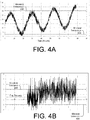
- FIG. 4A illustrates a graph of a semi-continuous dataset associated with a vital sign measured over the course of multiple days. An x axis of the graph represents time in hours. A y axis of the graph represents the measured vital sign. A maximum threshold 402 and a minimum threshold 404 may represent a normal range for the vital sign.
- the vital sign varies randomly due to random noise.
- the vital sign varies periodically over the course of each 24-hour cycle based on circadian offsets. Both the noise and the circadian offsets cause the dataset to exceed the maximum threshold 402 at various points throughout each day.
- the vital sign may linger between the maximum threshold 402 and the minimum threshold 404 even though the individual may require additional care. For instance, the vital sign of FIG. 4A would not notify a care provider that the individual's health may be deteriorating between 60 hours and 70 hours.
- FIG. 4B illustrates a graph of a circadian offset of the vital sign illustrated in FIG. 4A .
- An x axis of the graph represents time in hours.
- a y axis of the graph represents the circadian offset of the vital sign.
- a maximum variance 406 and a minimum variance 408 may represent a normal range for the circadian offset.
- the circadian offset omits the periodic, 24-hour cycle variations in the vital sign.
- the circadian offset illustrated in FIG. 4B varies outside of the maximum variance 406 and the minimum variance 408 as early as about 26 hours, even though the individual may not be deteriorating until after the 40 hour mark.
- FIG. 4C illustrates a graph of a running average of the semi-continuous vital sign dataset of FIG. 4A .
- An x axis of the graph represents time in hours.
- a y axis of the graph represents the running average of the measured vital sign.
- the vital sign is averaged over the course of an hour.
- the running average significantly reduces the impact of the random noise in the dataset of FIG. 4A .
- the running average effectively ensures that a care provider can be selectively notified as the individual's condition deteriorates.
- FIG. 4D illustrates a graph of a circadian offset of the running average illustrated in FIG. 4D .
- An x axis of the graph represents time in hours.
- a y axis of the graph represents the circadian offset of the average vital sign.
- the circadian offset represents the difference between an hourly vital sign at a particular time period and the hourly vital sign 24 hours prior to the particular time period.
- the circadian offset depicted in FIG. 4D only exceeds the maximum variance 406 after about 44 hours. Accordingly, a care provider can be assured that any alerts triggered due to the circadian offset of FIG. 4D are more likely to be accurate than alerts triggered due to the circadian offset of FIG. 4B .
- the circadian offset of FIG. 4D indicates that the individual's condition has deteriorated between the hours of 60 and 70.
- FIG. 5 illustrates a graph providing an example of correcting an average 502 based on a trend.
- An x axis of the graph represents time in hours.
- a y axis of the graph represents vital signs of an individual that are measured during a particular time period.
- the particular time period depicted in FIG. 5 may be significantly less than 24 hours. Accordingly, even if the measurements vary periodically over the course of 24 hours, the circadian offset may be relatively negligible over the course of the particular time period. As illustrated in FIG. 5 , the time period is 6 hours, but in certain implementations, the time period could be between 0.5-8 hours.
- a linear line-of-best fit may be determined for the measurements over the course of the time period.
- linear interpolation can be performed on the measurements.
- An average 502 of the measurements may be determined based on the measurements.
- the average 502 may be considered to be a raw average and may be determined by summing all of the measurements and dividing the sum by the time period.
- a corrected average 504 may be determined based on the slope m of the line, the time period over which the measurements were acquired, and the average 502 of the measurements.
- the corrected average 504 may be determined based on Equation 1, described above with reference to FIG. 1 .
- FIG. 6 illustrates a process 600 for determining and reporting a warning score of an individual.
- process 600 can be performed by at least one of a sensor device (e.g., sensor devices 104-1 to 104- n ), a monitoring system (e.g., the monitoring system 108), or a clinical device (e.g., clinical devices 114-1 to 114- m ).
- the process 700 can be performed by a system including at least one processor.
- the processor(s) can determine measurements of biological conditions of an individual that were measured within a time period.
- at least one sensor e.g., sensor devices 104-1 to 104- n
- the processor(s) can determine various parameters associated with the biological conditions, generate signals based on the parameters, and transmit the signals to the processor(s).
- the measurements may be semi-continuous.
- the sensor(s) may determine the parameters automatically and without warning to the individual. Accordingly, in some cases, the measurements may be susceptible to random noise.
- the sensor(s) may include an electronic blood pressure monitor that automatically tightens around the individual's arm, measures various parameters (e.g., an electrical signal) that are indicative of the individual's blood pressure during the time period, and transmits signals indicative of the individual's blood pressure to the processor(s).
- an electronic blood pressure monitor that automatically tightens around the individual's arm, measures various parameters (e.g., an electrical signal) that are indicative of the individual's blood pressure during the time period, and transmits signals indicative of the individual's blood pressure to the processor(s).
- the signals can be transmitted between the processor(s) and the sensor(s) via a transceiver in communication with the processor(s) and a transceiver in communication with the sensor(s).
- the processor(s) may receive the signals indicative of the measurements from the sensor(s).
- the transceiver in communication with the sensor(s) may wirelessly transmit the signals indicative of the measurements to the transceiver in communication with the processor(s)
- the transceiver in communication with the processor(s) may wirelessly receive the signals from the transceiver in communication with the sensor(s).
- the biological conditions may include vital signs, in some cases.
- the measurements of the biological conditions may include at least one of a respiratory rate of the individual, a body temperature of the individual, a blood pressure of the individual, a heart rate of the individual, whether the individual may be using supplemental oxygen, a consciousness of the individual, or the like.
- the time period may be shorter than a 24-hour time period.
- the time period may be significantly (e.g., at least ten times) as long as a sampling period of the measurements. In some cases, the time period can be between one half an hour and eight hours.
- the processor(s) may determine a warning score based on the measurements.
- the warning score may represent any single metric that aggregates multiple biological conditions, such as the biological conditions indicated in the measurements that were received at 602.
- the National Early Warning Score (NEWS2) is one example of a warning score determined by the processor(s) at 604.
- the processor(s) may determine the warning score based on a running average of each of the biological conditions over the course of the time period.
- the running average of a particular biological condition may be corrected based on a line-of-best-fit.
- the line-of-best-fit may be determined by the processor(s) for the measurements of the particular biological condition over the course of the time period. Accordingly, processor(s) may prevent the random noise in the measurements from propagating to the warning score.
- the processor(s) may cause at least one clinical device to output an indication of the warning score.
- the processor(s) may be in communication with the clinical device(s) via one or more wired or wireless interfaces, in certain examples.
- the processor(s) may cause a transceiver in communication with the processor(s) to transmit signals indicative of the warning score to at least one transceiver in communication with the clinical device(s).
- the processor(s) may cause the clinical device(s) to output the indication of the warning score by causing the transceiver to transmit the signals to the clinical device(s).
- the processor(s) may transmit (e.g., cause transmission via a transceiver) a signal indicating an instruction to output the indication of the warning score to the clinical device(s).
- the clinical device(s) may output the indication via a user interface.
- the clinical device(s) may output the indication as at least one of an auditory signal, a haptic signal, or a visual signal.
- the clinical device(s) may display, on a screen, a visual representation of the warning score.
- the processor(s) may determine that the warning score may be outside of a predetermined range. For instance, if the warning score is a NEWS2 score, the processor(s) may determine that the warning score is at least 3. In response to determining that the warning score is outside of the predetermined range, the processor(s) may cause the clinical device(s) to output the indication as an alert associated with the individual.
- the alert may indicate to any care provider interacting with the clinical device(s) that the individual may be likely to require critical care. For instance, a speaker associated with the clinical device(s) may output an alarm in response to the processor(s) transmitting a signal indicating an alert to the clinical device(s).
- the clinical device(s) may output indications of warning scores and other health indicators of multiple patients, including the individual.
- the clinical device(s) may selectively activate an alert for an individual corresponding to the warning score.
- the warning scores of other individuals may remain output by the clinical device(s). Accordingly, care providers can continuously monitor the warning scores of multiple patients using a single user interface and can be immediately notified when any of those patients are likely to require critical care.
- FIG. 7 illustrates an example process 700 for determining and reporting a circadian offset of an individual.
- process 700 can be performed by at least one of a sensor device (e.g., sensor devices 104-1 to 104- n ), a monitoring system (e.g., the monitoring system 108), or a clinical device (e.g., clinical devices 114-1 to 114- m ).
- the process 700 can be performed by a system including at least one processor.
- the processor(s) may determine first measurements of a biological condition of an individual that were measured determined within a first time period.
- at least one sensor e.g., sensor devices 104-1 to 104- n
- the first measurements may be semi-continuous.
- the sensor(s) may measure the various parameters automatically and without warning to the individual. Accordingly, in some cases, the first measurements may be susceptible to random noise.
- the sensor(s) may include an electronic blood pressure monitor that automatically tightens around the individual's arm, measures various parameters (e.g., an electrical signal) that are indicative of the individual's blood pressure during the time period, and transmits signals indicative of the individual's blood pressure to the processor(s).
- an electronic blood pressure monitor that automatically tightens around the individual's arm, measures various parameters (e.g., an electrical signal) that are indicative of the individual's blood pressure during the time period, and transmits signals indicative of the individual's blood pressure to the processor(s).
- the signals can be transmitted between the processor(s) and the sensor(s) via a transceiver in communication with the processor(s) and a transceiver in communication with the sensor(s).
- the processor(s) may receive the signals indicative of the first measurements from the sensor(s).
- the transceiver in communication with the sensor(s) may wirelessly transmit the signals indicative of the first measurements to the transceiver in communication with the processor(s).
- the transceiver in communication with the processor(s) may wirelessly receive the signals from the transceiver in communication with the sensor(s).
- the biological conditions may include a vital sign, in some cases.
- the first measurements of the biological conditions may include at least one of a respiratory rate of the individual, a body temperature of the individual, a blood pressure of the individual, a heart rate of the individual, whether the individual may be using supplemental oxygen, a consciousness of the individual, or the like.
- the first time period may be shorter than a 24-hour time period.
- the first time period may be significantly (e.g., at least ten times) as long as a sampling period of the measurements.
- the first time period can be between one half an hour and eight hours.
- the processor(s) may determine second measurements of the biological condition of the individual that were measured within a second time period.
- at least one sensor e.g., sensor devices 104-1 to 104- n
- the sensor(s) may measure various parameters associated with the individual, determine signals indicating the second measurements using the measured parameters, and transmit the signals to the processor(s).
- the second measurements may be semi-continuous.
- the sensor(s) may measure the parameters automatically and without warning to the individual.
- the sensor(s) may include an electronic blood pressure monitor that automatically tightens around the individual's arm, measures various parameters (e.g., an electrical signal) that are indicative of the individual's blood pressure during the second time period, and transmits signals indicative of the individual's blood pressure to the processor(s).
- the signals can be transmitted between the processor(s) and the sensor(s) via a transceiver in communication with the processor(s) and a transceiver in communication with the sensor(s).
- the processor(s) may receive the signals indicative of the second measurements from the sensor(s).
- the transceiver in communication with the sensor(s) may wirelessly transmit the signals indicative of the second measurements to the transceiver in communication with the processor(s).
- the transceiver in communication with the processor(s) may wirelessly receive the signals from the transceiver in communication with the sensor(s).
- the second time period may be shorter than a 24-hour time period.
- the second time period may be significantly (e.g., at least ten times) as long as a sampling period of the measurements.
- the second time period can be between one half an hour and eight hours.
- the second time period may occur, at least in part, 24 hours after the first time period.
- the second time period may overlap with 24 hours after the beginning of the first time period or 24 hours after the end of the first time period.
- a length of the second time period may be shorter than a length of the first time period.
- the first time period may be between one hour and eight hours, and the second time period may be between a half of an hour and 6 hours.
- the processor(s) may determine a circadian offset based on the first measurements and the second measurements. In some examples, the processor(s) determine the circadian offset based on an average of the first measurements and an average of the second measurements. For instance, the circadian offset may be equal to a difference between the averages. In some cases, the processor(s) may use corrected averages of the first measurements and the second measurements to determine the circadian offset.
- the processor(s) cause at least one clinical device to output an indication of the circadian offset.
- the processor(s) may be in communication with the clinical device(s) via one or more wired or wireless interfaces, in certain examples.
- the processor(s) may cause a transceiver in communication with the processor(s) to transmit signals indicative of the circadian offset to at least one transceiver in communication with the clinical device(s).
- the processor(s) may cause the clinical device(s) to output the indication of the circadian offset by causing the transceiver to transmit the signals to the clinical device(s).
- the processor(s) may transmit (e.g., cause transmission via a transceiver) a signal indicating an instruction to output the indication of the circadian offset to the clinical device(s).
- the clinical device(s) may output the indication via a user interface.
- the clinical device(s) may output the indication as at least one of an auditory signal, a haptic signal, or a visual signal.
- the clinical device(s) may display, on a screen, a visual representation of the circadian offset.
- the processor(s) may determine that the circadian offset is outside of a predetermined range. In response to determining that the circadian offset is outside of the predetermined range, the processor(s) may cause the clinical device(s) to output the indication as an alert associated with the individual.
- the alert may indicate to any care provider interacting with the clinical device(s) that the individual may be likely to require critical care. For instance, a speaker associated with the clinical device(s) may output an alarm in response to the processor(s) transmitting a signal indicating an alert to the clinical device(s).
- the clinical device(s) may output indications of circadian offsets and other health indicators of multiple patients, including the individual.
- the clinical device(s) may selectively activate an alert for an individual corresponding to the circadian offset.
- the circadian offsets of other individuals may remain output by the clinical device(s). Accordingly, care providers can continuously monitor the circadian offsets of multiple patients using a single user interface and can be immediately notified when any of those patients are likely to require critical care.
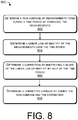
- FIG. 8 illustrates a process 800 for determining a corrected average, which may be used to determine a warning score and/or a circadian offset.
- process 800 can be performed by at least one of a sensor device (e.g., sensor devices 104-1 to 104- n ), a monitoring system (e.g., the monitoring system 108), or a clinical device (e.g., clinical devices 114-1 to 114- m ).
- the process 800 can be performed by a device including at least one processor.
- the processor(s) may determine a raw average of measurements that were measured during a time period. For instance, the processor(s) may add the measurements together and divide the sum of the measurements by the time period.
- the measurements may represent measurements of a biological condition of an individual.
- the time period may be eight hours or less, in some cases, to reduce the impacts of circadian offsets.
- the processor(s) may determine a linear line-of-best-fit for the measurements over the time period. For example, the processor(s) may perform linear interpolation on the measurements.
- the processor(s) may determine a correction by multiplying a slope of the line-of-best-fit by half of the time period. Then, at 808, the processor(s) may determine a corrected average by adding the raw average and the correction.
- the corrected average can be used to estimate the biological condition at the end of the time period. Unlike the raw average, the corrected average considers a trend of the biological condition throughout the time period. Accordingly, the corrected average may be a more accurate representation of the biological condition at the end of the time period than the raw average.
- FIG. 9 illustrates an example system including at least one device 900.
- the system illustrated in FIG. 9 may perform any of the functionality described herein.
- the device(s) 900 may be implemented by at least one of server computer(s), dedicated hardware, software operating on dedicated hardware, or virtualized function(s) hosted on an appropriate platform (e.g., cloud infrastructure).
- the device(s) 900 may be implemented as a single device or as multiple devices with components and data distributed among them.
- the device(s) 900 comprise a memory 902.
- the memory 902 is volatile (such as Random Access Memory (RAM)), nonvolatile (such as Read Only Memory (ROM), flash memory, etc.) or some combination of the two.
- RAM Random Access Memory
- ROM Read Only Memory
- Various elements stored in the memory 902 can include methods, threads, processes, applications, objects, modules, or any other sort of executable instructions. Elements stored in the memory 902 may be non-transitory.
- the memory 902 may also store various files, databases, or the like.
- the memory 902 may include various instructions 904, which can be executed by processor(s) 906 to perform operations.
- the instructions 904 when executed by the processor(s) 906, can cause the processor(s) 904 and/or the device(s) 900 to perform various functions of sensors (e.g., the sensors 104-1 o 104- n ), a monitoring system (e.g., the monitoring system 108), an EMR system (e.g., the EMR system 110), a clinical device (e.g., the clinical devices 114-1 to 114- m ), or a combination thereof.
- the memory 902 sores files, databases, and/or other types of data.
- the processor(s) 906 includes a Central Processing Unit (CPU), a Graphics Processing Unit (GPU), or both CPU and GPU, or other processing unit or component known in the art.
- the device(s) 900 can also include additional data storage components such as, for example, magnetic disks, optical disks, or tape. These additional data storage components can include removable storage 908 and non-removable storage 910. Tangible computer-readable media can include volatile and nonvolatile, removable and non-removable media implemented in any method or technology for storage of information, such as computer readable instructions, data structures, program modules, or other data.
- the memory 902, removable storage 908, and non-removable storage 910 are all examples of computer-readable storage media.
- Computer-readable storage media include, but are not limited to, RAM, ROM, EEPROM, flash memory or other memory technology, CD-ROM, Digital Versatile Discs (DVDs), Content-Addressable Memory (CAM), or other optical storage, magnetic cassettes, magnetic tape, magnetic disk storage or other magnetic storage devices, or any other medium which can be used to store the desired information and which can be accessed by the device(s) 900. Any such tangible computer-readable media can be part of the device(s) 900.
- the device(s) 900 can also include input device(s) 912 and output device(s) 914.
- the input device(s) 912 can include at least one of a keypad, a cursor control, a touch-sensitive display, a voice input device, a haptic feedback device, or the like.
- the output device(s) 914 can include at least one of a display, speakers, a haptic output device, printers, etc. These devices are well known in the art and need not be discussed at length here.
- the device(s) 900 can also include one or more wired or wireless transceiver(s) 916.
- the transceiver(s) 916 can include a Network Interface Card (NIC), a network adapter, a Local Area Network (LAN) adapter, or a physical, virtual, or logical address to connect to the various external devices and/or systems.
- the transceiver(s) 916 can include any sort of wireless transceivers capable of engaging in wireless communication (e.g., Radio Frequency (RF) communication).
- the transceiver(s) 916 can also include other wireless modems, such as a modem for engaging in Wi-Fi, WiMAX, Bluetooth, or infrared communication.
- the transceiver(s) 916 enable communication between the device(s) 900 and external devices over communication networks (e.g., the first network 106, the second network 112, the third network 116, or a combination thereof).
- one or more components may be referred to herein as “configured to,” “configurable to,” “operable/operative to,” “adapted/adaptable,” “able to,” “conformable/conformed to,” etc.
- configured to can generally encompass active-state components and/or inactive-state components and/or standby-state components, unless context requires otherwise.
- the terms “comprises/comprising/comprised” and “includes/including/included,” and their equivalents, can be used interchangeably.
- An apparatus, system, or method that "comprises A, B, and C" includes A, B, and C, but also can include other components (e.g., D) as well. That is, the apparatus, system, or method is not limited to components A, B, and C.
Landscapes
- Health & Medical Sciences (AREA)
- Life Sciences & Earth Sciences (AREA)
- Engineering & Computer Science (AREA)
- Public Health (AREA)
- Medical Informatics (AREA)
- Physics & Mathematics (AREA)
- General Health & Medical Sciences (AREA)
- Pathology (AREA)
- Biomedical Technology (AREA)
- Molecular Biology (AREA)
- Veterinary Medicine (AREA)
- Surgery (AREA)
- Heart & Thoracic Surgery (AREA)
- Biophysics (AREA)
- Animal Behavior & Ethology (AREA)
- Physiology (AREA)
- Cardiology (AREA)
- Pulmonology (AREA)
- Psychiatry (AREA)
- Signal Processing (AREA)
- Artificial Intelligence (AREA)
- Computer Vision & Pattern Recognition (AREA)
- Optics & Photonics (AREA)
- Data Mining & Analysis (AREA)
- Databases & Information Systems (AREA)
- Epidemiology (AREA)
- Primary Health Care (AREA)
- Emergency Medicine (AREA)
- Computer Networks & Wireless Communication (AREA)
- Measuring And Recording Apparatus For Diagnosis (AREA)
Applications Claiming Priority (1)
| Application Number | Priority Date | Filing Date | Title |
|---|---|---|---|
| US201962870967P | 2019-07-05 | 2019-07-05 |
Publications (2)
| Publication Number | Publication Date |
|---|---|
| EP3760108A1 true EP3760108A1 (de) | 2021-01-06 |
| EP3760108B1 EP3760108B1 (de) | 2024-09-04 |
Family
ID=71783799
Family Applications (1)
| Application Number | Title | Priority Date | Filing Date |
|---|---|---|---|
| EP20183731.7A Active EP3760108B1 (de) | 2019-07-05 | 2020-07-02 | Vitalparameter-monitore für stationäre medizinische abteilungen |
Country Status (3)
| Country | Link |
|---|---|
| US (1) | US11694811B2 (de) |
| EP (1) | EP3760108B1 (de) |
| CN (1) | CN112244786B (de) |
Families Citing this family (4)
| Publication number | Priority date | Publication date | Assignee | Title |
|---|---|---|---|---|
| US20210020311A1 (en) * | 2019-07-17 | 2021-01-21 | Richard G. Johnson | Method for Enhanced Medical Data Pattern Recognition |
| EP4327336A4 (de) * | 2021-04-22 | 2025-03-12 | Verily Life Sciences LLC | Systeme und verfahren für klinische fernuntersuchungen und automatisierte etikettierung von signaldaten |
| US20240423579A1 (en) * | 2021-10-26 | 2024-12-26 | Sparrow Acoustics Inc. | Method and an electronic device for processing a waveform |
| CN114936241B (zh) * | 2022-05-23 | 2025-08-15 | 青岛海信医疗设备股份有限公司 | 一种数据展示方法、设备和装置 |
Citations (3)
| Publication number | Priority date | Publication date | Assignee | Title |
|---|---|---|---|---|
| US20080162182A1 (en) * | 2006-12-27 | 2008-07-03 | Cardiac Pacemakers, Inc | Between-patient comparisons for risk stratification of future heart failure decompensation |
| US20160071393A1 (en) * | 2014-09-09 | 2016-03-10 | Torvec, Inc. | Systems, methods, and apparatus for monitoring alertness of an individual utilizing a wearable device and providing notification |
| WO2019018879A1 (en) * | 2017-07-25 | 2019-01-31 | Seer Medical Pty Ltd | METHODS AND SYSTEMS FOR PREDICTING EPILEPSY CRISIS |
Family Cites Families (25)
| Publication number | Priority date | Publication date | Assignee | Title |
|---|---|---|---|---|
| US4129125A (en) | 1976-12-27 | 1978-12-12 | Camin Research Corp. | Patient monitoring system |
| US5205294A (en) * | 1991-02-19 | 1993-04-27 | Pacific Communications, Inc. | Apparatus and methodology for digital telemetry of biomedical signals |
| RU2029492C1 (ru) * | 1992-10-07 | 1995-02-27 | Брикенштейн Владимир Хаимович | Способ оценки биоэлектрических процессов головного мозга |
| US8491492B2 (en) | 2004-02-05 | 2013-07-23 | Earlysense Ltd. | Monitoring a condition of a subject |
| US8498879B2 (en) * | 2006-04-27 | 2013-07-30 | Wellstat Vaccines, Llc | Automated systems and methods for obtaining, storing, processing and utilizing immunologic information of individuals and populations for various uses |
| US7946995B1 (en) * | 2006-11-09 | 2011-05-24 | Pacesetter, Inc. | Analyzing circadian variations of a hemodynamic parameter to determine an adverse cardiac condition |
| US8602997B2 (en) | 2007-06-12 | 2013-12-10 | Sotera Wireless, Inc. | Body-worn system for measuring continuous non-invasive blood pressure (cNIBP) |
| US8417312B2 (en) * | 2007-10-25 | 2013-04-09 | Dexcom, Inc. | Systems and methods for processing sensor data |
| EP2701131A2 (de) * | 2008-05-12 | 2014-02-26 | Earlysense Ltd. | Überwachung, Prognose und Behandlung von klinischen Episoden |
| CN102481121B (zh) | 2009-09-03 | 2015-04-22 | 皇家飞利浦电子股份有限公司 | 意识监测 |
| CN102971755A (zh) * | 2010-01-21 | 2013-03-13 | 阿斯玛西格诺斯公司 | 用于慢性病管理的早期告警方法和系统 |
| US10292625B2 (en) * | 2010-12-07 | 2019-05-21 | Earlysense Ltd. | Monitoring a sleeping subject |
| US20130054215A1 (en) * | 2011-08-29 | 2013-02-28 | Pulsar Informatics, Inc. | Systems and methods for apnea-adjusted neurobehavioral performance prediction and assessment |
| US9295413B2 (en) * | 2013-01-17 | 2016-03-29 | Garmin Switzerland Gmbh | Fitness monitor |
| US20150119769A1 (en) * | 2013-10-30 | 2015-04-30 | Alexander Z. Golbin | Wearable rhythmic device |
| KR101628062B1 (ko) * | 2014-02-26 | 2016-06-08 | 고려대학교 산학협력단 | It 기반 일주기 생체리듬 관리 시스템 및 그 방법 |
| CN107106024B (zh) * | 2014-11-20 | 2020-11-20 | 皇家飞利浦有限公司 | 用于在生命体征采样频率有限时的分数置信度区间估计的方法 |
| EP3262548A1 (de) * | 2015-02-26 | 2018-01-03 | Oura Health Oy | Verfahren und system zur beurteilung eines bereitschaftswertes eines benutzers |
| US20160302671A1 (en) * | 2015-04-16 | 2016-10-20 | Microsoft Technology Licensing, Llc | Prediction of Health Status from Physiological Data |
| US10068461B2 (en) | 2016-04-05 | 2018-09-04 | Hill-Rom Services, Inc. | Real-time patient experience monitoring system |
| US11172892B2 (en) * | 2017-01-04 | 2021-11-16 | Hill-Rom Services, Inc. | Patient support apparatus having vital signs monitoring and alerting |
| US10398337B2 (en) * | 2017-03-07 | 2019-09-03 | Biosense Webster (Israel) Ltd. | Automatic tracking and adjustment of the view angle during catheter ablation treatment |
| US11229406B2 (en) | 2017-03-24 | 2022-01-25 | Medtronic Minimed, Inc. | Patient-specific glucose prediction systems and methods |
| US10959681B2 (en) | 2017-04-19 | 2021-03-30 | Vital Connect, Inc. | Noninvasive blood pressure measurement and monitoring |
| EP3420896B1 (de) * | 2017-06-30 | 2025-06-25 | Nokia Technologies Oy | Vorrichtung, verfahren und computerprogramme zur überwachung des pulses eines benutzers |
-
2020
- 2020-07-01 US US16/918,904 patent/US11694811B2/en active Active
- 2020-07-02 EP EP20183731.7A patent/EP3760108B1/de active Active
- 2020-07-03 CN CN202010635060.6A patent/CN112244786B/zh active Active
Patent Citations (3)
| Publication number | Priority date | Publication date | Assignee | Title |
|---|---|---|---|---|
| US20080162182A1 (en) * | 2006-12-27 | 2008-07-03 | Cardiac Pacemakers, Inc | Between-patient comparisons for risk stratification of future heart failure decompensation |
| US20160071393A1 (en) * | 2014-09-09 | 2016-03-10 | Torvec, Inc. | Systems, methods, and apparatus for monitoring alertness of an individual utilizing a wearable device and providing notification |
| WO2019018879A1 (en) * | 2017-07-25 | 2019-01-31 | Seer Medical Pty Ltd | METHODS AND SYSTEMS FOR PREDICTING EPILEPSY CRISIS |
Non-Patent Citations (1)
| Title |
|---|
| SMITH G B ET AL: "Hospital-wide physiological surveillance-A new approach to the early identification and management of the sick patient", RESUSCITATION, ELSEVIER, IE, vol. 71, no. 1, 1 October 2006 (2006-10-01), pages 19 - 28, XP027919886, ISSN: 0300-9572, [retrieved on 20061001] * |
Also Published As
| Publication number | Publication date |
|---|---|
| CN112244786B (zh) | 2024-07-05 |
| US11694811B2 (en) | 2023-07-04 |
| CN112244786A (zh) | 2021-01-22 |
| US20210005323A1 (en) | 2021-01-07 |
| EP3760108B1 (de) | 2024-09-04 |
Similar Documents
| Publication | Publication Date | Title |
|---|---|---|
| US20210077035A1 (en) | Personalized vital sign monitors | |
| EP3760108B1 (de) | Vitalparameter-monitore für stationäre medizinische abteilungen | |
| US10095838B2 (en) | Graphical presentation of EWS/patient state | |
| JP6692355B2 (ja) | バイタルサインサンプリング周波数が限定されるときのスコア信頼区間推定に関する方法 | |
| US10039451B2 (en) | System and method for optimizing the frequency of data collection and thresholds for deterioration detection algorithm | |
| US10368748B2 (en) | System and method of evaluating an association between a wireless sensor and a monitored patient | |
| US10492696B2 (en) | Portable biometric monitoring device and method for use thereof | |
| US20150342538A1 (en) | Custom early warning scoring for medical device | |
| US8988227B2 (en) | Alarm information processing apparatus and alarm information processing program | |
| US20150208968A1 (en) | System and method for assessment of patient health based on recovery responses from oxygen desaturation | |
| US10839668B2 (en) | Alarm information processing apparatus and control program for alarm information processing apparatus | |
| JP7447449B2 (ja) | 血圧分析装置、血圧分析方法、及び血圧分析プログラム | |
| WO2015044859A1 (en) | A methodology for hospitalized patient monitoring and icu risk prediction with a physiologic based early warning system | |
| US20250195862A1 (en) | Automatic detection of dirty or contaminated connectors in a patient monitoring system | |
| WO2022176747A1 (en) | Monitoring method, monitor, and program | |
| KR20150059690A (ko) | 휴대용 심전도 측정기와 스마트 기기를 이용한 심건강 모니터링 시스템 및 이를 이용한 모니터링 방법 |
Legal Events
| Date | Code | Title | Description |
|---|---|---|---|
| PUAI | Public reference made under article 153(3) epc to a published international application that has entered the european phase |
Free format text: ORIGINAL CODE: 0009012 |
|
| STAA | Information on the status of an ep patent application or granted ep patent |
Free format text: STATUS: THE APPLICATION HAS BEEN PUBLISHED |
|
| AK | Designated contracting states |
Kind code of ref document: A1 Designated state(s): AL AT BE BG CH CY CZ DE DK EE ES FI FR GB GR HR HU IE IS IT LI LT LU LV MC MK MT NL NO PL PT RO RS SE SI SK SM TR |
|
| AX | Request for extension of the european patent |
Extension state: BA ME |
|
| STAA | Information on the status of an ep patent application or granted ep patent |
Free format text: STATUS: REQUEST FOR EXAMINATION WAS MADE |
|
| 17P | Request for examination filed |
Effective date: 20210630 |
|
| RBV | Designated contracting states (corrected) |
Designated state(s): AL AT BE BG CH CY CZ DE DK EE ES FI FR GB GR HR HU IE IS IT LI LT LU LV MC MK MT NL NO PL PT RO RS SE SI SK SM TR |
|
| STAA | Information on the status of an ep patent application or granted ep patent |
Free format text: STATUS: EXAMINATION IS IN PROGRESS |
|
| 17Q | First examination report despatched |
Effective date: 20230705 |
|
| GRAP | Despatch of communication of intention to grant a patent |
Free format text: ORIGINAL CODE: EPIDOSNIGR1 |
|
| STAA | Information on the status of an ep patent application or granted ep patent |
Free format text: STATUS: GRANT OF PATENT IS INTENDED |
|
| INTG | Intention to grant announced |
Effective date: 20240402 |
|
| RIN1 | Information on inventor provided before grant (corrected) |
Inventor name: SHI, YUAN Inventor name: DE BIE, JOHANNES |
|
| GRAS | Grant fee paid |
Free format text: ORIGINAL CODE: EPIDOSNIGR3 |
|
| GRAA | (expected) grant |
Free format text: ORIGINAL CODE: 0009210 |
|
| STAA | Information on the status of an ep patent application or granted ep patent |
Free format text: STATUS: THE PATENT HAS BEEN GRANTED |
|
| AK | Designated contracting states |
Kind code of ref document: B1 Designated state(s): AL AT BE BG CH CY CZ DE DK EE ES FI FR GB GR HR HU IE IS IT LI LT LU LV MC MK MT NL NO PL PT RO RS SE SI SK SM TR |
|
| REG | Reference to a national code |
Ref country code: GB Ref legal event code: FG4D |
|
| REG | Reference to a national code |
Ref country code: CH Ref legal event code: EP |
|
| REG | Reference to a national code |
Ref country code: IE Ref legal event code: FG4D |
|
| REG | Reference to a national code |
Ref country code: DE Ref legal event code: R096 Ref document number: 602020036937 Country of ref document: DE |
|
| REG | Reference to a national code |
Ref country code: LT Ref legal event code: MG9D |
|
| REG | Reference to a national code |
Ref country code: NL Ref legal event code: MP Effective date: 20240904 |
|
| PG25 | Lapsed in a contracting state [announced via postgrant information from national office to epo] |
Ref country code: NO Free format text: LAPSE BECAUSE OF FAILURE TO SUBMIT A TRANSLATION OF THE DESCRIPTION OR TO PAY THE FEE WITHIN THE PRESCRIBED TIME-LIMIT Effective date: 20241204 |
|
| PG25 | Lapsed in a contracting state [announced via postgrant information from national office to epo] |
Ref country code: GR Free format text: LAPSE BECAUSE OF FAILURE TO SUBMIT A TRANSLATION OF THE DESCRIPTION OR TO PAY THE FEE WITHIN THE PRESCRIBED TIME-LIMIT Effective date: 20241205 Ref country code: FI Free format text: LAPSE BECAUSE OF FAILURE TO SUBMIT A TRANSLATION OF THE DESCRIPTION OR TO PAY THE FEE WITHIN THE PRESCRIBED TIME-LIMIT Effective date: 20240904 Ref country code: PL Free format text: LAPSE BECAUSE OF FAILURE TO SUBMIT A TRANSLATION OF THE DESCRIPTION OR TO PAY THE FEE WITHIN THE PRESCRIBED TIME-LIMIT Effective date: 20240904 |
|
| PG25 | Lapsed in a contracting state [announced via postgrant information from national office to epo] |
Ref country code: BG Free format text: LAPSE BECAUSE OF FAILURE TO SUBMIT A TRANSLATION OF THE DESCRIPTION OR TO PAY THE FEE WITHIN THE PRESCRIBED TIME-LIMIT Effective date: 20240904 |
|
| PG25 | Lapsed in a contracting state [announced via postgrant information from national office to epo] |
Ref country code: LV Free format text: LAPSE BECAUSE OF FAILURE TO SUBMIT A TRANSLATION OF THE DESCRIPTION OR TO PAY THE FEE WITHIN THE PRESCRIBED TIME-LIMIT Effective date: 20240904 |
|
| PG25 | Lapsed in a contracting state [announced via postgrant information from national office to epo] |
Ref country code: HR Free format text: LAPSE BECAUSE OF FAILURE TO SUBMIT A TRANSLATION OF THE DESCRIPTION OR TO PAY THE FEE WITHIN THE PRESCRIBED TIME-LIMIT Effective date: 20240904 |
|
| PG25 | Lapsed in a contracting state [announced via postgrant information from national office to epo] |
Ref country code: ES Free format text: LAPSE BECAUSE OF FAILURE TO SUBMIT A TRANSLATION OF THE DESCRIPTION OR TO PAY THE FEE WITHIN THE PRESCRIBED TIME-LIMIT Effective date: 20240904 |
|
| PG25 | Lapsed in a contracting state [announced via postgrant information from national office to epo] |
Ref country code: PL Free format text: LAPSE BECAUSE OF FAILURE TO SUBMIT A TRANSLATION OF THE DESCRIPTION OR TO PAY THE FEE WITHIN THE PRESCRIBED TIME-LIMIT Effective date: 20240904 Ref country code: NO Free format text: LAPSE BECAUSE OF FAILURE TO SUBMIT A TRANSLATION OF THE DESCRIPTION OR TO PAY THE FEE WITHIN THE PRESCRIBED TIME-LIMIT Effective date: 20241204 Ref country code: LV Free format text: LAPSE BECAUSE OF FAILURE TO SUBMIT A TRANSLATION OF THE DESCRIPTION OR TO PAY THE FEE WITHIN THE PRESCRIBED TIME-LIMIT Effective date: 20240904 Ref country code: HR Free format text: LAPSE BECAUSE OF FAILURE TO SUBMIT A TRANSLATION OF THE DESCRIPTION OR TO PAY THE FEE WITHIN THE PRESCRIBED TIME-LIMIT Effective date: 20240904 Ref country code: GR Free format text: LAPSE BECAUSE OF FAILURE TO SUBMIT A TRANSLATION OF THE DESCRIPTION OR TO PAY THE FEE WITHIN THE PRESCRIBED TIME-LIMIT Effective date: 20241205 Ref country code: FI Free format text: LAPSE BECAUSE OF FAILURE TO SUBMIT A TRANSLATION OF THE DESCRIPTION OR TO PAY THE FEE WITHIN THE PRESCRIBED TIME-LIMIT Effective date: 20240904 Ref country code: ES Free format text: LAPSE BECAUSE OF FAILURE TO SUBMIT A TRANSLATION OF THE DESCRIPTION OR TO PAY THE FEE WITHIN THE PRESCRIBED TIME-LIMIT Effective date: 20240904 Ref country code: BG Free format text: LAPSE BECAUSE OF FAILURE TO SUBMIT A TRANSLATION OF THE DESCRIPTION OR TO PAY THE FEE WITHIN THE PRESCRIBED TIME-LIMIT Effective date: 20240904 |
|
| REG | Reference to a national code |
Ref country code: AT Ref legal event code: MK05 Ref document number: 1719504 Country of ref document: AT Kind code of ref document: T Effective date: 20240904 |
|
| PG25 | Lapsed in a contracting state [announced via postgrant information from national office to epo] |
Ref country code: NL Free format text: LAPSE BECAUSE OF FAILURE TO SUBMIT A TRANSLATION OF THE DESCRIPTION OR TO PAY THE FEE WITHIN THE PRESCRIBED TIME-LIMIT Effective date: 20240904 |
|
| PG25 | Lapsed in a contracting state [announced via postgrant information from national office to epo] |
Ref country code: IS Free format text: LAPSE BECAUSE OF FAILURE TO SUBMIT A TRANSLATION OF THE DESCRIPTION OR TO PAY THE FEE WITHIN THE PRESCRIBED TIME-LIMIT Effective date: 20250104 Ref country code: PT Free format text: LAPSE BECAUSE OF FAILURE TO SUBMIT A TRANSLATION OF THE DESCRIPTION OR TO PAY THE FEE WITHIN THE PRESCRIBED TIME-LIMIT Effective date: 20250106 |
|
| PG25 | Lapsed in a contracting state [announced via postgrant information from national office to epo] |
Ref country code: SM Free format text: LAPSE BECAUSE OF FAILURE TO SUBMIT A TRANSLATION OF THE DESCRIPTION OR TO PAY THE FEE WITHIN THE PRESCRIBED TIME-LIMIT Effective date: 20240904 Ref country code: RO Free format text: LAPSE BECAUSE OF FAILURE TO SUBMIT A TRANSLATION OF THE DESCRIPTION OR TO PAY THE FEE WITHIN THE PRESCRIBED TIME-LIMIT Effective date: 20240904 |
|
| PG25 | Lapsed in a contracting state [announced via postgrant information from national office to epo] |
Ref country code: EE Free format text: LAPSE BECAUSE OF FAILURE TO SUBMIT A TRANSLATION OF THE DESCRIPTION OR TO PAY THE FEE WITHIN THE PRESCRIBED TIME-LIMIT Effective date: 20240904 Ref country code: AT Free format text: LAPSE BECAUSE OF FAILURE TO SUBMIT A TRANSLATION OF THE DESCRIPTION OR TO PAY THE FEE WITHIN THE PRESCRIBED TIME-LIMIT Effective date: 20240904 |
|
| PG25 | Lapsed in a contracting state [announced via postgrant information from national office to epo] |
Ref country code: CZ Free format text: LAPSE BECAUSE OF FAILURE TO SUBMIT A TRANSLATION OF THE DESCRIPTION OR TO PAY THE FEE WITHIN THE PRESCRIBED TIME-LIMIT Effective date: 20240904 |
|
| PG25 | Lapsed in a contracting state [announced via postgrant information from national office to epo] |
Ref country code: SK Free format text: LAPSE BECAUSE OF FAILURE TO SUBMIT A TRANSLATION OF THE DESCRIPTION OR TO PAY THE FEE WITHIN THE PRESCRIBED TIME-LIMIT Effective date: 20240904 Ref country code: IT Free format text: LAPSE BECAUSE OF FAILURE TO SUBMIT A TRANSLATION OF THE DESCRIPTION OR TO PAY THE FEE WITHIN THE PRESCRIBED TIME-LIMIT Effective date: 20240904 |
|
| REG | Reference to a national code |
Ref country code: DE Ref legal event code: R097 Ref document number: 602020036937 Country of ref document: DE |
|
| PG25 | Lapsed in a contracting state [announced via postgrant information from national office to epo] |
Ref country code: DK Free format text: LAPSE BECAUSE OF FAILURE TO SUBMIT A TRANSLATION OF THE DESCRIPTION OR TO PAY THE FEE WITHIN THE PRESCRIBED TIME-LIMIT Effective date: 20240904 |
|
| PGFP | Annual fee paid to national office [announced via postgrant information from national office to epo] |
Ref country code: GB Payment date: 20250619 Year of fee payment: 6 |
|
| PLBE | No opposition filed within time limit |
Free format text: ORIGINAL CODE: 0009261 |
|
| STAA | Information on the status of an ep patent application or granted ep patent |
Free format text: STATUS: NO OPPOSITION FILED WITHIN TIME LIMIT |
|
| PGFP | Annual fee paid to national office [announced via postgrant information from national office to epo] |
Ref country code: FR Payment date: 20250620 Year of fee payment: 6 |
|
| 26N | No opposition filed |
Effective date: 20250605 |
|
| PG25 | Lapsed in a contracting state [announced via postgrant information from national office to epo] |
Ref country code: SE Free format text: LAPSE BECAUSE OF FAILURE TO SUBMIT A TRANSLATION OF THE DESCRIPTION OR TO PAY THE FEE WITHIN THE PRESCRIBED TIME-LIMIT Effective date: 20240904 |
|
| PGFP | Annual fee paid to national office [announced via postgrant information from national office to epo] |
Ref country code: DE Payment date: 20250620 Year of fee payment: 6 |
|
| REG | Reference to a national code |
Ref country code: CH Ref legal event code: H13 Free format text: ST27 STATUS EVENT CODE: U-0-0-H10-H13 (AS PROVIDED BY THE NATIONAL OFFICE) Effective date: 20260224 |
|
| PG25 | Lapsed in a contracting state [announced via postgrant information from national office to epo] |
Ref country code: LU Free format text: LAPSE BECAUSE OF NON-PAYMENT OF DUE FEES Effective date: 20250702 |
|
| REG | Reference to a national code |
Ref country code: BE Ref legal event code: MM Effective date: 20250731 |
|
| PG25 | Lapsed in a contracting state [announced via postgrant information from national office to epo] |
Ref country code: BE Free format text: LAPSE BECAUSE OF NON-PAYMENT OF DUE FEES Effective date: 20250731 |
|
| PG25 | Lapsed in a contracting state [announced via postgrant information from national office to epo] |
Ref country code: CH Free format text: LAPSE BECAUSE OF NON-PAYMENT OF DUE FEES Effective date: 20250731 |