EP3760213B1 - Pharmazeutische zusammensetzung zur vorbeugung oder behandlung von krebs mit einem antikrebsvirus und hydroxyharnstoff als wirksame bestandteile - Google Patents
Pharmazeutische zusammensetzung zur vorbeugung oder behandlung von krebs mit einem antikrebsvirus und hydroxyharnstoff als wirksame bestandteile Download PDFInfo
- Publication number
- EP3760213B1 EP3760213B1 EP19761185.8A EP19761185A EP3760213B1 EP 3760213 B1 EP3760213 B1 EP 3760213B1 EP 19761185 A EP19761185 A EP 19761185A EP 3760213 B1 EP3760213 B1 EP 3760213B1
- Authority
- EP
- European Patent Office
- Prior art keywords
- cancer
- oncolytic virus
- administered
- hydroxyurea
- day
- Prior art date
- Legal status (The legal status is an assumption and is not a legal conclusion. Google has not performed a legal analysis and makes no representation as to the accuracy of the status listed.)
- Active
Links
Images






Classifications
-
- A—HUMAN NECESSITIES
- A61—MEDICAL OR VETERINARY SCIENCE; HYGIENE
- A61K—PREPARATIONS FOR MEDICAL, DENTAL OR TOILETRY PURPOSES
- A61K35/00—Medicinal preparations containing materials or reaction products thereof with undetermined constitution
- A61K35/66—Microorganisms or materials therefrom
- A61K35/76—Viruses; Subviral particles; Bacteriophages
- A61K35/768—Oncolytic viruses not provided for in groups A61K35/761 - A61K35/766
-
- A—HUMAN NECESSITIES
- A61—MEDICAL OR VETERINARY SCIENCE; HYGIENE
- A61K—PREPARATIONS FOR MEDICAL, DENTAL OR TOILETRY PURPOSES
- A61K35/00—Medicinal preparations containing materials or reaction products thereof with undetermined constitution
- A61K35/66—Microorganisms or materials therefrom
- A61K35/76—Viruses; Subviral particles; Bacteriophages
-
- A—HUMAN NECESSITIES
- A61—MEDICAL OR VETERINARY SCIENCE; HYGIENE
- A61K—PREPARATIONS FOR MEDICAL, DENTAL OR TOILETRY PURPOSES
- A61K35/00—Medicinal preparations containing materials or reaction products thereof with undetermined constitution
- A61K35/66—Microorganisms or materials therefrom
- A61K35/76—Viruses; Subviral particles; Bacteriophages
- A61K35/761—Adenovirus
-
- A—HUMAN NECESSITIES
- A61—MEDICAL OR VETERINARY SCIENCE; HYGIENE
- A61K—PREPARATIONS FOR MEDICAL, DENTAL OR TOILETRY PURPOSES
- A61K31/00—Medicinal preparations containing organic active ingredients
- A61K31/16—Amides, e.g. hydroxamic acids
- A61K31/17—Amides, e.g. hydroxamic acids having the group >N—C(O)—N< or >N—C(S)—N<, e.g. urea, thiourea, carmustine
-
- A—HUMAN NECESSITIES
- A61—MEDICAL OR VETERINARY SCIENCE; HYGIENE
- A61K—PREPARATIONS FOR MEDICAL, DENTAL OR TOILETRY PURPOSES
- A61K35/00—Medicinal preparations containing materials or reaction products thereof with undetermined constitution
- A61K35/66—Microorganisms or materials therefrom
- A61K35/76—Viruses; Subviral particles; Bacteriophages
- A61K35/763—Herpes virus
-
- A—HUMAN NECESSITIES
- A61—MEDICAL OR VETERINARY SCIENCE; HYGIENE
- A61K—PREPARATIONS FOR MEDICAL, DENTAL OR TOILETRY PURPOSES
- A61K9/00—Medicinal preparations characterised by special physical form
- A61K9/0012—Galenical forms characterised by the site of application
- A61K9/0019—Injectable compositions; Intramuscular, intravenous, arterial, subcutaneous administration; Compositions to be administered through the skin in an invasive manner
-
- A—HUMAN NECESSITIES
- A61—MEDICAL OR VETERINARY SCIENCE; HYGIENE
- A61P—SPECIFIC THERAPEUTIC ACTIVITY OF CHEMICAL COMPOUNDS OR MEDICINAL PREPARATIONS
- A61P35/00—Antineoplastic agents
-
- C—CHEMISTRY; METALLURGY
- C12—BIOCHEMISTRY; BEER; SPIRITS; WINE; VINEGAR; MICROBIOLOGY; ENZYMOLOGY; MUTATION OR GENETIC ENGINEERING
- C12N—MICROORGANISMS OR ENZYMES; COMPOSITIONS THEREOF; PROPAGATING, PRESERVING, OR MAINTAINING MICROORGANISMS; MUTATION OR GENETIC ENGINEERING; CULTURE MEDIA
- C12N7/00—Viruses; Bacteriophages; Compositions thereof; Preparation or purification thereof
-
- C—CHEMISTRY; METALLURGY
- C12—BIOCHEMISTRY; BEER; SPIRITS; WINE; VINEGAR; MICROBIOLOGY; ENZYMOLOGY; MUTATION OR GENETIC ENGINEERING
- C12N—MICROORGANISMS OR ENZYMES; COMPOSITIONS THEREOF; PROPAGATING, PRESERVING, OR MAINTAINING MICROORGANISMS; MUTATION OR GENETIC ENGINEERING; CULTURE MEDIA
- C12N2710/00—MICROORGANISMS OR ENZYMES; COMPOSITIONS THEREOF; PROPAGATING, PRESERVING, OR MAINTAINING MICROORGANISMS; MUTATION OR GENETIC ENGINEERING; CULTURE MEDIA dsDNA viruses
- C12N2710/00011—Details
- C12N2710/10011—Adenoviridae
- C12N2710/10311—Mastadenovirus, e.g. human or simian adenoviruses
- C12N2710/10332—Use of virus as therapeutic agent, other than vaccine, e.g. as cytolytic agent
-
- C—CHEMISTRY; METALLURGY
- C12—BIOCHEMISTRY; BEER; SPIRITS; WINE; VINEGAR; MICROBIOLOGY; ENZYMOLOGY; MUTATION OR GENETIC ENGINEERING
- C12N—MICROORGANISMS OR ENZYMES; COMPOSITIONS THEREOF; PROPAGATING, PRESERVING, OR MAINTAINING MICROORGANISMS; MUTATION OR GENETIC ENGINEERING; CULTURE MEDIA
- C12N2710/00—MICROORGANISMS OR ENZYMES; COMPOSITIONS THEREOF; PROPAGATING, PRESERVING, OR MAINTAINING MICROORGANISMS; MUTATION OR GENETIC ENGINEERING; CULTURE MEDIA dsDNA viruses
- C12N2710/00011—Details
- C12N2710/16011—Herpesviridae
- C12N2710/16611—Simplexvirus, e.g. human herpesvirus 1, 2
- C12N2710/16632—Use of virus as therapeutic agent, other than vaccine, e.g. as cytolytic agent
-
- C—CHEMISTRY; METALLURGY
- C12—BIOCHEMISTRY; BEER; SPIRITS; WINE; VINEGAR; MICROBIOLOGY; ENZYMOLOGY; MUTATION OR GENETIC ENGINEERING
- C12N—MICROORGANISMS OR ENZYMES; COMPOSITIONS THEREOF; PROPAGATING, PRESERVING, OR MAINTAINING MICROORGANISMS; MUTATION OR GENETIC ENGINEERING; CULTURE MEDIA
- C12N2710/00—MICROORGANISMS OR ENZYMES; COMPOSITIONS THEREOF; PROPAGATING, PRESERVING, OR MAINTAINING MICROORGANISMS; MUTATION OR GENETIC ENGINEERING; CULTURE MEDIA dsDNA viruses
- C12N2710/00011—Details
- C12N2710/24011—Poxviridae
- C12N2710/24111—Orthopoxvirus, e.g. vaccinia virus, variola
- C12N2710/24132—Use of virus as therapeutic agent, other than vaccine, e.g. as cytolytic agent
-
- Y—GENERAL TAGGING OF NEW TECHNOLOGICAL DEVELOPMENTS; GENERAL TAGGING OF CROSS-SECTIONAL TECHNOLOGIES SPANNING OVER SEVERAL SECTIONS OF THE IPC; TECHNICAL SUBJECTS COVERED BY FORMER USPC CROSS-REFERENCE ART COLLECTIONS [XRACs] AND DIGESTS
- Y02—TECHNOLOGIES OR APPLICATIONS FOR MITIGATION OR ADAPTATION AGAINST CLIMATE CHANGE
- Y02A—TECHNOLOGIES FOR ADAPTATION TO CLIMATE CHANGE
- Y02A50/00—TECHNOLOGIES FOR ADAPTATION TO CLIMATE CHANGE in human health protection, e.g. against extreme weather
- Y02A50/30—Against vector-borne diseases, e.g. mosquito-borne, fly-borne, tick-borne or waterborne diseases whose impact is exacerbated by climate change
Definitions
- the present invention relates to a pharmaceutical composition and a kit for use in preventing or treating cancer, comprising, as active ingredients, an oncolytic virus and hydroxyurea.
- Oncolytic viruses have excellent tumor-specific targeting ability, proliferation ability in cancer cells, and cancer cell-killing ability. Recently, various clinical studies based on oncolytic viruses have been conducted. In 2015, an era of oncolytic virus field began in the United States and Europe, as talimogene laherparepvec (T-Vec), which is an oncolytic virus based on herpes simplex virus, was successfully commercialized as a therapeutic agent for advanced melanoma.
- T-Vec talimogene laherparepvec
- oncolytic viruses exceeds their own efficacy and the viruses activate tumor immunity, thereby showing their potential as a therapeutic agent that is used in combination with another immunotherapeutic agent.
- a direct killing effect of the viruses which is caused by cancer cell-specific proliferation thereof, was relatively more important.
- subsequent clinical studies have found that activation of tumor immunity is a key mechanism rather than a direct cancer cell-killing effect.
- therapeutic agents which include an oncolytic virus and an immunotherapeutic agent such as an immune checkpoint inhibitor, both being administered in combination, are recently being developed. This is because it is known that oncolytic viruses convert the tumor microenvironment, in which immunity is suppressed, into a tumor microenvironment appropriate for immunotherapy.
- WO 2017/205674 A1 relates to oncolytic vaccinia virus mutants and using them for cancer treatment.
- US 2014/234257 A1 relates to oncolytic viruses and methods for treating neoplastic disorders.
- US 2009/317456 A1 relates to the use of oncolytic viruses and antiangiogenic agents in the treatment of cancer.
- the present inventors studied to enhance the anticancer effect of an oncolytic virus. As a result, the present inventors have found that in a case where the oncolytic virus and hydroxyurea are administered in combination to an individual having cancer, a superior anticancer effect is achieved as compared with a conventional case where only the oncolytic virus is administered, and thus have completed the present invention.
- a pharmaceutical composition for use in preventing or treating cancer as defined in claim 1 in another aspect of the present invention, there is provided a kit for use in preventing or treating cancer as defined in claim 5.
- the pharmaceutical composition of the present invention for use in preventing or treating cancer as defined in the appended claims has superior anticancer effect and safety as compared with a conventional case where only the oncolytic virus is administered, is capable of suppressing growth of cancer cells that are resistant to the oncolytic virus, and is capable of killing cancer cells in which the oncolytic virus can proliferate. Therefore, the pharmaceutical composition of the present invention for use in preventing or treating cancer can be effectively used to treat cancer.
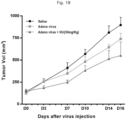
- Figures 1 , 6 , 12 and 16-19 do not relate to embodiments of the invention.
- a pharmaceutical composition for use preventing or treating cancer as defined in claim 1 there is provided a kit for use in preventing or treating cancer as defined in claim 5.
- the oncolytic virus and hydroxyurea may be administered in combination simultaneously, sequentially, or in reverse order. In some embodiments, the oncolytic virus and hydroxyurea may be administered simultaneously.
- oncolytic virus refers to a recombinant virus that destroys cancer cells, the recombinant virus being obtained by manipulating the gene of a virus so that it specifically proliferates only in the cancer cells.
- the oncolytic virus of use in the invention is derived from a vaccinia virus.
- the vaccinia virus may be, but is not limited to, Western Reserve (WR), New York vaccinia virus (NYVAC), Wyeth (The New York City Board of Health; NYCBOH), LC16m8, Lister, Copenhagen, Tian Tan, USSR, Tashkent, Evans, International Health Division-J (IHD-J), or International Health Division-White (IHD-W) vaccinia virus strain.
- WR Western Reserve
- NYVAC New York vaccinia virus
- Wyeth The New York City Board of Health; NYCBOH
- LC16m8 Lister
- Copenhagen Tian Tan
- USSR Tashkent
- IHD-J International Health Division-J
- IHD-W International Health Division-White
- the oncolytic virus may be a recombinant vaccinia virus (VV tk- ) into which granulocyte-macrophage colony-stimulating factor (GM-CSF) and ⁇ -galactosidase gene are not inserted and in which thymidine kinase gene is deleted.
- VV tk- recombinant vaccinia virus
- the oncolytic virus may be a recombinant vaccinia virus in which thymidine kinase (TK) gene is deleted and into which human GM-CSF or human G-CSF gene is inserted.
- TK thymidine kinase
- TK thymidine kinase
- TK is an enzyme used for biosynthesis of nucleotides both in cells and viruses.
- TK does not exist in normal cells because normal cells do not divide anymore; and even in rapidly dividing cells, such as hair root cells, the amount of TK is not enough for viruses to use.
- making TK gene defective in a virus allows the virus to proliferate only in a case where TK exists in cancer cells, so that the virus can selectively kill only the cancer cells.
- GM-CSF refers to granulocyte-macrophage colony-stimulating factor, a protein secreted by macrophages, T cells, mast cells, natural killer cells, endothelial cells, and fibroblasts.
- GM-CSF stimulates stem cells to produce granulocytes (neutrophils, basophils, eosinophils) and monocytes.
- GM-CSF sharply increases the number of macrophages, and thus induces an immune response.
- GM-CSF may be of human origin and may be a protein having the sequence of GenBank: AAA52578.1.
- G-CSF refers to granulocyte colony-stimulating factor, a cytokine produced by macrophages, fibroblasts, endothelial cells, and the like, upon stimulation caused by inflammation or endotoxin. G-CSF promotes neutrophil production.
- G-CSF may be of human origin (rhGCSF) and may be a protein having the sequence of GenBank: AAA03056.1.
- hydroxyurea refers to a compound having the following formula.
- the hydroxyurea may be contained in a pharmaceutical composition in the form of a commercially available medicament containing hydroxyurea.
- the commercially available medicament containing hydroxyurea may be, but is not limited to, Hydroxyurea ® , Hydrea ® , Droxia TM , Mylocel TM , Siklos ® , or Hydrine Capsule.
- a dosage of the oncolytic virus may vary depending on the individual's condition and body weight, severity of disease, type of drug, route and duration of administration, and may be appropriately selected by those skilled in the art.
- Patients may be administered the oncolytic virus of 1 ⁇ 10 5 to 1 ⁇ 10 18 virus particles, infectious viral units (TCID50), or plaque forming units (pfu).
- the oncolytic viruses may be administered at a dose of 1 ⁇ 10 5 , 2 ⁇ 10 5 , 5 ⁇ 10 5 , 1 ⁇ 10 6 , 2 ⁇ 10 6 , 5 ⁇ 10 6 , 1 ⁇ 10 7 , 2 ⁇ 10 7 , 5 ⁇ 10 7 , 1 ⁇ 10 8 , 2 ⁇ 10 8 , 5 ⁇ 10 8 , 1 ⁇ 10 9 , 2 ⁇ 10 9 , 5 ⁇ 10 9 , 1 ⁇ 10 10 , 5 ⁇ 10 10 , 1 ⁇ 10 11 , 5 ⁇ 10 11 , 1 ⁇ 10 12 , 1 ⁇ 10 13 , 1 ⁇ 10 14 , 1 ⁇ 10 15 , 1 ⁇ 10 16 , 1 ⁇ 10 17 , or more virus particles, infectious viral units, or plaque forming units, and various numbers and ranges may be included therebetween.
- the oncolytic virus may be administered at a dose of 1 ⁇ 10 5 to 1 ⁇ 10 10 pfu. More preferably, the oncolytic virus may be administered at a dose of equal to or greater than 1 ⁇ 10 5 and less than 1 ⁇ 10 9 pfu. In an embodiment of the present invention, the oncolytic virus was administered at 1 ⁇ 10 5 or 1 ⁇ 10 7 pfu.
- the hydroxyurea of use in the invention is administered at a dose of 20 mg/kg/day to 90 mg/kg/day.
- the hydroxyurea may be administered at a dose of 20 mg/kg/day to 50 mg/kg/day.
- the hydroxyurea was administered at 20 mg/kg/day, 30 mg/kg/day, 60 mg/kg/day, or 90 mg/kg/day.
- the cancer may be solid cancer or blood cancer.
- the solid cancer may be any one selected from the group consisting of lung cancer, colorectal cancer, prostate cancer, thyroid cancer, breast cancer, brain cancer, head and neck cancer, esophageal cancer, skin cancer, thymic cancer, gastric cancer, colon cancer, liver cancer, ovarian cancer, uterine cancer, bladder cancer, rectal cancer, gallbladder cancer, biliary cancer, and pancreatic cancer.
- the blood cancer may be any one selected from the group consisting of lymphoma, acute leukemia, and multiple myeloma.
- the pharmaceutical composition of the present invention may further comprise a physiologically acceptable carrier.
- the pharmaceutical composition of the present invention may further comprise suitable excipients and diluents commonly used in the preparation of pharmaceutical compositions.
- the pharmaceutical composition of the present invention may be formulated in the form of an injection according to conventional methods and used.
- the pharmaceutical composition may be a preparation for parenteral administration, and include sterile aqueous solutions, non-aqueous solvents, suspensions, emulsions, lyophilized preparations, suppositories, and the like.
- sterile aqueous solutions include sterile aqueous solutions, non-aqueous solvents, suspensions, emulsions, lyophilized preparations, suppositories, and the like.
- non-aqueous solvents and suspensions propylene glycol, polyethylene glycol, vegetable oil such as olive oil, injectable ester such as ethyl oleate, and the like may be used.
- As bases for the suppositories Witepsol, macrogol, Tween 61, cacao fat, laurin fat, glycerogelatin, and the like may be used.
- the pharmaceutical composition may be administered to a subject in various methods and amounts depending on the patient's condition and the presence or absence of side effects; and the optimal administration method, dosage, and frequency of administration may be selected within appropriate ranges by those skilled in the art.
- the pharmaceutical composition may be administered in combination with other drugs or physiologically active substances whose therapeutic effect is known for the disease to be treated, or may be formulated in the form of a preparation combined with other drugs.
- the pharmaceutical composition may be administered parenterally, such as by an appropriate method including intratumoral, intraperitoneal, subcutaneous, intradermal, intranodal, or intravenous administration.
- the administration may be intratumoral, intraperitoneal, or intravenous administration.
- a dosage of the pharmaceutical composition may be determined depending on administration schedule, dosage, the patient's health status, and the like.
- kits for preventing or treating cancer as defined in claim 5 there is provided a kit for preventing or treating cancer as defined in claim 5.
- the oncolytic virus is as described above for the pharmaceutical composition.
- the second composition comprising hydroxyurea as an active ingredient may be a commercially available medicament.
- the commercially available medicament including hydroxyurea as an active ingredient may be Hydroxyurea ® , Hydrea ® , Droxia TM , Mylocel TM , Siklos ® , or Hydrine Capsule.
- a dosage of the oncolytic virus may vary depending on the individual's condition and body weight, severity of disease, type of drug, route and duration of administration, and may be appropriately selected by those skilled in the art.
- Patients may be administered the oncolytic virus of 1 ⁇ 10 5 to 1 ⁇ 10 18 virus particles, infectious viral units (TCID50), or plaque forming units (pfu).
- the oncolytic viruses may be administered at a dose of 1 ⁇ 10 5 , 2 ⁇ 10 5 , 5 ⁇ 10 5 , 1 ⁇ 10 6 , 2 ⁇ 10 6 , 5 ⁇ 10 6 , 1 ⁇ 10 7 , 2 ⁇ 10 7 , 5 ⁇ 10 7 , 1 ⁇ 10 8 , 2 ⁇ 10 8 , 5 ⁇ 10 8 , 1 ⁇ 10 9 , 2 ⁇ 10 9 , 5 ⁇ 10 9 , 1 ⁇ 10 10 , 5 ⁇ 10 10 , 1 ⁇ 10 11 , 5 ⁇ 10 11 , 1 ⁇ 10 12 , 1 ⁇ 10 13 , 1 ⁇ 10 14 , 1 ⁇ 10 15 , 1 ⁇ 10 16 , 1 ⁇ 10 17 , or more virus particles, infectious viral units, or plaque forming units, and various numbers and ranges may be included therebetween.
- the oncolytic virus may be administered at a dose of 1 ⁇ 10 5 to 1 ⁇ 10 10 pfu. More preferably, the oncolytic virus may be administered at a dose of equal to or greater than 1 ⁇ 10 5 and less than 1 ⁇ 10 9 pfu. In an embodiment of the present invention, the first composition was administered at 1 ⁇ 10 5 or 1 ⁇ 10 7 pfu.
- the second composition comprising hydroxyurea is administered at a dose of 20 mg/kg/day to 90 mg/kg/day.
- the second composition comprising hydroxyurea may be administered at a dose of20 mg/kg/day to 50 mg/kg/day.
- the second composition comprising hydroxyurea was administered at 20 mg/kg/day, 25 mg/kg/day, 30 mg/kg/day, 60 mg/kg/day, or 90 mg/kg/day.
- the cancer may be solid cancer or blood cancer.
- the solid cancer may be any one selected from the group consisting of lung cancer, colorectal cancer, prostate cancer, thyroid cancer, breast cancer, brain cancer, head and neck cancer, esophageal cancer, skin cancer, thymic cancer, gastric cancer, colon cancer, liver cancer, ovarian cancer, uterine cancer, bladder cancer, rectal cancer, gallbladder cancer, biliary cancer, and pancreatic cancer.
- the blood cancer may be any one selected from the group consisting of lymphoma, acute leukemia, and multiple myeloma.
- the first composition and the second composition may further comprise a physiologically acceptable carrier.
- the pharmaceutical composition of the present invention may further comprise suitable excipients and diluents commonly used in the preparation of pharmaceutical compositions.
- the pharmaceutical composition of the present invention may be formulated in the form of an injection according to conventional methods and used.
- the first composition and the second composition may be preparations for parenteral administration, and include sterile aqueous solutions, non-aqueous solvents, suspensions, emulsions, lyophilized preparations, suppositories, and the like.
- sterile aqueous solutions include sterile aqueous solutions, non-aqueous solvents, suspensions, emulsions, lyophilized preparations, suppositories, and the like.
- non-aqueous solvents and suspensions propylene glycol, polyethylene glycol, vegetable oil such as olive oil, injectable ester such as ethyl oleate, and the like may be used.
- bases for the suppositories Witepsol, macrogol, Tween 61, cacao fat, laurin fat, glycerogelatin, and the like may be used.
- the first composition and the second composition may be administered to a subject in various methods and amounts depending on the patient's condition and the presence or absence of side effects; and the optimal administration method, dosage, and frequency of administration may be selected within appropriate ranges by those skilled in the art.
- the pharmaceutical composition may be administered in combination with other drugs or physiologically active substances whose therapeutic effect is known for the disease to be treated, or may be formulated in the form of a preparation combined with other drugs.
- the first composition and the second composition may be administered parenterally, such as by an appropriate method including intratumoral, intraperitoneal, subcutaneous, intradermal, intranodal, or intravenous administration.
- the administration may be intratumoral, intraperitoneal, or intravenous administration.
- dosages of the first composition and the second composition may be determined depending on administration schedule, dosage, the patient's health status, and the like.
- the first composition may be administered twice, and may be administered to an individual at intervals of 7 to 30 days. Specifically, the first composition may be administered at intervals of 7 days, 14 days, 21 days, or 30 days.
- the second composition may be continuously administered once a day starting from 3 to 5 days before administration of the first composition, and may be continuously administered once a day for 9 to 28 days starting from 24 hours after administration of the first composition.
- the term "individual” refers to a person suffering from cancer or having a disease whose condition can be alleviated, inhibited, or treated by administration of the pharmaceutical composition of the present invention.
- the term "administration” refers to introducing an effective amount of a substance into an individual in an appropriate manner, and administration of the oncolytic virus and hydroxyurea may be achieved via general routes that enable them to reach the target tissue.
- the oncolytic virus and hydroxyurea may be administered in combination with other drugs or physiologically active substances whose therapeutic effect is known for the disease to be treated, or may be formulated in the form of a preparation combined with other drugs.
- TK thymidine kinase
- NYC Department of Health species Wyeth strain
- Western Reserve species were purchased from the American Type Culture Collection (ATCC).
- ATCC American Type Culture Collection
- replacement of the TK site in the wild-type viruses was performed using, as vectors, a shuttle plasmid having firefly luciferase reporter (p7.5 promoter) gene, a shuttle plasmid having firefly luciferase reporter and herpes simplex virus thymidine kinase (HSV1-TK) genes, and a shuttle plasmid having GFP gene.
- p7.5 promoter a shuttle plasmid having firefly luciferase reporter
- HSV1-TK herpes simplex virus thymidine kinase
- Hela cells (ATCC) were seeded into a 6-well plate at 4 ⁇ 10 5 cells/well and cultured in EMEM medium containing 10% fetal bovine serum. Subsequently, treatment with the wild-type vaccinia virus at an MOI of 0.05 was performed. After 2 hours, the medium was replaced with EMEM medium containing 2% fetal bovine serum, and then transfection with 4 ⁇ g of the shuttle plasmid vector, which is constructed in Preparation Example 1.1. and linearized, was performed using XfectTM polymer (Clonetech 631317, USA).
- the medium was replaced with EMEM medium containing 2% fetal bovine serum, and then the cells were further cultured for 72 hours. Finally, the infected cells were collected, and then freezing and thawing were repeated three times. Then, the cells were lysed by ultrasonic pulverization, and recombinant vaccinia viruses isolated by a sucrose cushion method were obtained. The viruses were designated VV tk- , WRVV tk- .
- HSV1-TK mutation of HSV1-TK was induced in TK- osteosarcoma (osteosarcoma 143 TK-) cell line, in the presence of BrdU (thymidine analogue, 15 ⁇ g/mL), through 10 successive passages under a biochemical environment (TK-selection pressure) which allows for selection of cells having no TK function.
- BrdU thymidine analogue
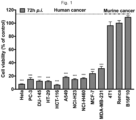
- toxicity was evaluated in 10 human cancer cell lines and 3 mouse cancer cell lines. Specifically, toxicity was evaluated in HeLa, PC-3, DU-145, HT-29, HCT-116, A549, NCI-H23, NCI-H460, MCF-7, MDA-MB-231, 4T1, Renca, and B16F10 cancer cell lines. HeLa, A549, 4T1, and B16F10 cells were obtained from ATCC (USA), and the remaining nine cancer cell lines were obtained from the Korea Cell Line Bank (KCLB).
- KCLB Korea Cell Line Bank
- each cancer cell line was infected with the oncolytic virus at an MOI of 0.5 (0.5 pfu/cell) and then cultured for 72 hours. Subsequently, cytotoxicity was analyzed using Cell Counting Kit8 (CCK8).
- 4T1, Renca, and B16F10 cancer cell lines which are mouse cancer cell lines, showed viability of 80% or more and showed relatively high resistance.
- mice were implanted human-derived or mouse-derived cancer cell lines, which had different oncolytic virus proliferative capacity, into mice, respectively, so that human cancer cell-implanted mice (xenograft model) and mouse cancer cell-implanted mice (allograft model) were produced.
- human cancer cell-implanted mice xenograft model
- mouse cancer cell-implanted mice allograft model
- an experiment was designed to identify whether the oncolytic virus had an increased anticancer effect in a case of being administered in combination with hydroxyurea in a state where proliferation of the oncolytic virus was limited.
- mice female, 7-week-old supplied by Orient Bio (Busan, Korea) were acclimatized for a week and then allografted with Renca cancer cell line (Korea Cell Line Bank) at 5 ⁇ 10 6 cells. Observation was made until the tumor size reached 100 mm 3 to 150 mm 3 , and then administration of the oncolytic virus began.
- the vaccinia virus-derived oncolytic virus VV tk- ) hardly proliferated in a mouse renal cancer cell-implanted mouse model.
- the group receiving saline intratumorally was set as a negative control group, and the group receiving oncolytic virus (VV tk- , 1 ⁇ 10 7 pfu) was set as a positive control group.
- the group receiving oncolytic virus (VV tk- , 1 ⁇ 10 7 pfu) and recombinant human granulocyte colony-stimulating factor (rh-G-CSF, 75 ⁇ g/kg), and the group receiving oncolytic virus (VV tk- , 1 ⁇ 10 7 pfu) and hydroxyurea (30 mg/kg) were set as experimental groups.
- the oncolytic virus was administered intratumorally, and its second administration was made 15 days after the first administration.
- rh-G-CSF or hydroxyurea was administered intraperitoneally starting from 4 days before administration of the oncolytic virus until sacrifice.
- mice in respective groups of Example 2.1 were administered drugs. Then, the mice were sacrificed on day 16 and the tumor size was measured. As a result, it was observed that the group receiving oncolytic virus and rh-G-CSF showed a similar tumor size to the negative control group and the positive control group, and that the tumor size had increased 10 times or more as compared with the initial one. On the other hand, it was observed that in the group receiving oncolytic virus and hydroxyurea in combination, the tumor size of the mice was smaller as compared with the negative control group, the positive control group, and other experimental groups, and that the tumor size had increased about 7 times as compared with the initial one ( Fig. 2 ). In particular, from the viewpoint that the tumor size was small as compared with the positive control group, it was identified that in a case where the hydroxyurea and oncolytic virus were administered in combination, an increased anticancer effect was achieved.
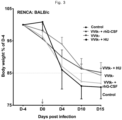
- mice Body weights of the mice were measured before administration of respective drugs to the control groups and the experimental groups of Example 2.1, on the day of administration, and on days 4, 10, and 15 after administration.
- mice female, 7-week-old supplied by Orient Bio (Busan, Korea) were acclimatized for a week and then allografted with Renca cancer cell line (Korea Cell Line Bank) at 5 ⁇ 10 6 cells. Observation was made until the tumor size reached 100 mm 3 to 150 mm 3 , and then administration of the oncolytic virus began.
- the vaccinia virus-derived oncolytic virus VV tk- ) hardly proliferated in a mouse renal cancer cell-implanted mouse model.
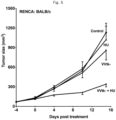
- the group receiving saline intratumorally was set as a negative control group, and the group receiving oncolytic virus (VV tk- , 1 ⁇ 10 7 pfu) or hydroxyurea (30 mg/kg) was set as a positive control group.
- the group receiving oncolytic virus and hydroxyurea in combination was set as an experimental group.
- the oncolytic virus was administered intratumorally once, and its second administration was made 17 days after the first administration.
- the hydroxyurea was administered intraperitoneally once a day starting from 3 days before administration of the oncolytic virus until 1 day before sacrifice, except for the day of administration of the oncolytic virus ( Fig. 4 ).
- mice in respective groups of Example 3.1 were administered drugs. Then, the mice were sacrificed on day 17 and the tumor size was measured. As a result, it was identified that the tumor size of the mice in the negative control group and the positive control group had rapidly increased by 10 to 15 times, while the tumor size of the mice in the experimental group was nearly 3 times smaller than the negative control group and the positive control group ( Fig. 5 ). From this, it was identified that in a case where the oncolytic virus and hydroxyurea were administered in combination, a greatly increased anticancer effect was achieved even in a tumor model in which the oncolytic virus hardly proliferated.
- Example 4.1 Production of mouse renal cancer cell-implanted mice and drug administration
- mice female, 7-week-old supplied by Orient Bio (Busan, Korea) were acclimatized for a week and then allografted with Renca cancer cell line (Korea Cell Line Bank) at 5 ⁇ 10 6 cells. Observation was made until the tumor size reaches 100 mm 3 to 150 mm 3 , and then administration of the oncolytic virus began.
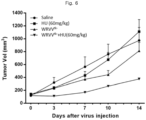
- the Western reserve species vaccinia virus-derived oncolytic virus (WRVV tk- ) can proliferate in a mouse renal cancer cell-implanted mouse model.
- the group receiving saline intratumorally was set as a negative control group, and the group receiving oncolytic virus (WRVV tk- , 1 ⁇ 10 7 pfu) or hydroxyurea (60 mg/kg) was set as a positive control group.
- the group receiving oncolytic virus and hydroxyurea in combination was set as an experimental group.
- the oncolytic virus was administered intraperitoneally once.
- the hydroxyurea was administered intraperitoneally once a day starting from 1 day before administration of the oncolytic virus until day 6 after administration, except for the day of administration of the oncolytic virus.
- mice in respective groups of Example 4.1 were administered drugs. Then, the tumor size was measured for 14 days. As a result, it was identified that the tumor size of the mice in the negative control group and the positive control group had increased by nearly 8 to 10 times, while the tumor size of the mice in the experimental group had increased by nearly 3 times. From this, it was identified that tumor growth was remarkably suppressed in a case where the oncolytic virus and hydroxyurea were administered in combination ( Fig. 6 ).
- mice female, 7-week-old supplied by Orient Bio (Busan, Korea) were acclimatized for a week and then allografted with 4T1 cancer cell line (Korea Cell Line Bank) at 2 ⁇ 10 6 cells. Observation was made until the tumor size reached 100 mm 3 to 150 mm 3 , and then administration of the oncolytic virus began.
- the vaccinia virus-derived oncolytic virus OTS-412 hardly proliferates in a mouse breast cancer cell-implanted mouse model.
- the group receiving saline intratumorally was set as a negative control group, and the group receiving oncolytic virus (OTS-412, 1 ⁇ 10 7 pfu) or hydroxyurea (30 mg/kg) was set as a positive control group.
- the group receiving oncolytic virus and hydroxyurea in combination was set as an experimental group.
- the oncolytic virus was administered intratumorally once.
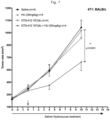
- the hydroxyurea was administered intraperitoneally once a day starting from 3 days before administration of the oncolytic virus until 1 day before sacrifice, except for the day of administration of the oncolytic virus.
- mice in respective groups of Example 5.1 were administered drugs. Then, changes in tumor size were measured for 10 days. As a result, it was observed that the tumor size of the mice in the negative control group and the positive control group had increased by nearly 5 times, while the tumor size of the mice in the experimental group had increased by nearly 3 times ( Fig. 7 ). From this, it was identified that in a case where the oncolytic virus and hydroxyurea were administered in combination, a superior anticancer effect was achieved as compared with a case where each drug was administered alone.
- Example 6.1 Production of mouse breast cancer cell-implanted mice and drug administration
- mice Female, 7-week-old supplied by Orient Bio (Busan, Korea) were acclimatized for a week and then allografted with 4T1 cancer cell line (Korea Cell Line Bank) at 1 ⁇ 10 6 cells. Observation was made until the tumor size reached 100 mm 3 to 150 mm 3 , and then administration of the oncolytic virus began.
- the vaccinia virus-derived oncolytic virus OTS-412
- the 4T1 cell line-implanted mice are an animal model in which metastasis to the whole body, including lung tissue, progresses; and in general, the metastasis is evaluated by the number of nodules on the tumor surface.
- the group receiving saline intratumorally was set as a negative control group, and the group receiving oncolytic virus (OTS-412, 1 ⁇ 10 7 pfu) or hydroxyurea (30 mg/kg) was set as a positive control group.
- the group receiving oncolytic virus and hydroxyurea in combination was set as an experimental group.
- For the oncolytic virus its second administration was made 7 days after the first intratumoral administration.
- the hydroxyurea was administered intraperitoneally once a day starting from 3 days before administration of the oncolytic virus until 3 days before sacrifice, except for the day of administration of the oncolytic virus.
- mice in respective groups of Example 6.1 were administered drugs. Then, the mice were sacrificed on day 21 and the number of tumor nodules was counted. As a result, for the mice in the group receiving only oncolytic virus, the number of nodules was 1.5 times higher than that of the negative control group. On the other hand, for the mice of the experimental group, it was identified that the number of nodules produced was 0.5 times which was remarkably small ( Fig. 8 ). From this, it was identified that in a case where the oncolytic virus and hydroxyurea were administered in combination, metastasis to other organs was suppressed.
- Example 7.1 Production of mouse breast cancer cell-implanted mice and drug administration
- mice female, 7-week-old supplied by Orient Bio (Busan, Korea) were acclimatized for a week and then allografted with 4T1 cancer cell line (Korea Cell Line Bank) at 5 ⁇ 10 6 cells. Observation was made until the tumor size reached 50 mm 3 to 200 mm 3 , and then administration of the oncolytic virus began.
- the vaccinia virus-derived oncolytic virus OTS-412 hardly proliferates in a breast cancer cell-implanted mouse model.
- mice The above-produced mouse breast cancer cell-implanted mice were divided into 4 groups.
- the group receiving saline intratumorally was set as a negative control group, and the group receiving oncolytic virus (OTS-412, 1 ⁇ 10 7 pfu) or high-dose hydroxyurea (90 mg/kg) was set as a positive control group.
- the group receiving oncolytic virus and high-dose hydroxyurea in combination was set as an experimental group.
- the oncolytic virus was administered intratumorally once.
- the hydroxyurea was administered intraperitoneally once a day starting from 3 days before administration of the oncolytic virus until 1 day before sacrifice, except for the day of administration of the oncolytic virus.
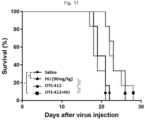
- mice in respective groups of Example 7.1 were administered drugs. Then, the tumor size was measured for 17 days. As a result, it was identified that the tumor size of the mice in the negative control group and the positive control group had increased by nearly 3.5 times, while the tumor size of the mice in the experimental group had increased by 2.5 times. From this, it was identified that in a case where the oncolytic virus and hydroxyurea were administered in combination, tumor growth was suppressed, as compared with a case where the oncolytic virus or hydroxyurea was administered alone ( Fig. 10 ).
- mice in respective groups until day 28 were checked.
- all mice in the group receiving only oncolytic virus died on day 21, and 1 mouse survived for the negative control group.
- Example 8.1 Production of human lung cancer cell-implanted mice and administration
- mice supplied by Orient Bio (Busan, Korea) were acclimatized for a week and then allografted with NCI-H460 lung cancer cells (Korea Cell Line Bank) at 1 ⁇ 10 6 cells.
- NCI-H460 lung cancer cells Korea Cell Line Bank
- OTS-412 The vaccinia virus-derived oncolytic virus (OTS-412) can proliferate in a lung cancer cell line-implanted mouse model.
- the above-produced human lung cancer cell-implanted mice were divided into 4 groups.
- the group receiving saline intratumorally was set as a negative control group, and the group receiving hydroxyurea or oncolytic virus (OTS-412, 1 ⁇ 10 5 pfu) was set as a positive control group.
- the group receiving oncolytic virus and hydroxyurea (20 mg/kg) intraperitoneally was set as an experimental group.
- the oncolytic virus was administered twice, and its second administration was made 5 days after the first administration.
- the hydroxyurea was administered once daily starting from the day before the first administration of oncolytic virus until the day of sacrifice, except for the day of administration of the oncolytic virus.
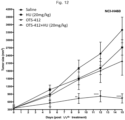
- mice in respective groups of Example 8.1 were administered drugs. Then, the mice were sacrificed on day 15 and the tumor size was measured. As a result, it was observed that the tumor size of the mice in the negative control group and the positive control groups had rapidly increased by 11, 9 and 7 times, respectively. On the other hand, the tumor size of the mice in the experimental group increased by about 2.5 times, and tended to decrease starting from day 12 ( Fig. 12 ). From this, it was identified that in a case where the oncolytic virus and hydroxyurea were administered in combination, tumor growth was effectively suppressed, as compared with a case where only the oncolytic virus was administered alone.
- mice Female, 7-week-old supplied by Orient Bio (Busan, Korea) were acclimatized for a week and then allografted with HCT-116 cancer cell line (Korea Cell Line Bank), a human colorectal cancer cell line, at 2.5 ⁇ 10 6 cells. Observation was made until the tumor size reached 20 mm 3 to 250 mm 3 , and then administration of the oncolytic virus began.
- HCT-116 cancer cell line Korea Cell Line Bank
- the group receiving saline intratumorally was set as a negative control group, and the group receiving hydroxyurea or oncolytic virus (OTS-412, 1 ⁇ 10 7 pfu) was set as a positive control group.
- the group receiving oncolytic virus and hydroxyurea (30 mg/kg) intraperitoneally was set as an experimental group.
- the oncolytic virus was administered once, and the hydroxyurea was administered once daily starting from 3 days before administration of the oncolytic virus until the day of sacrifice, except for the day of administration of the oncolytic virus.
- the vaccinia virus-derived oncolytic virus (OTS-412) can proliferate in a colorectal cancer cell line-implanted mouse model.
- mice in respective groups of Example 9.1 were administered drugs. Then, the mice were sacrificed on day 28 and the tumor size was measured. As a result, it was observed that the tumor size of the mice in the negative control group and the group receiving only hydroxyurea had sharply increased by 11 times. It was identified that in the group receiving oncolytic virus alone, the tumor size gradually decreased starting from 3 days after administration of the oncolytic virus and remained at the initial tumor size. On the other hand, for the experimental group, it was identified that the tumor size gradually decreased starting from the day of administration of the oncolytic virus, began to decrease, as compared with the initial tumor size, on day 14 after administration of the oncolytic virus, and almost disappeared on day 28 ( Fig. 13 ). In particular, complete remission was observed on day 28 for 2 animals in the experimental group ( Figs. 14 and 15 ).
- mice Female, 7-week-old supplied by Orient Bio (Busan, Korea) were acclimatized for a week and then allografted with HT-29 cancer cell line (Korea Cell Line Bank), a human colorectal cancer cell line, at 5 ⁇ 10 6 cells. Observation was made until the tumor size reached 150 mm 3 to 200 mm 3 , and then administration of the oncolytic virus began.
- HT-29 cancer cell line Korea Cell Line Bank
- the above-produced human colorectal cancer cell-implanted mice were divided into the following 2 groups, and experiments were performed for 8 weeks: the group receiving only oncolytic virus (OTS-412, 1 ⁇ 10 7 pfu) and the group additionally receiving hydroxyurea (25 mg/kg) intraperitoneally. From week 1 to week 4, the oncolytic virus was administered to each group twice a week. At week 5 and week 7, the oncolytic virus was administered once a week; and at week 6 and week 8, no oncolytic virus was administered to both groups. The hydroxyurea was administered once a day from week 6 to week 8.
- the vaccinia virus-derived oncolytic virus VV tk-
- VV tk- can proliferate in a colorectal cancer cell line-implanted mouse model.
- mice in respective groups were sacrificed and the tumor size was measured. As a result, it was identified that in the group receiving oncolytic virus and hydroxyurea, the tumor size decreased and the condition of tumor tissue was ameliorated, as compared with the group receiving only oncolytic virus ( Fig. 16 ).
- H&E staining of the collected tumor tissue was performed using hematoxylin and eosin.
- a darkly H&E-stained portion indicates viable cells.
- the group receiving oncolytic virus and hydroxyurea showed a smaller overall tumor size and a smaller darkly stained portion than the group receiving only oncolytic virus ( Fig. 16 ). That is, it was identified that the experimental group receiving oncolytic virus and hydroxyurea in combination showed a superior apoptotic effect, as compared with the control group receiving only oncolytic virus.
- the collected tumor tissue was analyzed by performing H&E staining and TUNEL staining.
- a darkly H&E-stained portion indicates viable cells; and in fluorescence staining, the oncolytic virus has red fluorescence and the dead cell has green fluorescence.
- the dead cells matched the oncolytic viruses in terms of stained portion, which identified cancer cell death caused by the oncolytic virus.
- the portion of dead cells was different from the stained portion of the oncolytic viruses. This identifies that in the group receiving oncolytic virus and hydroxyurea in combination, apoptosis occurred even in cancer cells that were not infected with the oncolytic virus ( Fig. 17 ).
- Balb/c mice female, 7-week-old supplied by Orient Bio (Busan, Korea) were acclimatized for a week and then allografted with Renca cancer cell line (Korea Cell Line Bank), a mouse renal cancer cell line, at 5 ⁇ 10 6 cells. Observation was made until the tumor size reaches 50 mm 3 to 200 mm 3 , and then administration of the oncolytic virus began.
- Renca cancer cell line Korea Cell Line Bank
- mice The above-produced mouse renal cancer cell-implanted mice were divided into 4 groups.
- the group receiving saline intratumorally was set as a control group, and the group receiving hydroxyurea or herpes simplex virus (HSV1, 1 ⁇ 10 6 pfu) was set as a positive control group.
- the group receiving HSV1 and hydroxyurea (30 mg/kg) was set as an experimental group.
- HSV1 was administered intratumorally once 3 days after administration of the hydroxyurea, and the hydroxyurea was administered intraperitoneally 6 times a week for 20 days after administration of the oncolytic virus.
- mice in respective groups of Example 11.1 were administered drugs. Changes in tumor size were measured on the day of drug administration, and days 3, 7, 10, 14, and 17 after administration. As a result, it was identified that the experimental group showed the smallest tumor size. From this, it was identified that in a case where HSV1 and hydroxyurea were administered in combination, tumor growth was more effectively suppressed than a case where only oncolytic virus was administered ( Fig. 18 ).
- Balb/c mice female, 7-week-old supplied by Orient Bio (Busan, Korea) were acclimatized for a week and then allografted with Renca cancer cell line (Korea Cell Line Bank), a mouse renal cancer cell line, at 5 ⁇ 10 6 cells. Observation was made until the tumor size reached 50 mm 3 to 200 mm 3 , and then administration of the oncolytic virus began.
- Renca cancer cell line Korea Cell Line Bank
- mice The above-produced mouse renal cancer cell-implanted mice were divided into 3 groups.
- the group receiving saline intratumorally was set as a negative control group, and the group receiving only oncolytic virus (adenovirus, 1 ⁇ 10 7 pfu) was set as a positive control group.
- the group receiving adenovirus (1 ⁇ 10 7 pfu) and hydroxyurea (30 mg/kg) was set as an experimental group.
- the adenovirus was administered intratumorally once 3 days after administration of the hydroxyurea, and the hydroxyurea was administered intraperitoneally 6 times a week for 16 days after administration of the oncolytic virus.
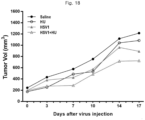
- mice in respective groups of Example 12.1 were administered drugs. Changes in tumor size were measured on the day of drug administration, and days 3, 7, 10, 14, and 17 after administration. As a result, it was identified that the group receiving oncolytic virus and hydroxyurea in combination showed the smallest tumor size. From this, it was identified that in a case where adenovirus and hydroxyurea were administered in combination, tumor growth was more effectively suppressed than a case where only oncolytic virus was administered ( Fig. 19 ).
Landscapes
- Health & Medical Sciences (AREA)
- Life Sciences & Earth Sciences (AREA)
- Chemical & Material Sciences (AREA)
- General Health & Medical Sciences (AREA)
- Medicinal Chemistry (AREA)
- Veterinary Medicine (AREA)
- Public Health (AREA)
- Animal Behavior & Ethology (AREA)
- Pharmacology & Pharmacy (AREA)
- Virology (AREA)
- Epidemiology (AREA)
- Microbiology (AREA)
- Mycology (AREA)
- Organic Chemistry (AREA)
- Nuclear Medicine, Radiotherapy & Molecular Imaging (AREA)
- General Chemical & Material Sciences (AREA)
- Chemical Kinetics & Catalysis (AREA)
- Oncology (AREA)
- Wood Science & Technology (AREA)
- Genetics & Genomics (AREA)
- Bioinformatics & Cheminformatics (AREA)
- Zoology (AREA)
- Engineering & Computer Science (AREA)
- Dermatology (AREA)
- Immunology (AREA)
- Biotechnology (AREA)
- Biomedical Technology (AREA)
- Biochemistry (AREA)
- General Engineering & Computer Science (AREA)
- Medicines Containing Material From Animals Or Micro-Organisms (AREA)
- Medicines That Contain Protein Lipid Enzymes And Other Medicines (AREA)
- Pharmaceuticals Containing Other Organic And Inorganic Compounds (AREA)
- Acyclic And Carbocyclic Compounds In Medicinal Compositions (AREA)
Claims (7)
- Pharmazeutische Zusammensetzung zur Verwendung bei der Vorbeugung oder Behandlung von Krebs, die als Wirkstoffe umfasst:ein onkolytisches Virus, wobei das onkolytische Virus ein Vaccinia-Virus ist, bei dem das Thymidinkinase-Gen deletiert ist,und Hydroxyharnstoff,wobei das onkolytische Virus in einer Dosis von 1×10⁵ pfu oder mehr pfu verabreicht wird, undwobei der Hydroxyharnstoff in einer Dosis von 20 mg/kg/Tag bis 90 mg/kg/Tag verabreicht wird.
- Pharmazeutische Zusammensetzung zur Verwendung nach Anspruch 1, wobei das onkolytische Virus in einer Dosis von 1×10⁵ pfu bis 1×10¹⁰ pfu verabreicht wird.
- Pharmazeutische Zusammensetzung zur Verwendung nach Anspruch 1 oder Anspruch 2, wobei der Krebs einer ist, ausgewählt aus der Gruppe bestehend aus Lungenkrebs, Dick- und Enddarmkrebs, Prostatakrebs, Schilddrüsenkrebs, Brustkrebs, Hirnkrebs, Kopf- und Halskrebs, Speiseröhrenkrebs, Hautkrebs, Thymusdruck, Magenkrebs, Dickdarmkrebs, Leberkrebs, Eierstockkrebs, Gebärmutterkrebs, Blasenkrebs, Enddarmkrebs, Gallenblasenkrebs, Gallengangskrebs und Bauchspeicheldrüsenkrebs.
- Pharmazeutische Zusammensetzung zur Verwendung nach einem der Ansprüche 1 bis 3, wobei die pharmazeutische Zusammensetzung intratumoral, intraperitoneal oder intravenös verabreicht wird.
- Set zur Verwendung bei der Vorbeugung oder Behandlung von Krebs, umfassend:eine erste Zusammensetzung, die ein onkolytisches Virus als Wirkstoff umfasst, wobei das onkolytische Virus ein Vaccinia-Virus ist, bei dem das Thymidinkinase-Gen deletiert ist, undeine zweite Zusammensetzung, die Hydroxyharnstoff als Wirkstoff umfasst,wobei die erste Zusammensetzung und die zweite Zusammensetzung gleichzeitig, nacheinander oder in umgekehrter Reihenfolge verabreicht werden,wobei das onkolytische Virus in einer Dosis von 1×10⁵ pfu oder mehr pfu verabreicht wird,wobei der Hydroxyharnstoff in einer Dosis von 20 mg/kg/Tag bis 90 mg/kg/Tag verabreicht wird,wobei, wenn die erste Zusammensetzung und die zweite Zusammensetzung nacheinander oder in umgekehrter Reihenfolge verabreicht werden, der Hydroxyharnstoff kontinuierlich einmal täglich verabreicht wird, beginnend ab 3 bis 5 Tage vor Verabreichung des onkolytischen Virus, und kontinuierlich einmal täglich über 9 bis 28 Tage ab 24 Stunden nach Verabreichung des onkolytischen Virus verabreicht wird.
- Set zur Verwendung nach Anspruch 5, wobei das onkolytische Virus dem Individuum in Intervallen von 7 bis 30 Tagen verabreicht wird.
- Set zur Verwendung nach Anspruch 5 oder Anspruch 6, wobei die erste Zusammensetzung und die zweite Zusammensetzung intratumoral, intraperitoneal oder intravenös verabreicht werden.
Priority Applications (1)
| Application Number | Priority Date | Filing Date | Title |
|---|---|---|---|
| EP24155126.6A EP4342985A3 (de) | 2018-02-28 | 2019-02-27 | Pharmazeutische zusammensetzung zur prävention oder behandlung von krebs mit antikrebsvirus und hydroxyharnstoff als wirksame komponenten |
Applications Claiming Priority (2)
| Application Number | Priority Date | Filing Date | Title |
|---|---|---|---|
| KR20180024461 | 2018-02-28 | ||
| PCT/KR2019/002376 WO2019168346A1 (ko) | 2018-02-28 | 2019-02-27 | 항암바이러스 및 히드록시유레아를 유효성분으로 포함하는 암 예방 또는 치료용 약학 조성물 |
Related Child Applications (2)
| Application Number | Title | Priority Date | Filing Date |
|---|---|---|---|
| EP24155126.6A Division-Into EP4342985A3 (de) | 2018-02-28 | 2019-02-27 | Pharmazeutische zusammensetzung zur prävention oder behandlung von krebs mit antikrebsvirus und hydroxyharnstoff als wirksame komponenten |
| EP24155126.6A Division EP4342985A3 (de) | 2018-02-28 | 2019-02-27 | Pharmazeutische zusammensetzung zur prävention oder behandlung von krebs mit antikrebsvirus und hydroxyharnstoff als wirksame komponenten |
Publications (4)
| Publication Number | Publication Date |
|---|---|
| EP3760213A1 EP3760213A1 (de) | 2021-01-06 |
| EP3760213A4 EP3760213A4 (de) | 2021-12-01 |
| EP3760213B1 true EP3760213B1 (de) | 2024-03-27 |
| EP3760213C0 EP3760213C0 (de) | 2024-03-27 |
Family
ID=67805884
Family Applications (2)
| Application Number | Title | Priority Date | Filing Date |
|---|---|---|---|
| EP24155126.6A Pending EP4342985A3 (de) | 2018-02-28 | 2019-02-27 | Pharmazeutische zusammensetzung zur prävention oder behandlung von krebs mit antikrebsvirus und hydroxyharnstoff als wirksame komponenten |
| EP19761185.8A Active EP3760213B1 (de) | 2018-02-28 | 2019-02-27 | Pharmazeutische zusammensetzung zur vorbeugung oder behandlung von krebs mit einem antikrebsvirus und hydroxyharnstoff als wirksame bestandteile |
Family Applications Before (1)
| Application Number | Title | Priority Date | Filing Date |
|---|---|---|---|
| EP24155126.6A Pending EP4342985A3 (de) | 2018-02-28 | 2019-02-27 | Pharmazeutische zusammensetzung zur prävention oder behandlung von krebs mit antikrebsvirus und hydroxyharnstoff als wirksame komponenten |
Country Status (9)
| Country | Link |
|---|---|
| US (1) | US20200405794A1 (de) |
| EP (2) | EP4342985A3 (de) |
| JP (1) | JP7167395B2 (de) |
| KR (2) | KR20190103979A (de) |
| CN (1) | CN111818932A (de) |
| AU (1) | AU2019226906B2 (de) |
| CA (1) | CA3092441A1 (de) |
| ES (1) | ES2976989T3 (de) |
| WO (1) | WO2019168346A1 (de) |
Families Citing this family (5)
| Publication number | Priority date | Publication date | Assignee | Title |
|---|---|---|---|---|
| CA3150829A1 (en) * | 2019-08-26 | 2021-03-04 | Bionoxx Inc. | Pharmaceutical composition comprising vaccinia virus and hydroxyurea as active ingredient for treatment of cancer |
| CN114364390A (zh) * | 2019-08-26 | 2022-04-15 | 拜耳诺克斯有限公司 | 用于治疗癌症的包含抗癌病毒、免疫检查点抑制剂和羟基脲作为活性成分的药物组合物 |
| KR102216319B1 (ko) * | 2020-04-10 | 2021-02-18 | 주식회사 바이오녹스 | 히드록시유레아를 포함하는 전신성 염증 억제용 약학 조성물 및 이의 제형 |
| AU2021221064B2 (en) * | 2020-02-14 | 2023-05-25 | Bionoxx Inc. | Pharmaceutical composition for inhibiting inflammatory response comprising hydroxyurea |
| CN116036138A (zh) * | 2022-12-29 | 2023-05-02 | 上海交通大学医学院附属新华医院 | 溶瘤病毒vg161在治疗结直肠癌中的应用及敏感性预测方法 |
Family Cites Families (13)
| Publication number | Priority date | Publication date | Assignee | Title |
|---|---|---|---|---|
| FR2723962B1 (fr) * | 1994-08-25 | 1996-10-31 | Univ Paris Curie | Hsv1-tk modifiee fonctionnelle |
| AU2905199A (en) * | 1999-03-15 | 2000-10-04 | Trustees Of The University Of Pennsylvania, The | Combined therapy with a chemotherapeutic agent and an oncolytic virus for killing tumor cells in a subject |
| US6428968B1 (en) * | 1999-03-15 | 2002-08-06 | The Trustees Of The University Of Pennsylvania | Combined therapy with a chemotherapeutic agent and an oncolytic virus for killing tumor cells in a subject |
| WO2000073479A1 (en) * | 1999-05-28 | 2000-12-07 | The Government Of The United States Of America, As Represented By The Secretary, Department Of Health And Human Services | A combined growth factor-deleted and thymidine kinase-deleted vaccinia virus vector |
| US8980246B2 (en) * | 2005-09-07 | 2015-03-17 | Sillajen Biotherapeutics, Inc. | Oncolytic vaccinia virus cancer therapy |
| EP2073823A1 (de) * | 2006-10-13 | 2009-07-01 | Medigene AG | Verwendung von onkolytischen viren und antiangiogenen mitteln in der krebsbehandlung |
| EP2097517B1 (de) * | 2006-10-16 | 2014-06-04 | Genelux Corporation | Rekombinantes Lister-Stamm Vaccinia Virus kodierend für einen einzelkettigen anti-VEGF Antikörper |
| KR20080084528A (ko) * | 2007-03-15 | 2008-09-19 | 제네렉스 바이오테라퓨틱스 인크. | 종양살상형 백시니아 바이러스 암 치료 |
| CA2709292A1 (en) * | 2009-07-10 | 2011-01-10 | The Governors Of The University Of Alberta | Oncolytic viruses and methods for treating neoplastic disorders |
| RU2696312C2 (ru) * | 2014-07-16 | 2019-08-01 | Трансген Са | Онколитический вирус для экспрессии модуляторов иммунологических контрольных точек |
| KR101605176B1 (ko) * | 2015-01-26 | 2016-03-21 | 부산대학교 산학협력단 | 종양 친화성이 강한 신규한 항암 바이러스 및 그의 용도 |
| WO2017205674A1 (en) * | 2016-05-25 | 2017-11-30 | Arizona Board Of Regents On Behalf Of Arizona State University | Oncolytic vaccinia virus mutants and using same for cancer treatment |
| CA3070146A1 (en) * | 2016-07-19 | 2018-01-25 | University Of Pittsburgh - Of The Commonwealth System Of Higher Education | Oncolytic viruses targeting stat3 |
-
2019
- 2019-02-27 WO PCT/KR2019/002376 patent/WO2019168346A1/ko not_active Ceased
- 2019-02-27 EP EP24155126.6A patent/EP4342985A3/de active Pending
- 2019-02-27 CA CA3092441A patent/CA3092441A1/en active Pending
- 2019-02-27 US US16/976,125 patent/US20200405794A1/en active Pending
- 2019-02-27 ES ES19761185T patent/ES2976989T3/es active Active
- 2019-02-27 AU AU2019226906A patent/AU2019226906B2/en active Active
- 2019-02-27 CN CN201980016179.0A patent/CN111818932A/zh active Pending
- 2019-02-27 JP JP2020544934A patent/JP7167395B2/ja active Active
- 2019-02-27 EP EP19761185.8A patent/EP3760213B1/de active Active
- 2019-02-27 KR KR1020190023232A patent/KR20190103979A/ko not_active Ceased
-
2020
- 2020-12-28 KR KR1020200185295A patent/KR102381952B1/ko active Active
Also Published As
| Publication number | Publication date |
|---|---|
| AU2019226906B2 (en) | 2023-02-02 |
| WO2019168346A1 (ko) | 2019-09-06 |
| AU2019226906A1 (en) | 2020-09-24 |
| KR20190103979A (ko) | 2019-09-05 |
| KR20210005827A (ko) | 2021-01-15 |
| EP3760213C0 (de) | 2024-03-27 |
| EP4342985A2 (de) | 2024-03-27 |
| EP3760213A1 (de) | 2021-01-06 |
| KR102381952B1 (ko) | 2022-04-04 |
| US20200405794A1 (en) | 2020-12-31 |
| EP3760213A4 (de) | 2021-12-01 |
| JP2021515753A (ja) | 2021-06-24 |
| CA3092441A1 (en) | 2019-09-06 |
| JP7167395B2 (ja) | 2022-11-09 |
| CN111818932A (zh) | 2020-10-23 |
| EP4342985A3 (de) | 2024-06-05 |
| ES2976989T3 (es) | 2024-08-14 |
Similar Documents
| Publication | Publication Date | Title |
|---|---|---|
| EP3760213B1 (de) | Pharmazeutische zusammensetzung zur vorbeugung oder behandlung von krebs mit einem antikrebsvirus und hydroxyharnstoff als wirksame bestandteile | |
| EP3489354B1 (de) | Rekombinantes vaccinia-virus und verwendung davon | |
| US20220339220A1 (en) | Therapeutic agents comprising oncolytic vaccinia viruses and nk cells, and uses thereof for drugs for treatment of tumors and/or cancers | |
| JP7326663B2 (ja) | がんの処置のための活性成分としてワクシニアウイルス及びヒドロキシ尿素を含む医薬組成物 | |
| JP7485888B2 (ja) | 活性成分として抗がんウイルス、免疫チェックポイント阻害剤及びヒドロキシ尿素を含む、がんを処置するための医薬組成物 | |
| CN111939262B (zh) | 一种治疗肿瘤或癌症的药物组合物和其应用 | |
| HK40095533A (zh) | 抗癌病毒及其用途 |
Legal Events
| Date | Code | Title | Description |
|---|---|---|---|
| STAA | Information on the status of an ep patent application or granted ep patent |
Free format text: STATUS: THE INTERNATIONAL PUBLICATION HAS BEEN MADE |
|
| PUAI | Public reference made under article 153(3) epc to a published international application that has entered the european phase |
Free format text: ORIGINAL CODE: 0009012 |
|
| STAA | Information on the status of an ep patent application or granted ep patent |
Free format text: STATUS: REQUEST FOR EXAMINATION WAS MADE |
|
| 17P | Request for examination filed |
Effective date: 20200928 |
|
| AK | Designated contracting states |
Kind code of ref document: A1 Designated state(s): AL AT BE BG CH CY CZ DE DK EE ES FI FR GB GR HR HU IE IS IT LI LT LU LV MC MK MT NL NO PL PT RO RS SE SI SK SM TR |
|
| AX | Request for extension of the european patent |
Extension state: BA ME |
|
| DAV | Request for validation of the european patent (deleted) | ||
| DAX | Request for extension of the european patent (deleted) | ||
| REG | Reference to a national code |
Ref country code: DE Ref legal event code: R079 Free format text: PREVIOUS MAIN CLASS: A61K0035760000 Ipc: A61K0035768000 Ref country code: DE Ref legal event code: R079 Ref document number: 602019049058 Country of ref document: DE Free format text: PREVIOUS MAIN CLASS: A61K0035760000 Ipc: A61K0035768000 |
|
| A4 | Supplementary search report drawn up and despatched |
Effective date: 20211104 |
|
| RIC1 | Information provided on ipc code assigned before grant |
Ipc: C12N 7/00 20060101ALI20211028BHEP Ipc: A61P 35/00 20060101ALI20211028BHEP Ipc: A61K 31/17 20060101ALI20211028BHEP Ipc: A61K 35/763 20150101ALI20211028BHEP Ipc: A61K 35/761 20150101ALI20211028BHEP Ipc: A61K 35/768 20150101AFI20211028BHEP |
|
| STAA | Information on the status of an ep patent application or granted ep patent |
Free format text: STATUS: EXAMINATION IS IN PROGRESS |
|
| 17Q | First examination report despatched |
Effective date: 20220926 |
|
| GRAP | Despatch of communication of intention to grant a patent |
Free format text: ORIGINAL CODE: EPIDOSNIGR1 |
|
| STAA | Information on the status of an ep patent application or granted ep patent |
Free format text: STATUS: GRANT OF PATENT IS INTENDED |
|
| INTG | Intention to grant announced |
Effective date: 20230925 |
|
| GRAS | Grant fee paid |
Free format text: ORIGINAL CODE: EPIDOSNIGR3 |
|
| GRAA | (expected) grant |
Free format text: ORIGINAL CODE: 0009210 |
|
| STAA | Information on the status of an ep patent application or granted ep patent |
Free format text: STATUS: THE PATENT HAS BEEN GRANTED |
|
| AK | Designated contracting states |
Kind code of ref document: B1 Designated state(s): AL AT BE BG CH CY CZ DE DK EE ES FI FR GB GR HR HU IE IS IT LI LT LU LV MC MK MT NL NO PL PT RO RS SE SI SK SM TR |
|
| REG | Reference to a national code |
Ref country code: GB Ref legal event code: FG4D |
|
| REG | Reference to a national code |
Ref country code: CH Ref legal event code: EP |
|
| REG | Reference to a national code |
Ref country code: DE Ref legal event code: R096 Ref document number: 602019049058 Country of ref document: DE |
|
| REG | Reference to a national code |
Ref country code: IE Ref legal event code: FG4D |
|
| U01 | Request for unitary effect filed |
Effective date: 20240409 |
|
| U07 | Unitary effect registered |
Designated state(s): AT BE BG DE DK EE FI FR IT LT LU LV MT NL PT SE SI Effective date: 20240418 |
|
| PG25 | Lapsed in a contracting state [announced via postgrant information from national office to epo] |
Ref country code: GR Free format text: LAPSE BECAUSE OF FAILURE TO SUBMIT A TRANSLATION OF THE DESCRIPTION OR TO PAY THE FEE WITHIN THE PRESCRIBED TIME-LIMIT Effective date: 20240628 |
|
| PG25 | Lapsed in a contracting state [announced via postgrant information from national office to epo] |
Ref country code: RS Free format text: LAPSE BECAUSE OF FAILURE TO SUBMIT A TRANSLATION OF THE DESCRIPTION OR TO PAY THE FEE WITHIN THE PRESCRIBED TIME-LIMIT Effective date: 20240627 Ref country code: HR Free format text: LAPSE BECAUSE OF FAILURE TO SUBMIT A TRANSLATION OF THE DESCRIPTION OR TO PAY THE FEE WITHIN THE PRESCRIBED TIME-LIMIT Effective date: 20240327 |
|
| PG25 | Lapsed in a contracting state [announced via postgrant information from national office to epo] |
Ref country code: RS Free format text: LAPSE BECAUSE OF FAILURE TO SUBMIT A TRANSLATION OF THE DESCRIPTION OR TO PAY THE FEE WITHIN THE PRESCRIBED TIME-LIMIT Effective date: 20240627 Ref country code: NO Free format text: LAPSE BECAUSE OF FAILURE TO SUBMIT A TRANSLATION OF THE DESCRIPTION OR TO PAY THE FEE WITHIN THE PRESCRIBED TIME-LIMIT Effective date: 20240627 Ref country code: HR Free format text: LAPSE BECAUSE OF FAILURE TO SUBMIT A TRANSLATION OF THE DESCRIPTION OR TO PAY THE FEE WITHIN THE PRESCRIBED TIME-LIMIT Effective date: 20240327 Ref country code: GR Free format text: LAPSE BECAUSE OF FAILURE TO SUBMIT A TRANSLATION OF THE DESCRIPTION OR TO PAY THE FEE WITHIN THE PRESCRIBED TIME-LIMIT Effective date: 20240628 |
|
| REG | Reference to a national code |
Ref country code: ES Ref legal event code: FG2A Ref document number: 2976989 Country of ref document: ES Kind code of ref document: T3 Effective date: 20240814 |
|
| PG25 | Lapsed in a contracting state [announced via postgrant information from national office to epo] |
Ref country code: IS Free format text: LAPSE BECAUSE OF FAILURE TO SUBMIT A TRANSLATION OF THE DESCRIPTION OR TO PAY THE FEE WITHIN THE PRESCRIBED TIME-LIMIT Effective date: 20240727 |
|
| PG25 | Lapsed in a contracting state [announced via postgrant information from national office to epo] |
Ref country code: SM Free format text: LAPSE BECAUSE OF FAILURE TO SUBMIT A TRANSLATION OF THE DESCRIPTION OR TO PAY THE FEE WITHIN THE PRESCRIBED TIME-LIMIT Effective date: 20240327 |
|
| PG25 | Lapsed in a contracting state [announced via postgrant information from national office to epo] |
Ref country code: CZ Free format text: LAPSE BECAUSE OF FAILURE TO SUBMIT A TRANSLATION OF THE DESCRIPTION OR TO PAY THE FEE WITHIN THE PRESCRIBED TIME-LIMIT Effective date: 20240327 |
|
| PG25 | Lapsed in a contracting state [announced via postgrant information from national office to epo] |
Ref country code: PL Free format text: LAPSE BECAUSE OF FAILURE TO SUBMIT A TRANSLATION OF THE DESCRIPTION OR TO PAY THE FEE WITHIN THE PRESCRIBED TIME-LIMIT Effective date: 20240327 |
|
| PG25 | Lapsed in a contracting state [announced via postgrant information from national office to epo] |
Ref country code: SK Free format text: LAPSE BECAUSE OF FAILURE TO SUBMIT A TRANSLATION OF THE DESCRIPTION OR TO PAY THE FEE WITHIN THE PRESCRIBED TIME-LIMIT Effective date: 20240327 |
|
| PG25 | Lapsed in a contracting state [announced via postgrant information from national office to epo] |
Ref country code: SM Free format text: LAPSE BECAUSE OF FAILURE TO SUBMIT A TRANSLATION OF THE DESCRIPTION OR TO PAY THE FEE WITHIN THE PRESCRIBED TIME-LIMIT Effective date: 20240327 Ref country code: SK Free format text: LAPSE BECAUSE OF FAILURE TO SUBMIT A TRANSLATION OF THE DESCRIPTION OR TO PAY THE FEE WITHIN THE PRESCRIBED TIME-LIMIT Effective date: 20240327 Ref country code: RO Free format text: LAPSE BECAUSE OF FAILURE TO SUBMIT A TRANSLATION OF THE DESCRIPTION OR TO PAY THE FEE WITHIN THE PRESCRIBED TIME-LIMIT Effective date: 20240327 Ref country code: PL Free format text: LAPSE BECAUSE OF FAILURE TO SUBMIT A TRANSLATION OF THE DESCRIPTION OR TO PAY THE FEE WITHIN THE PRESCRIBED TIME-LIMIT Effective date: 20240327 Ref country code: IS Free format text: LAPSE BECAUSE OF FAILURE TO SUBMIT A TRANSLATION OF THE DESCRIPTION OR TO PAY THE FEE WITHIN THE PRESCRIBED TIME-LIMIT Effective date: 20240727 Ref country code: CZ Free format text: LAPSE BECAUSE OF FAILURE TO SUBMIT A TRANSLATION OF THE DESCRIPTION OR TO PAY THE FEE WITHIN THE PRESCRIBED TIME-LIMIT Effective date: 20240327 |
|
| REG | Reference to a national code |
Ref country code: DE Ref legal event code: R097 Ref document number: 602019049058 Country of ref document: DE |
|
| PLBE | No opposition filed within time limit |
Free format text: ORIGINAL CODE: 0009261 |
|
| STAA | Information on the status of an ep patent application or granted ep patent |
Free format text: STATUS: NO OPPOSITION FILED WITHIN TIME LIMIT |
|
| U20 | Renewal fee for the european patent with unitary effect paid |
Year of fee payment: 7 Effective date: 20250107 |
|
| 26N | No opposition filed |
Effective date: 20250103 |
|
| PG25 | Lapsed in a contracting state [announced via postgrant information from national office to epo] |
Ref country code: MC Free format text: LAPSE BECAUSE OF FAILURE TO SUBMIT A TRANSLATION OF THE DESCRIPTION OR TO PAY THE FEE WITHIN THE PRESCRIBED TIME-LIMIT Effective date: 20240327 |
|
| PG25 | Lapsed in a contracting state [announced via postgrant information from national office to epo] |
Ref country code: IE Free format text: LAPSE BECAUSE OF NON-PAYMENT OF DUE FEES Effective date: 20250227 |
|
| REG | Reference to a national code |
Ref country code: CH Ref legal event code: U11 Free format text: ST27 STATUS EVENT CODE: U-0-0-U10-U11 (AS PROVIDED BY THE NATIONAL OFFICE) Effective date: 20260301 |
|
| U20 | Renewal fee for the european patent with unitary effect paid |
Year of fee payment: 8 Effective date: 20260214 |
|
| PGFP | Annual fee paid to national office [announced via postgrant information from national office to epo] |
Ref country code: GB Payment date: 20260206 Year of fee payment: 8 |
|
| PGFP | Annual fee paid to national office [announced via postgrant information from national office to epo] |
Ref country code: ES Payment date: 20260302 Year of fee payment: 8 |
|
| PGFP | Annual fee paid to national office [announced via postgrant information from national office to epo] |
Ref country code: CH Payment date: 20260301 Year of fee payment: 8 |