EP3760330A1 - Plaque métallique pour moulage à la presse, dispositif de moulage à la presse et procédé de production pour un élément pressé - Google Patents
Plaque métallique pour moulage à la presse, dispositif de moulage à la presse et procédé de production pour un élément pressé Download PDFInfo
- Publication number
- EP3760330A1 EP3760330A1 EP19761706.1A EP19761706A EP3760330A1 EP 3760330 A1 EP3760330 A1 EP 3760330A1 EP 19761706 A EP19761706 A EP 19761706A EP 3760330 A1 EP3760330 A1 EP 3760330A1
- Authority
- EP
- European Patent Office
- Prior art keywords
- curved
- press
- shape
- top sheet
- vertical wall
- Prior art date
- Legal status (The legal status is an assumption and is not a legal conclusion. Google has not performed a legal analysis and makes no representation as to the accuracy of the status listed.)
- Granted
Links
Images






Classifications
-
- B—PERFORMING OPERATIONS; TRANSPORTING
- B21—MECHANICAL METAL-WORKING WITHOUT ESSENTIALLY REMOVING MATERIAL; PUNCHING METAL
- B21D—WORKING OR PROCESSING OF SHEET METAL OR METAL TUBES, RODS OR PROFILES WITHOUT ESSENTIALLY REMOVING MATERIAL; PUNCHING METAL
- B21D22/00—Shaping without cutting, by stamping, spinning, or deep-drawing
- B21D22/20—Deep-drawing
- B21D22/26—Deep-drawing for making peculiarly, e.g. irregularly, shaped articles
-
- B—PERFORMING OPERATIONS; TRANSPORTING
- B21—MECHANICAL METAL-WORKING WITHOUT ESSENTIALLY REMOVING MATERIAL; PUNCHING METAL
- B21D—WORKING OR PROCESSING OF SHEET METAL OR METAL TUBES, RODS OR PROFILES WITHOUT ESSENTIALLY REMOVING MATERIAL; PUNCHING METAL
- B21D22/00—Shaping without cutting, by stamping, spinning, or deep-drawing
- B21D22/20—Deep-drawing
- B21D22/21—Deep-drawing without fixing the border of the blank
-
- B—PERFORMING OPERATIONS; TRANSPORTING
- B21—MECHANICAL METAL-WORKING WITHOUT ESSENTIALLY REMOVING MATERIAL; PUNCHING METAL
- B21D—WORKING OR PROCESSING OF SHEET METAL OR METAL TUBES, RODS OR PROFILES WITHOUT ESSENTIALLY REMOVING MATERIAL; PUNCHING METAL
- B21D19/00—Flanging or other edge treatment, e.g. of tubes
- B21D19/08—Flanging or other edge treatment, e.g. of tubes by single or successive action of pressing tools, e.g. vice jaws
-
- B—PERFORMING OPERATIONS; TRANSPORTING
- B21—MECHANICAL METAL-WORKING WITHOUT ESSENTIALLY REMOVING MATERIAL; PUNCHING METAL
- B21D—WORKING OR PROCESSING OF SHEET METAL OR METAL TUBES, RODS OR PROFILES WITHOUT ESSENTIALLY REMOVING MATERIAL; PUNCHING METAL
- B21D22/00—Shaping without cutting, by stamping, spinning, or deep-drawing
- B21D22/02—Stamping using rigid devices or tools
-
- B—PERFORMING OPERATIONS; TRANSPORTING
- B21—MECHANICAL METAL-WORKING WITHOUT ESSENTIALLY REMOVING MATERIAL; PUNCHING METAL
- B21D—WORKING OR PROCESSING OF SHEET METAL OR METAL TUBES, RODS OR PROFILES WITHOUT ESSENTIALLY REMOVING MATERIAL; PUNCHING METAL
- B21D24/00—Special deep-drawing arrangements in, or in connection with, presses
-
- B—PERFORMING OPERATIONS; TRANSPORTING
- B21—MECHANICAL METAL-WORKING WITHOUT ESSENTIALLY REMOVING MATERIAL; PUNCHING METAL
- B21D—WORKING OR PROCESSING OF SHEET METAL OR METAL TUBES, RODS OR PROFILES WITHOUT ESSENTIALLY REMOVING MATERIAL; PUNCHING METAL
- B21D24/00—Special deep-drawing arrangements in, or in connection with, presses
- B21D24/005—Multi-stage presses
-
- B—PERFORMING OPERATIONS; TRANSPORTING
- B21—MECHANICAL METAL-WORKING WITHOUT ESSENTIALLY REMOVING MATERIAL; PUNCHING METAL
- B21D—WORKING OR PROCESSING OF SHEET METAL OR METAL TUBES, RODS OR PROFILES WITHOUT ESSENTIALLY REMOVING MATERIAL; PUNCHING METAL
- B21D37/00—Tools as parts of machines covered by this subclass
- B21D37/08—Dies with different parts for several steps in a process
-
- B—PERFORMING OPERATIONS; TRANSPORTING
- B21—MECHANICAL METAL-WORKING WITHOUT ESSENTIALLY REMOVING MATERIAL; PUNCHING METAL
- B21D—WORKING OR PROCESSING OF SHEET METAL OR METAL TUBES, RODS OR PROFILES WITHOUT ESSENTIALLY REMOVING MATERIAL; PUNCHING METAL
- B21D5/00—Bending sheet metal along straight lines, e.g. to form simple curves
- B21D5/01—Bending sheet metal along straight lines, e.g. to form simple curves between rams and anvils or abutments
-
- B—PERFORMING OPERATIONS; TRANSPORTING
- B21—MECHANICAL METAL-WORKING WITHOUT ESSENTIALLY REMOVING MATERIAL; PUNCHING METAL
- B21D—WORKING OR PROCESSING OF SHEET METAL OR METAL TUBES, RODS OR PROFILES WITHOUT ESSENTIALLY REMOVING MATERIAL; PUNCHING METAL
- B21D5/00—Bending sheet metal along straight lines, e.g. to form simple curves
- B21D5/06—Bending sheet metal along straight lines, e.g. to form simple curves by drawing procedure making use of dies or forming-rollers, e.g. making profiles
-
- B—PERFORMING OPERATIONS; TRANSPORTING
- B62—LAND VEHICLES FOR TRAVELLING OTHERWISE THAN ON RAILS
- B62D—MOTOR VEHICLES; TRAILERS
- B62D21/00—Understructures, i.e. chassis frame on which a vehicle body may be mounted
- B62D21/02—Understructures, i.e. chassis frame on which a vehicle body may be mounted comprising longitudinally or transversely arranged frame members
- B62D21/03—Understructures, i.e. chassis frame on which a vehicle body may be mounted comprising longitudinally or transversely arranged frame members transverse members providing body support
-
- B—PERFORMING OPERATIONS; TRANSPORTING
- B62—LAND VEHICLES FOR TRAVELLING OTHERWISE THAN ON RAILS
- B62D—MOTOR VEHICLES; TRAILERS
- B62D21/00—Understructures, i.e. chassis frame on which a vehicle body may be mounted
- B62D21/02—Understructures, i.e. chassis frame on which a vehicle body may be mounted comprising longitudinally or transversely arranged frame members
- B62D21/04—Understructures, i.e. chassis frame on which a vehicle body may be mounted comprising longitudinally or transversely arranged frame members single longitudinal type
-
- Y—GENERAL TAGGING OF NEW TECHNOLOGICAL DEVELOPMENTS; GENERAL TAGGING OF CROSS-SECTIONAL TECHNOLOGIES SPANNING OVER SEVERAL SECTIONS OF THE IPC; TECHNICAL SUBJECTS COVERED BY FORMER USPC CROSS-REFERENCE ART COLLECTIONS [XRACs] AND DIGESTS
- Y10—TECHNICAL SUBJECTS COVERED BY FORMER USPC
- Y10T—TECHNICAL SUBJECTS COVERED BY FORMER US CLASSIFICATION
- Y10T428/00—Stock material or miscellaneous articles
- Y10T428/12—All metal or with adjacent metals
- Y10T428/12229—Intermediate article [e.g., blank, etc.]
- Y10T428/12236—Panel having nonrectangular perimeter
-
- Y—GENERAL TAGGING OF NEW TECHNOLOGICAL DEVELOPMENTS; GENERAL TAGGING OF CROSS-SECTIONAL TECHNOLOGIES SPANNING OVER SEVERAL SECTIONS OF THE IPC; TECHNICAL SUBJECTS COVERED BY FORMER USPC CROSS-REFERENCE ART COLLECTIONS [XRACs] AND DIGESTS
- Y10—TECHNICAL SUBJECTS COVERED BY FORMER USPC
- Y10T—TECHNICAL SUBJECTS COVERED BY FORMER US CLASSIFICATION
- Y10T428/00—Stock material or miscellaneous articles
- Y10T428/12—All metal or with adjacent metals
- Y10T428/12229—Intermediate article [e.g., blank, etc.]
- Y10T428/12264—Intermediate article [e.g., blank, etc.] having outward flange, gripping means or interlocking feature
Definitions
- the present invention is a technology relating to production of a press-formed component that has a hat-shaped cross-sectional shape including a vertical wall portion and a flange portion respectively continuous in left and right widthwise directions of a top sheet portion and that has a shape including one or more curved portions curved toward one side of the widthwise directions of the top sheet portion as seen in a plan view along a longitudinal direction of the top sheet portion.
- the invention is a technology suitable for production of a press-formed component that serves as a vehicle frame component.
- Vehicle frame components are, for example, configured to have a hat-shaped cross-sectional shape including a vertical wall portion and a flange portion continuous on both sides of a widthwise direction of a top sheet portion and also have a component shape including, at least one part in a longitudinal direction of the top sheet portion, one or more curved portions curved in such a manner as to protrude toward one side of the widthwise direction of the top sheet portion as seen in a plan view.
- a crack or a wrinkle may occur on a part of a formed component, so that a forming defect may occur.
- a spring-back or the like exceeding a predetermined amount easily occurs in the formed product after release, which causes a problem such as lowered dimensional accuracy.
- a crack due to shortage of material ductility easily occurs at the flange portion on a curved inner side (a curved recessed side) as seen in a plan view.
- a wrinkle due to material excess easily occurs at the flange portion on a curved outer side (a curved protruding side) as seen in the plan view.
- PTL 1 describes a preventive method.
- PTL 1 proposes use of a metal sheet including a projection portion that protrudes toward a curved recessed side direction with respect to an outer edge portion of a crack risk portion so as to avoid deformation concentration during press forming.
- PTL 2 describes a preventive method. PTL 2 proposes elimination of line length excess by providing a bead shape to a part where material excess occurs so that wrinkles are suppressed.
- the intermediate formed component when press forming into an intermediate formed component curved in the widthwise direction of a top sheet portion along a longitudinal direction at a first forming step, the intermediate formed component is formed to have a shape such that the width of the top sheet portion is different from that in a final product shape, and subsequently, at a second forming step, press forming is performed such that the shape of the intermediate formed component becomes the final product shape.
- PTL 3 to 5 propose this method to relieve a stress acting as a factor that causes the occurrence of spring-back.
- the method described in PTL 1 requires, as a step next to a press forming step of press forming into a desired press-formed component shape, a post step of cutting an unnecessary part.
- providing the bead shape to eliminate the material excess can significantly change the component shape, so that the bead shape that can be provided is limited.
- the present invention has been made in view of the above-described problems, and it is an object of the invention to provide a technology capable of further reducing forming defects such as cracks, wrinkles, and lowered dimensional accuracy when producing, by press forming, a press-formed component having a hat-shaped cross-sectional shape and including one or more curved portions curved toward one side of a widthwise direction of a top sheet portion in a plan view along a longitudinal direction.
- the present inventors conducted intensive studies about a press forming method capable of forming, without cracks and wrinkles, a press-formed component shape (a final component shape) that has a hat-shaped cross-sectional shape including a top sheet portion and a vertical wall portion and a flange portion continuous to the top sheet portion and that includes a curved portion at least one or more places in a longitudinal direction of the top sheet portion as seen in a plan view and capable of suppressing spring-back.
- a press forming method capable of forming, without cracks and wrinkles, a press-formed component shape (a final component shape) that has a hat-shaped cross-sectional shape including a top sheet portion and a vertical wall portion and a flange portion continuous to the top sheet portion and that includes a curved portion at least one or more places in a longitudinal direction of the top sheet portion as seen in a plan view and capable of suppressing spring-back.
- the present inventors obtained a knowledge that excess and shortage of material at the flange portions that becomes a factor causing the occurrence of a crack, a wrinkle, and spring-back can be reduced by forming while rotationally displacing a part of the material when forming the metal sheet into the press-formed component shape. Additionally, the present inventors obtained a knowledge that material shortage at the top sheet portion that becomes a factor causing the occurrence of spring-back can be significantly reduced by previously performing stretch forming at a predetermined place at a pre-step before a step of forming into the press-formed component shape to secure a line length likely to become insufficient.
- the present invention has been made on the basis of such findings.
- a metal sheet for press forming which is a metal sheet for press forming that is press formed into a press-formed component shape that has a hat-shaped cross-sectional shape including a vertical wall portion and a flange portion on both sides of a widthwise direction of a top sheet portion and that includes, at one or more places along a longitudinal direction of the top sheet portion, a curved portion curved in such a manner as to protrude toward one side of the widthwise direction of the top sheet portion as seen in a plan view, in which, in a developed shape of the press-formed component shape developed on a plane in such a manner that, in a region corresponding to the curved portion, a line length of a position corresponding to a ridge line between the top sheet portion and the vertical wall portion in the press-formed component shape is equal to a line length of the ridge line, a boundary between the region corresponding to the curved portion of the developed shape and an other region is rotationally
- a press forming device configured to press form a metal sheet for press forming according to the one aspect of the present invention into a press-formed component shape that has a hat-shaped cross-sectional shape including a vertical wall portion and a flange portion on both sides of a widthwise direction of a top sheet portion and that includes, at one or more places along a longitudinal direction of the top sheet portion, a curved portion curved in such a manner as to protrude toward one side of the widthwise direction of the top sheet portion in a plan view, the press forming device including an upper die including a die, a pad, and bending blades and a lower die including a punch facing the pad in a pressing direction, in which the pad is divided into a first pad configured to pressurize the region corresponding to the curved portion in the top sheet portion and a second pad configured to pressurize a region of a linear portion other than the curved portion in the top sheet portion, and in which the pad is divided into a first pad configured to pressurize the region corresponding
- a method for producing a press-formed component includes placing the metal sheet of the one aspect of the present invention on a punch; then causing an upper die to descend toward a lower die to pinch a position of a top sheet portion by a pad of the upper die and the punch; and causing the upper die to further descend to perform bending of vertical wall portions and flange portions by bending blades of the upper die, in which the press-formed component is produced by making a pressurization force applied to the top sheet portion by the pad at a linear portion position other than a curved portion relatively larger than the pressurization force at a curved portion position to perform the bending.
- a technology capable of press forming into a press-formed component having a hat-shaped cross-sectional shape and including one or more curved portions curved toward one side of the widthwise direction of a top sheet portion in a plan view along the longitudinal direction of the top sheet portion can be press formed with further reduced forming defects such as cracks, wrinkles, and lowered dimensional accuracy.
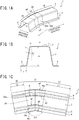
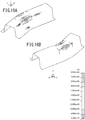
- the press-formed component shape 1 illustrated in FIG. 1 is a hat-shaped cross-sectional shape including a top sheet portion 2 and a vertical wall portion 3 and a flange portion 4 respectively continuous on both sides of a widthwise direction of the top sheet portion 2, and includes, at a certain position along a longitudinal direction of the top sheet portion 2, a curved portion 1A curved in such a manner as to protrude toward one side of the widthwise direction of the top sheet portion 2 as seen in a plan view.
- FIG. 1 is a hat-shaped cross-sectional shape including a top sheet portion 2 and a vertical wall portion 3 and a flange portion 4 respectively continuous on both sides of a widthwise direction of the top sheet portion 2, and includes, at a certain position along a longitudinal direction of the top sheet portion 2, a curved portion 1A curved in such a manner as to protrude toward one side of the widthwise direction of the top sheet portion 2 as seen in a plan view.
- reference sign 2A denotes the top sheet portion at the curved portion 1A.
- Reference sign 3Aa denotes the vertical wall portion on a curved protruding side at the curved portion 1A.
- Reference sign 4Aa denotes the flange portion on the curved protruding side at the curved portion 1A.
- Reference sign 3Ab denotes the vertical wall portion on a curved recessed side at the curved portion 1A.
- Reference sign 4Ab denotes the flange portion on the curved recessed side at the curved portion 1A.
- a metal sheet 10 for use in production of a press-formed component of the present embodiment is particularly suitably effective in cases where the metal sheet 10 is made of a high tensile strength steel material, such as a material having a tensile strength of 590 MPa or more.
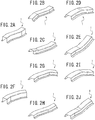
- FIG. 2 illustrates examples of the press-formed component shape 1 that is a subject of the present invention. As illustrated in FIG.
- the press-formed component shape 1 as the subject of the present invention is any press-formed component shape that includes, at a certain position along the longitudinal direction of the top sheet portion 2, the curved portion 1A curved in such a manner as to protrude toward one side of the widthwise direction of the top sheet portion 2 as seen in a plan view.
- the adjacent curved portions 1A may be continuously formed in the plan view, where any linearly extending portion does not have to be present between the adjacent curved portions 1A.
- the press-formed component shape 1 may include a portion curved up and down along the longitudinal direction, as seen in a side view.
- any linear portion 1B does not have to be present between the adjacent curved portions 1A.
- FIG. 1C exemplifies a case where the curved portion 1A is curved in such a manner as to protrude on an upper side of the paper (recessed on a lower side of the paper).
- the curved protruding side is referred to also as curved outer side
- the curved recessed side is referred to also as curved inner side.
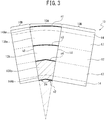
- an example of the metal sheet 10 to be used is a metal sheet 10 blanked into a developed shape of the desired press-formed component shape 1 developed on a plane, as illustrated in FIG. 3 .
- the press-formed component shape 1 includes one curved portion 1A and linear portions 1B on the left and right thereof, so that the developed shape also includes the one curved portion 10A and the linear portions 10B on the left and right thereof.
- the left and right linear portions 10B have a shape developed with dimensions of the press-formed component shape 1.
- the curved portion 10A is developed in such a manner that a line length of a position n3 corresponding to a ridge line m3 (particularly, on the curved protruding side) between the top sheet portion 2 and the vertical wall portion 3 is equal to a line length in the press-formed component shape 1, and, in a plan view, an angle 2 ⁇ formed by the flange portion 4Ab on the curved recessed side of the press-formed component shape 1 is equal to an angle formed by the flange portion 4 on the curved recessed side (an angle formed between the left and right linear portions 1B on the curved inner side) in the developed shape.
- FIG. 1 is an example where the contour of an outer edge m2 on the curved recessed side has a shape with a combination of two straight lines, and thus the developed shape is also illustrated so as to have a line length of a curve n2 formed by two straight lines.
- the contour of the outer edge m2 on the curved recessed side has an arc shape, the contour of the outer edge n2 on the curved recessed side of the developed shape also becomes arc-shaped.
- a length of an outer edge n1 on the curved protruding side of the metal sheet 10 corresponding to a length of an outer edge m1 of the flange portion 4Aa (see FIG. 1 ) on the curved outer side in the press-formed component shape 1 is in a relationship of "line length of m1 ⁇ line length of n1".
- a length of the outer edge n2 on the curved inner side of the metal sheet 10 corresponding to a length of the outer edge m2 of the flange portion 4Ab see FIG.
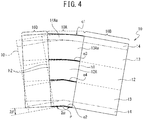
- the metal sheet 10 for press forming is configured to have a sheet-shape as illustrated in FIG. 4 , which sheet-shape is formed by changing the developed shape simply developed as described above to a shape in which a boundary h2 between the curved portion 10A and the linear portion 10B is rotationally displaced in-plane around a rotational center P set within a region (indicated by hatching in FIG. 3 ) positioned on the curved recessed side rather than a position n4 corresponding to a ridge line m4 between the top sheet portion 2 and the vertical wall portion 3 on the curved recessed side.
- the developed shape after the rotational displacement is referred to also as modified developed shape.
- the direction of the in-plane rotational displacement is set to a direction in which, in a fan-shaped region of the curved portion 10A in the developed shape simply developed as described above, the line length of the position n1 that becomes the outer edge of the flange portion 14Aa on the curved protruding side approaches the line length of the outer edge m1 of the flange portion 4Aa on the curved protruding side in the press-formed component shape (i.e., to a direction in which the line length of n1 becomes shorter), and to a direction in which the line length of the outer edge n2 of the position 14Ab to be formed into the flange portion 4Ab on the curved recessed side approaches the line length of the position m2 that becomes the outer edge of the flange portion 4Ab on the curved recessed side in the press-formed component shape (i.e., to a direction in which the line length of n2 becomes longer).
- the amount of rotational displacement is preferably set such that a difference between a line length of an outer edge q1 of a position to be formed into the flange portion 4Aa on the curved protruding side in the modified developed shape and a line length of an outer edge m1 of the flange portion 4Aa on the curved protruding side in the press-formed component is equal to or less than 10% of the outer edge m1 of the flange portion 4Aa on the curved protruding side in the press-formed component shape.
- a projection portion 20 protruding in an out-of-plane direction is formed in regions 12A and 13Aa corresponding to the top sheet portion 2A and the vertical wall portion 3Aa on the curved protruding side in the region corresponding to the curved portion 1A (see FIG. 5 ).
- a difference between a line length of a position q3 corresponding to the ridge line m3 between the top sheet portion 2 and the vertical wall portion 3 on the curved protruding side and the line length of the ridge line m3 between the top sheet portion 2 and the vertical wall portion 3 on the curved protruding side in the press-formed component shape is equal to or less than 10% of the line length of the ridge line m3 between the top sheet portion 2 and the vertical wall portion 3 on the curved protruding side in the press-formed component shape.
- the direction in which the projection portion 20 projects may be downward.
- each linear portion 10B other than the region 10A (the curved portion of the metal sheet 10) corresponding to the curved portion 1A at least one of a position corresponding to a ridge line between the top sheet portion 2 and the vertical wall portion 3 or a position corresponding to a ridge line between the vertical wall portion 3 and the above flange portion 4, the bead shape 21 or a crease shape extending in a direction along the ridge line is provided at least one place (see FIG. 5).
- FIG. 5 illustrates an example provided with the bead shapes 21.
- a broken line indicates a developed shape before the rotation.
- FIG. 4 exemplifies the case where, in the region corresponding to the curved portion 1A, a boundary h1 with the right linear portion 1B is fixed, and the boundary h2 with the left linear portion 1B is rotationally displaced to change the above-mentioned line length.
- the boundaries h1 and h2 on both sides may be respectively rotationally displaced.
- the boundaries h1 and h2 on both sides are respectively rotationally displaced by ⁇ each.
- a curvature radius of the ridge line m3 between the top sheet portion 2 and the vertical wall portion 3 on the curved protruding side is defined as R (mm), a width of the top sheet portion 2 as W (mm), a vertical height of the vertical wall portion 3 as H (mm), an angle formed between a horizontal surface of the top sheet portion 2 and the vertical wall portion 3 as ⁇ (deg), and a width of the flange portion 4 as f (mm).
- the angle ⁇ to be applied to the rotational displacement may be designed so as to satisfy the following expression: 0.9 ⁇ ⁇ ′ ⁇ ⁇ ⁇ 1.1 ⁇ ⁇ ′
- the line length of q1 may be designed so as to satisfy the following expression: 0.9 ⁇ line length of m 1 ⁇ line length of q 1 ⁇ 1.1 ⁇ line length of m 1
- the line length of the position q3 corresponding to the ridge line m3 between the top sheet portion 12 and the vertical wall portion 13Aa on the curved protruding side becomes shorter than the line length of the ridge line m3 in the press-formed component shape 1.
- the projection portion 20 protruding in an out-of-plane direction is formed in the region of a top sheet portion 12A and the vertical wall portion 13Aa on the curved protruding side in the region 10A corresponding to the curved portion 1A.
- the line length of the position q3 corresponding to the ridge line m3 between the top sheet portion 2 and the vertical wall portion 3 on the curved protruding side in the metal sheet 10 is designed so as to approach the line length in the press-formed component shape 1.
- the projection portion 20 is designed such that an increased amount ⁇ L of the line length of the position q3 corresponding to the ridge line m3 between the top sheet portion 12 and the vertical wall portion 13Aa on the curved protruding side in the metal sheet 10 satisfies the following expression: 0.9 ⁇ ⁇ 90 R 90 ⁇ ⁇ ⁇ R ⁇ W sin 90 ⁇ ⁇ sin 90 ⁇ ⁇ ⁇ ⁇ 90 ⁇ ⁇ ⁇ ⁇ ⁇ L ⁇ 1.1 ⁇ ⁇ 90 R 90 ⁇ ⁇ ⁇ R ⁇ W sin 90 ⁇ ⁇ sin 90 ⁇ ⁇ ⁇ ⁇ 90 ⁇ ⁇ ⁇ ⁇ ⁇ ⁇ ⁇ ⁇
- the line length of the position q3 corresponding to the ridge line m3 between the top sheet portion 12 and the vertical wall portion 13Aa on the curved protruding side in the metal sheet 10 approaches the line length of the corresponding ridge line m3 in the press-formed component shape 1. Specifically, it is possible to set to a line length difference of 10% or less.
- the projection portion 20 is designed into a protruding shape such that, regarding an amount of the line length increased in the longitudinal direction by formation of the projection portion, the increased amount at the line length position of the ridge line between the top sheet portion 2 and the vertical wall portion 3 on the curved protruding side in the metal sheet 10 is the largest.
- FIG. 5 it is preferable to form, at least one of positions corresponding to ridge lines of each linear portion 10B, a bead shape 21 extending along the ridge line.
- FIG. 5 is an example where the bead shape 21 is formed at positions corresponding to the ridge lines on both sides of the top sheet portion 2, but the invention is not limited thereto.
- the bead shape 21 may be also formed at positions corresponding to ridge lines between the vertical wall portion 3 and the flange portion 4 or at only some of the ridge lines at the ridge-line positions. Additionally, it is unnecessary to form the bead shape 21 over an entire length of one ridge line, and the bead shape 21 may be intermittently formed along the ridge line.
- the total length of the bead shape 21 is preferably set so as to be equal to or more than 1/3 of the entire length of the corresponding ridge line.
- a crease may be formed.
- the bead shape 21 and a crease may be used in combination such that the bead shape 21 is provided at a part thereof, and the crease is provided at the other part thereof.
- the projection portion forming step is a step of forming the projection portion 20 by stretch forming the metal sheet 10.
- the projection portion 20 may be provided by drawing or stamping. The following description will exemplify formation by drawing.
- the length of the position q3 corresponding to the ridge line m3 of the top sheet portion 2 on the curved protruding side of the metal sheet 10 is designed by rotationally displacing by 2 ⁇ in-plane around the rotational center P. Due to this, the length of the position q3 becomes shorter than the line length of the ridge line m3 of the top sheet portion 2 on the curved protruding side in the press-formed component shape 1. As a result, if press forming is performed as it is, tensile deformation is accordingly applied to the produced press-formed component.
- the projection portion 20 is formed on the metal sheet 10 at the projection portion forming step to secure the line length up to the same amount as the length of the ridge line m3 of the top sheet portion 2 on the curved protruding side in the press-formed component shape 1.
- a drawing die is prepared that includes an upper die formed by a die 30 and a lower die formed by a punch 31 and a blank holder 32, for example, as illustrated in FIG. 6 , and stretch forming for forming the projection portion 20 is performed by the drawing die.
- the die 30 is provided with a recessed portion 30A corresponding to the shape of the projection portion 20 at a portion facing the punch 31.
- the length of the projection portion 20 at the position q3 corresponding to the ridge line m3 is designed so as to be longer by ⁇ L than a length before forming the projection portion 20.
- ⁇ L may be set on the basis of the above description.
- the shape of the projection portion 20 in the present embodiment is designed, for example, as illustrated in FIG. 5 , in such a manner as to project across positions corresponding to the top sheet portion 12A of the curved portion 10A and the vertical wall portion 13Aa on the curved protruding side.
- the shape of the projection portion 20 is preferably designed so as to be a dome-like shape such that a maximum projection height is given at the position q3 where the required line length ⁇ L is secured, and the projection height is gradually reduced toward the widthwise direction of the top sheet portion 2.
- the shape of the projection portion 20 may be another contour shape as long as the line length can be secured.
- the die illustrated in FIG. 6 is set such that, at the projection portion forming step in advance, the bead shape 21 is provided at the positions corresponding to the ridge lines adjacent to the top sheet portion 2 in the press-formed component shape 1, except for the position for forming the projection portion 20.
- the metal sheet 10 provided with the bead shapes 21 With the metal sheet 10 provided with the bead shapes 21, bending forming into the desired press-formed component shape 1 is stabilized.
- FIG. 5 exemplifies the case of provision of the bead shape 21, a crease may be provided instead of the bead shape 21.
- the present embodiment exemplifies the case of use of the metal sheet 10 including the projection portion 20 and the bead shape 21 formed at the projection portion forming step, as the shape of the metal sheet 10 to be formed at a main forming step (see FIG. 5 ).
- the metal sheet 10 without both or one of the projection portion 20 and the bead shape 21, as in FIG. 4 or the like, may be used as the metal sheet 10 for the main forming step, although processing accuracy is slightly reduced.
- Press forming the above-described metal sheet 10 at the main forming step enables the press-formed component shape 1 to be obtained with suppressed cracks, wrinkles, and spring-back.
- a forming step for the purpose of restrike may be added as a step after the main forming step.
- the main forming step is a step of bending the metal sheet 10 to process into the final press-formed component shape 1.
- a bending die to be used at the main forming step includes an upper die 40 and a lower die 44, as illustrated in FIG. 7 .
- the upper die 40 includes bending blades 43 that bend the ridge lines of the component and a pad 41 that presses the top sheet portion 2.
- the lower die 44 includes a punch 45.
- the pad 41 that pressurizes the top sheet portion 2 in the present embodiment is divided into a pad 41a that pressurizes the top sheet portion 12A of the curved portion 10A and a pad 41b that pressurizes top sheet portions of the linear portions 10B other than the curved portion 1A.
- the pad 41b is preferably set so as to pressurize only the top sheet portion of one of the linear portions 1B positioned on both sides of the curved portion 1A therebetween.
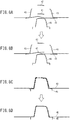
- the metal sheet 10 with the projection portion 20 formed at the projection portion forming step is placed on the punch 45 (see FIG. 8A ).
- the upper die 40 descends.
- the pad 41 and the punch 45 pinches a position 12 corresponding to the top sheet portion of the metal sheet 10 (see FIG. 8B ).
- the bending blades 43 contact with the metal sheet 10 (see FIG. 8C ) and bend ridge lines, and the metal sheet 10 is formed into the press-formed component shape 1 at a bottom dead center (see FIG. 8D ).
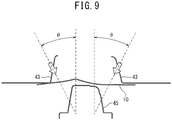
- the bending blades 43 may include a known cam mechanism such that moves from a direction inclined by a certain angle ⁇ with respect to the pressing direction toward the punch 45, as illustrated in FIG. 9 .
- the angle ⁇ is set to an angle inclined by 0 degrees to 90 degrees in directions away from the vertical wall portions 3 with respect to the pressing direction.
- an angle formed by the right linear portion 10B and the left linear portion 10B is relatively larger than a final angle in the press-formed component shape 1 in a plan view due to the rotational displacement.
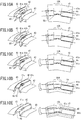
- the bending blades 43 bends the ridge lines to perform bending of the vertical wall portions 3 and the flange portions 4 in the state where the position 12 corresponding to the top sheet portion is partially pinched by the pad 41 and the punch 45, the material is bent while the left linear portion 1B is being rotationally displaced by 2 ⁇ with respect to the right linear portion 1B pinched by the pad 41b, as illustrated in FIG. 10 .
- the curved portion 1A is formed while rotating around the position of the curved recessed side of the top sheet portion 2.
- embossed shapes are provided on the curved recessed side of the top sheet portion 12A in the metal sheet 10 to be subjected to main forming, as illustrated in FIG. 7 . Providing embossed shapes 50 and 51 having unevenness on facing surfaces of the pad 41a and the punch 45 further improves formability.
- the pad 41b that presses the linear portion 10B and the pad 41a that presses the curved portion 10A are structurally independent.
- the setting of the pressurization forces of the pad 41 described above may be made by adjusting an actual pressing force (a cushion force) applied by each of the pads 41a and 41b.
- the above-described setting of the pressurization forces of the pad 41 may be achieved by adjusting stroke of each pad to set such that a height of the pad 41a is relatively higher than a height of the pad 41b during bending.
- FIG. 11 illustrates an example of the shape of a press-formed component after the main forming step.
- Reference sign 9 denotes a provided embossed shape.
- the press-formed component having the hat-shaped cross-sectional shape and including one or more curved portions 1A curved toward one side of the widthwise direction of the top sheet portion 2 in the plan view along the longitudinal direction can be press formed with further reduced forming defects such as cracks, wrinkles, and lowered dimensional accuracy.
- the press-formed component shape 1 including the top sheet portion 2 and the vertical wall portions 3 and the flange portions 4 continuous thereto and including at least one shape curved in the longitudinal direction as seen in a plan view can be formed without any cracks and wrinkles, and furthermore, spring-back due to stress difference in the longitudinal direction between the top sheet portion 2 and the flange portions 4 can be suppressed.
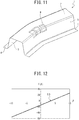
- FIG. 12 illustrates a relationship between ⁇ and calculated value f ( ⁇ ) when ⁇ changes.
- FIG. 12 depicts a case where ⁇ is plotted on the lateral axis and function values of the f( ⁇ ) are plotted on the vertical axis.
- FIG. 12 illustrates a shape of the metal sheet 10 rotationally displaced on the basis of the present invention with respect to the simply-developed developed shape.
- the projection portion 20 was formed on the metal sheet 10 at the projection portion forming step.
- the line length ⁇ L was calculated that was required to be secured at the ridge line m3 of the top sheet portion 2 on the curved protruding side.
- the design method as described above was employed to design the shape of the metal sheet 10 of the present Example, as illustrated in FIG. 13 , and a stretch forming die for use in the projection portion forming step.
- the metal sheet 10 was provided with the bead shape 21 having a height of 3 mm and a width of 5 mm at positions corresponding to ridge lines on both sides of the widthwise direction adjacent to the top sheet portion 12 in the linear portions 10B.
- a blank holding force of 50 ton was set, and the upper die was brought down to a bottom dead center to perform an analysis for forming the metal sheet 10 including the projection portion 20.
- pads 41a and 41b divided into two were used to independently press the curved portion 1A and the region of one of the left and right linear portions 1B other than that in the top sheet portion 12.
- the amounts of stroke and pressure of the pad 41a were 100 mm and 2 ton
- the stroke and pressure of the pad 41b were 125 mm and 10 ton. Note that heights of the pads 41a and 41b at initial positions were made equal.
- FIG. 14 illustrates a die used in the drawing.
- the drawing die includes an upper die formed by a die 61 and a lower die formed by a punch 63 and a blank holder 62 that presses the flange portions 4.
- the blank holding force was set to 50 ton.
- Comparative Example used, as a shape of a metal sheet 60 for press forming, a sheet having the developed shape obtained by simply developing the press-formed component shape 1 (see FIG. 3 ).
- FIG. 15 illustrates a sheet thickness reduction rate distribution at a forming bottom dead center when forming into the desired press-formed component shape 1 was performed by the conventional method. Additionally, FIG. 16 illustrates a sheet thickness reduction rate distribution at a forming bottom dead center when forming into the desired press-formed component shape 1 was performed on the basis of the present invention.
- the press-formed component formed by the method based on the present invention was produced by forming the metal sheet 10 by bending, almost no increase in the sheet thickness was seen on the flange portion 4 on the curved protruding side.
- the material was supplied by rotation of the material, so that almost no tensile deformation was applied, and thus there was no sheet thickness reduction.
- FIG. 17 illustrates a stress distribution (a longitudinal axial force distribution) at a sheet thickness center in the longitudinal direction (x direction) at the forming bottom dead center when the sheet was formed into the press-formed component shape 1 by the conventional method.
- FIG. 18 illustrates a stress distribution (a longitudinal axial force distribution) at a sheet thickness center in the longitudinal direction (x direction) at the forming bottom dead center when the sheet was formed into the press-formed component shape 1 by the method based on the present invention.
- FIG. 19 illustrates a distribution of sheet thickness front-back stress difference in a cross-sectional direction (a direction along the cross section) at the forming bottom dead center when forming into the press-formed component shape 1 was performed by the conventional method.
- FIG. 20 illustrates a distribution of sheet thickness front-back stress difference in the cross-sectional direction (the direction along the cross section) at the forming bottom dead center when forming into the press-formed component shape 1 was performed by the method based on the present invention.
- FIG. 21 illustrates a distribution of deviation amounts from a normal shape after spring-back in the press-formed component shape 1 formed by the conventional method.
- FIG. 22 illustrates a distribution of deviation amounts from a normal shape after spring-back in the press-formed component shape 1 formed by the method based on the present invention.
- the forming method based on the present invention is a forming method that reduces the sheet thickness center stress in the longitudinal direction (x direction) and the sheet thickness front-back stress difference in the widthwise direction that cause the above-mentioned spring-back.
- the forming method has enabled significant suppression of the spring-back, as compared with the conventional drawing method.
Landscapes
- Engineering & Computer Science (AREA)
- Mechanical Engineering (AREA)
- Chemical & Material Sciences (AREA)
- Combustion & Propulsion (AREA)
- Transportation (AREA)
- Shaping Metal By Deep-Drawing, Or The Like (AREA)
- Bending Of Plates, Rods, And Pipes (AREA)
Applications Claiming Priority (2)
| Application Number | Priority Date | Filing Date | Title |
|---|---|---|---|
| JP2018034569 | 2018-02-28 | ||
| PCT/JP2019/006551 WO2019167791A1 (fr) | 2018-02-28 | 2019-02-21 | Plaque métallique pour moulage à la presse, dispositif de moulage à la presse et procédé de production pour un élément pressé |
Publications (3)
| Publication Number | Publication Date |
|---|---|
| EP3760330A1 true EP3760330A1 (fr) | 2021-01-06 |
| EP3760330A4 EP3760330A4 (fr) | 2021-04-14 |
| EP3760330B1 EP3760330B1 (fr) | 2025-09-03 |
Family
ID=67805769
Family Applications (1)
| Application Number | Title | Priority Date | Filing Date |
|---|---|---|---|
| EP19761706.1A Active EP3760330B1 (fr) | 2018-02-28 | 2019-02-21 | Plaque métallique pour moulage à la presse, dispositif de moulage à la presse et procédé de production pour un élément pressé |
Country Status (7)
| Country | Link |
|---|---|
| US (1) | US11383286B2 (fr) |
| EP (1) | EP3760330B1 (fr) |
| JP (1) | JP6590129B1 (fr) |
| KR (1) | KR102339921B1 (fr) |
| CN (1) | CN111867747B (fr) |
| MX (1) | MX2020008961A (fr) |
| WO (1) | WO2019167791A1 (fr) |
Families Citing this family (11)
| Publication number | Priority date | Publication date | Assignee | Title |
|---|---|---|---|---|
| CN110795803B (zh) * | 2019-11-10 | 2023-09-29 | 中国航发南方工业有限公司 | 一种挤压成型叶片 |
| CN113118315A (zh) * | 2019-12-30 | 2021-07-16 | 上海强精金属制品有限公司 | 一种洗衣机前框板的模具 |
| JP7243670B2 (ja) * | 2020-04-16 | 2023-03-22 | Jfeスチール株式会社 | プレス部品の製造方法、及び金属板 |
| JP7335198B2 (ja) * | 2020-04-20 | 2023-08-29 | 豊田鉄工株式会社 | 長尺形状部品のプレス成形法、及び同成形法により成形した車両用ピラー部材 |
| JP7335197B2 (ja) * | 2020-04-20 | 2023-08-29 | 豊田鉄工株式会社 | 長尺形状部品のプレス成形法、及び同成形法により成形した車両用ピラー部材 |
| JP7156340B2 (ja) * | 2020-07-08 | 2022-10-19 | Jfeスチール株式会社 | 金属板の曲げ加工方法 |
| JP7587944B2 (ja) * | 2020-09-03 | 2024-11-21 | プレス工業株式会社 | 車体フレーム用部材、及び車体フレーム用部材の製造方法 |
| JP7647714B2 (ja) * | 2022-02-10 | 2025-03-18 | Jfeスチール株式会社 | プレス成形方法及びプレス成形品の製造方法 |
| JP7854972B2 (ja) * | 2023-08-23 | 2026-05-07 | 日本製鉄株式会社 | プレス成形方法 |
| CN120189048B (zh) * | 2025-05-26 | 2025-08-12 | 湖南省华芯医疗器械有限公司 | 弯曲管、插入部及内窥镜 |
| CN120438486B (zh) * | 2025-07-01 | 2025-10-28 | 聚变新能(安徽)有限公司 | 真空室壳盖加工模具、制备真空室壳盖的方法、真空室壳盖 |
Family Cites Families (36)
| Publication number | Priority date | Publication date | Assignee | Title |
|---|---|---|---|---|
| JPS4920649B1 (fr) | 1969-08-08 | 1974-05-27 | ||
| JPS5031702B1 (fr) | 1971-05-08 | 1975-10-14 | ||
| JPS5031703B2 (fr) | 1972-02-23 | 1975-10-14 | ||
| JPS5217928B2 (fr) | 1973-04-19 | 1977-05-18 | ||
| JPS585523A (ja) | 1981-06-30 | 1983-01-12 | Matsushita Electric Ind Co Ltd | 静圧流体スライド装置 |
| JPH0531703A (ja) | 1991-02-21 | 1993-02-09 | Keigo Murase | リツプソー自動歩出し装置 |
| JP2602136B2 (ja) | 1991-07-29 | 1997-04-23 | 武司 野末 | 長尺材の送り込み装置 |
| JPH05217928A (ja) | 1991-11-29 | 1993-08-27 | Nec Corp | 縦型熱処理装置 |
| JP2777763B2 (ja) | 1992-09-30 | 1998-07-23 | 株式会社 セガ・エンタープライゼス | コントロールキー装置 |
| JP4123021B2 (ja) * | 2003-03-17 | 2008-07-23 | 三菱自動車工業株式会社 | 自動車のサイドメンバ |
| JP4359264B2 (ja) * | 2005-06-03 | 2009-11-04 | 本田技研工業株式会社 | 自動車用シートの取付構造 |
| JP2008200709A (ja) | 2007-02-20 | 2008-09-04 | Nissan Motor Co Ltd | プレス成形品の製造装置、プレス成形品の製造方法、およびプレス成形品 |
| JP5031702B2 (ja) | 2008-09-12 | 2012-09-26 | 新日本製鐵株式会社 | 形状凍結性に優れる多段プレス成形方法 |
| JP4920649B2 (ja) * | 2008-09-12 | 2012-04-18 | 新日本製鐵株式会社 | 形状凍結性に優れる多段プレス成形方法 |
| JP5031703B2 (ja) | 2008-09-12 | 2012-09-26 | 新日本製鐵株式会社 | 形状凍結性に優れる多段プレス成形方法 |
| JP5217928B2 (ja) | 2008-11-12 | 2013-06-19 | 新日鐵住金株式会社 | プレス加工方法及びプレス成形体 |
| WO2012108282A1 (fr) * | 2011-02-09 | 2012-08-16 | 本田技研工業株式会社 | Structure pour cadres latéraux avant d'automobile |
| KR101701082B1 (ko) * | 2013-01-07 | 2017-02-13 | 신닛테츠스미킨 카부시키카이샤 | 프레스 부품의 제조 방법 및 제조 장치 |
| BR112015016037A2 (pt) * | 2013-01-16 | 2017-07-11 | Nippon Steel & Sumitomo Metal Corp | método de formação por prensagem |
| WO2014185428A1 (fr) * | 2013-05-13 | 2014-11-20 | 新日鐵住金株式会社 | Découpe, plaque moulée, procédé de fabrication de produit moulé sous pression et produit moulé sous pression |
| WO2015002077A1 (fr) * | 2013-07-03 | 2015-01-08 | 新日鐵住金株式会社 | Dispositif de moulage à la presse et procédé de moulage à la presse |
| JP5761275B2 (ja) | 2013-08-26 | 2015-08-12 | Jfeスチール株式会社 | 曲がり形状を有する多角形閉断面構造部品の製造方法およびその方法で製造した多角形閉断面構造部品 |
| JP5924331B2 (ja) * | 2013-11-25 | 2016-05-25 | トヨタ自動車株式会社 | 車体下部構造 |
| JP6083390B2 (ja) * | 2014-01-10 | 2017-02-22 | Jfeスチール株式会社 | プレス成形方法 |
| JP5954380B2 (ja) * | 2014-08-26 | 2016-07-20 | Jfeスチール株式会社 | プレス成形方法およびプレス成形部品の製造方法 |
| KR20170080681A (ko) * | 2014-11-12 | 2017-07-10 | 신닛테츠스미킨 카부시키카이샤 | 프레스 성형품의 제조 방법 및 제조 장치 |
| JP5987934B2 (ja) * | 2015-02-17 | 2016-09-07 | Jfeスチール株式会社 | プレス成形方法、プレス成形金型 |
| US10213819B2 (en) | 2015-02-27 | 2019-02-26 | Sango Co., Ltd. | Press forming method |
| JP5987942B1 (ja) | 2015-03-18 | 2016-09-07 | Jfeスチール株式会社 | プレス成形金型 |
| US10603707B2 (en) | 2015-03-31 | 2020-03-31 | Jfe Steel Corporation | Press-forming method, method of manufacturing component with the press-forming method and component manufactured with the press-forming method |
| KR101932878B1 (ko) | 2015-05-11 | 2018-12-27 | 신닛테츠스미킨 카부시키카이샤 | 프레스 성형 장치 및 프레스 성형 방법 |
| US11020785B2 (en) | 2015-07-06 | 2021-06-01 | Nippon Steel Corporation | Method and apparatus for manufacturing press component |
| JP6672933B2 (ja) * | 2016-03-24 | 2020-03-25 | 日本製鉄株式会社 | 自動車用構造部材、およびその製造方法、金型 |
| US11358203B2 (en) | 2016-04-04 | 2022-06-14 | Nippon Steel Corporation | Method for producing press-formed product |
| JP6819141B2 (ja) | 2016-08-30 | 2021-01-27 | いすゞ自動車株式会社 | ラジエータのエアガイド構造 |
| JP6547772B2 (ja) * | 2017-01-24 | 2019-07-24 | トヨタ自動車株式会社 | 車両フロア構造 |
-
2019
- 2019-02-21 WO PCT/JP2019/006551 patent/WO2019167791A1/fr not_active Ceased
- 2019-02-21 JP JP2019530230A patent/JP6590129B1/ja active Active
- 2019-02-21 CN CN201980013220.9A patent/CN111867747B/zh active Active
- 2019-02-21 US US16/970,467 patent/US11383286B2/en active Active
- 2019-02-21 KR KR1020207024097A patent/KR102339921B1/ko active Active
- 2019-02-21 EP EP19761706.1A patent/EP3760330B1/fr active Active
- 2019-02-21 MX MX2020008961A patent/MX2020008961A/es unknown
Also Published As
| Publication number | Publication date |
|---|---|
| CN111867747A (zh) | 2020-10-30 |
| KR102339921B1 (ko) | 2021-12-15 |
| EP3760330A4 (fr) | 2021-04-14 |
| KR20200108069A (ko) | 2020-09-16 |
| MX2020008961A (es) | 2020-10-05 |
| JPWO2019167791A1 (ja) | 2020-04-16 |
| US20210114075A1 (en) | 2021-04-22 |
| WO2019167791A1 (fr) | 2019-09-06 |
| CN111867747B (zh) | 2022-05-13 |
| JP6590129B1 (ja) | 2019-10-16 |
| EP3760330B1 (fr) | 2025-09-03 |
| US11383286B2 (en) | 2022-07-12 |
Similar Documents
| Publication | Publication Date | Title |
|---|---|---|
| EP3760330B1 (fr) | Plaque métallique pour moulage à la presse, dispositif de moulage à la presse et procédé de production pour un élément pressé | |
| EP3760332B1 (fr) | Procédé de production d'éléments pressés, dispositif de moulage à la presse et plaque métallique pour moulage à la presse | |
| CN111727089B (zh) | 冲压部件的制造方法、冲压成型装置和冲压成型用的金属板 | |
| CN112154036B (zh) | 冲压部件的制造方法 | |
| AU2011255898B2 (en) | Method for press-forming l-shaped components | |
| CN109952165B (zh) | 压制成形品的制造方法及制造装置 | |
| CA3018484A1 (fr) | Methode de production de produit forme par une presse | |
| EP3031544B1 (fr) | Produit moulé à la presse, procédé pour obtenir un produit moulé à la presse et dispositif pour obtenir un produit moulé à la presse | |
| EP3272437B1 (fr) | Procédé de formage à la presse et outil de formage à la presse | |
| CN110709181A (zh) | 冲压成型品的制造方法以及冲压生产线 | |
| EP3909697B1 (fr) | Procédé de moulage à la presse, procédé de fabrication d'article moulé à la presse | |
| CN115666809A (zh) | 冲压成形方法 | |
| EP4137245B1 (fr) | Moule de formage sous pression et procédé de formage sous pression | |
| JP2017042773A (ja) | プレス成形方法 | |
| JP6319382B2 (ja) | 伸びフランジ成形部品の製造方法 | |
| JP6319383B2 (ja) | 伸びフランジ成形部品の製造方法 | |
| JP2021062381A (ja) | 自動車用パネルの製造方法 | |
| EP3778057A1 (fr) | Procédé d'amélioration de rigidité pour article moulé à la presse, matrice de moulage à la presse, article moulé à la presse, et procédé de production d'article moulé à la presse | |
| JP2003311339A (ja) | プレス成形品、プレス成形品の製造方法および製造装置 | |
| JP7341840B2 (ja) | 自動車用パネルの製造方法 | |
| JP2011073050A (ja) | 曲がり部材成形方法および曲がり部材ならびに曲がり部材製造方法 |
Legal Events
| Date | Code | Title | Description |
|---|---|---|---|
| STAA | Information on the status of an ep patent application or granted ep patent |
Free format text: STATUS: THE INTERNATIONAL PUBLICATION HAS BEEN MADE |
|
| PUAI | Public reference made under article 153(3) epc to a published international application that has entered the european phase |
Free format text: ORIGINAL CODE: 0009012 |
|
| STAA | Information on the status of an ep patent application or granted ep patent |
Free format text: STATUS: REQUEST FOR EXAMINATION WAS MADE |
|
| 17P | Request for examination filed |
Effective date: 20200826 |
|
| AK | Designated contracting states |
Kind code of ref document: A1 Designated state(s): AL AT BE BG CH CY CZ DE DK EE ES FI FR GB GR HR HU IE IS IT LI LT LU LV MC MK MT NL NO PL PT RO RS SE SI SK SM TR |
|
| AX | Request for extension of the european patent |
Extension state: BA ME |
|
| A4 | Supplementary search report drawn up and despatched |
Effective date: 20210312 |
|
| RIC1 | Information provided on ipc code assigned before grant |
Ipc: B21D 22/20 20060101AFI20210305BHEP Ipc: B21D 5/01 20060101ALI20210305BHEP Ipc: B21D 19/08 20060101ALI20210305BHEP Ipc: B21D 22/02 20060101ALI20210305BHEP Ipc: B21D 22/26 20060101ALI20210305BHEP Ipc: B21D 24/00 20060101ALI20210305BHEP Ipc: B21D 22/21 20060101ALI20210305BHEP Ipc: B21D 5/06 20060101ALI20210305BHEP |
|
| DAV | Request for validation of the european patent (deleted) | ||
| DAX | Request for extension of the european patent (deleted) | ||
| STAA | Information on the status of an ep patent application or granted ep patent |
Free format text: STATUS: EXAMINATION IS IN PROGRESS |
|
| 17Q | First examination report despatched |
Effective date: 20230201 |
|
| GRAP | Despatch of communication of intention to grant a patent |
Free format text: ORIGINAL CODE: EPIDOSNIGR1 |
|
| STAA | Information on the status of an ep patent application or granted ep patent |
Free format text: STATUS: GRANT OF PATENT IS INTENDED |
|
| INTG | Intention to grant announced |
Effective date: 20250424 |
|
| RIN1 | Information on inventor provided before grant (corrected) |
Inventor name: YAMASAKI, YUJI Inventor name: SHINMIYA, TOYOHISA Inventor name: MIYAKE, HIROTO |
|
| GRAS | Grant fee paid |
Free format text: ORIGINAL CODE: EPIDOSNIGR3 |
|
| GRAA | (expected) grant |
Free format text: ORIGINAL CODE: 0009210 |
|
| STAA | Information on the status of an ep patent application or granted ep patent |
Free format text: STATUS: THE PATENT HAS BEEN GRANTED |
|
| AK | Designated contracting states |
Kind code of ref document: B1 Designated state(s): AL AT BE BG CH CY CZ DE DK EE ES FI FR GB GR HR HU IE IS IT LI LT LU LV MC MK MT NL NO PL PT RO RS SE SI SK SM TR |
|
| REG | Reference to a national code |
Ref country code: CH Ref legal event code: EP |
|
| REG | Reference to a national code |
Ref country code: DE Ref legal event code: R096 Ref document number: 602019075168 Country of ref document: DE |
|
| REG | Reference to a national code |
Ref country code: IE Ref legal event code: FG4D |
|
| REG | Reference to a national code |
Ref country code: NL Ref legal event code: MP Effective date: 20250903 |
|
| PG25 | Lapsed in a contracting state [announced via postgrant information from national office to epo] |
Ref country code: NO Free format text: LAPSE BECAUSE OF FAILURE TO SUBMIT A TRANSLATION OF THE DESCRIPTION OR TO PAY THE FEE WITHIN THE PRESCRIBED TIME-LIMIT Effective date: 20251203 |
|
| REG | Reference to a national code |
Ref country code: LT Ref legal event code: MG9D |
|
| PG25 | Lapsed in a contracting state [announced via postgrant information from national office to epo] |
Ref country code: FI Free format text: LAPSE BECAUSE OF FAILURE TO SUBMIT A TRANSLATION OF THE DESCRIPTION OR TO PAY THE FEE WITHIN THE PRESCRIBED TIME-LIMIT Effective date: 20250903 |
|
| PG25 | Lapsed in a contracting state [announced via postgrant information from national office to epo] |
Ref country code: HR Free format text: LAPSE BECAUSE OF FAILURE TO SUBMIT A TRANSLATION OF THE DESCRIPTION OR TO PAY THE FEE WITHIN THE PRESCRIBED TIME-LIMIT Effective date: 20250903 |
|
| PG25 | Lapsed in a contracting state [announced via postgrant information from national office to epo] |
Ref country code: GR Free format text: LAPSE BECAUSE OF FAILURE TO SUBMIT A TRANSLATION OF THE DESCRIPTION OR TO PAY THE FEE WITHIN THE PRESCRIBED TIME-LIMIT Effective date: 20251204 |
|
| PG25 | Lapsed in a contracting state [announced via postgrant information from national office to epo] |
Ref country code: SE Free format text: LAPSE BECAUSE OF FAILURE TO SUBMIT A TRANSLATION OF THE DESCRIPTION OR TO PAY THE FEE WITHIN THE PRESCRIBED TIME-LIMIT Effective date: 20250903 |
|
| PG25 | Lapsed in a contracting state [announced via postgrant information from national office to epo] |
Ref country code: LV Free format text: LAPSE BECAUSE OF FAILURE TO SUBMIT A TRANSLATION OF THE DESCRIPTION OR TO PAY THE FEE WITHIN THE PRESCRIBED TIME-LIMIT Effective date: 20250903 |
|
| PG25 | Lapsed in a contracting state [announced via postgrant information from national office to epo] |
Ref country code: PL Free format text: LAPSE BECAUSE OF FAILURE TO SUBMIT A TRANSLATION OF THE DESCRIPTION OR TO PAY THE FEE WITHIN THE PRESCRIBED TIME-LIMIT Effective date: 20250903 Ref country code: BG Free format text: LAPSE BECAUSE OF FAILURE TO SUBMIT A TRANSLATION OF THE DESCRIPTION OR TO PAY THE FEE WITHIN THE PRESCRIBED TIME-LIMIT Effective date: 20250903 |
|
| PG25 | Lapsed in a contracting state [announced via postgrant information from national office to epo] |
Ref country code: RS Free format text: LAPSE BECAUSE OF FAILURE TO SUBMIT A TRANSLATION OF THE DESCRIPTION OR TO PAY THE FEE WITHIN THE PRESCRIBED TIME-LIMIT Effective date: 20251203 |
|
| PG25 | Lapsed in a contracting state [announced via postgrant information from national office to epo] |
Ref country code: ES Free format text: LAPSE BECAUSE OF FAILURE TO SUBMIT A TRANSLATION OF THE DESCRIPTION OR TO PAY THE FEE WITHIN THE PRESCRIBED TIME-LIMIT Effective date: 20250903 |
|
| REG | Reference to a national code |
Ref country code: AT Ref legal event code: MK05 Ref document number: 1832409 Country of ref document: AT Kind code of ref document: T Effective date: 20250903 |
|
| PG25 | Lapsed in a contracting state [announced via postgrant information from national office to epo] |
Ref country code: NL Free format text: LAPSE BECAUSE OF FAILURE TO SUBMIT A TRANSLATION OF THE DESCRIPTION OR TO PAY THE FEE WITHIN THE PRESCRIBED TIME-LIMIT Effective date: 20250903 |
|
| PG25 | Lapsed in a contracting state [announced via postgrant information from national office to epo] |
Ref country code: SM Free format text: LAPSE BECAUSE OF FAILURE TO SUBMIT A TRANSLATION OF THE DESCRIPTION OR TO PAY THE FEE WITHIN THE PRESCRIBED TIME-LIMIT Effective date: 20250903 |
|
| PGFP | Annual fee paid to national office [announced via postgrant information from national office to epo] |
Ref country code: DE Payment date: 20260225 Year of fee payment: 8 |
|
| PG25 | Lapsed in a contracting state [announced via postgrant information from national office to epo] |
Ref country code: AT Free format text: LAPSE BECAUSE OF FAILURE TO SUBMIT A TRANSLATION OF THE DESCRIPTION OR TO PAY THE FEE WITHIN THE PRESCRIBED TIME-LIMIT Effective date: 20250903 |
|
| PG25 | Lapsed in a contracting state [announced via postgrant information from national office to epo] |
Ref country code: IT Free format text: LAPSE BECAUSE OF FAILURE TO SUBMIT A TRANSLATION OF THE DESCRIPTION OR TO PAY THE FEE WITHIN THE PRESCRIBED TIME-LIMIT Effective date: 20250903 |
|
| PG25 | Lapsed in a contracting state [announced via postgrant information from national office to epo] |
Ref country code: IS Free format text: LAPSE BECAUSE OF FAILURE TO SUBMIT A TRANSLATION OF THE DESCRIPTION OR TO PAY THE FEE WITHIN THE PRESCRIBED TIME-LIMIT Effective date: 20260103 |
|
| PGFP | Annual fee paid to national office [announced via postgrant information from national office to epo] |
Ref country code: FR Payment date: 20260225 Year of fee payment: 8 |
|
| PG25 | Lapsed in a contracting state [announced via postgrant information from national office to epo] |
Ref country code: PT Free format text: LAPSE BECAUSE OF FAILURE TO SUBMIT A TRANSLATION OF THE DESCRIPTION OR TO PAY THE FEE WITHIN THE PRESCRIBED TIME-LIMIT Effective date: 20260105 Ref country code: CZ Free format text: LAPSE BECAUSE OF FAILURE TO SUBMIT A TRANSLATION OF THE DESCRIPTION OR TO PAY THE FEE WITHIN THE PRESCRIBED TIME-LIMIT Effective date: 20250903 |
|
| PG25 | Lapsed in a contracting state [announced via postgrant information from national office to epo] |
Ref country code: SK Free format text: LAPSE BECAUSE OF FAILURE TO SUBMIT A TRANSLATION OF THE DESCRIPTION OR TO PAY THE FEE WITHIN THE PRESCRIBED TIME-LIMIT Effective date: 20250903 Ref country code: EE Free format text: LAPSE BECAUSE OF FAILURE TO SUBMIT A TRANSLATION OF THE DESCRIPTION OR TO PAY THE FEE WITHIN THE PRESCRIBED TIME-LIMIT Effective date: 20250903 |