EP3760672A1 - Harzzusammensetzung - Google Patents
Harzzusammensetzung Download PDFInfo
- Publication number
- EP3760672A1 EP3760672A1 EP19761605.5A EP19761605A EP3760672A1 EP 3760672 A1 EP3760672 A1 EP 3760672A1 EP 19761605 A EP19761605 A EP 19761605A EP 3760672 A1 EP3760672 A1 EP 3760672A1
- Authority
- EP
- European Patent Office
- Prior art keywords
- resin
- resin composition
- mass
- less
- viscosity
- Prior art date
- Legal status (The legal status is an assumption and is not a legal conclusion. Google has not performed a legal analysis and makes no representation as to the accuracy of the status listed.)
- Withdrawn
Links
Images

Classifications
-
- C—CHEMISTRY; METALLURGY
- C09—DYES; PAINTS; POLISHES; NATURAL RESINS; ADHESIVES; COMPOSITIONS NOT OTHERWISE PROVIDED FOR; APPLICATIONS OF MATERIALS NOT OTHERWISE PROVIDED FOR
- C09J—ADHESIVES; NON-MECHANICAL ASPECTS OF ADHESIVE PROCESSES IN GENERAL; ADHESIVE PROCESSES NOT PROVIDED FOR ELSEWHERE; USE OF MATERIALS AS ADHESIVES
- C09J123/00—Adhesives based on homopolymers or copolymers of unsaturated aliphatic hydrocarbons having only one carbon-to-carbon double bond; Adhesives based on derivatives of such polymers
- C09J123/02—Adhesives based on homopolymers or copolymers of unsaturated aliphatic hydrocarbons having only one carbon-to-carbon double bond; Adhesives based on derivatives of such polymers not modified by chemical after-treatment
- C09J123/10—Homopolymers or copolymers of propene
- C09J123/14—Copolymers of propene
- C09J123/145—Copolymers of propene with monomers having more than one C=C double bond
-
- C—CHEMISTRY; METALLURGY
- C09—DYES; PAINTS; POLISHES; NATURAL RESINS; ADHESIVES; COMPOSITIONS NOT OTHERWISE PROVIDED FOR; APPLICATIONS OF MATERIALS NOT OTHERWISE PROVIDED FOR
- C09J—ADHESIVES; NON-MECHANICAL ASPECTS OF ADHESIVE PROCESSES IN GENERAL; ADHESIVE PROCESSES NOT PROVIDED FOR ELSEWHERE; USE OF MATERIALS AS ADHESIVES
- C09J123/00—Adhesives based on homopolymers or copolymers of unsaturated aliphatic hydrocarbons having only one carbon-to-carbon double bond; Adhesives based on derivatives of such polymers
- C09J123/02—Adhesives based on homopolymers or copolymers of unsaturated aliphatic hydrocarbons having only one carbon-to-carbon double bond; Adhesives based on derivatives of such polymers not modified by chemical after-treatment
- C09J123/10—Homopolymers or copolymers of propene
- C09J123/14—Copolymers of propene
-
- C—CHEMISTRY; METALLURGY
- C08—ORGANIC MACROMOLECULAR COMPOUNDS; THEIR PREPARATION OR CHEMICAL WORKING-UP; COMPOSITIONS BASED THEREON
- C08L—COMPOSITIONS OF MACROMOLECULAR COMPOUNDS
- C08L23/00—Compositions of homopolymers or copolymers of unsaturated aliphatic hydrocarbons having only one carbon-to-carbon double bond; Compositions of derivatives of such polymers
- C08L23/02—Compositions of homopolymers or copolymers of unsaturated aliphatic hydrocarbons having only one carbon-to-carbon double bond; Compositions of derivatives of such polymers not modified by chemical after-treatment
- C08L23/10—Homopolymers or copolymers of propene
- C08L23/14—Copolymers of propene
- C08L23/145—Copolymers of propene with monomers having two or more carbon-to-carbon double bonds
-
- C—CHEMISTRY; METALLURGY
- C08—ORGANIC MACROMOLECULAR COMPOUNDS; THEIR PREPARATION OR CHEMICAL WORKING-UP; COMPOSITIONS BASED THEREON
- C08L—COMPOSITIONS OF MACROMOLECULAR COMPOUNDS
- C08L23/00—Compositions of homopolymers or copolymers of unsaturated aliphatic hydrocarbons having only one carbon-to-carbon double bond; Compositions of derivatives of such polymers
- C08L23/02—Compositions of homopolymers or copolymers of unsaturated aliphatic hydrocarbons having only one carbon-to-carbon double bond; Compositions of derivatives of such polymers not modified by chemical after-treatment
- C08L23/18—Homopolymers or copolymers of hydrocarbons having four or more carbon atoms
- C08L23/20—Homopolymers or copolymers of hydrocarbons having four or more carbon atoms having four to nine carbon atoms
- C08L23/22—Copolymers of isobutene; Butyl rubber; Homopolymers or copolymers of other iso-olefins
-
- C—CHEMISTRY; METALLURGY
- C09—DYES; PAINTS; POLISHES; NATURAL RESINS; ADHESIVES; COMPOSITIONS NOT OTHERWISE PROVIDED FOR; APPLICATIONS OF MATERIALS NOT OTHERWISE PROVIDED FOR
- C09J—ADHESIVES; NON-MECHANICAL ASPECTS OF ADHESIVE PROCESSES IN GENERAL; ADHESIVE PROCESSES NOT PROVIDED FOR ELSEWHERE; USE OF MATERIALS AS ADHESIVES
- C09J123/00—Adhesives based on homopolymers or copolymers of unsaturated aliphatic hydrocarbons having only one carbon-to-carbon double bond; Adhesives based on derivatives of such polymers
- C09J123/02—Adhesives based on homopolymers or copolymers of unsaturated aliphatic hydrocarbons having only one carbon-to-carbon double bond; Adhesives based on derivatives of such polymers not modified by chemical after-treatment
- C09J123/10—Homopolymers or copolymers of propene
- C09J123/12—Polypropene
-
- C—CHEMISTRY; METALLURGY
- C09—DYES; PAINTS; POLISHES; NATURAL RESINS; ADHESIVES; COMPOSITIONS NOT OTHERWISE PROVIDED FOR; APPLICATIONS OF MATERIALS NOT OTHERWISE PROVIDED FOR
- C09J—ADHESIVES; NON-MECHANICAL ASPECTS OF ADHESIVE PROCESSES IN GENERAL; ADHESIVE PROCESSES NOT PROVIDED FOR ELSEWHERE; USE OF MATERIALS AS ADHESIVES
- C09J123/00—Adhesives based on homopolymers or copolymers of unsaturated aliphatic hydrocarbons having only one carbon-to-carbon double bond; Adhesives based on derivatives of such polymers
- C09J123/02—Adhesives based on homopolymers or copolymers of unsaturated aliphatic hydrocarbons having only one carbon-to-carbon double bond; Adhesives based on derivatives of such polymers not modified by chemical after-treatment
- C09J123/18—Homopolymers or copolymers of hydrocarbons having four or more carbon atoms
- C09J123/20—Homopolymers or copolymers of hydrocarbons having four or more carbon atoms having four to nine carbon atoms
- C09J123/22—Copolymers of isobutene; Butyl rubber ; Homo- or copolymers of other iso-olefines
-
- C—CHEMISTRY; METALLURGY
- C08—ORGANIC MACROMOLECULAR COMPOUNDS; THEIR PREPARATION OR CHEMICAL WORKING-UP; COMPOSITIONS BASED THEREON
- C08L—COMPOSITIONS OF MACROMOLECULAR COMPOUNDS
- C08L2205/00—Polymer mixtures characterised by other features
- C08L2205/02—Polymer mixtures characterised by other features containing two or more polymers of the same C08L -group
- C08L2205/025—Polymer mixtures characterised by other features containing two or more polymers of the same C08L -group containing two or more polymers of the same hierarchy C08L, and differing only in parameters such as density, comonomer content, molecular weight, structure
-
- C—CHEMISTRY; METALLURGY
- C08—ORGANIC MACROMOLECULAR COMPOUNDS; THEIR PREPARATION OR CHEMICAL WORKING-UP; COMPOSITIONS BASED THEREON
- C08L—COMPOSITIONS OF MACROMOLECULAR COMPOUNDS
- C08L2205/00—Polymer mixtures characterised by other features
- C08L2205/03—Polymer mixtures characterised by other features containing three or more polymers in a blend
- C08L2205/035—Polymer mixtures characterised by other features containing three or more polymers in a blend containing four or more polymers in a blend
-
- C—CHEMISTRY; METALLURGY
- C08—ORGANIC MACROMOLECULAR COMPOUNDS; THEIR PREPARATION OR CHEMICAL WORKING-UP; COMPOSITIONS BASED THEREON
- C08L—COMPOSITIONS OF MACROMOLECULAR COMPOUNDS
- C08L91/00—Compositions of oils, fats or waxes; Compositions of derivatives thereof
Definitions
- the present invention relates to a resin composition, and precisely to a resin composition containing a specific amorphous polyolefin resin and/or a high-viscosity oil, and a specific polypropylene resin.
- a butyl rubber (isobutylene-isoprene rubber) and a polyisobutylene have a low gas permeability and are used for tire tubes and sealing materials.
- a butyl rubber and a polyisobutylene each are insufficient in strength, and a resin composition has been proposed which includes various resins blended therein (for example, see PTL 1).
- PTL 1 investigates a composition of a polyisobutylene and a polyethylene resin, but the combination is insufficient in adhesion strength.
- a technical problem of the present invention is to provide a resin composition excellent in adhesiveness.
- the present inventors have made assiduous studies for solving the above-mentioned problem and, as a result, have found that the problem can be solved by the present invention mentioned below.
- the present disclosure relates to the following:
- the resin composition of the present invention is excellent in adhesiveness and is favorable for use as a hot-melt adhesive.
- the resin composition of this embodiment is a resin composition containing at least one selected from the group consisting of an amorphous polyolefin resin (A-1) having a melt endotherm ( ⁇ H-D) of less than 3 J/g and a high-viscosity oil (A-2), and a polypropylene resin (B) having a melt endotherm ( ⁇ H-D) of 3 J/g or more and 80 J/g or less, wherein, relative to the total amount 100% by mass of the the amorphous polyolefin resin (A-1), the high-viscosity oil (A-2) and the polypropylene resin (B), the total of the amorphous polyolefin resin (A-1) and the high-viscosity oil (A-2) is 5.0% by mass or more and 99.5% by mass or less, and the amount of the polypropylene resin (B) is 0.5% by mass or more and 95.0% by mass or less.
- the amorphous polyolefin resin (A-1) for use in this embodiment is amorphous.
- the "amorphous polyolefin resin” in the present invention is a resin having a melt endotherm ( ⁇ H-D) of less than 3 J/g, as read on a melt endotherm curve drawn by keeping a sample at -10°C in a nitrogen atmosphere for 5 minutes and then heating it at 10°C/min, using a differential scanning calorimeter (DSC).
- the melt endotherm ( ⁇ H-D) is determined by calculating the area surrounded by a line portion that contains a peak observed on the highest temperature side of a melt endotherm curve drawn through DSC measurement and a baseline, which is drawn by connecting a point on a low-temperature side where no change of the quantity of heat is present with a point on a high-temperature side where no change of the quantity of heat is present.
- the melt endotherm ( ⁇ H-D) can be controlled by appropriately controlling the monomer concentration and the reaction pressure.
- the amorphous polyolefin resin (A-1) does not exhibit a melting point (Tm-D) that is defined as a peak top of the peak observed on the highest temperature side of a melt endotherm curve drawn by keeping a sample at -10°C in a nitrogen atmosphere for 5 minutes and then heating it at 10°C/min, using a differential scanning calorimeter (DSC).
- Tm-D melting point
- DSC differential scanning calorimeter
- the amorphous polyolefin resin (A-1) contains a structure represented by the following formula (1): wherein R 1 and R 2 each independently represent a hydrogen atom or a hydrocarbon group having 1 to 18 carbon atoms. However, both R 1 and R 2 are not hydrogen atoms.
- the hydrocarbon group may be linear or branched.
- the amorphous polyolefin resin (A-1) contains an olefin monomer having a quaternary carbon.
- R 1 and R 2 each represent a hydrocarbon group.
- quaternary carbon means a carbon atom bonding to four carbon atoms.
- the amorphous polyolefin resin (A-1) may contain a structural unit derived from any of ethylene, isoprene, maleic anhydride, styrene, ⁇ -methylstyrene and the like, in addition to the structure represented by the above-mentioned formula (1).
- the amorphous polyolefin resin (A-1) contains a structural unit derived from at least one selected from the group consisting of propylene, isobutylene and isoprene.
- amorphous polyolefin resin (A-1) examples include atactic polypropylene, propylene/ ⁇ -olefin copolymer, ethylene/propylene/ ⁇ -olefin copolymer, polyisobutylene, isobutylene/isoprene copolymer, isobutylene/n-butylene copolymer, isobutylene/maleic anhydride copolymer, ethylene/isobutylene copolymer, ethylene/propylene/isobutylene terpolymer, ethylene/styrene/isobutylene terpolymer, ethylene/ ⁇ -methylstyrene/isobutylene terpolymer, propylene/isobutylene copolymer, styrene/isobutylene copolymer, and ⁇ -methylstyrene/isobutylene copolymer.
- amorphous polyolefin resin (A-1) Commercial products of the amorphous polyolefin resin (A-1) include “Tetrax” from JXTG Nippon Oil & Energy Corporation, “Indopol” from INEOS Oligomers, and “Tafthren” from Sumitomo Chemical Co., Ltd.
- High-viscosity oil in the present invention means an oil having a kinematic viscosity at 40°C of 250 cSt or more.
- the high-viscosity oil (A-2) is not specifically limited, and examples thereof include mineral oils such as paraffinic process oil, naphthenic process oil and isoparaffinic oil, aromatic mineral oil-based hydrocarbons, synthetic resin-based hydrocarbons of low-molecular-weight materials such as ethylene-propylene copolymer, polybutene, polybutadiene, and poly( ⁇ -olefin), fatty oil-based softeners such as alkylbenzene, castor oil, linseed oil, rapeseed oil and coconut oil, and ester-based plasticizers such as dibutyl phthalate, dioctyl phthalate, dioctyl adipate and dioctyl sebacate.
- mineral oil-based hydrocarbons, paraffinic process oil and naphthenic process oil are preferably used.
- a paraffinic oil in which the carbon number of the paraffinic hydrocarbon accounts for 50% of the total carbon number is preferred.
- the kinematic viscosity at 40°C of the high-viscosity oil (A-2) is generally 250 cSt or more, preferably 300 cSt or more, more preferably 330 cSt or more, even more preferably 350 cSt or more, and is preferably 100,000 cSt or less, more preferably 50,000 cSt or less, even more preferably 10,000 cSt or less, further more preferably 5,000 cSt or less, especially more preferably 1,000 cSt or less.
- the kinematic viscosity is a value measured according to ISO 3104.
- A-2) Commercial products of the high-viscosity oil (A-2) include "Diana Process Oil PW-380" and “Diana Process Oil PS-430" from Idemitsu Kosan Co., Ltd.; “AP/E Core” and “SpectraSyn” from Exxon Mobil Corporation; “Lucant” from Mitsui Chemicals, Inc.; “Synfluid” from Chevron Corporation; “Kaydol Oil” from Chevron USA; “Licocene PPA 330 TP” from Clariant Corporation; and “Durasyn” from INEOS Oligomers (all trade names).
- the total content of the amorphous polyolefin resin (A-1) and the high-viscosity oil (A-2) in the resin composition is 5.0% by mass or more and 99.5% by mass or less, relative to the total amount 100% by mass of the the amorphous polyolefin resin (A-1), the high-viscosity oil (A-2) and the polypropylene resin (B).
- the total content is less than 5.0% by mass, interfacial strength may lower, but when it is more than 99.5% by mass, the strength of the composition itself may lower.
- the total content of the amorphous polyolefin resin (A-1) and the high-viscosity oil (A-2) is, relative to the total amount 100% by mass of the the amorphous polyolefin resin (A-1), the high-viscosity oil (A-2) and the polypropylene resin (B), preferably 10% by mass or more, more preferably 15% by mass or more, even more preferably 20% by mass or more, further more preferably 30% by mass or more, and is preferably 99% by mass or less, more preferably 95% by mass or less, even more preferably 90% by mass or less, further more preferably 85% by mass or less, especially more preferably 75% by mass or less.
- the polypropylene resin (B) for use in this embodiment has a melt endotherm ( ⁇ H-D) of 3 J/g or more and 80 J/g or less, as read on a melt endotherm curve drawn by keeping a sample at -10°C in a nitrogen atmosphere for 5 minutes and then heating it at 10°C/min, using a differential scanning calorimeter (DSC).
- ⁇ H-D melt endotherm
- DSC differential scanning calorimeter
- the melt endotherm ( ⁇ H-D) is preferably 20 J/g or more, more preferably 25 J/g or more, even more preferably 27 J/g or more, further more preferably 30 J/g or more, and is preferably 50 J/g or less, more preferably 45 J/g or less, even more preferably 40 J/g or less.
- melt endotherm ( ⁇ H-D) can be calculated in the same manner as that for the amorphous polyolefin resin (A-1) described hereinabove.
- the polypropylene resin (B) satisfies the following (1):
- the melting point (Tm-D) of the polypropylene resin (B) is not observed or is 0°C or higher and 120°C or lower.
- the melting point is more preferably 30°C or higher, even more preferably 35°C or higher, further more preferably 40°C or higher, and is more preferably 90°C or lower, even more preferably 85°C or lower, further more preferably 80°C or lower, further more preferably 70°C or lower.
- the melting point can be controlled by appropriately controlling the monomer concentration and the reaction pressure.
- the limiting viscosity [ ⁇ ] of the polypropylene resin (B) is preferably 0.01 dL/g or more, more preferably 0.10 dL/g or more, even more preferably 0.30 dL/g or more, further more preferably 0.40 dL/g or more, and is preferably 2.00 dL/g or less, more preferably 1.80 dL/g or less, even more preferably 1.70 dL/g or less, further more preferably 1.50 dL/g or less, further more preferably 1.00 dL/g or less.
- the limiting viscosity [ ⁇ ] is 0.01 dL/g or more, the miscibility of the amorphous polyolefin resin (A-1) and the high-viscosity oil (A-2) with the polypropylene resin (B) can be further enhanced. When it is 2.00 dL/g or less, processability can be further improved. The same may apply also to a resin composition containing, for example, a filler such as talc.
- the limiting viscosity [ ⁇ ] is calculated using the following equation (Huggins equation), in which the reduced viscosity ( ⁇ SP /c) is measured in tetralin at 135°C using an Ubbelohde viscometer.
- ⁇ SP / c ⁇ + K ⁇ 2 c
- the molecular weight distribution (Mw/Mn) of the polypropylene resin (B) is preferably 3.0 or less, more preferably 2.8 or less, even more preferably 2.6 or less, further more preferably 2.5 or less, and is preferably 1.5 or more, more preferably 1.6 or more, even more preferably 1.7 or more, further more preferably 1.8 or more.
- Mw/Mn molecular weight distribution
- the molecular weight distribution (Mw/Mn) is a value calculated from the polystyrene-equivalent weight-average molecular weight Mw and number-average molecular weight Mn measured through gel permeation chromatography (GPC).
- the polypropylene resin (B) is not specifically limited so far as the above-mentioned melt endotherm ( ⁇ H-D) thereof satisfies the above-mentioned range, and is, for example, preferably a propylenic polymer selected from a propylene homopolymer, a propylene-ethylene block copolymer, a propylene-butene block copolymer, a propylene- ⁇ -olefin block copolymer, a propylene-ethylene random copolymer, a propylene-butene random copolymer, a propylene-ethylene-butene ternary random copolymer, a propylene- ⁇ -olefin random copolymer or a propylene- ⁇ -olefin graft copolymer, more preferably a propylenic polymer selected from a propylene homopolymer, a propylene-ethylene random copolymer, a propylene-butene random
- the copolymer contains at least one structural unit selected from the group consisting of ethylene and an ⁇ -olefin having 4 to 30 carbon atoms in an amount of more than 0 mol% and 20 mol% or less, from the viewpoint of preventing lump formation by crosslinking to increase the flexibility of the resin composition.
- the structural unit content is more preferably 0.5 mol% or more, even more preferably 1.0 mol% or more, and is more preferably 18.5 mol% or less, even more preferably 15.0 mol% or less, further more preferably 10.0 mol% or less.
- the polypropylene resin (B) is a copolymer containing an olefin having 2 carbon atoms
- the structural unit of the olefin having 2 carbon atoms accounts for more than 0 mol% and 20 mol% or less, more preferably more than 0 mol% and 18 mol% or less, even more preferably more than 0 mol% and 16 mol% or less, further more preferably more than 0 mol% and 14 mol% or less.
- the content of the ⁇ -olefin having 4 or more carbon atoms is preferably more than 0 mol% and 30 mol% or less, more preferably more than 0 mol% and 25 mol% or less, even more preferably more than 0 mol% and 20 mol% or less.
- polypropylene resin (B) For the polypropylene resin (B), commercial products are usable. Examples thereof include “S400”, “S600” and “S901” of “L-MODU” (registered trademark) (from Idemitsu Kosan Co., Ltd.). Commercial products of amorphous poly- ⁇ -olefins include “REXtac” from REXtac, LLC; “Vestoplast” from Evonik Industries AG; and "Eastoflex” and “Aerafin” from Eastman Chemical Company (all trade names).
- propylenic elastomers Commercial products of propylenic elastomers include "Tafmer XM”, “Tafmer PN” and “Tafmer SN” from Mitsui Chemicals, Inc.; “Prime TPO” from Prime Polymer Co., Ltd.; “Versify” from Dow Chemical Corporation; “Vistamaxx” and “Linxar” from Exxon Mobile Corporation; “Licocene” from Clariant Corporation; and “Adflex” from LyondellBasell Corporation (all trade names).
- the polypropylene resin (B) can be prepared by polymerizing a monomer in the presence of a polymerization catalyst such as a Ziegler-Natta catalyst or a metallocene catalyst. Above all, the polypropylene resin (B) is preferably a polypropylene resin prepared with a metallocene catalyst.
- a metallocene catalyst is a type of a homogeneous catalyst, and the resultant polymer is a homogeneous polymer having a narrow molecular weight distribution or a narrow composition distribution.
- the content of the polypropylene resin (B) in the resin composition is 0.5% by mass or more and 95.0% by mass or less, relative to the total amount 100% by mass of the amorphous polyolefin resin (A-1), the high-viscosity oil (A-2) and the polypropylene resin (B).
- the content is less than 0.5% by mass, the strength of the composition itself may lower, and when it is more than 95.0% by mass, interfacial adhesion strength may lower.
- the content of the polypropylene resin (B) is, relative to the total amount 100% by mass of the amorphous polyolefin resin (A-1), the high-viscosity oil (A-2) and the polypropylene resin (B), preferably 1% by mass or more, more preferably 5% by mass or more, even more preferably 10% by mass or more, further more preferably 15% by mass or more, further more preferably 25% by mass or more, and is preferably 90% by mass or less, more preferably 85% by mass or less, even more preferably 80% by mass or less, further more preferably 70% by mass or less.
- the total content of the amorphous polyolefin resin (A-1), the high-viscosity oil (A-2) and the polypropylene resin (B) in the resin composition is, relative to 100% by mass of the resin composition, preferably 50% by mass or more, more preferably 70% by mass or more, even more preferably 75% by mass or more.
- the resin composition of this embodiment may further contain a tackifying resin (C).
- the tackifying resin examples include materials which are composed of a hydrogenated derivative of an aliphatic petroleum hydrocarbon resin, a rosin derivative resin, a polyterpene resin, a petroleum resin, an oil-soluble phenolic resin or the like and are in the form of a solid, a semi-solid, or a liquid at room temperature.
- a hydrogenated material is preferably used in consideration of miscibility with a base polymer. Above all, a hydrogenated petroleum resin material excellent in heat stability is more preferred.
- Examples of commercial products of the tackifying resin include "I-MARV” (from Idemitsu Kosan Co., Ltd.), “Arkon” (from Arakawa Chemical Industries, Ltd.), “Quinton” (from Zeon Corporation), “T-REZ” (from JXTG Nippon Oil & Energy Corporation), “Escorez” and “Oppera” (all from ExxonMobil Chemical Corporation), “Eastotac”, “Regalite”, “Regalrez” and “Plastolyn” (all from Eastman Chemical Company), “Sukolez” (from Kolon Corporation), and “Wingtack” and “Norsolene” (all from Cray Valley Corporation) (all trade names).
- a tackifier produced using an essential oil derived from orange as a raw material is also usable, and examples thereof include “Clearon” (from Yasuhara Chemical Co., Ltd.), and “Sylvalite” and “Sylvares” (from Arizona Chemical Corporation) (all trade names).
- a tackifier produced using a rosin or the like as a raw material is also usable, and examples thereof include “Haritack” and “Neotall” (from Harima Chemicals Group, Inc.), and “Ester Gum” and “Pensel” (from Arakawa Chemical Industries, Ltd.) (all trade names).
- the content of the tackifying resin (C) in the resin composition of the present invention is, from the viewpoint of increasing adhesiveness, coatability and improving wettability to adherends through viscosity reduction, and relative to the total content, 100 parts by mass of the amorphous polyolefin resin (A-1), the high-viscosity oil (A-2) and the polypropylene resin (B) in the resin composition, preferably 20 parts by mass or more, more preferably 30 parts by mass or more, even more preferably 40 parts by mass or more, further more preferably 50 parts by mass or more, and is preferably 200 parts by mass or less, more preferably 150 parts by mass or less, even more preferably 120 parts by mass or less, further more preferably 100 parts by mass or less.
- the softening point of the tackifying resin is not specifically limited. However, when the softening point is too high, coatability with hot-melt adhesive worsens owing to viscosity increase during coating, and when the softening point is too low, heat stability of hot-melt adhesive worsens and, if so, scorching may occur in a melter to have some negative influence on adhesiveness and to cause offensive odor emission.
- the softening point of the tackifying resin is preferably 80°C or higher, more preferably 85°C or higher, even more preferably 90°C or higher, and is preferably 130°C or lower, more preferably 120°C or lower, even more preferably 110°C or lower.
- the resin composition of this embodiment may further contain a low-viscosity oil (D).
- D low-viscosity oil
- Low-viscosity oil in the present invention means an oil having a kinematic viscosity at 40°C of less than 250 cSt.
- the low-viscosity oil (D) is not specifically limited, and examples thereof include a mineral oil such as a paraffinic process oil, a naphthenic process oil and an isoparaffinic oil; an aromatic, mineral oil-based hydrocarbon; a synthetic resin-based hydrocarbon of a low-molecular substance such as polybutene, polybutadiene, and poly( ⁇ -olefin); an aliphatic oil-based softener such as alkylbenzene, castor oil, linseed oil, rapeseed oil and coconut oil; and an ester plasticizer such as dibutyl phthalate, dioctyl phthalate, dioctyl adipate, and dioctyl sebacate.
- a mineral oil such as a paraffinic process oil, a naphthenic process oil and an isoparaffinic oil
- an aromatic, mineral oil-based hydrocarbon such as polybutene, polybutadiene, and poly( ⁇ -olef
- a mineral oil-based hydrocarbon preferably, a paraffinic process oil and a naphthenic process oil are preferably used.
- a paraffinic oil in which the carbon number of the paraffinic hydrocarbon accounts for 50% of the total carbon number is preferred.
- a mineral oil-based hydrocarbon having a weight-average molecular weight of 50 to 2,000, especially 100 to 1,500 is preferred.
- the kinematic viscosity at 40°C of the low-viscosity oil (D) is preferably less than 250 cSt, more preferably 3 to 220 cSt, even more preferably 5 to 200 cSt.
- the kinematic viscosity is a value measured according to ISO 3104.
- D low-viscosity oil
- D Commercial products of the low-viscosity oil
- D include "Diana Process Oil PW-32", “Diana Process Oil PW-90” (90 cSt), “Diana Process Oil PW-150", “Diana Process Oil PS-32”, “Diana Process Oil PS-90” and “ParaLux Oil” from Idemitsu Kosan Co., Ltd. (all trade names).
- the content of the low-viscosity oil (D) in the resin composition of the present invention is, from the viewpoint of increasing adhesiveness, coatability and improving wettability to adherends through viscosity reduction, and relative to the total content, 100 parts by mass of the amorphous polyolefin resin (A-1), the high-viscosity oil (A-2) and the polypropylene resin (B) in the resin composition, preferably 5 parts by mass or more, more preferably 10 parts by mass or more, and is preferably 200 parts by mass or less, more preferably 100 parts by mass or less, even more preferably 50 parts by mass or less.
- the resin composition of this embodiment may further contain a wax (E).
- wax examples include animal wax, vegetable wax, carnauba wax, candelilla wax, Japan wax, bees wax, mineral wax, petroleum wax, paraffin wax, microcrystalline wax, petrolatum, higher fatty acid wax, higher fatty acid ester wax, and Fischer-Tropsch wax.
- the content of the wax (E) in the resin composition of the present invention is, from the viewpoint of improving coatability, and relative to the total content, 100 parts by mass of the amorphous polyolefin resin (A-1), the high-viscosity oil (A-2) and the polypropylene resin (B) in the resin composition, preferably less than 25 parts by mass, and more preferably no wax is added to the resin composition. Increase in wax addition worsens coatability.
- the resin composition of this embodiment may further contain various additives such as a plasticizer, an inorganic filler, and an antioxidant.
- plasticizer examples include phthalates, adipates, fatty acid esters, glycols, epoxy-type polymer plasticizers.
- inorganic filler examples include talc, calcium carbonate, barium carbonate, wollastonite, silica, clay, mica, kaolin, titanium oxide, diatomaceous earth, urea resin, styrene beads, starch, barium sulfate, calcium sulfate, magnesium silicate, magnesium carbonate, alumina and quartz powder.
- antioxidants examples include phosphorus-based antioxidants such as trisnonylphenyl phosphite, distearylpentaerythritol diphosphite, "Adekastab 1178" (from ADEKA Corporation), “Sumilizer TNP” (from Sumitomo Chemical Co., Ltd.), “Irgafos 168” (from BASF Corporation), and “Sandstab P-EPQ” (from Sandoz K.K.); phenol-based antioxidants such as 2,6-di-t-butyl-4-methylphenol, n-octadecyl-3-(3',5'-di-t-butyl-4'-hydroxyphenyl) propionate, “Sumilizer BHT” (from Sumitomo Chemical Co., Ltd.), and “Irganox 1010” (from BASF Corporation); and sulfur-based antioxidants such as dilauryl-3,3'-thiodipropionate, pentaery
- a crosslinking agent and a crosslinking promoter may be added to the resin composition of this embodiment to form partial crosslinking in the composition.
- the crosslinking agent includes an organic peroxide, sulfur, a sulfur compound, a phenolic vulcanizing agent such as a phenolic resin.
- an organic peroxide is preferred.
- Specific examples of the organic peroxide include 2,5-dimethyl-2,5-di(t-butylperoxy)-hexane, 2,5-dimethyl-2,5-di(t-butylperoxy)-3-hexyne, 2,5-dimethyl-2,5-di(benzoylperoxy)hexane, t-butyl peroxybenzoate, dicumyl peroxide, t-butylcumyl peroxide, diisopropylbenzene hydroperoxide, 1,3-bis(t-butylperoxyisopropyl)benzene, benzoyl peroxide, 1,1-di(t-butylperoxy)-3,3,5-trimethylcyclohexane, di-t-butyl peroxid
- crosslinking promoter examples include N-methyl-N,4-dinitrosoaniline, nitrosobenzene, diphenylguanidine, divinylbenzene, trimethylolpropane tri(meth)acrylate, ethylene di(meth)acrylate, diethylene glycol di(meth)acrylate, allyl (meth)acrylate, diallyl phthalate, triallyl cyanurate, quinone dioxime, p,p'-dibenzoylquinone dioxime, bismaleimide, phenylenebismaleimide, trimethylolpropane-N,N'-m-phenylene dimaleimide, polyethylene glycol dimethacrylate, vinyl butyrate, vinyl stearate, unsaturated silane compounds, and sulfur. Using such a crosslinking promoter, uniform and mild crosslinking reaction is expected.
- crosslinking promoters triallyl cyanurate, ethylene glycol dimethacrylate, divinylbenzene and bismaleimide are preferred. These are easily handleable and are well miscible with the amorphous polyolefin resin (A-1), the high-viscosity oil (A-2) and the polypropylene resin (B) that are main ingredients of the material to be crosslinked, and in addition, these have an action to solubilize organic peroxides and act as a dispersant for organic peroxides, and therefore can give a resin composition capable of attaining a homogeneous crosslinking effect by heat treatment to provide a good balance between flexibility and physical properties.
- A-1 amorphous polyolefin resin
- A-2 high-viscosity oil
- B polypropylene resin
- crosslinking agent and the crosslinking promoter can be used either singly or as combined.
- crosslinking agent and a crosslinking promoter may be used in any arbitrary amount falling within a range of 0.1 to 5 parts by mass relative to the total amount, 100 parts by mass of the components (A-1), (A-2) and (B) to (E) to control the crosslinking degree of the resultant product.
- the composition may be further brought into contact with water in the presence of a silanol condensation catalyst to accelerate crosslinking reaction.
- the resin composition of this embodiment may further contain a polyolefin resin (F) not corresponding to any of the amorphous polyolefin resin (A-1) or the olefin polymer (B).
- the polyolefin resin (F) is a polyolefin resin having a melt endotherm ( ⁇ H-D) of more than 80 J/g, as read on a melt endotherm curve drawn by keeping a sample at -10°C in a nitrogen atmosphere for 5 minutes and then heating it at 10°C/min, using a differential scanning calorimeter (DSC).
- polyolefin resin (F) examples include polyethylene, polypropylene, ethylene/ ⁇ -olefin copolymer, and propylene/ ⁇ -olefin copolymer.
- Commercial products of the polyolefin include "Prime Polypro Y-2045GP" (propylene-ethylene copolymer) from Prime Polymer Co., Ltd.
- the resin composition of the present invention can be produced by dryblending an amorphous polyolefin resin (A-1), a high-viscosity oil (A-2) and an olefin polymer (B), with preferably at least one selected from the group consisting of a tackifying resin (C), a low-viscosity oil (D) and a wax (E), and optionally with any other various additives, using a Henschel mixer or the like, followed by meltkneading the blend in a single-screw or twin-screw extruder, or a Plastomill, a Banbury mixer or the like.
- A-1 amorphous polyolefin resin
- A-2 high-viscosity oil
- B olefin polymer
- C tackifying resin
- D low-viscosity oil
- E wax
- the hot-melt adhesive of the present invention contains the above-mentioned resin composition.
- the hot-melt adhesive of the present invention is excellent in adhesiveness.
- the physical properties of the amorphous polyolefin resin (A-1) and the polypropylene resin (B) were measured according to the following methods.
- the melt endotherm ( ⁇ H-D) is calculated as follows.
- a line drawn by connecting a point on the low-temperature side with no heat quantity change and a point on the high-temperature side with no heat quantity change is referred to as a baseline, and the area surrounded by the baseline and a line portion including peaks of the melt endotherm curve drawn through DSC measurement using a differential scanning calorimeter (DSC-7, from Perkin Elmer, Inc.) is calculated to determine the melt endotherm.
- DSC-7 differential scanning calorimeter
- melt viscosity (B-type viscosity) of the resin composition was measured at 190°C.
- Tables 1 to 7 Using Labo Plastomill, the components shown in Tables 1 to 7 relating to the kind and the blending amount thereof were melt-kneaded at 230°C for 3 minutes to prepare resin compositions.
- the unit of the blending amount is % by mass.
- the blank means no component.
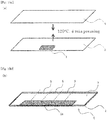
- a press-molded product 1 25 mm ⁇ 15 mm ⁇ 1 mm of the resin composition shown in Tables 1 and 3 was put, and a polypropylene film 3 similar to the polypropylene film 2 was further put thereon. These were pressed at 120°C for 4 minutes at 5 MPa to give a pressed sample 4 ( Fig. 1(a) ).
- the press-molded product 1 is a press-molded product 1a having a pressed and broadened shape ( Fig. 1(b) ).
- the resultant pressed sample 4 was cut into a strip specimen having a width of 25 mm (cut along the dotted line in Fig. 1(b) ) to give a measurement sample 5 ( Fig. 1(b) ).
- the measurement sample 5 was subjected to a peel test in which the polypropylene film 2 of the measurement sample 5 was pulled in the arrow A direction while the polypropylene film 3 thereof was pulled in the arrow B direction under the conditions of 180°, a pulling rate of 100 mm/sec, and 23°C. The test was performed three times. Data of the maximum adhesion force in each test were averaged to give an adhesion force of each sample ( Fig. 1(c) ).
- melt viscosity (B-type viscosity) of each resin composition shown in Table 2 was measured at 160°C.
- 3 g/m 2 of the resin composition shown in Table 2 was applied to a nonwoven fabric (NW) under the conditions of at a coating temperature of 150°C, at a line speed of 150 m/min, and a spiral diameter of 15 mm, then a polyethylene film (PE) was overlaid and bonded by pressing under a pressure of 1 MPa. After being left at room temperature (23°C) for 4 weeks, the thus-bonded sample was cut to a width of 25 mm in a direction (CD direction) perpendicular to the traveling direction of the substrate of the bonded sample, and the T-peel strength (peel strength) thereof was measured.
- the measurement environment was as follows: 23°C and 50% RH, the peeling speed was set to 100 mm/min, and an average of two maximum values was determined to be a peel strength value.
- T-peel strength is an index indicating the strength of a bonding force, and as the strength is higher, peeling is less likely to occur, and therefore a higher T-peel strength is preferred.
- the resin composition of the present invention is excellent in adhesiveness, and is favorably used for pressure-sensitive adhesives, hot-melt adhesives, sealants and coking materials.
Landscapes
- Chemical & Material Sciences (AREA)
- Organic Chemistry (AREA)
- Health & Medical Sciences (AREA)
- Chemical Kinetics & Catalysis (AREA)
- Medicinal Chemistry (AREA)
- Polymers & Plastics (AREA)
- Compositions Of Macromolecular Compounds (AREA)
- Adhesives Or Adhesive Processes (AREA)
Applications Claiming Priority (3)
| Application Number | Priority Date | Filing Date | Title |
|---|---|---|---|
| JP2018035671 | 2018-02-28 | ||
| JP2018100605 | 2018-05-25 | ||
| PCT/JP2019/007025 WO2019167872A1 (ja) | 2018-02-28 | 2019-02-25 | 樹脂組成物 |
Publications (2)
| Publication Number | Publication Date |
|---|---|
| EP3760672A1 true EP3760672A1 (de) | 2021-01-06 |
| EP3760672A4 EP3760672A4 (de) | 2021-11-17 |
Family
ID=67805051
Family Applications (1)
| Application Number | Title | Priority Date | Filing Date |
|---|---|---|---|
| EP19761605.5A Withdrawn EP3760672A4 (de) | 2018-02-28 | 2019-02-25 | Harzzusammensetzung |
Country Status (5)
| Country | Link |
|---|---|
| US (1) | US20210032510A1 (de) |
| EP (1) | EP3760672A4 (de) |
| JP (1) | JPWO2019167872A1 (de) |
| CN (1) | CN111742007A (de) |
| WO (1) | WO2019167872A1 (de) |
Families Citing this family (5)
| Publication number | Priority date | Publication date | Assignee | Title |
|---|---|---|---|---|
| WO2020050225A1 (ja) * | 2018-09-04 | 2020-03-12 | 出光興産株式会社 | 熱可塑性樹脂組成物及びホットメルト接着剤 |
| JP7692410B2 (ja) * | 2019-10-31 | 2025-06-13 | ボスティック,インコーポレイテッド | 粘着付与剤を含まないホットメルト接着剤組成物、その使用方法、及びそれを用いた製造品 |
| JPWO2022045165A1 (de) * | 2020-08-26 | 2022-03-03 | ||
| JP7830844B2 (ja) * | 2021-05-13 | 2026-03-17 | 荒川化学工業株式会社 | 樹脂組成物、成形体及びポリオレフィン樹脂/デンプン複合組成物用改質剤 |
| JP7875744B2 (ja) * | 2022-06-29 | 2026-06-18 | サンスター技研株式会社 | ホットメルト接着剤組成物、自動車内装用プレコート表皮材、自動車内装材、及び接着体の製造方法 |
Family Cites Families (11)
| Publication number | Priority date | Publication date | Assignee | Title |
|---|---|---|---|---|
| JP4080121B2 (ja) * | 1999-06-03 | 2008-04-23 | 東北リコー株式会社 | 孔版印刷用油中水型エマルションインキ |
| JP2009198753A (ja) * | 2008-02-21 | 2009-09-03 | Sumitomo Chemical Co Ltd | 光学部材用表面保護フィルム |
| EP2739695B1 (de) | 2011-08-04 | 2019-10-30 | Henkel IP & Holding GmbH | Klebstoffe und ihre verwendung |
| WO2013164976A1 (ja) * | 2012-05-01 | 2013-11-07 | 三井化学株式会社 | コーティング剤、加飾フィルムおよび成形体 |
| BR112015029180B8 (pt) * | 2013-05-23 | 2022-04-19 | Bostik Inc | Adesivo fundido a quente para uso em substratos porosos |
| WO2014192767A1 (ja) * | 2013-05-27 | 2014-12-04 | 出光興産株式会社 | ホットメルト接着剤用ベースポリマー及びホットメルト接着剤 |
| PL3207103T3 (pl) * | 2014-10-13 | 2021-11-29 | Bostik, Inc. | Kleje topliwe na bazie poliolefin o ulepszonych właściwościach przetwórczych i charakterystyce wiązania |
| CN107001841B (zh) * | 2014-11-17 | 2019-10-29 | 三井化学株式会社 | 涂层剂、装饰膜及成型体 |
| EP3159387A1 (de) * | 2015-10-23 | 2017-04-26 | Bostik Sa | Schmelzklebstoffzusammensetzung für elastische befestigungen |
| JP6795608B2 (ja) * | 2016-10-18 | 2020-12-02 | 株式会社Moresco | ホットメルト接着剤 |
| US11034826B2 (en) * | 2017-04-20 | 2021-06-15 | Idemitsu Kosan Co., Ltd. | Polypropylene-based resin composition, pellet, and molded object |
-
2019
- 2019-02-25 US US16/975,320 patent/US20210032510A1/en not_active Abandoned
- 2019-02-25 CN CN201980015269.8A patent/CN111742007A/zh active Pending
- 2019-02-25 EP EP19761605.5A patent/EP3760672A4/de not_active Withdrawn
- 2019-02-25 JP JP2020503486A patent/JPWO2019167872A1/ja active Pending
- 2019-02-25 WO PCT/JP2019/007025 patent/WO2019167872A1/ja not_active Ceased
Also Published As
| Publication number | Publication date |
|---|---|
| JPWO2019167872A1 (ja) | 2021-02-25 |
| US20210032510A1 (en) | 2021-02-04 |
| CN111742007A (zh) | 2020-10-02 |
| WO2019167872A1 (ja) | 2019-09-06 |
| EP3760672A4 (de) | 2021-11-17 |
Similar Documents
| Publication | Publication Date | Title |
|---|---|---|
| US20210032510A1 (en) | Resin composition | |
| CN103314067B (zh) | 粘合性树脂组合物及由该粘合性树脂组合物得到的热熔粘合剂 | |
| EP3124566B1 (de) | Schmelzhaftkleber | |
| EP1799765B1 (de) | Kombination von klebrigmacher und poly-alpha-olefin-öl | |
| US10501663B2 (en) | Base polymer for hot melt adhesive | |
| US10400142B2 (en) | Hot melt adhesive | |
| CN105940020A (zh) | 无定形丙烯-乙烯共聚物 | |
| JP2011195797A (ja) | ホットメルト接着剤組成物 | |
| CN102471656A (zh) | 非卤化聚异丁烯热塑性弹性体共混物压敏粘合剂 | |
| AU2015364520A1 (en) | Hot melt adhesive composition for bonding packs of metal containers | |
| JP7719764B2 (ja) | シラン含有化合物及び変性水添石油樹脂 | |
| JP7406497B2 (ja) | 熱可塑性樹脂組成物及びホットメルト接着剤 | |
| WO2018088359A1 (ja) | プロピレン系重合体、プロピレン系樹脂組成物及びそれらを含むホットメルト接着剤 | |
| JP5738135B2 (ja) | 変性プロピレン系樹脂組成物および当該組成物からなる接着剤 | |
| TWI828829B (zh) | 熱熔黏著劑組成物 | |
| EP3006535A1 (de) | Basispolymer für schmelzhaftkleber und schmelzhaftkleber | |
| JP2019530788A (ja) | コンタクト型接着剤 | |
| JPH0144222B2 (de) | ||
| JP2004307838A (ja) | 低分子量変性軟質ポリプロピレン及びホットメルト粘接着剤用樹脂組成物 | |
| WO2020004598A1 (ja) | 特定のプロピレン系樹脂組成物を含むホットメルト接着剤 | |
| US20230303813A1 (en) | Propylene resin composition | |
| JP2026013071A (ja) | ホットメルト接着剤組成物 | |
| JP2023062570A (ja) | カルボニル基含有水添石油樹脂 | |
| TW202415723A (zh) | 樹脂組成物及成形體 |
Legal Events
| Date | Code | Title | Description |
|---|---|---|---|
| STAA | Information on the status of an ep patent application or granted ep patent |
Free format text: STATUS: THE INTERNATIONAL PUBLICATION HAS BEEN MADE |
|
| PUAI | Public reference made under article 153(3) epc to a published international application that has entered the european phase |
Free format text: ORIGINAL CODE: 0009012 |
|
| STAA | Information on the status of an ep patent application or granted ep patent |
Free format text: STATUS: REQUEST FOR EXAMINATION WAS MADE |
|
| 17P | Request for examination filed |
Effective date: 20200824 |
|
| AK | Designated contracting states |
Kind code of ref document: A1 Designated state(s): AL AT BE BG CH CY CZ DE DK EE ES FI FR GB GR HR HU IE IS IT LI LT LU LV MC MK MT NL NO PL PT RO RS SE SI SK SM TR |
|
| AX | Request for extension of the european patent |
Extension state: BA ME |
|
| DAV | Request for validation of the european patent (deleted) | ||
| DAX | Request for extension of the european patent (deleted) | ||
| A4 | Supplementary search report drawn up and despatched |
Effective date: 20211019 |
|
| RIC1 | Information provided on ipc code assigned before grant |
Ipc: C09J 191/00 20060101ALI20211013BHEP Ipc: C09J 123/14 20060101ALI20211013BHEP Ipc: C09J 123/00 20060101ALI20211013BHEP Ipc: C08L 91/00 20060101ALI20211013BHEP Ipc: C08L 23/14 20060101ALI20211013BHEP Ipc: C08L 23/00 20060101AFI20211013BHEP |
|
| STAA | Information on the status of an ep patent application or granted ep patent |
Free format text: STATUS: THE APPLICATION IS DEEMED TO BE WITHDRAWN |
|
| 18D | Application deemed to be withdrawn |
Effective date: 20220519 |