EP3761003B1 - Procédé de mesure de la concentration, de la taille et du potentiel zêta des nanoparticules dans des liquides en mode lumière diffuse et en mode fluorescence - Google Patents
Procédé de mesure de la concentration, de la taille et du potentiel zêta des nanoparticules dans des liquides en mode lumière diffuse et en mode fluorescence Download PDFInfo
- Publication number
- EP3761003B1 EP3761003B1 EP20185891.7A EP20185891A EP3761003B1 EP 3761003 B1 EP3761003 B1 EP 3761003B1 EP 20185891 A EP20185891 A EP 20185891A EP 3761003 B1 EP3761003 B1 EP 3761003B1
- Authority
- EP
- European Patent Office
- Prior art keywords
- scattered light
- fluorescence
- light
- liquid
- nanoparticles
- Prior art date
- Legal status (The legal status is an assumption and is not a legal conclusion. Google has not performed a legal analysis and makes no representation as to the accuracy of the status listed.)
- Active
Links
Images
Classifications
-
- G—PHYSICS
- G01—MEASURING; TESTING
- G01N—INVESTIGATING OR ANALYSING MATERIALS BY DETERMINING THEIR CHEMICAL OR PHYSICAL PROPERTIES
- G01N15/00—Investigating characteristics of particles; Investigating permeability, pore-volume or surface-area of porous materials
- G01N15/02—Investigating particle size or size distribution
- G01N15/0205—Investigating particle size or size distribution by optical means
- G01N15/0211—Investigating a scatter or diffraction pattern
-
- G—PHYSICS
- G01—MEASURING; TESTING
- G01N—INVESTIGATING OR ANALYSING MATERIALS BY DETERMINING THEIR CHEMICAL OR PHYSICAL PROPERTIES
- G01N27/00—Investigating or analysing materials by the use of electric, electrochemical, or magnetic means
- G01N27/26—Investigating or analysing materials by the use of electric, electrochemical, or magnetic means by investigating electrochemical variables; by using electrolysis or electrophoresis
- G01N27/416—Systems
- G01N27/447—Systems using electrophoresis
- G01N27/44704—Details; Accessories
- G01N27/44717—Arrangements for investigating the separated zones, e.g. localising zones
- G01N27/44721—Arrangements for investigating the separated zones, e.g. localising zones by optical means
-
- G—PHYSICS
- G01—MEASURING; TESTING
- G01N—INVESTIGATING OR ANALYSING MATERIALS BY DETERMINING THEIR CHEMICAL OR PHYSICAL PROPERTIES
- G01N15/00—Investigating characteristics of particles; Investigating permeability, pore-volume or surface-area of porous materials
- G01N2015/0038—Investigating nanoparticles
-
- G—PHYSICS
- G01—MEASURING; TESTING
- G01N—INVESTIGATING OR ANALYSING MATERIALS BY DETERMINING THEIR CHEMICAL OR PHYSICAL PROPERTIES
- G01N15/00—Investigating characteristics of particles; Investigating permeability, pore-volume or surface-area of porous materials
- G01N2015/0042—Investigating dispersion of solids
- G01N2015/0053—Investigating dispersion of solids in liquids, e.g. trouble
-
- G—PHYSICS
- G01—MEASURING; TESTING
- G01N—INVESTIGATING OR ANALYSING MATERIALS BY DETERMINING THEIR CHEMICAL OR PHYSICAL PROPERTIES
- G01N15/00—Investigating characteristics of particles; Investigating permeability, pore-volume or surface-area of porous materials
- G01N15/02—Investigating particle size or size distribution
- G01N15/0205—Investigating particle size or size distribution by optical means
- G01N15/0211—Investigating a scatter or diffraction pattern
- G01N2015/0222—Investigating a scatter or diffraction pattern from dynamic light scattering, e.g. photon correlation spectroscopy
-
- G—PHYSICS
- G01—MEASURING; TESTING
- G01N—INVESTIGATING OR ANALYSING MATERIALS BY DETERMINING THEIR CHEMICAL OR PHYSICAL PROPERTIES
- G01N15/00—Investigating characteristics of particles; Investigating permeability, pore-volume or surface-area of porous materials
- G01N15/10—Investigating individual particles
- G01N2015/1027—Determining speed or velocity of a particle
-
- G—PHYSICS
- G01—MEASURING; TESTING
- G01N—INVESTIGATING OR ANALYSING MATERIALS BY DETERMINING THEIR CHEMICAL OR PHYSICAL PROPERTIES
- G01N15/00—Investigating characteristics of particles; Investigating permeability, pore-volume or surface-area of porous materials
- G01N15/10—Investigating individual particles
- G01N2015/1029—Particle size
Definitions
- the invention relates to a method for measuring the concentration, size and zeta potential of nanoparticles in liquids in scattered light mode and in fluorescence mode.
- the evaluation is carried out by heterodyne DLS (dynamic light scattering, ISO 22412).
- Suspensions and emulsions as disperse material systems are frequently occurring forms of particles in liquids. Applications range from printer ink to cosmetic emulsions to pharmaceutical administrations.
- Disperse systems are known to be thermodynamically unstable systems. The length of time for which such dispersions remain stable is of key importance for their applicability. A very frequently observed instability arises from the coagulation of particles, which can lead to irreversible particle size growth or to complete separation between the liquid phase and the particle phase.
- electrostatic stabilization This takes advantage of the fact that the approach of like-charged particles is made more difficult by their electrostatic repulsion. The repulsion is more efficient the higher the ionic charge of the particles at their interface with the medium.
- zeta potential The decisive factor here is the electrostatic particle interface potential, usually called zeta potential. This zeta potential is considered a measure that determines the degree of repulsion between neighboring particles. It is therefore important with regard to the stability of disperse systems.
- a well-known method is classical electrophoresis under the microscope, in particular under the scattered light microscope with the laser and microscope axes at 90° in the electrophoresis measuring arrangement.
- the particles are placed in an electric field. The stronger the zeta potential of the particles, the faster they move in the applied field.
- the measured quantity is the electrophoretic mobility ⁇ e, which is nothing other than the measured velocity v divided by the applied electric field E.
- This ⁇ e is converted into a zeta potential.
- This electrophoresis arrangement is popular when the particle electrophoresis movement can be observed directly in the video and possible interference effects such as convection can be identified.
- the films are automatically evaluated according to the speed distribution of the particles. By using sharply focusable lasers, the lower measurement limit of 1 ⁇ m particle size was reduced to 0.02 ⁇ m. This also applies to the Brownian motion of the particles, which is observed with the same device and from which the particle size can be derived.
- the invention is based on the object of specifying a method for measuring the concentration, size and zeta potential of nanoparticles in liquids in scattered light mode and in fluorescence mode.
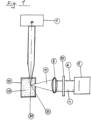
- Fig. 1 shows a representation of Particle Metrix's own PTA nanoparticle tracking measurement arrangement according to the state of the art.
- the imaging optics consist of the lens 6, which is aimed at the particulate sample 28 in the measuring cell 29, and a video camera, which records the movement of the particles.
- the laser 1 as the exciting light source for scattered light and fluorescent light, usually shines at an angle of 90 degrees to it.
- scattered light from the scattered light plane 31 and light from the fluorescence plane 30 are simultaneously registered via the beam path 11 through a liquid lens 8, or a motor-adjustable lens 8, with adjustable focus after passing through a fluorescence filter 10 via a beam path 4.
- Both scattered light and fluorescent light are emitted simultaneously by the same particles, with the scattered light always having a high intensity.
- the problem here is that the scattered light, which is orders of magnitude weaker, Fluorescence light must be separated from the much stronger scattered light signal by an optical edge filter. Due to the necessary resolution and high sensitivity, black and white cameras or grayscale detectors are used, which cannot distinguish the color of the fluorescence from the color of the scattered light.
- the filter has the task of clearly blocking scattered light that comes from the particles and parasitic scattered light that can land on the detector due to an unintentional interaction of the laser with the apparatus.
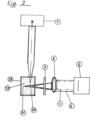
- Fig. 2 shows a representation of an improved version of the Fig. 1 shown arrangement.
- This representation corresponds in many parts to the illustration in Eig. 1.
- the imaging optics consist of the lens 6, which is aimed at the particulate sample 28 in the measuring cell 29, and a video camera or a detector that records the particles.
- the laser 1 is the exciting light source for fluorescent light and scattered light.
- scattered light from the scattered light plane 31 and light from the fluorescence plane 30 are simultaneously registered by a liquid lens 8, or a motor-adjustable lens 8, via a beam path that is not specified in more detail.
- the fluorescence filter 7 is located in the convergent beam path between the liquid lens 8, or a motor-adjustable lens 8, and the sample 28 and not in the parallel beam path directly in front of the video camera 5. This is because in many cases the attenuation of the filter is not sufficient to completely suppress the scattered light.
- the measure described improves the situation by orders of magnitude. If the fluorescence filter is located in the convergent beam path between the lens and the sample, the focus of the scattered light (e.g. 488 nm wavelength) is behind the focus of the fluorescent light (e.g. 510 nm to 560 nm wavelength.
- the optics of the lens "look" either into the scattered light focus or into the fluorescence focus. This leads to a Suppression of stray light by several orders of magnitude when the optics are set to fluorescence. This is even more important the weaker the fluorescence signals are.
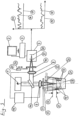
- the Fig.3 shows a representation of a device for determining the concentration, magnitude and zeta potential distribution of nanoparticles in scattered light mode and in fluorescence mode.
- a laser beam 1 is directed from above towards a liquid surface which is located in a container, here a sample vessel 27.
- This liquid is homogenized by a slight movement before a measurement. After the liquid has settled and the container 27 is opened in the direction of the laser beam 1, a measurement can begin.
- the laser beam 1 directed from above is directed onto the liquid via a beam part 14 through a liquid lens, or a motor-driven lens 9 with adjustable focus and an optical protective glass 23.
- the protective glass 23 is made of scratch-resistant material, such as sapphire or diamond.
- the liquid lens 9, or a motor-adjustable lens 9, is used for optimal focusing on a point just below the phase boundary between air and liquid.
- the focus must be approximately 0.1 mm to 1 mm in the liquid.
- the focal length of the liquid lens 9, or a motor-adjustable lens 9, can be moved in a defined manner using an optical control 15.
- the light reflected back by the liquid surface 22 and by the optical protective glass 23 is partly directed by the beam splitter 14 onto a detector 5, whereby a further liquid lens 8, or a motor-adjustable lens 8, serves to focus on the detector 5.
- the beam splitter 14 is not mounted at an exact 45° angle so that partially reflected laser light originating from the protective window 23 does not radiate into the emitting laser 1 in order to avoid undesirable feedback effects on the laser.
- the nanoparticles in sample 28 scatter in all directions according to Brownian motion. This motion is transferred to the scattered light signal as a temporal fluctuation. A portion of the scattered light corresponding to the solid angle of 180 degrees passes through the liquid lens 9 and the beam splitter 14 onto the detector 5. The light reflected from the liquid surface 22, the liquid lens 9 and the optical protective glass 23 and the scattered light from the particles coming from the interior of the sample are collected at the detector 5.
- DLS dynamic light scattering
- the laser component 17 of the total signal 16 can be determined.
- the scattered light component contains the information about the concentration and size distribution of the particles.
- the particle size distribution is calculated from Brownian molecular motion using the well-known DLS method. To do this, the viscosity of the sample of the liquid surrounding the particles must be known. This viscosity exists in tabular form for two temperature values for a wide variety of liquids. To calculate the values above these temperature values, the viscosity can be calculated by a specialist using a simple formula. With the help of a thermistor, the temperature sensor 26, above the vessel 27, the respective temperature is transmitted to the electronic control 3 for calculating the viscosity.
- the liquid lens 9 is adjusted so that the position of the liquid surface is only determined precisely by a bright reflection of the laser beam on the liquid surface 22. Starting from this position of the liquid lens 9, it is adjusted so that the focus is on a precisely determined distance d from the liquid surface in the liquid.
- the distance d can be optimized for different samples if necessary.
- the distance d results from the difference between 22 and 21.
- the imaging lens the liquid lens 8 in the beam path 32, is imaged with its focal point onto the detector 5 in the scattered light mode, whereby the fluorescence filter 10 is not in the beam path.
- the fluorescence filter is pushed into the beam path in front of the detector 5. This shifts the fluorescence focus or the fluorescence plane 30 accordingly and is readjusted using the liquid lens 8. Due to the different positions of the fluorescence focus and the scattered light focus or the scattered light plane 31, the filter effect is increased by orders of magnitude depending on the optical design of the imaging optics.
- the fluorescence filter 10 is removed from the beam path or inserted into the beam path by means of a sliding device 24 and its drive 25.
- the difference in the intensities of the respective detector signals 20 between the scattered light component 16 of the signal and the fluorescence signal 18 is shown in the diagrams on the right side of the Fig.3 plotted on the time axis 19.
- the device is operated by means of a touchscreen 2 and a display
- the electrodes installed in the sample vessel 27 are electroporesis electrodes 12 for a pulsed or modulated field and field tapping electrodes 13 which are used to measure the effective field in the sample chamber 28 in order to be able to reliably calculate the zeta potential. Disturbing effects on the electrodes 12 such as bubble formation therefore do not contribute to the determination of the electric field.
Landscapes
- Chemical & Material Sciences (AREA)
- Life Sciences & Earth Sciences (AREA)
- Health & Medical Sciences (AREA)
- Physics & Mathematics (AREA)
- Analytical Chemistry (AREA)
- Biochemistry (AREA)
- General Health & Medical Sciences (AREA)
- General Physics & Mathematics (AREA)
- Immunology (AREA)
- Pathology (AREA)
- Molecular Biology (AREA)
- Dispersion Chemistry (AREA)
- Chemical Kinetics & Catalysis (AREA)
- Electrochemistry (AREA)
- Investigating, Analyzing Materials By Fluorescence Or Luminescence (AREA)
Claims (2)
- Procédure de mesure de la concentration, de la taille et du potentiel zêta de nanoparticules dans des liquides en mode de lumière diffusée et en mode de fluorescence, présentant les caractéristiques suivantes :a) un échantillon liquide (28) contenant des nanoparticules dans un récipient d'échantillon (27) est irradié par le haut avec un faisceau laser (1) par l'intermédiaire d'un diviseur de faisceaux (14), d'une première lentille de liquide (9) à foyer réglable et d'un verre de protection optique (23),
dans lequel les nanoparticules produisent une lumière diffusée fluctuant dans le temps en raison du mouvement brownien et la surface de l'échantillon-liquide, la première lentille de liquide (9) et le verre de protection optique (23) produisent une lumière laser partiellement réfléchie qui est dirigée sur un détecteur (5) par l'intermédiaire du même diviseur de faisceaux (14) et d'une deuxième lentille de liquide (8) à foyer réglable,b) pour l'observation de la lumière fluorescente, un filtre de fluorescence (10) est monté dans le trajet convergent des rayons entre la deuxième lentille de liquide (8) et le détecteur (5) pour augmenter une distance des points focaux entre un plan de lumière diffusée (31) et un plan de fluorescence (30), dans lequel la partie laser (17) du signal total (16) de la lumière diffusée fluctuant dans le temps et de la lumière laser partiellement réfléchie est déterminée au niveau du détecteur (5) par une mesure avec un liquide sans contenu particulaire,dans lequel la concentration et la taille des nanoparticules sont déterminées sur la base de la proportion de lumière diffusée dans le signal total (16) de la lumière diffusée fluctuant dans le temps et de la lumière laser partiellement réfléchie au niveau du détecteur (5),dans lequel le potentiel zêta est déterminé sur la base d'une électrophorèse produite au moyen de premières électrodes (12) installées dans le récipient d'échantillon (27) et d'un champ électrique sans interférence mesuré au moyen de secondes électrodes (13) installées dans le récipient d'échantillon (27), etdans lequel la commande de l'opération de mesure est effectuée à l'aide d'un programme DLS de diffusion dynamique de la lumière à 180 degrés hétérodynes, d'une commande optique (15) pouvant déplacer la distance focale des première et deuxième lentilles de liquide (8, 9) et d'un afficheur (2) à écran tactile. - Procédé selon la revendication 1,
dans lequel la viscosité de l'échantillon (28) est déterminée à l'aide d'un capteur de température (26).
Applications Claiming Priority (3)
| Application Number | Priority Date | Filing Date | Title |
|---|---|---|---|
| DE102016013236.1A DE102016013236B4 (de) | 2016-11-07 | 2016-11-07 | Vorrichtung und Verfahren zum Messen der Konzentration, der Größe und des Zetapotentials von Nanopartikeln in Flüssigkeiten im Streulichtmodus und im Fluoreszenzmodus |
| EP17811180.3A EP3535561B1 (fr) | 2016-11-07 | 2017-11-03 | Dispositif et utilisation du-dit dispositif pour la mesure de la concentration, de la taille et du potentiel zéta de nanoparticules dans des liquides en mode diffusion de lumière et en mode fluorescence |
| PCT/DE2017/000365 WO2018082727A1 (fr) | 2016-11-07 | 2017-11-03 | Dispositif et procédé de mesure de la concentration, de la taille et du potentiel zéta de nanoparticules dans des liquides en mode diffusion de lumière et en mode fluorescence |
Related Parent Applications (2)
| Application Number | Title | Priority Date | Filing Date |
|---|---|---|---|
| EP17811180.3A Division EP3535561B1 (fr) | 2016-11-07 | 2017-11-03 | Dispositif et utilisation du-dit dispositif pour la mesure de la concentration, de la taille et du potentiel zéta de nanoparticules dans des liquides en mode diffusion de lumière et en mode fluorescence |
| EP17811180.3A Division-Into EP3535561B1 (fr) | 2016-11-07 | 2017-11-03 | Dispositif et utilisation du-dit dispositif pour la mesure de la concentration, de la taille et du potentiel zéta de nanoparticules dans des liquides en mode diffusion de lumière et en mode fluorescence |
Publications (3)
| Publication Number | Publication Date |
|---|---|
| EP3761003A1 EP3761003A1 (fr) | 2021-01-06 |
| EP3761003C0 EP3761003C0 (fr) | 2024-10-30 |
| EP3761003B1 true EP3761003B1 (fr) | 2024-10-30 |
Family
ID=60627360
Family Applications (2)
| Application Number | Title | Priority Date | Filing Date |
|---|---|---|---|
| EP20185891.7A Active EP3761003B1 (fr) | 2016-11-07 | 2017-11-03 | Procédé de mesure de la concentration, de la taille et du potentiel zêta des nanoparticules dans des liquides en mode lumière diffuse et en mode fluorescence |
| EP17811180.3A Active EP3535561B1 (fr) | 2016-11-07 | 2017-11-03 | Dispositif et utilisation du-dit dispositif pour la mesure de la concentration, de la taille et du potentiel zéta de nanoparticules dans des liquides en mode diffusion de lumière et en mode fluorescence |
Family Applications After (1)
| Application Number | Title | Priority Date | Filing Date |
|---|---|---|---|
| EP17811180.3A Active EP3535561B1 (fr) | 2016-11-07 | 2017-11-03 | Dispositif et utilisation du-dit dispositif pour la mesure de la concentration, de la taille et du potentiel zéta de nanoparticules dans des liquides en mode diffusion de lumière et en mode fluorescence |
Country Status (8)
| Country | Link |
|---|---|
| US (1) | US10928290B2 (fr) |
| EP (2) | EP3761003B1 (fr) |
| CN (1) | CN109923396B (fr) |
| DE (1) | DE102016013236B4 (fr) |
| DK (1) | DK3535561T3 (fr) |
| HU (1) | HUE050960T2 (fr) |
| PL (1) | PL3535561T3 (fr) |
| WO (1) | WO2018082727A1 (fr) |
Families Citing this family (11)
| Publication number | Priority date | Publication date | Assignee | Title |
|---|---|---|---|---|
| DE202018005287U1 (de) | 2018-11-14 | 2019-01-17 | Particle Metrix Gmbh | Vorrichtung zur Bestimmung der Fluoreszenz und der Anzahl von Antikörpern auf Exosomen |
| DE102018008980B4 (de) | 2018-11-14 | 2023-08-24 | Particle Metrix Gmbh | Vorrichtung und Verfahren zur Bestimmung der Fluoreszenz und der Anzahl von Antikörpern auf Exosomen. |
| US10928297B2 (en) | 2019-01-09 | 2021-02-23 | University Of Washington | Method for determining detection angle of optical particle sizer |
| DE102019003132B4 (de) * | 2019-05-02 | 2024-08-14 | Particle Metrix Gmbh | Verfahren zur Bestimmung der Fluoreszenz und der Anzahl von Antikörpern auf Exosomen mit einer Qualitätskontrolle durch ein erstes Verfahren der Mustererkennung und durch ein zweites Verfahren der Elektrophorese |
| EP3739321B1 (fr) * | 2019-05-17 | 2023-03-08 | Xtal Concepts GmbH | Procédé de qualification pour échantillons de microscopie cryoélectrique ainsi que porte-échantillon associé |
| DE102019004870B4 (de) * | 2019-07-11 | 2023-03-09 | Particle Metrix Gmbh | Vorrichtung und Verfahren zur Reduzierung der Intensitätsminderung des Fluoreszenzfarbstoffes durch Laserlicht bei der Bestimmung der Fluoreszenz und der Anzahl von Antikörpern auf Exosomen. |
| JP7504460B2 (ja) * | 2021-01-07 | 2024-06-24 | 国立研究開発法人物質・材料研究機構 | 動的光散乱測定装置、動的光散乱測定・解析方法、および、測定・解析プログラム |
| RU204569U1 (ru) * | 2021-03-23 | 2021-05-31 | Федеральное государственное автономное образовательное учреждение высшего образования "Национальный исследовательский университет "Московский институт электронной техники" | Анализатор траекторий наночастиц в объеме жидкости |
| CN113933607B (zh) * | 2021-10-19 | 2023-01-17 | 西北大学 | 一种基于荧光的固—液界面局部ζ势测量系统及方法 |
| JP7850000B2 (ja) * | 2022-03-31 | 2026-04-22 | 株式会社堀場製作所 | 粒子分析装置 |
| EP4502573A4 (fr) * | 2022-03-31 | 2026-03-11 | Horiba Ltd | Dispositif d'analyse de particules, programme de dispositif d'analyse de particules et procédé d'analyse de particules |
Family Cites Families (21)
| Publication number | Priority date | Publication date | Assignee | Title |
|---|---|---|---|---|
| US6929953B1 (en) | 1998-03-07 | 2005-08-16 | Robert A. Levine | Apparatus for analyzing biologic fluids |
| FR2827959B1 (fr) * | 2001-07-26 | 2004-03-19 | Centre Nat Rech Scient | Dispositif et procede de mesure d'un echantillon par spectroscopie par correlation |
| US20080218738A1 (en) * | 2004-04-10 | 2008-09-11 | Michael Trainer | Methods and apparatus for determining particle characteristics by measuring scattered light |
| US10386283B2 (en) * | 2004-03-06 | 2019-08-20 | Michael Trainer | Methods and apparatus for determining particle characteristics by utilizing force on particles |
| US20140226158A1 (en) * | 2004-03-06 | 2014-08-14 | Michael Trainer | Methods and apparatus for determining particle characteristics |
| JP4914715B2 (ja) | 2004-06-21 | 2012-04-11 | オリンパス株式会社 | 倒立顕微鏡システム |
| DE102004042197A1 (de) | 2004-08-26 | 2006-03-02 | Friedrich-Schiller-Universität Jena | Verfahren und Vorrichtung zur genauen selektiven Bestimmung lokal wirksamer Fluorophore eines Objektes |
| DE102005023326A1 (de) | 2005-05-17 | 2006-11-23 | Basf Ag | Verfahren zur Bestimmung der Leimungsmittelkonzentration, der Teilchengröße und der Teilchengrößenverteilung von Leimungsmitteln in einem Papierstoff |
| CN201083677Y (zh) * | 2007-09-26 | 2008-07-09 | 中国人民解放军军事医学科学院微生物流行病研究所 | 气溶胶颗粒光学检测系统 |
| WO2010041082A2 (fr) * | 2008-10-09 | 2010-04-15 | Malvern Instruments Limited | Appareil pour mesures de suspension à grand rendement |
| JP5667079B2 (ja) * | 2008-12-18 | 2015-02-12 | アズビル株式会社 | 粒径及び蛍光の同時検出のための小型検出器 |
| CN102053051A (zh) * | 2009-10-30 | 2011-05-11 | 西门子公司 | 一种体液分析系统和用于体液分析的图像处理设备、方法 |
| JP5537347B2 (ja) * | 2009-11-30 | 2014-07-02 | シスメックス株式会社 | 粒子分析装置 |
| US9423335B2 (en) * | 2011-07-21 | 2016-08-23 | Invitrox, Inc. | Instrument and method for optical particle sensing |
| JP6299600B2 (ja) * | 2012-10-15 | 2018-03-28 | ソニー株式会社 | 微小粒子測定装置 |
| CN103487359B (zh) * | 2013-09-25 | 2016-03-30 | 江西科技师范大学 | 一种激光激发的细胞和颗粒形态和分布测量装置 |
| JP6593174B2 (ja) * | 2014-01-17 | 2019-10-23 | 株式会社ニコン | 微粒子分析装置、観察装置、微粒子分析プログラムおよび微粒子分析方法 |
| DE102014007355B3 (de) | 2014-05-19 | 2015-08-20 | Particle Metrix Gmbh | Verfahren der Partikel Tracking Aalyse mit Hilfe von Streulicht (PTA) und eine Vorrichtung zur Erfassung und Charakterisierung von Partikeln in Flüssigkeiten aller Art in der Größenordnung von Nanometern |
| WO2016171198A1 (fr) * | 2015-04-21 | 2016-10-27 | 国立大学法人東京大学 | Système de détection de particule et programme de détection de particule |
| KR102577173B1 (ko) * | 2016-11-07 | 2023-09-08 | 어플라이드 머티어리얼스, 인코포레이티드 | 반도체 챔버 부품들로부터의 나노입자들의 검출 및 분석을 위한 방법들 및 장치 |
| US11041756B2 (en) * | 2017-10-20 | 2021-06-22 | Charted Scientific Inc. | Method and apparatus of filtering light using a spectrometer enhanced with additional spectral filters with optical analysis of fluorescence and scattered light from particles suspended in a liquid medium using confocal and non confocal illumination and imaging |
-
2016
- 2016-11-07 DE DE102016013236.1A patent/DE102016013236B4/de active Active
-
2017
- 2017-11-03 EP EP20185891.7A patent/EP3761003B1/fr active Active
- 2017-11-03 CN CN201780068800.9A patent/CN109923396B/zh active Active
- 2017-11-03 US US16/347,032 patent/US10928290B2/en active Active
- 2017-11-03 DK DK17811180.3T patent/DK3535561T3/da active
- 2017-11-03 WO PCT/DE2017/000365 patent/WO2018082727A1/fr not_active Ceased
- 2017-11-03 HU HUE17811180A patent/HUE050960T2/hu unknown
- 2017-11-03 EP EP17811180.3A patent/EP3535561B1/fr active Active
- 2017-11-03 PL PL17811180T patent/PL3535561T3/pl unknown
Also Published As
| Publication number | Publication date |
|---|---|
| DK3535561T3 (da) | 2020-10-26 |
| CN109923396B (zh) | 2021-11-12 |
| EP3761003A1 (fr) | 2021-01-06 |
| EP3761003C0 (fr) | 2024-10-30 |
| DE102016013236B4 (de) | 2020-07-16 |
| PL3535561T3 (pl) | 2021-03-08 |
| US20190277743A1 (en) | 2019-09-12 |
| DE102016013236A1 (de) | 2018-05-09 |
| CN109923396A (zh) | 2019-06-21 |
| WO2018082727A1 (fr) | 2018-05-11 |
| HUE050960T2 (hu) | 2021-01-28 |
| EP3535561B1 (fr) | 2020-09-02 |
| EP3535561A1 (fr) | 2019-09-11 |
| US10928290B2 (en) | 2021-02-23 |
Similar Documents
| Publication | Publication Date | Title |
|---|---|---|
| EP3761003B1 (fr) | Procédé de mesure de la concentration, de la taille et du potentiel zêta des nanoparticules dans des liquides en mode lumière diffuse et en mode fluorescence | |
| AT515577B1 (de) | Gemeinsamer Strahlungspfad zum Ermitteln von Partikel-information durch Direktbildauswertung und durch Differenzbildanalyse | |
| DE102014007355B3 (de) | Verfahren der Partikel Tracking Aalyse mit Hilfe von Streulicht (PTA) und eine Vorrichtung zur Erfassung und Charakterisierung von Partikeln in Flüssigkeiten aller Art in der Größenordnung von Nanometern | |
| EP4085243B1 (fr) | Méthode et appareil pour estimer les caractéristiques de particules avec une acquisition multiparamétrique de signaux lumineux dispersés et absorbés | |
| Maaß et al. | Experimental comparison of measurement techniques for drop size distributions in liquid/liquid dispersions | |
| EP2411787B1 (fr) | Dispositif pour déterminer la granulométrie de particules | |
| DE102016212164B3 (de) | Verfahren zur Bestimmung der mittleren Partikelgröße von Partikeln, die in einem flüssigen und fließenden Medium suspendiert sind, über dynamische Lichtstreuung und Vorrichtung hierzu | |
| DE69828345T2 (de) | Kreuzkorrelationsverfahren und Vorrichtung zur Unterdrückung der Effekte von Mehrfachstreuung | |
| DE2349271A1 (de) | Vorrichtung zum ermitteln von parametern von blutzellen | |
| DE102015209418A1 (de) | Scanvorrichtung und Scanverfahren | |
| DE202016006846U1 (de) | Vorrichtung zum Messen der Konzentration und der Größe von Nanopartikeln in Flüssigkeiten im Streulichtmodus und im Fluoreszenzmodus | |
| DE102017121587B4 (de) | Verfahren zum simultanen Bestimmen von Proben-Eigenschaften und Partikelmess-Vorrichtung | |
| EP3374755B1 (fr) | Microscope optique et procédé de détermination d'un indice de réfraction, dépendant de la longeur d'onde, d'un milieu échantillon | |
| EP2647982A2 (fr) | Procédé et dispositif de détermination d'un angle critique d'un faisceau lumineux excitateur | |
| DE102008007743B3 (de) | Verfahren und Vorrichtung zur Erfassung der Partikelverteilung in Flüssigkeiten | |
| EP4133258A1 (fr) | Procédé et dispositif de détermination d'indices de réfraction dépendant de la fréquence | |
| EP3133384A3 (fr) | Dispositif et procede de recherche thermo-optique d'echantillons | |
| DE10157511A1 (de) | Verfahren und Vorrichtung zur Korrektur der Größe und/oder Form eines Messvolumens in einer chemischen und/oder biologischen Probe | |
| DE102014007784A1 (de) | Verfahren zur Bestimmung der Größe und der Verteilung der Anzahldichte von Partikeln einer Teilchenansammlung | |
| EP2107362A2 (fr) | Dispositif de mesure de la dispersion et/ou de l'absorption et/ou de la réfraction d'un échantillon | |
| EP3658972A1 (fr) | Dispositif de microscopie | |
| DE102024119241A1 (de) | Vorrichtung und Verfahren zur Bestimmung von dreidimensionalen Partikelpositionen und Partikelgeschwindigkeiten sowie zur Bestimmung von Partikelgrößen | |
| DE102024114796A1 (de) | Messvorrichtung, insbesondere zum Sortieren von Objekten in mikrofluidischen Systemen und Verfahren zum Sortieren von Objekten | |
| DE102004031197A1 (de) | Biodetektor | |
| DD161063A3 (de) | Ermittlung der zahl und des volumens dispergierter teilchen |
Legal Events
| Date | Code | Title | Description |
|---|---|---|---|
| PUAI | Public reference made under article 153(3) epc to a published international application that has entered the european phase |
Free format text: ORIGINAL CODE: 0009012 |
|
| STAA | Information on the status of an ep patent application or granted ep patent |
Free format text: STATUS: THE APPLICATION HAS BEEN PUBLISHED |
|
| AC | Divisional application: reference to earlier application |
Ref document number: 3535561 Country of ref document: EP Kind code of ref document: P |
|
| AK | Designated contracting states |
Kind code of ref document: A1 Designated state(s): AL AT BE BG CH CY CZ DE DK EE ES FI FR GB GR HR HU IE IS IT LI LT LU LV MC MK MT NL NO PL PT RO RS SE SI SK SM TR |
|
| STAA | Information on the status of an ep patent application or granted ep patent |
Free format text: STATUS: REQUEST FOR EXAMINATION WAS MADE |
|
| 17P | Request for examination filed |
Effective date: 20210429 |
|
| RBV | Designated contracting states (corrected) |
Designated state(s): AL AT BE BG CH CY CZ DE DK EE ES FI FR GB GR HR HU IE IS IT LI LT LU LV MC MK MT NL NO PL PT RO RS SE SI SK SM TR |
|
| STAA | Information on the status of an ep patent application or granted ep patent |
Free format text: STATUS: EXAMINATION IS IN PROGRESS |
|
| 17Q | First examination report despatched |
Effective date: 20221006 |
|
| P01 | Opt-out of the competence of the unified patent court (upc) registered |
Effective date: 20230524 |
|
| GRAP | Despatch of communication of intention to grant a patent |
Free format text: ORIGINAL CODE: EPIDOSNIGR1 |
|
| STAA | Information on the status of an ep patent application or granted ep patent |
Free format text: STATUS: GRANT OF PATENT IS INTENDED |
|
| INTG | Intention to grant announced |
Effective date: 20240522 |
|
| GRAS | Grant fee paid |
Free format text: ORIGINAL CODE: EPIDOSNIGR3 |
|
| GRAA | (expected) grant |
Free format text: ORIGINAL CODE: 0009210 |
|
| STAA | Information on the status of an ep patent application or granted ep patent |
Free format text: STATUS: THE PATENT HAS BEEN GRANTED |
|
| AC | Divisional application: reference to earlier application |
Ref document number: 3535561 Country of ref document: EP Kind code of ref document: P |
|
| AK | Designated contracting states |
Kind code of ref document: B1 Designated state(s): AL AT BE BG CH CY CZ DE DK EE ES FI FR GB GR HR HU IE IS IT LI LT LU LV MC MK MT NL NO PL PT RO RS SE SI SK SM TR |
|
| RAP3 | Party data changed (applicant data changed or rights of an application transferred) |
Owner name: PARTICLE METRIX GMBH |
|
| REG | Reference to a national code |
Ref country code: GB Ref legal event code: FG4D Free format text: NOT ENGLISH |
|
| REG | Reference to a national code |
Ref country code: CH Ref legal event code: EP |
|
| REG | Reference to a national code |
Ref country code: IE Ref legal event code: FG4D Free format text: LANGUAGE OF EP DOCUMENT: GERMAN |
|
| REG | Reference to a national code |
Ref country code: DE Ref legal event code: R096 Ref document number: 502017016536 Country of ref document: DE |
|
| U01 | Request for unitary effect filed |
Effective date: 20241128 |
|
| U07 | Unitary effect registered |
Designated state(s): AT BE BG DE DK EE FI FR IT LT LU LV MT NL PT RO SE SI Effective date: 20241210 |
|
| P04 | Withdrawal of opt-out of the competence of the unified patent court (upc) registered |
Free format text: CASE NUMBER: APP_64614/2024 Effective date: 20241206 |
|
| U20 | Renewal fee for the european patent with unitary effect paid |
Year of fee payment: 8 Effective date: 20241206 |
|
| PG25 | Lapsed in a contracting state [announced via postgrant information from national office to epo] |
Ref country code: IS Free format text: LAPSE BECAUSE OF FAILURE TO SUBMIT A TRANSLATION OF THE DESCRIPTION OR TO PAY THE FEE WITHIN THE PRESCRIBED TIME-LIMIT Effective date: 20250228 Ref country code: HR Free format text: LAPSE BECAUSE OF FAILURE TO SUBMIT A TRANSLATION OF THE DESCRIPTION OR TO PAY THE FEE WITHIN THE PRESCRIBED TIME-LIMIT Effective date: 20241030 |
|
| PG25 | Lapsed in a contracting state [announced via postgrant information from national office to epo] |
Ref country code: ES Free format text: LAPSE BECAUSE OF FAILURE TO SUBMIT A TRANSLATION OF THE DESCRIPTION OR TO PAY THE FEE WITHIN THE PRESCRIBED TIME-LIMIT Effective date: 20241030 |
|
| PG25 | Lapsed in a contracting state [announced via postgrant information from national office to epo] |
Ref country code: NO Free format text: LAPSE BECAUSE OF FAILURE TO SUBMIT A TRANSLATION OF THE DESCRIPTION OR TO PAY THE FEE WITHIN THE PRESCRIBED TIME-LIMIT Effective date: 20250130 |
|
| PG25 | Lapsed in a contracting state [announced via postgrant information from national office to epo] |
Ref country code: GR Free format text: LAPSE BECAUSE OF FAILURE TO SUBMIT A TRANSLATION OF THE DESCRIPTION OR TO PAY THE FEE WITHIN THE PRESCRIBED TIME-LIMIT Effective date: 20250131 |
|
| PG25 | Lapsed in a contracting state [announced via postgrant information from national office to epo] |
Ref country code: PL Free format text: LAPSE BECAUSE OF FAILURE TO SUBMIT A TRANSLATION OF THE DESCRIPTION OR TO PAY THE FEE WITHIN THE PRESCRIBED TIME-LIMIT Effective date: 20241030 |
|
| PG25 | Lapsed in a contracting state [announced via postgrant information from national office to epo] |
Ref country code: RS Free format text: LAPSE BECAUSE OF FAILURE TO SUBMIT A TRANSLATION OF THE DESCRIPTION OR TO PAY THE FEE WITHIN THE PRESCRIBED TIME-LIMIT Effective date: 20250130 |
|
| REG | Reference to a national code |
Ref country code: CH Ref legal event code: PL |
|
| PG25 | Lapsed in a contracting state [announced via postgrant information from national office to epo] |
Ref country code: SM Free format text: LAPSE BECAUSE OF FAILURE TO SUBMIT A TRANSLATION OF THE DESCRIPTION OR TO PAY THE FEE WITHIN THE PRESCRIBED TIME-LIMIT Effective date: 20241030 |
|
| PG25 | Lapsed in a contracting state [announced via postgrant information from national office to epo] |
Ref country code: MC Free format text: LAPSE BECAUSE OF FAILURE TO SUBMIT A TRANSLATION OF THE DESCRIPTION OR TO PAY THE FEE WITHIN THE PRESCRIBED TIME-LIMIT Effective date: 20241030 |
|
| REG | Reference to a national code |
Ref country code: CH Ref legal event code: PL |
|
| PG25 | Lapsed in a contracting state [announced via postgrant information from national office to epo] |
Ref country code: CH Free format text: LAPSE BECAUSE OF NON-PAYMENT OF DUE FEES Effective date: 20241130 |
|
| PG25 | Lapsed in a contracting state [announced via postgrant information from national office to epo] |
Ref country code: SK Free format text: LAPSE BECAUSE OF FAILURE TO SUBMIT A TRANSLATION OF THE DESCRIPTION OR TO PAY THE FEE WITHIN THE PRESCRIBED TIME-LIMIT Effective date: 20241030 |
|
| PG25 | Lapsed in a contracting state [announced via postgrant information from national office to epo] |
Ref country code: CZ Free format text: LAPSE BECAUSE OF FAILURE TO SUBMIT A TRANSLATION OF THE DESCRIPTION OR TO PAY THE FEE WITHIN THE PRESCRIBED TIME-LIMIT Effective date: 20241030 |
|
| PLBE | No opposition filed within time limit |
Free format text: ORIGINAL CODE: 0009261 |
|
| STAA | Information on the status of an ep patent application or granted ep patent |
Free format text: STATUS: NO OPPOSITION FILED WITHIN TIME LIMIT |
|
| 26N | No opposition filed |
Effective date: 20250731 |
|
| PG25 | Lapsed in a contracting state [announced via postgrant information from national office to epo] |
Ref country code: IE Free format text: LAPSE BECAUSE OF NON-PAYMENT OF DUE FEES Effective date: 20241103 |
|
| U20 | Renewal fee for the european patent with unitary effect paid |
Year of fee payment: 9 Effective date: 20251029 |
|
| PGFP | Annual fee paid to national office [announced via postgrant information from national office to epo] |
Ref country code: GB Payment date: 20251121 Year of fee payment: 9 |