EP3766744B1 - Déclenchement d'au moins un coussin gonflable d'un véhicule sans équipage - Google Patents
Déclenchement d'au moins un coussin gonflable d'un véhicule sans équipage Download PDFInfo
- Publication number
- EP3766744B1 EP3766744B1 EP20184164.0A EP20184164A EP3766744B1 EP 3766744 B1 EP3766744 B1 EP 3766744B1 EP 20184164 A EP20184164 A EP 20184164A EP 3766744 B1 EP3766744 B1 EP 3766744B1
- Authority
- EP
- European Patent Office
- Prior art keywords
- unmanned vehicle
- triggering
- vehicle
- parameter
- sensor
- Prior art date
- Legal status (The legal status is an assumption and is not a legal conclusion. Google has not performed a legal analysis and makes no representation as to the accuracy of the status listed.)
- Active
Links
Images



Classifications
-
- B—PERFORMING OPERATIONS; TRANSPORTING
- B60—VEHICLES IN GENERAL
- B60R—VEHICLES, VEHICLE FITTINGS, OR VEHICLE PARTS, NOT OTHERWISE PROVIDED FOR
- B60R21/00—Arrangements or fittings on vehicles for protecting or preventing injuries to occupants or pedestrians in case of accidents or other traffic risks
- B60R21/01—Electrical circuits for triggering passive safety arrangements, e.g. airbags, safety belt tighteners, in case of vehicle accidents or impending vehicle accidents
- B60R21/013—Electrical circuits for triggering passive safety arrangements, e.g. airbags, safety belt tighteners, in case of vehicle accidents or impending vehicle accidents including means for detecting collisions, impending collisions or roll-over
- B60R21/0134—Electrical circuits for triggering passive safety arrangements, e.g. airbags, safety belt tighteners, in case of vehicle accidents or impending vehicle accidents including means for detecting collisions, impending collisions or roll-over responsive to imminent contact with an obstacle, e.g. using radar systems
-
- B—PERFORMING OPERATIONS; TRANSPORTING
- B60—VEHICLES IN GENERAL
- B60R—VEHICLES, VEHICLE FITTINGS, OR VEHICLE PARTS, NOT OTHERWISE PROVIDED FOR
- B60R21/00—Arrangements or fittings on vehicles for protecting or preventing injuries to occupants or pedestrians in case of accidents or other traffic risks
- B60R21/34—Protecting non-occupants of a vehicle, e.g. pedestrians
- B60R21/36—Protecting non-occupants of a vehicle, e.g. pedestrians using airbags
-
- G—PHYSICS
- G08—SIGNALLING
- G08G—TRAFFIC CONTROL SYSTEMS
- G08G1/00—Traffic control systems for road vehicles
- G08G1/16—Anti-collision systems
- G08G1/161—Decentralised systems, e.g. inter-vehicle communication
- G08G1/163—Decentralised systems, e.g. inter-vehicle communication involving continuous checking
-
- G—PHYSICS
- G08—SIGNALLING
- G08G—TRAFFIC CONTROL SYSTEMS
- G08G1/00—Traffic control systems for road vehicles
- G08G1/16—Anti-collision systems
- G08G1/166—Anti-collision systems for active traffic, e.g. moving vehicles, pedestrians, bikes
-
- B—PERFORMING OPERATIONS; TRANSPORTING
- B60—VEHICLES IN GENERAL
- B60R—VEHICLES, VEHICLE FITTINGS, OR VEHICLE PARTS, NOT OTHERWISE PROVIDED FOR
- B60R21/00—Arrangements or fittings on vehicles for protecting or preventing injuries to occupants or pedestrians in case of accidents or other traffic risks
- B60R21/01—Electrical circuits for triggering passive safety arrangements, e.g. airbags, safety belt tighteners, in case of vehicle accidents or impending vehicle accidents
- B60R2021/01013—Means for detecting collision, impending collision or roll-over
-
- B—PERFORMING OPERATIONS; TRANSPORTING
- B60—VEHICLES IN GENERAL
- B60R—VEHICLES, VEHICLE FITTINGS, OR VEHICLE PARTS, NOT OTHERWISE PROVIDED FOR
- B60R21/00—Arrangements or fittings on vehicles for protecting or preventing injuries to occupants or pedestrians in case of accidents or other traffic risks
- B60R21/01—Electrical circuits for triggering passive safety arrangements, e.g. airbags, safety belt tighteners, in case of vehicle accidents or impending vehicle accidents
- B60R2021/01204—Actuation parameters of safety arrangents
- B60R2021/01211—Expansion of air bags
-
- B—PERFORMING OPERATIONS; TRANSPORTING
- B60—VEHICLES IN GENERAL
- B60R—VEHICLES, VEHICLE FITTINGS, OR VEHICLE PARTS, NOT OTHERWISE PROVIDED FOR
- B60R21/00—Arrangements or fittings on vehicles for protecting or preventing injuries to occupants or pedestrians in case of accidents or other traffic risks
- B60R21/01—Electrical circuits for triggering passive safety arrangements, e.g. airbags, safety belt tighteners, in case of vehicle accidents or impending vehicle accidents
- B60R2021/01204—Actuation parameters of safety arrangents
- B60R2021/01211—Expansion of air bags
- B60R2021/01218—Expansion of air bags control of expansion speed
-
- B—PERFORMING OPERATIONS; TRANSPORTING
- B60—VEHICLES IN GENERAL
- B60R—VEHICLES, VEHICLE FITTINGS, OR VEHICLE PARTS, NOT OTHERWISE PROVIDED FOR
- B60R21/00—Arrangements or fittings on vehicles for protecting or preventing injuries to occupants or pedestrians in case of accidents or other traffic risks
- B60R21/01—Electrical circuits for triggering passive safety arrangements, e.g. airbags, safety belt tighteners, in case of vehicle accidents or impending vehicle accidents
- B60R2021/01204—Actuation parameters of safety arrangents
- B60R2021/01211—Expansion of air bags
- B60R2021/01225—Expansion of air bags control of expansion volume
-
- B—PERFORMING OPERATIONS; TRANSPORTING
- B60—VEHICLES IN GENERAL
- B60R—VEHICLES, VEHICLE FITTINGS, OR VEHICLE PARTS, NOT OTHERWISE PROVIDED FOR
- B60R21/00—Arrangements or fittings on vehicles for protecting or preventing injuries to occupants or pedestrians in case of accidents or other traffic risks
- B60R21/01—Electrical circuits for triggering passive safety arrangements, e.g. airbags, safety belt tighteners, in case of vehicle accidents or impending vehicle accidents
- B60R2021/01204—Actuation parameters of safety arrangents
- B60R2021/01211—Expansion of air bags
- B60R2021/01231—Expansion of air bags control of expansion timing or sequence
-
- B—PERFORMING OPERATIONS; TRANSPORTING
- B60—VEHICLES IN GENERAL
- B60R—VEHICLES, VEHICLE FITTINGS, OR VEHICLE PARTS, NOT OTHERWISE PROVIDED FOR
- B60R21/00—Arrangements or fittings on vehicles for protecting or preventing injuries to occupants or pedestrians in case of accidents or other traffic risks
- B60R21/01—Electrical circuits for triggering passive safety arrangements, e.g. airbags, safety belt tighteners, in case of vehicle accidents or impending vehicle accidents
- B60R2021/01286—Electronic control units
-
- B—PERFORMING OPERATIONS; TRANSPORTING
- B60—VEHICLES IN GENERAL
- B60R—VEHICLES, VEHICLE FITTINGS, OR VEHICLE PARTS, NOT OTHERWISE PROVIDED FOR
- B60R21/00—Arrangements or fittings on vehicles for protecting or preventing injuries to occupants or pedestrians in case of accidents or other traffic risks
- B60R21/01—Electrical circuits for triggering passive safety arrangements, e.g. airbags, safety belt tighteners, in case of vehicle accidents or impending vehicle accidents
- B60R21/013—Electrical circuits for triggering passive safety arrangements, e.g. airbags, safety belt tighteners, in case of vehicle accidents or impending vehicle accidents including means for detecting collisions, impending collisions or roll-over
- B60R21/0134—Electrical circuits for triggering passive safety arrangements, e.g. airbags, safety belt tighteners, in case of vehicle accidents or impending vehicle accidents including means for detecting collisions, impending collisions or roll-over responsive to imminent contact with an obstacle, e.g. using radar systems
- B60R2021/01345—Electrical circuits for triggering passive safety arrangements, e.g. airbags, safety belt tighteners, in case of vehicle accidents or impending vehicle accidents including means for detecting collisions, impending collisions or roll-over responsive to imminent contact with an obstacle, e.g. using radar systems using mechanical sensing means
Definitions
- Exemplary embodiments of the invention relate to a method, a device and a computer program for triggering at least one impact cushion for an unmanned vehicle.
- Unmanned vehicles with a means for picking up and transporting one or more shipments are known in the prior art.
- Such an unmanned vehicle moves, for example, autonomously or semi-autonomously (e.g., in a follow-me mode behind a person or by remote control) on sidewalks, bike paths, and streets. In doing so, it crosses streets, emerges from behind house corners, or turns corners.
- Due, for example, to the low height of the unmanned vehicle e.g., compared to a person walking upright
- it is easily overlooked by other road users, such as pedestrians or cyclists.
- EP 3 312 810 A1 discloses a method for averting a threat.
- WO 2010/040376 A1 discloses a method for reducing collision risks.
- the present invention therefore has the object, among others, of providing a method, a device, a system and a computer program for triggering at least one impact cushion of an unmanned vehicle.
- the disclosed method is carried out by an apparatus, for example the apparatus disclosed below.
- a device comprising means configured to carry out the disclosed method or respective means for carrying out the steps of the disclosed method.
- the device comprises means configured to carry out the disclosed method or respective means for carrying out the steps of the disclosed method.
- One or more steps can be carried out by the same means, or different steps can be carried out by different means.
- the means of the disclosed device can comprise hardware and/or software components.
- the means may, for example, comprise at least one memory with program instructions of a computer program (e.g., the computer program disclosed below) and at least one processor configured to execute program instructions from the at least one memory.
- a device shall also be understood as being disclosed which comprises at least one processor and at least one memory with program instructions, wherein the at least one memory and the program instructions are configured, together with the at least one processor, to cause the device to execute and/or control the disclosed method.
- the means of the device may, for example, further comprise one or more wireless and/or wired communication interfaces (e.g., one or more wireless and/or wired network adapters) and/or one or more User interfaces (e.g., a keyboard, a mouse, a screen, a touchscreen, a speaker, a microphone, a camera, etc.).
- one or more wireless and/or wired communication interfaces e.g., one or more wireless and/or wired network adapters
- User interfaces e.g., a keyboard, a mouse, a screen, a touchscreen, a speaker, a microphone, a camera, etc.
- the device further comprises at least one sensor configured to acquire sensor information.
- the device is configured, for example, to receive sensor information from one or more sensors of the unmanned vehicle.
- the sensors of the unmanned vehicle are, for example, external to the device (i.e., not part of the device).
- the device is directly or indirectly communicatively connected to the sensors of the unmanned vehicle.
- An example of such a sensor is an environmental sensor configured to at least partially monitor an environment of the unmanned vehicle and acquire sensor information (e.g., sensor information representing at least one object parameter of an object moving relative to the unmanned vehicle and located in the environment of the unmanned vehicle).
- Another example of such a sensor is a vehicle sensor configured to acquire vehicle information representing a vehicle parameter (e.g., acceleration or speed) of the unmanned vehicle.
- the device is, for example, directly or indirectly communicatively connected to at least one impact cushion of the unmanned vehicle, so that the device can, for example, trigger the at least one impact cushion.
- the disclosed device is communicatively connected, for example, to a sensor (e.g., an object sensor or a vehicle sensor) and an impact cushion of the unmanned vehicle
- a sensor e.g., an object sensor or a vehicle sensor
- an impact cushion of the unmanned vehicle can be understood, for example, to mean that the connection between the device and the respective component (e.g., sensor and/or impact cushion) is a wired and/or wireless communication connection (e.g., for information transmission).
- the device comprises, for example, one or more wireless and/or wired communication interfaces (e.g., one or more wireless and/or wired network adapters).
- the device may include one or more user interfaces (e.g., a keyboard, a mouse, a screen, a touchscreen, a speaker, a microphone, a camera, etc.).
- user interfaces e.g., a keyboard, a mouse, a screen, a touchscreen, a speaker, a microphone, a camera, etc.
- the device is a device for the unmanned vehicle, a module for the unmanned vehicle, or a part of the unmanned vehicle, for example, by the device being installed in the unmanned vehicle.
- the device can be, for example, a control device or a control module for the unmanned vehicle.
- the device can, for example, be connected to the unmanned vehicle's power supply.
- the device can also comprise its own power supply in the form of its own energy storage device, such as a battery and/or a capacitor.
- the device's own power supply could, for example, serve as a backup power supply. In this way, the device can operate even if the unmanned vehicle's power supply fails.
- the device as part of the unmanned vehicle, it is also possible, for example, to deactivate the device (e.g., manually or automatically) and use the unmanned vehicle independently of the disclosed use of the device. This is advantageous, for example, in situations where method steps performed by the device, in particular the deployment of an impact cushion, are not desired.
- the device is a server, for example a server remote from the unmanned vehicle (i.e. a server that is not part of the unmanned vehicle).
- a server can, for example, be both a physical server (i.e. a server with hardware and/or software components) and a virtual server.
- a virtual server is to be understood, for example, as a server functionality provided by hardware and/or software components of one or more physical servers (e.g., several servers in a so-called server cloud), with the several physical servers interacting, for example, to provide the functionality of the virtual server.
- a computer program is further disclosed, wherein the computer program comprises program instructions which, when executed by at least one processor, are designed to cause a device (e.g., the disclosed device) to execute the disclosed method.
- the disclosed computer program is contained and/or stored, for example, on a computer-readable storage medium.
- a computer-readable storage medium is understood to mean, for example, a physical and/or tangible storage medium. It is understood that the invention is not limited thereto, and the storage medium may alternatively also be a virtual storage medium, for example, formed by multiple physical memories.
- An unmanned vehicle is a land vehicle that participates in land traffic, on sidewalks in pedestrian areas.
- the unmanned vehicle has neither a driver nor passengers.
- the unmanned vehicle is designed to move at least partially autonomously and/or automatically and/or remotely.
- the unmanned vehicle is a robot and/or a drone.
- the unmanned vehicle comprises at least the impact cushion, which is arranged, for example, on an outer side of the unmanned vehicle and/or opens and/or deploys outwardly (i.e., opens and/or deploys away from an outer side of the unmanned vehicle) when triggered.
- An impact cushion can, for example, be formed at least partially by a fluid bag, which, when the impact cushion is triggered, is filled with a fluid and thereby opens and/or unfolds.
- An example of such an impact cushion is an airbag device comprising a gas bag (e.g. a plastic bag, in particular a nylon bag) and a gas generator, wherein the airbag device is configured, when triggered, to fill the gas bag with gas generated by the gas generator.
- the gas generator is, for example, a pyrotechnic gas generator, a cold gas generator or a hybrid gas generator.
- a gas generator comprises an ignition unit and one or more propellant charges (e.g. a solid propellant which is in tablet form).
- the ignition unit ignites one or more of the propellant charges, resulting in gas being developed, which leads to the gas bag being filled with gas.
- an airbag device can be triggered with different triggering intensities. The lowest trigger intensity corresponds, for example, to the case where only one propellant charge is ignited, and the highest trigger intensity corresponds, for example, to the case where all propellant charges are ignited.
- the unmanned vehicle comprises at least one sensor configured to detect sensor information (e.g., sensor information representing at least one object parameter of an object moving relative to the unmanned vehicle, or vehicle information).
- a sensor of the unmanned vehicle may be a sensor of the device or external to the device.
- the sensor of the unmanned vehicle may be one of a plurality of sensors of the unmanned vehicle.
- the sensors of such a plurality of sensors may at least partially be different sensors and/or at least partially be arranged at different locations (e.g., on different sides) of the unmanned vehicle.
- sensor information acquired by a sensor e.g., the environmental sensor or a vehicle sensor
- the device can be obtained by the device capturing the sensor information by the at least one sensor.
- sensor information acquired by a sensor e.g., the environmental sensor or a vehicle sensor
- Sensor information can be obtained from the sensor (e.g. via a communication link) by the device.
- the effect of receiving sensor information acquired by a sensor of the unmanned vehicle should be understood, for example, as meaning that the device controls the unmanned vehicle and/or the sensor in such a way (e.g., by means of control information) that the unmanned vehicle and/or the sensor acquires the sensor information and provides it to the device (e.g., sends it to the device via a communication connection), so that the device receives the information.
- the device and the unmanned vehicle have, for example, appropriately configured communication interfaces.
- Sensor information detected by a sensor of the unmanned vehicle e.g. sensor information detected by an environmental sensor or sensor information detected by a vehicle sensor
- Sensor information detected by a sensor of the unmanned vehicle is to be understood as, for example, a quantitative or qualitative representation of a chemical or physical property detected by the sensor (e.g. in the form of a measured value of a chemical or physical property detected by a sensor) and/or an environmental condition detected by the sensor (e.g. in the form of an image captured by an optical sensor such as a camera).
- a parameter represented by sensor information is to be understood as, for example, a qualitative or quantitative representation of a measured value of a physical and/or chemical property (e.g., a speed or acceleration) detected by a sensor (e.g., an environmental sensor or a vehicle sensor).
- a quantitative representation of a measured value of a physical and/or chemical property can, for example, indicate the measured value of the physical and/or chemical property detected by the sensor; and a qualitative representation of a physical and/or chemical property can, for example, represent an indication of whether the measured value of the physical and/or chemical property detected and/or determined by the sensor is above or below a predetermined threshold value or within a predetermined measured value range.
- a parameter represented by sensor information can also be understood as a parameter that can be determined based on the sensor information.
- the sensor information is further processed in order to obtain the parameter represented by the sensor information.
- an object recognition and object classification algorithm is applied to sensor information that represents an image captured by an optical sensor such as a camera in order to recognize and/or classify an object contained in the image, so that, for example, the object class of the recognized object is determined as the object parameter.
- one piece of sensor information can represent multiple parameters (e.g., multiple object parameters or vehicle parameters). Accordingly, it is conceivable, for example, that one piece of sensor information represents the temporal progression of a parameter. Alternatively or additionally, one piece of sensor information can represent multiple different parameters. It should also be understood, for example, that a single piece of sensor information represents a minimum number of parameters (e.g., at least one parameter, at least two parameters, etc.).
- the sensor information detected by the environmental sensor of the unmanned vehicle represents an object parameter of an object
- this sensor information represents a qualitative or quantitative representation of at least one measured value of at least one chemical or physical property of the object detected by the environmental sensor, or that the object parameter of the object can be determined based on this sensor information.
- An example of an object parameter of the object is a speed, an acceleration, an object class, or a distance of the object.
- the object is, for example, a road user (e.g., a person and/or a vehicle) or an object in an environment (e.g., an environment detectable by the unmanned vehicle's sensor) of the unmanned vehicle.
- a road user e.g., a person and/or a vehicle
- an object in an environment e.g., an environment detectable by the unmanned vehicle's sensor
- the fact that the object moves relative to the unmanned vehicle should be understood, for example, as the unmanned vehicle and the object approaching or moving away from each other.
- the object can be moving or stationary.
- the determination of whether a collision between the unmanned vehicle and the object is imminent is carried out, for example, according to one or more (e.g., predetermined) rules such as an algorithm or a decision model.
- the fact that the determination of whether a collision between the unmanned vehicle and the object is imminent is based at least partially on the at least one object parameter should be understood, for example, to mean that the at least one object parameter is taken into account when determining whether a collision between the unmanned vehicle and the object is imminent. It is understood that, in addition to the at least one object parameter, one or more further object parameters (e.g., represented by the sensor information) or other parameters (e.g., vehicle parameters of the unmanned vehicle) can be taken into account.
- the rules can specify for which object parameters (e.g., for which qualitative or quantitative representation of at least one measured value of at least one chemical or physical property of the object detected by the environmental sensor) or for which combination of object parameters it should be determined that a collision between the unmanned vehicle and the object is imminent.
- the rules can, for example, specify that if an object parameter represented by the sensor information indicates that the object is approaching the unmanned vehicle at a speed greater than or equal to a predetermined threshold (e.g., 3 m/s) and the distance of the object to the unmanned vehicle is less than or equal to a predetermined threshold (e.g., 0.3 m), a collision between the unmanned vehicle and the object is imminent.
- a predetermined threshold e.g., 3 m/s
- a predetermined threshold e.g., 0.3 m
- a collision between the unmanned vehicle and the object should be understood as, for example, a collision between the unmanned vehicle and the object.
- physical contact occurs between the unmanned vehicle and the object, which can result in damage, i.e. collision damage, to the unmanned vehicle and/or the object.
- damage i.e. collision damage
- the object that collides with the unmanned vehicle is a person (e.g. a pedestrian or a cyclist), the collision can result in injuries to the person.
- the at least one triggering parameter for triggering the at least one impact cushion of the unmanned vehicle is determined and the at least one impact cushion is triggered and/or triggered. For example, it may be provided that these steps (i.e., determining the triggering parameter and triggering and/or triggering the at least one impact cushion) are only performed if it is determined that a collision between the unmanned vehicle and the object is imminent.
- the at least one triggering parameter for triggering the at least one impact cushion is configured, for example, to at least partially control the triggering of the at least one impact cushion.
- the at least one triggering parameter specifies, for example, the at least one impact cushion, a triggering intensity, a triggering volume, and/or a triggering time for triggering the at least one impact cushion.
- the at least one impact cushion may be part of a plurality of impact cushions.
- the at least one triggering parameter may, for example, specify which triggering cushion(s) of the plurality of triggering cushions are to be triggered.
- these multiple impact cushions may be at least partially triggered according to different triggering parameters.
- the at least one triggering parameter for triggering the at least one impact cushion of the unmanned vehicle is determined, for example, according to one or more (e.g., predetermined) rules such as an algorithm or a decision model.
- the fact that the determination of at least one triggering parameter for triggering the at least one impact cushion is based at least partially on the at least one object parameter should be understood, for example, to mean that the object information is taken into account when determining at least one triggering parameter for triggering the at least one impact cushion.
- one or more further object parameters e.g., represented by the sensor information
- other parameters e.g., vehicle parameters of the unmanned vehicle
- one or more further triggering parameters for triggering the at least one impact cushion of the unmanned vehicle can be determined.
- the rules can specify for which object parameters (e.g. for which qualitative or quantitative representation of at least one measured value of at least one chemical or physical property of the object detected by the environmental sensor) or for which combination of object parameters which trigger parameter(s) should be determined.
- the rules can, for example, specify that the at least one impact cushion should be triggered with a first triggering intensity (e.g., a gas pressure with which the gas bag of an airbag device is filled with gas by the gas generator upon triggering) if the at least one object parameter represented by the sensor information indicates that the object is approaching the unmanned vehicle at a speed less than a predetermined threshold value (e.g., 5 m/s), and that the at least one impact cushion should be triggered with a second triggering intensity if the at least one object parameter represented by the sensor information indicates that the object is approaching the unmanned vehicle at a speed greater than or equal to the predetermined threshold value (e.g., 5 m/s).
- the first triggering intensity is, for example, lower than the second
- the triggering of the at least one impact cushion occurs according to the at least one triggering parameter should be understood, for example, to mean that the at least one triggering parameter is taken into account when triggering the at least one impact cushion, for example by controlling the triggering of the at least one impact cushion in such a way that the at least one triggering parameter is followed.
- Triggering the at least one impact cushion should be understood, for example, as meaning that the disclosed device controls the unmanned vehicle (e.g., a control device of the unmanned vehicle) and/or the at least one impact cushion of the unmanned vehicle (e.g., by means of control information) such that the at least one impact cushion is triggered.
- the impact cushion is triggered by a suitable triggering mechanism (e.g., an ignition unit).
- the triggering of the at least one impact cushion of the unmanned vehicle should be carried out in such a way that the at least one impact cushion is triggered before the impending collision.
- the at least one impact cushion (1) is triggered immediately (e.g. as quickly as possible) after it is determined that a collision is imminent, or (2) at a specific triggering time (e.g. determined by another triggering parameter).
- Deploying the at least one impact cushion prior to the imminent collision according to the at least one triggering parameter is particularly advantageous because damage resulting from an imminent collision, for which there is an increased risk with regard to an unmanned vehicle, for example due to its small size compared to other road users, can be particularly effectively prevented or reduced.
- Deploying the at least one impact cushion can be particularly advantageous because the at least one impact cushion is deployed according to the at least one specific triggering parameter prior to the imminent collision between the unmanned vehicle and an object (e.g., prior to physical contact between the unmanned vehicle and the object when the imminent collision actually occurs).
- the deployment of at least one impact cushion prior to the impending collision can be particularly advantageous because, for example, a lower deployment intensity (e.g., a lower speed at which the impact cushion opens) compared to conventional deployment methods can already be sufficient to protect against collision damage.
- a lower deployment intensity e.g., a lower speed at which the impact cushion opens
- collision damage due to the impending collision between the unmanned vehicle and an object may not be reduced or prevented. This may, for example, due to imponderables (e.g. errors or simplifications in determining at least one trigger parameter).
- the fact that the determination of a probability for the occurrence of the impending collision is based at least partially on the at least one object parameter should be understood, for example, to mean that the at least one object parameter is taken into account when determining a probability for the occurrence of the impending collision.
- a speed of the object and/or a distance of the object from the unmanned vehicle is taken into account when determining a probability of the occurrence of an impending collision.
- the faster the object moves and/or the closer the distance of the object from the unmanned vehicle the higher the probability of an impending collision occurring.
- one or more further object parameters e.g., represented by the sensor information
- other parameters e.g., vehicle parameters of the unmanned vehicle
- Determining whether a collision between the unmanned vehicle and the object is imminent may, for example, involve checking whether the probability of the impending collision exceeds a predefined threshold (e.g., 50%, 75%, or 90%).
- a predefined threshold e.g. 50%, 75%, or 90%.
- the threshold may, for example, have been determined through systematic experiments and/or be based on machine learning.
- determining whether a collision between the unmanned vehicle and the object is imminent is based at least in part on a decision model obtained by machine learning.
- the decision model receives at least one object parameter as an input parameter and outputs a probability that a collision with the object is imminent as an output parameter.
- a decision model is an artificial neural network or an AI (artificial intelligence)-based decision matrix.
- the decision model is obtained, for example, as the result of a learning phase according to a machine learning algorithm (e.g., an algorithm based on the deep learning method).
- a machine learning algorithm e.g., an algorithm based on the deep learning method.
- the decision model is trained using object parameters as input parameters.
- the object parameters can be obtained, for example, through systematic experiments.
- the unmanned vehicle comprises a plurality of impact cushions.
- One or more (e.g., each) of the impact cushions of the plurality of impact cushions may, for example, be arranged at a different location on an exterior of the unmanned vehicle and/or open and/or deploy at least partially in a different direction when the respective impact cushion is triggered.
- the plurality of impact cushions may be arranged at least partially in the form of a matrix on an exterior of the unmanned vehicle.
- the plurality of impact cushions may differ at least partially (e.g., in shape and/or size).
- one or more of the impact cushions of the plurality of impact cushions may be arranged on a front, rear, right and/or left outer side of the unmanned vehicle as seen in the direction of travel of the unmanned vehicle and open or deploy at least substantially away from the respective outer side, such that the impact cushions of the plurality of impact cushions arranged on the front outer side of the unmanned vehicle open and/or deploy at least substantially in the direction of travel when triggered.
- determining whether a collision between the unmanned vehicle and the object is imminent further comprises determining from which direction and/or on which outer side (e.g., on the front, rear, left, or right outer side as viewed in the direction of travel of the unmanned vehicle) of the unmanned vehicle a collision with the object is imminent, for example based at least in part on the at least one object parameter (e.g., a direction of movement) of the object.
- outer side e.g., on the front, rear, left, or right outer side as viewed in the direction of travel of the unmanned vehicle
- the determination of which at least one impact cushion of the plurality of impact cushions is triggered may be based on one or more further object parameters (e.g. represented by the sensor information) or other parameters (e.g. vehicle parameters of the unmanned vehicle) in addition to the at least one object parameter.
- further object parameters e.g. represented by the sensor information
- other parameters e.g. vehicle parameters of the unmanned vehicle
- the plurality of impact cushions comprising the unmanned vehicle
- a triggering parameter is obtained that specifies which of the plurality of impact cushions is to be triggered.
- the triggering parameter can, for example, represent (e.g., identify) the at least one impact cushion of the plurality of impact cushions. It is understood that the triggering parameter can further specify, for example, a triggering intensity, a triggering volume, and/or a triggering time for triggering the at least one impact cushion.
- the at least one triggering parameter defines the at least one impact cushion, a triggering intensity, a triggering volume and/or a triggering time for triggering the at least one impact cushion.
- a trigger intensity of an impact cushion is characteristic of the time period in which the impact cushion opens and/or deploys when triggered, the speed at which the impact cushion opens and/or deploys when triggered, and/or the pressure at which the impact cushion opens and/or deploys when triggered.
- the activation volume of an impact cushion is understood to mean, for example, the (e.g. maximum) volume of the opened and/or unfolded impact cushion after activation.
- the trigger time of an impact cushion describes the time at which the impact cushion should be triggered (e.g. the time at which the opening and/or unfolding of the impact cushion should begin).
- an example of an impact cushion is an airbag device comprising a gas bag (e.g., a plastic bag, in particular a nylon bag) and a gas generator, wherein the airbag device is configured, when triggered, to fill the gas bag with gas generated by the gas generator.
- the gas generator comprises, for example, an ignition unit and one or more propellant charges (e.g., a solid propellant in tablet form).
- the ignition unit upon triggering the airbag (e.g., via a current pulse), the ignition unit ignites one or more of the propellant charges. so that gas is developed, which leads to the filling of the gas bag with gas.
- a triggering parameter can determine the triggering intensity and/or the triggering volume of an airbag device by specifying the number of propellant charges to be ignited by the ignition unit. Furthermore, a triggering parameter can determine the triggering time of an airbag device by specifying the time at which the ignition unit should ignite the propellant charge(s).
- a position of an object is, for example, an absolute position or a relative position (e.g., relative to the unmanned vehicle).
- a position can be represented, for example, in the form of a position specification that refers, for example, to an arbitrarily defined absolute or relative coordinate system.
- a position of an object relative to the unmanned vehicle can be determined, for example, based on a sequence of multiple images captured by an optical sensor (e.g., a camera) of the unmanned vehicle.
- a distance of an object (e.g., the object) to the unmanned vehicle is, for example, a Euclidean or geodetic distance between the object and the unmanned vehicle.
- a distance between such an object and the unmanned vehicle can, for example, be measured by a distance sensor (e.g., a Distance sensor in the form of an ultrasonic or radar sensor) of the unmanned vehicle.
- An object class of an object is, for example, one of a plurality of predefined object classes.
- object classes are: moving objects and non-moving objects.
- These two exemplary object classes can be further subdivided as follows: land vehicles such as bicycles, motorcycles, cars, trucks, and pedestrians as object classes for "moving objects," and street furniture (e.g., benches, traffic lights, advertising columns, street signs), buildings, and plants as object classes for "non-moving objects.”
- the position of an object relative to the unmanned vehicle can be determined, for example, based on an image captured by an optical sensor (e.g., a camera) of the unmanned vehicle (e.g., according to a predefined algorithm such as a predefined segmentation, image recognition, and/or classification algorithm).
- a direction of movement of an object is understood, for example, as the direction in which the object is moving.
- This direction can be represented, for example, without reference (e.g., by specifying a compass direction) or with reference to the unmanned vehicle (e.g., by specifying an angle that the direction of movement of the object forms with a direction of movement of the unmanned vehicle).
- the direction of movement is limited to an indication of whether the object is moving toward the unmanned vehicle or not.
- the speed of an object can be understood without reference (e.g., as absolute speed) or with reference to the unmanned vehicle (e.g., as relative speed or differential speed). It can also be, for example, an average speed or an instantaneous speed.
- An acceleration of an object can be understood, for example, without reference (e.g., as absolute acceleration) or with reference to the unmanned vehicle (e.g., as relative acceleration or differential acceleration).
- the acceleration of an object is a change in the indicates the speed of the object and thus a positive acceleration (increase in the speed of the object) or a negative acceleration (decrease in the speed of the object) of the object is conceivable.
- a direction of movement, a speed and/or an acceleration of an object can be detected, for example, by a radar or lidar sensor of the unmanned vehicle.
- the at least one environmental sensor of the unmanned vehicle is one of the following sensors: a temperature sensor (e.g., a thermometer, a thermocouple, and/or a thermal resistor), an electromagnetic sensor (e.g., a radar sensor), an acoustic sensor (e.g., a microphone, a noise sensor, and/or an ultrasonic sensor), or an optical sensor (e.g., an infrared sensor, a light sensor, a brightness sensor, a photodiode, a photoresistor, an image sensor, an image camera, a CMOS sensor, and/or a CCD sensor, a video camera, and/or a lidar sensor).
- a temperature sensor e.g., a thermometer, a thermocouple, and/or a thermal resistor
- an electromagnetic sensor e.g., a radar sensor
- an acoustic sensor e.g., a microphone, a noise sensor, and/or an ultrasonic sensor
- vehicle information detected by the vehicle sensor of the unmanned vehicle represents a vehicle parameter of the unmanned vehicle
- vehicle information detected by the vehicle sensor of the unmanned vehicle represents a qualitative or quantitative representation of at least one measured value of at least one chemical or physical property of the unmanned vehicle detected by the vehicle sensor.
- vehicle parameter of the unmanned vehicle is a speed or acceleration of the unmanned vehicle.
- the determination of whether a collision between the unmanned vehicle and the object is imminent is based at least in part on the at least one vehicle parameter should be understood, for example, to mean that the at least one vehicle parameter is taken into account when determining whether a collision between the unmanned vehicle and the object is imminent.
- determining whether a collision between the unmanned vehicle and the object is imminent may, for example, be carried out according to one or more (e.g., predetermined) rules such as an algorithm or a decision model.
- the rules may specify for which combination of object parameter(s) and vehicle parameter(s) it should be determined that a collision between the unmanned vehicle and the object is imminent.
- the rules may, for example, specify that if the object parameter represented by the sensor information indicates that the distance of the object to the unmanned vehicle is less than or equal to a predetermined threshold (e.g., 0.3 m), and the vehicle parameter represented by the vehicle information indicates that the unmanned vehicle is moving toward the object at a speed greater than or equal to a predetermined threshold (e.g., 5 m/s), it should be determined that a collision between the unmanned vehicle and the object is imminent.
- a predetermined threshold e.g., 0.3 m
- a predetermined threshold e.g., 5 m/s
- such vehicle information representing at least one detected vehicle parameter of the unmanned vehicle can be obtained, for example, by detecting the vehicle parameter by at least one vehicle sensor of the unmanned vehicle.
- the present invention is not limited thereto. Accordingly, it should be understood as disclosed that the at least one vehicle parameter is detected by at least one vehicle sensor of the unmanned vehicle.
- the at least one vehicle sensor of the unmanned vehicle is, for example, part of the device that carries out the method or external to this device (i.e., not part of the device that carries out the method).
- the at least one vehicle sensor can be, for example, a speed sensor (e.g. a speedometer and/or a rotational speed sensor, wherein the detected rotational speed is, for example, proportional to the speed), an acceleration sensor (e.g., a piezoelectric acceleration sensor) or a rotation rate sensor (e.g., a gyroscope). It should be understood that, in the case of multiple vehicle sensors, the vehicle sensors may be different sensors.
- a speed sensor e.g. a speedometer and/or a rotational speed sensor, wherein the detected rotational speed is, for example, proportional to the speed
- an acceleration sensor e.g., a piezoelectric acceleration sensor
- a rotation rate sensor e.g., a gyroscope
- the direction of movement of an unmanned vehicle is the direction in which the unmanned vehicle is moving.
- the direction of movement of the unmanned vehicle can be detected, for example, by a gyroscope.
- the speed of an unmanned vehicle can be understood, for example, as an average speed or an instantaneous speed of the unmanned vehicle.
- the speed of the unmanned vehicle can be detected, for example, by a speed sensor.
- An acceleration of the unmanned vehicle should be understood, for example, as indicating a change in the speed of the unmanned vehicle.
- a positive acceleration (increase in the speed of the unmanned vehicle) or a negative acceleration (decrease in the speed of the unmanned vehicle) of the unmanned vehicle is conceivable.
- the acceleration of the unmanned vehicle can be detected, for example, by an acceleration sensor.
- the unmanned vehicle is an at least partially autonomous and/or automatically driving vehicle and/or remotely controlled vehicle.
- an unmanned vehicle should be understood as driving at least partially autonomously if the vehicle is moving at least on part of a given Route moves autonomously (e.g., without driver input) and navigates along the specified route.
- an autonomously driving vehicle moves autonomously (e.g., without driver input) along the entire route and navigates autonomously along the entire route.
- An automatically driving vehicle is, for example, a vehicle that automatically follows a vehicle or person in front (e.g. in a so-called follow-me mode).
- a remotely controlled vehicle is controlled by a remote driver (i.e., a driver who is not in the vehicle).
- a remote driver i.e., a driver who is not in the vehicle.
- line-of-sight remote control i.e., the driver is still within sight of the unmanned vehicle
- teleoperation remote control i.e., the driver is outside the sight of the vehicle and controls the vehicle based on sensor information acquired by the unmanned vehicle's sensors, such as images captured by a camera on the unmanned vehicle.
- the unmanned vehicle comprises means for receiving and transporting one or more goods.
- these goods are bulk goods or piece goods.
- piece goods can also be a shipment such as a package, a parcel (e.g., a package), and/or a letter (e.g., a letter).
- One means for receiving and transporting such goods is, for example, a receiving compartment that can be closed by a door and/or flap for receiving and transporting the goods.
- the unmanned vehicle can also have several receiving compartments that can be closed by a door and/or flap for receiving and transporting one or more goods. The respective door and/or flap closes, for example, a housing and/or body opening of the unmanned vehicle through which the respective receiving compartment of the vehicle is accessible.
- the unmanned vehicle is not intended for the transport of persons. This should be understood, for example, to mean that the unmanned vehicle is not designed to transport persons (i.e., neither a driver nor passengers). For example, the unmanned vehicle is intended exclusively for picking up and transporting one or more goods.
- Fig. 1 is a schematic representation of an exemplary embodiment of an unmanned vehicle 1 according to the invention.
- the unmanned vehicle 1 is a land vehicle and has a receiving compartment 10 closed with a door. In the receiving compartment 10, the unmanned vehicle 1 can transport a shipment.
- the unmanned vehicle 1 is a Outdoor robots or transport drones.
- the unmanned vehicle is designed to move at least partially autonomously.
- the unmanned vehicle 1 comprises a device 2 which is, for example, set up to carry out a method according to the invention (e.g. the method according to the flowchart in Fig. 4 ) to execute.
- a device 2 which is, for example, set up to carry out a method according to the invention (e.g. the method according to the flowchart in Fig. 4 ) to execute.
- the unmanned vehicle 1 has, for example, a plurality of environmental sensors 12-1 to 12-7, which are arranged on different exteriors of the unmanned vehicle 1.
- the environmental sensors 12-1 to 12-7 are configured, for example, to at least partially monitor an environment of the unmanned vehicle 1 and to acquire sensor information that represents at least one object parameter of an object that is located in the environment of the unmanned vehicle.
- the unmanned vehicle 1, in addition to the environmental sensors 12-1 to 12-7 may have further sensors (e.g., environmental sensors that are arranged on Fig. 1 non-visible exterior sides of the unmanned vehicle 1, and/or vehicle sensors).
- the device 2 can also comprise one or more further sensors (e.g., environmental sensors and/or vehicle sensors), which would thus be part of both the device 2 and the unmanned vehicle 1.
- the environmental sensors 12-1 to 12-7 are ultrasonic sensors that are configured to detect ultrasonic sensor information (e.g., in the form of an ultrasonic signal propagation time).
- the ultrasonic sensors 12-1 to 12-7 are each configured to emit an ultrasonic pulse and receive a reflection of the ultrasonic pulse, as well as to measure an ultrasonic signal propagation time (i.e., the period between the emission of the ultrasonic pulse and the reception of the reflection of the ultrasonic pulse). Based on such an ultrasonic signal propagation time, the distance between the unmanned vehicle 1 and the object at which the ultrasonic pulse was reflected can be determined.
- the unmanned vehicle 1 may additionally or alternatively comprise other sensors (temperature sensors, electromagnetic sensors, acoustic sensors and/or optical sensors) as environmental sensors 12-1 to 12-7.
- the unmanned vehicle 1 comprises a plurality of impact cushions 13-1, 13-2 and 13-3 (ie, a plurality of impact cushions 13-1 to 13-3) arranged on different outer sides of the unmanned vehicle 1. It is understood that the unmanned vehicle 1 may comprise further impact cushions (eg, impact cushions arranged on Fig. 1 non-visible exterior sides of the unmanned vehicle 1).
- each of the airbag devices 13-1 to 13-3 comprises, for example, a respective gas bag and a respective gas generator, wherein the airbag device is configured, when triggered, to fill the gas bag with gas generated by the gas generator so that the gas bag opens or deploys.
- the gas bag is, for example, a plastic bag (e.g., a nylon bag).
- the gas generator is, for example, a pyrotechnic gas generator, a cold gas generator, or a hybrid gas generator.
- the respective gas generator of each of the airbag devices 13-1 to 13-3 comprises two propellant charges.
- each of the airbag devices 13-1 to 13-3 can be triggered with two different triggering intensities.
- the lower triggering intensity corresponds, for example, to the case where only one propellant charge of the respective airbag device is ignited, and the higher triggering intensity corresponds, for example, to the case where both propellant charges of the respective airbag device are ignited.
- the ultrasonic sensors 12-1 to 12-7 and the airbag devices 13-1 to 13-3 of the unmanned vehicle are communicatively connected to the device 2 via one or more wired communication connections (e.g. via one or more bus systems such as one or more serial and/or parallel bus connections of the unmanned vehicle 1).
- the ultrasonic sensors 12-1 to 12-7 and the airbag devices 13-1 to 13-3 have one or more corresponding wired communication interfaces.
- the ultrasonic sensors 12-1 to 12-7 and the airbag devices 13-1 to 13-3 can also be connected via a wireless communication connection with the device 2.
- the ultrasonic sensors 12-1 to 12-7 and the airbag devices 13-1 to 13-3 may comprise one or more wireless communication interfaces.
- a wired communication connection is preferably understood to mean a communication connection via a wired communication network such as an Ethernet communication network, a CAN bus system (Controller Area Network), a K-line bus system, or a FlexRay bus system.
- Ethernet is specified in the IEEE 802.3 family of standards.
- CAN is specified in the ISO 11898 family of standards.
- K-line is specified in the ISO 9141 and ISO 14230-1 standards.
- FlexRay is specified in the ISO 17458 family of standards.
- An example of a wireless communication link is a communication link using a wireless communication technology such as Radio Frequency Identification (RFID) and/or Near Field Communication (NFC) and/or Bluetooth (e.g., Bluetooth version 2.1 and/or 4.0) and/or Wireless Local Area Network (WLAN).
- RFID and NFC are specified according to ISO standards 18000, 11784/11785, and ISO/IEC standards 14443-A and 15693.
- the Bluetooth specifications are currently available online at www.bluetooth.org.
- WLAN for example, is specified in the IEEE 802.11 family of standards.
- Fig. 2 is a schematic representation of an exemplary embodiment of a device 2 (e.g. the one shown in Fig. 1 illustrated device 2) according to the invention.
- the device 2 comprises, for example, a processor 20 and, connected to the processor 20, a first memory as program memory 21, a second memory as main memory 22 and a wired communication interface 24. Furthermore, the device 2 can optionally comprise one or more sensors 23 (e.g., an environmental sensor).
- sensors 23 e.g., an environmental sensor
- a processor such as processor 20 is understood to mean, for example, a microprocessor, a microcontrol unit, a microcontroller, a digital signal processor (DSP), an application-specific integrated circuit (ASIC), or a field-programmable gate array (FPGA). It is understood that device 2 may also comprise multiple processors 20.
- DSP digital signal processor
- ASIC application-specific integrated circuit
- FPGA field-programmable gate array
- Processor 20 executes program instructions stored in program memory 21 and stores, for example, intermediate results or the like in main memory 22.
- the program memory 21 contains, for example, program instructions of a computer program comprising program instructions that cause the processor 20 to execute the disclosed method (e.g., the method according to the Fig. 4 flowchart 400 shown) when the processor 20 executes these program instructions stored in program memory 21.
- the program memory 21 further contains, for example, the operating system of the device 2, which is at least partially loaded into main memory 22 upon startup of the device 2 and executed by the processor 20.
- the operating system of the device 2 which is at least partially loaded into main memory 22 upon startup of the device 2 and executed by the processor 20.
- at least a portion of the core of the operating system is loaded into main memory 22 and executed by the processor 20.
- An example of an operating system is a Windows, UNIX, Linux, Android, Apple iOS, and/or MAC OS operating system.
- the operating system enables, in particular, the use of device 2 for data processing. For example, it manages resources such as a main memory and a program memory, provides basic functions to other computer programs, among other things, through programming interfaces, and controls the execution of computer programs.
- a program memory such as program memory 21 is, for example, a non-volatile memory such as a flash memory, a magnetic memory, an EEPROM (electrically erasable programmable read-only memory), and/or an optical memory.
- a main memory such as main memory 22 is, for example, a volatile or non-volatile memory, in particular a random access memory (RAM) such as a static random access memory (SRAM), a dynamic random access memory (DRAM), a ferroelectric random access memory (FeRAM), and/or a magnetic random access memory (MRAM).
- RAM random access memory
- SRAM static random access memory
- DRAM dynamic random access memory
- FeRAM ferroelectric random access memory
- MRAM magnetic random access memory
- Main memory 22 and program memory 21 can also be configured as a single memory. Alternatively, main memory 22 and/or program memory 21 can each be formed by multiple memories. Furthermore, main memory 22 and/or program memory 21 can also be part of processor 20.
- the communication interface 24 of the device 2 can be a wireless or a wired communication interface, whereby a wired communication interface is assumed for example below.
- the device 2 can send and/or receive information via the communication interface 24.
- the device 2 can receive sensor information from the environmental sensors 12-1 to 12-7 of the unmanned vehicle 1 via the communication interface 24. Furthermore, the device 2 can, for example, trigger one or more of the airbag devices 13-1 to 13-3 of the unmanned vehicle 1 via the communication interface 24 by sending control information to the respective airbag device in order to actuate the respective airbag device and control the triggering of the respective airbag device.
- the triggering of the respective airbag device can be controlled in such a way that it occurs according to one or more (previously determined) triggering parameters.
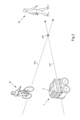
- Fig. 3 is a schematic representation of a situation in which a method according to the invention can take place, the situation being, for example, the Fig. 1 revealed unmanned vehicle 1, which is Fig. 2 disclosed device 2.
- the unmanned vehicle 1 moves automatically and follows a person 32 (e.g., a parcel delivery person) (e.g., in a follow-me mode).
- a cyclist 31 e.g., a bicycle and a cyclist
- the unmanned vehicle 1 moves automatically and follows a person 32 (e.g., a parcel delivery person) (e.g., in a follow-me mode).
- a cyclist 31 e.g., a bicycle and a cyclist
- the unmanned vehicle 1 moves automatically and follows a person 32 (e.g., a parcel delivery person) (e.g., in a follow-me mode).
- a cyclist 31 e.g., a bicycle and a cyclist
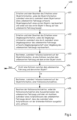
- Fig. 4 shows a flowchart 400 of an embodiment of a method according to the invention, the method steps 401 to 405 of which are explained with regard to the Fig. 3 situation presented will be explained below by way of example. It is assumed, for example, that the following method steps 401 to 405 are carried out by the device 2 of the unmanned vehicle 1.
- the device 2 receives sensor information, wherein the sensor information is detected by at least one environmental sensor of the environmental sensors 12-1 to 12-7 of the unmanned vehicle 1 and represents at least one object parameter of the cyclist 31 as an object moving relative to the unmanned vehicle 1.
- the sensor information represents the distance of the cyclist 31 to the unmanned vehicle 1 as an object parameter of the cyclist 31.
- multiple pieces of sensor information detected by at least one environmental sensor of the environmental sensors 12-1 to 12-7 of the unmanned vehicle 1 can also be obtained.
- such multiple pieces of sensor information could represent the distance of the cyclist 31 to the unmanned vehicle 1 at successive points in time as an object parameter of the cyclist 31.
- an average differential speed of the cyclist 31 at which the cyclist 31 approaches or moves away from the unmanned vehicle can be determined.
- the device 2 determines, at least partially based on the at least one object parameter represented by the sensor information obtained in step 401, whether a collision between the unmanned vehicle 1 and the cyclist 31 is imminent.
- the determination in step 402 is carried out, for example, according to one or more (e.g., predetermined) rules such as an algorithm or a decision model.
- the determination in step 402 is carried out at least partially based on a decision model obtained by machine learning, such as an artificial neural network or an AI-based decision matrix.
- the decision model receives the at least one object parameter, which is represented by the sensor information obtained in step 401, as an input parameter and outputs, for example, a probability of a collision occurring between the unmanned vehicle 1 and the cyclist 31 as an output parameter.
- the decision model may include further object parameters and/or vehicle parameters as Input parameters can be obtained and thus taken into account when determining the probability of a collision occurring between the unmanned vehicle 1 and the cyclist 31.
- a predetermined threshold value e.g. 50%, 75% or 90%
- step 402 it is determined that there is no risk of a collision between the unmanned vehicle 1 and the cyclist 31. In this case, the method is terminated in step 403, for example.
- step 402 If, however, it is determined in step 402 that a collision between the unmanned vehicle 1 and the cyclist 31 is imminent, the method continues with step 404.
- the device 2 determines, at least partially based on the at least one object parameter represented by the sensor information obtained in step 401, at least one triggering parameter for triggering at least one airbag device of the airbag devices 13-1 to 13-3 of the unmanned vehicle 1. It is understood that multiple triggering parameters can also be determined in step 404.
- the triggering parameters determined in step 404 specify, for example, the airbag device(s) of the airbag devices 13-1 to 13-3 that are to be triggered and/or the respective triggering time and/or the respective triggering intensity.
- the cyclist 31 is in danger of colliding with the front outer side of the unmanned vehicle 1, as seen in the direction of travel, so that the triggering parameter is determined, for example, in such a way that it specifies that the airbag device 13-1 arranged on this outer side of the unmanned vehicle 1 should be triggered.
- a further triggering parameter is determined in step 404, for example, such that it sets the triggering time such that the airbag device 13-1 is triggered before the impending collision.
- a further triggering parameter is determined in step 404, which determines the triggering intensity.
- the triggering parameter is determined such that it specifies that the airbag device 13-1 should be triggered with the higher triggering intensity when the cyclist 31 approaches the unmanned vehicle 1 with an average differential speed greater than or equal to a predetermined threshold value (e.g., 5 m/s). Otherwise, it can be provided, for example, that the triggering parameter is determined such that it specifies that the airbag device 13-1 should be triggered with the lower triggering intensity.
- step 405 the triggering and/or causing of the triggering of the at least one airbag device of the airbag devices 13-1 to 13-3 takes place according to the at least one triggering parameter determined in step 404, wherein the at least one airbag device is triggered before the impending collision.
- step 405 the device 2 triggers the airbag device 13-1 according to the triggering parameters determined in step 404, wherein the airbag device 13-1 is triggered before the impending collision between the unmanned vehicle 1 and the cyclist 31, for example by the device 2 controlling the airbag device in such a way that the propellant charge(s) of the airbag device 13-1 are ignited according to the triggering parameters determined in step 404.
- the triggering of the airbag device 13-1 in step 405 before the impending collision according to the triggering parameters determined in step 404 is particularly advantageous because damage as a result of an impending collision, for which there is an increased risk with regard to an unmanned vehicle 1, for example due to its small size compared to other road users, can be particularly effectively prevented or reduced.
- the triggering of an airbag device 13-1 in step 405 can be particularly advantageous because the airbag device 13-1 can be triggered according to the at least one determined triggering parameter before the impending collision between the unmanned vehicle 1 and the cyclist 31 (e.g., before the physical contact between the unmanned Vehicle 1 and cyclist 31, if the impending collision actually occurs).
- the deployment of an airbag device as an impact cushion in step 405 prior to the impending collision may be particularly advantageous because a lower deployment intensity (e.g., a lower speed at which the impact cushion opens) compared to conventional deployment methods may already be sufficient to protect against collision damage.
- a lower deployment intensity e.g., a lower speed at which the impact cushion opens
- FIG. 1 shows exemplary embodiments of storage media on which an embodiment of a computer program according to the invention can be stored.
- the storage medium can be, for example, a magnetic, electrical, optical and/or other type of storage medium.
- the storage medium can, for example, be part of a processor (e.g., the processor 20 of the Fig. 2 ), for example a (non-volatile or volatile) program memory of the processor or a part thereof (e.g. memory 21 in Fig. 2 ).
- Embodiments of a storage medium are a flash memory 50, an SSD hard disk 51, a magnetic hard disk 52, a memory card 53, a memory stick 54 (e.g., a USB stick), a CD-ROM or DVD 55, or a floppy disk 56.
- a flash memory 50 an SSD hard disk 51, a magnetic hard disk 52, a memory card 53, a memory stick 54 (e.g., a USB stick), a CD-ROM or DVD 55, or a floppy disk 56.
Landscapes
- Engineering & Computer Science (AREA)
- Mechanical Engineering (AREA)
- Radar, Positioning & Navigation (AREA)
- Remote Sensing (AREA)
- Physics & Mathematics (AREA)
- General Physics & Mathematics (AREA)
- Control Of Position, Course, Altitude, Or Attitude Of Moving Bodies (AREA)
- Traffic Control Systems (AREA)
Claims (14)
- Procédé mis en œuvre par un dispositif (2), le procédé comprenant:- obtenir (401) et/ou provoquer l'obtention d'une information de capteur détectée par au moins un capteur d'environnement (12-1) d'un véhicule sans équipage (1), l'information de capteur représentant au moins un paramètre d'objet d'un objet (31) qui se meut par rapport au véhicule sans équipage (1), le véhicule sans équipage (1) participant au trafic terrestre dans des zones piétonnes sur de chemins piétons, le véhicule sans équipage (1) comprenant des moyens (10) pour accueillir et transporter une ou plusieurs marchandises, le véhicule sans équipage (1) n'étant pas prévu pour le transport de personnes, et l'objet (31) étant un véhicule ou un objet dans l'environnement du véhicule sans équipage (1);- déterminer (402), au moins en partie sur la base de l'au moins un paramètre d'objet, si une collision est imminente entre le véhicule sans équipage (1) et l'objet (31); etlorsqu'il est déterminé qu'une collision entre le véhicule sans équipage (1) et l'objet (31) est imminente:- déterminer (404), au moins en partie sur la base de l'au moins un paramètre d'objet, au moins un paramètre de déclenchement pour un déclenchement d'au moins un coussin d'impact (13-1) du véhicule sans équipage (1), et- déclencher (405) et/ou provoquer le déclenchement de l'au moins un coussin d'impact (13-1) selon l'au moins un paramètre de déclenchement, l'au moins un coussin d'impact (13-1) étant déclenché avant la collision imminente.
- Procédé selon la revendication 1, dans lequel déterminer (402) si une collision est imminente entre le véhicule sans équipage (1) et l'objet (31) comprend :- déterminer, au moins en partie sur la base de l'au moins un paramètre d'objet, une probabilité que la collision imminente se produise.
- Procédé selon l'une quelconque des revendications 1 et 2, dans lequel déterminer (402) si une collision est imminente entre le véhicule sans équipage (1) et l'objet (31) a lieu au moins en partie sur la base d'un modèle de décision obtenu par apprentissage machine.
- Procédé selon l'une quelconque des revendications 1 à 3, dans lequel le véhicule sans équipage (1) comprend une pluralité de coussins d'impact (13-1; 13-2; 13-3).
- Procédé selon la revendication 4, le procédé comprenant en outre :- déterminer, au moins en partie sur la base de l'au moins un paramètre d'objet, quel au moins un coussin d'impact de la pluralité de coussins d'impact (13-1; 13-2; 13-3) doit être déclenché.
- Procédé selon l'une quelconque des revendications 1 à 5, dans lequel l'au moins un paramètre de déclenchement détermine une intensité de déclenchement, un volume de déclenchement et/ou un moment de déclenchement pour le déclenchement de l'au moins un coussin d'impact
- Procédé selon l'une quelconque des revendications 1 à 6, dans lequel l'au moins un paramètre d'objet de l'objet (31) représente :- une position de l'objet (31),- une distance allant de l'objet (31) au véhicule sans équipage (1),- une classe d'objet de l'objet (31),- une direction de mouvement de l'objet (31),- une vitesse de l'objet (31), et/ou- une accélération de l'objet (31).
- Procédé selon l'une quelconque des revendications 1 à 7, dans lequel l'au moins un capteur d'environnement (12-1) du véhicule sans équipage (1) est l'un des capteurs suivants : un capteur de température, un capteur électromagnétique, un capteur acoustique ou un capteur optique.
- Procédé selon l'une quelconque des revendications 1 à 8, le procédé comprenant en outre :- obtenir (401) et/ou provoquer l'obtention d'une information de véhicule, l'information de véhicule représentant au moins un paramètre de véhicule du véhicule sans équipage (1), et l'étape de déterminer (402) si une collision entre le véhicule sans équipage e (1) et l'objet (31) est imminente étant basée au moins en partie sur l'au moins un paramètre de véhicule et/ou l'étape de déterminer (404) de l'au moins un paramètre de déclenchement pour le déclenchement de l'au moins un coussin d'impact (13-1) du véhicule sans équipage (1) étant basée au moins en partie sur l'au moins un paramètre de véhicule.
- Procédé selon la revendication 9, dans lequel l'information de véhicule est acquise par au moins un capteur de véhicule du véhicule sans équipage (1).
- Procédé selon l'une quelconque des revendications 9 et 10, dans lequel l'au moins un paramètre du véhicule représente :- une direction de mouvement du véhicule sans équipage (1),- une vitesse du véhicule sans équipage (1), et/ou- une accélération du véhicule sans équipage (1).
- Procédé selon l'une quelconque des revendications 1 à 11, dans lequel le véhicule sans équipage (1) est un véhicule se mouvant de manière au moins partiellement autonome et/ou automatique et/ou télécommandée.
- Dispositif (2) comprenant:- des moyens (20-24) configurés pour la mise en œuvre du procédé selon l'une quelconque des revendications 1 à 12 ou comprenant des moyens respectifs pour la mise en œuvre des étapes du procédé selon l'une quelconque des revendications 1 à 12;- des moyens (10) pour accueillir et transporter une ou plusieurs marchandises,le dispositif:- étant un véhicule sans équipage (1), le véhicule sans équipage (1) participant à la circulation terrestre dans des zones piétonnes sur des chemins piétons, et le véhicule sans équipage (1) n'étant pas prévu pour le transport de personnes ;- faisant partie du véhicule sans équipage (1); ou- étant un module pour le véhicule sans équipage (1).
- Programme d'ordinateur comprenant des instructions de programme configurées pour, lorsqu'elles sont exécutées par au moins un processeur (20), amener le dispositif (2) selon la revendication 13 à mettre en œuvre le procédé selon l'une quelconque des revendications 1 à 12.
Applications Claiming Priority (1)
| Application Number | Priority Date | Filing Date | Title |
|---|---|---|---|
| DE102019119093.2A DE102019119093B4 (de) | 2019-07-15 | 2019-07-15 | Auslösen zumindest eines Aufprallkissens eines unbemannten Fahrzeugs |
Publications (3)
| Publication Number | Publication Date |
|---|---|
| EP3766744A1 EP3766744A1 (fr) | 2021-01-20 |
| EP3766744C0 EP3766744C0 (fr) | 2025-04-02 |
| EP3766744B1 true EP3766744B1 (fr) | 2025-04-02 |
Family
ID=71515039
Family Applications (1)
| Application Number | Title | Priority Date | Filing Date |
|---|---|---|---|
| EP20184164.0A Active EP3766744B1 (fr) | 2019-07-15 | 2020-07-06 | Déclenchement d'au moins un coussin gonflable d'un véhicule sans équipage |
Country Status (4)
| Country | Link |
|---|---|
| US (1) | US11472362B2 (fr) |
| EP (1) | EP3766744B1 (fr) |
| CN (1) | CN112224165A (fr) |
| DE (1) | DE102019119093B4 (fr) |
Families Citing this family (10)
| Publication number | Priority date | Publication date | Assignee | Title |
|---|---|---|---|---|
| JP7340402B2 (ja) * | 2019-10-01 | 2023-09-07 | 株式会社ダイセル | 乗員保護システム |
| JP7380171B2 (ja) * | 2019-12-17 | 2023-11-15 | 株式会社デンソー | 運転支援装置および運転支援プログラム |
| US20220063679A1 (en) * | 2020-08-26 | 2022-03-03 | Karma Automotive Llc | Logistics system |
| DE102021207126A1 (de) | 2021-07-07 | 2023-01-12 | Zf Friedrichshafen Ag | Verfahren zum Betreiben eines Sicherheitssystems eines Fahrzeugs, Computerprogrammprodukt, Vorrichtung und Steuergerät |
| US20230252903A1 (en) * | 2022-02-08 | 2023-08-10 | Nullmax (Hong Kong) Limited | Autonomous driving system with air support |
| US12330821B2 (en) | 2022-02-08 | 2025-06-17 | Nullmax (Hong Kong) Limited | Autonomous driving system with air support |
| CN114675640B (zh) * | 2022-03-03 | 2025-07-22 | 北京三快在线科技有限公司 | 一种无人设备、保护方法、装置、电子设备及存储介质 |
| DE102023112088B3 (de) | 2023-05-09 | 2024-10-17 | Cariad Se | Verfahren zum Vorbereiten eines Kraftfahrzeugs auf eine Kollision |
| DE102023116663A1 (de) * | 2023-06-23 | 2024-12-24 | Otto-von-Guericke-Universität Magdeburg, Körperschaft des öffentlichen Rechts | Verfahren zum Betreiben eines Transportfahrzeugs, Steuerungsvorrichtung, Speichermedium und Transportfahrzeug |
| DE102023002858A1 (de) * | 2023-07-14 | 2025-01-16 | Mercedes-Benz Group AG | Verfahren und Vorrichtung zur Kollisionserkennung eines Fahrzeugs |
Family Cites Families (30)
| Publication number | Priority date | Publication date | Assignee | Title |
|---|---|---|---|---|
| DE8232628U1 (de) | 1983-04-07 | Wollert, Wolfgang, Dipl.-Ing. | Auffahrschutzvorrichtung für Fahrzeuge | |
| US5732785A (en) * | 1996-03-28 | 1998-03-31 | Transmart Technologies, Inc. | Proactive exterior airbag system and its deployment method for a motor vehicle |
| DE10132681C1 (de) | 2001-07-05 | 2002-08-22 | Bosch Gmbh Robert | Verfahren zur Klassifizierung von einem Hindernis anhand von Precrashsensorsignalen |
| US6950014B2 (en) * | 2002-02-13 | 2005-09-27 | Ford Global Technologies Llc | Method for operating a pre-crash sensing system in a vehicle having external airbags |
| IL150123A0 (en) * | 2002-06-10 | 2003-07-06 | Shahar Avneri | Security system |
| DE10326001B4 (de) | 2003-02-26 | 2014-02-13 | Volkswagen Ag | Verfahren und Einrichtung zur Ansteuerung einer Sicherheitseinrichtung bei einem Kraftfahrzeug |
| DE10327115B3 (de) | 2003-06-13 | 2004-11-11 | Rehau Ag + Co. | Fußgängerschutzsystem für Kraftfahrzeuge |
| US20060106538A1 (en) * | 2004-11-12 | 2006-05-18 | Browne Alan L | Cooperative collision mitigation |
| DE102006008636A1 (de) | 2006-02-24 | 2007-08-30 | Robert Bosch Gmbh | Sensorik und zugehöriges Verfahren zur Objekterkennung für ein Fahrzeug |
| WO2010040376A1 (fr) | 2008-10-06 | 2010-04-15 | Alexander Augst | Procédé de réduction des risques de collision |
| DE102010003333B4 (de) * | 2010-03-26 | 2020-07-30 | Robert Bosch Gmbh | Verfahren und Vorrichtung zur Bestimmung von zumindest einem Auslöseparameter eines Personenschutzmittels eines Fahrzeugs |
| KR20120063626A (ko) * | 2010-12-08 | 2012-06-18 | 현대자동차주식회사 | 외장에어백의 제어장치 및 제어방법 |
| KR101428260B1 (ko) * | 2012-12-10 | 2014-08-07 | 현대자동차주식회사 | 외장에어백 전개방법 |
| EP2845779B1 (fr) * | 2013-09-09 | 2018-08-01 | Honda Research Institute Europe GmbH | Technique d'assistance à la conduite pour commande active de véhicule |
| DE102014002540B4 (de) | 2014-02-22 | 2018-08-30 | Audi Ag | Sicherheitseinrichtung für ein Kraftfahrzeug und zugehöriges Betriebsverfahren |
| KR101583928B1 (ko) * | 2014-05-12 | 2016-01-11 | 현대자동차주식회사 | 외장에어백 전개방법 |
| US9804599B2 (en) * | 2015-11-04 | 2017-10-31 | Zoox, Inc. | Active lighting control for communicating a state of an autonomous vehicle to entities in a surrounding environment |
| JP2017124809A (ja) * | 2016-01-07 | 2017-07-20 | シャープ株式会社 | 自律走行車両 |
| US10580301B2 (en) * | 2016-03-16 | 2020-03-03 | Kiomars Anvari | Moving vehicles in a smart environment |
| WO2017177205A1 (fr) * | 2016-04-08 | 2017-10-12 | Faraday & Future Inc. | Capteur mobile destiné à une conduite autonome |
| DE102016120058B4 (de) * | 2016-10-20 | 2022-12-29 | Deutsche Post Ag | Abwehren einer Gefährdung |
| US10183641B2 (en) * | 2017-03-23 | 2019-01-22 | Baidu Usa Llc | Collision prediction and forward airbag deployment system for autonomous driving vehicles |
| CN108146378A (zh) * | 2018-01-12 | 2018-06-12 | 吴盼婷 | 一种电动汽车的安全气囊控制系统及电动汽车 |
| CN108583495B (zh) * | 2018-04-26 | 2021-09-24 | 刘宗烨 | 一种汽车被动安全系统 |
| DE102018111153A1 (de) | 2018-05-09 | 2019-11-14 | Deutsche Post Ag | Transportwagen für Sendungen und Verfahren zum Betrieb des Transportwagens |
| JP7111517B2 (ja) * | 2018-06-14 | 2022-08-02 | シャープ株式会社 | 走行装置、走行装置の走行制御方法、走行装置の走行制御プログラムおよび記録媒体 |
| US20200020234A1 (en) * | 2018-07-10 | 2020-01-16 | Cavh Llc | Safety technologies for connected automated vehicle highway systems |
| US10858011B1 (en) * | 2018-07-13 | 2020-12-08 | State Farm Mutual Automobile Insurance Company | Dynamic safe storage of vehicle content |
| US10953830B1 (en) * | 2018-07-13 | 2021-03-23 | State Farm Mutual Automobile Insurance Company | Adjusting interior configuration of a vehicle based on vehicle contents |
| US11427146B2 (en) * | 2019-07-10 | 2022-08-30 | Pony Ai Inc. | Collision protection |
-
2019
- 2019-07-15 DE DE102019119093.2A patent/DE102019119093B4/de active Active
-
2020
- 2020-07-06 EP EP20184164.0A patent/EP3766744B1/fr active Active
- 2020-07-15 CN CN202010679850.4A patent/CN112224165A/zh active Pending
- 2020-07-15 US US16/929,888 patent/US11472362B2/en active Active
Non-Patent Citations (1)
| Title |
|---|
| DEUTSCHER BUSSGELDKATALOG: "Fußgängerzone & Fußgängerbereich | Bussgeldkataloge.de", 27 August 2023 (2023-08-27), XP093082434, Retrieved from the Internet <URL:https://www.bussgeldkataloge.de/fussgaengerzone/> [retrieved on 20230915] * |
Also Published As
| Publication number | Publication date |
|---|---|
| DE102019119093A1 (de) | 2021-01-21 |
| CN112224165A (zh) | 2021-01-15 |
| EP3766744A1 (fr) | 2021-01-20 |
| US11472362B2 (en) | 2022-10-18 |
| EP3766744C0 (fr) | 2025-04-02 |
| DE102019119093B4 (de) | 2023-05-04 |
| US20210016735A1 (en) | 2021-01-21 |
Similar Documents
| Publication | Publication Date | Title |
|---|---|---|
| EP3766744B1 (fr) | Déclenchement d'au moins un coussin gonflable d'un véhicule sans équipage | |
| DE102006041725B4 (de) | Verfahren und Vorrichtung zum Betrieb einer Vor-Aufprall-Erfassungsanordnung mit Kontaktsensor | |
| DE102017116411B4 (de) | Elektronischen Steuerungseinheit, Gatewayschaltung für eine elektronische Airbag-Steuerungseinheit, Sicherheitssystem für ein Fahrzeug und Umgebungssensorelement | |
| DE102017113596A1 (de) | Erkennen von gefahren in erwartung sich öffnender fahrzeugtüren | |
| EP3083361B1 (fr) | Procédé et dispositif pour surveiller une cote extérieure d'un véhicule | |
| DE102017116582A1 (de) | Fahrzeugferneinparkhilfe mit insassenerfassung | |
| DE102019205228A1 (de) | Einfädelverhaltenssysteme und Verfahren für Fahrzeuge auf einer Hauptspur | |
| DE102018101318A1 (de) | Objekterkennung unter verwendung eines rekurrenten neuronalen netzwerks und einer verketteten merkmalsabbildung | |
| DE102017116211A1 (de) | Fahrzeuginnen- und -aussenüberwachung | |
| DE102016226040A1 (de) | Verfahren und Vorrichtung in einem Kraftfahrzeug zum Fußgängerschutz | |
| WO2020020504A1 (fr) | Système de protection de passagers, véhicule automobile et procédé servant à faire fonctionner un système de protection de passagers | |
| DE112017007735T5 (de) | System und -verfahren zur fahrzeugüberprüfung | |
| DE102022121324A1 (de) | Verbessertes insassenkollisionssicherheitssystem | |
| DE102016209704A1 (de) | Verfahren zum Ansteuern einer Personenschutzeinrichtung eines Fahrzeugs und Steuergerät | |
| DE112015004722T5 (de) | Auffahrunfallschutz | |
| DE102016220450A1 (de) | Vorrichtung, Fortbewegungsmittel und Verfahren zur Abschätzung einer Kollisionswahrscheinlichkeit zwischen einem Fortbewegungsmittel und einem Umgebungsobjekt | |
| DE10335601B4 (de) | Verfahren zur Objektklassifizierung unter Verwendung einer 3D-Modelldatenbank | |
| DE102023113852A1 (de) | Objekterkennung um fahrzeugladestationen | |
| DE102014215430A1 (de) | Verfahren und Vorrichtung zum Überwachen eines abgestellten Fahrzeugs | |
| DE102016207376A1 (de) | Verfahren und Vorrichtung zum Erkennen von zumindest einer Position einer Person und/oder einer veränderten Position der Person oder einer weiteren Person für ein Fahrzeug und Verfahren zum Aktivieren eines Personenschutzmittels für ein Fahrzeug | |
| DE102020004348B4 (de) | Verfahren und Steueranordnung zum Vermeiden eines Zusammenstoßes unter Beteiligung eines vorstehenden Objektes | |
| DE102018222518A1 (de) | Kamerasystem mit hoher Updaterate | |
| DE102020205717A1 (de) | Verfahren und Vorrichtung zum Steuern von Insassenschutzmitteln für ein Fahrzeug bei einer Kollision des Fahrzeugs und Insassenschutzsystem für ein Fahrzeug | |
| DE102019123640A1 (de) | Detektion und Reaktion auf fliegende Objekte | |
| DE102024102305A1 (de) | Detektion von grossen tieren und massnahme in einem fahrzeug |
Legal Events
| Date | Code | Title | Description |
|---|---|---|---|
| PUAI | Public reference made under article 153(3) epc to a published international application that has entered the european phase |
Free format text: ORIGINAL CODE: 0009012 |
|
| STAA | Information on the status of an ep patent application or granted ep patent |
Free format text: STATUS: THE APPLICATION HAS BEEN PUBLISHED |
|
| AK | Designated contracting states |
Kind code of ref document: A1 Designated state(s): AL AT BE BG CH CY CZ DE DK EE ES FI FR GB GR HR HU IE IS IT LI LT LU LV MC MK MT NL NO PL PT RO RS SE SI SK SM TR |
|
| AX | Request for extension of the european patent |
Extension state: BA ME |
|
| RIN1 | Information on inventor provided before grant (corrected) |
Inventor name: BISCHOFF, HEIKE Inventor name: TRENDAFILOV, BORIS Inventor name: DREES, SANDRA Inventor name: KONG, DONG UCK Inventor name: RADETZKI, UWE |
|
| STAA | Information on the status of an ep patent application or granted ep patent |
Free format text: STATUS: REQUEST FOR EXAMINATION WAS MADE |
|
| 17P | Request for examination filed |
Effective date: 20210719 |
|
| RBV | Designated contracting states (corrected) |
Designated state(s): AL AT BE BG CH CY CZ DE DK EE ES FI FR GB GR HR HU IE IS IT LI LT LU LV MC MK MT NL NO PL PT RO RS SE SI SK SM TR |
|
| RIN1 | Information on inventor provided before grant (corrected) |
Inventor name: DREES, SANDRA Inventor name: BISCHOFF, HEIKE Inventor name: TRENDAFILOV, BORIS Inventor name: KONG, DONG UCK Inventor name: RADETZKI, UWE |
|
| STAA | Information on the status of an ep patent application or granted ep patent |
Free format text: STATUS: EXAMINATION IS IN PROGRESS |
|
| 17Q | First examination report despatched |
Effective date: 20230922 |
|
| GRAP | Despatch of communication of intention to grant a patent |
Free format text: ORIGINAL CODE: EPIDOSNIGR1 |
|
| STAA | Information on the status of an ep patent application or granted ep patent |
Free format text: STATUS: GRANT OF PATENT IS INTENDED |
|
| RIC1 | Information provided on ipc code assigned before grant |
Ipc: B60R 21/01 20060101ALN20241101BHEP Ipc: G08G 1/04 20060101ALI20241101BHEP Ipc: G08G 1/16 20060101ALI20241101BHEP Ipc: G08G 1/00 20060101ALI20241101BHEP Ipc: B60R 21/0134 20060101AFI20241101BHEP |
|
| INTG | Intention to grant announced |
Effective date: 20241122 |
|
| GRAS | Grant fee paid |
Free format text: ORIGINAL CODE: EPIDOSNIGR3 |
|
| GRAA | (expected) grant |
Free format text: ORIGINAL CODE: 0009210 |
|
| STAA | Information on the status of an ep patent application or granted ep patent |
Free format text: STATUS: THE PATENT HAS BEEN GRANTED |
|
| AK | Designated contracting states |
Kind code of ref document: B1 Designated state(s): AL AT BE BG CH CY CZ DE DK EE ES FI FR GB GR HR HU IE IS IT LI LT LU LV MC MK MT NL NO PL PT RO RS SE SI SK SM TR |
|
| REG | Reference to a national code |
Ref country code: GB Ref legal event code: FG4D Free format text: NOT ENGLISH |
|
| REG | Reference to a national code |
Ref country code: CH Ref legal event code: EP |
|
| REG | Reference to a national code |
Ref country code: IE Ref legal event code: FG4D Free format text: LANGUAGE OF EP DOCUMENT: GERMAN |
|
| REG | Reference to a national code |
Ref country code: DE Ref legal event code: R096 Ref document number: 502020010723 Country of ref document: DE |
|
| U01 | Request for unitary effect filed |
Effective date: 20250410 |
|
| U07 | Unitary effect registered |
Designated state(s): AT BE BG DE DK EE FI FR IT LT LU LV MT NL PT RO SE SI Effective date: 20250416 |
|
| U20 | Renewal fee for the european patent with unitary effect paid |
Year of fee payment: 6 Effective date: 20250722 |
|
| PG25 | Lapsed in a contracting state [announced via postgrant information from national office to epo] |
Ref country code: ES Free format text: LAPSE BECAUSE OF FAILURE TO SUBMIT A TRANSLATION OF THE DESCRIPTION OR TO PAY THE FEE WITHIN THE PRESCRIBED TIME-LIMIT Effective date: 20250402 |
|
| PG25 | Lapsed in a contracting state [announced via postgrant information from national office to epo] |
Ref country code: NO Free format text: LAPSE BECAUSE OF FAILURE TO SUBMIT A TRANSLATION OF THE DESCRIPTION OR TO PAY THE FEE WITHIN THE PRESCRIBED TIME-LIMIT Effective date: 20250702 Ref country code: GR Free format text: LAPSE BECAUSE OF FAILURE TO SUBMIT A TRANSLATION OF THE DESCRIPTION OR TO PAY THE FEE WITHIN THE PRESCRIBED TIME-LIMIT Effective date: 20250703 |
|
| PG25 | Lapsed in a contracting state [announced via postgrant information from national office to epo] |
Ref country code: PL Free format text: LAPSE BECAUSE OF FAILURE TO SUBMIT A TRANSLATION OF THE DESCRIPTION OR TO PAY THE FEE WITHIN THE PRESCRIBED TIME-LIMIT Effective date: 20250402 |
|
| PGFP | Annual fee paid to national office [announced via postgrant information from national office to epo] |
Ref country code: GB Payment date: 20250722 Year of fee payment: 6 |
|
| PG25 | Lapsed in a contracting state [announced via postgrant information from national office to epo] |
Ref country code: HR Free format text: LAPSE BECAUSE OF FAILURE TO SUBMIT A TRANSLATION OF THE DESCRIPTION OR TO PAY THE FEE WITHIN THE PRESCRIBED TIME-LIMIT Effective date: 20250402 |
|
| PG25 | Lapsed in a contracting state [announced via postgrant information from national office to epo] |
Ref country code: RS Free format text: LAPSE BECAUSE OF FAILURE TO SUBMIT A TRANSLATION OF THE DESCRIPTION OR TO PAY THE FEE WITHIN THE PRESCRIBED TIME-LIMIT Effective date: 20250702 |
|
| PG25 | Lapsed in a contracting state [announced via postgrant information from national office to epo] |
Ref country code: IS Free format text: LAPSE BECAUSE OF FAILURE TO SUBMIT A TRANSLATION OF THE DESCRIPTION OR TO PAY THE FEE WITHIN THE PRESCRIBED TIME-LIMIT Effective date: 20250802 |
|
| PG25 | Lapsed in a contracting state [announced via postgrant information from national office to epo] |
Ref country code: SM Free format text: LAPSE BECAUSE OF FAILURE TO SUBMIT A TRANSLATION OF THE DESCRIPTION OR TO PAY THE FEE WITHIN THE PRESCRIBED TIME-LIMIT Effective date: 20250402 |
|
| PG25 | Lapsed in a contracting state [announced via postgrant information from national office to epo] |
Ref country code: CZ Free format text: LAPSE BECAUSE OF FAILURE TO SUBMIT A TRANSLATION OF THE DESCRIPTION OR TO PAY THE FEE WITHIN THE PRESCRIBED TIME-LIMIT Effective date: 20250402 |
|
| PG25 | Lapsed in a contracting state [announced via postgrant information from national office to epo] |
Ref country code: SK Free format text: LAPSE BECAUSE OF FAILURE TO SUBMIT A TRANSLATION OF THE DESCRIPTION OR TO PAY THE FEE WITHIN THE PRESCRIBED TIME-LIMIT Effective date: 20250402 |
|
| PLBE | No opposition filed within time limit |
Free format text: ORIGINAL CODE: 0009261 |
|
| STAA | Information on the status of an ep patent application or granted ep patent |
Free format text: STATUS: NO OPPOSITION FILED WITHIN TIME LIMIT |
|
| REG | Reference to a national code |
Ref country code: CH Ref legal event code: L10 Free format text: ST27 STATUS EVENT CODE: U-0-0-L10-L00 (AS PROVIDED BY THE NATIONAL OFFICE) Effective date: 20260211 |
|
| REG | Reference to a national code |
Ref country code: CH Ref legal event code: H13 Free format text: ST27 STATUS EVENT CODE: U-0-0-H10-H13 (AS PROVIDED BY THE NATIONAL OFFICE) Effective date: 20260224 |
|
| 26N | No opposition filed |
Effective date: 20260105 |
|
| PG25 | Lapsed in a contracting state [announced via postgrant information from national office to epo] |
Ref country code: CH Free format text: LAPSE BECAUSE OF NON-PAYMENT OF DUE FEES Effective date: 20250731 |