EP3769878A1 - Insert et outil de coupe comprenant ledit insert - Google Patents
Insert et outil de coupe comprenant ledit insert Download PDFInfo
- Publication number
- EP3769878A1 EP3769878A1 EP19772148.3A EP19772148A EP3769878A1 EP 3769878 A1 EP3769878 A1 EP 3769878A1 EP 19772148 A EP19772148 A EP 19772148A EP 3769878 A1 EP3769878 A1 EP 3769878A1
- Authority
- EP
- European Patent Office
- Prior art keywords
- layer
- base
- compound
- atm
- insert
- Prior art date
- Legal status (The legal status is an assumption and is not a legal conclusion. Google has not performed a legal analysis and makes no representation as to the accuracy of the status listed.)
- Pending
Links
- 238000005520 cutting process Methods 0.000 title claims abstract description 36
- 150000001875 compounds Chemical class 0.000 claims abstract description 62
- 239000011247 coating layer Substances 0.000 claims abstract description 34
- 239000011230 binding agent Substances 0.000 claims abstract description 30
- 229910052799 carbon Inorganic materials 0.000 claims abstract description 16
- 229910052721 tungsten Inorganic materials 0.000 claims abstract description 14
- 239000010410 layer Substances 0.000 claims description 103
- ATJFFYVFTNAWJD-UHFFFAOYSA-N Tin Chemical compound [Sn] ATJFFYVFTNAWJD-UHFFFAOYSA-N 0.000 claims description 26
- PNEYBMLMFCGWSK-UHFFFAOYSA-N aluminium oxide Inorganic materials [O-2].[O-2].[O-2].[Al+3].[Al+3] PNEYBMLMFCGWSK-UHFFFAOYSA-N 0.000 claims description 12
- 229910052593 corundum Inorganic materials 0.000 claims description 12
- 229910001845 yogo sapphire Inorganic materials 0.000 claims description 12
- 229910052759 nickel Inorganic materials 0.000 claims description 9
- 229910052719 titanium Inorganic materials 0.000 claims description 6
- 239000002245 particle Substances 0.000 description 29
- 238000000034 method Methods 0.000 description 15
- OPFJDXRVMFKJJO-ZHHKINOHSA-N N-{[3-(2-benzamido-4-methyl-1,3-thiazol-5-yl)-pyrazol-5-yl]carbonyl}-G-dR-G-dD-dD-dD-NH2 Chemical compound S1C(C=2NN=C(C=2)C(=O)NCC(=O)N[C@H](CCCN=C(N)N)C(=O)NCC(=O)N[C@H](CC(O)=O)C(=O)N[C@H](CC(O)=O)C(=O)N[C@H](CC(O)=O)C(N)=O)=C(C)N=C1NC(=O)C1=CC=CC=C1 OPFJDXRVMFKJJO-ZHHKINOHSA-N 0.000 description 14
- 229940126086 compound 21 Drugs 0.000 description 14
- PXHVJJICTQNCMI-UHFFFAOYSA-N Nickel Chemical compound [Ni] PXHVJJICTQNCMI-UHFFFAOYSA-N 0.000 description 13
- 239000010408 film Substances 0.000 description 12
- 239000013078 crystal Substances 0.000 description 11
- 239000002994 raw material Substances 0.000 description 11
- 239000010936 titanium Substances 0.000 description 11
- 239000011248 coating agent Substances 0.000 description 10
- 238000000576 coating method Methods 0.000 description 10
- XEEYBQQBJWHFJM-UHFFFAOYSA-N iron Substances [Fe] XEEYBQQBJWHFJM-UHFFFAOYSA-N 0.000 description 8
- 238000000151 deposition Methods 0.000 description 7
- 238000010586 diagram Methods 0.000 description 7
- 229910052742 iron Inorganic materials 0.000 description 7
- 239000000843 powder Substances 0.000 description 7
- QBWKPGNFQQJGFY-QLFBSQMISA-N 3-[(1r)-1-[(2r,6s)-2,6-dimethylmorpholin-4-yl]ethyl]-n-[6-methyl-3-(1h-pyrazol-4-yl)imidazo[1,2-a]pyrazin-8-yl]-1,2-thiazol-5-amine Chemical compound N1([C@H](C)C2=NSC(NC=3C4=NC=C(N4C=C(C)N=3)C3=CNN=C3)=C2)C[C@H](C)O[C@H](C)C1 QBWKPGNFQQJGFY-QLFBSQMISA-N 0.000 description 6
- KGNDCEVUMONOKF-UGPLYTSKSA-N benzyl n-[(2r)-1-[(2s,4r)-2-[[(2s)-6-amino-1-(1,3-benzoxazol-2-yl)-1,1-dihydroxyhexan-2-yl]carbamoyl]-4-[(4-methylphenyl)methoxy]pyrrolidin-1-yl]-1-oxo-4-phenylbutan-2-yl]carbamate Chemical compound C1=CC(C)=CC=C1CO[C@H]1CN(C(=O)[C@@H](CCC=2C=CC=CC=2)NC(=O)OCC=2C=CC=CC=2)[C@H](C(=O)N[C@@H](CCCCN)C(O)(O)C=2OC3=CC=CC=C3N=2)C1 KGNDCEVUMONOKF-UGPLYTSKSA-N 0.000 description 6
- 239000011195 cermet Substances 0.000 description 6
- 229940125833 compound 23 Drugs 0.000 description 6
- 229940125846 compound 25 Drugs 0.000 description 6
- 230000008021 deposition Effects 0.000 description 6
- 229910003074 TiCl4 Inorganic materials 0.000 description 5
- 238000005229 chemical vapour deposition Methods 0.000 description 5
- 238000005238 degreasing Methods 0.000 description 5
- XJDNKRIXUMDJCW-UHFFFAOYSA-J titanium tetrachloride Chemical compound Cl[Ti](Cl)(Cl)Cl XJDNKRIXUMDJCW-UHFFFAOYSA-J 0.000 description 5
- 239000000463 material Substances 0.000 description 4
- 238000005259 measurement Methods 0.000 description 4
- 239000000203 mixture Substances 0.000 description 4
- 238000002441 X-ray diffraction Methods 0.000 description 3
- 238000009792 diffusion process Methods 0.000 description 3
- 229910052751 metal Inorganic materials 0.000 description 3
- 239000002184 metal Substances 0.000 description 3
- IJGRMHOSHXDMSA-UHFFFAOYSA-N Atomic nitrogen Chemical compound N#N IJGRMHOSHXDMSA-UHFFFAOYSA-N 0.000 description 2
- 229910000831 Steel Inorganic materials 0.000 description 2
- RTAQQCXQSZGOHL-UHFFFAOYSA-N Titanium Chemical compound [Ti] RTAQQCXQSZGOHL-UHFFFAOYSA-N 0.000 description 2
- 238000011156 evaluation Methods 0.000 description 2
- 238000010304 firing Methods 0.000 description 2
- 239000007789 gas Substances 0.000 description 2
- 238000004519 manufacturing process Methods 0.000 description 2
- 230000003647 oxidation Effects 0.000 description 2
- 238000007254 oxidation reaction Methods 0.000 description 2
- 229910052594 sapphire Inorganic materials 0.000 description 2
- 239000010959 steel Substances 0.000 description 2
- 229910000601 superalloy Inorganic materials 0.000 description 2
- WFOVEDJTASPCIR-UHFFFAOYSA-N 3-[(4-methyl-5-pyridin-4-yl-1,2,4-triazol-3-yl)methylamino]-n-[[2-(trifluoromethyl)phenyl]methyl]benzamide Chemical compound N=1N=C(C=2C=CN=CC=2)N(C)C=1CNC(C=1)=CC=CC=1C(=O)NCC1=CC=CC=C1C(F)(F)F WFOVEDJTASPCIR-UHFFFAOYSA-N 0.000 description 1
- OKTJSMMVPCPJKN-UHFFFAOYSA-N Carbon Chemical compound [C] OKTJSMMVPCPJKN-UHFFFAOYSA-N 0.000 description 1
- 229910001018 Cast iron Inorganic materials 0.000 description 1
- 229910020630 Co Ni Inorganic materials 0.000 description 1
- 229910003178 Mo2C Inorganic materials 0.000 description 1
- 229910000905 alloy phase Inorganic materials 0.000 description 1
- 238000004458 analytical method Methods 0.000 description 1
- 230000005540 biological transmission Effects 0.000 description 1
- 150000004649 carbonic acid derivatives Chemical class 0.000 description 1
- 239000010941 cobalt Substances 0.000 description 1
- 229910017052 cobalt Inorganic materials 0.000 description 1
- GUTLYIVDDKVIGB-UHFFFAOYSA-N cobalt atom Chemical compound [Co] GUTLYIVDDKVIGB-UHFFFAOYSA-N 0.000 description 1
- 230000000694 effects Effects 0.000 description 1
- 230000003628 erosive effect Effects 0.000 description 1
- 229910052748 manganese Inorganic materials 0.000 description 1
- 239000011656 manganese carbonate Substances 0.000 description 1
- 229910000016 manganese(II) carbonate Inorganic materials 0.000 description 1
- 150000002739 metals Chemical class 0.000 description 1
- 238000003801 milling Methods 0.000 description 1
- 238000000465 moulding Methods 0.000 description 1
- 229910052757 nitrogen Inorganic materials 0.000 description 1
- -1 oxides Chemical class 0.000 description 1
- 238000004445 quantitative analysis Methods 0.000 description 1
- 239000010409 thin film Substances 0.000 description 1
Images



Classifications
-
- C—CHEMISTRY; METALLURGY
- C23—COATING METALLIC MATERIAL; COATING MATERIAL WITH METALLIC MATERIAL; CHEMICAL SURFACE TREATMENT; DIFFUSION TREATMENT OF METALLIC MATERIAL; COATING BY VACUUM EVAPORATION, BY SPUTTERING, BY ION IMPLANTATION OR BY CHEMICAL VAPOUR DEPOSITION, IN GENERAL; INHIBITING CORROSION OF METALLIC MATERIAL OR INCRUSTATION IN GENERAL
- C23C—COATING METALLIC MATERIAL; COATING MATERIAL WITH METALLIC MATERIAL; SURFACE TREATMENT OF METALLIC MATERIAL BY DIFFUSION INTO THE SURFACE, BY CHEMICAL CONVERSION OR SUBSTITUTION; COATING BY VACUUM EVAPORATION, BY SPUTTERING, BY ION IMPLANTATION OR BY CHEMICAL VAPOUR DEPOSITION, IN GENERAL
- C23C16/00—Chemical coating by decomposition of gaseous compounds, without leaving reaction products of surface material in the coating, i.e. chemical vapour deposition [CVD] processes
- C23C16/22—Chemical coating by decomposition of gaseous compounds, without leaving reaction products of surface material in the coating, i.e. chemical vapour deposition [CVD] processes characterised by the deposition of inorganic material, other than metallic material
- C23C16/30—Deposition of compounds, mixtures or solid solutions, e.g. borides, carbides, nitrides
- C23C16/40—Oxides
- C23C16/403—Oxides of aluminium, magnesium or beryllium
-
- C—CHEMISTRY; METALLURGY
- C22—METALLURGY; FERROUS OR NON-FERROUS ALLOYS; TREATMENT OF ALLOYS OR NON-FERROUS METALS
- C22C—ALLOYS
- C22C29/00—Alloys based on carbides, oxides, nitrides, borides, or silicides, e.g. cermets, or other metal compounds, e.g. oxynitrides, sulfides
- C22C29/005—Alloys based on carbides, oxides, nitrides, borides, or silicides, e.g. cermets, or other metal compounds, e.g. oxynitrides, sulfides comprising a particular metallic binder
-
- C—CHEMISTRY; METALLURGY
- C22—METALLURGY; FERROUS OR NON-FERROUS ALLOYS; TREATMENT OF ALLOYS OR NON-FERROUS METALS
- C22C—ALLOYS
- C22C29/00—Alloys based on carbides, oxides, nitrides, borides, or silicides, e.g. cermets, or other metal compounds, e.g. oxynitrides, sulfides
- C22C29/02—Alloys based on carbides, oxides, nitrides, borides, or silicides, e.g. cermets, or other metal compounds, e.g. oxynitrides, sulfides based on carbides or carbonitrides
- C22C29/04—Alloys based on carbides, oxides, nitrides, borides, or silicides, e.g. cermets, or other metal compounds, e.g. oxynitrides, sulfides based on carbides or carbonitrides based on carbonitrides
-
- C—CHEMISTRY; METALLURGY
- C23—COATING METALLIC MATERIAL; COATING MATERIAL WITH METALLIC MATERIAL; CHEMICAL SURFACE TREATMENT; DIFFUSION TREATMENT OF METALLIC MATERIAL; COATING BY VACUUM EVAPORATION, BY SPUTTERING, BY ION IMPLANTATION OR BY CHEMICAL VAPOUR DEPOSITION, IN GENERAL; INHIBITING CORROSION OF METALLIC MATERIAL OR INCRUSTATION IN GENERAL
- C23C—COATING METALLIC MATERIAL; COATING MATERIAL WITH METALLIC MATERIAL; SURFACE TREATMENT OF METALLIC MATERIAL BY DIFFUSION INTO THE SURFACE, BY CHEMICAL CONVERSION OR SUBSTITUTION; COATING BY VACUUM EVAPORATION, BY SPUTTERING, BY ION IMPLANTATION OR BY CHEMICAL VAPOUR DEPOSITION, IN GENERAL
- C23C16/00—Chemical coating by decomposition of gaseous compounds, without leaving reaction products of surface material in the coating, i.e. chemical vapour deposition [CVD] processes
- C23C16/22—Chemical coating by decomposition of gaseous compounds, without leaving reaction products of surface material in the coating, i.e. chemical vapour deposition [CVD] processes characterised by the deposition of inorganic material, other than metallic material
- C23C16/30—Deposition of compounds, mixtures or solid solutions, e.g. borides, carbides, nitrides
- C23C16/34—Nitrides
-
- C—CHEMISTRY; METALLURGY
- C23—COATING METALLIC MATERIAL; COATING MATERIAL WITH METALLIC MATERIAL; CHEMICAL SURFACE TREATMENT; DIFFUSION TREATMENT OF METALLIC MATERIAL; COATING BY VACUUM EVAPORATION, BY SPUTTERING, BY ION IMPLANTATION OR BY CHEMICAL VAPOUR DEPOSITION, IN GENERAL; INHIBITING CORROSION OF METALLIC MATERIAL OR INCRUSTATION IN GENERAL
- C23C—COATING METALLIC MATERIAL; COATING MATERIAL WITH METALLIC MATERIAL; SURFACE TREATMENT OF METALLIC MATERIAL BY DIFFUSION INTO THE SURFACE, BY CHEMICAL CONVERSION OR SUBSTITUTION; COATING BY VACUUM EVAPORATION, BY SPUTTERING, BY ION IMPLANTATION OR BY CHEMICAL VAPOUR DEPOSITION, IN GENERAL
- C23C16/00—Chemical coating by decomposition of gaseous compounds, without leaving reaction products of surface material in the coating, i.e. chemical vapour deposition [CVD] processes
- C23C16/22—Chemical coating by decomposition of gaseous compounds, without leaving reaction products of surface material in the coating, i.e. chemical vapour deposition [CVD] processes characterised by the deposition of inorganic material, other than metallic material
- C23C16/30—Deposition of compounds, mixtures or solid solutions, e.g. borides, carbides, nitrides
- C23C16/36—Carbonitrides
-
- C—CHEMISTRY; METALLURGY
- C23—COATING METALLIC MATERIAL; COATING MATERIAL WITH METALLIC MATERIAL; CHEMICAL SURFACE TREATMENT; DIFFUSION TREATMENT OF METALLIC MATERIAL; COATING BY VACUUM EVAPORATION, BY SPUTTERING, BY ION IMPLANTATION OR BY CHEMICAL VAPOUR DEPOSITION, IN GENERAL; INHIBITING CORROSION OF METALLIC MATERIAL OR INCRUSTATION IN GENERAL
- C23C—COATING METALLIC MATERIAL; COATING MATERIAL WITH METALLIC MATERIAL; SURFACE TREATMENT OF METALLIC MATERIAL BY DIFFUSION INTO THE SURFACE, BY CHEMICAL CONVERSION OR SUBSTITUTION; COATING BY VACUUM EVAPORATION, BY SPUTTERING, BY ION IMPLANTATION OR BY CHEMICAL VAPOUR DEPOSITION, IN GENERAL
- C23C28/00—Coating for obtaining at least two superposed coatings either by methods not provided for in a single one of groups C23C2/00 - C23C26/00 or by combinations of methods provided for in subclasses C23C and C25C or C25D
- C23C28/04—Coating for obtaining at least two superposed coatings either by methods not provided for in a single one of groups C23C2/00 - C23C26/00 or by combinations of methods provided for in subclasses C23C and C25C or C25D only coatings of inorganic non-metallic material
-
- C—CHEMISTRY; METALLURGY
- C23—COATING METALLIC MATERIAL; COATING MATERIAL WITH METALLIC MATERIAL; CHEMICAL SURFACE TREATMENT; DIFFUSION TREATMENT OF METALLIC MATERIAL; COATING BY VACUUM EVAPORATION, BY SPUTTERING, BY ION IMPLANTATION OR BY CHEMICAL VAPOUR DEPOSITION, IN GENERAL; INHIBITING CORROSION OF METALLIC MATERIAL OR INCRUSTATION IN GENERAL
- C23C—COATING METALLIC MATERIAL; COATING MATERIAL WITH METALLIC MATERIAL; SURFACE TREATMENT OF METALLIC MATERIAL BY DIFFUSION INTO THE SURFACE, BY CHEMICAL CONVERSION OR SUBSTITUTION; COATING BY VACUUM EVAPORATION, BY SPUTTERING, BY ION IMPLANTATION OR BY CHEMICAL VAPOUR DEPOSITION, IN GENERAL
- C23C28/00—Coating for obtaining at least two superposed coatings either by methods not provided for in a single one of groups C23C2/00 - C23C26/00 or by combinations of methods provided for in subclasses C23C and C25C or C25D
- C23C28/04—Coating for obtaining at least two superposed coatings either by methods not provided for in a single one of groups C23C2/00 - C23C26/00 or by combinations of methods provided for in subclasses C23C and C25C or C25D only coatings of inorganic non-metallic material
- C23C28/044—Coating for obtaining at least two superposed coatings either by methods not provided for in a single one of groups C23C2/00 - C23C26/00 or by combinations of methods provided for in subclasses C23C and C25C or C25D only coatings of inorganic non-metallic material coatings specially adapted for cutting tools or wear applications
-
- C—CHEMISTRY; METALLURGY
- C23—COATING METALLIC MATERIAL; COATING MATERIAL WITH METALLIC MATERIAL; CHEMICAL SURFACE TREATMENT; DIFFUSION TREATMENT OF METALLIC MATERIAL; COATING BY VACUUM EVAPORATION, BY SPUTTERING, BY ION IMPLANTATION OR BY CHEMICAL VAPOUR DEPOSITION, IN GENERAL; INHIBITING CORROSION OF METALLIC MATERIAL OR INCRUSTATION IN GENERAL
- C23C—COATING METALLIC MATERIAL; COATING MATERIAL WITH METALLIC MATERIAL; SURFACE TREATMENT OF METALLIC MATERIAL BY DIFFUSION INTO THE SURFACE, BY CHEMICAL CONVERSION OR SUBSTITUTION; COATING BY VACUUM EVAPORATION, BY SPUTTERING, BY ION IMPLANTATION OR BY CHEMICAL VAPOUR DEPOSITION, IN GENERAL
- C23C30/00—Coating with metallic material characterised only by the composition of the metallic material, i.e. not characterised by the coating process
- C23C30/005—Coating with metallic material characterised only by the composition of the metallic material, i.e. not characterised by the coating process on hard metal substrates
-
- B—PERFORMING OPERATIONS; TRANSPORTING
- B22—CASTING; POWDER METALLURGY
- B22F—WORKING METALLIC POWDER; MANUFACTURE OF ARTICLES FROM METALLIC POWDER; MAKING METALLIC POWDER; APPARATUS OR DEVICES SPECIALLY ADAPTED FOR METALLIC POWDER
- B22F3/00—Manufacture of workpieces or articles from metallic powder characterised by the manner of compacting or sintering; Apparatus specially adapted therefor ; Presses and furnaces
- B22F3/24—After-treatment of workpieces or articles
- B22F2003/241—Chemical after-treatment on the surface
- B22F2003/242—Coating
-
- B—PERFORMING OPERATIONS; TRANSPORTING
- B22—CASTING; POWDER METALLURGY
- B22F—WORKING METALLIC POWDER; MANUFACTURE OF ARTICLES FROM METALLIC POWDER; MAKING METALLIC POWDER; APPARATUS OR DEVICES SPECIALLY ADAPTED FOR METALLIC POWDER
- B22F5/00—Manufacture of workpieces or articles from metallic powder characterised by the special shape of the product
- B22F2005/001—Cutting tools, earth boring or grinding tool other than table ware
-
- B—PERFORMING OPERATIONS; TRANSPORTING
- B22—CASTING; POWDER METALLURGY
- B22F—WORKING METALLIC POWDER; MANUFACTURE OF ARTICLES FROM METALLIC POWDER; MAKING METALLIC POWDER; APPARATUS OR DEVICES SPECIALLY ADAPTED FOR METALLIC POWDER
- B22F2998/00—Supplementary information concerning processes or compositions relating to powder metallurgy
- B22F2998/10—Processes characterised by the sequence of their steps
Definitions
- the present disclosure relates to an insert for use in a cutting process and a cutting tool including the same.
- Cermets including titanium (Ti) as a main component are now widely used as bases of members requiring wear resistance, sliding property, and chipping resistance, such as cutting tools, wear-resistant members, and sliding members.
- Patent Literature 1 discloses a surface-coated titanium carbonitride-based cermet cutting tool, in which a binder phase component based on cobalt (Co) and nickel (Ni) is contained, an erosion alloy phase composed of a metal binder phase component is formed on a surface portion, and a TiN layer having a diffusion-preventing effect is additionally provided thereon to suppress fracture or chipping.
- Patent Literature 1 Japanese Patent No. 5989930 Summary
- An insert of the present disclosure includes a base and a coating layer covering a surface of the base.
- the base includes a hard phase containing a carbonitride including Ti and a binder phase containing Co.
- a first compound that contains Co, C, and W whose contents in atm% satisfy a relation of Co > C > W is positioned between the base and the coating layer.
- a cutting tool of the present disclosure includes a holder extending from a first end to a second end and having a pocket on the first end side, and the aforementioned insert positioned in the pocket.
- an insert 1 of the present disclosure includes a base 3.
- the insert 1 of the present disclosure includes a coating layer 5 covering at least a part of the base 3.
- the insert 1 of the present disclosure has, for example, a quadrangular plate shape, and its upper surface in FIG. 1 is a rake face.
- the insert 1 has a lower surface on the side opposite to the upper surface and a side surface between the upper surface and the lower surface to connect to each of the upper and lower surfaces. At least a part of the side surface is a flank face.
- the insert 1 of the present disclosure has a cutting edge 7 positioned at at least a part of a ridge line where the upper surface and the side surface intersect.
- the insert 1 has the cutting edge 7 positioned at at least a part of a ridge line where the rake face and the flank face intersect.
- the insert 1 In the insert 1, the entire outer perimeter of the rake face may serve as the cutting edge 7.
- the insert 1 is not limited to such a configuration and, for example, may have the cutting edge 7 at only one side, or partially, of the quadrangular rake face.
- the size of the insert 1 is not limited and, for example, the length of one side of the rake face is set to about 3 to 20 mm.
- the thickness of the insert 1 is set, for example, to about 1 to 20 mm.
- the base 3 of the insert 1 of the present disclosure is composed of a cermet containing a hard phase containing a carbonitride including Ti and a binder phase containing Co.
- the cermet is a TiCN-based cermet.
- examples of the cermet include, but are not limited to, those containing TiC or TiN, etc., in addition to TiCN.
- the insert 1 of the present disclosure includes the coating layer 5 on the base 3. Since the insert 1 thus includes the coating layer 5, the wear resistance of the insert 1 is high.
- the coating layer 5 may be formed, for example, by a CVD process or a PVD process.
- a first layer 5a including a plurality of TiN particles, a second layer 5b including a plurality of TiCN particles, and a third layer 5c including a plurality of Al 2 O 3 particles may be disposed sequentially from the side close to the base 3.
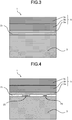
- a first compound 21 containing Co, C, and W whose contents in atm% satisfy the relation of Co > C > W is positioned between the base 3 and the coating layer 5.
- the insert 1 of the present disclosure having such a configuration has excellent wear resistance and chipping resistance.
- the first compound 21 may contain 90 atm% or more of a total of Co, C, and W and contain 69 to 89 atm% of Co, 8 to 25 atm% of C, and 3 to 12 atm% of W.
- the first compound 21 may cover a part of the base 3.
- the first compound 21 may cover 80% or more of the base 3 in a part in which the coating layer 5 is present.
- the first compound 21 may cover all of the base 3 in a part in which the coating layer 5 is present.
- a second compound 23 containing C, Co, and W whose contents in atm% satisfy the relation of C > Co > W may be positioned between the base 3 and the coating layer 5, in addition to the first compound 21.
- the second compound 23 may contain 90 atm% or more of a total of C, Co, and W and contain 60 to 75 atm% of C, 18 to 30 atm% of Co, and 2 to 10 atm% of W.
- the first compound 21 may surround the second compound 23 in a cross-sectional view.
- a third compound 25 containing C, Ti, and W whose contents in atm% satisfy the relation of C > Ti > W may be positioned between the base 3 and the coating layer 5, in addition to the first compound 21.
- the third compound 25 may be positioned between the first compound 21 and the coating layer 5 in a cross-sectional view.
- the first compound 21, the second compound 23, and the third compound 25 may be positioned between the base 3 and the coating layer 5.
- the third compound 25 may contain 80 atm% or more of a total of C, Ti, and W and contain 58 to 80 atm% of C, 7 to 25 atm% of Ti, and 1 to 15 atm% of W.
- the insert 1 of the present disclosure having the first compound 21 described above is excellent in wear resistance and chipping resistance.
- the base may contain Co 0.93 W 0.07 .
- Co 0.93 W 0.07 is a crystal represented in PDF: 01-071-7509 of the JCPDS card.
- the proportion of the Co 0.93 W 0.07 in all the crystals may be 5 to 10 in a crystalline phase analysis by X-ray diffraction.
- the proportion of Co 0.93 W 0.07 may be 8 to 10.
- the proportion of the Co 0.93 W 0.07 described above is obtained by calculating the proportion of Co 0.93 W 0.07 in the proportions of all the crystals detected by a Riedveld method using an X-ray system produced by PANalytical, X'Pert Pro 2 ⁇ : 10 to 100, and analysis software RIETAN-FP.
- the Co content in the total amount of the binder phase may be 99.0 mass% or more.
- the Co content may be 99.5 mass% or more.
- Fe, Ni, and the like may be included in the binder phase, in addition to Co.
- the Co content (mass%) is a value obtained by measuring the masses of Co, Fe, and Ni included in the insert, dividing the mass of Co by the total mass, and multiplying it by 100. In other words, the total amount of Fe and Ni in the binder phase included in the insert 1 of the present disclosure may be less than 1 mass%.
- the binder phase is Co alone, for example, the mean particle size as a raw material powder of the hard phase may be 1 ⁇ m or less, and further, 0.6 ⁇ m or less.
- the Co content in the base 3 may be 16 mass% or more.
- the width of TiN particles in a direction parallel to the surface of the base 3 may be 25 nm.
- the adhesion of the first layer 5a to the base 3 is excellent.
- the adhesion between the first layer 5a and the first compound 21, between the first layer 5a and the second compound 23, and between the first layer 5a and the third compound 25 is excellent.
- the coating film 5 is excellent in wear resistance.
- the width of TiN particles may be measured at a position of 0.05 ⁇ m from the surface of the base 3.
- the width of TiN particles may be measured at a position of 0.05 ⁇ m from the surface of the first compound 21.
- the width of TiN particles may be measured at a position of half the thickness of the first layer 5a.
- the width of TiN particles is the mean value of the widths of 20 TiN particles measured at the position described above.
- the ratio (which hereinafter may be referred to as aspect ratio) of the height of TiN particles in a direction vertical to the surface of the base to the width of TiN particles in a direction parallel to the surface of the base 3 may be within a range of 1.0 to 1.7. With such a configuration, the adhesion force between the first layer 5a and the base 3 is excellent.
- the aspect ratio of TiN particles may be measured for TiN particles present at a position of up to 0.05 ⁇ m from the surface of the base 3.
- the aspect ratio is the mean value of 20 TiN particles.
- the thickness of the first layer 5a may be 0.1 to 1.0 ⁇ m.
- the thickness of the first layer 5a is 0.1 ⁇ m or more, diffusion of the binder phase component included in the base 3 to the coating is suppressed, and the chipping resistance is excellent.
- the thickness of the first layer 5a is 1.0 ⁇ m or less, the upper layer, that is, the second layer 5b is finer, and the wear resistance is excellent.
- the thickness of the first layer 5a may be 0.3 to 0.7 ⁇ m.
- the thickness of the first layer 5a When the thickness of the first layer 5a is 0.1 ⁇ m or more, diffusion of the binder phase component included in the base 3 to the coating is suppressed, and the chipping resistance is excellent. Diffusion of the binder phase component included in the base 3 to the coating is suppressed, and the chipping resistance is excellent.
- the thickness of the first layer 5a is 1.0 ⁇ m or less, the TiCN particles included in the upper layer, that is, the second layer 5b are finer, and the wear resistance is excellent.
- the insert 1 includes the first layer 5a on the base 3.
- the insert 1 includes the second layer 5b on the first layer 5a.
- the second layer 5b includes TiCN particles that are TiCN crystals.
- the thermal expansion coefficient of the TiCN crystals is about 8 ⁇ 10 -6 /°C, and when the thermal expansion coefficient of the base 3 is 9.0 ⁇ 10 -6 /°C or more, the thermal expansion coefficient of the second layer 5b is smaller than the thermal expansion coefficient of the base 3.
- the second layer 5b is interposed between the base 3 and the first layer 5c to suppress peeling of the first layer 5c and suppress abrasive wear.
- the third layer 5c includes Al 2 O 3 particles that are Al 2 O 3 crystals.
- the thermal expansion coefficient of the Al 2 O 3 crystals is about 7.2 ⁇ 10 -6 /°C and is smaller than the thermal expansion coefficients of the base 3 and the second layer 5b.
- the base 3 and the second layer 5b may be in direct contact or, for example, the first layer 5a may be positioned between them as in the example in FIG. 2 .
- the first layer 5a is not necessarily composed of pure TiN particles and may contain, for example, O and/or C.
- the second layer 5b and the third layer 5c may be in direct contact or, for example, a TiN layer (not illustrated) may be positioned between them.
- an adequate compressive stress can be applied to the second layer 5b and the third layer 5c by adjusting the thermal expansion coefficient of the base 3 and the thickness of the third layer 5c.
- the thickness of the third layer 5c is 2 ⁇ m or more.
- the compressive stress applied to the second layer 5b may be 250 to 500 MPa
- the compressive stress applied to the third layer 5c may be 450 MPa or more
- the value of the compressive stress applied to the third layer 5c may be larger than the compressive stress applied to the second layer 5b.
- the insert 1 having such a configuration is excellent in wear resistance and durability.
- the compressive stresses applied to the second layer 5b and the third layer 5c may be determined based on measurement using a 2D process. Specifically, a section of the flank face, 1 mm or more away from the cutting edge 7, is set as a measurement location, and X-ray diffraction peaks are measured. For the crystal structure specified from the measurement result, the compressive stress can be obtained by determining how the value of 2 ⁇ in the measurement result deviates from the value of 2 ⁇ serving as a standard described in the JCPDS card.
- the residual stress When a residual stress has a negative value, the residual stress is compressive stress. When the value of compressive stress is expressed, it is represented by an absolute value with no minus sign.
- the third layer 5c is at a position more distant from the base 3.
- the third layer 5c comes into contact with the workpiece before the second layer 5b.
- the third layer 5c includes Al 2 O 3 particles and has a thickness of 2 ⁇ m or more, the wear resistance and the oxidation resistance are high.
- the thickness of the third layer 5c may be 2.5 ⁇ m or more and 8.0 ⁇ m or less.
- the insert 1 having such a configuration is more excellent in wear resistance and oxidation resistance.
- the sum of the thickness of the second layer 5b and the thickness of the third layer 5c may be 7 ⁇ m or more and 18 ⁇ m or less.
- the sum of the thicknesses may be 8 ⁇ m or more and 16 ⁇ m or less.
- the second layer 5b may have a thickness of 5 ⁇ m or more and 10 ⁇ m or less. With such a range, the wear resistance and the chipping resistance of the insert 1 are excellent.
- the thickness of the third layer 5c may be 0.2 to 0.4 times the sum of the thickness of the second layer 5b and the thickness of the third layer 5c.
- the insert 1 having such a configuration is excellent in wear resistance and chipping resistance.
- the C axis of the Al 2 O 3 crystals of the third layer 5c may be oriented along a direction vertical to a main surface of the base 3.
- the third layer 5c may contain ⁇ -Al 2 O 3 crystals, and the ⁇ -Al 2 O 3 crystals may be shaped into a column extending in the vertical direction relative to the main surface of the base 3.
- a binder-phase-enriched layer that contains a hard phase and a binder phase and has a higher proportion of the binder phase compared with the inside of the base 3 may be present on the surface.
- the thickness of this binder-phase-enriched layer may be 1 ⁇ m or more and 10 ⁇ m or less.
- Table 1 illustrates the proportions of raw material powders to form the base of the insert used in Examples described later.
- the mean particle size of each raw material is 1 ⁇ m or less. These raw material powders are typically used in production of cermets.
- the insert of the present disclosure can be obtained by controlling the composition of the base and the production condition of the coating layer.
- the proportion of Co in the binder phase included in the base may be set to 97.0 mass% or more, and the amount of Co included in the base may be set to 10 mass% or more.
- the proportion of Co in the binder phase included in the base may be 99.0 mass% or more and further may be 99.9 mass% or more.
- the proportion of Co is a value obtained by measuring the masses of Co, Fe, and Ni included in the insert and dividing the mass of Co by the total mass. This can be represented by a formula Co/(Co + Ni + Fe).
- the first compound covers a part of the base.
- the first compound covers all of the base covered with the coating layer.
- the powder After a binder is added to the raw material powder having such a composition range, for example, the powder is formed into a desired shape by press molding and subjected to a degreasing step for removing the binder component, and thereafter, fired in a nitrogen or vacuum atmosphere within a temperature range of 1500 to 1550°C to produce a highly dense base.
- the product is held in a vacuum at 200°C and 300°C each for 1 hour, and then the temperature is increased to 450°C and held for 1 hour.
- CO 2 gas is introduced into a degreasing furnace at a pressure of 1 to 5 kPa.
- the amount of C can be precisely controlled.
- the base may have a thermal expansion coefficient at 25 to 1000°C of 9.0 ⁇ 10 -6 /°C or more.
- a coating layer is provided.
- a first layer including a plurality of TiN particles is formed on a surface of the base.
- a second layer including a plurality of TiCN particles is further formed on the first layer.
- a third layer including a plurality of Al 2 O 3 particles is further formed thereon.
- the first layer, the second layer, and the third layer may be formed by a chemical vapor deposition (CVD) process. With this CVD process, the higher the deposition temperature is in depositing a film, the greater the compressive stress is applied to the deposited film. The deposition temperature is then adjusted, if necessary.
- CVD chemical vapor deposition
- the ratio of Co in the binder phase components included in the base may be set to 99.0 mass% or more.
- the first layer may be deposited, for example, at a temperature of 800 to 900°C, a pressure of 8 to 20 kPa, a TiCl 4 concentration of 0.2 to 2.5 mol%, a N 2 concentration of 25.0 to 49.9 mol%, and a H 2 concentration of 40.0 to 74.8 mol%.
- the amount of C in the raw materials and the amount of a hard phase in the raw material composition of the base may be adjusted such that C/hard phase is 8.0 or more.
- the amount of C in the raw materials includes, for example, C included in the raw material powders, in addition to C added as carbon.
- the hard phase refers to the one that may be present as a hard phase in an insert and does not include, for example, metals, oxides, or carbonates of Fe, Ni, Co, Mn, and/or Mo.
- the amount of a binder phase included in the base may exceed 16 mass%, and the C/hard phase may be set to 8.0 or more.
- the TiCl 4 concentration in the deposition condition for forming the first layer on the base may be set to 1.0 mol% or more.
- the insert having the third compound positioned between the first compound and the coating layer can be obtained.
- the first compound, the second compound, and the third compound prepared preliminarily may be attached to the surface of the base as desired, and thereafter, a coating film may be formed to produce the insert of the present disclosure.
- a cutting tool 101 of the present disclosure is, for example, a rod-shaped body extending from a first end (the upper end in FIG. 9 ) to a second end (the lower end in FIG. 9 ).
- the cutting tool 101 includes a holder 105 having a pocket 103 on the first end side (tip end side) and the aforementioned insert 1 positioned in the pocket 103.
- the cutting tool 101 includes the insert 1, and hence, can perform a stable cutting process over a long time period.
- the pocket 103 is a portion to which the insert 1 is attached and has a seat surface parallel to a lower surface of the holder 105 and a constraint side surface inclined relative to the seat surface.
- the pocket 103 is open on the first end side of the holder 105.
- the insert 1 is positioned in the pocket 103.
- the lower surface of the insert 1 may be in direct contact with the pocket 103, or a sheet (not illustrated) may be sandwiched between the insert 1 and the pocket 103.
- the insert 1 is attached to the holder 105 such that at least a part of a section used as the cutting edge 7 at the ridge line on which the flank face and the rake face intersect protrudes outward from the holder 105.
- the insert 1 is attached to the holder 105 by a fixing screw 107. That is, the insert 1 is attached to the holder 105 by inserting the fixing screw 107 into a through-hole 17 of the insert 1, inserting the tip end of the fixing screw 107 into a screw hole (not illustrated) formed in the pocket 103, and screwing the screw portions together.
- steel and cast iron can be used as the material of the holder 105.
- steel with a high toughness may be used.
- the cutting tool 101 for use in a turning process is illustrated by way of example.
- the turning process include, but are not limited to, a boring process, an external process, a grooving process, and a facing process.
- the cutting tool 101 is not limited to the one for use in the turning process.
- the insert 1 in the embodiments may be used for the cutting tool 101 for use in a milling process.
- the base was produced as follows. A molded product in the shape of a tool was produced using raw material powders in proportions indicated in Table 1, and a binder component was removed, followed by firing to produce a base. Among these samples, the bases of Sample Nos. 1 to 14 were a cermet. The base of Sample No. 15 was a superalloy. At the degreasing step, the product was held in a vacuum at 200°C and 300°C each for 1 hour, and then the temperature was increased to 450°C and held for 1 hour. At the step at 450°C, CO 2 gas was introduced at a pressure of 3 kPa into a degreasing furnace.
- the first layer was formed under the deposition condition illustrated in Table 2 by a CVD process.
- the second layer was further formed on the first layer.
- the third layer was further formed on the second layer.
- a cross section of the resulting insert was observed using a transmission electron microscope JEM-2010F (UHR) produced by JOEL Ltd. with a magnification of 80,000 to 200,000 to determine the presence/absence of the first compound, the second compound, and the third compound between the base and the coating layer.
- the shape of TiN particles in the first layer was measured. Whether the base contained Co 0.93 W 0.07 was determined by X-ray diffraction.
- the composition of each compound was determined by thin film quantitative analysis using the same device. The presence/absence of the first compound, the second compound, and the third compound in each sample is illustrated in Table 2.
- the bases had a binder-phase-enriched layer. Table 2 Sample No.
- First compound Second compound Third compound Amount of flank face wear [ ⁇ m] Number of impacts until chipping occurs TiCN Al 2 O 3 TiCN Al 2 O 3 TiCN+A l 2 O 3 Al 2 O 3 / (Al 2 O 3 +TiCN) 1 49.7 49.7 0.6 56 No Yes No -301 -511 7.78 3.52 11.30 0.31 90 15356 2 49.8 49.8 0.4 14 Yes Yes No -315 -502 7.60 3.74 11.34 0.33 81 30013 3 49.1 49.1 1.8 15 Yes No Yes -349 -498 7.41 3.87 11.28 0.34 84 31514 4 49.5 49.5 1.0 12 No Yes Yes Yes -341 -492 7.52 3.
- the first compound contained 90 atm% or more of a total of Co, C, and W and contained 69 to 89 atm% of Co, 8 to 25 atm% of C, and 3 to 12 atm% of W.
- Sample Nos. 2, 5, and 7 to 14 in which C/hard phase was 8.0 or more had the second compound between the base and the coating film.
- the second compound contained 90 atm% or more of a total of C, Co, and W and contained 60 to 75 atm% of C, 18 to 30 atm% of Co, and 2 to 10 atm% of W.
- Sample Nos. 3, 5, and 8 in which the TiCl 4 concentration was 1.0 mol% or more in the deposition condition for the TiN film had the third compound between the base and the coating film.
- the third compound contained 80 atm% or more of a total of C, Ti, and W and contained 58 to 80 atm% of C, 7 to 25 atm% of Ti, and 1 to 15 atm% of W.
- the resulting insert underwent a cutting test under the following conditions.
- the samples having the first compound exhibited more excellent wear resistance and chipping resistance than the samples not having the first compound.
- the samples having the second compound and/or the third compound exhibited more excellent wear resistance and chipping resistance than the samples not having the second compound and/or the third compound.
Landscapes
- Chemical & Material Sciences (AREA)
- Engineering & Computer Science (AREA)
- Materials Engineering (AREA)
- Mechanical Engineering (AREA)
- Metallurgy (AREA)
- Organic Chemistry (AREA)
- Chemical Kinetics & Catalysis (AREA)
- Inorganic Chemistry (AREA)
- General Chemical & Material Sciences (AREA)
- Cutting Tools, Boring Holders, And Turrets (AREA)
- Chemical Vapour Deposition (AREA)
Applications Claiming Priority (3)
| Application Number | Priority Date | Filing Date | Title |
|---|---|---|---|
| JP2018052842 | 2018-03-20 | ||
| JP2018223528 | 2018-11-29 | ||
| PCT/JP2019/010879 WO2019181794A1 (fr) | 2018-03-20 | 2019-03-15 | Insert et outil de coupe comprenant ledit insert |
Publications (2)
| Publication Number | Publication Date |
|---|---|
| EP3769878A1 true EP3769878A1 (fr) | 2021-01-27 |
| EP3769878A4 EP3769878A4 (fr) | 2021-12-22 |
Family
ID=67986224
Family Applications (1)
| Application Number | Title | Priority Date | Filing Date |
|---|---|---|---|
| EP19772148.3A Pending EP3769878A4 (fr) | 2018-03-20 | 2019-03-15 | Insert et outil de coupe comprenant ledit insert |
Country Status (4)
| Country | Link |
|---|---|
| EP (1) | EP3769878A4 (fr) |
| JP (1) | JP7057420B2 (fr) |
| CN (1) | CN111886097B (fr) |
| WO (1) | WO2019181794A1 (fr) |
Families Citing this family (1)
| Publication number | Priority date | Publication date | Assignee | Title |
|---|---|---|---|---|
| WO2023008189A1 (fr) * | 2021-07-30 | 2023-02-02 | 京セラ株式会社 | Outil revêtu et outil de coupe |
Family Cites Families (14)
| Publication number | Priority date | Publication date | Assignee | Title |
|---|---|---|---|---|
| SE9502687D0 (sv) * | 1995-07-24 | 1995-07-24 | Sandvik Ab | CVD coated titanium based carbonitride cutting tool insert |
| US5955186A (en) * | 1996-10-15 | 1999-09-21 | Kennametal Inc. | Coated cutting insert with A C porosity substrate having non-stratified surface binder enrichment |
| JPH11229143A (ja) * | 1998-02-20 | 1999-08-24 | Mitsubishi Materials Corp | 耐欠損性のすぐれた表面被覆超硬合金製エンドミル |
| US6251508B1 (en) * | 1998-12-09 | 2001-06-26 | Seco Tools Ab | Grade for cast iron |
| SE526604C2 (sv) * | 2002-03-22 | 2005-10-18 | Seco Tools Ab | Belagt skärverktyg för svarvning i stål |
| JP4069749B2 (ja) * | 2003-01-24 | 2008-04-02 | 京セラ株式会社 | 荒加工用切削工具 |
| JP4711714B2 (ja) * | 2005-03-30 | 2011-06-29 | 京セラ株式会社 | 表面被覆切削工具 |
| EP2058070B1 (fr) * | 2006-08-31 | 2014-02-26 | Kyocera Corporation | Outil de coupe, procédé pour sa fabrication et procédé de coupe |
| JP2009107059A (ja) * | 2007-10-30 | 2009-05-21 | Kyocera Corp | 切削工具および切削インサート並びに切削インサートの製造方法 |
| JP5075652B2 (ja) * | 2008-01-21 | 2012-11-21 | 日本特殊陶業株式会社 | ダイヤモンド被覆切削インサート及び切削工具 |
| JP2010105099A (ja) * | 2008-10-29 | 2010-05-13 | Kyocera Corp | 切削工具 |
| CN101879612B (zh) * | 2010-06-28 | 2011-12-07 | 株洲钻石切削刀具股份有限公司 | 用于钢材车削的硬质合金涂层刀片 |
| JP5989930B1 (ja) | 2014-11-27 | 2016-09-07 | 京セラ株式会社 | サーメットおよび切削工具 |
| JP6558633B2 (ja) * | 2015-08-10 | 2019-08-14 | 三菱マテリアル株式会社 | 耐塑性変形性、耐異常損傷性および耐摩耗性にすぐれたTi基サーメット切削工具 |
-
2019
- 2019-03-15 WO PCT/JP2019/010879 patent/WO2019181794A1/fr not_active Ceased
- 2019-03-15 EP EP19772148.3A patent/EP3769878A4/fr active Pending
- 2019-03-15 JP JP2020507761A patent/JP7057420B2/ja active Active
- 2019-03-15 CN CN201980020490.2A patent/CN111886097B/zh active Active
Also Published As
| Publication number | Publication date |
|---|---|
| EP3769878A4 (fr) | 2021-12-22 |
| CN111886097A (zh) | 2020-11-03 |
| JPWO2019181794A1 (ja) | 2021-03-11 |
| WO2019181794A1 (fr) | 2019-09-26 |
| JP7057420B2 (ja) | 2022-04-19 |
| CN111886097B (zh) | 2023-06-23 |
Similar Documents
| Publication | Publication Date | Title |
|---|---|---|
| EP2267182B1 (fr) | Outil de coupe revêtu | |
| US11311946B2 (en) | Coated tool and cutting tool including the same | |
| US7276301B2 (en) | Surface-coated cermet cutting tool with a hard coating layer exhibiting excellent chipping resistance | |
| US10744568B2 (en) | Coated tool | |
| US8142848B2 (en) | Coated cutting insert for milling | |
| EP1548154A2 (fr) | Outil de coupe en cermet revêtu d'une couche de revêtement conférant une excellente résistance au piquage. | |
| EP0440157B1 (fr) | Procédé de production d'une lame revêtue pour outils de coupe | |
| EP3747577A1 (fr) | Outil revêtu, et outil de coupe équipé de celui-ci | |
| KR102731820B1 (ko) | 피복 공구 | |
| EP3769878A1 (fr) | Insert et outil de coupe comprenant ledit insert | |
| EP3769881A1 (fr) | Insert et outil de coupe le comprenant | |
| EP3769874A1 (fr) | Insert et outil de coupe le comprenant | |
| EP3769873A1 (fr) | Insert et outil de coupe le comprenant | |
| EP3769876A1 (fr) | Outil et outil de coupe le comprenant | |
| US20260027625A1 (en) | Coated tool and cutting tool | |
| US11839923B2 (en) | Coated tool, cutting tool, and method for manufacturing machined product |
Legal Events
| Date | Code | Title | Description |
|---|---|---|---|
| STAA | Information on the status of an ep patent application or granted ep patent |
Free format text: STATUS: THE INTERNATIONAL PUBLICATION HAS BEEN MADE |
|
| PUAI | Public reference made under article 153(3) epc to a published international application that has entered the european phase |
Free format text: ORIGINAL CODE: 0009012 |
|
| STAA | Information on the status of an ep patent application or granted ep patent |
Free format text: STATUS: REQUEST FOR EXAMINATION WAS MADE |
|
| 17P | Request for examination filed |
Effective date: 20201015 |
|
| AK | Designated contracting states |
Kind code of ref document: A1 Designated state(s): AL AT BE BG CH CY CZ DE DK EE ES FI FR GB GR HR HU IE IS IT LI LT LU LV MC MK MT NL NO PL PT RO RS SE SI SK SM TR |
|
| AX | Request for extension of the european patent |
Extension state: BA ME |
|
| DAV | Request for validation of the european patent (deleted) | ||
| DAX | Request for extension of the european patent (deleted) | ||
| A4 | Supplementary search report drawn up and despatched |
Effective date: 20211122 |
|
| RIC1 | Information provided on ipc code assigned before grant |
Ipc: B22F 3/24 20060101ALI20211116BHEP Ipc: C23C 16/34 20060101ALI20211116BHEP Ipc: B22F 5/00 20060101ALI20211116BHEP Ipc: C23C 30/00 20060101ALI20211116BHEP Ipc: C22C 29/04 20060101ALI20211116BHEP Ipc: C23C 28/04 20060101ALI20211116BHEP Ipc: C22C 29/00 20060101ALI20211116BHEP Ipc: C23C 16/40 20060101ALI20211116BHEP Ipc: C23C 16/36 20060101ALI20211116BHEP Ipc: B23B 27/14 20060101AFI20211116BHEP |
|
| P01 | Opt-out of the competence of the unified patent court (upc) registered |
Effective date: 20230505 |