EP3771161A1 - Auswahl einer instanziierung eines teilnetzes für die uplink-paketübertragung - Google Patents
Auswahl einer instanziierung eines teilnetzes für die uplink-paketübertragung Download PDFInfo
- Publication number
- EP3771161A1 EP3771161A1 EP20170020.0A EP20170020A EP3771161A1 EP 3771161 A1 EP3771161 A1 EP 3771161A1 EP 20170020 A EP20170020 A EP 20170020A EP 3771161 A1 EP3771161 A1 EP 3771161A1
- Authority
- EP
- European Patent Office
- Prior art keywords
- instantiation
- network
- network slice
- rule
- entity
- Prior art date
- Legal status (The legal status is an assumption and is not a legal conclusion. Google has not performed a legal analysis and makes no representation as to the accuracy of the status listed.)
- Granted
Links
Images

Classifications
-
- H—ELECTRICITY
- H04—ELECTRIC COMMUNICATION TECHNIQUE
- H04W—WIRELESS COMMUNICATION NETWORKS
- H04W16/00—Network planning, e.g. coverage or traffic planning tools; Network deployment, e.g. resource partitioning or cells structures
- H04W16/02—Resource partitioning among network components, e.g. reuse partitioning
-
- H—ELECTRICITY
- H04—ELECTRIC COMMUNICATION TECHNIQUE
- H04L—TRANSMISSION OF DIGITAL INFORMATION, e.g. TELEGRAPHIC COMMUNICATION
- H04L65/00—Network arrangements, protocols or services for supporting real-time applications in data packet communication
- H04L65/10—Architectures or entities
- H04L65/1016—IP multimedia subsystem [IMS]
-
- H—ELECTRICITY
- H04—ELECTRIC COMMUNICATION TECHNIQUE
- H04W—WIRELESS COMMUNICATION NETWORKS
- H04W48/00—Access restriction; Network selection; Access point selection
- H04W48/18—Selecting a network or a communication service
-
- H—ELECTRICITY
- H04—ELECTRIC COMMUNICATION TECHNIQUE
- H04L—TRANSMISSION OF DIGITAL INFORMATION, e.g. TELEGRAPHIC COMMUNICATION
- H04L41/00—Arrangements for maintenance, administration or management of data switching networks, e.g. of packet switching networks
- H04L41/08—Configuration management of networks or network elements
- H04L41/0893—Assignment of logical groups to network elements
-
- H—ELECTRICITY
- H04—ELECTRIC COMMUNICATION TECHNIQUE
- H04L—TRANSMISSION OF DIGITAL INFORMATION, e.g. TELEGRAPHIC COMMUNICATION
- H04L45/00—Routing or path finding of packets in data switching networks
- H04L45/64—Routing or path finding of packets in data switching networks using an overlay routing layer
-
- H—ELECTRICITY
- H04—ELECTRIC COMMUNICATION TECHNIQUE
- H04L—TRANSMISSION OF DIGITAL INFORMATION, e.g. TELEGRAPHIC COMMUNICATION
- H04L65/00—Network arrangements, protocols or services for supporting real-time applications in data packet communication
- H04L65/10—Architectures or entities
- H04L65/102—Gateways
- H04L65/1033—Signalling gateways
-
- H—ELECTRICITY
- H04—ELECTRIC COMMUNICATION TECHNIQUE
- H04W—WIRELESS COMMUNICATION NETWORKS
- H04W28/00—Network traffic management; Network resource management
- H04W28/02—Traffic management, e.g. flow control or congestion control
- H04W28/0215—Traffic management, e.g. flow control or congestion control based on user or device properties, e.g. MTC-capable devices
-
- H—ELECTRICITY
- H04—ELECTRIC COMMUNICATION TECHNIQUE
- H04W—WIRELESS COMMUNICATION NETWORKS
- H04W48/00—Access restriction; Network selection; Access point selection
- H04W48/02—Access restriction performed under specific conditions
- H04W48/06—Access restriction performed under specific conditions based on traffic conditions
-
- H—ELECTRICITY
- H04—ELECTRIC COMMUNICATION TECHNIQUE
- H04W—WIRELESS COMMUNICATION NETWORKS
- H04W48/00—Access restriction; Network selection; Access point selection
- H04W48/16—Discovering, processing access restriction or access information
-
- H—ELECTRICITY
- H04—ELECTRIC COMMUNICATION TECHNIQUE
- H04W—WIRELESS COMMUNICATION NETWORKS
- H04W60/00—Affiliation to network, e.g. registration; Terminating affiliation with the network, e.g. de-registration
- H04W60/04—Affiliation to network, e.g. registration; Terminating affiliation with the network, e.g. de-registration using triggered events
-
- H—ELECTRICITY
- H04—ELECTRIC COMMUNICATION TECHNIQUE
- H04W—WIRELESS COMMUNICATION NETWORKS
- H04W88/00—Devices specially adapted for wireless communication networks, e.g. terminals, base stations or access point devices
- H04W88/02—Terminal devices
- H04W88/06—Terminal devices adapted for operation in multiple networks or having at least two operational modes, e.g. multi-mode terminals
-
- H—ELECTRICITY
- H04—ELECTRIC COMMUNICATION TECHNIQUE
- H04W—WIRELESS COMMUNICATION NETWORKS
- H04W48/00—Access restriction; Network selection; Access point selection
- H04W48/08—Access restriction or access information delivery, e.g. discovery data delivery
- H04W48/14—Access restriction or access information delivery, e.g. discovery data delivery using user query or user detection
Definitions
- the present invention relates to the field of telecommunications networks, and more particularly that of mobile telecommunications networks.
- 3GPP The architecture of these mobile telecommunications networks has so far been standardized through a standardization group known as 3GPP. This is in particular the case for so-called “2G”, “3G” and “4G” mobile networks, the different architectures of which are defined in technical specifications established by such an organization.
- the various network architectures are based on very specific equipment dedicated to certain precise functions, whether at the level of the access network or the core network. , in particular as regards the transmission of packets from or to a mobile terminal.
- network slicing a technique of slicing the network
- Such a technique of cutting the network into sections allows the operator of a telecommunications network to create “tailor-made” networks capable of providing optimized solutions for very varied scenarios with very diverse constraints in terms of functionality and performance.
- the concept of network slicing is based on three distinct layers which are the “resource” layer, the “network slice instantiation” layer and the “service instantiation” layer.
- the first “resource” layer comprises all the physical and logical resources of a network, in terms of computing power, memory and transmission capacity, necessary for the execution of the instantiation of one or more network slices.
- the so-called “physical” resources are all the equipment having calculation capacities, storage means and transmission capacities within a network.
- the so-called “logical” resources can then consist of part of a physical resource, or on the contrary of a gathering of several physical resources dedicated to a network function or shared between several network functions.
- the second “network slice instantiation” layer consists of the various network slice instantiations used to provide services, each instantiation being able to be broken down into one or more network functions executed by physical and / or logical resources of the “resource” layer.
- the third “service instantiation” layer represents services (to the user or to a company) which can be supported by the second layer, that is to say by using one or more slice instantiations. network to provide the network characteristics necessary for a required service instantiation.
- a network layer instantiation can be defined as being a set of network functions and resources making it possible to perform these network functions, akin to a complete logical network making it possible to obtain certain characteristics required by an instantiation of service.
- a conventional mobile terminal in a “4G / LTE” network is always connected to a single MME (“Mobility Management Entity”) and a single specific S-GW gateway, located in the heart of the mobile telecommunications network in occurrence, to be able to obtain various services and access external networks.
- MME Mobility Management Entity
- S-GW gateway located in the heart of the mobile telecommunications network in occurrence, to be able to obtain various services and access external networks.
- a conventional mobile terminal therefore does not have the ability to be able to connect to different instantiations of network slices such as can be envisaged in future networks, which potentially rely on various and varied physical and logical resources.
- the object of the present invention is to remedy these drawbacks.
- the operator of a communication network can thus segment his network according to different uses and levels of service, for example by offering a very robust network slice for services requiring a high availability (mission critical) and a weak network slice for services that can accept service interruptions.
- a user terminal can then select a specific instantiation from among different available network slices according to the service that it wishes to obtain by sending upstream packets, and thus benefit from network conditions specifically adapted to the need for this service, from a flexible and simple way.
- the uplink packet is sent to a user plane access entity for a default network slice instantiation.
- a default network slice instantiation allows the network operator to offer default network access for the terminal, even if the service it requests does not correspond to any specific slice instantiation. network at a given time. This default instantiation can then be used by the operator to provide a certain amount of information to the user terminal, in particular rules for selecting network slice instantiations suitable for the services that may be required by this terminal.
- the method further comprises a prior phase of attaching the user terminal to the instantiation of the default network slot, during which the communication module receives, from an entity access to the default network slice instantiation control plane, an attachment acknowledgment message containing said at least one rule designating a network slice instantiation.
- the communication module receives, from the access entity to the control plane of the default network slice instantiation, a message containing said at least one rule designating a network slice instantiation, which allows the network operator to be able to perform real-time control of the instantiation selection that the terminal can make for different types of services.
- This message can thus be both an initial supply message and an update message for the rule in question.
- the communication module when the uplink packet corresponds to a rule designating an instantiation of a network slot to which the user terminal is not attached, sends an attachment request to an entity of access to the control plane of the instantiation of the designated network slice, the upstream packet being sent following the reception of an attachment acknowledgment message from the control plane access entity.
- the at least one rule contains at least one parameter determined from among a destination address of the packets, a transport protocol, a source port, a destination port, an application protocol, information on the location of the terminal. or a time slot for the application of the rule, checking the correspondence between the upstream packet and said at least one rule comprising the verification of the adequacy between a parameter of the upstream packet and the determined parameter.
- the selection of instantiation can thus be carried out simply, by filtering the upstream packets with respect to some of their parameters to direct them to an instantiation suitable for the corresponding service.
- the method further comprises a preliminary step of verifying that the upstream packet belongs to a new data stream, the verification of the correspondence between the upstream packet and at least one rule being performed when the upstream packet belongs to a new data stream; and when the upstream packet does not belong to a new data stream, the upstream packet is sent to a user plane access entity of the network slice instantiation used for at least one previous upstream packet of the data stream to which belongs the amount package.
- the communication module when the terminal is attached to a network slice instantiation and it does not exchange any payload packet with an access entity to the user plane of said network slice instantiation during a determined period of time, the communication module sends a detachment request to an entity for access to the control plane of said network slice instantiation.
- the present invention is also aimed at a network entity, capable of allowing access to the control plane of a network slice instantiation in a communication network, comprising a communication module configured to send a message to a user terminal containing at least a rule designating a network slice instantiation in the communication network to be used by this user terminal to transmit an upstream packet.
- a network entity may in particular be an entity for access to the control plane of an access network or of a core network, when an instantiation of a network section in the communication network is separated according to this distinction. .
- the present invention is also aimed at a communication network comprising at least one network entity as described above, configured to provide access to a user terminal to the control plane of a network slice instantiation implemented in the network. communication, as well as a network entity configured to provide this terminal with access to the user plane of the instantiation to allow the sending of an upstream packet in said user plane of the instantiation.
- the present invention also relates to a computer program comprising instructions code for the implementation of the above selection method when the program is executed by the processor of a user terminal.
- This program can use any programming language, and be in the form of source code, object code, or intermediate code between source code and object code, such as in a partially compiled form, or in any what other desirable shape.
- the invention also relates to a recording medium on which the code instructions of a computer program as mentioned above are stored.
- This information medium can be any entity or device capable of storing the program.
- the medium may comprise a storage means, such as a ROM, for example a CD-ROM or a microelectronic circuit ROM, or else a magnetic recording means, for example a floppy disk or a hard disk.
- this information medium can be a transmissible medium such as an electrical or optical signal, which can be conveyed via an electrical or optical cable, by radio or by other means.
- the program according to the invention can in particular be downloaded from an Internet type network.
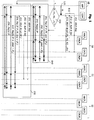
- FIG. 1 illustrates the steps of the selection method according to one embodiment of the invention.
- a user terminal UE which can be a mobile terminal, a smartphone, a computer with a radio interface or any other type of equipment capable of communicating with a radio access network or wired.
- This UE terminal comprises on the one hand an application module APP (or even several, a single module being illustrated in the figure 1 ) capable of executing software applications on the terminal UE and on the other hand a communication module COM capable of receiving data, in the form of packets, from the application module APP in order to transmit them to a mobile telecommunications network and vice versa of receive data packets from a mobile network to transmit them to the APP module.
- an application module APP or even several, a single module being illustrated in the figure 1
- a communication module COM capable of receiving data, in the form of packets, from the application module APP in order to transmit them to a mobile telecommunications network and vice versa of receive data packets from a mobile network to transmit them to the APP module.
- the APP module can consist of a purely software module (such as a mobile software application) or of a module composed of a processor associated with a memory in which are stored code instructions which may correspond to an application. mobile software.
- the COM module comprises in particular a transmitter / receiver (radio for a mobile UE terminal), able to receive downlink data packets from the network and to send upstream data packets coming from the APP module to the network, as well as a processor associated with a memory capable of storing code instructions that can be executed by the processor to process the data received from the network or from the APP module, for example to encapsulate the data packets according to a transmission protocol before their transmission by the transmitter / receiver or for selecting a network slice instantiation of a communication network for sending these packets, as will be seen later.
- a transmitter / receiver radio for a mobile UE terminal
- the COM module comprises in particular a transmitter / receiver (radio for a mobile UE terminal), able to receive downlink data packets from the network and to send upstream data packets coming from the APP module to the network, as well as a processor associated with a memory capable of storing code instructions that can be executed by the processor to process the data received from the network or from the
- a mobile telecommunications network is represented here according to the principle of division by network slices, with here three instantiations of network slice S0, S1, S2 purely by way of illustration and without limitation.
- Each network slice instantiation comprises a certain number of entities at the level of the control plane (for signaling) and of the user plane (for the transmission of payload data), in particular a first entity called access to the user plane of the network.
- 'instantiation allowing the exchange of payload data between the instantiation and the communication module COM of the terminal UE, and a second entity called access to the instantiation control plane, allowing the exchange of signaling messages between instantiation and the COM communication module of the UE terminal.
- These two entities can be in the form of a base station (such as an eNodeB), which can optionally be broken down into a user plane part and a control plane part depending on the type of network slice instantiation used.
- a communication module typically having a radio transmitter / receiver associated with a processor and memory means capable of storing software instructions that can be executed by this processor to process the data to be transmitted by the transmitter / receiver
- capable of receiving requests or messages from the terminal UE capable of receiving requests or messages from the terminal UE, and configured to prepare and send messages to the communication module COM of the terminal UE.
- Such an acknowledgment message may contain an address or an identifier making it possible to address the terminal UE through the instantiation S0 from a network external to the operator's communication network, and in particular the Internet network. It may in particular be an IP address or prefix (here denoted IP 0 ) when the instantiation S0 is based on the transmission IP protocol. We will then consider the case of IP addresses, without the invention being limited to the IP protocol alone.
- this acknowledgment message can advantageously also contain a set of filtering rules R1, R2, ..., Rn indicating to the COM module which instantiation to use for which type of upstream traffic.
- These Ri rules are typically constructed by the CNCP 0 entity, depending on the constraints of the network operator, before they can be transmitted to the UE terminal, via the ANCP 0 entity in the signaling plane of instantiation S0.
- these Ri rules can be constructed by the ANCP 0 entity (that is to say at the level of the access network component of the S0 instantiation), if this ANCP 0 entity is empowered to influence the switching upstream packets to a particular slice instantiation network and has the information for it.
- Ri rules can for example be encoded in the form of an XML file. They are intended to be evaluated in relation to the Pi packets that the APP module sends to the COM module for transmission to the network, and include one or more criterion (s) such as the IP address (or a range of IP addresses) of packet destination, transport protocol, source port, destination port or application protocol, among others.
- criterion such as the IP address (or a range of IP addresses) of packet destination, transport protocol, source port, destination port or application protocol, among others.
- These rules Ri can optionally relate to parameters linked to the environment of the terminal UE such as a geographical or topological area (for example expressed in the form of a list of PLMN IDs or TAIs), the time of day, etc.
- a geographical or topological area for example expressed in the form of a list of PLMN IDs or TAIs
- the time of day etc.
- These rules Ri also advantageously include a validity period parameter (or an expiration date or time) and each designate an instantiation S0, S1, S2 to be used for a packet corresponding to the rule.
- the CNCP 0 entity can include, or interact with, a user database containing the profile of each user subscribed to the communication network (similarly to a conventional HSS database), this profile comprising information corresponding to the type of user.
- the CNCP 0 entity is then configured to provide specific sets of rules for each type of user.
- the rules R1, R2 ... can be an integral part of a user's profile.
- these Ri rules can be prioritized with respect to each other in order to allow the selection of a single instantiation when several instantiations correspond to the same uplink packet.
- an XML file describing Ri rules can thus take the following form:
- rule R1 and R2 are defined, rule R1 having priority over rule R2, these two rules designating two distinct instantiations to be used (identified by "SlideID") according to a transmission protocol (TCP) , a range of destination addresses, a destination port number for rule R1, a zone of validity and a time range of validity for rule R2.
- TCP transmission protocol
- the terminal UE is attached to the instantiation of the S0 network and can transmit and receive data for services offered via this S0 instantiation. It has also advantageously received a set of rules R1, R2, ..., Rn that it has stored.
- the communication module COM subsequently receives (step E20) data originating from the APP module, typically in the form of a first packet Pi, to be sent to the mobile network.
- the communication module COM then proceeds to verify (step E30) the correspondence between the packet Pi and one of the rules R1, R2, ..., Rn stored by the terminal UE, in other words if the one of the filtering criteria defined in one of these rules is fulfilled by the Pi packet.
- the rules correspond to the Pi packet, it is possible to take into account only the first of these rules if the list of rules R1, R2, ..., Rn is ordered, or to choose a rule expressly designated as having priority over the others.
- the default instantiation S0 can be used (step E40) for the exchanges of packets between the terminal UE and the telecommunications network as part of the service initiated by the first Pi packet.
- this first packet Pi is sent (step E41) by the COM module, in the form of an ascending IP packet with the source address IP address 0 , to the entity ANUP 0 of the instantiation S0, which retransmits this packet to the CNUP 0 entity so that the latter retransmits it to an external network for which the packet Pi is intended.
- one or more downlink IP packet (ie coming from the external network via the CNUP 0 entity) can then be received (step 42) via the ANUP 0 entity, these packets being transmitted to the terminal UE by means of the IP address 0 which has been allocated to it, used as the destination address of these packets, allowing conventional routing of such packets from the external network to the CNUP 0 entity, then the handling of these packets by the S0 instantiation.
- the COM module uses (step E50) the instantiation Si designated by the rule Ri corresponding to the packet to forward this packet.
- the UE terminal firstly attaches itself to this instantiation S1, by means of its COM module which sends (step E51) a request for attachment to the entity ANCP 1 of this instantiation S1, by means of radio access parameters (for example provided in rule R1, this can also be parameters provided by the UE terminal itself when the access network is common to several network slice instantiations at the level core network).
- Receipt of this attachment request triggers a phase of identification, authentication and implementation of security parameters (step E52) by means of message exchanges between the COM module and the CNCP 1 entity of this instantiation S1 and, in the event of validation of the procedures, the sending of an acknowledgment message for the attachment of the CNCP entity 1 to the module COM (step E53), similarly to steps E11, E12 and E13 described above.
- the terminal UE is attached to the network slice instantiation S1, which has allocated to it a specific address for the use of this instantiation S1 (here the address IP1).
- the COM module of the UE terminal can then use this instantiation S1 to exchange packets with the network, by sending (step E54) the first packet Pi in the form of an upward IP packet with the source address IP address 1 , to the 'ANUP 1 entity of the instantiation S1, by receiving (step E55) in return one or more downlink IP packet (s) (ie coming from the external network via the CNUP 1 entity) using the IP address 1 as destination address, such exchanges of uplink and downlink packets can thus continue (step E56), similarly to steps E41, E42 and E43 described above, to provide the desired service to the terminal UE via the instantiation S1.
- the COM module can remain attached simultaneously to several instantiations S0, S1, ..., which can be the case when it has several data streams to be exchanged with the network for several applications executed by the (s) APP module (s) which correspond to several Ri rules.
- the COM module can advantageously trigger the detachment of the terminal UE from one of the instantiations to which it is attached, typically when it does not exchange any payload packet with the user plane of this instantiation (that is to say that it does not receive from the APP module any upward packet to be sent to this instantiation and that it does not receive any downward packet intended for the APP module since this instantiation) for a determined period of time (for example of the order of 10 min).
- the COM module sends a detachment request to the ANCP entity i of the instantiation Si concerned, which retransmits this request to the CNCP entity i so that the latter proceeds, in a manner known per se, to the detachment of the UE terminal, and returns a detachment acknowledgment message to the COM module at the end of this procedure.
- the terminal UE thus remains attached only to the instantiations Si of the network that it actually uses.
- the terminal UE once attached to the instantiation S0 by default, the terminal UE remains attached to this instantiation S0, even though it would be little or not used for the transmission of payload packets, in order to allow the sending signaling messages from the CNCP 0 entity to the COM module at any time, and in particular a updating of the correspondence rules Ri, containing new rules Ri to be stored in the terminal UE or instructions for modifying the rules Ri already stored previously, or even for deleting certain rules Ri which have become obsolete.
- the UE terminal even if the UE terminal is attached to an instantiation S0 by default, it can still detach itself from this instantiation S0 (for example by means of the detachment procedure described above, triggered by the module COM in the absence of reception of a payload packet coming from or destined for this instantiation S0 during a determined period of time).
- the module COM can advantageously request again the attachment to the instantiation S0, according to the procedure of step E10, in order to to get updated Ri rules.
- FIG 2 represents a flowchart illustrating the steps of the selection method according to the invention as executed by the communication module of a user terminal.
- the COM module receives a data packet Pi from the APP module (step E20 already discussed previously).
- the COM module can proceed to verify the membership of this packet Pi to a new stream (step E22). This verification can be carried out by consulting by the COM module a stored table of active flows, storing for each active flow parameters such as the source and destination addresses and port numbers used, as well as the protocol used, in order to compare these. parameters stored with the corresponding parameters of the Pi package.
- the instantiation Sk to be used to send this packet Pi is defined as being the instantiation Si, already used to transmit the previous Pi-1 packets of the same stream, which is then used again (step E24) to send this Pi packet (ie by sending this Pi packet to the ANUP i entity of this instantiation Si).
- the COM module can then advantageously check (step E26) whether the terminal UE has stored valid correspondence rules Ri, c that is, which have not yet expired. In the case where the expiration of a rule Ri automatically results in its erasure from the memory where it is stored, this verification simply consists in verifying the presence, or not, of a rule Ri in the memory of the terminal UE.
- the COM module can trigger the attachment of the UE terminal to instantiation S0 by default (for example by means of a conventional network search method), similarly to step E10 previously described, in order to obtain up-to-date correspondence rules Ri from the CNCP 0 entity (step E28).
- the module COM can then proceed to the verification (step E30) of a correspondence between the packet Pi and one of these match rules.
- an iterative method can be used in order to check the correspondence between the packet Pi and the succession of rules R1, R2, ..., Rn stored until a possible correspondence is found.
- the instantiation Sk to be used to send the packet Pi is defined as being the default instantiation S0 (step E31 '). If a match is found with a rule Rj by the module COM, the instantiation Sk to be used to send the packet Pi is defined as being the instantiation Sj designated by this rule Rj (step E33 ').
- the module COM can check (step E35 ') whether the terminal UE is already attached to the instantiation Sk designated for sending the packet Pi, in particular if this instantiation has been designated by a rule Rk corresponding to the packet Pi (This can also be the case if the terminal UE has not been attached beforehand to an S0 instantiation by default).
- the packet Pi can be sent directly (step E40 ') to the ANUP entity k of this instantiation Sk, similarly to l step E41 described above.
- the module COM triggers the attachment of the terminal UE to this instantiation Sk before sending the packet Pi via this instantiation Sk (step E50 '), similarly to step E50 described above.
- IP protocol has been used in the embodiments described above, but any other network routing protocol can be used.
- FIG. 1 illustrates an example of application of the division into network slices applied to a network consisting of an access network (radio or wired) and a core network
- the invention is applicable in the case where the division into slices of network would be applied to the single core network, a single access network being used and common for all the instantiations of core network slices.
- PCNA entities 0, PCNA 1, ... form a single entity that PCNA common access network
- ANUP entities 0 ANUP 1 ... form a single entity ANUP of this common access network.
- the COM module indicates the instantiation selected by means of the correspondence rules R1, R2 ... in the signaling messages that it sends to the ANCP entity as well as in the payload data packets that it sends to the ANUP entity, which allows the common access network to direct these signaling messages to the correct instantiation of the core network slice.
- the invention also applies to network slice instantiations in which these two planes are fused to the access network, in which case the entities ANCP ANUP 0 and 0 can not form a single entity, which may typically be implemented as a base station or an eNodeB.
- the CNCP 0 entity in charge of the control plane for this core network can be implemented by means of a first network device having identical functionalities or similar to those of a mobility management entity (MME in English) or control of policy and billing rules (PCRF in English) according to the LTE (4G) standard, or even of these two combined entities, while the CNUP 0 entity in charge of the user plane of this core network can be implemented by means of a second network equipment having functionalities identical or similar to those of an S-GW gateway according to this same LTE (4G) standard.
- MME mobility management entity
- PCRF policy and billing rules
- the sending of correspondence rules Ri has previously been described as being able to be carried out when the terminal UE is attached to a default network slice instantiation S0 or upon request from the terminal UE following the verification of the expiration of the stored rules, this verification being able to be triggered by the reception of an upward packet from the APP module.
- the sending of these rules can also be done spontaneously by the CNCP 0 entity of this default instantiation S0, as soon as the terminal UE is effectively attached to this default instantiation S0, for example following an update of these rules in the network.
- figure 1 illustrates only one entity ANCP 0
- the invention also applies to a plurality of entities ANCP 0.1 , ANCP 0.2 , ... together forming the same control plane of a network of access for a single instantiation of network slice S0. It's the same for other entities PCNA i, i CNCP, ANUP i and i CNUP illustrated in figure 1 .
Landscapes
- Engineering & Computer Science (AREA)
- Computer Networks & Wireless Communication (AREA)
- Signal Processing (AREA)
- Computer Security & Cryptography (AREA)
- Multimedia (AREA)
- Mobile Radio Communication Systems (AREA)
- Data Exchanges In Wide-Area Networks (AREA)
Priority Applications (1)
| Application Number | Priority Date | Filing Date | Title |
|---|---|---|---|
| EP25188594.3A EP4604488A3 (de) | 2016-03-07 | 2017-03-03 | Auswahl einer netzwerk-slice-instanziierung zur übertragung von uplink-paketen |
Applications Claiming Priority (3)
| Application Number | Priority Date | Filing Date | Title |
|---|---|---|---|
| FR1651892A FR3048574A1 (fr) | 2016-03-07 | 2016-03-07 | Selection d'une instanciation de tranche de reseau pour la transmission de paquets montants |
| EP17713729.6A EP3427449B1 (de) | 2016-03-07 | 2017-03-03 | Auswahl einer netzwerk-slice-instanziierung zum übertragen von uplink-paketen |
| PCT/FR2017/050484 WO2017153667A1 (fr) | 2016-03-07 | 2017-03-03 | Sélection d'une instanciation de tranche de réseau pour la transmission de paquets montants |
Related Parent Applications (3)
| Application Number | Title | Priority Date | Filing Date |
|---|---|---|---|
| PCT/FR2017/050484 Previously-Filed-Application WO2017153667A1 (fr) | 2016-03-07 | 2017-03-03 | Sélection d'une instanciation de tranche de réseau pour la transmission de paquets montants |
| EP17713729.6A Division EP3427449B1 (de) | 2016-03-07 | 2017-03-03 | Auswahl einer netzwerk-slice-instanziierung zum übertragen von uplink-paketen |
| EP17713729.6A Division-Into EP3427449B1 (de) | 2016-03-07 | 2017-03-03 | Auswahl einer netzwerk-slice-instanziierung zum übertragen von uplink-paketen |
Related Child Applications (2)
| Application Number | Title | Priority Date | Filing Date |
|---|---|---|---|
| EP25188594.3A Division EP4604488A3 (de) | 2016-03-07 | 2017-03-03 | Auswahl einer netzwerk-slice-instanziierung zur übertragung von uplink-paketen |
| EP25188594.3A Division-Into EP4604488A3 (de) | 2016-03-07 | 2017-03-03 | Auswahl einer netzwerk-slice-instanziierung zur übertragung von uplink-paketen |
Publications (3)
| Publication Number | Publication Date |
|---|---|
| EP3771161A1 true EP3771161A1 (de) | 2021-01-27 |
| EP3771161B1 EP3771161B1 (de) | 2025-08-13 |
| EP3771161C0 EP3771161C0 (de) | 2025-08-13 |
Family
ID=56511652
Family Applications (3)
| Application Number | Title | Priority Date | Filing Date |
|---|---|---|---|
| EP17713729.6A Active EP3427449B1 (de) | 2016-03-07 | 2017-03-03 | Auswahl einer netzwerk-slice-instanziierung zum übertragen von uplink-paketen |
| EP25188594.3A Pending EP4604488A3 (de) | 2016-03-07 | 2017-03-03 | Auswahl einer netzwerk-slice-instanziierung zur übertragung von uplink-paketen |
| EP20170020.0A Active EP3771161B1 (de) | 2016-03-07 | 2017-03-03 | Auswahl einer instanziierung eines teilnetzes für die uplink-paketübertragung |
Family Applications Before (2)
| Application Number | Title | Priority Date | Filing Date |
|---|---|---|---|
| EP17713729.6A Active EP3427449B1 (de) | 2016-03-07 | 2017-03-03 | Auswahl einer netzwerk-slice-instanziierung zum übertragen von uplink-paketen |
| EP25188594.3A Pending EP4604488A3 (de) | 2016-03-07 | 2017-03-03 | Auswahl einer netzwerk-slice-instanziierung zur übertragung von uplink-paketen |
Country Status (7)
| Country | Link |
|---|---|
| US (4) | US10588022B2 (de) |
| EP (3) | EP3427449B1 (de) |
| CN (2) | CN113795043B (de) |
| ES (2) | ES2812156T3 (de) |
| FR (1) | FR3048574A1 (de) |
| PL (2) | PL3427449T3 (de) |
| WO (1) | WO2017153667A1 (de) |
Families Citing this family (13)
| Publication number | Priority date | Publication date | Assignee | Title |
|---|---|---|---|---|
| CN111953514B (zh) | 2015-10-30 | 2024-09-24 | 华为技术有限公司 | 一种网关配置方法和网关设备 |
| FR3048574A1 (fr) * | 2016-03-07 | 2017-09-08 | Orange | Selection d'une instanciation de tranche de reseau pour la transmission de paquets montants |
| MX2018014143A (es) * | 2016-05-17 | 2019-02-25 | Sharp Kk | Aparato terminal, entidad de gestion de sesiones (sme) y metodo de control de comunicacion. |
| US10673751B2 (en) * | 2017-04-27 | 2020-06-02 | At&T Intellectual Property I, L.P. | Method and apparatus for enhancing services in a software defined network |
| US10749796B2 (en) | 2017-04-27 | 2020-08-18 | At&T Intellectual Property I, L.P. | Method and apparatus for selecting processing paths in a software defined network |
| US10070344B1 (en) | 2017-07-25 | 2018-09-04 | At&T Intellectual Property I, L.P. | Method and system for managing utilization of slices in a virtual network function environment |
| FR3074626A1 (fr) * | 2017-12-01 | 2019-06-07 | Orange | Procede d'acheminement de donnees d'une session initialisee entre un terminal et un serveur |
| US11382163B2 (en) | 2017-12-19 | 2022-07-05 | At&T Intellectual Property I, L.P. | Instantiating intelligent service delivery parameters within protected hardware |
| US10541877B2 (en) * | 2018-05-29 | 2020-01-21 | Ciena Corporation | Dynamic reservation protocol for 5G network slicing |
| TWI714239B (zh) | 2019-08-30 | 2020-12-21 | 緯創資通股份有限公司 | 行動通訊裝置及網路切片組態之管理方法 |
| US20240064776A1 (en) * | 2020-12-14 | 2024-02-22 | Google Llc | Electronic device tethering with supported network slicing in cellular networks |
| US11765218B2 (en) | 2021-05-12 | 2023-09-19 | Tencent America LLC | Method for discovery of media service entry for uplink and downlink streaming in 5G networks |
| CN119051987A (zh) * | 2024-10-30 | 2024-11-29 | 江西裕民银行股份有限公司 | 一种网络安全防护策略有效性验证方法及其系统 |
Citations (2)
| Publication number | Priority date | Publication date | Assignee | Title |
|---|---|---|---|---|
| WO2012092935A1 (en) * | 2011-01-04 | 2012-07-12 | Nokia Siemens Networks Oy | Access network selection in communications system |
| FR3008843A1 (fr) * | 2013-07-16 | 2015-01-23 | Orange | Selection d'un reseau d'acces conditionnee par la technologie d'acces cellulaire |
Family Cites Families (28)
| Publication number | Priority date | Publication date | Assignee | Title |
|---|---|---|---|---|
| US8510468B2 (en) * | 2000-04-17 | 2013-08-13 | Ciradence Corporation | Route aware network link acceleration |
| US20040179526A1 (en) * | 2003-03-10 | 2004-09-16 | Cypher Robert E. | Sending routing prefixes on all slices of a sliced network |
| US7336746B2 (en) * | 2004-12-09 | 2008-02-26 | Qualcomm Incorporated | Data transmission with spatial spreading in a MIMO communication system |
| CN101480070A (zh) * | 2006-07-04 | 2009-07-08 | 艾利森电话股份有限公司 | 在高速下行链路信道上的广播和多播 |
| CN101771509B (zh) * | 2009-01-07 | 2015-01-28 | 中兴通讯股份有限公司 | 一种正交网络空时编码方法及中继传输系统 |
| CN101888370B (zh) * | 2009-05-11 | 2013-01-09 | 中兴通讯股份有限公司 | 防止IPv6地址被欺骗性攻击的装置与方法 |
| CN102035633B (zh) * | 2009-09-29 | 2014-06-11 | 中兴通讯股份有限公司 | 用于回程链路的harq上行反馈信息的处理方法和装置 |
| US8548465B2 (en) * | 2010-04-23 | 2013-10-01 | Apple Inc. | Methods and apparatus for providing dynamic information in a wireless information channel |
| US8767553B2 (en) * | 2010-07-02 | 2014-07-01 | Nec Laboratories America, Inc. | Dynamic resource partitioning for long-term fairness to non-elastic traffic on a cellular basestation |
| US9729510B2 (en) * | 2013-07-24 | 2017-08-08 | Nokia Solutions And Networks Gmbh & Co. Kg | Network consolidation by means of virtualization |
| EP3072263B1 (de) * | 2013-11-18 | 2017-10-25 | Telefonaktiebolaget LM Ericsson (publ) | Mandantenfähige isolierung in einer cloud-umgebung mittels softwaredefinierter vernetzung |
| WO2015090360A1 (en) * | 2013-12-17 | 2015-06-25 | Nokia Solutions And Networks Gmbh & Co. Kg | Cell load based content data network selection |
| CN104852867B (zh) * | 2014-02-19 | 2018-02-06 | 华为技术有限公司 | 数据包转发方法、装置及系统 |
| US20170142010A1 (en) * | 2014-03-20 | 2017-05-18 | Hewlett Packard Enterprise Development Lp | Network operation rule |
| EP3099026B1 (de) * | 2014-04-04 | 2018-10-24 | Huawei Technologies Co., Ltd. | Netzinternes nachrichtenverarbeitungsverfahren, netzinterne nachrichtenweiterleitungsvorrichtung und netzinternes nachrichtenverarbeitungssystem |
| US10374965B2 (en) * | 2015-06-01 | 2019-08-06 | Huawei Technologies Co., Ltd. | Systems and methods for managing network traffic with a network operator |
| US9614731B2 (en) * | 2015-07-02 | 2017-04-04 | Fujitsu Limited | Scalable provisioning of virtual optical network demands |
| CN106375987B (zh) * | 2015-07-22 | 2021-08-20 | 中兴通讯股份有限公司 | 一种网络切片的选择方法及系统 |
| US9775045B2 (en) * | 2015-09-11 | 2017-09-26 | Intel IP Corporation | Slicing architecture for wireless communication |
| CN106550410B (zh) * | 2015-09-17 | 2020-07-07 | 华为技术有限公司 | 一种通信控制方法和控制器、用户设备、相关装置 |
| JP6573717B2 (ja) * | 2015-09-30 | 2019-09-11 | 華為技術有限公司Huawei Technologies Co.,Ltd. | サービスフロー処理ポリシーのための処理方法、装置、およびシステム |
| EP3403367B1 (de) * | 2016-01-14 | 2019-09-18 | Telefonaktiebolaget LM Ericsson (PUBL) | Verfahren, knoten und kommunikationsvorrichtung zur definition eines schlüssels in bezug auf mindestens zwei netzwerkinstanzen |
| CN114900863A (zh) * | 2016-01-15 | 2022-08-12 | 苹果公司 | 网络系统中的网络切片选择 |
| JP6725703B2 (ja) * | 2016-02-16 | 2020-07-22 | アイディーエーシー ホールディングス インコーポレイテッド | ネットワークスライシング操作 |
| US11323954B2 (en) * | 2016-02-18 | 2022-05-03 | Nokia Solutions And Networks Oy | Method and apparatus for selecting network slices and services |
| CN108702692B (zh) * | 2016-02-19 | 2021-04-20 | 华为技术有限公司 | 移动网络中的功能选择 |
| US9961713B2 (en) * | 2016-02-23 | 2018-05-01 | Motorola Mobility Llc | Procedures to support network slicing in a wireless communication system |
| FR3048574A1 (fr) * | 2016-03-07 | 2017-09-08 | Orange | Selection d'une instanciation de tranche de reseau pour la transmission de paquets montants |
-
2016
- 2016-03-07 FR FR1651892A patent/FR3048574A1/fr active Pending
-
2017
- 2017-03-03 PL PL17713729T patent/PL3427449T3/pl unknown
- 2017-03-03 US US16/082,992 patent/US10588022B2/en active Active
- 2017-03-03 EP EP17713729.6A patent/EP3427449B1/de active Active
- 2017-03-03 EP EP25188594.3A patent/EP4604488A3/de active Pending
- 2017-03-03 ES ES17713729T patent/ES2812156T3/es active Active
- 2017-03-03 CN CN202111200957.7A patent/CN113795043B/zh active Active
- 2017-03-03 ES ES20170020T patent/ES3048299T3/es active Active
- 2017-03-03 CN CN201780023016.6A patent/CN109314665B/zh active Active
- 2017-03-03 WO PCT/FR2017/050484 patent/WO2017153667A1/fr not_active Ceased
- 2017-03-03 EP EP20170020.0A patent/EP3771161B1/de active Active
- 2017-03-03 PL PL20170020.0T patent/PL3771161T3/pl unknown
-
2020
- 2020-01-23 US US16/750,643 patent/US10959102B2/en active Active
-
2021
- 2021-02-16 US US17/176,601 patent/US11716631B2/en active Active
-
2023
- 2023-03-21 US US18/187,286 patent/US11818585B2/en active Active
Patent Citations (2)
| Publication number | Priority date | Publication date | Assignee | Title |
|---|---|---|---|---|
| WO2012092935A1 (en) * | 2011-01-04 | 2012-07-12 | Nokia Siemens Networks Oy | Access network selection in communications system |
| FR3008843A1 (fr) * | 2013-07-16 | 2015-01-23 | Orange | Selection d'un reseau d'acces conditionnee par la technologie d'acces cellulaire |
Non-Patent Citations (4)
| Title |
|---|
| "3 rd Generation Partnership Project; Technical Specification Group Services and System Aspects; Feasibility Study on New Services and Markets Technology Enablers; Stage 1 (Release 14)", 8 February 2016 (2016-02-08), XP051071720, Retrieved from the Internet <URL:http://www.3gpp.org/ftp/tsg_sa/WG1_Serv/TSGS1_73_Okinawa/docs/> [retrieved on 20160208] * |
| "3rd Generation Partnership Project; Technical Specification Group Services and System Aspects; Study on Architecture for Next Generation System (Release 14)", 3GPP STANDARD; 3GPP TR 23.799, 3RD GENERATION PARTNERSHIP PROJECT (3GPP), MOBILE COMPETENCE CENTRE ; 650, ROUTE DES LUCIOLES ; F-06921 SOPHIA-ANTIPOLIS CEDEX ; FRANCE, vol. SA WG2, no. V0.2.0, 10 February 2016 (2016-02-10), pages 1 - 17, XP051087747 * |
| "Lecture Notes of the Institute for Computer Sciences, Social Informatics and Telecommunications Engineering", vol. 92, 31 December 2012, SPRINGER, DE, ISBN: 978-3-642-17758-3, ISSN: 1867-8211, article VENMANI DANIEL PHILIP, YVON GOURHANT, DJAMAL ZEGHLACHE: "OpenFlow as an Architecture for e-Node B Virtualization", pages: 49 - 63, XP055316315, DOI: 10.1007/978-3-642-29093-0_5 * |
| ERICSSON: "Network slice selection", vol. SA WG2, no. Sophia Antipolis, FRANCE; 20160223 - 20160226, 29 February 2016 (2016-02-29), XP051086132, Retrieved from the Internet <URL:http://www.3gpp.org/ftp/tsg_sa/WG2_Arch/TSGS2_113AH_Sophia_Antipolis/Docs/> [retrieved on 20160229] * |
Also Published As
| Publication number | Publication date |
|---|---|
| EP4604488A2 (de) | 2025-08-20 |
| CN113795043B (zh) | 2024-05-28 |
| FR3048574A1 (fr) | 2017-09-08 |
| US20200162927A1 (en) | 2020-05-21 |
| ES2812156T3 (es) | 2021-03-16 |
| EP3771161B1 (de) | 2025-08-13 |
| PL3427449T3 (pl) | 2020-11-16 |
| US11716631B2 (en) | 2023-08-01 |
| EP3771161C0 (de) | 2025-08-13 |
| EP3427449B1 (de) | 2020-05-27 |
| US20210168617A1 (en) | 2021-06-03 |
| CN109314665A (zh) | 2019-02-05 |
| CN109314665B (zh) | 2021-11-02 |
| US20190075467A1 (en) | 2019-03-07 |
| EP4604488A3 (de) | 2025-10-29 |
| US10959102B2 (en) | 2021-03-23 |
| EP3427449A1 (de) | 2019-01-16 |
| ES3048299T3 (en) | 2025-12-09 |
| US10588022B2 (en) | 2020-03-10 |
| WO2017153667A1 (fr) | 2017-09-14 |
| US11818585B2 (en) | 2023-11-14 |
| PL3771161T3 (pl) | 2026-01-05 |
| CN113795043A (zh) | 2021-12-14 |
| US20230239700A1 (en) | 2023-07-27 |
Similar Documents
| Publication | Publication Date | Title |
|---|---|---|
| EP3427449B1 (de) | Auswahl einer netzwerk-slice-instanziierung zum übertragen von uplink-paketen | |
| EP4087305B1 (de) | Auswahl eines anwendungsbezogenen netzabschnitts | |
| EP3318023B1 (de) | Verfahren zur optimierung der ladung eines netzwerkverbindungs-hubs | |
| KR101445047B1 (ko) | 토폴로지 서버의 지원으로 통신 아키텍처에 분산된 노드의 네트워크에 대한 기밀 또는 보호 액세스 | |
| EP3676992B1 (de) | Verfahren zur gebührenabrechnung von daten, die auf einem abschnitt eines kommunikationsnetzwerks geleitet werden | |
| EP3970352B1 (de) | Verfahren und vorrichtung zur verarbeitung einer anforderung zur anonymisierung einer quell-ip-adresse, verfahren und vorrichtung zur anforderung einer anonymisierung einer quell-ip-adresse | |
| WO2015001232A1 (fr) | Dispositif de controle d'un cœur de reseau ip et procede de commande mis en œuvre par ce dispositif | |
| WO2021130440A1 (fr) | Procede de configuration d'un equipement utilisateur, equipement utilisateur, et entite de gestion de regles | |
| WO2020120850A1 (fr) | Terminal pouvant être connecté simultanément à plusieurs réseaux d'accès, procédé de différentiation de trafic émis par le terminal, dispositif et procédé de gestion du trafic | |
| EP4335144A1 (de) | Konfiguration eines endgeräts | |
| WO2023135043A1 (fr) | Procédé, dispositif et système de modification d'une infrastructure de communication | |
| EP4264977A1 (de) | Verfahren und vorrichtung zur verwaltung einer notnummerntabelle, lokaleinrichtung und verwaltungssystem | |
| WO2025061515A1 (fr) | Procédés, dispositifs et système de contrôle d'une communication dans un réseau | |
| WO2025078594A1 (fr) | Procédés de sélection de tranches réseau adaptées à un service, de gestion d'au moins une tranche réseau et de communication, et entités configurées pour mettre en œuvre ces procédés | |
| FR3157769A1 (fr) | Procédé d’accès à un service par un dispositif de communication via au moins un réseau de communication |
Legal Events
| Date | Code | Title | Description |
|---|---|---|---|
| PUAI | Public reference made under article 153(3) epc to a published international application that has entered the european phase |
Free format text: ORIGINAL CODE: 0009012 |
|
| STAA | Information on the status of an ep patent application or granted ep patent |
Free format text: STATUS: THE APPLICATION HAS BEEN PUBLISHED |
|
| AC | Divisional application: reference to earlier application |
Ref document number: 3427449 Country of ref document: EP Kind code of ref document: P |
|
| AK | Designated contracting states |
Kind code of ref document: A1 Designated state(s): AL AT BE BG CH CY CZ DE DK EE ES FI FR GB GR HR HU IE IS IT LI LT LU LV MC MK MT NL NO PL PT RO RS SE SI SK SM TR |
|
| STAA | Information on the status of an ep patent application or granted ep patent |
Free format text: STATUS: REQUEST FOR EXAMINATION WAS MADE |
|
| RAP3 | Party data changed (applicant data changed or rights of an application transferred) |
Owner name: ORANGE |
|
| 17P | Request for examination filed |
Effective date: 20210721 |
|
| RBV | Designated contracting states (corrected) |
Designated state(s): AL AT BE BG CH CY CZ DE DK EE ES FI FR GB GR HR HU IE IS IT LI LT LU LV MC MK MT NL NO PL PT RO RS SE SI SK SM TR |
|
| STAA | Information on the status of an ep patent application or granted ep patent |
Free format text: STATUS: EXAMINATION IS IN PROGRESS |
|
| 17Q | First examination report despatched |
Effective date: 20220204 |
|
| REG | Reference to a national code |
Ref country code: DE Ref legal event code: R079 Free format text: PREVIOUS MAIN CLASS: H04L0012715000 Ipc: H04W0048180000 Ref document number: 602017091253 Country of ref document: DE |
|
| GRAP | Despatch of communication of intention to grant a patent |
Free format text: ORIGINAL CODE: EPIDOSNIGR1 |
|
| STAA | Information on the status of an ep patent application or granted ep patent |
Free format text: STATUS: GRANT OF PATENT IS INTENDED |
|
| RIC1 | Information provided on ipc code assigned before grant |
Ipc: H04L 65/1016 20220101ALI20250519BHEP Ipc: H04W 48/18 20090101AFI20250519BHEP |
|
| INTG | Intention to grant announced |
Effective date: 20250603 |
|
| GRAS | Grant fee paid |
Free format text: ORIGINAL CODE: EPIDOSNIGR3 |
|
| GRAA | (expected) grant |
Free format text: ORIGINAL CODE: 0009210 |
|
| STAA | Information on the status of an ep patent application or granted ep patent |
Free format text: STATUS: THE PATENT HAS BEEN GRANTED |
|
| AC | Divisional application: reference to earlier application |
Ref document number: 3427449 Country of ref document: EP Kind code of ref document: P |
|
| AK | Designated contracting states |
Kind code of ref document: B1 Designated state(s): AL AT BE BG CH CY CZ DE DK EE ES FI FR GB GR HR HU IE IS IT LI LT LU LV MC MK MT NL NO PL PT RO RS SE SI SK SM TR |
|
| REG | Reference to a national code |
Ref country code: GB Ref legal event code: FG4D Free format text: NOT ENGLISH |
|
| REG | Reference to a national code |
Ref country code: CH Ref legal event code: EP |
|
| REG | Reference to a national code |
Ref country code: DE Ref legal event code: R096 Ref document number: 602017091253 Country of ref document: DE |
|
| REG | Reference to a national code |
Ref country code: IE Ref legal event code: FG4D Free format text: LANGUAGE OF EP DOCUMENT: FRENCH |
|
| U01 | Request for unitary effect filed |
Effective date: 20250821 |
|
| U07 | Unitary effect registered |
Designated state(s): AT BE BG DE DK EE FI FR IT LT LU LV MT NL PT RO SE SI Effective date: 20250829 |
|
| REG | Reference to a national code |
Ref country code: ES Ref legal event code: FG2A Ref document number: 3048299 Country of ref document: ES Kind code of ref document: T3 Effective date: 20251209 |
|
| REG | Reference to a national code |
Ref country code: GR Ref legal event code: EP Ref document number: 20250402300 Country of ref document: GR Effective date: 20251210 |
|
| PG25 | Lapsed in a contracting state [announced via postgrant information from national office to epo] |
Ref country code: IS Free format text: LAPSE BECAUSE OF FAILURE TO SUBMIT A TRANSLATION OF THE DESCRIPTION OR TO PAY THE FEE WITHIN THE PRESCRIBED TIME-LIMIT Effective date: 20251213 |
|
| PG25 | Lapsed in a contracting state [announced via postgrant information from national office to epo] |
Ref country code: NO Free format text: LAPSE BECAUSE OF FAILURE TO SUBMIT A TRANSLATION OF THE DESCRIPTION OR TO PAY THE FEE WITHIN THE PRESCRIBED TIME-LIMIT Effective date: 20251113 |
|
| PG25 | Lapsed in a contracting state [announced via postgrant information from national office to epo] |
Ref country code: HR Free format text: LAPSE BECAUSE OF FAILURE TO SUBMIT A TRANSLATION OF THE DESCRIPTION OR TO PAY THE FEE WITHIN THE PRESCRIBED TIME-LIMIT Effective date: 20250813 |
|
| PG25 | Lapsed in a contracting state [announced via postgrant information from national office to epo] |
Ref country code: RS Free format text: LAPSE BECAUSE OF FAILURE TO SUBMIT A TRANSLATION OF THE DESCRIPTION OR TO PAY THE FEE WITHIN THE PRESCRIBED TIME-LIMIT Effective date: 20251113 |
|
| U1N | Appointed representative for the unitary patent procedure changed after the registration of the unitary effect |
Representative=s name: KILBURN & STRODE LLP; GB |
|
| U20 | Renewal fee for the european patent with unitary effect paid |
Year of fee payment: 10 Effective date: 20260219 |
|
| REG | Reference to a national code |
Ref country code: CH Ref legal event code: U11 Free format text: ST27 STATUS EVENT CODE: U-0-0-U10-U11 (AS PROVIDED BY THE NATIONAL OFFICE) Effective date: 20260401 |
|
| PG25 | Lapsed in a contracting state [announced via postgrant information from national office to epo] |
Ref country code: SM Free format text: LAPSE BECAUSE OF FAILURE TO SUBMIT A TRANSLATION OF THE DESCRIPTION OR TO PAY THE FEE WITHIN THE PRESCRIBED TIME-LIMIT Effective date: 20250813 |
|
| PGFP | Annual fee paid to national office [announced via postgrant information from national office to epo] |
Ref country code: GB Payment date: 20260220 Year of fee payment: 10 |
|
| PGFP | Annual fee paid to national office [announced via postgrant information from national office to epo] |
Ref country code: MC Payment date: 20260225 Year of fee payment: 10 |
|
| PGFP | Annual fee paid to national office [announced via postgrant information from national office to epo] |
Ref country code: IE Payment date: 20260223 Year of fee payment: 10 |
|
| PGFP | Annual fee paid to national office [announced via postgrant information from national office to epo] |
Ref country code: TR Payment date: 20260223 Year of fee payment: 10 |
|
| PGFP | Annual fee paid to national office [announced via postgrant information from national office to epo] |
Ref country code: CZ Payment date: 20260226 Year of fee payment: 10 |
|
| PGFP | Annual fee paid to national office [announced via postgrant information from national office to epo] |
Ref country code: GR Payment date: 20260224 Year of fee payment: 10 Ref country code: PL Payment date: 20260225 Year of fee payment: 10 |
|
| PG25 | Lapsed in a contracting state [announced via postgrant information from national office to epo] |
Ref country code: SK Free format text: LAPSE BECAUSE OF FAILURE TO SUBMIT A TRANSLATION OF THE DESCRIPTION OR TO PAY THE FEE WITHIN THE PRESCRIBED TIME-LIMIT Effective date: 20250813 |