EP3771284A1 - Procédés et appareil de mappage de groupes de préambule à accès aléatoire avec des configurations de canal de liaison montante - Google Patents
Procédés et appareil de mappage de groupes de préambule à accès aléatoire avec des configurations de canal de liaison montante Download PDFInfo
- Publication number
- EP3771284A1 EP3771284A1 EP20178867.6A EP20178867A EP3771284A1 EP 3771284 A1 EP3771284 A1 EP 3771284A1 EP 20178867 A EP20178867 A EP 20178867A EP 3771284 A1 EP3771284 A1 EP 3771284A1
- Authority
- EP
- European Patent Office
- Prior art keywords
- preamble
- configuration
- pusch
- channel
- random access
- Prior art date
- Legal status (The legal status is an assumption and is not a legal conclusion. Google has not performed a legal analysis and makes no representation as to the accuracy of the status listed.)
- Withdrawn
Links
Images

Classifications
-
- H—ELECTRICITY
- H04—ELECTRIC COMMUNICATION TECHNIQUE
- H04W—WIRELESS COMMUNICATION NETWORKS
- H04W72/00—Local resource management
- H04W72/02—Selection of wireless resources by user or terminal
-
- H—ELECTRICITY
- H04—ELECTRIC COMMUNICATION TECHNIQUE
- H04W—WIRELESS COMMUNICATION NETWORKS
- H04W72/00—Local resource management
- H04W72/04—Wireless resource allocation
- H04W72/044—Wireless resource allocation based on the type of the allocated resource
- H04W72/0446—Resources in time domain, e.g. slots or frames
-
- H—ELECTRICITY
- H04—ELECTRIC COMMUNICATION TECHNIQUE
- H04W—WIRELESS COMMUNICATION NETWORKS
- H04W72/00—Local resource management
- H04W72/04—Wireless resource allocation
- H04W72/044—Wireless resource allocation based on the type of the allocated resource
- H04W72/0453—Resources in frequency domain, e.g. a carrier in FDMA
-
- H—ELECTRICITY
- H04—ELECTRIC COMMUNICATION TECHNIQUE
- H04W—WIRELESS COMMUNICATION NETWORKS
- H04W72/00—Local resource management
- H04W72/12—Wireless traffic scheduling
- H04W72/1263—Mapping of traffic onto schedule, e.g. scheduled allocation or multiplexing of flows
-
- H—ELECTRICITY
- H04—ELECTRIC COMMUNICATION TECHNIQUE
- H04W—WIRELESS COMMUNICATION NETWORKS
- H04W72/00—Local resource management
- H04W72/12—Wireless traffic scheduling
- H04W72/1263—Mapping of traffic onto schedule, e.g. scheduled allocation or multiplexing of flows
- H04W72/1268—Mapping of traffic onto schedule, e.g. scheduled allocation or multiplexing of flows of uplink data flows
-
- H—ELECTRICITY
- H04—ELECTRIC COMMUNICATION TECHNIQUE
- H04W—WIRELESS COMMUNICATION NETWORKS
- H04W74/00—Wireless channel access
- H04W74/002—Transmission of channel access control information
- H04W74/004—Transmission of channel access control information in the uplink, i.e. towards network
-
- H—ELECTRICITY
- H04—ELECTRIC COMMUNICATION TECHNIQUE
- H04W—WIRELESS COMMUNICATION NETWORKS
- H04W74/00—Wireless channel access
- H04W74/08—Non-scheduled access, e.g. ALOHA
- H04W74/0833—Random access procedures, e.g. with 4-step access
-
- H—ELECTRICITY
- H04—ELECTRIC COMMUNICATION TECHNIQUE
- H04W—WIRELESS COMMUNICATION NETWORKS
- H04W74/00—Wireless channel access
- H04W74/08—Non-scheduled access, e.g. ALOHA
- H04W74/0833—Random access procedures, e.g. with 4-step access
- H04W74/0836—Random access procedures, e.g. with 4-step access with 2-step access
Definitions
- This disclosure relates generally to wireless networks, and specifically to methods and apparatus for implementing random access procedures involving preambles and channel configurations.
- a wireless network may implement a random access procedure to enable a user equipment (UE) such as a cellular handset to establish a connection with a base station.
- UE user equipment
- a random access procedure may enable the synchronization of an uplink between the UE and the base station.
- a method for random access in a wireless communication network may include selecting a first configuration or a second configuration for a first channel, selecting a preamble from a first preamble group corresponding to the first configuration or a second preamble group corresponding to the second configuration, transmitting the selected preamble from a user equipment (UE) through a second channel, and transmitting a payload from the UE through the first channel using the selected configuration, wherein the selected configuration and the selected preamble may be determined by the UE.
- the first channel may include a physical uplink shared channel (PUSCH), and the second channel may include a physical random access channel (PRACH).
- PUSCH physical uplink shared channel
- PRACH physical random access channel
- the one or more preambles in the first preamble group may be mapped to one or more sets of PUSCH resources in the first configuration
- one or more preambles in the second preamble group may be mapped to one or more sets of PUSCH resources in the second configuration
- the UE may transmit the payload using the set of PUSCH resources mapped to the selected preamble.
- the UE may select the configuration based on one or more channel conditions.
- the UE may select the configuration based on a potential length of the payload.
- the payload may include contention resolution information.
- the preambles may be mapped to the sets of PUSCH resources on a one-to-one basis.
- the preambles may be mapped to the sets of PUSCH resources on a multiple-to-one basis.
- the first preamble group may be non-overlapping with the second preamble group.
- the method may further include receiving the selected preamble through the PRACH at a base station, determining the selected configuration for the PUSCH based on the selected preamble at the base station, and receiving the payload through the PUSCH at the base station using the selected configuration.
- the method may further include receiving the selected preamble through the PRACH at a base station, determining the set of PUSCH resources mapped to the selected preamble at the base station, and receiving the payload through the PUSCH at the base station using the set of PUSCH resources mapped to the selected preamble.
- a user equipment (UE) for a wireless communication network may include a controller configured to: select a first configuration or a second configuration for a first channel, select a random access preamble from a first preamble group corresponding to the first configuration or a second preamble group corresponding to the second configuration, transmit the selected preamble from the UE through a second channel, and transmit a payload from the UE through the first channel using the selected configuration, wherein the selected configuration and the selected preamble may be determined by the controller.
- the first channel may include a physical uplink shared channel (PUSCH), and the second channel may include a physical random access channel (PRACH).
- PUSCH physical uplink shared channel
- PRACH physical random access channel
- One or more preambles in the first preamble group may be mapped to one or more sets of PUSCH resources in the first configuration
- one or more preambles in the second preamble group may be mapped to one or more sets of PUSCH resources in the second configuration
- the controller may be configured to transmit the payload using the set of PUSCH resources mapped to the selected preamble.
- the controller may be configured to select the configuration based on at least one of a channel condition or a potential length of the payload.
- the preambles may be mapped to the sets of PUSCH resources on a one-to-one basis.
- the preambles may be mapped to the sets of PUSCH resources on a multiple-to-one basis.
- the UE may further include a transceiver coupled to the controller.
- a base station for a wireless communication network may include a controller configured to: receive a random access preamble from a user equipment (UE) through a first channel (PRACH), determine a configuration for a second channel selected by the UE based on a preamble group to which the random access preamble belongs, and receive a random access payload through the second channel using the determined configuration.
- the first channel may include a physical random access channel (PRACH)
- the second channel may include a physical uplink shared channel (PUSCH).
- the controller may be configured to determine a set of PUSCH resources mapped to the random access preamble, and receive the random access payload through the PUSCH at the base station using the determined set of PUSCH resources.
- the controller may be configured to transmit a random access response to the UE in response to the random access preamble and the random access payload.
- the base station may further include a transceiver coupled to the controller.
- a method for random access in a wireless communication network may include transmitting, from a user equipment (UE), a selected preamble through a physical random access channel (PRACH), and transmitting, from the UE, a payload through a physical uplink shared channel (PUSCH) using a selected set of PUSCH resources, wherein: the selected set of PUSCH resources may be selected by the UE from one of two or more configurations for the PUSCH, the selected preamble may be selected by the UE from one of two or more groups of preambles, a first one of the groups of preambles corresponds to a first one of the configurations, a second one of the groups of preambles corresponds to a second one of the configurations, one or more preambles in the first one of the groups of preambles may be mapped to one or more corresponding sets of PUSCH resources in the first one of the configurations, and one or more preambles in the second one of the groups of preambles may be mapped to one or more
- a method for random access in a wireless communication network may include selecting one of two or more configurations for a physical uplink shared channel (PUSCH), selecting a preamble from one of two or more preamble groups mapped to corresponding ones of the two or more configurations, transmitting the selected preamble from a user equipment (UE) through a physical random access channel (PRACH), and transmitting a payload from the UE through the PUSCH using the selected configuration, wherein the selected configuration and the selected preamble may be determined by the UE.
- Each configuration may include one or more sets of PUSCH resources, each preamble may be mapped to a set of PUSCH resources in the corresponding configuration, and the UE may transmit the payload using the set of PUSCH resources corresponding to the selected preamble.
- a method for random access in a wireless communication network may include selecting a configuration for a physical uplink shared channel (PUSCH), selecting a preamble from a preamble group corresponding to the configuration, transmitting the selected preamble from a user equipment (UE) through a physical random access channel (PRACH), and transmitting a payload from the UE through the PUSCH using the configuration, wherein the UE may select the configuration from one of two or more configurations for the PUSCH, and the UE may select the preamble from one of two or more preamble groups corresponding to the two or more configurations.
- PUSCH physical uplink shared channel
- PRACH physical random access channel
- a 4-step random access procedure may involve four message transmissions.
- the procedure may be initiated when a user equipment (UE) transmits a first message including a preamble to a base station.
- the base station may respond to the first message by transmitting a second message including a grant of uplink resources to the UE.
- the UE may then use the uplink resources to transmit a third message including a data payload to the base station.
- the data payload may include, for example, a contention resolution sequence.
- the base station may then respond by sending a fourth message including, for example, a contention resolution response, to the UE.
- the use of four messages (i.e., two round-trip cycles between the UE and the base station) in a 4-step random access procedure may result in relatively high latency and/or control-signaling overhead.
- performance may be improved by using a 2-step random access procedure.
- a 2-step random access procedure may be initiated, for example, when a UE transmits a first message to a base station which may include both a preamble and a data payload.
- the data payload may include, for example, a contention resolution sequence.
- the base station may then respond by sending a second message to the UE with, for example, a contention resolution response.
- the base station since the base station may not have granted uplink resources to the UE, the base station may not be able to receive and/or decode the data payload in the first message.
- one or more components of a message from a UE may be mapped to one or more channel configurations and/or resources that may enable the base station to receive and/or decode a data payload in a first message from a UE during a random access procedure without sending a resource grant to the UE.
- preambles may be divided into groups, and each group may be mapped to a pre-determined uplink channel configuration that may be used for the data payload portion of the first message.
- the base station may be able to determine which channel configuration to use for receiving and/or decoding the data payload in the first message from the UE.
- specific preambles may be mapped to pre-determined sets of uplink channel resources which may be used to transmit the payload portion of the first message.
- a base station may determine which set of channel resources to use for receiving and/or decoding the data payload by detecting the specific preamble.
- some or all of the sets of channel resources may be associated with specific channel configurations.
- each set of channel resources mapped to preambles in a preamble group may be associated with a channel configuration that is mapped to the preamble group.
- there may be a first level of mapping e.g., between preamble groups and channel configurations
- a second level of mapping e.g., between specific preambles (and/or subgroups of preambles) and sets of channel resources.
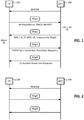
- Fig. 1 illustrates an example embodiment of a 4-step random access (RA) procedure for a wireless network according to this disclosure.
- a base station 100 which in this embodiment may be implemented as a next generation node B (gNB), may broadcast a master information block (MIB) and one or more system information blocks (SIBs) to any UEs within range such as UE 102.
- the MIB/SIB transmission(s) may include fundamental system information that a UE may use to communicate over the wireless network including information about the configuration of the RA procedure.
- a random access message exchange may be initiated by the UE 102 when it transmits a first message (Msg1) including a random access preamble to the gNB 100 over a physical random access channel (PRACH) which may be configured by the system information in the MIB/SIB.
- Msg1 a first message
- PRACH physical random access channel
- RA-RNTI random access radio network temporary identifier
- the UE 102 may select the preamble from two groups of preambles, Group A and Group B, which may be pre-configured by the network to indicate different sizes of a third message (Msg3) the UE 102 may transmit later through a physical uplink shared channel (PUSCH) as described below.
- PUSCH physical uplink shared channel
- the gNB 100 may use the random access preamble to allocate resources for the UE 102 to use to transmit Msg3 to the gNB 100 through the PUSCH.
- the division of preambles into groups may enable the gNB 100 to know how much information the UE 102 may send in Msg3.
- the gNB 100 may also use the random access preamble to calculate a timing advance (TA) that may be used by the UE 102 to adjust its uplink timing.
- TA timing advance
- Msg2 may be a random access response (RAR) which may include the calculated TA, a grant of uplink (UL) resources such as PUSCH time/frequency resources that the UE 102 may use to transmit Msg3, and/or a Temporary C radio network temporary identifier (TC-RNTI) which may be used by the UE 102 for the rest of the RA procedure.
- RAR random access response
- UL uplink
- TC-RNTI Temporary C radio network temporary identifier
- the UE 102 may use the calculated TA to adjust its uplink timing.
- the UE 102 may then transmit Msg3 to the gNB 100 using the PUSCH resources allocated by the uplink grant received in Msg2.
- the PUSCH transmission of Msg3 may be dynamically scheduled by the gNB 100 based on the grant of uplink resources.
- the data payload in Msg3 may contain, for example, a contention resolution sequence.
- Msg4 may include, for example, the same contention resolution sequence sent by the UE 102.
- the UE 102 may confirm that the contention resolution sequence sent by the gNB 100 is the same sequence it sent in Msg3. If the sequences match, the UE 102 may consider itself connected and promote the temporary identifier TC-RNTI to the dedicated UE identifier C-RNTI.
- Fig. 2 illustrates an example embodiment of a 2-step RA procedure for a wireless network according to this disclosure.
- a base station 104 which in this embodiment may be implemented as a next generation node B (gNB)
- gNB next generation node B
- the MIB/SIB transmission(s) may include fundamental system information that the UE 106 may use to communicate over the wireless network including information about the configuration of the RA procedure.
- the system information provided to the UE 106 may be different from that provided to the UE 102 in Fig. 1 , for example, to accommodate different pre-determined configurations, sets of resources, and/or the like, that may be used for a 2-step RA procedure.
- a 2-step RA procedure may begin with the UE 106 making one or more decisions to select a preamble, a PUSCH configuration, and/or a set of PUSCH resources to use for transmitting a payload portion of a first message (MsgA) as described in more detail below.
- MsgA first message
- a random access message exchange may be initiated by the UE 106 when it transmits MsgA, which may include two or more parts.
- MsgA may include two or more parts.
- the UE 106 may transmit a selected random access preamble to the gNB 104 over a PRACH which may be configured, for example, by the system information in the MIB/SIB. This may be referred to as a MsgA PRACH transmission.
- the UE 106 may transmit a data payload using a selected set of PUSCH resources as describe in more detail below. This may be referred to as a MsgA PUSCH transmission.
- a MsgA transmission may be implemented with two or more separate transmissions, for example, one for MsgA PRACH and one for MsgA PUSCH.
- the gNB 104 may determine the set of PUSCH resources selected and used by the UE 106, for example, based on a mapping between the preamble and the selected set of PUSCH resources as describe in more detail below.
- the data payload in the decoded MsgA PUSCH transmission may include, for example, contention resolution information.
- the gNB 104 may then send a second message (MsgB) back to the UE 106 which may include information similar to a RAR.
- MsgB may include the same contention resolution information sent by the UE 106 to enable the UE to confirm that it is connected to the network.
- each random access channel (RACH) occasion may be associated with a number of PUSCH resource sets.
- a number of preambles e.g., up to 64 preambles in some implementations
- a mapping may be implemented between the preambles and the PUSCH resource sets as described below.
- the components and/or operations are exemplary only. Some embodiments may involve various additional components and/or operations not illustrated, for example, retry operations. Some embodiments may omit some components and/or operations. Moreover, in some embodiments, the arrangement of components and/or the temporal order of the operations may be varied.
- Some embodiments according to this disclosure may implement various techniques to enable a UE to select resources to use for a PUSCH transmission to a gNB during a 2-step random access procedure, and to communicate the selection to the gNB so the gNB may know which resources to use to receive and/or decode the PUSCH transmission.
- a collection of pre-defined PUSCH resource sets for a specific PUSCH configuration may be provided to a gNB and one or more UEs. A UE may then select one of the PUSCH resource sets to use for a MsgA PUSCH transmission during a 2-step random access procedure.
- multiple PUSCH configurations may be used, wherein each configuration may have an associated collection of PUSCH resource sets. Multiple PUSCH configurations may be useful, for example, to enable a UE to prepare for a MsgA PUSCH transmission under different network conditions.
- a UE may first determine which configuration to use, and then select a specific PUSCH resource set from the collection associated with the selected configuration.
- the specific PUSCH resource set may be selected randomly from sets within the collection associated with the selected configuration.
- Random access preambles within each preamble group may be mapped to specific PUSCH resource sets within each configuration using, for example, one-to-one and/or multiple-to-one mapping.
- some or all of the random access preambles may be divided into preamble groups.
- one or more of the preamble groups may be mapped to one or more PUSCH configurations.
- each group of preambles may be mapped to a corresponding one of the configurations available at the UE and gNB.
- the UE may consequently select a preamble for the MsgA PRACH transmission from the preamble group which corresponds to the selected PUSCH configuration.
- preamble groups may be divided, at least in part, based on the size of an expected or potential data payload for the MsgA PUSCH transmission. For example, preambles in a first group may be used for PUSCH transmissions having a payload size greater than a certain threshold value, and preambles in a second group may be used otherwise. In some embodiments, preamble groups may be divided, at least in part, based on channel conditions such as, for example, a path loss between the UE and gNB. In other embodiments, preamble groups may be divided based on a combination of these and/or any other factors.
- a gNB may then determine which PUSCH configuration has been selected by the UE by detecting the preamble in the MsgA PRACH transmission and determining which group the preamble was selected from.
- preambles may be divided into non-overlapping groups such that a gNB may uniquely determine the PUSCH configuration based on the MsgA PRACH preamble.
- the gNB may then determine the specific set of PUSCH resources based on, for example, the one-to-one and/or multiple-to-one mapping used between the preambles within each preamble group and the specific PUSCH resource sets within each configuration.
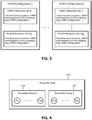
- Fig. 3 illustrates an example embodiment of some PUSCH configurations and resource sets according to this disclosure.
- a UE may be configured with G different PUSCH configurations.
- G may be any number including 1, 2, 3, etc.
- the first configuration may include a number N 1 of different PUSCH resource sets
- the second configuration may include a number N 2 of different PUSCH resource sets
- the last configuration number G which may include a number N G of different PUSCH resource sets.
- the PUSCH resource sets used for the MsgA PUSCH transmission may include, for example, any number of the following elements: time and/or frequency resources, demodulation reference signal (DMRS) resources such as DMRS ports and/or sequences, DMRS configuration, modulation coding scheme (MCS) selection, transport block size (TBS) selection, PUSCH mapping type, and/or the like.
- DMRS demodulation reference signal
- MCS modulation coding scheme
- TBS transport block size
- the PUSCH resource sets may be defined and/or constructed, for example, by a radio resource control layer (RRC) as part of a random access parameter and/or procedure initialization and/or configuration.
- RRC radio resource control layer
- a preamble grouping may be implemented as follows.
- a pool of preambles include of a total number N tot of preambles. Different preambles in the pool may be identified by label them with a preamble ID p i where i ⁇ ⁇ 1, ..., N tot ⁇ .
- a collection of G non-overlapping groups of preambles may be selected from the pool.
- a group of preambles may include R g distinct preambles, from which it may follow that R 1 + R 2 + ⁇ + R G ⁇ N tot .
- the set of R g preamble IDs in the group may be determined by p f g ( i ) where i ⁇ ⁇ 1, ..., R g ⁇ and the mapping functions f g ( i ) E ⁇ 1, ..., N tot ⁇ . Since, in some embodiments, each group may include distinct preambles, and the groups of preambles may be non-overlapping, it may follow that f g i ⁇ f k j , ⁇ g , k ⁇ 1 , ... , G , ⁇ i ⁇ 1 .. R G , ⁇ j ⁇ 1 , ... R k . In some embodiments, any set of functions f g ( i ) which satisfies the previous description may provide a valid preamble grouping.
- Fig. 4 illustrates an example embodiment of a preamble pool divided into two groups according to this disclosure.
- the specific details illustrated in Fig. 4 are exemplary only. Other embodiments may include any number of preamble groups, and any number of preambles within each group, which need not be equal across groups.
- Fig. 5 illustrates an example embodiment of a method for selecting preamble and a set of PUSCH resources for a PUSCH transmission in a 2-step random access procedure according to this disclosure.
- the method may begin at task 122 where a UE may decide to initiate a random access procedure by sending a MsgA to a gNB.
- the UE may determine which PUSCH configuration to use based on, for example, the network configuration, channel information and/or conditions, the potential size of MsgA PUSCH payload, and/or the like.
- the UE may determine, at task 126, a preamble group corresponding to the selected PUSCH configuration.
- the UE may select a random access (PRACH) preamble from the selected preamble group to be used for a MsgA PRACH transmission to the gNB. Also at task 128, the UE may select a PUSCH resource set from the selected PUSCH configuration to be used for a MsgA PUSCH transmission to the gNB.
- PRACH random access
- the illustrated components and/or operations are exemplary only. Some embodiments may involve various additional components and/or operations not illustrated, and some embodiments may omit some components and/or operations. Moreover, in some embodiments, arrangement of components and/or temporal order of the operations may be varied.
- Fig. 6 illustrates an example embodiment of a UE according to this disclosure.
- the embodiment 130 illustrated in Fig. 6 may include a radio transceiver 132 and a controller 134 which may control the operation of the transceiver 132 and/or any other components in the UE 130.
- the UE 130 may be used, for example, to implement any of the UE functionality described in this disclosure such as UE random access functionality.
- the transceiver 132 may transmit/receive one or more signals to/from a base station, and may include an interface unit for such transmissions/receptions. For example, the transceiver 132 may receive MIB/SIB information, random access related configuration information, and/or one or more synchronization signals from a base station. It may transmit one or more random access preambles, MsgA PRACH transmissions, MsgA PUSCH transmissions to a base station. It may receive responses thereto from the base station, for example, a MsgB transmission, RAR, and/or the like.
- the controller 134 may include, for example, one or more processors 136 and a memory 138 which may store instructions for the one or more processors 136 to execute to implement any of the UE functionality described in this disclosure.
- the controller 134 may be used to implement one or more decisions to select a preamble, a PUSCH configuration, and/or a set of PUSCH resources, and/or to implement various techniques to enable a UE to select resources to use for a PUSCH transmission to a gNB during a 2-step random access procedure, and to communicate the selection to the gNB so the gNB may know which resources to use to receive and/or decode the PUSCH transmission.
- the controller 134 may be used to implement, may be implemented as, may include, and/or may be included as part of, a medium access control (MAC) layer.
- MAC medium access control
- Fig. 7 illustrates an example embodiment of a base station according to this disclosure.
- the embodiment 140 illustrated in Fig. 7 may include a radio transceiver 142 and a controller 144 which may control the operation of the transceiver 142 and/or any other components in the base station 140.
- the base station 140 may be used, for example, to implement any of the base station functionality described in this disclosure such as base station random access functionality.
- the transceiver 142 may transmit/receive one or more signals to/from a base station, and may include an interface unit for such transmissions/receptions. For example, the transceiver 142 may transmit MIB/SIB information, random access related configuration information, and/or one or more synchronization signals to a UE. It may receive one or more random access preambles, MsgA PRACH transmissions, MsgA PUSCH transmissions and/or the like from a UE. It may transmit responses thereto to the UE, for example, a MsgB transmission, RAR, and/or the like.
- the controller 144 may include, for example, one or more processors 146 and a memory 148 which may store instructions for the one or more processors 146 to execute to implement any of the base station functionality described in this disclosure.
- the controller 144 may be used to implement one or more techniques to determine a PUSCH configuration, and/or a set of PUSCH resources selected by a UE during a 2-step random access procedure, and to receive and/or decode a MsgA PRACH transmission, MsgA PUSCH transmission and/or the like from a UE.
- the controller 144 may be used to implement, may be implemented as, may include, and/or may be included as part of, a medium access control (MAC) layer.
- MAC medium access control
- PUSCH may refer to any physical uplink shared channel
- PRACH may refer to any physical random access channel
- gNB may refer to any type of base station, etc.
- a reference to a component or element may refer to only a portion of the component or element.
- the use of terms such as “first” and “second” in this disclosure and the claims may only be for purposes of distinguishing the things they modify and may not indicate any spatial or temporal order unless apparent otherwise from context.
- a reference to a first thing may not imply the existence of a second thing.
- the various details and embodiments described above may be combined to produce additional embodiments according to the inventive principles of this patent disclosure.
Landscapes
- Engineering & Computer Science (AREA)
- Computer Networks & Wireless Communication (AREA)
- Signal Processing (AREA)
- Mobile Radio Communication Systems (AREA)
Applications Claiming Priority (2)
| Application Number | Priority Date | Filing Date | Title |
|---|---|---|---|
| US201962878102P | 2019-07-24 | 2019-07-24 | |
| US16/882,431 US20210029744A1 (en) | 2019-07-24 | 2020-05-22 | Methods and apparatus for mapping random access preamble groups to uplink channel configurations |
Publications (1)
| Publication Number | Publication Date |
|---|---|
| EP3771284A1 true EP3771284A1 (fr) | 2021-01-27 |
Family
ID=71078446
Family Applications (1)
| Application Number | Title | Priority Date | Filing Date |
|---|---|---|---|
| EP20178867.6A Withdrawn EP3771284A1 (fr) | 2019-07-24 | 2020-06-09 | Procédés et appareil de mappage de groupes de préambule à accès aléatoire avec des configurations de canal de liaison montante |
Country Status (6)
| Country | Link |
|---|---|
| US (1) | US20210029744A1 (fr) |
| EP (1) | EP3771284A1 (fr) |
| JP (1) | JP2021022926A (fr) |
| KR (1) | KR20210013524A (fr) |
| CN (1) | CN112312563A (fr) |
| TW (1) | TW202106099A (fr) |
Families Citing this family (4)
| Publication number | Priority date | Publication date | Assignee | Title |
|---|---|---|---|---|
| KR102853039B1 (ko) * | 2020-09-04 | 2025-09-01 | 한국전자통신연구원 | 통신 시스템에서 랜덤 액세스 절차를 사용하여 데이터를 전송하기 위한 방법 및 장치 |
| EP4247097B1 (fr) * | 2020-11-13 | 2025-10-08 | Guangdong Oppo Mobile Telecommunications Corp., Ltd. | Procédé et appareil de détermination de ressources d'accès aléatoire, dispositif réseau et support de stockage |
| CN114205916B (zh) * | 2021-11-12 | 2024-02-27 | 杭州昌泽信息技术有限公司 | 一种两阶段非正交随机接入的方法 |
| US20230328694A1 (en) * | 2022-04-12 | 2023-10-12 | Qualcomm Incorporated | Flexible uplink transmission skipping |
Family Cites Families (3)
| Publication number | Priority date | Publication date | Assignee | Title |
|---|---|---|---|---|
| US10631330B2 (en) * | 2015-04-03 | 2020-04-21 | Qualcomm Incorporated | Random access procedures under coverage limitations |
| US10827529B2 (en) * | 2016-06-24 | 2020-11-03 | Qualcomm Incorporated | Random access collision reduction based on multiple uplink grants |
| WO2018144586A1 (fr) * | 2017-02-02 | 2018-08-09 | Sharp Laboratories Of America, Inc. | Équipements d'utilisateurs, stations de base et procédés |
-
2020
- 2020-05-22 US US16/882,431 patent/US20210029744A1/en not_active Abandoned
- 2020-06-09 EP EP20178867.6A patent/EP3771284A1/fr not_active Withdrawn
- 2020-07-02 KR KR1020200081633A patent/KR20210013524A/ko not_active Withdrawn
- 2020-07-16 JP JP2020122284A patent/JP2021022926A/ja active Pending
- 2020-07-21 TW TW109124521A patent/TW202106099A/zh unknown
- 2020-07-23 CN CN202010716272.7A patent/CN112312563A/zh active Pending
Non-Patent Citations (4)
| Title |
|---|
| CATT: "2-step RACH procedure", vol. RAN WG2, no. Reno, USA; 20190513 - 20190517, 13 May 2019 (2019-05-13), XP051729252, Retrieved from the Internet <URL:http://www.3gpp.org/ftp/Meetings%5F3GPP%5FSYNC/RAN2/Docs/R2%2D1905753%2Ezip> [retrieved on 20190513] * |
| LG ELECTRONICS INC: "Criteria for 2-step RACH selection", vol. RAN WG2, no. Reno, USA; 20190513 - 20190517, 13 May 2019 (2019-05-13), XP051730041, Retrieved from the Internet <URL:http://www.3gpp.org/ftp/Meetings%5F3GPP%5FSYNC/RAN2/Docs/R2%2D1906580%2Ezip> [retrieved on 20190513] * |
| LG ELECTRONICS: "Discussion on preamble selection for 2-step RACH", vol. RAN WG1, no. Xian, China; 20190408 - 20190412, 7 April 2019 (2019-04-07), XP051699530, Retrieved from the Internet <URL:http://www.3gpp.org/ftp/Meetings%5F3GPP%5FSYNC/RAN1/Docs/R1%2D1904198%2Ezip> [retrieved on 20190407] * |
| VIVO: "Considerations on the 2-step RACH procedure", vol. RAN WG2, no. Xi'an, China; 20190408 - 20190412, 6 April 2019 (2019-04-06), XP051700434, Retrieved from the Internet <URL:http://www.3gpp.org/ftp/Meetings%5F3GPP%5FSYNC/RAN2/Docs/R2%2D1903077%2Ezip> [retrieved on 20190406] * |
Also Published As
| Publication number | Publication date |
|---|---|
| US20210029744A1 (en) | 2021-01-28 |
| TW202106099A (zh) | 2021-02-01 |
| JP2021022926A (ja) | 2021-02-18 |
| CN112312563A (zh) | 2021-02-02 |
| KR20210013524A (ko) | 2021-02-04 |
Similar Documents
| Publication | Publication Date | Title |
|---|---|---|
| US12507276B2 (en) | Random access method and apparatus for reduced capability terminal in wireless communication system | |
| US20240224344A1 (en) | Two-Step Contention-Based Random Access Over Radio Resources in LAA | |
| US12376146B2 (en) | User equipment and base station participating in prioritized random access | |
| CN111788861B (zh) | 用于执行随机接入的方法和装置 | |
| EP4054271B1 (fr) | Procédé et appareil permettant d'exécuter une procédure d'accès aléatoire basée sur la contention | |
| KR102502708B1 (ko) | 대역폭 부분 스위치에 의한 랜덤 액세스 | |
| US10779329B2 (en) | Random access response transmission method and device | |
| KR101969728B1 (ko) | Lte-a 시스템에서 반송파 집적을 이용한 랜덤 액세스 절차를 위한 방법 및 장치 | |
| RU2687033C1 (ru) | Передача ответного сообщения произвольного доступа | |
| EP3606266A1 (fr) | Procédé et dispositif d'accès aléatoire et d'instruction après retour arrière d'accès aléatoire | |
| EP3496500A1 (fr) | Procédé et dispositif d'accès aléatoire | |
| EP3952510B1 (fr) | Méthode et appareil pour configurer une ressource d'accès aléatoire, et station base | |
| KR20220002512A (ko) | 향상된 랜덤 액세스 절차의 시스템 및 방법 | |
| US20210029744A1 (en) | Methods and apparatus for mapping random access preamble groups to uplink channel configurations | |
| EP3788833B1 (fr) | Procédés, dispositif de communications et équipement d'infrastructure | |
| US20210058978A1 (en) | Method, device, computer-readable storage and carrier for random access | |
| CN110366261A (zh) | 一种连接态终端随机接入方法和装置 | |
| EP3427536B1 (fr) | Classification d'équipement utilisateur à l'aide d'un ensemble étendu de préambules d'accès aléatoire | |
| JP7695404B2 (ja) | ミッションクリティカルなユーザ機器のための第1のメッセージ反復 | |
| CN114586453B (zh) | 数据传输方法、装置、终端、网络设备和介质 | |
| CN109617656B (zh) | 终端、基站及混合自动重传请求harq过程标识id配置方法 |
Legal Events
| Date | Code | Title | Description |
|---|---|---|---|
| PUAI | Public reference made under article 153(3) epc to a published international application that has entered the european phase |
Free format text: ORIGINAL CODE: 0009012 |
|
| STAA | Information on the status of an ep patent application or granted ep patent |
Free format text: STATUS: THE APPLICATION HAS BEEN PUBLISHED |
|
| AK | Designated contracting states |
Kind code of ref document: A1 Designated state(s): AL AT BE BG CH CY CZ DE DK EE ES FI FR GB GR HR HU IE IS IT LI LT LU LV MC MK MT NL NO PL PT RO RS SE SI SK SM TR |
|
| AX | Request for extension of the european patent |
Extension state: BA ME |
|
| STAA | Information on the status of an ep patent application or granted ep patent |
Free format text: STATUS: REQUEST FOR EXAMINATION WAS MADE |
|
| 17P | Request for examination filed |
Effective date: 20210707 |
|
| RBV | Designated contracting states (corrected) |
Designated state(s): AL AT BE BG CH CY CZ DE DK EE ES FI FR GB GR HR HU IE IS IT LI LT LU LV MC MK MT NL NO PL PT RO RS SE SI SK SM TR |
|
| STAA | Information on the status of an ep patent application or granted ep patent |
Free format text: STATUS: EXAMINATION IS IN PROGRESS |
|
| 17Q | First examination report despatched |
Effective date: 20221209 |
|
| STAA | Information on the status of an ep patent application or granted ep patent |
Free format text: STATUS: THE APPLICATION IS DEEMED TO BE WITHDRAWN |
|
| 18D | Application deemed to be withdrawn |
Effective date: 20230420 |