EP3772331A1 - Körperüberwachungssystem mit einer mikronadel - Google Patents
Körperüberwachungssystem mit einer mikronadel Download PDFInfo
- Publication number
- EP3772331A1 EP3772331A1 EP19290067.8A EP19290067A EP3772331A1 EP 3772331 A1 EP3772331 A1 EP 3772331A1 EP 19290067 A EP19290067 A EP 19290067A EP 3772331 A1 EP3772331 A1 EP 3772331A1
- Authority
- EP
- European Patent Office
- Prior art keywords
- microneedle
- channel
- passage
- sensor
- sensor according
- Prior art date
- Legal status (The legal status is an assumption and is not a legal conclusion. Google has not performed a legal analysis and makes no representation as to the accuracy of the status listed.)
- Withdrawn
Links
- 238000012544 monitoring process Methods 0.000 title claims abstract description 19
- 239000000758 substrate Substances 0.000 claims abstract description 30
- 239000012491 analyte Substances 0.000 claims description 20
- XLYOFNOQVPJJNP-UHFFFAOYSA-N water Substances O XLYOFNOQVPJJNP-UHFFFAOYSA-N 0.000 claims description 8
- 238000000034 method Methods 0.000 claims description 6
- 239000000463 material Substances 0.000 claims description 5
- 230000004888 barrier function Effects 0.000 claims description 3
- 210000003491 skin Anatomy 0.000 description 26
- 238000005259 measurement Methods 0.000 description 19
- 239000002775 capsule Substances 0.000 description 12
- 238000000576 coating method Methods 0.000 description 9
- 239000011248 coating agent Substances 0.000 description 8
- 210000004369 blood Anatomy 0.000 description 7
- 239000008280 blood Substances 0.000 description 7
- 230000035515 penetration Effects 0.000 description 7
- WQZGKKKJIJFFOK-GASJEMHNSA-N Glucose Natural products OC[C@H]1OC(O)[C@H](O)[C@@H](O)[C@@H]1O WQZGKKKJIJFFOK-GASJEMHNSA-N 0.000 description 5
- 239000008103 glucose Substances 0.000 description 5
- 238000001514 detection method Methods 0.000 description 4
- 230000007794 irritation Effects 0.000 description 4
- 229910052710 silicon Inorganic materials 0.000 description 4
- 239000010703 silicon Substances 0.000 description 4
- 230000007704 transition Effects 0.000 description 4
- 239000012530 fluid Substances 0.000 description 3
- 239000007788 liquid Substances 0.000 description 3
- 238000012545 processing Methods 0.000 description 3
- 241000894006 Bacteria Species 0.000 description 2
- 229910004298 SiO 2 Inorganic materials 0.000 description 2
- 206010040880 Skin irritation Diseases 0.000 description 2
- 239000000853 adhesive Substances 0.000 description 2
- 238000004891 communication Methods 0.000 description 2
- 238000011161 development Methods 0.000 description 2
- 230000000694 effects Effects 0.000 description 2
- 230000035876 healing Effects 0.000 description 2
- 230000007170 pathology Effects 0.000 description 2
- 239000000523 sample Substances 0.000 description 2
- 230000036556 skin irritation Effects 0.000 description 2
- 231100000475 skin irritation Toxicity 0.000 description 2
- 210000000707 wrist Anatomy 0.000 description 2
- 230000001070 adhesive effect Effects 0.000 description 1
- 239000011324 bead Substances 0.000 description 1
- 210000001124 body fluid Anatomy 0.000 description 1
- 239000010839 body fluid Substances 0.000 description 1
- 210000004027 cell Anatomy 0.000 description 1
- 150000001875 compounds Chemical class 0.000 description 1
- 239000004020 conductor Substances 0.000 description 1
- 206010012601 diabetes mellitus Diseases 0.000 description 1
- 230000005684 electric field Effects 0.000 description 1
- 238000002848 electrochemical method Methods 0.000 description 1
- 230000005518 electrochemistry Effects 0.000 description 1
- 239000003792 electrolyte Substances 0.000 description 1
- 235000021183 entrée Nutrition 0.000 description 1
- 238000006911 enzymatic reaction Methods 0.000 description 1
- 210000002615 epidermis Anatomy 0.000 description 1
- 210000003722 extracellular fluid Anatomy 0.000 description 1
- 238000000605 extraction Methods 0.000 description 1
- 239000012212 insulator Substances 0.000 description 1
- 238000004519 manufacturing process Methods 0.000 description 1
- 239000000203 mixture Substances 0.000 description 1
- 238000012806 monitoring device Methods 0.000 description 1
- 210000005036 nerve Anatomy 0.000 description 1
- 230000003647 oxidation Effects 0.000 description 1
- 238000007254 oxidation reaction Methods 0.000 description 1
- 230000000149 penetrating effect Effects 0.000 description 1
- 210000002381 plasma Anatomy 0.000 description 1
- 229920000515 polycarbonate Polymers 0.000 description 1
- 239000004417 polycarbonate Substances 0.000 description 1
- 235000020004 porter Nutrition 0.000 description 1
- 230000002035 prolonged effect Effects 0.000 description 1
- 230000001737 promoting effect Effects 0.000 description 1
- 230000001681 protective effect Effects 0.000 description 1
- 238000006479 redox reaction Methods 0.000 description 1
- 238000012360 testing method Methods 0.000 description 1
Images
Classifications
-
- A—HUMAN NECESSITIES
- A61—MEDICAL OR VETERINARY SCIENCE; HYGIENE
- A61B—DIAGNOSIS; SURGERY; IDENTIFICATION
- A61B5/00—Measuring for diagnostic purposes; Identification of persons
- A61B5/145—Measuring characteristics of blood in vivo, e.g. gas concentration or pH-value ; Measuring characteristics of body fluids or tissues, e.g. interstitial fluid or cerebral tissue
- A61B5/14503—Measuring characteristics of blood in vivo, e.g. gas concentration or pH-value ; Measuring characteristics of body fluids or tissues, e.g. interstitial fluid or cerebral tissue invasive, e.g. introduced into the body by a catheter or needle or using implanted sensors
-
- A—HUMAN NECESSITIES
- A61—MEDICAL OR VETERINARY SCIENCE; HYGIENE
- A61B—DIAGNOSIS; SURGERY; IDENTIFICATION
- A61B5/00—Measuring for diagnostic purposes; Identification of persons
- A61B5/145—Measuring characteristics of blood in vivo, e.g. gas concentration or pH-value ; Measuring characteristics of body fluids or tissues, e.g. interstitial fluid or cerebral tissue
- A61B5/14507—Measuring characteristics of blood in vivo, e.g. gas concentration or pH-value ; Measuring characteristics of body fluids or tissues, e.g. interstitial fluid or cerebral tissue specially adapted for measuring characteristics of body fluids other than blood
- A61B5/1451—Measuring characteristics of blood in vivo, e.g. gas concentration or pH-value ; Measuring characteristics of body fluids or tissues, e.g. interstitial fluid or cerebral tissue specially adapted for measuring characteristics of body fluids other than blood for interstitial fluid
- A61B5/14514—Measuring characteristics of blood in vivo, e.g. gas concentration or pH-value ; Measuring characteristics of body fluids or tissues, e.g. interstitial fluid or cerebral tissue specially adapted for measuring characteristics of body fluids other than blood for interstitial fluid using means for aiding extraction of interstitial fluid, e.g. microneedles or suction
-
- A—HUMAN NECESSITIES
- A61—MEDICAL OR VETERINARY SCIENCE; HYGIENE
- A61B—DIAGNOSIS; SURGERY; IDENTIFICATION
- A61B5/00—Measuring for diagnostic purposes; Identification of persons
- A61B5/145—Measuring characteristics of blood in vivo, e.g. gas concentration or pH-value ; Measuring characteristics of body fluids or tissues, e.g. interstitial fluid or cerebral tissue
- A61B5/14532—Measuring characteristics of blood in vivo, e.g. gas concentration or pH-value ; Measuring characteristics of body fluids or tissues, e.g. interstitial fluid or cerebral tissue for measuring glucose, e.g. by tissue impedance measurement
-
- A—HUMAN NECESSITIES
- A61—MEDICAL OR VETERINARY SCIENCE; HYGIENE
- A61B—DIAGNOSIS; SURGERY; IDENTIFICATION
- A61B5/00—Measuring for diagnostic purposes; Identification of persons
- A61B5/145—Measuring characteristics of blood in vivo, e.g. gas concentration or pH-value ; Measuring characteristics of body fluids or tissues, e.g. interstitial fluid or cerebral tissue
- A61B5/1455—Measuring characteristics of blood in vivo, e.g. gas concentration or pH-value ; Measuring characteristics of body fluids or tissues, e.g. interstitial fluid or cerebral tissue using optical sensors, e.g. spectral photometrical oximeters
- A61B5/14551—Measuring characteristics of blood in vivo, e.g. gas concentration or pH-value ; Measuring characteristics of body fluids or tissues, e.g. interstitial fluid or cerebral tissue using optical sensors, e.g. spectral photometrical oximeters for measuring blood gases
- A61B5/14552—Details of sensors specially adapted therefor
-
- A—HUMAN NECESSITIES
- A61—MEDICAL OR VETERINARY SCIENCE; HYGIENE
- A61B—DIAGNOSIS; SURGERY; IDENTIFICATION
- A61B5/00—Measuring for diagnostic purposes; Identification of persons
- A61B5/145—Measuring characteristics of blood in vivo, e.g. gas concentration or pH-value ; Measuring characteristics of body fluids or tissues, e.g. interstitial fluid or cerebral tissue
- A61B5/1468—Measuring characteristics of blood in vivo, e.g. gas concentration or pH-value ; Measuring characteristics of body fluids or tissues, e.g. interstitial fluid or cerebral tissue using chemical or electrochemical methods, e.g. by polarographic means
-
- A—HUMAN NECESSITIES
- A61—MEDICAL OR VETERINARY SCIENCE; HYGIENE
- A61B—DIAGNOSIS; SURGERY; IDENTIFICATION
- A61B5/00—Measuring for diagnostic purposes; Identification of persons
- A61B5/145—Measuring characteristics of blood in vivo, e.g. gas concentration or pH-value ; Measuring characteristics of body fluids or tissues, e.g. interstitial fluid or cerebral tissue
- A61B5/1468—Measuring characteristics of blood in vivo, e.g. gas concentration or pH-value ; Measuring characteristics of body fluids or tissues, e.g. interstitial fluid or cerebral tissue using chemical or electrochemical methods, e.g. by polarographic means
- A61B5/1473—Measuring characteristics of blood in vivo, e.g. gas concentration or pH-value ; Measuring characteristics of body fluids or tissues, e.g. interstitial fluid or cerebral tissue using chemical or electrochemical methods, e.g. by polarographic means invasive, e.g. introduced into the body by a catheter
-
- A—HUMAN NECESSITIES
- A61—MEDICAL OR VETERINARY SCIENCE; HYGIENE
- A61B—DIAGNOSIS; SURGERY; IDENTIFICATION
- A61B5/00—Measuring for diagnostic purposes; Identification of persons
- A61B5/68—Arrangements of detecting, measuring or recording means, e.g. sensors, in relation to patient
- A61B5/6846—Arrangements of detecting, measuring or recording means, e.g. sensors, in relation to patient specially adapted to be brought in contact with an internal body part, i.e. invasive
- A61B5/6847—Arrangements of detecting, measuring or recording means, e.g. sensors, in relation to patient specially adapted to be brought in contact with an internal body part, i.e. invasive mounted on an invasive device
- A61B5/685—Microneedles
-
- A—HUMAN NECESSITIES
- A61—MEDICAL OR VETERINARY SCIENCE; HYGIENE
- A61M—DEVICES FOR INTRODUCING MEDIA INTO, OR ONTO, THE BODY; DEVICES FOR TRANSDUCING BODY MEDIA OR FOR TAKING MEDIA FROM THE BODY; DEVICES FOR PRODUCING OR ENDING SLEEP OR STUPOR
- A61M37/00—Other apparatus for introducing media into the body; Percutany, i.e. introducing medicines into the body by diffusion through the skin
- A61M37/0015—Other apparatus for introducing media into the body; Percutany, i.e. introducing medicines into the body by diffusion through the skin by using microneedles
-
- A—HUMAN NECESSITIES
- A61—MEDICAL OR VETERINARY SCIENCE; HYGIENE
- A61B—DIAGNOSIS; SURGERY; IDENTIFICATION
- A61B2562/00—Details of sensors; Constructional details of sensor housings or probes; Accessories for sensors
- A61B2562/04—Arrangements of multiple sensors of the same type
-
- A—HUMAN NECESSITIES
- A61—MEDICAL OR VETERINARY SCIENCE; HYGIENE
- A61B—DIAGNOSIS; SURGERY; IDENTIFICATION
- A61B2562/00—Details of sensors; Constructional details of sensor housings or probes; Accessories for sensors
- A61B2562/16—Details of sensor housings or probes; Details of structural supports for sensors
- A61B2562/164—Details of sensor housings or probes; Details of structural supports for sensors the sensor is mounted in or on a conformable substrate or carrier
-
- A—HUMAN NECESSITIES
- A61—MEDICAL OR VETERINARY SCIENCE; HYGIENE
- A61B—DIAGNOSIS; SURGERY; IDENTIFICATION
- A61B5/00—Measuring for diagnostic purposes; Identification of persons
- A61B5/68—Arrangements of detecting, measuring or recording means, e.g. sensors, in relation to patient
- A61B5/6801—Arrangements of detecting, measuring or recording means, e.g. sensors, in relation to patient specially adapted to be attached to or worn on the body surface
- A61B5/6802—Sensor mounted on worn items
- A61B5/681—Wristwatch-type devices
-
- A—HUMAN NECESSITIES
- A61—MEDICAL OR VETERINARY SCIENCE; HYGIENE
- A61M—DEVICES FOR INTRODUCING MEDIA INTO, OR ONTO, THE BODY; DEVICES FOR TRANSDUCING BODY MEDIA OR FOR TAKING MEDIA FROM THE BODY; DEVICES FOR PRODUCING OR ENDING SLEEP OR STUPOR
- A61M37/00—Other apparatus for introducing media into the body; Percutany, i.e. introducing medicines into the body by diffusion through the skin
- A61M37/0015—Other apparatus for introducing media into the body; Percutany, i.e. introducing medicines into the body by diffusion through the skin by using microneedles
- A61M2037/0053—Methods for producing microneedles
Definitions
- the present invention relates to a device for measuring a body analyte. More specifically, it relates to a body monitoring device by analyzing body fluid, typically interstitial.
- Certain pathologies such as diabetes require daily monitoring of biochemical parameters of the human body, in particular the concentrations of certain compounds (blood sugar in the example of glucose).
- Transcutaneous probes have been proposed alternatively in the form of a self-adhesive patch placing a “micro-needle sensor” just under the skin, so as to put the sensor in permanent fluid communication with the interstitial liquid, for continuous monitoring.
- Some of these patch-type transcutaneous probes include wireless communication means making it possible to send the measurements on the interstitial liquid to a mobile terminal, for storage and / or processing of the measurements (checking thresholds and variations, producing statistics. , triggering alerts if necessary, etc. ) .
- the sugarBEAT TM or FreeStyle Libre systems will be mentioned.
- the main aim of the invention is to remedy the problems thus posed.
- the aim of the present invention is in particular to provide a sensor comprising an array of microneedles, the wearing of which by a user limits irritation and / or the development of bacteria.
- a sensor for a body monitoring system comprising at least one substrate intended to come into contact with the skin, and at least one microneedle, the microneedle being mounted fixedly on the substrate, characterized in that the substrate comprises an open channel which surrounds the base of the microneedle, the microneedle having a central axis of symmetry, and the channel having a minimum height in the direction of the central axis greater than 20 ⁇ m, and having a minimum width greater than 200 ⁇ m in a direction radial to the central axis, the channel forming a cavity in which the microneedle is housed.
- Another aspect of the invention is a body monitoring system, comprising a sensor in accordance with the invention, and further comprising a module configured to exploit an electrical signal delivered by the sensor and to provide information representative of an analyte.
- this system further comprises at least one opening connecting at least one channel outside the system.
- Another aspect of the invention is a body monitoring method comprising a step in which a sensor in accordance with the invention is used.
- Electrode is understood to mean a conductive device making it possible to pick up the variations in electric potential in a living organism.
- An electrode comprises a terminal having a connection end and at least one sensing end through which an electric potential or an electric current is transmitted, each sensing end being carried by a microneedle.
- the electrode can thus have a single detection end. It can also include a plurality of detection ends. In this case, it will be noted that the electrode remains unique, even though several detection ends are intended to penetrate into the body of a living organism.
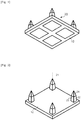
- a sensor comprises a support plate 10 provided with four micro-needles 20.
- the contour of the plate can be the subject of numerous variant embodiments.
- the plate 10 has a square outline.
- the four microneedles are respectively located near the corners of the plate 10.
- the microneedles 20 extend perpendicular to the base plane of the plate 10. In other words, the central axis 21 of each microneedle 20 extends perpendicular to the surface base plate 10.
- the face of the plate 10 opposite the microneedles 20 comprises four electrically conductive pads 30, each pad 30 being electrically connected to the active part 25 of each microneedle 20.
- the electrically conductive pads 30 allow electrical continuity of an electrode when they are electrically connected to a base, for example working or a counter-electrode, in the microneedle 20, and this potentially separately so that each working electrode is independent of the other working electrodes.
- these areas 30 can be integral with the microneedles 20 or electrically connected to the microneedles 20 by any suitable means through or around the plate 10.
- the support plate 10 can be made of any suitable material electrically, for example electrically. insulator or conductor.
- microneedles 20 can be formed from any suitable material.
- the microneedles 20 are suitable for conveying an electrical signal picked up by the active surface 25.
- the microneedles 20 can be formed based on polycarbonate or silicon.
- the microneedle or needles 20 are preferably full, that is to say without any cavity.
- the microneedle can mainly comprise silicon.
- the microneedle has an outer layer of non-conductive protective SiO 2 , formed by oxidation of the silicon on the surface.
- the microneedle may not include an additional coating to the SiO 2 layer.
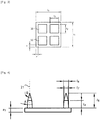
- each microneedle 20 comprises a base shank 22 and a pointed apex 24.
- the shank 22 can preferably be thinned towards the apex 24 of the microneedle 20.
- the apex 24 has a slope greater than that of the shaft 22. , that is to say that it forms an angle B with the central axis 21 greater than the angle A formed between the base shank 22 and the central axis 21.
- the microneedle 20 has a break or slope transition 23 between the base shank 22 and the pointed top. The slope transition 23 can be materialized by an edge.
- the base shank 22 and the pointed top 24 may have a square section.
- the base shank 22 is quadrangular and the point 24 is of the pyramidal type.
- the whole of the microneedle 20 can preferably have the shape of an obelisk.
- the microneedle 20 may have a circular section.
- the base shank 22 has the shape of a truncated circular cone of revolution and the point 24 is formed of a conical point of revolution.
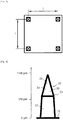
- the pointed apex 24 extends exclusively at a distance of between 350 ⁇ m and 1100 ⁇ m from the base of the base shaft 22 of the microneedle, that is to say from the face 12 of the support plate 10. , and preferably between 600 ⁇ m and 1000 ⁇ m from the base of the microneedle and this surface 12 of the support plate 10.
- the area of the active detection part 25 must be between 0.04 and 0.9 mm 2 . Consequently, when the measurement is made with a single microneedle 20, the active part 25 of this microneedle 20 is between 0.04 and 0.9 mm 2 . When the measurement is carried out with several microneedles 20, the area of the aforementioned active part, between 0.04 and 0.9 mm 2, means the total active area of the micro-needles considered.
- microneedles 20 or the shape of a similar circular body of revolution but having a break in slope between the base shank 22 and the pointed top 24, makes it possible to solve a problem posed by microneedles 20 known to the state of the art, namely to minimize the diameter of penetration into the skin while maximizing the surface area of the active part present in the part of the skin between the epidermis and the nerves.
- Microneedles 20 in accordance with the present invention can be made using any suitable microfabrication process.
- the active part 25 comprises an electrically conductive face, preferably covered with a coating which is the subject of various variants depending on the type of measurement sought and the type of analyte to be measured.
- the active part 25 is provided with a coating suitable for carrying out an enzymatic reaction with glucose.
- the active part 25 may also not include a coating specific to a predetermined analyte, for example in the case of the active part 25 of a counter electrode or of a reference electrode.
- microneedle or needles 20 in accordance with the invention make it possible to reduce the number of microneedles 20 of a working electrode 70.
- a working electrode comprises between one and seven, in particular between one and five and preferably between one and three parts.
- active 25 each covering at least part of the surface of the tip apex 24 of a different microneedle 20.
- the systems known from the state of the art do not allow the use of so few microneedles.
- the invention making it possible to drastically reduce the number of microneedles 20 necessary for the measurement compared to the systems known from the state of the art, it is possible, for a given sensor surface, to minimize the density of microneedles.
- Each pair of adjacent microneedles 20 is preferably separated by a distance between the tips of the peaks 24 of at least 1mm and preferably at least 1.5mm, or possibly at least 1.8mm. This has the effect of preventing a homogeneous deformation of the skin when a network of microneedles 20 is brought into contact with the skin, known in other technical fields under the name of the fakir effect, and on the contrary of promoting a deformation of the skin located around each of the microneedles.
- the pain caused by the penetration of needles into the skin can be significantly reduced, or even eliminated, and the penetration occurs very naturally, the needles having in fact become mechanically independent.
- the center distance l 3 between each pair of microneedles 20 is of the order of 1.5 mm.
- the sensor is preferably suitable for measuring the presence or the concentration of an analyte by electrochemistry.
- a sensor may include a working electrode 70, adapted to assess the presence of an analyte in the body of a user.
- the working electrode 70 comprises at least a first end electrically connected to a module configured to exploit the electrical signal from the working electrode 70, and at least a second end formed by the active part 25. It can also include a plurality. of second ends.
- the active part 25 of the microneedle 20 covers at least part of the surface of the peaked apex 24 and preferably the entire surface of the peaked apex 24.
- the active part 25, at the level of the peaked apex 24 is coated with any coating suitable for the desired measurement, typically a coating suitable for detecting blood glucose electrochemically.
- the sensor can include a counter electrode.
- the counter-electrode may include a first end intended to be electrically connected to a module configured to exploit an electrical signal, and at least one other end making it possible to exploit an electrical signal in the user's body.
- the other end of the counter-electrode can cover a micro-needle against the electrode, for example a micro-needle according to the invention.
- the counter electrode does not have the same active surface prerequisites as the working electrode.
- the peaked apex of the counter-electrode can extend exclusively at a distance of between 100 ⁇ m and 1100 ⁇ m from the base shank of the microneedle.
- the other end of the counter electrode may cover the entire surface of the counter electrode microneedle.
- each working electrode can be adapted to detect the same analyte as another working electrode, or be adapted to detect an analyte. different from another working electrode.
- each working electrode may comprise an active part comprising the same type of coating.
- each working electrode may also include different active parts, comprising different coatings, but adapted to detect the same analyte. The concentration of the analyte can thus be detected with more precision than using a single coating for the active part 25.
- Each electrode can also be adapted to detect different analytes. Thus, it is possible to monitor several pathologies with the same monitoring system.
- the microneedle or needles 20 can be arranged on a support plate 10.
- the thickness e 1 of the support plate is advantageously between 0.1 mm and 1 mm, and preferably of the order of 0.2 mm.
- the dimensions of the microneedles 20 can be the subject of numerous variant embodiments. The same is true for the support plate 10.
- the support plate 10 has sides having a width l 1 less than 10mm, advantageously less than 3mm, for example of the order of 2.3mm.
- the electrically conductive areas 30 are for example square areas having a side l 2 of the order of 0.8 mm. These areas 30 may be located at a distance e 2 of the order of 0.2 mm from the edges of the support plate.
- the support plates 10 can themselves be the subject of different variant embodiments. Certain support plates 10 can be adapted to support for example four microneedles while other support plates 10 can be adapted to support only two microneedles 20.
- the present invention can make it possible to measure the blood glucose level independently using a plurality of working electrodes 70. This has an undeniable advantage over the state of the art according to which such an independent measurement using a working electrode comprising a single microneedle was not possible because the measurement signal was too noisy using a single microneedle.
- the sensor preferably comprises several working electrodes 70, the measuring system being adapted to individually measure the electric potential of each of the working electrodes 70.
- the measurement of the potential of each of the working electrodes 70 can be multiplexed.
- the sensor according to the present invention can be implemented in different types of body monitoring system.
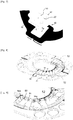
- the senor according to the invention is implemented in a monitoring system of the type illustrated in the figures 7 to 10 annexed.
- Such a system comprises a case 40 in the form of a watch case comprising a strap 42 adapted to surround the wrist of an individual.
- the box 40 houses a module configured to use the electrical signal delivered by each microneedle 20 and provide information representative of a physical quantity of the fluid, typically of a blood sugar level.
- the body monitoring system preferably used according to the invention comprises a capsule 50 comprising at least one sensor of the aforementioned type, and preferably a plurality of sensors as will be described in more detail below.
- the body monitoring system according to the invention furthermore comprises a patch 60 to which the capsule 50 is linked, the patch 60 itself being provided with an adhesive making it possible to adhere the patch and capsule assembly 50 to the skin of the body. 'an individual.
- the capsule 50 preferably has the general shape of a ring comprising a plurality of recessed housings 52 adapted to each respectively receive the support plate 10 of a said sensor.
- the capsule 50 may comprise electrically conductive pads 54 intended to be placed opposite the electrically conductive pads 30 provided on the support plate 10, to provide an electrical connection between the microneedles 20 and the module provided in the housing 40 to exploit the signal electrical thus taken.
- the pads 54 are themselves interconnected with the aforementioned module by electrically conductive tracks 56a.
- some of the ranges 54 can be individually connected to the aforementioned processing module by tracks 56a while other areas 54 can be connected to the processing module by common tracks 56b.
- the sensor comprises a substrate on which the microneedle or needles are fixedly mounted.
- substrate is meant for example the assembly of a support plate 10 and of a support base 80, or the surface of a capsule 50.
- the substrate, or at least part of the substrate, is intended to come into contact. with the user's skin.
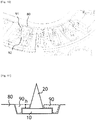
- the substrate comprises an open channel 90 which surrounds the base of the microneedle (s) 20.
- the term “open” channel is understood to mean that one of the walls of the channel 90, or part of the walls of the channel 90 may be missing, the channel 90 being adapted so that the skin of a user, when it is in contact with the substrate, comes to form the missing wall of the channel 90.
- an air channel 90 surrounds the microneedle or needles 20. This makes it possible to keep the opening of the skin caused by the penetration of the microneedle in contact with the air. Thus, irritations are avoided.
- the skin has a flexibility that allows it to adapt to different types of non-planar shapes.
- the channel has a minimum height h in the direction of the central axis 21 of a microneedle greater than 20 ⁇ m.
- the minimum height h of the channel is greater than 100 ⁇ m.
- the channel preferably has a minimum width in a direction radial to the central axis 21 of greater than 200 ⁇ m and preferably more than 1000 ⁇ m. This keeps an air reservoir high enough for healing of the skin around the microneedle 20.
- Channel 90 can be formed by many geometries.
- the substrate may have a cavity in which the microneedle 20 is housed, forming the channel 90 open around the base of the microneedle 20.
- the channel 90 can be connected to the outside of the sensor and / or the system by a passage 91.
- the passage 91 can be defined by the substrate, like the channel 90.
- the passage 91 can be an open passage 91, ie. that is to say that one of the walls of the passage 91, or a part of the walls of the passage 91 may be missing, the passage 91 being adapted so that the skin of a user, when it is in contact with the substrate, comes to form the missing wall of the passage 91.
- the air surrounding the base of one or more microneedles 20 can be renewed via the passage 91, which allows for example to regulate the humidity level in the channel 90 and d 'avoid skin irritation.
- the passage 91 may have a minimum height in the direction of the central axis 21 greater than 100 ⁇ m, and has a minimum width greater than 100 ⁇ m in a direction transverse to the central axis 21. Thus, it is possible to ensure sufficient air flow to channel 90 or to the outside, so as to avoid skin irritation.
- the substrate may preferably have the general shape of a ring having a central orifice.
- the passage 91 can connect the channel 90 of each needle to the central orifice.
- the passage has a width of at least 100 ⁇ m and preferably of at least 300 ⁇ m in a direction transverse to the central axis 21.
- the sensor can also include at least one opening 92, making it possible to connect at least two channels 90.
- the air surrounding the microneedle or needles 20 can do anything. likewise be renewed via the opening 92.
- a passage 91 can thus be preferably common to at most two hundred micro-needles, advantageously at most sixteen micro-needles and preferably at most eight micro-needles. Beyond that, the air supply may be more difficult.
- the passage 91 may preferably comprise a barrier made of semi-permeable material, that is to say impermeable to water and permeable to air. Thus, if the sensor and / or the system is accidentally contacted with water, the introduction of water around the needles can be avoided. As a variant, it is possible to define a width of the passage or passages 91 small enough to avoid the introduction of water by capillary repulsion. The width of the passage 91 can thus be less than 500 ⁇ m and preferably less than 400 ⁇ m.
- the present invention also relates to a method for monitoring the body using a sensor comprising a microneedle of the aforementioned type.
- the monitoring method comprises a step of measuring bodily analyte using a microneedle 20 in accordance with one embodiment of the invention.
- the sensor can comprise a plurality of working electrodes.
- the measurement can for example be implemented by polarizing the working electrode (s) and the counter-electrode (s) at an electrical potential suitable for causing an oxidation-reduction reaction involving the analyte to be measured.
- the measuring step can preferably be carried out at least using two different working electrodes.
- the measuring step can for example be implemented independently, successively on each of the working electrodes 70, or in parallel on each of the working electrodes 70.
- the concentration of the electrolyte can be analyzed more precisely than 'With a system comprising for example a single working electrode having several ends in the form of microneedles.
- Another aspect of the invention is a method for measuring a body analyte comprising a step of penetrating the microneedles of a sensor according to the invention into the skin of a user.
- the needles of the sensor can be introduced into the skin without an applicator, due to the spacing of the microneedles 20.
- a low force compared to the force provided by an applicator can be used for the penetration of microneedles.
- a force of less than 50 newtons, and preferably less than 30 newtons can be used for the penetration of the microneedles 20.
- the penetration of the microneedles can be implemented with the hand, or preferably with mechanical attachment means. of the system, for example a bracelet.
Landscapes
- Health & Medical Sciences (AREA)
- Life Sciences & Earth Sciences (AREA)
- Physics & Mathematics (AREA)
- Engineering & Computer Science (AREA)
- Medical Informatics (AREA)
- Animal Behavior & Ethology (AREA)
- Veterinary Medicine (AREA)
- Public Health (AREA)
- General Health & Medical Sciences (AREA)
- Heart & Thoracic Surgery (AREA)
- Biomedical Technology (AREA)
- Biophysics (AREA)
- Molecular Biology (AREA)
- Surgery (AREA)
- Pathology (AREA)
- Optics & Photonics (AREA)
- Chemical Kinetics & Catalysis (AREA)
- Emergency Medicine (AREA)
- General Chemical & Material Sciences (AREA)
- Chemical & Material Sciences (AREA)
- Anesthesiology (AREA)
- Dermatology (AREA)
- Hematology (AREA)
- Spectroscopy & Molecular Physics (AREA)
- Measurement Of The Respiration, Hearing Ability, Form, And Blood Characteristics Of Living Organisms (AREA)
Priority Applications (5)
| Application Number | Priority Date | Filing Date | Title |
|---|---|---|---|
| EP19290067.8A EP3772331A1 (de) | 2019-08-08 | 2019-08-08 | Körperüberwachungssystem mit einer mikronadel |
| US17/633,396 US20220287598A1 (en) | 2019-08-08 | 2020-08-07 | Body monitoring system comprising a microneedle |
| PCT/EP2020/072312 WO2021023884A1 (fr) | 2019-08-08 | 2020-08-07 | Systeme de surveillance corporelle comprenant une microaiguille |
| CN202080053045.9A CN114144112B (zh) | 2019-08-08 | 2020-08-07 | 包括微针的身体监测系统 |
| EP20753937.0A EP4009865B1 (de) | 2019-08-08 | 2020-08-07 | Körperüberwachungssystem mit einer mikronadel |
Applications Claiming Priority (1)
| Application Number | Priority Date | Filing Date | Title |
|---|---|---|---|
| EP19290067.8A EP3772331A1 (de) | 2019-08-08 | 2019-08-08 | Körperüberwachungssystem mit einer mikronadel |
Publications (1)
| Publication Number | Publication Date |
|---|---|
| EP3772331A1 true EP3772331A1 (de) | 2021-02-10 |
Family
ID=67981992
Family Applications (2)
| Application Number | Title | Priority Date | Filing Date |
|---|---|---|---|
| EP19290067.8A Withdrawn EP3772331A1 (de) | 2019-08-08 | 2019-08-08 | Körperüberwachungssystem mit einer mikronadel |
| EP20753937.0A Active EP4009865B1 (de) | 2019-08-08 | 2020-08-07 | Körperüberwachungssystem mit einer mikronadel |
Family Applications After (1)
| Application Number | Title | Priority Date | Filing Date |
|---|---|---|---|
| EP20753937.0A Active EP4009865B1 (de) | 2019-08-08 | 2020-08-07 | Körperüberwachungssystem mit einer mikronadel |
Country Status (4)
| Country | Link |
|---|---|
| US (1) | US20220287598A1 (de) |
| EP (2) | EP3772331A1 (de) |
| CN (1) | CN114144112B (de) |
| WO (1) | WO2021023884A1 (de) |
Families Citing this family (7)
| Publication number | Priority date | Publication date | Assignee | Title |
|---|---|---|---|---|
| US12109032B1 (en) | 2017-03-11 | 2024-10-08 | Biolinq Incorporated | Methods for achieving an isolated electrical interface between an anterior surface of a microneedle structure and a posterior surface of a support structure |
| US12599337B1 (en) | 2017-08-08 | 2026-04-14 | Biolinq Incorporated | Method and system for confirmation of microneedle-based analyte-selective sensor insertion into viable tissue via electrical interrogation |
| US20220031244A1 (en) | 2020-07-29 | 2022-02-03 | Biolinq Inc. | Continuous analyte monitoring system with microneedle array |
| FR3120779B1 (fr) | 2021-03-19 | 2024-02-09 | Pkvitality | Capteur pour dispositif de surveillance corporelle limitant les irritations |
| CN113777145B (zh) * | 2021-09-14 | 2024-12-06 | 北京大学 | 一种微针生物传感器制造方法 |
| EP4658168A2 (de) | 2023-02-02 | 2025-12-10 | Biolinq, Inc. | Verfahren zur verbesserten sensorempfindlichkeit eines kontinuierlichen analytüberwachungssystems auf mikronadelbasis |
| US12318224B2 (en) | 2023-02-23 | 2025-06-03 | Aquilx Incorporated | Wearable biosensor device |
Citations (7)
| Publication number | Priority date | Publication date | Assignee | Title |
|---|---|---|---|---|
| US20060030812A1 (en) * | 2004-08-05 | 2006-02-09 | Nevenka Golubovic-Liakopoulos | System and method for drug delivery and microfluidic applications using microneedles |
| US20150313527A1 (en) * | 2012-12-07 | 2015-11-05 | Ascilion Ab | A mocrofabricated sensor and a method of sensing the level of a component in bodily fluid |
| US20180161563A1 (en) * | 2015-12-04 | 2018-06-14 | Ascilion Ab | A microneedle and a chip |
| US20180338713A1 (en) * | 2013-11-11 | 2018-11-29 | Sandia Corporation | Integrated fluidic chip for transdermal sensing of physiological markers |
| US20180362334A1 (en) * | 2017-06-16 | 2018-12-20 | Spts Technologies Limited | Microneedles |
| CN109303976A (zh) * | 2018-11-07 | 2019-02-05 | 何坛明 | 一种药物均匀分布导入的微针结构 |
| US20190143090A1 (en) * | 2016-04-29 | 2019-05-16 | Kimberly-Clark Worldwide, Inc. | Microneedle array assembly, drug delivery device and method for administering liquid across a broad area at low pressure |
Family Cites Families (7)
| Publication number | Priority date | Publication date | Assignee | Title |
|---|---|---|---|---|
| IL134997A0 (en) * | 2000-03-09 | 2001-05-20 | Yehoshua Yeshurun | Health care system based on micro device |
| US6908453B2 (en) * | 2002-01-15 | 2005-06-21 | 3M Innovative Properties Company | Microneedle devices and methods of manufacture |
| WO2006110723A2 (en) * | 2005-04-11 | 2006-10-19 | Infotonics Technology Center, Inc. | Blood monitoring systems and methods thereof |
| US20110306853A1 (en) * | 2010-03-19 | 2011-12-15 | Michael Darryl Black | Body fluid sampling/fluid delivery device |
| JP6207459B2 (ja) * | 2014-05-15 | 2017-10-04 | 富士フイルム株式会社 | 経皮吸収シートの製造方法 |
| TWI640296B (zh) * | 2017-12-12 | 2018-11-11 | 研能科技股份有限公司 | 血糖偵測裝置 |
| WO2019213520A1 (en) * | 2018-05-04 | 2019-11-07 | University Of Cincinnati | Membrane enhanced sensors |
-
2019
- 2019-08-08 EP EP19290067.8A patent/EP3772331A1/de not_active Withdrawn
-
2020
- 2020-08-07 EP EP20753937.0A patent/EP4009865B1/de active Active
- 2020-08-07 WO PCT/EP2020/072312 patent/WO2021023884A1/fr not_active Ceased
- 2020-08-07 CN CN202080053045.9A patent/CN114144112B/zh not_active Withdrawn - After Issue
- 2020-08-07 US US17/633,396 patent/US20220287598A1/en active Pending
Patent Citations (7)
| Publication number | Priority date | Publication date | Assignee | Title |
|---|---|---|---|---|
| US20060030812A1 (en) * | 2004-08-05 | 2006-02-09 | Nevenka Golubovic-Liakopoulos | System and method for drug delivery and microfluidic applications using microneedles |
| US20150313527A1 (en) * | 2012-12-07 | 2015-11-05 | Ascilion Ab | A mocrofabricated sensor and a method of sensing the level of a component in bodily fluid |
| US20180338713A1 (en) * | 2013-11-11 | 2018-11-29 | Sandia Corporation | Integrated fluidic chip for transdermal sensing of physiological markers |
| US20180161563A1 (en) * | 2015-12-04 | 2018-06-14 | Ascilion Ab | A microneedle and a chip |
| US20190143090A1 (en) * | 2016-04-29 | 2019-05-16 | Kimberly-Clark Worldwide, Inc. | Microneedle array assembly, drug delivery device and method for administering liquid across a broad area at low pressure |
| US20180362334A1 (en) * | 2017-06-16 | 2018-12-20 | Spts Technologies Limited | Microneedles |
| CN109303976A (zh) * | 2018-11-07 | 2019-02-05 | 何坛明 | 一种药物均匀分布导入的微针结构 |
Also Published As
| Publication number | Publication date |
|---|---|
| CN114144112B (zh) | 2022-10-28 |
| CN114144112A (zh) | 2022-03-04 |
| US20220287598A1 (en) | 2022-09-15 |
| WO2021023884A1 (fr) | 2021-02-11 |
| EP4009865B1 (de) | 2024-11-06 |
| EP4009865A1 (de) | 2022-06-15 |
Similar Documents
| Publication | Publication Date | Title |
|---|---|---|
| EP4009865B1 (de) | Körperüberwachungssystem mit einer mikronadel | |
| EP3829437B1 (de) | Mikronadeleindringungsmanagement | |
| US11865289B2 (en) | On-body microsensor for biomonitoring | |
| FR3099696A1 (fr) | Systeme de surveillance corporelle comprenant une microaiguille | |
| FR3117766A1 (fr) | Dispositif de surveillance corporelle a gamme de detection etendue | |
| EP3829418B1 (de) | Metall-oberflächen-verhältnis einer mikrokanüle | |
| EP4009864B1 (de) | Körperüberwachungssystem mit einer mikronadel | |
| EP4009867A1 (de) | Körperüberwachungssystem mit einer mikronadel | |
| EP4404825B1 (de) | Anordnung zur vorbereitung eines sensors für eine körperüberwachungsvorrichtung | |
| EP3772330A1 (de) | Körperüberwachungssystem mit einer mikronadel | |
| EP4186421B1 (de) | Verfahren zur herstellung eines elementaren moduls eines mikronadelsensors | |
| FR3138320A1 (fr) | Procédé de fabrication d’une micro-aiguille et en particulier métallisation de la pointe d’une microaiguille | |
| EP1363699B1 (de) | Implantierbare elektrodenstruktur | |
| FR3138774A1 (fr) | Procédé de fabrication d’une micro-aiguille en particulier métallisation de la pointe d’une microaiguille. | |
| EP4099902B1 (de) | Gerät mit heftpflaster zur messung eines analyts | |
| EP4319635A1 (de) | Körperüberwachungsvorrichtung mit verbesserten elektrischen kontakten | |
| EP4056529B1 (de) | Verfahren zum ätzen eines lochs und verfahren zur herstellung einer mikronadel unter verwendung eines solchen lochs | |
| WO2022195236A1 (fr) | Capteur pour dispositif de surveillance corporelle limitant les irritations | |
| FR3110382A1 (fr) | Capteur pour système de surveillance corporelle monté en surface | |
| EP4395642A1 (de) | Körperüberwachungsvorrichtung mit verbesserten kontakten |
Legal Events
| Date | Code | Title | Description |
|---|---|---|---|
| PUAI | Public reference made under article 153(3) epc to a published international application that has entered the european phase |
Free format text: ORIGINAL CODE: 0009012 |
|
| STAA | Information on the status of an ep patent application or granted ep patent |
Free format text: STATUS: REQUEST FOR EXAMINATION WAS MADE |
|
| 17P | Request for examination filed |
Effective date: 20190812 |
|
| AK | Designated contracting states |
Kind code of ref document: A1 Designated state(s): AL AT BE BG CH CY CZ DE DK EE ES FI FR GB GR HR HU IE IS IT LI LT LU LV MC MK MT NL NO PL PT RO RS SE SI SK SM TR |
|
| AX | Request for extension of the european patent |
Extension state: BA ME |
|
| STAA | Information on the status of an ep patent application or granted ep patent |
Free format text: STATUS: THE APPLICATION HAS BEEN WITHDRAWN |
|
| 18W | Application withdrawn |
Effective date: 20210329 |