EP3774155B1 - Widerstandspunktschweisskopf mit integriertem beschleunigungsmesser - Google Patents
Widerstandspunktschweisskopf mit integriertem beschleunigungsmesser Download PDFInfo
- Publication number
- EP3774155B1 EP3774155B1 EP19719110.9A EP19719110A EP3774155B1 EP 3774155 B1 EP3774155 B1 EP 3774155B1 EP 19719110 A EP19719110 A EP 19719110A EP 3774155 B1 EP3774155 B1 EP 3774155B1
- Authority
- EP
- European Patent Office
- Prior art keywords
- electrode
- weld
- acceleration data
- pgw
- acceleration
- Prior art date
- Legal status (The legal status is an assumption and is not a legal conclusion. Google has not performed a legal analysis and makes no representation as to the accuracy of the status listed.)
- Active
Links
Images




Classifications
-
- B—PERFORMING OPERATIONS; TRANSPORTING
- B23—MACHINE TOOLS; METAL-WORKING NOT OTHERWISE PROVIDED FOR
- B23K—SOLDERING OR UNSOLDERING; WELDING; CLADDING OR PLATING BY SOLDERING OR WELDING; CUTTING BY APPLYING HEAT LOCALLY, e.g. FLAME CUTTING; WORKING BY LASER BEAM
- B23K11/00—Resistance welding; Severing by resistance heating
- B23K11/24—Electric supply or control circuits therefor
- B23K11/25—Monitoring devices
-
- B—PERFORMING OPERATIONS; TRANSPORTING
- B23—MACHINE TOOLS; METAL-WORKING NOT OTHERWISE PROVIDED FOR
- B23K—SOLDERING OR UNSOLDERING; WELDING; CLADDING OR PLATING BY SOLDERING OR WELDING; CUTTING BY APPLYING HEAT LOCALLY, e.g. FLAME CUTTING; WORKING BY LASER BEAM
- B23K11/00—Resistance welding; Severing by resistance heating
- B23K11/24—Electric supply or control circuits therefor
- B23K11/25—Monitoring devices
- B23K11/252—Monitoring devices using digital means
- B23K11/253—Monitoring devices using digital means the measured parameter being a displacement or a position
-
- B—PERFORMING OPERATIONS; TRANSPORTING
- B23—MACHINE TOOLS; METAL-WORKING NOT OTHERWISE PROVIDED FOR
- B23K—SOLDERING OR UNSOLDERING; WELDING; CLADDING OR PLATING BY SOLDERING OR WELDING; CUTTING BY APPLYING HEAT LOCALLY, e.g. FLAME CUTTING; WORKING BY LASER BEAM
- B23K11/00—Resistance welding; Severing by resistance heating
- B23K11/10—Spot welding; Stitch welding
- B23K11/11—Spot welding
-
- B—PERFORMING OPERATIONS; TRANSPORTING
- B23—MACHINE TOOLS; METAL-WORKING NOT OTHERWISE PROVIDED FOR
- B23K—SOLDERING OR UNSOLDERING; WELDING; CLADDING OR PLATING BY SOLDERING OR WELDING; CUTTING BY APPLYING HEAT LOCALLY, e.g. FLAME CUTTING; WORKING BY LASER BEAM
- B23K11/00—Resistance welding; Severing by resistance heating
- B23K11/10—Spot welding; Stitch welding
- B23K11/11—Spot welding
- B23K11/115—Spot welding by means of two electrodes placed opposite one another on both sides of the welded parts
-
- B—PERFORMING OPERATIONS; TRANSPORTING
- B23—MACHINE TOOLS; METAL-WORKING NOT OTHERWISE PROVIDED FOR
- B23K—SOLDERING OR UNSOLDERING; WELDING; CLADDING OR PLATING BY SOLDERING OR WELDING; CUTTING BY APPLYING HEAT LOCALLY, e.g. FLAME CUTTING; WORKING BY LASER BEAM
- B23K31/00—Processes relevant to this subclass, specially adapted for particular articles or purposes, but not covered by any single one of main groups B23K1/00 - B23K28/00
- B23K31/12—Processes relevant to this subclass, specially adapted for particular articles or purposes, but not covered by any single one of main groups B23K1/00 - B23K28/00 relating to investigating the properties, e.g. the weldability, of materials
- B23K31/125—Weld quality monitoring
-
- G—PHYSICS
- G01—MEASURING; TESTING
- G01P—MEASURING LINEAR OR ANGULAR SPEED, ACCELERATION, DECELERATION, OR SHOCK; INDICATING PRESENCE, ABSENCE, OR DIRECTION, OF MOVEMENT
- G01P15/00—Measuring acceleration; Measuring deceleration; Measuring shock, i.e. sudden change of acceleration
- G01P15/02—Measuring acceleration; Measuring deceleration; Measuring shock, i.e. sudden change of acceleration by making use of inertia forces using solid seismic masses
- G01P15/08—Measuring acceleration; Measuring deceleration; Measuring shock, i.e. sudden change of acceleration by making use of inertia forces using solid seismic masses with conversion into electric or magnetic values
- G01P15/12—Measuring acceleration; Measuring deceleration; Measuring shock, i.e. sudden change of acceleration by making use of inertia forces using solid seismic masses with conversion into electric or magnetic values by alteration of electrical resistance
- G01P15/122—Measuring acceleration; Measuring deceleration; Measuring shock, i.e. sudden change of acceleration by making use of inertia forces using solid seismic masses with conversion into electric or magnetic values by alteration of electrical resistance by metal resistance strain gauges, e.g. wire resistance strain gauges
-
- B—PERFORMING OPERATIONS; TRANSPORTING
- B23—MACHINE TOOLS; METAL-WORKING NOT OTHERWISE PROVIDED FOR
- B23K—SOLDERING OR UNSOLDERING; WELDING; CLADDING OR PLATING BY SOLDERING OR WELDING; CUTTING BY APPLYING HEAT LOCALLY, e.g. FLAME CUTTING; WORKING BY LASER BEAM
- B23K9/00—Arc welding or cutting
- B23K9/22—Percussion welding
Definitions
- the disclosure relates to an apparatus having resistance spot weld heads that are configured for both opposed and parallel gap resistance spot welding, see claim 1.
- Resistance spot welding is a welding technique that includes joining metal surfaces together through the heat generated from electrical resistance as a result of running current through the two surfaces.
- Current may be routed to the metal surfaces through a first electrode and routed away from the metal surfaces through a second electrode.
- two electrodes may execute a resistance spot weld (RSW) in an opposed weld configuration, where the two electrodes are substantially aligned on a single axis and approach each other (or one moving electrode approaches another relatively stationary electrode) to execute the weld to surfaces between the two electrodes.
- RSW resistance spot weld
- two electrodes may execute a RSW in a parallel gap configuration where the two electrodes simultaneously approach and contact one or more components that define the metal surfaces along different adjacent parallel axes to execute the weld.
- two electrodes may execute a RSW in a step weld configuration where the two electrodes simultaneously approach and contact one or more components that define the metal surfaces along different adjacent parallel axes to execute the weld, where one electrode contacts the one or more components at a relatively greater depth than the other electrode.
- US 8 886 359 B2 according to its abstract describes a robot, which has a robot mechanism unit having a sensor and a control unit:
- the control unit includes a normal control unit that controls the operation of the robot mechanism unit, and a learning control unit hat, when the robot mechanism unit operated by a speed command that is given by multiplying a teaching speed designated in a task program by a speed change ratio, performs learning to calculate, from a detection result by the sensor, a learning correction amount for making the trajectory or position of the control target in the robot mechanism unit approach the target trajectory or target position, or for reducing the vibration of the control target, and performs processes so that the control target position of the robot mechanism unit moves along a fixed trajectory regardless of the speed change ratio.
- An apparatus is defined in claim 1, and comprises a resistance spot weld (RSW) head that defines a PGW configuration and an opposed welding configuration.
- the RSW head includes one or more processing circuits, a first electrode, and a second electrode.
- the first electrode and the second electrode are configured to execute a parallel gap RSW (hereinafter referred to as a PGW) on a first component secured to a first base when the RSW head is in the PGW configuration.
- the first electrode is configured to execute an opposed weld with a third electrode of a second base on a second component secured to the second base when the RSW head is in the opposed welding configuration.
- the RSW head includes an accelerometer securely attached to the first electrode at a location adjacent to the first electrode.
- the one or more processing circuits are configured to cause the accelerometer to gather a PGW set of acceleration data of the first electrode during the PGW and gather an opposed weld set of acceleration data of the first electrode during the opposed weld.
- the RSW head may include a second accelerometer securely mounted to the second electrode that may collect a third set of acceleration data during the PGW.
- the one or more processing circuits are configured to determine that the PGW set of acceleration data gathered during the PGW when the RSW head is in the PGW configuration indicates a first welding defect by including at least one acceleration value outside of a threshold acceleration range.
- the one or more processing circuits are configured to determine that the opposed weld set of acceleration data gathered during the opposed weld when the RSW head is in the opposed welding configuration indicates a second welding defect by including at least one acceleration value outside of the threshold acceleration range.
- the weld head may include two arms that each are configured to receive an electrode configured for executing RSW.
- the two electrodes of the two arms may be used to execute either parallel gap RSW (hereinafter referred to as PGW) to one or more components secured to a first base or step RSW (hereinafter referred to as a step weld) to one or more components that define contact points at two different depths as secured to the first base, while an electrode embedded in a second base may be used along with one of the electrodes of the weld head to execute an opposed RSW (hereinafter referred to as opposed welding or an opposed weld) to one or more components secured to the second base.
- PGW parallel gap RSW
- a first base or step RSW hereinafter referred to as a step weld
- an electrode embedded in a second base may be used along with one of the electrodes of the weld head to execute an opposed RSW (hereinafter referred to as opposed welding or an opposed weld) to one or more components secured to the second
- the weld head may include at least one accelerometer secured adjacent one of the electrodes.
- the accelerometer may be configured to gather accelerometer data of the electrode as the electrode is executing a RSW.
- One or more processing circuits that are integrated into the weld head and/or integrated into a separate computing device may be configured to analyze the accelerometer data and determine if the RSW resulted in a welding defect.
- the processing circuits may be configured to determine that the accelerometer data indicates a defect when the accelerometer data includes data points satisfying one or more criteria, such as being out of a range threshold.
- the processing circuits may be configured to determine that the acceleration data indicates a welding defect if one or more acceleration values are either greater than a maximum threshold or lower than a minimum threshold during a predetermined time window of the RSW during which the respective acceleration values occurred.
- the weld head may provide current to an electrode of one of the arms, such both electrodes may press down upon and weld together two metal surfaces resting upon a first base when the current flows through the surface to the other electrode.
- the current may be provided to either the electrode of one of the two arms that is executing the opposed weld or current may be provided to an electrode embedded of a second base, such that the current may pass from one of these two electrodes through two metal surfaces resting upon the second base and into the other respective electrode to weld the two surfaces together.
- a welding system may switch between executing PGW, step welding, and opposed welding by merely swapping out which base is secured to the welding station (e.g., a base without an electrode for PGW and/or step welds or a base with an electrode for opposed welding), swapping out an electrode secured to an arm (e.g., securing a relatively longer electrode that can extend to a relatively lower depth during the weld), and/or resecuring an arm to a different location on the weld head (e.g., a lower relative location to enable the same electrode to extend to a relatively lower depth during the weld) depending upon the application.
- base e.g., a base without an electrode for PGW and/or step welds or a base with an electrode for opposed welding
- swapping out an electrode secured to an arm e.g., securing a relatively longer electrode that can extend to a relatively lower depth during the weld
- an arm e.g., securing a relatively longer electrode that can extend
- Configuring a welding system to alternate between PGW, step welding, and opposed welding by only switching and/or resecuring a single component may increase a speed at which the welding system may sequentially alternate between the configurations.
- Increasing a speed with which an operator may reconfigure a welding system to execute PGW, step welds, and/or opposed welds may enable the welding station to accommodate all three (or more) processes during production, reducing a need for additional stations to provide the alternative processes.
- the two arms may each define an aperture configured to receive a securing mechanism such as a bolt.
- a securing mechanism may be inserted through one of the apertures of a respective arm and also inserted into an aperture of the weld head to secure the respective arm to the weld head.
- each arm may define a plurality of apertures, such that the securing mechanism may be inserted through a different aperture of the arm to secure the respective electrode at a different location relative to the weld head. In this way, electrodes may be moved to different locations relative to the weld head in order to execute RSWs at different locations for different metal surfaces by securing respective arms to the weld head using different apertures.
- a weld head may be configured to quickly be configured to execute a plurality of PGWs and/or step welds with different corresponding gaps between the electrodes (e.g., where a predetermined gap distance correlates to predetermined apertures).
- FIG. 1 is a conceptual and schematic diagram of welding system 10 that includes weld head 12 configured to execute RSWs.
- FIG. 1 includes XYZ axes that are referenced herein for purposes of clarity, though weld systems 10 may have different orientations in different examples.
- Weld head 12 may include one or more arms 14A, 14B (collectively, “arms 14") that each are configured to receive at least one electrode 16A, 16B (collectively, “electrodes 16") that execute RSWs.
- arms 14A, 14B collectively, “electrodes 16"
- electrodes 16 Electrodes 16
- one or both electrodes 16 may be configured to execute a PGW, step weld, and an opposed weld as discussed herein.
- Electrodes 16 may be many conductive elements, such as, e.g., class 2 copper, class 1 copper, or silica loaded copper. Electrodes may be any size consistent with the disclosure herein. For example, electrodes 16 may define a 3.175 millimeter x 3.175 millimeter cross section at a "top" portion (e.g., where electrodes 16 are secured to arms 14) and a 1.015 millimeter x 0.635 millimeter cross-section at a "bottom” portion (e.g., where electrodes 16 contact components 20 as discussed herein). In some examples, electrodes 16 may define different cross-sectional shapes, such as circular, ovaloid, triangular, or the like.
- Base 18 and weld head 12 may both be secured to a common location at a welding station.
- weld head 12 may move towards base 18 to execute a PGW, step weld, and/or an opposed weld.
- weld head 12 may be secured to a moving stage that can be lowered or otherwise moved along the Z axis toward a relatively stationary base 18.
- Arms 14 may be configured to be moveable relative to weld head 12 when executing a PGW, step weld, and/or an opposed weld.
- one or both electrodes 16 may be secured to weld head 12 partially through spring 34 that is configured to longitudinally condense along the Z axis when electrodes 16 contact components 22A, 22B (collectively, components "22") that are secured to base 18.
- spring 34 may cause electrodes 16 to provide a physical force upon components 22.
- Locknuts of welding system 10 can be adjusted to modify this physical force as described herein.
- One or more components of welding system 10 e.g., such as a displacement sensor
- Control software may monitor this physical force and displacement to determine when the linear stage should stop (e.g., when the physical force and/or displacement satisfy a threshold level.
- control software identifies that the linear stage should stop
- power source 42 fires current through one electrode 16 that passes through the components 22 and passes back to power source to execute the PGW, step weld, or opposed weld.
- weld head 12 is retracted up Z-axis away from components 22 enabling spring 34 to stretch to a normal "resting" state and therein move arms 14 and electrodes 16 back to a "starting" state.
- Both base 18 and weld head 12 may be secured to a single welding station on an assembly line.
- Base 18 may be secured to a common location through one or more bores 36 of base 18 while weld head 12 is secured to the common location through one or more bores 38.
- base 18 may be fixedly secured to a first shelf through a first set of securing mechanisms that are inserted into bores 36 while weld head 12 is fixedly secured to a second shelf with securing mechanisms inserted through at least a first bore 38 (e.g., securing mechanisms such as a bolt or pin).
- base 18 may be secured to common location through other means, such as using a clamp or the like the mechanically secure base 18 to a location adjacent weld head 12.
- base 18 may be directly secured to weld head 12 (not depicted).
- Base 18 may be one of a plurality of bases that are used in conjunction with weld head 12, such that different examples of base 18 may be unsecured and interchanged for alternative applications as described herein.
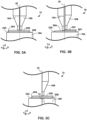
- base 18A as depicted in FIG. 3A is configured for PGW
- another base 18 is configured is configured for step welding
- another base 18B as depicted in FIG. 3C is configured for opposed welding.
- a same base e.g., base 18A
- an operator may only need to swap out a base (e.g., 18A or 18B) that is coupled to welding system 10 to switch between opposed weld and PGW/stepped weld functionality.
- Electrodes 16 execute a RSW weld of surfaces 20A, 20B (collectively, "surfaces 20") of components 22A, 22B (collectively, “components 22") secured upon base 18.
- Components 22 may include medical devices.
- two medical devices components 22 may be stacked on each other as secured to base 18 such that respective surfaces 20 of the components 22 are substantially coplanar as they contact each other (e.g., such that the two surfaces 20A, 20B are substantially flush with each other once components 22 are secured to base 18).
- the surfaces 20 may be planar with an XY plane as secured to base 18.
- components 22 are depicted as having a visible height (e.g., as measured along Z axis) herein for purposes of clarity, components 22 may define a relatively small height that may not be visible to the naked eye. For example, components 22 may define a height between 0.5 and 1.3 millimeters, though components 22 may be other sizes in other examples.
- one or both electrodes 16 may be lowered toward surfaces 20 of components 22 as weld head 12 is lowered toward base 18. Though two components 22 that each define respective surfaces 20 are depicted in FIG.
- electrodes 16 may be used to weld together two surfaces 20 of a single component, or execute a weld on a single surface of a single component, or weld together more than two surfaces 20 of more than two components 22.
- Weld head 12 includes accelerometer 24.
- Accelerometer 24 is configured to gather acceleration data of at least one of electrodes 16 as electrodes 16 move during the execution of the PGW, step weld, or opposed weld.
- accelerometer 24 may be configured to gather acceleration data while current is provided to one electrode of welding system 10 that flows throw both surfaces 20 to exit out another electrode of welding system 10.
- Accelerometer 24 may gather motion of one or both electrodes 16 relative to weld head 12, such motion being possible at least partially as a result of electrodes 16 being moveably attached to weld head 12 using springs 34 and slides (e.g., slide 130 of FIG. 6 ) as discussed herein.
- Accelerometer 24 may be configured to be fixedly secured to weld head 12 at a position adjacent to electrode 16, such that substantially each movement of electrode 16 along the Z axis may be substantially matched or otherwise measured by accelerometer 24.
- both accelerometer 24 and electrode 16B may be secured to arm 14B of weld head 12, such that both accelerometer 24 and electrode 16B move in conjunction as electrodes 16 executes RSWs as described herein.
- Accelerometer 24 may be configured to transmit acceleration data to computing device 26 of welding system 10.
- Computing device 26 may include one or more processing circuits that are configured to use acceleration data from accelerometer 24 to determine if a weld executed by electrodes 16 was defective.
- computing device 26 may further control and/or cause weld head 12 to execute PGW, step weld, and/or opposed welding.
- computing device 26 may cause current to be routed to one of electrodes 16 to execute an RSW, and/or computing device 26 may cause arms 14 to approach surfaces 20 in order to execute an RSW.
- FIG. 1 computing device 26 is depicted as a discrete component in comparison to weld head 12, in other examples one or more aspects of computing device 26 may be integrated into weld head 12.
- accelerometer 24 may be directly coupled to computing device 26.
- accelerometer 24 may transmit data over a computing network, such as a private local area network (LAN) or wide area network (WAN), or a public network such as the internet.
- computing device 26 may be configured to determine if the acceleration data indicates a welding defect. For example, computing device 26 may determine if that acceleration data as gathered by accelerometer 24 indicates a welding defect if the acceleration data includes one or more acceleration data points that are outside of a predetermined threshold data range.
- the acceleration data as gathered by accelerometer 24 and received by computing device 26 may include a plurality of acceleration data points.
- Accelerometer 24 may include a ceramic sensing element with a sensitivity of around 0.5 millivolts/(meter/second 2 ), +20%., a measurement range of (+9810 meters/second 2 peak, and a sampling rate of around 20,000 per/second.
- Acceleration data points may include negative (e.g, in a first direction along the Z axis) and/or positive (e.g., in a second and opposite direction along the Z axis) values. Acceleration data points are discussed and depicted herein are in meters/second 2 (m/s 2 ), though acceleration data may be recorded, received, or manipulated in any unit. Acceleration data points may be associated with a time during the weld at which the acceleration data was recorded.
- a weld may take 0.007 seconds to execute, and accelerometer 24 may record a plurality of acceleration data points that occur during the 0.007 seconds, where each recorded acceleration data point is identified and stored as associated with the relative time (e.g., a time between 0.000 seconds and 0.007 seconds) during the weld at which point the acceleration data was recorded.
- the relative time e.g., a time between 0.000 seconds and 0.007 seconds
- the predetermined threshold data range as stored and/or accessed by computing device 26 may include different acceleration data ranges for one or more different time spans of an RSW.
- a threshold data range for a given RSW may contain a plurality of upper and lower threshold values that correspond to different time periods of a weld such that the "envelope" of acceptable acceleration values may grow or shrink or encompass a different range of values at different points during a RSW.
- the number or range of acceptable acceleration values e.g., values that are between the upper threshold and lower threshold
- the number or range of acceptable acceleration values may increase, and similarly as the upper threshold decreases and/or the lower threshold increases the number or range of acceptable acceleration values may decrease.
- an acceleration data point that may be within the respective threshold range for the point in time during which the acceleration data point was gathered may be outside of (e.g., greater than upper threshold or lower than the lower threshold) the range for the other times of the weld.
- Computing device 26 may send results to display 28 of welding system 10.
- Computing device 26 may cause display 28 to provide a visual alert relating to detected welding defects.
- computing device 26 may cause display 28 to present a red light that indicates the welding defect, or present the text "WARNING IMD WELD 25813 FAILURE" or the like.
- computing device 26 may maintain a record of detected welding defects for future use.
- computing device 26 may compile a list of components 22 as potentially defective as computing device 26 analyzes data from accelerometer 24 and/or other sensors, subsequently providing a report on this complete list of components 22 (e.g., for an entire run of a plurality of components 22).
- Computing device 26 may cause display 28 to provide the visual alert for the benefit of a human operator that may further inspect or otherwise actively fix or discard the device that underwent the potentially defective weld. Computing device 26 may additional cause display 28 to display a positive indication if no defect was detected from the acceleration data.
- computing device 26 may cause removal mechanism 30 of welding system 10 to remove components 22 of surfaces 20 that underwent the potentially defective weld from base 18.
- Removal mechanism 30 may include a mechanical arm or the like that grasps, sweeps, or otherwise removes components 22 from base 18. Removal mechanism 30 may remove components 22 from an assembly line that includes welding system 10 to a separate location. For example, removal mechanism 30 may deposit components 22 in a discrete location designated for defective components, or components that otherwise require further inspection.
- Welding system 10 may include power source 42.
- Power source 42 may be configured to provide current to one of electrodes 16 to execute PGW, step welds, and opposed welds as discussed herein.
- Power source 42 may be coupled to one or more leads 32A-32C (collectively "leads 32").
- lead 32A that is configured to provide current to electrodes of welding system 10
- power source 42 may be coupled to leads 32B, 32C that are configured to return current to power source 42 to complete a circuit.
- lead 32A may be coupled to electrode 16B that is used in each of PGWs, step welds, and opposed welds, while lead 32B is configured to be coupled to an electrode secured within base 18 (e.g., electrode 74 of FIG. 3C ) that is configured to return current to power source 42 during opposed welds, while lead 32C is configured to be coupled to electrode 16A that is configured to return current to power source 42 during PGWs and/or step welds.
- electrode secured within base 18 e.g., electrode 74 of FIG. 3C
- Weld head 12 may be substantially mirrored across central plane 18 of weld head 12.
- both arms 14 may be substantially mirrored across central plane 18 as secured to weld head 12.
- Electrodes 16 may be on either side of central plane 25.
- welding system 10 may include additional sensors with accelerometer 24.
- computing device 26 may detect and indicate a defective weld if any of a number of sensors of welding system 10 detects a failure. In other examples, computing device 26 may only detect and indicate a defective weld if two or more sensors (e.g., including accelerometer 24) affirmatively identify a defective weld.
- welding system may include a current sensor that detects a current running through electrodes 16, a voltage sensor that detects voltage level across electrodes, a resistance sensor that detects resistance levels of electrodes, or a displacement sensor that detects displacement of electrodes 16.
- FIG. 2 is a functional block diagram illustrating components of computing device 26 of FIG. 1 .
- Computing device 26 includes interfaces 50, processing circuits 52, and memory 54.
- Computing device 26 may include any number of interfaces 50, processing circuits 52, and memory 54 components.
- Interfaces 50 may enable computing device 26 to communicate with one or more external components, such as weld head 12, accelerometer 24, display 28, and/or removal mechanism 30. Though weld head 12, accelerometer 24, computing device 26, display 28, and removal mechanism 30 are all depicted in FIG. 1 as separate and discrete components, in some examples one or more of weld head 12, accelerometer, display 26, and/or removal mechanism 30 may be directly coupled to or incorporated within computing device 26 and accessed using interfaces 50.
- Interfaces 50 may include one or more network interface cards, such as Ethernet cards, and/or any other types of interface devices that can send and receive information. Any suitable number of interfaces 50 may be used to perform the described functions according to particular needs.
- Computing device 26 may include one or more processing circuits 52 configured to implement functionality and/or process instructions as described herein.
- processing circuits 52 may be configured to execute instructions as stored in memory 54.
- Processing circuits 52 may include, for example, microprocessors, digital signal processors (DSPs), application specific integrated circuits (ASICs), field-programmable gate arrays (FPGAs), and/or equivalent discrete or integrated logic circuitry. Though in FIG.
- processing circuits 52 are depicted as separate from memory 54, in other examples one or more elements or portions of memory 54 may include one or more processing circuits 52, or instructions stored in memory 54 as described herein may be hard-coded into one or more processing circuits 52 (e.g., such that no instructions of identifying weld defects as described herein are stored within memory 54 of computing device 26).
- Computing device 26 may include memory 54 configured to store information within computing device 26.
- Memory 54 may include a computer-readable storage medium or computer-readable storage device.
- memory 54 may include one or more of a short-term memory or a long-term memory.
- Memory 54 may include, for example, random access memories (RAM), dynamic random-access memories (DRAM), static random-access memories (SRAM), magnetic hard discs, optical discs, floppy discs, flash memories, or forms of electrically programmable memories (EPROM), or electrically erasable and programmable memories (EEPROM).
- RAM random access memories
- DRAM dynamic random-access memories
- SRAM static random-access memories
- EPROM electrically programmable memories
- EEPROM electrically erasable and programmable memories
- memory 54 may store logic (e.g., logic of identifying weld defects using acceleration data as discussed herein) for execution by one or more processing circuits 52.
- memory 54 may be used by computing device 26 to temporarily or pseudo-permanently store information during program execution.
- computing device 26 may store one or more threshold ranges 58 and/or defect data 60 in memory 54.
- computing device 26 may store more or less data in memory 54, or may store the same data in a different structure or organization.
- Memory 54 may include defect controller 56.
- Defect controller 56 may include instructions to be executed by one or more processing circuits 52 of computing device 26 to perform the functions of computing device 26 as described herein.
- defect controller 56 may be configured to identify weld defects using acceleration data as gathered by accelerometer 24.
- Defect controller 56 may receive acceleration data and determine whether or not the acceleration data is within threshold ranges 58.
- Defect controller 56 may determine a particular threshold range 58 that is applicable to the respective weld. For example, defect controller 56 may identify whether weld head 12 executed an RSW in opposed weld, step weld, or PGW configuration.
- Defect controller 56 may determine whether or not weld head 12 executed an RSW in opposed weld, step weld, or PGW configuration by detecting where current flows during an RSW weld (e.g., from electrode 16 of weld head 12 to an electrode of base 18 or from one electrode 16A of weld head 12 to another electrode 16B of weld head 12). Further, defect controller 56 may identify and utilize different threshold ranges 58 based on a set of apertures used to secure arms 14 to weld head 12 and/or a detected type of electrode 16 secured to weld head 12 as described herein. In other examples defect controller 56 may use other variables or factors to identify and utilize one or more threshold ranges 58 as stored in memory 54.
- FIGS. 3A-3C depict conceptual and schematic diagram of PGW configuration 70, step configuration 76, and opposed weld configuration 72, respectively.
- PGW configuration 70 may include both electrodes 16A, 16B contacting component 22B as stacked on component 22A as secured to first base 18A. Surfaces 20 of components 22 to be welded may be facing and contacting each other as stacked on base 18A. While components 22 are depicted as offset as stacked on base 18 for purposes of depicting both surfaces 20, it is to be understood that components 22 may be substantially aligned in other examples.
- electrodes 16 may be on either side of central plane 25. For example, locations of both electrodes 16 may define a small distance along X axis between itself and central plane 25, therein defining a distance between both electrodes 16 along X axis.
- welding system 10 may include a first lead 32A coupled to electrode 16B and a second lead 32C coupled to electrode 16A. Both leads 32A, 32C may be coupled to power source 42. In this way, when you "fire” the welding power source 42, current may flow in the form of electrons from first lead 32A to electrode 16B to both components 22 to weld both surfaces 20 together, upon which electrons/current may exit components 22 through electrode 16A to return to power source 42 via second lead 32C.
- step weld configuration 76 may include one electrode 16A contacting component 22A and another electrode 16B contacting a second component 22C that is stacked on component 22A.
- second component 22C may be relatively smaller than component 22A, such that electrode 16A extends past second component 22C along Z axis to contact component 22A while electrode 16B contacts second component 22C.
- second component 22C may be a substantially similar size as component 22A but may simply be stacked offset such that electrode 16A extends further along Z axis than electrode 16B.
- Arm 14A securing electrode 16A may be configured to extend further along Z axis than arm 14B securing electrode 16B to move into step weld configuration 76.
- one or more lock nuts e.g., lock nuts 134 of FIG. 6
- spring 34 e.g., spring 34
- motors or drivers configured to move arms 14 may be configured to move arm 14A relatively further along Z axis than 14B.
- electrode 16A may be relatively longer than electrode 16B (e.g., as depicted between electrodes 16-1, 16-2, 16-3 of FIG. 5 ), such that arms 14 may both be configured to move a similar distance along Z-axis to result in electrode 16A reaching further along Z axis relative to electrode 16B.
- Both component 22A and component 22C may be secured to first base 18A.
- Surfaces 20A, 20C of components 22A, 22C to be welded may be facing and contacting each other as stacked on base 18A. While components 22A, 22C are depicted as offset on a right side as stacked on base 18A for purposes of depicting surface 20C, it is to be understood that components 22 may be substantially aligned such that an end of smaller component 22C is aligned with an end of relatively larger component 22A in other examples.
- electrodes 16 may be on either side of central plane 25. For example, locations of both electrodes 16 may define a small distance along X axis between itself and central plane 25, therein defining a distance between both electrodes 16 along X axis.
- welding system 10 may include a first lead 32A coupled to electrode 16B and a second lead 32C coupled to electrode 16A. Both leads 32A, 32C may be coupled to power source 42. In this way, when welding power source 42 is fired, current may flow in the form of electrons from first lead 32A to electrode 16B to component 22C through surfaces 20C and 20A to weld both surfaces 20A, 20C together, upon which electrons/current may exit component 22A through electrode 16A to return to power source 42 via second lead 32C.
- opposed weld configuration 72 includes electrode 16B and electrode 74 that is secured to second base 18B.
- Second base 18B is different than first base 18A in that second base 18B includes electrode 74.
- electrode 74 is depicted as structurally similar to electrodes 16 for purposes of illustration, electrode 74 may be a different shape in other examples.
- electrode 74 may be substantially larger than electrodes 16, such that electrode 74 defines a cross-sectional shape that is 25 millimeters by 50 millimeters or larger.
- electrode 74 may be aligned along Z axis with electrode 16B.
- component 22B may be stacked on component 22A as secured to first base 18A directly over electrode 74 and directly under electrode 16B.
- Surfaces 20 of components 22 to be welded may be facing and contacting each other as stacked on base 18A and between electrode 16B and electrode 74.
- electrode 74 may be external to base 18B, such that at least a tip of electrode 74 that is configured to contact components 22 is visible. In other examples, electrode 74 may be partially or substantially entirely enclosed within base 18B, such that the tip of electrode 74 is substantially flush with an outer surface of base 18B to contact or otherwise receive current from components 22 (e.g., as provided to components 22 by electrode 16B).
- electrode 16A may be removed from weld head 12 in opposed weld configuration 72. In other examples, weld head 12 may be configured to only lower electrode 16B in opposed weld configuration 72, such that electrode 16A is raised higher along axis Z than electrode 16B.
- both electrodes 16 may be lowered along Z axis to components 22, but current may only be provided to lead 32A and therein to one electrode 16B (e.g., the electrode that is aligned with electrode 74 of base 18B), and further current may only be allowed to return to power source 42 through lead 32B that is coupled with electrode 74 secured to base 18B.
- lead 32B may be manually or automatically (e.g., as caused by computing device 26) decoupled from power source 42 and/or decoupled from electrode 16A.
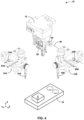
- FIG. 4 depicts a conceptual and schematic diagram of weld head 12, arms 14, and base 18 in a partially assembled state.
- arm 14B is removed from weld head 12 along axis 80 that is aligned with X axis.
- input port 82 of arm 14B is depicted.
- Input port 82 may be configured to receive lead 32A, such that upon receiving lead 32 electrode 16B of arm 14B is electrically coupled to lead 32A and therein power source 42.
- Arm 14B may be re-secured to weld head 12 by moving arm 14B back along axis 82 and inserting a securing mechanism (e.g., a pin or bolt or the like) through an aperture of arm 14B and aperture 86 of weld head 12
- a securing mechanism e.g., a pin or bolt or the like
- welding system 10 may include two accelerometers 24A, 24B. Both accelerometers 24A, 24B may be secured to respective arms 14A, 14B, such that accelerometers 24A, 24B may substantially move when electrodes 16A, 16B move. Put differently, accelerometers 24A, 24B may be configured to move along Z axis in conjunction with electrodes 16A, 16B when electrode 16B is providing current to components 22 to execute a RSW. In this way, welding system 10 may include two accelerometers 24A, 24B gathering acceleration data.
- computing device 26 may analyze accelerometer data as gathered from accelerometers 24A, 24B independently, such that each set of acceleration data is analyzed to see if the acceleration data indicates a welding defect. In such examples, welding system 10 may increase an opportunity for accelerometers 24A, 24B to gather evidence that indicates welding defect. In other examples, computing device 26 may average together acceleration data as gathered from both accelerometers 24A, 24B. Averaging together acceleration data across two or more accelerometers 24A, 24B may decrease a possibility of false negatives in indicating a weld was defective (e.g., where one accelerometer gathers acceleration data that incorrectly suggests that a weld was defective, while the other accelerometer gathers data that correctly indicates that a weld was acceptable).
- FIG. 4 depicts feedback wires 84A, 84B (collectively, “feedback wires 84") extending from arms 14. As depicted, feedback wires 84 extend straight out such that both feedback wires 84 are substantially stiff, though feedback wires 84 may be relatively flexible to allow feedback wires 84 to be routed between components. Feedback wires 84 may be coupled to computing device 26 and/or other devices. Feedback wires 84 may provide weld data to computing device 26. For example, feedback wires 84 may provide voltage feedback information from weld head 12 to computing device 26. Voltage feedback may include information about the weld pulse delivered to components 22 when current is provided through one electrode 16 to weld components 22.
- computing device 26 may gather acceleration data from one or both accelerometers 24A, 24B using feedback wires 84. Further, arms 14 and/or weld head 12 may send other sensor data using feedback wires 84. For example, displacement data, visual data, and the like may be sent over feedback wires 84 to computing device 26
- FIG. 5 depicts an exploded conceptual and schematic diagram exploded view of weld arm 14.
- Weld arm 14 may include a plurality of securing mechanisms 100A-100D (collectively, "securing mechanism 100") configured to secure arm 14 together in an assembled state.
- securing mechanisms 100 may include a variety of bolts, dowels, pins, or the like.
- Securing mechanisms 100 may be configured to removably or reversibly secure arm 14 into an assembled state, such that it may be possible to disassemble arm 14 by removing securing mechanisms 100 without damaging arm 14 or securing mechanisms 100.
- Arm 14 may include a plurality of body components 102A-102D (collectively, body components 102").
- Body components 102 may be cast, machined, or otherwise manufactured into their depicted shape.
- Body components 102 may be configured to be secured together to hold other components and/or define shapes that may be secured to weld head 12.
- body components 102A, 102C may be secured together to hold load cell 104 that weld head 12 may use to collect weld data during RSWs as described herein.
- body components 102B, 102C may be secured together to hold any of electrodes 16-1, 16-2, 16-3 in arm 14, each of which may both be substantially similar to electrodes 16 described herein.
- electrode 16-1 may be substantially longer along Z axis than electrode 16-2, which may be substantially longer along Z-axis than electrode 16-3.
- An operator may secure one of electrodes 16-1, 16-2, 16-3 to arm 14 and therein weld head 12 depending upon a specific welding application that welding system 10 is to be used for.
- Knob 108 may be used to remove securing mechanism 100B that is secured one of electrodes 16-1, 16-2, 16-3 within body compartments 102B, 102C.
- an operator may be able to modify weld system by simply turning knob 108 to loosen securing mechanism 100B in order to functionally replace one electrode with another.
- Configuring weld system 10 such that electrode position along the Z-axis may be altered by switching electrodes with different lengths may increase a functionality of weld system 10 and decrease an amount of time required to alter functionality of weld system 10.
- accelerometer 24 may be secured to weld arm 14 through magnets 106. Magnets 106 may securely affix accelerometer 24 to weld arm 14 such that accelerometer may move along each axis in conjunction with electrode 16. In some examples, magnets 106 may secure accelerometer 24 to the same body component 102C that encloses electrode 16 to improve an ability of accelerometer 24 to track movement of electrode 16. Magnets 106 may have a sufficient strength that accelerometer 24 does not move relative to arm 14 as RSW is executed. Magnets 106 may further be weak enough that an operator may remove accelerometer 24 from arm 14 without damaging either accelerometer 24, arm 14, or magnets 106. Configuring weld arm 14 such that accelerometer 24 is securely affixed at arm 14 such that accelerometer 24 is both configured to move with electrode 16 but also be removable may increase an ability of accelerometer 24 to be replaced easily and quickly.
- Arms 14 may be configured to be secured to weld head 12.
- Arms 14 may define a plurality of apertures 114A, 114B (collectively, "apertures 114") that may be used to secure arms 14 to weld head 12.
- arms 14 may be secured to weld head 12 using one or more pins, bolts, dowels, or the like that are configured to extend through apertures 114 and be securely mechanically received by weld head 12.
- securing members 100C are configured to be received by apertures 114 to secure arm 14 to weld head 12.
- arm 14A is depicted in FIG.
- arms 14 may define apertures 114 at a plurality of different relative locations (e.g., different locations along Y axis).
- different apertures 114 may be used to secure arms 14 to weld head 12 in different relative locations.
- aperture 114A may be used to secure arm 14A to weld head 12 to define relatively more distance and/or space between arm 14A and arm 14B along X axis
- aperture 114B may be used to secure arm 14A to weld head 12 to define relatively less space between arm 14A and arm 14B along X axis.
- a subset e.g., less than all
- apertures 114 are used to secure arms 14 at any one relative location to weld head 12.
- all apertures 114 relate to predetermined configurations.
- weld head 12 may be used to execute RSWs for a finite number of predetermined devices, such that each of the different RSWs are to be executed at predetermined locations.
- each of apertures 114 may relate to one or more of these predetermined locations. In this way, arms 14 may be moved to different relative locations on weld head 12 by switching which of apertures 114 are used to secure arms 14 to weld head 12.
- Arm 14 may include other components that improve an accuracy and robustness of weld system 10.
- arm may include bushing and linear race set 110 that is configured to prevent twisting of weld head 12 load cells 104.
- bushing and linear race set 110 may prevent side loading of load cells 104.
- Bushing and linear race set 110 may alternatively/additionally improve the force measurement during the welding process.
- one set of bushing and linear race set 110 may terminate in a hard stop used for reference in evaluating force measurements (e.g., to set up and check weld system 10 during an initialization protocol) and the other set of bushing and linear race set 110 terminates in spring 112 and measurement load cell 104.
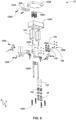
- FIG. 6 depicts a conceptual and schematic diagram exploded view of weld head 12.
- Weld arm 12 may include a plurality of securing mechanisms 120A-120G (collectively, "securing mechanism 120") configured to secure weld head 12 in an assembled state.
- securing mechanisms 120 may include a variety of bolts, dowels, pins, studs, or the like.
- Securing mechanisms 120 may be configured to removably or reversibly secure weld head 12, such it may be possible to disassemble weld head 12 by removing securing mechanisms 120 without damaging weld head 12 or securing mechanisms 120.
- Arm 14 may include a plurality of body components 122A-122D (collectively, "weld head body components 122").
- Body components 122 may be cast, machined, or otherwise manufactured into their shape.
- Body components 102 may be configured to be secured together to hold other components and/or define shapes that may be secured to weld head 12.
- body components 122C, 122D may be secured together to hold displacement gauge 124 (e.g., for sensing displacement values as discussed herein) in place.
- Body components may also be secured together to define apertures or bores of weld head 12.
- body components 122A, 122B may be secured together to define bore 38A as described herein.
- Weld head 12 may include sliding components 126 to which arms 14 may be coupled.
- Sliding components 126 may include a plate 128 that is configured to be fixedly secured to weld head 12 body component 120D using securing mechanisms 120B.
- Sliding components 126 may also define slide 130 that is configured to slide relative to plate 128.
- Arms 14 may be configured to be fixedly secured to slide 130 such that arms 14 may move relative to weld head 12.
- Arms 14 may be fixedly secured to slide 130 using securing mechanisms 100C that extend through apertures 114 of arms 14.
- arms 14 may be able to move relative to weld head 12, e.g., when respective electrodes 16 contact components 22 to execute a RSW as described herein.
- Weld head 12 may include other components that improve an accuracy and robustness of weld system 10.
- weld head 12 may include pin 132 along which locking nuts 134 may be moved up and down along Z-axis.
- pin 132 may include external threads along a portion of an external surface to facilitate locking nuts 134 moving up and down along Z-axis.
- a spring tension of spring 34 may be increased or decreased. Altering a spring tension of spring 34 may alter a weld force imparted by electrodes 16 upon components 22 during a weld as described herein.
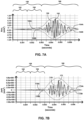
- FIG. 7A depicts a charts of acceleration data that indicated a defective weld 150 (said acceleration data hereinafter referred to as “defective acceleration data 150”) and acceleration data that indicated a successful weld 152 (said acceleration data hereinafter referred to as “successful acceleration data 152") in comparison to upper and lower threshold ranges 154A, 154B (collectively "threshold range 154").
- Defective acceleration data 150 and successful acceleration data 152 may include "raw" acceleration data such that neither first set nor second set of acceleration data 150, 152 have had data manipulated prior to depiction in FIG. 7A .
- threshold range 154 may be different at different times of the respective welds.
- successful acceleration data 152 may be entirely within upper and lower threshold ranges 154, such that computing device 26 determines that successful acceleration data 152 resulted in a successful weld.
- defective acceleration data 150 may be include extreme acceleration data points 156A, 156B (collectively "extreme data points 156") that are outside of both upper threshold range 154A and lower threshold range 154B, respectively.
- Welding system 10 may detect that defective acceleration data 150 includes one or more extreme data points 156 that are outside of upper and lower threshold ranges 154.
- welding system 10 may identify defective acceleration data 150 as indicating a weld defect as a result of only a single extreme data point being outside upper and lower threshold ranges 154.
- welding system 10 may identify defective acceleration data 150 as indicating a weld defect as a result of defective acceleration data 150 having more than a threshold number of extreme data points 156 that are outside of data ranges 154.
- computer device 26 may identify and isolate certain portions of acceleration data that are relatively prognosticative of welding defects.
- computing device 26 may identify first portion 158 of acceleration data as prognosticative.
- First portion 158 of acceleration data may include a portion of acceleration data that includes the first 0.003 seconds of an RSW (e.g., the first 0.003 seconds during which electrodes 16 are creating a circuit by running a current through surfaces 20).
- upper and lower threshold ranges 154 may include a relatively narrow band of acceptable ranges, such that successful acceleration data 152 is within upper and lower threshold ranges 154.
- defective acceleration data 150 may be outside upper and lower threshold ranges 154 in first portion.
- defective acceleration data 150 may be outside lower and upper threshold range 154 in first portion 158 but within lower and upper threshold range 154 in second portion 160.
- defective acceleration data 150 may be substantially similar (e.g., statistically similar over a statistically significant amount of RSWs) to successful acceleration data 152 across second portion 160.
- acceleration data may substantially only indicate a defective weld within first portion 158 of acceleration data.
- only a second amount of first portion 158 of weld may be prognostic.
- initializing portion 162 may include the first 0.0015 seconds of a weld
- prognostic portion 164 of acceleration data may include the time between 0.0015 and 0.003 seconds of a weld.
- Initializing portion 162 may include substantially nominal acceleration data, such that prognostic portion 164 of acceleration data may be the portion of the data that has the highest correlation with correctly identifying defective welds. Accordingly, in some examples computing device 26 may begin a process of analyzing acceleration data by truncating acceleration data to only include prognostic portion 164.
- first portion 158 of weld may include a different subset of time. For example, in some instances a full weld may complete in approximately 0.002 seconds. In such examples, first portion 158 may include the first 0.001 seconds of weld, such that second portion 160 includes between 0.001 and 0.002 seconds of weld. Other examples consistent with the disclosure herein are possible in other applications.
- computing device 26 may execute one or more mathematical operations on acceleration data.
- Computing device 26 may execute mathematical operations in order to increase an ability of acceleration data to indicate defective welds. For example, computing device 26 may determine a first derivative of the acceleration data to determine the rate of change of the acceleration data (i.e., to determine the jerk of one or more respective electrodes 16).
- FIG. 7B depicts a chart of such derivative acceleration data of an acceptable and defective weld in comparison to threshold ranges.
- FIG. 7B includes defective derived data set 170 and successful derived data set 172.
- Defective derived data set 170 may include data indicative of a defective RSW.
- Successful derived data set 172 may include data indicative of a successful RSW.
- Data points of defective and successful derived data sets 170, 172 are provided for purposes of illustration, such that other data points consistent with the discussion herein may be included in derived data sets are indicative of defective or successful RSWs.
- FIG. 7B may also include upper threshold range 174A and lower threshold range 174B (collectively, "threshold ranges 174"), as well as first portion 158, second portion 160, initializing portion 162, and prognostic portion 164 of FIG. 7A , which may relate to substantially the same time ranges of FIG. 7A .
- first derivative first portion 158 of second derived data set 172 may flatten to a substantially flat line.
- derived data sets of successful RSWs may reliably flatten to a substantially flat line, such that upper and lower threshold ranges 174 are relatively close to this predicted flat line.
- relatively mild deviations from this flat line may be identified as indicative of a defective RSW.
- first derived data set 170 may include plurality of data points 176A, 176B (collectively "data points 176") outside of upper and lower threshold ranges 174.
- initial unmodified acceleration data may show a statistically insignificant amount of deviation, but acceleration data following a first derivative may identify a spike that is outside of upper and/or lower threshold ranges 174.
- computing device 26 may first determine that acceleration data as gathered by accelerometer 24 is within upper and lower threshold ranges 154, after which computing device 26 may determine that derived acceleration data includes some extreme data points 176 outside of upper and/or lower threshold ranges 174. In this way, computing device 26 may be configured to increase an ability of welding system 10 to detect a welding defect.
- FIG. 8 depicts a conceptual flowchart of a method of executing and monitoring a weld using the weld system of FIG. 1 .
- FIG. 8 is discussed referencing the reference numerals of FIGS. 1-3B , it is to be understood that the method of FIG. 8 may be executed using any weld system consistent with the disclosure herein. Further, in other examples the method of FIG. 8 may be executed with one or more operations in a different order, or may be executed skipping or adding in one or more operations.
- Apertures 114 may be used to secure arms 14 to weld head 12 of welding system 10 (200).
- One or more securing components may be used for each of the one or more apertures 114.
- a single bolt or pin may be inserted into each of the one or more apertures 114 to secure the arms 14 to weld head 12.
- Apertures 114 may be selected based on the planned use of welding system 10. For example, securing mechanisms may be inserted into a predetermined plurality of apertures 114 to secure arms 14 at a predetermined relative location to weld head 12 in response to components 20 that welding system 10 will be welding.
- an operator may determine a specific electrode 16 for the respective application. For example, an operator may determine a relatively shorter or longer electrode 16 (e.g., electrode 16-1 vs electrode 16-2 vs electrode 16-3 as depicted in FIG. 5 ) depending upon a particular application. An operator may turn a knob (e.g., knob 108 of FIG. 5 ) of a respective arm 14 to unsecure a respective electrode 16 and insert an alternate electrode 16. Upon inserting the alternate electrode 16, the operator may turn the knob in the opposite direction to secure the alternate electrode 16 in the respective arm 14.
- a knob e.g., knob 108 of FIG. 5
- Welding system 10 may be configured to execute a PGW, a step weld, and/or an opposed weld (202).
- configuring welding system 10 for either PGW or an opposed weld may include no more than switching base 18 of welding system 10, though in other examples switching between PGW and opposed welding may additionally include adding or removing one weld arm 14.
- welding system 10 may be configured for PGW by securing PGW base 18A to welding system 10 (204). PGW base 18A may not include an electrode. Once PGW base 18A is secure to welding system 10, welding system 10 will provide current to one of electrode 16 of arms 14 (206).
- computing device 26 may cause current to be routed to one of electrodes 16 of arms 14 through one lead 32.
- the instructions to provide the current may be received using feedback wires (e.g., feedback wires 84 of FIG. 4 ).
- System 10 may provide current to an electrode 16A to and let current return through electrode 16B to execute PGW to surfaces 20 below electrodes 16.
- a relatively longer electrode 16 may be secured to one arm 14 of welding system 10 (208).
- a knob e.g., knob 108 of FIG. 5
- a step weld base 18A which may be substantially similar to a PGW base 18A may be secured to weld system 10.
- System 12 may then provide current to one electrode 16A of weld head 12 using lead 32 such that current runs through both components 22 and exits through another electrode 16B of weld head 12 back through another respective lead 32 to power source 42 (210).
- System 12 may provide current to first electrode 16A to create a circuit between power source 42, first electrode 16A, second electrode 16B, and components 22.
- opposed base 18B may be secured to welding system 10 (212).
- Opposed base 18B may include electrode 74 that is configured to align with one electrode 16 of weld head 12 once secured to system.
- System 12 may then provide current to top electrode 16 using lead 32 such that current runs through both components 22 and exits through electrode 74 of opposed base 18B back through another respective lead 32 to power source 42 (214).
- System 12 may provide current to top electrode 16 to create a circuit between power source 42, top electrode 16, bottom electrode 74, and components 22.
- Accelerometer 24 may gather acceleration data of the weld (216). Accelerometer 24 may gather acceleration data whether or not the weld was an opposed weld, a PGW, or a step weld. In some examples, only one accelerometer 24 may gather acceleration data. For example, where RSW is an opposed weld, accelerometer 24 may be attached to arm 14 that holds electrode 16 that is opposed to electrode 74 of opposed base 18B. In other examples, system 12 may gather acceleration data from two accelerometers (e.g., accelerometers 24A, 24B of FIG. 4 ). In some examples, computing device 26 may calculate a first derivative of the gathered acceleration data.
- Computing device 26 may identify a prognostic portion (e.g., prognostic portion 164 of FIGS. 7A and 7B ) of the acceleration data (218).
- the prognostic portion may include a predetermined time period of the weld.
- the prognostic portion may include a period of the weld that is subsequent to an initial instantiating portion (e.g., instantiating portion 162 of FIGS. 7A and 7B ) and a period of the weld that is prior to the greatest acceleration data points (e.g., second portion 160 of FIGS. 7A and 7B ).
- Computing device 26 may determine whether the prognostic portion of the acceleration data (220). Computing device 26 may determine that the prognostic portion of the acceleration data is indicative of a welding defective if the prognostic portion of acceleration data includes data points (e.g., data points 156 of FIG. 7A , or data points 176 of FIG 7B ). Accordingly, if computing device 26 determines that the prognostic portion indicates that the weld is defective, computing device 26 may provide an indication of the defective weld (222). For example, computing device 26 may provide a visual indication using display 28, such that a human operator may further inspect or otherwise address components 20 that underwent the respective weld. Additionally, or alternatively, computing device 26 may cause a removal mechanism 30 to remove the components 20 that underwent the weld to a predetermined location for further inspection or disposal.
- data points e.g., data points 156 of FIG. 7A , or data points 176 of FIG 7B . Accordingly, if computing device 26 determines that the prognostic portion indicates
- computing device 26 may provide an indication of the successful weld (224). For example, computing device 26 may provide the indication to the display 28. Further, in some examples, computing device 26 may store the successful weld in a pseudo-permanent log.
Landscapes
- Engineering & Computer Science (AREA)
- Mechanical Engineering (AREA)
- Physics & Mathematics (AREA)
- General Physics & Mathematics (AREA)
- Quality & Reliability (AREA)
- Resistance Welding (AREA)
Claims (15)
- Einrichtung, die Folgendes umfasst:
einen Widerstandspunktschweißkopf (RSW-Kopf) (12), der dazu ausgelegt ist, eine Parallelspalt-RSW (PGW)-Konfiguration und eine gegenüberliegende Schweißkonfiguration zu definieren, wobei der RSW-Kopf Folgendes umfasst:eine oder mehrere Verarbeitungsschaltungen (52); undeine erste Elektrode und eine zweite Elektrode,wobei die Einrichtung ferner eine dritte Elektrode (74), eine erste Basis (18A) und eine zweite Basis (18B) umfasst, wobei die zweite Basis (18B) die dritte Elektrode (74) umfasst,wobei die erste Elektrode und die zweite Elektrode dazu ausgelegt sind, eine Parallelspalt-RSW (PGW) auf einem ersten Satz von Komponenten (22A) auszuführen, die an der ersten Basis (18A) gesichert sind, wenn sich der RSW-Kopf in der PGW-Konfiguration befindet, wobei die erste Elektrode dazu ausgelegt ist, eine gegenüberliegende RSW (gegenüberliegende Schweißung) auszuführen, wobei die dritte Elektrode der zweiten Basis (18B) auf einem zweiten Satz von Komponenten (22B) sind, die an der zweiten Basis gesichert sind, wenn sich der RSW-Kopf in der gegenüberliegenden Schweißkonfiguration befindet, undwobei der RSW-Kopf (12) ferner einen Beschleunigungsmesser (24) umfasst, der fest an der ersten Elektrode an einer Stelle angrenzend an die erste Elektrode angebracht ist, wobei die eine oder die mehreren Verarbeitungsschaltungen dazu ausgelegt sind, zu bewirken, dass der Beschleunigungsmesser einen PGW-Satz von Beschleunigungsdaten der ersten Elektrode während der PGW sammelt und einen gegenüberliegenden Schweißsatz von Beschleunigungsdaten der ersten Elektrode während der gegenüberliegenden Schweißung sammelt,wobei die eine oder die mehreren Verarbeitungsschaltungen dazu ausgelegt sind, basierend auf dem PGW-Satz von Beschleunigungsdaten, der mindestens einen Beschleunigungswert außerhalb eines ersten Schwellenbeschleunigungsbereichs beinhaltet, zu bestimmen, dass der PGW-Satz von Beschleunigungsdaten einen ersten Schweißdefekt angibt, undwobei die eine oder die mehreren Verarbeitungsschaltungen dazu ausgelegt sind, basierend auf dem gegenüberliegenden Schweißsatz von Beschleunigungsdaten, der mindestens einen Beschleunigungswert außerhalb eines zweiten Schwellenbeschleunigungsbereichs beinhaltet, zu bestimmen, dass der gegenüberliegende Schweißsatz von Beschleunigungsdaten einen zweiten Schweißdefekt angibt. - Einrichtung nach Anspruch 1, wobei sowohl der erste Schwellenbeschleunigungsbereich als auch der zweite erste Schwellenbeschleunigungsbereich unterschiedliche obere und untere Schwellengrenzen für unterschiedliche Zeitperioden von RSW beinhalten.
- Einrichtung nach Anspruch 1 oder 2, wobei die eine oder die mehreren Verarbeitungsschaltungen (52) dazu ausgelegt sind, einen ersten Teil des PGW-Satzes und des gegenüberliegenden Schweißsatzes von Beschleunigungsdaten zu analysieren, um zu bestimmen, dass der PGW-Satz und der gegenüberliegende Schweißsatz von Beschleunigungsdaten den ersten Schweißdefekt und den zweiten Schweißdefekt angeben, wobei der erste Teil relativ weniger Volatilität von Beschleunigungsdaten als ein nachfolgender zweiter Teil des PGW-Satzes und des gegenüberliegenden Schweißsatzes von Beschleunigungsdaten beinhaltet.
- Einrichtung nach Anspruch 3, wobei der erste Teil erste 0,003 Sekunden des PGW-Satzes und des gegenüberliegenden Schweißsatzes von Beschleunigungsdaten beinhaltet.
- Einrichtung nach Anspruch 3, wobei die eine oder die mehreren Verarbeitungsschaltungen (52) dazu ausgelegt sind, einen prognostischen Teil des ersten Teils des PGW-Satzes und des gegenüberliegenden Schweißsatzes von Beschleunigungsdaten zu analysieren, um zu bestimmen, dass der PGW-Satz und der gegenüberliegende Schweißsatz von Beschleunigungsdaten den ersten Schweißdefekt und den zweiten Schweißdefekt angeben.
- Einrichtung nach Anspruch 5, wobei der prognostische Teil zwischen 0,0015 Sekunden und 0,003 Sekunden des PGW-Satzes und des gegenüberliegenden Schweißsatzes von Beschleunigungsdaten beträgt.
- Einrichtung nach einem der obigen Ansprüche, wobei:die erste Elektrode und die zweite Elektrode dazu ausgelegt sind, eine andere PGW auf einem dritten Satz von Komponenten auszuführen, die an der ersten Basis gesichert sind, wenn sich der RSW-Kopf in der PGW-Konfiguration befindet;die eine oder die mehreren Verarbeitungsschaltungen dazu ausgelegt sind, zu bewirken, dass der Beschleunigungsmesser einen dritten Satz von Beschleunigungsdaten der ersten Elektrode während der anderen PGW sammelt;die eine oder die mehreren Verarbeitungsschaltungen dazu ausgelegt sind, zu bestimmen, dass der dritte Satz von Beschleunigungsdaten keinen Schweißdefekt angibt, indem Beschleunigungswerte des dritten Satzes von Beschleunigungsdaten mit dem ersten Schwellenbeschleunigungsbereich verglichen werden;die eine oder die mehreren Verarbeitungsschaltungen dazu ausgelegt sind, einen ersten abgeleiteten Satz von Beschleunigungsdaten durch Bestimmen einer ersten Ableitung von Beschleunigungswerten des dritten Satzes von Beschleunigungsdaten zu bestimmen; unddie eine oder die mehreren Verarbeitungsschaltungen dazu ausgelegt sind, zu bestimmen, dass der erste abgeleitete Satz von Beschleunigungsdaten einen dritten Schweißdefekt angibt, indem sie mindestens einen abgeleiteten Beschleunigungswert außerhalb eines schwellenabgeleiteten Beschleunigungsbereichs beinhalten.
- Einrichtung nach einem der obigen Ansprüche, wobei:die erste Elektrode dazu ausgelegt ist, eine andere gegenüberliegende Schweißung mit der dritten Elektrode der zweiten Basis auf einem vierten Satz von Komponenten auszuführen, die an der zweiten Basis gesichert sind, wenn sich der RSW-Kopf in der gegenüberliegenden Schweißkonfiguration befindet;die eine oder die mehreren Verarbeitungsschaltungen dazu ausgelegt sind, zu bewirken, dass der Beschleunigungsmesser einen vierten Satz von Beschleunigungsdaten der ersten Elektrode während der anderen gegenüberliegenden Schweißung sammelt;die eine oder die mehreren Verarbeitungsschaltungen dazu ausgelegt sind, durch Vergleichen von Beschleunigungswerten des vierten Satzes von Beschleunigungsdaten mit dem zweiten Schwellenbeschleunigungsbereich zu bestimmen, dass der vierte Satz von Beschleunigungsdaten keinen Schweißdefekt angibt;die eine oder die mehreren Verarbeitungsschaltungen dazu ausgelegt sind, einen zweiten abgeleiteten Satz von Beschleunigungsdaten durch Bestimmen einer ersten Ableitung von Beschleunigungswerten des vierten Satzes von Beschleunigungsdaten zu bestimmen; unddie eine oder die mehreren Verarbeitungsschaltungen dazu ausgelegt sind, zu bestimmen, dass der zweite abgeleitete Satz von Beschleunigungsdaten einen vierten Schweißdefekt angibt, indem sie mindestens einen abgeleiteten Beschleunigungswert außerhalb eines schwellenabgeleiteten Beschleunigungsbereichs beinhalten.
- Einrichtung nach einem der obigen Ansprüche, wobei der RSW-Kopf (12) dazu ausgelegt ist, die PGW auszuführen, indem sowohl die erste Elektrode als auch die zweite Elektrode zu der ersten Basis hin bewegt werden, und wobei der RSW-Kopf dazu ausgelegt ist, die gegenüberliegende Schweißung auszuführen, indem die erste Elektrode zu der zweiten Basis hin bewegt wird.
- Einrichtung nach einem der obigen Ansprüche, die ferner einen ersten Arm (14A), der dazu ausgelegt ist, die erste Elektrode aufzunehmen, und einen zweiten Arm (14B), der dazu ausgelegt ist, die zweite Elektrode aufzunehmen, umfasst, wobei der erste Arm und der zweite Arm durch einen Satz von Befestigungsmechanismen (100), die sich durch Öffnungen des ersten Arms und des zweiten Arms erstrecken und sich in Öffnungen des RSW-Kopfes erstrecken, fest verbunden und an dem RSW-Kopf gesichert sind.
- Vorrichtung nach einem der obigen Ansprüche, wobei die erste Elektrode und die zweite Elektrode eine Querschnittsfläche von ungefähr 1,015 Millimeter mal 0,635 Millimeter an einer Spitze definieren, die dazu ausgelegt ist, den ersten und den zweiten Satz von Komponenten zu kontaktieren.
- Einrichtung nach einem der obigen Ansprüche, wobei der RSW-Kopf einen Entfernungsmechanismus beinhaltet, wobei:die eine oder die mehreren Verarbeitungsschaltungen dazu ausgelegt sind, zu bewirken, dass der Entfernungsmechanismus den ersten Satz von Komponenten physisch von der ersten Basis zu einer vorbestimmten Defektposition entfernt, basierend darauf, dass die eine oder die mehreren Verarbeitungsschaltungen bestimmen, dass der PGW-Satz von Beschleunigungsdaten den ersten Schweißdefekt angibt; unddie eine oder die mehreren Verarbeitungsschaltungen dazu ausgelegt sind, zu bewirken, dass der Entfernungsmechanismus den zweiten Satz von Komponenten physisch von der zweiten Basis zu der vorbestimmten Defektstelle entfernt, basierend darauf, dass die eine oder die mehreren Verarbeitungsschaltungen bestimmen, dass der gegenüberliegende Schweißsatz von Beschleunigungsdaten den zweiten Schweißdefekt angibt.
- Einrichtung nach einem der obigen Ansprüche, die ferner eine Anzeige (28) umfasst, wobei:die eine oder die mehreren Verarbeitungsschaltungen dazu ausgelegt sind, zu bewirken, dass die Anzeige eine Angabe des ersten Schweißdefekts basierend darauf bereitstellt, dass die eine oder die mehreren Verarbeitungsschaltungen bestimmen, dass der PGW-Satz von Beschleunigungsdaten den ersten Schweißdefekt angibt; unddie eine oder die mehreren Verarbeitungsschaltungen dazu ausgelegt sind, zu bewirken, dass die Anzeige eine Angabe des zweiten Schweißdefekts basierend darauf bereitstellt, dass die eine oder die mehreren Verarbeitungsschaltungen bestimmen, dass der gegenüberliegende Schweißsatz von Beschleunigungsdaten den zweiten Schweißdefekt angibt.
- Einrichtung nach einem der obigen Ansprüche, wobei der Beschleunigungsmesser (24) an der ersten Elektrode an der Stelle angrenzend an die erste Elektrode unter Verwendung eines oder mehrerer Magnete montiert ist.
- Einrichtung nach einem der obigen Ansprüche, wobei der RSW-Kopf eine Stufenschweißkonfiguration definiert und ferner eine dritte Elektrode umfasst, die mit der zweiten Elektrode austauschbar ist und relativ länger als die zweite Elektrode ist,wobei die erste Elektrode und die dritte Elektrode dazu ausgelegt sind, eine Stufen-RSW (Stufenschweißung) an einem dritten Satz von Komponenten auszuführen, die an der ersten Basis gesichert sind, wenn sich der RSW-Kopf in der Stufenschweißkonfiguration befindet,wobei die eine oder die mehreren Verarbeitungsschaltungen dazu ausgelegt sind, zu bewirken, dass der Beschleunigungsmesser einen Stufenschweißsatz von Beschleunigungsdaten der ersten Elektrode während des Stufenschweißens sammelt,wobei die eine oder die mehreren Verarbeitungsschaltungen dazu ausgelegt sind, basierend auf dem Stufenschweißsatz von Beschleunigungsdaten, der mindestens einen Beschleunigungswert außerhalb eines dritten Schwellenbeschleunigungsbereichs beinhaltet, zu bestimmen, dass der Stufenschweißsatz von Beschleunigungsdaten einen dritten Schweißdefekt angibt.
Applications Claiming Priority (2)
| Application Number | Priority Date | Filing Date | Title |
|---|---|---|---|
| US15/951,889 US11224932B2 (en) | 2018-04-12 | 2018-04-12 | Resistance spot weld head with integrated accelerometer |
| PCT/US2019/026702 WO2019199912A1 (en) | 2018-04-12 | 2019-04-10 | Resistance spot weld head with integrated accelerometer |
Publications (2)
| Publication Number | Publication Date |
|---|---|
| EP3774155A1 EP3774155A1 (de) | 2021-02-17 |
| EP3774155B1 true EP3774155B1 (de) | 2025-05-28 |
Family
ID=66248842
Family Applications (1)
| Application Number | Title | Priority Date | Filing Date |
|---|---|---|---|
| EP19719110.9A Active EP3774155B1 (de) | 2018-04-12 | 2019-04-10 | Widerstandspunktschweisskopf mit integriertem beschleunigungsmesser |
Country Status (4)
| Country | Link |
|---|---|
| US (1) | US11224932B2 (de) |
| EP (1) | EP3774155B1 (de) |
| CN (1) | CN112004632B (de) |
| WO (1) | WO2019199912A1 (de) |
Families Citing this family (2)
| Publication number | Priority date | Publication date | Assignee | Title |
|---|---|---|---|---|
| CN111014922B (zh) * | 2019-12-27 | 2021-06-29 | 浙江大学台州研究院 | 电喷圈自动点焊设备 |
| DE102021101654A1 (de) * | 2021-01-26 | 2022-07-28 | Hesse Gmbh | Verfahren zum Betreiben einer Ultraschallverbindungsvorrichtung |
Family Cites Families (20)
| Publication number | Priority date | Publication date | Assignee | Title |
|---|---|---|---|---|
| US4376883A (en) | 1980-07-30 | 1983-03-15 | American Can Company | Monitoring weld quality via forging assembly dynamics |
| US4472620A (en) | 1983-04-01 | 1984-09-18 | General Electric Company | Instrumented spot welding electrode |
| US4596917A (en) | 1984-01-16 | 1986-06-24 | General Electric Company | Resistance spot welder process monitor |
| DE3404692A1 (de) | 1984-02-10 | 1985-08-14 | Messerschmitt-Bölkow-Blohm GmbH, 8012 Ottobrunn | Elektrode fuer ein widerstandspressschweissgeraet |
| AT390578B (de) * | 1988-03-31 | 1990-05-25 | Evg Entwicklung Verwert Ges | Vielpunkt-schweissmaschine |
| US5111020A (en) | 1991-05-02 | 1992-05-05 | Ariel Stiebel | Method and apparatus for controlling electrical resistance spot welding |
| DE4419071C1 (de) | 1994-05-31 | 1995-11-02 | Siemens Ag | Vorrichtung zur Schweißstromregelung beim Punktschweißen mit einem Fuzzy-Meßgeber zur quantifizierten Erfassung der Stärke von Schweißspritzern |
| FR2797794B1 (fr) * | 1999-08-26 | 2001-11-09 | Aro | Procede de selection automatique de sequence de soudage pour pince de soudage manuelle; pince de soudage manuelle pour la mise en oeuvre du procede |
| WO2002024392A1 (en) | 2000-09-21 | 2002-03-28 | Massachusetts Institute Of Technology | Spot welding system and method for sensing welding conditions in real time |
| US6515251B1 (en) * | 2000-10-31 | 2003-02-04 | Steelcase Development Corporation | Welding system and method |
| US7564005B2 (en) | 2001-07-10 | 2009-07-21 | Doben Limited | Resistance welding fastener electrode and monitor and method of using same |
| DE102007002319B4 (de) | 2007-01-16 | 2024-06-20 | Volkswagen Ag | Verfahren zur Qualitätssicherung beim Widerstandspunktschweißen |
| US8426761B2 (en) | 2009-10-21 | 2013-04-23 | Fanuc Ltd | Method of detection of welding workpiece position using movable electrode |
| US20110220619A1 (en) * | 2010-03-10 | 2011-09-15 | Illinois Tool Works Inc. | Positional monitoring systems and methods for welding devices |
| CN101862889B (zh) * | 2010-05-13 | 2012-05-23 | 上海交通大学 | 电阻点焊中电极振幅的监测装置 |
| US8886359B2 (en) | 2011-05-17 | 2014-11-11 | Fanuc Corporation | Robot and spot welding robot with learning control function |
| DE102011118419B4 (de) | 2011-11-12 | 2018-03-08 | Audi Ag | Verfahren zum Erkennen eines Verschleißzustandes von Elektroden einer Schweißzange und Schweißzange |
| EP3015213B1 (de) | 2013-06-26 | 2019-05-01 | JFE Steel Corporation | Indirektes punktschweissverfahren |
| CN103331511B (zh) * | 2013-07-03 | 2014-07-02 | 林青云 | 电阻焊方法及其应用和所用的电极焊头 |
| US10818890B2 (en) | 2014-04-22 | 2020-10-27 | Medtronic, Inc. | Power source for an implantable medical device |
-
2018
- 2018-04-12 US US15/951,889 patent/US11224932B2/en active Active
-
2019
- 2019-04-10 CN CN201980025432.9A patent/CN112004632B/zh active Active
- 2019-04-10 EP EP19719110.9A patent/EP3774155B1/de active Active
- 2019-04-10 WO PCT/US2019/026702 patent/WO2019199912A1/en not_active Ceased
Also Published As
| Publication number | Publication date |
|---|---|
| CN112004632B (zh) | 2022-10-14 |
| WO2019199912A1 (en) | 2019-10-17 |
| EP3774155A1 (de) | 2021-02-17 |
| US20190314925A1 (en) | 2019-10-17 |
| US11224932B2 (en) | 2022-01-18 |
| CN112004632A (zh) | 2020-11-27 |
Similar Documents
| Publication | Publication Date | Title |
|---|---|---|
| US11056731B2 (en) | Modular, adaptable holders for sensors and battery cells for physical analysis | |
| EP3774155B1 (de) | Widerstandspunktschweisskopf mit integriertem beschleunigungsmesser | |
| US10036731B2 (en) | Weld testing system and method for a welding assembly | |
| US9015173B2 (en) | Spot weld data management and monitoring system | |
| US20210154790A1 (en) | Anomaly detection device, method of detecting anomaly, and program | |
| CN103358308A (zh) | 机器人焊枪取向规范化 | |
| KR101632532B1 (ko) | 릴레이 접점수명 측정 방법 및 시스템 | |
| ES2271304T3 (es) | Metodo y sistema para la monitorizacion de un procedimiento de soldadura. | |
| JP4880021B2 (ja) | 溶接ワーク位置検出方法 | |
| CN111290365A (zh) | 伺服系统监测方法、装置、计算机设备和存储介质 | |
| US20070175869A1 (en) | Method for monitoring a resistance welding process and device therefor | |
| MXPA05005958A (es) | Metodo y sistema para vigilar proceso de soldado. | |
| BR112015025047B1 (pt) | conjunto de eletrodo superior para fixadores de solda, conjunto de pistola de solda e método de detecção de uma característica de soldagem de fixador durante a soldagem | |
| EP4632407A1 (de) | Auf interner widerstandskonsistenz basierendes fehlererkennungsverfahren für energiespeicherbatterie und energiespeichersystem | |
| US20030195649A1 (en) | System for automatically certifying the accuracy of a manufacturing machine | |
| KR20250151253A (ko) | 스마트 환경 제어 및 ai 기반 이상 예측을 포함한 로봇청소기 라이프 테스트 방법 및 시스템 | |
| CN112946428A (zh) | 一种检测方法 | |
| KR102268039B1 (ko) | 나사 어셈블리 검사 장치 및 방법 | |
| CN108982601A (zh) | 一种焊点检测设备和方法 | |
| CN108363856B (zh) | 一种刀杆疲劳变形加速试验方法 | |
| CN117991060A (zh) | 局部放电的检测方法、装置、电子设备及存储介质 | |
| CN106560719A (zh) | 一种检测装置及检测方法 | |
| JP2004286730A (ja) | ガルヴァーニ電池のための保持器を備えた、複数のガルヴァーニ電池のための自動電子測定検査装置における障害追跡のための方法及び装置 | |
| JP2021010944A (ja) | 制御装置、プログラム、及びロボット制御システム | |
| CN207300520U (zh) | 一种激光测振仪的可靠性试验系统 |
Legal Events
| Date | Code | Title | Description |
|---|---|---|---|
| STAA | Information on the status of an ep patent application or granted ep patent |
Free format text: STATUS: UNKNOWN |
|
| STAA | Information on the status of an ep patent application or granted ep patent |
Free format text: STATUS: THE INTERNATIONAL PUBLICATION HAS BEEN MADE |
|
| PUAI | Public reference made under article 153(3) epc to a published international application that has entered the european phase |
Free format text: ORIGINAL CODE: 0009012 |
|
| STAA | Information on the status of an ep patent application or granted ep patent |
Free format text: STATUS: REQUEST FOR EXAMINATION WAS MADE |
|
| 17P | Request for examination filed |
Effective date: 20201111 |
|
| AK | Designated contracting states |
Kind code of ref document: A1 Designated state(s): AL AT BE BG CH CY CZ DE DK EE ES FI FR GB GR HR HU IE IS IT LI LT LU LV MC MK MT NL NO PL PT RO RS SE SI SK SM TR |
|
| AX | Request for extension of the european patent |
Extension state: BA ME |
|
| DAV | Request for validation of the european patent (deleted) | ||
| DAX | Request for extension of the european patent (deleted) | ||
| GRAP | Despatch of communication of intention to grant a patent |
Free format text: ORIGINAL CODE: EPIDOSNIGR1 |
|
| STAA | Information on the status of an ep patent application or granted ep patent |
Free format text: STATUS: GRANT OF PATENT IS INTENDED |
|
| INTG | Intention to grant announced |
Effective date: 20231120 |
|
| GRAJ | Information related to disapproval of communication of intention to grant by the applicant or resumption of examination proceedings by the epo deleted |
Free format text: ORIGINAL CODE: EPIDOSDIGR1 |
|
| STAA | Information on the status of an ep patent application or granted ep patent |
Free format text: STATUS: REQUEST FOR EXAMINATION WAS MADE |
|
| STAA | Information on the status of an ep patent application or granted ep patent |
Free format text: STATUS: EXAMINATION IS IN PROGRESS |
|
| INTC | Intention to grant announced (deleted) | ||
| 17Q | First examination report despatched |
Effective date: 20240424 |
|
| GRAP | Despatch of communication of intention to grant a patent |
Free format text: ORIGINAL CODE: EPIDOSNIGR1 |
|
| STAA | Information on the status of an ep patent application or granted ep patent |
Free format text: STATUS: GRANT OF PATENT IS INTENDED |
|
| INTG | Intention to grant announced |
Effective date: 20241206 |
|
| GRAS | Grant fee paid |
Free format text: ORIGINAL CODE: EPIDOSNIGR3 |
|
| GRAA | (expected) grant |
Free format text: ORIGINAL CODE: 0009210 |
|
| STAA | Information on the status of an ep patent application or granted ep patent |
Free format text: STATUS: THE PATENT HAS BEEN GRANTED |
|
| AK | Designated contracting states |
Kind code of ref document: B1 Designated state(s): AL AT BE BG CH CY CZ DE DK EE ES FI FR GB GR HR HU IE IS IT LI LT LU LV MC MK MT NL NO PL PT RO RS SE SI SK SM TR |
|
| REG | Reference to a national code |
Ref country code: GB Ref legal event code: FG4D |
|
| REG | Reference to a national code |
Ref country code: CH Ref legal event code: EP |
|
| REG | Reference to a national code |
Ref country code: DE Ref legal event code: R096 Ref document number: 602019070508 Country of ref document: DE |
|
| REG | Reference to a national code |
Ref country code: IE Ref legal event code: FG4D |
|
| REG | Reference to a national code |
Ref country code: NL Ref legal event code: MP Effective date: 20250528 |
|
| PG25 | Lapsed in a contracting state [announced via postgrant information from national office to epo] |
Ref country code: ES Free format text: LAPSE BECAUSE OF FAILURE TO SUBMIT A TRANSLATION OF THE DESCRIPTION OR TO PAY THE FEE WITHIN THE PRESCRIBED TIME-LIMIT Effective date: 20250528 Ref country code: FI Free format text: LAPSE BECAUSE OF FAILURE TO SUBMIT A TRANSLATION OF THE DESCRIPTION OR TO PAY THE FEE WITHIN THE PRESCRIBED TIME-LIMIT Effective date: 20250528 |
|
| REG | Reference to a national code |
Ref country code: LT Ref legal event code: MG9D |
|
| PG25 | Lapsed in a contracting state [announced via postgrant information from national office to epo] |
Ref country code: GR Free format text: LAPSE BECAUSE OF FAILURE TO SUBMIT A TRANSLATION OF THE DESCRIPTION OR TO PAY THE FEE WITHIN THE PRESCRIBED TIME-LIMIT Effective date: 20250829 Ref country code: NO Free format text: LAPSE BECAUSE OF FAILURE TO SUBMIT A TRANSLATION OF THE DESCRIPTION OR TO PAY THE FEE WITHIN THE PRESCRIBED TIME-LIMIT Effective date: 20250828 |
|
| PG25 | Lapsed in a contracting state [announced via postgrant information from national office to epo] |
Ref country code: PL Free format text: LAPSE BECAUSE OF FAILURE TO SUBMIT A TRANSLATION OF THE DESCRIPTION OR TO PAY THE FEE WITHIN THE PRESCRIBED TIME-LIMIT Effective date: 20250528 Ref country code: NL Free format text: LAPSE BECAUSE OF FAILURE TO SUBMIT A TRANSLATION OF THE DESCRIPTION OR TO PAY THE FEE WITHIN THE PRESCRIBED TIME-LIMIT Effective date: 20250528 |
|
| PG25 | Lapsed in a contracting state [announced via postgrant information from national office to epo] |
Ref country code: BG Free format text: LAPSE BECAUSE OF FAILURE TO SUBMIT A TRANSLATION OF THE DESCRIPTION OR TO PAY THE FEE WITHIN THE PRESCRIBED TIME-LIMIT Effective date: 20250528 |
|
| PG25 | Lapsed in a contracting state [announced via postgrant information from national office to epo] |
Ref country code: HR Free format text: LAPSE BECAUSE OF FAILURE TO SUBMIT A TRANSLATION OF THE DESCRIPTION OR TO PAY THE FEE WITHIN THE PRESCRIBED TIME-LIMIT Effective date: 20250528 |
|
| PG25 | Lapsed in a contracting state [announced via postgrant information from national office to epo] |
Ref country code: RS Free format text: LAPSE BECAUSE OF FAILURE TO SUBMIT A TRANSLATION OF THE DESCRIPTION OR TO PAY THE FEE WITHIN THE PRESCRIBED TIME-LIMIT Effective date: 20250828 |
|
| PG25 | Lapsed in a contracting state [announced via postgrant information from national office to epo] |
Ref country code: IS Free format text: LAPSE BECAUSE OF FAILURE TO SUBMIT A TRANSLATION OF THE DESCRIPTION OR TO PAY THE FEE WITHIN THE PRESCRIBED TIME-LIMIT Effective date: 20250928 |
|
| PG25 | Lapsed in a contracting state [announced via postgrant information from national office to epo] |
Ref country code: LV Free format text: LAPSE BECAUSE OF FAILURE TO SUBMIT A TRANSLATION OF THE DESCRIPTION OR TO PAY THE FEE WITHIN THE PRESCRIBED TIME-LIMIT Effective date: 20250528 |
|
| REG | Reference to a national code |
Ref country code: AT Ref legal event code: MK05 Ref document number: 1798367 Country of ref document: AT Kind code of ref document: T Effective date: 20250528 |
|
| PG25 | Lapsed in a contracting state [announced via postgrant information from national office to epo] |
Ref country code: DK Free format text: LAPSE BECAUSE OF FAILURE TO SUBMIT A TRANSLATION OF THE DESCRIPTION OR TO PAY THE FEE WITHIN THE PRESCRIBED TIME-LIMIT Effective date: 20250528 Ref country code: SM Free format text: LAPSE BECAUSE OF FAILURE TO SUBMIT A TRANSLATION OF THE DESCRIPTION OR TO PAY THE FEE WITHIN THE PRESCRIBED TIME-LIMIT Effective date: 20250528 Ref country code: AT Free format text: LAPSE BECAUSE OF FAILURE TO SUBMIT A TRANSLATION OF THE DESCRIPTION OR TO PAY THE FEE WITHIN THE PRESCRIBED TIME-LIMIT Effective date: 20250528 |
|
| PG25 | Lapsed in a contracting state [announced via postgrant information from national office to epo] |
Ref country code: CZ Free format text: LAPSE BECAUSE OF FAILURE TO SUBMIT A TRANSLATION OF THE DESCRIPTION OR TO PAY THE FEE WITHIN THE PRESCRIBED TIME-LIMIT Effective date: 20250528 |
|
| PG25 | Lapsed in a contracting state [announced via postgrant information from national office to epo] |
Ref country code: EE Free format text: LAPSE BECAUSE OF FAILURE TO SUBMIT A TRANSLATION OF THE DESCRIPTION OR TO PAY THE FEE WITHIN THE PRESCRIBED TIME-LIMIT Effective date: 20250528 |
|
| PG25 | Lapsed in a contracting state [announced via postgrant information from national office to epo] |
Ref country code: RO Free format text: LAPSE BECAUSE OF FAILURE TO SUBMIT A TRANSLATION OF THE DESCRIPTION OR TO PAY THE FEE WITHIN THE PRESCRIBED TIME-LIMIT Effective date: 20250528 Ref country code: SK Free format text: LAPSE BECAUSE OF FAILURE TO SUBMIT A TRANSLATION OF THE DESCRIPTION OR TO PAY THE FEE WITHIN THE PRESCRIBED TIME-LIMIT Effective date: 20250528 |
|
| PG25 | Lapsed in a contracting state [announced via postgrant information from national office to epo] |
Ref country code: IT Free format text: LAPSE BECAUSE OF FAILURE TO SUBMIT A TRANSLATION OF THE DESCRIPTION OR TO PAY THE FEE WITHIN THE PRESCRIBED TIME-LIMIT Effective date: 20250528 |
|
| REG | Reference to a national code |
Ref country code: DE Ref legal event code: R097 Ref document number: 602019070508 Country of ref document: DE |
|
| PLBE | No opposition filed within time limit |
Free format text: ORIGINAL CODE: 0009261 |
|
| STAA | Information on the status of an ep patent application or granted ep patent |
Free format text: STATUS: NO OPPOSITION FILED WITHIN TIME LIMIT |
|
| REG | Reference to a national code |
Ref country code: CH Ref legal event code: L10 Free format text: ST27 STATUS EVENT CODE: U-0-0-L10-L00 (AS PROVIDED BY THE NATIONAL OFFICE) Effective date: 20260409 |
|
| PGFP | Annual fee paid to national office [announced via postgrant information from national office to epo] |
Ref country code: FR Payment date: 20260319 Year of fee payment: 8 |