EP3776697B1 - Elektrochemisches element des lithium-schwefel-typs - Google Patents
Elektrochemisches element des lithium-schwefel-typs Download PDFInfo
- Publication number
- EP3776697B1 EP3776697B1 EP19716891.7A EP19716891A EP3776697B1 EP 3776697 B1 EP3776697 B1 EP 3776697B1 EP 19716891 A EP19716891 A EP 19716891A EP 3776697 B1 EP3776697 B1 EP 3776697B1
- Authority
- EP
- European Patent Office
- Prior art keywords
- carbon
- electrochemical cell
- cell according
- pores
- lithium
- Prior art date
- Legal status (The legal status is an assumption and is not a legal conclusion. Google has not performed a legal analysis and makes no representation as to the accuracy of the status listed.)
- Active
Links
Images
Classifications
-
- H—ELECTRICITY
- H01—ELECTRIC ELEMENTS
- H01M—PROCESSES OR MEANS, e.g. BATTERIES, FOR THE DIRECT CONVERSION OF CHEMICAL ENERGY INTO ELECTRICAL ENERGY
- H01M4/00—Electrodes
- H01M4/02—Electrodes composed of, or comprising, active material
- H01M4/13—Electrodes for accumulators with non-aqueous electrolyte, e.g. for lithium-accumulators; Processes of manufacture thereof
-
- H—ELECTRICITY
- H01—ELECTRIC ELEMENTS
- H01M—PROCESSES OR MEANS, e.g. BATTERIES, FOR THE DIRECT CONVERSION OF CHEMICAL ENERGY INTO ELECTRICAL ENERGY
- H01M10/00—Secondary cells; Manufacture thereof
- H01M10/05—Accumulators with non-aqueous electrolyte
- H01M10/052—Li-accumulators
-
- H—ELECTRICITY
- H01—ELECTRIC ELEMENTS
- H01M—PROCESSES OR MEANS, e.g. BATTERIES, FOR THE DIRECT CONVERSION OF CHEMICAL ENERGY INTO ELECTRICAL ENERGY
- H01M10/00—Secondary cells; Manufacture thereof
- H01M10/05—Accumulators with non-aqueous electrolyte
- H01M10/056—Accumulators with non-aqueous electrolyte characterised by the materials used as electrolytes, e.g. mixed inorganic/organic electrolytes
- H01M10/0564—Accumulators with non-aqueous electrolyte characterised by the materials used as electrolytes, e.g. mixed inorganic/organic electrolytes the electrolyte being constituted of organic materials only
- H01M10/0566—Liquid materials
- H01M10/0568—Liquid materials characterised by the solutes
-
- H—ELECTRICITY
- H01—ELECTRIC ELEMENTS
- H01M—PROCESSES OR MEANS, e.g. BATTERIES, FOR THE DIRECT CONVERSION OF CHEMICAL ENERGY INTO ELECTRICAL ENERGY
- H01M10/00—Secondary cells; Manufacture thereof
- H01M10/05—Accumulators with non-aqueous electrolyte
- H01M10/056—Accumulators with non-aqueous electrolyte characterised by the materials used as electrolytes, e.g. mixed inorganic/organic electrolytes
- H01M10/0564—Accumulators with non-aqueous electrolyte characterised by the materials used as electrolytes, e.g. mixed inorganic/organic electrolytes the electrolyte being constituted of organic materials only
- H01M10/0566—Liquid materials
- H01M10/0569—Liquid materials characterised by the solvents
-
- H—ELECTRICITY
- H01—ELECTRIC ELEMENTS
- H01M—PROCESSES OR MEANS, e.g. BATTERIES, FOR THE DIRECT CONVERSION OF CHEMICAL ENERGY INTO ELECTRICAL ENERGY
- H01M4/00—Electrodes
- H01M4/02—Electrodes composed of, or comprising, active material
- H01M4/36—Selection of substances as active materials, active masses, active liquids
- H01M4/38—Selection of substances as active materials, active masses, active liquids of elements or alloys
-
- H—ELECTRICITY
- H01—ELECTRIC ELEMENTS
- H01M—PROCESSES OR MEANS, e.g. BATTERIES, FOR THE DIRECT CONVERSION OF CHEMICAL ENERGY INTO ELECTRICAL ENERGY
- H01M4/00—Electrodes
- H01M4/02—Electrodes composed of, or comprising, active material
- H01M4/36—Selection of substances as active materials, active masses, active liquids
- H01M4/38—Selection of substances as active materials, active masses, active liquids of elements or alloys
- H01M4/381—Alkaline or alkaline earth metals elements
- H01M4/382—Lithium
-
- H—ELECTRICITY
- H01—ELECTRIC ELEMENTS
- H01M—PROCESSES OR MEANS, e.g. BATTERIES, FOR THE DIRECT CONVERSION OF CHEMICAL ENERGY INTO ELECTRICAL ENERGY
- H01M4/00—Electrodes
- H01M4/02—Electrodes composed of, or comprising, active material
- H01M4/62—Selection of inactive substances as ingredients for active masses, e.g. binders, fillers
- H01M4/624—Electric conductive fillers
- H01M4/625—Carbon or graphite
-
- H—ELECTRICITY
- H01—ELECTRIC ELEMENTS
- H01M—PROCESSES OR MEANS, e.g. BATTERIES, FOR THE DIRECT CONVERSION OF CHEMICAL ENERGY INTO ELECTRICAL ENERGY
- H01M4/00—Electrodes
- H01M4/02—Electrodes composed of, or comprising, active material
- H01M2004/021—Physical characteristics, e.g. porosity, surface area
-
- H—ELECTRICITY
- H01—ELECTRIC ELEMENTS
- H01M—PROCESSES OR MEANS, e.g. BATTERIES, FOR THE DIRECT CONVERSION OF CHEMICAL ENERGY INTO ELECTRICAL ENERGY
- H01M2300/00—Electrolytes
- H01M2300/0017—Non-aqueous electrolytes
- H01M2300/0025—Organic electrolyte
- H01M2300/0028—Organic electrolyte characterised by the solvent
- H01M2300/0037—Mixture of solvents
-
- H—ELECTRICITY
- H01—ELECTRIC ELEMENTS
- H01M—PROCESSES OR MEANS, e.g. BATTERIES, FOR THE DIRECT CONVERSION OF CHEMICAL ENERGY INTO ELECTRICAL ENERGY
- H01M4/00—Electrodes
- H01M4/02—Electrodes composed of, or comprising, active material
- H01M4/36—Selection of substances as active materials, active masses, active liquids
- H01M4/38—Selection of substances as active materials, active masses, active liquids of elements or alloys
- H01M4/40—Alloys based on alkali metals
- H01M4/405—Alloys based on lithium
-
- Y—GENERAL TAGGING OF NEW TECHNOLOGICAL DEVELOPMENTS; GENERAL TAGGING OF CROSS-SECTIONAL TECHNOLOGIES SPANNING OVER SEVERAL SECTIONS OF THE IPC; TECHNICAL SUBJECTS COVERED BY FORMER USPC CROSS-REFERENCE ART COLLECTIONS [XRACs] AND DIGESTS
- Y02—TECHNOLOGIES OR APPLICATIONS FOR MITIGATION OR ADAPTATION AGAINST CLIMATE CHANGE
- Y02E—REDUCTION OF GREENHOUSE GAS [GHG] EMISSIONS, RELATED TO ENERGY GENERATION, TRANSMISSION OR DISTRIBUTION
- Y02E60/00—Enabling technologies; Technologies with a potential or indirect contribution to GHG emissions mitigation
- Y02E60/10—Energy storage using batteries
Definitions
- the technical field of the invention is that of rechargeable electrochemical cells of the lithium/sulfur type.
- element used in the following designates an electrochemical element.
- electrochemical element designates an electrochemical element.
- electrochemical element and “electrochemical element” are used interchangeably in the following.
- a lithium/sulfur (Li/S) electrochemical element is known from the state of the art. It typically comprises at least one positive electrode (cathode) of elemental sulfur, an organic liquid electrolyte and at least one negative electrode (anode) of lithium metal or of a lithium metal alloy.
- the cathode is usually composite, that is, it is prepared from elemental sulfur and non-electrochemically active additives.
- non-electrochemically active additives mention may be made of an electronic conductor making it possible to improve the electronic conductivity of the cathode since sulfur is an electronic insulator. Mention may also be made of a polymer binder making it possible to ensure cohesion between the various materials of the cathode.
- the cyclic molecules of sulfur (in the form of octasulfur S 8 ) are reduced and form linear chains of lithium polysulfides, of general formula Li 2 S n , n generally ranging from 2 to 8.
- the first compounds formed during the discharge of the element are long-chain lithium polysulphides, such as Li 2 S 8 or Li 2 S 6 .
- a lithium/sulfur electrochemical cell typically comprises an electrolyte whose solvent is based on ethers.
- the ethers such as 1,3-dioxolane or tetrahydrofuran have been used for several decades and allow significant solubilization of lithium polysulphides.
- Li 2 S 8 or Li 2 S 6 dissolve in the electrolyte during cell discharge and are susceptible - if the cell container is accidentally opened and bringing the electrolyte or electrodes into contact with the ambient air - reacting with the humidity contained in the ambient air, and thus causing the formation of hydrogen sulphide, a toxic gas.
- the electrochemical element it is also sought for the electrochemical element to retain a high mass capacity, that is to say greater than or equal to 1500 mAh/g of sulphur.
- the document WO 2016/192111 discloses a lithium/sulfur electrochemical cell comprising a cathode comprising a composite material comprising microporous carbon and sulfur.
- the electrolyte contains a salt which is lithium hexafluorophosphate (LiPF 6 ).
- LiPF 6 lithium hexafluorophosphate
- the document WO 2012/100301 describes an electrochemical element of the lithium-sulfur type in which the cathode is at least partially made up of a composite sulfur-carbon material.
- This sulfur-carbon composite material comprises micropores with a size of less than 1.6 nm and mesopores with a size greater than 6 nm. Sulfur is present in the micropores. Mesopores are essentially sulfur free.
- the electrolyte can be a solution of LiPF 6 at 1 mol.L -1 in a mixture of carbonates.
- the document CN 102 903 887 describes a sulfur electrode, its preparation and application.
- the sulfur electrode comprises a sulfur/carbon composite, a conductive agent and a binder, sulfur being an electrode active material.
- the sulfur/carbon composite content of the electrode is 10-95%.
- a mass ratio of sulfur to porous carbonaceous material in the sulfur/carbon composite is 1:0.05-19.
- the porous carbonaceous material in the sulfur / carbon composite has a conductivity greater than or equal to 0.1 S/cm, a specific surface greater than or equal to 500 m 2 /g and a pore volume greater than or equal to 0.3 cm 3 /g.
- the pore structure is microporous and mesoporous.
- Sulfur electrode has the advantages of high specific energy, excellent cycling stability, cheap and readily available electrode material, and simple and convenient preparation method applied to an element. secondary electrochemical.
- the document FROM 11 2015 005161 describes a lithium-sulfur type electrochemical cell in which the cathode comprises a sulfur/carbon composite.
- the sulfur is lodged in the pores of the carbon.
- the average pore diameter of carbon ranges from 1 to 6 nm.
- the porous carbon has a specific surface ranging from 2000 m 2 /g to 3000 m 2 /g.
- the electrolyte solvent can be a cyclic or linear carbonate.
- the document JP 2015-115270 describes a lithium/sulfur electrochemical cell whose electrolyte comprises an ether-based solvent and a salt consisting of lithium bis(fluorosulfonyl)imide LiFSI.
- This document aims to eliminate the degradation of the electrical performance of the element on charge and on discharge. It is indicated that dioxolane, which is part of the family of cyclic ethers, can be advantageously used as solvent for the electrolyte with the aim of stabilizing the electrical performance of the element in charge and in discharge.
- This document is also not intended to reduce the quantity of hydrogen sulphide likely to be emitted in the event of accidental opening of the container of the element.
- the carbon has a porous structure comprising pores with an average diameter less than or equal to 3 nm, or less than or equal to 2 nm.
- At least 50% or at least 75% of the porous volume consists of pores with a diameter less than or equal to 6 nm.
- At least 50% or at least 75% of the porous volume consists of pores with a diameter less than or equal to 2 nm.
- the electrolyte comprises a first organic solvent which is a cyclic carbonate and a second organic solvent which is a linear carbonate.
- the cyclic carbonate is monosubstituted with fluorine.
- the electrolyte does not include any ester and/or does not include any ether.
- the cyclic carbonate is ethylene carbonate, optionally monosubstituted by fluorine, and the linear carbonate is dimethyl carbonate.
- no more than 20% of the carbon pore volume or no more than 10% of the carbon pore volume consists of pores with a diameter greater than 6 nm and up to 50 nm.
- the cathode is a composite prepared from electrochemically active elemental solid sulfur and non-electrochemically active compounds.
- Elemental solid sulfur exists in different molecular forms.
- the preferred form is sulfur alpha Sa, of formula Ss corresponding to cyclooctasulfur, which is the thermodynamically most stable form.
- the average diameter of the pores can be less than or equal to 3 nm, or even less than or equal to 2 nm.
- the pores of the porous structure house the elemental sulfur particles.
- One possible method for incorporating elemental sulfur particles into the pores of the porous carbon structure is as follows.
- the porous carbon is mixed with solid elemental sulfur.
- the mass of solid elemental sulfur is 30-80% or 55-65% of the sum of the masses of solid elemental sulfur and carbon.
- the mass of carbon is typically 70 to 20% or 45 to 35% of the sum of the masses of solid elemental sulfur and carbon.
- the mixture is heated to a temperature close to 155° C. for approximately 5 hours, under vacuum, to allow the sulfur molecules to penetrate into the open pores of the carbon. Around 155°C, sulfur in the liquid state has its lowest viscosity.
- the mixture is then heated under inert gas at a temperature of about 300° C. for about 30 minutes, which has the effect of sublimating the sulfur and eliminating the excess.
- the product obtained is then generally mixed with at least one binder and at least one good electronic conductor compound.
- the binder can be chosen from carboxymethylcellulose (CMC), a butadiene-styrene copolymer (SBR), polytetrafluoroethylene (PTFE), polyamideimide (PAI), polyimide (PI), styrene-butadiene rubber (SBR), poly(acrylic acid) (PAA), polyvinyl alcohol, polyvinylidene fluoride (PVDF) and a mixture thereof.
- CMC carboxymethylcellulose
- SBR butadiene-styrene copolymer
- PTFE polytetrafluoroethylene
- PAI polyamideimide
- PI polyimide
- SBR styrene-butadiene rubber
- PAA poly(acrylic acid)
- PVDF polyvinylidene fluoride
- the electronic conducting compound is generally carbon black.
- An ink is obtained which is deposited on one or both faces of a current collector which may be an aluminum strip.
- the ink-coated current collector is laminated to adjust its thickness. A cathode is thus obtained.
- the amount of elemental sulfur is measured on the composite by thermogravimetric analysis after treatment at 300°C.
- the active material of the anode is a strip consisting of metallic lithium or a metallic lithium alloy.
- the electrolyte is liquid and comprises one or more organic solvents, at least one of these organic solvents being a carbonate, in which (or which) is (or are) dissolved one (or more) salt(s), at least one of these salts being lithium bis(fluorosulfonyl)imide LiFSI of formula:
- the carbonate can be a cyclic or linear carbonate.
- the cyclic carbonate can be mono- or multi-substituted by one or more halogen atoms, such as fluorine.
- cyclic carbonates are ethylene carbonate (EC), propylene carbonate (PC) and butylene carbonate (BC). Ethylene carbonate (EC) and propylene carbonate (PC) are preferred. Ethylene carbonate can be monosubstituted with fluorine (FEC). The electrolyte may also contain vinylene carbonate.
- linear carbonates examples include dimethyl carbonate (DMC), diethyl carbonate (DEC), methyl ethyl carbonate (EMC) and methyl propyl carbonate (PMC).
- DMC dimethyl carbonate
- DEC diethyl carbonate
- EMC methyl ethyl carbonate
- PMC methyl propyl carbonate
- the percentage by volume of carbonate(s) may be greater than or equal to 50%, greater than or equal to 60%, greater than or equal to 70%, greater than or equal to 80%, greater than or equal to 90% of the sum of the volumes organic solvents.
- the electrolyte does not contain any ester and/or does not contain any ether. More preferably, the electrolyte contains no organic solvent other than one or more carbonates.
- the electrolyte can include a first organic solvent which is a cyclic carbonate and a second organic solvent which is a linear carbonate.
- the electrolyte contains no organic solvent other than one or more cyclic carbonate(s) and other than one or more linear carbonate(s).
- the volume of said at least one cyclic carbonate can represent from 10 to 50% or from 20 to 40% or from 15 to 25% of the total volume of the organic solvents.
- the volume of said at least one linear carbonate can represent from 90 to 50% or 80 to 60% or from 85 to 75% of the total volume of the organic solvents.
- the cyclic carbonate can be ethylene carbonate, optionally monosubstituted by fluorine, and the linear carbonate can be dimethyl carbonate.
- the electrolyte necessarily contains lithium bis(fluorosulfonyl)imide LiN(SO 2 F) 2 (LiFSI) but may also contain one or more other salts, such as lithium perchlorate LiClO 4 , lithium hexafluoroantimonate LiSbF 6 , lithium hexafluorophosphate LiPF 6 , lithium tetrafluoroborate LiBF 4 , lithium hexafluoroarsenate LiAsF 6 , lithium trifluoromethanesulfonate LiCF 3 SO 3 , lithium bis(trifluoromethanesulfonyl)imide LiN(CF 3 SO 2 ) 2 (LiTFSI ), lithium tris(trifluoromethanesulfonyl)methylide LiC(CF 3 SO 2 ) 3 (LiTFSM), lithium bis(pentafluoroethylsulfonyl)imide LiN(C 2 F 5 SO 2 ) 2 (LiBETI
- the mass percentage of lithium bis(fluorosulfonyl)imide LiFSI may be higher or equal to 50%, greater than or equal to 60%, greater than or equal to 70%, greater than or equal to 80%, greater than or equal to 90%, preferably equal to 100% of the sum of the masses of the salts dissolved in the organic solvent(s).
- the concentration of lithium bis(fluorosulfonyl)imide LiFSI in the electrolyte may be greater than or equal to 1 mol.L -1 or be less than or equal to 1 mol.L -1 . It may be between 0.1 and 3 mol.L -1 , or between 0.5 and 1.5 mol.L -1 , or else be approximately 1 mol.L -1 .
- the lithium bis(fluorosulfonyl)imide salt LiFSI is dissolved, optionally with the other lithium salts, in said at least one carbonate and optionally other organic solvents.
- a separator prevents electrical contact between an anode and a cathode but nevertheless allows the transport of ions between the electrodes.
- the material of the separator can be chosen from the following materials: a polyolefin, for example polypropylene and polyethylene, a polyester, glass fibers bonded together by a polymer, polyimide, polyamide, polyaramide, polyamideimide and cellulose.
- the polyester can be chosen from polyethylene terephthalate (PET) and polybutylene terephthalate (PBT).
- the polyester or polypropylene or polyethylene contains or is coated with a material selected from the group consisting of a metal oxide, a carbide, a nitride, a boride, a silicide and a sulphide.
- This material can be SiO 2 or Al 2 O 3 .
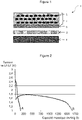
- the figure 1 is an exploded schematic representation of a stack of a cathode (2), a separator (3) and an anode (4) in an electrochemical cell (1) according to the invention.
- the cathode has a porous structure (5).
- the pores of the cathode house sulfur.
- a stable passivation layer (SEI for "Solid Electrolyte Interface") (6) is formed on the surface of the cathode (2). It results from the reduction at the cathode of chemical species contained in the electrolyte during the discharge of the element.
- SEI Solid Electrolyte Interface
- An electrochemical beam is formed by inserting a separator between at least one cathode and at least one anode.
- the electrochemical bundle is inserted into the cell container.
- the element's container can be parallelepiped or cylindrical. In the latter case, the electrochemical bundle is spiral to form a cylindrical mounting of the electrodes.
- the container provided with the electrochemical bundle is filled with the electrolyte as described above.
- the applicant has surprisingly found that the combination of a carbon cathode having a porous structure comprising pores with an average diameter less than or equal to 6 nm with an electrolyte comprising at least one carbonate and at least one bis( lithium fluorosulfonyl)imide (LiFSI) made it possible to reduce the quantity of hydrogen sulphide likely to be emitted in the event of accidental opening of the container of the element.
- LiFSI bis( lithium fluorosulfonyl)imide
- the Applicant is of the opinion that the chemical species located in the cathode passivation layer (SEI) in the element according to the invention have a lower reactivity with respect to water. and that this lower reactivity is responsible for the lower emission of hydrogen sulphide.
- SEI cathode passivation layer
- the invention makes it possible to reduce the quantity of electrolyte contained in the element. Indeed, it is customary when designing a lithium-sulfur element to provide an excess of electrolyte. This excess is used to compensate for the increase in the viscosity of the electrolyte caused by the dissolution of the lithium polysulphides during the discharge of the cell. It is recalled that the discharge of a lithium/sulfur element leads to the formation of lithium polysulphides which dissolve in the electrolyte. This dissolution leads to a drop in the amount of cathodic active material and an increase in the viscosity of the electrolyte.
- the increase in the viscosity of the electrolyte in turn leads to a reduction in ionic mobility, which is detrimental to the proper functioning of the element.
- the ratio between the volume of electrolyte and the amount of sulfur in a conventional lithium-sulfur element can be at least 5 ⁇ L of electrolyte per milligram of sulfur.
- an increase in the quantity of electrolyte penalizes the mass and volume energy of the electrochemical element.
- the invention makes it possible to reduce the ratio between the volume of electrolyte and the quantity of sulfur, for example by maintaining this ratio at a value less than or equal to 4 ⁇ L of electrolyte per milligram of sulfur, and consequently to increase the specific and voluminal energy of the element.
- Examples A and C are available from Akzo Nobel under the trade name Ketjen Black EC 600J.
- the nitrogen adsorption technique at 77 K was used.
- the adsorption and desorption isotherms were measured using a Belsorp mini II type apparatus.
- the carbon used in examples A and C has a porous structure comprising pores with an average diameter of 6.5 nm.
- the developed specific surface of this carbon, measured by the Brunauer-Emmet-Teller (BET) method, is 1439 m 2 /g.
- the BJH method also makes it possible to estimate the average pore diameter associated with the mesoporous volume, which will be denoted d mesoporous , from the nitrogen adsorption and desorption isotherms.
- the Horvath-Kawazoe method makes it possible to estimate the average diameter of the pores associated with the microporous volume which will be denoted d microporous , from the nitrogen adsorption and desorption isotherms.
- the average pore diameter was evaluated at 0.88 nm for the carbon used in examples B, D, E, F and G.
- the specific surface of this carbon measured by nitrogen adsorption and calculated by the method of Brunauer-Emmet-Teller (BET) is 2163 m 2 /g.
- the carbon of Examples A and C does not have a micropore volume. Its mean pore diameter therefore corresponds to the mesoporous d measured by the BJH method, which is 6.5 nm.
- the elemental solid sulfur used is available from the company Sigma-Aldrich, under the reference 215198.
- the composite of sulfur and carbon was prepared by mixing carbon with solid elemental sulfur. The mixture was heated at a temperature of 155°C for about 5 hours, under vacuum to allow the sulfur molecules to penetrate into the pores of the carbon. Heating of the mixture was continued at a temperature of 300°C for 30 minutes under a flow of inert gas in order to remove excess sulfur.
- the sulfur content in the carbon-sulfur composite prepared is measured by Thermogravimetric Analysis (TGA) using a TA Instrument Q500 apparatus.
- Elements D and E differ only by the nature of the electrolyte salt which is LiPF 6 for element D and LiFSI for element E.
- the comparison between the results obtained with element D and those obtained with element E shows that the replacement of LiPF 6 by LiFSI made it possible to reduce the quantity of hydrogen sulphide emitted.
- the lower quantity of hydrogen sulphide emitted by element E shows that the invention makes it possible to reduce the risk of toxicity for a user.
Landscapes
- Chemical & Material Sciences (AREA)
- Chemical Kinetics & Catalysis (AREA)
- Electrochemistry (AREA)
- General Chemical & Material Sciences (AREA)
- Engineering & Computer Science (AREA)
- Manufacturing & Machinery (AREA)
- Physics & Mathematics (AREA)
- Condensed Matter Physics & Semiconductors (AREA)
- General Physics & Mathematics (AREA)
- Inorganic Chemistry (AREA)
- Materials Engineering (AREA)
- Secondary Cells (AREA)
- Battery Electrode And Active Subsutance (AREA)
Claims (15)
- Elektrochemisches Element (1) des Lithium-Schwefel-Typs, umfassend:a) eine Kathode (2), umfassend:i) Kohlenstoff, der eine poröse Struktur (5) aufweist, umfassend Poren mit einem durchschnittlichen Durchmesser kleiner oder gleich 6 nm;ii) Schwefel mit einem Oxydationsgrad, der von 0 bis -2 in den Poren des Kohlenstoffs gehen kann;b) einen Elektrolyten, umfassend:i) mindestens ein organisches Lösungsmittel, das ein Karbonat ist;ii) ein oder mehrere Salze, wobei mindestens ein Salz Lithium-Bis(fluorsulfonyl)imid (LiFSI) ist;c) eine Anode (4), umfassend Lithiummetall oder eine metallische Lithium-Legierung,
wobei der durchschnittliche Durchmesser der Poren nach der in der Beschreibung angeführten Methode gemessen wird. - Elektrochemisches Element nach Anspruch 1, bei dem der Kohlenstoff eine poröse Struktur aufweist, umfassend Poren mit einem durchschnittlichen Durchmesser kleiner oder gleich 2 nm.
- Elektrochemisches Element nach einem der vorhergehenden Ansprüche, bei dem mindestens 50 % des porösen Volumens von Poren mit einem Durchmesser kleiner oder gleich 6 nm gebildet sind.
- Elektrochemisches Element nach einem der vorhergehenden Ansprüche, bei dem mindestens 50 % des porösen Volumens von Poren mit einem Durchmesser kleiner oder gleich 2 nm gebildet sind.
- Elektrochemisches Element nach Anspruch 4, bei dem mindestens 75 % des porösen Volumens von Poren mit einem Durchmesser kleiner oder gleich 2 nm gebildet sind.
- Elektrochemisches Element nach einem der vorhergehenden Ansprüche, bei dem der Schwefel fester Elementarschwefel ist und:- die feste Elementarschwefelmasse 30 bis 80 % der Summe der Massen von festem Elementarschwefel und Kohlenstoff darstellt;- die Kohlenstoffmasse 70 bis 20 % der Summe der Massen von festem Elementarschwefel und Kohlenstoff darstellt.
- Elektrochemisches Element nach Anspruch 6, bei dem:- die feste Elementarschwefelmasse 55 bis 65 % der Summe der Massen von festem Elementarschwefel und Kohlenstoff darstellt;- die Kohlenstoffmasse 45 bis 35 % der Summe der Massen von festem Elementarschwefel und Kohlenstoff darstellt.
- Elektrochemisches Element nach einem der vorhergehenden Ansprüche, bei dem die Kathode ferner mindestens ein Bindemittel und mindestens eine elektronenleitende Verbindung umfasst und der Schwefel fester Elementarschwefel ist, und:- die feste Elementarschwefelmasse 30 bis 80 % der Summe der Massen des festen Elementarschwefels, des Kohlenstoffs, des mindestens einen Bindemittels und der mindestens einen elektronenleitenden Verbindung darstellt;- die Kohlenstoffmasse 10 bis 60 % der Summe der Massen des festen Elementarschwefels, des Kohlenstoffs, des mindestens einen Bindemittels und der mindestens einen elektronenleitenden Verbindung darstellt;- die Masse des mindestens einen Bindemittels 3 bis 8 % der Summe der Massen des festen Elementarschwefels, des Kohlenstoffs, des mindestens einen Bindemittels und der mindestens einen elektronenleitenden Verbindung darstellt;- die Masse der mindestens einen elektronenleitenden Verbindung 2 bis 7 % der Summe der Massen des festen Elementarschwefels, des Kohlenstoffs, des mindestens einen Bindemittels und der mindestens einen elektronenleitenden Verbindung darstellt.
- Elektrochemisches Element nach einem der vorhergehenden Ansprüche, bei dem der Elektrolyt ein erstes organisches Lösungsmittel, das ein zyklisches Karbonat ist, und ein zweites organisches Lösungsmittel, das ein lineares Karbonat ist, umfasst.
- Elektrochemisches Element nach Anspruch 9, bei dem:- das Volumen des oder der zyklischen Karbonats(e) 10 bis 50 % des Gesamtvolumens der organischen Lösungsmittel darstellt;- das Volumen des oder der linearen Karbonats(e) 50 bis 90 % des Gesamtvolumens der organischen Lösungsmittel darstellt.
- Elektrochemisches Element nach einem der Ansprüche 9 bis 10, bei dem das zyklische Karbonat durch Fluor monosubstituiert ist.
- Elektrochemisches Element nach einem der vorhergehenden Ansprüche, bei dem der Elektrolyt kein Ester und/oder kein Ether umfasst.
- Elektrochemisches Element nach einem der Ansprüche 9 bis 12, bei dem das zyklische Karbonat Ethylenkarbonat, eventuell substituiert durch Fluor, und das lineare Karbonat Dimethylkarbonat ist.
- Elektrochemisches Element nach einem der vorhergehenden Ansprüche, bei dem höchstens 20 % des porösen Volumens von Poren mit einem Durchmesser über 6 nm und bis zu 50 nm gebildet sind.
- Elektrochemisches Element nach Anspruch 14, bei dem höchstens 10 % des porösen Volumens des Kohlenstoffs von Poren mit einem Durchmesser über 6 nm und bis zu 50 nm gebildet sind.
Applications Claiming Priority (2)
| Application Number | Priority Date | Filing Date | Title |
|---|---|---|---|
| FR1853161A FR3080222B1 (fr) | 2018-04-11 | 2018-04-11 | Element electrochimique lithium/soufre |
| PCT/EP2019/058969 WO2019197410A1 (fr) | 2018-04-11 | 2019-04-09 | Élément électrochimique de type lithium/soufre |
Publications (2)
| Publication Number | Publication Date |
|---|---|
| EP3776697A1 EP3776697A1 (de) | 2021-02-17 |
| EP3776697B1 true EP3776697B1 (de) | 2022-06-08 |
Family
ID=63407308
Family Applications (1)
| Application Number | Title | Priority Date | Filing Date |
|---|---|---|---|
| EP19716891.7A Active EP3776697B1 (de) | 2018-04-11 | 2019-04-09 | Elektrochemisches element des lithium-schwefel-typs |
Country Status (4)
| Country | Link |
|---|---|
| US (1) | US12224400B2 (de) |
| EP (1) | EP3776697B1 (de) |
| FR (1) | FR3080222B1 (de) |
| WO (1) | WO2019197410A1 (de) |
Families Citing this family (4)
| Publication number | Priority date | Publication date | Assignee | Title |
|---|---|---|---|---|
| US12315911B2 (en) * | 2019-08-22 | 2025-05-27 | Saft | Lithium-sulfur battery with improved performances |
| FR3117679B1 (fr) * | 2020-12-11 | 2023-04-21 | Accumulateurs Fixes | Element electrochimique lithium-soufre a electrolyte gelifie |
| US20240194932A1 (en) * | 2021-03-19 | 2024-06-13 | National Institute Of Advanced Industrial Science And Technology | Nonaqueous secondary battery electrolyte, and nonaqueous secondary battery using this |
| JP7672651B2 (ja) * | 2021-11-22 | 2025-05-08 | 学校法人 関西大学 | 非水電解質蓄電素子、機器及び非水電解質蓄電素子の製造方法 |
Family Cites Families (9)
| Publication number | Priority date | Publication date | Assignee | Title |
|---|---|---|---|---|
| KR100416098B1 (ko) * | 2001-12-18 | 2004-01-24 | 삼성에스디아이 주식회사 | 캐소드 전극, 이의 제조방법 및 이를 채용한 리튬 설퍼 전지 |
| WO2011051275A1 (en) * | 2009-10-27 | 2011-05-05 | Solvay Fluor Gmbh | Lithium sulfur battery |
| KR101117695B1 (ko) * | 2009-10-30 | 2012-03-02 | 삼성에스디아이 주식회사 | 리튬 전지용 전해액, 이를 포함한 리튬 전지 및 상기 리튬 전지의 작동 방법 |
| WO2012100301A1 (en) * | 2011-01-27 | 2012-08-02 | The University Of Queensland | Sulfur-carbon material and use as cathodes for high energy batteries |
| CN102903887B (zh) * | 2011-07-28 | 2015-06-03 | 中国科学院大连化学物理研究所 | 一种硫电极及其制备和应用 |
| US9882243B2 (en) * | 2013-09-26 | 2018-01-30 | Eaglepicher Technologies, Llc | Lithium-sulfur battery and methods of reducing insoluble solid lithium-polysulfide depositions |
| JP2015115270A (ja) * | 2013-12-13 | 2015-06-22 | 株式会社アルバック | リチウム硫黄二次電池 |
| JP6796254B2 (ja) * | 2014-11-13 | 2020-12-09 | 株式会社Gsユアサ | 硫黄−カーボン複合体、硫黄―カーボン複合体を含む電極を備えた非水電解質電池、及び硫黄−カーボン複合体の製造方法 |
| JP6756742B2 (ja) * | 2015-06-05 | 2020-09-16 | ローベルト ボツシユ ゲゼルシヤフト ミツト ベシユレンクテル ハフツングRobert Bosch Gmbh | リチウム−硫黄電池用の微多孔性カーボンナノシートを含む硫黄−炭素複合体およびそれを調製するためのプロセス |
-
2018
- 2018-04-11 FR FR1853161A patent/FR3080222B1/fr not_active Expired - Fee Related
-
2019
- 2019-04-09 WO PCT/EP2019/058969 patent/WO2019197410A1/fr not_active Ceased
- 2019-04-09 EP EP19716891.7A patent/EP3776697B1/de active Active
- 2019-04-09 US US17/044,482 patent/US12224400B2/en active Active
Also Published As
| Publication number | Publication date |
|---|---|
| WO2019197410A1 (fr) | 2019-10-17 |
| EP3776697A1 (de) | 2021-02-17 |
| FR3080222B1 (fr) | 2020-03-20 |
| FR3080222A1 (fr) | 2019-10-18 |
| US12224400B2 (en) | 2025-02-11 |
| US20210151802A1 (en) | 2021-05-20 |
Similar Documents
| Publication | Publication Date | Title |
|---|---|---|
| EP2321866B1 (de) | Lithium-ionen-akkumulatoren mit ionischem flüssigelektrolyt | |
| EP3103155B1 (de) | Spezifische lithiumbatterien mit wasserfreien elektrolyten auf der basis von sulfonverbindungen | |
| EP3776697B1 (de) | Elektrochemisches element des lithium-schwefel-typs | |
| EP3703174B1 (de) | Elektrolytzusammensetzung für ein elektrochemisches lithium-ionen-element | |
| EP3170216B1 (de) | Lithium-schwefel-batterie | |
| EP3491689B1 (de) | Anode für eine lithium-ionen-batteriezelle, herstellungsverfahren dafür und batterie damit | |
| EP3116827A1 (de) | Lithium-schwefel-batterie | |
| JP2014523094A (ja) | 金属硫化物を含む電極材料 | |
| EP3227944A1 (de) | Organische lithiumbatterie | |
| WO2006123050A1 (fr) | Procede de preparation d'une anode pour batterie a ion-lithium. | |
| WO2019097189A1 (fr) | Utilisation d'un melange de sels a titre d'additif dans une batterie au lithium gelifiee | |
| EP3327832B1 (de) | Verfahren zur herstellung einer positiven elektrode für eine lithium-schwefel-batterie | |
| EP3549192B1 (de) | Verbesserung der ionenleitfähigkeit eines elektrolyten auf basis von lithium-imidazolat-salzen | |
| US12315911B2 (en) | Lithium-sulfur battery with improved performances | |
| FR3127331A1 (fr) | Formulation d’une composition pour cathode comprenant une matière active fonctionnant à haut potentiel | |
| EP4004998A1 (de) | Elektrolytzusammensetzung für eine elektrochemische komponente mit einer lithiumanode | |
| FR3117679A1 (fr) | Element electrochimique lithium-soufre a electrolyte gelifie | |
| EP3472882B1 (de) | Verfahren zur herstellung einer als positivelektrode und als stromabnehmer wirkenden struktur für einen elektrochemischen lithium-schwefel-akkumulator | |
| FR3163776A1 (fr) | Nouvelles compositions de matieres actives | |
| EP3327831B1 (de) | Verfahren zur herstellung einer porösen positiven elektrode für eine lithium-schwefel-batterie | |
| WO2026008453A1 (fr) | Composition d'electrolyte pour element electrochimique lithium-ion | |
| FR3150647A1 (fr) | Elément électrochimique comprenant une électrode positive à base de phosphate lithié de manganèse et de fer | |
| FR3129780A3 (fr) | Elément électrochimique lithium-ion |
Legal Events
| Date | Code | Title | Description |
|---|---|---|---|
| STAA | Information on the status of an ep patent application or granted ep patent |
Free format text: STATUS: UNKNOWN |
|
| STAA | Information on the status of an ep patent application or granted ep patent |
Free format text: STATUS: THE INTERNATIONAL PUBLICATION HAS BEEN MADE |
|
| PUAI | Public reference made under article 153(3) epc to a published international application that has entered the european phase |
Free format text: ORIGINAL CODE: 0009012 |
|
| STAA | Information on the status of an ep patent application or granted ep patent |
Free format text: STATUS: REQUEST FOR EXAMINATION WAS MADE |
|
| 17P | Request for examination filed |
Effective date: 20201023 |
|
| AK | Designated contracting states |
Kind code of ref document: A1 Designated state(s): AL AT BE BG CH CY CZ DE DK EE ES FI FR GB GR HR HU IE IS IT LI LT LU LV MC MK MT NL NO PL PT RO RS SE SI SK SM TR |
|
| AX | Request for extension of the european patent |
Extension state: BA ME |
|
| DAV | Request for validation of the european patent (deleted) | ||
| DAX | Request for extension of the european patent (deleted) | ||
| RIC1 | Information provided on ipc code assigned before grant |
Ipc: H01M 4/40 20060101ALN20211112BHEP Ipc: H01M 10/0569 20100101ALI20211112BHEP Ipc: H01M 10/0568 20100101ALI20211112BHEP Ipc: H01M 10/052 20100101ALI20211112BHEP Ipc: H01M 4/62 20060101ALI20211112BHEP Ipc: H01M 4/38 20060101ALI20211112BHEP Ipc: H01M 4/13 20100101AFI20211112BHEP |
|
| GRAP | Despatch of communication of intention to grant a patent |
Free format text: ORIGINAL CODE: EPIDOSNIGR1 |
|
| STAA | Information on the status of an ep patent application or granted ep patent |
Free format text: STATUS: GRANT OF PATENT IS INTENDED |
|
| RIC1 | Information provided on ipc code assigned before grant |
Ipc: H01M 4/40 20060101ALN20211220BHEP Ipc: H01M 10/0569 20100101ALI20211220BHEP Ipc: H01M 10/0568 20100101ALI20211220BHEP Ipc: H01M 10/052 20100101ALI20211220BHEP Ipc: H01M 4/62 20060101ALI20211220BHEP Ipc: H01M 4/38 20060101ALI20211220BHEP Ipc: H01M 4/13 20100101AFI20211220BHEP |
|
| INTG | Intention to grant announced |
Effective date: 20220114 |
|
| GRAS | Grant fee paid |
Free format text: ORIGINAL CODE: EPIDOSNIGR3 |
|
| GRAA | (expected) grant |
Free format text: ORIGINAL CODE: 0009210 |
|
| STAA | Information on the status of an ep patent application or granted ep patent |
Free format text: STATUS: THE PATENT HAS BEEN GRANTED |
|
| AK | Designated contracting states |
Kind code of ref document: B1 Designated state(s): AL AT BE BG CH CY CZ DE DK EE ES FI FR GB GR HR HU IE IS IT LI LT LU LV MC MK MT NL NO PL PT RO RS SE SI SK SM TR |
|
| REG | Reference to a national code |
Ref country code: AT Ref legal event code: REF Ref document number: 1497540 Country of ref document: AT Kind code of ref document: T Effective date: 20220615 Ref country code: CH Ref legal event code: EP |
|
| REG | Reference to a national code |
Ref country code: DE Ref legal event code: R096 Ref document number: 602019015676 Country of ref document: DE |
|
| REG | Reference to a national code |
Ref country code: IE Ref legal event code: FG4D Free format text: LANGUAGE OF EP DOCUMENT: FRENCH |
|
| REG | Reference to a national code |
Ref country code: LT Ref legal event code: MG9D |
|
| REG | Reference to a national code |
Ref country code: NL Ref legal event code: MP Effective date: 20220608 |
|
| PG25 | Lapsed in a contracting state [announced via postgrant information from national office to epo] |
Ref country code: SE Free format text: LAPSE BECAUSE OF FAILURE TO SUBMIT A TRANSLATION OF THE DESCRIPTION OR TO PAY THE FEE WITHIN THE PRESCRIBED TIME-LIMIT Effective date: 20220608 Ref country code: NO Free format text: LAPSE BECAUSE OF FAILURE TO SUBMIT A TRANSLATION OF THE DESCRIPTION OR TO PAY THE FEE WITHIN THE PRESCRIBED TIME-LIMIT Effective date: 20220908 Ref country code: LT Free format text: LAPSE BECAUSE OF FAILURE TO SUBMIT A TRANSLATION OF THE DESCRIPTION OR TO PAY THE FEE WITHIN THE PRESCRIBED TIME-LIMIT Effective date: 20220608 Ref country code: HR Free format text: LAPSE BECAUSE OF FAILURE TO SUBMIT A TRANSLATION OF THE DESCRIPTION OR TO PAY THE FEE WITHIN THE PRESCRIBED TIME-LIMIT Effective date: 20220608 Ref country code: GR Free format text: LAPSE BECAUSE OF FAILURE TO SUBMIT A TRANSLATION OF THE DESCRIPTION OR TO PAY THE FEE WITHIN THE PRESCRIBED TIME-LIMIT Effective date: 20220909 Ref country code: FI Free format text: LAPSE BECAUSE OF FAILURE TO SUBMIT A TRANSLATION OF THE DESCRIPTION OR TO PAY THE FEE WITHIN THE PRESCRIBED TIME-LIMIT Effective date: 20220608 Ref country code: BG Free format text: LAPSE BECAUSE OF FAILURE TO SUBMIT A TRANSLATION OF THE DESCRIPTION OR TO PAY THE FEE WITHIN THE PRESCRIBED TIME-LIMIT Effective date: 20220908 |
|
| REG | Reference to a national code |
Ref country code: AT Ref legal event code: MK05 Ref document number: 1497540 Country of ref document: AT Kind code of ref document: T Effective date: 20220608 |
|
| PG25 | Lapsed in a contracting state [announced via postgrant information from national office to epo] |
Ref country code: RS Free format text: LAPSE BECAUSE OF FAILURE TO SUBMIT A TRANSLATION OF THE DESCRIPTION OR TO PAY THE FEE WITHIN THE PRESCRIBED TIME-LIMIT Effective date: 20220608 Ref country code: LV Free format text: LAPSE BECAUSE OF FAILURE TO SUBMIT A TRANSLATION OF THE DESCRIPTION OR TO PAY THE FEE WITHIN THE PRESCRIBED TIME-LIMIT Effective date: 20220608 |
|
| PG25 | Lapsed in a contracting state [announced via postgrant information from national office to epo] |
Ref country code: NL Free format text: LAPSE BECAUSE OF FAILURE TO SUBMIT A TRANSLATION OF THE DESCRIPTION OR TO PAY THE FEE WITHIN THE PRESCRIBED TIME-LIMIT Effective date: 20220608 |
|
| PG25 | Lapsed in a contracting state [announced via postgrant information from national office to epo] |
Ref country code: SM Free format text: LAPSE BECAUSE OF FAILURE TO SUBMIT A TRANSLATION OF THE DESCRIPTION OR TO PAY THE FEE WITHIN THE PRESCRIBED TIME-LIMIT Effective date: 20220608 Ref country code: SK Free format text: LAPSE BECAUSE OF FAILURE TO SUBMIT A TRANSLATION OF THE DESCRIPTION OR TO PAY THE FEE WITHIN THE PRESCRIBED TIME-LIMIT Effective date: 20220608 Ref country code: RO Free format text: LAPSE BECAUSE OF FAILURE TO SUBMIT A TRANSLATION OF THE DESCRIPTION OR TO PAY THE FEE WITHIN THE PRESCRIBED TIME-LIMIT Effective date: 20220608 Ref country code: PT Free format text: LAPSE BECAUSE OF FAILURE TO SUBMIT A TRANSLATION OF THE DESCRIPTION OR TO PAY THE FEE WITHIN THE PRESCRIBED TIME-LIMIT Effective date: 20221010 Ref country code: ES Free format text: LAPSE BECAUSE OF FAILURE TO SUBMIT A TRANSLATION OF THE DESCRIPTION OR TO PAY THE FEE WITHIN THE PRESCRIBED TIME-LIMIT Effective date: 20220608 Ref country code: EE Free format text: LAPSE BECAUSE OF FAILURE TO SUBMIT A TRANSLATION OF THE DESCRIPTION OR TO PAY THE FEE WITHIN THE PRESCRIBED TIME-LIMIT Effective date: 20220608 Ref country code: CZ Free format text: LAPSE BECAUSE OF FAILURE TO SUBMIT A TRANSLATION OF THE DESCRIPTION OR TO PAY THE FEE WITHIN THE PRESCRIBED TIME-LIMIT Effective date: 20220608 Ref country code: AT Free format text: LAPSE BECAUSE OF FAILURE TO SUBMIT A TRANSLATION OF THE DESCRIPTION OR TO PAY THE FEE WITHIN THE PRESCRIBED TIME-LIMIT Effective date: 20220608 |
|
| PG25 | Lapsed in a contracting state [announced via postgrant information from national office to epo] |
Ref country code: PL Free format text: LAPSE BECAUSE OF FAILURE TO SUBMIT A TRANSLATION OF THE DESCRIPTION OR TO PAY THE FEE WITHIN THE PRESCRIBED TIME-LIMIT Effective date: 20220608 Ref country code: IS Free format text: LAPSE BECAUSE OF FAILURE TO SUBMIT A TRANSLATION OF THE DESCRIPTION OR TO PAY THE FEE WITHIN THE PRESCRIBED TIME-LIMIT Effective date: 20221008 |
|
| REG | Reference to a national code |
Ref country code: DE Ref legal event code: R097 Ref document number: 602019015676 Country of ref document: DE |
|
| PG25 | Lapsed in a contracting state [announced via postgrant information from national office to epo] |
Ref country code: AL Free format text: LAPSE BECAUSE OF FAILURE TO SUBMIT A TRANSLATION OF THE DESCRIPTION OR TO PAY THE FEE WITHIN THE PRESCRIBED TIME-LIMIT Effective date: 20220608 |
|
| PLBE | No opposition filed within time limit |
Free format text: ORIGINAL CODE: 0009261 |
|
| STAA | Information on the status of an ep patent application or granted ep patent |
Free format text: STATUS: NO OPPOSITION FILED WITHIN TIME LIMIT |
|
| PG25 | Lapsed in a contracting state [announced via postgrant information from national office to epo] |
Ref country code: DK Free format text: LAPSE BECAUSE OF FAILURE TO SUBMIT A TRANSLATION OF THE DESCRIPTION OR TO PAY THE FEE WITHIN THE PRESCRIBED TIME-LIMIT Effective date: 20220608 |
|
| 26N | No opposition filed |
Effective date: 20230310 |
|
| PG25 | Lapsed in a contracting state [announced via postgrant information from national office to epo] |
Ref country code: SI Free format text: LAPSE BECAUSE OF FAILURE TO SUBMIT A TRANSLATION OF THE DESCRIPTION OR TO PAY THE FEE WITHIN THE PRESCRIBED TIME-LIMIT Effective date: 20220608 |
|
| P01 | Opt-out of the competence of the unified patent court (upc) registered |
Effective date: 20230514 |
|
| REG | Reference to a national code |
Ref country code: CH Ref legal event code: PL |
|
| PG25 | Lapsed in a contracting state [announced via postgrant information from national office to epo] |
Ref country code: LU Free format text: LAPSE BECAUSE OF NON-PAYMENT OF DUE FEES Effective date: 20230409 |
|
| REG | Reference to a national code |
Ref country code: BE Ref legal event code: MM Effective date: 20230430 |
|
| PG25 | Lapsed in a contracting state [announced via postgrant information from national office to epo] |
Ref country code: MC Free format text: LAPSE BECAUSE OF FAILURE TO SUBMIT A TRANSLATION OF THE DESCRIPTION OR TO PAY THE FEE WITHIN THE PRESCRIBED TIME-LIMIT Effective date: 20220608 |
|
| PG25 | Lapsed in a contracting state [announced via postgrant information from national office to epo] |
Ref country code: MC Free format text: LAPSE BECAUSE OF FAILURE TO SUBMIT A TRANSLATION OF THE DESCRIPTION OR TO PAY THE FEE WITHIN THE PRESCRIBED TIME-LIMIT Effective date: 20220608 Ref country code: LI Free format text: LAPSE BECAUSE OF NON-PAYMENT OF DUE FEES Effective date: 20230430 Ref country code: IT Free format text: LAPSE BECAUSE OF FAILURE TO SUBMIT A TRANSLATION OF THE DESCRIPTION OR TO PAY THE FEE WITHIN THE PRESCRIBED TIME-LIMIT Effective date: 20220608 Ref country code: CH Free format text: LAPSE BECAUSE OF NON-PAYMENT OF DUE FEES Effective date: 20230430 |
|
| REG | Reference to a national code |
Ref country code: IE Ref legal event code: MM4A |
|
| PG25 | Lapsed in a contracting state [announced via postgrant information from national office to epo] |
Ref country code: BE Free format text: LAPSE BECAUSE OF NON-PAYMENT OF DUE FEES Effective date: 20230430 |
|
| PG25 | Lapsed in a contracting state [announced via postgrant information from national office to epo] |
Ref country code: IE Free format text: LAPSE BECAUSE OF NON-PAYMENT OF DUE FEES Effective date: 20230409 |
|
| PG25 | Lapsed in a contracting state [announced via postgrant information from national office to epo] |
Ref country code: IE Free format text: LAPSE BECAUSE OF NON-PAYMENT OF DUE FEES Effective date: 20230409 |
|
| PG25 | Lapsed in a contracting state [announced via postgrant information from national office to epo] |
Ref country code: BG Free format text: LAPSE BECAUSE OF FAILURE TO SUBMIT A TRANSLATION OF THE DESCRIPTION OR TO PAY THE FEE WITHIN THE PRESCRIBED TIME-LIMIT Effective date: 20220608 |
|
| PG25 | Lapsed in a contracting state [announced via postgrant information from national office to epo] |
Ref country code: BG Free format text: LAPSE BECAUSE OF FAILURE TO SUBMIT A TRANSLATION OF THE DESCRIPTION OR TO PAY THE FEE WITHIN THE PRESCRIBED TIME-LIMIT Effective date: 20220608 |
|
| PGFP | Annual fee paid to national office [announced via postgrant information from national office to epo] |
Ref country code: DE Payment date: 20250430 Year of fee payment: 7 |
|
| PGFP | Annual fee paid to national office [announced via postgrant information from national office to epo] |
Ref country code: GB Payment date: 20250430 Year of fee payment: 7 |
|
| PG25 | Lapsed in a contracting state [announced via postgrant information from national office to epo] |
Ref country code: CY Free format text: LAPSE BECAUSE OF FAILURE TO SUBMIT A TRANSLATION OF THE DESCRIPTION OR TO PAY THE FEE WITHIN THE PRESCRIBED TIME-LIMIT; INVALID AB INITIO Effective date: 20190409 |
|
| PG25 | Lapsed in a contracting state [announced via postgrant information from national office to epo] |
Ref country code: HU Free format text: LAPSE BECAUSE OF FAILURE TO SUBMIT A TRANSLATION OF THE DESCRIPTION OR TO PAY THE FEE WITHIN THE PRESCRIBED TIME-LIMIT; INVALID AB INITIO Effective date: 20190409 |
|
| PG25 | Lapsed in a contracting state [announced via postgrant information from national office to epo] |
Ref country code: TR Free format text: LAPSE BECAUSE OF FAILURE TO SUBMIT A TRANSLATION OF THE DESCRIPTION OR TO PAY THE FEE WITHIN THE PRESCRIBED TIME-LIMIT Effective date: 20220608 |
|
| PGFP | Annual fee paid to national office [announced via postgrant information from national office to epo] |
Ref country code: FR Payment date: 20260310 Year of fee payment: 8 |