EP3777671A1 - Befestigungspad - Google Patents
Befestigungspad Download PDFInfo
- Publication number
- EP3777671A1 EP3777671A1 EP19776844.3A EP19776844A EP3777671A1 EP 3777671 A1 EP3777671 A1 EP 3777671A1 EP 19776844 A EP19776844 A EP 19776844A EP 3777671 A1 EP3777671 A1 EP 3777671A1
- Authority
- EP
- European Patent Office
- Prior art keywords
- attachment
- target substance
- electrode layer
- electrode
- resin film
- Prior art date
- Legal status (The legal status is an assumption and is not a legal conclusion. Google has not performed a legal analysis and makes no representation as to the accuracy of the status listed.)
- Granted
Links
Images


Classifications
-
- A—HUMAN NECESSITIES
- A61—MEDICAL OR VETERINARY SCIENCE; HYGIENE
- A61B—DIAGNOSIS; SURGERY; IDENTIFICATION
- A61B5/00—Measuring for diagnostic purposes; Identification of persons
- A61B5/68—Arrangements of detecting, measuring or recording means, e.g. sensors, in relation to patient
- A61B5/6801—Arrangements of detecting, measuring or recording means, e.g. sensors, in relation to patient specially adapted to be attached to or worn on the body surface
- A61B5/683—Means for maintaining contact with the body
-
- A—HUMAN NECESSITIES
- A61—MEDICAL OR VETERINARY SCIENCE; HYGIENE
- A61B—DIAGNOSIS; SURGERY; IDENTIFICATION
- A61B5/00—Measuring for diagnostic purposes; Identification of persons
- A61B5/24—Detecting, measuring or recording bioelectric or biomagnetic signals of the body or parts thereof
- A61B5/25—Bioelectric electrodes therefor
- A61B5/251—Means for maintaining electrode contact with the body
- A61B5/252—Means for maintaining electrode contact with the body by suction
-
- A—HUMAN NECESSITIES
- A61—MEDICAL OR VETERINARY SCIENCE; HYGIENE
- A61B—DIAGNOSIS; SURGERY; IDENTIFICATION
- A61B5/00—Measuring for diagnostic purposes; Identification of persons
- A61B5/24—Detecting, measuring or recording bioelectric or biomagnetic signals of the body or parts thereof
- A61B5/25—Bioelectric electrodes therefor
- A61B5/263—Bioelectric electrodes therefor characterised by the electrode materials
-
- H—ELECTRICITY
- H02—GENERATION; CONVERSION OR DISTRIBUTION OF ELECTRIC POWER
- H02N—ELECTRIC MACHINES NOT OTHERWISE PROVIDED FOR
- H02N13/00—Clutches or holding devices using electrostatic attraction, e.g. using Johnson-Rahbek effect
-
- A—HUMAN NECESSITIES
- A61—MEDICAL OR VETERINARY SCIENCE; HYGIENE
- A61B—DIAGNOSIS; SURGERY; IDENTIFICATION
- A61B2562/00—Details of sensors; Constructional details of sensor housings or probes; Accessories for sensors
- A61B2562/02—Details of sensors specially adapted for in-vivo measurements
- A61B2562/0209—Special features of electrodes classified in A61B5/24, A61B5/25, A61B5/283, A61B5/291, A61B5/296, A61B5/053
-
- A—HUMAN NECESSITIES
- A61—MEDICAL OR VETERINARY SCIENCE; HYGIENE
- A61B—DIAGNOSIS; SURGERY; IDENTIFICATION
- A61B2562/00—Details of sensors; Constructional details of sensor housings or probes; Accessories for sensors
- A61B2562/14—Coupling media or elements to improve sensor contact with skin or tissue
Definitions
- the present invention relates to an attachment pad that is used in a state of being attached to attachment target substances utilizing an electrical attachment force, and more specifically relates to an attachment pad that can be attached to and held on attachment target substances including not only conductors but also substances such as animals, plants, and processed products thereof, which are soft and have a certain level of moisture and oil, particularly human skin.
- an electrostatic chuck has been conventionally used as means for attaching an attachment target substance by an electrical attachment force.
- Electrostatic chucks are mainly used for industrial purposes for attaching and holding a semiconductor substrate or a glass substrate when they are treated.
- An electrostatic chuck generally has a structure in which electrodes are vertically sandwiched by dielectrics, and can attach an attachment target substance with a surface of one of the dielectrics as an attachment surface by application of a voltage to the electrodes according to the attachment principle.
- an electrostatic chuck has heating means, or has a structure in which it is integrally bonded to a metal base having a conduit through which a coolant flows.
- the inventors of the present application have proposed an electrostatic attachment structure to which the structure and principle of electric attachment of an electrostatic chuck is applied.
- PTL 1 proposes an electrostatic attachment structure which is highly convenient in changing its configuration.
- the electrostatic attachment structure multiple sheet members in which two dielectrics are sandwiched between electrodes are laminated.
- the members When a voltage is applied between the electrodes, the members can be attached and fixed to each other and exhibited objects and posters such as paper and resin sheets can be attached on the other attachment surface.
- PTL 2 proposes a power generation device which shows good selectivity of installation locations and attachment/detachment properties.
- the power generation device has attachment and detachment means constituted by surfaces of an electrostatic chuck in which attachment electrodes are sandwiched between two insulating layers and a film-shaped solar cell is attached thereto.
- the electrostatic attachment structure of PTL 1 and the power generation device of PTL 2 have favorable attachment/detachment properties because the attachment principle of the electrostatic chuck is used.
- the electrostatic attachment structure and the power generation device are thin and devised considering handleability, However, they are only intended to be attached and fixed to artificial materials that are relatively large and have an even surface such as the above-mentioned industrial products or daily necessities, and their application to attachment target substances such as human skin that is soft and has a certain level of moisture and oil has not yet been studied.
- a polyimide film or a polyethylene terephthalate (PET) film is preferably used as a specific dielectric layer (insulator) in the electrostatic attachment structure described in PTL 1 and the power generation device described in PTL 2.
- PET polyethylene terephthalate
- the conventional electrostatic chuck requires a sufficient contact area between a target object and the chuck to obtain a sufficient attachment force, and when both the attachment target side and the chuck side are made flat for increasing the contact area.
- a surface of a living body for example, human skin and the like
- an electrode pad for electrocardiographic measurement as described in PTL 3 or a medical instrument such as a patch for measuring an amount of sweat as described in PTL 4 has been conventionally known as a means used by being attached to human skin, but they are both means in which a pressure sensitive adhesive is used on an attachment surface, and are not means utilizing an electrical attachment force.
- an attachment pad can be attached to and held particularly on human skin by an electrical attachment force without using such a conventional pressure sensitive adhesive by configuring a simple attachment pad used together with a power supply device that can receive application of a voltage to an electrode layer, in which a resin film having a specific tensile elastic modulus and a specific volume resistance value is adopted for at least an attachment surface to an attachment target substance, and a laminate sheet in which the resin film and another resin film are sandwiched together between the electrode layer and laminated is obtained, and thus completed the present invention.
- an object of the present invention is to provide an attachment pad that can be attached to and held particularly on human skin with favorable followability by utilizing an electrical attachment force.
- the gist of the present invention is as follows.
- an attachment pad that can be attached to and held on attachment target substances that are soft and have a certain level of moisture and oil, particularly human skin, with favorable followability by utilizing an electrical attachment force.
- an electrical attachment force since the attachment pad can be attached and fixed by an electrical attachment force, it can be used repeatedly without using a chemical adhesive means such as an adhesive or a pressure sensitive adhesive.
- the attachment pad is simple and cost effective because a release film used therefor becomes unnecessary.
- wearable electric products for example, various sensors that read biometric information, medical devices, ornaments
- the technique is expected to expand into fields and industries such as medical care, beauty, sports, clothing, and wearable devices.
- an attachment pad of the present invention at least includes a laminate sheet in which a first resin film, an electrode layer, and a second resin film are sequentially laminated, and the electrode layer is sandwiched between the resin films; and a power supply device that applies a voltage to the electrode layer.
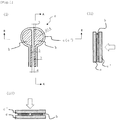
- the electrode layer may be a bipolar type having a positive electrode and a negative electrode as shown in Figs. 1 and 2 , or may be a unipolar type which has only a positive (negative) electrode and in which a negative (positive) electrode side is grounded as shown in Figs. 3 and 4 .
- each configuration will be described in detail.
- the second resin film is on an attachment surface for an attachment target substance in the present invention, and a volume resistivity of at least the second resin film serving as the attachment surface is required to be 1 ⁇ 10 10 to 10 13 ⁇ cm.
- a volume resistivity of the second resin film on the attachment surface exceeds 1 ⁇ 10 13 ⁇ cm, an attachment force for an attachment target substance (human skin and the like) decreases, and, for example, the attachment pad may fall off even due to its own weight.
- a volume resistivity is preferably 1 ⁇ 10 10 to 10 12 ⁇ cm in view of both realization of attachment force and safety.
- a volume resistivity can be appropriately set regarding the first resin film used on the side opposite to the attachment surface of an attachment target substance, but since there is a probability that an electric current that should flow between the second resin film and an attachment target substance may flow to the first resin film side, a volume resistivity of the first resin film is preferably the same as or higher than a volume resistivity of the second resin film.
- the second resin film serving as the attachment surface is required to have a tensile elastic modulus (Young's modulus) of 1 MPa or more and less than 100 MPa.
- a tensile elastic modulus (Young's modulus) of at least the second resin film serving as the attachment surface is set within the above-mentioned range.
- a tensile elastic modulus (Young's modulus) of the first resin film used on the side opposite to the attachment surface of the attachment target substance can be appropriately set, but a tensile elastic modulus (Young's modulus) of the first resin film is preferably the same as or smaller than a tensile elastic modulus (Young's modulus) of the second resin film so that flexibility of the entire attachment pad (laminate sheet) is not impaired.
- each of the first resin film and the second resin film is required to have a thickness of 20 to 200 ⁇ m to ensure insulation properties, followability of attachment to an attachment target substance, and attachment force, where a thickness is preferably 50 to 100 ⁇ m.
- a thickness is less than 20 ⁇ m, dielectric breakdown easily occurs, and the attachment pad may not function as an attachment pad due to pinholes formed in the resin film due to the dielectric breakdown.
- a thickness exceeds 200 ⁇ m, it is not preferable because followability of attachment to an attachment target substance is poor, and a distance to the attachment target substance is large, which may reduce an attachment force.
- first and second resin films may be the same as or different from each other, and specific examples of such resin films described above include polyimide, polyethylene terephthalate (PET), nylon, polypropylene, polyurethane, soft polyvinyl chloride, polyvinylidene chloride, and the like. Examples thereof further include films processed (by mixing a filler thereinto, and the like) to adjust conductivity thereof.
- the second resin film is preferably polyurethane or soft polyvinyl chloride and is more preferably soft polyvinyl chloride so that a volume resistivity and a tensile elastic modulus thereof are set within the above-mentioned predetermined ranges.
- a material, a shape, and the like of the electrode layer used in the present invention are not particularly limited, but a thickness thereof is required to be 1 to 20 ⁇ m.
- a thickness is less than 1 ⁇ m, the electrode layer may be disconnected or conductivity may be reduced due to deformation of the attachment pad.
- a thickness exceeds 20 ⁇ m, hardness of the electrode layer tends to increase, and therefore, flexibility of the entire attachment pad deteriorates, and followability for an attachment target substance may deteriorate.
- a metal foil may be used as it is; an electrode layer obtained by etching a metal film formed by a sputtering method, an ion plating method, or the like into a predetermined shape may be used; or an electrode layer formed into a predetermined shape by spraying a metal material or printing a conductive ink may be used.
- the shape can be appropriately selected from, for example, a flat plate shape, a semicircular shape, a pattern shape such as a comb shape or a mesh, and the like.
- first and second resin films and the electrode layer described above are used and laminated to form a laminate sheet.
- the electrode layer is required to be sandwiched between the resin films so that the electrode layer is not exposed.
- these resin films and electrode layer are sequentially laminated, heat and pressure are applied thereto, and thermoplasticity of the resin films themselves is utilized to fuse the laminate.
- bonding may be performed using a bonding sheet, an adhesive, or a pressure-sensitive adhesive.
- the method of fusion welding using thermoplasticity of the films is preferable.
- a power supply device for applying a voltage to the electrode layers to generate an electrical attachment force is required.
- the power supply device can be connected to the electrode layer of the laminate sheet via a connection terminal and a switch (both not shown).
- a power supply device similar to that used for a general electrostatic attachment structure may be used, and any power supply device may be used as long as it can generate a high DC voltage.
- a potential difference to be generated can be set up to about 500 to 5,000 V, and if necessary, a booster circuit (high voltage generator circuit) capable of boosting to a required voltage may be provided.
- an output current from the power supply it is preferable to suppress an output current from the power supply to 0.5 mA or less. This is because the human body cannot generally perceive current when it is 0.5 mA or less.
- an electrostatic capacity of the attachment pad is preferably set to 1,000 pF or less, which is the same level as the human body, specifically to about 10 pF to 100 pF, and a voltage is preferably set within ⁇ 5,000 V so that current will be 5 ⁇ C or less even when it is accumulated in the human body.
- the above-mentioned laminate sheet and power supply device are provided to form the attachment pad of the present invention. If necessary, a sensor or the like may be separately provided to the attachment pad of the present invention. Furthermore, appropriate change or addition of the configuration may be performed within the scope of the object of the present invention such as changing the pattern of the electrode layer.
- an attachment target substance not only a conductor but also paper or cloth having poor electric conductivity can be adapted.
- Substances typically the human skin, that are soft and have a certain level of moisture and oil equivalent to human skin, which are substances having a certain surface to which the attachment pad can be connected and attached (for example, organs, animal skin, plants, foods such as meat and processed meat products/vegetables and processed vegetable products/fruits and processed fruit products, or a combination thereof) can be particularly targeted.
- bipolar attachment pad As a bipolar attachment pad, the following was prepared. Two aluminum foils b (thickness: 0.012 mm) as electrode layers having a predetermined shape with dimensions (unit: mm) as shown in Fig. 1 were sandwiched from above and below between two resin films c and c' made from soft polyvinyl chloride [where both had a volume resistivity of 1 ⁇ 10 10 ⁇ cm (measured by a method to be described later), a tensile elastic modulus (Young's modulus): 20 to 30 MPa, and a thickness of 100 ⁇ m], and they were thermocompression bonded at a temperature of 150°C to obtain a bipolar laminate sheet a.
- the produced laminate sheet a was provided with a power supply device as shown in Fig. 2 [a power supply device consisting of a battery d (DC 3.7 V), a DC-DC converter e (5 V output), and a high voltage generator circuit f ( ⁇ 2,000 V output)] to form an attachment pad h according to the present invention.
- a power supply device consisting of a battery d (DC 3.7 V), a DC-DC converter e (5 V output), and a high voltage generator circuit f ( ⁇ 2,000 V output)
- Positive (+2,000 V) and negative (-2,000 V) symmetrical voltages were applied to each of a first electrode and a second electrode in the electrode layer, and thereby it was possible to attach the attachment pad to an attachment target substance (human skin) g while making a potential of the attachment target substance (human body) approximately 0 V.
- a unipolar attachment pad As a unipolar attachment pad, the following was prepared.
- the laminate sheet a' thus produced was provided with a power supply device as shown in Fig. 4 [a power supply device consisting of a commercial power supply d' (AC 100 V), an AC adapter e' (5 V output), and a high voltage generator circuit f (-4,000 V output)] to form an attachment pad h' according to the present invention.
- the attachment pad was attached to an attachment target substance (human skin) g. Ground (not shown) of the attachment target substance (human skin) g and the high voltage generator circuit f were earthed.
- a power supply device was turned on, and the attachment pad h' of Example 1 produced as above was attached to the skin g' of the forearm of a human body (adult man) while pressing the pad with the other hand so that the load was applied vertically downward (the direction of the white arrow in the figure) to generate and hold an electrical attachment force between the attachment pad and the skin of the forearm.
- a weight j made of brass was installed at a lower end of the attachment pad to check how many grams of the weight the pad could hold, and this was used as evaluation of attachment properties. A holding time of the weight was 15 seconds or longer. The results are shown in Table 1.
- Example 1 Second resin film Attachment target substance Evaluation result Material Volume resistivity ( ⁇ cm) Tensile elastic modulus (MPa)
- Example 1 Soft polyvinyl chloride 1 ⁇ 10 10 20 to 30 Human skin 200 g could be held.
- Example 2 1 ⁇ 10 12 20 to 30
- Example 3 1 ⁇ 10 13 - 10 to 20 g could be held.
- Example 4 1 ⁇ 10 10 20 to 30 Leaf of foliage plant 10 to 20 g could be held.
- Example 5 1 ⁇ 10 10 20 to 30 Processed pork meat 10 to 20 g could be held.
- Example 6 1 ⁇ 10 10 20 to 30 Vegetable (eggplant) 10 to 20 g could be held.
- Comparative Example 1 1 ⁇ 10 15 - Human skin Pad fell off due to its own weight.
- Comparative Example 2 Polyimide (Kapton H) 1 ⁇ 10 17 3 ⁇ 10 3 Attachment force was rapidly reduced and pad fell off due to its own weight.
- Comparative Example 3 PET (Lumirror S10) 1 ⁇ 10 17 4 ⁇ 10 3
- a volume resistivity of the soft polyvinyl chloride film in Example 1 was measured by a double ring electrode method (IEC 60093, ASTM D257, JIS K 6911, JIS K 6271), and a volume resistivity of each resin film used in Examples 2 to 6 and Comparative Examples 1 to 3 to be described later was also measured by the same method.
- An attachment pad according to Example 2 was produced in the same manner as in Example 1 except that a soft polyvinyl chloride film (thickness: 100 ⁇ m) having a volume resistivity of 1 ⁇ 10 12 ⁇ cm (measured by the method described above) and a tensile elastic modulus (Young's modulus) of 20 to 30 MPa was used as the second resin film c' that served as an attachment surface of an attachment target substance. Furthermore, attachment properties of the attachment pad were evaluated in the same manner as in Example 1. The results are as shown in Table 1.
- An attachment pad according to Example 3 was produced in the same manner as in Example 1 except that a soft polyvinyl chloride film (thickness: 100 ⁇ m) having a volume resistivity of 1 ⁇ 10 13 ⁇ cm (measured by the method described above) was used as the second resin film c' that served as an attachment surface of an attachment target substance. Furthermore, attachment properties of the attachment pad were evaluated in the same manner as in Example 1. The results are as shown in Table 1.
- Attachment properties were evaluated in the same manner as in Example 1 except that the attachment pad h' used in Example 1 was used, the leaf of the foliage plant (plant name: Ficus umbellata ) was used as the attachment target substance g' instead of the human skin, and the pad was attached to a surface of the leaf.
- the results are as shown in Table 1.
- Attachment properties were evaluated in the same manner as in Example 1 except that the attachment pad h' used in Example 1 was used, processed pork meat (manufactured by Foodlier Co., Ltd., product name: loin ham) was used instead of the human skin as the attachment target substance g', and the pad was attached to a surface of the meat after removing some oil on the surface.
- the results are as shown in Table 1.
- An attachment pad h' according to Comparative Example 1 was produced in the same manner as in Example 1 except that a soft polyvinyl chloride film (trade name: 711M, manufactured by Nakagawa Chemical Inc., thickness: 100 ⁇ m) having a volume resistivity of 1 ⁇ 10 15 ⁇ cm (measured by the method described above) was used as the second resin film c' that served as an attachment surface of an attachment target substance. Furthermore, attachment properties of the attachment pad with respect to human skin were evaluated in the same manner as in Example 1. The results are as shown in Table 1.
- An attachment pad h' according to Comparative Example 2 was produced in the same manner as in Example 1 except that a polyimide film [manufactured by DU PONT-TORAY CO., LTD., product name: Kapton (registered trademark) H, volume resistivity: 1 ⁇ 10 17 ⁇ cm (measured by the method described above), tensile elastic modulus (Young's modulus): 3 ⁇ 10 3 MPa, thickness 50 ⁇ m] was used as the second resin film c' that served as an attachment surface of an attachment target substance. Furthermore, attachment properties of the attachment pad with respect to human skin were evaluated in the same manner as in Example 1. The results are as shown in Table 1.
- An attachment pad h' according to Comparative Example 3 was produced in the same manner as in Example 1 except that a polyethylene terephthalate (PET) film [manufactured by Toray Industries, Inc., product name: Lumirror (registered trademark) S10, volume resistivity: 1 ⁇ 10 17 ⁇ cm (measured by the method described above), tensile elastic modulus (Young's modulus): 4 ⁇ 10 3 MPa, thickness 50 ⁇ m] was used as the second resin film c' that served as an attachment surface of an attachment target substance. Furthermore, attachment properties of the attachment pad with respect to human skin were evaluated in the same manner as in Example 1. The results are as shown in Table 1.
Landscapes
- Health & Medical Sciences (AREA)
- Life Sciences & Earth Sciences (AREA)
- Medical Informatics (AREA)
- Biophysics (AREA)
- Pathology (AREA)
- Engineering & Computer Science (AREA)
- Biomedical Technology (AREA)
- Heart & Thoracic Surgery (AREA)
- Physics & Mathematics (AREA)
- Molecular Biology (AREA)
- Surgery (AREA)
- Animal Behavior & Ethology (AREA)
- General Health & Medical Sciences (AREA)
- Public Health (AREA)
- Veterinary Medicine (AREA)
- Laminated Bodies (AREA)
- Measurement And Recording Of Electrical Phenomena And Electrical Characteristics Of The Living Body (AREA)
- Cardiology (AREA)
- Electrotherapy Devices (AREA)
Applications Claiming Priority (2)
| Application Number | Priority Date | Filing Date | Title |
|---|---|---|---|
| JP2018065085 | 2018-03-29 | ||
| PCT/JP2019/010533 WO2019188341A1 (ja) | 2018-03-29 | 2019-03-14 | 吸着パッド |
Publications (3)
| Publication Number | Publication Date |
|---|---|
| EP3777671A1 true EP3777671A1 (de) | 2021-02-17 |
| EP3777671A4 EP3777671A4 (de) | 2021-12-29 |
| EP3777671B1 EP3777671B1 (de) | 2025-12-24 |
Family
ID=68061453
Family Applications (1)
| Application Number | Title | Priority Date | Filing Date |
|---|---|---|---|
| EP19776844.3A Active EP3777671B1 (de) | 2018-03-29 | 2019-03-14 | Befestigungspad |
Country Status (7)
| Country | Link |
|---|---|
| US (1) | US20210038154A1 (de) |
| EP (1) | EP3777671B1 (de) |
| JP (1) | JP7090354B2 (de) |
| KR (1) | KR102614668B1 (de) |
| CN (1) | CN111918605B (de) |
| TW (1) | TWI800633B (de) |
| WO (1) | WO2019188341A1 (de) |
Cited By (1)
| Publication number | Priority date | Publication date | Assignee | Title |
|---|---|---|---|---|
| EP3831748A4 (de) * | 2018-08-02 | 2022-05-18 | Creative Technology Corporation | Elektrostatischer adsorptionskörper |
Families Citing this family (1)
| Publication number | Priority date | Publication date | Assignee | Title |
|---|---|---|---|---|
| US12397446B2 (en) | 2020-10-02 | 2025-08-26 | Creative Technology Corporation | Electrostatic attractor and robot hand comprising same |
Family Cites Families (45)
| Publication number | Priority date | Publication date | Assignee | Title |
|---|---|---|---|---|
| JPH0744859B2 (ja) * | 1990-03-30 | 1995-05-15 | 株式会社アビサレ | 透明静電吸着シート |
| JPH06225556A (ja) * | 1992-12-03 | 1994-08-12 | Abisare:Kk | 静電吸着装置 |
| JPH07130827A (ja) * | 1993-11-04 | 1995-05-19 | Hitachi Ltd | ウエーハ静電吸着装置 |
| JP3208029B2 (ja) * | 1994-11-22 | 2001-09-10 | 株式会社巴川製紙所 | 静電チャック装置およびその作製方法 |
| JP4149526B2 (ja) * | 1995-02-22 | 2008-09-10 | ミドリ安全株式会社 | 樹脂電極 |
| JPH09172057A (ja) * | 1995-12-20 | 1997-06-30 | Souzou Kagaku:Kk | 静電チャック |
| CH694041A5 (de) * | 1997-04-09 | 2004-06-30 | Delsys Pharmaceutical Corp | Teilchenabscheidevorrichtung und Verfahren zum Betrieb dieser Vorrichtung. |
| JP2000252351A (ja) * | 1999-02-26 | 2000-09-14 | Taiheiyo Cement Corp | 静電チャックおよびその製造方法 |
| US6295194B1 (en) * | 1999-09-10 | 2001-09-25 | Delsys Pharmaceutical Corporation | Bead or particle manipulating chucks |
| WO2001032114A1 (en) * | 1999-11-02 | 2001-05-10 | Wizcare Ltd. | Skin-gripper |
| US7635488B2 (en) * | 2001-03-13 | 2009-12-22 | Dbv Technologies | Patches and uses thereof |
| JP2004147358A (ja) * | 2002-08-30 | 2004-05-20 | Dainippon Ink & Chem Inc | 静電吸着装置 |
| JP2004319700A (ja) * | 2003-04-15 | 2004-11-11 | Nhk Spring Co Ltd | 静電チャック |
| JP2004344523A (ja) * | 2003-05-23 | 2004-12-09 | Sekisui Chem Co Ltd | 電極板および医療器具用電極板 |
| JP2004349663A (ja) * | 2003-05-23 | 2004-12-09 | Creative Technology:Kk | 静電チャック |
| JP2005073421A (ja) * | 2003-08-26 | 2005-03-17 | Dainippon Ink & Chem Inc | 静電吸着装置 |
| JP2005245157A (ja) * | 2004-02-27 | 2005-09-08 | Dainippon Ink & Chem Inc | 静電吸着装置 |
| JP4684222B2 (ja) * | 2004-03-19 | 2011-05-18 | 株式会社クリエイティブ テクノロジー | 双極型静電チャック |
| TWI420579B (zh) * | 2005-07-12 | 2013-12-21 | 創意科技股份有限公司 | And a foreign matter removing method for a substrate |
| JP5187472B2 (ja) * | 2005-07-22 | 2013-04-24 | 株式会社クリエイティブ テクノロジー | ウエハ検査装置の載置台 |
| US7248457B2 (en) * | 2005-11-15 | 2007-07-24 | Toto Ltd. | Electrostatic chuck |
| JP2007317820A (ja) * | 2006-05-25 | 2007-12-06 | Shin Etsu Chem Co Ltd | 静電吸着装置 |
| US7551419B2 (en) * | 2006-06-05 | 2009-06-23 | Sri International | Electroadhesion |
| TWM333782U (en) * | 2007-12-31 | 2008-06-11 | Siang Wei Technology Corp | Anti-mosquito LED light with special optical wavelength |
| CN102160165B (zh) * | 2008-09-17 | 2012-12-12 | 创意科技股份有限公司 | 静电吸盘 |
| TWI467691B (zh) * | 2008-10-15 | 2015-01-01 | 創意科技股份有限公司 | Electrostatic chuck and its manufacturing method |
| JP5279455B2 (ja) * | 2008-11-10 | 2013-09-04 | 太平洋セメント株式会社 | 静電チャック |
| JP5186394B2 (ja) * | 2009-01-06 | 2013-04-17 | 東京エレクトロン株式会社 | 載置台及びプラズマエッチング又はアッシング装置 |
| US8515510B2 (en) * | 2009-03-31 | 2013-08-20 | Covidien Lp | Electroadhesive medical devices |
| EP2450948B1 (de) * | 2009-07-02 | 2018-11-07 | Creative Technology Corporation | Elektrostatisch anziehende struktur und herstellungsverfahren dafür |
| TW201131716A (en) * | 2010-01-29 | 2011-09-16 | Nitto Denko Corp | Thermal conductive sheet, light-emitting diode mounting substrate, and thermal conductive adhesive sheet |
| JP6021006B2 (ja) * | 2010-12-27 | 2016-11-02 | 株式会社クリエイティブテクノロジー | ワーク加熱装置及びワーク処理装置 |
| US9634582B2 (en) | 2011-03-23 | 2017-04-25 | Creative Technology Corporation | Detachable generator device |
| JP6071285B2 (ja) * | 2012-07-06 | 2017-02-01 | キヤノン株式会社 | 静電容量型トランスデューサ |
| CN205021603U (zh) * | 2012-10-12 | 2016-02-10 | Sri国际公司 | 电粘附性系统 |
| CN104838484B (zh) * | 2012-11-22 | 2019-04-16 | 株式会社创意科技 | 供电系统 |
| KR101779100B1 (ko) * | 2013-03-15 | 2017-09-18 | 에스알아이 인터내셔널 | 엑소수트 시스템 |
| EP3147331B1 (de) * | 2014-05-23 | 2019-03-20 | SDP Global Co., Ltd. | Wasserabsorbierende harzteilchen, absorber umfassend diese und absorbierender gegenstand |
| JP6573302B2 (ja) * | 2014-07-14 | 2019-09-11 | 国立研究開発法人産業技術総合研究所 | 生体信号検出装置 |
| CN106999060A (zh) * | 2014-08-11 | 2017-08-01 | 伊利诺伊大学评议会 | 用于分析温度特性和热传送特性的表皮器件 |
| WO2016045118A1 (zh) * | 2014-09-28 | 2016-03-31 | 深圳迈瑞生物医疗电子股份有限公司 | 一种传感器 |
| JP6548013B2 (ja) | 2015-07-22 | 2019-07-24 | ライフケア技研株式会社 | 発汗量測定用パッチと発汗量測定装置 |
| JP6234425B2 (ja) | 2015-12-22 | 2017-11-22 | Ami株式会社 | 心電測定用電極ユニット、電極パッド及び電気ケーブル |
| WO2017145103A1 (en) * | 2016-02-24 | 2017-08-31 | Ecole Polytechnique Federale De Lausanne (Epfl) | Electroadhesive device, system and method for gripping |
| CN206021923U (zh) * | 2016-09-07 | 2017-03-15 | 苏州捷迪纳米科技有限公司 | 一种基于碳纳米管柔性面状可贴电极结构 |
-
2019
- 2019-03-14 CN CN201980021754.6A patent/CN111918605B/zh active Active
- 2019-03-14 KR KR1020207027129A patent/KR102614668B1/ko active Active
- 2019-03-14 JP JP2020509896A patent/JP7090354B2/ja active Active
- 2019-03-14 EP EP19776844.3A patent/EP3777671B1/de active Active
- 2019-03-14 US US16/978,459 patent/US20210038154A1/en not_active Abandoned
- 2019-03-14 WO PCT/JP2019/010533 patent/WO2019188341A1/ja not_active Ceased
- 2019-03-28 TW TW108111094A patent/TWI800633B/zh active
Cited By (2)
| Publication number | Priority date | Publication date | Assignee | Title |
|---|---|---|---|---|
| EP3831748A4 (de) * | 2018-08-02 | 2022-05-18 | Creative Technology Corporation | Elektrostatischer adsorptionskörper |
| US11866281B2 (en) | 2018-08-02 | 2024-01-09 | Creative Technology Corporation | Electrostatic adsorption body |
Also Published As
| Publication number | Publication date |
|---|---|
| WO2019188341A1 (ja) | 2019-10-03 |
| CN111918605B (zh) | 2024-07-26 |
| KR20200136912A (ko) | 2020-12-08 |
| EP3777671A4 (de) | 2021-12-29 |
| TW201941736A (zh) | 2019-11-01 |
| US20210038154A1 (en) | 2021-02-11 |
| TWI800633B (zh) | 2023-05-01 |
| JP7090354B2 (ja) | 2022-06-24 |
| JPWO2019188341A1 (ja) | 2021-04-22 |
| KR102614668B1 (ko) | 2023-12-19 |
| EP3777671B1 (de) | 2025-12-24 |
| CN111918605A (zh) | 2020-11-10 |
Similar Documents
| Publication | Publication Date | Title |
|---|---|---|
| SE450808B (sv) | Kapacitivt kopplad, indifferent elektrod | |
| US4771783A (en) | Flat, conformable, biomedical electrode | |
| TWI819046B (zh) | 靜電吸附體 | |
| CN111512705A (zh) | 伸缩导电布线材料及具有伸缩导电布线材料的伸缩导电布线模块 | |
| EP3777671B1 (de) | Befestigungspad | |
| CN105686959A (zh) | 一种微电流面膜 | |
| WO2010151875A1 (en) | Defibrillation electrodes | |
| US11883646B2 (en) | Microcurrent patch | |
| KR102665942B1 (ko) | Ecg 및 제세동 회로들을 위한 별도의 인쇄된 트레이스들 | |
| JP2019096825A (ja) | 伸縮性基板、伸縮性基板の製造方法 | |
| US20230149594A1 (en) | Electrically switchable adhesives for application on skin and related products and uses | |
| CN106848051B (zh) | 机械能采集装置及其制备方法 | |
| EP4197718B1 (de) | Elektrostatischer anziehungsapparat und roboterhand damit | |
| US20220218983A1 (en) | Conductive Member For Use In Radiofrequency Ablation | |
| HK40031683A (en) | Attachment pad and attachment method | |
| AU629657B2 (en) | Flat, conformable, biomedical electrode | |
| HK40031683B (zh) | 吸着垫与吸着方法 | |
| EP0269200A1 (de) | Biomedizinische Flachelektrode | |
| JP2014045823A (ja) | 生体用電極、その製造方法及びイオントフォレシス装置 | |
| EP2168629B1 (de) | System zur Präparierung von Haut vor der Elektrodenanwendung | |
| CN210019322U (zh) | 一种偏心电极 | |
| JP2025539300A (ja) | 代替アレイ材料を有するトランスデューサアレイ | |
| JPH10155916A (ja) | 電 極 | |
| HK40039647A (en) | Electrostatic adsorption body |
Legal Events
| Date | Code | Title | Description |
|---|---|---|---|
| STAA | Information on the status of an ep patent application or granted ep patent |
Free format text: STATUS: THE INTERNATIONAL PUBLICATION HAS BEEN MADE |
|
| PUAI | Public reference made under article 153(3) epc to a published international application that has entered the european phase |
Free format text: ORIGINAL CODE: 0009012 |
|
| STAA | Information on the status of an ep patent application or granted ep patent |
Free format text: STATUS: REQUEST FOR EXAMINATION WAS MADE |
|
| 17P | Request for examination filed |
Effective date: 20200927 |
|
| AK | Designated contracting states |
Kind code of ref document: A1 Designated state(s): AL AT BE BG CH CY CZ DE DK EE ES FI FR GB GR HR HU IE IS IT LI LT LU LV MC MK MT NL NO PL PT RO RS SE SI SK SM TR |
|
| AX | Request for extension of the european patent |
Extension state: BA ME |
|
| DAV | Request for validation of the european patent (deleted) | ||
| DAX | Request for extension of the european patent (deleted) | ||
| REG | Reference to a national code |
Ref country code: DE Free format text: PREVIOUS MAIN CLASS: A61B0005040800 Ipc: H02N0013000000 Ref legal event code: R079 Ref document number: 602019079588 Country of ref document: DE |
|
| A4 | Supplementary search report drawn up and despatched |
Effective date: 20211129 |
|
| RIC1 | Information provided on ipc code assigned before grant |
Ipc: B25J 15/00 20060101ALN20211123BHEP Ipc: A61B 5/00 20060101ALI20211123BHEP Ipc: H02N 13/00 20060101AFI20211123BHEP |
|
| STAA | Information on the status of an ep patent application or granted ep patent |
Free format text: STATUS: EXAMINATION IS IN PROGRESS |
|
| 17Q | First examination report despatched |
Effective date: 20240531 |
|
| GRAP | Despatch of communication of intention to grant a patent |
Free format text: ORIGINAL CODE: EPIDOSNIGR1 |
|
| STAA | Information on the status of an ep patent application or granted ep patent |
Free format text: STATUS: GRANT OF PATENT IS INTENDED |
|
| RIC1 | Information provided on ipc code assigned before grant |
Ipc: H02N 13/00 20060101AFI20250731BHEP Ipc: A61B 5/00 20060101ALI20250731BHEP Ipc: B25J 15/00 20060101ALN20250731BHEP |
|
| INTG | Intention to grant announced |
Effective date: 20250819 |
|
| RIN1 | Information on inventor provided before grant (corrected) |
Inventor name: TATSUMI, YOSHIAKI Inventor name: HIRANO, SHINSUKE Inventor name: TSUBOI, KAZUKI Inventor name: KANEKO, DAIKI |
|
| GRAS | Grant fee paid |
Free format text: ORIGINAL CODE: EPIDOSNIGR3 |
|
| GRAA | (expected) grant |
Free format text: ORIGINAL CODE: 0009210 |
|
| STAA | Information on the status of an ep patent application or granted ep patent |
Free format text: STATUS: THE PATENT HAS BEEN GRANTED |
|
| AK | Designated contracting states |
Kind code of ref document: B1 Designated state(s): AL AT BE BG CH CY CZ DE DK EE ES FI FR GB GR HR HU IE IS IT LI LT LU LV MC MK MT NL NO PL PT RO RS SE SI SK SM TR |
|
| REG | Reference to a national code |
Ref country code: CH Ref legal event code: F10 Free format text: ST27 STATUS EVENT CODE: U-0-0-F10-F00 (AS PROVIDED BY THE NATIONAL OFFICE) Effective date: 20251224 Ref country code: GB Ref legal event code: FG4D |
|
| REG | Reference to a national code |
Ref country code: DE Ref legal event code: R096 Ref document number: 602019079588 Country of ref document: DE |
|
| PGFP | Annual fee paid to national office [announced via postgrant information from national office to epo] |
Ref country code: GB Payment date: 20260311 Year of fee payment: 8 |
|
| REG | Reference to a national code |
Ref country code: LT Ref legal event code: MG9D |
|
| PG25 | Lapsed in a contracting state [announced via postgrant information from national office to epo] |
Ref country code: NO Free format text: LAPSE BECAUSE OF FAILURE TO SUBMIT A TRANSLATION OF THE DESCRIPTION OR TO PAY THE FEE WITHIN THE PRESCRIBED TIME-LIMIT Effective date: 20260324 |
|
| PGFP | Annual fee paid to national office [announced via postgrant information from national office to epo] |
Ref country code: DE Payment date: 20260327 Year of fee payment: 8 |
|
| PG25 | Lapsed in a contracting state [announced via postgrant information from national office to epo] |
Ref country code: FI Free format text: LAPSE BECAUSE OF FAILURE TO SUBMIT A TRANSLATION OF THE DESCRIPTION OR TO PAY THE FEE WITHIN THE PRESCRIBED TIME-LIMIT Effective date: 20251224 Ref country code: HR Free format text: LAPSE BECAUSE OF FAILURE TO SUBMIT A TRANSLATION OF THE DESCRIPTION OR TO PAY THE FEE WITHIN THE PRESCRIBED TIME-LIMIT Effective date: 20251224 |
|
| PG25 | Lapsed in a contracting state [announced via postgrant information from national office to epo] |
Ref country code: RS Free format text: LAPSE BECAUSE OF FAILURE TO SUBMIT A TRANSLATION OF THE DESCRIPTION OR TO PAY THE FEE WITHIN THE PRESCRIBED TIME-LIMIT Effective date: 20260324 |
|
| PGFP | Annual fee paid to national office [announced via postgrant information from national office to epo] |
Ref country code: FR Payment date: 20260323 Year of fee payment: 8 |
|
| PG25 | Lapsed in a contracting state [announced via postgrant information from national office to epo] |
Ref country code: LV Free format text: LAPSE BECAUSE OF FAILURE TO SUBMIT A TRANSLATION OF THE DESCRIPTION OR TO PAY THE FEE WITHIN THE PRESCRIBED TIME-LIMIT Effective date: 20251224 |