EP3778663B1 - Polyéthylène et polyéthylène chloré associé - Google Patents
Polyéthylène et polyéthylène chloré associé Download PDFInfo
- Publication number
- EP3778663B1 EP3778663B1 EP19894608.9A EP19894608A EP3778663B1 EP 3778663 B1 EP3778663 B1 EP 3778663B1 EP 19894608 A EP19894608 A EP 19894608A EP 3778663 B1 EP3778663 B1 EP 3778663B1
- Authority
- EP
- European Patent Office
- Prior art keywords
- polyethylene
- temperature
- alkyl
- group
- chemical formula
- Prior art date
- Legal status (The legal status is an assumption and is not a legal conclusion. Google has not performed a legal analysis and makes no representation as to the accuracy of the status listed.)
- Active
Links
Images

Classifications
-
- C—CHEMISTRY; METALLURGY
- C08—ORGANIC MACROMOLECULAR COMPOUNDS; THEIR PREPARATION OR CHEMICAL WORKING-UP; COMPOSITIONS BASED THEREON
- C08F—MACROMOLECULAR COMPOUNDS OBTAINED BY REACTIONS ONLY INVOLVING CARBON-TO-CARBON UNSATURATED BONDS
- C08F110/00—Homopolymers of unsaturated aliphatic hydrocarbons having only one carbon-to-carbon double bond
- C08F110/02—Ethene
-
- C—CHEMISTRY; METALLURGY
- C08—ORGANIC MACROMOLECULAR COMPOUNDS; THEIR PREPARATION OR CHEMICAL WORKING-UP; COMPOSITIONS BASED THEREON
- C08F—MACROMOLECULAR COMPOUNDS OBTAINED BY REACTIONS ONLY INVOLVING CARBON-TO-CARBON UNSATURATED BONDS
- C08F2/00—Processes of polymerisation
- C08F2/38—Polymerisation using regulators, e.g. chain terminating agents, e.g. telomerisation
-
- C—CHEMISTRY; METALLURGY
- C08—ORGANIC MACROMOLECULAR COMPOUNDS; THEIR PREPARATION OR CHEMICAL WORKING-UP; COMPOSITIONS BASED THEREON
- C08F—MACROMOLECULAR COMPOUNDS OBTAINED BY REACTIONS ONLY INVOLVING CARBON-TO-CARBON UNSATURATED BONDS
- C08F4/00—Polymerisation catalysts
- C08F4/42—Metals; Metal hydrides; Metallo-organic compounds; Use thereof as catalyst precursors
- C08F4/44—Metals; Metal hydrides; Metallo-organic compounds; Use thereof as catalyst precursors selected from light metals, zinc, cadmium, mercury, copper, silver, gold, boron, gallium, indium, thallium, rare earths or actinides
- C08F4/60—Metals; Metal hydrides; Metallo-organic compounds; Use thereof as catalyst precursors selected from light metals, zinc, cadmium, mercury, copper, silver, gold, boron, gallium, indium, thallium, rare earths or actinides together with refractory metals, iron group metals, platinum group metals, manganese, rhenium technetium or compounds thereof
- C08F4/62—Refractory metals or compounds thereof
- C08F4/64—Titanium, zirconium, hafnium or compounds thereof
- C08F4/659—Component covered by group C08F4/64 containing a transition metal-carbon bond
- C08F4/65904—Component covered by group C08F4/64 containing a transition metal-carbon bond in combination with another component of C08F4/64
-
- C—CHEMISTRY; METALLURGY
- C08—ORGANIC MACROMOLECULAR COMPOUNDS; THEIR PREPARATION OR CHEMICAL WORKING-UP; COMPOSITIONS BASED THEREON
- C08F—MACROMOLECULAR COMPOUNDS OBTAINED BY REACTIONS ONLY INVOLVING CARBON-TO-CARBON UNSATURATED BONDS
- C08F4/00—Polymerisation catalysts
- C08F4/42—Metals; Metal hydrides; Metallo-organic compounds; Use thereof as catalyst precursors
- C08F4/44—Metals; Metal hydrides; Metallo-organic compounds; Use thereof as catalyst precursors selected from light metals, zinc, cadmium, mercury, copper, silver, gold, boron, gallium, indium, thallium, rare earths or actinides
- C08F4/60—Metals; Metal hydrides; Metallo-organic compounds; Use thereof as catalyst precursors selected from light metals, zinc, cadmium, mercury, copper, silver, gold, boron, gallium, indium, thallium, rare earths or actinides together with refractory metals, iron group metals, platinum group metals, manganese, rhenium technetium or compounds thereof
- C08F4/62—Refractory metals or compounds thereof
- C08F4/64—Titanium, zirconium, hafnium or compounds thereof
- C08F4/659—Component covered by group C08F4/64 containing a transition metal-carbon bond
- C08F4/6592—Component covered by group C08F4/64 containing a transition metal-carbon bond containing at least one cyclopentadienyl ring, condensed or not, e.g. an indenyl or a fluorenyl ring
- C08F4/65922—Component covered by group C08F4/64 containing a transition metal-carbon bond containing at least one cyclopentadienyl ring, condensed or not, e.g. an indenyl or a fluorenyl ring containing at least two cyclopentadienyl rings, fused or not
- C08F4/65925—Component covered by group C08F4/64 containing a transition metal-carbon bond containing at least one cyclopentadienyl ring, condensed or not, e.g. an indenyl or a fluorenyl ring containing at least two cyclopentadienyl rings, fused or not two cyclopentadienyl rings being mutually non-bridged
-
- C—CHEMISTRY; METALLURGY
- C08—ORGANIC MACROMOLECULAR COMPOUNDS; THEIR PREPARATION OR CHEMICAL WORKING-UP; COMPOSITIONS BASED THEREON
- C08F—MACROMOLECULAR COMPOUNDS OBTAINED BY REACTIONS ONLY INVOLVING CARBON-TO-CARBON UNSATURATED BONDS
- C08F4/00—Polymerisation catalysts
- C08F4/42—Metals; Metal hydrides; Metallo-organic compounds; Use thereof as catalyst precursors
- C08F4/44—Metals; Metal hydrides; Metallo-organic compounds; Use thereof as catalyst precursors selected from light metals, zinc, cadmium, mercury, copper, silver, gold, boron, gallium, indium, thallium, rare earths or actinides
- C08F4/60—Metals; Metal hydrides; Metallo-organic compounds; Use thereof as catalyst precursors selected from light metals, zinc, cadmium, mercury, copper, silver, gold, boron, gallium, indium, thallium, rare earths or actinides together with refractory metals, iron group metals, platinum group metals, manganese, rhenium technetium or compounds thereof
- C08F4/62—Refractory metals or compounds thereof
- C08F4/64—Titanium, zirconium, hafnium or compounds thereof
- C08F4/659—Component covered by group C08F4/64 containing a transition metal-carbon bond
- C08F4/6592—Component covered by group C08F4/64 containing a transition metal-carbon bond containing at least one cyclopentadienyl ring, condensed or not, e.g. an indenyl or a fluorenyl ring
- C08F4/65922—Component covered by group C08F4/64 containing a transition metal-carbon bond containing at least one cyclopentadienyl ring, condensed or not, e.g. an indenyl or a fluorenyl ring containing at least two cyclopentadienyl rings, fused or not
- C08F4/65927—Component covered by group C08F4/64 containing a transition metal-carbon bond containing at least one cyclopentadienyl ring, condensed or not, e.g. an indenyl or a fluorenyl ring containing at least two cyclopentadienyl rings, fused or not two cyclopentadienyl rings being mutually bridged
-
- C—CHEMISTRY; METALLURGY
- C08—ORGANIC MACROMOLECULAR COMPOUNDS; THEIR PREPARATION OR CHEMICAL WORKING-UP; COMPOSITIONS BASED THEREON
- C08F—MACROMOLECULAR COMPOUNDS OBTAINED BY REACTIONS ONLY INVOLVING CARBON-TO-CARBON UNSATURATED BONDS
- C08F8/00—Chemical modification by after-treatment
- C08F8/18—Introducing halogen atoms or halogen-containing groups
- C08F8/20—Halogenation
- C08F8/22—Halogenation by reaction with free halogens
-
- C—CHEMISTRY; METALLURGY
- C08—ORGANIC MACROMOLECULAR COMPOUNDS; THEIR PREPARATION OR CHEMICAL WORKING-UP; COMPOSITIONS BASED THEREON
- C08L—COMPOSITIONS OF MACROMOLECULAR COMPOUNDS
- C08L23/00—Compositions of homopolymers or copolymers of unsaturated aliphatic hydrocarbons having only one carbon-to-carbon double bond; Compositions of derivatives of such polymers
- C08L23/26—Compositions of homopolymers or copolymers of unsaturated aliphatic hydrocarbons having only one carbon-to-carbon double bond; Compositions of derivatives of such polymers modified by chemical after-treatment
- C08L23/28—Compositions of homopolymers or copolymers of unsaturated aliphatic hydrocarbons having only one carbon-to-carbon double bond; Compositions of derivatives of such polymers modified by chemical after-treatment by reaction with halogens or halogen-containing compounds
- C08L23/286—Chlorinated polyethylene
-
- C—CHEMISTRY; METALLURGY
- C08—ORGANIC MACROMOLECULAR COMPOUNDS; THEIR PREPARATION OR CHEMICAL WORKING-UP; COMPOSITIONS BASED THEREON
- C08L—COMPOSITIONS OF MACROMOLECULAR COMPOUNDS
- C08L27/00—Compositions of homopolymers or copolymers of compounds having one or more unsaturated aliphatic radicals, each having only one carbon-to-carbon double bond, and at least one being terminated by a halogen; Compositions of derivatives of such polymers
- C08L27/02—Compositions of homopolymers or copolymers of compounds having one or more unsaturated aliphatic radicals, each having only one carbon-to-carbon double bond, and at least one being terminated by a halogen; Compositions of derivatives of such polymers not modified by chemical after-treatment
- C08L27/04—Compositions of homopolymers or copolymers of compounds having one or more unsaturated aliphatic radicals, each having only one carbon-to-carbon double bond, and at least one being terminated by a halogen; Compositions of derivatives of such polymers not modified by chemical after-treatment containing chlorine atoms
- C08L27/06—Homopolymers or copolymers of vinyl chloride
-
- C—CHEMISTRY; METALLURGY
- C08—ORGANIC MACROMOLECULAR COMPOUNDS; THEIR PREPARATION OR CHEMICAL WORKING-UP; COMPOSITIONS BASED THEREON
- C08F—MACROMOLECULAR COMPOUNDS OBTAINED BY REACTIONS ONLY INVOLVING CARBON-TO-CARBON UNSATURATED BONDS
- C08F2420/00—Metallocene catalysts
- C08F2420/01—Cp or analog bridged to a non-Cp X neutral donor
-
- C—CHEMISTRY; METALLURGY
- C08—ORGANIC MACROMOLECULAR COMPOUNDS; THEIR PREPARATION OR CHEMICAL WORKING-UP; COMPOSITIONS BASED THEREON
- C08F—MACROMOLECULAR COMPOUNDS OBTAINED BY REACTIONS ONLY INVOLVING CARBON-TO-CARBON UNSATURATED BONDS
- C08F2420/00—Metallocene catalysts
- C08F2420/06—Cp analog where at least one of the carbon atoms of the non-coordinating part of the condensed ring is replaced by a heteroatom
-
- C—CHEMISTRY; METALLURGY
- C08—ORGANIC MACROMOLECULAR COMPOUNDS; THEIR PREPARATION OR CHEMICAL WORKING-UP; COMPOSITIONS BASED THEREON
- C08F—MACROMOLECULAR COMPOUNDS OBTAINED BY REACTIONS ONLY INVOLVING CARBON-TO-CARBON UNSATURATED BONDS
- C08F2420/00—Metallocene catalysts
- C08F2420/07—Heteroatom-substituted Cp, i.e. Cp or analog where at least one of the substituent of the Cp or analog ring is or contains a heteroatom
-
- C—CHEMISTRY; METALLURGY
- C08—ORGANIC MACROMOLECULAR COMPOUNDS; THEIR PREPARATION OR CHEMICAL WORKING-UP; COMPOSITIONS BASED THEREON
- C08F—MACROMOLECULAR COMPOUNDS OBTAINED BY REACTIONS ONLY INVOLVING CARBON-TO-CARBON UNSATURATED BONDS
- C08F2420/00—Metallocene catalysts
- C08F2420/09—Cyclic bridge, i.e. Cp or analog where the bridging unit linking the two Cps or analogs is part of a cyclic group
-
- C—CHEMISTRY; METALLURGY
- C08—ORGANIC MACROMOLECULAR COMPOUNDS; THEIR PREPARATION OR CHEMICAL WORKING-UP; COMPOSITIONS BASED THEREON
- C08F—MACROMOLECULAR COMPOUNDS OBTAINED BY REACTIONS ONLY INVOLVING CARBON-TO-CARBON UNSATURATED BONDS
- C08F2420/00—Metallocene catalysts
- C08F2420/10—Heteroatom-substituted bridge, i.e. Cp or analog where the bridge linking the two Cps or analogs is substituted by at least one group that contains a heteroatom
-
- C—CHEMISTRY; METALLURGY
- C08—ORGANIC MACROMOLECULAR COMPOUNDS; THEIR PREPARATION OR CHEMICAL WORKING-UP; COMPOSITIONS BASED THEREON
- C08F—MACROMOLECULAR COMPOUNDS OBTAINED BY REACTIONS ONLY INVOLVING CARBON-TO-CARBON UNSATURATED BONDS
- C08F2420/00—Metallocene catalysts
- C08F2420/12—Long bridge, i.e. Cp or analog where the bridging unit linking the two Cps or analogs is composed of at least two atoms which are not part of a cycle and which are not an ethylene bridge
-
- C—CHEMISTRY; METALLURGY
- C08—ORGANIC MACROMOLECULAR COMPOUNDS; THEIR PREPARATION OR CHEMICAL WORKING-UP; COMPOSITIONS BASED THEREON
- C08F—MACROMOLECULAR COMPOUNDS OBTAINED BY REACTIONS ONLY INVOLVING CARBON-TO-CARBON UNSATURATED BONDS
- C08F2500/00—Characteristics or properties of obtained polyolefins; Use thereof
- C08F2500/12—Melt flow index or melt flow ratio
-
- C—CHEMISTRY; METALLURGY
- C08—ORGANIC MACROMOLECULAR COMPOUNDS; THEIR PREPARATION OR CHEMICAL WORKING-UP; COMPOSITIONS BASED THEREON
- C08F—MACROMOLECULAR COMPOUNDS OBTAINED BY REACTIONS ONLY INVOLVING CARBON-TO-CARBON UNSATURATED BONDS
- C08F2500/00—Characteristics or properties of obtained polyolefins; Use thereof
- C08F2500/18—Bulk density
-
- C—CHEMISTRY; METALLURGY
- C08—ORGANIC MACROMOLECULAR COMPOUNDS; THEIR PREPARATION OR CHEMICAL WORKING-UP; COMPOSITIONS BASED THEREON
- C08F—MACROMOLECULAR COMPOUNDS OBTAINED BY REACTIONS ONLY INVOLVING CARBON-TO-CARBON UNSATURATED BONDS
- C08F2810/00—Chemical modification of a polymer
-
- C—CHEMISTRY; METALLURGY
- C08—ORGANIC MACROMOLECULAR COMPOUNDS; THEIR PREPARATION OR CHEMICAL WORKING-UP; COMPOSITIONS BASED THEREON
- C08F—MACROMOLECULAR COMPOUNDS OBTAINED BY REACTIONS ONLY INVOLVING CARBON-TO-CARBON UNSATURATED BONDS
- C08F4/00—Polymerisation catalysts
- C08F4/42—Metals; Metal hydrides; Metallo-organic compounds; Use thereof as catalyst precursors
- C08F4/44—Metals; Metal hydrides; Metallo-organic compounds; Use thereof as catalyst precursors selected from light metals, zinc, cadmium, mercury, copper, silver, gold, boron, gallium, indium, thallium, rare earths or actinides
- C08F4/60—Metals; Metal hydrides; Metallo-organic compounds; Use thereof as catalyst precursors selected from light metals, zinc, cadmium, mercury, copper, silver, gold, boron, gallium, indium, thallium, rare earths or actinides together with refractory metals, iron group metals, platinum group metals, manganese, rhenium technetium or compounds thereof
- C08F4/62—Refractory metals or compounds thereof
- C08F4/64—Titanium, zirconium, hafnium or compounds thereof
- C08F4/659—Component covered by group C08F4/64 containing a transition metal-carbon bond
- C08F4/65912—Component covered by group C08F4/64 containing a transition metal-carbon bond in combination with an organoaluminium compound
-
- C—CHEMISTRY; METALLURGY
- C08—ORGANIC MACROMOLECULAR COMPOUNDS; THEIR PREPARATION OR CHEMICAL WORKING-UP; COMPOSITIONS BASED THEREON
- C08F—MACROMOLECULAR COMPOUNDS OBTAINED BY REACTIONS ONLY INVOLVING CARBON-TO-CARBON UNSATURATED BONDS
- C08F4/00—Polymerisation catalysts
- C08F4/42—Metals; Metal hydrides; Metallo-organic compounds; Use thereof as catalyst precursors
- C08F4/44—Metals; Metal hydrides; Metallo-organic compounds; Use thereof as catalyst precursors selected from light metals, zinc, cadmium, mercury, copper, silver, gold, boron, gallium, indium, thallium, rare earths or actinides
- C08F4/60—Metals; Metal hydrides; Metallo-organic compounds; Use thereof as catalyst precursors selected from light metals, zinc, cadmium, mercury, copper, silver, gold, boron, gallium, indium, thallium, rare earths or actinides together with refractory metals, iron group metals, platinum group metals, manganese, rhenium technetium or compounds thereof
- C08F4/62—Refractory metals or compounds thereof
- C08F4/64—Titanium, zirconium, hafnium or compounds thereof
- C08F4/659—Component covered by group C08F4/64 containing a transition metal-carbon bond
- C08F4/65916—Component covered by group C08F4/64 containing a transition metal-carbon bond supported on a carrier, e.g. silica, MgCl2, polymer
Definitions
- the present disclosure relates to a polyethylene homopolymer which can prepare a chlorinated polyethylene having excellent chlorination productivity and thermal stability to improve impact strength of PVC compound by maintaining a stable crystal structure at a high temperature and ensuring excellent uniformity in chlorine distribution, and a chlorinated polyethylene thereof.
- Chlorinated polyethylenes prepared by reacting polyethylenes with chlorine are known to have better physical and mechanical properties than the polyethylene, and in particular, they can resist harsh external environments, and thus, can be used as a packing material such as various containers, fibers and pipes and a heat transfer material.
- Chlorinated polyethylenes are generally prepared by making the polyethylene in suspension and then reacting with chlorine, or by placing the polyethylene in an aqueous HCl solution and then reacting with chlorine to replace hydrogen of the polyethylene with chlorine.
- chlorinated polyethylenes are widely used for an impact reinforcing agent for pipes and window profiles by compounding with PVC, and are generally prepared by reacting polyethylene with chlorine in a suspension, or by reacting polyethylene with chlorine in aqueous HCl solution.
- This PVC compound product requires excellent impact strength, and the strength of the compound varies depending on physical properties of the chlorinated polyethylene.
- the impact strength of the final product is excellent, and for this purpose, it is preferable that chlorine is uniformly distributed in the HDPE chain.
- EP 3 372 620 A1 relates to a catalyst composition for synthesizing an olefin copolymer, including a first metallocene catalyst of Chemical Formula 1, a second metallocene catalyst of Chemical Formula 2, and a third metallocene catalyst of Formula 3, as further defined in the document:
- KR 2017 0030924 A describes a chlorinated polyethylene resin which is prepared by controlling resin characteristics, including molecular weight, molecular weight distribution, and particle size distribution, of a high-density polyethylene resin, which is a starting material of the chlorinated polyethylene.
- the polyethylene resin which is used to produce chlorinated polyethylene that has a melt flow index of 1.0-5.0 g/10 min. (load 5 kg, 190C; MI 5 ), a melt flow ratio (MI 21.6 /MI 5 ; MFRR) of 14-30, an average particle diameter of 80-300 ⁇ m, and a density of 0.940-0.970 g/cm 3 .
- EP 2 344 551 A1 describes a polyethylene maerial having processability that is produced in one single, e.g. gas phase reactor, and a blown film comprising from 50% to 100% by weight of a lower density polyethylene having a multimodal comonomer distribution.
- EP 3 770 185 A1 describes a polyethylene having a narrow particle size distribution and which can minimize a change in the crystal structure, and thus, it can be reacted with chlorine to prepare chlorinated polyethylene having chlorination productivity and thermal stability.
- the polyethylene has a molecular weight distribution (Mw/Mn) of 2 to 10, a tie molecule fraction of 3 % or more, a crystal structure transition temperature of 108 °C or more, and an endothermic initiation temperature of 125 °C or more.
- WO 99/50316 A1 relates to blocky chlorinated polyolefins as compatibilizers of PVC and/or CPVC resins with polyolefin elastomers.
- the present disclosure is to provide a polyethylene which can prepare a chlorinated polyethylene having excellent chlorination productivity and thermal stability to improve impact strength of PVC compound by maintaining a stable crystal structure at a high temperature and ensuring excellent uniformity in chlorine distribution, and a chlorinated polyethylene thereof.
- the present disclosure is to provide a method for preparing the polyethylene.
- a polyethylene homopolymer having an alpha transition temperature of 120 °C or more, wherein the alpha transition temperature is determined by thermal analysis of the polymer by lowering the temperature to -60 °C, maintaining at that temperature for 5 minutes, increasing the temperature to 140 °C, and determining the top of the tan ⁇ curve as the alpha transition temperature using dynamic mechanical analyzer, and having a high-crystalline region ratio on a temperature rising elution fractionation (TREF) graph of 12.5% or less, wherein the high-crystalline region ratio is obtained by dividing a graph area of a high-crystalline region, which is defined by having an elution temperature of the splitting point or more, by a total graph area in percentage, wherein the splitting point corresponds the temperature where the TREF graph has its minimum between two highest peak.
- TEZ temperature rising elution fractionation
- the present disclosure provides a method for preparing the polyethylene homopolymer.
- the present disclosure also provides a chlorinated polyethylene homopolymer prepared by reacting the polyethylene with chlorine.
- a polyethylene homopolymer according to the present disclosure is reacted with chlorine to prepare a chlorinated polyethylene having excellent chlorination productivity and thermal stability by maintaining a stable crystal structure at a high temperature and ensuring excellent uniformity in chlorine distribution.
- FIG 1 is a temperature rising elution fractionation (TREF) graph for the polyethylenes of Examples 1 to 2 according to one embodiment of the present disclosure, on which a high-crystalline region is illustrated.
- TREF temperature rising elution fractionation
- the terms "the first”, “the second” are used to describe a variety of components, and these terms are merely employed to distinguish a certain component from other components.
- parts by weight refers to a relative concept of a ratio of the weight of the material based on the weight of a specific material. For example, in a mixture containing 50 g of material A, 20 g of material B, and 30 g of material C, the amounts of material B and C based on 100 parts by weight of material A are 40 parts by weight and 60 parts by weight, respectively.
- wt% (% by weight) refers to an absolute concept of expressing the weight of a specific material in percentage based on the total weight.
- the contents of material A, B and C based on 100% of the total weight of the mixture are 50%, 20% and 30% by weight, respectively. At this time, a sum of contents of each component does not exceed 100 weight%.
- a polyethylene homopolymer capable of preparing a chlorinated polyethylene having excellent chlorination productivity and thermal stability to improve impact strength of PVC compound by maintaining a stable crystal structure at a high temperature and ensuring excellent uniformity in chlorine distribution.
- the polyethylene homopolymer is characterized in that a high-crystalline region ratio on a temperature rising elution fractionation (TREF) graph is 12.5% or less, wherein the high-crystalline region ratio is obtained by dividing a graph area of the high-crystalline region having an elution temperature, which is a splitting point corresponding to a smallest peak between two highest peaks, or more by a total graph area in percentage.
- TEZ temperature rising elution fractionation
- chlorinated polyethylenes are produced by reacting polyethylenes with chlorine, which means that a part of hydrogen of the polyethylene is substituted with chlorine.
- hydrogen of the polyethylene is substituted with chlorine
- properties of the polyethylene are changed because atomic volumes of hydrogen and chlorine are different.
- chlorination productivity and thermal stability are further increased.
- the smaller and uniform the overall size of the chlorinated polyethylene particles the more easily the chlorine penetrates to the center of the polyethylene particles, so that the degree of chlorine substitution in the particles can be uniform, thereby exhibiting excellent physical properties.
- the polyethylene according to the present disclosure may provide a chlorinated polyethylene having a high alpha transition temperature and a low high-crystalline region ratio according to temperature rising elution fractionation (TREF) analysis, thereby exhibiting better chlorination productivity and thermal stability.
- TEZ temperature rising elution fractionation
- the polyethylene of the present disclosure is characterized by a low content of high-crystalline region in the molecular structure, which may increase elongation of CPE through uniform chlorine substitution.
- the polyethylene of the present disclosure has a high alpha transition temperature, so that the crystal structure may be stably maintained even at high temperatures.
- the polyethylene of the present disclosure may prepare a chlorinated polyethylene having excellent chlorination productivity and thermal stability, and can increase the elongation of CPE through uniform chlorine substitution, thereby improving impact strength when applied as an impact reinforcing material to the PVC compound.
- the polyethylene according to the present disclosure is an ethylene homopolymer which does not contain a separate copolymer.
- the polyethylene has an alpha transition temperature of 120 °C or more.
- the alpha transition temperature may be or 120 °C to 145 °C, 122 °C or more or 122 °C to 145 °C, or 125 °C or more or 125 °C to 145 °C.
- the alpha transition temperature refers to a temperature at which a change in the crystal arrangement occurs while a lamellar structure forming the crystal is maintained, and can be measured by thermal analysis of polyethylene.
- the alpha transition temperature was measured by lowering the temperature to -60 °C, maintaining at that temperature for 5 minutes, increasing the temperature to 140 °C, and then determining the top of the tan ⁇ curve as the alpha transition temperature using dynamic mechanical analyzer (DMA).
- DMA dynamic mechanical analyzer
- the change in the crystal arrangement of the polyethylene occurs around the alpha transition temperature.
- the polyethylene of the present disclosure has the alpha transition temperature of 120 °C or more, which is close to the melting temperature, so that the change in the crystal arrangement occurs at a higher temperature, and the morphology of polyethylene particles is difficult to change during chlorination. Therefore, high chlorination productivity can be ensured.
- the polyethylene of the present disclosure is characterized by a low high-crystalline region ratio on temperature rising elution fractionation (TREF) graph with the high alpha transition temperature.
- TEZ temperature rising elution fractionation
- the polyethylene has the low high-crystalline region ratio on a temperature rising elution fractionation (TREF) graph of 12.5% or less, or 5% to 12.5%.
- the high-crystalline region ratio may be 12% or less or 5% to 12%, or 11.8% or less or 5% to 11.8%.
- the lower the high-crystalline region ratio the more easily the chlorine molecules penetrates into the crystal.
- the high-crystalline region ratio should be 12% or less in terms of uniform chlorination reaction.
- the high-crystalline region ratio is too low, the alpha transition temperature may also decrease, so that the high-crystalline region ratio may preferably be 5% or more.
- the high-crystalline region ratio is obtained from a temperature rising elution fractionation (TREF) graph for polyethylene, as illustrated in one embodiment of FIG 1 .
- a temperature rising elution fractionation (TREF) graph for polyethylene is obtained, and an elution temperature, which is a splitting point corresponding to a smallest peak (minimum value) between two highest peaks among the peaks appearing on the TREF graph, is used as a reference for the high-crystalline region.
- the elution temperature of the minimum value is made into the vertical axis and the region having the elution temperature or more is called as a high-crystalline region. From this, a graph area of the high-crystalline region having an elution temperature or more is measured, and the high-crystalline region ratio (%) is obtained by dividing the graph area by a total graph area in percentage.
- the temperature rising elution fractionation (TREF) graph for polyethylene may be obtained using Agilent Technologies 7890A manufactured by PolymerChar.
- a sample is dissolved in 20 mL of 1,2,4-trichlorobenzene at a concentration of 1.5 mg/mL, then dissolved by increasing the temperature at a rate of 40 °C/min from 30 °C to 150 °C, then recrystallized by lowering the temperature at a rate of 0.5 °C/min to 35 °C, and then eluted by increasing the temperature at a rate of 1 °C/min to 140 °C to obtain the graph.
- the temperature rising elution fractionation (TREF) graph of polyethylene thus obtained has the elution temperature (°C) on X axis, and the amount of elution at that temperature (dW/dt) on Y axis, as illustrated in one embodiment of FIG 1 .
- the region having a temperature equal to or higher than the splitting point between two peaks on the TREF graph is called as the high-crystalline region. That is, the elution temperature, which is the minimum value between two peaks, is made into the vertical axis, and a value obtained by integrating an area of the graph having a temperature equal to or higher than the elution temperature may be referred to as an area of the high-crystalline region.
- a percentage value obtained by dividing an area of the high-crystalline region by a total graph area may be referred to as the high-crystalline region ratio.
- the polyethylene is prepared by optimizing a specific metallocene catalyst, the alpha transition temperature is high and the high-crystalline region ratio according to temperature rising elution fractionation (TREF) analysis is low as described above.
- the polyethylene according to the present disclosure has a feature of exhibiting better chlorination productivity and thermal stability when preparing a chlorinated polyethylene.
- the polyethylene may have a melt index (MI 5 ) measured at a temperature of 190 °C under a load of 5 kg in accordance with ASTM D 1238 of 0.1 g/10min to 1.5 g/10min, 0.15 g/10 min to 1.2 g/10 min, 0.18 g/10 min to 1.0 g/10 min, or 0.2 g/10 min to 0.35 g/10 min.
- the melt index MI 5 may be 1.5 g/10min or less in terms of excellent thermal stability, because the viscosity becomes higher as the MI is lower and PE particles are less morphologically changed in a high temperature slurry state for chlorination.
- the melt index MI 5 may be 0.1 g/10min or more in terms of improving processability due to a lower viscosity as MI is higher.
- the polyethylene may have a melt flow rate ratio (MFRR 21.6/5 , a value obtained by dividing the melt index measured at 190 °C under a load of 21.6 kg by the melt index measured at 190 °C under a load of 5 kg in accordance with ASTM D 1238) of 10 to 20, or 11 to 18.
- MFRR 21.6/5 a melt flow rate ratio obtained by dividing the melt index measured at 190 °C under a load of 21.6 kg by the melt index measured at 190 °C under a load of 5 kg in accordance with ASTM D 1238) of 10 to 20, or 11 to 18.
- the polyethylene may have a density of 0.947 g/cm 3 to 0.957 g/cm 3 , or 0.948 g/cm 3 to 0.954 g/cm 3 . This means that the polyethylene has a high content of crystaline part and is dense, and the crystal structure of the polyethylene is difficult to change during chlorination.
- the polyethylene of the present disclosure may have a molecular weight distribution of 2 to 10, 3 to 7, or 3.5 to 6. This means that the molecular weight distribution of the polyethylene is narrow. When the molecular weight distribution is broad, a difference in the molecular weight between polyethylenes is large, so the chlorine content of the polyethylenes after the chlorination reaction may vary, and the uniform distribution of chlorine is difficult. In addition, when a low molecular weight component is melted, fluidity becomes high, so that pores of polyethylene particles may be blocked to reduce the chlorination productivity. However, since the polyethylene of the present disclosure has the molecular weight distribution as described above, the difference in molecular weight between polyethylenes after the chlorination reaction is not large, and chlorine may be uniformly substituted.
- the molecular weight distribution may be measured using gel permeation chromatography (GPC, manufactured by Water).
- the MWD may be determined by measuring a weight average molecular weight (Mw) and a number average molecular weight (Mn), and then dividing the weight average molecular weight by the number average molecular weight.
- PL-GPC220 manufactured by Waters may be used as the gel permeation chromatography (GPC) instrument, and a Polymer Laboratories PLgel MIX-B 300 mm length column may be used.
- An evaluation temperature may be 160 °C, and 1,2,4-trichlorobenzene may be used for a solvent at a flow rate of 1 mL/min.
- Each polyethylene sample may be pretreated by dissolving in 1,2,4-trichlorobenzene containing 0.0125% of BHT for 10 hours using a GPC analyzer (PL-GP220), and the sample with a concentration of 10 mg/10 mL may be supplied in an amount of 200 microleters ( ⁇ L).
- Mw and Mn may be obtained using a calibration curve formed using a polystyrene standard.
- 9 kinds of the polystyrene standard are used with the molecular weight of 2000 g/mol, 10000 g/mol, 30000 g/mol, 70000 g/mol, 200000 g/mol, 700000 g/mol, 2000000 g/mol, 4000000 g/mol, 10000000 g/mol.
- the polyethylene may have a weight average molecular weight of 160000 g/mol to 260000 g/mol, 170000 g/mol to 250000 g/mol, or 180000 g/mol to 240000 g/mol. This means that the polyethylene has a high molecular weight and a high content of a high molecular weight component, which leads to an effect of increasing the content of a linking molecule to be described later.
- the method for preparing the polyethylene according to the present disclosure may include the step of polymerizing ethylene in the presence of at least one first metallocene compound represented by the following Chemical Formula 1; and at least one second metallocene compound selected from the compounds represented by the following Chemical Formula 2: in Chemical Formula 1,
- the halogen may be fluorine (F), chlorine (Cl), bromine (Br) or iodine (I).
- the hydrocarbyl group is a monovalent functional group in which a hydrogen atom is removed from hydrocarbon, and may include an alkyl group, an alkenyl group, an alkynyl group, an aryl group, an aralkyl group, an aralkenyl group, an aralkynyl group, an alkylaryl group, an alkenylaryl group, and an alkynylaryl group.
- the C 1-30 hydrocarbyl group may be a C 1-20 hydrocarbyl group or a C 1-10 hydrocarbyl group.
- the hydrocarbyl group may be linear, branched or cyclic alkyl.
- the C 1-30 hydrocarbyl group may be a linear, branched or cyclic alkyl group such as a methyl group, an ethyl group, an n-propyl group, an iso-propyl group, an n-butyl group, an iso-butyl group, a tert-butyl group, an n-pentyl group, an n- hexyl group, an n-heptyl group and a cyclohexyl group; or an aryl group such as phenyl, biphenyl, naphthyl, anthracenyl, phenanthrenyl, or fluorenyl.
- a linear, branched or cyclic alkyl group such as a methyl group, an ethyl group, an n-propyl group, an iso-propyl group, an n-butyl group, an iso-butyl group, a tert-butyl
- alkylaryl such as methylphenyl, ethylphenyl, methylbiphenyl, and methylnaphthyl
- arylalkyl such as phenylmethyl, phenylethyl, biphenylmethyl, and naphthylmethyl.
- alkenyl such as allyl, ethenyl, propenyl, butenyl, and pentenyl.
- the C 1-20 alkyl may be linear, branched or cyclic alkyl.
- the C 1-20 alkyl may be C 1-20 linear alkyl; C 1-15 linear alkyl; C 1-6 linear alkyl; C 3-20 branched or cyclic alkyl; C 3-16 branched or cyclic alkyl; or C 3-10 branched or cyclic alkyl.
- the C 1-20 alkyl may include methyl, ethyl, propyl, isopropyl, n-butyl, tert-butyl, pentyl, hexyl, heptyl, octyl, cyclopropyl, cyclobutyl, cyclopentyl, cyclohexyl, cycloheptyl, and cyclooctyl.
- the C 2-20 alkenyl includes linear or branched alkenyl, and may specifically include allyl, ethenyl, propenyl, butenyl, and pentenyl.
- the C 1-20 alkoxy may include methoxy, ethoxy, isopropoxy, n-butoxy, tert-butoxy, and cyclohexyloxy.
- the C 2-20 alkoxyalkyl group is a functional group in which at least one hydrogen of the above-mentioned alkyl is substituted with alkoxy, and it may include methoxymethyl, methoxyethyl, ethoxymethyl, iso-propoxymethyl, isopropoxyethyl, iso-propoxypropyl, iso-propoxyhexyl, tert-butoxymethyl, tert-butoxyethyl, tert-butoxypropyl, and tert-butoxyhexyl.
- the C 6-40 aryloxy may include phenoxy, biphenoxyl, and naphthoxy.
- the C 7-40 aryloxyalkyl group is a functional group in which at least one hydrogen of the above-mentioned alkyl is substituted with aryloxy, and it may include phenoxymethyl, phenoxyethyl, and phenoxyhexyl.
- the C 1-20 alkylsilyl or the C 1-20 alkoxysilyl is a functional group in which 1 to 3 hydrogens of -SiH 3 are substituted with 1 to 3 alkyl groups or alkoxy groups described above, and it may include alkylsilyl such as methylsilyl, dimethylsilyl, trimethylsilyl, dimethylethylsilyl, diethylmethylsilyl or dimethylpropylsilyl; alkoxysilyl such as methoxysilyl, dimethoxysilyl, trimethoxysilyl or dimethoxyethoxysilyl; or alkoxyalkylsilyl such as methoxydimethylsilyl, diethoxymethylsilyl or dimethoxypropylsilyl.
- alkylsilyl such as methylsilyl, dimethylsilyl, trimethylsilyl, dimethylethylsilyl, diethylmethylsilyl or dimethylpropylsily
- the C 1-20 silylalkyl is a functional group in which at least one hydrogen of the above-mentioned alkyl is substituted with silyl, and it may include -CH 2 -SiH 3 , methylsilylmethyl or dimethylethoxysilylpropyl.
- the C 1-20 alkylene is the same as the above-mentioned alkyl except that it is a divalent substituent, and it may include methylene, ethylene, propylene, butylene, pentylene, hexylene, heptylene, octylene, cyclopropylene, cyclobutylene, cyclopentylene, cyclohexylene, cycloheptylene, and cyclooctylene.
- the C 6-20 aryl may be a monocyclic, bicyclic or tricyclic aromatic hydrocarbon.
- the C 6-20 aryl may include phenyl, biphenyl, naphthyl, anthracenyl, phenanthrenyl, and fluorenyl.
- the C 7-20 alkylaryl may refer to a substituent in which at least one hydrogen of the aromatic ring is substituted with the above-mentioned alkyl.
- the C 7-20 alkylaryl may include methylphenyl, ethylphenyl, methylbiphenyl, and methylnaphthyl.
- the C 7-20 arylalkyl may refer to a substituent in which at least one hydrogen of the alkyl is substituted with the above-mentioned aryl.
- the C 7-20 arylalkyl may include phenylmethyl, phenylethyl, biphenylmethyl, and naphthylmethyl.
- the C 6-20 arylene is the same as the above-mentioned aryl except that it is a divalent substituent, and it may include phenylene, biphenylene, naphthylene, anthracenylene, phenanthrenylene, and fluorenylene.
- the Group 4 transition metal may be titanium (Ti), zirconium (Zr), hafnium (Hf), or rutherfordium (Rf), and may specifically be titanium (Ti), zirconium (Zr), or hafnium (Hf). More specifically, it may be zirconium (Zr), or hafnium (Hf).
- the Group 13 element may be boron (B), aluminum (Al), gallium (Ga), indium (In), or thallium (TI), and may specifically be boron (B) or aluminum (Al).
- the first metallocene compound may be represented by any one of the following Chemical Formulae 1-1 to 1-4.
- Q 1 , Q 2 , A 1 , M 1 , X 1 , X 2 , and R 1 to R 8 are the same as defined in Chemical Formula 1, and R' and R" are the same as or different from each other, and are each independently a C 1-10 hydrocarbyl group.
- each of the Q 1 and Q 2 may be C 1-3 alkyl, and preferably be methyl.
- each of the X 1 and X 2 may be halogen, and preferably be chloro.
- a 1 may be silicon (Si).
- M 1 may be zirconium (Zr) or hafnium (Hf).
- each of the R 1 to R 8 may be hydrogen, or C 1-20 alkyl, or C 1-10 alkyl, or C 1-6 alkyl, or C 2-6 alkyl substituted with C 1-6 alkoxy, or C 4-6 alkyl substituted with C 1-4 alkoxy.
- two or more substituents adjacent to each other of R 32 to R 39 may be connected with each other to form a C 6-20 aliphatic or aromatic ring substituted with C 1-3 alkyl.
- each of the R 3 and R 6 may be C 1-6 alkyl, or C 2-6 alkyl substituted with C 1-6 alkoxy, or C 4-6 alkyl, or C 4-6 alkyl substituted with C 1-4 alkoxy.
- each of the R 3 and R 6 may be n-butyl, n-pentyl, n-hexyl, tert-butoxy butyl, or tert-butoxy hexyl.
- R 1 , R 2 , R 4 , R 5 , R 7 , and R 8 may be hydrogen.
- the compound represented by the Chemical Formula 1 may be, for example, a compound represented by one of the following structural formulae.
- the first metallocene compound represented by the above structural formula may be synthesized by applying known reactions, and a detailed synthesis method may be referred to Examples.
- At least one first metallocene compound represented by the Chemical Formula 1, Chemical Formula 1-1, 1-2, 1-3, or 1-4 as described above is used together with at least one second metallocene compound described below.
- TEZ temperature rising elution fractionation
- the second metallocene compound may be represented by the following Chemical Formula 2-1.
- Chemical Formula 2-1 Q 3 , Q 4 , A 2 , M 2 , X 3 , X 24 , R 11 , and R 17 to R 29 are the same as defined in Chemical Formula 2.
- each of the Q 3 and Q 4 may be C 1-3 alkyl, or C 2-12 alkoxyalkyl, and preferably be methyl or tert-butoxyhexyl.
- each of the X 3 and X 4 may be halogen, and preferably be chloro.
- a 2 may be silicon (Si).
- M 2 may be zirconium (Zr) or hafnium (Hf), and preferably be zirconium (Zr).
- each of the R 17 to R 21 and R 17' to R 21' may be hydrogen, or C 1-6 haloalkyl, and preferably be hydrogen, or C 1-3 haloalkyl.
- R 17 to R 20 or R 17' to R 20' may be hydrogen, and R 21 or R 21' may be trihalomethyl, preferably trifluoromethyl.
- each of the R 11 and R 11' may be C 1-6 linear or branched alkyl, or C 1-3 linear or branched alkyl, and preferably be methyl.
- each of the R 22 to R 29 may be hydrogen, or C 1-20 alkyl, or C 1-10 alkyl, or C 1-6 alkyl, or C 1-3 alkyl. Or, two or more substituents adjacent to each other of R 22 to R 29 may be connected with each other to form a C 6-20 aliphatic or aromatic ring substituted with C 1-3 alkyl
- each of the R 30 to R 35 may be hydrogen, or C 1-20 alkyl, or C 1-10 alkyl, or C 1-6 alkyl, or C 1-3 alkyl.
- each of the R 26 to R 29 may be hydrogen, or C 1-20 alkyl, or C 1-10 alkyl, or C 1-6 alkyl, or C 1-3 alkyl.
- the compound represented by the Chemical Formula 2 may be, for example, a compound represented by the following structural formula.
- the second metallocene compound represented by the above structural formula may be synthesized by applying known reactions, and a detailed synthesis method may be referred to Examples.
- a preparing method of the metallocene compound is described in detail in the Examples to be described later.
- the metallocene catalyst used in the present disclosure may be supported on a support together with a cocatalyst compound.
- the cocatalyst supported on a support for activating the metallocene compound is an organometallic compound containing a Group 13 metal and is not particularly limited as long as it can be used in the polymerization of olefins in the presence of a general metallocene catalyst.
- the cocatalyst is an organometallic compound containing a Group 13 metal and is not particularly limited as long as it can be used in the polymerization of ethylene in the presence of a general metallocene catalyst.
- the cocatalyst may be at least one selected from the group consisting of the compounds represented by the following Chemical Formulae 4 to 6: [Chemical Formula 4] -[Al(R 40 )-O] c - in Chemical Formula 4,
- the compound represented by Chemical Formula 4 may be alkylaluminoxane such as modified methyl aluminoxane (MMAO), methyl aluminoxane (MAO), ethylaluminoxane, isobutylaluminoxane, and butylaluminoxane.
- alkylaluminoxane such as modified methyl aluminoxane (MMAO), methyl aluminoxane (MAO), ethylaluminoxane, isobutylaluminoxane, and butylaluminoxane.
- the alkyl metal compound represented by Chemical Formula 5 may be trimethylaluminum, triethylaluminum, triisobutylaluminum, tripropylaluminum, tributylaluminum, dimethylchloroaluminum, dimethylisobutylaluminum, dimethylethylaluminum, diethylchloroaluminum, triisopropylaluminum, tri-s-butylaluminum, tricyclopentylaluminum, tripentylaluminum, triisopentylaluminum, trihexylaluminum, ethyldimethylaluminum, methyldiethylaluminum, triphenylaluminum, tri-p-tolylaluminum, dimethylaluminummethoxide, dimethylaluminumethoxide, trimethylboron, triethylboron, triisobutylboron, tripropylboron, or tribut
- the compound represented by Chemical Formula 6 may be triethylammonium tetraphenylboron, tributylammonium tetraphenylboron, trimethylammonium tetraphenylboron, tripropylammonium tetraphenylboron, trimethylammonium tetra(p-tolyl)boron, tripropylammonium tetra(p-tolyl)boron, triethylammonium tetra(o,p-dimethylphenyl)boron, trimethylammonium tetra(o,p-dimethylphenyl)boron, tributylammonium tetra(p-trifluoromethylphenyl)boron, trimethylammonium tetra(p-trifluoromethylphenyl)boron, tributylammonium tetrapentafluorophenylboron, N,N-diethylanilinium
- the cocatalyst may be supported in an amount of 5 mmol to 20 mmol based on 1 g of the support.
- a support containing hydroxyl groups on the surface may be used.
- a support containing highly reactive hydroxyl groups and siloxane groups which is dried to remove moisture on the surface may be used.
- the support may be silica, silica-alumina, or silica-magnesia dried at a high temperature, and commonly contain oxide, carbonate, sulfate, and nitrate such as Na 2 O, K 2 CO 3 , BaSO 4 , and Mg(NO 3 ) 2 .
- a drying temperature of the support may preferably be 200 °C to 800 °C, more preferably 300 °C to 600 °C, and most preferably 300 °C to 400 °C.
- the drying temperature of the support is less than 200 °C, surface moisture may react with the cocatalyst due to excessive moisture.
- it is greater than 800 °C pores on the surface of the support may be combined to reduce the surface area, and a lot of hydroxyl groups may be lost on the surface and only siloxane groups may remain, thus decreasing the reaction sites with the cocatalyst, which is not preferable.
- the amount of the hydroxyl groups on the surface of the support may preferably be 0.1 mmol/g to 10 mmol/g, more preferably 0.5 mmol/g to 5 mmol/g.
- the amount of the hydroxyl groups on the surface of the support may be controlled by the preparation method and conditions of the support, or drying conditions, for example, temperature, time, vacuum, or spray drying.
- the reaction sites with the cocatalyst may be little, and when it is greater than 10 mmol/g, there is a possibility of being derived from moisture other than hydroxyl groups on the surface of the support particle, which is not preferable.
- a weight ratio of total transition metal included in the metallocene catalyst to the support may be 1: 10 to 1: 1000.
- a weight ratio of the cocatalyst compound to the support may be 1: 1 to 1: 100.
- the ethylene polymerization reaction may be carried out using a continuous slurry polymerization reactor, a loop slurry reactor, a gas phase reactor, or a solution reactor.
- the polyethylene according to the present disclosure may be prepared by homopolymerizing ethylene in the presence of at least one first metallocene compound represented by the Chemical Formula 1; and at least one second metallocene compound selected from the compounds represented by the Chemical Formula 2.
- a weight ratio of the first metallocene compound and the second metallocene compound may be 40: 60 to 75: 25, or 42: 58 to 65: 35.
- the weight ratio of the catalyst precursor may be within the above range in terms of implementing a molecular structure having a narrow particle distribution and a low content of ultra-high molecular weight to improve impact strength of PVC compound, and to prepare a chlorinated polyethylene having excellent chlorination productivity and thermal stability.
- the polyethylene may be prepared under the metallocene catalyst as described above while introducing hydrogen gas.
- the hydrogen gas may be introduced in an amount of 30 ppm to 60 ppm, 30 ppm to 45 ppm, or 30 ppm to 40 ppm relative to ethylene.
- the polymerization may be performed at a temperature of 25 °C to 500 °C, preferably 25 °C to 200 °C, more preferably 50 °C to 150 °C.
- the polymerization may be performed at a pressure of 1 kgf/cm 2 to 100 kgf/cm 2 , preferably 1 kgf/cm 2 to 50 kgf/cm 2 , more preferably 5 kgf/cm 2 to 30 kgf/cm 2 .
- the supported metallocene catalyst may be dissolved or diluted in a C5 to C12 aliphatic hydrocarbon solvent such as pentane, hexane, heptane, nonane, decane and an isomer thereof, in an aromatic hydrocarbon solvent such as toluene and benzene, or in a hydrocarbon solvent substituted with chlorine such as dichloromethane and chlorobenzene, and injected.
- a C5 to C12 aliphatic hydrocarbon solvent such as pentane, hexane, heptane, nonane, decane and an isomer thereof
- an aromatic hydrocarbon solvent such as toluene and benzene
- a hydrocarbon solvent substituted with chlorine such as dichloromethane and chlorobenzene
- CPE chlorinated polyethylene
- the chlorinated polyethylene according to the present disclosure may be prepared by polymerizing ethylene in the presence of the supported metallocene catalyst described above, and then reacting the polyethylene with chlorine.
- the reaction with chlorine may be carried out by dispersing the prepared polyethylene with water, an emulsifier and a dispersant, and then adding a catalyst and chlorine to react.
- polyether or polyalkylene oxide may be used as the emulsifier.
- the dispersant may be a polymer salt or an organic acid polymer salt, and the organic acid may be methacrylic acid or acrylic acid.
- the catalyst may be a chlorination catalyst used in the art, and benzoyl peroxide may be used.
- the chlorine may be used alone, or may be mixed with an inert gas and then used.
- the chlorination reaction may be performed at 60 °C to 150 °C, 70 °C to 145 °C, or 80 °C to 140 °C for 10 minutes to 10 hours, 1 hour to 9 hours, or 2 hours to 8 hours.
- the chlorinated polyethylene prepared by the above reaction may be further subjected to a neutralization process, a washing process and/or a drying process, and thus may be obtained in a powder form.
- the chlorinated polyethylene has excellent uniformity in chlorine distribution and exhibits a high elongation, since the polyethylene maintains a stable crystal structure at a high temperature and has a low content of high-crystalline region.
- the chlorinated polyethylene may have an elongation of 1000% or more, or 1100% or more when measured in accordance with ASTM D-412.
- the elongation of the chlorinated polyethylene may be measured under a condition of 500 mm/min.
- the elongation measured under a condition of 500 mm/min in accordance with ASTM D-412 after preparing the chlorinated polyethylene by reacting the polyethylene with chlorine in a slurry (water or aqueous HCl solution) at 60 °C to 150 °C may be 1000% or more.
- the elongation of CPE may be a value measured for the chlorinated polyethylene obtained by heating 500 kg to 600 kg of polyethylene in a slurry state (water or aqueous HCl solution) from 75 °C to 85 °C to a final temperature of 120 °C to 140 °C at a rate of 15 °C/hr to 18.5 °C/hr, and then performing a chlorination reaction with gaseous chlorine at a final temperature of 120 °C to 140 °C for 2 hours to 5 hours.
- a slurry state water or aqueous HCl solution
- the chlorination reaction may be carried out by injecting the gaseous chlorine while raising the temperature and maintaining the pressure in the reactor at 0.2 MPa to 0.4 MPa at the same time, and a total amount of chlorine injected is 550 kg to 650 kg.
- the chlorinated polyethylene may have a chlorine content of 20 wt% to 45 wt%, 31 wt% to 40 wt%, or 33 wt% to 38 wt%.
- the chlorine content of the chlorinated polyethylene may be measured using combustion ion chromatography.
- the combustion ion chromatography uses a combustion IC (ICS-5000/AQF-2100H) device equipped with an IonPac AS18 (4 x 250 mm) column.
- the chlorine content may be measured using KOH (30.5 mM) as an eluent at a flow rate of 1 mL/min at an inlet temperature of 900 °C and an outlet temperature of 1000 °C.
- the device conditions and measurement conditions for measuring the chlorine content are as described in Test Example 2 to be described later, the detailed description is omitted.
- the chlorinated polyethylene may be, for example, a randomly chlorinated polyethylene.
- the chlorinated polyethylene prepared according to the present disclosure is excellent in chemical resistance, weather resistance, flame retardancy, processability and impact strength reinforcing effect, and is widely used as an impact reinforcing agent for PVC pipes and window profiles.
- the chlorinated polyethylene according to the present disclosure may produce a PVC molded product by conventional methods in the art.
- the molded product may be manufactured by roll-milling the chlorinated polyethylene and extruding it.
- t-Butyl-O-(CH 2 ) 6 -Cl was prepared by the method shown in Tetrahedron Lett. 2951 (1988 ) using 6-chlorohexanol, and reacted with cyclopentadienyl sodium (sodium Cp salt, NaCp) to obtain t-butyl-O-(CH 2 ) 6 -C 5 H 5 (yield 60%, b.p. 80 °C/0.1 mmHg).
- t-butyl-O-(CH 2 ) 6 -C 5 H 5 was dissolved in THF at -78 °C, and n-BuLi was slowly added thereto. Thereafter, it was heated to room temperature and reacted for 8 hours.
- the lithium salt solution synthesized as described above was slowly added to a suspension solution of ZrCl 4 (THF) 2 (170 g, 4.50 mmol)/THF(30 mL) at -78 °C, and further reacted for 6 hours at room temperature. All volatiles were dried in vacuum and the resulting oily liquid material was filtered by adding a hexane solvent.
- the filtered solution was dried in vacuum, and hexane was added to obtain a precipitate at a low temperature (-20 °C).
- the obtained precipitate was filtered at a low temperature to obtain [tBu-O-(CH 2 ) 6 -C 6 H 4 ] 2 ZrCl 2 in the form of a white solid (yield 92%).
- the lithiated solution of fluorene was slowly added dropwise to the Si solution in a dryice/acetone bath and stirred overnight at room temperature. After the reaction, it was extracted with ether/water and residual moisture of the organic layer was removed with MgSO 4 . Then, the solvent was removed under vacuum reduced pressure to obtain 5.5 g (7.4 mmol) of an oily ligand compound, which was confirmed by 1H-NMR.
- the slurry was filtered to remove LiCl, the toluene of the filtrate was removed by vacuum drying, and then 100 mL of hexane was added thereto, followed by sonication for 1 hour. Thereafter, the slurry was filtered to obtain 4.5 g (yield 62.3 mol%, yellow solid) of a metallocene compound as a filtered solid.
- reaction mixture was filtered to remove LiCl, and toluene of the filtrate was vacuum dried to obtain 1.5 g of a liquid catalyst with a yield of 23 mol%.
- a supported hybrid catalyst was prepared in the same manner as in Preparation Example 1, except that the metallocene compound of Synthesis Example 3 was used instead of the metallocene compound of Synthesis Example 2.
- a supported hybrid catalyst was prepared in the same manner as in Preparation Example 1, except that the metallocene compound of Synthesis Example 4 was used instead of the metallocene compound of Synthesis Example 2.
- the supported catalyst prepared in Preparation Example 1 was added to a single slurry polymerization process to prepare a high density polyethylene.
- a 100 m 3 reactor was charged with a flow rate of 25 ton/hr of hexane, 10 ton/hr of ethylene, 30 ppm of hydrogen (relative to ethylene), and 10 kg/hr of triethylaluminum (TEAL), and a supported hybrid metallocene catalyst of Preparation Example 1 was injected to the reactor at 0.5 kg/hr. Thereafter, the ethylene was continuously reacted in a hexane slurry state at a reactor temperature of 82 °C and a pressure of 7.0 kg/cm 2 to 7.5 kg/cm 2 . Then, it was subjected to solvent removal and drying to prepare a high density polyethylene in a powder form.
- TEAL triethylaluminum
- a high density polyethylene having a powder form was prepared in the same manner as in Example 1-1, except that the input amount of hydrogen was changed to 40 ppm.
- a high density polyethylene having a powder form was prepared in the same manner as in Example 1-1, except that the input amount of hydrogen was changed to 35 ppm.
- HDPE high density polyethylene
- CE604K Ziegler-Natta (Z/N) catalyst and has a melt index (MI 5 , 190 °C, 5 kg) of 0.45 g/10min, was prepared for Comparative Example 1-1.
- a high density polyethylene having a powder form was prepared in the same manner as in Example 1-2, except that the supported catalyst prepared in Comparative Preparation Example 1 was used instead of the supported catalyst prepared in Preparation Example 1.
- a high density polyethylene having a powder form was prepared in the same manner as in Comparative Example 1-2, except that the input amount of hydrogen was changed to 70 ppm.
- a high density polyethylene having a powder form was prepared in the same manner as in Comparative Example 1-2, except that the input amount of hydrogen was changed to 50 ppm.
- a high density polyethylene having a powder form was prepared in the same manner as in Example 1-1, except that the supported catalyst prepared in Comparative Preparation Example 2 was used instead of the supported catalyst prepared in Preparation Example 1.
- the melt index (MI 2.16 , MI 5 , MI 21.6 ) was measured under a load of 5 kg, and 21.6 kg, respectively, in accordance with ASTM D 1238 at a temperature of 190 °C. A weight (g) of polymer melted for 10 minutes was recorded as the melt index.
- the melt flow rate ratio (MFRR, MI 21.6/5 ) was obtained by dividing the melt index measured at 190 °C under a load of 21.6 kg by the melt index measured at 190 °C under a load of 5 kg in accordance with ASTM D 1238.
- the density (g/cm 3 ) was measured in accordance with ASTM D 1505.
- a temperature rising elution fractionation (TREF) graph for polyethylene was obtained, and an elution temperature, which is a splitting point (minimum value) between two highest peaks among the peaks appearing on the TREF graph, was used as a reference for the vertical axis at which the high-crystalline region starts. Then, a graph area of the high-crystalline region having a temperature equal to or higher than the elution temperature of the minimum value was measured, and a percentage value obtained by dividing the graph area by a total graph area was expressed as the high-crystalline region ratio (%).
- the temperature rising elution fractionation (TREF) graph for polyethylene was obtained using Agilent Technologies 7890A manufactured by PolymerChar.
- a sample was dissolved in 20 mL of 1,2,4-trichlorobenzene at a concentration of 1.5 mg/mL, then dissolved by increasing the temperature at a rate of 40 °C/min from 30 °C to 150 °C, then recrystallized by lowering the temperature at a rate of 0.5 °C/min to 35 °C, and then eluted by increasing the temperature at a rate of 1 °C/min to 140 °C to obtain the graph.
- the alpha transition temperature was measured by lowering the temperature to -60 °C, maintaining at that temperature for 5 minutes, increasing the temperature to 140 °C, and then determining the top of the tan ⁇ curve as the alpha transition temperature using dynamic mechanical analyzer (DMA).
- DMA dynamic mechanical analyzer
- the input amount (ppm) of H 2 during polymerization is a hydrogen gas content based on the input amount of ethylene.
- Chlorinated polyethylenes were prepared using the polyethylenes prepared in Examples and Comparative Examples.
- Example 1-1 5000 L of water and 550 kg of high density polyethylene prepared in Example 1-1 were added to a reactor, followed by sodium polymethacrylate as a dispersant, oxypropylene and oxyethylene copolyether as an emulsifier, and benzoyl peroxide as a catalyst. Then, the temperature was raised from 80 °C to 132 °C at a rate of 17.3 °C/hr and chlorination was carried out by injecting gaseous chlorine at a final temperature of 132 °C for 3 hours. At this time, the gaseous chlorine was injected while simultaneously raising the temperature and maintaining the reactor pressure at 0.3 MPa, and a total input of chlorine was 610 kg. The chlorinated reactant was neutralized with NaOH for 4 hours, washed again with running water for 4 hours, and finally dried at 120 °C to prepare a chlorinated polyethylene in a powder form.
- sodium polymethacrylate as a dispersant
- chlorinated polyethylenes having a powder form were also prepared in the same manner as described above, using the polyethylenes prepared in Examples 1-2 to 1-3 and Comparative Examples 1-1 to 1-5.
- the elongation of CPE was measured under a condition of 500 mm/min in accordance with ASTM D-2240.
- a deoxidation process was performed by adding water until the pH of the solution reached 6.0 or higher in the preparation of chlorinated polyethylene, and the time taken until the pH of the solution became 6.0 or higher was measured as the deoxidation time.
- the deoxidation time of CPE is preferably 550 minutes or less. When it is longer than 550 minutes, the entire chlorination process is delayed, which may cause a problem that the CPE productivity decreases.
- Examples Comparative Examples 2-1 2-2 2-3 2-1 2-2 2-3 2-4 2-5 Elongation of CPE (%) 1240 1370 1123 1100 1398 1400 1400 861 Deoxidation time (min) 390 535 388 431 605 600 600 -
Landscapes
- Chemical & Material Sciences (AREA)
- Health & Medical Sciences (AREA)
- Chemical Kinetics & Catalysis (AREA)
- Medicinal Chemistry (AREA)
- Polymers & Plastics (AREA)
- Organic Chemistry (AREA)
- Crystallography & Structural Chemistry (AREA)
- Engineering & Computer Science (AREA)
- Materials Engineering (AREA)
- General Chemical & Material Sciences (AREA)
- Addition Polymer Or Copolymer, Post-Treatments, Or Chemical Modifications (AREA)
Claims (14)
- Homopolymère de polyéthylène présentant une température de transition alpha de 120 °C ou plus, dans lequel la température de transition alpha est déterminée par analyse thermique du polymère en abaissant la température à -60 °C, en maintenant cette température pendant 5 minutes, en augmentant la température à 140 °C et en déterminant le sommet de la courbe de tanδ comme étant la température de transition alpha au moyen d'un analyseur mécanique dynamique, et
une proportion de région hautement cristalline sur un graphique de fractionnement par élution à température croissante (TREF) de 12,5 % ou moins, dans lequel la proportion de région hautement cristalline est obtenue en divisant une surface de graphique d'une région hautement cristalline, qui est définie par le fait qu'elle présente une température d'élution au point de séparation ou supérieure, par une surface totale de graphique en pourcentage, dans lequel le point de séparation correspond à la température à laquelle le graphique TREF présente son minimum entre deux pics les plus élevés. - Polyéthylène selon la revendication 1, dans lequel le polyéthylène présente une température de transition alpha de 120 °C à 145 °C.
- Polyéthylène selon la revendication 1, dans lequel le polyéthylène présente la proportion de région hautement cristalline sur un graphique de fractionnement par élution à température croissante (TREF) de 5 % à 12,5 %, telle que déterminée par dissolution d'un échantillon dans 20 mL de 1,2,4-trichlorobenzène à une concentration de 1,5 mg/mL, puis dissolution en augmentant la température à une vitesse de 40 °C/min de 30 °C à 150 °C, puis recristallisation en abaissant la température à une vitesse de 0,5 °C/min jusqu'à 35 °C, et ensuite élution en augmentant la température à une vitesse de 1 °C/min jusqu'à 140 °C pour obtenir le graphique.
- Polyéthylène selon la revendication 1, dans lequel le polyéthylène présente un indice de fluidité à chaud (MI5), mesuré à une température de 190 °C sous une charge de 5 kg conformément à l'ASTM D 1238, de 0,1 g/10 min à 1,5 g/10 min, ou
dans lequel le polyéthylène présente un rapport d'indices de fluidité à chaud MFRR21,6/5, une valeur obtenue en divisant l'indice de fluidité à chaud mesuré à 190 °C sous une charge de 21,6 kg par l'indice de fluidité à chaud mesuré à 190 °C sous une charge de 5 kg conformément à l'ASTM D 1238, de 10 à 20. - Polyéthylène selon la revendication 1, dans lequel le polyéthylène présente une masse volumique de 0,947 g/cm3 à 0,957 g/cm3
- Procédé de préparation du polyéthylène selon l'une quelconque des revendications 1 à 5, comprenant l'étape de polymérisation d'éthylène en présence d'au moins un premier composé de métallocène représenté par la formule chimique 1 suivante ; et d'au moins un second composé de métallocène sélectionné parmi les composés représentés par la formule chimique 2 suivante :
 au moins un parmi R1 à R8 est -(CH2)n-OR, dans lequel R est un alkyle linéaire ou ramifié en C1-6 et n est un nombre entier de 2 à 6 ;les R1 à R8 restants sont identiques les uns aux autres ou différents les uns des autres, et sont sélectionnés chacun indépendamment dans le groupe consistant en un hydrogène, un halogène, un alkyle en C1-20, un alcényle en C2-20, un aryle en C6-20, un alkylaryle en C7-40, et un arylalkyle en C7-40, ou deux ou plus parmi R1 à R8 qui sont adjacents les uns aux autres sont reliés les uns aux autres pour former un cycle aliphatique ou aromatique en C6-20 non substitué ou substitué avec un groupe hydrocarbyle en C1-10 ;Q1 et Q2 sont identiques l'un à l'autre ou différents l'un de l'autre, et sont chacun indépendamment un hydrogène, un halogène, un alkyle en C1-20, un alcényle en C2-20, un alcoxyalkyle en C2-20, un aryle en C6-20, un alkylaryle en C7-40, ou un arylalkyle en C7-40 ;A1 est un carbone, un silicium, ou un germanium ;M1 est un métal de transition du groupe 4 ;X1 et X2 sont identiques l'un à l'autre ou différents l'un de l'autre, et sont chacun indépendamment un halogène, un alkyle en C1-20, un alcényle en C2-20, un aryle en C6-20, un groupe nitro, un groupe amido, un alkylsilyle en C1-20, un alcoxy en C1-20, ou un groupe sulfonate en C1-20 ; etm est un nombre entier de 0 ou 1,
 Q3 et Q4 sont identiques l'un à l'autre ou différents l'un de l'autre, et sont chacun indépendamment un hydrogène, un halogène, un alkyle en C1-20, un alcényle en C2-20, un alcoxyalkyle en C2-20, un aryle en C6-20, un alkylaryle en C7-40, ou un arylalkyle en C7-40 ;A2 est un carbone, un silicium, ou un germanium ;M2 est un métal de transition du groupe 4 ;X3 et X4 sont identiques l'un à l'autre ou différents l'un de l'autre, et sont chacun indépendamment un halogène, un alkyle en C1-20, un alcényle en C2-20, un aryle en C6-20, un groupe nitro, un groupe amido, un alkylsilyle en C1-20, un alcoxy en C1-20, ou un groupe sulfonate en C1-20 ; etun parmi C1 et C2 est représenté par la formule chimique 3a ou 3b suivante, et l'autre est représenté par la formule chimique 3c, 3d ou 3e suivante ;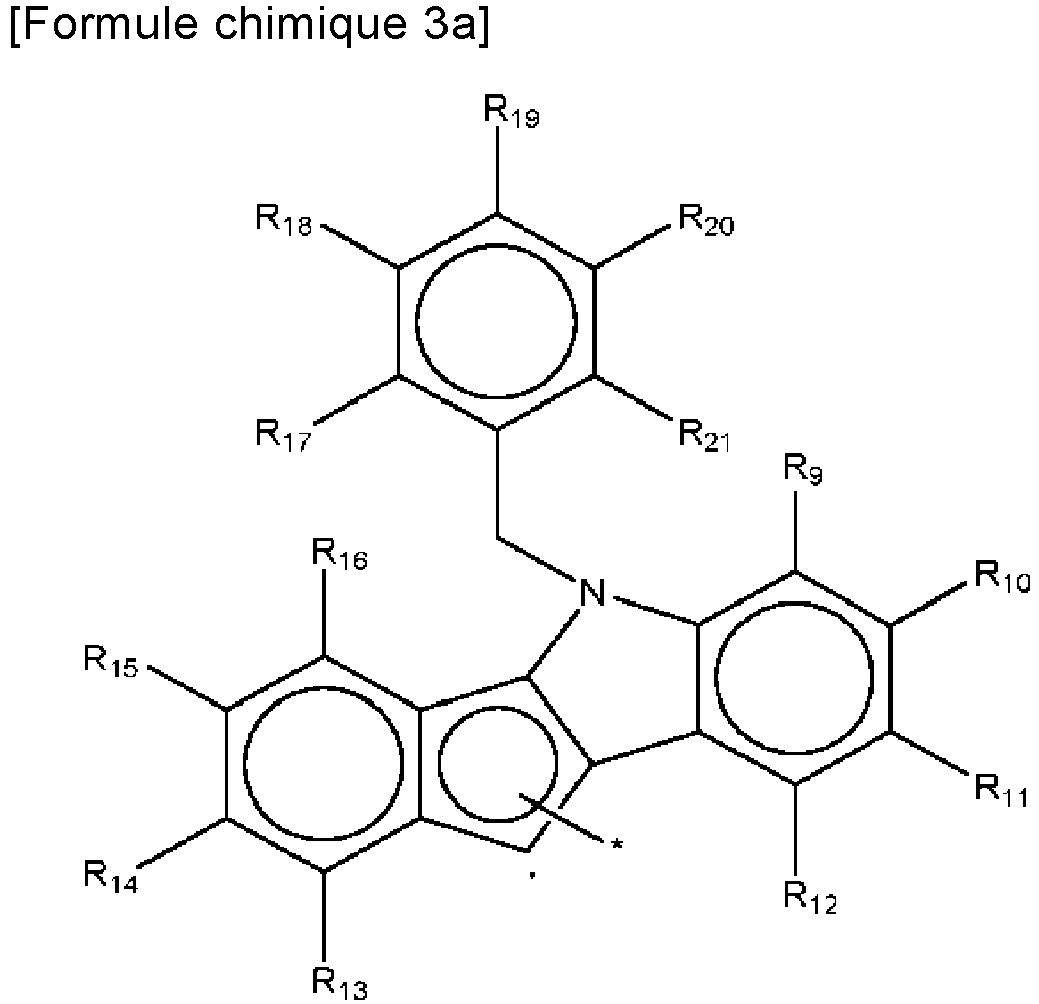


 dans les formules chimiques 3a, 3b, 3c, 3d et 3e, Rg à R39 et R9' à R21' sont identiques les uns aux autres ou différents les uns des autres, et sont chacun indépendamment un hydrogène, un halogène, un alkyle en C1-20, un haloalkyle en C1-20, un alcényle en C2-20, un alkylsilyle en C1-20, un silylalkyle en C1-20, un alcoxysilyle en C1-20, un alcoxy en C1-20, un aryle en C6-20, un alkylaryle en C7-40, ou un arylalkyle en C7-40, à condition qu'au moins un parmi R17 à R21 et R17' à R21' soit un haloalkyle en C1-20, oudeux ou plus parmi R22 à R39 qui sont adjacents les uns aux autres sont reliés les uns aux autres pour former un cycle aliphatique ou aromatique en C6-20 non substitué ou substitué avec un groupe hydrocarbyle en C1-10 ;• représente un site de liaison à A2 ; et* représente un site de liaison à M2.
 - Procédé de préparation du polyéthylène selon la revendication 6, dans lequel le premier composé de métallocène est représenté par une des formules chimiques 1-1 à 1-4 suivantes :


- Procédé de préparation du polyéthylène selon la revendication 6, dans lequel chacun parmi R3 et R6 est indépendamment un alkyle en C1-6 non substitué ou un alkyle en C2-6 substitué avec un alcoxy en C1-6.
- Procédé de préparation du polyéthylène selon la revendication 6, dans lequel le second composé de métallocène est représenté par la formule chimique 2-1 suivante :

- Procédé de préparation du polyéthylène selon la revendication 6, dans lequel chacun parmi R17 à R21 et R17' à R21' est indépendamment un hydrogène, ou un haloalkyle en C1-6, à condition qu'au moins un parmi R17 à R21 et R17' à R21' soit un haloalkyle en C1-6.
- Procédé de préparation du polyéthylène selon la revendication 6, dans lequel un rapport pondéral du premier composé de métallocène et du second composé de métallocène est de 40:60 à 75:25.
- Procédé de préparation du polyéthylène selon la revendication 6, dans lequel la polymérisation est réalisée tout en introduisant 30 ppm à 60 ppm d'hydrogène gazeux sur la base de la teneur en éthylène.
- Polyéthylène chloré préparé en faisant réagir le polyéthylène selon l'une quelconque des revendications 1 à 5 avec du chlore.
- Polyéthylène chloré selon la revendication 13, dans lequel le polyéthylène chloré présente un allongement de 1000 % ou plus lorsque la mesure est effectuée conformément à l'ASTM D-412.
Applications Claiming Priority (4)
| Application Number | Priority Date | Filing Date | Title |
|---|---|---|---|
| KR20180158328 | 2018-12-10 | ||
| KR20190007089 | 2019-01-18 | ||
| KR1020190163116A KR102252430B1 (ko) | 2018-12-10 | 2019-12-09 | 폴리에틸렌 및 이의 염소화 폴리에틸렌 |
| PCT/KR2019/017398 WO2020122561A1 (fr) | 2018-12-10 | 2019-12-10 | Polyéthylène et polyéthylène chloré associé |
Publications (3)
| Publication Number | Publication Date |
|---|---|
| EP3778663A1 EP3778663A1 (fr) | 2021-02-17 |
| EP3778663A4 EP3778663A4 (fr) | 2021-07-28 |
| EP3778663B1 true EP3778663B1 (fr) | 2024-05-22 |
Family
ID=71143473
Family Applications (1)
| Application Number | Title | Priority Date | Filing Date |
|---|---|---|---|
| EP19894608.9A Active EP3778663B1 (fr) | 2018-12-10 | 2019-12-10 | Polyéthylène et polyéthylène chloré associé |
Country Status (4)
| Country | Link |
|---|---|
| US (1) | US12304976B2 (fr) |
| EP (1) | EP3778663B1 (fr) |
| KR (1) | KR102252430B1 (fr) |
| CN (1) | CN112088173B (fr) |
Families Citing this family (5)
| Publication number | Priority date | Publication date | Assignee | Title |
|---|---|---|---|---|
| KR102427756B1 (ko) * | 2018-12-10 | 2022-08-01 | 주식회사 엘지화학 | 폴리에틸렌 및 이의 염소화 폴리에틸렌 |
| KR102427755B1 (ko) | 2018-12-10 | 2022-08-01 | 주식회사 엘지화학 | 폴리에틸렌 및 이의 염소화 폴리에틸렌 |
| KR102252430B1 (ko) | 2018-12-10 | 2021-05-14 | 주식회사 엘지화학 | 폴리에틸렌 및 이의 염소화 폴리에틸렌 |
| US12365748B2 (en) | 2020-06-10 | 2025-07-22 | Lg Chem, Ltd. | Polyethylene and chlorinated polyethylene thereof |
| CN111704686B (zh) * | 2020-07-23 | 2023-02-17 | 上海宝钱新材料技术有限公司 | 一种高氯化聚乙烯的制备方法 |
Family Cites Families (58)
| Publication number | Priority date | Publication date | Assignee | Title |
|---|---|---|---|---|
| US4825939A (en) * | 1984-08-31 | 1989-05-02 | The University Of Dayton | Polymeric compositions incorporating polyethylene glycol as a phase change material |
| DK132191D0 (da) * | 1991-07-05 | 1991-07-05 | Danaklon As | Fibre og fremstilling deraf |
| US5972450A (en) * | 1995-10-10 | 1999-10-26 | Bundy Corporation | Metal tubing coated with multiple layers of polymeric materials |
| JPH08281834A (ja) | 1995-04-19 | 1996-10-29 | Daiso Co Ltd | 後塩素化エチレン共重合体製ブーツ |
| UA47394C2 (uk) | 1995-05-16 | 2002-07-15 | Юнівейшн Текнолоджіз, Ллс | Етиленовий полімер, який має підвищену придатність до обробки та вирiб, що містить етиленовий полімер |
| US5914289A (en) | 1996-02-19 | 1999-06-22 | Fina Research, S.A. | Supported metallocene-alumoxane catalysts for the preparation of polyethylene having a broad monomodal molecular weight distribution |
| US6124406A (en) | 1998-03-31 | 2000-09-26 | The B. F. Goodrich Company | Blocky chlorinated polyolefins, process for making and use as impact modifier compatibilizer for PVC or CPVC |
| CN1982361B (zh) | 2001-08-17 | 2011-11-16 | 陶氏环球技术有限责任公司 | 双峰聚乙烯组合物及其制品 |
| JP2004149761A (ja) | 2002-09-02 | 2004-05-27 | Sumitomo Chem Co Ltd | エチレン重合体 |
| KR20040076965A (ko) | 2003-02-27 | 2004-09-04 | 호남석유화학 주식회사 | 올레핀 중합용 담지 다중핵 메탈로센 촉매 및 이의 제조방법 |
| US6958377B2 (en) | 2003-10-15 | 2005-10-25 | Equistar Chemicals, Lp | Olefin polymerization process |
| US6870010B1 (en) * | 2003-12-01 | 2005-03-22 | Univation Technologies, Llc | Low haze high strength polyethylene compositions |
| BRPI0517210B1 (pt) | 2004-12-17 | 2017-01-24 | Dow Global Technologies Inc | composição adequada para tubos, composição adequada para películas sopradas, composição adequada para artigos moldados soprados, tubo, película, artigo moldado por sopro e método para melhorar o comportamento de fluxo de fluência de uma resina |
| US7968166B2 (en) * | 2006-01-31 | 2011-06-28 | Hewlett-Packard Development Company, L.P. | Optical recording system |
| JP2007218324A (ja) | 2006-02-15 | 2007-08-30 | Mitsui Chemicals Inc | ポリエチレンパイプ |
| CN101437878B (zh) | 2006-03-10 | 2012-09-05 | 陶氏环球技术有限责任公司 | 用于片材和热成型应用的聚乙烯树脂 |
| KR101115061B1 (ko) | 2008-01-02 | 2012-02-13 | 주식회사 엘지화학 | 염화비닐수지의 충격보강제로서 염소화 폴리에틸렌 및 그를포함하는 염화비닐수지 |
| KR100929114B1 (ko) | 2008-02-15 | 2009-11-30 | 삼성토탈 주식회사 | 염소화폴리에틸렌 수지 |
| EP2130863A1 (fr) | 2008-06-02 | 2009-12-09 | Borealis AG | Compositions polymères haute densité, leur procédé de préparation et tuyaux résistants à la pression fabriqués à partir de ces compositions |
| JP5346088B2 (ja) | 2008-09-25 | 2013-11-20 | バーゼル・ポリオレフィン・ゲーエムベーハー | 耐衝撃性lldpe組成物及びそれから製造されるフィルム |
| US20130274427A1 (en) | 2010-12-22 | 2013-10-17 | BASELL POLOYOLEFINE GmbH | Process for controlling the relative activity of active centers of catalyst systems comprising at least one late transition metal catalyst component and at least one ziegler catalyst component |
| KR101262307B1 (ko) | 2010-12-27 | 2013-05-08 | 롯데케미칼 주식회사 | 염소화 폴리에틸렌 수지 및 이를 포함하는 조성물에 의해 형성된 성형품 |
| KR101309389B1 (ko) | 2011-06-28 | 2013-09-17 | 삼성토탈 주식회사 | 열수축 필름용 폴리에틸렌 수지 조성물 및 열수축 필름 |
| EP2570455A1 (fr) | 2011-09-16 | 2013-03-20 | Borealis AG | Composition de polyéthylène avec large distribution de poids moléculaire et homogénéité améliorée |
| ES2657137T5 (en) | 2012-03-28 | 2025-02-12 | Borealis Ag | Multimodal polymer |
| EP2740761B1 (fr) | 2012-12-05 | 2016-10-19 | Borealis AG | Composition de polyéthylène présentant un équilibre amélioré de résistance à la propagation des fissures lentes, la résistance aux chocs et une résistance à la pression des tuyaux pour des applications de tuyaux |
| CN105073794B (zh) | 2013-03-15 | 2018-04-20 | 尤尼威蒂恩技术有限责任公司 | 用于烯烃聚合的包含金属茂和基于三齿氮的配体络合物的多催化剂系统 |
| KR101603407B1 (ko) | 2013-04-19 | 2016-03-21 | 주식회사 엘지화학 | 저입도 폴리에틸렌, 이의 염소화 폴리에틸렌 및 이를 포함하는 pvc 조성물 |
| KR101597421B1 (ko) | 2013-04-19 | 2016-02-24 | 주식회사 엘지화학 | 왁스 함량이 조절된 폴리에틸렌, 이의 염소화 폴리에틸렌 및 이로부터 제조된 성형품 |
| KR101670468B1 (ko) | 2013-11-18 | 2016-10-28 | 주식회사 엘지화학 | 폴리올레핀의 제조 방법 및 이로부터 제조된 폴리올레핀 |
| KR101769097B1 (ko) | 2013-11-21 | 2017-08-17 | 주식회사 엘지화학 | 메탈로센 화합물, 이를 포함하는 촉매 조성물, 및 이를 이용하는 폴리올레핀의 제조방법 |
| KR101705340B1 (ko) | 2014-06-03 | 2017-02-09 | 주식회사 엘지화학 | 폴리올레핀의 제조 방법 및 이로부터 제조된 폴리올레핀 |
| KR101763371B1 (ko) * | 2014-10-17 | 2017-07-31 | 주식회사 엘지화학 | 폴리에틸렌 및 이의 염소화 폴리에틸렌 |
| KR101747401B1 (ko) | 2014-12-08 | 2017-06-14 | 주식회사 엘지화학 | 가공성이 우수한 에틸렌/알파-올레핀 공중합체 |
| WO2016122018A1 (fr) | 2015-01-28 | 2016-08-04 | 주식회사 엘지화학 | Composé de type métallocène, composition catalytique le contenant et procédé pour la préparation d'une polyoléfine l'utilisant |
| KR101891638B1 (ko) | 2015-04-15 | 2018-08-24 | 주식회사 엘지화학 | 가공성이 우수한 에틸렌/알파-올레핀 공중합체 공중합체 |
| WO2016172099A1 (fr) | 2015-04-20 | 2016-10-27 | Exxonmobil Chemical Patents Inc. | Composition à base de polyéthylène |
| BR112017023792B1 (pt) | 2015-05-07 | 2022-08-09 | Fina Technology, Inc | Método para obtenção de polietileno com desempenho superior de termoformação para extrusão de chapa |
| CN107531958B (zh) * | 2015-05-08 | 2020-11-06 | 陶氏环球技术有限责任公司 | 使用偶氮二甲酰胺/柠檬酸盐混合物作为成核剂来发泡聚烯烃组合物的工艺 |
| KR101753979B1 (ko) | 2015-09-10 | 2017-07-04 | 롯데케미칼 주식회사 | 폴리에틸렌 및 이로부터 제조된 염소화 폴리에틸렌 |
| KR101723774B1 (ko) | 2016-07-28 | 2017-04-18 | 한화케미칼 주식회사 | 혼성 담지 메탈로센 촉매를 이용한 고가공성 고밀도 에틸렌계 중합체 및 제조방법 |
| EP3415540B1 (fr) | 2016-11-15 | 2022-09-14 | LG Chem, Ltd. | Copolymère éthylène/alpha-oléfine présentant une excellente résistance à la fissuration sous contrainte environnementale |
| KR102073252B1 (ko) | 2016-12-05 | 2020-02-04 | 주식회사 엘지화학 | 올레핀 공중합체 합성용 촉매 조성물 및 올레핀 공중합체의 제조 방법 |
| KR102072697B1 (ko) | 2016-12-09 | 2020-02-03 | 주식회사 엘지화학 | 가공성 및 기계적 물성이 우수한 에틸렌/1-헥센 공중합체 |
| KR102215630B1 (ko) * | 2016-12-13 | 2021-02-10 | 주식회사 엘지화학 | 혼성 담지 메탈로센 촉매 |
| KR102073253B1 (ko) | 2016-12-19 | 2020-02-04 | 주식회사 엘지화학 | 혼성 담지 메탈로센 촉매 및 이를 이용한 폴리올레핀의 제조 방법 |
| KR102087340B1 (ko) | 2016-12-20 | 2020-03-10 | 주식회사 엘지화학 | 폴리올레핀계 필름 |
| KR102260362B1 (ko) | 2017-03-09 | 2021-06-02 | 주식회사 엘지화학 | 올레핀 공중합체 |
| KR101904496B1 (ko) | 2017-12-13 | 2018-11-28 | 대림산업 주식회사 | 멀티모달 폴리올레핀 수지 및 이로부터 제조되는 성형체 |
| WO2019139355A1 (fr) | 2018-01-11 | 2019-07-18 | 주식회사 엘지화학 | Procédé pour la préparation d'une polyoléfine à l'aide d'un catalyseur métallocène hybride supporté |
| KR102219312B1 (ko) | 2018-08-30 | 2021-02-24 | 주식회사 엘지화학 | 폴리에틸렌 및 이의 염소화 폴리에틸렌 |
| EP3647645A1 (fr) | 2018-10-31 | 2020-05-06 | Borealis AG | Composition de polyéthylène pour tuyaux résistant à une haute pression |
| KR102427755B1 (ko) | 2018-12-10 | 2022-08-01 | 주식회사 엘지화학 | 폴리에틸렌 및 이의 염소화 폴리에틸렌 |
| KR102431339B1 (ko) | 2018-12-10 | 2022-08-10 | 주식회사 엘지화학 | 폴리에틸렌 및 이의 염소화 폴리에틸렌 |
| WO2020122561A1 (fr) | 2018-12-10 | 2020-06-18 | 주식회사 엘지화학 | Polyéthylène et polyéthylène chloré associé |
| KR102252430B1 (ko) | 2018-12-10 | 2021-05-14 | 주식회사 엘지화학 | 폴리에틸렌 및 이의 염소화 폴리에틸렌 |
| KR102427756B1 (ko) | 2018-12-10 | 2022-08-01 | 주식회사 엘지화학 | 폴리에틸렌 및 이의 염소화 폴리에틸렌 |
| WO2020122563A1 (fr) | 2018-12-10 | 2020-06-18 | 주식회사 엘지화학 | Polyéthylène et polyéthylène chloré associé |
-
2019
- 2019-12-09 KR KR1020190163116A patent/KR102252430B1/ko active Active
- 2019-12-10 EP EP19894608.9A patent/EP3778663B1/fr active Active
- 2019-12-10 CN CN201980030754.2A patent/CN112088173B/zh active Active
- 2019-12-10 US US17/051,031 patent/US12304976B2/en active Active
Also Published As
| Publication number | Publication date |
|---|---|
| CN112088173A (zh) | 2020-12-15 |
| KR102252430B1 (ko) | 2021-05-14 |
| US20210047443A1 (en) | 2021-02-18 |
| CN112088173B (zh) | 2024-01-16 |
| US12304976B2 (en) | 2025-05-20 |
| EP3778663A4 (fr) | 2021-07-28 |
| KR20200071035A (ko) | 2020-06-18 |
| EP3778663A1 (fr) | 2021-02-17 |
Similar Documents
| Publication | Publication Date | Title |
|---|---|---|
| EP3778665B1 (fr) | Polyéthylène et polyéthylène chloré associé | |
| EP3778663B1 (fr) | Polyéthylène et polyéthylène chloré associé | |
| EP3770187B1 (fr) | Polyéthylène et polyéthylène chloré associé | |
| EP3778664B1 (fr) | Polyéthylène et polyéthylène chloré associé | |
| EP3865522A1 (fr) | Polyéthylène et polyéthylène chloré associé | |
| KR102648795B1 (ko) | 폴리에틸렌 및 이의 염소화 폴리에틸렌 | |
| CN117050215A (zh) | 聚乙烯及其氯化聚乙烯 | |
| KR102775684B1 (ko) | 폴리에틸렌 및 이의 염소화 폴리에틸렌 | |
| KR102589954B1 (ko) | 폴리에틸렌 및 이의 염소화 폴리에틸렌 | |
| EP4015542B1 (fr) | Polyéthylène et son polyéthylène chloré | |
| US12365748B2 (en) | Polyethylene and chlorinated polyethylene thereof | |
| KR102654813B1 (ko) | 폴리에틸렌 및 이의 염소화 폴리에틸렌 | |
| KR102775202B1 (ko) | 폴리에틸렌 및 이의 염소화 폴리에틸렌 | |
| KR102568406B1 (ko) | 혼성 담지 촉매 및 이용한 폴리올레핀의 제조 방법 | |
| EP3936541A1 (fr) | Polyéthylène et polyéthylène chloré associé |
Legal Events
| Date | Code | Title | Description |
|---|---|---|---|
| STAA | Information on the status of an ep patent application or granted ep patent |
Free format text: STATUS: THE INTERNATIONAL PUBLICATION HAS BEEN MADE |
|
| PUAI | Public reference made under article 153(3) epc to a published international application that has entered the european phase |
Free format text: ORIGINAL CODE: 0009012 |
|
| STAA | Information on the status of an ep patent application or granted ep patent |
Free format text: STATUS: REQUEST FOR EXAMINATION WAS MADE |
|
| 17P | Request for examination filed |
Effective date: 20201106 |
|
| AK | Designated contracting states |
Kind code of ref document: A1 Designated state(s): AL AT BE BG CH CY CZ DE DK EE ES FI FR GB GR HR HU IE IS IT LI LT LU LV MC MK MT NL NO PL PT RO RS SE SI SK SM TR |
|
| AX | Request for extension of the european patent |
Extension state: BA ME |
|
| A4 | Supplementary search report drawn up and despatched |
Effective date: 20210629 |
|
| RIC1 | Information provided on ipc code assigned before grant |
Ipc: C08F 110/02 20060101AFI20210623BHEP Ipc: C08F 8/22 20060101ALI20210623BHEP Ipc: C08F 4/6592 20060101ALI20210623BHEP Ipc: C08F 4/659 20060101ALI20210623BHEP Ipc: C08F 2/38 20060101ALI20210623BHEP Ipc: C08L 27/06 20060101ALI20210623BHEP Ipc: C08L 23/28 20060101ALI20210623BHEP |
|
| DAV | Request for validation of the european patent (deleted) | ||
| DAX | Request for extension of the european patent (deleted) | ||
| STAA | Information on the status of an ep patent application or granted ep patent |
Free format text: STATUS: EXAMINATION IS IN PROGRESS |
|
| 17Q | First examination report despatched |
Effective date: 20230131 |
|
| GRAP | Despatch of communication of intention to grant a patent |
Free format text: ORIGINAL CODE: EPIDOSNIGR1 |
|
| STAA | Information on the status of an ep patent application or granted ep patent |
Free format text: STATUS: GRANT OF PATENT IS INTENDED |
|
| INTG | Intention to grant announced |
Effective date: 20240227 |
|
| GRAS | Grant fee paid |
Free format text: ORIGINAL CODE: EPIDOSNIGR3 |
|
| GRAA | (expected) grant |
Free format text: ORIGINAL CODE: 0009210 |
|
| STAA | Information on the status of an ep patent application or granted ep patent |
Free format text: STATUS: THE PATENT HAS BEEN GRANTED |
|
| AK | Designated contracting states |
Kind code of ref document: B1 Designated state(s): AL AT BE BG CH CY CZ DE DK EE ES FI FR GB GR HR HU IE IS IT LI LT LU LV MC MK MT NL NO PL PT RO RS SE SI SK SM TR |
|
| REG | Reference to a national code |
Ref country code: GB Ref legal event code: FG4D |
|
| REG | Reference to a national code |
Ref country code: CH Ref legal event code: EP |
|
| REG | Reference to a national code |
Ref country code: DE Ref legal event code: R096 Ref document number: 602019052767 Country of ref document: DE |
|
| REG | Reference to a national code |
Ref country code: IE Ref legal event code: FG4D |
|
| REG | Reference to a national code |
Ref country code: LT Ref legal event code: MG9D |
|
| REG | Reference to a national code |
Ref country code: NL Ref legal event code: MP Effective date: 20240522 |
|
| PG25 | Lapsed in a contracting state [announced via postgrant information from national office to epo] |
Ref country code: IS Free format text: LAPSE BECAUSE OF FAILURE TO SUBMIT A TRANSLATION OF THE DESCRIPTION OR TO PAY THE FEE WITHIN THE PRESCRIBED TIME-LIMIT Effective date: 20240922 |
|
| PG25 | Lapsed in a contracting state [announced via postgrant information from national office to epo] |
Ref country code: BG Free format text: LAPSE BECAUSE OF FAILURE TO SUBMIT A TRANSLATION OF THE DESCRIPTION OR TO PAY THE FEE WITHIN THE PRESCRIBED TIME-LIMIT Effective date: 20240522 |
|
| PG25 | Lapsed in a contracting state [announced via postgrant information from national office to epo] |
Ref country code: HR Free format text: LAPSE BECAUSE OF FAILURE TO SUBMIT A TRANSLATION OF THE DESCRIPTION OR TO PAY THE FEE WITHIN THE PRESCRIBED TIME-LIMIT Effective date: 20240522 Ref country code: FI Free format text: LAPSE BECAUSE OF FAILURE TO SUBMIT A TRANSLATION OF THE DESCRIPTION OR TO PAY THE FEE WITHIN THE PRESCRIBED TIME-LIMIT Effective date: 20240522 |
|
| PG25 | Lapsed in a contracting state [announced via postgrant information from national office to epo] |
Ref country code: GR Free format text: LAPSE BECAUSE OF FAILURE TO SUBMIT A TRANSLATION OF THE DESCRIPTION OR TO PAY THE FEE WITHIN THE PRESCRIBED TIME-LIMIT Effective date: 20240823 |
|
| PG25 | Lapsed in a contracting state [announced via postgrant information from national office to epo] |
Ref country code: PT Free format text: LAPSE BECAUSE OF FAILURE TO SUBMIT A TRANSLATION OF THE DESCRIPTION OR TO PAY THE FEE WITHIN THE PRESCRIBED TIME-LIMIT Effective date: 20240923 |
|
| REG | Reference to a national code |
Ref country code: AT Ref legal event code: MK05 Ref document number: 1688730 Country of ref document: AT Kind code of ref document: T Effective date: 20240522 |
|
| PG25 | Lapsed in a contracting state [announced via postgrant information from national office to epo] |
Ref country code: NL Free format text: LAPSE BECAUSE OF FAILURE TO SUBMIT A TRANSLATION OF THE DESCRIPTION OR TO PAY THE FEE WITHIN THE PRESCRIBED TIME-LIMIT Effective date: 20240522 |
|
| PG25 | Lapsed in a contracting state [announced via postgrant information from national office to epo] |
Ref country code: ES Free format text: LAPSE BECAUSE OF FAILURE TO SUBMIT A TRANSLATION OF THE DESCRIPTION OR TO PAY THE FEE WITHIN THE PRESCRIBED TIME-LIMIT Effective date: 20240522 |
|
| PG25 | Lapsed in a contracting state [announced via postgrant information from national office to epo] |
Ref country code: AT Free format text: LAPSE BECAUSE OF FAILURE TO SUBMIT A TRANSLATION OF THE DESCRIPTION OR TO PAY THE FEE WITHIN THE PRESCRIBED TIME-LIMIT Effective date: 20240522 |
|
| PG25 | Lapsed in a contracting state [announced via postgrant information from national office to epo] |
Ref country code: PL Free format text: LAPSE BECAUSE OF FAILURE TO SUBMIT A TRANSLATION OF THE DESCRIPTION OR TO PAY THE FEE WITHIN THE PRESCRIBED TIME-LIMIT Effective date: 20240522 |
|
| PG25 | Lapsed in a contracting state [announced via postgrant information from national office to epo] |
Ref country code: LV Free format text: LAPSE BECAUSE OF FAILURE TO SUBMIT A TRANSLATION OF THE DESCRIPTION OR TO PAY THE FEE WITHIN THE PRESCRIBED TIME-LIMIT Effective date: 20240522 |
|
| PG25 | Lapsed in a contracting state [announced via postgrant information from national office to epo] |
Ref country code: PT Free format text: LAPSE BECAUSE OF FAILURE TO SUBMIT A TRANSLATION OF THE DESCRIPTION OR TO PAY THE FEE WITHIN THE PRESCRIBED TIME-LIMIT Effective date: 20240923 Ref country code: PL Free format text: LAPSE BECAUSE OF FAILURE TO SUBMIT A TRANSLATION OF THE DESCRIPTION OR TO PAY THE FEE WITHIN THE PRESCRIBED TIME-LIMIT Effective date: 20240522 Ref country code: NO Free format text: LAPSE BECAUSE OF FAILURE TO SUBMIT A TRANSLATION OF THE DESCRIPTION OR TO PAY THE FEE WITHIN THE PRESCRIBED TIME-LIMIT Effective date: 20240822 Ref country code: NL Free format text: LAPSE BECAUSE OF FAILURE TO SUBMIT A TRANSLATION OF THE DESCRIPTION OR TO PAY THE FEE WITHIN THE PRESCRIBED TIME-LIMIT Effective date: 20240522 Ref country code: LV Free format text: LAPSE BECAUSE OF FAILURE TO SUBMIT A TRANSLATION OF THE DESCRIPTION OR TO PAY THE FEE WITHIN THE PRESCRIBED TIME-LIMIT Effective date: 20240522 Ref country code: IS Free format text: LAPSE BECAUSE OF FAILURE TO SUBMIT A TRANSLATION OF THE DESCRIPTION OR TO PAY THE FEE WITHIN THE PRESCRIBED TIME-LIMIT Effective date: 20240922 Ref country code: HR Free format text: LAPSE BECAUSE OF FAILURE TO SUBMIT A TRANSLATION OF THE DESCRIPTION OR TO PAY THE FEE WITHIN THE PRESCRIBED TIME-LIMIT Effective date: 20240522 Ref country code: GR Free format text: LAPSE BECAUSE OF FAILURE TO SUBMIT A TRANSLATION OF THE DESCRIPTION OR TO PAY THE FEE WITHIN THE PRESCRIBED TIME-LIMIT Effective date: 20240823 Ref country code: FI Free format text: LAPSE BECAUSE OF FAILURE TO SUBMIT A TRANSLATION OF THE DESCRIPTION OR TO PAY THE FEE WITHIN THE PRESCRIBED TIME-LIMIT Effective date: 20240522 Ref country code: ES Free format text: LAPSE BECAUSE OF FAILURE TO SUBMIT A TRANSLATION OF THE DESCRIPTION OR TO PAY THE FEE WITHIN THE PRESCRIBED TIME-LIMIT Effective date: 20240522 Ref country code: BG Free format text: LAPSE BECAUSE OF FAILURE TO SUBMIT A TRANSLATION OF THE DESCRIPTION OR TO PAY THE FEE WITHIN THE PRESCRIBED TIME-LIMIT Effective date: 20240522 Ref country code: AT Free format text: LAPSE BECAUSE OF FAILURE TO SUBMIT A TRANSLATION OF THE DESCRIPTION OR TO PAY THE FEE WITHIN THE PRESCRIBED TIME-LIMIT Effective date: 20240522 Ref country code: RS Free format text: LAPSE BECAUSE OF FAILURE TO SUBMIT A TRANSLATION OF THE DESCRIPTION OR TO PAY THE FEE WITHIN THE PRESCRIBED TIME-LIMIT Effective date: 20240822 |
|
| PG25 | Lapsed in a contracting state [announced via postgrant information from national office to epo] |
Ref country code: DK Free format text: LAPSE BECAUSE OF FAILURE TO SUBMIT A TRANSLATION OF THE DESCRIPTION OR TO PAY THE FEE WITHIN THE PRESCRIBED TIME-LIMIT Effective date: 20240522 |
|
| PG25 | Lapsed in a contracting state [announced via postgrant information from national office to epo] |
Ref country code: EE Free format text: LAPSE BECAUSE OF FAILURE TO SUBMIT A TRANSLATION OF THE DESCRIPTION OR TO PAY THE FEE WITHIN THE PRESCRIBED TIME-LIMIT Effective date: 20240522 |
|
| PG25 | Lapsed in a contracting state [announced via postgrant information from national office to epo] |
Ref country code: CZ Free format text: LAPSE BECAUSE OF FAILURE TO SUBMIT A TRANSLATION OF THE DESCRIPTION OR TO PAY THE FEE WITHIN THE PRESCRIBED TIME-LIMIT Effective date: 20240522 |
|
| PG25 | Lapsed in a contracting state [announced via postgrant information from national office to epo] |
Ref country code: SK Free format text: LAPSE BECAUSE OF FAILURE TO SUBMIT A TRANSLATION OF THE DESCRIPTION OR TO PAY THE FEE WITHIN THE PRESCRIBED TIME-LIMIT Effective date: 20240522 Ref country code: RO Free format text: LAPSE BECAUSE OF FAILURE TO SUBMIT A TRANSLATION OF THE DESCRIPTION OR TO PAY THE FEE WITHIN THE PRESCRIBED TIME-LIMIT Effective date: 20240522 |
|
| PG25 | Lapsed in a contracting state [announced via postgrant information from national office to epo] |
Ref country code: SM Free format text: LAPSE BECAUSE OF FAILURE TO SUBMIT A TRANSLATION OF THE DESCRIPTION OR TO PAY THE FEE WITHIN THE PRESCRIBED TIME-LIMIT Effective date: 20240522 |
|
| PG25 | Lapsed in a contracting state [announced via postgrant information from national office to epo] |
Ref country code: SM Free format text: LAPSE BECAUSE OF FAILURE TO SUBMIT A TRANSLATION OF THE DESCRIPTION OR TO PAY THE FEE WITHIN THE PRESCRIBED TIME-LIMIT Effective date: 20240522 Ref country code: SK Free format text: LAPSE BECAUSE OF FAILURE TO SUBMIT A TRANSLATION OF THE DESCRIPTION OR TO PAY THE FEE WITHIN THE PRESCRIBED TIME-LIMIT Effective date: 20240522 Ref country code: RO Free format text: LAPSE BECAUSE OF FAILURE TO SUBMIT A TRANSLATION OF THE DESCRIPTION OR TO PAY THE FEE WITHIN THE PRESCRIBED TIME-LIMIT Effective date: 20240522 Ref country code: EE Free format text: LAPSE BECAUSE OF FAILURE TO SUBMIT A TRANSLATION OF THE DESCRIPTION OR TO PAY THE FEE WITHIN THE PRESCRIBED TIME-LIMIT Effective date: 20240522 Ref country code: DK Free format text: LAPSE BECAUSE OF FAILURE TO SUBMIT A TRANSLATION OF THE DESCRIPTION OR TO PAY THE FEE WITHIN THE PRESCRIBED TIME-LIMIT Effective date: 20240522 Ref country code: CZ Free format text: LAPSE BECAUSE OF FAILURE TO SUBMIT A TRANSLATION OF THE DESCRIPTION OR TO PAY THE FEE WITHIN THE PRESCRIBED TIME-LIMIT Effective date: 20240522 |
|
| REG | Reference to a national code |
Ref country code: DE Ref legal event code: R097 Ref document number: 602019052767 Country of ref document: DE |
|
| PLBE | No opposition filed within time limit |
Free format text: ORIGINAL CODE: 0009261 |
|
| STAA | Information on the status of an ep patent application or granted ep patent |
Free format text: STATUS: NO OPPOSITION FILED WITHIN TIME LIMIT |
|
| PG25 | Lapsed in a contracting state [announced via postgrant information from national office to epo] |
Ref country code: SI Free format text: LAPSE BECAUSE OF FAILURE TO SUBMIT A TRANSLATION OF THE DESCRIPTION OR TO PAY THE FEE WITHIN THE PRESCRIBED TIME-LIMIT Effective date: 20240522 |
|
| 26N | No opposition filed |
Effective date: 20250225 |
|
| PG25 | Lapsed in a contracting state [announced via postgrant information from national office to epo] |
Ref country code: MC Free format text: LAPSE BECAUSE OF FAILURE TO SUBMIT A TRANSLATION OF THE DESCRIPTION OR TO PAY THE FEE WITHIN THE PRESCRIBED TIME-LIMIT Effective date: 20240522 |
|
| REG | Reference to a national code |
Ref country code: CH Ref legal event code: PL |
|
| PG25 | Lapsed in a contracting state [announced via postgrant information from national office to epo] |
Ref country code: LU Free format text: LAPSE BECAUSE OF NON-PAYMENT OF DUE FEES Effective date: 20241210 |
|
| PG25 | Lapsed in a contracting state [announced via postgrant information from national office to epo] |
Ref country code: SE Free format text: LAPSE BECAUSE OF FAILURE TO SUBMIT A TRANSLATION OF THE DESCRIPTION OR TO PAY THE FEE WITHIN THE PRESCRIBED TIME-LIMIT Effective date: 20240522 |
|
| REG | Reference to a national code |
Ref country code: BE Ref legal event code: MM Effective date: 20241231 |
|
| PG25 | Lapsed in a contracting state [announced via postgrant information from national office to epo] |
Ref country code: BE Free format text: LAPSE BECAUSE OF NON-PAYMENT OF DUE FEES Effective date: 20241231 |
|
| PG25 | Lapsed in a contracting state [announced via postgrant information from national office to epo] |
Ref country code: CH Free format text: LAPSE BECAUSE OF NON-PAYMENT OF DUE FEES Effective date: 20241231 |
|
| PG25 | Lapsed in a contracting state [announced via postgrant information from national office to epo] |
Ref country code: IE Free format text: LAPSE BECAUSE OF NON-PAYMENT OF DUE FEES Effective date: 20241210 |
|
| PGFP | Annual fee paid to national office [announced via postgrant information from national office to epo] |
Ref country code: DE Payment date: 20251120 Year of fee payment: 7 |
|
| PGFP | Annual fee paid to national office [announced via postgrant information from national office to epo] |
Ref country code: GB Payment date: 20251120 Year of fee payment: 7 |
|
| PGFP | Annual fee paid to national office [announced via postgrant information from national office to epo] |
Ref country code: IT Payment date: 20251121 Year of fee payment: 7 |
|
| PGFP | Annual fee paid to national office [announced via postgrant information from national office to epo] |
Ref country code: FR Payment date: 20251125 Year of fee payment: 7 |