EP3779966A1 - Procédé de service d'intelligence artificielle et dispositif associé - Google Patents
Procédé de service d'intelligence artificielle et dispositif associé Download PDFInfo
- Publication number
- EP3779966A1 EP3779966A1 EP18918144.9A EP18918144A EP3779966A1 EP 3779966 A1 EP3779966 A1 EP 3779966A1 EP 18918144 A EP18918144 A EP 18918144A EP 3779966 A1 EP3779966 A1 EP 3779966A1
- Authority
- EP
- European Patent Office
- Prior art keywords
- artificial intelligence
- user
- user data
- adaptive training
- model
- Prior art date
- Legal status (The legal status is an assumption and is not a legal conclusion. Google has not performed a legal analysis and makes no representation as to the accuracy of the status listed.)
- Withdrawn
Links
Images



Classifications
-
- G—PHYSICS
- G10—MUSICAL INSTRUMENTS; ACOUSTICS
- G10L—SPEECH ANALYSIS TECHNIQUES OR SPEECH SYNTHESIS; SPEECH RECOGNITION; SPEECH OR VOICE PROCESSING TECHNIQUES; SPEECH OR AUDIO CODING OR DECODING
- G10L15/00—Speech recognition
- G10L15/22—Procedures used during a speech recognition process, e.g. man-machine dialogue
-
- G—PHYSICS
- G06—COMPUTING OR CALCULATING; COUNTING
- G06F—ELECTRIC DIGITAL DATA PROCESSING
- G06F21/00—Security arrangements for protecting computers, components thereof, programs or data against unauthorised activity
- G06F21/30—Authentication, i.e. establishing the identity or authorisation of security principals
- G06F21/31—User authentication
- G06F21/32—User authentication using biometric data, e.g. fingerprints, iris scans or voiceprints
-
- G—PHYSICS
- G06—COMPUTING OR CALCULATING; COUNTING
- G06N—COMPUTING ARRANGEMENTS BASED ON SPECIFIC COMPUTATIONAL MODELS
- G06N20/00—Machine learning
-
- G—PHYSICS
- G06—COMPUTING OR CALCULATING; COUNTING
- G06Q—INFORMATION AND COMMUNICATION TECHNOLOGY [ICT] SPECIALLY ADAPTED FOR ADMINISTRATIVE, COMMERCIAL, FINANCIAL, MANAGERIAL OR SUPERVISORY PURPOSES; SYSTEMS OR METHODS SPECIALLY ADAPTED FOR ADMINISTRATIVE, COMMERCIAL, FINANCIAL, MANAGERIAL OR SUPERVISORY PURPOSES, NOT OTHERWISE PROVIDED FOR
- G06Q50/00—Information and communication technology [ICT] specially adapted for implementation of business processes of specific business sectors, e.g. utilities or tourism
- G06Q50/10—Services
-
- G—PHYSICS
- G10—MUSICAL INSTRUMENTS; ACOUSTICS
- G10L—SPEECH ANALYSIS TECHNIQUES OR SPEECH SYNTHESIS; SPEECH RECOGNITION; SPEECH OR VOICE PROCESSING TECHNIQUES; SPEECH OR AUDIO CODING OR DECODING
- G10L15/00—Speech recognition
- G10L15/06—Creation of reference templates; Training of speech recognition systems, e.g. adaptation to the characteristics of the speaker's voice
- G10L15/065—Adaptation
- G10L15/07—Adaptation to the speaker
-
- G—PHYSICS
- G10—MUSICAL INSTRUMENTS; ACOUSTICS
- G10L—SPEECH ANALYSIS TECHNIQUES OR SPEECH SYNTHESIS; SPEECH RECOGNITION; SPEECH OR VOICE PROCESSING TECHNIQUES; SPEECH OR AUDIO CODING OR DECODING
- G10L15/00—Speech recognition
- G10L15/08—Speech classification or search
- G10L15/16—Speech classification or search using artificial neural networks
Definitions
- the present invention relates to a method (biometric information security method) for operating an artificial intelligence system such as speech recognition, etc., without leaking biometric information such as voice, etc., out of a terminal, and a device for supporting the same.
- Speech recognition is a technology that converts speech into a text by using a computer. Speech recognition technology has made rapid progress in recent years and has been commercially used in artificial intelligence speakers, etc.
- Speech recognition technology is a technology based on artificial intelligence learning. Speech recognition learning deals with large-scale speech data and thus takes days to weeks to be performed even in high-end servers.
- Speech has a distinct characteristic for each speaker and uses a wide vocabulary, and thus adaptation is required for each user. In other words, it is necessary to tune a speech recognizer in accordance with a user's voice.
- User information such as voice, vocabulary or the like is required for user adaptive training.
- An object of the present invention is to propose a method for operating an artificial intelligence system such as speech recognition, etc., without leaking biometric information such as voice, etc., out of a terminal.
- a method for providing an artificial intelligence service by an artificial intelligence device may include: receiving an input of user data including user biometric information; performing user adaptive training for transforming a base artificial intelligence model to be suitable for a characteristic of the user data; and providing an artificial intelligence service by applying an artificial intelligence model generated as a result of the user adaptive training.
- the method may further include receiving the base artificial intelligence model from a remote server.
- the base artificial intelligence model may be pre-stored in the artificial intelligence device.
- the user adaptive training may be performed during a time when the artificial intelligence service is not provided.
- the user adaptive training may be performed in real time even while the artificial intelligence service is provided.
- the inputted user data may be accumulated and stored until the user adaptive training is started.
- the method may further include evaluating confidence of results of recognizing the user data, in which the user data may not be used in the user adaptive training when the confidence is smaller than a pre-set threshold value.
- an artificial intelligence device for providing an artificial intelligence service may include: an input unit for receiving an input of user data including user biometric information ;a memory for storing the user data; and a processor for controlling the input unit and the memory, in which the processor may receive an input of user data including user biometric information through the input unit, perform user adaptive training for transforming a base artificial intelligence model to be suitable for a characteristic of the user data, and provide an artificial intelligence service by applying an artificial intelligence model generated as a result of the user adaptive training.
- FIGS. 1 and 2 are views for explaining an existing artificial intelligence service and training method in which biometric information security is not guaranteed.
- a terminal 110 may collect user data (for example, voice, fingerprint, iris, etc.) while providing an artificial intelligence service together (S201).
- user data for example, voice, fingerprint, iris, etc.
- S201 an artificial intelligence service together
- the terminal 110 may transmit the collected user data 120 to a remote server 140 located in a remote site (S202).
- the user data 120 transmitted to the remote server 140 may be used in the remote server 140 for training (learning) (S203).
- An artificial intelligence model 130 that has finished training in the remote server 140 may be transmitted to the terminal 110, that is, the terminal 110 may obtain an artificial intelligence model 130 from the remote server 140 (S204).
- the terminal 110 may provide an artificial intelligence service as a new artificial intelligence model by reflecting the obtained artificial intelligence model 130 (S205).
- the above method there may occur a problem that user information (data) is inevitably transmitted to a server in a remote site.
- the user's information (data) especially biometric information such as voice, may be used as a key for a security system, and thus external leakage needs to be prevented.
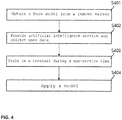
- FIGS. 3 and 4 are views for explaining an artificial intelligence service and training method in which biometric information security is guaranteed according to one embodiment of the present invention.
- a terminal 310 may obtain a base artificial intelligence model from a remote server 340 in a remote site (S401).
- the terminal 310 may collect user data (for example, voice, fingerprint, iris, etc.) while providing an artificial intelligence service together (S401).
- user data for example, voice, fingerprint, iris, etc.
- S401 an artificial intelligence service together
- the collected information may be stored in the terminal 310 until training (i.e., learning).
- the information collected before training may be accumulated and stored in the terminal.
- the terminal 310 may start user adaptive training at a specific point of time (for example, during a time when the artificial intelligence service is not provided) by using the base artificial intelligence model and the user data (S403).
- the artificial intelligence service may be continued by reflecting a new artificial intelligence model on the terminal 310 (404).
- the base artificial intelligence model may not be obtained from the remote server 340, but may be pre-stored in the terminal 310 (i.e., provisioning).
- the user adaptive training may not refer to creating an artificial intelligence model from the beginning, but refer to transforming and/or modifying the base artificial intelligence model to be suitable for the characteristics extracted from user data.
- it may be possible to save time and cost without a need for a large amount of data compared to newly building the artificial intelligence model from the beginning.
- training time may decrease as the amount of data used for user adaptive training decreases.
- training efficiency may decrease if there is no necessary data.
- the data unnecessary for user adaptive training may refer to well-recognized data.
- the user data (information) may not be leaked to the outside of the terminal, and the user adaptive training may be performed together.
- FIG. 5 is a block view for illustrating a configuration of a terminal according to one embodiment of the present invention.
- a terminal 500 (i.e., an artificial intelligence device) according to the present invention may include an input unit 510 for receiving an input of user data, a communication unit 520 for receiving a base artificial intelligence model, and a memory 530 for storing the user data and the base artificial intelligence model, and a processor 540 for performing the user adaptive training by using the base artificial intelligence model and the user data.
- an input unit 510 for receiving an input of user data
- a communication unit 520 for receiving a base artificial intelligence model
- a memory 530 for storing the user data and the base artificial intelligence model
- a processor 540 for performing the user adaptive training by using the base artificial intelligence model and the user data.
- the input unit 110 may be a constituent element for receiving an input of user data, and in particular, may include a microphone. When a user's uttered speech is inputted, the input unit 110 may convert the speech into an electrical signal and output the signal to the processor 540.
- the input unit 110 may include biometric sensors for receiving an input of user biometric information.
- An example of the biometric sensor may include a facial recognition sensor, an iris recognition sensor, a fingerprint recognition sensor, and the like.
- the communication unit 120 may include one or more modules that enable wired/wireless communication with a remote server.
- the communication unit 120 may include a broadcast receiving module, a mobile communication module, a wireless Internet module, a short range communication module, and the like.
- the broadcast receiving module may receive a digital broadcasting signal by using a digital broadcasting system, for example, Digital Multimedia Broadcasting-Terrestrial (DMB-T), Digital Multimedia Broadcasting-Satellite (DMB-S), Media Forward Link Only (MediaFLO), Digital Video Broadcasting-Handheld (DVB-H), Integrated Services Digital Broadcast-Terrestrial (ISDB-T), etc.
- DMB-T Digital Multimedia Broadcasting-Terrestrial
- DMB-S Digital Multimedia Broadcasting-Satellite
- MediaFLO Media Forward Link Only
- DVD-H Digital Video Broadcasting-Handheld
- ISDB-T Integrated Services Digital Broadcast-Terrestrial
- a mobile communication module may transmit and receive radio signals with at least one of a base station, an external terminal, and a server on a mobile communication network.
- the radio signal may include a voice call signal, a video call signal, or various types of data according to transmission/reception of text/multimedia messages.
- the wireless Internet module may refer to a module for wireless Internet access and may be built in or external to the terminal.
- a wireless Internet technology may include Wireless LAN (WLAN, Wi-Fi), Wireless broadband (Wibro), World Interoperability for Microwave Access (Wimax), High Speed Downlink Packet Access (HSDPA), and the like.
- a short range communication module may refer to a module for short range communication.
- a short range communication technology may include Bluetooth, Radio Frequency Identification (RFID), infrared Data Association (IrDA), Ultra Wideband (UWB), ZigBee, Near Field Communication (NFC), etc.
- RFID Radio Frequency Identification
- IrDA infrared Data Association
- UWB Ultra Wideband
- ZigBee ZigBee
- NFC Near Field Communication
- the processor 540 may implement the functions, processes and/or methods as proposed in FIGS. 3 and 4 described above.
- the processor 540 may perform the user adaptive training by using user data inputted from the input unit 510 and a base artificial intelligence model received (or pre-stored) from a remote server. In addition, the processor 540 may perform processing/transformation, etc. of user data received from the input unit 510 in order to perform the user adaptive training.
- the processor 540 may store the user data inputted from the input unit 510 and the base artificial intelligence model received from a remote server into the memory 530. Furthermore, the processor 540 may store a new artificial intelligence model, which is a result of user adaptive training, into the memory 530.
- the processor 540 may obtain a user's speech data by applying a speech recognition algorithm or a speech recognition engine to the signal received from the input unit 510.
- the signal inputted to the processor 540 may be converted into a more useful form for speech recognition, and the processor 540 may convert the inputted signal from an analog form to a digital form, and may detect a start point and an end point of the speech so as to detect an actual speech section/data included in the speech data. This is called End Point Detection (EPD).
- EPD End Point Detection
- the processor 540 may extract a feature vector of the signal by applying a feature vector extraction technique such as Cepstrum, Linear Predictive Coefficient (LPC), Mel Frequency Cepstral Coefficient (MFCC), Filter Bank Energy or the like within the detected section.
- a feature vector extraction technique such as Cepstrum, Linear Predictive Coefficient (LPC), Mel Frequency Cepstral Coefficient (MFCC), Filter Bank Energy or the like within the detected section.
- the processor 540 may store information on an end point of speech data and a feature vector by using the memory 530 for storing data.
- the processor 540 may obtain a recognition result by comparing the extracted feature vector with a trained reference pattern.
- a recognition result by comparing the extracted feature vector with a trained reference pattern.
- it may be possible to use an acoustic model for modeling and comparing signal characteristics of speech and a language model for modeling a language ordering relationship such as words, syllables or the like corresponding to a recognized vocabulary.
- the acoustic model may be divided again into a direct comparison method, which sets an object to be recognized as a feature vector model and compares with a feature vector of speech data, and a statistical method, which statistically processes and uses a feature vector of an object to be recognized.
- the direct comparison method may be a method, which sets a unit such as a word, a phoneme, etc., which is the object to be recognized, as a feature vector model and compares how much the inputted speech is similar to this vector model, and a vector quantization method may be typically used as the direct comparison method.
- a feature vector of inputted speech data may be mapped with a codebook, which is a reference model, and the obtained mapped values may be encoded into representative values, thereby comparing the encoded values with each other.
- the statistical model method may be a method, which configures a unit for the object to be recognized in a state sequence and uses a relationship between state sequences.
- the state sequence may include a plurality of nodes.
- the method of using the relationship between the state sequences may be divided again into Dynamic Time Warping (DTW), Hidden Markov Model (HMM), a method using a neural network, etc.
- DTW Dynamic Time Warping
- HMM Hidden Markov Model
- Dynamic Time Warping may be a method, which compensates for a difference on a time axis when compared with a reference model by considering the dynamic characteristics of the speech, in which a signal length varies with time even if the same person speaks the same pronunciation.
- Hidden Markov Model may be a recognition technique, in which speech is assumed in a Markov process having a state transition probability and an observation probability of a node (output symbol) in each state, after which the state transition probability and the observation probability of the node are estimated through learning data, and then a probability that inputted speech occurs from the estimated model is calculated.
- the language model for modeling the language ordering relationship such as words, syllables or the like, it may be possible to reduce acoustic ambiguity and errors of recognition by applying an ordering relationship between the units, which constitute a language, to units obtained from the speech recognition.
- the language model may include a statistical language model and a model based on finite state networks (Finite State Automata: FSA), and the statistical language model may use a chain probability of words such as Unigram, Bigram, Trigram, etc.
- FSA Finite State Automata
- the processor 540 may use any of the methods described above when recognizing speech.
- the acoustic model to which the HMM is applied may be used, or an N-best search method, in which the acoustic model and the language model are combined, may be used.
- N-best search method up to N recognition result candidates may be selected using the acoustic model and the language model, and then the ranking of these candidates may be re-evaluated, thereby improving the recognition performance.
- the processor 540 may calculate a confidence score (or may be abbreviated as "confidence") in order to ensure the confidence of the recognition result.
- the confidence score may be a measure indicating how much the speech recognition results are reliable.
- the confidence score may be defined as a relative value to a probability that a corresponding speech is uttered from other phonemes or words, with respect to phonemes or words which are the recognized results. Accordingly, the confidence score may be expressed as a value between 0 and 1, or expressed as a value between 0 and 100. If the confidence score is greater than a preset threshold, the recognition result may be recognized. If the confidence score is smaller than the preset threshold, the recognition result may be rejected.
- the confidence score may be obtained according to various conventional algorithms for confidence score acquisition.
- the processor 540 may not use the corresponding user data (for example, speech data) in user adaptive training. In other words, the corresponding user data may be removed.
- the memory 530 may include at least one storage medium of flash memory, hard disc, memory card, Read-Only Memory (ROM), Random Access Memory (RAM), memory card, Electrically Erasable Programmable Read-Only Memory (EEPROM), Programmable Read-Only Memory (PROM), magnetic memory, magnetic disk, and optical disk.
- ROM Read-Only Memory
- RAM Random Access Memory
- EEPROM Electrically Erasable Programmable Read-Only Memory
- PROM Programmable Read-Only Memory
- magnetic memory magnetic disk, and optical disk.
- An embodiment according to the present invention may be implemented by various devices, for example, hardware, firmware, software, or a combination thereof.
- one embodiment of the present invention may be implemented by at least one of application specific integrated circuits (ASICs), digital signal processors (DSPs), digital signal processing devices (DSPDs), programmable logic devices (PLDs), field programmable gate arrays (FPGAs), processors, controllers, microcontrollers, microprocessors, etc.
- ASICs application specific integrated circuits
- DSPs digital signal processors
- DSPDs digital signal processing devices
- PLDs programmable logic devices
- FPGAs field programmable gate arrays
- processors controllers, microcontrollers, microprocessors, etc.
- one embodiment of the present invention may be implemented in the form of a module, a procedure, a function, etc., which perform the functions or operations as described above.
- the software code may be stored in a memory and driven by a processor.
- the memory may be located inside or outside the processor, and may exchange data with the processor through various known devices.
- the present invention can be applied to various fields of artificial intelligence service.
Landscapes
- Engineering & Computer Science (AREA)
- Physics & Mathematics (AREA)
- Theoretical Computer Science (AREA)
- Health & Medical Sciences (AREA)
- Computer Security & Cryptography (AREA)
- General Physics & Mathematics (AREA)
- Software Systems (AREA)
- Acoustics & Sound (AREA)
- Human Computer Interaction (AREA)
- Multimedia (AREA)
- Computational Linguistics (AREA)
- Audiology, Speech & Language Pathology (AREA)
- Artificial Intelligence (AREA)
- Business, Economics & Management (AREA)
- General Engineering & Computer Science (AREA)
- Tourism & Hospitality (AREA)
- Evolutionary Computation (AREA)
- Computer Hardware Design (AREA)
- General Health & Medical Sciences (AREA)
- General Business, Economics & Management (AREA)
- Strategic Management (AREA)
- Primary Health Care (AREA)
- Marketing (AREA)
- Human Resources & Organizations (AREA)
- Economics (AREA)
- Computer Vision & Pattern Recognition (AREA)
- Data Mining & Analysis (AREA)
- Medical Informatics (AREA)
- Computing Systems (AREA)
- Mathematical Physics (AREA)
- Information Retrieval, Db Structures And Fs Structures Therefor (AREA)
Applications Claiming Priority (1)
| Application Number | Priority Date | Filing Date | Title |
|---|---|---|---|
| PCT/KR2018/005409 WO2019216461A1 (fr) | 2018-05-10 | 2018-05-10 | Procédé de service d'intelligence artificielle et dispositif associé |
Publications (2)
| Publication Number | Publication Date |
|---|---|
| EP3779966A1 true EP3779966A1 (fr) | 2021-02-17 |
| EP3779966A4 EP3779966A4 (fr) | 2021-11-17 |
Family
ID=68468097
Family Applications (1)
| Application Number | Title | Priority Date | Filing Date |
|---|---|---|---|
| EP18918144.9A Withdrawn EP3779966A4 (fr) | 2018-05-10 | 2018-05-10 | Procédé de service d'intelligence artificielle et dispositif associé |
Country Status (5)
| Country | Link |
|---|---|
| US (1) | US20210232670A1 (fr) |
| EP (1) | EP3779966A4 (fr) |
| JP (1) | JP2021529978A (fr) |
| KR (1) | KR102395808B1 (fr) |
| WO (1) | WO2019216461A1 (fr) |
Families Citing this family (2)
| Publication number | Priority date | Publication date | Assignee | Title |
|---|---|---|---|---|
| US12346432B2 (en) * | 2018-12-31 | 2025-07-01 | Intel Corporation | Securing systems employing artificial intelligence |
| EP4403830A1 (fr) | 2023-01-23 | 2024-07-24 | Fraunhofer-Gesellschaft zur Förderung der angewandten Forschung e.V. | Appareil de cuisson et procédé |
Family Cites Families (16)
| Publication number | Priority date | Publication date | Assignee | Title |
|---|---|---|---|---|
| JPH09114482A (ja) * | 1995-10-17 | 1997-05-02 | Nippon Telegr & Teleph Corp <Ntt> | 音声認識のための話者適応化方法 |
| JP3589044B2 (ja) * | 1998-10-20 | 2004-11-17 | 三菱電機株式会社 | 話者適応化装置 |
| KR100331689B1 (ko) * | 2000-06-24 | 2002-04-09 | 송문섭 | 음성인식 시스템의 화자적응 훈련방법 |
| JP3756879B2 (ja) * | 2001-12-20 | 2006-03-15 | 松下電器産業株式会社 | 音響モデルを作成する方法、音響モデルを作成する装置、音響モデルを作成するためのコンピュータプログラム |
| JP2003241788A (ja) * | 2002-02-20 | 2003-08-29 | Ntt Docomo Inc | 音声認識装置及び音声認識システム |
| KR100679044B1 (ko) * | 2005-03-07 | 2007-02-06 | 삼성전자주식회사 | 사용자 적응형 음성 인식 방법 및 장치 |
| JP2008241970A (ja) * | 2007-03-27 | 2008-10-09 | Kddi Corp | 話者適応装置、話者適応方法及び話者適応プログラム |
| KR100994930B1 (ko) * | 2008-07-21 | 2010-11-17 | 주식회사 씨에스 | 음성인식 기반 홈네트워크 시스템의 적응화 음성 인식 제어방법 및 그 시스템 |
| KR20100073178A (ko) * | 2008-12-22 | 2010-07-01 | 한국전자통신연구원 | 음성 인식을 위한 화자 적응 장치 및 그 방법 |
| WO2014144579A1 (fr) * | 2013-03-15 | 2014-09-18 | Apple Inc. | Système et procédé pour mettre à jour un modèle de reconnaissance de parole adaptatif |
| US10170114B2 (en) * | 2013-05-30 | 2019-01-01 | Promptu Systems Corporation | Systems and methods for adaptive proper name entity recognition and understanding |
| KR102371697B1 (ko) * | 2015-02-11 | 2022-03-08 | 삼성전자주식회사 | 음성 기능 운용 방법 및 이를 지원하는 전자 장치 |
| WO2017112813A1 (fr) * | 2015-12-22 | 2017-06-29 | Sri International | Assistant personnel virtuel multilingue |
| US20190279613A1 (en) * | 2018-03-06 | 2019-09-12 | Ford Global Technologies, Llc | Dialect and language recognition for speech detection in vehicles |
| US20190311713A1 (en) * | 2018-04-05 | 2019-10-10 | GM Global Technology Operations LLC | System and method to fulfill a speech request |
| US11398218B1 (en) * | 2018-04-26 | 2022-07-26 | United Services Automobile Association (Usaa) | Dynamic speech output configuration |
-
2018
- 2018-05-10 EP EP18918144.9A patent/EP3779966A4/fr not_active Withdrawn
- 2018-05-10 JP JP2020560899A patent/JP2021529978A/ja active Pending
- 2018-05-10 WO PCT/KR2018/005409 patent/WO2019216461A1/fr not_active Ceased
- 2018-05-10 US US17/054,102 patent/US20210232670A1/en not_active Abandoned
- 2018-05-10 KR KR1020207029338A patent/KR102395808B1/ko active Active
Also Published As
| Publication number | Publication date |
|---|---|
| KR20200125736A (ko) | 2020-11-04 |
| KR102395808B1 (ko) | 2022-05-09 |
| EP3779966A4 (fr) | 2021-11-17 |
| WO2019216461A1 (fr) | 2019-11-14 |
| US20210232670A1 (en) | 2021-07-29 |
| JP2021529978A (ja) | 2021-11-04 |
Similar Documents
| Publication | Publication Date | Title |
|---|---|---|
| US11664020B2 (en) | Speech recognition method and apparatus | |
| US11069353B1 (en) | Multilingual wakeword detection | |
| CN110610707B (zh) | 语音关键词识别方法、装置、电子设备和存储介质 | |
| EP3132442B1 (fr) | Génération de modèle de mot-clé permettant de détecter un mot-clé défini par un utilisateur | |
| CN103971685B (zh) | 语音命令识别方法和系统 | |
| US5873061A (en) | Method for constructing a model of a new word for addition to a word model database of a speech recognition system | |
| US20060287856A1 (en) | Speech models generated using competitive training, asymmetric training, and data boosting | |
| EP1220197A2 (fr) | Système et méthode de reconnaissance de la parole | |
| CN102280106A (zh) | 用于移动通信终端的语音网络搜索方法及其装置 | |
| EP2847761A1 (fr) | Représentation de modèle acoustique différentiel et adaptation basée sur une transformation linéaire pour des techniques efficaces de mise à jour de profil d'utilisateur dans une reconnaissance automatique de parole | |
| US9280979B2 (en) | Online maximum-likelihood mean and variance normalization for speech recognition | |
| US9037463B2 (en) | Efficient exploitation of model complementariness by low confidence re-scoring in automatic speech recognition | |
| US20210398521A1 (en) | Method and device for providing voice recognition service | |
| EP3779966A1 (fr) | Procédé de service d'intelligence artificielle et dispositif associé | |
| KR20210052563A (ko) | 문맥 기반의 음성인식 서비스를 제공하기 위한 방법 및 장치 | |
| Vimala et al. | Isolated speech recognition system for Tamil language using statistical pattern matching and machine learning techniques | |
| Bacchiani et al. | Design of a speech recognition system based on acoustically derived segmental units | |
| CN111048068B (zh) | 语音唤醒方法、装置、系统及电子设备 | |
| US20220005462A1 (en) | Method and device for generating optimal language model using big data | |
| CN112151020A (zh) | 语音识别方法、装置、电子设备及存储介质 | |
| KR101427806B1 (ko) | 전투기 조종사 음성명령실행방법 및 이의 음성명령어 인식 시스템 | |
| CN117198271B (zh) | 语音解析方法及装置、智能设备、介质和计算机程序产品 | |
| JP3894419B2 (ja) | 音声認識装置、並びにこれらの方法、これらのプログラムを記録したコンピュータ読み取り可能な記録媒体 | |
| CN108682416B (zh) | 本地自适应语音训练方法和系统 | |
| KR20050063986A (ko) | 고유음성 계수를 이용한 화자종속 음성인식 시스템 및 방법 |
Legal Events
| Date | Code | Title | Description |
|---|---|---|---|
| STAA | Information on the status of an ep patent application or granted ep patent |
Free format text: STATUS: THE INTERNATIONAL PUBLICATION HAS BEEN MADE |
|
| PUAI | Public reference made under article 153(3) epc to a published international application that has entered the european phase |
Free format text: ORIGINAL CODE: 0009012 |
|
| STAA | Information on the status of an ep patent application or granted ep patent |
Free format text: STATUS: REQUEST FOR EXAMINATION WAS MADE |
|
| 17P | Request for examination filed |
Effective date: 20201104 |
|
| AK | Designated contracting states |
Kind code of ref document: A1 Designated state(s): AL AT BE BG CH CY CZ DE DK EE ES FI FR GB GR HR HU IE IS IT LI LT LU LV MC MK MT NL NO PL PT RO RS SE SI SK SM TR |
|
| AX | Request for extension of the european patent |
Extension state: BA ME |
|
| DAV | Request for validation of the european patent (deleted) | ||
| DAX | Request for extension of the european patent (deleted) | ||
| A4 | Supplementary search report drawn up and despatched |
Effective date: 20211013 |
|
| RIC1 | Information provided on ipc code assigned before grant |
Ipc: G10L 15/16 20060101ALI20211008BHEP Ipc: G10L 15/22 20060101AFI20211008BHEP |
|
| STAA | Information on the status of an ep patent application or granted ep patent |
Free format text: STATUS: THE APPLICATION HAS BEEN WITHDRAWN |
|
| 18W | Application withdrawn |
Effective date: 20220613 |