EP3780632A1 - System zur verbreitung eines audiovisuellen inhalts - Google Patents
System zur verbreitung eines audiovisuellen inhalts Download PDFInfo
- Publication number
- EP3780632A1 EP3780632A1 EP20184248.1A EP20184248A EP3780632A1 EP 3780632 A1 EP3780632 A1 EP 3780632A1 EP 20184248 A EP20184248 A EP 20184248A EP 3780632 A1 EP3780632 A1 EP 3780632A1
- Authority
- EP
- European Patent Office
- Prior art keywords
- processing
- module
- data
- request
- elementary
- Prior art date
- Legal status (The legal status is an assumption and is not a legal conclusion. Google has not performed a legal analysis and makes no representation as to the accuracy of the status listed.)
- Granted
Links
Images


Classifications
-
- H—ELECTRICITY
- H04—ELECTRIC COMMUNICATION TECHNIQUE
- H04N—PICTORIAL COMMUNICATION, e.g. TELEVISION
- H04N21/00—Selective content distribution, e.g. interactive television or video on demand [VOD]
- H04N21/80—Generation or processing of content or additional data by content creator independently of the distribution process; Content per se
- H04N21/83—Generation or processing of protective or descriptive data associated with content; Content structuring
- H04N21/845—Structuring of content, e.g. decomposing content into time segments
- H04N21/8456—Structuring of content, e.g. decomposing content into time segments by decomposing the content in the time domain, e.g. in time segments
-
- H—ELECTRICITY
- H04—ELECTRIC COMMUNICATION TECHNIQUE
- H04N—PICTORIAL COMMUNICATION, e.g. TELEVISION
- H04N21/00—Selective content distribution, e.g. interactive television or video on demand [VOD]
- H04N21/20—Servers specifically adapted for the distribution of content, e.g. VOD servers; Operations thereof
- H04N21/23—Processing of content or additional data; Elementary server operations; Server middleware
- H04N21/24—Monitoring of processes or resources, e.g. monitoring of server load, available bandwidth, upstream requests
- H04N21/2405—Monitoring of the internal components or processes of the server, e.g. server load
-
- G—PHYSICS
- G06—COMPUTING OR CALCULATING; COUNTING
- G06N—COMPUTING ARRANGEMENTS BASED ON SPECIFIC COMPUTATIONAL MODELS
- G06N3/00—Computing arrangements based on biological models
- G06N3/02—Neural networks
- G06N3/04—Architecture, e.g. interconnection topology
- G06N3/044—Recurrent networks, e.g. Hopfield networks
- G06N3/0442—Recurrent networks, e.g. Hopfield networks characterised by memory or gating, e.g. long short-term memory [LSTM] or gated recurrent units [GRU]
-
- G—PHYSICS
- G06—COMPUTING OR CALCULATING; COUNTING
- G06N—COMPUTING ARRANGEMENTS BASED ON SPECIFIC COMPUTATIONAL MODELS
- G06N3/00—Computing arrangements based on biological models
- G06N3/02—Neural networks
- G06N3/04—Architecture, e.g. interconnection topology
- G06N3/045—Combinations of networks
-
- G—PHYSICS
- G06—COMPUTING OR CALCULATING; COUNTING
- G06N—COMPUTING ARRANGEMENTS BASED ON SPECIFIC COMPUTATIONAL MODELS
- G06N3/00—Computing arrangements based on biological models
- G06N3/02—Neural networks
- G06N3/04—Architecture, e.g. interconnection topology
- G06N3/0464—Convolutional networks [CNN, ConvNet]
-
- G—PHYSICS
- G06—COMPUTING OR CALCULATING; COUNTING
- G06N—COMPUTING ARRANGEMENTS BASED ON SPECIFIC COMPUTATIONAL MODELS
- G06N3/00—Computing arrangements based on biological models
- G06N3/02—Neural networks
- G06N3/08—Learning methods
- G06N3/09—Supervised learning
-
- H—ELECTRICITY
- H04—ELECTRIC COMMUNICATION TECHNIQUE
- H04L—TRANSMISSION OF DIGITAL INFORMATION, e.g. TELEGRAPHIC COMMUNICATION
- H04L67/00—Network arrangements or protocols for supporting network services or applications
- H04L67/50—Network services
- H04L67/60—Scheduling or organising the servicing of application requests, e.g. requests for application data transmissions using the analysis and optimisation of the required network resources
-
- H—ELECTRICITY
- H04—ELECTRIC COMMUNICATION TECHNIQUE
- H04N—PICTORIAL COMMUNICATION, e.g. TELEVISION
- H04N21/00—Selective content distribution, e.g. interactive television or video on demand [VOD]
- H04N21/20—Servers specifically adapted for the distribution of content, e.g. VOD servers; Operations thereof
- H04N21/21—Server components or server architectures
- H04N21/218—Source of audio or video content, e.g. local disk arrays
- H04N21/2187—Live feed
-
- H—ELECTRICITY
- H04—ELECTRIC COMMUNICATION TECHNIQUE
- H04N—PICTORIAL COMMUNICATION, e.g. TELEVISION
- H04N21/00—Selective content distribution, e.g. interactive television or video on demand [VOD]
- H04N21/20—Servers specifically adapted for the distribution of content, e.g. VOD servers; Operations thereof
- H04N21/23—Processing of content or additional data; Elementary server operations; Server middleware
- H04N21/231—Content storage operation, e.g. caching movies for short term storage, replicating data over plural servers, prioritizing data for deletion
- H04N21/23103—Content storage operation, e.g. caching movies for short term storage, replicating data over plural servers, prioritizing data for deletion using load balancing strategies, e.g. by placing or distributing content on different disks, different memories or different servers
-
- H—ELECTRICITY
- H04—ELECTRIC COMMUNICATION TECHNIQUE
- H04N—PICTORIAL COMMUNICATION, e.g. TELEVISION
- H04N21/00—Selective content distribution, e.g. interactive television or video on demand [VOD]
- H04N21/20—Servers specifically adapted for the distribution of content, e.g. VOD servers; Operations thereof
- H04N21/25—Management operations performed by the server for facilitating the content distribution or administrating data related to end-users or client devices, e.g. end-user or client device authentication, learning user preferences for recommending movies
- H04N21/262—Content or additional data distribution scheduling, e.g. sending additional data at off-peak times, updating software modules, calculating the carousel transmission frequency, delaying a video stream transmission, generating play-lists
- H04N21/26258—Content or additional data distribution scheduling, e.g. sending additional data at off-peak times, updating software modules, calculating the carousel transmission frequency, delaying a video stream transmission, generating play-lists for generating a list of items to be played back in a given order, e.g. playlist, or scheduling item distribution according to such list
-
- H—ELECTRICITY
- H04—ELECTRIC COMMUNICATION TECHNIQUE
- H04N—PICTORIAL COMMUNICATION, e.g. TELEVISION
- H04N21/00—Selective content distribution, e.g. interactive television or video on demand [VOD]
- H04N21/80—Generation or processing of content or additional data by content creator independently of the distribution process; Content per se
- H04N21/83—Generation or processing of protective or descriptive data associated with content; Content structuring
- H04N21/84—Generation or processing of descriptive data, e.g. content descriptors
-
- G—PHYSICS
- G06—COMPUTING OR CALCULATING; COUNTING
- G06N—COMPUTING ARRANGEMENTS BASED ON SPECIFIC COMPUTATIONAL MODELS
- G06N3/00—Computing arrangements based on biological models
- G06N3/02—Neural networks
- G06N3/04—Architecture, e.g. interconnection topology
- G06N3/049—Temporal neural networks, e.g. delay elements, oscillating neurons or pulsed inputs
Definitions
- the present invention relates to a system for distributing audiovisual content, and a method performed by said system.
- OTT over-the-top service, "Over-The-Top service” in Anglo-Saxon terminology
- An OTT service is an audiovisual content distribution service on a network in which the operator of said network (ie a cable, telephone or satellite company) only acts as a transporter of said content.
- the network operator has no control over the content, that is to say, he is neither responsible nor able to control the display of said content, respect for rights authors, and / or the redistribution of said content.
- OTT services are operated on so-called unmanaged networks, that is to say with bandwidth and quality of service (“quality of service (QoS)” not guaranteed.
- QoS quality of service
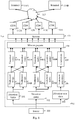
- the Fig. 1 schematically represents an example of a broadcasting channel 1 of audiovisual programs.
- the broadcast chain 1 comprises a source 100, a block called the OTT network head 10, a server, called the origin server, 111, a plurality of CDNs 112A, 112B, 112C and 112D connected to terminals 114A, 114B by the 'intermediary of an Internet network 113.
- the source 100 provides original content to the OTT network head 10.
- this content is encoded in the form of a binary stream comprising a video sub-stream, at least one audio sub-stream and at least one subtitle sub-stream.
- the OTT network head 10 is in charge of preparing the content in versions that meet the needs of terminals that could request this content.
- the OTT network head 10 comprises a plurality of modules, each module possibly being a physical (“hardware” in English terminology) or software (“software” in English terminology) module.
- the binary stream is received by a video decoder 101 (respectively an audio decoder 102, a subtitle decoder 103) which generates a decoded video stream (respectively at least one decoded audio stream, at least a decoded subtitle stream).
- the decoded video stream is supplied to two image processing modules 104A and 104B which generate processed video streams.
- the image processing module 104A is for example a noise-reducing filtering module.
- the image processing module 104B is for example a contour enhancement module.
- Each processed video stream is supplied to two video encoders 107A and 107B.
- the 107A video encoder is for example an encoder conforming to the AVC standard (H.264 / AVC (ISO / IEC 14496-10 - MPEG-4 Part 10, advanced video coding (“Advanced Video Coding” / ITU-T H.264).
- the 107B encoder is for example an encoder conforming to the HEVC standard (ISO / IEC 23008-2 - MPEG-H Part 2, high efficiency video coding (High Efficiency Video Coding) / ITU-T H.265) .
- Each decoded audio stream is supplied to two audio processing modules 105A and 105B which generate processed audio streams.
- the audio processing module 105A is for example a noise reducing filtering module.
- the image processing module 105B is for example a voice enhancement module.
- Each processed audio stream is supplied to two audio encoders 108A and 108B.
- the audio encoder 108A is for example an encoder conforming to the AAC standard (Advanced Audio Coding, ISO / IEC 13818-7).
- the 107B encoder is for example an encoder conforming to the MP3 standard (MPEG-1/2 Audio Layer 3).
- Each decoded subtitle stream is supplied to a subtitle processing module 106 which generates processed subtitle streams.
- the subtitle processing module 106 is for example a filtering module replacing certain words with others according to regional linguistic uses.
- Each processed subtitle stream is supplied to a subtitle format conversion module.
- Each video stream originating from the video encoders 107A and 107B, each audio stream originating from the audio encoders 108A and 108B and each subtitle stream originating from the conversion module 109 are transmitted to a packetization module (“packetizer” in English terminology -saxonne) 110.
- the packetization module 110 forms segments conforming to the protocol (s) to be supported.
- Each segment is then transmitted to an origin server 111 which is responsible for transmitting these segments to the CDNs 112A, 112B, 112C and 112D.
- Each terminal 114A (or 114B) wishing to play the content requests the content from a CDN segment by segment, changing profiles if necessary from one segment to another.
- the OTT network head 10 has generated, assuming that two HAS type protocols must be supported, around thirty different versions of the content.
- the segments corresponding to each version are stored on each CDN.
- JIT Just in time, "just in time” in English terminology
- An application of the JIT concept to the OTT network head 10 would consist in not systematically using all the modules of said block.
- the OTT head end 10 could stop at decoding, i.e. video decoding by the video decoder 101, audio decoding by the audio decoder 102 and subtitle decoding by the decoder of subtitles 103. Then, on request, depending on the needs of the terminal that sent the request, the OTT network head 10 activates certain modules.
- the JIT concept can relate to different stages of an audiovisual content distribution chain.
- the JIT concept can be applied to a processing stage (image processing, audio processing, subtitle processing) and / or to an encoding stage (video or audio) and / or to a processing stage. bundling.
- a packetization stage may form only segments conforming to a single protocol.
- Another application of the JIT concept consists in generating a single version of a content (a single video or audio processing, a single video encoding, a single audio encoding, a single protocol) called a pivot version, then generating other versions on request from the pivot version, for example by transcoding.
- HAS-type systems audiovisual content distribution systems
- JIT-type systems monolithic and static.
- HAS-type systems audiovisual content distribution systems
- JIT-type systems monolithic and static.
- these systems have been dimensioned once and for all to process a predefined number of maximum audiovisual contents in parallel.
- These systems cannot go beyond this predefined number.
- the relationships between the different processing modules of these systems are fixed. Each module is thus statically connected with the module which gives it data and the module to which it gives data.
- workflow in English terminology
- the monolithic and static aspect implies that the processing chains are rigid and therefore not very scalable. Thus, it is very difficult to integrate new functionalities or to replace functionalities in an existing processing chain. At best, an intervention on the OTT head end to reconfigure it and at worst a replacement of the OTT head end are necessary.
- micro-service type architectures make it possible to make processing chains more flexible.
- a micro-services type architecture is a software architecture in which a complex application or processing is broken down into several independent and loosely coupled processes called micro-services. Each micro-service is usually specialized in a single task. Micro-services communicate with each other using APIs (Application Programming Interface) such as REST APIs (representational state transfer). -saxonne).
- APIs Application Programming Interface
- REST APIs representational state transfer
- -saxonne A declared advantage of a micro-service type architecture is that, if there is a need for an increase in resources to carry out a processing, only the micro-service (s) involved in this processing must be scaled ("scaled" in Anglo-Saxon terminology). However, these architectures are still difficult to implement.
- the invention relates to an elementary module intended to be used in at least one processing chain of a system making it possible to distribute audiovisual content stored or produced live by sources to terminals of display, each content being received by a terminal in the form of a succession of consecutive files, called segments, each segment being distributed to a terminal following a transmission of a request by said terminal and being obtained by an application of a chain processing to a portion of a content, the elementary module executing a processing of a predefined type of the processing chain.
- the elementary module comprises: a variable plurality of processing units available to execute the processing of the predefined type, the elementary module regularly obtaining information representative of each processing unit added or deleted from the plurality, each processing unit not keeping any information relating to processing after processing has taken place; a module, called a central module, comprising a communication module capable of receiving requests for first data, each request comprising information representative of a processing chain to be applied to a portion of a content corresponding to a segment requested in a request by a terminal to obtain said first data and information representative of configuration parameters to be applied to at least one processing unit of said elementary module to generate the first data, each processing unit taking into account the information representative of the configuration parameters included in a request for first data to perform processing corresponding to said request for first data; capable of transmitting a request for second data to a unit preceding the elementary module in the processing chain determined from the information representative of the processing chain, said second data corresponding to said portion processed or not by one or more preceding units the elementary module in the processing chain; and, capable of transmitting first data when it
- each model is a hybrid neural network in which a neural network of the convolutional neural network type, called the CNN neural network, is followed by a neural network of the long-term short-term memory type. , called LSTM neural network, then a multi-level perceptron type neural network, called MLP neural network.
- the invention relates to a system for distributing audiovisual content stored or produced live by sources to display terminals, each content being received by a terminal in the form of a succession of files. consecutive, called segments, each segment being distributed to a terminal following transmission of a request by said terminal and being obtained by applying a processing chain to a portion of a content.
- Said system is such that at least one processing chain implemented by the distribution system comprises at least one elementary module according to the first aspect capable of implementing processing of a predefined type of processing, and said system comprises in in addition: a metrics aggregation module in charge of regularly obtaining metrics from each of the elementary modules of said system and, for each type of predefined processing, of aggregating the metrics obtained from each module processing of said system implementing said type of predefined processing; and, a modeling module retrieving the metrics specific to each type of predefined processing provided by the metrics aggregation module and, on the basis of these metrics, defining, for each of said types of predefined processing, an updating model. scale and a load distribution model specific to said type of predefined treatment.
- the definition by training of the scaling and load distribution models is performed asynchronously with respect to the operation of each processing chain comprising at least one elementary module implemented by said system.
- the invention relates to a processing method executed by an elementary module executing a type of predefined processing in at least one processing chain of a distribution system for audiovisual content stored or produced live by from sources to display terminals, each content distribution being in the form of files, called segments, each segment distributed to a terminal having been the subject of a request transmitted by said terminal and resulting from an application of a processing chain with a portion of content requested by the request.
- the method comprises: receiving at least one request for first data, each request comprising information representative of a processing chain to be applied to a portion of a content corresponding to a segment requested in a request by a terminal to obtain said first data and information representative of configuration parameters to be applied to at least one processing unit in order to generate the first data; for each of said requests, extract the information representative of the configuration parameters contained in the said request and transmit a request for second data to a source or to a unit preceding the elementary module in the processing chain determined from the information representative of the processing chain, said second data corresponding to said portion whether or not processed by one or more units preceding the elementary module in the processing chain; determining a number of processing units to be allocated to perform each processing requested in each first data request received by using a scaling model corresponding to the processing of the predefined type provided by a modeling module included in said system, each processing unit belonging to a plurality of processing units available to execute the processing of the predefined type, the elementary module regularly obtaining information representative of each processing unit added or removed from said plurality, and al
- the training of the scaling and load distribution models is performed asynchronously with respect to the operation of each processing chain comprising the elementary module.
- the training of each model uses a set of characteristics taking the form of a vector of parameters, certain parameters being themselves vectors.
- the set of characteristics used for training the scaling model comprises characteristics making it possible to adjust parameters of said model in order to achieve an objective of avoiding overloading of the allocated processing units.
- the invention relates to a computer program product, comprising instructions for implementing, by a device, the method according to the third aspect by a processor of the device.
- the invention relates to storage means, storing a computer program comprising instructions for implementing, by a device, the method according to the third aspect when said program is executed by a processor of said device.
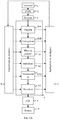
- the Figs. 2A , 2B and 2C describe an evolution of an audiovisual content distribution system during operation when the invention is used.
- this distribution system comprises a display terminal 1, at least one CDN 2, an origin server 3, referred to simply as a server hereinafter, a processing chain 4, a gateway ("gateway" in English terminology ) 5, a source 6, a metrics aggregation module 7, and a modeling module 8.
- the source 6 comprises at least one audiovisual content, simply called content hereinafter, which can be requested by the terminal 1 according to a profile particular.
- the gateway 5 is in charge of transforming a continuous stream of data into files.
- the processing chain 4 comprises a set of processing modules comprising a decoding module 44 capable of performing audio and video decoding, an image processing module 43A capable of applying an image processing A, an encoding module 42 capable of performing audio and video encoding and a packetization module 41 capable of generating segments conforming to a predetermined protocol, an encryption and rights management module (“Digital Right Management (DRM)” in English terminology -saxonne) 40B capable of applying processing to the segments so as, in particular, to prevent illicit use of these segments and a module for generating playlists (“playlist” in English terminology) 40A capable of generating lists of segments corresponding to the content.
- the processing of images A is, for example, noise-reducing filtering.
- Each processing module of the processing chain 4 can be a software module ("software” in English terminology) executed by one or more programmable processing units or hardware ("hardware" in English terminology) executed by a unit dedicated processing.
- the processing modules of the processing chain 4 can be geographically collocated and linked for example by a communication bus or dispersed and linked together by a communication network.
- Each processing module of the processing chain 4 produces, during its operation, metrics representative of said operation comprising business data as well as system data.
- System data includes for example a number of requests processed by a module and / or a percentage of use of a processing unit such as a CPU and / or a number of accesses to a cache memory, etc.
- the metrics aggregation module 7 is responsible for regularly requesting metrics from each of the processing modules of the audiovisual content distribution system and, for each type of processing implemented by one or more processing modules of said system, d 'aggregate the metrics obtained from each processing module of said system implementing said type of processing. In the context of the invention, these metrics are supplied to the modeling module 8.
- the metrics aggregation module 7 is a Prometheus type module as described in the website https: // prometheus .io / docs / introduction / overview / .
- the modeling module 8 retrieves the metrics specific to each type of processing implemented by one or more processing modules of said system provided by the metrics aggregation module 7. From these metrics, it defines, for each of said types treatment, at least one behavior model specific to said type of treatment.
- Each processing module of the processing chain 4 must solve at least two problems: a scaling problem and a load balancing problem.
- the scaling problem consists in determining a number of processing units to be allocated to execute a set of the processing operations requested from the processing module.
- the load distribution problem consists, once the number of processing units has been determined, in determining how to distribute the load of all the processing operations requested from the processing module between the different allocated processing units.
- Each processing module uses, for each problem to be solved, a behavior model dedicated to the processing implemented by said processing module and to said problem to be solved.
- Each processing module therefore uses a behavior model to solve the scaling problem, called a scaling model, and a behavior model to solve the load distribution problem, called a load distribution model. .
- the scaling model receives as input, in particular, information representative of the processing operations requested from the processing module and, on the basis of this information, determines a number of processing units to be allocated.
- the load distribution model receives as input, in particular, the information representative of the processing operations requested from the processing module and generates at output information representative of a distribution of the load on the allocated processing units.
- Deep learning algorithms make it possible to get around this difficulty. This is because deep learning algorithms are capable of extracting the relevant characteristics themselves and finding patterns in a large volume of heterogeneous data.
- each behavior model is a hybrid neural network in which a CNN neural network is followed by an LSTM neural network then by an MLP neural network, the CNN neural network comprising a large number of layers.
- the CNN neural network includes ten layers.
- each neural network ie each behavior model based on a neural network, used in the audiovisual content distribution system of the invention must be trained, ie must perform training.
- the training consists in determining parameters of the neural network. The determination of these parameters is based on input data of the neural network, called training data, for which the result that the neural network must give is known. One then seeks parameters of the neural network making it possible to obtain known results for a large number of training data.
- the input data are metrics supplied by said processing module.
- each neural network has been trained using metrics supplied by an operator for which processing results are known.
- the metrics provided are metrics that are identical to the metrics provided by said processing module. These metrics have for example been obtained from processing modules of conventional audiovisual content distribution systems, such as HAS or JIT type systems, equivalent to said processing module.
- known results corresponding to these metrics include numbers of allocated processing units.
- the known results corresponding to these metrics include information representative of a distribution of requested processing on allocated processing units.
- the metrics include metrics for which no overload of allocated processing units or unacceptable processing latency has been observed and metrics for which unacceptable overloads and latencies have been observed.
- the neural networks are then defined in such a way as to exclude cases of overload.
- the neural networks thus trained are used when the audiovisual content distribution system starts up. Subsequently, the training of the neural networks continues during the operation of the audiovisual content distribution system according to the invention using the metrics supplied by the processing modules of said system. Thus, the impact of the metrics provided by the operator in the definition of neural networks is gradually reduced.
- the MPEG-2 TS format offers great granularity in terms of random access to independently decodable portions of streams.
- the MPEG-2 TS format makes it possible to have segments whose first bytes can be processed by a decoder upon reception.
- the mp4 format did not offer as fine a granularity as the MPEG-2 TS format.
- an mp4 segment has a syntactic structure preventing a decoder from start processing quickly the first bytes received.
- the mp4 segments have been divided into fragments, a fragment being a portion of a stream starting with a synchronization point from which a decoder can start a syntactic analysis (“parsing” in English terminology) of said stream. Subsequently, the granularity of the fragments being judged insufficient, they were divided into chunks, a chunk also being a portion of the stream starting with a synchronization point from which a decoder can start a syntactic analysis of said stream.
- the vector of parameters includes the following parameters: Unit_type_id_i (where i is the index of one of the n processing units), vCpu_type_id_i, vCpu_frequency_i, vCpu_cores_i, vCpu_count_i, Memory_Usage_i, Success_Balancing_i.
- the “ success_Balancing_i ” parameters represent a ratio between a number of tasks performed by the processing unit i and a sum of the RealTimeRatio for each of these tasks.
- the parameter vector comprises the following parameters: Unit_type_id_i, vCpu_type_id_i, vCpu_frequency_i, vCpu_cores_i, vCpu_count_i, Memory_Usage_i, Success_Balancing_i.
- the vector of parameters includes: Unit_type_id_i, vCpu_type_id_i, vCpu_frequency_i, vCpu_cores_i, vCpu_count_i, Memory_Usage_i, Success_Balancing_i.
- the distribution system is distributing content.
- Terminal 1 has set a profile and the distribution system provides segments compatible with this profile.
- the terminal 1 sends a request in order to obtain said segment containing information representative of the desired profile.
- Each segment has been chosen from a playlist (“playlist”) supplied by the playlist generation module from among a set of segments corresponding to different versions of the same sub-part of the content.
- the processing chain 4 is dynamically defined for each segment by the terminal 1 or by an intermediate device which can be the CDN 2 or the server 3.
- each processing module has been chosen from a set of candidate processing modules capable of applying exactly the same treatment.
- each processing can be executed by different processing modules.
- a change in processing module may be motivated by a temporary unavailability of a processing module, for example, when this processing module is already used to generate another segment, by a malfunction. of said processing module, by overloading the computing unit having to implement said processing module, by a choice of an operator who wishes to favor certain processing units rather than others, and so on.
- a processing of B images would be more appropriate than the processing of A images.
- the processing of B images is, for example, filtering making it possible to enhance contours.
- the operator sends for example a command to the terminal 1 so that the terminal 1 generates a request making it possible to modify the processing chain 4.
- the image processing module 43A is replaced by a module.
- image processing 43B implementing image processing B.
- the metrics aggregation module 7 requests metrics from the module of image processing 43B.
- the modeling module 8 recovers the metrics specific to the image processing module 43B supplied by the metrics aggregation module 7. Two embodiments are then possible. In one embodiment, the modeling module 8 learns a scaling model and a load distribution model specific to the image processing module 43B independent of the behavior models of the image processing module 43A. In another embodiment, the modeling module considers that the behavior models learned for the modeling module 43A constitute a good starting point for learning the behavior models of the image processing module 43B. Thus, the parameters of the neural networks learned for the behavior models of the image processing module 43A serve to initialize the parameters of the neural network of the behavior models of the image processing module 43B.
- a digital watermark type C treatment is appropriate.
- the operator sends for example a command to the terminal 1 so that the terminal 1 generates a request making it possible to modify the processing chain 4.
- a digital watermark module 43C is added to the processing chain 4 between the processing module 43B and the encoding module 42.
- the module metrics aggregation 7 requests metrics from the digital watermark module 43B.
- the modeling module 8 retrieves the metrics specific to the digital watermarking module 43C supplied by the metrics aggregation module 7. The modeling module 8 then learns a scaling model and a load distribution model specific to the digital watermarking module 43 C.
- the examples described in Figs. 2A , 2B and 2C show that the invention allows great dynamicity and agility in the definition of the processing chain 4. Thus, a different processing chain can be defined for each segment. It should be noted that the definition of the processing chain is not only dynamic in the choice of the candidate processing module having to implement such or such processing, but also in terms of the choice of the processing operations to be applied by this processing chain.
- each processing module of the processing chain 4 is implemented by an elementary module which we describe below in relation to the
- Each elementary module makes available to the processing chain 4, one or more processing units to implement a processing module of the processing chain 4.
- a role of an elementary module in charge of processing in a processing chain is to choose which processing unit or units from among a set of processing units of which it is aware must perform said processing.
- no processing implemented by an elementary module is executed by a processing unit defined in advance in a centralized manner.
- each request from the terminal 1 for a segment leads, for each elementary module involved in a processing of the processing chain having to produce this segment, a scaling decision and a load distribution decision.
- each processing module determines how many processing units are to be allocated during the implementation of all the processing operations requested of it (including the processing requested in the request that led to the decision being taken) and how to distribute the load of these treatments on the treatment units. From one segment to another, the selected processing unit (s) may be different. To make these decisions, each elementary module is based on the scaling and load distribution models corresponding to the type of processing implemented by said elementary module provided by the modeling module 8.
- an elementary module can contribute to several processing chains in parallel, each processing chain making it possible to distribute audiovisual content stored or produced live by a source to a display terminal. An elementary module is therefore not monopolized by a processing chain. At each processing performed by an elementary module, said elementary module generates metrics corresponding to the type of processing that said module implements and which are collected regularly by the metrics aggregation module 7.
- the metrics 7 and modeling 8 aggregation modules are however linked to a plurality of processing chains.
- the metrics aggregation module 7 obtains metrics from a plurality of processing chains that may or may not share elementary modules.
- the modeling module 8 generates scaling and load distribution models which are used in parallel in a plurality of processing chains.
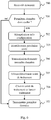
- the Fig. 5 schematically illustrates steps of a method for activating a processing chain so that a terminal can obtain a segment.
- the method of Fig. 5 is executed by terminal 1.
- the process of Fig. 5 allows terminal 1 to activate a processing chain in order to obtain a segment.
- the requested segment conforms to the HLS protocol and each data transmission, each request and each request are made in the form of request transmissions conforming to the HTTP / HTTPS protocol (HTTP secured "HTTP secured" in English terminology. Saxon).
- terminal 1 Prior to the execution of the Fig. 5 , we assume that terminal 1 has requested a manifest from CDN 2 regarding some content. In a step 600, the terminal 1 receives a request containing the manifest from the CDN 2. This manifest describes each profile that can be requested by the terminal 1.
- a step 601 the terminal 1 determines whether it must continue to play the current content or not, ie if it must request a new segment, called the current segment. This information was for example provided by a user of the terminal 1. If the terminal 1 must not continue to play the content, the method ends during a step 602.
- step 601 is followed by step 603.
- terminal 1 determines whether the processing chain 4 used for the segment preceding the current segment must be modified. In other words, is it necessary to add, delete or replace a processing executed by the processing chain 4 to obtain the current segment. In one embodiment, during each change of profile, the terminal 1 considers that the processing chain 4 must be modified.
- the terminal 1 selects a profile, called the current profile, among the profiles of the manifest as a function of transmission and processing constraints obtained by the terminal 1.
- the transmission constraints are for example a measured flow constraint. by the terminal 1.
- the processing constraints are for example a display capacity ( ie a screen resolution) of the terminal 1, a number of images that can be decoded per second, and so on.
- the current profile is compared to the requested profile for the segment preceding the current segment. If the two profiles are identical, the terminal 1 executes a step 605. If the two profiles are different or if the current segment is the first segment requested for the content, the terminal 1 executes a step 604.
- the terminal 1 obtains a list of processing operations representative of the processing chain 4 to be applied to a portion of the content to obtain the current segment.
- this list is deduced from the profile selected during step 603.
- Terminal 1 has for example a correspondence table associating each profile that can be requested for a content, with a list of processing operations.
- step 605 the terminal 1 determines whether each processing of the list of processing has been considered. If not, the terminal 1 browses the list from the first processing in search of the next processing not yet considered.
- the terminal 1 chooses an elementary module from a set of modules capable of executing said processing.
- the terminal 1 adds an identifier composed of an address and a port number of the elementary module chosen in a request. Each identifier is written after the identifier (s) that may already be present in the request.
- Step 607 is followed by step 605, during which terminal 1 proceeds to the next processing in the list.
- the terminal 1 goes to a step 608.
- the terminal 1 adds to the request information representative of the portion of the content desired. This information also makes it possible to identify the source storing or directly producing said content.
- the source of the content is the gateway 5.
- the terminal 1 obtains for each processing information representative of configuration parameters of the elementary module corresponding to said processing, the information representative of the configuration parameters having been obtained from, in particular, the profile selected during the step 603.
- the terminal 1 adds the information representative of configuration parameters of each module in the request.
- the query includes the following sequence: http: // Address1: port1 / Address2: port2 / Address3: port3 / Address4: port4 / IDportion? Conf where Address1: port1 (respectively Address2: port2, Address3: port3, Address4: port4 ) corresponds to the identifier (the address and the port number) of the module 41 (respectively the identifier of the module 42, of the module 43 and of the module 44). IDportion corresponds to the information representative of the portion of the content. Conf corresponds to the information representative of the configuration parameters of each module.
- the conf field explicitly includes each configuration parameter to be applied to an elementary module.
- the terminal 1 transmits the request to the first recipient elementary module in order to start the execution of the processing chain and thus cause the transmission of the current segment to the terminal 1.
- the diffusion systems described in relation to the Figs. 2A , 2B and 2C include a CDN 2 and a server 3 located between the terminal 1 and the processing chain 4.
- the request sent by the terminal 1 passes through the server 2 and the CDN 3 without intervention from those who are satisfied with the retransmit.
- a terminal does not request just one segment, but a set of successive segments forming audiovisual content.
- the process of Fig. 5 is executed for each segment of said audiovisual content.
- the Fig. 3 schematically illustrates an elementary 4X module capable of executing a processing of a predefined type of a processing chain.
- the 4X elementary module of the Fig. 3 is for example an elementary module implementing one of the processing modules 41, 42, 43A, 43B, 43C or 44. If, for example, the elementary module implements the processing module 41, the type of processing implemented by the elementary module 4X is therefore packetization in accordance with the HLS protocol.
- the elementary module 4X comprises a variable plurality of processing units 31 available to execute the processing of the predefined type, the elementary module 4X regularly obtaining information representative of each processing unit added or deleted from the plurality.
- Each processing unit of the plurality is said to be stateless, that is to say it does not retain any information relating to a processing after the processing has been carried out.
- One advantage of a stateless processing unit is that it can easily switch from one processing to another without the successive processing relating to the same content, the same processing chain or the same terminal.
- the elementary module 4X further comprises a central module, comprising a communication module 305, a scaling module 303 and a load distribution module 302 and a database 35.
- the communication module 305 is able to receive requests for first data.
- a request for first data is for example the request transmitted by the terminal 1 during step 611 when the elementary module 4X implements the processing module 41.
- the elementary module implements the processing module 42 (respectively 43 or 44)
- a request for first data corresponds to the request transmitted by the terminal 1 during step 611 modified by the elementary module implementing the processing module 41 (respectively by the elementary modules implementing the processing modules 41 and 42 or by the elementary modules implementing the processing modules 41, 42 and 43) according to a modification procedure described in relation to the Fig. 6 .
- the first data correspond to the current segment since the module 41 is the last module of the processing chain.
- the request generated by the terminal 1 therefore requests the current segment from the elementary module 4X.
- the elementary module 4X implements the processing module 42 (respectively 43 or 44)
- the first data is a result of the processing of the content portion corresponding to the identifier IDportion by the processing modules 43 and 44 (respectively of the processing of said portion of content by processing module 44 or said portion of content).
- this request for first data comprises information representative of a processing chain to be applied to the content portion corresponding to the identifier IDportion in order to obtain the first data and information representative of parameters. configuration to be applied to at least one processing unit of said elementary module to generate the first data.
- the information representative of the processing chain ie the sequence Address1: port1 / Address2: port2 / Address3: port3 / Address4: port4 describes the entire processing chain.
- the information representative of the processing chain describes the processing chain up to the processing module 42 (ie Address2: port2 / Address3: port3 / Address4: port4) (respectively up to module 43 (Address3: port3 / Address4: port4) or 44 (Address4: port4)).
- the communication module 305 is also capable of transmitting a request for second data to the source 5 or to a unit preceding the elementary module 4X in the processing chain 4 determined from the information representative of the processing chain.
- the unit preceding the elementary module 4X is an elementary module implementing the processing module 42.
- the second data corresponds to a result of an application of the processing modules 42, 43 and 44 to the content portion corresponding to the identifier IDportion.
- the unit preceding the elementary module 4X is an elementary module implementing the processing module 43.
- the second data corresponds to the result of an application of the processing modules 43 and 44 to the content portion corresponding to the identifier IDportion.
- the unit preceding the elementary module 4X is an elementary module implementing the processing module 44.
- the second data corresponds to the result of an application of the processing module 44. to the content portion corresponding to the identifier IDportion.
- the unit preceding the elementary module 4X is the source 5.
- the second data corresponds to the content portion corresponding to the identifier IDportion.
- the communication module 305 is also able to transmit the first data requested to the unit which sent the request for said first data.
- the unit which sent the request is the terminal 1.
- the unit which sent the request is the module elementary module implementing the processing module 41.
- the unit that issued the request is the elementary module implementing the processing module 42.
- the elementary module 4X puts implementing the processing module 44 the unit having sent the request is the elementary module implementing the processing module 43.
- the communication module 305 is a WEB server.
- the scaling module 303 determines a number of processing units to be allocated for the implementation of all the processing operations requested from the elementary module 4X. The determination of the number of processing units to be allocated is based on the update model the scale corresponding to the processing of the predefined type supplied by the modeling module 8. As a function of the determined number of processing units to be allocated, the scaling module 303 allocates available processing units or deallocates processing units. treatment, taking into account the treatment units already allocated.
- the load distribution module 302 is able to choose, for each request received, at least one processing unit from among the processing units allocated by the scaling module 303 and able to launch the processing of the type predefined by each processing unit. treatment chosen in order to obtain the first data requested from the second data.
- the choice of the processing units to be used is based on the load distribution model provided by the modeling module 8.
- the database 35 is intended to store text files, for example in JSON format. or XML each containing detailed configuration parameters corresponding to the information representative of the NomConfN configuration parameters contained in the requests for first data.
- the database 35 also stores text files which do not correspond directly to the profiles requested by terminals, but to so-called constrained profiles containing constrained configuration parameters set by an external entity independently of a request. first data.
- constrained configuration parameters are for example parameters imposed by an operator which do not appear in a profile. For example, these settings can force a video encoder to work with a limited number of compression tools.
- the central module 30 comprises a cache memory 304 used to temporarily store, according to a predefined cache memory management method implemented by a cache management module, the first data generated by the elementary module 4X.
- the method of managing the cache memory may consist simply in keeping in the cache memory 304 each first data item for a predefined period and erasing these first data after this predefined period.
- the cache management module can calculate statistics on the requested contents and adjust the retention period of the first data according to these statistics.
- the method of managing the cache memory 304 may consist in increasing the predefined retention period for the first data corresponding to highly demanded content and in reducing the retention period for the first data corresponding to low demand content.
- the communication module 305 implements the method for managing the cache memory 304.
- the elementary module 4X does not include a cache management module.
- the elementary module 4X comprises an extraction module 36 capable of extracting the information representative of the configuration parameters of each request for first data received by the elementary module 4X.
- the central module 30 comprises a regulation module 301 providing management rules.
- management rules are, for example, cache management rules taken into account in the cache memory management procedure 304, processing unit allocation rules intended for the scaling module 303 and load distribution rules intended for the load distribution module 302.
- the regulation module 301 stores predefined management rules and / or receives management rules from an external entity.
- the cache management rules fix for example the duration of conservation of the first data in the cache memory 304.
- the allocation rules fix for example which processing units must be allocated or deallocated in priority according to criteria of computational capacity, energy consumption or financial cost of using each processing unit.
- the load management rules can for example set when a processing unit is considered to be overloaded and that it should no longer be called upon for new processing.
- the modules 30, 301, 302, 303, 305 and 36, the database 35, and the cache memory 304 are included in a single device 4Y and linked together by a communication bus.
- the processing units of the plurality 31 are included in the equipment 4Y or included in other equipment connected to the equipment 4Y by a communication network.
- the Fig. 4 illustrates an example of hardware architecture of a 4Y device used in the context of the invention.
- the equipment 4Y implements the modules 30, 301, 302, 303, 305 and 36, the database 35, and the cache memory 304 and includes certain processing units of the plurality 31.
- the equipment 4Y then comprises, connected by a communication bus 400: a plurality of processing units 401; a random access memory RAM 402; a ROM read only memory 403; a storage unit or a storage medium reader, such as an SD card reader 404; a set of communication interfaces 405 allowing the equipment 4Y to communicate with other units of the processing chain, ie with other elementary modules, with the source 5, the terminal 1 and with other equipment.
- the storage unit 404 stores the database 35 and the cache memory 304.
- Each of the plurality 401 processing unit is capable of executing instructions loaded into RAM 402 from ROM 403, external memory (not shown), storage medium, such as an SD card , or a communication network.
- each of the plurality of processing units 401 is able to read from the RAM 402 instructions and execute them.
- Each module of the 4X elementary module, the processing of the predefined type implemented by the 4X elementary module and the method described below in relation to the Fig. 6 is shown as instructions forming a computer program.
- one or more processing units load a computer program corresponding to a module (respectively to a process or to the process described in relation to Fig. 6 ) it implements said module (respectively said processing or said method).
- each processing unit of the plurality is a physical processor (or logic implemented by a physical processor), a microcontroller or a DSP (“Digital Signal Processor” in English terminology) loading one computer programs.
- a physical processor or logic implemented by a physical processor
- microcontroller or a DSP (“Digital Signal Processor” in English terminology) loading one computer programs.
- DSP Digital Signal Processor
- all or part of the modules, the processing of the predefined type or the method described in relation to the Fig. 6 can be implemented in hardware form by a machine or a dedicated component, such as an FPGA ("Field-Programmable Gate Array") or an ASIC ("Application-Specific Integrated Circuit" in English terminology) .
- FPGA Field-Programmable Gate Array
- ASIC Application-Specific Integrated Circuit
- the modules of the elementary module 4X, the database 35, and the cache memory 304 are totally or partially dispersed over different equipment items, and linked together by a communication bus when they are on the same. equipment or by a communication network when they are on different equipment.
- the Fig. 6 schematically illustrates a method executed by an elementary module upon receipt of one or more requests for first data.
- the communication module 305 of the elementary module 4X receives a request for first data.
- the request for first data corresponds to the request transmitted by the terminal 1 during step 611.
- the communication module 305 of the 4X elementary module can receive several requests for first data almost simultaneously.
- the communication module 305 can receive several requests for first data from several terminals.
- the elementary module 4X can also be in the process of processing one or more requests for first data.
- the communication module 305 of the elementary module 4X verifies, for each request for first data received, a presence of said first data in the cache memory 304.
- the extraction module 36 extracts during a step 702 the information representative of the configuration parameters of said request for first data. Since the 4X elementary module does not have the first data at its disposal, it must request them.
- the communication module 305 transmits during a step 704 a request for second data to the gateway 5 or to a unit preceding the elementary module 4X in the processing chain 4.
- the module determines during a step 703 to whom it must transmit the request for second data on the basis of the information representative of the processing chain.
- the unit preceding the elementary module 4X in the processing chain 4 is either the gateway 5 or an elementary module. If the elementary module 4X implements the processing module 41, the elementary module preceding the elementary module 4X in the processing chain 4 is an elementary module implementing the processing module 42.
- the request for second data corresponds to a modified version of the request for first data.
- the communication module removes the identifier of the elementary module 4X from the request for first data.
- the request for first data comprises the following sequence: http: // Address1: port1 / Address2: port2 / Address3: port3 / Address4: port4 / IDportion? Conf and becomes: http: // Address2: port2 / Address3: port3 / Address4: port4 / Portion ID? Conf once changed to get the second data request.
- the scaling module 303 determines a number NU of processing units to be allocated to execute each processing requested in each request for first data received for which the first data is absent from the cache memory 304. To do this, the scaling module 303 injects metrics into the scaling model corresponding to the processing of the predefined type. These metrics include in particular the configuration parameters of these requests for first data corresponding to the processing of the predefined type, the characteristics of the predefined processing as implemented by the elementary module 4X, and the characteristics of the second data to be processed. For example, for the encoding module 42, the configuration parameters for a request for first data, that is to say corresponding to encoded data, include the following parameters also used for training the layout model.
- Characteristics of the encoding as implemented by the encoding module 42 include, for example, information indicating whether the implementation of the encoding includes parallelizable processes and if so, how many processes can be parallelized. Characteristics of the second data to be processed, that is to say of the data to be encoded for the encoding module 42, include for example the Segment_complexity parameter also used during training.
- the number of processing units to be allocated NU therefore not only corresponds to a number NR of processing units necessary for the implementation of all the processing operations requested from the elementary module 4X, but corresponds to the sum of the number NR and an MS safety margin to support rapid increases in the number of first data requests.
- the deep learning algorithm is defined in such a way as to find a better compromise between the need to define a sufficient MS safety margin to avoid overloads and the need not to allocate an inordinate number of processing units, which can increase a operating cost of the audiovisual content distribution system.
- each RealTimeRatio parameter is a good indicator to determine if a CPU, whose characteristics we know, is overloaded, or not when it has to execute a process whose characteristics we know.
- the parameters of the scaling model (ie of the neural network corresponding to the scaling model) will be adjusted by training in order to avoid CPU overloads.
- the load distribution module 302 chooses for each request for first data at least one processing unit among the processing units allocated to execute the processing of the predefined type.
- each allocated processing unit is associated with a list of first data requests which has been assigned to it.
- the load balancing module 302 Upon receipt of one or more new requests for first data for which the first data is not present in the cache memory, the load balancing module 302 must determine in which lists should be inserted said new requests. To do this, the load distribution module 302 injects metrics into the load distribution model corresponding to the processing of the predefined type.
- These metrics include the configuration parameters of new requests corresponding to the predefined type processing, processing characteristics predefined as implemented by the elementary 4X module, characteristics of the second data to be processed, characteristics of the allocated processing units and for each allocated processing unit, the configuration parameters corresponding to the processing of the predefined type of requests for first data already present in the list associated with said processing unit.
- the configuration parameters of the new requests or of the requests already present in a list associated with one of the allocated processing units corresponding to the processing of the predefined type, that is to say corresponding to encoded data includes the following parameters: Codec_id, Codec_implementation_id, Video_profile, Video_level, Output_bitrate, Output_width, Output_Height, Output_FrameRate, Quality_Level, Segment_duration and GopSize.
- Characteristics of the encoding as implemented by the encoding module 42 include, for example, information indicating whether the implementation of the encoding includes parallelizable processes and if so, how many processes can be parallelized.
- Characteristics of the second data to be processed that is to say of the data to be encoded for the encoding module 42, for example comprise the parameter Segment_complexity.
- Characteristics of the allocated processing units include, for example, a type of CPU, a type of virtual CPU, a CPU frequency, a number of cores in the CPU, a number of virtual CPUs, a size of RAM memory.
- the load distribution model then provides information representative of a distribution of the new requests for first data in the lists associated with the allocated processing units.
- Each processing unit processes the requests for first data which have been assigned to it in the order of their appearance in the list associated with said processing unit.
- the processing unit concerned waits for the reception of the second data corresponding to said first data requested during step 704 in order to be able to apply the processing of the predefined type to said second data in order to obtain said first data.
- the load balancing module interrogates the database 35 with the information representative of the configuration parameters extracted from said request for first data by the module of extraction 36 to obtain the configuration parameters corresponding to said request for first data.
- Step 706 and step 701 are followed by step 707 during which, for each request for first data, the communication module 305 transmits the first data when they are available to the unit which issued the request. for said first data.
- the unit which issued the request for said first data is either terminal 1 (when the elementary module 4X implements the processing module 41), or a module elementary (when the elementary module 4X implements the processing module 42 or 43 or 44).
- the extraction module 36 extracts each piece of information representative of configuration parameters of each request for first data and stores this information in the database 35.
- Each processing unit of the plurality 31 having to perform a processing interrogates the database 35 to obtain said information and then find the configuration parameters corresponding to this information.
- Each piece of information representing configuration parameters thus stored forms part of the metrics supplied to the metrics extraction module 7.
- the procedure for launching the processing chain is executed by the CDN 2 or the server 3.
- the terminal 1 transmits a request for example in accordance with the HLS protocol to obtain said segment. and the CDN 2 or the server 3 translates this request into a request in accordance with the invention as for example described in relation to step 610.
- the procedure for launching the processing chain is executed by the CDN 2 independently of any request from a terminal.
- CDN 2 anticipates upcoming requests from clients.
- the segments thus obtained are kept at least temporarily by the CDN 2.
- each processing unit of the plurality available to perform processing of the predefined type corresponding to an elementary 4X module registers itself with a unit such as a server, called a registration server, with which each elementary module can communicate using a communication network.
- each elementary module interrogates the recording server in order to obtain the list of processing units that it could use.
- an elementary module allocates a processing unit from the list kept by the recording server, it informs the recording server, which removes this processing unit from the list.
Landscapes
- Engineering & Computer Science (AREA)
- Signal Processing (AREA)
- Physics & Mathematics (AREA)
- Theoretical Computer Science (AREA)
- Multimedia (AREA)
- General Engineering & Computer Science (AREA)
- Biophysics (AREA)
- Mathematical Physics (AREA)
- Data Mining & Analysis (AREA)
- Evolutionary Computation (AREA)
- General Health & Medical Sciences (AREA)
- Molecular Biology (AREA)
- Computing Systems (AREA)
- Biomedical Technology (AREA)
- General Physics & Mathematics (AREA)
- Computational Linguistics (AREA)
- Software Systems (AREA)
- Artificial Intelligence (AREA)
- Life Sciences & Earth Sciences (AREA)
- Health & Medical Sciences (AREA)
- Databases & Information Systems (AREA)
- Computer Networks & Wireless Communication (AREA)
- Information Transfer Between Computers (AREA)
- Two-Way Televisions, Distribution Of Moving Picture Or The Like (AREA)
- Information Retrieval, Db Structures And Fs Structures Therefor (AREA)
Applications Claiming Priority (1)
| Application Number | Priority Date | Filing Date | Title |
|---|---|---|---|
| FR1907690A FR3098672B1 (fr) | 2019-07-09 | 2019-07-09 | système de distribution d’un contenu audiovisuel |
Publications (2)
| Publication Number | Publication Date |
|---|---|
| EP3780632A1 true EP3780632A1 (de) | 2021-02-17 |
| EP3780632B1 EP3780632B1 (de) | 2023-01-11 |
Family
ID=68343089
Family Applications (1)
| Application Number | Title | Priority Date | Filing Date |
|---|---|---|---|
| EP20184248.1A Active EP3780632B1 (de) | 2019-07-09 | 2020-07-06 | System zur verbreitung eines audiovisuellen inhalts |
Country Status (4)
| Country | Link |
|---|---|
| US (1) | US11356722B2 (de) |
| EP (1) | EP3780632B1 (de) |
| FR (1) | FR3098672B1 (de) |
| IL (1) | IL275845A (de) |
Families Citing this family (2)
| Publication number | Priority date | Publication date | Assignee | Title |
|---|---|---|---|---|
| US11240340B2 (en) * | 2020-05-12 | 2022-02-01 | International Business Machines Corporation | Optimized deployment of analytic models in an edge topology |
| US11350166B2 (en) | 2020-08-27 | 2022-05-31 | Comcast Cable Communications, Llc | Systems and methods for improved content accessibility scoring |
Citations (1)
| Publication number | Priority date | Publication date | Assignee | Title |
|---|---|---|---|---|
| US20170078376A1 (en) * | 2015-09-11 | 2017-03-16 | Facebook, Inc. | Using worker nodes in a distributed video encoding system |
Family Cites Families (8)
| Publication number | Priority date | Publication date | Assignee | Title |
|---|---|---|---|---|
| US9338467B1 (en) * | 2010-07-19 | 2016-05-10 | Google Inc. | Parallel video transcoding |
| WO2012135019A2 (en) * | 2011-03-29 | 2012-10-04 | Lyrical Labs LLC | Video encoding system and method |
| US20130104177A1 (en) * | 2011-10-19 | 2013-04-25 | Google Inc. | Distributed real-time video processing |
| US10679345B2 (en) * | 2017-12-20 | 2020-06-09 | International Business Machines Corporation | Automatic contour annotation of medical images based on correlations with medical reports |
| CN108600863A (zh) * | 2018-03-28 | 2018-09-28 | 腾讯科技(深圳)有限公司 | 多媒体文件处理方法和装置、存储介质及电子装置 |
| US10496924B1 (en) * | 2018-08-07 | 2019-12-03 | Capital One Services, Llc | Dictionary DGA detector model |
| CN111049615B (zh) * | 2018-10-15 | 2021-01-05 | 华为技术有限公司 | 处理信号的方法和装置 |
| US20200210809A1 (en) * | 2018-12-30 | 2020-07-02 | Playtika Ltd. | System and method for outlier detection using a cascade of neural networks |
-
2019
- 2019-07-09 FR FR1907690A patent/FR3098672B1/fr active Active
-
2020
- 2020-07-05 IL IL275845A patent/IL275845A/en unknown
- 2020-07-06 EP EP20184248.1A patent/EP3780632B1/de active Active
- 2020-07-07 US US16/922,518 patent/US11356722B2/en active Active
Patent Citations (1)
| Publication number | Priority date | Publication date | Assignee | Title |
|---|---|---|---|---|
| US20170078376A1 (en) * | 2015-09-11 | 2017-03-16 | Facebook, Inc. | Using worker nodes in a distributed video encoding system |
Non-Patent Citations (2)
| Title |
|---|
| DENEKE TEWODORS ET AL: "Video transcoding time prediction for proactive load balancing", 2014 IEEE INTERNATIONAL CONFERENCE ON MULTIMEDIA AND EXPO (ICME), IEEE, 14 July 2014 (2014-07-14), pages 1 - 6, XP032639085, DOI: 10.1109/ICME.2014.6890256 * |
| SRIRAM SETHURAMAN ET AL: "Noniterative Content-Adaptive Distributed Encoding Through ML Techniques", SMPTE MOTION IMAGING JOURNAL, vol. 127, no. 9, 1 October 2018 (2018-10-01), US, pages 50 - 55, XP055675322, ISSN: 1545-0279, DOI: 10.5594/JMI.2018.2862647 * |
Also Published As
| Publication number | Publication date |
|---|---|
| US20210014547A1 (en) | 2021-01-14 |
| EP3780632B1 (de) | 2023-01-11 |
| FR3098672B1 (fr) | 2022-01-21 |
| US11356722B2 (en) | 2022-06-07 |
| IL275845A (en) | 2021-01-31 |
| FR3098672A1 (fr) | 2021-01-15 |
Similar Documents
| Publication | Publication Date | Title |
|---|---|---|
| US10547850B2 (en) | Audio splitting with codec-enforced frame sizes | |
| US9332051B2 (en) | Media manifest file generation for adaptive streaming cost management | |
| US9516078B2 (en) | System and method for providing intelligent chunk duration | |
| EP1233591B1 (de) | Multimediadatenübertragung durch vorwärtsgerichtetes Streamen | |
| CN105324972A (zh) | 实况媒体处理和流传输服务 | |
| FR2857198A1 (fr) | Optimisation de qualite de service dans la distribution de flux de donnees numeriques | |
| FR2864407A1 (fr) | Procede et dispositif de transmission continue d'une video dans un reseau de communication | |
| FR2975555A1 (fr) | Methode d'adaptation dynamique du debit de reception et recepteur associe | |
| EP3072303B1 (de) | Adaptive rundfunkübertragung von multimediainhalt | |
| EP3780632B1 (de) | System zur verbreitung eines audiovisuellen inhalts | |
| FR2959636A1 (fr) | Procede d'acces a une partie spatio-temporelle d'une sequence video d'images | |
| EP2947888A1 (de) | Verfahren zum adaptiven herunterladen von digitalen inhalten für mehrere bildschirme | |
| FR2946820A1 (fr) | Procede de transmission de donnees et dispositif associe. | |
| EP3378232B1 (de) | Verfahren zur verarbeitung von codierten daten, verfahren zum empfang von codierten daten, entsprechende vorrichtungen und computerprogramme | |
| US11316794B1 (en) | Method and system for improving adaptive bit rate content and data delivery | |
| CN112243136A (zh) | 内容播放方法、视频存储方法和设备 | |
| Thang et al. | Video streaming over HTTP with dynamic resource prediction | |
| EP3675425B1 (de) | Basismodul eines system zur verteilung von audiovisuellem inhalt | |
| EP3675505B1 (de) | Verfahren und system zur verbreitung audiovisueller inhalte | |
| US11611635B1 (en) | Content creation utilizing micro-services | |
| FR2923970A1 (fr) | Procede et dispositif de formation, de transfert et de reception de paquets de transport encapsulant des donnees representatives d'une sequence d'images | |
| US11025969B1 (en) | Video packaging system using source encoding | |
| Leetch et al. | A multi-agent system to stream multimedia to handheld devices | |
| Episkopos | Peer-to-Peer video content delivery optimization service in a distributed network | |
| EP2819424A1 (de) | Verfahren zur Verbesserung der Umschaltzeiten zwischen audiovisuellen Programmen |
Legal Events
| Date | Code | Title | Description |
|---|---|---|---|
| PUAI | Public reference made under article 153(3) epc to a published international application that has entered the european phase |
Free format text: ORIGINAL CODE: 0009012 |
|
| STAA | Information on the status of an ep patent application or granted ep patent |
Free format text: STATUS: THE APPLICATION HAS BEEN PUBLISHED |
|
| AK | Designated contracting states |
Kind code of ref document: A1 Designated state(s): AL AT BE BG CH CY CZ DE DK EE ES FI FR GB GR HR HU IE IS IT LI LT LU LV MC MK MT NL NO PL PT RO RS SE SI SK SM TR |
|
| AX | Request for extension of the european patent |
Extension state: BA ME |
|
| STAA | Information on the status of an ep patent application or granted ep patent |
Free format text: STATUS: REQUEST FOR EXAMINATION WAS MADE |
|
| 17P | Request for examination filed |
Effective date: 20210727 |
|
| RBV | Designated contracting states (corrected) |
Designated state(s): AL AT BE BG CH CY CZ DE DK EE ES FI FR GB GR HR HU IE IS IT LI LT LU LV MC MK MT NL NO PL PT RO RS SE SI SK SM TR |
|
| RIC1 | Information provided on ipc code assigned before grant |
Ipc: H04N 19/436 20140101ALI20220727BHEP Ipc: H04N 19/30 20140101ALI20220727BHEP Ipc: H04N 21/84 20110101ALI20220727BHEP Ipc: H04N 21/262 20110101ALI20220727BHEP Ipc: H04N 21/24 20110101AFI20220727BHEP |
|
| GRAP | Despatch of communication of intention to grant a patent |
Free format text: ORIGINAL CODE: EPIDOSNIGR1 |
|
| STAA | Information on the status of an ep patent application or granted ep patent |
Free format text: STATUS: GRANT OF PATENT IS INTENDED |
|
| INTG | Intention to grant announced |
Effective date: 20220916 |
|
| GRAS | Grant fee paid |
Free format text: ORIGINAL CODE: EPIDOSNIGR3 |
|
| GRAA | (expected) grant |
Free format text: ORIGINAL CODE: 0009210 |
|
| STAA | Information on the status of an ep patent application or granted ep patent |
Free format text: STATUS: THE PATENT HAS BEEN GRANTED |
|
| AK | Designated contracting states |
Kind code of ref document: B1 Designated state(s): AL AT BE BG CH CY CZ DE DK EE ES FI FR GB GR HR HU IE IS IT LI LT LU LV MC MK MT NL NO PL PT RO RS SE SI SK SM TR |
|
| REG | Reference to a national code |
Ref country code: GB Ref legal event code: FG4D Free format text: NOT ENGLISH |
|
| REG | Reference to a national code |
Ref country code: CH Ref legal event code: EP |
|
| REG | Reference to a national code |
Ref country code: DE Ref legal event code: R096 Ref document number: 602020007481 Country of ref document: DE |
|
| REG | Reference to a national code |
Ref country code: IE Ref legal event code: FG4D Free format text: LANGUAGE OF EP DOCUMENT: FRENCH |
|
| REG | Reference to a national code |
Ref country code: AT Ref legal event code: REF Ref document number: 1544119 Country of ref document: AT Kind code of ref document: T Effective date: 20230215 |
|
| REG | Reference to a national code |
Ref country code: LT Ref legal event code: MG9D |
|
| REG | Reference to a national code |
Ref country code: NL Ref legal event code: MP Effective date: 20230111 |
|
| REG | Reference to a national code |
Ref country code: AT Ref legal event code: MK05 Ref document number: 1544119 Country of ref document: AT Kind code of ref document: T Effective date: 20230111 |
|
| PG25 | Lapsed in a contracting state [announced via postgrant information from national office to epo] |
Ref country code: NL Free format text: LAPSE BECAUSE OF FAILURE TO SUBMIT A TRANSLATION OF THE DESCRIPTION OR TO PAY THE FEE WITHIN THE PRESCRIBED TIME-LIMIT Effective date: 20230111 |
|
| PG25 | Lapsed in a contracting state [announced via postgrant information from national office to epo] |
Ref country code: RS Free format text: LAPSE BECAUSE OF FAILURE TO SUBMIT A TRANSLATION OF THE DESCRIPTION OR TO PAY THE FEE WITHIN THE PRESCRIBED TIME-LIMIT Effective date: 20230111 Ref country code: PT Free format text: LAPSE BECAUSE OF FAILURE TO SUBMIT A TRANSLATION OF THE DESCRIPTION OR TO PAY THE FEE WITHIN THE PRESCRIBED TIME-LIMIT Effective date: 20230511 Ref country code: NO Free format text: LAPSE BECAUSE OF FAILURE TO SUBMIT A TRANSLATION OF THE DESCRIPTION OR TO PAY THE FEE WITHIN THE PRESCRIBED TIME-LIMIT Effective date: 20230411 Ref country code: LV Free format text: LAPSE BECAUSE OF FAILURE TO SUBMIT A TRANSLATION OF THE DESCRIPTION OR TO PAY THE FEE WITHIN THE PRESCRIBED TIME-LIMIT Effective date: 20230111 Ref country code: LT Free format text: LAPSE BECAUSE OF FAILURE TO SUBMIT A TRANSLATION OF THE DESCRIPTION OR TO PAY THE FEE WITHIN THE PRESCRIBED TIME-LIMIT Effective date: 20230111 Ref country code: HR Free format text: LAPSE BECAUSE OF FAILURE TO SUBMIT A TRANSLATION OF THE DESCRIPTION OR TO PAY THE FEE WITHIN THE PRESCRIBED TIME-LIMIT Effective date: 20230111 Ref country code: ES Free format text: LAPSE BECAUSE OF FAILURE TO SUBMIT A TRANSLATION OF THE DESCRIPTION OR TO PAY THE FEE WITHIN THE PRESCRIBED TIME-LIMIT Effective date: 20230111 Ref country code: AT Free format text: LAPSE BECAUSE OF FAILURE TO SUBMIT A TRANSLATION OF THE DESCRIPTION OR TO PAY THE FEE WITHIN THE PRESCRIBED TIME-LIMIT Effective date: 20230111 |
|
| PG25 | Lapsed in a contracting state [announced via postgrant information from national office to epo] |
Ref country code: SE Free format text: LAPSE BECAUSE OF FAILURE TO SUBMIT A TRANSLATION OF THE DESCRIPTION OR TO PAY THE FEE WITHIN THE PRESCRIBED TIME-LIMIT Effective date: 20230111 Ref country code: PL Free format text: LAPSE BECAUSE OF FAILURE TO SUBMIT A TRANSLATION OF THE DESCRIPTION OR TO PAY THE FEE WITHIN THE PRESCRIBED TIME-LIMIT Effective date: 20230111 Ref country code: IS Free format text: LAPSE BECAUSE OF FAILURE TO SUBMIT A TRANSLATION OF THE DESCRIPTION OR TO PAY THE FEE WITHIN THE PRESCRIBED TIME-LIMIT Effective date: 20230511 Ref country code: GR Free format text: LAPSE BECAUSE OF FAILURE TO SUBMIT A TRANSLATION OF THE DESCRIPTION OR TO PAY THE FEE WITHIN THE PRESCRIBED TIME-LIMIT Effective date: 20230412 Ref country code: FI Free format text: LAPSE BECAUSE OF FAILURE TO SUBMIT A TRANSLATION OF THE DESCRIPTION OR TO PAY THE FEE WITHIN THE PRESCRIBED TIME-LIMIT Effective date: 20230111 |
|
| REG | Reference to a national code |
Ref country code: DE Ref legal event code: R097 Ref document number: 602020007481 Country of ref document: DE |
|
| PG25 | Lapsed in a contracting state [announced via postgrant information from national office to epo] |
Ref country code: SM Free format text: LAPSE BECAUSE OF FAILURE TO SUBMIT A TRANSLATION OF THE DESCRIPTION OR TO PAY THE FEE WITHIN THE PRESCRIBED TIME-LIMIT Effective date: 20230111 Ref country code: RO Free format text: LAPSE BECAUSE OF FAILURE TO SUBMIT A TRANSLATION OF THE DESCRIPTION OR TO PAY THE FEE WITHIN THE PRESCRIBED TIME-LIMIT Effective date: 20230111 Ref country code: EE Free format text: LAPSE BECAUSE OF FAILURE TO SUBMIT A TRANSLATION OF THE DESCRIPTION OR TO PAY THE FEE WITHIN THE PRESCRIBED TIME-LIMIT Effective date: 20230111 Ref country code: DK Free format text: LAPSE BECAUSE OF FAILURE TO SUBMIT A TRANSLATION OF THE DESCRIPTION OR TO PAY THE FEE WITHIN THE PRESCRIBED TIME-LIMIT Effective date: 20230111 Ref country code: CZ Free format text: LAPSE BECAUSE OF FAILURE TO SUBMIT A TRANSLATION OF THE DESCRIPTION OR TO PAY THE FEE WITHIN THE PRESCRIBED TIME-LIMIT Effective date: 20230111 |
|
| PLBE | No opposition filed within time limit |
Free format text: ORIGINAL CODE: 0009261 |
|
| STAA | Information on the status of an ep patent application or granted ep patent |
Free format text: STATUS: NO OPPOSITION FILED WITHIN TIME LIMIT |
|
| PG25 | Lapsed in a contracting state [announced via postgrant information from national office to epo] |
Ref country code: SK Free format text: LAPSE BECAUSE OF FAILURE TO SUBMIT A TRANSLATION OF THE DESCRIPTION OR TO PAY THE FEE WITHIN THE PRESCRIBED TIME-LIMIT Effective date: 20230111 |
|
| 26N | No opposition filed |
Effective date: 20231012 |
|
| REG | Reference to a national code |
Ref country code: DE Ref legal event code: R082 Ref document number: 602020007481 Country of ref document: DE Representative=s name: PUSCHMANN BORCHERT KAISER KLETTNER PATENTANWAE, DE Ref country code: DE Ref legal event code: R082 Ref document number: 602020007481 Country of ref document: DE Representative=s name: PATCARE PATENTANWAELTE PARTNERSCHAFT MBB, DE |
|
| PG25 | Lapsed in a contracting state [announced via postgrant information from national office to epo] |
Ref country code: SI Free format text: LAPSE BECAUSE OF FAILURE TO SUBMIT A TRANSLATION OF THE DESCRIPTION OR TO PAY THE FEE WITHIN THE PRESCRIBED TIME-LIMIT Effective date: 20230111 |
|
| PG25 | Lapsed in a contracting state [announced via postgrant information from national office to epo] |
Ref country code: MC Free format text: LAPSE BECAUSE OF FAILURE TO SUBMIT A TRANSLATION OF THE DESCRIPTION OR TO PAY THE FEE WITHIN THE PRESCRIBED TIME-LIMIT Effective date: 20230111 |
|
| PG25 | Lapsed in a contracting state [announced via postgrant information from national office to epo] |
Ref country code: MC Free format text: LAPSE BECAUSE OF FAILURE TO SUBMIT A TRANSLATION OF THE DESCRIPTION OR TO PAY THE FEE WITHIN THE PRESCRIBED TIME-LIMIT Effective date: 20230111 |
|
| REG | Reference to a national code |
Ref country code: CH Ref legal event code: PL |
|
| REG | Reference to a national code |
Ref country code: BE Ref legal event code: MM Effective date: 20230731 |
|
| PG25 | Lapsed in a contracting state [announced via postgrant information from national office to epo] |
Ref country code: LU Free format text: LAPSE BECAUSE OF NON-PAYMENT OF DUE FEES Effective date: 20230706 |
|
| PG25 | Lapsed in a contracting state [announced via postgrant information from national office to epo] |
Ref country code: LU Free format text: LAPSE BECAUSE OF NON-PAYMENT OF DUE FEES Effective date: 20230706 |
|
| REG | Reference to a national code |
Ref country code: IE Ref legal event code: MM4A |
|
| PG25 | Lapsed in a contracting state [announced via postgrant information from national office to epo] |
Ref country code: CH Free format text: LAPSE BECAUSE OF NON-PAYMENT OF DUE FEES Effective date: 20230731 |
|
| PG25 | Lapsed in a contracting state [announced via postgrant information from national office to epo] |
Ref country code: IT Free format text: LAPSE BECAUSE OF FAILURE TO SUBMIT A TRANSLATION OF THE DESCRIPTION OR TO PAY THE FEE WITHIN THE PRESCRIBED TIME-LIMIT Effective date: 20230111 Ref country code: BE Free format text: LAPSE BECAUSE OF NON-PAYMENT OF DUE FEES Effective date: 20230731 |
|
| PG25 | Lapsed in a contracting state [announced via postgrant information from national office to epo] |
Ref country code: IE Free format text: LAPSE BECAUSE OF NON-PAYMENT OF DUE FEES Effective date: 20230706 |
|
| PG25 | Lapsed in a contracting state [announced via postgrant information from national office to epo] |
Ref country code: IE Free format text: LAPSE BECAUSE OF NON-PAYMENT OF DUE FEES Effective date: 20230706 |
|
| PG25 | Lapsed in a contracting state [announced via postgrant information from national office to epo] |
Ref country code: BG Free format text: LAPSE BECAUSE OF FAILURE TO SUBMIT A TRANSLATION OF THE DESCRIPTION OR TO PAY THE FEE WITHIN THE PRESCRIBED TIME-LIMIT Effective date: 20230111 |
|
| PG25 | Lapsed in a contracting state [announced via postgrant information from national office to epo] |
Ref country code: BG Free format text: LAPSE BECAUSE OF FAILURE TO SUBMIT A TRANSLATION OF THE DESCRIPTION OR TO PAY THE FEE WITHIN THE PRESCRIBED TIME-LIMIT Effective date: 20230111 |
|
| PG25 | Lapsed in a contracting state [announced via postgrant information from national office to epo] |
Ref country code: CY Free format text: LAPSE BECAUSE OF FAILURE TO SUBMIT A TRANSLATION OF THE DESCRIPTION OR TO PAY THE FEE WITHIN THE PRESCRIBED TIME-LIMIT; INVALID AB INITIO Effective date: 20200706 |
|
| PG25 | Lapsed in a contracting state [announced via postgrant information from national office to epo] |
Ref country code: HU Free format text: LAPSE BECAUSE OF FAILURE TO SUBMIT A TRANSLATION OF THE DESCRIPTION OR TO PAY THE FEE WITHIN THE PRESCRIBED TIME-LIMIT; INVALID AB INITIO Effective date: 20200706 |
|
| PGFP | Annual fee paid to national office [announced via postgrant information from national office to epo] |
Ref country code: DE Payment date: 20250729 Year of fee payment: 6 |
|
| PGFP | Annual fee paid to national office [announced via postgrant information from national office to epo] |
Ref country code: GB Payment date: 20250728 Year of fee payment: 6 |
|
| PGFP | Annual fee paid to national office [announced via postgrant information from national office to epo] |
Ref country code: FR Payment date: 20250725 Year of fee payment: 6 |
|
| PG25 | Lapsed in a contracting state [announced via postgrant information from national office to epo] |
Ref country code: TR Free format text: LAPSE BECAUSE OF FAILURE TO SUBMIT A TRANSLATION OF THE DESCRIPTION OR TO PAY THE FEE WITHIN THE PRESCRIBED TIME-LIMIT Effective date: 20230111 |