EP3784648B1 - Nicht-koordinierende anionen-aktivatoren, die kationen mit verzweigten alkylgruppen enthalten - Google Patents
Nicht-koordinierende anionen-aktivatoren, die kationen mit verzweigten alkylgruppen enthalten Download PDFInfo
- Publication number
- EP3784648B1 EP3784648B1 EP19791462.5A EP19791462A EP3784648B1 EP 3784648 B1 EP3784648 B1 EP 3784648B1 EP 19791462 A EP19791462 A EP 19791462A EP 3784648 B1 EP3784648 B1 EP 3784648B1
- Authority
- EP
- European Patent Office
- Prior art keywords
- group
- alkyl
- substituted
- hydrocarbyl
- aryl
- Prior art date
- Legal status (The legal status is an assumption and is not a legal conclusion. Google has not performed a legal analysis and makes no representation as to the accuracy of the status listed.)
- Active
Links
Images

Classifications
-
- C—CHEMISTRY; METALLURGY
- C07—ORGANIC CHEMISTRY
- C07F—ACYCLIC, CARBOCYCLIC OR HETEROCYCLIC COMPOUNDS CONTAINING ELEMENTS OTHER THAN CARBON, HYDROGEN, HALOGEN, OXYGEN, NITROGEN, SULFUR, SELENIUM OR TELLURIUM
- C07F5/00—Compounds containing elements of Groups 3 or 13 of the Periodic Table
- C07F5/02—Boron compounds
- C07F5/027—Organoboranes and organoborohydrides
-
- C—CHEMISTRY; METALLURGY
- C07—ORGANIC CHEMISTRY
- C07C—ACYCLIC OR CARBOCYCLIC COMPOUNDS
- C07C211/00—Compounds containing amino groups bound to a carbon skeleton
- C07C211/01—Compounds containing amino groups bound to a carbon skeleton having amino groups bound to acyclic carbon atoms
- C07C211/02—Compounds containing amino groups bound to a carbon skeleton having amino groups bound to acyclic carbon atoms of an acyclic saturated carbon skeleton
- C07C211/03—Monoamines
- C07C211/08—Monoamines containing alkyl groups having a different number of carbon atoms
-
- C—CHEMISTRY; METALLURGY
- C07—ORGANIC CHEMISTRY
- C07C—ACYCLIC OR CARBOCYCLIC COMPOUNDS
- C07C211/00—Compounds containing amino groups bound to a carbon skeleton
- C07C211/43—Compounds containing amino groups bound to a carbon skeleton having amino groups bound to carbon atoms of six-membered aromatic rings of the carbon skeleton
- C07C211/44—Compounds containing amino groups bound to a carbon skeleton having amino groups bound to carbon atoms of six-membered aromatic rings of the carbon skeleton having amino groups bound to only one six-membered aromatic ring
- C07C211/45—Monoamines
- C07C211/48—N-alkylated amines
-
- C—CHEMISTRY; METALLURGY
- C07—ORGANIC CHEMISTRY
- C07C—ACYCLIC OR CARBOCYCLIC COMPOUNDS
- C07C211/00—Compounds containing amino groups bound to a carbon skeleton
- C07C211/43—Compounds containing amino groups bound to a carbon skeleton having amino groups bound to carbon atoms of six-membered aromatic rings of the carbon skeleton
- C07C211/54—Compounds containing amino groups bound to a carbon skeleton having amino groups bound to carbon atoms of six-membered aromatic rings of the carbon skeleton having amino groups bound to two or three six-membered aromatic rings
- C07C211/55—Diphenylamines
-
- C—CHEMISTRY; METALLURGY
- C07—ORGANIC CHEMISTRY
- C07C—ACYCLIC OR CARBOCYCLIC COMPOUNDS
- C07C211/00—Compounds containing amino groups bound to a carbon skeleton
- C07C211/62—Quaternary ammonium compounds
- C07C211/63—Quaternary ammonium compounds having quaternised nitrogen atoms bound to acyclic carbon atoms
-
- C—CHEMISTRY; METALLURGY
- C07—ORGANIC CHEMISTRY
- C07C—ACYCLIC OR CARBOCYCLIC COMPOUNDS
- C07C211/00—Compounds containing amino groups bound to a carbon skeleton
- C07C211/62—Quaternary ammonium compounds
- C07C211/64—Quaternary ammonium compounds having quaternised nitrogen atoms bound to carbon atoms of six-membered aromatic rings
-
- C—CHEMISTRY; METALLURGY
- C08—ORGANIC MACROMOLECULAR COMPOUNDS; THEIR PREPARATION OR CHEMICAL WORKING-UP; COMPOSITIONS BASED THEREON
- C08F—MACROMOLECULAR COMPOUNDS OBTAINED BY REACTIONS ONLY INVOLVING CARBON-TO-CARBON UNSATURATED BONDS
- C08F10/00—Homopolymers and copolymers of unsaturated aliphatic hydrocarbons having only one carbon-to-carbon double bond
- C08F10/14—Monomers containing five or more carbon atoms
-
- C—CHEMISTRY; METALLURGY
- C08—ORGANIC MACROMOLECULAR COMPOUNDS; THEIR PREPARATION OR CHEMICAL WORKING-UP; COMPOSITIONS BASED THEREON
- C08F—MACROMOLECULAR COMPOUNDS OBTAINED BY REACTIONS ONLY INVOLVING CARBON-TO-CARBON UNSATURATED BONDS
- C08F110/00—Homopolymers of unsaturated aliphatic hydrocarbons having only one carbon-to-carbon double bond
- C08F110/04—Monomers containing three or four carbon atoms
- C08F110/06—Propene
-
- C—CHEMISTRY; METALLURGY
- C08—ORGANIC MACROMOLECULAR COMPOUNDS; THEIR PREPARATION OR CHEMICAL WORKING-UP; COMPOSITIONS BASED THEREON
- C08F—MACROMOLECULAR COMPOUNDS OBTAINED BY REACTIONS ONLY INVOLVING CARBON-TO-CARBON UNSATURATED BONDS
- C08F210/00—Copolymers of unsaturated aliphatic hydrocarbons having only one carbon-to-carbon double bond
- C08F210/02—Ethene
-
- C—CHEMISTRY; METALLURGY
- C08—ORGANIC MACROMOLECULAR COMPOUNDS; THEIR PREPARATION OR CHEMICAL WORKING-UP; COMPOSITIONS BASED THEREON
- C08F—MACROMOLECULAR COMPOUNDS OBTAINED BY REACTIONS ONLY INVOLVING CARBON-TO-CARBON UNSATURATED BONDS
- C08F210/00—Copolymers of unsaturated aliphatic hydrocarbons having only one carbon-to-carbon double bond
- C08F210/04—Monomers containing three or four carbon atoms
- C08F210/06—Propene
-
- C—CHEMISTRY; METALLURGY
- C08—ORGANIC MACROMOLECULAR COMPOUNDS; THEIR PREPARATION OR CHEMICAL WORKING-UP; COMPOSITIONS BASED THEREON
- C08F—MACROMOLECULAR COMPOUNDS OBTAINED BY REACTIONS ONLY INVOLVING CARBON-TO-CARBON UNSATURATED BONDS
- C08F4/00—Polymerisation catalysts
- C08F4/42—Metals; Metal hydrides; Metallo-organic compounds; Use thereof as catalyst precursors
- C08F4/44—Metals; Metal hydrides; Metallo-organic compounds; Use thereof as catalyst precursors selected from light metals, zinc, cadmium, mercury, copper, silver, gold, boron, gallium, indium, thallium, rare earths or actinides
- C08F4/60—Metals; Metal hydrides; Metallo-organic compounds; Use thereof as catalyst precursors selected from light metals, zinc, cadmium, mercury, copper, silver, gold, boron, gallium, indium, thallium, rare earths or actinides together with refractory metals, iron group metals, platinum group metals, manganese, rhenium technetium or compounds thereof
- C08F4/62—Refractory metals or compounds thereof
- C08F4/64—Titanium, zirconium, hafnium or compounds thereof
- C08F4/643—Component covered by group C08F4/64 with a metal or compound covered by group C08F4/44 other than an organo-aluminium compound
-
- C—CHEMISTRY; METALLURGY
- C08—ORGANIC MACROMOLECULAR COMPOUNDS; THEIR PREPARATION OR CHEMICAL WORKING-UP; COMPOSITIONS BASED THEREON
- C08F—MACROMOLECULAR COMPOUNDS OBTAINED BY REACTIONS ONLY INVOLVING CARBON-TO-CARBON UNSATURATED BONDS
- C08F4/00—Polymerisation catalysts
- C08F4/42—Metals; Metal hydrides; Metallo-organic compounds; Use thereof as catalyst precursors
- C08F4/44—Metals; Metal hydrides; Metallo-organic compounds; Use thereof as catalyst precursors selected from light metals, zinc, cadmium, mercury, copper, silver, gold, boron, gallium, indium, thallium, rare earths or actinides
- C08F4/60—Metals; Metal hydrides; Metallo-organic compounds; Use thereof as catalyst precursors selected from light metals, zinc, cadmium, mercury, copper, silver, gold, boron, gallium, indium, thallium, rare earths or actinides together with refractory metals, iron group metals, platinum group metals, manganese, rhenium technetium or compounds thereof
- C08F4/62—Refractory metals or compounds thereof
- C08F4/64—Titanium, zirconium, hafnium or compounds thereof
- C08F4/659—Component covered by group C08F4/64 containing a transition metal-carbon bond
- C08F4/65908—Component covered by group C08F4/64 containing a transition metal-carbon bond in combination with an ionising compound other than alumoxane, e.g. (C6F5)4B-X+
-
- C—CHEMISTRY; METALLURGY
- C08—ORGANIC MACROMOLECULAR COMPOUNDS; THEIR PREPARATION OR CHEMICAL WORKING-UP; COMPOSITIONS BASED THEREON
- C08F—MACROMOLECULAR COMPOUNDS OBTAINED BY REACTIONS ONLY INVOLVING CARBON-TO-CARBON UNSATURATED BONDS
- C08F4/00—Polymerisation catalysts
- C08F4/42—Metals; Metal hydrides; Metallo-organic compounds; Use thereof as catalyst precursors
- C08F4/44—Metals; Metal hydrides; Metallo-organic compounds; Use thereof as catalyst precursors selected from light metals, zinc, cadmium, mercury, copper, silver, gold, boron, gallium, indium, thallium, rare earths or actinides
- C08F4/60—Metals; Metal hydrides; Metallo-organic compounds; Use thereof as catalyst precursors selected from light metals, zinc, cadmium, mercury, copper, silver, gold, boron, gallium, indium, thallium, rare earths or actinides together with refractory metals, iron group metals, platinum group metals, manganese, rhenium technetium or compounds thereof
- C08F4/62—Refractory metals or compounds thereof
- C08F4/64—Titanium, zirconium, hafnium or compounds thereof
- C08F4/659—Component covered by group C08F4/64 containing a transition metal-carbon bond
- C08F4/65916—Component covered by group C08F4/64 containing a transition metal-carbon bond supported on a carrier, e.g. silica, MgCl2, polymer
-
- C—CHEMISTRY; METALLURGY
- C08—ORGANIC MACROMOLECULAR COMPOUNDS; THEIR PREPARATION OR CHEMICAL WORKING-UP; COMPOSITIONS BASED THEREON
- C08F—MACROMOLECULAR COMPOUNDS OBTAINED BY REACTIONS ONLY INVOLVING CARBON-TO-CARBON UNSATURATED BONDS
- C08F4/00—Polymerisation catalysts
- C08F4/42—Metals; Metal hydrides; Metallo-organic compounds; Use thereof as catalyst precursors
- C08F4/44—Metals; Metal hydrides; Metallo-organic compounds; Use thereof as catalyst precursors selected from light metals, zinc, cadmium, mercury, copper, silver, gold, boron, gallium, indium, thallium, rare earths or actinides
- C08F4/60—Metals; Metal hydrides; Metallo-organic compounds; Use thereof as catalyst precursors selected from light metals, zinc, cadmium, mercury, copper, silver, gold, boron, gallium, indium, thallium, rare earths or actinides together with refractory metals, iron group metals, platinum group metals, manganese, rhenium technetium or compounds thereof
- C08F4/62—Refractory metals or compounds thereof
- C08F4/64—Titanium, zirconium, hafnium or compounds thereof
- C08F4/659—Component covered by group C08F4/64 containing a transition metal-carbon bond
- C08F4/6592—Component covered by group C08F4/64 containing a transition metal-carbon bond containing at least one cyclopentadienyl ring, condensed or not, e.g. an indenyl or a fluorenyl ring
-
- C—CHEMISTRY; METALLURGY
- C08—ORGANIC MACROMOLECULAR COMPOUNDS; THEIR PREPARATION OR CHEMICAL WORKING-UP; COMPOSITIONS BASED THEREON
- C08F—MACROMOLECULAR COMPOUNDS OBTAINED BY REACTIONS ONLY INVOLVING CARBON-TO-CARBON UNSATURATED BONDS
- C08F4/00—Polymerisation catalysts
- C08F4/42—Metals; Metal hydrides; Metallo-organic compounds; Use thereof as catalyst precursors
- C08F4/44—Metals; Metal hydrides; Metallo-organic compounds; Use thereof as catalyst precursors selected from light metals, zinc, cadmium, mercury, copper, silver, gold, boron, gallium, indium, thallium, rare earths or actinides
- C08F4/60—Metals; Metal hydrides; Metallo-organic compounds; Use thereof as catalyst precursors selected from light metals, zinc, cadmium, mercury, copper, silver, gold, boron, gallium, indium, thallium, rare earths or actinides together with refractory metals, iron group metals, platinum group metals, manganese, rhenium technetium or compounds thereof
- C08F4/70—Iron group metals, platinum group metals or compounds thereof
- C08F4/7001—Iron group metals, platinum group metals or compounds thereof the metallic compound containing a multidentate ligand, i.e. a ligand capable of donating two or more pairs of electrons to form a coordinate or ionic bond
- C08F4/7039—Tridentate ligand
- C08F4/704—Neutral ligand
- C08F4/7042—NNN
-
- C—CHEMISTRY; METALLURGY
- C07—ORGANIC CHEMISTRY
- C07F—ACYCLIC, CARBOCYCLIC OR HETEROCYCLIC COMPOUNDS CONTAINING ELEMENTS OTHER THAN CARBON, HYDROGEN, HALOGEN, OXYGEN, NITROGEN, SULFUR, SELENIUM OR TELLURIUM
- C07F15/00—Compounds containing elements of Groups 8, 9, 10 or 18 of the Periodic Table
- C07F15/02—Iron compounds
- C07F15/025—Iron compounds without a metal-carbon linkage
-
- C—CHEMISTRY; METALLURGY
- C08—ORGANIC MACROMOLECULAR COMPOUNDS; THEIR PREPARATION OR CHEMICAL WORKING-UP; COMPOSITIONS BASED THEREON
- C08F—MACROMOLECULAR COMPOUNDS OBTAINED BY REACTIONS ONLY INVOLVING CARBON-TO-CARBON UNSATURATED BONDS
- C08F10/00—Homopolymers and copolymers of unsaturated aliphatic hydrocarbons having only one carbon-to-carbon double bond
- C08F10/02—Ethene
-
- C—CHEMISTRY; METALLURGY
- C08—ORGANIC MACROMOLECULAR COMPOUNDS; THEIR PREPARATION OR CHEMICAL WORKING-UP; COMPOSITIONS BASED THEREON
- C08F—MACROMOLECULAR COMPOUNDS OBTAINED BY REACTIONS ONLY INVOLVING CARBON-TO-CARBON UNSATURATED BONDS
- C08F10/00—Homopolymers and copolymers of unsaturated aliphatic hydrocarbons having only one carbon-to-carbon double bond
- C08F10/04—Monomers containing three or four carbon atoms
- C08F10/06—Propene
-
- C—CHEMISTRY; METALLURGY
- C08—ORGANIC MACROMOLECULAR COMPOUNDS; THEIR PREPARATION OR CHEMICAL WORKING-UP; COMPOSITIONS BASED THEREON
- C08F—MACROMOLECULAR COMPOUNDS OBTAINED BY REACTIONS ONLY INVOLVING CARBON-TO-CARBON UNSATURATED BONDS
- C08F210/00—Copolymers of unsaturated aliphatic hydrocarbons having only one carbon-to-carbon double bond
- C08F210/16—Copolymers of ethene with alpha-alkenes, e.g. EP rubbers
-
- C—CHEMISTRY; METALLURGY
- C08—ORGANIC MACROMOLECULAR COMPOUNDS; THEIR PREPARATION OR CHEMICAL WORKING-UP; COMPOSITIONS BASED THEREON
- C08F—MACROMOLECULAR COMPOUNDS OBTAINED BY REACTIONS ONLY INVOLVING CARBON-TO-CARBON UNSATURATED BONDS
- C08F2410/00—Features related to the catalyst preparation, the catalyst use or to the deactivation of the catalyst
- C08F2410/01—Additive used together with the catalyst, excluding compounds containing Al or B
-
- C—CHEMISTRY; METALLURGY
- C08—ORGANIC MACROMOLECULAR COMPOUNDS; THEIR PREPARATION OR CHEMICAL WORKING-UP; COMPOSITIONS BASED THEREON
- C08F—MACROMOLECULAR COMPOUNDS OBTAINED BY REACTIONS ONLY INVOLVING CARBON-TO-CARBON UNSATURATED BONDS
- C08F2500/00—Characteristics or properties of obtained polyolefins; Use thereof
- C08F2500/15—Isotactic
-
- C—CHEMISTRY; METALLURGY
- C08—ORGANIC MACROMOLECULAR COMPOUNDS; THEIR PREPARATION OR CHEMICAL WORKING-UP; COMPOSITIONS BASED THEREON
- C08F—MACROMOLECULAR COMPOUNDS OBTAINED BY REACTIONS ONLY INVOLVING CARBON-TO-CARBON UNSATURATED BONDS
- C08F36/00—Homopolymers and copolymers of compounds having one or more unsaturated aliphatic radicals, at least one having two or more carbon-to-carbon double bonds
- C08F36/02—Homopolymers and copolymers of compounds having one or more unsaturated aliphatic radicals, at least one having two or more carbon-to-carbon double bonds the radical having only two carbon-to-carbon double bonds
-
- C—CHEMISTRY; METALLURGY
- C08—ORGANIC MACROMOLECULAR COMPOUNDS; THEIR PREPARATION OR CHEMICAL WORKING-UP; COMPOSITIONS BASED THEREON
- C08F—MACROMOLECULAR COMPOUNDS OBTAINED BY REACTIONS ONLY INVOLVING CARBON-TO-CARBON UNSATURATED BONDS
- C08F4/00—Polymerisation catalysts
- C08F4/42—Metals; Metal hydrides; Metallo-organic compounds; Use thereof as catalyst precursors
- C08F4/44—Metals; Metal hydrides; Metallo-organic compounds; Use thereof as catalyst precursors selected from light metals, zinc, cadmium, mercury, copper, silver, gold, boron, gallium, indium, thallium, rare earths or actinides
- C08F4/52—Metals; Metal hydrides; Metallo-organic compounds; Use thereof as catalyst precursors selected from light metals, zinc, cadmium, mercury, copper, silver, gold, boron, gallium, indium, thallium, rare earths or actinides selected from boron, aluminium, gallium, indium, thallium or rare earths
-
- C—CHEMISTRY; METALLURGY
- C08—ORGANIC MACROMOLECULAR COMPOUNDS; THEIR PREPARATION OR CHEMICAL WORKING-UP; COMPOSITIONS BASED THEREON
- C08F—MACROMOLECULAR COMPOUNDS OBTAINED BY REACTIONS ONLY INVOLVING CARBON-TO-CARBON UNSATURATED BONDS
- C08F4/00—Polymerisation catalysts
- C08F4/42—Metals; Metal hydrides; Metallo-organic compounds; Use thereof as catalyst precursors
- C08F4/44—Metals; Metal hydrides; Metallo-organic compounds; Use thereof as catalyst precursors selected from light metals, zinc, cadmium, mercury, copper, silver, gold, boron, gallium, indium, thallium, rare earths or actinides
- C08F4/60—Metals; Metal hydrides; Metallo-organic compounds; Use thereof as catalyst precursors selected from light metals, zinc, cadmium, mercury, copper, silver, gold, boron, gallium, indium, thallium, rare earths or actinides together with refractory metals, iron group metals, platinum group metals, manganese, rhenium technetium or compounds thereof
- C08F4/62—Refractory metals or compounds thereof
- C08F4/64—Titanium, zirconium, hafnium or compounds thereof
- C08F4/659—Component covered by group C08F4/64 containing a transition metal-carbon bond
- C08F4/65912—Component covered by group C08F4/64 containing a transition metal-carbon bond in combination with an organoaluminium compound
Definitions
- the present disclosure provides group 13 metallate (such as borate or aluminate) activators, catalyst systems comprising, and methods for polymerizing olefins using such activators.
- group 13 metallate such as borate or aluminate
- Polyolefins are widely used commercially because of their robust physical properties. Polyolefins are typically prepared with a catalyst that polymerizes olefin monomers. Therefore, there is interest in finding new catalysts and catalyst systems that provide polymers having improved properties.
- Catalysts for olefin polymerization are often based on metallocenes as catalyst precursors, which are activated either with an alumoxane or an activator containing a non-coordinating anion.
- a non-coordinating anion such as tetrakis(pentafluorophenyl)borate, is capable of stabilizing the resulting metal cation of the catalyst. Because such activators are fully ionized and the corresponding anion is highly non-coordinating, such activators can be effective as olefin polymerization catalyst activators. However, because they are ionic salts, such activators are insoluble in aliphatic hydrocarbons and only sparingly soluble in aromatic hydrocarbons.
- polymer products such as isotactic polypropylene, formed using such activators can have lower molecular weights (e.g., Mw less than about 100,000) and a high melt temperature (Tm) (e.g., Tm greater than about 110°C).
- Tm melt temperature
- US 5,919,983 discloses polymerization of ethylene and octene using a catalsyts sytem comprising [(C 18 ) 2 MeN)] + [B(PhF 5 ) 4 ] - activator having four fluoro-phenyl groups bound to the boron atom and two linear C 18 groups bound to the nitrogen, as well as describing other linear groups at column 3, line 51 et seq.
- US 2002/0062011 discloses phenyl dioctadecylammonium(hydroxyphenyl) tris(pentafluorophenyl) borate at paragraph [0200] and (pentafluorophenyl) dioctadecylammonium tetrakis(pentafluorophenyl) borate at paragraph [0209].
- US 7,799,879 , US 7,985,816 , US 8,580,902 , US 8,835,587 , and WO 2010/014344 describe ammonium borate activators that include some that use a tetrakis(heptafluoronaphth-2-yl)borate anion.
- WO 2010/014344 discloses catalyst systems that include a transition metal compound and an activator, the activator comprising a non-coordinating anion and a cyclic cation.
- activators that are soluble in aliphatic hydrocarbons and capable of producing polyolefins having a high molecular weight and high melt temperature.
- activators that are soluble in aliphatic hydrocarbons and capable of producing polyolefins at high activity levels where the polymers preferably have high molecular weight and/or high melt temperature.
- references of interest include: WO 2002/002577 ; US 7,087,602 ; US 8,642,497 ; US 6,121,185 ; US 8,642,497 ; US2015/0203602 ; and USSN 62/662,972 filed April 26, 2018 , CAS number 909721-53-5 , CAS number 943521-08-2 .
- This invention relates to activator compounds represented by Formula (I): [R 1 R 2 R 3 EH] + [BR 4 R 5 R 6 R 7 ] - ( I ) wherein:
- the present disclosure provides a catalyst system comprising an activator as described herein and a catalyst compound.
- the present disclosure provides a catalyst system comprising an activator as described herein, a catalyst support, and a catalyst compound.
- the present disclosure provides a polymerization process comprising a) contacting one or more olefin monomers with a catalyst system comprising: i) an activator as described herein, ii) a catalyst compound, and iii) optional support.
- the present disclosure provides a polyolefin formed by a catalyst system and or method of the present disclosure.
- melt temperatures are DSC second melt and are determined using the following DSC procedure according to ASTM D3418-03.
- Differential scanning calorimetric (DSC) data are obtained using a TA Instruments model Q200 machine. Samples weighing about 5 to about 10 mg are sealed in an aluminum hermetic sample pan. The DSC data are recorded by first gradually heating the sample to about 200°C at a rate of about 10°C/minute. The sample is kept at about 200°C for about 2 minutes, then cooled to about -90°C at a rate of about 10°C/minute, followed by an isothermal for about 2 minutes and heating to about 200°C at about 10°C/minute. Both the first and second cycle thermal events are recorded. The melting points reported herein are obtained during the second heating/cooling cycle unless otherwise noted.
- MI weight average
- HLMI high load melt index
- MIR Melt index ratio
- the specification describes catalysts that can be transition metal complexes.
- the term complex is used to describe molecules in which an ancillary ligand is coordinated to a central transition metal atom.
- the ligand is bulky and stably bonded to the transition metal so as to maintain its influence during use of the catalyst, such as polymerization.
- the ligand may be coordinated to the transition metal by covalent bond and/or electron donation coordination or intermediate bonds.
- the transition metal complexes are generally subjected to activation to perform their polymerization or oligomerization function using an activator which is believed to create a cation as a result of the removal of an anionic group, often referred to as a leaving group, from the transition metal.
- the numbering scheme for the Periodic Table Groups is the "New” notation as as described in Chemical and Engineering News, 63(5), pg. 27 (1985 ). Therefore, a "Group 8 metal” is an element from Group 8 of the Periodic Table, e.g., Fe.
- o-biphenyl is an ortho-biphenyl moiety represented by the structure dme is 1,2-dimethoxyethane, Me is methyl, Ph is phenyl, Et is ethyl, Pr is propyl, iPr is isopropyl, n-Pr is normal propyl, cPr is cyclopropyl, Bu is butyl, iBu is isobutyl, tBu is tertiary butyl, p-tBu is para-tertiary butyl, nBu is normal butyl, sBu is sec-butyl, TMS is trimethylsilyl, TIBAL is triisobutylaluminum, TNOAL is tri(n-octyl)aluminum, MAO is methylalumoxane, p-Me is para-methyl, Ph is phenyl, Bn is benzyl (i.
- substituted means that at least one hydrogen atom has been replaced with at least a non-hydrogen group, such as a hydrocarbyl group, a heteroatom, or a heteroatom containing group, such as halogen (such as Br, Cl, F or I) or at least one functional group such as -NR* 2 , -OR*, -SeR*, -TeR*, -PR* 2 , -AsR* 2 , -SbR* 2 , -SR*, -BR* 2 , -SiR*, -SiR* 3 , -GeR*, -GeR* 3 , -SnR*, -SnR* 3 , -PbR* 3 , and the like, where each R* is independently a hydrocarbyl or halocarbyl radical, and two or more
- hydrocarbyl radical is defined to be C 1 -C 100 radicals of carbon and hydrogen, that may be linear, branched, or cyclic, and when cyclic, aromatic or non-aromatic.
- radicals can include methyl, ethyl, n-propyl, isopropyl, n-butyl, isobutyl, sec-butyl, tert-butyl, pentyl, iso-amyl, hexyl, octyl cyclopropyl, cyclobutyl, cyclopentyl, cyclohexyl, cyclooctyl, and the like.
- Substituted hydrocarbyl radicals are radicals in which at least one hydrogen atom of the hydrocarbyl radical has been replaced with a heteroatom, or a heteroatom containing group, such as halogen (such as Br, Cl, F or I) or at least one functional group such as -NR* 2 , -OR*, -SeR*, -TeR*, -PR* 2 , -AsR* 2 , -SbR* 2 , -SR*, -BR* 2 , -SiR*, -SiR* 3 , -GeR*, -GeR* 3 , -SnR*, -SnR* 3 , -PbR* 3 , and the like, where each R* is independently a hydrocarbyl or halocarbyl radical, and two or more R* may join together to form a substituted or unsubstituted saturated, partially unsaturated or aromatic cyclic or polycyclic
- Substituted cyclopentadienyl, indenyl, tetrahydroindenyl or fluorenyl groups are cyclopentadienyl, indenyl, tetrahydroindenyl or fluorenyl groups where at least one hydrogen atom has been replaced with at least a non-hydrogen group, such as a hydrocarbyl group, a heteroatom, or a heteroatom containing group, such as halogen (such as Br, Cl, F or I) or at least one functional group such as -NR* 2 , -OR*, -SeR*, -TeR*, -PR* 2 , -AsR* 2 , -SbR* 2 , -SR*, -BR* 2 , -SiR*, -SiR* 3 , -GeR*, -GeR* 3 , -SnR*, -SnR* 3 , -Pb
- Halocarbyl radicals are radicals in which one or more hydrocarbyl hydrogen atoms have been substituted with at least one halogen (e.g., F, Cl, Br, I) or halogen-containing group (e.g., CF 3 ).
- Hydrocarbylsilyl groups are radicals in which one or more hydrocarbyl hydrogen atoms have been substituted with at least one SiR* 3 containing group or where at least one -Si(R*) 2 - has been inserted within the hydrocarbyl radical where R* is independently a hydrocarbyl or halocarbyl radical, and two or more R* may join together to form a substituted or unsubstituted saturated, partially unsaturated or aromatic cyclic or polycyclic ring structure.
- Silylcarbyl radicals can be bonded via a silicon atom or a carbon atom.
- Germylcarbyl radicals are radicals in which one or more hydrocarbyl hydrogen atoms have been substituted with at least one GeR* 3 containing group or where at least one -Ge(R*) 2 - has been inserted within the hydrocarbyl radical where R* is independently a hydrocarbyl or halocarbyl radical, and two or more R* may join together to form a substituted or unsubstituted saturated, partially unsaturated or aromatic cyclic or polycyclic ring structure.
- Germylcarbyl radicals can be bonded via a germanium atom or a carbon atom.
- alkyl radical and “alkyl” are used interchangeably throughout this disclosure.
- alkyl radicals are defined to be C 1 -C 40 alkyls that may be linear or branched. Examples of such radicals can include methyl, ethyl, n-propyl, isopropyl, n-butyl, isobutyl, sec-butyl, tert-butyl, pentyl, iso-amyl, hexyl, octyl and the like.
- Substituted alkyl radicals are radicals in which at least one hydrogen atom of the alkyl radical has been substituted with at least a non-hydrogen group, such as a hydrocarbyl group, a heteroatom, or a heteroatom containing group, such as halogen (such as Br, Cl, F or I) or at least one functional group such as -NR* 2 , -OR*, -SeR*, -TeR*, -PR* 2 , -AsR* 2 , -SbR* 2 , - SR*, -BR* 2 , -SiR*, -SiR* 3 , -GeR*, -GeR* 3 , -SnR*, -SnR* 3 , -PbR* 3 , and the like, where each R* is independently a hydrocarbyl or halocarbyl radical, and two or more R* may join together to form a substituted or unsub
- branched alkyl means that the alkyl group contains a tertiary or quaternary carbon (a tertiary carbon is a carbon atom bound to three other carbon atoms. A quaternary carbon is a carbon atom bound to four other carbon atoms).
- 3,5,5 trimethylhexylphenyl is an alkyl group (hexyl) having three methyl branches (hence, one tertiary and one quaternary carbon) and thus is a branched alkyl bound to a phenyl group.
- a branched alkyl includes all isomers thereof.
- alkenyl means a straight-chain, branched-chain, or cyclic hydrocarbon radical having one or more carbon-carbon double bonds. These alkenyl radicals may be substituted. Examples of suitable alkenyl radicals can include ethenyl, propenyl, allyl, 1,4-butadienyl cyclopropenyl, cyclobutenyl, cyclopentenyl, cyclohexenyl, cyclooctenyl and the like.
- arylalkenyl means an aryl group where a hydrogen has been replaced with an alkenyl or substituted alkenyl group.
- styryl indenyl is an indene substituted with an arylalkenyl group (a styrene group).
- alkoxy means an alkyl ether or aryl ether radical wherein the term alkyl is as defined above and the term aryl is as defined below.
- suitable alkyl ether radicals can include methoxy, ethoxy, n-propoxy, iso-propoxy, n-butoxy, iso-butoxy, sec-butoxy, tert-butoxy, phenoxy, and the like.
- aryl or "aryl group” means a carbon-containing aromatic ring such as phenyl.
- heteroaryl means an aryl group where a ring carbon atom (or two or three ring carbon atoms) has been replaced with a heteroatom, such as N, O, or S.
- aromatic also refers to pseudoaromatic heterocycles which are heterocyclic substituents that have similar properties and structures (nearly planar) to aromatic heterocyclic ligands, but are not by definition aromatic.
- Heterocyclic means a cyclic group where a ring carbon atom (or two or three ring carbon atoms) has been replaced with a heteroatom, such as N, O, or S.
- a heterocyclic ring is a ring having a heteroatom in the ring structure as opposed to a heteroatom substituted ring where a hydrogen on a ring atom is replaced with a heteroatom.
- tetrahydrofuran is a heterocyclic ring and 4-N,N-dimethylamino-phenyl is a heteroatom substituted ring.
- Substituted heterocyclic means a heterocyclic group where at least one hydrogen atom of the heterocyclic radical has been substituted with at least a non-hydrogen group, such as a hydrocarbyl group, a heteroatom, or a heteroatom containing group, such as halogen (such as Br, Cl, F or I) or at least one functional group such as -NR* 2 , -OR*, -SeR*, -TeR*, -PR* 2 , -AsR* 2 , -SbR* 2 , -SR*, -BR* 2 , -SiR*, -SiR* 3 , -GeR*, -GeR* 3 , -SnR*, -SnR* 3 , -PbR* 3 , and the like, where each R* is independently a hydrocarbyl or halocarbyl radical.
- a non-hydrogen group such as a hydrocarbyl group
- a substituted aryl is an aryl group where at least one hydrogen atom of the aryl radical has been substituted with at least a non-hydrogen group, such as a hydrocarbyl group, a heteroatom, or a heteroatom containing group, such as halogen (such as Br, Cl, F or I) or at least one functional group such as -NR* 2 , -OR*, -SeR*, -TeR*, -PR* 2 , -AsR* 2 , -SbR* 2 , -SR*, -BR* 2 , -SiR*, -SiR* 3 , -GeR*, -GeR* 3 , -SnR*, -SnR* 3 , -PbR* 3 , and the like, where each R* is independently a hydrocarbyl or halocarbyl radical, and two or more R* may join together to form a substituted or unsubstitute
- substituted phenyl or “substituted phenyl group” means a phenyl group having one or more hydrogen groups replaced by a hydrocarbyl, substituted hydrocarbyl, heteroatom or heteroatom containing group, such as halogen (such as Br, Cl, F or I) or at least one functional group such as -NR* 2 , -OR*, -SeR*, -TeR*, -PR* 2 , -AsR* 2 , -SbR* 2 , -SR*, -BR* 2 , -SiR*, -SiR* 3 , -GeR*, -GeR* 3 , -SnR*, -SnR* 3 , -PbR* 3 , and the like, where each R* is independently a hydrocarbyl, halogen, or halocarbyl radical.
- halogen such as Br, Cl, F or I
- the "substituted phenyl" group is represented by the formula: where each of R 17 , R 18 , R 19 , R 20 , and R 21 is independently selected from hydrogen, C 1 -C 40 hydrocarbyl or C 1 -C 40 substituted hydrocarbyl, a heteroatom, such as halogen, or a heteroatom-containing group (provided that at least one of R 17 , R 18 , R 19 , R 20 , and R 21 is not H), or a combination thereof.
- fluorophenyl or “fluorophenyl group” is a phenyl group substituted with one, two, three, four or five fluorine atoms.
- arylalkyl means an aryl group where a hydrogen has been replaced with an alkyl or substituted alkyl group.
- 3,5'-di-tert-butyl-phenyl indenyl is an indene substituted with an arylalkyl group.
- an arylalkyl group is a substituent on another group, it is bound to that group via the aryl.
- alkylaryl means an alkyl group where a hydrogen has been replaced with an aryl or substituted aryl group.
- phenethyl indenyl is an indene substituted with an ethyl group bound to a benzene group.
- an alkylaryl group is a substituent on another group, it is bound to that group via the alkyl.
- aryloxy or "aryloxide” means an aryl ether radical wherein the term aryl is as defined above.
- references to an alkyl, alkenyl, alkoxide, or aryl group without specifying a particular isomer e.g., butyl
- expressly discloses all isomers e.g., n-butyl, iso-butyl, sec-butyl, and tert-butyl), unless otherwise indicated.
- ring atom means an atom that is part of a cyclic ring structure. Accordingly, a benzyl group has six ring atoms and tetrahydrofuran has 5 ring atoms.
- a "catalyst system” is a combination of at least one catalyst compound, an activator, and an optional support material.
- the catalyst systems may further comprise one or more additional catalyst compounds.
- the ionic form of the component is the form that reacts with the monomers to produce polymers.
- Catalysts of the presented disclosure and activators represented by Formula (I) are intended to embrace ionic forms in addition to the neutral forms of the compounds.
- substituted means that a hydrogen group has been replaced with a hydrocarbyl group, a heteroatom, or a heteroatom containing group.
- methyl cyclopentadiene (Cp) is a Cp group substituted with a methyl group.
- an "olefin,” alternatively referred to as “alkene,” is a linear, branched, or cyclic compound comprising carbon and hydrogen having at least one double bond.
- alkene is a linear, branched, or cyclic compound comprising carbon and hydrogen having at least one double bond.
- the olefin present in such polymer or copolymer is the polymerized form of the olefin.
- Mn is number average molecular weight
- Mw is weight average molecular weight
- Mz is z average molecular weight
- wt% is weight percent
- mol% is mole percent.
- Molecular weight distribution (MWD) also referred to as polydispersity index (PDI)
- PDI polydispersity index
- a “solution polymerization” means a polymerization process in which the polymerization is conducted in a liquid polymerization medium, such as an inert solvent or monomer(s) or their blends.
- a solution polymerization is typically homogeneous.
- a homogeneous polymerization is one where the polymer product is dissolved in the polymerization medium.
- Such systems are typically not turbid as described in Oliveira, J. V. et al. (2000) "High-Pressure Phase Equilibria for Polypropylene-Hydrocarbon Systems," Ind. Eng. Chem. Res., v.39, pp. 4627-4633 .
- a bulk polymerization means a polymerization process in which the monomers and/or comonomers being polymerized are used as a solvent or diluent using little or no inert solvent or diluent.
- a small fraction of inert solvent might be used as a carrier for catalyst and scavenger.
- a bulk polymerization system contains less than about 25 wt% of inert solvent or diluent, such as less than about 10 wt%, such as less than about 1 wt%, such as 0 wt%.
- the present disclosure relates to activator compounds that can be used in olefin polymerization processes.
- the present disclosure provides ammonium borate activators, catalyst systems comprising ammonium borate activators, and methods for polymerizing olefins using ammonium borate activators.
- activators are described that feature ammonium groups with long-chain aliphatic hydrocarbyl groups for improved solubility of the activator in aliphatic solvents, as compared to conventional activator compounds.
- Useful borate groups of the present disclosure include fluoroaryl (such as fluoronaphthyl borates and or fluorophenyl borates). It has been discovered that activators of the present disclosure having certain borate anions have improved solubility in aliphatic solvents, as compared to conventional activator compounds. Activators having a cation as described herein can provide enhanced activity for polymer production.
- the present disclosure relates to polymer compositions obtained from the catalyst systems and processes set forth herein.
- the components of the catalyst systems according to the present disclosure and used in the polymerization processes of the present disclosure, as well as the resulting polymers, are described in more detail herein below.
- the present disclosure also relates to processes for polymerizing olefins comprising contacting, under polymerization conditions, one or more olefins with a catalyst system comprising a transition metal compound and an activator compound of formula (I).
- a catalyst system comprising a transition metal compound and an activator compound of formula (I).
- the weight average molecular weight of the polymer formed can increase with increasing monomer conversion at a given reaction temperature.
- activator compounds of formula (I) will be further illustrated below. Any combinations of cations and non-coordinating anions disclosed herein are suitable to be used in the processes of the present disclosure.
- NCA Non-Coordinating Anion
- NCA Noncoordinating anion
- activator means an anion either that does not coordinate to the catalyst metal cation or that does coordinate to the metal cation, but only weakly.
- NCA is also defined to include multicomponent NCA-containing activators, such as N,N-di-isotridecylanilinium tetrakis(perfluoronaphthyl)borate, that contain an acidic cationic group and the non-coordinating anion.
- NCA is also defined to include neutral Lewis acids, such as tris(pentafluoronaphthyl)boron, that can react with a catalyst to form an activated species by abstraction of an anionic group.
- An NCA coordinates weakly enough that a neutral Lewis base, such as an olefinically or acetylenically unsaturated monomer can displace it from the catalyst center.
- Any metal or metalloid that can form a compatible, weakly coordinating complex may be used or contained in the noncoordinating anion.
- Suitable metals can include aluminum, gold, and platinum.
- Suitable metalloids can include boron, aluminum, phosphorus, and silicon.
- non-coordinating anion activator includes neutral activators, ionic activators, and Lewis acid activators.
- an activator of the present disclosure where R 1 is methyl is used with a group 4 metallocene catalyst in an olefin polymerization
- the catalyst system activity is substantially better than comparative activators, and can form polymers having a higher molecular weight and/or melt temperature vs. polymers formed using comparative activators.
- activators of the present disclosure are soluble in aliphatic solvent.
- a 20 wt% mixture of the compound in n-hexane, isohexane, cyclohexane, methylcyclohexane, or a combination thereof forms a clear homogeneous solution at 25°C, preferably a 30 wt% mixture of the compound in n-hexane, isohexane, cyclohexane, methylcyclohexane, or a combination thereof, forms a clear homogeneous solution at 25°C.
- the activators described herein have a solubility of more than 10 mM (or more than 20 mM, or more than 50 mM) at 25°C (stirred 2 hours) in methylcyclohexane.
- the activators described herein have a solubility of more than 1 mM (or more than 10 mM, or more than 20 mM) at 25°C (stirred 2 hours) in isohexane.
- the present disclosure relates to a catalyst system comprising a transition metal compound and an activator compound as described herein, to the use of such activator compounds for activating a transition metal compound in a catalyst system for polymerizing olefins, and to processes for polymerizing olefins, the process comprising contacting under polymerization conditions one or more olefins with a catalyst system comprising a transition metal compound and such activator compounds, where aromatic solvents, such as toluene, are absent (e.g. present at zero mol%, alternately present at less than 1 mol%, preferably the catalyst system, the polymerization reaction and/or the polymer produced are free of "detectable aromatic hydrocarbon solvent," such as toluene.
- detecttable aromatic hydrocarbon solvent means 0.1 mg/m 2 or more as determined by gas phase chromatography.
- detecttable toluene means 0.1 mg/m 2 or more as determined by gas phase chromatography.
- the polyolefins produced herein preferably contain 0 ppm (alternately less than 1 ppm) of aromatic hydrocarbon.
- the polyolefins produced herein contain 0 ppm (alternately less than 1 ppm) of toluene.
- the catalyst systems used herein preferably contain 0 ppm (alternately less than 1 ppm) of aromatic hydrocarbon.
- the catalyst systems used herein contain 0 ppm (alternately less than 1 ppm) of toluene.
- This invention relates to activator compounds represented by Formula (I): [R 1 R 2 R 3 EH] + [BR 4 R 5 R 6 R 7 ] - ( I ) wherein:
- the activator is an ionic ammonium borate represented by Formula (I): [R 1 R 2 R 3 EH] + [BR 4 R 5 R 6 R 7 ] - ( I ) wherein:
- R 1 , R 2 and R 3 may independently be represented by the formula (IV) where:
- R 2 is unsubstituted phenyl or substituted phenyl.
- R 2 is phenyl, methyl phenyl, n-butyl phenyl, n-octadecyl-phenyl, or an isomer thereof, preferably R 2 is meta or para substituted phenyl, such as meta- or para-substituted alkyl substituted phenyl.
- R 3 is branched alkyl such as isopropyl, isobutyl, isopentyl, isohexyl, isoheptyl, isooctyl, isononyl, isodecyl, isoundecyl, isododecyl, isotridecyl, isotetradecyl, isopentadecyl, isohexadecyl, isoheptadecyl, isooctadecyl, isononadecyl, isoicosyl, isohenicosyl, isodocosyl, isotricosyl, isotetracosyl, isopentacosyl, isohexacosyl, isoheptacosyl, isooctacosyl, isononacosyl, or isotricontyl, alkyl-butyl, alkyl-pentyl, alkyl-pentyl,
- R 1 is methyl, and R 2 is branched alkyl, and R 3 is branched alkyl.
- R 1 is methyl
- R 2 is substituted phenyl
- R 3 is C 10 to C 30 branched alkyl.
- R 2 is not meta substituted phenyl.
- R 2 is not ortho substituted phenyl.
- R 1 is methyl
- R 2 is C 1 to C 35 alkyl substituted phenyl (preferably ortho- or meta- substituted)
- R 3 is C 8 to C 30 branched alkyl.
- R 1 is C 1 to C 10 alkyl
- R 2 is C 1 to C 35 alkyl substituted phenyl (preferably para substituted phenyl)
- R 3 is C 8 to C 30 branched alkyl.
- R 1 is methyl;
- R 2 is C 1 to C 35 alkyl substituted phenyl, such as methylphenyl, ethylphenyl, n-propylphenyl, n-butylphenyl, n-pentylphenyl, n-hexylphenyl, n-heptylphenyl, n-octylphenyl, n-nonylphenyl, n-decylphenyl, n-undecyl,phenyl n-dodecylphenyl, n-tridecylphenyl, n-butadecylphenyl, n-pentadecylphenyl, n-hexadecylphenyl, n-heptadecylphenyl, n-octadecylphenyl, n-nonadecylphenyl,
- R 2 is C 1 to C 35 alkyl substituted phenyl, such as methylphenyl, ethylphenyl, n-propylphenyl, n-butylphenyl, n-pentylphenyl, n-hexylphenyl, n-heptylphenyl, n-octylphenyl, n-nonylphenyl, n-decylphenyl, n-undecyl,phenyl n-dodecylphenyl, n-tridecylphenyl, n-butadecylphenyl, n-pentadecylphenyl, n-hexadecylphenyl, n-heptadecylphenyl, n-octadecylphenyl, n-nonadecylphenyl, and n-icosy
- R 1 is methyl
- R 2 is substituted phenyl
- R 3 is C 8 to C 30 branched alkyl
- R 4 , R 5 , R 6 , R 7 are perfluoronaphthyl.
- R 1 is methyl;
- R 2 is C 1 to C 35 alkyl substituted phenyl, such as as methylphenyl, ethylphenyl, n-propylphenyl, n-butylphenyl, n-pentylphenyl, n-hexylphenyl, n-heptylphenyl, n-octylphenyl, n-nonylphenyl, n-decylphenyl, n-undecyl,phenyl n-dodecylphenyl, n-tridecylphenyl, n-butadecylphenyl, n-pentadecylphenyl, n-hexadecylphenyl, n-heptadecylphenyl, n-octadecylphenyl, n-nonadecylphenyl
- R 1 is o-MePh
- R 2 and R 3 are isooctadecyl.
- each of R 4 , R 5 , R 6 , and R 7 is not perfluorophenyl.
- R 4 , R 5 , R 6 , and R 7 are naphthyl, wherein at least one, two, three, or four of R 4 , R 5 , R 6 , and R 7 is/are substituted with one, two, three, four, five, six or seven fluorine atoms.
- Molecular volume is used herein as an approximation of spatial steric bulk of an activator molecule in solution. Comparison of substituents with differing molecular volumes allows the substituent with the smaller molecular volume to be considered “less bulky” in comparison to the substituent with the larger molecular volume. Conversely, a substituent with a larger molecular volume may be considered “more bulky” than a substituent with a smaller molecular volume.
- the Calculated Total MV of the anion is the sum of the MV per substituent, for example, the MV of perfluorophenyl is 183 ⁇ 3 , and the Calculated Total MV for tetrakis(perfluorophenyl)borate is four times 183 ⁇ 3 , or 732 ⁇ 3 .
- the general synthesis of the activators can be performed using a two-step process.
- a solvent e.g. hexane, cyclohexane, methylcyclohexane, ether, dichloromethane, toluene
- an excess e.g., 1.2 molar equivalents
- hydrogen chloride is added to form a chloride salt.
- This salt is typically isolated by filtration from the reaction medium and dried under reduced pressure.
- the isolated chloride is then heated to reflux with about one molar equivalent of an alkali metal metallate or metalloid (such as a borate or aluminate) in a solvent (e.g. cyclohexane, dichloromethane, methylcyclohexane) to form the desired borate or aluminate along with byproduct alkali metal chloride, the latter of which can typically be removed by filtration.
- an alkali metal metallate or metalloid such as a borate or aluminate
- the general synthesis of the ammonium borate activators can be performed using a two-step process.
- a solvent e.g. hexane, cyclohexane, methylcyclohexane, ether, dichloromethane, toluene
- an excess e.g., 1.2 molar equivalents
- hydrogen chloride is added to form an ammonium chloride salt.
- This salt is typically isolated by filtration from the reaction medium and dried under reduced pressure.
- the isolated ammonium chloride is then heated to reflux with about one molar equivalent of an alkali metal borate in a solvent (e.g. cyclohexane, dichloromethane, methylcyclohexane) to form the ammonium borate along with byproduct alkali metal chloride, the latter of which can typically be removed by filtration.
- the solubility of the borate or aluminate activators of the present disclosure in aliphatic hydrocarbon solvents increases with the number of aliphatic carbons in the cation group (i.e., the ammonium or the phosphonium).
- a solubility of at least 10mM is achieved with an activator having an ammonium or phosphonium group of about 21 aliphatic carbon atoms or more, such as about 25 aliphatic carbons atoms or more, such as about 35 carbon atoms or more.
- the solubility of the ammonium borate activators of the present disclosure in aliphatic hydrocarbon solvents increases with the number of aliphatic carbons in the ammonium group.
- a solubility of at least 10mM is achieved with an activator having an ammonium group of about 21 aliphatic carbon atoms or more, such as about 25 aliphatic carbons atoms or more, such as about 35 carbon atoms or more.
- Useful aliphatic hydrocarbon solvent can be isobutane, butane, pentane, isopentane, hexanes, isohexane, heptane, octane, dodecane, and mixtures thereof; cyclic and alicyclic hydrocarbons, such as cyclohexane, cycloheptane, methylcyclohexane, methylcycloheptane, and mixtures thereof.
- aromatics are present in the solvent at less than 1 wt%, such as less than 0.5 wt%, such as at 0 wt% based upon the weight of the solvents.
- the activators of the present disclosure can be dissolved in one or more additional solvents. Additional solvent includes ethereal, halogenated and N,N -dimethylformamide solvents.
- the aliphatic solvent is isohexane and/or methylcyclohexane.
- scavengers or co-activators may be used.
- Aluminum alkyl or organoaluminum compounds which may be utilized as scavengers or co-activators include, for example, trimethylaluminum, triethylaluminum, triisobutylaluminum, tri-n-hexylaluminum, tri-n-octylaluminum, and diethyl zinc.
- scavenger such as trialkyl aluminum
- Scavenger can be present at zero mol%, alternately the scavenger is present at a molar ratio of scavenger metal to transition metal of less than 100:1, such as less than 50:1, such as less than 15:1, such as less than 10:1.
- Additional catalysts suitable for use herein include those referenced in US Patents 6,309,997 ; 6,265,338 ; US Patent publication 2006/019925 , and the following articles: Resconi, L. et al. (2000) "Selectivity in Propene Polymerization with Metallocene Catalysts," Chem. Rev., v.100(4), pp. 1253-1346 ; Gibson, V. C. et al. (2003) “Advances in Non-Metallocene Olefin Polymerization Catalysis,” Chem. Rev., v.103(1), pp. 283-316 ; Nakayama, Y. et al.
- Exemplary metallocene compounds useful herein are include:
- the catalyst compound may be selected from:
- the catalyst is one or more of:
- the catalyst compound is one or more of:
- the catalyst compound is one or more of:
- pyridyldiamido complex or "pyridyldiamide complex” or “pyridyldiamido catalyst” or “pyridyldiamide catalyst” refers to a class of coordination complexes described in US Pat. No.
- quinolinyldiamido complex or "quinolinyldiamido catalyst” or "quinolinyldiamide complex” or “quinolinyldiamide catalyst” refers to a related class of pyridyldiamido complex/catalyst described in US 2018/0002352 where a quinolinyl moiety is present instead of a pyridyl moiety.
- bisphenolate complex or "bisphenolate catalyst” refers to a class of coordination complexes described in US 6,841,502 , WO 2017/004462 , and WO 2006/020624 that feature a dianionic tetradentate ligand that is coordinated to a metal center through two neutral Lewis basic donor atoms (e.g., oxygen bridge moieties) and two anionic aryloxy (i.e., deprotonated phenoxy) donors.
- neutral Lewis basic donor atoms e.g., oxygen bridge moieties
- anionic aryloxy i.e., deprotonated phenoxy
- iron pyridyl bis(imine) complex refers to a class of iron coordination complexes described in US 7,087,686 that typically feature an iron metal center coordinated to a neutral, tridentate pyridyl bis(imine) ligand and two other anionic ligands.
- Suitable non-metallocene complexes can include zirconium and hafnium non-metallocene complexes.
- non-metallocene complexes for the present disclosure include group 4 non-metallocene complexes including two anionic donor atoms and one or two neutral donor atoms.
- Suitable non-metallocene complexes for the present disclosure include group 4 non-metallocene complexes including an anionic amido donor.
- Suitable non-metallocene complexes for the present disclosure include group 4 non-metallocene complexes including an anionic aryloxide donor atom.
- Suitable non-metallocene complexes for the present disclosure include group 4 non-metallocene complexes including two anionic aryloxide donor atoms and two additional neutral donor atoms.
- a catalyst compounds can be a quinolinyldiamido (QDA) transition metal complex represented by Formula (BI), such as by Formula (BII), such as by Formula (BIII): wherein:
- QDA quinolinyldiamido
- M is a group 4 metal, such as zirconium or hafnium, such as M is hafnium.
- Non-metallocene transition metal compounds usable for forming poly(alpha-olefin)s of the present disclosure also include tetrabenzyl zirconium, tetra bis(trimethylsilymethyl) zirconium, oxotris(trimethlsilylmethyl) vanadium, tetrabenzyl hafnium, tetrabenzyl titanium, bis(hexamethyl disilazido)dimethyl titanium, tris(trimethyl silyl methyl) niobium dichloride, and tris(trimethylsilylmethyl) tantalum dichloride.
- J is an aromatic substituted or unsubstituted hydrocarbyl having from 3 to 30 non-hydrogen atoms, such as J is represented by the formula: such as J is where R 7 , R 8 , R 9 , R 10 , R 10' , R 11 , R 11' , R 12 , R 14 and E are as defined above, and any two R groups (e.g., R 7 & R 8 , R 8 & R 9 , R 9 & R 10 , R 10 & R 11 , etc.) may be joined to form a substituted or unsubstituted hydrocarbyl or heterocyclic ring, where the ring has 5, 6, 7, or 8 ring atoms (such as 5 or 6 atoms), and said ring may be saturated or unsaturated (such as partially unsaturated or aromatic), such as J is an arylalkyl (such as arylmethyl, etc.) or dihydro-1H-indenyl, or tetrahydronaphthal
- J is selected from the following structures: where indicates connection to the complex.
- E is carbon
- X may be an alkyl (such as alkyl groups having 1 to 10 carbons, such as methyl, ethyl, propyl, butyl, pentyl, hexyl, heptyl, octyl, nonyl, decyl, and isomers thereof), aryl, hydride, alkylsilane, fluoride, chloride, bromide, iodide, triflate, carboxylate, amido (such as NMe 2 ), or alkylsulfonate.
- alkyl such as alkyl groups having 1 to 10 carbons, such as methyl, ethyl, propyl, butyl, pentyl, hexyl, heptyl, octyl, nonyl, decyl, and isomers thereof
- L is an ether, amine or thioether.
- R 10 and R 11 may be joined to form a five-membered ring with the joined R 10 R 11 group being -CH 2 CH 2 -.
- R 10 and R 11 are joined to form a six-membered ring with the joined R 10 R 11 group being -CH 2 CH 2 CH 2 -.
- R 1 and R 13 may be independently selected from phenyl groups that are variously substituted with between zero to five substituents that include F, Cl, Br, I, CF 3 , NO 2 , alkoxy, dialkylamino, aryl, and alkyl groups having 1 to 10 carbons, such as methyl, ethyl, propyl, butyl, pentyl, hexyl, heptyl, octyl, nonyl, decyl, and isomers thereof.
- the QDA transition metal complex represented by the Formula (BII) above where:
- R 4 , R 5 , and R 6 are independently selected from the group including hydrogen, hydrocarbyls, substituted hydrocarbyls, alkoxy, aryloxy, halogen, amino, and silyl, and wherein adjacent R groups (R 4 and R 5 and/or R 5 and R 6 ) are joined to form a substituted hydrocarbyl, unsubstituted hydrocarbyl, unsubstituted heterocyclic ring or substituted heterocyclic ring, where the ring has 5, 6, 7, or 8 ring atoms and where substitutions on the ring can join to form additional rings.
- R 7 , R 8 , R 9 , and R 10 are independently selected from the group including hydrogen, hydrocarbyls, substituted hydrocarbyls, alkoxy, halogen, amino, and silyl, and wherein adjacent R groups (R 7 and R 8 and/or R 9 and R 10 ) may be joined to form a saturated, substituted hydrocarbyl, unsubstituted hydrocarbyl, unsubstituted heterocyclic ring or substituted heterocyclic ring, where the ring has 5, 6, 7, or 8 ring carbon atoms and where substitutions on the ring can join to form additional rings.
- R 2 and R 3 are each, independently, selected from the group including hydrogen, hydrocarbyls, and substituted hydrocarbyls, alkoxy, silyl, amino, aryloxy, halogen, and phosphino, R 2 and R 3 may be joined to form a saturated, substituted or unsubstituted hydrocarbyl ring, where the ring has 4, 5, 6, or 7 ring carbon atoms and where substitutions on the ring can join to form additional rings, or R 2 and R 3 may be joined to form a saturated heterocyclic ring, or a saturated substituted heterocyclic ring where substitutions on the ring can join to form additional rings.
- R 11 and R 12 are each, independently, selected from the group including hydrogen, hydrocarbyls, and substituted hydrocarbyls, alkoxy, silyl, amino, aryloxy, halogen, and phosphino, R 11 and R 12 may be joined to form a saturated, substituted or unsubstituted hydrocarbyl ring, where the ring has 4, 5, 6, or 7 ring carbon atoms and where substitutions on the ring can join to form additional rings, or R 11 and R 12 may be joined to form a saturated heterocyclic ring, or a saturated substituted heterocyclic ring where substitutions on the ring can join to form additional rings, or R 11 and R 10 may be joined to form a saturated heterocyclic ring, or a saturated substituted heterocyclic ring where substitutions on the ring can join to form additional rings.
- R 1 and R 13 are independently selected from phenyl groups that are variously substituted with between zero to five substituents that include F, Cl, Br, I, CF 3 , NO 2 , alkoxy, dialkylamino, aryl, and alkyl groups having 1 to 10 carbons, such as methyl, ethyl, propyl, butyl, pentyl, hexyl, heptyl, octyl, nonyl, decyl, and isomers thereof.
- suitable R 12 -E-R 11 groups include CH 2 , CMe 2 , SiMe 2 , SiEt 2 , SiPr 2 , SiBu 2 , SiPh 2 , Si(aryl) 2 , Si(alkyl) 2 , CH(aryl), CH(Ph), CH(alkyl), and CH(2-isopropylphenyl), where alkyl is a C 1 to C 40 alkyl group (such as C 1 to C 20 alkyl, such as one or more of methyl, ethyl, propyl, butyl, pentyl, hexyl, heptyl, octyl, nonyl, decyl, undecyl, dodecyl, and isomers thereof), aryl is a C 5 to C 40 aryl group (such as a C 6 to C 20 aryl group, such as phenyl or substituted phenyl, such as
- R 11 , R 12 , R 9 , R 14 , and R 10 are independently selected from the group consisting of hydrogen, hydrocarbyls, substituted hydrocarbyls, alkoxy, halogen, amino, and silyl, and wherein adjacent R groups (R 10 and R 14 , and/or R 11 and R 14 , and/or R 9 and R 10 ) may be joined to form a saturated, substituted hydrocarbyl, unsubstituted hydrocarbyl, unsubstituted heterocyclic ring or substituted heterocyclic ring, where the ring has 5, 6, 7, or 8 ring carbon atoms and where substitutions on the ring can join to form additional rings.
- the R groups above (i.e., any of R 2 to R 14 ) and other R groups mentioned hereafter may contain from 1 to 30, such as 2 to 20 carbon atoms, such as from 6 to 20 carbon atoms.
- the R groups above (i.e., any of R 2 to R 14 ) and other R groups mentioned hereafter, may be independently selected from the group including hydrogen, methyl, ethyl, phenyl, isopropyl, isobutyl, trimethylsilyl, and -CH 2 -Si(Me) 3 .
- E is carbon and R 11 and R 12 are independently selected from phenyl groups that are substituted with 0, 1, 2, 3, 4, or 5 substituents selected from the group consisting of F, Cl, Br, I, CF 3 , NO 2 , alkoxy, dialkylamino, hydrocarbyl, and substituted hydrocarbyl groups with from one to ten carbons.
- R 11 and R 12 are independently selected from hydrogen, methyl, ethyl, phenyl, isopropyl, isobutyl, -CH 2 -Si(Me) 3 , and trimethylsilyl.
- R 7 , R 8 , R 9 , and R 10 are independently selected from hydrogen, methyl, ethyl, propyl, isopropyl, phenyl, cyclohexyl, fluoro, chloro, methoxy, ethoxy, phenoxy, -CH 2 -Si(Me) 3 , and trimethylsilyl.
- R 2 , R 3 , R 4 , R 5 , and R 6 are independently selected from the group consisting of hydrogen, hydrocarbyls, alkoxy, silyl, amino, substituted hydrocarbyls, and halogen.
- R 10 , R 11 and R 14 are independently selected from hydrogen, methyl, ethyl, phenyl, isopropyl, isobutyl, -CH 2 -Si(Me) 3 , and trimethylsilyl.
- each L is independently selected from Et 2 O, MeOtBu, Et 3 N, PhNMe 2 , MePh 2 N, tetrahydrofuran, and dimethylsulfide.
- each X is independently selected from methyl, benzyl, trimethylsilyl, neopentyl, ethyl, propyl, butyl, phenyl, hydrido, chloro, fluoro, bromo, iodo, dimethylamido, diethylamido, dipropylamido, and diisopropylamido.
- R 1 is 2,6-diisopropylphenyl, 2,4,6-triisopropylphenyl, 2,6-diisopropyl-4-methylphenyl, 2,6-diethylphenyl, 2-ethyl-6-isopropylphenyl, 2,6-bis(3-pentyl)phenyl, 2,6-dicyclopentylphenyl, or 2,6-dicyclohexylphenyl.
- R 13 is phenyl, 2-methylphenyl, 2-ethylphenyl, 2-propylphenyl, 2,6-dimethylphenyl, 2-isopropylphenyl, 4-methylphenyl, 3,5-dimethylphenyl, 3,5-di-tert-butylphenyl, 4-fluorophenyl, 3-methylphenyl, 4-dimethylaminophenyl, or 2-phenylphenyl.
- J is dihydro-1H-indenyl and R 1 is 2,6-dialkylphenyl or 2,4,6-trialkylphenyl.
- R 1 is 2,6-diisopropylphenyl and R 13 is a hydrocarbyl group containing 1, 2, 3, 4, 5, 6, or 7 carbon atoms.
- the catalyst is a phenoxyimine compound represented by the formula (VII): wherein M represents a transition metal atom selected from the groups 3 to 11 metals in the periodic table; k is an integer of 1 to 6; m is an integer of 1 to 6; R a to R f may be the same or different from one another and each represent a hydrogen atom, a halogen atom, a hydrocarbon group, a heterocyclic compound residue, an oxygen-containing group, a nitrogen-containing group, a boron-containing group, a sulfur-containing group, a phosphorus-containing group, a silicon-containing group, a germanium-containing group or a tin-containing group, among which 2 or more groups may be bound to each other to form a ring; when k is 2 or more, R a groups, R d groups, R c groups, R d groups, R e groups, or R f groups may be the same or different from one another, one group of R a to R f contained
- R 4 , R 5 , R 6 , R 7 , R 8 , R 9 , R 10 , R 11 , R 12 , R 13 , R 14 , R 15 , R 16 , R 17 , R 18 , and R 19 is independently hydrogen, halogen, C 1 -C 40 hydrocarbyl or C 1 -C 40 substituted hydrocarbyl (such as C 1 -C 10 alkyl, C 1 -C 10 alkoxy, C 6 -C 20 aryl, C 6 -C 10 aryloxy, C 2 -C 10 alkenyl, C 2 -C 40 alkenyl, C 7 -C 40 arylalkyl, C 7 -C 40 alkylaryl, C 8 -C 40 arylalkenyl, or conjugated diene which is optionally substituted with one or more hydrocarbyl, tri(hydrocarbyl) silyl or tri(hydrocarbyl) silylhydrocarbyl, the diene having
- Polymerizations can be performed at any temperature and/or pressure suitable to obtain the desired polymers, such as ethylene and or propylene polymers.
- Typical temperatures and/or pressures include a temperature in the range of from 0°C to 300°C, such as 20°C to 200°C, such as 35°C to 150°C, such as 40°C to 120°C, such as 45°C to 80°C, for example about 74°C, and at a pressure in the range of from 0.35 MPa to 10 MPa, such as 0.45 MPa to 6 MPa, such as 0.5 MPa to 4 MPa.
- the activity of the catalyst is from 50 gP/mmolCat/hour to 200,000 gP/mmolCat/hr, such as from 10,000 gP/mmolCat/hr to 150,000 gP/mmolCat/hr, such as from 40,000 gP/mmolCat/hr to 100,000 gP/mmolCat/hr, such as about 50,000 gP/mmolCat/hr or more, such as 70,000 gP/mmolCat/hr or more.
- the conversion of olefin monomer is at least 10%, based upon polymer yield and the weight of the monomer entering the reaction zone, such as 20% or more, such as 30% or more, such as 50% or more, such as 80% or more.
- a catalyst system of the present disclosure is capable of producing a polyolefin.
- a polyolefin is a homopolymer of ethylene or propylene or a copolymer of ethylene such as a copolymer of ethylene having from 0.1 to 25 wt% (such as from 0.5 to 20 wt%, such as from 1 to 15 wt%, such as from 5 to 17 wt%) of ethylene with the remainder balance being one or more C 3 to C 20 olefin comonomers (such as C 3 to C 12 alpha-olefin, such as propylene, butene, hexene, octene, decene, dodecene, such as propylene, butene, hexene, octene).
- a catalyst system of the present disclosure is capable of producing polyolefins, such as polypropylene (e.g., iPP) or ethylene-octene copolymers, having an Mw from 40,000 to 1,500,000 g/mol, such as from 70,000 to 1,000,000 g/mol, such as from 90,000 to 500,000g/mol, such as from 90,000 to 250,000 g/mol, such as from 90,000 to 200,000 g/mol, such as from 90,000 to 110,000 g/mol.
- polypropylene e.g., iPP
- ethylene-octene copolymers having an Mw from 40,000 to 1,500,000 g/mol, such as from 70,000 to 1,000,000 g/mol, such as from 90,000 to 500,000g/mol, such as from 90,000 to 250,000 g/mol, such as from 90,000 to 200,000 g/mol, such as from 90,000 to 110,000 g/mol.
- the polymerization 1) is conducted at temperatures of 0 to 300°C (such as 25 to 150°C, such as 40 to 120°C, such as 70 to 110°C, such as 85 to 100°C); 2) is conducted at a pressure of atmospheric pressure to 10 MPa (such as 0.35 to 10 MPa, such as from 0.45 to 6 MPa, such as from 0.5 to 4 MPa); 3) is conducted in an aliphatic hydrocarbon solvent (such as isobutane, butane, pentane, isopentane, hexanes, isohexane, heptane, octane, dodecane, and mixtures thereof; cyclic and alicyclic hydrocarbons, such as cyclohexane, cycloheptane, methylcyclohexane, methylcycloheptane, and mixtures thereof, where aromatics are present in the solvent at less than 1 wt%, such as less than 0.5 wt%, such
- a gaseous stream containing one or more monomers is continuously cycled through a fluidized bed in the presence of a catalyst under reactive conditions.
- the gaseous stream is withdrawn from the fluidized bed and recycled back into the reactor.
- polymer product is withdrawn from the reactor and fresh monomer is added to replace the polymerized monomer.
- a slurry polymerization process generally operates between 1 to about 50 atmosphere pressure range (103 kPa to 5068 kPa (15 psi to 735 psi)) or even greater and temperatures in the range of 0°C to about 120°C.
- a suspension of solid, particulate polymer is formed in a liquid polymerization diluent medium to which monomer and comonomers, along with catalysts, are added.
- the suspension including diluent is intermittently or continuously removed from the reactor where the volatile components are separated from the polymer and recycled, optionally after a distillation, to the reactor.
- the liquid diluent used in the polymerization medium is typically an alkane having from 3 to 7 carbon atoms, such as a branched alkane.
- the medium employed should be liquid under the conditions of polymerization and relatively inert.
- propane medium When a propane medium is used, the process must be operated above the reaction diluent critical temperature and pressure.
- a hexane or an isobutane medium is employed.
- a polymerization process is a particle form polymerization, or a slurry process, where the temperature is kept below the temperature at which the polymer goes into solution.
- the temperature in the particle form process can be from about 85°C to about 110°C.
- Two example polymerization methods for the slurry process are those using a loop reactor and those utilizing a plurality of stirred reactors in series, parallel, or combinations thereof.
- Non-limiting examples of slurry processes include continuous loop or stirred tank processes.
- other examples of slurry processes are described in US Pat. No. 4,613,484 .
- the slurry process is carried out continuously in a loop reactor.
- the catalyst as a slurry in isohexane or as a dry free flowing powder, is injected regularly to the reactor loop, which is itself filled with circulating slurry of growing polymer particles in a diluent of isohexane containing monomer and optional comonomer.
- Hydrogen optionally, may be added as a molecular weight control. (In one embodiment hydrogen is added from 50 ppm to 500 ppm, such as from 100 ppm to 400 ppm, such as 150 ppm to 300 ppm.)
- the reactor may be maintained at a pressure of 2,000 kPa to 5,000 kPa, such as from 3,620 kPa to 4,309 kPa, and at a temperature of from about 60°C to about 120°C depending on the desired polymer melting characteristics. Reaction heat is removed through the loop wall since much of the reactor is in the form of a double-jacketed pipe.
- the slurry is allowed to exit the reactor at regular intervals or continuously to a heated low pressure flash vessel, rotary dryer and a nitrogen purge column in sequence for removal of the isohexane diluent and all unreacted monomer and comonomer.
- the resulting hydrocarbon free powder is then compounded for use in various applications.
- additives may also be used in the polymerization, as desired, such as one or more scavengers, promoters, modifiers, chain transfer agents (such as diethyl zinc), reducing agents, oxidizing agents, hydrogen, aluminum alkyls, or silanes.
- Useful chain transfer agents are typically alkylalumoxanes, a compound represented by the formula AlR 3 , ZnR 2 (where each R is, independently, a C 1 -C 8 hydrocarbyl, such as methyl, ethyl, propyl, butyl, penyl, hexyl octyl or an isomer thereof).
- Examples can include diethyl zinc, methylalumoxane, trimethylaluminum, triisobutylaluminum, trioctylaluminum, or a combination thereof.
- a solution polymerization is a polymerization process in which the polymer is dissolved in a liquid polymerization medium, such as an inert solvent or monomer(s) or their blends.
- a solution polymerization is typically homogeneous.
- a homogeneous polymerization is one where the polymer product is dissolved in the polymerization medium.
- Such systems are typically not turbid as described in in Oliveira, J. V. et al. (2000) "High-Pressure Phase Equilibria for Polypropylene-Hydrocarbon Systems," Ind. Eng. Chem. Res., v.39, pp. 4627-4633 .
- solution polymerization involves polymerization in a continuous reactor in which the polymer formed and the starting monomer and catalyst materials supplied, are agitated to reduce or avoid concentration gradients and in which the monomer acts as a diluent or solvent or in which a hydrocarbon is used as a diluent or solvent.
- Suitable processes typically operate at temperatures from about 0°C to about 250°C, such as about 10°C to about 150°C, such as about 40°C to about 140°C, such as about 50°C to about 120°C, and at pressures of about 0.1 MPa or more, such as 2 MPa or more.
- the upper pressure limit is not critically constrained but typically can be about 200 MPa or less, such as 120 MPa or less.
- Temperature control in the reactor can generally be obtained by balancing the heat of polymerization and with reactor cooling by reactor jackets or cooling coils to cool the contents of the reactor, auto refrigeration, pre-chilled feeds, vaporization of liquid medium (diluent, monomers or solvent) or combinations of all three. Adiabatic reactors with pre-chilled feeds can also be used. The purity, type, and amount of solvent can be optimized for the maximum catalyst productivity for a particular type of polymerization.
- the solvent can be also introduced as a catalyst carrier.
- the solvent can be introduced as a gas phase or as a liquid phase depending on the pressure and temperature.
- the solvent can be kept in the liquid phase and introduced as a liquid.
- Solvent can be introduced in the feed to the polymerization reactors.
- compositions of matter which can be produced by the methods described herein.
- a polyolefin is a propylene homopolymer, an ethylene homopolymer or an ethylene copolymer, such as propylene-ethylene and/or ethylene-alphaolefin (such as C 4 to C 20 ) copolymer (such as an ethylene-hexene copolymer or an ethylene-octene copolymer).
- a polyolefin can have an Mw/Mn of greater than 1 to 4 (such as greater than 1 to 3).
- a polyolefin is a homopolymer of ethylene or propylene or a copolymer of ethylene such as a copolymer of ethylene having from 0.1 to 25 wt% (such as from 0.5 to 20 wt%, such as from 1 to 15 wt%, such as from 5 to 17 wt%) of ethylene with the remainder balance being one or more C 3 to C 20 olefin comonomers (such as C 3 to C 12 alpha-olefin, such as propylene, butene, hexene, octene, decene, dodecene, such as propylene, butene, hexene, octene).
- C 3 to C 20 olefin comonomers such as C 3 to C 12 alpha-olefin, such as propylene, butene, hexene, octene, decene, dodecene, such as propylene,
- a polyolefin can be a copolymer of propylene such as a copolymer of propylene having from 0.1 to 25 wt% (such as from 0.5 to 20 wt%, such as from 1 to 15 wt%, such as from 3 to 10 wt%) of propylene and from 99.9 to 75 wt% of one or more of C 2 or C 4 to C 20 olefin comonomer (such as ethylene or C 4 to C 12 alpha-olefin, such as butene, hexene, octene, decene, dodecene, such as ethylene, butene, hexene, octene).
- C 2 or C 4 to C 20 olefin comonomer such as ethylene or C 4 to C 12 alpha-olefin, such as butene, hexene, octene, decene, dodecene, such as ethylene, but
- a polyolefin such as a polypropylene (e.g., iPP) or an ethylene-octene copolymer
- a polypropylene e.g., iPP
- ethylene-octene copolymer has an Mw from 40,000 to 1,500,000, such as from 70,000 to 1,000,000, such as from 90,000 to 500,000, such as from 90,000 to 250,000, such as from 90,000 to 200,000, such as from 90,000 to 110,000.
- a polyolefin such as a polypropylene (e.g., iPP) or an ethylene-octene copolymer
- Mn from 5,000 to 1,000,000, such as from 20,000 to 160,000, such as from 30,000 to 70,000, such as from 40,000 to 70,000.
- a polyolefin, such as a polypropylene (e.g., iPP) or an ethylene-octene copolymer has an Mw/Mn value from 1 to 10, such as from 1.5 to 9, such as from 2 to 7, such as from 2 to 4, such as from 2.5 to 3, for example about 2.
- the polymer is an ethylene copolymer
- the comonomer is octene, at a comonomer content of from 1 wt% to 18 wt% octene, such as from 5 wt% to 15 wt%, such as from 8 wt% to 13 wt%, such as from 9 wt% to 12 wt%.
- DSC-Procedure-2 Melting Temperature, Tm, is measured by differential scanning calorimetry ("DSC") using a DSCQ200 unit.
- the sample is first equilibrated at 25°C and subsequently heated to 220°C using a heating rate of 10°C/min (first heat).
- the sample is held at 220°C for 3 min.
- the sample is subsequently cooled down to -100°C with a constant cooling rate of 10°C/min (first cool).
- the sample is equilibrated at - 100°C before being heated to 220°C at a constant heating rate of 10°C/min (second heat).
- Films may be subsequently unoriented, uniaxially oriented, or biaxially oriented to the same or different extents.
- One or more of the layers of the film may be oriented in the transverse and/or longitudinal directions to the same or different extents.
- the uniaxially orientation can be accomplished using typical cold drawing or hot drawing methods.
- Biaxial orientation can be accomplished using tenter frame equipment or a double bubble processes and may occur before or after the individual layers are brought together.
- a polyethylene layer can be extrusion coated or laminated onto an oriented polypropylene layer or the polyethylene and polypropylene can be coextruded together into a film then oriented.
- oriented polypropylene could be laminated to oriented polyethylene or oriented polyethylene could be coated onto polypropylene then optionally the combination could be oriented even further.
- the films are oriented in the Machine Direction (MD) at a ratio of up to 15, such as between 5 and 7, and in the Transverse Direction (TD) at a ratio of up to 15, such as 7 to 9.
- MD Machine Direction
- TD Transverse Direction
- the film is oriented to the same extent in both the MD and TD directions.
- the films may vary in thickness depending on the intended application; however, films of a thickness from 1 ⁇ m to 50 ⁇ m are usually suitable. Films intended for packaging are usually from 10 ⁇ m to 50 ⁇ m thick.
- the thickness of the sealing layer is typically 0.2 ⁇ m to 50 ⁇ m.
- one or more layers may be modified by corona treatment, electron beam irradiation, gamma irradiation, flame treatment, or microwave.
- one or both of the surface layers is modified by corona treatment.
- Lithium tetrakis(pentafluorophenyl)borate etherate (Li-BF20) was purchased from Boulder Scientific.
- N,N-Dimethylanilinium tetrakis(pentafluorophenyl)borate (DMAH-BF20) was purchased from Grace Davison and converted to sodium tetrakis(heptafluoronaphthalen-2-yl)borate (Na-BF28) by reaction with sodium hydride in toluene.
- N,N-dimethylanilinium tetrakis(heptafluoronaphthalen-2-yl)borate (DMAH-BF28) were purchased from Grace Davison.
- Exxal TM 13 is an oxo alcohol produced by ExxonMobil Chemical Company, Houston, Texas, and is a mixture of isomers.
- Bis(4-(2,4,4-trimethylpentan-2-yl)phenyl)amine was purchased from Oakwood chemical. All other reagents were purchased from Sigma-Aldrich and used as received. All anhydrous solvents were purchased from Sigma-Aldrich. Solvents (Sigma-Aldrich) were sparged with nitrogen and stored over molecular sieves.
- BF20 is tetrakis(pentafluorophenyl)borate.
- BF28 is tetrakis(heptafluoronaphthalen-2-yl)borate.
- MCN-1 is dimethylsilylbis(indenyl)hafnium dimethyl.
- 1 H NMR for Compound Characterization Chemical structures are determined by 1 H NMR. 1 H NMR data are collected at room temperature (e.g., 23°C) in a 5 mm probe. The 1 H NMR measurements were recorded on a 400 MHz or 500 MHz Bruker spectrometer with chemical shifts referenced to residual solvent peaks (CDCl 3 : 7.27 ppm for 1 H, 77.23 ppm for 13 C).
- Exxal TM 13 Isotridecyl Alcohol is a C 13 branched alcohol available from ExxonMobil Chemical Company, Houston, Texas.
- Ammonium borate activators were prepared using a two-step process. In the first step, an amine was prepared from a branched alkyl bromide; and then the amine was dissolved in a solvent (e.g. hexane, cyclohexane, methylcyclohexane, ether, dichloromethane, toluene) and an excess (ca. 1.2 molar equivalents) of hydrogen chloride was added to form an ammonium chloride salt. This salt was isolated by filtration from the reaction medium and dried under reduced pressure. The isolated ammonium chloride was then heated to reflux with one molar equivalent of an alkali metal borate in a solvent (e.g.
- Carbon tetrabromide (89.3 g, 270 mmol) was added at a slow rate to prevent reflux. Upon completion, diethyl ether was added to cause a white precipitate, which was filtered away. The filtrate was concentrated to a white solid and the solid extracted with pentane. The pentane fractions were concentrated to a colorless oil. NMR analysis indicated the presence of triphenylphosphine oxide, thus the oil was extracted with pentane twice more. The bromide was obtained in 60% yield as a pale yellow oil.
- N , N -Di-isotridecylcyanamide Sodium amide (2.04 g, 52.3 mmol) was added to a solution of cyanamide (1.0 g, 23.8 mmol) in anhydrous dimethylformamide (13 mL) at 0 °C and stirred for 30 minutes. Then Br-C 13 prepared above (12.5 g, 47.5 mmol, 2.0 equiv) in anhydrous dimethylformamide (12 mL) was added and stirred the reaction was stirred at room temperature for 4 days. The reaction was diluted with ethyl acetate (250 mL), and washed with saturated brine solution (200 mL).
- Di-isotridecylamine A solution of 2.75 M sulfuric acid (11.0 mL) and N,N- di- isotride cylcyanamide (2.0 g, 4.9 mmol) was refluxed for 6.0 hours. When the reaction was determined to be complete by NMR analysis, it was cooled to room temperature and diluted with water (10.0 mL) and 24% sodium hydroxide solution (10.0 mL). The mixture was extracted with chloroform (3 x 200 mL). The combined organic layers were washed with saturated brine (100.0 mL), dried over sodium sulfate (100.0 g) and concentrated at 20°C under reduced pressure. The product was dried in high vacuum chamber at room-temperature for 2.0 hours to give di- isotridec ylamine (1.75 g, 93% yield) as a light yellow oil.
- N -Methyl- N -tridecyltridecan-1-amine DEMA: 37% Aqueous formaldehyde (1.06 ml, 13.2 mmol), acetic acid (2.0 mL, 35.0 mmol) and zinc (1.15 g, 17.5 mmol) were sequentially added to a solution of di- isotridec ylamine (3.35 g, 8.8 mmol) in 1,4-dioxane (10.0 mL) at room temperature. After stirring for 24 hours, NMR analysis indicated the reaction was complete. The reaction mixture was diluted with ammonium hydroxide solution (10.0 mL) and stirred at room-temperature for 2 hours.
- DEMA N -Methyl- N -tridecyltridecan-1-amine
- the reaction was diluted with ethyl acetate (100 mL) and passed through Celite (50.0 g). The Celite bed was washed with additional ethyl acetate (100.0 mL). The combined filtrates were washed with saturated sodium bicarbonate (100 mL) and water (100 mL). The combined aqueous layers were extracted with ethyl acetate (2 x 250 mL). All the organic layers were combined, dried over sodium sulfate and concentrated under reduced pressure to give compound 5 (2.5 g, 72% yield) as an yellow oil.
- N -methyl- N -tridecyltridecan-1-aminium chloride (DEMAH-Cl): 4.0 M HCL in dioxane (3.16 mL, 12.6 mmol) was added to a solution of DEMA (2.5 g, 6.3 mmol) in 1,4-dioxane (32.0 mL). After stirring at room-temperature for 2.0 hours, the reaction was concentrated under reduced pressure. The product was dissolved in diethyl ether (5 x 250 mL) and concentrated under reduced pressure to give DEMAH (2.72 g, 99.8% yield) as a brown viscous liquid.
- N -methyl- N -tridecyltridecan-1-aminium BF20 (DEMAH-BF20): The HCl salt (0.5 g, 1.1 mmol) described above, was suspended in 100 mL of cyclohexane and combined with a suspension of Li-BF20 (0.89 g, 1.1 mmol) in 100 mL of cyclohexane. The mixture was heated at 80 °C for 1.5 h, then cooled to ambient. The solvent was decanted away and the pink oil remaining in the flask was dissolved in methylene chloride, filtered through Celite, and concentrated under vacuum to give the product in 48% yield.
- N -methyl- N -tridecyltridecan-1-aminium BF28 (DEMAH-BF28): The HCl salt (0.5 g, 1.1 mmol) described above, was suspended in 100 mL of cyclohexane and combined with a suspension of Na-BF-28 (1.2 g, 1.1 mmol) in 100 mL of cyclohexane. The mixture was heated at 80°C for 1.5 hours, then cooled to ambient and filtered through Celite. The filtrate was concentrated to a brown oil, redissolved in methylene chloride, filtered through Celite, and then concentrated under vacuum to a viscous oil in a 54% yield.
- DEMAH-BF28 N -methyl- N -tridecyltridecan-1-aminium BF28
- N -methyl- N -isotridecylaniline N -methylaniline (2.0 g, 18 mmol), isotridecyl bromide (5.8 g, 22 mmol), potassium carbonate (7.7 g, 55 mmol), and a catalytic amount of tetrabutylammonium iodide (approx. 100 mg) were combined in 200 mL of acetonitrile and heated at 80°C for 16 hours. After cooling, the solution was filtered and dried under vacuum. The alkylated product was purified by silica gel chromatography using 20% acetone/isohexane as eluent. MEA was obtained as a yellow oil in 41% yield.
- N -methyl- N -isotridecylbenzenaminium-BF20 (MEAH-BF20): The above N- methyl- N -isotridecylaniline (1.5 g, 5.2 mmol) was dissolved in 100 mL of hexane. A 2 M ethereal solution of HCl (2.9 mL, 5.7 mmol) was added slowly, causing a small amount of white precipitate to form. After stirring for 2 hours, the solution was filtered and the clear, colorless filtrate was dried under vacuum to give the anilinium salt as a yellow oil in 92% yield.
- N -methyl- N -isotridecylbenzenaminium-BF28 (MEAH-BF28): A slurry of the above aniline HCl salt (500 mg, 1.5 mmol) and Na-BF28 (1.6 g, 1.5 mmol) in 100 mL cyclohexane was heated at reflux for 1.5 hours. Once cooled to ambient, the supematant was decanted away from a brown solid. The solid was dissolved in dichloromethane, filtered through Celite, and then concentrated to give the product as a brown solid in 41% yield.
- the dialkylated product was purified by silica gel chromatography using isohexane as eluent. It was obtained as a yellow oil in 5% yield.
- 4-butyl- N,N -bis(isotridecyl)benzenaminium-BF20 (DEBAH-BF20): The above 4-butyl- N,N- bis( isotridecyl )aniline (0.25 g, 0.49 mmol) was dissolved in 20 mL of hexane. A 2 M ethereal solution of HCl (0.26 mL, 0.51 mmol) was added slowly, causing the solution to tum pink. After stirring for 30 min, the clear solution was dried under vacuum to give the anilinium salt as a pink oil in 98% yield.
Landscapes
- Chemical & Material Sciences (AREA)
- Organic Chemistry (AREA)
- Health & Medical Sciences (AREA)
- Chemical Kinetics & Catalysis (AREA)
- Medicinal Chemistry (AREA)
- Polymers & Plastics (AREA)
- Engineering & Computer Science (AREA)
- Materials Engineering (AREA)
- Crystallography & Structural Chemistry (AREA)
- Transition And Organic Metals Composition Catalysts For Addition Polymerization (AREA)
- Organic Low-Molecular-Weight Compounds And Preparation Thereof (AREA)
Claims (15)
- Verbindung der Formel (I)
[R1R2R3EH]+ [BR4R5R6R7]- (I)
wobei:E Stickstoff oder Phosphor, vorzugsweise Stickstoff ist;R1, R2 und R3 jeweils unabhängig voneinander verzweigtes oder lineares C1-C40-Alkyl oder C5-C50-Aryl sind, wobei R1, R2 und R3 jeweils unabhängig voneinander unsubstituiert oder mit mindestens einem von Halogenid, C5-C50-Aryl, C6-C35-Arylalkyl, C6-C35-Alkylaryl substituiert sind, und, im Fall von C5-C50-Aryl, C1-C50-Alkyl, wobei R1, R2 und R3 zusammen 15 oder mehr Kohlenstoffatome umfassen;jedes von R4, R5, R6 und R7 Naphthyl ist, wobei mindestens eines von R4, R5, R6 und R7 mit einem bis sieben Fluoratomen substituiert ist, und vorausgesetzt, dass mindestens eines von R1, R2 und R3 ein verzweigtes Alkyl ist. - Verbindung nach Anspruch 1, wobei mindestens einer der Reste R1, R2 und R3 unabhängig voneinander ein verzweigtes C3-C40-Alkyl ist, das unsubstituiert oder mit mindestens einem der folgenden Reste substituiert ist: Halogenid, C5-C15-Aryl, C6-C25-Arylalkyl und C6-C25-Alkylaryl.
- Verbindung nach Anspruch 1, wobei: R1 eine Methylgruppe ist; R2 C10-C42-Aryl ist; R3 unabhängig verzweigtes C1-C40-Alkyl ist; wobei R2 und R3 jeweils unabhängig voneinander unsubstituiert oder mit mindestens einem von Halogenid, C5-C15-Aryl, C6-C25-Arylalkyl, C6-C25-Alkylaryl und im Fall von C10-C42-Aryl mit C1-C10-Alkyl substituiert sind; und R2 und R3 zusammen 20 oder mehr Kohlenstoffatome umfassen.
- Verbindung nach einem der Ansprüche 1, 2 oder 3, wobei R4, R5, R6 und R7 Perfluoraryl sind.
- Verbindung nach einem der Ansprüche 1 bis 4, wobei R1, R2 und R3 zusammen 21 oder mehr Kohlenstoffatome umfassen.
- Verbindung nach Anspruch 1, wobei das verzweigte Alkyl durch die Formel dargestellt wird:
 wobei RA und RE jeweils unabhängig voneinander H, lineares oder verzweigtes C1-C40-Alkyl oder C5-C50-Aryl sind, wobei RA und RE jeweils gegebenenfalls mit einem oder mehreren der folgenden Elemente substituiert sind: Halogenid, C5-C50-Aryl, C6-C35-Arylalkyl, C6-C35-Alkylaryl und, im Falle des C5-C50-Aryls, C1-C50-Alkyl, mit der Maßgabe, dass in mindestens einer (RA-C-RE )-Gruppe eines oder beide der Elemente RA und RE nicht H sind; undRC, RB und RD Wasserstoff sind; undQ eine ganze Zahl von 5 bis 40 ist.
 - Verbindung nach einem der obigen Ansprüche, wobei ein, zwei oder drei von R1, R2 und R3 unabhängig voneinander durch die Formel (IV) dargestellt werden, wobei:
 jeder der Reste R17, R18, R19, R20 und R21 unabhängig voneinander ausgewählt ist aus Wasserstoff, C1-C40-Kohlenwasserstoff oder substituiertem C1-C40-Kohlenwasserstoff, einem Heteroatom, wie Halogen, einer Heteroatom-enthaltenden Gruppe, oder durch die Formel (BIII) dargestellt wird, vorausgesetzt, dass mindestens einer der Reste R17, R18, R19, R20 und R21 nicht Wasserstoff ist, wobei die Formel (BIII) ist:
 wobei RA und RE jeweils unabhängig voneinander H, ein lineares oder verzweigtes C1-C40-Alkyl oder C5-C50-Aryl sind, wobei RA und RE jeweils gegebenenfalls mit einem oder mehreren von Halogenid, C5-C50-Aryl, C6-C35-Arylalkyl, C6-C35-Alkylaryl und, im Fall von C5-C50-Aryl, C1-C50-Alkyl substituiert sind, mit der Maßgabe, dass in mindestens einer (RA-C-RE)-Gruppe eines oder beide von RA und RE nicht H sind;RC, RB und RD Wasserstoff sind; undQ eine ganze Zahl zwischen 5 und 40 ist.
 - Verbindung nach Anspruch 1, wobei R1 ein C1-C10-Alkyl, vorzugsweise Methyl, ist und R2 und R3 jeweils unabhängig voneinander ein verzweigtes C10-C40-Alkyl sind.
- Verbindung nach Anspruch 1, wobei R1 C5-C22-Aryl ist und R2 und R3 jeweils verzweigtes C1-C40-Alkyl sind, wobei R1 unsubstituiert oder mit mindestens einem C1-C10-Alkyl substituiert ist.
- Verbindung nach Anspruch 9, wobei R1 Phenyl ist, R2 Methyl ist und R3 verzweigtes C10-C40-Alkyl ist
- Katalysatorsystem, umfassend einen Katalysator, eine Aktivatorverbindung nach einem der Ansprüche 1 bis 10 und gegebenenfalls ein Trägermaterial, vorzugsweise ausgewählt aus Al2O3, ZrO2, SiO2, SiO2/Al2O3, SiO2/TiO2, Siliciumdioxidton, Siliciumoxid/Ton oder Mischungen davon.
- Katalysatorsystem nach Anspruch 10, wobei der Katalysator durch Formel (II) oder Formel (III) dargestellt wird:
 M das Metallzentrum ist und ein Metall der Gruppe 4 ist;n 0 oder 1 ist;T eine optionale Brückengruppe ist, ausgewählt aus Dialkylsilyl, Diarylsilyl, Dialkylmethyl, Ethylenyl oder Hydrocarbylethylenyl, wobei ein, zwei, drei oder vier der Wasserstoffatome in Ethylenyl durch Kohlenwasserstoff substituiert sind;Z Stickstoff, Sauerstoff, Schwefel oder Phosphor ist;R' eine zyklische, lineare oder verzweigte C1- bis C40-Alkyl- oder substituierte Alkylgruppe ist und Z-R' gegebenenfalls eine zyklische Gruppe bilden kann, wobei R' vorzugsweise eine lineare C1-C40-Alkyl- oder substituierte Alkylgruppe ist; q 1 oder 2 ist; undX1 und X2 unabhängig voneinander Wasserstoff, Halogen, Hydridreste, Kohlenwasserstoffreste, substituierte Kohlenwasserstoffreste, Halogencarbylreste, substituierte Halogencarbylreste, Silylcarbylreste, substituierte Silylcarbylreste, Germylcarbylreste oder substituierte Germylcarbylreste sind; odersowohl X1 als auch X2 verbunden und an das Metallatom gebunden sind, um einen Metallzyklusring zu bilden, der etwa 3 bis etwa 20 Kohlenstoffatome enthält; oder beide zusammen ein Olefin-, Diolefin- oder Aryl-Ligand sein können,wobei der Katalysator vorzugsweise Dimethylsilyl-bis(indenyl)hafniumdimethyl und oder 1,1'-Bis(4-triethylsilylphenyl)methylen-(cyclopentadienyl)(3,8-di-tertiär-butyl-1-fluorenyl)hafniumdimethyl ist.
 - Katalysatorsystem nach Anspruch 11, wobei der Katalysatora) dargestellt wird durch die Formel (BI), die Formel (BII) oder die Formel (BIII):

 wobeiM ein Metall der Gruppe 3, 4, 5, 6, 7, 8, 9, 10, 11 oder 12'istJ eine Gruppe mit einer Drei-Atom-Brücke zwischen dem Chinolin und dem Amidostickstoff ist;E Kohlenstoff, Silizium oder Germanium ist;X eine anionische Abgangsgruppe ist;L eine neutrale Lewis-Base ist;R1 und R13 unabhängig voneinander aus der Gruppe ausgewählt sind, die Kohlenwasserstoffe, substituierte Kohlenwasserstoffe und Silylgruppen umfasst;R2 , R3, R4, R5, R6, R7, R8, R9, R10, R10', R11, R11', R12 und R14 unabhängig voneinander Wasserstoff, Kohlenwasserstoff, Alkoxy, Silyl, Amino, Aryloxy, substituierter Kohlenwasserstoff, Halogen oder Phosphin sind;n 1 oder 2 ist;m 0, 1 oder 2 ist, wobei n+m nicht größer als 4 ist;zwei beliebige R-Gruppen gegebenenfalls miteinander verbunden sind, um einen substituierten Kohlenwasserstoff-, unsubstituierten Kohlenwasserstoff-, substituierten heterozyklischen oder unsubstituierten heterozyklischen, gesättigten oder ungesättigten Ring zu bilden, wobei der Ring 5, 6, 7 oder 8 Ringatome aufweist und Substitutionen am Ring sich zu weiteren Ringen verbinden können;zwei beliebige X-Gruppen gegebenenfalls miteinander verbunden sind, um eine dianionische Gruppe zu bilden;zwei beliebige L-Gruppen gegebenenfalls miteinander verbunden sind, um eine zweizähnige Lewis-Base zu bilden; undjede X-Gruppe gegebenenfalls mit einer L-Gruppe verbunden ist, um eine monoanionische zweizähnige Gruppe zu bilden; oderb) dargestellt wird durch die Formel (CI)
 M ein Metall der Gruppe 4 ist;X1 und X2 unabhängig voneinander ein einwertiger C1-C20-Kohlenwasserstoffrest, ein substituierter C1-C20-Kohlenwasserstoffrest, ein Heteroatom oder eine Heteroatom-enthaltende Gruppe sind, oder X1 und X2 miteinander verbunden sind, um eine zyklische oder polyzyklische C4-C62-Ringstruktur zu bilden;R1, R2, R3, R4, R5, R6, R7, R8, R9 und R10 jeweils unabhängig voneinander Wasserstoff, C1-C40-Kohlenwasserstoff, substituierter C1-C40-Kohlenwasserstoff, ein Heteroatom oder eine heteroatomhaltige Gruppe sind oder zwei oder mehr von R1, R2, R3, R4, R5, R6, R7, R8, R9 oder R10 gegebenenfalls miteinander verbunden sind, um eine zyklische oder polyzyklische C4-C62-Ringstruktur zu bilden, oder eine Kombination davon;Q eine neutrale Donorgruppe ist;J ein Heterozyklus, eine substituierte oder unsubstituierte kondensierte polyzyklische C7-C60-Gruppe ist, wobei mindestens ein Ring aromatisch ist und wobei mindestens ein Ring, der aromatisch sein kann oder nicht, mindestens fünf Ringatome aufweist;G wie für J definiert ist oder Wasserstoff, C2-C60-Kohlenwasserstoff, substituierter C1-C60-Kohlenwasserstoff sein kann oder gegebenenfalls unabhängig eine zyklische oder polyzyklische C4-C60-Ringstruktur mit R6, R7 oder R8 oder einer Kombination davon bildet;Y zweiwertiger C1-C20-Kohlenwasserstoff oder zweiwertiger substituiertes C1-C20-Kohlenwasserstoff ist oder (-Q-Y-) zusammen einen Heterozyklus bilden; und der Heterozyklus aromatisch sein und/oder mehrere kondensierte Ringe haben kann; oderc) dargestellt wird durch die Formel (IV):
 A Chlor, Brom, Jod, -CF3 oder -OR11 istR1 und R2 jeweils unabhängig voneinander Wasserstoff, C1-C22-Alkyl, C2-C22-Alkenyl, C6-C22-Aryl, Arylalkyl, wobei Alkyl 1 bis 10 Kohlenstoffatome und Aryl 6 bis 20 Kohlenstoffatome aufweist, oder fünf-, sechs- oder siebengliedriges Heterocyclyl sind, das mindestens ein Atom ausgewählt aus der Gruppe bestehend aus N, P, O und S umfasst, wobei jeder der Reste R1 und R2 gegebenenfalls durch Halogen, -NR11 2, -OR11 oder -SiR12 3 substituiert ist, wobei R1 gegebenenfalls mit R3 und R2 gegebenenfalls mit R5 verbunden sind, um jeweils unabhängig voneinander einen fünf-, sechs- oder siebengliedrigen Ring zu bilden;R7 ein C1-C20-Alkyl ist;R3, R4, R5, R8, R9, R10, R15, R16 und R17 jeweils unabhängig voneinander Wasserstoff, C1-C22-Alkyl, C2-C22-Alkenyl, C6-C22-Aryl, Arylalkyl, wobei Alkyl 1 bis 10 Kohlenstoffatome und Aryl 6 bis 20 Kohlenstoffatome aufweist, -NR11 2, -OR11, Halogen, -SiR12 3 oder fünf-, sechs- oder siebengliedriges Heterocyclyl, umfassend mindestens ein Atom, ausgewählt aus der Gruppe bestehend aus N, P, O und S, bedeuten;wobei R3, R4, R5, R7, R8, R9, R10, R15, R16 und R17 gegebenenfalls durch Halogen, - NR11 2, -OR11 oder -SiR12 3 substituiert sind;wobei R3 gegebenenfalls mit R4, R4 gegebenenfalls mit R5, R7 gegebenenfalls mit R10, R10 gegebenenfalls mit R9, R9 gegebenenfalls mit R8, R17 gegebenenfalls mit R16 und R16 gegebenenfalls mit R15 verbunden ist, um jeweils unabhängig voneinander einen fünf-, sechs- oder siebengliedrigen carbozyklischen oder heterozyklischen Ring zu bilden, wobei der heterozyklische Ring mindestens ein Atom aus der Gruppe bestehend aus N, P, O und S umfasst;R13 ein C1-C20-Alkyl ist, das über ein primäres oder sekundäres Kohlenstoffatom an den Arylring gebunden ist;R14 Chlor, Brom, Jod, -CF3 oder -OR11, oder C1-C20-Alkyl ist, das an den Arylring gebunden ist;jedes R11 unabhängig Wasserstoff, C1-C22-Alkyl, C2-C22-Alkenyl, C6-C22-Aryl, Arylalkyl, wobei Alkyl 1 bis 10 Kohlenstoffatome und Aryl 6 bis 20 Kohlenstoffatome aufweist, oder -SiR12 3 ist, wobei R11 gegebenenfalls durch Halogen substituiert ist, oder zwei R11-Reste gegebenenfalls unter Bildung eines fünf- oder sechsgliedrigen Rings verbunden sind;jedes R12 unabhängig Wasserstoff, C1-C22-Alkyl, C2-C22-Alkenyl, C6-C22-Aryl, Arylalkyl, wobei Alkyl 1 bis 10 Kohlenstoffatome und Aryl 6 bis 20 Kohlenstoffatome aufweist, oder zwei R12-Reste, die gegebenenfalls unter Bildung eines fünf- oder sechsgliedrigen Rings verbunden sind, bedeutet;E1, E2 und E3 jeweils unabhängig voneinander Kohlenstoff, Stickstoff oder Phosphor sind;jedes u unabhängig 0 ist, wenn E1, E2 und E3 Stickstoff oder Phosphor ist, und 1 ist, wenn E1, E2 und E3 Kohlenstoff ist;jedes X unabhängig voneinander Fluor, Chlor, Brom, Jod, Wasserstoff, C1-C20-Alkyl, C2-C10-Alkenyl, C6-C20-Aryl, Arylalkyl, wobei Alkyl 1 bis 10 Kohlenstoffatome und Aryl 6 bis 20 Kohlenstoffatome aufweist, -NR18 2, -OR18, -SR18, -SO3R18, -OC(O)R18, -CN, -SCN, β-Diketonat, -CO, -BF4 - , -PF6- ist oder sperrige nicht-koordinierende Anionen sind, und die Reste X miteinander verbunden sein können;jedes R18 unabhängig Wasserstoff, C1-C20-Alkyl, C2-C20-Alkenyl, C6-C20-Aryl, Arylalkyl, wobei Alkyl 1 bis 10 Kohlenstoffatome und Aryl 6 bis 20 Kohlenstoffatome aufweist, oder -SiR19 3 ist, wobei R18 durch Halogen oder stickstoff- oder sauerstoffhaltige Gruppen substituiert sein kann und zwei R18-Reste gegebenenfalls unter Bildung eines fünf-oder sechsgliedrigen Rings verbunden sind;jedes R19 unabhängig Wasserstoff, C1-C20-Alkyl, C2-C20-Alkenyl, C6-C20-Aryl oder Arylalkyl ist, wobei Alkyl 1 bis 10 Kohlenstoffatome und Aryl 6 bis 20 Kohlenstoffatome aufweist, wobei R19 durch Halogen oder stickstoff- oder sauerstoffhaltige Gruppen substituiert sein kann oder zwei R19-Reste gegebenenfalls zu einem fünf- oder sechsgliedrigen Ring verbunden sind;s 1, 2 oder 3 ist;D ein neutraler Spender ist;t 0 bis 2 ist; oderd) dargestellt wird durch die Formel (VII):
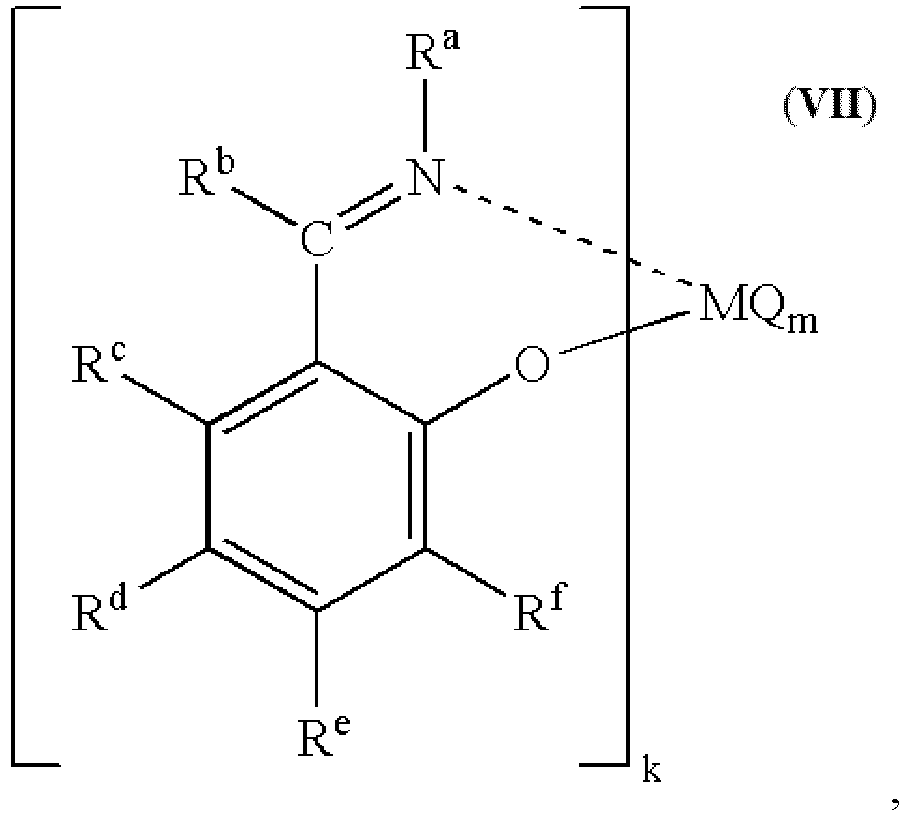 wobei M ein Übergangsmetallatom, ausgewählt aus den Gruppen 3 bis 11 der Metalle des Periodensystems, darstellt;k eine ganze Zahl von 1 bis 6 ist;m eine ganze Zahl von 1 bis 6 ist;Ra bis Rf gleich oder verschieden voneinander sein können und jeweils ein Wasserstoffatom, ein Halogenatom, eine Kohlenwasserstoffgruppe, einen Rest einer heterozyklischen Verbindung, eine sauerstoffhaltige Gruppe, eine stickstoffhaltige Gruppe, eine borhaltige Gruppe, eine schwefelhaltige Gruppe, eine phosphorhaltige Gruppe, eine siliciumhaltige Gruppe, eine germaniumhaltige Gruppe oder eine zinnhaltige Gruppe darstellen können, von denen 2 oder mehr Gruppen gegebenenfalls unter Bildung eines Rings aneinander gebunden sind;wenn k 2 oder größer ist, können die Ra-Gruppen, Rb-Gruppen, Rc-Gruppen, Rd-Gruppen, Re-Gruppen oder Rf-Gruppen gleich oder verschieden voneinander sein, eine in einem Liganden enthaltene Ra- bis Rf-Gruppe und eine in einem anderen Liganden enthaltene Ra- bis Rf-Gruppe eine verbindende Gruppe oder eine Einfachbindung bilden, können und ein in Ra bis Rf enthaltenes Heteroatom kann mit M koordinieren oder daran binden kann;m eine Zahl ist, die der Wertigkeit von M entspricht;Q ein Wasserstoffatom, ein Halogenatom, ein Sauerstoffatom, eine Kohlenwasserstoffgruppe, eine sauerstoffhaltige Gruppe, eine schwefelhaltige Gruppe, eine stickstoffhaltige Gruppe, eine borhaltige Gruppe, eine aluminiumhaltige Gruppe, eine phosphorhaltige Gruppe, eine halogenhaltige Gruppe, ein Rest einer heterozyklischen Verbindung, eine siliciumhaltige Gruppe, eine germaniumhaltige Gruppe oder eine zinnhaltige Gruppe darstellt;wenn m 2 oder gößer ist, eine Vielzahl von Gruppen, die durch Q dargestellt werden, gleich oder verschieden voneinander sein kann, und eine Vielzahl von Gruppen, die durch Q dargestellt werden, aneinander gebunden sein können, um einen Ring zu bilden; odere) dargestellt wird durch Formel (VIII)
 M Co oder Fe ist;jedes X ein Anion ist;n 1, 2 oder 3 ist, so dass die Gesamtzahl der negativen Ladungen des Anions oder der Anionen gleich der Oxidationsstufe eines in (VIII) vorhandenen Fe- oder Co-Atoms ist;R1, R2 und R3 jeweils unabhängig voneinander Wasserstoff, Kohlenwasserstoff, substituierter Kohlenwasserstoff oder eine inerte funktionelle Gruppe sind;R4 und R5 jeweils unabhängig voneinander Wasserstoff, Kohlenwasserstoff, eine inerte funktionelle Gruppe oder substituierter Kohlenwasserstoff sind;R6 durch die Formel (IX) dargestellt wird:
 und R7 durch die Formel (X) dargestellt wird
 wobei R8 und R13 jeweils unabhängig voneinander Kohlenwasserstoff, substituierter Kohlenwasserstoff oder eine inerte funktionelle Gruppe sind;R9, R10, R11, R14, R15 und R16 jeweils unabhängig voneinander Wasserstoff, Kohlenwasserstoff, substituierter Kohlenwasserstoff oder eine inerte funktionelle Gruppe sind;R12 und R17 jeweils unabhängig voneinander Wasserstoff, Kohlenwasserstoff, substituierter Kohlenwasserstoff oder eine inerte funktionelle Gruppe sind; undmit der Maßgabe, dass jeweils zwei von R8, R9, R10, R11, R12, R13, R14, R15, R16 und R17, die einander benachbart sind, zusammen gegebenenfalls einen Ring bilden;f) dargestellt wird durch Formel (XI)
 wobei M1 ausgewählt ist aus der Gruppe bestehend aus Titan, Zirkonium, Hafnium, Vanadium, Niob, Tantal, Chrom, Molybdän und Wolfram;Q1, Q2, Q3 und Q4 jeweils unabhängig voneinander Sauerstoff oder Schwefelsind;R1 und R2 unabhängig voneinander Wasserstoff, Halogen, Hydroxyl, Kohlenwasserstoff oder substituierter Kohlenwasserstoff sind, wobei R1 und R2 gegebenenfalls auch miteinander verbunden sein können, um eine Alkandiylgruppe oder einen konjugierten C4-C40-Dienliganden zu bilden, der an M1 koordiniert ist;R4, R5, R6, R7, R8, R9, R10, R11, R12, R13, R14, R15, R16, R17, R18 und R19 jeweils unabhängig voneinander Wasserstoff, Halogen, C1-C40-Kohlenwasserstoff oder substituierter C1-C40-Kohlenwasserstoff, -NR'2, -SR', -OR, -OSiR'3, -PR'2 bedeuten, wobei jedes R' Wasserstoff, Halogen, C1-C10-Alkyl oder C6-C10-Aryl ist, oder einer oder mehrere der Reste R4 und R5, R5 und R6, R6 und R7, R8 und R9, R9 und R10, R10 und R11, R12 und R13, R13 und R14, R14 und R15, R16 und R17, R17 und R18 und R18 und R19 gegebenenfalls verbunden sind, um einen gesättigten Ring, ungesättigten Ring, substituierten gesättigten Ring oder substituierten ungesättigten Ring zu bilden;R3 ein ungesättigtes C1-C40-Alkyl oder substituiertes ungesättigtes C1-C40-Alkyl ist; oderg) dargestellt wird durch die Formel (XII) oder (XIII):
 wobei M ein Übergangsmetall der Gruppe 3 bis 12 oder ein Hauptgruppenmetall der Gruppe 13 oder 14 ist;jedes X unabhängig eine Abgangsgruppe ist;y 0 oder 1 ist (wenn y 0 ist, ist die Gruppe L' abwesend);'n' der Oxidationszustand von M und +3, +4 oder +5 ist;'m' die formale Ladung des YZL- oder des YZL'-Liganden darstellt und 0, -1, -2 oder -3 ist;L ein Element der Gruppe 15 oder 16 ist;L' ein Element der Gruppe 15 oder 16 oder eine Gruppe 14 Element enthaltende Gruppe ist;Y ein Element der Gruppe 15 ist;Z ein Element der Gruppe 15 ist;R1 und R2 unabhängig voneinander eine C1- bis C20-Kohlenwasserstoffgruppe, eine ein Heteroatom enthaltende Gruppe mit bis zu zwanzig Kohlenstoffatomen, Silicium, Germanium, Zinn, Blei oder Phosphor sind;R3 gegebenenfalls nicht vorhanden ist oder eine Kohlenwasserstoffgruppe, ein Wasserstoff, ein Halogen, eine ein Heteroatom enthaltende Gruppe sein kann;R4 und R5 unabhängig voneinander eine Alkylgruppe, eine Arylgruppe, eine substituierte Arylgruppe, eine zyklische Alkylgruppe, eine substituierte zyklische Alkylgruppe, eine zyklische Aralkylgruppe, eine substituierte zyklische Aralkylgruppe oder ein Mehrfachringsystem sind;R6 und R7 unabhängig voneinander abwesend sind oder Wasserstoff, eine Alkylgruppe, Halogen, ein Heteroatom oder eine Kohlenwasserstoffgruppe sind;R* abwesend sein kann oder ein Wasserstoff, eine ein Atom der Gruppe 14 enthaltende Gruppe, ein Halogen oder eine ein Heteroatom enthaltende Gruppe sein kann.
 - Verfahren zur Polymerisation von Olefinen zur Herstellung mindestens eines Polyolefins, wobei das Verfahren das Inkontaktbringen mindestens eines Olefins mit dem Katalysatorsystem gemäß einem der Ansprüche 11 bis 13 und den Erhalt eines Polyolefins umfasst, wobei vorzugsweise das mindestens eine Olefin Propylen und das Polyolefin isotaktisches Polypropylen ist.
- Verfahren zur Polymerisation von Olefinen zur Herstellung mindestens eines Polyolefins, wobei das Verfahren das Inkontaktbringen von zwei oder mehr verschiedenen Olefinen, vorzugsweise Ethylen und Propylen, mit dem Katalysatorsystem gemäß einem der Ansprüche 11 bis 13 und den Erhalt eines Polyolefins umfasst.
Applications Claiming Priority (3)
| Application Number | Priority Date | Filing Date | Title |
|---|---|---|---|
| US201862662972P | 2018-04-26 | 2018-04-26 | |
| US201862769208P | 2018-11-19 | 2018-11-19 | |
| PCT/US2019/029061 WO2019210030A1 (en) | 2018-04-26 | 2019-04-25 | Non-coordinating anion type activators containing cation having branched alkyl groups |
Publications (3)
| Publication Number | Publication Date |
|---|---|
| EP3784648A1 EP3784648A1 (de) | 2021-03-03 |
| EP3784648A4 EP3784648A4 (de) | 2022-03-02 |
| EP3784648B1 true EP3784648B1 (de) | 2025-07-02 |
Family
ID=68290994
Family Applications (2)
| Application Number | Title | Priority Date | Filing Date |
|---|---|---|---|
| EP19793334.4A Pending EP3784677A4 (de) | 2018-04-26 | 2019-04-25 | Aktivatoren vom nichtkoordinierenden anionentyp mit einem kation mit grossen alkylgruppen |
| EP19791462.5A Active EP3784648B1 (de) | 2018-04-26 | 2019-04-25 | Nicht-koordinierende anionen-aktivatoren, die kationen mit verzweigten alkylgruppen enthalten |
Family Applications Before (1)
| Application Number | Title | Priority Date | Filing Date |
|---|---|---|---|
| EP19793334.4A Pending EP3784677A4 (de) | 2018-04-26 | 2019-04-25 | Aktivatoren vom nichtkoordinierenden anionentyp mit einem kation mit grossen alkylgruppen |
Country Status (8)
| Country | Link |
|---|---|
| US (3) | US11041031B2 (de) |
| EP (2) | EP3784677A4 (de) |
| JP (1) | JP7196197B2 (de) |
| KR (1) | KR102510732B1 (de) |
| CN (3) | CN112020491A (de) |
| ES (1) | ES3036867T3 (de) |
| SG (1) | SG11202010442QA (de) |
| WO (3) | WO2019210030A1 (de) |
Families Citing this family (52)
| Publication number | Priority date | Publication date | Assignee | Title |
|---|---|---|---|---|
| US10968290B2 (en) | 2017-03-28 | 2021-04-06 | Exxonmobil Chemical Patents Inc. | Metallocene-catalyzed polyalpha-olefins |
| WO2019157169A1 (en) | 2018-02-12 | 2019-08-15 | Exxonmobil Chemical Patents Inc. | Catalyst systems and processes for poly alpha-olefin having high vinylidene content |
| US11078308B2 (en) | 2018-02-12 | 2021-08-03 | Exxonmobil Chemical Patents Inc. | Processes to produce poly alpha-olefin trimers |
| US11021553B2 (en) | 2018-02-12 | 2021-06-01 | Exxonmobil Chemical Patents Inc. | Metallocene dimer selective catalysts and processes to produce poly alpha-olefin dimers |
| SG11202010442QA (en) | 2018-04-26 | 2020-11-27 | Exxonmobil Chemical Patents Inc | Non-coordinating anion type activators containing cation having large alkyl groups |
| CN114502521B (zh) | 2019-08-09 | 2026-03-24 | 埃克森美孚化学专利公司 | 使用可溶于非芳族烃的活化剂生产低粘度聚α-烯烃的方法 |
| WO2021034459A1 (en) | 2019-08-22 | 2021-02-25 | Exxonmobil Chemical Patents Inc. | Isotactic propylene homopolymers and copolymers produced with c1 symmetric metallocene catalysts |
| EP4051656A1 (de) | 2019-10-28 | 2022-09-07 | ExxonMobil Chemical Patents Inc. | Dimer-selektive metallocen-katalysatoren, nicht-aromatische kohlenwasserstoff-lösliche aktivatoren und verfahren zum produzieren von poly-alpha-olefin-oligmeren mit ihnen |
| KR102677352B1 (ko) | 2019-10-28 | 2024-06-20 | 엑손모빌 케미칼 패턴츠 인코포레이티드 | 장쇄 알콕시 작용기를 갖는 양이온을 함유하는 비배위 음이온 활성화제 |
| WO2021119089A1 (en) * | 2019-12-11 | 2021-06-17 | Exxonmobil Chemical Patents Inc. | Processes for introduction of liquid activators in olefin polymerization reactions |
| US11572423B2 (en) | 2019-12-11 | 2023-02-07 | Exxonmobil Chemicals Patents Inc. | Processes for introduction of liquid activators in olefin polymerization reactions |
| US11584707B2 (en) | 2019-12-16 | 2023-02-21 | Exxonmobil Chemical Patents Inc. | Non-coordinating anion type activators containing cation having aryldiamine groups and uses thereof |
| US11760814B2 (en) | 2020-03-03 | 2023-09-19 | Exxonmobil Chemical Patents Inc. | 1,5 diazabicyclooctane ligand systems and methods therewith |
| EP4119540A4 (de) | 2020-03-12 | 2024-04-03 | Agc Inc. | Boratverbindungen enthaltende zusammensetzung |
| WO2021182438A1 (ja) * | 2020-03-12 | 2021-09-16 | Agc株式会社 | 新規なボレート化合物含有組成物 |
| WO2021194831A1 (en) | 2020-03-25 | 2021-09-30 | Exxonmobil Chemical Patents Inc. | Alkylation of transition metal coordination catalyst complexes |
| US20230212330A1 (en) | 2020-06-16 | 2023-07-06 | Exxonmobil Chemical Patents Inc. | Metallocene Catalysts for Producing Vinyl-Terminated Polyalphaolefins and Methods Associated Therewith |
| WO2021262842A1 (en) | 2020-06-26 | 2021-12-30 | Exxonmobil Chemical Patents Inc. | COPOLYMERS OF ETHYLENE, α-OLEFIN, NON-CONJUGATED DIENE, AND ARYL-SUBSTITUTED CYCLOALKENE, METHODS TO PRODUCE, BLENDS, AND ARTICLES THEREFROM |
| WO2022035484A1 (en) * | 2020-08-10 | 2022-02-17 | Exxonmobil Chemical Patents Inc. | Methods for delivery of non-aromatic solutions to polymerization reactors |
| JP7629985B2 (ja) * | 2020-08-13 | 2025-02-14 | エクソンモービル ケミカル パテンツ インコーポレイテッド | 遷移金属ビス(フェノラート)触媒錯体を使用して得られる環含有ポリマー組成物およびその製造方法 |
| EP4222180B1 (de) | 2020-09-30 | 2024-04-10 | ExxonMobil Chemical Patents Inc. | Bis(heterocyclisches-olat) lewis-base-katalysatoren und verfahren dafür |
| US11919981B2 (en) | 2020-10-22 | 2024-03-05 | Exxonmobil Chemical Patents Inc. | Monocyclopentadienyl pyridyl hydroxyl amine catalyst compounds and systems for olefin polymerization |
| CN117043198A (zh) | 2020-10-22 | 2023-11-10 | 埃克森美孚化学专利公司 | 多齿路易斯碱催化剂及其使用方法 |
| WO2022093814A1 (en) | 2020-10-28 | 2022-05-05 | Exxonmobil Chemical Patents Inc. | Non-aromatic hydrocarbon soluble olefin polymerization catalysts and use thereof |
| CN114478595A (zh) * | 2020-11-13 | 2022-05-13 | 浙江蓝天环保高科技股份有限公司 | 一种新型长链铵四(五氟苯基)硼酸盐的制备方法 |
| US20240018278A1 (en) | 2020-11-23 | 2024-01-18 | ExxonMobil Technology and Engineering Company-Chem | Improved Process to Prepare Catalyst from In-Situ Formed Alumoxane |
| US20240010660A1 (en) | 2020-11-23 | 2024-01-11 | Exxonmobil Chemical Patents Inc. | Toluene Free Supported Methylalumoxane Precursor |
| US12195563B2 (en) | 2020-12-29 | 2025-01-14 | Exxonmobil Chemical Patents Inc. | Polyolefin-based ionomers and production thereof |
| US11746163B2 (en) | 2021-01-05 | 2023-09-05 | Exxonmobil Chemical Patents Inc. | Isohexane-soluble unsaturated alkyl anilinium tetrakis(perfluoroaryl)borate activators |
| US12503529B2 (en) | 2021-02-26 | 2025-12-23 | Exxonmobil Chemical Patents Inc. | Polymers of 4-substituted hexadiene and processes for production thereof |
| CA3229216A1 (en) | 2021-09-20 | 2023-03-23 | Darryl J. Morrison | Olefin polymerization catalyst system and polymerization process |
| JP7752513B2 (ja) * | 2021-11-02 | 2025-10-10 | 三井化学株式会社 | ホウ素含有化合物、オレフィン重合用触媒、およびオレフィン重合体の製造方法 |
| CN118202023A (zh) | 2021-11-05 | 2024-06-14 | 埃克森美孚化学专利公司 | 聚丙烯粘度改性剂及其润滑油 |
| CA3237353A1 (en) | 2021-11-05 | 2023-05-11 | Sara Yue Zhang | Lubricating oil composition with viscosity modifier based on syndiotactic propylene-based ethylene-propylene copolymers with improved properties |
| KR20240096736A (ko) | 2021-11-05 | 2024-06-26 | 엑손모빌 케미컬 패튼츠, 아이엔씨. | 신디오택틱 프로필렌계 에틸렌-프로필렌 공중합체 |
| US20250179106A1 (en) | 2022-03-14 | 2025-06-05 | Exxonmobil Chemical Patents Inc. | Metal Bis(Imino) Aryl Compounds and Methods Thereof |
| WO2023187552A1 (en) | 2022-03-22 | 2023-10-05 | Nova Chemicals (International) S.A. | Organometallic complex, olefin polymerization catalyst system and polymerization process |
| EP4519333A1 (de) | 2022-05-04 | 2025-03-12 | ExxonMobil Chemical Patents Inc. | Substituierte pyridin-2,6-bis(phenylenphenolat)-komplexe mit verbesserter löslichkeit, die als katalysatorkomponenten zur olefinpolymerisierung nützlich sind |
| KR20250004066A (ko) | 2022-05-04 | 2025-01-07 | 엑손모빌 케미칼 패턴츠 인코포레이티드 | 올레핀 중합용 촉매 성분으로서 유용한 향상된 용해도를 갖는 개질된 피리딘-2,6-비스(페닐렌페놀레이트) 착체 |
| EP4519332A1 (de) | 2022-05-04 | 2025-03-12 | ExxonMobil Chemical Patents Inc. | Substituierte pyridin-2,6-bis(phenylenphenolat)-komplexe mit verbesserter löslichkeit, die als katalysatorkomponenten zur olefinpolymerisierung nützlich sind |
| JP2025517140A (ja) | 2022-05-04 | 2025-06-03 | エクソンモービル ケミカル パテンツ インコーポレイテッド | オレフィン重合のための触媒構成成分として有用な、溶解度の増大した置換ピリジン-2,6-ビス(フェニレンフェノラート)錯体 |
| WO2024072545A1 (en) | 2022-09-29 | 2024-04-04 | Exxonmobil Chemical Patents Inc. | Foamable branched polypropylene compositions and foamed products produced therefrom |
| EP4665774A1 (de) | 2023-02-14 | 2025-12-24 | ExxonMobil Technology and Engineering Company | Metallocenkatalysatorverbindungen mit ferrocenylsubstituenten |
| WO2024236408A1 (en) | 2023-05-15 | 2024-11-21 | Nova Chemicals (International) S.A. | Solution phase polymerization process |
| WO2025063194A1 (ja) * | 2023-09-21 | 2025-03-27 | Agc株式会社 | 脂肪族炭化水素溶媒に可溶な新規なボレート化合物 |
| WO2025080492A1 (en) | 2023-10-13 | 2025-04-17 | ExxonMobil Technology and Engineering Company | Metallocene catalyst compounds for producing polyolefins |
| WO2025117277A1 (en) | 2023-12-01 | 2025-06-05 | ExxonMobil Technology and Engineering Company | Metallocene catalyst compounds for producing polyolefins |
| WO2025136494A1 (en) | 2023-12-20 | 2025-06-26 | ExxonMobil Technology and Engineering Company | Ethylene copolymers for photovoltaic cells |
| WO2025172887A1 (en) | 2024-02-16 | 2025-08-21 | Nova Chemicals (International) S.A. | Solution phase polymerization process |
| WO2026024944A1 (en) | 2024-07-25 | 2026-01-29 | ExxonMobil Technology and Engineering Company | Metallocene catalyst compounds for producing polyolefins |
| WO2026024926A1 (en) | 2024-07-25 | 2026-01-29 | ExxonMobil Technology and Engineering Company | Metallocene catalyst compounds for producing polyolefins |
| WO2026075865A1 (en) | 2024-10-02 | 2026-04-09 | ExxonMobil Technology and Engineering Company | Polypropylene copolymer compositions and films thereof |
Family Cites Families (115)
| Publication number | Priority date | Publication date | Assignee | Title |
|---|---|---|---|---|
| NL268946A (de) * | 1960-09-06 | |||
| US3076835A (en) * | 1961-01-17 | 1963-02-05 | Texaco Inc | Amine salts of boron acids and esters |
| US3248179A (en) | 1962-02-26 | 1966-04-26 | Phillips Petroleum Co | Method and apparatus for the production of solid polymers of olefins |
| US4588790A (en) | 1982-03-24 | 1986-05-13 | Union Carbide Corporation | Method for fluidized bed polymerization |
| US4543399A (en) | 1982-03-24 | 1985-09-24 | Union Carbide Corporation | Fluidized bed reaction systems |
| US4613484A (en) | 1984-11-30 | 1986-09-23 | Phillips Petroleum Company | Loop reactor settling leg system for separation of solid polymers and liquid diluent |
| US5008204A (en) | 1988-02-02 | 1991-04-16 | Exxon Chemical Patents Inc. | Method for determining the compositional distribution of a crystalline copolymer |
| FR2634212B1 (fr) | 1988-07-15 | 1991-04-19 | Bp Chimie Sa | Appareillage et procede de polymerisation d'olefines en phase gazeuse dans un reacteur a lit fluidise |
| US6265338B1 (en) | 1989-09-13 | 2001-07-24 | Exxon Chemical Patents, Inc. | Monocyclopentadienyl titanium metal compounds for ethylene-α-olefin copolymer production catalysts |
| EP0594777A1 (de) | 1991-07-18 | 1994-05-04 | Exxon Chemical Patents Inc. | Heissgesiegelter gegenstand |
| US5436304A (en) | 1992-03-19 | 1995-07-25 | Exxon Chemical Patents Inc. | Process for polymerizing monomers in fluidized beds |
| US5352749A (en) | 1992-03-19 | 1994-10-04 | Exxon Chemical Patents, Inc. | Process for polymerizing monomers in fluidized beds |
| US5317036A (en) | 1992-10-16 | 1994-05-31 | Union Carbide Chemicals & Plastics Technology Corporation | Gas phase polymerization reactions utilizing soluble unsupported catalysts |
| US5462999A (en) | 1993-04-26 | 1995-10-31 | Exxon Chemical Patents Inc. | Process for polymerizing monomers in fluidized beds |
| JP3077940B2 (ja) | 1993-04-26 | 2000-08-21 | エクソン・ケミカル・パテンツ・インク | 流動層重合法のための安定な操作条件を決定する方法 |
| ZA943399B (en) | 1993-05-20 | 1995-11-17 | Bp Chem Int Ltd | Polymerisation process |
| US5453471B1 (en) | 1994-08-02 | 1999-02-09 | Carbide Chemicals & Plastics T | Gas phase polymerization process |
| US5668234A (en) | 1994-09-12 | 1997-09-16 | Rhodes; Larry Funderburk | Reaction injection molding (RIM) of methyl (meth)acrylate and related monomers using group-4 catalysts |
| US5616661A (en) | 1995-03-31 | 1997-04-01 | Union Carbide Chemicals & Plastics Technology Corporation | Process for controlling particle growth during production of sticky polymers |
| WO1997022639A1 (en) | 1995-12-19 | 1997-06-26 | Exxon Chemical Patents Inc. | High temperature solution polymerization process |
| JP2000506880A (ja) | 1996-03-15 | 2000-06-06 | ゼネカ・リミテッド | シンノリン誘導体及びその使用 |
| EP0889912B1 (de) * | 1996-03-27 | 2000-07-12 | The Dow Chemical Company | Hochlösliches aktivierungsmittel für olefinpolymerisationskatalysator |
| US5783512A (en) * | 1996-12-18 | 1998-07-21 | The Dow Chemical Company | Catalyst component dispersion comprising an ionic compound and solid addition polymerization catalysts containing the same |
| TW420693B (en) | 1997-04-25 | 2001-02-01 | Mitsui Chemicals Inc | Olefin polymerization catalysts, transition metal compounds, and <alpha>-olefin/conjugated diene copolymers |
| US6175409B1 (en) | 1999-04-02 | 2001-01-16 | Symyx Technologies, Inc. | Flow-injection analysis and variable-flow light-scattering methods and apparatus for characterizing polymers |
| US6260407B1 (en) | 1998-04-03 | 2001-07-17 | Symyx Technologies, Inc. | High-temperature characterization of polymers |
| US6294388B1 (en) | 1998-04-03 | 2001-09-25 | Symyx Technologies, Inc. | Indirect calibration of polymer characterization systems |
| US6406632B1 (en) | 1998-04-03 | 2002-06-18 | Symyx Technologies, Inc. | Rapid characterization of polymers |
| US6306658B1 (en) | 1998-08-13 | 2001-10-23 | Symyx Technologies | Parallel reactor with internal sensing |
| US6455316B1 (en) | 1998-08-13 | 2002-09-24 | Symyx Technologies, Inc. | Parallel reactor with internal sensing and method of using same |
| DE19901524A1 (de) | 1999-01-16 | 2000-07-20 | Wilhelm Keim | Verfahren zur Stabilisierung homogener Katalysatoren bei der destillativen Produktabtrennung unter Verwendung ionischer Flüssigkeit und der damit verbundenen Möglichkeit der Katalysator-Wiederverwendung der homogenen Katalyse |
| US6436292B1 (en) | 1999-04-02 | 2002-08-20 | Symyx Technologies, Inc. | Parallel high-performance liquid chromatography with post-separation treatment |
| US6296771B1 (en) | 1999-04-02 | 2001-10-02 | Symyx Technologies, Inc. | Parallel high-performance liquid chromatography with serial injection |
| US6271325B1 (en) | 1999-05-17 | 2001-08-07 | Univation Technologies, Llc | Method of polymerization |
| ATE299898T1 (de) | 1999-10-22 | 2005-08-15 | Univation Tech Llc | Katalysatorsysteme und deren verwendung in einem polymerisationsverfahren |
| EP1226190A1 (de) | 1999-10-22 | 2002-07-31 | Univation Technologies LLC | Katalysatorzusammensetzungen, polymerisationsverfahren, und polymere daraus |
| DE19962910A1 (de) | 1999-12-23 | 2001-07-05 | Targor Gmbh | Chemische Verbindung, Verfahren zu deren Herstellung und deren Verwendung in Katalysatorsystemen zur Herstellung von Polyolefinen |
| US6809209B2 (en) * | 2000-04-07 | 2004-10-26 | Exxonmobil Chemical Patents Inc. | Nitrogen-containing group-13 anionic compounds for olefin polymerization |
| KR20030013479A (ko) * | 2000-06-30 | 2003-02-14 | 더 다우 케미칼 캄파니 | 폴리사이클릭 접합 고리 화합물, 금속 착체 및 중합방법 |
| WO2002038628A2 (en) | 2000-11-07 | 2002-05-16 | Symyx Technologies, Inc. | Substituted pyridyl amine ligands, complexes and catalysts therefrom; processes for producing polyolefins therewith |
| US6852659B1 (en) | 2000-11-16 | 2005-02-08 | Univation Technologies, Llc | Method for preparing a catalyst composition and its use in a polymerization process |
| US6964937B2 (en) | 2000-11-30 | 2005-11-15 | Univation Technologies, Llc | Bimetallic catalyst for producing polyethylene resins with bimodal molecular weight distribution, its preparation and use |
| CN100427515C (zh) | 2000-12-04 | 2008-10-22 | 尤尼威蒂恩技术有限责任公司 | 聚合方法 |
| US6518444B1 (en) | 2000-12-18 | 2003-02-11 | Univation Technologies, Llc | Preparation of polymerization catalysts |
| US6936675B2 (en) | 2001-07-19 | 2005-08-30 | Univation Technologies, Llc | High tear films from hafnocene catalyzed polyethylenes |
| US7087686B2 (en) | 2001-08-06 | 2006-08-08 | Bp Chemicals Limited | Chain growth reaction process |
| AU2002365866A1 (en) | 2001-11-30 | 2003-06-17 | Exxonmobil Chemical Patents Inc. | Bimetallic catalysts with higher activity |
| US7091292B2 (en) | 2002-04-24 | 2006-08-15 | Symyx Technologies, Inc. | Bridged bi-aromatic catalysts, complexes, and methods of using the same |
| US6841502B2 (en) | 2002-04-24 | 2005-01-11 | Symyx Technologies, Inc. | Bridged bi-aromatic ligands, catalysts, processes for polymerizing and polymers therefrom |
| US6884748B2 (en) | 2002-09-04 | 2005-04-26 | Univation Technologies, Llc | Process for producing fluorinated catalysts |
| WO2004026923A2 (en) | 2002-09-20 | 2004-04-01 | Exxonmobil Chemical Patents Inc. | Supercritical polymerization process and polymers produced therefrom |
| US8222229B2 (en) | 2002-11-21 | 2012-07-17 | Kowa Co., Ltd. | Peritoneal dialysis method |
| US6958306B2 (en) | 2003-08-28 | 2005-10-25 | Univation Technologies, Llc | Activated catalyst systems from substituted dialuminoxane complexes |
| JP4847676B2 (ja) | 2003-10-15 | 2011-12-28 | 住友化学株式会社 | 変性ポリオレフィン樹脂組成物の製造方法及び変性ポリオレフィン樹脂組成物 |
| US7741417B2 (en) | 2004-01-07 | 2010-06-22 | Exxonmobil Chemical Patents Inc. | Preparation of polymerization catalyst activators utilizing indole-modified silica supports |
| US7157531B2 (en) | 2004-06-21 | 2007-01-02 | Univation Technologies, Llc | Methods for producing polymers with control over composition distribution |
| CA2473378A1 (en) * | 2004-07-08 | 2006-01-08 | Nova Chemicals Corporation | Novel borate activator |
| US7741420B2 (en) | 2004-07-14 | 2010-06-22 | Exxonmobil Chemical Patents Inc. | Polymer production at supercritical conditions |
| JP2008509277A (ja) | 2004-08-09 | 2008-03-27 | ダウ グローバル テクノロジーズ インコーポレイティド | ポリマーの製造のための担持ビス(ヒドロキシアリールアリールオキシ)触媒 |
| US7169864B2 (en) | 2004-12-01 | 2007-01-30 | Novolen Technology Holdings, C.V. | Metallocene catalysts, their synthesis and their use for the polymerization of olefins |
| US7705157B2 (en) | 2004-12-16 | 2010-04-27 | Symyx Solutions, Inc. | Phenol-heterocyclic ligands, metal complexes, and their uses as catalysts |
| EP1856010B1 (de) | 2005-03-09 | 2010-07-28 | ExxonMobil Chemical Patents Inc. | Verfahren zur oligomerisation von olefinen |
| EP2275457B1 (de) * | 2005-05-18 | 2016-11-23 | Mitsui Chemicals, Inc. | Zusammensetzung auf Basis von Propylenpolymer und die davon geformte Produkte, Platte, Folie, Laminate und Vliesstoffe |
| US7297653B2 (en) * | 2005-07-21 | 2007-11-20 | Exxonmobil Chemical Patents Inc. | Fluorophenylborates and their use as activators in catalyst systems for olefin polymerization |
| JP4733588B2 (ja) | 2005-08-03 | 2011-07-27 | 国立大学法人京都大学 | 参照電極、塩橋及びそれらを用いたイオン濃度測定装置 |
| US8642497B2 (en) | 2005-12-12 | 2014-02-04 | Albemarle Corporation | Processes for the preparation of tetrakis(Faryl)borate salts |
| AU2006329980A1 (en) | 2005-12-16 | 2007-07-05 | Dow Global Technologies Inc. | Polydentate heteroatom ligand containing metal complexes, catalysts and methods of making and using the same |
| WO2007076231A2 (en) | 2005-12-16 | 2007-07-05 | Symyx Technologies, Inc. | Bridged phenol-heterocyclic ligands, metal complexes, and their uses as catalysts |
| EP2018390B1 (de) | 2006-05-05 | 2016-03-09 | Dow Global Technologies LLC | Orthometallierte hafniumkomplexe aus imidazolliganden |
| US20080182951A1 (en) | 2007-01-08 | 2008-07-31 | Ackerman Lily J | Chromium Pyridine Bis(Oxazoline) And Related Catalysts For Ethylene Dimerization |
| US8138348B2 (en) | 2007-01-08 | 2012-03-20 | Exxonmobil Chemical Patents Inc. | Methods for oligomerizing olefins with chromium pyridine mono-oxazoline catalysts |
| EP2106402A1 (de) | 2007-01-08 | 2009-10-07 | ExxonMobil Chemical Patents Inc. | Verfahren zur oligomerisierung von olefinen mit chrom-pyridin-phosphino-katalysatoren |
| EP2114974A1 (de) | 2007-01-08 | 2009-11-11 | ExxonMobil Chemical Patents Inc. | Verfahren zur oligomerisierung von olefinen mit chrom-pyridinether-katalysatoren |
| WO2008085658A1 (en) | 2007-01-08 | 2008-07-17 | Exxonmobil Chemical Patents Inc. | Methods for oligomerizing olefins with chromium pyridine thioether catalysts |
| US8513478B2 (en) * | 2007-08-01 | 2013-08-20 | Exxonmobil Chemical Patents Inc. | Process to produce polyalphaolefins |
| US8188200B2 (en) | 2007-11-09 | 2012-05-29 | University Of Maryland, College Park | Process for preparation of polyolefins via living coordinative chain transfer polymerization |
| US20090286944A1 (en) | 2008-05-15 | 2009-11-19 | Symyx Technologies, Inc. | Select phenol-heterocycle ligands, metal complexes formed therefrom, and their uses as catalysts |
| US8372930B2 (en) | 2008-06-20 | 2013-02-12 | Exxonmobil Chemical Patents Inc. | High vinyl terminated propylene based oligomers |
| US8674040B2 (en) | 2008-07-25 | 2014-03-18 | Exxonmobil Chemical Patents Inc. | Pyridyldiamido transition metal complexes, production and use thereof |
| US8710163B2 (en) | 2008-07-25 | 2014-04-29 | Exxonmobil Chemical Patents Inc. | Pyridyldiamido transition metal complexes, production and use thereof |
| US7973116B2 (en) | 2008-07-25 | 2011-07-05 | Exxonmobil Chemical Patents Inc. | Pyridyldiamido transition metal complexes, production and use thereof |
| US8394902B2 (en) | 2008-07-25 | 2013-03-12 | Exxonmobil Chemical Patents Inc. | Pyridyldiamido transition metal complexes, production and use thereof |
| US8580902B2 (en) | 2008-08-01 | 2013-11-12 | Exxonmobil Chemical Patents Inc. | Catalyst system, process for olefin polymerization, and polymer compositions produced therefrom |
| US7799879B2 (en) | 2008-08-01 | 2010-09-21 | Exxonmobil Chemical Patents Inc. | Catalyst system and process for olefin polymerization |
| CN103951769A (zh) * | 2008-08-01 | 2014-07-30 | 埃克森美孚化学专利公司 | 催化剂体系和用于烯烃聚合的方法 |
| EP2396112B1 (de) * | 2009-02-16 | 2014-05-07 | Sasol Technology (Pty) Ltd | Oligomerisierung von olefinischen verbindungen in gegenwart aktivierter oligomerisationskatalysatoren |
| WO2010102163A2 (en) | 2009-03-06 | 2010-09-10 | Dow Global Technologies Inc. | Catalysts, processes for making catalysts, processes for making polyolefin compositions and polyolefin compositions |
| ES2446096T3 (es) * | 2009-10-19 | 2014-03-06 | Sasol Technology (Proprietary) Limited | Oligomerización de compuestos olefínicos con formación de polímero reducida. |
| JP5841077B2 (ja) | 2010-03-08 | 2016-01-06 | エルジー・ケム・リミテッド | 担持メタロセン触媒、その製造方法及びそれを用いたポリオレフィンの製造方法 |
| JP5750271B2 (ja) * | 2011-01-20 | 2015-07-15 | 三井化学株式会社 | オレフィン重合体の製造方法 |
| US8426659B2 (en) | 2011-03-25 | 2013-04-23 | Exxonmobil Chemical Patents Inc. | Vinyl terminated higher olefin polymers and methods to produce thereof |
| US8399724B2 (en) * | 2011-03-25 | 2013-03-19 | Exxonmobil Chemical Patents Inc. | Vinyl terminated higher olefin copolymers and methods to produce thereof |
| US8455597B2 (en) * | 2011-03-25 | 2013-06-04 | Exxonmobil Chemical Patents Inc. | Catalysts and methods of use thereof to produce vinyl terminated polymers |
| US8658556B2 (en) * | 2011-06-08 | 2014-02-25 | Exxonmobil Chemical Patents Inc. | Catalyst systems comprising multiple non-coordinating anion activators and methods for polymerization therewith |
| CN103596686B (zh) * | 2011-06-08 | 2015-08-12 | 埃克森美孚化学专利公司 | 包含多种非配位阴离子化活化剂的催化剂体系以及使用其的聚合方法 |
| JP6306585B2 (ja) | 2012-07-31 | 2018-04-04 | ダウ グローバル テクノロジーズ エルエルシー | オレフィン重合触媒活性化剤を製造する方法 |
| US8957171B2 (en) * | 2012-08-03 | 2015-02-17 | Exxonmobil Chemical Patents Inc. | Catalysts comprising salan ligands |
| JP5695687B2 (ja) * | 2013-03-05 | 2015-04-08 | 日本ポリエチレン株式会社 | エチレン/α−オレフィン共重合体の製造方法 |
| EP2964682B1 (de) * | 2013-03-06 | 2018-04-25 | ExxonMobil Chemical Patents Inc. | Reversibler kettentransfer in der polyolefinpolymerisation mit pyridyldiamidkatalysatoren |
| WO2014169017A1 (en) * | 2013-04-11 | 2014-10-16 | Exxonmobil Chemical Patents Inc. | Process of producing polyolefins using metallocene polymerization catalysts and copolymers therefrom |
| JP6483608B2 (ja) * | 2013-05-15 | 2019-03-13 | 広栄化学工業株式会社 | 新規テトラアリールボレート化合物及びその製造方法 |
| EP3022236B1 (de) | 2013-07-17 | 2017-11-15 | ExxonMobil Chemical Patents Inc. | Verfahren mit substituierten metallocenkatalysatoren und produkte daraus |
| US9290519B2 (en) | 2013-11-15 | 2016-03-22 | Exxonmobil Chemical Patents Inc. | Pyridyldiamido transition metal complexes, production and use thereof |
| KR102588243B1 (ko) | 2015-06-30 | 2023-10-13 | 다우 글로벌 테크놀로지스 엘엘씨 | 에틸렌계 폴리머를 제조하는 중합 방법 |
| WO2017058388A1 (en) * | 2015-10-02 | 2017-04-06 | Exxonmobil Chemical Patents Inc. | Supported salan catalysts |
| US11059918B2 (en) * | 2016-05-27 | 2021-07-13 | Exxonmobil Chemical Patents Inc. | Metallocene catalyst compositions and polymerization process therewith |
| US10208140B2 (en) | 2016-06-30 | 2019-02-19 | Exxonmobil Chemical Patents Inc. | Quinolinyldiamido transition metal complexes, production and use thereof |
| WO2019210027A1 (en) | 2018-04-26 | 2019-10-31 | Exxon Mobil Chemical Patents Inc. | Alkyl ammonium (fluoroaryl)borate activators |
| SG11202010442QA (en) | 2018-04-26 | 2020-11-27 | Exxonmobil Chemical Patents Inc | Non-coordinating anion type activators containing cation having large alkyl groups |
| US11059791B2 (en) | 2019-04-25 | 2021-07-13 | Exxonmobil Chemical Patents Inc. | Non-coordinating anion type benzimidazolium activators |
| US20200339509A1 (en) | 2019-04-25 | 2020-10-29 | Exxonmobil Chemical Patents Inc. | Non-Coordinating Anion Type Indolinium Activators in Aliphatic and Alicyclic Hydrocarbon Solvents |
| US20210121863A1 (en) | 2019-10-28 | 2021-04-29 | Exxonmobil Chemical Patents Inc. | Catalyst Systems Including Salan Catalyst and Non-Coordinating Anion Type Activator Containing Cation Having Alkyl Groups and uses Thereof |
| US20210122844A1 (en) | 2019-10-28 | 2021-04-29 | Exxonmobil Chemical Patents Inc. | Catalyst Systems Including Phenol-Oxadiazole Catalyst and Non-Coordinating Anion Type Activators Containing Cation Having Alkyl Groups and uses Thereof |
| EP4051656A1 (de) | 2019-10-28 | 2022-09-07 | ExxonMobil Chemical Patents Inc. | Dimer-selektive metallocen-katalysatoren, nicht-aromatische kohlenwasserstoff-lösliche aktivatoren und verfahren zum produzieren von poly-alpha-olefin-oligmeren mit ihnen |
| US20210122841A1 (en) | 2019-10-28 | 2021-04-29 | Exxonmobil Chemical Patents Inc. | Catalyst Systems Including Group 15 Catalyst and Non-Coordinating Anion Type Activator Containing Cation Having Alkyl Groups and uses Thereof |
-
2019
- 2019-04-25 SG SG11202010442QA patent/SG11202010442QA/en unknown
- 2019-04-25 US US16/394,197 patent/US11041031B2/en active Active
- 2019-04-25 EP EP19793334.4A patent/EP3784677A4/de active Pending
- 2019-04-25 CN CN201980028116.7A patent/CN112020491A/zh active Pending
- 2019-04-25 WO PCT/US2019/029061 patent/WO2019210030A1/en not_active Ceased
- 2019-04-25 WO PCT/US2019/029056 patent/WO2019210026A1/en not_active Ceased
- 2019-04-25 ES ES19791462T patent/ES3036867T3/es active Active
- 2019-04-25 JP JP2020559414A patent/JP7196197B2/ja active Active
- 2019-04-25 CN CN201980028114.8A patent/CN112088172A/zh active Pending
- 2019-04-25 KR KR1020207033932A patent/KR102510732B1/ko active Active
- 2019-04-25 WO PCT/US2019/029060 patent/WO2019210029A1/en not_active Ceased
- 2019-04-25 US US16/394,166 patent/US11414436B2/en active Active
- 2019-04-25 CN CN201980037245.2A patent/CN112351987B/zh active Active
- 2019-04-25 EP EP19791462.5A patent/EP3784648B1/de active Active
- 2019-04-25 US US16/394,186 patent/US11117908B2/en active Active
Also Published As
| Publication number | Publication date |
|---|---|
| US11041031B2 (en) | 2021-06-22 |
| JP2021522243A (ja) | 2021-08-30 |
| CN112351987A (zh) | 2021-02-09 |
| CN112020491A (zh) | 2020-12-01 |
| KR102510732B1 (ko) | 2023-03-15 |
| WO2019210030A1 (en) | 2019-10-31 |
| CN112088172A (zh) | 2020-12-15 |
| US11117908B2 (en) | 2021-09-14 |
| US11414436B2 (en) | 2022-08-16 |
| KR20200136494A (ko) | 2020-12-07 |
| ES3036867T3 (en) | 2025-09-25 |
| EP3784677A4 (de) | 2022-03-09 |
| US20190330246A1 (en) | 2019-10-31 |
| WO2019210026A1 (en) | 2019-10-31 |
| EP3784648A1 (de) | 2021-03-03 |
| EP3784648A4 (de) | 2022-03-02 |
| WO2019210029A1 (en) | 2019-10-31 |
| EP3784677A1 (de) | 2021-03-03 |
| US20190330139A1 (en) | 2019-10-31 |
| US20190330392A1 (en) | 2019-10-31 |
| CN112351987B (zh) | 2024-02-02 |
| SG11202010442QA (en) | 2020-11-27 |
| JP7196197B2 (ja) | 2022-12-26 |
Similar Documents
| Publication | Publication Date | Title |
|---|---|---|
| US11041031B2 (en) | Non-coordinating anion type activators containing cation having branched alkyl groups | |
| EP4051686B1 (de) | Nicht-koordinierende anionenaktivatoren, die ein kation mit langkettiger alkoxyfunktionalisierung enthalten | |
| US20190330394A1 (en) | Alkyl Ammonium (Fluoroaryl)borate Activators | |
| US12466902B2 (en) | Non-coordinating anion type activators for use with polyolefin polymerization catalysts | |
| US11584707B2 (en) | Non-coordinating anion type activators containing cation having aryldiamine groups and uses thereof | |
| US20210122844A1 (en) | Catalyst Systems Including Phenol-Oxadiazole Catalyst and Non-Coordinating Anion Type Activators Containing Cation Having Alkyl Groups and uses Thereof | |
| US11059791B2 (en) | Non-coordinating anion type benzimidazolium activators | |
| US20200339509A1 (en) | Non-Coordinating Anion Type Indolinium Activators in Aliphatic and Alicyclic Hydrocarbon Solvents | |
| US20210122841A1 (en) | Catalyst Systems Including Group 15 Catalyst and Non-Coordinating Anion Type Activator Containing Cation Having Alkyl Groups and uses Thereof | |
| US10683377B2 (en) | Catalysts for olefin polymerization | |
| WO2021086468A1 (en) | Supported non-coordinating anion activators, use thereof, and production thereof | |
| US20240317905A1 (en) | Polymers of vinylcyclobutane and processes for making same | |
| US12503529B2 (en) | Polymers of 4-substituted hexadiene and processes for production thereof | |
| WO2019160710A1 (en) | Catalysts, catalyst systems, and methods for using the same | |
| WO2020219049A1 (en) | Non-coordinating anion type indolinium activators in aliphatic and alicyclic hydrocarbon solvents | |
| WO2020219050A1 (en) | Non-coordinating anion type benzimidazolium activators |
Legal Events
| Date | Code | Title | Description |
|---|---|---|---|
| STAA | Information on the status of an ep patent application or granted ep patent |
Free format text: STATUS: THE INTERNATIONAL PUBLICATION HAS BEEN MADE |
|
| PUAI | Public reference made under article 153(3) epc to a published international application that has entered the european phase |
Free format text: ORIGINAL CODE: 0009012 |
|
| STAA | Information on the status of an ep patent application or granted ep patent |
Free format text: STATUS: REQUEST FOR EXAMINATION WAS MADE |
|
| 17P | Request for examination filed |
Effective date: 20201125 |
|
| AK | Designated contracting states |
Kind code of ref document: A1 Designated state(s): AL AT BE BG CH CY CZ DE DK EE ES FI FR GB GR HR HU IE IS IT LI LT LU LV MC MK MT NL NO PL PT RO RS SE SI SK SM TR |
|
| AX | Request for extension of the european patent |
Extension state: BA ME |
|
| DAV | Request for validation of the european patent (deleted) | ||
| DAX | Request for extension of the european patent (deleted) | ||
| A4 | Supplementary search report drawn up and despatched |
Effective date: 20220131 |
|
| RIC1 | Information provided on ipc code assigned before grant |
Ipc: C08F 4/659 20060101ALI20220125BHEP Ipc: C07C 211/55 20060101ALI20220125BHEP Ipc: C07C 211/08 20060101ALI20220125BHEP Ipc: C07C 211/48 20060101ALI20220125BHEP Ipc: C08F 4/70 20060101ALI20220125BHEP Ipc: C08F 4/64 20060101ALI20220125BHEP Ipc: C08F 4/52 20060101ALI20220125BHEP Ipc: C08F 210/18 20060101ALI20220125BHEP Ipc: C08F 210/06 20060101ALI20220125BHEP Ipc: C08F 110/06 20060101ALI20220125BHEP Ipc: C07F 5/02 20060101ALI20220125BHEP Ipc: C07C 211/64 20060101AFI20220125BHEP |
|
| STAA | Information on the status of an ep patent application or granted ep patent |
Free format text: STATUS: EXAMINATION IS IN PROGRESS |
|
| 17Q | First examination report despatched |
Effective date: 20230224 |
|
| GRAP | Despatch of communication of intention to grant a patent |
Free format text: ORIGINAL CODE: EPIDOSNIGR1 |
|
| STAA | Information on the status of an ep patent application or granted ep patent |
Free format text: STATUS: GRANT OF PATENT IS INTENDED |
|
| INTG | Intention to grant announced |
Effective date: 20250217 |
|
| GRAS | Grant fee paid |
Free format text: ORIGINAL CODE: EPIDOSNIGR3 |
|
| GRAA | (expected) grant |
Free format text: ORIGINAL CODE: 0009210 |
|
| STAA | Information on the status of an ep patent application or granted ep patent |
Free format text: STATUS: THE PATENT HAS BEEN GRANTED |
|
| P01 | Opt-out of the competence of the unified patent court (upc) registered |
Free format text: CASE NUMBER: APP_18804/2025 Effective date: 20250506 |
|
| AK | Designated contracting states |
Kind code of ref document: B1 Designated state(s): AL AT BE BG CH CY CZ DE DK EE ES FI FR GB GR HR HU IE IS IT LI LT LU LV MC MK MT NL NO PL PT RO RS SE SI SK SM TR |
|
| REG | Reference to a national code |
Ref country code: GB Ref legal event code: FG4D |
|
| REG | Reference to a national code |
Ref country code: CH Ref legal event code: EP |
|
| REG | Reference to a national code |
Ref country code: DE Ref legal event code: R096 Ref document number: 602019071980 Country of ref document: DE |
|
| REG | Reference to a national code |
Ref country code: IE Ref legal event code: FG4D |
|
| REG | Reference to a national code |
Ref country code: NL Ref legal event code: FP |
|
| REG | Reference to a national code |
Ref country code: ES Ref legal event code: FG2A Ref document number: 3036867 Country of ref document: ES Kind code of ref document: T3 Effective date: 20250925 |
|
| PG25 | Lapsed in a contracting state [announced via postgrant information from national office to epo] |
Ref country code: PT Free format text: LAPSE BECAUSE OF FAILURE TO SUBMIT A TRANSLATION OF THE DESCRIPTION OR TO PAY THE FEE WITHIN THE PRESCRIBED TIME-LIMIT Effective date: 20251103 |
|
| REG | Reference to a national code |
Ref country code: AT Ref legal event code: MK05 Ref document number: 1809136 Country of ref document: AT Kind code of ref document: T Effective date: 20250702 |
|
| PG25 | Lapsed in a contracting state [announced via postgrant information from national office to epo] |
Ref country code: IS Free format text: LAPSE BECAUSE OF FAILURE TO SUBMIT A TRANSLATION OF THE DESCRIPTION OR TO PAY THE FEE WITHIN THE PRESCRIBED TIME-LIMIT Effective date: 20251102 |
|
| PG25 | Lapsed in a contracting state [announced via postgrant information from national office to epo] |
Ref country code: NO Free format text: LAPSE BECAUSE OF FAILURE TO SUBMIT A TRANSLATION OF THE DESCRIPTION OR TO PAY THE FEE WITHIN THE PRESCRIBED TIME-LIMIT Effective date: 20251002 |
|
| REG | Reference to a national code |
Ref country code: LT Ref legal event code: MG9D |
|
| PG25 | Lapsed in a contracting state [announced via postgrant information from national office to epo] |
Ref country code: AT Free format text: LAPSE BECAUSE OF FAILURE TO SUBMIT A TRANSLATION OF THE DESCRIPTION OR TO PAY THE FEE WITHIN THE PRESCRIBED TIME-LIMIT Effective date: 20250702 |
|
| PG25 | Lapsed in a contracting state [announced via postgrant information from national office to epo] |
Ref country code: FI Free format text: LAPSE BECAUSE OF FAILURE TO SUBMIT A TRANSLATION OF THE DESCRIPTION OR TO PAY THE FEE WITHIN THE PRESCRIBED TIME-LIMIT Effective date: 20250702 |
|
| PG25 | Lapsed in a contracting state [announced via postgrant information from national office to epo] |
Ref country code: HR Free format text: LAPSE BECAUSE OF FAILURE TO SUBMIT A TRANSLATION OF THE DESCRIPTION OR TO PAY THE FEE WITHIN THE PRESCRIBED TIME-LIMIT Effective date: 20250702 |
|
| PG25 | Lapsed in a contracting state [announced via postgrant information from national office to epo] |
Ref country code: GR Free format text: LAPSE BECAUSE OF FAILURE TO SUBMIT A TRANSLATION OF THE DESCRIPTION OR TO PAY THE FEE WITHIN THE PRESCRIBED TIME-LIMIT Effective date: 20251003 |
|
| PG25 | Lapsed in a contracting state [announced via postgrant information from national office to epo] |
Ref country code: SE Free format text: LAPSE BECAUSE OF FAILURE TO SUBMIT A TRANSLATION OF THE DESCRIPTION OR TO PAY THE FEE WITHIN THE PRESCRIBED TIME-LIMIT Effective date: 20250702 Ref country code: CZ Free format text: LAPSE BECAUSE OF FAILURE TO SUBMIT A TRANSLATION OF THE DESCRIPTION OR TO PAY THE FEE WITHIN THE PRESCRIBED TIME-LIMIT Effective date: 20250702 |
|
| PG25 | Lapsed in a contracting state [announced via postgrant information from national office to epo] |
Ref country code: LV Free format text: LAPSE BECAUSE OF FAILURE TO SUBMIT A TRANSLATION OF THE DESCRIPTION OR TO PAY THE FEE WITHIN THE PRESCRIBED TIME-LIMIT Effective date: 20250702 |
|
| PG25 | Lapsed in a contracting state [announced via postgrant information from national office to epo] |
Ref country code: PL Free format text: LAPSE BECAUSE OF FAILURE TO SUBMIT A TRANSLATION OF THE DESCRIPTION OR TO PAY THE FEE WITHIN THE PRESCRIBED TIME-LIMIT Effective date: 20250702 Ref country code: BG Free format text: LAPSE BECAUSE OF FAILURE TO SUBMIT A TRANSLATION OF THE DESCRIPTION OR TO PAY THE FEE WITHIN THE PRESCRIBED TIME-LIMIT Effective date: 20250702 |
|
| PG25 | Lapsed in a contracting state [announced via postgrant information from national office to epo] |
Ref country code: RS Free format text: LAPSE BECAUSE OF FAILURE TO SUBMIT A TRANSLATION OF THE DESCRIPTION OR TO PAY THE FEE WITHIN THE PRESCRIBED TIME-LIMIT Effective date: 20251002 |
|
| PG25 | Lapsed in a contracting state [announced via postgrant information from national office to epo] |
Ref country code: SM Free format text: LAPSE BECAUSE OF FAILURE TO SUBMIT A TRANSLATION OF THE DESCRIPTION OR TO PAY THE FEE WITHIN THE PRESCRIBED TIME-LIMIT Effective date: 20250702 |
|
| PG25 | Lapsed in a contracting state [announced via postgrant information from national office to epo] |
Ref country code: DK Free format text: LAPSE BECAUSE OF FAILURE TO SUBMIT A TRANSLATION OF THE DESCRIPTION OR TO PAY THE FEE WITHIN THE PRESCRIBED TIME-LIMIT Effective date: 20250702 |
|
| PG25 | Lapsed in a contracting state [announced via postgrant information from national office to epo] |
Ref country code: SK Free format text: LAPSE BECAUSE OF FAILURE TO SUBMIT A TRANSLATION OF THE DESCRIPTION OR TO PAY THE FEE WITHIN THE PRESCRIBED TIME-LIMIT Effective date: 20250702 Ref country code: EE Free format text: LAPSE BECAUSE OF FAILURE TO SUBMIT A TRANSLATION OF THE DESCRIPTION OR TO PAY THE FEE WITHIN THE PRESCRIBED TIME-LIMIT Effective date: 20250702 |
|
| PLBE | No opposition filed within time limit |
Free format text: ORIGINAL CODE: 0009261 |
|
| STAA | Information on the status of an ep patent application or granted ep patent |
Free format text: STATUS: NO OPPOSITION FILED WITHIN TIME LIMIT |