EP3790931B1 - Sulforhodamin-phosphoramidit-farbstoffe - Google Patents
Sulforhodamin-phosphoramidit-farbstoffe Download PDFInfo
- Publication number
- EP3790931B1 EP3790931B1 EP19725532.6A EP19725532A EP3790931B1 EP 3790931 B1 EP3790931 B1 EP 3790931B1 EP 19725532 A EP19725532 A EP 19725532A EP 3790931 B1 EP3790931 B1 EP 3790931B1
- Authority
- EP
- European Patent Office
- Prior art keywords
- optionally substituted
- attached
- atoms
- taken together
- compound
- Prior art date
- Legal status (The legal status is an assumption and is not a legal conclusion. Google has not performed a legal analysis and makes no representation as to the accuracy of the status listed.)
- Active
Links
Images


Classifications
-
- C—CHEMISTRY; METALLURGY
- C07—ORGANIC CHEMISTRY
- C07F—ACYCLIC, CARBOCYCLIC OR HETEROCYCLIC COMPOUNDS CONTAINING ELEMENTS OTHER THAN CARBON, HYDROGEN, HALOGEN, OXYGEN, NITROGEN, SULFUR, SELENIUM OR TELLURIUM
- C07F9/00—Compounds containing elements of Groups 5 or 15 of the Periodic Table
- C07F9/02—Phosphorus compounds
- C07F9/06—Phosphorus compounds without P—C bonds
- C07F9/22—Amides of acids of phosphorus
-
- C—CHEMISTRY; METALLURGY
- C09—DYES; PAINTS; POLISHES; NATURAL RESINS; ADHESIVES; COMPOSITIONS NOT OTHERWISE PROVIDED FOR; APPLICATIONS OF MATERIALS NOT OTHERWISE PROVIDED FOR
- C09B—ORGANIC DYES OR CLOSELY-RELATED COMPOUNDS FOR PRODUCING DYES, e.g. PIGMENTS; MORDANTS; LAKES
- C09B11/00—Diaryl- or thriarylmethane dyes
- C09B11/04—Diaryl- or thriarylmethane dyes derived from triarylmethanes, i.e. central C-atom is substituted by amino, cyano, alkyl
- C09B11/10—Amino derivatives of triarylmethanes
- C09B11/24—Phthaleins containing amino groups ; Phthalanes; Fluoranes; Phthalides; Rhodamine dyes; Phthaleins having heterocyclic aryl rings; Lactone or lactame forms of triarylmethane dyes
-
- C—CHEMISTRY; METALLURGY
- C07—ORGANIC CHEMISTRY
- C07D—HETEROCYCLIC COMPOUNDS
- C07D491/00—Heterocyclic compounds containing in the condensed ring system both one or more rings having oxygen atoms as the only ring hetero atoms and one or more rings having nitrogen atoms as the only ring hetero atoms, not provided for by groups C07D451/00 - C07D459/00, C07D463/00, C07D477/00 or C07D489/00
- C07D491/22—Heterocyclic compounds containing in the condensed ring system both one or more rings having oxygen atoms as the only ring hetero atoms and one or more rings having nitrogen atoms as the only ring hetero atoms, not provided for by groups C07D451/00 - C07D459/00, C07D463/00, C07D477/00 or C07D489/00 in which the condensed system contains four or more hetero rings
-
- C—CHEMISTRY; METALLURGY
- C07—ORGANIC CHEMISTRY
- C07H—SUGARS; DERIVATIVES THEREOF; NUCLEOSIDES; NUCLEOTIDES; NUCLEIC ACIDS
- C07H19/00—Compounds containing a hetero ring sharing one ring hetero atom with a saccharide radical; Nucleosides; Mononucleotides; Anhydro-derivatives thereof
- C07H19/02—Compounds containing a hetero ring sharing one ring hetero atom with a saccharide radical; Nucleosides; Mononucleotides; Anhydro-derivatives thereof sharing nitrogen
- C07H19/04—Heterocyclic radicals containing only nitrogen atoms as ring hetero atom
- C07H19/06—Pyrimidine radicals
- C07H19/073—Pyrimidine radicals with 2-deoxyribosyl as the saccharide radical
-
- C—CHEMISTRY; METALLURGY
- C07—ORGANIC CHEMISTRY
- C07H—SUGARS; DERIVATIVES THEREOF; NUCLEOSIDES; NUCLEOTIDES; NUCLEIC ACIDS
- C07H21/00—Compounds containing two or more mononucleotide units having separate phosphate or polyphosphate groups linked by saccharide radicals of nucleoside groups, e.g. nucleic acids
-
- C—CHEMISTRY; METALLURGY
- C09—DYES; PAINTS; POLISHES; NATURAL RESINS; ADHESIVES; COMPOSITIONS NOT OTHERWISE PROVIDED FOR; APPLICATIONS OF MATERIALS NOT OTHERWISE PROVIDED FOR
- C09B—ORGANIC DYES OR CLOSELY-RELATED COMPOUNDS FOR PRODUCING DYES, e.g. PIGMENTS; MORDANTS; LAKES
- C09B57/00—Other synthetic dyes of known constitution
-
- C—CHEMISTRY; METALLURGY
- C12—BIOCHEMISTRY; BEER; SPIRITS; WINE; VINEGAR; MICROBIOLOGY; ENZYMOLOGY; MUTATION OR GENETIC ENGINEERING
- C12Q—MEASURING OR TESTING PROCESSES INVOLVING ENZYMES, NUCLEIC ACIDS OR MICROORGANISMS; COMPOSITIONS OR TEST PAPERS THEREFOR; PROCESSES OF PREPARING SUCH COMPOSITIONS; CONDITION-RESPONSIVE CONTROL IN MICROBIOLOGICAL OR ENZYMOLOGICAL PROCESSES
- C12Q1/00—Measuring or testing processes involving enzymes, nucleic acids or microorganisms; Compositions therefor; Processes of preparing such compositions
- C12Q1/68—Measuring or testing processes involving enzymes, nucleic acids or microorganisms; Compositions therefor; Processes of preparing such compositions involving nucleic acids
- C12Q1/6876—Nucleic acid products used in the analysis of nucleic acids, e.g. primers or probes
-
- Y—GENERAL TAGGING OF NEW TECHNOLOGICAL DEVELOPMENTS; GENERAL TAGGING OF CROSS-SECTIONAL TECHNOLOGIES SPANNING OVER SEVERAL SECTIONS OF THE IPC; TECHNICAL SUBJECTS COVERED BY FORMER USPC CROSS-REFERENCE ART COLLECTIONS [XRACs] AND DIGESTS
- Y02—TECHNOLOGIES OR APPLICATIONS FOR MITIGATION OR ADAPTATION AGAINST CLIMATE CHANGE
- Y02P—CLIMATE CHANGE MITIGATION TECHNOLOGIES IN THE PRODUCTION OR PROCESSING OF GOODS
- Y02P20/00—Technologies relating to chemical industry
- Y02P20/50—Improvements relating to the production of bulk chemicals
- Y02P20/55—Design of synthesis routes, e.g. reducing the use of auxiliary or protecting groups
Definitions
- Fluorescent dyes are among the most commonly used tags for modifying oligonucleotides because they offer sensitive detection in a wide variety of applications ranging from PCR to sequencing.
- Rhodamine dyes are widely used in oligonucleotide labeling because they offer longer wavelength emission maxima than other dyes such as fluoresceins and provide opportunities for multicolor labeling and staining. Additionally, rhodamines exhibit higher photostability than fluoresceins and coumarins.
- a fluorophore should have spectral characteristics close to those of Texas Red ® dye. Such fluorophore should be stable to standard oligonucleotide synthesis conditions (e.g., iodine treatment, capping, and acid deprotection conditions) and amenable to incorporation at any position in the oligonucleotide.
- EPF End-Point Fluorescence
- AquaPhluor ® Another family of dyes, AquaPhluor ® , includes a red dye that is highly fluorescent with an absorption maximum at 593 nm and an emission maximum at 613 nm. However, due to its structural limitations, this dye can only be incorporated at the 5' end or the 3' end of an oligonucleotide.
- R 2 is Cl and R 3 is H.
- L 1 is a PEG 2-10 linker. In certain embodiments, L 1 is -CH 2 CH 2 OCH 2 CH 2 -.
- R 4 and R 5 taken together are an optionally substituted C 3 alkylene chain connecting the atoms to which R 4 and R 5 are attached;
- R 10 and R 11 taken together are an optionally substituted C 3 alkylene chain connecting the atoms to which R 10 and R 11 are attached;
- R 6 and R 7 taken together are an optionally substituted C 3 alkylene chain connecting the atoms to which R 6 and R 7 are attached;
- R 8 and R 9 taken together are an optionally substituted C 3 alkylene chain connecting the atoms to which R 8 and R 9 are attached.
- R 4 and R 5 taken together are a propylene chain connecting the atoms to which R 4 and R 5 are attached;
- R 10 and R 11 taken together are a propylene chain connecting the atoms to which R 10 and R 11 are attached;
- R 6 and R 7 taken together are a propylene chain connecting the atoms to which R 6 and R 7 are attached;
- R 8 and R 9 taken together are a propylene chain connecting the atoms to which R 8 and R 9 are attached.
- R 5 , R 6 , R 9 , and R 10 are each methyl.
- the compound has a structure represented by Formula IA: or a stereoisomer, tautomer, or salt thereof, wherein R 1 is L 1 X and R 3 is H or halogen.
- the compound is:
- R 3 is H.
- R 2 is H. In some embodiments, R 2 is Cl.
- the compound is represented by Formula (IIA): or a stereoisomer, tautomer, or salt thereof, wherein:
- the compound is:
- R 2 is Cl and R 3 is H.
- R 4 and R 5 taken together are an optionally substituted C 3 alkylene chain connecting the atoms to which R 4 and R 5 are attached;
- R 10 and R 11 taken together are an optionally substituted C 3 alkylene chain connecting the atoms to which R 10 and R 11 are attached;
- R 6 and R 7 taken together are an optionally substituted C 3 alkylene chain connecting the atoms to which R 6 and R 7 are attached;
- R 8 and R 9 taken together are an optionally substituted C 3 alkylene chain connecting the atoms to which R 8 and R 9 are attached.
- R 4 and R 5 taken together are a propylene chain connecting the atoms to which R 4 and R 5 are attached;
- R 10 and R 11 taken together are a propylene chain connecting the atoms to which R 10 and R 11 are attached;
- R 6 and R 7 taken together are a propylene chain connecting the atoms to which R 6 and R 7 are attached;
- R 8 and R 9 taken together are a propylene chain connecting the atoms to which R 8 and R 9 are attached.
- the compound is: or
- R 7 , R 8 , R 10 , R 11 , R 14 , and R 15 are methyl.
- L 1 is a PEG 2-10 linker, and in other embodiments, L 1 is -CH 2 CH 2 OCH 2 CH 2 -. In certain embodiments, R 2 , R 3 , R 4 , and R 5 are H.
- R 6 is a C 1 -C 6 alkyl optionally substituted with OH or Cl-C6 acyloxy, for example, R 6 is an ethyl substituted with OH or OAc.
- R 9 is a C 1 -C 6 alkyl optionally substituted with OH or C1-C6 acyloxy, for example, R 9 is an ethyl substituted with OH or OAc.
- the compound is: or a stereoisomer, tautomer, or salt thereof, wherein:
- Q 1 and Q 2 are acetyl.
- the compound is: wherein R 1 is as defined above for Formula VI.
- the compound is:
- a labeled polynucleotide comprising a compound of formula IV: or a stereoisomer, tautomer, or salt thereof, wherein:
- R 2 is Cl and R 3 is H.
- R 4 and R 5 are an optionally substituted C 3 alkylene chain connecting the atoms to which R 4 and R 5 are attached;
- R 10 and R 11 are an optionally substituted C 3 alkylene chain connecting the atoms to which R 10 and R 11 are attached;
- R 6 and R 7 are an optionally substituted C 3 alkylene chain connecting the atoms to which R 6 and R 7 are attached;
- R 8 and R 9 are an optionally substituted C 3 alkylene chain connecting the atoms to which R 8 and R 9 are attached.
- the labeled polynucleotide is a 5'-nuclease PCR probe. In some embodiments, the labeled polynucleotide further comprises a fluorescence quencher. In some embodiments, the labeled polynucleotide is attached to a solid support. In some embodiments, the solid support i s a controlled pore glass bead, polystyrene bead, magnetic bead, or microwell plate.
- a method for preparing a labeled conjugate of a ligand comprising contacting a ligand with a compound of any one of Claims 1 to 9 or Claims 12 to 14 in a suitable solvent under conditions sufficient to covalently attach the compound to the ligand thereby forming the labeled conjugate.
- sulforhodamine dye phosphoramidites that can be incorporated into oligonucleotides via standard automated oligonucleotide synthesis. Additionally, sulforhodamine dyes comprising other reactive groups are provided.
- the words “comprise” and “include” and variations thereof such as “comprises,” “comprising,” “includes,” and “including” are intended to convey the possible inclusion of other elements or integers not specifically recited, where the context allows.
- the term “consisting of” is intended to mean including and limited to whatever follows the phrase “consisting of.” Thus, the phrase “consisting of” indicates that the listed elements are required or mandatory and that no other elements may be present.
- the term “consisting essentially of” means that the composition, method or structure may include additional ingredients, steps and/or parts, but only if the additional ingredients, steps and/or parts do not materially alter the basic and novel characteristics of the claimed composition, method or structure.
- nucleic acids or oligonucleotides are written left to right in 5' to 3' orientation.
- Non-limiting exemplary amplification methods include polymerase chain reaction (PCR), reverse-transcriptase PCR, real-time PCR, nested PCR, multiplex PCR, quantitative PCR (Q-PCR), nucleic acid sequence based amplification (NASBA), transcription mediated amplification (TMA), ligase chain reaction (LCR), rolling circle amplification (RCA), strand displacement amplification (SDA), ligase detection reaction (LDR), multiplex ligation-dependent probe amplification (MLPA), ligation followed by Q-replicase amplification, primer extension, strand displacement amplification (SDA), hyperbranched strand displacement amplification, multiple displacement amplification (MDA), nucleic acid strand-based amplification (NASBA), two-step multiplexed amplifications, digital amplification, and the like.
- PCR polymerase chain reaction
- TMA transcription mediated amplification
- LCR transcription mediated amplification
- RCA rolling circle amplification
- SDA
- base means a nitrogen-containing heterocyclic moiety capable of forming hydrogen bonds, e.g., Watson-Crick type hydrogen bonds, with a complementary nucleotide base or nucleotide base analog, e.g. a purine, a 7-deazapurine, or a pyrimidine.
- Typical bases are the naturally occurring bases adenine, cytosine, guanine, thymine, and uracil.
- Bases also include analogs of naturally occurring bases such as deazaadenine, 7-deaza-8-azaadenine, 7-deazaguanine, 7-deaza-8-azaguanine, inosine, nebularine, nitropyrrole, nitroindole, 2-amino-purine, 2,6-diamino-purine, hypoxanthine, 5-methylcytosine, isocytosine, pseudoisocytosine, 5-bromouracil, 5-propynyluracil, 6-aminopurine, 2-chloro-6-aminopurine, xanthine, hypoxanthine, etc.
- bases such as deazaadenine, 7-deaza-8-azaadenine, 7-deazaguanine, 7-deaza-8-azaguanine, inosine, nebularine, nitropyrrole, nitroindole, 2-amino-purine, 2,6-diamino-purine,
- the term "complementary” refers to the ability of polynucleotide sequences to hybridize to and from base pairs with one another. Base pairs are typically formed by hydrogen bonds between nucleotide units in antiparallel polynucleotide strands. Complementary polynucleotide strands can base pair in the Watson-Crick manner (e.g., A to T, A to U, C to G), or in any other manner that allows for the formation of duplexes.
- the percentage of "complementarity" of a probe sequence to a target sequence is the percentage “identity" of the probe sequence to the sequence of the target or to the complement of the sequence of the target.
- duplex refers to a double-stranded hybridization complex formed by annealing (hybridizing) complementary (or partially complementary) single-stranded polynucleotides, e.g., DNA, RNA, LNA, or peptide nucleic acid (PNA).
- halogen means F, Cl, Br, or I.
- T m is generally defined as the temperature at which half of the DNA strands are in the single-stranded (ssDNA) state. T m depends on various parameters such as the length of the hybridized complementary strand sequence, their specific nucleotide sequences, base compositions, base modifications, and the concentrations of the complementary strands.
- label and “detectable label” are used interchangeably and refer to a moiety that, when attached to a biomolecule, a nucleoside, a nucleotide, or a polynucleotide, renders such biomolecule, nucleoside, nucleotide, or polynucleotide detectable by suitable detection means.
- exemplary labels include fluorophores, chromophores, radioisotopes, spin-labels, enzyme labels, chemiluminescent labels, electrochemiluminescent compounds, magnetic labels, microspheres, colloidal metal, immunologic labels, ligands, enzymes, and the like.
- modified nucleotide base or “modified base” refer to a base that does not have the structure of a naturally occurring base and thus, is non-naturally occurring.
- modified sugar refers to a sugar or sugar analog that does not have the structure of a naturally occurring sugar, e.g. ribose or deoxyribose sugar, and thus is non-naturally occurring.
- nucleoside refers to a molecule consisting of a nitrogenous base of the type mentioned herein that is bound to a sugar of the types mentioned herein, for example, to ribose or deoxyribose sugar via a beta-glycosidic linkage.
- nucleosides include adenosine, cytidine, guanosine, thymidine, uridine, and inosine.
- nucleotide means a phosphate ester of a nucleoside, either as an independent monomer or as a subunit within a polynucleotide.
- Nucleotide monomers include for example nucleotide 5'-monophosphate, 5'-diphosphate, 5'-triphosphate, and 3'-monophosphate.
- Nucleotide triphosphates are sometimes denoted as "NTP", “dNTP” (2'-deoxypentose) or “ddNTP” (2', 3'-dideoxypentose) to particularly point out the structural features of the ribose sugar.
- Nucleotide 5'-triphosphate refers to a nucleotide with a triphosphate ester group at the 5' position.
- the triphosphate ester group may include sulfur substitutions for one or more phosphate oxygen atoms, e.g. alpha-thionucleotide 5'-triphosphates.
- a nucleotide monophosphate, diphosphate or triphosphate may serve as the substrate for a nucleic acid processing enzyme that catalyzes modifications of nucleic acids or nucleic acid intermediates.
- oligonucleotide broadly refers to a single stranded chain composed primarily or entirely of about 2 to about 300 naturally occurring or modified nucleotide monomer units, e.g., of deoxyribose or ribose sugar rings substituted with A, C, G, T, or U bases and which are linked by conventional phosphate backbone moieties. More particularly, the term refers to a single stranded chain of deoxyribonucleotides, in the size range described above.
- an oligonucleotide can comprise one or more modified bases and/or sugars.
- an oligonucleotide can incorporate one or more detectable labels and/or one or more reactive groups.
- polynucleotide generally refers to an oligonucleotide that comprises about 10 to about 300 nucleotide monomer units.
- a polynucleotide can incorporate one or more detectable labels and/or one or more reactive groups.
- primer refers to a polynucleotide or modified polynucleotide that is effective as a starting point to synthesize a polynucleotide strand that is complementary to a target nucleic acid strand.
- primers for use in PCR comprise a forward and reverse primer wherein the forward primer contains a sequence complementary to a region of a target nucleic acid strand and guides synthesis of a complementary strand.
- a reverse primer contains a sequence complementary to the opposite stand and guides synthesis along the opposite strand of the target nucleic acid strand.
- the term "probe” refers to a labeled oligonucleotide or labeled modified oligonucleotide containing a sequence complementary to a region of a target nucleic acid sequence, allowing the probe to form a duplex with the target sequence and generate a detectable signal indicating the presence of the region of the target sequence.
- a detectable signal is generated during or after hybridization, either directly or indirectly.
- the probes lack an extendable 3' hydroxyl group to prevent polym erase-mediated extension of the probe.
- probes include TaqMan ® probes, TaqMan MGB ® probes, Pleiades ® probes, molecular beacons (e.g., those disclosed in Tyagi, Sanjay & Kramer, Fred. (2012) Molecular Beacons in Diagnostics. F1000 medicine reports. 4. 10. 10.3410/M4-10 ), and the like.
- protecting group refers to a labile chemical modification of a functional group (e.g., hydroxyl) meant to preserve its functionality and/or to obtain chemoselectivity in a subsequent chemical reaction.
- a protecting group is removed from the final product by a deprotective treatment (e.g., treatment with acid).
- solid support refers to any insoluble material including particles (e.g., beads), fibers, monoliths, membranes, filters, plastic strips, arrays, microwell plates, and the like.
- solid supports are solid supports suitable for automated phosphoramidite oligonucleotide synthesis, such as polystyrene and controlled pore glass (CPG).
- sulforhodamine dyes comprising one or more phosphoramidite groups as claimed.
- the dyes disclosed herein comprise a sultam moiety.
- the dyes disclosed herein can exist in open or closed form, as shown below for one exemplary compound:
- polynucleotide conjugates of the dyes of the present disclosure unlike the conjugate of the dyes disclosed in the art, have fluorescence that is not pH-dependent in the pH range relevant for PCR applications, e.g., from about 6.5 to about 8.5, and can be quenched well with conventional quenchers, such as BHQ-2 quencher (Biosearch), to produce high end-point fluorescence (EPF).
- end-point fluorescence is a difference between the fluorescence of a quenched probe and a cleaved probe or a difference between the fluorescence of a quenched probe and a hybridized probe.
- the "open" form of the sulforhodamine dyes disclosed herein surprisingly has spectral properties, such as emission and absorption maxima, comparable to or matching those of Sulforhodamine 101 dye or a TAMRA dye.
- the sulforhodamine dyes disclosed herein are non-polar in their closed (sultam) form and easily dissolve in organic solvents compatible with automated phosphoramidite synthesis and/or bioconjugation conditions. This advantageous property of the dyes disclosed herein also allows ease of purification by conventional laboratory techniques such as silica gel column chromatography.
- the dyes have a structure represented by Formula I: or a stereoisomer, tautomer, or salt thereof, wherein:
- R 2 is Cl and R 3 is H.
- R 4 and R 5 form an optionally substituted C 3 alkylene chain connecting the atoms to which R 4 and R 5 are attached
- R 11 and R 10 form an optionally substituted C 3 alkylene chain connecting the atoms to which R 11 and R 10 are attached
- R 6 and R 7 form an optionally substituted C 3 alkylene chain connecting the to which R 6 and R 7 are attached
- R 8 and R 9 form an optionally substituted C 3 alkylene chain connecting the atoms to which R 8 and R 9 are attached.
- the C 3 alkylene is propylene
- L 1 can comprise one or more heteroatoms selected from N, O, S, P, and combinations thereof.
- L 1 is a PEG 2-10 linker.
- L 1 is - CH 2 CH 2 OCH 2 CH 2 -.
- R 5 , R 6 , R 9 , and R 10 are C1-C3 alkyl, e.g., methyl.
- Q is a hydroxyl protective group that is compatible with the automated phosphoramidite oligonucleotide synthesis conditions.
- Sulforhodamine dyes comprising other reactive moieties or groups are also within the scope of this disclosure; for example, reactive groups that can form chemical bonds with primary amines.
- reactive groups that can form chemical bonds with primary amines.
- These include isothiocyanates, isocyanates, acyl azides, NHS esters, sulfonyl chlorides, aldehydes, glyoxals, epoxides, oxiranes, carbonates, aryl halides, imidoesters, carbodiimides, anhydrides, nitrophenyl esters, and fluorophenyl esters.
- the reactive group is an activated ester.
- an "activated ester” is an ester of a carboxylic acid that can react with an amino group with the formation of an amide.
- Activated esters include N-hydroxysuccinimide (NHS) esters, pentafluorophenyl esters, tetrafluorophenyl esters, and p-nitrophenyl esters.
- NHS N-hydroxysuccinimide
- Activated esters that are generated in situ e.g., by addition of an activating agent such as a carbodiimide to a carboxylic acid are also included herein.
- the sulforhodamine dye has a structure represented by Formula IA: or a stereoisomer, tautomer, or salt thereof, wherein R 1 is L 1 X and R 3 is H or halogen.
- the sulforhodamine dye phosphoramidite is represented by Formula II: wherein:
- R 3 is H. In other embodiments, R 2 is H. In yet other embodiments, R 2 is Cl.
- R 14 and R 15 form a C 2 alkylene chain, optionally substituted with 1, 2, or 3 methyl groups, connecting the atoms to which R 14 and R 15 are attached; and yet other embodiments, R 16 and R 17 form a C 2 alkylene chain, optionally substituted with 1, 2, or 3 methyl groups, connecting the atoms to which R 16 and R 17 are attached. In certain embodiments, R 14 and R 15 form an ethylene chain substituted with 3 methyl groups and R 16 and R 17 form an ethylene chain substituted with 3 methyl groups.
- R 14 and R 15 taken together and R 16 and R 17 , taken together are: wherein ⁇ denotes the point of attachment to the nitrogen atom, and ** denotes the point of attachment to the aromatic carbon atom.
- the compound is represented by Formula (IIA): or a stereoisomer, tautomer, or salt thereof.
- the compound is:
- R 2 is Cl and R 3 is H.
- R 4 and R 5 form an optionally substituted C 3 alkylene chain connecting the atoms to which each is attached
- R 11 and R 10 form an optionally substituted C 3 alkylene chain connecting the atoms to which each is attached
- R 6 and R 7 form an optionally substituted C 3 alkylene chain connecting the atoms to which each is attached
- R 8 and R 9 form an optionally substituted C 3 alkylene chain connecting the atoms to which each is attached.
- the compound is: or
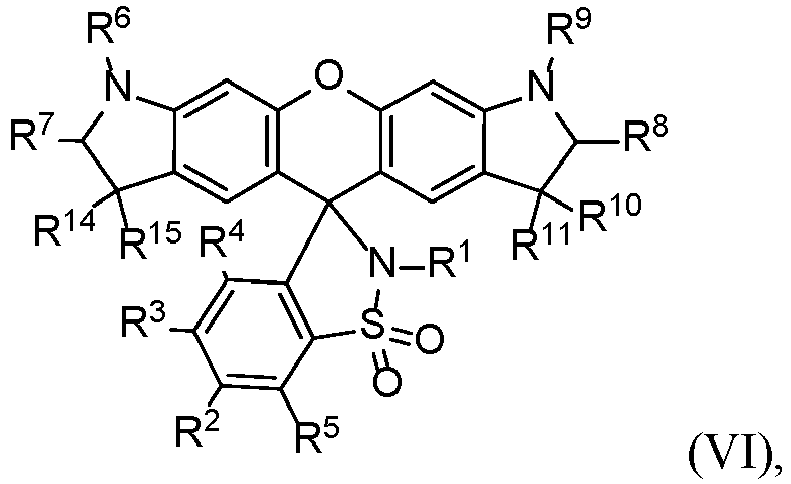
- the sulforhodamine dye is a compound represented by Formula VI: or a stereoisomer, tautomer, or salt thereof, wherein:
- R 7 , R 8 , R 10 , R 11 , R 14 , and R 15 are methyl.
- R 2 , R 3 , R 4 , and R 5 are H.
- R 6 is a C 1 -C 6 alkyl optionally substituted with OH or Cl-C6 acyloxy
- R 9 is a C 1 -C 6 alkyl optionally substituted with OH or C 1 -C 6 acyloxy.
- R 6 is an ethyl substituted with OH or OAc.
- R 9 is an ethyl substituted with OH or OAc.
- the compound is: or a stereoisomer, tautomer, or salt thereof, wherein:
- the compound is: wherein R 1 is as defined for compound of Formula VI.
- the compound is:
- alkyl As used herein, the terms “alkyl,” “alkenyl,” and “alkynyl” include straight-chain, branched-chain, and cyclic monovalent hydrocarbyl radicals, and combinations of these, which contain only C and H when they are unsubstituted. Examples include methyl, ethyl, isobutyl, cyclohexyl, cyclopentylethyl, 2-propenyl, 3-butynyl, and the like. The total number of carbon atoms in each such group is sometimes described herein, e.g., when the group can contain up to ten carbon atoms it can be represented as 1-10C, as C 1 -C 10 , C-C10, or C1-10.
- heteroalkyl means the corresponding hydrocarbons wherein one or more chain carbon atoms have been replaced by a heteroatom.
- exemplary heteroatoms include N, O, S, and P.
- the numbers describing the group though still written as e.g. C3-C10, represent the sum of the number of carbon atoms in the cycle or chain and the number of such heteroatoms that are included as replacements for carbon atoms in the cycle or chain being described.
- a single group can include more than one type of multiple bond, or more than one multiple bond; such groups are included within the definition of the term "alkenyl” when they contain at least one carbon-carbon double bond, and are included within the term “alkynyl” when they contain at least one carbon-carbon triple bond.
- alkylene straight-chain, branched-chain, and cyclic divalent hydrocarbyl radicals, and combinations thereof.
- Alkyl, alkenyl, and alkynyl groups can be optionally substituted to the extent that such substitution makes sense chemically.
- Alkyl, alkenyl and alkynyl groups can also be substituted by C 1 -C 8 acyl, C 2 -C 8 heteroacyl, C 6 -C 10 aryl, or C 5 -C 10 heteroaryl, each of which can be substituted by the substituents that are appropriate for the particular group.
- alkyl as used herein includes cycloalkyl and cycloalkylalkyl groups
- cycloalkyl is used herein to describe a carbocyclic non-aromatic group that is connected via a ring carbon atom
- cycloalkylalkyl is used to describe a carbocyclic non-aromatic group that is connected to the molecule through an alkyl linker.
- heterocyclyl is used to identify a non-aromatic cyclic group that contains at least one heteroatom as a ring member and that is connected to the molecule via a ring atom, which may be C or N; and “heterocyclylalkyl” may be used to describe such a group that is connected to another molecule through an alkylene linker. As used herein, these terms also include rings that contain a double bond or two, as long as the ring is not aromatic.
- Aromaatic or aryl substituent or moiety refers to a monocyclic or fused bicyclic moiety having the well-known characteristics of aromaticity; examples include phenyl and naphthyl.
- heteroaryl refers to such monocyclic or fused bicyclic ring systems which contain as ring members one or more heteroatoms. Suitable heteroatoms include N, O, and S, inclusion of which permits aromaticity in 5-membered rings as well as 6-membered rings.
- Typical heteroaromatic systems include monocyclic C5-C6 aromatic groups such as pyridyl, pyrimidyl, pyrazinyl, thienyl, furanyl, pyrrolyl, pyrazolyl, thiazolyl, oxazolyl, and imidazolyl, and fused bicyclic moieties formed by fusing one of these monocyclic groups with a phenyl ring or with any of the heteroaromatic monocyclic groups to form a C8-C10 bicyclic group such as indolyl, benzimidazolyl, indazolyl, benzotriazolyl, isoquinolyl, quinolyl, benzothiazolyl, benzofuranyl, pyrazolopyridyl, quinazolinyl, quinoxalinyl, cinnolinyl, and the like.
- monocyclic C5-C6 aromatic groups such as pyridyl, pyrimidy
- Aryl and heteroaryl moieties can be substituted with a variety of substituents including C 1 -C 8 alkyl, C 2 -C 8 alkenyl, C 2 -C 8 alkynyl, C 5 -C 12 aryl, C 1 -C 8 acyl, and heteroforms of these, each of which can itself be further substituted; other substituents for aryl and heteroaryl moieties include halogens (F, Cl, Br, I), OR, NR 2 , SR, SO 2 R, SO 2 NR 2 , NRSO 2 R, NRCONR 2 , NRC(O)OR, NRC(O)R, CN, C(O)OR, C(O)NR 2 , OC(O)R, C(O)R, and NO 2 , wherein each R is independently H, C 1 -C 8 alkyl, C 2 -C 8 heteroalkyl, C 2 -C 8 alkenyl, C 2 -C 8 heteroalkeny
- the group takes up two available valences, so the total number of substituents that may be included is reduced according to the number of available valences.
- Salts, stereoisomers, and tautomers of the sulforhodamine compounds disclosed herein, such as compounds of formulae I, IA, II, IIA, and III, are also within the scope of this disclosure.
- stereoisomer or “stereoisomers” refer to compounds that differ in the chirality of one or more stereocenters. Stereoisomers include enantiomers and diastereomers.
- tautomer refers to alternate forms of a compound that differ in the position of a proton, such as enol-keto and imine-enamine tautomers.
- salt of a compound refers to an ion of the compound ionically association with a counterion.
- a salt of a compound can be formed by the neutralization reaction of an acid and a base. Salts can be derived from a variety of organic and inorganic counter ions well known in the art and include, by way of example only, sodium, potassium, calcium, magnesium, ammonium, and tetraalkylammonium; and when the molecule contains a basic functionality, salts of organic or inorganic acids, such as hydrochloride, hydrobromide, tartrate, mesylate, acetate, maleate, and oxalate.
- structures of the compounds disclosed herein can be shown in only one resonance form, it is understood that all resonance forms are included.
- Synthesis of the sulforhodamine compounds disclosed herein, e.g., compounds of Formulae I, IA, II, IIA, III, and VI can be achieved in any suitable manner using techniques and methods known in the art. See, e.g., Beija M. et al, Chem. Soc. Rev., (2009): 38, 2410-2433 ; Kreimerman et al, Current Radiopharmaceuticals, (2017): 10, 212-220 ; Corrie J.E.T. and Munasinghe V.R. Dyes and Pigments 79 (2008): 76-82 ; Corrie J.E.T. et al. Bioconjugate Chem. 12 (2001): 186-194 . Examples 1-9 shown below illustrate synthesis of some exemplary compounds of the disclosure.
- sulforhodamine dye-labeled polynucleotides prepared by an automated oligonucleotide synthesis from the phosphoramidite sulforhodamine dyes disclosed herein.
- sulforhodamine dye-labeled polynucleotide refers to a polynucleotide that prepared by an automated oligonucleotide synthesis from the phosphoramidite sulforhodamine dyes disclosed herein and incorporates a sulforhodamine dye moiety in either open or closed form.
- a labeled polynucleotide comprising a compound of formula IV: or a stereoisomer, tautomer, or salt thereof, wherein:
- a labeled polynucleotide comprising a compound of formulae VA or VB: or a stereoisomer, tautomer, or salt thereof, wherein:
- R 14 and R 15 form a C 2 alkylene chain, optionally substituted with 1, 2, or 3 methyl groups, connecting the atoms to which R 14 and R 15 are attached; and yet other embodiments, R 16 and R 17 form a C 2 alkylene chain, optionally substituted with 1, 2, or 3 methyl groups, connecting the atoms to which R 16 and R 17 are attached. In certain embodiments, R 14 and R 15 form an ethylene chain substituted with 3 methyl groups and R 16 and R 17 form an ethylene chain substituted with 3 methyl groups.
- R 14 and R 15 taken together and R 16 and R 17 , taken together are: wherein * denotes the point of attachment to the nitrogen atom, and ** denotes the point of attachment to the aromatic carbon atom.
- Labeled polynucleotides disclosed herein can comprise one or more additional compounds.
- a polynucleotide comprises a minor groove binder.
- a polynucleotide comprises an intercalator.
- a polynucleotide labeled with the dyes disclosed herein is a polynucleotide wherein the backbone comprises 2'-deoxyribose or ribose.
- a labeled polynucleotide can comprise one or more modifications.
- a polynucleotide comprises a sugar modification, e.g., a modified sugar.
- sugar modifications are useful. Some non-limiting sugar modifications include arabinose, d-arabino-hexitol, 2-fluoroarabinose, xylulose, hexose, or a bicyclic sugar.
- Labeled polynucleotides disclosed herein can comprise one or more modified or unnatural bases.
- Modified bases include modified thymine and cytosine bases (e.g, those disclosed in U.S. Pat. Nos 9,598,455 and 9,598,456 ), 2,6-diaminopurine bases, universal bases, and the like.
- Labeled polynucleotides disclosed herein can comprise non-nucleoside segments or non-nucleoside monomers (e.g., linkers such as poly(ethyleneglycol) linkers).
- the polynucleotide disclosed herein is probe, e.g. a 5'-nuclease PCR probe.
- the polynucleotide further comprises one or more additional labels, for example, a fluorescence quencher.
- additional labels for example, a fluorescence quencher.
- a modified polynucleotide which comprises a sulforhodamine dye moiety as a fluorophore on one end of its sequence and a fluorescence quencher on the other end of its sequence, so that the fluorescence quencher suppresses the fluorescence signal of the fluorophore in the intact probe (i.e., the oligonucleotide being used as a probe) via an energy transfer mechanism such as fluorescence resonance energy transfer (“FRET").
- FRET fluorescence resonance energy transfer
- the 5'-nuclease activity of the polymerase cleaves the probe, thereby allowing the fluorophore to diffuse away from the fluorescence quencher so that the fluorescent signal is now detected.
- the signal increases with each PCR cycle proportionally to the amount of probe that is cleaved, and thus, proportionally to the amount of amplification product (e.g., amplicon, target sequence). This allows direct detection and quantification of the target DNA sequence.
- the sulforhodamine dye moiety is attached to a base that is at least one nucleotide position away from the end of the sequence of the labeled polynucleotide and the fluorescence quencher is attached to a base that is at least one nucleotide position away from the other end of the modified polynucleotide.
- the fluorophore, e.g., the sulforhodamine dye moiety, and the fluorescence quencher are located internally within a probe. As one of ordinary skill in the art will appreciate, the location of the fluorophore and/or the fluorescence quencher within a probe can vary and is not limited.
- the fluorophore e.g., the sulforhodamine dye moiety, and fluorescence quencher are not at the ends of a FRET probe.
- the emission spectrum of the sulforhodamine dye overlaps considerably with the absorption spectrum of the fluorescence quencher. However, such spectral overlap is less important or not required when quenching involves a collisional mechanism, or the overlap is increased, for example, due to reaction conditions or probe structure.
- Quenchers useful for inclusion in probes disclosed herein include bis-azoquenchers (e.g., those disclosed in U.S. Pat. No. 6,790,945 ), quenchers available from Biosearch Technologies, Inc.
- the ligand is a polynucleotide.
- the conditions sufficient to covalently attach the compound of the present disclosure to the ligand i.e., oligonucleotide or polynucleotide, are automated phosphoramidite oligonucleotide synthesis conditions. Automated phosphoramidite oligonucleotide synthesis conditions used to synthesize and deprotect synthetic oligonucleotides are well-known in the art, and are described, for example, in Current Protocols in Nucleic Acid Chemistry, Vol. I, Beaucage et al., Eds., John Wiley & Sons, 2002 .
- oligonucleotide e.g., DNA
- synthesis is considered as the standard synthesis method used in most automated synthesizers.
- Building blocks used for synthesis are commonly referred to as nucleotide building blocks, monomers, or nucleoside phosphoramidites, which are activated nucleoside derivatives (phosphoramidites).
- An acid-cleavable protecting group typically, the dimethoxytrityl (DMT) group, is used to protect the 5'-end of the nucleoside and a p-cyanoethyl group is used to protect the 3'-phosphite moiety.
- DMT dimethoxytrityl
- a monomer may also include additional groups that serve to protect other moieties, e.g., reactive primary amines in the nucleobases.
- the protecting groups are selected to prevent branching or other undesirable side reactions from occurring during synthesis. Skilled artisans will be readily able to select protecting groups having properties suitable for use under specific synthesis and deprotection and/or cleavage conditions.
- a wide variety of amine protecting groups are taught, for example in, Greene & Wuts, "Protective Groups In Organic Chemistry," 3d Edition, John Wiley & Sons, 1999 (hereinafter "Green & Wuts").
- oligonucleotides are synthesized on solid supports, e.g., control pore glass (CPG)- or polystyrene- filled column, a membrane, or a similar material.
- CPG control pore glass
- An oligonucleotide is usually synthesized from the 3' to the 5'-end.
- the first nucleotide building block or monomer is usually anchored to the support, typically, via a linker, such as a long chain alkylamine-controlled pore glass (LCAA-CPG).
- LCAA-CPG long chain alkylamine-controlled pore glass
- phosphoramidite coupling can be carried out in acetonitrile containing 0.25 M 5-ethylthio-1H-tetrazole, 0.25 M 4,5-dicyanoimidazole (DCI) or 0.25 M 5-benzylthio-1H-tetrazole (BTT).
- Oxidation can be carried out with 0.1 M, 0.05 M or 0.02 M I 2 in THF/H 2 O/pyridine (7:2:1)
- Capping can be carried out by treatment with THF/lutidine/acetic anhydride followed by treatment with 16% NMI in THF.
- cleavage in reference to solid phase oligonucleotide synthesis means breaking the bond which attaches an oligonucleotide to a solid phase support.
- cleavage involves hydrolysis of a succinate ester bond between the 3' hydroxyl of an attached oligonucleotide and the solid phase support.
- deprotection means removing protection groups from the exocyclic amines of the heterocyclic bases of an oligonucleotide. Usually, deprotection involves hydrolysis of an amide moiety consisting of an exocyclic amine and an amino protection group, e.g. benzoyl or isobutyryl. Various techniques and methods of deprotection are known in the art.
- This example describes synthesis of an exemplary sulforhodamine dye S1 which comprises a phosphoramidite group.
- This dye is suitable for incorporation into the 5' end of an oligonucleotide via standard automated oligonucleotide synthesis.
- the reaction solution was cooled to 0-5°C and treated with N,N-diisopropylethylamine (DIEA) (25 mL, 10 eq) and 2-aminoethoxyethanol (AEE) (7.2 mL, 5 eq) while maintaining the temperature below 8°C.
- DIEA N,N-diisopropylethylamine
- AEE 2-aminoethoxyethanol
- the reaction was stirred while allowing to warm up to RT over 1-2 h, then stirred at RT overnight.
- the reaction progress was monitored by TLC (10% MeOH/DCM).
- the reaction mixture was diluted with DCM (250 mL) and washed with 1 N HCl (2 X185 mL), brine (1 ⁇ 200 mL) and dried over Na 2 SO 4 .
- This example describes synthesis of an exemplary sulforhodamine dye S2 which comprises a phosphoramidite group and a hydroxyl group protected with dimethoxytrityl group.
- This dye is suitable for incorporation into the 5'-end or in a middle position of an oligonucleotide via standard automated oligonucleotide synthesis.
- Trifluoromethane sulfonic acid 50 mL in a 150 mL round bottom flask was cooled to 0°C under argon atmosphere.
- 8-Hydroxyjulolidine HJ
- 2-Sulfobenzoic acid cyclic anhydride 10.95 g, 59.5 mmol was added in one portion. The mixture was heated to 110°C and stirred for 18 h then cooled to RT.
- the reaction mixture was added dropwise to a mixture of 3M NaOAc (300 mL) and crushed ice (200 mL). To the resulting mixture, DCM was added (500 mL), and the mixture was transferred to a separatory funnel. The organic layer was collected and washed with water and brine. The combined aqueous layers were back-extracted with DCM, and all organic layers were combined. After drying over Na 2 SO 4 , the solution was filtered, and DCM was removed under vacuum. The product was purified by chromatography on silica gel (3" ⁇ 7" bed) using 2% to 10% water/acetonitrile (ACN). A dark red impurity comes off the column with the solvent front.
- ACN acetonitrile
- This example describes synthesis of an exemplary sulforhodamine dye S3 which comprises an NHS ester.
- This dye is suitable for fluorescent labeling of biomolecules, for example, peptides, via conjugation reaction with an amino group.
- Another exemplary dye S4 comprising an activated ester derivative can be readily prepared according to the procedure outlined in Scheme 4 using the reaction conditions described above for Compound S3.
- reaction mixture volume (purple in color) was halved by evaporation on the rotary evaporator and the product was precipitated by pouring the reaction solution into DI water (75 mL) at room temperature The suspension was filtered, the cake was washed with additional DI water (15 mL) and was dried in a vacuum oven at 40-50 °C and ⁇ 2 mbar vacuum for 20 h to give 0.54g (93% yield) of Compound 9 as a purple powder which was used as is in the next step.
- This example describes synthesis of an exemplary sulforhodamine dye S5 which comprises a phosphoramidite group.
- This dye is suitable for incorporation at the 5'-end of an oligonucleotide via standard automated oligonucleotide synthesis.
- This example describes synthesis of an exemplary sulforhodamine dye S6 which comprises a phosphoramidite group and a hydroxyl group protected with dimethoxytrityl group.
- This dye is suitable for incorporation at the 5'-end or in a middle position of an oligonucleotide via standard automated oligonucleotide synthesis.
- Synthesis of Compound 12 was performed by treatment with ethylene oxide 2,3,3-trimethyl-2,3-dihydro-1H-indol-6-ol in acetic acid (FCH Group, Lithuania). Water (27 mL) was cooled to ca 0°C, and conc. H 2 SO 4 (41 mL) was slowly added. The resulting solution was heated in a 250 mL, 3-neck, round bottom flask to 160°C. Thoroughly premixed 2-formylbenzenesulfonic acid (3.21 g, 15.4 mmol) and Compound 12 (6.82 g, 30.8 mmol) were added portion wise over 1 minute to the sulfuric acid solution.
- Compound S6 was incorporated into the 5'-end of a model oligonucleotide (SEQ. ID No 1).
- SEQ. ID No 1 The excitation and emission spectra of the exemplary oligonucleotide are shown in FIGURE 3 .
- This example describes synthesis of an exemplary sulforhodamine dye S7 which comprises a phosphoramidite group and a hydroxyl group protected with dimethoxytrityl group.
- This dye is suitable for incorporation at the 5'-end or in a middle position of an oligonucleotide via standard automated oligonucleotide synthesis.
- This example describes synthesis of an exemplary sulforhodamine dye S8 which comprises a phosphoramidite group and a hydroxyl group protected with dimethoxytrityl group.
- This dye is suitable for incorporation at the 5'-end or in a middle position of an oligonucleotide via standard automated oligonucleotide synthesis.
- This example describes synthesis of an exemplary sulforhodamine dye S9 which comprises a phosphoramidite group and a hydroxyl group protected with dimethoxytrityl group.
- This dye is suitable for incorporation at the 5'-end or in a middle position of an oligonucleotide via standard automated oligonucleotide synthesis.
- Polynucleotides comprising sulforhodamine dyes were synthesized on a MerMade-12 oligonucleotide synthesizer utilizing standard 200 nmol DNA protocol in cycles of DMT removal - coupling - capping - oxidation - capping. Coupling time for sulforhodamine dye phosphoramidites was extended to 6 min.
- Sulforhodamine 101-labeled oligonucleotides were prepared by conjugation of amino-C 6 -oligo with a commercial Texas Red ® -X (NHS ester) reagent (mixed isomers, Thermo Fisher Scientific). All purified polynucleotides were characterized by mass spectroscopy.
- 5'-Nuclease probes comprising exemplary sulforhodamine dyes were prepared using commercially available BHQ-2 quencher CPG, Glycolate 500 Angstrom column (BioSearch Technologies).
- A01 denotes 2-amino-dA (2,6-diamino- 2'-deoxypurine riboside) which was incorporated using commercially available 2-Amino-dA-CE phosphoramidite (Glen Research, product Catalog Number: 10-1085).
- oligonucleotides incorporating sulforhodamine dye phosphoramidites and Sulforhodamine 101 (Tx Red)-labeled oligonucleotides are listed in Table 1.
- Table 1. Name 5' Dye Sequence 3' Quencher Oligo A Tx Red SEQ ID NO: 1 N/A Oligo B (S6) SEQ ID NO: 1 N/A Oligo C (S7) SEQ ID NO: 1 N/A Oligo D Tx Red SEQ ID NO: 2 BHQ-2 Oligo E (S7) SEQ ID NO: 2 BHQ-2 Oligo F Tx Red SEQ ID NO: 3 BHQ-2 Oligo G (S7) SEQ ID NO: 3 BHQ-2
- the dye moieties incorporated at the 5'-end of the polynucleotides have the following structures: and the oligonucleotide sequences are as follows:
- Excitation and emission spectra of labeled oligonucleotides were recorded on an Agilent Cary fluorimeter (200 nM oligonucleotide, 0.1 M Tris buffer, pH 8).
- the excitation and emission maxima of an exemplary oligonucleotide prepared via automated oligonucleotide synthesis using an exemplary dye phosphoramidite reagent Compound S7 (Oligo C) matches the excitation and emission maxima values of an oligonucleotide comprising Texas Red ® dye (Oligo A).
- the excitation and emission maxima of an exemplary oligonucleotide prepared via automated oligonucleotide synthesis using an exemplary dye phosphoramidite reagent Compound S6 (Oligo B), are close to the literature-reported excitation and emission maxima of TAMRA dye-labeled oligonucleotides.
- 5'-Nuclease PCR probes comprising dyes of the disclosure were evaluated and compared to Texas Red ® -comprising PCR probes. Human genome DNA beta-globulin housekeeping gene was used as the target.
- the forward and reverse primers had the following sequences:
- PCR was performed on GeneXpert ® (Cepheid) instrument with 4 modules (detection: Tx Red channel, Ex 585 nm, Em 610 nm). Each PCR curve is an average of 4 repeats. The following PCR protocol was used:
- FIGURES 2A and 2B The resulting PCR data are shown in FIGURES 2A and 2B .
- 5' nuclease PCR probes labeled with exemplary dyes of the disclosure have performance comparable with that of with Texas Red ® -labeled PCR probes.
- probes comprising an exemplary dye S7 demonstrate endpoint similar to those demonstrated by probes labeled with Texas Red ® .
- This example describes synthesis of exemplary sulforhodamine dyes S10a and S10b which comprise a phosphoramidite group. These dyes are suitable for incorporation at the 5'-end position of an oligonucleotide via standard automated oligonucleotide synthesis.
- Compound S10a is an example of a sulforhodamine dye synthesized from 12a, a single enantiomer of compound 12, resulting in compound S10a existing as a single diastereomer.
- Compound 12a can be synthesized from 2,3,3-trimethyl-3H-indole-6-ol (FCH Group, Lativa) via asymmetric transfer hydrogenation (as described in Org. Lett. 2018, 20, 5107-5111 ) using chiral catalyst RuCl(p-cymene)[(R,R)-Ts-DPEN] (Aldrich cat # 703907).
- compound 12b a stereoisomer of 12a, can be synthesized by a similar procedure using RuCl(p-cymene)[(S,S)-Ts-DPEN] (Aldrich).
- Compound S10b can be prepared from intermediate 12b in a similar manner.
- Exemplary labeled polynucleotides of SEQ. ID NO: 1 incorporating dyes S10 and S10a at the 5' ends were prepared by automated oligonucleotide synthesized as described above.
- the labeled polynucleotide incorporating dye S10 was purified by HPLC on Phenomenex Gemini column (5 ⁇ m C18 110 ⁇ ) eluting with a gradient of 16-34% ACN in 0.1 M triethylammonium bicarbonate buffer over 20 min.
- the labeled polynucleotide incorporating dye S10a was purified by HPLC on Phenomenex Gemini column (5 ⁇ m C18 110 ⁇ ) eluting with a gradient of 18-38% ACN in 0.1 M triethylammonium bicarbonate buffer over 20 min.
- the HPLC profiles of the two exemplary labeled polynucleotides are shown in FIGURES 3A and 3B .
- FIGURE 1D shows the emission/excitation spectrum of the S10a-labeled oligonucleotide SEQ. ID NO: 1 demonstrating that S10a could be used as a replacement for TAMRA dye.
- the exemplary S10a-labeled polynucleotide produces predominantly a single peak by HPLC as compared to the multiple peaks produced by the exemplary S10-labeled polynucleotide ( FIGURE 3A ), which simplifies chromatographic purification of such oligonucleotides.
Landscapes
- Chemical & Material Sciences (AREA)
- Organic Chemistry (AREA)
- Life Sciences & Earth Sciences (AREA)
- Health & Medical Sciences (AREA)
- Molecular Biology (AREA)
- Biochemistry (AREA)
- Engineering & Computer Science (AREA)
- General Health & Medical Sciences (AREA)
- Biotechnology (AREA)
- Genetics & Genomics (AREA)
- Proteomics, Peptides & Aminoacids (AREA)
- Wood Science & Technology (AREA)
- Analytical Chemistry (AREA)
- Zoology (AREA)
- Physics & Mathematics (AREA)
- Microbiology (AREA)
- Immunology (AREA)
- Biophysics (AREA)
- Bioinformatics & Cheminformatics (AREA)
- General Engineering & Computer Science (AREA)
- Measuring Or Testing Involving Enzymes Or Micro-Organisms (AREA)
- Saccharide Compounds (AREA)
- Nitrogen And Oxygen Or Sulfur-Condensed Heterocyclic Ring Systems (AREA)
- Organic Low-Molecular-Weight Compounds And Preparation Thereof (AREA)
Claims (15)
- Verbindung, dargestellt durch Formel I:
 R1 L1-X ist;R2 Halogen oder SO2NH2 ist;R3 H oder Halogen ist;R4, R7, R8 und R11 allein genommen unabhängig voneinander H, Halogen oder optional substituiertes C1-C6-Alkyl sind;R5, R6, R9 und R10 allein genommen unabhängig voneinander H oder optional substituiertes C1-C6-Alkyl sind;R4 und R5 zusammen genommen eine optional substituierte C2-C3-Alkylenkette sind, die die Atome verbindet, an die R4 und R5 gebunden sind;R6 und R7 zusammen genommen eine optional substituierte C2-C3-Alkylenkette sind, die die Atome verbindet, an die R6 und R7 gebunden sind;R8 und R9 zusammen genommen eine optional substituierte C2-C3-Alkylenkette sind, die die Atome verbindet, an die R8 und R9 gebunden sind;R10 und R11 zusammen genommen eine optional substituierte C2-C3-Alkylenkette sind, die die Atome verbindet, an die R10 und R11 gebunden sind;R5 und R6 zusammen mit dem Stickstoffatom, an das R5 und R6 gebunden sind, einen 5-gliedrigen oder 6-gliedrigen ungesättigten Ring bilden;R9 und R10 zusammen mit dem Stickstoffatom, an das R9 und R10 gebunden sind, einen 5-gliedrigen oder einen 6-gliedrigen ungesättigten Ring bilden;L1 ein optional substituiertes C2-C10-Alkylen oder optional substituiertes C2-C20-Heteroalkylen ist;X ist
 wobei der Begriff "Alkyl" ein geradkettiges, verzweigtkettiges oder zyklisches einwertiges Kohlenwasserstoffradikal oder eine Kombination davon einschließt, das, wenn es unsubstituiert ist, nur C und H enthält, und wobei das Alkyl optional substituiert ist.
 - Verbindung nach Anspruch 1, wobei:(a) R2 Cl ist und R3 H ist; oder(b) L1 ein PEG2-10-Linker ist; oder(c) L1 -CH2CH2OCH2CH2- ist; oder(d) R4 und R5 zusammen genommen eine optional substituierte C3-Alkylenkette sind, die die Atome verbindet, an die R4 und R5 gebunden sind; R10 und R11 zusammen genommen eine optional substituierte C3-Alkylenkette sind, die die Atome verbindet, an die R10 und R11 gebunden sind; R6 und R7 zusammen genommen eine optional substituierte C3-Alkylenkette sind, die die Atome verbindet, an die R6 und R7 gebunden sind; und R8 und R9 zusammen genommen eine optional substituierte C3-Alkylenkette sind, die die Atome verbindet, an die R8 und R9 gebunden sind; oder(e) R4 und R5 zusammen genommen eine Propylenkette sind, die die Atome verbindet, an die R4 und R5 gebunden sind; R10 und R11 zusammen genommen eine Propylenkette sind, die die Atome verbindet, an die R10 und R11 gebunden sind; R6 und R7 zusammen genommen eine Propylenkette sind, die die Atome verbindet, an die R6 und R7 gebunden sind; und R8 und R9 zusammen genommen eine Propylenkette sind, die die Atome verbindet, an die R8 und R9 gebunden sind; oder(f) R5, R6, R9 und R10 jeweils Methyl sind.
- Verbindung nach Anspruch 1, wobei:(a) die Verbindung durch die Formel IA dargestellt wird:
 (b) die Verbindung ist:
- Verbindung, dargestellt durch Formel II:
 R1 C1-C6-Alkyl ist;R2 H, Halogen oder SO2NH2 ist;R3 H oder Halogen ist;R14 und R16 allein genommen unabhängig voneinander H, Halogen oder optional substituiertes C1-C6-Alkyl sind;R15 und R17 allein genommen unabhängig voneinander H oder optional substituiertes C1-C6-Alkyl sind;R14 und R15 zusammen genommen eine optional substituierte C2-C3-Alkylenkette bilden, die die Atome verbindet, an die R14 und R15 gebunden sind;R16 und R17 zusammen genommen eine optional substituierte C2-C3-Alkylenkette bilden, die die Atome verbindet, an die R16 und R17 gebunden sind;Q eine Trityl- oder Dimethoxytritylgruppe ist;L1 und L2 unabhängig voneinander ein optional substituiertes C2-C10-Alkylen oder ein optional substituiertes C2-C20-Heteroalkylen sind; undwobei der Begriff "Alkyl" ein geradkettiges, verzweigtkettiges oder cyclisches einwertiges Kohlenwasserstoffradikal oder eine Kombination davon einschließt, das nur C und H enthält, wenn es unsubstituiert ist, und wobei das Alkyl optional substituiert ist.
 - Verbindung nach Anspruch 4, wobei:(a) R3 H ist; oder(b) R2 H ist; oder(c) R2 Cl ist; oder(d) die Verbindung dargestellt wird durch die Formel (IIA):

- Verbindung nach Anspruch 4, wobei die Verbindung:

- Verbindung, dargestellt durch Formel (III):
 R2 H, Halogen oder SO2NH2 ist;R3 Halogen oder H ist;R4, R7, R8 und R11 allein genommen unabhängig voneinander H, Halogen oder optional substituiertes C1-C6-Alkyl sind;R5, R6, R9 und R10 allein genommen unabhängig voneinander H oder optional substituiertes C1-C6-Alkyl sind;R4 und R5 zusammen genommen eine optional substituierte C2-C3-Alkylenkette sind, die die Atome verbindet, an die R4 und R5 gebunden sind;R6 und R7 zusammen genommen eine optional substituierte C2-C3-Alkylenkette sind, die die Atome verbindet, an die R6 und R7 gebunden sind;R8 und R9 zusammen genommen eine optional substituierte C2-C3-Alkylenkette sind, die die Atome verbindet, an die R8 und R9 gebunden sind;R10 und R11 zusammen genommen eine optional substituierte C2-C3-Alkylenkette sind, die die Atome verbindet, an die R10 und R11 gebunden sind;R5 und R6 zusammen mit dem Stickstoffatom, an das R5 und R6 gebunden sind, einen 5-gliedrigen oder 6-gliedrigen ungesättigten Ring bilden;R9 und R10 zusammen mit dem Stickstoffatom, an das R9 und R10 gebunden sind, einen 5-gliedrigen oder einen 6-gliedrigen ungesättigten Ring bilden;n eine ganze Zahl von 1 bis 9 ist;Y Folgendes ist:wobei:
 Q eine Trityl- oder Dimethoxytritylgruppe ist;R12 und R13 unabhängig voneinander optional substituiertes C1-C6-Alkyl sind; undwobei der Begriff "Alkyl" ein geradkettiges, verzweigtkettiges oder zyklisches einwertiges Kohlenwasserstoffradikal oder eine Kombination davon einschließt, das nur C und H enthält, wenn es unsubstituiert ist, und wobei das Alkyl optional substituiert ist.
 - Verbindung nach Anspruch 7, wobei:(a) R2 Cl ist und R3 H ist; oder(b) R4 und R5 zusammen genommen eine optional substituierte C3-Alkylenkette sind, die die Atome verbindet, an die R4 und R5 gebunden sind; R10 und R11 zusammen genommen eine optional substituierte C3-Alkylenkette sind, die die Atome verbindet, an die R10 und R11 gebunden sind; R6 und R7 zusammen genommen eine optional substituierte C3-Alkylenkette sind, die die Atome verbindet, an die R6 und R7 gebunden sind; und R8 und R9 zusammen genommen eine optional substituierte C3-Alkylenkette sind, die die Atome verbindet, an die R8 und R9 gebunden sind; oder(c) R4 und R5 zusammen genommen eine Propylenkette sind, die die Atome verbindet, an die R4 und R5 gebunden sind; R10 und R11 zusammen genommen eine Propylenkette sind, die die Atome verbindet, an die R10 und R11 gebunden sind; R6 und R7 zusammen genommen eine Propylenkette sind, die die Atome verbindet, an die R6 und R7 gebunden sind; und R8 und R9 zusammen genommen eine Propylenkette sind, die die Atome verbindet, an die R8 und R9 gebunden sind; oder(d) R12 und R13 jeweils Isopropyl sind.
- Verbindung nach Anspruch 7, wobei die Verbindung Folgendes ist:


- Markiertes Polynucleotid, das eine Verbindung von Formel IV umfasst:
 R2 Halogen oder SO2NH2 ist;R3 H oder Halogen ist;R4, R7, R8 und R11 allein genommen unabhängig voneinander H, Halogen oder optional substituiertes C1-C6-Alkyl sind;R5, R6, R9 und R10 allein genommen unabhängig voneinander H oder optional substituiertes C1-C6-Alkyl sind;R4 und R5 zusammen genommen eine optional substituierte C2-C3-Alkylenkette sind, die die Atome verbindet, an die R4 und R5 gebunden sind;R6 und R7 zusammen genommen eine optional substituierte C2-C3-Alkylenkette sind, die die Atome verbindet, an die R6 und R7 gebunden sind;R8 und R9 zusammen genommen eine optional substituierte C2-C3-Alkylenkette sind, die die Atome verbindet, an die R8 und R9 gebunden sind;R10 und R11 zusammen genommen eine optional substituierte C2-C3-Alkylenkette sind, die die Atome verbindet, an die R10 und R11 gebunden sind;R5 und R6 zusammen mit dem Stickstoffatom, an das R5 und R6 gebunden sind, einen 5-gliedrigen oder 6-gliedrigen ungesättigten Ring bilden;R9 und R10 zusammen mit dem Stickstoffatom, an das R9 und R10 gebunden sind, einen 5-gliedrigen oder einen 6-gliedrigen ungesättigten Ring bilden;n eine ganze Zahl von 1 bis 9 ist;Y Folgendes ist:wobei:
 die gewellte Linie der Punkt der Bindung an Formel IV ist;W H oder L4-O-Z2 ist;L3, L4 und L5 unabhängig voneinander ein optional substituiertes C2-C10-Alkylen oder optional substituiertes C2-C30-Heteroalkylen sind;Z CH, N, NHC(O)N oder OC(O)N ist;Z1 ein Nukleotid oder Oligonukleotid ist;Z2 ein Nukleotid, Oligonukleotid oder H ist; undwobei der Begriff "Alkyl" ein geradkettiges, verzweigtkettiges oder zyklisches einwertiges Kohlenwasserstoffradikal oder eine Kombination davon einschließt, das nur C und H enthält, wenn es unsubstituiert ist, und wobei das Alkyl optional substituiert ist.
 - Markiertes Polynukleotid nach Anspruch 10, wobei:(a) R2 Cl ist und R3 H ist; oder(b) R4 und R5 eine optional substituierte C3-Alkylenkette sind, die die Atome verbindet, an die R4 und R5 gebunden sind; R10 und R11 eine optional substituierte C3-Alkylenkette sind, die die Atome verbindet, an die R10 und R11 gebunden sind; R6 und R7 eine optional substituierte C3-Alkylenkette sind, die die Atome verbindet, an die R6 und R7 gebunden sind; und R8 und R9 eine optional substituierte C3-Alkylenkette sind, die die Atome verbindet, an die R8 und R9 gebunden sind; oder(c) das markierte Polynukleotid eine 5'-Nuklease-PCR-Sonde ist; oder(d) das markierte Polynukleotid ferner einen Fluoreszenzlöscher umfasst.
- Verbindung, dargestellt durch Formel VI:
 R1 L1-X ist;R2, R3, R4 und R5 unabhängig voneinander H, Halogen, C1-C6-Alkyl oder SO2NH2 sind;R6 und R9 unabhängig voneinander H oder optional substituiertes C1-C6-Alkyl sind;R7, R8, R10, R11, R14 und R15 unabhängig voneinander H oder optional substituiertes C1-C6-Alkyl sind;L1 ein optional substituiertes C2-C10-Alkylen oder optional substituiertes C2-C20-Heteroalkylen ist;X -OP(OCH2CH2CN)N(i-Pr)2 ist; undwobei der Begriff "Alkyl" ein geradkettiges, verzweigtkettiges oder cyclisches einwertiges Kohlenwasserstoffradikal oder eine Kombination davon einschließt, das nur C und H enthält, wenn es unsubstituiert ist, und wobei das Alkyl optional substituiert ist.
 - Verbindung nach Anspruch 12, wobei(a) R7, R8, R10, R11, R14 und R15 Methyl sind; oder(b) L1 ein PEG2-10-Linker ist; oder(c) L1 -CH2CH2OCH2CH2- ist; oder(d) R2, R3, R4 und R5 H sind; oder(e) R6 ein C1-C6-Alkyl ist, optional substituiert mit OH oder C1-C6-Acyloxy; oder(f) R9 ein C1-C6-Alkyl ist, das optional mit OH oder C1-C6-Acyloxy substituiert ist; oder(g) R6 ein mit OH oder OAc substituiertes Ethyl ist; oder(h) R9 ein mit OH oder OAc substituiertes Ethyl ist; oder(i) die Verbindung Folgendes ist:
 R2, R3, R4 und R5 H sind; undQ1 und Q2 unabhängig voneinander H oder C1-C6-Acyl sind, wobei Q1 und Q2 vorzugsweise Acetyl sind; oder(j) die Verbindung Folgendes ist:
- Verbindung nach Anspruch 12, wobei die Verbindung wie folgt ist:

- Verfahren zur Herstellung eines markierten Konjugats eines Liganden, das das Inkontaktbringen eines Liganden mit einer Verbindung nach einem der Ansprüche 1 bis 9 oder 12 bis 14 in einem geeigneten Lösungsmittel unter Bedingungen beinhaltet, die ausreichen, um die Verbindung kovalent an den Liganden zu binden, wodurch das markierte Konjugat gebildet wird,
wobei optional:der Ligand ein Polynukleotid, ein Protein, ein Peptid, ein Polysaccharid, ein Polymer mit einem ethylenischen Grundgerüst oder ein fester Träger ist; oderder Ligand ein Polynukleotid ist; oderdie Bedingungen, die ausreichen, um die Verbindung kovalent an den Liganden zu binden, automatische Phosphoramidit-Oligonukleotid-Synthesebedingungen sind.
Applications Claiming Priority (2)
| Application Number | Priority Date | Filing Date | Title |
|---|---|---|---|
| US201862668109P | 2018-05-07 | 2018-05-07 | |
| PCT/US2019/031188 WO2019217470A1 (en) | 2018-05-07 | 2019-05-07 | Sulforhodamine phosphoramidite dyes |
Publications (2)
| Publication Number | Publication Date |
|---|---|
| EP3790931A1 EP3790931A1 (de) | 2021-03-17 |
| EP3790931B1 true EP3790931B1 (de) | 2023-09-27 |
Family
ID=66625340
Family Applications (1)
| Application Number | Title | Priority Date | Filing Date |
|---|---|---|---|
| EP19725532.6A Active EP3790931B1 (de) | 2018-05-07 | 2019-05-07 | Sulforhodamin-phosphoramidit-farbstoffe |
Country Status (11)
| Country | Link |
|---|---|
| US (2) | US12071547B2 (de) |
| EP (1) | EP3790931B1 (de) |
| JP (1) | JP7399882B2 (de) |
| KR (1) | KR102753367B1 (de) |
| CN (1) | CN112533998B (de) |
| AU (1) | AU2019266218B2 (de) |
| CA (1) | CA3099701A1 (de) |
| ES (1) | ES2967690T3 (de) |
| MX (1) | MX2020011378A (de) |
| WO (1) | WO2019217470A1 (de) |
| ZA (1) | ZA202006485B (de) |
Families Citing this family (3)
| Publication number | Priority date | Publication date | Assignee | Title |
|---|---|---|---|---|
| AU2021307437A1 (en) | 2020-07-16 | 2023-03-16 | Cepheid | Fluorescent dyes |
| CN115636843B (zh) * | 2022-09-27 | 2024-12-13 | 大连理工大学 | 一类多功能荧光染料及应用 |
| CN115414703B (zh) * | 2022-11-03 | 2023-01-17 | 百力格生物科技(上海)股份有限公司 | 染料修饰后的核酸探针纯化方法 |
Family Cites Families (9)
| Publication number | Priority date | Publication date | Assignee | Title |
|---|---|---|---|---|
| US5231191A (en) * | 1987-12-24 | 1993-07-27 | Applied Biosystems, Inc. | Rhodamine phosphoramidite compounds |
| US5451463A (en) | 1989-08-28 | 1995-09-19 | Clontech Laboratories, Inc. | Non-nucleoside 1,3-diol reagents for labeling synthetic oligonucleotides |
| US6727356B1 (en) | 1999-12-08 | 2004-04-27 | Epoch Pharmaceuticals, Inc. | Fluorescent quenching detection reagents and methods |
| US7344701B2 (en) * | 2004-02-03 | 2008-03-18 | Biosearch Technologies, Inc. | Xanthene dyes |
| CN101454315B (zh) * | 2006-03-31 | 2016-08-17 | 应用生物系统有限责任公司 | 用于合成罗丹明-标记的寡核苷酸的试剂 |
| BR112012025165B1 (pt) * | 2010-04-02 | 2021-02-09 | Pharmacophotonics, Inc. | composição de um corante de rodamina ou um sal do mesmo |
| WO2014058535A1 (en) * | 2012-08-19 | 2014-04-17 | Michigan Technological University | Lysosomal targeting probes |
| WO2015153510A1 (en) | 2014-03-30 | 2015-10-08 | Cepheid | Modified cytosine polynucleotide oligomers and methods |
| JP6574239B2 (ja) | 2014-03-30 | 2019-09-11 | セフィエド | 修飾チミンポリヌクレオチドオリゴマーおよび方法 |
-
2019
- 2019-05-07 US US17/053,683 patent/US12071547B2/en active Active
- 2019-05-07 MX MX2020011378A patent/MX2020011378A/es unknown
- 2019-05-07 AU AU2019266218A patent/AU2019266218B2/en active Active
- 2019-05-07 EP EP19725532.6A patent/EP3790931B1/de active Active
- 2019-05-07 CA CA3099701A patent/CA3099701A1/en active Pending
- 2019-05-07 CN CN201980030812.1A patent/CN112533998B/zh active Active
- 2019-05-07 WO PCT/US2019/031188 patent/WO2019217470A1/en not_active Ceased
- 2019-05-07 ES ES19725532T patent/ES2967690T3/es active Active
- 2019-05-07 KR KR1020207035076A patent/KR102753367B1/ko active Active
- 2019-05-07 JP JP2020562197A patent/JP7399882B2/ja active Active
-
2020
- 2020-10-19 ZA ZA2020/06485A patent/ZA202006485B/en unknown
-
2024
- 2024-08-19 US US18/808,689 patent/US20250051577A1/en active Pending
Also Published As
| Publication number | Publication date |
|---|---|
| AU2019266218A1 (en) | 2021-01-07 |
| CA3099701A1 (en) | 2019-11-14 |
| WO2019217470A1 (en) | 2019-11-14 |
| ZA202006485B (en) | 2025-07-30 |
| US12071547B2 (en) | 2024-08-27 |
| KR102753367B1 (ko) | 2025-01-10 |
| CN112533998A (zh) | 2021-03-19 |
| US20250051577A1 (en) | 2025-02-13 |
| US20240067824A1 (en) | 2024-02-29 |
| EP3790931A1 (de) | 2021-03-17 |
| CN112533998B (zh) | 2023-06-20 |
| BR112020022684A2 (pt) | 2021-02-17 |
| MX2020011378A (es) | 2021-02-15 |
| ES2967690T3 (es) | 2024-05-03 |
| AU2019266218B2 (en) | 2024-08-15 |
| JP7399882B2 (ja) | 2023-12-18 |
| JP2021523268A (ja) | 2021-09-02 |
| KR20210035079A (ko) | 2021-03-31 |
Similar Documents
| Publication | Publication Date | Title |
|---|---|---|
| US20250051577A1 (en) | Sulforhodamine phosphoramidite dyes | |
| CN106460058B (zh) | 经修饰的胞嘧啶多核苷酸寡聚物和方法 | |
| EP3126372B1 (de) | Modifizierte thyminpolynukleotidoligomere und verfahren | |
| JP2004339202A (ja) | 6員環を有するヌクレオチドアナログ | |
| Yanagi et al. | A fluorescent 3, 7-bis-(naphthalen-1-ylethynylated)-2′-deoxyadenosine analogue reports thymidine in complementary DNA by a large emission Stokes shift | |
| US11807643B2 (en) | Fluorescent dyes | |
| CN107207480B (zh) | 香豆素基化合物及相关方法 | |
| CN101970443B (zh) | Rna选择性杂交试剂及其应用 | |
| BR122025017976A2 (pt) | Compostos de corantes de fosforamidita de sulforodamina e método para preparar um conjugado rotulado de um ligante | |
| BR112020022684B1 (pt) | Composto, polinucleotídeo rotulado e método para preparar um conjugado rotulado de um ligante | |
| Moriguchi et al. | Novel method of the synthesis and hybridization properties of an oligonucleotide containing non-ionic diisopropylsilyl internucleotide linkage | |
| HK1234451A1 (en) | Modified cytosine polynucleotide oligomers and methods | |
| HK1234412B (en) | Modified thymine polynucleotide oligomers and methods | |
| HK1239658B (en) | Coumarin-based compounds and related methods | |
| HK1239658A1 (en) | Coumarin-based compounds and related methods | |
| HK1234412A1 (en) | Modified thymine polynucleotide oligomers and methods | |
| HK1234451B (zh) | 經修飾的胞嘧啶多核苷酸寡聚物和方法 |
Legal Events
| Date | Code | Title | Description |
|---|---|---|---|
| STAA | Information on the status of an ep patent application or granted ep patent |
Free format text: STATUS: UNKNOWN |
|
| STAA | Information on the status of an ep patent application or granted ep patent |
Free format text: STATUS: THE INTERNATIONAL PUBLICATION HAS BEEN MADE |
|
| PUAI | Public reference made under article 153(3) epc to a published international application that has entered the european phase |
Free format text: ORIGINAL CODE: 0009012 |
|
| STAA | Information on the status of an ep patent application or granted ep patent |
Free format text: STATUS: REQUEST FOR EXAMINATION WAS MADE |
|
| 17P | Request for examination filed |
Effective date: 20201207 |
|
| AK | Designated contracting states |
Kind code of ref document: A1 Designated state(s): AL AT BE BG CH CY CZ DE DK EE ES FI FR GB GR HR HU IE IS IT LI LT LU LV MC MK MT NL NO PL PT RO RS SE SI SK SM TR |
|
| AX | Request for extension of the european patent |
Extension state: BA ME |
|
| DAV | Request for validation of the european patent (deleted) | ||
| DAX | Request for extension of the european patent (deleted) | ||
| STAA | Information on the status of an ep patent application or granted ep patent |
Free format text: STATUS: EXAMINATION IS IN PROGRESS |
|
| 17Q | First examination report despatched |
Effective date: 20211004 |
|
| GRAP | Despatch of communication of intention to grant a patent |
Free format text: ORIGINAL CODE: EPIDOSNIGR1 |
|
| STAA | Information on the status of an ep patent application or granted ep patent |
Free format text: STATUS: GRANT OF PATENT IS INTENDED |
|
| INTG | Intention to grant announced |
Effective date: 20221128 |
|
| GRAJ | Information related to disapproval of communication of intention to grant by the applicant or resumption of examination proceedings by the epo deleted |
Free format text: ORIGINAL CODE: EPIDOSDIGR1 |
|
| STAA | Information on the status of an ep patent application or granted ep patent |
Free format text: STATUS: EXAMINATION IS IN PROGRESS |
|
| GRAP | Despatch of communication of intention to grant a patent |
Free format text: ORIGINAL CODE: EPIDOSNIGR1 |
|
| STAA | Information on the status of an ep patent application or granted ep patent |
Free format text: STATUS: GRANT OF PATENT IS INTENDED |
|
| INTC | Intention to grant announced (deleted) | ||
| INTG | Intention to grant announced |
Effective date: 20230421 |
|
| GRAS | Grant fee paid |
Free format text: ORIGINAL CODE: EPIDOSNIGR3 |
|
| GRAA | (expected) grant |
Free format text: ORIGINAL CODE: 0009210 |
|
| STAA | Information on the status of an ep patent application or granted ep patent |
Free format text: STATUS: THE PATENT HAS BEEN GRANTED |
|
| P01 | Opt-out of the competence of the unified patent court (upc) registered |
Effective date: 20230725 |
|
| AK | Designated contracting states |
Kind code of ref document: B1 Designated state(s): AL AT BE BG CH CY CZ DE DK EE ES FI FR GB GR HR HU IE IS IT LI LT LU LV MC MK MT NL NO PL PT RO RS SE SI SK SM TR |
|
| REG | Reference to a national code |
Ref country code: GB Ref legal event code: FG4D |
|
| REG | Reference to a national code |
Ref country code: CH Ref legal event code: EP |
|
| REG | Reference to a national code |
Ref country code: DE Ref legal event code: R096 Ref document number: 602019038191 Country of ref document: DE |
|
| REG | Reference to a national code |
Ref country code: IE Ref legal event code: FG4D |
|
| REG | Reference to a national code |
Ref country code: SE Ref legal event code: TRGR |
|
| REG | Reference to a national code |
Ref country code: LT Ref legal event code: MG9D |
|
| PG25 | Lapsed in a contracting state [announced via postgrant information from national office to epo] |
Ref country code: GR Free format text: LAPSE BECAUSE OF FAILURE TO SUBMIT A TRANSLATION OF THE DESCRIPTION OR TO PAY THE FEE WITHIN THE PRESCRIBED TIME-LIMIT Effective date: 20231228 |
|
| PG25 | Lapsed in a contracting state [announced via postgrant information from national office to epo] |
Ref country code: RS Free format text: LAPSE BECAUSE OF FAILURE TO SUBMIT A TRANSLATION OF THE DESCRIPTION OR TO PAY THE FEE WITHIN THE PRESCRIBED TIME-LIMIT Effective date: 20230927 Ref country code: NO Free format text: LAPSE BECAUSE OF FAILURE TO SUBMIT A TRANSLATION OF THE DESCRIPTION OR TO PAY THE FEE WITHIN THE PRESCRIBED TIME-LIMIT Effective date: 20231227 Ref country code: LV Free format text: LAPSE BECAUSE OF FAILURE TO SUBMIT A TRANSLATION OF THE DESCRIPTION OR TO PAY THE FEE WITHIN THE PRESCRIBED TIME-LIMIT Effective date: 20230927 Ref country code: LT Free format text: LAPSE BECAUSE OF FAILURE TO SUBMIT A TRANSLATION OF THE DESCRIPTION OR TO PAY THE FEE WITHIN THE PRESCRIBED TIME-LIMIT Effective date: 20230927 Ref country code: HR Free format text: LAPSE BECAUSE OF FAILURE TO SUBMIT A TRANSLATION OF THE DESCRIPTION OR TO PAY THE FEE WITHIN THE PRESCRIBED TIME-LIMIT Effective date: 20230927 Ref country code: GR Free format text: LAPSE BECAUSE OF FAILURE TO SUBMIT A TRANSLATION OF THE DESCRIPTION OR TO PAY THE FEE WITHIN THE PRESCRIBED TIME-LIMIT Effective date: 20231228 Ref country code: FI Free format text: LAPSE BECAUSE OF FAILURE TO SUBMIT A TRANSLATION OF THE DESCRIPTION OR TO PAY THE FEE WITHIN THE PRESCRIBED TIME-LIMIT Effective date: 20230927 |
|
| REG | Reference to a national code |
Ref country code: NL Ref legal event code: MP Effective date: 20230927 |
|
| REG | Reference to a national code |
Ref country code: AT Ref legal event code: MK05 Ref document number: 1615418 Country of ref document: AT Kind code of ref document: T Effective date: 20230927 |
|
| PG25 | Lapsed in a contracting state [announced via postgrant information from national office to epo] |
Ref country code: NL Free format text: LAPSE BECAUSE OF FAILURE TO SUBMIT A TRANSLATION OF THE DESCRIPTION OR TO PAY THE FEE WITHIN THE PRESCRIBED TIME-LIMIT Effective date: 20230927 |
|
| PG25 | Lapsed in a contracting state [announced via postgrant information from national office to epo] |
Ref country code: IS Free format text: LAPSE BECAUSE OF FAILURE TO SUBMIT A TRANSLATION OF THE DESCRIPTION OR TO PAY THE FEE WITHIN THE PRESCRIBED TIME-LIMIT Effective date: 20240127 |
|
| PG25 | Lapsed in a contracting state [announced via postgrant information from national office to epo] |
Ref country code: AT Free format text: LAPSE BECAUSE OF FAILURE TO SUBMIT A TRANSLATION OF THE DESCRIPTION OR TO PAY THE FEE WITHIN THE PRESCRIBED TIME-LIMIT Effective date: 20230927 |
|
| PG25 | Lapsed in a contracting state [announced via postgrant information from national office to epo] |
Ref country code: SM Free format text: LAPSE BECAUSE OF FAILURE TO SUBMIT A TRANSLATION OF THE DESCRIPTION OR TO PAY THE FEE WITHIN THE PRESCRIBED TIME-LIMIT Effective date: 20230927 Ref country code: RO Free format text: LAPSE BECAUSE OF FAILURE TO SUBMIT A TRANSLATION OF THE DESCRIPTION OR TO PAY THE FEE WITHIN THE PRESCRIBED TIME-LIMIT Effective date: 20230927 Ref country code: IS Free format text: LAPSE BECAUSE OF FAILURE TO SUBMIT A TRANSLATION OF THE DESCRIPTION OR TO PAY THE FEE WITHIN THE PRESCRIBED TIME-LIMIT Effective date: 20240127 Ref country code: EE Free format text: LAPSE BECAUSE OF FAILURE TO SUBMIT A TRANSLATION OF THE DESCRIPTION OR TO PAY THE FEE WITHIN THE PRESCRIBED TIME-LIMIT Effective date: 20230927 Ref country code: CZ Free format text: LAPSE BECAUSE OF FAILURE TO SUBMIT A TRANSLATION OF THE DESCRIPTION OR TO PAY THE FEE WITHIN THE PRESCRIBED TIME-LIMIT Effective date: 20230927 Ref country code: AT Free format text: LAPSE BECAUSE OF FAILURE TO SUBMIT A TRANSLATION OF THE DESCRIPTION OR TO PAY THE FEE WITHIN THE PRESCRIBED TIME-LIMIT Effective date: 20230927 Ref country code: PT Free format text: LAPSE BECAUSE OF FAILURE TO SUBMIT A TRANSLATION OF THE DESCRIPTION OR TO PAY THE FEE WITHIN THE PRESCRIBED TIME-LIMIT Effective date: 20240129 Ref country code: SK Free format text: LAPSE BECAUSE OF FAILURE TO SUBMIT A TRANSLATION OF THE DESCRIPTION OR TO PAY THE FEE WITHIN THE PRESCRIBED TIME-LIMIT Effective date: 20230927 |
|
| REG | Reference to a national code |
Ref country code: ES Ref legal event code: FG2A Ref document number: 2967690 Country of ref document: ES Kind code of ref document: T3 Effective date: 20240503 |
|
| PG25 | Lapsed in a contracting state [announced via postgrant information from national office to epo] |
Ref country code: PL Free format text: LAPSE BECAUSE OF FAILURE TO SUBMIT A TRANSLATION OF THE DESCRIPTION OR TO PAY THE FEE WITHIN THE PRESCRIBED TIME-LIMIT Effective date: 20230927 Ref country code: IT Free format text: LAPSE BECAUSE OF FAILURE TO SUBMIT A TRANSLATION OF THE DESCRIPTION OR TO PAY THE FEE WITHIN THE PRESCRIBED TIME-LIMIT Effective date: 20230927 |
|
| REG | Reference to a national code |
Ref country code: DE Ref legal event code: R097 Ref document number: 602019038191 Country of ref document: DE |
|
| PG25 | Lapsed in a contracting state [announced via postgrant information from national office to epo] |
Ref country code: DK Free format text: LAPSE BECAUSE OF FAILURE TO SUBMIT A TRANSLATION OF THE DESCRIPTION OR TO PAY THE FEE WITHIN THE PRESCRIBED TIME-LIMIT Effective date: 20230927 |
|
| PG25 | Lapsed in a contracting state [announced via postgrant information from national office to epo] |
Ref country code: DK Free format text: LAPSE BECAUSE OF FAILURE TO SUBMIT A TRANSLATION OF THE DESCRIPTION OR TO PAY THE FEE WITHIN THE PRESCRIBED TIME-LIMIT Effective date: 20230927 |
|
| PLBE | No opposition filed within time limit |
Free format text: ORIGINAL CODE: 0009261 |
|
| STAA | Information on the status of an ep patent application or granted ep patent |
Free format text: STATUS: NO OPPOSITION FILED WITHIN TIME LIMIT |
|
| 26N | No opposition filed |
Effective date: 20240628 |
|
| PG25 | Lapsed in a contracting state [announced via postgrant information from national office to epo] |
Ref country code: SI Free format text: LAPSE BECAUSE OF FAILURE TO SUBMIT A TRANSLATION OF THE DESCRIPTION OR TO PAY THE FEE WITHIN THE PRESCRIBED TIME-LIMIT Effective date: 20230927 |
|
| PG25 | Lapsed in a contracting state [announced via postgrant information from national office to epo] |
Ref country code: SI Free format text: LAPSE BECAUSE OF FAILURE TO SUBMIT A TRANSLATION OF THE DESCRIPTION OR TO PAY THE FEE WITHIN THE PRESCRIBED TIME-LIMIT Effective date: 20230927 |
|
| PG25 | Lapsed in a contracting state [announced via postgrant information from national office to epo] |
Ref country code: BG Free format text: LAPSE BECAUSE OF FAILURE TO SUBMIT A TRANSLATION OF THE DESCRIPTION OR TO PAY THE FEE WITHIN THE PRESCRIBED TIME-LIMIT Effective date: 20230927 |
|
| PG25 | Lapsed in a contracting state [announced via postgrant information from national office to epo] |
Ref country code: BG Free format text: LAPSE BECAUSE OF FAILURE TO SUBMIT A TRANSLATION OF THE DESCRIPTION OR TO PAY THE FEE WITHIN THE PRESCRIBED TIME-LIMIT Effective date: 20230927 |
|
| REG | Reference to a national code |
Ref country code: CH Ref legal event code: PL |
|
| PG25 | Lapsed in a contracting state [announced via postgrant information from national office to epo] |
Ref country code: MC Free format text: LAPSE BECAUSE OF FAILURE TO SUBMIT A TRANSLATION OF THE DESCRIPTION OR TO PAY THE FEE WITHIN THE PRESCRIBED TIME-LIMIT Effective date: 20230927 |
|
| PG25 | Lapsed in a contracting state [announced via postgrant information from national office to epo] |
Ref country code: LU Free format text: LAPSE BECAUSE OF NON-PAYMENT OF DUE FEES Effective date: 20240507 |
|
| PG25 | Lapsed in a contracting state [announced via postgrant information from national office to epo] |
Ref country code: MC Free format text: LAPSE BECAUSE OF FAILURE TO SUBMIT A TRANSLATION OF THE DESCRIPTION OR TO PAY THE FEE WITHIN THE PRESCRIBED TIME-LIMIT Effective date: 20230927 Ref country code: LU Free format text: LAPSE BECAUSE OF NON-PAYMENT OF DUE FEES Effective date: 20240507 Ref country code: CH Free format text: LAPSE BECAUSE OF NON-PAYMENT OF DUE FEES Effective date: 20240531 |
|
| REG | Reference to a national code |
Ref country code: BE Ref legal event code: MM Effective date: 20240531 |
|
| PG25 | Lapsed in a contracting state [announced via postgrant information from national office to epo] |
Ref country code: IE Free format text: LAPSE BECAUSE OF NON-PAYMENT OF DUE FEES Effective date: 20240507 |
|
| PG25 | Lapsed in a contracting state [announced via postgrant information from national office to epo] |
Ref country code: BE Free format text: LAPSE BECAUSE OF NON-PAYMENT OF DUE FEES Effective date: 20240531 |
|
| PGFP | Annual fee paid to national office [announced via postgrant information from national office to epo] |
Ref country code: DE Payment date: 20250528 Year of fee payment: 7 |
|
| PGFP | Annual fee paid to national office [announced via postgrant information from national office to epo] |
Ref country code: ES Payment date: 20250611 Year of fee payment: 7 |
|
| PGFP | Annual fee paid to national office [announced via postgrant information from national office to epo] |
Ref country code: FR Payment date: 20250526 Year of fee payment: 7 |
|
| PGFP | Annual fee paid to national office [announced via postgrant information from national office to epo] |
Ref country code: SE Payment date: 20250526 Year of fee payment: 7 |
|
| PG25 | Lapsed in a contracting state [announced via postgrant information from national office to epo] |
Ref country code: CY Free format text: LAPSE BECAUSE OF FAILURE TO SUBMIT A TRANSLATION OF THE DESCRIPTION OR TO PAY THE FEE WITHIN THE PRESCRIBED TIME-LIMIT; INVALID AB INITIO Effective date: 20190507 |
|
| PG25 | Lapsed in a contracting state [announced via postgrant information from national office to epo] |
Ref country code: HU Free format text: LAPSE BECAUSE OF FAILURE TO SUBMIT A TRANSLATION OF THE DESCRIPTION OR TO PAY THE FEE WITHIN THE PRESCRIBED TIME-LIMIT; INVALID AB INITIO Effective date: 20190507 |
|
| PGFP | Annual fee paid to national office [announced via postgrant information from national office to epo] |
Ref country code: GB Payment date: 20260304 Year of fee payment: 8 |