EP3794262B1 - Verbesserung der rheologischen eigenschaften von thermoplastischen polyolefinzusammensetzungen - Google Patents
Verbesserung der rheologischen eigenschaften von thermoplastischen polyolefinzusammensetzungen Download PDFInfo
- Publication number
- EP3794262B1 EP3794262B1 EP19724202.7A EP19724202A EP3794262B1 EP 3794262 B1 EP3794262 B1 EP 3794262B1 EP 19724202 A EP19724202 A EP 19724202A EP 3794262 B1 EP3794262 B1 EP 3794262B1
- Authority
- EP
- European Patent Office
- Prior art keywords
- polyolefin composition
- rheology modifier
- resin
- reactive
- polyolefin
- Prior art date
- Legal status (The legal status is an assumption and is not a legal conclusion. Google has not performed a legal analysis and makes no representation as to the accuracy of the status listed.)
- Active
Links
Images
Classifications
-
- C—CHEMISTRY; METALLURGY
- C08—ORGANIC MACROMOLECULAR COMPOUNDS; THEIR PREPARATION OR CHEMICAL WORKING-UP; COMPOSITIONS BASED THEREON
- C08L—COMPOSITIONS OF MACROMOLECULAR COMPOUNDS
- C08L23/00—Compositions of homopolymers or copolymers of unsaturated aliphatic hydrocarbons having only one carbon-to-carbon double bond; Compositions of derivatives of such polymers
- C08L23/02—Compositions of homopolymers or copolymers of unsaturated aliphatic hydrocarbons having only one carbon-to-carbon double bond; Compositions of derivatives of such polymers not modified by chemical after-treatment
- C08L23/04—Homopolymers or copolymers of ethene
- C08L23/08—Copolymers of ethene
- C08L23/0807—Copolymers of ethene with unsaturated hydrocarbons only containing four or more carbon atoms
- C08L23/0815—Copolymers of ethene with unsaturated hydrocarbons only containing four or more carbon atoms with aliphatic 1-olefins containing one carbon-to-carbon double bond
-
- C—CHEMISTRY; METALLURGY
- C08—ORGANIC MACROMOLECULAR COMPOUNDS; THEIR PREPARATION OR CHEMICAL WORKING-UP; COMPOSITIONS BASED THEREON
- C08J—WORKING-UP; GENERAL PROCESSES OF COMPOUNDING; AFTER-TREATMENT NOT COVERED BY SUBCLASSES C08B, C08C, C08F, C08G or C08H
- C08J5/00—Manufacture of articles or shaped materials containing macromolecular substances
- C08J5/18—Manufacture of films or sheets
-
- C—CHEMISTRY; METALLURGY
- C08—ORGANIC MACROMOLECULAR COMPOUNDS; THEIR PREPARATION OR CHEMICAL WORKING-UP; COMPOSITIONS BASED THEREON
- C08K—Use of inorganic or non-macromolecular organic substances as compounding ingredients
- C08K5/00—Use of organic ingredients
- C08K5/16—Nitrogen-containing compounds
- C08K5/34—Heterocyclic compounds having nitrogen in the ring
- C08K5/3412—Heterocyclic compounds having nitrogen in the ring having one nitrogen atom in the ring
- C08K5/3415—Five-membered rings
-
- C—CHEMISTRY; METALLURGY
- C08—ORGANIC MACROMOLECULAR COMPOUNDS; THEIR PREPARATION OR CHEMICAL WORKING-UP; COMPOSITIONS BASED THEREON
- C08J—WORKING-UP; GENERAL PROCESSES OF COMPOUNDING; AFTER-TREATMENT NOT COVERED BY SUBCLASSES C08B, C08C, C08F, C08G or C08H
- C08J3/00—Processes of treating or compounding macromolecular substances
- C08J3/24—Crosslinking, e.g. vulcanising, of macromolecules
-
- C—CHEMISTRY; METALLURGY
- C08—ORGANIC MACROMOLECULAR COMPOUNDS; THEIR PREPARATION OR CHEMICAL WORKING-UP; COMPOSITIONS BASED THEREON
- C08K—Use of inorganic or non-macromolecular organic substances as compounding ingredients
- C08K2201/00—Specific properties of additives
- C08K2201/019—Specific properties of additives the composition being defined by the absence of a certain additive
-
- C—CHEMISTRY; METALLURGY
- C08—ORGANIC MACROMOLECULAR COMPOUNDS; THEIR PREPARATION OR CHEMICAL WORKING-UP; COMPOSITIONS BASED THEREON
- C08K—Use of inorganic or non-macromolecular organic substances as compounding ingredients
- C08K5/00—Use of organic ingredients
- C08K5/16—Nitrogen-containing compounds
- C08K5/17—Amines; Quaternary ammonium compounds
-
- C—CHEMISTRY; METALLURGY
- C08—ORGANIC MACROMOLECULAR COMPOUNDS; THEIR PREPARATION OR CHEMICAL WORKING-UP; COMPOSITIONS BASED THEREON
- C08L—COMPOSITIONS OF MACROMOLECULAR COMPOUNDS
- C08L2203/00—Applications
- C08L2203/16—Applications used for films
-
- C—CHEMISTRY; METALLURGY
- C08—ORGANIC MACROMOLECULAR COMPOUNDS; THEIR PREPARATION OR CHEMICAL WORKING-UP; COMPOSITIONS BASED THEREON
- C08L—COMPOSITIONS OF MACROMOLECULAR COMPOUNDS
- C08L2203/00—Applications
- C08L2203/18—Applications used for pipes
-
- C—CHEMISTRY; METALLURGY
- C08—ORGANIC MACROMOLECULAR COMPOUNDS; THEIR PREPARATION OR CHEMICAL WORKING-UP; COMPOSITIONS BASED THEREON
- C08L—COMPOSITIONS OF MACROMOLECULAR COMPOUNDS
- C08L2207/00—Properties characterising the ingredient of the composition
- C08L2207/04—Thermoplastic elastomer
-
- C—CHEMISTRY; METALLURGY
- C08—ORGANIC MACROMOLECULAR COMPOUNDS; THEIR PREPARATION OR CHEMICAL WORKING-UP; COMPOSITIONS BASED THEREON
- C08L—COMPOSITIONS OF MACROMOLECULAR COMPOUNDS
- C08L2207/00—Properties characterising the ingredient of the composition
- C08L2207/06—Properties of polyethylene
- C08L2207/062—HDPE
-
- F—MECHANICAL ENGINEERING; LIGHTING; HEATING; WEAPONS; BLASTING
- F16—ENGINEERING ELEMENTS AND UNITS; GENERAL MEASURES FOR PRODUCING AND MAINTAINING EFFECTIVE FUNCTIONING OF MACHINES OR INSTALLATIONS; THERMAL INSULATION IN GENERAL
- F16L—PIPES; JOINTS OR FITTINGS FOR PIPES; SUPPORTS FOR PIPES, CABLES OR PROTECTIVE TUBING; MEANS FOR THERMAL INSULATION IN GENERAL
- F16L9/00—Rigid pipes
- F16L9/12—Rigid pipes of plastics with or without reinforcement
Definitions
- the present invention relates to a process for improving the rheological properties of a thermoplastic polyolefin composition by reacting a polyolefin resin with a rheology modifier, which is free of peroxide initiator, a reactive polyolefin composition comprising a polyolefin resin and said rheology modifier, which is a precursor of a thermoplastic polyolefin composition, the thermoplastic polyolefin composition obtainable by said process and articles comprising said thermoplastic polyolefin composition.
- Polyolefin compositions are used for a variety of different applications such as e.g. pipes, injection moulding applications, films and blow moulding applications. Especially for these applications enhanced melt strength is of significant importance.
- melt strength is directly connected to the rheological properties of a polyolefin composition.
- certain limits to rheological properties such as melt flow rate or viscosity are imposed by the polymerization catalyst used for polymerizing a polyolefin resin as polymerization catalysts, especially Ziegler-Natta catalysts usually only allow the polymerization of polyolefin resins with certain limits to their molecular weight.
- sequential multi-stage polymerization processes in which two or more polymerization reactors are connected in series to allow the polymerization of multimodal polyolefin resins impose limits to the melt strength of the polyolefin compositions.
- the split of the polymerization stage in which the high molecular weight polyolefin component usually a gas phase reactor stage
- increase of the gas phase reactor split to increase the molecular weight and the melt strength of a polyolefin composition has a detrimental effects on other properties of the polyolefin composition such as mechanical strength, or impact resistance.
- EP 3 109 275 A1 discloses a polyethylene composition suitable for pipe applications, especially large diameter pipes, with high melt strength which results in improved sagging and extrusion properties.
- This application shows the limits of conventional polyolefin polymerization in multistage processes with Ziegler-Natta catalysts in which the lower limit of melt flow rate MFR 5 for bimodal polyethylene compositions are in the range of 0.14 g/10 min to 0.30 g/10 min together with an upper limit of the viscosity at a shear stress of 747 Pa, eta 747 , of 1300 kPa ⁇ s.
- the use of the functional agent in the method of the present invention allows for the modification of the polyolefin resin in the compounding step, meaning that no further processing steps, for example Infrared heat curing, need be added either post extrusion or post production in the production of modified articles, saving both time and money.
- the rheology of the polyolefin resin must not be modified too drastically, as to do so could generate polyolefins with undesirable processing properties, which would risk blockages in the compounding equipment used to react the polyolefin resin and rheology modifier as well as risking damage to said compounding equipment.
- the present invention thus relates to a reactive polyolefin composition
- a reactive polyolefin composition comprising
- thermoplastic polyolefin composition comprising
- thermoplastic polyolefin composition obtainable by the process as described above or below.
- the present invention relates to an article which comprises the thermoplastic polyolefin composition as described above or below or obtainable by the process as described above or below.
- thermoplastic polyolefin composition by reacting a polyolefin composition with a rheology modifier, which is free of peroxide initiator, using specific processing conditions as outlined above or below, the rheological properties of the resulting thermoplastic polyolefin composition can be improved as such, that e.g.
- the viscosity at a constant shear stress of 747 Pa, eta 747 can be significantly increased, the melt flow rate MFR 5 can be significantly reduced, several different shear thinning indices and the flow rate ratio, which are rheological measurements of the molecular weight distribution, can be significantly broadened, and the melt strength and die swell, which are measures for the molecular weight, can be significantly increased whereas at the same time thermal and mechanical properties, such as melting and crystallization temperature, tensile properties, impact properties and pipe pressure tests, are not influenced.
- thermoplastic polyolefin composition with an improved rheological properties while maintaining thermal properties and mechanical properties.
- reaction between a polyolefin composition and a rheology modifier can be carried out without the need for any extra processing steps, by adapting the compounding step such that the reaction occurs therein as a result of the heat and shear force. This enables the production of modified articles without any extra processing steps, for example infrared heating curing.
- a polyolefin resin denotes resin comprising a polymer which is composed of monomer units of the general formula C n H 2n , such as polyethylene resins or polypropylene resins.
- the polyolefin resin can be present in powder form, such as coming directly from the polymerization reactor, or in pelletized form, such as after a compounding step.
- a polyethylene resin according to the present invention denotes a polymer derived from at least 50 mol% ethylene monomer units and additional comonomer units.
- An ethylene homopolymer thereby denotes a polymer consisting essentially of ethylene monomer units. Due to the requirements of large-scale polymerization it may be possible that the ethylene homopolymer includes minor amounts of comonomer units, which usually is below 0.1 mol%, preferably below 0.05 mol%, most preferably below 0.01 mol% of the ethylene homopolymer.
- An ethylene copolymer denotes a polymer consisting of ethylene monomer units and comonomer units in an amount of at least 0.1 mol%. In an ethylene random copolymer the comonomer units are randomly distributed in the polymer chain.
- a polypropylene resin according to the present invention denotes a polymer derived from at least 50 mol% propylene monomer units and additional comonomer units.
- a propylene homopolymer thereby denotes a polymer consisting essentially of propylene monomer units. Due to the requirements of large-scale polymerization it may be possible that the propylene homopolymer includes minor amounts of comonomer units, which usually is below 0.1 mol%, preferably below 0.05 mol%, most preferably below 0.01 mol% of the propylene homopolymer.
- a propylene copolymer denotes a polymer consisting of propylene monomer units and comonomer units in an amount of at least 0.1 mol%. In a propylene random copolymer the comonomer units are randomly distributed in the polymer chain.
- a polyolefin composition such as a polyethylene composition or polypropylene composition, denotes a blend of the polyolefin resin (A) together with the rheology modifier (B) and optionally additional additives.
- the blend is produced by compounding or melt mixing.
- the term 'different' denotes that a polymeric component differs from another polymeric component in at least one measurable property. Suitable properties for differentiating polymeric components are weight average molecular weight, melt flow rate MFR 2 or MFR 5 , density or comonomer content.
- Specific energy is the energy introduced into the polyolefin composition, usually by means of kinetic energy generated through shear force.
- Shearing forces in general are unaligned forces pushing one part of a body in one specific direction, and another part of the body in the opposite direction.
- shearing forces are usually induced on the polyolefin composition by the screw or screws in the compounder such as the extruder.
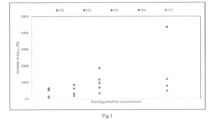
- Figure 1 shows the increase of the viscosity at a constant shear stress of 747 Pa, eta 747 , as a function of the amount of rheology modifier for the polyethylene resins PE1 to PE5 of the example section.
- the reactive polyolefin composition comprises the polyolefin resin (A) and the rheology modifier (B), which is free of peroxide.
- reaction conditions under which the polyolefin resin (A) and the rheology modifier (B) are reactive to form the thermoplastic polyolefin composition are a temperature in the range of from 180°C to 300°C and a specific energy equal to or greater than 0.15 kWh/kg.
- reaction conditions under which the polyolefin resin (A) and the rheology modifier (B) are reactive to form the thermoplastic polyolefin composition, are in a compounder, suitably an extruder. Said reaction conditions are therefore not applied through an additional processing step, for example an infrared heating curing step.
- the temperature for reacting the polyolefin resin (A) and the rheology modifier (B) is in the range of from 180°C to 300°C, more preferably in the range of from 220°C to 285°C and most preferably in the range of from 240°C to 280°C.
- the processing temperature can be selected at the lower end of the above range whereas for polyolefin resins (A) with a higher melting temperature T m the processing temperature can be selected at the upper end of the above range.
- the specific energy for reacting the polyolefin resin (A) and the rheology modifier (B) is in the range of from 0.15 kWh/kg to 0.50 kWh/kg, more preferably in the range of from 0.15 kWh/kg to 0.40 kWh/kg and most preferably in the range of from 0.20 kWh/kg to 0.30 kWh/kg.
- the specific energy is preferably introduced into the reactive polyolefin composition as kinetic energy, such as by means of shearing forces.
- the shearing forces to be applied to obtain a certain specific energy can depend on the density and viscosity of the polyolefin resin (A).
- a specific energy higher than 0.50 kWh/kg can result in chain scissions of the polymer chains of the polyolefin resin (A).
- the temperature and specific energy for reacting the reactive polyolefin composition are usually applied during the compounding step of the reactive polyolefin composition.
- the compounding step usually is conducted in a compounder such as a melt mixer or an extruder.
- the temperature is preferably applied by extruding the reactive polyolefin composition at an extruding temperature in the above described range.
- the specific energy is preferably applied by extruding the reactive polyolefin composition at a certain screw speed of the one or two screws of the extruder.
- the polyolefin resin (A) can be any polyolefin resin suitable for applications such as pipe applications, injection moulding applications, film applications, blow moulding and other extrusion applications.
- the polyolefin resin (A) can be a polyethylene resin, polypropylene resin, polybutylene resin or blended mixtures thereof.
- the polyolefin resin (A) is a polyethylene resin or a polypropylene resin or a blended mixture thereof such as a mechanical blend of a polyethylene resin and a polypropylene resin.
- Polyolefin resins which include polyolefin fractions, which differ not in their molecular weight but in their comonomer content, are also called “multimodal".
- a polyolefin resin with two fractions differing in their comonomer content thus are also called “bimodal”.
- a unimodal polyolefin resin only includes one polyolefin fraction which cannot be differentiated in molecular weight or comonomer content.
- unimodal polyolefin resins are polymerized in a single polymerization stage.
- the properties of the polyolefin resin (A) such as density, melt flow rate MFR 5 or viscosity are not specifically limited.
- polyolefin resin (A) e.g. polyethylene resins with a broad variety of densities, melt flow rates and viscosities can be suitably used.
- the polyolefin resin (A) is a polyethylene resin, preferably a copolymer of ethylene and one or more alpha-olefin comonomers, preferably of one or more C 4 to C 10 alpha olefin comonomers.
- the comonomer is selected from the group of 1-butene, 1-hexene, 4-methyl-1-pentene, 1-octene and 1-decene. Most preferably, the comonomer is 1-butene and/or 1-hexene.
- the polyethylene resin is preferably a multimodal polyethylene resin, more preferably a bimodal polyethylene resin.
- the polyethylene resin consists of two polyethylene fractions, the fraction having a lower weight average molecular weight is denoted low molecular weight fraction, the other is denoted high molecular weight fraction. Both fractions could be homo-and/or copolymer fractions.
- the polyethylene resin is an "in-situ"-blend.
- Such blends are preferably produced in a multistage process.
- an "in-situ" -blend may also be produced in one reaction stage by using two or more different kind of catalyst.
- the polymerization catalysts for the production of the polyethylene resin include coordination catalysts of a transition metal, such as Ziegler-Natta (ZN), metallocenes, non-metallocenes, Cr-catalysts etc.
- the catalyst may be supported, e.g. with conventional supports including silica, Al-containing supports and magnesium dichloride based supports.
- the catalyst is a ZN catalyst, more preferably the catalyst is a non-silica supported ZN catalyst, and most preferably a MgCl 2 -based ZN catalyst.
- the Ziegler-Natta catalyst further preferably comprises a group 4 (group numbering according to new IUPAC system) metal compound, preferably titanium, magnesium dichloride and aluminium.
- the catalyst may be commercially available or be produced in accordance or analogously to the literature.
- the content of these documents in its entirety is incorporated herein by reference, in particular concerning the general and all preferred embodiments of the catalysts described therein as well as the methods for the production of the catalysts.
- Particularly preferred Ziegler-Natta catalysts are described in EP 0 810 235 and WO 99/51646 .
- Such a polymerisation process generally comprises at least one polymerisation stage however the polymerisation process may also comprise additional polymerisation stages.
- the polymerisation at each stage is generally carried out in solution, slurry, bulk or gas phase.
- the process contains at least one bulk reactor stage and at least one gas phase reactor stage, each stage comprising at least one reactor and all reactors being arranged in cascade.
- the polymerisation process comprises at least one bulk reactor and at least one gas phase reactor arranged in that order.
- the process comprises one bulk reactor and at least two gas phase reactors, e.g. two or three gas phase reactors.
- the process may further comprise pre- and post reactors.
- Pre-reactors comprise typically prepolymerisation reactors.
- high polymerisation temperatures are generally used in order to achieve specific properties of the polymers. Typical temperatures in all processes are 70 °C or higher, preferably 80 °C or higher, more preferably 85 °C or higher.
- the high polymerisation temperatures as mentioned above are generally applied either in some or all reactors of the reactor cascade.
- the polyethylene resin has a density of 920 kg/m 3 or more, more preferably of 930 kg/m 3 or more, still more preferably of 940 kg/m 3 or more, still more preferably of 950 kg/m 3 or more.
- the density may also be between 920 to 960 kg/m 3 .
- the polyethylene resin can be selected from linear low density polyethylene (LLDPE) resins, medium density polyethylene (MDPE) resins and high density polyethylene (HDPE) resins.
- LLDPE linear low density polyethylene
- MDPE medium density polyethylene
- HDPE high density polyethylene
- the melt flow rate MFR 5 of the polyethylene resin preferably is in the range of from 0.05 g/10 min to 50 g/10 min, more preferably 0.10 g/10 min to 20 g/10 min.
- the melt flow rate thereby depends in the application of the thermoplastic polyethylene composition.
- the polyethylene resin has a MFR 21 of 1 to 100 g/10 min, more preferably of 2 to 50 g/10 min, and most preferably of 5 to 30 g/10 min.
- the flow rate ratio FRR 21/5 (the ratio between MFR 21 and MFR 5 ) of the polyethylene resin which is indicative for the broadness of the molecular weight distribution of a polymer is preferably from 5 to 60, more preferably from 15 to 55, even more preferably from 20 to 50.
- polyolefin resin (A) is a polypropylene resin.
- the polypropylene resin can be a random copolymer of propylene and one or more comonomers, preferably of one or more of ethylene and/or C 4 to C 10 alpha olefin comonomers.
- the comonomer is selected from the group of ethylene, 1-butene, 1-hexene, 4-methyl-1-pentene, 1-octene and 1-decene. More preferably, the comonomer is ethylene, 1-butene and/or 1-hexene. Most preferably the comonomer is ethylene.
- the polypropylene resin is preferably a multimodal propylene random copolymer resin, more preferably a bimodal propylene random copolymer resin.
- the polypropylene resin can be a heterophasic propylene copolymer which comprises a propylene homo- or random copolymer as matrix phase and an elastomeric copolymer such as a propylene based elastomeric copolymer or an ethylene-based elastomeric copolymer dispersed therein.
- the propylene random copolymer suitable as matrix phase can be a random copolymer of propylene and one or more comonomers, preferably of one or more of ethylene and/or C 4 to C 10 alpha olefin comonomers.
- the comonomer is selected from the group of ethylene, 1-butene, 1-hexene, 4-methyl-1-pentene, 1-octene and 1-decene. More preferably, the comonomer is ethylene, 1-butene and/or 1-hexene. Most preferably the comonomer is ethylene.
- a polymerisation catalyst will be present in the polymerisation process of the polypropylene resin.
- the polymerisation catalyst typically comprises a transition metal compound and an activator.
- a suitable polymerisation catalyst known in the art is generally a Ziegler-Natta catalyst.
- a Ziegler-Natta type catalyst typically used for propylene polymerisation and/or copolymerisation will be a stereospecific, solid, high yield Ziegler-Natta catalyst component comprising as main components Mg, Ti and Cl.
- a cocatalyst(s) as well as external donor(s) will generally be used in the polymerisation process.
- the components of the catalyst may be supported on a particulate support, such as inorganic oxide, like silica or alumina, or, usually, a magnesium halide may form the solid support. It is also possible that the catalyst components are not supported on an external support, but the catalyst is prepared by an emulsion-solidification method or by a precipitation method, as is well-known by the man skilled in the art of catalyst preparation.
- the solid catalyst usually also comprises at least one electron donor (internal electron donor) and optionally aluminium.
- Suitable external electron donors used in the polymerisation are well known in the art and include ethers, ketones, amines, alcohols, phenols, phosphines and silanes.
- Such a polymerisation process generally comprises at least one polymerisation stage however the polymerisation process may also comprise additional polymerisation stages.
- the polymerisation at each stage is generally carried out in solution, slurry, bulk or gas phase.
- the process contains at least one bulk reactor stage and at least one gas phase reactor stage, each stage comprising at least one reactor and all reactors being arranged in cascade.
- the polymerisation process comprises at least one bulk reactor and at least one gas phase reactor arranged in that order.
- the process comprises one bulk reactor and at least two gas phase reactors, e.g. two or three gas phase reactors.
- the process may further comprise pre- and post reactors.
- Pre-reactors comprise typically prepolymerisation reactors. In this kind of processes high polymerisation temperatures are generally used in order to achieve specific properties of the polymers.
- Typical temperatures in all processes are 70 °C or higher, preferably 80 °C or higher, more preferably 85 °C or higher.
- the high polymerisation temperatures as mentioned above are generally applied either in some or all reactors of the reactor cascade.
- the rheology modifier (B) is preferably a heterocyclic compound, more preferably a cyclic imide derivative. Still more preferably, the rheology modifier is selected from maleimide derivatives, most preferably is hexamethylene-1,6-dimaleimide.
- the rheology modifier (B) can be added to the reactive polyolefin composition as such (neat) in the amounts as described above or in form of so-called master batch (MB), in which the rheology modifier (B) are contained in concentrated form in a carrier polymer.
- the reactive polyolefin composition may comprise and preferably comprises usual additives (C) for utilization with polyolefins, such as stabilizers (e.g. antioxidant agents), metal scavengers and/or UV-stabilizers, antistatic agents and utilization agents (such as processing aid agents).
- additives (C) for utilization with polyolefins, such as stabilizers (e.g. antioxidant agents), metal scavengers and/or UV-stabilizers, antistatic agents and utilization agents (such as processing aid agents).
- the amount of these additives (C) is 10 wt% or below, more preferably 8 wt% or below, more preferably 5 wt% or below, of the reactive polyolefin composition.
- the amount of additives (C) different from carbon black is 0 wt% to 1 wt%, more preferably 0.001 wt% to 0.8 wt%.
- the reactive polyolefin composition can further comprise carbon black (B) in an amount of 1.0 to 10 wt%, preferably 1.5 to 9.0 wt%, more preferably 1.8 to 8.0 wt%, still more preferably 1.8 to 7.0 wt%, still more preferably 1.8 to 5.0 wt%, still more preferably 1.8 to 4.5 wt% and most preferably 1.8 to 4.0 wt%, based on the total amount of the reactive polyolefin composition.
- carbon black (B) in an amount of 1.0 to 10 wt%, preferably 1.5 to 9.0 wt%, more preferably 1.8 to 8.0 wt%, still more preferably 1.8 to 7.0 wt%, still more preferably 1.8 to 5.0 wt%, still more preferably 1.8 to 4.5 wt% and most preferably 1.8 to 4.0 wt%, based on the total amount of the reactive polyolefin composition.
- Carbon black (D) can be added to reactive polyolefin composition as such (neat) or in form of so-called master batch (CBMB), in which carbon black, and optionally further additives (C) as defined above, are contained in concentrated form in a carrier polymer.
- CBMB master batch
- carbon black, and optionally further additives (C) as defined above are contained in concentrated form in a carrier polymer.
- the optional carrier polymer of carbon black masterbatch is not calculated to the amount of the polymer components present in the reactive polyolefin composition.
- carbon black (D) and optional additive(s) (C) may be added to the reactive polyolefin composition in form of a masterbatch, i.e. together with a carrier polymer.
- the carrier polymer is not considered as polymer component(s), but is calculated into the amount (wt%) of carbon black (D) or, respectively, into the amount (wt%) of additive(s) (C).
- the amount of the optional carrier polymer of the carbon black master batch is 0 to 5 wt% based on the total amount of the reactive polyolefin composition.
- the reactive polyolefin composition is suitably produced by blending the polyolefin resin (A) the rheology modifier (B) and optionally further additives (C) and/or carbon black as described above or below.
- the blending can be conducted by mixing the components e.g. by dry-blending introducing the blended composition into a compounder such as a melt mixer or an extruder.
- a compounder such as a melt mixer or an extruder.
- the present invention also relates to a process for preparing a thermoplastic polyolefin composition
- a process for preparing a thermoplastic polyolefin composition comprising
- the reactive polyolefin composition is preferably prepared as described above and below and preferably comprises the components as described above and below.
- the reactive polyolefin composition is preferably heated to a temperature of from 180°C to 300°C, more preferably of from 220°C to 285°C and most preferably of from 240°C to 280°C.
- the heating temperature can be selected at the lower end of the above range whereas for polyolefin resins (A) with a higher melting temperature Tm the heating temperature can be selected at the upper end of the above range.
- the specific energy in process step c) is in the range of from 0.15 kWh/kg to 0.50 kWh/kg, more preferably in the range of from 0.15 kWh/kg to 0.40 kWh/kg and most preferably in the range of from 0.20 kWh/kg to 0.30 kWh/kg.
- the specific energy is preferably introduced into the reactive polyolefin composition as kinetic energy, such as by means of shearing forces.
- the shearing forces to be applied to obtain a certain specific energy can depend on the density and viscosity of the polyolefin resin (A). The lower the density and the lower the viscosity the lower is the amount of shearing forces which need to be applied to obtain a certain specific energy.
- the temperature and specific energy for reacting the reactive polyolefin composition are usually applied during the compounding step of the reactive polyolefin composition.
- the compounding step usually is conducted in a compounder such as a melt mixer or an extruder.
- the process steps b) and c) are carried out simultaneously in an extruder.
- the extruder preferably is selected from a single screw extruder or a twin screw extruder.
- the extruder is a shear-induced extruder.
- the temperature is preferably applied by extruding the reactive polyolefin composition at an extruding temperature in the above described range.
- the specific energy is preferably applied by extruding the reactive polyolefin composition at a certain screw speed of the one or two screws of the extruder.
- the further compounding conditions preferably are as follows:
- the mixer speed is in the range of from 200 to 750 rpm, more preferably in the range of from 300 to 500 rpm such as suitably around 400 rpm.
- the production rate preferably is preferably in the range of from 100 kg/hr to 1000 kg/hr, more preferably in the range of from 130 kg/hr to 750 kg/hr, still more preferably in the range of from 150 kg/hr to 500 kg/hr such as suitably in the range of from 170 kg/hr to 220 kg/hr.
- the gear pump suction pressure is preferably in the range of from 1.0 bar to 10 bar, more preferably in the range of from 1.5 bar to 5.0 bar, such as suitably in the range of from 2.0 bar to 3.0 bar.
- the gate opening is preferably in the range of from 10% to 50%, more preferably in the range of from 15% to 40%, such as suitably in the range of from 20% to 30%.
- thermoplastic polyolefin composition is formed by reacting the polyolefin resin (A) and the rheology modifier (B) under the reaction conditions described for process steps b) and c) as described above or below.
- thermoplastic polyolefin composition is preferably pelletized as known in the art.
- thermoplastic polyolefin composition has a higher viscosity at a constant shear stress of 747 Pa, eta 747 , a higher complex viscosity at a shear rate of 0.05 rad/s, eta 0.05 , a lower melt flow rate MFR 5 , a broader flow rate ratio FRR 21/5 , a broader shear thinning index SHI 0.5/300 , a broader shear thinning index SHI 2.7/210 , a broader shear thinning index SHI 5/200 , and a higher die swell, compared to a thermoplastic polyolefin composition which includes the same polyolefin resin (A) and the same optional additives and carbon black but does not include the rheology modifier (B) and is compounded using comparable compounding conditions.
- the thermoplastic polyolefin composition preferably has a viscosity at a constant shear stress of 747 Pa, eta 747 (Comp), which is at least 10% higher, more preferably at least 20% higher, still more preferably at least 30% higher and most preferably at least 50% higher as the viscosity at a constant shear stress of 747 Pa of the polyolefin composition based on polyolefin resin (A) without the rheology modifier (B), eta 747 (A).
- Comp eta 747
- the viscosity at constant shear stress of 747 Pa, eta 747 (Comp), of the thermoplastic polyolefin composition is preferably at most 500% higher, more preferably at most 200% higher, still more preferably at most 150% higher and most preferably at most 100% higher than the viscosity at a constant shear stress of 747 Pa of the polyolefin composition based on polyolefin resin (A) without the rheology modifier (B), eta 747 (A).
- the viscosity at constant shear stress of 747 Pa, eta 747 (Comp), of the thermoplastic polyolefin composition is preferably in the range of 10 to 500% higher, more preferably 20 to 200% higher, still more preferably 30 to 150% higher and most preferably in the range of 50 to 100% higher than the viscosity at a constant shear stress of 747 Pa of the polyolefin composition based on polyolefin resin (A) without the rheology modifier (B), eta 747 (A).
- thermoplastic polyolefin composition further preferably has a complex viscosity at a shear rate of 0.05 rad/s, eta 0.05 (Comp), which is at least 5% higher, more preferably at least 10% higher, still more preferably at least 20% higher and most preferably at least 25% higher as the complex viscosity at a shear rate of 0.05 rad/s of the polyolefin composition based on polyolefin resin (A) without the rheology modifier (B), eta 0.05 (A).
- Comp complex viscosity at a shear rate of 0.05 rad/s, eta 0.05
- the complex viscosity at a shear rate of 0.05 rad/s, eta 0.05 (Comp), of the thermoplastic polyolefin composition is preferably at most 70% higher, more preferably at most 50% higher, still more preferably at most 40% higher and most preferably at most 35% higher than the complex viscosity at a shear rate of 0.05 rad/s of the polyolefin composition based on polyolefin resin (A) without the rheology modifier (B), eta 0.05 (A).
- the complex viscosity at a shear rate of 0.05 rad/s, eta 0.05 (Comp), of the thermoplastic polyolefin composition is preferably in the range of 5 to 70% higher, more preferably 10 to 50% higher, still more preferably 20 to 40% higher and most preferably in the range of 25 to 35% higher than the complex viscosity at a shear rate of 0.05 rad/s of the polyolefin composition based on polyolefin resin (A) without the rheology modifier (B), eta 0.05 (A).
- thermoplastic polyolefin composition preferably has a melt flow rate MFR 5 (Comp), which is not more than 90%, preferably not more than 85%, more preferably not more than 80% and most preferably not more than 75% of the melt flow rate of the polyolefin composition based on polyolefin resin (A) without the rheology modifier (B), MFR 5 (A).
- MFR 5 melt flow rate
- the melt flow rate MFR 5 (Comp) of the thermoplastic polyolefin composition is preferably not less than 50%, more preferably not less than 60%, still more preferably not less than 65% and most preferably not less than 70% of the melt flow rate of the polyolefin composition based on polyolefin resin (A) without the rheology modifier (B), MFR 5 (A).
- the melt flow rate MFR 5 (Comp) of the thermoplastic polyolefin composition is preferably in the range of 50 to 90 %, more preferably 60 to 85%, still more preferably 65 to 80% and most preferably in the range of 70 to 75% of the melt flow rate of the polyolefin composition based on polyolefin resin (A) without the rheology modifier (B), MFR 5 (A).
- thermoplastic polyolefin composition preferably has a flow rate ratio FRR 21/5 (Comp), which is at least 1.0% higher, more preferably at least 1.5% higher, still more preferably at least 2.0% higher and most preferably at least 5.0% higher as the flow rate ratio of the polyolefin composition based on polyolefin resin (A) without the rheology modifier (B), FRR 21/5 (A).
- FRR 21/5 a flow rate ratio
- the flow rate ratio FRR 21/5 (Comp) of the thermoplastic polyolefin composition is preferably at most 30.0% higher, more preferably at most 20.0% higher, still more preferably at most 15.0% higher and most preferably at most 10.0% higher than the flow rate ratio the polyolefin composition based on polyolefin resin (A) without the rheology modifier (B), FRR 21/5 (A).
- the flow rate ratio FRR 21/5 (Comp) of the thermoplastic polyolefin composition is preferably in the range of 1.0 to 30.0% higher, more preferably 1.5 to 20.0% higher, still more preferably 2.0 to 15.0% higher and most preferably in the range of 5.0 to 10.0% higher than the flow rate ratio the polyolefin composition based on polyolefin resin (A) without the rheology modifier (B), FRR 21/5 (A).
- the flow rate ratio FRR 21/5 (Comp) of the thermoplastic polyolefin composition is preferably in the range of 0.5 to 35 % higher, more preferably 1.0 to 20.0% higher, still more preferably 1.5 to 15.0% higher and most preferably in the range of 5.0 to 20.0% higher than the flow rate ratio the polyolefin composition based on polyolefin resin (A) without the rheology modifier (B), FRR 21/5 (A).
- thermoplastic polyolefin composition preferably has a shear thinning index SHI 5/200 (Comp), which is at least 2.0% higher, more preferably at least 3.5% higher, still more preferably at least 5.0% higher and most preferably at least 7.5% higher than the shear thinning index of the polyolefin composition based on polyolefin resin (A) without the rheology modifier (B), SHI 5/200 (A).
- Comp shear thinning index SHI 5/200
- the shear thinning index SHI 5/200 (Comp) of the thermoplastic polyolefin composition is preferably at most 80.0% higher, more preferably at most 65.0% higher, still more preferably at most 40.0% higher and most preferably at most 25.0% higher than the shear thinning index of the polyolefin composition based on polyolefin resin (A) without the rheology modifier (B), SHI 5/200 (A).
- the shear thinning index SHI 5/200 (Comp) of the thermoplastic polyolefin composition is preferably in the range of 2.0 to 80.0% higher, more preferably 3.5 to 65.0% higher, still more preferably 5.0 to 40.0% higher and most preferably in the range of 7.5 to 25.0% higher than the shear thinning index of the polyolefin composition based on polyolefin resin (A) without the rheology modifier (B), SHI 5/200 (A).
- the flow rate ratio FRR 21/5 (Comp) of the thermoplastic polyolefin composition is preferably between 5 and 55, more preferably between 10 and 50, most preferably between 15 and ⁇ 50.
- thermoplastic polyolefin composition obtainable by the process according to the present invention.
- thermoplastic polyolefin composition preferably comprises the polyolefin resin (A), the rheology modifier (B) in their reacted form as described above and below as well as optionally the additives (C) and/or carbon black as described above or below.
- thermoplastic polyolefin composition preferably shows the properties as described above or below.
- the present invention relates to an article which comprises the thermoplastic polyolefin composition as described above or below or obtainable by the process as described above or below.
- the article is selected from a pipe, a film, a blow moulded article or any other extruded article.
- thermoplastic polyolefin composition when forming the article of the present invention.
- the present invention also relates to the use of a rheology modifier (B), which is free of peroxide initiator, in a reactive polyolefin composition comprising a polyolefin resin (A) and the rheology modifier (B), which is free of peroxide initiator, as described above or below, for increasing the viscosity at a constant shear stress of 747 Pa of the final thermoplastic polyolefin composition, eta 747 (Comp), and reducing the melt flow rate of the final thermoplastic polyolefin composition, MFR 5 (Comp), by reacting the polyolefin resin (A) and the rheology modifier (B) at a temperature in the range of from 180°C to 300°C and a specific energy equal to or greater than 0.15 kWh/kg, in a compounder.
- a rheology modifier (B) which is free of peroxide initiator
- melt flow rate is determined according to ISO 1133 and is indicated in g/10 min.
- the MFR is an indication of the flowability, and hence the processability, of the polymer. The higher the melt flow rate, the lower the viscosity of the polymer.
- the MFR 5 of polyethylene is measured at a temperature of 190 °C and a load of 5 kg
- the MFR 2 of polyethylene at a temperature of 190 °C and a load of 2.16 kg
- the MFR 21 of polyethylene is measured at a temperature of 190 °C and a load of 21.6 kg.
- the quantity FRR flow rate ratio
- FRR 21/5 denotes the value of MFR 21 /MFR 5 .
- Density of the polymer was measured according to ISO 1183-1:2004 Method A on compression moulded specimen prepared according to EN ISO 1872-2 (Feb 2007) and is given in kg/m 3 .
- the characterization of polymer melts by dynamic shear measurements complies with ISO standards 6721-1 and 6721-10.
- the measurements were performed on an Anton Paar MCR301 stress controlled rotational rheometer, equipped with a 25 mm parallel plate geometry. Measurements were undertaken on compression moulded plates using nitrogen atmosphere and setting a strain within the linear viscoelastic regime. The oscillatory shear tests were done at 190°C applying a frequency range between 0.0154 and 500 rad/s and setting a gap of 1.2 mm.
- the elasticity index EI(x) is the value of the storage modulus, G', determined for a value of the loss modulus, G", of x kPa and can be described by equation 9.
- the EI(5 kPa) is defined by the value of the storage modulus G', determined for a value of G'' equal to 5 kPa.
- the SHI (0.05/300) is defined by the value of the complex viscosity, in Pa.s, determined for a value of G* equal to 0.05 kPa, divided by the value of the complex viscosity, in Pa.s, determined for a value of G* equal to 300 kPa.
- the SHI (5/200) is defined by the value of the complex viscosity, in Pa.s, determined for a value of G* equal to 5 kPa, divided by the value of the complex viscosity, in Pa.s, determined for a value of G* equal to 200 kPa.
- the SHI (2.7/210) is defined by the value of the complex viscosity, in Pa.s, determined for a value of G* equal to 2.7 kPa, divided by the value of the complex viscosity, in Pa.s, determined for a value of G* equal to 210 kPa.
- ⁇ * 300rad/s (eta* 300rad/s ) is used as abbreviation for the complex viscosity at the frequency of 300 rad/s and ⁇ * 0.05rad/s (eta* 0.05rad/s ) is used as abbreviation for the complex viscosity at the frequency of 0.05 rad/s.
- the values are determined by means of a single point interpolation procedure, as defined by Rheoplus software. In situations for which a given G* value is not experimentally reached, the value is determined by means of an extrapolation, using the same procedure as before. In both cases (interpolation or extrapolation), the option from Rheoplus "Interpolate y-values to x-values from parameter" and the "logarithmic interpolation type" were applied.
- One method which correlates well with the sagging properties, and is used in connection with the present invention relates to the rheology of the polymer and is based on determination of the viscosity of the polymer at a constant shear stress.
- a shear stress of 747 Pa has been selected for this method.
- the viscosity of the polymer at this shear stress is determined at a temperature of 190 °C and has been found to be inversely proportional to the gravity flow of the polymer, i.e. the greater the viscosity the lower the gravity flow.
- the determination of the viscosity at 747 Pa shear stress is made by using a rotational rheometer, which can be a constant stress rheometer as for example an Anton Paar MCR Series Rheometer. Rheometers and their function have been described in " Encyclopedia of Polymer Science and Engineering", 2nd Ed., Vol. 14, pp. 492-509 . The measurements are performed under a constant shear stress between two 25 mm diameter plates (constant rotation direction). The gap between the plates is 1.2 mm.
- the sample is temperature conditioned before the measurement is started.
- the measurement is performed at 190 °C.
- After temperature conditioning the measurement starts by applying the predetermined stress of 747 Pa.
- the stress is maintained during the measurement time of 1860 s.
- the eta 747 parameter is calculated by averaging the last 5 points of the measured transient shear viscosity. These are found to be in the interval from 1620 to 1860 s. Therefore, the eta 747 is determined at a corresponding time of 1740 s.
- the measurement principle is to apply a certain torque to the plate axis via a precision motor. This torque is then translated into a shear stress in the sample. This shear stress is kept constant. The rotational speed produced by the shear stress is recorded and used for the calculation of the viscosity of the sample.
- the tensile modulus (E-modulus) of the compositions was measured at 23 °C on compression molded specimens according to ISO 527-2:1993.
- the specimens (1B type) were cut from plaques of 4 mm thickness prepared by compression molding according to ISO 293:2004 using the conditions defined in chapter 3.3 of ISO 1872-2:2007.
- the modulus was measured at a speed of 1 mm/min.
- the tensile strength at break and elongation at break (i.e. tensile strain at break) is measured according to ISO 527-1 (cross head speed 50 mm/min) at a temperature of 23 °C.
- Charpy impact strength is determined according to ISO179/1eA:2000 on V-notched samples of 80*10*4 mm 3 at -20°C (Charpy impact strength (-20 °C)) and at 23°C (Charpy impact strength (23 °C)). Samples were cut from plaques of 4 mm thickness prepared by compression molding according to ISO 293:2004 using the conditions defined in chapter 3.3 of ISO 1872-2:2007.
- the melting temperature of the used polymers was measured in accordance with ISO 11357-3.
- T m and T cr were measured with TA Instruments Q2000 differential scanning calorimetry (DSC) on 3 ⁇ 0.5 mg samples. Both crystallization and melting curves were obtained during 10 °C/min cooling and heating scans between 0 and 200 °C. Melting and crystallization temperatures were taken as the peaks of endotherms and exotherms, respectively.
- the strain hardening behaviour is determined by the method as described in the article " Rheotens-Mastercurves and Drawability of Polymer Melts", M. H. Wagner, Polymer Engineering and Science, Vol. 36, pages 925 to 935 .
- the strain hardening behaviour of polymers is analysed by Rheotens apparatus (product of Göttfert, Siemensstr.2, 74711 Buchen, Germany) in which a melt strand is elongated by drawing down with a defined acceleration.
- the Rheotens experiment simulates industrial spinning and extrusion processes. In principle a melt is pressed or extruded through a round die and the resulting strand is hauled off.
- the stress on the extrudate is recorded, as a function of melt properties and measuring parameters (especially the ratio between output and haul-off speed, practically a measure for the extension rate).
- the gear pump was pre-adjusted to a strand extrusion rate of 5 mm/s, and the melt temperature was set to 200°C.
- the spinline length between die and Rheotens wheels was 100 mm.
- the take-up speed of the Rheotens wheels was adjusted to the velocity of the extruded polymer strand (tensile force zero): Then the experiment was started by slowly increasing the take-up speed of the Rheotens wheels until the polymer filament breaks.
- the acceleration of the wheels was small enough so that the tensile force was measured under quasi-steady conditions.
- the acceleration of the melt strand drawn down is 120 mm/sec2.
- the Rheotens was operated in combination with the PC program (rheotens).
- the end points of the Rheotens curve (force versus pulley rotary speed), where the polymer strand ruptures, are taken as the F30 melt strength and drawdown velocity.
- Die swell properties are measured at 190 °C for PE (or 230°C for PP) and shear/load (2.16 kg and/or 5kg) using melt-indexers, such as Göttfert MI-4.
- melt-indexers such as Göttfert MI-4.
- the melt indexer or capillary rheometer the polymer melt is forced to flow from a reservoir (barrel) through a capillary die of known dimension.
- a given load (weight) or shear rate (piston speed) is applied, the material undergoes a contraction flow. After the material flows out from the capillary die, and due to its inherent/specific viscoelastic properties, a phenomenon characterized by a "swelling" of the extrudate takes place. This phenomenon is mentioned as die swell.
- the reported swell ratios were calculated from the average of measured strand diameters.
- the die swell can also be expressed by the percentage change in the extrudate diameter relative to the die diameter (percent swell).
- the strain hardening test is a modified tensile test performed at 80 °C on a specially prepared thin sample.
- the Strain Hardening Modulus (MPa), ⁇ Gp>, is calculated from True Strain-True Stress curves; by using the slope of the curve in the region of True Strain, ⁇ , is between 8 and 12.
- the true strain, ⁇ is calculated from the length, l (mm), and the gauge length, l 0 (mm), as shown by Equation 1.
- ⁇ l the increase in the specimen length between the gauge marks, (mm).
- the Neo-Hookean constitutive model (Equation 3) is used to fit the true strain- true stress data from which ⁇ Gp> (MPa) for 8 ⁇ ⁇ ⁇ 12 is calculated.
- ⁇ true Gp 20 ⁇ 2 ⁇ 1 ⁇ + C
- the PE granules of materials were compression molded in sheets of 0.30 mm thickness according to the press parameters as provided in ISO 1872-2, Table 2.
- the sheets were annealed to remove any orientation or thermal history and maintain isotropic sheets. Annealing of the sheets was performed for 1 h in an oven at a temperature of (120 ⁇ 2) °C followed by slowly cooling down to room temperature by switching off the temperature chamber. During this operation free movement of the sheets was allowed.
- test pieces were punched from the pressed sheets.
- the sample has a large clamping area to prevent grip slip, dimensions given the below table.
- the punching procedure is carried out in such a way that no deformation, crazes or other irregularities are present in the test pieces.
- the thickness of the samples was measured at three points of the parallel area of the specimen; the lowest measured value of the thickness of these measurements was used for data treatment.
- the load sustained by the specimen is measured with a load cell of 200 N.
- the elongation is measured with a non-contact extensometer.
- the catalyst was prepared as described in example 1 of WO 99/51646
- a first loop reactor having a volume of 50 dm 3 and operating at a temperature of 70 °C and a pressure of 57.4 bar propane (C 3 , 50 kg/h), ethylene (C 2 , 2 kg/h), and hydrogen (H 2 , 5 g/h) were introduced for conducting a pre-polymerization step.
- propane (C 3 , 50 kg/h) propane (C 3 , 50 kg/h), ethylene (C 2 , 2 kg/h), and hydrogen (H 2 , 5 g/h) were introduced for conducting a pre-polymerization step.
- the Ziegler-Natta catalyst prepared as described above under a) was introduced into the reactor together with triethylaluminium cocatalyst so that the ratio of aluminium to titanium was 15 mol/mol.
- the slurry was withdrawn intermittently from the prepolymerization reactor and directed to a second loop reactor having a volume of 500 dm 3 and operating at a temperature of 95 °C and a pressure of 55.8 bar. Additionally, propane, ethylene and hydrogen were fed to the second loop reactor whereby the ethylene concentration and the hydrogen to ethylene ratio for example PE1 are listed in Table 1. The production rate, split, the density and melt index of the polymer fractions produced in the second loop reactor are listed in Table 1.
- the slurry was withdrawn intermittently from the second loop reactor by using settling legs and directed to a gas phase reactor.
- the gas phase reactor was operated at a temperature of 85 °C and a pressure of 20 bar. Additional ethylene, 1-hexene comonomer (C 6 ), and hydrogen were fed whereby the ethylene concentration, the 1-hexene to ethylene ratio and the hydrogen to ethylene ratio as well as the production split and the density of the polymers of example Ex 1 withdrawn from the gas phase reactor are listed in Table 1.
- the Polyethylene Resin PE1 was purged with nitrogen (about 50 kg/h) for one hour, stabilised with commercial stabilisers, 1100 ppm of Irganox 1010, 1100 ppm Irgafos 168 and 1100 ppm Ca-stearate and then extruded together with 2.3 wt% carbon black to pellets in a Mixtron LCM 80 counter-rotating twin screw extruder (manufactured by KOBELCO, Kobe Steel, Japan) using the compounding conditions as listed below in Table 2.
- IE1 and IE2 hexamethylene-1,6-di maleimide commercially available as Nexamite A48 from Nexam Chemical, Lund (Sweden) was mixed as rheology modifier into the polyethylene resin PE1 in the amounts as listed in Table 2.
- Table 2 shows the compounding conditions of the compounded composition as well as the properties of the compounded compositions of CE1, IE1 and IE2.
- Table 2 Compounding of PE1 CE1 IE1 IE2 Compounded composition PE1 [wt%] 97.35 97.32 97.30 Additives [ppm] 3500 3500 3500 Carbon Black [wt%] 2.3 2.3 2.3 Rheology modifier [ppm] 0 300 500 Compounding Conditions Temperature [°C] 275 275 275 Production Rate [kg/hr] 200 200 200 Mixer Speed [rpm] 400 400 400 Gear pump suc pressure [bar] 2.7 2.7 2.7 Gate opening [%] 28.1 28.1 28.1 Specific Energy [kWh/kg] 0.258 0.256 0.260
- the Polyethylene Resin PE2 was purged with nitrogen (about 50 kg/h) for one hour, stabilised with commercial stabilisers, 1100 ppm of Irganox 1010, 1100 ppm Irgafos 168 and 1100 ppm Ca-stearate and then extruded together with 2.3 wt% carbon black to pellets in a Mixtron LCM 80 counter-rotating twin screw extruder (manufactured by KOBELCO, Kobe Steel, Japan) using the compounding conditions as listed below in Table 3.
- a Mixtron LCM 80 counter-rotating twin screw extruder manufactured by KOBELCO, Kobe Steel, Japan
- IE3 and IE4 hexamethylene-1,6-di maleimide commercially available as Nexamite A48 from Nexam Chemical, Lund (Sweden) was mixed as rheology modifier into the polyethylene resin PE1 in the amounts as listed in Table 3.
- Table 3 shows the compounding conditions of the compounded composition as well as the properties of the compounded compositions of CE2, IE3 and IE4.
- Table 3 Compounding of PE2 CE2 IE3 IE4 Compounded composition PE1 [wt%] 97.35 97.34 97.32 Additives [ppm] 3500 3500 3500 Carbon Black [wt%] 2.3 2.3 2.3 Rheology modifier [ppm] 0 100 300 Compounding Conditions Temperature [°C] 252 262 262 Production Rate [kg/hr] 189 189 189 Mixer Speed [rpm] 400 400 400 Gear pump suc pressure [bar] 2.7 2.7 2.7 Gate opening [%] 29.3 29.3 29.3 Specific Energy [kWh/kg] 0.260 0.260 0.260 Properties of the compounded compositions MFR 5 [g/10 min] 0.15 0.15 0.11 MFR 21 [g/10 min] 5.58 5.55 4.53 FRR 21/5 36 38 40 Laser Die Swell, dyn.
- the Polyethylene Resin PE3 was purged with nitrogen (about 50 kg/h) for one hour, stabilised with commercial stabilisers, 1100 ppm of Irganox 1010, 1100 ppm Irgafos 168 and 1100 ppm Ca-stearate and then extruded to pellets in a Mixtron LCM 80 counter-rotating twin screw extruder (manufactured by KOBELCO, Kobe Steel, Japan) using the compounding conditions as listed below in Table 4.
- a Mixtron LCM 80 counter-rotating twin screw extruder manufactured by KOBELCO, Kobe Steel, Japan
- IE5 IE6 and IE7 hexamethylene-1,6-di maleimide, commercially available as Nexamite A48 from Nexam Chemical, Lund (Sweden) was mixed as rheology modifier into the polyethylene resin PE3 in the amounts as listed in Table 4.
- Table 4 shows the compounding conditions of the compounded composition as well as the properties of the compounded compositions of CE3, IE5, IE6 and IE7.
- the Polyethylene Resin PE4 was purged with nitrogen (about 50 kg/h) for one hour, stabilised with commercial stabilisers, 1100 ppm of Irganox 1010, 1100 ppm Irgafos 168 and 1100 ppm Ca-stearate and then extruded to pellets in a Mixtron LCM 80 counter-rotating twin screw extruder (manufactured by KOBELCO, Kobe Steel, Japan) using the compounding conditions as listed below in Table 2.
- IE8 IE9 and IE10 hexamethylene-1,6-di maleimide, commercially available as Nexamite A48 from Nexam Chemical, Lund (Sweden) was mixed as rheology modifier into the polyethylene resin PE4 in the amounts as listed in Table 5.
- Table 5 shows the compounding conditions of the compounded composition as well as the properties of the compounded compositions of CE4, IE8, IE9 and IE10.
- Table 5 Compounding of PE4 CE4 IE8 IE9 IE10
- Compounded composition PE4 [wt%] 99.650 99.635 99.620 99.600
- Additives [ppm] 3500 3500 3500 3500
- Rheology modifier [ppm] 0 150
- Compounding Conditions Temperature [°C] 254.6 257.8 262.7 263.1 Production Rate [kg/hr] 195 195 195 195 195 195
- Properties of the compounded compositions MFR 5 [g/10 min] 1.48 1.49 1.33 1.34
- MFR 21 [g/10 min] 28.9 29.5 27.
- the Polyethylene Resin PE5 was purged with nitrogen (about 50 kg/h) for one hour, stabilised with commercial stabilisers, 1100 ppm of Irganox 1010, 1100 ppm Irgafos 168 and 1100 ppm Ca-stearate and then extruded to pellets in a Mixtron LCM 80 counter-rotating twin screw extruder (manufactured by KOBELCO, Kobe Steel, Japan) using the compounding conditions as listed below in Table 6.
- IE11, IE12 and IE13 hexamethylene-1,6-di maleimide commercially available as Nexamite A48 from Nexam Chemical, Lund (Sweden) was mixed as rheology modifier into the polyethylene resin PE5 in the amounts as listed in Table 6.
- Table 6 shows the compounding conditions of the compounded composition as well as the properties of the compounded compositions of CE5, IE11, IE12 and IE13.
- Table 6 Compounding of PE5 CE5 IE11 IE12 IE13 Compounded composition PE5 [wt%] 99.650 99.635 99.620 99.600 Additives [ppm] 3500 3500 3500 3500 Rheology modifier [ppm] 0 150 300 500 Compounding Conditions Temperature [°C] 245.4 247.5 253.4 255.2 Production Rate [kg/hr] 190 190 190 190 190 190 190 Mixer Speed [rpm] 400 400 400 400 Gear pump suc pressure [bar] 2.5 2.5 2.5 2.5 2.5 Gate opening [%] 20 20 20 20 20 Specific Energy [kWh/kg] 0.223 0.225 0.220 0.220 Properties of the compounded compositions MFR 5 [g/10 min] 2.51 2.48 2.21 2.16 MFR 21 [g/10 min] 51.6 51.3 46.7 45.8 FRR 21/5 20.6 20.7 21.1
- the polyethylene resins in powder form reactor is mixed with antioxidant additive and filler like carbon black during the compounding step to impart necessary functionality in the polymer and final polyethylene composition is in pellet form.
- antioxidant additive and filler like carbon black during the compounding step to impart necessary functionality in the polymer
- final polyethylene composition is in pellet form.
- the shear energy imparted in the polymer is measured as the specific energy (kWh/kg) requirement in the compounding process is a function of polymer enthalpy, rate of processing, suction pressure of melt pump, rpm of screw, melt viscosity of polymer.
Landscapes
- Chemical & Material Sciences (AREA)
- Health & Medical Sciences (AREA)
- Chemical Kinetics & Catalysis (AREA)
- Medicinal Chemistry (AREA)
- Polymers & Plastics (AREA)
- Organic Chemistry (AREA)
- Engineering & Computer Science (AREA)
- Manufacturing & Machinery (AREA)
- Materials Engineering (AREA)
- Compositions Of Macromolecular Compounds (AREA)
- Polymerisation Methods In General (AREA)
Claims (15)
- Reaktive Polyolefin-Zusammensetzung, umfassend(A) ein Polyolefinharz;(B) einen Rheologiemodifikator, der frei von einem Peroxidinitiator ist,wobei das Polyolefinharz (A) und der Rheologiemodifikator (B) reaktiv sind, um eine thermoplastische Polyolefin-Zusammensetzung bei einer Temperatur im Bereich von 180°C bis 300°C und einer spezifischen Energie gleich oder größer als 0,15 kWh/kg zu bilden,wobei der Rheologiemodifikator (B) in der reaktiven Polyolefin-Zusammensetzung in einer Menge im Bereich von > 150 bis 750 ppm, bezogen auf die Gesamtmenge der reaktiven Polyolefin-Zusammensetzung, vorhanden ist.
- Reaktive Polyolefin-Zusammensetzung nach Anspruch 1, wobei der Rheologiemodifikator (B) Hexamethylen-1,6-dimaleimid ist.
- Reaktive Polyolefin-Zusammensetzung nach Anspruch 1 oder 2, wobei der Rheologiemodifikator (B) in der reaktiven Polyolefin-Zusammensetzung in einer Menge im Bereich von > 150 bis < 750 ppm, weiter bevorzugt 200 bis 700 ppm, bezogen auf die Gesamtmenge der reaktiven Polyolefin-Zusammensetzung, vorhanden ist.
- Reaktive Polyolefin-Zusammensetzung nach einem der vorhergehenden Ansprüche, wobei das Polyolefinharz (A) aus einem Polyethylenharz, einem Polypropylenharz oder Mischungen davon ausgewählt ist.
- Reaktive Polyolefin-Zusammensetzung nach einem der vorhergehenden Ansprüche, wobei das Polyolefinharz (A) unimodal, bimodal oder multimodal ist und/oder wobei das Polyolefinharz (A) ein Polyethylenharz ist, ausgewählt aus linearem Polyethylen niedriger Dichte (LLDPE), Polyethylen mittlerer Dichte (MDPE) oder Polyethylen hoher Dichte (HDPE).
- Reaktive Polyolefin-Zusammensetzung nach einem der vorhergehenden Ansprüche, wobei die reaktive Polyolefin-Zusammensetzung frei von Peroxidradikal-Initiierungsmitteln oder anderen Koagenzien ist.
- Verfahren zur Herstellung einer thermoplastischen Polyolefin-Zusammensetzung, umfassenda) Bereitstellen einer reaktiven Polyolefin-Zusammensetzung nach einem der vorhergehenden Ansprüche;b) Erhitzen der reaktiven Polyolefin-Zusammensetzung auf eine Temperatur von 180°C bis 300°C; undc) Unterwerfen der reaktiven Polyolefin-Zusammensetzung einer spezifischen Energie von gleich oder mehr als 0,15 kWh/kg, um die thermoplastische Polyolefin-Zusammensetzung zu erhalten, wobei die Verfahrensschritte (b) und (c) gleichzeitig in einem Extruder durchgeführt werden und der Extruder mit einer Mischergeschwindigkeit im Bereich von 200 bis 750 U/min betrieben wird.
- Verfahren nach Anspruch 7, wobei die Verfahrensschritte (b) und (c) gleichzeitig in einem Extruder durchgeführt werden, der aus einem Einschneckenextruder und einem Doppelschneckenextruder ausgewählt ist.
- Verfahren nach Anspruch 8, wobei der Extruder mit einer Mischergeschwindigkeit im Bereich von 300 bis 500 U/min betrieben wird.
- Verfahren nach einem der Ansprüche 7 bis 9, wobei die spezifische Energie durch Scherkraft bereitgestellt wird.
- Verfahren nach einem der Ansprüche 7 bis 10, wobei die thermoplastische Polyolefin-Zusammensetzung eine Viskosität bei einer konstanten Scherbeanspruchung von 747 Pa, eta747 (Comp), aufweist, die mindestens 10 % höher, vorzugsweise mindestens 20 % höher, noch bevorzugter mindestens 30 % höher und am meisten bevorzugt mindestens 50 % höher ist als die Viskosität bei einer konstanten Scherbeanspruchung von 747 Pa der Polyolefin-Zusammensetzung auf Basis von Polyolefinharz (A) ohne den Rheologiemodifikator (B), eta747 (A).
- Verfahren nach einem der Ansprüche 7 bis 11, wobei die thermoplastische Polyolefin-Zusammensetzung aufweist:a) eine komplexe Viskosität bei einer Scherrate von 0,05 rad/s, eta0,05 (Comp), die mindestens 5 % höher ist als die komplexe Viskosität bei einer Scherrate von 0,05 rad/s der Polyolefin-Zusammensetzung auf Basis von Polyolefinharz (A) ohne den Rheologiemodifikator (B), eta0,05 (A), und/oderb) eine Schmelzflussrate MFR5 (Comp), die nicht mehr als 90 % der Schmelzflussrate der Polyolefin-Zusammensetzung auf der Basis von Polyolefinharz (A) ohne den Rheologiemodifikator (B) beträgt, MFR5 (A), und/oderc) ein Fließratenverhältnis FRR21/5 (Comp), das mindestens 1,0 % höher ist als das Fließratenverhältnis der Polyolefin-Zusammensetzung auf Basis von Polyolefinharz (A) ohne den Rheologiemodifikator (B), FRR21/5 (A), und/oderd) ein Durchflussmengenverhältnis FRR21/5 (Comp), das zwischen 5 und 55 liegt.
- Thermoplastische Polyolefin-Zusammensetzung, erhältlich nach dem Verfahren gemäß einem der Ansprüche 7 bis 12.
- Gegenstand, der die thermoplastische Polyolefin-Zusammensetzung nach Anspruch 13 enthält oder durch das Verfahren nach einem der Ansprüche 7 bis 12 erhältlich ist, der vorzugsweise aus einem Rohr, einer Folie oder einem blasgeformten oder einem anderen extrudierten Gegenstand ausgewählt ist.
- Verwendung eines Rheologiemodifikators (B), der frei von einem Peroxidinitiator ist, in einer reaktiven Polyolefin-Zusammensetzung, die ein Polyolefinharz (A) und den Rheologiemodifikator (B), der frei von einem Peroxidinitiator ist, nach einem der Ansprüche 1 bis 6 umfasst, um die Viskosität bei einer konstanten Scherspannung von 747 Pa der endgültigen thermoplastischen Polyolefin-Zusammensetzung zu erhöhen, eta747 (Comp), Verringerung der Schmelzflußrate der endgültigen thermoplastischen Polyolefin-Zusammensetzung, MFR5 (Comp), durch Umsetzung des Polyolefinharzes (A) und des Rheologiemodifikators (B) bei einer Temperatur im Bereich von 180°C bis 300°C und einer spezifischen Energie gleich oder größer als 0.15 kWh/kg in einem Compounder.
Applications Claiming Priority (2)
| Application Number | Priority Date | Filing Date | Title |
|---|---|---|---|
| EP18173235 | 2018-05-18 | ||
| PCT/EP2019/062784 WO2019219902A1 (en) | 2018-05-18 | 2019-05-17 | Improving rheological properties of thermoplastic polyolefin compositions |
Publications (2)
| Publication Number | Publication Date |
|---|---|
| EP3794262A1 EP3794262A1 (de) | 2021-03-24 |
| EP3794262B1 true EP3794262B1 (de) | 2025-05-07 |
Family
ID=62217832
Family Applications (1)
| Application Number | Title | Priority Date | Filing Date |
|---|---|---|---|
| EP19724202.7A Active EP3794262B1 (de) | 2018-05-18 | 2019-05-17 | Verbesserung der rheologischen eigenschaften von thermoplastischen polyolefinzusammensetzungen |
Country Status (6)
| Country | Link |
|---|---|
| US (1) | US20210171749A1 (de) |
| EP (1) | EP3794262B1 (de) |
| CN (1) | CN112368501B (de) |
| SA (1) | SA520420399B1 (de) |
| TW (1) | TWI736891B (de) |
| WO (1) | WO2019219902A1 (de) |
Families Citing this family (22)
| Publication number | Priority date | Publication date | Assignee | Title |
|---|---|---|---|---|
| ES2874060T3 (es) | 2017-12-05 | 2021-11-04 | Borealis Ag | Artículo que comprende una composición de polipropileno reforzada con fibra |
| EP3495422B1 (de) | 2017-12-05 | 2020-11-11 | Borealis AG | Faserverstärkte polypropylenzusammensetzung |
| KR102553655B1 (ko) | 2018-04-16 | 2023-07-07 | 보레알리스 아게 | 다층 요소 |
| CN110498973B (zh) | 2018-05-16 | 2023-09-01 | 北欧化工公司 | 发泡聚丙烯组合物 |
| EP3584089A1 (de) | 2018-06-19 | 2019-12-25 | Borealis AG | Polyolefinzusammensetzung mit verbessertem kontrast von lasermarkierungen |
| WO2020025757A1 (en) | 2018-08-02 | 2020-02-06 | Borealis Ag | Process for polymerizing ethylene in a multi-stage polymerization process |
| WO2020064313A1 (en) | 2018-09-26 | 2020-04-02 | Borealis Ag | Propylene random copolymer for use in film applications |
| US12404393B2 (en) | 2018-09-26 | 2025-09-02 | Borealis Ag | Propylene copolymer composition with excellent optical and mechanical properties |
| CN112638959B (zh) | 2018-09-26 | 2023-05-02 | 博里利斯股份公司 | 具有优异光学性能的丙烯共聚物 |
| CA3107692C (en) | 2018-10-02 | 2023-10-17 | Borealis Ag | High speed cross-linking of grafted plastomers |
| KR102593923B1 (ko) | 2018-12-20 | 2023-10-25 | 보레알리스 아게 | 파괴 강도가 개선된 2축 배향 폴리프로필렌 필름 |
| CN113260642B (zh) * | 2018-12-27 | 2023-03-14 | Sabic环球技术有限责任公司 | 制备聚乙烯的方法 |
| ES3053799T3 (en) | 2019-07-01 | 2026-01-26 | Borealis Gmbh | Pipe made of peroxide-crosslinked polyethylene of high uv stability |
| EP3994187A1 (de) | 2019-07-04 | 2022-05-11 | Borealis AG | Langkettige verzweigte propylenpolymerzusammensetzung |
| WO2021001200A1 (en) * | 2019-07-04 | 2021-01-07 | Sabic Global Technologies B.V. | Multimodal polyethylene |
| EP3763777B1 (de) | 2019-07-08 | 2022-03-16 | Borealis AG | Aldehydgehaltreduzierungsverfahren und recyceltes polyolefin mit niedrigem aldehydgehalt |
| KR102723723B1 (ko) | 2019-08-19 | 2024-10-29 | 보레알리스 아게 | 개선된 특성을 갖는 폴리프로필렌 - 폴리에틸렌 배합물 |
| WO2021144179A1 (en) | 2020-01-16 | 2021-07-22 | Borealis Ag | Process for avoiding phase separation during solution polymerization of ethylene-1-butene copolymers |
| CA3167398A1 (en) | 2020-01-16 | 2021-07-22 | Borealis Ag | Process for avoiding phase separation during solution polymerization of ethylene-1-octene copolymers |
| BR112022020713A2 (pt) | 2020-04-17 | 2022-11-29 | Borealis Ag | Filme soprado |
| WO2025125458A1 (en) | 2023-12-12 | 2025-06-19 | Abu Dhabi Polymers Co. Ltd (Borouge) - Sole Proprietorship L.L.C. | Modified polyethylene having improved hydrostatic pressure resistance and slow crack growth resistance |
| EP4574891A1 (de) | 2023-12-19 | 2025-06-25 | Abu Dhabi Polymers Co. Ltd (Borouge) - Sole Proprietorship L.L.C. | Polyethylenzusammensetzungen mit verbesserten rheologischen eigenschaften |
Family Cites Families (48)
| Publication number | Priority date | Publication date | Assignee | Title |
|---|---|---|---|---|
| US4226963A (en) | 1971-06-25 | 1980-10-07 | Montedison S.P.A. | Process for the stereoregular polymerization of alpha-olephins |
| US4107414A (en) | 1971-06-25 | 1978-08-15 | Montecatini Edison S.P.A. | Process for the stereoregular polymerization of alpha olefins |
| US4186107A (en) | 1978-04-14 | 1980-01-29 | Hercules Incorporated | Solid catalyst component for olefin polymerization |
| US4347160A (en) | 1980-06-27 | 1982-08-31 | Stauffer Chemical Company | Titanium halide catalyst system |
| IT1209255B (it) | 1980-08-13 | 1989-07-16 | Montedison Spa | Catalizzatori per la polimerizzazione di olefine. |
| JPS57153005A (en) | 1981-03-19 | 1982-09-21 | Ube Ind Ltd | Polymerization of alpha-olefin |
| US4530912A (en) | 1981-06-04 | 1985-07-23 | Chemplex Company | Polymerization catalyst and method |
| EP0072129B2 (de) | 1981-08-07 | 1990-02-28 | Imperial Chemical Industries Plc | Übergangsmetallzusammensetzung auf einem Träger aufgebracht |
| US4382019A (en) | 1981-09-10 | 1983-05-03 | Stauffer Chemical Company | Purified catalyst support |
| IT1190681B (it) | 1982-02-12 | 1988-02-24 | Montedison Spa | Componenti e catalizzatori per la polimerizzazione di olefine |
| IT1190682B (it) | 1982-02-12 | 1988-02-24 | Montedison Spa | Catalizzatori per la polimerizzazione di olefine |
| IT1190683B (it) | 1982-02-12 | 1988-02-24 | Montedison Spa | Componenti e catalizzatori per la polimerizzazione di olefine |
| US4532313A (en) | 1982-10-13 | 1985-07-30 | Himont Incorporated | Method for preparing an improved catalyst support, Ziegler-Natta catalyst utilizing said support and polymerization of 1-olefins utilizing said catalyst |
| US4560671A (en) | 1983-07-01 | 1985-12-24 | Union Carbide Corporation | Olefin polymerization catalysts adapted for gas phase processes |
| US4581342A (en) | 1984-11-26 | 1986-04-08 | Standard Oil Company (Indiana) | Supported olefin polymerization catalyst |
| US4657882A (en) | 1984-11-26 | 1987-04-14 | Amoco Corporation | Supported olefin polymerization catalyst produced from a magnesium alkyl/organophosphoryl complex |
| FI80055C (fi) | 1986-06-09 | 1990-04-10 | Neste Oy | Foerfarande foer framstaellning av katalytkomponenter foer polymerisation av olefiner. |
| JP2619942B2 (ja) * | 1988-11-21 | 1997-06-11 | 三井石油化学工業株式会社 | 熱可塑性エラストマーの製造方法 |
| FI88048C (fi) | 1991-05-09 | 1993-03-25 | Neste Oy | Grovkornig polyolefin, dess framstaellningsmetod och en i metoden anvaend katalysator |
| FI88049C (fi) | 1991-05-09 | 1993-03-25 | Neste Oy | Polyolefin med stora porer, foerfarande foer dess framstaellning och en i foerfarandet anvaend katalysator |
| FI88047C (fi) | 1991-05-09 | 1993-03-25 | Neste Oy | Pao tvenne elektrondonorer baserad katalysator foer polymerisation av olefiner |
| FI90247C (fi) | 1991-05-31 | 1994-01-10 | Borealis As | Menetelmä polymerointikatalyytin aktiivisten ja tasakokoisten kantajahiukkasten valmistamiseksi |
| FI91967C (fi) | 1991-11-29 | 1994-09-12 | Borealis Polymers Oy | Menetelmä olefiinipolymerointikatalyyttien valmistamiseksi |
| FI90248C (fi) | 1991-11-29 | 1994-01-10 | Borealis As | Menetelmä hiukkasmaisen kantajan valmistamiseksi olefiinipolymerointikatalyyttiä varten |
| FI95715C (fi) | 1992-03-24 | 1996-03-11 | Neste Oy | Suihkukiteyttämällä valmistetun polymerointikatalyyttikantajan valmistus |
| DE4219861A1 (de) * | 1992-06-17 | 1993-12-23 | Basf Ag | Mit Bismaleinimidoverbindungen teilvernetzte Olefinpolymerisate |
| FI96214C (fi) | 1994-05-31 | 1996-05-27 | Borealis As | Olefiinien polymerointiin tarkoitettu stereospesifinen katalyyttisysteemi |
| DE19515678B4 (de) | 1995-04-28 | 2007-12-27 | Basell Polyolefine Gmbh | Rohr aus Polyethylen mit verbesserten mechanischen Eigenschaften |
| FI102070B1 (fi) | 1996-03-29 | 1998-10-15 | Borealis As | Uusi kompleksiyhdiste, sen valmistus ja käyttö |
| US5767034A (en) | 1996-05-31 | 1998-06-16 | Intevep, S.A. | Olefin polymerization catalyst with additive comprising aluminum-silicon composition, calixarene derivatives or cyclodextrin derivatives |
| FI963707A0 (fi) | 1996-09-19 | 1996-09-19 | Borealis Polymers Oy | Foerfarande foer polymerisering av alfa-olefiner, vid polymerisering anvaendbar katalysator och foerfarande foer framstaellning av densamma |
| EP0926165B1 (de) | 1997-12-23 | 2002-02-27 | Borealis Technology Oy | Magnesium, Titanium, Halogen und Elektronendonor-enthaltendes Kalalysatorkomponent, seine Herstellung und Verwendung |
| FI111372B (fi) | 1998-04-06 | 2003-07-15 | Borealis Polymers Oy | Olefiinien polymerointiin tarkoitettu katalyyttikomponentti, sen valmistus ja käyttö |
| US6294600B1 (en) * | 1998-06-03 | 2001-09-25 | Mitsuboshi Belting, Ltd. | Rubber composition and power transmission belt incorporating the rubber composition |
| JP3403938B2 (ja) * | 1998-06-03 | 2003-05-06 | 三ツ星ベルト株式会社 | ゴム組成物およびこれを用いた伝動ベルト |
| EP1266933A1 (de) | 2001-06-14 | 2002-12-18 | SOLVAY POLYOLEFINS EUROPE - BELGIUM (Société Anonyme) | Zusammensetzung aus Polyethylen |
| ATE328015T1 (de) | 2001-06-20 | 2006-06-15 | Borealis Polymers Oy | Herstellung eines katalysatorbestandteils zur olefinpolymerisation |
| ATE328912T1 (de) | 2001-06-20 | 2006-06-15 | Borealis Tech Oy | Herstellung eines katalysatorbestandteils zur olefinpolymerisation |
| WO2004055068A1 (en) | 2002-12-18 | 2004-07-01 | Borealis Technology Oy | Method for the preparation of olefin polymerisation catalyst support and an olefin polymerisation catalyst |
| EP1403292B1 (de) | 2002-09-30 | 2016-04-13 | Borealis Polymers Oy | Verfahren zur herstellung eines olefinpolymerisationskatalysatorbestandteils mit verbesserter aktivität bei hoher temperatur |
| EP2228394B1 (de) | 2009-02-24 | 2013-09-04 | Borealis AG | Mehrstufiges Verfahren zur Herstellung von multi-modalem Polyethylen mit niederer Dichte |
| US8779063B2 (en) * | 2010-06-30 | 2014-07-15 | Basell Poliolefine Italia S.R.L. | Cross-linked polyolefin composition |
| EP2415790B1 (de) | 2010-07-13 | 2014-09-24 | Borealis AG | Katalysatorkomponente |
| ES2727405T3 (es) | 2011-12-30 | 2019-10-16 | Borealis Ag | Preparación de catalizadores de ZN PP libres de ftalato |
| CN103044745B (zh) * | 2012-12-05 | 2015-07-22 | 济南赛辰高分子材料有限公司 | 一种采油用防腐、防结蜡、耐高温聚乙烯管材及其制备方法 |
| CN103467812A (zh) * | 2013-08-16 | 2013-12-25 | 安徽省振云塑胶有限公司 | 一种复合pe给水管 |
| GB201506876D0 (en) * | 2015-04-22 | 2015-06-03 | Uponor Innovation Ab | Polyolefin pipe |
| EP3109275B1 (de) | 2015-06-22 | 2017-08-09 | Abu Dhabi Polymers Company Limited (Borouge) L.L.C. | Polyethylenzusammensetzung für rohranwendungen mit verbesserten durchhang- und extrusionseigenschaften |
-
2019
- 2019-05-17 EP EP19724202.7A patent/EP3794262B1/de active Active
- 2019-05-17 US US17/052,233 patent/US20210171749A1/en active Pending
- 2019-05-17 TW TW108117129A patent/TWI736891B/zh active
- 2019-05-17 CN CN201980029839.9A patent/CN112368501B/zh active Active
- 2019-05-17 WO PCT/EP2019/062784 patent/WO2019219902A1/en not_active Ceased
-
2020
- 2020-10-21 SA SA520420399A patent/SA520420399B1/ar unknown
Also Published As
| Publication number | Publication date |
|---|---|
| TWI736891B (zh) | 2021-08-21 |
| SA520420399B1 (ar) | 2022-12-19 |
| US20210171749A1 (en) | 2021-06-10 |
| CN112368501A (zh) | 2021-02-12 |
| WO2019219902A1 (en) | 2019-11-21 |
| EP3794262A1 (de) | 2021-03-24 |
| TW202003658A (zh) | 2020-01-16 |
| CN112368501B (zh) | 2023-01-31 |
Similar Documents
| Publication | Publication Date | Title |
|---|---|---|
| US20210171749A1 (en) | Improving rheological properties of thermoplastic polyolefin compositions | |
| KR102380683B1 (ko) | 고성능 멀티모달 초고분자량 폴리에틸렌 | |
| CN106133030B (zh) | 包含炭黑和用于炭黑的载体聚合物的聚合物组合物 | |
| EP2966123B1 (de) | Multimodale Polyethylenzusammensetzung mit Hochdruckbeständigkeit | |
| EP3109275B1 (de) | Polyethylenzusammensetzung für rohranwendungen mit verbesserten durchhang- und extrusionseigenschaften | |
| CN107207796B (zh) | 高密度聚乙烯 | |
| EP2989159B1 (de) | Polypropylenzusammensetzung mit verbesserter schlagfestigkeit für rohranwendungen | |
| JP2014530924A (ja) | 高速亀裂伝播耐性及び耐圧性の高いポリエチレン組成物 | |
| EP2864374B1 (de) | Filmzusammensetzung | |
| EP2894174B1 (de) | Polyethylenzusammensetzung mit hoher Flexibilität und Hitzebeständigkeit für Rohranwendungen | |
| CN101283037B (zh) | 用于吹塑的具有改善的抗应力开裂性/刚度关系的聚乙烯组合物 | |
| CN104583300B (zh) | 吹塑用聚合物组合物 | |
| CN101160332B (zh) | 具有改良的加工性能与机械性能的聚乙烯膜 | |
| CN113242883B (zh) | 抗冲击性和抗致白性改善的聚烯烃组合物 | |
| EP4393967A1 (de) | Pe100-rc mit buten als comonomer | |
| CN118525040A (zh) | 高性能多峰超高分子量聚乙烯 | |
| EP4574891A1 (de) | Polyethylenzusammensetzungen mit verbesserten rheologischen eigenschaften | |
| EP4389777A1 (de) | Hochdichtes polyethylen für rohranwendungen mit verbesserter druckleistung und verbesserten mechanischen eigenschaften | |
| EP4570856A1 (de) | Statistische polypropylencopolymerzusammensetzungen mit verbesserter schlagfestigkeit für rohranwendungen | |
| EP4389820A1 (de) | Statistische polypropylencopolymerzusammensetzungen mit verbesserter schlagfestigkeit für rohranwendungen | |
| WO2018107308A1 (en) | Heat conductive pe composition for pipe applications |
Legal Events
| Date | Code | Title | Description |
|---|---|---|---|
| STAA | Information on the status of an ep patent application or granted ep patent |
Free format text: STATUS: UNKNOWN |
|
| STAA | Information on the status of an ep patent application or granted ep patent |
Free format text: STATUS: THE INTERNATIONAL PUBLICATION HAS BEEN MADE |
|
| TPAC | Observations filed by third parties |
Free format text: ORIGINAL CODE: EPIDOSNTIPA |
|
| PUAI | Public reference made under article 153(3) epc to a published international application that has entered the european phase |
Free format text: ORIGINAL CODE: 0009012 |
|
| STAA | Information on the status of an ep patent application or granted ep patent |
Free format text: STATUS: REQUEST FOR EXAMINATION WAS MADE |
|
| 17P | Request for examination filed |
Effective date: 20201104 |
|
| AK | Designated contracting states |
Kind code of ref document: A1 Designated state(s): AL AT BE BG CH CY CZ DE DK EE ES FI FR GB GR HR HU IE IS IT LI LT LU LV MC MK MT NL NO PL PT RO RS SE SI SK SM TR |
|
| AX | Request for extension of the european patent |
Extension state: BA ME |
|
| TPAC | Observations filed by third parties |
Free format text: ORIGINAL CODE: EPIDOSNTIPA |
|
| DAV | Request for validation of the european patent (deleted) | ||
| DAX | Request for extension of the european patent (deleted) | ||
| RAP3 | Party data changed (applicant data changed or rights of an application transferred) |
Owner name: BOREALIS AG Owner name: ABU DHABI POLYMERS CO. LTD (BOROUGE) LLC. |
|
| STAA | Information on the status of an ep patent application or granted ep patent |
Free format text: STATUS: EXAMINATION IS IN PROGRESS |
|
| 17Q | First examination report despatched |
Effective date: 20221220 |
|
| GRAP | Despatch of communication of intention to grant a patent |
Free format text: ORIGINAL CODE: EPIDOSNIGR1 |
|
| STAA | Information on the status of an ep patent application or granted ep patent |
Free format text: STATUS: GRANT OF PATENT IS INTENDED |
|
| INTG | Intention to grant announced |
Effective date: 20240923 |
|
| GRAS | Grant fee paid |
Free format text: ORIGINAL CODE: EPIDOSNIGR3 |
|
| P01 | Opt-out of the competence of the unified patent court (upc) registered |
Free format text: CASE NUMBER: APP_66626/2024 Effective date: 20241217 |
|
| GRAA | (expected) grant |
Free format text: ORIGINAL CODE: 0009210 |
|
| STAA | Information on the status of an ep patent application or granted ep patent |
Free format text: STATUS: THE PATENT HAS BEEN GRANTED |
|
| RAP3 | Party data changed (applicant data changed or rights of an application transferred) |
Owner name: BOREALIS AG Owner name: ABU DHABI POLYMERS CO. LTD (BOROUGE) - SOLEPROPRIETORSHIP L.L.C. |
|
| AK | Designated contracting states |
Kind code of ref document: B1 Designated state(s): AL AT BE BG CH CY CZ DE DK EE ES FI FR GB GR HR HU IE IS IT LI LT LU LV MC MK MT NL NO PL PT RO RS SE SI SK SM TR |
|
| REG | Reference to a national code |
Ref country code: GB Ref legal event code: FG4D |
|
| REG | Reference to a national code |
Ref country code: CH Ref legal event code: EP |
|
| REG | Reference to a national code |
Ref country code: DE Ref legal event code: R096 Ref document number: 602019069616 Country of ref document: DE |
|
| REG | Reference to a national code |
Ref country code: IE Ref legal event code: FG4D |
|
| PGFP | Annual fee paid to national office [announced via postgrant information from national office to epo] |
Ref country code: DE Payment date: 20250521 Year of fee payment: 7 |
|
| RAP4 | Party data changed (patent owner data changed or rights of a patent transferred) |
Owner name: ABU DHABI POLYMERS CO. LTD (BOROUGE) - SOLEPROPRIETORSHIP L.L.C. Owner name: BOREALIS GMBH |
|
| REG | Reference to a national code |
Ref country code: NL Ref legal event code: MP Effective date: 20250507 |
|
| PG25 | Lapsed in a contracting state [announced via postgrant information from national office to epo] |
Ref country code: PT Free format text: LAPSE BECAUSE OF FAILURE TO SUBMIT A TRANSLATION OF THE DESCRIPTION OR TO PAY THE FEE WITHIN THE PRESCRIBED TIME-LIMIT Effective date: 20250908 Ref country code: FI Free format text: LAPSE BECAUSE OF FAILURE TO SUBMIT A TRANSLATION OF THE DESCRIPTION OR TO PAY THE FEE WITHIN THE PRESCRIBED TIME-LIMIT Effective date: 20250507 Ref country code: ES Free format text: LAPSE BECAUSE OF FAILURE TO SUBMIT A TRANSLATION OF THE DESCRIPTION OR TO PAY THE FEE WITHIN THE PRESCRIBED TIME-LIMIT Effective date: 20250507 |
|
| REG | Reference to a national code |
Ref country code: LT Ref legal event code: MG9D |
|
| PG25 | Lapsed in a contracting state [announced via postgrant information from national office to epo] |
Ref country code: GR Free format text: LAPSE BECAUSE OF FAILURE TO SUBMIT A TRANSLATION OF THE DESCRIPTION OR TO PAY THE FEE WITHIN THE PRESCRIBED TIME-LIMIT Effective date: 20250808 Ref country code: NO Free format text: LAPSE BECAUSE OF FAILURE TO SUBMIT A TRANSLATION OF THE DESCRIPTION OR TO PAY THE FEE WITHIN THE PRESCRIBED TIME-LIMIT Effective date: 20250807 |
|
| PG25 | Lapsed in a contracting state [announced via postgrant information from national office to epo] |
Ref country code: NL Free format text: LAPSE BECAUSE OF FAILURE TO SUBMIT A TRANSLATION OF THE DESCRIPTION OR TO PAY THE FEE WITHIN THE PRESCRIBED TIME-LIMIT Effective date: 20250507 Ref country code: PL Free format text: LAPSE BECAUSE OF FAILURE TO SUBMIT A TRANSLATION OF THE DESCRIPTION OR TO PAY THE FEE WITHIN THE PRESCRIBED TIME-LIMIT Effective date: 20250507 |
|
| PGFP | Annual fee paid to national office [announced via postgrant information from national office to epo] |
Ref country code: IT Payment date: 20250829 Year of fee payment: 7 |
|
| REG | Reference to a national code |
Ref country code: AT Ref legal event code: MK05 Ref document number: 1792783 Country of ref document: AT Kind code of ref document: T Effective date: 20250507 |
|
| PG25 | Lapsed in a contracting state [announced via postgrant information from national office to epo] |
Ref country code: BG Free format text: LAPSE BECAUSE OF FAILURE TO SUBMIT A TRANSLATION OF THE DESCRIPTION OR TO PAY THE FEE WITHIN THE PRESCRIBED TIME-LIMIT Effective date: 20250507 |
|
| PG25 | Lapsed in a contracting state [announced via postgrant information from national office to epo] |
Ref country code: HR Free format text: LAPSE BECAUSE OF FAILURE TO SUBMIT A TRANSLATION OF THE DESCRIPTION OR TO PAY THE FEE WITHIN THE PRESCRIBED TIME-LIMIT Effective date: 20250507 |
|
| PG25 | Lapsed in a contracting state [announced via postgrant information from national office to epo] |
Ref country code: AT Free format text: LAPSE BECAUSE OF FAILURE TO SUBMIT A TRANSLATION OF THE DESCRIPTION OR TO PAY THE FEE WITHIN THE PRESCRIBED TIME-LIMIT Effective date: 20250507 |
|
| PG25 | Lapsed in a contracting state [announced via postgrant information from national office to epo] |
Ref country code: RS Free format text: LAPSE BECAUSE OF FAILURE TO SUBMIT A TRANSLATION OF THE DESCRIPTION OR TO PAY THE FEE WITHIN THE PRESCRIBED TIME-LIMIT Effective date: 20250807 |
|
| PG25 | Lapsed in a contracting state [announced via postgrant information from national office to epo] |
Ref country code: IS Free format text: LAPSE BECAUSE OF FAILURE TO SUBMIT A TRANSLATION OF THE DESCRIPTION OR TO PAY THE FEE WITHIN THE PRESCRIBED TIME-LIMIT Effective date: 20250907 |
|
| PG25 | Lapsed in a contracting state [announced via postgrant information from national office to epo] |
Ref country code: LV Free format text: LAPSE BECAUSE OF FAILURE TO SUBMIT A TRANSLATION OF THE DESCRIPTION OR TO PAY THE FEE WITHIN THE PRESCRIBED TIME-LIMIT Effective date: 20250507 |
|
| REG | Reference to a national code |
Ref country code: CH Ref legal event code: H13 Free format text: ST27 STATUS EVENT CODE: U-0-0-H10-H13 (AS PROVIDED BY THE NATIONAL OFFICE) Effective date: 20251223 |
|
| PG25 | Lapsed in a contracting state [announced via postgrant information from national office to epo] |
Ref country code: DK Free format text: LAPSE BECAUSE OF FAILURE TO SUBMIT A TRANSLATION OF THE DESCRIPTION OR TO PAY THE FEE WITHIN THE PRESCRIBED TIME-LIMIT Effective date: 20250507 Ref country code: SM Free format text: LAPSE BECAUSE OF FAILURE TO SUBMIT A TRANSLATION OF THE DESCRIPTION OR TO PAY THE FEE WITHIN THE PRESCRIBED TIME-LIMIT Effective date: 20250507 |
|
| PG25 | Lapsed in a contracting state [announced via postgrant information from national office to epo] |
Ref country code: LU Free format text: LAPSE BECAUSE OF NON-PAYMENT OF DUE FEES Effective date: 20250517 |
|
| PG25 | Lapsed in a contracting state [announced via postgrant information from national office to epo] |
Ref country code: CH Free format text: LAPSE BECAUSE OF NON-PAYMENT OF DUE FEES Effective date: 20250531 |
|
| PG25 | Lapsed in a contracting state [announced via postgrant information from national office to epo] |
Ref country code: CZ Free format text: LAPSE BECAUSE OF FAILURE TO SUBMIT A TRANSLATION OF THE DESCRIPTION OR TO PAY THE FEE WITHIN THE PRESCRIBED TIME-LIMIT Effective date: 20250507 |
|
| PG25 | Lapsed in a contracting state [announced via postgrant information from national office to epo] |
Ref country code: EE Free format text: LAPSE BECAUSE OF FAILURE TO SUBMIT A TRANSLATION OF THE DESCRIPTION OR TO PAY THE FEE WITHIN THE PRESCRIBED TIME-LIMIT Effective date: 20250507 |
|
| PG25 | Lapsed in a contracting state [announced via postgrant information from national office to epo] |
Ref country code: RO Free format text: LAPSE BECAUSE OF FAILURE TO SUBMIT A TRANSLATION OF THE DESCRIPTION OR TO PAY THE FEE WITHIN THE PRESCRIBED TIME-LIMIT Effective date: 20250507 Ref country code: SK Free format text: LAPSE BECAUSE OF FAILURE TO SUBMIT A TRANSLATION OF THE DESCRIPTION OR TO PAY THE FEE WITHIN THE PRESCRIBED TIME-LIMIT Effective date: 20250507 |
|
| REG | Reference to a national code |
Ref country code: BE Ref legal event code: MM Effective date: 20250531 |
|
| REG | Reference to a national code |
Ref country code: DE Ref legal event code: R097 Ref document number: 602019069616 Country of ref document: DE |
|
| PG25 | Lapsed in a contracting state [announced via postgrant information from national office to epo] |
Ref country code: MC Free format text: LAPSE BECAUSE OF FAILURE TO SUBMIT A TRANSLATION OF THE DESCRIPTION OR TO PAY THE FEE WITHIN THE PRESCRIBED TIME-LIMIT Effective date: 20250507 |
|
| PLBE | No opposition filed within time limit |
Free format text: ORIGINAL CODE: 0009261 |
|
| STAA | Information on the status of an ep patent application or granted ep patent |
Free format text: STATUS: NO OPPOSITION FILED WITHIN TIME LIMIT |
|
| REG | Reference to a national code |
Ref country code: CH Ref legal event code: L10 Free format text: ST27 STATUS EVENT CODE: U-0-0-L10-L00 (AS PROVIDED BY THE NATIONAL OFFICE) Effective date: 20260318 |
|
| PG25 | Lapsed in a contracting state [announced via postgrant information from national office to epo] |
Ref country code: IE Free format text: LAPSE BECAUSE OF NON-PAYMENT OF DUE FEES Effective date: 20250517 |
|
| 26N | No opposition filed |
Effective date: 20260210 |
|
| PG25 | Lapsed in a contracting state [announced via postgrant information from national office to epo] |
Ref country code: BE Free format text: LAPSE BECAUSE OF NON-PAYMENT OF DUE FEES Effective date: 20250531 |
|
| PG25 | Lapsed in a contracting state [announced via postgrant information from national office to epo] |
Ref country code: FR Free format text: LAPSE BECAUSE OF NON-PAYMENT OF DUE FEES Effective date: 20250707 |
|
| GBPC | Gb: european patent ceased through non-payment of renewal fee |
Effective date: 20250807 |