EP3795657A1 - Verfahren zur herstellung eines biotreibstoffes - Google Patents
Verfahren zur herstellung eines biotreibstoffes Download PDFInfo
- Publication number
- EP3795657A1 EP3795657A1 EP19804579.1A EP19804579A EP3795657A1 EP 3795657 A1 EP3795657 A1 EP 3795657A1 EP 19804579 A EP19804579 A EP 19804579A EP 3795657 A1 EP3795657 A1 EP 3795657A1
- Authority
- EP
- European Patent Office
- Prior art keywords
- catalyst
- bio
- jet fuel
- producing
- oil
- Prior art date
- Legal status (The legal status is an assumption and is not a legal conclusion. Google has not performed a legal analysis and makes no representation as to the accuracy of the status listed.)
- Pending
Links
Images



Classifications
-
- C—CHEMISTRY; METALLURGY
- C10—PETROLEUM, GAS OR COKE INDUSTRIES; TECHNICAL GASES CONTAINING CARBON MONOXIDE; FUELS; LUBRICANTS; PEAT
- C10G—CRACKING HYDROCARBON OILS; PRODUCTION OF LIQUID HYDROCARBON MIXTURES, e.g. BY DESTRUCTIVE HYDROGENATION, OLIGOMERISATION, POLYMERISATION; RECOVERY OF HYDROCARBON OILS FROM OIL-SHALE, OIL-SAND, OR GASES; REFINING MIXTURES MAINLY CONSISTING OF HYDROCARBONS; REFORMING OF NAPHTHA; MINERAL WAXES
- C10G3/00—Production of liquid hydrocarbon mixtures from oxygen-containing organic materials, e.g. fatty oils, fatty acids
- C10G3/42—Catalytic treatment
- C10G3/44—Catalytic treatment characterised by the catalyst used
-
- C—CHEMISTRY; METALLURGY
- C10—PETROLEUM, GAS OR COKE INDUSTRIES; TECHNICAL GASES CONTAINING CARBON MONOXIDE; FUELS; LUBRICANTS; PEAT
- C10G—CRACKING HYDROCARBON OILS; PRODUCTION OF LIQUID HYDROCARBON MIXTURES, e.g. BY DESTRUCTIVE HYDROGENATION, OLIGOMERISATION, POLYMERISATION; RECOVERY OF HYDROCARBON OILS FROM OIL-SHALE, OIL-SAND, OR GASES; REFINING MIXTURES MAINLY CONSISTING OF HYDROCARBONS; REFORMING OF NAPHTHA; MINERAL WAXES
- C10G69/00—Treatment of hydrocarbon oils by at least one hydrotreatment process and at least one other conversion process
- C10G69/02—Treatment of hydrocarbon oils by at least one hydrotreatment process and at least one other conversion process plural serial stages only
-
- B—PERFORMING OPERATIONS; TRANSPORTING
- B01—PHYSICAL OR CHEMICAL PROCESSES OR APPARATUS IN GENERAL
- B01J—CHEMICAL OR PHYSICAL PROCESSES, e.g. CATALYSIS OR COLLOID CHEMISTRY; THEIR RELEVANT APPARATUS
- B01J21/00—Catalysts comprising the elements, oxides, or hydroxides of magnesium, boron, aluminium, carbon, silicon, titanium, zirconium, or hafnium
- B01J21/02—Boron or aluminium; Oxides or hydroxides thereof
- B01J21/04—Alumina
-
- B—PERFORMING OPERATIONS; TRANSPORTING
- B01—PHYSICAL OR CHEMICAL PROCESSES OR APPARATUS IN GENERAL
- B01J—CHEMICAL OR PHYSICAL PROCESSES, e.g. CATALYSIS OR COLLOID CHEMISTRY; THEIR RELEVANT APPARATUS
- B01J23/00—Catalysts comprising metals or metal oxides or hydroxides, not provided for in group B01J21/00
- B01J23/70—Catalysts comprising metals or metal oxides or hydroxides, not provided for in group B01J21/00 of the iron group metals or copper
- B01J23/76—Catalysts comprising metals or metal oxides or hydroxides, not provided for in group B01J21/00 of the iron group metals or copper combined with metals, oxides or hydroxides provided for in groups B01J23/02 - B01J23/36
- B01J23/84—Catalysts comprising metals or metal oxides or hydroxides, not provided for in group B01J21/00 of the iron group metals or copper combined with metals, oxides or hydroxides provided for in groups B01J23/02 - B01J23/36 with arsenic, antimony, bismuth, vanadium, niobium, tantalum, polonium, chromium, molybdenum, tungsten, manganese, technetium or rhenium
- B01J23/85—Chromium, molybdenum or tungsten
- B01J23/88—Molybdenum
- B01J23/883—Molybdenum and nickel
-
- B—PERFORMING OPERATIONS; TRANSPORTING
- B01—PHYSICAL OR CHEMICAL PROCESSES OR APPARATUS IN GENERAL
- B01J—CHEMICAL OR PHYSICAL PROCESSES, e.g. CATALYSIS OR COLLOID CHEMISTRY; THEIR RELEVANT APPARATUS
- B01J23/00—Catalysts comprising metals or metal oxides or hydroxides, not provided for in group B01J21/00
- B01J23/70—Catalysts comprising metals or metal oxides or hydroxides, not provided for in group B01J21/00 of the iron group metals or copper
- B01J23/89—Catalysts comprising metals or metal oxides or hydroxides, not provided for in group B01J21/00 of the iron group metals or copper combined with noble metals
-
- B—PERFORMING OPERATIONS; TRANSPORTING
- B01—PHYSICAL OR CHEMICAL PROCESSES OR APPARATUS IN GENERAL
- B01J—CHEMICAL OR PHYSICAL PROCESSES, e.g. CATALYSIS OR COLLOID CHEMISTRY; THEIR RELEVANT APPARATUS
- B01J23/00—Catalysts comprising metals or metal oxides or hydroxides, not provided for in group B01J21/00
- B01J23/70—Catalysts comprising metals or metal oxides or hydroxides, not provided for in group B01J21/00 of the iron group metals or copper
- B01J23/89—Catalysts comprising metals or metal oxides or hydroxides, not provided for in group B01J21/00 of the iron group metals or copper combined with noble metals
- B01J23/892—Nickel and noble metals
-
- B—PERFORMING OPERATIONS; TRANSPORTING
- B01—PHYSICAL OR CHEMICAL PROCESSES OR APPARATUS IN GENERAL
- B01J—CHEMICAL OR PHYSICAL PROCESSES, e.g. CATALYSIS OR COLLOID CHEMISTRY; THEIR RELEVANT APPARATUS
- B01J29/00—Catalysts comprising molecular sieves
- B01J29/04—Catalysts comprising molecular sieves having base-exchange properties, e.g. crystalline zeolites
- B01J29/06—Crystalline aluminosilicate zeolites; Isomorphous compounds thereof
- B01J29/08—Crystalline aluminosilicate zeolites; Isomorphous compounds thereof of the faujasite type, e.g. type X or Y
-
- B—PERFORMING OPERATIONS; TRANSPORTING
- B01—PHYSICAL OR CHEMICAL PROCESSES OR APPARATUS IN GENERAL
- B01J—CHEMICAL OR PHYSICAL PROCESSES, e.g. CATALYSIS OR COLLOID CHEMISTRY; THEIR RELEVANT APPARATUS
- B01J29/00—Catalysts comprising molecular sieves
- B01J29/04—Catalysts comprising molecular sieves having base-exchange properties, e.g. crystalline zeolites
- B01J29/06—Crystalline aluminosilicate zeolites; Isomorphous compounds thereof
- B01J29/08—Crystalline aluminosilicate zeolites; Isomorphous compounds thereof of the faujasite type, e.g. type X or Y
- B01J29/10—Crystalline aluminosilicate zeolites; Isomorphous compounds thereof of the faujasite type, e.g. type X or Y containing iron group metals, noble metals or copper
- B01J29/14—Iron group metals or copper
- B01J29/146—Y-type faujasite
-
- B—PERFORMING OPERATIONS; TRANSPORTING
- B01—PHYSICAL OR CHEMICAL PROCESSES OR APPARATUS IN GENERAL
- B01J—CHEMICAL OR PHYSICAL PROCESSES, e.g. CATALYSIS OR COLLOID CHEMISTRY; THEIR RELEVANT APPARATUS
- B01J29/00—Catalysts comprising molecular sieves
- B01J29/04—Catalysts comprising molecular sieves having base-exchange properties, e.g. crystalline zeolites
- B01J29/06—Crystalline aluminosilicate zeolites; Isomorphous compounds thereof
- B01J29/08—Crystalline aluminosilicate zeolites; Isomorphous compounds thereof of the faujasite type, e.g. type X or Y
- B01J29/16—Crystalline aluminosilicate zeolites; Isomorphous compounds thereof of the faujasite type, e.g. type X or Y containing arsenic, antimony, bismuth, vanadium, niobium, tantalum, polonium, chromium, molybdenum, tungsten, manganese, technetium or rhenium
- B01J29/166—Y-type faujasite
-
- B—PERFORMING OPERATIONS; TRANSPORTING
- B01—PHYSICAL OR CHEMICAL PROCESSES OR APPARATUS IN GENERAL
- B01J—CHEMICAL OR PHYSICAL PROCESSES, e.g. CATALYSIS OR COLLOID CHEMISTRY; THEIR RELEVANT APPARATUS
- B01J29/00—Catalysts comprising molecular sieves
- B01J29/04—Catalysts comprising molecular sieves having base-exchange properties, e.g. crystalline zeolites
- B01J29/06—Crystalline aluminosilicate zeolites; Isomorphous compounds thereof
- B01J29/70—Crystalline aluminosilicate zeolites; Isomorphous compounds thereof of types characterised by their specific structure not provided for in groups B01J29/08 - B01J29/65
-
- B—PERFORMING OPERATIONS; TRANSPORTING
- B01—PHYSICAL OR CHEMICAL PROCESSES OR APPARATUS IN GENERAL
- B01J—CHEMICAL OR PHYSICAL PROCESSES, e.g. CATALYSIS OR COLLOID CHEMISTRY; THEIR RELEVANT APPARATUS
- B01J29/00—Catalysts comprising molecular sieves
- B01J29/04—Catalysts comprising molecular sieves having base-exchange properties, e.g. crystalline zeolites
- B01J29/06—Crystalline aluminosilicate zeolites; Isomorphous compounds thereof
- B01J29/70—Crystalline aluminosilicate zeolites; Isomorphous compounds thereof of types characterised by their specific structure not provided for in groups B01J29/08 - B01J29/65
- B01J29/7007—Zeolite Beta
-
- B—PERFORMING OPERATIONS; TRANSPORTING
- B01—PHYSICAL OR CHEMICAL PROCESSES OR APPARATUS IN GENERAL
- B01J—CHEMICAL OR PHYSICAL PROCESSES, e.g. CATALYSIS OR COLLOID CHEMISTRY; THEIR RELEVANT APPARATUS
- B01J29/00—Catalysts comprising molecular sieves
- B01J29/04—Catalysts comprising molecular sieves having base-exchange properties, e.g. crystalline zeolites
- B01J29/06—Crystalline aluminosilicate zeolites; Isomorphous compounds thereof
- B01J29/70—Crystalline aluminosilicate zeolites; Isomorphous compounds thereof of types characterised by their specific structure not provided for in groups B01J29/08 - B01J29/65
- B01J29/72—Crystalline aluminosilicate zeolites; Isomorphous compounds thereof of types characterised by their specific structure not provided for in groups B01J29/08 - B01J29/65 containing iron group metals, noble metals or copper
- B01J29/76—Iron group metals or copper
- B01J29/7615—Zeolite Beta
-
- B—PERFORMING OPERATIONS; TRANSPORTING
- B01—PHYSICAL OR CHEMICAL PROCESSES OR APPARATUS IN GENERAL
- B01J—CHEMICAL OR PHYSICAL PROCESSES, e.g. CATALYSIS OR COLLOID CHEMISTRY; THEIR RELEVANT APPARATUS
- B01J35/00—Catalysts, in general, characterised by their form or physical properties
- B01J35/19—Catalysts containing parts with different compositions
-
- B—PERFORMING OPERATIONS; TRANSPORTING
- B01—PHYSICAL OR CHEMICAL PROCESSES OR APPARATUS IN GENERAL
- B01J—CHEMICAL OR PHYSICAL PROCESSES, e.g. CATALYSIS OR COLLOID CHEMISTRY; THEIR RELEVANT APPARATUS
- B01J37/00—Processes, in general, for preparing catalysts; Processes, in general, for activation of catalysts
- B01J37/04—Mixing
-
- C—CHEMISTRY; METALLURGY
- C10—PETROLEUM, GAS OR COKE INDUSTRIES; TECHNICAL GASES CONTAINING CARBON MONOXIDE; FUELS; LUBRICANTS; PEAT
- C10G—CRACKING HYDROCARBON OILS; PRODUCTION OF LIQUID HYDROCARBON MIXTURES, e.g. BY DESTRUCTIVE HYDROGENATION, OLIGOMERISATION, POLYMERISATION; RECOVERY OF HYDROCARBON OILS FROM OIL-SHALE, OIL-SAND, OR GASES; REFINING MIXTURES MAINLY CONSISTING OF HYDROCARBONS; REFORMING OF NAPHTHA; MINERAL WAXES
- C10G3/00—Production of liquid hydrocarbon mixtures from oxygen-containing organic materials, e.g. fatty oils, fatty acids
-
- C—CHEMISTRY; METALLURGY
- C10—PETROLEUM, GAS OR COKE INDUSTRIES; TECHNICAL GASES CONTAINING CARBON MONOXIDE; FUELS; LUBRICANTS; PEAT
- C10G—CRACKING HYDROCARBON OILS; PRODUCTION OF LIQUID HYDROCARBON MIXTURES, e.g. BY DESTRUCTIVE HYDROGENATION, OLIGOMERISATION, POLYMERISATION; RECOVERY OF HYDROCARBON OILS FROM OIL-SHALE, OIL-SAND, OR GASES; REFINING MIXTURES MAINLY CONSISTING OF HYDROCARBONS; REFORMING OF NAPHTHA; MINERAL WAXES
- C10G3/00—Production of liquid hydrocarbon mixtures from oxygen-containing organic materials, e.g. fatty oils, fatty acids
- C10G3/50—Production of liquid hydrocarbon mixtures from oxygen-containing organic materials, e.g. fatty oils, fatty acids in the presence of hydrogen, hydrogen donors or hydrogen generating compounds
-
- C—CHEMISTRY; METALLURGY
- C10—PETROLEUM, GAS OR COKE INDUSTRIES; TECHNICAL GASES CONTAINING CARBON MONOXIDE; FUELS; LUBRICANTS; PEAT
- C10G—CRACKING HYDROCARBON OILS; PRODUCTION OF LIQUID HYDROCARBON MIXTURES, e.g. BY DESTRUCTIVE HYDROGENATION, OLIGOMERISATION, POLYMERISATION; RECOVERY OF HYDROCARBON OILS FROM OIL-SHALE, OIL-SAND, OR GASES; REFINING MIXTURES MAINLY CONSISTING OF HYDROCARBONS; REFORMING OF NAPHTHA; MINERAL WAXES
- C10G45/00—Refining of hydrocarbon oils using hydrogen or hydrogen-generating compounds
- C10G45/58—Refining of hydrocarbon oils using hydrogen or hydrogen-generating compounds to change the structural skeleton of some of the hydrocarbon content without cracking the other hydrocarbons present, e.g. lowering pour point; Selective hydrocracking of normal paraffins
-
- C—CHEMISTRY; METALLURGY
- C10—PETROLEUM, GAS OR COKE INDUSTRIES; TECHNICAL GASES CONTAINING CARBON MONOXIDE; FUELS; LUBRICANTS; PEAT
- C10G—CRACKING HYDROCARBON OILS; PRODUCTION OF LIQUID HYDROCARBON MIXTURES, e.g. BY DESTRUCTIVE HYDROGENATION, OLIGOMERISATION, POLYMERISATION; RECOVERY OF HYDROCARBON OILS FROM OIL-SHALE, OIL-SAND, OR GASES; REFINING MIXTURES MAINLY CONSISTING OF HYDROCARBONS; REFORMING OF NAPHTHA; MINERAL WAXES
- C10G45/00—Refining of hydrocarbon oils using hydrogen or hydrogen-generating compounds
- C10G45/58—Refining of hydrocarbon oils using hydrogen or hydrogen-generating compounds to change the structural skeleton of some of the hydrocarbon content without cracking the other hydrocarbons present, e.g. lowering pour point; Selective hydrocracking of normal paraffins
- C10G45/60—Refining of hydrocarbon oils using hydrogen or hydrogen-generating compounds to change the structural skeleton of some of the hydrocarbon content without cracking the other hydrocarbons present, e.g. lowering pour point; Selective hydrocracking of normal paraffins characterised by the catalyst used
-
- C—CHEMISTRY; METALLURGY
- C10—PETROLEUM, GAS OR COKE INDUSTRIES; TECHNICAL GASES CONTAINING CARBON MONOXIDE; FUELS; LUBRICANTS; PEAT
- C10G—CRACKING HYDROCARBON OILS; PRODUCTION OF LIQUID HYDROCARBON MIXTURES, e.g. BY DESTRUCTIVE HYDROGENATION, OLIGOMERISATION, POLYMERISATION; RECOVERY OF HYDROCARBON OILS FROM OIL-SHALE, OIL-SAND, OR GASES; REFINING MIXTURES MAINLY CONSISTING OF HYDROCARBONS; REFORMING OF NAPHTHA; MINERAL WAXES
- C10G65/00—Treatment of hydrocarbon oils by two or more hydrotreatment processes only
- C10G65/02—Treatment of hydrocarbon oils by two or more hydrotreatment processes only plural serial stages only
- C10G65/04—Treatment of hydrocarbon oils by two or more hydrotreatment processes only plural serial stages only including only refining steps
- C10G65/043—Treatment of hydrocarbon oils by two or more hydrotreatment processes only plural serial stages only including only refining steps at least one step being a change in the structural skeleton
-
- C—CHEMISTRY; METALLURGY
- C10—PETROLEUM, GAS OR COKE INDUSTRIES; TECHNICAL GASES CONTAINING CARBON MONOXIDE; FUELS; LUBRICANTS; PEAT
- C10L—FUELS NOT OTHERWISE PROVIDED FOR; NATURAL GAS; SYNTHETIC NATURAL GAS OBTAINED BY PROCESSES NOT COVERED BY SUBCLASSES C10G OR C10K; LIQUIFIED PETROLEUM GAS; USE OF ADDITIVES TO FUELS OR FIRES; FIRE-LIGHTERS
- C10L1/00—Liquid carbonaceous fuels
- C10L1/04—Liquid carbonaceous fuels essentially based on blends of hydrocarbons
- C10L1/08—Liquid carbonaceous fuels essentially based on blends of hydrocarbons for compression ignition
-
- C—CHEMISTRY; METALLURGY
- C10—PETROLEUM, GAS OR COKE INDUSTRIES; TECHNICAL GASES CONTAINING CARBON MONOXIDE; FUELS; LUBRICANTS; PEAT
- C10G—CRACKING HYDROCARBON OILS; PRODUCTION OF LIQUID HYDROCARBON MIXTURES, e.g. BY DESTRUCTIVE HYDROGENATION, OLIGOMERISATION, POLYMERISATION; RECOVERY OF HYDROCARBON OILS FROM OIL-SHALE, OIL-SAND, OR GASES; REFINING MIXTURES MAINLY CONSISTING OF HYDROCARBONS; REFORMING OF NAPHTHA; MINERAL WAXES
- C10G2300/00—Aspects relating to hydrocarbon processing covered by groups C10G1/00 - C10G99/00
- C10G2300/10—Feedstock materials
- C10G2300/1011—Biomass
-
- C—CHEMISTRY; METALLURGY
- C10—PETROLEUM, GAS OR COKE INDUSTRIES; TECHNICAL GASES CONTAINING CARBON MONOXIDE; FUELS; LUBRICANTS; PEAT
- C10G—CRACKING HYDROCARBON OILS; PRODUCTION OF LIQUID HYDROCARBON MIXTURES, e.g. BY DESTRUCTIVE HYDROGENATION, OLIGOMERISATION, POLYMERISATION; RECOVERY OF HYDROCARBON OILS FROM OIL-SHALE, OIL-SAND, OR GASES; REFINING MIXTURES MAINLY CONSISTING OF HYDROCARBONS; REFORMING OF NAPHTHA; MINERAL WAXES
- C10G2300/00—Aspects relating to hydrocarbon processing covered by groups C10G1/00 - C10G99/00
- C10G2300/20—Characteristics of the feedstock or the products
- C10G2300/201—Impurities
- C10G2300/202—Heteroatoms content, i.e. S, N, O, P
-
- C—CHEMISTRY; METALLURGY
- C10—PETROLEUM, GAS OR COKE INDUSTRIES; TECHNICAL GASES CONTAINING CARBON MONOXIDE; FUELS; LUBRICANTS; PEAT
- C10G—CRACKING HYDROCARBON OILS; PRODUCTION OF LIQUID HYDROCARBON MIXTURES, e.g. BY DESTRUCTIVE HYDROGENATION, OLIGOMERISATION, POLYMERISATION; RECOVERY OF HYDROCARBON OILS FROM OIL-SHALE, OIL-SAND, OR GASES; REFINING MIXTURES MAINLY CONSISTING OF HYDROCARBONS; REFORMING OF NAPHTHA; MINERAL WAXES
- C10G2300/00—Aspects relating to hydrocarbon processing covered by groups C10G1/00 - C10G99/00
- C10G2300/20—Characteristics of the feedstock or the products
- C10G2300/201—Impurities
- C10G2300/202—Heteroatoms content, i.e. S, N, O, P
- C10G2300/203—Naphthenic acids, TAN
-
- C—CHEMISTRY; METALLURGY
- C10—PETROLEUM, GAS OR COKE INDUSTRIES; TECHNICAL GASES CONTAINING CARBON MONOXIDE; FUELS; LUBRICANTS; PEAT
- C10G—CRACKING HYDROCARBON OILS; PRODUCTION OF LIQUID HYDROCARBON MIXTURES, e.g. BY DESTRUCTIVE HYDROGENATION, OLIGOMERISATION, POLYMERISATION; RECOVERY OF HYDROCARBON OILS FROM OIL-SHALE, OIL-SAND, OR GASES; REFINING MIXTURES MAINLY CONSISTING OF HYDROCARBONS; REFORMING OF NAPHTHA; MINERAL WAXES
- C10G2300/00—Aspects relating to hydrocarbon processing covered by groups C10G1/00 - C10G99/00
- C10G2300/20—Characteristics of the feedstock or the products
- C10G2300/30—Physical properties of feedstocks or products
- C10G2300/301—Boiling range
-
- C—CHEMISTRY; METALLURGY
- C10—PETROLEUM, GAS OR COKE INDUSTRIES; TECHNICAL GASES CONTAINING CARBON MONOXIDE; FUELS; LUBRICANTS; PEAT
- C10G—CRACKING HYDROCARBON OILS; PRODUCTION OF LIQUID HYDROCARBON MIXTURES, e.g. BY DESTRUCTIVE HYDROGENATION, OLIGOMERISATION, POLYMERISATION; RECOVERY OF HYDROCARBON OILS FROM OIL-SHALE, OIL-SAND, OR GASES; REFINING MIXTURES MAINLY CONSISTING OF HYDROCARBONS; REFORMING OF NAPHTHA; MINERAL WAXES
- C10G2300/00—Aspects relating to hydrocarbon processing covered by groups C10G1/00 - C10G99/00
- C10G2300/20—Characteristics of the feedstock or the products
- C10G2300/30—Physical properties of feedstocks or products
- C10G2300/304—Pour point, cloud point, cold flow properties
-
- C—CHEMISTRY; METALLURGY
- C10—PETROLEUM, GAS OR COKE INDUSTRIES; TECHNICAL GASES CONTAINING CARBON MONOXIDE; FUELS; LUBRICANTS; PEAT
- C10G—CRACKING HYDROCARBON OILS; PRODUCTION OF LIQUID HYDROCARBON MIXTURES, e.g. BY DESTRUCTIVE HYDROGENATION, OLIGOMERISATION, POLYMERISATION; RECOVERY OF HYDROCARBON OILS FROM OIL-SHALE, OIL-SAND, OR GASES; REFINING MIXTURES MAINLY CONSISTING OF HYDROCARBONS; REFORMING OF NAPHTHA; MINERAL WAXES
- C10G2300/00—Aspects relating to hydrocarbon processing covered by groups C10G1/00 - C10G99/00
- C10G2300/20—Characteristics of the feedstock or the products
- C10G2300/30—Physical properties of feedstocks or products
- C10G2300/307—Cetane number, cetane index
-
- C—CHEMISTRY; METALLURGY
- C10—PETROLEUM, GAS OR COKE INDUSTRIES; TECHNICAL GASES CONTAINING CARBON MONOXIDE; FUELS; LUBRICANTS; PEAT
- C10G—CRACKING HYDROCARBON OILS; PRODUCTION OF LIQUID HYDROCARBON MIXTURES, e.g. BY DESTRUCTIVE HYDROGENATION, OLIGOMERISATION, POLYMERISATION; RECOVERY OF HYDROCARBON OILS FROM OIL-SHALE, OIL-SAND, OR GASES; REFINING MIXTURES MAINLY CONSISTING OF HYDROCARBONS; REFORMING OF NAPHTHA; MINERAL WAXES
- C10G2300/00—Aspects relating to hydrocarbon processing covered by groups C10G1/00 - C10G99/00
- C10G2300/20—Characteristics of the feedstock or the products
- C10G2300/30—Physical properties of feedstocks or products
- C10G2300/308—Gravity, density, e.g. API
-
- C—CHEMISTRY; METALLURGY
- C10—PETROLEUM, GAS OR COKE INDUSTRIES; TECHNICAL GASES CONTAINING CARBON MONOXIDE; FUELS; LUBRICANTS; PEAT
- C10G—CRACKING HYDROCARBON OILS; PRODUCTION OF LIQUID HYDROCARBON MIXTURES, e.g. BY DESTRUCTIVE HYDROGENATION, OLIGOMERISATION, POLYMERISATION; RECOVERY OF HYDROCARBON OILS FROM OIL-SHALE, OIL-SAND, OR GASES; REFINING MIXTURES MAINLY CONSISTING OF HYDROCARBONS; REFORMING OF NAPHTHA; MINERAL WAXES
- C10G2300/00—Aspects relating to hydrocarbon processing covered by groups C10G1/00 - C10G99/00
- C10G2300/40—Characteristics of the process deviating from typical ways of processing
- C10G2300/4006—Temperature
-
- C—CHEMISTRY; METALLURGY
- C10—PETROLEUM, GAS OR COKE INDUSTRIES; TECHNICAL GASES CONTAINING CARBON MONOXIDE; FUELS; LUBRICANTS; PEAT
- C10G—CRACKING HYDROCARBON OILS; PRODUCTION OF LIQUID HYDROCARBON MIXTURES, e.g. BY DESTRUCTIVE HYDROGENATION, OLIGOMERISATION, POLYMERISATION; RECOVERY OF HYDROCARBON OILS FROM OIL-SHALE, OIL-SAND, OR GASES; REFINING MIXTURES MAINLY CONSISTING OF HYDROCARBONS; REFORMING OF NAPHTHA; MINERAL WAXES
- C10G2300/00—Aspects relating to hydrocarbon processing covered by groups C10G1/00 - C10G99/00
- C10G2300/40—Characteristics of the process deviating from typical ways of processing
- C10G2300/4012—Pressure
-
- C—CHEMISTRY; METALLURGY
- C10—PETROLEUM, GAS OR COKE INDUSTRIES; TECHNICAL GASES CONTAINING CARBON MONOXIDE; FUELS; LUBRICANTS; PEAT
- C10G—CRACKING HYDROCARBON OILS; PRODUCTION OF LIQUID HYDROCARBON MIXTURES, e.g. BY DESTRUCTIVE HYDROGENATION, OLIGOMERISATION, POLYMERISATION; RECOVERY OF HYDROCARBON OILS FROM OIL-SHALE, OIL-SAND, OR GASES; REFINING MIXTURES MAINLY CONSISTING OF HYDROCARBONS; REFORMING OF NAPHTHA; MINERAL WAXES
- C10G2300/00—Aspects relating to hydrocarbon processing covered by groups C10G1/00 - C10G99/00
- C10G2300/40—Characteristics of the process deviating from typical ways of processing
- C10G2300/4018—Spatial velocity, e.g. LHSV, WHSV
-
- C—CHEMISTRY; METALLURGY
- C10—PETROLEUM, GAS OR COKE INDUSTRIES; TECHNICAL GASES CONTAINING CARBON MONOXIDE; FUELS; LUBRICANTS; PEAT
- C10G—CRACKING HYDROCARBON OILS; PRODUCTION OF LIQUID HYDROCARBON MIXTURES, e.g. BY DESTRUCTIVE HYDROGENATION, OLIGOMERISATION, POLYMERISATION; RECOVERY OF HYDROCARBON OILS FROM OIL-SHALE, OIL-SAND, OR GASES; REFINING MIXTURES MAINLY CONSISTING OF HYDROCARBONS; REFORMING OF NAPHTHA; MINERAL WAXES
- C10G2400/00—Products obtained by processes covered by groups C10G9/00 - C10G69/14
- C10G2400/08—Jet fuel
-
- C—CHEMISTRY; METALLURGY
- C10—PETROLEUM, GAS OR COKE INDUSTRIES; TECHNICAL GASES CONTAINING CARBON MONOXIDE; FUELS; LUBRICANTS; PEAT
- C10L—FUELS NOT OTHERWISE PROVIDED FOR; NATURAL GAS; SYNTHETIC NATURAL GAS OBTAINED BY PROCESSES NOT COVERED BY SUBCLASSES C10G OR C10K; LIQUIFIED PETROLEUM GAS; USE OF ADDITIVES TO FUELS OR FIRES; FIRE-LIGHTERS
- C10L2200/00—Components of fuel compositions
- C10L2200/04—Organic compounds
- C10L2200/0407—Specifically defined hydrocarbon fractions as obtained from, e.g. a distillation column
- C10L2200/043—Kerosene, jet fuel
-
- C—CHEMISTRY; METALLURGY
- C10—PETROLEUM, GAS OR COKE INDUSTRIES; TECHNICAL GASES CONTAINING CARBON MONOXIDE; FUELS; LUBRICANTS; PEAT
- C10L—FUELS NOT OTHERWISE PROVIDED FOR; NATURAL GAS; SYNTHETIC NATURAL GAS OBTAINED BY PROCESSES NOT COVERED BY SUBCLASSES C10G OR C10K; LIQUIFIED PETROLEUM GAS; USE OF ADDITIVES TO FUELS OR FIRES; FIRE-LIGHTERS
- C10L2200/00—Components of fuel compositions
- C10L2200/04—Organic compounds
- C10L2200/0461—Fractions defined by their origin
- C10L2200/0469—Renewables or materials of biological origin
-
- C—CHEMISTRY; METALLURGY
- C10—PETROLEUM, GAS OR COKE INDUSTRIES; TECHNICAL GASES CONTAINING CARBON MONOXIDE; FUELS; LUBRICANTS; PEAT
- C10L—FUELS NOT OTHERWISE PROVIDED FOR; NATURAL GAS; SYNTHETIC NATURAL GAS OBTAINED BY PROCESSES NOT COVERED BY SUBCLASSES C10G OR C10K; LIQUIFIED PETROLEUM GAS; USE OF ADDITIVES TO FUELS OR FIRES; FIRE-LIGHTERS
- C10L2270/00—Specifically adapted fuels
- C10L2270/02—Specifically adapted fuels for internal combustion engines
- C10L2270/026—Specifically adapted fuels for internal combustion engines for diesel engines, e.g. automobiles, stationary, marine
-
- Y—GENERAL TAGGING OF NEW TECHNOLOGICAL DEVELOPMENTS; GENERAL TAGGING OF CROSS-SECTIONAL TECHNOLOGIES SPANNING OVER SEVERAL SECTIONS OF THE IPC; TECHNICAL SUBJECTS COVERED BY FORMER USPC CROSS-REFERENCE ART COLLECTIONS [XRACs] AND DIGESTS
- Y02—TECHNOLOGIES OR APPLICATIONS FOR MITIGATION OR ADAPTATION AGAINST CLIMATE CHANGE
- Y02E—REDUCTION OF GREENHOUSE GAS [GHG] EMISSIONS, RELATED TO ENERGY GENERATION, TRANSMISSION OR DISTRIBUTION
- Y02E50/00—Technologies for the production of fuel of non-fossil origin
- Y02E50/10—Biofuels, e.g. bio-diesel
-
- Y—GENERAL TAGGING OF NEW TECHNOLOGICAL DEVELOPMENTS; GENERAL TAGGING OF CROSS-SECTIONAL TECHNOLOGIES SPANNING OVER SEVERAL SECTIONS OF THE IPC; TECHNICAL SUBJECTS COVERED BY FORMER USPC CROSS-REFERENCE ART COLLECTIONS [XRACs] AND DIGESTS
- Y02—TECHNOLOGIES OR APPLICATIONS FOR MITIGATION OR ADAPTATION AGAINST CLIMATE CHANGE
- Y02P—CLIMATE CHANGE MITIGATION TECHNOLOGIES IN THE PRODUCTION OR PROCESSING OF GOODS
- Y02P30/00—Technologies relating to oil refining and petrochemical industry
-
- Y—GENERAL TAGGING OF NEW TECHNOLOGICAL DEVELOPMENTS; GENERAL TAGGING OF CROSS-SECTIONAL TECHNOLOGIES SPANNING OVER SEVERAL SECTIONS OF THE IPC; TECHNICAL SUBJECTS COVERED BY FORMER USPC CROSS-REFERENCE ART COLLECTIONS [XRACs] AND DIGESTS
- Y02—TECHNOLOGIES OR APPLICATIONS FOR MITIGATION OR ADAPTATION AGAINST CLIMATE CHANGE
- Y02P—CLIMATE CHANGE MITIGATION TECHNOLOGIES IN THE PRODUCTION OR PROCESSING OF GOODS
- Y02P30/00—Technologies relating to oil refining and petrochemical industry
- Y02P30/20—Technologies relating to oil refining and petrochemical industry using bio-feedstock
Definitions
- the present invention relates to a method for producing a bio-jet fuel, in which a crude oil obtained by a deoxygenation treatment of a raw oil containing a triglyceride and/or a free fatty acid is used as a raw material.
- the present inventor has made intensive studies about a method for producing a bio-jet fuel, in which a crude oil obtained by a deoxygenation treatment of a raw oil containing a triglyceride and/or a free fatty acid, such as biological fat and oil, and a waste food oil, is used as a raw material.
- a crude oil obtained by a deoxygenation treatment, particularly by a decarboxylation treatment using a fat and oil decarboxylation decomposition catalyst has been variously analyzed, and as a result, has been found to have the following physical properties.
- An object of the present invention is to provide a method for producing a bio-jet fuel, which can mass-produce a bio-j et fuel capable of achieving the following standards (ASTM D7566-Annex 2), from a crude oil having the above physical properties, at a low cost:
- the method for producing a bio-jet fuel of the present invention has the following configuration.
- a method for producing a bio-jet fuel of the present invention ⁇ 1> has the configuration in which comprises a reaction step of hydrogenating, isomerizing, and decomposing a crude oil obtained by a deoxygenation treatment of a raw oil containing a triglyceride and/or a free fatty acid, by using a hydrogenation catalyst and an isomerization catalyst in a hydrogen atmosphere under conditions of a reaction temperature of 180°C to 350°C and a pressure of 0.1 MPa to 30 MPa.
- Examples of the raw oil containing a triglyceride and/or a free fatty acid include plant oil, plant fat, plant oil and plant fat obtained by genetic engineering, animal fat, fish oil, or a mixture thereof.
- waste food oil, plant oil and plant fat include sunflower oil, rapeseed oil, canola oil, palm oil, palm kernel oil, soybean oil, hemp oil, olive oil, perilla oil, linseed oil, mustard oil, peanut oil, castor oil, coconut oil, peregrina oil, tall oil contained in pulp of a pine tree, and waste material such as oil and fat discharged from the food industry, or a mixture thereof.
- animal oil and animal fat examples include bacon fat, lard, tallow, cream, and waste material such as oil and fat discharged from the food industry, or a mixture thereof.
- Other examples also include terpene oil, fish oil, fat and oil collected from certain algae, dark oil, sludge, and oil raw material wasted and pressed from fruits or seeds before oil-pressing, for example, flesh and seed of oil palm, albumen of coconut palm, fruits of rapeseed and olive, seeds of perilla, castor-oil plant and the like, and seeds of peregrine and Cornus wisoniana.
- the crude oil to be subjected to reactions in the reaction step in the present invention is obtained by a deoxygenation treatment of the above-mentioned raw oil containing a triglyceride and/or a free fatty acid.
- the deoxygenation treatment include a decarboxylation treatment of a raw oil by using a fat and oil decarboxylation decomposition catalyst (for example, method described in Japanese Patent No. 5353893 ), a methylesterification treatment by adding methanol to a raw oil, and a hydrogenation and deoxygenation treatment of a raw oil under a high pressure.
- the decarboxylation treatment with a fat and oil decarboxylation decomposition catalyst is preferable because a desired bio-jet fuel composition (or a composition approximate thereto) can be easily obtained in the reaction step.
- a decarboxylation treatment will be described below.
- the reaction temperature here used is 180°C to 350°C, preferably 200°C to 320°C.
- a tendency is seen where, as the temperature is lower than 200°C, a higher saturated hydrocarbon is not degraded and remains. Further, a tendency is seen where, as the temperature is more than 320°C, the yield of a bio-jet fuel fraction by excess decomposition is decreased. Such tendencies are remarkably seen as the temperature is lower than 180°C or more than 350°C and thus these temperatures are not preferable.
- the pressure here used is 0.1 MPa to 30 MPa, preferably 0.5 MPa to 3 MPa, more preferably 0.5 MPa to 2.5 MPa, further preferably 1 MPa to 2.5 MPa.
- a tendency is seen where, as the pressure is lower than 1 MPa, hydrogenation is made insufficient to result in an increase in content rate of an aromatic hydrocarbon, and such a tendency is more remarkably seen particularly as the pressure is lower than 0.1 MPa.
- a tendency is also observed where, as the pressure is more than 2.5 MPa, an improvement in composition is lower to result in deterioration in energy saving properties.
- the method of the present invention provides a bio-jet fuel composition (or a composition approximate thereto) even at a pressure of 2.5 MPa or lower.
- the catalysts used may be a hydrogenation catalyst and an isomerization catalyst, and such catalysts may be used separately or in combination. The detail will be described below.
- a fixed bed system is preferably used in a reaction vessel. Each reaction is preferably performed as a continuous reaction.
- the hydrogenation reaction and the isomerization reaction may be performed in respective separate reaction vessels, while it is preferably performed in the same reaction vessel.
- H 2 /raw oil 500 to 5000 vol/vol, preferably 1000 to 2000 vol/vol.
- a tendency is seen where, as the ratio is lower than 1000 vol/vol, hydrogenation is made insufficient to result in an increase in content rate of an aromatic hydrocarbon as a reaction product, and a tendency is seen where, as the ratio is more than 2000 vol/vol, the retention time of a reaction product is shorter, an unreacted product is increased, and hydrogen is wasted highly and required to be recycled, thereby causing an apparatus to be complicated.
- These tendencies are more remarkably seen particularly as the ratio is lower than 500 vol/vol or more than 5000 vol/vol.
- a hydrogen atmosphere is preferably in an atmosphere consisting of only hydrogen gas, and such an atmosphere may include any inert gas such as nitrogen, argon, and the like as long as the reaction is not affected.
- the method for producing a bio-j et fuel of the present invention ⁇ 2 > has the configuration in which, according to the above-described method for producing a bio-jet fuel ⁇ 1>, the hydrogenation, isomerization and decomposition are performed by use of a hydro-isomerization catalyst comprising a hydrogenation catalyst and an isomerization catalyst in the reaction step.
- the above configuration can allow a bio-jet fuel to be more efficiently produced than a case where the hydrogenation catalyst and the isomerization catalyst are separately used. While these reactions may be performed in one reaction vessel as in the method ⁇ 3> for producing a bio-jet fuel of the present invention, described below, a reaction mainly of hydrogenation and a reaction mainly of isomerization/decomposition may be separately performed by using two or more reaction vessels different in reaction conditions (temperature, pressure, and the like).
- the method for producing a bio-jet fuel of the present invention ⁇ 3> has the configuration in which, according to the above-described method for producing a bio-jet fuel ⁇ 2>, the hydrogenation, isomerization and decomposition are simultaneously performed by using a hydro-isomerization catalyst comprising a hydrogenation catalyst and an isomerization catalyst in the reaction step.
- the above configuration can allow a bio-jet fuel to be more efficiently produced by one-stage reaction.
- Performing the hydrogenation, isomerization and decomposition simultaneously does not mean that these reactions are performed exactly at the same time, but mean that the hydrogenation, isomerization and decomposition occur together along with passing through the hydro-isomerization catalyst bed.
- the method for producing a bio-jet fuel of the present invention ⁇ 4> has the configuration in which the deoxygenation treatment is a decarboxylation treatment using a fat and oil decarboxylation decomposition catalyst in any one of the above-described method for producing a bio-jet fuel ⁇ 1> to ⁇ 3>.
- the decarboxylation treatment with a fat and oil decarboxylation decomposition catalyst is specifically described in, for example, Japanese Patent No. 5353893 .
- a fat and oil decarboxylation decomposition catalyst with fat and oil (raw oil containing a triglyceride and/or a free fatty acid) at 350°C to 475°C in a reaction container.
- the method mainly produces an aliphatic hydrocarbon having 8 to 24 carbon atoms according to the following reaction scheme.
- the method for producing a bio-jet fuel of the present invention ⁇ 5> has the configuration in which the fat and oil decarboxylation decomposition catalyst comprises any of magnesium hydroxide, oxide, and carbonate in the above-described method for producing a bio-jet fuel ⁇ 4>.
- Specific examples include one obtained by coating any of activated carbon, active coke, and a mixture thereof with any of magnesium hydroxide, oxide, and carbonate.
- Such a catalyst can be used to thereby efficiently decarboxylate the raw oil.
- the method for producing a bio-jet fuel of the present invention ⁇ 6> has the configuration in which, in the above-described method for producing a bio-jet fuel ⁇ 4> or ⁇ 5>, the crude oil obtained by a decarboxylation treatment of a raw oil containing a triglyceride and/or a free fatty acid satisfies the following requirements a) to e):
- the above configuration can allow a crude oil more suitable for the production of a bio-jet fuel to be obtained.
- condition a for example, 5% or more of a hydrocarbon compound having 16 or more carbon atoms is comprised, and 10% or more of the compound can be comprised.
- the upper limit of the pour point is about 10°C.
- condition c) the content rate of an aromatic hydrocarbon is 1 to 10 mass%.
- condition d) the acid value can be 0 to 10 mg-KOH/g-oil.
- the content rate of a cyclic compound can be 10 mass% or lower.
- the method for producing a bio-jet fuel of the present invention ⁇ 7> has the configuration in which the reaction in the reaction step is performed at 0.5 MPa to 3 MPa in any one of the above-described method for producing a bio-jet fuel ⁇ 1> to ⁇ 6>.
- the method of the present invention can efficiently provide a bio-jet fuel composition (or a composition approximate thereto) even by such a low-pressure reaction.
- the method for producing a bio-jet fuel of the present invention ⁇ 8> has the configuration in which the hydrogenation catalyst comprises a Group 9 metal and/or a Group 10 metal in any one of the above-described method for producing a bio-jet fuel ⁇ 1> to ⁇ 7>.
- Examples of the Group 9 metal include Co.
- Examples of the Group 10 metal include Ni, Pd and Pt, and two or more thereof are preferably used. For example, Ni and Pd are preferably used.
- any Group 6 metals such as Mo or W, any Group 8 metals such as Ru, and any Group 11 metals such as Cu may be further included.
- the method for producing a bio-jet fuel of the present invention ⁇ 9> has the configuration in which the isomerization catalyst comprises a solid acid catalyst in any one of the above-described method for producing a bio-jet fuel ⁇ 1> to ⁇ 8>.
- the isomerization catalyst here used is, for example, a catalyst including a metal halide such as aluminum halide, or a solid acid catalyst including silica alumina, activated alumina, activated white earth, or zeolite, and is preferably a solid acid catalyst including zeolite. This can allow for efficient isomerization and/or decomposition of higher olefin and higher paraffin to lower paraffin by an inexpensive catalyst.
- zeolite examples include ⁇ -type zeolite, Y-type zeolite, MFI zeolite, mordenite, and L-type zeolite.
- ⁇ -Type zeolite, Y-type zeolite, and MFI zeolite are preferable, and ⁇ -type zeolite is more preferable because not only heat resistance and water resistance to water or the like generated by hydrogenation of a free fatty acid are excellent, but also the effect of suppressing caulking can be expected.
- the method for producing a bio-jet fuel of the present invention ⁇ 10> has the configuration in which the hydro-isomerization catalyst is a mixed catalyst having a mixing ratio of hydrogenation catalyst: isomerization catalyst of 5:95 to 95:5 in any one of the above-described method for producing a bio-jet fuel ⁇ 2> to ⁇ 9>.
- the hydro-isomerization catalyst here used is a mixed catalyst having a mixing ratio of hydrogenation catalyst: isomerization catalyst of 5:95 to 95:5, preferably 10:90 to 90:10.
- a tendency is seen where, as the mixing ratio of the hydrogenation catalyst is lower, hydrogenation is made insufficient to result in an increase in content rate of an aromatic hydrocarbon as a reaction product and a reduction in yield of a bio-jet fuel fraction due to excess decomposition. Further, a tendency is seen where, as the mixing ratio of the hydrogenation catalyst is higher, the isomerization reaction is suppressed and a higher saturated hydrocarbon remains being not reacted, resulting in no drops in freezing point or pour point.
- An inert substance may be mixed at a mixing ratio of hydro-isomerization catalyst: inert substance of 10 to 90:90 to 10. Such an inert substance is mixed so that the inert substance is interposed to thereby disperse a crystalline hydro-isomerization catalyst and enhance catalytic activity of the hydro-isomerization catalyst, because the hydro-isomerization catalyst is a crystalline substance.
- the inert substance include glass beads, silica beads, and alumina beads.
- the method for producing a bio-jet fuel of the present invention ⁇ 11> has the configuration in which the hydro-isomerization catalyst is a composite of a hydrogenation catalyst and an isomerization catalyst in any one of the above-described method for producing a bio-jet fuel ⁇ 2> to ⁇ 10>.
- the hydro-isomerization catalyst in the present invention may be in the state of being merely mixed, while it is preferably an integrated composite.
- the composite may be, for example, one where an isomerization catalyst particle is attached to or supported on the surface of a hydrogenation catalyst particle, one where a hydrogenation catalyst particle is attached to or supported on the surface of an isomerization catalyst particle, or one where a hydrogenation catalyst particle and an isomerization catalyst particle are mixed and integrated by using a binder.
- the method for producing a bio-jet fuel of the present invention ⁇ 12> has the configuration in which the hydrogenation catalyst is powderized so as to have a particle size smaller than a particle size of the isomerization catalyst, and is attached to or supported on a surface of the isomerization catalyst in any one of the above-described method for producing a bio-jet fuel ⁇ 2> to ⁇ 11>.
- the method for producing a bio-jet fuel of the present invention ⁇ 13> has the configuration in which 1 to 10 mass% of Cu is added to the hydrogenation catalyst in any one of the above-described method for producing a bio-jet fuel ⁇ 1> to ⁇ 12>.
- the amount of Cu added is here 1 to 10 mass%, preferably 2 to 5 mass%. A tendency is seen where, as the amount is lower than 2 mass%, the amount of methane produced due to dissociation of a methyl group at an end of paraffin is increased, a tendency is seen where, as the amount is more than 5 mass%, the ability of hydrogenation with Ni is deteriorated, and these tendencies are strongly seen in an amount of lower than 1 mass% or more than 10 mass% and are not preferable.
- Fe may be used instead of Cu.
- the method for producing a bio-jet fuel of the present invention ⁇ 14> has the configuration in which a liquid hourly space velocity on a catalyst bed is 0.1 to 10 h -1 in the reaction step in any one of the above-described method for producing a bio-jet fuel ⁇ 1> to ⁇ 13>.
- the liquid hourly space velocity (LHSV) on the catalyst bed can be set to 0.1 to 10.0 h -1 , thereby allowing the crude oil to be subjected to sufficient hydrogenation, hydrogenation decomposition, deoxygenation decomposition, and a naphthenization reaction of aromatics in a hydrogen atmosphere.
- the liquid hourly space velocity on the catalyst bed is here preferably 0.1 to 10.0 h -1 , and more preferably 0.2 to 4.0 h -1 , further preferably 0.2 to 2.0 h -1 is applied.
- a tendency is seen where, as the liquid hourly space velocity is lower than 0.2 h -1 , the yield of a bio-jet fuel fraction due to excess decomposition is decreased, and a tendency is seen where, as the liquid hourly space velocity is more than 2.0 h -1 , a higher saturated hydrocarbon is not reacted and remains. These tendencies are strongly seen at lower than 0.1 h -1 or more than 10.0 h -1 .
- the method for producing a bio-jet fuel of the present invention ⁇ 15> has the configuration in which, in any one of the above-described method for producing a bio-jet fuel ⁇ 1> to ⁇ 14>, a refined oil obtained in the reaction step satisfies the following requirements A) to E):
- condition A preferably 70 mass% or more, more preferably 80 mass% or more of the hydrocarbon compound having 9 to 15 carbon atoms is comprised.
- the method for producing a bio-jet fuel of the present invention can satisfy the main standards according to ASTM D7566-Annex 2.
- the method has the following effects.
- Figure 1 is a schematic view of a main section of an apparatus for producing a bio-jet fuel in the present invention.
- Reference numeral 1 indicates a hydrogen mass flow controller for controlling the flow rate of hydrogen and maintaining the pressure of a reactor to 0.5 MPa to 3 MPa;
- reference numeral 2 indicates a raw oil tank for storing the crude oil obtained by decomposing a naturally occurring triglyceride-containing raw oil;
- reference numeral 3 indicates a transfer pump;
- reference numeral 3a indicates a preheater for pre-heating a raw oil to 150 to 320°C;
- reference numeral 4 indicates a pressure gauge;
- reference numeral 5 indicates a fixed bed-type reaction vessel for performing hydro-isomerization, and decomposition reactions of a crude oil with a hydro-isomerization catalyst in a hydrogen atmosphere;
- reference numeral 6 indicates a heater for heating the reaction vessel 5 to 180°C to 350°C;
- reference numeral 7 indicates a hydro-isomerization decomposition catalyst;
- the method for producing a bio-jet fuel of the present invention is briefly described in the following by using the apparatus for producing a bio-jet fuel, configured as above.
- a sealed fixed bed reaction vessel 5 is loaded with a hydro-isomerization decomposition catalyst 7 consisting of a mixture of a hydrogenation catalyst and an isomerization decomposition catalyst, thereby preparing a fixed bed of the hydro-isomerization decomposition catalyst 7.
- the internal temperature of the fixed bed reaction vessel 5 is heated to around 180 to 350°C by the heater 6.
- a hydrogen gas is allowed to flow from the hydrogen gas mass flow controller 1 until the pressure in the reaction vessel reaches 0.5 to 3 MPa.
- a crude oil for a bio-fuel, while being heated to 150 to 320°C by the preheater 3a, is transferred by the transfer pump 3 from the raw oil tank 2 to the pre-heated fixed bed reaction vessel 5.
- a biodiesel fuel is subjected to hydro-isomerization, and decomposition reactions with the superficial velocity in the fixed bed reaction vessel 5 being kept at 0.1 to 10.0 h -1 at one-stage and converted into a bio-jet fuel.
- the resulting reaction product is cooled in the cooler 10 and thus subjected to gas-liquid separation.
- a liquid fraction obtained by such gas-liquid separation is reserved as a crude oil for a bio-jet fuel in a reservoir tank, and a gaseous phase fraction is discharged through the outflow portion 13 toward the outside of the system.
- the crude oil for a bio-jet fuel is sent to a rectification apparatus not illustrated, and separately flows as a kerosine fraction and is converted into a bio-jet fuel.
- HiBD crude oil is a crude oil for a bio-fuel, produced based on the description of Japanese Patent No. 5353893 .
- a crude oil for a bio-fuel differs in physical properties depending on the raw material composition.
- Table 1 shows oil characteristics of a crude oil for a bio-fuel with respect to each bio raw material.
- HiBD is a registered trademark of Kaoru
- HiBD raw material: waste food oil
- composition analysis was found to generally include 50% of normal paraffin, 29% of an olefin compound, 10% of an aromatic compound, 7% of an oxygen compound, and 1% of naphthene.
- the olefin compound in HiBD was easy to be hydrogenated, thus mixing of the olefin compound merely progressed any reactions other than hydrogenation, caused the results to be complicated, and had no effect on the whole evaluation, and thus the model compound was obtained by excluding the olefin compound and mixing paraffin in an amount corresponding to that of the olefin compound.
- the distribution of the number of carbon atoms of the linear hydrocarbon compound in HiBD exhibited peaks at numbers of carbon atoms of 15 and 17, and thus hexadecane having an intermediate number of carbon atoms, between 15 and 17, and heptane were selected for the model compound.
- the content rate of an aromatic compound was 0.5% or lower and the content rate of naphthene (cycloparaffin) was 15% or lower, according to ASTM D7566 Annex 2.
- the content of naphthene in HiBD is a trace amount and naphthene was mostly produced by hydrogenation of an aromatic compound, and thus the content rate of an aromatic compound in the model compound was set to 20% which exceeds 15%. Toluene was selected for the model of an aromatic compound.
- Any free fatty acid would be slightly incorporated into HiBD depending on the production method or the production apparatus.
- 1% of octanoic acid was allowed to be comprised in the model compound, instead of a free fatty acid.
- composition of the model compound was thus determined to be that of a mixed oil of 50% of n-hexadecane, n-heptane, 29% of toluene, and 1% of octanoic acid, as shown in No. 1 in (Table 2).
- No. Raw material name Composition 1 Model compound n-hexadecane: 50%, n-heptane: 29%, toluene: 20%, octanoic acid: 1% 2 HiBD crude oil 1 Palm oil as raw material (acid value 6mg-KOH/mg) 3 HiBD crude oil 2 Waste food oil as raw material (content rate of aromatics 4%) 4 HiBD crude oil 3 Palm oil as raw material (content rate of aromatics 2%)
- compositions shown in (Table 3) were used as hydro-isomerization catalyst.
- Table 3a No. Catalyst name Composition 1 Hydrogenation catalyst 1 Hydrogenation catalyst Sample-A manufactured by Nippon Ketien Co., Ltd. 2 Hydrogenation catalyst 2 Hydrogenation catalyst d-2311L manufactured by Nikko Rica Corporation (Ni: 67.2%, Al: 31.9%, Mo: 0.9%) 3 Isomerization catalyst 1 ⁇ zeolite preproduction catalyst F05M-1308-1 manufactured by JGC Catalysts and Chemicals Ltd.
- a fixed bed reaction vessel was filled with a hydro-isomerization catalyst prepared using a catalyst described in (Table 3a) as described in (Table 3b) by using a raw material having the raw material name described in (Table 2), and an experiment was performed under conditions of (Table 4) under a hydrogen flow at a flow rate of 200 ml/min with the inside of the vessel being kept at a predetermined temperature.
- Table 4 No. Label Object of reaction Catalyst Raw material Tmperature (°C) Pressure (Mpa) LHSV (h -1 ) 1
- Example 1 Isomerization (change of pressure) No. 1 Model compound 220 1.0 0.5 2
- the pour point is here a measurement value obtained by immersing a test tube where 1 ml of a sample was taken, in a Dewar flask where ethanol was placed at a volume of one-fourth of the flask, using a thermometer capable of measuring to - 100°C, dropping the temperature at an interval of 5°C with dry ice and cooling the temperature of such an ethanol solvent by 5°C, then retaining the temperature for 3 minutes, then taking out the test tube and inclining the test tube at an angle, and determining the temperature range between the temperature of the sample which did not cause any flowing (not causing dripping) even in resting for 5 seconds and the sample became a solid state, and the temperature + 5°C, as the pour point.
- a particulate mixed catalyst was used as the hydro-isomerization catalyst with respect to the raw material: model compound, and the pressure dependency of the composition of a bio-jet fuel as a product was confirmed by varying the pressure with the reaction temperature being constantly kept at 220°C and the LHSV (h -1 ) being constantly kept at 0.5.
- the particulate mixed catalyst here used was one (No. 1 of (Table 3b)) obtained by physically mixing a hydrogenation catalyst d-311L manufactured by Nikko Jamaica Corporation (particle of 2 to 10 mm) as the hydrogenation catalyst and a ⁇ zeolite catalyst F05M-1308-1 manufactured by JGC Catalysts and Chemicals Ltd. (pellet of ⁇ 3.4 mm ⁇ 3 mm) as the isomerization catalyst at a ratio of about 1:1, by keeping the state of particles.
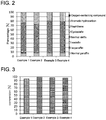
- Figure 2 is a component distribution diagram of a group of peaks in C8-C9 zone according to GC/MS analysis
- Figure 3 is a conversion rate diagram
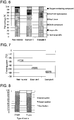
- Figure 4 is a pour point diagram.
- HiBD crude oil 1 as raw material No.2 in (Table 2) was used as a raw material.
- Example 2 The temperature dependency of the composition of a bio-jet fuel as a product at a high temperature was confirmed in the Examples.
- the confirmation was performed in the same conditions as in Example 1 except that not only the reaction temperature was varied to 290°C and 300°C with the pressure being kept at 2.0 (MPa) and the LHSV being kept at 0.5 (h -1 ) as in Example 1, but also the hydro-isomerization catalyst was changed to an attached mixed catalyst (No. 2 of (Table 3b)).
- the component distribution of HiBD crude oil 1 as raw material No.2 in (Table 2) was confirmed as that of a control raw material.
- GC-FID was used for calculation of the component distribution. After sample analysis was performed with GC/MS in the same conditions as in GC-FID, each peak was analyzed.
- raw material No.2 could be utilized in a high-quality bio-jet fuel under the conditions of use of the attached mixed catalyst as the hydro-isomerization catalyst, a pressure of 2.0 (MPa), and a LHSV of 0.5 (h -1 ).
- reaction 1) is the most desirable reaction and reaction 2) is the second desirable reaction.
- reaction 3) is an undesirable reaction because, when the reaction occurs, a gaseous product such as methane is produced and the yield of a refined oil is decreased in an amount corresponding to the production of methane or the like.
- the catalyst was a composite (No. 3 and No. 4 of (Table 3b)) of a Ni-Pd/alumina catalyst and a zeolite relatively large in pore size, such as Y or ⁇ zeolite, and heptane was used as a model compound.
- Each reaction was performed at a reaction temperature of 240°C and a reaction pressure of 2.0 MPa.
- Heptane was used as a raw material, as in the above.
- the reaction temperature was 240°C
- the pressure was 1.0, 2.0, or 3.0 MPa
- the catalyst here used was a composite of a Ni-Pd/alumina catalyst and zeolite.
- the selection rate in the isomerization reaction being a desirable reaction at any pressure was remarkably high. It was thus found that a sufficient isomerization reaction proceeded even at a low pressure of 1.0 to 3.0 MPa.
- Respective crude oils (crude oil 2 and crude oil 3) obtained from waste food oil were used for raw materials, thereby obtaining refined oils at a reaction temperature of 240°C and at a pressure of 2.0 MPa by the same catalyst as in Example 8.
- Example 10 Crude oil 2 Refined oil Crude oil 3 Refined oil C8 or lower 0.6 23.2 0.2 26.7 C9-15 43.1 67.4 47.4 67.1 C16 or more 56.3 9.3 52.4 6.2
- Example 10 Component distribution [%] Crude oil 2 Refined oil Crude oil 3 Refined oil Normal paraffin 69.0 26.2 70.8 26.6 Isoparaffin 1.7 63.7 0.3 68.1 Isoolefin 0.0 0.0 0.0 0.0 Normal olefin 11.0 0.0 11.0 0.0 Cycloolefin 0.4 0.0 2.2 0.0 Cycloparaffin 1.5 7.3 4.9 4.4 Aromatics 3.9 0.0 1.6 0.0 Oxygen-containing aromatics 0.2 0.0 0.3 0.0 Oxygen-containing cycloparaffin 0.4 0.6 0.9 0.0 Oxygen-containing cycloolefin 0.1 0.0 0.0 0.0 Oxygen-containing linear hydrocarbon 11.8 2.3 8.0 0.8 Total 100 100 100 100 100 100 Cyclic compound [%]
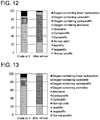
- Table 15 shows the component distribution, acid value and pour point of each of the refined oils, and furthermore Figure 12 and Figure 13 each show a component distribution diagram of each of the refined oils.
- the cyclic compound in Table 15 refers to all cyclic compounds of cycloparaffin, cycloolefin, an aromatic compound, and the like.
- the proportions of cycloparaffin and aromatics in each of the refined oils of Example 9 and Example 10 were 7.3% and 0%, and 4.4% and 0%, respectively.
- the standard values of cycloparaffin and aromatics according to the ASTM standard are a maximum of 15 mass% and a maximum of 0.5 mass%, respectively.
- the ASTM standard value defines 0.015 mgKOH/g-oil as the maximum value with respect to the acid value, and the ASTM standard value defines -40°C with respect to the pour point.
- the refined oils in Examples 9 and 10 each exhibited an acid value of 0 mgKOH/g-oil, and exhibited a pour point of -50 to -45°C in Example 9 and a pour point of -55 to -50°C in Example 10, and thus such acid values and pour points satisfied the ASTM standard values.
- the present invention is a significant invention relating to a method for producing a bio-jet fuel, which can provide a high-quality bio-jet fuel at a high yield.
Landscapes
- Chemical & Material Sciences (AREA)
- Chemical Kinetics & Catalysis (AREA)
- Engineering & Computer Science (AREA)
- Organic Chemistry (AREA)
- Oil, Petroleum & Natural Gas (AREA)
- Materials Engineering (AREA)
- General Chemical & Material Sciences (AREA)
- Crystallography & Structural Chemistry (AREA)
- Production Of Liquid Hydrocarbon Mixture For Refining Petroleum (AREA)
- Organic Low-Molecular-Weight Compounds And Preparation Thereof (AREA)
- Fats And Perfumes (AREA)
- Liquid Carbonaceous Fuels (AREA)
- Low-Molecular Organic Synthesis Reactions Using Catalysts (AREA)
- Catalysts (AREA)
Applications Claiming Priority (2)
| Application Number | Priority Date | Filing Date | Title |
|---|---|---|---|
| JP2018096478 | 2018-05-18 | ||
| PCT/JP2019/019756 WO2019221287A1 (ja) | 2018-05-18 | 2019-05-17 | バイオジェット燃料の製造方法 |
Publications (2)
| Publication Number | Publication Date |
|---|---|
| EP3795657A1 true EP3795657A1 (de) | 2021-03-24 |
| EP3795657A4 EP3795657A4 (de) | 2021-06-23 |
Family
ID=68540161
Family Applications (1)
| Application Number | Title | Priority Date | Filing Date |
|---|---|---|---|
| EP19804579.1A Pending EP3795657A4 (de) | 2018-05-18 | 2019-05-17 | Verfahren zur herstellung eines biotreibstoffes |
Country Status (10)
| Country | Link |
|---|---|
| US (1) | US11603501B2 (de) |
| EP (1) | EP3795657A4 (de) |
| JP (2) | JP6635362B1 (de) |
| KR (1) | KR102487444B1 (de) |
| CN (1) | CN112189046B (de) |
| BR (1) | BR112020022177B1 (de) |
| MY (1) | MY200211A (de) |
| PH (1) | PH12020551965A1 (de) |
| SG (1) | SG11202011450RA (de) |
| WO (1) | WO2019221287A1 (de) |
Cited By (1)
| Publication number | Priority date | Publication date | Assignee | Title |
|---|---|---|---|---|
| WO2024079387A1 (en) * | 2022-10-14 | 2024-04-18 | Neste Oyj | A process for producing an aviation fuel component |
Families Citing this family (8)
| Publication number | Priority date | Publication date | Assignee | Title |
|---|---|---|---|---|
| JPWO2023085337A1 (de) * | 2021-11-09 | 2023-05-19 | ||
| EP4457317A1 (de) * | 2021-12-30 | 2024-11-06 | Neste Oyj | Mitteldestillatbrennstoff aus organischem material biologischen ursprungs |
| CN120322293A (zh) * | 2022-09-27 | 2025-07-15 | 国立大学法人东京农工大学 | 生物喷气燃料制造用催化剂和使用了生物喷气燃料制造用催化剂的生物喷气燃料制造方法 |
| CN117825665B (zh) * | 2023-12-13 | 2024-12-27 | 湖北天基生物能源股份有限公司 | 一种高收率可持续航空燃料的原料筛选方法 |
| CN120272231B (zh) * | 2024-01-05 | 2026-04-14 | 中国石油化工股份有限公司 | 一种油脂类原料生产生物喷气燃料的加氢方法 |
| CN120272234B (zh) * | 2024-01-08 | 2026-04-14 | 中国石油化工股份有限公司 | 一种制备生物喷气燃料的加氢方法 |
| CN120272233B (zh) * | 2024-01-08 | 2026-04-14 | 中国石油化工股份有限公司 | 一种油脂类原料生产喷气燃料的方法 |
| JP7788605B1 (ja) * | 2024-12-13 | 2025-12-19 | 横井 明 | 燃料油の製造方法 |
Family Cites Families (24)
| Publication number | Priority date | Publication date | Assignee | Title |
|---|---|---|---|---|
| DE2503302C3 (de) | 1975-01-28 | 1978-07-20 | Gestra-Ksb-Vertriebsgesellschaft Mbh & Co Kg, 2800 Bremen | Ventil, insbesondere schwimmergesteuerter Kondensatableiter |
| JPS62279854A (ja) * | 1986-05-30 | 1987-12-04 | Tomoe Kogyo Kk | 燃料油清浄装置 |
| US7540838B2 (en) | 2005-10-18 | 2009-06-02 | Varco I/P, Inc. | Centrifuge control in response to viscosity and density parameters of drilling fluid |
| DE602007011667D1 (de) * | 2006-12-01 | 2011-02-10 | Univ North Carolina State | Verfahren zur umwandlung von biomasse in treibstoff |
| US20080163543A1 (en) * | 2007-01-05 | 2008-07-10 | Ramin Abhari | Process for producing bio-derived fuel with alkyl ester and iso-paraffin components |
| CN101230291B (zh) | 2007-01-23 | 2012-02-29 | 中国石油化工股份有限公司 | 一种低能耗的费托合成产物的加工方法 |
| WO2008124607A1 (en) | 2007-04-06 | 2008-10-16 | Syntroleum Corporation | Process for co-producing jet fuel and lpg from renewable sources |
| US8058492B2 (en) | 2008-03-17 | 2011-11-15 | Uop Llc | Controlling production of transportation fuels from renewable feedstocks |
| US8198492B2 (en) | 2008-03-17 | 2012-06-12 | Uop Llc | Production of transportation fuel from renewable feedstocks |
| PT2141217E (pt) * | 2008-07-01 | 2015-07-30 | Neste Oil Oyj | Processo para o fabrico de combustível para aviação ou stocks de mistura para combustível para aviação de origem biológica |
| CN102203218B (zh) * | 2008-10-31 | 2015-03-25 | 公益财团法人北九州产业学术推进机构 | 生物柴油燃料的制备方法及其制备装置、用于该方法的油脂脱羧分解催化剂 |
| JP5330935B2 (ja) * | 2009-08-31 | 2013-10-30 | Jx日鉱日石エネルギー株式会社 | 航空燃料油基材の製造方法及び航空燃料油組成物 |
| CN103459031A (zh) | 2010-12-16 | 2013-12-18 | 能源技术公司 | 催化剂、催化剂的制备方法、脱氧的方法以及用于燃料制造的系统 |
| BR112013019652A2 (pt) * | 2011-02-03 | 2019-09-24 | Univ Louisville Res Found Inc | processo para converter ácido graxos em hidrocarbonetos lineares parafínicos, processo para produzir hidrocarbonetos parafínicos ramificados à partir de ácidos graxos e hidrocarboneto parafínico |
| EP2679657B1 (de) * | 2012-06-27 | 2016-01-06 | Alfa Laval Corporate AB | Verfahren zum abscheiden von katalysatorfeinteilen aus einem ölstrom |
| DE102012112026A1 (de) | 2012-12-10 | 2014-06-12 | Gea Mechanical Equipment Gmbh | Verfahren zur Aufbereitung von Schweröl |
| US9162938B2 (en) | 2012-12-11 | 2015-10-20 | Chevron Lummus Global, Llc | Conversion of triacylglycerides-containing oils to hydrocarbons |
| MY173217A (en) | 2013-03-13 | 2020-01-06 | Basf Corp | Hydroisomerization catalysts based on fe containing molecular sieves |
| US20140275670A1 (en) | 2013-03-14 | 2014-09-18 | Ted R. Aulich | Process for low-hydrogen-consumption conversion of renewable feedstocks to alkanes |
| US9283572B2 (en) | 2013-09-09 | 2016-03-15 | Derrick Corporation | Centrifuge with automatic sampling and control and method thereof |
| WO2015107487A1 (en) * | 2014-01-20 | 2015-07-23 | Eni S.P.A. | Process for the production of hydrocarbon fractions from mixtures of a biological origin |
| US9771523B2 (en) * | 2014-07-11 | 2017-09-26 | Triton Emission Solutions Inc. | Fuel cleaning system and method for a ship |
| KR101607868B1 (ko) | 2014-10-14 | 2016-03-31 | 한국에너지기술연구원 | 비식용 유지를 이용한 고품질 바이오항공유 제조방법 및 이에 의해 제조된 바이오항공유 |
| US9914880B2 (en) | 2015-12-04 | 2018-03-13 | Uop Llc | Method of increasing the yield of aviation fuel from renewable feedstocks |
-
2019
- 2019-05-17 SG SG11202011450RA patent/SG11202011450RA/en unknown
- 2019-05-17 MY MYPI2020005906A patent/MY200211A/en unknown
- 2019-05-17 WO PCT/JP2019/019756 patent/WO2019221287A1/ja not_active Ceased
- 2019-05-17 EP EP19804579.1A patent/EP3795657A4/de active Pending
- 2019-05-17 BR BR112020022177-5A patent/BR112020022177B1/pt active IP Right Grant
- 2019-05-17 JP JP2019527571A patent/JP6635362B1/ja active Active
- 2019-05-17 US US17/055,062 patent/US11603501B2/en active Active
- 2019-05-17 CN CN201980032001.5A patent/CN112189046B/zh active Active
- 2019-05-17 KR KR1020207032858A patent/KR102487444B1/ko active Active
- 2019-10-18 JP JP2019190940A patent/JP2020090660A/ja active Pending
-
2020
- 2020-11-18 PH PH12020551965A patent/PH12020551965A1/en unknown
Cited By (1)
| Publication number | Priority date | Publication date | Assignee | Title |
|---|---|---|---|---|
| WO2024079387A1 (en) * | 2022-10-14 | 2024-04-18 | Neste Oyj | A process for producing an aviation fuel component |
Also Published As
| Publication number | Publication date |
|---|---|
| JP2020090660A (ja) | 2020-06-11 |
| BR112020022177A2 (pt) | 2021-02-02 |
| KR102487444B1 (ko) | 2023-01-10 |
| US20210171844A1 (en) | 2021-06-10 |
| PH12020551965A1 (en) | 2021-09-13 |
| JPWO2019221287A1 (ja) | 2020-05-28 |
| WO2019221287A1 (ja) | 2019-11-21 |
| EP3795657A4 (de) | 2021-06-23 |
| KR20200141087A (ko) | 2020-12-17 |
| MY200211A (en) | 2023-12-13 |
| US11603501B2 (en) | 2023-03-14 |
| BR112020022177B1 (pt) | 2024-02-06 |
| SG11202011450RA (en) | 2020-12-30 |
| CN112189046A (zh) | 2021-01-05 |
| CN112189046B (zh) | 2023-03-28 |
| JP6635362B1 (ja) | 2020-01-22 |
Similar Documents
| Publication | Publication Date | Title |
|---|---|---|
| EP3795657A1 (de) | Verfahren zur herstellung eines biotreibstoffes | |
| Lin et al. | The production of bio-jet fuel from palm oil derived alkanes | |
| KR102581306B1 (ko) | 카르복실산 및 에스테르를 기유 탄화수소로 전환하기 위한 방법 | |
| Sankaranarayanan et al. | Hydroprocessing of sunflower oil–gas oil blends over sulfided Ni–Mo–Al–zeolite beta composites | |
| US9458396B2 (en) | Process for conversion of feedstocks obtained from renewable sources based on marine fuels | |
| Bezergianni et al. | Effectiveness of CoMo and NiMo catalysts on co-hydroprocessing of heavy atmospheric gas oil–waste cooking oil mixtures | |
| EP2177587B1 (de) | Entgasung von materialien biologischen ursprungs | |
| Onyestyák et al. | Sunflower oil to green diesel over Raney-type Ni-catalyst | |
| JP5317644B2 (ja) | 航空燃料油基材の製造方法 | |
| Li et al. | Recent advances for the production of hydrocarbon biofuel via deoxygenation progress | |
| AU2016218804A1 (en) | Hydrotreatment method for low-temperature fischer-tropsch synthesis product | |
| KR102359499B1 (ko) | 방향족 및 황 함량이 낮은 탄화수소 유체의 제조 방법 | |
| EP3666857A1 (de) | Verfahren zur herstellung von flüssigem kohlenwasserstoffbrennstoff | |
| KR101607868B1 (ko) | 비식용 유지를 이용한 고품질 바이오항공유 제조방법 및 이에 의해 제조된 바이오항공유 | |
| US12319881B1 (en) | Converting a renewable fuel intermediate composition to finished transportation fuel | |
| WO2007105400A1 (ja) | 炭化水素油の製造方法および炭化水素油 | |
| US20130338411A1 (en) | Liquefaction of carbonaceous material and biomass to produce a synthetic fuel | |
| KR101452793B1 (ko) | 수소화 정제방법 | |
| EP3467076A1 (de) | Verfahren zur herstellung von flüssigem kohlenwasserstoffbrennstoff | |
| US10457875B2 (en) | H2 and bio-fuels production from renewable feedstocks | |
| Toth et al. | Straight run gas oil as sulphur compound to preserve the sulphide state of the hydroprocessing catalyst of triglycerides | |
| Kasza et al. | Isomerization of paraffin mixtures produced from sunflower oil | |
| KR102079608B1 (ko) | 바이오 매스로부터 연료유 및 윤활기유 제조용 중합촉매 및 이를 이용한 연료유 및 윤활기유의 제조방법 | |
| CN118853222B (zh) | 一种含氯油脂类原料加氢制备喷气燃料组分的方法 | |
| WO2026072435A1 (en) | Converting a renewable fuel intermediate composition to finished transportation fuel |
Legal Events
| Date | Code | Title | Description |
|---|---|---|---|
| STAA | Information on the status of an ep patent application or granted ep patent |
Free format text: STATUS: THE INTERNATIONAL PUBLICATION HAS BEEN MADE |
|
| PUAI | Public reference made under article 153(3) epc to a published international application that has entered the european phase |
Free format text: ORIGINAL CODE: 0009012 |
|
| STAA | Information on the status of an ep patent application or granted ep patent |
Free format text: STATUS: REQUEST FOR EXAMINATION WAS MADE |
|
| 17P | Request for examination filed |
Effective date: 20201111 |
|
| AK | Designated contracting states |
Kind code of ref document: A1 Designated state(s): AL AT BE BG CH CY CZ DE DK EE ES FI FR GB GR HR HU IE IS IT LI LT LU LV MC MK MT NL NO PL PT RO RS SE SI SK SM TR |
|
| AX | Request for extension of the european patent |
Extension state: BA ME |
|
| A4 | Supplementary search report drawn up and despatched |
Effective date: 20210526 |
|
| RIC1 | Information provided on ipc code assigned before grant |
Ipc: C10G 3/00 20060101AFI20210519BHEP Ipc: B01J 23/883 20060101ALI20210519BHEP Ipc: B01J 23/89 20060101ALI20210519BHEP Ipc: B01J 29/08 20060101ALI20210519BHEP Ipc: B01J 29/70 20060101ALI20210519BHEP Ipc: B01J 37/04 20060101ALI20210519BHEP Ipc: C10G 45/58 20060101ALI20210519BHEP Ipc: C10G 65/04 20060101ALI20210519BHEP Ipc: B01J 23/02 20060101ALI20210519BHEP Ipc: B01J 35/00 20060101ALI20210519BHEP Ipc: B01J 21/10 20060101ALI20210519BHEP Ipc: B01J 23/72 20060101ALI20210519BHEP |
|
| RIC1 | Information provided on ipc code assigned before grant |
Ipc: C10G 3/00 20060101AFI20210618BHEP Ipc: B01J 23/883 20060101ALI20210618BHEP Ipc: B01J 23/89 20060101ALI20210618BHEP Ipc: B01J 29/08 20060101ALI20210618BHEP Ipc: B01J 29/70 20060101ALI20210618BHEP Ipc: B01J 37/04 20060101ALI20210618BHEP Ipc: C10G 45/58 20060101ALI20210618BHEP Ipc: C10G 65/04 20060101ALI20210618BHEP Ipc: B01J 23/02 20060101ALI20210618BHEP Ipc: B01J 35/00 20060101ALI20210618BHEP Ipc: B01J 21/10 20060101ALI20210618BHEP Ipc: B01J 23/72 20060101ALI20210618BHEP Ipc: B01J 21/04 20060101ALI20210618BHEP Ipc: B01J 29/16 20060101ALI20210618BHEP |
|
| DAV | Request for validation of the european patent (deleted) | ||
| DAX | Request for extension of the european patent (deleted) | ||
| STAA | Information on the status of an ep patent application or granted ep patent |
Free format text: STATUS: EXAMINATION IS IN PROGRESS |
|
| 17Q | First examination report despatched |
Effective date: 20220204 |